
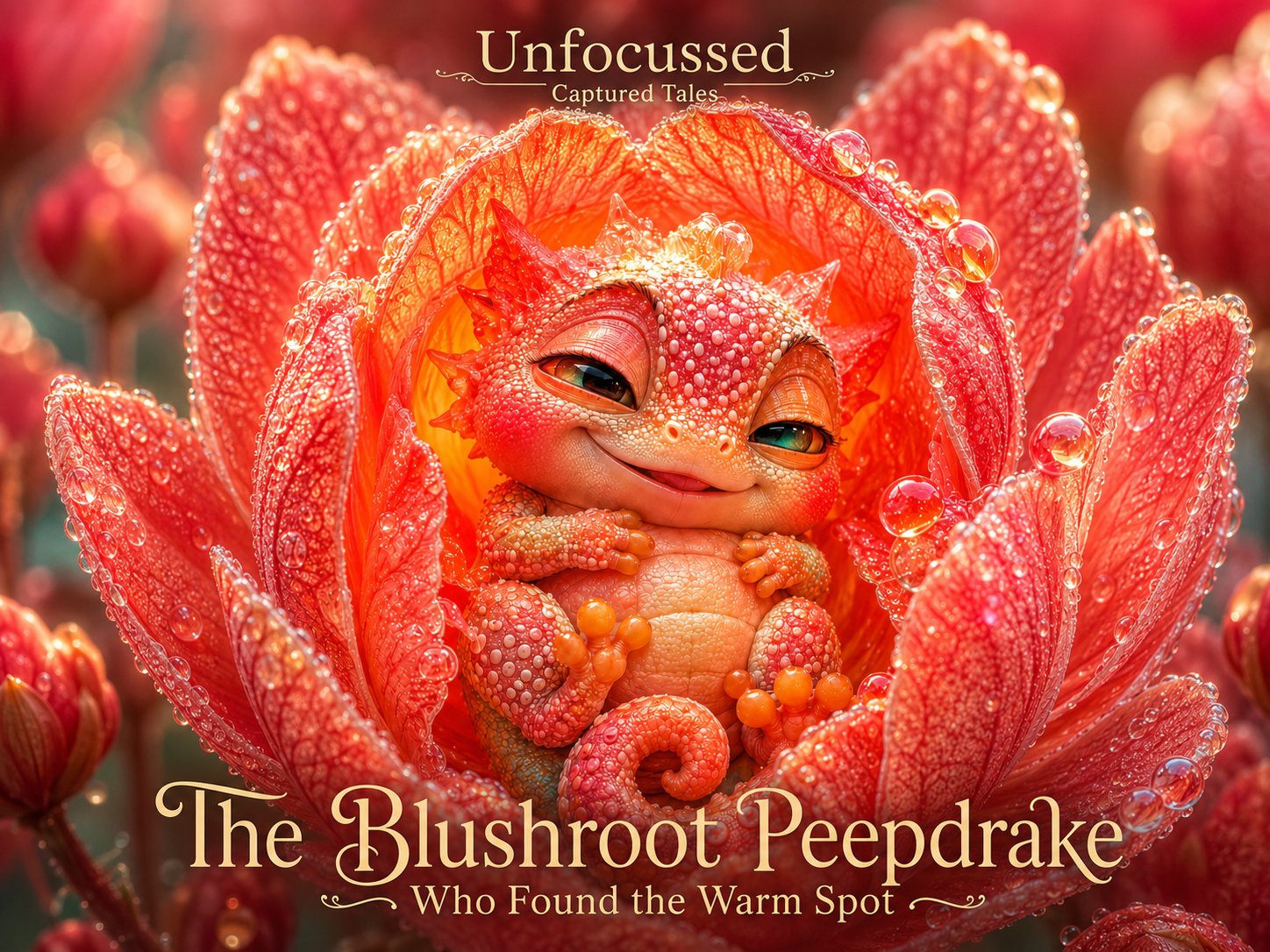
The Flower That Blushed Back
There were warm places in Sugarwild Garden, and then there were warm places.
A sun-baked stone beside the raspberry wall was warm. The underside of a sleeping bumbleboar was warm, provided one did not mind the snoring, the smell, or the possibility of being rolled into jam. Madame Crinklecap’s compost heap remained warm through winter, although sitting upon it invited questions no respectable creature wished to answer.
But the center of a fully opened blushroot bloom was something else entirely.
It was soft without being soggy, snug without being tight, and heated from beneath by a faint magical pulse that traveled upward through the flower’s roots. Its overlapping petals formed a deep scarlet cradle lined with golden pollen and jeweled with morning dew. The warmth gathered there in one exquisite pocket, exactly large enough for a small creature with four feet, a curled tail, and absolutely no intention of sharing.
The Blushroot Peepdrake discovered it shortly after dawn.
He had not been searching for anything important. Peepdrakes rarely did. He had spent the morning chasing a floating seed tuft, biting three droplets because they sparkled suspiciously, and attempting to intimidate his reflection in the polished shell of a passing glimmerbeetle.
The glimmerbeetle had not been intimidated.
“You are the size of a breakfast biscuit,” she had informed him.
The peepdrake puffed himself up, which only made him look like a breakfast biscuit that had become emotionally invested in an argument.
Then a breeze passed through the blushroot patch.
One enormous flower opened beneath him with a slow, silken rustle. A breath of fragrant heat rose from its center and rolled across his belly.
The peepdrake stopped mid-puff.
His pupils widened.
His tiny nostrils flared.
His expression changed from wounded outrage to the solemn wonder of a creature receiving a personal invitation from the universe.
He stepped onto the nearest petal.
The bloom warmed beneath his toes.
“Peep?” he whispered.
He took another step.
The petals flexed inward, guiding him gently toward the glowing center. Heat soaked through his pearly coral scales. His translucent back-spikes tingled. His curled tail loosened, then tightened again in pure delight.
He lowered one foot into the central hollow.
Then the other.
Then, with a wiggle so shamelessly satisfied that the glimmerbeetle immediately looked away, he planted his little backside directly in the warmest spot.
The flower blushed.
Its deep pink petals brightened to scarlet.
The peepdrake blinked.
The blushroot released another pulse of heat.
He sank lower.
The petals deepened from scarlet to luminous crimson.
The peepdrake’s mouth curled into a sleepy smile.
The flower glowed brighter still.
Neither of them understood what had just begun.
The blushroot was a responsive bloom. Its petals changed color when warmed, and the warmer its petals became, the more heat its roots drew from the rich earth below. Ordinarily this harmless little cycle ended when the morning sun moved on or a passing creature left the flower.
The peepdrake, however, had no intention of leaving.
He tucked his front feet beneath his round belly. He rested his chin upon the petal rim. A bead of dew rolled down one of his spikes, slid along his nose, and dropped into the pollen beneath him with a tiny hiss.
“That,” said the glimmerbeetle, “appears warmer than it should be.”
The peepdrake opened one eye.
“Peep.”
“Are you planning to move?”
He closed the eye.
“Peep.”
“Was that a yes-peep or a no-peep?”
The peepdrake tucked himself another half inch deeper into the bloom.
The glimmerbeetle sighed. “No-peep. Of course.”
By midmorning, the blushroot flower could be seen glowing from the opposite side of the garden.
This attracted the attention of Mallowdip, a young nectar mouse whose chief occupations were sampling unattended pastries and appearing wherever something unusual might become edible.
He climbed the flower’s stem and peered over the rim.
“Oh,” he said. “There you are.”
The peepdrake did not move.
“We’ve been looking for you.”
This was not true. Nobody had been looking for the peepdrake. Mallowdip had only said it because it sounded more official than I smelled something cooking.
He placed one paw on the petal and snatched it back.
“That’s hot.”
The peepdrake smiled without opening his eyes.
“Do you know it’s hot?”
“Peep.”
“Right. Stupid question.”
Mallowdip leaned closer. Heat shimmered above the peepdrake’s back. The dew on the surrounding petals had vanished. Tiny curls of steam rose from the bloom’s golden center.
“You may be getting cooked.”
The peepdrake’s smile widened.
“You look oddly pleased about that.”
A low, contented trill vibrated through the petals.
The blushroot responded at once. Its veins flashed molten orange. Heat traveled down the stem and into the tangled roots below, where it nudged the neighboring blooms awake.
One by one, they began to blush.
Across the patch, pale pink flowers turned red.
Then crimson.
Then a bright, unnatural shade normally associated with warning signs, emergency lanterns, and Madame Honeyslip after somebody mentioned the midsummer picnic.
Mallowdip watched the color spread.
“I think you’re doing that.”
The peepdrake lifted his head.
For one hopeful moment, Mallowdip thought he might stand.
Instead, the little creature turned around three times, mashed his backside into the hottest part of the flower, and settled facing the opposite direction.
“You cannot simply show me your bottom whenever I raise a legitimate horticultural concern.”
The peepdrake flicked his tail over his nose.
“Apparently you can,” Mallowdip muttered.
By noon, the warmth had escaped the blushroot patch and spread into the surrounding garden beds.
The sugarberries began to sweat.
The butterplums softened on their branches.
A row of frostmint curled into itself and whispered that this was exactly why it preferred winter.
Three gumdrop gnats flew too close to the central bloom and emerged with their feet lightly caramelized. They found this delightful and immediately went back for another pass.
At the edge of the patch, a family of bogbeans discovered that their lunch had cooked inside its leaf wrapping without anyone lighting a stove.
“Convenient,” said the eldest bogbean.
“Ominous,” said his wife.
“Needs salt,” said their son.
High above them, the peepdrake slept on.
With every warm breath he released, the flower grew hotter.
With every increase in heat, the peepdrake grew happier.
And with every happy little trill, the blushroot pulled more warmth from beneath the garden.
It was a catastrophically perfect arrangement.
The first berry burst at twelve minutes past noon.
It was a bloomberry belonging to Lady Bristlewink, who had spent six weeks polishing it for the Summer Produce Admiration. The berry gave one faint squeak, swelled to twice its proper size, and exploded against her hat.
Lady Bristlewink stood motionless beneath a dripping layer of purple pulp.
“Someone,” she said with terrifying calm, “is going to explain that.”
A second bloomberry burst behind her.
Then a third.
All across the garden, fruit began simmering on the stem. Nectar bubbled inside unopened flowers. The pond warmed until the lilyfish climbed onto the bank and fanned themselves with their fins.
A buttercup beside the main path suddenly produced a perfectly browned biscuit.
Nobody knew why.
Nobody trusted it.
Mallowdip ate it anyway.
Within minutes, worried creatures gathered around the blushroot patch. Beetles carried shade leaves. Fairies arrived with dew buckets. Two elderly thimblemoths brought folding chairs, because they had correctly recognized that whatever happened next would be worth watching.
At the center of it all, glowing like a coal wrapped in silk, sat the blushroot bloom.
Inside it, the peepdrake remained curled in unbearable comfort.
His scales had taken on a rosy golden shine. His cheeks were warm. His tiny tongue protruded between his teeth. Every so often, he performed a blissful little wiggle that sent another red pulse racing through the petals.
“There,” Mallowdip announced, pointing. “That’s the problem.”
Lady Bristlewink narrowed her eyes. Purple juice dripped from the brim of her hat.
“That smug dumpling?”
The peepdrake opened one eye and looked at her.
“Peep.”
“Do not ‘peep’ at me. My prize bloomberry is running down my collar.”
The peepdrake considered this, yawned, and closed his eye again.
A gasp moved through the crowd.
Lady Bristlewink’s left eyebrow began twitching.
“Remove him.”
Nobody volunteered.
The flower was now hot enough to brown a leaf at three paces. Waves of heat distorted the air above it, making the peepdrake appear to wobble like a pink pudding.
Finally, a broad-shelled dewbeetle named Constable Clack stepped forward. He wrapped wet moss around all six feet, lowered his horn, and marched up the stem.
“Young dragon,” he called, “you are occupying a dangerously overheated bloom. By authority of the Garden Safety Committee, you are ordered to vacate immediately.”
The peepdrake’s tail twitched.
Constable Clack climbed onto the outer petal.
“Did you hear me?”
“Peep.”
“Good. Then vacate.”
“Peep.”
“I am beginning to dislike the flexibility of that word.”
The constable edged closer, reached into the flower, and placed two feet beneath the peepdrake’s round belly.
He lifted.
The peepdrake did not rise.
Constable Clack pulled harder.
The peepdrake’s front claws emerged from beneath his chest and sank into the petal lining.
“Release the flower.”
The peepdrake gripped tighter.
“This is an official instruction.”
Two more claws appeared.
“You are making this unnecessarily difficult.”
The curled tail uncurled and wrapped around the central stamen.
Constable Clack braced all six feet and heaved.
The peepdrake stretched.
The flower stretched.
The stamen stretched.
The crowd leaned forward.
Then the peepdrake snapped back into the bloom like a released berry sling, launching Constable Clack through the air and directly into Lady Bristlewink.
They landed together in a warm patch of mint.
The peepdrake resettled himself, gave one satisfied shimmy, and resumed snoring.
The blushroot flared brilliant red.
Far beneath the flower bed, a new surge of heat raced through the root network.
The ground trembled.
Every unopened blushroot bud in the garden sprang open at once.
A hundred crimson blooms turned toward the central flower.
From somewhere beyond the raspberry wall came a series of wet, heavy pops as the remaining berries began bursting in rapid succession.
Mallowdip stared at the glowing patch.
“Well,” he said, licking biscuit crumbs from his whiskers, “the good news is that he finally found somewhere comfortable.”
Lady Bristlewink rose from the mint with Constable Clack tangled in her hat.
“And the bad news?” she asked.
A bead of sweat rolled down Mallowdip’s nose and evaporated before reaching his chin.
Behind him, the butterplum tree began to steam.
“I think,” he said, “he may be about to cook the entire garden.”
The Garden Begins to Simmer
Lady Bristlewink looked from the steaming butterplum tree to the glowing blushroot patch.
“Then remove him properly.”
Constable Clack extracted himself from her hat and dropped onto the mint with what remained of his dignity.
“I attempted that.”
“You tickled his stomach and became airborne.”
“It was a tactical pull.”
“It was a tactical disaster.”
The ground gave another tremble.
Across Sugarwild Garden, the hundred newly opened blushroots began drawing heat through their connected roots. Their petals brightened in sequence, creating expanding rings of crimson light around the sleeping peepdrake.
The nearest flowers warmed first.
Then those beside the berry path.
Then the blossoms beneath the old honeywillow.
Finally, a neglected cluster behind Madame Crinklecap’s compost heap flared red and ignited a pair of bloomers she had hung there to dry.
Madame Crinklecap emerged carrying a watering can and wearing nothing below the waist but a furious expression.
“Which one of you bastards cooked my drawers?”
Nobody answered.
She followed the glowing root trail toward the blushroot patch, saw the crowd, and immediately understood that her undergarments were only the beginning.
“Oh,” she said. “We’re having one of those days.”
The peepdrake snored.
A ripple of heat rolled outward.
Several creatures ducked.
The two thimblemoths unfolded parasols without leaving their chairs.
“This is better than the beetle wedding,” said one.
“Nothing is better than the beetle wedding,” said the other. “The groom ate the bouquet and married the centerpiece.”
“Give it time.”
Lady Bristlewink climbed onto an overturned dew bucket so the assembled creatures could see her above the steam.
“We require a plan.”
“Cold water,” suggested a fairy.
“Shade cloth,” offered a beetle.
“A very long stick,” said Madame Crinklecap.
“Lunch,” said Mallowdip.
Lady Bristlewink glared at him.
“We may be trapped here for hours,” he explained.
“You have eaten continuously since you arrived.”
“That is why I remain calm in emergencies.”
Another bloomberry exploded behind them.
Mallowdip caught a chunk in his mouth.
“Preparedness,” he said while chewing.
The Garden Safety Committee formed beneath the honeywillow, although nobody had invited the Garden Safety Committee and half its members had only joined because they enjoyed wearing little orange hats.
Constable Clack drew a diagram in the soil.
It consisted of a circle labeled HOT FLOWER, a smaller circle labeled DRAGON, and six arrows pointing in contradictory directions.
“Our first priority,” he said, “is reducing the temperature without startling the occupant.”
“Why?” asked Madame Crinklecap.
“A frightened peepdrake may release defensive flame.”
Everyone looked toward the creature in the bloom.
The peepdrake rolled onto his back. His round belly glowed softly. One hind foot kicked twice in a dream.
“That thing breathes fire?” Lady Bristlewink asked.
“Technically.”
“How much?”
Constable Clack considered this.
“No one knows.”
“Has he never done it?”
“He once sneezed near a haystack.”
“And?”
“We no longer have a haystack.”
Lady Bristlewink stepped down from the bucket.
“Cold water it is.”
The fairies organized a bucket line from Dewdrop Pond. This would normally have been an excellent idea. Unfortunately, Dewdrop Pond had already grown so warm that the lilyfish were using the buckets as personal baths.
The first bucket reached the blushroot patch with three lilyfish inside it and barely enough water to dampen a handkerchief.
“Get out,” ordered Lady Bristlewink.
The largest lilyfish folded its fins across its chest.
“The pond is soup.”
“This is an emergency.”
“Exactly. We are evacuating.”
“Not in our cooling water.”
“Find your own bucket.”
While Lady Bristlewink argued with the refugees, the fairies carried a second bucket toward the flower. They flew as close as the heat allowed and flung the water in a sparkling arc.
It struck the outer petals.
There was a tremendous hiss.
A cloud of pink steam engulfed the entire patch.
The crowd disappeared.
For several seconds, Sugarwild Garden contained nothing but coughing, wingbeats, and Madame Crinklecap shouting that someone had grabbed the wrong mushroom.
When the steam cleared, the blushroot stood exactly as before.
The peepdrake remained asleep.
The water had evaporated without cooling the bloom by a single degree.
Worse, the warm mist settled across the garden and condensed upon every berry, leaf, and creature in a thin layer of scented moisture.
Mallowdip licked his arm.
“Raspberry.”
Lady Bristlewink wiped pink droplets from her face.
“Do not encourage it.”
Inside the flower, the peepdrake inhaled the humid air and gave a deeper, happier trill.
The blushroot’s petals flashed.
The soil beneath the crowd grew hot enough that everyone began hopping from foot to foot.
“Cooling attempt unsuccessful,” Constable Clack announced.
“Thank you,” said Lady Bristlewink. “We might have mistaken this for progress.”
Plan Two involved shade.
The beetles stitched together twenty-seven broad moonmallow leaves, four picnic blankets, Madame Crinklecap’s surviving laundry, and a ceremonial banner reading WELCOME, REGIONAL TURNIP INSPECTORS.
They stretched the enormous canopy over the entire blushroot patch.
For one blessed moment, the garden dimmed.
The flowers stopped brightening.
The butterplum tree ceased steaming.
Several creatures applauded.
Then the trapped heat gathered beneath the canopy.
The applause ended.
The leaves sagged.
The picnic blankets began smoking.
The words REGIONAL TURNIP INSPECTORS browned, curled, and vanished one letter at a time.
The peepdrake’s head rose above the petal rim.
The entire crowd froze.
His eyes opened halfway.
He looked at the enormous roof they had built over him.
For the first time all afternoon, his smile disappeared.
“Perhaps he dislikes shade,” whispered Mallowdip.
The peepdrake inflated.
His cheeks puffed.
His translucent spikes stood upright.
A warm golden glow appeared deep inside his throat.
“Down!” shouted Constable Clack.
The peepdrake sneezed.
A narrow jet of pink-orange flame shot upward, pierced the canopy, and set the turnip banner ablaze.
The beetles released the ropes.
The burning canopy collapsed.
The crowd scattered in all directions as flaming laundry, roasted moonmallow leaves, and one pair of Madame Crinklecap’s reinforced gardening bloomers drifted from the sky.
The bloomers landed over Constable Clack.
“Those are the durable pair,” Madame Crinklecap called. “You’ll be fine.”
Lady Bristlewink stamped out a picnic blanket with both feet.
“Whose plan was shade?”
Every beetle pointed at Constable Clack.
His muffled voice emerged from inside the bloomers.
“The committee approved it collectively.”
“Cowards,” he added after a pause.
The peepdrake watched the commotion with mild interest.
Then a shaft of sunlight fell through the hole he had burned in the canopy and touched his belly.
His smile returned.
He curled back into the warm hollow.
“Peep,” he murmured.
The flower pulsed.
Every blushroot in the garden became a shade brighter.
“We have made him warmer,” Lady Bristlewink said.
“Marginally,” said Constable Clack.
“We soaked the garden in hot raspberry fog and built him a greenhouse.”
“When you phrase it that way, the operation sounds less successful.”
“There is no other way to phrase it.”
Plan Three was Madame Crinklecap’s very long stick.
It was not an ordinary stick. It had once been the handle of a ceremonial rake belonging to the Duke of Mulch, and it was long enough to poke the peepdrake from beyond the worst of the heat.
Madame Crinklecap wrapped a cushion around one end.
“So we don’t hurt him,” Mallowdip said approvingly.
“So he doesn’t bite my rake.”
She braced the handle against her shoulder and advanced.
The crowd formed a wide semicircle behind her.
“Gentle pressure,” Constable Clack advised.
“I know how to use a stick.”
“We are attempting to persuade him, not launch him.”
“You had your turn.”
Madame Crinklecap extended the padded end over the bloom and nudged the peepdrake’s side.
Nothing happened.
She nudged again.
The peepdrake shifted slightly, exposing more of his round belly to the warmth.
“Wrong direction,” said Lady Bristlewink.
“I am aware.”
Madame Crinklecap pressed harder.
The peepdrake rolled with the cushion, tucked his front feet around it, and hugged the end of the stick.
“He’s holding it,” Mallowdip said.
“I can see that.”
The peepdrake rubbed his cheek against the cushion.
A tiny purr traveled down the rake handle and into Madame Crinklecap’s arms.
“He thinks you brought him a pillow,” said one of the thimblemoths.
“That is adorable,” said the other.
Madame Crinklecap’s jaw tightened.
“Release my rake, you overheated turnip.”
She pulled.
The peepdrake held on.
She planted both feet and pulled harder.
The peepdrake’s tail wrapped around the central stamen while all four claws sank into the cushion.
The stick bowed.
The flower bent.
Madame Crinklecap leaned backward until her bare backside pointed directly at the committee.
“Nobody,” she warned, “says a word.”
Mallowdip covered his mouth.
Lady Bristlewink examined the sky.
The thimblemoths watched with the focused delight of creatures receiving a second show at no additional cost.
Madame Crinklecap gave one final heave.
The peepdrake released the cushion.
She flew backward through the crowd, taking four fairies, a dew bucket, and the diagram labeled HOT FLOWER with her.
The stick continued over the raspberry wall and vanished.
A distant voice shouted, “Who threw a rake through my gazebo?”
Madame Crinklecap lay in the grass.
“Nobody answer that.”
The peepdrake settled into the depression left by the cushion and licked one front foot.
Lady Bristlewink turned toward Constable Clack.
“We need someone who understands blushroots.”
“The Garden Botanical Society?”
“Those idiots classified a singing onion as a migratory bird.”
“Professor Thistlewhump?”
“Banned from the patch.”
“Why?”
“He attempted to cross-pollinate a blushroot with a trumpet vine. The result followed him home and announced his bowel movements for six months.”
Constable Clack shuddered.
“The Root Sisters, then.”
The crowd fell quiet.
Even Madame Crinklecap sat up.
The Root Sisters lived beneath the oldest stump in Sugarwild Garden. They were three ancient bogbean women who understood every underground root, bulb, tuber, buried secret, and regrettable thing anyone had attempted behind the hydrangeas.
They were wise.
They were powerful.
They were also extremely difficult to wake before supper.
“Send someone,” Lady Bristlewink ordered.
Everyone looked at Mallowdip.
He was standing beside the remains of the committee’s emergency biscuit supply with both cheeks full.
“Why me?” he asked.
“You are fast.”
“So are the fairies.”
“They are carrying water.”
The fairies quietly set down their empty buckets.
“You know the way,” Constable Clack added.
“Everyone knows the way.”
Lady Bristlewink leaned closer.
“Because you stole a pie from their windowsill last week and owe them an apology.”
Mallowdip swallowed.
“That sounds like a strong reason for someone else to go.”
A nearby sugarberry split open and released a slow stream of bubbling jam.
The garden path beneath Mallowdip’s feet had become soft enough to leave pawprints.
He looked at the glowing flower, the sleeping peepdrake, and Lady Bristlewink’s purple-stained face.
“I’ll need provisions.”
“Go.”
Mallowdip filled his pockets with biscuits and ran.
Behind him, the garden’s condition deteriorated with remarkable enthusiasm.
The warmed nectar inside the bellflowers began fermenting. Their bells hiccupped each time the wind moved them. A flock of buttonwing beetles drank from the nearest bloom and became aggressively affectionate, embracing stones, stems, and one deeply uncomfortable snail.
The frostmint gave up entirely and crawled into the shade.
Honey leaked from the combs beneath the honeywillow and fell in thick golden ropes. Three gumdrop gnats attempted to swing from them, collided in midair, and landed in a bowl of softened butterplums.
They declared this the finest day of their lives.
At Dewdrop Pond, bubbles rose from the mud.
The lilyfish evacuated into teacups, helmets, hollow gourds, and Lady Bristlewink’s second-best handbag.
“Absolutely not,” she told them.
The largest lilyfish sank deeper into the handbag.
“Possession is nine-tenths of pond law.”
“That is not a pond.”
“It is now.”
Lady Bristlewink closed her eyes and counted to five.
At three, another bloomberry burst against her back.
At four, she changed the exercise from counting to swearing.
The heat continued rising.
By late afternoon, every surface in the garden felt warm to the touch. The brass sundial drooped. Waxberries melted off their stems and flowed together into a fragrant blue puddle. The old stone gargoyle beside the herb beds removed his vest for the first time in two hundred years, revealing that nobody had ever bothered to carve his back.
The thimblemoths moved their chairs beneath an umbrella.
“Do you think we should leave?” asked the first.
“And miss the ending?” said the second.
“Good point.”
At the center of the crisis, the peepdrake awoke just enough to stretch.
He extended his front legs.
Then his back legs.
Then all four at once, pressing his round belly deeper into the flower’s glowing center.
The blushroot shuddered with delight.
A wave of red light raced outward through the root network.
The entire patch released a single enormous sigh.
The air grew ten degrees warmer.
Somewhere in the distance, a scarecrow spontaneously combusted.
Constable Clack stared at the peepdrake.
“He stretched.”
“I noticed,” Lady Bristlewink said.
“That was only a stretch.”
“I noticed that as well.”
“What happens when he wakes properly?”
Nobody answered.
The soil beneath the blushroot patch bulged.
A thick root surfaced, glowing orange beneath its bark. Then another rose beside it. All around the central flower, the ground split into narrow cracks filled with red light.
The peepdrake peered sleepily over the petal rim.
Hundreds of sweating creatures stared back.
He blinked.
“Peep?”
“Yes, this is about you,” Lady Bristlewink snapped.
The peepdrake glanced around at the steaming trees, bubbling berries, displaced fish, intoxicated beetles, scorched laundry, and Constable Clack’s smoldering orange hat.
He appeared to consider the evidence.
Then he looked down at his flower.
He touched one warm petal with his foot.
His eyes softened.
He gave the crowd an expression of such innocent satisfaction that three fairies immediately began questioning whether the disaster might somehow be their fault.
“Do not let the face fool you,” Lady Bristlewink said. “The face is part of the problem.”
The peepdrake lowered his chin onto the petal.
“Peep.”
“No.”
“Peep.”
“You cannot stay.”
The peepdrake’s eyes narrowed.
“Peep.”
“That sounded rude.”
Constable Clack adjusted his singed hat.
“I believe it was a refusal.”
“I know what it was.”
The peepdrake turned around and presented his backside to the committee again.
Lady Bristlewink made a sound normally heard from kettles moments before structural failure.
“When this is over,” she said, “I am having that creature fitted with trousers.”
The peepdrake wiggled.
The blushroot brightened.
“And suspenders.”
At last, Mallowdip returned from the oldest stump.
He arrived at a staggering run, his whiskers singed, his pockets empty, and three furious bogbean women rolling behind him inside an enormous hollow root.
The root struck a stone, bounced over a puddle of melted waxberries, and crashed to a halt beside the Garden Safety Committee.
The Root Sisters emerged one at a time.
The eldest, Granny Burdock, wore a crown of tangled roots and carried a forked walking stick.
The middle sister, Auntie Taproot, had soil beneath every fingernail and a necklace made from labeled seedpods.
The youngest, Miss Rhizoma, was only one hundred and twelve and therefore regarded by the others as flighty and irresponsible.
All three wore nightcaps.
Granny Burdock looked at the molten cracks in the soil.
She looked at the glowing flowers.
She looked at the peepdrake’s backside sticking out of the central bloom.
Then she turned to Mallowdip.
“You woke us for a dragon with a warm arse?”
“It is slightly more serious than that.”
A butterplum dropped from the steaming tree and burst into flames between them.
Granny Burdock watched it burn.
“Slightly,” she agreed.
The Root Sisters approached the patch. Unlike everyone else, they did not hop across the hot ground. Roots rose beneath their feet and carried them forward like slow wooden waves.
Auntie Taproot pressed one ear to the soil.
Miss Rhizoma touched the nearest blushroot stem.
Granny Burdock sniffed the air.
“Feedback fever,” she said.
Constable Clack found a fresh patch of soil and began another diagram.
“Meaning?”
“The dragon warms the flower. The flower warms the dragon. Every time the little fool feels comfortable, the roots pull more heat from below.”
“We had determined most of that,” Lady Bristlewink said.
Granny Burdock pointed her walking stick toward the glowing cracks.
“Had you determined the roots are drawing from the Emberdeep?”
Lady Bristlewink’s expression changed.
“The Emberdeep?”
“Ancient heat beneath the garden,” Auntie Taproot explained. “Warms the soil through winter. Ripens the moonmelons. Keeps the frostworms from freezing their little ends off.”
“And if the blushroots continue pulling from it?” asked Constable Clack.
Miss Rhizoma smiled brightly.
“The whole patch could erupt.”
There was a brief silence.
“Define erupt,” said Mallowdip.
“Upward,” said Miss Rhizoma.
“That is a direction, not a definition.”
“A very forceful upward.”
Granny Burdock struck the ground with her stick.
The cracks flashed beneath everyone’s feet.
“When the roots become saturated, every blushroot in Sugarwild Garden will release its stored heat at once. Flowers, pollen, soil, dragon, anyone standing nearby. Straight into the sky.”
The thimblemoths folded their chairs.
“Now?” asked the first.
“Now,” agreed the second.
They hurried away.
Lady Bristlewink looked toward the central bloom.
The peepdrake had fallen asleep again.
“How long do we have?”
Auntie Taproot pressed her ear to the soil once more.
There was a deep thump beneath the garden.
Then another.
The second was louder.
“Not long.”
Constable Clack wiped his horn.
“Can you sever the roots?”
“Not without releasing the heat immediately,” said Granny Burdock.
“Can you block them?”
“Not while the flower keeps asking for more.”
Lady Bristlewink stared at the peepdrake.
“Then we remove him.”
“You tried pulling?” asked Miss Rhizoma.
Constable Clack pointed to the impression his body had left in the mint.
“Poking?”
Madame Crinklecap pointed beyond the raspberry wall, where someone was still shouting about a gazebo.
“Water?”
The lilyfish waved from Lady Bristlewink’s handbag.
“Shade?”
The remains of the turnip banner smoldered nearby.
Miss Rhizoma nodded.
“Thorough work.”
“Do you have a useful suggestion?” Lady Bristlewink asked.
Granny Burdock studied the peepdrake.
“He found the warmest place in the garden.”
“Yes.”
“He believes it belongs to him.”
“Obviously.”
“Then you will not drag him from it.”
Another thump shook the patch.
The central flower swelled.
Its petals tightened around the peepdrake’s body, holding him in an even deeper cradle. He sighed happily and tucked his tail beneath his chin.
“We do not need to drag him,” Granny Burdock said. “We need to make him leave willingly.”
Lady Bristlewink folded her arms.
“How?”
The old bogbean smiled.
It was not a comforting smile.
It was the smile of someone who had just thought of an idea that would be extremely unpleasant for somebody else.
“We convince him,” she said, “that there is an even warmer spot.”
The Search for Somewhere Even Warmer
Lady Bristlewink stared at Granny Burdock.
“There is no warmer spot.”
“The dragon does not know that,” Granny Burdock replied.
“He may be small, but he is not entirely stupid.”
The peepdrake lifted his head.
“Peep.”
“No offense,” Lady Bristlewink said.
He narrowed his eyes.
“Some offense,” she amended.
Another deep thump rolled upward from the Emberdeep.
The blushroot patch heaved beneath them. Several flowers rose on columns of swollen roots before sinking back into the soil. A spray of hot pollen burst from one bloom and coated Constable Clack’s shell in shimmering gold.
He sneezed.
A tiny orange safety hat flew off his head and landed in the bubbling waxberry puddle.
“We require specifics,” he said. “What false warm spot are we offering, where are we putting it, and how do we prevent it from becoming a second horticultural catastrophe?”
Granny Burdock looked around the steaming garden.
“One catastrophe at a time, Constable.”
“That has been the committee’s approach all day,” Lady Bristlewink said. “It has not served us well.”
Auntie Taproot knelt beside one of the glowing cracks.
“We cannot merely warm a cushion and wave it at him. The little beast has spent hours soaking in blushroot magic. He will feel the difference.”
Miss Rhizoma brightened.
“What about the sunstone from the southern wall?”
“Too dry,” said Auntie Taproot.
“Madame Crinklecap’s compost heap?”
“Too fragrant,” said Lady Bristlewink.
“The old bread oven?” Mallowdip suggested.
“Too fatal,” said Constable Clack.
“The bumbleboar?”
Everyone looked toward the raspberry wall.
Beyond it, an enormous striped shape lay asleep in a meadow of crushed clover. The bumbleboar’s belly rose and fell with each rumbling breath. Warm air puffed from its nostrils strongly enough to bend the grass.
Madame Crinklecap scratched her chin.
“Soft. Warm. Round.”
“And liable to roll over,” said Lady Bristlewink.
“That is why we put the dragon on top.”
“He would sink into the fur.”
“He would love that.”
Mallowdip shook his head.
“Not warm enough. I slept there once.”
Lady Bristlewink turned slowly toward him.
“Why?”
“I had eaten a great deal of fermented clover pudding.”
“Why did I ask?”
“The night became complicated.”
Another root punched through the soil.
It split open with a dry crack, revealing a bright orange core. Heat rolled from it in a visible wave. Three beetles fainted into one another’s arms. The remaining fairies abandoned their buckets and began evacuating everything small enough to carry.
Granny Burdock struck the exposed root with her walking stick.
“We have minutes, not hours.”
Miss Rhizoma looked toward the honeywillow.
Thick ropes of warmed honey still dripped from its lower branches. Beneath them lay heaps of scorched moonmallow leaves, singed picnic blankets, burst berries, softened butterplums, and Madame Crinklecap’s least durable undergarments.
“What if we build one?” she asked.
“Build what?”
“A better flower.”
Granny Burdock stared at her youngest sister.
“Explain quickly.”
Miss Rhizoma began pointing.
“Moonmallow petals for softness. Honey for scent. Butterplum pulp to hold heat. A sunstone underneath. We shape the whole thing into a nest and place it somewhere the peepdrake can see.”
“That will be sticky,” said Constable Clack.
“He is a peepdrake. Sticky is a feature.”
“It also sounds edible,” Mallowdip said.
“You are not eating the emergency dragon lure.”
“I was assessing a possible weakness.”
“With your mouth open?”
“That is where I conduct most assessments.”
Lady Bristlewink looked at the central bloom.
The peepdrake’s eyes were open now. He watched them with sleepy suspicion, his claws still buried in the petal lining.
“Even if your nest is warmer, he will not leave while we are standing around staring at him.”
“Then stop staring,” said Granny Burdock. “And make it look forbidden.”
Every face turned toward her.
“Forbidden?” asked Constable Clack.
“Have none of you met a young dragon?”
The peepdrake tilted his head.
Granny Burdock lowered her voice.
“If we invite him, he will refuse. If we tell him the new warm spot is dangerous, private, and absolutely not for peepdrakes, he will crawl into it before we finish the sentence.”
Madame Crinklecap grinned.
“Now that is a sensible plan.”
The Garden Safety Committee went to work with a level of urgency it had not previously demonstrated, largely because glowing roots were now surfacing beneath its members’ feet.
Beetles dragged the least-burned moonmallow leaves into a pile. Fairies scraped warm butterplum pulp from the path and spread it between the layers. Madame Crinklecap collected dripping honey in her watering can. Mallowdip was assigned to carry sunstones from the southern wall under direct supervision.
He returned with six sunstones and a biscuit.
“Where did you get that?” Lady Bristlewink demanded.
“Found it.”
“In your pocket?”
“A fortunate location.”
Constable Clack confiscated the biscuit.
“Evidence.”
“You’re eating the evidence.”
“Safety inspection.”
Madame Crinklecap poured warm honey over the moonmallow nest.
The first attempt collapsed into a fragrant puddle.
The second caught fire when they used too many sunstones.
The third was occupied by four intoxicated buttonwing beetles who believed it was a honeymoon suite.
Lady Bristlewink seized the edges and tipped them out.
“Find another shrub to adore.”
“Your hat is magnificent,” one beetle told a rock.
The fourth attempt held.
It was not elegant.
It resembled a pastry designed by someone who had heard flowers described but had never personally seen one. Its petals were uneven, its center sagged, and warm butterplum filling oozed through the lower leaves.
But it was soft.
It was fragrant.
And when the six sunstones beneath it began glowing, it became extremely warm.
They positioned it upon a flat stone just beyond the blushroot patch.
Miss Rhizoma added three fresh petals for color.
Madame Crinklecap added a cushion.
Mallowdip added raisins.
Lady Bristlewink removed the raisins.
“Those were decorative.”
“They were unnecessary.”
“Decoration is never unnecessary.”
“You stole them from the emergency buns.”
“That does not make them less decorative.”
Granny Burdock examined the finished lure.
“It needs a barrier.”
Constable Clack immediately erected six tiny committee posts around it and connected them with orange string. He hung a freshly painted sign from the front.
STRICTLY FORBIDDEN.
NO PEEP DRAKES.
Lady Bristlewink read it.
“Peepdrake is one word.”
“This is not the time for spelling.”
“Incorrect signage undermines authority.”
“The garden is about to erupt.”
“Then we should not face annihilation looking illiterate.”
Constable Clack squeezed the words together with one hurried brushstroke.
The result read:
NO PEEPDRRAKES.
Lady Bristlewink inhaled sharply.
“Leave it,” Granny Burdock ordered.
They turned their backs on the lure.
Every creature in the garden began speaking loudly and unconvincingly.
“What a completely ordinary afternoon,” said Constable Clack.
“Indeed,” Lady Bristlewink replied. “Nothing unusually warm has been constructed nearby.”
“Especially nothing intended only for important adult creatures,” Madame Crinklecap added.
“With honey,” said Mallowdip.
Lady Bristlewink elbowed him.
Inside the central bloom, the peepdrake’s nostrils twitched.
He lifted his chin.
A ribbon of fragrant steam drifted from the false flower.
He sniffed.
His eyes moved toward the orange string.
Then to the sign.
Peepdrakes could not read particularly well, but they recognized the visual language of disapproval. Posts, barriers, stern lettering, and adults pretending not to look were universally understood to mean that something interesting had been placed where it did not belong.
The peepdrake sat up.
The blushroot tightened around him.
He looked down at the warm hollow.
He looked toward the forbidden nest.
He looked back at his flower.
“Do not invite him,” Granny Burdock whispered.
Everyone continued staring in the wrong direction.
The peepdrake stood.
A murmur traveled through the crowd.
Lady Bristlewink kicked the nearest beetle before he could cheer.
The peepdrake placed his front feet on the petal rim. His tail remained wrapped around the stamen.
He sniffed again.
The artificial bloom released a warm, buttery sigh.
His pupils widened.
He unwrapped his tail.
The blushroot shuddered.
Far below, the Emberdeep thumped.
Granny Burdock tightened her grip on her walking stick.
“Come on, you greedy little dumpling,” Madame Crinklecap muttered.
The peepdrake climbed onto the outer petal.
For the first time since dawn, his entire body emerged from the flower.
His belly was round and glowing. Golden pollen coated his backside. His scales had become such a bright coral that he looked freshly baked.
He stretched one wing.
Then the other.
The false flower sat only twelve feet away.
He crouched.
The crowd held its breath.
He sprang.
His front feet left the blushroot.
His wings opened.
He sailed three feet through the hot air.
Then a small stream of butterplum filling leaked from the false nest and struck the stone with a wet splat.
The peepdrake looked down.
His wings stalled.
He turned in midair with the panicked dignity of a thrown teapot and landed backward in his original flower.
The blushroot closed around him.
Every creature groaned.
The peepdrake peered over the petals at the suspicious puddle.
“Peep.”
“He noticed the filling,” Miss Rhizoma said.
“Of course he noticed it,” Lady Bristlewink snapped. “The replacement flower is hemorrhaging jam.”
Mallowdip dipped one paw into the puddle.
“Technically butterplum.”
“Stop helping.”
The ground rose beneath them.
This time, it did not settle.
The entire blushroot patch lifted several inches as the roots below swelled with Emberdeep heat. Red light poured through widening cracks. Unopened seedpods rattled on their stems. Pollen gathered inside the surrounding flowers until their centers bulged like overfilled cushions.
Auntie Taproot pressed both hands to the soil.
“Saturation.”
“How long?” Constable Clack asked.
“One minute. Perhaps two.”
Lady Bristlewink looked at Granny Burdock.
“Your brilliant deception has a leak.”
“Then make it warmer.”
“It is already melting.”
“Not the nest. The dragon.”
Lady Bristlewink blinked.
Granny Burdock pointed toward the peepdrake.
“He leaves when he believes somewhere else feels better. Stop trying to sell the flower. Make his current spot uncomfortable.”
Constable Clack looked appalled.
“Water failed. Shade failed. Pulling failed. Poking failed. What remains?”
Miss Rhizoma smiled.
“Cold.”
“Where are we finding cold in this garden?”
A faint voice answered from beneath the honeywillow.
“Over here.”
Everyone turned.
The frostmint had crawled into the deepest shade and curled itself beneath a scorched picnic blanket. Its pale blue leaves trembled miserably.
“We still have a little,” it said. “Not much.”
Granny Burdock hurried toward it.
“A little is enough.”
They uncovered the frostmint.
The plant had shrunk to half its usual size, but tiny beads of ice clung beneath its lowest leaves. Auntie Taproot gathered them carefully into a folded moonmallow petal.
“What do we do with that?” Lady Bristlewink asked.
Granny Burdock looked toward the peepdrake.
“We make it rain.”
The fairies returned to their buckets.
They placed the remaining frostmint ice into the cleanest one, added the last cool water from the bottom of a lilyfish teacup, and flew high above the central flower.
The peepdrake watched them.
His claws tightened.
“He will breathe fire,” Constable Clack warned.
“Then do not miss,” Granny Burdock said.
The fairies tipped the bucket.
One small drop fell.
It struck the peepdrake directly between the shoulders.
His entire body stiffened.
His wings shot outward.
His eyes became enormous.
For half a second, nothing happened.
Then the cold reached his skin.
The peepdrake launched straight upward with a shriek that began as a peep and ended somewhere near a kettle being murdered.
“PEEEEEEEEP!”
He cleared the flower, flapped wildly through a cloud of pollen, and landed belly-first in the forbidden nest.
The orange string snapped.
The committee posts scattered.
The artificial petals folded around him.
Warm butterplum pulp squished between his toes. Honey soaked his belly. The cushion caught his chin. Six sunstones glowed beneath him with glorious, dry heat.
The peepdrake froze.
He blinked once.
Then twice.
His limbs melted into the nest.
His tail curled.
A smile spread across his face.
“Peep,” he whispered.
The entire garden waited.
He performed one slow, luxurious wiggle.
The false flower sagged but held.
“He likes it,” Mallowdip said.
“Nobody move,” Granny Burdock warned.
The abandoned blushroot remained fully open.
Its petals trembled.
Without the peepdrake’s warm body in its center, the flower began to cool.
Scarlet faded to crimson.
Crimson softened to deep pink.
The orange light inside its veins dimmed.
Across the patch, the neighboring blushroots followed.
The root network stopped drawing from the Emberdeep.
For one magnificent moment, it appeared that the crisis had ended.
Then the earth made a sound like an enormous cork being pulled from a bottle.
Granny Burdock’s eyes widened.
“Down.”
The stored heat released.
Every blushroot in Sugarwild Garden erupted at once.
A hundred columns of warm red pollen blasted into the sky.
The central bloom launched highest.
Its petals snapped open, flinging Constable Clack’s missing hat, three caramelized gumdrop gnats, a lilyfish teacup, and the remains of the turnip-inspector banner above the honeywillow.
The ground bucked.
Creatures tumbled into berry pulp, honey puddles, laundry piles, and one another.
Lady Bristlewink disappeared beneath an avalanche of pink petals.
Madame Crinklecap was lifted several feet by a warm pollen geyser and landed astride the old stone gargoyle.
“Buy me supper first,” she told him.
The gargoyle, whose unfinished back was still exposed, looked deeply grateful that stone could not blush.
Mallowdip flew past holding the committee’s biscuit tin.
“I saved the provisions!”
“You stole the provisions!” Constable Clack shouted from inside a bush.
“History will decide!”
The final pollen column burst from beneath the artificial nest.
The peepdrake rose into the air upon a soft cushion of warm pink dust.
He did not wake.
He floated over the garden curled inside the moonmallow leaves, his face peaceful, his belly sticky, and his tail wrapped possessively around the cushion.
The nest drifted across the honeywillow, circled the steaming pond, and descended gently onto the broad back of the sleeping bumbleboar beyond the raspberry wall.
The bumbleboar grunted.
The peepdrake resettled himself between two warm stripes.
Neither opened an eye.
The pollen cloud spread across Sugarwild Garden.
For several seconds, the entire world became pink.
Then the breeze carried it away.
Silence followed.
A petal fluttered to the ground.
Somewhere beneath Lady Bristlewink’s handbag, a lilyfish coughed.
The soil cooled.
The glowing cracks closed.
The butterplum tree stopped steaming.
Dewdrop Pond released one final bubble and settled into something slightly cooler than soup.
The scarecrow continued burning in the distance, but nobody had liked him.
Granny Burdock rose from a pile of moonmallow leaves and brushed pollen from her nightcap.
“That,” she announced, “was the harmless release.”
Lady Bristlewink emerged from beneath the petals.
Her hat was gone. Her fur was pink. A small intoxicated beetle clung lovingly to one eyebrow.
“Harmless?”
Granny Burdock looked toward the bumbleboar, where the peepdrake slept in perfect comfort.
“Nobody important exploded.”
“My entire garden has been boiled, fermented, scorched, and fired into the atmosphere.”
“Yes.”
“My prize bloomberry is inside my clothing.”
“Also yes.”
“There are fish living in my handbag.”
The largest lilyfish poked its head over the rim.
“We prefer ‘aquatic tenants.’”
Lady Bristlewink made the kettle sound again.
Constable Clack crawled from the bush and began taking notes.
“The committee will issue a complete incident report.”
“How soon?”
“Six to eight seasons.”
“And what will it say?”
Constable Clack looked over the devastated patch.
“Do not permit dragons to sit in responsive flowers.”
Lady Bristlewink stared at him.
“That is your expert conclusion?”
“We may add a diagram.”
Madame Crinklecap climbed down from the gargoyle.
“Make sure the dragon has trousers in it.”
The following morning, Sugarwild Garden began repairing itself.
The blushroots returned to their ordinary shades of pink. The sugarberries stopped sweating. The butterplums were mostly ruined, although Mallowdip successfully marketed the softened remains as artisanal breakfast compote.
Dewdrop Pond cooled enough for the lilyfish to return.
The largest refused to leave Lady Bristlewink’s handbag until she paid its relocation expenses.
The buttonwing beetles awoke with terrible headaches and several complicated engagements.
Madame Crinklecap found her ceremonial rake embedded in a gazebo roof and negotiated its return by promising never to explain why she had been outside without bloomers.
The Garden Safety Committee placed a small fence around the central blushroot.
Its corrected sign read:
NO SITTING.
NO SLEEPING.
NO DRAGONS.
ABSOLUTELY NO WIGGLING.
The peepdrake remained on the bumbleboar until noon.
When the enormous creature finally rolled over, the little dragon slid down its side, bounced twice in the clover, and landed upright.
He looked toward the blushroot patch.
Lady Bristlewink saw him.
He saw Lady Bristlewink.
Both froze.
She pointed toward the gate.
“Do not even think about it.”
The peepdrake glanced at the fenced flower.
He glanced at the warning sign.
His expression changed.
Not to shame.
Not to fear.
To interest.
“Peep?”
Lady Bristlewink ran.
The peepdrake ran faster.
He darted beneath the gate, scrambled past the committee posts, and leaped into the blushroot before she reached the patch.
The flower caught him.
Its petals folded around his body.
A faint warmth rose beneath his belly.
The peepdrake smiled.
Lady Bristlewink skidded to a halt.
“Out.”
“Peep.”
“Immediately.”
“Peep.”
“We nearly lost the garden yesterday.”
The peepdrake turned around.
Lady Bristlewink raised one warning finger.
“Do not show me your bottom.”
He showed her his bottom.
Then he settled into the warm spot, tucked his feet beneath his belly, and gave one tiny, blissful wiggle.
The flower blushed.
Lady Bristlewink screamed for the Root Sisters.
Bring the Warm Spot Home
The Blushroot Peepdrake may have nearly boiled Sugarwild Garden from the roots upward, but it is difficult to stay angry at anything wearing that smug little face. Now his gloriously warm, coral-colored sanctuary can brighten your own favorite corner without fermenting the bellflowers, displacing the lilyfish, or launching your gardening bloomers over the nearest gazebo.
Display every luminous scale and dew-covered petal with a framed print or vibrant metal print. For a larger splash of warm Sugarwild color, explore the richly detailed tapestry.
You can also curl up with the shameless little heat thief beneath a cozy fleece blanket, carry his suspiciously satisfied grin on a tote bag, or settle in with the delightfully troublesome jigsaw puzzle.
For a smaller dose of warm-bottomed mischief, the artwork is also available as a charming greeting card.
Explore The Blushroot Peepdrake Who Found the Warm Spot collection at shop.unfocussed.com.

 Sir Petalgrip and the Fold He Should’ve Respected
 Madame Sucklewink and the Nectar Bead That Hung On Too Long
 Forest Park Keeps Another Season