absurd gnome humor

Cuentos capturados

View

Laughter in the Dark

por Bill Tiepelman

Laughter in the Dark

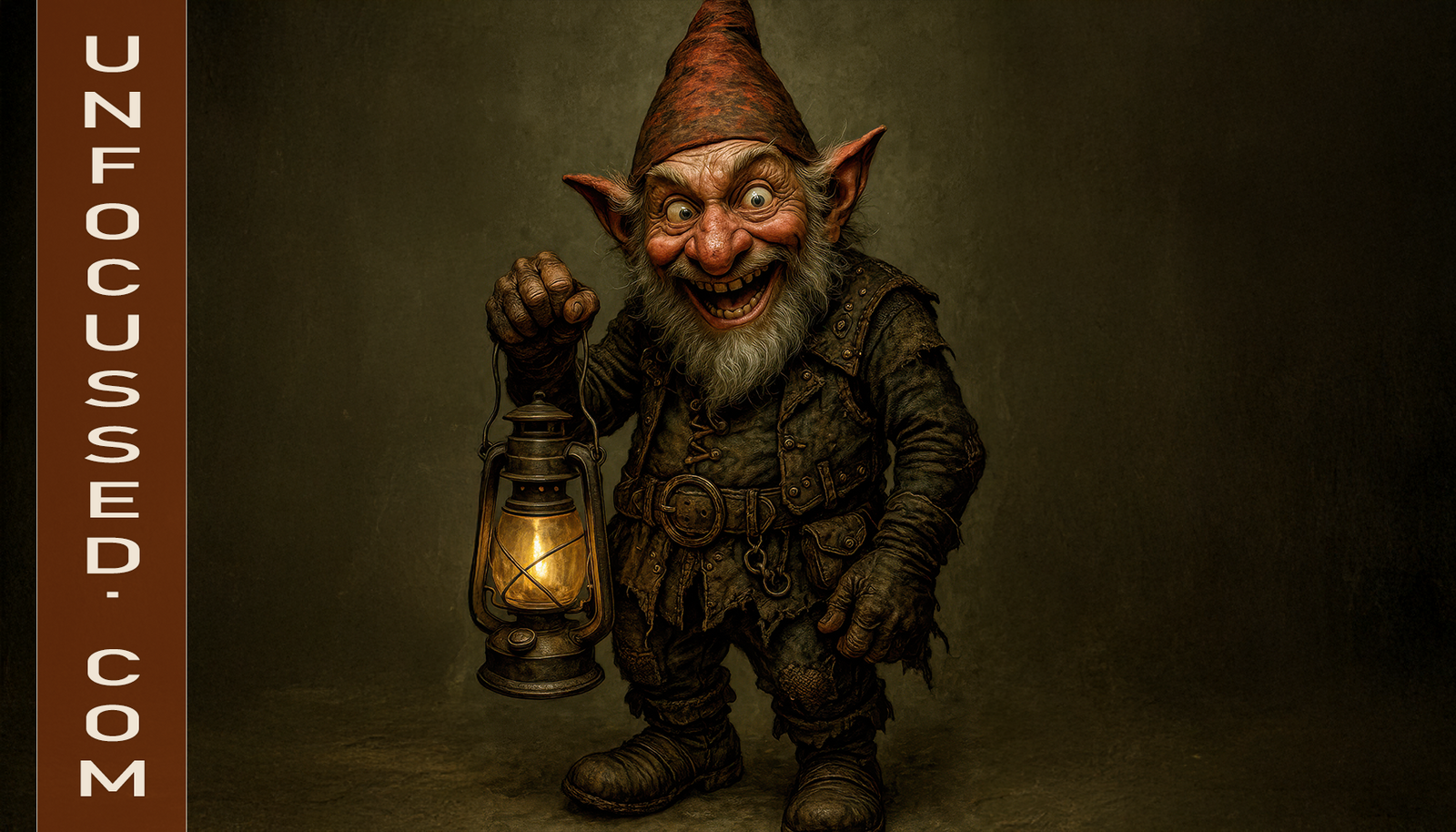
The Lantern-Bearer Appears Everyone in the village of Mirewood knew the rules about the forest. The elders taught them in school, the barkeep scrawled them on the back of ale-stained napkins, and old Grandmother Bipple would shout them at anyone walking too close to the edge of the trees. They were simple rules, easy enough to remember, though most ignored them until it was too late: Never whistle after dark. (It attracts unwanted attention.) Never follow the sound of laughter in the woods. (It is not your friends.) If you see a lantern swaying where no lantern should be—run. Of course, travelers passing through rarely knew these rules. And travelers, being what they are, tended to scoff at local superstition, right until the superstition waddled out of the bushes and introduced itself with a smile wide enough to make their teeth ache. That superstition had a name—or at least several variations of one. Some called him Grimble. Others called him Snagtooth. A few claimed his name was Darryl, but those people had been drinking heavily, and possibly had a habit of naming everything Darryl. Whatever his name, the truth remained: he was a lantern-bearer. Not a guide. Not a helper. Certainly not a friend. A lantern-bearer, and if you saw the light, you were already in trouble. The night our story begins was moonless, the sky clotted with heavy clouds, and the woods darker than the inside of a cow’s belly. A group of weary merchants, their donkeys sagging under bags of turnips, onions, and exactly one barrel of something suspiciously sloshy, were making their way down the Old Hollow Road. Their boots squelched in the mud, their tempers were thin, and their conversation had dwindled to muttered complaints about turnip prices. They didn’t notice it at first. A faint glow, like the last ember of a dying fire, bobbing between the trees. Perhaps it could have been a will-o’-the-wisp, perhaps moonlight glinting off wet bark—but then came the sound. The laugh. Oh, the laugh. It began as a hiccup, as though someone had swallowed a kazoo. Then it rose into a cackle that rattled the leaves, wheezed through the undergrowth, and echoed through the travelers’ bones until their spines tightened like violin strings. It was a laugh that said, Yes, I know exactly where you’re going. And no, you won’t like it when you get there. One of the donkeys brayed nervously. The youngest merchant whispered, “Did you hear that?” The oldest merchant pretended he hadn’t. Denial, after all, was cheaper than therapy. And then— He appeared. A squat figure, not more than four feet tall but twice as broad, stepping out of the trees as though the forest itself had coughed him up. His leather vest looked as though it had been stitched together by someone with poor eyesight and no sense of proportion. His boots sagged, patched so many times they had become more patch than boot. His gloves creaked with grime, and his belt buckle was bent in the shape of something that might once have been a circle. But the merchants weren’t staring at his outfit. They were staring at his face. At the pointed ears sticking out like dagger handles. At the eyes, round and bulging, that glistened with lunatic cheer. At the nose—red, bulbous, the sort of nose that spoke of centuries of bad life choices. And, of course, the mouth. That enormous, horrifying, magnificent mouth that stretched almost ear to ear and revealed a collection of teeth that looked like they had been borrowed from several different species and arranged without a clear plan. He grinned. The lantern in his hand swayed, casting a flicker of golden light that danced across the merchants’ pale, horrified faces. “HA! HA! HA! YOU’RE LOST, AREN’T YA?” The laugh that followed could not possibly have come from a creature of his size. It was thunderous, ridiculous, echoing through the trees like a drunk choir of demons trying to sing sea shanties. One of the donkeys sat down in protest. Another began chewing its reins. The merchants clutched their turnips for moral support. No one moved. The woods seemed to hold its breath. And then, in a voice far too chipper for the situation, the lantern-bearer said: “Don’t worry. I know a shortcut.” The Shortcut Now, in most tales, when a grinning goblin-like stranger pops out of the forest at midnight and offers you a shortcut, the sensible thing to do is refuse, bow politely, and run in the opposite direction until your shoes catch fire. Unfortunately, merchants are not known for their sense of adventure—or their sense of caution. They are, however, known for their greed and impatience. The youngest merchant cleared his throat nervously. “A shortcut, you say?” The lantern-bearer’s grin widened, which seemed medically impossible. “Oh aye. The quickest way to the village. Quick as a hiccup, quicker than a sneeze, quicker than a goose falling down a well.” “Goose falling down a—what?” the eldest merchant asked, eyebrows furrowing like angry caterpillars. The creature blinked at him, expression utterly serious, then threw back his head and howled with laughter so violent his hat nearly flew off. The woods joined in, the echoes clattering through the branches until it sounded as if the forest itself was giggling. That was the trouble with him: once he started laughing, everything laughed. The trees creaked in mirth. The wind wheezed. Even the donkeys let out startled, undignified hee-haws that sounded suspiciously like chuckles. The merchants shivered, because there is nothing more sinister than a donkey laughing at you. Still, the idea of shaving two days off their journey was too tempting. The merchants exchanged glances. Their boots were muddy, their tempers sour, and the barrel of suspiciously sloshy liquid was already half-empty. A shortcut would mean warmth, ale, and safety sooner. Surely, they reasoned, a creature with such excellent comedic timing couldn’t possibly be dangerous. “Lead on, good sir,” the youngest merchant said bravely, though his voice cracked in three different places. “Sir?” The lantern-bearer clutched his chest as if mortally wounded. “Do I look like a sir to you? My dear boy, I’m a professional!” “A professional…what?” the eldest merchant asked suspiciously. “A professional guide of lost things!” the creature bellowed, flourishing the lantern dramatically. “Lost sheep! Lost coins! Lost socks! Lost sense of direction! I find it all. Except virginity. That one tends to stay lost.” The merchants coughed uncomfortably. One donkey snorted. Somewhere in the distance, a crow cawed in disapproval.     And so, against the advice of every folktale ever written, the merchants followed the Lantern-Bearer off the main road. His lantern bobbed ahead of them like a firefly on caffeine, dipping and swaying, sometimes vanishing completely before popping up again with a sudden shout of “BOO!” that made the donkeys fart in terror. The path he led them on was no path at all. It twisted through undergrowth that snagged their clothes, across streams that soaked their boots, and under branches that seemed to duck too late on purpose. Each time they stumbled, each time they cursed, each time they tripped over a log that hadn’t been there a moment before—the Lantern-Bearer laughed. Loud, long, and wheezing, like a broken organ grinder trying to play itself to death. After what felt like hours, the merchants were panting, muddy, and less certain about their life choices. “Are you sure this is shorter?” one muttered. “Shorter than what?” the guide asked innocently, eyes gleaming. “Than the road!” “Oh aye,” he said, beaming. “Shorter than the road. Also shorter than eternity, shorter than a giraffe, shorter than—” he leaned in close, his nose nearly brushing the merchant’s cheek—“shorter than your patience.” He threw back his head and erupted into another gale of laughter. The sound was so loud and so infectious that the merchants found themselves chuckling nervously, then giggling, then outright cackling, though they couldn’t for the life of them explain why. Their laughter tangled with his, until the forest was a roaring carnival of giggles, howls, guffaws, and snorts. It went on and on, until they felt drunk on mirth, lightheaded and dizzy, stumbling through the dark with tears streaming down their cheeks. And then, just as abruptly, the laughter stopped. Silence. Heavy, suffocating silence. The kind of silence that pressed on your ears until you heard your own blood sloshing about like soup in a kettle. The merchants blinked, panting, and realized the lantern-bearer was no longer ahead of them. He was behind them. Grinning. Still. Always grinning. “Now,” he whispered, his voice sharp as a knife scraping bone. “Here we are.” The merchants looked around. They weren’t on a road. They weren’t anywhere near a village. They stood in a clearing ringed by trees with trunks warped and twisted into strange shapes. Knots in the bark seemed to watch them, faces frozen mid-laugh. Roots curled across the ground like skeletal fingers. And in the center of it all was a stone well, old and moss-eaten, its mouth blacker than the night sky. The Lantern-Bearer raised his light. His grin somehow grew wider. “The shortcut,” he declared proudly, “to exactly where you never wanted to be.” And then he laughed again. Louder than ever. The kind of laugh that promised Part Three of this story was going to get much, much worse. The Well of Echoes The clearing held its breath. The merchants stood huddled together, clutching their onions like holy relics, staring at the mossy stone well in the center. The air smelled damp and earthy, with a faint tang of iron, like the forest had been chewing on old nails. Somewhere far above, a crow cawed once, then thought better of it. Silence returned. “Well,” said the eldest merchant, forcing a laugh that sounded more like a hiccup, “thank you for your… services, friend. We’ll just, ah, be on our way now.” The Lantern-Bearer’s eyes bulged wider. His grin twitched. He leaned forward, lantern swinging, until the glow carved strange shadows across his face. “On your way? But you’ve only just arrived. Don’t you want to see what’s inside?” He jabbed a stubby finger toward the well. The moss shivered. The stones groaned as if they remembered something unpleasant. The youngest merchant squeaked. “Inside? No, no, we don’t—no time, really—” “INSIDE!” bellowed the Lantern-Bearer, and his laughter followed, booming, crashing, echoing off the trees until the roots quivered in glee. The merchants covered their ears, but it was no use. His laughter slid into their skulls, rattled around in their brains, and leaked out their noses like smoke. They couldn’t escape it. They couldn’t even think over it. The donkeys brayed in panic, tugging against their reins. One of them backed up, tripped over a root, and landed directly on the barrel of sloshy liquid. The barrel cracked, spilling a stream of something pungent that hissed as it hit the ground. The forest floor slurped it up hungrily, and the trees gave a collective shudder of delight. “Oh, that’s just lovely,” the Lantern-Bearer sighed dreamily, sniffing the fumes. “Reminds me of my childhood. Nothing like a good solvent to bring out the nostalgia.”     The eldest merchant, summoning what little courage remained in his wrinkled bones, stepped forward. “Look here, you little imp. We’ve had enough of your games. We demand—” He didn’t get to finish. The Lantern-Bearer’s lantern flared bright, dazzling white, so bright that the merchants staggered back, shielding their eyes. The clearing seemed to warp. The well stretched taller, wider, its stones groaning, until it loomed like a hungry mouth. From deep within, something shifted. Something giggled. Something very large, very old, and very awake. “You hear it?” whispered the Lantern-Bearer, suddenly quiet, reverent, almost tender. “That’s the Well of Echoes. It collects every laugh ever lost in the woods. Giggles from children who wandered too far. Chuckles from hunters who never came back. Even one or two cackles from priests who really should’ve known better.” The merchants shivered. The sound rose from the well—layered, overlapping laughter, hundreds of voices tangled together, some shrill, some guttural, some hysterical, some sobbing even as they laughed. It wasn’t just noise. It was hungry. The youngest merchant dropped his onion bag. The bulbs rolled across the clearing, tumbling toward the lip of the well. One onion tipped over the edge and fell. For a heartbeat, nothing happened. Then the laughter in the well swallowed it whole with a satisfied burp. “Well,” said the Lantern-Bearer, beaming proudly, “that’s dinner sorted.”     Panic set in. The merchants bolted for the trees, stumbling and shrieking. But no matter which way they ran, the clearing stretched with them. The well remained at the center. The trees curved back, folding the world like a cruel carnival tent. They were trapped inside a joke, and the punchline was coming fast. The Lantern-Bearer danced in circles, swinging his lantern, kicking his stubby legs, howling with mirth. His eyes glittered. His teeth gleamed. His voice rang out like a gleeful executioner. “Don’t you see? You’re part of it now! You came for a shortcut, and you’ll never leave! You’ll laugh, and laugh, and laugh, until there’s nothing left but echoes!” One by one, the merchants began to laugh. First a nervous chuckle. Then a wheeze. Then helpless, roaring hysteria. Their bodies doubled over, their faces twisted, tears streaming. They clutched their sides, unable to breathe, unable to stop. Their laughter tangled with the voices in the well, pulled downward, dragged into the hungry dark until their own echoes joined the eternal chorus. Even the donkeys giggled. A terrible, braying, soul-curdling laughter that would have been funny if it weren’t so horribly wrong. Their reins snapped as they bucked and rolled, their laughter tumbling down into the well, swallowed whole.     At last, silence fell again. The clearing was empty. Only the Lantern-Bearer remained, standing by the mossy stones, lantern glowing faintly gold. He hummed a little tune, tapping his foot, as if nothing strange had happened at all. “Well,” he said cheerfully, glancing around, “that was fun.” He adjusted his hat, burped, and wiped a tear from his bulging eye. “But I do hope the next lot brings better snacks. Onions, really? Pah.” He turned and waddled back into the forest, lantern bobbing. His laughter trailed behind him like smoke, curling through the trees, drifting down the Old Hollow Road toward the next group of travelers who thought superstition was just silly old stories. And the well waited. Always waiting. Hungry for the next laugh in the dark.     Bring the Lantern-Bearer Home (If You Dare) If the tale of Laughter in the Dark tickled your funny bone (or chilled it), you can invite the mischievous Lantern-Bearer into your own world. His eerie grin and glowing lantern live on in a series of high-quality art products—perfect for lovers of spooky whimsy and gothic humor. 🖼️ Framed Prints – Bring his unsettling charm to your walls in a beautifully crafted frame. ✨ Metal Prints – Make his lantern glow even brighter with bold, modern metal finishes. 💌 Greeting Cards – Send a little spooky cheer (and maybe a cackle or two) through the mail. 🔖 Stickers – Add a pop of creepy whimsy to your laptop, journal, or favorite potion bottle. Whichever form you choose, you’ll carry a piece of the Lantern-Bearer’s strange magic with you. Just… be careful when the lights go out. His laugh has a way of finding you.

Seguir leyendo

Acorn Express Airways

por Bill Tiepelman

Acorn Express Airways

Boarding & Questionable Safety Briefing Sprig Thistlewick, professional optimist and part-time mushroom taxidermist, had finally decided to launch his airline. Not a metaphorical airline. A literal one. His plan was simple: slap a hat on, grab a squirrel, and call it an enterprise. No paperwork, no infrastructure, just raw courage and a complete misunderstanding of physics. Now, to be fair, most gnomes lacked Sprig’s flair for disastrous entrepreneurship. The last time he tried to “modernize” gnome society, he had invented self-heating trousers. Unfortunately, they had worked too well, turning every family dinner into a small bonfire. The squirrels still referred to it as “the Winter of Screams.” And yet here he was, standing in the middle of a mossy runway—a fallen log painted with suspicious white stripes—preparing to launch his greatest venture yet: Acorn Express Airways, offering daily flights to “wherever the squirrel feels like going.” Helix, his squirrel pilot, had not signed a contract. In fact, Helix hadn’t even signed up. He was recruited at acorn-point (which is like gunpoint, but more adorable), bribed with promises of unlimited hazelnuts and a health insurance plan Sprig had scribbled on a leaf. The terms read: “If you die, you don’t have to pay premiums.” Helix considered this generous. The passengers—well, passenger—was also Sprig himself. “Every great airline begins with one brave traveler,” he announced, saluting the trees. “And also, technically, one brave mammal who doesn’t know what’s happening.” Mushrooms leaned out of the underbrush to watch. A pair of hedgehogs sold popcorn. Somewhere, a frog was taking bets. The entire forest knew this flight was a disaster waiting to happen, and they’d canceled their evening plans to spectate. Sprig climbed aboard Helix with all the dignity of a drunk librarian mounting a roller skate. His boots flopped, his beard snagged, his hat got caught on a twig and flung backward like a parachute that gave up halfway through deployment. “Preflight checklist!” he bellowed, gripping Helix’s fur like he was about to wrestle a particularly hairy pillow. “Tail: flamboyant. Whiskers: symmetrical. Nuts: accounted for.” Helix gave him a look. That look squirrels give when they’re not sure whether you’re about to feed them or ruin their entire bloodline. Sprig translated it generously as, “Permission granted.” With a solemn nod, he reached into his pocket and pulled out a rolled-up fern leaf. He cleared his throat and recited the safety briefing he’d written at 3 a.m. while delirious on dandelion wine: “In the unlikely event of a water landing, please scream loudly and hope a duck feels charitable.” “Acorns may drop from overhead compartments. These are for eating, not flotation.” “Please keep your arms and dignity inside the ride at all times.” “If you are seated next to an emergency exit, congratulations, you are also the emergency exit.” Helix twitched his whiskers and launched. Straight up. No runway, no build-up, just boom—vertical takeoff like a caffeinated rocket. Sprig’s scream ricocheted through the branches, equal parts thrill and bowel-loosening terror. Below, the fox ground crew waved fern fronds in professional arcs, guiding their ascent with the exaggerated confidence of someone who had absolutely no idea what air traffic control was. A badger in a neon vest blew a whistle. No one asked why. Through the canopy they burst, slicing through golden beams of morning light. Birds scattered. Leaves tore free. One owl muttered, “Unbelievable,” and went back to sleep. Sprig’s hat flapped behind him like a flag of questionable sovereignty. “Altitude: dramatic!” he shouted. “Dignity: postponed!” The forest below stretched into a dizzying swirl of fantasy woodland art, whimsical forest scene, and enchanted nature waiting to be marketed on Etsy. They whipped past a hawk who gave them the side-eye usually reserved for people who clap when the plane lands. A pair of sparrows debated filing a noise complaint. Helix ignored them all, laser-focused on the thrill of speed and the occasional possibility of spontaneous combustion. Then Sprig saw it: hanging impossibly in midair was a floating brass door, polished to a glow, stamped with an ornate sign: Gate A-Corn. Suspended by nothing, radiating authority, humming with magic, the doorway shimmered with the promise of destinations unknown. Sprig pointed dramatically. “There! First stop on the Acorn Express! Aim true, Helix, and mind the turbulence of existential dread!” Helix tightened his grip on physics, ignored several laws of aerodynamics, and arrowed straight toward the door. The air around them trembled, and Sprig’s grin stretched into the kind of manic expression only found on cult leaders and people who’ve had six espressos on an empty stomach. The adventure had begun, and neither gravity, reason, nor common sense was invited along for the ride.   The Turbulence of Utter Nonsense The brass door grew larger, looming like a bureaucratic nightmare in the middle of open sky. Helix, panting with the ferocity of a squirrel who’d once bitten into a chili pepper by mistake, powered forward. Sprig tightened his grip, shouting into the wind like a prophet who’d just discovered caffeine. “Gate A-Corn, our destiny!” he cried. “Or possibly our obituary headline!” The door creaked open midair. Not swung, not slid—creaked, as though it had hinges in the clouds themselves. From within, light spilled: golden, shimmering, and suspiciously judgmental. A sign above flickered in runes that translated, unhelpfully, to: “Now Boarding Group All.” Sprig adjusted his hat, which had migrated halfway down his back, and yelled at Helix, “This is it! Remember your training!” Helix, who had received no training beyond the words “don’t die,” chirped in squirrel profanity and barreled through. They shot into a void of impossible architecture. Corridors twisted like licorice sticks designed by an angry mathematician. Floors melted into ceilings, which politely excused themselves and became walls. A tannoy voice announced, “Welcome to Acorn Express Airways. Please abandon logic in the overhead compartment.” Sprig saluted. “Already did!” They weren’t alone. Passengers—other gnomes, pixies, at least one surprisingly well-dressed frog—floated in midair, clutching boarding passes made of bark. A centipede in a waistcoat offered complimentary peanuts (which were actually acorns, but the branding department insisted on calling them peanuts). “Can I get you a beverage, sir?” the centipede asked in a customer-service tone that implied violence. Sprig grinned. “Do you have dandelion wine?” “We have water that has looked at wine.” “Close enough.” Helix landed with a clumsy skid on what appeared to be carpeting woven from moss and gossip. A flight attendant—a raven in a bowtie—flapped forward, glaring. “Sir, your mount must be placed in an overhead compartment or under the seat in front of you.” Sprig snorted. “Do you see a seat in front of me?” The raven checked. The seats were currently in rebellion, galloping off toward the emergency exit while singing sea shanties. “Point taken,” the raven said, and handed him a complimentary sick bag labeled ‘Soul Leakage Only’. The tannoy boomed again: “This is your captain speaking. Captain Probability. Our cruising altitude will be approximately yes, and our estimated arrival time is don’t ask. Please enjoy your flight, and remember: if you feel turbulence, it’s probably emotional.” And turbulence there was. The corridor-airplane hybrid jolted violently, tossing passengers like dice in a cosmic gambling hall. A pixie lost her hat, which immediately filed for divorce. A goblin’s lunch turned into a live chicken mid-bite. Helix dug his claws into the moss carpet while Sprig flailed with the elegance of a man fighting off bees at a funeral. “Brace positions!” the tannoy announced. “Or just improvise. Honestly, no one cares.” The turbulence escalated into full chaos. Luggage compartments began spewing secrets: a suitcase burst open, releasing 47 unpaid parking tickets and a raccoon with diplomatic immunity. Another compartment exploded in confetti and existential dread. Sprig clung to Helix, shouting over the din, “THIS IS EXACTLY WHAT I EXPECTED!” which, frankly, made it worse. The gnome’s laughter blended with screams, creating a symphony of woodland absurdity that might’ve impressed Wagner if Wagner had been drunk and concussed. Then came the in-flight entertainment. A giant screen unfolded from thin air, flickering on to reveal a propaganda film: “Why Flying Squirrel Airlines Are the Future.” The narrator’s voice boomed with ominous cheer: “Tired of walking? Of course you are! Introducing high-speed, fur-lined, moderately rabid travel. Our pilots are trained in climbing trees and ignoring consequences. Book now, and you’ll receive a free hat you didn’t want.” Helix stared at the screen, tail twitching furiously. Sprig patted his neck. “Don’t take it personally, lad. You’re the pioneer. The Wright Brother. The… Wright Brother’s pet squirrel.” Helix squeaked indignantly, clearly offended at being demoted to sidekick status in his own narrative. But before Sprig could placate him with a bribe of candied pinecones, the tannoy blared once more: “Attention passengers: we are now entering the Anomalous Weather Zone. Please ensure your limbs are securely attached, and for the love of moss, don’t make eye contact with the sky.” The plane shook like a blender filled with bad decisions. Out the windows (which appeared and disappeared depending on mood), the sky warped into colors usually reserved for lava lamps and regrettable tattoos. Raindrops fell upward. Thunder clapped in Morse code, spelling out rude words. A lightning bolt high-fived another lightning bolt, then turned to wink at Sprig. “Friendly lot,” he muttered, before being slapped across the face by a passing cumulonimbus. The gnome realized this was no ordinary turbulence. This was orchestrated chaos. He sniffed the air. Yes—mischief. Sabotage. Possibly sabotage fueled by mushrooms, but sabotage nonetheless. Somewhere in this nightmare-aircraft, someone wanted them grounded. Literally. Sprig stood, wobbling like a marionette drunk on vinegar. “Helix!” he shouted over the madness. “Plot a course to the cockpit! Someone’s playing games with our lives, and it’s not even us this time!” Helix squeaked in agreement, lunged forward, and tore down the twisting corridor-airplane hybrid like a streak of vengeful fur. Gnomes, frogs, pixies, and at least one confused insurance salesman scattered out of the way. The journey to the cockpit was perilous. They dodged a stampede of seats still singing sea shanties, leapt over a snack cart staffed by an angry beetle demanding exact change, and sprinted through a cabin section where gravity had simply quit its job and gone home. Sprig clung on with the grim determination of a man who knew that heroism and idiocy were separated only by who wrote the history books. His beard streamed behind him like an untrustworthy flag. His heart pounded. The tannoy whispered seductively, “Please don’t die. It’s tacky.” Finally, at the end of a corridor that looped back on itself three times before giving up, they saw it: the cockpit door. Polished brass. Massive. Glowing faintly with the promise of answers. Sprig jabbed a finger toward it. “There, Helix! Destiny! Or perhaps indigestion!” The squirrel squealed, launched himself into a final sprint, and leapt for the handle. And that’s when the door began to laugh.   Cockpit of Chaos & the Final Boarding Call The cockpit door did not just laugh. It guffawed, a deep, rattling belly-laugh that shook the very air around it, as though someone had installed an entire comedy club into its hinges. Sprig froze mid-leap, dangling from Helix’s back like an accessory no one ordered. “Doors don’t laugh,” he muttered. “That’s page one of ‘How to Identify Things That Are Doors.’” Helix squeaked nervously, his tail puffing up like a feather duster in a thunderstorm. The brass rippled, and the handle twisted into a sneering smile. “You’ve come this far,” the door said, voice dripping with smugness. “But no gnome, squirrel, or tragically overdressed woodland creature has ever passed through me. I am the Cockpit Door, Guardian of Captain Probability, Keeper of the Flight Manifest, Judge of Carry-On Liquids!” Sprig puffed up his chest. “Listen here, you smug slab of hinges, I’ve faced trousers that spontaneously combusted and survived the aftertaste of mushroom brandy. I am not afraid of a talking door.” Helix, meanwhile, was quietly gnawing on the corner of the carpeting in stress. The door chuckled again. “To enter, you must answer my riddles three!” Sprig groaned. “Of course. Always three. Never two, never four, always three. Fine. Give me your worst, you squeaky furniture.” Riddle One: “What flies without wings, roars without a throat, and terrifies squirrels at picnics?” Sprig squinted. “That’s easy. Wind. Or my Aunt Maple after three cups of pine needle tea. But mostly wind.” The door shuddered. “Correct. Though your Aunt Maple is terrifying.” Riddle Two: “What is heavier than guilt, faster than gossip, and more unpredictable than your tax returns?” “Obviously time,” Sprig replied. “Or possibly Helix after eating fermented berries. But I’ll stick with time.” The door rattled angrily. “Correct again. But your tax returns remain suspicious.” Riddle Three: “What is both destination and journey, filled with laughter and terror, and only possible when logic takes a day off?” Sprig grinned, his eyes sparkling with manic triumph. “Flight. Specifically, Acorn Express Airways.” The door howled, cracked, and finally swung open with theatrical reluctance. “Ugh. Fine. Go on then. But don’t say I didn’t warn you when the captain gets weird.”     Inside, the cockpit defied comprehension. Buttons grew like mushrooms across every surface. Levers hung from the ceiling, dripping with condensation. The control panel was clearly designed by someone who had once seen an accordion and thought, “Yes, but angrier.” At the center sat Captain Probability, a massive owl wearing aviator goggles and a captain’s hat two sizes too small. His feathers gleamed like spilled ink. His eyes were orbs of mathematics gone rogue. “Ah,” Captain Probability hooted, voice a strange mix of dignified scholar and used-car salesman. “Welcome to my office. You’ve braved turbulence, riddles, and seating arrangements that defy Geneva Conventions. But why are you here? To fly? To question? To snack?” Sprig cleared his throat. “We’re here because the weather tried to eat us, the tannoy keeps flirting with me, and my squirrel has developed PTSD from peanuts.” Helix squeaked agreement, twitching his whiskers like an overstimulated antenna. “We demand answers!” Captain Probability leaned forward, his beak clicking ominously. “The truth is this: Acorn Express Airways is no mere airline. It is a crucible, a test of those who dare to reject the tyranny of logic. Each passenger is chosen, plucked from their quiet woodland lives, and hurled into chaos to see if they will laugh, cry, or order overpriced snacks.” “So it’s a cult,” Sprig said flatly. “Great. Knew it.” “Not a cult,” the owl corrected. “An adventure subscription service. Auto-renews every full moon. No refunds.” The cockpit lurched violently. Outside, the Anomalous Weather Zone roared with renewed fury. Clouds twisted into monstrous faces. Lightning spelled out, “HA HA NO.” The tannoy blared: “Brace yourselves! Or don’t. Honestly, mortality rates are included in the brochure.” Sprig gritted his teeth. “Helix, we’re taking over this flight.” The squirrel squealed, appalled but loyal, and scampered toward the controls. Captain Probability flared his wings. “You dare?” he bellowed. “Do you think you can outfly chaos itself?” “No,” Sprig said, grinning wildly. “But I can ride a squirrel into absolute nonsense, and that’s practically the same thing.”     Chaos erupted. Helix leapt onto the console, paws slamming random buttons with all the subtlety of a drunk orchestra conductor. Sirens wailed. Panels lit up with messages like ‘You Shouldn’t Press That’ and ‘Congratulations, You’ve Opened the Wormhole’. The floor tilted violently, sending Sprig skidding toward a lever labeled “Do Not Pull Unless You’re Feeling Spicy.” Naturally, he pulled it. The plane screamed, reality hiccupped, and suddenly they were no longer in sky or storm—they were in a tunnel of pure absurdity. Colors exploded. Acorns rained sideways. A choir of chipmunks sang “O Fortuna” while juggling flaming pinecones. Captain Probability flailed, hooting in outrage. “You’ll destroy everything!” Sprig whooped with joy, clinging to Helix as the squirrel steered them through collapsing geometry. “DESTROY? NO, MY FEATHERED FRIEND! THIS IS INNOVATION!” He slammed another button. The tannoy moaned sensually. The moss carpeting grew legs and began tap-dancing. Somewhere, a vending machine achieved enlightenment. At the end of the tunnel, a blinding light awaited. Not gentle, hopeful light. Blinding, obnoxious, migraine-inducing light, the kind that suggests a divine being really needs to adjust their dimmer switch. Sprig pointed. “That’s our exit, Helix! Take us home!” Helix gathered every ounce of rodent strength, tail blazing like a comet, and hurled them forward. Captain Probability lunged after them, screeching, “No passenger escapes probability!” But Sprig turned, hat askew, beard wild, and shouted back the most heroic nonsense ever uttered by a gnome: “MAYBE IS FOR COWARDS!”     They burst through the light— —and crash-landed on the forest floor with all the grace of a piano falling down stairs. Birds scattered. Trees groaned. A mushroom fainted dramatically. Sprig staggered to his feet, brushing moss from his beard, while Helix flopped onto his back, chest heaving. Silence reigned for a long moment. Then Sprig grinned, wide and maniacal. “Well, Helix, we’ve done it. We’ve survived the maiden voyage of Acorn Express Airways. I declare it a success!” He raised a triumphant fist, only to immediately collapse on his face. Helix chattered weakly, rolling his eyes. Behind them, the sky shimmered. The brass door flickered, laughed once more, and disappeared into nothing. The forest returned to normal—or at least as normal as a forest gets when one gnome and one squirrel have committed interdimensional hijinks. Sprig groaned, pushed himself upright, and looked at Helix. “Same time tomorrow?” The squirrel slapped him in the face with his tail. And thus ended the first and very possibly last official flight of Acorn Express Airways, an airline that operated for exactly forty-seven minutes, carried exactly one idiot and one reluctant squirrel, and somehow managed to change the fate of woodland absurdity forever.     Bring the Adventure Home If Sprig and Helix’s madcap maiden voyage made you laugh, gasp, or quietly worry about the state of gnome aviation safety, you can keep the magic alive with beautiful products featuring Acorn Express Airways. Perfect for adding whimsy to your space, gifting to a fellow daydreamer, or carrying a little absurd humor into everyday life. Framed Print — Elevate your walls with a polished, ready-to-hang piece that captures the soaring absurdity of Sprig and Helix’s adventure. Canvas Print — Bring texture and depth to your home with this gallery-style print, the perfect centerpiece for a whimsical space. Jigsaw Puzzle — Relive the chaos piece by piece, whether as a solo challenge or with friends who also enjoy gnomish nonsense. Greeting Card — Share a laugh and a touch of woodland magic with someone who could use a smile (or a squirrel-powered airline ticket). Weekender Tote Bag — Whether you’re packing for adventure or just grocery day, this bag lets you carry the absurd whimsy of the Acorn Express with you. Each product is crafted with care and high-quality printing, ensuring that the spirit of Acorn Express Airways shines bright—whether on your wall, your table, or over your shoulder. Because some journeys deserve to be remembered… even the ones powered by squirrels.

Seguir leyendo

The Agave Whisperer

por Bill Tiepelman

The Agave Whisperer

The Barrel-Bottom Prophet It was said in the whisperiest of taverns — between shots of regret and beers of poor decisions — that somewhere deep in the groves of Tuscagave, there lived a gnome who could speak to tequila. Not about tequila. To it. And worse still... it whispered back. His name was Bartó the Brash, and legend had it he was born in a bootleg still, cradled in blue agave husks, and teethed on fermented lime peels. The midwife had slapped his ass, and he belched a perfect margarita mist. His mother passed out from pride. Or mezcal. Or both. Bartó lived alone, if you didn’t count the raccoons (whom he called his “spirit consultants”) and the near-empty bottle of Tequila Yore N. Abort he carried like a talisman. He claimed the bottle contained the voice of an ancient agave god named Chuchululululul — or “Chu” for short — who had chosen him as the last Tequilamancer, a sacred order long disbanded due to liver failure and questionable pants choices. “I don’t drink to forget,” Bartó would slur at passing squirrels, “I drink to remember what the hell I’m meant to be doing.” Then he’d usually pass out face-first into a cactus and have visions of the future, or at least hallucinate himself into a screaming match with a talking gecko wearing a fedora. But fate — that wobbly barstool of destiny — was about to spin beneath him. On a morning dripping in sun and hangover dew, Bartó squinted into the olive grove horizon and saw it: a caravan of bureaucrats in beige capes, clipboards clenched like holy relics. The Department of Magical Overreach and Beverage Regulation (DMOBR) had arrived — and they were pissed. “Unauthorized intoximancy! Public incantation while under the influence! Summoning of unlicensed limes!” barked the lead official, a sour-faced elf named Sandra with a severe bob and the moral flexibility of a corkscrew. “You, sir, are a fermenting menace!” “Oh please,” Bartó scoffed, adjusting his mossy, sagging hat. “I’ve fermented things that would make your clipboard cry.” Sandra raised a pen. “By the authority of subsection 3B of the Intoxicating Enchantments Code, I hereby revoke your right to whisper to any agave-derived spirit for a period not less than—” CRACK! Lightning struck a nearby clay jug. A sizzling bolt carved the words “BITE ME” into the side of an olive tree. Chu, the bottle god, was awake. “OH SH*T,” Bartó grinned. “He’s back.” The tequila began to glow. The raccoons began to chant. The olives rolled uphill. Somewhere, a mariachi band formed out of thin air. And just like that, our story — soaked in alcohol, mischief, and prophecy — had begun. The Rise of the Drunken Oracle As the tequila bottle pulsed with a holy light that smelled vaguely of lime zest and bad decisions, the air around Bartó the Brash thickened like a triple-distilled vision quest. The gnome stood — or rather, teetered confidently — on the barrel like a demented squirrel messiah, arms raised high, eyes crossed but determined. “Chu has spoken,” he announced, “and he says you’re all a bunch of cork-sniffing, oak-aged fun vampires.” Sandra, lead pencil-pusher of DMOBR, adjusted her clipboard with bureaucratic menace. “That bottle is unauthorized and unregistered. Its mouthpiece—you—are in direct violation of thirteen beverage communion laws, four forbidden fermentation rites, and one very specific restraining order involving a sacred cactus.” “That cactus liked it,” Bartó muttered under his breath, then belched out a tiny lightning bolt. A nearby stone frog sculpture twitched and winked. The raccoons began circling in a loose formation resembling a pentagram made entirely of bad intentions and spilled mezcal. Their eyes glowed with a dangerous mix of mysticism and dumpster trauma. One was wearing a tiny cape made from a bar mat that said "Lick, Sip, Regret." From the tequila bottle came the rumbling voice of Chu — ancient, boozy, and oddly flirtatious. “THE AGAVE AWAKENS. THE TIME OF DISTILLED PROPHECY IS NIGH. BRING ME TACOS.” Bartó gasped. “It’s the Prophecy of the Blistered Tongue!” Sandra rolled her eyes so hard they almost filed a complaint. “There is no such prophecy. That was debunked in a 2007 memo titled ‘Delirium-Driven Distillery Delusions.’” “Delusions?! You bureaucratic bottle cap!” Bartó roared. “I have seen visions in the foam of my beer, heard sermons in the slosh of a margarita! I AM THE AGAVE WHISPERER!” He chugged from the bottle like a man possessed by both the divine and several questionable life choices. The sky dimmed. Olive trees trembled. Somewhere in the distance, a goat screamed in what might have been Latin. BOOM! A wave of golden vapor exploded from the bottle and blasted across the grove. Everyone within a fifty-foot radius was hit with a sudden wave of intoxicated clairvoyance. One elf dropped to his knees sobbing about his childhood toothbrush. Another began giggling and drawing phallic doodles in the dirt with his wand. Sandra’s clipboard snapped in half. “This… this is unauthorized revelatory broadcasting!” “This,” Bartó grinned, “is happy hour at the end of the f*cking world.” And with that, he flung the bottle skyward. It hovered. Hovered! Swirling with magical carbonation, it began to rotate, casting symbols in the air — ancient agave runes, each one glowing and dripping with tequila logic. The runes formed into a flaming piñata goat, which promptly exploded into glitter and regret confetti. The raccoons began to chant in tongues. Literal tongues. They had stolen some from a taco truck. “We are the Chosen Few!” Bartó shouted. “We are the Drunk, the Damned, the Slightly Sticky! Rise, my festive minions! The world must be unbuttoned!” At this, the caravan of DMOBR agents began to panic. Their enchanted clipboards were now possessed by spirits (both bureaucratic and alcoholic), their regulation sashes turned into salsa-scented snakes, and several of them had started twerking involuntarily to an invisible mariachi band echoing through the hills. Sandra screamed. “Code Vermouth! I repeat, Code Vermouth!” Bartó, now somehow riding a summoned barrel like a tequila-powered chariot, pointed at her dramatically. “You wanna regulate joy? License laughter? Tax my farts? Over my pickled body!” Chu’s voice thundered once more. “ONE AMONG YOU SHALL SQUEEZE THE SACRED LIME. THEY SHALL UNCORK THE FINAL FIESTA.” A hush fell. Even the raccoons stopped licking their toes. Everyone stared at Bartó. His eyes sparkled. His beard blew dramatically in the wind. He dropped the tequila bottle into the crook of his arm like a baby made of danger. “I must find the Sacred Lime,” he whispered. “Only it can complete the Rite of the Salty Rim.” “That’s not a real thing,” Sandra snapped. “It is now,” Bartó said, then mounted his raccoon-pulled barrel chariot and disappeared into the grove at full squeaky wheel speed, laughing like a gremlin who just farted in a cathedral. The DMOBR team was left in stunned silence. Sandra stared at the bottle, now lying innocently in the dirt, leaking a faint trail of glowing liquid that spelled the word “WHEEEE” in cursive. The prophecy had begun. And Bartó the Brash? He was off to save the world — armed with only a bottle, some cursed citrus, and the unwavering belief that destiny was best pursued while hammered. The Sacred Lime & the End of the Pour Deep in the sunburnt olive groves of Tuscagave, under skies marbled with hangover clouds and divine indecision, Bartó the Brash thundered through the underbrush on his raccoon-powered barrel-chariot of destiny. His eyes were bloodshot with purpose. His beard? Windswept. His bottle? Glowing like a disco ball in a frat house bathroom. “THE SACRED LIME!” he cried, yanking hard on the reins (which were actually shoelaces tied to raccoon tails). “It calls to me!” “SQUEEEEE!” squealed the lead raccoon, who had been mainlining moonshine since breakfast and was now entirely committed to whatever this mission was. He tore through a grove of enchanted citrus trees, where oranges screamed motivational quotes and grapefruits sobbed about their father issues. But there, on a mossy pedestal carved from a petrified margarita glass, pulsed the Sacred Lime — the one foretold in soggy bar napkin prophecies and whispered about in inebriated dreams. It was perfect. Glossy. Green. Slightly smug. And guarded by a beast of legend: a giant horned badger with a salt-rimmed collar and a body carved from hardened party fouls. It reeked of expired guacamole and regret. Its name was only spoken in the lost language of Jell-O shots. “BEHOLD!” Bartó yelled, drawing forth his corkscrew wand. “I demand tequila-based trial by combat!” The badger hissed like a shaken can of LaCroix and lunged. Bartó countered with a savage swirl of his tequila bottle, spraying a hypnotic mist that hit the beast right in the dignity. It staggered, disoriented, and tripped over a lime wedge from 1983. “Chug, raccoons, chug!” Bartó bellowed. The raccoons formed a circle, chanting and doing something that looked suspiciously like a conga line of doom. He seized the Sacred Lime and held it aloft. The heavens parted. Trumpets farted a triumphant tune. Somewhere, a mariachi band combusted into pure joy. Chu’s voice echoed once more from the tequila bottle: “YOU HAVE THE LIME. NOW UNCORK THE FINAL FIESTA.” “Oh, we’re about to fiesta so hard the gods will need aspirin,” Bartó whispered with a drunken reverence only achievable at blood-alcohol levels considered biologically implausible. He rolled back into town like a legend carved from leftover nachos, raccoons flanking him like intoxicated bodyguards. The villagers of Tuscagave were already halfway through their annual Tax-Free Liquor Festival and thus barely blinked at the sight of their drunken savior astride a squeaky wheel of destiny. Sandra, DMOBR’s fun-hating elf enforcer, awaited him at the gates, looking slightly more frazzled and extremely more sticky than last we saw her. “You’ve violated more ordinances than the Great Whiskey Riots of 1824,” she spat. “What say you in your defense, gnome?” “I say this,” Bartó declared. He raised the Sacred Lime in one hand, the tequila bottle in the other. “Let the world know: regulation without celebration is just constipation in a cocktail glass.” He squeezed the lime into the bottle. Time stopped. Reality hiccupped. A geyser of fluorescent tequila shot into the air like a golden volcano of freedom. It rained down on Tuscagave like divine margarita mist. People screamed. People stripped. One man achieved enlightenment while motorboating a vat of salsa. The olive trees danced. The raccoons ascended. Sandra’s clipboard melted into a poem about forgiveness and nachos. The Final Fiesta had begun. And what a fiesta it was. For seven days and six blurry nights, the world paused for celebration. Debts were forgiven, enemies made out in alleyways, and the moon was replaced with a glowing disco lime. Bartó became both messiah and cautionary tale, immortalized in limericks, bar songs, and a regrettable tattoo on someone’s buttock in a village far away. When the fog of booze and prophecy finally cleared, the town was different. Happier. Wilder. Sticky. Bartó the Brash? He vanished into the hills, bottle in hand, raccoons in tow. His final words to Sandra (who, by then, had retired from DMOBR to open a margarita spa for burned-out auditors) were simple: “If the lime fits… squeeze it.” And from that day forward, bartenders in every realm would raise their glasses to the sky and whisper a toast to the Agave Whisperer — gnome, oracle, and sacred party goblin. May your salt be fine, your lime be sacred, and your hangovers blessed with purpose. Fin.     Take Bartó home with you! Immortalize the legendary Agave Whisperer on something equally bold and occasionally questionable. Whether you're sipping inspiration or summoning chaos, we've bottled his mischievous magic into a wood print worthy of a cantina wall, or a sleek acrylic print that glows with prophecy and poor decisions. Need something for your wild journeys? Sling the tote bag over your shoulder and smuggle sacred limes like a true believer. Prefer your revelations in doodle form? The spiral notebook is perfect for recording drunken prophecies and raccoon conspiracy theories. And if you just want to slap Bartó’s face somewhere totally inappropriate, there’s always the sticker. Go ahead — join the cult of Chu. Tequila not included… but strongly encouraged.

Seguir leyendo

The Laughing Grovekeeper

por Bill Tiepelman

The Laughing Grovekeeper

There are two types of gnomes in the deepwood wilds: the silent, mysterious kind who guard ancient secrets and never speak above a whisper… and then there’s Bimble. Bimble was, by most measurements, a disaster of a gnome. His hat was perpetually askew, like it had fought a raven and lost. His boots were tied with spaghetti vines (which, yes, eventually molded and had to be replaced with slightly more practical slugs), and his beard looked like it had been combed with a squirrel in heat. But what truly set him apart was his laugh—a high-pitched, rusty-kettle wheeze that could startle owls off branches and make fairies reconsider immortality. He lived atop a mushroom throne so large and suspiciously squishy that it probably had its own zip code. The cap was dotted with tiny, bioluminescent freckles—because of course it was—and the stem occasionally sighed under his weight, which was concerning, because fungi aren’t known to breathe. To the untrained eye, Bimble’s job title might have been something lofty like “Steward of the Grove” or “Elder Guardian of Mossy Things.” But in truth, his primary responsibilities included the following: Laughing at nothing in particular Terrifying squirrels into paying “mushroom taxes” And licking rocks to “see what decade they taste like” Still, the forest tolerated Bimble. Mostly because no one else wanted the job. Ever since the Great Leaf Pile Incident of '08 (don’t ask), the grove had struggled to recruit competent leadership. Bimble, with his complete lack of dignity and a knack for repelling centaurs with his natural musk, had been reluctantly voted in by a council of depressed badgers and one stoned fox. And honestly? It kind of worked. Every morning, he sat on his mushroom throne, sipping lukewarm pine-needle tea from a chipped acorn cap and cackling like a lunatic at the sunrise. Occasionally, he’d shout unsolicited advice at passing deer (“Stop dating does who don’t text back, Greg!”) or wave at trees that definitely weren’t waving back. Yet, somehow, the forest thrived under his watch. The moss grew thicker, the mushrooms puffier, and the vibes? Immaculate. Creatures came from miles around just to bask in his chaotic neutrality. He wasn’t good. He wasn’t evil. He was just... vibing. Until one day, he wasn’t. Because on the fourth Tuesday of Springleak, something stomped into his grove that wasn’t supposed to exist anymore. Something that hadn’t been seen since the War of the Wandering Toenails. Something large. Something loud. Something wearing a name tag that read: “Hi, I’m Dennis.” Bimble squinted into the foliage, his smile slowly spreading into the kind of grin that made fungi wilt out of fear. “Well, piss on a possum. It’s finally happening,” he said. And with that, the Laughing Grovekeeper rose—creaking like a haunted accordion—and adjusted his hat with all the regal grace of a raccoon unhinging a trash can lid. The grove held its breath. The mushroom trembled. The squirrels armed themselves with acorns sharpened into tiny shivs. Whatever Dennis was, Bimble was about to meet it. Possibly fight it. Possibly flirt with it. Possibly offer it tea made of moss and sarcasm. And thus began the weirdest week the forest had ever known. Dennis, Destroyer of Vibes Dennis was, and this is putting it gently, a lot. He crashed into the grove like a drunken minotaur at a yoga retreat. Birds evacuated. Moss curled up like it didn’t want to be perceived. Even the notoriously unbothered toads let out little amphibian swear words and flopped off into the underbrush. He was seven feet of horned fury, with arms like tree trunks and the emotional intelligence of a toaster oven. His armor clanked like a marching band falling down a well, and his breath smelled like someone had boiled onions in regret. And yet, somehow, his name tag still gleamed with a wholesome cheerfulness that just screamed, “I’m here for the icebreaker games and free granola bars!” Bimble didn’t move. He just sipped his tea, still grinning like the world’s oldest toddler who just found scissors. The mushroom squelched softly beneath him. It hated confrontation. “Dennis,” Bimble said, dragging the name out like it owed him money. “I thought you got banished to the Realm of Extremely Moist Things.” Dennis shrugged, sending a cascade of rust flakes from his shoulder plates into a nearby fern that immediately turned brown and died of sheer inconvenience. “They let me out early. Said I’d been ‘reflective.’” Bimble snorted. “Reflective? You tried to teach a pack of nymphs how to do CrossFit using actual centaur corpses.” “Character building,” Dennis replied, flexing a bicep. It made a sound like a creaking drawbridge and an old sandwich being stepped on at the same time. “But I’m not here for the past. I’ve found purpose.” “Oh no,” Bimble said. “You’re not selling essential oils again, are you?” “No,” Dennis said with alarming solemnity. “I’m building a wellness retreat.” A squirrel gasped audibly from a nearby tree. Somewhere, a pixie dropped her latte. Bimble’s left eye twitched. “A wellness retreat,” the Grovekeeper repeated slowly, like he was tasting a new kind of poison. “In my grove.” “Oh, not just in the grove,” Dennis said, pulling out a scroll so long it unrolled across half a clearing and landed in a puddle of salamanders. “We’re gonna rebrand the whole forest. It’s gonna be called… Tranquil Pines™.” Bimble made a noise somewhere between a gag and a bark. “This isn’t Aspen, Dennis. You can’t just gentrify a biome.” “There’ll be juice cleanses, crystal balancing, and meditation circles led by raccoons,” Dennis said dreamily. “Also, a goat that screams motivational quotes.” “That’s Brenda,” Bimble muttered. “She already lives here. And she screams because she hates you.” Dennis knelt dramatically, nearly flattening a mushroom colony. “Bimble, I’m offering you a chance to be part of something bigger. Picture it: branded robes. Organic pinecone foot soaks. Gnome-themed retreats with hashtags. You could be the Mindfulness Wizard.” “I once stuck my finger in a beehive to find out if honey could ferment,” Bimble replied. “I’m not qualified for inner peace.” “All the better,” Dennis beamed. “People love authenticity.” The mushroom let out a despairing gurgle as Bimble stood up slowly, dusted off his tunic (which accomplished nothing except releasing a cloud of glitter spores), and exhaled through his nose like a dragon who just found out the princess eloped with a blacksmith. “Alright, Dennis,” he said. “You can have one trial event. One. No tiki torches. No vibe consultants. No spiritual tax forms.” Dennis squealed like a man twice his size and half his sanity. “YES! You won’t regret this, Bimbobuddy.” “Don’t call me that,” Bimble said, already regretting this. “You won’t regret this, Lord Vibe-A-Lot,” Dennis tried again. “I swear on my spores, Dennis…” — One week later — The grove was chaos. Absolute, glorious chaos. There were 47 self-proclaimed influencers, all arguing over who had exclusive rights to film near the ancient wishing stump. A group of elves was stuck in a group therapy circle, sobbing over how nobody respected their leaf arrangement skills. Three bears had started a kombucha stand, and one raccoon had declared himself “The Guru of Trash,” charging six acorns per enlightened dumpster dive. Bimble, meanwhile, sat on his mushroom throne wearing sunglasses carved from smoked quartz and a shirt that read “Namaste Outta My Grove.” He was surrounded by candles made of scented wax and bad decisions, while a lizard in a crop top played ambient didgeridoo next to him. “This,” he muttered to himself, sipping something green and suspiciously chunky, “is why we don’t say yes to Dennis.” Just then, a goat trotted by screaming “YOU’RE ENOUGH, BITCH!” and somersaulted into a moss pile. “Alright,” Bimble said, standing up and cracking his knuckles. “It’s time to end the retreat.” “With fire?” asked a chipmunk assistant who had been documenting the whole thing for his upcoming memoir, ‘Nuts and Nonsense: My Time Under Bimble.’ “No,” Bimble said with a grin, “with performance art.” The grove would never be the same. The Great De-influencing Bimble’s performance art piece was called “The Untethering of the Grove’s Colon.” And no, it wasn’t metaphorical. At precisely dawn-o-clock, Bimble rose atop his mushroom throne—which he had dramatically dragged to the center of Dennis’s crystal-tent-studded “serenity glade”—and clanged two ladles together like a possessed dinner bell. This immediately startled five “forest wellness coaches” into dropping their sage bundles into a communal smoothie vat, which began smoking ominously. “LADIES, LICHES, AND PEOPLE WHO HAVE NOT POOPED SINCE STARTING THIS DETOX,” he bellowed, “welcome to your final lesson in gnome-led spiritual reclamation.” Someone in tie-dye raised a hand and asked if there would be gluten-free seating. Bimble stared into the middle distance and didn’t blink for a full thirty seconds. “You’ve colonized my glade,” he said finally, “with your hollow laughter, your ring lights, your whispery-voiced content reels about ‘staying grounded.’ You’re standing on literal ground. How much more grounded do you want to be, Fern?” “It’s Fernë,” she corrected, because of course it was. Bimble ignored her. “You took a wild, chaotic, fart-scented miracle of a forest and tried to brand it. You named a wasps’ nest ‘The Self-Care Pod.’ You’re microdosing pine needles and calling it ‘nectar ascension.’ And you’ve turned my goat Brenda into a cult leader.” Brenda, nearby, stomped dramatically on a vintage yoga mat and screamed “SURRENDER TO THE CRUMBLE!” A dozen acolytes collapsed into grateful sobs. “So,” Bimble continued, “as Grovekeeper, I have one last gift for you. It’s called: Reality.” He snapped his fingers. From the underbrush, a hundred forest critters poured out—squirrels, opossums, an owl wearing a monocle, and something that may have once been a porcupine but now identified as a ‘sentient pincushion named Carl.’ They weren’t violent. Not at first. They simply began un-decorating. Lamps were chewed. Tents were deflated. Sound bowls were rolled down hills and into a creek. A raccoon found a ring light and wore it like a hula hoop of shame. The kombucha bears were tranquilized with valerian root and tucked gently into hammocks. Bimble approached Dennis, who had climbed onto a meditation swing that was now hanging from a birch tree by a single desperate rope. “Dennis,” Bimble said, arms folded, beard billowing in the gentle breeze of justified fury, “you took something sacred and turned it into… into influencer brunch.” Dennis looked up, dazed, and sniffed. “But the hashtags were trending…” “No one trends in the deepwoods, Dennis. Out here, the only algorithm is survival. The only filter is dirt. And the only juice cleanse is getting chased by a boar until you puke berries.” There was a long pause. A wind rustled the leaves. Somewhere in the distance, Brenda screamed “EGO IS A WEED, AND I AM THE FLAME.” “I don’t understand nature anymore,” Dennis whispered. “You never did,” Bimble replied gently, patting his metal-clad shoulder. “Now go. Tell your people. Let the woods heal.” And with that, Dennis was given a backpack filled with granola, a canteen of mushroom tea, and a firm slap on the behind from a very aggressive chipmunk named Larry. He was last seen stumbling out of the forest muttering something about chakra parasites and losing followers in real time. The grove took weeks to recover. Brenda stepped down from her goat cult, citing exhaustion and a newfound passion for interpretive screaming in private. The influencers scattered back to their podcasts and patchouli farms. The mushroom throne grew back its natural glisten. Even the air smelled less of sandalwood disappointment. Bimble returned to his duties with a little more grey in his beard and a renewed appreciation for silence. The animals resumed their non-taxed existence. Moss thrived. And the sun once again rose each day to the sound of gnome laughter echoing through the trees—not hollow, not recorded, not hashtagged. Just real. One day, a small sign appeared at the entrance to the grove. It read: “Welcome to the Grove. No Wi-Fi. No smoothies. No bullshit.” Below it, scrawled in crayon, someone had added: “But yes to Brenda, if you bring snacks.” And thus, the Laughing Grovekeeper remained. Slightly weirder. Slightly wiser. And forever, delightfully, unfollowable.     Love Bimble’s vibes? Carry a little Grovekeeper mischief into your world! From a poster that immortalizes his chaotic smirk, to a tapestry that'll make your walls 73% weirder (in the best way), we’ve got you covered. Snuggle up with a fleece blanket woven with woodland nonsense, or take notes on your own gnome encounters in this handy spiral notebook. Each item is a little wink from the woods, guaranteed to confuse at least one guest per week.

Seguir leyendo

Last Call at Gnome O’Clock

por Bill Tiepelman

Última llamada a la hora del gnomo

El provocador en miniatura Hay tabernas, y luego está The Pickled Toadstool , un lugar tan remoto que ni siquiera Google Maps lo pudo encontrar. Enterrado bajo un tocón de sauce torcido en el extremo más alejado de Hooten Hollow, este pequeño y acogedor rincón de taburetes de madera, suelos pegajosos y licores de dudosa procedencia era un secreto bien guardado entre la gente del bosque. Solo tenía dos reglas: no se permitían duendes los jueves, y si el gnomo Old Finn bebía tequila, simplemente lo dejaba. El viejo Finn no era solo un cliente habitual. Era la razón por la que el camarero tenía siempre gajos de lima en reserva y el papel pintado olía constantemente a sal y malas decisiones. Ataviado con una gorra roja torcida y un chaleco que llevaba décadas sin abotonarse, Finn era una leyenda, una historia con moraleja y un problema de salud frecuente, todo a la vez. Técnicamente no era viejo (los gnomos vivían eternamente si se mantenían alejados de las cortadoras de césped), pero desde luego bebía como si no tuviera nada que demostrar. Esa noche, Finn entró a trompicones en El Hongo Encurtido con una arrogancia que solo los borrachos más ebrios podían lograr. Abrió de una patada la puerta con bisagras de bellota, se detuvo dramáticamente bajo el umbral como un pistolero con zapatos puntiagudos y lanzó una amenaza silenciosa en la habitación. Se hizo el silencio. Incluso los duendes se detuvieron a medio aletear. "Quiero", dijo, señalando con un dedo rechoncho y nudoso a nadie en particular, "tu mejor botella de lo que me haga olvidar el llamado de apareamiento del ganso pechirrojo". Jilly, la camarera, una coqueta duendecilla con forma de hongo, un piercing en la ceja y nada de paciencia, puso los ojos en blanco y metió la mano bajo la barra. Sacó una botella de Oro de la Madera Oscura: tequila de calidad gnomo, añejado tres meses en una calavera de ardilla y, según se rumoreaba, ilegal en tres reinos. Ni siquiera se molestó en servirla. Simplemente la entregó como si fuera un arma cargada. Finn sonrió, descorchó la botella con los dientes y dio un trago tan fuerte que desmayó el único helecho decorativo de la taberna. Golpeó su vaso de chupito contra la mesa (aunque había traído el suyo de una pelea anterior en el bar), cortó una lima con un cuchillo que guardaba en la bota y gritó: "¡A LAS MALAS DECISIONES Y A LOS INTESTINOS IRRITABLES!". La ovación que siguió sacudió las raíces del árbol que se alzaba sobre sus cabezas. Un erizo balbuceó algo sobre correr desnudo, un sátiro se desmayó antes de poder objetar, y alguien (nadie admite quién) convocó una conga que pisoteó una partida de ajedrez entera. El caos floreció como un nabo mohoso, y Finn estaba en el centro, más borracho que un trol en el Oktoberfest, con los ojos brillantes como un mapache que acaba de encontrar un contenedor de basura abierto. Pero a medida que avanzaba la noche, el tequila se acababa, la música se volvía más rara y Finn empezó a hacer preguntas existenciales que nadie estaba preparado para responder, como "¿Alguna vez has visto llorar a una ardilla?" y "¿Cuál es el peso moral de beber salmuera de pepinillos por dinero?". Y ahí fue cuando las cosas dieron un giro… Revelaciones de tequila y jolgorio de hongos Ahora, seamos claros: cuando un gnomo empieza a filosofar con una botella medio vacía de Murkwood Gold y una rodaja de lima agarrada en la mano como si fuera un cítrico para apoyar las emociones, es hora de salir corriendo o grabarlo todo para el folclore. Pero ninguno de los borrachos degenerados de The Pickled Toadstool tenía el buen juicio —ni la sobriedad— para ninguna de las dos cosas. Así que, en cambio, se inclinaron. Finn se había plantado encima de la barra como un profeta del trono de porcelana, con la barba manchada de tequila, una bota faltante y la otra misteriosamente conteniendo un pez dorado. Señaló a una zarigüeya confundida con un monóculo —Sir Slinksworth, que estaba allí principalmente por los cacahuetes gratis— y gritó: «TÚ. Si los hongos pueden hablar, ¿por qué nunca contestan los mensajes?». Sir Slinksworth parpadeó una vez, se ajustó el monóculo y retrocedió lentamente hacia un armario de escobas, donde permanecería durante el resto de la velada fingiendo ser un perchero. La mirada de Finn recorrió la barra. Agarró una cuchara cercana y la levantó como la varita de un director de orquesta. «Damas. Caballeros. Hongos inteligentes ilegales. Es hora... de historias ». Un grillo picó dramáticamente en una hoja cercana. Alguien se tiró un pedo. Y con eso, el bar volvió a quedar en silencio mientras Finn se inclinaba hacia su leyenda. —Una vez —empezó, tambaleándose un poco—, besé a una trol bajo un puente. Era hermosa, como si me matara. Cabello como algas y aliento como col fermentada. Mmm. Era joven. Era estúpido. Estaba... desempleado. Jilly, mientras limpiaba el mostrador con algo que alguna vez pudo haber sido una toalla, murmuró: "Aún estás desempleado". “ Técnicamente ”, respondió, “soy un catador de bebidas y consultor espiritual independiente”. “¿Consultor espiritual?” Consulto a los espíritus. Me dicen: «Bebe más». La taberna estalló en carcajadas. Un duendecillo se cayó de su taburete y volcó un tazón de nueces de babosa brillantes. Una ardilla bailaba en la barra con dos bellotas estratégicamente colocadas donde no debería haber ninguna. La conga hacía tiempo que se había convertido en un gateo interpretativo, y un mapache vomitaba detrás de una maceta llamada Carl. Pero luego llegó la cal. Nadie sabe quién lo empezó. Algunos dicen que fue la vieja Gertie, la mascota del cantinero. Otros culpan a las gemelas: dos comadrejas bípedas llamadas Fizz y Gnarle, a quienes habían expulsado de tres comunas de hadas por "mordisquear en exceso". Pero lo cierto es esto: la pelea de limas empezó con un inocente lanzamiento... y se convirtió en una guerra de cítricos a gran escala. Finn recibió un cuadrado de lima en la frente y ni se inmutó. En cambio, se lo metió en la boca y escupió la cáscara como si fuera una semilla de sandía, dándole a un unicornio en la oreja. Ese unicornio tenía problemas de ira. El caos subió de nivel. El cristal se hizo añicos. Alguien sacó un mirlitón. La lámpara de araña de la taberna —en realidad, solo un fajo enredado de seda de araña y luciérnagas— se desplomó sobre un grupo de druidas que estaban demasiado ocupados cantando Fleetwood Mac al revés como para darse cuenta. El aire se densificó con pulpa de lima y rocío salino. Finn fue subido a hombros por dos ratones de campo ebrios y declarado, por votación popular, el «Ministro del Mal Momento». Saludó majestuosamente. "¡Acepto esta nominación no consensuada con gracia y la promesa de una destrucción moderada!" Y así, el Ministro Finn presidió lo que la leyenda local conocería como la Gran Rebelión de la Lima de Hooten Hollow. A medianoche, el bar era una zona de guerra. A las 2 de la madrugada, se había convertido en un improvisado concurso de poesía con un centauro borracho que rimaba todo con "butt" (trasero). A las 3:30, todo el establecimiento se había quedado sin tequila, sal, limas y paciencia. Fue entonces cuando Jilly tocó la campana. Un único sonido metálico que atravesó el ruido como un cuchillo cortando un brie demasiado maduro. Último llamado, criaturas del caos. Terminen sus bebidas, besen a alguien sospechoso y lárguense antes de que empiece a convertir a la gente en hongos decorativos. Todos gimieron. Alguien lloró. Finn, todavía tambaleándose, ahora con un sombrero de pirata que sin duda era una hoja de lechuga, levantó su vaso para brindar por última vez. —¡Por decisiones terribles! —gritó—. ¡Por recuerdos que no recordaremos y arrepentimientos que repetiremos con entusiasmo! Y con eso, todo el bar le repitió con reverencia ebria: "¡A LA HORA DEL GNOMO!" Afuera, el amanecer comenzaba a teñir el cielo de rosa. Los primeros pájaros cantaban dulces canciones anunciando la inminente resaca. Los juerguistas salieron a trompicones, cubiertos de purpurina, manchados de hierba y parcialmente sin pantalones, pero profundamente y sinceramente contentos. Excepto Finn. Finn aún no había terminado. Se le ocurrió una idea más. Una idea terrible, hermosa y llena de cal. Y se trataba de una carretilla, una jarra de miel y el preciado ganso del alcalde... El ganso, la gloria y el gnomo El rocío matutino brillaba sobre las briznas de hierba como si el universo mismo estuviera en resaca. Una neblina se extendía por Hooten Hollow, perturbada solo por el leve bamboleo de una rueda chirriante. Esa rueda pertenecía a una carretilla oxidada y ligeramente manchada de sangre, que descendía por una pendiente con la gracia de una cabra en patines. ¿Y al timón? Lo adivinaste: Finn, el gnomo, sonriendo como un loco que no tenía ni idea de qué hacer con maquinaria agrícola. El jarro de miel estaba atado a su pecho con un cordel. El ganso del alcalde, Lady Featherstone III, estaba bajo su brazo como un acordeón indignado. ¿Y el plan? Bueno, "plan" es una palabra generosa. Era más bien una visión inducida por el tequila que incluía venganza, espectáculo animal y un intento profundamente equivocado de fundar una nueva religión centrada en el agave fermentado y la sabiduría avícola. Retrocedamos cinco minutos. Tras ser expulsado ceremoniosamente de La Seta Encurtida con una honda (una tradición anual), Finn aterrizó de lleno en un seto y murmuró algo sobre «iluminación divina a través de las aves acuáticas». Salió cubierto de abrojos, con la mirada perdida y con una misión. Esa misión, por lo que se sabía, consistía en glasear con miel la preciada gansa del alcalde y declararla la reencarnación de una diosa gnoma olvidada llamada Quacklarella. Ahora bien, Lady Featherstone no era una gansa cualquiera. Era una mordedora. Una experta. Se rumoreaba que una vez persiguió a un enano por tres provincias por insultar su plumaje. Había sobrevivido a dos inundaciones mágicas, a una noche de karaoke que salió mal y a una breve temporada como campeona de un club de lucha clandestino. No era, en ningún ámbito, apta para la explotación religiosa. Pero Finn, ebrio de ego y licor de maíz que encontró tras un tronco, no estuvo de acuerdo. Untó a la gansa con miel, le colocó una corona hecha con sombrillas de cóctel y se subió a un tocón para dar su sermón. —¡Compañeros del bosque! —declaró a un público desconcertado de ardillas listadas y dos dríades con resaca—. ¡Contemplen a su pegajosa salvadora! ¡Quacklarella exige respeto, comida y exactamente dos minutos de graznidos sincronizados en su honor! El ganso, ahora furioso y reluciente como un jamón glaseado con miel, graznó una vez: un sonido atroz y vengativo que provocó que varias ardillas reaccionaran con furia. Luego, cerró el pico alrededor de la barba de Finn y tiró. Lo que siguió fue un caos, puro y dulce como la miel que aún se le pegaba a los calcetines. La carretilla volcó. Finn cayó sobre un matorral de ortigas. El ganso huyó aleteando hacia el amanecer, dejando tras de sí sombrillas de cóctel y maldiciones de gnomo. Los habitantes del pueblo se despertaron y encontraron plumas por todas partes, la campana del pueblo sonando (nadie sabía cómo) y un panfleto clavado en la puerta del alcalde titulado "Diez lecciones espirituales de un ganso que sabía demasiado". Estaba prácticamente en blanco, salvo por el dibujo de una copa de martini y un haiku profundamente inquietante sobre ensalada de huevo. Más tarde ese mismo día, encontraron a Finn desmayado en la fuente del pueblo, vestido solo con un monóculo y una bota llena de puré de guisantes. Sonreía. Cuando le preguntaron qué demonios había pasado, abrió un ojo y susurró: «Revolución... sabe a pollo y a vergüenza». Luego eructó, se dio la vuelta y empezó a tararear una versión lenta y melódica de «Livin' on a Prayer». Esa semana, el alcalde aprobó una moción que prohibía tanto las coronaciones de gansos como los sermones dirigidos por gnomos dentro del municipio. Finn fue puesto en libertad condicional, lo cual no significaba nada, ya que no había seguido las normas desde la invención de los nabos encurtidos. Aún hoy, cuando hay luna llena y los tilos florecen, se escuchan susurros por Hooten Hollow. Dicen que se puede oír el aleteo de alas empapadas en miel y el leve sonido de un vaso de chupito al golpearse contra un roble antiguo. Y si uno guarda silencio... quizá pueda vislumbrar una figura barbuda tambaleándose por el bosque, murmurando sobre los tilos y la realeza perdida. Porque algunas leyendas llevan coronas. Otras cabalgan sobre corceles nobles. ¿Y algunas? Algunas llevan un sombrero de lechuga y gobiernan la noche... una mala decisión a la vez. Trae la leyenda a casa: Si el caos de Finn, alimentado por el tequila, te hizo reír o cuestionar tus decisiones de vida, estás en buena compañía. Conmemora esta historia de borrachera con productos exclusivos de nuestra colección "Última Llamada a la Hora del Gnomo" . Ya sea que te gusten las impresiones metálicas nítidas, las impresiones de madera acogedoras, una tarjeta de felicitación atrevida para enviar a tu compañero de copas o un cuaderno de espiral para tus propias ideas cuestionables, esta colección captura cada gramo de travesuras alimentadas por el bosque y disparates empapados de lima. Advertencia: puede inspirar congas espontáneas y sermones no solicitados.

Seguir leyendo

The Howling Hat of Hooten Hollow

por Bill Tiepelman

El sombrero aullador de Hooten Hollow

El sombrero que mordió Para cuando Glumbella Fernwhistle cumplió noventa y siete años y medio, ya había dejado de fingir que su sombrero no estaba vivo. Borboteaba cuando bostezaba, eructaba cuando comía lentejas y, en una ocasión, le dio una bofetada a una ardilla que se cayó de un árbol por mirar mal sus setas. Y no setas metafóricas, claro está, sino hongos de verdad que brotaban del lateral de su tocado flexible y desmesurado. Lo llamaba Carl. Carl el Sombrero. Carl no aprobaba la sobriedad, la vergüenza ni las ardillas. Esto le sentaba de maravilla a Glumbella. Vivía en una cabaña adoquinada con forma de hongo al borde de Hooten Hollow, un lugar tan lleno de travesuras que los árboles tenían cambios de humor y el musgo tenía opiniones. Glumbella era de esas gnomas que no se visitaban a menos que llevaras una botella y una disculpa (de qué, no siempre se sabía con certeza). Tenía una carcajada como una cabra en terapia y sacaba la lengua con tanta frecuencia que se había bronceado. Pero lo que realmente hizo famosa a Glumbella fue la noche en que hizo sonrojar a la luna. Todo empezó, como suele ocurrir con los triunfos más lamentables, con un reto. Su vecina, Tildy Grizzleblum —la renombrada inventora del caldero de salsa que se agita solo— apostó con Glumbella diez botones de cobre a que no podría seducir a la luna. Glumbella, con tres vinos de saúco y descalza, había subido a la cima del Acantilado del Destellador, esbozó una sonrisa espectacular y sin filtro, y gritó: "¡Oye! ¡LUNA! ¡Gran provocadora! ¡Enséñanos tus cráteres!" La luna, antes considerada emocionalmente distante, se volvió rosa por primera vez en la historia. Tildy nunca pagó. Afirmó que el rubor era una perturbación atmosférica. Glumbella maldijo su salsa para que supiera a arrepentimiento durante una semana. Fue la comidilla del Hueco hasta que Glumbella se casó accidentalmente con un sapo. Pero ese es otro asunto, con un velo de novia maldito y un caso de identidad equivocada durante la temporada de apareamiento. Aun así, nada en su larga y escandalosamente inapropiada vida la preparó para la llegada de ÉL. Un sendero en el bosque, una brisa sospechosa y un gnomo macho muy desaliñado con ojos como castañas borrachas. Podía oler problemas. Y un toque de calcetines viejos. Su combinación favorita. "¿Perdiste, cariño?" preguntó ella, con los labios curvados y Carl estremeciéndose de interés. No parpadeó. Simplemente sonrió con una sonrisa torcida y dijo: «Solo si dices que no». Y así, de repente, el Hueco dejó de ser lo más extraño en la vida de Glumbella. Él sí lo era. Hechizos, descaro y un problema lamentable Se hacía llamar Zarza. Sin apellido. Solo Zarza. Lo cual, por supuesto, era sospechoso o atractivo. Posiblemente ambas cosas. Glumbella lo miró con los ojos entrecerrados como quien examina el moho en el queso, intentando decidir si le daba sabor o le causaría alucinaciones. Carl el Sombrero se inclinó ligeramente en lo que podría haber sido una muestra de aprobación. O gases. Con Carl, nadie podía saberlo. —Entonces —dijo Glumbella, apoyándose en un poste torcido con toda la gracia de un crítico de poesía borracho—, ¿apareces aquí con esas botas embarradas, encantadoras, criminalmente desgastadas, y esa barba que claramente nunca ha sido peinada, y esperas que no te pregunte dónde escondes tus motivos? Bramble rió entre dientes, un sonido bajo y suave como la grava que despertó sus instintos musgosos. "Solo soy un vagabundo", dijo, "buscando problemas". —Lo encontraste —dijo sonriendo—. Y muerde. Intercambiaron palabras como pociones: algunas rebosantes de insinuaciones, otras de sarcasmo. Los gnomos de Hooten Hollow no eran conocidos por su sutileza, pero incluso el sapo del porche de Glumbella dejó de tomar el sol para observar las chispas que saltaban. En menos de una hora, Bramble había aceptado una invitación a su cocina, donde las tazas eran desiguales, el vino era de saúco y desafiante, y cada mueble tenía al menos una historia vergonzosa. "Esa silla de ahí", dijo, señalando con un cucharón, "albergó una orgía de duendes durante una fiesta lunar de verano. Todavía huele a purpurina y escaramujos fermentados". Bramble se sentó sin dudarlo. «Ahora estoy aún más cómodo». Carl dejó escapar un leve zumbido. El sombrero siempre estaba un poco celoso. Una vez había hechizado la barba de un pretendiente para convertirla en un nido de colibríes furiosos. Pero Carl... Carl quería a Bramble. No confianza, todavía no. Pero interés. Carl solo babeaba por las cosas que quería conservar. A Bramble se le babeaba. Mucho. A medida que el vino fluía, la conversación se volvió turbia. Intercambiaban hechizos como chistes verdes. Glumbella mostró su preciada colección de calcetines malditos, todos robados de misteriosas desapariciones en lavanderías a través de las dimensiones. Bramble, a su vez, reveló un tatuaje en su cadera que podía susurrar insultos en diecisiete idiomas. —Di algo en galimatías —ronroneó. "Simplemente te llamó 'una descarada de calavera brillante con energía salvaje'". Casi se atragantó con el vino. «Es lo más bonito que me han dicho en esta década». La velada se convirtió en un pong de pociones (ella ganó), una justa de escobas uno contra uno (ella también ganó, pero él se veía genial al caer) y un acalorado debate sobre si la luz de la luna era mejor para los hechizos o para nadar desnudo (aún no se ha decidido). En algún momento, Bramble la retó a dejar que Carl lanzara un hechizo sin supervisión. "¿Estás loco?", gritó. "Una vez, Carl intentó convertir un ganso en una hogaza de pan y terminó con una baguette chillona que todavía ronda mi despensa". —Vivo peligrosamente —dijo Bramble con una sonrisa—. Y a ti, obviamente, te gusta el caos. —Bueno —dijo, poniéndose de pie dramáticamente y tirando una botella de tónica con gas—, supongo que no es un martes como es debido hasta que algo se incendia o alguien recibe un beso. Y así fue como Bramble terminó pegado al techo. Carl, en un inusual estado de ánimo cooperativo, había intentado conjurar un "hechizo de levitación romántica". Funcionó. Demasiado bien. Bramble flotaba boca abajo, agitándose, con un calcetín cayéndose mientras Glumbella reía a carcajadas y tomaba notas en una servilleta titulada "ideas para futuros juegos previos". "¿Cuánto dura esto?" preguntó Bramble desde arriba, girando lentamente. "Oh, supongo que hasta que el sombrero se aburra o hasta que me felicites por las rodillas", sonrió. Observó sus piernas. «Robusta como un roble hechizado y el doble de encantadora». Con un dramático "fwoomp", cayó directamente en sus brazos. Ella lo soltó, naturalmente, porque estaba hecha para los insultos y el vino, no para los portes nupciales. Aterrizaron en un montón de extremidades, encaje y un sombrero bastante presumido que se deslizó despreocupadamente de la cabeza de Glumbella para reclamar la botella de vino. —Carl se ha vuelto rebelde —murmuró. "¿Eso significa que la cita va bien?" preguntó Bramble sin aliento. —Cariño —dijo ella, quitándole el confeti de hojas de la barba—, si esto fuera mal, ya serías una rana con tutú pidiendo moscas. Y así, un nuevo tipo de problema se arraigó en Hooten Hollow: una conexión traviesa, magnética y absolutamente desaconsejable entre una bruja gnomo sin filtro y un vagabundo rebelde que sonreía como si supiera cómo iniciar incendios con elogios. Los sapos empezaron a cotillear. Los árboles se acercaron. Carl se afiló el ala. Resacón en Las Vegas, La maldición y La luna de miel (no necesariamente en ese orden) La mañana siguiente olía a arrepentimiento, bellotas asadas y barba quemada. Bramble despertó colgado boca abajo en una hamaca hecha completamente de ropa encantada, con la ceja izquierda desaparecida y la derecha crispándose en código Morse. Carl estaba sentado a su lado con una cantimplora vacía y un brillo amenazador en el borde. —Buenos días, degenerado del bosque —gorjeó Glumbella desde el jardín, vestida con una túnica escandalosamente musgosa y blandiendo una paleta como si fuera una espada—. Gritaste en sueños. O soñabas con auditorías fiscales o eres alérgico al coqueteo. —Soñé que era un calabacín —gimió—. Siendo juzgado. Por ardillas. Se rió tan fuerte que un tomate se sonrojó. "Entonces vamos bien". El Hueco estaba en pleno auge de los chismes. Los gnomitos murmuraban sobre un cortejo forjado en el caos. El Consejo de Ancianos envió a Glumbella un pergamino con fuertes palabras que instaba a «discreción, decencia y pantalones». Ella lo enmarcó encima de su retrete. Bramble, ahora semi-residente y completamente desnudo el 60% del tiempo, encajaba en el ecosistema como un virus encantador. Las plantas se inclinaban hacia él. Los grillos componían sonetos sobre su trasero. Carl siseaba cuando se besaban, pero solo por costumbre. Y luego vino el incidente de Pickle. Todo empezó con una poción. Siempre. Glumbella había estado experimentando con un elixir de "Ámame, Odíame, Lámeme", supuestamente un potenciador suave del coqueteo. Lo dejó en el estante de la cocina con la etiqueta "No apto para Bramble" , lo que, por supuesto, aseguró que Bramble se lo bebiera sin querer mientras intentaba encurtir remolacha. ¿El resultado? Se enamoró perdida y dramáticamente de un frasco de pepinos fermentados. —Me entiende —declaró, sosteniendo el frasco con los ojos llorosos—. Es compleja. Salada. Un poco picante. Glumbella respondió con un hechizo tan potente que lo convirtió brevemente en un sándwich consciente. Todavía tiene pesadillas con la terapia de mayonesa. Una vez que el elixir pasó (con la ayuda de dos hadas sarcásticas, una bofetada de Carl y un beso tan agresivo que sobresaltó a una bandada de cuervos), Bramble recuperó el sentido. Se disculpó escribiéndole una carta de amor con hojas encantadas que gritaba halagos al leerla en voz alta. Los vecinos se quejaron. Glumbella lloró una vez, en silencio, mientras se vertía vino en las botas. Con el tiempo, el Hollow empezó a aceptar al dúo como un mal necesario. Como las inundaciones estacionales o los erizos emocionalmente inestables. La panadería del pueblo empezó a vender pan de masa madre "Carl Crust". La taberna local ofrecía un cóctel llamado "Latigazo de la Bruja": dos partes de brandy de saúco y una parte de arrepentimiento seductor. Los turistas se adentraban en el bosque con la esperanza de ver a la infame bruja del sombrero y a su peligrosamente atractivo consorte. La mayoría se perdió. Uno se casó con un árbol. Sucede. ¿Pero Glumbella y Bramble? Simplemente... prosperaron. Como hongos en un cajón húmedo. No se casaron al estilo tradicional. No hubo palomas, ni anillos, ni declaraciones solemnes. En cambio, una mañana brumosa, Glumbella se despertó y descubrió que Bramble había grabado sus iniciales en la luna usando un hechizo meteorológico robado y una cabra con problemas de ansiedad. La luna parpadeó dos veces. Carl cantó una canción marinera. Y eso fue todo. Lo celebraron emborrachándose en una casa del árbol, haciendo carreras de botes de hojas en el río e ignorando agresivamente el concepto de monogamia durante seis meses seguidos. Fue perfecto. Algunos dicen que su risa aún resuena por el Valle. Otros afirman que Carl organiza una partida de póquer los miércoles y hace trampa con su sombrero. Una cosa es segura: si alguna vez te pierdes en el Valle de Hooten y te encuentras con una bruja de pelo alborotado y una sonrisa malvada y un hombre a su lado que parece haber besado un tornado, los has encontrado. No mires fijamente. No juzgues. Y, por supuesto, no toques el sombrero. Muerde. Lleva la magia a casa Si el descaro de Glumbella, el encanto de Bramble y el ala impredecible de Carl te hicieron reír, sonrojarte o considerar abandonar tu carrera por una vida de caos encantado, ¿por qué no invitar su travesura a tu espacio? Explora una gama de recuerdos bellamente impresos inspirados en El sombrero aullador de Hooten Hollow , cada uno elaborado con cuidado para traer un toque de fantasía forestal y deleite gnomo a tu mundo cotidiano: Tapiz : transforme cualquier habitación con este tapiz tejido ricamente detallado que presenta a Glumbella en todo su esplendor salvaje. Impresión en madera : agregue un encanto rústico a sus paredes con esta vibrante obra de arte impresa en vetas de madera suaves, tal como Carl lo hubiera querido (suponiendo que lo aprobara). Impresión enmarcada : una opción clásica para los amantes del arte fantástico y la energía caótica de los gnomos: enmarcada, lista para colgar y con la garantía de que sus invitados se harán preguntas. Manta de vellón : acurrúcate con una manta que captura la calidez, la fantasía y la seducción discreta de una noche mágica en Hooten Hollow. Tarjeta de felicitación : envía una risita, un guiño o un suave hechizo por correo con una tarjeta que presente esta escena inolvidable. Cada artículo es perfecto para los amantes de la fantasía extravagante, las historias traviesas y el tipo de arte que se siente vivo (posiblemente sensible, definitivamente con opiniones firmes). Encuentra tu favorito en shop.unfocussed.com y deja que el espíritu de Hooten Hollow te atrape, y tal vez hasta la habitación de invitados.

Seguir leyendo

The Woodland Wisecracker

por Bill Tiepelman

El chistoso del bosque

El ladrido detrás de la risa En lo profundo de las entrañas susurrantes del Bosque de Saúco, donde los helechos chismean más fuerte que los cuervos y los hongos forman camarillas, vive un gnomo con una risa como la de una ardilla estrangulada y una lengua más rápida que la de una ardilla en hidromiel. ¿Su nombre? Nadie lo sabe con certeza. La mayoría lo llama "Ese Maldito Gnomo" o, con más respeto, "El Chismoso del Bosque ". Tiene la edad de un gnomo, lo cual ya es decir, porque a los gnomos les empiezan a salir bigotes grises antes de que les dejen los pañales. Pero este lleva aquí lo suficiente como para hacerle una broma al árbol sagrado de una dríade, vivir para contarlo y volver a hacerle una broma solo porque no le gustó el tono sentimental que usó cuando lo atrapó la primera vez. Su sombrero es un collage de indiscreciones pasadas: bayas que robó de los bolsos de las brujas, setas "prestadas" de los círculos de las hadas y un mechón de cola de ardilla terrible que, según él, ganó en una partida de póquer (nadie le cree, y menos las ardillas). Sus días son un tapiz de travesuras. Hoy, había manipulado a una familia de ranas arbóreas para que croaran al unísono cada vez que alguien pasaba por la vieja letrina de cedro. Ayer, deletreó la madriguera del tejón para que oliera a perfume de flor de saúco, un incidente que aún se litiga en el tribunal forestal no oficial de "¿Qué demonios acabas de hacer, Gary?". Pero no siempre fue así. El Chismoso había sido en su día un prometedor historiador de bosques, con notas a pie de página impecables y una auténtica afición por la clasificación del musgo. Eso fue hasta el Gran Incidente: un desacuerdo académico sobre si el musgo azul era simplemente musgo verde con descaro. Terminó con un simposio arruinado por bombas de purpurina, un boicot furioso de las dríades y un trol furioso con destellos donde ningún trol debería brillar. Desde entonces, el Chismoso había optado por una vida más... recreativa. Vivía en un tronco ahuecado, lleno de pergaminos, chistes de ranas y un frasco de licor de remolacha fermentado que se reponía constantemente. Nadie sabía de dónde venía. Simplemente estaba ahí. Como sus opiniones. En voz alta. Sin invitación. Y normalmente seguido de una broma con pulimento de raíz resbaladizo o calzoncillos animados mágicamente. Fue en una mañana brillante y fresca por el rocío —una de esas asquerosamente poéticas que inspiran a las criaturas del bosque a tararear melodías de espectáculos— que el Chismoso decidió que era hora de subir la apuesta. El bosque se había vuelto demasiado acogedor. Demasiado educado. Hasta las comadrejas estaban organizando clubes de lectura. —Inaceptable —murmuró a su asiento de hongo, rascándose la barbilla con una ramita que había afilado solo para darle un toque dramático—. Si quieren algo sano... les daré algo sano. Con una guarnición de mermelada de bayas explosiva. Y así comenzó la Gran Guerra de Bromas del Bosque de la Temporada, una campaña destinada a escandalizar a las ninfas, enfurecer a los escarabajos y cimentar firmemente el legado de Wisecracker como el pequeño bastardo más impenitente que el bosque alguna vez había amado odiar. De bromas, feromonas y erupciones de pociones inoportunas El Chismoso, gnomo de refinadas tonterías, sabía que la clave de una broma memorable no era la simple humillación, sino la humillación poética. Tenía que haber ritmo. Arte. Un arco dramático. Idealmente, sin pantalones. Y así, la primera fase de la Gran Guerra de Bromas del Bosque de la Temporada comenzó al amanecer... con una cesta de bayas encantadas y un hechizo de feromonas tan potente que podría convertir un pino piñonero en un abrazo. Dejó la cesta al pie del Claro del Consejo, donde los habitantes del bosque se reunían para su círculo semanal de "Mediación y Chillido Mutuo". Dentro había bayas infusionadas con aceite de hoja de risa, esporas de cosquilleo y una pizca de algo que él llamaba "feroblaster de hadas", una sustancia prohibida en al menos siete condados y un convento de hadas muy traumatizado. Al mediodía, el claro se había convertido en un caos absoluto. Una ardilla mayor empezó a bailar lentamente con una piña. Dos ninfas del bosque iniciaron un acalorado debate sobre la ética de lamer la savia de los árboles directamente de la corteza, con una demostración completa. Y un desafortunado búho empezó a ulular a su propio reflejo en un charco, proclamándolo «el único pájaro que me entiende». Cuando el Consejo intentó investigar, no encontró nada más que una tarjeta de visita debajo de la cesta: un dibujo tosco de un gnomo mostrando el trasero a un pino con la palabra “BESEN ESTO, ABRAZADORES DE ÁRBOLES” escrita con una agresiva tinta de hongo. —Es él otra vez —gimió el Anciano Wyrmbark, un tronco parlante centenario con la paciencia de un caracol budista y la libido de un tronco solitario—. El Chismoso ha atacado de nuevo. Como era de esperar, la comunidad forestal estaba dividida. La mitad declaró la guerra. La otra mitad pidió consejos sobre recetas. Mientras tanto, el propio gnomo estaba ocupado con la Fase Dos: Operación Bollos Calientes. Esto implicaba desviar el manantial termal feérico mediante un sistema de mangueras encantadas (que había tomado prestadas, para siempre, de un elemental de agua caído en desgracia con problemas de intimidad). A media tarde, el Maratón de Bronceado anual de Luna Llena de los duendes era un géiser humeante y burbujeante de chillidos y un pudor que se evaporaba rápidamente. " Estuvieron a punto de inventar la línea del bikini", le susurró con orgullo a un escarabajo cercano, que le devolvió la mirada con la mirada perdida de alguien que ha visto cosas que ningún escarabajo debería ver. Pero no todos los planes salieron a la perfección. Tomemos, por ejemplo, el desvío romántico. Verán, el Sabio tenía una relación complicada con una tal señorita Bramblevine, una hechicera mitad duende, mitad zarza, que una vez lo besó, lo abofeteó y luego le hechizó las cejas para que crecieran al revés. Él aún no la había perdonado. O había dejado de escribir cartas que nunca enviaba. Una noche, la encontró en un claro, murmurando conjuros y tocando acordes de arpa con un aire sospechosamente romántico. Estaba evocando un aura de amor para una cita rápida en el bosque. Naturalmente, no podía dejar que esta farsa de intimidad se desarrollara sin tocarla. Se acercó a ella con su encanto habitual, sin llevar nada más que una sonrisa, una correa de hojas y una bota (la otra estaba siendo utilizada por una familia de erizos por razones fiscales). —Qué suerte encontrarte por aquí —le guiñó un ojo, apoyándose seductoramente en un tronco que se desmoronó al instante—. ¿Te apetece probar un poco de brebaje casero de gnomo? Tiene notas de arrepentimiento y frambuesa silvestre. "¿Sigues intentando seducir a toda la maleza con tus tonterías fermentadas?", sonrió con sorna, pero cogió la petaca. Inhaló, sintió arcadas y se la bebió de un trago. "Todavía sabe a promesas rotas y a pis de murciélago". “Siempre dijiste que yo era constante.” Hubo un momento. Un momento peligroso, chispeante, de "¿deberíamos o no deberíamos volver a hacer esto?". Entonces su cabello se incendió. Suavemente. Suavemente. Porque el gnomo, lamentablemente, había condimentado el lote con helecho de fuego para darle más sabor. “¿ACABAS DE—” ¡Me entró el pánico! ¡Se suponía que iba a ser seductor! ¡No vuelvas a explotar las ranas! Era demasiado tarde. Su hechizo de furia detonó el coro decorativo de ranas que había escondido en el arbusto cercano. La explosión dispersó a los anfibios músicos por el claro. Uno de ellos graznó los primeros compases de una canción de Barry White antes de callarse para siempre. El Chismoso huyó, con su única bota ondeando, el pelo como cuerdas de arpa, el corazón latiendo al ritmo de sus propias travesuras. Tendría que esconderse, tal vez en los túneles de tejones. Tal vez en el corazón de Bramblevine. Tal vez en ambos. Le gustaba lo complicado. Y, sin embargo, el bosque ahora rebosaba energía. Las bromas se propagaban como esporas en primavera. Arte callejero de erizos. Batallas de rap con mapaches. Una misteriosa nueva tendencia donde las ardillas llevaban bigotitos y inspeccionaban bellotas. La influencia del Wisecracker se filtraba por las raíces. Ya no se trataba solo de risas. Era una revuelta. Un movimiento de sarcasmo y subversión que se extendía por todo el bosque. Y en el centro de todo, el pequeño gnomo de la sonrisa desmesurada, un arsenal de bromas peligrosamente desbordante y una absoluta incapacidad para parar. Se subió a su trono cubierto de musgo esa noche, con los brazos abiertos hacia las estrellas, y gritó hacia el dosel: “¡QUE COMIENCE LA TERCERA FASE!” En algún lugar de la oscuridad, un búho defecó. Una rana volvió a cantar. Y los árboles se prepararon para lo que venía después. Mayhem, Moss y el Tribunal de Travesuras Iluminado por la Luna El bosque había llegado a un punto crítico de estupidez. Las ardillas se habían sindicalizado. Las ranas habían formado un trío de jazz. Un zorro empezó a cobrar entrada para ver a un mapache y un tejón pelear en una danza interpretativa. Por todas partes, la influencia del Chismoso rezumaba como savia brillante: travesuras, caprichos, caos y solo un toque de incendio provocado de baja intensidad. Ya era hora. No para otra broma. No. Esto fue más que una travesura. Esto fue un legado. Esto... fue la broma final . Pero primero, necesitaba una distracción. Así que recurrió a sus aliados más leales: los Bailarines de Trufas, un grupo de tejones corpulentos y semi-retirados que le debían un favor por aquella vez que les ayudó a esconder su alambique de aguardiente de hongos de los faunos guardabosques. “Necesito que hagas una actuación”, dijo, ajustándose el sombrero ceremonial de broma (un sombrero normal, pero cubierto de plumas, manchas de mermelada y escarabajos vivos entrenados para deletrear palabras groseras). “¿Interpretativo?”, preguntó Bunt, el tejón líder, mientras ya se untaba las articulaciones de la cadera con resina de pino. —Explosivo —dijo el gnomo—. Habrá brillo. Habrá jazz. Puede que haya gritos. Al anochecer, el claro tras el Bosque de Corteza de Saúco se llenó de un público de sobriedad cuestionable y con niveles de consentimiento muy dispares. Bramblevine estaba allí, con los brazos cruzados y los ojos entrecerrados, sosteniendo ya una pequeña bola de fuego en una mano y un ungüento curativo en la otra. Dualidad. La actuación comenzó. Niebla. Una luz de antorchas dramática. Bunt girando como un rollo de canela furioso. Los tejones se movían. Un hurón lloraba. En algún lugar, un cuervo graznó el grito de Wilhelm. Pero justo cuando comenzaba el gran final, con un coro de ranas lanzando cohetes de sus bocas , todo se congeló . Un trueno resonó por el bosque. El claro quedó en un silencio sepulcral. Incluso los escarabajos que deletreaban «FLAPSACK» se detuvieron a media A. Del cielo descendió un par de sandalias gigantes cubiertas de musgo, unidas a la forma espectral del abuelo Spriggan , el antiguo espíritu del bosque y renuente ejecutor del orden natural (y, lamentablemente, de los pantalones). —BASTA —bramó el espíritu, con una voz como un trueno envuelto en ortigas—. ¡SE HA REINTERRUMPIDO EL EQUILIBRIO! El tribunal forestal se reunió en el acto. Los espectadores se transformaron en un jurado de nobles del bosque: una cigüeña, tres ardillas indignadas, un topo desaprobador con gafas bifocales y un sapo que parecía demasiado absorto en el drama. ¿La acusación? Delitos contra la quietud, encantamiento temerario, encantamiento no autorizado de accesorios de cola de mapache y violación deliberada del Artículo 7B del Código Forestal: «No instalarás ruidos de pedos en cañadas sagradas». El Chismoso se quedó acusado. Sin camisa. Glorioso. Sosteniendo una botella de agua de pantano casera con gas y aún ligeramente quemado por un incidente anterior con brillantina. —¿Cómo se suplica? —preguntó el abuelo, mientras sus sandalias crujían amenazadoramente. "Te lo suplico... ¡fabuloso !", dijo el gnomo, haciendo una pirueta y soltando una bomba de humo con forma de pato. El pato graznó. Dramáticamente. Se oyeron jadeos por el claro. En algún lugar, una piña se desvaneció. El tribunal se sumió en el caos. El jurado prorrumpió en una discusión. Las ardillas querían el exilio. El topo exigía humillación pública. El sapo propuso algo con mermelada y un bidé embrujado. Bramblevine lo observaba todo con una mirada que mezclaba admiración e irritación homicida. Pero luego... silencio. El abuelo levantó una mano. «Que el acusado haga su última declaración». El Wisecracker subió al estrado (un tocón con una rana sospechosamente familiar posada sobre él) y se aclaró la garganta. Amigos. Enemigos. Chupa savias de todo tipo. No niego mis travesuras. Las abrazo. Las selecciono . Este bosque se estaba volviendo monótono. Las ardillas empezaban a citar a Platón. El musgo había formado un cuarteto de jazz llamado "Suave y Húmedo". Nos estábamos volviendo... elegantes. Se estremeció. Y el musgo de jazz también. Sí, aderezé tus festivales de primavera con mapaches desnudos y silbatos encantados. Sí, hechicé a todo un coro de comadrejas para que cantaran limericks obscenos frente al Valle Sagrado. Pero lo hice porque amo este bosque. Y porque soy justo el tipo de duende del caos emocionalmente atrofiado que me parece gracioso. Una pausa. Un silencio más denso que la salsa de tejón. Entonces... el sapo aplaudió. Lentamente. Luego, con furia. La multitud lo siguió. Una rana estalló de alegría (literalmente, era parte globo). Incluso el abuelo Spriggan esbozó lo que podría haber sido una sonrisa de suficiencia. —Muy bien —dijo el viejo espíritu—. Tu castigo... es continuar. “...Espera, ¿qué?” dijo el gnomo. Por la presente, se te nombra Guardián Oficial de Bromas del Bosque de Saúco. Equilibrarás la travesura con la magia. Sembrarás el caos donde hay orden. Y orden donde hay demasiado potaje de frijoles. Deberás reportarte directamente a mí y a Bramblevine, porque alguien tiene que evitar que mueras en un accidente relacionado con una rana. —Acepto —dijo el gnomo, ajustándose el sombrero de plumas de escarabajo con sorprendente gravedad. Luego se volvió hacia Bramblevine—. Entonces... ¿unas copas? Ella puso los ojos en blanco. "Uno. Pero si tu petaca vuelve a oler a arrepentimiento, te voy a prender fuego al pezón izquierdo". "Trato." Y así fue como el Chismoso del Bosque ascendió, no a la gloria, sino a la leyenda . Un gnomo de bromas, un profeta de las travesuras, un mesías de travesuras mágicas cuyas acciones resonarían entre las raíces y las hojas durante siglos. Las ranas cantaban. Los escarabajos deletreaban tributos. Y en algún lugar, en el cálido seno del bosque, un tejón meneaba las caderas... solo para él. Larga vida al Wisecracker. ¡Trae las travesuras a casa! Si las travesuras del Chismoso del Bosque te hicieron reír, reír o cuestionar las decisiones de vida de ciertos anfibios, ahora puedes inmortalizar su caos en tu propio reino. Ya sea que estés decorando una guarida digna de tejones encantados o buscando el regalo perfecto para ese adorable alborotador de tu vida, lo tenemos cubierto: Adorna tus paredes con un tapiz vibrante que capture su gloria gnomónica en plena floración caótica, o atrévete con una impresión metálica brillante o una deslumbrante exhibición de acrílico digna de un tribunal. Para noches acogedoras de travesuras planeadas (o de arrepentimientos introspectivos), envuélvete en nuestra lujosa y suave manta de polar . Y no olvides enviarle una risa (o una amable advertencia) con nuestra encantadora e irreverente tarjeta de felicitación del mismísimo Wisecracker. Reclame una parte del legado del bromista y deje que su decoración rebose carácter.

Seguir leyendo

Explore nuestros blogs, noticias y preguntas frecuentes

¿Sigues buscando algo?