
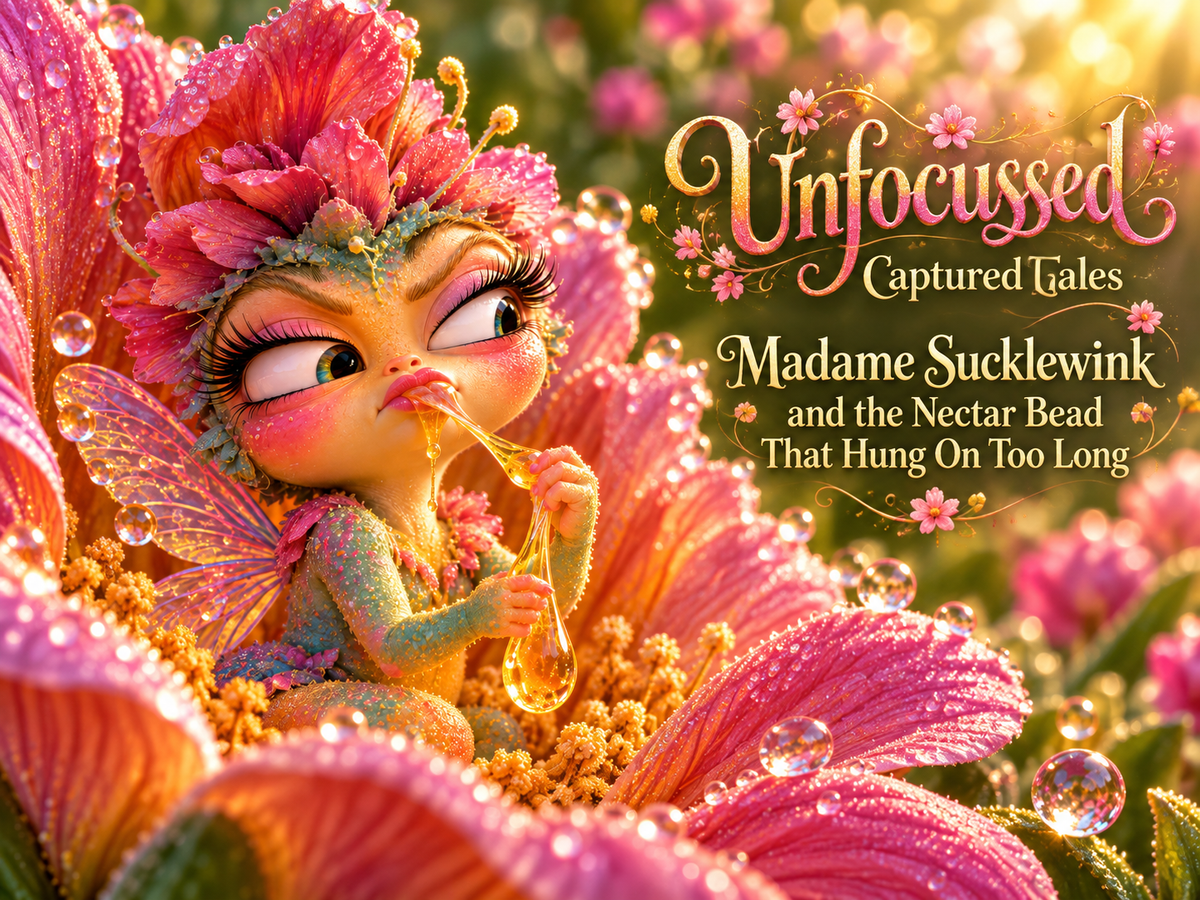
A Very Private Inspection
Madame Sucklewink had hosted garden parties for nearly a century, and in all that time she had never once been caught unprepared.
She had rescued a soufflé from a wandering caterpillar, redirected a tipsy duke away from the compost heap, and once kept an entire string quartet playing while a family of field mice made off with the sheet music. She could manage any mishap with a smile, a fan, and a firm belief that panic was for people who had forgotten where they put their good gloves.
Then the nectar bead appeared.
It clung to the tip of her favorite bloom, round and glistening in the afternoon light. Madame dabbed it with a handkerchief. It stretched, shimmered, and settled right back where it had been.
“Well,” she murmured, leaning closer. “You are certainly committed.”
The bead gave a tiny wobble.
Madame straightened at once. “And I am certainly not going to discuss it with a flower.”
Unfortunately, the flower was the centerpiece of the terrace, and the terrace was where that evening’s guests would gather. Madame had promised a graceful supper beneath the lantern vines. She had arranged the silver, chilled the elderberry cordial, and instructed the fireflies to keep their lighting soft and flattering. A stubborn little bead of nectar was not going to upstage her.
She tried a silk ribbon. The ribbon slipped.
She tried a leaf. The leaf folded itself over the bloom and promptly sprang open again.
She tried blowing on it, which made the bead quiver in a manner Madame found unnecessarily theatrical.
“There is no need to make a production of this,” she told it.
At that moment, the garden gate creaked.
Madame froze. Through the hedge came Dr. Bartholomew Bramblewick, the neighborhood botanist, carrying a leather satchel and the calm, unhurried expression of someone who had never been personally challenged by a droplet of nectar.
“Madame Sucklewink,” he said, removing his hat. “I received your note. You said there was a delicate botanical matter requiring discretion.”
“I did.” Madame glanced at the bloom, then back at him. “Though I had hoped to have it sorted before anyone arrived.”
Dr. Bramblewick set his satchel on the table. “Plants can be surprisingly stubborn.”
“I have noticed.”
He followed her gaze to the flower. The bead shone innocently in the sun.
“Ah,” he said. “I see.”
“You do?” Madame asked, with more relief than she intended.
“I see that it is still there.”
“A promising start.”
The botanist leaned in for a closer look. Madame leaned in too, then remembered the angle and abruptly examined the tablecloth instead.
“It may need a little coaxing,” he said.
“I have tried coaxing.”
“Perhaps a gentler touch.”
“I have tried that as well.”
“Then we should examine the stem.”
“The stem?”
“To learn what is keeping it attached.”
Madame gave him a careful look. “Doctor, I invited you here because you are a professional.”
“And I intend to remain one.”
She exhaled. “Good. I would hate for the garden to get the wrong impression.”
“The garden is unlikely to form an impression.”
From somewhere beyond the hedge came a muffled giggle.
Dr. Bramblewick glanced toward the sound.
Madame’s eyes narrowed. “The garden, perhaps. The neighbors, certainly.”
“Shall I close the gate?”
“Please do. And if you hear anyone asking, you are inspecting a rare bloom.”
“Are you?”
“I am now.”
He reached for a small magnifying lens. Madame watched him inspect the bloom with the grave concentration of a physician at a bedside. The nectar bead trembled as he touched the stem with a gloved fingertip.
“Careful,” Madame whispered.
“I am being careful.”
“It has a mind of its own.”
“Most nectar does not.”
“This one missed the lecture.”
Dr. Bramblewick adjusted his lens. “I may need to test whether the stem is holding it or the bloom.”
“And how do you propose to do that?”
He opened his satchel and produced a slender glass pipette.
Madame’s fan snapped open. “Doctor.”
“It is a standard tool.”
“I am sure it is.”
“For gathering a small sample.”
“Of course.”
“Would you prefer I explain each step?”
“I would prefer you explain nothing where the hedge can hear you.”
Another giggle fluttered from the other side.
Dr. Bramblewick lowered his voice. “Then I suggest we move the flower into the conservatory.”
Madame considered the glowing bead, the open garden gate, and the suspiciously quiet hedge.
“Fine,” she said. “But we are taking the back path.”
They lifted the pot together. It was heavier than Madame expected, and as she adjusted her grip, the bloom brushed Dr. Bramblewick’s sleeve.
He paused.
She paused.
The nectar bead quivered.
“Not a word,” Madame said.
“I wasn’t going to say anything.”
“You were thinking something botanically suggestive.”
“I was thinking the plant is warmer than it should be.”
Madame held the pot a little farther from herself. “That is somehow worse.”
Behind them, the hedge rustled again. A whisper passed from leaf to leaf, followed by the unmistakable sound of someone trying not to laugh.
Madame lifted her chin and headed for the conservatory.
“Doctor,” she said, “whatever you find, we will handle it quietly.”
“Naturally.”
“Professionally.”
“Certainly.”
“And without letting the neighbors invent their own version.”
Dr. Bramblewick looked toward the hedge. “I’m afraid they may already be writing it.”
The conservatory door swung shut behind them. Outside, the garden went silent.
Inside, the nectar bead gave one slow, defiant wobble.
The Bead That Would Not Budge
The conservatory was warm, fragrant, and blessedly out of sight from the terrace. Madame set the flowerpot on a marble stand while Dr. Bramblewick shut the door behind them.
“Now,” she said, “let us discover what this bead wants.”
“Nectar generally wants to fall.”
“Then this one is being contrary.”
Dr. Bramblewick peered through his lens. “The bloom is perfectly healthy. The stem is sound. The nectar appears unusually viscous.”
“You mean sticky.”
“Very.”
Madame folded her arms. “I knew that already.”
“Of course. But now it is an official observation.”
He took out a little glass dish and held it beneath the flower. “If I touch the bead gently with the edge, it should release into the dish.”
“And if it doesn’t?”
“Then we’ll learn something.”
“About the nectar?”
“About the nectar.”
“Good. I merely wanted to be certain we were discussing the same thing.”
Dr. Bramblewick brought the dish close. Madame watched with her fan at the ready, though she had no idea what she planned to do with it. The pipette touched the bead.
It stretched into a shining thread.
“Oh!” Madame cried.
The botanist drew back. The thread snapped, and the bead swung beneath the bloom like a tiny golden pendulum.
They both stared at it.
“That,” said Madame, “was not the gentle release I had in mind.”
“Nor mine.”
He tried a second time, adjusting the angle. The bead trembled, lengthened, and clung fast.
“Perhaps the flower needs a little warmth,” he said.
“It has warmth. It has had all afternoon to enjoy the sunshine.”
“A little more warmth might loosen the nectar.”
“Doctor, I am begging you to choose your words with care.”
“I mean the sunlamp.”
“I know what you mean.”
Dr. Bramblewick fetched a brass lamp from the potting bench. When he switched it on, a soft amber glow filled the conservatory. The bloom warmed. The bead glistened.
It grew larger.
Madame lowered her fan. “That seems to be the opposite of what we wanted.”
“It is responding to the heat.”
“Rather enthusiastically.”
“I’ll turn the lamp down.”
He reached for the dial. The lamp flickered, then flared brighter. A cluster of nearby flowers opened all at once, releasing a sweet perfume so rich that Madame began to sneeze.
“Turn it off!”
“I’m trying!”
The lamp sputtered. Dr. Bramblewick fumbled with the switch while Madame waved her fan to clear the air. A warm gust swept through the conservatory and set the hanging vines swaying.
The nectar bead swung with them.
It tapped the rim of the glass dish.
Once.
Twice.
On the third tap, the dish slid off the marble stand.
Dr. Bramblewick caught it against his chest. Madame caught the flowerpot before it tipped. For one breathless moment, they stood pressed together amid the swaying vines, each holding something fragile and neither willing to admit how close the whole arrangement had come to disaster.
“Are you all right?” he asked.
“My dignity is in critical condition.”
“And the bloom?”
“Still holding on.”
He glanced down. The bead now hung just above the dish in his hand, stretched into a thin, shining droplet.
“Don’t move,” he whispered.
“I wasn’t planning to.”
“The slightest disturbance could make it fall.”
“Then I recommend you stop breathing directly on it.”
He held his breath.
The bead quivered anyway.
Madame looked past him. Through the frosted glass, a shadow crossed the conservatory door. Then another.
“The neighbors,” she murmured.
“How can you tell?”
“They’ve stopped pretending to garden.”
A faint whisper drifted through the glass.
“I heard he brought special instruments,” someone said.
“I heard she asked for a private inspection,” another whispered back.
Madame’s fan snapped shut. “They are going to turn a botanical inconvenience into a scandal.”
“We can explain.”
“Certainly. We’ll go out there together and announce that you were examining my bloom with a pipette.”
Dr. Bramblewick winced. “Perhaps not.”
“A rare bloom,” Madame added. “In a warm conservatory.”
“I see the difficulty.”
“Good. Then I shall leave the explaining to me.”
She took a steadying breath and reached for the door. The botanist carefully followed, still balancing the dish beneath the stubborn bead.
“Madame,” he said, “we cannot leave it suspended like this.”
“We can if we do so with confidence.”
“That doesn’t sound like botany.”
“It is hostessing. Far more dangerous.”
She opened the door.
The two neighbors on the other side sprang apart. One pretended to examine a potted fern. The other held a watering can upside down.
“How is the patient?” one asked.
“Bloom,” Madame corrected.
“Of course,” said the neighbor. “The bloom.”
Madame smiled. “Dr. Bramblewick has identified the problem. The nectar is unusually persistent.”
“I can see that.”
“And it requires a delicate hand.”
“Naturally.”
“So we’ll be conducting the rest of the inspection inside.”
“Naturally,” the neighbor repeated, with the expression of someone already composing a letter to the garden club.
Madame closed the door again.
Behind her, Dr. Bramblewick looked into the dish. The bead still hung there, trembling between flower and glass, refusing to choose its destination.
“I may have one more idea,” he said.
Madame lifted an eyebrow. “Does it involve a lamp?”
“No.”
“A pipette?”
“Possibly.”
“Then explain it very carefully.”
He leaned closer to the bloom. The nectar bead shone between them, poised as if waiting to hear the plan.
The Garden Gets Its Answer
“My idea,” said Dr. Bramblewick, “is to let gravity do the work.”
Madame looked at the trembling bead. “That sounds less like an idea and more like something gravity has been trying to do all afternoon.”
“Not quite. The bead is attached to the bloom, but it’s also touching the dish. If we tilt the dish slowly, the nectar may follow the glass and release from the flower.”
“And if it doesn’t?”
“Then we’ll have a small amount of nectar in a very inconvenient place.”
“I see. We’re gambling with a sticky situation.”
“Precisely.”
Madame took one side of the dish. Dr. Bramblewick held the other. Together they tilted it by the smallest possible degree.
The bead slid along the glass.
“It’s moving,” Madame whispered.
“Slowly.”
“Don’t celebrate yet.”
“I wouldn’t dream of it.”
The bead slipped another fraction of an inch, stretching thinner where it still clung to the bloom. Madame leaned in, holding the dish steady. Dr. Bramblewick adjusted his grip.
“A little farther,” he said.
“I’m giving it all the encouragement I can.”
“The dish, Madame.”
“I know what you meant.”
The bead stretched to its limit. For one long second it hung between the flower and the glass, a shining thread pulled taut.
Then it let go.
The nectar settled into the dish with a tiny, satisfying plink.
Madame blinked. “That was it?”
“That was it.”
“After all that fuss?”
“Some things require patience.”
“Some things require a botanist, a pipette, a sunlamp, and an audience hiding behind the door.”
They both turned toward the conservatory entrance.
Outside, the shadows scattered.
Madame set down the dish and opened the door. The neighbors were clustered around a potted shrub, all studying its leaves with sudden scholarly interest.
“Everything all right?” one asked.
“Perfectly,” Madame said. “The matter has been resolved.”
“And the bloom?”
“Healthy.”
“And the doctor?”
“Professional.”
Dr. Bramblewick appeared beside her. “Entirely.”
Madame smiled. “You see? A perfectly ordinary botanical inspection.”
The neighbors nodded, their faces solemn with the effort of not smiling.
“Well,” Madame said, “since you are all so fascinated by the garden, you may join us for supper. The lanterns are lit, the cordial is chilled, and I could use help carrying the chairs.”
There was a brief pause.
“Of course,” one neighbor said. “We’d be delighted.”
“Wonderful. Then I shall ask you to carry them from the far end of the terrace.”
She handed them the chairs and watched them retreat beneath the vines.
Dr. Bramblewick lifted the little glass dish. “Would you like me to take this away?”
“Please. And thank you for your discretion.”
“It was my pleasure.”
“That is a dangerous thing to say in this garden.”
He smiled. “Then I’ll say it was my professional duty.”
“Much safer.”
They stepped out onto the terrace as the first guests arrived. The lantern vines glowed softly overhead. Madame welcomed each guest with her usual poise, while Dr. Bramblewick placed the dish discreetly on a side table.
For a while, the evening went beautifully. The cordial was praised. The music was lovely. The fireflies kept their lighting soft and flattering. Madame even began to think the neighbors might have forgotten the whole affair.
Then someone raised a glass.
“To Madame Sucklewink,” the neighbor declared, “who knows how to handle even the most persistent bloom.”
A few guests coughed into their napkins. One firefly blinked twice, as if trying not to laugh.
Madame lifted her glass.
“To patience,” she said, “good tools, and knowing when to stop poking at a problem.”
Dr. Bramblewick choked gently on his cordial.
The guests burst into laughter, and Madame joined them. Beneath the lanterns, the garden was warm and sweet, and the little flower on the conservatory sill stood proudly free of its troublesome bead.
Madame Sucklewink had rescued the evening after all.
Though from then on, whenever the neighbors saw Dr. Bramblewick arrive with his satchel, they found somewhere else to be.
Bring Madame Sucklewink Home
Madame Sucklewink’s garden-party mishap is ready to come home with you. Bring her nectar-bead predicament to your wall with a canvas print, framed print, or metal print. Or make the inspection last a little longer with the jigsaw puzzle. For smaller gifts, choose the greeting card; for extra cozy garden gossip, there’s the fleece blanket.

 Sir Petalgrip and the Fold He Should’ve Respected
 Forest Park Keeps Another Season
 Sir Quilliam’s Demonstration of Aggressive Affection