cosmic humor

Contes capturés

View

Song of the Spotted Sky

par Bill Tiepelman

Song of the Spotted Sky

The Problem with Borrowing Magic By the time Pip realized the sky was humming in a key he could actually hit, he’d already promised three different mushrooms an encore and a fern a personalized shout-out. Pip—being a spotted owl-dragon hatchling with the attention span of a soap bubble—loved applause, snacks, and shortcuts, not necessarily in that order. He had two shiny new wings, a belly like a toasted marshmallow, and the deep personal conviction that rules were for species without charisma. On this particular morning, the forest glowed like it had been gently basted in sunlight and baked to golden perfection. Pip perched on a log, warming his toes and contemplating the day’s agenda, which mostly involved not doing the responsible thing and definitely doing the dramatic thing. The responsible thing was practicing flight patterns. The dramatic thing was debuting his original composition: “Song of the Spotted Sky.” There was only one issue—he hadn’t technically written it yet. Minor speed bump. Major main-character energy. “Art is ninety percent confidence and ten percent improvisation,” Pip announced to a moss ball, which offered the kind of silent support only spherical plants can. “Also, snacks.” He flicked his ears, spread his leathery wings, and attempted a warmup trill that sounded like a piccolo losing an argument with a kazoo. Somewhere in the canopy, an elderly jay shouted, “Cease and desist!” which Pip took as rave feedback from his core demographic: disgruntled elders. Enter Marnie, a bat with the dry wit of a tax auditor and the fashion sense of midnight. She hung upside down from a low branch like punctuation at the end of a bad decision. “You’re going to try sky-singing without asking the sky?” she asked, deadpan. “Bold. Illegal. I respect the commitment to chaos; I do not endorse the consequences.” “I’m not stealing the sky’s song,” Pip said. “I’m sampling it. Very modern. Very remix culture.” He wiggled a talon like a lawyer presenting a loophole. “Also, the sky is big. It won’t notice.” Marnie blinked. “The sky notices everything. It’s literally the surveillance state of nature.” She flapped once, landing beside him. “Look, maestro, you can either learn the fundamentals or you can learn them the hard way. The sky will teach you, but it charges interest.” Pip pretended to listen, which is to say he didn’t. The forest was now definitely humming, a slow, honey-thick chord that slid under his skin and lit up his bones like lanterns. It felt like standing in front of a bakery when the first tray of cinnamon rolls hits the air—illegal levels of irresistible. He lifted his chin and caught the melody, bright and simple as a whistle. It fit his throat like a key in a lock. He sang. Oh, he sang. Notes poured out like coins from a cracked jar—tinkling, spinning, showing off. Birds paused mid-complaint. Leaves angled themselves for better acoustics. Even the grumpy jay muttered, “Well, I’ll be—” and forgot to finish being offended. Pip’s wings vibrated with resonance, and the log thrummed along as if it, too, had been waiting to be part of something catchy. “See?” Pip gasped between phrases. “Effort is a myth invented by mediocre squirrels.” He stretched the last note into a glittering ribbon—and felt it tug back. The sky’s melody hooked him like a fish on an invisible line. He choked. His next breath tasted like static and rain. The golden haze sharpened to a metallic blue, and the air grew crowded, like a room where someone important had just walked in. The song—the sky’s song—unspooled wider, older, and wholly unimpressed. The clouds drew together with the soft menace of a librarian closing a very heavy book. A voice rolled across the glade, not loud, but large, as if it had been practicing patience for a few million years. “Little borrower,” it said, “did you ask?” Pip, who had not asked, did what all natural performers do when confronted with accountability: he smiled like a discount cherub and tried charm first. “Big beautiful sky,” he crooned, “I was merely honoring your work with a tasteful tribute—” “Cute,” the sky said, in the tone of a bouncer checking an obviously fake ID. “Return what you took.” The humming tightened. Pip’s wings snapped open on their own, his feet skittered, and he found himself hovering a foot above the log, held there by a music that tolerated no nonsense. Marnie winced. “Interest,” she reminded him, like a friend who has absolutely called this before. “Also, do not say ‘remix culture’ again. Nature starts charging royalties.” The sky’s melody pressed against Pip’s chest. Under it, he could hear something smaller—a thin, bright thread that might’ve been his voice. If he didn’t learn fast, he’d be a cautionary tale with good hair. The forest leaned in. The moss ball leaned in, which is impressive for something with no neck. “Okay,” Pip whispered. “Teach me.” The sky paused, amused. “Lesson one,” it said. “You don’t get to lead the choir until you’ve learned to listen.” The Choir of Small Noises Pip did not like being grounded—especially while hovering a foot off the ground. The irony was thick enough to butter toast with. The sky’s magic held him in place like an invisible hand, and his wings, those shiny new symbols of self-importance, trembled as if they had realized they’d been rented, not owned. “Lesson one,” the sky had said, in that tone all teachers use right before you regret enrolling. “Listen.” So Pip listened. Or rather, he pretended to. He tilted his head, widened his eyes, and summoned the expression of someone who had just discovered depth as a concept. The forest hummed around him, but it wasn’t the dramatic cosmic harmony he expected. It was… busy. Petty, even. The soundscape of small lives doing small things with alarming commitment. Leaves whispered gossip about who was photosynthesizing too loudly. Ants bickered about traffic management. A beetle somewhere was giving an unsolicited TED talk on bark texture. Even the moss muttered in an ancient, damp dialect that seemed mostly to be complaining about the humidity. It was less “sacred song of the natural world” and more “open mic night for neurotic vegetation.” “Is this it?” Pip whispered. “This can’t be it. The sky wants me to listen to this?” “Yes,” said Marnie, who had returned, smug as gravity. “This is what the universe sounds like when you’re not starring in it.” Pip gave her a side-eye so sharp it could’ve opened envelopes. “You’re suggesting that enlightenment sounds like moss complaining about its knees?” “You’d be surprised,” she said. “The trick is realizing it’s not about you. That’s when you start hearing what’s really there.” “But I’m adorable,” Pip protested. “Surely the universe can make an exception for someone with marketable charm.” “The universe has a strict no-influencer policy,” Marnie said. “Now shut up and listen harder.” He did. And gradually—painfully—the noise began to sort itself into something less like chaos and more like pattern. The beetle’s rant had rhythm. The ants marched in percussion. Even the muttering moss had a bass line so low it vibrated his feathers. Tiny sounds wove together, looping, layering, becoming something bigger. Pip blinked. For the first time, he noticed the beat under the breeze, the way the sunlight hit leaves in tempo, the soft pulse of sap and water. He wasn’t hearing notes; he was hearing intention. And somewhere in it, faint but steady, his own voice was tucked like a wayward thread—part of the fabric, not on top of it. “Well, I’ll be feathered,” he murmured. “They’re all… singing.” “You just realized that?” Marnie said, hanging upside down again, because emotional growth was clearly exhausting for her. “Everything sings. Some things just do it off-key.” “So the sky’s song…” Pip began slowly. “It’s everyone?” “Exactly. You tried to solo over a symphony.” Pip frowned. “But how am I supposed to stand out if I blend in?” Marnie gave him a pitying look reserved for the hopelessly theatrical. “Oh, sweet nebula, that’s not the problem. You already stand out. The problem is you don’t fit in. Big difference.” He chewed on that thought, which tasted suspiciously like humility and dirt. The forest hum swelled again—gentle, accepting, disinterested in his personal narrative. He tried humming along, softly this time. His tone wobbled, then steadied as he stopped performing and just… participated. The air shifted. The sky, which had been looming like a disappointed stage manager, eased its grip. “Better,” it rumbled, though it sounded almost amused now. “You’re not tone-deaf to consequence anymore.” Pip grinned weakly. “So… I’m free?” “Free-ish,” the sky said. “You still owe me a song. But now you’ll write it with the world, not against it.” “Collaborations aren’t my brand,” Pip muttered. “Neither is existing as a cautionary tale, and yet…” Marnie said. Pip exhaled, flapping his wings just to make sure they still worked. They did, but something had changed. The air felt thicker with meaning, heavier with… awareness, maybe. Or possibly guilt. Hard to tell those apart when you’ve just been schooled by the atmosphere itself. “Fine,” he said, stretching his neck dramatically. “I’ll listen. I’ll learn. I’ll become one with the whatever. But I refuse to stop being fabulous about it.” “No one’s asking you to,” Marnie said. “Just—maybe use your fabulousness for good. Like inspiring humility. Accidentally.” That night, Pip climbed to the tallest branch he could find. The stars blinked awake one by one, like cosmic critics taking their seats. The forest murmured in its thousand sleepy languages. He inhaled the scent of moss, bark, and something like old stories—and began to hum again. This time, the sound didn’t fight the world; it folded into it. The trees harmonized softly. The wind sighed in perfect pitch. A cricket orchestra joined in, playing from the shadows. Even the moon gave a slow, approving nod. Pip sang—not to impress, but to connect. It wasn’t as shiny as performing, but it was deeper, warmer, more… real. And for a moment, the forest’s countless little noises stopped being noise at all. They were the song. The spotted sky above shimmered as if smiling. Then, of course, a toad somewhere croaked completely off-beat and ruined the vibe. “Every band has a drummer,” Marnie said from a nearby branch. “Don’t take it personally.” Pip snorted. “You think the sky’s still listening?” “Oh, definitely. But it’s laughing now.” The night air buzzed softly, and Pip thought—just for a moment—he heard the faintest chuckle woven into the stars. He didn’t know if it was mockery or approval. Probably both. “Lesson two,” the sky murmured faintly. “Humility doesn’t mean silence. It means knowing when not to scream.” “That’s going on a T-shirt,” Pip said, and the wind carried his laughter into the dark, where even the toad managed to land on beat—just once. Encore Under the Falling Stars By the following evening, Pip had achieved something most creatures only dream of: a partial redemption arc and a sense of perspective. Unfortunately, both were terrible for his brand. Nobody buys plush toys of a morally balanced protagonist. He missed being the scandalous, sparkly one—the kind of hatchling who looked like trouble and sounded like a soundtrack. But he also didn’t particularly want to get vaporized by the upper atmosphere again, so personal growth it was. “Balance,” he told himself the next morning, as he tried to hum while eating a berry roughly the size of his head. “Moderation. Maturity.” He paused to lick juice off his wing. “God, I hate it here.” “You’ll get used to it,” said Marnie, who’d made a hobby of appearing uninvited whenever his self-esteem was within kicking distance. “Besides, if you’re done being punished, maybe you can figure out what the sky actually wants from you.” “I thought it wanted me to listen,” Pip said. “Then it wanted me to collaborate. What’s next? Therapy?” “You could use some,” Marnie said cheerfully. “Your ego’s still writing checks your soul can’t cash.” Pip scowled, but she wasn’t wrong. The forest was quieter today—or maybe he was just tuned differently. The chatter of beetles felt less like background noise and more like percussion again. The leaves’ whispers had softened into melody. Even the cranky moss had settled into something like harmony. And over it all, the sky’s hum lingered—patient, constant, the low thrumming reminder that magic, like rent, was due monthly. Then came the rumor. It started in the brambles, as most bad ideas do. A flock of sparrows passed it along to the jays, who exaggerated it into legend, and by sundown the whole forest knew: the sky was planning an open concert. “An open concert?” Pip repeated when Marnie told him. “Like… auditions?” “More like a cosmic jam session,” she said. “Every species gets a chance to contribute their sound. It’s how the sky keeps the balance—every few decades, everyone has to remind it they still exist.” Pip’s feathers fluffed. “So it’s basically a celestial open mic night?” “Exactly. Except if you mess up, you don’t just get booed off stage. You might, you know… disappear.” “Oh,” Pip said, smiling too wide. “So high stakes. Perfect. I’m in.” “You’re not invited,” Marnie said immediately. “You literally just got off musical probation.” “And yet,” Pip said, already preening, “how poetic would it be if I came full circle? The sky took my song—now I give it back, better. Redemption arc, act three, the critics will eat it up.” “The critics,” said Marnie, “will eat you.” But Pip had already decided. You can’t argue logic with someone who narrates their own character development in real time. The Sky’s Stage Three nights later, the entire forest gathered in a clearing so vast it seemed carved by something older than weather. The trees leaned back respectfully, their canopies forming natural amphitheater walls. Fireflies swirled overhead like stage lights. Even the moon looked dressed up, shining with the smug brightness of someone who’d scored front-row seats. The air was thick with anticipation and pollen—both equally intoxicating. One by one, creatures performed. The frogs croaked thunderous harmonies. The crickets chirped in complex polyrhythms that would’ve made jazz musicians weep. The breeze itself sighed through the reeds, a wistful solo that drew a standing ovation from the ferns. Even Marnie participated, contributing a haunting echo that danced through the canopy like smoke and shadow. And then, as always, Pip made an entrance. Not just an entrance—a moment. He swooped in with the subtlety of fireworks at a funeral, his wings catching the moonlight like polished bronze. The crowd collectively groaned. You could hear a fern mutter, “Oh gods, it’s him again.” “Evening, adoring public!” Pip declared, landing on a moss-covered boulder. “I come humbly before you to—” “Stop talking before the smiting starts,” Marnie hissed from above. “—to share a lesson learned!” Pip continued, ignoring her. “Once, I sang without listening. I borrowed what wasn’t mine. But now, I bring back what I’ve found: my voice, shared, not stolen.” He fluffed his chest feathers, inhaled, and began. At first, his song was small—a single, clear note, fragile as glass. Then it grew, layered with echoes of everything he’d heard since: the whisper of moss, the chatter of ants, the rustle of leaves. His voice rose and fell in rhythm with the forest’s breath. It wasn’t perfect. It cracked. It stumbled. But it was alive. Honest. His melody wound through the night like a thread stitching everything together. The sky listened. Then—because the universe enjoys good timing—a shooting star tore across the heavens. It left behind a streak of light that seemed to pulse in sync with Pip’s song. One became two, then ten, then a rain of falling stars, each burning brighter as his voice wove around them. The forest gasped. Even the moss stopped mumbling. The sky spoke again, but this time not as thunder or judgment. It was laughter, soft and rumbling, full of warmth and warning both. “You’ve learned to listen,” it said. “Now listen to what you’ve made.” Pip’s song didn’t stop when he stopped singing. It kept going—echoed, mirrored, remixed by the world itself. The frogs picked up his rhythm. The crickets repeated his melody. The wind whistled in harmony. For the first time, the forest didn’t just hear him; it answered him. And it sounded good. Unreasonably good. Like, “someone’s-going-to-start-selling-merch” good. He beamed. “So… I passed?” “Technically,” said the sky, “but I’m keeping the publishing rights.” “Fair,” Pip said. “I’d only blow it on snacks anyway.” The laughter rippled outward again, scattering among the stars until the whole clearing glowed with gentle, golden light. Creatures turned toward him—some amused, some admiring, a few already plotting to start a tribute act. Marnie landed beside him, giving a little snort. “You realize this means you’re insufferable again.” “Oh, absolutely,” Pip said, grinning. “But now I’m insufferable with depth.” “That’s somehow worse.” They watched the stars fall in silence for a while. It wasn’t comfortable silence—Pip had the attention span of a caffeinated squirrel—but it was companionable. The kind of quiet that happens when you’ve finally stopped trying to fill it. “So what now?” he asked eventually. “Now?” Marnie said. “Now you live with what you’ve learned until you forget it again. Then the sky will teach you something new.” “That’s the cycle?” “That’s the joke,” she said. “Welcome to enlightenment.” He nodded, thoughtful. Then: “Do you think the sky would mind if I did an encore?” Marnie groaned. “You are constitutionally incapable of not pushing your luck.” “True,” Pip said, and before she could stop him, he leapt from the boulder and flared his wings wide. His voice soared into the sky—lighter, freer, full of everything he’d been too proud to feel before. The forest joined him again, this time not out of obligation or curiosity, but out of joy. The whole world became orchestra and audience all at once. And for a brief, impossible moment, Pip thought he could feel the universe smiling—a soundless note of pure approval humming through his bones. Then the note faded, leaving behind only wind and laughter and a toad with no sense of timing. But that was enough.   The Lesson (Abridged, Annotated, and Mildly Sarcastic) The moral, of course, is painfully simple: You can’t own what you don’t understand, and you can’t understand what you refuse to hear. Pip learned—eventually—that creation isn’t conquest, and that sometimes the loudest voice in the room is the one quietly keeping time. The universe has rhythm. You can dance to it, or you can get dragged along by it, but either way—you’re part of the song. And maybe that’s the joke, too: everyone wants to headline, but no one wants to rehearse. Pip just happened to learn both the hard and the entertaining way. Which, frankly, is the only way worth learning anything at all. As for the sky—it kept on humming, amused, watchful, and only slightly worried about what Pip would try next. Because one thing’s for sure: somewhere, somehow, that little spotted show-off was definitely plotting a remix. ARCHIVE NOTE: Prints, downloads, and image licensing of “Song of the Spotted Sky” are available through the Unfocussed Image Archive. Perfect for collectors of whimsical art and lovers of morally ambiguous forest creatures.   Bring the Magic Home If Pip’s song made you grin, snort, or reconsider stealing from cosmic entities, you can now take a little piece of that story home with you. The artwork “Song of the Spotted Sky” by Bill and Linda Tiepelman is available in several gorgeous formats, each guaranteed to brighten your space—or mildly judge you if you ignore your creative calling. ✨ Framed Print — Because every wall deserves a touch of whimsy and questionable decision-making. ⚙️ Metal Print — Bold, luminous, and utterly indestructible. Perfect for showcasing Pip’s ego in HD. 🧩 Puzzle — 500+ chances to question your life choices, piece by piece. It’s chaos therapy with wings. 💌 Greeting Card — Send a note, a laugh, or an unsolicited life lesson in Pip-approved style. Whichever version you choose, remember: art is just another way of singing with your eyes open. And if you start hearing the forest hum back—don’t worry. That’s just Pip trying to duet again.

En savoir plus

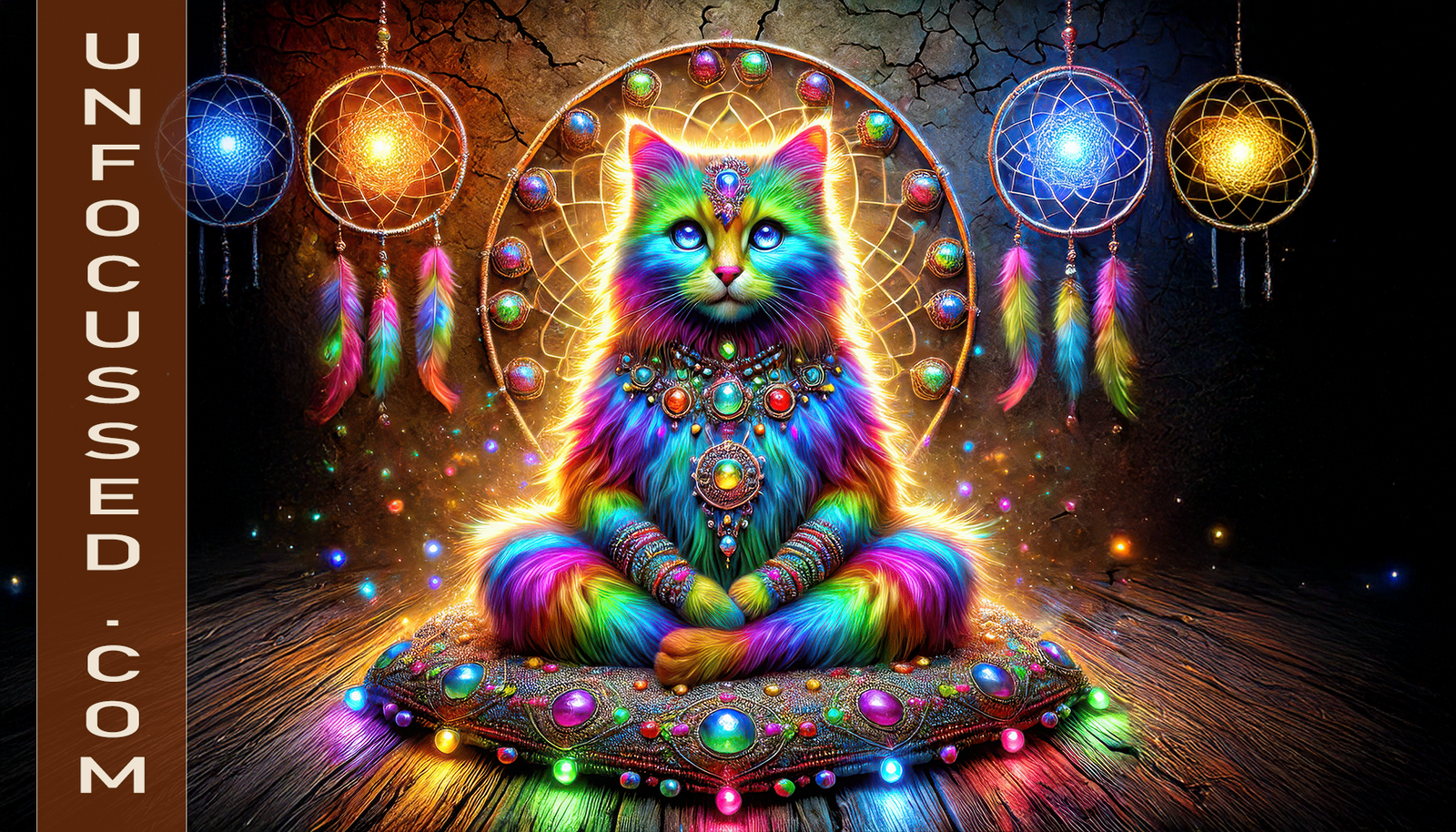
Meditative Whiskers of Light

par Bill Tiepelman

Moustaches de Lumière Méditatives

Le guide des résolutions du Nouvel An pour les hippies Une autre année, un autre tour du soleil. C’est ce que je me disais, assise sur mon coussin de méditation dans le coin de mon salon, la fumée d’encens s’enroulant autour de moi comme les volutes mystiques de ma jeunesse libre d’esprit. « Résolutions du Nouvel An », murmurais-je à mon chat, Cosmic Steve, qui me regardait avec la sagesse détachée d’un être qui m’avait vu au pire – comme la fois où j’avais essayé de faire fermenter mon propre kombucha en 1987 et où je me suis retrouvée avec une cuisine qui sentait comme les toilettes portatives de Woodstock. Je me suis gratté la barbe, désormais couverte de mèches grises, et j’ai réfléchi au défi qui m’attendait. Les résolutions. C’était comme essayer d’arrêter le sucre tout en tenant une boîte de brownies bio et végétaliens – techniquement bons pour la santé, mais toujours pénibles. « Ok, Steve », ai-je dit, « cette année, je vais prendre ça au sérieux. Plus d’excuses. » Résolution n°1 : manger plus sainement J’ai dépoussiéré un vieux presse-agrumes que j’avais acheté dans un vide-grenier en 1993. Il avait probablement préparé du jus pour une communauté disparue depuis longtemps dans l’Oregon, à en juger par la légère odeur d’huile de patchouli qui y restait. J’y ai ajouté du chou frisé, une carotte et une pomme pour faire bonne mesure. Le presse-agrumes a rugi comme un ours en colère, crachant ce qui ressemblait à de l’eau de marais. J’ai pris une gorgée, grimacé, et immédiatement suivi d’un verre de tequila. Cosmic Steve m’a regardé comme pour dire : « Tu n’as rien appris. » Résolution n°2 : faire plus d'exercice « Yoga », ai-je décidé en déroulant un tapis que j’avais acheté dans les années 70. Il était plus taché qu’un t-shirt tie-dye à un concert de Grateful Dead. Je me suis étirée en chien tête en bas, qui s’est rapidement transformée en sieste. Entre la posture de l’enfant et celle du cadavre, je me suis assoupie, pour me réveiller une heure plus tard au son de Steve qui tripotait la centrifugeuse. L’exercice physique commençait mal. « Peut-être demain », ai-je dit en me traînant jusqu’au canapé pour regarder les rediffusions de That 70’s Show . Résolution n°3 : soyez plus à l’aise avec la technologie C'était l'idée de Cosmic Steve. Ou du moins je le pensais, vu la façon dont il marchait toujours sur mon clavier pendant que j'essayais de chercher sur Google « comment vivre hors réseau en 2024 ». J'ai finalement décidé de créer un compte TikTok pour diffuser ma sagesse hippie au grand public. Ça ne s'est pas bien passé. Ma première vidéo, intitulée « Comment fabriquer des attrape-rêves en macramé pour votre troisième œil », a eu exactement trois vues, dont une où j'essayais de comprendre comment la supprimer. « Les réseaux sociaux sont un piège, mec », ai-je dit à Steve. Il n'était pas en désaccord. Résolution n°4 : Soyez mieux organisé J’ai acheté un agenda. Un très joli agenda avec des motifs floraux et des citations inspirantes comme « Le voyage est la récompense ». J’ai vite oublié où je l’avais rangé. Quand je l’ai enfin retrouvé – sous une pile de disques vinyles – je me suis rendu compte que j’avais écrit « PLAN LIFE » le 1er janvier et rien d’autre. « C’est parfait », me suis-je dit. « Les esprits libres ne peuvent pas être limités par des calendriers. » L'Épiphanie du Nouvel An À la fin de la première semaine, mes résolutions s’étaient transformées en intentions vagues, comme « peut-être manger moins de fromage » et « penser à faire du jogging ». Mais ensuite, au cours d’une de mes méditations du soir (bon, d’accord, j’étais allongé sur le canapé avec un verre de vin et du Pink Floyd), ça m’a frappé. Pourquoi m’efforçais-je d’être quelqu’un que je n’étais pas ? J’avais passé des décennies à perfectionner l’art d’être une vieille âme hippie. Les résolutions n’étaient que des constructions sociales, mec. C’étaient comme les horloges et les impôts – des règles arbitraires destinées à nous enfermer dans des cases. « Tant pis, Steve, dis-je. Ma résolution est de continuer à être moi-même. » La leçon finale Alors voilà, je n'ai pas perdu de poids, je n'ai pas couru de marathon et ma carrière sur TikTok est probablement morte avant même d'avoir commencé. Mais j'ai renoué avec les choses qui me rendent heureuse : les couchers de soleil, les disques vinyles et les expériences douteuses de kombucha de temps en temps. Et c'est peut-être ça, les résolutions. Il ne s'agit pas de changer qui vous êtes, mais de redoubler d'efforts sur les parties de vous qui sont déjà géniales. Bonne année, mon gars. Que tes ondes soient bonnes et que tes résolutions soient facultatives. Découvrez l'essence des « Moustaches méditatives de lumière » dans nos archives d'images . Cette œuvre d’art vibrante et fantaisiste est disponible pour les impressions, les téléchargements et les licences. Parfait pour ajouter une touche de sérénité colorée à votre espace ou à votre projet. Plongez dans la magie dès aujourd'hui !

En savoir plus

Cradle of the Universe

par Bill Tiepelman

Berceau de l'Univers

Au commencement – ​​même si le mot « commencement » est peut-être une simplification excessive – il n’y avait que de la poussière d’étoiles, de la poussière cosmique tourbillonnant dans un vide inconnaissable. De là est né l’univers, un terrain de jeu chaotique et infini de lumière et de gravité, d’expansion et d’implosion. Il n’y avait ni rime ni raison, juste le potentiel tourbillonnant sans fin de tout ce qui allait advenir. Et quelque part en chemin, peut-être parce que l’univers s’ennuyait ou parce qu’il raffole des expériences, il y a eu des mains. Ce n'étaient pas des mains ordinaires. Elles n'avaient pas d'empreintes digitales, de nerfs ou d'os, et n'étaient pas attachées à un corps particulier. Elles étaient simplement... flottantes, brillantes, de nature cosmique, faites de poussière d'étoiles et de galaxies, quelque peu chaudes malgré leur texture surnaturelle. Si vous regardiez de plus près, vous jureriez voir des nébuleuses tourbillonner sous la peau, comme de l'huile sur l'eau, scintillant d'un spectre de couleurs impossible. Mais pour autant que quiconque puisse le dire, elles n'appartenaient à personne ni à rien. C'étaient des mains sans maître, ou peut-être étaient-elles le maître, et l'univers lui-même n'était qu'une idée tenue doucement dans leurs paumes. Pendant des éternités, ils flottaient simplement, s'émerveillant de leur propre existence comme seules les mains peuvent le faire. S'ils avaient pu rire, ils l'auraient fait, et s'ils avaient pu penser, ils auraient longuement réfléchi à leur but. Mais après tout, ils n'étaient que des mains. Leur but n'avait aucune importance ; ils existaient simplement, berçant des morceaux d'étoiles et des lueurs de lumière, sentant la chaleur de toute la création circuler à travers eux. Et cela suffisait. Ou du moins c'était le cas, jusqu'au jour où ils ont ressenti quelque chose de nouveau. C'était un léger frémissement, un bourdonnement presque imperceptible venu des profondeurs de l'univers, un signal, peut-être, ou un appel. Quelque chose dans l'univers avait… changé. Alors que les mains se rejoignaient instinctivement, elles remarquèrent le contour flou d'une petite fleur lumineuse prenant forme entre leurs paumes, une fleur éthérée et délicate qui brillait de la lumière des étoiles. Ses pétales scintillaient dans des tons de rose et de violet, son centre était un doux éclat de soleil doré. Les mains sentaient quelque chose, si l'on pouvait dire que les mains ressentent les choses. La sensation n'était pas une pensée, pas exactement, c'était plutôt une impulsion, une envie pressante. Elles avaient bercé l'univers tout entier depuis aussi longtemps qu'elles en étaient conscientes, mais cela semblait… différent. Personnel. La fleur se déploya, couche après couche, chaque pétale une explosion de couleurs et de lumière, comme si la fleur contenait toutes les histoires de toutes les étoiles dans sa forme minuscule. Et pour la première fois, les mains ressentirent une douleur, une envie de protéger quelque chose d'aussi fragile et pourtant d'une beauté si infinie. Alors elles la serrèrent plus fort, la prenant plus soigneusement dans leurs mains, sentant une douce chaleur irradier à travers leurs paumes intangibles. Dans un univers défini par le chaos et l'incertitude, voici quelque chose qui semblait précieux, quelque chose qui nécessitait des soins. Tandis qu’ils s’émerveillaient, la fleur se mit à murmurer. Non pas des mots – les fleurs n’ont pas de bouche – mais un savoir profond et résonnant qui se déversait d’une manière ou d’une autre directement dans la poussière d’étoiles de ces mains célestes. Le murmure était à la fois infiniment ancien et étonnamment nouveau. Il parlait de vie et de mort, de naissance et de déclin, de rire et de chagrin. Il parlait d’instants – la sensation de la lumière lorsqu’elle touche la peau pour la première fois après l’hiver, ou la joie particulière de partager une blague qui n’a pas besoin d’être drôle tant que vous riez ensemble. Il murmurait aussi des paradoxes, l’absurdité et la magnificence de la vie humaine, les moments où les gens rient à travers leurs larmes ou tombent amoureux contre toute raison. Les mains ne pouvaient pas rire, mais si elles l'avaient pu, elles auraient pu rire de l'absurdité de tout cela. Une fleur qui contenait tous les secrets de l'univers, chuchotant à propos de premiers rendez-vous gênants et de la sensation du sable entre les orteils, comme si ces minuscules moments humains pesaient d'une certaine manière autant que la naissance des étoiles et l'effondrement des empires. Mais tandis que les mains écoutaient, elles comprirent quelque chose d'encore plus étrange : la fleur ne se souciait pas d'être éternelle. Sa sagesse résidait dans la compréhension que tout – chaque rire, chaque larme, chaque étoile, chaque silence – finirait par s'effacer un jour. Et elle s'en contentait. En fait, elle célébrait cela. La fleur embrassait le temporaire, l'aigre-doux, les brefs éclats de beauté qui donnaient un sens à l'existence. À cet instant, les mains comprirent, à leur manière silencieuse et muette. Le but de bercer l'univers n'était pas de le protéger du changement, mais de nourrir ses transformations, de laisser les choses s'épanouir et se faner, d'être témoins des joies et des absurdités de l'existence. C'était peut-être pour cela qu'elles étaient là : pour considérer l'univers non pas comme une possession, mais comme un ami, quelqu'un que vous comprenez et qui n'est en visite que pour un temps. Et ainsi, pour la première fois depuis des éternités qu'elles existaient, les mains relâchèrent leur prise. Elles laissèrent la fleur reposer librement dans leurs paumes, se contentant de la regarder vivre et grandir, et finalement, inévitablement, faner. C'était étrange, réconfortant même, de savoir qu'au bout du compte, tout ce qui venait à l'existence finirait par retourner à la même poussière cosmique d'où il était sorti. Alors que les pétales de la fleur commençaient à s'éloigner comme de minuscules étoiles, les mains se trouvèrent étrangement en paix. Elles savaient que l'univers poursuivrait sa danse chaotique, faisant naître de nouvelles merveilles, créant et détruisant dans des cycles sans fin. Elles observeraient, témoigneraient de leur seul but : bercer, prendre soin et, parfois, lâcher prise. Et peut-être, peut-être, s'ils avaient eu le don du rire, ils auraient ri de l'ironie de tout cela. Après tout, c'étaient des mains, les formes les plus simples, tenant les choses les plus complexes. Mais c'est la vie, n'est-ce pas ? Simple, absurde et infiniment belle. Apportez le « Berceau de l'Univers » dans votre espace Si l'histoire du « Berceau de l'Univers » vous parle, pensez à intégrer cette beauté céleste dans votre propre vie. De la décoration murale aux essentiels douillets, il existe de nombreuses façons de garder cette image à portée de main, un rappel du doux mystère de l'univers et de nos propres moments fugaces d'émerveillement. Explorez ces superbes options de produits pour en faire une partie de votre monde : Tapisserie : Transformez n'importe quel mur en un sanctuaire cosmique avec cette tapisserie captivante, parfaite pour les espaces de méditation ou les studios de création. Puzzle : Vivez une expérience consciente en assemblant « Le Berceau de l'Univers », une activité apaisante et méditative. Impression encadrée : Rehaussez la décoration de votre maison avec une impression encadrée de cette œuvre d'art intemporelle, un rappel quotidien de la beauté et de la perspective. Couverture polaire : Enveloppez-vous dans la chaleur du cosmos avec une couverture polaire douce, parfaite pour les nuits d'observation des étoiles ou pour vous blottir à l'intérieur. Chaque produit vous permet d’emporter un morceau de l’univers dans votre propre vie, un doux rappel de sa beauté cosmique et de ses mystères sans fin.

En savoir plus

Explorez nos blogs, actualités et FAQ

Vous cherchez toujours quelque chose ?