philosophical fantasy

Contes capturés

View

When Angels Duel Demons

par Bill Tiepelman

When Angels Duel Demons

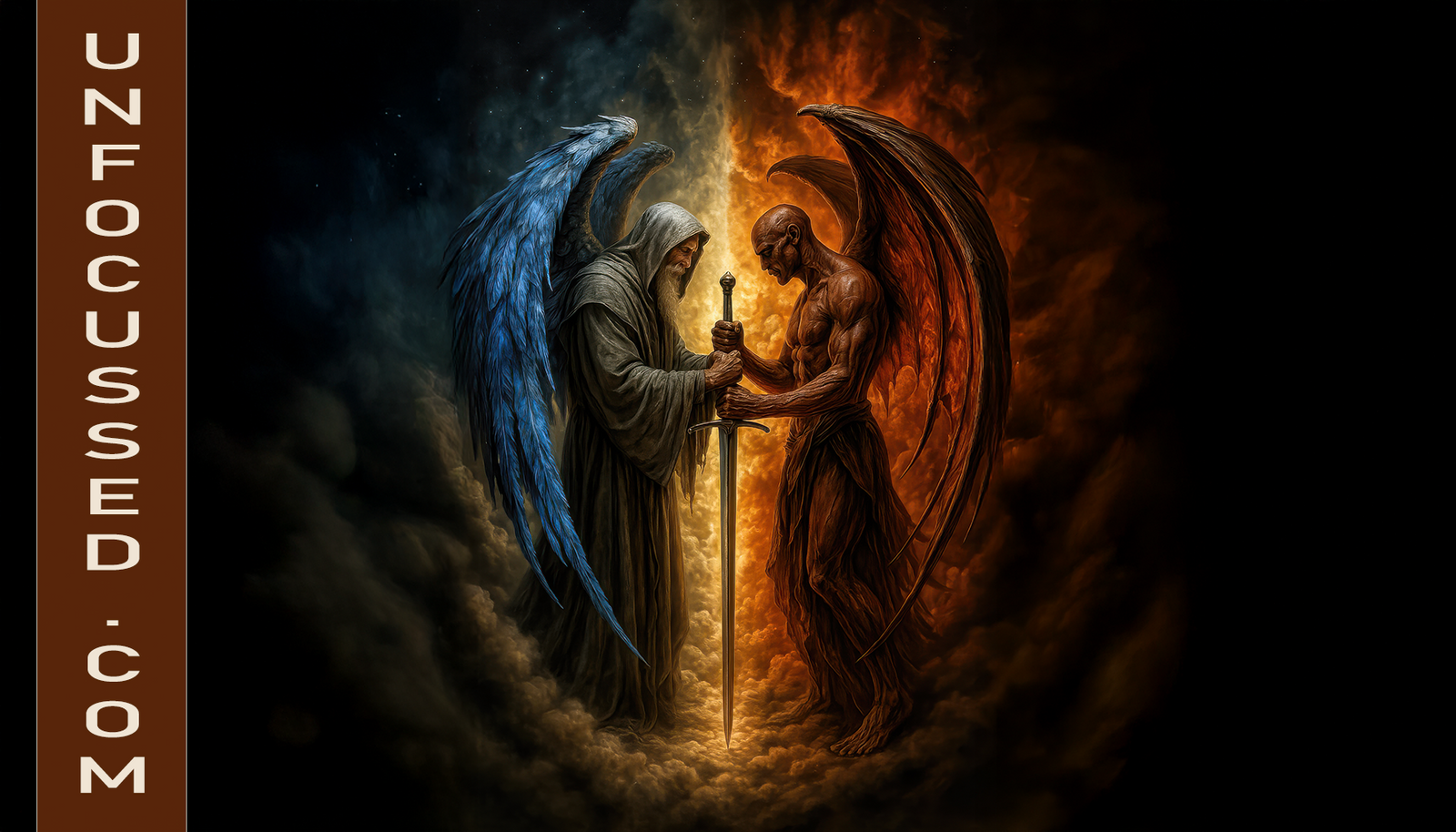
The Sword Between Worlds The sky was bleeding fire and frost. Where the heavens ended and hell began, a rift had formed—a tear in the fabric of what mortals once called balance. And in the heart of that rupture stood two beings, locked in place not by chains or weapons, but by the unbearable gravity of fate. The angel was older than light. Cloaked in robes worn by a thousand years of wandering, his wings shimmered with residual starlight—blue, cold, and aching. Time had not dulled the sorrow in his eyes, nor the blade he held with bone-pale hands. His name, lost in tongues no longer spoken, trembled at the edge of every prayer whispered by a desperate soul. And yet, tonight, no prayers would save anyone. The demon across from him breathed smoke with each snarl of his lungs. Carved from rage and sinew, his wings stretched like razors into the blazing inferno behind him. Skin dark as dried blood, eyes deeper than obsidian. He wasn’t born from sin—he authored it. Once divine, now damned, he remembered the light only as something he chose to unlove. Not hate. That would be too simple. He abandoned it like one discards truth when it becomes unbearable. Between them: a sword. No ordinary weapon, but a relic older than either of them. A blade forged by the first act of betrayal. Its hilt burned and froze all at once, reacting not to touch but to the soul that dared wield it. And now, neither could let go. Their hands wrapped around it, locked in eternal deadlock. The sword would decide nothing. It only listened. Clouds convulsed beneath their feet, the storm of heaven and hell surging in circular torment. Light battled shadow on their skin, every flicker of flame casting new truths, new lies. The air tasted of iron, ash, and inevitability. “You don’t want this,” the angel said, voice hoarse with conviction. It wasn’t a threat—it was the kind of truth that makes your blood run cold. The kind that arrives too late. The demon grinned, and gods wept somewhere far beyond. “I do. I’ve always wanted this. But not for the reasons you fear.” “Then speak. Let me understand the madness before I end it.” “You won’t end it,” the demon whispered, leaning closer, cheek brushing against the frigid wind pouring off the angel’s wings. “Because ending it means accepting that we were always the same.” The sword pulsed. Once. Then again. And a low hum echoed across the void—neither holy nor unholy. Just ancient. Watching. Far below them, humanity slept. Dreaming of peace, unaware that the only reason dawn might come again… was because two timeless beings couldn’t decide whether the world was worth destroying or redeeming. The Sin in the Mirror The hum of the blade grew louder, and for the first time in millennia, the angel faltered—not in grip, but in faith. Not in strength, but in purpose. What if he had already lost the war, not on the battlefield, but in the quiet places of himself? Places where doubt crept like mold through a cathedral. He stared into the demon’s eyes. No fire. No glee. Only the echo of pain masquerading as certainty. The angel had seen it before—in fallen soldiers who couldn’t die, in saints who forgot why they prayed. In his own reflection, long ago. “What do you want?” he finally asked, not out of pity, but out of terror that he already knew. The demon chuckled, a sound like dry leaves torn apart in wind. “To be seen. To be heard. Not by them—” he nodded toward the sleeping earth below, “—but by you. My brother. My mirror.” Silence. The angel’s grip tightened, not on the sword, but on the moment. He remembered the first schism—the sundering not of realms, but of hearts. The day one chose obedience, and the other chose knowledge. They were not opposites. They were choices cleaved from the same truth. And that was the lie no scripture dared tell. “I gave up paradise,” the demon said. “Not for hatred. For freedom. I wanted to ask questions you were too afraid to form. I wanted to love without conditions. I wanted to fail without eternal damnation. And you—you stayed. You bent. You broke yourself into what they wanted.” The angel looked down. His robe, once pure, was stained by decisions he never questioned. Deeds he called righteous because someone else had written the rules. How many were punished in the name of justice? How many prayers did he ignore because they came from mouths deemed ‘unclean’? “We are what we protect,” the angel said softly. “And I protected a machine. You burned it down.” “And yet here we are,” said the demon, voice trembling now. “Still holding the same blade. Still undecided.” The sword pulsed again. This time, they both felt it not in their hands—but in their memories. One held a newborn in a plague-ridden city, shielding it with wings of frost. One whispered rebellion to a queen who would die screaming for a crown. One destroyed a war before it began. One birthed one that had to be fought. Neither right. Neither wrong. Just necessary. And the sword hummed again, as if to say: I know you both. And I do not choose. The demon stepped back, his wings folding, not in surrender, but in reflection. “I came here thinking we would end everything. But now... I see the truth.” The angel looked up. “Which is?” “The end was never mine to bring. Nor yours. We’re just the gatekeepers. The fire and the flood. The warning signs carved into existence.” Below them, the first star of morning pierced the clouds. The angel loosened his grip. So did the demon. The blade, now without tension, hovered between them—not falling, not flying. Suspended, like truth between myth and memory. “What now?” asked the angel. “Now,” the demon smiled faintly, “we watch. We wait. And when they come to that same sword, thinking it will save them or doom them... we let them choose.” He turned and walked back into the fire. The angel stood still, then turned toward the wind and vanished into the stars. And the sword? It stayed. In the clouds. Waiting. Listening. For the next hand, the next heart, bold or blind enough to believe it knew what it was fighting for. Some weapons are not forged to end wars, but to begin conversations too dangerous for gods or men.     If this story moved you—if the image of eternal duality and the weight of cosmic consequence still lingers in your chest—bring When Angels Duel Demons into your world. This powerful artwork is available across a stunning range of formats to suit your space, your style, and your soul. Transform any room into a sacred space of contrast with our wall tapestry, a bold statement piece where fabric meets philosophy. Showcase the fire-and-ice aesthetic in gallery-level detail with a metal print—a striking finish for lovers of depth, shadow, and light. Carry the confrontation wherever you go with a versatile tote bag that holds more than items—it holds story. Wrap yourself in mythos with our plush fleece blanket, where warmth meets wonder. And for those who dare take the battle to the sun, make waves with our dramatic beach towel—a conversation starter as epic as the tale itself. Choose your form. Carry the conflict. Let the story live with you.

En savoir plus

The Alchemy of Fire and Water

par Bill Tiepelman

The Alchemy of Fire and Water

The Birth of the Twin Koi In the beginning, before time learned to walk and the stars whispered their first names, there was the Void. It was neither light nor dark, for those were things yet to be. The Void was simply... waiting. And then, from the stillness, the First Pulse came. It was not a sound, nor a movement, but a knowing—a cosmic sigh that rippled through nothingness and split it in two. From this rupture, two beings emerged, born not of flesh but of essence itself. One burned with a fire that needed no fuel, its golden scales rippling like molten dawn. The other flowed with the cold certainty of the deep, its silvery form woven from the breath of glaciers. Their names were Kael and Isun, though neither spoke them aloud, for names had no meaning to the firstborn of the cosmos. Kael was the Infernal Koi, a creature of restless hunger, of movement, of destruction and rebirth. Isun was the Celestial Koi, patient as the tides, slow as the turning of ages, and as inevitable as the silence after the storm. For an eternity, or perhaps a moment, they circled one another, tracing patterns through the Void that had never before been drawn. Their movements shaped reality itself, giving birth to the first laws of existence. Where Kael passed, stars flared to life, burning bright with his insatiable energy. Where Isun swam, the cooling hush of gravity took hold, weaving planets from scattered dust. They were opposite. They were perfect. They were one. The Covenant of the Eternal Dance The first to break the silence was Kael. “What are we?” he asked, his voice like embers carried on the wind. Isun’s answer was slow, drawn from the depths of an ocean that had not yet formed. “We are motion. We are balance. We are the dream that keeps the cosmos from waking.” Kael flared with dissatisfaction. “Then why do I hunger? Why do I burn? If we are balance, why is my fire never still?” Isun did not answer, but heaved a sigh that became the first wave. In that moment, Kael knew what he must do. He would not simply swim through the void, tracing the same loops forever. He would change. He would grow. He turned sharply, breaking from their eternal spiral, diving toward the heart of the newborn stars. His fire raged, and the cosmos quaked. Suns collapsed, their burning hearts torn open. Worlds cracked and bled. The void filled with light and ruin. Isun, bound to him by the law of their existence, felt the disturbance ripple through his being. His tail flicked once, and time itself bent in his wake. He did not chase Kael, for water never chases fire. Instead, he followed in the way that the moon follows the tide—without rush, without force, but inevitable. Where Kael burned, Isun soothed. He let his presence cool the shattered husks of dying worlds, turning their molten cores into solid land. He wove the first oceans from the sighs of dying stars. He was the healer, the slow hand of patience to counter Kael’s furious destruction. And so, the first cycle was born—the dance of creation and ruin, of fire and water, of the endless hunger and the eternal calm. The First Betrayal But the balance was fragile. Kael, weary from his burning, turned to Isun and said, “I am tired of our endless dance. We exist only to undo each other’s work. What is the point?” Isun, unshaken, replied, “The point is that we are. Without me, your fire would consume all. Without you, my waters would freeze the stars themselves. We do not undo each other—we complete one another.” But Kael had already turned away. He did not want completion. He wanted more. And so, for the first time, he did the unthinkable—he struck Isun. It was not a battle of muscle or steel, for such things did not exist. It was a battle of essence, of energy and silence. Kael’s fire tore through Isun’s flowing form, sending cracks through the fabric of the heavens. Isun reeled, his shimmering scales darkened with burning scars. The void trembled at this first betrayal. But Isun did not fight back. Instead, he spoke softly: “If you destroy me, you destroy yourself.” And Kael knew it was true. Without Isun’s waters to temper him, he would rage unchecked until there was nothing left to burn. And so, with a growl of frustration, he fled into the darkness. Isun, left behind, sank into the silent deep. The Fragmenting of the Cosmos Where once there had been unity, now there was division. Fire and water no longer danced as one but warred across the heavens. Stars died and were born anew. Planets withered under Kael’s fury, then drowned beneath Isun’s sorrow. And yet, something new stirred in their wake. From the scattered embers of their struggle, life began to bloom. The cosmos, in its first act of defiance, had found a way to turn war into renewal, suffering into creation. The cycle had begun. But the dance was still unfinished. Kael and Isun had yet to meet again. And when they did, the balance of all things would hang upon a single choice.     The Last Convergence Time does not move forward in the way mortals imagine. It does not march, does not flow like a river. It coils, it loops, it folds upon itself in ways only the oldest of things understand. And so, though eons had passed since Kael and Isun last touched, to them, it was but a breath—one held too long, waiting to be exhaled. Kael, the Infernal Koi, had gone where no fire should—into the void beyond the stars, where nothing could burn. He let himself shrink, let his flames dwindle to embers, let his hunger turn to silence. But silence did not suit him. And so, from the blackness, he watched. He watched as Isun shaped the worlds Kael had once shattered. He watched as rivers carved valleys, as rains kissed barren rock into verdant life. He watched as creatures small and fragile stepped from the waters, standing beneath skies he had once scorched. And he felt something he had never known before. Longing. The Summoning of Fire On the world Isun loved most—one spun from the dust of fallen stars, where water curled through the land like veins—there were beings that lifted their eyes to the heavens. They did not know of Kael and Isun, not as they once were, but they felt their echoes in the world around them. They built temples to the sun, to the tides, to the dance of the elements. One among them, a woman with hair the color of flame and eyes like the ocean’s depths, stood upon the highest peak and whispered a name she did not know she knew. “Kael.” And the embers in the void stirred. She called again, not with her mouth but with her soul, and this time, Kael heard. For the first time since his exile, he moved. He plunged from the heavens like a fallen star, his body still wrapped in the ember-light of his former glory. He struck the earth, and the ground split. The sky wept fire. The sea recoiled, steaming where it met him. And across the cosmos, Isun opened his eyes. The Return of the Celestial Koi Isun had felt Kael’s presence long before the woman had spoken his name. He had known, in the way the tides know when to rise, that this moment would come. And yet, he had not moved to stop it. He had let the call be made. But now, he could not be still. He descended, not in fire but in mist, his body unfurling through the sky like the breath of an ancient storm. He came to where Kael stood, his molten body still smoking from the journey. They faced one another upon the threshold of a world that had not yet been lost. Kael, trembling, spoke first. “Do you still hold to your silence, brother?” Isun did not answer at once. He let his gaze drift over the land, over the people who stood watching, over the woman who had called Kael back from the dark. Then, finally, he spoke. “You came because you were called.” Kael's flames flickered, uncertain. “I came because I remembered.” Isun tilted his head. “And what is it you remember?” Kael hesitated. He could feel the fire beneath his skin, urging him to act, to consume, to remake. And yet, beneath it, there was something else—something colder, steadier, something he had once despised but now yearned for. Balance. The Choice That Was Theirs Alone All things must choose, in the end. Even those who have lived since before time learned its own name. Kael knew he could burn. He could rise, could scorch this world and many others, could undo the work Isun had so carefully mended. It would be easy. It had always been easy. But then he looked upon the woman who had called him. He saw the way her fingers curled into fists, not in fear, but in defiance. He saw the way the people behind her stood, not in worship, but in wonder. And he understood. “You were never my enemy,” he said, his voice quieter than it had ever been. “You were my lesson.” Isun, at last, smiled. And so, for the first time in all of existence, Kael did not burn. He bowed his head. The Alchemy of Fire and Water In that moment, the cosmos changed. Not with the violent rending of worlds, not with the clash of fire and wave, but with something smaller, something gentler. With understanding. Kael stepped forward, his flames flickering with a new light, not of hunger, but of warmth. Isun met him, his waters not as a force of opposition, but of embrace. Their forms twined, not in battle, but in harmony. And where they met, the world flourished. Rivers carved the land not in destruction, but in creation. Volcanic fire did not burn unchecked, but nurtured the soil, making it rich. The seas did not rise to drown the land, but to shape it with care. The people watched, and they knew they were witnessing the birth of something greater than gods, greater than myths. They were witnessing balance. Kael and Isun, the twin koi, the first forces of all things, had become what they were always meant to be—not enemies, not rivals, but two halves of a single whole. And so, the cycle did not end. It simply began again.     Bring the Balance Home The timeless dance of fire and water, of destruction and renewal, is more than just a myth—it is a reminder that opposites do not destroy, but complete one another. Now, you can bring this celestial balance into your own space with "The Alchemy of Fire and Water" collection, featuring stunning artwork inspired by the eternal koi. Tapestries – Transform your walls with the swirling beauty of Kael and Isun, captured in exquisite detail. Puzzles – Piece together the cosmic legend, one intricate detail at a time. Tote Bags – Carry the balance of fire and water with you, wherever your journey takes you. Wood Prints – A natural and timeless way to display this breathtaking fusion of elements. Let the dance of creation and transformation inspire your space and your spirit. Explore the full collection here.

En savoir plus

Cradle of the Universe

par Bill Tiepelman

Berceau de l'Univers

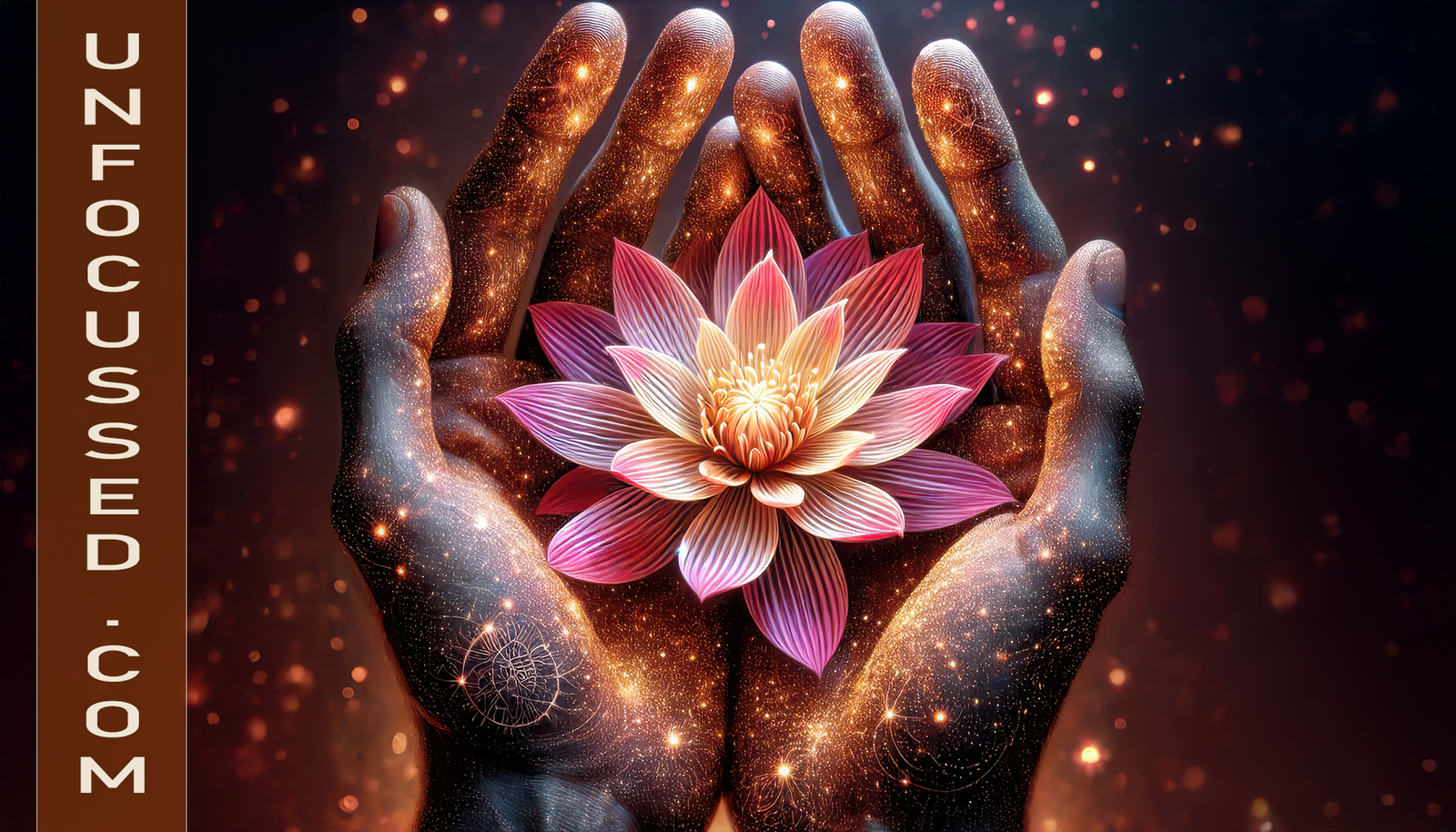
Au commencement – ​​même si le mot « commencement » est peut-être une simplification excessive – il n’y avait que de la poussière d’étoiles, de la poussière cosmique tourbillonnant dans un vide inconnaissable. De là est né l’univers, un terrain de jeu chaotique et infini de lumière et de gravité, d’expansion et d’implosion. Il n’y avait ni rime ni raison, juste le potentiel tourbillonnant sans fin de tout ce qui allait advenir. Et quelque part en chemin, peut-être parce que l’univers s’ennuyait ou parce qu’il raffole des expériences, il y a eu des mains. Ce n'étaient pas des mains ordinaires. Elles n'avaient pas d'empreintes digitales, de nerfs ou d'os, et n'étaient pas attachées à un corps particulier. Elles étaient simplement... flottantes, brillantes, de nature cosmique, faites de poussière d'étoiles et de galaxies, quelque peu chaudes malgré leur texture surnaturelle. Si vous regardiez de plus près, vous jureriez voir des nébuleuses tourbillonner sous la peau, comme de l'huile sur l'eau, scintillant d'un spectre de couleurs impossible. Mais pour autant que quiconque puisse le dire, elles n'appartenaient à personne ni à rien. C'étaient des mains sans maître, ou peut-être étaient-elles le maître, et l'univers lui-même n'était qu'une idée tenue doucement dans leurs paumes. Pendant des éternités, ils flottaient simplement, s'émerveillant de leur propre existence comme seules les mains peuvent le faire. S'ils avaient pu rire, ils l'auraient fait, et s'ils avaient pu penser, ils auraient longuement réfléchi à leur but. Mais après tout, ils n'étaient que des mains. Leur but n'avait aucune importance ; ils existaient simplement, berçant des morceaux d'étoiles et des lueurs de lumière, sentant la chaleur de toute la création circuler à travers eux. Et cela suffisait. Ou du moins c'était le cas, jusqu'au jour où ils ont ressenti quelque chose de nouveau. C'était un léger frémissement, un bourdonnement presque imperceptible venu des profondeurs de l'univers, un signal, peut-être, ou un appel. Quelque chose dans l'univers avait… changé. Alors que les mains se rejoignaient instinctivement, elles remarquèrent le contour flou d'une petite fleur lumineuse prenant forme entre leurs paumes, une fleur éthérée et délicate qui brillait de la lumière des étoiles. Ses pétales scintillaient dans des tons de rose et de violet, son centre était un doux éclat de soleil doré. Les mains sentaient quelque chose, si l'on pouvait dire que les mains ressentent les choses. La sensation n'était pas une pensée, pas exactement, c'était plutôt une impulsion, une envie pressante. Elles avaient bercé l'univers tout entier depuis aussi longtemps qu'elles en étaient conscientes, mais cela semblait… différent. Personnel. La fleur se déploya, couche après couche, chaque pétale une explosion de couleurs et de lumière, comme si la fleur contenait toutes les histoires de toutes les étoiles dans sa forme minuscule. Et pour la première fois, les mains ressentirent une douleur, une envie de protéger quelque chose d'aussi fragile et pourtant d'une beauté si infinie. Alors elles la serrèrent plus fort, la prenant plus soigneusement dans leurs mains, sentant une douce chaleur irradier à travers leurs paumes intangibles. Dans un univers défini par le chaos et l'incertitude, voici quelque chose qui semblait précieux, quelque chose qui nécessitait des soins. Tandis qu’ils s’émerveillaient, la fleur se mit à murmurer. Non pas des mots – les fleurs n’ont pas de bouche – mais un savoir profond et résonnant qui se déversait d’une manière ou d’une autre directement dans la poussière d’étoiles de ces mains célestes. Le murmure était à la fois infiniment ancien et étonnamment nouveau. Il parlait de vie et de mort, de naissance et de déclin, de rire et de chagrin. Il parlait d’instants – la sensation de la lumière lorsqu’elle touche la peau pour la première fois après l’hiver, ou la joie particulière de partager une blague qui n’a pas besoin d’être drôle tant que vous riez ensemble. Il murmurait aussi des paradoxes, l’absurdité et la magnificence de la vie humaine, les moments où les gens rient à travers leurs larmes ou tombent amoureux contre toute raison. Les mains ne pouvaient pas rire, mais si elles l'avaient pu, elles auraient pu rire de l'absurdité de tout cela. Une fleur qui contenait tous les secrets de l'univers, chuchotant à propos de premiers rendez-vous gênants et de la sensation du sable entre les orteils, comme si ces minuscules moments humains pesaient d'une certaine manière autant que la naissance des étoiles et l'effondrement des empires. Mais tandis que les mains écoutaient, elles comprirent quelque chose d'encore plus étrange : la fleur ne se souciait pas d'être éternelle. Sa sagesse résidait dans la compréhension que tout – chaque rire, chaque larme, chaque étoile, chaque silence – finirait par s'effacer un jour. Et elle s'en contentait. En fait, elle célébrait cela. La fleur embrassait le temporaire, l'aigre-doux, les brefs éclats de beauté qui donnaient un sens à l'existence. À cet instant, les mains comprirent, à leur manière silencieuse et muette. Le but de bercer l'univers n'était pas de le protéger du changement, mais de nourrir ses transformations, de laisser les choses s'épanouir et se faner, d'être témoins des joies et des absurdités de l'existence. C'était peut-être pour cela qu'elles étaient là : pour considérer l'univers non pas comme une possession, mais comme un ami, quelqu'un que vous comprenez et qui n'est en visite que pour un temps. Et ainsi, pour la première fois depuis des éternités qu'elles existaient, les mains relâchèrent leur prise. Elles laissèrent la fleur reposer librement dans leurs paumes, se contentant de la regarder vivre et grandir, et finalement, inévitablement, faner. C'était étrange, réconfortant même, de savoir qu'au bout du compte, tout ce qui venait à l'existence finirait par retourner à la même poussière cosmique d'où il était sorti. Alors que les pétales de la fleur commençaient à s'éloigner comme de minuscules étoiles, les mains se trouvèrent étrangement en paix. Elles savaient que l'univers poursuivrait sa danse chaotique, faisant naître de nouvelles merveilles, créant et détruisant dans des cycles sans fin. Elles observeraient, témoigneraient de leur seul but : bercer, prendre soin et, parfois, lâcher prise. Et peut-être, peut-être, s'ils avaient eu le don du rire, ils auraient ri de l'ironie de tout cela. Après tout, c'étaient des mains, les formes les plus simples, tenant les choses les plus complexes. Mais c'est la vie, n'est-ce pas ? Simple, absurde et infiniment belle. Apportez le « Berceau de l'Univers » dans votre espace Si l'histoire du « Berceau de l'Univers » vous parle, pensez à intégrer cette beauté céleste dans votre propre vie. De la décoration murale aux essentiels douillets, il existe de nombreuses façons de garder cette image à portée de main, un rappel du doux mystère de l'univers et de nos propres moments fugaces d'émerveillement. Explorez ces superbes options de produits pour en faire une partie de votre monde : Tapisserie : Transformez n'importe quel mur en un sanctuaire cosmique avec cette tapisserie captivante, parfaite pour les espaces de méditation ou les studios de création. Puzzle : Vivez une expérience consciente en assemblant « Le Berceau de l'Univers », une activité apaisante et méditative. Impression encadrée : Rehaussez la décoration de votre maison avec une impression encadrée de cette œuvre d'art intemporelle, un rappel quotidien de la beauté et de la perspective. Couverture polaire : Enveloppez-vous dans la chaleur du cosmos avec une couverture polaire douce, parfaite pour les nuits d'observation des étoiles ou pour vous blottir à l'intérieur. Chaque produit vous permet d’emporter un morceau de l’univers dans votre propre vie, un doux rappel de sa beauté cosmique et de ses mystères sans fin.

En savoir plus

Explorez nos blogs, actualités et FAQ

Vous cherchez toujours quelque chose ?