
The Day the Numbers Sneezed
By the time the first basket reached the counting table, Nella Voss had already been informed that the harvest was proceeding incorrectly. The fruit was fine. The baskets were sound. The trouble, according to the Harvest Board, was that someone had laid the ledger on the left side of the table when the approved diagram showed it on the right.
“The diagram was drawn by a man who has never carried a wet basket,” Nella said.
Orla Fenwick, the board's visiting auditor, moved the ledger an inch to the right. “He has carried several important opinions.”
Nella liked Orla more than she intended to. The woman had a face as composed as a sealed envelope and a way of delivering an insult so gently that its target often thanked her. Today she wore a clean cream coat to a cranberry harvest, which Nella considered either bravery or a compelling argument for supervision.
The berries had to be counted before the afternoon buyers arrived. One marked basket meant one measure. A brass token went into the tally bowl, and Orla entered the measure in her ledger. It was a simple system improved by three committees over six seasons until nobody trusted it. A red cord identified berries picked from the upper beds. A blue cord identified the lower beds. A basket without a cord required an incident report, even if everyone had watched it being filled.
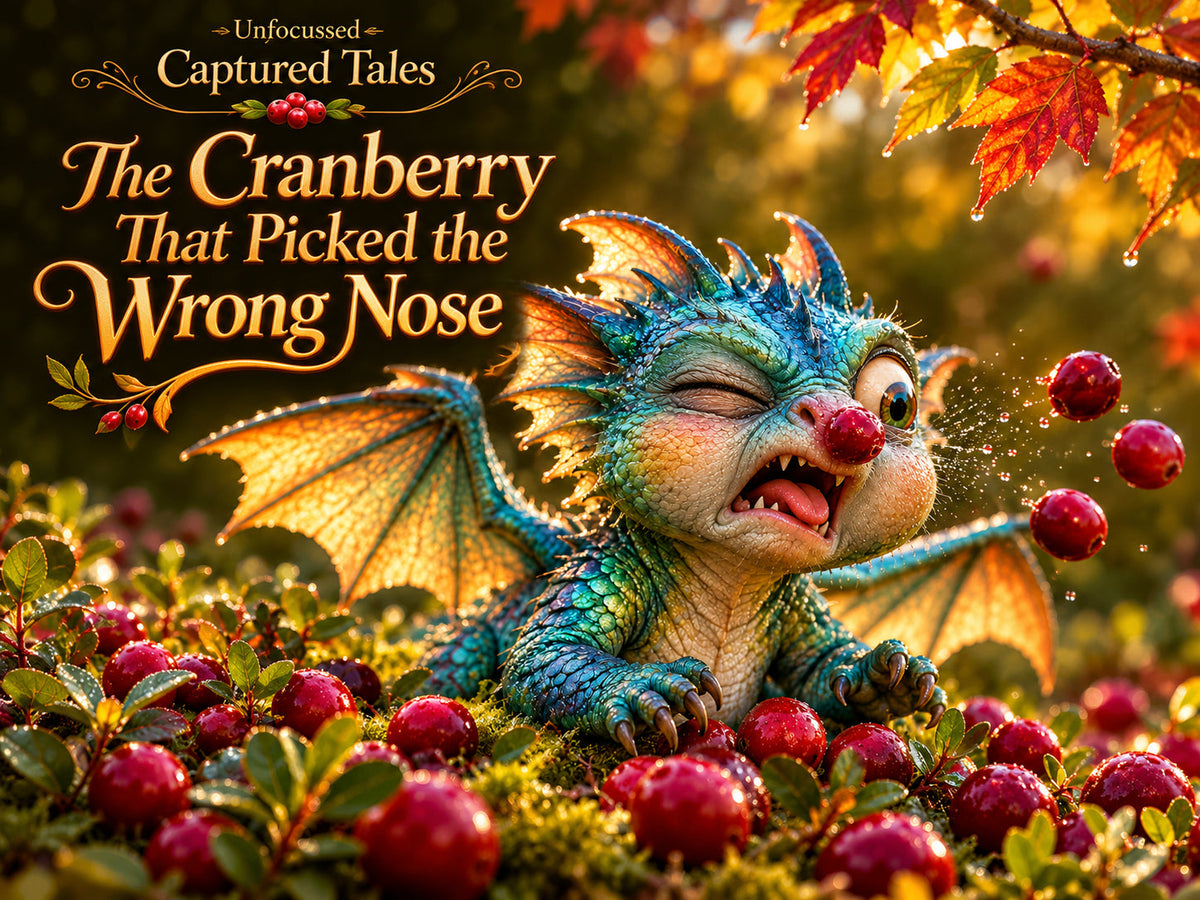
At the edge of the table, a small blue-green dragon crouched in the moss beside a pile of discarded leaves. He was no one's employee and had no token of any color. Nella had found him following the scent of warmed berries that morning, curious enough to inspect every basket and young enough to believe the adults knew what they were doing. She had warned him that the counting table was boring. He had stayed anyway, apparently enchanted by the sound of a brass token dropping into the bowl.
“Our observer has no standing,” said Pella Bracken, chair of the board, without looking at him.
“He has four feet,” said Nella.
“That is not the kind of standing I mean.”
“Then I suspect he'll survive the disappointment.”
Orla entered the twelfth basket. Nella took the next from a harvester whose sleeves were stained to the elbows and set it beneath the scale. The dragon leaned forward. A single loose cranberry rolled from the rim, bumped his snout, and stayed there. He went very still. One eye narrowed. The other opened wide enough to reflect the whole counting table.
Nella recognized that look. “Everybody take one step back.”
Pella raised her pen. “Why?”
The answer arrived with a sneeze that could not possibly have fit inside a creature so small. The berry shot off his nose. Half a dozen others leaped from the open basket, bright red against the warm light. Droplets glittered between them. One berry landed in an upper-bed measure. Two bounced into a lower-bed basket. Another struck Orla's ledger, leaving a round stain precisely where her handwriting had been most elegant.
For a heartbeat, nobody moved. The dragon looked from the airborne fruit to Nella with the astonishment of someone who had opened a door and discovered the room behind it was on fire.
“Well,” Orla said. “That was a remarkably concise objection.”
Pella clasped her pen to her chest. “The figures are compromised.”
“Some berries changed baskets,” Nella said. “I saw where they went.”
“You cannot touch them now. That would alter the evidence.”
“The evidence is making its way down your sleeve.”
Pella looked. A cranberry had lodged in the fold of her cuff. She held her arm out as though she had been bitten by a legal document.
The board ordered a pause. The harvesters, who could see the buyers' wagons approaching on the far road, kept picking. Their baskets gathered in a line while Pella called an emergency accounting review. Orla drew a neat box around the stain in the ledger and labeled it “unclassified impact.” Nella placed the dragon on an overturned crate where nobody could accidentally step on him. He tried to press his little claws together in what might have been an apology. Nobody on the board accepted it, because nobody on the board had asked for one.
“We must determine which baskets received unauthorized fruit,” Pella announced.
“The fruit came from a basket we own,” Nella said. “It hasn't applied for a new citizenship.”
“Ownership is not allocation.”
“Then allocate it back.”
“Without a witnessed transfer form?”
Orla's mouth twitched. Nella knew the look of a woman trying not to laugh in front of a superior and admired the effort. Pella began drawing a boundary around the counting area with spare cord. The harvesters had to step over it to deliver their baskets, which turned each arrival into a procedural violation. By the time the board had agreed that the cord itself did not count as a contaminated object, six new baskets were waiting and the buyers had stopped on the road to watch.
Nella could have let Pella enjoy her emergency. Instead she checked the ledger. If they were going to recount, they might as well start with what had actually been recorded. Orla's columns were tidy, each measure entered beside its token number. Nella followed the upper-bed line with a berry-stained finger, then the lower-bed line. There was a difference of one basket between the ledger and the brass tokens. The sneeze had not sent a basket anywhere.
“Orla,” she said quietly, “how many measures did you have before our unclassified impact?”
“Twelve.”
“The ledger says thirteen.”
Orla came around the table. Pella remained inside her cord boundary, lecturing a harvester on the distinction between waiting and loitering. The dragon leaned over the edge of his crate, watching Nella's finger travel down the page.
Orla counted the tokens. Twelve. She counted the entries. Thirteen. Then she lifted the top corner of the ledger page and saw a second, fainter line pressed into the paper beneath it: the same basket number written twice, once in ink and once in an impression from the sheet above.
“That's impossible,” Orla said.
Nella glanced toward the buyers' wagons, then at the growing queue of baskets. “It would be convenient if it were.”
The dragon gave a tiny sniff. Every adult at the table turned toward him.
An Error with Excellent Penmanship
The dragon sniffed again. Nella put a hand over the loose cranberries before anyone could mistake his breathing for a second attack on the accounts.
“No one is arresting a sneeze,” Orla told him.
“No one has suggested arrest,” Pella said from behind her cord.
“You drew a perimeter.”
“A perimeter is not a prison.”
“Then why are you standing on the only opening?”
Pella moved half a step. The harvesters watched with the hungry patience of people who had worked since dawn and would be paid only when someone with clean hands finished being important. Beyond them, the buyers' wagons stood at the bend. A buyer in a dark green coat had climbed down and was studying the queue with an expression that said she knew exactly how many other growers would take her money.
Orla lifted the marked page. She had been using a thin transfer sheet to carry entries into the board's summary ledger. The impression on the next page carried the same basket number and the same small hook in her handwriting. At a page turn, she had copied that basket into the new column, then copied it again from the transfer sheet as if it were a fresh arrival.
“One basket, two entries,” Nella said.
“One basket, two locations on paper,” Orla corrected. “The basket itself behaved impeccably.”
“Unlike the rest of us.”
Orla looked toward Pella. “I can correct this. It is my error.”
Pella's face tightened at the word my. “We cannot classify an error until we establish whether the missing token was removed.”
“The token is not missing,” Nella said. “There were twelve tokens for twelve baskets. The thirteenth basket exists only in the book.”
“An absence can be evidence.”
“So can your refusal to count to twelve.”
The buyer in the green coat started toward them. Pella turned to the harvesters and declared an extension of the pause, though nobody had asked how long the first one was. A murmur passed down the line. The upper-bed pickers were due a slightly higher share because those bushes were harder to reach. If the duplicate entry stayed in the total, the board would pay for fruit that had not been picked, then divide the shortfall among the people who had. The difference was not enormous. It was exactly the kind of small difference that always seemed to come from someone else's pocket.
Nella knew why Orla had gone quiet. The auditor had spent years making herself impossible to dismiss, taking work in rooms where a woman was welcomed for her neat handwriting and resented when she used it to find the arithmetic. A mistake in her own ledger would be repeated long after anyone forgot that she had caught it herself. Nella wanted to tell her that a bad page was not a bad mind. It was not the sort of thing one could say across a counting table without making it sound like a public condolence.
The dragon, meanwhile, had located the berry that started it all. It sat beside Orla's ink pot, glossy and innocent. He slid from his crate, padded to the table leg, and climbed with the fierce concentration of a creature whose reach exceeded his wingspan only in his imagination.
“Our observer is approaching the evidence,” Pella said.
“Our observer has a nose,” Nella replied. “It's led him astray before.”
He reached the tabletop, nudged the berry away from the ink, and pushed it toward the open basket. The fruit rolled over the raised edge of Orla's transfer sheet. The sheet slipped beneath the ledger, lifting a corner Nella had not thought to check. Under it lay the original tally slip for basket twelve, its brass token number written beside a small sketch of a split handle. The same split handle appeared on the basket at Nella's elbow.
“There,” Orla said. “Original slip, original token, original basket. My duplicate came from the transfer sheet.”
The dragon pressed the berry against the basket rim. It refused to climb. He tried again, paws braced and wings trembling with effort. Nella picked up the berry and set it inside. He stared at her hand, then at the basket, with the affronted dignity of someone whose heroic labor had been completed by a person with longer fingers.
“For the record,” Orla said, “he found the slip.”
“For the record,” Pella said, “he interfered with a controlled surface.”
“He has contributed more to this audit than the cord.”
The buyer reached the perimeter and stopped. She looked at the line of baskets, the berry on Pella's cuff, and the little dragon whose nose was still stained red.
“Do you have a count?” she asked.
“We have an irregularity under review,” Pella said.
“I asked about fruit.”
“We are protecting the integrity of the transaction.”
The buyer folded her arms. “My wagons can protect the integrity of a trip somewhere else.”
Orla opened the ledger to the duplicate entries. “The preliminary count has one copied measure too many. I found the original slip. The berries in the two open baskets need separating after the sneeze. A witnessed recount will give you a defensible total.”
“Then do one,” said the buyer.
“The board must authorize it,” Pella said.
“The board is standing in front of you.”
Pella looked at the harvesters. They looked back. Every face in the queue would see the correction, which meant every face would know where the extra basket had come from. Her pen hovered over the ledger. For one brief moment Nella thought she might sign.
Instead Pella drew a second line of cord across the opening. “There will be no public recount until this office determines how the public came to know one was needed.”
Orla closed her eyes. Nella heard the buyer's wagon driver call for the horses. Beside the ledger, the dragon inhaled through his stained little nose, and the entire Harvest Board flinched.
The Count That Counted
The dragon did not sneeze. He sniffed once, considered the terror on twelve adult faces, and sneezed at nobody. Nella suspected this would be entered as a successful containment measure.
The buyer's driver gathered the reins. The harvesters stood between their waiting baskets and the board's second cord, an arrangement that made the cord look less like a rule and more like a very thin excuse. Pella kept her pen above the unsigned certificate. Orla kept the original tally slip in plain sight.
“If the problem is that the public knows,” Nella said, “you can solve it by telling them the truth.”
“That is a childish view of administration,” Pella said.
“It's the dragon's view. He has the advantage of being new to it.”
Orla walked to the opening in the cord. “There were twelve baskets before the accident. I recorded one twice. Six more arrived during the pause. Two open baskets received loose berries when our observer sneezed. Those are the facts. I can show every slip and every token.”
“You cannot conduct a public recount without board authorization,” Pella said.
“I can count in public,” said Orla. “Whether you authorize arithmetic is another matter.”
The buyer in green turned to her driver. “Give them a few minutes.”
The driver loosened the reins with a sigh that sounded suspiciously like an invoice. Nella pulled the cord aside. She left it on the table rather than throwing it into the patch, because the berries had suffered enough from the board's equipment.
They counted from the beginning. A harvester brought each basket forward, called its bed, showed its cord, and held up the matching slip. Orla dropped a brass token into the bowl and spoke the number aloud before she wrote it. Nella checked the handle against the slip. The buyer checked the total. Pella remained close enough to object and too close to pretend she had not heard.
Basket twelve had the split handle. Orla held up its original slip, then the transfer sheet that had caused the duplicate. The two marks matched. She struck through the second entry with one clean line, initialed it, and left it legible.
“You could have erased it,” the buyer said.
“Then someone would wonder what I erased,” Orla replied. “They should be able to see what I corrected.”
The harvesters had been quiet until then. Nella watched the change pass through them: not relief exactly, but the recognition that the ledger could belong to the people carrying baskets as much as to the people holding pens. One woman who had been picking since before dawn asked to see her own entry. Orla turned the book toward her. She found it, nodded, and returned to the line.
The two open baskets were harder. Three berries had crossed between them, and Nella had seen the direction of every bounce. Pella insisted that memory was not a recognized unit of measurement. Nella agreed, which surprised her. Then she weighed the loose fruit separately. It came to less than a handful. Rather than pretending she could prove the bed of each berry, she proposed adding the handful to a common measure and paying the two affected pickers at the higher upper-bed rate for their full baskets. The board's difference would cost less than the ink used to investigate it.
“That creates a precedent,” Pella warned.
“Yes,” said Nella. “The precedent is that we do not charge workers for being near an accident.”
The buyer accepted the measure. So did the two pickers. Orla recorded the adjustment in a margin, using words short enough to fit. The dragon, who had been watching every token fall, pushed the last loose cranberry toward the common bowl. This time Nella let him manage the rim himself. It took him three attempts and a great deal of wing, but the berry went in.
“One contribution,” Orla announced.
“Unmeasured,” Pella said automatically.
“Widely witnessed.”
At eighteen baskets, the tokens and ledger agreed. The buyer named her price. The harvesters knew their shares. Orla signed the corrected count. The only signature missing was Pella's.
“The board needs an internal review,” Pella said.
“Hold one tomorrow,” the buyer said. “Today I need to know whether you're selling cranberries.”
Pella looked down at the certificate. Her coat cuff still held a red stain from the berry she had carried through the entire dispute. She had guarded that stain more carefully than she had guarded the pickers' pay. Nella saw her notice it. For once, Pella did not offer a regulation.
She signed.
The wagons moved into place. Baskets passed from harvesters to buyers with the satisfying speed of work that no longer required a meeting. Orla stayed to help Nella clear the table. The dragon curled on his crate, worn out by a morning of involuntary influence and one very deliberate berry.
“You were right to catch the duplicate,” Orla said.
“You caught it too.”
“After you made me look.”
“That's usually how looking works.”
Orla laughed, finally and without hiding it. She showed Nella the corrected page again, not because Nella needed proof, but because it pleased them both to see a mistake left visible and made right.
The next week, the board issued a notice on improved harvest procedure. It recommended shorter transfer sheets, clearer basket numbers, and a designated place for observers with four feet. Pella had added a paragraph about airborne fruit. Orla had crossed out the sentence requiring prior notice of a sneeze.
Nella read the notice aloud beside the cranberry patch. The dragon listened with one eye half closed. When she reached the words “unexpected movement,” he took a careful step away from the nearest basket.
“Good judgment,” Nella told him. “I wish it were contagious.”
He gave a tiny sniff. Somewhere behind the counting table, an adult dropped a pen. Nella decided not to record the incident.
Bring Home the Berry Accounting Scandal
Nella's harvest ledger needed a recount. The little dragon's cranberry sneeze, on the other hand, deserves to be remembered exactly as it happened: bright, spectacular, and entirely innocent of fraud. The original artwork is available as a framed print for a wall that could use a little commotion.
For an afternoon with pieces that really do need counting, try the jigsaw puzzle. Or send a fellow survivor of paperwork and public misunderstanding a greeting card. Each carries the same cranberry-strewn dragon artwork that inspired this tale.

 Sir Jamwick and the Tart He Absolutely Didn't Touch
 The Morning Brew That Broke His Face
 The Scarf That Wouldn’t Let Go