
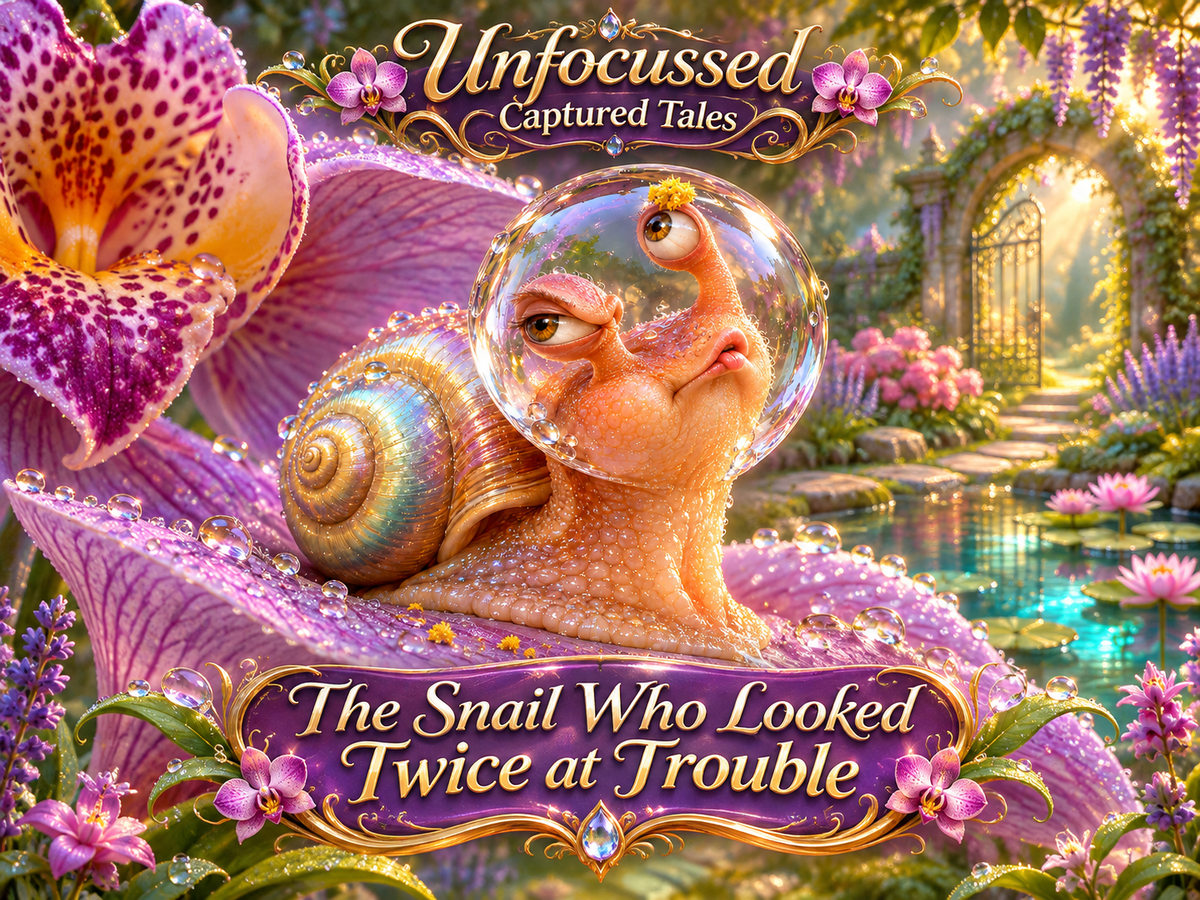
The Shape Beneath the Petal
By the time Quillip saw the thing beneath the orchid, the invitations had already gone out. They were folded from rose-thin leaves, sealed with a dab of nectar, and delivered to every adult in the eastern beds who could be trusted to bring a plate, a scandal, or both. At sunset, the orchid's broad lower petal would hold the annual supper for the gardeners who kept Sugarwild standing through the damp months. Quillip had helped lash that petal to its living supports years ago. He knew precisely how much weight it could carry, which was why the small dark shape in his morning dewdrop made his stomach pull tight inside his shell.
It looked like a hooked black finger sliding along the underside of the lavender petal. Quillip lifted one eye stalk toward the place it seemed to occupy. Nothing. Yellow pollen dusted the flower's throat. The veined surface shone cleanly in the new light. He looked into the round drop again. The finger had moved.
"Oh, that's charming," he said to the empty garden. "A mystery before breakfast. I was hoping for toast."
Quillip was old enough to have stopped confusing a good view with a complete one. He was also old enough to know that announcing a moving shadow beneath a banquet platform would make everyone accuse him of having sampled the fermented nectar before sunrise. He touched the drop with the edge of his shell. It quivered, bent the whole orchid into a tiny upside-down world, then steadied. The hooked thing remained. A faint silver line ran across it like a scar.
He circled the blossom slowly. He could not move quickly without attracting comment, but he could be thorough. From the front, he saw only the orchid's broad lip and the soft dark hollow of its throat. From the side, he saw the woven stems that held the supper petal level. From behind, he found a tight forest of reeds, roots, and old binding cord, all striped by light. He saw no black finger. When he returned to his place beneath the dewdrop, the shape had climbed higher.
Virelle, the orchid's keeper, arrived with a bundle of fresh table moss and the expression of someone whose patience had been booked for an event she had not agreed to host. Her wings were folded beneath a practical brown cloak, and she carried a short measuring stick behind one ear. Quillip had known her since the first season he worked on the support weave. In those days, she could tell a failing stem by touching it once and closing her eyes. These days she had a ledger, an assistant, and a dozen people who insisted on calling every ordinary repair an emergency.
"You look as if the flower propositioned you," she said.
"Worse. It may be trying to kill our guests." Quillip pointed with his taller eye stalk. "Look in the drop."
Virelle bent beside him. For a moment her face lost its usual professional stillness. Then she straightened. "A shadow," she said.
"A moving shadow."
"The sun is moving."
"So are the guests, if you keep the supper here."
She pressed a palm to the petal's edge. "The supports were checked three weeks ago."
"By whom?"
"By the person who built them."
Quillip let the question settle between them. He had indeed checked the front ties three weeks ago. He had not squeezed through the rear reed stand, where a wet patch had turned the ground unpleasant and the insects excessively interested in his soft parts. He had put a neat tick in Virelle's ledger anyway. It had been a small lie, the kind adults tell themselves is only shorthand for a job mostly done. In the dewdrop, the black shape shivered.
"Then the person who built them needs another look," he said.
Virelle's mouth tightened. "The supper begins at dusk. If you raise an alarm without evidence, I lose the terrace for the season. If you find evidence, I lose it tonight. I'd prefer you to be certain before you start a chorus."
Quillip understood the arithmetic. The supper funded repairs in the other beds. A cancelled evening would cost more than embarrassment. A collapsed terrace would cost something no ledger could put right. He asked her to keep guests off the lower petal until noon. She agreed to keep the table moss off it, which was a much smaller promise.
After she left, Quillip watched the drop. A small gust combed the reeds behind him. The dark finger in the water twitched at the same instant. He turned, but the reed stand presented its ordinary mess of green and brown. He looked back. The shape was still there, now darker against the inverted patch of sky. The drop had shown him something real, he thought, but perhaps it had lied about where to look. He set one foot against the stem and began the long climb toward the rear ties he should have inspected three weeks earlier.
What the Water Knew
The rear of the orchid was not designed for visitors with shells. It was a damp, crowded place where the flower's beauty became engineering: reed braces, living root loops, knotted vine, and a narrow trough that carried rain away from the banquet petal. Quillip eased himself between two stems and found the patch that had stopped him three weeks earlier. It was wetter now. The ground gave beneath him with a soft, obscene noise.
"A wonderfully dignified profession," he muttered.
He tested each tie with the end of his eye stalk. The lowest was taut. The next was taut. The third moved a little, but all living supports moved a little. Above them, the trough glittered with a thin stream of water. Quillip followed it to a split in the orchid's upper leaf. Rain had slipped through the split, run behind the reed screen, and soaked the binding cord where no one at the supper tables would ever see it. There was a dark stain on one loop. He leaned close. It was harmless lichen, not a crack. He felt a mean little rush of relief.
Then the petal shifted overhead. Quillip froze. The movement was slight enough to pass for a breath. It came with a sound like someone pulling a thread from a tight seam. He had heard that sound once before, during a storm, when an old bridge tie had failed beneath an empty crossing. He had spent the following week telling everyone how fortunate they were that the bridge had been empty. He had never said how long he had stood beside the worn tie before admitting it was his to replace.
He emerged from the reeds carrying a strand of wet cord. Virelle was arranging plates on a neighboring blossom. She examined the strand, rubbed it between her fingers, and pulled. It held.
"This is from an outer loop," she said. "It isn't the load-bearing line."
"I know. The line I need is behind the upper reed. I can't reach it from below."
"Then what exactly do you want me to tell forty hungry people? That you have a feeling, a puddle, and a shadow that refuses to be photographed?"
"Tell them the truth. We haven't checked the hidden tie."
"You told me you had."
"I know."
Virelle did not raise her voice. That made it worse. "Your signature is in my ledger."
"I know that too."
She looked toward the broad petal, where the first guests had begun to gather despite her small promise about table moss. A moth in a pearl-colored collar was telling a story with both hands. Two beetles were arguing over whether a dish of spiced nectar counted as supper or foreplay. None of them looked up at the underside of the platform. Why would they? The whole point of competent maintenance was that nobody had to think about it.
"If this is nothing," Virelle said, "we ruin the evening and I explain your false inspection to the garden committee."
"If it's something, you'll explain why I let them sit on it."
Quillip took her to the dewdrop. At first the shape was gone. The sun had climbed, and the little water globe now held a bright miniature of the sky. Virelle gave him a look that made his shell feel transparent. He shifted one eye left, then right. The hooked darkness returned at the edge of the drop, not under the petal as he had first believed but high in the inverted picture, with its silver scar trembling.
"Stand where I am," he said. "Don't look through the middle. Look past the blue reflection."
Virelle crouched. He watched her expression change.
"It's the reed screen," she said.
"No. The screen is behind us. The drop bends it into the space beneath the flower. That is why I couldn't find a thing where I thought it was."
She moved the tip of her measuring stick beside one blackened reed. In the drop, a pale line appeared alongside the silver scar. Quillip's two eyes, which had spent the morning disagreeing about the direction of every threat, came to the same conclusion at once. The dark hook was a loop of the upper support, seen backward through the water. The silver line was not moonlight or lichen. It was the inner fiber showing through an opened seam.
Virelle reached behind the reed. When she drew her hand back, a fine white filament clung to her fingers. The main loop had begun to separate. The petal had not fallen because three other ties still held it. With forty guests and a table of food, they would be asked to hold more.
"We close the terrace," Quillip said.
"And the supper?"
"Move it."
Virelle looked around the cramped beds. There was no other blossom broad enough. The repair fund would vanish with the event, and every neglected support in the eastern beds would remain neglected a little longer. Quillip saw her make that calculation; he had made it himself. He also saw the moth in the pearl collar step onto the lower petal and beckon friends after her.
The support gave another small, intimate sigh. Quillip did not ask Virelle to choose for him. He crawled to the petal's front edge, climbed onto a serving stone, and called for everyone to step down. His voice was not impressive, but the crack that answered it was.
The Second Look
The first crack did not bring the petal down. It did something more useful: it made everybody stop arguing about whether Quillip had a vivid imagination. The moth in the pearl collar backed away from the center. A beetle caught her arm and guided her toward the stem. Plates slid. Someone shouted that the spiced nectar was spilling, and somebody else shouted that the spiced nectar could bloody well spill. For a few breathless moments the eastern beds remembered how to move as one body.
Quillip stayed on the serving stone and counted heads. He had no grand speech. He called to the nearest guests by what they were wearing: blue scarf, silver cuffs, absurdly tall hat. He told each to keep moving and to pull one other person along. Virelle cleared the rear approach and sent the last of the servers around the safer side of the bloom. When the final plate and its stubborn owner were off the petal, the main support snapped with a sound much louder than the warning had been.
The lower lip sagged into the bramble beneath it. It did not fall through. The three remaining ties held, taut and trembling, while a spray of pollen burst over the empty place where the supper table had stood. The moth in the pearl collar sat down hard on the path. Quillip had just enough time to be grateful before everyone began talking at once.
One guest declared the orchid cursed. Another announced that Quillip had predicted the collapse, which was more flattering than accurate. A third asked whether dinner would still be served. Virelle stepped between the guests and the flower, held up the white inner fiber she had pulled from the tie, and told them the support had failed. When someone asked why it had not been caught, she looked at Quillip.
He could have explained the wet ground, the hard-to-reach loop, the thousand small tasks that turned a proper inspection into a glance and a signature. All of those things were true. None of them changed the fact that he had signed the ledger. He climbed down from the stone.
"Because I checked the easy ties," he said. "I wrote that I'd checked them all. I didn't."
There was a silence that felt less forgiving than the shouting. Then Virelle said, "I saw the wet patch and let that signature stand. I wanted the terrace open tonight." She folded the broken fiber into her palm. "We can discuss whose mistake was worse after nobody is standing under it."
They roped off the path beneath the petal. Quillip showed Virelle exactly where the upper leaf had split and where water had been running down the hidden line. Together they led a small repair crew through the reeds, not to make the terrace ready for supper, but to brace the other three ties until the bloom could be safely lowered. Quillip did not offer to tick a box for anyone. He held a lamp while Virelle checked each knot with her own hands, and he watched the workers pull the damaged petal gently into the bramble cradle. It rested there like a proud creature forced, at last, to sit down.
By then the sky was turning the color of ripe plums. Guests drifted toward the exit with their covered dishes. A cancelled supper meant no repair fund. Quillip saw Virelle looking toward the ledger as though the numbers might rearrange themselves out of pity. He had a reasonable thought that he should leave her alone. He had a better one a moment later.
"The food is already here," he said. "The guests are still here. The ground hasn't collapsed, which is more than I can say for my reputation. Why not eat down here?"
"Under what tables?"
Quillip looked at the serving stones, the broad fallen leaves, the empty trays, and the beetles who had spent half the afternoon debating whether the nectar was indecent. "Those are the sort of people who can improvise a table."
The new supper was less elegant than the planned one. It spread across the path and around the safe side of the orchid, with plates balanced on stones and cups nested in moss. Nobody had the view they had paid for. They had a close view of the repair crew's muddy knees, of Virelle's open ledger, and of a broken cord passed around so no one had to imagine what had happened. Some guests asked for their contributions back. Virelle returned them without an argument. Most stayed. The moth in the pearl collar made a toast to being alive to complain about the seating.
Quillip sat apart for a while, too tired to pretend the evening had turned out well simply because it had turned out safely. Virelle brought him a piece of sugared plum. She did not tell him he was forgiven, and he did not ask. They compared the work still to be done: a new drainage channel, a replacement support, a second set of eyes on every hidden tie. This time the second set would belong to someone who had not signed the first inspection.
"You saw it in a drop of water," she said.
"I saw it in the wrong place in a drop of water. It took me most of the day to work out where it really was."
"You could have decided the drop was foolish."
"I nearly did. Then I remembered I've been foolish without assistance from a drop."
At dawn the next morning, Quillip returned to the orchid. A fresh dewdrop hung from the safe upper petal. In it the garden turned upside down, bright and intricate, every reed apparently somewhere it was not. He looked once and saw a black curve. He looked twice and found the shadow of his own shell. For the first time in weeks, he laughed before he worried. Then he checked the support behind him anyway.
Take a Closer Look at Sugarwild
Quillip's second look saved supper, though his first honest inspection came rather late. The original artwork keeps that curious snail and his dew-bright garden close. Choose a framed print or canvas print for a wall, take the scene apart and put it together again as a jigsaw puzzle, or send someone a little garden mystery on a greeting card.
Each format features the same artwork that inspired this tale. Pick the one that makes you want to look twice.

 The Gnome Who Swore the Mushroom Was Listening
 The Seedpod That Fired Before Anyone Was Ready
 The Blossom That Left a Mark