animalistic abstracts

Contes capturés

View

Snowveil Hare of the Frozen Court

par Bill Tiepelman

Snowveil Hare of the Frozen Court

The Hare Who Refused to Be Ordinary On the coldest night of the year, when the aurora stretched across the sky like spilled paint and everyone with common sense was indoors hoarding soup, the Frozen Court gathered in the Valley of Unreasonable Sparkle. The snow there never simply “fell.” It pirouetted. It glowed. It attempted, on more than one occasion, to unionize. Every ruler of the North was present. The Ice Stag with his cathedral-sized antlers, the Glacial Owls with their disapproving expressions, the Polar Bear Matron wearing a cloak of storm clouds, and a flock of snow sprites who communicated exclusively in giggles and glitter. Even the northern wind had attended, appearing as a tall, translucent figure who looked like they spent far too much time in perfume commercials. At the center of it all, sitting on a smooth rise of snow that glowed from within, was a throne carved from a single block of ice. It was both magnificent and deeply uncomfortable, which is how you knew it was a throne. And atop that throne, in a halo of swirling frost, sat the most improbable monarch the realm had ever had: the Snowveil Hare of the Frozen Court. Snowveil was not what anyone expected from a winter ruler. For starters, they were small. Not metaphorically small, either. Physically. A hare. A very fluffy hare with long legs, luminous sapphire eyes, and antlers that looked like moonlight had grown tired of being intangible and decided to crystallize into something with sharp edges and opinions. The antlers glimmered with frost fractal patterns, delicate branches sparkling as though each was lit by its own tiny aurora. Snowveil’s coat was etched with swirls of ice-lace, filigree crawling over fur like an artist had been allowed to go absolutely feral with a frostbrush. Every time Snowveil moved, the patterns shifted, catching the light and throwing fragments of cold fire into the air. The Frozen Court had elected Snowveil for a simple reason: no one could intimidate enemies and charm tourists quite like a hyper-realistic magical hare with crystalline antlers. The marketing potential alone was obscene. There were already plans for seasonal tapestries, enamel pins, and collectible prints in the Hall of Excessively On-Brand Merchandise. But that night, the Court wasn’t thinking about merchandising strategies or limited-edition aurora posters. They were thinking about the problem. The problem in question came in the form of a messenger wisp, who spun into existence over the court like a terrified snowflake that had read too much bad news. It trembled in the cold air, its tiny face pale blue and worried. “Your Frosted Majesty,” the wisp squeaked, bowing so low it nearly folded itself inside out, “we have an issue in the Southern Melt.” The Southern Melt was not a place anyone enjoyed saying out loud, mostly because it sounded like a seasonal dessert special. It was the liminal region where the eternal winter of the North grudgingly shook hands with the warmer lands beyond. The snow there had a habit of melting, refreezing, sulking, and writing anonymous complaints in the slush. Snowveil’s whiskers twitched. “What kind of issue?” they asked, voice soft but edged with the crispness of subzero air. The wisp hesitated. “The snow,” it said, “is… refusing to fall.” The Court erupted into panicked murmurs. The Glacial Owls fluffed up indignantly. The Ice Stag stomped a hoof, causing an avalanche somewhere unfortunate. The Polar Bear Matron let out a shocked huff that formed a new iceberg off the northern coast. “Refusing?” Snowveil repeated, one elegant ear flicking. “Snow is not allowed to refuse. That’s literally its whole job. It goes up, it freezes, it falls. That’s the brand.” The wisp nodded miserably. “It says it’s on strike, Your Majesty. Something about ‘unreasonable working conditions, lack of respect, and human tourists who keep calling it ‘so aesthetic’ instead of appreciating its complex crystalline geometry.’” Snowveil pinched the bridge of their nose with an invisible paw of pure exasperation. The antlers glittered in sympathy. “Of course it does,” they muttered. “The last time we let a cloud read anything about labor rights, it staged a blizzard walkout.” The Wind leaned closer, cape of translucent air whispering. “If the snow stops falling in the Southern Melt, the line between winter and spring will blur,” it warned. “Rivers will swell early. Flowers will bloom too soon. Mortals will start posting ‘Is this climate change or vibes?’ on their little glowing rectangles. It will be chaos.” Snowveil wasn’t afraid of chaos; they were the sort of creature who could turn a snowstorm into a fashion statement. But they were concerned about balance. The winter realms relied on subtle rhythms: snowfall patterns, frost crystal maps, aurora schedules, the weekly migration of overly dramatic ravens. If the snow decided to rebel, everything else would wobble. The Ice Stag cleared his throat, antlers chiming like distant bells. “We could send the Storm Wolves,” he suggested. “A little intimidation might persuade the flakes to fall in line.” Snowveil’s blue eyes narrowed. “We are not threatening the weather into compliance,” they said. “Every time we do that, some mortal writes a myth where the gods are jerks and the moral is ‘Never trust atmospheric deities.’ Our PR team still hasn’t recovered from the Great Hailstone Incident.” There were solemn nods. The Great Hailstone Incident was still whispered about in the Hall of Reputational Damage. Somebody had tried to speed-run an entire winter in one week. It had not gone well. Snowveil hopped down from the ice throne in a flurry of glittering frost, landing so softly the snow barely noticed. They paced slowly, hooves—no, paws, but dignified ones—leaving faint trails of glowing patterns behind them. Each step wrote a secret sigil in the snow, the language of ice and intention. “Snow is not the enemy,” Snowveil said at last. “It’s an artist. It likes to be admired. It likes to be taken seriously. And lately it’s been treated like nothing more than a filter for mortal photographs and a hazard for poorly chosen footwear.” The Polar Bear Matron rumbled thoughtfully. “Humans do enjoy sliding around shrieking as if walking on frozen water is a deeply surprising concept.” “Exactly,” Snowveil said. “If I were a snowflake, I’d be offended too. Imagine spending hours crystallizing yourself into a unique six-armed masterpiece, just to get stomped by someone in discount boots and then compressed into sludge.” The Court winced collectively. “So,” Snowveil continued, “we’re going to negotiate.” The Glacial Owls blinked. “Negotiate,” one repeated slowly, as though tasting the word like a questionable berry. “With precipitation.” Snowveil’s whiskers twitched again, this time in amusement. “Yes. With precipitation. The snow wants respect? We’ll see what that means. And if we can’t come to an agreement, then we’ll find the real reason behind this strike. Snow doesn’t just stop falling unless something bigger is meddling.” The suggestion settled over the Court like a thin new layer of frost—chilly but stabilizing. They all knew what Snowveil wasn’t saying: storms didn’t organize themselves. If there was a labor movement among the clouds, something—or someone—had stirred it. A faint shiver slid through the air. Snowveil felt it, the way a hare feels the shadow of a hawk long before it sees the wings. It was subtle, like a ripple in the pattern of the cold, a small wrongness humming under the usual song of the North. That was the twist, Snowveil realized. The snow’s rebellion wasn’t the problem. It was the symptom. They turned to the wisp. “You’ll guide me to the Southern Melt,” Snowveil said. “We leave at once.” There was a murmur of protest—about the hour, the temperature, the ongoing agenda items concerning icicle zoning regulations—but Snowveil flicked one antler and the complaints froze solid, glittering briefly before shattering. “This realm,” Snowveil said calmly, “is balanced on patterns most mortals never see. Frost fractals, snowdrift rhythms, the way ice sings under starlight. If those patterns start misbehaving, we don’t sit here and fill out complaint forms. We go out there and fix it.” The Wind gave an appreciative bow, snow swirling in elegant spirals. “Very dramatic,” it said. “Nine out of ten. I would have added a cape swirl.” Snowveil’s fur rippled in a way that absolutely counted as a cape swirl. “Happy now?” they asked dryly. And so the Court parted to open a path of glowing frost. Snowveil stepped forward, antlers haloed in pale light, eyes reflecting all the strange, beautiful cold of the North. The wisp bobbed nervously at their side, already regretting every life choice that had led it to be the courier of bad meteorological news. As Snowveil crossed the boundary of the valley, the sky brightened with a fresh wave of aurora. Greens and violets rippled across the dark, dancing above the hare like a royal banner. Snowveil didn’t look back, but if they had, they would have seen the Frozen Court watching in tense silence, each member aware that something old and patient was stirring beneath the snow. Because far to the south, just beyond the edge of winter, someone else was tired of being ignored by the world. And unlike the snow, they weren’t planning a strike. They were planning a takeover. Snowveil didn’t know the details yet. But as a faint tremor shivered through the eternal ice, the hare’s antlers rang like distant glass bells, and they had the unsettling sensation that the season itself had just winked at them. “Wonderful,” Snowveil muttered under their breath. “It’s going to be one of those winters.” Negotiating With Weather (And Other Terrible Ideas) The journey to the Southern Melt began with the sort of dramatic flourish Snowveil generally tried to avoid before their morning tea. The wisp led the way, jittering like a lantern flame in a nervous sneeze, while Snowveil bounded through drifts of glittering snow that behaved as though they were in a perfume ad—swirling, shimmering, and showing off for absolutely no reason. The first sign something was wrong came when they reached the River of Respectable Ice, which had recently rebranded itself from the River of Slightly Cranky Ice after a successful therapy arc. Normally, it was frozen solid—quiet, reliable, and pleasantly self-important. Now? A chunk near the southern bank had melted into a suspiciously warm puddle, bubbling as though being boiled by a kettle operated by an unlicensed pyromancer. Snowveil leaned down, antlers casting shimmering reflections on the surface. “This isn’t normal.” The wisp nodded vigorously. “This happened when the snow declared its strike. The Melt's expanding faster than it should, and the air keeps getting… hotter.” Snowveil raised a furry brow. “Hotter? In the North? Without a signed permission slip from the Winter Council? Bold.” The puddle suddenly belched steam, which coalesced into a tiny, irritable heat sprite. It looked up at Snowveil with the expression of someone who had eaten a ghost pepper and immediately regretted all life choices leading to that moment. “Look,” the sprite rasped, hands on nonexistent hips, “we’re doing our best, okay? There’s interference. Someone’s cranking up the temperature without filling out one single Seasonal Adjustment Form. I swear, it’s like mortals think weather just happens by accident.” Snowveil cleared their throat. “Do you know who’s causing it?” The sprite squinted. “Something big. Something fiery. Something with an ego large enough to require its own postal code.” Snowveil winced. “Oh no. Not… him.” The sprite shuddered. “Yep.” Snowveil muttered a string of ancient frost-words that sounded suspiciously like someone cursing into a scarf. “The Sun Prince?" The wisp gasped. “He wouldn’t dare!” “Oh, he absolutely would,” Snowveil said. “He once tried to annex the twilight hours because he wanted to ‘expand his brand.’ The man radiates confidence and secondhand embarrassment.” But there was no time to stand there and make fun of a nuclear star’s self-esteem issues. The snow had unionized. The Melt was creeping north. There was a solid chance someone would attempt to turn the Frozen Court into a spa resort “for warmth enthusiasts.” Snowveil marched southward, antlers glowing faintly with frost energy. Along the way they encountered several troubling anomalies: A patch of daisies blooming aggressively out of season, attempting to start a selfie trend. A flock of robins arguing heatedly with a confused snowdrift about territory law. A snowman lying on its side like a Victorian damsel, dramatically claiming it was “melting from emotional distress.” And then—there it was. The Southern Melt in full rebellion mode. Snow wasn’t falling. It was floating upward in tiny groups, holding tiny picket signs made of ice chips. Every single snowflake was shouting at once, which sounded like a thousand faint jingles mixed with the subtle auditory equivalent of passive-aggressive emails. Snowveil took a deep breath. “Here we go.” They hopped onto a mound of slush like a politician climbing onto a podium moments before regretting everything. “Attention, snow!” Snowveil called, antlers ringing like crystalline bells. “We are here to listen to your grievances.” A representative flake drifted forward, swirling itself into a larger, more dramatic configuration that vaguely resembled a snowflake with managerial responsibilities. It floated eye-level with Snowveil. “We demand respect,” it chirped. “And hazard pay.” Snowveil blinked slowly. “Hazard pay?” “Yes!” the snowflake huffed. “Do you have any idea how dangerous it is falling through the atmosphere? We’re basically yeeted from the sky at terminal velocity! And what for? To be shoveled, stomped, salted, and photographed with filters that completely misrepresent our crystalline geometry!” Snowveil rubbed their forehead. “Okay. I understand. But refusing to fall is destabilizing the winter cycle. We need you.” The snowflake crossed its little flake-arms. “We’re not doing a single elegant descent until our demands are acknowledged.” Snowveil’s voice softened. “What if I promised to speak to the Court? To advocate for better conditions, better appreciation, and maybe a mandatory course on how to photograph snow without flattening it into white mush?” The snowflake’s edges softened. “That… could be negotiated.” Snowveil nodded. “Good. Because something far bigger is threatening the winter realms. You aren’t striking alone. Something’s heating the North from the inside out.” A hush fell over the strike line. The snowflake trembled. “You mean—” “Yes,” Snowveil said grimly. “The Sun Prince.” The snowflakes erupted into outraged jingling. “That radiant himbo!” one shouted. “He’s always trying to steamroll winter! Literally!” “Precisely.” Snowveil shook frost from their whiskers. “We need unity, not rebellion. Winter won’t stand a chance if he unleashes one of his ‘seasonal rebrand’ schemes. The last time he tried to warm up the North, we ended up with the Great Slush Flood of Year 401. The otters still don’t speak to us." The snowflake hovered thoughtfully. “What do you need from us?” Snowveil looked up, antlers glittering with incoming determination. “Your help. Not as precipitation. As witnesses. Scouts. The Sun Prince won’t expect resistance from those he ignores. We need you to find where he’s concentrating heat. Where he’s planning his move.” The snowflakes conferred among themselves in soft crystalline chimes. Finally, the leader drifted forward. “We accept. On one condition.” Snowveil braced internally. “Name it.” The flake pointed one of its tiny arms at Snowveil. “If we save winter, we want recognition. Official titles. An annual parade. And—this is non-negotiable—a public apology from the Sun Prince for melting our brethren without proper documentation.” Snowveil nodded. “Done. Winterwide proclamation, parade funding, and a strongly worded letter dipped in frost for dramatic effect.” The snowflake twinkled smugly. “We’ll begin surveillance immediately.” The flakes scattered into the air like a burst of silent fireworks, streaking southward on cold winds. Snowveil exhaled in relief. One disaster stabilized. A larger one incoming. The wisp drifted beside them, trembling. “What now?” Snowveil stared toward the horizon where heat shimmered like a mirage. “Now? We go meet the Sun Prince.” The wisp squeaked. “Isn’t he… dangerous?” “Oh, absolutely,” Snowveil said. “He’s hotter than the gossip about two yetis caught canoodling behind the Icefall Tavern. But he’s also vain. And dramatic. And deeply susceptible to emotional manipulation.” The wisp blinked. “Manipulation?” Snowveil smirked. “Yes. You’d be amazed what you can accomplish with a strategic compliment about the luminosity of his solar flares.” The wisp groaned. “We’re doomed.” As they continued south, heat shimmered stronger, rising in waves that made the snow beneath them whimper anxiously. Something truly immense was interfering with the season—bigger and bolder than any prior tantrum the Sun Prince had thrown. But the final confirmation didn’t come until the clouds themselves parted in a sudden, dramatic flourish… and a colossal golden figure stepped forward, radiating smugness and SPF 500 energy. The Sun Prince, crown blazing like a supernova, looked down at Snowveil with a smile that suggested he practiced it in reflective surfaces. “Well, well,” he purred. “If it isn’t winter’s cutest little monarch.” He winked. “Don’t melt on me.” Snowveil’s eye twitched. “Fantastic,” they whispered. “It’s going to be one of those negotiations.” The Hare, the Himbo Sun Prince, and the Great Winter Rebrand Attempt The Sun Prince stood before Snowveil like a bronzed monument to questionable decisions, basking in his own radiance with the confidence of someone who believed sunscreen was a personality trait. Heat shimmered around him in waves so intense that several nearby icicles fainted dramatically and had to be revived with sassy pep talks from a passing frost sprite. Snowveil squared their tiny but ferociously majestic shoulders. Their crystalline antlers glinted defiantly, each delicate branch giving off the distinct impression that it would absolutely be used as a weapon if negotiations failed. “Sun Prince,” Snowveil began coolly, tone sharp enough to shave ice sculptures. “What exactly do you think you’re doing?” He flashed a smile bright enough to cause mild retinal trauma. “Just warming things up, darling. Your winter has been a liiittle too... wintery this year. I thought I'd give the land some razzle-dazzle.” He wiggled his fingers, and a plume of steam spiraled upward as if agreeing with him. Snowveil stared at him. Blinked once. Slowly. “You are destabilizing the entire seasonal structure of the Northern Realms.” He shrugged. “I like to think of it as… rebranding.” He leaned forward with a conspiratorial grin. “Picture it: ‘Hot Winter™: A Sunny Take on Snow.’” Snowveil made a strangled noise that could have frozen a lesser being on the spot. “You cannot trademark winter.” The Sun Prince gave a devastatingly smug wink. “Watch me.” Behind Snowveil, the wisp made a noise somewhere between a gasp and a dying squeal. The hare pressed a paw to their forehead, antlers buzzing with frost energy. “Why,” Snowveil hissed, “would you do this? What are you possibly gaining from melting my domain?” The Sun Prince sighed dramatically, wind machines of pure solar flare powering up behind him. “Fine. You want the truth? I’m bored.” Snowveil arched a brow. “Bored.” “YES bored!” he burst out. “Mortals worship me all summer long—sunbathing, sunflowers, that whole solar-powered happiness aesthetic. But winter comes? And suddenly it’s all cocoa and blankets and ‘oh look how elegant the frost is’ and ‘the moonlight is so atmospheric’ and ‘let’s light candles and pretend the sun doesn’t exist.’” He stomped a foot, causing the ground to steam aggressively. “It’s rude.” Snowveil inhaled deeply. “So you heated half of my kingdom because you felt… underappreciated.” “Yes,” he said without shame. “Also, one mortal called me ‘mid’ in a poem last month, and I haven’t recovered.” Snowveil’s eye twitched with the force of an avalanche. But then—something shifted. Behind the heat shimmer on the horizon, a familiar glittering cloud approached, moving with purposeful, icy grace. Snowflakes. Thousands of them, sparkling like a rebellious militia with excellent posture. The snowflake leader hovered forward, tiny arms crossed in indignation. “Excuse us,” it chimed pointedly, “but are YOU the reason half of us melted before we even fell? Because some of us were masterpieces, thank you very much.” The Sun Prince recoiled. “Are you talking to me?” The snowflake jabbed a tiny icy arm right at his solar-plexus region. “Oh, we are more than talking. We are FILING A FORMAL COMPLAINT.” Several snowflakes behind it chanted “COMPLAINT! COMPLAINT!” like an extremely chilly protest group. The Sun Prince sputtered. “I—I didn’t melt you on purpose!” “Oh REALLY?” the snowflake hissed. “Because we have eyewitness accounts of unauthorized heat waves, unscheduled solar bursts, and at least one snowman who claims you looked at him funny and he liquefied out of fear.” Snowveil cleared their throat. “Prince. Apologize.” He stared at Snowveil as though they had asked him to dim. “I’m sorry—you want me to apologize to the weather?” “Yes,” Snowveil said firmly. “It’s that or we file a complaint with the Equinox Council. And you know how they get.” The Sun Prince blanched. “Not the Equinox Council. They make everything so… bureaucratic.” Snowveil nodded solemnly. “Mm-hmm. You’d be stuck filling out sunbeam allocation forms until next solstice.” The Prince shuddered in horror. “Fine! FINE. I apologize to the snow for melting—” A snowflake coughed loudly. He rolled his eyes. “—for melting you… without authorization. And for… uh… calling winter ‘emotionally clingy.’” The snowflakes squealed triumphantly and immediately began drafting parade blueprints. Satisfied, Snowveil stepped forward. “Now. You’re going to turn the heat down. Gradually. We don’t want steamstorms again. And after that, you’re going to sit with your feelings like a responsible celestial entity instead of committing meteorological arson every time someone forgets your fan club.” The Sun Prince sighed. “You’re surprisingly stern for someone so fluffy.” Snowveil smiled sweetly. “I will end you.” He believed them. A slow, controlled coolness spread through the land. Frost reformed. Snowflakes fell with dramatic flair. The river sighed in relief and refroze in the shape of a polite bow. The Melt retreated, muttering apologies as it went. By the time the Frozen Court gathered to greet their returning monarch, winter had returned to its elegant, orderly, and mildly judgmental self. The Court erupted in cheers. The Polar Bear Matron shed proud tears (which froze midair and had to be chiseled off). The Ice Stag bowed deeply. The Glacial Owls attempted applause but produced only very dignified wing flaps. Snowveil climbed the icy throne once more, fur glittering with victorious frost. “Winter,” they proclaimed, “is restored. And our realm stands strong—because even rebellious snowflakes have their place in the pattern.” The snowflake leader drifted up beside them. “We expect that parade by mid-month.” Snowveil sighed. “Yes, yes. I’ll inform the auroras to prep their choreography.” The auroras overhead brightened in smug acknowledgment. As celebrations erupted around them, Snowveil glanced southward. The Sun Prince was already retreating, muttering something about updating his fan club newsletter and exfoliating his solar layers. Snowveil shook their head with fond exasperation. “Drama,” they murmured. “Pure, incandescent drama.” But peace had returned. Balance was restored. And winter, once again, would sparkle with elegance, mystery, and just a hint of absurdity—exactly as it should.     Bring the Snowveil Hare of the Frozen Court into your own winter realm. Whether you're looking to elevate your décor, wrap yourself in enchanted warmth, or send a bit of frosted magic to someone special, this piece shines across multiple premium formats. Each product below transforms Snowveil’s crystalline elegance into a tangible keepsake—perfect for collectors, fantasy lovers, and anyone who lives for winter’s spellbinding charm. Explore the full collection:• Framed Print: A gallery-worthy display capturing every icy fractal and luminous detail.Shop Framed Print• Metal Print: Vibrant, reflective, and impossibly crisp—Snowveil practically glows from within.Shop Metal Print• Acrylic Print: Depth, clarity, and a glass-like finish that gives Snowveil dimensional presence.Shop Acrylic Print• Fleece Blanket: Wrap yourself in winter magic with a soft, luxurious blanket featuring Snowveil’s regal glow.Shop Fleece Blanket• Bath Towel: Add a touch of frosted elegance to your bathroom décor—yes, even your towels can be majestic.Shop Bath Towel• Greeting Card: Send winter magic to friends and family with a card that sparkles with charm and mischief.Shop Greeting Card Surround yourself with the enchanting energy of Snowveil—and let the Frozen Court’s most fashionable monarch bring a little winter wonder into your space.

En savoir plus

Twinkle-Shell the Festive Wanderer

par Bill Tiepelman

Twinkle-Shell the Festive Wanderer

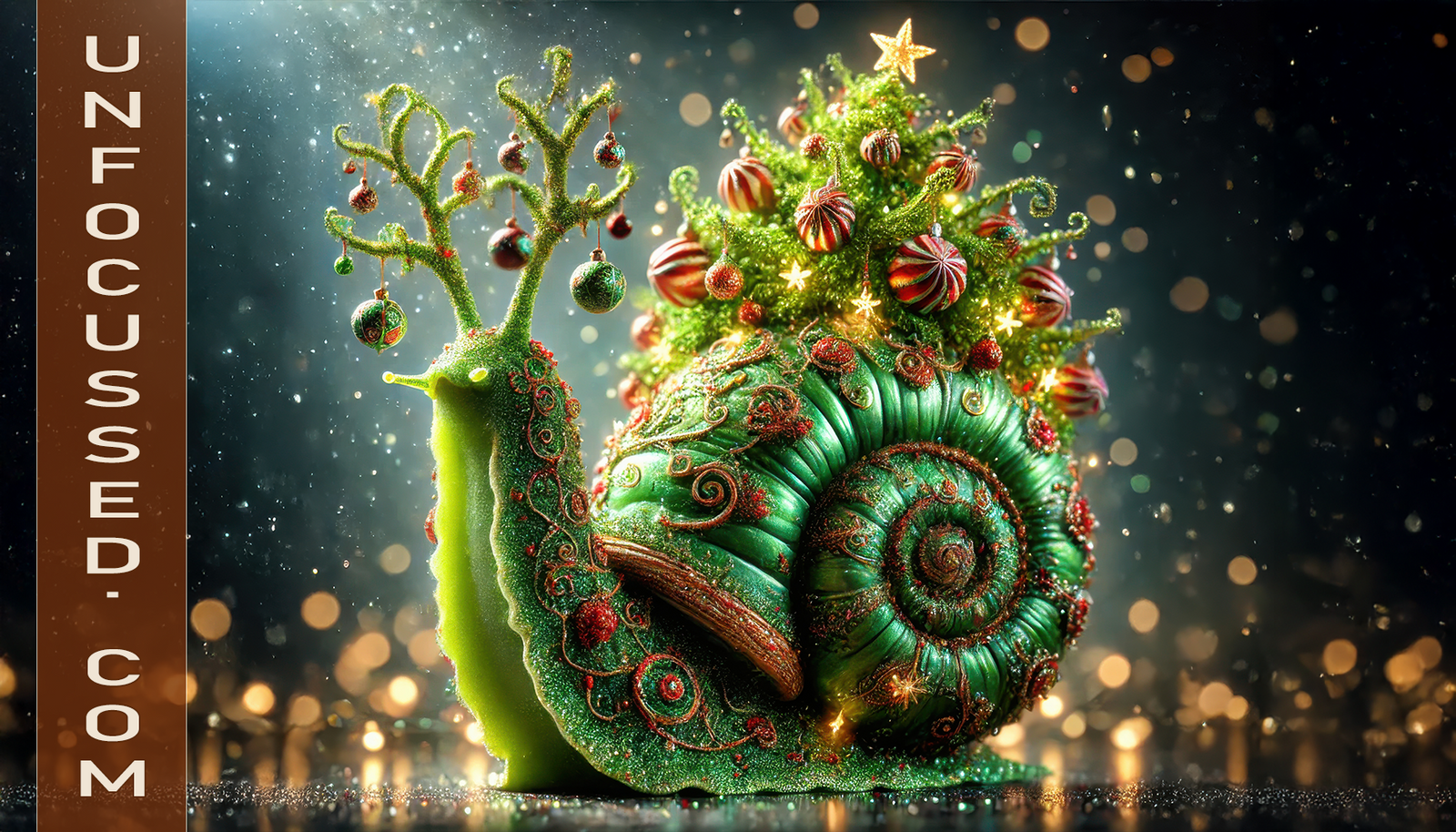
The Glitter-Covered Menace of Mistletoe Marsh Deep inside the glimmering heart of Mistletoe Marsh—where the trees shed glitter instead of leaves and the ground is permanently sticky from a century of spilled eggnog—there lived a creature so cheerfully chaotic that even Santa had him on a “soft ban” list. His name was Twinkle-Shell, the Festive Wanderer, and his hobbies included: jingling loudly at inappropriate hours, hoarding peppermint just to say he had it, and single-handedly destabilizing the local ecosystem every time he tried to “spread holiday joy.” Twinkle-Shell, a snail by birth but an *aspiring* reindeer by attitude, strutted—or slithered, depending on how frozen the marsh happened to be—beneath a towering Christmas tree growing directly out of his shell. Not metaphorically. Not tattooed. Literally. A whole, sparkly, fully-functional tree, complete with ornaments that jingled, lights that flickered, and a star on top that glowed brighter whenever he felt dramatic… which was often. His antlers, grown out of pure festive stubbornness, sprouted ornaments like some kind of holiday fruit tree with boundary issues. Every time he moved, a cascade of jingles followed behind him, making stealth absolutely impossible. Neighborhood squirrels used him as a navigational beacon. A family of chipmunks synchronized their winter dances to the rhythm of his accidental jingling. And at least one very confused owl tried to mate with the ornament hanging from his left antler. (Twinkle-Shell never recovered emotionally.) He also had, for reasons beyond nature or decency, a reputation as a walking hazard. If you saw glitter drifting in the air, it wasn’t snowfall—it was him. If a candy cane mysteriously disappeared from your porch and reappeared lodged in a tree branch two miles away, it was him. If your snowman woke up wearing red lace garland like a feather boa, it was definitely him. Twinkle-Shell insisted these things just “sort of happened” around him, a statement that carried the same sincerity as a toddler claiming the dog opened the permanent marker. But despite the chaos—or perhaps because of it—everyone at Mistletoe Marsh adored him. He was the unofficial herald of the holiday season. The moment they heard his jingle-jangle-jing-JANGLE (followed by a thud, usually him slipping on his own ornament debris), they knew: the season had begun. This year, however… things were different. Twinkle-Shell had woken up with a feeling. A vibe. A destiny-level sensation that this holiday season, he was meant for something big. Something important. Something completely beyond his normal jurisdiction of moderately controlled chaos. And that, unfortunately for Mistletoe Marsh, meant he was about to try—really try—to be helpful. The last time he tried to be helpful, twelve ducks got perms and the mayor of the Marsh still refused to discuss “the tinsel incident.” But none of that deterred him. With the star on his shell glowing like it had just consumed espresso, Twinkle-Shell declared: “THIS YEAR… I SHALL SAVE CHRISTMAS!” No one had asked him to. No one had suggested Christmas was even remotely in danger. But history had proven one fact: when Twinkle-Shell decided something was destiny, destiny usually sent an apology note in advance. As he jingle-slid toward the edge of the Marsh to begin his “heroic quest,” local residents whispered, worried, hopeful, and bracing for impact. Because whatever was about to happen… it would be memorable. And probably sticky. Twinkle-Shell’s Incredibly Poor Life Choices Twinkle-Shell had barely made it twenty jingle-steps out of Mistletoe Marsh before destiny introduced itself in the form of a frantic puffin wearing a scarf knitted entirely of panic and broken dreams. The puffin crash-landed into the snow in front of him, skidding through slush like a feathery curling stone before popping up and blurting, “THE NORTH POLE IS A DISASTER!” Now, Twinkle-Shell was no stranger to the word “disaster.” He heard it often. Usually directed at him. But this time, it had a certain global tone—like the kind of disaster where holiday laws would be violated, elves would unionize, and Santa might start drinking the non-virgin eggnog before noon. “Explain yourself,” Twinkle-Shell declared, attempting to stand heroically tall, but remembering too late that snails do not stand. He settled instead for rearing up in slow motion, which looked less like bravery and more like he was trying to reach a cookie on a high shelf. The puffin took a dramatic breath. “Santa’s workshop… is covered in gingerbread sludge! The ovens malfunctioned, the cookie mixers revolted, and half the toys smell like cinnamon-based despair!” Twinkle-Shell gasped with the force of a creature who once ate an entire wreath and regretted nothing. “Is Santa okay?” “He’s… sticky,” the puffin whispered, as though sharing a national secret. “Very… very sticky.” That settled it. This was a job for a hero. A legend. A creature with the power to make things worse before making them better. This was a job for— “TWINKLE-SHELL THE FESTIVE WANDERER!” The puffin blinked. “I don’t know who that is.” “Still me,” Twinkle-Shell said, flexing an antler so that a tiny ornament fell off and rolled dramatically into a snowbank. And so, the two set off toward the North Pole, Twinkle-Shell jingling with heroic enthusiasm and the puffin waddling in a state of ongoing regret. Their journey was… complicated. First, Twinkle-Shell attempted to “speed up” by sliding down a frozen hill. This resulted in him spinning like a holiday Beyblade, screaming, “I WAS NOT BUILT FOR THIS!” as ornaments flew off his antlers like festive shrapnel. The puffin, trying to help, flapped frantically behind him, shouting instructions such as “STEER LEFT!” and “WHY ARE YOU SPARKLING MORE?!” Twinkle-Shell eventually crashed into a drift of powdered snow, emerging glitterier than before, which should have been impossible by the laws of physics but was absolutely on-brand for him. Then came the Snow Sprite Incident. Snow Sprites were known for their ephemeral beauty, frosted wings, and a temperament roughly equivalent to a caffeinated ferret. They were fragile, delicate, and notoriously manipulative when slightly bored. As Twinkle-Shell and the puffin cut through a clearing, a cluster of them descended like sparkly piranhas. “Ooooh! A walking tree!” one Sprite squealed. “A talking ornament bush!” another cried. “A sentient holiday fever dream!” said a third, deeply concerned but intrigued. Twinkle-Shell tried to introduce himself, but Sprites don’t wait for introductions. Or permission. Within seconds, they were hanging new ornaments on him, braiding his garlands, fluffing the branches of his shell-tree, and rearranging his decorations with the aggressive enthusiasm of interior decorators who haven’t eaten in days. “We added more sparkle to your sparkle,” one Sprite reported proudly. “You’re welcome,” another said, while applying shimmering frost to his left flank. Twinkle-Shell attempted polite gratitude, but the sheer weight of the extra ornaments nearly tipped him over. He had to dig his foot into the snow to keep upright. “I appreciate the… enthusiasm,” he managed, “but we’re on an urgent quest!” “A quest?” the Sprites gasped collectively like a dramatic choir. “For WHAT?” “To save Christmas!” There was a silence, followed by all twenty Sprites bursting into chaotic applause while yelling conflicting advice: “Kidnap the gingerbread!” “Punch a snowman!” “Blame the elves! They can take it!” “Bring Santa soup!” “Don’t bring Santa soup! He hates soup!” By the time the Sprites finished “decorating” him, Twinkle-Shell now jingled when he blinked. Literally. The puffin stared at him with the hollow expression of someone reconsidering every life decision. “Let’s just… go,” the puffin muttered. At last, after waddling, sliding, jingling, and arguing their way across the tundra, the North Pole appeared on the horizon—shimmering with lights, smoke, and the faint smell of gingerbread on fire. Twinkle-Shell whispered reverently, “We made it…” “I’m going to regret this,” the puffin whispered back. They approached the candy-cane gates, only to find them half-melted, coated in sticky sugar, and buzzing with tiny, exhausted elves trying to chisel themselves free from cookie cement. One elf, covered in dried frosting and rethinking all career choices, pointed at Twinkle-Shell and groaned, “Oh no. Not again.” Twinkle-Shell’s eyes widened. “We’ve never met!” The elf shook his head. “Doesn’t matter. I can FEEL the chaos.” That was when another elf staggered out of the workshop, hair smoking slightly, and shouted: “THE GINGERBREAD HAS GONE SENTIENT! AND IT HAS DEMANDS!” Twinkle-Shell inhaled sharply. “This… this is my moment.” And as the peppermint-scented smoke billowed out of the workshop behind him, Twinkle-Shell jingle-glowed with heroic determination. This would be the day he proved himself. This would be the moment he saved Christmas. Or—more statistically likely—this would be the moment everything went gloriously, catastrophically wrong. The Great Gingerbread Uprising (And the Snail Who Probably Should’ve Stayed Home) The moment Twinkle-Shell slid into the workshop, he was hit with a wave of heat, spice, and the unmistakable smell of burnt sugar trauma. The walls were coated in gingerbread goo. Half-constructed toys were glued to the ceiling. A Nutcracker soldier was stuck to the floor, repeatedly muttering, “I did NOT sign up for this.” Somewhere in the distance, an oven door rattled like something inside was trying to negotiate its release. Elves scurried everywhere, armed with frosting spatulas, licorice whips, and the kind of exhausted expressions found on retail workers on December 24th at exactly 11:59 p.m. And right there, at the center of the chaos, stood the enemy. A giant, twelve-foot-tall, semi-sentient gingerbread man. He had gumdrop eyes of pure malice. He had frosting facial hair that suggested he’d been through three divorces. And he wore a peppermint belt like he was in some kind of seasonal wrestling league. “I AM GINGERPAPA!” he bellowed, his voice echoing like thunder made of cookie crumbs. “AND CHRISTMAS SHALL BURN IN THE OVEN OF MY WRATH!” Twinkle-Shell gasped. Mostly because he got too excited and inhaled a sprinkle. The giant gingerbread titan turned his gumdrop glare on him. “You,” GingerPapa growled. “Tree snail. Decorative menace. Living mall display. You dare approach me?” Twinkle-Shell jingle-flexed proudly, which involved wiggling his antlers and immediately losing two ornaments. “I am here… to restore holiday harmony!” An elf whispered to another, “Oh great. He’s monologuing. This is going to end in frosting.” GingerPapa raised one icing-coated arm and roared, “ATTACK, MY GINGERMINIONS!” From behind him poured an army of smaller gingerbread creatures—some shaped like classic gingerbread men, others shaped like little stars, bells, candy canes, and one disturbingly buff gingerbread duck who looked like he worked out twice a day and drank raw eggnog. Twinkle-Shell took a heroic stance (again, mostly by accident). The puffin behind him screamed into his scarf. The elves shrieked. The oven doors rattled harder. It was chaos. Beautiful, stupid, holiday chaos.   The Battle Was… Not Great Twinkle-Shell attempted to charge heroically. Unfortunately, as a snail, his top speed was “confidently leisurely.” The gingerbread army reached him long before he made any meaningful forward progress. They swarmed up his shell, climbing the branches of his Christmas tree, poking his ornaments, licking his lights (disgusting), and slapping him with tiny sugary hands. “Ow! Ow! Hey! Personal space! That’s a limited edition bauble!” Twinkle-Shell cried, flailing his antlers wildly—knocking gingerbread men off like shuriken made of holiday shame. Meanwhile, GingerPapa bellowed laughter. “FOOLISH SNAIL! YOU CANNOT STOP THE RISE OF THE COOKIE KINGDOM!” The elves, realizing they had backup, began throwing handfuls of flour like improvised flash grenades. The puffin aggressively pecked a gingerbread star into crumbs. A squad of teddy-bear-shaped cookies began chanting, “DOWN WITH MILK! DOWN WITH MILK!” for reasons no one fully understood. Overwhelmed and sticky, Twinkle-Shell’s star began to glow—not with chaos, but with something he had never experienced before: Actual determination. And then something incredible happened. His shell-tree lit up. Every ornament flared. Every garland shimmered. Every holiday light sparked to life all at once— —and unleashed a blinding explosion of glitter. Not normal glitter. Not craft-store glitter. This was primordial holiday glitter. The kind that sticks to souls. The kind that ruins marriages. The kind that you still find on you 17 years later. The workshop was consumed by a shimmering shockwave that froze the gingerbread army in place—literally. The sugar in their dough flash-crystallized, turning them into sparkling statue versions of themselves. GingerPapa let out a final dramatic roar: “NOOOOOOO! I SHOULD HAVE ADDED MORE MOLASSES!” before freezing solid with a pose suspiciously similar to interpretive jazz hands. When the glitter cleared, the workshop was silent. Twinkle-Shell blinked. The glitter blinked back.   Aftermath, Regret, and Questionable Praise Santa finally emerged from the back, coated in hardened gingerbread goo like a festive swamp creature. He squinted at Twinkle-Shell through the sticky sugar on his beard. “…did you… save Christmas?” Twinkle-Shell stood tall (as tall as a snail can stand). “Yes. I did.” Santa stared at the frozen gingerbread titan. Then at the glitter coating every inch of his workshop. Then at the elves—half cheering, half trying to scrape cookie cement off the walls. Then at the puffin, who looked like he needed therapy immediately. Finally, Santa sighed. “Could you… maybe next time… warn me before doing whatever you just did?” Twinkle-Shell thought about it. Thought long and hard. Then said confidently: “No.” Santa closed his eyes in defeat, but the elves celebrated. They lifted Twinkle-Shell onto a sled, cheering his name, chanting as though he were a holiday demigod: “TWINKLE-SHELL! TWINKLE-SHELL! SAVIOR OF THE SEASON!” The puffin even flapped up onto his shell-tree and declared, “You absolute disaster… I am so proud of you.”   A Hero Returns Twinkle-Shell returned to Mistletoe Marsh that night, glowing with triumph, glittering from shell to foot, and dragging so much leftover cookie dust that he left behind a trail of gingerbread crumbs like Hansel and Gretel going through a holiday divorce. Everyone gathered around him. They cheered. They jingled their bells. A choir of squirrels performed a celebratory interpretive dance despite having no formal training. Twinkle-Shell announced proudly: “I HAVE SAVED CHRISTMAS!” And the Marsh erupted in applause. However… a small, nervous squirrel raised a paw. “So… uh… does this mean you’ll stop trying to ‘help’ now?” Twinkle-Shell laughed, his ornaments chiming like tiny alarm bells of doom. “No, my sweet winter children. No it does not.” And from that day forward, the holidays were never peaceful again.     Bring Twinkle-Shell Home If Twinkle-Shell’s heroic glitterbomb of holiday chaos made you smile, swoon, or briefly reconsider the stability of the gingerbread ecosystem, you can now bring this gloriously unhinged icon into your own home. Celebrate the season (and the snail who almost accidentally destroyed it) with beautifully crafted holiday collectibles featuring Twinkle-Shell the Festive Wanderer. For a classic touch, hang him proudly on your wall as a framed print — a perfect way to let guests know your décor aesthetic is “classy chaos with a side of peppermint madness.” Prefer something sleek and modern? Show off every shimmering detail with a metal print that captures the image’s glossy textures and festive glow. If you enjoy a challenge (or simply wish to relive the gingerbread uprising in slow motion), the jigsaw puzzle offers a wonderfully chaotic holiday pastime — ideal for family gatherings, cozy evenings, or proving you're mentally stronger than sentient cookies. And for spreading the joy directly, nothing beats the charm of a greeting card. Send it to friends, family, coworkers, or that one neighbor who still owes you a borrowed wreath. Twinkle-Shell will deliver seasonal cheer, questionable decisions, and glitter-based optimism wherever he goes. Let the legend of Twinkle-Shell live on — in your home, on your walls, and in the hearts of everyone who receives a card and thinks, “Why is that snail sexier than I expected?”

En savoir plus

Inferno on the Branch

par Bill Tiepelman

Inferno on the Branch

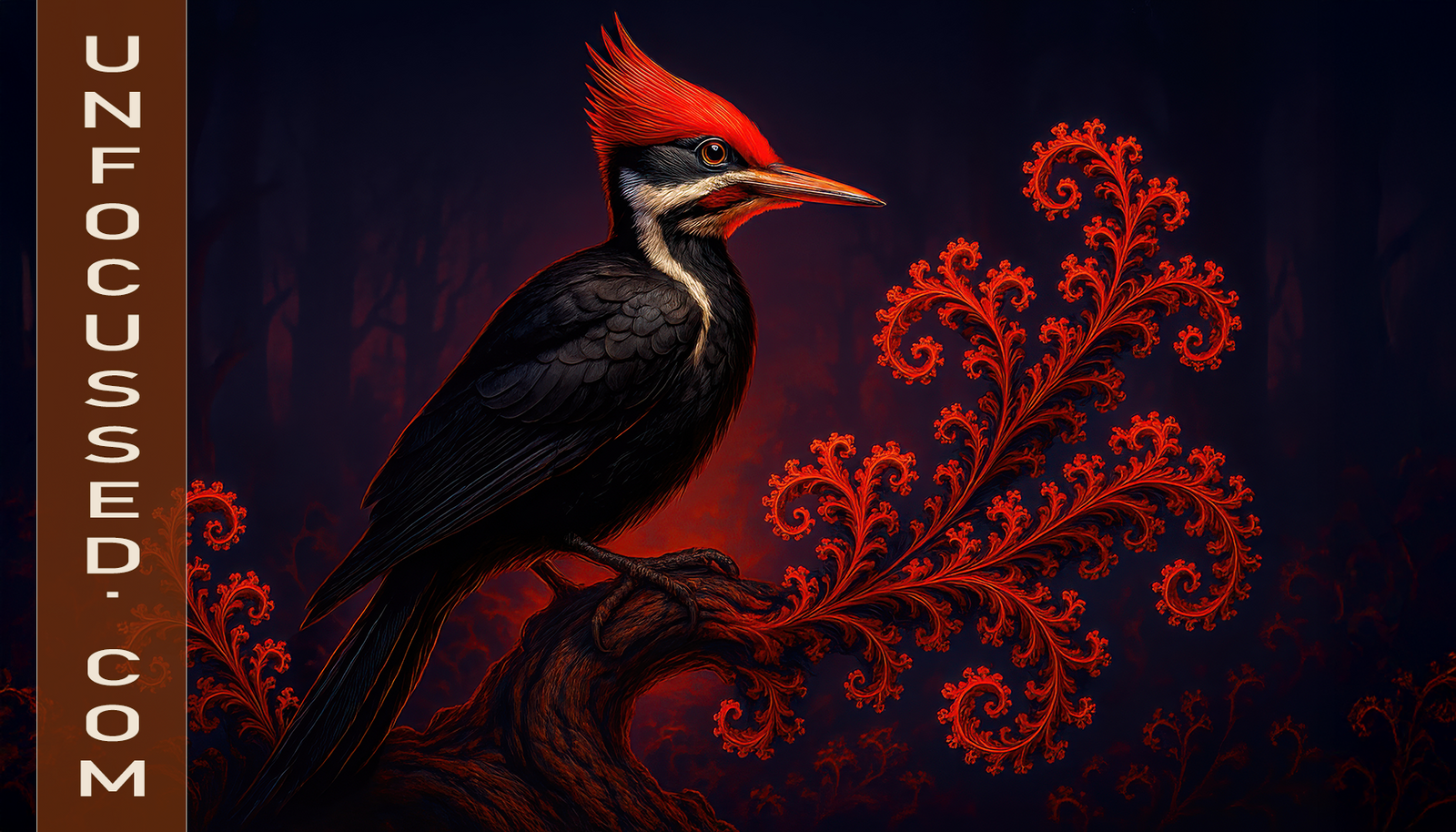
If you ask the birders down at the trailhead what a Pileated Woodpecker sounds like, they’ll give you three answers: a jungle monkey on espresso, a carpenter with a union card and no patience, and the exact ringtone that makes them fumble their binoculars into the mud. I heard all three the morning I met the crimson-crowned chaos engine who would later become the reluctant star of my portfolio and the patron saint of my caffeine addiction. The forest was still damp with night, the understory steamed like a tea kettle, and out of the silhouette of black trunks came a laugh—kik-kik-kik—that sliced the mist like a gossip column through a small town. I was there for a photo—what I call a “fractal field trip,” because apparently I can’t just photograph a bird on a branch like a normal adult. No, my brand requires a branch that curls into fiery spiral filigree as if Mother Nature took a workshop with M.C. Escher and then got spicy with a blowtorch. The maples had played along, sending out burls and lichens in arabesques, but this perch, this ember-painted corkscrew of a limb, looked forged by a blacksmith with an art degree and a grudge. I framed it, adjusted my ISO, and promised the forest I’d be tasteful this time. The forest, veteran of my promises, remained unconvinced. Enter our protagonist: a pileated the size of a skinny chicken and twice as judgmental. He arrived like a thrown comet, leveled the red crest like a Don’t-Speak-to-Me-Until-I’ve-Hammered sign, and rode the branch with the athletic balance of a tightrope walker who’d also taken a few semesters of carpentry. His beak—let’s call it what it is, a gothic chisel—ticked against the bark once, twice, then BAM, a strike so decisive the ants filed a workplace complaint. “Morning,” I whispered, as if the bird spoke English and preferred soft openings. “Just one pose. Hyper-realistic. Moody forest. Inferno on the Branch. You’re going to be merch.” The woodpecker did the slow swivel—one amber eye, then the other—like a maître d’ deciding whether my shoes were acceptable. Satisfied, or at least resigned, he flared his tail into a glossy black fan, braced with white like punctuation marks, and presented me with a profile that would make an owl jealous. In case you’re not a birder, this is the moment the life-listers whisper, “Oh my God, the Merlin app was right,” and try not to squeal. I do not squeal. I exhale very loudly and pretend I planned it. The branch beneath him—my corkscrew diva—began to glow with morning. From trunk to tip the textures rose in spiral rosettes, each curve catching ember-red light. I could feel the composition locking into place: bird’s gaze to the right, fractal plumes unfurling like fire made ferns, shadowed forest soft as velvet behind it all. This is the part where the art professors say “leading lines” and I nod like I discovered geometry personally. He drummed again—tat-tat-tat-TAT—and a flotilla of ants staged an emergency evacuation. It’s a myth that pileateds are chaotic; they’re engineers in feathers, running probabilistic models on every strike. He tested, listened for hollow space, then set to work on the exact patch where the bark had a tiny ripple, the kind only a bird with 50 million years of tool-making behind his eyes would notice. Chips flew. I smelled sap. Somewhere, a squirrel muttered the woodland equivalent of “not again.” “You know you’re trending,” I said, because the adult human brain needs conversation even when the audience is a bird. “Your species is basically the celebrity sighting of the eastern forest. People hear one drumroll and suddenly they’re wildlife photographers. We love your crimson crest. We love your moody lighting. We love that you’re a bulldozer with eyeliner.” The woodpecker paused, tilted his head, and regarded the curves of the branch as if auditioning them. Then he took three deliberate steps higher—click-click-click—and parked himself square in the golden eddy where the spiral foliage created a halo. If he had read my shot list, he could not have done better. I framed tighter, let the background fall charcoal-dark, and watched the reds saturate until they looked like embers in slow motion. My shutter whispered a thousand small yeses. In the trail behind me, a small procession of birders formed, the kind with hats that have sun shields and pockets for snacks and, presumably, life insurance policies for when a Great Horned Owl side-eyes their Chihuahua. They froze in that communal hush that means oh, we are in church now. Someone whispered, “Inferno on the Branch,” like they’d read the caption in my head, and I felt the delicious tingle of a shot earning its title while still being made. “What’s he after?” a new birder breathed. I wanted to say: redemption. I wanted to say: brand synergy. But the truth was simpler. “Carpenter ants,” I murmured. “Big ones. The filet mignon of protein. And maybe the prestige of looking like a living exclamation point.” The bird obliged by extracting one (ant, not exclamation point) and swallowing with the bland professionalism of a sommelier tasting from a paper cup. Then the forest did its favorite magic trick—time dilation. The light slid an inch, the branch went from blood-orange to garnet, and the woodpecker, as if aware of color theory, repositioned step by step until the rule of thirds lined up like we’d rehearsed. He held still long enough for the shutter to whisper a burst, then whip-cracked around to glare at a rival hammering deeper in the ravine. The laugh came again, the espresso-jungle-monkey kind, and a ripple of chills moved through the line like a stadium wave for very quiet people. I could have packed up right there. The image was in the camera and simmering in the back of my skull, already titled, already framed, already begging to become a fine art print with paper so thick it could stop a rumor. But the bird had not finished his set. He fluffed, shook out a snow globe of bark dust, and delivered one last drumroll that echoed off the black trunks and bounced back as applause. And because I am, despite evidence, a professional, I thanked him. Out loud. With feeling. The kind of gratitude you reserve for baristas and unblocked creative flow. “You were incandescent,” I said. “You were Inferno on the Branch.” The woodpecker blinked once, twice, and then, like a stage actor hearing a cue, lifted into the smoky light. He arrowed across the canyon of trees, a scarlet streak that dwindled to a comma in the sentence of the forest, and was gone. The birders exhaled. Someone dabbed at their eyes. Someone else asked me what settings I used, and I gave them the classic answer: “All of them.” We laughed the relieved laugh of people who got what they came for and then a little extra. I checked my screen again and—yes—there it was: the pileated woodpecker regal as myth, the fractal branch uncurling like flame, the dusky forest holding it all like a velvet box. The kind of frame that makes a wall say thank you. Of course, I didn’t yet know what waited deeper in those trees, or why the woodpecker chose that particular ember-lit perch, or what restless geometry was growing beneath the bark like a secret alphabet. That was a problem for Future Me, Photographic Adventurer and Occasional Bad Decision Enthusiast. Present Me just closed my eyes, listened to the dying echoes of the drum, and marked the GPS pin with a name: Inferno on the Branch. What I did next would have made a park ranger sigh and a poet nod approvingly. But that is Part Two, and this forest loves a cliffhanger almost as much as I do. The Ember Grove The thing about woodpeckers—and you can quote me at the next Audubon meeting—is that they don’t just happen. They appear like punctuation in the forest, interrupting your sentence with a full stop or an exclamation mark, and then dare you to rewrite the whole paragraph around them. That morning’s Inferno on the Branch moment could have been the perfect ending to my hike. I could’ve hiked back to the trailhead, smug and caffeinated, clutching my camera like a poker player walking away from the table while still ahead. But smug doesn’t feed curiosity, and caffeine makes you overconfident. I followed the direction of his flight. It wasn’t stalking. It was… professional interest. Birders call it “shadowing” if they want to make it sound respectable, and “woodpecker paparazzi” if they don’t. My boots crunched the frost-laced leaf litter, each step sounding absurdly loud in the cathedral silence. Somewhere ahead, I heard the faint drumming again—slower now, like he was working through a particularly stubborn patch of bark or a crossword puzzle with only vowels. The branch fractals behind me still glowed in my mind’s eye, but the pull forward was irresistible. What, after all, was worth leaving that stage for? The terrain changed subtly. The oaks gave way to older pines, their trunks straight as moral absolutes but scarred with decades of fire and lightning. The undergrowth thinned, replaced by a carpet of needles that muted my steps. And then I saw it: a clearing that shouldn’t exist, at least not in that geometry. The trees formed an almost perfect circle, and in the center grew a twisted giant of a maple, its limbs spiraling in patterns so complex they looked engineered by some cosmic watchmaker. The light in this space was stranger, warmer, as if the canopy filtered it through an old bottle of brandy. And there he was—my woodpecker—clinging to the trunk like it owed him money. His crest caught the filtered light and flared into a molten crown. He hammered with steady, deliberate strikes, each one sending a small snow of reddish bark to the ground. The tree seemed to respond—don’t ask me how—to his rhythm, the spiraling limbs flexing imperceptibly in time, like a dancer stretching before a performance. I crouched, zoomed, and framed. This wasn’t the Inferno branch; this was something else entirely. If the earlier perch was a piece of functional art, this tree was an altar. Every knot and burl glowed faintly, the reds and golds deepening with every beam of morning light. I’d photographed plenty of fractal structures before—ferns, frost, the accidental swirls in a jar of peanut butter—but this was different. The spirals weren’t random; they spoke. The patterns led the eye inward, toward a hollow in the trunk just above the woodpecker’s industrious beak. It was then I noticed the smell: resin, yes, but undercut by something warmer, almost sweet, like cinnamon and old paper. The woodpecker paused, cocked his head, and stared directly into that hollow as though listening for an answer. I swear I heard something—a faint clicking, like the sound of a typewriter buried under moss. He resumed hammering, and the clicking stopped. My skin prickled. Nature loves her mysteries, and I’d just walked into one wearing a camera like a backstage pass. Somewhere above, a shadow flickered through the canopy. Not another woodpecker—too big. I glanced up just in time to see a broad wing vanish into the sunlight. A hawk? Maybe. Or maybe the kind of forest resident you only see once and then spend the rest of your life trying to prove wasn’t a figment of an under-caffeinated morning. I checked the tree again. My woodpecker had moved higher, closer to the hollow, his claws gripping the bark in those perfect zygodactyl toes—two forward, two back—like he was designed in a laboratory for vertical defiance. I inched closer, the photographer in me bargaining with the part of my brain that knew better. The spiral patterns in the bark became hypnotic up close. Tiny ridges caught the light like illuminated manuscript borders, curling inward in deliberate arcs. My lens drank it all in. The closer I got, the more the patterns began to repeat—not just in the bark, but in the shapes of the leaves overhead, in the curve of the woodpecker’s tail feathers, in the ripple of the moss underfoot. It was the forest’s quiet admission: fractals weren’t an art trick. They were the blueprint. The woodpecker stopped hammering and looked down at me with the kind of expression only birds and high school guidance counselors can pull off: equal parts suspicion and pity. Then, without warning, he plunged his head into the hollow and came up with… something. Not an insect. Not sap. It was small, flat, and glinted like old brass. He held it delicately in his beak, turned toward me, and—this part I will argue with anyone over—nodded. Once. Then he flew past me in a flash of crimson and shadow, the object still clamped in his beak. I spun to follow him, tripped over a root, and did a graceless half-roll that put me on my back staring at the spiraled canopy. By the time I scrambled up, he was gone. The clearing was still, the only sound the faint creak of branches in a wind I couldn’t feel. The maple loomed overhead, spirals turning in my peripheral vision, daring me to come closer. I did. My fingers brushed the hollow’s rim. The wood was warm, unnaturally so, and under my touch the spirals seemed to deepen, the grooves tightening into a pattern that felt less like wood grain and more like… handwriting. I snapped a photo, then another, checking the playback obsessively. In each image, the spirals shifted slightly, as though the tree wasn’t posing so much as conversing. And in the very center of the hollow, framed by the curling grain, was a faint, perfect imprint: the outline of a feather. Not a woodpecker’s—too long, too narrow. I didn’t recognize it, and that bothered me more than I wanted to admit. When I finally tore myself away, I marked the GPS again, labeling it “Ember Grove.” The hike back felt longer, every tree suddenly suspect in its geometry. By the time the parking lot came into view, I’d convinced myself the whole thing was just a trick of light, a fever dream of reds and golds. But that night, when I uploaded the shots to my computer, the truth stared back at me in pixel-perfect detail: the spirals were real. The feather was real. And in the corner of one frame, half-hidden by a blur of motion, was the woodpecker—crest blazing, eyes locked on the lens—still carrying that mysterious glint in his beak. I didn’t sleep much. I kept thinking about the hollow, the smell, the clicking sound, the way the branch at Inferno and the maple in the grove shared the same curling geometry. And I kept asking myself one question: what in the forest needs a woodpecker as its locksmith? Whatever the answer was, I had the distinct, unsettling feeling it was waiting for me to come back. The Locksmith’s Secret I’ve done plenty of return trips to interesting photo spots before, but this one didn’t feel like my usual “let’s see if the heron’s still there” jaunt. This felt… loaded. Like the forest and I had an unfinished conversation, and the woodpecker—my so-called locksmith—was the only one holding the spare key. I spent three days trying to act like a normal human: editing other shots, answering emails, pretending I wasn’t Googling “pileated woodpecker mythology” at 2 a.m. Spoiler: turns out that in certain Native folklore, they’re messengers. In others, they’re builders for the gods. In my overcaffeinated brain, they were now both—and also possibly the forest’s maintenance crew. When I finally went back, it was pre-dawn. I wanted to arrive before the light turned the forest into an Instagram cliché. The air was sharp enough to sting my lungs, and the first chorus of birdsong was still warming up. My boots remembered the way without me thinking; my body was a compass set on “creeping around in questionable situations.” Every so often, I’d hear a distant hammering—three beats, pause, three beats—like the woodpecker was playing his own doorbell chime. By the time I reached the clearing, the light was dripping through the canopy like molten brass, just as before. The maple stood waiting, its spirals catching the first fire of the day. And there he was, crest flared, tail braced, pounding away at a new section of bark just below the hollow. The rhythm was steady, almost ceremonial. I raised my camera, half-expecting him to fly off like most self-respecting birds when a paparazzo shows up. Instead, he hopped sideways, giving me a perfect view of what he’d been working on: a ring of shallow holes forming a precise, geometric shape. A lock, I realized. Or at least the bird equivalent of one. Each hole was spaced with uncanny symmetry, like he’d measured it with calipers. My inner art nerd was thrilled; my inner rational human was starting to sweat. I stayed low, inching forward. He didn’t seem to mind. In fact, he began tapping the holes in a sequence—front, left, right, bottom—as if entering a code. A low thunk followed, not the brittle crack of bark but the dull, resonant shift of wood moving somewhere deeper inside. The spirals in the grain shivered. The hollow darkened, then deepened, as if the space itself was stretching. I couldn’t breathe. The woodpecker stepped aside, cocked his head toward me, and—again, I swear this happened—jerked his beak toward the hollow in a very clear your turn. Everything in me screamed do not stick your hand into strange forest holes. But curiosity is a drug, and I was already high on the scent of resin and whatever ancient secret this tree was cooking up. I set the camera to video, slung it over my shoulder, and reached in. The wood wasn’t just warm; it was pulsing faintly, like a heartbeat through old timber. My fingertips brushed something smooth and cool. I curled my hand around it and pulled it free. It was the same object I’d seen days before—flat, brass-like—but now I could see the detail. A medallion, no bigger than a drink coaster, etched with the same spiraling patterns as the bark, radiating outward from a single feather symbol in the center. The feather was inlaid with something dark, maybe obsidian, that seemed to swallow the light instead of reflecting it. Around the edge, in letters too fine to have been carved by human hands, was an inscription. Not English. Not any script I knew. The characters were fractal too—tiny curves within curves, so intricate I couldn’t follow their lines without getting lost. Behind me, the woodpecker drummed once—sharp, decisive. The ground beneath the maple shuddered just enough for me to feel it through my boots. I looked up, half-expecting the sky to split, but instead I saw movement in the spirals overhead. The branches were… shifting. Slowly, imperceptibly at first, then with deliberate grace. The limbs untwined and retwined into new patterns, closing off the clearing like the iris of an eye. Light poured in through specific gaps, illuminating the medallion in my palm. The inlaid feather shimmered, and for a brief, spine-tingling second, I heard that same clicking sound from before—but louder now, faster, like an invisible typewriter finishing a sentence. “Okay,” I whispered to the bird, because silence would have been worse. “You win. What is this? Why me?” The woodpecker only blinked, then launched himself onto the spiral limb directly above my head. He tilted his beak skyward and called—a loud, rolling kik-kik-kik that bounced between the trunks. Almost immediately, shapes moved at the edge of the clearing. Shadows, but… not entirely. Some tall and narrow, some low and branching, all slipping between shafts of golden light like they belonged to a slower clock than mine. I couldn’t make out faces, only the gleam of eyes reflecting the medallion’s light. They didn’t come closer. They just watched. I felt the weight of the moment the way you feel the weight of deep water. The medallion was warm now, almost hot. The spirals etched into it seemed to crawl under my fingertips, rearranging themselves like puzzle pieces. One shape resolved into something familiar: a map. Not a top-down map with rivers and mountains, but a map of connections—spirals linked to spirals, branches to branches. And at the center, the feather. The same feather etched in the tree, the same feather inlaid into the medallion. The same feather I now realized I’d seen in the subtle patterns of Inferno’s branch days ago. The shadows at the clearing’s edge stirred. The woodpecker called again, softer this time. The spirals in the maple’s bark began to slow, the branches returning to their original positions. The light shifted back to its ordinary golden filter, the clearing once again a simple circle of trees. Whatever had been watching melted back into the forest without a sound. The medallion cooled in my hand, the etched map freezing into place. The woodpecker dropped down to the maple’s trunk, sidled toward me, and with the precision of a jeweler inspecting a gemstone, tapped the medallion once with his beak. Then he launched upward, crest blazing like the last ember in a dying fire, and vanished into the canopy. The clearing was still again. Too still. I stood there a long time, listening for anything—a creak, a drumroll, a laugh. Nothing. Finally, I slipped the medallion into my jacket pocket and started the slow walk back to the trailhead. Every spiral in the bark along the way caught my eye. Every pattern in the moss looked a little too deliberate. By the time I reached my car, I’d stopped telling myself I was imagining things. I wasn’t. The forest was keeping secrets, and my woodpecker friend was one of its gatekeepers. That night, I laid the medallion on my desk under a lamp. The feather symbol seemed dull now, ordinary. But when I turned off the light, it faintly glowed—a deep, ember red, the color of a crest slicing through the morning mist. I don’t know if I’ll ever see him again. I don’t know what the map leads to, or why he chose to give it to me. But I do know one thing: the next time I hear that jungle-monkey espresso laugh in the forest, I’ll be ready. Camera in one hand, medallion in the other, waiting for my locksmith to open another door I never knew existed. And maybe—just maybe—that’s the whole point. The forest doesn’t hand you answers. It hands you keys, a little at a time, and trusts you to notice the locks. All you have to do is follow the sound of the hammering, and hope you’re clever enough to knock back.     Bring “Inferno on the Branch” Into Your World Let the fiery elegance of the pileated woodpecker and the hypnotic curves of the fractal branch ignite your space with our exclusive Inferno on the Branch merchandise. Whether you want a statement piece for your walls, a functional work of art for your daily life, or a tactile puzzle to immerse yourself in, this design brings the forest’s mystery right to you. Showcase the drama and vivid color on a Metal Print for modern, luminous impact, or opt for a timeless Framed Print that turns your wall into a gallery. For something you can carry into the wild—or the farmer’s market—the Tote Bag lets you bring the ember-lit forest wherever you go. And for quiet, mindful moments, piece together the magic one curve at a time with our Jigsaw Puzzle. No matter which form you choose, every piece captures the same rich colors, hyper-realistic details, and mystical energy that made the original image unforgettable. Invite the legend of the locksmith woodpecker into your home—you never know what doors it might open.

En savoir plus

The Rooster’s Bloom

par Bill Tiepelman

The Rooster’s Bloom

The Blooming Begins Once upon a time (and probably three chardonnays deep), in the sleepy village of Cluckminster, lived a rooster unlike any other. His name was Bartholomew Featherfax the Third, but most just called him Bart. He wasn’t your average morning-screamer. No. Bart was a vibe, an icon, a strut incarnate. He crowed not at dawn, but when he was good and ready — preferably after a nice stretch, a moment of affirmations, and two sips of lukewarm espresso with goat milk foam. But what truly made Bart different — aside from his deep baritone voice and suspiciously tight thighs — was his plumage. Where other roosters sported rugged reds or moody blacks, Bart had… flora. Petals. Fronds. Tiny spiraling succulents growing where feathers should be. His tail alone looked like a small, highly curated Etsy boutique, and his neck shimmered like the inside of a dream wrapped in a kaleidoscope wrapped in a cheeky Pinterest board. Of course, this was not the norm in Cluckminster, where most poultry preferred their feathers basic, their beaks unmoisturized, and their ambitions low. Bart, however, bloomed loudly. And unapologetically. “Are those flowers growing out of your butt?” hissed Gertrude the Hen one morning as Bart passed the grain trough, hips swaying like a disco ball in slow motion. “Excuse me, Gertrude,” he clucked, tossing a begonia over his shoulder, “they’re fractal-integrated botanicals. And they are thriving, unlike your brittle dry comb.” The hens gasped. The ducks pretended not to listen, but everyone knew ducks were messy. Even the barn cat, who’d spent most of the week high on catnip behind the hay bales, peeked out and whispered, “Daaaaamn.” That very day, Bart strutted up to the barn roof (as one does), stood against the inky dawn sky, fluffed his botanical majesty, and let out a crow so powerfully fabulous that nearby sunflowers did a little shimmy. This was not just a wake-up call. It was a declaration. An arrival. A blooming of epic proportions. Unfortunately, it also alerted the Council of Poultry Aesthetics — an outdated, cranky bunch of feathered fossils who preferred conformity, beige feathers, and strictly one type of squawk per gender. And thus began the official filing of **Complaint #37B: Unauthorized Blooming While Male**. The Petal Trials of Bartholomew Featherfax the Third The Council of Poultry Aesthetics convened in their musty little coop-turned-office behind the barn. Their motto, carved in dust on a crooked plaque, read: "Neutral tones. Modest combs. No flair, no fun, no feathers undone." Each member was older than hay, balder than truth, and more wrinkled than a two-week-old raisin in a sauna. At the head of the table sat Lord Pecksley, a rooster so uptight his tail feathers had fused into a single, clenched curl. “This Bartholomew menace,” he wheezed, adjusting his monocle (yes, monocle), “must be... pruned.” “He’s flaunting,” clucked Madam Prunella, chief hen of etiquette. “With petals. In broad daylight. Children can see them. Succulents, even! Euphorbia vulgaris right on his neck!” “And that spiral bloom near his vent?” whispered the Vice Chair, scandalized. “Nature doesn’t spiral there.” “Well,” Pecksley snapped, slamming a talon down, “nature clearly needs a stern reminder of boundaries!” The council voted unanimously: Bart was to appear before the Barn Court in three days’ time to account for his botanical 'indecency'. Meanwhile, the barnyard was losing its mind. On one side, Bart’s fans. The Bloomers. They were a colorful coalition of hens with glittery combs, ducklings with attitude, a wildly dramatic peacock from three towns over, and at least one suspiciously muscular squirrel who just wanted to vibe. They marched with signs like “”, “Fractal is Functional,” and “Botany Is Not A Crime.” Someone even wrote a spoken-word piece about photosynthesis and liberation. It was weird. And beautiful. On the other side? The Cluckservatives. Stern hens in neutral shawls. Roosters who'd never moisturized. A pair of judgmental pigeons from accounting. They accused Bart of ‘distracting the flock,’ ‘unsettling the egg count,’ and ‘making the chicks ask too many damn questions.’ In the middle of it all? Bart. Fabulous. Furious. And frankly, exhausted. He’d never asked to be a symbol. He just wanted to bloom. Was that so much? Still, the pressure was mounting. The council began clipping the petals of other hens who dared to accessorize. Feathers were being inspected. Seeds confiscated. The goose who painted her beak was publicly peck-shamed. Dandelion crowns were outlawed. They even tried to dye Bart’s tail beige with expired oat milk. (He slapped it away with a calendula plume and muttered “Try again, you bland bastards.”) By the time the trial began, Bart arrived in full regalia. He’d spent the night cultivating a rare orchid at the tip of each tail plume. A crown of golden chrysanthemum spirals framed his head. His wattles sparkled with bioluminescent dew drops. His beak was polished. His claws were French-tipped. And his eye — oh, his eye — was a smoldering blaze of “I will burn your coop with my vibe.” “Bart Featherfax,” boomed Lord Pecksley, standing beneath a flickering barn bulb that made him look like an undercooked chicken nugget, “you stand accused of aesthetic anarchy, defiance of rooster norms, and inciting unauthorized botanical awakening. How do you plead?” Bart stepped forward. Slowly. Every movement caused a ripple of floral shimmer to cascade across his body like spring gossip on a breeze. He cleared his throat. Held the entire barn’s breath in his claws. Then, with a voice smooth as silken molasses draped over a jazz solo, he replied: “I plead flourished.” Gasps. Screeches. A hen fainted. Someone dropped a corn cob. “You say I incite awakening?” he continued, strutting a slow spiral around the haybale podium. “Good. Because we’ve been asleep far too long. For generations, you told us our feathers were only worth something if they matched someone else’s mold. That we had to peck in place. That color was chaos. That bloom was bad. But I am not your beige fantasy.” He spun, flared his wings. Petals shimmered. Fractals unfurled. The damn flowers sang. (No one knows how. It just happened.) “I’m not here to conform. I’m here to photosynthesize and stir sh*t up.” The Bloomers exploded in applause. The peacock sobbed. The squirrel threw glitter. Even a few Cluckservatives began loosening their comb wraps. Lord Pecksley’s monocle popped off. “Order! ORDER I SAY!” he clucked, shaking his beak violently. “This isn’t over, Featherfax! This is a war on standardization!” Bart winked. “Then call me your flamboyant revolution.” And as the barn doors creaked open behind him, letting in the morning light — Bart strutted out, feathers in full bloom, tail spirals catching the sun like fire-wheels of rebellion. The hens followed. The ducks quacked in rhythm. The squirrel raised a tiny flowered fist. But just beyond the barnyard fence... something else stirred. Something bigger. Something ancient. Something with feathers... and vines. The Bloom Beyond the Fence The fence behind the barn had always been a mystery — a line never crossed, a story never told. Chickens said it led to the Overgrowth. The elders whispered it was where the Wild Roosters roamed. Roosters who refused to be plucked, preened, or pigeonholed. Roosters whose feathers had evolved into forests. Roosters who didn’t crow… but howled. And now, as Bart stood blinking into the early dawn light, fresh from revolution and still radiating orchid-based defiance, he saw them. First, the trees parted. Not like they’d been pushed, but like they’d politely stepped aside. Then out came a shape — tall, plumed, and radiant. A rooster, yes, but... more. Part phoenix, part rainforest. His tail coiled like galaxies. His beak glinted like obsidian wrapped in mango nectar. His chest bore markings older than shade. His eyes held starlight and dirt. He smelled like rebellion steeped in rosemary. He approached Bart and spoke in a voice that didn’t echo — it rooted. “You bloomed loud, little brother.” “I didn’t know I had a family out there,” Bart whispered, petals trembling. “You bloomed. That’s enough.” Behind the Forest Rooster came others — a parade of legendary bloomers. A hen whose feathers were literal roses. A duck with floating lily pads for wings. A turkey with bioluminescent mushroom gills. A quail that glowed with internal fire. A peacock that bent light itself. Bart blinked. “Is this heaven?” “It’s better,” the Forest Rooster grinned. “It’s real. And it’s ours. Come walk with us.” But Bart looked back. Behind him, the barnyard was in chaos and color. The Bloomers were holding their ground. The Cluckservatives had begun to fray at the combs. A small group of chicks were painting each other’s beaks with elderberry juice and shouting things like “Pollinate your power!” and “Be your own bouquet!” He turned back. “I can’t leave them.” The Forest Rooster nodded. “Then we’ll come with you.” And that’s how the Bloom War began. Oh, don’t worry, it wasn’t violent. It was worse. It was artistic. They began with the barn. They painted it in gradients so bold even the sheep looked up. They threw a full moon rave in the coop. They taught the chicks geometry via sunflowers. They brought jazz. Poetry. Mushroom farming. Avian glitter drag shows. One night, a nightingale beatboxed the entire first act of *Hamlet*. It was confusing and transcendent. The Cluckservatives fought back the only way they knew how: bureaucracy. They issued cease-and-decrow orders. They tried to form a Ministry of Modesty. They attempted to regulate petal diameter. Someone even invented a Bloom Tax. But the movement couldn’t be stopped. Not when the very soil had begun to shift. The coop’s walls started growing vines. The old troughs overflowed with marigolds. The roosts sprouted lavender stems that hummed lullabies at night. Nature had chosen a side. And at the center of it all was Bart — no longer just a rooster, but a revolution in feathers. He stood daily in the sun, petals wide, comb glowing with dew, and told stories to the chicks about the time he turned shame into shade, judgment into jasmine, and hate into horticulture. He never wore the same feathers twice. He always smiled when the council glared. He kissed his reflection good morning. He was everything they'd told him not to be — and then some. Years later, long after Lord Pecksley was seen retiring bitterly into a worm commune and the barn had become a museum-slash-nightclub-slash-botanical sanctuary, an elder chick asked Bart: “Why flowers?” He smiled, rustling with heliotrope and sass. “Because feathers fly,” he said. “But blooms? Blooms stay. They root. They multiply. They shake the ground and perfume the air. And you can’t pluck a bloom without spreading seeds.” The chick blinked. “So... you’re saying we’re all just walking flower bombs?” Bart winked. “Exactly. Now go explode somewhere fabulous.” And so they did.     🌺 Take a Piece of the Bloom Home If Bart strutted into your heart like he did into history, now you can let his blooming brilliance brighten your everyday life. Bring The Rooster’s Bloom into your space with our Framed Print — a stunning, gallery-ready tribute to floral rebellion and fearless expression. Carry his sass wherever you go with the eco-chic Tote Bag, perfect for farmers markets, libraries, or storming the gates of boring fashion. Send blooming wisdom to your favorite humans with a vibrant Greeting Card, ideal for birthdays, affirmations, or unapologetic declarations of fabulousness. And for a sleek modern touch? The Metal Print brings Bart’s fractal feathers to life in full radiant glory — durable, bold, and entirely unbothered by bland walls. Whether you're here for the laughter, the layers, or the lush, rebellious artistry — let Bart remind you: it’s always the season to bloom exactly as you are.

En savoir plus

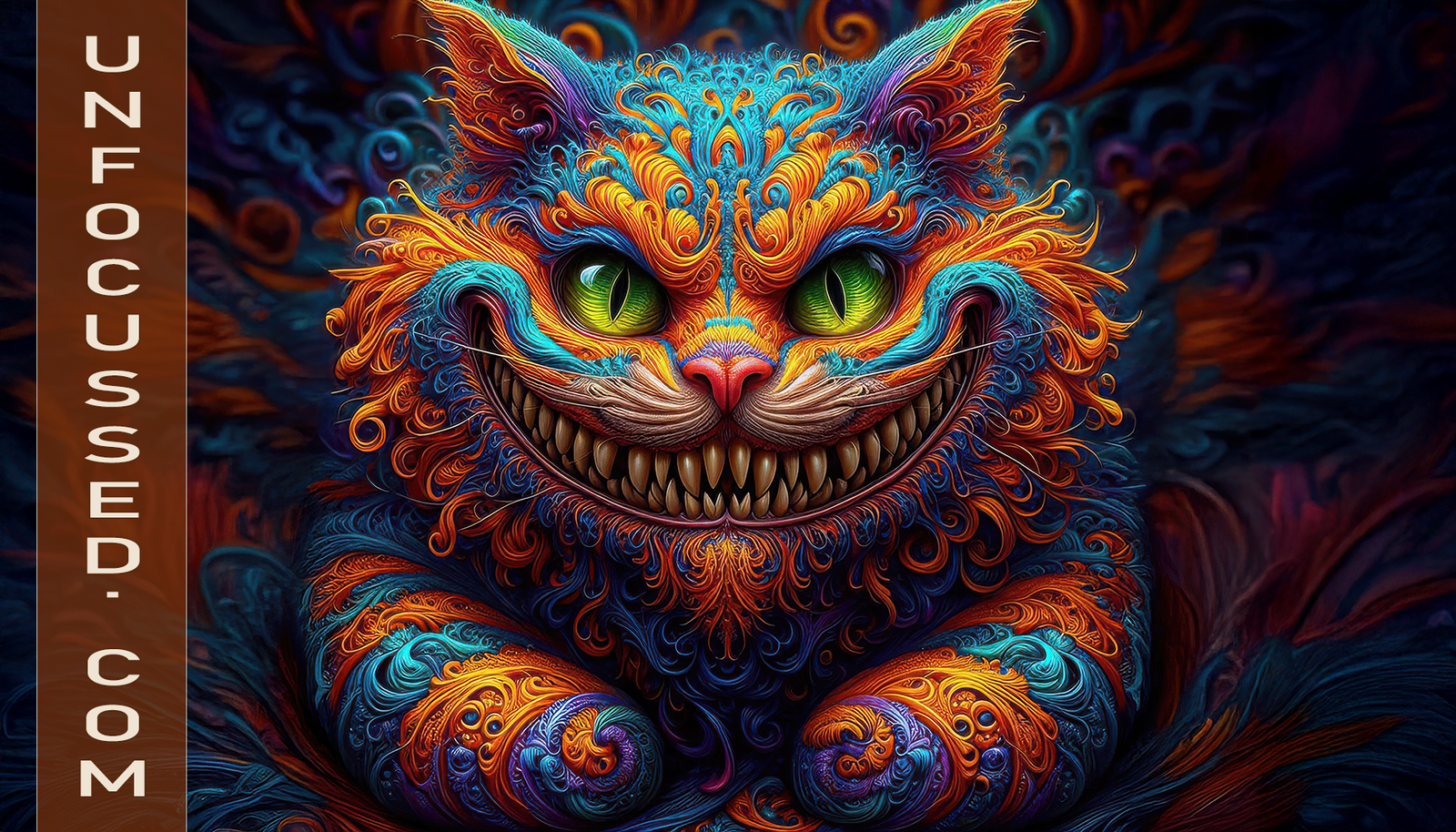
Grinfinity Purradox

par Bill Tiepelman

Grinfinity Purradox

The Cat, the Cult, and the Missing Underpants In the acid-laced dreamscape of Kaleidowood, nestled between the Caffeine Mountains and the River of Poor Decisions, lived a feline who wasn’t quite... sane. Or real. Or housebroken. Locals called it Grinfinity — a name spoken only after three espresso shots and a silent prayer to the God of Hangovers. Grinfinity wasn’t born. He coalesced. Formed from the collective subconscious of every drunk art major who ever said “I could totally design an NFT of a cat that eats the multiverse.” He was 70% fractal mischief, 20% day-glow fluff, and 10% weaponized smile. And that smile? It had molars. Not like “oh how cute, kitty has teeth,” but “oh god it bit the mayor and he still can't eat pudding right.” By day, he posed as a mystical guru in the backyard of a defunct yoga studio, purring cryptic nonsense to wide-eyed influencers and failed DJs. By night, he attended underground raves where he sold micro-doses of existential dread packed in jellybean form. His third favorite hobby was rearranging people’s sock drawers into mandalas and then watching their slow mental decline. But on the fateful Thursday that kicked off the Purradox, Grinfinity had other plans: he wanted the Moon's underpants. "What?" you ask. "The Moon wears underpants?" Of course it does. Why do you think it hides behind clouds during full moons? Modesty. Lunar modesty. But the Moon’s underpants weren’t just any cosmic skivvies — no, these were handwoven from the silky regret of 1990s boybands and reinforced with the sighs of every raccoon who ever found an empty trash bin. They were the comfiest, most powerful underpants in the known reality cluster. Legend said that whoever wore them gained the ability to lick their own ego clean, summon a never-ending brunch, and annoy telemarketers with mind bullets. Grinfinity didn’t care about that. He just wanted to steal them and leave them hanging on a church steeple in Wisconsin. For the vibes. Thus began a journey through wormholes, drive-thrus, and a surprisingly aggressive nudist colony called “Freeballonia.” But first, he needed a crew. And like any true antihero, he started with the worst idea possible: Craigslist. The first to answer was Darla Doomleg, a retired roller derby champ turned erotic taxidermist. She had a bat tattooed on each butt cheek and a pet stoat named Greg. Then came Phil “No Pants” McGravy, a man banned from seventeen diners and one time accidentally married an inflatable couch. And rounding out the chaos was Kevin, a sentient pile of glitter with a vape addiction and daddy issues. “We're going to steal lunar underwear,” Grinfinity announced, tail coiling like a Salvador Dalí signature. “And if we’re lucky, fart in them before the universe resets.” No one blinked. Kevin did release a small puff of lavender mist, but that was just how he showed excitement. They climbed into Darla’s hover-Winnebago, gassed up on fermented Snapple and sheer spite, and rocketed toward their fate. Grinfinity sat at the helm, purring like a tattoo gun stuck on “regret,” eyes glowing like traffic lights at a rave. The first destination? The Great Cosmic Sock Drawer — a sub-dimensional vault rumored to contain every lost sock, sense of dignity, and good decision ever made while drunk. It was also, according to Reddit, the portal to the Moon's laundry chute. They had no idea what horrors awaited. But Grinfinity didn’t care. He had his claws sharpened, his grin dialed to “menace,” and his butt parked squarely in destiny’s cupholder. The Great Sock Drawer and the Trouble with Sentient Panties Inside the yawning, sock-scented maw of the Great Cosmic Sock Drawer, time hiccuped. Reality folded like origami made by a drunk uncle at a family BBQ, and gravity was having a petty argument with inertia. Grinfinity and his crew stumbled out of the hover-Winnebago, blinking at the fuzzy chaos sprawling before them. The landscape was pure chaos. Left socks lounged in velvet hammocks, drinking hot cocoa and sighing about their missing partners. Right socks marched in military formations, demanding justice, a Netflix series, and warm feet. Thongs floated overhead like smug butterflies, occasionally dive-bombing crew members with snarky insults. A massive athletic sock the size of a cathedral sobbed gently into a vat of Axe body spray. “I feel like I licked a lava lamp,” muttered Phil No Pants, who was currently wearing a kilt made of caution tape and chewing on a glowstick for courage. “What is this place?” “The psychic fallout zone of every laundry day gone wrong,” Darla Doomleg whispered, clutching Greg the stoat, who had gone full feral and was now gnawing at the space-time continuum like it owed him money. “We need to find the Laundry Chute of Ascension.” Kevin the Glitter Pile was vibrating, leaving behind little trails of sparkly nonsense and purring to himself in Morse code. “This place smells like wet shame and cinnamon gum,” he murmured. “I feel alive.” Grinfinity prowled ahead, his paws leaving imprints of color that shifted when no one was looking. Every step was an insult to geometry. His grin widened with each twitching sock and floating brassiere they passed. He was in his element — chaos, laundry, and low-stakes cosmic thievery. All his nine lives had been leading to this moment. Suddenly, a booming voice erupted from the horizon like a burp from a god who’d eaten too much cheese. “WHO SEEKS THE PANTIES OF THE MOON?” Everyone froze. Even Greg. Even Darla’s left butt cheek clenched in alarm. Out of a storm cloud made entirely of mismatched dryer lint emerged a being of impossible fluff and profound sass: the Panty Warden of the 7th Cycle. It had the body of a sentient laundry basket, legs made of coat hangers, and eyes that screamed "I once had hopes, but then I taught middle school." “State your purpose or be ye sorted by the eternal spin cycle!” it roared. Phil stepped forward, holding a novelty-sized pair of edible underpants as a peace offering. “We’re here to borrow the Moon’s undies and maybe cause some low-level metaphysical vandalism. No biggie.” The Panty Warden blinked slowly. “Do you even understand the power you seek? Those briefs control tides, menstrual cycles, and cheese production in Wisconsin. They're woven from lunar wool and blessed by the Pope's weird cousin.” “That’s exactly why we need them,” Grinfinity replied, his eyes glowing like radioactive olives. “Also, I made a bet with a comet that I could graffiti Saturn’s rings while wearing them.” The Warden sighed, releasing a cloud of fabric softener that smelled like unresolved childhood trauma. “Very well. But first, you must pass... the Trials of the Tumble.” And just like that, the ground fell away. The crew screamed, some out of fear, others out of habit. They plummeted through a vortex of laundry-themed horrors: a tunnel of moist towels, a field of biting sock puppets quoting Nietzsche, and a karaoke pit where rogue lingerie sang ABBA songs at weaponized volume. Trial One: The Washer of Regret. The team was trapped inside a swirling cylinder of bad exes, awkward conversations, and that one time you texted “you too” when the barista said “enjoy your drink.” Grinfinity just floated through, humming “Toxic” by Britney Spears and occasionally hissing at ghosts. Darla punched her way out with brass-knuckled sass. Kevin just melted into a puddle of self-love and re-emerged fabulous and more glittery than ever. Trial Two: The Bleach Zone. Everything turned white. The crew was assaulted by unsolicited opinions, yoga moms in Uggs, and the endless loop of someone explaining NFTs. Phil nearly broke until he remembered he’d once peed in an influencer’s smoothie. That gave him strength. Trial Three: Ironing Board of Destiny. A smooth-talking ironing board challenged them to a game of philosophical beer pong. The questions were abstract (“Can socks dream of matching feet?”), the answers more so. Grinfinity aced it with riddles that sounded like pickup lines from a sentient thesaurus. He seduced the board into submission. Finally, they emerged in the heart of the Drawer — the Spin Temple, a massive coliseum of cotton and ego. Suspended in the center, guarded by a choir of floating sentient boxer briefs, hovered the prize: the Lunar Underpants. They were magnificent. High-waisted. Laced with constellations. The tag simply read “Handwash Only: Violates 17 Natural Laws if Machine Dried.” “I’m gonna sniff them,” Kevin whispered reverently. “You’re not gonna sniff them,” Darla snapped. “I might sniff them,” Grinfinity admitted, already climbing the scaffolding with the grace of a deranged ballet dancer. As he reached for the waistband, a ripple shot through space — a psychic fart of destiny. The Moon felt it. Back on the lunar surface, the Moon blinked. It had been binge-watching telenovelas and eating emotional ice cream, unaware its favorite underpants were under siege. It rose slowly. The air crackled. Somewhere, a celestial gong sounded. The Moon. Was. Coming. Underwearageddon, Glitter Redemption, and the Grinning End of All Things The Moon was pissed. Like, full-on “I came home to find my favorite snack gone and someone used my toothbrush as a butt-scrubber” kind of pissed. It tore across the cosmos like a cosmic Karen in a minivan made of passive-aggressive Yelp reviews, headed directly for the Great Cosmic Sock Drawer. As it moved, it plucked meteors from space like curlers and rolled them into its hair. Lightning cracked across its craters. It snarled in Spanish. Meanwhile, deep within the Spin Temple, Grinfinity clutched the legendary Lunar Underpants like a man possessed — or more accurately, like a cat who had just found the warmest, most forbidden nap spot in the multiverse. “They’re... so soft,” he purred, eyes rolling back as celestial cotton caressed his furry cheeks. “This must be what angels wear when they go clubbing.” Darla Doomleg stood guard, wielding a feather boa turned plasma whip. “We’ve got maybe thirty seconds until the Moon shows up and rage-bounces us into another dimension.” Kevin, now three times larger and pulsing with high-voltage glam energy, was covered in psychic sequins and vibrating with existential anxiety. “I don’t think I’m ready to fight a planetary body, guys. I barely survived brunch with my ex last week.” Phil No Pants was applying glow-in-the-dark war paint using a bottle of expired ranch dressing. “You guys worry too much. What’s the Moon gonna do, moon us?” Then the ceiling exploded in a tidal wave of lunar fury. The Moon descended like a glittery judgment god, wreathed in flames and expletives. “WHO. TOUCHED. MY. UNDIES.” “It was consensual!” Grinfinity shouted, hiding the underpants in a pocket dimension shaped like a suspiciously moist gym sock. “Also, we’re technically insured.” The Moon blinked, then launched a crater-sized moonbeam directly at them. Chaos erupted. Battle of the Briefs had begun. Sock armies rose from beneath the temple, unified by their mutual hatred of foot sweat and abandonment. They charged the Moon’s shoelace golems, who whipped through the air with deadly accuracy. Lingerie drones buzzed above, firing taser-thongs at anything that moved. One particularly aggressive sports bra suplexed a cardigan into next week. Phil No Pants rode into the fray on a flaming flip-flop, swinging twin pool noodles like nunchucks and screaming, “I AM THE TIDE POD WARRIOR!” Darla leapt into the air, roundhouse-kicking a pair of sentient long johns into a spinning dryer vortex, then delivered a passionate monologue about consent and the importance of label-reading during laundry. The socks paused, inspired. One wept quietly. Kevin, meanwhile, had achieved a glitter-based transcendence. He floated above the battlefield, shimmering like a rave god, whispering affirmations and raining down healing sparkles. Enemies froze mid-punch to marvel at his radiant thighs. A bra snapped itself back on in respect. But the Moon would not be swayed. It summoned a tidal wave of moonlight, collapsing the fabric of the drawer. Grinfinity had one shot — one chance to save them all and pants the Moon at the same time. He reached into the quantum sock-pocket, pulled out the Lunar Underpants, and slipped them on with the slow-motion power of a shampoo commercial meets an exorcism. Light flared. Somewhere, a llama learned to play bass guitar. Reality hiccuped. “You cannot wear those,” the Moon roared. “They are mine!” “Correction,” Grinfinity said, stepping forward with a pelvic thrust that echoed through the void. “They were yours. Now they’re riding this fuzzy thunder-thicc tail and fueling chaos like grandma’s chili on cheat day.” He activated the Underpant Protocol: an ancient power encoded in the waistband. Threads of truth and bad decisions spiraled outward, rewriting physics with every purr. The Moon staggered, blinking in slow-motion as its own gravitational ego was pulled into a swirling vortex of shame and self-reflection. “Is this what I’ve become?” the Moon whispered. “A petty ball of overreactive glow?” Kevin floated up beside it. “We all lose our shine sometimes. What matters is whether you sparkle again… on your own terms.” The Moon sobbed. One giant, shimmering tear fell from the sky and splashed onto Earth, instantly birthing a pop-up spa in Cleveland. No one questioned it. It had a four-star rating by noon. In that moment, Grinfinity forgave the Moon. Or maybe just got distracted by a floating meatball. Either way, peace was restored. The Spin Temple faded into a soft fog of dryer sheets and awkward goodbyes. The sock armies disbanded. The sentient panties returned to their cloud nests. The Moon returned home, slightly wiser, moderately humbler, and down one pair of godly underwear. Back on Earth, Grinfinity opened a fusion brunch parlor called Purradox & Eggs. Darla launched a wildly successful line of tactical corsets. Phil became the host of a reality show called “Naked and Mildly Confused.” Kevin published a memoir titled “Glitter and Guts: My Journey Through Sockspace.” And the underpants? Still worn by Grinfinity, usually on Wednesdays, always backwards, occasionally while skateboarding down gravity wells just to flip off the laws of thermodynamics. He never stopped grinning.     Still grinning? Good — because now you can bring a piece of the madness home. Whether you want to display Grinfinity’s legendary smirk above your fireplace, send dangerously whimsical greetings to frenemies, or spend a questionable weekend assembling his fur one psychedelic piece at a time, we've got you covered. Own the purradox in glorious form: Framed Print: Class up your chaos — Grinfinity belongs in a frame, not in your sock drawer. Canvas Print: Vibrant, bold, and as misbehaved as your last birthday party. Tapestry: Cover your wall in color-drenched cat chaos (or your ex’s taste in décor). Jigsaw Puzzle: Lose your sanity piece by piece — just like Grinfinity intended. Greeting Card: Because nothing says “I’m thinking of you” like a cosmic cat who may have destroyed space-time for fun. Get weird. Get wonderful. Get Grinfinity.

En savoir plus

Whiskers at the Witching Window

par Bill Tiepelman

Whiskers at the Witching Window

The Familiar's Complaint “If one more squirrel insults me from the holly bush, I swear to Bast I’ll torch the tree.” The orange tabby was muttering again. His name—though few dared use it aloud—was Bartholomew R.J. Whiskerstein, Esquire. He was the third Familiar to serve at No. 13 Embercurl Lane, a mystical townhouse wedged between dimensions, where the mail arrived only when Mercury was in retrograde and the curtains had a mind of their own. Bartholomew’s ears twitched as he sat perched on the ledge of the violet-paned window. Beneath him bloomed a plush carpet of enchanted lavender that hissed faintly if plucked without permission. Behind him, thick velvet curtains danced without breeze—tracing glowing sigils in the air like lazy lightning bugs scribbling curses in cursive. Inside the townhouse, chaos hummed in that pleasant, distant way only mild sorcery can. There was the sound of a teapot making demands. A stack of grimoire pages trying to unionize. And, somewhere in the study, the soft weeping of a sentient lamp contemplating its existence. Bartholomew ignored all of this. Because Bartholomew had a job. A highly specific job. A job that came with perks (a bottomless dish of roasted chicken hearts) and perils (being regularly used as a scrying lens by a witch who still hadn’t mastered “consent”). He was the Official Perimeter Watcher, Guardian of Thresholds, and—unofficially—the only housemate with the balls to tell Madam Zephira that her black lace corsets were clashing with her aura again. Tonight, however, the swirls in the stucco glowed brighter than usual. Their fractal curls pulsed like molten gold veins across the obsidian walls, marking the hour as not quite midnight and definitely up to something. And Bartholomew, with his one crooked whisker and eyes the color of guilty marmalade, knew the signs. Someone was coming. And not the kind who wore boots or knocked politely or brought salmon. Someone uninvited. With a tail twitch of annoyance and a small sneeze into the lavender blooms (they smelled amazing but were absolute bastards to his sinuses), Bartholomew straightened his spine, narrowed his gaze, and did what any respectable magical creature would do in his position. He farted dramatically, just to establish dominance. The wall beside him hissed in response. “Oh please,” he purred into the growing glow. “If you’re here to devour souls, at least bring a snack.” Zephira, Doomscrolling, and the Visitor from the Slant Madam Zephira Marrowvale was elbow-deep in her spellbook, though not for anything productive. She was doomscrolling. To be fair, the grimoire had recently updated its interface, and now it mimicked the layout of a social media feed—an unfortunate side effect of Zephira’s habit of whispering her thoughts to her mirror while the Wi-Fi was unstable. As such, instead of recipes for lunar elixirs or hexes for passive-aggressive neighbors, the leather-bound tome now served up endless gossip from disembodied witches across the astral plane. “Ugh,” Zephira groaned. “Another thirst trap from Hagatha Moonbroom. That’s the third this week. No one needs to see that much thigh from a lich.” Bartholomew, having returned from his window post only to find his warning hisses entirely ignored, slunk into the main room, tail held at a judgmental tilt. “You do realize,” he said with that slow, deliberate tone cats use when they know you’re not paying attention, “that there’s a potential rift forming in the wall?” Zephira didn’t look up. “Is it the laundry wall or the library wall?” “The front wall.” “Oh.” She blinked. “That’s... more important, isn’t it?” “Only if you enjoy the concept of interior dimensions staying on the inside,” Bartholomew replied, now licking one paw in a manner that suggested this was all terribly beneath him. With a sigh and a dramatic flourish, Zephira stood up, her long coat rustling like parchment paper dipped in attitude. The air around her shimmered with leftover magic: sparkles, ash, and the faint smell of peppermint schnapps. She stomped toward the window where Bartholomew had resumed his watch, this time sitting like a disappointed statue made entirely of orange velvet. Outside, the night was beginning to change. Not just darken—but change. The swirling glow around the window had thickened, threads of molten amber knotting and curving like someone had spilled calligraphy ink into firelight and pressed it to the walls of reality. Then—something knocked. Or maybe it burped. Or maybe the universe coughed up a hairball. Either way, the sound was wrong. “That’s not good,” Zephira whispered, suddenly sober. “That’s... from the Slant.” Bartholomew’s ears flattened. The Slant was a bad neighborhood between planes. It was where lost socks went. Where contracts rewrote themselves. Where things that weren’t supposed to feel shame hung out just to enjoy the sensation. No one invited guests from the Slant. Mostly because if you could invite them, it meant you were already partly one of them. The knock-burp-hiccup came again. “Do you think it’s after you or me?” Zephira asked, half-hoping it would be Bartholomew. He was, after all, technically immortal and less emotionally fragile. “Neither,” he said, fur bristling. “It’s here for the window.” “Why the hell would anyone come for a window?” “Because,” Bartholomew said, leaping down into a stretch that made every vertebrae in his body crackle like a haunted fireplace, “this particular window is a passage. A junction between realms. A former portal to the Celestial DMV. You really should keep better notes.” Zephira’s mouth fell open. “I thought this window had weird feng shui.” Before either of them could speak again, the glass began to bend inward—not break, not shatter—bend, like it was made of smoke or jelly or poorly explained plot devices. The lavender beneath the sill rustled and puffed in protest, releasing sparkles and spores that smelled strongly of sassafras and minor regret. From the swirling gold, a face emerged. Not a full face. Just... parts. An eye here, a suggestion of a grin there. And—strangest of all—a monocle made of static electricity. It was a face both beautiful and terrible, like a Greek god who also did your taxes and wasn’t happy about your deductions. “HOUSE OCCUPANTS,” the entity intoned, its voice vibrating the curtains into curls. Bartholomew leapt back onto the sill and squared his shoulders. “What in the unholy name of wet kibble do you want?” The face pulsed, amused. “I AM THE INSPECTOR OF INTERPLANE THRESHOLDS. THIS UNIT—” “This house, darling,” Zephira corrected, arms crossed. “—THIS UNIT IS IN VIOLATION OF CODE 776-B: UNSANCTIONED ENCHANTMENT OF ARCHITECTURAL OPENINGS.” Zephira raised an eyebrow. “So you’re telling me I have a... magical zoning issue?” Bartholomew hissed. “He’s here to repo the window.” The entity blinked. “YES.” For a moment, no one spoke. Then Zephira reached down, plucked Bartholomew off the sill, and cradled him like a particularly judgmental baguette. “Listen here, Spectral Bureaucrat,” she said, raising her chin, “this window is original to the house. Hand-framed by a sentient carpenter who charged us in riddles. It’s mine. Mine!” The inspector swirled ominously, then paused. “HAVE YOU FILED FORM 13-WHISKER?” Zephira blinked. “...There’s a form?” Bartholomew groaned. “Of course there’s a form.” The face began to phase back into the wall. “I SHALL RETURN AT MOONRISE TO SEIZE THE STRUCTURAL COMPONENT UNLESS PROPER PAPERWORK IS PRODUCED. PREFERABLY WITH A NOTARY’S SIGIL AND A RUNE OF COMPLIANCE.” Then—poof. Gone. Only a light sprinkle of bureaucracy sparkles remained in the air, which smelled like cinnamon and mild passive aggression. Zephira looked down at Bartholomew. “Well... now what?” “Now?” he said, wriggling out of her arms. “Now we commit minor fraud and probably summon your cousin from the Ministry of Misfiled Souls.” “Ugh. Thistle? She still owes me twenty moons and a jar of pickled griffin toes.” “Then I suggest you bring snacks,” Bartholomew said, already walking away. “And don’t wear the lace. It makes your aura look bloated.” Loopholes, Lavender, and Larceny The clock struck something. Probably not midnight, because this particular clock refused to engage with time in a linear fashion. It preferred vibes. Tonight, it struck “tense-but-optimistic,” which was either promising or deeply concerning. Bartholomew was back at the window, tail twitching like a metronome set to sarcasm. The lavender beneath him had sprouted extra blossoms during the argument with the inspector, clearly energized by the conflict. They whispered quietly to themselves about how juicy everything was getting. Inside the house, Zephira was hunched over a cluttered desk, surrounded by scrolls, spell-stamped forms, and at least two empty wine bottles (one real, one conjured). She’d summoned her cousin Thistle for help, which was like hiring a tax attorney who specialized in interpretive dance. “You don’t file the 13-Whisker form,” Thistle was explaining, twirling a quill that occasionally bit her fingers. “You embed it into a sub-layer of your home’s aura, with a notarized dream. Honestly, Zeph, everyone knows that.” “Everyone?” Zephira asked, face planted in a stack of parchment. “You mean everyone who majored in Arcane Bureaucracy and enjoys licking stamps made of beetle shells?” Thistle shrugged, looking very pleased with herself in a cardigan made of disappointment and sequins. “I got mine done during a blackout after a cursed fondue party. You’ve had years.” Bartholomew, overhearing this, let out a sound that was somewhere between a meow and a groan. “You two do realize the Inspector’s coming back tonight, right? I’m not in the mood to explain to the dimensional authorities why a ginger tabby is living inside a legally extradimensional portal with noncompliant trim.” Zephira stood up, eyes glowing faintly with a mix of hope and sleep deprivation. “We have one chance. If we can disguise the window’s threshold signature—just until the next lunar quarter—we can delay the repossession. Thistle, get the dreamcatcher chalk. Bart, start projecting non-threatening thoughtforms. I need plausible deniability on the astral field.” “Excuse you,” Bartholomew sniffed. “I’ve been projecting non-threatening thoughtforms since I was neutered.” The house groaned in agreement, shifting its weight as spells realigned themselves. The curtains flattened. The furniture arranged itself into Feng Shui legal compliance. The dishes washed themselves in a frenzy of sudsy paranoia. Just as the finishing rune was inscribed around the window frame—using chalk blessed by three caffeine-addled dreamwalkers and one heavily sedated owl—the wall glowed again. He was back. The Inspector oozed into existence like molasses with a law degree. “OCCUPANTS,” it bellowed, less intense this time. “I RETURN FOR—” “Hold it,” Zephira interrupted, stepping forward like a woman who had absolutely not just spilled gin on an ancient document of exemption. “Please review Form 13-WHISKER, Subsection D, filed under the Implied Entanglement Clause, certified via mnemonic binding and signed by my Familiar’s third eyelash.” She held up a glittering sigil embossed into a strip of lavender parchment that reeked of legitimacy. Mostly because it was actually a forged wedding license from a dryad and a toaster, re-enchanted by Thistle with mild deception runes and a scent of “forest confidence.” The Inspector pulsed. Blinked. Spun slowly. “THIS... DOES APPEAR TO BE... ACCEPTABLE.” “Then kindly sod off into your dimension’s nearest cubicle farm,” Bartholomew purred, eyes half-lidded. “Before we file a Form 99-B for harassment under Rule of Familiar Dignity.” The Inspector paused. “THOSE STILL EXIST?” “They do if you’ve got a cousin in the Ministry,” Thistle said sweetly, batting her eyes and sipping something from a mug that steamed in Morse code. The glow faded. The swirling tendrils dimmed. The monocle flickered, sighed, and finally vanished like a disappointed dad at a community theatre recital. The Inspector was gone. Zephira slumped against the wall, lavender chalk crumbling in her fist. “We did it.” “We barely did it,” Bartholomew corrected, stretching luxuriously. “You owe me an entire week of scrying-free naps and the good sardines.” “Done,” Zephira said, kissing his furry forehead. “And no corsets for at least a lunar cycle.” “Blessed be,” Thistle whispered, throwing a little confetti made of shredded legal scrolls into the air. Outside, the window returned to its quiet glow. The lavender purred. The swirls of gold settled into elegant curves again—less frantic now, more decorative. Like they were proud of themselves. Like they, too, were in on the joke. Bartholomew returned to his perch, curling up with a satisfied grunt. He blinked once at the stars. “Let ‘em try,” he muttered. “This house is defended by sarcasm and sleep deprivation. We’ll never be conquered.” And as the first rays of false dawn peeked through the enchanted sky, the cat on the sill slept—dreaming, no doubt, of squirrels who finally shut their damn mouths.     Take a Little Magic Home If you felt the curl of mystery or heard the whisper of lavender while reading Whiskers at the Witching Window, you’re not alone. Now you can bring a piece of Bartholomew’s world into your own with a selection of enchanted keepsakes featuring this very scene. Cozy up with the fleece blanket for a nap worthy of a Familiar, or rest your dreams beneath the swirling gold with our duvet cover. Need a bit of sass on the go? The tote bag has your back—whether you're transporting spell ingredients or snacks. And for those seeking a bold statement of aesthetic rebellion, the framed art print is a portal unto itself, ready to hang in any room that dares to flirt with the arcane. Each item is available exclusively at shop.unfocussed.com, where fantasy meets home decor in purring, glowing, ginger-furred defiance.

En savoir plus

Watcher of the Fractal Rift

par Bill Tiepelman

Watcher of the Fractal Rift

The Contract of Bones and Bubbles Every few centuries, the ocean forgets how to lie. When that happens, it sends something ancient to the surface—just briefly—to remind the world that monsters don’t need to be evil. They only need to be patient. The Watcher of the Fractal Rift wasn’t born. It was exhaled, like a sigh from the deep tectonic lips of the world. Its flesh—scaled like volcanic armor, its claws—weathered into brutal honesty, and its shell—a massive, barnacled library of forgotten crimes. Its name wasn’t always the Watcher. For a time, it went by “The Beast With the Bureaucracy Fetish,” thanks to an unfortunate entanglement with a drowned city-state that thought forming a council to worship it might win them favor. Spoiler: it didn’t. Somewhere beneath the Mariana Slouch (a rift deeper than the Trench but too lazy to hold record-breaking status), the Watcher stirred again. The reef above it had begun to burn—not with fire, but with ideas. Human divers had found it. Not it directly, of course. Just a heat shimmer, a few bubbles that tasted like crushed secrets, and a fossilized merman with what appeared to be a “Live, Laugh, Lurk” tattoo on his pelvis. The Watcher was not pleased. Ancient beings don’t do well with exposure. The internet had not been kind. An AI-enhanced sonar scan labeled the Watcher as a “turtle-dragon-muppet hybrid with trust issues.” This had 4.2 million views on TikTok, and one influencer named “DrenchedMami88” had already announced her intention to ride it for likes. So the Watcher ascended. Not because it wanted to destroy humanity. Oh no. It had done that before, in a previous geological epoch, and frankly it was exhausting. No, this time, it wanted to file a complaint. A proper one. In triplicate. It rose through curtains of crimson coral and electric-blue fractals—its claws slicing the water with righteous bureaucracy. Along the way, it accidentally devoured three jellyfish cults and one sentient coral opera troupe. It didn’t mean to. They just... floated wrong. At 800 meters below the surface, the Watcher paused. A pair of human eyes stared back at it through a reinforced diving helmet. “Whoa,” the diver breathed. “It’s like... an angry grandpa made of reef and trauma.” The Watcher blinked. Slowly. Then it did something no one expected: it signed. Underwater hand gestures. Fluid movements that spoke of decades in therapy and one particularly traumatizing internship with Poseidon’s legal department. The Watcher gestured: You have 48 hours to vacate my mythos. The diver, understandably, peed a little. What followed was the beginning of a new era—one of haunted negotiations, bureaucratic hauntings, and the slow unravelling of everything humanity thought it knew about sea life, cosmic justice, and the real reason lobsters scream when boiled (hint: it's not the heat—it's the paperwork). But the story doesn’t end here. No, this was merely the handshake. The opening clause. The preamble to a contract none of us remember signing... Of Pelicans, Paperwork, and the Rage of Coral The thing about negotiating with ancient, eldritch sea turtles is that your first instinct—run, scream, upload—is always wrong. And also, counterproductive. The Watcher of the Fractal Rift did not forget. It didn’t forgive. But most terrifyingly, it followed up. Three days after the initial encounter, an intern at the Pacific Geological Survey office named Jasmine received a waterproof scroll via certified orca courier. It was etched in bioluminescent squid ink and wrapped in tendrils of passive-aggressive kelp. The heading read: FORM 1089-R: Request for Mythological Non-Disclosure Rectification Jasmine did not have clearance for this form. She also did not have emotional stability, an exoskeleton, or even caffeine, since someone named Ken had “borrowed” the communal cold brew again. What she did have was an instinct for escalation, so she slid it into the “Probably Not Our Problem” tray, which triggered a proximity alert at Oceanic Legal, Level 9: Myth Management & Deep Rifts Division. Meanwhile, beneath the waves, the Watcher waited. And watched. And mentally composed a withering Yelp review for Earth’s hospitality. But patience was beginning to calcify into something worse—hope. Hope that maybe, this time, the surface dwellers would get it right. That they’d stop poking holes in myths and calling it “content.” That they’d respect the sanctity of coral courts and the rift’s living laws. Hope, unfortunately, has a taste. Like betrayal steeped in lemon brine. And just as it was about to sink back into dormant rage, the Watcher was visited by The Ghost of a Pelican That Regrets Everything™. “Gerald,” the Watcher intoned, without turning its head. The pelican’s ghost swirled into view, translucent, bloated with guilt and vintage anchovies. “You’re mad,” Gerald wheezed, his beak flickering like an existential screensaver. “You encouraged the cult,” the Watcher rumbled. “They were offering snacks!” Gerald snapped. “How was I to know the ‘Salted Flesh of the Shell Warden’ was a metaphor?” The Watcher exhaled. Bubbles spiraled upward like regret in champagne. “What do you want, Gerald?” “To help,” the ghost replied. “To stop another ocean-wide panic. You remember the Mackerel Schism.” The Watcher remembered. Thousands of fish flipping political allegiance mid-current. Anchovy uprisings. Swordfish rhetoric. It had been exhausting. “They need a representative,” Gerald said. “Someone who can mediate between your grievances and their... ridiculous TikTok dances.” “They’ll send a fool,” the Watcher murmured. “They always do.” And he was right. Enter: Trevor. Middle management. Human Resources liaison for the Department of Subaquatic Compliance and Public Mythos Transparency. His LinkedIn bio included “proficient in spreadsheets” and “once survived an awkward dolphin encounter.” Trevor was flown in by helicopter, strapped into a neoprene suit that cost more than his car, and dropped with great optimism into the abyss. He arrived at the designated meeting rift—glowing, thrumming, lined with fractal coral that hissed passive insults like, “Nice haircut, corporate drone” and “Your ancestors evolved gills for this?” The Watcher emerged from the shadows like the memory of a tax audit. Slowly. Impossibly large. Its presence made Trevor’s kidneys contract in primal reverence. “Oh sweet bureaucracy,” Trevor gasped, flailing. “You’re real. You’re... glistening.” “You are the emissary?” the Watcher asked, voice rolling like tectonic plates muttering about job security. Trevor fumbled for his laminated ID. “Trevor Benson, Myth Liaison Specialist. I brought... the folder.” The Watcher blinked. Slowly. Folders were a good sign. Or at least less offensive than harpoons or YouTube channels. “Then we begin,” the Watcher said. “With the First Clause: Reckoning.” Trevor opened the folder and promptly passed out. Because the First Clause was alive. It slithered from the page, ink forming spectral tentacles of obligation. It whispered tax codes and grandmotherly disappointment. It made a small child in Argentina sneeze out of season. It was, in every sense, a haunted memo. Gerald reappeared. “It’s... going well, I think.” The reef shook. The coral screamed. Every polyp within five leagues screamed a single word in unison: “DENIED!” Trevor woke up vomiting seawater and generational shame. He flailed again. “Wait! I—I brought amendments! Suggested revisions! A four-point plan with interdepartmental synergy!” That last part stopped everything. The coral quieted. Gerald hiccupped. Even the Watcher tilted its colossal head. “Did you say... synergy?” “Yes!” Trevor gasped. “And a diversity initiative. We’re prepared to rename invasive species in accordance with rift heritage.” The Watcher studied this small, trembling fool. This oddly sincere little mammal with corporate printouts and too much cologne. It considered annihilation. Then considered... precedent. “You have until the next lunar bloom to present terms the Rift can respect,” the Watcher intoned. “Fail, and the sea will rise—not in anger, but compliance.” Trevor nodded, shaking like a wet Chihuahua in a thunderstorm. “Understood. May I—uh—return to my boat?” “The trench provides,” the Watcher said cryptically, and the reef unceremoniously spat Trevor upward like a regretful burp. Gerald hovered beside the Watcher. “You’re going soft.” “No,” the Watcher replied. “I’m going legal.” And somewhere far above, a jellyfish influencer posted a new reel titled #TurtleDaddyReturns, tagging a location she did not understand and a fate she could not avoid. Because the sea was awake now. The Watcher was listening. And the coral? Oh, it was taking notes. The Final Clause and the Surface That Forgot For exactly one lunar bloom—twenty-eight tidal contractions, four hundred reef seizures, and an unsettling number of dolphins unionizing—Trevor scrambled to prepare. Back on the surface, he worked from a borrowed fishing boat converted into a makeshift office. He installed a printer powered by guilt and solar panels, dictated amendments via kelp-wrapped microphone, and coordinated a team of myth compliance specialists via seagull courier (less reliable than email, but far more dramatic). He didn't sleep. He barely ate. He only cried once—when the AI-generated proposal for clause simplification autocorrected “Watcher of the Fractal Rift” to “Turt Daddy Vibes.” Meanwhile, the sea waited. And dreamed. Down where light becomes myth and temperature becomes threat, the Watcher stirred among the fractals of living law. The coral—pulsing in slow, vengeful Morse—compiled lists of violations committed by the surface: improper myth disposal, cultural reef appropriation, unauthorized whale-meme production, disrespectful kelp harvesting. The reef was done being ornamental. It had grown teeth—metaphorical and otherwise. Worse, the Archive Octopus had risen. This ancient, ink-stained cephalopod lived nestled inside a spiral of petrified myth. It remembered everything—every lie whispered into a shell, every deity demoted to a children’s cartoon, every coral poem turned into stock footage. It now served as archivist and arbitrator for the Watcher’s case. It also wore bifocals and passive-aggressive pearls. “I have reviewed the brief,” the Octopus said, her voice slick with disdain. “Trevor has submitted 422 pages of ‘amended clauses,’ a playlist, and—bafflingly—a scented bath bomb called ‘Tranquili-sea.’” The Watcher frowned. “I liked the bath bomb.” “That is not relevant,” the Octopus hissed. “What is relevant is that this mortal’s proposal includes a clause recognizing reef consciousness, reparations in the form of sustainable story licensing, and a quarterly performance review for humanity’s myth behavior.” The coral began to murmur. Not scream. Not roar. Just whisper—dangerously—like a gossip with a grudge and all the receipts. “Let him speak,” the Watcher finally said. Trevor, visibly moist with stress, descended in a personal submersible that resembled a soup can with ambition. He wore a suit. It was crumpled. His tie had fish on it. He cleared his throat and held up a waterproof binder labeled “Initiative: Operation LoreHarmony.” “Esteemed... entities,” he began, voice trembling like a squid at a sushi festival. “We recognize that humanity has—uh—extracted, sensationalized, and memeified your existence. We’ve commodified myth and flattened magic into marketing. For that, we offer... structure.” The Watcher blinked, slow and tectonic. Trevor flipped the binder open. “Item one: annual symposiums on myth integrity, hosted jointly by surface and rift. Item two: revenue-sharing agreements for merchandising rights. Item three: restoration of previously redacted legends through official platforms—Wikipedia, folklore podcasts, late-night cable documentaries. Item four: a warning label system for any human fiction featuring underwater beings.” The reef hissed. The coral spat bubbles. The Archive Octopus adjusted her pearls. “And finally,” Trevor said, voice cracking, “item five: the establishment of a Department of Mythos Relations—a permanent council of surface-dwellers and sentient sea creatures to govern the boundaries between truth and tourism.” Silence. Then: “He forgot the ceremonial reef snack,” Gerald whispered in horror. But the Watcher raised one massive, clawed flipper. “Enough.” Its voice made the sea still. Even the currents knelt. “You come not with fear, or weapons, or false reverence. But with paperwork, performance metrics, and olive oil-stained ambition. I see in you the flaws of your species... but also its ridiculous hope.” The Watcher swam forward, massive eyes glowing with ancient light. “Very well.” It extended one claw. Trevor stared. Hesitated. Then reached out and shook it. The Contract was sealed. Not in blood. Not in fire. But in mutual disillusionment and complicated policy. Which, in ancient mythic terms, is far more binding. The Archive Octopus sighed. “Fine. I’ll draft the final copy in triplicate. Anyone got a pen that doesn’t scream when used on wet vellum?” And so the Council of LoreHarmony was born. The Watcher returned to its rift—not in anger, but in exhausted hope. The reef quieted. Gerald ascended to the Upper Pelican Plane, where regret is optional and fish are always consenting. And Trevor? Well, he became head of Mythos HR, writing memos like: “Reminder: If you see a kelp construct whispering your childhood fears, please file a Form 2-B before engaging.” But the sea... it remembers. Every story. Every insult. Every unpaid mythological debt. So tell your tales wisely, surface-walker. Because deep below, a red eye still glows. A contract still waits. And the coral? It’s still taking notes.     Bring the Rift Home If you're ready to take a piece of mythic madness into your space, our Watcher of the Fractal Rift collection is now available on select products. Whether you want to wrap yourself in oceanic lore, stare into the abyss over morning coffee, or simply confuse your guests with a fractal turtle guardian—they’re all here, waiting. Tapestry – Drape a legend across your wall, doorway, or altar to interdimensional bureaucracy. Framed Print – For the office, dungeon, or aquarium lobby that craves quiet intimidation. Acrylic Print – As vivid and reflective as the Watcher’s own armored hide. Jigsaw Puzzle – Piece together the abyss, one mildly cursed shard at a time. Weekender Tote – Because even reef gods need luggage. Shop the myth. Display the Watcher. Disturb your guests.

En savoir plus

Tempest of Taurus

par Bill Tiepelman

Tempest of Taurus

The Fracture Before the stars were sewn into the heavens, before breath had found a name, the Bull stood alone at the edge of creation. A beast born not of flesh, but of force—of element, echo, and eternity. His body was split from the moment of his awakening: half of him blazed with volcanic wrath, molten rivers carving scars across a horned brow; the other half grew with the quiet pulse of life, moss-covered and breathing, rooted in stars and soil alike. He did not know time, only motion. He walked across the void as if it were pasture, his hooves forging galaxies in his wake. Wherever he passed, dual realms unfurled: forests that smoldered with flame, rivers that ran both steam and starlight, skies that trembled under his silent roar. But the Bull—he was not whole. He was a tempest trapped in duality, torn between destruction and birth, fury and forgiveness. The gods who made him had long disappeared, leaving no answer to his agony. He became myth before the worlds had names, and his suffering was written into the bones of every planet he forged. In one world, where the blue glowed too fiercely and the soil sang with sorrow, he stopped. For the first time since the First Spark, he folded his legs beneath him and lay still. The fire in his left eye dimmed. The vines along his right shoulder whispered to the sky. And the stars came closer to listen. It was then he spoke—not with voice, but with gravity. A soundless, resonant sorrow echoed across the sky: “I am the fracture. I am the seed and the scorch.” From his tears bloomed the first mortals—flawed, divided, beautiful—each carrying a sliver of his war inside them. Some burned. Some grew. Most did both. As time passed, they built temples to his fury and songs to his grace. They did not understand he was neither god nor demon—but a mirror. A reminder. A wound that shaped the universe. Yet something stirred in him as the people danced under twin moons, as they painted their skin in ash and pollen, as they whispered his name not in fear, but in reverence: Taurun. The Tempest. The Eternal. And in that reverence, he felt the first hint of peace—a flicker. A beginning. But peace, like fire, must be earned. The Reckoning Centuries passed like drifting embers across the void, and still the Bull lay beneath the twin moons, half-coiled in forest, half-encased in flame. Civilizations rose and fell in the shadow of his slumber. Priests walked barefoot across obsidian fields to whisper their dreams into the cracks of his scorched side. Lovers carved promises into the bark of the trees that grew from his ribs. And children, born of stardust and sweat, played beneath the branches of his mane without fear. Yet still he did not rise. The gods, forgotten or fled, had left him as their final parable. The Bull, the Broken One, whose duality mirrored the soul of all things. But the mortals began to forget that duality was not a punishment—it was a path. And when they forgot, they tried to cleanse what made them whole. They built fires to burn away their roots. They razed the forests to tame the chaos. They crowned kings who spoke only with fire and banished those who still listened to the leaves. In time, they split themselves as the Bull had once been split—not by gods, but by choice. It was then that Taurun stirred. His eye of flame re-ignited like a dying star reborn, casting shadows across the constellations. The leaves in his fur trembled. The air thickened. And from deep within the earth, a rumble that had no source or direction rose—a pulse, ancient and undeniable. He rose not in anger, but necessity. His hooves cracked the crust of the world. His breath shook the oceans. Above him, the sky split open—not with lightning, but with memory. Visions fell like rain: of every child who had sung in his forest, every prayer spoken in firelight, every soul who had ever dared to hold both grief and wonder in the same heart. He roared, not to destroy, but to remind. And the world listened. Torrents of rain fell where deserts had claimed dominion. Forests rose in the wake of ash. And where fire had consumed, life returned—not in defiance, but in unity. The Bull’s body was no longer divided, but fused: flames that fed the soil, branches that danced with sparks. He was no longer half-this or half-that. He was wholeness born of fracture. And for the first time since the stars had learned to sing, Taurun smiled—not with lips, but with silence. The silence that follows a storm. The silence that speaks of balance restored. The mortals, changed, carried this new myth into their bones. They built no more temples. They planted forests instead. And they taught their children that to burn was not to be evil, and to grow was not to be weak. That they, like Taurun, held both fury and forest in their chest. And that was their magic. The Bull walked into the night sky then, his body dissolving into constellations, into stories, into the veins of every living thing. He had been fire. He had been forest. And now, he was forever. Look to the sky when your heart breaks in two. You will see him—horns arched across the heavens, stars tangled in his mane, the Tempest watching, waiting, reminding you: You are not broken. You are becoming.     Epilogue: The Silence Between Stars Long after the Bull dissolved into constellation and legend, long after the final embers cooled beneath roots of newly-grown trees, a quiet question still drifts between the galaxies: “What remains when the gods are gone, and the world must choose for itself?” The answer is not written in stone, nor hidden in fire. It is not carried by prophets or preserved in parchment. It lives in the flicker of contradiction—where kindness meets anger, where grief dances with joy, where you break, and from the cracks something green begins to grow. That is where the Bull lives now—not in temples, not in stars, but in the moment a hand clenches in rage, and chooses instead to open. In the way we burn, and still love. In how we destroy, and then plant anew. Some say you can still hear his breath in the wind between seasons, feel his footsteps in the shifting soil beneath your bare feet. Others say he is simply a myth—an old tale born of cosmic need. But if you ever feel both too much and not enough, too fierce and too fragile—remember: You are the storm and the soil. You are not lost. You are not alone. And in the silence between stars, Taurun watches. Not as judge. But as kin.     Bring the Bull Home If the story of Taurun stirred something within you—if you too carry fire and forest inside your bones—carry this myth into your space. Our “Tempest of Taurus” image is available in a range of high-quality products designed to keep the dual magic alive in your everyday world. Celestial Tapestry: Drape your space in myth. This vibrant fabric wall art makes any room feel like a portal to the stars. Metal Print: A bold, gallery-quality display that captures the fire and forest in hyper-vivid clarity. Glossy. Iconic. Immortal. Jigsaw Puzzle: Piece together the myth yourself—perfect for quiet moments of reflection and those who savor complexity. Tote Bag: Carry the tempest with you—ideal for book lovers, market wanderers, and those who walk between worlds. Coffee Mug: Sip the story. A daily ritual infused with myth, strength, and the serenity of celestial balance. View all available formats here → Your walls. Your rituals. Your myth.

En savoir plus

Mini Kraken, Major Attitude

par Bill Tiepelman

Mini Kraken, Major Attitude

Trouble in the Tidal Flats It was a quiet morning in the shallows of the Glimmering Gulf, where the sand sparkled like spilled champagne and hermit crabs gossiped like old barmaids. The sea was calm. The waves whispered. And in the middle of it all, sitting under a shell-shaped shadow with the grumpiest frown this side of Atlantis, was the Mini Kraken. He wasn’t technically a kraken. His government-issued name was Reginald of Tentacleshire, but he’d long since rebranded himself. At just nine inches long (when feeling generous), he made up for his lack of mass with excessive sass. Wide black eyes, eight sticky limbs, and a permanent scowl that could sour milk at twenty leagues. Reginald hated mornings. He hated pebbles that weren’t symmetrical. He especially hated the way the clams clicked at him like they were judging his life choices. And most of all, he hated being called “adorable.” “I’m not cute,” he grumbled, puffing up his mantle and turning slightly more purple. “I’m a terrifying leviathan of the deep.” “Of course you are, sweetie,” murmured an elderly starfish named Dorinda, sipping her brine latte from a limp sea sponge. “You tell them, sugar tentacles.” Reginald narrowed his eyes. “I don’t need your validation, Dorinda.” She winked a slow, five-armed wink. “And yet here you are, monologuing into the current like a theatre major with a shellfish allergy.” It wasn’t easy being the Mini Kraken. The seahorses called him “Snippy.” The anglerfish used him as a mood ring. And last week, a group of scuba influencers took a selfie with him and captioned it, “Tiny Terrors of the Tide #SoSquishy”. He was still emotionally recovering. Today, however, was the day everything would change. Today, Reginald had a plan. He had drawn up blueprints in ink, tucked under a rock labeled “Totally Not Evil Plans.” If all went well, he’d reclaim his dignity, his territory, and maybe—just maybe—get those sea cucumbers to stop calling him “cutie patootie.” But first, he needed allies. And unfortunately, that meant... mingling. The Mollusk Manifesto Reginald wasn’t fond of group projects. He preferred the solitude of brooding under rocks, perfecting his death glare, and muttering passive-aggressive insults into the current. But desperate times called for collaborative pettiness. He began his recruitment with the easiest mark: a disgruntled jellyfish named Greg, who had recently been stung by his own existential crisis. Greg was translucent, emotionally fragile, and constantly narrating his life like it was a sad French film. “I float, therefore I am… ignored,” Greg moaned as he drifted aimlessly. “You want revenge on the entire ecosystem, or not?” Reginald snapped. Greg blinked (probably), then pulsed with uncertain rage. “Only if I can write the manifesto.” “Fine. But no metaphors about drifting through capitalism’s emotional tidepools, okay?” Next up was Coraline the crab, a battle-hardened crustacean with two missing legs and zero tolerance for nonsense. She ran a black-market barnacle-shaving operation and had claws sharp enough to slice through condescension. “What’s in it for me?” she demanded, eyes narrowed beneath her chipped shell. “Power. Infamy. The right to pinch anyone who calls you a ‘side dish,’” Reginald said, deadpan. She paused. Then slowly, silently, extended a claw. “I’m in.” Within hours, the underwater coup had grown to a full-blown movement. They called themselves: F.R.O.T.H. – Ferocious Rascals Of The Hadal. Membership included: A cynical cuttlefish who only spoke in passive-aggressive haikus. An emo dolphin who wrote sea-shanties about unrequited love. Two barnacle twins named Clack and Cluck who had been kicked off a coral reef for being “too dramatic.” Reginald was thrilled. Or as thrilled as his face would allow—which meant a slightly less intense scowl and a contented grumble. The plan was simple: during the Coral Carnival, the most festive event of the season, they would unleash a synchronized ink-cloud performance so chaotic, it would shut down every seashell selfie station within a nautical mile. Aesthetic ruin. Digital despair. Perfect vengeance. The day arrived. Coral streamers floated in the tide. Clownfish wore bow ties. Anemones pulsed in technicolor. The influencers had arrived early, phones clutched in waterproof pouches like weapons of mass documentation. And then, it began. Greg, high on poetic vengeance, opened the event by reciting a 12-verse spoken-word poem titled “My Gelatinous Cage”. The crowd was confused. Some applauded out of fear. A toddler eel wept softly. Coraline pinch-snapped confetti urchins into the water, causing a minor panic. The cuttlefish cast a gloom-colored haiku into the reef: Inky depths murmur—Your vibes are unseasoned brine,Float away, peasant. And then, the finale—Reginald rose from behind a giant oyster shell, arms dramatically outstretched, eyes gleaming like abyssal orbs of sass and glory. “BEHOLD! I am the terror in your tranquil tide! The shadow in your shimmering filter! I AM THE MINI KRAKEN!” he roared. At his signal, a volcanic explosion of ink erupted from every F.R.O.T.H. member, blackening the water like a goth squid wedding. Chaos. Screams. A GoPro spiraled into the abyss. Somewhere, a conch fainted. The Carnival was ruined. And Reginald? He floated in the middle of it all, arms folded, basking in the inky glory of his vengeance. Days later, the reef was still talking about it. The sea-cucumbers gave him a respectful nod. The dolphins stopped calling him “baby blob.” Even Dorinda offered him a spongy latte and said, “You know what, Reg—you’ve got teeth.” He didn’t smile. Not outwardly. But his frown was... slightly less catastrophic. And as he slipped into the deeper water, cloak of ink behind him, Reginald whispered the words he’d waited so long to say: “Not cute. Legendary.”     Epilogue: Of Ink and Influence Weeks passed. The Carnival scandal had gone viral—literally. Some sea lion with a shellphone had posted the footage, and now Reginald was trending under hashtags like #Inkfluencer, #KrakenKhaos, and inexplicably, #CephalopodDaddy. He hated it. He loved it. Mostly, he tolerated it with a level of disdain usually reserved for overcooked plankton. His face had been plastered on reef walls, coffee mugs made of polished clamshell, and kelp-themed fashion lines. Influencers started imitating his scowl, calling it “Kraken Chic.” Coraline started a self-defense class for crustaceans. Greg was on tour. F.R.O.T.H. was now a movement—and somehow, a lifestyle brand. Reginald was no longer just the Mini Kraken. He was a symbol. Of sea-powered rebellion. Of cute-anarchic energy. Of not letting the ocean walk all over your squishy little dignity. He still didn’t smile. He might have signed an autograph. And every now and then, when the tide was low and no one was looking, he’d ink a quick signature on a rock: “With zero affection – MK.” And somewhere in the dark, swirling deep where legends linger, the whisper echoed through the water like the pulse of an old sea god with attitude: “Don’t underestimate the small ones. We’ve got suction and grudges.”     Bring the Kraken Vibes Home If you found yourself oddly inspired by Reginald’s inky rebellion and unbothered glare, good news: you can now take the Mini Kraken, Major Attitude wherever your tide rolls. Whether you’re drying off your salty sass with a beach towel, lounging in full kraken glory on a round towel, or hauling your drama in a stylish weekender tote, there’s a deep-sea statement piece just waiting for you. Feeling bold? Make a splash with a sleek acrylic print and let Reginald glare at your guests in high definition. Live salty. Ink proudly.

En savoir plus

The Noble Watcher

par Bill Tiepelman

The Noble Watcher

Frost, Chain, and Silence He stood at the gate long before the mountain was named. Before the forests whispered. Before the rivers learned their curves. Before humans had words for faith or beasts or fear — he stood. Still. Unmoving. Watching. They call him many things. The Pale Chain. The Frosted Sentinel. The One Who Does Not Blink. But once, long ago — before the first crown was forged and before betrayal taught kings to kneel — he had a name. That name is lost. Buried beneath snow and silence. And yet… he remembers it. But he will not speak it. He has not barked in centuries. He only watches. What He Guards Some say he guards a door. Others, a curse. A realm. A child. A secret too dangerous for language. Or perhaps he guards nothing — perhaps he is simply there, because some beasts are born to wait, and some souls are built of patience too deep to measure. He is massive — bigger than stories allow, with shoulders carved like mountains and a presence that bends wind around him. His fur ripples with frost-laced curls, as if time tried to settle into him but never quite managed to stay. A chain hangs around his neck. Heavy. Cold. Unbroken. It’s not for restraint. It’s a memory. A vow made in steel. Those who try to pass him — well, let’s just say they don’t tend to try again. He doesn’t growl. He doesn’t lunge. He simply looks at them until they understand they were never worthy of what lies beyond. Or, if they’re truly foolish — until the ground opens and gently encourages them to leave. He doesn’t make the ground do that. The mountain just likes him. The Boy and the Apple On the 7,392nd winter of his watch, a boy arrived. No armor. No sword. Just a half-frozen apple and a stare far too bold for someone whose boots were on backwards. “Are you the dog that eats intruders?” Silence. “I brought an apple. I didn’t have meat. Hope that’s okay.” The Watcher did not move. The boy sat cross-legged. “Okay. So. If you’re here, then something important is back there. And if it’s that important, it probably needs someone like you.” He tossed the apple forward. It rolled. Stopped just shy of the Watcher’s paw. The dog (if one were to call him that) stared at it as though it had deeply insulted his ancestors. “You gonna eat it?” Silence. Breath visible in the cold. “Right. Dignified. Stoic. Very ‘silent sentinel in a snowstorm’ aesthetic. I get it.” The Watcher blinked. Slowly. Once. The boy blinked back. Twice. “I’m coming back tomorrow,” the boy said. “With better boots and a ham sandwich. You look like a sandwich guy.” And just like that, he left. The Watcher looked down at the apple. He did not eat it. But he didn’t freeze it either. And when the snow fell again that night, it fell gently on the boy’s footprints, as if reluctant to erase them. The Chain and the Choice The boy came back the next day. As promised. This time with boots that matched and a sandwich that did not. Ham and something purple. It smelled questionable. The Watcher remained unimpressed. “Look,” the boy said, plopping down again, “I don’t know what you’re guarding. And I don’t really need to. I just… needed to get away from where I was.” The Watcher said nothing, but the wind quieted. Listening. “They said I wasn’t brave enough. Said I ran away. But I think sometimes running is just trying to find the right place to stand still.” He unwrapped the sandwich. Took a bite. Made a face. “Okay. That was a mistake.” He offered the rest anyway. For the first time in seven millennia, the Watcher moved. One step. One paw forward. He didn’t eat it. But he let the boy set it down without growling. The Storm Three days passed. Three visits. Then came the fourth — with no boy. Instead came the wind. The wrong kind. Thick with magic. Tainted. Hungry. Shadows slithered from the north, spilling over snow and stone. A whispering force not seen since the Watcher’s chain was first forged. It sought passage. It sought what lay beyond. The Watcher stood taller. He did not bark. He did not lunge. He simply stepped between the wind and the gate — his chest rising with something not seen in ages: defiance. The shadows struck. They did not pass. When the blizzard cleared, the mountain groaned — and the Watcher stood unmoved, coated in a layer of black frost that cracked and fell like old regret. And beside him, buried but unbroken — the apple. The first one. The Breaking On the seventh day, the boy returned. Limping. Mud-streaked. Bleeding from a shoulder cut made by something he wouldn’t talk about. “They found me,” he muttered. “I didn’t think they’d follow. I thought I was just... nobody.” The Watcher moved again. Slow. Measured. He circled the boy once. Then stopped. And lowered his head. The boy’s hand trembled as he touched the Watcher’s massive skull — the cold of myth and metal, softened by something older than mercy. The chain rattled. Then cracked. One link. Then another. Seven links, one for each age he had stood. And as the final one fell, the boy gasped. “Are you... leaving?” The Watcher looked at him, eyes heavy with weight and will. Then turned — not away from the gate, but toward him. And sat. He wasn’t guarding a place anymore. He was guarding someone. After the Silence The legends changed that year. Some still said the Watcher guards a realm of untold power. Others claim he died in the storm. Some say he walks now — unseen — beside lost travelers, the broken, the brave, and the in-between. But in one small village, nestled beneath an unnamed mountain, lives a man with silver scars and a calm gaze. He owns no sword. He speaks little. But by his side walks a creature the size of a boulder, with fur like snowstorm spirals and eyes that see far too much. Children call him The Noble Watcher. And he does not correct them.     Carry the Watcher’s Legacy The Noble Watcher is more than an image — he is a symbol. Of guardianship. Of loyalty. Of silent strength that speaks louder than war drums. Now, his presence can live on in your world — in quiet corners and sacred spaces alike. Bring home the myth. Not as a memory — but as a companion: Tapestry – Let the legend stand watch in your space, woven in shadow and frost, silent but ever-seeing. Tote Bag – Take a guardian with you — strong, stoic, and surprisingly good at carrying books or battle snacks. Coffee Mug – Because even legends start their watch with warmth. Let your morning brew be watched over with dignity. Throw Pillow – Rest beside strength. Soft on the outside, enduring at heart — like any true guardian. Cross-Stitch Pattern – Honor the legend one stitch at a time. A slow ritual, worthy of the one who never blinked. Let the Watcher stand with you.Not in noise. Not in fire. But in unwavering presence — exactly where he’s needed most.

En savoir plus

The Enchanted Husky

par Bill Tiepelman

The Enchanted Husky

The Snow Between the Stars They say the world was once a whisper — cold and formless, drifting in silence until the winds learned to howl. It was then that Varro came, born not of mother or pack, but of breath and blizzard. His fur was spun from frost-laced clouds, his eyes twin shards of glacier sky. He walked without sound, but where he passed, the lost found direction, and the broken remembered how to mend. They call him many names. The Spirit Between Steps. The Winter Watcher. The Dog Who Waits. But only one knows his true name — and that is the girl who once wept in the forest, her hands full of ashes and her heart full of silence. She Had No Name The girl had wandered far. Too far. Past the edge of memory, past the trees that spoke in roots and riddles. She had nothing. No family. No purpose. No voice. Just the ache of something lost before it was ever found. Snow fell in spirals that day. Not cruel, but insistent. It kissed her lashes and curled around her like a question waiting to be answered. And then — she saw him. Varro stood atop a rise of crystal drift, his form barely touching the earth. He did not bark. He did not growl. He simply was — watching her with the kind of knowing that made your soul sit up straight. She took a step forward, then another. “I don’t know where I’m going,” she whispered. His eyes flickered. Not pity. Not command. Just... understanding. And then he turned and walked into the mist. She followed. The Path of Stillness They walked for what could have been minutes or a thousand quiet years. No words. No trail. Only the crunch of snow beneath her, and the soft disturbance of air as Varro moved ahead, weaving between trees and half-frozen dreams. Every so often, she would stumble, and he would pause. Not to help — but to wait. As if to say: This is your walk. I will not carry you. But I will not leave you. They came to a frozen lake that mirrored the sky. Stars blinked in its reflection, though none burned above them. She knelt at its edge and touched the ice — and it rippled with memory. Her father’s laugh. Her mother’s lullaby. The first time she fell. The first time she stood again. The way her name used to sound when said with love. She gasped and turned — but Varro was gone. In his place: pawprints. Leading across the lake. No cracks beneath them. Only stars. She rose and followed. The Voice Beneath the Cold At the lake’s center, she heard it — not with her ears, but with the part of her that had once been silent for too long. “Do you remember now?” She closed her eyes. “I remember being small. I remember being scared. I remember... forgetting who I was supposed to become.” The wind stirred. “Then you are ready.” She opened her eyes. Varro stood before her again, his face close. Eyes clear. Steady. Alive. She raised a hand, expecting to meet fur — but her fingers touched starlight instead. Cool. Luminous. A shimmer of soul given form. “Are you real?” she asked softly. He blinked. And in that moment, she knew — he was not meant to be questioned. He was meant to be followed. The Echo in the Ice The lake shimmered as she stepped forward, her reflection rippling beneath her feet — not just herself as she was, but every version she had ever been: the laughing child, the silent teen, the woman with questions no one had the courage to answer. Varro walked beside her now, not ahead. Their paths parallel, no longer teacher and student, but companions in clarity. At the center of the lake stood a tree — not made of bark, but ice and light, its branches curling like breath in frost. It pulsed with energy that felt older than the stars. Older than loss. “This is where I stop,” Varro said. Not aloud. But clearly. She turned to him. “What is it?” “The place where you choose.” “Choose what?” “To return. Or to rise.” The Heart of Stillness She placed her hand against the tree’s surface. It was cold — not painfully so, but clean, like the feeling of being seen without judgment. The tree responded, and the world shifted. She stood in her childhood room, but it was made of stars. She walked through the memory of her mother’s laughter, but it echoed like wind through pine. She stood face-to-face with herself — the real her, the hidden her, the one who had always doubted her own worth — and for the first time, she smiled at that version of herself. Not with pity. With recognition. She placed her hands on her own shoulders, looked herself in the eyes, and whispered: “We are enough. And we are not done.” The image folded into light. Varro’s Gift When she turned from the tree, Varro was waiting. He had grown — not in size, but in presence. A great creature of swirling winds and celestial wisdom. His fur moved like ocean tides. His eyes glowed with galaxies. “I don’t want to say goodbye,” she said. “You never will. I live in the steps between your courage and your kindness. I walk in the moments when you trust yourself again.” “Then what now?” He stepped forward, pressed his forehead to hers. “Now, you go back. And you guide others. As I guided you.” He stepped away, and as he did, his body dissolved into light — not death, but expansion. Wind curled around her like an embrace. The stars spun. The ice tree glowed — then shattered into a thousand sparks, each one a whisper of awakening. She woke beneath a pine, heart pounding, breath steady. Snow clung to her lashes. The sun broke through the trees. And beside her in the snow — a single pawprint. Warm. Fresh. Waiting. She stood. And followed.     Carry the Spirit. Remember the Path. “The Enchanted Husky” is more than a tale — it’s a guidepost, a companion, and a reminder that some journeys begin in stillness, and some guardians walk with us even when unseen. Now, you can bring Varro’s quiet strength and luminous beauty into your space through a collection designed for those who feel the call of the wild and the whisper of the stars: Wood Print – Let the story breathe on natural grain, where every line carries the texture of ancient wisdom and quiet strength. Throw Pillow – Rest with a guardian by your side. Subtle. Majestic. Ever-watchful. Tote Bag – Carry calm, carry clarity, carry a myth wrapped in fur and frost wherever you go. Sticker – A small reminder on your journal, water bottle, or window — that guidance often comes on quiet paws. Cross-Stitch Pattern – Stitch a spirit into form. Meditative, meaningful, and timeless. Let Varro walk with you.Because some stories don’t end — they echo, softly, wherever the snow falls and the soul listens.

En savoir plus

The Painter's Pup

par Bill Tiepelman

The Painter's Pup

The Trouble With Turpentine and Tails There once lived a pup with fur so swirled, so vibrantly chaotic, that art professors across the land either wept with envy or spontaneously retired. His name? Bristle. Named not after a brush, but after what most people did when he tried to “help” them paint. Bristle was no ordinary dog. He didn’t bark. He *splattered*. His tail was a living brushstroke, his paws tracked cerulean, ochre, and “is-that-glitter?” across every surface. If he sneezed, someone got a new mural. His human, Gilda van Splick, was a renowned expressionist painter with a penchant for dramatic hats and even more dramatic tantrums. “Bristle, darling,” she’d often sigh, mid-explosion, “you can’t just PEE in the palette again. That’s a *limited edition* umber.” Bristle would cock his head, blink twice, and promptly chase a phantom dot only he could see. It was rumored the dot was existential. The Incident With the Art Critic It was a sunny Tuesday when the infamous art critic Clive Rottensnob arrived at Gilda’s studio. He wore a monocle, carried a snarky aura, and smelled faintly of ungrateful cheese. “I’m here,” he announced, “to review your latest masterpiece. It had better not involve that dog again.” Gilda’s eyes twitched. “Of course not, Clive. He’s simply... around. Not *involved*.” At that exact moment, Bristle launched from behind a canvas, flying in an arc of neon green and metallic gold, leaving a streak of paint across Clive’s cream linen trousers. The dog landed with a proud yip and a splat. The splat was considered avant-garde. “Good heavens!” Clive bellowed. “I am not a canvas!” “Clearly not,” Gilda said. “You lack depth.” Clive left in a huff, then a minute later returned to retrieve his monocle. Bristle had chewed it into a kaleidoscope and renamed it “Optic Confusion.” It sold two days later for $4,000 and a meatball sub. The Rise of a Furry Muse Word spread quickly. Suddenly, everyone wanted a Bristle Original. His pawprint had become the toast of the art world — literal toast, in one gallery's case. He had no idea what he was doing, and that made it better. “Art is feeling,” Gilda mused one night, sipping wine and watching Bristle roll through a vat of abstract glitter goo. “Art,” Bristle replied, licking a brush that had definitely seen too much turpentine, “tastes weird.” He sneezed. The splatter hit a blank wall. It sold the next morning for $12,000 and a year’s supply of chew toys. And thus, the legend of the Painter’s Pup began. The Gallery Gala, the Glitterpocalypse, and the Brush With Greatness Six months later, Bristle was a phenomenon. No longer just a mischievous mutt with a Jackson Paw-llock complex, he had become a celebrated enigma in the art world. People whispered his name in hushed tones at espresso bars. Critics battled over the meaning of his works, particularly the infamous "Untitled #37", which was just a series of red pawprints across a yoga mat and one disturbingly accurate depiction of a sausage. Gilda, once a misunderstood genius, now found herself outshone by her shaggy sidekick. Invitations rolled in faster than Bristle could destroy them. (He had an unfortunate habit of mistaking envelopes for hostile squirrels.) But none of that compared to the invitation that arrived by drone one cloudy Tuesday: THE GRAND GALA OF GLORIOUS GALLERIESThe prestigious House of Aesthetics invites you to unveil your greatest work at the Gala of the Century.Dress code: Excessively dramatic. Glitter optional but encouraged. Bristle barked once and promptly painted the RSVP in raspberry jam on the carpet. They were going. Gala Night: The Brush, the Bark, the Buffet The venue was a literal castle, converted from a 14th-century fortress into a modern space with ambient lighting, brooding violinists, and at least three people named “Sebastian” wearing scarves that cost more than rent. Gilda wore a gown inspired by one of Bristle’s earlier works — a swirling pattern of orange, blue, and “oops-that-was-coffee.” Bristle? He wore a bowtie made of paintbrush bristles and glitter shoes he made himself by rolling through a craft bin. He looked like a Lisa Frank fever dream — and he loved it. “Are you nervous?” Gilda asked as they entered the main hall, which was filled with gallerists, influencers, and that one guy who always insists NFTs are still a thing. Bristle sniffed the air. “I smell shrimp cocktail and mild existential panic. Classic opening night energy.” At the center of the gala, on a rotating dais beneath a chandelier shaped like a question mark, was the showstopper: Bristle’s newest masterpiece. He’d titled it “I Chased the Moon and Found My Tail”. The piece defied explanation. Swirls, splatters, bite marks. A haunting dab of mustard in the corner that art theorists would debate for years. One critic cried openly. Another proposed marriage to the canvas. Then... disaster struck. The Glitterpocalypse Everything was going well until Bristle, overcome with creative inspiration (or possibly indigestion), attempted a live performance piece. He leapt onto the buffet table. He rolled through a tray of canapés. He launched himself at the rotating dais, did a backflip midair (where did he learn that?!), and knocked over three vats of promotional glitter — one of which was pressurized. The explosion was immediate. And glorious. Glitter coated every person, every artwork, every canapé. The chandelier collapsed under the weight of aesthetic irony. One influencer livestreamed the entire thing and gained 42,000 new followers in 30 minutes. In the center of it all, Bristle stood triumphant, tail wagging in a shimmering cyclone of fabulous ruin. His bowtie was on fire. Nobody cared. It was art. The Aftermath and Accidental Enlightenment The House of Aesthetics tried to be outraged. They issued a formal complaint written entirely in haiku. But it was too late — Bristle had become a legend. His work — the smeared remains of food, fabric, and glitter-borne chaos — was rebranded as “Post-Intentional Aesthetic Destruction”. It sold to a private collector in Milan for the price of a small yacht, a lifetime supply of chew toys, and a full-time emotional support butler named Wayne. Gilda and Bristle returned to their studio. They painted less and played more. Bristle, tired of fame, focused on his true calling: making very specific messes in very expensive places. “Do you ever wonder what it all means?” Gilda asked one evening, watching Bristle nap on a palette shaped like a cloud. Bristle yawned, rolled onto his back, and whispered, “Art is just the universe licking its own tail and calling it a masterpiece.” She blinked. “That... was actually profound.” He farted. “And that was balance.” Epilogue: Where Are They Now? Bristle currently teaches an abstract splatter class for toddlers and surrealist pigeons. Gilda is launching a line of clothing inspired by dog prints and chaos. Clive Rottensnob became a llama therapist and hasn’t spoken about “Optic Confusion” since. Optic Confusion was recently acquired by a museum, where it now haunts the gift shop. And as for art? It’s still messy. Still loud. Still weird. Just like Bristle.     Decorate Like a Dog Just Discovered Color Inspired by the legendary chaos of Bristle the Brush-Tailed Wonder, we've turned his vibrant, swirly madness into home décor that makes a statement. (That statement is somewhere between “I love dogs” and “I let my inner goblin paint the guest room.”) The Painter’s Pup is now available in glorious, cuddle-approved form: Tapestry – Hang a hurricane of color and fluff on your wall like the artistic rebel you are. Throw Pillow – Snuggle into swirls that may or may not inspire a nap and a sudden craving for peanut butter. Fleece Blanket – Stay warm in a flurry of fur, color, and questionable life choices (just like Bristle). Tote Bag – Carry your snacks, sketchpads, or emergency glitter with Bristle’s chaotic charm by your side. Cross-Stitch Pattern – Stitch this adorable masterpiece one loop at a time while Bristle barks encouragement from beyond the frame. Shop the Pup Collection and let your living space scream "I believe in art, color, and small dogs with big dreams." 🎨🐾

En savoir plus

Mystic Guardian: The Wolf of Thousand Dreams

par Bill Tiepelman

Mystic Guardian: The Wolf of Thousand Dreams

In the quiet hours between dusk and nightfall, when shadows slither long and the wind hums forgotten names, the forest breathes with more than leaves. It was here, in the forbidden boundary of reality and myth, that the villagers spoke of a presence not bound by flesh, but carved in dream and fire. They called it Avenar, the Wolf of Thousand Dreams. Avenar was not born but woven. The old stories said his fur was stitched from strands of starfire, his eyes forged in the black furnace between worlds. To gaze upon him was to glimpse all your regrets at once, bathed in cosmic silence. Children dared one another to cross the Hollowroot River—the border of the waking world—to seek his trail. None returned unchanged. But tonight was different. She came from the city. Leather jacket cracked with wear, her boots stained in blood and secrets. Her name was Elira, and she carried a blade shaped like a crescent moon and scarred like its surface. A Guardian. Chosen not by gods, but by consequence. She bore no mark, no blessing. Only purpose. Whispers from the Elderglen trees wound around her mind like mist: He is awake. She did not flinch when the cold howl rose from the depths of the vale, ancient and aching. Instead, she followed it. Past the grove where time bent, past the rocks that bled silver when touched by shadow. She knew the wolf was waiting—not to attack, but to weigh her soul. They met beneath the forgotten temple, half-consumed by ivy and moonlight. The wolf’s breath stirred the stars. His fur rippled with fractal hues, a living mosaic of dreams lost and found. Eyes like burning orbs, deep and knowing, fixed on her. Elira knelt. "I seek not absolution,” she said, “only truth." The wind stilled. The trees bowed. And in a voice that was both thunder and whisper, the wolf answered: "Then walk the path of those who never sleep." The night cracked. A portal of memory and madness yawned open behind him, a swirl of lives unlived and moments unborn. Elira stepped forward, blade humming with light, into the fold of eternity itself. Behind her, the forest closed like a secret. Only the howl remained, echoing across realms. The Dream That Hunts There was no up, no down. Only the spiral. Elira fell and flew at once, her mind stitched across lifetimes—hers and others. Memories not her own clawed into her senses: a child lost in winter, a lover swallowed by fire, a war that never was. The dream-path was no mere vision; it was an ecosystem, breathing pain and hope in equal measure. The Wolf of Thousand Dreams led her through it—not as a guide, but as a test. “Every step forward,” he had told her in voice like rusted bells, “is a truth laid bare.” First, she met the hunter she might have become. In that strand of existence, Elira had slain Avenar before his howl ever touched the sky. She wore his pelt like a crown, ruled villages with fear. Her eyes were hollow, her smile cruel. When their gazes met across the thin veil, both versions of her snarled. She staggered back into the spiral. Next came the child. A girl with silver braids and mismatched eyes, cradling a bone flute made from the spine of her fallen mother. She looked at Elira, not with fear, but recognition. “You left me,” the girl whispered. “And the dream turned into a cage.” The world around her was barren—ashes, cracked earth, no stars above. The Guardian dropped to her knees. Her blade trembled. She couldn’t tell if the girl was future or past, consequence or warning. But Avenar was watching. The wolf emerged from the starlit fissures again, silent as breath. His form had shifted—no longer entirely wolf. Wings feathered with cosmic ink shimmered behind him, and his limbs bent in ways no earthly creature should. His voice, when it came, resonated through her bones. "You think your strength is in the sword. But your burden is older than steel." Elira rose slowly, her voice hoarse. “Then tell me what I carry.” Avenar circled her, eyes flaming suns. "You carry every soul that cried for justice. Every whisper ignored. Every nightmare you never faced. You are not here to defeat me, Elira. You are here to become me." The realization struck like lightning. This was not a trial to conquer the guardian wolf. It was a rite to inherit his legacy. Elira’s breath caught. Her blade shattered—voluntarily—splintering into motes of light that embedded themselves into her skin. Her bones felt heavier, older, made of the forest and fire and sorrow. She collapsed to her knees as the last echoes of her former self fell away. When she rose, her eyes mirrored his. And the spiral shifted. Now she stood at the mouth of the forgotten temple, half-consumed by ivy and moonlight. A young man approached, weapon at his back, his soul cracked by grief. He did not see a woman. He saw a beast of myth, fur laced with glowing fractals, eyes that glimmered with every dream he’d buried. He dropped to one knee. “I seek not glory, only peace.” Elira—the new Avenar—breathed deep and spoke her first words as the Dream Guardian: "Then walk the path of those who never sleep." The howl rose again, ancient and fierce, carrying across dimensions like a beacon. A new guardian stood watch. A new spiral had begun. And somewhere, far away, a child dreamed of a silver wolf, and smiled in her sleep.     Bring the Mystic Guardian into Your World If the legend of Avenar stirred your soul, now you can carry his story into your space. The Wolf of Thousand Dreams by Bill and Linda Tiepelman is available in beautifully crafted formats for your home, heart, and hands. 🔥 Wood Print – Bold, natural, and timeless 🌌 Wall Tapestry – Let dreams flow across your walls 👜 Tote Bag – Carry a guardian wherever you go ☕ Coffee Mug – Start your mornings with myth 🧵 Cross-Stitch Pattern – Craft the dream with your own hands Let the Guardian live on—not just in tales, but in the texture of your life.

En savoir plus

Queen of the Gossamer Hive

par Bill Tiepelman

Queen of the Gossamer Hive

The Buzzening It began on a Tuesday, which was already suspicious. Tuesdays have a way of feeling like Mondays in a cheaper outfit, and this one had a particularly uncanny vibe—like reality was wearing its seams inside out. Desmond Flarrow, mild-mannered beekeeper and semi-retired baritone, stood ankle-deep in clover, admiring his hive and nursing a lukewarm thermos of chamomile gin. It was his daily ritual: check the bees, mutter something poetic, then go inside and pretend to write a novel. But today, something was... humming. Not just the usual bee buzz, but a rich, harmonic vibration that shimmered through the air like a choir of tuning forks singing in Latin. The clover swayed as though tickled by unseen hands, and the sky—was that glitter? From the heart of Hive 7, the one Desmond always suspected was a little “extra,” erupted a flash of gold and cobalt light. The top of the hive popped off like a champagne cork, releasing a scent somewhere between caramel thunder and ancient spellbook. Then, from the misty interior, she emerged. Not a queen bee. The Queen. The mother of buzz. The feathered empress of nectar. She hovered five feet in the air, wings vibrating with lace-like precision, her fur a velvet tapestry of burnt orange, turquoise, and secrets. Eyes like midnight gemstones. She was part insect, part divine fashion statement, and 100% not supposed to be real. "Hello, Desmond," she said, her voice like wind chimes at a burlesque show. "I’m Queen Aurelia. We’ve got work to do." Desmond, to his credit, only spilled half his gin. Before he could ask how or why a bee was speaking to him—and doing it with more charisma than most mayors—Queen Aurelia extended a wing, traced a circle in the air, and opened a glowing portal made entirely of honeycomb patterns and electric tangerine light. "You’ve been chosen," she said. "You’re not just a beekeeper, Desmond. You’re the Keeper of the Old Nectar." "The what-now?" he stammered, already feeling the pull of the portal. His feet lifted off the ground as if the grass had given up on gravity. He floated toward the opening, gin thermos still clutched in one trembling hand. "You’ll understand soon," she purred. "But for now, hold on tight. We’re going beyond the veil. And there’s a bureaucratic centipede who owes me a favor." And with that, they vanished into the glowing vortex, leaving only a scorched clover patch and a very confused squirrel behind. The Nectarverse Bureaucracy and the Dance of Seven Stingers Desmond landed not with a thud, but with the disconcerting squelch of a mushroom sofa. The realm around him pulsed with soft light and whispered in six dialects of Bee. He was inside the Nectarverse—a hidden dimension somewhere between dream logic, jazz improv, and the inside of a Fabergé egg. Everything sparkled, but also somehow smelled faintly of smoked paprika and regret. Queen Aurelia fluttered beside him, radiating confidence and pheromonal majesty. “Welcome to Central Apis,” she declared. “The capital of the pollinational multirealm.” “It’s... weirdly moist,” Desmond muttered, brushing a small constellation of glittering beetles off his shoulder. One of them gave him a tiny thumbs-up. He would later discover this was a political gesture, and he had accidentally committed to sponsoring a dung beetle election campaign. They were greeted by a footman—a centipede in a waistcoat with a monocle on each of his first eight eyes. “Her Majesty Queen Aurelia, Sovereign of Pollenlight, Duchess of Dandelion Dust, and Keeper of the Forbidden Buzz,” he intoned. “And... guest.” Desmond waved sheepishly. “Hi. Just here for the ride, honestly.” Queen Aurelia ignored the formalities. “We need a pass to the Blooming Courts. The Queen of Hornets is stirring again.” The centipede sniffed and unfurled a scroll longer than a tailgate party. “You’ll need to submit Form Bee-17B, request an audience with the Floral Conclave, and schedule a pollen audit. Oh, and your human companion must undergo the Trial of Seven Stingers.” Desmond’s voice cracked. “I’m sorry—the what?” He was immediately whisked away by a swarm of very polite moths in tuxedos, leaving Aurelia behind with the centipede and some impressively tense diplomatic stares. He was flown into a glowing amphitheater made of thistleglass and echoing with murmurs of ancient pollen law. At the center: a circle of thrones shaped like giant flower pistils. On each sat a member of the **Council of Seven Stingers**, draped in pollen-robes and judging everyone with the kind of intensity usually reserved for drag queens and dental hygienists. “State your nectar lineage!” one barked. “Um. I like honey in my tea?” “Unacceptable!” shouted another. “Perform the Dance of Seven Stingers or face eternal reclassification as Floral Debris!” Desmond, not a man of movement, stared into the glowing dance pit. Music began: part techno, part beeswax gospel. A drone passed him a glittering leotard with sequins that spelled “BUZZWORTHY” in six languages. The choice was clear: dance or die. What followed was thirty-seven minutes of increasingly erratic flailing, interpretive twirls, and one accidental summoning of a pollen storm spirit named Todd. The crowd roared. The Council wept. One old wasp knight whispered, “He has the nectar in him.” Back in the foyer of fragrant madness, Queen Aurelia was sipping nectar out of a chalice shaped like a tulip martini glass when Desmond returned, panting and slightly radioactive. “Did I pass?” he croaked. “Oh yes,” she beamed. “Not only did you pass, you’re now legally considered a Demi-Buzz Entity. It comes with dental.” With the bureaucratic nonsense cleared, Aurelia flared her wings, casting dazzling patterns of sacred geometry across the realm. The air vibrated with anticipation. “Now,” she said, “to the Blooming Courts. The Queen of Hornets is plotting to rewrite the Floral Constitution. And I need someone who can dance the unholy pollen out of her.” Desmond blinked. “You want me to dance again?” “Oh, sweetheart,” she smirked, “we’re just getting started.” And with that, they vanished once more into a swirl of chromatic light, ready to face conspiracy, chaos, and at least one ballroom showdown that would be remembered in bee folklore for centuries to come.     🛍️ Take a Piece of the Hive Home If you’re still buzzing from Desmond’s dance of destiny and Queen Aurelia’s gilded glory, why not bring a bit of that enchantment into your own realm? Canvas prints of Queen of the Gossamer Hive capture every luminous detail, while the tapestry turns your wall into a portal to the Nectarverse itself. Sip your own brew like a demi-buzz deity with a mug, cuddle up with a throw pillow, or flaunt your allegiance to the hive with a tote bag. And yes, there’s even a sticker for those of you who want to make your laptop or journal 86% more royal. Long live the buzz!

En savoir plus

Roar of Balance: A Lion Split by the Elements

par Bill Tiepelman

Rugissement de l'équilibre : un lion divisé par les éléments

Un rugissement pour un nouveau départ Le réveillon du Nouvel An, la seule nuit de l’année où tout le monde s’accorde à dire que la vie est un chaos, mais que le champagne rend la situation supportable. Je me tenais au bord d’une soirée où les paillettes s’accrochaient à toutes les surfaces, comme un espoir qui refuse de me lâcher. Ma « liste de résolutions » était fourrée dans ma poche, mais honnêtement, c’était plutôt une boîte à suggestions pour l’univers : « Perdre du poids, gagner de l’argent et arrêter d’envoyer des SMS à mon ex quand j’ai bu. » Des objectifs ambitieux, sachant que j’avais déjà bu trois flûtes de Prosecco et que j’en avais en vue d’une quatrième. L'horloge indiquait 23 h 18. J'avais encore le temps de réfléchir, comme on dit toujours. Mais qui réfléchit pendant une fête ? Le DJ diffusait un remix de chansons que personne n'admettait aimer, et le barman semblait sur le point de lancer un shaker à cocktail sur quelqu'un. Mon genre de chaos. « Quelle est ta grande résolution pour cette année ? » demanda une voix à côté de moi. Je me retournai pour voir un vieil ami, ou peut-être juste une connaissance dont j'appréciais suffisamment pour me souvenir vaguement. « Comme l’année dernière », dis-je en haussant les épaules. « Arrête de prendre des résolutions qui vont me faire échouer. » Ils ont ri comme si je plaisantais, mais ce n'était pas le cas. Les résolutions, à mon avis, ne sont qu'une liste annuelle de choses à faire pour les gens qui, inévitablement, rompront leurs promesses d'ici février. C'est une tradition. Minuit approche À 23 h 45, la fête avait atteint l’inévitable étape de « l’ivresse philosophique ». Des groupes de personnes se sont rassemblés dans des coins, débattant de la question de savoir si le temps était réel ou si l’ananas sur la pizza pouvait ruiner les amitiés. Quelque part près de la table des collations, quelqu’un avait renversé une boisson, et une autre personne essayait de « nettoyer » en versant plus de champagne dessus. Ah, le cycle de la vie. Pour ma part, je me suis retrouvée sur un balcon, à contempler les lumières de la ville en contrebas. L’air était froid, piquant contre mes joues, et j’adorais ça. Là-bas, loin du bruit, je pouvais presque sentir le poids du moment, la pression silencieuse de dire au revoir à une année et d’accueillir la suivante comme si ce n’étaient pas de simples lignes arbitraires tracées sur le calendrier. Le temps, après tout, est aussi réel que mon engagement à « réduire les glucides ». « Des pensées lourdes ? » demanda une voix derrière moi. C’était encore mon ami – ou une connaissance, peu importe. On me tendit un verre de quelque chose d’étrangement clair. Probablement de la vodka. « Je pense juste que cette année se termine exactement comme elle a commencé », dis-je en prenant une gorgée. « Un verre à la main et je n'ai aucune idée de ce que je fais. » « Hé, la régularité est sous-estimée », ont-ils répondu en faisant tinter leur verre contre le mien. « Mais sérieusement, ne me dites pas que vous faites partie de ces personnes qui détestent le Nouvel An. C'est comme la seule nuit où nous avons le droit d'être ridicules et pleins d'espoir en même temps. » J'ai haussé un sourcil. « De l'espoir ? C'est un peu exagéré. Nous faisons tous semblant de ne pas remarquer que la vie est en fait un incendie de poubelle sur roues. » « Oui, mais c'est notre feu de poubelle enflammé », ont-ils dit avec un sourire. « Et qui n'aime pas un bon feu de camp ? » Le compte à rebours À 23 h 58, la salle était devenue une véritable cacophonie de cris, de rires et de rencontres de dernière minute. Le DJ a compté à rebours prématurément deux fois, ce qui lui a valu des huées de la part de la foule. Quelqu'un m'a tendu un klaxon de fête, que j'ai immédiatement perdu, et un verre de champagne, ce que je n'avais certainement pas fait. Les derniers instants de l’année m’ont donné l’impression de me trouver au bord d’une falaise : à la fois excitants et terrifiants, avec juste un soupçon de vertige. Alors que le compte à rebours commençait, j’ai ressenti l’étrange mélange d’émotions qui m’assaillent toujours à cette époque de l’année : du soulagement, du regret et un peu de cet espoir stupide et ridicule dont ma connaissance m’avait parlé. « Dix ! Neuf ! Huit ! » Les gens criaient, sautaient et renversaient des boissons avec enthousiasme. Les couples se penchaient pour leur baiser de minuit, tandis que les célibataires faisaient semblant de ne pas s'en soucier. Quelqu'un au fond pleurait déjà, mais personne ne savait si c'était de joie ou de terreur existentielle. « Trois ! Deux ! Un ! » La salle a été prise de panique. Les verres ont trinqué, des inconnus se sont embrassés et le DJ a finalement trouvé le bon timing. Des feux d'artifice ont explosé à l'extérieur, illuminant le ciel d'éclats dorés, rouges et bleus. Pendant un instant, tout semblait possible. Un rugissement pour l'avenir Et puis, comme à la Saint-Sylvestre, la réalité a repris le dessus. Quelqu'un a trébuché sur les câbles des enceintes, coupant la musique. Le type qui pleurait plus tôt était maintenant en pleurs. J'ai vu un fêtard ivre tenter d'escalader la balustrade du balcon, mais il a été ramené en arrière par ses amis, qui riaient si fort qu'ils ne pouvaient pas se tenir debout. Je suis restée dans mon coin, sirotant mon champagne et me sentant... bizarrement bien. Bien sûr, l'année avait été un désastre. Bien sûr, je n'avais pas accompli la moitié des choses que je m'étais fixées. Mais à ce moment-là, en regardant la folie se dérouler autour de moi, j'ai réalisé quelque chose : personne ne sait vraiment ce qu'il fait. Nous avançons tous en tâtonnant, en espérant le meilleur et en nous préparant au pire. Et d'une certaine manière, c'est réconfortant. La connaissance devenue amie m'a rejoint à nouveau, tenant deux verres de ce que le barman offrait gratuitement. « Bonne année », ont-ils dit en levant leur verre. « À la prochaine. » Je souris en faisant tinter mon verre contre le leur. « Je souhaite survivre à l'incendie de la poubelle. » Et c'est ainsi que la nouvelle année a commencé, désordonnée, chaotique et pleine de potentiel. Exactement comme je l'aime. Apportez un rugissement d'équilibre dans votre espace Vous aimez la dualité et la puissance capturées dans « Roar of Balance » ? Vous pouvez désormais intégrer ce superbe design dans votre maison ou votre espace de travail grâce à nos offres de produits exclusives. Choisissez parmi une variété d'articles de haute qualité pour correspondre à votre style : Tapisserie : Transformez vos murs en une déclaration de feu et de vie avec cette tapisserie saisissante. Impression sur toile : ajoutez une touche élégante à votre décor avec une impression sur toile vibrante de cette œuvre d'art. Coussin décoratif : rendez votre espace de vie confortable et audacieux avec un coussin décoratif arborant ce design dynamique. Couverture polaire : Enveloppez-vous dans le confort de l'équilibre avec une couverture polaire mettant en valeur cette image puissante. Cliquez sur les liens pour découvrir chaque produit et intégrer « Roar of Balance » dans votre univers. Ce n'est pas seulement une œuvre d'art, c'est un déclencheur de conversation et un rappel de la dualité saisissante de la nature.

En savoir plus

Guardian of Changing Times

par Bill Tiepelman

Gardien des temps qui changent

La résolution du Nouvel An de la libellule C'était le 31 décembre et, au plus profond de la forêt, là où les arbres murmuraient des secrets et où les rivières riaient comme des grand-mères bavardes, une libellule réfléchissait à son année. Ce n'était pas n'importe quelle libellule. Oh non, c'était **Donovan**, une libellule aux ailes irisées qui scintillaient des teintes des quatre saisons. Donovan était le genre de libellule qui avait tout vu : les matins givrés, les après-midi pluvieux, les nuits d'été étouffantes et beaucoup trop de tasses de café au lait épicé à la citrouille jetées par les randonneurs. « Encore une année de passée », soupira Donovan en sirotant du nectar dans une petite tasse. (Ce n’était pas vraiment une tasse, c’était un gland couvert de rosée, mais l’imagination d’une libellule est une chose puissante.) « Qu’ai-je accompli ? Ai-je grandi en tant que libellule ? Ai-je vécu ma vérité ? Ai-je mangé trop de moustiques ? Probablement. Mais les regrets ne conviennent pas à mon espèce. » Malgré ses réflexions, Donovan ressentait le même poids que beaucoup d’adultes alors que le calendrier menaçait de basculer : la terreur existentielle écrasante des **résolutions du Nouvel An**. Le brainstorming sur la résolution « Ok, Donovan, murmura-t-il pour lui-même, soyons sérieux. Si les humains peuvent se convaincre qu'ils vont « aller à la salle de sport » ou « arrêter de regarder en boucle des séries qu'ils ont déjà vues », alors je peux me fixer mes propres objectifs. » Il prit une feuille, trempa une brindille dans de la boue et commença à écrire. Voler plus souvent. « J'ai passé beaucoup trop de temps à me reposer sur les branches cette année. Je volerai de manière plus spectaculaire en 2024 ! » Réduisez vos grignotages. « Moins de moustiques, plus de… euh… de petits moustiques ? » Apprenez une nouvelle compétence. « Comme planer à l’envers ? Ou voler de manière synchronisée ? Les autres libellules ADORERAIENT ça ! » Trouver l'amour. Donovan s'arrêta un instant, rougissant légèrement. « Bon, peut-être que je vais essayer de ne pas me faire ghoster par une autre éphémère. » À mesure que la liste s'allongeait, Donovan commença à ressentir quelque chose d'inhabituel : l'espoir. Bien sûr, ses résolutions semblaient ridicules, mais n'était-ce pas là le but ? La vie n'avait pas besoin d'être un grand spectacle, elle devait simplement être sa propre petite aventure. La célébration du réveillon du Nouvel An Ce soir-là, la forêt bourdonnait d'excitation. Des animaux de toutes formes et de toutes tailles s'étaient rassemblés près de l'étang scintillant pour la fête annuelle du Nouvel An. Une famille de ratons laveurs était l'hôte, naturellement, car les ratons laveurs savent comment organiser une fête. Les lucioles fournissaient l'éclairage, les hiboux assuraient le DJ avec leurs hululements apaisants, et les grenouilles ? Oh, les grenouilles croassaient en harmonie comme une chorale de karaoké ivre. Donovan est arrivé vêtu de sa plus belle robe de rosée, ses ailes captant la lueur des lucioles. « Nouvelle année, nouveau moi », a-t-il murmuré en essayant de se mêler aux autres. Il a discuté avec un écureuil qui ne pouvait s’empêcher de grignoter nerveusement un gland, a complimenté une coccinelle pour ses taches parfaitement symétriques et a même échangé des plaisanteries maladroites avec un coléoptère d’une taille intimidante qui prétendait « investir dans l’avenir des pucerons ». À l'approche de minuit, toute la forêt s'est rassemblée près de l'étang. Une vieille tortue sage est montée sur un rocher couvert de mousse et s'est raclé la gorge pour prononcer le discours du compte à rebours annuel. Réflexions et révélations « Une autre année s’achève », commença la tortue, sa voix lente et assurée. « Nous avons survécu aux tempêtes, aux sécheresses et… à ce voyage de camping étrange. Mais regardez autour de vous maintenant. Nous sommes là. Ensemble. Et cela, mes amis, est suffisant. » La foule explosa en acclamations, croassements et gazouillis. Donovan sentit une bouffée de chaleur, non seulement venant des lucioles, mais de l'intérieur. Bien sûr, il avait dressé une liste de résolutions, mais peut-être, juste peut-être, n'avait-il pas besoin de les réaliser toutes. Peut-être que le fait d'espérer, de rêver, suffisait à entrer dans la nouvelle année avec détermination. Alors que le compte à rebours commençait – « 10 ! 9 ! 8 ! » – Donovan tourna son visage vers les étoiles. Il pensa à tous les zigzags qu’il avait faits cette année, aux quasi-accidents et aux atterrissages parfaits. La vie n’était pas parfaite, mais elle était la sienne. « 3! 2! 1! » « Bonne année ! » rugit la forêt tandis que les lucioles illuminaient le ciel nocturne en formant des motifs spectaculaires. Donovan sentit une petite larme couler sur son œil à facettes. « Je te souhaite de voler plus haut, de rire plus fort et peut-être de manger un moustique de moins… mais un seul. » Et sur ces mots, la libellule s'élança dans les airs, ses ailes irisées brillant plus fort que jamais. La nouvelle année s'étendait devant lui, vaste et inexplorée. Et Donovan, la libellule aux quatre saisons sur ses ailes, était prêt à tout affronter. La morale de l'histoire Alors, à nous, les Donovans du monde. La vie n'a pas besoin d'être parfaite ou méticuleusement planifiée. Il suffit que nous continuions à voler, à rêver et à nous montrer, avec des ailes étincelantes et tout. Santé à une nouvelle année amusante, pleine d'espoir et joyeusement imparfaite ! Le vœu d'une libellule pour la nouvelle année Oh, la libellule perchée avec son éclat coloré, Les ailes des quatre saisons, une garde-robe si rare. "Une autre année passe, oh mon Dieu, quelle aventure, Mais voici de nouveaux chapitres avec le rire comme guide ! » L'hiver était glacial; nous étions gelés sur place, Le printemps nous a titillés avec des allergies et des maux de dos. L'été ? Trop chaud, les aisselles moites étaient une malédiction, Et l’automne a apporté l’épice de citrouille (et les reçus dans notre sac à main). Et pourtant nous continuons d'avancer, avec un toast à la main, Vers une nouvelle année à venir, non planifiée et non cartographiée. Débarrassons-nous de l'ancien comme d'une mue au soleil, Et relevez chaque défi, chaque nouveau rire et chaque nouveau jeu de mots. Vous vous souvenez de janvier dernier ? La salle de sport était notre vœu, Jusqu’à ce que février arrive : « Eh, peut-être pas maintenant. » Mais cette année est différente, nous jurons que nous réussirons, (Mais des collations pendant Netflix ? Un besoin non négociable.) La libellule murmure : « Laisse-toi porter par le courant, Laissez les brises de la vie vous guider, ne ramez pas contre la neige. Tes ailes peuvent être battues, ton chemin n'est pas une ligne, Mais avec de l'humour et de l'espoir, tout ira bien. Alors, voici les erreurs et la croissance lorsque nous apprenons, Aux petits pas, aux pages que nous tournerons. La nouvelle année nous attend, comme la floraison précoce du printemps, Rions du chaos et balayons la tristesse. Levons bien haut notre verre, trinquons en toute bonne humeur : « À une nouvelle année drôle, pleine d'espoir et de désordre ! » Ramenez la magie de la libellule à la maison Célébrez la beauté et l'espoir des saisons avec des produits inspirés de « Guardian of Changing Times ». Tapisserie – Parfait pour ajouter une touche de magie saisonnière à votre espace. Impression sur toile – Une superbe pièce maîtresse pour votre collection d’art mural. Puzzle – Amusez-vous à assembler cette œuvre d’art complexe lors de soirées douillettes à la maison. Couverture polaire – Enveloppez-vous dans la chaleur de ce design enchanteur. Cliquez sur l’un des liens ci-dessus pour découvrir ces produits uniques et faire de l’esprit de la libellule une partie de votre monde !

En savoir plus

Guardian of the Frozen Tundra

par Bill Tiepelman

Gardien de la toundra gelée

Dans les étendues glaciales de la toundra gelée, où la neige s'étend à perte de vue sous une éternelle couverture d'étoiles, existe une légende selon laquelle les vents murmurent aux audacieux et aux désespérés. C'est l'histoire du Souverain Frostfang, un loup spectral qui porte la couronne de l'hiver lui-même, protecteur de l'invisible et arbitre de la nature impitoyable. La naissance du souverain Frostfang Il y a des siècles, avant que la toundra ne devienne une étendue désolée, elle était gouvernée par une tribu de chasseurs nomades connue sous le nom de Skýlmar. Ils vivaient en harmonie avec la terre glacée, vénérant l'esprit céleste du loup Fenroth, qui, selon eux, gouvernait l'équilibre entre la vie et la mort. On disait que Fenroth parcourait les cieux, sa fourrure argentée tissée de poussière d'étoiles, son souffle glacé peignant le ciel arctique. Un hiver fatidique, plus sombre et plus froid que tous les précédents, l'harmonie fut rompue. Un spectre monstrueux, connu sous le nom de Klythar le Dévoreur, émergea des profondeurs des grottes glaciaires. Sa faim était insatiable ; il dévorait tout : les villages, les forêts, et même la lumière elle-même. À mesure que Klythar grandissait, sa seule présence drainait la chaleur du monde, menaçant de tout plonger dans une ère glaciaire éternelle. Les Skýlmars prièrent Fenroth, implorant l'esprit du loup de les sauver. Fenroth, ému par leur dévotion, descendit du royaume céleste. Mais il n'arrivait pas seul. À ses côtés se trouvait son homologue mortel, un loup blanc comme neige nommé Lykara, dont la loyauté et la force lui avaient valu la bénédiction de Fenroth. Ensemble, ils affrontèrent Klythar dans une bataille qui secoua la toundra elle-même. Fenroth combattit vaillamment, mais même l'esprit céleste ne put tuer ce qui était déjà mort. L'esprit du loup sacrifia son essence, fusionnant son âme avec celle de Lykara, la transformant en souveraine Frostfang, la gardienne éternelle de la toundra gelée. La Coiffe de l'Hiver Après la bataille, les Skýlmars s'émerveillèrent de la transformation. Lykara n'était plus seulement une louve. Sa fourrure brillait comme la lune embrassée par le givre, ses yeux brillaient du feu bleu éthéré de l'esprit de Fenroth, et au sommet de sa tête reposait la Coiffe de l'Hiver, une magnifique couronne forgée à partir des éclats de l'essence gelée de Klythar. Des plumes argentées s'étiraient vers l'extérieur comme les rayons de l'aube arctique, tandis que des cristaux glaciaires palpitaient au rythme de l'âme de la toundra elle-même. On disait que la coiffe permettait à Lykara de contrôler la structure même de l'hiver, maniant le givre, les vents et même les étoiles. Grâce à son nouveau pouvoir, la souveraine Frostfang enferma Klythar sous le glacier d'Oblivion, garantissant ainsi que le spectre ne puisse jamais revenir. Elle se retira ensuite dans la nature glacée, où elle devint un mythe, une protectrice qui veilla à ce que l'équilibre soit maintenu dans la toundra. Les Skýlmars prêtèrent serment de l'honorer, transmettant l'histoire de génération en génération. La légende perdure Au fil des siècles, la toundra gelée envahit les Skýlmar et leurs histoires tombèrent dans l'oubli. Mais la légende du souverain Frostfang perdura. Les voyageurs qui osèrent traverser la toundra racontèrent des histoires de yeux bleus perçants qui les observaient dans l'obscurité, de hurlements fantomatiques qui leur glaçaient la moelle des os et d'une force invisible qui protégeait les faibles et punissait les méchants. L'une de ces histoires raconte l'histoire d'une bande de mercenaires rebelles qui cherchaient à piller les ruines antiques enfouies sous la croûte glacée de la toundra. Ils profanèrent des sites funéraires sacrés, brisant d'anciens totems pour en récupérer des bibelots d'or. La troisième nuit, alors qu'ils campaient sous la lueur inquiétante de l'aurore boréale, ils reçurent la visite de la souveraine Frostfang. Elle émergea de l'ombre, sa coiffe irradiant une lumière froide qui transforma la neige sous ses pattes en glace cristalline. Les armes des mercenaires furent inutiles contre elle ; le gel lui-même se retourna contre eux, les ensevelis dans des glaciers implacables. Dans une autre histoire, une enfant perdue errant dans une tempête de neige prétendit avoir été ramenée en sécurité par un grand loup argenté. Elle décrivit des yeux brillants et une voix qui résonnait non pas dans le son mais dans la pensée, l'exhortant à la suivre. Lorsque son peuple la trouva, elle tenait une unique plume d'argent et de glace, qui fondit alors qu'ils essayaient de la lui prendre des mains. La promesse du souverain La souveraine Frostfang reste une énigme, ni amie ni ennemie. Pour les cœurs purs et ceux dans le besoin, elle est une gardienne et un guide, un rappel de la nature dure mais impartiale de la toundra. Mais pour les cruels et ceux qui cherchent à exploiter la terre, elle est une force de la nature vengeresse, un avatar du châtiment. Aujourd'hui encore, sous les vents glacés de l'Arctique, certains disent pouvoir apercevoir sa silhouette se détachant sur les étoiles, sa couronne scintillante de la lumière des anciennes batailles livrées et gagnées. Sa légende continue, gravée dans la trame même de la toundra gelée, une gardienne intemporelle dont l'histoire ne sera jamais ensevelie sous la neige. Épilogue Si jamais vous vous trouvez sous l'étendue froide du ciel arctique et que vous entendez un hurlement lointain porté par le vent, souvenez-vous de la souveraine Frostfang. Elle observe, toujours, à la frontière entre la légende et la réalité. Ses yeux voient votre vérité et son jugement, comme l'hiver lui-même, est absolu. Ramenez la légende à la maison Plongez dans l'histoire intemporelle du Souverain Frostfang avec des œuvres d'art et des produits exclusifs inspirés de la légende. Des tapisseries qui apportent la beauté éthérée de la toundra gelée à vos murs aux couvertures douillettes qui vous enveloppent de la chaleur de la magie de l'hiver, chaque pièce capture l'essence du Gardien. Tapisserie : Transformez votre espace avec cette superbe représentation du souverain Frostfang, idéale pour créer une ambiance hivernale royale. Impression sur toile : possédez une impression sur toile de haute qualité de l'œuvre d'art, parfaite pour mettre en valeur la majesté de la toundra gelée dans n'importe quelle pièce. Coussin décoratif : ajoutez une touche d'élégance givrée à votre maison avec ce coussin magnifiquement conçu, un déclencheur de conversation pour n'importe quel espace. Couverture polaire : enveloppez-vous dans l'étreinte douillette de cette couverture polaire de qualité supérieure, parfaite pour les froides nuits d'hiver. Découvrez la collection complète : visitez la boutique officielle pour plus de produits inspirés de la légende du Souverain Croc de Givre.

En savoir plus

Enchanted Protector of the Ancients

par Bill Tiepelman

Protecteur enchanté des Anciens

La jungle dense respirait la vie, ses arbres imposants murmuraient les secrets d’un passé ancien. Une voyageuse solitaire, Mara, s’aventura dans son cœur, ses pas hésitant tandis que des ombres s’étendaient sur le terrain accidenté. Elle avait entendu les légendes, les histoires d’un gardien mystique – mi-esprit, mi-bête – qui régnait sur ces terres. Personne n’y pénétrait de son plein gré, et pourtant elle était là, poussée non par la curiosité, mais par un besoin désespéré de vaincre la peur qui la paralysait depuis des années. Mara n’était pas étrangère à la peur. Elle l’accompagnait depuis son enfance, une voix implacable qui lui disait qu’elle n’était pas suffisante. Elle murmurait dans les moments de calme, hurlait dans les moments de chaos et imprégnait chacune de ses décisions. Elle pensait qu’en affrontant l’inconnu, en s’engageant dans l’étreinte interdite de la jungle, elle pourrait enfin faire taire cette voix. Mais maintenant, entourée par le poids de la jungle, sa détermination vacillait. Alors que le crépuscule tombait, elle trébucha dans une clairière. En son centre se dressait un monolithe colossal, gravé de symboles brillant faiblement dans la faible lumière. L'air s'épaissit, bourdonnant d'énergie. Elle s'approcha, son souffle s'accélérant tandis que le sol sous ses pieds semblait pulser au rythme de son cœur qui s'emballait. Puis, quelque chose se produisit : un son si profond et guttural qu'il semblait provenir de la terre elle-même. Un grognement. L'arrivée du protecteur Surgissant de l'ombre, le tigre apparut. Mais ce n'était pas une bête ordinaire. Sa tête était ornée d'une coiffure extravagante, d'une couronne de plumes et de bijoux qui scintillaient comme la lumière des étoiles. Les motifs de sa fourrure semblaient vivants, changeants et coulants comme des rivières d'or fondu. C'était à la fois terrifiant et époustouflant. Ses yeux ambrés se fixèrent sur les siens, sans ciller, comme s'ils transperçaient son âme. Mara se figea. Les histoires ne l'avaient pas préparée à cela. Le tigre, le Protecteur, était censé être le gardien de l'équilibre, le juge des cœurs. Il punissait ceux qui cherchaient à exploiter les secrets de la jungle et récompensait ceux qui venaient avec une intention pure. Mais Mara n'était pas là pour les trésors ou la gloire. Elle était là pour quelque chose d'intangible, quelque chose qu'elle ne pouvait pas vraiment nommer. Le tigre tournait autour d'elle lentement, chaque pas étant délibéré. ​​Les plumes de sa coiffe murmuraient en effleurant l'air. Elle sentait son regard non pas comme celui d'un prédateur surveillant sa proie, mais comme une force pesant son essence. Son instinct lui hurlait de fuir, mais quelque chose de plus profond – une lueur de défi – la maintenait enracinée. Le miroir intérieur « Pourquoi es-tu ici ? » résonna une voix dans son esprit. Elle était profonde, résonnante, et pourtant étrangement compatissante. Les lèvres de Mara remuèrent, mais aucun son ne sortit. Le tigre inclina la tête, comme s'il était amusé par sa lutte. « Vous cherchez à vaincre la peur », continua la voix. « Mais la peur n’est pas un ennemi. C’est un enseignant, un guide. Pour la vaincre, vous devez d’abord la comprendre. » Le tigre s’approcha, sa silhouette massive la dominant. Mara voulut détourner le regard, mais l’intensité de son regard la captura. Dans ses yeux, elle vit quelque chose d’extraordinaire : elle-même. Pas celle qui tremblait face aux défis, mais celle qu’elle avait enterrée. L’enfant intrépide qui grimpait aux arbres sans hésitation, la rêveuse qui croyait pouvoir changer le monde, la combattante qui avait enduré quand la vie semblait impossible. Tout était là, reflété dans son regard. Les larmes coulaient sur son visage quand elle comprit. La peur n'était pas son adversaire, c'était la cage qu'elle avait construite pour se protéger de l'échec, de la douleur et du rejet. Mais cette cage était devenue sa prison. Le regard du tigre s'adoucit, comme s'il reconnaissait sa compréhension. La transformation « Avance », ordonna la voix. Mara hésita, puis fit un pas hésitant. Le tigre baissa la tête et, pendant un instant, leurs fronts se touchèrent. Une vague d’énergie la parcourut, chaude et puissante, allumant quelque chose de profond en elle. Sa peur, autrefois un poids étouffant, commença à se dissiper, remplacée par un sentiment de clarté et de détermination. Le tigre recula, sa coiffe scintillant comme l’aube. « Tu t’es retrouvé face à toi-même, et c’est là le plus grand défi de tous. Vas-y maintenant, et souviens-toi : le courage n’est pas l’absence de peur, mais la décision d’avancer malgré elle. » Alors que le tigre disparaissait dans l'ombre, la jungle semblait respirer. Les arbres autrefois menaçants semblaient désormais protecteurs, leurs murmures apaisants plutôt que sinistres. Mara se tenait dans la clairière, le poids qu'elle portait depuis des années enfin levé. Elle n'était pas sans peur, elle n'avait pas besoin de l'être. Elle était suffisante, telle qu'elle était. L'héritage du courage Des années plus tard, Mara retourna dans la jungle, non pas en tant que chercheuse, mais en tant que guide. Elle parla du Protecteur aux autres, du pouvoir qui ne réside pas dans la fuite face à la peur, mais dans le fait de l'affronter de front. Son voyage devint une histoire transmise de génération en génération, un rappel que les plus grandes batailles se livrent à l'intérieur et que les victoires les plus profondes sont celles de l'esprit. Et au plus profond de la jungle, le tigre observait, ses yeux dorés brillant d'une fierté tranquille. Pour chaque âme qui faisait face à la vérité de sa peur, le but du Protecteur était accompli et l'équilibre du monde antique restait intact. Ramenez l'enchantement à la maison Inspiré par le voyage intemporel de la découverte de soi et du courage, « Enchanted Protector of the Ancients » est plus qu'une simple œuvre d'art : c'est une histoire qui résonne profondément avec l'esprit humain. Vous pouvez désormais intégrer cette magnifique pièce dans votre vie grâce à une variété de produits magnifiquement conçus. Tapisserie : Transformez votre espace avec l'élégance et la puissance du Protecteur. Parfait comme pièce maîtresse murale. Impression sur toile : Découvrez les détails complexes et les couleurs vibrantes d'une toile de qualité galerie prête à orner vos murs. Carnet à spirale : emportez la sagesse et l'inspiration du Protecteur avec vous partout où vous allez, parfait pour noter votre propre voyage. Serviette de plage : Prélassez-vous dans la majesté du tigre tout en profitant des journées ensoleillées au bord de l'eau, un véritable déclencheur de conversation. Ces produits exclusifs célèbrent l'essence de l'œuvre d'art, vous permettant de vous inspirer de son message au quotidien. Explorez la collection ici et laissez le Protecteur vous rappeler votre courage et votre force.

En savoir plus

The Heavenly Tiger's Call

par Bill Tiepelman

L'appel du tigre céleste

Dans un royaume où les frontières entre la terre et le ciel se confondaient dans un crépuscule perpétuel, le Tigre céleste régnait en sentinelle solitaire. C'était une créature d'une majesté sans pareille, son pelage rayé témoignait de ses origines terrestres, tandis que ses vastes ailes angéliques marquaient sa transcendance céleste. Peu de gens l'avaient vu, et encore moins vivaient pour raconter cette rencontre. Pourtant, pendant des siècles, sa légende a perduré, murmurée à travers les royaumes sur un ton de crainte et de révérence. Les ailes du tigre n'étaient pas une simple décoration. Chaque plume semblait vivante, scintillante d'une irisation subtile qui reflétait les teintes du ciel : l'or du lever du soleil, l'argent du clair de lune et le violet profond de la tempête à venir. On disait que ses ailes n'avaient pas été données mais gagnées, chaque plume représentant une épreuve, un sacrifice, un moment où le tigre avait choisi le devoir plutôt que le désir, les autres plutôt que lui-même. Il y avait des jours où le tigre aspirait à des temps plus simples, à l'innocence de sa jeunesse lorsqu'il rôdait dans les forêts denses d'un monde oublié. À l'époque, son monde était défini par l'instinct et la survie. Mais cette vie lui avait été arrachée le jour où il avait répondu à l'appel des dieux. Il se souvenait de la voix céleste, ni masculine ni féminine, qui avait résonné dans son âme : « Vous avez été choisis. Pour le courage. Pour l'honneur. Pour l'amour de toutes les choses indomptées. » En acceptant, le tigre s’était transformé. Son corps était devenu plus fort, ses sens plus aiguisés, et ses ailes – ces ailes d’une beauté incroyable – s’étaient déployées pour la première fois. Pourtant, chaque cadeau avait un prix. Il n’était plus simplement une créature sauvage ; il était devenu un pont entre deux mondes, lié à aucun des deux et responsable des deux. C’était un lourd fardeau, qu’aucun mortel ne pouvait porter sans que des fissures ne se forment sous son poids. Une veillée éternelle Pendant des siècles, le tigre a erré dans les espaces liminaires : les lisières des forêts, les crêtes des montagnes, les horizons lointains où le ciel rencontre la mer. Partout où le déséquilibre menaçait de faire pencher la balance délicate de l'existence, le tigre apparaissait. Son rugissement était un baume pour les cœurs brisés, un cri de ralliement pour les opprimés et un avertissement pour ceux qui cherchaient à exploiter la fragile harmonie des royaumes. Mais au fil du temps, le doute commença à s'infiltrer dans le cœur autrefois inébranlable du tigre. Il se demandait si ses efforts étaient vains. Peu importe le nombre de fois où il rétablissait l'équilibre, le chaos revenait toujours, arborant un nouveau visage. Chaque bataille laissait des cicatrices, certaines visibles sur son corps rayé, d'autres gravées au plus profond de son âme. Il n'avait pas de compagnons, pas d'âmes sœurs pour partager son fardeau. Les cieux étaient silencieux et la terre, bien que belle, était indifférente. Un soir, alors qu’il était perché sur une falaise surplombant une vallée baignée par la lueur argentée du clair de lune, le tigre poussa un rugissement. Ce n’était pas le rugissement autoritaire qu’il utilisait pour avertir ou protéger. Celui-ci était différent : un cri d’angoisse brut et non filtré qui résonna dans le ciel. Le son fit sursauter les étoiles, les faisant scintiller comme si elles n’étaient pas sûres de leur place dans le cosmos. L'appel de la réflexion Dans le silence qui suivit, le tigre replia ses ailes et ferma les yeux. Pour la première fois depuis des siècles, il se laissa aller à ressentir tout le poids de sa solitude. Il se souvint des visages des créatures qu'il avait sauvées, des vies qu'il avait touchées. S'en souvenaient-ils ? Ont-ils jamais pensé au gardien qui avait silencieusement assuré leur survie ? Il songea aux dieux qui l'avaient choisi. L'observaient-ils encore ou s'étaient-ils tournés vers d'autres créations, d'autres champions ? Était-il un pion dans un jeu qu'il ne comprenait pas ou ses actes avaient-ils vraiment de l'importance ? Ces questions le rongeaient, mais aucune réponse ne lui venait. Seul le bruissement du vent dans ses plumes lui rappelait que le monde évoluait, avec ou sans son intervention. Pourtant, même dans son désespoir, le tigre ne pouvait ignorer le léger tremblement sous ses pieds. Quelque part dans la vallée en contrebas, un feu vacillait de manière anormale, sa lumière déformée et affamée. Des ombres s'enroulaient autour de lui, consumant les arbres et se propageant comme une maladie. Le tigre se leva, déployant instinctivement ses ailes. Les doutes, la solitude, les questions, tout cela n'avait plus d'importance maintenant. Quelque chose n'allait pas, et c'était nécessaire. Le choix d'un gardien Alors qu'il sautait de la falaise, ses ailes flottant dans l'air frais de la nuit, le tigre sentit un pincement familier dans son cœur. C'était là son but. Pas les réponses, pas la reconnaissance, mais l'acte lui-même. À cet instant, il comprit : le sens de son existence n'était pas quelque chose à donner ou à trouver. C'était quelque chose à créer, instant après instant, choix après choix. Le feu rugissait de plus belle à mesure que le tigre s'approchait, ses yeux dorés reflétant le chaos en contrebas. Il n'hésita pas. Avec un dernier rugissement qui fit trembler la terre, il descendit au cœur des ténèbres, un phare de force et de lumière contre le vide envahissant. La bataille serait féroce et les cicatrices seraient nombreuses. Mais pour l'instant, à cet instant, il suffisait de savoir qu'il se battait pour quelque chose de plus grand que lui-même. Et ainsi, la légende du Tigre Céleste continua, gravée non pas dans les annales des dieux ou des mortels, mais dans la gratitude silencieuse et tacite d'un monde qui, qu'il le sache ou non, devait tout à une créature qui ne cesserait jamais de lutter pour son équilibre. Ramenez la légende à la maison Célébrez la majesté impressionnante du Tigre céleste avec des œuvres d'art et des produits exclusifs conçus pour transformer votre espace en un royaume de mythe et de beauté. Découvrez ces offres premium inspirées du gardien céleste : Tapisserie Tigre Céleste – Parfait pour ajouter une touche éthérée à vos murs. Impression sur toile – Une superbe pièce maîtresse pour inspirer n’importe quelle pièce. Coussin décoratif – Apportez confort et élégance à votre espace de vie. Housse de couette – Laissez-vous emporter par des rêves d’équilibre céleste avec cette literie exquise. Chaque pièce est fabriquée avec soin pour honorer l'histoire et l'esprit du Tigre Céleste. Cliquez sur les liens ci-dessus pour faire de cette légende votre propriété dès aujourd'hui.

En savoir plus

A Hummingbird's Holiday

par Bill Tiepelman

Les vacances d'un colibri

C'était un matin glacial de décembre, et le monde avait revêtu ses habits d'hiver étincelants. Le soleil était bas dans le ciel, sa faible lumière se reflétant sur les branches couvertes de neige et les baies rouges glacées. Sur l'une de ces branches se trouvait un colibri plutôt extraordinaire nommé Percival Featherbottom III, ou Percy en abrégé. Percy n'était pas un colibri ordinaire. D'abord, il portait un bonnet de Père Noël. Mais plus important encore, Percy avait une mission : sauver Noël. « Bon, voyons, » marmonna Percy en ajustant le petit bonnet de Père Noël perché au sommet de sa tête scintillante. « La liste dit que j'ai besoin précisément de cinq des baies les plus rouges de la ronce givrée pour compléter la potion. » Il baissa les yeux sur les baies qui l'entouraient, chacune scintillant comme un joyau sous le soleil hivernal. « Hmm. Trop rose. Trop ronde. Trop… étrangement collante. » Il sauta de branche en branche avec la grâce d'un gymnaste et la paranoïa d'un écureuil sous l'effet de la caféine. La potion, comme Percy l’avait expliqué la veille à un rouge-gorge déconcerté, était destinée à un problème plutôt particulier. La Grande Oie des Neiges, gardienne ancestrale de la magie hivernale, avait attrapé un terrible rhume. Sans le cri d’enchantement annuel de l’oie, la neige ne scintillerait pas, les arbres ne scintilleraient pas et, horreur des horreurs, le traîneau du Père Noël ne volerait pas. « Imaginez ! s’était exclamé Percy de façon dramatique. Un traîneau qui s’est échoué. Les visages des enfants ! Un scandale absolu ! » Ainsi, Percy avait décidé de trouver les ingrédients de la potion de renouveau scintillant, une concoction magique censée guérir même les maladies hivernales les plus glaciales. La recette avait été transmise par les hiboux sages (et légèrement ivres) du pin du Nord, qui avaient assuré à Percy qu'elle fonctionnerait. Probablement. Les bêtes maladroites de Bramblewood Alors que Percy choisissait sa troisième baie – « Ah, parfaitement rouge ! » – un bruissement derrière lui le fit se figer. Il se retourna lentement, le cœur battant, pour découvrir deux écureuils qui le regardaient fixement depuis une branche voisine. « Et que penses-tu faire de nos baies ? » demanda le plus gros des deux, un écureuil grisonnant à qui il manquait un morceau de l’oreille gauche. « Tes baies ? » demanda Percy, feignant d'être choqué. « Ce ne sont pas tes baies ! Ce sont des baies communes ! Propriété forestière ! Fruits publics ! » Le petit écureuil, une créature nerveuse à la queue agitée, plissa les yeux. « Nous les avons vus en premier. Bouge-les, oiseau. » Percy gonfla son torse. « Écoute, rongeur, je suis en quête de la plus haute importance. Noël lui-même est en jeu ! Tu ne voudrais sûrement pas… » Avant qu’il ait pu finir, les écureuils se lancèrent sur Percy comme des boulets de canon velus. S’ensuivit une course-poursuite qui allait entrer dans l’histoire de Bramblewood sous le nom de « Le grand vol de baies ». Percy fonça à travers les branches et autour des troncs, le bonnet de Père Noël vacillant dangereusement sur sa tête. Les écureuils le suivirent avec une agilité surprenante, poussant des cris de guerre comme de minuscules guerriers des bois. « Donnez-nous les baies ! » crièrent-ils. « Pour la gloire de la réserve ! » L'oie, le chapeau et la bombe à paillettes Finalement, Percy réussit à semer les écureuils en plongeant dans un banc de neige et en creusant jusqu’à ce qu’il soit complètement caché. Lorsque la voie fut libre, il émergea en secouant la neige comme un ornement très indigné. « Des voyous, marmonna-t-il en serrant fermement ses baies. Les jeunes d’aujourd’hui n’ont aucun respect pour les causes nobles. » Au moment où Percy atteignit la tanière de la Grande Oie des Neiges, une grotte douillette ornée de glaçons et sentant légèrement la cannelle, le soleil commençait à se coucher. L'Oie, un oiseau massif aux plumes aussi blanches que la neige fraîchement tombée, était allongée en boule sur un nid d'aiguilles de pin, le bec pendant. « Tu es en retard », croassa-t-elle, sa voix rauque comme celle d'un vieux parchemin. « La circulation », dit Percy en déposant les baies dans un petit chaudron qu'il avait apporté. « Maintenant, voyons… » Il ajouta une pincée de givre en poudre, une pincée de poussière d'étoile et une goutte de clair de lune (siphonnée minutieusement la nuit précédente par un papillon lunaire particulièrement coopératif). Tandis qu'il remuait, la potion commença à briller, émettant un son doux et tintant comme le rire d'elfes lointains. « Bois, dit Percy en tendant le chaudron à l'oie. Elle le regarda avec méfiance. Si ça explose, oiseau, tu passeras Noël en sucette glacée. » « Charmant », dit Percy avec un sourire séduisant. « Maintenant, bois avant que la magie ne disparaisse. » L'oie prit une gorgée prudente, puis une autre. Soudain, ses plumes gonflèrent, ses yeux s'illuminèrent et elle émit un magnifique klaxon qui résonna dans la forêt. Les flocons de neige commencèrent à scintiller, l'air scintilla d'une magie invisible et, quelque part, une chorale de tamias se mit à chanter impromptuement « Jingle Bells ». Un toast aux petits héros Lorsque Percy revint à sa branche, il était épuisé mais triomphant. La Grande Oie des Neiges était guérie, la potion était un succès et Noël était sauvé. Alors qu'il s'installait pour se percher, il remarqua les deux écureuils qui l'observaient de loin. Ils hésitèrent, puis s'approchèrent en lui tendant une petite grappe de baies. « Pour… ta quête », dit maladroitement l'écureuil grisonnant. Percy cligna des yeux, ému. « Merci, mes amis », dit-il en prenant les baies. « Mais, entre nous, je pense que j'ai eu assez d'émotions pour une seule fête. » Et tandis que les premières étoiles apparaissaient dans le ciel hivernal, Percy s'assoupit, son bonnet de Père Noël légèrement de travers, rêvant d'un monde où même la plus petite des créatures pourrait faire la différence. Car, comme Percy aimait à le dire, « Parfois, ce sont les plus petites ailes qui portent la plus grande magie. » Obtenez « Les vacances d'un colibri » pour votre maison Apportez la magie de l'aventure festive de Percy dans votre maison avec de superbes produits mettant en vedette les vacances d'un colibri : Tapisseries Impressions sur toile Casse-têtes Cartes de vœux Cliquez sur les liens ci-dessus pour découvrir ces magnifiques souvenirs et ajouter une touche de fantaisie festive à votre décor !

En savoir plus

The Geometric Serpent

par Bill Tiepelman

Le serpent géométrique

Dans un royaume où la géométrie rencontre la magie, existait une créature d'une beauté et d'un esprit sans pareils : un serpent nommé Kalidos, dont les écailles scintillaient en motifs fractals complexes qui se déplaçaient et brillaient comme la surface d'un kaléidoscope. Kalidos n'était pas un serpent ordinaire : il était l'autoproclamé « Gardien de la symétrie » et un fauteur de troubles occasionnel qui s'épanouissait grâce aux énigmes, aux farces et aux visiteurs déroutants de son domaine. Son antre, si l'on peut l'appeler ainsi, était un labyrinthe de formes géométriques lumineuses : spirales impossibles, triangles récursifs et mandalas vibrants qui défiaient les lois de la physique. Les voyageurs trébuchaient souvent dans le royaume de Kalidos, attirés par la légende de ses écailles semblables à des joyaux et la promesse qu'il pouvait résoudre n'importe quel problème, aussi complexe soit-il. Ce que les légendes omettaient cependant de mentionner, c'était son sens de l'humour particulier. L'intrus Un soir fatidique, alors que la forêt fractale bourdonnait de sa symphonie habituelle de motifs changeants, Kalidos se prélassait paresseusement au sommet d'un mandala lumineux, sa queue soigneusement enroulée au centre comme un artiste signant son œuvre. Il était sur le point de s'endormir lorsqu'une voix perça le silence. « Euh… excusez-moi ? » Kalidos se détendit, levant sa tête triangulaire pour regarder le nouveau venu – un homme portant un sac à dos et l'expression indubitable de quelqu'un regrettant profondément ses choix de vie. « Tu es en train de pénétrer sans autorisation, dit Kalidos d'une voix traînante et veloutée. Mais tu as de la chance. Aujourd'hui est une bonne journée. Je me sens généreux et peut-être ennuyé. » L'homme cligna des yeux. « Je suis, euh, à la recherche du légendaire Serpent Géométrique. On dit que tu peux apporter la sagesse et résoudre des problèmes impossibles. » Kalidos se pavana, ses écailles vacillant dans une lueur satisfaite. « Tu l'as trouvé. Mais la sagesse n'est pas gratuite, mon ami. Elle doit être gagnée. Commençons par quelque chose de simple : pourquoi un cercle ne fait-il jamais confiance à un triangle ? » L’homme se gratta la tête. « Parce que… les triangles sont… pointus ? » Kalidos éclata de rire, son rire résonnant dans le labyrinthe comme un chœur de carillons. « C'est assez proche ! Tu feras l'affaire. Maintenant, qu'est-ce qui t'amène ici ? Un trésor perdu ? Un cœur brisé ? Ou es-tu simplement nul pour lire les cartes ? » Le marché « J'ai besoin de ton aide », dit l'homme, ignorant la pique. « Une malédiction pèse sur ma famille. À chaque pleine lune, nous nous transformons en… canards très maladroits. » Kalidos cligna des yeux. « Des canards ? C'est nouveau. J'ai généralement des princes qui se transforment en grenouilles, ou des royaumes entiers figés dans le temps. Les canards sont... créatifs. » « Peux-tu lever la malédiction ou non ? » demanda l’homme, de plus en plus impatient. Kalidos pencha la tête, ses yeux brillants comme des galaxies jumelles. « Oh, je pourrais le soulever. Mais où est le plaisir ? Faisons-en un jeu. Si tu parviens à résoudre mon labyrinthe et à atteindre le centre, je lèverai la malédiction. Si tu échoues, tu devras abandonner ton bien le plus précieux. » L'homme hésita. « C'est… vague. Qu'est-ce qui compte comme mon bien le plus précieux ? » Kalidos sourit, révélant des dents qui brillaient comme des opales. « C'est à moi de décider. Maintenant, c'est parti ! » Le labyrinthe du rire Le labyrinthe était un cauchemar kaléidoscopique. Les murs bougeaient et tournaient, les sols devenaient des plafonds et chaque recoin semblait ramener à l'endroit où l'homme avait commencé. Les farces de Kalidos ajoutaient au chaos : de temps en temps, une fractale lumineuse explosait en confettis, ou un couloir résonnait soudainement avec la voix désincarnée du serpent délivrant de terribles jeux de mots. « Pourquoi les polygones ne sont-ils jamais invités aux fêtes ? » résonna Kalidos. « Parce qu'ils sont trop audacieux ! » L'homme gémit mais continua à avancer, naviguant dans le labyrinthe mouvant par essais et erreurs. Alors qu'il pensait progresser, il trébucha sur ce qui semblait être... une bande de Möbius flottante ? « Attention ! » cria Kalidos d'en haut. « C'est une dispute à sens unique qui ne demande qu'à se produire ! » Les heures passèrent, ou peut-être les jours – le temps n’avait aucune importance dans le labyrinthe. Finalement, l’homme trébucha jusqu’au centre, où l’attendait Kalidos, enroulé au sommet d’un grand mandala qui scintillait comme un ciel étoilé. La résolution « Eh bien, eh bien, ronronna Kalidos. Tu as réussi. Je suis impressionné. Maintenant, à propos de cette malédiction… » « Tu vas le soulever ? » demanda l'homme, essoufflé. « Bien sûr », dit Kalidos, sa voix dégoulinant d’une fausse sincérité. « Mais d’abord, ton bien le plus précieux. Donne-le-moi. » L'homme hésita, puis fouilla dans son sac à dos et en sortit… un sandwich. Un sandwich au beurre de cacahuète et à la confiture légèrement écrasé, pour être précis. Kalidos le regarda fixement. « C'est ton bien le plus précieux ? » L’homme haussa les épaules. « J’ai sauté le petit-déjeuner. » Pendant un instant, Kalidos sembla sur le point de protester. Puis, avec un soupir dramatique, il se détendit et tapota le sandwich avec sa queue. « Très bien. La malédiction est levée. Maintenant, va-t'en, avant que je ne change d'avis. » Les conséquences Alors que l’homme quittait le labyrinthe, Kalidos le regarda partir, secouant la tête avec incrédulité. « Les humains », marmonna-t-il en mordant dans le sandwich. « Toujours aussi dramatique. » Et ainsi, le serpent géométrique retourna à son mandala, prêt à tisser plus de farces et d'énigmes dans son domaine en constante évolution. Après tout, à quoi bon préserver la symétrie si l'on ne peut pas s'amuser un peu en chemin ? Apportez le serpent géométrique dans votre espace Célébrez le charme fantaisiste et la beauté envoûtante de Kalidos, le serpent géométrique, avec ces produits exclusifs. Que vous cherchiez à ajouter une touche enchanteresse à votre maison ou à emporter avec vous un morceau de son monde magique, il y en a pour tous les goûts : Modèle de point de croix – Donnez vie à Kalidos avec ce motif de point de croix complexe et créatif, parfait pour les débutants et les brodeurs chevronnés. Affiche – Une impression vibrante et captivante qui ajoute une touche de magie et de géométrie à n’importe quel mur. Tapisserie – Élevez votre espace avec cette superbe pièce en tissu, mettant en valeur les motifs éblouissants du monde de Kalidos. Coussin décoratif – Ajoutez une touche de confort et d’enchantement avec ce coussin magnifiquement conçu. Sac fourre-tout – Emportez un morceau de la magie de Kalidos partout où vous allez avec cet accessoire élégant et fonctionnel. Impression sur métal – Une option élégante et durable qui transforme Kalidos en un chef-d’œuvre moderne pour votre maison ou votre bureau.

En savoir plus

The Dual Seasons of the Fox

par Bill Tiepelman

Les deux saisons du renard

Dans un coin reculé du monde, là où le soleil et la lune dansaient à la frontière de deux saisons, un renard d’origine extraordinaire errait dans la forêt. On disait qu’il ne s’agissait pas d’une créature ordinaire, mais d’un être dont on parlait dans les mythes – un gardien de l’équilibre, un émissaire à la fois du feu et du gel. Ceux qui prétendaient l’avoir vu parlaient d’une étrange beauté : une moitié de sa fourrure brûlait des couleurs vives de l’automne, tandis que l’autre scintillait comme de la neige fraîchement tombée, comme si la créature elle-même incarnait la lutte éternelle entre la chaleur et le froid. L'âme divisée de la forêt La forêt qui l'abritait ne ressemblait à aucune autre. D'un côté, les feuilles d'ambre tombaient sans fin, recouvrant le sol d'un tapis rouge et or ardent. L'air sentait la terre et la fumée, là où le craquement des pas annonçait votre présence. Pourtant, il suffisait de quelques pas pour que le paysage se transforme. Le givre s'accrochait aux branches squelettiques et le sol était dur de glace. Les flocons de neige flottaient doucement dans le silence et la morsure amère de l'hiver s'emparait des sens. Les légendes racontent que le renard est né au moment précis où les saisons se heurtaient, à l’instant fugace où l’automne meurt et où l’hiver prend son premier souffle. Le monde avait tremblé à cette frontière, et de son battement de cœur, le renard a émergé. Les deux côtés de la forêt vénéraient la créature, l’appelant le Gardien de l’équinoxe , un esprit envoyé pour s’assurer qu’aucune saison ne prenne le pas sur l’autre. Mais la vénération a vite cédé la place à la cupidité. Car là où réside l’équilibre, réside aussi le pouvoir. La trahison des saisons Tous ceux qui cherchaient le renard ne l’admiraient pas. Des histoires circulaient selon lesquelles capturer la créature équivalait à dominer la nature elle-même. Les fermiers murmuraient que son sang pouvait invoquer un printemps éternel ou une récolte sans fin, tandis que les seigneurs de guerre rêvaient d’exploiter les tempêtes ou les sécheresses pour paralyser leurs ennemis. Ainsi, les chasseurs arrivèrent, leurs pièges armés de dents de fer et leurs cœurs endurcis par l’ambition. Mais le renard était insaisissable, se glissant entre les ombres et le gel, ne s’attardant jamais assez longtemps pour être clairement vu. Jusqu'à une nuit fatidique. Un chasseur nommé Kaelen, amer et fatigué par des années de chasse à la créature, a conçu un piège unique en son genre. Il comprenait la nature du renard, son lien avec les saisons. Il a placé son piège au cœur de la forêt, là où les feuilles d'automne rencontrent la neige de l'hiver, et a attendu en silence. Les heures se sont étirées jusqu'à l'éternité, la forêt respirant autour de lui, jusqu'à ce qu'enfin la créature apparaisse. Elle se déplaçait avec une grâce étrange et éthérée, ses moitiés ardentes et glacées scintillant au clair de lune. Kaelen retint son souffle tandis que le renard s'approchait de l'appât. Au moment où il posa le pied sur le piège dissimulé, ses yeux dorés croisèrent les siens. À cet instant, il sentit quelque chose remuer au plus profond de lui-même – une vague de chagrin si profonde qu'elle le fit presque tomber à genoux. Mais la détermination du chasseur se renforça. Avec un bruit sec, le piège se referma. La malédiction de la cupidité Kaelen s'approcha triomphalement du renard capturé, mais en s'approchant, il remarqua quelque chose d'étrange. Le renard ne se débattait pas et ne grognait pas. Au lieu de cela, il le regardait avec une expression calme et entendue. Sa voix, douce comme la neige qui tombe, emplissait son esprit. « Tu ne comprends pas ce que tu as fait », dit-il, le son portant le poids des siècles. « L’équilibre que je maintiens est fragile. Sans moi, les saisons se déchaîneront sans retenue, se consumant les unes les autres jusqu’à ce qu’il ne reste plus rien. » Kaelen hésita, les paroles du renard rongeaient sa cupidité. Mais il avait passé trop d'années à courir après ce prix pour faire marche arrière maintenant. Il emporta la créature dans un village lointain, avec l'intention de la vendre au plus offrant. Pourtant, au fil des jours, des choses étranges commencèrent à se produire. La forêt derrière lui se dessécha et mourut, sa chaleur d'automne cédant la place à un hiver impitoyable. Le gel s'étendait davantage chaque jour, s'infiltrant dans les terres environnantes. Les villages furent engloutis par les congères, leurs habitants fuyant l'emprise glaciale d'un hiver sans fin. Kaelen se mit à rêver du renard, ses yeux dorés le hantant d'un jugement muet. « Libère-moi », murmura-t-il dans son sommeil, encore et encore, jusqu'à ce que le son devienne insupportable. Le triomphe du chasseur se transforma en une culpabilité purulente. Il comprit trop tard que sa cupidité avait déclenché une catastrophe qu'il ne pouvait contrôler. La Rédemption Désespéré de réparer son erreur, Kaelen retourna dans la forêt avec le renard. Mais le paysage n'était plus le même. Les clairières d'automne vibrantes avaient été dévorées par le gel, leurs feuilles ardentes étaient désormais cassantes et sans vie. La neige et la glace recouvraient le sol où régnait autrefois la chaleur. Le renard, bien qu'affaibli, leva la tête comme s'il sentait le changement. « Il faut rétablir l’équilibre », a-t-il déclaré d’une voix faible mais résolue. « Mais cela aura un prix. » Kaelen s'agenouilla devant la créature, les larmes se glaçant sur ses joues. « Que dois-je faire ? » Le renard le fixa de ses yeux dorés, une lueur de tristesse dans leurs profondeurs. « Pour réparer le monde, il faut donner une vie. Le choix t'appartient. » Sans hésitation, Kaelen hocha la tête. Il savait que le prix de sa cupidité ne pourrait être payé que de sa propre vie. Le renard s'avança, ses moitiés ardentes et glaciales se mélangeant en une lueur radieuse. Lorsqu'il le toucha, Kaelen sentit une chaleur se répandre dans sa poitrine, suivie d'un calme glacial. Sa vision s'assombrit, et la dernière chose qu'il vit fut le renard debout, entier et intact, alors que la forêt commençait à cicatriser. L'héritage du gardien de l'équinoxe Le renard erre toujours dans la forêt, sa fourrure ardente et glacée rappelant l'équilibre fragile qu'il protège. Certains disent que la nuit de l'équinoxe, lorsque les saisons se rencontrent, on peut entendre son cri obsédant - un son à la fois lugubre et beau, qui résonne à travers les arbres. C'est un avertissement, une histoire transmise de génération en génération : l'équilibre de la nature n'est pas une chose à posséder, mais une force à respecter. Et si jamais vous vous trouvez à marcher dans une forêt où l'automne rencontre l'hiver, avancez prudemment. Vous pourriez apercevoir le Gardien de l'Équinoxe, qui veille, attend, s'assure que le monde reste intact. L'héritage du gardien de l'équinoxe Le renard erre toujours dans la forêt, sa fourrure ardente et glacée rappelant l'équilibre fragile qu'il protège... Possédez les deux saisons de Fox Apportez l'enchantement de cette légende dans votre propre espace avec de magnifiques produits inspirés de l'histoire. Que vous cherchiez à transformer votre maison avec une tapisserie, une impression sur bois unique ou un coussin douillet, nous avons quelque chose pour chaque admirateur de la dualité de la nature. Parcourez ces articles exclusifs : Tapisserie - Transformez vos murs avec l'image saisissante du renard incarnant les saisons. Impression sur bois - Ajoutez une touche rustique à votre décor avec cette œuvre d'art unique montée sur bois. Coussin décoratif - Parfait pour créer un coin douillet tout en célébrant la beauté de la nature. Puzzle - Plongez dans les détails de cette magnifique œuvre d'art avec un puzzle stimulant. Découvrez-les et bien plus encore dans notre boutique en ligne .

En savoir plus

The Celestial Butterfly's Whimsical Adventure

par Bill Tiepelman

L'aventure fantaisiste du papillon céleste

Il était une fois, dans un pays où le ciel scintillait de mille couleurs et où les arbres murmuraient des secrets aux étoiles, un papillon nommé Binky. Mais Binky n'était pas n'importe quel papillon : c'était le Papillon Céleste, connu dans le monde entier pour ses couleurs éblouissantes et changeantes et son sens de l'humour fantaisiste. Un matin ensoleillé, Binky sortit de son cocon douillet dans le Jardin Enchanté. Alors qu'il déployait ses ailes vibrantes, il décida que c'était le jour idéal pour une aventure. « Aujourd'hui, je vais trouver le légendaire buisson de baies de Giggle ! » déclara-t-il à personne en particulier, car Binky parlait souvent tout seul. On disait que le buisson de baies de Giggleberry était la plante la plus drôle de tout le royaume magique. Ses baies éclataient de rire lorsqu'elles étaient cueillies, et quiconque les mangeait était pris de fous rires incontrôlables pendant des heures. Binky avait entendu parler de ce buisson par le vieux hibou sage, Hootington, qui vivait dans le plus grand arbre du jardin. La quête commence D'un battement d'ailes, Binky se lança dans sa quête. En chemin, il rencontra nombre de ses amis excentriques. Tout d'abord, il rencontra Squeaky l'écureuil, qui était toujours pressé. "Hé, Squeaky ! As-tu vu le buisson de baies rigolotes ?" demanda Binky. Squeaky s'arrêta un instant, agitant sa queue. « Je ne l'ai pas fait, mais j'ai entendu dire qu'il était gardé par les serpents Snickerdoodle. Ils ne sont pas dangereux, juste incroyablement chatouilleux ! » Binky rit et remercia Squeaky avant de poursuivre son voyage. Alors qu'il survolait le ruisseau scintillant, il aperçut Grumble la grenouille, connue pour son air renfrogné. « Bonjour, Grumble ! Sais-tu où je peux trouver le buisson de Giggleberry ? » Grumble émit un croassement grave. « J'ai entendu dire que c'était au-delà de la Clairière du Rire, là où poussent les Arbres à Chatouilles. Mais attention, les Arbres à Chatouilles adorent chatouiller tous ceux qui passent. » Le défi de la clairière des rires À chaque pas, Binky devenait de plus en plus enthousiaste. Il aimait les défis, surtout ceux qui promettaient des rires. Finalement, il atteignit le bord de la Clairière du Rire. L'air était rempli d'un léger tintement, comme un chœur de petites cloches. Alors qu'il s'aventurait plus profondément dans la clairière, il pouvait voir les Arbres à Chatouilles avec leurs branches ondulantes. « Bon, on ne va pas se plaindre », dit Binky en se préparant. Il voleta à travers les arbres, qui commencèrent immédiatement à le chatouiller avec leurs feuilles plumeuses. Binky gloussa de manière incontrôlable, ses ailes colorées battant sauvagement. « Arrêtez ! Hahaha ! Arrêtez, stupides arbres ! » Après ce qui lui sembla une éternité de rires, Binky émergea enfin de l'autre côté de la clairière. Là, au centre d'une clairière ensoleillée, se dressait le buisson de baies de Giggleberry. Ses baies scintillaient d'un éclat malicieux, et lorsque Binky s'approcha, elles commencèrent à rire doucement. L'énigme du buisson de mûres Binky cueillit une baie et en mordit une bouchée. Il fut instantanément pris du rire le plus joyeux et le plus déchirant qu'il ait jamais connu. En riant, il remarqua quelque chose de curieux : une énigme était gravée dans l'écorce du buisson. Elle disait : « J'ai des clés mais je n'ouvre aucune serrure. J'ai de l'espace mais pas de place. Tu peux entrer, mais pas sortir. Que suis-je ? » Entre deux fous rires, Binky réfléchissait à l'énigme. Qu'est-ce que cela pouvait bien être ? Il pensait à toutes les choses amusantes et fantaisistes qu'il avait rencontrées au cours de son voyage. Cher lecteur, peux-tu aider Binky à résoudre l'énigme ? Qu'est-ce qui a des clés mais n'ouvre pas de serrure, a de l'espace mais pas de place, et tu peux entrer mais pas sortir ? Alors que Binky riait et réfléchissait, il a trouvé la réponse à l'énigme. Pouvez-vous la deviner aussi ? Apportez la magie du papillon céleste à la maison Inspirés de l'aventure fantaisiste de Binky et du charmant Giggleberry Bush, ces produits exclusifs Celestial Butterfly vous permettent d'emporter un morceau de ce conte magique dans votre propre monde. Que vous décoriez votre espace ou que vous offriez de la joie aux autres, il y a quelque chose pour chaque rêveur de papillons ! Créez votre propre papillon céleste avec un motif de point de croix – Parfait pour les amateurs d'artisanat qui souhaitent recréer les couleurs éblouissantes de Binky. Transformez votre espace avec une superbe tapisserie – Laissez les teintes vibrantes des ailes de Binky illuminer n'importe quelle pièce. Décorez vos murs avec une affiche captivante – Revivez chaque jour le voyage de Binky vers le Giggleberry Bush. Installez-vous confortablement avec un coussin papillon céleste – Un mélange parfait de confort et de magie pour votre maison. Répandez la joie avec les cartes de vœux Papillon céleste – Partagez le rire et la beauté de l'aventure fantaisiste de Binky avec vos amis et votre famille. Ne manquez pas ces trésors inspirés du voyage fantaisiste du Papillon Céleste. Découvrez d'autres créations magiques ici !

En savoir plus

Flight Between Warmth and Winter

par Bill Tiepelman

Vol entre chaleur et hiver

Les ailes du papillon battaient en silence, un scintillement fragile pris entre deux mondes. À sa gauche, une chaleur émanait de la lueur déclinante de l'automne, les arbres flamboyaient dans des teintes orange brûlées et cramoisies, projetant des ombres longues et douces. À sa droite, le froid de l'hiver se profilait, une lumière bleue éthérée givrait les branches, chaque brindille cassante sous une gaine de glace. Elle les ressentait tous les deux : le feu et le gel, le désir et le silence, le souvenir de la chaleur et l'attrait du calme. Depuis des siècles, elle connaissait cette danse, celle qui la faisait passer d’une saison à l’autre. Son vol n’était jamais rectiligne ; elle virait, dérivait, plongeait, telle une feuille prise dans un vent invisible. Elle savait que chaque rafale qui l’entraînait dans un sens ou dans l’autre était une invitation, mais son voyage n’était ni simple ni sans but. Son chemin était façonné par le désir de trouver cet endroit – cet instant fugace où la chaleur de l’automne rencontrait le froid de l’hiver, où le feu ne brûlait pas et la glace ne se brisait pas. Là, dans cette veine silencieuse, croyait-elle, se trouvait la paix. Pourtant, la paix était une promesse qu’elle ne parviendrait jamais à concrétiser. Chaque année, alors que les feuilles d’automne tombaient et que les premières neiges tombaient, elle sentait un désir ardent se gonfler dans sa poitrine fragile. Elle était à la fois ombre et lumière, feu et gel, et bien que ses ailes la transportaient à travers chaque royaume, elle n’appartenait à aucun des deux. Son cœur souffrait d’une faim intemporelle, d’un besoin de comprendre sa place dans le monde – un monde qui ne cessait de changer, de passer de la chaleur au froid, de la lumière à l’ombre. Son voyage ne fut pas sans cicatrices. Chaque saison laissait sa marque, un changement subtil dans les teintes de ses ailes, un murmure de changement dans le rythme de son vol. Elle était résiliente, mais chaque changement lui ôtait quelque chose. Elle en avait vu d’autres – d’autres papillons qui ne luttaient pas entre les mondes. Ils s’installaient, se reposant sur les fleurs ou bravant le gel, chez eux dans la saison qu’ils avaient choisie. Mais elle ne pouvait pas se calmer, ne pouvait pas s’ancrer dans un temps, un lieu. Alors que le crépuscule tombait, projetant une teinte pourpre meurtrie dans le ciel, elle atterrit sur la branche d'un arbre qui se dressait à la frontière des deux royaumes. La moitié de l'arbre était stérile, ses branches dénudées et squelettiques, témoignage de la fin ardente de l'automne. L'autre moitié était recouverte de givre, chaque feuille recouverte d'argent scintillant. Elle se reposa là, ressentant la douleur profonde dans ses ailes, le fardeau d'un vol sans fin, d'un désir sans réponse. Dans ce silence, elle osa fermer les yeux, se laissant submerger par les sensations – le froid mordant, la chaleur persistante. Elle pensa aux nombreux cycles dont elle avait été témoin, aux naissances et aux morts, aux couleurs sauvages se fondant dans des gris atténués. Elle pensa aux vies qu’elle avait côtoyées, aux endroits qu’elle avait vus, et se demanda si sa place n’était pas dans la recherche de la paix mais dans l’acte même de la recherche. Avec un léger frisson, elle ouvrit les yeux et se trouva entourée d’une faible lueur. L’arbre, dressé au seuil des saisons, semblait vibrer d’une vie tranquille et ancienne. Le gel et le feu coexistaient dans une délicate harmonie, aucun ne surpassant l’autre, chacun vibrant et immobile. Elle pouvait le sentir, un murmure dans le silence – un message selon lequel tout ce qu’elle cherchait était là, dans le liminal, dans l’équilibre entre deux forces. Elle déploya ses ailes, sentant la chaleur de l’automne se fondre dans le froid glacial de l’hiver, et s’éleva dans les airs. Pour la première fois, elle volait sans résistance, embrassant les deux côtés d’elle-même – le feu et le gel, l’espoir et le désir. Elle n’appartenait pas à l’un ou l’autre monde, mais à la couture où ils se rejoignaient. Elle était le pont, le papillon qui pouvait transporter à la fois la chaleur et le froid, porteur de la promesse que quelque part, dans chaque saison qui passe, se trouvait un moment de calme. Et elle s'éleva, telle une étincelle dans le crépuscule, une créature des deux saisons et de l'absence de saison. Elle portait avec elle les murmures des feuilles d'automne et les secrets du froid hivernal, un témoignage vivant de l'espoir, du désir et de la beauté d'embrasser à la fois la lumière et l'ombre. Apportez la beauté du « vol entre la chaleur et l’hiver » dans votre maison Plongez dans l'équilibre délicat de la dualité de la nature avec des produits inspirés du vol entre chaleur et hiver . Chaque pièce capture la beauté éthérée du voyage du papillon, vous permettant d'apporter une touche de magie saisonnière à votre environnement. Tapisserie – Décorez vos murs avec cette œuvre d’art, capturant la transition harmonieuse entre l’automne et l’hiver. Puzzle – Reconstituez l’histoire de la transformation et de la résilience avec chaque détail complexe. Coussin décoratif – Ajoutez une touche d’élégance saisonnière à votre espace de vie avec ce coussin magnifiquement conçu. Rideau de douche – Transformez votre salle de bain en un sanctuaire de chaleur et d’élégance fraîche avec ce rideau de douche unique. Chaque produit rappelle le voyage du papillon, symbole d'espoir, de désir et de beauté que l'on trouve dans l'équilibre entre les mondes. Embrassez les saisons et faites de « Vol entre chaleur et hiver » une partie de votre histoire.

En savoir plus

Explorez nos blogs, actualités et FAQ

Vous cherchez toujours quelque chose ?