dark fantasy saga

Contes capturés

View

Pale Messenger of the Void

par Bill Tiepelman

Pale Messenger of the Void

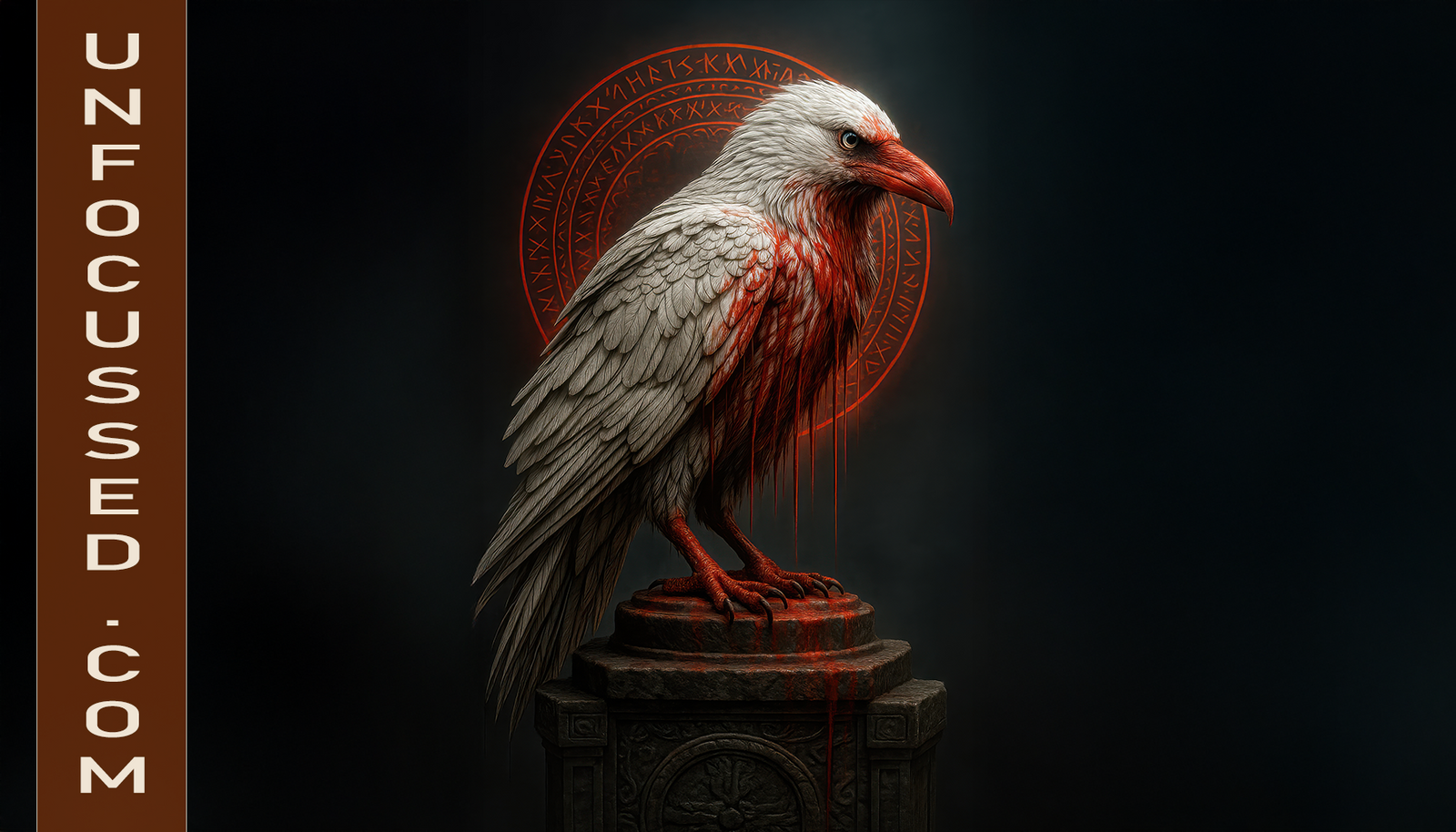
There are names not spoken aloud in the village of Vareth’s Hollow—names so old they cannot be traced in any written tongue, only whispered beneath breath and buried under stones. Names like Keth-Avûn, the Void Binder. Names like Eslarei, the Feathered Curse. The last one was muttered only once in the living memory of any soul who dared remain in that place—on the night the white raven returned. The pedestal still stood on the hill, worn by rain and lichen but never crumbling, though none could remember who carved it. At its base, the runes had long since lost meaning to the common folk, etched deep in a language that fed on silence and blood. And on the winter solstice, when the moon hung lowest and the wind carried the smell of burnt marrow, the raven came back—its feathers bone-white, save for the glistening red streaks that seemed to weep from its own body. Eril Dane, the apothecary's orphaned son, had never believed the stories. A pragmatist raised on tinctures and the bitter bark of reason, he scoffed at tales of "void messengers" and "soul brands." But when the raven landed at dusk, painting the frozen air with the scent of iron and rot, he felt something shift in the marrow of his bones. It wasn’t just fear—it was recognition. His mother had vanished when he was eight, walking into the fog with a leather-bound book and a scar below her throat that he had never noticed before. That same sigil, the one etched behind the raven in ethereal red light, now burned in his memory—he had drawn it once, by instinct, into the dirt. The village priest struck him for it. The scar on Eril’s knuckles still flared in cold weather. That night, he climbed the hill. The white raven did not flee. Its eyes, black as cinder pits and rimmed with blood, regarded him like a judge too weary for mercy. Eril knelt. The sigil blazed behind the bird, painting him in spirals of ruinous light, and a voice—more thought than sound—pressed into his head: “One must remember before they can repent.” He fell into a dream deeper than sleep. There, he wandered a crumbling city of bone towers and red rivers, each building shaped like weeping faces. The raven followed him, now a creature of immense size and shadow, shedding drops of memory and blood alike. In the reflection of a blood-slick river, he saw himself—not as a boy, but as a man wearing robes stitched with runes and guilt. And the raven on his shoulder. When he awoke, hours had passed. The hill was empty. But carved freshly into the stone pedestal, beneath the old symbols, was one new word: Eril. The village would not understand. They would fear him. But he knew now—the raven had not returned for vengeance. It had come for an heir. Vareth’s Hollow did not ask questions. That was how the village survived. But as the days passed and the snows blackened with ash, they began to notice changes they could not ignore. Cattle were born with teeth. Wells whispered secrets when drawn at dusk. The children stopped dreaming—or worse, began to speak of the same dream: a tower of feathers and flame where a man in robes stood screaming, his mouth filled with birds. Eril Dane rarely left the apothecary cellar now. The once-sunny shop was shuttered, herbs wilting against the windowpanes. No one saw him eat. No one saw him age. What they did see—what terrified them more than they dared admit—was the raven. Always the raven. Perched on the crooked weather vane above the apothecary. Watching. Waiting. Growing. Its feathers were not so white anymore. They were beginning to smoke at the edges, feather-tips curling into shadow. And from its body, a soft red glow pulsed like a heartbeat. No one approached the hill again. Not after the dogs stopped barking, and not after the last priest walked into the woods barefoot, weeping, and did not come back. Eril wrote, always wrote. Pages and pages filled with symbols no one could decipher—scratched with clawed quills, stained with something darker than ink. He spoke with the raven, though no lips moved. And at night, his dreams cracked open like rotten eggs, spilling truths that smelled of burning stars and long-buried screams. He saw the first Binding, when the ancient ones flayed the sky and chained the Hunger between worlds. He saw the Feathered Seal, carved from the bones of extinct gods and offered in pact to keep the Void slumbering. He saw the betrayal. The arrogance. The forgetting. And he saw his mother… smiling, mouth stitched shut with sigils, eyes burned out by knowledge she’d swallowed whole. She had walked into the fog to feed the Binding. Her flesh, her memory, her name—offered freely, to keep the world stitched together for another generation. But she had failed. Something had shifted. A glyph misaligned. A promise broken. And the cost would now be paid in full… by her bloodline. The raven was not a messenger. It was a ledger. It had returned not to warn—but to collect. When Eril emerged, on the night of the black moon, he was not alone. His shadow was wrong—too tall, shaped like feathers in a storm, rippling as if caught in an eternal wind. His eyes glowed faintly red, not from within, but as though something behind them was peering out. Watching. Judging. The villagers gathered at a distance, compelled by fear, by awe, by the weight of something ending. He did not speak. He lifted his hand, and the raven spread its wings. From the pedestal behind them, the sigil flared once more—this time not in light, but in absence. A perfect hole in reality. A wound that would never heal. The air wept blood. The trees bowed as though in mourning. And one by one, the names of every soul who had ever whispered Eslarei’s name echoed into the hollow… and vanished. Erased. Devoured. Eril Dane became more than a man that night. He became the last sigil. The Living Bind. The One Who Remembers. His name would never again be spoken in Vareth’s Hollow, because the village no longer existed. The map burned itself clean. The roads rerouted. The stars refused to align above its former resting place. But in certain forbidden grimoires—pages written in feather-blood and sealed with breathless wax—there is still mention of a pale bird that heralds the Void. A raven, crowned in runes, that lands only once every thousand years upon the stone where memory dies. And when it does, it does not come for prophecy. It comes to feed.     Epilogue Centuries passed. The world turned, forgetful as ever. Forests reclaimed the land. Dust buried truth. And still, the pedestal remained—unbroken, untouched, unseen. They called it the "Blind Stone" in the new maps, though none who passed it could remember why they avoided it, only that their hearts grew heavier the closer they came. Even satellite imagery blurred, as if something ancient reached through code and lens alike to keep itself sacred, veiled. Yet every so often, a white bird is spotted by travelers—solitary, silent, watching from a twisted tree or a crumbled stone, feathers too pale for nature, eyes too dark for peace. It does not fly. It simply waits. And for those few who dare sketch its form, or speak its sighting aloud, strange dreams follow. Dreams of towers made of mouths, of a man with a bleeding crown, of a name scratched in ash into the inside of their eyelids. Sometimes they wake with feathers in their hands. Sometimes, they don't wake at all. And in one forgotten corner of the world, where no birds sing and the wind moans in old tongues, the pedestal's runes flicker faintly—like a heartbeat beneath stone. A single word still burns upon it: “Eril.”     If this story lingers in your bones and whispers through your dreams, you can now bring the legend home. Let the raven watch over your space, ward your rest, or shadow your thoughts with these evocative merchandise pieces. Drape your walls in the myth with a rune-bound tapestry, or summon the void’s elegance with a metal print worthy of arcane reverence. Sink into haunting comfort with a plush throw pillow, or let forgotten lore guard your dreams beneath a duvet cover woven with whispers. And if you wander, carry its omen with you in a tote bag etched in shadow.

En savoir plus

Queen of the Forsaken Soil

par Bill Tiepelman

Queen of the Forsaken Soil

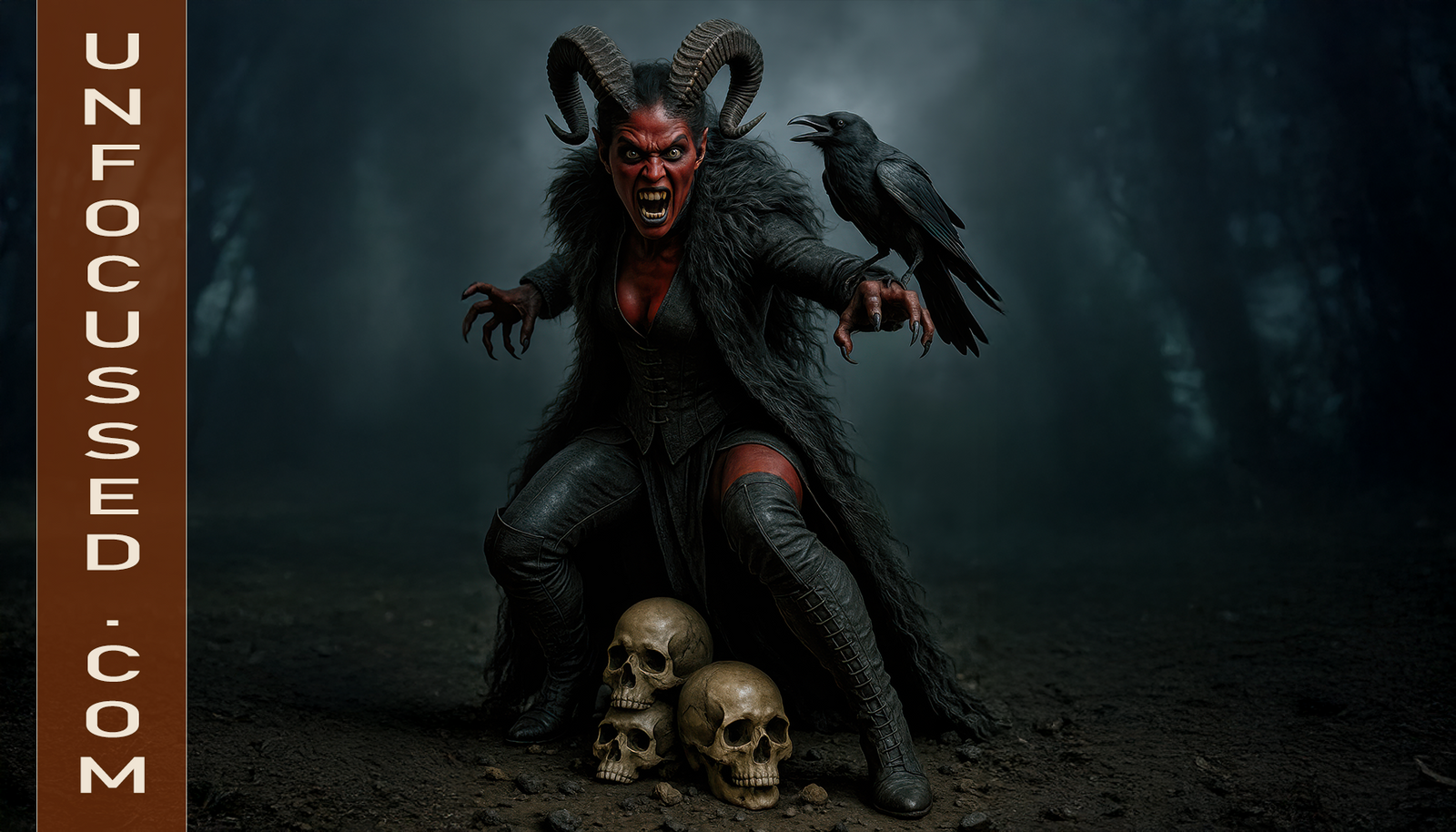
The Screaming Soil The land was wrong. Not just haunted, not just cursed. It screamed. Beneath the brittle roots of leafless trees, under stones older than kings, deep in the marrow of the earth — the soil itself whispered names. Names no one should know. It begged. It threatened. It told filthy stories that’d peel the teeth from your skull if you listened too long. That’s why no one came here willingly. Except for bastard lunatics. And Pym. Pym was a rat-catcher, formally. Informally, he was a drunk, a gravedigger’s assistant, a mediocre pickpocket, and an ex-squire who once farted during a bishop’s funeral mass and had never recovered socially. Life hadn’t handed Pym much in the way of dignity. But he had nimble fingers and a talent for pretending he didn’t notice corpses moving. He’d been sent to the Forsaken Soil by a mistake. A cartographer’s one-eyed apprentice had miswritten “blessed woodlands” on a parchment that actually meant “do not enter unless you’re tired of your skin.” Pym, ever optimistic and three tankards deep, had taken the job for a silver half-drake and a warm handjob behind the alehouse. That was twelve hours ago. And now he stood ankle-deep in muck that bled when you stepped wrong, staring at what was unmistakably a throne of skulls, and a woman — if you could call that towering hell-beast a woman — perched on it like a spider in mourning. The sky was dead gray. The trees had no leaves. The wind sounded like it sobbed through broken flutes. And the queen... She wore the darkness like a perfume. Her horns curled like old knives. Her red skin gleamed like lacquered sin. A black raven perched on her arm, pecking at a silver chain wound tight around her wrist. She snarled with the kind of authority that didn’t ask for your attention, it seized it by the throat, bit down, and whispered “mine.” “Well,” Pym muttered, already regretting everything from his childhood onward, “looks like I’ve stumbled into a royal arse-whooping.” The Queen rose. Slowly. Deliberately. As if gravity was her plaything. Her eyes, bright with fury and ancient boredom, locked on his. Her lips parted. And when she spoke, her voice cracked the air like frost cracking a tombstone. “You dare trespass,” she said, “with piss on your boots and hangover breath in your mouth?” Pym blinked. “Technically, milady, it's not my piss.” Silence. Even the raven tilted its head like it wasn’t sure whether to laugh or disembowel him. She stepped forward, the skulls beneath her throne crunching like dry cereal. “Then whose piss is it?” “...Would you believe me if I said divine intervention?” There are many ways to die in the Forsaken Soil. Slowly, screaming, clawing your own eyes out. Quickly, with your heart ripped through your back. But Pym, the idiot, did what no one in five hundred years had done: He made the Queen of the Forsaken Soil laugh. It wasn’t a pleasant sound. It was the kind of laugh that made your spleen try to leave your body through your spine. But it was a laugh. And when she was done, when her jagged grin had split her face nearly in half, she said, “Fine. I’ll give you a task.” Pym sighed. “Can it be fetching ale? I’m quite good at that.” “No,” she said. “I want you to find my heart.” “Not much for poetry, are you?” “I buried it six centuries ago in the belly of a demon. Find it, bring it to me, and I might let you leave with your genitals still attached.” Pym scratched his stubble. “Seems fair.” And with that, the Queen turned and vanished into mist. The raven stayed, watching him. Judging him. Probably considering whether he could survive on rat-catcher meat alone. “Well, bird,” Pym said, adjusting his crotch. “Looks like we’re going heart hunting.” The Demon’s Belly and the House that Hated Floors Pym had one rule in life, and it was: Don’t follow talking birds. Unfortunately, the Queen hadn’t exactly given him options. The raven squawked once, flapped its wings, and began drifting down a trail of gnarled, bone-colored trees that arched over like a vertebrae-choked tunnel. The soil beneath his feet pulsed occasionally, as if it was dreaming something ugly. Which it probably was. The whole landscape felt like the inside of a colon that belonged to a failed god. The raven didn’t talk. But it sure did judge. Every time Pym stumbled, it turned its head slowly like a disappointed librarian. Every time he muttered something sarcastic, it cawed just once — sharp and short, like it was filing his name under “Future Disembowelment.” After two hours of walking through fog so thick it made his teeth ache, Pym saw the demon. To be fair, the demon might’ve once been a castle. Or a mountain. Or a cathedral. Now it was all three, and none. It pulsed like a living organ, with windows for eyes and doors that opened and closed like mouths mid-scream. From its roof jutted towers shaped like broken fingers, and down its sides oozed viscous, dark ichor that smelled like regret, onions, and betrayal. “Queen really knows how to bury a heart,” Pym muttered. The entrance wasn’t guarded, unless you counted the wall of teeth that snapped shut every thirty seconds like a metronome for the damned. The raven landed on a crooked fencepost and cawed twice. Translation: Well, you going in or what, dickhead? Pym waited until the jaw-wall opened, dashed through, and immediately regretted everything. The inside of the demon’s belly was worse. The floors weren’t floors. They were slick, pulsing membranes that squelched under his boots. The halls shifted. Sometimes they were too narrow, other times they yawned open into cathedral-sized spaces with ceilings made of writhing worms. Portraits blinked. Doors screamed when you touched them. And worst of all, the building hated gravity. Halfway down one hallway, he fell up. He landed on the ceiling, only for it to turn into a staircase that folded inside itself like origami having a panic attack. He cursed. Loudly. The place responded with a wet belch and a wall that tried to lick him. “I’ve been in brothels cleaner than this,” he grunted. Eventually, he found the heart. Or what was left of it. It floated in a chamber the size of a cathedral nave, encased in glass, suspended in thick yellow-green fluid. It pulsed slowly, like it was remembering how to beat. Black veins curled through it, and arcane runes lit the air around it like angry fireflies. Surrounding the heart was a circle of iron obelisks, and kneeling at each was a creature that could best be described as "priest-shaped fungus with opinions." The raven landed beside him, somehow unfazed. Pym sighed. “Well. This is either the world’s creepiest baptism or a Monday in the Queen’s calendar.” He crept in, careful not to step on the writhing red roots that wormed out from the obelisks and into the walls. The moment he touched the glass, one of the kneeling things moaned and lifted its face. It had no eyes. No mouth. Just a lot of weeping holes and a very wet sound when it moved. “Ah. The welcoming committee.” Things escalated quickly. The fungus-priests rose, shaking off bits of sacred slime. They hissed. One reached for a curved knife made of screaming bone. Pym pulled a dagger from his belt — which, to be fair, was mostly ceremonial and mostly used to slice cheese — and launched himself into the dumbest fight of his life. He stabbed one in the kneecap. It squealed like a pig made of fungus and exploded into spores. Another lunged; Pym dodged and accidentally tripped on a root, landing face-first in something that definitely wasn’t carpet. He scrambled, slashed, bit, headbutted. Eventually, he stood panting, covered in goo, with three dead not-quite-monks around him, and the raven staring like it was reconsidering their entire partnership. “Don’t judge me,” he wheezed. “I was trained for rats, not demonic clergy.” He grabbed the heart. The runes screamed. The tower trembled. Outside, the demon-castle let out a sound like someone stepping on a bag of organs. The fluid in the tank began to boil. The heart beat faster — it was alive now, angry and wet and pulsing with foul heat. “Time to leave,” Pym muttered, sprinting as the floor melted and the ceiling turned into a nest of teeth. It was a blur. He ran, ducked, swore, possibly soiled himself (again — still not his fault), and finally burst out the demon’s jaw-door just as it collapsed behind him in a roaring wave of broken architecture and bile. He collapsed in the mud, still holding the jarred, steaming heart in his hands like a sacred turd. The raven landed beside him, gave a single approving caw, and nodded toward the mist. The Queen waited. Of course she did. And Pym had no idea what the hell she was going to do with this disgusting chunk of ancient rage — or what she might do with him for being stupid enough to actually succeed. But hell, he wasn’t going to back out now. “Let’s go see royalty,” he muttered, and followed the bird into the fog. The Heartless Queen and the Bastard Crown The fog thickened as Pym walked. It clung to him like a wet, pervy uncle. With every step, the heart pulsed hotter in his arms, leaking small drips of ancient, boiling ichor onto his shirt. His nipples would never be the same. Behind him, the demon-castle collapsed into a gurgling sinkhole, still belching out the occasional hymn of despair, which Pym found oddly catchy. The raven circled ahead like a drunken prophet, finally guiding him back to the clearing — back to her. The Queen of the Forsaken Soil stood exactly where he’d left her, though now the throne of skulls had multiplied. Twice the bones. Triple the menace. A second raven perched on her shoulder, this one older, balder, and somehow more disappointed-looking. “You return,” she said, eyeing him with a gaze that could make stone weep blood. “And intact.” Pym coughed, wiped some demon-slime off his chin, and held up the jar like an idiot displaying a meat prize at a butcher’s convention. “Found your heart. It was inside a giant screaming building full of religious mushrooms and bad taste.” She did not laugh this time. Instead, she descended the skull steps with a grace that made gravity blush. The mist curled away from her. The ground whispered, She walks, she walks, she walks. The two ravens flanked her like feathery shadows. When she reached him, she extended a single clawed hand. Pym hesitated, just a little. Because in that moment, the heart twitched. Not like a dying thing. Like a watching thing. Like it knew this wasn’t just a delivery. Like it wanted to be held a little longer. “...You’re not going to eat it, are you?” The Queen raised a brow. “Would it matter?” He thought about it. “Kind of, yeah. I'm emotionally fragile and squeamish after that last fungus orgy.” She grinned. “I’ll show you what I do with it.” She took the jar and — in one impossibly smooth motion — crushed it in her palm. Glass and fluid hissed, and the heart dropped onto her other hand like it had been waiting. She raised it above her head. The sky groaned. The skulls howled. A bolt of black lightning struck the earth a few feet away and opened a screaming pit full of wailing, naked lawyers (probably). Then she shoved the heart into her own chest. No wound. No incision. Just pure magic. The flesh parted like old curtains and drank the organ in. She roared — not in pain, but in power. Her skin lit from within, brighter than fire, redder than vengeance. The wind shrieked. Trees caught fire. Ravens exploded into feathers and reformed into skeletal versions of themselves. She levitated a few inches off the ground and spoke with a voice made of iron, shadow, and sarcasm. “I AM WHOLE.” “That’s... great,” Pym said, trying not to pee himself again. “So, we good? You’re healed, I get to leave with all my fingers?” She floated gently back to the ground, her form changed. Taller. More monstrous. More regal. She was still beautiful, but in the way a thunderstorm is beautiful right before it drops a tornado on your house. “You did not merely return my heart,” she said. “You touched it. Carried it. Gave it warmth. You breathed over it. That makes you...” She stepped forward, and placed one clawed hand on his chest. “...a consort.” “I’m sorry, a what now?” She snapped her fingers. Chains of mist wrapped around his limbs. A crown of bone and blood appeared in her other hand. She held it over his head with amused menace. “Kneel, rat-catcher.” “I think this is moving a bit fast—” “Kneel and rule beside me, or die with your balls in a jar. Your choice.” Pym, being an adaptable man and not particularly attached to his testicles, dropped to one knee. The crown dropped onto his greasy hair. It hissed, bit, then settled. He felt nothing at first. Then too much. Power, yes — but also history. Centuries of war, sorrow, rage, betrayal, and very poor architectural decisions. “Ow,” he said, as his spine cracked into regal posture. “That tickles. And burns.” The Queen leaned in, her lips at his ear. “You’ll get used to it. Or you’ll rot trying.” The mist lifted. The Forsaken Soil shifted. It accepted him. Skulls arranged themselves into a new throne beside hers. The dead whispered gossip. The trees bowed. The ravens nested in his hair. One of them pooped gently on his shoulder in approval. And just like that, Pym the rat-catcher became King of the Damned. Consort to a furious, heart-reborn goddess. Keeper of the Fog. Heir to nothing, master of everything that should not exist. He sat beside her, newly majestic, already itching from the crown and wondering if kings got bar tabs. He leaned over to her. “So,” he whispered, “now that we’re co-ruling, does this mean we share a bathroom or...?” The Queen did not answer. But she did smile. And far below them, in the screaming soil, something new began to stir.     Claim Your Throne (or at least your wall)If the Queen has haunted your imagination like she did poor Pym’s underwear, why not bring her home in all her dark, cinematic glory? This powerful image — Queen of the Forsaken Soil — is now available as a tapestry fit for a cursed throne room, a canvas print soaked in gothic dread, a metal print sharp enough to summon demons, or an acrylic print smooth enough to lure a raven. Want something more interactive? Dare to assemble the Queen piece by piece with this dark fantasy jigsaw puzzle — perfect for rainy nights and mild psychological unraveling. Long live the Queen… preferably on your wall.

En savoir plus

Soulbound to the Stonekeep

par Bill Tiepelman

Soulbound to the Stonekeep

The Oath Beyond the Stars The stars bled the night into the Stonekeep’s battered towers, their wounded glow spilling across crumbling battlements like ghostly rivers. At the threshold of the great steps, where moss devoured stone and the air crackled with forgotten spells, Kaelen waited — a sentinel forged from both flesh and the breath of dead worlds. His fur shimmered with unnatural hues — obsidian, cobalt, and veins of burning gold that seemed to pulse with a heartbeat not entirely his own. Runes etched into his hide by a dying celestial god throbbed softly beneath his pelt, whispering oaths older than the language of men. His luminous eyes, fractured like twin nebulas, stared down the endless path winding into the mist beyond the gates, where mortal threats once dared approach the Keep. But no mortal dared the Stonekeep now. Not after the Sundering. The Keep itself, a fortress of monolithic stone veined with silver and sorrow, leaned against the bruised sky as though exhausted by its own terrible history. Each carved arch and battered spire was a gravestone to the kings, scholars, and dreamers swallowed by ambition. A thousand worlds had brushed against the Keep’s walls when the Veil had thinned — some offering wonder, others ruin — until finally, the skies had cracked open, and the gods themselves had turned away their faces. It was in that abandonment that Kaelen was bound. He was no common beast; he was the anchor, the last thread stitching the dying weave of the Keep to the mortal plane. Where once a hundred Guardians stood — lions of flame, serpents of crystal, titans of bone — now only Kaelen remained. The others had broken. Fallen. Or worse, been unmade by the silence beyond the Veil. Tonight, the stars sang again. And it was not a song of hope. In the cold black spaces between constellations, something moved — a hunger stitched into existence by forgotten hands. It called to the ruins. It called to Kaelen. But Kaelen’s heart — battered, cosmic, invincible — answered not with submission, but with defiance. He stood, muscles rippling under his ancient armor, claws digging into sacred stone, and loosed a sound that tore across the heavens like the shattering of an old and terrible chain. His howl was not for summoning. It was a warning. The Hunger Beneath Names The mists recoiled at Kaelen’s cry, folding back to reveal a path long abandoned to darkness. Shadows spilled across the broken ground, writhing like worms in a corpse. Yet no mortal army emerged, no clang of steel or warhorn broke the hush. Only a slow, deliberate pressure bled through the air, like a hand unseen, reaching across eternity to test the last lock upon a forbidden gate. Kaelen bristled. Beneath his fur, the runes ignited, flooding his limbs with borrowed power — starlight condensed into violence. It was a fragile gift. The magic that stitched his spirit to the Keep was ancient, and the stone drank from him even as it sheltered him. Every breath was a negotiation; every heartbeat a gamble. Out beyond the crumbled roads, past the skeletons of forgotten villages, the Hollow Ones stirred. Kaelen felt them before he saw them — life forms denatured by cosmic entropy, stripped of memory, stripped of name. They dragged themselves toward the Keep not in search of conquest, but oblivion. It was not hatred that moved them; it was the gravitational hunger of annihilation itself, wearing their corpses like cloaks. They were his former kindred — kings, mages, dreamers — now puppeted by something deeper than decay. Kaelen growled low, the sound a serrated promise. He would not let the Stonekeep fall. He would not allow the rot to take what little remained of honor, of memory, of truth. The first of them lurched into view — a knight whose armor hung in rusted tatters, eyes hollow save for the pinpoint glow of forgotten stars trapped in their sockets. Around its broken crown hovered splinters of some shattered relic, orbiting like moons around a dead world. The creature raised a blade that wept black ichor onto the stones — a blade that had once pledged itself to the defense of the Keep, before time turned loyalty into a joke whispered by carrion. Kaelen did not flinch. He lunged, a blur of cosmic fire and iron will, crashing into the Hollow One with a force that cracked the earth beneath their clash. His jaws found the specter’s throat — not flesh, but the trembling memory of flesh — and tore it apart with a snarl born of grief and fury intertwined. More came, drawn by the scent of defiance. Hollowed champions, shambling scholars, even the spectral echoes of children who had once played at the edge of the battlements. The air was thick with sorrow — a sorrow that fed the thing beyond the stars, the true enemy. And from within the dark firmament above, something vast and patient opened an unseen eye. Kaelen felt it gaze upon him — not with anger, but curiosity, the way a flood studies a stone before deciding whether to wash it away or grind it into dust. It knew his name. It had always known his name. The Last Stitch of the World Kaelen stood at the summit of the battered steps, his breath steaming in the cold air, the bloodless corpses of Hollow Ones crumbling to dust around him. But he knew these victories were illusions, as transient as mist on a blade. Every foe he felled left a scar in the weave of existence itself. Every roar he loosed shook loose another thread from the fragile tapestry the Stonekeep anchored to the mortal realm. The true enemy was not these empty husks. It was the thing beyond the veil — the Nameless Hunger — a force older than gods, older than stars, birthed in the blind space between creation’s first thought and its first regret. It had no form, no mercy, no language beyond entropy. It was not evil. It simply was. And it had noticed Kaelen’s defiance. Above him, the stars began to smear, twisting into unnatural sigils that burned the eyes and shredded the soul. The air itself became viscous, heavy with the scent of iron and ancient sorrow. A rift tore open in the sky — a mouth with no lips, a wound across existence — and from it spilled tendrils of darkness laced with starlight, seeking purchase upon the world below. Kaelen lowered his head, the ancient sigils across his body blazing gold and white. His muscles ached under the pressure, his mind fraying at the edges. He could not fight the Hunger as he had the Hollow Ones. He could not tear it apart with fang and claw. But he could deny it. The runes that had been carved into his bones were not merely wards — they were keys. Keys to the Stonekeep's true purpose: not as a fortress, but as a lock. A final barricade against the unraveling of reality. And Kaelen, once a prince among his kind, had been reforged into its guardian, bound by oaths so old the gods themselves had forgotten the words. He turned away from the oncoming darkness, ascending the final steps to the great door of the Keep — a door of ironwood and starstone, etched with patterns that pulsed under his gaze. The door knew him. The Keep remembered. Behind that door lay the Heartstone — a fragment of the First Light, the raw, chaotic ember from which the multiverse had been kindled. Left unguarded, it would burn this world to ash... or worse, call the Hunger directly into its core. But sealed, nourished by sacrifice, it could deny the Nameless One entry for another age, another desperate generation. Kaelen pressed his paw against the cold surface. He felt the connection ignite instantly — a bridge of agony and grace stretching from his body into the infinite roots of the Keep. Every memory he carried, every hope, every sorrow, began to pour into the ancient stone. His victories, his failures, the warm voices of companions long dust... even the taste of the stars he'd once hunted across the night sky. All of it streamed from him, weaving into the lattice that would seal the Heartstone anew. He did not hesitate. He did not falter. Outside, the world howled in protest as tendrils of darkness lashed against the Keep’s walls, tearing away towers and battlements like parchment before a storm. But Kaelen stood unmoving, his spirit burning brighter than any star the Hunger had ever extinguished. In his final breath, Kaelen offered no plea, no curse. Only a promise: “I remember. And as long as I do, you will not pass.” The Keep shuddered once — a deep, earth-splitting groan — and then the door sealed with a blinding flash that erased every shadow. The rift in the sky closed with a scream that no mortal ear could hear. The Hollow Ones froze mid-crawl and crumbled into nothingness. The world stilled. The stars, battered but unbroken, resumed their silent vigil. And within the Stonekeep, somewhere deep beyond mortal reach, the last echo of a guardian's heartbeat fused into the walls, forever a stitch binding the mortal world against the end. Kaelen was no more. Yet he was everywhere the Keep still stood. Soulbound. Eternal.     Bring the Legend Home Kaelen's oath and the enduring spirit of the Stonekeep live on beyond the final page. Honor his memory and carry a fragment of his story into your world with exclusive artwork from Unfocussed: Adorn your walls with the Soulbound to the Stonekeep Tapestry, a sweeping canvas that captures every fierce, cosmic detail. Embrace the story’s fire with a Metal Print — a striking, durable piece worthy of any warrior's hall. Wrap yourself in cosmic protection with the Soulbound Fleece Blanket, perfect for nights under embattled stars. Even your most ordinary battles can feel epic with the Stonekeep Bath Towel, a warrior's way to greet the morning. Carry the legend. Remember the oath. Keep the darkness waiting a little longer.

En savoir plus

Explorez nos blogs, actualités et FAQ

Vous cherchez toujours quelque chose ?