tiger

Contes capturés

View

Guardian of Winter Blossoms

par Bill Tiepelman

Guardian of Winter Blossoms

The Tiger in the Snow They said the forest had a keeper. Not a ranger, not some crusty hermit with a beard full of frozen squirrels, but a tiger. A big, white, impossibly real tiger who walked where no paw prints should remain, and who carried in his mane an entire bouquet of blossoms that had no business blooming in a snowstorm. The villagers whispered his name like a curse or a prayer, depending on how many ciders they’d downed. They called him the Guardian of Winter Blossoms. Now, this tiger wasn’t your ordinary “I’ll eat your face if you look at me funny” sort of cat. Oh no. He was the divine union of myth, sass, and frostbite. Legends claimed he was born when a goddess of spring had one too many cocktails at a midsummer banquet and accidentally stumbled into the bed of the frost god. Nine months later: boom. One gloriously moody feline with a crown of flowers sprouting out of his fur, like some kind of murderous garden gnome on steroids. He was beautiful, terrifying, and, honestly, a little dramatic. The blossoms never wilted, no matter how deep the blizzards blew, and his amber eyes were rumored to pierce through souls like knives through hot butter. People swore he could see every secret you tried to bury—your midnight trysts, the time you lied about your grandmother being sick to get out of work, or that “accidentally” broken wine glass that totally wasn’t an accident. Nothing was safe under that gaze. The Guardian wasn’t just lounging about looking pretty, though. No, he had a job, and he took it seriously. His role was to keep the balance between frost and bloom. Too much winter and the world froze into silence. Too much spring and things rotted into chaos. He was the cosmic thermostat nobody asked for but desperately needed. Of course, he had opinions about everything, and he wasn’t shy about enforcing his will. Farmers found their crops mysteriously flourishing after leaving him offerings of honeyed mead. Hunters, however, who tried to take too much from the land? They disappeared. And not in a polite “off to grandma’s” kind of way—more like in a “never seen again, and we don’t talk about it at dinner” kind of way. Still, not everyone believed in him. Some called it a fairy tale. Others, a hallucination brought on by frostbite and boredom. But those who had seen him swore that when he moved through the snow, the wind itself stopped to bow. And every step left behind not paw prints, but a single blooming flower that defied the ice. That was how you knew he’d been there. That was how you knew the stories were real. And so, one night, when the blizzard was howling like a choir of banshees and the moon glowed pale and cruel, a wanderer stumbled into the frozen wood. She was bold, reckless, and frankly a little drunk. And she was about to discover just how much trouble one could get into when face-to-face with a sassy myth wrapped in fur and frost. The Wanderer and the Guardian The wanderer was not your average heroine material. She was not tall, nor noble, nor particularly skilled in anything besides drinking questionable liquors and making poor life choices. Her name was Lyra, though in some taverns she was known as “That Woman Who Tried to Arm-Wrestle a Goat” — a title she wore with more pride than shame. On this particular night, she’d set out in search of a shortcut through the winter forest, which anyone with half a brain would tell you was less “shortcut” and more “death wish.” But Lyra had never been particularly encumbered by half a brain. She stumbled through the snow, singing to herself, her breath fogging in the air like smoke signals calling out to whoever was bored enough to listen. That was when the wind changed. It didn’t just blow — it hushed, as though the entire forest had suddenly remembered its manners. The blizzard dropped into a silence so heavy it pressed against her ears. And in that silence, she saw him. There he was: the Guardian of Winter Blossoms. A massive, gleaming form of white fur streaked with black, a mane tumbling around his neck like a snowdrift on fire, sprouting flowers that glowed faintly against the dark. His amber eyes burned as if he’d been waiting for her specifically, which was alarming considering she had zero appointments scheduled with mythical beasts that evening. “Well,” Lyra muttered to herself, swaying only slightly, “either the cider was stronger than I thought, or I’ve wandered into a children’s storybook. In which case, I’d like to politely request to be the sassy side character who doesn’t die in Act One.” The tiger blinked. And then, to her horror and delight, he spoke. “Mortal,” his voice rumbled, deep enough to make the icicles tremble, “you trespass in the sacred domain of frost and bloom.” Lyra squinted at him. “Wow, okay, chill out with the Shakespeare. I’m just passing through. Do you want me to bow, or leave a Yelp review?” The Guardian’s mane of blossoms shivered in the icy wind. “You mock what you do not understand. Few mortals see me and live. Fewer still dare speak with such insolence.” “Insolence?” Lyra hiccupped. “Buddy, I’m just trying not to freeze my butt off. If you’re the local god-beast thing, can you point me toward an inn that serves stew and doesn’t charge extra for bread?” The tiger growled, and the sound made the trees shake snow from their branches like frightened birds. His eyes narrowed, but there was something else there too — amusement. No one had ever spoken to him like this. Usually it was begging, praying, or the high-pitched shriek of someone who realized far too late that staring at a divine predator was not the brightest life choice. “You are bold,” he admitted, pacing around her. His paws left behind blossoms in the snow: roses, marigolds, lilies — a trail of impossible life against the death-white world. “And foolish. Boldness and foolishness often walk hand in hand, though rarely for long.” Lyra turned to follow him, staggering a little but grinning. “Story of my life, stripes.” He paused. “Stripes?” “Yeah. Big, fluffy, dramatic stripes with flowers. Look, if you expect me to worship you, you’re going to have to get used to nicknames.” For a long, tense moment, the Guardian of Winter Blossoms stared at her, tail twitching, muscles coiled like frozen thunder. Then — and this part would become a scandalous rumor among the forest spirits for centuries to come — the great beast snorted. A sharp, unexpected huff that fogged the night air. It was almost laughter, though he’d never admit it. “Perhaps,” he said slowly, “you amuse me.” Lyra, never one to waste an opening, curtsied clumsily. “Finally. Someone gets my charm.” But amusement was a dangerous thing in the presence of gods and guardians. For every blossom in his mane, there were stories of blood in the snow. He was protector, yes — but also executioner. And the forest did not suffer fools for long. As the night deepened, Lyra found herself pulled into his orbit, whether she liked it or not. He began to test her, weaving riddles into the wind, shaping illusions in the frost, watching to see if her sass could hold up when the stakes were no longer cute banter, but survival. The first trial came quickly. A chorus of shadows slipped from the treeline — wolves, their eyes black as voids, their fur bristling with frost. They were not of this world; they were the Devourers of Balance, creatures who thrived when order tipped too far into chaos. Normally, the Guardian could dispatch them with a single roar. But tonight, as though fate had a sense of humor, he simply looked at Lyra. “Prove yourself,” he said, lowering his massive head until his breath warmed her face. “Or the snow will drink your bones.” “Excuse me?” she squeaked, fumbling for the dagger she barely knew how to use. “You’re the giant god-cat with the flower crown! Why do I have to—” But the wolves lunged. And Lyra, drunk, cold, and thoroughly unprepared, had no choice but to meet them head-on. What followed would not be remembered as graceful, dignified, or even competent. But it would be remembered — and sometimes, that’s enough to tilt the scales of destiny. The Balance of Frost and Bloom Lyra would later swear that the only thing that saved her from being eaten alive by frost-wolves was sheer dumb luck and the adrenaline-fueled clumsiness of someone who once survived falling off a roof because she landed in a laundry basket. She swung her dagger with all the grace of a drunk scarecrow, shrieking battle cries that sounded suspiciously like “DON’T YOU DARE TOUCH MY BOOTS!” Somehow, impossibly, she connected. Steel bit into icy fur, and the wolf dissolved into a puff of snow and shadow. The Guardian of Winter Blossoms sat watching, a smirk in his amber eyes. Not that he’d ever admit to smirking. But the truth was undeniable — he was enjoying the show. Every flower in his mane seemed to tremble with laughter, petals unfurling as though his very amusement fueled their bloom. More wolves lunged. Lyra rolled, stabbed, flailed, and cursed with a creativity that would’ve earned her a tavern-wide standing ovation back home. At one point she smacked a wolf with her boot instead of her blade and yelled, “I banish thee in the name of stylish footwear!” Somehow, that worked. By the end, the snow was littered with steaming blossoms where the wolves had once stood, proof that chaos had been beaten back by the most unlikely of champions. Breathless, dagger shaking in her hand, Lyra spun toward the Guardian. “Well? Am I a chosen hero now? Do I get a medal? A parade? A lifetime supply of mulled wine?” The tiger prowled closer, his fur rippling like living moonlight. He lowered his head until his amber gaze pinned her in place. “You did not fight with skill. You fought with defiance. That is rarer. And far more dangerous.” Lyra wiped her brow with a frozen mitten. “Translation: you’re impressed. Just say it, stripes. Go on. I won’t tell anyone… except literally everyone I meet.” The Guardian’s mane shook, and a single crimson blossom fell into the snow. He looked at it as if even he couldn’t believe what was happening. “No mortal has ever… loosened my crown.” “Oh great,” Lyra said, bending down to scoop up the flower. “Now I’m accidentally flirting with a mythological snow-cat. This is going straight into my diary under bad ideas that somehow worked out.” But as her fingers closed around the bloom, the air shifted. The forest itself groaned, trees bending under an unseen weight. The Guardian stiffened. “Do you understand what you’ve done?” he growled. “To take a blossom from my mane is to bind yourself to me. To the balance. To the endless war between frost and bloom.” Lyra blinked. “Wait—what? No one told me this was a contract deal! I thought it was just a free souvenir!” But it was too late. The flower pulsed in her hand, its heat searing against her skin even as the snow around her hissed and melted. The shadows of the wolves writhed at the edge of the trees, sensing weakness in the Guardian. He roared, the sound splitting the night, scattering them for now. Yet Lyra knew this wasn’t over. She had just been drafted into a battle older than memory itself. “Listen carefully, mortal,” the Guardian said, his voice both thunder and whisper. “The Devourers will return. They hunger for imbalance, and they will not stop. You are now part of this cycle. My strength flows into you, and your defiance fuels me. We are bound — guardian and fool. Petals and frost.” Lyra gaped. “Bound? Like… magically linked forever? I didn’t even get to negotiate terms! Where’s my union rep?!” The Guardian’s tail lashed. “You asked for stew and bread. You will instead have destiny and doom.” “Oh fabulous,” she groaned, throwing her arms up. “Every time I try to take a shortcut, I end up with existential baggage. This is why my friends tell me to just stay home!” Yet despite her protests, something inside her stirred. Power hummed under her skin. The crimson flower dissolved into sparks, sinking into her chest, and she felt the forest pulse with her heartbeat. She looked at the tiger again — no, not just a tiger, never just a tiger — and realized she wasn’t staring at some fairy-tale beast. She was staring at her partner. Her doom. Her ridiculous, floral-crowned, judgmental partner. “Fine,” she said at last, planting her fists on her hips. “If I’m stuck in this, you’re going to have to deal with me talking back. And singing when I’m drunk. And stealing the best blankets.” The Guardian’s blossoms rustled in the wind. His golden eyes gleamed like twin suns behind a snowstorm. And for the second time that night, scandalously, impossibly, he laughed. “Very well, Lyra,” he said. “Then let the world tremble. For the Guardian of Winter Blossoms now walks with a fool — and perhaps, just perhaps, the balance will be stronger for it.” And so they walked into the frozen dawn: the divine beast and the drunken wanderer, petals blooming where his paws touched, chaos cursing where her boots stumbled. Together they would face storms, shadows, and gods. Together they would rewrite what it meant to guard the fragile line between frost and bloom. And the legends would whisper forever of the day the Guardian laughed — and found his equal in a woman too foolish to fear him.     Bring the Guardian Home Lyra may have been bound to the Guardian of Winter Blossoms by accident, but you don’t need to wrestle frost-wolves or sign mythical contracts to bring his legend into your own home. This enchanting artwork is available across a range of unique pieces designed to add both power and whimsy to your space. From framed prints worthy of a gallery wall to cozy throws perfect for curling up during a snowstorm, each product carries the same fierce beauty and playful spirit that made the Guardian unforgettable. Whether you’re seeking to drape his presence across a tapestry, rest your head against a vibrant throw pillow, or jot down your own myths in a spiral notebook, each piece keeps a little of the Guardian’s balance close by. Wrap yourself in the story with a fleece blanket or let him preside proudly from your wall as a framed print. Because sometimes, balance isn’t found in frost or bloom, but in the way art transforms a space — reminding us that beauty, power, and a little bit of sass can thrive even in the coldest winters.

En savoir plus

Seasons of the Hunter

par Bill Tiepelman

Seasons of the Hunter

The Amber Eye of Thal They said the forest was split by an ancient curse — one that stitched time along a crooked seam. On the left side of the path, the world still bled with the warmth of fall; brittle leaves crunched underfoot, burnt-orange maples clawed at the dying light, and the air was spiced with rot and memory. To the right, winter had already carved its claim. Icy breath lingered like ghosts between silver pines, the snow as clean and silent as the grave. Between them, it walked. The tiger. But not just a tiger — Thal, the Ember-Eyed, the Relic, the Whispering Death. His paws made no sound, though the earth shivered in his wake. Every step was deliberate, ancient. He wasn’t just walking through seasons; he was walking through them — the gods, the hunters, the fools who once tried to bind him in chains made of prophecy and ego. Spoiler: it didn’t go well for them. Thal’s gaze glinted gold, not from the sun (which had the sense to keep its distance), but from something deeper. A memory, perhaps, or a thousand of them stacked like bones beneath his ribs. To look into his eyes was to feel time laugh at your mortality. From the frost-cloaked evergreens, a shape stirred. A man, wrapped in wolf pelts, stepped from the shadows with the arrogance of someone who hadn’t yet been educated by regret. He bore a spear longer than himself, etched with sigils that sizzled faintly against the cold air. A hunter, no doubt. Thal did not slow. “You walk toward death,” the man called, raising the spear. “Return to your side of the forest, beast. You do not belong here.” Thal paused. The leaves rustled. The snow sighed. And the tiger—yes, the one with paws like thunder and a heart older than most mountains—smirked. At least, that’s what the wind whispered. They always say that. With a motion so smooth it might’ve been a thought, Thal lunged—not at the man, but at the air between them, cleaving space itself. And in that breath, everything shifted. Trees tilted. The spear turned to ash. The hunter screamed. Not in pain—yet—but in the realization that he’d just become part of the story. And worse, not the hero. Thal padded forward as if nothing had happened, leaving behind a smear of melted snow and a man on his knees, sobbing into the scent of burning bark. The tiger’s eyes flicked to the horizon. Something bigger stirred. He could feel it waking. Not a hunter. Not prey. Something else. And it had his scent in its throat already. So much for a quiet stroll between seasons. The Cold God’s Hunger Deep beneath the roots of the winter side, where frost had gnawed away the bones of civilizations, something shifted. Not the innocent stirrings of woodland life, but a pull, as if gravity itself was reconsidering its allegiance. The Cold God was waking. And Thal could feel its hunger like static between his fangs. He’d met it once. Just once. Back when gods still bled the same color as their believers and thrones were built from the skulls of saints. Back then, it had worn the face of a child — a little boy made of rime and sorrow, who whispered promises to dying kings. Thal hadn’t liked the child. He’d left claw marks on its palace walls and teeth in its priests. And still, the thing had smiled. But that was another forest. Another age. Another Thal, before the centuries had taught him the delight of patience. Before sarcasm became his only shield against the divine absurdity of this world. Now, as he stalked the treacherous line between autumn’s decline and winter’s dominion, the forest around him began to convulse with quiet betrayal. Crows stopped mid-caw. The wind folded its wings. Time dared not breathe too loudly. The path ahead curved unnaturally, bending like a ribcage trying to cage him in. Oh, how they tried. “Still alive, Thal?” croaked a voice like a dying fire under wet wood. It came from above—a broken pine twisted in the shape of a woman, her bark bleeding sap that steamed as it touched snow. Thal glanced up. “Sylfa. Still rooted in bad decisions, I see.” The dryad cackled, a sound like snapped kindling. “The Cold God wants your pelt, old friend.” “He can want all he likes. So can the moon.” “He dreams of you. Of fire. Of endings.” “Then he dreams wrong.” The tree-woman’s laughter shivered into the branches above, triggering an avalanche somewhere unseen. Thal didn’t stop. He never stopped. That was the first rule of survival for a creature like him. Movement wasn’t just instinct; it was ritual. Keep walking, keep breathing, keep mocking the gods until they were too tired or too confused to smite you properly. Still, he could feel the Cold God now. It was no longer a whisper beneath the ground, but a presence bulging at the seams of reality. It was not frost. It was not wind. It was something much worse: the absence of all that had ever meant warmth. It devoured memory, ambition, even pain — leaving behind numb obedience. Its faithful called it mercy. Thal called it cowardice wrapped in holy frostbite. And it had just stepped onto the path behind him. Not walked. Not emerged. Just… was. A figure ten feet tall, draped in robes of shifting snow, face hidden beneath a jagged mask of antlers and glass. Wherever it stepped, autumn died. Even Thal’s breath came slower, his body tensing as his primal bones remembered the cost of overconfidence. The trees bent toward it. Time hiccuped again. “Tiger,” it said in a voice that didn’t echo because sound refused to linger around it. “Oh good,” Thal replied. “It talks. That’ll make this one-sided conversation slightly less boring.” “You have crossed the line.” “I invented the line,” Thal growled, circling. “You’re just squatting on it like some frostbitten beggar in need of relevance.” The Cold God lifted one hand. The spear that had turned to ash earlier reformed in its grip — sleek, elegant, and made from a single shard of frozen time. Behind it, the dryad gasped and turned to ice with a sharp, pitiful crack. No cackle this time. Just silence and regret. Thal didn’t flinch. Didn’t run. He crouched. Muscles like coiled storms surged beneath striped fur. There was no preamble, no warning roar, no cinematic leap into destiny. He simply moved. The impact was apocalyptic. The forest howled. Snow exploded. The spear clanged against his flank with a sound that shattered the air into crystals. Thal’s claws found purchase — not in flesh, but in memory — digging into the Cold God’s form and tearing away the illusion of invincibility. For a heartbeat, the mask cracked. Beneath it: eyes like dying stars. They both recoiled. And in that pause, something even worse happened: the forest began to change. The line between seasons widened, split open like a wound. From it, a third force emerged — not cold, not heat, but void. An absence so complete it made winter look warm. Thal landed, eyes darting. He hadn’t expected a third player. He hated plot twists. “What in the Nine Groaning Hells is that?” he muttered, ears flattening. The Cold God didn’t answer. It just backed away, robes folding into the snow as if hiding was an acceptable response now. And maybe it was. Because the thing emerging wasn’t a god. Wasn’t mortal. Wasn’t even real in the way forests or tigers or sarcastic inner monologues were. It looked like Thal. But it wasn’t him. Not anymore. The Echo in the Skin The creature was a parody of Thal—same shape, same stripes, same gold-flecked eyes—but every detail felt… off. Its coat didn’t shimmer, it absorbed light. Its paws left no tracks, not because it was weightless, but because the earth refused to acknowledge its presence. It looked like a tiger, but it moved like a shadow trying to remember what it once was. Thal lowered his head, not in submission but in concentration. He didn’t blink. Didn’t breathe. Somewhere in the frozen branches above, birds fell dead from sheer proximity to the thing’s presence. “You’re late,” Thal growled, voice low and bitter. “I was hoping to die before I had to meet myself.” The Echo tilted its head, mirroring the gesture with uncanny timing. Its eyes, his eyes, burned back with nothing but silent amusement… and a hunger that made the Cold God look like a bedtime story. “What is it?” croaked the Cold God, still recoiling, more shadow now than shape. “A mistake,” Thal said flatly. “A leftover from an old spell. From a war they tried to erase. My soul was split once—by force, by fire, by idiots who thought balance required duplicity. They carved out everything I was willing to burn to survive… and stitched it into that.” The Echo moved forward—graceful, mocking, patient. Around it, the seam of seasons collapsed. Autumn withered. Winter turned to slush. The path disappeared under layers of reality folding like wet paper. Thal dug in, claws scraping frost and fallen bark, trying to anchor himself in a world that no longer knew what “real” meant. The Cold God was gone. Coward. Figures. He always was an idea more than a god anyway—powerful, sure, but only in the way regret is powerful. It lingers, but it never wins. Thal lunged. But the Echo didn’t resist. It welcomed him. Their bodies collided not with violence but fusion—a scream of memory unspooling, identities clashing like tectonic plates. Thal roared. Not in pain. In defiance. The forest split wide. Trees bent into rings. The sky cracked open. He was drowning in himself and biting his way out at the same time. Every kill. Every legend. Every lie told around campfires about the Ember-Eyed Tiger. They bled through him like wildfire through dry grass. For a heartbeat, he was both—the myth and the monster. Then the moment tipped. He remembered. Not the battles. Not the hunger. Not even the gods. He remembered why he had survived. Why he had walked across centuries of war and peace and stupidity. Not for vengeance. Not for power. But for choice. He was the one creature left that the world could not predict. That choice—every deliberate footstep between the seasons—was his defiance, his rebellion against becoming another cog in the divine machine. And he would not give it up to some soul-born echo stitched together by cowards with altars and delusions. With a roar that cracked glaciers, Thal sank his teeth into the Echo’s throat—and ripped. Not flesh. Not blood. Possibility. The thing unraveled, screaming in a hundred tongues before silence took it like sleep. And then, stillness. Thal stood alone. The forest lay quiet, like a child pretending not to breathe under a blanket. The seasons had returned to their border—autumn rich and warm, winter cold and watching. He stepped forward. Just one pace. But it was enough. The world exhaled. Behind him, the void hissed and closed. No more echoes. No more gods. No more destiny clawing at his back like ticks. He had walked between the seasons and come out whole. Mostly. “Still got it,” Thal muttered, licking a drop of starlight from his paw. “Someone tell the gods I’m not done being inconvenient.” And with that, he disappeared into the blaze of fallen leaves, leaving pawprints that would never freeze… and a story too strange for the Cold God to ever retell.     Bring the myth home with you. If Thal's journey through time and shadow stirred something primal in your soul, honor the legend with one of our exquisite woven wall tapestries, or channel the tiger’s dual-season power in your daily life with a stunning wood print or plush fleece blanket. Want a bit of beastly boldness in your bath routine? Try our ultra-vivid bath towel that roars with wild style. Each piece immortalizes the intensity and mystery of Thal’s legend, making it more than decor—it’s a declaration.

En savoir plus

Aristocratic Whorls: The Majestic Mane

par Bill Tiepelman

Verticilles aristocratiques : la crinière majestueuse

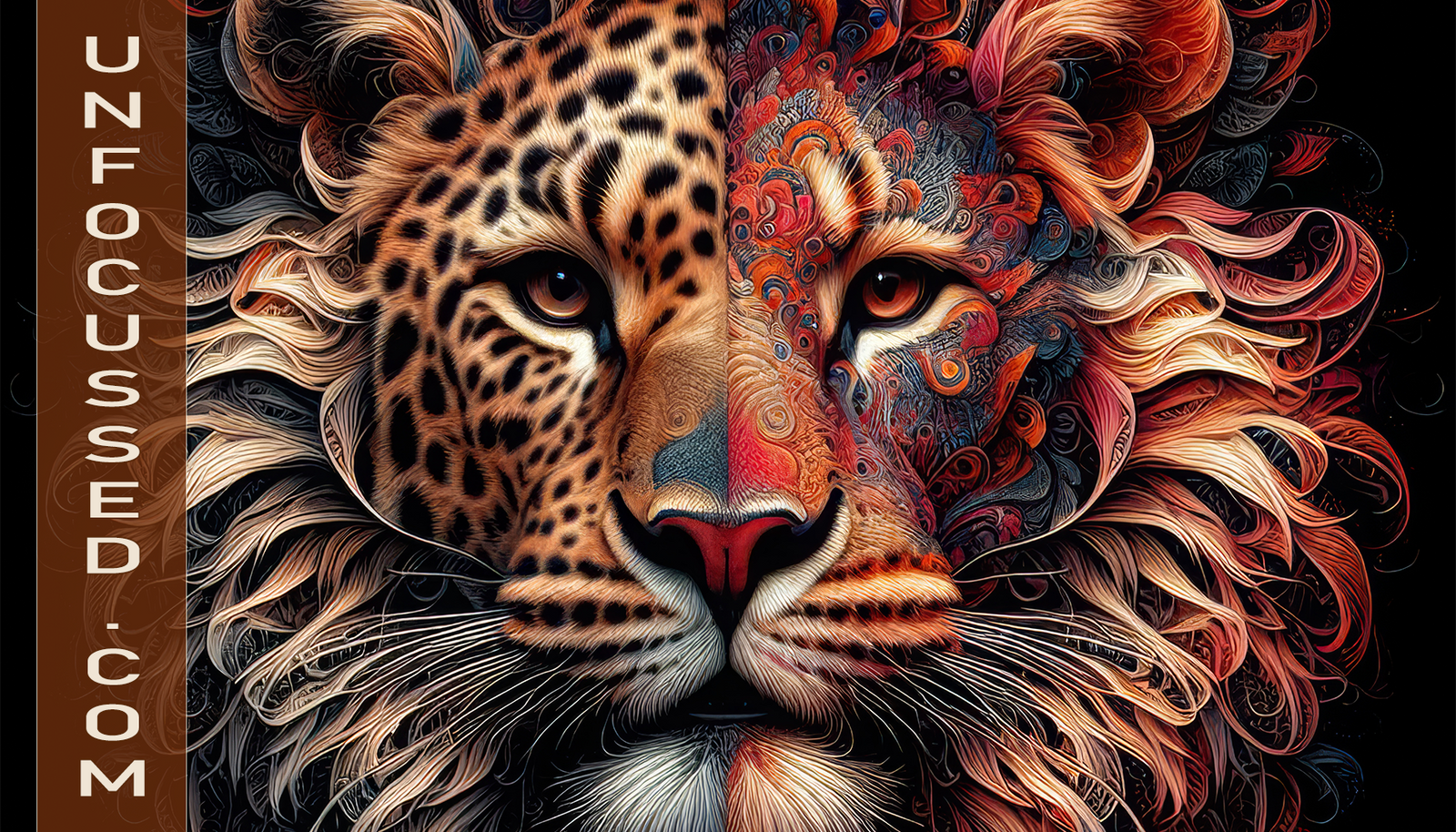
Au cœur de la forêt vierge, rôdait une créature d'origine noble et à la présence formidable, une fusion majestueuse de léopard et de lion : le Léopon. Avec une crinière qui tourbillonnait avec les mystères de ses deux héritages, Lysandre, comme on l'appelait, marchait avec l'autorité silencieuse du léopard et la présence imposante du lion. La crinière de Lysander était une couronne de verticilles aristocratiques, chacune témoignant du mélange harmonieux d'agilité et de puissance. Son pelage tacheté, une toile de la furtivité du léopard, fusionné avec les teintes ensoleillées du lion, créant un sonnet visuel des prouesses artistiques de la nature. Ses yeux, ambrés tachetés d'émeraude, parlaient de canopées verdoyantes et de savanes ouvertes, d'un double royaume sur lequel il régnait en maître. Sous le doux regard de la lune, Lysandre marchait sur les pierres anciennes, usées par le passage d'innombrables pattes. Là, là où les frontières de ses deux mondes se brouillaient, il laissait échapper un appel qui était à la fois un grondement des plaines et un murmure des ombres, un son qui résonnait avec la double essence de son esprit. Le royaume de Lysandre n'était pas un royaume de conquête mais d'unité, un lieu où la grâce fluide du léopard dansait avec l'équilibre digne du lion. En lui, le cœur primordial de la forêt battait en tandem avec le pouls indompté des prairies. Il était un pont entre deux mondes, un emblème vivant à la fois de la mystique du léopard et de la grandeur du lion, un monarque singulier d'un royaume mixte. Et ainsi reste Lysandre, un souverain des terres sauvages, dont les verticilles aristocratiques et la crinière majestueuse racontent une histoire d'harmonie et de coexistence, un héritage léonin enrichi par la tradition du léopard, inscrit à jamais dans les annales de la forêt et de la savane. cDans le silence de cathédrale de la grande forêt, Lysandre, le Léopon, se déplaçait avec une grâce qui démentait sa forme puissante. La symphonie de sa lignée jouait dans l'air qui l'entourait, chaque pas étant une note, chaque souffle un accord dans l'opus de son existence. La crinière royale qui couronnait son visage n'était pas seulement une collerette de fourrure, mais l'incarnation d'un héritage riche et légendaire, une histoire vivante enchâssée dans des couleurs et des textures vibrantes. Les arbres eux-mêmes semblaient s'incliner à son passage, leurs membres anciens chuchotant des histoires sur la créature qui n'était ni une chose ni l'autre, mais quelque chose de plus. Sa crinière captait la lumière du soleil tachetée, la dispersant sur le sol de la forêt comme des éclats de la première lumière de l'aube. Ici, dans ce royaume isolé, Lysandre était plus qu'un simple habitant ; il était une idée incarnée – le concept d’unité et de pouvoir incarné. Le jour, sa silhouette projetait une ombre solitaire sur la tapisserie de feuillage, une silhouette qui parlait de deux mondes disparates fusionnés en un seul. La nuit, son visage était peint avec le pinceau argenté du clair de lune, sa crinière encadrant son visage dans un halo de feu fantomatique. Ses appels au crépuscule étaient les chants de deux âmes, enlacées dans un être solitaire, faisant écho aux anciens récits du prédateur et du monarque. Les autres créatures de la forêt et de la savane le vénéraient, leurs regards remplis d'un respect né de l'ordre naturel, mais tempéré d'intrigue. Car à la cour de Lysandre, il n’y avait ni peur ni tyrannie, seulement la crainte de son règne équilibré. Son leadership n'était pas celui de la soumission, mais du respect de tous les fils de la vie qui se tissaient autour de lui, un roi qui n'avait pas seulement le nom. Contempler Lysandre, c'était être témoin d'une mosaïque vivante, chaque mouvement étant un coup de pinceau, chaque souffle une teinte qui peignait le monde avec l'essence à la fois de la jungle et de la plaine. C'était une créature qui n'appartenait à aucun des deux, mais qui régnait pourtant sur les deux, le souverain d'un domaine qui s'étendait au-delà du tangible jusqu'au cœur même de ceux qui partageaient son monde. L'héritage de Lysandre n'était pas seulement écrit dans la terre sur laquelle il marchait, mais aussi dans les contes qui flottaient comme des feuilles au vent – ​​des contes qui survivraient aux forêts et aux savanes, aux pierres et aux ruisseaux, une légende qui persisterait longtemps après son ère. la forme majestueuse s'était fondue dans la tradition d'où elle venait. Dans les motifs tourbillonnants de la crinière de Lysandre, une légende était murmurée, aussi vieille que les forêts et aussi vaste que les savanes. Ils disaient que les verticilles n'étaient pas de simples marques mais une carte d'un royaume où les esprits du léopard et du lion erraient librement. On disait que chaque rebondissement et courbe contenait la sagesse de la terre, les secrets du vent et le courage du cœur. Les artisans et artisans, inspirés par la splendeur de l'héritage de Lysandre, ont cherché à capturer l'essence de sa crinière majestueuse. Dans chaque point et pierre de leurs créations, ils ont insufflé l’esprit de la légende. Le motif artistique Aristocratic Whorls Diamond Art est devenu un hommage étincelant à la magnificence de la nature. Chaque facette des diamants reflétait une partie de l'histoire de Lysander, un morceau de légende que chacun pouvait apporter dans sa maison et dans sa vie. De même, le modèle de point de croix Aristocratic Whorls permettait aux conteurs de tisser le conte avec une aiguille et du fil, chaque couleur représentant un chapitre, chaque point un verset du voyage de Léopon. À chaque croix et torsion du tissu, les artisans devenaient les narrateurs de la légende, leurs mains travaillant pour faire naître l'histoire d'unité et de force que signifiait l'existence de Lysandre. Ces modèles n’étaient pas de simples dessins ; c'étaient des histoires rendues tangibles, chaque pièce fabriquée témoignant de l'esprit de Léopon, permettant à l'héritage des verticilles aristocratiques et de la crinière majestueuse de Lysandre de résonner dans les cœurs et les maisons de ceux qui admiraient la noblesse du monde naturel.

En savoir plus

Regalia of the Wild: The Tiger's Dreamcoat

par Bill Tiepelman

Regalia of the Wild : le manteau de rêve du tigre

Au cœur de la Forêt Enchantée, où les murmures des arbres centenaires racontaient des histoires d'antan, Rajah le tigre régnait en tisserand de rêves. À chaque pas silencieux, ses pattes embrassaient la terre, et là où elles se touchaient, le sol s'épanouissait de couleurs vibrantes, reflétant les motifs kaléidoscopiques de sa fourrure légendaire. Ce n’était pas une bête ordinaire, mais une tapisserie vivante, confectionnée par les mains du divin, ornée de tourbillons et de cachemires qui palpitaient de la force vitale de la forêt elle-même. La flore et la faune de la forêt parlaient de Rajah à voix basse, un respect réservé à une créature qui faisait à la fois partie de la nature et son magistral conteur. Sa fourrure contenait des récits d'époques passées, chaque verticille un chapitre d'une saga épique - les tempêtes silencieuses qui murmuraient de doux mots aux feuilles tremblantes, les valses d'ombres et de lumière au clair de lune et le rythme palpitant de la nature qui palpitait dans l'air même. . Les yeux de Rajah, ces profondes flaques d'ambre, étaient comme des soleils jumeaux posés sur le crépuscule de son visage, projetant une lueur dorée qui reflétait l'enfer de la vie en lui. Dans leurs profondeurs tourbillonnaient les histoires de création et de destruction, la danse éternelle des forces opposées de la nature et la paix tranquille qui était en jeu. Son arrivée était toujours annoncée par un subtil changement de vent, un changement dans le chant de la forêt alors qu'elle se préparait à rendre hommage à son habitant le plus exquis. Lorsque Rajah rugissait, ce n'était pas seulement un appel, mais une mélodie tissée dans la symphonie de la nature, commandant une quiétude presque sacrée, un pacte d'honneur entre tous ceux qui l'entendaient. Suivre le sillage de Rajah, c'était parcourir un chemin d'enchantement. Des germes d'imagination se déployaient dans ses empreintes, poussant ceux qui le suivirent à rêver, à croire, à créer. Il était la muse de la nature sauvage, le cœur des sauvages, peignant le monde avec les teintes de son magnifique manteau. Alors que le crépuscule s'installait et que les créatures de la nuit se réveillaient, Rajah montait jusqu'à la plus haute crête où la terre embrassait le ciel. Là, il contemplait les étoiles, sa silhouette se détachant sur la toile de la nuit. Il était le gardien de tout ce qu'il observait, l'incarnation de l'esprit indompté de la nature, vêtu des insignes des légendes, un spectre de beauté et de force qui inspirerait à jamais les rêves de la forêt et au-delà.

En savoir plus

Explorez nos blogs, actualités et FAQ

Vous cherchez toujours quelque chose ?