
The Road Beyond the Old Ways
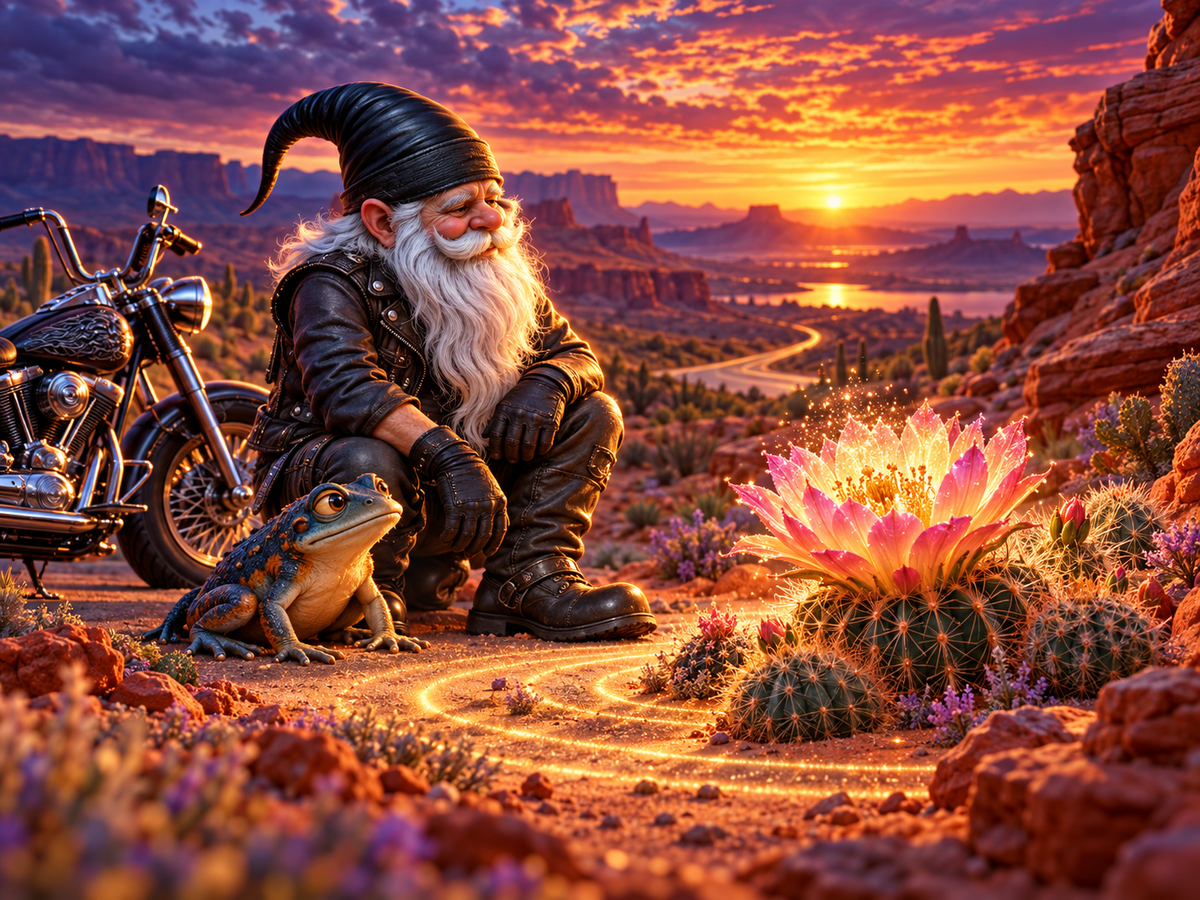
By the time Thornbeard reached the Copperwake Reach, the sun had begun to melt into the red-rock horizon. His black motorcycle carried him along a ribbon of road that bent between cactus fields and mesas, its chrome catching the last bright scraps of day. In the sidecar, Jup-Jup watched the desert with the solemn attention of a creature who had never trusted a landscape simply because it looked peaceful.
They were searching for a bloom that opened once in a hundred years. The road-house stories said its nectar could let a traveler hear the oldest memories held by the earth. Thornbeard wanted that communion badly enough to cross half of Echoterra, but he had not told Jup-Jup the whole reason. Years earlier, he had left a hidden brotherhood of nature guardians. They had taught him to protect every root and spring, then to mistake obedience for belonging. He had ridden away before he could explain that a life devoted to guarding the world still had to leave room for choosing his own road.
He told himself the bloom would answer the question he had carried ever since: had he left because he was brave enough to choose, or because he was afraid to stay and be known? The answer, he hoped, would be waiting in a cup of impossible nectar. Jup-Jup offered no opinion. He only tapped the sidecar twice, the signal they had settled on for you are thinking too loudly again.
At the last road-house, an old mapmaker had warned them that the bloom did not trade in gold. “It asks for the story that brought you there,” she said. “Some riders leave with a new understanding. Some leave as a story everyone else tells.” Thornbeard had laughed, thanked her, and ridden on. Now, with the desert narrowing into a maze of dry washes, the warning no longer sounded like decoration for a tale.
As twilight deepened, three stone markers appeared beside the road. Their worn faces carried riddles, not directions. Thornbeard answered the first with a joke, the second with a guess, and the third only after Jup-Jup pointed at the road behind them. The last question asked what a traveler could give away without becoming less himself. Thornbeard looked at the miles they had shared and knew the answer was not a thing he could put in a saddlebag.
The Bloom Beneath the Copper Moon
The dry wash opened into a sheltered garden. A single cactus stood at its center, its pale spines bright with dew that had no business surviving the heat. One enormous flower rested among them, still closed, its petals glowing pink and gold from within. The desert seemed to hold its breath around it. Thornbeard switched off the engine. For the first time in days, the loudest sound was the cooling tick of the motorcycle.
Then the question came. It was not a voice, exactly. A faint rhythm trembled through the sand and into his boots: Tell me the story you came here to leave.
Thornbeard stared at the bloom. He had imagined a challenge, perhaps, or a cup waiting beneath the petals. Instead, the bargain felt plain and terrible. If he told the story, would the flower keep it? Would the desert remember him and erase the gnome who had lived it? He could already picture strangers repeating a legend in which Thornbeard became brave, then disappeared. A neat ending. A dreadful one.
Jup-Jup climbed from the sidecar and leaned against his boot. The little amphibian made a short, questioning croak, then looked from the flower to the road and back to Thornbeard. It was the same look Jup-Jup had given him on the first night they met, when Thornbeard had offered a ride and pretended not to notice that his companion was frightened. The ride had become a friendship because neither of them had demanded a guarantee about where it would end.
“I did not come all this way to be eaten by a cactus,” Thornbeard muttered. Jup-Jup croaked again, louder. Thornbeard rubbed his beard. “Fine. I came because I thought the earth might tell me whether leaving was the right thing.”
He began with the truth he had kept from the road-house: he had loved the old brotherhood, and that was why leaving hurt. He told the flower about the rules he had followed, the questions he had swallowed, and the first night on the highway when the open sky felt less like freedom than an enormous, empty audience. He told it how Jup-Jup had joined him, how they had learned each other’s silences, and how a companion could disagree without making the road feel narrower.
Nothing in the garden interrupted. Thornbeard’s story did not pour out of him or vanish into the sand. It remained his, even as he chose to share it.
What the Road Carried Home
When Thornbeard finished, the cactus flower opened. Its petals unfolded with a soft shimmer, scattering a ring of light over the wash. The pulse in the sand returned, joined by the quiet scrape of Jup-Jup’s feet and the steady beat Thornbeard felt in his own chest. It was not a command from the bloom, and it was not a power he could steer. It was a brief, shared resonance, as if the place had made room for each small sound without asking any of them to surrender their name.
For one clear moment, Thornbeard felt the memory of rain moving beneath the desert floor. He could not own it, bottle it, or claim to understand every season the land had endured. He could only listen. That was communion enough.
The nectar glimmered in the flower’s heart. Thornbeard could have reached for it, but the question had already changed shape. He had come seeking a private answer, a certainty he could carry away. The garden offered something humbler: a story could be shared without being surrendered, and listening did not make the listener the owner of what he heard.
He left the bloom rooted where it had opened. Before sunrise, its light dimmed and a few seeds lifted into the warm air, settling among the stones. Thornbeard did not mark the garden on any public map. He wrote only the safe route back to the wash, a note to return with water for the road, and one sentence for anyone who asked what the flower had cost him: Nothing he was unwilling to give, and nothing he needed to lose.
At the road-house, the mapmaker asked whether the legend was true. Thornbeard told her the whole ride, including the parts where he had been frightened and the part where he had almost blamed a cactus for asking a fair question. Jup-Jup added one emphatic croak whenever Thornbeard made himself sound more heroic than he had been.
By the time they left, other travelers had gathered around the table. No one received a vial of desert nectar. They received a route worth respecting, a story worth carrying, and the reminder that a road can lead away from an old life without making that life worthless. Thornbeard swung onto his iron steed. Jup-Jup settled into the sidecar. The motorcycle rolled toward the copper sunrise, its engine rising into the morning while the shared rhythm of Echoterra lingered softly beneath the sand.

Some journeys bring us back with a souvenir; Thornbeard returns with a quieter kind of certainty. If the silver-bearded rider, his loyal sidecar companion, and the copper dusk of Echoterra’s Copperwake Reach stay with you, explore A Gnome’s Highway to Adventure on the Unfocussed shop, where the artwork is available in a range of print and gift formats.
 The Seedpod That Fired Before Anyone Was Ready
 The Blossom That Left a Mark
 The Witching Hour Went Sideways