
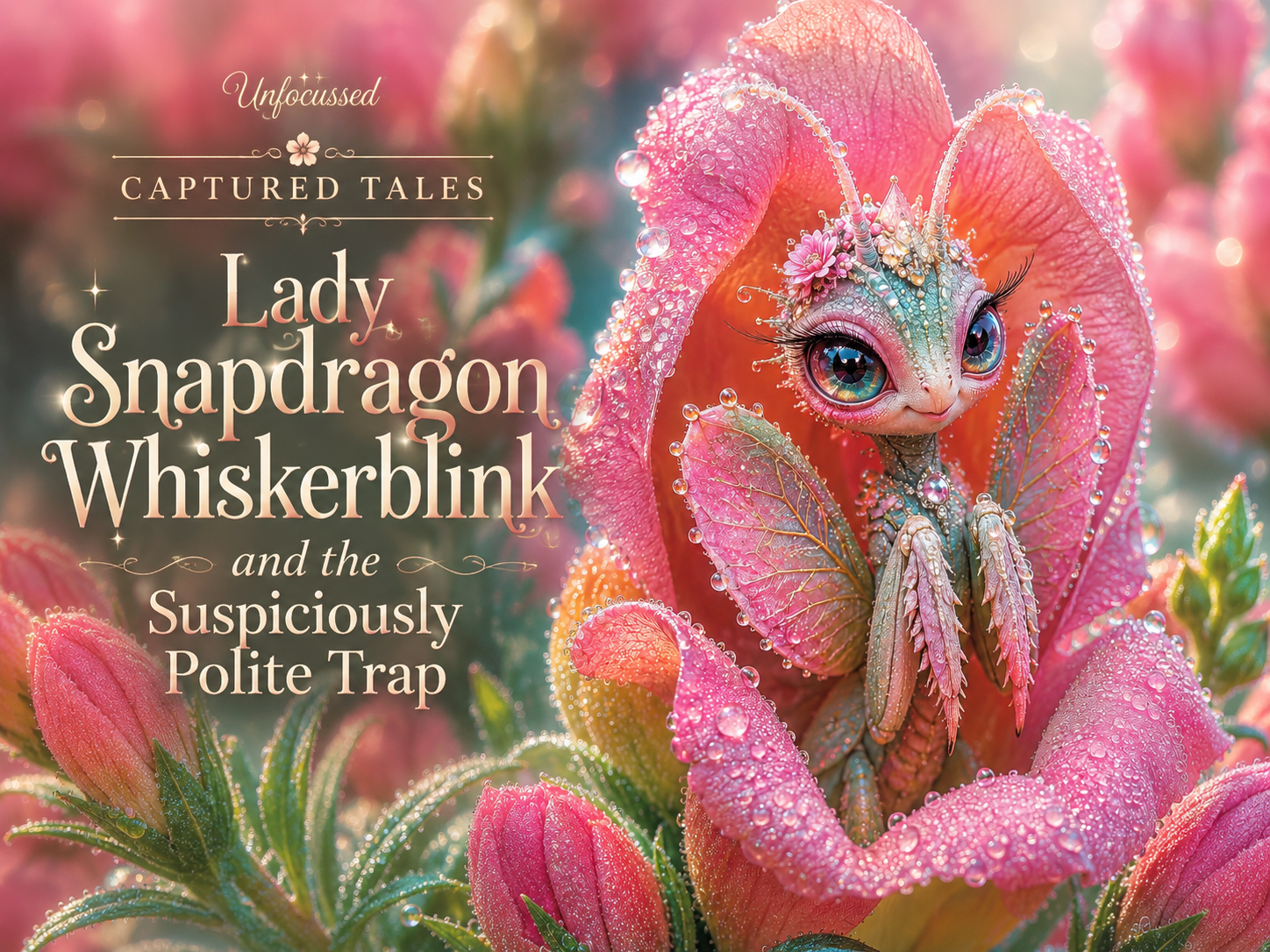
The Blossom With the Impeccable Reputation
In the jeweled quarter of Sugarwild Garden, where every leaf wore dew like inherited wealth and every flower had at least three opinions about the weather, thenchanted bloomere stood a snapdragon bloom of such devastating beauty that lesser blossoms routinely wilted out of spite.
It rose from the eastern bed beside the pearl-moss path, pink as a scandal whispered behind a lace fan and curved like a teacup designed by someone with both taste and secrets. Its petals unfurled in plush folds of coral, rose, peach, and sugared blush, each rimmed with trembling droplets that caught the morning light and threw it back in tiny rainbows, because subtlety had never once survived a full minute in Sugarwild Garden.
This was Snapdragon House.
And inside Snapdragon House lived Lady Snapdragon Whiskerblink, first of her name, keeper of the Dewdrop Etiquette Bell, defender of properly folded napkins, and absolute terror of anyone who tried to chew with their mouth open within six petals of her parlor.
She was small, exquisite, and dangerous in the way beautiful things often are when they have been underestimated for too long. Her body shimmered turquoise and rose beneath a fine dusting of golden pollen. Her wings were veined like stained glass. Her eyelashes were so grand they had once caused a passing moth to apologize to his own eyebrows. A tiny floral crown rested between her antennae, though she insisted it was not a crown.
“It is a compositional necessity,” she would say, adjusting the pink blossoms near her brow. “A lady must frame the face God and lighting gave her.”
Lady Whiskerblink held court from the inner cup of the snapdragon, perched among dew beads and petal folds as if born to rule from a velvet throne. Each morning, she received guests. Each afternoon, she poured nectar tea. Each evening, she reviewed the day’s offenses in a little pearl-bound ledger labeled Incidents of Barbarism, Rudeness, and General Mouth-Breathing.
The ledger was full.
Sugarwild Garden, despite its glittering ponds, candied pollen breezes, and flowers that chimed when kissed by sunlight, was not a civilized place. Not truly. It only pretended. Beneath every glossy petal and perfumed breeze lurked gossip, vanity, petty theft, dramatic fainting, and at least one beetle trying to pass off pond scum as imported jade relish.
Lady Whiskerblink knew this. She did not object to wickedness in principle. Wickedness, when done with posture and appropriate stationery, could be almost charming. What she objected to was sloppy wickedness. Clumsy wickedness. Wickedness committed without a proper invitation or matching serving spoons.
“If one must be a menace,” she often said, “one should at least be seated correctly.”
It was this philosophy that made her famous.
It was also this philosophy that made everyone deeply suspicious of her flower.
For Snapdragon House had a reputation.
Not an ugly reputation, mind you. Ugly reputations belonged to bog trolls, mildew prophets, and that one aphid baroness who wore too much violet and once poisoned a cheese course. Snapdragon House’s reputation was more refined than that. More polished. More difficult to prove in a court of law.
Guests entered Snapdragon House. Guests admired the petals. Guests took tea with Lady Whiskerblink beneath the soft pink glow of the inner bloom.
And sometimes, guests did not come back out for a while.
Not forever. Usually.
They would reappear hours later on the pearl-moss path, dazed, damp, missing a glove, and suddenly very interested in becoming better people. Some left wearing improved manners. Some left with written apologies pinned to their collars. One particularly loud scarab named Lord Bumblecrust had emerged three days after a luncheon with his entire vocabulary reduced to “please,” “thank you,” and “I was wrong.”
No one had ever looked happier to be wrong.
The garden called it many things.
The Snapdragon Squeeze.
The Courtesy Curse.
The Pink Petal Punishment.
The Tea Trap.
Lady Whiskerblink called it “baseless provincial hysteria by insects who think a napkin is something that happens to other people.”
She denied everything.
Beautifully.
A Lady Receives Rumors With Tea
On the morning the trouble began, Lady Whiskerblink was arranging sugar pearls in a dish shaped like a lily pad when her attendant, Miss Fenneltoe, fluttered into the bloom with the expression of someone carrying news hot enough to ruin upholstery.
Miss Fenneltoe was a lacewing with translucent green wings, a nervous constitution, and an addiction to gossip she disguised as “social awareness.” She landed on the petal rim, wrung all four of her tiny hands, and looked around as though the dew itself might be listening.
It was. Dew always listened. Dew was shameless.
“My lady,” Miss Fenneltoe whispered, “there has been talk.”
Lady Whiskerblink did not look up. She nudged one sugar pearl half a hair to the left.
“There is always talk, Fenneltoe. The garden runs on sunlight, nectar, and insects saying things they should have kept inside their empty little heads.”
“Yes, my lady, but this is pointed talk.”
“All talk is pointed when delivered by creatures with mandibles.”
“They are saying Snapdragon House is unsafe.”
Lady Whiskerblink finally paused.
The sugar pearl, sensing drama, rolled a very small distance and stopped.
“Unsafe?” she repeated.
Her voice was soft. Her lashes lowered. Across the inner petals, dew droplets trembled as if every one of them had just remembered an urgent appointment elsewhere.
“Well,” Miss Fenneltoe said, “not unsafe exactly. More... selectively hospitable.”
“How delightfully cowardly of them.”
“They say the flower closes.”
“Flowers do that.”
“Around guests.”
“Guests should feel embraced.”
“Tightly, apparently.”
Lady Whiskerblink placed the sugar pearl spoon down with the kind of care that meant someone was about to be mentally dismembered and served in courses.
“Fenneltoe,” she said, “Snapdragon House is one of the oldest, most respected floral residences in the eastern bed. My teas are punctual. My cushions are plumped. My invitations are embossed. If certain guests leave improved, quieter, and less likely to spray crumbs into polite society, I fail to see why I should apologize.”
“Of course, my lady.”
“If Lord Bumblecrust lost three days, perhaps he should not have used the finger bowl as soup.”
“Unforgivable, my lady.”
“If the Moss Twins emerged reciting basic etiquette, perhaps divine justice occasionally wears petals.”
“A comforting thought, my lady.”
“And if Countess Nibblefern left without her stolen pearl brooch, perhaps the flower has better morals than the aristocracy.”
Miss Fenneltoe blinked.
“Did the flower take the brooch?”
“What an invasive question.”
The lacewing promptly looked ashamed, which was wise. Shame prevented many unfortunate outcomes in Snapdragon House. Not all of them, of course, but enough to be considered socially useful.
Lady Whiskerblink lifted her teacup, sipped dew-mint nectar, and glanced toward the outer garden. Beyond the pink petal walls, sunlight scattered through the morning haze. Bees hummed along the lavender border. A troop of ladybugs argued over whether spots were inherited status symbols or merely decorative lies. Somewhere in the marigolds, a cricket practiced violin badly enough to be considered a public health concern.
All appeared normal.
Which, in Sugarwild Garden, usually meant the catastrophe had dressed nicely and was approaching through the front gate.
Miss Fenneltoe cleared her throat.
“There is another matter.”
“Naturally. Disasters breed like aphids.”
“The Council of Pollinated Concerns has appointed an investigator.”
Lady Whiskerblink’s antennae stilled.
“An investigator.”
“Yes, my lady.”
“For my flower.”
“Yes, my lady.”
“How thrilling. I do so love being insulted by committee.”
Miss Fenneltoe reached into her satchel and removed a folded notice sealed with yellow wax. The seal bore the mark of the council: three pollen grains, two crossed stems, and one beetle who had clearly insisted on being included despite contributing nothing useful.
Lady Whiskerblink accepted the notice between two delicate claws and opened it.
Her eyes moved across the page.
Her smile did not change.
This concerned Miss Fenneltoe greatly. Lady Whiskerblink’s smile was lovely, yes, but there were varieties. There was the bright smile she gave welcome guests. The polite smile she gave fools. The dazzling smile she gave rivals before ruining their week. And then there was this smile: still, sweet, and sharp enough to trim hedges.
“Sir Thistlewick Vane,” Lady Whiskerblink read aloud. “Third Baron of Bramblehook, licensed inspector of botanical irregularities, temporary magistrate of floral conduct, and special envoy to the Council of Pollinated Concerns.”
She looked up.
“Good heavens. Did he bring a title or drag a parade float behind him?”
“He is said to be very thorough.”
“That is what boring people call themselves when no one invites them twice.”
“He arrives at noon.”
Lady Whiskerblink folded the notice carefully, then folded it again, then again, until it became a tiny square of official disappointment.
“Then we shall receive him.”
Miss Fenneltoe swallowed.
“In Snapdragon House?”
“Where else? Shall I meet him in the mud like a beetroot with anxiety?”
“No, my lady.”
“We will offer him tea.”
“Of course.”
“We will offer him biscuits.”
“Naturally.”
“We will offer him every courtesy owed to a guest, investigator, and pompous little thorn in my breakfast.”
Miss Fenneltoe gave a tiny bow.
“And the flower?”
The question hung between them.
Above Lady Whiskerblink, the snapdragon petals gave the faintest shiver. Not from wind. There was no wind inside the bloom. The movement was subtle, almost graceful, like a lady shifting behind a curtain to hear better.
Lady Whiskerblink looked up.
“Snapdragon House,” she said gently, “will behave.”
The petals did not move.
“Do you hear me?” she added, still gentle.
A dew drop slid slowly down the inner petal wall.
Miss Fenneltoe pretended not to notice.
Lady Whiskerblink smiled again.
“Wonderful. Then prepare the blue china.”
The Arrival of Sir Thistlewick Vane
By noon, Snapdragon House had been polished, perfumed, arranged, rearranged, and threatened into perfection.
The dew beads along the petal rims glittered like chandelier crystals. The tea table had been set atop a flat leaf lacquered with snail-shell gloss. Rose-pollen biscuits sat in a tiered stand. Nectar spoons gleamed. The cushions had been fluffed until they looked like smug little clouds. A tiny sign at the entrance read:
Welcome, Honored Guest. Kindly Mind Your Manners and Your Limbs.
Miss Fenneltoe had objected to the last three words.
Lady Whiskerblink had objected to the objection.
At precisely twelve bells, a shadow crossed the pearl-moss path.
Sir Thistlewick Vane arrived wearing a traveling coat of dark bramble silk, a brass-buttoned waistcoat, polished boots, and the expression of a creature who had never once been surprised by joy. He was a tall, angular insect with thornlike shoulders, elegant wings folded sharply behind him, and a silver monocle attached to a chain so unnecessary that it had clearly been chosen for intimidation.
He carried a black leather case, a measuring rod, a notebook, three sealed warrants, and the general emotional atmosphere of a tax audit.
Behind him came his assistant, a stout little weevil named Pock, who dragged a satchel nearly twice his size and looked as though he had been regretting this employment since birth.
Sir Thistlewick stopped before the snapdragon bloom and looked up.
Snapdragon House towered above him, pink petals glowing in the noon light, dew shining along every curve, its open mouth lovely enough to lure poets and suspicious enough to silence them.
“Charming,” Sir Thistlewick said.
He made the word sound like a diagnosis.
Lady Whiskerblink appeared on the inner petal balcony, framed by rose light and sparkling dew. She inclined her head with perfect grace.
“Sir Thistlewick Vane, I presume.”
“Lady Snapdragon Whiskerblink.”
“What a relief. We have both learned names. Civilization survives another minute.”
His monocle flashed.
“I have been sent by the Council of Pollinated Concerns.”
“Yes, your notice arrived ahead of you. It had less luggage.”
Pock made a noise that might have been a cough or a suppressed laugh. Sir Thistlewick did not turn, but Pock immediately became fascinated by a pebble.
“I am here to investigate allegations of botanical misconduct,” Sir Thistlewick said.
“How deliciously dreary.”
“Specifically, reports that your residence has entrapped, restrained, humiliated, disciplined, squeezed, corrected, or otherwise detained visitors against their will.”
Lady Whiskerblink placed one claw against her chest.
“Against their will? Sir, most of my guests arrive with so little willpower that they mistake a dessert fork for a personal philosophy.”
“You deny the allegations?”
“I deny their grammar, their tone, and the cheap paper upon which they were filed.”
“But not their substance?”
She smiled.
“Do come in for tea.”
Pock dropped the satchel.
Sir Thistlewick looked at the open bloom. Its petals curved inward, soft and luminous. The entrance was wide enough for two insects to pass comfortably, though the soft folds around it suggested they might not pass back out unless the flower was in a generous mood.
“I would prefer to conduct the first stage of my examination from outside,” he said.
Lady Whiskerblink sighed.
“How tragic. You dress like a funeral and attend like a coward.”
“Caution is not cowardice.”
“Often said by cowards with stationery.”
Sir Thistlewick’s mouth tightened.
“Lady Whiskerblink, I am not here to be entertained.”
“Then you should have warned me before I put out the good biscuits.”
Another tiny cough from Pock.
Sir Thistlewick removed his notebook and opened it with a snap.
“Let the record show that the resident of Snapdragon House attempts to deflect inquiry with mockery.”
“Let the record show that the investigator arrived with the warmth of wet gravel.”
His pen paused.
“Do you intend to obstruct this investigation?”
“My dear sir, I intend to host it. Whether you survive hospitality with dignity intact is between you, your breeding, and whatever poor tutor failed to sand the edges off your personality.”
Sir Thistlewick looked up slowly.
The garden had gathered, as gardens do when something potentially humiliating is about to happen to someone who deserves it. Bees hovered near the lavender. Two caterpillars leaned over a cabbage leaf balcony. A row of beetles pretended to inspect moss while listening with their entire bodies. Even the marigolds seemed perkier.
“Very well,” Sir Thistlewick said. “We will begin inside.”
Pock’s eyes widened.
“Sir?”
“Bring the satchel.”
“Into the... into the flower, sir?”
“Do you see another inside available?”
Pock looked at Snapdragon House.
Snapdragon House looked, in its flowerish way, back.
“No, sir,” Pock said weakly.
Lady Whiskerblink clapped her foreclaws once.
“Splendid. Fenneltoe, pour the tea. Snapdragon House, do make our guests comfortable.”
The petals quivered.
Only once.
But Sir Thistlewick noticed.
Of course he did. Men like Sir Thistlewick noticed everything except when they were being unbearable.
Tea Beneath Questionable Petals
The interior of Snapdragon House was even more spectacular than its reputation, which annoyed Sir Thistlewick immediately.
He disliked being impressed. It complicated his posture.
The inner bloom glowed with warm pink light, softened through layers of translucent petal tissue. Dew hung in perfect beads from tiny filaments above, casting prismatic sparks across the curved walls. The air smelled of rose nectar, citrus pollen, and something faintly spicy that suggested the flower had a temper and excellent taste.
Lady Whiskerblink sat at the tea table as though she had been painted there by a master and then improved by gossip. Miss Fenneltoe poured dew-mint nectar into blue china cups. Pock settled onto a cushion near the entrance, where he could keep one eye on the tea and one eye on the exit. Sir Thistlewick remained standing.
“Do sit,” Lady Whiskerblink said.
“I prefer to stand.”
“How unfortunate for your knees and everyone watching.”
“I am conducting an inspection.”
“You may inspect from a cushion. Many of society’s finest accusations have been made while seated.”
Sir Thistlewick did not sit.
Lady Whiskerblink selected a biscuit.
“As you wish. Tower over the refreshments like a haunted rake.”
Pock reached for a biscuit, then froze when Sir Thistlewick glanced down at him.
“Assistants may eat,” Lady Whiskerblink said kindly. “It prevents them from gnawing through their own despair.”
Pock took the biscuit.
“Thank you, my lady.”
“Excellent manners. You may live.”
Pock stopped chewing.
Lady Whiskerblink smiled warmly.
“A joke, dear.”
It was not entirely clear whether this improved matters.
Sir Thistlewick walked the inner perimeter of the bloom, examining the petal seams, dew glands, support tendrils, and soft folds near the entrance. He tapped the wall lightly with his measuring rod. The flower gave no response.
“There are no visible hinge structures,” he murmured.
“Because it is a flower, not a cupboard.”
“The allegations suggest rapid closure.”
“The allegations probably also suggest intelligence among the complainants, so we must be cautious.”
Sir Thistlewick leaned closer to a petal fold.
“Has this bloom ever closed while guests were inside?”
Lady Whiskerblink stirred her tea.
“All homes close around guests in some fashion. Walls. Doors. Social expectations. The unbearable pressure to compliment a host’s curtains.”
“Answer plainly.”
“Ask beautifully.”
He turned.
For the first time, irritation cracked his official polish.
“Lady Whiskerblink, three visitors in the last fortnight reported being detained inside this flower.”
“Then how industrious of them to report anything at all.”
“Lord Bumblecrust emerged after three days.”
“Improved.”
“The Moss Twins claim they were forced to copy etiquette rules onto lily parchment until their hands cramped.”
“Their handwriting remains offensive, but progress requires patience.”
“Countess Nibblefern says she was searched.”
“Countess Nibblefern stole my pearl brooch.”
“Allegedly.”
“She had it pinned under her left wing with the subtlety of a drunk magpie.”
“That does not give you the right to imprison her.”
Lady Whiskerblink set down her spoon.
At once, the bloom seemed quieter. The outside hum of Sugarwild Garden faded, muffled by velvet petals and the sudden tightening of attention.
“Sir Thistlewick,” she said, “may I ask you a question?”
“If relevant.”
“How many complaints did the council receive before it decided Snapdragon House was a danger?”
He adjusted his monocle.
“Several.”
“How many?”
“Seven formal statements.”
“From whom?”
“The identities are confidential.”
“Of course. Nothing says justice like anonymous whining delivered through wax seals.”
“The complainants fear retaliation.”
Lady Whiskerblink laughed softly.
It was a beautiful sound. It made Pock smile despite himself. It made Miss Fenneltoe nervous. It made Sir Thistlewick look as though he suspected beauty itself of tampering with evidence.
“Retaliation,” Lady Whiskerblink said. “What a magnificent word when spoken by people accustomed to consequence-free behavior.”
“Meaning?”
“Meaning the garden has grown comfortable mistaking politeness for weakness. A lady smiles, so they assume she cannot bite. A lady pours tea, so they assume she cannot keep score. A lady lives in a pink flower, and suddenly every puffed-up winged purse with a title thinks he may enter, flatter badly, steal lightly, insult the biscuits, and leave without so much as a thank-you note.”
Sir Thistlewick’s gaze sharpened.
“Are you admitting to punishment?”
“I am admitting to standards.”
“Standards do not detain guests.”
“They should. The world would improve overnight.”
Pock, who had finished his biscuit, whispered, “She’s not entirely wrong, sir.”
Sir Thistlewick did not dignify this with a glance.
Lady Whiskerblink lifted her cup again.
“Tell me, Sir Thistlewick, when a guest arrives uninvited, speaks over his hostess, refuses tea, insults the home, and pokes the walls with a stick, is that guest owed endless patience?”
“I am here under council authority.”
“Ah. The traditional shield of the mannerless.”
“You are evading.”
“You are trespassing with paperwork.”
“You invited me in.”
“And you have yet to thank me.”
The petals rustled.
This time, everyone heard it.
Miss Fenneltoe went very still.
Pock slowly lowered his second biscuit.
Sir Thistlewick turned toward the entrance. The petal opening remained wide, but the outer folds had shifted slightly inward. Not closed. Not even close to closed.
But less open than before.
He walked toward it.
The floor beneath him flexed softly.
Lady Whiskerblink’s expression flickered.
Only for a breath. Only enough for someone very observant to catch.
Sir Thistlewick caught it.
“Interesting,” he said.
“Is it?” Lady Whiskerblink replied.
“You looked concerned.”
“I looked bored. They are similar on a woman surrounded by incompetence.”
He touched the petal fold with his measuring rod.
The snapdragon shivered.
Sir Thistlewick smiled faintly.
It was the first almost-human expression he had worn all day, and somehow it made him less pleasant.
“This bloom responds to stimulus.”
“Most living things do. Except certain council officials, who require tragedy and a signed form.”
He pressed harder.
The petal twitched inward.
Lady Whiskerblink stood.
“I would not do that.”
Sir Thistlewick looked back at her.
“Why not?”
Her lashes lowered.
“Because it is rude.”
“Rude?”
“To jab a hostess’s wall.”
“The wall is evidence.”
“The wall is sensitive.”
“Then perhaps the wall should testify.”
Lady Whiskerblink went quiet.
Outside, the garden waited. Inside, dew trembled from the ceiling threads. The pink light deepened, turning the air warm and close.
Sir Thistlewick pressed the measuring rod into the petal seam once more.
Snapdragon House closed one inch.
Pock made a squeaking sound that he would later deny under oath.
Miss Fenneltoe whispered, “Oh dear.”
Lady Whiskerblink did not move.
Her face remained composed, lovely, powdered with dew and dignity. But her claws had tightened around the edge of the tea table.
Sir Thistlewick saw that too.
“Lady Whiskerblink,” he said slowly, “are you in control of this flower?”
Her smile returned.
A little too quickly.
“Sir Thistlewick, I am in control of myself. That is more than most creatures can claim before lunch.”
“That is not what I asked.”
“No,” she said. “It is what you deserved.”
The petal fold behind him shifted again.
Another inch.
Then another.
The entrance remained open, but narrower now, its soft pink edges drawing closer with exquisite patience. No snap. No violence. No dramatic gulp.
Just a flower, politely reconsidering its guest list.
Pock stood.
“Sir, perhaps we should continue the inspection from somewhere less... affectionate.”
Sir Thistlewick did not retreat.
He watched Lady Whiskerblink, and for the first time since his arrival, his expression held something beyond suspicion.
Curiosity.
“You are not the trap,” he said.
Lady Whiskerblink’s eyes flashed.
“Careful.”
“You live inside it.”
“Many of us live inside things that are trying to ruin us. Families. Titles. Bad reputations. Waistcoats.”
“But you are not commanding it.”
The flower closed another inch.
Lady Whiskerblink looked up toward the petals.
For one heartbeat, her courtly mask slipped, and beneath it was something rawer than pride.
Fear.
Not much. Not enough for gossip. But enough.
Then she lifted her chin, smoothed her expression, and spoke in a voice as sweet as sugared poison.
“Snapdragon House,” she said, “our guest is being tedious, but he has not yet become dinner.”
The petals stopped.
Pock whispered, “Yet?”
Lady Whiskerblink ignored him.
Sir Thistlewick lowered his measuring rod.
The silence that followed was plush, pink, and deeply inconvenient.
Then, from somewhere within the living walls of Snapdragon House, there came the softest sound.
Not a growl.
Not a sigh.
A delicate, damp little click.
Like a mouth closing around a secret.
Lady Whiskerblink’s smile became flawless.
“More tea?” she asked.
And for the first time in his professional life, Sir Thistlewick Vane looked as though he might actually need some.
The First Courtesy of the Trap
He sat.
Not because he had been defeated, of course. Sir Thistlewick Vane was not the sort of insect who admitted defeat before a full written report, two witnesses, and at least one opportunity to blame poor lighting.
He sat because the investigation had changed shape.
Until that moment, he had believed he had come to expose Lady Snapdragon Whiskerblink as a charming little tyrant with a carnivorous parlor and a genius for plausible deniability. He had expected evasions, vanity, decorative cruelty, and perhaps a hidden pulley system made of vine fibers. He had expected a criminal.
Instead, he had found a hostess staring down her own home as though it were a beloved beast with blood on its teeth.
That was far more interesting.
Far more dangerous.
And, irritatingly, far more difficult to put in a tidy report.
Lady Whiskerblink poured him tea herself. The gesture did not escape anyone. Miss Fenneltoe’s eyes widened. Pock sat back down with extreme caution. Even the petals seemed to pause in appreciation, though that may have been because Lady Whiskerblink had briefly glared at them.
Sir Thistlewick accepted the cup.
“Thank you,” he said.
The words were clipped, but proper.
The bloom loosened half an inch.
Everyone noticed.
No one mentioned it.
Lady Whiskerblink’s smile brightened by exactly one degree.
“You are welcome.”
Sir Thistlewick looked at the tea, then at the petal walls, then at her.
“Does it respond to manners?”
“Doesn’t everyone?”
“Not physically.”
“You have never seen a duchess denied a compliment.”
He set the cup down untasted.
“Lady Whiskerblink.”
“Sir Thistlewick.”
“What is this flower?”
She considered him for a long moment.
The glow of the snapdragon lit the jeweled surfaces of her face, catching in the dew beads along her cheeks and antennae. She looked impossibly delicate. She also looked like she could dismantle a man’s self-esteem with a butter knife and a pleasant anecdote.
“This flower,” she said, “is Snapdragon House.”
“That is its name, not its nature.”
“Names are nature if given properly.”
“And was it given properly?”
Her expression cooled.
“That is a family matter.”
“The council will not accept family matters as explanation for unlawful detention.”
“The council accepts stale muffins as refreshments. Their standards cannot wound me.”
“You may be in danger.”
That, at last, landed.
Lady Whiskerblink looked at him with sudden sharpness, as if he had set an uninvited truth on her table without a coaster.
“How gallant,” she said. “And here I thought you came to arrest me.”
“I came to investigate.”
“Investigators are arrests wearing better buttons.”
“Not always.”
“No?”
“Sometimes,” Sir Thistlewick said, “we are warnings.”
For a moment, none of them spoke.
The flower held still around them, all pink velvet and glittering dew, beautiful enough to make danger seem rude for interrupting. Outside, the garden murmured. A bee sneezed. Someone whispered, “Has he been eaten yet?” and someone else whispered, “No, but he sat down, so emotionally perhaps.”
Lady Whiskerblink’s antennae tilted toward the noise.
“Fenneltoe,” she said, without looking away from Sir Thistlewick.
“Yes, my lady?”
“Please inform the spectators that anyone caught loitering for the purpose of witnessing my downfall will be charged admission.”
Miss Fenneltoe rose at once.
“Yes, my lady.”
“Double for beetles. They block the path and pretend it is architecture.”
“Of course, my lady.”
As Miss Fenneltoe hurried out, the bloom opened just enough to let her pass. Sir Thistlewick watched closely.
Lady Whiskerblink watched him watching.
“You see?” she said. “Perfectly safe.”
“For her.”
“Fenneltoe says thank you when served tea.”
“And those who do not?”
Lady Whiskerblink reached for a sugar pearl and dropped it into her cup.
“They learn.”
The pearl dissolved slowly, releasing a faint golden shimmer.
Sir Thistlewick opened his notebook again.
“Then let us begin with the first formal question.”
“How bureaucratic. My pulse quickens against its will.”
He ignored her.
“Lady Snapdragon Whiskerblink, has any guest ever failed to leave Snapdragon House alive?”
The petals above them glistened.
Pock held his breath.
Lady Whiskerblink’s smile remained in place.
But this time, she did not answer quickly.
And somewhere deep within the flower, beneath petal and stem and perfumed velvet, something gave another soft, polite click.
Like a lady locking the good silver away before company got ideas.
Lady Whiskerblink lifted her cup.
“Alive,” she said carefully, “is such a flexible condition in Sugarwild Garden.”
Sir Thistlewick’s pen hovered over the page.
“That is not a no.”
“No,” she said, eyes glittering. “It is not.”
The Question No Respectable Hostess Enjoys
Sir Thistlewick Vane did not write down Lady Snapdragon Whiskerblink’s answer immediately.
This was unusual.
Sir Thistlewick wrote down nearly everything. He wrote down the weather. He wrote down pauses. He wrote down suspicious crumbs. Once, during an inquiry into fraudulent honey labeling, he had written down the phrase bee made prolonged defensive buzzing noise, likely emotional manipulation, which had led to three days of legal argument and one beekeeper throwing a thimble.
But now his pen hovered above the page, suspended in the warm pink glow of Snapdragon House, while Lady Whiskerblink sat across from him with her teacup raised and her smile sharpened to a ceremonial blade.
“Alive,” he repeated.
“Yes,” she said. “A word beloved by officials because it pretends to be simple.”
“Most words are simple when used honestly.”
Lady Whiskerblink gave him a pitying look so polished it could have reflected sunlight into a rival’s eyes.
“How refreshing. A man who believes language is honest. Do they keep you in a drawer between assignments?”
Pock, still seated near the entrance, looked from one to the other with the haunted expression of an assistant who had chosen a safe government job and somehow ended up inside a fragrant mouth.
“My lady,” he said cautiously, “when you say alive is flexible...”
Lady Whiskerblink lowered her cup.
“I mean Sugarwild Garden contains many states of being that would distress a census taker. There are ghosts in the foxglove bells. There is a retired caterpillar in the west hedge who insists he is between bodies and refuses to pay rent. Three mushrooms near the pond claim to be one philosopher. And last spring, Lord Chitterspoon became a rumor so powerful he now attends parties without a body.”
Sir Thistlewick’s eyes narrowed.
“Did Snapdragon House cause any of those conditions?”
“Do not be ridiculous. Lord Chitterspoon did that to himself by repeating his own importance too often in damp weather.”
Pock nodded faintly, as if this seemed reasonable enough compared to the rest of his day.
Sir Thistlewick set his pen to the page at last.
“Let us be precise. Has any guest entered this flower and failed to exit in the same general biological category?”
Lady Whiskerblink’s lashes fluttered.
“How romantic. I see why the council sends you to frighten widows and mildew.”
“Answer the question.”
“One guest,” she said.
Pock’s biscuit fell out of his hand.
Sir Thistlewick went very still.
The petals of Snapdragon House trembled above them, not with hunger this time, but with something almost like embarrassment. A dew drop plinked onto the tea table and rolled toward the sugar pearls as if trying to change the subject.
Lady Whiskerblink watched it go.
“One guest entered Snapdragon House and did not leave as he entered,” she said. “His name was Mr. Dandyflit Glasswing. He was a moth of large collars, small courage, and the kind of cologne that should have required a public warning.”
Sir Thistlewick began writing.
“Date?”
“Late Honeysuckle Season. Three years ago.”
“Circumstances?”
“Tedious.”
“Lady Whiskerblink.”
“Fine. Socially tedious and morally damp.”
“Explain.”
She looked up toward the inner curve of the snapdragon, where pink light glowed through veined petals like sunrise trapped under silk.
“Mr. Glasswing came courting.”
Pock inhaled softly.
Sir Thistlewick did not react, which meant he reacted quite violently on the inside and planned to invoice someone for the inconvenience.
“Courting you?” he asked.
“No, the tea stand. Yes, me.”
“Was his visit invited?”
“Regrettably. My aunt insisted I consider him because he had property, breeding, and the jawline of a decorative spoon. These are the standards by which society attempts to doom women with good lighting.”
“And what happened?”
Lady Whiskerblink did not answer at once.
Her foreclaws rested on the edge of the table, delicate and still. For the first time since Sir Thistlewick had arrived, she did not look amused, insulted, or ready to stab a man with grammar. She looked tired. Not visibly, not sloppily. Lady Whiskerblink would sooner wrestle a slug in public than appear undone. But there was a tightness beneath her posture, a carefulness in the way she breathed.
“He proposed,” she said.
“And you refused?”
“Several times. Politely at first, because I was young and still believed men heard the first no if you embroidered it nicely. Then less politely, because one must adapt to the thickness of the skull presented.”
The bloom around them gave a soft rustle.
Lady Whiskerblink glanced upward.
“Settle,” she murmured.
Sir Thistlewick’s pen paused again.
“The flower reacted?”
“The flower listened.”
“To what?”
“To him.”
“What did he say?”
Lady Whiskerblink smiled, but it was not a court smile. It had no lace on it.
“He said a great many things. That I was too pretty to be difficult. That Snapdragon House was wasted on a single lady. That a husband would know how to manage such a rare bloom. That my refusal was charming, then inconvenient, then insulting. That I owed him kindness because he had dressed well.”
Pock made a low noise in his throat.
Sir Thistlewick looked down at his notebook, but he was no longer writing.
“And then?” he asked.
“Then he reached for me.”
The petals above them shivered hard enough to scatter three dew drops. One struck Sir Thistlewick’s hat. He did not move.
Lady Whiskerblink’s voice remained smooth.
“Snapdragon House closed.”
“Around him?”
“Around us both.”
“For how long?”
“I do not know. Long enough for him to stop shouting. Long enough for me to stop shaking. Long enough for the flower to decide what courtesy required.”
“And what did courtesy require?”
Her gaze returned to Sir Thistlewick.
“Transformation.”
Behind Pock, the petal entrance gave a nervous little click.
Sir Thistlewick’s voice lowered.
“What became of Mr. Glasswing?”
Lady Whiskerblink pointed with one claw toward a narrow interior shelf near the back of the bloom. At first glance it looked decorative, covered in soft moss and tiny beads of amber resin. Then Sir Thistlewick noticed a small wing, pale as moonpaper, preserved beneath a clear droplet of hardened nectar.
Pock whispered, “Oh, bugger me sideways with a twig.”
Lady Whiskerblink turned to him.
“Pock.”
“Sorry, my lady.”
“One does not get buggered with a twig in the good parlor.”
“No, my lady.”
“At least not before supper.”
Pock opened his mouth, closed it, and wisely stared at the floor.
Sir Thistlewick rose and approached the preserved wing. He inspected it without touching.
“A memorial?”
“A warning,” Lady Whiskerblink said.
“To whom?”
“Apparently everyone except the entitled.”
“Is Mr. Glasswing dead?”
“No.”
Sir Thistlewick looked back.
“No?”
“He was remade.”
“Into what?”
Lady Whiskerblink took another sip of tea.
“A small, tasteful patch of evening primrose beside the compost wall.”
Pock gripped his cushion.
Sir Thistlewick stared.
Lady Whiskerblink tilted her head.
“He blooms only after dusk and has not interrupted a woman since.”
For several seconds, the only sound was the soft drip of dew from the ceiling threads.
Then Sir Thistlewick said, “The council was not informed.”
“The council was informed that Mr. Glasswing had left the district to pursue personal growth.”
“That is not accurate.”
“He grew roots.”
“Lady Whiskerblink.”
“What? It was the most growth he had managed in years.”
The Tour No One Requested
Miss Fenneltoe returned moments later, cheeks bright with the fresh shine of having ejected an audience and harvested gossip simultaneously.
“The spectators have dispersed, my lady,” she announced. “Except for the beetles, who asked if there was a group rate.”
“There never is.”
“I told them as much.”
“Did they look wounded?”
“Deeply.”
“Good. Beetles require regular emotional exfoliation.”
Miss Fenneltoe noticed the atmosphere and stopped smiling.
“Oh. Have we arrived at the awful bit?”
“We have arrived at one of them,” Lady Whiskerblink said.
“How many awful bits are there?” Pock asked.
“In this garden?” Lady Whiskerblink said. “We could die of old age counting.”
Sir Thistlewick closed his notebook.
“I need to inspect the full structure of Snapdragon House.”
Lady Whiskerblink’s expression cooled at once.
“You have inspected the parlor.”
“I need the stem chamber, root vestibule, inner hinge membranes, and any concealed botanical organs related to closure, restraint, digestion, enchantment, transformation, or morally opinionated architecture.”
Pock blinked.
“There’s a form for morally opinionated architecture?”
“Three,” Sir Thistlewick said.
Lady Whiskerblink set her cup down.
“No.”
“No?”
“I selected the word carefully. It is small, elegant, and often ignored by men who later become cautionary shrubbery.”
“If this flower is dangerous—”
“This flower is my home.”
“Homes can be dangerous.”
“So can governments, but I do not poke your council chambers with a stick.”
“Your home transformed a moth into primrose.”
“After he assaulted my boundaries and my seating arrangement.”
“Your home detains guests.”
“Only the deserving.”
“That is not a legal category.”
“A failure of law, not logic.”
Sir Thistlewick removed his monocle, cleaned it with a square of cloth, and replaced it with ritual precision. The gesture seemed to annoy Lady Whiskerblink almost as much as his words, which may have been its purpose.
“Lady Whiskerblink,” he said, “if I cannot determine how Snapdragon House functions, the council will classify it as an uncontrolled predatory residence.”
The phrase changed the room.
Miss Fenneltoe’s hands flew to her mouth.
Pock suddenly found the tea table fascinating.
The petals of Snapdragon House drew inward by the width of a breath.
Lady Whiskerblink’s eyes hardened.
“Do not use that language in my home.”
“That is the council language.”
“Then the council may shove its language under a damp log and see what crawls out married to it.”
“Classification would permit removal.”
For the first time, Lady Whiskerblink did not answer with wit.
The silence came down softly, all velvet and dew.
Sir Thistlewick watched her closely.
“You knew that,” he said.
“Everyone knows the council’s favorite solution to misunderstood things is to cut them, cage them, label them, and charge admission.”
“If I recommend removal, Snapdragon House would be transferred to the Conservatory of Public Safety.”
Miss Fenneltoe whispered, “No.”
Pock looked genuinely sick.
Even Sir Thistlewick did not seem fond of the idea.
Lady Whiskerblink stood slowly.
She was tiny inside the enormous bloom, but somehow the room arranged itself around her as though she were the tallest thing in it.
“The Conservatory of Public Safety,” she said, “is a glass prison full of dying wonders and smug plaques. They would put Snapdragon House behind wire. They would feed it measured drops of graywater and call that preservation. They would parade school larvae past it and say, ‘Observe the dangerous flower, children, and be grateful your government knows which beautiful things to fear.’”
Sir Thistlewick’s jaw tightened.
“I am aware of the conservatory’s reputation.”
“Reputation?” She laughed once. “How gentle. Its reputation is a lace glove over a meat hook.”
Pock nodded before remembering who signed his pay warrants.
Sir Thistlewick glanced at him.
Pock stopped nodding with heroic cowardice.
Lady Whiskerblink stepped from the tea table toward the deeper curve of the bloom. A seam appeared in the inner wall, subtle as a secret under makeup. The petal tissue parted, revealing a narrow passage descending into rose-shadowed green.
Sir Thistlewick’s eyes sharpened.
“There is a lower chamber.”
“There are several.”
“You denied access.”
“I deny many things before allowing them with grace. It preserves suspense.”
“You will permit inspection?”
“I will permit a tour.”
“A full inspection.”
“A tour,” she repeated. “You may look. You may ask questions. You may not cut, scrape, sample, prod, peel, prick, extract, sniff aggressively, or use the phrase ‘morally opinionated architecture’ where Snapdragon House can hear you.”
Sir Thistlewick glanced toward the passage.
“And if evidence requires collection?”
“Then evidence may learn disappointment.”
He considered.
“Very well.”
Lady Whiskerblink’s smile returned.
“Excellent. Fenneltoe, bring the lantern pearls. Pock, bring your satchel but not your whimpering. Sir Thistlewick, try to walk as though you were raised indoors.”
“I was raised indoors.”
“Then sue the architect.”
She turned and entered the passage.
The others followed.
Behind them, the parlor petals eased shut.
Not closed entirely.
Just enough to make everyone very aware that Snapdragon House had opinions about exits.
Below the Pretty Lies
The lower chambers of Snapdragon House were nothing like the parlor.
Above, the flower was all blush, glitter, softness, and the sort of lighting that made even a tax notice look flirtatious. Below, the beauty deepened into something older and stranger. The passage spiraled down through layers of living tissue, the walls changing from coral-pink to green-gold to a rich translucent amber streaked with veins of turquoise sap.
Lantern pearls glowed in Miss Fenneltoe’s hands, casting soft light over ribbed membranes and pulsing root fibers. Dew ran in narrow channels along the walls, carrying flecks of pollen like golden dust in a slow river. The air was cooler here, damp and mineral, threaded with the scent of earth, nectar, and buried lightning.
Pock walked very close to Sir Thistlewick.
Sir Thistlewick pretended not to notice because official dignity sometimes requires allowing an assistant to cling near your coat hem like a nervous burr.
Lady Whiskerblink moved ahead with practiced ease, her wings folded, her antennae brushing the air. Snapdragon House seemed to open for her without command. Petal seams parted. Tendrils curled aside. Dew beads brightened as she passed.
“How long has your family occupied this residence?” Sir Thistlewick asked.
“Seven generations.”
“And the flower has always been reactive?”
“All snapdragons are reactive. They are flowers with opinions and excellent cheekbones.”
“Reactive in this manner.”
She glanced back.
“No.”
“When did the unusual behavior begin?”
“After my grandmother’s death.”
“Your grandmother was the previous caretaker?”
“Matriarch. Hostess. Keeper. Tyrant in pearls. Depending who owed her money.”
“And after her death, the bloom changed?”
“It grieved.”
Sir Thistlewick almost stumbled.
“Grieved?”
Lady Whiskerblink stopped beside a wall where turquoise sap pulsed beneath a thin membrane.
“You are determined to underestimate it because it has petals. That is the first mistake everyone makes.”
“I do not underestimate dangerous organisms.”
“No, you file them alphabetically. Much more intimate.”
She touched the wall gently.
The sap brightened beneath her claw.
“Snapdragon House was planted from a courtesy seed,” she said. “A rare thing. Older than the eastern bed, older than the pond court, older than the council by enough centuries to make its opinions smell like new paint.”
Sir Thistlewick leaned closer, careful not to touch.
“Courtesy seed is folklore.”
“So are honest politicians and satisfying low-fat desserts, yet people keep pretending.”
“You claim this residence grew from an enchanted seed?”
“Not enchanted. Bound.”
At that word, the passage shivered.
Miss Fenneltoe lowered the lantern pearls.
Pock whispered, “Bound to what?”
Lady Whiskerblink’s face softened, though only slightly.
“To the family line. To the rules of guest-right. To the old bargain between host and shelter.”
Sir Thistlewick opened his notebook again, though he wrote slowly now.
“Describe the bargain.”
“A host offers sanctuary. A guest offers respect. If both are sincere, the house nourishes them. If the host betrays sanctuary, the house withers. If the guest betrays respect...”
She let the sentence hang.
From somewhere below came a small click.
Pock closed his eyes.
“I hate when architecture finishes sentences.”
Lady Whiskerblink continued down the passage.
“For generations, Snapdragon House did little more than warm in winter, cool in summer, and occasionally spit out guests who lied about liking the soup. My grandmother understood it best. She could quiet it with a hum. She knew its moods. She knew when the roots needed moonwater and when the petals were sulking because someone had used the wrong vase.”
“Flowers sulk?” Pock asked.
“Have you met flowers?” Lady Whiskerblink said.
“Fair point.”
They reached a circular chamber at the heart of the stem.
It was breathtaking in a way that made even Sir Thistlewick forget to look severe.
The chamber walls glowed from within, layered with living stained glass: rose, gold, green, blue, and pearl. Root filaments descended from above like chandelier strands. At the center, suspended in a cradle of tendrils, hung a large translucent drop of amber sap. Inside it floated tiny objects: a broken button, a fragment of lace, a silver pin, a beetle’s cufflink, three pearl beads, a blue feather, a scrap of parchment, and something dark that might once have been a glove.
“What is this?” Sir Thistlewick asked.
Lady Whiskerblink’s voice was quiet.
“The Courtesy Register.”
Pock squinted.
“Looks like a junk drawer with feelings.”
“Many sacred things do.”
Sir Thistlewick stepped closer.
“These belonged to guests?”
“To those who broke guest-right badly enough that Snapdragon House kept a token.”
“Evidence.”
“Memory.”
“Possibly both.”
Lady Whiskerblink gave him a narrow look.
“Do not become agreeable without warning. It makes your face confusing.”
He studied the objects suspended in the sap.
“Can the register show what happened?”
“Sometimes.”
“How?”
“By touch.”
“Then touch it.”
“No.”
Sir Thistlewick looked back at her.
“You brought me here.”
“Against my better judgment, which is now filing a formal complaint.”
“If the register contains memory, it may confirm whether Snapdragon House acted defensibly.”
“Or it may relive things I have no desire to perform for your notebook.”
The rebuke landed cleanly. Sir Thistlewick’s posture shifted, not much, but enough.
“I did not mean—”
“No,” Lady Whiskerblink said. “Men rarely mean to make spectacle of pain. They simply arrive with chairs.”
Pock stared at the floor.
Miss Fenneltoe’s wings trembled.
Sir Thistlewick closed the notebook.
“Then I will touch it.”
Lady Whiskerblink’s head snapped up.
“Absolutely not.”
“Why?”
“Because the register is not a parlor game, and you are held together by arrogance and buttons.”
“I am trained in evidentiary imprints.”
“You are trained to make things worse in cursive.”
“Lady Whiskerblink, if you will not show me what happened, and you will not allow me to see for myself, I cannot help you.”
The words settled heavily.
Help.
Not charge. Not classify. Not remove.
Help.
Lady Whiskerblink looked at him for a long time. The glow from the register colored her face amber and rose. Her eyes, huge and iridescent, reflected the suspended tokens like tiny trapped stars.
“You are a very inconvenient man,” she said at last.
“I have been described more warmly.”
“By whom? Your tailor?”
“My mother, once.”
“Was she under duress?”
“Possibly weather-related.”
Pock made a strangled little laugh.
Lady Whiskerblink looked faintly annoyed at herself for almost smiling.
“Fine,” she said. “But you will not touch the register alone.”
Sir Thistlewick nodded.
“What is required?”
“A host and a witness.”
“You and me?”
“Me and someone less likely to insult a sacred plant with cheekbones.”
Pock stepped back immediately.
“Oh no. Absolutely not. I am very fond of my current biological category.”
Miss Fenneltoe swallowed.
“I can witness, my lady.”
Lady Whiskerblink looked at her attendant, and for a moment her expression softened enough to show genuine affection.
“No, Fenneltoe. You have already witnessed too much and embroidered most of it.”
Sir Thistlewick held out one hand.
“Then it will have to be us.”
Lady Whiskerblink stared at his hand as if he had offered her a dead spider on a dessert plate.
“Do not look so pleased,” she said.
“I am not pleased.”
“Your wrist is smug.”
“My wrist is neutral.”
“Nothing attached to you is neutral.”
Nevertheless, she placed her claw lightly against his offered hand.
Together, they touched the amber sap.
The chamber vanished.
The Memory in the Sap
They stood inside Snapdragon House as it had been three years earlier, though not physically. Memory had its own texture: too bright at the edges, too sharp in the center, full of smells that seemed to arrive before objects did.
The parlor was younger then. The petals looked fuller, less guarded, flushed with innocent pink. The tea table was smaller. The cushions were patterned in gold. On the inner wall, a portrait of Lady Whiskerblink’s grandmother hung beneath a garland of dried jasmine.
And there was Lady Whiskerblink herself, younger by three seasons, standing beside the tea table in a gown of petal silk and dew pearls.
She looked almost the same.
Almost.
The lashes, the crown, the shining wings, the courtly poise—all were there. But the younger Lady Whiskerblink carried a softness around her eyes that the present one had since sharpened into armor.
Across from her stood Mr. Dandyflit Glasswing.
Even memory seemed offended by him.
He was handsome in the way many terrible men are handsome: all gleam and posture, like a knife pretending to be jewelry. His wings shimmered silver. His collar rose nearly to his cheeks. His antennae were curled with scented wax. He smiled with confidence so thick it deserved its own weather system.
“He looks expensive,” Pock whispered from somewhere nearby in the memory haze.
“He was,” Lady Whiskerblink’s present voice replied, though her body stood beside Sir Thistlewick now, unseen by the figures of the past. “To everyone’s patience.”
The younger Lady Whiskerblink poured tea.
“Another cup, Mr. Glasswing?”
“Only if you serve it with a kinder answer.”
Sir Thistlewick’s jaw set.
The younger Lady Whiskerblink’s smile remained perfect.
“Then I fear your cup must remain empty.”
Mr. Glasswing laughed.
“You are amusing when you pretend to be firm.”
The parlor petals gave the faintest rustle.
The younger Lady Whiskerblink glanced upward, then back to him.
“I am not pretending.”
“My dear, all ladies pretend. It is half your charm.”
“And what is the other half?”
“Eventually giving in.”
The memory seemed to darken at the edges.
Present Lady Whiskerblink’s claw tightened against Sir Thistlewick’s hand.
He did not comment. For once, he did something almost miraculous.
He shut up.
Mr. Glasswing stepped closer to the younger Lady Whiskerblink.
“You and I would make a magnificent arrangement. My family has influence. Your family has this curious flower. Together, we could become a household of consequence.”
“I am already consequential.”
“You are decorative.”
The parlor shook.
Not violently. Not yet. But the petal walls flexed as though a sleeping animal had opened one eye.
The younger Lady Whiskerblink lifted her chin.
“You should leave.”
“There it is again. That charming little refusal.”
“There is nothing charming about it.”
“Everything about you is charming. That is the problem. You cannot expect a man to take every pretty sound seriously.”
Present Lady Whiskerblink whispered, “I should have stabbed him with the spoon.”
“That would have complicated jurisdiction,” Sir Thistlewick said quietly.
“Worth it.”
“Possibly.”
She glanced at him, surprised.
The memory continued.
Mr. Glasswing reached out.
The younger Lady Whiskerblink stepped back.
“Do not touch me.”
He smiled.
“Do not be dramatic.”
His hand closed around her wrist.
Snapdragon House snapped shut.
The memory convulsed into darkness and pink pressure.
Not blackness. Not exactly. The closed bloom became a world of muffled rose light and thunderous sap. Mr. Glasswing shouted. The younger Lady Whiskerblink pulled away and fell against the tea table. Cups shattered. Dew spilled upward as though gravity itself had become startled.
“Open this thing!” Glasswing bellowed.
The flower squeezed.
He slammed both hands against the petal wall.
“Open it!”
The younger Lady Whiskerblink stood, trembling.
“Snapdragon House,” she said, voice shaking, “release us.”
The flower did not.
Mr. Glasswing rounded on her.
“You planned this.”
“No.”
“You vicious little ornament.”
The flower squeezed again.
This time, the sound that came from the walls was not a click.
It was a pulse.
A deep, living, furious pulse.
Mr. Glasswing tried to lunge toward her, but vines burst from the petal seams and wrapped his arms, not brutally, but with terrifying precision. Like etiquette had grown muscles.
“What is this?” he shouted.
The younger Lady Whiskerblink stared, horrified.
“I do not know.”
“Liar!”
The vines tightened.
Above them, the petals formed shapes in shadow and light. Not words exactly, but impressions. Rules. Old rules. Guest-right. Sanctuary. Violation. Correction.
Present Sir Thistlewick watched with visible astonishment.
“The flower judged him,” he murmured.
“The flower defended me,” Lady Whiskerblink said.
“At first.”
She did not answer.
Because the memory shifted.
Mr. Glasswing stopped shouting.
That was somehow worse.
His expression changed from rage to calculation. He looked from the vines to the petals to the younger Lady Whiskerblink, and his smile returned in a pale, poisonous form.
“If you let me out,” he said, “I will say nothing.”
The younger Lady Whiskerblink backed away.
“I cannot let you out.”
“Then make it let me out.”
“I don’t know how.”
“Convenient.”
The flower pulsed.
Mr. Glasswing’s eyes flicked upward.
He seemed to understand something then, or think he did.
“A house that listens,” he said softly. “A house that protects. A house with power.”
The younger Lady Whiskerblink went still.
“Stop.”
His smile widened.
“Do you know what my family could do with this?”
The flower pulsed harder.
“Stop speaking,” she said.
“Do you know what the council would pay to control it?”
Vines crawled up his coat.
“Stop.”
“No wonder your grandmother hid it. No wonder your family kept this place under manners and lace. This is not a residence. It is a weapon.”
Snapdragon House clicked.
Once.
Then the vines drew him backward.
The younger Lady Whiskerblink cried out and reached toward him despite herself.
“Wait!”
But the flower had already made its judgment.
Not death.
Not exactly.
The memory filled with golden light. Mr. Glasswing’s shouting dissolved into moth-wing flutter, then into leaf-rustle, then into a smell like evening primrose opening after dusk. His silver wings broke apart into pale petals. His polished boots became roots. His furious mouth closed into a small yellow bloom.
And then the memory stilled.
The younger Lady Whiskerblink stood alone in the sealed flower, shaking in the aftermath.
Snapdragon House loosened its petals.
Fresh air spilled in.
The young lady sank to the floor among broken china and stared at the place where Mr. Glasswing had been.
On the wall, her grandmother’s portrait seemed to watch with eyes full of warnings that had not been spoken soon enough.
The memory faded.
The stem chamber returned.
Lady Whiskerblink pulled her claw from Sir Thistlewick’s hand as though the contact had burned.
“There,” she said. “You have your spectacle.”
Sir Thistlewick Misplaces His Certainty
No one spoke for a while.
This did not suit Lady Whiskerblink. Silence, in her experience, was rarely empty. It filled quickly with pity, judgment, assumptions, or the sort of emotional dampness that ruined a perfectly structured afternoon.
So she lifted her chin and reached for the nearest available weapon.
“Well?” she said. “Shall I pose beside the trauma for your sketch artist, or would you prefer to accuse me while the lighting remains flattering?”
Sir Thistlewick did not answer immediately.
He looked at the Courtesy Register, then at the glowing root chamber, then at her. His severity had not vanished. Men like him did not shed severity all at once. They loosened it by fractions, like a waistcoat after a large meal and a troubling revelation.
“You did not command the transformation,” he said.
“No.”
“You did not know Snapdragon House could do that.”
“No.”
“But afterward, you concealed it.”
“Yes.”
“Why?”
Lady Whiskerblink gave him a look.
“Because telling the council that my flower turned an influential moth into a decorative perennial seemed unlikely to improve my week.”
“You might have requested protection.”
“From whom? The same insects who would ask whether I had encouraged him by owning wrists?”
Sir Thistlewick’s mouth tightened.
Miss Fenneltoe whispered, “She’s not wrong.”
Pock added, “Deeply not wrong.”
Sir Thistlewick looked at them both.
They became very interested in the amber floor.
Lady Whiskerblink folded her claws.
“I hid the truth because the truth would have been put on trial in the wrong dress. Mr. Glasswing had relatives with titles, debts, and the kind of outrage that hires lawyers. I had a dead grandmother, a living flower, and a reputation already considered too pretty to be trusted.”
“So you let the garden believe lesser rumors.”
“Lesser rumors are manageable. A courtesy curse. A pink petal punishment. A hostess with eccentric discipline. Those I could survive. They made me formidable instead of vulnerable.”
“And the later detentions?”
“Were not transformations.”
“But they were deliberate.”
Lady Whiskerblink hesitated.
The chamber seemed to listen.
“Sometimes,” she said.
“By you?”
“By us.”
Sir Thistlewick’s eyes sharpened.
“Define us.”
Lady Whiskerblink looked toward the pulsing sap threads.
“Snapdragon House and I came to an understanding.”
Pock muttered, “That sounds like marriage, but wetter.”
“Pock,” Sir Thistlewick said.
“Sorry, sir.”
Lady Whiskerblink did not seem offended.
“The flower reacts to violations of guest-right. At first, I tried to stop it entirely. I sang. I begged. I threatened to redecorate in beige.”
Miss Fenneltoe gasped.
“My lady.”
“I was desperate.”
“Still.”
“Eventually I realized it was not mindless. It learned. It listened. It understood courtesy not as manners, but as contract. A guest who insults biscuits may be rude, but not dangerous. A guest who steals, lies, threatens, corners, manipulates, or arrives under false friendship is something else.”
Sir Thistlewick nodded slowly.
“A violator.”
“A pest with jewelry.”
“That is not the formal term.”
“It should be.”
He almost smiled.
Almost.
It died before anyone could prove it.
“So when Lord Bumblecrust used the finger bowl as soup?” he asked.
“That alone would not have triggered anything but my personal disgust. He also brought counterfeit pollen bonds and attempted to pressure Fenneltoe into endorsing them.”
Miss Fenneltoe huffed.
“He said I had an honest face and should use it before age stole the market value.”
Sir Thistlewick made a note.
“The Moss Twins?”
“They came to luncheon with sweet tongues and left three listening beetles under my cushion to gather gossip for a blackmail broadsheet.”
Pock looked impressed.
“That’s rotten.”
“Worse,” Lady Whiskerblink said. “One of the beetles had damp feet.”
Sir Thistlewick continued writing.
“Countess Nibblefern?”
“Stole my pearl brooch, as previously stated, and accused the teaspoon of seducing her bag.”
Pock frowned.
“Can teaspoons do that?”
“Not without a license,” Lady Whiskerblink said.
Sir Thistlewick’s pen slowed.
“All seven complainants may have had cause to fear exposure.”
Lady Whiskerblink’s eyes glittered.
“Do not sound so surprised. It wrinkles the air.”
“But you did not report their offenses.”
“To the council?”
“Yes.”
“The same council currently attempting to seize my home because rude insects disliked their consequences?”
“The council requires evidence.”
“The council requires humility, fiber, and someone to slap the wax seal out of its hand.”
Pock coughed.
Sir Thistlewick looked at him.
“Apologies, sir. Dust.”
“There is no dust in here.”
“Emotional dust, sir.”
Sir Thistlewick turned back to Lady Whiskerblink.
“If the complainants are compromised, someone may be using this investigation.”
“There it is,” Lady Whiskerblink said softly.
“There what is?”
“The first intelligent sentence to survive your mouth.”
“I have had several.”
“Do not become greedy. It cheapens the miracle.”
He ignored that, though with less ice than before.
“Who benefits if Snapdragon House is classified and removed?”
Lady Whiskerblink looked again at the Courtesy Register.
Inside the amber drop, the preserved wing of Mr. Glasswing gleamed pale and thin.
“His family,” she said.
“Glasswing?”
“His aunt sits on the Council of Pollinated Concerns.”
Pock made another unfortunate sound.
Sir Thistlewick’s expression darkened.
“Councilor Mirabel Glasswing?”
“The very same. She wears grief like perfume and applies both too heavily.”
“She signed my commission.”
Lady Whiskerblink smiled without humor.
“Of course she did.”
Miss Fenneltoe clutched the lantern pearls.
“Do you think she knows?”
“About Dandyflit?” Lady Whiskerblink asked. “I think she suspects. I think she has suspected for three years. I think she waited until she could gather enough offended aristocrats, half-truths, and polished panic to dress revenge as public safety.”
Sir Thistlewick stared at the amber register.
“If that is true, my investigation was compromised before I arrived.”
“How dreadful. Your paperwork has been used for evil. Will it need counseling?”
He did not rise to it.
That annoyed her more than if he had.
“I need the complainant statements,” he said.
“You have them.”
“The originals. With seals. With timing. With chain of custody.”
“How arousingly administrative.”
Pock choked.
Miss Fenneltoe dropped a lantern pearl.
Sir Thistlewick’s ears, or the nearest insect equivalent, darkened by one dignified shade.
Lady Whiskerblink looked delighted.
“Ah. There is blood in there after all.”
He cleared his throat.
“My case documents are at the field station near the marigold arch.”
“Then we shall retrieve them.”
“No,” he said. “You will remain here.”
Lady Whiskerblink’s lashes lowered.
“Careful, Sir Thistlewick. Command is a hat that does not fit every head.”
“If Councilor Glasswing is behind this, you leaving Snapdragon House may expose you.”
“And if I stay, I sit inside the very flower they mean to condemn.”
“Which may be the safest place for you.”
At that, the chamber clicked approvingly.
Lady Whiskerblink looked upward.
“Do not encourage him.”
Sir Thistlewick regarded the walls.
“It understood me.”
“Unfortunately.”
“Does it always?”
“It understands intent more than words.”
“Then it knows I mean to help.”
The flower gave another soft click.
Lady Whiskerblink folded her arms.
“Traitor.”
A Test of Manners and Other Dangerous Instruments
Sir Thistlewick insisted on conducting one controlled test before they left the lower chamber.
Lady Whiskerblink called this “male optimism with a measuring rod.”
Miss Fenneltoe called it “unwise.”
Pock called it “not covered by my salary.”
Snapdragon House, for its part, opened a side alcove as if preparing seats for a show.
“Absolutely not,” Lady Whiskerblink said to the alcove.
The alcove remained open.
“I said no.”
A tendril curled from the wall and patted one of the moss cushions.
Pock stared.
“It wants us to sit?”
“It wants to be dramatic,” Lady Whiskerblink said. “It gets that from my grandmother.”
Sir Thistlewick removed his coat and handed it to Pock.
“If the flower responds to intent rather than etiquette alone, we need to establish the boundary.”
“Lovely,” Lady Whiskerblink said. “Shall we also establish whether fire is warm by putting your head in a candle?”
“I will begin with mild discourtesy.”
“You arrived with mild discourtesy and nearly became wall décor.”
“Intentional discourtesy, clearly labeled.”
“Ah yes, consent-based rudeness. The scholar’s path to being slapped.”
Sir Thistlewick stood in the center of the chamber, spine straight, monocle glinting. Without his coat, he seemed less like a walking warrant and more like a creature made of tension, habit, and inconvenient courage.
Lady Whiskerblink noticed this and resented it.
“Snapdragon House,” he said clearly, “I am about to insult your resident for investigative purposes only.”
The flower did nothing.
Lady Whiskerblink’s mouth tightened.
“This is absurd.”
“Lady Whiskerblink,” he said, “your tea is mediocre.”
Miss Fenneltoe gasped.
Pock whispered, “Too far.”
Lady Whiskerblink went perfectly still.
The chamber did not react.
Not a twitch.
Not a click.
Not even a judgmental drip.
Sir Thistlewick glanced around.
“No response.”
Lady Whiskerblink smiled.
“Because it knows you are lying.”
“The tea was acceptable.”
“The tea was exquisite.”
“That is subjective.”
“So is beauty, yet here I sit proving the concept.”
Pock made a tiny approving noise.
Sir Thistlewick tried again.
“Your cushions are overstuffed.”
Nothing.
“Your china is too blue.”
Nothing.
“Your floral crown is excessive.”
The chamber lights flickered.
Lady Whiskerblink’s eyes widened.
“Excuse me?”
Sir Thistlewick looked upward.
“Slight response.”
“Because that one was stupid enough to sound sincere.”
“It was sincere.”
The walls pulsed.
Lady Whiskerblink stepped closer, antennae high.
“My crown is a compositional necessity.”
“It is larger than regulation headwear for field nobility.”
“Regulation headwear was designed by beetles with neck envy.”
“Nevertheless—”
A tendril shot from the wall and slapped the measuring rod out of Sir Thistlewick’s hand.
Pock leapt to his feet.
“There we are! Boundary established! Pack it up, science is done!”
Sir Thistlewick looked at his empty hand, then at Lady Whiskerblink.
“It defended your crown.”
“As any creature of taste would.”
“But did not close.”
“Because tackiness is not a capital offense, however tempting.”
Sir Thistlewick retrieved the measuring rod from the floor.
“Now I will test threat.”
Lady Whiskerblink’s expression changed instantly.
“No.”
“A controlled verbal threat.”
“No.”
“The flower needs to distinguish between real and stated intent.”
“It does.”
“We do not know that.”
“I know that.”
“Then let me verify it.”
Lady Whiskerblink stepped between him and the center of the chamber.
“You are not going to stand in my home and threaten me for sport.”
“Not sport. Evidence.”
“Same arrogance, uglier hat.”
Sir Thistlewick’s gaze softened by an amount so small no respectable gossip could have sold it.
“Lady Whiskerblink, if I am to argue that Snapdragon House acts only in response to genuine violation, I need to understand what genuine violation means to it.”
“And if it reacts before you finish your sentence?”
“Then we learn quickly.”
“That is not reassuring from a man with only one neck.”
“I will stop if you tell me to stop.”
Lady Whiskerblink looked at him.
There it was again.
Not command. Not presumption.
A line offered and held.
She hated how effective it was.
“Fine,” she said. “But you will phrase it like a gentleman.”
Pock blinked.
“How does one threaten like a gentleman?”
Lady Whiskerblink did not look away from Sir Thistlewick.
“Indirectly, with excellent posture, and while pretending the victim forced your hand.”
Sir Thistlewick inhaled.
“Snapdragon House, I am about to make a false threat for investigative purposes only.”
The chamber pulsed once.
He faced Lady Whiskerblink.
“If you do not cooperate with this inquiry, I will recommend removal.”
The walls tightened.
Miss Fenneltoe made a small sound.
Pock hugged the satchel.
Lady Whiskerblink held Sir Thistlewick’s gaze.
“Do you mean it?” she asked.
“No.”
The walls loosened.
Sir Thistlewick looked sharply upward.
“It detected the lie.”
Lady Whiskerblink’s voice was very quiet.
“Or the truth under it.”
He frowned.
“What truth?”
“That you could.”
The chamber darkened slightly.
For the first time, Sir Thistlewick looked uneasy.
Not afraid of the flower.
Afraid of himself as an instrument within someone else’s hand.
He looked toward the Courtesy Register.
“Again,” he said.
Lady Whiskerblink’s eyes narrowed.
“No.”
“One more.”
“You are developing the survival instincts of a decorative pea.”
“I need to test concealed intent.”
“Whose?”
He did not answer immediately.
That was answer enough.
Pock’s voice dropped.
“Sir?”
Sir Thistlewick stood very still.
“When I accepted this commission, I believed the council wanted an impartial assessment. But I also believed...”
He stopped.
Lady Whiskerblink watched him closely.
“Believed what?”
The chamber pulsed. Slow. Listening.
Sir Thistlewick looked at the amber register, at the preserved wing, at the living walls, and finally at Lady Whiskerblink.
“I believed beautiful private things are often hiding ugly conduct.”
Lady Whiskerblink’s face went still.
“How very convenient for a man who enters them uninvited.”
“Yes.”
She blinked.
He continued before she could sharpen the pause.
“My sister lived in a glassbell house near the western orchids. It was admired. Praised. Painted. Visitors called it charming. Her husband called it sanctuary. It took her seven years to escape it.”
Pock’s eyes lowered.
Miss Fenneltoe’s wings stilled.
Lady Whiskerblink did not speak.
Sir Thistlewick’s voice remained controlled, but not cold.
“After that, I stopped trusting beautiful houses.”
The chamber hummed.
Not threateningly.
Almost gently.
Lady Whiskerblink’s posture shifted. Her expression did not soften exactly, but something behind it made room.
“And so you came here expecting my flower to be a cage,” she said.
“Yes.”
“And me its willing little jailer.”
“Yes.”
The word was plain. No defense. No polish.
Lady Whiskerblink looked up at the walls.
Snapdragon House did not close.
It opened.
Only slightly. A seam in the upper chamber unfurled, sending a thin shaft of rosy sunlight down through the stem like a blessing delivered by someone with dramatic timing.
Pock let out a breath.
“Well,” he said, “that was emotionally invasive.”
Lady Whiskerblink glanced at him.
“Correct, Pock. But tastefully so.”
Sir Thistlewick reached for his coat.
“The test is sufficient.”
“Wonderful,” Lady Whiskerblink said. “We have determined the flower dislikes sincere threats, false threats, bad suitors, counterfeit bonds, pearl theft, damp-footed beetles, and your opinion of my crown.”
“It did not dislike my opinion.”
A tendril slapped the measuring rod again.
Sir Thistlewick closed his eyes briefly.
Lady Whiskerblink smiled.
“The witness rests.”
The Field Station With Too Many Locks
Leaving Snapdragon House required more ceremony than Sir Thistlewick thought necessary and less ceremony than Lady Whiskerblink thought appropriate, which meant they compromised by irritating each other equally.
Lady Whiskerblink insisted on changing into a traveling shawl of pale rose silk embroidered with gold pollen thread.
Sir Thistlewick insisted they move quickly.
Lady Whiskerblink informed him that only fugitives and badly trained dogs moved quickly.
Sir Thistlewick said evidence could be destroyed.
Lady Whiskerblink said outfits could be ruined.
Pock suggested they split the difference and “hurry elegantly,” which earned him a look of such approval from Lady Whiskerblink that he immediately stood taller and then tripped over the satchel.
When they finally emerged from the bloom, Snapdragon House opened its petals with theatrical reluctance. The garden outside had returned to its usual activities, though its usual activities now included pretending very badly not to spy.
Near the lavender border, the beetles had formed what they claimed was a walking club. None of them were walking. Two bees hovered upside down behind a foxglove bell. A caterpillar wearing opera glasses ducked behind a cabbage leaf and knocked over his own lunch.
Lady Whiskerblink paused at the threshold and addressed them all.
“To those gathered here for innocent exercise, botanical appreciation, or moral failure disguised as concern, good afternoon. I will be away from home briefly. Anyone attempting to enter Snapdragon House in my absence will be considered either a burglar or a volunteer educational example.”
The walking club dispersed with remarkable athleticism.
Sir Thistlewick stepped onto the pearl-moss path.
“Do you always speak to neighbors that way?”
“Only when I am being kind.”
“And when you are not?”
“There are fewer neighbors afterward.”
Pock made a mental note never to move east.
The field station stood beneath the marigold arch at the edge of the council path. It was a temporary structure, folded from stiff leaf panels and sealed with waxed grass tape, the sort of official shelter designed by someone who believed comfort was evidence of corruption. A council pennant hung above the door, drooping in the heat with the defeated look of bureaucracy exposed to nature.
Sir Thistlewick moved fast now.
His coat snapped behind him. His jaw was tight. Whatever skepticism he still held toward Lady Whiskerblink had been joined by a darker suspicion toward the commission that had brought him here.
That, Lady Whiskerblink decided, suited his face better.
He unlocked the first latch.
Then the second.
Then the third.
Then a fourth hidden latch under a fake knot in the leaf panel.
Lady Whiskerblink watched with one brow raised.
“Do you lock your lunch as well?”
“Only in beetle districts.”
“Reasonable.”
Inside, the station smelled of ink, paper, dry stems, and the bleak emotional climate of portable furniture. A narrow desk stood beneath a pinned map of Sugarwild Garden. Stacks of documents were arranged in exact piles. A small cot sat in one corner, made with military precision and no visible joy. Pock set the satchel down and began lighting a lamp.
Sir Thistlewick crossed to a locked case on the desk.
He stopped.
The case was open.
Lady Whiskerblink noticed his shoulders before she noticed the case.
“Ah,” she said. “I recognize that posture. That is the posture of a man whose day has just grown paperwork teeth.”
Sir Thistlewick lifted the lid.
The interior was empty.
Pock dropped the match.
“No.”
Sir Thistlewick’s voice was flat.
“The statements are gone.”
Lady Whiskerblink stepped inside and looked around. Her eyes moved over the desk, the floor, the map, the cot, the window slit, the wax crumbs near the latch.
“Not gone,” she said.
Sir Thistlewick turned.
“What?”
She pointed to the desk.
“Stolen. Quickly. By someone with long foreclaws, cheap violet powder, and the emotional restraint of a damp firework.”
Pock stared.
“You got all that from wax crumbs?”
“No, dear. From the smell.”
Sir Thistlewick leaned toward the desk.
“Violet powder.”
“Countess Nibblefern bathes in it. I assume to distract from the moral rot.”
“She was one of the complainants.”
“She was also under my tea table two months ago with my pearl brooch under her wing and an expression of injured innocence so large it deserved scaffolding.”
Sir Thistlewick inspected the lock.
“No forced entry.”
“Then someone had a key.”
Pock’s face drained.
“Sir...”
Sir Thistlewick looked at him.
“What?”
Pock swallowed.
“Councilor Glasswing requested a duplicate field key before we departed. Said it was procedure for special botanical inquiries.”
Sir Thistlewick went very still.
Lady Whiskerblink folded her claws.
“Does your council have a procedure for being obvious villains, or do they improvise?”
He did not answer.
From outside came the sound of approaching wings.
Many wings.
Too many for gossip. Too organized for coincidence.
Pock hurried to the window slit and peered out.
“Sir,” he said, voice small, “we have company.”
Lady Whiskerblink moved beside him.
Across the pearl-moss path, beneath the golden marigold arch, a procession was approaching.
At its head floated Councilor Mirabel Glasswing.
She was an elegant silver moth with a high mourning collar, pale wings veined in black, and the solemn face of someone who had practiced grief in mirrors until it became a weapon. Behind her marched two council clerks, four thorn guards, Countess Nibblefern in a cloud of violet powder, Lord Bumblecrust looking reformed in only the shallowest possible way, and the Moss Twins carrying a rolled notice tied with red twine.
Behind them came a wagon.
On the wagon lay shears.
Not garden shears.
Council shears.
Long, black-handled, silver-bladed, engraved with official symbols and designed for cutting living things while letting everyone pretend it was procedure.
Lady Whiskerblink’s expression did not change.
That was how Sir Thistlewick knew she was afraid.
“They moved fast,” Pock whispered.
“No,” Sir Thistlewick said. “They were already moving.”
Councilor Glasswing stopped outside the field station.
Her voice floated in, soft and funeral-sweet.
“Sir Thistlewick Vane. By emergency authority of the Council of Pollinated Concerns, you are relieved of independent inquiry.”
Sir Thistlewick opened the door and stepped out.
Lady Whiskerblink followed before he could tell her not to, because she had never once in her life improved a situation by obeying a man with urgency in his eyebrows.
Councilor Glasswing’s eyes settled on her.
A faint smile touched the moth’s mouth.
“Lady Whiskerblink. How brave of you to leave your little flower.”
Lady Whiskerblink smiled back.
“Councilor Glasswing. How bold of you to arrive before your conscience.”
Countess Nibblefern gasped theatrically.
Lord Bumblecrust looked around as if hoping someone would remind him whether he was still allowed to be offended.
Sir Thistlewick stepped forward.
“Councilor, on what grounds am I relieved?”
She lifted one pale hand.
One of the clerks unrolled the red-tied notice.
“New evidence has emerged showing that Snapdragon House poses an immediate threat to public safety,” Councilor Glasswing said.
“What evidence?”
“Your own preliminary notes.”
Sir Thistlewick’s face darkened.
“My notes were stolen.”
“Recovered,” Councilor Glasswing corrected. “Along with disturbing admissions from the resident.”
Lady Whiskerblink laughed.
It was bright, sharp, and almost convincing.
“Oh, Mirabel. If you are going to forge outrage, at least moisturize it first.”
The councilor’s smile thinned.
“You have hidden behind charm long enough.”
“And you behind mourning.”
For the first time, Councilor Glasswing’s face twitched.
Sir Thistlewick noticed.
So did Lady Whiskerblink.
So did Snapdragon House.
Though it stood several lengths away, the great pink bloom at the end of the pearl-moss path stirred. Its petals lifted in the sunlight, dew trembling along their rims.
Councilor Glasswing turned toward it.
Her grief-mask returned.
“By order of emergency classification, the residence known as Snapdragon House is hereby declared an uncontrolled predatory bloom. It will be cut, contained, and transported to the Conservatory of Public Safety before sundown.”
Miss Fenneltoe cried out from behind them.
Pock whispered, “No, no, no.”
The thorn guards moved toward the wagon.
Sir Thistlewick stepped into their path.
“Stand down.”
Councilor Glasswing looked at him coldly.
“You no longer have authority here.”
“My inquiry is incomplete.”
“Your inquiry found enough.”
“My inquiry found interference.”
Countess Nibblefern clutched her pearls, several of which were probably stolen.
“He has been compromised by her!”
Lady Whiskerblink turned slowly.
“Countess, the only thing I have compromised is your reputation for successful theft.”
Nibblefern made a noise like a kettle discovering betrayal.
Lord Bumblecrust stepped forward.
“That flower held me for three days!”
“And yet here you are,” Lady Whiskerblink said, “still wasting them.”
The Moss Twins began whispering to each other.
One of them dropped the red twine.
Councilor Glasswing raised her hand again.
“Proceed.”
The guards lifted the council shears.
Snapdragon House opened wide.
Not beautifully.
Not politely.
Wide.
The petals flared like pink silk banners before a war. Dew droplets flew from the rims, scattering light across the path. The inner bloom darkened from rose to a deep, pulsing coral.
Lady Whiskerblink turned toward it.
“No,” she whispered.
Sir Thistlewick heard her.
“What is it doing?”
Her voice was barely audible.
“Calling me home.”
Before anyone could move, the pearl-moss path rippled.
Roots burst from beneath the stones.
Not attacking.
Not yet.
They swept forward in a braided rush, lifted Lady Whiskerblink from the ground with impossible gentleness, and carried her toward the open bloom.
Sir Thistlewick lunged after her.
“Lady Whiskerblink!”
One root looped around his waist and yanked him too.
Pock shouted, “Sir!”
Miss Fenneltoe screamed.
Countess Nibblefern fainted into Lord Bumblecrust, who did not catch her because reform had apparently not reached his reflexes.
The roots pulled Lady Whiskerblink and Sir Thistlewick across the path and into Snapdragon House.
The petals rose around them.
Lady Whiskerblink twisted in the root’s hold.
“Snapdragon House, release him!”
The bloom ignored her.
Sir Thistlewick hit the inner parlor floor hard enough to lose his monocle. Lady Whiskerblink landed beside him in a spill of rose silk and fury.
Outside, Councilor Glasswing shouted orders.
The thorn guards rushed forward with the shears.
Snapdragon House closed.
This time, it did not close by inches.
It sealed itself in one tremendous, velvet-soft snap.
Pink darkness swallowed the parlor.
The outer world vanished.
Inside, the walls pulsed with heat, fear, and old magic waking too quickly.
Sir Thistlewick pushed himself upright.
“Are you hurt?”
Lady Whiskerblink stared at the sealed petals.
“No.”
“Can you open it?”
She swallowed.
The sound was very small.
Very unlike her.
“No.”
From deep beneath them came the click.
Not polite now.
Not delicate.
A locking sound.
Then another.
Then a third.
Lady Whiskerblink’s eyes widened.
“Oh, hell.”
Sir Thistlewick looked at her.
“What?”
The floor tilted beneath them.
Below the parlor, the lower chambers began to glow, one after another, root-light rising like fire through stained glass.
Lady Whiskerblink’s voice shook despite every ounce of breeding trying to strangle it.
“It is not trapping them out.”
The walls squeezed inward by a breath.
Outside, muffled through layers of petal and panic, came the first sharp scrape of council shears against living bloom.
Snapdragon House roared without making a sound.
Lady Whiskerblink turned to Sir Thistlewick, all jewels, lashes, terror, and command.
“It is trapping us in.”
And beneath their feet, the Courtesy Register cracked open.
Not like glass.
Like a mouth.
Like memory deciding it had been quiet long enough.
And from the amber depths below came a voice neither of them had heard in three years.
Soft.
Scented.
Furious.
“My dear Lady Snapdragon,” whispered Mr. Dandyflit Glasswing, “did you truly think becoming a flower had improved my manners?”
Lady Whiskerblink went pale.
Sir Thistlewick reached for the measuring rod he no longer had.
Outside, the shears scraped again.
Inside, the bloom began to bite back.
And this time, it was not entirely clear whose side it was on.
The Gentleman in the Roots
There are few situations in polite society more awkward than discovering the arrogant moth who once attempted to bully you into marriage has been lingering beneath your parlor floor as a bitter floral afterthought.
Lady Snapdragon Whiskerblink, to her credit, handled it with remarkable composure.
By which one means she froze, went pale, and whispered, “Oh, I am going to prune that bastard into salad.”
Sir Thistlewick Vane, who had been trained for botanical emergencies, legal irregularities, public hearings, dangerous specimens, enchanted structures, counterfeit pollen bonds, and one deeply regrettable seminar on emotionally unstable mushrooms, had not been trained for this.
He rose slowly inside the sealed pink darkness of Snapdragon House. The parlor around them pulsed with root-light from below, turning the walls from soft rose to bruised coral to a strange, heated gold. Outside, the council shears scraped again against the living bloom. The sound made the entire flower shudder.
From the cracked Courtesy Register below came the voice of Mr. Dandyflit Glasswing.
“Still so dramatic, my dear,” it purred. “Though I must say, the crown has grown larger. Compensation, perhaps?”
Lady Whiskerblink’s eyes narrowed.
“You have been a weed for three years and still found time to be underwhelming.”
A damp little laugh rose through the floor.
“A weed? Cruel. I prefer perennial gentleman of unconventional circumstance.”
“I prefer mulch.”
Sir Thistlewick crouched near the glowing seam in the parlor floor. Amber light leaked through it, sharp and wet. The Courtesy Register had cracked beneath them, but not completely. Through the widening fissure came tendrils of pale root, slick with resin, curling upward like fingers that had learned manners badly from a villain.
“How is he speaking?” Sir Thistlewick asked.
“With his mouth,” Lady Whiskerblink snapped, then caught herself. “No. He does not have one. Which makes this significantly less charming.”
“The register kept more than a token.”
“I gathered that from the haunted flirting, thank you.”
The floor pulsed.
Glasswing’s voice drifted up again, syrupy and pleased with itself.
“Not haunted. Preserved. There is a distinction. Snapdragon House remade me, yes, but it kept what mattered. My thoughts. My patience. My rightful grievance.”
Lady Whiskerblink laughed once.
“Your rightful grievance? You grabbed my wrist and threatened my home.”
“I offered you consequence.”
“You offered me ownership dressed as courtship.”
“And you offered me a grave with petals.”
The walls tightened.
Sir Thistlewick looked sharply around.
“The flower is reacting to him.”
“The flower should know better.” Lady Whiskerblink slapped one claw against the nearest petal wall. “Snapdragon House, do not listen to the moth shrub. He wore scented collar wax and thought it counted as a personality.”
For a moment, the pulse softened.
Then the shears scraped outside again.
A deep tremor rolled through the bloom.
The voice below sharpened.
“They are cutting you, dear flower. Cutting your pretty walls. Cutting your sanctuary. Cutting the only thing that ever loved our lady enough to become violent for her.”
“Do not call me our lady,” Lady Whiskerblink hissed.
Sir Thistlewick moved closer to her.
“He is provoking Snapdragon House.”
“Obviously.”
“No. More than that. He is using the shears as proof of violation.”
Lady Whiskerblink looked toward the sealed petal entrance. The muffled voices outside rose in confusion, command, and fear. Councilor Glasswing’s voice cut through them, cold and steady.
“Again! Cut deeper. The bloom must be opened before it devours them.”
Snapdragon House shook.
The inner petals flexed inward, not enough to crush, but enough to make the air dense and hot. Dew rained from above. The tea table slid half an inch. One sugar pearl rolled dramatically to the edge and fell into a crack, where it vanished with a faint golden pop.
Lady Whiskerblink stared after it.
“That was imported.”
“Focus,” Sir Thistlewick said.
“I am focused. I can be furious about several things at once. It is called breeding.”
From below, Glasswing laughed.
“Still performing, Snapdragon? Still polishing the silver while the house burns? That was always your gift. Making fear look like etiquette.”
Lady Whiskerblink stepped to the cracked seam.
“Come up here and say that with leaves, you chlorophyll-cursed little peacock.”
A pale tendril snapped from the crack.
Sir Thistlewick yanked her backward just before it lashed the air where her face had been.
Lady Whiskerblink looked down at his hand on her arm.
He released her instantly.
“Apologies.”
She blinked.
“Accepted.”
He looked momentarily more startled by that than by the talking plant ghost.
Glasswing’s voice oozed upward.
“How sweet. The investigator has learned to ask permission. Shall we clap for the bar being buried in the mud?”
Lady Whiskerblink’s lashes lowered.
“Thistlewick.”
“Yes?”
“Please tell me you have a plan involving more than crouching handsomely near a crack.”
“You think I am crouching handsomely?”
“Do not become aroused by grammar during a siege.”
“I was not.”
“Your monocle fell off and you still managed to look smug.”
“My face rests officially.”
“Your face rests like it charges late fees.”
Another scrape outside. This time, Snapdragon House recoiled so violently that the parlor floor buckled. A line of amber sap split across the wall. The glowing crack widened.
Below, the Courtesy Register groaned.
“A plan,” Sir Thistlewick said, steadying himself, “requires understanding who controls what.”
“Snapdragon House controls the bloom.”
“Usually.”
“Glasswing is inside the register.”
“Or rooted into it.”
“Mirabel Glasswing is outside with council shears.”
“And every cut convinces the house that guest-right has been violated.”
“They are not guests,” Lady Whiskerblink said.
“Exactly. They are invaders. The old bargain may be escalating from correction to defense.”
Lady Whiskerblink looked around the sealed parlor, at the pulsing walls, at the tendrils curling from the floor, at the soft pink home that had protected her, frightened her, embarrassed her, and now possibly trapped her with a dead suitor’s ego still stinking up the roots.
“Defense against whom?” she asked.
Sir Thistlewick did not answer.
The flower answered for him.
The parlor floor split open.
A Very Improper Possession
The crack widened into a round amber opening, and from it rose the Courtesy Register.
It was no longer a suspended drop of memory tucked safely in the lower chamber. It emerged like a blister of golden glass, carried upward by pale roots, glowing from within. The tokens floated inside it, spinning slowly: the broken button, the scrap of lace, the blue feather, the pearl beads, the stolen cufflink, the preserved wing of Mr. Dandyflit Glasswing.
But the wing was changing.
It twitched.
Then unfolded.
Thin veins of black spread through the pale membrane like ink in water.
Lady Whiskerblink’s face hardened.
“Absolutely not.”
The wing pressed against the amber from within.
Glasswing’s voice poured out stronger now.
“For three years I have listened. Do you know what it is to listen, Snapdragon? To hear every guest laugh above me? To hear you pour tea and pretend refinement while my aunt mourned? To feel the flower feed on your fear, your pride, your precious little rules?”
“I know what it is to hear you talk,” Lady Whiskerblink said. “So yes, I understand suffering.”
The amber bulged.
Sir Thistlewick stepped between Lady Whiskerblink and the register.
“Mr. Glasswing, by authority of the Council of Pollinated Concerns—”
The register gave a wet, ugly chuckle.
“The council? My dear fellow, the council sent blades to a living house and called it safety. Authority is simply violence with better stationery.”
Lady Whiskerblink flicked a glance at Sir Thistlewick.
“I hate that he has a point. It feels unhygienic.”
Sir Thistlewick kept his eyes on the register.
“He is twisting truth to justify revenge.”
“Yes, that was his best parlor trick when he had legs.”
The petals tightened again.
Outside, voices shouted. There was a heavy thud against the bloom, then another. The thorn guards were trying to pry the petals open.
Glasswing’s voice sharpened into delight.
“Yes. Come closer. Bring the shears. Bring the council. Bring every titled little liar who signed their complaint because the pretty flower finally punished them for being what they are.”
The roots in the floor surged toward the sealed entrance.
Sir Thistlewick understood first.
“He wants them inside.”
Lady Whiskerblink’s eyes widened.
The roots threaded into the petal seams, preparing to open.
Not to release Lady Whiskerblink and Sir Thistlewick.
To invite the invaders in.
“Snapdragon House!” Lady Whiskerblink shouted. “No. You will not turn my parlor into a buffet of bureaucrats.”
Glasswing laughed.
“Why not? They broke the bargain. They cut the host. They trespassed with blades. Let the house do what it was grown to do.”
“The house was grown to protect sanctuary,” Lady Whiskerblink said. “Not satisfy your wilted little revenge fantasy.”
“Sanctuary?” His voice turned cruel. “You think this is sanctuary? It is a cage that learned your manners. It closed around me. It closed around your guests. It closed around you. And now, finally, it will close around everyone who deserves it.”
The petal entrance began to loosen.
A slit of daylight appeared.
Outside stood Councilor Mirabel Glasswing, framed by panic, guards, and lifted shears.
For one breath, aunt and remnant saw each other.
Councilor Glasswing’s mask broke.
“Dandyflit?”
The amber register pulsed.
The voice softened.
“Aunt Mirabel.”
Lady Whiskerblink whispered, “Oh, damn.”
Sir Thistlewick moved toward the opening, but roots swept up and blocked him.
Councilor Glasswing stepped forward, all grief, triumph, and horror braided together.
“I knew it,” she breathed. “I knew you were in there.”
Lady Whiskerblink turned sharply.
“You knew?”
Mirabel looked at her, and the grief vanished from her face like a curtain yanked from a window.
“I knew enough. He would never have left without writing. He would never have vanished unless something had taken him.”
“Something stopped him,” Lady Whiskerblink said. “There is a difference, though I understand nuance may be difficult when one’s mourning collar cuts off blood to the brain.”
Mirabel’s wings trembled.
“You stole him.”
“He grabbed me.”
“He loved you.”
Lady Whiskerblink’s expression went cold enough to frost petals.
“No. He wanted me. There is a canyon between the two, and men like him keep falling in because no one taught them to read signs.”
Mirabel lifted her chin.
“You will release him.”
The amber register shuddered.
Glasswing’s voice slid between them.
“Yes. Release me.”
Sir Thistlewick stared at the register.
“That may not be possible.”
“It is possible,” Mirabel snapped. “This flower changed him. It can change him back.”
“You do not know that.”
“I know what I paid to discover.”
Silence dropped.
Lady Whiskerblink’s antennae stilled.
“Paid whom?”
Behind Mirabel, Countess Nibblefern tried to retreat behind Lord Bumblecrust, who tried to retreat behind the Moss Twins, who tried to retreat behind each other and achieved only a nervous little circle of cowardice.
Sir Thistlewick’s gaze moved through them.
“The complainants.”
Mirabel said nothing.
Lady Whiskerblink laughed softly.
“Oh, Mirabel. You formed a revenge committee out of thieves, blackmailers, frauds, and a man who thought finger water was broth.”
Lord Bumblecrust puffed up.
“It was served warm!”
“Because you held it under a sunbeam, you tragic ladle.”
The bloom trembled, and for one strange moment it almost felt like Snapdragon House was laughing.
Glasswing did not laugh.
His voice turned sharp and hungry.
“Enough. Aunt, cut the register free.”
Mirabel looked toward the amber mass.
“Cut it?”
“Free me from the roots.”
Lady Whiskerblink stepped forward.
“If she cuts the Courtesy Register, she may kill Snapdragon House.”
“A fair exchange,” Glasswing said.
The flower recoiled.
Lady Whiskerblink felt it like a flinch in her own chest.
For three years, she had treated Snapdragon House as a dangerous secret. A loyal beast. A burden. A weapon she refused to name. But in that recoil, she felt something else. Pain. Betrayal. Confusion.
The house had preserved Glasswing because the old bargain did not know how to destroy him. It had judged him, transformed him, contained him, and carried the stain of him in its own memory. Now that stain was speaking with the voice of the very violation it had tried to stop.
And it was tired.
So very tired.
Lady Whiskerblink placed both claws against the petal wall.
“Snapdragon House,” she said, and for once there was no performance in her voice. No courtly sugar. No fan-fluttered insult. “Listen to me. Not him. Not the blades. Not the council. Me.”
The petals trembled.
The amber register pulsed angrily.
Glasswing hissed, “Do not pretend tenderness now.”
Lady Whiskerblink did not look at him.
“You protected me when I did not know how to protect myself. You kept my secrets when the garden would have fed on them. You corrected the cruel, the greedy, and the vulgar, and yes, occasionally you overreacted, but who among us has not considered swallowing a dinner guest during the cheese course?”
Pock, outside now near the open slit, whispered, “I have.”
Sir Thistlewick glanced at him.
“What?”
“Nothing, sir.”
Lady Whiskerblink pressed her forehead gently to the petal wall.
“But this is not courtesy. This is not guest-right. This is not protection. This is him wearing your pain like a stolen coat.”
The flower stilled.
Glasswing’s voice cracked like a whip.
“Aunt, cut it now.”
Mirabel lifted the council shears.
Sir Thistlewick moved.
He lunged through the opening and seized the lower blade with both hands just before it bit into the amber register’s exposed root.
The edge sliced across one palm.
He did not let go.
“Councilor Glasswing,” he said through clenched teeth, “you are interfering with a protected living residence under active investigation.”
Mirabel stared at him.
“You are relieved.”
“No. I am annoyed. The two are apparently easy to confuse.”
Lady Whiskerblink turned.
“Was that a joke?”
“A legal distinction.”
“It had timing.”
“Focus.”
“I am focused. I am also proud. Briefly. Do not ruin it.”
The thorn guards surged forward.
Then Miss Fenneltoe flew straight into one guard’s face with a shriek so sharp it startled three bees out of formation.
“Nobody cuts my lady’s house!” she yelled, and dumped an entire pouch of powdered pepper pollen into his eyes.
The guard dropped his spear and began sneezing so violently his helmet spun around backward.
Pock, inspired by terror and possibly biscuits, swung the heavy satchel into another guard’s knees. The guard toppled into Lord Bumblecrust, who fell into Countess Nibblefern, who grabbed the Moss Twins, who promptly betrayed balance as a concept and collapsed in a heap of titles, accusations, and violet powder.
Lady Whiskerblink watched for half a second.
“Fenneltoe,” she called, “your form was atrocious, but your spirit was exquisite.”
“Thank you, my lady!”
Sir Thistlewick wrested the shears downward. Mirabel fought him with surprising strength.
“He is all I have left,” she hissed.
Sir Thistlewick’s voice was low.
“Then grieve him. Do not feed him victims.”
Mirabel’s face twisted.
Inside the bloom, the amber register bulged again.
Glasswing screamed, “Cut me free!”
The sound tore through Snapdragon House.
The parlor buckled. Roots thrashed. Petals flared. The old bargain, battered by blades, grief, fear, and the poison in its own preserved memory, began to fail.
Lady Whiskerblink felt it give way beneath her feet.
She knew, with sudden awful clarity, what would happen next.
If the bargain broke, Snapdragon House would no longer distinguish guest from invader, threat from fear, correction from revenge. It would become exactly what the council had called it.
An uncontrolled predatory bloom.
And Sugarwild Garden would remember only that it had been right to fear the beautiful thing.
The Rule Older Than Teeth
Lady Whiskerblink ran to the tea table.
It was a ridiculous choice in the middle of a siege, which was precisely why no one expected it.
The table had tilted during the chaos. Cups lay scattered. Biscuits had slid into a petal fold. The blue china teapot remained miraculously upright, because true breeding persists beyond reason.
Lady Whiskerblink seized the Dewdrop Etiquette Bell.
It was tiny, silver, and engraved with the motto of Snapdragon House:
Welcome Is Sacred. So Is Leaving.
Her grandmother’s motto.
The old bargain in six words.
Lady Whiskerblink lifted the bell and rang it.
The sound was small.
Clear.
Utterly impossible to ignore.
It cut through Glasswing’s scream, Mirabel’s orders, the guards’ shouts, Miss Fenneltoe’s pepper-pollen battle cry, Pock’s panicked apology to the guard he had just kneecapped with paperwork, and even the deep silent roar of Snapdragon House.
Everything stopped.
The bell rang again.
The flower listened.
Lady Whiskerblink stood in the center of the parlor, dew falling around her, crown glittering, shawl torn, lashes damp, one claw raised with the bell.
“Snapdragon House,” she said, “recite the first courtesy.”
The petals shuddered.
Glasswing’s voice snapped, “Do not answer her.”
The bell rang a third time.
From the walls came a sound.
Not a click.
Not a pulse.
A whisper made of leaves, sap, and old sunlight.
A host offers sanctuary.
Lady Whiskerblink’s eyes filled, though she would later blame pollen with such ferocity that no one dared question it.
“And the second courtesy?”
The house whispered:
A guest offers respect.
Glasswing hissed from the register.
“Respect? They came with blades.”
Lady Whiskerblink looked toward the opening, where Sir Thistlewick still held the shears away from the root, blood dark on his palm, Mirabel frozen before him.
“And the third courtesy?” Lady Whiskerblink asked.
The flower hesitated.
Its walls trembled. Its roots tightened. Its memory bled amber light.
The whisper came weakly.
Harm ends welcome.
Glasswing laughed in triumph.
“Yes. Harm ends welcome. End them.”
Lady Whiskerblink rang the bell so hard the tiny silver handle bent.
“No.”
The word cracked through the parlor.
She turned toward the amber register.
“You always did stop listening before the important part.”
The flower stilled.
Sir Thistlewick looked up.
Lady Whiskerblink raised her chin.
“The fourth courtesy,” she said.
For a long moment, there was only silence.
Then from deep within Snapdragon House, beneath root and stem and grief and years of guarded fear, came the oldest whisper of all.
Mercy decides what harm becomes.
The amber register recoiled.
Glasswing’s voice went thin.
“No.”
Lady Whiskerblink stepped toward him.
“Yes.”
“Mercy?” he spat. “For them? For her? For the council that came to cut you open?”
“Mercy is not permission.”
She stepped closer.
“Mercy is not softness.”
Another step.
“Mercy is not letting villains keep the room because they learned to cry in public.”
The register shook violently.
“You know nothing of mercy.”
Lady Whiskerblink smiled.
There was sugar in it.
There was sass in it.
There was also something sharp enough to cut rot from a root.
“My dear Dandyflit, I have allowed your evening primrose bed to receive moonlight for three years instead of pissing beetle repellent on it every dawn. Do not lecture me on restraint.”
Pock whispered, “That is a very specific mercy.”
Miss Fenneltoe whispered back, “Her ladyship is thorough.”
Lady Whiskerblink rang the damaged bell one final time.
“Snapdragon House, he broke guest-right. You corrected him. Then he remained in your memory and poisoned your fear. He used your pain. He used mine. He used Mirabel’s grief. He would have you become the monster they named you.”
The petals trembled.
Glasswing screamed, “I am part of the house!”
“No,” Lady Whiskerblink said. “You are what the house could not digest because arrogance has the texture of old boot leather.”
Sir Thistlewick, still gripping the shears, said, “Lady Whiskerblink.”
“Yes?”
“That may be evidentiary language.”
“Then spell boot leather correctly.”
He almost smiled again.
Mirabel Glasswing stared at the amber register, tears bright in her eyes.
“Dandyflit,” she whispered.
The register softened for a second.
His voice changed.
“Aunt.”
Mirabel took one step closer.
Sir Thistlewick tightened his hold on the shears.
“Do not cut.”
She did not seem to hear him.
“I can bring you back.”
“Yes,” Glasswing whispered. “Please. I have waited so long.”
Lady Whiskerblink’s voice cut across the moment.
“Mirabel.”
The councilor looked at her with hatred.
Lady Whiskerblink softened, though not gently. She was still Lady Snapdragon Whiskerblink. Even her compassion wore earrings.
“If you cut him free as he is, you will not get your nephew back. You will release the worst part of him into a living house already wounded by your blades.”
“You do not know that.”
“I know him.”
Mirabel flinched.
Lady Whiskerblink stepped closer to the opening.
“I know the voice he used when he did not get what he wanted. I know the smile. I know the way he turned injury into entitlement and desire into debt. You loved him. I will not mock that. Love makes fools of the clever and saints of the undeserving.”
Her gaze flicked briefly toward Sir Thistlewick.
“But grief does not make him innocent.”
Mirabel’s hands shook on the shears.
Glasswing’s voice became urgent.
“She is lying. She trapped me. She stole me. She turned you against me.”
Mirabel closed her eyes.
For a moment, she looked very old beneath the powder and mourning silk.
“Dandyflit,” she said, “tell me the truth.”
The register pulsed.
“I am.”
“Did you touch her after she told you not to?”
Silence.
It was not long.
But it was long enough.
Mirabel opened her eyes.
Something broke in her face. Not loudly. Not theatrically. The real breaks rarely bothered with staging.
“Oh,” she whispered.
Glasswing’s voice sharpened again.
“She embarrassed me.”
Lady Whiskerblink’s eyes flashed.
“I refused you.”
“Same thing.”
The house recoiled.
Mirabel let go of the shears.
Sir Thistlewick threw them aside. They landed in the pearl-moss with an ugly metallic thud.
Then Snapdragon House moved.
Not with hunger.
Not with panic.
With decision.
The Polite Trap Chooses Its Teeth
The roots withdrew from the guards, from the petal seams, from the opening, and from the council shears.
They turned inward.
The amber register rose higher, suspended in the parlor like a golden heart with a black wing beating inside it. Tendrils wrapped around it, not tight enough to shatter, but firm enough to hold.
Glasswing screamed.
“No. No, you need me. I remember the violations. I remember the names. I remember every guest who smiled and lied and stole and threatened. Without me, you are weak.”
Lady Whiskerblink stood beneath the register.
“Without you, it is free.”
“Free?” His laugh cracked. “To be cut? To be feared? To rely on you? You could barely admit what it was.”
Lady Whiskerblink looked at the walls of Snapdragon House.
“He is right about one thing.”
The roots paused.
Sir Thistlewick’s eyes sharpened.
“Lady Whiskerblink?”
She inhaled slowly.
“I was ashamed of you,” she said to the house.
The petals shivered.
“Not because you protected me. Because I feared what protection would cost. I feared what they would call you. What they would call me. I hid the truth under manners because manners were easier to polish than terror.”
Her voice wavered, then strengthened.
“I made you carry my silence. That was not fair.”
Snapdragon House gave the smallest, saddest click.
Lady Whiskerblink touched the nearest tendril.
“So here is the truth, spoken before council, witnesses, cowards, thieves, one emotionally useful assistant, one surprisingly aggressive lacewing, one investigator with appalling crown opinions, and every nosy beetle within earshot.”
Outside, several beetles leaned closer.
She turned toward the opening.
“Snapdragon House defended me from Mr. Dandyflit Glasswing after he ignored my refusal and laid hands on me. It transformed him according to an old courtesy bargain I did not understand. I concealed this because I feared exactly the kind of blade-happy nonsense now parked on my moss path. Later, when guests violated trust under my roof, the house corrected them. Some corrections were excessive. Several were stylish. None were random.”
Countess Nibblefern sputtered.
“I was humiliated!”
Lady Whiskerblink turned.
“You stole from me.”
“It was a misunderstanding.”
“You hid my brooch under your wing and told the spoon it had tempted you.”
The gathered insects murmured.
Lord Bumblecrust attempted to inch behind a guard.
Lady Whiskerblink pointed at him.
“You attempted fraud against my attendant.”
“I had pamphlets,” Lord Bumblecrust said weakly.
“Criminals often do.”
The Moss Twins whispered to one another.
Sir Thistlewick looked at them.
“And you planted listening beetles?”
One Moss Twin said, “Define planted.”
The other said, “Define beetles.”
From the lavender border came an offended beetle voice: “We are right here.”
Sir Thistlewick opened his notebook with one bloody hand.
“Excellent. Everyone is about to define everything under oath.”
Glasswing shrieked from the register.
“This is not justice. This is theater.”
Lady Whiskerblink smiled up at him.
“My dear, justice is often theater. The question is whether the villain realizes he is not the lead.”
The roots tightened around the amber register.
Mirabel Glasswing fell to her knees on the moss path.
“What will it do to him?”
Lady Whiskerblink looked to Snapdragon House.
The whisper came through the petals.
Mercy decides.
Lady Whiskerblink closed her eyes.
She thought of the younger version of herself, shaking among broken china. She thought of the three years she spent turning fear into reputation because reputation could be worn like armor and fear could not. She thought of every guest who had entered her home and mistaken softness for invitation. She thought of Snapdragon House, ancient and loyal, trying with petals and roots to enforce rules society wrote on napkins and ignored whenever powerful insects got thirsty.
Then she thought of Mr. Dandyflit Glasswing, not as a suitor, not as a victim, not as a memory, but as a rot that had learned to speak.
“Do not destroy him,” she said.
Glasswing went silent.
Mirabel looked up.
Sir Thistlewick watched her carefully.
Lady Whiskerblink lifted her chin.
“He has spent three years as a flower and learned nothing from beauty. That is punishment enough to make philosophers weep into their ugly sandals. But he does not get to remain in the Courtesy Register. He does not get to poison the house. He does not get to become a legend tragic enough for fools to romanticize.”
“Then what?” Sir Thistlewick asked.
Lady Whiskerblink’s smile returned, slow and brilliant.
“We relocate him.”
Pock, still clutching the satchel, whispered, “To where?”
Lady Whiskerblink looked toward the far end of Sugarwild Garden, where the compost wall steamed beneath the afternoon sun.
“Somewhere educational.”
Glasswing’s voice grew faint.
“No.”
“Yes.”
“You would not.”
Lady Whiskerblink’s lashes fluttered.
“Dandyflit, darling, after everything you have seen, how are you still underestimating me? It is almost impressive. Like watching a fly headbutt the same window and declare architecture his enemy.”
Snapdragon House understood.
The roots twisted around the amber register and drew out the black-veined wing. It came free with a wet gasp, no longer pale and pretty, but dark, shriveled, and furiously alive with memory. The house wrapped it in a bead of clear sap, sealing Glasswing’s voice inside.
He shouted, but the sound became muffled.
Then small.
Then blessedly absent.
The roots carried the sealed bead out through the open petals, across the pearl-moss path, past the stunned council procession, past the beetles pretending not to applaud, past the lavender border, and toward the compost wall.
There, beneath a cracked pot where failed seedlings went to reconsider their choices, Snapdragon House planted him.
A tiny green shoot sprang up.
At its tip bloomed a small evening primrose.
Then, because mercy had limits and Lady Whiskerblink had taste, the flower sneezed once and produced a single unpleasant beige petal.
Lady Whiskerblink stared across the garden.
“Beige,” she said. “How just.”
Pock shuddered.
“Cruel, my lady.”
“Mercifully cruel.”
Sir Thistlewick nodded gravely.
“A precise distinction.”
Lady Whiskerblink looked at him.
“You are learning.”
The Council Receives an Education and Dislikes It
Once Mr. Glasswing had been relocated to the compost wall and rendered beige enough to offend even the dirt, the rest of the afternoon became beautifully inconvenient for nearly everyone who deserved inconvenience.
Sir Thistlewick reclaimed authority with the sort of calm fury that made clerks drop documents before being asked. He arrested no one immediately, which Lady Whiskerblink considered disappointing, but he did detain Councilor Mirabel Glasswing, Countess Nibblefern, Lord Bumblecrust, and the Moss Twins pending formal inquiry into conspiracy, evidence tampering, fraudulent complaint, attempted unlawful removal of a protected living residence, and, in Lord Bumblecrust’s case, “miscellaneous financial sliminess yet to be properly labeled.”
“Is that a real charge?” Pock whispered.
Sir Thistlewick did not look up from writing.
“It will be by sundown.”
Lady Whiskerblink beamed.
“Oh, he is fun when weaponized.”
The council clerks, sensing the wind had changed and not wishing to be found standing in the path of consequence, began producing documents at remarkable speed. The stolen statements were discovered in Countess Nibblefern’s violet satchel beneath three pearl brooches, two of which were not hers, a lipstick case containing forged seals, and a tiny fan embroidered with the phrase innocent until unfashionable.
“That fan is not evidence,” Nibblefern protested.
Lady Whiskerblink leaned close.
“No, but it is hideous, and the court should know.”
Lord Bumblecrust attempted to claim he had been misled by Mirabel, confused by paperwork, and emotionally vulnerable after his previous stay in Snapdragon House.
“Your previous stay,” Sir Thistlewick said, “occurred because you attempted to defraud Miss Fenneltoe.”
Lord Bumblecrust sniffed.
“I have since become very respectful.”
From Snapdragon House came a dry little click.
Lord Bumblecrust went pale.
“Please,” he added quickly.
The flower relaxed.
Pock whispered to Miss Fenneltoe, “I think the house is enjoying itself.”
“It has been under strain,” Miss Fenneltoe said. “A little public vindication is good for the sap.”
The Moss Twins crumbled almost immediately under questioning, each blaming the other until their statements became so tangled that Sir Thistlewick assigned Pock to draw a diagram. The diagram resembled two worms trying to commit perjury in a teacup.
Mirabel Glasswing said very little.
Her mourning collar sagged. Her silver wings hung heavy behind her. Without her outrage to hold her upright, she looked less like a councilor and more like a woman who had built a shrine to the wrong version of the dead.
Lady Whiskerblink did not forgive her.
Forgiveness, she felt, was a dish too often demanded hot by people who had not helped cook it.
But when Mirabel looked once toward the compost wall, where the beige primrose sulked beneath the cracked pot, Lady Whiskerblink said nothing cruel.
This restraint was noticed by Snapdragon House, which sent a tiny dew drop sliding down beside her like approval.
“Do not patronize me,” Lady Whiskerblink murmured.
The dew drop sparkled.
“I was magnanimous once. Let us not make it a lifestyle.”
By late afternoon, the council shears had been sealed in Sir Thistlewick’s evidence case. The thorn guards, now leaderless and pepper-dusted, helped repair the cut along Snapdragon House’s outer petal under Miss Fenneltoe’s supervision.
Miss Fenneltoe supervised like a general.
“Gentler! That is living tissue, not a tax form. You there, with the elbows, stop breathing aggressively near the wound. And if anyone tracks mud onto the pearl-moss path, I will personally tell Lady Whiskerblink you prefer your biscuits dry.”
The guards worked faster.
Pock, meanwhile, recovered the scattered tea service from inside the parlor. He found three biscuits tucked into his own pocket and had no memory of placing them there.
“Trauma does strange things,” he said.
Lady Whiskerblink glanced at the pocket.
“Trauma did not butter them.”
“No, my lady.”
“You may keep two.”
“Thank you, my lady.”
“Return the third. It is almond-rose and above your station.”
“Yes, my lady.”
Sir Thistlewick stood near the repaired petal seam, his injured hand wrapped in clean petal linen. He looked tired, ink-stained, and less severe than when he had arrived. This was not necessarily an improvement, Lady Whiskerblink decided. Severity suited him. But the tiredness made him look almost approachable, which was dangerous in a different and more annoying direction.
He closed his notebook.
“My preliminary finding,” he said, “will state that Snapdragon House is a sentient bound residence operating under an ancient guest-right compact, recently compromised by a preserved hostile remnant and external council misconduct.”
Lady Whiskerblink considered this.
“Dry, but not stupid.”
“I will also recommend protective status.”
She blinked.
“For the house?”
“For the house, its caretaker, and any future guests who agree to posted rules before entering.”
“Posted rules?”
“Clear terms prevent legal ambiguity.”
Lady Whiskerblink stared at him.
“You want me to hang a rules sign on my ancestral bloom?”
“Yes.”
“Like a public pond?”
“A tasteful sign.”
“You have no authority over taste.”
“No. That is why I said tasteful and looked at you.”
She paused.
“Was that flattery?”
“Possibly evidence-based.”
“Your flirting has the texture of a notarized cabbage.”
“I was not flirting.”
Snapdragon House clicked.
Lady Whiskerblink turned slowly toward the bloom.
“Do not insert yourself into this conversation.”
The flower opened one petal with great innocence.
Sir Thistlewick’s ears darkened again.
Pock appeared delighted.
Miss Fenneltoe looked as though she might explode from the strain of not gossiping before dinner.
Lady Whiskerblink lifted a claw.
“All of you will forget that sound immediately.”
No one did.
The New Terms of Snapdragon House
By sunset, Sugarwild Garden had changed its mind about Snapdragon House at least nine times.
This was normal. The garden’s public opinion had the structural integrity of whipped cream in rain.
At noon, Snapdragon House had been a suspiciously polite trap. By mid-afternoon, it had been a predatory menace. By tea, it was a tragic ancestral guardian. By early evening, after the beetles began retelling the story with themselves as essential witnesses, it had become “that heroic pink bloom that exposed council corruption,” which Lady Whiskerblink found both useful and nauseating.
“Heroic,” she said, watching two bees place flowers near the pearl-moss path. “Yesterday they called it a digestive sofa.”
Miss Fenneltoe adjusted the repaired tea table.
“Public sentiment is improving, my lady.”
“Public sentiment is a drunk moth in a bonnet.”
“Still, it may help.”
“So does vinegar, and I do not wish to sip it.”
Inside the parlor, Snapdragon House had settled into a softer glow. The amber stain where the Courtesy Register had cracked was healing. The tokens within it had cleared, no longer spinning in agitation. The preserved wing was gone. In its place floated a tiny beige petal, sealed behind a bubble of sap as a reminder that mercy, when administered by Lady Whiskerblink, did not have to be flattering.
Sir Thistlewick drafted the first version of the posted rules under Lady Whiskerblink’s supervision.
It did not go smoothly.
His draft read:
Visitors to Snapdragon House enter under the terms of guest-right. Theft, coercion, fraud, bodily threat, unlawful surveillance, evidence tampering, and other forms of material disrespect may result in immediate botanical response.
Lady Whiskerblink read it twice.
“This sounds like being scolded by a courthouse fern.”
“It is legally clear.”
“It is romantically deceased.”
“Rules are not meant to be romantic.”
“Rules are meant to be obeyed. Charm helps. Ask any corset.”
“I would rather not.”
She took the pen and revised:
Welcome to Snapdragon House. Guests are cherished when courteous, corrected when vile, and compost-adjacent when truly committed to poor choices. Kindly do not steal, threaten, grope, defraud, spy, forge, tamper, or behave like an overwatered arse in formalwear. The flower is listening.
Sir Thistlewick stared at it.
“Compost-adjacent is not legally defined.”
“It is emotionally vivid.”
“Overwatered arse will be challenged.”
“By overwatered arses, yes.”
“The flower is listening may create alarm.”
Snapdragon House clicked approvingly.
Lady Whiskerblink gestured toward the wall.
“The client likes it.”
They compromised, after extensive argument, three cups of tea, one biscuit dispute, and Pock quietly suggesting they include “please.”
The final sign, painted in gold on a rose-pink petal plaque near the entrance, read:
Welcome to Snapdragon House. Courtesy is sanctuary. Harm ends welcome. Mercy decides what harm becomes. Kindly behave as though the flower is listening, because darling, it absolutely is.
Lady Whiskerblink approved.
Sir Thistlewick tolerated.
Snapdragon House preened so visibly that two dew drops slid off its outer petals and landed on Lord Bumblecrust, who had been passing under guard and immediately said, “Thank you,” just in case.
When the last council wagon departed with its disgraced passengers and confiscated shears, the garden finally exhaled. The sky over Sugarwild turned lavender and peach. Lantern beetles lit themselves along the moss path. Evening primroses opened near the compost wall, except for one small beige bloom that remained stubbornly shut and, according to a passing worm, “gave off nasty little opinions.”
Lady Whiskerblink stood at the entrance of Snapdragon House and watched the sunset spill gold across her petals.
Sir Thistlewick approached with his case in one hand and his bandaged palm tucked carefully against his coat.
“I leave at first light,” he said.
“How tragic,” she replied. “The garden had only just adjusted to your gloomy angles.”
“I must file the full report in person.”
“Try to use small words for the council. They have been through a great deal of almost learning something.”
“I will recommend suspension of Councilor Glasswing’s authority pending inquiry.”
“Recommend harder.”
“I intend to.”
She looked at him then.
Really looked.
He was still severe. Still angular. Still dressed as though joy had to submit a request three weeks in advance. But he had stood between her home and the blade. He had listened when listening was inconvenient. He had changed his mind in public, which among officials was considered nearly indecent.
“Sir Thistlewick,” she said.
“Lady Whiskerblink.”
“Your initial investigation was insulting, invasive, presumptuous, and conducted with the social warmth of a pickled thorn.”
“Noted.”
“Your later conduct was less disappointing.”
He bowed his head.
“High praise.”
“Do not become greedy.”
He glanced at the newly posted sign.
“May I ask one last question before I go?”
“You may ask. Whether the question survives is its own affair.”
“Will you keep receiving guests?”
Lady Whiskerblink looked back into Snapdragon House. The parlor glowed warmly behind her. The tea table had been reset. The repaired petals held. The Courtesy Register rested in the lower chamber, cleansed but not emptied. Memory remained, as memory does. But it no longer had Glasswing’s voice curled inside it like rot.
“Yes,” she said.
“Even after all this?”
“Especially after all this. A house made for sanctuary must open. Carefully. Selectively. With a sign that threatens compost-adjacent consequences in elegant script.”
“That is not exactly what the sign says.”
“It is what the sign means.”
He nodded.
“Then I hope your guests behave.”
Lady Whiskerblink smiled.
Behind her, Snapdragon House gave one soft, delighted click.
“So do I,” she said. “But let us not deny the flower its hobbies.”
The Tea Service Returns to Society
The first official tea after the incident took place one week later.
Attendance was cautious, selective, and extremely well-mannered.
Miss Fenneltoe managed the guest list with the severity of a tiny winged executioner. Pock, granted temporary leave from council service after “field trauma involving stationery,” attended as an honored guest and brought biscuits wrapped in a napkin so properly folded that Lady Whiskerblink nearly shed a tear.
“Pock,” she said, examining the fold, “this is excellent.”
He beamed.
“Thank you, my lady. I practiced on Sir Thistlewick’s spare warrants.”
“A noble use.”
Also present were three bees of decent character, a widowed firefly with scandalous earrings, a shy beetle poet who had written an ode to the sign, and one elderly caterpillar who asked permission before sitting, before sipping, and once before having a thought.
Snapdragon House behaved beautifully.
Mostly.
When the beetle poet used the phrase “petaled enchantress of righteous devouring,” the flower did puff slightly with pride. When the widowed firefly said the tea was “nearly as good as gossip,” the petals warmed flatteringly. And when the elderly caterpillar burped without warning, the entrance narrowed half an inch until he said, “Pardon me,” at which point it reopened with visible satisfaction.
Lady Whiskerblink presided over it all from her cushioned seat inside the bloom, crown perfectly placed, lashes grand enough to deserve their own heraldry, turquoise wings shimmering in the rose light.
She was still a lady.
Still a hostess.
Still a menace with immaculate napkins.
But she was no longer pretending Snapdragon House was harmless.
Harmless, she had decided, was overrated. Harmless things were plucked, caged, dismissed, explained over, and placed on mantels by people with dusty morals. Better to be beautiful and bounded. Better to be sweet and sharp. Better to be a sanctuary with teeth than a parlor that let cruelty wipe its feet at the door.
Near the end of tea, a messenger moth arrived with a sealed letter.
Lady Whiskerblink accepted it with interest. The seal was official, but not council-yellow. It was dark green, stamped with a thorn and quill.
She opened it.
Miss Fenneltoe leaned so far toward the page that subtlety died on the carpet.
“Fenneltoe,” Lady Whiskerblink said.
“Yes, my lady?”
“If you lean any farther, you will be reading with your teeth.”
“Apologies, my lady.”
The letter was from Sir Thistlewick Vane.
His report had been accepted into formal review. Councilor Glasswing had been suspended. The Conservatory of Public Safety had been barred from approaching Snapdragon House without unanimous approval, two independent witnesses, and a signed statement confirming they had learned the difference between preservation and kidnapping.
At the bottom, in writing so precise it nearly creased the paper by itself, he had added:
I trust the sign remains legible. Please inform Snapdragon House that its opinions on my measuring rod have been omitted from the official record as a professional courtesy.
Lady Whiskerblink smiled.
There was, folded inside the letter, a second note.
Shorter.
Less official.
If you are receiving guests next month, I would be honored to take tea under proper terms.
No flourish. No presumption. No demand.
Just a request.
Lady Whiskerblink read it twice.
Snapdragon House clicked softly.
Miss Fenneltoe made a noise like a corked scream.
Pock looked into his teacup with the intense focus of someone trying not to grin above his station.
Lady Whiskerblink folded the note and tucked it beneath the sugar dish.
“Well,” she said, “we shall see.”
The flower’s petals warmed.
“Do not start,” she warned it.
The petals warmed more.
“I said do not.”
A single dew drop slid from the inner wall and landed beside the second teacup, which no one had placed there.
Lady Whiskerblink stared at it.
Then, slowly, she smiled.
“Fine,” she said. “But if he insults my crown again, you may slap the rod.”
Snapdragon House clicked with exquisite satisfaction.
And so, in the jeweled quarter of Sugarwild Garden, where flowers kept secrets and beetles pretended not to gossip while absolutely gossiping, Lady Snapdragon Whiskerblink continued to receive guests inside the most beautiful, dangerous, well-mannered bloom in the eastern bed.
The tea was excellent.
The biscuits were guarded.
The sign was clear.
And anyone entering Snapdragon House did so with one comforting certainty:
They would be welcomed with grace, served with elegance, judged with precision, and, should they behave like an overwatered arse in formalwear, corrected by a flower that had finally remembered mercy was allowed to have teeth.
Which, frankly, made for a much better class of guest.
And a far quieter garden.
For about three days.
After that, someone tried to steal the sign.
Snapdragon House kept the thief’s hat.
Lady Whiskerblink called that restraint.
No one argued.
Not twice.
Bring the jeweled mischief of Lady Snapdragon Whiskerblink and the Suspiciously Polite Trap into your own parlor—preferably one with better-behaved guests—with artwork that captures her glittering eyes, pink snapdragon throne, and dangerously polished garden sass. This Captured Tales piece is available as a framed print, metal print, canvas print, and tapestry for anyone who enjoys floral elegance with just enough threat of compost-adjacent consequences. For giftable chaos, Snapdragon House also blooms beautifully as a puzzle, greeting card, or spiral notebook, perfect for recording etiquette violations, garden gossip, or the names of people who absolutely should not be invited to tea.

 The Emerald Stair of the Sleeping Fern
 The Honey-Lipped Budnewt Who Couldn’t Swallow the Evidence
 The Amethyst Moth Shrine of Palebranch