
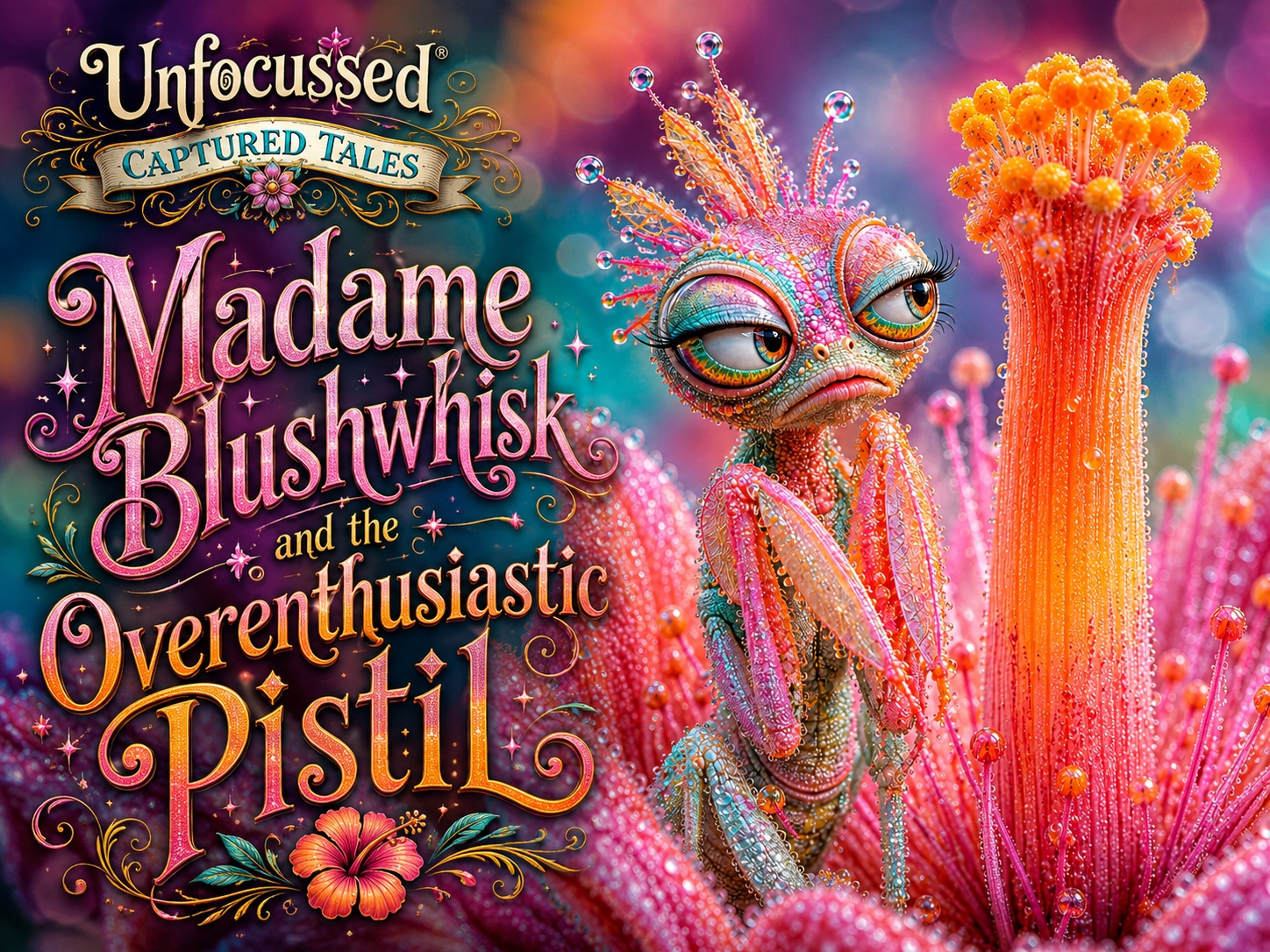
The Grand Bloom Pageant Was Supposed to Be Respectable
Madame Blushwhisk arrived at the Royal Garden precisely seven minutes late, which was, by her own private accounting, the only elegant form of punctuality. Arriving on time suggested desperation. Arriving too late suggested drama. Seven minutes, however, suggested a woman of refinement who had been briefly delayed by either perfume, prophecy, or the need to glare at a mushroom.
In Madame Blushwhisk’s case, it had been the mushroom.
“You are blocking the eastern dew path,” she had informed it.
The mushroom, being a mushroom, had said nothing.
“Typical,” she replied, stepping around it with the slow dignity of someone who had once been described as difficult by a committee of gnats and had worn the comment like a coronet ever since.
Madame Blushwhisk was not merely attending the Grand Bloom Pageant. She was judging it, which meant she had spent the morning polishing her antennae, dusting her wing-veins with rose-pearl shimmer, and practicing expressions suitable for every possible contestant.
For symmetry, she had prepared the impressed blink.
For fragrance, she had prepared the delicate nostril lift.
For overconfidence, she had prepared the slow downward stare.
For vulgarity, she had prepared absolutely nothing, because Madame Blushwhisk believed vulgarity should be met raw, in the moment, with the full sting of natural talent.
The Royal Garden of Petalborne had been transformed for the occasion. Every bloom from the northern trellis to the southern moss pools had been buffed, misted, curled, scented, and fluffed until the whole place looked less like a garden and more like a wedding cake that had developed opinions. Dewdrops hung from curling vines like chandeliers. Butterflies in powdered waistcoats hovered beside velvet ropes. A choir of lacewing larvae hummed a ceremonial overture from inside a bluebell amphitheater, though one of them was clearly flat and far too proud of himself.
At the center of it all stood the Judging Petal, a vast pink hibiscus platform veined in gold and rimmed with tiny crystal droplets. Five chairs had been arranged there for the official panel, though “chairs” was a generous word. They were curled leaves with tassels. Decorative, yes. Stable, absolutely not.
Madame Blushwhisk eyed her assigned seat.
“If this thing dumps me into public foliage,” she murmured, “I will sue the shrubbery.”
Beside her, Lord Fennelthorpe of the East Trellis was already seated, his green waistcoat straining across his belly like it had received bad news. He gave her a stiff nod.
“Madame Blushwhisk. How delightful you could join us.”
“Yes,” she said. “The garden was beginning to lack standards.”
Lord Fennelthorpe coughed into a tiny linen handkerchief.
On her other side sat Miss Mallowmidge, a pale lavender moth with spectacles so large they made her look permanently astonished by the concept of furniture. She clutched her scoring slate against her chest.
“I do hope we have a pleasant competition,” Miss Mallowmidge whispered. “Last year’s pageant was rather tense.”
“Last year’s pageant was a felony with petals,” Madame said.
Miss Mallowmidge blinked. “The marigold merely shed early.”
“The marigold exploded pollen into the duchess’s soup and blamed the wind.”
“Well.” Miss Mallowmidge adjusted her spectacles. “The wind did have a reputation.”
Madame Blushwhisk lowered herself into her leaf-chair and crossed her delicate forelimbs. Her eyes, large and golden and rimmed in painted turquoise, drifted across the stage with the weary suspicion of someone who had seen enough pageantry to know that beauty and good sense rarely attended the same event.
This year’s Grand Bloom Pageant promised to be the most competitive in decades. The winner would receive the Silver Sprinkling Can, a month of premium morning dew, and the right to be called Royal Bloom of the Season, which, in Petalborne, was legally meaningless but socially devastating.
Every flower wanted it.
Every insect wanted to gossip about it.
Every vine wanted to pretend it did not care while slowly creeping closer.
A trumpet beetle waddled onto the stage, lifted a curled lily horn, and blew a note so damp and heroic it sounded like a frog being knighted.
“Honored petals, esteemed pollinators, decorative mosses, visiting dignitaries, and those of you who entered through the compost gate without tickets—welcome to the one hundred and twelfth Grand Bloom Pageant of the Royal Garden!”
The crowd burst into applause. Wings fluttered. Petals trembled. A snail in a top hat waved both eyestalks and looked overcome by civic pride.
Madame Blushwhisk opened her scoring booklet.
At the top of the first page, she had written: Do not be lenient simply because something sparkles.
Under that, she had added: Especially if it sparkles aggressively.
The Contestants Begin Their Nonsense
The first contestant was a moon-white gardenia named Lady Pearlbreath, whose entire presentation consisted of slowly opening, releasing a cloud of expensive fragrance, and making everyone feel underdressed.
Miss Mallowmidge sighed dreamily. Lord Fennelthorpe dabbed at his eyes. Madame Blushwhisk gave a respectable score for scent, a modest score for petal arrangement, and deducted two points for smugness.
“Smugness is not an official category,” Lord Fennelthorpe whispered.
“It should be,” Madame said.
The second contestant was a climbing rose with a dramatic backstory, three backup bees, and a thorn arrangement that spelled out resilience when viewed from above. This would have been impressive if the rose had not insisted on narrating the entire thing herself.
“And here,” said the rose, bending toward the audience, “you see how hardship shaped me.”
“It shaped you into a speech,” Madame murmured.
The third contestant, a blue tulip from the northern shade beds, performed a petal-twist so technically perfect that even Madame had to admit it was elegant. Unfortunately, the tulip’s family had brought banners, and every time she turned, they screamed, “THAT’S OUR BLUEBELL!” though her name was not Bluebell, and she was not, in fact, a bluebell.
By contestant four, Madame had begun to suspect the pageant organizers had confused refinement with prolonged exposure.
Contestant four was a daffodil named Sir Yellowsnap who had somehow secured a tiny smoke machine. He emerged through a golden mist, dipped his trumpet, and announced, “Behold: spring.”
“Spring can behold itself,” Madame said. “Next.”
Contestant five was a violet with stage fright.
Contestant six was a carnation who had clearly misunderstood the assignment and arrived wearing a cape.
Madame scored each with fairness, wit, and just enough cruelty to keep standards alive.
Then the trumpet beetle returned to the center of the stage and consulted his scroll. His antennae twitched. Once. Twice. Then he leaned toward the pageant marshal and whispered something.
The marshal whispered back.
The trumpet beetle went pale around the mandibles.
Madame noticed.
She always noticed the precise moment incompetence began sweating.
“What is happening?” Miss Mallowmidge asked.
“Something with paperwork,” Madame said. “Or prophecy. They smell similar.”
The trumpet beetle cleared his throat.
“Our seventh contestant,” he announced, voice cracking slightly, “is a late addition from the lower hothouse beds. Please welcome… the Marmalade Sunspike Hibiscus.”
A murmur rolled through the garden.
Lord Fennelthorpe stiffened. “The hothouse beds? Are those even eligible?”
“Technically,” said Miss Mallowmidge, flipping through the rules, “any rooted flowering body in good civic standing may compete, provided it has not bitten a judge within three years.”
Madame did not look up from her slate. “A disappointingly low bar.”
The stage lights dimmed.
Somewhere beneath the platform, a drum began to thump.
Not a tasteful drum. Not a ceremonial drum. This was the kind of drum one heard before a traveling magician sawed a radish in half or a scandal entered wearing perfume.
The petals at the back of the stage parted.
At first, only color emerged: hot coral, molten orange, blush pink, and a shimmer of dew so bright it made several aphids gasp and one elderly fern whisper, “Oh dear.”
Then came the bloom.
The Marmalade Sunspike Hibiscus rose from behind the velvet moss curtain in a grand unfurling sweep, its petals wide, glossy, and shamelessly pink, each edge beaded with droplets that caught the light like a thousand tiny witnesses. Its central stalk stood tall, ribbed, glittering, and orange as a sunrise that had been complimented too much as a child.
And at the top of that stalk—bursting upward in a crown of bobbing golden spheres—was the pistil.
The overenthusiastic pistil.
There was no other word for it.
It did not merely exist. It presented.
It did not merely rise. It announced vertical intent.
It did not merely shimmer. It behaved as though the entire Royal Garden had been invented so it could finally have decent lighting.
The crowd went silent.
Somewhere, a moth dropped a canapé.
Miss Mallowmidge made a tiny sound like a kettle losing confidence.
Lord Fennelthorpe’s handkerchief slipped from his fingers.
Madame Blushwhisk stared at the bloom. Then at the pistil. Then at the bloom again.
Her expression did not change.
Not outwardly.
Inside, however, several of her most dignified thoughts had tripped over each other and fallen down a staircase.
“Well,” Lord Fennelthorpe whispered hoarsely.
“Do not say anything foolish,” Madame warned.
“I was only going to say—”
“That sounded like the beginning of foolishness.”
The Marmalade Sunspike Hibiscus completed its unfurling with a flourish. Its petals trembled. Dew rolled dramatically down its central column. The golden tips bobbed in the stage breeze as if greeting old friends in every direction at once.
Then the music stopped.
The silence became enormous.
And into that silence, the bloom gave a little sparkle.
Not a natural sparkle.
A deliberate one.
Madame Blushwhisk narrowed her eyes.
“That flower knows exactly what it is doing.”
The Garden Attempts to Remain Civilized
The pageant marshal, a rigid dragonfly named Captain Thistleclick, marched onto the stage with his clipboard pressed tightly to his chest.
“Contestant seven,” he said, voice strained, “will now proceed with the formal presentation of symmetry, color, fragrance, and central floral architecture.”
At the phrase central floral architecture, the crowd made a collective choking noise.
Madame wrote the phrase down in her booklet and underlined it twice.
Miss Mallowmidge leaned close. “Is that an official category?”
“It is now,” said Madame.
The hibiscus began its routine.
To be fair—and Madame Blushwhisk was always fair, even when she was sharpening her judgment like a cake knife—it was spectacular. The petals opened with astonishing grace, rippling from deep rose at the base to luminous coral along the edges. Dew shimmered across every surface in tiny chains of light. The bloom’s color was rich without being gaudy, bold without becoming loud, radiant without needing to scream, though the pistil had apparently not received that portion of the etiquette manual.
The fragrance arrived next.
It was warm, sweet, and faintly citrusy, with a whisper of honey and rain. Several bees in the front row became emotional. One of them put a wing over his heart and whispered, “I need to call my mother.”
Then came the movement.
The Marmalade Sunspike Hibiscus swayed. Slowly. Elegantly. Almost innocently.
Almost.
The central stalk leaned left.
The golden tips bobbed.
A hundred eyes followed.
The stalk leaned right.
The golden tips bobbed again.
A beetle in the second row fainted backward into a pansy.
Madame Blushwhisk set down her pencil.
“Oh, come now.”
Lord Fennelthorpe’s face had turned a shade of green usually associated with spoiled nectar.
“This is highly irregular.”
“Irregular?” Madame said. “Lord Fennelthorpe, that thing is performing with cheekbones.”
Miss Mallowmidge peered over her spectacles. “Flowers do not have cheekbones.”
“And yet.”
The hibiscus bent forward in what was technically a bow and socially a declaration of war. Dewdrops slid downward in glittering trails. The golden pollen tips quivered. A soft sigh passed through the audience, followed by a scandalized hush as everyone realized they had sighed together.
The trumpet beetle forgot to breathe into his instrument and produced a small squeak.
Captain Thistleclick marched in a tight circle, as though movement alone might restore order.
“Judges,” he called, “please prepare preliminary scoring.”
Madame lifted her pencil.
She had judged crooked roses, vain lilies, fraudulent orchids, and one sunflower that had attempted to bribe her with imported compost. She had once sat through a four-hour fern exhibition titled Humility in Green, which had contained neither humility nor, by the end, much green. She was not easily rattled.
But this hibiscus—this glowing pink hothouse menace with its towering orange nerve—presented a rare problem.
It was inappropriate.
It was ridiculous.
It was absolutely full of itself.
It was also, damnably, magnificent.
Madame stared at the scoring categories.
Symmetry. Excellent.
Color. Absurdly good.
Fragrance. Annoyingly charming.
Dew retention. Unfair advantage, bordering on witchcraft.
Poise. Complicated.
Decorum. In critical condition.
She tapped her pencil against the booklet.
“I refuse,” she said quietly, “to reward a flower for strutting.”
The hibiscus sparkled again.
Madame’s eyes narrowed further.
“Do not sparkle at me.”
Miss Mallowmidge’s wings trembled. “Do you think it heard you?”
“I hope it did.”
The pistil leaned very slightly toward the judges’ platform.
Not enough to be obvious.
Just enough to be rude.
Madame Blushwhisk sat back.
“Oh, we are doing this, are we?”
A Judge With Standards Meets a Bloom Without Shame
Captain Thistleclick announced the next portion of judging: direct inspection.
This was a long-standing pageant tradition in which the judges approached each finalist, examined petal structure, dew distribution, stem posture, and overall presentation, then asked one question about seasonal values. It had been designed centuries ago by a council of elder bees who believed character could be measured by how a flower answered, “What does blooming mean to you?”
Madame believed character could be measured by whether a flower answered in under thirty seconds.
The judges descended from the hibiscus platform and crossed the stage. Lord Fennelthorpe walked as though approaching a tax audit. Miss Mallowmidge fluttered in nervous little hops. Madame Blushwhisk moved with slow precision, every step placed exactly where it meant to be, her pink wing-fronds trailing behind her like stained glass gossip.
The Marmalade Sunspike Hibiscus waited under the lights.
Up close, it was even more outrageous.
The petals were vast and soft-looking, curling upward around the central column in lush folds of rose, coral, and pink. Every surface glistened with dew. The pistil rose from the center like a tower built by someone who had never been told no. Its orange filaments clustered thickly near the top, each tipped with a golden bead that shimmered with pollen and misplaced confidence.
Madame stopped before it.
The pistil bobbed.
She stared.
It bobbed again.
“Enough,” she said.
Lord Fennelthorpe made a strangled noise. “Madame, one does not speak directly to the floral architecture.”
“One does when the floral architecture is acting like it owns a velvet robe.”
Miss Mallowmidge hid behind her scoring slate.
Captain Thistleclick cleared his throat. “Question for contestant seven: What does blooming mean to you?”
The hibiscus rustled. A hush fell. Even the gossip moths stopped whispering, though one continued mouthing things silently to a friend.
The bloom answered in the soft, warm voice of petals brushing in summer rain.
“To bloom,” it said, “is to reveal what the world was not prepared to admire.”
The audience gasped.
Madame Blushwhisk hated that the answer was good.
She hated it immediately.
She hated it with the passion of a woman who had planned to dismiss nonsense and had instead been handed poetry wearing too much shimmer.
Lord Fennelthorpe whispered, “Remarkable.”
“Showy,” Madame said.
Miss Mallowmidge whispered, “But remarkable.”
“Showily remarkable.”
The hibiscus gave another delicate rustle.
“Do you have a question, Madame Judge?”
The crowd stirred.
No contestant addressed Madame Blushwhisk directly unless they were brave, foolish, or already dying.
Madame lifted her chin.
“I do.”
The hibiscus waited.
“Were you aware,” she asked, “when preparing your presentation, that the Grand Bloom Pageant is a competition of elegance, restraint, and botanical grace?”
“Yes.”
“And were you also aware that restraint appears to have left your central region unsupervised?”
A sound shot through the crowd like a dropped tray.
Miss Mallowmidge squeaked.
Lord Fennelthorpe whispered, “Madame!”
Captain Thistleclick’s clipboard snapped in half.
The hibiscus did not wilt.
It did not tremble.
It did not apologize.
Instead, it leaned—just slightly, just terribly—toward Madame Blushwhisk.
“Restraint,” it said, “is often praised by those afraid of being noticed.”
The Royal Garden inhaled.
Madame Blushwhisk’s pupils sharpened.
Somewhere in the crowd, a damselfly whispered, “Oh, it’s dead.”
Madame smiled.
It was not a friendly smile. It was a small, polished thing, like a pearl found inside a warning.
“My dear bloom,” she said, “I have been noticed in better lighting by creatures with stronger stems.”
The audience erupted.
Not into applause. Not exactly.
Into a frenzy of shocked murmurs, wing-flutters, scandalized coughs, delighted gasps, and one snail shouting, “I knew this would be worth the climb!”
The hibiscus shimmered brighter.
Madame held its gaze.
For a moment, the pageant ceased to be a contest between flowers and became something far more dangerous: a contest between a bloom without shame and a judge without patience.
Captain Thistleclick tried to restore order by blowing a whistle, but it came out as a shrill peep. He blew again. Peep. The third attempt produced a sound so pitiful that everyone politely pretended not to hear it.
“Judges will now return to the platform,” he barked, voice wobbling. “Final scoring will commence after a brief dew intermission.”
Madame turned to leave.
Behind her, the hibiscus rustled once more.
“Madame Blushwhisk?”
She stopped.
Slowly, she looked back.
“Careful,” she said. “You are one syllable away from pruning.”
The hibiscus’s golden tips glowed under the pageant lights.
“I look forward to your score.”
Madame’s wings lifted slightly.
“Do not.”
Then she walked back toward the judges’ platform with every eye in the Royal Garden upon her, her expression composed, her posture immaculate, and her thoughts increasingly crowded with one infuriating truth.
The Marmalade Sunspike Hibiscus was a menace.
A preening, glittering, indecently vertical menace.
And unless Madame Blushwhisk found a way to disqualify it on grounds stronger than being personally irritating while gorgeous, it might very well win the Grand Bloom Pageant.
Which, naturally, was unacceptable.
Not because she was flustered.
Absolutely not.
Madame Blushwhisk did not get flustered.
She got strategic.
And as the dew intermission began, as gossip moths scattered through the garden with their tiny mouths already loaded, as Lord Fennelthorpe wheezed into his tea and Miss Mallowmidge stared at her scoring slate like it had betrayed her, Madame opened her booklet to a clean page.
At the top, in neat, furious script, she wrote:
Possible Grounds for Disqualification of Contestant Seven.
She paused.
Then beneath it, she added:
1. Excessive confidence in the central floral region.
She considered this.
Then, with a sniff, she underlined excessive three times.
Across the stage, the overenthusiastic pistil sparkled like it had just won an argument.
Madame Blushwhisk’s smile returned.
“Enjoy yourself,” she whispered. “I have not even begun.”
And somewhere deep inside the Royal Garden, beneath the velvet moss, behind the trellis gates, and far too close to the official prize table, something old and root-bound shifted in the soil as if the pageant’s scandal had awakened more than gossip.
The Grand Bloom Pageant was not merely becoming inappropriate.
It was becoming interesting.
Dew Intermission Was Where Reputations Went to Die
The Royal Garden’s dew intermission had always been a polite little pause in which guests refreshed themselves, judges recalibrated their superiority, and contestants pretended not to stare at each other’s scores. It was meant to be serene. A social misting. A civilized sip between rounds.
This year, it became a full-blown gossip stampede with wings.
The moment Captain Thistleclick announced the break, every gossip moth in Petalborne launched from the audience like a flock of scandalized napkins. They zipped between blossoms, ducked under vines, hovered beside teacups, and distributed three hundred versions of the truth, none of which had been properly inspected for accuracy, dignity, or basic sanity.
“Madame Blushwhisk challenged the pistil to a duel!” whispered one moth.
“No, no, she complimented it in code!” said another.
“I heard the hibiscus winked with its entire center column.”
“Flowers cannot wink with a center column.”
“Not with that attitude.”
Near the refreshment table, a cluster of ladybugs fanned themselves with mint leaves while pretending they had not enjoyed every second of the exchange. Two bumblebees argued over whether “overenthusiastic” was technically a criticism or a lifestyle. A snail in a top hat had somehow acquired a tiny paper cone of roasted seed crumbs and was slowly making his way back toward the best view.
“I knew this would get good,” he muttered, chewing. “Pageants are just lawsuits with petals.”
Madame Blushwhisk remained seated at the judges’ platform, her back straight, her expression cool, and her pencil moving with the cold purpose of a guillotine in formalwear.
Her disqualification page now contained six possible infractions:
1. Excessive confidence in the central floral region.
2. Unauthorized sparkle with intent to distract.
3. Improper leaning toward officials.
4. Public bobbing during a solemn category.
5. Fragrance deployed in a manner bordering on emotional manipulation.
6. General shamelessness, aggravating circumstances.
She had underlined general shamelessness so hard the pencil had nearly punctured the page.
Lord Fennelthorpe leaned toward her, his voice hushed and damp with concern. “Madame, surely you are not seriously considering an official objection.”
“I am considering several,” she said.
“Several objections?”
“Several legal pathways to one objection.”
Miss Mallowmidge clutched her slate. “But the hibiscus scored well. Very well. It had magnificent petal saturation.”
“Petal saturation is not the issue.”
“Its dew retention was extraordinary.”
“Also not the issue.”
“Its answer about blooming was rather beautiful.”
Madame paused.
Only briefly.
“That,” she said, “was the most suspicious thing of all.”
Across the stage, the Marmalade Sunspike Hibiscus stood beneath a curtain of warm light, its petals still gleaming, its orange center still towering, its golden pollen beads still clustered in a crown of glittering misbehavior. It appeared utterly calm. Worse, it appeared pleased.
Madame hated pleased things when they had not earned permission.
The hibiscus caught her looking.
The pistil gave one tiny, radiant bob.
Madame’s pencil snapped.
Miss Mallowmidge flinched. “Oh dear.”
“Fetch me the rulebook,” Madame said.
Lord Fennelthorpe went pale. “The full rulebook?”
“Unless you would prefer I make up law by instinct, which, frankly, might be quicker and more satisfying.”
Captain Thistleclick heard the word rulebook from halfway across the stage and froze with the haunted expression of a dragonfly who had just discovered his afternoon was about to develop paperwork. He marched over, saluted stiffly, and tried to smile. It came out like a grimace wearing boots.
“Madame Judge, might I be of assistance?”
“Yes. Bring me the official Grand Bloom Pageant rulebook, including appendices, buried clauses, ancestral addendums, and any suspicious footnotes written by dead committee members with control issues.”
Captain Thistleclick swallowed. “That volume is rather extensive.”
“So is my patience when threatened by nonsense. Move.”
The captain clicked his heels and hurried away.
Lord Fennelthorpe dabbed his forehead. “This may cause a scene.”
Madame looked around at the swarming gossip moths, the fainted beetle still being revived with smelling salts, the bees composing emotional letters to their mothers, and the overenthusiastic pistil sparkling under the pageant lights like a chandelier with a personal agenda.
“Lord Fennelthorpe,” she said, “the scene has already unpacked, changed clothes, and ordered breakfast.”
The Rulebook Was Worse Than the Flower
The official Grand Bloom Pageant rulebook arrived on a rolling moss cart pushed by two exhausted ants and one intern caterpillar who looked too young to have regrets but had already begun collecting them.
The book itself was bound in pressed bark, trimmed with silver lichen, and large enough to flatten a rude hydrangea. Its title was embossed across the front in curling vine script:
Standards, Traditions, Measurements, Exceptions, Clarifications, Prohibitions, Allowances, and Occasional Threats Pertaining to the Grand Bloom Pageant of Petalborne.
Madame Blushwhisk stared at the cover.
“Who named this, a committee of constipated hedges?”
Captain Thistleclick cleared his throat. “The title was finalized in the eighty-third pageant by the Council of Proper Flowering Bodies.”
“That explains the constipation.”
The captain opened the book with the reverence of a priest handling holy nonsense. Dust rose from the pages. Three nearby gnats sneezed themselves backward into a fern.
Madame flipped through the sections.
There were rules on petal width, rules on acceptable fragrance intensity, rules on dew droplet spacing, rules on root posture, rules on whether a blossom could use backup dancers, rules on cape length after the Carnation Incident of Year Ninety-One, and a full appendix titled Trumpets: Floral, Beetle, and Otherwise.
“Here,” Miss Mallowmidge said, leaning over the book. “Section Eleven: Central Floral Presentation.”
Lord Fennelthorpe made a nervous sound. “Must we call it that?”
“It is the rulebook’s language,” Miss Mallowmidge said.
Madame adjusted her gaze toward the hibiscus. “The rulebook and I are both being generous.”
Section Eleven was written in tiny, fussy script:
All central floral structures must be displayed in a manner consistent with grace, purpose, and the natural dignity of the species. No bloom shall exaggerate, weaponize, dramatize, brandish, waggle, flourish, or otherwise perform its central structure in a manner likely to produce disorder among observers, judges, pollinators, or impressionable seedlings.
Madame’s eyes brightened.
“Weaponize,” she said softly. “There you are, you beautiful little word.”
Captain Thistleclick leaned in. “It does say likely to produce disorder.”
At that exact moment, a damselfly in the audience shouted, “Show us the sparkle again!” and was immediately shushed by twelve aunties and one offended fern.
Madame pointed her broken pencil toward the crowd. “Evidence.”
Lord Fennelthorpe shook his head. “But we must be careful. If you formally accuse contestant seven of indecorous presentation, the old protocols may apply.”
“What old protocols?”
Miss Mallowmidge’s spectacles slid down her nose. “Oh. Oh dear. I had forgotten those.”
“Everyone keeps saying oh dear,” Madame said. “It is becoming less informative each time.”
Captain Thistleclick turned several pages with trembling claws. The paper crackled. The stage lights flickered. Beneath the Judging Petal, somewhere deep in the soil, the old root-bound thing shifted again.
This time, Madame felt it through her feet.
A slow pulse.
A woody groan.
The kind of sound made by something ancient waking up and immediately regretting the state of modern society.
The rulebook fell open by itself.
The pages fluttered though there was no wind.
Then a line of ink darkened across the parchment.
Clause Seventeen-B: The Decorum Trial.
The audience quieted.
Not all at once. Gossip never died instantly. It simply realized something larger than itself had entered the room and pretended it had been listening the whole time.
Captain Thistleclick read aloud, his voice thin.
“Should a judge formally object to a contestant’s central floral presentation on grounds of disorder, indecency, undue spectacle, or other public agitation, the objecting judge must summon the Decorum Trial. The accused bloom shall be tested not for modesty alone, but for purpose, truth, restraint, and the sacred courage of proper blooming.”
Miss Mallowmidge whispered, “Sacred courage. That’s rather lovely.”
Madame gave her a look. “Do not romanticize bureaucracy.”
Captain Thistleclick continued. “If the bloom is found guilty of vain excess, it shall be disqualified and barred from pageantry for one full season.”
The crowd murmured.
The hibiscus did not move.
Madame’s expression sharpened.
“And if the bloom is found innocent?”
Captain Thistleclick hesitated.
“Read,” Madame said.
“If the bloom is found innocent, the objecting judge shall issue a formal apology before the garden and withdraw all deductions related to decorum. Refusal shall require the Sash of Premature Judgment at the next three civic events.”
A gasp ripped through the audience.
The snail in the top hat stopped chewing.
Madame slowly turned her head. “The what.”
Lord Fennelthorpe looked at his lap. “It is lavender.”
Miss Mallowmidge added, “With little bells.”
Madame stared at them both.
“Little bells.”
“Very tiny ones,” Miss Mallowmidge said, as if this improved anything.
Madame closed the rulebook.
It was not a slam. It was too controlled for that. It was a precise, lethal shutting.
Across the stage, the hibiscus’s golden tips shimmered with what looked dangerously like amusement.
“Madame Blushwhisk,” the bloom called gently, “I would hate to see you in bells.”
Madame rose.
The entire Royal Garden held its breath.
“Captain Thistleclick,” she said, “summon the Decorum Trial.”
Captain Thistleclick’s wings rattled. “Are you certain?”
“I have never been less interested in uncertainty.”
Lord Fennelthorpe whispered, “This is unwise.”
Madame looked at the hibiscus, then at the crowd, then at the enormous rulebook written by generations of over-serious foliage.
“Possibly,” she said. “But so is letting a flower flirt with a jury.”
The Root Magistrate Rises
Captain Thistleclick struck the stage three times with the broken end of his clipboard.
“By ancient clause, civic root, pageant soil, and the authority vested in this garden by seventy-seven generations of overly dramatic perennials, the Decorum Trial is summoned!”
For a heartbeat, nothing happened.
Then the prize table exploded.
Not violently. Not dangerously. It simply heaved upward in a shower of moss, ribbon, seed crackers, and one silver serving spoon that went spinning into the air and landed neatly in Lord Fennelthorpe’s tea.
The Silver Sprinkling Can toppled sideways. The ceremonial sash rack collapsed. A decorative topiary swan fainted, which was impressive because it had not previously been alive.
From beneath the prize table rose a vast, twisted root.
It curled upward in coils of dark wood and pale fiber, ancient and knotted, its surface marked with tiny carvings of past pageants: roses, lilies, irises, one suspiciously smug orchid, and at least three committee chairs who had clearly insisted on flattering profiles. At the top of the root, a face opened in the bark: stern eyes, a long ridge of nose, and a mouth drawn thin with centuries of disapproval.
The entire garden bowed.
Even Madame Blushwhisk inclined her head, though only as much as necessary to avoid being technically rude.
Captain Thistleclick dropped to one knee. “Root Magistrate Primula.”
The root’s wooden eyelids creaked open.
“Who,” it groaned, “has disturbed my nap with pageant foolishness?”
Several hundred guests pointed at Madame Blushwhisk.
Madame did not turn around. “Cowards.”
Root Magistrate Primula’s gaze settled on her. “Name yourself, objecting judge.”
Madame stepped forward. “Madame Blushwhisk of the Western Dewline. Certified judge, former etiquette instructor, floral critic, and undefeated survivor of the Orchid Supper of Year One Hundred and Seven.”
The old root blinked. “Ah. That supper was a mess.”
“It was beige violence with garnish.”
Primula’s eyes shifted to the hibiscus. “And the accused bloom?”
The Marmalade Sunspike Hibiscus rustled its petals, unbothered beneath the weight of ancient judgment. “Marmalade Sunspike Hibiscus of the lower hothouse beds.”
“You stand accused of indecorous central floral presentation, undue spectacle, and public agitation.”
The hibiscus’s petals lifted slightly. “I stand accused of standing.”
A delighted murmur moved through the audience.
Madame’s wings flicked. “You know very well there is standing, and then there is whatever your middle is doing with the lighting.”
The hibiscus turned its bloom toward her. “It is called catching the sun.”
“It is called making three bees forget their own names.”
“Perhaps they needed better names.”
The audience made the dangerous little sound of people trying not to laugh in front of authority.
Root Magistrate Primula raised one root tendril.
Silence fell.
“The Decorum Trial shall proceed through three measures,” the magistrate declared. “First: the Mirror of Modest Appearance. Second: the Nectar of True Intention. Third: the Pollinator’s Passage.”
Miss Mallowmidge whispered, “Oh, I’ve read about this.”
“Of course you have,” Madame murmured. “You collect stress academically.”
Primula continued. “The objecting judge shall observe each measure directly. She may question. She may challenge. She may not hide behind taste alone.”
Madame’s eyes narrowed. “Taste is civilization wearing perfume.”
“Taste is often fear with nicer posture,” the root replied.
The garden gasped.
Madame stared at the root.
The root stared back.
For the first time that afternoon, the hibiscus looked fully delighted.
“I like her,” it said.
“Do not bond with the ancient root about me,” Madame snapped.
Primula’s mouth creaked into something almost like a smile. “Begin.”
The Mirror Had Opinions
The Mirror of Modest Appearance rose from the soil beside the stage, carried by two curling vines and framed in white roots. Its surface was not glass but a sheet of still dew stretched impossibly thin, shimmering with silver light. Every creature who looked into it saw not their reflection, but the shape of how they presented themselves to the world.
This, naturally, made half the audience look away immediately.
“The accused bloom shall face the mirror,” Root Magistrate Primula declared. “If its display is vanity without purpose, the mirror will exaggerate it until even the bloom recoils.”
Lord Fennelthorpe nodded gravely. “Very proper.”
Madame did not like that he sounded hopeful. She preferred being the only hopeful person in a room, especially when the hope involved someone else’s downfall.
The Marmalade Sunspike Hibiscus glided toward the mirror, its petals luminous, its central column unapologetically upright. The stage lights reflected in every dewdrop. The golden tips trembled at the top like they were preparing to address a banquet.
Madame folded her forelimbs. “This should be brief.”
The hibiscus faced the mirror.
The dew surface rippled.
For a moment, the reflection showed the bloom exactly as it appeared: pink, orange, shining, enormous, indecently confident.
Then the mirror began its work.
The reflected pistil stretched taller.
The crowd gasped.
It stretched wider.
Miss Mallowmidge squeaked into her slate.
It glittered brighter.
Lord Fennelthorpe whispered, “Merciful mulch.”
The reflection became absurd: a towering orange monument of floral drama crowned with pollen suns, surrounded by trumpets, banners, and tiny cherubs made of nectar mist. A reflected version of the hibiscus appeared beneath it, wearing a jeweled cape, while an entire chorus of bees spelled out BEHOLD in synchronized flight.
Madame’s eyebrows lifted.
“Subtle.”
The real hibiscus stared at its reflection.
Its petals trembled.
The crowd leaned closer.
Then the hibiscus laughed.
It was not a loud laugh. It was a warm rustle, low and petaled, like summer rain hitting a silk canopy.
“That,” said the hibiscus, “is ridiculous.”
The mirror shimmered.
“And?” Root Magistrate Primula asked.
The hibiscus tilted slightly. “And not entirely inaccurate.”
The audience burst into whispers.
Madame’s eyes sharpened. “So you admit vanity.”
The hibiscus turned toward her. “I admit presence.”
“That was not the category.”
“It should be.”
Madame stepped closer. “Presence is not an excuse for spectacle.”
“No,” the hibiscus said. “But spectacle is not always a crime.”
The mirror rippled again.
The absurd reflection dissolved.
In its place appeared the lower hothouse beds.
The entire garden quieted.
The image showed a dim, glass-roofed room at the far edge of Petalborne, where sunlight arrived late and left early. Rows of young blooms grew in crowded trays. Their colors were muted. Their stems bent toward any scrap of brightness. A younger Marmalade Sunspike Hibiscus stood among them, smaller then, its petals still tight, its central stalk barely risen.
A gardener beetle in a gray apron moved through the beds, trimming anything that grew too wild.
“Keep tidy,” the beetle said in the mirror’s memory. “Nobody likes a desperate bloom.”
Madame’s expression did not change, but something behind her eyes paused.
The mirror showed the young hibiscus stretching toward a high window. Bees passed outside, never noticing the lower beds. Pollen went untouched. Fragrance faded in stale air. A small bloom beside the hibiscus wilted before it had ever been seen.
The younger hibiscus stretched higher.
Not elegantly.
Not modestly.
Desperately.
The memory shifted to rainlight, then summer, then the hibiscus growing brighter, taller, louder in color, learning to catch the eye of anything with wings because being overlooked in the hothouse meant being forgotten.
The mirror returned to the present.
The stage remained silent.
Even the gossip moths had the decency to shut their tiny mouths.
Root Magistrate Primula spoke. “The Mirror of Modest Appearance finds vanity present.”
Madame lifted her chin.
Then the root continued.
“But not empty.”
The crowd stirred.
Madame’s mouth tightened.
“That is very convenient.”
The hibiscus watched her. Its voice was softer when it spoke.
“Madame Judge, have you never made yourself brighter because the world tried to make you small?”
It was a dangerous question.
Not because it was flirtatious.
Not because it was clever.
Because it was accurate.
Madame Blushwhisk had once been a nymph in the Western Dewline, all elbows, strange colors, and too-large eyes. She had been told she stared too much, spoke too sharply, shimmered at inappropriate angles, and made older insects uncomfortable by noticing things they hoped would remain unnoticed. So she had polished herself into elegance. Not softness. Not modesty. Elegance. A blade with lacquer.
She had made herself impossible to dismiss.
And now here stood this pink-orange hothouse catastrophe, making itself impossible to ignore by entirely different methods.
Madame hated parallels when they were not pre-approved.
“This trial is not about me,” she said.
The hibiscus’s golden tips bobbed once. “Not yet.”
Madame’s stare could have curdled nectar.
The Nectar Told the Truth and Immediately Regretted It
The second measure was prepared in a silver thimble placed upon a pedestal of curled ivy. From the thimble rose one drop of amber nectar, suspended in the air like a tiny sun.
Root Magistrate Primula gestured with a root tendril. “The Nectar of True Intention reveals whether a bloom seeks admiration for nourishment, connection, joy, survival, arrogance, or mere appetite.”
Lord Fennelthorpe stiffened. “Mere appetite?”
Madame did not look at him. “Try not to faint before the verdict. It would clutter the record.”
The hibiscus leaned toward the nectar.
The drop brightened.
Captain Thistleclick announced, “The objecting judge may ask three questions before the nectar is tasted.”
Madame stepped forward immediately.
“Question one,” she said. “Did you design your presentation specifically to provoke reaction from the crowd?”
The hibiscus answered without hesitation. “Yes.”
The audience erupted.
Madame lifted one forelimb. “There. Done. Thank you all for coming. Please collect your dignity at the exit.”
Root Magistrate Primula’s wooden eyes narrowed. “Continue the measure.”
Madame sighed.
The hibiscus turned toward her. “All flowers provoke reaction. Fragrance, color, shape, height, sweetness, timing. That is half of blooming.”
“There is a difference between attracting pollinators and causing a beetle to fall into a pansy.”
“He seemed comfortable there.”
From the audience, the beetle weakly raised one leg. “It was surprisingly plush.”
Madame ignored him.
“Question two,” she said. “Did you exaggerate your central structure beyond natural necessity?”
The hibiscus’s petals shifted.
“No.”
Madame’s eyes narrowed. “Careful.”
“I grew as I needed to grow.”
“That is not an answer. That is a phrase embroidered on a pillow by someone avoiding accountability.”
The hibiscus’s voice remained calm. “In the lower hothouse, small blooms were missed. Quiet blooms were passed over. Tidy blooms died politely. I learned that if I wanted bees, light, water, or even room to breathe, I had to become unmistakable.”
The nectar drop pulsed.
Gold light spread through it.
Miss Mallowmidge whispered, “The nectar accepts that.”
“The nectar is impressionable,” Madame said.
Root Magistrate Primula rumbled, “The nectar is older than your sarcasm.”
“So are stones, and I do not ask them for pageant scores.”
The old root’s mouth creaked.
It might have been irritation.
It might have been amusement.
With ancient roots, the two often shared a face.
Madame stepped closer to the hibiscus. “Question three.”
The garden leaned in.
The hibiscus lowered slightly toward her, which was unnecessary, dramatic, and did not help matters.
Madame held its gaze. “If you win, what do you intend to do with the title Royal Bloom of the Season?”
The answer came softer than expected.
“Open the lower hothouse to the morning path.”
A murmur moved through the crowd.
Even Captain Thistleclick blinked.
The hibiscus continued. “The lower beds receive leftover water, late sun, and whatever attention remains after the upper garden has finished congratulating itself. If I win, the title grants one civic request. I will request that the shade glass be lifted and the hothouse path restored.”
Madame said nothing.
The nectar drop glowed brighter.
Lord Fennelthorpe shifted uncomfortably. “I was not aware the lower hothouse path had been closed.”
“Most upper petals are unaware of anything below their own fragrance,” the hibiscus said.
Several roses took offense at this, mostly because it was true.
Madame felt the garden watching her now. Waiting. Hoping, perhaps, for softness. Or surrender. Or some teary little moment where she admitted she had misjudged the bloom and embraced public growth like a damp pamphlet.
Absolutely not.
She was moved, not ruined.
There was a difference.
“A noble intention,” she said at last.
The hibiscus seemed almost surprised.
Then Madame added, “Wrapped in a great deal of public wiggling.”
The hibiscus’s petals lifted. “I do not wiggle.”
“You absolutely wiggle.”
“I sway.”
“You sway with witnesses.”
The nectar drop quivered as if trying not to laugh.
Root Magistrate Primula gestured. “The accused bloom will taste.”
The hibiscus drew the suspended nectar into its petals. For a moment, golden light traveled through its veins, illuminating every rib and droplet. The central column glowed from base to crown, not with vanity, but with memory: hothouse dimness, closed paths, overlooked seedlings, the fierce stubbornness of survival dressed as spectacle.
The nectar spoke in a voice like bees inside amber.
“Intention: nourishment, recognition, restoration, pride.”
Madame tilted her head. “Pride?”
The nectar pulsed.
“Pride is not guilt.”
Madame looked deeply offended by the nectar’s tone.
“Everything is giving speeches today.”
Root Magistrate Primula announced, “The second measure does not convict.”
The crowd began to buzz.
Not with certainty now, but with complication. The worst kind of buzz. Simple gossip had turned into moral conversation, and everyone hated when a scandal developed roots.
The Proper Petals Panic
While the judges and the accused bloom prepared for the final measure, trouble sprouted near the contestant waiting area.
Lady Pearlbreath the gardenia stood beneath a lace parasol, surrounded by a cluster of upper-bed contestants who had discovered, to their horror, that the Marmalade Sunspike Hibiscus was no longer merely inappropriate. It was sympathetic.
Sympathy was dangerous.
Sympathy won pageants.
Worse, sympathy made rich flowers look like furniture.
Sir Yellowsnap the daffodil paced in a cloud of leftover stage smoke. “This is outrageous. The lower hothouse cannot simply waltz into the pageant with a glowing tower and a tragic backstory.”
The carnation in the cape nodded. “Some of us practiced.”
A rose with thorn-banners whispered, “My hardship choreography took six weeks.”
Lady Pearlbreath narrowed her creamy petals. “We cannot allow contestant seven to reach the Pollinator’s Passage unchallenged.”
“Isn’t the entire point of the trial to challenge it?” asked the violet with stage fright.
Everyone looked at her.
She shrank behind a leaf. “Sorry.”
Lady Pearlbreath leaned closer to the group. Her fragrance intensified, which meant she was either plotting or had just insulted someone internally.
“The Pollinator’s Passage tests whether pollinators approach from genuine attraction or confusion. If the bees choose the hibiscus, it will be nearly impossible to disqualify.”
Sir Yellowsnap lowered his trumpet. “Then the bees must not choose it.”
The carnation’s cape fluttered. “Are we speaking metaphorically?”
“No,” Lady Pearlbreath said. “We are speaking competitively.”
From beneath her parasol, she produced a tiny vial of powdered frostmint.
The others gasped.
Frostmint was not illegal. Not technically. It was often used to calm overheated petals, freshen wilted arrangements, and give elderly ferns the illusion of purpose. But to bees, frostmint muddled scent trails. Too much of it could send a pollinator toward a decorative cabbage and convince him he had made a romantic decision.
The violet whispered, “That seems wrong.”
Lady Pearlbreath smiled sweetly. “Wrong is such an ugly word. I prefer corrective atmospheric balance.”
Before the violet could object, a shadow fell over the group.
Madame Blushwhisk stood behind them.
No one had heard her approach.
Madame had spent years perfecting silent judgment. It was useful in hallways, dinner parties, and any situation involving cowards with vials.
“Corrective atmospheric balance,” she repeated.
Lady Pearlbreath stiffened. “Madame Judge.”
Madame looked at the vial. Then at the contestants. Then back at the vial.
“How fascinating. I was under the impression this was a pageant, not a perfume-based mugging.”
Sir Yellowsnap’s trumpet dipped. “We were merely discussing garden fairness.”
“Were you? Because fairness rarely arrives in a tiny bottle looking guilty.”
Lady Pearlbreath tucked the vial behind a petal. “You misunderstand.”
“I doubt it. Misunderstanding usually requires less evidence.”
The carnation whispered, “Should we run?”
Madame turned her gaze toward him. “In that cape? Not far.”
The carnation wilted slightly.
Lady Pearlbreath recovered herself with the smooth arrogance of a flower accustomed to being called graceful by creatures too polite to mention manipulation. “Madame, surely you do not want that hothouse spectacle to win.”
Madame’s eyes narrowed. “Do not mistake my objection for an invitation to cheat.”
“But you filed the trial.”
“I filed a trial because I believe standards matter.”
Lady Pearlbreath’s smile sharpened. “So do we.”
“No,” Madame said. “You believe status matters. Standards are what status puts on when it wants to look useful.”
The group fell silent.
For a moment, Lady Pearlbreath’s petals lost their perfect arrangement.
Madame extended one clawed forelimb. “The vial.”
“You cannot confiscate private property.”
“Watch me bloom into a problem.”
Lady Pearlbreath hesitated.
Then, from the side, the Marmalade Sunspike Hibiscus rustled.
It had approached during the exchange, towering pink and orange behind Madame like a sunset with excellent timing.
“I wondered why your fragrance had teeth,” the hibiscus said.
Lady Pearlbreath flushed ivory. “You have no proof.”
Madame plucked the vial from behind the gardenia’s petal and held it up to the light.
“Proof,” she said.
Captain Thistleclick came skittering over. “What is happening?”
“Corrective atmospheric balance,” Madame said. “With intent to be a little snake.”
Captain Thistleclick blinked. “Is that a formal charge?”
“It can be if you write quickly.”
The gardenia sputtered. “This is humiliating.”
“Yes,” Madame said. “But unlike your plan, it is deserved.”
The hibiscus looked down at Madame, its petals glowing with an expression dangerously close to admiration.
“You defended me.”
Madame did not turn around. “I defended the trial.”
“Of course.”
“And the bees.”
“Naturally.”
“And the concept of not being a fragrant little fraud.”
“A noble cause.”
Madame finally looked up at the hibiscus. “Do not make this tender.”
The hibiscus’s golden tips bobbed. “Wouldn’t dream of it.”
“You absolutely would.”
“Perhaps a little.”
Madame stared at it for three full seconds.
Then she said, “I still think your pistil is showing off.”
“It is.”
Madame blinked.
The hibiscus continued, “But now you know why.”
For once, Madame had no immediate reply.
This annoyed her more than the original bobbing.
The Pollinator’s Passage Begins Badly
The final measure took place at the center of the garden, where Root Magistrate Primula raised a circular archway of woven vines. It formed a tunnel from the contestant stage to the old fountain, lined with open blossoms, hanging droplets, and little bells that chimed whenever a wing passed through. At the far end waited the official pollinators: seven bees, three butterflies, one hummingbird moth with dramatic eyebrows, and a beetle who insisted he was there in a professional capacity despite having fainted earlier.
“The Pollinator’s Passage,” Primula announced, “reveals whether attraction is true, useful, and mutual. The bloom shall enter the passage without theatrical enhancement. The pollinators shall choose freely.”
Madame stood beside the arch with her scoring booklet pressed to her chest.
The Marmalade Sunspike Hibiscus waited at the entrance.
“Without theatrical enhancement?” Madame said, glancing upward.
The hibiscus’s petals fluttered. “This is my natural state.”
“Your natural state requires a permit.”
“Your commentary requires a cushion.”
“For what?”
“The fainting it causes in weaker personalities.”
Madame looked toward Lord Fennelthorpe.
Lord Fennelthorpe immediately pretended to read the rulebook upside down.
Root Magistrate Primula raised a tendril. “The objecting judge must accompany the accused bloom through the passage.”
Madame’s head snapped around. “Excuse me?”
“The protocol binds accuser to evidence.”
“The evidence is seven feet tall and glittering.”
“Then you should not lose it.”
A ripple of laughter moved through the audience.
Madame took one step toward the root. “Magistrate, I respect ancient traditions when they are useful, decorative, or safely dead. This one appears to be none of the above.”
Primula’s eyes narrowed. “Do you withdraw your objection?”
The Sash of Premature Judgment hung nearby on its rack, lavender and hideous, with tiny silver bells stitched along the edges.
A breeze moved through the bells.
They jingled.
Madame recoiled as if struck.
“I will accompany the bloom.”
The hibiscus rustled. “How brave.”
“How temporary,” Madame said.
They entered the passage together.
The crowd leaned in from every side. Bees lifted from their perches. Butterflies fanned their wings. The hummingbird moth hovered with the seriousness of a tiny judge wearing invisible robes.
At first, everything seemed controlled.
The hibiscus moved slowly, petals open but not flaring. Its central column stood tall, yes, and gleamed, yes, and caught every available sunbeam like it had bribed the sky, yes, but it did not lean. It did not bob. It did not sparkle on purpose.
Mostly.
Madame walked beside it, watching with intense suspicion.
“You are trying very hard,” she said.
“I was told restraint mattered.”
“It does.”
“It itches.”
“Good. That means it is working.”
The first bee entered the passage.
He circled once, sniffed the air, and flew directly toward the hibiscus. He landed on a lower petal, collected pollen with solemn enthusiasm, and hummed approvingly.
The bells chimed.
The second bee followed.
Then the third.
A butterfly drifted in, touched down delicately near the central column, and fanned its wings in delight. The hummingbird moth zipped forward, hovered, reversed, hovered again, then announced, “Efficient access, strong scent clarity, excellent visual markers.”
Madame wrote: Pollinator response unfortunately positive.
The hibiscus looked pleased.
“Do not,” Madame said.
“I did not say anything.”
“Your petals did.”
“They are expressive.”
“They are smug.”
“They learned from your eyebrows.”
Madame’s pencil paused.
“Careful, hothouse.”
The hibiscus’s voice lowered. “Careful, Madame.”
For one ridiculous moment, the air between them shimmered with something that was not quite rivalry, not quite flirtation, and certainly not appropriate for a civic proceeding overseen by an ancient root.
Then the frostmint hit.
It came as a pale blue puff from somewhere behind the contestant line, drifting into the passage on a hidden current. The scent sliced through the hibiscus’s warm citrus fragrance, sharp and cold. The bees wobbled midair. One butterfly veered sideways into a bell. The beetle declared, “I love cabbage,” and staggered toward a decorative kale arrangement.
Captain Thistleclick shouted, “Interference!”
The crowd erupted.
Madame spun toward the source.
Lady Pearlbreath stood at the edge of the stage, eyes wide with false innocence. Sir Yellowsnap’s smoke machine wheezed behind her, exhaling the last of the frostmint cloud through its trumpet nozzle.
“Oh, you powdered little goblin,” Madame hissed.
The hibiscus swayed as the confused pollinators scattered.
Root Magistrate Primula’s voice thundered through the garden. “The passage has been corrupted.”
The vines of the arch tightened.
The bells clanged wildly.
The old fountain at the far end cracked open with a burst of silver light.
Madame’s feet shifted as the stage trembled. The hibiscus leaned to shield her from falling droplets and splintering vine bits, which she noticed and immediately resented because gratitude was inconvenient during an objection.
The Silver Sprinkling Can, still lying near the ruined prize table, began to glow.
Primula’s wooden face darkened. “The trial cannot conclude under interference. Ancient pageant law requires restoration.”
Captain Thistleclick shouted over the chaos, “What kind of restoration?”
The root magistrate turned slowly toward Madame Blushwhisk and the Marmalade Sunspike Hibiscus.
“The accused bloom and the objecting judge must complete the passage together by carrying the true scent through the corrupted air.”
Madame stared. “Carrying it how?”
The root lifted a tendril toward the hibiscus’s glowing center.
“The judge must ascend to the crown, gather the untainted pollen, and release it at the fountain before the frostmint takes hold.”
The entire garden froze.
Every eye turned to Madame.
Then to the towering orange pistil.
Then back to Madame.
The snail in the top hat whispered, “Oh, this is better than the climb.”
Madame Blushwhisk looked up.
The golden pollen crown shimmered far above her, delicate, bright, and perched atop the very floral structure she had spent the afternoon trying to have condemned.
The hibiscus lowered its petals slightly, offering a path of dew-slick folds and ribbed orange ridges.
“Madame Judge,” it said softly, “I promise not to sparkle excessively.”
Madame’s eyes narrowed into slits.
“If I fall,” she said, “I am haunting your roots.”
“Understood.”
“If you bob while I am up there, I will turn your entire lower hothouse into a cautionary legend.”
“Perfectly fair.”
“And if one gossip moth describes this as romantic, I am burning the newsletter.”
From the crowd, six gossip moths discreetly tucked away their pencils.
The frostmint cloud thickened. The bees drifted farther from the hibiscus, confused and drowsy. The fountain’s silver light flickered.
Root Magistrate Primula’s voice lowered. “Choose, Madame Blushwhisk. Withdraw, and the trial fails. Continue, and the truth may yet be restored.”
Madame looked at the ugly lavender sash with its tiny bells.
She looked at Lady Pearlbreath, whose innocent face deserved a strongly worded thunderstorm.
She looked at the lower hothouse reflected in memory: dim glass, closed paths, small blooms bending toward a light that did not come.
Then she looked at the overenthusiastic pistil.
“I still think you are excessive,” she said.
The hibiscus’s petals warmed. “I know.”
Madame climbed onto the first pink petal.
The crowd gasped as one.
She gripped a dew-beaded ridge, lifted herself with all the dignity possible while scaling a public flower under emergency legal conditions, and began her ascent toward the golden crown.
Halfway up, the hibiscus whispered, “For the record, you are handling this with tremendous grace.”
Madame did not look down.
“For the record,” she said, “you are one compliment away from becoming mulch.”
The hibiscus smiled in petals.
Above them, the pollen crown glowed.
Below them, the fountain cracked wider.
And behind the frostmint haze, Lady Pearlbreath’s lace parasol tilted as something darker than jealousy moved through the upper petals: the old fear of being outshone, outgrown, and finally seen for what it was.
Madame Blushwhisk neared the top just as the entire archway snapped shut behind them.
The Pollinator’s Passage had become a cage.
And the overenthusiastic pistil, for once in its dramatic life, stood perfectly still.
The Climb Was Not Romantic, According to Madame
Madame Blushwhisk had endured many indignities in her life.
She had once judged a chrysanthemum recital where every bloom insisted on speaking in metaphor. She had survived a twelve-course nectar luncheon hosted by a lily who believed silence was rude and conversation was exercise. She had been trapped in a rain barrel with three drunk june bugs and a motivational frog. She had even, in her youth, modeled for a series of etiquette pamphlets titled Appropriate Wing Placement in Mixed Company, which remained the single darkest chapter of her public career.
But scaling an accused hibiscus during an emergency Decorum Trial while half the Royal Garden stared up at her underskirts of wing-frond was an entirely new category of nonsense.
“Nobody is enjoying this,” she called down.
The snail in the top hat lifted one eyestalk. “I am trying not to visibly enjoy it.”
“Fail quieter,” Madame snapped.
The Pollinator’s Passage had sealed shut around them, its woven vines crossing overhead and locking together like the ribs of a green cage. Frostmint haze crawled along the floor in pale blue coils, sharp and cold, muddling the bees, stunning the butterflies, and making one confused beetle continue his doomed courtship with the decorative cabbage.
At the far end, the old fountain split wider, silver light pulsing from inside its cracked stone bowl. Root Magistrate Primula’s tendrils were wrapped around the archway, holding the ancient trial together by sheer woody irritation.
“Madame Blushwhisk,” Primula called, voice rumbling through bark and soil, “the untainted pollen must reach the fountain before the frostmint corrupts the passage completely.”
Madame gripped a ribbed orange ridge with one claw and glared downward.
“Yes, thank you, Magistrate. I had not forgotten the part where I am required to personally rescue public decency by climbing the problem.”
The Marmalade Sunspike Hibiscus stood beneath her, perfectly still. Its petals were curved upward in a supportive bowl of pink and coral, dew glittering along every edge. Its central column rose steady as a tower, crowned high above by golden pollen beads that glowed warm against the cold haze.
“You are doing well,” the hibiscus said softly.
“Do not narrate me.”
“I was only—”
“You were only producing words near my concentration.”
“Understood.”
Madame climbed higher.
The surface beneath her was slick with dew, warm from captured sunlight, and faintly fragrant with citrus-honey bloom. She refused to think about the absurd intimacy of it. This was not a romantic moment. This was a legal procedure with unfortunate height. Anyone who described it otherwise would be fed to a carnivorous begonia with confidence issues.
The golden crown shimmered above her.
One pollen bead drifted loose and floated down past her face.
Madame snatched it from the air.
It glowed in her palm, warm and bright, smelling not merely of sweetness but of open glass, morning path, lower hothouse dust, and the stubborn little ache of wanting to be seen.
Her expression softened.
Only slightly.
Only where no one could see.
Then the hibiscus shifted.
Barely.
A tremor ran through the column.
Madame flattened herself against the orange ridge with an undignified squeak she hoped no one would ever prove had come from her.
“You bobbed.”
“I did not bob,” said the hibiscus, strained. “Something struck my roots.”
Below, the frostmint haze thickened into a rolling cloud. Inside it, Lady Pearlbreath’s powdered scent sharpened again. The gardenia stood outside the cage with Sir Yellowsnap beside her, his smoke machine sputtering behind a row of ornamental ferns.
Captain Thistleclick pointed his broken clipboard like a sword. “Stop interfering with the trial!”
Lady Pearlbreath widened her petals in offended innocence. “Captain, I am merely standing here, being naturally fragrant and socially concerned.”
Madame shouted from high on the hibiscus, “You are one parasol away from becoming compost with accessories!”
The crowd gasped.
The carnation in the cape whispered, “I think she means it.”
“She always means it,” Miss Mallowmidge whispered back, clutching her slate with shining eyes. “That is one of her gifts.”
Lady Pearlbreath’s creamy petals tightened. Her polite mask began to crack, and beneath it was not elegance at all, but panic. Pure, bitter, upper-bed panic. The kind that made old flowers clutch old titles and call it tradition.
“This is not a trial anymore,” Lady Pearlbreath cried. “This is a spectacle! Look at them! A judge climbing a hothouse bloom’s center column in front of children, widows, and several unpaid interns!”
The intern caterpillar raised one leg. “I’m actually getting course credit.”
“Silence,” Lady Pearlbreath snapped.
Root Magistrate Primula’s eyes darkened. “Gardenia, you have already fouled the air once.”
“I corrected the air,” Lady Pearlbreath said. “Someone had to. Petalborne is being asked to admire a bloom that does not know its place.”
The words struck the garden harder than any frostmint.
The bees stopped drifting.
The butterflies stilled.
Even the decorative cabbage beetle paused, one leg romantically draped over a kale leaf, as if the stupidity in the air had finally become too dense to ignore.
Madame Blushwhisk looked down from the glowing column.
Her golden eyes sharpened.
“There it is,” she said.
Lady Pearlbreath’s petals fluttered. “There what is?”
“The rot under the perfume.”
The crowd murmured.
Madame pulled herself onto a higher ridge, now almost level with the pollen crown. Frostmint curled up around her ankles, biting cold through her delicate legs. The hibiscus trembled again, but held firm.
“You do not object to spectacle,” Madame called. “You object to spectacle from below the terrace.”
Lady Pearlbreath’s fragrance soured.
“Do not twist my words.”
“My dear, your words arrived twisted. I am merely displaying them.”
A ripple of shocked delight moved through the garden.
Lord Fennelthorpe blinked as if a curtain had opened behind his forehead. “Good heavens.”
Miss Mallowmidge whispered, “She’s right.”
“Of course she is,” said the snail, now fully invested. “She’s rude, not wrong.”
Madame reached the crown.
Up close, the golden beads were breathtaking. Each one trembled with pollen, but not the dusty, careless kind that left smudges on napkins and reputations. This pollen glowed like bottled morning. It carried the hibiscus’s true scent: citrus, rain, warm glass, stubborn pride, and the yearning of every lower-bed bloom that had ever stretched toward a closed path.
The frostmint surged.
The golden beads dimmed.
Madame lifted both forelimbs and gathered the pollen against her chest.
It stuck to her blush-pink whiskers.
It dusted her face.
It clung to the tips of her antennae in bright golden specks.
The crowd went silent.
Madame Blushwhisk, certified judge, former etiquette instructor, floral critic, and sworn enemy of unnecessary public bobbing, now looked as though she had lost a wrestling match with a sunbeam.
The hibiscus looked up carefully.
“Madame.”
“Not a word.”
“You have pollen on your—”
“I said not a word.”
“It is very becoming.”
The silence deepened.
Madame looked slowly down.
“After I save this trial,” she said, “I am going to insult you so thoroughly your seedlings will feel drafty.”
“I accept.”
“You should not.”
The Fountain Demanded Drama, Naturally
Getting up the pistil had been humiliating.
Getting down was worse.
The archway cage trembled as Lady Pearlbreath’s frostmint cloud pressed against the vines. Bells chimed frantically. Pollinators stumbled in woozy loops, their tiny bodies confused between true scent and cold deception. Root Magistrate Primula held the trial open, but ancient bark had limits, and those limits were apparently being tested by pageant sabotage and one woman’s refusal to let anyone win too easily.
“The pollen must be released at the fountain,” Primula thundered.
Madame glanced toward the cracked stone bowl at the far end of the passage. It was only a few body lengths away from the hibiscus, but between her and it lay slick petals, frostmint haze, tangled vines, confused bees, and the terrible possibility of being seen scrambling.
“I could fly,” Madame muttered.
The frostmint cloud lashed upward.
Her wings stiffened in the cold. The delicate fronds that usually shimmered with rose and turquoise light clung damply together.
“Of course,” she said. “Why should dignity have support structures?”
The hibiscus lowered its petals one by one, creating a sloping path toward the fountain.
“Use me,” it said.
Madame froze.
The garden froze.
Six gossip moths nearly exploded from the effort of not writing.
The hibiscus seemed to realize what it had said and added quickly, “As a bridge.”
Madame closed her eyes.
“Every word today has been a trap.”
“A floral bridge,” the hibiscus clarified.
“Stop helping.”
There was no better option.
Madame tucked the glowing pollen against herself and slid down the first petal with as much poise as could be managed by someone descending a scandal under combat conditions. Dew streaked beneath her feet. The hibiscus held steady, angling its petals to guide her. When one petal buckled under a blast of frostmint, the central stalk leaned—not flamboyantly, not rudely, but protectively—blocking the cold cloud from striking her full in the face.
Madame noticed.
Again.
Gratitude was becoming a nuisance.
“You are leaning,” she said.
“Defensively.”
“I did not approve defensive leaning.”
“File it after survival.”
She slid to the next petal.
The crowd cheered.
“Do not cheer,” Madame shouted. “This is not acrobatics. This is governance.”
The snail waved his seed cone. “Best governance I’ve ever seen!”
At the entrance of the passage, Captain Thistleclick and two ants wrestled with Sir Yellowsnap’s smoke machine. The daffodil clung to it desperately.
“It is stage property!” he cried.
Captain Thistleclick yanked the nozzle free. “It is evidence!”
“It has emotional value!”
“So will your confession!”
Miss Mallowmidge, trembling but determined, fluttered toward Lady Pearlbreath with her scoring slate held like a shield.
“Lady Pearlbreath, you must stop this.”
The gardenia turned on her. “Stay out of this, little moth.”
Miss Mallowmidge flinched.
For a moment, she looked exactly like everyone expected her to look: nervous, soft, made mostly of apologies.
Then she straightened.
“No.”
The word was small.
But it landed.
Lord Fennelthorpe looked over, startled.
Miss Mallowmidge adjusted her enormous spectacles. “I said no. I have listened to upper-bed flowers define grace as whatever keeps them comfortable for too many seasons. This pageant is not yours simply because your ancestors spent the longest time blocking the light.”
A gasp rolled through the audience.
Madame, halfway down a hibiscus petal, glanced over.
“Well done, Mallowmidge!”
Miss Mallowmidge flushed lavender. “Thank you!”
Lady Pearlbreath’s petals shook with fury. “You insignificant little—”
“Finish that sentence,” Madame called, “and I will make your epitaph rhyme with mildew.”
Lady Pearlbreath stopped.
The hibiscus whispered, “That was very good.”
Madame slid down another petal. “I have range.”
The fountain pulsed brighter.
Its cracked rim opened like a stone flower, revealing a hollow basin lined with old silver moss. At its center, one clear droplet hovered, waiting for the true pollen.
Madame reached the final petal bridge.
The frostmint cloud surged one last time, pushed by the broken smoke machine as it spat its remaining powder into the passage. The cold gust hit the hibiscus hard. Its petals shuddered. Its central column bent.
The pollen in Madame’s arms flickered.
She lost her footing.
The crowd screamed.
Madame slipped off the edge of the petal.
For one terrible second, she fell.
Then a golden filament curled around her waist.
The overenthusiastic pistil, previously condemned for excessive confidence in its central floral region, had reached out with one flexible pollen-bearing tendril and caught her midair.
The garden went completely silent.
Madame hung there, pollen clutched to her chest, one antenna bent, her expression carved from absolute murder.
The hibiscus held very still.
“Madame,” it said carefully.
“Do not,” she said.
“I caught you.”
“I am aware.”
“You are safe.”
“Temporarily.”
“Would you like me to set you down?”
“I would like everyone here to develop sudden amnesia.”
The snail whispered, “Not happening.”
The hibiscus lowered her gently onto the fountain’s rim.
Madame landed, straightened her posture, adjusted one damp wing-frond, and behaved as though being rescued by the very botanical appendage she had tried to legally shame was simply another refined pageant custom.
“Thank you,” she said.
The hibiscus seemed stunned.
Madame did not look at it.
“Do not make me repeat myself. The first one was already violent.”
The hibiscus’s petals glowed.
Madame turned to the fountain.
The frostmint haze closed around the cage. The true scent in her arms dimmed to a fragile gold.
She lifted the pollen high.
“For the record,” she said loudly, “I objected to contestant seven on grounds of indecorous spectacle.”
Root Magistrate Primula watched in silence.
The garden held its breath.
Madame looked back at the hibiscus.
“I maintain that the spectacle is indecorous.”
The hibiscus bowed its bloom slightly.
“Fair.”
Madame’s mouth twitched.
“However,” she continued, “I withdraw the accusation that it is empty.”
The hibiscus stilled.
“The display is excessive,” Madame said. “Frequently smug. Occasionally unbearable. It has the restraint of a trumpet in a pantry and the subtlety of a chandelier falling down stairs.”
A few bees nodded as if taking notes.
“But it is not vain excess without purpose. It is a survival strategy. A signal. A declaration from the lower beds that being overlooked is not the same as being unworthy.”
Lady Pearlbreath hissed, “You cannot be serious.”
Madame turned her head.
“I can be many terrible things, Lady Pearlbreath. Serious is one of the quieter ones.”
Then Madame released the pollen.
The golden dust fell into the hovering droplet.
For one breath, nothing happened.
Then the fountain erupted upward in a column of warm light.
The True Scent Restores the Passage
The light did not blast through the garden. It bloomed.
It opened in layers: gold first, then coral, then pink, then a bright orange shimmer that rose like sunrise through glass. The fountain’s cracked stone petals unfolded, spilling warm mist into the Pollinator’s Passage. The frostmint haze recoiled as though offended by sincerity.
The true scent spread.
It was not overpowering. It did not shove itself into anyone’s face, despite coming from a bloom very capable of face-shoving as an art form. It moved gently but firmly through the air, clearing the cold confusion, waking the bees, steadying the butterflies, and reminding the beetle that the decorative cabbage, while supportive, was not emotionally available.
He stepped away from it with dignity. “We will always have kale.”
The bells of the passage stopped clanging and began to chime in harmony. The vines loosened. The cage reopened into an arch. Pollinators lifted into the restored air, following the true scent not because they were dazzled, tricked, or emotionally blackmailed, but because it was clear, nourishing, and real.
One bee landed on the hibiscus.
Then another.
Then all seven.
The butterflies followed, touching down on petals and sipping delicately. The hummingbird moth hovered at the glowing crown, nodded once with professional severity, and announced, “Excellent recovery under hostile atmospheric conditions.”
Captain Thistleclick immediately wrote that down, though his clipboard was still broken and he had to use the back of Sir Yellowsnap’s confiscation notice.
Root Magistrate Primula rose higher, tendrils unfurling through the stage.
“The Pollinator’s Passage is restored,” she declared. “The final measure finds attraction true, useful, and mutual.”
The audience erupted.
This time it was applause. Real applause. Wings thundered. Petals clapped against stems. Bees hummed. The snail waved his top hat so hard he nearly toppled backward, which would have delayed him several hours and possibly become a separate folk song.
Madame Blushwhisk stood on the fountain rim, dusted in golden pollen, damp from dew, one antenna still bent at a rebellious angle. She looked like a sacred garden icon who had just finished threatening the painter.
The Marmalade Sunspike Hibiscus bowed toward her.
Not the earlier bow.
Not the rude one.
This was careful. Grateful. Still dramatic, because the bloom had not been replaced by a different personality, but less like a taunt and more like an offering.
Madame inclined her head.
“Adequate,” she said.
The hibiscus’s petals rustled with laughter.
“From you, I assume that is a sonnet.”
“Do not get greedy.”
Root Magistrate Primula turned to Lady Pearlbreath.
The gardenia had gone pale enough to look like a napkin at a funeral.
Sir Yellowsnap attempted to hide behind his smoke machine, forgetting it had been confiscated.
Captain Thistleclick marched them both forward. The carnation in the cape followed voluntarily, whispering, “I only watched. And the cape is unrelated.”
Primula’s wooden eyes narrowed.
“Lady Pearlbreath of the upper beds. Sir Yellowsnap of the eastern daffodil line. You are found guilty of corrupting a Decorum Trial, interfering with pollinator passage, and attempting to preserve false status through scent-based cowardice.”
The crowd murmured with satisfaction.
Lady Pearlbreath lifted her petals. “I acted to preserve tradition.”
Madame stepped down from the fountain rim and walked toward her.
Every eye followed.
“No,” Madame said. “You acted to preserve comfort. Tradition is what cowards call comfort when they want it guarded by law.”
Root Magistrate Primula’s mouth creaked again.
This time it was definitely amusement.
“The gardenia and daffodil are disqualified,” Primula declared. “They shall perform three weeks of service in the lower hothouse beds, including shade-glass cleaning, path restoration, and apology distribution.”
Sir Yellowsnap gasped. “Manual labor?”
Madame looked at him. “Try not to describe it like a haunted object.”
Lady Pearlbreath trembled. “I will appeal.”
“Good,” said Primula. “The appeals office is a fern who only opens on foggy Thursdays.”
Lady Pearlbreath wilted.
The gossip moths wrote furiously.
Madame turned to them. “Use the phrase scent-based cowardice accurately or not at all.”
Six moths nodded so hard their pencils blurred.
The Verdict Requires an Apology, Unfortunately
Once the passage reopened and the frostmint cleared, the garden reset itself as best it could. The prize table was reconstructed by ants, though it leaned slightly to the left and seemed emotionally changed. The Silver Sprinkling Can was polished. The lavender Sash of Premature Judgment remained on its rack, hideous and jingling with malicious possibility.
Madame Blushwhisk eyed it.
The sash jingled in the breeze.
“Do not look smug,” she told it.
Miss Mallowmidge hurried to her side with a damp mint cloth. “You have pollen on your whiskers.”
“I am aware.”
“And your antenna.”
“Also aware.”
“And a bit on your—”
Madame turned slowly.
Miss Mallowmidge folded the cloth. “You look radiant.”
“Better.”
Lord Fennelthorpe approached with the full rulebook open in his arms. “The trial must now be concluded.”
“Yes,” Madame said. “Let us finish this before the garden invents another ancient clause requiring me to tap dance on a mushroom.”
Captain Thistleclick called the pageant back to order. The remaining contestants lined up onstage, some humbled, some bitter, and one violet now standing slightly taller after witnessing Miss Mallowmidge tell off a gardenia and survive.
Root Magistrate Primula raised one tendril.
“The Decorum Trial has found the accused bloom innocent of vain excess. Its display, while extravagant, serves truth, survival, nourishment, and civic restoration.”
The audience applauded.
“The objecting judge,” Primula continued, “must therefore issue a formal apology before the garden and withdraw all decorum-related deductions.”
The applause shifted into a delighted hush.
Madame Blushwhisk went still.
“A formal apology,” she repeated.
“Yes.”
“Before the garden.”
“Yes.”
“To the hibiscus.”
“That is generally how apologies work.”
Madame looked at the Marmalade Sunspike Hibiscus.
The hibiscus wisely did not sparkle.
It did, however, look deeply entertained.
Madame turned back to the root. “And if I refuse?”
The lavender sash jingled.
Madame’s jaw tightened.
“Fine.”
She stepped to the center of the stage.
The entire Royal Garden leaned forward. Gossip moths hovered in a neat row, pencils poised. Bees paused mid-hum. The snail balanced on the edge of his seat, which had taken him seventeen minutes to reach and was therefore valuable real estate.
Madame lifted her chin.
“Marmalade Sunspike Hibiscus of the lower hothouse beds,” she began, “I formally apologize for accusing your central floral presentation of being vain excess without sufficient purpose.”
The hibiscus bowed. “Accepted.”
Madame raised one claw.
“I was not finished.”
The hibiscus stilled.
“Your presentation was, in fact, excessive. It remains excessive. It may be the most excessive thing I have seen since the peony twins tried to enter as one bloom wearing a shared hat.”
Several older petals nodded grimly. Everyone remembered the hat.
“However,” Madame continued, “excess alone is not guilt. Sometimes the world trims, shades, silences, and overlooks a living thing until that thing must grow taller, brighter, stranger, louder, and yes, even more offensively vertical than anyone expected simply to claim the sunlight it was owed.”
The lower hothouse blooms, clustered near the back of the audience, began to glow faintly.
Madame looked toward them.
“I mistook boldness for vanity because I assumed confidence should arrive pre-approved by taste. That was my error.”
Lord Fennelthorpe whispered, “Remarkably graceful.”
Miss Mallowmidge whispered back, “Do not interrupt. She may never do this again.”
Madame looked back at the hibiscus.
“You are still a menace.”
The hibiscus’s petals lifted. “I accept that as well.”
“Good. Because it was not negotiable.”
The apology, by any reasonable measure, should have ended there.
But Madame Blushwhisk, having been dragged by ancient law, public pollen, and a heroic floral appendage into emotional clarity, decided to make one additional point before anyone mistook her growth for softness.
She turned to the audience.
“Let the record show,” she said, “that decorum is not the same as silence. Modesty is not the same as worth. And tradition, when used to keep the lower beds dark, deserves to be uprooted, rinsed, and smacked against a rock until the worms complain.”
The lower hothouse erupted.
Bees cheered. The violet cried. The carnation clapped with his cape. Miss Mallowmidge dabbed at her eyes. Lord Fennelthorpe looked deeply uncomfortable in the manner of someone realizing he had been polite in the wrong direction for years.
Root Magistrate Primula nodded.
“Apology accepted by ancient clause.”
The lavender sash went limp on its rack, robbed of purpose.
Madame looked at it. “That’s what I thought.”
The Crown Goes Exactly Where the Garden Did Not Expect
Final scoring resumed under conditions that could only be described as tense, fragrant, and legally educational.
Lady Pearlbreath and Sir Yellowsnap were removed from competition, though not from the audience, where they were required to sit in the front row wearing little moss tags that read Pending Hothouse Service. Sir Yellowsnap tried to turn his tag around. Captain Thistleclick turned it back with unnecessary force.
The remaining contestants presented themselves for final review.
The blue tulip performed another flawless petal twist, this time to applause that included her family shouting, “THAT’S OUR ACTUAL TULIP!” which was progress.
The violet with stage fright gave a tiny bow and managed not to apologize for existing, earning a special commendation from Miss Mallowmidge.
The carnation in the cape received a mild deduction for cape dependency but a note from Madame that read: At least he commits to the foolishness.
Lady Pearlbreath’s gardenia score was stricken from the record, except for Madame’s side note, which Captain Thistleclick later framed for the marshal office: Beautiful fragrance. Rotten civic instincts.
Then came contestant seven.
The Marmalade Sunspike Hibiscus stood in the restored passage glow, petals open, central column shining, golden crown replenished by sunlight. It did not hide. It did not shrink. It did not become tasteful for the comfort of those who had tried to dull it.
But it did stand differently now.
Still tall.
Still bright.
Still gloriously, unapologetically too much.
Yet steadier. Less like it needed to prove itself to every eye, and more like it had finally found a garden willing to look without demanding an apology for being seen.
Madame scored it carefully.
Symmetry: excellent.
Color: magnificent, irritatingly so.
Fragrance: restored and genuine.
Dew retention: still witchcraft-adjacent.
Pollinator function: undeniable.
Decorum: complicated, but acquitted.
Civic intention: unexpectedly noble.
At the bottom of the scoring sheet, she wrote one final note:
Must be watched. Preferably from a safe distance. Possibly with tea.
The judges’ scores were collected in a silver acorn bowl and carried to Root Magistrate Primula. The old root read them slowly, making everyone wait because ancient entities loved suspense almost as much as committees loved subclauses.
Finally, Primula raised the Silver Sprinkling Can.
“The Grand Bloom Pageant of Petalborne names as Royal Bloom of the Season…”
The garden held its breath.
“The Marmalade Sunspike Hibiscus of the lower hothouse beds.”
The cheer shook dew from every vine.
The lower hothouse blooms burst into color. Tiny orange buds opened. Pink petals unfurled. Pale seedlings lifted their heads. Bees flew in dizzy loops. The hummingbird moth gave one approving nod, which several observers later described as “practically a parade.”
The hibiscus bowed beneath the Silver Sprinkling Can’s ceremonial misting. Its petals glowed brighter as the first royal droplets fell across them.
Captain Thistleclick announced the winner’s civic request.
The hibiscus did not hesitate.
“Open the lower hothouse path,” it said. “Lift the shade glass. Restore morning access. Let the bees through. Let the seedlings breathe.”
Root Magistrate Primula struck the soil with one tendril.
“Granted.”
At the far edge of the garden, the old shade glass above the lower hothouse shuddered.
For years, it had been clouded with dust, excuse, and polite neglect. Now it lifted panel by panel, each one rising with a groan. Sunlight spilled through. Not leftover light. Not late light. Morning-bright, golden, direct.
The lower beds ignited in color.
Blooms no one had ever noticed opened in sudden, ridiculous beauty: sherbet-striped trumpets, blue speckled bells, coral curls, tiny moon-white stars, and one fuzzy yellow bud that sneezed pollen directly into Sir Yellowsnap’s face.
Madame watched with satisfaction.
“Good aim,” she murmured.
The hibiscus leaned slightly toward her.
“Thank you.”
“I was speaking to the bud.”
“Of course.”
“But congratulations.”
The hibiscus’s petals softened. “Thank you, Madame Judge.”
“Do not become unbearable about it.”
“I was already unbearable.”
“Yes, but now you have a title.”
The hibiscus considered this. “That may be dangerous.”
“For everyone.”
The Afterparty Was Almost Respectable
By sunset, the Royal Garden had transformed from courtroom back into celebration, though several witnesses agreed it would never entirely recover its innocence. Dew lanterns were lit along the trellises. The lacewing larvae resumed music, now only slightly flat. The bees organized themselves into a victory hum. The lower hothouse blooms were invited to the main refreshment table for the first time in living memory, where they discovered that upper-bed seed cakes were dry, overrated, and improved greatly by mockery.
Lady Pearlbreath and Sir Yellowsnap were escorted to the lower beds with cleaning cloths, moss buckets, and written apology forms.
“This is beneath me,” Lady Pearlbreath said.
Madame Blushwhisk appeared beside her as if summoned by hypocrisy.
“That is exactly the problem you are here to correct.”
Lady Pearlbreath said nothing after that, though she scrubbed the shade glass with the fury of a flower composing legal threats in her head.
Sir Yellowsnap sneezed from lingering pollen and knocked his own trumpet into a watering tray.
No one helped immediately.
Personal growth requires hydration.
Back near the fountain, Madame sat on a repaired leaf-chair with a cup of dew tea, her wings finally dried and restored to a respectable shimmer. Miss Mallowmidge sat beside her, still flushed with pride from her earlier rebellion.
“You were magnificent,” Miss Mallowmidge said.
Madame sipped her tea. “Yes.”
Miss Mallowmidge smiled. “No argument?”
“False modesty is just vanity wearing slippers.”
Lord Fennelthorpe approached, hat in hand. He looked as though he had spent the last hour being quietly beaten by his own conscience.
“Madame Blushwhisk,” he said. “Miss Mallowmidge. I owe you both thanks. And perhaps an apology.”
Madame looked at him over her cup. “Perhaps?”
He cleared his throat. “An apology.”
“Better.”
“I have served on this panel for nineteen seasons and never asked why the lower hothouse path remained closed.”
“Convenience often masquerades as ignorance.”
He nodded. “Yes. I see that now.”
Madame gestured toward the lower beds, now glowing under restored light. “Then keep seeing it after the applause stops.”
Lord Fennelthorpe bowed his head. “I will.”
Miss Mallowmidge smiled gently. “Good.”
Madame waited until he left, then leaned toward her. “If he forgets, we haunt him administratively.”
Miss Mallowmidge brightened. “I know forms.”
“I know tone.”
“A devastating partnership.”
“Precisely.”
Across the garden, the Marmalade Sunspike Hibiscus was surrounded by lower-bed seedlings, bees, butterflies, and several upper petals now pretending they had supported it all along. It accepted congratulations gracefully, though its pistil still caught the lantern light in a way that could only be described as criminally pleased with itself.
Madame watched it for a long moment.
The hibiscus turned.
Even from across the garden, it found her gaze.
It did not bob.
It did not sparkle aggressively.
It simply bowed.
Madame lifted her teacup.
A truce.
Not surrender.
Never surrender.
The hibiscus’s petals warmed under the lanterns.
The snail in the top hat, now seated on a moss cushion nearby, sighed contentedly. “I give it six hours before the first ballad.”
Madame turned. “There will be no ballads.”
“There are already three.”
“Burn them.”
“One rhymes pistil with whistle.”
“Execute it twice.”
The snail munched a seed crumb. “You cannot stop art, Madame.”
“No,” she said. “But I can criticize it until it limps.”
Madame Blushwhisk Revises Her Standards
Long after the pageant guests began drifting home, after the lanterns dimmed and the gossip moths had flown off to make terrible headlines, Madame Blushwhisk returned alone to the Judging Petal.
The rulebook still rested on its moss cart, heavy and self-important.
She opened it to Section Eleven: Central Floral Presentation.
The clause about exaggeration, weaponizing, dramatizing, brandishing, waggling, flourishing, and otherwise performing central structures remained in place, smug with age.
Madame read it twice.
Then she took out her pencil.
Captain Thistleclick, who had been collecting broken signage nearby, rushed over in alarm. “Madame, you cannot write in the official rulebook.”
She did not look up. “Can’t I?”
“It is an ancient document.”
“Then it has had plenty of time to become wrong.”
He looked helplessly toward Root Magistrate Primula.
The old root, now lowering herself back beneath the prize table for another nap, opened one wooden eye.
“Let her write.”
Captain Thistleclick nearly dropped his clipboard. “Magistrate?”
“Rules that cannot survive revision are just dried vines.”
Madame smiled faintly.
She added a note beneath Section Eleven in neat, exact script:
Clarification: Spectacle shall not be judged indecorous solely because it draws attention from established blooms, unsettles comfortable observers, or expresses survival with uncommon flair.
She paused, then added:
Further clarification: Excessive confidence remains annoying, but annoyance is not evidence.
Root Magistrate Primula’s wooden mouth creaked. “Good.”
Captain Thistleclick read the addition and frowned. “Is annoying proper legal language?”
Madame closed the rulebook. “It is now.”
The Marmalade Sunspike Hibiscus approached quietly, or as quietly as a radiant award-winning flower with lantern-lit petals and a famously overenthusiastic central column could approach anything.
“You changed the rulebook,” it said.
Madame tucked the pencil away. “I clarified it.”
“For blooms like me?”
“For judges like me.”
The hibiscus stilled.
Madame looked up at it.
“Do not misunderstand. I still reserve the right to find you exhausting.”
“I would be disappointed if you did not.”
“And if you abuse your title, I will return with pruning shears and a legal team.”
“Noted.”
“And if your pistil begins a musical career, I will deny knowing you.”
The hibiscus rustled with laughter. “It has been offered representation.”
Madame stared.
“That was a joke,” the hibiscus said quickly.
“It had better be.”
They stood together under the last warm glow of the garden lanterns. The lower hothouse path was open now, a golden stripe running from the old glass beds into the main garden. Bees moved freely along it. Seedlings leaned into the light. The air smelled of citrus, dew, cleaned glass, and the faint but satisfying downfall of pretentious frauds.
The hibiscus’s voice softened. “You could visit the lower beds sometime.”
Madame lifted one brow. “Is that an invitation?”
“Yes.”
“To inspect civic improvements?”
“If that makes you more comfortable.”
“It does.”
“Then yes. To inspect civic improvements.”
Madame considered it.
“I may visit,” she said. “Strictly for oversight.”
“Strictly.”
“And tea.”
“We have excellent tea.”
“And if anyone sings that ballad, I leave.”
“I will ban rhymes involving pistil.”
“A promising start.”
The hibiscus bowed again.
This time, the golden crown bobbed only once.
Madame narrowed her eyes.
“That was nearly tasteful.”
“I am growing.”
“Do not overdo it.”
The hibiscus smiled in petals.
Madame Blushwhisk turned toward the western dew path, her wings catching moonlight, her whiskers still faintly dusted with gold no matter how carefully she had tried to clean them.
Behind her, the Royal Bloom of the Season stood tall in the opened garden, bright and ridiculous and alive with purpose.
And from that day forward, the Grand Bloom Pageant of Petalborne changed.
Not completely. Pageants are stubborn. Judges still argued. Roses still took themselves too seriously. Daffodils still confused volume with depth. At least one carnation continued wearing capes to events where capes were neither required nor useful.
But the lower hothouse path stayed open.
The shade glass stayed lifted.
Blooms once dismissed as strange, too bright, too eager, too large, too loud, or too difficult began appearing on the main stage with colors no one had names for yet.
And Madame Blushwhisk judged them all.
Strictly.
Sharply.
Fairly.
With one new line added to the top of every scoring booklet:
Do not confuse discomfort with poor taste.
Under it, in smaller script, she always wrote:
But do keep an eye on the pistils.
Because growth was important.
So were standards.
And Madame Blushwhisk, despite everything the gossip moths claimed, had not lost her edge.
She had simply sharpened it in better light.
As for the overenthusiastic pistil, it became famous, naturally. There were postcards. There were unauthorized songs. There was one very tasteful commemorative teacup and one extremely untasteful parade float that Madame refused to discuss without legal counsel.
But whenever the Marmalade Sunspike Hibiscus caught the morning sun just right, when its golden crown shimmered over the opened lower beds and bees followed its true scent through the garden, Madame Blushwhisk would pause on the dew path, give it one long appraising stare, and say the same thing every time.
“Still excessive.”
And the hibiscus, glowing brighter, would answer:
“Still here.”
Which, in the Royal Garden of Petalborne, became the most scandalous and beautiful standard of all.
Bring a little Sugarwild home
Bring the scandalous charm of Madame Blushwhisk and the Overenthusiastic Pistil into your own garden of questionable dignity with artwork that captures every glossy petal, sparkling dewdrop, and gloriously overconfident floral flourish. This vivid Captured Tales piece is available as a canvas print, framed print, metal print, and tapestry for walls that clearly deserve more sass. For cozy chaos, it also blooms beautifully on a fleece blanket or duvet cover, perfect for anyone who believes bedtime should involve at least a little botanical drama. You can also enjoy Madame Blushwhisk’s unimpressed stare piece by piece as a puzzle, or send the whole overenthusiastic situation to someone special with a greeting card.

 The Wink That Got Away With Everything
 The Dewdrop He Swore He Could Handle
 Sir Petalgrip and the Fold He Should’ve Respected