
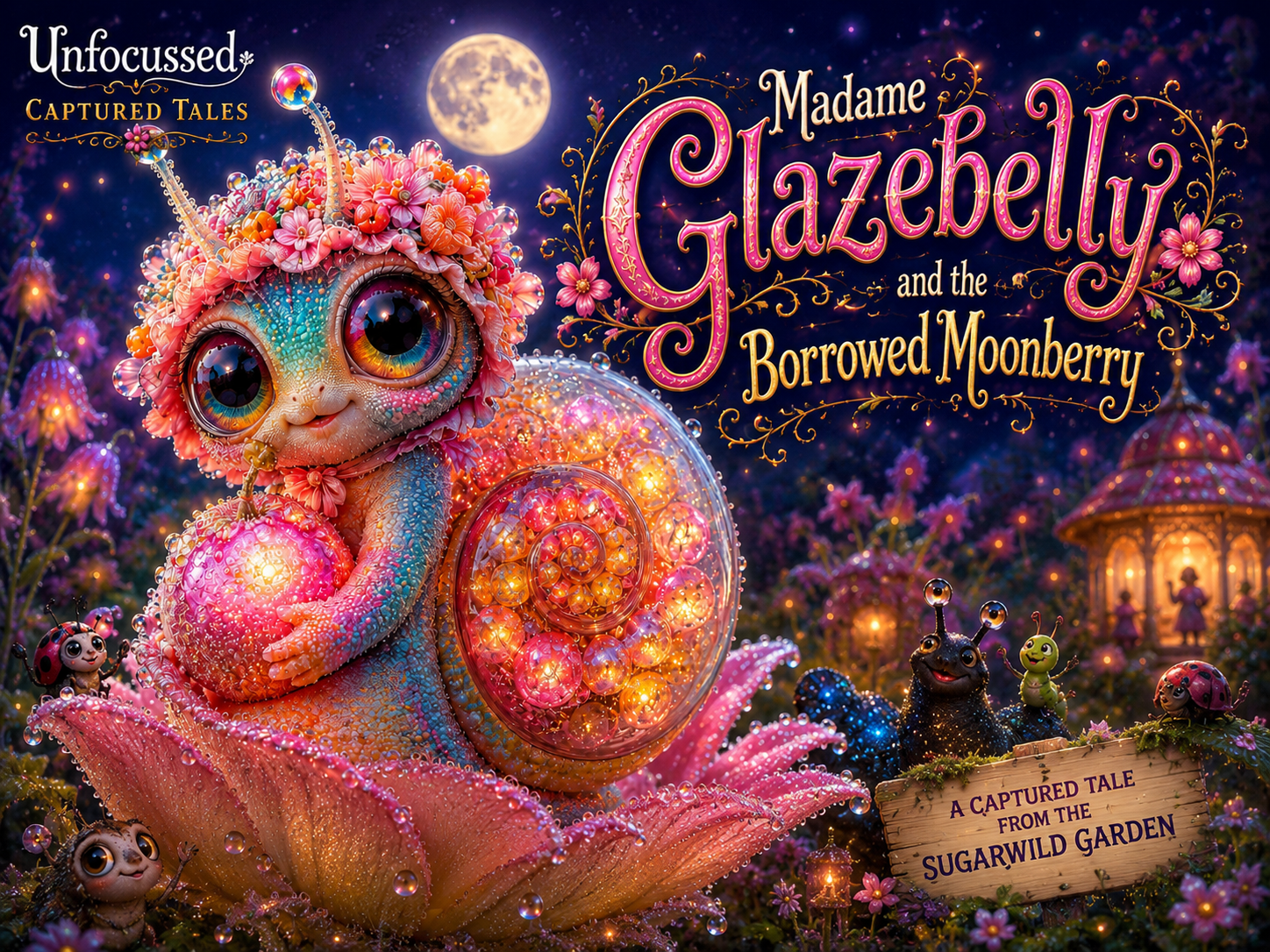
The Moonberry Was Not Stolen, According to the Snail Holding It
In the eastern curl of the Sugarwild Garden, where the flowers grew large enough to host dinner parties and rude enough to comment on your outfit, Madame Glazebelly lived in a blush-pink blossom with excellent drainage, flattering morning light, and absolutely no respect for the concept of property.
She was, by most accounts, adorable.
She was also, by several notarized beetle affidavits, “a known problem.”
Madame Glazebelly had eyes like polished twilight marbles, a shell full of glowing gumdrop chambers, and a complexion that looked as though a rainbow had exploded in a pastry shop and then apologized by becoming fashionable. Her tiny antennae were tipped with glassy orbs that caught the dawn and made it look expensive. A wreath of sugared blossoms crowned her head, because she claimed flowers simply “attached themselves to greatness.”
No one had ever proved otherwise.
She spent her days gliding through the dew-laced petals of her neighborhood, leaving behind a faint shimmer that gardeners mistook for magic and cynics correctly identified as theatrical residue. She attended tea circles she had not been invited to, interrupted butterfly meditations with fashion advice, and once convinced a committee of elder daisies that “emotional support glitter” should be classified as a civic necessity.
There were snails who carried burdens.
There were snails who carried wisdom.
Madame Glazebelly carried herself like a duchess who had just insulted someone and was waiting to see if they were clever enough to notice.
But even in a garden full of sugar-puffed nonsense, moonlit pollen, and vines that hummed when they were lonely, there was one thing everyone agreed should not be touched.
The Moonberry.
The Moonberry grew only once every thirteen-and-a-half moonspills, in the heart of the Lunarcup Pavilion, at the center of a silver-veined blossom so old that its roots remembered the first dirty joke ever whispered by moss. It was round, radiant, pink as a scandalous sunset, and bright enough to make the night insects compose poetry they later deeply regretted.
It was not eaten. It was not sold. It was not polished for fun. It was not used as a lamp, a mirror, a paperweight, or a dramatic prop in arguments, though Madame Glazebelly had privately noted it would be excellent for all four.
The Moonberry was presented each season during the Dewrise Ceremony, where the petalfolk gathered beneath the open moon and performed their ancient rites: singing, bowing, glowing softly, and taking themselves far too seriously.
The petalfolk were tiny blossom-dwelling people with petal skirts, pollen-bright cheeks, and voices like wind chimes that had read too many bylaws. They could be charming, generous, and graceful, provided nobody moved their ceremonial napkins or questioned why a berry needed seven guards and a velvet pedestal.
This year’s Moonberry had been announced by Hyacintha Flounce, Chairpetal of the Lunarcup Preservation Society, at a garden-wide assembly held on the broad leaf of a very patient hosta.
“The Moonberry,” Hyacintha declared, her lavender petal cape fluttering with bureaucratic importance, “shall be unveiled tomorrow evening under the full glow. Its light will bless the Sugarwild Garden with harmony, sweetness, and appropriate reverence.”
At this, Madame Glazebelly blinked slowly from the back row.
“Appropriate reverence,” she murmured, “is what dull people call a lack of imagination.”
The ladybug beside her, a nervous little fellow named Peabuckle, adjusted his spectacles. “Please don’t start.”
“I haven’t started anything.”
“You’re smiling with all four corners of your face.”
“That is just how glamour sits on me.”
Peabuckle swallowed. “Last time glamour sat on you, three tulips resigned.”
“They were weak-stemmed.”
Across the leaf, Hyacintha continued listing rules. No touching the Moonberry. No leaning near the Moonberry. No unauthorized breathing within three petals of the Moonberry. No bringing jam spoons. No reflective shells. No “interpretive licking,” a clause added after an incident with a slug poet in the previous century.
Madame Glazebelly listened with growing interest.
Not because she respected the rules.
Because rules, when recited with that much smugness, became less like instructions and more like invitations wrapped in lace.
By the time Hyacintha reached the section regarding “sanctioned admiration distance,” Madame Glazebelly had already begun planning what she would later describe as a harmless borrowing, a temporary relocation, and an act of civic sparkle redistribution.
Peabuckle saw the look in her eyes and made the tiny noise of a creature watching fate put on lipstick.
“Madame,” he whispered, “you are not thinking of stealing the Moonberry.”
“Absolutely not.”
“Good.”
“Stealing is such an ugly word.”
“Oh no.”
“I prefer borrowing.”
“That is still stealing if you don’t ask.”
“I shall ask the universe.”
“The universe does not own the Moonberry.”
“Neither do those petal-clenched little ceremony goblins, technically.”
“They have a preservation society.”
“So does mildew if left unchecked.”
Peabuckle turned pale beneath his spots.
Madame Glazebelly patted him with one dainty, dew-glittered foot. “Don’t fret, darling. I am not reckless.”
“You once tried to ride a dragonfly while wearing a cape made of pollen.”
“And I looked magnificent during the brief portion of the attempt that could be called airborne.”
“You landed in a compost bowl.”
“Art requires sacrifice.”
Peabuckle groaned into his own wing casing.
But Madame Glazebelly had already turned her gaze toward the western ridge of blossoms, where the Lunarcup Pavilion rose from a cradle of silver moss. Even in daylight, the pavilion shimmered faintly, its petals curled around secrets, its guards posted with ridiculous solemnity.
Somewhere inside, the Moonberry waited.
Glowing.
Tempting.
Practically begging to be appreciated by someone with taste.
And Madame Glazebelly, who considered taste both a virtue and a weapon, knew she could not allow that poor luminous orb to spend its entire existence being stared at by committees.
That evening, as the garden softened into pink-violet dusk and the fireflies began clocking in for their glow shift, Madame Glazebelly prepared.
Preparation, in her opinion, was the difference between a criminal and a legend.
She began with a bath in pearldew collected from the underside of a magnolia leaf. Then she buffed her shell until each gemlike chamber glowed with warm candy light. She applied a dusting of crushed star-pollen along her cheeks, not because it was necessary for the heist, but because history deserved a good cheekbone.
Her flower crown was carefully adjusted. Her antennae were polished. Her smile was rehearsed in three variations: innocent, misunderstood, and “you’ll thank me later, you uptight little cabbage.”
On a petal beside her, Peabuckle paced.
“I don’t want to be involved,” he said.
“Then stop pacing like a guilty chandelier.”
“You told me to meet you here.”
“For emotional support.”
“I thought you meant tea.”
“The evening may yet include tea.”
“Will it include returning the Moonberry?”
“Eventually.”
“Define eventually.”
Madame Glazebelly looked up at the first slice of moon rising over the garden wall. “Before anyone important faints permanently.”
Peabuckle sat down hard.
Her plan was simple, which made it elegant. It had only seven stages, two diversions, one bribe, one dramatic pause, and a contingency involving a sleeping moth named Uncle Grump.
Stage one: arrive at the Lunarcup Pavilion during the changing of the petal guards.
Stage two: distract the guards with a forged memo from Hyacintha Flounce regarding emergency lace alignment.
Stage three: slip beneath the pavilion through the dew channel, where ceremonial condensation drained into a moss basin.
Stage four: emerge behind the Moonberry pedestal.
Stage five: exchange the Moonberry for a decoy orb made from a candied glowplum, polished shell jelly, and one of Peabuckle’s emergency marbles.
Stage six: retreat through the moonmint hedge.
Stage seven: enjoy the Moonberry privately in her blossom for one single, harmless, educational evening.
“That is not a plan,” Peabuckle said after hearing it. “That is a lawsuit with scenery.”
“Nonsense. The decoy is excellent.”
“The decoy smells like jam.”
“So does half this garden.”
“It has my marble in it.”
“Your marble was underappreciated.”
“It was mine.”
“And now it is contributing to the arts.”
Peabuckle adjusted his spectacles again, which he did whenever his soul needed something to hold onto. “Why do you even want the Moonberry?”
Madame Glazebelly’s smile faltered just a fraction.
Not enough for a stranger to notice.
Enough for Peabuckle, who had known her since she was a smaller, rounder menace with a shell full of unfinished opinions.
“Because,” she said lightly, “it is beautiful.”
“So are many things you do not commit crimes over.”
“Name one.”
“Sunrise.”
“Too early.”
“Raindrops.”
“Common.”
“Friendship.”
“Difficult to accessorize.”
Peabuckle gave her a look.
Madame Glazebelly looked away, toward the silver glow of the distant pavilion.
The truth was tucked somewhere beneath her sass, under the glitter, beneath the little smirk she wore like armor. She had seen the Moonberry once before, years ago, when she was young enough to believe ceremonies existed to include everyone. Her mother had carried her to the edge of the crowd and whispered that Moonberries held reflected wishes—not granted ones, exactly, but remembered ones. Old hopes. Soft regrets. Dreams that had not spoiled even after being set aside.
That year, Madame Glazebelly had wished to become dazzling enough that no one would ever overlook her.
She had gotten her wish, more or less.
But lately, beneath all the sparkle and scandal, she had begun to wonder whether being seen was the same as being known.
This was not a thought she appreciated.
It had depth. Depth was inconvenient. Depth ruined perfectly good vanity.
So she had decided to borrow the Moonberry and inspect the matter privately, without Hyacintha Flounce sighing through her nose or some petal clerk documenting her emotional growth in triplicate.
That was all.
Personal reflection.
With light theft adjacent qualities.
“It doesn’t belong locked up,” Madame Glazebelly said at last. “All that glow, and they only let anyone see it from six feet away while being shushed by flowers in hats.”
Peabuckle softened, but only slightly. “Madame.”
“Don’t Madame me in italics.”
“You could ask.”
“I could also grow wings and develop patience, but let’s keep our expectations rooted in reality.”
“This is going to end badly.”
“Many worthwhile things do.”
“That is not comforting.”
“Comfort is for pillows and emotionally stable mushrooms.”
And with that, Madame Glazebelly slid toward destiny at a speed that was, for a snail, practically reckless.
The Lunarcup Pavilion was already glowing when she arrived.
It stood in a clearing of silver moss, surrounded by towering blossoms whose petals curled inward like gossiping fans. Threads of moonlight dripped from the upper leaves. Tiny lantern beetles hovered in formation, illuminating the ceremonial path in soft gold. At the pavilion entrance, four petal guards stood in polished acorn-cap helmets and stern expressions that suggested they had never once enjoyed cake without permission.
Madame Glazebelly tucked herself behind a curl of moonmint and watched.
Hyacintha Flounce paced near the steps, speaking to a cluster of assistants.
“The Moonberry must not be moved before the ceremony,” Hyacintha said. “No one touches the pedestal. No one adjusts the pedestal. No one compliments the pedestal unless cleared through me.”
“Naturally,” said one assistant.
“The glow must remain unsmudged.”
“Of course.”
“And for pollen’s sake, keep the beetles away from the refreshment table until after the Invocation of Silvery Restraint. Last year, one of them ate the crescent cakes early and the entire second verse had crumbs in it.”
Peabuckle, hidden beside Madame Glazebelly, whispered, “That was my cousin.”
“Your cousin has instincts,” Madame whispered back.
The guard change began precisely when the moon cleared the top of the tallest foxglove. Two guards stepped aside. Two replacements approached. A small window opened between suspicion and paperwork.
Madame Glazebelly gave Peabuckle a nod.
“No,” he whispered.
“Yes.”
“I hate this.”
“You’ll love the memoir.”
Peabuckle fluttered out from behind the moonmint carrying the forged memo in his front feet. He flew badly when nervous, which made him wobble like a raisin with wings, but the petal guards noticed him immediately.
“Message from Chairpetal Flounce!” Peabuckle squeaked.
The nearest guard frowned. “She is standing over there.”
“Emergency duplicate message.”
“Emergency duplicate?”
“Regarding lace alignment.”
The guard’s face changed. Every petalfolk knew lace alignment was serious business. Poorly aligned ceremonial lace had once caused a minor scandal at a buttercup wedding, and the phrase “asymmetrical hemline” was still used as an insult in certain formal circles.
The guards gathered around the memo.
Madame Glazebelly moved.
She slipped down the side of the moss basin, her shell lights dimmed beneath a smear of shadowdew. The dew channel beneath the pavilion was narrow, cold, and smelled faintly of old moonwater and dramatic tradition. She squeezed through it with the grace of a lady entering a ballroom and the sound of a wet gumdrop being politely forced through a keyhole.
Above her, footsteps tapped.
Voices murmured.
Somewhere nearby, Hyacintha gasped, “Who authorized lavender thread on the left hem?”
Madame smiled.
Peabuckle, bless his anxious little organs, had committed fully.
She pushed forward through the channel until the silver moss parted and a soft pink glow spilled across her face.
There it was.
The Moonberry.
It rested atop a pedestal of carved pearlstem, round and luminous, covered in tiny dew-jewels that pulsed with light. Its surface was not smooth, not exactly. It seemed made of layers: blush, rose, gold, and deep inner fire. Inside it, something swirled like a tiny sleeping sunrise.
Madame Glazebelly stopped breathing.
For once, she had no immediate comment.
This alarmed her.
The Moonberry did not merely glow. It remembered how to glow. It held the shine of all the moons that had ever leaned over the Sugarwild Garden. It held whispered wishes, yes, but also laughter, longing, stupid ideas, brave apologies, and every secret ever told to a flower under the impression that flowers were discreet.
Madame’s reflection shimmered across its surface: enormous eyes, flower crown, glittering shell, mouth curled in a practiced smirk that suddenly looked a bit small.
“Well,” she whispered, “aren’t you a rude little miracle.”
The Moonberry pulsed.
Not brightly.
Knowingly.
Madame narrowed her eyes. “Don’t judge me. I’m rescuing you from committee life.”
From outside came a sharp voice.
“Where is Peabuckle going?” Hyacintha demanded.
A beetle yelp followed.
Madame’s heart kicked.
“Damn it,” she hissed. “We are ahead of schedule emotionally and behind schedule criminally.”
She hauled the decoy from beneath her flower crown. It was, admittedly, less convincing beneath the Moonberry’s actual glow. The candied glowplum orb glistened pink and gold, but it had the unfortunate quality of looking like something a raccoon fairy might lick.
“Good enough for bureaucrats,” Madame decided.
She nudged the real Moonberry off the pedestal and immediately realized two things.
First, it was heavier than expected.
Second, it liked her.
The moment the Moonberry touched her, its light surged through her tiny feet, up her speckled body, and into the glowing chambers of her shell. Each orb in her shell flickered awake, filling with molten pink, tangerine, and soft lunar gold. Her antennae bulbs flashed. Her flower crown bloomed wider. Somewhere deep in the garden, three sleeping marigolds sneezed glitter.
“Oh,” Madame said, clutching the berry against her belly. “That is going to be difficult to hide.”
Outside the pavilion, Hyacintha shouted, “Why does the moss smell like jam?”
Madame shoved the decoy onto the pedestal.
It wobbled.
She froze.
The decoy tilted left.
She reached out with one foot.
It tilted right.
“Do not embarrass me,” she whispered.
The decoy settled.
Madame exhaled.
Then it released one small, unmistakable bubble of glowplum scent.
Pop.
From outside, every voice stopped.
Hyacintha said, very quietly, “What was that?”
Madame did not wait to find out.
She clutched the Moonberry tight and slid back into the dew channel, glowing like a guilty sunrise. The channel, which had seemed narrow on the way in, now felt personally insulting. The Moonberry pressed against her belly. Her shell scraped softly against moss. Her flower crown caught on a root hair.
“Unhand me, you underground eyebrow,” she snapped at the root.
A shadow crossed the opening behind her.
“Who’s there?” called a guard.
Madame flattened herself, which did nothing useful because she was a snail carrying a forbidden glowing orb the size of her torso.
Outside, another guard said, “The pedestal looks strange.”
“Strange how?”
“Delicious.”
Hyacintha’s shriek tore through the pavilion.
“THE MOONBERRY HAS BEEN REPLACED WITH JAM.”
Madame winced. “Technically glowplum preserves, you shrill napkin.”
The clearing erupted.
Bells rang. Petalfolk shouted. Lantern beetles broke formation. Someone yelled, “Seal the moss!” Someone else yelled, “Check the refreshment table!” A third voice, probably Peabuckle’s, yelled, “I am too delicate for prison!”
Madame burst from the far end of the dew channel into a thicket of moonmint and nearly collided with Uncle Grump, the sleeping moth from her contingency plan.
Uncle Grump opened one enormous fuzzy eye.
“Mmph?”
“No time, darling,” Madame said. “History has become athletic.”
She shoved a pinch of sparkleleaf beneath his nose.
Uncle Grump sneezed so powerfully that a cloud of silver dust blasted into the clearing behind them, coating the pursuing guards in a sparkling haze. Three of them began coughing. One declared he could taste triangles. Hyacintha Flounce staggered out of the pavilion with jam on her fingers and betrayal in her eyes.
“Find her!” Hyacintha cried.
Madame froze.
Peabuckle, wobbling through the air above the moss, also froze.
Hyacintha’s eyes narrowed.
“Find Madame Glazebelly.”
Peabuckle dropped behind a leaf.
Madame pulled the Moonberry closer. “Rude. Accurate, but rude.”
She fled.
Now, it should be understood that snail fleeing does not look impressive to the untrained eye. It does not involve sprinting, leaping, or dramatic hair streaming in the wind, unless the snail has made questionable choices at a wig stall. But Madame Glazebelly had a gift for making even slow movement feel theatrical.
She slid across petals, under fern curls, between sugared stems, and through a tunnel of blush-colored clover, Moonberry blazing against her belly. Behind her, the garden woke into chaos.
“Thief!” cried a petal guard.
“Borrower!” Madame shouted back.
“Return the relic!”
“Return your tone to something less constipated!”
A cluster of pearl gnats gasped.
“She said constipated,” whispered one.
“During Moonberry season,” whispered another. “Filthy.”
Madame ducked beneath a curling rose petal just as two lantern beetles swept overhead. Their light passed across the ground in searching bands. She held still, pressing herself into the petal’s shadow.
The Moonberry pulsed again.
Her shell answered with a glow.
“Stop helping,” she whispered.
The berry warmed in her arms.
She had the peculiar sensation that it was amused.
Peabuckle landed beside her, panting. “You replaced the most sacred relic in the garden with jam.”
“Preserves.”
“They know it was you.”
“They suspect it was me.”
“Hyacintha said your name.”
“That woman says my name when toast burns.”
“Madame!”
She peeked over the edge of the petal. Guards swarmed the pathways. Petalfolk gathered in clusters, whispering at the speed of scandal. A line of beetles was already forming near the pavilion, not to help, but because someone had mentioned jam.
“All right,” Madame said. “The exit strategy requires refinement.”
“The exit strategy was moonmint hedge.”
“The moonmint hedge is currently full of judgmental lanterns.”
“Then what do we do?”
Madame looked down at the Moonberry. Its glow softened, reflecting in her enormous eyes. For a brief moment, her expression was not smug or sparkling or sharpened for battle. It was almost tender.
“We get it somewhere safe,” she said.
Peabuckle stared. “You mean your blossom?”
“Naturally.”
“That is not safe. That is the first place they’ll look.”
“They’ll look, yes. But they won’t find.”
“Why?”
Madame smiled again, and this smile was the sort that made sensible creatures check their insurance.
“Because everyone knows I am vain, dramatic, and allergic to humility.”
“All true.”
“Therefore, they will expect me to hide the Moonberry somewhere grand.”
“Also true.”
“Somewhere theatrical.”
“Definitely.”
“Somewhere worthy of my ego.”
“You are worrying me less with the logic and more with the accuracy.”
Madame leaned close. “So we hide it somewhere boring.”
Peabuckle blinked.
“Where?”
Madame pointed one antenna toward the far edge of the Sugarwild Garden, where a squat patch of beige mushrooms grew beside the compost fence. No one hosted ceremonies there. No one took portraits there. No one said, “Oh, how enchanting,” unless they were lying to a mushroom’s face.
“The Dullcap Patch,” Peabuckle breathed.
“Exactly.”
“You hate the Dullcap Patch.”
“I do. It has the charisma of wet lint.”
“Then why would you go there?”
“Because no one who knows me would believe I had.”
For the first time that evening, Peabuckle looked impressed.
Then a small voice above them said, “I would.”
Madame Glazebelly went still.
Peabuckle made a squeak so tiny it barely qualified as sound.
Slowly, Madame looked up.
Perched on the underside of the rose petal, upside down and grinning like a secret with legs, was a small green aphid wearing a crooked seed-cap and the most insufferably smug expression in the entire Sugarwild Garden.
Nim Nibblestem.
The nosiest creature ever hatched beneath a leaf.
Nim was known for three things: listening where he was not wanted, remembering what he should not know, and trading information for snacks, favors, or the opportunity to make adults uncomfortable. He had once exposed a forbidden romance between two rival snapdragons simply because one of them had called him “little buddy” in a tone he found patronizing.
“Hello, Madame,” Nim said sweetly.
Madame’s smile became dangerous.
“Nim,” she said. “How lovely. I was just thinking this crime needed a rash.”
Peabuckle whispered, “Don’t insult the witness.”
“I saw everything,” Nim said.
“You saw moonlight playing tricks.”
“I saw you sneak into the pavilion.”
“A misunderstanding.”
“I saw the jam orb.”
“A tribute.”
“I saw you carrying the Moonberry.”
Madame glanced at the glowing orb pressed against her belly.
“This?” she said. “This is my emotional support fruit.”
Nim’s grin widened. “Hyacintha will want to hear about that.”
Peabuckle covered his face.
Madame tilted her head, flowers trembling in her crown. “And what, you horrible little salad ingredient, would persuade you to postpone your civic duty?”
Nim tapped his chin with one tiny foot.
Below them, guards thundered past, which, given their size, sounded mostly like someone angrily tapping spoons on leaves.
“I want in,” Nim said.
Madame blinked. “In?”
“On the heist.”
“The heist is over.”
“Doesn’t look over. Looks messy.”
Peabuckle whispered, “He has a point.”
Madame ignored him.
Nim leaned lower, upside-down grin bright with wicked delight. “You’ve got the Moonberry. The petalfolk are hunting you. The Dullcap Patch is crawling with night slugs after dark. And I know a shortcut.”
Madame stared at him.
The Moonberry pulsed again, warm and amused against her heart.
Somewhere in the distance, Hyacintha Flounce shouted, “Search every blossom! Especially the dramatic ones!”
Madame looked from Peabuckle to Nim to the glowing stolen-borrowed-rehomed Moonberry in her arms.
Then she sighed.
It was a beautiful sigh. Tragic. Elegant. Deeply inconvenienced.
“Fine,” she said. “But if you betray me, I will personally see to it that every aphid in this garden learns to pronounce your middle name in public.”
Nim’s grin vanished.
“You wouldn’t.”
Madame smiled.
“Try me, Nimbiferous.”
Peabuckle gasped. “That’s his middle name?”
Nim flushed green.
Madame hugged the Moonberry tighter and slid toward the shadows, now accompanied by one terrified ladybug, one blackmail-vulnerable aphid, and one sacred glowing fruit that seemed far too pleased with the company it was keeping.
Behind them, the Sugarwild Garden rang with alarms, accusations, and the first delicious rumors of the season.
And Madame Glazebelly, thief by technicality and heroine by pending review, disappeared into the night with moonlight on her belly and trouble sparkling in her wake.
Which was, frankly, how she preferred to travel.
The Dullcap Patch Has Never Hosted This Much Crime
The Dullcap Patch sat at the far edge of the Sugarwild Garden like an apology no one had bothered to decorate.
It was not ugly, exactly. Ugly required effort. The Dullcap Patch had skipped effort entirely and gone straight to beige. Beige mushrooms. Beige moss. Beige little stones arranged in a way that suggested someone once intended a path, got bored, and wandered off to die quietly under a leaf.
Even the air seemed tired there.
It was the sort of place where dramatic music came to lose confidence.
Madame Glazebelly hated it on principle.
“This place looks like a nap forgot to become a coma,” she muttered, sliding beneath a sagging fern with the Moonberry clutched against her belly.
Peabuckle fluttered behind her, breathing hard. “Please keep your voice down.”
“The mushrooms are already dead inside. I doubt I can offend them further.”
“You can offend anything further.”
Nim Nibblestem scampered along the underside of a leaf above them, upside down as usual, because aphids enjoyed behaving like gravity was a suggestion made by boring people. “You know,” he said, “for someone hiding from the entire Lunarcup Preservation Society, you do talk like you’re trying to get heckled by moss.”
Madame looked up at him. “And for someone whose full middle name is Nimbiferous, you do talk like your reputation is secure.”
Nim went silent.
Peabuckle whispered, “That is a devastating amount of syllables.”
“My mother was sentimental,” Nim snapped.
“Your mother was armed with vowels,” Madame said.
They moved on.
Or rather, Madame moved on. Nim darted. Peabuckle fluttered. The Moonberry glowed with the infuriating calm of an object that had never once had to explain itself to guards, committees, or shrieking flower officials with lace problems.
Behind them, the Sugarwild Garden had become a scandal engine.
Every blossom hummed with alarm. Lantern beetles swept the petal lanes. Petal guards knocked on tulip doors and demanded to know whether anyone had seen “a round, glowing, pinkish sacred object of immense cultural importance,” which resulted in twenty-seven inappropriate jokes and one confused tomato being briefly detained.
The gossip had already mutated beyond usefulness.
By the time Madame reached the outskirts of the Dullcap Patch, rumor insisted she had stolen three Moonberries, seduced a moth, poisoned the ceremonial punch, insulted the moon, and replaced the sacred relic with a jar of jam bearing her monogram.
“I do not own monogrammed jam,” Madame said when Peabuckle reported this between gasps.
“That’s the part you object to?”
“Details matter.”
“You did replace the Moonberry with preserves.”
“Glowplum preserves.”
“That does not help.”
“It helps the flavor profile.”
Nim dropped from his leaf onto a mushroom cap, landing with a little bounce. “The petalfolk have search teams coming through the eastern lanes. Hyacintha is with them.”
Madame stiffened. “Of course she is.”
“She brought the Sniff Moths.”
Peabuckle made a strangled noise. “The Sniff Moths?”
Nim nodded grimly. “All three.”
Madame frowned. “There are only three?”
“Three official ones,” Nim said. “The fourth got demoted after tracking a stolen sugarbean into his own lunch.”
Peabuckle clutched his spectacles. “Sniff Moths can smell moonlight residue from six petals away.”
“That sounds made up.”
“It is not.”
“Everything in this garden sounds made up.”
“Madame.”
She sighed and glanced down at herself.
It was not an encouraging sight.
The Moonberry’s glow had seeped into every speckled bead of her skin. Her shell, normally impressive in a tasteful, expensive, slightly smug way, now blazed with internal pink and golden lights. Each round chamber glimmered like a lantern at a luxury candy festival. Her antenna bulbs shone with rainbow sparks. Even her flower crown had become suspiciously radiant.
She looked less like a fugitive and more like a parade float with a motive.
“Fine,” she said. “We require concealment.”
Nim gestured around the Dullcap Patch. “This is concealment.”
Madame looked at the beige mushrooms. “This is where joy goes to file taxes.”
“It’s also where nobody looks.”
“Nobody looks because looking directly at it causes spiritual chafing.”
Peabuckle landed on a low stem and bent forward, panting. “Can we please focus? The Sniff Moths are coming, the guards are searching, Hyacintha knows it was you, and Nim is blackmailing us.”
“I prefer the term negotiating from an advantageous witness position,” Nim said.
Madame narrowed her eyes. “You prefer a lot of words for someone who could fit in a teacup and still leave room for shame.”
Nim grinned. “Still got the shortcut, though.”
“Then show us.”
“First, I want terms.”
Peabuckle groaned. “We don’t have time for terms.”
“Criminals always have time for terms,” Nim said. “That’s how you know they’re professionals.”
Madame shifted the Moonberry in her grip. It warmed against her belly, pulsing once, twice, almost like a heartbeat. For a brief instant, the glow painted Nim’s green face rose-gold and made him look less like a pest and more like a child who had crawled too close to a secret.
His grin softened.
Only for a second.
Then it returned sharper than before.
“I want one favor,” Nim said.
Madame blinked. “That is suspiciously reasonable.”
“One future favor.”
“Ah. There’s the smell.”
“No questions. No moralizing. No pretending you’re above it, because currently you’re glowing with felony.”
Peabuckle whispered, “Technically artifact theft.”
“Borrowing,” Madame said.
“With pursuit.”
“A misunderstanding with cardio.”
Nim held out a tiny foot. “Deal?”
Madame stared at him.
Peabuckle shook his head wildly.
Madame ignored him, because Peabuckle’s caution, while often correct, had the texture of uncooked oatmeal.
“One future favor,” she said. “But if it involves bodily fluids, public singing, or humiliating hats, I reserve the right to renegotiate.”
“Fine.”
“And no betrayal.”
“Fine.”
“And you stop grinning like a pickle with secrets.”
“No promises.”
They shook.
It was not a noble handshake. It was a snail foot and an aphid foot meeting on a mushroom cap while a ladybug hyperventilated nearby and a stolen sacred fruit glowed against everyone’s better judgment.
But in the Sugarwild Garden, that counted as binding.
Nim hopped down from the mushroom and scurried toward a cluster of Dullcaps that leaned together in a tired little circle. “This way.”
Madame followed, though every inch of her body objected to brushing against the beige mushroom stalks.
“If I develop blandness,” she said, “I’m holding you responsible.”
“The shortcut runs under the patch,” Nim said. “Old vole tunnel. Abandoned.”
Peabuckle froze. “Abandoned by whom?”
“The vole.”
“Why?”
Nim shrugged. “Personal reasons.”
“Was he eaten?”
“That’s personal.”
Peabuckle looked faint.
Madame peered into the narrow opening beneath the mushroom cluster. The tunnel was dark, damp, and smelled like roots, dirt, and the sort of decisions made after midnight. A thin trickle of water ran along one side. Tiny crystals clung to the ceiling, catching the Moonberry’s glow.
“Absolutely not,” Madame said.
“It leads straight beneath the old compost fence,” Nim said. “From there, we can reach the Snoregrass Hollow without crossing the open paths.”
“I repeat: absolutely not.”
Peabuckle glanced over his shoulder. Faint lights bobbed in the distance. Voices drifted closer.
“Madame,” he whispered, “we may not have another choice.”
“I always have another choice.”
“Name it.”
Madame opened her mouth.
Behind them, a Sniff Moth let out a long, quivering honk.
It was an awful sound. Not frightening in the majestic sense. More like a kazoo being murdered in a bathtub.
Nim’s eyes widened. “They picked up the glow.”
Hyacintha Flounce’s voice rang across the moss. “This way! I smell moonlight, shell polish, and audacity!”
Madame pressed one foot to her chest. “Shell polish, yes. Moonlight, perhaps. But audacity is not a scent.”
Another Sniff Moth honked.
Peabuckle shoved at her side. “Tunnel!”
Madame glared at the opening. “I am filing a formal complaint with the narrative.”
Then she ducked inside.
The tunnel swallowed them in cool, earthy darkness.
For the first few moments, there was only the wet hush of soil and Madame’s indignant muttering.
“I was built for petals,” she said. “Petals and admiration. Perhaps polished leaves. Occasionally a dessert table. I was not built for vole infrastructure.”
Nim scurried ahead. “Keep moving.”
“Do not rush me. I am a creature of dignity.”
Peabuckle fluttered behind her. “You are leaving a glowing trail.”
Madame looked back. Sure enough, the slime trail behind her shimmered faintly pink and gold.
Nim stopped. “That’s bad.”
“It’s also gorgeous,” Madame said.
“It’s traceable.”
“Many gorgeous things are.”
Peabuckle’s wings trembled. “Can you stop glowing?”
“Can Hyacintha stop sounding like a violated teapot?”
“Madame.”
“I don’t know how. The berry is doing it.”
The Moonberry pulsed again, softly illuminating the tunnel. Its light moved across the crystal-lined ceiling, and for the first time, Madame noticed that the walls were etched with old marks. Not claw marks or root scratches, but tiny patterns: crescents, spirals, dots, and branching lines like miniature vines.
“Wait,” she said.
Nim looked back. “What?”
“These marks.”
Peabuckle adjusted his spectacles and leaned in. “They look old.”
“Older than the vole?” Nim asked.
“Older than your manners,” Madame said.
The Moonberry brightened.
The markings began to glow.
One by one, tiny lines of silver light spread along the tunnel walls. Crescents opened into full moons. Spirals unfurled into blossoms. Branching lines connected like roots beneath an unseen garden. The whole tunnel awakened in a soft, shimmering pulse.
Peabuckle whispered, “Oh.”
Nim whispered something that sounded like, “No way.”
Madame, for once, did not insult either of them.
The light traveled ahead, revealing that the tunnel was not merely an old vole passage. It was part of something older. A forgotten underpath lined with moonmarks and root-script, hidden beneath the least glamorous patch in the garden.
“Well,” Madame said quietly. “The Dullcap Patch has been underselling itself.”
The Moonberry warmed against her.
A sound drifted through the tunnel.
Not from behind.
From ahead.
A low, gentle hum.
Peabuckle’s eyes widened. “Is someone singing?”
“If it’s mushrooms,” Nim said, “I’m leaving.”
“You are not leaving,” Madame said. “You owe us a shortcut.”
“This shortcut wasn’t supposed to glow and hum.”
“Few quality shortcuts are.”
They continued forward, slower now.
The tunnel widened. Roots curled along the ceiling like sleeping fingers. Crystals clustered in small pockets, each reflecting the Moonberry’s light until the walls seemed filled with tiny stars. The hum grew warmer, more layered. It was not music exactly, but memory shaped like sound.
Madame felt it through her shell.
Her glowing chambers flickered in rhythm.
For an uncomfortable moment, she remembered being very small. Smaller than her sass, smaller than her shell, smaller than the expectations she had built like jewelry around herself. She remembered clinging to her mother’s side near the Lunarcup Pavilion, watching the Moonberry from the edge of the crowd because only certain families, certain blossoms, and certain polished little citizens had places near the front.
Her mother had whispered, “Light isn’t less yours because someone else built a fence around it.”
Madame had not understood then.
She was not fully sure she understood now.
But she remembered the feeling of being too far away from something beautiful and being told distance was tradition.
Her grip tightened around the Moonberry.
“Madame?” Peabuckle asked softly.
She blinked. “What?”
“You stopped.”
“I was considering the architectural value of old dirt.”
Peabuckle gave her a look gentle enough to be annoying.
Nim, mercifully, ruined the moment. “Uh, we may have another problem.”
Madame turned.
Ahead, the tunnel opened into a small underground chamber.
At its center stood a ring of pale mushroom stems, not beige like the Dullcaps above, but pearly and translucent. Their caps glowed faintly from within, as though moonlight had been poured into them and left to steep. In the center of the ring was a shallow basin of still water, its surface smooth as glass.
And around that basin, half-buried in moss and dust, were dozens of old Moonberry husks.
Not full berries. Not living glow.
Empty shells.
Pink-gold skins, dried and translucent, curled like petals after bloom.
Peabuckle landed beside one and stared. “There have been more.”
“Obviously,” Nim said. “They grow every season.”
“No,” Peabuckle said. “These are old. Very old. And they’re here. Not in the pavilion.”
Madame slid closer to the basin.
The Moonberry’s glow deepened.
The water stirred.
A reflection formed on its surface: not of Madame, not of Nim, not of Peabuckle, but of the Lunarcup Pavilion as it must have looked long ago. No velvet pedestal. No guards. No lace. No committees. Just a wide open moonblossom under the night sky, surrounded by garden creatures of every kind: snails, beetles, moths, petalfolk, slugs, bees, spiders, even worms peeking politely from the dirt.
At the center, the Moonberry shone.
Then the image shifted.
The gathered creatures carried the berry down into the earth, singing softly. They placed it in the basin. The berry dissolved into light, and that light spread through the roots of the garden. Flowers bloomed. Seeds awakened. Dew rose in glittering beads. The whole Sugarwild Garden shimmered with shared magic.
The reflection faded.
No one spoke.
Nim scratched his seed-cap. “So the Moonberry isn’t supposed to stay in the pavilion?”
Peabuckle swallowed. “It looks like it was meant to be brought here.”
Madame stared at the basin.
The Moonberry pulsed in her arms.
Outside, distant but growing closer, a Sniff Moth honked again.
“That,” Madame said, “complicates my legal defense in a favorable direction.”
Peabuckle looked at her. “Madame.”
“What? It does.”
“This is serious.”
“I am capable of being serious.”
Nim coughed.
Madame glared. “I am capable of being serious when properly lit.”
The Moonberry brightened.
Peabuckle stepped toward the basin. “Maybe we should place it there.”
Madame pulled the berry back instinctively.
Peabuckle noticed.
So did Nim.
So did, apparently, the Moonberry, because it warmed against her with a small pulse that felt far too understanding.
Madame’s face tightened.
“Not yet,” she said.
Peabuckle’s voice softened. “Why?”
“Because we don’t know enough.”
“The vision seemed fairly clear.”
“Visions are notorious little show-offs. They give you symbols and expect you to do all the emotional labor.”
“Madame.”
“And because,” she snapped, then stopped.
The chamber held its breath.
Even Nim kept quiet, which suggested either maturity or fear.
Madame looked down at the Moonberry.
In its glow, she saw tiny reflections layered over one another. The child she had been at the edge of the ceremony. Her mother’s soft smile. Hyacintha Flounce standing near the front, younger then, already polished, already certain where everyone belonged. A Moonberry shining far away while rules held the crowd apart.
“Because I spent years being told this light was not for me,” Madame said at last. Her voice was low, stripped of its usual decorative knives. “And now it is in my hands, and I am not quite ready to give it back to the first ancient puddle that asks politely.”
Peabuckle’s expression crumpled with sympathy.
Nim looked at the floor.
Madame immediately regretted the vulnerability. It sat in the air between them, damp and exposed, like a peeled grape.
“If either of you speaks of that,” she said, “I will deny it with such force that nearby lilies will lose petals.”
Peabuckle nodded quickly.
Nim raised one foot. “Not even for snacks?”
Madame turned slowly toward him.
“Joking,” he said. “Emotionally inappropriate, but joking.”
A sound cracked through the tunnel behind them.
Voices.
Closer now.
“The glow trail leads downward!” called a petal guard.
Hyacintha’s voice followed, sharp enough to trim hedges. “Careful. Madame Glazebelly may be flamboyant, but she is not stupid.”
Madame sniffed. “That is the nicest thing she has ever said about me.”
“She also called you a shell-polished menace,” Nim said.
“Also accurate.”
Peabuckle fluttered toward the chamber’s far side. “There has to be another exit.”
Nim ran along the root wall, tapping marks. “There is. Or there was.”
“What does that mean?” Peabuckle asked.
“It means old tunnels sometimes collapse, and I am not legally responsible for geology.”
Madame slid toward him. “Nimbiferous.”
“Don’t full-name me in a crisis!”
“Find the exit.”
Nim scrambled faster.
The Sniff Moths honked again, now echoing clearly through the tunnel. Madame heard wings, armor, Hyacintha muttering something about disgrace, and a guard asking whether anyone had remembered to bring jam evidence.
The Moonberry glowed brighter.
Too bright.
“Darling,” Madame whispered to it, “if you could refrain from announcing our location like a drunken lighthouse, I would be grateful.”
The Moonberry pulsed.
The basin answered.
A beam of soft pink-gold light rose from the water and touched the ceiling. Root-script blazed across the chamber. The pearly mushroom ring unfurled, caps lifting like little umbrellas. Dust shook loose from the walls.
Peabuckle yelped.
Nim jumped back. “I found something!”
A section of root wall split open with a slow, creaking groan, revealing a narrow passage beyond.
Madame smiled. “Excellent. See? Crime encourages architecture.”
Peabuckle pointed behind them. “They’re almost here.”
The first Sniff Moth’s antennae appeared at the tunnel entrance, quivering. It was huge by garden standards, fluffy, pale, and wearing an official ribbon that had been pinned to its chest with great seriousness and questionable taste.
It inhaled.
Its eyes crossed.
Then it honked directly at Madame.
“Subtle,” she said.
“There!” shouted a guard.
Hyacintha appeared behind the moth, breathless, furious, and still wearing her ceremonial lavender cape despite having crawled through dirt. To her credit, she looked only partially destroyed by the experience.
“Madame Glazebelly,” she said, voice trembling with outrage, “step away from the Moonberry.”
Madame lifted her chin. “That is difficult, since I am holding it.”
“You have desecrated the Dewrise Ceremony.”
“The ceremony was already wearing too much lace.”
“You replaced a sacred relic with jam.”
“Glowplum preserves.”
“You dragged the Moonberry through a drainage channel.”
“It needed to see the world.”
Hyacintha’s eyes flashed. “You have no idea what you are meddling with.”
Madame glanced around the glowing chamber, the basin, the ancient husks, the open root passage.
“Actually,” she said, “I am beginning to suspect neither do you.”
Hyacintha’s expression changed.
It happened quickly. A flicker. A tightening around the mouth. A glance toward the basin that was not surprise, but recognition.
Madame saw it.
So did Peabuckle.
Nim’s grin returned, sharp and delighted.
“Oh,” Nim said. “You knew about this place.”
Hyacintha stiffened. “Silence, child.”
“That means yes,” Nim whispered loudly.
Peabuckle turned toward Hyacintha. “The Moonberry used to be brought here, didn’t it?”
The guards shifted uneasily.
One of the Sniff Moths, apparently confused by tension, honked at a mushroom.
Hyacintha drew herself taller. “The Moonberry belongs in the pavilion.”
“That was not the question,” Madame said.
“The pavilion protects it.”
“From whom?”
“From misuse.”
Madame’s smile thinned. “Misuse by anyone without a reserved seat near the front?”
Hyacintha’s cheeks flushed lavender. “You always reduce everything to insult.”
“Only when insult is the most accurate tool available.”
“You think this is about status?” Hyacintha snapped. “You think everything is vanity because you polish your insecurity until it blinds innocent bystanders.”
Peabuckle gasped.
Nim whispered, “Damn.”
Madame went very still.
For one bright, dangerous moment, all the humor drained from her face.
The Moonberry flickered.
Her shell lights dimmed.
Hyacintha seemed to realize she had struck deeper than intended, but pride held her mouth shut.
Madame looked at her with a softness more frightening than anger.
“Careful, Hyacintha,” she said. “If you aim for the wound, you should be prepared to explain why you know where it is.”
The chamber fell silent.
Then the far passage rumbled.
Nim looked over. “That seems bad.”
The root-script along the wall flashed erratically. The basin’s surface rippled. The Moonberry pulsed harder against Madame’s chest, no longer amused, no longer gentle, but urgent.
Peabuckle’s wings buzzed. “What’s happening?”
Hyacintha’s eyes widened. “You awakened the underpath.”
“Technically,” Madame said, “the Moonberry did.”
“Because you moved it before moonrise.”
“You were going to leave it on a pedestal.”
“Because the old rite is unstable!” Hyacintha shouted.
The words struck the chamber like a dropped bell.
Everyone turned to her.
Hyacintha pressed her lips together, but it was too late.
Madame’s eyes narrowed. “Explain.”
“No.”
“Hyacintha.”
“You do not get to demand answers while clutching stolen moonfruit in a root cellar.”
“Borrowed moonfruit in a heritage chamber.”
“Madame!” Peabuckle shouted.
Another rumble shook the chamber.
From the open passage came a wet, sliding sound.
Nim took one step backward. “That is definitely bad.”
Out of the passage emerged a night slug.
Then another.
Then five more.
They were large, velvet-black, and shimmering with faint blue speckles. Their eyes glowed like tiny disgruntled lanterns. Night slugs were not evil, exactly, but they were territorial, slow to forgive, and very fond of eating anything infused with moonlight.
The first one lifted its head and tasted the air.
Its eyes fixed on the Moonberry.
Peabuckle whispered, “They’re hungry.”
Madame pulled the berry close. “Of course they are. It’s always snack politics with slugs.”
Hyacintha backed toward her guards. “Form a barrier.”
The guards hesitated.
There were many slugs now. More sliding from the passage. Their bodies glistened in the Moonberry light. Their mouths made soft, damp sounds that nobody enjoyed.
Nim climbed up onto Madame’s shell. “I vote we leave.”
“Get off my shell.”
“I vote from here.”
“Get off my shell before I turn your future favor into a funeral arrangement.”
Peabuckle darted beside her. “The exit is behind the slugs.”
“Naturally.”
Hyacintha’s guards tried to advance, but the Sniff Moths panicked first. One honked, flapped backward, collided with another, and sent both tumbling into a cluster of pearly mushrooms. The mushrooms released a puff of silver spores.
The guards coughed.
Nim sneezed.
Peabuckle sneezed.
Madame sneezed so delicately it seemed rehearsed.
The night slugs surged forward.
Chaos bloomed.
A guard slipped. A moth honked. Hyacintha yelled instructions no one followed. Nim clung to Madame’s shell despite direct threats. Peabuckle flew in dizzy circles trying to determine whether he was brave enough to be useful. The Moonberry blazed brighter and brighter, turning the underground chamber into a pink-gold fever dream.
Madame looked at the slugs.
She looked at Hyacintha.
She looked at the basin.
Then she looked at the Moonberry.
The berry pulsed.
Not with fear.
With instruction.
“Oh, don’t look at me like that,” she said. “I am not heroic on command.”
The berry warmed.
“I am heroic only when cornered, flattered, or wearing something with dramatic fringe.”
The berry pulsed again.
Peabuckle shouted, “Madame, now would be a beautiful time for heroism!”
“I said not on command!”
A night slug lunged.
Madame did the only thing she could think to do.
She lifted the Moonberry high.
For a creature with no arms in the conventional sense, this involved an impressive amount of full-body commitment, spiritual profanity, and one foot braced against a mushroom stem. But she lifted it all the same, pressing it up toward the glowing root-script overhead.
“Listen here, you damp little midnight sausages,” she shouted. “This berry is not dinner!”
The slugs paused.
Everyone paused.
Nim whispered, “Did you just call them midnight sausages?”
“I speak under pressure.”
The Moonberry flared.
Light burst through the chamber, not sharp, not burning, but rich and warm as sunrise poured through rose petals. It swept across the night slugs, across the guards, across Hyacintha, Peabuckle, Nim, the mushrooms, the old husks, the basin, the dirt, the roots, everything.
The slugs froze.
Then, one by one, they lowered their heads.
Not in hunger.
In recognition.
The largest night slug rumbled.
It was a deep, wet sound that seemed to come from the oldest part of the earth.
Madame stared. “Does anyone speak slug?”
One petal guard slowly raised a hand. “My aunt married into a pond family.”
“Translate.”
The guard swallowed. “It says… the light has returned beneath the roots.”
The slug rumbled again.
“It says the old path remembers.”
Another rumble.
The guard’s eyes widened. “And it says the berry is late.”
Hyacintha went pale.
Madame turned toward her.
“Late,” she repeated.
Hyacintha looked away.
Madame’s voice hardened. “How many seasons have you kept it from this place?”
Hyacintha said nothing.
The largest slug rumbled a final time.
The guard whispered, “Thirteen.”
Peabuckle’s wings stilled.
Nim’s mouth fell open.
Madame stared at Hyacintha. “Thirteen Moonberries?”
Hyacintha lifted her chin, but the motion shook. “We had reasons.”
“Committees always do.”
“The old rite nearly flooded the garden with bloomlight.”
“Bloomlight?” Nim asked.
Peabuckle’s face changed. “That was the year of the Wild Bloom.”
Madame remembered it. Everyone did. The year every flower in the garden opened at once, every seed sprouted, every vine grew drunk on magic, and the air filled with so much pollen that half the beetles spent three weeks proposing marriage to furniture.
“The old rite overfed the roots,” Hyacintha said. “The garden became unstable. Flowers grew too large. Paths vanished overnight. Creatures got lost in blossoms that had not existed that morning. We nearly lost the western wall.”
“So you stopped bringing the Moonberry here,” Peabuckle said.
“We preserved it instead,” Hyacintha said. “Controlled its light. Honored it safely.”
Madame laughed once, without humor. “You locked it on a pedestal and called distance reverence.”
Hyacintha snapped, “And you grabbed it because your feelings were bruised by childhood seating arrangements.”
The chamber tightened.
Madame’s eyes flashed.
“Yes,” she said. “Partly.”
Hyacintha blinked, caught off guard by the honesty.
Madame slid closer, Moonberry glowing between them. “I grabbed it because I was selfish, curious, offended, nostalgic, and absolutely certain it would look stunning against my complexion. I am a complicated woman with excellent instincts and terrible boundaries.”
Nim whispered, “That should be on a pillow.”
“But I also grabbed it,” Madame continued, “because something about your ceremony has always smelled wrong. Not literally. Literally it smells like lace, nectar, and repressed panic. But wrong.”
Hyacintha’s mouth tightened.
“You say you protected the garden,” Madame said. “Maybe you did. But somewhere along the way, protection became possession. And possession became performance. And performance became you, standing in front of everyone, telling them how far away they must stay from the thing that feeds their roots.”
For once, Hyacintha had no answer.
The night slugs watched.
The guards watched.
Even the Sniff Moths watched, though one was still upside down in a mushroom cluster and looked deeply concerned about its life choices.
The Moonberry pulsed again.
The basin shimmered.
Peabuckle stepped forward. “Maybe both things are true.”
Everyone looked at him.
He flinched under the attention but continued. “Maybe the old rite was dangerous. And maybe keeping the Moonberry locked away for thirteen seasons was wrong.”
Nim nodded. “That’s annoyingly reasonable.”
“Thank you?” Peabuckle said.
Madame looked at the basin. The light within it swirled now, slow and waiting.
“Then what does the berry want?” she asked.
The answer came not as words, but as a deep pulse through the chamber.
The old husks rustled.
The pearly mushrooms opened wider.
The night slugs parted, revealing the passage beyond them. At the far end, faint moonlight shone through a crack in the earth.
On the tunnel wall beside that opening, root-script glowed in three symbols: a berry, a blossom, and a shell.
Nim squinted. “Is that… you?”
Madame stared at the shell symbol.
It was not exact, of course. Ancient root-script was not known for portrait work. But the spiral shape glowed with pink-gold fire, and within it were tiny dots like the luminous chambers of her own shell.
Peabuckle’s voice dropped to a whisper. “Madame.”
Hyacintha stepped forward, horrified. “No.”
Madame looked between them. “What?”
The Moonberry pulsed against her.
The largest night slug rumbled.
The guard translated, voice trembling. “It says… the carrier must bring the berry to first moon height.”
“Carrier?” Madame said.
The slug rumbled again.
“The one who woke it,” the guard whispered. “The one whose shell holds borrowed light.”
Madame glanced at her glowing shell.
Nim leaned close. “That’s definitely you.”
“I am aware, you tiny witness protection hazard.”
Hyacintha shook her head. “Impossible. The carrier must be chosen through rite.”
The Moonberry pulsed sharply.
Hyacintha flinched.
Madame raised an eyebrow. “It appears the fruit has opinions.”
“It is not fruit,” Hyacintha said.
Madame blinked. “Excuse me?”
Hyacintha closed her eyes.
The truth seemed to pain her on its way out.
“It is a seed,” she said.
The chamber stilled.
Peabuckle whispered, “A seed?”
Hyacintha nodded. “A Moonberry is the seed-heart of the garden’s bloom cycle. The old rite returned its stored light to the roots, but too much at once caused the Wild Bloom. That is why the Preservation Society changed the ceremony. We kept the seed intact. We let it bless the garden slowly from the pavilion.”
Madame looked down at the glowing orb in her arms.
A seed.
Not a relic.
Not a trophy.
Not a pretty thing placed on a pedestal so important people could congratulate themselves for not touching it.
A seed.
Something meant to become.
Her throat tightened in a way she found deeply rude.
“And if it is never returned?” Peabuckle asked.
Hyacintha said nothing.
The largest night slug rumbled.
The guard translated softly. “Roots remember hunger.”
From above them came a sound like thunder.
But it was not thunder.
It was the garden.
All at once, roots shifted overhead. The chamber trembled. Dirt rained from the ceiling. Somewhere in the distance, flowers groaned open too quickly. The Moonberry’s light surged, then flickered, as if the seed were being pulled in two directions at once.
Hyacintha looked upward in alarm. “The moon is rising.”
Peabuckle turned to Madame. “First moon height.”
Nim pointed toward the passage beyond the slugs. “That exit comes out near the Snoregrass Hollow. If the root-script is right, the moonline crosses there before it reaches the pavilion.”
“Can we get there in time?” Peabuckle asked.
Nim looked at Madame.
Madame looked at herself.
Snail.
Glowing.
Wanted.
Possibly chosen by a sacred seed with trust issues.
She exhaled through her nose.
“I would like to register,” she said, “that destiny should really consider selecting creatures with longer legs.”
A root cracked overhead.
The chamber shook harder.
Hyacintha’s guards scrambled. One Sniff Moth honked in existential despair.
The night slugs parted fully now, forming a slick, solemn corridor toward the exit passage.
Hyacintha stared at Madame, torn between fury, fear, and something that looked uncomfortably like hope.
“You cannot do this alone,” she said.
Madame gave her a bright, dangerous smile.
“Darling,” she said, “I have never done anything alone. I simply prefer everyone else to believe I was the main attraction.”
Peabuckle flew to her side.
Nim climbed onto a nearby root, ready to scout.
The largest night slug bowed its head.
And Hyacintha Flounce, Chairpetal of the Lunarcup Preservation Society, disgrace survivor, lace tyrant, and professional ruiner of fun, stepped forward and removed her lavender cape.
Madame stared. “What are you doing?”
Hyacintha held the cape out. “Cover your shell. It may dim the glow trail.”
Madame did not take it immediately.
“This cape has seen committee meetings.”
“It is clean.”
“Spiritually?”
Hyacintha’s eye twitched. “Do you want help or not?”
Madame accepted the cape with visible reluctance.
“If I absorb respectability from this,” she said, “I will never forgive you.”
“Move,” Hyacintha snapped.
“There she is,” Madame said. “I was worried we were bonding.”
Together, thief, witness, worrier, guards, moths, slugs, and one furious petal official pushed toward the passage as the chamber trembled behind them. Madame slid as fast as she could, the Moonberry cradled to her chest beneath the lavender cape. Its glow still leaked through the fabric in warm pulses, lighting her face from below.
She looked absurd.
She looked magnificent.
She looked, against all reasonable odds, necessary.
As they entered the narrow exit tunnel, the basin behind them flared once more. A final image rippled across its surface: the Snoregrass Hollow beneath the rising moon, roots open, flowers waiting, and at the center of it all, Madame Glazebelly holding the Moonberry while the entire Sugarwild Garden bent toward her light.
Then the chamber went dark.
Above, the first moon bell rang.
First moon height was coming.
And Madame Glazebelly, who had meant only to borrow one pretty little miracle for a private evening of vanity, found herself carrying the hungry heart of the garden toward a ritual everyone had feared, forgotten, or fenced off for thirteen seasons.
“Peabuckle,” she said as the tunnel narrowed around them.
“Yes?”
“If I die heroically, make sure my shell is displayed somewhere flattering.”
“You are not going to die.”
“If I am mildly injured heroically, same request.”
Nim called from ahead, “What if you just embarrass yourself?”
Madame’s smile glowed in the dark.
“Then, Nimbiferous, make sure there are no witnesses.”
Behind them, Hyacintha muttered, “Too late for that.”
And the tunnel carried them onward, toward moonlight, root hunger, and the sort of public disaster that had no business becoming sacred.
First Moon Height and Other Public Embarrassments
The exit tunnel spat them into Snoregrass Hollow with all the elegance of a sneeze through a keyhole.
Madame Glazebelly emerged first, lavender cape dragging over her glowing shell, Moonberry clutched beneath her like a very illegal nightlight. She tumbled onto a cushion of silver-green grass, rolled half a turn, righted herself with a scandalized gasp, and immediately checked whether her flower crown had survived.
It had.
Bent, yes.
Dusty, certainly.
Still magnificent, obviously.
“I would like the record to show,” she said, spitting out a bit of root hair, “that nature has no manners.”
Peabuckle stumbled out behind her, spectacles crooked, wings trembling, dignity scattered somewhere in the tunnel. Nim Nibblestem popped from the opening next, landing upside down on a blade of Snoregrass and grinning like a creature who had just survived something and intended to make it everyone else’s problem. Hyacintha Flounce followed with two guards, three traumatized Sniff Moths, and the expression of a woman discovering that her carefully curated evening had become a root-based felony parade.
The night slugs emerged last.
They flowed from the tunnel in dark, shimmering silence, each velvet-black body speckled with blue points like little pieces of midnight had remembered how to crawl. They arranged themselves around the hollow in a wide circle, solemn and damp, which was generally the most a slug could offer before becoming theological.
Snoregrass Hollow was not grand in the way the Lunarcup Pavilion was grand. It had no carved pedestal, no embroidered banners, no ceremonial cushions arranged by rank, no lace, no silver tassels, and absolutely no refreshments table guarded against beetle cousins with poor impulse control.
It was simply open.
A moonlit clearing cupped between low hills of moss, ringed by nodding flowers and sleepy grasses whose seedheads breathed in slow, whispering waves. Root tips braided up through the soil in pale arches, forming a natural circle at the center. Dew gathered on every blade, and the rising moon painted each droplet with soft pearl light.
Madame hated to admit it, but the place had atmosphere.
Not as much as she did, of course.
But enough to avoid embarrassment.
The Moonberry pulsed against her belly.
The root arches answered.
One by one, tiny veins of pink-gold light awakened beneath the clearing. They ran through the roots, up the grass blades, around the mushroom caps, and into the dew. Snoregrass Hollow brightened as though the earth itself had taken a breath and remembered it was supposed to sparkle.
Peabuckle stared. “It’s beautiful.”
“Yes,” Madame said. “Disgustingly inconvenient, isn’t it?”
Nim leaned over from his grass blade. “You say that when you’re impressed.”
“I say many things when I am impressed. Most of them should not be repeated around seedlings.”
Hyacintha stepped carefully into the clearing, her face pale beneath the lavender pollen dusting her cheeks. Without her cape, she looked smaller. Less like a Chairpetal carved from policy and more like someone who had once been young enough to believe ceremonies could save things if only they were done correctly.
She looked toward the sky.
The moon was climbing.
First moon height was close.
“We do not have long,” Hyacintha said.
Madame looked at her. “Then I suggest you stop standing there like a regret in shoes and tell us what happens next.”
Hyacintha’s mouth tightened. “I told you. The old rite is unstable.”
“You told us that after omitting it for thirteen seasons, which makes your tone less helpful than you think.”
One of the petal guards cleared his throat. “Chairpetal, if the Moonberry is a seed-heart and the roots are hungry, then perhaps the rite must be completed.”
Hyacintha shot him a look.
He straightened. “Respectfully.”
Nim whispered to Peabuckle, “That means he knows he’s right and would like to survive saying it.”
Peabuckle nodded. “Diplomacy.”
“Cowardice with posture,” Madame said.
The guard pretended not to hear.
Hyacintha stepped toward the center of the hollow. “The old rite required the Moonberry to be placed among the roots at first moon height. The seed-heart would open, release stored bloomlight, and feed the garden through the underpath.”
“Yes, we saw the educational puddle,” Madame said.
“The basin showed you the gentle version,” Hyacintha said. “It did not show you what happened when the bloomlight ran wild.”
Peabuckle’s voice was soft. “The Wild Bloom.”
Hyacintha nodded.
For a moment, the hollow filled with the memory of that terrible, gorgeous year. Flowers blooming until their petals split. Vines swallowing paths in a single night. Fruit ripening, bursting, and growing again before anyone could collect it. Bees flying drunk on nectar so potent they developed opinions on opera. Mushrooms glowing until the badgers complained of insomnia. Entire cottages of petalfolk trapped inside overgrown blossoms, saved only when the night slugs chewed emergency exits and then demanded an apology for the texture.
It had been beautiful.
It had been dangerous.
Like many things in the Sugarwild Garden, including weather, romance, and Madame Glazebelly after compliments.
“We almost lost control of everything,” Hyacintha said. “The roots took too much. The bloomlight had no guide.”
Madame looked down at the Moonberry. “Then guide it.”
Hyacintha laughed once, bitterly. “You think I never tried?”
The words were sharp, but the pain underneath them was sharper.
Madame studied her.
“Ah,” she said. “There it is.”
Hyacintha stiffened. “There what is?”
“The secret beneath the starch.”
“This is not the time for your theatrical analysis.”
“It is exactly the time. Crisis peels people. You, darling, are practically molting.”
Peabuckle winced. “Madame.”
“No,” Madame said, eyes fixed on Hyacintha. “She knows more than she’s saying.”
Hyacintha turned away.
The Moonberry pulsed.
The root arches glowed brighter.
A low tremor moved through the hollow. The Snoregrass bowed, then lifted, as if bracing itself. In the distance, beyond the clearing, shouts rose from the garden proper. Petalfolk. Beetles. Moths. Others drawn by the glow, the alarms, the rumors, and the irresistible promise of watching someone important lose control in public.
Nim cocked his head. “Crowd incoming.”
“Of course there is,” Madame said. “Disaster adores witnesses.”
Hyacintha looked toward the approaching lights and swallowed. “I was the carrier.”
The hollow seemed to still.
Peabuckle blinked. “You?”
Hyacintha nodded once. “Thirteen seasons ago.”
Madame said nothing.
This was so unusual that Nim looked worried.
Hyacintha clasped her hands in front of her, fingers tight. “I was young. Newly appointed to the preservation council. Certain. Proud. Very proud. The old rite had always been performed by a chosen carrier from among the petalfolk, and that season it was me.”
Madame’s expression did not change, but her voice softened by half a shade. “And the Wild Bloom happened.”
Hyacintha nodded again. “I released the Moonberry’s light too quickly. I thought grandeur meant strength. I thought the garden would admire me for pouring everything out at once.”
Madame’s lips twitched faintly. “A mistake I cannot possibly relate to.”
Peabuckle looked at her.
“Fine,” Madame said. “A mistake I can relate to in theory.”
Hyacintha continued, eyes fixed on the glowing roots. “The bloomlight overwhelmed the underpath. It flooded the roots. For three nights, the garden grew faster than we could understand it. Creatures were hurt. Homes were buried. The western wall cracked. I thought I had killed the garden with reverence.”
Her voice broke slightly on the last word.
No one made fun of it.
Not even Nim.
Especially not Madame.
Hyacintha lifted her chin, gathering herself with visible effort. “So yes. I changed the rite. I convinced the council to preserve the Moonberry intact, to let its light bless the garden slowly from the pavilion. No risk. No flood. No carrier with too much pride and too little wisdom.”
Madame stared at her for a long moment.
Then she sighed.
“You built a fence around your shame,” she said quietly. “And called it safety.”
Hyacintha’s eyes flashed. “And you stole the fence because you were tired of standing outside it.”
“Borrowed.”
“Madame.”
“Fine. I unlawfully inconvenienced the fence.”
Nim whispered, “That’s my favorite crime.”
Peabuckle hushed him.
The approaching crowd reached the edge of Snoregrass Hollow.
Petalfolk gathered first, lanterns raised, faces wide with shock. Then beetles, moths, crickets, bees, dew spiders, sugar ants, and three slugs who had apparently come only because someone told them there might be glowing leftovers. Hyacintha’s remaining guards pushed through the crowd, then stopped cold at the sight of Madame in the center of the hollow, glowing beneath a lavender cape, Moonberry blazing in her grasp, night slugs standing like solemn priests of dampness all around her.
Whispers spread.
“She has it.”
“She really stole it.”
“Is that Hyacintha’s cape?”
“Why are there slugs?”
“Is the Moonberry supposed to be pulsing like that?”
“I heard she replaced it with jam.”
“I heard she replaced it with herself.”
“I heard she ate the real one and that is why she is glowing.”
Madame turned her head slowly toward that last voice.
“Whoever said that,” she called, “your imagination is disgusting and poorly structured.”
The crowd quieted.
Hyacintha closed her eyes, perhaps praying to the ancient blossoms for patience, perhaps wondering whether it was too late to crawl back into the vole tunnel and let the slugs have politics.
At the front of the crowd, Elder Mossmere arrived.
He was not petalfolk, not insect, not snail, but an old moss-sprite with eyebrows like damp ferns and a beard that contained at least two beetle trails and possibly a small weather system. Elder Mossmere rarely spoke unless necessary. When he did, everyone listened, partly because he was wise and partly because his sentences took so long that interrupting felt like aging in reverse.
He gazed at the Moonberry.
Then at Madame.
Then at Hyacintha.
Then at the night slugs.
“Well,” he said slowly, “this is moist.”
Madame nodded. “That is the slugs.”
The largest night slug rumbled in what may have been offense.
The petal guard translator leaned toward Madame. “It says it prefers ‘earth-kissed.’”
“Of course it does.”
Elder Mossmere stepped into the clearing. “The underpath is awake.”
Hyacintha bowed her head. “Yes.”
“The seed-heart is late.”
Madame glanced down at the Moonberry. “We have established it has poor time management.”
Mossmere’s fern brows lifted.
Peabuckle whispered, “Maybe don’t sass the elder moss.”
“I am nervous.”
“You insult people when you’re nervous?”
“I insult people when I am awake. Do not pathologize me.”
Mossmere’s mouth twitched. “The carrier must decide.”
Hyacintha stepped forward. “Elder, she was not chosen by council rite.”
The Moonberry flashed.
Several petalfolk gasped.
Mossmere looked at Hyacintha. “No. She was chosen by inconvenience.”
Nim nodded sagely. “The ancient way.”
Madame gave him a side-eye. “Do not become poetic. It makes your head look larger.”
The moon climbed higher.
Its silver edge cleared the tallest blossom ridge, and a shaft of cold, pure light spilled directly into Snoregrass Hollow. The Moonberry answered violently. Its glow shot outward, bathing Madame in pink, gold, and pearl. The chambers of her shell ignited one by one until she looked like a stained-glass lantern full of dawn.
The crowd fell back.
Madame gasped.
For one terrifying, dazzling second, she felt every root beneath the garden.
Not in words.
In hunger.
The roots were not starving in the ordinary sense. They were remembering fullness. Remembering old cycles interrupted. Remembering the taste of moonlight poured into soil. Thirteen seasons of slow blessing from the pavilion had kept the garden alive, yes, but not whole. The light had touched the surface. It had polished petals, sweetened dew, brightened ceremony.
But beneath it all, the roots had waited.
The Moonberry was not angry.
The garden was not vengeful.
It was tired.
And longing.
Madame’s eyes filled with reflected glow.
She tightened around the berry. “Oh, you poor enormous bastard,” she whispered.
Peabuckle touched her side gently. “Madame?”
“It’s hungry,” she said.
Hyacintha’s face crumpled. “I know.”
“No,” Madame said. “Not for too much. Not for a flood. Just for what it was promised.”
The root arches around the center of the hollow opened wider. A circle formed in the soil, dark and rich, threaded with silver veins. It was not a hole exactly. It was a mouth made of earth and memory.
Nim peered into it. “That looks important.”
Peabuckle grabbed him by the seed-cap and pulled him back. “Do not lean into ancient root mouths.”
“I wasn’t going to fall.”
“You are entirely made of bad decisions.”
“That’s rich coming from an accomplice.”
Peabuckle looked deeply wounded. “I was emotionally coerced.”
Madame glanced at Hyacintha. “How do I keep it from flooding?”
Hyacintha stared at her.
“What?” Madame snapped. “You wanted responsibility. Here it is, glowing and heavy. Be useful.”
Hyacintha looked at the Moonberry, then at Madame’s shell. “The old carrier released the light directly into the roots. All at once.”
“And you were dramatic.”
“Yes,” Hyacintha said, with the painful dignity of someone agreeing to a truth she disliked. “I was dramatic.”
Madame’s eyebrows rose. “Was that an admission? Should I frame the moment?”
“Madame.”
“Fine.”
Hyacintha stepped closer. “Your shell is holding the berry’s light.”
Madame looked back at her glowing spiral shell. “My shell has always been accommodating to beauty.”
“It is refracting it.”
Peabuckle’s wings lifted. “Like prism chambers.”
“Yes,” Hyacintha said. “If the Moonberry releases through you, the bloomlight may separate into smaller pulses. The roots can drink in waves instead of drowning.”
Madame blinked.
“Through me?”
Hyacintha nodded.
“As in through my shell.”
“Yes.”
“My very expensive-looking, highly personal, emotionally significant shell.”
“Madame,” Peabuckle said carefully, “you cannot own a shell and call it expensive.”
“Watch me.”
Nim raised a foot. “Question: will this hurt?”
Everyone looked at Hyacintha.
Hyacintha hesitated.
Madame’s face sharpened. “Answer.”
“I don’t know.”
“That is a terrible answer.”
“It is the true one.”
The Moonberry pulsed in Madame’s grasp.
She looked down at it, and in the glow she saw her own reflection again: huge glossy eyes, speckled cheeks, flower crown tilted, cape dusty, shell blazing with borrowed light. She looked ridiculous. She looked radiant. She looked like every rumor about her had somehow put on ceremonial lighting.
She thought of the pavilion.
She thought of the velvet pedestal.
She thought of standing far away as a child while others decided who was near enough to wonder.
She thought of Hyacintha, young and proud and terrified by the consequences of too much grandeur.
She thought of Peabuckle, trembling but still beside her.
Nim, nosy and obnoxious and strangely loyal once legally bribed.
The night slugs, ancient and damp and apparently more emotionally available than half the petalfolk council.
The crowd watching from the edge of the hollow: not ranked, not sorted, not kept at an appropriate admiration distance.
All of them under the same moon.
All of them rooted, one way or another, in the same hungry garden.
Madame swallowed.
It was an undignified thing, swallowing before a crowd.
She did it anyway.
“Peabuckle,” she said.
“Yes?”
“If this goes poorly, I would like you to tell people I remained stunning throughout.”
His eyes softened. “You will.”
“That was not a joke.”
“Neither was my answer.”
For once, Madame did not swat tenderness away.
She only nodded.
Then Nim cleared his throat. “Before you maybe explode into decorative soup, I would like to call in my favor.”
The entire clearing turned toward him.
Madame stared. “Now?”
“Seems like a significant moment.”
“You horrible little timing wart.”
“You promised one favor.”
Peabuckle groaned. “Nim, please.”
Hyacintha looked scandalized. “This is sacred.”
Nim pointed at her. “Exactly. That’s my favor.”
Madame narrowed her eyes. “Explain quickly before I become history.”
Nim hopped down from the grass blade and stood near the root circle, suddenly less smug than usual. The crowd quieted. Even the Sniff Moths stopped honking, which made the moment feel strangely official.
“No more front rows,” Nim said.
Hyacintha frowned. “What?”
Nim lifted his chin. “No more reserved places near the Moonberry. No more petalfolk-only rite. No more making everyone else stand far away like we’re scenery.”
A ripple moved through the crowd.
Beetles murmured. Bees buzzed. Moths turned toward one another. A dew spider raised all eight brows.
Nim’s voice wavered, then strengthened. “My mother brought me to the ceremony every season. We always stood behind the lilies because aphids were considered disruptive. I am disruptive, obviously, but that is not the point.”
Madame’s expression softened.
“The point,” Nim said, “is that the Moonberry belongs to the garden. Not the council. Not the front row. Not whoever owns the most ceremonial lace.”
Hyacintha flushed.
Nim turned to Madame. “That’s my favor. If you survive, make them change it.”
Madame looked at him for a long moment.
Then she smiled.
Not her dangerous smile.
Not her polished smile.
A true one.
It looked almost too bright for her face.
“Nimbiferous,” she said, “that was irritatingly noble.”
Nim scowled. “Don’t spread that around.”
“No promises.”
Madame turned toward Hyacintha.
Hyacintha’s jaw worked.
For a moment, old habits battled visible truth. Tradition. Shame. Fear. Pride. The tidy comfort of rules. The terrifying mess of repair.
Then Elder Mossmere spoke.
“Roots do not eat by rank.”
That settled across the clearing like old rain.
Hyacintha lowered her head.
“If the garden survives tonight,” she said, “the Dewrise Ceremony will change.”
Nim crossed his tiny feet. “Say it louder.”
Hyacintha glared at him.
Madame lifted one brow.
Hyacintha turned to the crowd. “The Dewrise Ceremony will change. The Moonberry rite will belong to the whole Sugarwild Garden.”
A murmur rose.
Then a cheer.
Then several cheers.
Then one beetle shouted, “Does this mean snacks before the invocation?”
Hyacintha’s face tightened. “We will discuss snack timing through appropriate channels.”
Madame sighed. “Progress limps.”
The moon rose higher.
First moon height arrived.
The Moonberry flared so brightly that every creature in the hollow shielded their eyes. Madame cried out, not in pain exactly, but in shock. Light poured through her feet, up her body, into her shell. Each chamber filled until the translucent walls shone like blown glass full of sunrise. Pink, gold, coral, pearl, tangerine, rose, and soft lunar white swirled together inside her spiral.
Hyacintha moved beside her. “Place the seed-heart against the root circle.”
Madame slid forward.
The soil opened wider.
The Moonberry grew heavier.
It wanted the earth.
It wanted release.
It wanted to become something too large for anyone’s private longing.
Madame pressed it gently into the waiting roots.
The moment the Moonberry touched the soil, light surged upward through her shell.
Madame screamed.
Peabuckle shouted her name.
Hyacintha reached for her but stopped, uncertain whether touching her would interrupt the rite. Nim darted forward anyway and grabbed the edge of Madame’s flower crown as if he could anchor her by sheer disrespect for danger.
“Hold on!” he yelled.
“To what?” Madame gasped.
“Your ego! It’s huge!”
Despite everything, despite the pain, despite the light splitting through her shell, Madame laughed.
That laugh cracked something open.
The Moonberry released.
Bloomlight rushed through the root circle and into Madame’s shell. But instead of flooding the garden in one uncontrollable torrent, it struck the chambers of her spiral and separated. Each orb within her shell caught a different portion of the light. One glowed with soft pink warmth. One with golden sweetness. One with blue-white moonrest. One with green rootwake. One with coral bloomfire. One with lavender hush.
Then, pulse by pulse, the shell released them.
The first wave flowed into the roots like a lullaby.
The Snoregrass bowed.
The second wave spread beneath the flowers.
Closed blossoms opened, not explosively, but with careful wonder.
The third wave moved through the moss.
Old dry patches softened and greened.
The fourth touched the trees at the garden’s edge.
Their leaves shimmered silver underneath, as though moonlight had sewn itself into their veins.
The fifth reached the buried seeds.
They did not all sprout at once. They stirred. They remembered. They waited, awake but patient.
Hyacintha watched with tears on her face.
Peabuckle hovered close to Madame, whispering encouragement too softly for anyone else to hear. Nim clung stubbornly to her crown, apparently prepared to be vaporized in solidarity or at least claim he had helped afterward.
The night slugs hummed.
It was not pretty.
It sounded like damp velvet dragged across thunder.
But the roots answered.
The crowd began to hum too.
Not in harmony at first. Beetles buzzed too low. Bees buzzed too high. Moths hummed dreamily off tempo. Petalfolk tried to organize themselves into parts and were immediately drowned out by a chorus of crickets who believed rhythm was a competitive sport.
Somehow, it worked.
The sound wrapped around the bloomlight and slowed it. Guided it. Shared it.
Madame felt the pressure lessen.
The Moonberry sank deeper into the root circle, its round shape softening, opening, becoming less an orb and more a bloom of light beneath the soil. Its surface unfurled in layers like translucent petals. At the center was a tiny seed of white fire.
Madame saw it.
Everyone saw it.
Then the seed dropped into the earth.
The whole garden inhaled.
Silence.
One heartbeat.
Two.
Then a single new sprout pushed up from the center of the root circle.
Small.
Pale.
Trembling.
Its first two leaves opened, and on each leaf was a tiny bead of moonlit dew.
The crowd erupted.
Cheers burst across Snoregrass Hollow. Beetles stomped. Moths flapped. Bees spun in wild circles. Petalfolk embraced one another and then awkwardly embraced several non-petalfolk because the moment demanded growth and nobody had brought an etiquette manual for cross-species sacred relief.
Peabuckle sobbed openly.
Nim wiped his eyes and immediately claimed it was pollen.
The night slugs rumbled with satisfaction, then began slowly eating the old dead edge of a root in what seemed to be both a snack and a blessing.
Hyacintha stood frozen, tears shining on her cheeks.
Madame Glazebelly remained beside the root circle, shell dimming, flower crown crooked, lavender cape half fallen off, body trembling from the force of what had passed through her.
For once, she said nothing.
The silence lasted long enough to frighten Peabuckle.
He landed in front of her. “Madame?”
She blinked slowly.
“I,” she said, voice faint, “would like a chair.”
Peabuckle laughed through tears.
Madame swayed. “And cake.”
Nim dropped from her crown. “Hero cake?”
“At minimum.”
Hyacintha stepped forward, hesitant. “Madame.”
Madame turned, visibly exhausted but still able to arch one brow with lethal precision. “Choose your words carefully. I have recently been sacred and am in no mood for foolishness.”
Hyacintha folded her hands.
The whole hollow quieted again.
“You saved the garden,” Hyacintha said.
Madame blinked.
The words landed awkwardly, like a compliment wearing shoes too large.
“Yes,” Madame said after a moment. “Well. Someone had to. You were busy hoarding fruit.”
A few creatures gasped.
Hyacintha surprised everyone by laughing.
It was small. Cracked. Almost rusty from disuse. But it was real.
“Seed-heart,” she corrected.
“Fruit with responsibilities.”
“Madame.”
“Fine. Seed-heart.”
Hyacintha looked down. “I am sorry.”
The apology was quiet, but the hollow carried it.
Madame’s face changed.
Not softened exactly. Madame Glazebelly did not soften on command; she curated vulnerability in rare and controlled releases. But something in her gaze loosened.
“For what?” she asked.
Hyacintha swallowed. “For the fence. For the distance. For letting my fear become everyone else’s tradition.”
Madame studied her.
“That,” she said, “was a better apology than I expected.”
Hyacintha’s lips twitched. “Thank you?”
“Do not get greedy.”
Peabuckle nudged Madame gently. “And you?”
Madame turned toward him. “And me what?”
He gave her the look.
The small, patient, ladybug look of someone who had witnessed too much, assisted in a crime, crawled through a vole tunnel, and earned the right to be mildly unbearable.
Madame sighed.
“Fine.”
She lifted her head and addressed the crowd.
“I may,” she said, “have borrowed the Moonberry without following every available administrative courtesy.”
Hyacintha crossed her arms.
Peabuckle coughed.
Nim muttered, “Weak start.”
Madame glared at him. Then she tried again.
“I stole it.”
The crowd murmured.
“Temporarily,” she added.
Peabuckle whispered, “Madame.”
“Fine. I stole it dramatically, replaced it with preserves, endangered several reputations, caused emotional distress to at least three moths, and may have used the phrase ‘midnight sausages’ in a sacred context.”
The largest night slug rumbled.
The guard translator said, “They accept the phrase now, but only among friends.”
“Generous,” Madame said. “Thank you.”
She turned back to the crowd. “I was vain. I was angry. I was curious. I was not entirely wrong, but I was absolutely not entirely right, which is an irritating moral shape and I resent it deeply.”
Nim nodded. “That one should also go on a pillow.”
Madame ignored him. “So yes. I apologize.”
She paused.
“Somewhat.”
Peabuckle opened his mouth.
Madame cut him off. “Sincerely somewhat.”
The crowd laughed.
Not cruelly.
Warmly.
Madame looked faintly offended by the affection, which only made them laugh more.
Elder Mossmere stepped forward and placed one mossy hand near the tiny new sprout. “The rite is restored.”
Hyacintha bowed her head. “Changed.”
Mossmere smiled. “Restored things often are.”
The little sprout shimmered.
In its leaves, tiny reflections appeared: not just the petalfolk, not just the council, not just Madame, but everyone gathered in the hollow. Snails. Beetles. Aphids. Moths. Bees. Spiders. Slugs. Moss-sprites. Petalfolk. Crickets. Even Uncle Grump, who had arrived late, covered in sparkleleaf dust, and immediately fallen asleep against a stone.
The garden saw itself whole.
For a while, no one spoke.
Then the beetle from the refreshment rumor cleared his throat. “About the snacks?”
The sacred mood cracked.
Hyacintha covered her face.
Madame smiled. “At last. Practical governance.”
The celebration that followed was not planned, which made it far better than the original Dewrise Ceremony.
There was no invocation of silvery restraint. Restraint had been thoroughly exhausted by then. The crescent cakes were brought from the pavilion and distributed immediately, causing several elder petalfolk to tremble at the impropriety before eating three each. The glowplum preserves decoy was retrieved, officially examined, and then unofficially spread on mossbread. Peabuckle’s marble was recovered from the center and returned to him sticky but intact, which he accepted with the weary gratitude of a man whose possessions had been through too much.
The Sniff Moths were given nectar and emotional blankets.
The night slugs received a formal apology for centuries of being described as “uninvited moisture.”
Nim Nibblestem told the story of the heist seventeen times in under an hour, each version less accurate and more flattering to himself. In one telling, he had wrestled a guard. In another, he had single-handedly discovered the underpath. By the seventeenth, he claimed to have personally advised the Moonberry on its career options.
Madame listened from a soft pile of Snoregrass where Peabuckle had insisted she rest.
She was wrapped in Hyacintha’s lavender cape, which she pretended to dislike while refusing to give it back.
Her shell had dimmed to its usual candy-glass glow, though one small chamber near the center still held a lingering pearl-pink light. It pulsed gently every so often, like a secret keeping time.
Peabuckle sat beside her with a crescent cake.
“You did well,” he said.
Madame accepted a bite of cake with queenly exhaustion. “Obviously.”
“You were brave.”
“I was cornered.”
“You were honest.”
“Temporary condition.”
“You apologized.”
“Do not spread filth.”
Peabuckle smiled.
Madame leaned back against a curled blade of grass and looked toward the root circle. Hyacintha stood there now, speaking with Elder Mossmere, two night slugs, and a beetle auntie who had very strong feelings about equitable cake distribution. Nim hovered nearby, clearly eavesdropping and pretending not to.
The new sprout glowed faintly in the center.
Small.
Alive.
Not owned.
Madame’s smile faded into something quieter.
“It really was never meant to be kept,” she said.
Peabuckle followed her gaze. “No.”
“But it was borrowed.”
“The Moonberry?”
Madame touched the glowing chamber in her shell. “The light.”
Peabuckle tilted his head.
She continued, voice soft enough that only he could hear. “It passed through me. For a moment. It did not stay. But it changed something on the way.”
Peabuckle’s eyes grew gentle. “That’s what borrowed things do, sometimes.”
Madame looked at him. “That was dangerously wise.”
“Sorry.”
“Do it again and I’ll deny knowing you.”
He laughed.
Hyacintha approached then, holding two cups of moonmint tea.
Madame eyed her. “If that is council tea, I refuse. It will taste like procedure.”
“It is celebration tea.”
“Does it contain joy?”
“A cautious amount.”
“Fine.”
Hyacintha offered her a cup.
Madame accepted.
For a few minutes, they sat in awkward quiet, which was an impressive achievement given the ongoing background noise of beetles arguing over preserves and Nim loudly misquoting history.
Finally, Hyacintha said, “The council will still need to address what happened.”
Madame sipped her tea. “Naturally.”
“There may be consequences.”
“For whom?”
Hyacintha looked toward the pavilion lights in the distance. “For both of us, I imagine.”
Madame considered this.
Then she smiled. “Shared consequences. How intimate.”
Hyacintha nearly choked on her tea.
Peabuckle looked up at the moon as if asking it for patience.
Madame continued, “I assume mine will involve public service, tedious meetings, and being asked to lend my shell to future rites.”
Hyacintha hesitated. “Possibly.”
“And yours?”
Hyacintha looked down at her cup. “Dismantling the ceremony structure. Opening the rite. Rebuilding trust.”
“Mmm.”
“And,” Hyacintha added, visibly pained, “reviewing snack timing.”
Madame brightened. “Now we are healing.”
Hyacintha glanced at her. “You will be impossible about this forever, won’t you?”
“Darling, I was impossible before this. Now I have religious precedent.”
Peabuckle muttered, “Oh no.”
Madame’s eyes glittered. “Imagine the stationery.”
The next morning, the Sugarwild Garden woke changed.
Not violently. Not with vines swallowing walkways or flowers blooming into structural threats. Instead, the change was subtle and everywhere. Dewdrops glowed a little warmer. The moss held silver threads. The blossoms opened with more patience. The Dullcap Patch, to everyone’s shock and Madame’s personal irritation, produced three pearly mushrooms with pink-gold undersides, instantly making it interesting enough to ruin several of her previous insults.
She handled this poorly.
“I refuse to revise my position on beige,” she announced.
Peabuckle pointed to the new mushrooms. “They’re not beige anymore.”
“Then they have betrayed their brand.”
The Lunarcup Preservation Society held an emergency meeting, which everyone expected to be grim. Instead, it was crowded beyond all precedent. Bees hovered in the rafters. Beetles filled the back rows. Moths lined the window petals. Night slugs waited respectfully outside, partly because they were too large for the doorway and partly because they had developed a taste for being ominous.
Nim attended as a witness, correspondent, and self-appointed scandal historian.
Madame attended wrapped in Hyacintha’s lavender cape.
Hyacintha noticed immediately.
“That is still mine,” she said.
Madame adjusted it around her shoulders. “I assumed it was a symbolic transfer of mutual respect.”
“It was camouflage.”
“Exactly. Respect, but practical.”
“Give it back.”
“Eventually.”
Hyacintha stared.
Madame smiled. “Borrowed.”
The meeting lasted six hours, which was obscene but productive. By the end, the old rules had been rewritten. The Dewrise Ceremony would no longer be held as a distant performance at the pavilion. Each season, the Moonberry seed-heart would be carried from the Lunarcup Blossom to Snoregrass Hollow at first moon height, guided through a prism carrier and surrounded by representatives from every part of the garden.
No reserved front rows.
No species exclusions.
No admiration distance.
No ceremony clause regarding interpretive licking, though that removal was controversial and later reinstated in milder language after the slug poet appealed.
Madame was named the first Prism Carrier of the restored rite.
She objected to the title.
“It sounds like a lamp shop assistant,” she said.
After considerable debate, and one suggestion from Nim that was rejected for containing the phrase “Glow Duchess of Crimes,” the title was revised.
Madame Glazebelly became Keeper of the Borrowed Light.
This pleased her enough that she pretended it did not.
Hyacintha remained Chairpetal, but now with a council expanded beyond the petalfolk. Peabuckle was appointed Keeper of Practical Concerns, a role he accepted with solemn dread. Nim was given the position of Public Witness, mostly to keep his snooping where everyone could see it.
“So I’m official now?” Nim asked.
Hyacintha sighed. “Unfortunately.”
Madame leaned toward him. “Abuse it tastefully.”
“Obviously.”
Weeks passed.
The garden settled into its new rhythm.
The tiny sprout in Snoregrass Hollow grew into a delicate moonvine with translucent leaves and soft rose-gold buds. No one picked them. No one fenced them. Children of every species came to see the vine and were allowed close enough to marvel, provided they did not chew, lick, pocket, polish, or propose marriage to it.
Madame visited often.
She claimed it was because the vine benefited from her presence.
Peabuckle claimed it was because she liked the quiet.
Madame claimed Peabuckle was on thin ice.
But sometimes, when no one else was around except the night slugs and the grass, she would sit beside the vine and let the little pearl-pink chamber in her shell glow softly. The vine always answered.
Not loudly.
Not dramatically.
Just enough.
One evening, Hyacintha found her there.
Madame did not look up. “If you have come for the cape, I am grieving in advance.”
“I brought you something.”
Madame turned.
Hyacintha held out a folded scrap of silk, pale pink and embroidered with a tiny spiral shell surrounded by moonvine leaves.
Madame eyed it suspiciously. “What is this?”
“A new cape.”
“For me?”
“Yes.”
“Why?”
Hyacintha looked uncomfortable. “Because you still have mine.”
“A weak reason.”
“Because you earned one.”
Madame’s expression shifted.
Hyacintha looked away quickly, as though sincerity might bite if stared at too long. “And because the Keeper of the Borrowed Light should not attend the next rite in stolen council outerwear.”
“Borrowed.”
“Madame.”
Madame accepted the cape.
The silk was soft beneath her foot. Beautifully made. Not too formal. Not too restrained. The embroidered shell shimmered with thread that caught the moonlight and flashed rose-gold.
It was, infuriatingly, perfect.
“This is acceptable,” Madame said.
Hyacintha smiled. “High praise.”
“Do not get emotional. It wrinkles the air.”
“Of course.”
They sat beside the moonvine while the garden dimmed into evening.
After a while, Madame said, “You were not wrong to be afraid.”
Hyacintha looked at her.
Madame kept her eyes on the vine. “Fear is not the problem. Decorating it as law is where things get tacky.”
Hyacintha considered this. “And you were not wrong to want the light.”
Madame’s mouth tilted. “Naturally.”
“But stealing it was not the answer.”
“It was not the final answer.”
Hyacintha sighed.
Madame smiled. “But it was a very effective first draft.”
From the grass nearby, Nim’s voice said, “That’s going in the official account.”
Madame and Hyacintha both turned.
Nim froze halfway up a stem, inkleaf notebook under one foot.
“Were you eavesdropping?” Hyacintha demanded.
Nim blinked. “As Public Witness, I prefer the term documenting.”
Madame narrowed her eyes. “Come here, Nimbiferous.”
Nim vanished so fast the stem bounced.
Hyacintha laughed.
Madame tried not to.
Failed.
And somewhere beneath them, the roots of the Sugarwild Garden drank their moonlight slowly, steadily, gratefully.
The next Dewrise Ceremony was a catastrophe in the best possible sense.
There were too many attendees, not enough crescent cakes, and a heated but ultimately productive argument over whether night slugs should be allowed near the ceremonial mossbread after last year’s “moist crumb incident.” The petalfolk wore their finest blossoms, the beetles polished their shells, the bees brought honey lanterns, the moths rehearsed a hymn they forgot halfway through, and Nim sold unofficial pamphlets until Hyacintha confiscated them for containing “excessive adjectives.”
Madame arrived last.
Of course she did.
She wore her new pink silk cape, her flower crown restored, her shell polished until each chamber shone like a little captured sunrise. Peabuckle walked beside her, carrying a scroll of practical notes. Nim lurked near the front, not because he had reserved a place, but because there were no reserved places anymore and he was small enough to squeeze through outrage.
Hyacintha stood at the center of Snoregrass Hollow, not on a platform, not above anyone, but among them.
When the Moonberry was brought forward, the crowd did not fall into stiff silence.
They quieted naturally.
Wonder can do what rules only pretend to.
The new Moonberry glowed soft and pink beneath the rising moon. Smaller than the one Madame had borrowed, but bright with promise. Hyacintha lifted it, then turned and placed it gently against Madame’s shell.
“Keeper of the Borrowed Light,” she said, “will you carry what does not belong to you, guide what cannot be owned, and return what must become?”
Madame lifted her chin.
For a moment, her usual theatrical answer hovered on her tongue.
Something wicked.
Something glittering.
Something about looking fabulous while burdened by everyone else’s poor planning.
But the Moonberry pulsed against her shell, and the crowd watched, and the roots waited beneath them all.
So Madame Glazebelly smiled softly.
“Yes,” she said.
Then, because she was still Madame Glazebelly, she added, “And I will look better doing it than any of you deserve.”
The crowd laughed.
The rite began.
Moonlight spilled into Snoregrass Hollow. The Moonberry released its glow through Madame’s shell, chamber by chamber, pulse by careful pulse. The roots drank. The flowers shimmered. The garden brightened without breaking.
No one stood too far away.
No one was shushed for gasping.
No one mistook distance for reverence.
And when the seed-heart opened and a new sprout appeared, the cheer that rose from the Sugarwild Garden was loud enough to startle three owls, wake Uncle Grump, and cause one elderly daisy to declare the whole thing “emotionally excessive but well catered.”
Later, when the cakes were eaten and the moonvine shimmered beneath a sky full of bright little stars, Peabuckle found Madame resting beside the root circle.
“Are you happy?” he asked.
Madame considered this.
“Happy is a large word,” she said.
“Madame.”
She sighed. “Yes.”
Peabuckle smiled.
“Do not look smug,” she warned.
“I’m not.”
“You are glowing with emotional correctness.”
“That might be moonlight.”
“Do not hide behind astronomy.”
He laughed and sat beside her.
Above them, the moon shone clean and full. Around them, the Sugarwild Garden hummed with new life, old roots, changed rules, and the sweet, ridiculous relief of a community that had nearly lost itself to fear, vanity, and lace.
Madame touched the little pearl-pink chamber in her shell.
It glowed back.
Borrowed light.
Not hers.
Not gone.
Changed by passing through.
She smiled to herself.
Then Nim’s voice drifted from somewhere behind a leaf.
“For the official record, should I describe your smile as tender, radiant, or suspiciously sappy?”
Madame’s eyes snapped open.
“Nimbiferous.”
There was a tiny squeak.
A rustle.
A fleeing aphid.
Madame rose with renewed strength, flower crown trembling, cape flashing in the moonlight.
“Come back here, you ambulatory footnote!” she shouted.
Nim darted through the grass, laughing. Peabuckle sighed, then followed at a practical distance in case apologies, medical care, or witness revisions became necessary.
Hyacintha watched from beside the moonvine and shook her head, smiling despite herself.
The night slugs rumbled approvingly.
And through the Sugarwild Garden, under petals and roots and dewdrops bright as tiny moons, the story spread: of a glamorous snail who borrowed a Moonberry, exposed a dusty old fear, offended several public officials, restored an ancient rite, and discovered that some lights are never meant to be kept.
They are meant to pass through.
To change you.
To feed the roots.
To leave a little glow behind.
And if, while doing so, one happens to look utterly fabulous and mildly criminal beneath the moon?
Well.
Madame Glazebelly would tell you that was not theft.
That was presentation.
And presentation, darling, is sacred.
Bring Madame Glazebelly and the Borrowed Moonberry home in all her glittering, suspiciously innocent glory with artwork that captures her glowing shell, candy-colored petals, and tiny sacred-fruit crime spree. The piece is available as a canvas print, framed print, and tapestry for anyone who needs a little Sugarwild mischief on the wall. For cozier chaos, Madame’s moonlit charm also shines on a fleece blanket or duvet cover, perfect for those who believe bedtime should involve questionable decisions and excellent lighting. You can also enjoy her radiant little moon-heist as a puzzle or send a bit of whimsical garden gossip with a greeting card.

 The Emerald Stair of the Sleeping Fern
 The Honey-Lipped Budnewt Who Couldn’t Swallow the Evidence
 The Amethyst Moth Shrine of Palebranch