
The First Lock Goes Dark
No one in Palebranch remembered when Vesper Vine had first appeared.
The oldest bark ledgers described it as already ancient when the first ivory mushrooms unfolded beneath the crescent moon. The moth archivists insisted it had grown from a single black root planted by the moon herself. The beetle clergy claimed it was the spine of a forgotten god. One elderly slug, who had been banned from the archives for licking historical documents, maintained that it had always been there and everyone should stop asking questions that made the forest uncomfortable.
Whatever its origin, Vesper Vine ruled the eastern hollow without leaves, blossoms, or permission.
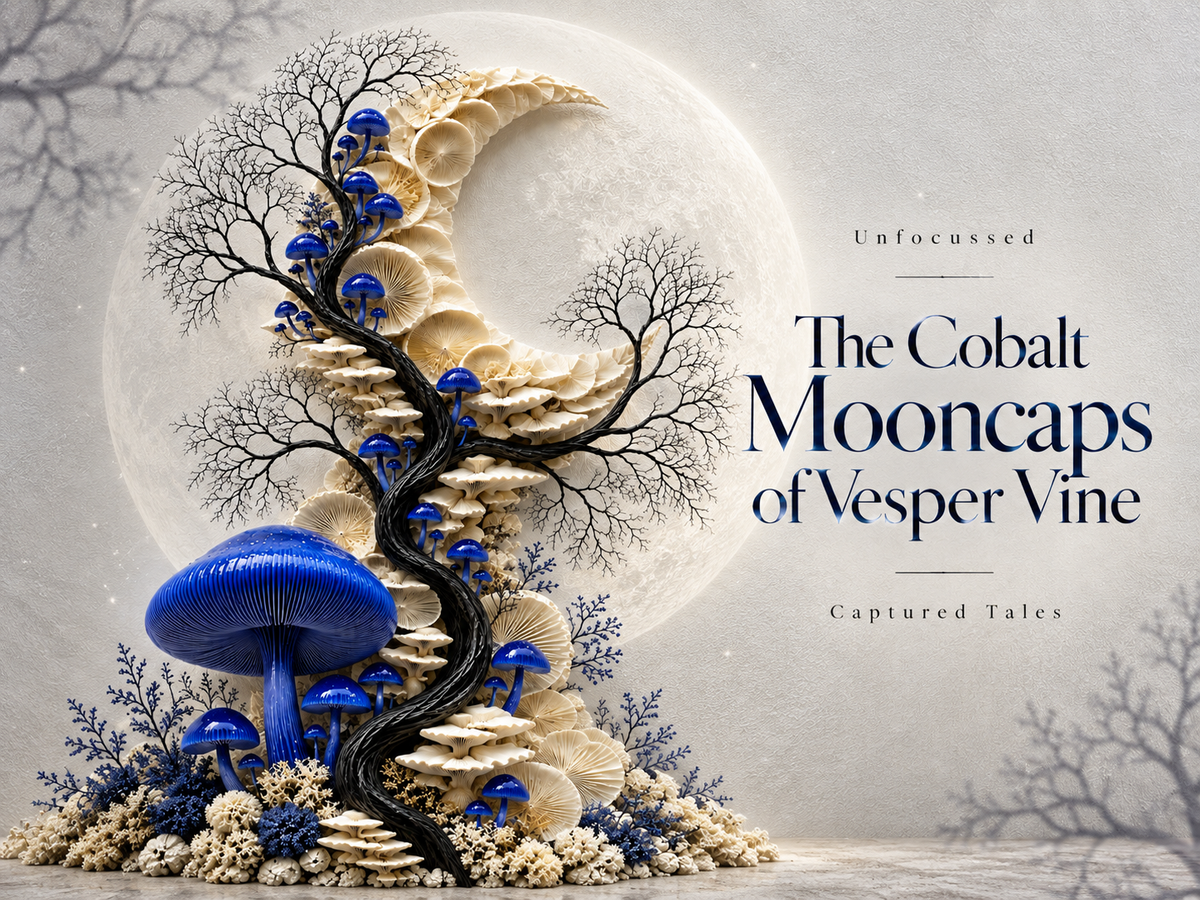
Its black limbs rose from the chalk-white earth in one continuous twist, polished as wet obsidian and hard enough to blunt a woodpecker’s beak. Branches split from its trunk in delicate, skeletal fans, reaching outward through the pale fungal shelves that climbed the cliff behind it. Those mushrooms grew in overlapping tiers, their creamy gills spread wide enough to cradle rainwater, moth eggs, whispered promises, and occasionally a drunk field mouse who had mistaken one for a balcony.
Above them all curved the great ivory crescent.
It was not the moon, although from across the hollow it could easily have fooled anyone with poor eyesight or a strong commitment to superstition. It was an enormous formation of fused mushrooms, white as old bone and shaped into a perfect celestial arc. Every cap faced inward. Every gill pointed toward the dark space at its center. On clear nights, pale light gathered inside it until the entire structure seemed to glow from somewhere beneath its flesh.
The cobalt mooncaps grew along the vine beneath that false moon.
They were small, glossy creatures of stem and cap, their blue surfaces so deep and vivid that the color appeared borrowed from the final moment before midnight. Most forest fungi communicated through slow chemical murmurs beneath the soil. Mooncaps, however, could speak aloud whenever moonlight touched their gills, which made them unusually talkative, distressingly opinionated, and nearly impossible to live beside during a full moon.
There were twenty-seven of them growing on Vesper Vine.
Each guarded one of the vine’s twenty-seven living locks.
Or there had been twenty-seven until Lock Nine went dark.
Morrow noticed it just after moonrise.
He was the largest mooncap in the hollow, stationed near the base where Vesper Vine emerged from a mound of ivory coral fungus. His cap was broad enough to shelter three beetles and a modest lunch. Beneath it, hundreds of blue gills curved inward with architectural precision. The younger mooncaps believed this made him wise.
In truth, it mostly made him difficult to move around.
“Something is wrong,” Morrow said.
High above him, a much smaller mooncap named Pip gave an exhausted little sigh.
“You say that every night.”
“And one night,” Morrow replied, “I will be right.”
“You said the moths were organizing a coup.”
“They were flying in formation.”
“They were mating.”
“Those activities are not mutually exclusive.”
Pip leaned from the vine and peered downward. He grew halfway up the black trunk, wedged between two broad ivory shelves. His cap was barely wider than an acorn, but his voice could cross the entire hollow when he was annoyed, which was often.
“What is supposedly wrong this time?”
Morrow did not answer immediately. His stem had gone rigid. A thin blue luminescence moved beneath his gills, pulsing once, then again.
Every mooncap felt it.
The usual chatter stopped.
Along the vine, twenty-six cobalt caps tilted toward the same empty place.
Lock Nine had occupied a narrow bend above the central fork, where the vine twisted sharply beneath the ivory crescent. A mooncap named Luma had grown there for ninety-three years. She was slender, silver-spotted, and notorious for singing hymns after everyone else had asked her to stop.
Now only a ragged blue stump remained.
No broken cap lay below it. No scraps of stem clung to the surrounding shelves. There were no teeth marks, claw marks, spores, or trails in the dust.
Luma had not been eaten.
She had not fallen.
She had been removed.
The black vine shifted beneath them.
It was a tiny movement, little more than a tightening through the wood, but every mooncap felt it travel upward from the buried root. The ivory shelves trembled. A handful of pale spores slipped from their gills and drifted through the hollow like ash.
Then came a sound from somewhere deep inside the vine.
Thum.
Pip’s cap flattened.
“Was that what I think it was?”
Thum.
Morrow stared at the black trunk beneath him.
“That depends entirely upon what you think it was.”
“A heartbeat.”
“Then yes.”
“Vines do not have hearts.”
“This one does.”
“You neglected to mention that.”
“I was hoping it had died.”
A murmur passed among the younger mooncaps. Several pulled their stems closer to the vine. One attempted to hide behind a shelf mushroom despite being significantly bluer than everything around it.
The heartbeat sounded a third time.
This time, the ivory crescent answered.
Light poured through its enormous gills in a pale ripple. The crescent brightened from its lower point to its hooked upper tip, throwing sharp shadows across the hollow. For one terrible instant, every bare branch of Vesper Vine appeared to reach toward the true moon hanging above the forest.
Morrow knew what the light meant.
One lock was open.
One chamber inside the vine had begun to feed.
“Wake Sable,” he ordered.
Pip blinked. “Sable is awake.”
From beneath a ruffled cluster of oyster mushrooms came a muffled voice.
“Sable was having a private crisis.”
A cobalt cap shoved its way through the pale folds. Sable grew upside down beneath the shelf, her curved stem anchored to its underside. She was small, sharp-tongued, and responsible for maintaining the network of silver mycelial threads connecting all twenty-seven locks.
Twenty-six locks now, Pip thought, but wisely kept it to himself.
Sable lowered herself until her cap hung level with Luma’s severed stump. Fine blue tendrils emerged from her stem and pressed against the exposed surface. She closed the tiny slits beneath her cap that served as eyes.
The vine shuddered.
Sable recoiled so violently that a puff of cobalt spores burst around her.
“Well?” Morrow asked.
“Lock Nine is gone.”
“We noticed the missing mushroom,” Pip said. “The empty space was our first clue.”
“Not damaged. Not broken. Gone.” Sable stared at the stump. “The binding threads were cut from inside the vine.”
Silence spread through the colony.
Something inside Vesper Vine had removed its own lock.
High above them, the true moon slipped from behind a bank of thin clouds. Its cold light touched the ivory crescent and spilled downward across the black branches.
The vine drank it.
A narrow silver current appeared beneath the polished bark. It flowed toward the vacant lock, vanished through the ragged stump, and descended into the trunk.
Thum.
The heartbeat grew stronger.
At the base of the vine, one ivory mushroom collapsed inward. Its soft white flesh shriveled, grayed, and split open along the cap. A thread of captured moonlight leaked from its gills and sank directly into the black wood.
Morrow watched it disappear.
“The first chamber is feeding,” he said.
Pip looked from the dead mushroom to the false crescent overhead.
“Feeding on what?”
Morrow’s answer was quiet.
“The moonbeams stored inside the ivory caps.”
More murmurs broke out along the vine. The youngest mooncaps had never been told what the white mushrooms contained. Most believed they gathered ordinary moonlight because it was pretty, harmless, and useful for keeping away fungus gnats.
Sable stared at Morrow.
“How many beams?”
“One in every gilled cap.”
She looked upward.
Hundreds of ivory mushrooms crowded the vine and the towering crescent behind it.
“That is not a collection,” she whispered. “That is a reservoir.”
“It is a ration,” Morrow corrected.
“For what?” Pip asked.
The vine’s branches creaked around them.
Morrow had guarded the lowest lock for two hundred and eleven years. He had spent much of that time pretending not to remember why the locks existed. Forgetfulness, he had discovered, could become almost convincing if practiced with discipline.
But Vesper Vine was awake now.
And its hunger was climbing.
“Long ago,” he said, “the vine served the moon. It carried her light underground and fed it to the roots of the sleeping forest. Nothing bloomed here without passing through its heart.”
“That sounds almost noble,” Pip said suspiciously.
“It was. Until the moon left it starving through seven winters.”
The old mooncap’s voice lowered as the memory returned.
“The sky filled with smoke. The moon could not reach the hollow, and the vine’s heart began consuming whatever light remained inside it. First it took the glowworms. Then the lantern moss. Then the memories of daylight stored inside the trees.”
A faint tremor moved through the dead branches.
“When the smoke cleared,” Morrow continued, “the moon returned. But Vesper Vine no longer wanted to carry her light. It wanted to possess it. All of it. It reached into the sky and nearly pulled her down.”
Pip glanced at the skeletal limbs stretching around the ivory crescent.
They no longer looked decorative.
They looked like fingers.
“The first mooncaps bound the vine’s heart,” Morrow said. “Twenty-seven living locks, each sealing one chamber of its hunger. The ivory mushrooms were grown to collect small portions of moonlight and feed them through the locks. Enough to keep the heart sleeping. Never enough to let it grow strong.”
Sable touched Luma’s severed stump again.
“And now one chamber is consuming the reserve directly.”
“Yes.”
“What happens when it has eaten enough?”
The black wood beneath them pulsed.
Thum.
A second ivory mushroom withered.
Morrow looked toward the true moon.
“It opens the next lock.”
As if summoned by the words, a scream rang from the upper branches.
Mooncaps twisted toward the sound.
Lock Sixteen flickered near the center of the crescent. Its guardian, a narrow-stemmed mooncap called Orra, bucked against the vine as black fibers tightened around her base.
“It has me!” she cried.
Sable launched a braid of blue mycelium toward her. The thread wrapped around Orra’s stem just as the bark split beneath the struggling mooncap.
A dark opening formed.
There were no teeth inside it.
There was only depth.
Endless, moonless depth.
Something pulled.
Sable’s thread snapped taut. Pip and three others wrapped themselves around it, anchoring their stems to the ivory shelves. Morrow drove his underground roots deeper, sending a surge of blue light through the colony.
For several seconds, Orra remained suspended between them and the opening.
Then a whisper emerged from inside the vine.
It spoke with Luma’s voice.
“Let go.”
Orra stopped struggling.
Her cap turned toward the darkness.
“Luma?”
“Let go,” the voice repeated. “It is warm beneath the bark.”
Black fibers climbed Orra’s stem.
Sable pulled harder. “That is not Luma.”
“She says she found the heart.”
“Orra, listen to me.”
“She says it remembers us.”
The opening widened.
For an instant, pale light revealed something deep inside the vine: a descending corridor of twisted wood, lined with shriveled mushroom caps and strands of silver that pulsed like veins. Far below, a vast shape contracted around a cold white glow.
The stolen moonbeams were gathering in its center.
Orra’s stem slipped another inch into the darkness.
Morrow released a burst of spores from beneath his cap. They struck the black fibers and flared cobalt blue. The vine recoiled. Sable jerked Orra free, sending all five mooncaps tumbling across the shelf in a tangle of stems and furious swearing.
The opening snapped shut.
Orra lay trembling against the ivory gills.
A thin black stain remained around the base of her stem.
“It knew my name,” she whispered.
Morrow looked at the mark and understood what Vesper Vine had done.
Lock Nine had not been the only seal it had touched.
It had tested the others.
And now it knew which one was weakest.
“We cannot defend the locks from out here,” Sable said. “The vine can reach their roots before we even feel it moving.”
Pip stared at the place where the trunk had opened.
“You are about to suggest something appalling, aren’t you?”
“We go inside.”
“There it is.”
“We find Luma, repair Lock Nine, and seal the first chamber before it gathers enough strength to open another.”
“The corridor was lined with dead mushrooms.”
“Then remain here and wait for the vine to add you to the interior decoration.”
Pip considered this.
“Inside suddenly has a certain appeal.”
Morrow studied the colony. Fear had dimmed their cobalt glow, leaving the surrounding ivory caps pale and colorless. They had been grown to serve as locks, yet none but Morrow had ever been told what lay beneath them. Their lives had been built around guarding a danger they had been encouraged to forget.
That ignorance had protected them when the vine slept.
Now it would get them killed.
“Sable is right,” he said. “We cannot mend the lock from the surface.”
“How do we enter?” Orra asked.
Morrow turned his broad cap toward the base of Vesper Vine.
Beneath the largest blue mushroom, hidden among ivory coral growths, a narrow seam had appeared in the trunk. Moonlight seeped through it from the wrong side.
He had not seen that door in more than two centuries.
“Through the root gate.”
The earth shook.
A deep crack split the lowest ivory shelf. Its stored light poured into the vine in a brilliant silver stream. The false crescent blazed overhead, illuminating the entire hollow like a second moon.
At its uppermost tip, one of Vesper Vine’s black branches moved.
Slowly, deliberately, it bent toward the sky.
The true moon hung directly above it.
Thum.
This time, every tree in Palebranch heard the heartbeat.
Morrow uprooted himself from the earth.
“We leave now.”
The seam at the base of the vine opened wider, revealing a staircase spiraling downward through the black wood. Its steps were formed from ancient mushroom caps, each one dry, gray, and curved into a silent expression of pain.
A warm wind rose from below.
It smelled of damp roots, burnt moonlight, and something that had been hungry for a very long time.
Then Luma began to sing beneath the bark.
The Staircase Beneath the Bark
Morrow entered first.
His broad cap scraped both sides of the root gate, producing a long, unpleasant squeal that echoed down the staircase.
Behind him, Pip stopped at the threshold.
“Marvelous,” he muttered. “We have announced ourselves to the ancient hungry thing.”
“It already knows we are here,” Sable said.
“That does not mean we should arrive making the sound of furniture dragged across a crypt.”
Morrow turned sideways and forced himself through. The black walls flexed around his cap, then snapped back into place as soon as he passed. Sable followed, carrying coils of silver mycelium wrapped around her stem. Pip came next, complaining quietly but continuously, which Morrow suspected was the only thing keeping him brave.
Orra remained outside with the other mooncaps.
The stain around her stem had spread into her lowest gills. She would guard the root gate while the colony reinforced her weakened lock, assuming Vesper Vine allowed them enough time to try.
“If the gate closes,” Sable told her, “cut through the seam with blue spores. Do not listen to any voice coming from inside, even if it sounds like us.”
“How will I know it is not you?”
Pip peered from behind Morrow’s cap.
“Ask whether I volunteered for this. If the answer is yes, burn the vine to the ground.”
Orra managed a faint smile.
Then the three mooncaps descended.
The root gate sealed behind them.
Moonlight vanished.
For several breaths, there was only darkness and the soft creaking of living wood. Then Morrow opened his gills. Cobalt light spilled from beneath his cap, illuminating the staircase in narrow blue bands. Sable and Pip did the same.
The walls glistened.
Vesper Vine was larger inside than its trunk could possibly contain. The staircase curled downward through a chamber wide enough to hold the entire hollow. Black roots braided across the walls, each one swelling and relaxing with the vine’s slow pulse. Silver currents ran between them, carrying stolen moonlight deeper underground.
The steps beneath the mooncaps were exactly what they had appeared to be from above.
Dead caps.
Thousands of them.
Mooncaps of every size and age had been pressed into the spiraling staircase, their cobalt color leeched away until only gray shells remained. Some were perfectly preserved. Others had cracked beneath centuries of footsteps belonging to creatures no living mooncap remembered.
Pip stared down at the cap beneath his stem.
“Morrow.”
“Keep moving.”
“Who were they?”
“Keep moving.”
“You know who they were.”
Morrow descended another step before answering.
“The first locks.”
Sable’s glow sharpened.
“You told us the first mooncaps bound the heart.”
“They did.”
“You failed to mention that the vine turned them into stairs.”
“There are many details I had hoped would remain irrelevant.”
“They are under our feet, Morrow. Relevance has been established.”
The old mooncap stopped.
Far below them, Luma’s song wound through the chamber. It was a familiar hymn about dawn returning to the hollow, but the melody had been stretched into something slow and hollow. Each note seemed to travel upward through the walls rather than through the air.
“The first binding failed,” Morrow said. “The mooncaps sealed the chambers, but Vesper Vine learned to feed through their roots. It consumed them one by one and used what remained to build a path toward its heart.”
Pip lifted himself away from the dead cap beneath him.
“And then?”
“The second colony changed the locks. We anchored ourselves outside the bark, where the vine could not reach our caps without exposing itself.”
Sable studied him.
“You said ‘we.’”
Morrow continued downward.
“I was the last mooncap grown by the first colony.”
Neither of them spoke for several steps.
Pip finally broke the silence.
“You are more than two hundred years old.”
“Two hundred and eleven.”
“You let us believe you were one hundred and forty.”
“I moisturize.”
“You lie.”
“That also preserves a person.”
The staircase tightened as it descended. Its outer edge dropped into a shaft without a visible bottom. Threads of pale light floated through the darkness like drowned stars. Each time the heart beat, the black roots contracted and pulled those lights downward.
Thum.
The step beneath Pip’s stem twitched.
He leaped forward and collided with Sable.
“The stairs are moving.”
“They are dead,” Sable said.
The gray cap behind them flexed.
A narrow split opened across its surface.
Blue light appeared beneath it.
Then another step moved. And another.
All along the spiral, ancient caps lifted from the wood. Dry gills opened like rows of tiny mouths. The staircase breathed in.
The glow beneath Morrow’s cap dimmed.
“Run.”
The dead mooncaps exhaled.
A cloud of gray spores erupted through the shaft.
Morrow lunged downward, using his heavy cap to shield Sable and Pip. Spores struck his back with the force of sleet. Wherever they touched his blue surface, the color faded.
Pip raced beneath him, bounding from step to step.
“What do the spores do?”
“They steal memory,” Morrow shouted.
“How much?”
“That depends on how long you keep asking questions instead of running.”
The staircase convulsed.
Dead caps folded upward behind them, transforming the path into a closing tunnel of brittle gills. Sable threw a mycelial cord around a root ahead and swung over a section as it collapsed. Pip jumped after her, missed the cord, and caught the end with the edge of his cap.
“I hate this vine!” he cried as Sable hauled him across the gap.
“It is fond of you.”
“That is worse!”
Morrow reached the collapsing section last. His broad cap wedged between the closing gills. Gray spores swarmed around him, stripping fragments of color from his rim.
He pushed forward.
The dead caps tightened.
A memory vanished.
He felt it leave him as a sudden coldness: the scent of the first rain he had ever known. One moment it was there, damp and mineral-rich beneath the moon. The next, he remembered only that rain possessed a smell and that he had once loved it.
Morrow roared and forced his cap through the narrowing gap.
The dead gills snapped shut behind him.
He landed beside Sable and Pip on a ledge of black bark. Beyond it stood a door made from hundreds of interwoven silver roots.
At its center was an empty, mooncap-shaped hollow.
Lock Nine.
Luma’s song came from the other side.
Sable rushed to the door and pressed her tendrils against the silver weave. Light traveled through the threads, mapping the damage.
“The binding has been pulled inward,” she said. “Luma is alive.”
“Can you open it?” Morrow asked.
“Yes.”
“Can you close it afterward?”
Sable hesitated.
“Also yes.”
Pip tilted his cap. “That pause had a noticeable amount of death in it.”
“The lock requires a living mooncap.”
“We will bring Luma back.”
“If she can still bind to it.”
“And if she cannot?”
Sable looked at the empty hollow.
It was barely larger than Pip.
He followed her gaze.
“Absolutely not.”
“I did not say anything.”
“Your silence volunteered me.”
Morrow stepped between them.
“No one takes the lock unless there is no other choice.”
“There is always another choice,” Pip said.
“That is something creatures say before discovering the final two choices are terrible.”
Luma’s song stopped.
Three slow knocks sounded from the other side of the door.
Pip lowered his voice.
“Does she know we are here?”
“She does now,” Sable said.
A silver root pulled away from the weave.
Then another.
The door was opening itself.
“Back,” Morrow ordered.
The mooncaps retreated as the roots unbraided. A pale radiance spilled through the widening seam. The chamber beyond was filled with moonlight so bright that their cobalt caps turned almost black against it.
Luma stood at the center.
She appeared unharmed.
Her slender blue stem rose from a pool of silver light. Her cap shone with the same spotted pattern Morrow remembered, and every gill remained intact.
“You came,” she said.
Pip moved toward her.
Sable caught him with a loop of mycelium.
“Wait.”
Luma smiled.
Mooncaps did not have mouths.
The pale curve split across her stem anyway.
“There is nothing to fear,” she said.
Morrow entered the chamber alone.
Silver light climbed his stem, warm and thick as sap. The walls were lined with hundreds of ivory caps connected by black roots. Their stored moonbeams poured into the pool surrounding Luma.
Behind her stood the first chamber of Vesper Vine’s heart.
It resembled a closed black flower taller than the oldest tree in Palebranch. Its overlapping petals contracted with each heartbeat. Between them shone thin seams of imprisoned light.
Thum.
The flower opened slightly.
A wave of hunger moved through the chamber.
Morrow felt it taste the light beneath his gills.
“Step out of the pool, Luma.”
“I cannot.”
“Then we will pull you out.”
“You misunderstand.”
Black filaments rose beneath the silver surface. They passed through Luma’s stem, branching inside her until they reached her cap.
“I do not wish to leave.”
Sable entered beside Morrow.
“It is speaking through you.”
“It showed me the truth.”
“It filled you with roots.”
“Those facts can coexist.”
Pip remained near the doorway.
“I liked her better when she sang too much.”
Luma turned toward him.
“Come closer, Pip. The heart remembers the moment your first spore woke beneath the moon.”
He backed away.
“I barely remember that myself.”
“It remembers everything fed into the vine. Every moonbeam. Every root. Every mooncap the locks consumed.”
The black flower opened another fraction.
Shapes appeared within its light.
Thousands of pale caps crowded together inside the heart, their gills moving as one. The first colony had not been destroyed. Their memories, voices, and hunger had been absorbed into Vesper Vine.
Luma’s smile widened.
“They are still here.”
Morrow stared into the flower.
Among the pale faces, he recognized Ember, the mooncap who had taught him to speak. He saw gentle Thren, who had guarded Lock Four. He saw Noll and Vestra and little Ardin, who used to shake dew from his cap onto sleeping moths.
Then he saw a mooncap whose spotted crown had haunted his oldest memories.
His mother.
She opened her eyes inside the heart.
“Morrow,” she whispered.
His stem moved before he could stop it.
He stepped into the pool.
Sable’s tendrils snapped around him.
“That is not her.”
“It knows her voice.”
“Because it ate her.”
The bluntness struck harder than the memory spores.
Morrow stopped.
The face inside the flower twisted. Its gentle expression collapsed into fury, then flattened into one of cold amusement.
Vesper Vine spoke through every dead mooncap in the heart.
“You left them here.”
The chamber shook.
Black roots erupted from the pool.
Sable flung Morrow backward as one wrapped around her stem. Another lashed toward Pip. He ducked, but its tip clipped his cap and spun him into the silver-rooted door.
Morrow drove his roots into the chamber floor and released a cobalt flare. Blue light raced across the pool, briefly revealing the network beneath it.
Every stream of stolen moonlight passed through Luma.
She was not merely trapped inside the first chamber.
Vesper Vine had turned her into its feeding root.
“Sable!” Morrow shouted. “Sever the filaments!”
She twisted beneath the root holding her and fired a strand of mycelium across the pool. Its sharpened tip sliced through the first black filament inside Luma’s stem.
The vine screamed.
The sound came from the walls, the staircase, the dead caps, and the enormous flower. Luma folded forward as silver light burst from the wound.
Sable cut a second filament.
Then a third.
The chamber began to collapse.
Ivory mushrooms tore free from the walls. Stored moonbeams spilled across the floor in blinding streams. Black roots thrashed through them, drinking whatever light they touched.
Pip crawled toward Luma.
“How many are left?”
“Seven,” Sable said.
“Can you cut them before the ceiling kills us?”
“Ask me after the ceiling kills us.”
A slab of bark crashed between them.
Morrow caught it across his cap. The impact drove his stem deep into the chamber floor, but he held the slab aloft.
“Move!”
Sable cut four more filaments while Pip reached Luma. He wrapped his small stem around hers and pulled.
She did not move.
Her roots had fused with the heart.
“Luma,” Pip said, “you need to help me.”
Her eyes flickered beneath her cap.
“It is warm here.”
“Yes, you mentioned that. Warmth is not a compelling reason to become part of a homicidal shrub.”
“It remembers everything.”
“Then let it remember losing.”
Luma’s smile vanished.
For the first time, Pip saw fear in her eyes.
She strained upward.
Her fused roots began to tear.
Sable severed the final three filaments at once.
The black flower opened.
All the moonlight stored inside the first chamber erupted outward.
Morrow lost his grip on the fallen slab. Sable vanished beneath a torrent of silver. Pip felt Luma’s stem tear free in his grasp, and the two of them were thrown across the chamber.
Within the explosion, something dark emerged from the heart.
It was not a root.
It was a hand.
Five long wooden fingers closed around the escaping moonlight. The vine compressed it into a single glowing sphere, bright as a miniature moon.
Then it withdrew the sphere into the open flower.
Thum.
The first chamber split apart.
A crack raced upward through the ceiling, along the trunk, and into the hollow above.
Somewhere outside, another lock broke.
Then another.
Morrow felt both vanish from the colony’s living network.
Twenty-four locks remained.
The heart beat again.
This time, the staircase began carrying them downward.
The dead caps rotated around the shaft in a slow spiral, transforming the steps into a vast turning mechanism. Silver doors flashed past them as the chamber sank deeper into Vesper Vine.
One door for every lock.
One chamber for every portion of its hunger.
Sable dragged herself from beneath a fallen root.
“It used Luma to open the first chamber.”
Morrow pulled Luma upright. Her cap had dimmed, but a weak cobalt glow still moved beneath her gills.
“And it used the first chamber to break two more locks.”
Pip looked through the shattered wall.
The descending spiral had carried them far beneath Palebranch. Below them, twenty-four sealed chambers curved around an abyss. Silver light pulsed behind each door.
At the bottom stood something immense.
Vesper Vine’s true heart was not a flower.
The black flower had been only its mouth.
The heart was a tightly coiled mass of roots wrapped around a white sphere. The sphere was scarred, cratered, and radiant beneath the wood.
Pip stared down at it.
“That is not stored moonlight.”
Morrow’s remaining color drained from the rim of his cap.
He finally understood why the moon had once abandoned Vesper Vine through seven winters.
She had not abandoned it.
She had cut something away from herself and buried it where the vine could guard it.
A fragment of the original moon.
And Vesper Vine had spent centuries feeding upon it.
The roots around the buried fragment tightened.
A black fissure opened across its surface.
Far above them, the true moon answered with a tremor that shook the entire night sky.
The Heart That Remembered Hunger
The moon moved.
Not across the sky, as moons were expected to move, but downward.
In Palebranch, owls abandoned their branches. Moths dropped from the air. Pools rose from their banks in trembling silver columns, and every pale flower in the forest turned toward Vesper Vine.
At the root gate, Orra watched the moon swell above the ivory crescent.
It was coming closer.
The black stain beneath her cap pulsed.
Vesper Vine tightened around her lock.
“Hold me,” she told the others.
Blue stems wound around hers. Mycelial threads bound the remaining mooncaps together across the trunk. One by one, they anchored themselves to the ivory shelves and pulled against the vine.
The black bark split beneath Orra.
A voice whispered through the opening.
It belonged to Morrow.
“Let go.”
Orra closed her eyes.
“Pip did not volunteer.”
The voice hesitated.
Then the vine tore at her roots.
The colony pulled back.
Cobalt light erupted across Vesper Vine as twenty-four living locks fought the hunger beneath its bark.
Far below them, the descending chamber shuddered to a halt.
Morrow felt the colony’s resistance through the severed network. Their combined glow streamed downward in thin blue threads, illuminating the abyss and the vast roots coiled around the buried moon fragment.
“They are holding the locks,” he said.
Sable studied the turning staircase.
“They will not hold them for long.”
Two chambers already stood open below. Their black mouths poured stolen light toward the heart. A third door trembled in its silver frame as the roots behind it hammered from within.
Thum.
The buried moon fragment cracked again.
Light burst through the fissure and struck the walls. Images flared wherever it touched: vanished forests, silver rivers, antlered creatures walking beneath unfamiliar stars. These were not reflections. They were memories preserved inside the moon.
Vesper Vine drank them as quickly as they appeared.
A root swallowed an ancient snowfall.
Another consumed the memory of the first moth taking flight.
A third darkened as it absorbed the image of the moon resting on a young world with no name.
Pip stood beside Luma, who could barely support her own cap.
“Why would the moon bury part of herself down here?”
Morrow stared at the glowing sphere.
“Because it was sick.”
He remembered the seven winters of smoke. The forests had believed clouds concealed the moon, but there had been no clouds. The darkness had spread from within her light, a shadow that grew each time living creatures looked upon her with fear.
The moon had cut the infected fragment from herself.
And Vesper Vine had accepted the burden of guarding it.
“The vine was not abandoned,” Morrow said. “It was poisoned.”
Sable followed the black roots from the buried fragment into the surrounding chambers.
“It fed on the corruption.”
“For centuries.”
“Then the hunger is not the vine’s.”
Below them, the black fissure spread across the moon fragment.
Something moved behind it.
A pale eye opened within the crack.
It had no pupil. No iris. Only a white brilliance surrounded by veins of absolute darkness.
The eye looked upward.
Every mooncap froze.
The voice that entered their minds did not belong to Vesper Vine.
It belonged to whatever the moon had amputated and buried.
Open the sky.
The third chamber ruptured.
Its silver door flew outward, spinning into the abyss. A torrent of stored moonbeams struck the coiled heart. Black roots swelled, splintering against one another as the buried fragment fed.
The staircase lurched downward.
Sable caught Luma before she fell.
“We cannot repair Lock Nine while this chamber is connected to the heart,” she said.
“Then sever the connection,” Morrow replied.
“With what?”
He looked at the braid of blue light descending from the colony above.
“With every lock at once.”
Sable understood immediately.
“That would release the bindings.”
“Only for a moment.”
“A moment is enough for the vine to break all of them.”
“It is also enough to move the moonlight somewhere the corruption cannot consume it.”
Pip glanced around the chamber.
“And where, precisely, is that?”
Morrow turned his broad cap toward the dead mooncaps forming the staircase.
Thousands of colorless gills surrounded them.
Thousands of hollow vessels.
Thousands of memories Vesper Vine believed it had consumed.
“Into the first colony.”
Sable stared at him.
“They cannot hold that much light.”
“They once held the vine’s entire hunger.”
“And it killed them.”
“It will not have time to kill them again.”
The buried eye widened.
Open the sky.
The black branches above answered. Vesper Vine’s tallest limb curled around the descending moon, its slender twigs spreading across the lunar surface like cracks.
Moonlight vanished from half the forest.
Orra screamed as the stain reached her cap.
The mooncaps around her tightened their grip. Blue light passed from stem to stem until the entire colony burned against the darkness.
“Tell us what to do,” Sable said.
Morrow drove his roots into the moving staircase.
They pierced the oldest cap beneath him.
Memory flooded upward.
He saw the first colony gather inside Vesper Vine. He felt their terror as they wrapped themselves around the infected moon fragment. He heard his mother singing while the darkness hollowed her cap.
Then he heard the words she had spoken before the vine consumed her.
What is carried together cannot be swallowed alone.
Morrow opened every gill beneath his cap.
“Sable, reconnect us to the colony.”
“The network is broken.”
“Use me as the bridge.”
“It will pass through your roots.”
“Yes.”
“It may burn every memory out of you.”
Morrow looked down at the ancient cap beneath him.
He could no longer remember the scent of rain. Soon he might forget the voice of his mother, the names of the mooncaps above, or why he had entered the vine at all.
But the dead surrounding him remembered.
Perhaps no memory was ever meant to belong to one creature forever.
“Do it,” he said.
Sable unwound the silver mycelium from her stem. She threaded one end through Luma’s severed roots and drove the other into Morrow’s.
Pain flashed through him.
The network opened.
He felt every living mooncap on Vesper Vine.
Orra struggling against the black stain. Two frightened twins clinging beneath the crescent. Old Brill muttering obscenities at the branches. Twenty-four locks bound together by fear, duty, and the unreasonable determination not to become architectural material.
Morrow sent one message through them all.
When the next heartbeat comes, release your locks.
Panic surged back through the network.
He pushed his roots deeper into the dead staircase.
The ancient caps awakened beneath him.
Blue light appeared in one set of gills.
Then another.
Color flowed downward through the spiral until thousands of dead mooncaps glimmered in the abyss.
Faces returned within them.
Ember opened her eyes. Thren lifted his cap. Noll, Vestra, and Ardin emerged from centuries of gray silence.
Morrow’s mother looked up from the step below him.
“You took your time,” she said.
He wanted to answer, but the heart beat.
Thum.
The living mooncaps released their locks.
Twenty-four silver doors opened at once.
Vesper Vine convulsed with triumph.
Every chamber discharged its stored moonlight toward the buried fragment. Rivers of white fire rushed through the roots, carrying centuries of gathered radiance toward the darkness.
Sable seized the network.
She redirected it through Morrow.
The first wave struck his roots.
His cap ignited cobalt blue.
Memory tore through him faster than thought. Full moons, eclipses, winters, births, funerals, migrations, vows, betrayals, and every quiet night Vesper Vine had ever witnessed surged beneath his gills.
His own memories began to scatter.
He forgot his age.
He forgot the beetle coup that had actually been moths mating.
He forgot Pip’s name.
Then the dead colony reached for him.
Thousands of roots joined his.
The moonlight divided among them.
Gray caps turned blue. Empty gills filled with silver. The staircase transformed into a luminous spiral wrapped around the abyss, each dead mooncap carrying a portion of the light no single lock could hold.
The buried fragment opened its eye wider.
No.
For the first time, fear entered its voice.
Black roots tore free from the heart and lashed at the staircase. Wherever they struck, the awakened mooncaps released brilliant clouds of spores. Blue fire spread across the roots, burning away the corruption woven through them.
Vesper Vine screamed.
The sound shook every branch above the earth.
Its grip around the true moon loosened.
Orra looked up as light returned to the forest.
“Now!” she shouted.
The living colony resealed its locks.
Twenty-four silver doors slammed shut.
The moonlight remaining inside the heart had nowhere to go.
Sable released Morrow from the network and drove every loose strand of mycelium into Luma’s roots.
“Pip, get her to Lock Nine!”
He wrapped himself around Luma and pulled her toward the empty hollow in the silver door.
“I cannot bind,” Luma gasped.
“You can sing.”
“That has never helped anyone.”
“I have been saying that for years, but tonight we shall test it.”
They reached the hollow.
Sable pressed Luma’s damaged roots into the silver weave. The binding threads recoiled from the black residue inside her stem.
“They will not accept her,” Sable said.
The heart struck the chamber walls.
A root broke through beneath Pip and wrapped around his stem.
He screamed as it dragged him toward the open black flower.
Luma lunged after him. Her silver threads stretched from the door but did not hold.
“Let him go!”
The voice inside the vine laughed.
Give me the sky.
“You cannot even keep a mushroom,” Pip shouted as he clawed at the floor. “The sky may be beyond your competence.”
Luma began to sing.
Her voice trembled at first. It was the same hymn the vine had used to lure them into the chamber, the old song about dawn returning to Palebranch.
But now the words were her own.
She sang of the mooncaps above holding fast against the dark. She sang of Morrow carrying more light than memory. She sang of Sable stitching a broken colony together and Pip insulting an ancient horror while being actively dragged toward its mouth.
The awakened mooncaps joined her.
Thousands of voices rose from the staircase.
Their song traveled through the silver network and into the hollow above. Orra heard it first. Then Brill. Then the twins beneath the crescent.
One by one, the living colony began to sing.
The silver threads accepted Luma.
Lock Nine closed around her stem.
Its light struck the root holding Pip and severed it.
He flew backward, bounced from an ivory cap, and landed upside down against the door.
“I remain opposed to singing,” he said weakly, “but I acknowledge limited tactical value.”
The first chamber sealed.
The black flower folded inward.
Without the stolen moonlight feeding it, Vesper Vine’s true heart began to shrink. Its swollen roots split open, shedding centuries of accumulated darkness. Beneath them appeared the vine as it had once been: thin, silver-barked, and wrapped protectively around the infected fragment.
The pale eye inside the fragment turned toward Morrow.
You cannot imprison hunger forever.
Morrow looked at the thousands of awakened mooncaps surrounding it.
“No,” he said. “But we can make it considerably more crowded.”
The first colony released their gathered light.
Not into the fragment.
Through it.
A cobalt beam pierced the buried moon and shot upward through the vine. It passed through every chamber, every lock, and every ivory mushroom before striking the true moon above Palebranch.
The moon blazed blue.
For one breath, the whole forest stood beneath cobalt daylight.
The infected fragment cracked from edge to edge.
Darkness poured from it and vanished inside the beam. The pale eye collapsed. Its final scream dwindled into a whisper, then into silence.
The fragment became clear and white.
Freed from the corruption, it rose from the heart.
Roots opened around it.
The sphere passed upward through the chambers, gathering every remaining moonbeam as it climbed. When it emerged from Vesper Vine, it hovered inside the ivory crescent like a small and perfect moon.
The true moon pulled it home.
The fragment streaked into the sky and vanished into the radiant surface above.
A wave of silver light rolled across Palebranch.
Water settled into its pools. Owls returned to their branches. Moths recovered their dignity and pretended they had intended to fall from the air.
Vesper Vine released the moon.
Its black branches relaxed around the ivory crescent.
Far below, the staircase stopped turning.
The awakened mooncaps dimmed one by one. Before Morrow’s mother faded, she touched one pale root to his.
The scent of rain returned to him.
Wet earth. Cold stone. The first silver drops striking his new blue cap.
Then she was gone.
The ancient mooncaps became still, but they did not turn gray again. A faint cobalt color remained beneath their gills, preserving the memories they had carried together.
Sable examined Morrow.
“Do you know who you are?”
He considered the question carefully.
“Morrow.”
“Do you know who I am?”
“Sable.”
Pip righted himself against the silver door.
“And me?”
Morrow studied him.
“A persistent irritation with a cap.”
Pip brightened.
“He remembers.”
They climbed from the vine together.
Luma remained bound to Lock Nine, but she was no longer alone inside it. The silver network connected her to every mooncap in the colony. When the root gate opened, twenty-four voices greeted her at once, several talking over one another and one demanding to know whether she intended to resume the singing.
The ivory crescent had changed.
Its inner space no longer held an empty darkness. A soft cobalt glow floated there, shaped by the light passing between the living locks and the ancient colony beneath the bark.
Vesper Vine was still alive.
It would always carry hunger in its roots, just as every creature carried some darkness inside it. But the vine no longer bore that hunger alone, and it no longer mistook possession for devotion.
When moonlight touched its branches, they bent toward the sky without grasping.
The ivory mushrooms continued gathering small portions of silver light. The cobalt mooncaps continued guarding the chambers. Pip continued objecting to nearly every aspect of the arrangement, particularly the singing, the danger, and the lack of recognition for his heroic resistance to being eaten.
Morrow finally told the colony the whole history of Vesper Vine.
He left nothing out.
Not the buried fragment. Not the first locks. Not the staircase made from their bodies. Not the centuries he had spent hoping silence could turn a terrible truth into a harmless one.
The youngest mooncaps listened until sunrise.
Then they began carving the names of the first colony into the ivory shelves.
Visitors later claimed that the cobalt glow inside the crescent was a second moon, born beneath the forest and tangled forever in Vesper Vine. Others said it was merely light passing through blue spores.
The mooncaps did not correct them.
They knew the glow was neither moon nor magic.
It was memory shared widely enough that no darkness could swallow it whole.
And whenever a new cobalt cap emerged along the black vine, its first sight was the ivory crescent shining above it.
Its first sound was Luma singing.
Its second was Pip asking her to stop.
Bring the Mooncaps Home
The darkness beneath Vesper Vine has been sealed, but its cobalt glow still escapes into the world. Bring home The Cobalt Mooncaps of Vesper Vine as a luminous canvas print, an elegant framed print, or a radiant metal print. Its intricate fungal crescent also becomes a wonderfully devious challenge as a jigsaw puzzle, while the greeting card offers a smaller piece of moonlit Palebranch to share. Explore these forms and more at shop.unfocussed.com.

 Sir Grumblethorn and the Mushroom That Disagreed
 The Wink That Got Away With Everything
 The Dewdrop He Swore He Could Handle