
A Lane That Remembered the Measure
Knotsnarl Lane tucked itself beneath the eastern fringe of the Great Whispering Woods, where old roots lifted the cobbles and every cottage seemed to lean close enough to hear the next one’s business. Before Queen Vandelina ordered public music silenced, the lane had kept time with a four-note market measure: one phrase for opening stalls, one for closing shutters, and a last little turn that meant come quickly; someone needs you. The tune was gone from the air now. The measure survived in small habits—four quiet taps on a lantern glass, passed from doorway to doorway like a secret everyone was trusted to keep.
So when every lock on the lane clicked open at once, the taps stopped. Cellar doors eased wide. A drawer no one had touched in years slid forward by the width of a fingernail. In the back garden of Mrs. Dalloway’s house, a gate unlatched itself with the considerate little sound of a guest who had already decided to come in.
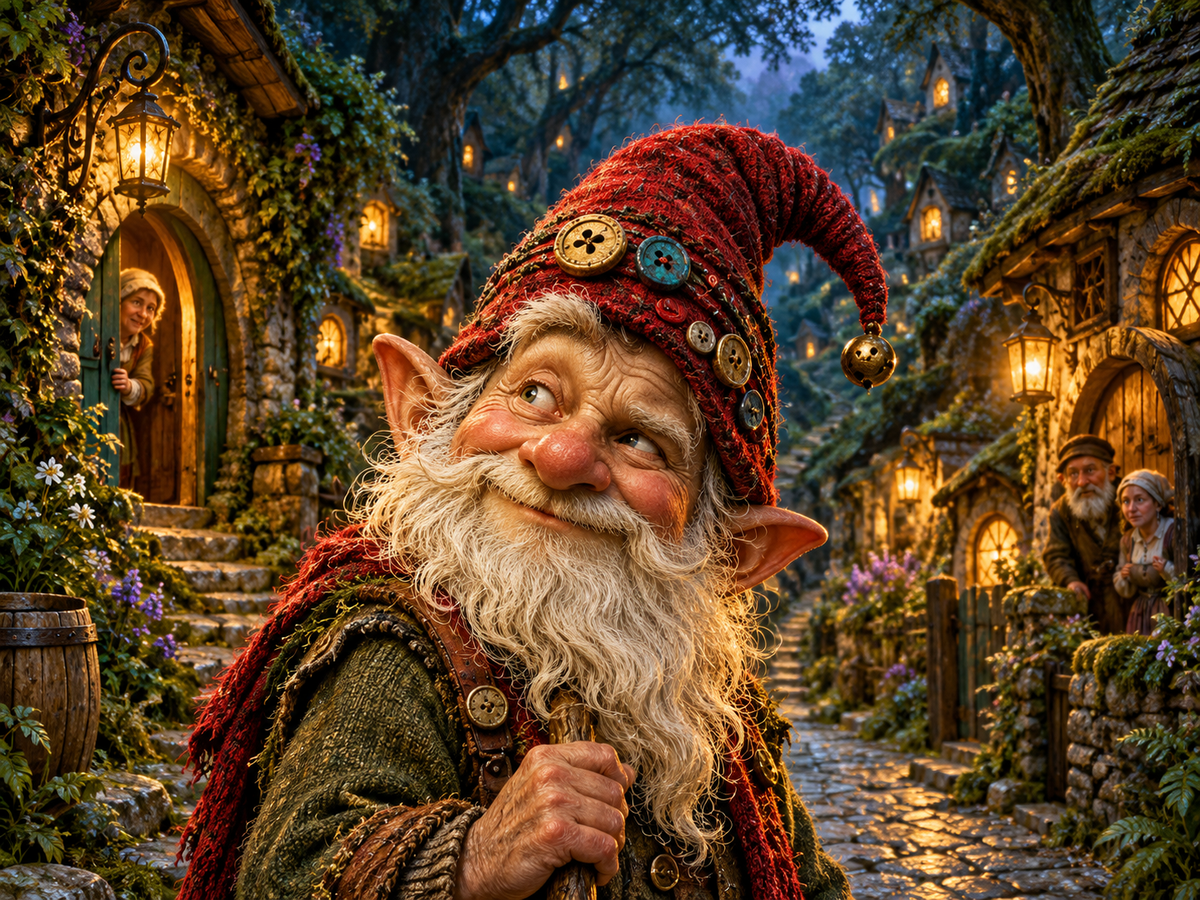
The gnome stood at the lane’s entrance, smiling as if he had arrived precisely on time for a party that had not invited him. Road dust silvered his boots. His coat was stitched from velvet, wool and scraps of very expensive-looking brocade, all of it worn with the confidence of someone who considered “matching” a timid hobby. The crooked red cap on his head was worse. It was knitted, curled at the tip, and covered in mismatched buttons: brass, bone, walnut, shell, and one blue button that looked as if it had fallen off a dress belonging to a duchess with excellent taste and poor security.
His laugh escaped before his name did. It was not loud. It did not need to be. A shutter swung open. A cupboard door came ajar. Somewhere, a hidden drawer remembered what it held. No answering pulse traveled through the forest, and no communal music rose from the roots. This was a smaller, stranger magic—the gnome’s own, stitched into the buttons on his hat.
Mrs. Dalloway recognized him. Years earlier, beside the river, she had asked for the truth about a man she loved and said she would give anything to have it. The gnome had given her an answer. It was not the romantic secret she expected; the man had been hiding money to repair her roof before winter. Mrs. Dalloway had laughed, then cried, then thanked him. She had not understood that the gnome considered the word anything an invoice with no limit printed on it.
“You came back,” she said.
“I did say I was thorough.” He touched a dull brass button. It chimed once against his nail. “You asked for an answer. You received one. Today, I’m collecting the rest of that sentence.”
“I never agreed to this.”
“You said anything.”
“I said it because I was frightened and in love.”
For the first time, his grin paused. Only for a beat. Then he tipped the hat, and the button chimed again. “We shall see what the lane has promised.” He turned toward the crooked houses, leaving Mrs. Dalloway with her broom in one hand and the uneasy feeling that every word she had ever used for emphasis had been written down somewhere.
Receipts for Careless Words
By midday, the gnome had found several people who had once said something dramatic because a smaller, truer sentence felt too difficult. He kept the hat tilted just so, as though it were an ordinary accessory and not a filing system with an appetite.
“I’d give my left hand to escape this debt,” said a market porter, remembering a desperate bargain from years ago. The gnome took a small ivory button from his cap. “I have no use for your hand,” he said. “I do, however, have a use for the follow-through you promised when the money was lent.” The button flicked. The porter forgot what he had meant to say next and watched a lifetime of unfinished errands scatter through his mind like startled hens. No blood, no broken fingers—just the unnerving discovery that starting was easy and completing had become impossible.
“That is not what I meant,” the porter protested.
“It is what you said.”
“I was trying to get through a hard day.”
“Aren’t we all?” The gnome gave him a bright pat on the shoulder and moved along, looking far too pleased with the neatness of the exchange.
At the well, he collected from a man who had promised to “always choose” his partner, though he had already decided to leave. The gnome lifted a dark, polished button. Its surface swallowed the afternoon light. When it clicked, the man lost the practiced ability to say comforting things he did not mean. His partner heard, at last, the honest sentence beneath all those careful evasions. It hurt. It also meant she could make her own choice.
By then, half the lane had gathered in the square. They did not sing; no one had sung in public since the Queen’s decree. But a child tapped four beats against a lantern glass. A second lantern answered. Then a third. The old measure passed along the houses, quiet and unmistakable. It was not a spell, and it did not summon the Echo Pulse. It was simply Knotsnarl Lane remembering how to call its people together.
Mrs. Dalloway stepped to the front. “You have taken more than we understood we were offering.”
The gnome’s smile sharpened. “I took what you said you would give.”
“You kept the words and hid the terms.”
“I did not force anyone to speak.”
“No,” she said. “You only waited until we were desperate, then treated our worst sentence as a contract we had read carefully.” The lane grew still. “We were careless with our words. You were careful with our fear. Do not tell us those are the same thing.”
The gnome glanced up at the hat. Hundreds of buttons—each tied to some promise, exaggeration or bargain from Knotsnarl Lane—caught the pale afternoon. They did not glow with the forest’s returning music. They chimed with his own private craft, and every note sounded suddenly less like a triumph.
“You meant it at the time,” he said, quieter now.
“Sometimes,” said the porter. “Sometimes I meant to be heard. Sometimes I meant to get home. Sometimes I meant to make someone stop asking me for a truth I was not ready to give.” Mrs. Dalloway held his gaze. “You treated every figure of speech as informed consent. You know the difference. You simply liked the version that paid you.”
His fingers curled around the edge of his cap. For once, no clever line arrived to rescue him. The four-beat measure continued in the lanterns around the square—not music, not magic, but people choosing to remain present while the truth became uncomfortable.
A Promise Given Freely
“Then tell me what you want,” the gnome said.
Mrs. Dalloway looked around the square. “We want back what you took.”
“And what do I receive?”
“Nothing you are not freely offered.”
His brows rose. “That sounds like a very poor bargain.”
“It is not a bargain,” she said. “We will tell you what we were afraid to say. We will own the harm we caused. But you will return what you took because you know you had no right to keep it.”
The lane answered her with four quiet taps. Then people began, one at a time, to say what they meant without dressing it up as a vow. The porter admitted he had borrowed money and avoided the lender because shame was easier than repayment. The man by the well admitted that he had used a promise of forever to postpone an honest goodbye. Mrs. Dalloway said she had wanted the truth about her husband because uncertainty made her feel foolish; she had not considered what her demand might cost him, or herself.
None of it came out perfectly. A few people stumbled. One started over twice. The gnome listened with his hands still, the buttons quiet against one another. Their words were not gifts to him. They were theirs to give or withhold.
“I could keep the buttons,” he said, though his voice had lost its certainty.
“You could,” said Mrs. Dalloway. “And we could remember what kind of person chose to do it.”
The gnome took off his hat. Without the tilt and the grin, he looked older than the lane had first noticed: an adult gnome with rain lines at the corners of his eyes and a white beard gone soft with years. He turned the cap in both hands. The buttons held the lane’s old words, but the lane had given him something more useful now—plain truth, offered without a trap.
“I thought I was teaching you to mean what you said,” he murmured.
“You were teaching us to fear what we said,” Mrs. Dalloway replied. “Those lessons do not sound alike.”
He nodded once. “No. They do not.”
He loosened the first button. It fell into his palm with a small, ordinary click. As he set it on the low stone wall, the porter remembered how to finish a thought. The next button came free; the man at the well found the courage to speak plainly without making the truth cruel. Another returned to Mrs. Dalloway, carrying no answer this time—only the part of herself she had set aside while waiting for one.
The gnome worked slowly. No grand flash, no forest-wide pulse, no chorus conjured from the roots. Just a button, a name, and a person finding a piece of their own life back in their hands. Some memories came with a wince. Some habits returned awkwardly, like coats taken from storage. The lane did not cheer. It watched, and let every person decide what to do next.
When the last button was free, the cap looked less like a crown and more like a very peculiar hat. The gnome set it back on his head. “That,” he said, “was a spectacularly bad business decision.”
“It was a decent one,” the porter said. He thought for a moment. “A decent decision. I am practicing.”
A laugh crossed the square, careful at first, then warmer. It did not unlock a single door. No one’s promise was taken from them. The sound belonged to the people who made it.
Knotsnarl Lane did not return to the way it had been. It became more exact. When someone promised to help, the neighbors asked what help and when. When someone said “anything,” the others learned to ask, “Do you mean that, or are you only trying to get through this minute?” The old four-beat measure remained a local signal: tap the lantern glass if you needed company, and someone would answer if they could. No spell enforced it. No one owed a response. That was why the answer mattered.
Mrs. Dalloway kept a small wooden box by her window. Most days it held nothing. She liked it that way. The porter learned to finish the promises he could keep and decline the ones he could not. The man by the well and his former partner learned that a difficult truth, spoken kindly, left both of them more room to choose.
Before the gnome left, he repaired the lantern whose glass the child had tapped. “Will you come back?” someone asked.
He considered offering an answer with a clever little hook in it. Then he looked at the buttons on his cap. “I don’t know,” he said. “If I do, I will knock first.”
“That is a better promise,” Mrs. Dalloway told him.
He walked toward the Great Whispering Woods, his hat lighter and his grin still crooked, but no longer sharpened for collecting. The lane’s sign appeared a week later, carved beside the garden path: Mean it, or ask before you promise it.
On quiet evenings, when the lanterns caught the leaves and the old four-beat measure passed gently from door to door, Knotsnarl Lane remembered the gnome’s laugh. It had echoed there once because he wanted the last word. It lingered afterward because the people had chosen to answer.
Some stories leave a sound behind. The original portrait of the button-capped gnome is preserved in the Unfocussed Archive, where the source image carries the automatic PhotoShelter watermark.

Keep a Little Knotsnarl Mischief Close
If the lantern-lit lane and its impossible button collection made you smile, the framed print or tapestry brings that crooked-cap grin into a room. A fleece blanket keeps the woodland warmth close, while a notebook, greeting card, or sticker carries a smaller reminder to mean what you say—and ask before you promise anything dramatic.
See the available art and merchandise in the main shop listing for The Giggle That Echoed Through Knotsnarl Lane.

 The Seedpod That Fired Before Anyone Was Ready
 The Blossom That Left a Mark
 The Witching Hour Went Sideways