
The Beat Begins
Oswick Nibblemint was the kind of gnome your mother warned you about—assuming your mother had an unusually specific fear of low-frequency sonic rebellion, forbidden headphone technology, and small men with suspiciously confident hips.
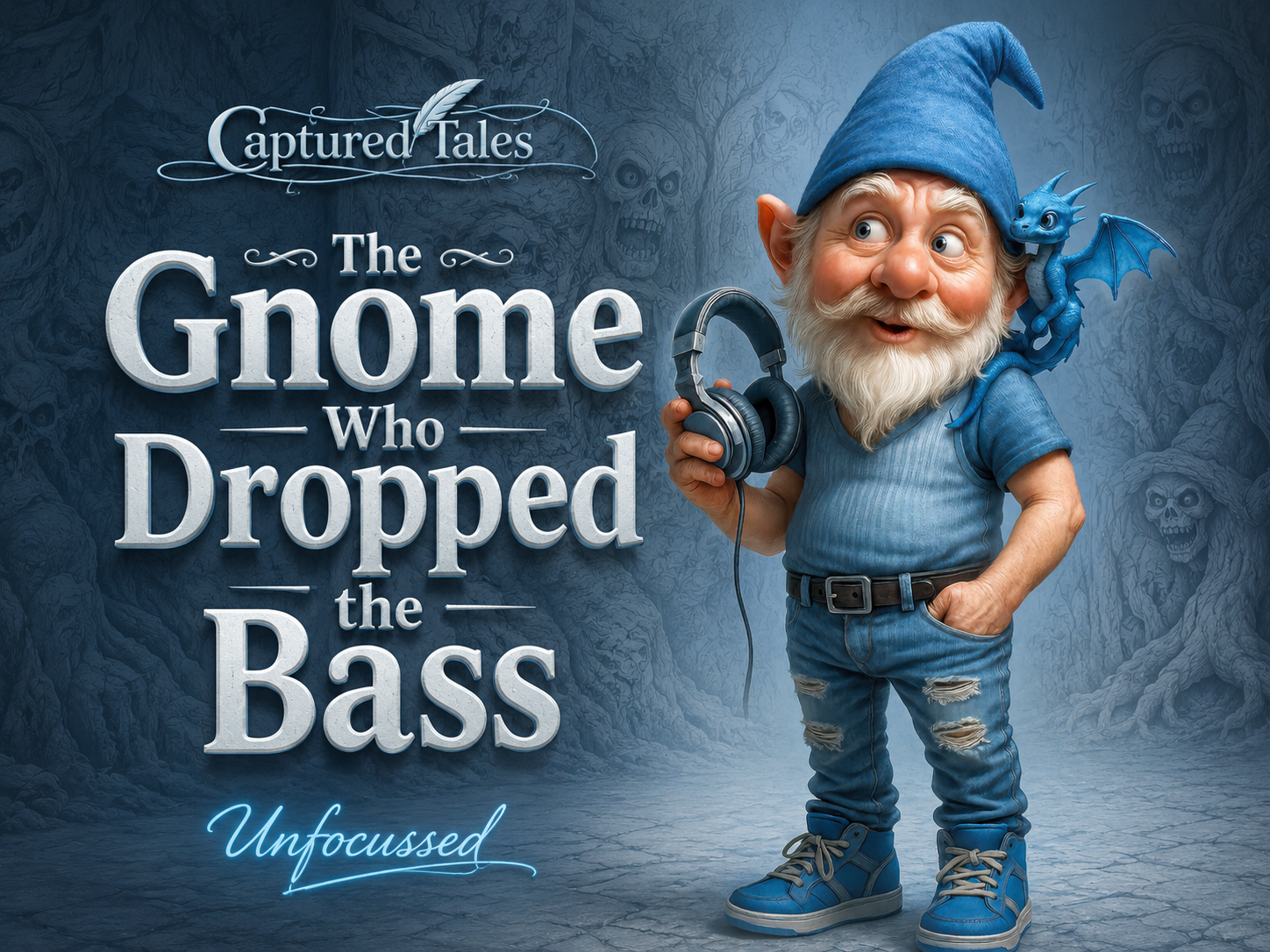
He stood barely taller than a tavern stool, wore his blue pointy hat cocked at an angle that suggested either swagger or poor neck judgment, and kept his beard groomed with the obsessive care of someone who expected to be painted on wanted posters. His jeans were torn in exactly the right places to imply danger, irony, and at least one previous misunderstanding with a banshee barbershop quartet. His sneakers were bright blue, his shirt was ribbed, his belt buckle had seen battle, and his mustache curled like it knew several secrets and charged for access.
In one hand, Oswick held a pair of ancient over-ear headphones. They were scuffed, heavy, and wrapped in silver bands etched with old runes of amplification. In the other, he carried the small black cord that connected them to the most illegal object in all of Echoterra: a portable beat sphere.
On his shoulder clung Snizzle, a tiny blue dragon with anxious eyes, oversized wings, and the emotional constitution of a nervous accountant trapped inside a fire-breathing lizard. He had sharp little horns, sharper little opinions, and a deep concern that today was going to end with someone being cursed, arrested, eaten, or publicly asked to dance.
“You’re really doing this?” Snizzle muttered, digging his claws into Oswick’s sleeve. “You know Queen Vandelina still has a bounty out for anyone caught beatboxing. And that’s just vocal percussion. This thing has a bass core.”
Oswick adjusted the dial on the beat sphere with the calm confidence of a man who had made many bad choices and survived just enough of them to become insufferable.
“It isn’t beatboxing,” he said. “It’s interpretive throat expression.”
Snizzle blinked. “You were doing it to Drop It Like It’s Trollish outside a funeral home.”
“Art does not check the room first.”
“Art got us banned from three villages and a cheese festival.”
“The cheese festival lacked range.”
They stood at the edge of the Great Whispering Woods, where the moss-covered milestone leaned crookedly from the ground like it too had given up on good posture. Beyond it, the forest rose in cold blue shadows. Tall trees twisted into one another, their bark carved with faces, warnings, and old symbols from a kingdom that had once understood rhythm before fear smothered every note.
The villagers of Mossbottom had gathered a safe distance behind Oswick and Snizzle. They were pretending not to watch, which meant they were absolutely watching. Curtains twitched. Doors creaked. One baker had stepped outside with a rolling pin “for protection,” though everyone knew she just wanted to see if Oswick finally blew himself into a decorative crater.
“Last chance to turn back,” Snizzle said. “There’s still time to become sensible. We could open a candle shop. Very calm. Nice margins. No death trees.”
Oswick looked into the woods. His eyes gleamed with that particular madness reserved for folk heroes, doomed poets, and anyone who has ever said, “Trust me, I know what I’m doing,” moments before structural damage.
“The kingdom has been quiet long enough.”
Snizzle sighed. “That sounds noble, which is how I know we’re in trouble.”
A century earlier, Echoterra had not been quiet. It had been alive with music. Bagpipes wailed in the mountains. Fiddles shrieked through wedding barns. Lutes twanged by rivers. Goblin brass bands ruined sleep schedules with pride. The old cities thumped with enchanted basslines that made cobblestones tremble and grandmothers salsa on market day whether their hips approved or not.
Then came the incident.
The kingdom’s official histories called it The Royal Buffet Disturbance, which was polite nonsense. Everyone with half a clue knew the truth: a rogue bard named Pippin Thistlejaw had attempted a theremin solo during Queen Vandelina’s Moonfeast banquet and accidentally summoned a kraken into the soup course. It ate three candelabras, slapped a duke through a tapestry, and left behind a smell no priest could fully bless away.
Queen Vandelina responded with the kind of restraint usually shown by people who ban ladders after tripping over a footstool. She outlawed rhythm. Then melody. Then clapping. Then humming. Then spoons, because apparently spoons could be “percussive gateways.”
Within a year, Echoterra became a kingdom of muffled footsteps, whispered sneezes, and aggressively soft slippers. Tavern songs vanished. Children learned arithmetic in silence. Church bells were replaced with apologetic hand gestures. Even thunderclouds were asked to submit written notice before rumbling.
But Oswick remembered.
Not from childhood. He was too young for the old days. He remembered because he had dug up proof beneath the ruins of the Vinyl Citadel: cracked records, broken mixers, rave scrolls sealed in wax, bass monk manuscripts, and one extremely opinionated instruction manual titled So You Think You Can Drop.
For years, Oswick studied in secret. He learned tempo incantations by candlelight. He repaired relics with stolen wire and questionable glue. He practiced rhythm patterns beneath mushroom caps where the sound would not travel. While other gnomes learned herb lore, tax evasion, or how to sit in gardens without looking haunted, Oswick became a Soundsmith.
Not a musician. Not merely a DJ.
A Soundsmith.
One of the old craft. A shaper of beat, builder of pulse, and certified nuisance to authoritarian silence.
And today, he meant to find the Echo Pulse, the lost frequency buried somewhere inside the Great Whispering Woods. If he could awaken it, the kingdom might remember what it had buried beneath all that fear.
Snizzle leaned close to his ear. “I still think the underground ukulele resistance in Lower Glandrick had potential.”
“Lower Glandrick banned minor chords last week.”
“Only after Gerald got dramatic.”
“Gerald played one sad strum and made an alderman weep into a pudding.”
“It was moving.”
“It was illegal.”
“So is this.”
Oswick smiled. “Exactly.”
He stepped past the milestone.
The forest swallowed the sound of his boots.
Immediately, the air changed. It grew thick and syrupy, as if silence itself had been poured between the trees. The birds did not sing. The branches did not creak. Even the wind seemed to tiptoe. On nearby trunks, old warnings had been carved in jagged letters:
Beware the Silent Ones.
Spoil not the stillness.
No shuffle mode beyond this point.
Snizzle read the last one and frowned. “That feels oddly specific.”
“The old laws were thorough.”
“The old laws were written by people who hated joy and probably seasoned food with regret.”
Oswick clipped the headphones around his neck and continued forward. The cord swung at his side. The beat sphere hummed faintly against his hip, eager but restrained, like a tiny storm waiting for permission to be rude.
The deeper they went, the quieter it became. Not peaceful quiet. Not restful quiet. This was an unnatural silence that pressed against the ears and made every thought feel padded in wool. Trees leaned over the path like disapproving aunts. Roots curled beneath the soil like knuckles. Pale carvings in the bark showed faces with hollow eyes, long mouths, and expressions that suggested someone had once played a recorder here and paid dearly for it.
Oswick kept walking, bouncing slightly with each step.
Snizzle noticed. “Are you strutting?”
“I am proceeding with rhythm.”
“You are absolutely strutting.”
“The woods need to know I came prepared.”
“The woods are going to kill us because your pelvis has an attitude.”
Then Oswick stopped.
Snizzle froze. “What?”
Oswick raised one finger.
There it was.
Faint.
Buried.
Not sound exactly, but pressure. A pulse beneath the soil. A low, fragmented thrum, like the heartbeat of something enormous sleeping under the roots.
Oswick’s grin spread slowly.
“That’s it.”
Snizzle swallowed. “No. That’s a bad thing pretending to be a good thing. Classic cursed forest behavior.”
“The Echo Pulse.”
“Trap pulse.”
“Ancient frequency.”
“Murder rhythm.”
“The thing I came for.”
“The thing that wants to wear your face as a decorative silence mask.”
Oswick clicked a dial on the beat sphere.
A single low note rolled out.
It was not loud, but the forest felt it. Leaves shivered. Moss trembled. A beetle toppled backward in spiritual confusion. Somewhere in the brush, something hissed the word “rude.”
Snizzle’s eyes went wide. “You just poked the sacred quiet.”
Oswick lifted the headphones and settled them over his ears.
“Good.”
The pulse answered.
And far deeper in the woods, something that had been still for a century began to wake.
The Deck Beneath the Moss
The Echo Pulse led them away from the path, which was precisely what every sensible creature in folklore tells you not to do. Oswick, having made a lifelong habit of treating sensible advice like garnish, followed it anyway.
They climbed over fallen logs slick with blue fungus. They passed stones carved with old music glyphs, half-swallowed by moss. They crossed a shallow stream where the water flowed without making a sound, which Snizzle declared “deeply unacceptable” and then refused to drink from on ethical grounds.
Every few minutes, the pulse returned.
Thum.
Then silence.
Thum.
Then silence.
Each time, Oswick adjusted the beat sphere, matching its rhythm little by little. He was tuning to it. Listening beneath it. Feeling where the silence had been layered over the old magic like a blanket over a crime scene.
“You hear that?” Oswick whispered.
Snizzle clung tighter to his shoulder. “I hear my own panic developing a personality.”
“Under the pulse. There’s texture.”
“That’s probably mold.”
“No. It’s old resonance. Layered harmonics. Buried memory.”
“You say these things like they aren’t exactly how wizards die.”
A shadow moved between the trees.
Snizzle’s head snapped toward it. “There.”
Oswick turned. Nothing. Only bark, fog, and those dreadful carved faces staring from the trunks.
“The woods are watching us,” Snizzle whispered.
“Let them.”
“That is not a plan. That is a sentence people say before becoming cautionary murals.”
They moved on.
The trees grew larger and older. Their roots rose from the ground in tangled arches, forming tunnels of bark and bone-colored lichen. The silence thickened until Oswick could barely hear his own breathing. Even the beat sphere’s hum faded to a vibration against his palm.
Then, without warning, the pulse stopped.
Not faded. Not softened.
Stopped.
Oswick and Snizzle emerged into a clearing.
At its center stood an enormous stone turntable, half-buried in moss and cracked with age. It was wider than a cottage roof, its circular surface carved with grooves that spiraled inward like frozen soundwaves. Around its rim, ancient glyphs glowed faintly beneath dirt and vine: Reverb, Syncopation, Harmonic Convergence, Bass Mercy, and one symbol Oswick recognized from the most forbidden of the rave scrolls.
“No way,” he breathed.
Snizzle followed his gaze. “Please tell me that’s just an oversized birdbath for deeply pretentious birds.”
Oswick stepped closer. “It’s The Deck.”
Snizzle went very still. “Capital The?”
“Capital The.”
The Deck was legend. It had belonged to the Forgotten Mixlords, the last order of Soundsmiths before Queen Vandelina’s silence decree. The stories said they used it during the Battle of Funkfall, when the Bass Monks ascended in a burst of low-end enlightenment and several enemy generals were forced to confront their feelings through interpretive dance.
No one knew what became of The Deck afterward. Some said the Queen shattered it. Others claimed the Mixlords hid it beyond mortal hearing. A particularly drunk dwarf once insisted it had married a volcano and moved south.
And yet, here it was.
Waiting beneath moss.
Oswick approached slowly, reverently. The air around The Deck hummed against his bones. Not music. Memory. He saw flashes in his mind: crowds dancing beneath lanterns, drums rolling through streets, children laughing as ribbons snapped in rhythm, old women clapping on balconies, trolls stomping in muddy circles, goblins playing horns too loudly and being adored for it anyway.
Then the images darkened.
Silence patrols.
Instruments burned.
Hands pulled away from drums.
Mouths covered mid-song.
A kingdom learning to fear its own heartbeat.
Oswick’s jaw tightened.
“They buried this place,” he said.
Snizzle’s voice softened. “They buried more than a place.”
For once, the little dragon did not crack a joke.
Oswick removed his headphones and placed them on the edge of The Deck. The moment the ear cups touched stone, blue light ran through the grooves. The glyphs brightened. Moss lifted in tiny curls as if the ancient surface were exhaling.
“Well,” Snizzle said, trying very hard to sound brave and failing adorably, “that seems either promising or catastrophic.”
“Both usually means important.”
Oswick drew the beat sphere from his belt and set it in the center of The Deck. The sphere clicked into place as if it had always belonged there.
A low thrum rolled beneath the clearing.
Oswick whispered the opening phrase from the old manual.
Drop thy ego. Raise thy vibe.
The Deck awakened.
Blue light shot through the stone grooves. The air vibrated. The trees around the clearing shuddered as if a giant hand had brushed across their branches. Dust rose in perfect circles. Snizzle’s wings popped open involuntarily.
“Oh, that’s a big hum,” he squeaked.
Oswick put the headphones on. The world changed.
Through them, he could hear the forest’s hidden architecture: old rhythms trapped under roots, melodies sealed inside stone, basslines wrapped in chains of quiet magic. He heard centuries of unsung songs pressing against the spell that held them down.
He also heard something else.
A counter-frequency.
Cold. Sharp. Merciless.
“They’re coming,” Oswick said.
Snizzle turned in a slow circle. “Who?”
The trees moved.
Not swaying.
Not bending.
Moving.
They stepped aside.
From between the trunks emerged the Silent Ones.
They came robed in black-gray fabric that did not flutter, though the clearing had begun to tremble. Their bodies seemed too tall beneath those robes, stretched thin by centuries of disapproval. Their masks were smooth and pale, with no mouth, no nose, and only shallow dents where eyes should have been. Each carried a long black tuning fork that drank the sound around it.
Noise-canceling magic made flesh.
Snizzle cursed in Draconic. It was brief, musical, and somehow involved someone’s grandmother.
The lead Silent One glided forward. Its voice arrived without being spoken, pressing directly into Oswick’s skull.
“Oswick Nibblemint.”
Oswick winced. “Ugh. Skull voice. Classy.”
“You are charged with Unlicensed Rhythm, Possession of Subharmonic Contraband, Unauthorized Use of Lost Audio Relics, and Reckless Beat Conduct in a Restricted Sonic Zone.”
Snizzle leaned toward Oswick. “To be fair, that last one is extremely accurate.”
Oswick lifted his chin. “I plead fabulous.”
The Silent Ones raised their tuning forks.
Anti-sound rippled outward.
The Deck dimmed.
Oswick felt the pressure hit his chest. It stole the air from his lungs and the rhythm from his pulse. The headphones crackled. The beat sphere flickered.
Snizzle flattened himself against Oswick’s shoulder. “Plan?”
“Still forming.”
“You usually say that when there isn’t one.”
“Great art develops under pressure.”
“So do ulcers.”
The Silent Ones glided closer.
The lead figure extended one long hand. “Surrender the sphere. Submit to stillness. Accept quiet mercy.”
Oswick’s fingers tightened around the rim of The Deck.
He thought of Mossbottom’s shuttered tavern. The children who had never heard a drum. The old musicians who kept their instruments wrapped in blankets beneath floorboards. He thought of a kingdom trained to apologize for making sound while living.
And then he thought of Queen Vandelina, sitting in her tower, collecting silence like tax.
“No,” Oswick said.
The Silent One tilted its blank face.
“No?”
Oswick grinned.
“Hard no. With bass.”
He slammed his palm onto the beat sphere and twisted the central dial past every legal limit, every warning notch, and one tiny engraved label that read Seriously, Don’t.
The Deck roared to life.
Glyphs blazed. The stone grooves spun, slowly at first, then faster. Ancient bass rolled up through the clearing in a wave so deep it made Oswick’s beard lift and Snizzle’s teeth chatter.
The Silent Ones recoiled.
Oswick bent his knees, dropped into a stance that was half battle posture and half suspicious dance move, and spoke the forbidden incantation of the Rhythm Rebellion.
“Drop. The. Beat.”
And drop it did.
Subwoofers and Shadows
The first pulse blasted through the clearing with enough force to slap dust off history.
Trees bent backward. Mushrooms launched spores like confetti cannons. A family of squirrels, previously committed to neutrality, began nodding in unison before realizing they had no idea what was happening. The ground bucked beneath Oswick’s sneakers as The Deck spun faster, pulling rhythm from the roots and hurling it into the air.
The Silent Ones staggered.
One of them lifted its tuning fork and unleashed a wave of anti-sound. The beat shattered against it, splitting into broken fragments that zipped across the clearing like angry blue fireflies.
Oswick adjusted the mix.
“Snizzle!” he shouted. “Counter-vibes!”
Snizzle blinked. “That is not a technical command!”
“It is today!”
The tiny dragon launched from Oswick’s shoulder. His wings caught the bass wave and sent him spiraling upward in a somewhat heroic, somewhat panicked corkscrew. He inhaled, cheeks puffing.
Then he breathed fire.
Not ordinary flame.
Harmonic fire.
Blue and silver sparks poured from his mouth in crackling ribbons, each one ringing like electric guitar strings. The fire struck the nearest Silent One’s tuning fork, wrapping around it in shimmering coils. The fork vibrated wildly, then melted into a drooping black noodle.
The Silent One looked at it.
Even without a face, it somehow managed to appear offended.
“That’s for trying to file paperwork at my funeral!” Snizzle squeaked, then immediately looked confused. “I don’t know why I said that. The moment got away from me.”
Oswick laughed and spun the next dial.
The beat shifted.
Now it rolled with layered drums, deep enough to loosen secrets from stone. The Deck answered him, feeding him old sounds: war drums from mountain halls, handclaps from orchard dances, tavern stomps, goblin brass, fairy bells, troll bass chants, gnome kitchen spoon percussion, and the glorious accidental rhythm of a drunken uncle falling down cellar stairs.
Oswick mixed it all.
He did not simply play music.
He opened a vein in the buried heart of Echoterra and let it thump.
The Silent Ones changed formation.
They slid into a circle around The Deck, raising their remaining tuning forks. The air grew painfully tight. Oswick’s ears popped. Snizzle tumbled midair and only narrowly avoided crashing into a fern that looked judgmental even by fern standards.
“Harmonic Suppression Protocol,” Snizzle gasped.
Oswick glanced up. “You know that?”
“I read when I’m scared!”
The Silent Ones struck their forks against the ground.
Silence detonated inward.
For a horrible moment, Oswick heard nothing.
Not The Deck.
Not Snizzle.
Not his own breath.
The world became a sealed jar.
The blue light faded from the grooves. The beat sphere dimmed to a dull ember. Oswick’s knees hit the stone. His headphones crackled and went dead.
Inside the silence, he saw Queen Vandelina’s decree as if it were carved into the air:
Stillness is safety. Silence is order. Rhythm is risk.
The words pressed on him.
For one flickering heartbeat, doubt crept in.
What if the Queen was right? Music had summoned the kraken. Rhythm had cracked the court’s perfect order. Sound could cause chaos. Sound could stir grief. Sound could make people remember what they had lost.
Maybe silence was easier.
Maybe quiet was safer.
Then Snizzle bit his ear.
Hard.
Oswick yelped, though no sound came out.
The silence cracked just enough for Snizzle’s voice to squeeze through, tiny and furious.
“Do not get poetic and die on me, you overdressed mushroom goblin!”
Oswick blinked.
Snizzle hovered in front of him, flapping desperately against the anti-sound field. His eyes were wide, his little claws curled, and his tail sparked with harmonic flame.
“You are Oswick Nibblemint,” Snizzle snapped. “You broke into the Vinyl Citadel with a butter knife. You once convinced a troll choir to sing backup for a tax protest. You wore those jeans in public and somehow made it everyone else’s problem. You do not kneel to creepy librarians with tuning forks.”
Oswick stared at him.
Then slowly, he smiled.
The smile turned wicked.
The silence suddenly seemed less like a prison and more like a challenge.
Oswick placed both hands on The Deck.
He closed his eyes.
The Silent Ones had muted sound, but they had not muted rhythm. Not completely. Rhythm lived deeper than ears. It lived in blood. Breath. Muscle. Memory. It lived in the small, stubborn thud of a heart refusing to be managed by royal decree.
Oswick tapped one finger against the stone.
Nothing.
He tapped again.
Still nothing.
He tapped a third time.
The Deck answered beneath his palm.
Not loudly.
Not magically.
Physically.
A vibration.
Thum.
Oswick tapped again.
Thum.
Snizzle saw what he was doing and grinned, showing all his needle teeth.
He beat his tiny wings in time.
Thum.
Oswick stomped one sneaker.
Thum.
Snizzle snapped his tail.
Thum.
The rhythm built without sound, traveling through stone, root, bone, and blood. The Silent Ones tightened their circle, but too late. The forest felt it. The buried songs felt it. The lost frequencies beneath The Deck reached toward it like starving things.
Oswick opened his eyes.
They glowed blue.
“You can cancel noise,” he said, and this time his voice cracked the silence like thunder through glass. “But you can’t cancel pulse.”
The Deck exploded with light.
Sound came back all at once.
The bass hit so hard three trees forgot they were trees and briefly attempted choreography.
The Silent Ones flew backward. Their robes snapped like flags in a storm. Their masks cracked. Their tuning forks shrieked with overloaded anti-magic. Snizzle dove through the air, blasting harmonic fire across the circle, each flame ribbon singing in perfect counter-melody.
Oswick moved.
Not like a trained warrior.
Like a gnome who had spent years practicing forbidden dance alone in a cellar and was now horrifically ready.
He slid across The Deck, twisted one dial with his heel, slapped the beat sphere with his palm, and flung a bassline into the clearing that turned the Silent Ones’ suppression spell inside out. One Silent One tried to raise its fork again, but the bass caught it mid-motion and forced it into a shoulder shimmy so awkward it bordered on tragic.
Snizzle gasped. “Oh no. He’s got no rhythm.”
“That’s why they’re angry!” Oswick shouted.
The final pulse rose.
Oswick felt it coming from beneath The Deck: the Echo Pulse itself, no longer buried, no longer fragmented. A pure, ancient frequency that had waited a century for someone foolish enough, stubborn enough, and stylish enough to wake it.
The Silent Ones gathered their remaining power. Their masks turned toward him. Their skull-voices merged into one command.
“Cease.”
Oswick lifted one finger.
“Counterpoint.”
He dropped the bass.
The Echo Pulse burst outward.
Blue light tore through the clearing. The anti-sound shattered. Masks cracked. Tuning forks burst into black dust. The Silent Ones screamed—not audibly, but spiritually, like someone had skipped the best part of a song forever.
Then they vanished.
Not into smoke.
Into quiet.
The bad kind.
The defeated kind.
The clearing settled.
The Deck slowed. The grooves dimmed to a soft blue glow. Leaves drifted down in lazy spirals. Somewhere nearby, the previously neutral squirrels erupted into applause, then immediately looked embarrassed and scattered.
Oswick stood in the center of The Deck, chest heaving, beard windswept, hat somehow still perfect.
Snizzle landed on his shoulder and poked his cheek.
“Alive?”
“Mostly.”
“Legally speaking?”
“Less so.”
Snizzle looked around the clearing. “They’ll be back.”
“Probably.”
“With reinforcements.”
“Likely.”
“Maybe a sonic lawyer.”
Oswick shuddered. “That is dark even for you.”
The Deck gave one final pulse.
This time, it did not stay in the clearing.
Oswick felt it travel beneath the ground, through root and stone, out beyond the woods, toward villages, roads, rivers, towers, and sleeping cities. The Echo Pulse was awake now. It was moving.
Snizzle felt it too.
His eyes widened. “Oh. Oh, that went far.”
Oswick turned toward the forest’s edge.
Beyond it lay Echohold, the capital of silence. Queen Vandelina’s city. A place where clapping could earn a fine and coughing in 4/4 could get you questioned by authorities.
Oswick adjusted his headphones.
“Then we keep moving.”
Snizzle groaned. “Of course we do.”
“The kingdom heard the first thump.”
“That sounds like a threat.”
Oswick smiled.
“It’s a promise.”
The City That Forgot How to Dance
By the time Oswick and Snizzle emerged from the Great Whispering Woods, the world had changed.
Or maybe the world had been waiting for permission to admit it was bored.
The air outside the forest tasted brighter. The grass seemed greener. The road hummed faintly beneath Oswick’s feet. In the distance, church towers stood stiff and silent, but even their stones seemed to tremble with some buried anticipation.
Snizzle rode on Oswick’s shoulder with his wings wrapped around himself like a dramatic scarf.
“Let’s review,” he said. “We entered cursed woods, awakened a mythic turntable, fought faceless anti-music librarians, melted several illegal tuning forks, and released a kingdom-wide underground pulse. Did I miss anything?”
“You bit my ear.”
“Heroically.”
“Painfully.”
“Both can be true.”
They followed the road toward Echohold.
News traveled faster than they did.
At first, it came as whispers from the roadside. A farmer leaned over a fence and asked if Oswick was “the gnome what made the trees boogie.” A shepherd claimed his sheep had formed a drum circle and refused to explain themselves. A widow from Brindlebarrow said her late husband’s old fiddle had vibrated beneath the bed for the first time in forty years, scaring her new boyfriend nearly bald.
Then the signs grew bolder.
A tavern in Little Wump reopened its back room and served ale in rhythm to a spoon tapped beneath the counter. Children in Hushwick drew chalk circles in the street and stomped in secret patterns. An old goblin brass player was spotted weeping into a trumpet he swore he had only kept for “decorative plumbing reasons.”
The Echo Pulse was spreading.
And Queen Vandelina knew it.
By noon, royal notices had been nailed to every post along the main road:
By order of Her Most Serene Majesty Queen Vandelina, all citizens are reminded that humming remains punishable by fine, confiscation of footwear, and mandatory stillness counseling.
Below that, someone had scrawled:
Try and stop my ankles, you dusty joy goblins.
Oswick admired it. “Good penmanship.”
Snizzle sniffed the notice. “Fresh ink. Rebellion is getting organized.”
“Rebellion was always organized. It was just whispering.”
“And now?”
Oswick looked toward the capital rising in the distance, all pale towers and narrow spires, as elegant and lifeless as a wedding cake no one wanted to eat.
“Now it gets loud.”
Echohold sat in a valley of polished stone. It had once been the music capital of Echoterra, home to amphitheaters, festival squares, river stages, and moonlit dance halls. Under Queen Vandelina, it had become a monument to controlled breathing. The streets were swept clean. The fountains flowed soundlessly. The bells had been removed from every tower and replaced with flags that fluttered in apologetic little motions.
The people of Echohold dressed in soft fabrics and softer shoes. They closed doors carefully. They spoke in half-whispers. They laughed behind gloved hands like joy might be contagious and poorly insured.
As Oswick entered the city, curtains opened.
Faces appeared.
Not angry faces.
Hungry ones.
A baker paused mid-knead, flour on her cheeks. A barber held a razor in the air and forgot his client. A child clutched a tambourine under her coat, the little metal jingles wrapped in cloth to keep them from betraying her. An elderly elf standing beside a lamppost narrowed his eyes as if trying to recognize a dream.
“Could it be?” the elf whispered. “A groovebringer?”
Snizzle leaned toward Oswick. “I’m uncomfortable with how quickly you’re becoming a religious inconvenience.”
“Folk hero at minimum.”
“Public disturbance with cheekbones.”
“Also fair.”
They made their way to the old amphitheater at the center of Echohold.
Once, the amphitheater had hosted orchestras, dance battles, solstice concerts, comedy lute duels, and an infamous goblin percussion ensemble called The Problematic Buckets. Now it served as a public meditation circle and gluten-free tea garden, because tyranny rarely has taste.
Queen Vandelina’s banners hung from the columns: pale silver cloth embroidered with a single closed mouth.
Oswick hated them immediately.
He stepped into the amphitheater’s center. His boots echoed against the stone.
The sound rang out.
People gasped.
Some recoiled.
One man clutched a pamphlet titled Volume and You: Coping Without Screaming.
Snizzle scanned the surrounding rooftops. “Silent Guard on the north tower.”
Oswick did not look up. “How many?”
“Six. Maybe eight. Hard to tell. They all dress like expired nightmares.”
“Queen?”
Snizzle peered toward the palace tower overlooking the amphitheater. A thin figure stood behind blue glass, crowned and rigid.
“Watching.”
Oswick set the beat sphere on the ground.
A murmur passed through the gathered crowd. More people entered the amphitheater. Then more. Then more. They came slowly at first, as if each step needed permission from some old fear. Shopkeepers, washerwomen, children, widowers, cobblers, scribes, retired bards, gardeners, monks pretending not to be interested, and at least two accountants who looked ready to snap and become tambourine people.
Oswick stood before them.
He removed his headphones and let them hang around his neck.
For once, he did not grin.
“You’ve lived too long under silence,” he said.
His voice carried through the amphitheater.
Three people flinched. One person fainted with excellent posture.
Oswick continued.
“You were told quiet would keep you safe. That stillness would keep order. That rhythm was dangerous because it made people move before asking permission.”
The crowd stirred.
Snizzle watched the rooftops. The Silent Guard shifted.
“But the truth is, they did not ban music because it summoned a kraken.”
A ripple of shock moved through the crowd.
Oswick pointed toward the palace tower.
“They banned music because music made people remember they had feet. And hips. And opinions. And once a person remembers all three at the same time, good luck stuffing them politely back into a chair.”
A laugh escaped someone near the back.
It was small.
Terrified.
Beautiful.
The crowd turned toward the sound as if witnessing a crime.
Then another laugh followed.
Then a third.
Oswick smiled now.
“There it is.”
From the tower, Queen Vandelina’s voice sliced through the square, amplified by royal stillness magic.
“Oswick Nibblemint!”
The crowd froze.
Snizzle muttered, “Here comes the cushion screamer.”
The Queen stood on the balcony, tall and silver-robed, her hair pulled back so tightly it seemed to be punishing her skull. Her crown was narrow, sharp, and joyless. She held a silk handkerchief in one hand and a legal decree in the other, which told you plenty about her personality.
“You stand accused of treasonous rhythm,” she declared. “You have disturbed the lawful peace of this kingdom, corrupted public stillness, and encouraged unauthorized ankle activity.”
A nervous man in the crowd looked down at his feet.
Oswick followed his gaze. The man’s left foot was tapping.
Barely.
But tapping.
Oswick winked at him.
The man stopped, horrified.
Then started again.
The Queen’s eyes narrowed.
“Seize him.”
The Silent Guard descended from the rooftops.
They were not as ancient as the Silent Ones from the woods, but they were nasty enough: masked enforcers in pale armor, each carrying a short suppression baton tipped with anti-sound crystal. They landed around the amphitheater in a perfect ring.
Snizzle bared his teeth. “I hate baton people.”
Oswick crouched beside the beat sphere.
“Good,” he said. “Bite one if necessary.”
“With pleasure and probable regret.”
The first guard stepped forward. “Step away from the contraband.”
Oswick rested one finger on the sphere.
“This?”
“Yes.”
“You mean the public safety hazard?”
“Yes.”
“The dangerous artifact?”
“Yes.”
“The illegal rhythm engine?”
“Yes.”
Oswick smiled at the crowd.
“Anybody else think it sounds more exciting every time he says it?”
This time, the laugh was louder.
The guard lunged.
Oswick kicked the beat sphere.
It pulsed.
The Final Drop
The first beat rolled through Echohold like thunder wearing sneakers.
Windows rattled. Tea cups leapt from saucers. Pigeons launched themselves from rooftops in chaotic gray bursts. Somewhere in the palace, an expensive vase cracked from rim to base and finally felt useful.
The Silent Guard staggered.
Oswick twisted the sphere’s dial with the toe of his shoe.
The beat deepened.
It struck the amphitheater stones and rebounded through the city’s old acoustic channels—channels built a century ago by architects who understood that a good bassline deserved infrastructure. The sound traveled under streets, up columns, through fountains, across bridges, and into locked rooms where instruments had slept in dust.
A drum in an attic answered.
Then a fiddle string.
Then a horn.
Then a thousand forgotten things began to hum.
The Queen shrieked from the tower. “Suppress it!”
The Silent Guard raised their batons.
Snizzle launched himself at them like a furious blue dart.
“Nope!” he squealed, breathing harmonic fire across the nearest crystal. It shattered with a bright musical ping. “Nope, nope, and absolutely not, you joyless walking curtain rods!”
Oswick moved with the beat.
He did not dance so much as weaponize rhythm through every joint he owned. He spun, ducked, slid, and stomped, guiding the sphere with his feet and hands. Each movement shifted the mix. Each shift awakened another layer of the city.
The baker in the front row dropped her rolling pin.
It hit the stone.
Clack.
The sound landed perfectly between beats.
She stared at it.
Then, slowly, she picked it up and struck the stone again.
Clack.
Oswick pointed at her. “There you go.”
She struck again.
Clack.
The tambourine child stepped forward, trembling. Her mother grabbed her sleeve, then stopped. The child unwrapped the cloth from the tambourine. The little metal jingles gleamed like sunlight with an attitude.
She shook it once.
The sound was tiny.
The entire amphitheater heard it.
The crowd inhaled.
Then the old elf by the lamppost began to clap.
Slowly.
Defiantly.
One clap.
Then another.
Then another.
The rhythm caught.
Hands joined. Feet followed. A cobbler stomped so hard he scared himself. A monk threw off his gray outer robe, revealing a glittering vest beneath it that suggested decades of preparation. Two accountants looked at each other, nodded solemnly, and began the most emotionally repressed shuffle anyone had ever seen.
Echohold remembered.
Badly at first.
Awkwardly.
With stiffness, hesitation, and several dance moves that should have been filed with the health ministry.
But it remembered.
The Silent Guard tried to advance, but the crowd closed around Oswick—not violently, not with weapons, but with rhythm. Claps. Stomps. Spoon strikes. Tambourine shakes. Rolling pins. Boot heels. One elderly woman produced a pair of finger cymbals from her brassiere with such confidence that everyone nearby wisely decided not to ask questions.
Snizzle hovered above them, eyes shining.
“Oswick!” he shouted. “It’s working!”
The beat sphere glowed brighter.
Too bright.
Oswick felt the warning through his palms.
The Echo Pulse was amplifying. Feeding on the city’s awakening. Becoming bigger than the sphere could contain.
The old manual had warned of this. In a footnote, naturally, because wizards and ancient Soundsmiths had terrible priorities.
Should the gathered pulse exceed mortal containment, the Soundsmith must either release the drop fully or be turned into a decorative smear of vibe.
Oswick had always found the wording rude.
Now he found it relevant.
Snizzle saw his expression. “What’s wrong?”
“The sphere can’t hold the pulse.”
“That sounds like an exploding sentence.”
“It is.”
“Can you stop it?”
Oswick looked around the amphitheater.
The city was dancing now. Truly dancing. Not well, but with feeling. People laughed openly. Cried openly. Moved like something had been unlocked in their bones. A century of fear cracked beneath their feet.
Above them, Queen Vandelina gripped the balcony rail.
Her face was pale with fury.
But her foot was tapping.
Once.
Twice.
Then again.
She looked down at it in horror.
“No,” she whispered.
Her royal foot tapped harder.
Snizzle noticed and gasped. “Oh my gods. The Queen’s got toe treason.”
Oswick laughed.
Then the beat sphere cracked.
A blue line split across its surface.
The crowd felt the shift. The rhythm wavered. The Silent Guard regained their footing. Queen Vandelina raised her decree and began chanting the old silence law, her voice amplified by the palace tower.
“Stillness is safety. Silence is order. Rhythm is—”
“Risk!” Oswick shouted over her. “Yes! Exactly! That’s the damn point!”
The crowd turned toward him.
Oswick lifted the cracked sphere with both hands. Blue light poured between his fingers.
“Rhythm is risk. So is laughter. So is grief. So is love. So is standing up after a hundred years of being told to sit down and keep your knees respectable.”
The Queen’s chant faltered.
Oswick’s voice rose.
“Silence can be peace. But forced silence? That’s just fear wearing slippers.”
The amphitheater erupted.
Snizzle swooped down beside him. “Please tell me this speech includes a survival plan.”
Oswick held out one arm.
“I need you to fly the pulse upward.”
Snizzle stared. “Into the sky?”
“Into the old bell tower.”
“The bell tower has no bell.”
Oswick smiled. “Exactly. It’s empty resonance.”
Snizzle blinked slowly. “That is either brilliant or the dumbest thing ever said by a man in ripped pants.”
“Can it be both?”
“With you, somehow always.”
Oswick tossed the sphere into the air.
Snizzle caught it in his claws and shot upward, wings straining against the raw bass pouring from the cracked shell. The crowd gasped as the tiny dragon climbed toward the bell tower, trailing blue light and harmonic sparks.
The Silent Guard rushed forward.
The crowd stomped.
Hard.
The amphitheater answered.
A wave of rhythm knocked the guards off their feet.
Oswick raised both hands and conducted the crowd like an orchestra of beautiful disasters.
“Again!”
They stomped.
“Clap!”
They clapped.
“Tambourine child!”
The child shook her tambourine with the terrifying confidence of someone who had just discovered power and planned to become everyone’s problem.
Snizzle reached the bell tower.
He circled once, twice, then hurled the cracked beat sphere into the hollow chamber where the great bell had once hung.
The sphere burst.
The Echo Pulse rang through the empty tower.
Not as an explosion.
As a note.
One vast, deep, shimmering note that rolled across Echohold and out into the kingdom beyond. It carried every clap, every stomp, every forbidden laugh, every hidden song, every grief swallowed in silence, every joy postponed by fear.
The note struck the palace banners.
The embroidered closed mouths split open at the seams.
The note struck the Silent Guard batons.
They crumbled into harmless gray dust.
The note struck Queen Vandelina’s decree.
The parchment burst into confetti.
The Queen stared at her empty hands.
Then, in the full view of her kingdom, her other foot joined the first.
A two-foot tap.
The crowd saw it.
A gasp moved through the square.
Queen Vandelina froze.
Then her shoulders twitched.
Just once.
But it was enough.
Snizzle landed beside Oswick, smoking slightly.
“Did we just make the tyrant shimmy?”
Oswick watched the Queen grip the balcony in horror as her hips betrayed a century of policy.
“Looks like it.”
Snizzle nodded solemnly. “History will remember this as deeply funny.”
The Remix Prophet of Echoterra
The silence decree did not fall all at once.
Tyranny rarely collapses neatly. It wheezes. It argues. It forms committees. It insists the paperwork was misinterpreted.
But after the Final Drop, Queen Vandelina could no longer pretend rhythm was gone. Not when half of Echohold had danced in the amphitheater. Not when the old bell tower now hummed every sunset. Not when the Queen herself had been seen performing what witnesses described as “a reluctant but technically undeniable two-step.”
Within days, the laws began to crack.
First, humming was downgraded from criminal offense to “discouraged personal weather.” Then clapping became legal at weddings, funerals, and exceptionally well-plated desserts. Spoons were released from suspicion under strict guidelines. Tambourines remained controversial, mostly because the tambourine child had formed a youth percussion guild and showed no mercy.
Across Echoterra, music returned in pieces.
A fiddle played in a barn.
A drumbeat rolled through a mountain village.
A troll grunge band formed near the northern mines and immediately wrote six songs about moss, betrayal, and one emotionally unavailable bridge.
The underground ukulele resistance of Lower Glandrick emerged from hiding, though Gerald was still monitored around minor chords.
In Mossbottom, the baker who had once carried a rolling pin for “protection” opened a tavern stage called The Sacred Clack. It became famous for rhythm nights, questionable cider, and a house rule that anyone requesting complete silence had to sit outside with the turnips.
As for Oswick Nibblemint, he became impossible to describe without sounding ridiculous.
Some called him the Groovebringer.
Some called him the Remix Prophet.
The Bass Monks, who had apparently not ascended so much as relocated to a very private spa dimension, sent him a ceremonial cable wrapped in gold thread and a note reading: Not bad, little dude.
Snizzle framed it.
“For humility,” he said.
“That is not what framing praise does.”
“For decorative humility.”
Oswick never rebuilt the beat sphere exactly as it had been. Some relics were meant to break. Some drops were meant to be released, not bottled. Instead, he built smaller rhythm charms for villages that had forgotten how to begin. Little pulse stones. Pocket metronomes. Bass seeds that could be planted beneath dance floors and watered with confidence.
He also kept the headphones.
They were too iconic to retire.
Snizzle remained on his shoulder, of course. He complained constantly, advised aggressively, and accepted snacks as tribute. His harmonic fire became legendary in its own right, though he insisted his real contribution was “preventing Oswick from becoming a stylish corpse on at least four occasions.”
This was accurate.
Queen Vandelina did not become cheerful. That would have been suspicious and frankly too much to ask. But she did soften in strange ways. She repealed the worst laws, allowed public concerts under “reasonable volume conditions,” and was once spotted behind palace curtains tapping along to a goblin brass rehearsal.
When asked about it, she claimed she was “testing the structural integrity of the floor.”
No one believed her.
The first official Festival of the Returned Beat was held one year after the Final Drop. People came from every corner of Echoterra. Banners flew. Drums thundered. Fiddles wailed. Children danced in the streets. Old musicians played until they cried. Young musicians played until everyone wished they had practiced more, but even that was beautiful in its own loud little way.
At sunset, Oswick climbed the steps of the old amphitheater.
The crowd roared.
He looked smaller than the legend now built around him, just a blue-hatted gnome with a wild mustache, a ridiculous amount of confidence, and a tiny dragon perched proudly on his shoulder.
Snizzle leaned close. “Say something inspiring.”
Oswick nodded.
He stepped forward.
The crowd fell quiet.
Not the old forced silence.
A living quiet.
The kind that listens because it wants to.
Oswick lifted the headphones.
“Echoterra,” he said, “you sound terrible.”
A stunned pause.
Then laughter rolled through the amphitheater.
Oswick grinned.
“You’re off-beat, over-loud, under-rehearsed, and half of you clap like your elbows were installed by committee.”
More laughter.
“But you’re here. You’re making noise. You’re moving. You’re remembering. And that means the beat is alive.”
The crowd began to stomp softly.
One foot.
Then another.
Thousands of feet, finding the pulse together.
Oswick placed the headphones over his ears.
Snizzle spread his wings.
The old bell tower hummed.
And beneath the city, beneath the roads, beneath the roots of the Great Whispering Woods, The Deck answered from its hidden clearing.
Thum.
The kingdom answered.
Thum.
Oswick smiled, raised one hand, and gave the smallest possible nod.
The drop came soft this time.
Warm.
Deep.
A bassline like a heartbeat returning home.
People danced. Not because they had to. Not because they were told. Not because a decree allowed it.
Because silence had finally stopped pretending to be peace.
And from that day forward, whenever music played faintly in places where silence once ruled—a low thump in the floorboards, a rhythm in the rain, a whisper of bass under moonlit trees—people smiled and listened.
Because somewhere out there, in a blue hat with headphones around his neck and a tiny dragon judging his life choices, Oswick Nibblemint was still spinning.
Still strutting.
Still making trouble.
Still reminding the world that sometimes the most dangerous thing you can do is find the beat everyone else tried to bury.
And drop it.
Bring The Gnome Who Dropped the Bass out of the enchanted silence and straight into your own space with artwork that captures Oswick Nibblemint, his tiny blue dragon Snizzle, and enough forbidden bass energy to make a monastery file a complaint. This mischievous blue-toned fantasy piece is available as a framed print, canvas print, or wood print for anyone who wants their wall art with a little swagger and a lot of beard confidence. You can also carry the groove with a tote bag, send a little sonic mischief with a greeting card, jot down your own rebellious ideas in a spiral notebook, or piece together the chaos one glorious section at a time with the puzzle. Because honestly, if a gnome and his shoulder dragon can overthrow forced silence with headphones and attitude, your decor can probably handle a little bass too.

 The Emerald Stair of the Sleeping Fern
 The Honey-Lipped Budnewt Who Couldn’t Swallow the Evidence
 The Amethyst Moth Shrine of Palebranch