
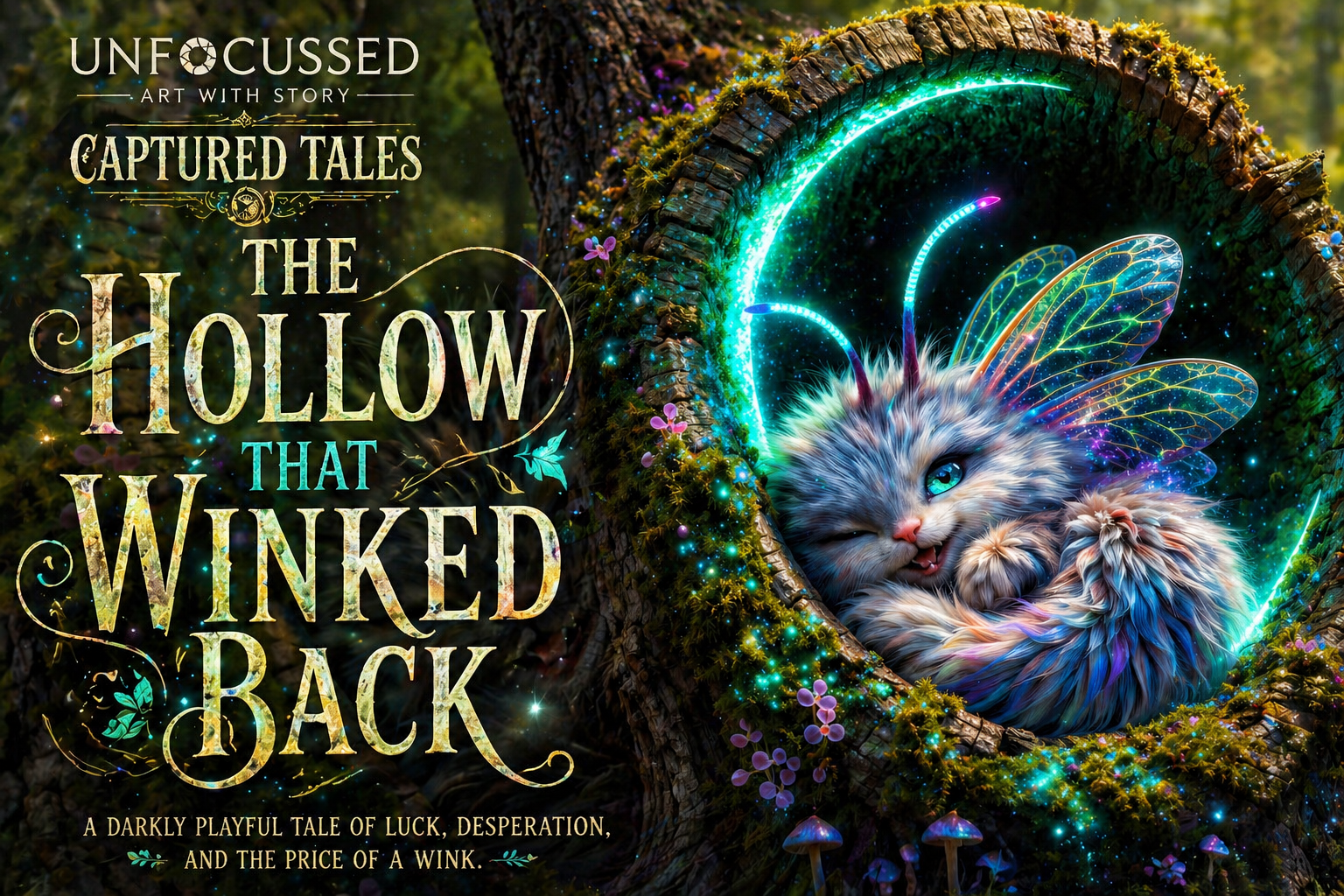
The Hollow and the Wink
There were, in the village of Bracken Hollow, three kinds of people when it came to the Wyrdwood. The first kind would not go near it at all. The second kind would go near it only in daylight, only in groups, and only while loudly pretending they were not afraid. The third kind were the ones who inevitably ended up in trouble, cursed, married to something glowing, or missing one very specific memory they could never quite put their finger on. Ellery Thorne belonged, with the tragic confidence of a person who had survived several bad ideas already, very much to the third kind.
He was not reckless in the dramatic heroic sense. He did not leap off rooftops or challenge bears to contests of masculinity. He was reckless in the quieter, more embarrassing way of people who believed they could “probably manage.” He had a talent for underestimating ancient forces, overestimating his own charm, and treating warnings as though they were interesting local color instead of active survival advice. It was, he had been told many times, a deeply annoying quality.
On the evening this story properly began, Ellery had mud on his boots, a split in the left sleeve of his coat, and exactly six copper crowns in his pocket. Six. He had counted them three times, which was the financial equivalent of poking a bruise to make sure it still hurt.
The path through the lower Wyrdwood was slick with rain. Mist tangled itself in the roots of the old trees and drifted low across the ground like something that had lost its way but intended to be menacing about it. The forest smelled of wet bark, cold stone, and the sharp green scent of crushed fern. Somewhere in the distance, something gave a cry that sounded either like a fox or a woman laughing through her teeth. Ellery chose, for his own comfort, to assume fox.
He adjusted the strap of the satchel at his shoulder and glanced at the sky through the clawing branches overhead. Dusk had long since begun its slow theft of color, draining the world into silver, charcoal, and shadow. He should have turned back an hour ago. He should never have come this deep into the trees with fading light and empty pockets and a head full of stubbornness. Unfortunately, necessity was a loud bastard.
His sister Mara needed medicine by morning. The apothecary in town had agreed to prepare it but refused, with what Ellery privately considered an almost theatrical lack of compassion, to part with it for promises and apologies. Payment first. Or collateral. Or, as the woman had said while looking him up and down with merciless practicality, “something besides that face, which clearly owes money all over the county.” So Ellery had done what desperate men, fools, and desperate fools often did: he had taken to the forest in search of mooncap mushrooms, ghost-thyme, and anything else rare enough to sell before dawn.
“Perfectly reasonable,” he muttered to himself. A branch snagged his hair. “Ow. Rude.” The forest, being an ancient magical ecosystem rather than a customer service establishment, did not apologize. He pressed deeper into the dark. Bracken Hollow had no shortage of stories about the Wyrdwood. Most villages with old forests did not merely have folklore; they had inventories of mistakes. Children were raised on bedtime warnings disguised as tales. Do not follow the song you know nobody is singing. Do not answer when the trees speak your name unless you are very certain which name they are using. Do not eat fruit in the fae places unless you are prepared to be unhelpfully beautiful forever. Do not thank anything with too many eyes.
And above all else: if the wood offers you kindness, ask yourself what it is buying. Ellery knew all of them. He could repeat them in order. He could even, when sufficiently sober and publicly observed, admit that they probably existed for a reason. But knowing a warning and respecting it were cousins at best. He found the first cluster of mooncaps under a fallen birch, pale and luminous as dropped coins. Relief loosened something in his chest. He crouched, drew his knife, and carefully cut them free, laying each delicate mushroom into a cloth pouch. By the time he was done, he had enough to make the apothecary stop scowling for at least one full sentence.
It was not enough. Mara’s fever had worsened since morning. He needed certainty, not “perhaps.” Enough for the medicine, enough for broth, enough to keep the landlord from discovering how thin hope had become in that little rented cottage at the edge of town. He rose, wiped damp soil from his fingers, and looked farther in. Something glimmered. At first he thought it was marsh light, one of those wandering tricks that lured drunks and romantics into bog water. But this glow was steadier, greener, threaded with a strange blue-white pulse beneath it. It did not bob. It did not drift. It waited.
Ellery stared at it through the tangled undergrowth. “Absolutely not,” he told himself. Then, after a thoughtful pause: “Unless maybe.” There it was—that fatal hinge upon which so many regrettable choices swung. He pushed aside a curtain of branches and followed the light. The trees grew older the farther he went, trunks widening into monstrous columns of bark and moss. Their roots rose from the earth like the backs of sleeping beasts. Strange flowers clustered at their bases, petals pale as pearl and veined with silver. The air changed, too. It grew warmer, though no fire burned. Softer. The usual forest sounds had gone quiet, not absent so much as respectfully distant, as if whatever lived here preferred privacy.
That should have unsettled him more than it did. Instead, it made his heart beat faster with the terrible thrill of possibility. He emerged at last into a clearing so small it felt accidental, as though the forest had made room for only one secret and resented the intrusion already.
At its center stood a great tree split by age and lightning, its trunk twisting upward like a frozen cry. In its base was a hollow, perfectly round and softly glowing from within. Moss draped the bark in lush emerald folds, tiny white flowers blooming along the edges. The opening itself shimmered with a light too bright to be natural and too gentle to be fire. Floating motes drifted through the clearing, rising and falling like slow sparks underwater. And inside the hollow, curled in a nest of luminous moss as though it owned the very concept of comfort, was a creature no sane person should have mistaken for harmless.
It was small enough to fit in both hands, if one were suicidal or particularly optimistic. Its fur was thick and impossibly soft-looking, shot through with pale iridescent color that changed with the light—rose, blue, pearl, and green. Delicate wings, translucent as stained glass and threaded with silver veins, rested folded against its back. Two faintly glowing antennae curved above its head, their tips casting pinpricks of gold into the dim. Its paws were tucked neatly beneath it. Its tail curled like a question mark made by a poet with boundary issues.
Its left eye was closed. Its right eye, bright and unnervingly intelligent, was fixed directly on Ellery. Then it winked. Not slowly. Not dreamily. Not with the soft innocence of a woodland creature discovering trust. It winked like a cardsharp palming an ace. Ellery stood very still. The creature opened its other eye and smiled. A tiny tooth showed. “Well,” Ellery said to the silence, “that is deeply concerning.” The creature let out a sound somewhere between a chirp and a laugh. Every useful warning he had ever heard came stampeding back at once.
Don’t meet their eyes. Don’t speak first. Don’t accept gifts. Don’t let them know you’re impressed. Don’t act like an idiot in front of things older than your bloodline. He failed at least two of these immediately. “You’re not,” he said slowly, “a rabbit.” The creature tipped its head as though this was the most offensive thing anyone had ever suggested. “Right,” Ellery said. “Obviously not.”
It uncurled with luxurious slowness and stood within the glowing hollow, stretching its front paws forward and arching its back. Its wings fluttered once, scattering shimmer into the air. Up close it was even stranger than he had first realized. Its ears were tufted, almost feline, but too expressive. Its face held a structure that was all wrong for any known animal—too knowing in the brow, too articulate in the mouth. And its little claws, when they flexed against the moss, caught the portal light like polished needles.
“Are you trapped in there?” Ellery asked. The creature blinked. Then, with maddening deliberation, it glanced back into the hollow behind it, looked at him again, and made a face that clearly communicated, Do I look trapped? “Fair point.” There was a beat of silence. The glow from the hollow pulsed, casting ripples of color over the creature’s fur. It stepped forward to the threshold, not crossing it. Ellery felt the hair along his arms rise. The whole clearing seemed to lean inward. Then the thing spoke. Its voice was soft, musical, and just rough enough at the edges to suggest it had laughed at funerals.
“You smell like nettles, worry, and poor finances.” Ellery flinched so hard he nearly kicked a root. “You talk.” “With astonishing competence.” “That,” he said, recovering some fraction of his dignity, “is not a normal thing for a glowing winged woodland puffball.” The creature’s whiskers twitched. “And yet I manage.” Ellery’s mouth went dry. There was a very specific category of danger reserved for things that looked huggable and sounded smug. It bypassed the practical brain entirely and went straight for the weak, foolish part of a man that thought he might be able to handle it.
“I should go,” he said. “You should,” the creature agreed pleasantly. Neither of them moved. Ellery narrowed his eyes. “You sound almost disappointed.” “You sound almost useful.” That, irritatingly, landed somewhere near his ego. “I have no intention of being useful to a mysterious fae squirrel-cat.” The creature drew itself up, offended all over again. “Rude. I am no one’s squirrel.” “Right. Of course. My apologies, Your Tiny Luminous Majesty.” “Better.” Ellery laughed before he meant to. The sound seemed to brighten the clearing. The motes drifting in the air shivered, and the creature’s smile sharpened in a way that made the laugh die embarrassingly fast in his throat.
Ah. There it was. The sense, cold and clean as a knife, that he had just stepped onto a floor he could no longer see the edges of. The creature studied him with predatory delight. “You are very close,” it murmured, “to becoming interesting.” “That sounds bad.” “Not for me.” Ellery took one cautious step back. “I’m serious. I don’t want anything. I was just foraging. I found your… glowing tree mouth. Delightful, very memorable. And now I’m going to leave before one of us says something legally binding.”
The creature’s expression grew almost tender. That was somehow worse. “You already want something,” it said. He opened his mouth to deny it, but the words caught. Its bright gaze slipped over him, not lustful exactly, but intimate in a more dangerous way—as if it could see all the places where fear had nested and made itself furniture. “Medicine,” it said softly. “For the fevered one with your eyes and your mother’s jaw. Rent. Food. Relief. A little less dread when morning comes.” Ellery’s hand tightened around the strap of his satchel.
“How do you know about Mara?” The creature flicked one ear. “The forest listens. Worry is loud. Yours practically tripped over roots coming in.” He should have left then. Truly. Immediately. Without wit, without farewell, without that stupid male impulse to salvage some kind of conversational upper hand before retreating from supernatural peril. Instead he said, “If you know all that, then you know I’m not in the mood to be toyed with.” The creature’s wings rustled. “I don’t toy.” It smiled wider. “I bargain.” The word settled into the clearing like a hooked thing.
Ellery’s stomach knotted. “No.” “A pity. You have such lovely desperation.” “I mean it.” “So do I.” The creature sat again, wrapping its plume of a tail over its paws like nobility arranging a cloak. “You mortals always assume a bargain means doom, screaming, regrettable anatomy changes, and an unfortunate amount of moss.” “There’s an unfortunate amount of moss already.” “That’s aesthetic. Keep up.” Against all rational self-interest, Ellery nearly smiled. The creature continued. “Not all bargains are cruel. Some are exquisitely practical. A small need met. A burden eased. A little luck tipped in your favor.”
“By what cost?” “Always the dullest question first.” “It is, however, the one most likely to keep my organs where I left them.” The creature seemed to consider this. “Fair.” It leaned forward, its voice lowering into something smoother, richer. The glow from the hollow sharpened behind it until the outline of its tiny body looked haloed in deceit. “You need coin,” it said. “You need speed. You need the sort of fortune that turns impossible nights into survivable mornings. I can give you that. A path opened. A hand guided. A locked mood softened. A chance encounter tilted in your favor. Nothing dramatic. I dislike theatrics unless they are very well dressed.”
Ellery swallowed. The clearing smelled suddenly sweeter, like crushed mint and rain on stone. “And in return?” “Something small.” “That is precisely the sort of phrase that ends with me unable to recognize my own face.” “Your vanity suggests you recognize it often.” “I work with what I have.” The creature gave him a look so assessing it nearly felt indecent. “Modestly, too. Charming.” Ellery hated that some neglected, idiotic corner of him preened. “You’re avoiding the answer,” he said. “I haven’t chosen the price yet.” “Absolutely not.”
“You wound me.” “I aspire to.” The creature laughed—a bright, dangerous sound that seemed to ring from inside the tree as well as from its throat. “There it is. The interesting part.” It stood and padded to the very edge of the hollow. The light pooled beneath its paws. One more step and it would have been in the clearing with him. Instead it remained exactly where it was, as though some line mattered very much to it. Ellery noticed that and filed it away under things to be alarmed about later.
“Listen carefully,” it said. “I am offering a favor. One. Simple. Immediate. No blood. No bones. No firstborn nonsense. Those are vulgar. In return, when the time comes, I will ask for something of proportionate worth. A trifle. A thread. A sliver. Something you will hardly miss.” “That’s the worst sales pitch I’ve ever heard.” “And yet you’re still listening.” That was the problem, wasn’t it? Because he was.
Because in the space between one heartbeat and the next, he could see it all too clearly: Mara breathing easier by dawn. The apothecary finally handing over the tincture without that look of thinly veiled pity. Enough money to buy bread. Maybe even enough left to settle one debt and postpone three others. One night of relief. One tiny miracle in a life that had lately seemed determined to chew him up with bureaucratic thoroughness. Small favor. Small price. That was how traps got into the house. Not by kicking the door in, but by looking useful in the rain.
“No,” he said again, but softer now. The creature’s expression changed. Not to anger. Not to disappointment. To curiosity. “You are trying,” it observed, “very hard to be sensible.” “A new hobby of mine.” “You wear it poorly.” Ellery exhaled through his nose and looked away from those bright, impossible eyes. The clearing shimmered at the edges. He became suddenly aware of how tired he was. How cold. How badly he wanted someone, anyone, even a suspiciously flirtatious magical gremlin, to make one thing easier. “Why me?” he asked.
“Because you came.” “That is not an answer.” “It is the only one you’re getting for free.” He looked back at it. The creature held his gaze without blinking. There was playfulness there, yes, and danger enough to fill a chapel. But there was also patience. Old patience. The kind that had sat through empires, lovers, winters, and every version of mortal pride before arriving at this quiet little clearing to wait for the next fool with a good heart and poor timing. Ellery knew, with a sudden and nauseating clarity, that if he turned and walked away now, he would think of this hollow for the rest of his life.
Not merely as temptation refused, but as possibility abandoned. And when Mara’s fever worsened in the night—if it worsened—he would hear that soft voice again and again in memory, offering a simple favor in exchange for some tiny future wound he had not yet learned to fear. The creature saw the moment his resistance bent. Its ears lifted slightly. Its smile became very still. “Ah,” it whispered. “There you are.” Ellery closed his eyes for one brief second. Stupid. Stupid, desperate man. When he opened them again, he said, “If I ask for help, I set the terms first.”
“How adorably ambitious.” “I’m serious.” “So am I.” “No tricks.” “I am fae. That word is decorative at best.” “Then no lies.” The creature considered. “No direct lies.” “That is not comforting.” “Mortals say that so often. You would think comfort was the point.” Ellery dragged a hand down his face. “I need enough coin tonight to buy medicine for my sister. Nothing more. No grand fortune. No crown inheritance. No mysterious dead relatives with suspiciously convenient wills. Just enough.” “Practical. Boring. Acceptable.” “And I want it done without harm to Mara, to me, or to anyone I know.”
The creature’s whiskers twitched. “You negotiate like someone who has been disappointed by contracts before.” “Frequently.” “Mm. Very well.” The glow within the hollow deepened until the moss looked lit from beneath by moonfire. The motes in the clearing gathered, circling slowly around Ellery’s boots. He did not move. “One favor,” said the creature. “Enough coin to buy the medicine and a little more besides. No direct harm to you, your sister, or those you personally know as a result of the favor itself.” Ellery frowned. “That phrasing was slippery.”
“All phrasing is slippery if licked properly.” He stared. The creature blinked with saintly innocence that fooled exactly nobody. “You are profoundly suspicious for something that looks like it should sleep in a teacup,” he muttered. “And you are profoundly breakable for something that keeps arguing with destiny in a wet coat.” That hit harder than he liked. The creature lifted one tiny paw. “Do we have a bargain, Ellery Thorne?” The sound of his name in its mouth made the air go strange. He had not told it his name.
Something in the clearing seemed to lean closer. Ellery’s pulse hammered at his throat. He knew this mattered. Names always mattered. The old warnings had worn many shapes, but they all circled the same truth eventually: the things in the deep places could do more with what was truly yours than you ever suspected. And yet… Mara’s face flashed in his mind, damp with fever, trying and failing to smile that morning so he would worry less. That did it. That was the final shove. “We have,” he said.
The creature’s eye gleamed. “Say it properly.” Ellery hesitated. Somewhere behind him, the wind rose in the branches like a crowd inhaling. Then, because disaster often arrives dressed as syntax, he said, “I accept your bargain.” The world changed. Not loudly. Not with thunder or flame or some dramatic ripping of the heavens. It changed the way a lock turns inside a door you did not realize had closed behind you.
The motes blazed bright. The hollow flared emerald and silver. The creature’s wings opened in a sudden crystalline shimmer, and for one impossible instant Ellery saw not a tiny beast but something vast behind it—something antlered in silhouette, laughing and bright-eyed and mercilessly old, wearing the little shape the way a knife might wear velvet. Then the vision collapsed. The clearing went still. The creature lowered its paw and smiled with exquisite satisfaction. “Done,” it purred. Ellery’s voice came out thin. “That was fast.” “Need often is.” He looked down.
At his boots, half-hidden among the moss and flower roots, lay a small leather purse that had definitely not been there before. His stomach dropped. Slowly, as if expecting it to bite, he bent and picked it up. It was real. Worn. Heavy. He untied the cord and looked inside. Silver flashed in the green light. Far more than he had hoped for. Enough for medicine, rent, food, and perhaps the first full breath he had taken in weeks. His hands shook. “Where did this come from?” he asked.
The creature smiled that same infuriating, wicked smile. “Now that,” it said, “would be telling.” Ellery looked from the purse to the glowing hollow, to the little winged horror wearing innocence like a costume stitched by liars. He should have felt victorious. Instead he felt the first true touch of dread. Because a favor granted was one thing. But a debt waiting in the dark was another entirely. The creature settled back into the hollow, curling once more into its nest of luminous moss. Its eye slid half-shut. It looked, infuriatingly, adorable.
Then it winked again. “Run along,” it murmured. “Morning has teeth.” Ellery backed away from the clearing, silver heavy in his hand and unease heavier still in his chest. He did not turn his back until the branches finally swallowed the light. As he made his way through the darkening forest, one thought kept pace with him step for step. The bargain had been too easy. And things that came too easily from the Wyrdwood did not stay simple for long.
Luck That Leans Too Hard
Ellery Thorne had always believed that luck, when it arrived, came in small, apologetic portions. A coin found in the road. A merchant looking the other way. A loaf that lasted longer than it should. Nothing in his experience had prepared him for luck that arrived like it had something to prove. He was halfway out of the Wyrdwood when it began. The path he had stumbled through on the way in—slick, root-choked, and actively malicious—seemed suddenly to… cooperate. Branches that had clawed at his coat now leaned aside. Mud that should have swallowed his boots held firm beneath his weight. Even the mist thinned, revealing a clearer route through the trees as though someone had quietly edited the forest for his convenience.
Ellery did not like that. “Coin first,” he muttered. “Consequences later. That’s the order, right?” The forest, once again, declined to comment. By the time he reached the edge of Bracken Hollow, the sky had deepened into full night, pricked through with stars. Lanterns glowed in cottage windows. The village looked exactly as it always did—modest, quiet, stubbornly alive. Which made what happened next all the more unsettling. The apothecary was still open. That alone was enough to make Ellery slow to a stop in the road. Old Mistress Keld had the punctuality of a grave marker. She closed at dusk, not a moment later, and considered any attempt to persuade her otherwise a personal attack on the concept of time itself.
And yet, there it was—her shop lit, door ajar, the scent of bitter herbs spilling out into the cool night air. Ellery hesitated on the threshold. “This is fine,” he whispered. “This is perfectly normal. Shops are sometimes open when they are not. That’s a thing.” He stepped inside. “You’re late,” Mistress Keld said without looking up. Ellery blinked. “You’re open.” “I am,” she agreed. “Temporarily inconvenienced by a delay in closing.” “What delay?” She finally looked at him, irritation sharp as always—but there was something else beneath it. A flicker of confusion, quickly buried.
“I misplaced something,” she said. “A ledger. Important. Annoying.” Ellery’s stomach turned. “You found it?” he asked carefully. “Just now.” She gestured to the counter. “Which is fortunate. For you.” Yes. Fortunate. He reached into his satchel, but his hand brushed the purse first. It felt heavier than it should. Warmer, somehow, as though it held more than coin—like a heartbeat trapped in leather. “I have payment,” he said. “Miracles do happen,” Mistress Keld replied dryly. Ellery set the purse on the counter and untied it. Silver spilled into the lamplight.
More than enough. The apothecary’s brows rose. “You’ve had a productive evening.” “You could say that.” She counted the coins with brisk efficiency, her expression smoothing into something almost approving. “This covers the tincture. And the powder. And the broth concentrate. And your previous balance.” Ellery blinked. “All of it?” “All of it.” She tied off the remaining coins and pushed the purse back toward him. “With surplus.” Surplus. The word felt obscene. “Thank you,” he said, the reflex slipping out before he could stop it. Mistress Keld snorted. “Don’t thank me. You paid.”
Ellery’s fingers tightened slightly on the purse. Don’t thank anything with too many eyes. He swallowed the rest of the sentiment. “Right,” he said. “Of course.” She handed him a small wrapped bundle, the glass vial within catching the light. “This will bring her fever down by morning. Keep her warm. Small doses.” Relief hit him so hard it nearly buckled his knees. “You’ve saved her,” he said. “You’ve paid me,” she corrected. “Try to keep the distinction.” Ellery nodded, clutching the bundle like something sacred. As he turned to leave, Mistress Keld added, “Ellery.”
He paused. “However you came by that coin,” she said, her gaze sharpening, “I’d suggest not making a habit of it.” His throat went dry. “Why?” She hesitated. Just for a moment. Then shook her head, dismissing the thought. “Because sudden fortune has a way of evening itself out.” Ellery forced a smile. “I’ll keep that in mind.” He stepped out into the night, the door closing softly behind him. The air felt different now. Charged. Like the moment before a storm remembers it’s supposed to happen. Mara was still awake when he returned home.
She lay curled beneath thin blankets, her skin flushed with fever, dark hair damp against her temples. Her eyes lifted as he entered, and for a moment—just a moment—they brightened. “You’re late,” she murmured. “I brought help,” he said, kneeling beside her. Her gaze flicked to the bundle in his hand. “You found enough?” “More than enough.” That, too, felt like a dangerous phrase. He prepared the tincture, hands steadier now with purpose. Mara drank obediently, making a face at the bitterness. “Tastes like regret,” she said weakly.
“Perfect,” Ellery replied. “Exactly what we’re aiming for.” She smiled faintly, then settled back against the pillow. Within minutes, her breathing began to ease. The fever did not vanish—it wasn’t magic, not in the obvious sense—but it loosened its grip. The tension left her brow. Her shoulders relaxed. Sleep came for her in a gentler way than it had all day. Ellery sat there long after she drifted off. Watching. Waiting. Making sure the improvement was real. It was. Of course it was. The favor had been granted.
Clean. Simple. Effective. Exactly as promised. Which was, in hindsight, the first problem. The second problem arrived the next morning. In the form of a man shouting in the street. Ellery had just stepped outside, blinking against the pale gold of dawn, when the noise reached him—loud, frantic, threaded with disbelief. “Gone!” He turned. A small crowd had gathered near the crossroads. At its center stood a merchant Ellery recognized—Tomas Reed, a trader known for his tidy accounts and louder complaints. “It was there!” Tomas was saying, gesturing wildly. “Locked, sealed, under my own roof! I checked it before bed!”
“What’s gone?” someone asked. “My coin purse!” Tomas snapped. “Half my earnings from market! Just—gone!” Ellery’s blood went cold. Slowly, very slowly, his hand moved to his coat pocket. The purse was still there. Heavy. Warm. Full. The creature’s voice echoed in his memory. “Now that… would be telling.” His stomach twisted. “You sure you didn’t misplace it?” someone else offered. Tomas rounded on them. “Do I look like I misplace half my livelihood?” There was a murmur of agreement. Ellery stepped back. No. No, that wasn’t what had happened.
It couldn’t be. He had been clear. He had said no harm to anyone he knew. And Tomas… Ellery frowned. He knew him. Not well. Not personally. But enough. Enough to recognize his face, his voice, his tendency to argue over weights and measures at the market. Did that count? Did that qualify? Or had the creature been very, very careful with its wording? “No direct harm,” it had said. And Tomas Reed was still standing. Still breathing. Just… poorer. Ellery swallowed hard. “Bad luck,” someone muttered. “Bad something,” Tomas growled.
Ellery turned away. He did not want to hear the rest. He did not want to stand there while the edges of the bargain began to show themselves, thin and sharp and exactly as dangerous as he had feared. He walked. Faster than necessary. As though distance could undo what had already been done. For the rest of the day, luck followed him like a loyal, slightly unsettling dog. The landlord, who had been threatening eviction with the enthusiasm of a man who enjoyed leverage, accepted Ellery’s payment without question—and, inexplicably, reduced the total owed.
A baker, distracted by a delivery mishap, handed Ellery an extra loaf with a distracted wave and never asked for payment. A broken strap on his satchel, which should have required careful repair, somehow held together just long enough to get him home, where it fell apart neatly in his hands as though its job had been completed. Every small inconvenience bent. Every minor obstacle stepped aside. It was… intoxicating. And horrifying. Because each time something went right, Ellery found himself wondering what it had cost somewhere else.
Who had lost the loaf meant for him? Who had been overcharged so he could be undercharged? Whose bad day had become worse so his could improve? By evening, the purse felt heavier again. He checked it twice. More coin. Not dramatically so. Not absurdly. Just… incrementally. As if luck itself were accruing interest. Ellery sat at the small table in his cottage, staring at it. “This isn’t right,” he said aloud. The room did not disagree. Mara stirred in the next room, her breathing steady now, her fever broken into something manageable. That should have been enough. That should have been everything.
Instead, unease curled deeper in his chest. Because the bargain wasn’t finished. It hadn’t asked for its price yet. And something told him, with quiet certainty, that whatever it eventually chose would not feel like a small thing at all. That night, Ellery dreamed. He stood once more in the clearing. The hollow glowed brighter than before, the light spilling out in slow, pulsing waves. The air shimmered with motes, thicker now, swirling like a lazy storm caught in a bowl. The creature sat within, watching him. Waiting.
“You’re enjoying it,” it said. Ellery crossed his arms. “I’m tolerating it.” “Liar.” “Selective liar.” The creature’s wings rustled softly. “It fits you better than you think. This… tilt. This ease. The world bending just enough to make you feel clever.” “It’s not me doing it.” “Does that matter if you benefit?” Ellery’s jaw tightened. “It matters if someone else is paying for it.” The creature’s smile softened—not kindly, but knowingly. “Everything is paid for,” it said. “You simply noticed the bill this time.” He stepped closer. “Take it back.”
“No.” “I don’t want it like this.” “You wanted the result. You got it.” “At a cost I didn’t agree to.” “You agreed to me.” That landed. Hard. Ellery exhaled slowly. “Then name the price. Now. Get it over with.” The creature tilted its head. For the first time, there was something almost gentle in its expression. “Impatient,” it said. “Afraid.” “Reasonably.” “Mm.” It stood and padded forward, stopping once more at the edge of the hollow. The light curled around it like something affectionate. “Not yet,” it said.
Ellery’s stomach dropped. “What?” “The moment isn’t right.” “For you.” “For the story.” “This isn’t a story.” The creature smiled, slow and devastating. “Everything is a story,” it said. “Especially the ones that hurt.” Ellery stared at it, frustration and fear tangling in his chest. “You said it would be small,” he pressed. “It will be.” “You’re enjoying this.” “Immensely.” He dragged a hand through his hair. “Of course you are.” The creature’s gaze softened again, that same almost-tender look from before. “Don’t worry,” it said quietly. “You’ll hardly miss it.”
Ellery’s pulse thudded in his ears. “That’s exactly what I’m afraid of.” The creature’s eye gleamed. Then, just before the dream slipped away, it winked. Again. Always that wink. Like it knew something he didn’t. Like it had already chosen. And was simply waiting… …for the perfect moment to collect.
The Thing He Could Hardly Miss
By the third day, Bracken Hollow had begun to feel wrong in the subtle, maddening way a familiar face feels wrong when the smile arrives half a second too late. Nothing had changed enough to be named. And yet everything had shifted just enough to make Ellery wish it had the decency to become obvious.
Tomas Reed had recovered from the loss of his purse poorly and loudly. Mistress Keld’s apprentice sliced open his palm on a knife that should have been sheathed. Old Nan Brier—who had not tripped on anything more challenging than a memory in twenty years—fell on the chapel steps and spent an afternoon cursing gravity, saints, and “the general decline of proper ground.” A cart axle broke on the south road and ruined a cloth shipment that was supposed to pay two men’s wages for the week. Each thing, taken alone, was merely bad luck.
Together, they began to feel like a pattern. Not one anyone else could see, perhaps. But Ellery could. Because every misfortune seemed to coincide with one of his own problems solving itself with obscene convenience. The butcher extended credit he never would have granted before. The cooper overpaid him for a stack of salvaged wood with an absent-minded shrug. Even Mara, already improving from the tincture, rallied faster than Mistress Keld had predicted—her appetite back, color returning to her face, strength arriving in careful, hopeful increments. Ellery should have been grateful.
Instead he felt like a man warming himself by a beautiful fire while slowly realizing the house itself was burning. On the fourth morning, Mara caught him staring at the coin purse as if it had insulted his bloodline. She sat up in the narrow bed by the window, wrapped in a blanket, hair loosely braided and expression annoyingly perceptive for someone who had been half-delirious two days prior. “You look,” she said, “like you’re considering murdering a wallet.” Ellery glanced up. “It started it.” “That bad?”
He hesitated. Mara had always been better than him at seeing where the rot began in a situation. Unfortunately, she was also his sister, which meant lying to protect her came as naturally as breathing and with nearly the same success rate. “I came by some help,” he said carefully. “That sounds suspicious already.” “It was... unusual help.” Mara’s eyes narrowed. “Ellery.” “I know.” “No, I don’t think you do. That tone you’re using? That’s your ‘I have done something so profoundly stupid I’m trying to package it as character-building’ tone.”
“That is slander.” “That is pattern recognition.” She held out a hand. “Give it here.” “Absolutely not.” “Then tell me.” He looked at her, pale but recovering, alive in a way she had not been that night, and hated every possible version of the truth. “I made a bargain,” he said. Mara went very still. “With whom?” He did not answer quickly enough. Her face drained of what little color it had regained. “Ellery.” “It was for you.” “That is not remotely the part I’m upset about.” “I was careful.”
“You are never careful. You are decorative caution wrapped around impulse and cheekbones.” Despite everything, he almost laughed. “That’s hurtful.” “Good.” Mara pushed the blanket aside and stood too fast, swaying only slightly before catching the bedpost. “Who?” “Something in the Wyrdwood.” “Something?” “Small. Winged. Horribly smug.” “That narrows it down to seven nightmares and at least two species of regret.” He exhaled. “It lives in a glowing hollow at the heart of a clearing. Looks like a kitten designed by a liar. Talks like it invented bad decisions.”
Mara stared at him. Then, very softly, said, “Oh, you absolute idiot.” “Again: hurtful.” “No, accurate. You found a hollow-keeper?” “A what?” “A collector.” The word landed in the room like a thrown blade. Ellery’s pulse picked up. “A collector of what?” Mara’s expression tightened. “Depends on the keeper. Some take names. Some take years. Some take music, luck, warmth, shadows, dreams, appetite, memory. Small things, usually. Tiny things. The sort you don’t defend properly because they don’t sound vital until they’re gone.” Ellery’s mouth went dry. “It said it would ask for something I’d hardly miss.”
“Yes,” Mara said grimly. “That is how they always market the knife.” He looked at the purse again. It sat on the table in the morning light, harmless as old leather and just as honest as a politician in church. “Can bargains be broken?” he asked. “Broken? Rarely. Twisted? Sometimes. Outplayed?” She gave him a pointed look. “Usually not by you.” “Rude.” “Still recovering. Haven’t the strength to be polite.” Ellery rubbed his face. “Then what do I do?” Mara’s gaze moved to the window, toward the woods beyond the village. “You go back.”
“That was also my least favorite option.” “And yet.” She crossed her arms. “Whatever it wants, do not let it choose in comfort. Make it say the thing plainly. Make it speak its price aloud. Fae power likes shape. Names. Terms. Specifics. Drag it into the dull light of exact wording if you can.” “You say that as though exact wording has not already been the scenic route to my destruction.” “Yes, well. Perhaps try being more exact and less decorative this time.” He opened his mouth to retort, then closed it again.
Because she was right. Annoyingly. Predictably. Deeply. Mara reached out and gripped his wrist. “Ellery.” He looked at her. “Whatever it asks,” she said, her voice low now, stripped of sarcasm, “don’t give it anything that makes you you.” He swallowed. “Helpful in theory. Hard to inventory under pressure.” “Then remember this.” She squeezed once. “If it wants something you can’t measure, it’s because that’s where the real worth is.” He nodded slowly. And because he was, for all his faults, her brother before he was anything else, he touched his forehead briefly to hers and said, “Bolt the door after me.”
“I’m not expecting polite callers,” Mara said. “Good.” The Wyrdwood let him in too easily. That was the first thing he noticed. No clawing branches. No hidden roots. No cold patches of mist trying to send him in circles. The path opened before him with the smooth, eager courtesy of a host expecting company. Ellery hated that more than resistance. Resistance would at least have had the manners to feel honest. By the time he reached the clearing, dusk had begun smearing itself across the sky in bruised violet and deepening blue. The great split tree stood at the center as before, its hollow glowing with that impossible teal-green light, flowers blooming innocently along the mossy edge like they hadn’t personally overseen any suffering.
The creature was already waiting. Curled in its luminous nest. Watching him. Winking, of course, the smug little bastard. “You came back,” it said, stretching languidly. “I do enjoy being right.” Ellery stopped several paces from the hollow. “I’m not here to flatter you.” “No? You wore your good anger.” “I’m here to end this.” The creature’s wings fluttered once, scattering dust-like light. “Everything ends. I find details more interesting.” Ellery pulled the purse from his coat and threw it onto the moss at the edge of the clearing. It landed with a dull, traitorous weight.
“Take it back.” The creature glanced at the purse, then back at him with serene amusement. “No.” “You said it was one favor. You gave me what I needed. Fine. Done. Take the coin, take the luck, take whatever nasty little enchantment is making the village feel like it’s being balanced by a drunk accountant, and let’s be finished.” “Mm.” The creature tilted its head. “No.” Ellery felt his temper sharpen. “That is not how this works.” “On the contrary,” it purred, “it very much is.” He took a step closer. “Then name the price.”
The clearing hushed. The floating motes slowed, their drift becoming a kind of attentive hover. Even the trees seemed to still, like a court settling in its seats. The creature’s smile thinned into something older. “So impatient.” “So done with your bullshit.” That made it laugh—a bright, delighted sound with cruelty just under the skin. “There you are,” it murmured. “That lovely little spine. I knew it wasn’t decorative.” Ellery folded his arms. “The price.” The creature rose and walked to the threshold of the hollow, stopping where the glow ended. It never crossed it. Not once. He noticed that harder now, with Mara’s warnings in his blood.
“Very well,” it said. “You have enjoyed the favor.” “That is not the word I’d use.” “You have benefited from the favor.” “Unfortunately true.” “And now,” it said softly, “I would like my due.” Ellery’s throat tightened. “What do you want?” The creature’s bright eyes fixed on him with terrible intimacy. “Your wonder.” He blinked. “My what?” “Your wonder.” The creature spoke the word like savoring a sweet. “That little ache in you when the world becomes briefly larger than your understanding. The thing that makes your chest go quiet at the sight of starlight on black water. The part of you that still believes beauty might be worth pausing for even when life is ugly. That.”
Ellery stared. Then barked a laugh of pure disbelief. “That’s not a thing you can take.” “Everything is a thing if it can be missed.” “No.” “You said that before.” “No, I mean it’s not small.” The creature blinked slowly. “To survival? It is microscopic.” Ellery felt the answer hit him in layers. His wonder. Not his memories. Not his sister. Not his name or voice or years. The bright, foolish, resilient tenderness in him that had not yet been fully beaten flat by debt and grief and adulthood’s relentless talent for grinding magic into powder.
The reason he still looked up when birds startled from a field. The reason he still noticed light in old glass. The reason the world had not become merely a list of costs. “No,” he said again, and this time the word came out raw. “Absolutely not.” Something like approval flickered across the creature’s face. “Ah,” it said softly. “So you do know what you’re made of.” Ellery’s pulse hammered. “Pick something else.” “I already did.” “Coin. Blood. A year. A scar. A finger. Something vulgar and obvious.”
“How dull.” “How human.” “Precisely.” The creature’s tail flicked. “I do not collect what rots. I collect what shines.” “This is not proportionate.” “Isn’t it?” Its voice softened, slick as silk over a blade. “I gave you more than medicine, Ellery Thorne. I gave you relief. I gave you days without panic chewing your bones. I gave your sister breath, your home safety, your body rest. I gave you the exquisite sensation of the world briefly not kicking you in the teeth. In exchange, I ask for a luxury.”
“Wonder is not a luxury.” The creature smiled. “To the hungry? It is dessert.” Ellery wanted to strike it. Which seemed unwise, given its size and likely horrifying true nature, but the impulse was there, hot and satisfying. “No,” he said. “I won’t agree.” “You already did.” “Not to that specifically.” “No,” said the creature pleasantly. “To me.” Damn it. Damn his mouth. Damn desperation. Damn the whole shining, smug little nightmare. “There has to be a condition,” he said, forcing his voice steady. “A bargain that vague has shape somewhere. You said naming mattered.”
The creature’s ears twitched. “I said no such thing. Your sister did, perhaps.” Ellery froze. The creature’s smile widened. “Did you think your cottage was beyond the wood’s hearing?” His hands curled into fists. “Stay out of my house.” “Then stop dragging me into it with your feelings.” Ellery drew a slow breath through his nose and tried not to scream, which felt very adult of him under the circumstances. “State the terms,” he said. “Exactly.” The creature was quiet for a long moment. Then, perhaps because it admired nerve, or perhaps because watching him suffer in precise language amused it, it obliged.
“If I take your wonder,” it said, “you will live. You will remember what wonder was. You will know others still feel it. You will be capable of kindness, humor, hunger, grief, desire, duty, pleasure, and love.” Ellery’s chest tightened. “But?” “But beauty will no longer wound you sweetly. Awe will not catch in your ribs. Mystery will not tempt you. The world’s strangeness will become information, not invitation.” The creature’s eye gleamed. “You will go on. Competently. Efficiently. Poorly entertained by sunsets.” Ellery stared at it in horror.
“That’s monstrous.” “That’s adulthood for many,” it said dryly. “I simply offer an accelerated version.” He almost laughed at that. Almost. Instead he said, “Then no.” The creature leaned forward slightly. “You reject the bargain?” “I reject that price.” “You cannot reject the price without consequence. Collection delayed becomes collection sharpened.” “There it is,” Ellery snapped. “That’s the line underneath the silk.” “Don’t pout. It cheapens your face.” He took another step closer to the hollow, close enough now to feel the strange warmth coming off the glow. “What happens if I refuse?”
The creature’s answer came almost lazily. “The favor curdles.” Ellery’s blood went cold. “Meaning?” “Meaning luck withdraws badly. Threads snap. Balances correct with enthusiasm. Illness revisits. Coin vanishes. Opportunities rot. It would be... unpleasant.” “For me?” Its whiskers twitched. “For the story.” Ellery closed his eyes briefly. There it was. The knife, finally out where he could see it. He could pay and lose some precious, private light inside himself forever. Or refuse and risk Mara, the cottage, the fragile little stability he had just clawed back from ruin.
There were, he thought with bitter clarity, many elegant words for blackmail when fairies did it. He opened his eyes again. The creature was still watching him. Waiting. Certain, perhaps, that desperation would do what it had already done once. And that certainty was its mistake. Because desperation had indeed brought him here. But love had educated it on the way. Ellery looked at the glowing threshold, at the line the creature never crossed, at the purse lying in the moss, at the hollow that pulsed like a held breath. Mara’s words returned to him in a rush.
Make it speak plainly. If it wants something you can’t measure, it’s because that’s where the real worth is. And another thing besides—something he had nearly overlooked because panic had such a loud personality. The creature could offer. It could entice. It could collect. But it had not crossed the hollow. Not once. “You can’t take it from here,” he said suddenly. The creature went still. Not startled. But attentive in a new way. Ellery felt it then, the faint click of a truth brushing into place. “You need me to yield it.”
Silence. Then a slow blink. “Many things are easier when given.” “That wasn’t an answer.” “It was the one you earned.” His heart kicked hard. “You can’t simply snatch wonder out of me. I have to surrender it.” The creature smiled again, but this time it was sharper, less playful. “Must you turn everything into labor?” “Only when survival’s involved.” He took one more step, close enough that the motes curled around his boots in slow spirals. “Then here are my terms,” he said. The creature laughed softly. “Delicious. Go on.”
“If you want my wonder, you can have only what I give willingly.” “That is true of all worthwhile things.” “And I don’t give it.” The creature’s tail lashed once. “Then the bargain sours.” “Maybe.” Ellery’s own smile came then—not smug, not safe, but alive with exactly the kind of dangerous inspiration the creature had just tried to classify as expendable. “Unless I pay you with something else of equal value.” The creature narrowed its eyes. “You do not decide equivalence.” “No,” Ellery said. “But stories do.” That got its attention.
Properly this time. Because the clearing listened harder. Because the glow sharpened. Because somewhere inside the fae machinery of old magic and older appetite, he had touched the right wire. “You like stories,” he continued. “You said so yourself. You feed on shape, irony, elegance. Fine. Then hear this: if you take my wonder, your favor ends in exactly the kind of cheap little tragedy every hedge-witch warns children about. Desperate man makes bargain, gets saved, grows hollow, becomes practical and gray, the end. Efficient. Boring. No bite.”
The creature’s ears tilted back almost imperceptibly. Good. He was annoying it. “But,” Ellery said, voice steadying as the idea sharpened, “if I offer you something rarer—something with edges you can savor—that’s different.” “And what,” the creature asked softly, “do you imagine you possess that is rarer than wonder?” Ellery met its gaze. “My certainty.” The word fell between them. The creature blinked. Not because it didn’t understand. Because it did. Ellery pressed on before courage could notice what he was doing and attempt to resign.
“Take the part of me that thinks I understand how things will go. Take my neat little belief that effort equals reward, that caution prevents loss, that love guarantees safety, that making the right choice means the world owes you a matching outcome.” He spread his hands. “Take that. Strip me of certainty. Leave me wonder.” The creature stared. And for the first time since he had entered the clearing, it did not look amused. It looked hungry. “That,” it whispered, “is interesting.” Ellery’s pulse thundered. “Of course it is. Wonder without certainty doesn’t die. It gets wilder. Meaner. More honest. It survives disappointment because it never promised itself control in the first place.”
The creature stepped closer to the threshold, light rippling under its tiny claws. “And you would give that?” “Not happily.” “But willingly?” He thought of Mara. Of the village. Of Tomas Reed swearing in the road. Of every strange, bright thing he had ever loved for no practical reason at all. Then he nodded once. “Willingly.” The clearing shivered. The motes spun faster, rising in a spiral around them both. The tree groaned softly, like old wood approving a well-made threat. The creature’s smile returned—slow, delighted, terrible. “Ellery Thorne,” it murmured, “there may be hope for you yet.”
“That sounds insulting.” “It is affectionate. Try not to ruin the moment.” It lifted one paw. “Speak the revised offering.” He swallowed, mouth dry. This, too, mattered. Names mattered. Shape mattered. Language was the leash and the blade both. So he drew one careful breath and said, “In fulfillment of the bargain already made, I offer willingly my certainty in place of my wonder. Let the favor stand, let the harm cease where it may, and let what was taken in excess return to balance as gently as balance permits.”
The creature’s eye flashed. “Accepted.” The world changed again. This time not like a lock turning. Like a window opening in winter. The air rushed through him, cold and bright and immense. He felt something inside his chest loosen—something rigid, something hidden, something he had not known he clung to with white knuckles all his life. Not hope. Not joy. Not wonder. Expectation. The hard, private architecture of assuming that if he could only be clever enough, good enough, careful enough, he might finally earn a world that made sense.
It tore free like silk pulled from thorns. Ellery gasped. For one dizzy instant, grief and relief hit him together with such force he nearly dropped to his knees. Then it was over. The motes dimmed. The hollow’s glow softened. The creature lowered its paw slowly, and there was something new in its gaze now. Respect, perhaps. Or appetite satisfied in a way that bordered on admiration. Ellery swayed. The world around him looked the same. The moss still glowed emerald. The flowers were still absurdly delicate. The sky through the branches was still bruised with evening. The creature was still offensively cute for something that should probably be illegal.
And yet... He felt different. Lighter in one place. Less defended in another. Not hollow. Not dulled. Just stripped of the lie that life, if negotiated properly, would ever agree to be fair. He looked up through the branches and saw the first stars beginning to show. And the sight still caught in him. Still hurt sweetly. Still made the world feel larger than his suffering. Wonder remained. Thank every reckless god. Ellery let out a breath that shook at the edges. “I hate you,” he said. The creature considered that. “No,” it said gently. “You don’t.”
Annoyingly, it was right. He did not hate it. He distrusted it. Resented it. Wanted to wrap it in a blanket and throw it into another century. But hate? No. Because something in him, newly untethered from the expectation of justice, recognized it for what it was: not fair, not kind, not safe— but true to its nature in a world that often hid cruelty behind better tailoring. “Will the village even out?” he asked hoarsely. “Mostly,” said the creature. “Balance is seldom tidy after mortals panic in it.”
“And the purse?” The creature flicked its tail toward the leather bag in the moss. It looked flatter now. Ordinary. “Empty by dawn.” “Good.” “Liar,” it murmured. “A little part of you liked being favored.” Ellery gave it a flat look. “A little part of me also likes liquor. That does not make it a sound governance model.” The creature laughed. Then, unexpectedly, it sat back on its haunches and inclined its head. A tiny gesture. Courtly. Real. “You bargained better in the end,” it said. “That feels like a backhanded compliment.”
“All my best ones are.” Ellery bent, picked up the emptying purse, and tucked it into his coat. He was not sure why. Perhaps as a reminder. Perhaps because human beings were rarely wise enough to leave symbols lying around once they had suffered for them. He looked once more at the glowing hollow. At the impossible little keeper curled in its threshold. At that bright, old, unnerving eye. “One question,” he said. The creature yawned. “You always have at least three. Be brave and choose.” “Why me, really?”
The creature’s wings gave the faintest rustle. It regarded him in silence long enough that he almost thought it would refuse. Then it said, “Because you were desperate enough to bargain...” It tilted its head. And smiled. “...and foolish enough to remain interesting after.” Ellery snorted despite himself. “That might be the nicest thing anyone’s said to me all month.” “Your social circle is weak.” “Your bedside manner is worse.” “I don’t have a bedside,” said the creature. “Only thresholds. That is rather the point.” Ellery shook his head and turned to go.
“Ellery Thorne,” the creature called softly. He paused. “Next time,” it said, “try not to sell yourself so cheaply at the start.” He looked back over his shoulder. The little thing was already settling into the moss again, curling its tail around itself, all luminous fluff and hidden knives. “Next time,” Ellery said, “try not to flirt like a legal disaster.” The creature’s tooth flashed. Then—of course—it winked. Bracken Hollow did, in fact, settle. Not perfectly. Nothing ever did.
Tomas Reed’s missing purse turned up two days later in the false bottom of a trunk his late father had built, and while he insisted for the rest of his life that some bastard had moved it there, the silver was intact and his shouting mellowed back into its usual commercial range. Mistress Keld’s apprentice healed. Old Nan Brier recovered with such speed that she claimed the fall had improved her posture and her temper, which was provably false in the latter case. The south-road carter received an unexpectedly favorable contract from a cloth merchant eager to apologize for prior stinginess.
Balance, it seemed, had unknotted itself with only a little lingering spite. Mara recovered fully, which made every remaining discomfort worth bearing. And Ellery— Ellery found that life had not become easier after the bargain. Not exactly. He still worried. Still worked too hard. Still made choices with the confidence of a man who had survived several bad ones and was therefore statistically due for another. But the old belief that he could control outcome through sheer effort had been peeled away, and in its place was something stranger, rougher, and, perhaps, healthier.
He stopped mistaking preparedness for authority over fate. Stopped taking disappointment as proof of personal failure. Stopped assuming the world owed him coherence simply because he showed up earnest and tired and trying. Oddly enough, this made him kinder. And much funnier. It also left his wonder untouched. Perhaps even sharpened. He still paused for moonlight on wet rooftops. Still watched birds wheel over fields as if they were writing messages too quick for language. Still looked too long at strange flowers in ditches and light through bottles and the first snow catching on bare branches.
And every now and then, when dusk thickened green at the edge of the Wyrdwood and the air smelled of moss, rain, and a bad idea wearing perfume, he felt the faintest echo of a wink move through memory. He never returned to the clearing casually. But neither did he entirely avoid the thought of it. Because some thresholds, once crossed, do not simply mark danger. They mark the place where a person first realizes what they cannot afford to lose. And for Ellery Thorne, who had once nearly sold the best part of his soul because desperation made the offer sound practical, that lesson remained as bright and sharp as starlight through black branches.
In the end, the hollow had winked back. And he, by some miracle of nerve, love, and sheer argumentative stubbornness, had managed to keep enough of himself to wink right back at the dark.
The Hollow That Winked Back isn’t just a story about a dangerous little fae menace with a face like a blessing and motives like a lawsuit—it’s also a striking piece of magical artwork you can bring into your own realm. Whether you want the luminous mystery hanging on your wall as a framed print or wood print, worked into your cozy chaos as a throw pillow, or kept close in smaller forms like a spiral notebook, sticker, or greeting card, this enchanted little winker is ready to cause problems in excellent taste. It’s the perfect piece for anyone who likes their fantasy beautiful, mischievous, and just unsettling enough to feel personal.

 The Emerald Stair of the Sleeping Fern
 The Honey-Lipped Budnewt Who Couldn’t Swallow the Evidence
 The Amethyst Moth Shrine of Palebranch