
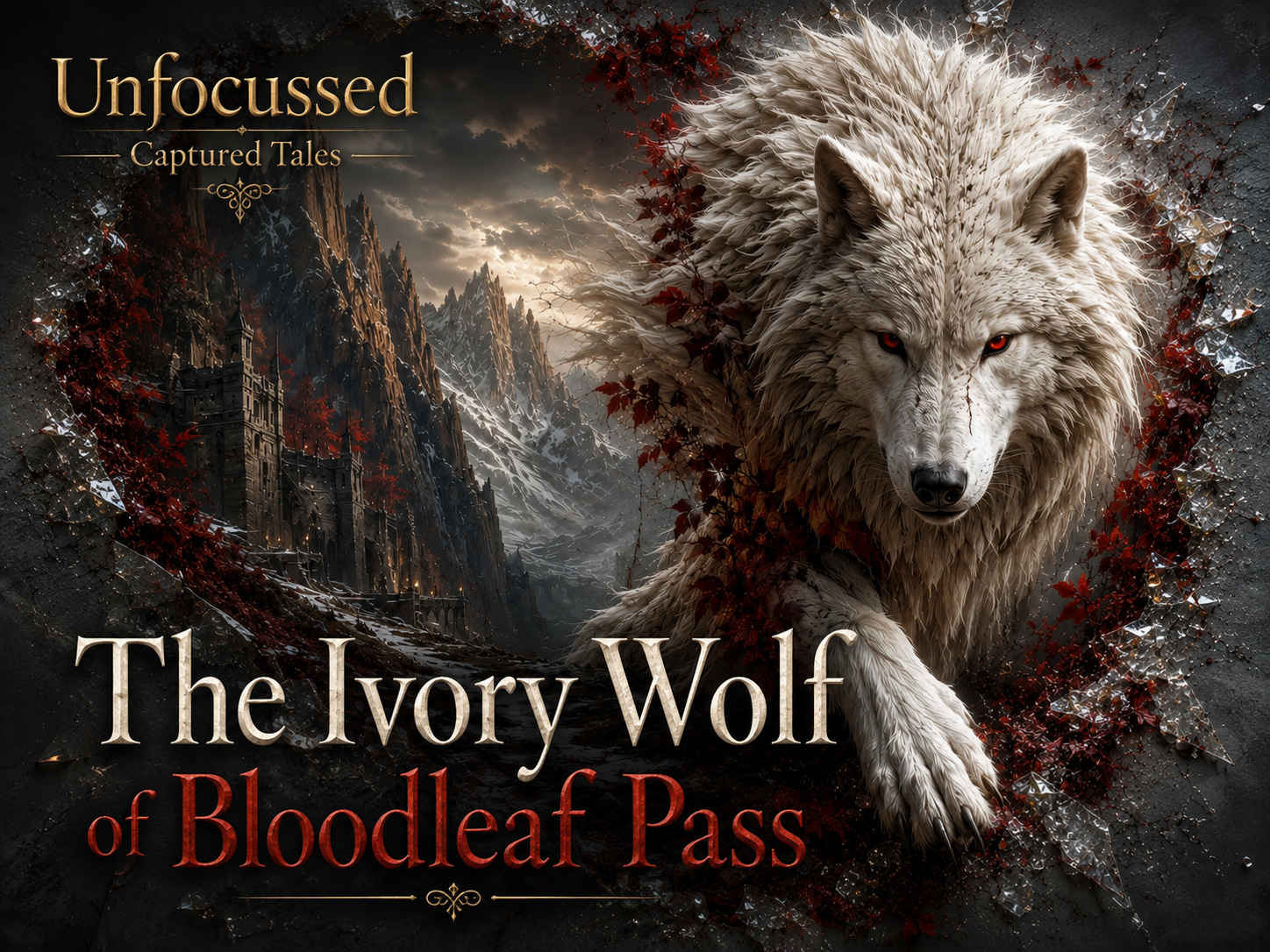
The Pass That Bit Back
Bloodleaf Pass had never been fond of visitors.
It tolerated shepherds if they kept their heads down, their prayers short, and their sheep from nibbling anything red. It endured merchants only because wagons occasionally overturned, and the mountain believed spilled wine and dropped coins were acceptable entertainment. Pilgrims were permitted, but barely. Soldiers were laughed at by the wind, which slapped banners sideways, filled helmets with sleet, and once stole an entire regiment’s breakfast sausages so cleanly that the men accused each other for three days before surrendering to the obvious truth: the pass was a bastard.
But above all other creatures, Bloodleaf Pass respected the wolf.
He moved through the snow with the kind of silence that made owls feel theatrical. His fur was ivory, thick and wild, each strand carrying the frost-glow of moonlit bone. His eyes were not yellow, not amber, not any honest color a sensible animal should possess. They were red. Not bright like rubies in a jeweler’s window, but deep and living, like embers buried under ash, waiting for someone stupid enough to blow on them.
The villagers below called him the Ivory Wolf.
The soldiers at the fortress called him the Passbeast, because soldiers were brave, underpaid, and rarely burdened with poetry.
The mountain called him Veyr.
Names mattered in Bloodleaf Pass. Names had weight. Names could open doors, seal graves, or get a man dragged backward into a snowbank by roots that absolutely had not been there five seconds earlier. That was why only the oldest trees whispered the wolf’s true name, and even then only during storms, when the thunder was loud enough to pretend it had misheard.
Veyr belonged to no one.
This fact had been explained many times, in many ways, to many ambitious fools. Usually through growling. Sometimes through the sudden removal of decorative clothing. Once, through the complete disappearance of a duke’s favorite hat, which was later found hanging from the highest tower of Castle Varrican with a frozen trout inside it. No one could prove the wolf had done it, but everyone knew. The trout especially.
Castle Varrican crouched at the western throat of Bloodleaf Pass, its towers thrust into the clouds like blackened fingers accusing heaven of poor management. The fortress had been built by a paranoid king, expanded by a paranoid queen, and renovated by several generations of increasingly wealthy nobles who believed murder holes were tasteful if arranged symmetrically. Its walls were dark granite, its roofs iron-scaled, and its chapel windows stained crimson by glassmakers who had either been geniuses or deeply exhausting people at dinner parties.
For centuries, Castle Varrican had claimed it guarded the pass.
For centuries, Bloodleaf Pass had allowed the lie, mostly because correcting men in armor was tedious.
The truth was simpler: Veyr guarded the pass.
He guarded the old road between the mountains. He guarded the buried gates under the snowfields. He guarded the broken glass ring where the world had once split open and tried to invite something hungry inside. He guarded the crimson vines that grew from the cracks in stone, their leaves sharp as spilled secrets and red as vows made too late.
The people of the valleys left offerings at the foot of the pass: salted meat, blue candles, winter apples, carved bone charms, and occasionally apology letters from children who had thrown rocks at foxes and then thought better of it. Veyr accepted some offerings and ignored others. He had standards. He was not a village goat with dramatic lighting.
He did not enter Castle Varrican.
Not because he feared it.
Veyr feared very little. Fire bored him. Blades annoyed him. Priests made him sleepy unless they brought sausages. Men who shouted threats from horseback mostly looked like meat trying to improve its height.
No, he avoided Castle Varrican because the fortress smelled wrong.
Old blood lived in the stones. Not honest blood from battle or birth or the ordinary accidents of sharp tools and bad decisions. This blood had been invited out. Coaxed. Spilled with ceremony. Mixed with wax, ash, and promises nobody intended to keep.
The castle smelled of hunger pretending to be duty.
And Veyr had no patience for that particular costume.
The Men Who Mistook Teeth for Decoration
Lord Malrec Varrican believed the wolf was a symbol.
This was his first mistake.
His second mistake was believing symbols could be owned.
His third mistake was wearing a collar of silver wolf heads to a council meeting where he planned to discuss taming an actual wolf. This was less a political statement and more the kind of wardrobe choice that made fate lean forward and say, “Oh, good, he’s helping.”
Lord Malrec stood at the head of the fortress council chamber beneath a ceiling painted with heroic scenes of Varrican ancestors doing heroic things. Most of the paintings were lies. One ancestor was shown slaying a frost giant, though records strongly suggested he had actually fallen into a flour cart and been bitten by a goose. Another was painted receiving a blessing from the mountain spirits, when in truth he had been fined by three villages for moving boundary stones while drunk.
Still, the Varricans had always understood the power of a confident mural.
A long black table filled the room. Around it sat the lords and ladies of the pass: House Grell with their hawk-nosed suspicion, House Morvayne with their velvet gloves and tax-related cruelty, House Pell with their winter pearls and unfortunate habit of saying “tradition” whenever they meant “profit.” At the far end sat three priests of the Crimson Chapel, their faces hidden behind red veils embroidered with leaf veins.
Between them all lay a map of Bloodleaf Pass.
Across the map, a small ivory carving of a wolf had been placed beside the western gate.
Malrec tapped one jeweled finger on it.
“The beast must be bound.”
Lady Ysabet Morvayne lifted a brow. It was a precise brow, trained in cruelty, skepticism, and implying servants smelled faintly of cabbage. “The beast has guarded the pass since before this fortress had a roof. Why interfere?”
“Because it guards the pass according to its own will,” Malrec said.
“Yes,” said Lord Pell. “That is generally how wild creatures work.”
Malrec ignored him. He had the well-polished confidence of a man who considered listening to be a hobby for lesser bloodlines. “It obeys no summons. It kneels to no banner. It protects peasants and pilgrims as readily as noble caravans. Last month it overturned my cousin’s hunting party.”
“Your cousin tried to spear it,” said Lady Ysabet.
“He was establishing dominance.”
“He established a limp.”
A few councilors coughed into their sleeves. One priest made a noise that might have been disapproval or laughter trying to escape through official fabric.
Malrec’s jaw tightened. “Bloodleaf Pass is the spine of the northern trade road. Whoever controls the wolf controls the pass. Whoever controls the pass controls the valleys. Whoever controls the valleys—”
“Can afford better wine,” muttered Lord Pell.
Malrec’s eyes cut toward him.
Lord Pell smiled the delicate smile of a man who knew he was too useful to stab before dessert.
At the far end of the chamber, the eldest priest lifted one crimson-veiled hand. “The old rites warned against binding the Ivory Wolf.”
Malrec turned slowly. “The old rites were written by frightened hermits with ink made of mushroom water.”
“They were written by the founders of this fortress.”
“And yet the founders are dead.”
“Yes,” said the priest. “Several because they attempted the thing you are proposing.”
A pleasant silence followed. It was the sort of silence that arrives at court when someone has said something factual and inconvenient, which is considered poor manners if done without music.
Malrec leaned over the map. The firelight caught the silver wolf heads at his collar, making them flash like little decorative warnings he had failed to understand.
“The realm is changing,” he said. “The southern kings grow greedy. The eastern clans are restless. Our stores are thin, our soldiers divided, and every winter the pass takes more from us than it gives.”
Lady Ysabet folded her hands. “And you believe enslaving a sacred guardian will fix your budget?”
“I believe power unused is power wasted.”
There it was.
The family motto of every doomed man who had ever looked at a sleeping dragon and thought, What if saddle?
The eldest priest lowered his hand. “The wolf is not a hound, Lord Varrican.”
“Everything can be made to serve.”
“Spoken like someone who has never met weather,” said Lord Pell.
Malrec snapped his fingers.
The doors opened.
Four servants entered carrying a chest of black iron banded in crimson metal. Behind them came a woman in a plain gray gown, her hair cropped close to her skull, her eyes pale and still. She walked without bowing to anyone, which immediately made half the room hate her and the other half wonder if she was about to do something useful.
Malrec smiled.
“Councilors, may I present Maerla Thorne. Bloodwright of the lower marshes. Specialist in binding rites, curse architecture, and difficult animals.”
Maerla glanced at the ivory wolf carving on the map.
“Difficult animals are usually just animals with accurate opinions.”
Lord Pell’s smile widened. “I like her.”
“You would,” Malrec said.
Maerla approached the table. The servants set the iron chest down with a heavy thud. Something inside it shifted, not loudly, but enough to make the candle flames recoil.
The eldest priest stood. “What is in that chest?”
Maerla rested one hand on the lid. “A leash.”
The chamber went cold.
Not winter cold. Not draft-under-the-door cold. This was older, cleaner, sharper. The cold of a blade before it has decided who deserves it.
Malrec looked pleased.
That, too, was a mistake.
The Wolf Below the Glass
Far from the council chamber, beyond the fortress walls, Veyr stood before the shattered ring.
It lay half-buried in the pass where the old road bent beneath a cliff of black stone. To human eyes it looked like a wound in the world: an oval break in the air edged with jagged glass, silver ice, and crimson leafwork. Through it one could see the pass as it had been long ago, or might be tomorrow, or possibly never was at all. The mountains beyond the ring shifted when no one watched. Towers rose and sank in the distance. Snow fell upward. Sometimes voices whispered from inside the glass, offering crowns, apologies, or recipes for soup that involved far too much bone.
Veyr did not answer the voices.
He had learned early that anything whispering from a dimensional wound was either a liar, a salesman, or a relative.
None were worth encouraging.
The crimson vines curled around the base of the ring, their leaves trembling though no wind touched them. Bloodleaf vines fed on broken oaths. The stronger the betrayal, the deeper the red. In peaceful years, they dulled to rust. In honest years, rare as polite ravens, they withered almost black.
Tonight they shone bright as fresh wounds.
Veyr lowered his head and sniffed.
Wax.
Iron.
Priest-cloth.
Fear.
And beneath all of it, the sour-sweet stink of ambition dressed up as necessity.
The fortress was plotting.
Again.
He huffed, and steam curled from his nostrils.
Humans plotted the way rabbits multiplied: often, nervously, and with poor awareness of predators. Usually their schemes collapsed under the weight of their own stupidity. A forged tax order. A marriage contract with six loopholes and one cousin too many. A secret tunnel that opened, hilariously, into the latrine wall.
Veyr preferred to let such things rot naturally.
But Bloodleaf Pass did not glow this red for tax fraud.
A sound rose behind him.
Soft boots on snow.
Veyr did not turn. He knew the tread.
“You are brooding,” said a woman’s voice.
Veyr remained still.
“Do not look offended. You are standing in front of the cursed glass hole with your ears back. That is brooding. Very dramatic. Very on brand.”
Only then did the wolf glance over his shoulder.
Old Nessa climbed the road with a basket hooked over one arm and a walking stick in the other. She was wrapped in three shawls, two scarves, and a hat that looked as if it had lost an argument with a badger. Her hair was white, her cheeks wind-cracked, and her expression suggested she had been born unimpressed and refined the skill professionally.
She was not noble. She was not a priestess. She was not a witch, though several villagers had accused her of it after she correctly predicted six pregnancies, four storms, and the mayor’s unfortunate encounter with a turnip cart.
Nessa was simply old, observant, and entirely willing to tell destiny when it had spinach in its teeth.
She set the basket down before Veyr.
“Smoked venison,” she said. “Before you make that face, yes, I salted it properly this time.”
Veyr sniffed the basket.
Then he sneezed.
Nessa narrowed her eyes. “That was one time. One. And if your delicate royal snout cannot handle pepper, perhaps stop looking like a nightmare prince and start looking like a barn cat.”
Veyr took a strip of venison between his teeth.
Nessa watched him chew. “The castle bells rang twice before dusk.”
The wolf’s ears shifted.
“Not chapel bells. Council bells.” She looked toward Castle Varrican, its towers cutting black shapes against the bruised sky. “They have been buying iron from the southern road. Black iron. Not for hinges. Not for plows. And three nights ago, a gray woman came through the village with a chest that made my teeth hurt.”
Veyr’s lip lifted just enough to show one white fang.
“Yes,” Nessa said. “That was my thought too, though mine had more swearing.”
A gust of wind moved through the pass. The bloodleaves shivered. A few detached and skated across the snow like little red knives.
Nessa bent slowly, picked one up, and held it to the light.
It pulsed.
Her face changed.
Only slightly. But Veyr saw it.
“That red,” she whispered. “That is not court gossip. That is oathwork.”
Veyr stepped closer to the shattered ring.
Inside the glass, something moved.
Not a reflection.
A memory.
For one breath, the broken portal showed Castle Varrican as it had stood on the night of its founding. New walls. Fresh banners. Men and women gathered beneath torches, their hands cut, their blood falling into snow. At their center stood a younger wolf—not smaller, not softer, but less scarred by centuries of human nonsense. Ivory fur. Red eyes. Patient contempt.
The first Varrican king knelt before him.
Not master and beast, the king had said. Not chain and throat. We ask the pass to endure us. We ask its guardian to judge us. Should our house become a danger to the road, to the valley, or to the old gate, let the wolf’s teeth find us first.
The bloodleaf vines had bloomed that night from every crack in the stone.
They had been pale then.
Almost pink.
Hopeful little things, which was embarrassing in hindsight.
Nessa watched the memory fade. She swallowed.
“They swore to be judged by you.”
Veyr’s eyes remained on the fortress.
“And now?” Nessa asked.
The shattered ring darkened.
In the distance, from Castle Varrican, another bell rang.
Once.
Twice.
Three times.
The sound rolled down the pass, too deep for celebration, too slow for alarm. Ravens burst from the battlements in a black cloud. The snow beneath Veyr’s paws trembled.
Nessa gripped her walking stick.
“That is not a council bell.”
No.
It was older.
A summoning bell.
A command bell.
A sound made by men who had found an ancient warning and mistaken it for instructions.
Veyr turned from the glass.
The bloodleaf vines along the ring twisted toward the fortress, reaching like veins toward a heart that had gone rotten.
Nessa stepped back. “Do not go in there angry.”
The wolf looked at her.
“Fine,” she said. “Go in there exactly as angry as the situation deserves. But remember, some of us live below that fortress, and I would prefer not to spend my remaining years being rained on by chunks of aristocrat.”
Veyr lowered his head, almost a nod.
Then he began to walk.
Not toward the fortress gate.
Toward the cliff beneath it.
Nessa frowned. “That is not the road.”
Veyr did not slow.
“Of course,” she muttered. “Why use a gate when you can make a point?”
The Ivory Wolf climbed the broken stone as if gravity were merely a local suggestion. Snow slid beneath his paws. Shards of old ice cracked around him. Crimson leaves spiraled in his wake, drawn upward by the force of his passing. Above, the fortress windows burned with candlelight, each one a watching eye.
Inside Castle Varrican, Lord Malrec stood in the old binding chamber beneath the chapel.
The room had not been used in two hundred years, largely because everyone with sense had agreed it was a terrible place and then died, leaving the opinion defenseless against later generations. Its walls were carved with leaf patterns, wolf shapes, and warnings in three dead languages. Malrec had ordered tapestries hung over the most discouraging inscriptions.
No need to dampen morale.
Maerla Thorne stood beside the black iron chest. Around her, servants poured salt in a circle. Priests lit crimson candles. Soldiers held spears with silvered tips, all pretending not to notice their hands shaking.
Lord Malrec drew a ceremonial knife from his belt.
“When the wolf enters the circle,” Maerla said, “do not speak its true name.”
“I do not know its true name.”
“Good. That improves your odds of surviving the first minute.”
Malrec paused. “Only the first?”
Maerla opened the chest.
Inside lay a collar.
It was made of black iron links, each etched with crimson runes. From it hung no leash, but a long chain of red glass, delicate as frozen blood and humming faintly in the candlelit dark.
The soldiers stared.
The priests whispered prayers.
Malrec smiled like a man admiring the key to a kingdom.
Then the far wall exploded inward.
Stone burst across the chamber. Candles vanished. Soldiers shouted. One priest fell backward into a tapestry and discovered, too late, that warning inscriptions were easier to respect when not landing face-first beneath them.
Dust rolled through the room.
Through the broken wall stepped the Ivory Wolf.
Huge. Silent. White as winter judgment.
His red eyes found the collar.
Then Lord Malrec.
Then the collar again.
His expression did not change, because wolves do not smirk.
But everyone in that room, even the ones currently coughing up powdered granite, understood with perfect clarity that if he could have smirked, it would have been devastating.
Maerla Thorne looked at the shattered wall, then at the wolf, then at Lord Malrec.
“He came through the cliff,” she said.
Malrec lifted his chin. “So he answers the summons.”
The wolf’s ears tilted forward.
Maerla took one slow step away from the chest.
“No,” she said quietly. “He answered the insult.”
The bloodleaf candles flared.
The iron collar rose from the chest by itself, chain uncoiling through the air like a serpent made of bad ideas.
Lord Malrec raised the knife.
“Bind him.”
The runes ignited.
And beneath Castle Varrican, under the mountain, under the old chapel and older bones, something heard the command and woke laughing.
The Collar of Spectacularly Poor Judgment
The collar flew toward Veyr’s throat.
It did not fly like metal should. It did not clatter, swing, or obey the dull honest rules of weight and distance. It moved like a curse remembering its destination, black iron links twisting through the dust, red glass chain flickering behind it in a hungry arc.
The soldiers stepped back.
The priests stepped back faster.
Lord Malrec Varrican did not step back at all, because men who have mistaken arrogance for courage are always the last to notice when the room has become educational.
Veyr watched the collar come.
His ears remained forward. His paws did not shift. Snowmelt steamed off his fur where broken candlelight struck him, and the red glow in his eyes deepened until every rune carved into the chamber walls began to tremble.
Maerla Thorne whispered, “Move.”
The wolf did not.
The collar snapped around his neck.
Every candle in the binding chamber roared upward in crimson flame.
Lord Malrec smiled.
It was a beautiful smile, if one admired the facial expression of a man standing beneath a falling chandelier and complimenting the craftsmanship.
“Kneel,” he commanded.
The room waited.
The soldiers gripped their spears.
The priests held their breath.
The red glass chain tightened, stretching from the collar to Malrec’s knife hand. The runes along the black iron links pulsed like little wicked hearts.
Veyr lowered his head.
Just slightly.
Malrec’s smile widened. “There. You see? Even legends understand authority.”
Then the wolf yawned.
It was not a nervous yawn. It was not a sleepy yawn. It was the grand, cavernous, pink-tongued yawn of a creature so unimpressed by the current proceedings that boredom had become a public service announcement.
One soldier made a choking sound.
Lord Pell, who had been dragged to the chamber as a witness and had wisely positioned himself near the least cursed wall, whispered, “Oh, that is going to hurt someone’s feelings.”
Malrec’s face reddened. “Kneel.”
The chain tightened again.
This time, the collar bit.
Black iron sank through ivory fur, searching for blood, oath, spirit, anything it could hook into and drag down. The red glass chain rang with a thin, shrieking note. The chamber floor cracked beneath Veyr’s paws.
And the wolf finally moved.
Not backward.
Forward.
One step.
The chain snapped taut.
Malrec’s arm jerked so hard his shoulder nearly climbed out of its socket and filed for independence. He gasped. The ceremonial knife clattered to the floor.
Veyr took another step.
The chain dragged Malrec across the stone.
Not quickly. Not violently. Worse.
Calmly.
With the steady inevitability of winter, taxes, and old women saying “I told you so” before anyone has technically asked.
Malrec dug in his heels. “Hold him!”
The soldiers rushed forward.
That was brave.
Also deeply stupid.
Veyr turned his head and looked at them.
He did not growl. He did not bare his teeth. He simply looked, and every soldier abruptly remembered something important elsewhere. A stove left burning. A cousin’s birthday. A lifelong dream of becoming a beekeeper in a region with fewer supernatural wolves.
They stopped.
One dropped his spear.
Another whispered, “Nope.”
Lord Malrec staggered to his feet, one hand clamped around the red chain. “You swore to guard this pass.”
The wolf’s eyes narrowed.
At that, the entire chamber changed.
The warnings carved into the walls flared through the hanging tapestries. Cloth smoked. Threads curled. Ancient letters burned through velvet in lines of white-blue fire, revealing the inscriptions Malrec had ordered hidden.
Not chain and throat.
Not master and beast.
Let the wolf judge the house when the house becomes hunger.
Lady Ysabet Morvayne, who had also been summoned as a witness and was now standing with the brittle dignity of someone trying not to be crushed by historical irony, read the walls with increasing disgust.
“Malrec,” she said slowly, “did you cover legal warnings with decorative tapestries?”
“They were demoralizing.”
“They were instructions.”
“They were old.”
“So is the mountain, you decorative idiot.”
The eldest priest, still dusted with powdered stone from the wolf’s entrance, pulled himself upright. His crimson veil had slipped sideways, giving him the appearance of a haunted lampshade.
“Lord Varrican,” he said, voice shaking, “release the binding.”
“No.” Malrec wrapped the chain around his fist until the red glass cut his palm. Blood ran between his fingers and the chain drank it eagerly. “This fortress is mine. This pass is mine. That oath was made by dead men who did not understand power.”
Maerla Thorne went very still.
“You should not have said that.”
Malrec glared at her. “You were paid to bind him.”
“I was paid to attempt a controlled bloodwright tether using old Varrican rites.”
“And?”
“And you just declared yourself above the oath that made the rite possible.”
Lord Pell leaned toward Lady Ysabet. “Is that bad?”
Maerla answered without looking at him. “That depends.”
“On?”
“How attached everyone is to the current arrangement of this castle.”
From beneath the floor came another laugh.
Low.
Wet.
Enormous.
Not human. Not animal. Not anything polite enough to have a category.
The stones underfoot pulsed red.
Veyr finally bared his teeth.
And every bloodleaf vine in the pass began crawling toward Castle Varrican.
The House That Forgot Its Own Teeth
Above the binding chamber, Castle Varrican woke in pieces.
Doors slammed open though no hands touched them. Hallway torches burned crimson. Portraits of dead nobles hissed as bloodleaf vines slipped behind their frames, cracking paint and curling around painted throats. In the east tower, a tax clerk looked up from his ledgers just in time to see the ink in every book rearrange itself into the words PAY WHAT YOU OWE, which was personally upsetting and professionally inconvenient.
In the kitchens, a cook named Branna watched a vine slide across the floor, lift the lid from a stewpot, sniff the contents, and retreat.
“That’s fair,” she said. “Needs garlic.”
In the barracks, sleeping soldiers rolled from their bunks as the fortress bell began ringing by itself. Not in alarm. Not in warning.
In judgment.
Below, in the old chamber, the collar around Veyr’s neck tightened again.
Malrec had both hands on the red glass chain now. Blood ran down his wrists. His face had gone pale except for two feverish spots high on his cheeks.
“You will obey,” he said.
The wolf stepped closer.
The chain pulled Malrec forward until their faces were only a breath apart: lord and guardian, velvet and fang, one reeking of fear beneath perfume, the other smelling of snow, stone, and patience ending.
Malrec whispered, “You are bound.”
Veyr’s lips curled.
Then a voice filled the chamber.
It did not come from the wolf’s mouth.
It came from the walls, the floor, the broken runes, the veins of bloodleaf root tunneling through old stone. It came from every promise made beneath the mountain and every promise broken above it.
So are you.
Lord Malrec froze.
The red chain flashed.
For one instant, the chamber vanished.
Everyone inside saw the same vision.
Castle Varrican on its founding night. The first king kneeling in snow. His blood falling onto pale leaves. The Ivory Wolf standing before him, younger but no less terrible. Around them gathered the first houses of the pass, their hands cut, their voices joined.
We hold the road in service, not possession.
We guard the weak before the wealthy.
We will not bind the guardian, nor twist the pass for greed.
Should our line become a chain around the mountain’s throat, let the wolf break us.
The vision shifted.
Years rushed forward.
A hungry winter.
A sealed granary.
Peasants turned away from the gate while noble tables bent under roasted meat.
The bloodleaves reddened.
Another shift.
A merchant caravan trapped in snow. Varrican soldiers demanding double toll before allowing rescue ropes. Three children freezing beneath an overturned wagon while the captain counted coins.
The bloodleaves deepened.
Another.
Prisoners taken from the valley and sent into the old mines beneath the fortress, not for crime, but for debt. Names scratched into walls. Bones left where lantern light failed.
The leaves burned red.
Another.
Malrec, younger, standing over his father’s sickbed. A cup of medicine on the table. A physician waiting outside. Malrec’s hand closing around the door latch, keeping it shut until the old lord’s breathing stopped.
Lady Ysabet drew in a sharp breath.
Lord Pell muttered, “Well, that explains the sudden inheritance.”
Malrec shouted, “Lies!”
The walls answered with another memory.
Malrec ordering the purchase of black iron.
Malrec hiring Maerla Thorne.
Malrec standing before the covered inscriptions and saying, “The wolf will be the face of our rule. Let the peasants see their guardian kneel and understand who truly owns the pass.”
The vision ended.
Silence slammed into the chamber.
Malrec’s breathing came ragged and loud.
No one looked at him with loyalty now.
Fear, yes.
Revulsion, certainly.
Lady Ysabet looked as if she were mentally calculating whether murder would stain her gloves.
The eldest priest removed his crimson veil. Beneath it, his face was older than anyone had realized, lined with grief and a dawning fury that had waited a lifetime to be useful.
“The oath has been breached,” he said.
“The oath is dead,” Malrec snapped.
The bloodleaf vines burst through the floor.
They came up in coils: red, black, thorned, shining with old magic. Soldiers screamed and scattered. One vine wrapped around a spear and crushed it like dry straw. Another climbed the wall and ripped down the remaining tapestries, exposing more carved warnings.
Maerla Thorne stepped backward from the iron chest, her pale eyes locked on the collar.
“That is not just a tether anymore,” she said.
Lady Ysabet did not take her eyes off the vines. “Wonderful. What is it?”
“A verdict.”
The collar’s runes shifted.
They had been Malrec’s runes a moment before, sharpened by bloodwright craft and arrogance. Now they rearranged themselves into older shapes, deeper shapes, letters that looked less written than clawed into reality by something with excellent penmanship and a bad mood.
The chain between Malrec and Veyr darkened.
Veyr took another step.
This time, Malrec was dragged to his knees.
The lord stared up at the wolf.
For the first time in his life, his face held no performance. No contempt. No careful noble mask. Only naked fear.
“You cannot kill me,” he whispered.
Veyr leaned close.
The voice from the stones returned.
He can.
A pause.
But he has better taste.
Lord Pell blinked. “Did the mountain just insult him?”
“I believe so,” said Lady Ysabet.
“Good mountain.”
Veyr opened his jaws and closed them around the red glass chain.
Malrec screamed, “No!”
The wolf bit down.
The chain shattered.
Red glass exploded across the chamber like frozen blood flung into fire. Every shard hung in the air for one impossible heartbeat, each reflecting a different broken oath. Then the pieces turned to crimson leaves and scattered.
The collar fell from Veyr’s neck.
It struck the floor with a dead iron sound.
Malrec collapsed, clutching his bleeding hands.
For a moment, it seemed finished.
Of course it was not finished.
Nothing involving old magic, buried crimes, and a nobleman with the survival instincts of damp bread ever finishes when it politely should.
The black iron collar twitched.
Maerla saw it first.
“Get away from it.”
The collar split open.
Not broken.
Hatching.
From inside the iron links poured a black smoke threaded with red veins. It crawled across the floor, swallowing candlelight. The bloodleaf vines recoiled. The carved warnings along the walls flared white-hot.
The eldest priest whispered, “The Under-Oath.”
Lady Ysabet turned sharply. “The what?”
“The thing beneath the vow. The punishment if the pact was twisted.”
Lord Pell stared at the spreading smoke. “You people wrote punishments under punishments?”
The priest swallowed. “The founders were thorough.”
“The founders needed hobbies.”
The smoke rose.
It formed a shape.
At first it looked like a wolf, but wrong. Too many joints. Too much mouth. Antlers of black iron branched from its skull. Its body was made of smoke, thorns, and old accusations. Where eyes should have been burned two hollow red pits.
The thing laughed again.
CHAIN OFFERED.
The words shook dust from the ceiling.
THROAT NAMED.
Veyr lowered himself into a crouch.
The smoke-wolf turned its hollow gaze toward Malrec.
HOUSE FOUND WANTING.
Malrec scrambled backward. “I revoke it. I revoke the rite.”
Maerla’s voice was cold. “You cannot revoke a knife after stabbing yourself with it.”
The smoke-wolf opened its impossible mouth.
And all through Castle Varrican, every locked door opened.
The Prisoners Under the Mountain
Old Nessa reached the fortress courtyard just as the western gate tore itself off its hinges.
She stopped, planted both hands on her walking stick, and looked up at the shaking towers.
“Subtle,” she said. “Very mature.”
A wave of servants, soldiers, clerks, and minor nobles spilled into the courtyard. Some carried trunks. Some carried children. One man carried a portrait of himself and nothing else, which Nessa judged silently but thoroughly.
The bloodleaf vines had wrapped around the battlements now, curling over stone like red lightning. The fortress bell rang and rang. In the high windows, crimson light flickered.
Branna the cook stumbled into the snow with a cleaver in one hand and a loaf of bread in the other.
Nessa pointed at the bread. “For survival?”
“For rage,” Branna said.
“Good girl.”
A crack split the courtyard stones.
From beneath came voices.
Not ghost voices. Not whispers from the dead.
Living voices.
Coughing. Crying. Calling out.
Nessa’s expression hardened.
“Oh, you rotten velvet bastards.”
She moved toward the crack.
A young guard blocked her path. His helmet sat crooked, his eyes wide. “The courtyard is unsafe.”
Nessa looked at him.
He stepped aside.
“Smart boy.”
The crack widened, revealing old stairs beneath the stones. Cold air rushed upward, carrying the smell of damp rock, rusted chains, and too many people kept too long from daylight.
Branna came to Nessa’s side. “Those are mine doors.”
“Debt prisoners,” Nessa said.
“Malrec said the mines were sealed.”
“Malrec also wears wolf jewelry to wolf crimes. His judgment has never been the village standard.”
Together, they descended.
Above and below, Castle Varrican continued to unravel.
In the binding chamber, Veyr lunged.
He struck the smoke-wolf with enough force to crack the floor from wall to wall. The creature dissolved under him, then reformed behind him, jaws snapping at his flank. Black thorns raked across ivory fur. Red sparks flew where they struck.
Veyr twisted, caught one smoke-limb in his teeth, and tore it free. The thing shrieked, not in pain, but in delighted recognition.
GUARDIAN.
It circled him.
JUDGE.
Veyr growled low.
The sound rolled through the chamber and into the bones of everyone present.
Maerla grabbed the black iron chest and slammed it shut, trapping the last wisps of escaping smoke. “The Under-Oath cannot be killed while the breach remains.”
Lady Ysabet had armed herself with a fallen spear and looked deeply offended by its lack of ornamentation. “Explain in words fit for those of us who did not attend curse school.”
“The binding rite turned the old pact inside out. The wolf broke the chain, but Malrec’s claim still stands unless the house renounces it.”
All eyes turned to Malrec.
He was crawling toward the side passage.
Lord Pell sighed. “Of course.”
Lady Ysabet stepped into Malrec’s path and set the spear point beneath his chin.
“Renounce it.”
Malrec spat blood onto the stone. “You think this ends with me? The pass needs rule. The valley needs order. Without Varrican command, every merchant, thief, farmer, and flea-bitten pilgrim will think themselves equal beneath the mountain.”
“Yes,” said Lord Pell. “That does sound dreadful for people who own too many chairs.”
Malrec glared up at Lady Ysabet. “You need me.”
Her expression sharpened into something almost like pity, but with better posture.
“No, Malrec. We needed the story your family told about itself. The guardian. The oath. The noble burden.” She glanced toward the smoke-wolf as it slammed Veyr against a pillar hard enough to crack it. “You, personally, have been a mildew problem in a velvet coat.”
Maerla moved to the wall and pressed her bloody palm against one glowing inscription. “There may be another way.”
The eldest priest looked at her. “No.”
“Yes.”
“That rite has not been used since the founding.”
“Then it is well rested.”
Lady Ysabet snapped, “What rite?”
Maerla turned. “If the ruling house refuses judgment, the pass may accept witnesses from the people protected by the oath. Servants. villagers, prisoners, travelers. Those harmed under false guardianship.”
Lord Pell looked toward the ceiling as another tremor shook dust into his hair. “Conveniently, the castle seems to be coughing them up.”
Below the courtyard, Nessa and Branna found the first cell.
Inside were six miners, two old women, a boy no older than fourteen, and a merchant with a beard down to his belt. They stared at the open door as if daylight were a rumor they did not trust.
Nessa lifted her lantern.
“Anyone here owe Lord Malrec money?”
The merchant raised a trembling hand.
“Anyone here owe him enough to justify being buried under a mountain?”
No one moved.
“Good. Up you get.”
The boy blinked. “Who are you?”
Nessa considered this.
“Currently? A bad mood with knees.”
They opened cell after cell.
The prisoners came slowly at first, then in a flood. Men and women with hollow cheeks. Children born below who had never seen snow fall from the sky. Farmers taken for unpaid grain levies. Travelers accused of false toll debts. A seamstress imprisoned after refusing to stitch Varrican banners without pay. A one-eyed fiddler who insisted he had been arrested for “excessive morale.”
By the time they reached the upper stairs, the courtyard was full.
The fortress shook around them.
High above, through the broken chapel floor, crimson light burst upward.
Nessa looked toward it.
Then she looked at the crowd.
“Right,” she said. “Who here has been wronged by House Varrican?”
Every hand rose.
Even Branna’s, though technically she worked there.
Nessa nodded. “Excellent. I need all of you to come upstairs and be very honest at something ancient and probably dangerous.”
The one-eyed fiddler raised his hand higher. “Will there be revenge?”
“There will be consequences.”
He smiled. “Fancy revenge.”
“Close enough.”
The Witnesses of Bloodleaf Pass
By the time the first villagers reached the binding chamber, Veyr was bleeding.
Not much. Not enough to weaken him. But enough that every person who saw it understood the insult.
Ivory fur was torn along his shoulder. Black thorn marks smoked across his ribs. One ear had a ragged edge where the smoke-wolf’s jaws had grazed him.
The sight of it moved through the crowd like fire through dry grass.
The guardian had protected the pass for centuries.
And Castle Varrican had tried to put him in a collar.
That kind of stupidity was no longer political.
It was personal.
The smoke-wolf towered near the far wall, antlers scraping stone, jaws stretched wide with laughter. Veyr stood between it and the crowd, his red eyes blazing, his body low and ready.
Maerla had drawn a new circle on the floor. Not salt this time. Bloodleaf ash, melted snow, and a thin line of her own blood. The eldest priest stood beside her, chanting from memory with the terrified confidence of a man who had spent decades hoping never to use his education.
Lady Ysabet dragged Malrec to the center of the chamber and threw him down inside the circle.
“I protest,” he snarled.
Nessa pushed through the crowd. “Oh, lovely. Put that on a banner and wave it at the giant curse wolf.”
Malrec saw the prisoners.
His face shifted.
Not guilt.
Calculation.
That was the saddest thing about men like Malrec. Even at the edge of ruin, with ancient judgment breathing smoke down their collars, they still believed there was a clever angle. A phrase. A bargain. A scapegoat with clean shoes.
He rose to his knees. “People of the pass, you have been misled. These rites are unstable. This beast has turned the fortress against us. Stand with your lord, and I will grant pardons, food, silver—”
Branna threw the loaf of bread at him.
It hit him squarely in the face.
The chamber went silent.
Lord Pell whispered, “Magnificent.”
Branna folded her arms. “That was yesterday’s loaf. Today’s deserves better.”
The crowd began to murmur.
Then the seamstress stepped forward.
She was thin, gray-haired, and shaking with fury so old it had become part of her bones.
“My daughter died in your mines,” she said.
The circle flared red.
A farmer stepped forward. “You took my sons for grain tax after your men burned the field.”
The circle flared brighter.
The merchant with the long beard said, “You charged tolls on rescue wagons during the white storm.”
A child whispered, “I was born underground.”
The bloodleaf vines wrapped around the chamber pillars and bloomed.
One by one, the witnesses spoke.
Not speeches. Not polished accusations. Just truth, plain and brutal, the kind no court bard could improve without making it weaker.
Malrec shouted over them at first.
Then argued.
Then pleaded.
Then fell silent.
With every testimony, the smoke-wolf shrank.
Not because the curse weakened.
Because its target clarified.
Its enormous hollow eyes turned from the crowd to Malrec.
HOUSE FOUND WANTING.
Maerla lifted both hands. “The witnesses have spoken. The pass may judge.”
The eldest priest looked at Veyr.
“Guardian,” he said, voice breaking. “The oath returns to your teeth.”
The chamber stilled.
Veyr stepped toward Malrec.
Malrec did not move.
Perhaps he could not. Perhaps some part of him finally understood that there are moments when power stops being a ladder and becomes a hole.
The wolf stood over him, vast and silent.
Veyr opened his jaws.
Malrec squeezed his eyes shut.
But the bite did not come.
Instead, Veyr seized the silver collar of wolf heads around Malrec’s neck.
With one savage jerk, he ripped it free.
Silver links snapped. Little decorative wolf heads scattered across the floor, bouncing pathetically into dust.
Then Veyr carried the collar to the bloodleaf vines and dropped it among them.
The vines closed over it.
Malrec gasped as if something had been torn from inside him.
His fine clothes dulled. The Varrican signet on his hand cracked from ruby to ash. Across the chamber, every banner bearing his crest unraveled at once.
The smoke-wolf bowed its antlered head to Veyr.
Then it turned to Malrec.
NAME STRIPPED.
The words struck like a hammer.
Malrec screamed.
Not from pain.
From absence.
The old magic did not kill him. It did something worse to a man who had built his entire soul out of ownership.
It made him nobody.
No title. No claim. No house. No command.
Just Malrec.
Small. Shaking. Unadorned.
And judging from the faces around him, still very much due for a long conversation with several angry villagers and possibly Branna’s cleaver.
For one fragile moment, it seemed the pass had settled.
Then the shattered ring outside the fortress answered.
A sound split the mountain.
High, bright, terrible.
Glass breaking across the sky.
Veyr spun toward the broken wall.
Far beyond the fortress, down in the pass, the ancient portal blazed red-white. The bloodleaf vines around it whipped upward like flames. Through the jagged opening came shapes moving against the snow.
Not memories.
Not reflections.
Something had heard the binding.
Something had smelled the broken oath.
And now, from the other side of the glass, it had found the door unlocked.
Nessa stepped beside Veyr and looked out through the shattered wall toward the burning pass.
“Well,” she said, tightening her grip on her walking stick. “That seems inconvenient.”
Veyr growled.
The sound was no longer judgment.
It was warning.
Because Castle Varrican had tried to tame its guardian.
And in doing so, it had called everything he had been guarding the pass from.
The Things Behind the Glass
The portal in Bloodleaf Pass had never been a door.
That was the first mistake people made when they saw it. A door suggested manners. A door suggested hinges, handles, perhaps a little brass knocker shaped like a lion if someone in the household had more money than taste. A door implied one side could be politely separated from the other.
The shattered ring in the pass was not polite.
It was a wound with edges.
And now it was bleeding light.
From the broken wall of Castle Varrican, the gathered witnesses watched the ancient glass blaze red-white against the snow. The mountains around it groaned. Sheets of ice slid from the cliffs and shattered on the rocks below. Bloodleaf vines thrashed around the portal’s rim, no longer blooming but gripping, as if the entire pass had wrapped both hands around the wound and was trying to hold its guts in.
Beyond the jagged opening, something moved.
Many somethings.
They came crawling through sideways light: long-limbed shapes made of frost-black bone, antlers, torn banners, and faces that looked almost human until they smiled. Their bodies shimmered like reflections in cracked mirrors. Their claws touched the snow without sinking into it. Their eyes were empty silver, and inside those eyes drifted little scenes of betrayal: fathers abandoned at gates, children sold for favors, promises snapped like twigs, kings kissing holy books with blood still wet under their rings.
The eldest priest went pale. “Glasswights.”
Lord Pell glanced at him. “Of course they have a name. Why would anything horrible arrive without branding?”
Maerla Thorne stepped closer to the broken wall, her gray gown whipping in the wind that was now tearing through the chamber. “Not just Glasswights.”
Another shape pushed through the portal.
This one was larger. Much larger.
It crawled on six limbs, each joint bending in a direction that made several onlookers decide they had enjoyed knowing less about anatomy. Its head resembled a stag skull wrapped in blackened vines, but beneath the skull hung a second face, soft and noble and smiling with the exact expression of a lord announcing a tax increase “for everyone’s benefit.” A crown of broken glass floated above it, turning slowly.
Nessa squinted at it from beside Veyr.
“That one looks important.”
The priest whispered, “The Hollow Regent.”
“Naturally,” Nessa said. “Couldn’t be Kevin.”
Veyr growled.
The sound rolled down the mountain, and the first line of Glasswights stopped.
Not from fear.
Recognition.
The Hollow Regent lifted its skull-head toward the fortress, and when it spoke, the voice came through the pass like ice cracking under a lake.
GUARDIAN.
Veyr stepped onto the broken stones at the edge of the chamber.
CHAINED? the Hollow Regent asked.
The word slid across the snow with greedy amusement.
The wolf’s red eyes burned.
Behind him, Malrec made the terrible choice to speak.
“This is your doing,” he spat. “Your beast drew them here.”
Every head turned toward him.
Even the Glasswights seemed to pause, perhaps delighted that someone in the room was committed to being the worst possible version of himself under pressure.
Branna the cook lifted her cleaver. “I can fix his mouth.”
Lady Ysabet raised one hand. “Not yet.”
“Soon?”
“Emotionally, yes.”
Maerla crossed the chamber and seized Malrec by the front of his ruined coat. “You used a binding rite at the mouth of an old breach. You spilled lord’s blood through a false claim. You told the pass the guardian had been chained.”
Malrec’s eyes flicked toward the portal. “So?”
“So everything beyond that glass which has spent centuries waiting for him to weaken just heard you brag about it, you upholstered sack of consequences.”
Lord Pell pressed one hand to his chest. “I withdraw my earlier support. I now adore her.”
The Hollow Regent began descending the pass.
With every step, the snow around it blackened. Behind it came the Glasswights in a widening flood, crawling over rocks, through drifts, along cliff faces, their mirror eyes fixed on the fortress and the valley road below.
The prisoners in the chamber shifted uneasily.
Children clung to parents. Soldiers looked to captains who had no orders worth giving. Nobles who had spent their lives discussing courage over dinner suddenly discovered courage was less pleasant when it had teeth and required standing near a broken wall.
Veyr looked over his shoulder.
His red gaze moved across them all: servants, villagers, prisoners, priests, soldiers, nobles, cooks, clerks, debtors, thieves, widows, children, cowards, and the few brave fools trying not to show they were shaking.
Then his eyes settled on Maerla.
She understood before anyone else did.
“No,” she said.
Veyr stared.
“Absolutely not.”
He did not blink.
Maerla looked toward the portal, then back at the crowd, then cursed under her breath with impressive structure.
Nessa leaned closer. “What is he asking?”
Maerla dragged both hands over her cropped hair. “He cannot close the breach alone. Not after the binding. The oath was twisted by human claim, human blood, human authority. It has to be answered by human witness.”
Lord Pell sighed. “Naturally. The apocalypse requires paperwork.”
“Not paperwork,” Maerla said. “A vow.”
The chamber went quiet.
Outside, the Hollow Regent came closer.
Nessa looked around at the frightened crowd. “What kind of vow?”
The eldest priest answered, voice rough. “The founding oath. But not from a ruling house this time.”
Lady Ysabet’s expression sharpened. “From whom?”
Maerla turned toward the broken wall, where the crimson vines were beginning to crawl inward, reaching for ankles and stone alike.
“Everyone.”
When Nobles Become Useful
Everyone disliked this plan immediately.
Not because it was foolish. It was actually quite sensible, in the horrible way old magic often is. The problem was that sensible magic tends to demand things like honesty, sacrifice, humility, and other activities wealthy families traditionally hire poorer people to perform.
Lady Ysabet stared at Maerla. “Define everyone.”
“Everyone who claims protection under the pass.”
Lord Pell raised a finger. “Does temporary residency count?”
“Yes.”
“Damn.”
Nessa jabbed her walking stick into the floor. “Good. Then we do it.”
A murmur ran through the crowd.
One of the freed miners stepped forward. “Why should we swear anything to this fortress?”
“You should not,” Nessa said.
“Then what are we swearing to?”
Nessa turned toward the broken wall, toward the pass, toward Veyr standing white and blood-marked against the storm.
“To the road. To the valley. To each other. To the very refreshing concept that no velvet bastard gets to own a mountain because his great-grandfather stabbed himself ceremonially in the snow.”
Branna nodded. “I’ll swear to that.”
“You would swear at a cabbage,” Lord Pell said.
“Only if it deserved it.”
Outside, the first Glasswights reached the lower cliff road.
Veyr leapt.
He launched from the broken chamber wall into open air, ivory fur flashing in the storm. For one breath he seemed suspended above the pass, enormous and unreal, a white blade thrown by the mountain itself. Then he struck the first Glasswight and drove it into the snow with a crack that echoed from peak to peak.
The battle began.
Glasswights swarmed him.
Veyr moved like winter given muscle. He tore through mirror-flesh and bone-shadow, snapping limbs, crushing skulls, scattering shards that dissolved into red leaves before they struck the ground. But for every creature he broke, two more pulled themselves from the portal. Their claws raked his fur. Their antlers gouged the stone. Their mouths opened with the voices of oathbreakers, whispering lies in tones that sounded almost loving.
You cannot guard them.
They will betray you again.
Let the pass empty.
Let the valley freeze.
Veyr answered by ripping one in half and throwing the pieces at another, which was not eloquent but extremely clear.
In the chamber, Maerla drew new lines across the floor, extending the circle from Malrec’s feet to the broken wall. The eldest priest joined her, chanting the oldest form of the oath. His voice shook at first, then steadied as other priests took up the words.
Lady Ysabet looked at the nobles clustered behind her. “Well?”
Lord Grell sputtered, “We cannot simply abandon the authority of the houses.”
Ysabet stared at him. “Lord Grell, a curse deer with a floating crown is currently marching down the road because Malrec tried to accessorize a sacred wolf. This may be a fine moment to broaden our political imagination.”
Lord Pell drew a small knife from his sleeve.
Everyone looked at him.
He shrugged. “What? I am witty, not decorative.”
He sliced his palm and stepped into the circle.
“I, Cassian Pell of House Pell, swear no house shall claim the pass as property, no toll shall be weighed against a life, and no guardian shall be chained by noble will.”
The circle flared gold-red beneath his blood.
He winced. “Rude, but encouraging.”
Lady Ysabet took the knife from him.
She cut her own palm without hesitation.
“I, Ysabet Morvayne, swear the road shall answer to need before rank, the granaries shall open before children starve, and any lord who hides warnings behind tapestries should be slapped by history and possibly a cook.”
Branna lifted her cleaver. “I volunteer for the practical portion.”
The circle burned brighter.
One by one, people stepped forward.
The seamstress swore for those whose labor had been stolen.
The miners swore for those buried beneath debt.
The soldiers swore, awkwardly at first, then with growing force, that they would guard the people of the pass before the pride of any lord. A few removed their Varrican badges and threw them into the circle, where the old magic swallowed them with what sounded suspiciously like satisfaction.
The young guard with the crooked helmet cut his hand and said, “I swear not to be a coward when cowardice has paperwork.”
Nessa pointed at him. “That one’s getting soup later.”
Children came too, though Maerla refused their blood.
“Words only,” she said. “Old magic can have many things, but it is not getting blood from children while I’m standing here.”
A little girl born in the mines stepped into the circle and whispered, “I swear the mountain should have sky.”
The entire chamber lit.
Even Veyr paused below, one paw braced on the shattered chest of a Glasswight, his red eyes turning briefly toward the fortress.
Nessa stepped into the circle last among the villagers.
She did not cut her palm. She had already sliced it open on stone while freeing prisoners, and frankly, at her age, she considered redundant bleeding poor planning.
She raised her bloodied hand.
“I, Nessa of the lower road, swear to tell the truth when fools dress lies in banners, to feed those who come hungry if I can, to mock tyrants while my teeth hold, and to remind this pass that people are worth guarding even when they are tremendous pains in the backside.”
The oath circle flashed so brightly several nobles shielded their eyes.
Lord Pell whispered, “That may be the most sacred insult I have ever heard.”
Then the circle dimmed.
Not enough.
Maerla looked at the lines, then toward the pass where Veyr was being driven backward by the Hollow Regent’s approach.
The wolf had broken the Glasswights around him, but the Regent had reached the lower road. It towered above him, crown spinning, second face smiling with soft, poisonous pity.
OLD DOG, it crooned. OLD TEETH. OLD DUTY.
Its antlers lowered.
THEY CHAINED YOU ONCE.
Veyr snarled.
THEY WILL CHAIN YOU AGAIN.
The Hollow Regent struck.
Veyr met it head-on, but the force drove him through a snowbank and into the cliffside. Stone cracked. Blood marked the snow.
The chamber gasped.
Maerla’s face hardened.
“The oath still has a hole.”
Lady Ysabet looked around. “Who has not spoken?”
The answer came with a dry, ugly laugh.
Malrec.
He knelt inside the circle, stripped of title, coat torn, hands trembling. Yet his eyes still burned with the last rancid scraps of pride.
“No,” he said.
Nessa turned slowly. “No?”
Malrec smiled. “You need me.”
Several people groaned.
Lord Pell rubbed his forehead. “Still? Truly? At this hour?”
Malrec lifted his chin. “The old pact was made by my bloodline. Without Varrican blood, your little village oath is just noise.”
The worst part was that he was not entirely wrong.
Maerla’s silence confirmed it.
The circle needed the blood that had broken it to answer.
Outside, the Hollow Regent’s claws closed around Veyr’s throat.
Not a collar.
Worse.
A mockery of one.
Bloodleaf vines tore through the chamber windows, whipping wildly now, their leaves darkening at the edges.
Malrec saw the panic move through the crowd and smiled wider.
“Restore my title,” he said. “Swear fealty to me, and I will speak.”
For one stunning moment, nobody moved.
Then Branna hit him with another loaf of bread.
This one was fresh.
The impact made a magnificent sound.
Malrec toppled sideways.
“That,” Branna said, “was today’s loaf.”
Nessa stepped over him and looked down. “Listen carefully, you soggy little throne wart. You are going to speak the oath because if you do not, that thing outside eats the pass, the valley, the fortress, and eventually whatever miserable corner you planned to hide in while calling it strategy.”
Malrec spat. “I would rather see it burn.”
And there it was.
The final truth of him.
Not ambition. Not politics. Not even greed.
Just the spoiled, shriveled fury of a man who would rather destroy the table than lose his favorite chair.
The circle went cold.
The Hollow Regent laughed.
Veyr’s red eyes flared below.
And the old magic made its choice.
The Oath Without a Lord
The bloodleaf vines surged toward Malrec.
He screamed as they wrapped around his wrists, ankles, and throat, not cutting, not choking, simply holding him with the firm administrative grip of consequences long overdue.
Maerla stumbled back. “Wait—”
The eldest priest dropped to one knee, staring at the glowing inscriptions in the floor. “The pass rejects the line.”
Lady Ysabet whispered, “Can it do that?”
The mountain answered.
Every stone in Castle Varrican spoke at once, not in words exactly, but in pressure, sound, memory, and deep old irritation.
YES.
Lord Pell blinked. “Well. That settles the constitutional question.”
The bloodleaf vines dragged Malrec to the edge of the circle. His signet ring cracked fully apart and spilled gray dust across the floor. The old Varrican crest carved above the chamber split down the center. Far overhead, banners tore loose and flew into the storm.
The line that had claimed the pass had broken its oath.
The last lord of that line had refused to mend it.
So the pass took back what had been lent.
Not with kindness.
Not with cruelty.
With finality.
A new path of light opened in the oath circle, stretching not toward Malrec, but toward the gathered witnesses. Blood from dozens of hands glowed along the floor. Words rose from the stone, no longer written in the formal script of kings, but in something rougher, older, and easier to understand.
Maerla read them aloud.
“The pass may be held by those who keep it.”
Nessa’s eyes narrowed. “Meaning?”
The eldest priest stood slowly. “Meaning the oath does not require a lord. It requires guardianship.”
The crowd looked at one another.
Outside, Veyr was thrown across the road. He hit hard, rolled, and rose again, slower this time. The Hollow Regent advanced, antlers gleaming, crown spinning faster.
OLD DOG.
Veyr’s legs shook.
Then a sound came from the fortress.
A horn.
Not a noble war horn. Not a ceremonial trumpet polished for parades and compensating men on balconies. This was a kitchen horn, cracked at the rim, used to call workers to meals and occasionally announce that someone had dropped a ham.
Branna stood at the broken wall, blowing into it with the fury of a woman who had already sacrificed two good loaves and was not losing the valley too.
The note rang down Bloodleaf Pass.
Behind her, the witnesses began to speak together.
Not perfectly. Not beautifully.
Some stumbled. Some wept. Some shouted. Lord Pell was half a beat behind and trying to look intentional. Nessa kept glaring people back into rhythm. The children spoke loudest.
“We hold the road in service, not possession.”
The circle flared.
“We guard the weak before the wealthy.”
The bloodleaf vines blazed crimson-gold.
“We will not bind the guardian, nor twist the pass for greed.”
The broken collar on the floor melted into black ash.
“Should any house, council, crown, or hungry little bastard in a velvet coat become a chain around the mountain’s throat—”
The eldest priest looked sharply at Nessa.
She shrugged. “Improved it.”
The crowd roared the final line.
“Let the wolf break us.”
The oath struck the mountain.
Bloodleaf Pass answered.
The cliffs lit from within. Snow rose into the air like white fire. Every crimson leaf along the road shone bright enough to paint the storm red. The shattered portal screamed as new lines of light raced across its jagged edges, sealing cracks, burning through the glass, stitching the wound from both sides.
Below, Veyr lifted his head.
The Hollow Regent faltered.
For the first time, its smiling second face changed.
It looked offended.
Then afraid.
Veyr lunged.
This time, he was not alone.
The bloodleaf vines swept down the pass behind him, not as chains, but as roots, whips, and blazing red ribbons of old judgment. They wrapped around Glasswights and tore them from the road. They lashed the Hollow Regent’s legs, dragging it sideways as Veyr hit its chest with the full force of centuries withheld.
The Regent shrieked.
Its floating crown shattered.
Veyr clamped his jaws around the stag-skull head and drove the creature backward, step by step, toward the portal. Glasswights clawed at him, but arrows flew from the fortress wall. Soldiers, villagers, and former prisoners had taken up bows, spears, kitchen knives, mining picks, and in one memorable case, a fireplace poker wielded by a grandmother with murder in her cardigan.
Lord Pell threw a dagger, missed everything, and still bowed as if he had contributed.
Lady Ysabet did not miss.
Her spear struck a Glasswight through the spine and pinned it to the road, where Branna finished it with the cleaver.
“That one,” Branna shouted, “is for the stew comment.”
“It made no comment,” Ysabet said.
“It looked capable.”
Nessa stood at the broken wall with the children behind her, leading the oath again and again, each repetition strengthening the light around the portal.
Veyr forced the Hollow Regent to the rim.
The creature dug its claws into the snow, leaving trenches of black ice. Its second face peeled open, revealing a mouth full of tiny silver tongues.
THEY WILL FAIL YOU.
Veyr’s jaws tightened.
THEY ALWAYS FAIL.
For a moment, the wolf saw them all.
Not as they wished to be seen.
As they were.
Frightened. Flawed. Petty. Brave in bursts. Cowardly in corners. Capable of betrayal, yes. Capable of cruelty, certainly. Humans were messy little storms wrapped in skin, forever inventing taxes, casseroles, and reasons to be disappointing.
But behind him, they kept speaking the oath.
Not because a lord commanded it.
Not because a collar forced it.
Because they chose.
And choice, freely given, had teeth of its own.
Veyr released the Regent’s skull.
The creature laughed, thinking itself free.
Then the Ivory Wolf threw back his head and howled.
The sound tore through Bloodleaf Pass, through Castle Varrican, through the shattered ring and the hungry dark beyond it. It carried every winter he had endured, every child he had watched cross the road safely, every oath broken, every oath remade, every insult swallowed until the day came to bite.
The bloodleaf vines answered.
They speared through the Hollow Regent from every side, crimson-gold and blazing.
Veyr struck once more.
The Regent went through the portal backward.
The Glasswights screamed and were pulled after it, dragged by vines, light, and the furious gravity of a mountain reclaiming its boundaries. The portal narrowed. Jagged glass folded inward. The red-white blaze became a thin seam, then a crack, then a single bright point.
The Hollow Regent’s voice hissed through just before the wound sealed.
OLD DOG.
Veyr stood before the closing light, bleeding, snow-covered, magnificent, and utterly done with everyone’s nonsense.
He growled back.
The portal sealed.
The pass fell silent.
Then from the fortress wall, Nessa called, “I assume that was wolf for ‘get stuffed.’”
Veyr looked up at her.
His tail moved once.
Possibly from exhaustion.
Possibly agreement.
History would choose the funnier version.
The Fortress After the Bite
Castle Varrican did not fall.
This irritated some people.
Several villagers had quietly hoped for at least one tower to collapse for dramatic closure, preferably the smug-looking one above the tax office. But the fortress remained standing, though changed. Its black stones were veined now with living bloodleaf roots. The chapel bells no longer rang for council commands. The old binding chamber was sealed, reopened, then sealed again after Lord Pell suggested turning it into a wine cellar and received the kind of collective stare that ends hobbies.
The prisoners were freed.
The mines were opened to daylight.
The granaries were unlocked before the week ended, partly because of the new oath and partly because Branna stood in the storage hall holding her cleaver and asking each clerk whether they wanted to discover which reason mattered more.
Malrec was not executed.
This also irritated some people.
But the pass had stripped him of title, name, claim, and every magical protection his house had hoarded. He was given a plain wool coat, a shovel, and work repairing the lower road under the supervision of the very miners he had imprisoned.
It was widely agreed this was harsher.
On his first morning, Malrec objected to the cold.
A former prisoner handed him a pickaxe and said, “Good news. Swing that long enough and you’ll warm up.”
By noon, he had developed blisters.
By sunset, he had developed silence.
Both were considered improvements.
The council of houses was dissolved and replaced by the Roadkeeping Assembly, which sounded dignified until one attended a meeting and discovered it included nobles, farmers, traders, cooks, miners, two priests, three extremely opinionated grandmothers, and a rotating chair system that ensured no single person could become insufferable for more than a month at a time.
Nessa was nominated to lead the first assembly.
She refused.
Then accepted after learning refusal required attending more meetings to explain herself.
“Fine,” she said. “But if anyone says ‘procedural framework’ before I have tea, I am resigning into violence.”
Lady Ysabet became keeper of the granary keys.
Lord Pell became minister of trade, mostly because he understood tariffs, charm, and how to insult merchants in four languages without ending negotiations. Branna became head of fortress stores and unofficial commander of practical threats. The young guard with the crooked helmet was promoted after he admitted he had been terrified and stayed anyway, which Nessa declared “the only kind of bravery that isn’t mostly perfume.”
Maerla Thorne remained through winter to repair the old wards.
She carved new warnings into the binding chamber walls in larger letters.
Then, at Nessa’s insistence, she added a final inscription above the sealed door:
Do Not Put Collars On Sacred Wolves, You Absolute Turnip.
The eldest priest objected to the wording.
The assembly overruled him unanimously.
As for Veyr, he returned to the pass.
He accepted no throne, no banner, no jeweled collar, no ceremonial platform, and absolutely no attempts by grateful villagers to place a flower crown on his head. One little boy tried. Veyr stared at him until the child slowly lowered the flowers and placed them on a nearby rock instead.
The rock looked festive.
Veyr looked relieved.
The shattered portal no longer gaped open beneath the cliff. In its place stood a smooth oval of pale glass set into the stone, sealed by crimson vines that bloomed only at the edges. Sometimes, in moonlight, shadows moved behind it. Sometimes whispers curled through the snow, promising power, revenge, or soup recipes with suspicious bone content.
Veyr ignored them.
He had better things to do.
Caravans crossed the pass under new law. No traveler could be denied rescue for lack of coin. No toll could be charged during storm, sickness, or famine. Every winter, the first stores opened to the valley before the fortress tables were filled. This made certain surviving nobles deeply uncomfortable, but discomfort, as Nessa often said, was not fatal unless one insisted on being dramatic about it.
The bloodleaf vines changed too.
They remained red, but not wound-red. Not betrayal-red.
A deeper color now.
Like embers under snow.
Like a warning kept warm.
Like a promise that had learned not to trust too easily, but had not given up.
The Wolf Who Belonged to No One
On the first clear night after the pass was restored, Nessa climbed the road with a basket on her arm.
She found Veyr at the sealed glass ring, watching the stars burn cold above the peaks. His wounds had begun to close. His fur was still torn along one shoulder, and one ear remained ragged at the edge, giving him an even stronger air of ancient judgment interrupted during breakfast.
Nessa set the basket down.
“Smoked venison,” she said. “No pepper.”
Veyr sniffed.
Then took a piece.
“You are welcome.”
He chewed without gratitude, but with acceptance, which from Veyr was practically a parade.
Nessa lowered herself onto a stone with a groan. “The assembly wants to build a statue of you.”
The wolf stopped chewing.
“I told them no.”
He resumed.
“Then Pell suggested a tasteful fountain.”
Veyr’s eyes slid toward her.
“I told him if he built a fountain, you would haunt it while alive.”
The wolf huffed.
Nessa looked out over the pass. Below them, Castle Varrican glowed with honest lamplight. Not the crimson blaze of rites or the cold shine of command, but kitchen light, watch light, candles in windows where freed families slept under roofs instead of stone.
“They will fail sometimes,” she said.
Veyr did not move.
“You know that.”
His red eyes stayed on the valley.
“People are people. We improve in spurts, then trip over our own cleverness and land face-first in the same ditch with a new excuse.” She sighed. “But they swore it. Not perfectly. Not prettily. But together.”
The bloodleaf vines around the sealed glass rustled softly.
Nessa reached into her shawl and pulled out a small object.
A silver wolf head from Malrec’s broken collar.
Veyr’s lip lifted.
“Relax. I did not keep it as a keepsake. I’m old, not tasteless.”
She tossed it onto the ground before the sealed portal.
The bloodleaf vines curled over it at once. The silver blackened, cracked, and sank into the snow.
“Just wanted you to see that bit finished.”
Veyr looked at her for a long moment.
Then he stepped closer and lowered his great head.
Nessa froze.
The Ivory Wolf touched his brow lightly to hers.
It lasted only a breath.
Then he pulled away, picked up another strip of venison, and turned back toward the pass as if nothing sentimental had occurred and anyone suggesting otherwise would be eaten professionally.
Nessa cleared her throat.
“Well,” she said, voice rougher than usual. “That was unnecessary.”
Veyr’s tail moved once.
“Show-off.”
Below, the fortress bell rang.
Not a command.
Not an alarm.
A meal bell.
Branna’s horn answered from the kitchens, loud and cracked and completely inappropriate for formal governance, which made it perfect.
Nessa stood with effort and picked up her empty basket.
“Try not to terrify anyone tonight.”
Veyr looked at her.
“Fine,” she said. “Try not to terrify anyone who does not richly deserve it.”
He accepted this revision.
Then the Ivory Wolf of Bloodleaf Pass turned and walked into the snow.
He belonged to no lord.
No fortress.
No collar.
He belonged to the road between dangers, to the old glass sealed beneath crimson leaves, to the valley lights flickering like stubborn little stars below the mountain.
He belonged to the oath freely spoken.
And whenever ambition dressed itself in velvet and climbed too high above the people it was meant to serve, the bloodleaves reddened, the mountain listened, and somewhere in the snow, red eyes opened.
Because Bloodleaf Pass still bit back.
And its teeth were ivory.
Step into The Ivory Wolf of Bloodleaf Pass, where a red-eyed guardian bursts through shattered glass, crimson leaves curl like old warnings, and one very foolish fortress learns why sacred wolves should never be treated like decorative murder-dogs. The artwork’s stark ivory fur, icy mountain pass, gothic fortress, and bloodleaf-red accents make it a striking fantasy piece across canvas prints, framed prints, metal prints, and acrylic prints. For a more hands-on encounter with the pass, the image is also available as a puzzle, while smaller bites of Bloodleaf drama can be sent or stuck through the greeting card and sticker options.

 The Emerald Stair of the Sleeping Fern
 The Honey-Lipped Budnewt Who Couldn’t Swallow the Evidence
 The Amethyst Moth Shrine of Palebranch