
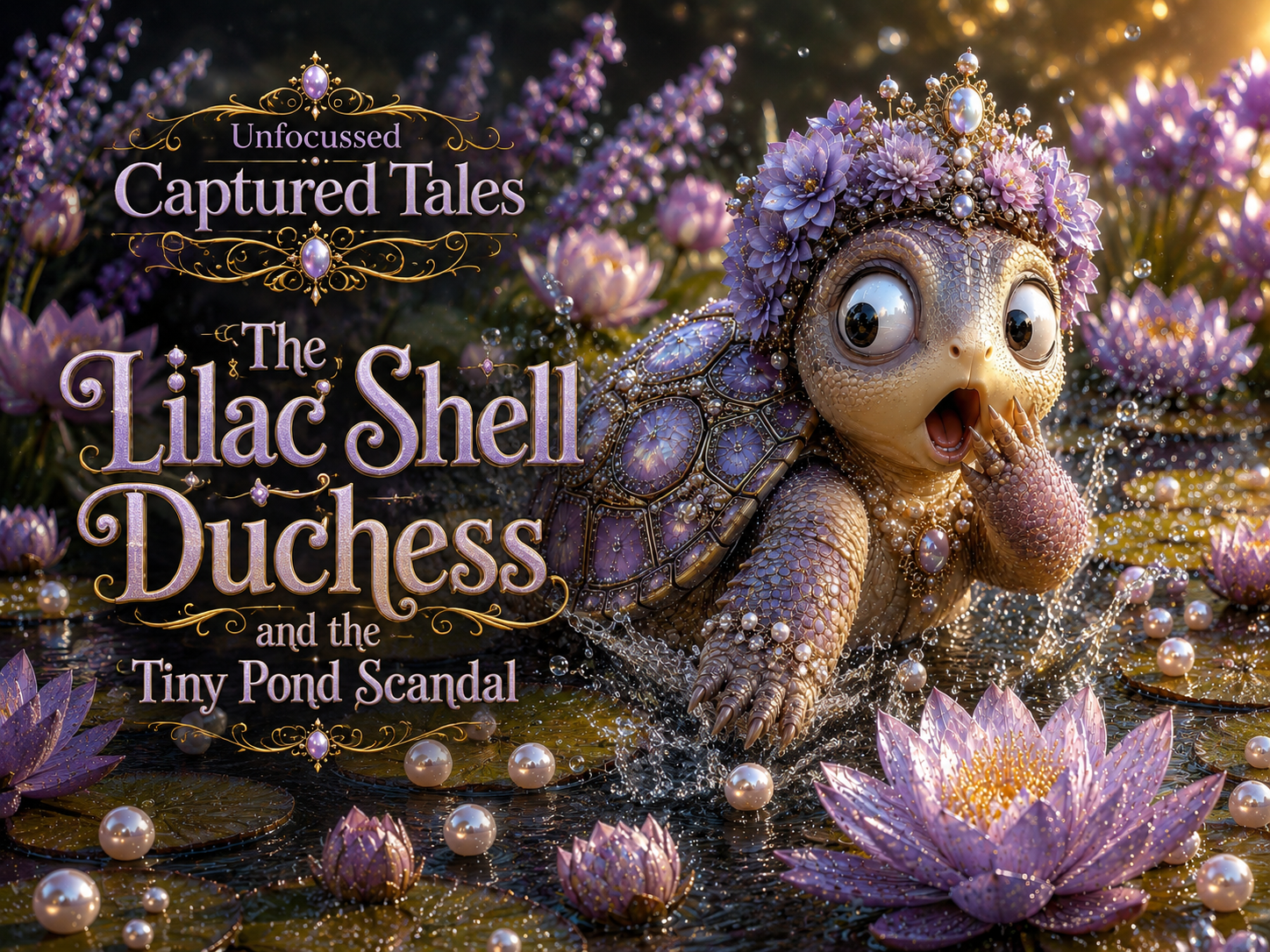
The Morning the Pond Forgot Its Manners
The Lilac Shell Duchess awoke to the sound of seventeen bubbles popping in a pattern she did not approve of.
Not that bubbles were forbidden in Bloomwater Pond. That would have been unreasonable, and the Duchess was many things—delicate, jeweled, dramatic enough to make a swan reconsider its career—but she was not unreasonable before breakfast. Bubbles were allowed. Encouraged, even, during festivals, hatchdays, and properly scheduled moments of merriment.
But these bubbles had popped in a crooked little rhythm just beneath her private lily pad balcony.
Pop. Pop-pop. Pop. Pop-pop-pop.
It was the sort of rhythm one might use to send a message, conceal a secret, or summon a questionable relative with a history of arriving uninvited and dripping on the cushions.
The Duchess lifted her head from her satin moss pillow, blinked her enormous glossy eyes, and immediately looked offended on behalf of civilization.
“Absolutely not,” she whispered.
Her full name, according to pond records, was Her Grace Duchess Liliandra Shellibelle of the Lilac Rim, Keeper of the Pearl Current, Defender of Polite Nibbling, and Most Decorated Tiny Shell of the Eastern Reeds. According to everyone who had ever attended one of her luncheons, she was “a lot,” but beautifully so. She wore pearls the way other creatures wore confidence. Her shell shimmered with lilac enamel, golden filigree, opal panels, and enough ornamental beadwork to bankrupt a family of dragonflies.
Her crown was made of lavender water blossoms, moon pearls, and one central opal so dramatic it had once caused a heron to apologize to its own reflection.
She eased herself from bed, adjusted the pearl necklace resting around her wrinkled little throat, and looked out over Bloomwater Pond.
It should have been a respectable morning.
Golden sunlight filtered through the cattails. Lilac water lilies floated on the surface like tiny royal barges. Dew clung to the reeds. Dragonflies zipped elegantly above the water, pretending they were not completely full of themselves. A family of minnows practiced synchronized darting near the shallows. In short, everything looked perfect, which immediately made the Duchess suspicious.
Perfection in a pond was always either temporary, staged, or hiding something damp.
Another bubble rose beside the largest lily pad in the royal cove.
Pop.
The Duchess narrowed her eyes.
“That,” she said, “was deliberate.”
From the neighboring lily pad, her lady-in-waiting stirred beneath a folded fern fan. Lady Nibblessa Puddlebun was a plump little newt with a powdered face, a nervous laugh, and the emotional strength of wet pastry.
“What was deliberate, Your Grace?” she asked, already frightened because the Duchess used the word deliberate the way thunderclouds used lightning.
The Duchess raised one gem-tipped claw and pointed at the pond surface.
“The water is speaking in code.”
Lady Nibblessa sat up so fast her fern fan flipped into the pond.
“Oh dear. Is it rude code?”
“All code is rude when used before tea.”
“Should I call for the breakfast beetles?”
“No. Call for my scandal shawl.”
Lady Nibblessa gasped. “The lavender one?”
“Obviously the lavender one. This is not a mustard-level emergency.”
Within minutes, the royal cove was in motion. Two beetle footmen polished the Duchess’s shell until the opals caught the morning light like trapped bits of dawn. A water skater delivered a thimble of dew tea on a floating rose petal. Lady Nibblessa arranged the scandal shawl—a delicate, translucent wrap of woven spider silk and lilac pollen—over the Duchess’s shoulders.
The Duchess sipped her tea, stared at the suspicious lily pad, and waited.
Bloomwater Pond had survived many crises. There had been the Tadpole Choir Incident, when forty-seven young frogs performed an unauthorized hymn in three wrong keys and one deeply emotional belch. There had been the Great Snail Seating Chart Disaster, when no one could remember which gastropods were speaking to each other and which were still furious about the parsley garnish. There had even been the unfortunate matter of Lord Ripplewick, who claimed his missing monocle had been stolen, only for it to be found attached to his own face for six consecutive hours.
But coded bubbles beneath the royal lily pads were new.
And new things, in the Duchess’s opinion, were usually old nonsense wearing a suspicious hat.
A Luncheon Spoiled by Whispers
By midmorning, the Duchess had scheduled an emergency Petal Float Luncheon, because the only proper way to investigate a secret was to invite everyone likely involved and make them uncomfortable over finger sandwiches.
The luncheon was held in the central bloom ring, where the finest lily pads drifted in a loose circle beneath the tall purple irises. Every important creature in Bloomwater Pond attended, which meant every creature who considered themselves important attended, which meant the guest list was both crowded and emotionally exhausting.
Lord Thistleplop arrived first, a squat green frog in a velvet waistcoat, carrying a cane he did not need and a sense of grievance he absolutely did.
“Your Grace,” he croaked, bowing so low his chin touched the water. “Splendid morning for a gathering of refined society.”
“Is it?” said the Duchess.
Lord Thistleplop blinked. “I had assumed so.”
“Assumption is the first cousin of embarrassment.”
“Ah.”
“And embarrassment,” she added, “is not invited to luncheon.”
Lord Thistleplop straightened and immediately looked as though embarrassment had arrived in his waistcoat pocket.
Next came Baroness Glimmergill, a silver fish with pearl earrings and a voice so smooth it made lies sound moisturized. She circled the lily ring twice before taking her place, flashing her scales in the sunlight.
“Darling Duchess,” she said, “what a beautiful gathering. So spontaneous. So intimate. So clearly not prompted by panic.”
The Duchess smiled.
“Baroness, how comforting that you brought your entire personality.”
Glimmergill’s smile twitched.
Then came Sir Whiskerfen, an elderly water vole with a damp cravat and a habit of clearing his throat whenever someone mentioned rules. Behind him drifted Madame Murkmina, a snail seamstress whose shell was embroidered with tiny blue flowers and whose gossip network was more efficient than most governments.
At the rear of the gathering, attempting to look as innocent as a tadpole could manage while actively failing, hovered Pipsqueak Puddlejump, a young froglet with enormous feet, a squeaky voice, and the anxious expression of someone who had recently done something he was not tall enough to regret properly.
The Duchess noticed him immediately.
She noticed everyone immediately. It was one of her gifts, along with accessorizing and turning silence into a weapon.
“Pipsqueak,” she said.
The froglet flinched so violently he slapped himself in the face with his own foot.
“Your Grace! Hello! Lovely pond! Very wet! Normal amount of secrets!”
The entire luncheon went still.
Lady Nibblessa made a small squeaking noise and hid behind the tea tray.
The Duchess set down her dew cup.
“Normal amount of what?”
“Reeds!” Pipsqueak said. “I said reeds. Normal amount of reeds.”
Lord Thistleplop coughed into his fist.
Baroness Glimmergill looked delighted in the discreet, vicious way of socially dangerous fish.
Madame Murkmina’s eye stalks slowly rose higher, as if the gossip gods themselves had tugged them upward.
The Duchess leaned forward, the pearls in her crown catching sparks of sunlight.
“How fascinating. I was unaware reeds had become secret enough to require correction.”
Pipsqueak swallowed.
“Some reeds are shy.”
“Are they?”
“Terribly.”
“And do these shy reeds communicate by coded bubbles beneath my private balcony?”
Sir Whiskerfen dropped his cucumber slice.
Baroness Glimmergill stopped circling.
Lord Thistleplop’s throat inflated and deflated twice without making a sound.
Madame Murkmina whispered, “Oh, delicious,” to no one in particular.
The Duchess watched them all.
There it was.
That tiny ripple through the crowd. Not confusion. Not surprise. Recognition.
Several guests knew something. Several guests had the audacity to know something before she did, which was practically treason with garnish.
“My friends,” the Duchess said, though her tone suggested she was using the word generously, “this morning, I was disturbed by a sequence of bubbles rising from beneath the royal lily pads. I intend to discover their source.”
“Could have been mud gas,” Lord Thistleplop offered.
The Duchess looked at him.
“Lord Thistleplop, you once blamed mud gas for eating three honey cakes and falling asleep in a napkin basket.”
“And I stand by the science.”
“Sit down by the shame.”
He sat.
Baroness Glimmergill gave a soft laugh. “Surely this is nothing more than pond nonsense, Your Grace. Bubbles happen. Water moves. Frogs overinflate themselves emotionally.”
“This was not nonsense,” said the Duchess. “It was a pattern.”
Madame Murkmina’s shell gave the faintest shiver.
The Duchess caught it.
“Madame Murkmina.”
The snail froze halfway through nibbling a petal cracker.
“Your Grace?”
“You know patterns.”
“I know embroidery patterns.”
“And seating patterns.”
“Sometimes.”
“And movement patterns.”
“I am but a humble seamstress.”
“You are a humble seamstress with a gossip network that could locate a missing pearl inside a sleeping clam during a thunderstorm.”
Madame Murkmina smiled shyly, which on a snail looked less like modesty and more like slow plotting.
“One hears things.”
“Then hear this,” said the Duchess. “Someone has been sending messages beneath my pond.”
A breeze moved across the lily pads.
The water glittered.
And then, from beneath the luncheon circle, three bubbles rose to the surface.
Pop. Pop-pop.
Every guest stared down.
The Duchess did not move.
Lady Nibblessa whimpered, “That felt personal.”
The Petals Were Arranged Incorrectly
The luncheon dissolved into an uproar, which was to say everyone pretended not to panic while panicking in highly specific ways.
Lord Thistleplop began insisting that bubbles had always been part of healthy pond culture and should not be stigmatized. Baroness Glimmergill announced that she had an urgent appointment with a sunbeam. Sir Whiskerfen repeatedly asked whether there would be minutes from the meeting, as if official paperwork might protect him from consequences. Pipsqueak Puddlejump attempted to hide behind a water lily stem and forgot that his back legs stuck out like two guilty twigs.
The Duchess raised one claw.
“No one leaves.”
Everyone stopped.
Even the dragonflies paused midair, which was difficult for them and made several look personally victimized.
“Your Grace,” Baroness Glimmergill said sweetly, “surely you cannot detain an entire luncheon over bubbles.”
“I can detain an entire luncheon over napkin placement if properly provoked.”
“That seems excessive.”
“Then let us all pray I remain charming.”
Madame Murkmina slowly slid closer to the Duchess.
“Your Grace,” she murmured, “may I observe something?”
“You may, provided it is useful and not merely juicy.”
“How strict are we being with that distinction?”
“Madame.”
“Very well.” The snail tilted her eye stalks toward the lily pads surrounding the luncheon. “The flowers have been moved.”
The Duchess looked around.
At first, the bloom ring appeared unchanged. Lilac lilies floated where they always floated, delicate and perfumed. White lotus cups shimmered near the reeds. Pink buds gathered in little clusters like polite guests at a wedding they planned to complain about later.
But then she saw it.
The smallest lily in the eastern cluster had been turned backward.
The central lotus was missing one petal.
Three lilac blossoms near the Duchess’s seat faced west instead of south.
And a single white lily had been tucked beneath a broad green pad at the edge of the luncheon circle, almost hidden.
Almost.
The Duchess’s mouth fell open.
Not in fear.
In offense.
“Who,” she said, with terrifying softness, “has rearranged my florals?”
Lady Nibblessa clutched her chest.
“Not the florals.”
“Yes, Nibblessa. The florals.”
“But that’s how society collapses.”
“Precisely.”
Sir Whiskerfen adjusted his cravat. “Perhaps the wind—”
“If anyone says wind, current, mud gas, or youthful exuberance, I shall personally assign them to napkin-folding duty for the ducklings’ etiquette retreat.”
The pond went silent.
No one wanted the ducklings.
They were adorable, yes, but they had no respect for folded corners and treated garnish as a war crime.
The Duchess turned to Madame Murkmina. “You saw the pattern?”
“I saw enough to recognize intent.”
“Meaning?”
The snail hesitated.
“Meaning someone arranged these blossoms according to an old code.”
A gasp moved through the guests.
Baroness Glimmergill’s tail flicked too sharply.
Lord Thistleplop suddenly became fascinated by his own cane.
The Duchess’s eyes widened until they reflected half the pond.
“An old code?”
Madame Murkmina lowered her voice. “Petal cipher. Very unfashionable now. Popular years ago among secret clubs, rebellious cousins, and pond creatures with more free time than moral structure.”
“What does it say?”
The snail studied the lilies. Her eye stalks moved from blossom to blossom, counting angles, colors, missing petals, and placement.
“It is difficult to translate without the full arrangement.”
“Try.”
Madame Murkmina inhaled, which took longer than anyone was emotionally prepared for.
“I believe it says…”
The pond leaned in.
Even the reeds seemed nosy.
Madame Murkmina whispered, “Beneath the largest pad, the spoon remembers.”
There was a very long silence.
Then Lord Thistleplop said, “I beg your pardon?”
“That cannot be right,” said Sir Whiskerfen.
“It may be metaphorical,” Madame Murkmina said.
“It may be stupid,” said the Duchess.
Lady Nibblessa trembled. “What spoon?”
“No one knows,” said Baroness Glimmergill quickly. Too quickly.
The Duchess turned toward her.
“How relieving that you answered before being asked.”
Glimmergill’s smile returned, shiny and brittle. “I only meant that spoons are not typically pond items.”
“Neither are velvet waistcoats, but Lord Thistleplop continues to threaten us with one.”
Lord Thistleplop looked wounded. “This is imported moss velvet.”
“It is imported moss nonsense.”
The Duchess slid off her lily pad with a soft splash and began paddling toward the largest pad in the central bloom ring. It was an enormous green plate of a leaf, old and thick, with lilac veins running through it like hidden rivers. It had floated in Bloomwater Pond longer than the Duchess had been alive. Longer than most could remember.
The elders called it Grandmother Pad.
The children called it Big Flop.
The Duchess called it “that old thing,” because she did not enjoy being emotionally outshined by vegetation.
She approached it slowly.
Behind her, the luncheon guests followed at what they probably believed was a respectful distance but was actually the distance of cowards hoping someone else would get cursed first.
At the edge of Grandmother Pad, the water looked darker.
A cluster of bubbles clung to the underside.
The Duchess reached forward with one jeweled claw and lifted the pad.
Something gold flashed beneath it.
Lady Nibblessa shrieked.
Pipsqueak fainted into a lily cup.
Lord Thistleplop whispered something that sounded suspiciously like, “Well, dammit.”
The Duchess froze.
Beneath Grandmother Pad, tucked into a cradle of woven reed stems and pond silk, was a tiny golden spoon.
It was no larger than a beetle’s wing, delicately engraved, tarnished at the edges, and set with a single lilac stone at the handle.
The Duchess stared at it.
She had never seen the spoon before.
But every creature over the age of gossip looked as if they had.
The Spoon No One Wanted to Discuss
The Duchess held the spoon on a folded lotus petal while the luncheon guests gathered around in varying degrees of dread.
“Well?” she said.
No one answered.
The spoon gleamed innocently in the sunlight, which only made the situation worse. Innocent objects found in suspicious locations were never truly innocent. They were evidence, symbols, clues, or cursed heirlooms with abandonment issues.
The Duchess turned it over with one claw.
On the underside, etched in delicate curling script, were three tiny words:
The First Stirring.
Lady Nibblessa made a faint choking noise. “That sounds historical.”
“It sounds pretentious,” said the Duchess. “Historical things usually do.”
Sir Whiskerfen dabbed at his forehead with a napkin. “Your Grace, perhaps this object should be returned to the water and never discussed.”
The Duchess slowly looked up.
“Sir Whiskerfen.”
“Yes?”
“That was the most incriminating sentence anyone has ever wrapped in a cravat.”
He swallowed.
Madame Murkmina slid closer, eyeing the spoon with a mixture of fear and professional delight. “It is real, then.”
“What is real?” asked the Duchess.
Lord Thistleplop stepped back. “Old nonsense.”
“Everyone keeps saying nonsense,” the Duchess said, “which is how I know we are standing hip-deep in truth.”
Baroness Glimmergill’s voice became smooth again. Too smooth. “There are old stories, Your Grace. Pond myths. Children’s tales. Nothing worth troubling your crown over.”
“My crown has survived storms, insults, and one heron with boundary issues. It can manage a myth.”
Madame Murkmina looked toward the reeds.
“The First Stirring belonged to the Order of the Underlily.”
Another gasp rippled across the pond.
The Duchess blinked.
“The Order of the what now?”
Lady Nibblessa whispered, “That sounds like a club that meets in damp places.”
“We live in a pond, Nibblessa. Narrow it down.”
Madame Murkmina continued, her voice low. “The Order of the Underlily was said to be a secret society formed long ago by the original pondkeepers. They protected Bloomwater’s oldest treasures, settled disputes before they became public scandals, and recorded every serious breach of etiquette committed in the pond.”
The Duchess stiffened.
“Every breach?”
“So the stories say.”
Lord Thistleplop muttered, “Ridiculous.”
“Including cake-related breaches?” the Duchess asked.
Lord Thistleplop shut his mouth.
Madame Murkmina nodded. “The spoon was their symbol. It represented the stirring of truth from the mud.”
The Duchess stared at the tiny golden spoon.
“Truth from the mud,” she repeated.
“Yes.”
“How needlessly theatrical.”
“You would have liked them.”
“I already resent that.”
Baroness Glimmergill flicked her tail. “It was only a legend. A silly tale used to frighten young frogs into admitting who chewed the reed curtains.”
Pipsqueak, who had regained consciousness inside the lily cup, whispered, “They were chewy.”
The Duchess ignored him.
“If the Order is legend,” she said, “then why is its spoon tucked under Grandmother Pad, guarded by coded bubbles and improper florals?”
No one answered.
Above them, a dragonfly zipped past and then doubled back slowly, pretending to inspect pollen while very clearly listening.
The Duchess turned the spoon again.
There was something else etched along the curve of the bowl. Not words this time, but markings.
Four dots.
A curved line.
A tiny lily symbol.
Then an arrow pointing downward.
“Madame,” said the Duchess, “translate.”
The snail peered at the markings. Her face went very still.
“Oh.”
“That is not a translation.”
“No, Your Grace.”
“It is the sound people make before becoming inconvenient.”
Madame Murkmina lowered her voice. “The symbols indicate a place.”
“Where?”
“Beneath the roots of Grandmother Pad.”
The Duchess looked at the huge lily pad floating before them.
Its stems disappeared into the dark, glittering water below. Thick roots twisted beneath the surface, tangling with old reeds, sunken petals, and shadow. Anything could be down there. Lost shells. Ancient pearls. Forgotten tea sets. That one awful porcelain swan from Aunt Brindle’s solstice party.
Or a secret.
The Duchess felt a thrill run through her tiny body.
It was not fear.
Fear wore flat shoes and made poor decisions.
This was curiosity. Royal curiosity. The dangerous kind. The kind that put on jewels, lifted its chin, and marched directly toward trouble because trouble had failed to introduce itself properly.
“Very well,” she said.
Lady Nibblessa’s eyes bulged. “Very well what?”
“We investigate beneath the roots.”
“Underwater?”
“We are pond creatures, Nibblessa.”
“Yes, but I prefer water from above. As ambiance.”
Sir Whiskerfen stepped forward, his cravat trembling. “Your Grace, I must strongly advise against disturbing the roots. Ancient pond systems can be delicate.”
“So can reputations.”
“Precisely.”
The Duchess tilted her head.
Sir Whiskerfen looked away.
There it was again.
That flicker. That little tremor of someone standing too close to an old secret.
The Duchess tucked the golden spoon carefully into the edge of her pearl necklace.
“Lord Thistleplop. Baroness Glimmergill. Sir Whiskerfen. Madame Murkmina. Pipsqueak.”
Each creature stiffened as their name was called.
“You will accompany me.”
Lord Thistleplop croaked. “Must we?”
“You may decline, of course.”
He exhaled in relief.
“And then I shall assume you are guilty.”
He inhaled in regret.
The Duchess smiled sweetly. “Wonderful. We depart at once.”
Lady Nibblessa raised one trembling hand. “Your Grace, should I bring anything?”
“Yes. A lantern pearl, three emergency napkins, and my waterproof accusation gloves.”
“The ones with the gold trim?”
“Obviously. We are not animals.”
Below the Grandmother Pad
The descent beneath Grandmother Pad was neither graceful nor dignified, which deeply irritated the Duchess because she had dressed for both.
The water below the lily canopy was cool and green-gold, full of drifting pollen, tiny fish, and shafts of sunlight that broke apart like shattered glass. Roots twisted downward in thick ropes, covered in moss and jeweled beads of air. Snails clung to the stems. Minnows scattered as the Duchess and her unwilling investigative party slipped beneath the surface.
The Duchess moved carefully, her ornate shell glimmering in the filtered light. Pearls streamed behind her. Her floral crown remained miraculously in place, because it knew better.
Lady Nibblessa paddled beside her, clutching a lantern pearl that glowed with soft lavender light.
Lord Thistleplop sank more than swam, muttering about his waistcoat.
Baroness Glimmergill moved with suspicious elegance, her silver body slipping through the water like a secret with fins.
Sir Whiskerfen followed reluctantly, cheeks puffed, cravat floating upward around his face like a haunted ribbon.
Madame Murkmina had attached herself to a drifting reed and was being slowly dragged along, which she claimed was “efficient travel” and not “snail panic.”
Pipsqueak brought up the rear, accidentally kicking everyone at least once.
The roots of Grandmother Pad formed a tangled chamber beneath the pond surface. It was darker there. Older. The sounds of the luncheon above faded into muffled ripples. The Duchess could hear the soft creak of roots, the hush of mud shifting below, and somewhere deeper, a faint rhythmic tapping.
Tap. Tap-tap. Tap.
The same pattern as the bubbles.
The Duchess stopped.
The others bumped into one another behind her.
“Did everyone hear that,” she whispered, “or has the pond finally become dramatic enough to speak directly to me?”
Lady Nibblessa nodded frantically.
Baroness Glimmergill said nothing.
Sir Whiskerfen looked miserable.
The Duchess followed the tapping through the roots. The lantern pearl cast lavender light over the tangled stems, revealing something woven into the very base of Grandmother Pad.
A door.
It was tiny, round, and made of dark polished seedwood, banded with tarnished gold. Lilac moss grew along its edges. In the center was a carved spoon symbol, nearly identical to the one now tucked against the Duchess’s necklace.
Lady Nibblessa pressed both hands over her mouth.
Lord Thistleplop whispered, “Well, that’s inconvenient.”
The Duchess stared at the door.
For once, she said nothing.
It was not often the world presented her with something worthy of silence.
She lifted the golden spoon and placed it against the carved symbol.
The spoon warmed beneath her claw.
The door shivered.
A ring of tiny bubbles escaped around its frame.
Then the seedwood door opened inward with a soft, ancient groan.
Beyond it was a hidden chamber glowing with pearl light.
The walls were lined with shelves carved from root and shell. Scrolls floated in glass tubes. Tiny spoons hung from silk cords. Petals were pinned in coded arrangements across moss boards. At the center stood a round table made from an old turtle shell, polished smooth and surrounded by seven seats.
But one seat was not empty.
A small hooded figure sat at the table, barely larger than Pipsqueak, wearing a cloak woven from black lily petals.
The figure looked up.
Two bright eyes shone beneath the hood.
Then it spoke in a squeaky, solemn voice.
“Her Grace has found the Underlily.”
The Duchess floated in the doorway, dripping pearls and outrage.
“I have found a secret clubhouse beneath my luncheon pond,” she said. “And someone had better explain themselves before I become historically unpleasant.”
The hooded figure reached toward the table and pushed forward a sealed glass tube.
Inside was a rolled petal-scroll tied with lilac thread.
On the outside, written in tiny curling script, were the words:
The Scandal Was Never About the Spoon.
The Duchess’s eyes widened.
Behind her, someone gasped.
And somewhere in the hidden chamber, another bubble rose from the shadows and popped against the ceiling.
Pop-pop-pop.
The Club Beneath Everyone’s Feet
The hidden chamber beneath Grandmother Pad was exactly the sort of place the Lilac Shell Duchess disliked on principle.
It was secretive. It was damp. It had shelves. Worst of all, it had clearly existed for generations without asking her opinion about the drapery.
The pearl-lit room glowed softly beneath the old lily roots, round and snug and ancient, with walls of braided reeds, polished shells, and dark rootwood that curved like the inside of a sleeping creature’s heart. Tiny glass tubes floated in neat rows along the walls, each containing a rolled petal-scroll tied with colored thread. Several shelves displayed golden spoons of various sizes, from beetle-tiny to frog-soup alarming. A board of pinned lily petals stretched across one wall in a pattern so complicated it looked like a flower bed had lost a legal argument.
The Duchess drifted inside with all the authority of someone entering a room she had not been invited to and immediately improving it by being there.
Behind her came Lady Nibblessa, lantern pearl trembling between her hands; Lord Thistleplop, who looked offended that underwater rooms did not have chairs suited to his waistcoat; Baroness Glimmergill, who looked far too elegant for someone actively marinating in suspicion; Sir Whiskerfen, whose damp cravat had wrapped itself around his snout like a nervous flag; Madame Murkmina, who appeared both frightened and deeply entertained; and Pipsqueak Puddlejump, who was trying to be brave but kept blinking bubbles out of his own face.
At the table, the hooded figure sat very still.
The Duchess pointed one claw at the sealed glass tube that had been pushed toward her.
“Explain.”
The hooded figure folded its tiny hands. “There are procedures.”
“There is also my patience, and it is currently wearing thin enough to qualify as lace.”
“The Underlily does not recognize above-water titles during formal inquiry.”
The Duchess stared.
“I beg your soggy little pardon?”
The hooded figure cleared its throat, producing a squeak so small it should have been escorted from the room for underperforming.
“Within this chamber, all creatures are equal before the truth.”
Lady Nibblessa whispered, “Oh no.”
The Duchess slowly turned her head.
“Equal?”
“Yes.”
“To me?”
“Before the truth.”
“The truth sounds poorly raised.”
The figure reached up and pushed back its hood.
Beneath it was not an ancient turtle, a ghostly snail, or a prophetic fish with eyes full of doom. It was a tiny mud minnow with spectacles made from two polished dew drops and a face so solemn it looked personally responsible for several centuries of paperwork.
“I am Archivist Minnifred Silt,” said the minnow. “Temporary Keeper of the Third Spoon, Acting Recorder of Improper Petal Movement, Junior Witness to Submerged Matters, and only surviving member of the current Underlily quorum.”
Lord Thistleplop blinked. “You’re a child.”
“I am a very compact historian.”
“You look like lunch.”
The Duchess snapped her gaze toward him.
“Lord Thistleplop.”
“I meant in a scholarly sense.”
“No one has ever meant anything in a scholarly sense while looking that edible.”
Minnifred adjusted her dew-drop spectacles with stiff dignity.
“The Order of the Underlily has endured through collapse, drought, duck occupation, and three separate eras of frog opera. We are not easily dismissed.”
“You are a secret club in a root basement,” said the Duchess. “You are at least a little dismissible.”
“And yet you came.”
The chamber went quiet.
The Duchess lifted her chin.
“I came because someone disturbed my pond.”
“Your pond?” Minnifred asked.
The words struck the room like a pebble thrown by someone with excellent aim and a bad attitude.
Lady Nibblessa gasped.
Sir Whiskerfen made a strangled sound.
Baroness Glimmergill’s smile flickered.
The Duchess did not move.
“Choose your next words,” she said, “as if they are applying for survival.”
Minnifred slid the sealed glass tube closer.
“The scandal was never about the spoon.”
The Duchess looked down at the curled petal-scroll inside the tube. Its lilac thread trembled in the faint current.
“So the tube claims.”
“It was about the seat.”
“What seat?”
Minnifred pointed to the round table at the center of the chamber.
Seven tiny chairs surrounded it. Each was carved with a symbol: a lily, a reed, a shell, a snail spiral, a frog foot, a fish scale, and a vole whisker.
The Duchess noticed the shell symbol last.
It was carved in the shape of a lilac-lined turtle shell.
Her shell.
Not exactly hers, of course. It was older, simpler, less ornamented, and depressingly practical. But the shape was unmistakable.
“Why,” she asked carefully, “does this conspiracy furniture feature my family crest?”
Minnifred folded her fins.
“Because House Shellibelle was one of the seven founding keepers of Bloomwater Pond.”
The Duchess blinked.
“My family founded Bloomwater?”
“No.”
“Then you might wish to duck.”
“Your family helped keep Bloomwater. That is not the same thing.”
Lord Thistleplop made the mistake of murmuring, “Technically true.”
The Duchess turned on him.
“Did your waistcoat just speak?”
He shrank behind his cane.
A History Nobody Wanted Served Cold
Minnifred opened the glass tube with a careful twist. The petal-scroll unfurled in the water without tearing, its surface shimmering with ink made from crushed blackberry, moonlit silt, and the kind of old resentment that never fully dried.
Words appeared slowly across the petal.
The Scandal Was Never About the Spoon. It Was About the Right to Sit.
Lady Nibblessa peered at it. “That seems like a lot of trouble over furniture.”
“Seats,” said Minnifred, “are never just seats.”
The Duchess gave a reluctant nod. “Unfortunately true. I once watched two beetle countesses stop speaking for six weeks over a cushion tassel.”
“The Order began after the First Blooming,” Minnifred continued. “Back when Bloomwater Pond was smaller, wilder, and significantly less obsessed with napkin ranks.”
“Napkin ranks exist for a reason,” the Duchess said.
“To wound snails?” Madame Murkmina asked softly.
The Duchess glanced at her.
Madame Murkmina did not look away.
For the first time since entering the chamber, the Duchess noticed that the snail seamstress had gone very still. Not frightened still. Not gossip-hungry still. Something deeper. Older. Personal.
Minnifred continued. “The seven founding keepers agreed that Grandmother Pad would belong to no single family. It was to be the gathering place of all pond voices. Shell, scale, whisker, foot, spiral, reed, and bloom. Decisions were to be stirred together.”
The Duchess stared at the golden spoon tucked in her necklace.
“That is why the spoon was their symbol.”
“Yes,” said Minnifred. “Truth stirred from the mud. Power stirred among all. No creature above another in matters that affected the pond.”
Lord Thistleplop grimaced. “Sounds exhausting.”
“Democracy usually does, dear,” said Baroness Glimmergill. “That is why it requires snacks.”
The Duchess ignored them both.
“What happened?”
Minnifred’s expression darkened. On a mud minnow, this mostly meant she looked like a comma with grievances.
“Seventy-three summers ago, during the Lavender Moon Luncheon, the First Spoon vanished.”
Lady Nibblessa sucked in a breath. “The spoon we found?”
“The same.”
“How dramatic.”
“Worse,” said Minnifred. “The spoon was discovered later in the sewing reeds of Lady Mallowmire Murkmina, seamstress to the bloom court.”
Madame Murkmina lowered her eye stalks.
The Duchess looked at her. “Your ancestor.”
“My great-grandmother,” Madame Murkmina said quietly.
Lord Thistleplop shifted. Sir Whiskerfen suddenly found the tabletop fascinating. Baroness Glimmergill’s tail moved once, sharp as a blade.
Minnifred went on. “Lady Mallowmire was accused of stealing the spoon to embarrass the founding table. Her family denied it. No one listened. The snail spirals lost their seat. The Mirefolk were barred from arranging ceremonial petals. Their testimony was deemed ‘decorative but unreliable.’”
Madame Murkmina’s voice was soft. “We became seamstresses only. Never witnesses.”
The Duchess felt something uncomfortable press beneath her pearls.
It was not guilt, exactly. She had not been alive seventy-three summers ago, and she personally had never barred a snail from testimony. She had barred several from dessert, but only after the cream puff incident, and that was different. Mostly.
Still, the chamber felt smaller.
“Who accused her?” the Duchess asked.
Minnifred looked at the table.
“According to the public record, the accusation was made by Lord Bogwell Thistleplop.”
Every eye turned to Lord Thistleplop.
He puffed up. “That was my great-uncle.”
“Who found the spoon,” said Minnifred.
“Allegedly.”
“The public record says definitely.”
“Public records have terrible posture.”
The Duchess narrowed her eyes. “Lord Thistleplop.”
He looked suddenly sweaty, which was impressive underwater.
“I was not there, Your Grace.”
“No one suggested you were. But your face is confessing to something your mouth has not scheduled yet.”
He opened his mouth, closed it, then muttered, “My family may have benefited somewhat.”
“Define somewhat.”
“We received the frog foot seat.”
“That sounds more than somewhat.”
“And ceremonial croaking rights.”
“Continue digging. I enjoy watching men build their own holes.”
He winced. “And first access to the western basking stones.”
Lady Nibblessa whispered, “Oh, that is very somewhat.”
Minnifred pointed to Sir Whiskerfen next. “The revised charter removing the snail spiral seat was written by Vellum Whiskerfen.”
Sir Whiskerfen coughed so hard a bubble escaped from his ear.
“My grandfather was a respected clerk.”
“He was a vole with excellent penmanship and suspicious timing,” said Madame Murkmina.
The Duchess gave a tiny approving hum. “That was well sharpened.”
Minnifred turned to Baroness Glimmergill. “The public ceremony declaring the scandal resolved was witnessed by the Glimmergill family.”
Baroness Glimmergill smiled blandly. “Fish witness many things. It is difficult not to when everyone conducts their nonsense in water.”
“Your family signed the declaration.”
“My family signs everything. We enjoy pens.”
The Duchess stared at her. “Baroness, your charm is beginning to smell preserved.”
The fish’s smile thinned.
Minnifred finally looked at the Duchess.
The Duchess did not like that. She liked being looked at admiringly, fearfully, or by artists seeking inspiration for porcelain. She did not like being looked at historically.
“And House Shellibelle,” said Minnifred, “was granted permanent stewardship of Grandmother Pad after the scandal.”
The chamber fell silent.
Lady Nibblessa clutched the lantern pearl so tightly its light fluttered.
The Duchess’s jaw set.
“I see.”
“Do you?” Madame Murkmina asked.
The question was not rude.
That somehow made it worse.
The Duchess looked down at her jeweled claws. At the opals set into her shell. At the pearls around her neck. At the tiny golden spoon that had been hidden beneath the pad from which her family’s authority had bloomed.
For a moment, her usual outrage did not come.
That was irritating.
Outrage was reliable. Outrage arrived early, wore excellent shoes, and knew where to stand.
This feeling was messier. It wore no shoes at all.
“You are suggesting,” the Duchess said, “that my family’s position in Bloomwater may have been built on a false accusation.”
Minnifred nodded.
“I am suggesting the Underlily preserved evidence that the scandal was arranged.”
“By whom?”
The archivist hesitated.
“That evidence is missing.”
The Duchess looked up sharply.
“Missing?”
Minnifred pointed to an empty slot on the wall of floating scroll tubes. Its shell brackets were cracked. A few tiny bubbles still leaked from the gap.
“The Root Charter and the final witness record were removed this morning.”
Pipsqueak squeaked.
The Duchess slowly turned toward him.
“Pipsqueak.”
He tried to hide behind his own foot and failed because it was attached to him.
“Yes, Your Grace?”
“Why did you make that sound?”
“I am emotionally musical?”
“Try again.”
“I may know something adjacent.”
“Adjacent to truth or adjacent to a lie wearing a hat?”
Pipsqueak swallowed. “Both are near each other in my neighborhood.”
The Junior Nuisance Confesses Slightly
Pipsqueak was placed on the central table for questioning, mostly because he kept drifting away in panic and once tried to apologize to a chair.
The Duchess settled herself opposite him, pearls drifting around her throat like elegant little threats.
“Begin,” she said.
“I didn’t steal the scroll.”
“That was a conclusion, not a beginning.”
“I didn’t steal the scroll at the beginning either.”
Lord Thistleplop muttered, “The boy’s doomed.”
The Duchess raised one claw without looking at him.
“You are not helping.”
Pipsqueak clasped his tiny hands together. “I only sent the bubbles.”
Lady Nibblessa gasped. “The rude code!”
“It wasn’t rude,” said Pipsqueak. “It was warning code.”
“All warning code is rude when directed beneath a balcony,” said the Duchess. “But continue.”
Pipsqueak looked toward Madame Murkmina.
The snail’s eye stalks dipped.
The Duchess noticed.
Of course she noticed.
“Madame Murkmina.”
The seamstress sighed. “I taught him the old petal cipher.”
Lord Thistleplop pointed his cane. “Aha!”
“Lord Thistleplop,” the Duchess said, “if your next word is not useful, I shall use your imported moss velvet to dust a duck.”
He lowered the cane.
Madame Murkmina continued. “I taught several young ones. Quietly. They should know the old language. It belongs to the pond, not just the powerful.”
The Duchess tapped one claw against the table.
“Did you arrange the lilies?”
“Some of them.”
Another ripple of shock passed through the room.
“Some?”
“The first message. Beneath the largest pad, the spoon remembers.”
“And the bubbles?”
“Pipsqueak carried them.”
Pipsqueak lifted one hand weakly. “I practiced for weeks. I can also do happy hatchday, evacuation, and your hat is on fire.”
Lady Nibblessa frowned. “Why is that last one part of the curriculum?”
“Dragonflies,” said Minnifred.
Everyone nodded. That did explain it.
The Duchess leaned closer to Madame Murkmina. “You wanted me to find the spoon.”
“Yes.”
“Why today?”
Minnifred answered before the seamstress could.
“Because someone else found the chamber first.”
The Duchess turned toward the archivist.
“Explain in fewer mysteries.”
“At dawn, the Underlily alarm triggered. The Root Charter was removed from its bracket. The chamber sealed itself, but not before the thief escaped through the reed chute.”
“There is a reed chute?” Lady Nibblessa asked.
“Emergency exit,” said Minnifred.
“To where?”
“The shawl closet.”
The Duchess’s head snapped toward Lady Nibblessa.
Lady Nibblessa turned the color of spoiled mint.
“My shawl closet?” the Duchess asked.
“Technically,” Minnifred said, “it was a root access vent before it became a shawl closet.”
“Nothing becomes a shawl closet without permission.”
Lady Nibblessa fluttered her hands. “Your Grace, I had no idea! I thought the draft was decorative!”
“Drafts are never decorative. They are gossip from architecture.”
The Duchess’s mind sharpened.
At dawn, someone had entered the Underlily chamber. Stolen the Root Charter and witness record. Escaped through a reed chute into her own shawl closet. Then, later that morning, she had demanded her scandal shawl.
The lavender one.
The one Lady Nibblessa had fetched.
The Duchess slowly looked at the translucent spider-silk wrap draped over her shoulders.
Lady Nibblessa followed her gaze and whimpered.
“Surely not.”
The Duchess removed the shawl with glacial care. She held it in the lantern pearl’s glow. Lilac pollen shimmered along its hem. Gold thread glinted in the woven edges. Tiny pearl beads hung like dew drops.
Madame Murkmina slid closer, seamstress instincts overtaking scandal fear.
“May I?”
The Duchess handed it over.
Madame Murkmina examined the hem, her eye stalks narrowing. Then she touched one bead with the tip of her feeler.
The bead opened.
Inside was a rolled scrap of dark waterweed paper.
Lady Nibblessa made a noise like a kettle losing faith.
The Duchess’s eyes flashed.
“Read it.”
Madame Murkmina unrolled the scrap.
“It says…” She paused. “Too late to stir what has already sunk.”
Lord Thistleplop groaned. “I hate poetic criminals.”
“Everyone hates poetic criminals,” said the Duchess. “That is how they become poetic.”
Minnifred swam to the empty slot on the wall and touched the cracked bracket. “The thief left that message to taunt the Order.”
“No,” said the Duchess.
Everyone looked at her.
She stared at the shawl.
“Not merely to taunt the Order. To implicate my household.”
Lady Nibblessa gasped. “But I would never!”
“I know.”
Nibblessa blinked. “You do?”
“You once cried because you accidentally sat on a biscuit shaped like a duckling. You do not possess the spine for underground treason.”
“Thank you?”
“You’re welcome.”
The Duchess looked toward the guests. “Someone wanted me surrounded by suspects and wearing evidence.”
Baroness Glimmergill’s silver scales flashed. “How dreadful. Almost as if scandal follows those who collect it.”
The Duchess smiled.
“Careful, Baroness. Your smugness is showing at the hem.”
Glimmergill’s expression hardened for the smallest moment.
Small moments were often where truth stored its knives.
Evidence With Terrible Manners
The Underlily chamber began to reveal its wounds.
Once the Duchess ordered everyone to stop touching things unless they wished to be categorized as a clue, Minnifred led them to the broken scroll bracket. The thief had pried it open with something thin and sharp. The shell hinge was scratched. The moss around the slot had been crushed. A faint trail of disturbed silt led toward a narrow tunnel behind a curtain of roots.
“The reed chute,” said Minnifred.
“Naturally,” said the Duchess. “Every respectable scandal needs a hidden escape hole near accessories.”
Madame Murkmina studied the scratches. “Not a claw.”
“No?”
“Too smooth. Too narrow.”
“A fish bone?” Pipsqueak asked.
Baroness Glimmergill glided closer. “Fish do not generally carry bones externally, child.”
“You carry attitude externally,” Pipsqueak mumbled.
The Duchess turned to him with mild surprise.
“That was almost excellent.”
Pipsqueak looked proud enough to burst.
Baroness Glimmergill did not.
Sir Whiskerfen leaned toward the bracket, squinting. “Could have been a letter opener.”
The Duchess looked at him. “Why would anyone have a letter opener underwater?”
“For waterproof correspondence.”
“That answer was so prepared it has fingerprints.”
Sir Whiskerfen pulled back.
Minnifred produced a tiny evidence shell from beneath the table. “The chamber collected several traces during the theft.”
“The chamber collects traces?” Lord Thistleplop asked.
“Of course,” said Minnifred. “The Underlily is ancient, not incompetent.”
The archivist tipped the shell onto the table.
Five objects floated in the lantern light.
A silver fish scale.
A thread of moss velvet.
A curled vole whisker.
A strand of snail silk.
And a smear of lilac pollen mixed with gold dust.
The Duchess stared at the evidence.
Then she laughed once.
It was not a happy laugh.
It was the kind of laugh a crown makes before becoming a weapon.
“How generous,” she said. “The thief has implicated everyone. How efficient. How theatrical. How absolutely tacky.”
Lord Thistleplop puffed up. “That thread could be from any imported moss velvet garment.”
Everyone looked at his waistcoat.
“There are many.”
The room remained silent.
“Several.”
Still silence.
“Fine. Mine is distinctive.”
Baroness Glimmergill swished her tail. “Scales shed naturally.”
“How convenient for criminals with fins,” said Madame Murkmina.
Sir Whiskerfen touched his trembling whiskers. “Voles shed as well.”
“An epidemic of shedding,” said the Duchess. “How tragic. Shall we hold a combing vigil?”
Madame Murkmina pointed to the snail silk. “That could have come from any fine stitching.”
The Duchess arched a brow. “And did it?”
“Possibly.”
“Madame.”
The snail sighed. “No. It is mine.”
Pipsqueak gasped. “You were here?”
“I have been here many times.”
The Duchess’s gaze sharpened.
Madame Murkmina met it calmly.
“My family never stopped serving the Underlily. We were removed from the table above, not from the truth below.”
Minnifred nodded. “Madame Murkmina is not a thief. She is a registered informant.”
The Duchess blinked. “A registered what?”
“Informant.”
“You have registration?”
“Three copies.”
“Of course you do. Secret societies always become bureaucracies when left unattended.”
Madame Murkmina’s mouth curved. “One must pass the centuries somehow.”
The Duchess looked back at the final smear: lilac pollen and gold dust.
That belonged to her.
Or rather, it belonged to the cloud of ornament, polish, powders, petals, and expensive nonsense that followed her everywhere like a sparkling alibi.
“The thief used traces from all of us,” she said.
“Or all of you were involved,” Baroness Glimmergill said.
“Including you.”
“Naturally, but I was involved beautifully.”
“You are one more comment away from being stored in a jam jar.”
“With ventilation?”
“Do not negotiate your jar.”
Minnifred touched the table with one fin. “There is more.”
“There always is,” the Duchess muttered. “Scandals reproduce faster than ducklings.”
At the archivist’s gesture, the Duchess reluctantly surrendered the golden spoon from her necklace. Minnifred pressed it against a groove in the center of the table. The old turtle-shell surface glowed faintly. Lines of lilac light spread outward, connecting the seven carved chairs.
One by one, the symbols brightened.
Lily.
Reed.
Snail spiral.
Frog foot.
Fish scale.
Vole whisker.
Shell.
The shell symbol flared brightest.
The golden spoon quivered in the groove.
It lifted by itself from the table. It floated in the water, turned once, and pointed directly at her chest.
Lady Nibblessa whispered, “Oh, I dislike magical cutlery.”
“So do I,” said the Duchess, though she did not move. “It is always so opinionated.”
The spoon drifted closer to the ornate front edge of her shell, where a lilac jewel rested beneath gold filigree.
Click.
The jewel shifted.
The Duchess froze.
Another click followed.
Then another.
Along the left side of her shell, beneath a decorative band she had always assumed was purely ornamental, a hidden seam appeared.
Every creature stared.
The Duchess stared hardest.
“Excuse me,” she said in a voice that could have iced a summer pond. “Why is my shell making decisions without me?”
Minnifred’s spectacles slid down her face.
“The Shellibelle seal.”
“Do not say that as if I should know what it means.”
“Your ceremonial shellwork contains one of the original Underlily locks.”
“My ceremonial shellwork contains what?”
Lady Nibblessa was near tears. “I only polish the outside!”
The hidden seam opened just enough for a tiny compartment to slide outward.
From inside the Duchess’s jeweled shell emerged a glass tube.
It was sealed with lilac wax.
Tied around it was a black lily thread.
Madame Murkmina’s eye stalks rose.
Sir Whiskerfen looked ready to expire from paperwork.
Lord Thistleplop’s mouth fell open.
Baroness Glimmergill went perfectly still.
The Duchess stared at the tube now floating in front of her.
“If,” she said slowly, “anyone suggests I have been smuggling historical documents in my person, I shall become a weather event.”
No one spoke.
The tube turned in the water.
Inside was not one scroll, but two.
One tied with silver thread.
One tied with red.
Minnifred’s voice trembled. “The Root Charter.”
The Duchess swallowed.
“And the other?”
Madame Murkmina whispered, “The final witness record.”
The Scroll That Bit Back
The Duchess did not immediately open the tube.
This was not because she was afraid.
She would later make that extremely clear to anyone with ears, fins, spirals, or a working rumor system. She was not afraid of a scroll. Scrolls were leaves with ambition. She had eaten more intimidating salad.
But some truths had teeth.
And this one had just crawled out of her own shell wearing archival thread.
“How long,” she asked, “has that compartment existed?”
Minnifred looked toward the shell chair. “Since the founding, likely. The Shellibelle keeper was entrusted with emergency preservation.”
“Meaning?”
“If the Underlily was compromised, the most important records could be hidden inside the shell seal.”
“And no one told the current shell?”
“The knowledge was lost.”
“How convenient for everyone except the turtle being used as a filing cabinet.”
Lady Nibblessa sniffled. “Your Grace, I would have dusted it differently had I known.”
“That is somehow comforting and horrifying.”
Lord Thistleplop leaned closer. “So the thief didn’t steal the charter?”
Minnifred’s eyes narrowed. “Not the original.”
“Then what was taken from the wall?”
“A decoy,” said Madame Murkmina.
The Duchess looked at her.
The snail nodded slowly, understanding dawning across her face. “My great-grandmother must have suspected the Order was compromised. She hid the true records with House Shellibelle’s seal and left false records in the chamber.”
Sir Whiskerfen whispered, “Then the thief stole bait.”
“And left a message,” said the Duchess, “thinking the truth had sunk.”
Her eyes hardened.
“It has not.”
For the first time since the morning bubbles, the Duchess felt steady. Not comfortable. Not safe. Certainly not pleased. But steady.
She had been implicated, insulted, surprised by her own shell, and forced to admit that perhaps her family history had more mud in it than the official portraits suggested.
Still.
The truth was here.
And it had chosen to emerge in front of her, which showed decent taste.
“Open it,” she said.
Minnifred broke the lilac wax seal with the golden spoon. The glass tube opened with a soft sigh.
The first scroll, tied in silver thread, unfurled above the table.
The Root Charter shimmered into view.
Its words were old, beautiful, and written in a hand that looked too elegant to have ever dealt with frogs.
Grandmother Pad shall never be throne, property, pedestal, nor private balcony. She shall be table, shelter, witness, and gathering place. No one shell, scale, foot, whisker, reed, bloom, or spiral may claim her above the others. Let all who drink from Bloomwater stir truth together.
The Duchess read the words twice.
The room seemed to breathe around her.
Grandmother Pad shall never be throne.
Property.
Pedestal.
Private balcony.
The phrase landed with all the subtlety of a goose through a window.
Lady Nibblessa did not look at her.
No one did.
The Duchess lifted her chin.
“Well,” she said. “That is awkward.”
Pipsqueak nodded solemnly. “Very.”
She gave him a look.
“Sorry.”
Madame Murkmina’s voice was gentle. “Your Grace.”
The Duchess exhaled through her nose.
“Do not gentle me yet. I am not ready to be improved as a person.”
“Fair.”
Minnifred reached for the second scroll.
The red thread loosened on its own.
The final witness record unrolled slowly.
This scroll was older-looking than the first, its edges dark, its ink uneven. At the top was the symbol of the Underlily spoon. Beneath it were seven signatures.
The Duchess recognized some family names.
Shellibelle.
Thistleplop.
Glimmergill.
Whiskerfen.
Murkmina.
Others belonged to lines long vanished into reeds and rumor.
The text below began:
I, Lady Mallowmire Murkmina, seamstress and seventh witness, record this truth before the false tide rises.
Madame Murkmina closed her eyes.
The Duchess looked at her but said nothing.
Minnifred read aloud.
“The spoon was placed in my sewing reeds by another. I saw the hand that hid it, and I know why. The theft was staged to break the seven seats and give Grandmother Pad into private keeping. I name the one who carried the spoon. I name the one who wrote the false record. I name the one who watched and smiled.”
Sir Whiskerfen trembled.
Lord Thistleplop muttered, “Oh no.”
Baroness Glimmergill’s eyes sharpened.
The Duchess leaned forward.
“Read the names.”
Minnifred’s mouth opened.
Then the chamber shook.
A deep groan rolled through the roots.
The pearl lights flickered.
Above them, somewhere beyond the ceiling of roots and water, a huge splash broke the surface.
Then came shouting.
Not polite shouting.
Not luncheon shouting.
Real shouting.
The kind that put mud on reputations.
Lady Nibblessa clutched the lantern pearl. “What was that?”
Minnifred looked upward in alarm. “Grandmother Pad.”
“What about her?” the Duchess demanded.
Another groan shook the chamber.
A crack split through the rootwood wall.
Silt drifted down like dirty snow.
Minnifred’s voice went thin.
“Someone is cutting the anchor roots.”
The Duchess’s eyes flashed.
“While we are inside them?”
“Yes.”
Lord Thistleplop croaked, “That seems rude.”
The Duchess turned toward him.
“Rude? Rude is failing to RSVP. This is attempted murder with gardening tools.”
A third groan tore through the chamber.
The table lurched.
The final witness scroll snapped back and rolled itself tight before Minnifred could read the names.
From above came the muffled roar of panicked pond society.
Then the hidden door slammed shut.
Lady Nibblessa screamed.
Pipsqueak screamed because she screamed.
Lord Thistleplop screamed because apparently that was contagious.
The Duchess did not scream.
She rose above the table, jewels glowing, crown blazing lavender in the failing light, and held the Root Charter in one claw and the witness record in the other.
“Enough,” she said.
The chamber stilled for half a breath.
The Duchess turned toward the sealed door.
“Someone has stolen my morning, insulted my florals, tampered with my shawl closet, implicated my shell, endangered my guests, and attempted to prune an elder lily during an active investigation.”
Her voice dropped.
“I am done being curious.”
The golden spoon floated toward her.
She caught it.
Above them, another anchor root snapped.
The whole chamber tilted.
The Duchess smiled, small and bright and terrifying.
“Now,” she said, “I am offended.”
Her Grace Becomes Historically Unpleasant
The hidden Underlily chamber tilted sharply beneath Grandmother Pad, sending scroll tubes rattling in their shell brackets and stirring up a storm of ancient silt.
Lady Nibblessa clung to the table leg with one hand and the lantern pearl with the other, which would have looked brave if she had not also been whispering, “I regret literacy, I regret brunch, I regret knowing about roots.”
Lord Thistleplop had wedged himself between two chairs and was making noises that suggested his imported moss velvet was experiencing a personal apocalypse.
Sir Whiskerfen was pawing at the sealed door, muttering, “There must be a release clause, there must be a release clause,” because voles believed every emergency could be improved by paperwork.
Madame Murkmina had wrapped herself around the Root Charter’s glass tube and was holding on with the grim determination of a snail who had waited seventy-three summers to see someone else sweat.
Pipsqueak Puddlejump was paddling in frantic circles, accidentally inventing several new directions.
And the Lilac Shell Duchess floated at the center of it all, crown blazing, pearls drifting, golden spoon in claw, looking less like a frightened royal and more like a very tiny courtroom with teeth.
Another anchor root snapped above them.
The chamber dropped.
Everyone screamed.
The Duchess did not.
She was saving her breath for something more useful than panic, such as accusation.
“Minnifred,” she said sharply.
The mud minnow archivist clutched the witness scroll to her chest. “Yes, Your Grace?”
“How many anchor roots hold this chamber?”
“Seven primary roots. Dozens of smaller support threads.”
“How many have been cut?”
Another deep crack answered from above.
Minnifred swallowed. “Four.”
“Then we have three roots, one spoon, and an alarming abundance of fools.”
Lord Thistleplop groaned. “Can the fools assist?”
“That depends. Are you prepared to become useful for the first time before noon?”
“I am prepared to consider it.”
“Splendid. Progress smells damp but acceptable.”
The Duchess turned toward the sealed door. The old seedwood had locked itself from the inside when the roots began to tear, its carved spoon symbol now glowing faintly red. The reed chute behind them had collapsed, crushed by twisting roots. There would be no elegant retreat through the shawl closet, which was deeply irritating because the Duchess had already begun composing several excellent insults for architecture.
Above them, muffled shouting rippled through the water.
Someone was cutting Grandmother Pad loose.
Not just damaging it.
Not just hiding evidence.
Severing it from Bloomwater Pond.
The thought struck the Duchess harder than she expected.
For all her declarations, all her jeweled ownership, all her ridiculous little balcony claims, Grandmother Pad had been older than her family, older than the court, older than every petty luncheon squabble and pearl-polished title. It had held tadpoles in rainstorms. It had shaded minnows from herons. It had hosted weddings, arguments, naps, reconciliations, and at least one extremely unfortunate interpretive dance by Lord Thistleplop’s cousin.
It was not hers.
That was becoming annoyingly clear.
But it was theirs.
And someone was trying to kill it.
The Duchess lifted the golden spoon.
“Archivist Minnifred.”
“Yes?”
“Does the spoon do anything besides accuse furniture and unlock my private compartments without permission?”
“It is a ceremonial key, signal tool, truth marker, quorum stirrer, and emergency resonance implement.”
“I regret asking in detail. What is an emergency resonance implement?”
Minnifred’s eyes brightened behind her dew-drop spectacles. “It can send a vibration through Grandmother Pad’s root system.”
“Excellent. How?”
“By striking the table in the original bubble code.”
The Duchess glanced at Pipsqueak.
The froglet froze.
“Pipsqueak.”
“Yes, Your Grace?”
“You know the code.”
“Some of it.”
“Do you know emergency?”
“Yes.”
“Do you know liar?”
“Yes.”
“Do you know stop cutting the ancient lily pad before I personally staple your dignity to a cattail?”
Pipsqueak blinked. “That one is more advanced.”
“Condense.”
He bobbed nervously. “Emergency. Traitor. Surface. Roots.”
“Good enough.”
Lady Nibblessa lifted a trembling hand. “I know ‘your hat is on fire.’”
The Duchess glanced at her.
“Why?”
“You made me learn it after the solstice candle incident.”
“That hat was not on fire. It was glowing with ambition.”
“It had smoke, Your Grace.”
“Ambition often does.”
The chamber lurched again, harder this time. A shelf split open, sending a century of petal records spinning through the water like panicked confetti.
The Duchess slammed the golden spoon against the turtle-shell table.
Tink.
The sound was tiny.
Embarrassingly tiny.
The kind of sound that made dramatic speeches regret their career choices.
Lord Thistleplop coughed. “Was that it?”
The Duchess slowly looked at him.
“Would you like to be the next instrument?”
“No, Your Grace.”
Minnifred swam forward. “The table must be struck in sequence. The old symbols carry the sound.”
The seven carved chairs glowed weakly around the table. Lily, reed, spiral, foot, scale, whisker, shell.
Pipsqueak swallowed, then began tapping one webbed finger against his palm.
“Emergency is three quick, two slow, one long.”
The Duchess held the spoon over the table.
“Then speak clearly, little frog.”
Pipsqueak nodded.
“Now.”
The Duchess struck the first symbol.
Tink-tink-tink.
The sound traveled through the table, deeper this time, spreading into the walls.
“Slow,” said Pipsqueak.
Tonnnng. Tonnnng.
The chamber hummed.
“Long.”
The Duchess brought the spoon down on the shell symbol.
TOOOOOONG.
The entire root system answered.
The sound rolled upward through the water, through the tangled stems, through Grandmother Pad’s broad green heart, and burst toward the surface in a storm of bubbles.
Above them, the shouting stopped.
Then came a muffled voice.
“What in the soggy hell was that?”
The Duchess smiled.
“Ah. Civilization has heard us.”
The Pond Receives a Strongly Worded Bubble
Pipsqueak’s code became a thunderstorm.
The Duchess struck the table as he called the sequence, and each symbol answered with a different tone. The lily sang high and bright. The reed vibrated low and woody. The snail spiral gave a slow, curling note that seemed to wrap around the chamber walls. The frog foot thumped with embarrassing enthusiasm. The fish scale rang sharp as silver. The vole whisker buzzed like nervous ink. The shell roared like a tiny bell declaring war in a teacup.
Emergency.
Traitor.
Surface.
Roots.
Lady Nibblessa, who had become unexpectedly useful under pressure, added “hat on fire” twice by mistake.
“Nibblessa,” the Duchess snapped.
“Sorry! My hands are panicking in cursive!”
“Focus.”
“Yes, Your Grace.”
Above them, the pond erupted.
They could hear voices now through the roots and water. Frogs croaking in alarm. Minnows scattering. Dragonflies shrieking updates as if broadcasting a sporting event. Someone yelled for rope. Someone else yelled that rope was a land rumor. A duckling asked whether the ancient lily pad was supposed to wobble like pudding and was immediately told not to help.
Then a new sound sliced through the chaos.
A metallic scrape.
Another root being cut.
The Duchess struck the table so hard the spoon sparked lavender.
TOOOONG.
Madame Murkmina looked up. “They did not stop.”
“No,” said the Duchess. “They heard us and continued.”
Her expression became very calm.
This was not reassuring.
For the Duchess, calm was not peace. Calm was where she sharpened the knives.
“Minnifred, can the table open the door?”
“Only if all seven symbols are activated at once.”
“All seven seats?”
“Yes.”
The Duchess looked around the room.
Seven symbols. Seven seats. Seven voices.
And because the universe apparently enjoyed forcing personal growth at the most inconvenient moments, the chamber held exactly the lineages required.
Shell. Hers.
Spiral. Madame Murkmina.
Frog foot. Lord Thistleplop.
Fish scale. Baroness Glimmergill.
Vole whisker. Sir Whiskerfen.
Reed and lily had no formal representatives present, but Minnifred belonged to the silt archives, old enough in service to speak for the roots, and Pipsqueak had carried the coded bloom message.
The pond, irritatingly, had arranged itself into symbolism.
The Duchess hated when reality developed themes.
“Everyone to a chair,” she said.
Lord Thistleplop stared. “You want us to sit?”
“No, I want us to participate in whatever soggy ancestral nonsense this table requires before we are flattened into decorative paste.”
“Ah.”
“Move.”
They moved.
Madame Murkmina slid to the snail spiral chair and placed one feeler against its carved mark. Lord Thistleplop pressed his webbed hand to the frog foot. Sir Whiskerfen gripped the vole whisker with both paws. Pipsqueak took the lily symbol with terrified pride. Minnifred claimed the reed symbol, her tiny fin trembling but steady. Baroness Glimmergill drifted near the fish scale but did not touch it.
The Duchess noticed.
“Baroness.”
Glimmergill smiled faintly. “Surely any fish scale will do.”
“Yet yours is here, gleaming smugly and refusing teamwork.”
“I dislike old rituals.”
“I dislike being trapped in a root cellar while someone performs attempted horticultural homicide. We are all making compromises.”
The Baroness’s eyes narrowed.
Above them, another root screamed as it split.
The chamber dropped several inches.
Lady Nibblessa shrieked and clutched the Duchess’s tail by accident.
“Release my dignity,” the Duchess barked.
“Sorry!”
The Duchess turned back to Glimmergill.
“Touch the symbol.”
The fish did not move.
And in that refusal, small and silver and sharp, the whole room understood.
Madame Murkmina’s voice went cold. “It was you.”
Lord Thistleplop puffed. “Now hold on—”
“No,” said Sir Whiskerfen quietly. “It was.”
The Duchess stared at the Baroness.
“You entered the chamber this morning.”
Glimmergill’s smile vanished.
The smoothness went with it.
Without her practiced charm, she looked older. Harder. Less like polished silver and more like a knife left in water too long.
“I retrieved what should have remained buried,” she said.
“You stole a decoy.”
Her eye twitched.
The Duchess allowed herself one tiny, vicious smile.
“Oh, you did not know. How tragic. Someone fetch a napkin small enough for her ego.”
Baroness Glimmergill’s tail lashed. “Those records would have torn Bloomwater apart.”
“The records?” Madame Murkmina asked. “Or the truth?”
“The past is over.”
“How convenient,” said the Duchess, “for those still dining on it.”
Glimmergill’s eyes flashed. “Do you think your family will survive this untouched? Do you think their jewels will still sparkle when everyone learns Grandmother Pad was never yours?”
The Duchess did not answer immediately.
That was the worst part.
The chamber groaned around them, the ancient roots straining, the door sealed, the water thick with silt and accusation.
Then the Duchess lifted her chin.
“No,” she said. “I do not.”
Lady Nibblessa looked at her in surprise.
The Duchess kept her gaze on Glimmergill.
“I imagine it will be humiliating. There will be whispers. Possibly pamphlets. Someone will make a dreadful rhyme. Lord Thistleplop will say something foolish near a snack table and make it worse.”
“Likely,” Lord Thistleplop admitted.
“But humiliation is not death,” the Duchess continued. “And truth is not destruction merely because liars find it rude.”
Madame Murkmina’s eye stalks lifted.
Glimmergill sneered. “How noble. How sudden.”
“Yes, well, personal growth is disgusting, but occasionally efficient.”
The Duchess pointed the spoon at the fish scale symbol.
“Touch the table, Baroness.”
“No.”
“Then we remain trapped.”
“You remain trapped.”
Glimmergill flicked her tail and darted toward a shadowed crack in the chamber wall, a narrow fish-sized gap half-hidden behind broken roots.
She had known it was there.
Of course she had.
The Duchess swung the golden spoon like a royal gavel.
“Pipsqueak!”
The froglet acted before he thought, which was fortunate because thinking would have ruined it.
He launched himself from the lily chair with a tremendous kick, collided with Baroness Glimmergill sideways, and wrapped all four limbs around her middle.
“Unhand me, you damp goblin!” she snapped.
“I’m not a goblin! I’m emotionally musical!”
The two spun through the water in a glittering mess of frog feet and fish outrage. Glimmergill thrashed. Pipsqueak clung harder, his eyes squeezed shut.
Lord Thistleplop stared. “That boy is either brave or stupid.”
“Many legends are both,” said Madame Murkmina.
The Duchess shot forward. With one claw, she snagged the Baroness’s pearl earring. With the other, she lifted the spoon.
“Glimmergill,” she said sweetly, “you may either touch the symbol willingly, or I shall drag you across this table like a wet napkin with ambitions.”
The Baroness bared her tiny teeth.
“You wouldn’t.”
The Duchess smiled.
“I woke up to rude bubbles, discovered inherited corruption, found a filing cabinet in my own shell, and have not had a proper second tea. Test me.”
The Baroness looked into the Duchess’s eyes.
Then, very slowly, she placed one fin against the fish scale symbol.
The table blazed.
The Seven Seats Stir
Light surged through the Underlily chamber.
Not bright light. Old light. Root light. The kind that had filtered through generations of murky decisions and somehow still remembered what clean water looked like.
The seven symbols flared together, and for one breath, every creature around the table stood equal before the truth.
The Duchess felt it in her shell.
That hidden seam warmed. The gold filigree along her back hummed. The pearls at her throat trembled, not with fear, but recognition. Her family had been part of this table once. Not above it. Not seated on it like a throne. Part of it.
That distinction landed in her heart with the grace of a drunken goose, but it landed.
The turtle-shell table rotated slowly. At its center, a small pool of clear water opened, impossibly still despite the shaking chamber.
In the pool, an image appeared.
Grandmother Pad from above.
Its great green body tilted wildly on the pond surface, half torn from its anchor roots. Around it, creatures shouted and scrambled. Dragonflies darted. Minnows circled in panic. Beetle footmen clung to floating tea trays like doomed waiters aboard a soup ship.
And at the far edge of the pad, near the western reeds, three silver-scaled fish in dark lily-petal sashes sawed at the remaining roots with sharpened clam shells.
Glimmergill’s servants.
Lady Nibblessa gasped. “They are cutting Grandmother Pad loose!”
“We established that,” the Duchess said. “But I appreciate your commitment to the obvious.”
Minnifred pressed both fins to the reed symbol. “If the last roots break, the chamber will flood with silt and collapse.”
Sir Whiskerfen stared at the water image. “The sealed door is connected to the seventh root. If we open it before stabilizing the pad, the pressure could crush us.”
Lord Thistleplop looked horrified. “Why do you know that?”
“Because I read emergency architecture manuals for comfort.”
“That is bleak.”
“It is practical.”
The Duchess gripped the spoon tighter.
“Can we stop them from here?”
Minnifred looked at the table. “The seven-seat signal can command the root locks, but only if the message is unanimous.”
“Meaning?”
“Everyone at the table must send the same intent.”
“Wonderful. Cooperation. My favorite punishment.”
Glimmergill laughed bitterly. “You think I will help expose my own family?”
Madame Murkmina’s voice cut through the chamber like a fine needle. “Your family exposed itself the moment it sent servants with saws.”
“My family protected Bloomwater from chaos.”
“Your family protected its reflection.”
The Baroness whipped toward her. “You snails always did enjoy martyrdom.”
Madame Murkmina moved closer, slow and steady.
“No. We enjoy memory. That is what frightens you.”
The Duchess watched them, and for once, she resisted the urge to interrupt with something sparkling and terrible. This was not only her scandal. That was becoming even more irritating than personal growth.
Not everything required her to be the loudest creature in the room.
Several things did, obviously.
But not everything.
Glimmergill turned away. “You cannot force my intent.”
“No,” said the Duchess. “But I can offer you a choice.”
The fish looked back.
The Duchess floated to the shell chair, placed one claw on its glowing mark, and held the golden spoon over the center pool.
“Help us save Grandmother Pad, and you will stand formal inquiry above water, in front of the pond, with the dignity of someone who briefly remembered she had a spine.”
“And if I refuse?”
“Then you remain here as the chamber collapses, remembered forever as the fish who murdered a lily pad because history embarrassed her.”
Glimmergill’s mouth tightened.
The Duchess leaned closer.
“Baroness, scandal can be survived. Ridicule is harder.”
That did it.
The Baroness closed her eyes and pressed her fin more firmly to the fish scale symbol.
“Save the roots,” she whispered.
The table shook.
Madame Murkmina pressed the spiral. “Save the roots.”
Lord Thistleplop swallowed and pressed the frog foot. “Save the roots.”
Sir Whiskerfen touched the whisker. “Save the roots.”
Pipsqueak pressed both hands to the lily symbol. “Save the roots!”
Minnifred placed her fin on the reed. “Save the roots.”
The Duchess touched the shell mark last.
She looked into the clear water pool, at the ancient pad tearing above them, at the servants cutting, at the frightened pond creatures scattering in confusion.
And she said, clearly, “Grandmother Pad belongs to Bloomwater.”
The golden spoon struck the table.
The chamber roared.
Roots erupted from the walls like living ropes.
Not violently. Not cruelly. But with the firm, ancient irritation of a grandmother who had finally had enough nonsense at her table.
Above, the remaining anchor roots tightened. The severed ends curled back toward one another, glowing green-gold as they knit together. The three fish servants dropped their clam-shell saws and tried to flee, only to be wrapped gently but decisively in lily root loops and hoisted from the water like extremely embarrassed ornaments.
The entire pond watched as Grandmother Pad righted itself.
Water rushed.
Bubbles exploded.
The old lily leaf settled back into place with a grand, wet slap that echoed across Bloomwater.
The hidden chamber steadied.
The sealed door opened.
And from above came the voice of a duckling shouting, “THE BIG FLOP WON!”
The Duchess closed her eyes.
“I despise that name.”
Pipsqueak grinned. “It is catchy.”
“So is pond fungus. We do not celebrate it.”
A Trial With Appetizers
The return to the surface was not graceful.
It involved rushing water, tangled roots, three captured fish servants, one crying lady-in-waiting, two ancient scrolls, a mud minnow archivist, a snail seamstress with the emotional composure of a monument, and Lord Thistleplop accidentally wearing a lily pad as a hat.
Still, the Duchess emerged first.
That mattered.
She rose from beneath Grandmother Pad in a glittering burst of water and lavender light, crown still somehow perfect, pearls intact, shell shining with the newly revealed Underlily seam along its side.
The pond erupted into questions.
“What happened?”
“Who cut the roots?”
“Why is Lord Thistleplop a salad?”
“Is the luncheon canceled?”
“Does this affect dessert?”
The Duchess climbed onto Grandmother Pad and shook water from her shell.
Everyone fell silent.
Even the ducklings stopped chewing whatever they had found, which was alarming but useful.
The Duchess looked across Bloomwater Pond.
At the frogs. The minnows. The snails. The voles. The beetles. The dragonflies pretending not to be breathless from gossip. The lily keepers and reed singers and small creatures who had always lived around Grandmother Pad but had not always been welcome upon it.
She had planned many speeches in her life.
Speeches about proper napkin folding. Speeches about unauthorized croaking. Speeches about why one did not bring marsh flies to a moonlit tea unless one enjoyed social collapse.
This speech, unfortunately, mattered.
She hated when speeches mattered. It made the throat inconvenient.
Lady Nibblessa floated beside her and whispered, “Your Grace?”
The Duchess nodded once.
Minnifred surfaced with the Root Charter and final witness record sealed safely in their tubes. Madame Murkmina rose beside her. Pipsqueak climbed onto the pad, puffed with pride. Lord Thistleplop removed the lily pad from his head and tried to pretend it had been intentional. Sir Whiskerfen held the three clam-shell saws in his paws like cursed stationery.
Baroness Glimmergill surfaced last, escorted by two beetle footmen and a dragonfly who kept announcing, “SUSPECT COMING THROUGH,” with far too much joy.
The Duchess raised the golden spoon.
“Creatures of Bloomwater,” she began.
A frog coughed.
The Duchess paused.
The frog stopped existing emotionally.
“Creatures of Bloomwater,” she repeated, “this morning began with bubbles beneath my balcony.”
Madame Murkmina gently cleared her throat.
The Duchess exhaled.
“Beneath what I have, until very recently, called my balcony.”
A murmur spread through the pond.
“It has come to my attention,” the Duchess continued, “in the most inconvenient manner possible, that Grandmother Pad was never meant to be private property, royal staging, decorative superiority, or a platform from which I judge cucumber thickness.”
Lord Thistleplop whispered, “That was very specific.”
Lady Nibblessa elbowed him.
The Duchess held up the Root Charter.
“This is the original charter of Bloomwater Pond. It states that Grandmother Pad belongs to no single family, title, shell, scale, foot, whisker, reed, bloom, or spiral. It is a gathering place for all pond voices.”
The murmur grew louder.
The Duchess raised one claw.
Silence returned, though it looked annoyed about it.
“Seventy-three summers ago, Lady Mallowmire Murkmina was falsely accused of stealing the First Spoon of the Underlily. That accusation removed the snail spiral seat from pond council and shifted power to families who benefited from her disgrace.”
All eyes turned to Madame Murkmina.
The seamstress lifted her head.
She did not smile.
She did not cry.
She simply remained, which in that moment felt stronger than either.
The Duchess continued. “This morning, Baroness Glimmergill entered the Underlily chamber, stole what she believed were the true records, planted evidence to implicate my household and several others, and ordered Grandmother Pad’s roots cut in an attempt to collapse the chamber and bury the truth.”
The pond exploded.
Baroness Glimmergill shouted, “This is slander!”
One of her captured servants, still wrapped in lily root, yelled, “You told us to cut the old salad table!”
Everyone turned to him.
The servant blinked.
“Was I not supposed to say that part?”
The Duchess smiled. “Do continue. You have the rare gift of stupidity with public value.”
Baroness Glimmergill closed her eyes.
Madame Murkmina’s eye stalks tilted. “The pond appreciates clarity.”
The Duchess held up the final witness record.
“The names recorded by Lady Mallowmire confirm the original conspiracy: Lord Bogwell Thistleplop carried the spoon. Vellum Whiskerfen wrote the false record. Aurelia Glimmergill witnessed the lie and sealed it. And my own ancestor, Duchess Bellalune Shellibelle, failed to restore the truth publicly after receiving the hidden record.”
A deeper hush settled over the pond.
The Duchess felt the weight of every eye.
Good.
Let them look.
Titles were very good at standing in sunlight. They should learn to stand in mud too.
“House Shellibelle benefited from that silence,” she said. “So did others. That does not make me guilty of the original lie, but it does make me responsible for what I do now.”
Lady Nibblessa sniffled.
Lord Thistleplop stared at his cane.
Sir Whiskerfen removed his damp cravat and wrung it nervously.
The Duchess turned to Madame Murkmina.
“Madame Murkmina, descendant of Lady Mallowmire, keeper of the old petal cipher, registered informant of an unnecessarily bureaucratic secret society—”
Minnifred lifted one fin. “Accurate.”
“—Bloomwater Pond owes your family restoration.”
Madame Murkmina bowed her head.
The Duchess raised the golden spoon.
“The snail spiral seat is restored.”
The pond erupted in cheers.
Snails wept slowly, which meant the cheering lasted a while out of respect for pacing.
The Duchess continued. “The Underlily chamber will be opened, preserved, and cataloged by a council representing all seven seats. Grandmother Pad is hereby returned to common stewardship.”
A duckling lifted one wing. “Can we still call it Big Flop?”
“No.”
Several ducklings booed.
The Duchess pointed the spoon. “You may call it Grandmother Pad in public and whatever disappointing nonsense you prefer in private.”
The ducklings whispered excitedly. This was apparently a compromise they could exploit.
“As for Baroness Glimmergill,” the Duchess said.
The Baroness lifted her chin, trying to reclaim elegance from the swamp of her choices.
“You have no authority to punish me alone.”
The Duchess smiled.
“Correct.”
Glimmergill faltered.
The Duchess turned to the pond.
“Which is why the first restored seven-seat council shall decide her consequences.”
Lord Thistleplop blinked. “We are doing that now?”
“Unless your schedule is packed with root crimes.”
“No.”
“Splendid.”
Consequences, Served Chilled
The first restored council of Bloomwater Pond was held on Grandmother Pad that very afternoon, because the Duchess believed in swift justice and also because luncheon had already been paid for.
The seating was rearranged.
This caused gasps.
Then complaints.
Then three snails openly laughing, which almost caused a second scandal but was allowed under “historic emotional correction.”
The Duchess did not sit at the head of the gathering because, as the Root Charter made painfully clear, there was no head. Instead, the seven seats formed a circle around the old turtle-shell table that had been carefully raised from the Underlily chamber and placed atop Grandmother Pad.
Madame Murkmina sat at the snail spiral.
Lord Thistleplop sat at the frog foot, looking as if ancestral shame had given him indigestion.
Sir Whiskerfen sat at the vole whisker with three emergency minutes already drafted.
Minnifred sat for the reed archives, spectacles gleaming.
Pipsqueak sat temporarily at the lily bloom seat, because he had carried the warning code and because no one else could produce bubbles with such dramatic incompetence.
A silver minnow elder took the fish scale seat after Baroness Glimmergill was removed from consideration on account of the attempted murder-gardening.
And the Duchess sat at the shell.
Not above.
Not before.
At.
She was still jeweled. Still crowned. Still frankly overdressed for reform.
But she sat.
Baroness Glimmergill stood before the circle, guarded by beetle footmen and one extremely smug dragonfly.
The evidence was presented.
The decoy scroll she had stolen.
The hidden message in the scandal shawl.
The clam-shell saws.
The testimony of her own servants, who were offered leniency in exchange for honesty and immediately spilled details with the eagerness of creatures who had never been paid enough for felonies.
The council deliberated.
Lord Thistleplop suggested a formal apology and restriction from pastries.
The Duchess said pastry restriction was serious and should not be tossed around like confetti.
Sir Whiskerfen recommended probation, public record correction, and six months of supervised community reed repair.
Madame Murkmina suggested the Baroness be required to sew replacement ceremonial sashes for every snail family excluded from the council for seventy-three summers.
Baroness Glimmergill looked horrified.
“I do not sew.”
Madame Murkmina smiled. “You will learn slowly.”
Pipsqueak proposed that she also apologize to Grandmother Pad.
Everyone paused.
The Duchess considered it.
“That is ridiculous.”
Pipsqueak wilted.
“And therefore perfectly appropriate for this pond. Approved.”
Minnifred recorded everything in triplicate, because secret societies were indeed bureaucracies when left unattended.
In the end, Baroness Glimmergill was stripped of ceremonial witnessing privileges, removed from all private waterway claims near Grandmother Pad, sentenced to one year of supervised root restoration, required to fund the opening and preservation of the Underlily archive, and ordered to issue a public apology to Madame Murkmina’s family, Bloomwater Pond, and Grandmother Pad itself.
The apology to the pad was scheduled for sunset.
Attendance was enormous.
Creatures arrived from every reedbank and moss shelf, mostly because no one wanted to miss a disgraced aristocrat apologizing to a plant. Even the ducklings behaved, though one brought popcorn made of pond seeds and refused to share.
Baroness Glimmergill floated before Grandmother Pad, silver scales duller than usual.
She cleared her throat.
“Grandmother Pad,” she said stiffly, “I regret attempting to sever your roots, collapse your archive, drown your historical chamber, and manipulate pond society for personal and familial preservation.”
The pond waited.
The Duchess lifted one brow.
Glimmergill gritted her tiny teeth.
“It was rude.”
Grandmother Pad, being a lily pad, did not respond.
But a single bubble rose from beneath it.
Pop.
Pipsqueak gasped. “That means accepted!”
Minnifred frowned. “Technically it means damp acknowledgment.”
“Close enough,” said the Duchess.
The Duchess Learns to Share a Scandal
By evening, Bloomwater Pond looked almost peaceful again, which meant everyone was exhausted, full of appetizers, and temporarily too stunned by history to misbehave.
Grandmother Pad floated steady in the center of the pond, its repaired roots glowing faintly beneath the surface. Lantern pearls hung from the surrounding lily stems. The Underlily door remained open below, guarded by two beetles, one minnow archivist, and a sign that read:
Historical Archive. No Unauthorized Snooping Unless Properly Registered.
Madame Murkmina had already called the wording “a start,” which from her was basically applause with a shell.
The Duchess sat near the edge of Grandmother Pad, looking out over the water.
Her private balcony had been removed.
Not destroyed.
Relocated.
To a perfectly respectable smaller lily pad nearby, where she could still drink tea, judge cucumber thickness, and look dramatic in morning light without violating a founding charter.
She was adjusting.
She hated adjusting.
It felt like wearing someone else’s slippers.
Lady Nibblessa settled beside her with a fresh cup of dew tea.
“Your Grace?”
“Yes?”
“Are you all right?”
The Duchess accepted the cup.
“I have been accused by history, betrayed by fish, surprised by my own shell, forced into public humility, and deprived of balcony supremacy.”
Lady Nibblessa winced. “So… no?”
The Duchess sipped.
“I am magnificent under pressure.”
“Yes, Your Grace.”
“But I am also annoyed.”
“Also yes, Your Grace.”
Madame Murkmina approached slowly across the pad, carrying a folded scrap of lilac silk.
The Duchess watched her come.
“Madame.”
“Your Grace.”
There was a pause between them. Not an awkward one, exactly. More like two old doors deciding whether to creak.
Madame Murkmina placed the silk before her.
“I repaired your scandal shawl.”
The Duchess looked down.
The shawl’s hidden bead had been removed, the hem resewn with extraordinary delicacy. Along the edge, Madame Murkmina had added tiny stitched symbols: shell, spiral, lily, reed, frog foot, fish scale, vole whisker.
The seven seats.
The Duchess touched the embroidery with one claw.
“This is exquisite.”
“It is accurate.”
“Must everything be educational now?”
“Only the things you wear.”
The Duchess almost smiled.
Almost.
“Your family should never have lost its place.”
Madame Murkmina lowered her eye stalks slightly. “No.”
“My family should have corrected the lie.”
“Yes.”
The Duchess looked at her sharply.
Madame Murkmina did not flinch.
After a moment, the Duchess gave a small nod.
“I suppose we are doing honesty now.”
“It appears contagious.”
“How vulgar.”
“Deeply.”
The Duchess placed the repaired shawl around her shoulders.
“You will sit at the next council.”
“I know.”
“That was not an invitation. It was a statement.”
“I know.”
“And you will teach the petal cipher officially.”
“To whom?”
The Duchess looked across the pond, where Pipsqueak was demonstrating emergency bubble code to a group of young frogs, two minnows, and a duckling who kept shouting “BIG FLOP ALERT” despite warnings.
“To anyone too nosy to be stopped.”
Madame Murkmina’s mouth curved. “That may include most of Bloomwater.”
“Then most of Bloomwater may become literate in scandal.”
At the edge of the pad, Pipsqueak produced a perfect bubble sequence.
Pop-pop-pop. Pop. Pop-pop.
Lady Nibblessa gasped. “What did that say?”
Madame Murkmina squinted toward the water.
“It says… the Duchess has a shiny butt.”
The pond went silent.
Pipsqueak froze.
The Duchess set down her tea.
Very slowly.
“Pipsqueak.”
The froglet turned pale green, which was impressive because he had begun that way.
“Yes, Your Grace?”
“Was that a translation error?”
“A little?”
“How little?”
“Mostly not.”
Lady Nibblessa covered her mouth.
Madame Murkmina pretended to inspect the shawl stitching.
The Duchess stood.
Pipsqueak squeaked.
Then, to the shock of the entire pond, the Duchess laughed.
It was not a polite laugh.
It was not a court laugh.
It was a real laugh, bright and ridiculous, spilling over the water like shaken pearls.
Everyone stared at her.
She wiped one tiny tear from the corner of her eye.
“Well,” she said, “at least the child is accurate.”
The pond exploded into laughter.
Even Grandmother Pad seemed to tremble with it, though Minnifred insisted that was merely root stabilization and not botanical amusement.
The Duchess returned to her tea, smiling despite herself.
The scandal would not vanish. Proper scandals never did. They settled into the mud, changed shape, fed roots, and occasionally bubbled up when some overdressed fool thought the past had drowned.
But this one had surfaced.
It had been named.
It had been shared.
And Bloomwater Pond, ridiculous little jewel of cattails and gossip that it was, had survived the truth.
As the lantern pearls glowed and the repaired roots held steady beneath Grandmother Pad, the Lilac Shell Duchess lifted her cup toward Madame Murkmina, Pipsqueak, Minnifred, Lady Nibblessa, and the whole damp, nosy, impossible pond.
“To Bloomwater,” she said.
Lord Thistleplop raised his own cup. “To truth stirred from the mud.”
Sir Whiskerfen added, “To proper records.”
Madame Murkmina smiled. “To restored seats.”
Pipsqueak shouted, “To shiny butts!”
The Duchess pointed one claw at him.
“Do not make me regret mercy.”
He sank slightly behind a lily cup.
But he was grinning.
The Duchess looked out over the pond, crown glittering, shell glowing, scandal shawl fluttering with seven tiny symbols stitched along its hem.
Tomorrow there would be council meetings, corrections, apologies, arguments over access schedules, and at least three creatures pretending they had always supported reform.
Tomorrow there would be work.
But tonight, Bloomwater Pond shimmered beneath the lavender dusk, Grandmother Pad floated free and shared, and the Duchess allowed herself the smallest, grandest satisfaction.
She had lost a private balcony.
She had gained a scandal worth surviving.
And really, for a duchess with a jeweled shell and a reputation for dramatic excellence, that was practically a promotion.
Bring a little Sugarwild home
Bring home the royal ridiculousness of The Lilac Shell Duchess and the Tiny Pond Scandal, where one jeweled turtle, one suspicious lily pad, and one deeply offended pond uncover a scandal older than brunch itself. The artwork’s lilac shell, pearl crown, sparkling water lilies, and wildly expressive Duchess make it a perfect fit for elegant wall art like a framed print, metal print, or statement tapestry. For cozy chaos and giftable pond drama, it is also available as a puzzle, fleece blanket, shower curtain, and greeting card, because some scandals deserve to be framed, folded, puzzled over, or hung dramatically near plumbing.

 Sir Grumblethorn and the Mushroom That Disagreed
 The Wink That Got Away With Everything
 The Dewdrop He Swore He Could Handle