
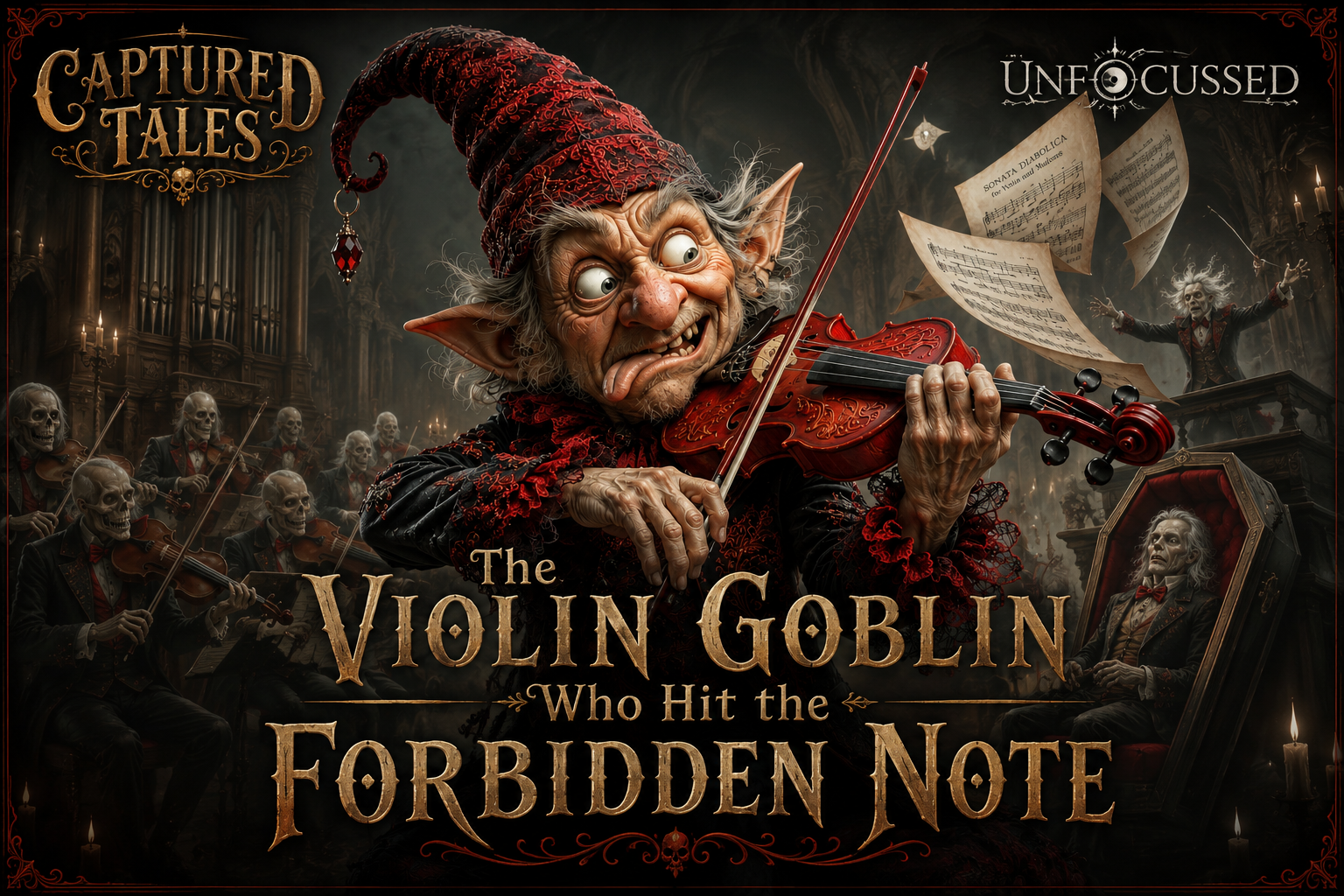
The Funeral Invitation Written in Red Ink
In the crooked village of Brindlehook, where the chimneys leaned gossipward and the moon always looked as if it had been caught listening at windows, there lived a violin goblin named Grimsby Fret.
Grimsby was not loved, precisely. He was tolerated in the way one tolerates a cracked bell, a suspicious puddle, or an elderly aunt who keeps predicting deaths at breakfast and being right just often enough to ruin the eggs. He had a face like a startled walnut, ears sharp enough to slice a lie in half, and eyes so large and unevenly focused that people often confessed things to him simply because they assumed he already knew.
He did not.
He merely looked like a creature who had seen the backstage paperwork of the universe and found it deeply mismanaged.
Grimsby’s true gift was the violin. His instrument was a lacquered crimson thing, carved with curling vines, tiny snarling beasts, and little decorative flourishes that were not decorative at all if you stared too long. It had belonged, according to Grimsby, to a duke, a demon, a widow, a prince, a corpse, and once, briefly, a tax collector who “had it coming.” Depending on how much wine he had stolen from weddings, the order of ownership changed.
When Grimsby played, the village reacted in complicated ways.
The goats fainted.
The weather reconsidered itself.
Unhappy marriages improved for roughly eleven minutes, then became much worse because both parties remembered they had opinions.
Babies stopped crying, dogs began crying, and the local priest once climbed fully clothed into the baptismal font and announced that he had “heard the damp truth.” No one knew what that meant, but afterward he stopped charging extra for funerals during rain.
Grimsby took all of this as applause.
“Art,” he often said, usually while being chased from somewhere, “is supposed to move people.”
“You made a butcher levitate into his own sausage rack,” someone would reply.
“Moved him upward, didn’t I?”
He considered himself misunderstood, which was true, though not in the flattering way he imagined. The villagers understood him perfectly well. They understood that he was a short, shrieking, velvet-clad menace with a bow arm like a possessed metronome and the moral restraint of a raccoon in a pantry. They understood that he would play anywhere for money, praise, or a convincing promise of cheese. They understood that his music did not simply enter a room—it rifled through the drawers, tried on the curtains, insulted the wallpaper, and left with someone’s inheritance.
Still, even in Brindlehook, there were rules.
One rule was that Grimsby was not allowed to play within thirty feet of a wedding cake.
Another rule was that he was not allowed to improvise during baptisms, christenings, blessings, elections, barn raisings, harvest suppers, sentencing hearings, or any gathering where the phrase “public safety” had already been used twice.
The oldest rule, written in soot on the back wall of the tavern and underlined by generations of trembling hands, was this:
Grimsby Fret shall never, under any circumstance, play from the red-bound folio marked Sonata Diabolica.
Grimsby had signed the rule himself.
Not because he agreed with it.
Because he liked seeing his name on official things.
The trouble began, as trouble often does in small villages with too many superstitions and not enough entertainment, on a Thursday night.
Thursday was rehearsal night at The Pickled Thistle, where Grimsby performed on a three-legged stool near the hearth while the villagers drank just enough ale to believe they enjoyed him. The tavern had low beams, warped floorboards, and a stuffed boar’s head above the bar that had once smiled during a particularly aggressive jig and had never been trusted since.
Grimsby was halfway through a tune called The Miller’s Wife Found the Butter Churn Eventually, which was livelier than the title suggested and filthier than the village council preferred, when the tavern door opened.
No wind blew in.
No bell rang.
The fire did not dim.
Nothing dramatic happened at all, which was how everyone knew the visitor was truly dreadful.
A woman stepped inside wearing a black funeral veil, though no funeral had been announced. She was tall, still, and thin enough to suggest she had been assembled from candle smoke and bad news. Her dress was the dull black of old mourning cloth, but around her throat she wore a ribbon of red silk tied so tightly it looked less like fashion and more like a warning.
Every conversation in the tavern stopped.
Grimsby did not stop playing.
That would have been tasteful.
Instead, he leaned into the tune with renewed vulgarity, because he believed silence was something other people made when they were not brave enough to fill it.
The woman waited until he scraped through the final flourish, which caused two spoons to bend and the stuffed boar’s eyes to roll toward the ceiling.
Then she clapped once.
Only once.
The sound landed in the room like a shovel hitting coffin wood.
“Grimsby Fret,” she said.
Grimsby swept off his curled hat and bowed so low his nose nearly entered someone’s soup. “Madam, if you’ve come to complain, do take a number. If you’ve come to praise me, do speak up. The room is full of jealous hacks and turnip-minded bastards.”
Old Man Vell, who sold turnips, took offense. “My turnips have more restraint than you.”
“Yes,” said Grimsby. “And less rhythm.”
The veiled woman did not blink. At least, no one saw her blink. This created a general discomfort among the patrons, who began suddenly remembering chores, fevers, debts, and reasons to sit farther away.
“I have come to hire you,” she said.
Grimsby’s grin widened until it became almost legally concerning. “Ah. A woman of taste. Tragic taste, clearly, but taste.”
She reached into one sleeve and withdrew an envelope sealed with red wax.
The wax bore the impression of a violin crossed with a shovel.
Several patrons made religious gestures. A few made gestures from religions they did not belong to, just to diversify their chances.
The tavern keeper, Mistress Boglow, leaned over the bar and hissed, “Don’t touch that.”
Grimsby touched it immediately.
“Feels expensive,” he said.
“It is an invitation,” said the woman.
“To what? A funeral? A murder? A wedding with ambition?”
“A funeral.”
“Lovely. Dead people are the finest audiences. They rarely heckle, and when they do, it means something.”
The woman tilted her veiled head. “The deceased requests your music.”
The room went cold.
Not chilly.
Cold.
The kind of cold that slipped into sleeves and asked personal questions.
Grimsby blinked both eyes in separate directions. “The deceased requests?”
“Yes.”
“Bit demanding for a corpse.”
“He has always been that way.”
Mistress Boglow crossed her arms. “Who’s dead?”
The woman turned slowly toward her. “Lord Bellweather Mourn.”
Every face in the tavern changed.
Lord Bellweather Mourn owned Mournfield Manor, the estate beyond the north cemetery, though “owned” was perhaps a generous word. The place had belonged to the Mourn family since before maps admitted Brindlehook existed, and the house had the exhausted look of something that had spent centuries trying to sink into the earth but kept being prevented by pride.
Lord Bellweather himself was eighty-six years old, unpleasantly rich, famously alive, and hated music with a devotion most people reserved for gods and grudges.
“Lord Mourn isn’t dead,” said Old Man Vell.
The veiled woman paused. “Not yet.”
That answer was so thoroughly unhelpful that even Grimsby respected it.
He broke the wax seal with one claw. The envelope exhaled a faint smell of damp roses, extinguished candles, and old coins kept in a dead man’s mouth. Inside was a single sheet of thick cream paper, written in slanted red ink.
Grimsby held it close and read aloud, because he enjoyed alarming groups.
“To Master Grimsby Fret, violinist, goblin, alleged public nuisance, and one-time victor of the Hollowfen Improvised Dirge Competition—”
“You cheated,” muttered someone.
“I enhanced,” Grimsby snapped, then continued. “You are cordially commanded to attend the midnight funeral of Lord Bellweather Mourn at Saint Bartholomew’s Cemetery, north gate, beneath the seventh yew, upon the third toll after moonrise. You will bring your crimson violin. You will bring your bow. You will bring the red-bound folio marked Sonata Diabolica.”
Nobody breathed.
Even the ale seemed to flatten.
Grimsby’s smile twitched.
“Well,” he said softly, “that is spicy.”
Mistress Boglow slapped both hands on the bar. “No.”
“You don’t even know the fee.”
“I know the cemetery.”
“Most villages do have one.”
“I know what’s under it.”
That stilled him.
For all his bravado, Grimsby was not stupid. He was reckless, vain, nosy, dramatic, and absolutely the sort of creature who would lick a cursed bell to see what flavor prophecy had. But he was not stupid.
Saint Bartholomew’s Cemetery was older than Brindlehook, older than the church that claimed it, and possibly older than anything respectable. Graves spread across the northern hill in crooked rows, stones leaning like gossiping teeth. Beneath the seventh yew tree, where no bird nested and no child dared climb, there was said to be a sealed stairway.
Some called it a crypt.
Some called it a chapel.
Some called it the Mouth, but only after too much drink and never twice.
The old stories said that once, long before Brindlehook learned to keep its curtains shut, there had been an orchestra below the cemetery. Not a band, not a choir, not a handful of cheerful idiots with fiddles and ambition—an orchestra. The Hollowbone Philharmonic. They had played for kings, bishops, witches, widows, and things wearing human manners like borrowed gloves.
Their final performance had been a cursed sonata commissioned by the Mourn family.
No one agreed on what happened that night.
Some said the musicians died in their seats, still holding their instruments.
Some said they vanished between the notes.
Some said they kept playing long after the audience fled, long after the candles burned out, long after the ground above them swallowed the hall.
And some said the piece was never finished.
Grimsby looked down at the invitation again.
At the bottom of the page, beneath the final line, was a sum of money.
His ears sprang up.
“Mother of mildew,” he whispered.
Mistress Boglow narrowed her eyes. “How much?”
Grimsby folded the invitation against his chest. “A vulgar amount.”
“How vulgar?”
“The kind that makes morality take off its shoes and stay awhile.”
Old Man Vell leaned forward. “You can’t play that sonata.”
“I have never said I would.”
“You’re smiling like you’ve already rented your conscience out by the hour.”
“My conscience is a seasonal creature.”
The veiled woman extended a gloved hand. “Will you accept?”
Grimsby tapped the invitation against his teeth. His violin rested beneath his chin, still warm from the tavern tune. The crimson varnish caught the firelight with a wet, hungry gleam.
“Before I answer,” he said, “is the deceased truly dead?”
“Not yet.”
“And is he aware of the funeral?”
“He arranged it.”
“While alive?”
“He dislikes surprises.”
“A man schedules his own funeral, requests a goblin, demands the forbidden sonata, and pays enough to make a bishop sweat through his vestments.” Grimsby rubbed his hands together. “Madam, this is either a crime, a curse, or high art.”
“Does it matter?”
His grin returned in full, wicked bloom.
“Not at these rates.”
Mistress Boglow grabbed a ladle from behind the bar and pointed it at him like a weapon. “Grimsby, you listen to me. That folio is locked in the church vault for a reason.”
“Several reasons,” said the veiled woman.
“Not helping,” said Mistress Boglow.
Grimsby tucked the invitation into his embroidered coat. “I am a professional.”
The tavern erupted.
“You played a jig during a house fire!”
“It needed tempo!”
“You made the baker confess love to a scarecrow!”
“They had chemistry!”
“You turned my aunt’s wig into a ferret!”
“Briefly! And she looked younger!”
Mistress Boglow lifted the ladle higher. “You are not touching that sonata.”
Grimsby placed one hand over his heart. “I would never endanger this village merely for coin.”
Everyone stared.
He sighed. “Fine. I would rarely endanger this village merely for coin.”
The stares continued.
“I would consider the exchange rate first.”
The veiled woman turned toward the door. “Midnight. North gate. Come alone.”
“Alone?” Grimsby frowned. “But I do enjoy arriving with witnesses. They add scale to regret.”
“Come alone,” she repeated.
Then she stepped out into the night.
This time, the tavern bell rang after the door closed.
No one liked that at all.
For several minutes, the patrons sat in the thick silence of people who had just watched a bad decision acquire formal stationery.
Then Mistress Boglow spoke.
“Give me the invitation.”
“No.”
“Give me the invitation, you embroidered boil.”
“Madam, flattery will open many doors, but not my inner coat pocket.”
“I’ll nail you inside a cider barrel.”
“Tempting, but I am booked.”
Old Man Vell pushed away from his table. “We should lock him in the root cellar until morning.”
“Again?” Grimsby asked.
“It worked last time.”
“It delayed genius.”
“It prevented you from playing at the mayor’s digestion ceremony.”
“That man was cleansed.”
“That man exploded a trousers button into the soup tureen.”
Grimsby stood on the stool, drew himself up to his full height, which remained disappointing, and raised his bow like a declaration of war.
“People of Brindlehook,” he said, “you have mocked me, banned me, underpaid me, overthrown me from civic events, and once accused me of haunting a pantry I was merely exploring. Yet tonight, destiny has knocked upon my door.”
“It knocked on the tavern door,” said Mistress Boglow.
“Do not ruin my shape.”
“Your what?”
“My speech has a shape.”
He cleared his throat and tried again. “Tonight, destiny has extended to me a summons from the shadowy rim of the mortal coil. A wealthy old bastard wishes to die with music in his ears, or near his ears, or possibly beneath his feet. Shall I deny him? Shall I refuse the sacred duty of the artist?”
“Yes,” said everyone.
Grimsby scowled. “You answered too quickly.”
Mistress Boglow stepped around the bar. “That sonata killed the Hollowbone Philharmonic.”
“Rumor.”
“It cracked the cemetery hill.”
“Weathering.”
“It made the Mourn family rich.”
“Now that is concerning.”
“And if you play it wrong—”
“I do not play wrong.”
“You once played a lullaby so wrong the cradle filed a complaint.”
Grimsby stabbed the air with his bow. “The cradle lacked vision.”
The tavern keeper came close enough that he could smell the flour on her apron and the iron in her temper. She lowered her voice.
“Grimsby. Listen carefully. There are things below that graveyard that have been waiting for someone stupid enough to believe applause matters more than survival.”
His grin flickered, not gone but thinner.
“Applause is survival,” he said.
“No,” she replied. “Applause is noise. Survival is walking away before the floor opens.”
For a heartbeat, the goblin said nothing.
Then the fire popped, someone coughed, and Grimsby hopped down from the stool.
“A moving speech,” he said. “Deeply maternal. Mildly insulting. Almost enough to sway me.”
“Almost?”
He patted the pocket where the invitation rested. “The sum is extremely vulgar.”
Mistress Boglow closed her eyes. “You greedy little funeral beetle.”
“Also,” he added, and his voice softened in a way that made the room uneasy, “I have wanted to see that folio since I was seven.”
No one laughed then.
Because they all knew it was true.
Grimsby had been found as a child beneath the cemetery wall, wrapped in a torn piece of red velvet, clutching a broken violin bridge in one hand and a button from a dead musician’s coat in the other. Nobody knew where he came from. Nobody claimed him. Mistress Boglow, younger then and foolish with compassion, had taken him in after he bit the undertaker and refused to stop humming.
He had grown up on tavern scraps, ghost stories, and melodies he swore he heard through the floorboards on moonless nights.
Sometimes, when drunk or lonely or both, he said the cemetery sang to him.
Sometimes he said the song knew his name.
And sometimes, when the fire was low and nobody was meant to be listening, he played fragments of a tune no one recognized, a tune that made the glasses tremble and the old boar’s head weep a single bead of dust from one glass eye.
Mistress Boglow remembered those nights.
So did Grimsby.
He lowered his bow.
“If the old stories are true,” he said, “then the Hollowbone Philharmonic never finished the sonata.”
“And you think you can?”
His expression sharpened, absurdity giving way to something older, hungrier, and far more dangerous than vanity.
“I think,” he said, “they have been waiting for a better violinist.”
That was when Mistress Boglow hit him with the ladle.
It was a solid strike, well-aimed, full of civic responsibility.
Grimsby went down in a heap of lace, velvet, outrage, and artistic betrayal.
“Root cellar,” said Old Man Vell.
“Root cellar,” agreed the tavern.
They carried him there between four of them, though he regained enough sense halfway down the stairs to accuse them of suppressing culture. They locked him in among onions, barrels, potatoes, and one suspicious crate labeled Definitely Not Gin, which he immediately inspected and found disappointingly accurate.
“This is censorship!” he shouted through the door.
“This is community care!” Mistress Boglow shouted back.
“You’ll regret this when my memoir names names!”
“Your memoir will be shelved under calamity!”
“That is still shelf space!”
They left him in darkness with his violin, because taking it away from him had been attempted before and ended with a broom playing polka for three days.
For the first hour, Grimsby sulked.
For the second hour, he cursed.
For the third, he tuned his violin so quietly that even the spiders paused to admire the discipline.
Above him, the tavern settled. Chairs scraped. Boots left. The fire died down. Mistress Boglow barred the doors and muttered old protections under her breath, protections she claimed not to believe in during daylight.
In the root cellar, Grimsby sat on a sack of potatoes and removed the invitation again.
The red ink glimmered faintly.
The letters had changed.
Where before the message had ended with the promised fee, there was now a new line written at the bottom.
He is dead now.
Grimsby swallowed.
Somewhere far off, a bell began to toll.
Once.
The sound moved through the cellar stones like a hand dragging nails across bone.
Twice.
The onions shifted in their sacks. A barrel hoop tightened with a tiny metallic whine.
Three times.
On the third toll, the lock on the cellar door opened by itself.
Grimsby stared up the stairs.
He waited.
Waiting was not his strongest talent. In truth, waiting was barely on the list. It sat somewhere below humility, sobriety, and not touching suspicious glowing objects.
The door creaked open.
A blade of moonlight fell across the steps.
There, resting in the pale glow, lay a key.
Not the key to the cellar.
A different key.
Long. Black. Iron. Its handle shaped like a treble clef twisted into a skull.
Attached to it by a red ribbon was a scrap of paper.
Grimsby climbed the stairs slowly, every creak beneath his boots sounding obscenely loud. He picked up the key, unfolded the paper, and read the words written there in the same red hand.
Church vault. Then north gate.
He looked toward the tavern room.
Mistress Boglow slept in a chair by the hearth, a rolling pin across her lap like a knight’s sword. The other villagers were gone. The boar’s head watched him from above the bar, its glass eyes shining with a judgment Grimsby considered excessive from a dead pig.
He should have woken her.
He should have thrown the key into the fire.
He should have stayed in the tavern, drunk something warm, and allowed Lord Bellweather Mourn to be buried in silence like any other unpleasant rich man with excellent timing.
Instead, Grimsby crept across the room, retrieved his hat from a hook, and placed it carefully on his head.
“Do not look at me that way,” he whispered to the boar. “This is professional development.”
The boar did not blink.
“Also,” Grimsby added, adjusting the red jewel that dangled from his hat, “I may be networking with ghosts.”
He slipped out into the night.
Brindlehook slept uneasily beneath a moon thin as a widow’s smile. Fog gathered in the lanes, pooling around doorsteps, curling beneath fences, and clinging to Grimsby’s boots as if trying to slow him down. The cottages leaned inward as he passed, their windows dark and watchful. Somewhere a dog whined. Somewhere else, a rooster crowed once, realized the hour, and shut up in horror.
The church of Saint Bartholomew stood at the edge of the village, old stone hunched beneath ivy, its bell tower crooked enough to suggest either bad masonry or divine reluctance. Grimsby had been banned from the church many times, though the bans had grown increasingly specific over the years.
He was not allowed to enter during services.
He was not allowed to enter between services.
He was not allowed to perform, rehearse, hum, whistle, tap, chant, mutter rhythmically, or “breathe in a noticeably musical fashion” anywhere on consecrated grounds.
The current notice on the church door read:
GRIMSBY FRET IS WELCOME TO REPENT QUIETLY FROM OUTSIDE.
He admired the lettering every time.
Tonight, the church door was unlocked.
Of course it was.
That irritated him. He enjoyed breaking into places. An unlocked door robbed a criminal of texture.
Inside, the nave smelled of cold wax, dust, and old prayers wearing thin at the elbows. Moonlight fell through the stained glass in fractured colors, painting the pews with saints, beasts, and one angel who looked as if she had seen the parish accounts.
Grimsby padded down the center aisle with his violin tucked under one arm and the black key held tight in his fist.
The vault lay below the sacristy, behind two locked doors, three iron bolts, and a plaque reading:
FORBIDDEN MATERIALS, RELICS OF DOUBTFUL HOLINESS, AND ITEMS THAT HUM WHEN DENIED ATTENTION.
The black key fit all the locks.
That, too, was rude.
In the vault, shelves lined the walls from floor to ceiling. There were jars of teeth labeled by year, a brass chalice sealed inside a birdcage, a cracked mirror covered in black cloth, and a wooden box marked Do Not Open Even If It Begs Nicely.
At the far end, chained to a reading stand, lay the red-bound folio.
Sonata Diabolica.
Grimsby stopped breathing.
The cover was darker than blood and polished like old leather, though he suspected it was neither leather nor anything one should mention near children. The title was embossed in tarnished gold. Beneath it, nearly worn away by time, were the words:
For Violin and Madness.
He touched the cover.
The folio shivered.
So did he.
Not from fear, although fear was present and politely clearing its throat.
From recognition.
Because the moment his claw brushed the binding, Grimsby heard music.
Not in the room.
Not in his ears.
In his bones.
A phrase of melody unfurled inside him, slow and dark and unbearably familiar. It moved like velvet over a knife. It smelled of wet stone, candle smoke, and roses left too long on a coffin lid. It had been there beneath his childhood dreams, beneath every tune he had ever half-remembered, beneath the fragments he played when he thought no one was listening.
The sonata knew him.
Worse, it had been waiting.
“Well,” he whispered, because terror and vanity both required commentary, “that is intimate.”
The chains unlocked with soft clicks.
Grimsby lifted the folio.
Behind him, something in the vault breathed.
He turned very slowly.
The cracked mirror in the black cloth had shifted.
The cloth sagged at one corner, revealing a sliver of glass.
In that sliver, Grimsby saw not the vault, not himself, not the moonlight through the church window.
He saw a concert hall.
Vast. Underground. Lit by hundreds of candles. Rows of empty seats curved around a stage blackened by age. At the center stood a conductor’s podium.
And seated in the orchestra pit were musicians in rotting formalwear, each holding an instrument of bone, brass, gut, and shadow.
Their skulls turned toward him.
Every empty socket watched.
A bow lifted.
A horn tilted.
A skeletal hand tapped once upon a timpani stretched with skin too pale to name.
Then a voice, dry as sheet music in a tomb, whispered from the mirror.
“Late.”
Grimsby hugged the folio to his chest.
“Fashionably.”
The mirror went dark.
From outside the church came the distant iron groan of the cemetery gate opening.
Grimsby turned toward the sound.
For the first time that night, he did not grin.
He only tucked the forbidden sonata beneath his arm, lifted his crimson violin, and walked toward the graves.
By the time he reached Saint Bartholomew’s Cemetery, the fog had risen to waist height and the stones looked as if they were floating in a pale, breathless sea. The north gate stood open. Its hinges dripped rust. Beyond it, the seventh yew waited at the top of the hill, black against the moon, its branches spread like a conductor’s hands.
Beneath the tree stood the veiled woman.
Beside her was a coffin.
The coffin was upright.
That was not customary.
It was also knocking from the inside.
Grimsby approached with what he hoped looked like professional calm, though his knees had begun rehearsing a private folk dance.
“I was told he was dead now,” he said.
The veiled woman inclined her head. “He is.”
Knock. Knock. Knock.
Grimsby looked at the coffin.
“He appears unconvinced.”
“Lord Mourn was argumentative in life.”
“And in death?”
“Worse.”
The coffin lid jerked. A muffled voice came from within.
“I object to the upholstery!”
Grimsby’s ears twitched.
The veiled woman sighed. “Ignore him.”
“I paid for satin!” shouted the dead Lord Bellweather Mourn. “This is clearly velvet, and cheap velvet at that! I will not be eternally remembered with bargain lining!”
Grimsby leaned closer to the veiled woman. “Is he always this dead?”
“Since the third toll.”
“Impressive lung discipline.”
“He no longer has lungs.”
“Then his commitment to complaint is inspirational.”
The veiled woman gestured toward the roots of the yew. “Stand there.”
Between the roots, half-hidden by moss and grave dirt, was a stone slab carved with musical notation. The notes were worn nearly smooth, but Grimsby recognized the shape of them. Not from reading. From dreaming.
He swallowed again.
“And what, exactly, am I performing?”
“The opening movement.”
“Only the opening?”
“Enough to wake the hall.”
“That phrase is doing a great deal of work.”
The coffin knocked harder.
“Tell the goblin to begin!” Lord Mourn barked. “I did not die on schedule to wait in a vertical box while a short musician develops nerves.”
Grimsby snapped his head toward the coffin. “Short? Sir, I am concentrated.”
“You are underpaid until successful.”
“I have your invitation stating otherwise.”
“Payment is below.”
Grimsby froze.
The veiled woman said nothing.
The fog moved around them in slow, listening curls.
“Below,” Grimsby repeated.
From somewhere beneath the graves came a sound.
Not a bell.
Not thunder.
A tuning note.
Low, mournful, and impossibly deep.
The cemetery stones vibrated.
One by one, hairline cracks opened in the ground around the seventh yew. They spread outward in delicate patterns, like black lace stitched through the earth. The upright coffin fell silent.
Grimsby looked down at the red-bound folio.
The cover opened by itself.
The pages turned.
Slowly.
Deliberately.
Until they stopped on the first movement of Sonata Diabolica.
The notes crawled slightly on the page, as if stretching after a long sleep.
At the top, written in red ink, was a warning:
The first forbidden note opens the hall.
Beneath it, in smaller script:
The second invites the orchestra.
And beneath that, nearly hidden in the margin:
The third chooses the soloist.
Grimsby lifted his violin.
The veiled woman stepped back.
The coffin held its breath, or whatever Lord Mourn had instead.
All across the cemetery, the dead seemed to lean closer beneath the soil.
Grimsby placed the violin beneath his chin. His fingers found the strings. His bow hovered.
For one wild second, he thought of Mistress Boglow asleep by the hearth, rolling pin in her lap. He thought of the tavern, the old boar’s judgmental glass eyes, the villagers who feared him but knew his name. He thought of the music that had haunted him since childhood, the tune beneath all tunes, the melody that had reached up through stone and root and bone to find him.
Then he grinned.
Because fear was one thing.
But an audience was another.
“Ladies, gentlemen, corpses, creditors, and whatever is listening with too many ears,” he whispered, “try not to embarrass yourselves.”
He drew the bow across the strings.
The first note rose into the midnight air.
It was beautiful.
It was wrong.
It was the sound of a locked door remembering it had hinges.
The cemetery split open.
The Orchestra Beneath the Seventh Yew
The cemetery did not simply split open.
That would have been dramatic enough for reasonable people.
No, Saint Bartholomew’s Cemetery opened with a sense of occasion, as if the earth had been waiting centuries to make an entrance and refused to waste the moment on a mere crack. The ground beneath the seventh yew trembled, shuddered, sighed, and then peeled apart in two great slabs of mossy stone, each carved with old musical notation and older warnings nobody had bothered to translate because people in Brindlehook preferred their terror traditional and poorly understood.
Fog poured into the widening gap like cream into black tea.
Grimsby Fret stood frozen with his crimson violin still tucked beneath his chin, bow hovering in the air, grin gone stiff at the edges.
“Well,” he said, because silence was gaining confidence and he hated that, “that escalated with admirable structure.”
The veiled woman stood beside the upright coffin, hands folded neatly before her. Her veil stirred though there was no wind.
“You opened the hall,” she said.
“I opened a death staircase.”
“The hall is below.”
“Most halls are considerate enough to use doors.”
The coffin knocked once from within.
“Stop quibbling,” barked Lord Bellweather Mourn. “I paid for punctuality.”
Grimsby lowered the violin just enough to glare at the coffin. “You paid for artistry. Punctuality costs extra.”
“Everything costs extra with artists.”
“And yet here you are, dead and still booking talent.”
A low groan drifted from the opening beneath the yew. It was not the sound of stone. It was not the sound of wind. It was the sound of an orchestra tuning in a room no living throat should have been able to hear.
One violin answered from below.
Then a cello.
Then a horn.
Then something that sounded like a bassoon with an unresolved grudge.
The cemetery stones began to hum.
All around them, graves shifted in their plots. Not enough to open. Not yet. But enough to suggest the dead had heard the first note and were now deciding whether the evening was worth getting up for.
Grimsby looked down into the gap.
A stairway descended beneath the roots of the seventh yew, each step cut from black stone, each edge trimmed with a thin line of tarnished brass. Candle flames burned along the walls below, floating without sconces, blue at the base and red at the tips. The staircase spiraled down farther than moonlight could follow.
At the top of the first step lay a small brass plaque.
It read:
HOLLOWBONE HALL — Audience Members Enter Quietly, Musicians Enter Damned.
Grimsby bent to inspect it. “Bit unfriendly.”
The veiled woman gestured toward the stairs. “After you.”
“I insist after you.”
“You are the musician.”
“Yes, but you are the suspicious woman who brought a talking corpse to a cemetery at midnight. Surely that earns priority boarding.”
The coffin knocked again.
“Carry me,” Lord Mourn commanded.
Grimsby looked at the veiled woman. “Is he joking?”
“He has never joked.”
“That’s the saddest thing I’ve heard tonight, and I just opened a grave escalator.”
The veiled woman reached beneath the coffin and tugged a hidden brass lever. Four little iron wheels unfolded from its base.
Grimsby stared.
“He has travel features?”
“Lord Mourn planned carefully.”
“For death?”
“For inconvenience.”
With a shove of her gloved hands, she rolled the upright coffin toward the stairs. It tipped forward, landed on its back with a wooden thump, and began sliding down the black steps like a rich man’s sled.
From inside came a furious muffled cry.
“This is undignified!”
Grimsby watched the coffin vanish into the foggy spiral.
“For once, I agree with him.”
The veiled woman stepped onto the stairs.
Grimsby hesitated only long enough to pretend he was weighing spiritual consequences. In truth, he was listening. The note he had played still trembled in his violin strings, though his bow had left them. Beneath it, beneath everything, the melody from the red-bound folio breathed inside him like an animal curled around his ribs.
It did not feel like a song he was learning.
It felt like a song remembering where it had left him.
He tucked the folio beneath one arm, held the violin tight in the other, and followed the veiled woman down.
The staircase smelled of wet stone, candle wax, rusted iron, and flowers left too long in chapel water. The walls were carved with names, hundreds of them, maybe thousands, written in cramped script around staffs of music. Some names belonged to the Mourn family. Some belonged to musicians. Some had been scratched out so violently the stone itself seemed bruised.
Grimsby ran one claw along the carvings as he descended.
“Charming décor,” he said. “Very ‘ancestral guilt with acoustics.’”
The veiled woman did not answer.
Below them, Lord Mourn’s coffin continued its awkward, bumping descent.
“Ow!” came his voice from far below.
Then another wooden thud.
“Ow!”
Another thud.
“I will haunt the carpenter!”
Grimsby smiled despite himself. “He is growing on me.”
“Do not allow that,” said the veiled woman. “Things that grow from Lord Mourn are usually taxed.”
That was the first thing she had said all evening that sounded almost human.
Grimsby glanced up at her. “You know him well.”
“I know him enough.”
“Daughter?”
“Granddaughter.”
“Ah. That explains the veil.”
“Does it?”
“No. But it gives my assumption a place to sit.”
She paused on the next step, turning slightly. Her veil hid her face, but Grimsby felt her attention settle on him.
“My name is Eveline Mourn,” she said.
“Grimsby Fret,” he replied with a little bow, nearly dropping the folio down the stairs. “Persecuted genius, village irritant, and current victim of poor contractual transparency.”
“You accepted the invitation.”
“Under the influence of red ink and money.”
“That is how my family has done most things.”
The stairway curved again. The music below grew louder, though no full tune had yet emerged. It was tuning, only tuning, but there was intelligence in it. Each note tested the air. Each scrape of bow and breath of brass seemed to taste the living trespassers coming down.
Grimsby adjusted his hat. The dangling red jewel trembled against his ear.
“Why me?” he asked.
Eveline did not slow. “Because the hall asked.”
“Halls ask many things. Mostly for mops.”
“This one asked for a violinist.”
“There are other violinists.”
“Not like you.”
“I know, but I prefer hearing it from strangers.”
She kept descending. “The invitation wrote your name before my grandfather dictated it.”
Grimsby’s steps faltered.
“Invitations should not freelance.”
“Neither should curses.”
They reached the bottom of the stairs.
There, beneath the cemetery hill, impossible and waiting, stood Hollowbone Hall.
It was vast.
Not village-vast. Not manor-vast. Not even cathedral-vast. Hollowbone Hall stretched beneath the earth like a secret kingdom of sound, its ceiling lost in darkness where roots hung down like the hair of buried giants. Hundreds of candles floated in tiers above a sunken stage. Velvet seats rose in curved rows around it, some upright, some rotted, some occupied by shapes too still to be furniture and too polite to announce themselves.
The walls were paneled in black wood veined with silver. Between the panels hung portraits of musicians whose faces had been painted with loving precision and whose eyes had been scratched out. Gilded balconies curved along both sides of the hall, draped in curtains the color of dried blood. At the far end, above the stage, an enormous organ climbed the wall, its pipes made not of metal but of pale bone, each one carved with tiny open mouths.
Grimsby stared upward.
The organ mouths whispered among themselves.
“No,” he told them immediately. “I am not taking requests.”
Lord Mourn’s coffin had reached the floor first and lay in a crumpled dignity at the foot of the stairs. It rocked from side to side until Eveline set it upright again.
“Finally,” snapped Lord Mourn from within. “I have arrived with less ceremony than a laundry hamper.”
“You’re welcome,” Grimsby said.
Eveline rolled the coffin toward the front row, where a place had been left open between two carved chairs.
“Why is he in the audience?” Grimsby asked.
“Because he is the patron.”
“Patrons usually sit outside their coffins.”
“Not in this family.”
As she set the coffin in place, the hall stirred.
Seats creaked.
Curtains shifted.
A shape in the second balcony leaned forward, wearing a hat that had gone out of fashion before common decency learned to walk upright. Somewhere in the back row, a woman’s laugh rattled dryly and then stopped, as if her throat had remembered it was missing.
Then the stage lights rose.
The Hollowbone Philharmonic sat waiting.
Grimsby had seen them in the mirror, but the mirror had been merciful.
There were nearly sixty of them, arranged in perfect orchestral order. The string players sat with violins and violas made of polished bone and blackened wood, bows strung with hair too fine and silver to have belonged to horses. Cellists cradled instruments carved with names of the dead. A row of horn players held tarnished brass that breathed steam from its bells. Flutes gleamed like old teeth. The percussionist sat behind drums stretched with something pale and thin and regrettably memorable.
The musicians themselves were not simply skeletons.
That would have been clean.
Some had skulls visible beneath lace collars and rotted wigs. Some still wore scraps of skin tight against bone like old parchment. Some had eyes, though not always a matching pair. One bass player appeared mostly human except for his hands, which had too many joints and tapped silently against the strings with hungry precision. A harpist in a decaying blue gown smiled at Grimsby with no lips and all the confidence of someone who had waited two hundred years for a good entrance.
At the center podium stood the conductor.
He was tall, skeletal, and dressed in a black tailcoat embroidered with silver thread. A white cravat clung around his throat like a bandage. His hair, or what remained of it, drifted behind him in thin gray wisps. In one hand he held a baton made from a finger bone tipped with gold.
He bowed.
Not to Eveline.
Not to Lord Mourn.
To Grimsby.
“Master Fret,” said the conductor.
His voice was not loud, but the entire hall seemed built to obey it. The syllables touched every wall, every candle, every string, and came back colder.
Grimsby clutched his violin a little tighter. “Master Bonebag.”
Eveline inhaled sharply.
The dead orchestra went still.
The conductor’s empty sockets narrowed in a way empty sockets had no right to manage.
Then he laughed.
It sounded like dry leaves turning pages in a closed room.
“I am Maestro Ossivar Vale,” he said. “Conductor of the Hollowbone Philharmonic, murdered in service, buried in applause, and now, apparently, insulted by a goblin in aggressively embroidered stockings.”
Grimsby glanced down at his legs. “These stockings are curated.”
“They are loud.”
“So am I.”
“Yes,” said Maestro Vale. “That is why you were summoned.”
A murmur ran through the orchestra. Bows twitched. Brass valves clicked softly. The harpist plucked one string, and somewhere above them a candle flame turned black for a heartbeat.
Lord Mourn’s coffin knocked from the front row.
“Can we proceed? I did not die to listen to wardrobe criticism.”
Maestro Vale turned toward the coffin.
Every musician turned with him.
The air tightened.
“Lord Bellweather Mourn,” said the maestro. “Last of the direct debt.”
“Last of the direct line,” corrected Lord Mourn. “Debt is such a peasant word.”
“Debt is the word written in blood.”
“My grandfather signed in blood. I prefer ink.”
“Your grandfather signed for all of you.”
“Typical of him,” Lord Mourn muttered. “Always spending descendants.”
Grimsby leaned toward Eveline. “Family gatherings must be a delight.”
“We stopped holding them after the soup screamed.”
“Reasonable.”
Maestro Vale lifted his baton. The orchestra settled instantly.
“Bring forth the folio.”
Grimsby held it up but did not step forward. “Before we get all dramatic and legally binding, I have questions.”
“You are a musician,” said the maestro. “You should have instincts.”
“I have many instincts. One of them says never hand cursed sheet music to the dead without asking who gets paid, who gets eaten, and whether there will be refreshments.”
The harpist leaned toward a cellist and whispered something. The cellist snickered, which sounded like a beetle trapped in a snuffbox.
Maestro Vale extended one skeletal hand. “The folio, Master Fret.”
“No.”
The hall went so quiet that Grimsby could hear Lord Mourn being offended inside his coffin.
“No?” said the maestro.
“No, thank you. I was hired to play. Not to surrender materials to a committee of elegant remains.”
“You stand in Hollowbone Hall.”
“I noticed. Excellent ceiling roots.”
“You have opened the door with the first forbidden note.”
“Yes, and I am considering adding that to my résumé under special skills.”
“You will play the second.”
“Will I?”
The maestro’s baton lowered a fraction.
Every candle in the hall leaned toward Grimsby.
“You will,” said Maestro Vale, “because the living cannot leave this hall once the first note is played unless the music moves forward.”
Grimsby looked toward the staircase.
The stairs were gone.
Where the stairway had been, there was now only a blank stone wall carved with a single treble clef shaped like a skull.
He stared at it.
Then he stared at Eveline.
She had gone very still.
“Did you know?” he asked.
Her gloved hands tightened. “No.”
Lord Mourn’s coffin shifted in the front row.
“I did.”
Grimsby slowly turned toward him.
“You dead, upholstered barnacle.”
“Mind your tone. I am grieving myself.”
Eveline stepped toward the coffin. “Grandfather.”
“Oh, don’t start,” said Lord Mourn. “You wanted the curse ended. I wanted my name cleared. We both required the goblin.”
Grimsby’s ears flattened. “Required for what?”
Maestro Vale answered before Lord Mourn could.
“For the solo.”
The word crossed the hall like a blade dragged across glass.
The orchestra murmured again.
Solo.
Solo.
Solo.
The red-bound folio warmed beneath Grimsby’s arm.
He opened it despite himself. The pages turned in a gust of air smelling of roses and grave dust. They stopped on the same page he had seen above, but the warning had changed.
The first forbidden note opens the hall.
The second invites the orchestra.
The third chooses the soloist.
Then another line bled into view beneath the rest:
The chosen shall finish what blood began.
Grimsby shut the folio.
“Absolutely not.”
“You have not heard the terms,” said Lord Mourn.
“I have heard enough terms. They have claws.”
“There is a fortune under this hall.”
“I suspected.”
“Gold. Silver. Jewels. Instruments once played before emperors. Deeds. Bonds. A ruby the size of a priest’s panic.”
Grimsby’s pupils widened.
Eveline snapped, “Grandfather.”
“He likes money,” said Lord Mourn. “One should negotiate with available weaknesses.”
“I am a complex creature,” Grimsby said, though without much force.
“You are a goblin with a hat jewel and unpaid tavern debts.”
“Also true.”
Maestro Vale lifted his baton again. “Enough.”
The stage groaned beneath the orchestra. Not from weight. From memory.
“The bargain was made one hundred and eighty-seven years ago,” said the maestro. “Lord Alaric Mourn commissioned the Sonata Diabolica from a composer who had no name left by the time he finished it. The piece was written for violin and madness, for one soloist, full orchestra, and an audience willing to applaud beyond death.”
“Pretentious,” Grimsby muttered.
“Ambitious,” corrected Maestro Vale. “We rehearsed beneath the Mourn estate for seven years. Seven years of candlelight. Seven years of bone dust. Seven years while Lord Alaric promised patronage, immortality, and payment.”
“I know where this is going,” said Grimsby. “Rich man promised payment, rich man developed sudden philosophical concerns about payment.”
“He paid,” said the maestro.
That surprised him.
“Oh.”
“He paid in musicians.”
The hall seemed to darken.
Every dead player sat a little straighter.
Maestro Vale’s grip tightened around the baton.
“On the night of the first performance, Lord Alaric sealed the hall with the audience inside. He believed the sonata’s final movement would bind all who heard it to the Mourn line. He wanted an orchestra that would never age, never refuse, never demand wages, never leave.”
“A management strategy,” said Lord Mourn from the coffin, “not without efficiency.”
Eveline kicked the coffin.
It was a small kick, but satisfying.
“Ow,” Lord Mourn said. “I am recently deceased.”
“Then behave like it.”
Maestro Vale continued. “But the first violinist saw the trap. She broke the final movement, tore the last bridge from her instrument, and fled before the third forbidden note could complete the binding.”
Grimsby felt the hall tilt.
Not physically.
Worse.
Meaningfully.
He tightened his grip around the neck of his crimson violin. “The first violinist.”
“Seraphina Fret,” said the maestro.
The name moved through him like cold water through a cracked cup.
Fret.
He had never known where his name came from. Mistress Boglow had found it stitched into the torn red velvet around him when he was a baby, the letters crooked but legible. FRET. She had always told him it sounded better than “Small Biter Found Near Wall,” which had been the undertaker’s suggestion.
Grimsby looked down at the violin bridge. His instrument’s bridge was old, darker than the rest, carved with tiny marks he had never been able to identify.
“She escaped,” he said.
“She escaped with the broken bridge,” said Maestro Vale. “And with something else Lord Alaric had not known she carried.”
Grimsby’s mouth went dry.
Eveline whispered, “A child.”
The orchestra watched him.
Every hollow eye.
Every remaining eye.
Every instrument, angled toward him like a question.
Grimsby gave a sharp laugh, far too loud.
“No. No, that is lazy storytelling. I refuse. I am not some cemetery orphan with a secret bloodline and a cursed inheritance. I am a self-made public nuisance.”
“You are Seraphina Fret’s last living heir,” said Maestro Vale.
“Allegedly.”
“The sonata recognizes blood.”
“The sonata can get in line behind several tavern creditors.”
Lord Mourn’s coffin knocked twice, impatiently.
“This is why we hired you. You are the missing note.”
Grimsby pointed his bow at the coffin. “I am not a note. I am a complete disaster with tailoring.”
“Exactly,” said Lord Mourn.
Eveline turned toward Maestro Vale. “If he finishes the sonata, what happens?”
The maestro’s skull tilted.
“The bargain completes.”
“Meaning?” Grimsby demanded.
“The orchestra is freed from the hall.”
That sounded almost good.
Too good.
Grimsby had spent his life suspicious of good things. A good thing was usually a bad thing wearing perfume and waiting near paperwork.
“Freed how?” he asked.
The harpist smiled again.
The horn players lowered their instruments.
Somewhere in the upper balcony, something chuckled without a body to support the habit.
Maestro Vale said, “Freed into the world that buried us.”
“Ah,” said Grimsby. “There’s the mold in the jam.”
Eveline stepped forward. “You would rise?”
“We would perform,” said the maestro.
“For whom?”
The conductor turned his empty gaze toward the stone wall where the stairs had vanished.
“For Brindlehook. For the Mourn estate. For every village that clapped while patrons cheated artists and called it tradition. For every church that locked away the music but left the debt unpaid. For every living ear that has enjoyed silence purchased with our bones.”
Grimsby winced. “That is a lot of resentment. Have you tried journaling?”
“We tried dying.”
“Fair.”
Lord Mourn’s coffin rattled. “Dramatic nonsense. The orchestra will be bound to my line if the final movement is played correctly.”
Eveline stared at the coffin. “You lied to me.”
“I refined the truth.”
“You told me this would end the curse.”
“It will. For me.”
The hall’s candles flickered.
Eveline’s gloved hands curled into fists.
“You planned to use him to bind them again.”
“The Mourn family built half this village.”
“The Mourn family stole half this village.”
“Construction is complicated.”
Grimsby looked between Eveline, the coffin, and the dead orchestra. “So, to summarize, because I enjoy knowing precisely how doomed I am: the orchestra wants me to finish the sonata so they can escape and perform vengeance on everyone with ears. The corpse wants me to finish it so he can enslave the orchestra again and possibly continue being rich while dead, which is vulgar even by my standards. And you—”
He pointed at Eveline.
She lifted her chin beneath the veil. “I wanted the curse broken.”
“Did you consider hiring a lawyer?”
“We tried. He joined the clarinet section.”
In the orchestra, one clarinetist raised a bony hand in greeting.
Grimsby nodded back despite himself. “Condolences.”
Maestro Vale tapped the baton once against the podium.
The sound cracked through the hall.
“The second note, Master Fret.”
“No.”
“You must move the music forward.”
“I dislike being musically bullied by antiques.”
“Without the second note, the hall remains sealed.”
“Then we all enjoy each other’s company until dawn.”
“There is no dawn below.”
That landed poorly.
Grimsby glanced toward the vanished stairs again.
“I hate this venue.”
“Play,” said Maestro Vale.
The command moved through the hall, but it also moved through Grimsby’s violin.
The crimson instrument gave a faint answering hum.
His fingers twitched.
He clamped them against the neck.
“Don’t you start,” he whispered.
The violin hummed again, softer, sweeter, coaxing.
The melody inside his bones stirred.
He remembered being small. He remembered the tavern hearth. He remembered lying under tables while boots moved around him and Mistress Boglow sang off-key while washing mugs. He remembered pressing his ear to the floorboards because he could hear something no one else could hear: a distant orchestra tuning beneath the earth.
Not calling him.
Not then.
Practicing.
Waiting.
Keeping his place.
His bow rose.
He tried to lower it.
It rose anyway.
Eveline saw. “Grimsby?”
“I am negotiating with my arm.”
“Are you winning?”
“My arm has unionized.”
The folio opened on the floor before him, though he had not dropped it. Pages turned in a blur, then stopped. The first measure glowed faintly. Beneath the notes, the warning remained.
The second invites the orchestra.
Grimsby laughed once, sharp and frightened.
“Well. I hate to be rude to guests already seated.”
“Do not play it,” Eveline said.
Lord Mourn snapped, “Play it.”
Maestro Vale whispered, “Remember it.”
That was the worst one.
Because Grimsby did.
He had never seen the measure before, not with his eyes, but his fingers knew it. His wrist knew the cruel curve of the bowing. His bones knew where the note hid. The music rose through him, not like possession, not exactly, but like inheritance with terrible manners.
He set the violin beneath his chin.
“For the record,” he said, voice thin but still his own, “I am doing this under supernatural protest.”
Then he played the second forbidden note.
The sound did not travel outward.
It traveled inward.
Every candle flame collapsed into a red spark. Every instrument on the stage drew a breath. The walls shuddered. The bone organ opened its tiny carved mouths and moaned in harmony.
The orchestra rose.
Not from their chairs.
From death.
A flush of awful vitality swept through them. Old strings tightened. Brass brightened. Hollow eyes filled with pinpricks of blue fire. Rotten sleeves settled over skeletal wrists. The harpist flexed her fingers, each joint clicking into readiness. The percussionist smiled down at his pale drums and whispered, “Again.”
Then they played.
Grimsby had heard loud music. He had made loud music. He had once played a reel so vicious that three tavern shutters filed for retirement.
But the Hollowbone Philharmonic did not make loud music.
They made old music.
Music older than manners, older than coffins, older than the polite agreement that the dead should stay where they were put. It rose from the stage in black waves, rich with grief and rage and grandeur. Violins cut through the air like moonlight on surgical steel. Cellos groaned with the weight of buried promises. Horns blared from somewhere behind the ribs of the world. The bone organ trembled against the far wall, each pipe-mouth singing with a voice that had once belonged to somebody’s ancestor.
Grimsby played with them because he could not stop.
At first, terror drove his bow.
Then training.
Then something worse.
Joy.
He hated that most of all.
The music was magnificent.
It was obscene how magnificent it was.
Every scrape and swell fitted itself around him. The orchestra did not drown him; it lifted him. It knew when to pull back, when to surge, when to leave space for his violin to speak. For the first time in his life, no one winced at his intensity. No one ducked. No one clapped hands over children’s ears or accused him of souring the milk. The orchestra followed him, challenged him, answered him.
He was not too much here.
He was almost not enough.
The thought thrilled him so deeply that he nearly missed the change in the hall.
The audience seats were filling.
Not with the living.
Not yet.
From the shadows between rows, the dead emerged.
Old patrons in crumbling finery. Ladies with pearls sunk into their throats. Gentlemen whose wigs housed tiny colonies of spiders. Children pale as candle smoke. Priests. Butchers. Mayors. Beggars. Mourn ancestors in black velvet and silver rings. They appeared one by one, summoned by the second forbidden note, and took their seats with the stiff eagerness of those who had spent generations waiting for entertainment.
Some applauded before the movement ended.
Some wept dust.
One woman in the third row leaned toward another and whispered, “He’s shorter than expected.”
Grimsby, while playing a brutally difficult passage, managed to glare at her.
The music climbed.
Maestro Vale conducted with terrible grace, baton slicing measures from the dark. His skull turned toward Grimsby as the second movement approached its close.
There was pride in that dead face.
Worse, there was expectation.
Grimsby’s fingers flew. The crimson violin burned beneath his chin, its carved vines glowing like embers. The bridge—the old dark bridge—vibrated with such intensity he felt it through his jaw.
The final phrase of the second note sequence arrived.
He played it.
The orchestra cut off as one.
Silence slammed into the hall.
For a heartbeat, nothing moved.
Then the audience erupted.
The dead applauded.
It was not the soft, polite patter of hands.
It was thunder made of bone, glove, ring, palm, coffin lid, cane, and things that had forgotten what hands were but still wanted to participate. The sound crashed over Grimsby. It filled his ears, his mouth, his chest. It poured into every secret hungry place inside him.
He bowed before he could stop himself.
Deeply.
Flamboyantly.
Almost happily.
Then he saw Eveline standing alone beside the front row, not applauding.
Her veil had lifted slightly. Beneath it, her face was pale, young, and frightened, but not weak. Her eyes were fixed on him with urgent warning.
Grimsby straightened.
The applause faded.
Maestro Vale lowered his baton.
“The third note,” he said.
Grimsby stepped back. “No.”
“You played beautifully.”
“Yes, I noticed. It complicates my refusal.”
“The hall has accepted you.”
“The hall has poor boundaries.”
“The orchestra has risen.”
“Lovely for morale.”
“The audience has gathered.”
“They should have bought tickets.”
“The third chooses the soloist.”
Grimsby’s grip tightened around his bow. “Then I choose not to choose.”
Maestro Vale’s skull angled toward the coffin in the front row.
“Lord Mourn.”
The coffin lid opened.
Slowly.
It creaked with expensive displeasure.
Inside lay Lord Bellweather Mourn, or what remained of his body: long, thin, white-haired, dressed in funeral black with a red silk cravat at his throat. His eyes were closed. His hands were folded over his chest around a silver-handled cane. His face looked peaceful only because arrogance had finally run out of muscle.
Then his ghost sat up through his own corpse.
He looked exactly like himself, but slightly more transparent and considerably more annoyed.
“Took long enough,” said Lord Mourn’s ghost.
Grimsby recoiled. “Oh, wonderful. Now there are two of him and one has less accountability.”
Lord Mourn stepped out of the coffin and adjusted his spectral cuffs. “Enough theatrics. The goblin will play the third note. The orchestra will bind. The Mourn line will be absolved. The debt will be contained.”
Eveline moved between him and Grimsby. “No.”
Lord Mourn looked at her as if she were a stain on a ledger. “Eveline.”
“You cannot bind them again.”
“I can if he plays correctly.”
“And if he does not?”
Lord Mourn’s translucent mouth thinned.
Maestro Vale answered.
“If the third note chooses him and he refuses the final movement, the hall will take him in place of the first violinist who fled.”
Grimsby’s ears sank.
“Take me how?”
The orchestra remained silent.
That was answer enough.
“I see,” he said. “No refreshments, then.”
Eveline turned fully toward her grandfather. “You knew that too.”
“Sacrifice is often unpleasant for the sacrificed.”
“He is not yours to spend.”
“Everything below Mournfield is ours.”
Something in the hall snarled.
Not Grimsby.
Not Eveline.
The orchestra.
All sixty dead musicians leaned forward at once.
Maestro Vale’s baton snapped in his grip, then reformed whole again, bone knitting to bone.
“Say that again,” whispered the maestro.
Lord Mourn hesitated.
It was the first sensible thing he had done all night.
Grimsby looked down at the folio. The pages had turned again.
The third note waited there.
It did not glow.
It pulsed.
One note only, written black on the staff, surrounded by rests. A single mark of ink that seemed too heavy for the page.
Above it, words appeared.
The third chooses the soloist.
Below it:
The soloist chooses the ending.
Grimsby stared.
That line had not been there before.
“Maestro,” he said quietly.
Vale’s empty gaze shifted to him.
“What did Seraphina do?”
The conductor did not answer at once.
When he did, the anger had drained from his voice, leaving something older and sadder behind.
“She saved her child.”
“And left you.”
“Yes.”
“Do you hate her?”
A violinist in the first row lowered her bow. The harpist’s fingers stilled. The horn players looked toward Maestro Vale.
The conductor’s jaw worked, bone shifting with a tiny click.
“Every year,” he said, “I have hated her differently.”
Grimsby waited.
“At first, I hated her for running. Then I hated her for surviving. Then I hated her for dying beyond the reach of our music. Then I hated the child she saved, because he lived while we remained.”
Grimsby’s throat tightened.
“And now?”
Maestro Vale looked at him for a long time.
“Now I hear you play,” he said, “and I remember why she ran.”
The hall softened around that sentence.
Only slightly.
Only enough for grief to breathe.
Lord Mourn ruined it immediately.
“Sentimentality is how contracts become expensive.”
Grimsby pointed his bow at him. “I swear on every tavern I have been thrown out of, if you speak again, I will improvise directly at your face.”
Lord Mourn sniffed. “Empty threat.”
Eveline said, “It is not.”
“No,” Grimsby agreed. “It is very full.”
The folio pulsed again.
The third note waited.
The hall waited.
The dead audience leaned forward.
Grimsby felt the music pressing against him, not forcing now, but asking. That was worse than force. Force could be resisted out of spite. Asking required one to know who one was.
He had built an entire personality around avoiding that level of inconvenience.
He thought of Mistress Boglow again, and the root cellar, and her voice saying applause was noise. Survival was walking away before the floor opened.
The floor had opened.
Walking away was no longer listed among available services.
He thought of Seraphina Fret, running up those vanished stairs with a child bundled in torn red velvet, the orchestra dying behind her, the final movement broken in her hands. He thought of the broken bridge passed unknowingly into his violin. He thought of the melody under his dreams, not a summons after all, but a memory trying to finish grieving.
He looked at Maestro Vale.
“If I play the third note,” Grimsby said, “I choose the ending?”
“So says the folio.”
“Do you trust it?”
“No.”
“Good. I distrust cheerful sheet music.”
Eveline stepped close. “Grimsby, you do not owe them this.”
“I owe nearly everyone something. It’s part of my charm.”
“Not your life.”
He gave her a small, crooked smile. “You sound like Boglow.”
“Then listen.”
“I rarely do.”
“I noticed.”
Lord Mourn lifted his cane. “Play, goblin. Bind them. I will double your fee.”
Grimsby looked at him. “You are dead.”
“My accounts are not.”
“That is the most horrifying thing you have said.”
Maestro Vale’s baton rose.
“Master Fret.”
The orchestra lifted their instruments.
Not threateningly.
Ready.
The dead audience held its breath, though most of them no longer had lungs and several seemed to be doing it for nostalgia.
Grimsby set the violin beneath his chin.
His face twisted into that wild, impossible grin—the one Brindlehook knew, feared, and sometimes secretly admired when no one respectable was watching. His eyes bulged. His nose wrinkled. His little uneven teeth flashed beneath his curling mustache.
He looked absurd.
He looked terrified.
He looked born for this in the most inconvenient way imaginable.
“If this kills me,” he said, “I want it recorded that my stockings were excellent.”
“Noted,” Eveline whispered.
“And that Lord Mourn had bargain coffin lining.”
“It is not bargain!” shouted Lord Mourn.
“Also noted.”
Grimsby drew in a breath.
The third forbidden note stared up from the page.
He played it.
The note did not sound like music.
It sounded like a choice tearing itself open.
The hall vanished.
For one impossible moment, Grimsby stood nowhere at all.
No stage. No orchestra. No coffin. No Eveline. No dead audience. Only darkness, vast and listening, and a red thread stretched through it, trembling from his violin to something far away.
Then he saw her.
A woman with goblin-sharp ears, silver-black hair, and eyes like his, though steadier. She wore a torn red velvet shawl. In one hand she held a violin. In the other, a bundled child.
Seraphina Fret.
Not alive.
Not dead in the way the orchestra was dead.
A memory with teeth.
She looked at him, and her expression broke with such tenderness that Grimsby nearly dropped the bow.
“Little bridge,” she said.
He had never heard the nickname before.
Still, somehow, it hurt.
“I am not little,” he said automatically.
She smiled. “No. You became loud.”
“That seems to be the consensus.”
“I am sorry.”
He swallowed hard. “For what?”
“For leaving them.”
Behind her, in the dark, the Hollowbone Philharmonic appeared as they had been before death: living musicians in fine clothes, tired faces lit by candlelight, bows raised, mouths tight with concentration and fear. Maestro Vale stood young and proud at the podium. Lord Alaric Mourn watched from the front row, smiling.
“I thought breaking the final movement would save the child and break the bargain,” Seraphina said. “I did not know it would trap them between the second and third notes.”
“You saved me.”
“I saved one life by leaving sixty behind.”
“That is an unfair bit of arithmetic.”
“Most curses are.”
The red thread between Grimsby’s violin and the darkness tightened.
Seraphina looked over her shoulder. “The sonata is not evil.”
“It has a branding problem.”
“It was made into a cage. But music is not a cage unless someone writes bars around it.”
“That was almost poetic enough to be suspicious.”
She stepped closer and touched the old bridge on his violin.
“The soloist chooses the ending,” she said. “Not the patron. Not the conductor. Not the dead. The soloist.”
“And what ending did you choose?”
Her eyes filled with grief.
“I chose escape.”
The darkness trembled.
Somewhere far away, Maestro Vale’s voice called his name.
Seraphina’s hand tightened over his.
“Choose better.”
The vision shattered.
Hollowbone Hall returned with a roar.
Every candle blazed red. The dead audience surged to their feet. The orchestra stood, instruments lifted. Maestro Vale stared at Grimsby with blue fire burning deep in his skull. Eveline reached for him, but some invisible force held her back.
And Lord Mourn laughed.
His ghost stood beside the open coffin, cane raised high, spectral face bright with triumph.
“Chosen!” he cried. “The soloist is chosen!”
The red-bound folio flew upward, pages spinning. The final movement unfolded in the air above Grimsby, sheet after sheet spreading like wings across the hall. Notes crawled into place. Measures reassembled. The broken ending Seraphina had torn apart long ago stitched itself together before his eyes.
But the music did not settle into one ending.
It split into three.
One ending burned gold, bound in chains of elegant notation.
One ending burned blue, wild and jagged, notes spilling beyond the staff like teeth.
One ending remained black, unfinished, waiting.
Maestro Vale lifted his baton toward the blue ending.
“Freedom,” he whispered.
Lord Mourn pointed his cane toward the gold.
“Binding,” he commanded.
Eveline stared at the black ending. “What is that one?”
Grimsby looked at it.
The unfinished measures pulsed in time with his heart.
Before he could answer, the wall where the stairway had vanished cracked open.
Not into the stairs.
Into Brindlehook.
One by one, shadowy doorways appeared all along the hall: the tavern, the church, cottages, barns, the mayor’s bedroom, the baker’s kitchen, the root cellar, the black lane under the moon. Through each doorway, Grimsby saw villagers asleep in their beds, stirring beneath blankets as the music reached for them.
The final movement was gathering an audience.
A living audience.
At the nearest doorway, Mistress Boglow stood in her nightdress, boots half-laced, hair wild, rolling pin in one hand and Grimsby’s abandoned cellar lock in the other.
She looked through the crack between worlds, saw the hall, saw the orchestra, saw the coffin, saw Grimsby standing beneath three impossible endings.
Her eyes narrowed.
“Grimsby Fret,” she said, voice carrying into the depths like a tavern bell with murder in it, “you put that damned fiddle down right now.”
The dead orchestra turned toward her.
The living villagers began to wake.
And Grimsby’s bow rose for the final movement.
The Ending Grimsby Wrote in Black
For one sacred, terrible, magnificently inconvenient breath, Hollowbone Hall balanced between three endings.
Above Grimsby Fret, the final movement of Sonata Diabolica hung in the air like a storm made of ink.
The gold ending shimmered with perfect, elegant notation, every measure chained to the next in loops of mathematical cruelty. It was beautiful in the way a lock can be beautiful when crafted by someone who has never had to wear it. That was Lord Mourn’s ending. Binding. Control. A dead man’s dream of owning the orchestra forever, because apparently dying had not improved his personality.
The blue ending burned wild and ragged, notes tearing beyond the staffs, slashing through the air with furious light. That was Maestro Vale’s ending. Freedom, yes—but freedom sharpened into vengeance. The Hollowbone Philharmonic would rise into Brindlehook and perhaps farther, playing grief so loudly that every living ear would pay for the silence purchased with buried bones.
The black ending did not burn.
It waited.
There were spaces where notes should have been. Rests without instruction. Measures unfinished. A blankness that did not feel empty so much as expectant, like fresh snow before footprints or a tavern room right before somebody makes a choice everyone will regret.
Grimsby’s bow hovered over the strings.
“Grimsby Fret,” Mistress Boglow said again from the cracked doorway between the hall and Brindlehook, “you put that damned fiddle down.”
He looked at her.
She stood framed in moonlight and tavern lamplight, hair wild, nightdress crooked, boots unlaced, rolling pin gripped in one hand with the full ancestral authority of women who have raised troublesome creatures and are prepared to wallop destiny if necessary.
Behind her, villagers stirred awake in their beds. Doors opened. Candles flared. Faces appeared in the other shadowy doorways: Old Man Vell clutching a turnip like a religious weapon; the baker with flour in his beard; the mayor in a sleeping cap and, indeed, a very suspicious wig; the priest holding a lantern and already looking damply resigned.
Brindlehook was waking into the music.
The final movement wanted witnesses.
Lord Mourn’s ghost thrust his silver cane toward the golden ending.
“Play what is written,” he commanded.
Maestro Vale lifted his baton toward the blue.
“Play what is owed.”
Eveline Mourn, pale and steady beneath her black veil, stared at the unfinished black measures. “Play what is yours.”
Grimsby swallowed.
That one landed differently.
He had spent his life being many things to many people. A nuisance. A goblin. A performer. A mistake wrapped in velvet. A bitey little orphan with too much noise in his bones. A joke, a threat, a cautionary tavern policy, a line in church notices, a bad idea with excellent cuffs.
But his?
That was new.
The music pressed closer. The hall listened. The orchestra waited, instruments lifted. The dead audience leaned forward. The living villagers peered through trembling doorways, confused, frightened, and mostly underdressed.
Grimsby turned toward Lord Mourn.
“You know,” he said, “for a corpse at his own funeral, you have contributed remarkably little charm.”
Lord Mourn’s translucent face hardened. “Play the binding.”
“No.”
The word rang through Hollowbone Hall.
Not loudly.
Not dramatically.
Simply.
That made it worse for Lord Mourn.
“You were hired,” he hissed.
“I was tricked.”
“You accepted payment.”
“Payment has not been delivered.”
“It waits beneath this hall.”
“Then it has already shown more patience than you.”
Lord Mourn raised his cane higher. The gold ending pulsed brighter. Chains of notation uncurled from it and reached toward Grimsby’s wrists, thin as harp strings and bright as coins.
Eveline lunged forward.
The chains passed through her.
She gasped, but did not fall.
“Grandfather!”
“Stand aside,” Lord Mourn snapped. “I did not preserve this family for generations so a goblin with theatrical hosiery could develop ethics at the climax.”
“Ethics?” Grimsby looked genuinely offended. “Do not insult me in front of musicians.”
The golden chains curled closer.
Maestro Vale’s baton trembled. The blue ending flared in response, casting cold fire across every skull and polished instrument.
“Master Fret,” the maestro said, voice tight with rage and longing. “Do not let him bind us again.”
“I’m working on it.”
“Then play the blue.”
“And let you turn Brindlehook into a cautionary ballad?”
“They slept above us.”
“Most of them sleep through everything. It’s not a moral position.”
The maestro’s empty sockets burned. “We rotted while they danced.”
“They didn’t know.”
“They benefited.”
That silenced Grimsby for half a breath.
The hall tightened around the word.
Benefited.
It was an ugly little truth. Brindlehook had lived with the Mourn family’s money in its walls, its church, its roads, its festivals, its pretty clock tower that never kept honest time. The village had told stories about the cemetery and the vanished orchestra, then gone on eating, drinking, marrying, burying, and clapping for safer songs.
Mistress Boglow stepped forward in the tavern doorway. “We didn’t know the whole of it.”
Maestro Vale turned toward her. “Would you have cared?”
The question struck the villagers harder than any spell.
Old Man Vell lowered his turnip.
The baker looked at his flour-covered hands.
The priest bowed his head.
Mistress Boglow did not look away.
“Maybe not enough,” she said.
The dead audience rustled.
Maestro Vale’s baton lowered slightly.
Mistress Boglow swallowed, then pointed her rolling pin toward the stage. “But I care now.”
“Care does not unbury us,” said the maestro.
“No,” she replied. “But it can keep us from burying more.”
Grimsby stared at her.
There she was: the woman who had dragged him from the cemetery wall as a baby, fed him, scolded him, chased him with kitchenware, barred him from three separate weddings, and still kept a blanket for him near the tavern hearth when winter grew teeth.
She was not sentimental. She would rather chew glass than admit tenderness in public.
But her voice, when she spoke again, shook.
“Grimsby, you are not their payment. You are not his tool. And you are not a mistake the dead get to spend because the living were cowards.”
The red thread inside him trembled.
Lord Mourn sneered. “Touching. Incorrect, but touching.”
“Shut up,” said Eveline.
Lord Mourn blinked.
It was a small pleasure, watching a ghost discover family disappointment still applied after death.
Eveline stepped beside Grimsby. She pulled the black veil from her head and dropped it to the floor. Her face was no longer hidden, and though she was frightened, her fear had sharpened into something useful.
“The Mourn line ends tonight,” she said.
Lord Mourn stared at her. “You are the Mourn line.”
“Then I end it.”
The hall murmured.
“You cannot,” he said.
“I can refuse inheritance.”
“Inheritance is blood.”
“Inheritance is also choice.”
Grimsby glanced at her. “That was very good. Did you prepare it?”
“I have been angry for years.”
“Ah. Rehearsed internally. Excellent method.”
Lord Mourn’s ghost darkened at the edges. The gold ending shone brighter, and the coin-bright chains snapped toward Grimsby.
They wrapped around his bow wrist.
He yelped.
The violin screamed in answer.
The orchestra surged to its feet. The villagers cried out. Mistress Boglow lifted her rolling pin as if she could beat magical contract law into submission from across dimensions.
The chains tightened, dragging Grimsby’s bow toward the strings.
“Play,” Lord Mourn commanded.
Grimsby dug his heels into the stage floor. “I am developing a serious dislike for patrons.”
“Artists exist because patrons permit them.”
That was a mistake.
Every dead musician in Hollowbone Hall inhaled at once.
Or remembered inhaling.
Or did something so close to inhaling that the candles guttered.
Maestro Vale turned slowly toward Lord Mourn.
“Say that,” he whispered, “one more time.”
Lord Mourn’s arrogance faltered. Only slightly. Enough.
Grimsby saw the black ending shift above him.
One empty measure filled itself with a single note.
Not gold.
Not blue.
Black.
A note shaped like defiance, but quieter.
Grimsby understood then.
The unfinished ending was not blank because it lacked music.
It was blank because no patron, no conductor, no curse, no ancestor, and no corpse had written it yet.
It belonged to whoever dared compose while everyone else was shouting instructions.
The golden chains pulled again.
Grimsby let them.
His bow touched the strings.
Lord Mourn smiled.
“Yes,” he breathed.
Grimsby smiled back.
It was the worst smile in Brindlehook. Crooked, sharp, gleeful, and full of legal ambiguity.
“You should have read the reviews,” he said.
Then he played the wrong note on purpose.
Hollowbone Hall exploded into sound.
Not the golden binding.
Not the blue vengeance.
Something else.
The note shot through the golden chains and soured them from within. Coin-bright links turned black, then brittle, then shattered into glittering dust that smelled faintly of burned ledgers. Lord Mourn screamed as the fragments spiraled around him, each one flashing with a name, a date, a debt, a signature, a promise broken and buried.
“No!” he cried. “That is not written!”
“It is now,” said Grimsby.
The black ending unfurled above him.
Measure by measure, it filled—not with tidy notation, but with fierce, living marks that looked half like music and half like claw scratches across a tavern table. Grimsby played faster. The crimson violin blazed beneath his chin. His bow flew. His teeth bared. His eyes bulged with terrified delight.
He was improvising inside a curse.
It was, honestly, the most on-brand thing he had ever done.
Maestro Vale stared, then raised his baton.
“Follow him,” he ordered.
The orchestra hesitated.
For nearly two centuries, they had waited to finish what had been written. They had dreamed of endings already made: binding or vengeance, chains or fire.
Now a goblin in red-and-black finery was scribbling a third option into the bones of the hall with nothing but panic, ego, grief, and very aggressive wrist action.
The harpist laughed first.
It began as a dry click of amusement, then widened into something bright and reckless. She plucked a run of notes that curled around Grimsby’s melody like ivy around a grave rail.
The cellists followed.
Then the violas.
Then the horns, with one particularly rude blast that made Lord Mourn’s spectral wig lift off his head and drift three feet upward before remembering itself.
The percussionist struck his largest drum.
The sound rolled through Hollowbone Hall like a burial mound standing up.
Maestro Vale conducted the black ending.
Not perfectly. That was the point.
The music was no longer a cage. It stumbled, snarled, laughed, sobbed, corrected itself, contradicted itself, and kept going. It sounded like a funeral procession that had taken a wrong turn into a wedding, then stolen the cake and confessed to several ancient crimes. It sounded like a village waking up. It sounded like bones remembering they had once danced before they died.
Grimsby’s violin rose above it all.
Not prettily.
Not safely.
Gloriously.
The living doorways widened.
Brindlehook saw everything.
The villagers saw the orchestra as they had been: living, sweating, exhausted musicians beneath candlelight. They saw Lord Alaric Mourn sealing the hall. They saw hands pounding on doors that would not open. They saw Seraphina Fret tear the final movement apart with bleeding fingers. They saw her flee with a child in torn red velvet while behind her the music collapsed into screaming silence.
Old Man Vell began to cry.
“Oh,” he whispered, clutching his turnip to his chest. “Oh, hell.”
The baker covered his mouth.
The mayor removed his wig without being asked, which everyone later agreed was the moment the village understood the seriousness of the evening.
The priest sank to his knees. “We built prayers above them.”
Mistress Boglow stepped through the doorway.
The hall resisted her at first. The threshold rippled around her boots. She narrowed her eyes.
“Don’t start,” she told it.
The hall, perhaps sensing it had met a woman who had successfully raised Grimsby Fret through adolescence, let her pass.
One by one, the villagers followed.
Not all.
Some were too frightened. Some too ashamed. Some simply could not find trousers quickly enough for supernatural accountability.
But enough came.
They entered Hollowbone Hall in nightclothes, boots, shawls, coats, sleeping caps, aprons, and fear. They filled the back rows among the dead. Living hands trembled beside skeletal ones. Living breath mingled with grave-cold air.
The music changed again.
It had witnesses now.
Not an audience to be owned.
Witnesses.
Grimsby felt the difference in the strings. The sonata was listening to them listen. The black ending pulsed overhead, writing itself through every face turned toward the stage.
Lord Mourn staggered backward, spectral cane clutched in both hands.
“No,” he spat. “No, no, no. They cannot be part of this. They are villagers. Tenants. Debtors. Background.”
Eveline walked toward him. “They are people.”
“People are how estates happen.”
“People are how estates fall.”
“You ungrateful girl.”
“Yes,” she said. “Finally.”
Then she reached into her coat and withdrew a folded document sealed in black wax.
Lord Mourn went still.
“What is that?”
“Your will.”
“That belongs in the manor vault.”
“I stole it.”
Grimsby, mid-run, managed to beam at her with such pride that he nearly missed a note.
Eveline broke the seal.
The gold ending above them flickered.
Lord Mourn lunged, but his ghostly hand passed through the paper.
“Do not,” he hissed.
“You taught me blood binds,” she said. “You taught me ink controls. You taught me a family name is a chain.”
“Yes.”
She tore the will in half.
The sound was tiny.
The effect was not.
Every portrait on the walls cracked.
The gold ending convulsed. Chains snapped across the air. The coffin in the front row slammed shut, then flew open, then slammed shut again as if even the box could not decide whether to applaud.
Lord Mourn howled.
“You stupid girl! You have destroyed your inheritance!”
Eveline tore the halves again.
“No,” she said. “I have made it honest.”
She threw the pieces into the air.
The black ending caught them.
Paper became notes.
Ink became rhythm.
Signature became percussion.
The orchestra seized the moment. Maestro Vale drove them forward, and Grimsby followed, or led, or both, because the music had gone beyond hierarchy. It was no longer conductor and soloist. No longer patron and performer. It was a room full of the buried and the breathing, trying to decide what justice sounded like when it stopped being revenge.
The blue ending flickered dangerously.
The orchestra’s rage still lived there. Of course it did. Grimsby could feel it beneath every note: the hunger to break upward, flood the village, and make every safe bed tremble with the music of what had been ignored.
He did not blame them.
That made stopping them harder.
He turned toward Maestro Vale as they played, catching the conductor’s burning gaze.
“Names!” Grimsby shouted over the music.
“What?”
“Their names!”
Vale’s baton faltered. “Whose?”
“All of you!” Grimsby snapped. “If we are doing justice, let’s not be vague and dramatic about it like a cheap ghost pamphlet. Names, Maestro. Give them names.”
The conductor stared at him.
Then, slowly, he understood.
He turned to the orchestra.
The final movement softened beneath Grimsby’s bow, making room.
Maestro Vale spoke the first name.
“Ansel Rook, second violin.”
A violinist in the second row gasped.
Not because he had lungs.
Because his name had not been spoken aloud in one hundred and eighty-seven years.
The black ending took the name and set it into the music.
The note rang clear.
Maestro Vale continued.
“Mira Thorne, harp.”
The lipless harpist bowed her head. Her blue-fire eyes brightened, then softened.
“Jonas Reed, cello.”
A cellist clutched his instrument like a child.
“Elspeth Vane, flute.”
A silver flute sang by itself, a single sweet line that made the living villagers weep harder.
“Tobias Quill, horn.”
The horn player raised his tarnished instrument and let out a note so proud and broken that even Old Man Vell’s turnip seemed moved.
Name after name entered the hall.
Musicians. Ushers. Candle boys. Stagehands. The page-turner. The seamstress who had repaired concert coats. The apprentice who had tuned the timpani and never grown old enough to become terrible at cards. The lawyer who had become a clarinetist after trying to sue a curse and losing jurisdiction.
Each name became music.
Each name loosened the hall.
The dead audience changed too. Their posture softened. Their applause, when it came, no longer sounded hungry. It sounded ashamed. It sounded human, even from hands that were not.
Lord Mourn shrank with every name.
Not physically at first.
Spiritually, which was far more satisfying.
His edges blurred. His fine ghostly coat lost its sharpness. His cane bent. His face twisted as the music stripped away title, estate, inheritance, and all the polished furniture a cruel man hides behind.
“Stop this,” he pleaded, but the plea had no command left in it.
Grimsby did not stop.
His arm ached. His fingers burned. His jaw throbbed against the violin. Sweat ran beneath his ridiculous hat. The jewel at its tip swung wildly with every movement, flashing red in the candlelight like a tiny drunken planet.
He had never played so long.
He had never played so honestly.
That was deeply uncomfortable, and he planned to ruin it with jokes as soon as possible.
Mistress Boglow moved to the edge of the stage.
“Grimsby!”
He glanced at her without stopping.
“What?”
“You’re bleeding!”
He looked down.
His fingertips were dark against the strings.
“That happens when one is important!”
“That happens when one is stupid!”
“Both can be true!”
“Do you need help?”
The question almost broke him.
Because yes.
He did.
The black ending was still unfinished. The names had loosened the curse, Eveline had torn the inheritance, the orchestra had shifted from vengeance toward remembrance—but the final measure remained empty.
The sonata still needed payment.
Not gold.
Not blood.
Not another musician buried in place of the old.
Something else.
Grimsby felt the answer hovering just out of reach.
He looked toward the living villagers.
They stood among the dead, frightened and weeping, witnesses at last.
He looked at Maestro Vale.
The conductor was no longer only rage and bone. He was grief with a baton, pride with an injury, an artist who had died during someone else’s ambition and still wanted the ending to be beautiful.
He looked at Eveline.
She stood beside the shredded remains of her family’s power, shaking but unbowed.
He looked at Mistress Boglow.
She stood with one hand pressed to her mouth, rolling pin lowered, eyes bright in a way she would deny forever.
Then he understood.
Applause was not survival.
But sometimes, if given freely, it was witness.
And sometimes witness was payment.
Grimsby turned toward the hall and shouted, “When I stop, you clap.”
The living villagers blinked.
The dead audience murmured.
Lord Mourn laughed weakly. “That is your grand solution? Applause?”
Grimsby grinned at him. “You wouldn’t understand. You’ve only ever purchased it.”
He faced the orchestra. “Not for me.”
Maestro Vale’s baton lowered.
“For them,” Grimsby said.
The hall went still beneath the music.
“For the named. For the buried. For every note stolen, every wage unpaid, every silence mistaken for consent. When I stop, you clap until this hall knows they were heard.”
Mistress Boglow nodded first.
Then Eveline.
Then Old Man Vell, who wiped his face with the sleeve not holding the turnip.
The priest stood.
The baker stood.
The mayor stood and, after a moment of visible internal struggle, placed his wig over his heart.
Maestro Vale looked across his orchestra.
Every musician lifted their instrument for the final measure.
Grimsby set his bow.
“Maestro,” he said.
Vale raised the baton one last time.
Together, they played the ending Grimsby had written in black.
It began softly, almost too softly to hear. A violin line alone, thin and trembling, like a child humming through a tavern floor. Then the cello answered. Then harp. Then flute. Then horn. Then the bone organ, no longer moaning, but singing with every tiny carved mouth in a harmony that sounded painfully close to mercy.
The music rose through the hall.
Not out of it.
Through it.
Through the walls.
Through the roots of the seventh yew.
Through every grave above.
Through Brindlehook’s streets, chimneys, beds, cupboards, locked boxes, unpaid bills, hidden letters, and old portraits turned face to the wall.
Every secret the village had used to make itself comfortable trembled.
But the music did not expose them cruelly.
It asked them to remember.
The final note approached.
Grimsby felt it coming like sunrise beneath stone.
His fingers screamed.
His arm shook.
His grin vanished.
For once, he had no joke ready.
Seraphina Fret appeared at the edge of the stage, faint as candle smoke, the red velvet shawl around her shoulders. She did not speak. She only lifted her violin and played the last phrase with him.
Grimsby’s eyes filled.
“Oh, don’t,” he whispered. “I’m hideous when sincere.”
Seraphina smiled.
Their bows moved together.
The final note sounded.
It was not forbidden.
Not anymore.
It was forgiven by the only ones who had the right to decide.
Grimsby lowered his bow.
For one heartbeat, Hollowbone Hall was silent.
Then Mistress Boglow clapped.
Once.
The sound landed like a shovel hitting coffin wood.
Then Eveline clapped.
Old Man Vell clapped, turnip tucked beneath one arm.
The baker clapped.
The priest clapped.
The mayor clapped with the wig still pressed to his chest, which made a faint padding sound but counted morally.
The living villagers clapped.
The dead audience clapped.
The orchestra did not move at first.
They simply listened.
Applause filled Hollowbone Hall—not demanded, not bought, not trapped inside contracts or chained to bloodlines. Applause given to names finally spoken. To music finally heard. To grief finally witnessed without being turned into property.
The hall began to crack.
Not violently.
Gently.
Like ice thawing.
Black wood brightened to warm brown. Silver veins turned to threads of light. The bone organ sighed, and its pipes softened into white lilies that bloomed up the wall. Portraits repaired themselves—not with painted faces, but with names beneath empty frames, waiting for memory to fill what art had failed to keep.
The musicians of the Hollowbone Philharmonic began to change.
Rot fell away. Bone brightened. Blue fire softened into human eyes, or something near enough to make no cruelty of the difference. Their instruments glowed in their hands.
Mira Thorne, harpist, laughed with lips restored by light.
Jonas Reed, cellist, wept openly.
Ansel Rook, second violin, bowed to the villagers with the bewildered dignity of a man who had been dead for nearly two centuries and still cared about posture.
Maestro Ossivar Vale stood at the podium, baton lowered.
He looked at Grimsby.
“You did not free us into vengeance,” he said.
“No.”
“You did not bind us.”
“Also no.”
“You made them clap.”
“I have a gift for audience management.”
The maestro regarded him for a long moment.
Then he bowed.
Deeply.
To Grimsby.
The goblin’s face collapsed into panic.
“Do not do that. I will become unbearable.”
“Too late,” said Mistress Boglow from below the stage.
Grimsby pointed at her. “You are ruining a historic moment.”
“I am improving it.”
Maestro Vale smiled.
It was strange on a face still partly bone, but not unpleasant.
“Seraphina chose escape,” he said. “You chose witness.”
Grimsby looked toward the place where Seraphina had stood.
She was fading now, the red shawl dissolving into the warm light blooming through the hall.
“Little bridge,” she said softly.
He sniffed. “I remain medium at minimum.”
“You became enough.”
That was unforgivably tender.
He tried to answer, but his throat had become a traitor.
Seraphina lifted one hand.
Then she was gone.
Grimsby wiped his eyes with one embroidered cuff and immediately pretended he had scratched his cheek.
“Dusty hall,” he muttered.
Mistress Boglow said nothing.
Her expression said everything, which was rude.
At the front row, Lord Mourn screamed.
Everyone had briefly forgotten him, which was perhaps the cruelest thing one could do to Lord Bellweather Mourn.
His ghost was unraveling, not into light but into paper. Strips of ledger pages peeled from his sleeves. Receipts flaked from his hands. Contracts curled from his mouth. His silver cane shrank into a quill.
“No!” he cried. “I am Bellweather Mourn! I am patron, heir, master of Mournfield, holder of—”
“Debt,” said Eveline.
The word finished him.
The remains of Lord Mourn folded inward with a crisp bureaucratic snap. In his place, on the floor beside the coffin, lay a small black book.
On its cover, in gold letters, was written:
Outstanding Accounts.
The book sneezed.
Then, in Lord Mourn’s muffled voice, it said, “This binding is inadequate.”
Grimsby stared.
Then he began to laugh.
He laughed so hard he nearly fell off the stage. The villagers joined him. The dead joined too, some uncertainly at first, then with relief that cracked centuries of bitterness from the walls. Even Maestro Vale covered his mouth with one translucent hand, though whether from amusement or dignity was unclear.
Eveline picked up the book with two fingers.
“What should we do with him?” she asked.
Mistress Boglow walked forward, took the book, and tucked it beneath her arm. “I have a tavern table with one short leg.”
“You wouldn’t dare!” shouted Lord Mourn from the cover.
“I raised Grimsby,” said Mistress Boglow. “My dare threshold is ruined.”
That settled it.
Hollowbone Hall brightened further. The stage dissolved at the edges into drifting motes of candlelight. The dead audience rose. Some embraced. Some bowed. Some simply looked upward, where roots parted and moonlight poured down for the first time in one hundred and eighty-seven years.
The orchestra began to fade.
Not vanish.
Depart.
There was a difference, and everyone felt it.
Maestro Vale stepped down from the podium and approached Grimsby. He held out the bone baton.
Grimsby stared at it. “Is that sanitary?”
“No.”
“Good. I distrust clean relics.”
He took it carefully.
The baton was warm.
“For when the music forgets itself,” said the maestro.
“Does it do that often?”
“Constantly. That is why it needs nuisances.”
Grimsby’s grin returned, smaller and realer than before.
“I am available selectively and at vulgar rates.”
“So I have heard.”
Maestro Vale bowed once more, then turned toward the orchestra. One by one, the musicians lifted their instruments and walked into the widening moonlight. Their names lingered behind them in the air like sparks.
Mira Thorne.
Jonas Reed.
Ansel Rook.
Elspeth Vane.
Tobias Quill.
Ossivar Vale.
And many, many more.
When the last musician passed beyond the light, Hollowbone Hall gave one final sigh.
The walls became mist.
The seats became dust.
The bone organ became lilies.
The red-bound folio closed and fell gently at Grimsby’s feet.
Its cover was no longer red.
It was black.
Across it, in silver, the title had changed.
Sonata Witnessed.
Beneath that, in smaller letters:
For Violin, Village, and Whatever Comes After.
Grimsby picked it up.
“Catchy,” he said, though his voice wobbled.
The hall dissolved completely.
Everyone found themselves standing in Saint Bartholomew’s Cemetery beneath the seventh yew, just before dawn. The ground had sealed. The stone slab remained, but the old notation carved into it had changed to names.
All the names.
The villagers stood in the wet grass, shivering, exhausted, and very aware that none of them had brought proper coats for a moral reckoning.
The coffin sat upright beside the yew.
It was empty except for Lord Mourn’s body, which at last had the decency to be quiet.
Mistress Boglow tucked the small black ledger under one arm.
“Table leg,” muttered the book. “Undignified. I demand an appeal.”
“You can appeal to the floor,” she said.
Eveline stood before the newly carved slab, one hand pressed over her heart. The first pale light of morning touched her face.
“I will sell the manor,” she said.
The villagers turned toward her.
“Not for profit,” she continued. “For repair. For wages owed, as best they can be named. For the church. For the cemetery. For a hall above ground, where music can be played without anyone being trapped beneath municipal landscaping.”
Old Man Vell raised his turnip. “Can the hall host dances?”
Grimsby opened his mouth.
Mistress Boglow pointed the rolling pin at him. “Supervised dances.”
He closed his mouth.
The priest cleared his throat. “We should hold a memorial.”
“With music,” said the baker.
Everyone looked at Grimsby.
He lifted both hands. “Do not look at me as if I am suddenly respectable.”
“No danger of that,” said Mistress Boglow.
“Good.”
“But you’ll play.”
He looked at the stone slab, at the names carved there, at the yew branches moving gently in the dawn wind. He thought of Seraphina. He thought of Maestro Vale. He thought of applause that was not hunger and silence that was not safety.
Then he sniffed and adjusted his hat.
“I will require payment.”
Eveline smiled. “Of course.”
“And cheese.”
Mistress Boglow sighed. “Naturally.”
“And no one may refer to last night as an incident.”
Old Man Vell frowned. “What should we call it?”
Grimsby lifted his crimson violin, now faintly marked near the bridge with one new silver line.
He drew himself up to his full height, which remained modest but had gained historical weight.
“A performance,” he said.
From beneath Mistress Boglow’s arm, the ledger muttered, “A liability.”
Grimsby pointed the bow at it. “Shut up, table wedge.”
And so, in the years that followed, Brindlehook changed.
Not all at once. Villages rarely do. They resist improvement the way cats resist baths: with suspicion, claws, and dramatic noises.
But change came.
Mournfield Manor was emptied of its hoarded wealth, its portraits, its locked ledgers, and several cupboards full of silver spoons nobody could explain without admitting to centuries of theft. Eveline Mourn, who gave up her family name and took her mother’s instead, turned the estate grounds into a public garden and music school.
Saint Bartholomew’s Cemetery received new gates, new paths, and a memorial beneath the seventh yew. Every year, at midsummer, the village read the names carved into the stone. Nobody was allowed to skip the long ones. Grimsby insisted that forgotten people deserved full pronunciation, even when drunk, which he often was by the brass section.
The church removed its notice about him.
Then replaced it with a more flexible one:
GRIMSBY FRET MAY ENTER WITH VIOLIN ONLY BY PRIOR AGREEMENT, SOBERNESS PREFERRED BUT NOT EXPECTED.
He considered that progress.
The Pickled Thistle gained a new table by the hearth. One leg was shorter than the others, but Mistress Boglow solved this with a small black ledger that complained whenever someone spilled ale.
“Coaster duty is beneath me,” Lord Mourn would grumble.
“So was empathy,” Mistress Boglow would reply.
On cold nights, when fog gathered near the windows and the moon looked nosy again, Grimsby played.
Not the forbidden sonata.
Not often.
He played reels filthy enough to make the spoons blush. He played lullabies that no longer caused furniture complaints. He played jigs that made goats nervous but not faint. He played memorial airs for the Hollowbone names, and when he did, even the loudest villagers grew quiet.
Sometimes, if the room was warm and the applause was honest, a harp note would shimmer from nowhere.
Sometimes a cello would answer beneath the floorboards, not trapped, not calling, just visiting.
Sometimes the old boar’s head above the bar smiled.
Nobody trusted that, but they accepted it as part of the atmosphere.
As for Grimsby Fret, he became famous.
This was unfortunate for everyone.
He told the story often and embellished it shamelessly. In some versions, there were three hundred skeletal musicians. In others, Lord Mourn had been twelve feet tall and defeated by a single devastating trill. In one particularly offensive telling, Mistress Boglow arrived riding a flaming turnip, which Old Man Vell claimed was botanically irresponsible.
But when children asked about the forbidden note, Grimsby grew quieter.
He would tap the black folio, now kept on a high shelf at The Pickled Thistle beside the good glasses and behind three locks Mistress Boglow pretended were for his benefit.
“A note is not forbidden because it is powerful,” he would say. “Powerful things are everywhere. Storms. Love. Debt collectors. Cheese aged too boldly.”
The children would giggle.
He would lean closer, eyes huge and glittering.
“A note becomes forbidden when someone uses it to own what should only ever be shared.”
Then he would cross his legs, lift his crimson violin, and add, “Also, some notes are forbidden because they sound like a goose being murdered inside a soup pot, and those should remain illegal for reasons of taste.”
That was the lesson Brindlehook remembered best, because Brindlehook was still Brindlehook.
One autumn evening, years after the cemetery opened and closed and opened again in a kinder way, Grimsby sat alone beneath the seventh yew.
He had brought his violin, a heel of bread, a wedge of cheese, and the bone baton Maestro Vale had given him. The memorial stone glowed faintly in the last light. Names covered it from root to root.
He played a small tune.
Not for an audience.
Not for coin.
Not even for applause.
For a woman in a red velvet shawl who had chosen escape and a child who had grown loud enough to choose witness.
When he finished, the wind moved through the yew branches.
For just a moment, it sounded like strings tuning far away.
Grimsby smiled.
“Yes, yes,” he said softly. “I know. My tempo wandered.”
A single leaf fell onto his hat.
It landed perfectly on the dangling jewel.
He looked up.
“Rude.”
Somewhere beneath the hill, or above it, or beyond the need for either, an orchestra laughed.
And Grimsby Fret, goblin violinist, cemetery orphan, public nuisance, accidental liberator, and the only musician in Brindlehook still banned from playing within thirty feet of a wedding cake, lifted his crimson violin once more.
This time, when he played the forbidden note, nothing opened.
Nothing cracked.
No ghost rose, no coffin knocked, no wealthy bastard attempted posthumous management.
The note simply rang across the graves, dark and bright and free.
Beautiful.
Wrong.
His.
Bring the wicked little performance of The Violin Goblin Who Hit the Forbidden Note into your own lair with artwork that looks like it was yanked straight from a cursed concert hall and framed before it could misbehave. The goblin’s crimson violin, theatrical costume, and wildly unhinged expression make this piece a perfect fit as a framed print, metal print, or canvas print for anyone who appreciates gothic whimsy with a side of musical menace. For smaller doses of goblin-grade chaos, it is also available as a greeting card, puzzle, or spiral notebook—because some forbidden notes deserve to live on your wall, your desk, or in the hands of someone who absolutely should not be trusted with sheet music.

 Sir Grumblethorn and the Mushroom That Disagreed
 The Wink That Got Away With Everything
 The Dewdrop He Swore He Could Handle