
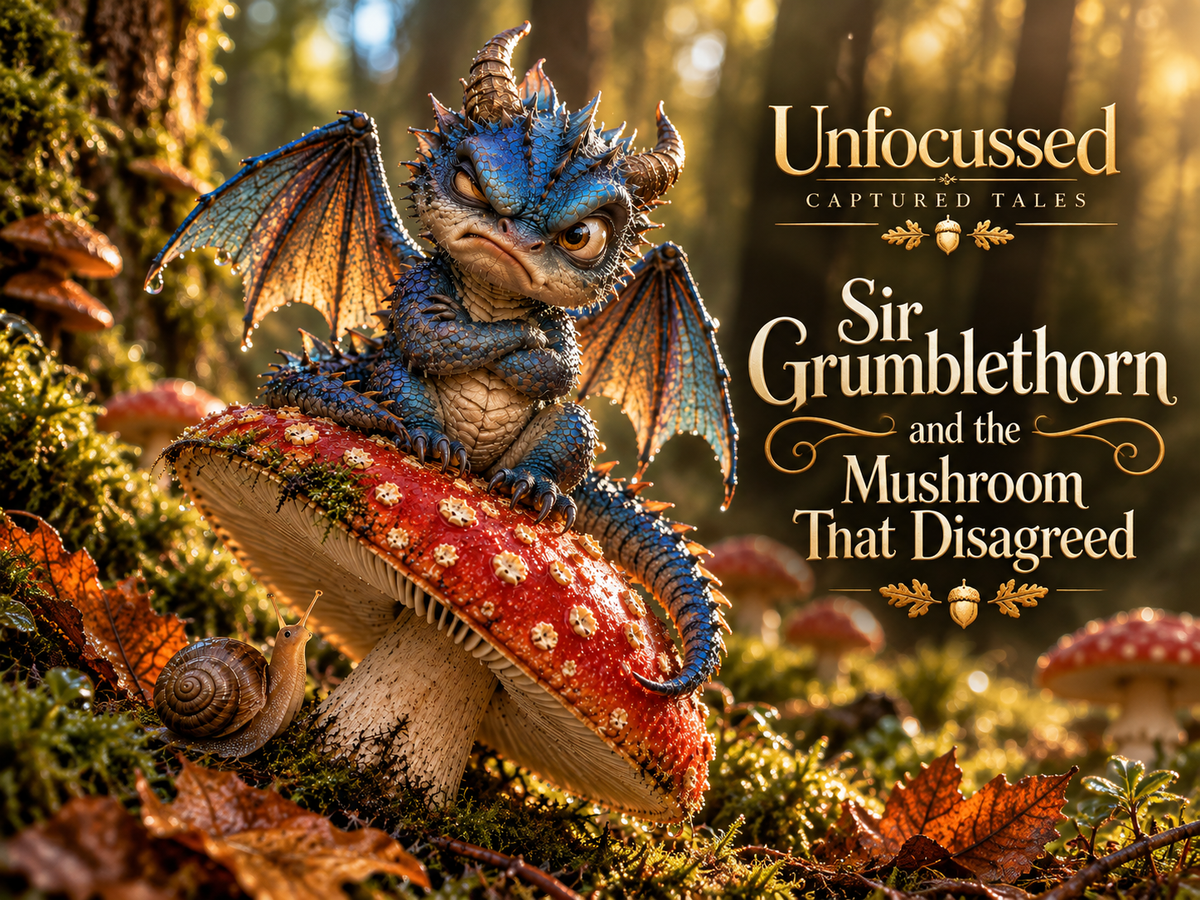
The Perch That Would Not Take Orders
Sir Grumblethorn had not been knighted by anyone. He had found a silver thimble beside a path, worn it as a helmet for three afternoons, and decided that was close enough. The thimble had since vanished into a beetle's pantry, but the title remained. So did Grumblethorn's habit of announcing himself to anything with ears, including things that did not have ears.
On the brightest morning after a week of rain, he discovered the mushroom. Its red cap rose from the moss like a little roof. Pale gills curved beneath it, and a shaft of gold fell through the trees precisely where a ruler ought to sit. At its foot, a snail traveled over a dark leaf with the grave concentration of someone carrying a very important parcel. Grumblethorn stepped over her, climbed the stem, and arranged his cobalt wings.
“A serviceable throne,” he declared. “You may remain.”
The mushroom tipped left.
Grumblethorn dug his claws into the cap. “I said remain.”
It tipped farther. He slid across the slick red surface and landed on a cushion of moss with an undignified whuff. The snail continued her journey. She did not laugh, which Grumblethorn considered rude. Laughter, at least, would have acknowledged the scale of the event.
He tried again, approaching from the opposite side. This time he sat gently and spoke with the patience usually reserved for very young acorns. “You will hold still.” The cap rose beneath him, shivered, and eased toward the same patch of moss. He hopped away before it could throw him. When the snail reached the stem, the mushroom settled level.
Grumblethorn narrowed one amber eye. “You saw that.”
“I did,” said the snail. Her voice was as soft as leaf mold. “You keep sitting on the wrong side.”
“There is no wrong side of a throne.”
“Then it is fortunate this is a mushroom.”
Grumblethorn opened his mouth, closed it, and pulled himself to his full height. He was roughly the size of the mushroom cap. This did not trouble him. An argument could be large even when its participants were small.
He began with courtesy. He complimented the mushroom's bright color, its remarkable gills, and the pleasing way rainwater gathered along its rim. He asked it to stand straight for one brief, ceremonial sitting. The mushroom leaned toward the snail. He offered it a polished pebble. It leaned a little more. He offered two pebbles and the location of a particularly agreeable sunbeam. The mushroom did not move at all, which somehow felt like a more pointed refusal.
The snail made another slow circuit of the stem. Grumblethorn followed her with a glare. “Are you doing this?”
“Walking?” she asked. “Yes.”
“The other thing.”
“You will have to be more specific. You seem to be having several other things.”
By noon he had devised a formal challenge. He scratched a circle in the moss, set his polished pebbles at its edge, and informed the mushroom that it had until the sun touched the fallen birch to hold steady beneath him. If it failed, he would declare himself the victor and sit somewhere else.
“That sounds convenient for both of you,” said the snail.
He did not appreciate her tone. He appreciated even less that the cap remained perfectly level as she slipped beneath its rim, then lurched the moment he placed one paw on top. Something pale flashed between the gills. Grumblethorn caught himself with both wings and looked down. The snail had disappeared into the shadow under the cap.
“What are you hiding?” he called.
From below came her quiet reply. “Something you keep nearly stepping on.”
A Bargain Made Beneath the Gills
Grumblethorn had expected stolen treasure. He had expected a tiny door with a tiny sign reading Dragons Not Admitted. He had not expected the snail to emerge carrying a bead of rainwater on her shell and looking thoroughly unimpressed with him.
“Come down,” she said. “Carefully.”
He ducked under the cap. The air smelled of damp wood and clean earth. Beneath a folded leaf, tucked against the mushroom's stem, rested a cluster of clear, pearl-small eggs. Each held a pale curl no larger than a comma. The snail drew her body between them and Grumblethorn's claws.
“Mine,” she said.
He stared. “You might have mentioned them.”
“I did. You were making a speech to a mushroom.”
The cap tilted as a gust moved through the clearing. Water slid along its rim and fell beyond the eggs. Grumblethorn looked from the sheltered leaf to the snail and back again. The mushroom had not thrown him toward the moss at random. Its stem bent when weight settled on the exposed side, and the cap turned to shed rain away from the little hollow. When the snail passed beneath it, she nudged a loose root with her shell. The cap steadied. The wrong side existed after all.
Grumblethorn considered apologizing. Unfortunately, he had already announced a challenge in a voice loud enough for three beetles and a wren to hear. A knight could not simply withdraw a challenge before the sun reached the birch. He could, however, propose terms.
“I shall sit above,” he said, “and serve as an additional roof.”
“You are considerably heavier than rain.”
“I can be light when required.”
To demonstrate, he sprang onto the cap. It dipped. The snail shoved beneath the leaf as a fat drop struck the place where her head had been. Grumblethorn sprang off again. The cap rose. The three beetles, who had stayed to watch the challenge, retreated behind a twig. The wren made a sound suspiciously like a cough.
“Lightness,” said the snail, “may require practice.”
Grumblethorn found a forked twig and set it beneath the cap like a prop. He tested it with one paw. The twig snapped. He found a broader stick and wedged it against the stem. The mushroom leaned against it and sent a little runnel of water directly toward the eggs. He pulled the stick free so quickly that moss sprayed over his wings.
Clouds thickened above the clearing. The gold light vanished from the cap, and the air took on the hush that came before hard rain. Grumblethorn could see the snail looking beyond him toward higher ground. Her eggs could not be carried quickly. Even if she could gather them, the open moss between the mushroom and the old log offered no cover.
“I have a plan,” he said.
“Does it involve a stick?”
“It does not.”
It involved a large leaf. He dragged one from beneath the birch and tried to stretch it over the mushroom like a second roof. A vein snagged on one of his horns. He turned, the leaf wrapped around his face, and he staggered across the moss. Somewhere nearby, a beetle applauded once. When Grumblethorn tore the leaf free, he saw that its stem could reach the hollow from the higher side without pressing on the cap.
“That might work,” the snail said.
He paused. It was the first encouraging thing she had said all day. Together they set the leaf's stem in a notch of root and let its broad surface slant toward a shallow channel beyond the eggs. It would catch the overflow, if the wind did not lift it. Grumblethorn pressed his paws against its edges. The first heavy drops struck. The leaf trembled but held.
Then the wind changed. The mushroom pitched toward him, the leaf tugged against his claws, and water began to gather where the snail's children lay.
The Smallest Terms of Victory
Grumblethorn had spent the morning trying to make the mushroom stand still. Now he needed it to move. The cap bent beneath the wind, drawing rain away from one side but exposing the other. The leaf caught the overflow until a curl formed in its middle and spilled toward the eggs.
“The root on your right,” the snail called. “There is a hollow behind it.”
Grumblethorn could not see it. He was hanging from the leaf's edge with all four claws, and water ran down his horns into his eyes. “If this is a test of my hearing, I pass.”
“It is a test of your listening.”
He let one claw go, felt along the root, and found the hollow. It was just wide enough for a snail to shelter beneath, but the eggs lay too far from it to move before the next rush of water. He could guide the flow there instead. He pulled a strip of bark loose with his teeth and laid it between the wet leaf and the hollow, making a narrow trough. The bark tipped. He caught it with his tail.
“More to the left,” said the snail.
“I know where left is.”
“Then use it.”
He shifted the bark. Water ran into the hollow and away through the roots. The cap dipped again, pressing the leaf lower, and a fresh gust nearly tore it free. Grumblethorn opened his wings to brace himself. Rain beat through their thin membranes. He could not hold a whole storm above a mushroom, and he knew it. He only had to hold this one leaf until the worst of the cloud passed.
The three beetles reappeared. One climbed onto the leaf's stem to weigh it down; the others rolled pebbles into place around the root. The wren brought a long blade of grass, which the snail wound around the stem and a knot in the bark. No one declared themselves in charge. Grumblethorn found the arrangement surprisingly effective.
When the rain fell hardest, he crouched beside the cap rather than on it. He let the mushroom bend. Its broad red roof sent most of the water past the eggs, while the leaf and bark carried the rest to the hollow. Twice the bark slipped and twice he caught it. Once he sneezed so violently that a beetle lost its grip and had to be retrieved from a puddle. The beetle announced that the rescue had been magnificent. Grumblethorn was grateful for one accurate witness.
At last the rain softened. Light returned between the branches. The snail touched each egg with the gentle tip of a feeler and counted them twice. Grumblethorn waited through both counts without offering to hurry her. When she finished, she looked up at him.
“All here,” she said.
His wings drooped with relief. The mushroom settled as the wind eased. Its cap bore a scatter of shining droplets, and the leaf below it had begun to sag like a tired green sail. Grumblethorn removed the bark trough so water would not pool against the stem. He set the beetles' pebbles in a neat ring, far enough away to leave the snail a clear path.
The sun touched the fallen birch.
“My challenge has ended,” Grumblethorn said. “I have decided the mushroom may remain.”
“Generous,” said the snail.
“I also withdraw my complaint concerning its angle.”
“An excellent second decision.”
He glanced at the cap. He still wanted to sit in that square of gold. He wanted it badly enough that he almost made another speech. Instead he asked, “Is there room, if I keep off the hollow?”
The snail traced a damp line along the firm side of the stem, marking where his weight would do no harm. “Try there. Gently.”
Grumblethorn climbed with care. He placed his paws where she had shown him and folded his wings before settling his weight. The mushroom flexed once, then held. Below, the snail moved into the shade beside her eggs. A drop fell from the cap and struck Grumblethorn's nose.
“You did that on purpose,” he told the mushroom.
It gave no answer. The snail's quiet laugh rose from under the gills.
For once, Grumblethorn let someone else have the last word. He sat very still, proud of his new perch, the dry little hollow beneath it, and the peculiar fact that both had become safer when he stopped giving orders.
Give a Grumpy Little Dragon a Place to Perch
Sir Grumblethorn may have learned to ask nicely, but he still looks splendid making a fuss. Explore artwork and gifts inspired by his standoff with the mushroom, including wall art, puzzles, and greeting cards.

 The Wink That Got Away With Everything
 The Dewdrop He Swore He Could Handle
 Sir Petalgrip y el pliegue que debió haber respetado