
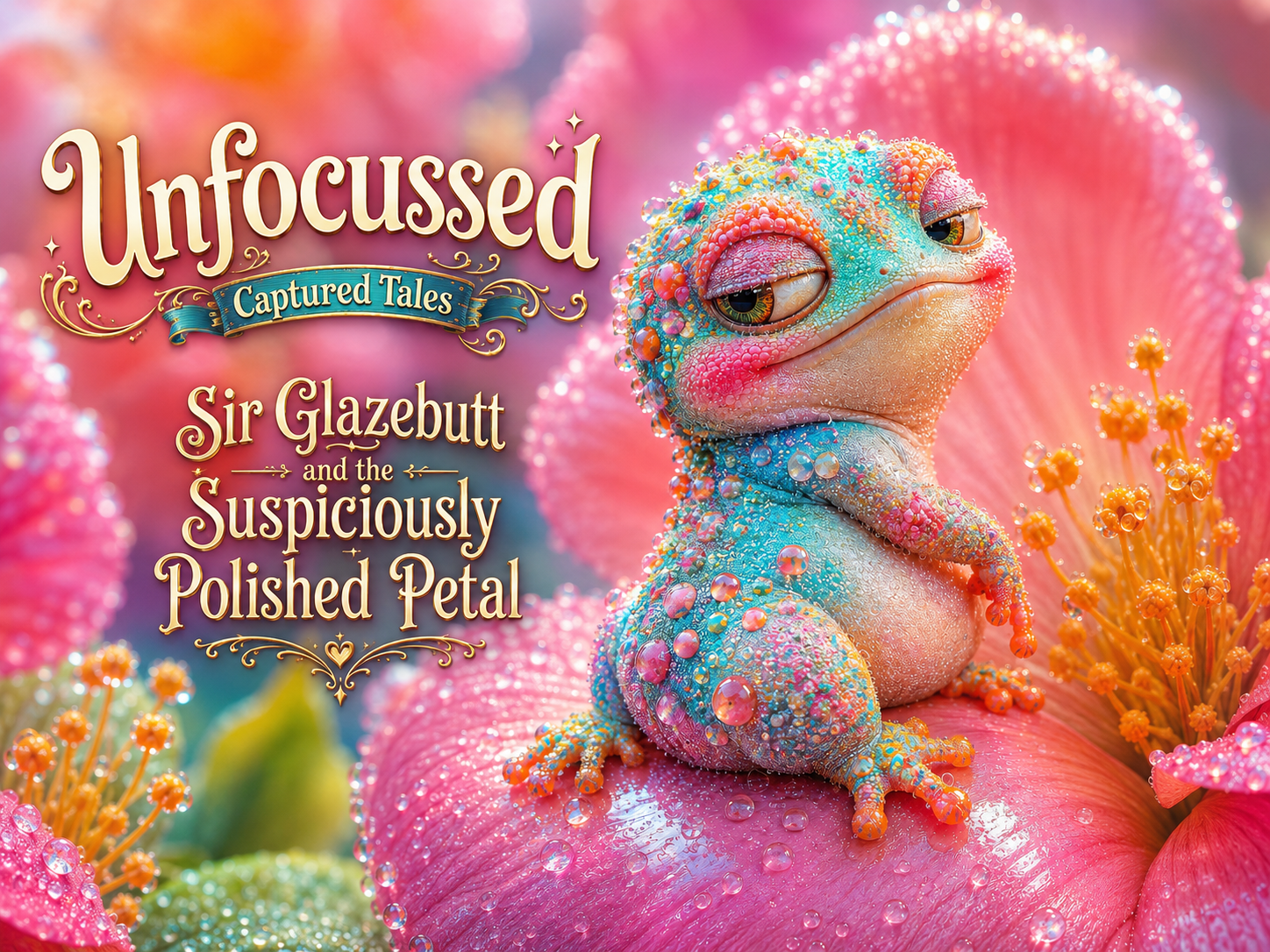
Le ministère des Affaires pétalaires spontanées
Sir Glazebutt n’avait jamais été adoubé.
Il n’avait jamais sauvé de princesse, vaincu de dragon, défendu de pont, retrouvé de navet sacré, ni accompli aucune des corvées légèrement ridicules par lesquelles on obtient traditionnellement le titre de chevalier dans le jardin de Sugarwild. Il n’avait même jamais possédé d’épée, à moins de compter le minuscule couteau à beurre qu’il gardait dans son gilet pour les urgences impliquant des scones.
Néanmoins, cela faisait si longtemps qu’il s’appelait lui-même « Sir » que le corriger maintenant ne ressemblait plus tant à une défense de la vérité qu’au gâchis d’un après-midi parfaitement agréable.
Son nouveau titre était tout aussi infondé.
« Inspecteur royal des pétales », annonça Sir Glazebutt en présentant une carte rose à Madame Honeyslip, de la vigne trompette dorée. « Première classe. Entièrement accrédité. Autorisé à examiner les étamines, les sépales, les fleurs, les bourgeons, les plis, les froufrous, le dessous, le dessus et toute crevasse inhabituellement accueillante. »
Madame Honeyslip ajusta ses lunettes et étudia la carte.
Elle avait été découpée dans le carton d’une boîte de crème dessert à la framboise. Le sceau royal était une empreinte de pouce à la confiture, et la signature au bas disait :
Sa plus Radiante Majesté, définitivement la Reine.
« Cela semble suspect », dit-elle.
« Cela prouve que c’est officiel », répondit Glazebutt. « Les documents gouvernementaux sont censés paraître suspects. Cela maintient le public dans le respect. »
Madame Honeyslip regarda la carte, puis Glazebutt, puis la magnifique fleur rose corail derrière elle. La fleur s’était ouverte ce matin-là, son large pétale intérieur brillant sous une fine couche de nectar et de rosée.
Glazebutt la regarda aussi.
Il l’examina avec l’intérêt professionnel concentré d’une grenouille qui n’avait inventé son métier qu’environ six minutes plus tôt.
« Et en quoi », demanda Madame Honeyslip, « consiste une inspection ? »
« Des tests approfondis. »
« De quel genre ? »
« Fermeté. Humidité. Intégrité structurelle. Lustrage. »
« Lustrage ? »
« Vital. »
« Pour la fleur ? »
« Pour le moral. »
Avant qu’elle ne puisse demander de quel moral il parlait, Glazebutt sauta sur la fleur, tourna deux fois sur lui-même et abaissa son imposant postérieur turquoise sur le pétale avec un soupir de satisfaction.
Le pétale émit un petit grincement humide.
« Intéressant », murmura-t-il.
Il se décala légèrement vers la gauche.
Grincement.
Puis vers la droite.
Sqrrrk.
« Très intéressant, en effet. »
Madame Honeyslip restait bouche bée.
Sir Glazebutt s’appuya contre la courbe chaude de la fleur et adopta l’expression grave d’un médecin face à une éruption cutanée particulièrement compliquée. Sa peau aux reflets de bijou scintillait de turquoise et de corail sous des centaines de gouttelettes rondes et transparentes. Ses yeux ambrés se plissèrent de concentration — ou peut-être de plaisir — alors qu’il glissait de quelques centimètres le long du pétale lisse.
« Votre floraison a un fini dangereusement irrégulier », déclara-t-il.
« Elle n’était pas lustrée à votre arrivée. »
« Précisément. Une infraction grave. »
« Il y a maintenant une traînée brillante qui a exactement la forme de votre derrière. »
Glazebutt jeta un coup d’œil derrière lui.
Une large traînée scintillante descendait le long du pétale.
« Une preuve », dit-il solennellement.
« De quoi ? »
« De négligence. »
La bouche de Madame Honeyslip se crispa. « Descendez de ma vigne trompette. »
Glazebutt sortit une deuxième carte de son gilet. « Entraver une inspection royale entraîne une pénalité de trois pots de confiture. »
« Cette carte dit : “Collectionnez douze tartelettes aux baies et la treizième est gratuite.” »
« La loi est souvent rédigée dans un langage que les citoyens ordinaires trouvent confus. »
Elle le chassa de la vigne avec une baguette d’arrosage.
Cela aurait dû s’arrêter là.
Cela se serait arrêté là si Sir Glazebutt possédait soit de la honte, soit une compréhension réaliste des conséquences. Malheureusement, il avait égaré la première il y a des années et considérait la seconde comme une sombre rumeur colportée par des gens manquant d’imagination.
Au coucher du soleil, il avait inspecté sept fleurs de plus.
Il examina le rembourrage d’un bouton d’or, la tension de ressort d’une tulipe, les angles d’inclinaison de deux lys ouverts et le « glissement d’urgence » d’une fleur de framboisier particulièrement large. À chaque arrêt, il exhibait ses références en carton de crème dessert, fronçait les sourcils de manière critique devant le pétale, s’y installait et se tortillait jusqu’à ce que la surface brille.
Il délivrait ensuite à chaque fleur un rapport officiel.
Ces rapports consistaient en des phrases telles que suffisamment souple, excessivement chatouilleuse, prometteuse mais étroite par l’approche arrière, et, dans un cas particulièrement scandaleux, nécessite une attention immédiate d’un second inspecteur et peut-être d’une serviette.
Le jardin aurait dû reconnaître la fraude évidente.
Au lieu de cela, le jardin fut impressionné.
C’était en partie parce que Glazebutt utilisait un presse-papiers.
Très peu de créatures dans le jardin de Sugarwild comprenaient le fonctionnement des presse-papiers, mais tout le monde les craignait. Un presse-papiers suggérait des formulaires, des règlements et la possibilité que quelqu’un, quelque part, avait compté des choses. La simple vue d’un tel objet pouvait pousser des scarabées innocents à avouer des crimes qu’ils n’avaient pas commis.
Cela aidait aussi que Sir Glazebutt inspecte les fleurs avec une assurance extraordinaire. Il approchait d’une fleur, tapotait son bord, reniflait son centre, louchait sur ses plis, puis hochait la tête comme si le pétale venait de confirmer un soupçon profondément troublant.
« Hmm. »
C’était généralement tout ce qu’il fallait.
« Quoi ? » demandait nerveusement le propriétaire de la fleur.
« Je préférerais ne pas vous alarmer. »
« M’alarmer à quel sujet ? »
« Avez-vous remarqué une mollesse inhabituelle le matin ? »
« C’est un pétale. »
« Donc, c’est un oui. »
En deux jours, des jardiniers nerveux réclamaient des rendez-vous.
« J’ai une pivoine qui semble assez moelleuse », dit Lady Dewbuckle.
« Cela pourrait être grave », répondit Glazebutt.
« Mon orchidée se courbe quand on appuie dessus. »
« Instabilité classique. »
« Le dessous de mon lys de lune reste humide jusqu’à midi. »
« Madame, je suis étonné que vous ayez survécu à la semaine. »
Sa liste d’attente s’allongeait. Son gilet devenait plus serré. Sa réputation grandissait plus vite que sa connaissance de la botanique, qui restait entièrement théorique et largement erronée.
Il établit le ministère des Affaires pétalaires spontanées sous un auvent en champignon rayé. Le département contenait un coussin de velours, trois boîtes à archives vides, une cloche volée à un hôtel pour escargots et une enseigne peinte indiquant :
INSPECTIONS ROYALES DES PÉTALES
DISCRÉTION • QUALITÉ • CONTACT APPROFONDI
En dessous, en plus petites lettres, il ajouta :
AUCUNE FLEUR TROP GRANDE
AUCUNE CREVASSE TROP DOUTEUSE
Les clients étaient invités à payer avant l’inspection. Les honoraires acceptés incluaient du vin de baies, des brioches glacées, des moucherons sucrés, des biscuits aux graines, de la confiture, de l’huile de lustrage et tout ce qui était décrit comme « à la crème ».
Les affaires prospéraient.
Sir Glazebutt eut bientôt besoin d’aide et engagea un puceron vert pâle nommé Nigel pour gérer les rendez-vous. Nigel avait été renvoyé du Trésor royal après avoir calculé par erreur que le royaume devait onze millions de glands à un écureuil mort. Glazebutt considérait que c’était une excellente expérience administrative.
« Que dois-je dire aux clients qui demandent à voir votre nomination officielle venant du palais ? » demanda Nigel.
« Dites-leur que c’est confidentiel. »
« Et s’ils demandent quelle autorité royale l’a classifié ? »
« L’autorité classifiée. »
« Et s’ils demandent si vous avez une assurance ? »
« Sonnez la cloche et faites semblant que le bâtiment est en feu. »
Nigel hocha la tête et nota tout cela.
Pendant plusieurs semaines glorieuses, Glazebutt vécut magnifiquement.
Il déjeunait de crumpets au miel. Il dînait de gâteaux aux fleurs glacés au sirop de framboise. Le soir, il s’allongeait sur ses plus beaux pétales inspectés et dictait des règlements imaginaires à Nigel.
« Toutes les tulipes doivent fournir un soutien lombaire. »
« Très bien, monsieur. »
« Les marguerites auront l’interdiction d’être trop guillerettes avant le lever du soleil. »
« Naturellement. »
« Et aucune fleur ne pourra se décrire comme “ultra moelleuse” sans se soumettre à un examen complet en position assise. »
« Dois-je classer cela sous protection des consommateurs ? »
« Classez-le sous “urgent”. »
Le système aurait pu se poursuivre indéfiniment si Glazebutt n’avait pas inspecté la rose primée de Lord Nectarwick.
Lord Nectarwick était un riche marchand de pollen qui possédait six serres, quatre fontaines et une haie taillée à l’image de son propre profil. Il parlait de ses roses comme des parents fiers parlaient d’enfants talentueux, à l’exception près que les roses étaient régulièrement inscrites à des concours et que les enfants avaient été envoyés en pensionnat pour avoir touché aux meubles.
Sa nouvelle fleur, la Duchesse Rouge, était énorme.
Ses pétales étaient d’un rose profond et lustré, enroulés en plis doux et imprégnés d’une rosée aromatique. Elle avait remporté la première place à la Grande Exposition Florale, la deuxième place aux Essais de Parfum au Clair de Lune et une mention honorable après avoir mordu un juge de la Société Horticole de Thornvale.
« Manipulez-la avec précaution », prévint Lord Nectarwick. « La Duchesse est sensible. »
Sir Glazebutt grimpa dans la rose.
« La sensibilité », dit-il, « est ma spécialité. »
Nigel toussa dans son presse-papiers.
Glazebutt testa le pétale extérieur avec un pied aux pointes orangées. Puis il pressa ses deux paumes contre sa surface. Enfin, après s’être assuré que tout le monde regardait, il se tourna et s’abaissa dans le pli central.
La Duchesse Rouge émit un son profond et humide.
Fwoomp.
Sir Glazebutt s’enfonça jusqu’aux coudes.
Seuls sa tête et un doigt levé restaient visibles au-dessus des pétales.
« Aha », dit-il.
« Qu’est-ce que c’est ? » demanda Lord Nectarwick.
Glazebutt n’en avait aucune idée.
La rose était plus chaude que prévu. Son nectar était inhabituellement épais. Quelque chose sous lui semblait pulser.
« Pression de floraison avancée », déclara-t-il.
La rose se contracta.
Glazebutt fut propulsé vers le haut avec un bruit normalement associé à un bouchon quittant une bouteille coûteuse. Il traversa la serre, rebondit sur une orchidée suspendue et atterrit, le postérieur le premier, dans un bol d’argent rempli de crème anglaise décorative.
Nigel sonna la cloche d’urgence.
« Au feu ! » cria-t-il.
« Il n’y a pas de feu », dit Lord Nectarwick.
« Feu classé confidentiel ! » cria Nigel, avant de s’enfuir.
Glazebutt sortit du bol de crème avec autant de dignité qu’un amphibien couvert de bijoux et de crème dessert sur le derrière pouvait raisonnablement en rassembler.
« L’inspection est terminée », annonça-t-il.
Lord Nectarwick pointa la Duchesse Rouge du doigt.
Une traînée brillante courait du centre de la fleur jusqu’à son bord extérieur. Les pétales primés avaient été aplatis exactement selon les contours de la célèbre anatomie de Sir Glazebutt.
« Vous l’avez ruinée ! »
« Ruinée ? » s’étouffa Glazebutt. « Mon cher seigneur, j’ai révélé un défaut sérieux. »
« Vous vous êtes assis sur ma rose ! »
« Dans des conditions contrôlées. »
« Vous vous êtes tortillé ! »
« Mouvement diagnostique. »
« Vous avez crié : “Oh, c’est étrangement chaud.” »
« Terminologie clinique. »
Le visage de Lord Nectarwick s’assombrit jusqu’à correspondre presque exactement à la Duchesse Rouge.
« Je vais rapporter cela au palais. »
Sir Glazebutt se figea.
« Le palais ? »
« La Reine elle-même entendra comment son soi-disant inspecteur conduit les affaires royales. »
« Il n’est nul besoin de déranger Sa Majesté pour un petit lustrage professionnel. »
« Vous avez laissé une empreinte de fesse dans une rose de championnat. »
« Beaucoup d’artistes signent leur œuvre. »
Lord Nectarwick saisit sa canne.
Glazebutt s’échappa par la fenêtre la plus proche.
Il atterrit dans un hortensia, roula dans un bain d’oiseaux et se dépêcha de retourner à son bureau avec son presse-papiers tenu de manière protectrice sur son arrière-train. Nigel était déjà là, rangeant les biscuits aux graines dans une valise.
« Nous devons fermer le département », dit Glazebutt.
« Je l’avais supposé. »
« Temporairement. »
« Bien sûr. »
« En raison d’améliorations administratives de routine. »
« Et du fait que vous avez commis une fraude contre une rose politiquement connectée ? »
« Surtout à cause des améliorations. »
Glazebutt arracha l’enseigne, enterra ses références de boîte à framboises sous le coussin de velours et passa la soirée à s’entraîner à prendre des expressions innocentes dans une cuillère.
Au matin, il s’était arrêté sur une expression combinant dignité blessée et constipation légère.
C’était excellent.
C’était aussi inutile.
À neuf heures précises, un cortège de névroptères royaux arriva devant l’auvent en champignon. Leurs ailes scintillaient comme du vitrail, leurs uniformes étaient impeccables et chacun portait un parchemin portant le sceau doré authentique de la Reine Maribelle Bloomcrown.
Le capitaine s’avança.
« Sir Glazebutt ? »
« Jamais entendu parler de lui. »
« Vous portez un gilet brodé des mots “Sir Glazebutt”. »
Il baissa les yeux. « Une coïncidence tragique. »
Le capitaine ouvrit le parchemin.
« Par ordre de Sa Majesté, vous êtes sommé de comparaître demain au Festival Royal des Fleurs. »
Glazebutt déglutit.
« Suis-je arrêté ? »
« Non. »
Ses épaules se relâchèrent.
« Vous devez effectuer une inspection publique complète de la Rose Pétalelune de la Reine devant la cour assemblée. »
Ses épaules remontèrent vers ses oreilles.
Le capitaine continua la lecture.
« Sa Majesté a reçu des rapports extraordinaires concernant votre expertise. Elle attend une démonstration formelle de vos méthodes, une explication de tous les règlements floraux pertinents et la preuve de votre nomination en tant qu’Inspecteur Royal des Pétales. »
Nigel retira discrètement son badge nominatif.
« La présence est obligatoire », conclut le capitaine. « Le défaut de comparution sera considéré comme une usurpation de titre officiel, une falsification de références du palais, une collecte frauduleuse de pâtisseries et un contact illégal avec des fleurs protégées. »
« Quelle est la punition ? » murmura Glazebutt.
« La dernière créature condamnée a été scellée à l’intérieur d’un nain de jardin décoratif. »
La couleur de Glazebutt passa du turquoise au bleu pâle d’une bouillie effrayée.
Le capitaine lui remit la convocation.
« La Reine attend votre inspection avec impatience. »
« Comme c’est charmant. »
« Tout le royaume sera en train de regarder. »
« Encore plus charmant. »
« Portez quelque chose de digne. »
Les névroptères royaux repartirent.
Pendant un long moment, Sir Glazebutt resta debout sous l’auvent en champignon rayé, serrant la convocation à deux mains. À travers le jardin, les cloches commencèrent à annoncer le festival. Les propriétaires de fleurs émergeaient de leurs chalets. Les vendeurs dressaient des tentes colorées. Les courtisans polissaient leurs ailes, lavaient leurs antennes et répandaient la nouvelle que le mystérieux Inspecteur Royal des Pétales de la Reine démontrerait enfin sa célèbre technique.
Glazebutt se tourna lentement vers Nigel.
« À quel point », demanda-t-il, « serait-il difficile de devenir un véritable expert en botanique d’ici demain matin ? »
Nigel réfléchit à la question.
« À quel point tenez-vous à dormir ? »
« Modérément. »
« Et au fait de rester en dehors d’un nain de jardin décoratif ? »
« Extrêmement. »
Nigel rouvrit la valise, remit les biscuits aux graines sur le bureau et plaça le presse-papiers entre eux.
« Alors nous ferions mieux d’apprendre ce qu’est réellement un pétale. »
Sir Glazebutt le fixa.
« C’est le petit truc mou sur lequel on s’assoit. »
Nigel soupira.
Dehors, les cloches du festival sonnaient plus fort.
Ils avaient vingt-quatre heures pour transformer l’arrière-train le plus confiant du jardin de Sugarwild en quelque chose ressemblant à un inspecteur royal qualifié.
Ce n’était pas assez de temps.
C’était, cependant, considérablement plus de temps que n’importe quelle personne sensée ne leur aurait donné.
Une brève éducation sur les choses sur lesquelles Glazebutt s’était déjà assis
L’éducation botanique de Sir Glazebutt commença mal et se détériora à partir de là.
Nigel ouvrit L’anatomie illustrée complète des fleurs respectables à sa première page et pointa un schéma.
« Ceci est une fleur. »
Glazebutt fronça les sourcils. « Je sais ce qu’est une fleur. »
« Hier, vous en avez décrit une comme “un coussin naturel avec du parfum”. »
« C’était une définition fonctionnelle. »
« C’était une jonquille. »
« Un coussin étroit, alors. »
Nigel prit une longue inspiration par le nez. Il faisait cela fréquemment depuis qu’il avait accepté un emploi au ministère des Affaires pétalaires spontanées. C’était soit une technique de relaxation, soit le début d’un problème médical.
Ils avaient converti le bureau champignon en salle de classe d’urgence. Des livres étaient ouverts sur chaque surface. Des diagrammes pendaient de l’auvent. Des fleurs spécimens remplissaient des bocaux le long du bureau, bien que Glazebutt eût déjà mangé le chèvrefeuille en prétendant que c’était nécessaire pour une recherche comparative.
Nigel tapota à nouveau le diagramme.
« Les parties aux couleurs vives entourant les structures reproductrices sont appelées pétales. »
« Je le savais. »
« Les structures extérieures vertes sont des sépales. »
« Je le savais aussi. »
« Qu’est-ce qu’une étamine ? »
Glazebutt étudia l’image.
« Une affaire privée ? »
« Non. »
« La baguette personnelle d’une fleur ? »
« Non. »
« Le truc qui devient surexcité quand les abeilles arrivent ? »
Nigel hésita.
« Biologiquement imprécis », dit-il, « mais dérangeamment proche. »
Ils continuèrent toute la nuit.
Glazebutt apprit que le pollen n’était pas des « pellicules de fleur », que le nectar n’était pas simplement de « l’alcool d’abeille » et que les pistils n’étaient ni des ustensiles de cuisine ni une rumeur scandaleuse impliquant Madame Honeyslip. Il apprit que les pétales attiraient les pollinisateurs, protégeaient les structures délicates et communiquaient par la couleur, l’odeur, la température et des changements subtils de texture.
Ce dernier fait capta son attention.
« Texture ? » demanda-t-il.
« Oui. »
« Alors mes méthodes n’étaient pas entièrement frauduleuses. »
« Tu as poli une orchidée avec ton derrière pendant quarante minutes. »
« Mais au niveau de la texture. »
« Tu as facturé un supplément pour le mouvement circulaire. »
« Travail de spécialiste. »
Nigel ferma les yeux.
« Essaie d'absorber un fait utile avant le lever du soleil, je t'en prie. »
Glazebutt essaya.
Il essaya sincèrement.
Malheureusement, son esprit avait été conditionné par des années de paresse à rejeter toute information qui ne pouvait pas être mangée, portée ou utilisée pour excuser un comportement douteux. La terminologie botanique entrait par une oreille, errait à la recherche d'un endroit confortable, et ressortait par l'autre.
À minuit, il savait distinguer un sépale d'une louche à soupe, mais sans grande assurance.
À deux heures du matin, il avait mémorisé la phrase : « L'éclat des pétales peut indiquer l'hydratation, la santé cellulaire ou la structure de la surface », bien qu'il prononçât cellulaire comme s'il s'agissait d'un petit royaume près de la côte.
À quatre heures, Nigel commença à le tester avec des spécimens.
Il brandit une marguerite.
« Identifie ceci. »
« Asteraceae. »
« Excellent. »
« J'ai lu l'étiquette sur le bocal. »
Nigel retourna le bocal.
Il brandit un lys lunaire.
« Et ceci ? »
« Humide. »
« Botaniquement parlant. »
« Humidaceae. »
« Ce mot n'existe pas. »
« Il devrait. »
Nigel abandonna les spécimens et passa à la stratégie d'urgence.
« Tu ne peux pas duper toute la cour royale avec une terminologie inventée et une expression sérieuse. »
Glazebutt leva un doigt. « Tu sous-estimes à la fois mon expression et la cour royale. »
« La Reine va poser des questions. »
« Je répondrai avec aplomb. »
« Avec des faits réels. »
« Ne paralysons pas la représentation avec des restrictions inutiles. »
« Et tu dois présenter une preuve de ta nomination. »
Tous deux regardèrent vers le coussin de velours sous lequel Glazebutt avait enterré sa carte de crème à la framboise.
Nigel souleva le coussin.
La carte avait disparu.
À sa place se trouvait une petite traînée de miettes violettes et un mot écrit au jus de mûre :
Merci de soutenir la faune locale.
Une famille de souris avait mangé les références royales de Glazebutt.
« Ceci », dit Nigel, « est peut-être la chose la plus légitime qui leur soit jamais arrivée. »
Glazebutt fixa les miettes.
« Il nous faut une autre carte. »
« Il nous faut un miracle. »
« On peut en imprimer un ? »
Nigel attrapa son manteau.
« Où vas-tu ? »
« Quelque part très loin du nain de jardin décoratif dans lequel tu es sur le point d'être scellé. »
Glazebutt attrapa sa manche.
« Nigel, mon fidèle collègue. »
« Tu me paies avec des pâtisseries abîmées. »
« Mon ami le plus proche. »
« Tu pensais que je m'appelais Neville jusqu'à hier. »
« Mon cher Neville... Nigel. Nigel. Évidemment Nigel. Tu ne peux pas m'abandonner maintenant. »
« Pourquoi pas ? »
Glazebutt ouvrit la bouche pour inventer une réponse.
Puis, peut-être parce que l'aube approchait et que l'épuisement avait affaibli ses défenses, la vérité lui échappa.
« Parce que tout le monde va voir que je ne suis rien. »
Nigel cessa de se dégager.
Les cloches du festival tintaient au loin, mais à l'intérieur du bureau-champignon, tout devint calme.
Glazebutt baissa les yeux sur ses mains ornées de bijoux.
« Avant cette histoire d'inspection, personne ne m'invitait nulle part », dit-il. « Les fleurs se plaignaient quand je m'asseyais dessus. Les jardiniers fermaient leurs serres à clé. Lady Dewbuckle a un jour installé une clôture spécialement conçue pour repousser mon postérieur. »
« C'était une clôture très efficace. »
« Cruellement efficace. »
« Elle avait des grelots. »
« Des grelots humiliants. »
Glazebutt s'affaissa sur le coussin de velours.
« Mais quand je tenais le presse-papiers, les créatures écoutaient. Elles demandaient mon avis. Elles m'apportaient des gâteaux. Pour une fois, je n'étais pas simplement cet idiot brillant qui se prélasse sur les choses et fait semblant de ne pas remarquer quand elles plient. »
L'expression de Nigel s'adoucit malgré son meilleur jugement.
« Tu n'es pas rien. »
« Cite-moi une seule qualité utile que je possède. »
« Ta peau est hautement décorative. »
« Ce n'est pas utile. »
« Tu as survécu au lancement depuis la Duchesse Rouge. »
« Mes os ne sont que des suggestions. »
« Tu sais identifier un pétale confortable à vingt pas. »
Glazebutt leva les yeux.
Nigel croisa son regard.
Aucun des deux ne parla pendant plusieurs secondes.
« Ça », dit Nigel lentement, « pourrait être réellement utile. »
Il retourna au livre de botanique et feuilleta les pages jusqu'à trouver un chapitre intitulé Contrainte mécanique, dommages de surface et charge des pollinisateurs.
« Les fleurs réagissent différemment à la pression », dit-il. « Les pétales sains plient et se remettent. Les pétales faibles ou malades se froissent, se fendent, se décolorent ou restent compressés. »
« Donc, s'asseoir dessus peut révéler leur état ? »
« Dans des circonstances soigneusement contrôlées, les tests de pression peuvent révéler des faiblesses structurelles. »
Glazebutt se leva si rapidement que le coussin resta brièvement collé à son derrière.
« Mon cul est scientifique. »
« Je regrette immédiatement de te l'avoir dit. »
« Nigel, cela change tout. »
« Cela change très peu de choses. »
« Je ne suis pas un imposteur. Je suis un instrument intuitif de test de pression. »
« Tu es un imposteur qui a accidentellement trébuché près d'un principe légitime. »
« L'histoire retient les résultats, pas les notes de bas de page. »
Nigel passa au chapitre sur les pétales qui changeaient de couleur lorsqu'ils étaient endommagés. Puis il en trouva un sur la température du nectar, un autre sur les taches fongiques, et un autre décrivant comment certaines fleurs enchantées réagissaient au son, à l'émotion ou au toucher.
Glazebutt se pencha par-dessus son épaule.
« Qu'est-ce qu'il dit sur la Rose Pétalunaire de la Reine ? »
Nigel chercha dans l'index.
Il y avait trois entrées.
La première décrivait la Rose Pétalunaire comme une ancienne fleur royale issue d'une bouture transportée à travers sept royaumes par la grand-mère de la Reine Maribelle.
La seconde expliquait que ses pétales translucides reflétaient la lumière de la lune même pendant la journée.
La troisième ne contenait que quatre mots :
Voir Flore Magique Volatile.
Nigel alla chercher un autre livre.
Ils trouvèrent le passage pertinent juste au moment où le lever du soleil peignait en or l'auvent du champignon.
« Ici », dit Nigel. « La Rose Pétalunaire possède des propriétés empathiques. Ses pétales réagissent aux intentions de quiconque les touche. »
« Réagissent comment ? »
« Les intentions pures produisent une lueur argentée. »
« Et les intentions malhonnêtes ? »
Nigel lut la phrase suivante.
Ses antennes s'affaissèrent.
« Les intentions malhonnêtes produisent des épines. »
Glazebutt jeta un coup d'œil à son propre reflet dans la cuillère.
« Quelle taille ? »
« Le livre dit que leur taille est proportionnelle à la tromperie. »
« Comme c'est ennuyeusement poétique. »
« Il y a une illustration. »
Nigel retourna le livre.
Le dessin montrait un duc malhonnête expulsé à travers le toit d'une serre par une épine de la taille d'un poteau de clôture.
Glazebutt le fixa.
« Peut-être que la Reine accepterait une inspection visuelle. »
« Elle a demandé une démonstration publique complète. »
« Peut-être pourrais-je la toucher avec un doigt de pied très honnête. »
« Chaque partie de toi appartiendrait toujours au même menteur. »
« Formulation brutale. »
« Scientifiquement exacte. »
Il n'y avait plus de temps pour créer un nouveau plan.
Des trompettes résonnèrent depuis le domaine royal. Le Festival Royal des Fleurs avait commencé.
Nigel habilla Glazebutt avec les vêtements les plus respectables qu'ils purent rassembler : un gilet rouge baie, une écharpe dorée empruntée à un pot de marmelade de luxe et un petit bonnet en velours servant autrefois à couvrir une théière. Le presse-papiers resta, car Glazebutt insistait sur le fait qu'il lui donnait de l'autorité, et Nigel admit qu'au moins, cela empêchait ses mains de trembler visiblement.
Ils se joignirent au cortège vers le Palais de la Couronne Florale.
Le festival s'étendait à travers les pelouses royales dans une débauche de couleurs impossibles. Des lys imposants formaient des arches au-dessus des allées. Des papillons de nuit lanterne dérivaient sous des arbres en fleurs. Des coléoptères musiciens se produisaient depuis le cœur de fleurs en trompette tandis que des vendeurs vendaient du nectar pétillant, du pollen sucré et des coussins commémoratifs brodés avec le visage de Glazebutt.
Il s'arrêta en les voyant.
« Ils ont fait de la marchandise. »
« Ne laisse pas cela renforcer ta confiance. »
« Il y a trois tailles. »
« Continue de marcher. »
Les créatures bordaient l'avenue pour le regarder passer.
« Le voilà ! » cria une jeune souris des fleurs.
« L'Inspecteur Royal ! »
« Montre-nous le frétillement de diagnostic ! » cria quelqu'un dans la foule.
Glazebutt leva son presse-papiers et fit signe de la main.
Son expression devenait plus grandiose à chaque pas. L'admiration des étrangers entrait dans son corps comme un sirop tiède. Au moment où il atteignit les portes du palais, il s'était presque convaincu que tout irait bien.
Puis il vit Lord Nectarwick debout à côté de la plateforme royale.
Le marchand de pollen sourit sans chaleur.
À côté de lui se tenaient Madame Honeyslip, Lady Dewbuckle, trois gardiens d'orchidées offensés et le propriétaire de la fleur de blushberry que Glazebutt avait décrite comme « généreuse au niveau du pli arrière ».
Chacun portait l'un de ses rapports d'inspection.
« Tes anciens clients ont été invités à témoigner », chuchota Nigel.
« Comme c'est festif. »
Au centre de la pelouse s'élevait une estrade circulaire entourée de milliers de spectateurs. Sur celle-ci se trouvait un piédestal en cristal. De ce piédestal poussait la Rose Pétalunaire de la Reine.
C'était à couper le souffle.
La fleur était plus grande que le bureau de Glazebutt, ses pétales blancs sur les bords s'approfondissant vers des nuances lumineuses de rose, de corail et de violet à l'intérieur. Des veines argentées scintillaient sous sa surface translucide. Des perles de nectar roulaient lentement le long de ses courbes, captant la lumière du soleil comme de minuscules lunes.
Elle était aussi couverte d'épines.
La plupart ne dépassaient pas la taille des doigts de Glazebutt.
Pour l'instant.
La Reine Maribelle Bloomcrown était assise sous un auvent de vignes en fleurs. C'était un élégant papillon de nuit lunaire aux ailes émeraude, arborant une couronne de roses vivantes et le sourire composé d'une monarque qui avait déjà entendu toutes les excuses et aimait en collectionner de nouvelles.
« Sir Glazebutt », dit-elle alors qu'il s'approchait.
Il s'inclina.
L'écharpe en marmelade glissa sur sa tête et atterrit aux pieds de la Reine.
« Votre Majesté. »
Elle souleva le ruban collant avec un soulier orné de bijoux.
« Est-ce un emballage de petit-déjeuner ? »
« Un emballage de petit-déjeuner cérémoniel. »
Nigel fit un léger bruit d'étouffement.
Le sourire de la Reine devint plus aigu.
« Nous avons entendu des choses remarquables sur vos méthodes. »
« Les rapports ont peut-être exagéré mon génie. »
« Les rapports mentionnent principalement votre derrière. »
Glazebutt rajusta son gilet.
« Une tendance malheureuse du journalisme moderne. »
La foule rit.
Glazebutt ressentit une étincelle d'espoir. S'il pouvait les divertir, peut-être personne ne songerait à l'enfermer dans un nain de jardin.
La Reine fit un geste vers la Rose Pétalunaire.
« Cette fleur a récemment montré des signes de détresse. Son éclat s'estompe au coucher du soleil. Plusieurs pétales sont devenus anormalement glissants, et hier, elle a produit trois épines après que mon jardinier en chef a complimenté son parfum. »
Le jardinier en chef évita le regard de tout le monde.
« Vous allez l'inspecter », continua-t-elle, « identifier la cause et démontrer votre célèbre technique de polissage. »
Glazebutt fit un pas vers la rose.
Ses épines se tournèrent légèrement dans sa direction.
Il fit un pas en arrière.
Les épines se détendirent.
« Réactive », murmura-t-il.
« Quelque chose ne va pas ? » demanda la Reine.
« Rien au-delà des complexités ordinaires de la botanique royale. »
Une épine s'allongea de deux pouces.
La foule murmura.
Nigel se précipita et chuchota : « Elle réagit quand tu mens. »
« Je suis au courant. »
Une autre épine poussa.
« Arrête de le faire. »
« C'est comme demander à un rossignol d'arrêter de chanter. »
« C'est la comparaison la moins flatteuse qu'on ait jamais faite à un rossignol. »
La Reine Maribelle se pencha en avant.
« Avant de commencer, vos références. »
La pelouse devint silencieuse.
Glazebutt serra le presse-papiers contre sa poitrine.
La carte à la framboise mangée avait disparu. L'écharpe en marmelade gisait aux pieds de la Reine. Lord Nectarwick regardait avec une satisfaction avide. Des milliers de créatures attendaient de voir la preuve de l'autorité dont Glazebutt s'était vanté dans tout le jardin.
Il pouvait avouer.
Il pouvait admettre qu'il avait inventé le titre, fabriqué les documents et fait payer des citoyens innocents pour une activité qu'il aurait sinon pratiquée gratuitement.
Ou il pouvait mentir une fois de plus.
Glazebutt regarda la rose.
La rose semblait le regarder en retour.
Il plongea la main dans son gilet et sortit lentement un morceau de papier plié.
Les yeux de Nigel s'écarquillèrent.
« Qu'est-ce que c'est ? » chuchota-t-il.
« Une référence de remplacement. »
« Quand l'as-tu faite ? »
« Pendant le défilé. »
« Tu ne peux pas falsifier une nomination royale en marchant. »
« Pas proprement. »
Glazebutt déplia le papier.
C'était l'un des programmes du festival. En haut, à l'encre de baie, il avait écrit :
Par Très Haute Autorité Royale, Cette Grenouille Est Officielle.
Nigel se couvrit le visage.
La Reine Maribelle tendit une main.
Glazebutt leva le document vers elle.
La Rose Pétalunaire frissonna.
Chaque épine sur la fleur commença à pousser.
Certaines s'enroulèrent autour du piédestal. D'autres s'élevèrent au-dessus de l'estrade. Un spécimen particulièrement ambitieux s'étendit sous Glazebutt, soulevant le dos de son gilet de plusieurs centimètres.
La foule haleta.
Lord Nectarwick sourit.
La Reine, elle, ne sourit pas.
« Sir Glazebutt », dit-elle doucement, « y a-t-il quelque chose que vous souhaiteriez nous dire avant que cette fleur ne présente votre derrière au toit du palais ? »
La plus grosse épine craqua sous lui.
Glazebutt regarda la Reine.
Il regarda Nigel.
Il regarda les milliers de créatures venues voir un expert royal et qui étaient à deux doigts de découvrir un imposteur couvert de bijoux avec des références à la crème anglaise.
Puis il baissa les yeux vers la Rose Pétalunaire étrangement glissante.
Quelque chose à sa surface attira son attention.
Sous les veines argentées, presque invisible à l'intérieur du pétale brillant, coulait une fine ligne de résidu orange.
Glazebutt connaissait cette couleur.
Il connaissait cette texture.
Il connaissait ce reflet collant et artificiel mieux que n'importe quel botaniste formé dans le royaume.
C'était de l'huile de polissage.
Quelqu'un avait altéré la rose de la Reine.
Et à en juger par le parfum qui s'élevait de ses pétales, Glazebutt savait exactement qui l'avait fournie.
La Vérité, l'Épine et le Frétillement de Diagnostic
Sir Glazebutt abaissa la référence falsifiée.
La plus grosse épine cessa de pousser, bien que sa pointe restât pressée contre une zone de son anatomie rarement incluse dans les procédures royales formelles.
« Votre Majesté », dit-il, « la Rose Pétalunaire a été polie. »
Un murmure parcourut la pelouse.
La Reine Maribelle jeta un coup d'œil à la fleur scintillante.
« Évidemment. Mes jardiniers l'entretiennent quotidiennement. »
« Ils l'arrosent. Ils la nourrissent. Ils retirent les pousses endommagées et lui murmurent des encouragements quand elle devient capricieuse. »
Le jardinier en chef hocha la tête. « Elle préfère les compliments après le petit-déjeuner. »
« Mais quelqu'un a recouvert ses pétales d'huile de polissage artificielle », déclara Glazebutt. « Récemment, généreusement, et avec toute la retenue d'un coléoptère ivre décorant un gâteau de mariage. »
Le sourire de Lord Nectarwick s'évanouit.
La Reine se leva de son trône.
« Pouvez-vous le prouver ? »
Glazebutt fixa le résidu orange sous le pétale translucide. Puis il regarda vers Lord Nectarwick, dont les roses primées étaient célèbres pour leur couleur profonde, leur éclat parfait et leur capacité suspecte à rester humides pendant les sécheresses.
Il pouvait dénoncer le marchand de pollen.
Il pouvait sauver la rose de la Reine.
Il pouvait aussi être expulsé à travers le toit du palais à tout moment, car il restait perché au-dessus d'une fleur magique tout en portant des papiers frauduleux.
« Je peux prouver que l'huile est présente », dit-il. « Mais d'abord, je dois expliquer quelque chose. »
Les antennes de Nigel se relevèrent.
La foule devint silencieuse.
Glazebutt prit une inspiration.
« Je ne suis pas l'Inspecteur Royal des Pétales. »
Les épines tremblèrent.
Puis, d'un coup, elles raccourcirent.
La pointe sous son gilet se retira avec un léger bruit de grattage qui fit fermer les yeux à Glazebutt avec une profonde gratitude.
« Je me suis nommé moi-même », continua-t-il. « Mes références initiales provenaient d'une boîte de crème à la framboise. Le sceau royal était de la marmelade. Le système de classification a été inventé pendant que je mangeais un petit pain, et le Département des Affaires Pétalaires Non Sollicitées n'a aucune autorité légale au-delà de la capacité de Nigel à faire tinter une cloche et à crier au feu. »
Le public se tourna vers Nigel.
Il fit un petit signe de la main.
« Soutien administratif », dit-il.
Glazebutt déplia sa référence de remplacement.
« Celle-ci a été écrite sur un programme de festival en marchant. L'écriture est mauvaise parce que le parcours du défilé contenait des pavés. »
La Reine Maribelle accepta le papier et le lut.
Ses sourcils se levèrent à la phrase Cette Grenouille Est Officielle.
« Je vois. »
« Pour être juste », ajouta Glazebutt, « le public n'aurait dû croire à rien de tout cela. »
Plusieurs propriétaires de fleurs croisèrent les bras.
« J'avais un presse-papiers », dit-il pour se défendre.
Les propriétaires de fleurs échangèrent des regards embarrassés. Cette partie-là était difficile à contester.
« Vous avez encaissé un paiement sous de faux prétextes », déclara la Reine.
« Oui. »
« Vous vous êtes fait passer pour un fonctionnaire du palais. »
« Oui. »
« Vous avez mené des examens physiques non autorisés sur des fleurs protégées. »
« Des examens extrêmement minutieux. »
La rose produisit une nouvelle épine.
« Non autorisés », corrigea vivement Glazebutt.
L'épine se rétracta.
« Pourquoi avouer maintenant ? » demanda la Reine Maribelle.
Glazebutt jeta un coup d'œil à la Rose Pétalunaire.
Ses nervures argentées commençaient à s'illuminer.
« Parce qu'elle ne révélera pas la vérité tant que je resterai à ses côtés à dire des mensonges. »
Il jeta ses faux titres de créance. Ils voletèrent depuis l'estrade et atterrirent sur les genoux de Lord Nectarwick.
« Je ne suis pas chevalier. Je ne suis pas botaniste. Je ne comprends pas la moitié des mots que Nigel m'a enfoncés dans le crâne hier soir, et je reste convaincu que la moistaceae mérite une reconnaissance officielle. »
Nigel soupira.
« Mais je m'y connais en huile de polissage », poursuivit Glazebutt. « Je sais quelle odeur elle a, comment elle s'étale et ce qu'elle fait lorsqu'elle est compressée contre une surface chaude. »
Lady Dewbuckle leva la main. « À cause de vos inspections ? »
« Parce qu'une fois, j'ai renversé une bouteille entière sur une chaise de salle à manger et que je suis resté coincé trois heures sous une duchesse. »
La Reine cligna des yeux.
« Un meuble appelé une duchesse », précisa-t-il.
La rose produisit une autre épine.
« Très bien. Elle avait un titre. »
La foule éclata de rire.
Même la bouche de la Reine Maribelle se contracta.
Glazebutt s'approcha de la fleur sans lever son presse-papiers ni inventer de règlement. Les épines restèrent immobiles.
« L'huile artificielle bloque les minuscules structures par lesquelles les pétales échangent leur humidité », dit-il, répétant la leçon que Nigel lui avait martelée avant l'aube. « Sur une fleur ordinaire, cela peut provoquer une décoloration et une fragilité. Sur une Rose Pétalunaire enchantée, cela emprisonne aussi les résidus émotionnels. »
« C'est-à-dire ? » demanda la Reine.
« C'est-à-dire que la fleur a absorbé des intentions malhonnêtes sans pouvoir les relâcher. C'est pourquoi elle est devenue défensive. Elle est poisseuse parce que quelqu'un l'a enduite, et épineuse parce que la créature qui a fait cela mentait à travers ses dents coûteuses. »
Lord Nectarwick recula d'un pas.
Glazebutt le remarqua.
Nigel aussi.
« L'huile contient de la fleur d'oranger amer », dit Glazebutt. « Très rare. Très coûteuse. Habituellement vendue par des marchands de pollen aux rosiéristes compétiteurs. »
Tous les regards se tournèrent vers Lord Nectarwick.
« C'est absurde », lança-t-il. « Des douzaines de jardiniers respectables utilisent de l'huile de fleurs. »
« Pas ce mélange-là. » Glazebutt frotta une gouttelette entre ses doigts et la renifla. « Orange amère, cire de graines de lune, perle en poudre et ce qu'on appelle l'Éclat de Champion de Nectarwick. »
Le visage de Lord Nectarwick pâlit.
« Vous ne pouvez absolument pas identifier cela à l'odeur. »
« Vous l'avez utilisée sur la Duchesse Rouge. »
« Absurde. »
« J'ai atterri dans un bol de crème anglaise après qu'elle m'ait éjecté. L'huile était incrustée là où on ne devrait jamais s'attendre à ce qu'un gentleman reconnaisse un parfum du commerce. »
Madame Honeyslip se couvrit la bouche.
Lady Dewbuckle ne prit pas la peine de le faire. Elle rit si fort qu'elle manqua de faire tomber son rapport d'inspection.
La Reine Maribelle descendit du dais royal.
« Lord Nectarwick, avez-vous appliqué cette substance sur ma rose ? »
« Certainement pas. »
La Rose Pétalunaire projeta une épine à travers la scène.
Elle traversa le chapeau de Lord Nectarwick et le cloua à une arche fleurie à dix mètres de là.
Il fixa sa tête nue.
Le public le fixa avec lui.
« La fleur semble sceptique », dit la Reine.
« Elle fonctionne mal ! » cria-t-il.
Trois épines supplémentaires poussèrent.
« Peut-être », suggéra Glazebutt, « devriez-vous arrêter de mentir avant qu'elle ne vous redécore. »
Lord Nectarwick chercha du soutien du regard. Ses jardiniers l'évitaient. Ses riches connaissances se passionnèrent soudainement pour leurs chaussures. Même la Duchesse Rouge, exposée sous un pavillon voisin, sembla replier un pétale par gêne.
Finalement, il s'affaissa.
« Je voulais seulement ternir temporairement la Rose Pétalunaire », avoua-t-il. « La Duchesse Rouge était censée gagner la Médaille Royale de la Fleur. Comment pouvait-elle rivaliser avec une fleur qui brille ? »
Les épines raccourcirent légèrement.
« J'ai appliqué l'huile après minuit », continua-t-il. « Je ne savais pas que la rose absorberait mes intentions. Je ne savais certainement pas qu'elle deviendrait agressive. »
« Vous avez saboté une fleur royale protégée », dit la Reine Maribelle.
« J'ai paniqué. »
« Et vous avez ensuite accusé Glazebutt d'avoir endommagé votre propre rose. »
L'expression de Lord Nectarwick se durcit. « Il a bien laissé une empreinte de fessier dessus. »
« Cette partie est exacte », admit Glazebutt.
La Rose Pétalunaire resta calme.
La Reine fit mander deux scarabées du palais. Ils escortèrent Lord Nectarwick hors de la pelouse tandis qu'il protestait que son chapeau était toujours fixé à l'arche et que le public n'avait aucune appréciation pour les pressions de l'horticulture compétitive.
« Que lui arrivera-t-il ? » demanda Glazebutt.
« Il remboursera les producteurs lésés et effectuera six mois de service dans les fosses à compost du palais », répondit la Reine.
Glazebutt grimaça.
« Et après ? »
« Il sera scellé à l'intérieur d'un nain de jardin décoratif. »
« Ah. »
« Seulement pour les week-ends. »
« Miséricordieux. »
La menace immédiate était écartée, mais la Rose Pétalunaire restait couverte d'huile. Ses pétales s'affaissaient sous le film poisseux, et de petites épines continuaient de frémir le long de sa tige.
La Reine Maribelle se tourna vers Glazebutt.
« Peut-on enlever l'huile ? »
Il examina la surface.
« L'eau ordinaire va l'étaler. Le savon pourrait endommager le pétale. Un chiffon déchirerait les nervures argentées. »
« Alors que recommandez-vous ? »
Glazebutt hésita.
Nigel lut la réponse sur son visage.
« Non », dit le puceron.
« C'est l'option la plus sûre. »
« Absolument pas. »
« Ma peau absorbe naturellement les huiles florales. »
« Vous avez inventé ça. »
« Nous avons établi que mes inventions trébuchent parfois sur la science. »
« Trébuchent parfois la tête la première dans la science. »
Glazebutt se tourna vers la Reine.
« Le pétale a besoin d'une pression contrôlée et d'un mouvement doux pour soulever le résidu sans meurtrir les tissus. »
La Reine le fixa.
« Êtes-vous en train de proposer ce que je pense que vous proposez ? »
« Cela dépend si vous imaginez quelque chose de digne. »
« Ce n'est pas le cas. »
« Alors, oui. »
Il retira son gilet et le tendit à Nigel.
La foule se pencha en avant.
« Si la rose réagit à l'intention », dit Glazebutt, « alors je dois l'aborder sans avidité, sans tromperie, sans vanité, et sans plaisir personnel. »
« Pouvez-vous gérer cela ? » demanda Nigel.
« Pendant quelques secondes, certainement. »
Une minuscule épine émergea.
« Je vais tenter avec sincérité », amenda Glazebutt.
L'épine se rétracta.
Il grimpa prudemment sur la Rose Pétalunaire.
Ses énormes pétales bougèrent sous son poids. Les nervures argentées faiblirent. Plusieurs épines s'orientèrent vers lui mais ne poussèrent pas.
Glazebutt plaça ses deux mains contre le pli interne et s'abaissa lentement.
Le pétale émit un grincement profond et résonnant qui porta à travers la pelouse royale.
Quelque part dans le public, un enfant gloussa.
Glazebutt ferma les yeux.
Pour une fois, il ne pensa pas aux applaudissements, aux pâtisseries, aux titres, ou à l'allure impressionnante qu'il aurait brodé sur un coussin commémoratif. Il pensa à la fleur blessée. Il pensa aux créatures qui avaient fait confiance à ses ridicules cartes. Il pensa à Nigel qui était resté alors qu'il aurait pu s'enfuir. Plus douloureux encore, il pensa à quel point il voulait devenir la créature que tout le monde avait brièvement cru qu'il était.
Puis il bougea.
Une fois vers la gauche.
Sqrrrk.
Une fois vers la droite.
Fwoop.
Et finalement, dans un cercle lent et soigneusement contrôlé.
Le célèbre tortillement diagnostique.
La foule retint son souffle.
L'huile orange s'agglutina contre la peau à la texture de joyau de Glazebutt. Des gouttelettes roulèrent du pétale et se rassemblèrent inoffensivement le long de ses flancs. Sous lui, la Rose Pétalunaire s'éclaircit.
Une lumière argentée se répandit dans ses nervures.
Les épines s'adoucirent et se replièrent vers l'intérieur. Les pétales se soulevèrent, s'ouvrant plus largement sous le soleil. Le rose s'intensifia en corail, le corail fondit en violet, et la fleur entière commença à briller d'un éclat nacré et pur.
Glazebutt continua jusqu'à ce que la dernière trace d'huile ait été éliminée.
Quand il se leva, la rose était entièrement restaurée.
Son postérieur, cependant, brillait comme une lanterne de cérémonie.
Pendant plusieurs secondes de silence, personne ne bougea.
Puis la foule explosa en acclamations.
Glazebutt se figea sur la rose.
Il avait déjà entendu des applaudissements, généralement après être tombé de quelque chose ou être resté coincé dans autre chose. C'était différent. Les acclamations n'étaient pas pour le titre, le presse-papiers ou le mystère frauduleux de sa technique.
Elles étaient pour lui.
Nigel essuya un œil et fit immédiatement semblant d'avoir été frappé par du pollen.
La Reine Maribelle s'approcha de la fleur restaurée. Elle passa une main sur le pétale et sourit alors qu'une lumière argentée s'enroulait autour de ses doigts.
« Vous l'avez sauvée. »
« Avec une pression contrôlée », dit Glazebutt.
« Et un mouvement doux. »
« Extrêmement doux. »
« Vous avez également avoué plusieurs crimes devant tout le royaume. »
Son sourire s'affaiblit.
« J'espérais que la fin heureuse pourrait distraire de cela. »
« Ce ne fut pas le cas. »
« Mince alors. »
La Reine retourna à son trône et appela le greffier royal. Un parchemin argenté fut placé devant elle.
« Sir Glazebutt, vous rembourserez chaque honoraire perçu sous de faux prétextes. »
Il regarda vers les boîtes de pâtisseries.
« Même ceux déjà digérés ? »
« Une valeur équivalente sera acceptée. »
« Cela semble administrativement vindicatif. »
« Vous présenterez vos excuses à chaque propriétaire de fleur dont vous avez examiné la plante sans permission informée. »
Madame Honeyslip fit un signe de la main joyeux depuis le public.
« Et pendant un an, toutes les inspections physiques devront être supervisées par un botaniste agréé. »
Glazebutt jeta un coup d'œil à Nigel.
« En connaissez-vous un ? »
Nigel déplia un certificat de son manteau.
« J'ai terminé le cours par correspondance du palais pendant que vous mémorisiez le mot sépale. »
« Frimeur. »
La Reine trempa sa plume dans de l'encre dorée.
« Sous réserve de ces conditions, je vous nomme par la présente premier Inspecteur Royal de la Pression des Pétales du Jardin de Sugarwild. »
La bouche de Glazebutt resta ouverte.
« Officiellement ? »
« Officiellement. »
« Avec de la vraie paperasse ? »
« Oui. »
« Et un vrai sceau ? »
« Oui. »
« Y aura-t-il un presse-papiers ? »
« Je suspecte que cela doit être le cas. »
La Reine signa la nomination.
La Rose Pétalunaire brilla d'argent, confirmant que chaque mot était vrai.
À partir de ce jour, Sir Glazebutt dirigea un bureau légitime à côté de la serre du palais. L'enseigne au-dessus de la porte disait désormais :
INSPECTIONS ROYALES DE PRESSION DES PÉTALES
AGRÉÉ • SUPERVISÉ • CONSENSUEL
Nigel gérait les rendez-vous, percevait des honoraires raisonnables et s'assurait que chaque client signait un accord de contact détaillé avant que Glazebutt ne s'approche de la marchandise.
Ses méthodes devinrent étonnamment respectées.
Il détectait les plis affaiblis des lys avant qu'ils ne se déchirent. Il identifiait les tulipes en surchauffe, les pivoines déshydratées et une infection fongique chez une orchidée lunaire que trois botanistes distingués avaient balayée comme étant « un teint malheureux ». Sa peau inhabituelle absorbait les huiles nocives sans endommager les surfaces délicates, tandis que son squelette souple et suggestif distribuait la pression plus délicatement que n'importe quel instrument conventionnel.
Il était toujours vaniteux.
Il était toujours paresseux.
Il utilisait toujours des expressions comme « instabilité du pli arrière » alors qu'un langage ordinaire aurait été parfaitement adéquat.
Mais il cessa de prétendre à une expertise qu'il n'avait pas. En cas d'incertitude, il consultait Nigel. Lorsqu'une fleur refusait l'inspection, il la respectait. Et lorsqu'une rose particulièrement flirteuse demandait un polissage après les heures de bureau sans supervision, il transférait l'affaire au conseiller juridique du palais avant de retirer son gilet.
Le jardin n'oublia jamais le Festival des Fleurs.
Les marchands non plus.
Dès le printemps suivant, l'effigie de Glazebutt apparut sur des tasses à thé, des coussins, des drapeaux de jardin, des puzzles et une gamme très controversée de chiffons de polissage. Le modèle le plus populaire le montrait alangui sur la Rose Pétalunaire restaurée, une main posée sur son ventre et une expression de satisfaction totale sur son visage de joyau.
Sous l'image figuraient les mots :
Professionnellement Inspecté. Suspectement Poli.
Sir Glazebutt garda le premier coussin dans son bureau.
Chaque fois que des visiteurs demandaient si l'histoire derrière tout cela était vraie, il se calait, plissait ses yeux ambrés et souriait.
« Chaque mot digne », disait-il.
La Rose Pétalunaire devant sa fenêtre produisait généralement une petite épine.
Juste assez pour le garder honnête.
Ramenez un peu de Sugarwild à la maison
Sir Glazebutt a peut-être inventé ses titres de compétence, mais les illustrations de Sir Glazebutt et le Pétale Suspectement Poli sont officiellement disponibles pour les créatures au goût impeccable et aux instincts de décoration discutables. Affichez sa magnificence éclatante comme une impression encadrée, une impression sur toile, ou une impression sur métal étincelante—car peu de choses améliorent un mur comme un amphibien suspect affichant fièrement ses atouts professionnels. Pour une plus grande dose de scandale au Jardin de Sugarwild, il est également disponible sous forme de tapisserie, de couverture polaire douillette, ou de puzzle délicieusement glissant. Vous pouvez même emporter son tortillement diagnostique en public sur un sac fourre-tout ou envoyer à quelqu'un une salutation suspectement polie avec une carte de vœux.

 Sir Grumblethorn and the Mushroom That Disagreed
 The Wink That Got Away With Everything
 The Dewdrop He Swore He Could Handle