
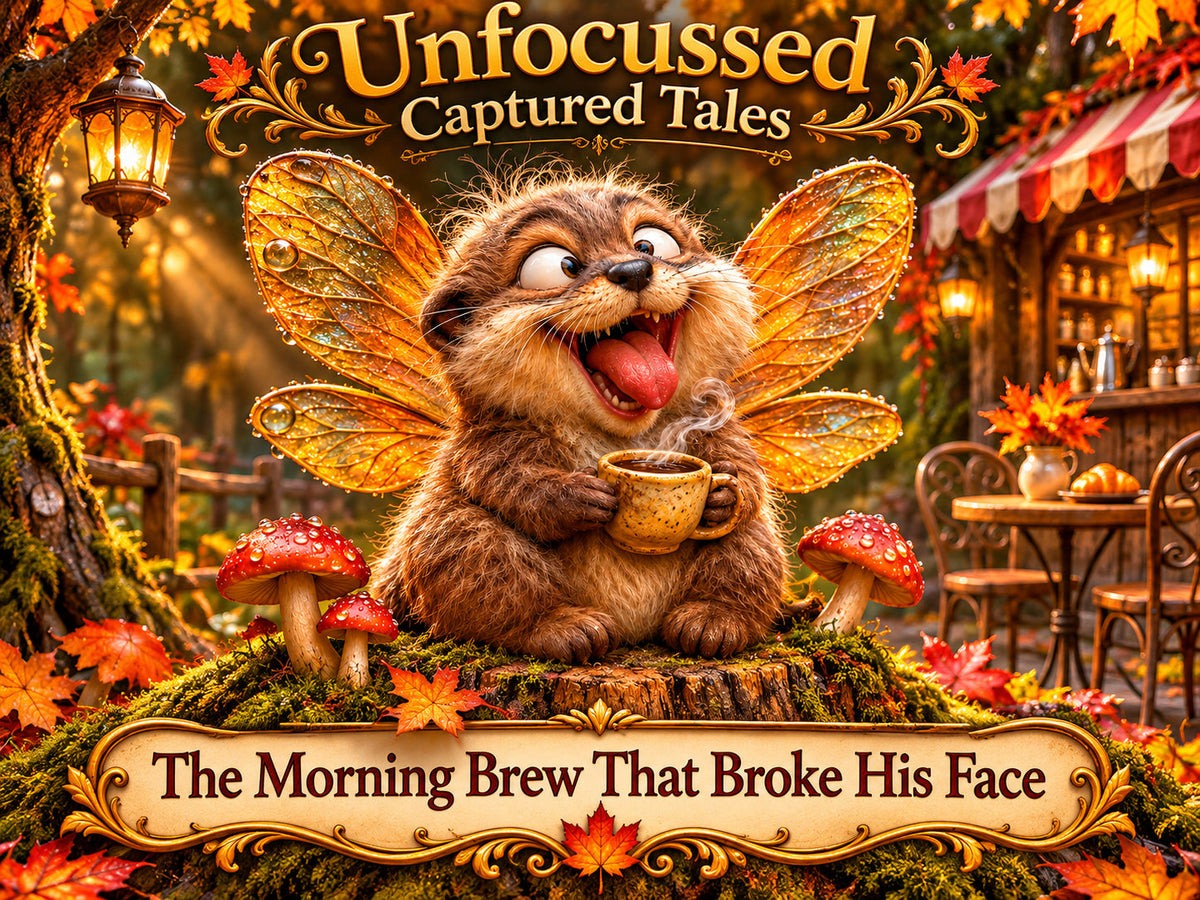
A Face the Village Could Read
Fenrick had spent the night with the cooper, and the only woodland creature entitled to know what happened was the cooper. This was not because anything scandalous had occurred. It was because something lovely had, and Fenrick had learned that lovely things survived longer when the whole village did not get its sticky fingers on them.
They had eaten plum cake after midnight. They had argued, with great seriousness, about whether a kiss counted as a promise if one of them still had crumbs on their mouth. They had kissed again to test the matter. Fenrick had left just before dawn with his four amber wings folded against the morning chill, a small smile under his whiskers, and a very firm understanding that no public announcement was required.
Then he made the mistake of wanting coffee.
At the Stump Café, the first batch waited in a blue pot beside the window. Fenrick knew the place well. He had sanded the counter after last winter's beetle infestation and once talked the proprietor, Mrs. Thistle, out of charging extra for foam shaped like a heart. This morning she was out gathering fresh cream, leaving a sign that said HELP YOURSELF, PAY HONESTLY, AND FOR THE LOVE OF MOSS DO NOT TOUCH THE RED POT.
The red pot sat on the far shelf. Fenrick did not touch it. He poured from the blue one, dropped a coin in the tin and took his little ceramic cup to the stump outside. Steam curled around his nose. A woodpecker practiced rude percussion overhead. The world appeared willing to let him have a quiet morning.
The coffee tasted of dark roast, orange peel and a faint sweetness he could not place. Fenrick swallowed. His eyes crossed. His tongue flew out with the conviction of a creature trying to escape its own face. All four wings sprang wide, scattering droplets of dew. He could have blamed the heat or the strength of the brew. Instead, his face briefly became a bright, hovering copy of itself above the cup, twice the size and much less discreet.
It winked.
Fenrick did not wink. He was busy coughing. The floating face performed a second wink, followed by an expression of such spectacular satisfaction that even the woodpecker missed a beat. Fenrick ducked behind the cup. The face remained in the air like an extremely personal weather report.
Two beetle sisters passed on their way to the bakery. One of them saw the apparition. The other saw Fenrick's wings and the hour. Their joint conclusion formed before either had taken a second breath.
“Well,” said the first sister.
“Well indeed,” said the second, and both went to tell absolutely nobody, which in the village meant everybody before breakfast.
Fenrick waved at the hovering face. It copied his arm movement but chose a leer for its mouth. He pulled his wings tight. The face developed a blush. He tried to think of tax forms, cold porridge and the smell of damp rope. That only made it look as if he had remembered something filthy and regretted enjoying it.
By the time Mrs. Thistle returned with cream, the café steps held an audience. A mushroom picker asked whether Fenrick had spent the night at the cooper's. A squirrel asked whether the cooper had survived. Someone in the back wanted to know if four wings made the furniture situation complicated.
“I had coffee,” Fenrick said.
The floating face rolled its eyes and blew an extravagant kiss toward the crowd.
Mrs. Thistle set down her cream pail. She looked at the blue pot, then at the red pot, then at Fenrick's cup. “That is not ordinary coffee.”
“You said not to touch the red pot. I didn't.”
“I know. I put the test batch in the blue one while I cleaned the red.”
Fenrick considered the sign, the pot and the growing crowd. “That seems like a design flaw.”
Mrs. Thistle winced. She explained that a traveling roaster had left a sample of echo-blossom beans, promising they would give a drinker a little more sparkle. She had intended to test them alone before serving anyone. She had forgotten to move the sample after switching pots. The echo blossom, it appeared, did not reveal secrets or read minds. It simply magnified whatever a face was already doing, then improvised like a drunk actor who believed every gesture needed a second curtain call.
“So that thing isn't my thoughts?” Fenrick asked.
“No,” Mrs. Thistle said. “It is your face, with a terrible sense of timing.”
From the crowd came a disappointed little murmur. The floating face turned toward it and raised one eyebrow with such indecent confidence that the murmur returned in force.
Fenrick felt heat rise beneath his fur. He was not ashamed of the night, nor of the cooper. He was furious that strangers had taken a picture made of steam and decided it belonged to them. He asked Mrs. Thistle how long it would last.
She opened the roaster's label. The instructions, printed in letters small enough to require a beetle's eyesight, offered no answer. They did say to keep the beans away from children, which made Fenrick grateful that the crowd consisted entirely of adults and less grateful for Mrs. Thistle's new expression.
“We'll stop serving it,” she said. “And find that roaster.”
“Good,” said Fenrick. “But first, tell these people what you told me.”
She faced the steps. “The coffee caused the floating face. It cannot show anyone's memories. It cannot confirm where Fenrick spent the night.”
The crowd listened. Several nodded. Then the second beetle sister asked, “So you're saying there was a night?”
The floating face winked again. Fenrick set down his cup with exquisite care. He had a feeling this morning would take longer than the coffee had.
Everybody Had an Opinion
Mrs. Thistle covered the blue pot, but the village had already drunk its fill of the story. By midmorning, Fenrick had supposedly left the cooper's house through a bedroom window, a pantry hatch and an opening in the roof that did not exist. A hedgehog insisted the floating face was proof of a proposal. A frog called it proof of the opposite. Someone asked whether the cooper would be taking commissions for beds with wing clearance.
Fenrick tried to walk home. The face bobbed beside him, smiling as if it had bought a ticket to the performance. Every time he hurried, it floated faster. Every time he lowered his head, it tipped its chin in triumph. He considered the creek, but did not trust an enchanted echo with reflections.
At the bridge, the cooper waited with a box of repaired hinges under one arm. They had heard the rumors before hearing what had caused them. Their first look was for Fenrick's eyes, not the ridiculous apparition.
“Are you all right?” they asked.
“Physically, yes. Socially, I may have to move to a different forest.”
The cooper studied the floating face. It displayed an expression best reserved for the privacy of a closed door. “That isn't how you looked last night.”
“I know. I was much more dignified.”
“You tried to eat plum cake while kissing me.”
“I said more dignified, not successful.”
They laughed, but the cooper's hand tightened on the hinge box when three neighbors appeared at the far end of the bridge. Fenrick understood. The previous night had been theirs together. The morning's spectacle was his, and now the village wanted to charge admission to both.
“I can tell them this has nothing to do with you,” Fenrick said.
“You can tell them it isn't their business. Please don't make up a story on my behalf.”
He nodded. The distinction mattered. Privacy was not something he could protect by grabbing it away from the person beside him.
The neighbors approached with false innocence and remarkable speed. Fenrick told them the coffee was enchanted, the face was an effect, and no one had permission to question the cooper. The apparition chose that moment to press its lips together and make an appreciative noise like a teakettle with poor manners.
One neighbor nearly swallowed her own hat ribbon. Another said, “I think it just answered us.”
“It didn't,” said the cooper. “And neither will I.”
That should have ended it. Instead, the woodpecker arrived with news that the traveling roaster had set up a tasting stall in the market. A chalkboard advertised ECHO BLOSSOM: THE BREW THAT SHOWS WHAT YOU REALLY MEAN. A line of adults curled past the mushroom seller. Some wanted to find out whether their partners were sincere. Some hoped to be noticed by a partner they had not yet dared to approach. A few simply wanted to watch someone else make a face.
Fenrick and the cooper went together, not as an announcement but as two people with a problem to solve. Mrs. Thistle had already reached the stall. She was demanding the label be corrected and the batch recalled. The roaster, a slim moth with a polished kettle and a practiced smile, held up a packet of beans as though it were a royal decree.
“Nothing harmful,” he said. “A harmless little echo. Look at the interest.”
“Your sign says it shows what people mean,” Fenrick said. “It doesn't.”
“It shows a little something.”
“It shows my face being directed by an idiot.”
“Not every customer gets such a strong result,” the moth replied, and glanced at Fenrick's four wings as though they explained a private defect.
The cooper set the hinge box on his counter. “Your label also says to keep it away from children. Did you tell the customers in that line?”
The roaster's smile lost a fraction of its shine. The adults in line looked at the packet, then at one another. At that moment a baker at the front took a sample. A pale, enormous version of her face appeared above the stall and made a delighted, almost lecherous expression at a passing badger.
The baker was married to no one and owed no one an explanation. She did, however, turn bright red as three people began congratulating the badger on a romance neither of them had agreed to. The badger looked ready to crawl into the nearest sack of flour.
“There,” the roaster said weakly. “A conversation starter.”
“You started it without asking either of them,” Fenrick said.
The baker's face-echo kissed the air. Hers, below it, looked horrified. Mrs. Thistle raised her voice. “No one else drinks this until we know exactly what it does and how long it lasts.”
The roaster protested that he had paid for the stall and printed a hundred labels. The council steward, hearing the crowd, arrived in a waistcoat so stiff it looked personally offended by flexibility. He declared a hearing at noon. He asked Fenrick to attend as the first affected drinker.
Fenrick looked toward the cooper. They squeezed his paw once and let go. “I'll be there,” they said, “if you want me.”
“I do. But you don't owe the council last night.”
“Neither do you.”
For the first time that morning, the floating face fell quiet. It hovered above them with a blank, almost thoughtful expression. Fenrick suspected even bad magic could recognize when it had reached the edge of a joke.
What the Cup Could Not Tell
At noon the council steward assembled everyone beneath the old oak. He placed the roaster on one side of a table, Mrs. Thistle on the other, and Fenrick in the middle, where a citizen with four wings could be seen from every angle. The baker stood nearby with her face-echo still hovering above her. It had spent the last hour smiling at trees, rocks and one startled beetle. The badger to whom it had appeared to make a proposition had gone home to recover from being publicly courted by a person who had done no such thing.
“We are here,” the steward began, “to determine whether the coffee reveals the drinker's true intentions.”
“We are here,” Fenrick said, “because the roaster told everyone it did.”
That earned him a tap of the steward's gavel, which was a walnut on a stick and no more authoritative for the effort.
The roaster explained echo blossom as a natural enhancement. He spoke at length about aroma, theatrical lift and the importance of honest conversation. He did not explain why the packet promised knowledge of a stranger's private thoughts. When Mrs. Thistle asked, he described the wording as “poetic.”
“So is a sign that says the moon will marry your sandwich,” she said. “You still shouldn't print it on lunch.”
Fenrick took his place before the table. The apparition above him looked thrilled. He told the council exactly what he had consumed and how the face appeared. He described its gestures, including the ones he wished it had kept to itself. He did not describe the cooper's house.
“What were you thinking when it first winked?” the steward asked.
“That I'd burned my tongue.”
“And when it blew a kiss?”
“That Mrs. Thistle should use larger handwriting on her labels.”
The steward glanced up. The floating face made a suggestive little O with its mouth. “That is difficult to reconcile.”
“Only if you assume it knows more than I do,” Fenrick said.
The baker stepped forward. Her echo was currently leering at the council's ceremonial inkpot. “I was thinking about whether I'd left my oven on,” she said. “If this thing is announcing my deepest desires, my deepest desire is apparently stationery.”
“Some of us have had relationships with worse,” murmured Mrs. Thistle.
The laugh that followed was the first one all day that did not land on Fenrick. It loosened something in the crowd. The badger, who had returned after all, said he and the baker had never arranged a meeting. The baker said she would be happy to speak to him someday, privately, if both of them wanted to. The badger agreed. Neither floating face was consulted.
The steward asked the roaster for his preparation notes. The moth hesitated, then produced a folded sheet from his apron. It confirmed that echo blossom amplified facial movements, sometimes held them in the air for several hours, and had no known power to retrieve memories or intentions. The warning about children was clear. So was a final sentence recommending that the effect be demonstrated only to willing adults who understood what might appear.
Mrs. Thistle took one look at it and said, “You left that sentence off the packets.”
“There wasn't room.”
“You found room for the lie.”
The steward's walnut landed on the table. The roaster would take back every unserved packet, refund the customers who wanted their money and correct the label before selling another bean. Mrs. Thistle would post a clear notice and keep all test batches behind the counter, in a container that could not reasonably be mistaken for the breakfast pot. The café would offer the affected drinkers a proper meal and, once their faces returned to ordinary size, an ordinary cup of coffee.
Fenrick appreciated the remedies. He also knew the rules would not make the whispers vanish by themselves. He looked at the crowd. The floating face mirrored him, suddenly solemn.
“For the record,” he said, “I spent last night with someone I care about. We are adults. It was ours. A cup of coffee did not turn it into a public meeting.”
One of the beetle sisters opened her mouth, then closed it. The other studied her shoes. Fenrick did not demand their embarrassment, but he let the silence last long enough to be useful.
The cooper stepped beside him. “You may ask whether the coffee is safe. You may not ask what happened in my home. Those are different questions.”
The baker lifted a hand. “And please stop telling the badger I proposed to him with my forehead.”
“I had heard it was a wink,” said the badger.
“It was an oven.”
“That makes more sense.”
One beetle sister apologized to Fenrick. The other apologized to the cooper and promised to correct the story she had spread. More followed, awkwardly. Some were sincere. A few sounded like they were apologizing to escape the discomfort of hearing themselves. Fenrick accepted what he could and did not pretend the rest had never happened.
By late afternoon the echo faces began to thin. The baker's was first to go, dissolving into a pale ribbon of steam. Fenrick's held on until he and the cooper reached the bridge. There it gave one last outrageous wink, as if determined to have a final word, and vanished.
Fenrick exhaled. “I may never drink coffee again.”
“You said that when you spilled a cup on your wings last spring.”
“I meant it more this time.”
The cooper took his paw. They walked home without announcing where, and the village, for once, allowed them the courtesy of an unfinished story. The next morning Mrs. Thistle served Fenrick a small cup from a plainly labeled pot. He took one cautious sip. His face did something spectacular.
It smiled.
Take the Morning Home, Minus the Rumors
Fenrick's face became the village's favorite story without his permission. The artwork that inspired his thoroughly inconvenient cup deserves a quieter place to be enjoyed. Give that four-winged grin its own corner with a framed print, where the autumn color and tiny cup can do all the talking.
If you like your mornings in pieces, try the jigsaw puzzle. If you prefer to keep a hot drink and your dignity at the same time, the coffee mug carries the same original artwork. And a greeting card lets you send somebody a smile without telling the entire village why.

 Sir Jamwick and the Tart He Absolutely Didn't Touch
 The Cranberry That Picked the Wrong Nose
 The Scarf That Wouldn’t Let Go