
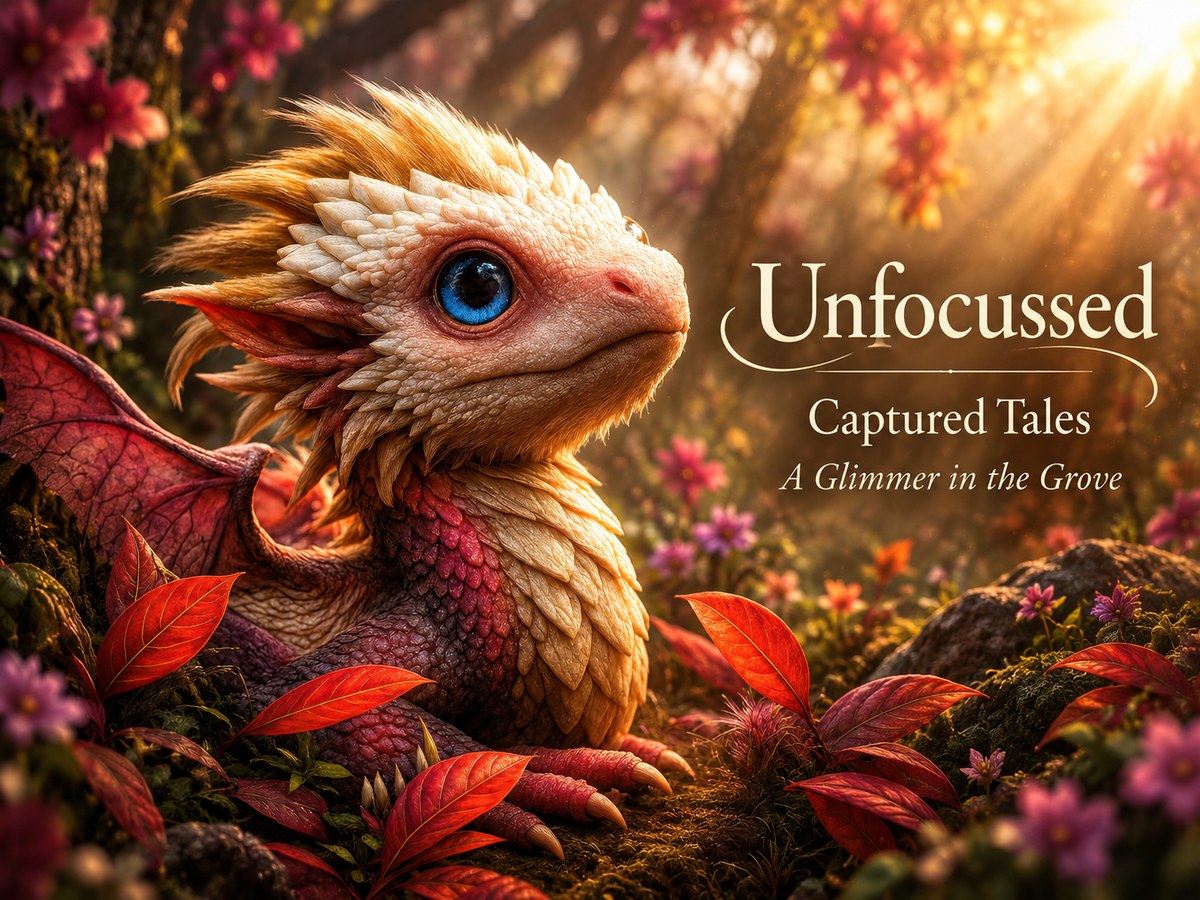
The World’s Most Inconvenient Miracle
The dragon was not supposed to exist.
At least, that’s what they told Elira back in the Overgrown Library, between musty sips of mildew-scented tea and “you wouldn’t understand, dear” looks from mages with more beard than bones. The grove’s flame-blooded dragons were extinct, extinct, extinct. Full stop. Period. End of one very specific majestic lineage. Other dragons might be somebody else’s paperwork; the Library insisted that none of these had hatched locally in centuries. Elira had spent six years copying its field notes and practicing its modest household wards. She trusted the wards rather more than the scholars. Which is why Elira was fully unprepared to discover one sitting in her breakfast bowl.
Yes, the egg had looked odd—like a glittering gob of moonlight dipped in raspberry jam—but she’d been hungover and ravenous and assumed the innkeeper was just very into poultry aesthetics. It wasn’t until her spoon clinked against the shell and the entire thing wobbled, chirped, and hatched with a dramatic “ta-da” puff of flower-scented smoke that Elira finally dropped her spoon and screamed like someone who had found a lizard in their latte.
The creature that emerged was absurd. A sassy marshmallow with legs. Its body was covered in cream-and-gold scales beneath a soft, tawny mane, with rose-colored wings and a peach-pink snout. Autumn light caught every little ridge whenever it tilted its head. Which it did often, and always with the bored grace of a woodland diva who knows you’re not paying enough attention to its tragic cuteness.
“Oh, no. Nope. Absolutely not,” Elira said, backing away from the table. “Whatever this is, I didn’t sign up for it.”
The dragon blinked its disproportionately large eyes—glittering oceans with lashes so thick they could swat away existential crises—and made a pitiful squeak. Then it flopped dramatically into her toast and made a show of dying from neglect.
“You manipulative little mushroom,” Elira muttered, scooping it off her plate before it soaked up all the jam. “You’re lucky I’m emotionally starved and weirdly susceptible to cute things.”
That was Day One. By Day Two, it had claimed her satchel, acquired the name “Pip” from Elira after its favorite squeaking noise, and emotionally blackmailed half the village into feeding it strawberries dipped in honey and affection. On Day Three, it started glowing. Literally.
“You can’t just glimmer like that!” she hissed, trying to shove Pip under her cloak as they passed through the Moonpetal Market. “This is supposed to be low-profile. Incognito.”
Pip, nestled in her hood, blinked up with the deadpan stare of a creature who had already filed a complaint with the universe about how loud her boots were. Then he glimmered harder, brighter, practically sending sunbeams out of his nose.
“You little spotlight, I swear—”
“Oh my gods!” cried a woman at a jewelry stall. “Is that a dracling?”
Pip chirped smugly.
Elira ran.
The next time they hid out, it was in an overgrown grove so thick with pink foliage and lazily swirling pollen, it looked like a perfume ad for woodland nymphs. It was there—deep in the heart of that glimmering bower—that Pip curled up beside a mushroom, sighed like a toddler who’d just manipulated their parent into a pony, and gave her the look.
“What?” she asked, arms crossed. “I’m not adopting you. You’re just tagging along because the alternative is being dissected by weird scholars.”
Pip pressed a paw to his heart and fake-wept. A nearby butterfly passed out from emotional exposure.
Elira groaned. “Fine. But no peeing on my boots, no catching fire indoors, and absolutely no singing.”
He winked.
And thus began the most gloriously inconvenient relationship of her life.
Small Wings, Spectacular Consequences
Life with Pip was an exercise in boundaries, all of which he ignored with the reckless abandon of a toddler on espresso.
By the second week, Elira had learned several painful truths: Pip shed little flakes of scale, collected shiny things (including, unfortunately, live bees), and could cry in a pitch so high it made her brain do origami. She released the bees. He considered this a hostile takeover. He also bit things when startled—including her left butt cheek once, which was not how she envisioned her noble destiny unfolding.
But she couldn’t deny it: there was something kind of... magical about him. Not in the expected “oh wow he breathes fire” way, but in the “he knows when I’m crying even if I’m three trees away and hiding it like a champ” way. In the “he brings me moss hearts on bad days” way. In the “I woke up from a nightmare and he was already glaring at the darkness like he could bite it into submission” way.
Which made it really hard to be rational about what came next.
His first uncontrolled flares. Or, as she came to know it: the Fourteen Days of Magical Hellscapes. He was still a hatchling, still learning what belonged inside his mouth and what very emphatically did not.
It started with a sneeze. A tiny one. Adorable, really. Pip had been napping in her cloak, curled like a cinnamon roll with wings, when he woke up, sniffled, and sneezed—sending a flash of fire through the edge of her bedroll and into two nearby bushes. A perfectly innocent songbird escaped mid-aria, returned to a higher branch, and delivered what sounded like a formal complaint. Elira smothered the flames with damp earth before she allowed herself to panic.
“We’re going to die,” Elira said calmly, ash in her eyebrows. Then she fetched water, checked the roots for embers, and made Pip sit beside her while they cleaned up. His miserable little squeaks did not repair a bedroll. Her sewing, unfortunately, would have to.
Over the next fortnight, Pip did the following:
- Set fire to their soup. From inside his mouth. While trying to taste it.
- Flew for the first time. Into a tree. Which he then tried to sue for assault.
- Discovered that tail flicks could be weaponized emotionally and physically.
- Shrieked for four hours straight after she called him “my spark nugget” in front of a handsome potion courier.
But worst of all—the horror—was when he started talking.
Not in words at first. Just humming noises and emotional squeaks. Then came gestures. Dramatic head flops. Pointed sighs. And then... words.
“Elri. Elriya. You... you... potato queen,” he said near the end of their fourth week together, puffing his chest with pride.
“Excuse me?”
“You smell like... thunder cheese. But heart good.”
“Well, thank you for that emotionally confusing statement.”
“I bite people who look at you too long. Is love?”
“No. Love means telling me you’re worried. Teeth stay out of people.”
“I love Elriya. But also love sticks. And cheese. And murder.”
“You heard that last one from the innkeeper complaining about his accounts. You don’t know what it means.”
“Bad numbers?”
“Extremely bad numbers. We’re sticking with cheese.” She let him curl into her lap, half-laughing, half-crying, and moved his experimenting teeth away from her sleeve.
That night, she couldn't sleep. Not from fear or Pip-induced anxiety (for once), but because something had shifted. There was a connection between them now—more than instinct, more than survival. Pip had tangled his little dragon soul into hers, and the damn thing fit.
It terrified her.
She’d spent years alone on purpose. Being needed, being wanted—those were foreign currencies, expensive and risky. But this pink, glowing, emotionally manipulative salamander with opinions about soup was cracking her open like a fire-blossom seed in summer.
So she asked for a morning to herself. Asking felt, inconveniently, much harder than running.
At dawn she took Pip to the innkeeper, who had a walled garden, a water bucket, and surprisingly firm opinions about fireproof babysitting. She told Pip she would return by lunch, left her scarf for his nest, and walked to the edge of the grove. She needed enough quiet to hear her own thoughts without the soft weight of his trust on her ribs.
By noon, she’d cried twice, punched a tree, and eaten half a loaf of resentment bread. She missed him like she’d grown an extra limb that screamed when he wasn’t nearby.
She returned just after sunset. The innkeeper met her at the garden gate. “He’s safe. He’s been asking since lunch. Next time, send word.” There was no cruelty in it, which made it much worse.
Her scarf lay on the garden bench beside three moss hearts and a flat stone. The innkeeper had written down the words Pip kept repeating, each one a small, stubborn instruction.
Elriya go. Pip wait. Scarf here. Elriya come back.
She sat down so fast her knees cracked. The stone burned in her palm.
He had trusted the time she gave him. She had let that time pass. Loving him was not going to make her promises less important.
She found him in the low crook of the innkeeper’s willow, within reach of the garden bench, surrounded by shiny twigs, abandoned buttons, and the broken dreams of seventeen butterflies who couldn’t emotionally handle his brooding energy.
“I’m sorry I’m late,” she whispered, crouching where he could see her. “I said lunch. I should have sent word.” She held out her hands and waited until he climbed into them.
He just snuggled under her chin and whispered, “Thunder cheese,” with tearful sincerity.
“Yeah,” she sighed, stroking his wing. “I missed you too.”
Later that night, as they curled in the soft glow of the grove’s pulsing flowers, Elira realized something. She didn’t care that he was a dragon. Or a magical miracle. Or a flammable cryptid toddler with abandonment issues and a superiority complex.
They had chosen one another. She still needed quiet sometimes; he still needed somebody to come when she said she would. Tomorrow she would start with a shorter walk and a promise she could keep.
And that was enough to start a legend.
A Light No Cage Could Keep
The thing no one tells you about raising a magical creature is that eventually… someone comes to collect.
They arrived with cloaks of starlight and egos the size of royal dining halls. The local Conclave of Eldritch Preservation—an aggressively titled group of magic academics with too many vowels in their names—descended upon the grove with scrolls, sigils, and smugness.
“We sensed a breach,” intoned a particularly sparkly wizard who smelled like patchouli and judgment. “A resurgence of the grove lineage. It is our sworn duty to protect and contain such phenomena.”
Elira folded her arms. “Funny. Because Pip doesn’t seem like a phenomenon to me. More like a sassy, stubborn, pants-biting family member with an overdeveloped sense of justice and an underdeveloped understanding of doors.”
Pip, hiding behind her legs, peeked out and burped up a fire-spark shaped like a middle finger. It hovered, wobbled, and winked out with a defiant pop.
“He is dangerous,” the wizard snarled.
“So is heartbreak,” Elira replied. “And you don’t see me locking that in a tower.”
They weren’t interested in nuance. They brought binding chains, glowing cages, and a spell orb shaped like a smug pearl. Pip hissed when they approached, his wings flaring into delicate arcs of light. Elira stood between them and pulled her old warding chalk from her pocket. The little circle she drew was the same one that kept kitchen sparks off curtains. It would not stop a determined mage. Her hand shook anyway; she finished it.
“I will not give him up,” she growled.
“You will not survive this,” the lead wizard said.
“You clearly haven’t seen me before coffee.”
Then Pip flared.
Not with fire this time. For days Elira had noticed him grow brighter in the sunny grove and dimmer after an evening of glimmering. Now all that gathered light poured out at once. One second, he was a slightly-too-round sparkle-lizard with opinions about soup. The next, he was a deeply inconvenient little sun.
Light caught the leaves and scattered through the pollen. Pip beat his wings, rising barely above Elira’s knee. Even the smug wizards backed the hell up, blinking spots out of their vision. It was no divine transformation: his wings were trembling with effort. He used the few words he had.
“Not thing,” he said. “Not cage. Pip stay here.”
“She is unqualified,” a mage blurted, clutching his scroll like a security blanket.
“She feed Pip. She come back. Say sorry.” His glow flickered. “Pip choose Elriya.”
Elira, for once in her entire life, was speechless.
Pip dropped into her waiting hands, suddenly dim and exhausted. “Elriya mine?” he asked, nudging her thumb.
“Your family,” she whispered, eyes wet. “Not your possession. You brilliant, flaming little emotional grenade.”
The Conclave left. Whether by fear, awe, or simple exhaustion from being out-sassed by a dragon the size of a decorative pillow, they retreated with a promise to “monitor from afar” and “file an incident report.” Elira insisted that any return visit begin at the inn, with the innkeeper present and the cages left behind. Their chief mage agreed through pinched lips. Pip slept through the paperwork and most of the following day; spending all his light had left him with very little interest in being a legend.
In the weeks that followed, something inside Elira changed. Not in the sparkly, Disney-montage way. She still cursed too much, had zero patience, and over-salted her stew. But she was... open. Softer in strange places. Sometimes she caught herself humming when Pip slept on her chest. Sometimes she didn’t flinch when people got too close.
And Pip grew. Slowly, but surely. Wings stronger. Spines sharper. Vocabulary increasingly weird.
“You are best friend,” he told her one night under a sky littered with stars. “And noodle mind. But heart-massive.”
“Thanks?”
He licked her nose. “I stay. Always. Even when old. Even when fire big. Even when you scream at soup for not being soup enough.”
She buried her face in his side and laughed until she sobbed.
Because he meant it.
Because somehow, in a world that tried so hard to be cold, she’d found something incandescent. Not perfect. Not polished. Just... pure.
And in the heart of the grove, surrounded by blossoms and moonbeams and a small dragon still learning that affection did not require teeth, Elira finally allowed herself to believe:
Love, real love—the bratty, explosive, thunder-cheese kind—might just be the oldest kind of magic.
A Little Wonder to Come Home To
What draws me back to A Glimmer in the Grove is the quiet underneath Pip’s spectacular talent for trouble: that enormous blue eye, the light on his ivory scales, and the red leaves gathered around him like a small shelter. A canvas print gives those warm woodland colors a place to settle in your own reading corner. It is the original dragon portrait that inspired Elira’s inconvenient new family—a little reminder that the things we make room for can change the feeling of home.
If your favorite chair already has a story attached to it, the throw pillow brings Pip’s autumn grove a little closer. The greeting card is a gentler way to send someone a small, bright encouragement: no grand prophecy required, just a note that says you are thinking of them. You can explore the complete artwork listing for the available formats and choose the one that feels right for your space or your person.

 The Seedpod That Fired Before Anyone Was Ready
 The Blossom That Left a Mark
 The Witching Hour Went Sideways