
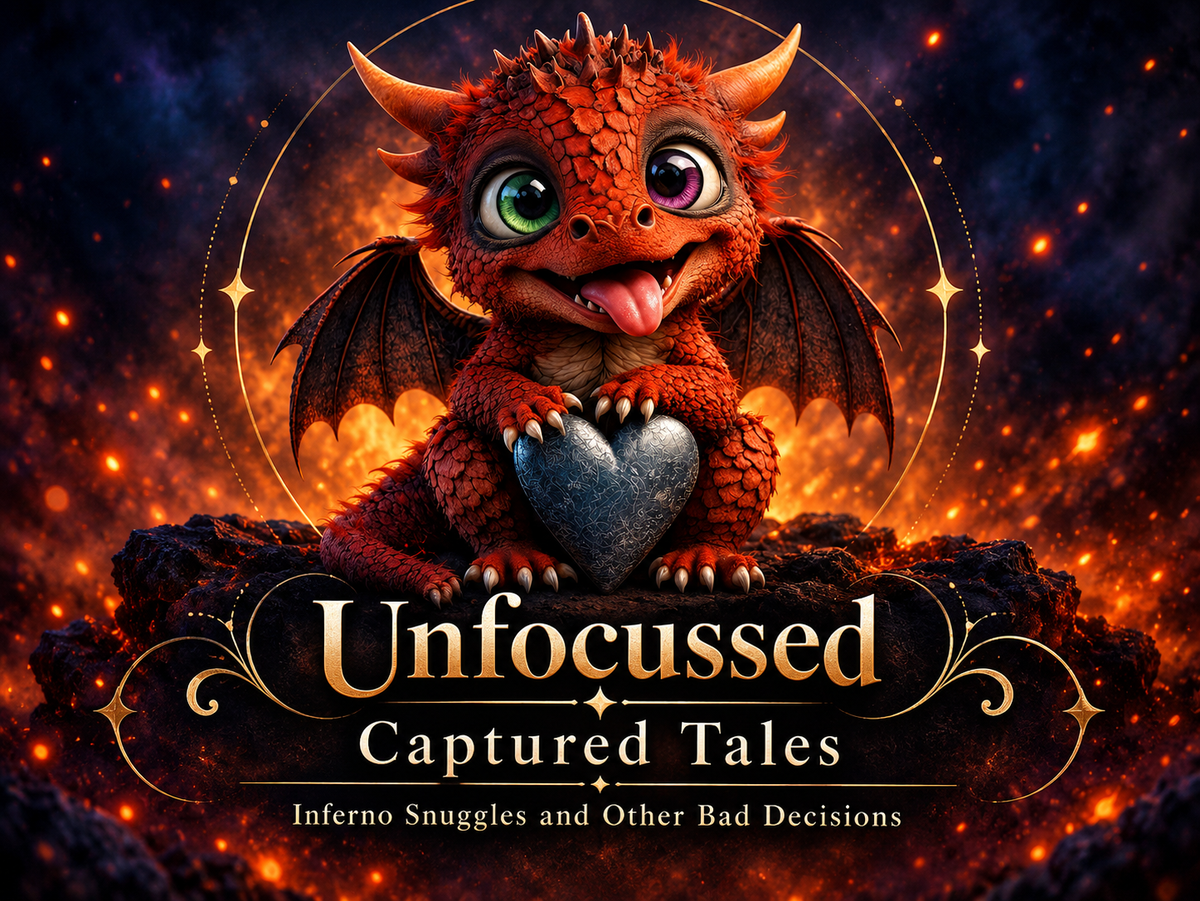
A Gift with Terrible Implications
There were, in Brimstone Vale, many important and ancient rules. Do not whistle into a sinkhole after midnight. Do not mock a widow made of smoke. Do not accept soup from anyone with glowing teeth. Aunt Vespera maintained that the last rule was unnecessarily restrictive, but she had also eaten a door because somebody had knocked on it too early.
Cinder knew the rules. Knowing things was one of his finest qualities. Remembering them at the appropriate moment was a separate department, currently understaffed.
He sat on a warm basalt stone at the edge of Blackglass Hollow, a hatchling the size of an overfed housecat, examining a silver spoon. His crimson scales looked like tiny plates of cooling lava. One eye was green, the other violet; both could achieve extraordinary innocence when something expensive broke nearby. His little dark wings were too small for his ambitions, and his tongue poked from the side of his mouth whenever he thought hard. At present, it hung out so far that a passing beetle took a sensible detour.
The spoon was for Maribel Thorne. It was an excellent spoon. It was also the mayor's spoon, although Cinder hoped the mayor might consider this a temporary administrative detail.
Maribel lived in Thistlefoot, a village with matching fences, tidy flower boxes and the deeply unsettling habit of apologizing to people before asking them to move. Cinder regarded it with suspicion. Nothing that smelled so consistently of cinnamon could be entirely honest. Nevertheless, he visited almost every day.
Three weeks earlier, she had found him in a rusted fox trap behind the old road chapel.
He had been inspecting a tinker's scrap heap. Inspecting was an important scholarly activity in which one put interesting things in one's mouth to determine whether they belonged there. The trap had closed on his foreleg, ending his research with a noise he could still hear when the wind rattled a loose shutter.
He had screamed. He had scorched the nettles. He had bitten a wheel spoke in half, which had been satisfying but useless. Then dusk had come, and all his furious noise had dwindled to frightened little breaths.
Maribel had arrived carrying a basket and wearing the expression of a woman who had already dealt with enough nonsense for one day. She set the basket down anyway.
“Well,” she said, crouching beyond the reach of his teeth. “You are either a very small dragon or a deeply upsetting lizard.”
Cinder tried to snarl. His leg hurt too much.
“Dragon it is. I’m going to open this. Please don't set my eyebrows on fire.”
She explained what she was doing before touching him. She wedged the jaws apart with a piece of timber, wrapped his leg in a clean strip from her basket and waited while he decided whether standing was still something he believed in. When he offered her a dead mole in a dazed burst of gratitude, she looked at it, looked at him and said, “That is revolting. But I appreciate the sentiment.”
Then she took him to Aunt Vespera's warm ruins above Blackglass Hollow. Cinder had expected a lecture about scrap heaps. He got one, but only after Vespera had checked his leg, tucked him beneath a wing and stopped shaking quite so visibly.
Maribel came back the next afternoon with fresh bandages.
And the next.
By the fourth visit, Cinder knew the sound of her boots on the outer steps. By the sixth, he had begun waiting before lunch. By the ninth, the wound had closed and he could walk without limping.
“There,” Maribel said. “You won't need me fussing over you every afternoon now.”
She meant that he was healing. Cinder heard that kindness had an ending date.
He did not ask what she meant. Asking would have required admitting that the idea frightened him, and he was a dragon. Dragons had opinions, magnificent teeth and, according to several extremely unreliable songs, no feelings that could not be resolved by burning a hillside.
So he decided to become indispensable.
The spoon was his opening argument.
He left it on her doorstep at dawn and hid in the hydrangeas. Maribel picked it up, turned it over and read the mayor's initials.
“Cinder.”
A leaf moved.
“I can see your tail.”
He pulled the tail farther into the bush, leaving his horns exposed.
“This goes back.”
“It is very shiny.”
“Its shine is not the difficulty.”
They returned it together. The mayor made a long speech about civic property. Cinder listened with one eye on a brass paperweight until Maribel quietly moved it out of reach.
The following morning he brought a necklace made from polished crow bones, red thread and one excellent button. Maribel studied it for some time.
“Did anything alive object to becoming this?”
“No.”
“Did anybody own the button?”
A pause.
“Vespera said I could have it.”
“Then thank you.”
She hung the necklace beside the back door, where it would not alarm visitors quite so immediately. Cinder went home in a state of triumph so intense that he walked into a watering can.
Then came a scorched teapot, a fox skull, three stones he hoped might be rubies and a trout partly cooked by accident. Maribel accepted the stones after he explained where he had found them. The teapot belonged to Pella. The trout went into the compost. The skull received a firm, courteous refusal.
“You don't have to bring something every time,” she told him.
Cinder stared at the rejected skull. Perhaps she meant he had to bring something better.
His visits had become a private examination for which nobody would explain the marking system. A smile meant he was doing well. A closed door meant disaster, even when Maribel was simply out buying flour. If she was tired, he worried. If she was busy, he presented an object. If she said she would see him tomorrow, he began planning how to earn tomorrow.
One afternoon he heard Elsie, the baker's daughter, teasing Maribel outside the shop.
“Another tribute?” Elsie asked, pointing to the bone necklace visible through Maribel's open kitchen window.
“He is trying to say thank you.”
“Quite thoroughly.”
“I'd rather he brought himself and told me honestly what he needed.” Maribel heaved a flour sack onto her shoulder. “Something with heart would do. No more stolen silver.”
Cinder, listening beneath the cart, stopped breathing.
Something with heart.
At last. Instructions.
A wiser creature might have noticed the first half of the sentence. Cinder seized the second half and ran away with it before wisdom could organize an interception.
He consulted Vespera that evening while she warmed a kettle between her forepaws.
“What is a gift with heart?”
“One you mean,” she said.
“What if you mean it a great deal?”
“Then you generally don't need to shout.”
“What if it must make someone stay?”
Her head came up. “Why must someone stay?”
“For theoretical reasons.”
Vespera set the kettle down. “Come here, theoretical reasons.”
But Cinder had already backed toward the steps, embarrassed by the sudden softness in her voice. He announced that he needed to inspect a stone and left before she could ask which one. There were plenty of stones. It was an excellent excuse.
His second consultation was with Old Soot, a salamander who lived near the sulfur pools and claimed to have advised queens. Cinder suspected he mostly shouted predictions at bats and let rumor do the rest.
“I need a heart,” Cinder said.
“Seven beetles,” said Old Soot.
Cinder brought nine. This was important.
The salamander swallowed, considered his customer and said, “Heartvault. Inside the mountain. They make things that keep promises.”
“What sort of things?”
“Heavy things.”
“Will it work?”
“Everything works. Whether you like what it does is a different question.”
Old Soot then closed his eyes, which Cinder interpreted as profound concentration. It was, in fact, the beginning of a nap.
There were many stories about the Heartvault. A smith who hammered feelings into iron. A forge built over a dying god. A machine that could make a promise too heavy to break. None of the storytellers agreed, although they all spoke with the confidence of people who would never be asked to go down and check.
Cinder knew a fissure behind Widow Ash's orchard. He had been told not to enter it. On this occasion he remembered the instruction perfectly, which made ignoring it considerably less defensible.
At moonrise, he left Vespera a note: Getting a proper thank-you. Back soon.
He drew a reassuring flame beneath it.
Then he slipped into the mountain, carrying nine beetles' worth of advice and an idea that had grown much heavier than he was.
The Mountain That Took Him Literally
The tunnels smelled of hot minerals, wet soot and the sort of dampness that ought not to exist so close to lava. Cinder followed a narrow shelf above a dry channel, placing his recovering foreleg carefully. Every few yards he scratched a mark in the dust. He had enough sense to plan how to get out, just not enough to question going in.
Behind him, the orchard's strip of moonlight shrank to a pale thread and vanished.
He began talking to himself.
“A proper gift. Not silver. Not a skull. Very clear requirements.”
The tunnel returned skull with unnecessary enthusiasm.
“Nobody asked you.”
Crystals clustered in the walls. Beneath them lay things previous travelers had dropped: a dented lantern, a buckle, a pair of tongs almost consumed by rust. Cinder passed a row of small alcoves holding iron shapes on stone shelves. Rings. Knots. A clasped pair of hands. Some were cold and black. Others glimmered with a sullen red line.
Above each alcove was the same pattern: an object carried toward an anvil; an open hand beneath it; the object resting on the anvil again. Under the pictures, letters had been cut into the rock. He recognized only a few. The old script was not among the things he had learned while inspecting scrap heaps.
A smarter traveler might have copied the symbols and gone home to ask. Cinder thought they were directions to the gift counter.
He reached the forge an hour later.
The Heartvault was a cavern around an anvil platform, bounded by slow red channels of magma. Chains hung from the ceiling. Its pillars carried the same three pictures he had passed in the tunnel, repeated larger here, with a worn inscription beneath the open hand.
A vast iron heart hovered over the anvil. It beat once, and dust loosened from the ceiling.
Cinder's tongue withdrew into his mouth.
“That,” he whispered, “may be slightly too large for her doorstep.”
The heart turned.
WHO SEEKS A BINDING?
Cinder jumped, scorched his own footprint and tried to stand in a more impressive arrangement.
“A thank-you. Ideally one that lasts.”
WHAT DO YOU ASK IT TO HOLD?
“A place.”
NAME THE PLACE.
He hesitated. Blackglass Hollow was home. Vespera was there, with warm stones and enough food and a wing that always lifted when he came near. But Maribel's kitchen had become another kind of safe place. He did not want to lose it simply because his leg no longer hurt.
“Somewhere beside someone,” he said.
The chains moved with a soft, deliberate clink.
NO WILL MAY BE BOUND THAT IS NOT OFFERED HERE.
“I'm not trying to make her do anything.”
That was almost true. He wanted a gift so magnificent that she could never close the door on him. He had not considered how closely that resembled making a choice for her.
The forge waited.
“I just want her to know I'm worth keeping.”
WHAT WILL YOU OFFER?
Cinder opened the little pouch he had brought. Three bright stones rolled onto the anvil. He added the remaining beetle, which had survived Old Soot by hiding in a seam and now made a determined bid for freedom.
NOT TAKEN THINGS. SOMETHING OF YOUR OWN.
His chest tightened. He had no money, no grand history, no useful skill that did not occasionally set something alight. He was small. His wings were unreliable. Sometimes he still woke with the sound of the trap in his head and needed Vespera to tell him where he was.
He was tired of needing.
“My fire,” he said.
The cavern brightened.
YOUR FIRE WILL REST IN THE TOKEN WHILE YOU HOLD ITS CLAIM.
“Rest sounds nice.”
YOU WILL FEEL ITS ABSENCE.
“Temporarily?”
The great heart turned far enough to reveal the open-hand symbol on the anvil behind it.
UNTIL THE CLAIM IS RETURNED, WITNESSED AND RELEASED.
Cinder looked at the symbol, then at the heart. He heard the word returned and assumed there was a refund policy. He was too embarrassed to ask what a claim was.
“And it will show her I mean it?”
IT WILL SHOW WHAT YOU HAVE GIVEN. IT CANNOT CHOOSE WHAT ANOTHER FEELS.
Later, he would remember that sentence very clearly. At the time he was thinking how wonderfully the iron would gleam on Maribel's table.
He stepped onto the center mark.
Light ran through the grooves beneath his claws. The great heart opened into black iron petals, and a smaller heart descended between them. It was broad enough for him to hug, hammered with tiny curling lines and dark as cooled cinders. He reached toward it.
The binding caught him beneath the breastbone.
There was no glorious burst of courage. There was a frightened cry and a sudden, terrible cold. His fire rose instinctively, then poured away from him in a red thread, winding through the iron.
He tried to pull back. The thread held for one last breath and snapped into the heart.
Cinder sat hard on the anvil.
“I don't like that.”
The voice did not congratulate him. The chains did not applaud. An old mechanism had done exactly what he had asked it to do, and the fact that he was frightened did not make it wiser.
The heart settled into his forepaws. Its weight nearly tipped him over. When he pushed it away, cold tightened around his ribs. When he clutched it, the ache eased, but only a little.
WHAT IS BOUND MUST RETURN BY THE SAME WAY.
“Can I do that now?”
WITH A WITNESS. WITH AN OPEN HAND.
He looked at his claws wrapped around the iron. “I have hands.”
No answer came.
The forge had gone still. Cinder stood alone in the fading light, holding the thing that had seemed certain to solve his problem. He tried a tiny puff of flame. Nothing happened. He tried again, harder, and began to shake.
For a few moments he simply wanted his aunt.
Then shame arrived, offering its usual bad advice. He had come all this way. The gift was beautiful. Perhaps if Maribel liked it, the cold would mean something. Perhaps once somebody was pleased, he would stop feeling as if he had made a dreadful mistake.
He dragged the heart to the tunnel, then worked out how to carry it in short, awkward stretches. The iron would not fit in his pouch. It scraped his knees. Twice he had to stop and rest beside the marks he had scratched into the dust.
The beetle passed him on the way out.
“Don't,” he told it.
It had said nothing, but he recognized an opinion when he saw one.
By the time he reached Widow Ash's orchard, the sky had begun to pale. A thin crust of frost lay between the roots. Normally he would have enjoyed the hiss of it beneath his feet. This morning he felt every cold patch through his scales.
He could go north to Vespera. The path was familiar. He imagined showing her the heart and having to explain that he had been afraid to tell her he was afraid.
Instead, he turned toward Thistlefoot.
Maribel found him on her doorstep with his chin propped on the iron, trying to arrange his face into something triumphant. One wing drooped. His tongue was tucked away. His green eye watered in the morning cold.
She set down her basket so quickly that apples rolled across the floor.
“What happened?”
“I brought a proper thank-you.”
She knelt, keeping her hands where he could see them. “Cinder. Are you hurt?”
He opened his mouth to explain the craftsmanship. No words arrived.
“I can't make fire,” he whispered.
Maribel called Elsie through the open window. She asked for Vespera, immediately, and a blanket warmed by the bakery stove. Then she sat on the doorstep beside him, close enough that he did not have to wonder whether she had gone.
“Is it good?” he asked.
She looked at the iron heart. Then at his shaking paws.
“It's heavy.”
“I meant the gift.”
“So did I.”
That was when Cinder finally began to cry.
The Things Nobody Had Asked Him to Earn
Vespera reached Thistlefoot before the bakery's first batch had cooled. She landed badly in the square, knocked over an empty crate and left it where it fell. This alone told Maribel how frightened she was. Ordinarily Vespera would have found time to blame the crate.
Cinder lay beside the kitchen stove, wrapped in a blanket with the iron heart against his chest. Maribel had tried moving it onto a cushion within reach. The moment his paws left it, he began to shake more violently, so she put it back without testing anything else.
Vespera lowered her head until he could feel her breath.
“There you are.”
He waited for the lecture.
“I found your note,” she said. “Then I found Old Soot. He is having a less pleasant morning than he anticipated.”
“Did you eat him?”
“No.”
“Did you want to?”
“Very much. But I needed directions.”
He gave a tiny, watery laugh. She tucked one wing around him, careful of the iron, and listened while he told them everything. The beetles. The tunnel. The voice. The cold. He tried to make it sound less foolish. Vespera waited through the improvements until he began telling it plainly.
When he reached the part about giving away his fire, she closed her eyes. Maribel rested a hand on the table. Neither of them called him brave.
“I thought,” he said, “if it cost enough, you would know.”
“Know what?” Maribel asked.
“That I wasn't only a problem you had fixed.”
The kitchen grew very quiet.
“Oh, Cinder.”
He stared at the iron. “My leg got better. You said I wouldn't need you. I thought that meant you wouldn't come.”
Maribel sat on the floor in front of him.
“I said you wouldn't need bandages every day. I should have said it more clearly. I like seeing you. That was true before you brought me anything.”
“Even the spoon?”
“Despite the spoon.”
“What about the skull?”
“We have quite different ideas about kitchen decoration.”
“But—”
“You may ask to visit. I may be busy. Sometimes I'll say another day. None of that is a bill you pay by hurting yourself.”
He looked up, one green eye and one violet, searching her face for the small print.
“And if you don't want the heart?”
“Then I don't want the heart. That does not mean I don't want you in my life.”
Vespera shifted her wing closer.
“You already have a home,” she said. “A particularly well-heated one. You may have friends as well. You do not have to buy either arrangement.”
Cinder swallowed. It should have been a relief. Instead it hurt, because if he had asked one ordinary question three nights ago, he might still have his fire.
“Can we get it back?”
“We are going to find out,” said Vespera. “And we are not going to pretend that needing help is another failure.”
She knew some of the old forge script. Not because she had been secretly waiting for this exact disaster, but because her ruined home had once housed a smithy and she had spent several winters deciphering the warnings over its doors. She asked Cinder to draw the pictures he remembered.
He sketched the heart, the anvil and the open hand. Maribel wrote down the voice's words exactly as he could recall them. Where he wasn't sure, she left a space. No one filled the gaps with something reassuring.
“A binding held in an object,” Vespera said at last. “It hasn't destroyed your fire. It is keeping it somewhere you cannot use it.”
“Can you break it?”
She examined the metal without pulling it from him. “Not safely. If the forge tied the knot, we take the knot back to the forge.”
Cinder pressed his face into the blanket.
“I don't want to go there again.”
“I know,” she said. “You won't go alone.”
They waited until he had eaten and stopped trembling quite so badly. Vespera carried him in a sling against her chest, where her steady warmth reached his scales. Maribel brought a lantern, water, chalk and a coil of rope. At the orchard, Widow Ash showed them a broader old service entrance beyond the fissure. She had barred it years before after stones fell near the mouth; Vespera moved the loose rubble and checked the passage before letting the others through.
Maribel tied a bright cloth to the outer branch. This was a rescue, not an opportunity to become a second missing party.
The journey down took twice as long as Cinder remembered. They stopped at every crossing. Vespera read the inscriptions. Maribel marked their route. Cinder pointed out his scratches in the dust, and both adults thanked him for making them. He had done one useful thing. It was allowed to remain useful even in the middle of everything else.
At the alcoves, they halted.
Vespera brushed soot from the writing beneath the open hand.
“The token returns to the anvil,” she translated slowly. “The giver withdraws the claim. A witness confirms that nothing is being demanded in exchange. No replacement offering.”
Maribel repeated the last phrase.
“No replacement offering.”
Cinder looked toward the forge. “So you don't have to give it something instead?”
“Correct.”
“Not your fire?”
“Certainly not.”
“That seems...” He searched for a word.
“Less dramatic?” Vespera offered.
He nodded.
“Let us try less dramatic. It would make a refreshing change.”
The great iron heart turned when they entered. Heat moved over the platform, stirring the edge of Maribel's coat.
THE TOKEN RETURNS.
“Along with two complaints,” Vespera said.
Maribel touched her foreleg. They had come for Cinder, not to win an argument with an anvil.
They followed the carved path. At its center, Vespera lowered Cinder onto a warm stone bench beside the anvil. He clung to the small heart. Its engraved lines glowed red between his claws.
WHAT IS YOUR CLAIM?
He tried to say that he had only wanted to be kind. It was part of the truth, but the rest stood behind it, waiting.
“I wanted her to keep a place for me because I had given something important.”
The chains shifted.
“I didn't know how to ask.”
DO YOU WITHDRAW THE CLAIM?
He looked at Maribel. “Even if she says no sometimes?”
“Even then,” she said. “A yes means something because it can be chosen.”
His paws tightened. The heart had become both the proof of his mistake and the thing that kept the cold manageable. Letting go frightened him more than taking it had.
Vespera settled behind him, close enough for him to lean against.
“You can be frightened,” she murmured. “We are still here.”
Cinder pushed the iron onto the anvil. His claws followed it to the edge, then opened.
“I withdraw it.”
Maribel stepped beside him.
“I ask for nothing from him. I did not ask him to give up his fire. He owes me no part of himself for helping him.”
The heart opened along a narrow seam. A red thread rose from it, wavering like a wick in a draft.
Cinder flinched.
“Slowly,” Vespera said, to the forge, to him, perhaps to the whole ill-managed mountain.
The warmth returned in little waves. It hurt, but differently now: a cramped, thawing ache rather than the sudden hollow cold. He breathed against Vespera's chest while Maribel counted softly with him. Nobody asked him to make a speech. Nobody called the pain the price of love.
At last the light went out of the iron.
Cinder coughed a thin gray wisp.
He burst into tears again, this time with such force that Vespera had to tuck her chin over his head to keep him from knocking his horns against the bench.
The heart on the anvil had become an ordinary lump of metal. Maribel left it there. Taking it home as a souvenir would have missed rather a lot of the afternoon's point.
They emerged into the orchard after dark.
The next morning, Cinder still could not make a flame. Nor could he the morning after that. The binding was gone, but his body had been through something frightening and exhausting. Vespera kept him warm. Maribel visited when she could and told him when she couldn't. Elsie sent rolls shaped like dragons, all of them anatomically insulting.
He was not permitted back at the sulfur pools alone. Old Soot returned seven beetles, claimed the other two constituted a consultation fee and was informed by Vespera that there would be no further consultations with hatchlings. The orchard entrances received new barriers and warnings in plain village lettering. The Heartvault remained dangerous. One successful rescue did not make it a suitable place to prove a point.
On the eighth morning, Cinder sneezed a tiny spark into his porridge.
He stared at it.
Vespera stared at him.
“That,” she said at last, “was an appalling use of breakfast.”
Then she folded him under her wing so carefully that he knew how much she had wanted to do it.
His fire returned gradually. They practiced beside bare stone, with water nearby, and stopped when he grew tired. Some nights the old fear came back. He learned to wake Vespera. Some afternoons Maribel's door was closed. He learned to read the little note saying when she would be home, rather than filling the silence with his worst guess.
Several weeks later, he made her a different gift.
It was a small clay heart, lopsided and thumb-marked, fired under Vespera's supervision. One side carried a green dot, the other a violet one. In the middle he had scratched two words.
Thank you.
Maribel turned it in her hands.
“Did you steal anything?”
“No.”
“Bind anything?”
“Only a ribbon. Vespera checked.”
“And if I put it on the shelf?”
“That would be nice.”
“And if you come tomorrow and I'm out?”
Cinder's tongue appeared at the corner of his mouth. He considered the question carefully.
“I could come the next day. If you want.”
“I do.”
She put the heart beside the bone necklace. It was neither magnificent nor expensive. No mountain had noticed its creation. Nobody had become colder so that it could be warm.
Cinder sat on the hearth rug, a safe distance from the kindling, and asked whether he might lean against her boot.
“Yes,” Maribel said.
So he did.
There were still many bad decisions ahead of him. He was a young dragon with excellent teeth and a deeply unreliable relationship with unattended biscuits. But for that afternoon, in a kitchen that smelled of bread and ordinary life, he had nothing to offer and nowhere else he needed to be.
It turned out to be enough.
A Small Heart, Without the Binding
Cinder's face contains at least three bad ideas and the sincere belief that this next one will work. His mismatched green and violet eyes, rough crimson scales and carefully clutched iron heart give Inferno Snuggles and Other Bad Decisions its peculiar warmth: a tiny creature trying much too hard, rendered in rich volcanic color and tactile detail. Explore the artwork's wall-art options for a reading corner that welcomes both a little mischief and a softer ending.
The matching shop also offers home decor, puzzles and stationery, so that expressive little face can accompany an evening at home or a note to somebody you appreciate. Browse the prints and gifts for this artwork to choose a format that fits. Maribel would probably approve of a thank-you that arrives without requiring anyone to enter a mountain.

 Sir Grumblethorn and the Mushroom That Disagreed
 The Wink That Got Away With Everything
 The Dewdrop He Swore He Could Handle