
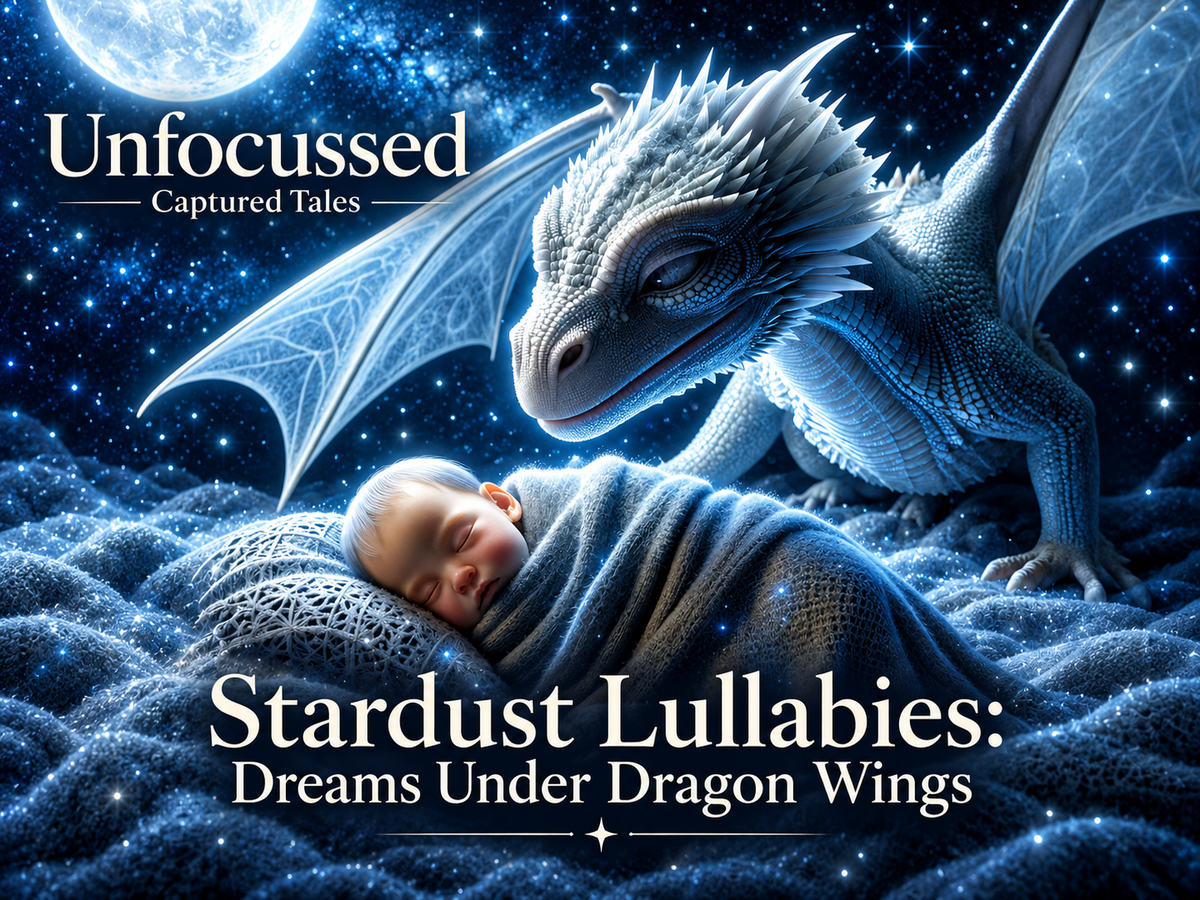
The Smallest Watcher
On the night Lyra came home, Elysandral tried to bring her the moon.
It was a generous intention, poorly supported by his reach. He rose on his hind feet beneath the nursery window, stretched one silver paw toward the round light above the hills, and fell backward into a basket of clean cloths.
Lyra’s father lifted him out by supporting his warm little belly.
“Perhaps something nearer,” he suggested.
Elysandral considered the lamp. Her father moved that farther away.
They lived below the dome of a hilltop observatory, where Lyra’s parents kept charts, polished lenses and stayed up at hours the village baker considered deeply suspicious. The rooms beneath it smelled of paper, wool and the soup somebody was always forgetting to eat. Elysandral had hatched there in the previous spring, a silver-blue dragon small enough to curl beneath the observing chair.
He had large wings for his body, a pointed crown of pale spines and eyes that followed moving light with absolute seriousness. His scales caught the lamps in tiny scattered sparks. Lyra’s mother called him her pocketful of stars, although she had stopped putting him in a pocket after he ate a button.
Until Lyra arrived, he had been the newest and most interesting creature in the house. Now everyone leaned over a small wooden cradle and made noises he had never heard them make over his accomplishments.
He could open the lower cupboard.
Lyra could make a fist.
Apparently the fist was extraordinary.
Elysandral sat beside the cradle with his tail wrapped neatly around his paws, trying to decide whether he approved. When Lyra stirred, he leaned closer. Her fingers opened toward him. Her whole hand was smaller than one of his feet.
He lowered his nose and made the softest sound he knew.
Lyra blinked. He blinked back.
Something in his chest loosened.
That evening, her mother sang while her father warmed supper. The song was about a dragon so old that stars had learned their names beneath its wings. In the song, it crossed the heavens and watched over a child whose dreams were bright enough to fill the sky.
Elysandral listened from his cushion on the floor. At the word dragon, he lifted his head. At watched over, he sat straighter.
Her mother noticed.
“You may keep us company,” she told him. “We will look after her together.”
It was a modest invitation. Elysandral heard an appointment of enormous importance.
When the cradle was settled and the lamp lowered, he positioned himself between it and the door. He folded his wings. He arranged his paws. He fixed his gaze on the darkness with the expression of someone who had accepted responsibility for the entire horizon.
From the kitchen came a clatter of bowls.
He jumped.
Lyra slept through it.
Elysandral sat down again, slightly farther from the door, and began his watch.
When the Stars Disappeared
For several nights, being a guardian seemed pleasantly straightforward. Lyra slept. Elysandral watched. Her parents took turns sitting nearby, and somebody always remembered his breakfast.
He learned the ordinary sounds of the house: the click of the stair latch, the kettle beginning to murmur, the soft scrape of a chair moving back from a desk. He learned that Lyra could cry while perfectly safe and could also stop crying for reasons that remained entirely mysterious.
Her father said that was true of a surprising number of people.
Then a storm climbed the hill.
By supper, clouds had covered the observatory windows. Rain struck the dome in sudden hard handfuls. Her father secured the shutters upstairs while her mother stayed in the nursery. The room that usually held a square of moonlight had become a room with a dark window.
Elysandral stared at it.
He had been watching the moon every night. It was always there while he worked. Now it was gone, and the baby was beginning to cry.
He climbed onto his low window seat and searched the glass. Nothing. He tried the other corner. Still nothing. Behind him, Lyra’s mother lifted her from the cradle and held her close.
Elysandral tapped the window with one claw.
The sky did not answer.
He tapped harder.
“The clouds are in front of it,” her mother said gently. “The moon has not gone away.”
But he could not see it, and Lyra was crying, and the dragon in the song had wings large enough to cover suns. His own wings barely covered the window seat.
He opened them anyway.
A small gray reflection spread across the pane. Behind it, rain ran down the glass. He held the pose until the muscles along his shoulders shook.
When her father came downstairs, he found Elysandral standing rigidly in the window, determined to do something magnificent and visibly running out of strength.
He sat beside him rather than lifting him away.
“You cannot hold the weather back,” he said.
Elysandral made a thin, unhappy noise.
“Neither can I.”
The father folded a dry cloth on his knees. Elysandral stepped down onto it and let his wings close. Up close, the human looked tired too. There was rain on his sleeve and a little white dust from the dome’s old plaster in his hair.
Lyra’s mother changed her, fed her and walked slowly across the room. Her crying softened, then rose again when thunder rolled over the roof.
Elysandral flinched with her.
Her father rested a hand nearby, waiting. After a moment, the dragon pressed against it.
“Frightening noise,” he agreed.
No one said brave dragons were not frightened. No one asked him to try the window again.
Her mother began the star song, but halfway through it she forgot a line. She stopped, laughed quietly at herself and started humming instead.
Elysandral knew that part.
He made a low sound beneath her melody, rougher than a purr and steadier than his usual chirp. It vibrated faintly through the folded cloth. Her father looked down.
“There you are.”
The dragon hummed again.
Lyra turned her face toward the sound.
The storm did not stop. The clouds did not part. But for a few breaths, all four of them listened to something other than the rain.
A Sky Close Enough to Touch
They made no attempt to rescue the whole night.
Lyra’s mother settled in the broad chair with her daughter in her arms. Her father checked the nursery latch, brought water for both of them and placed Elysandral’s cushion where he could see the cradle. Then he sat on the rug beside the little dragon.
“Show me the song again,” he whispered.
Elysandral hummed. The father’s version was terrible.
The dragon stopped and looked at him.
“I know.”
He tried again, more softly. Elysandral tolerated it.
Between them, the room found a rhythm: rain on the roof, a low humming note, the chair’s quiet creak. Lyra’s fists slowly opened. Her mother’s shoulders lowered. When the baby finally slept, she laid her in the cradle and remained beside it.
Elysandral stayed on his cushion. For a while, that seemed sufficient. Then his head began to dip.
He jerked it upright.
It dipped again.
Lyra’s father took the observing notebook from the low table and opened it across his knees. “My turn.”
Elysandral looked toward the cradle.
“I’m here.”
The dragon’s eyes closed. A minute later, he was asleep with his nose tucked beside his tail, making a small whistling sound that would not have improved the old song.
Near dawn, the rain eased. Pale light entered around the curtains. The parents were tired, the roof had acquired a drip over a bucket in the hall, and nothing about the world had become magically simple. But the nursery was warm. Lyra had rested. So had the dragon.
When Elysandral woke, her mother was singing the tune again, this time with new words about a watcher who had stayed small enough to sit beside a cradle.
He liked the new version.
Over the following months, they built small habits around one another. Lyra learned to follow him with her eyes. Elysandral learned to keep his tail out of the rocking chair’s runners. Her parents showed her the moon through the closed nursery window and, when she was older, carried her up to the observatory to look through a small telescope.
No one told her the universe depended on her. They told her the lights had names, that some questions took a lifetime, and that she was welcome to begin with whichever question she liked.
Her first question was whether the moon had a spoon.
Her father considered this more original than most of the correspondence he received.
In their stories, Elysandral still sometimes flew between constellations. Lyra grew old enough to add her own inventions: a comet with lost mittens, a sleepy moon that needed a blanket, a dragon who carried soup through the stars without spilling any. The stories belonged to the hours before sleep. The real Elysandral belonged to the room, silver scales bright in the lamplight, occasionally interrupting the narration to investigate a biscuit.
One clear afternoon, after Lyra had begun walking, they spread a thick rug on the observatory floor for a few hours of drawing. Her father was at the desk, her mother beside her with a book. The child fell asleep before finishing the enormous green moon she had drawn.
Elysandral approached with his old solemn expression. He settled nearby and half opened one pale wing, making a little shelter from the bright strip of light across the floor.
Her mother watched him, smiling, and brushed a fingertip over the fine scales above his brow.
“Thank you,” she said.
Later, she painted the memory as a dream: the child small again, wrapped in starlight, the nursery walls dissolved into a deep blue sky. She painted Elysandral’s wing wide and luminous, and scattered stars around the two of them. The picture held the feeling of his companionship, not the measurements of the room.
Lyra asked whether he really guarded the whole sky.
“No,” her mother said. “He sits with us in our little piece of it.”
That night, the moon returned to the nursery window. Elysandral watched it for a moment, then looked at his cushion.
Lyra was asleep. Her father was in the chair. Her mother had left the door open just enough for the warm hallway light.
The small dragon curled up, folded his wings and let somebody else watch the stars.
Bring a Little Starlight Home
What draws me back to this image is the tenderness in the dragon’s lowered face. Those luminous scales and wide wings could belong to something fearsome, yet everything about his posture feels quiet. A Stardust Lullabies canvas print gives the silver-blue details room to glow in a reading corner, while a framed print of the artwork makes a lovely focal point for a space where you go to slow down.
If the story’s reminder to share the watch stayed with you, the image can keep that feeling close in smaller ways. Drape a Stardust Lullabies fleece throw over your favorite chair for an evening with a book, or send a greeting card to someone who could use a little tenderness. The stars make it dreamlike; that small, attentive face makes it personal.

Another Small Beginning
For another young dragon finding his confidence a little at a time, meet Smidge in The Littlest Flame: A Dragon’s Heartwarming Beginnings. It is a separate adventure with a similarly gentle heart.
If the quiet beside Lyra’s cradle was your favorite part, settle beneath a different sheltering wing in Resting in the Light of Legends. Ash’s clumsy landings and Ember’s patient company make a warm companion to Elysandral’s discovery that being there matters more than guarding the whole sky.
 Sir Grumblethorn and the Mushroom That Disagreed
 The Wink That Got Away With Everything
 The Dewdrop He Swore He Could Handle