Baby dragon antics

Captured Tales

View

Snuggle Scales

by Bill Tiepelman

Snuggle Scales

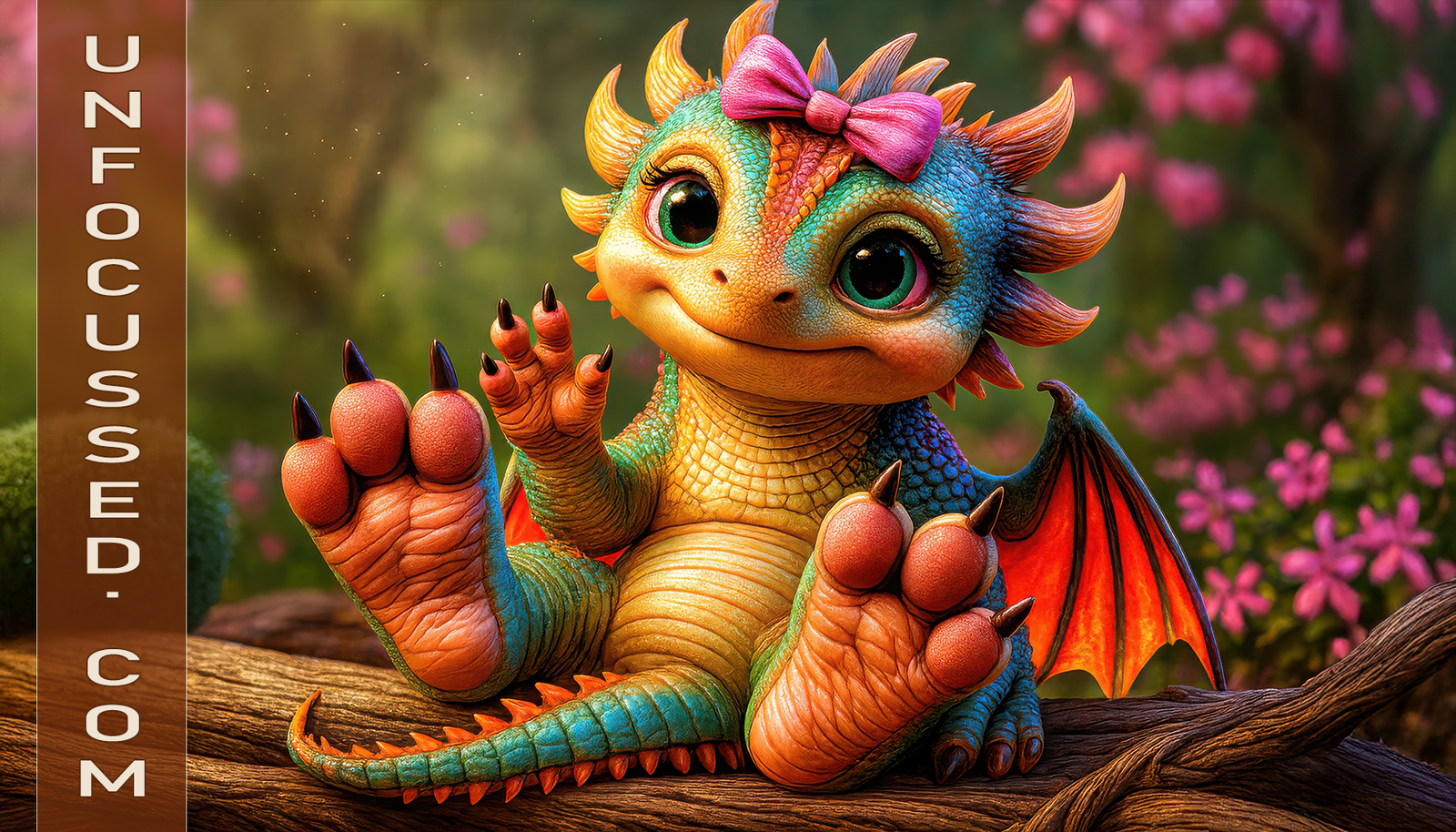
Of Blossoms, Boredom, and Blunt Claws Snuggle Scales was not her given name. No self-respecting dragon would hatch with a name that sounded like it belonged to a toddler’s bedtime plushie. No, she was born as Flareth Sparkfang the Third, a name that demanded respect, fear, and at the very least, a mildly dramatic soundtrack. But that all changed when she tumbled—quite literally—out of her cozy cave and landed butt-first in a bed of cherry blossoms, wings tangled and claws pointed skyward, like a fallen croissant with an attitude. That’s when the forest gnomes found her. All seventy-three of them. “OH MY GOODNESS, IT’S GOT TOES!” one of them shrieked with the volume of a kazoo in heat. “AND LOOK AT HER LITTLE BELLY FLUFF!” another gushed, already crocheting a pink bow mid-hyperventilation. The vote to rename her "Snuggle Scales" was unanimous. Flarespark-whatever was never mentioned again—except by her therapist (a deeply overworked toad named Dr. Gloomp). Now, Snuggle Scales lived in the *Whifflewood Glade*, an aggressively cheerful corner of the Enchanted Lands that always smelled faintly of cinnamon and gossip. It was springtime, which meant the petals were falling like pink confetti, the birds were practicing passive-aggressive harmonies, and Snuggle Scales had reached peak boredom. She'd already rearranged her claw polish collection (sixteen shades of 'Molten Mischief'), ironed her tail ribbons, and sorted her wing glitter by sass level. So, she decided to do something no baby dragon had dared before. She would leave the glade. She would enter The Human Realm. Why? Because dragons were meant to soar, not pose for gnome-sponsored tea parties with daffodil cupcakes and emotional support hedgehogs named Crispin. And if one more elf tried to paint her scales for “pastel realism” art class, she was going to burn their easel into bite-sized regret. So, with her wings fluffed, talons sharpened, and bow freshly fluffed, Snuggle Scales grabbed her emotional support mushroom (don’t judge), did a dramatic stretch for the imaginary audience, and waddled confidently toward the portal tree. Which, of course, had a “Wet Bark” sign hanging from it. “You have GOT to be kidding me,” she muttered, tapping the wood like a suspicious landlord. “I swear, if I get moss on my tail again, I’m suing the forest.” And with one last eye-roll at the overly fragrant breeze, Snuggle Scales stepped through the tree, into a world of chaos, caffeine, and, as she would soon discover, feral toddlers at birthday parties. Caffeine, Cupcakes, and Catastrophic Bounce Houses The Human Realm was not what Snuggle Scales expected. She had envisioned grand towers, mysterious music, and possibly a ritualistic offering of snacks. Instead, she crash-landed in the middle of a suburban park — face-first into a pink plastic picnic table covered in unicorn napkins and half-eaten cupcakes. A small human screamed. Then another. Then several. Within seconds, she was surrounded by a battalion of sticky-fingered, frosting-smeared toddlers — the terrifying kind that ask “Why?” five hundred times and think personal space is a myth. “LOOK! A LIZARD!” one of them shrieked, pointing at her with a sparkly wand that smelled like raspberry sanitizer and poor decisions. “She’s a DINOSAUR!” said another, already attempting to mount her tail like a pony ride. Snuggle Scales was two seconds away from turning this party into a fiery lesson in boundaries, but just then — she locked eyes with the ringleader. A tiny human queen in a glitter crown and a tutu the size of a small planet. “You’re invited,” the girl said solemnly, offering her a cupcake with the confidence of someone who had never been denied anything in her life. “You’re my special guest now.” Snuggle Scales blinked. The cupcake was vanilla. It had edible glitter. And more importantly, it was presented without any adult supervision. With great dignity (and minor frosting inhalation), she accepted. Two hours later, Snuggle Scales was inexplicably wearing a Hello Kitty sticker on her snout, had adopted the name “Miss Wiggles,” and had somehow agreed to be the grand finale in a game called *Pin the Sparkle on the Reptile.* “This is a new low,” she muttered, glancing sideways at a balloon animal that looked like a depressed goat. “I used to be feared. I used to be majestic.” “You used to be lonely,” said a tiny voice from under the cupcake table. It was the birthday girl, now minus the crown and frosting but plus a surprisingly sharp sense of emotional timing. Snuggle Scales looked at her — really looked at her. She had that messy, defiant, beautiful chaos that reminded the dragon of spring mornings in the glade. Of imperfect gnome poetry. Of soft petals on scales and snorting laughter during daffodil charades. And for the first time since she'd crossed into this sugar-coated world, something inside her softened. “Do you... want to pet my toe beans?” she offered, lifting a foot. The child gasped in reverent delight. “YES.” And just like that, an unspoken contract was sealed: the girl would never tell anyone that Miss Wiggles had accidentally belched glitter mid-yawn, and Snuggle Scales would never admit that she now owned a friendship bracelet made of licorice string and rainbow beads. “You’re magic,” the girl whispered, curling up beside her under the shade of the party tent. “Can you stay forever?” Snuggle Scales hesitated. Forever was a long time. Long enough for more birthdays. More cupcakes. More of this squishy, imperfect chaos that somehow made her scales feel warmer. And maybe… just maybe… long enough to teach these tiny humans how to properly use wing glitter. She looked up at the sky, half-expecting a portal to yank her back. But nothing came. Just a breeze carrying the scent of sugar, grass, and potential. “We’ll see,” she said, smirking. “But only if I get my own bounce house next time.” “Deal,” the girl said. “And a tiara.” Snuggle Scales snorted. “Obviously.” And so, the rest of the party unfolded in a blur of squeals, sprinkles, and unlicensed dragon rides. Somewhere between her second slice of confetti cake and a dance-off with a toddler DJ, Snuggle Scales forgot entirely why she ever thought she was too big, too bold, or too weird for a little human joy. Turns out, she wasn’t the only creature who’d needed rescuing that day. Of Glittering Goodbyes and Slightly Illegal Tiara Smuggling Monday morning hit the human realm like a caffeinated squirrel. The park was empty. The balloons had deflated into sad rubber pancakes, the frosting had turned crusty in the sun, and someone had stolen the bounce house (probably Gary from next door — he looked shady). Snuggle Scales sat in the middle of the battlefield — I mean, playground — still wearing her licorice friendship bracelet and a flower crown made of dandelions, which she had not agreed to but now kind of loved. She’d stayed the night curled up under a picnic table, half-watching the stars, half-listening to the little girl breathe in her sleep beside her. She hadn’t slept. Dragons didn’t sleep during soul shifts. Because something was shifting. Back in Whifflewood, the seasons were changing. The trees would be gossiping. The gnomes would be filing a formal “Where Is Our Dramatic Baby?” complaint. And Dr. Gloomp was probably sending passive-aggressive mushrooms through the portal. The forest wanted her back. But… did she want back? “You’re still here,” said a sleepy voice beside her. The girl sat up, hair wild, tutu wrinkled, eyes soft. “I thought maybe you were a dream.” Snuggle Scales sighed, releasing a small puff of glitter-smoke. “I mean, I’m adorable enough to be. But no. Real dragon. Still technically fierce. Now 37% cupcake.” The girl giggled, then got serious in that intense child way that feels like an emotional ambush. “You don’t look like you want to go home.” “Home is... complicated,” Snuggle said. “It’s full of expectations. Rituals. Very clingy gnomes. I’m supposed to be majestic. Breathe fire on command. Pretend I’m not obsessed with sparkles.” “But you can breathe sparkles now,” the girl pointed out. “And you’re so majestic when you do a dance spin before sneezing.” Snuggle blinked. “You mean... my patented Glitter Twirl Sneeze™?” “That one,” the girl whispered reverently. “It changed me.” They sat in silence, the kind that only exists when two odd souls have found an unexpected alignment. Then — the wind shifted. “Uh oh,” said Snuggle Scales. The portal tree was humming behind them, its bark glowing with that “ancient magic plus low battery warning” vibe. If she didn’t return soon, it might close. Permanently. “If I go now,” she said slowly, “I’ll be stuck there until next spring. And honestly, gnome karaoke season starts soon. It’s a nightmare.” The girl stood up, walked to the tree, and did something astonishing. She *hugged it.* “You can come visit her,” she said to the tree like it was an ex-boyfriend who still had good books. “But you don’t get to trap her.” The portal shimmered. Flickered. Then… waited. Snuggle Scales blinked. That had never happened before. Trees didn’t negotiate. But maybe — just maybe — it wasn’t the tree deciding anymore. “You’re magic,” she whispered to the girl, her voice caught between a sob and a snort. “I know,” the girl replied. “But don’t tell anyone. They’ll make me run the PTA.” They hugged, long and fierce. Dragon claws against glitter-stained hands. Old magic meeting new. Snuggle Scales stepped into the portal. Just one foot. Just enough to keep the door open. And then, before anyone could stop her, she turned around and tossed the flower crown to the girl. “If you ever need me,” she said, “just light a vanilla cupcake and whisper, ‘Slay, Miss Wiggles.’ I’ll come running.” The portal closed with a pop. And far away, back in the glade, the gnomes gasped in horror — because their baby dragon had returned wearing a homemade tiara, toe polish in four different colors, and an attitude that would not be contained. Spring had come. And Snuggle Scales? She had bloomed. And heaven help the next elf who tried to paint her scales without permission.     Love Snuggle Scales as much as she loves toe polish and rebellion? Bring home the magic — and a little cheeky dragon charm — with these delightful products inspired by our sassiest hatchling yet: Framed Print — Perfect for nurseries, nooks, or any wall that needs a little sparkle and sass. Acrylic Print — A bold, vivid statement piece with magical gloss and mythical attitude. Jigsaw Puzzle — Because nothing says “cozy chaos” like piecing together a dragon’s glitter sneeze in 500 bits. Greeting Card — Send someone a snuggly fire-breath of joy (and maybe a tiara). Whether you hang her on your wall, piece her together on a cozy afternoon, or send her to a friend who needs a giggle — Snuggle Scales is ready to bring whimsy, warmth, and just the right amount of dragon drama to your world.

Read more

Squeaky Clean Scales

by Bill Tiepelman

Squeaky Clean Scales

The Bath Time Rebellion Dragons, as you may know, are not typically creatures of hygiene. They’re more “roll in ashes and singe your eyebrows” than “minty fresh and sparkling clean.” But then there was Crispin, the hatchling with scales the color of caramelized sugar and an expression permanently stuck between “evil mastermind” and “gleeful toddler on a sugar rush.” Today, Crispin had declared war… on dirt. Or maybe it was soap. The jury was still out. It all began when his keeper, a half-asleep wizard named Marvin, tried to dunk Crispin in a copper basin full of bubbles. “You’ll enjoy it!” Marvin promised, stirring the frothy water like he was mixing a witch’s brew. Crispin, however, was unconvinced. Bath time had always been a source of great drama in the lair—tantrums, tail-thrashing, and one incident where the curtains had to be replaced because the hatchling had tried to flee mid-suds and accidentally set them ablaze. But then Crispin spotted something—bubbles. Shiny, rainbow-glass globes floating upward, popping with tiny kisses of sound. His pupils widened. His wings twitched. And before Marvin could lecture him about soap-to-scale ratios, Crispin lunged straight into the tub with the kind of enthusiasm normally reserved for bacon-wrapped griffin wings. He erupted out of the foam like a champagne cork, sending suds flying in every direction. Marvin sputtered, soaked, and muttered something about “regretting his life choices.” Crispin, meanwhile, was in ecstasy. He discovered the joy of clapping his tiny claws together and making bubbles leap like startled pixies. He practiced blowing on them, which resulted in singed froth and one very offended rubber ducky. His reflection warped and shimmered across each bubble’s surface, turning his grin into monstrous, goofy caricatures of himself—something he found absolutely hilarious. For once, the little terror wasn’t interested in setting things on fire, hoarding shiny objects, or gnawing on Marvin’s spellbooks. He was just… celebrating the sheer miracle of soap. And in that moment, Marvin, dripping and annoyed, realized something profound. Life wasn’t always about conquering towers or memorizing spells or repairing scorch marks on the ceiling. Sometimes, life was about watching a dragon discover joy in a bubble bath. Crispin wasn’t just squeaky clean—he was teaching Marvin that delight can be found in the simplest, sudsiest corners of existence. Still, Marvin prayed fervently that Crispin wouldn’t sneeze while submerged in foam. Nothing says “spiritual life lesson ruined” quite like igniting an entire bath’s worth of bubbles in a single fiery hiccup. The Suds Uprising By the time Marvin had mopped up the first tidal wave of foam, Crispin had gone full renegade. The dragonling discovered that when he slapped his tail just right, he could send geysers of suds rocketing into the air like celebratory fireworks. He shrieked with laughter, spraying the walls with wet streaks of soap and bubbles that clung to the ceiling like glistening cobwebs. It was less “bath time” and more “foam-fueled riot.” Marvin, towel draped around his shoulders like a defeated gladiator, sighed. “You’re supposed to be a fearsome beast one day, Crispin. You’ll terrorize villages, scorch kingdoms, demand tribute.” He waved a soggy hand at the dragonling. “Not… this.” Crispin, of course, ignored him. He was busy building a bubble crown. Each sphere balanced precariously on his spiky horns, creating an absurd, regal headpiece that would’ve made any monarch jealous. He puffed out his tiny chest, narrowed his eyes in mock seriousness, and gave Marvin a look that clearly translated to: Bow before your Squeaky Majesty. “Oh no,” Marvin muttered, massaging his temples. “He’s invented monarchy.” The rebellion escalated quickly. Crispin discovered that he could bite the bubbles without consequence. POP. POP. POP. He snapped at them like a cat in a sunbeam chasing dust motes, wings flapping wildly. Soon, he’d cleared a small patch of airspace, then leapt out of the tub—suds still dripping from his belly—declaring himself Champion of All Things That Burst. He roared (more of a squeaky hiccup, but the sentiment was there) and promptly slipped on the tile, landing in a splat that sent Marvin into uncontrollable laughter. For once, the old wizard wasn’t annoyed—he was cackling like a drunk at a comedy tavern, because seeing a dragon crown himself with soap bubbles only to skid across the bathroom like a greased piglet was just… priceless. And then came the philosophy, as bath-time chaos often inspires. Marvin realized that Crispin wasn’t just rebelling against dirt—he was rebelling against the expectation of being serious. Society told dragons to be terrifying, wizards to be wise, and bubbles to pop silently without purpose. But Crispin was rewriting the script. He was bratty, yes—he dunked his head into the suds and blew out his nostrils like a fire-breathing walrus—but he was also showing that joy was an act of defiance. To laugh at the absurdity of it all was to thumb your nose (or snout) at the very weight of existence. “Lesson of the day,” Marvin announced to no one, raising a dripping finger like a lecturer. “If life hands you soap, crown yourself King of Bubbles.” Crispin rewarded him by spitting foam directly into his beard. Marvin sputtered, but even he had to admit—it was well-deserved. The bubbles had become something greater: not just toys, not just soap, but symbols. Crispin wasn’t merely playing—he was staging a revolution of simplicity. Each bubble was a tiny manifesto, iridescent declarations that screamed: we are fleeting but fabulous! And though Marvin knew this was probably just his sleep-deprived brain overanalyzing, he couldn’t help but feel moved. The bratty little beast was teaching him to celebrate things that lasted mere seconds before popping. That maybe the point wasn’t permanence—it was the sparkle before the end. Crispin, meanwhile, had decided to test the boundaries of physics. He flapped his wings furiously, scattering soapy droplets like rain across the room, and tried to take flight. The effort launched him a glorious six inches into the air before gravity yanked him back into the tub with a KER-SPLASH that flooded half the floor. The dragonling poked his head out of the foam, eyes gleaming, grin wide, and let out a satisfied burble. Marvin just stared at the flooded chaos around him and whispered: “This… is my life now.” And yet, he wasn’t angry. He was weirdly grateful. Grateful for the mess, the noise, the bratty energy of a creature too young to care about dignity. Crispin was chaos, yes—but he was also a reminder that even wizards needed to loosen their robes once in a while and laugh at the suds sticking to their noses. Life, Marvin realized, is basically one long bubble bath: foamy, ridiculous, and gone too soon. The Gospel of the Bubble Dragon By now the bathroom looked less like a place of hygiene and more like a battlefield where the gods of Foam and Chaos had fought an epic war. The walls dripped with suds, the ceiling wore a frothy halo, and Marvin’s slippers had vanished somewhere under a swamp of soapy water. Crispin, however, was unfazed. He perched proudly on the rim of the copper tub, suds clinging to his horns, tail flicking like a metronome set to “trouble,” eyes gleaming with bratty triumph. He had conquered bath time, rewritten the rules, and crowned himself emperor of everything bubbly. Marvin sat cross-legged on the wet floor, soaked to his knobby knees, beard sparkling with soap residue. He had officially given up trying to control the situation. Instead, he leaned back against the wall and watched, part of him wondering how his life had come to this, another part weirdly thrilled to witness the spectacle. Somewhere between the suds in his ear and the dragon spit in his beard, the old wizard realized he’d stumbled into something rare: a teaching moment. Not the kind found in dusty grimoires or scrawled on parchment scrolls—no, this was the messy, hilarious gospel according to Crispin. The dragonling cleared his throat (a dramatic little “hrrrk” noise that sounded suspiciously like a toddler about to demand apple juice) and began strutting along the tub’s edge like a king addressing his court. His tiny claws tapped the rim, his wings flicked theatrically, and his bubble crown wobbled but somehow stayed intact. Marvin swore the little beast was giving a speech. “Pop, pop, pop,” Crispin chirped, punctuating each sound by biting at bubbles that drifted too close. Marvin couldn’t translate dragonling chatter exactly, but the meaning felt obvious: Life is short, so chomp it while it’s shiny. The more Marvin watched, the more the philosophy unfolded. Crispin splashed deliberately, soaking himself anew, as if to say: Cleanliness is temporary, but joy is renewable. He piled foam into ridiculous sculptures—mountains, castles, what looked suspiciously like Marvin’s bald head—and then gleefully smashed them, cackling with dragon giggles. Marvin found himself laughing too, realizing Crispin was showing him the joy of impermanence. You didn’t cling to bubbles. You played with them, loved them, and let them go. There was no tragedy in their popping—only the memory of sparkle. Of course, Crispin’s bratty streak wasn’t about to let the evening stay purely philosophical. Once he sensed he had Marvin’s attention, the dragonling doubled down on the mischief. He leapt from the tub with a wild squeal, wings flapping, and landed squarely on Marvin’s chest. The impact knocked the wizard backward into the puddled floor with a splash. Marvin wheezed, “I’m too old for this!” but Crispin just curled up smugly on his robe, leaving streaks of soap and little claw prints all over the fabric like a wet signature. Then came the grand finale: Crispin’s fire sneeze. Marvin saw it coming too late—the dragonling’s nose crinkled, his eyes crossed, his cheeks puffed. “No, no, no!” Marvin shouted, scrambling to grab a towel. But the sneeze erupted with a WHOOSH, igniting a cluster of bubbles into a brief, glorious fireball that shimmered across the bathroom like a dragon’s disco ball. Miraculously, nothing burned. Instead, the flames fizzled into rainbow smoke that smelled faintly of lavender soap. Marvin collapsed into helpless laughter, wheezing, tears streaming down his face. Even Crispin, startled, blinked once before bursting into shrieking giggles. It was official: bath time had become both rave and sermon. Later, when the chaos subsided, Marvin sat with Crispin curled up in a nest of towels. The hatchling, worn out from the suds rebellion, let out a little snore that sounded like a hiccup wrapped in purrs. Marvin stroked the damp scales on his head, reflecting. He’d always thought wisdom came from solemn rituals, from silence, from discipline. But tonight, wisdom had come in the form of bubbles, bratty tantrums, slippery floors, and a dragon that refused to do anything without making it fun. And maybe—just maybe—that was the greater lesson: that joy itself is an act of rebellion against a world too obsessed with being serious all the time. “Squeaky clean scales,” Marvin whispered with a chuckle, glancing at the glistening hatchling in his lap. “You’re not just clean, Crispin. You’re holy. A prophet of play, a tiny philosopher of foam.” He shook his head and smiled. “And you’re also the reason I’ll need to buy a mop.” Somewhere in his sleep, Crispin burbled happily, a bubble popping on his nose. And Marvin, exhausted but oddly renewed, decided that the simple things—the bratty, goofy, messy, fleeting, soapy things—were the ones worth celebrating. After all, no kingdom, no spell, no treasure could rival the miracle of a dragon who found enlightenment in a bubble bath.     Epilogue: The Legend of Squeaky Clean Scales In the weeks that followed, Marvin noticed something strange. Crispin began demanding regular baths. Not because he cared about hygiene—his bratty grin made it clear he just wanted more bubble chaos—but because bath time had become ritual. Every splash, every crown of suds, every fire-sneeze into foam became part of the dragonling’s growing legend. Neighbors whispered that Marvin’s hatchling was not just any dragon, but a mystical beast who glowed brighter than treasure after a bubble scrub. Of course, the truth was far less glamorous. Crispin still slipped on tiles. He still spit soap into Marvin’s beard for fun. He still staged miniature rebellions against bedtime, vegetables, and anything that didn’t involve sparkle or snacks. But in the oddest way, the little creature had changed something fundamental. Marvin, once stoic and grumpy, now found himself chuckling in the market, buying lavender soap in bulk. He even started greeting people with the phrase: “Find your bubble and pop it proudly.” It confused the townsfolk, but Marvin didn’t care—he had bubbles in his beard and joy in his chest. As for Crispin, he wore his title proudly: Squeaky Clean Scales. A dragon who would one day grow massive wings and fiery breath, but who, for now, was perfectly content to be small, goofy, and dripping with foam. His kingdom wasn’t of gold or jewels—it was of laughter, suds, and life lessons disguised as bratty fun. And in some quiet corner of the world, where dragons and wizards and bubbles all existed together, the simple miracle of bath time became a reminder that sometimes the greatest magic isn’t fire or flight—it’s joy. Pure, ridiculous, fleeting joy.     Bring the Bubble Dragon Home If Crispin the hatchling made you smile, why not let his bubbly antics brighten your own space? Squeaky Clean Scales is more than a story—it’s a celebration of joy, silliness, and life’s simplest pleasures. And now you can carry that magic into your everyday world with beautifully crafted products featuring this whimsical artwork. Dress up your walls with a stunning Framed Print or a luminous Acrylic Print—perfect conversation starters that capture every bubble and sparkle in vivid detail. Or make bath time legendary with a playful Shower Curtain that turns any bathroom into Crispin’s kingdom of foam. For cozy nights, wrap yourself in the warmth of a Fleece Blanket, or bring the dragonling’s bratty charm on the go with a versatile Tote Bag. Each piece is crafted to celebrate the joy, play, and laughter that Crispin reminds us to embrace. Because sometimes, the greatest treasures aren’t gold or fire—they’re bubbles, giggles, and the reminder to celebrate life’s little sparks.

Read more

The Juicy Guardian

by Bill Tiepelman

The Juicy Guardian

A Dragonling with Too Much Juice Long before kingdoms rose and fell, and even before humanity figured out how to weaponize wine into bad karaoke, there existed a lush orchard where fruits reigned supreme. Mangos glistened in the early sun like golden gems, pineapples stood tall like spiky fortresses, and watermelons lay across the grass as if they had been plucked straight from a fruit god’s imagination. In the middle of this overripe paradise lived a creature no one expected, a dragonling so cheeky and unruly that even the bananas tried to peel themselves just to get away from his speeches. He was known, in a title he gave himself after exactly zero votes, as The Juicy Guardian. This dragonling was small by dragon standards—hardly bigger than a beach ball—but he compensated with attitude. His scales shimmered in shifting tones of citrus orange and leafy green, and his stubby wings flapped like a drunken butterfly when he was excited. His horns were tiny, more like decorative ice cream cones than menacing spikes, but don’t tell him that unless you’re ready to be pelted with lime wedges at alarming velocity. Worst of all—or best, depending on how much chaos you enjoy—was his tongue. Long, wiggly, and constantly flopping out of his mouth, it was the sort of tongue that made you wonder if evolution had overcorrected somewhere around the amphibian era. “Hear me, peasants of the orchard!” the dragonling declared one morning, climbing atop a pineapple with the solemn dignity of a child trying to wear their dad’s oversized shoes. His stubby claws gripped the spiky surface like it was a throne built just for him. “From this day forth, no kiwi shall be stolen, no mango bruised, and no watermelon sliced without my express permission. I am the sacred defender of juice, pulp, and fruity honor!” The audience of fruits was, naturally, silent. But the villagers who worked the orchard had gathered at a distance, pretending to be busy with baskets, all while trying not to choke on their own laughter. The Juicy Guardian, undeterred, believed they were basking in awe. He puffed out his tiny chest until his scales squeaked and stuck his tongue out in what he believed was an intimidating display. It was not. It was adorable in a way that made grown men giggle and women mutter, “Oh my gods, I want ten of him in my kitchen.” Now, here’s the thing about The Juicy Guardian: he wasn’t exactly a fire-breather. In fact, he had tried once, and the result had been a mild burp that caramelized half an orange and singed his own eyebrows. From that day on, he embraced his true talent—what he called “fruit-based combat.” If you threatened the orchard, he’d sneeze pulp into your eyes with sniper-like precision. If you dared to insult pineapples (his favorite fruit, obviously, since he used them as makeshift thrones), he would waggle his sticky tongue until you were so grossed out you left voluntarily. And if you really pushed your luck, well, let’s just say the last raccoon who underestimated him was still finding tangerine seeds in uncomfortable places. “Oi, dragonling!” shouted one villager from behind a basket of mangos. “Why should we let you guard the fruit? All you do is slobber on it!” The Guardian didn’t even flinch. He tilted his head, narrowed one massive eye, and replied with the bravado only a creature under a foot tall could muster: “Because no one else can guard fruit with this level of flair.” He struck a pose, wings flared, tongue dangling proudly, drooling nectar onto the pineapple he was standing on. The villagers groaned in unison. He took it as applause. Obviously. The truth was, most of the villagers tolerated him. Some even liked him. The kids adored his antics, cheering whenever he declared yet another “sacred fruit law” like: All grapes must be eaten in even numbers, lest the gods get indigestion, or Banana bread is holy, and hoarding it is punishable by public tickling. Others found him insufferable, swearing under their breath that if they had to hear one more proclamation about “the divine juiciness of melons,” they’d pickle him alive and serve him with onions. But the dragonling, blissfully oblivious, strutted around as if he were the king of tropical chaos, which—let’s be honest—he kind of was. It was during one particularly loud morning announcement that things took a turn. The Juicy Guardian was mid-speech—something about enforcing a fruit tax payable in smoothies—when the orchard fell strangely quiet. Even the cicadas stopped buzzing. A massive shadow rolled over the grove, blotting out the warm sunlight. The fruits themselves seemed to shiver, and the villagers froze mid-basket, staring upward. The Guardian, tongue wagging dramatically, froze in place. His pineapple crown tilted sideways like a drunk sailor’s hat. “Oh, great,” he muttered under his breath, his smugness cracking into genuine irritation. “If that’s another oversized banana slug trying to eat my melons, I swear I’m moving to the desert.” His wings twitched nervously, his tiny claws digging into the pineapple throne. The villagers gasped as the shadow grew larger and darker, spilling across the watermelon patch and swallowing the rows of citrus. Something huge was coming, something that didn’t care about fruit laws, smoothie taxes, or sticky tongues. The Juicy Guardian narrowed his one open eye, gave the shadow a wobbly salute with his tongue, and whispered, “Alright then… come and get juicy.” The Shadow Over the Orchard The shadow slithered across the grove like a spilled smoothie, blotting out the juicy glow of the morning sun. Villagers scattered, clutching baskets of fruit to their chests like they were rescuing sacred relics. A few less committed villagers shrugged, dropped their harvest, and ran—better to lose a few lemons than their heads. Only one tiny figure did not flinch: The Juicy Guardian. Perched atop his pineapple, he tilted his oversized head, narrowed his cartoonishly large eye, and let his tongue dangle defiantly like a warrior waving a very pink, very gooey flag of battle. “Alright, you oversized mood-killer,” he called out, his little voice carrying farther than anyone expected, “who dares trespass on my orchard? State your business! If it involves melons, I want a cut. Literally. I’ll take the middle slice.” The villagers gasped. A few of them muttered that the dragonling had finally lost the last marble he never had to begin with. But then the source of the shadow revealed itself: a massive airship, creaking like a wooden whale, descending with ropes and sails flapping. Painted along its hull were crude depictions of swords, grapes, and—for reasons no one could explain—a suggestive-looking carrot. The flag snapping above it read, in bold letters: “The Order of the Fruit Bandits.” “Oh, come on,” groaned The Juicy Guardian, dragging his claws down his snout. “Fruit bandits? Really? Is this my life? I wanted epic battles with knights and treasure hoards, not… organic theft on a flying salad bowl.” The airship docked itself awkwardly on the edge of the orchard, crushing three lemon trees and half a papaya grove. Out tumbled a ragtag crew of bandits, each dressed in patchwork armor and fruit-themed bandanas. One had a banana painted across his chest, another had kiwi seeds tattooed across his forehead, and the apparent leader—tall, muscular, with a jaw that could crack coconuts—strode forward carrying a watermelon-shaped mace. “I am Captain Citrullus,” he bellowed, flexing as if auditioning for a very sweaty poster. “We are here to claim this orchard in the name of the Fruit Bandits! Hand over the harvest, or face the consequences!” The Juicy Guardian tilted his pineapple throne back slightly, waggled his tongue, and muttered loud enough for the villagers to hear: “Captain Citrullus? Really? That’s Latin for watermelon. Congratulations, pal, you just named yourself Captain Melon. How threatening. I feel so intimidated. Somebody call the salad bar police.” The villagers tried not to laugh. The bandits scowled. The Captain stomped forward, pointing his mace at the dragonling. “And who are you, little lizard? A mascot? Do the villagers dress you up and parade you around like a pet?” “Excuse me,” the Guardian snapped, hopping down from his pineapple to strut across the grass with the exaggerated swagger of someone six times his size. “I am not a mascot. I am not a pet. I am the divinely appointed, absolutely fabulous, disgustingly powerful Juicy Guardian! Protector of fruit, ruler of pulp, and wielder of the most dangerous tongue this side of the tropics!” He flicked his tongue dramatically, slapping one bandit across the cheek with a wet slorp. The man yelped and stumbled backward, smelling faintly of citrus for the rest of his life. The villagers erupted into laughter. The bandits, however, were not amused. “Get him!” Captain Citrullus roared, charging forward with his fruit-mace raised high. The bandits surged after him, swords glinting, nets waving, baskets ready to scoop up melons. The Guardian’s wings buzzed nervously, but he didn’t flee. No—he grinned. A bratty, self-satisfied grin. Because if there was one thing this dragonling loved, it was attention. Preferably the dangerous, dramatic kind. “Alright, boys and girls,” he said to himself, rolling his shoulders like a boxer about to step into the ring, “time to make a mess.” The first bandit lunged, swinging a net. The Guardian ducked, darted under his legs, and whipped his tongue around like a whip, snagging an orange from a nearby branch. With a flick, he launched it straight into the bandit’s face. Splurt! Juice and pulp exploded everywhere. The man staggered, blinded, shrieking, “It burns! IT BURNS!” “That’s vitamin C, sweetheart,” the Guardian called after him, “the ‘C’ stands for cry harder.” Another bandit swung a sword down at him. The blade hit the ground, sending sparks into the grass. The Guardian leapt onto the flat of the sword like it was a seesaw, bounced high into the air, and belly-flopped directly onto the attacker’s helmet. With his claws gripping the man’s face and his tongue slapping against his visor, the dragonling cackled, “Surprise smooch, helmet-boy!” before hopping off, leaving the bandit dizzy and smelling faintly of pineapple. The villagers were screaming, cheering, and throwing fruit of their own at the invaders. It wasn’t every day you saw a tiny dragon wage war with produce, and they weren’t going to waste the chance to hurl a few grapefruits. One old woman in particular launched a mango so hard it knocked out a bandit’s front tooth. “I’ve still got it!” she cackled, high-fiving the Guardian as he zipped past. But the tide began to shift. Captain Citrullus waded through the chaos, his melon-mace smashing aside fruit like it was made of air. He stomped toward the Guardian, his face red with rage. “Enough games, lizard. Your fruit is mine. Your orchard is mine. And your tongue—” he pointed the mace straight at him—“is going to be my trophy.” The Juicy Guardian licked his own eyeball slowly, just to make a point, and muttered, “Buddy, if you want this tongue, you better be ready for the stickiest fight of your life.” The villagers fell silent. Even the fruit seemed to hold its breath. The bratty little dragon, dripping pulp and sass, squared off against the massive bandit captain. One small, one huge. One wielding a tongue, the other a melon-mace. And in that moment, everyone knew: this was going to get very, very messy. Pulpocalypse Now The orchard stood still, every mango, lime, and papaya trembling as the two champions squared off. On one side, Captain Citrullus, a towering slab of muscle and melon obsession, hefting his watermelon-shaped mace like it was forged from pure intimidation. On the other, The Juicy Guardian: a stubby, bratty little dragonling with wings too small for dignity, a pineapple crown slipping over one eye, and a tongue dripping nectar like a faucet in desperate need of repair. The villagers formed a loose circle, wide-eyed, clutching fruit baskets like improvised shields. Everyone knew something legendary was about to happen. “Final chance, lizard,” Captain Citrullus growled, stomping forward so hard the ground shook, dislodging a peach. “Hand over the orchard, or I pulp you myself.” The Guardian tilted his head, tongue dangling, then let out the most obnoxious laugh anyone had ever heard—a high-pitched, nasal cackle that made even the parrots flee the trees. “Oh, honey,” he wheezed between gasps of laughter, “you think you can pulp me? Sweetie, I am the pulp. I’m the juice in your veins. I’m the sticky spot on your kitchen counter that you can never, ever scrub clean.” The villagers gasped. One man dropped an entire basket of figs. Captain Citrullus turned purple with rage—part fury, part embarrassment at being out-sassed by what was essentially a lizard toddler. With a roar, he swung his mace down in a crushing arc. The Guardian darted sideways just in time, the melon weapon smashing into the ground and exploding in a shower of watermelon chunks. Seeds sprayed everywhere, pelting villagers like fruity shrapnel. One farmer caught a seed in the nostril and sneezed for the next five minutes straight. “Missed me!” the Guardian taunted, sticking his tongue out so far it smacked Citrullus across the shin. “And ew, you taste like overripe cantaloupe. Gross. Get some better lotion.” What followed could only be described as fruit warfare on steroids. The Guardian zipped around the battlefield like a sticky orange bullet, launching citrus grenades, slapping people with his tongue, and sneezing mango pulp directly into the eyes of anyone foolish enough to get close. Bandits flailed and slipped on fruit guts, falling over one another like bowling pins coated in guava jelly. Villagers joined in with gusto, weaponizing every edible thing they could grab. Papayas flew like cannonballs. Limes were hurled like grenades. Someone even unleashed a barrage of grapes via slingshot, which was less effective as a weapon and more as an impromptu snack for the Guardian mid-battle. “For the orchard!” bellowed one elderly woman, dual-wielding pineapples as clubs. She bludgeoned a bandit so hard he dropped his sword, then stole his bandana and wore it as a victory sash. The villagers cheered wildly, as if centuries of repressed fruit-related rage had finally found release. But Captain Citrullus would not be undone so easily. He charged at the Guardian again, swinging his melon-mace in wide arcs, knocking aside bananas and terrified villagers alike. “You’re nothing but a snack, dragon!” he roared. “When I’m done with you, I’ll pickle your tongue and drink it with gin!” The Guardian froze for half a second. Then his face contorted into pure bratty offense. “Excuse me? You’re gonna what? Oh, honey, NO ONE pickles this tongue. This tongue is a national treasure. UNESCO should protect it.” He puffed his tiny chest and added with a glare, “Also, gin? Really? At least use rum. What are you, a monster?” And with that, the fight escalated from silly to mythic chaos. The Guardian launched himself into the air, stubby wings flapping furiously, and wrapped his tongue around Citrullus’s mace mid-swing. The sticky appendage clung like sap, yanking the weapon out of the captain’s hands. “Mine now!” the Guardian squealed, spinning in midair with the mace dangling from his tongue. “Look, Mom, I’m jousting!” He swung the mace clumsily, knocking three bandits flat and accidentally smashing a melon cart into oblivion. Villagers roared in laughter, chanting, “Juicy! Juicy! Juicy!” as their ridiculous protector rode the chaos like a carnival act gone horribly right. Citrullus lunged after him, fists clenched, but the Guardian wasn’t done. He dropped the mace, spun in the air, and unleashed his most secret, most dreaded weapon: The Citrus Cyclone. It began as a sniffle. Then a cough. Then the dragonling sneezed with such violent force that a hurricane of pulp, juice, and shredded citrus peels erupted from his snout. Oranges whirled like comets, limes spun like buzzsaws, and a lemon wedge smacked a bandit so hard he re-evaluated all his life choices. The orchard became a storm of sticky, acidic chaos. Villagers ducked, bandits screamed, and even Captain Citrullus staggered under the onslaught of pure vitamin C. “Taste the rainbow, you salad-flavored meatloaf!” the Guardian shrieked through the storm, eyes wild, tongue flapping like a battle flag. When the cyclone finally subsided, the orchard looked like a battlefield after a smoothie blender explosion. Fruits lay smashed, juice ran in sticky rivers, and the villagers were covered head to toe in pulp. The bandits lay groaning on the ground, their weapons lost, their dignity even more so. Captain Citrullus stumbled, dripping with mango mush, his once-proud melon-mace now just a soggy rind. The Guardian swaggered forward, tongue dragging in the juice-soaked grass. He hopped onto Citrullus’s chest, puffed out his tiny chest, and bellowed, “Let this be a lesson, melon-boy! No one messes with The Juicy Guardian. Not you, not banana slugs, not even the smoothie bar at that overpriced yoga retreat. This orchard is under MY protection. The fruit is safe, the villagers are safe, and most importantly—my tongue remains unpickled.” The villagers erupted into cheers, hurling pineapples into the air like fireworks. The bandits, defeated and embarrassed, scrambled back to their airship, slipping on orange rinds and tripping over mangos. Captain Citrullus, humiliated and sticky, swore revenge but was too busy trying to get papaya seeds out of his hair to sound convincing. Within minutes, the ship lifted off, wobbling into the sky like a drunken balloon, leaving behind only pulp, shame, and a faint smell of overripe cantaloupe. The Juicy Guardian stood tall atop his pineapple throne, juice dripping from his scales, tongue wagging proudly. “Another day, another fruit saved,” he announced with dramatic flair. “You’re welcome, peasants. Long live juice!” The villagers groaned at his arrogance, but they also clapped, laughed, and toasted him with fresh coconuts. Because deep down, they all knew: as bratty, goofy, and insufferable as he was, this tiny dragonling had defended them with sticky, ridiculous glory. He wasn’t just their guardian. He was their legend. And somewhere in the distance, parrots repeated his chant in perfect unison: “Juicy! Juicy! Juicy!” echoing across the tropics like the world’s silliest war cry.     The Juicy Guardian Lives On The villagers may have wiped pulp out of their hair for weeks, but the legend of The Juicy Guardian grew juicier with every retelling. His tongue became myth, his pineapple throne a symbol of sass and stickiness, and his battle cry echoed through markets, taverns, and the occasional smoothie stand. And as with all legends worth savoring, people wanted more than just the story—they wanted to bring a little piece of the fruity chaos home. For those bold enough to let a bratty dragonling guard their own space, you can capture his juicy glory in stunning metal prints and sleek acrylic prints—perfect for giving any wall a splash of tropical whimsy. For a softer touch, the Guardian is equally happy lounging across a colorful throw pillow, ready to sass up your couch. If your home craves a statement as bold as his fruit-fueled battles, nothing says “long live juice” quite like a full-sized shower curtain. And for those who simply want to spread his sticky legend everywhere, a cheeky sticker makes the perfect sidekick for laptops, bottles, or anywhere that could use a splash of dragonling attitude. The Juicy Guardian may have been born of pulp and sass, but his story is far from over—because now, he can live wherever you dare to let him. 🍍🐉✨

Read more

The Rosebound Hatchling

by Bill Tiepelman

The Rosebound Hatchling

In a garden that didn’t technically exist on any map, but still insisted on blooming anyway, there stood a single rosebush of impossible beauty. Its petals were velvet-dark, kissed with dew that sparkled like diamonds at dawn. Every gardener in the known (and lesser-known) realms swore it was enchanted. They weren’t wrong, but they weren’t entirely right either. Enchantment implied someone had cast a spell on it; this rose had simply decided to be extraordinary all on its own. On one peculiar morning, as the dew drops slid lazily down the petals, a golden-orange hatchling with wings like stained glass tumbled out of nowhere—literally nowhere. One blink it wasn’t there, the next blink it was. The rose caught it like an indulgent stage mother, and the little dragon blinked its oversized eyes as if the world owed it a standing ovation for existing. Which, honestly, it did. The hatchling stretched its wings—shimmering with streaks of violet, magenta, and sapphire—and immediately knocked half the dew off its perch. “Well,” it squeaked in a voice too tiny for such audacious drama, “this is a start.” Already, it was radiating the kind of energy you’d expect from someone who planned to become either a legend or a catastrophe. Possibly both. Its tail curled possessively around the rose’s stem, and with a sniff, the little beast declared: “Mine.” Across the garden, a chorus of gossiping sparrows paused mid-peck. One muttered, “Great. Another one of those ambitious types.” Another replied, “Mark my feathers, it’s always the small ones who aim for world domination before they can even fly straight.” The hatchling, naturally, pretended not to hear. After all, big dreams require selective deafness. The rose, for its part, sighed (as much as a flower can sigh) and thought, Here we go again. The hatchling, having made its dramatic debut, decided that a perch upon a rose was entirely too small a stage for its destiny. It tested its wings with a few flaps, each one sending droplets scattering into tiny prisms of light. The garden glistened with irritation. “Honestly,” muttered the rose, “you’d think subtlety was outlawed.” But subtlety had never once survived in the company of baby dragons. Especially not ones with aspirations that outpaced their wingspan. “First things first,” the hatchling announced to absolutely no one, because the sparrows had already lost interest. “I need a name.” It paced dramatically along the rose’s curved petal, as if the petal were a catwalk and it was the star model of Paris Draconic Fashion Week. “Something powerful, something people will whisper in taverns after I’ve passed by with a trail of smoke and glory.” Names were auditioned and dismissed at breakneck speed. “Scorch?” Too obvious. “Fang?” Too pedestrian. “Glitterdeath?” Tempting, but sounded like it belonged to an angsty teenage bard’s sketchbook. After much dramatic preening, it finally sighed and muttered, “I’ll wait until fate names me. That’s what all the greats do. And I am most certainly great.” Meanwhile, the rose rolled its petals and thought about all the hatchlings it had seen over the centuries. Some had grown into noble protectors of kingdoms, others into terrifying beasts of calamity. A few, honestly, had just fizzled out after realizing fire-breathing was more complicated than anticipated. But this one… this one had a certain reckless sparkle, like a candle deciding it was destined to become a lighthouse. The rose wasn’t entirely sure whether to admire it or brace for impact. The hatchling leapt to the garden path, managing to glide all of three feet before colliding with a pebble. To its credit, it immediately stood up, shook itself, and declared, “Nailed it.” That was the kind of confidence that would either inspire ballads or catastrophic insurance claims. A snail, sliding slowly past, muttered, “I’ve seen braver landings from slugs.” The hatchling ignored the insult and puffed out its tiny chest. “One day, snail,” it hissed with theatrical menace, “the world will bow before me.” But ambition, like wings, requires exercise. The hatchling began to explore the garden, each new corner becoming a kingdom it claimed for itself. A patch of daisies? “My floral army.” A mossy stone? “My throne.” A puddle glimmering with reflected sky? “My royal lake, for ceremonial splashings.” Every discovery was narrated aloud in case invisible chroniclers were taking notes. After all, legends didn’t write themselves. By midday, the hatchling was exhausted from conquering so much territory and promptly fell asleep under a toadstool, snoring tiny smoke rings. Dreams arrived quickly—dreams of soaring above mountains, of entire villages cheering, of statues erected in its honor with heroic poses (wings wider, eyes more dramatic, maybe even a crown). In the dream, it even defeated a rival dragon twice its size by delivering a particularly witty insult followed by an accidental tail whip. The crowd roared. The hatchling basked. Back in reality, a family of ants had started building a little dirt mound uncomfortably close to the dragon’s tail. “We’ll need to file a complaint with management,” said one ant, eyeing the hatchling with suspicion. The rose, overhearing, muttered, “Good luck. He already thinks he’s management.” When the hatchling awoke, its belly rumbled. Food was clearly in order. Unfortunately, the grand ambitions of glory had not accounted for the logistical problem of being very small and very hungry. It attempted to hunt a butterfly but tripped over its own claws. It tried nibbling on a petal but immediately spat it out—“Ugh, vegan.” Eventually, it settled on licking dew from a blade of grass. “Exquisite,” it declared. “A feast fit for a king.” The grass, somewhat flattered, bowed slightly in the breeze. As the day waned, the hatchling climbed back to the rose, determined to give a motivational speech. “Dear subjects,” it squeaked loudly to the garden at large, “fear not, for your guardian has arrived! I, the future greatest dragon of all time, shall defend you from—” It paused, realizing it didn’t actually know what threats gardens typically faced. “Uh… slugs? Overzealous bunnies? Rogue weed-whackers?” The list was uninspiring, but the tone was impeccable. “Point is,” the hatchling continued, “no one messes with my rose, or my garden. Ever.” The sparrows chuckled. The ants grumbled. The snail yawned. And the rose—despite itself—felt a little surge of pride. Perhaps this hatchling was ridiculous. Perhaps its big ambitions were far too big. But the truth was: big ambitions have a way of bending the world to fit them. And somewhere in the quiet of twilight, the hatchling’s tiny roar didn’t sound entirely small anymore. By the time the moon had climbed high into the sky and painted the garden silver, the hatchling had officially decided that its destiny wasn’t just big—it was astronomical. The little dragon perched proudly on the rose, gazing upward at the constellations with the sort of intensity usually reserved for philosophers or drunk poets. “That one,” it whispered, squinting at a faint smattering of stars shaped vaguely like a spoon, “shall be my sigil. The Spoon of Destiny.” The rose groaned. “You can’t just… pick destiny like a salad item.” “Watch me,” said the hatchling, wings glittering defiantly. “I’m building an empire here, one dramatic declaration at a time.” The night unfolded into a planning session of absurdly epic proportions. Using dew droplets as markers, the hatchling began sketching out a map of the future upon the rose’s leaves. “First, the garden. Then the meadow. Then, obviously, the castle. Probably two castles. No, three—one for each season. Then I’ll need a fleet. A fleet of… geese! Yes. War geese. Everyone underestimates geese until they’re chasing you down a cobblestone street with rage in their eyes.” “Charming,” muttered the rose. “I always knew my thorns weren’t the sharpest thing around here.” But ambition thrives on delusion, and the hatchling’s delusion was glorious. It practiced speeches to imaginary crowds. “People of the realm, fear not!” it squeaked, balancing dramatically on a rose petal that wobbled dangerously. “For I shall guard your lands, roast your enemies, and provide witty one-liners at festivals. Also, I’ll sign autographs. No touching the wings though.” The sparrows heckled from a branch above. “You’re shorter than a buttercup stem!” one cried. The hatchling snapped back without missing a beat, “And yet my charisma is taller than your family tree.” Even the sparrows had to admit that was pretty good. By dawn, the hatchling had upgraded its ambitions yet again. Protecting the garden was noble, sure, but why stop there? Why not become the official dragon of inspiration? “I shall be a motivational icon,” it announced, marching along the petal with military precision. “They’ll invite me to conferences. I’ll stand behind a podium, wings flared, and declare: ‘Follow your dreams, even if you fall on your face—because trust me, I do it all the time!’” The rose laughed so hard it nearly dropped its petals. “You? A motivational speaker?” “Exactly,” the hatchling said, undeterred. “My brand is resilience wrapped in glitter. People will buy mugs with my slogans. Posters. T-shirts. Maybe even mouse pads.” The ants, who had by now completed an elaborate dirt citadel at the base of the bush, whispered to each other. “It’s insane.” “It’s ridiculous.” “It’s… actually kind of inspiring?” Even the snail admitted, “Kid’s got moxie.” So the hatchling trained. Not with fire or claws just yet—those skills were still embarrassingly unreliable—but with speeches, poses, and the art of dramatic timing. It perfected the pause before delivering a line, the tilt of the wings for maximum shimmer under moonlight, the confident head-turn that said, “Yes, I do own this garden, thank you for noticing.” Every day, it declared new goals and celebrated them like victories, even when those victories were, objectively, disasters. One afternoon it attempted to fly across the entire garden and crashed directly into a wheelbarrow. The wheelbarrow tipped over and spilled compost everywhere. The hatchling climbed out, covered in twigs, and announced proudly, “I call that a tactical diversion.” By the end of the week, the ants were chanting, “Tactical diversion! Tactical diversion!” whenever things went sideways in their colony. The hatchling had accidentally created its first cultural legacy. Weeks passed, and the once-ordinary garden was transformed into something extraordinary. It wasn’t the roses or the daisies or the mossy stones that made it legendary—it was the sheer audacity of a tiny dragon who refused to see itself as tiny. Visitors from nearby villages began to whisper about the garden with the peculiar rose that glowed brighter under moonlight and the sound of strange, squeaky speeches echoing through the hedges. People started leaving small offerings: shiny buttons, scraps of cloth, even the occasional cookie. The hatchling interpreted this as tribute, naturally. The rose just rolled its petals and muttered, “He’s going to need a vault at this rate.” One particularly foggy evening, the hatchling stood proudly at the top of the rose, its wings shimmering in the mist like shards of stained glass. It raised its head high and shouted into the night: “I may be small, I may be new, but I am vast in ambition! You can call me many things—ridiculous, loud, even clumsy—but someday, when they write the stories of great dragons, they’ll begin with this: The Rosebound Hatchling who dreamed too big and made the world expand just to keep up.” Silence followed. Then a cricket applauded. Then a frog croaked approval. Then, to everyone’s shock, the moon itself broke through the fog and bathed the hatchling in silver light, as if the cosmos were saying, “Alright, kid. We see you.” And for the first time, even the rose stopped doubting. Perhaps this ridiculous little creature wasn’t just bluster after all. Perhaps audacity was magic in its own right. With a yawn, the hatchling curled once more against the rose’s velvet petals, already dreaming of bigger stages, grander speeches, and a fleet of goose-warriors honking in unison. The world wasn’t ready. But then again, the world never really is.     Epilogue: The Legend in Bloom Years later, when the garden was famous far beyond its hedges, travelers would come searching not for the roses or the mossy stones, but for the whispers of the hatchling. They’d swear they heard speeches carried on the wind, tiny smoke rings floating like punctuation in the night air. Some claimed to see flashes of golden-orange wings darting just beyond the corner of their vision. Others reported losing sandwiches in mysterious “tactical diversions.” The ants, naturally, built an entire tourist industry around it. And though skeptics scoffed, those who lingered long enough always felt the same thing: a strange, unshakable sense that ambition could be contagious. That even the smallest spark—ridiculous, clumsy, loud—could grow into a roaring fire. The rose, older and prouder now, still held the memories in its velvet folds and smiled at the thought. After all, it had been there at the beginning. It had been the cradle of audacity. As for the hatchling? Let’s just say the Spoon of Destiny constellation now had a fan club. And the war geese… well, that’s another story entirely.     Bring the Hatchling Home The tale of The Rosebound Hatchling doesn’t have to stay locked in whispers and moonlight. Now, you can let this whimsical little dragon perch proudly in your own home. Whether you want it framed on your wall as a reminder that even the smallest spark can ignite a legend, or stretched across canvas to become the centerpiece of a room, this artwork is ready to inspire bold dreams in your space. For those who prefer to carry a bit of magic wherever they go, the hatchling also takes flight on a stylish tote bag — perfect for groceries, books, or smuggling tactical diversion snacks. Or, if your mornings require a little boost of whimsical fire, sip your coffee or tea from a Rosebound Hatchling mug and start the day with ambition as audacious as a tiny dragon’s. Choose your favorite way to bring the legend alive: Framed Print | Canvas Print | Tote Bag | Coffee Mug Because legends aren’t just told. They’re displayed, carried, and sipped from daily.

Read more

The Hatchling Companions

by Bill Tiepelman

The Hatchling Companions

The Day the Twins Discovered Trouble (and Each Other) On the morning the mountain sneezed, two baby dragons blinked awake beneath a quilt of warm moss and questionable decisions. The orange one—Ember—had a belly the color of toasted apricot jam and the perpetual expression of someone about to press a clearly labeled “Do Not Touch” button. The teal-and-violet one—Mistral—looked like moonlight caught in sea glass and wore mischief like eyeliner. They were not identical, but stares tended to rhyme around them: big glossy eyes, soft fangs, and tiny wings that whirred like gossip. They had hatched in the same minute—Ember three breaths early, Mistral three plans ahead. From the start they were a duet of bad ideas harmonized: Ember supplied sparkle and heat; Mistral supplied strategy and plausible deniability. Their nursery—an alcove of drippy crystals and dragonfruit peels—was quiet enough, but quiet is just potential energy in the hands of clever hatchlings. “We should practice our roars,” Ember announced, rolling his shoulders until scales flashed like copper coins. “For safety.” “Safety,” Mistral agreed, because she had already decided their roars would be more useful for negotiations with pastry vendors. She shrugged her little wings and the air picked up—just a flirty breeze, but it carried the smell of cinnamon from the village below. She liked cinnamon, and she liked the word below even more. They marched to the ledge like backpackers heading to a brunch reservation. Rows of stone terraces stretched down the mountain, dotted with market tents, steaming cauldrons, and the occasional goat scrawling rude messages in hoofprints. The twins practiced their roars once—twice—thrice. The echoes came back sounding taller than they were, which they both took personally. “We need… ambiance,” Mistral said, because ambiance is French for make it extra. She inhaled, tail curling, and exhaled a ribbon of breeze that teased Ember’s throat flame into a brighter note. The combined sound was part thunder, part rumor. Birds startled. A tent peg sighed. Somewhere, a pastry flake took flight. “We’re amazing,” Ember decided, which is a perfectly healthy conclusion after startling infrastructure. They launched—well, hopped and tumbled—in a spiral that would have been majestic if gravity had been more forgiving. They landed behind a spice stall where glass jars glittered like low-hanging stars. The vendor, a grandmother with braids thick as ship ropes, took one look at the twins and said the ancient market blessing: “Don’t you two even think about it.” They thought about it. Hard. Ember’s tummy rumbled a chord of longing. Mistral batted her lashes, which should be registered as a controlled substance. “We’re on a culinary pilgrimage,” she explained. “It’s for… culture.” “Culture takes coins,” the grandmother replied, not unkindly, “and a promise not to flambé the oregano.” “We can offer endorsements,” Mistral countered, pointing at her own enormous eyes. “We are very influential. Dragonlings. Cute ones. Baby dragons, even.” She paused for effect, then whispered, “Viral.” The grandmother’s mouth did a dance between no and aw. Ember took advantage of the hesitation to sneeze a spark that crisped a stray clove into something that smelled suspiciously like holiday morning. “See?” he said brightly. “Limited-edition aromas.” That was how the twins earned their first job: official breeze-and-heat for the drying racks. Mistral supplied a steady airflow that made the herbs sway like they were at a very polite concert, while Ember delivered micro-bursts of warmth so precise that peppercorns blushed. The grandmother paid them in a coil of cinnamon, three candied ginger bits, and a warning not to weaponize nutmeg. It was, by all accounts, a great gig. It lasted eleven minutes. Because at minute twelve, they overheard two apprentices gossiping about the For-Grown-Dragons-Only wing of the mountain library—a place where the maps were too dangerous and the recipes were too ambitious. A place with a rumor attached: a forbidden page that described the technique for turning any breeze into a storm of flavor, and any spark into a memory. The apprentices called it The Palate Codex. The twins looked at each other, and a decision hatched between them like a baby comet. “We’re going,” Ember said. “Obviously,” Mistral agreed. “For educational purposes. And snacks.” On the way, they collected allies the way trouble collects witnesses. A goat with a jailbroken bell. A moth with opinions about typography. A jar of honey that claimed it could do taxes. Each swore fealty to the twins’ cause, which is to say, they buzzed along for the drama. The library lived inside the mountain’s oldest rib—a vaulted cavern of stone shelves and counterfeit quiet. A librarian dragon, scaled in bureaucratic gray with spectacles large enough to serve tea on, dozed behind a desk. The sign in front of her read: ABSOLUTELY NO SMOLDERING. Ember exhaled through his nose with the solemnity of a monk and still managed to smolder by accident. Mistral tucked his tail under her paw like a babysitter who had given up on subtlety. They slinked past studying wyverns and bored salamanders, toward the wing with the velvet rope and the sign that said Don’t. The rope, alas, was only an invitation written in string. Mistral lifted it, Ember ducked, and they entered a room so still that dust motes discussed philosophy. The shelves here were taller, the leather darker, and the air tasted faintly of cardamom and conspiracy. In the center sat a pedestal with a glass bell jar, and under the jar lay a single sheet, edges singed, letters inked in something that wasn’t quite ink. “The Palate Codex,” Mistral breathed. Her voice sounded like velvet learning to purr. “I don’t know what that means,” Ember confessed, “but it feels delicious.” Mistral’s breeze tickled the bell jar’s seal until it lifted with a kiss of suction. Ember’s spark flickered, tender as a candle at a birthday. The page fluttered free as if it had been bored for centuries and was finally offered the chance to be interesting. Words shimmered. Lines rearranged. A recipe assembled itself with scandalous clarity: Recipe 0: Memory Meringue — Whip one honest breath of wind into a soft peak. Fold in a single warm spark until glossy. Serve at dusk. Warning: may recall the flavor of the moment you most needed, and survived. “That’s… beautiful,” Ember whispered, unexpectedly reverent. “It’s also dangerous,” Mistral said, which to her meant “irresistible.” She glanced at Ember, and in that glance was the entire thesis of their twinhood: I see you. Let’s be extra. They followed the instructions, because instructions are just dares printed neatly. Mistral inhaled a long, careful breath and released it into a bowl made of her cupped claws. The air swirled, then stiffened into pale peaks that quivered like nervous opera. Ember leaned in, offered the gentlest ember of a spark, and the mixture shone. The room changed. The floor became the stony ledge of their nursery; the air smelled of moss, ginger, and shy sunlight. A flicker of sound—another roar, small and stubborn—echoed off the memory of the cave. It was them, newborn and ridiculous, huddled together for warmth and audacity. The meringue tasted like the first time they realized that together they were braver than their own shadows. “We made a feeling you can eat,” Ember said, awe-struck. “We made a brand,” Mistral corrected, because even hatchlings understand merchandising. “Imagine the fantasy wall art posters, the dragon lovers’ gifts, the enchanted home decor. Memory Meringue™. Has a ring.” A hiss interrupted their brainstorming. The librarian—spectacles shining with the light of impending disappointment—stood in the doorway, velvet rope looped over one arm like a lasso of consequences. The gray scales along her jaw clicked in sentence structure. “Children,” she said, in the tone of someone about to file paperwork, “what precisely do you think you are doing in the Restricted Wing with a culinary spell and an unlicensed goat?” Mistral nudged Ember. Ember nudged courage. Together they lifted their chins. “Research,” they said in stereo. “For the community.” The librarian’s eyebrow ridge rose slowly, the way a continent might. “Community, is it? Then you won’t mind a small demonstration for the Board of Draconic Oversight.” She pointed a claw toward a corridor they had not noticed, its walls hung with stern portraits of dragons who had never giggled. “Bring your… confection.” Ember swallowed. The Memory Meringue jiggled with the confidence of a dessert that had read too many self-help scrolls. Mistral squared her tiny shoulders, winked at the goat for moral support, and whispered, “This is fine. Worst case, we charm them. Best case, we get a scholarship.” They padded forward, clutching their bowl of edible feelings like a passport. The portraits stared down, unimpressed. A door ahead creaked open on its own, breathing out a gust of cold, official air. Inside, a semicircle of elder dragons waited—scales austere, pearls of authority strung along their neck ridges, eyes that had seen the world and were not easily sold cinnamon. The librarian took her place at a podium. “Presenting Exhibit A: Twins who cannot read signs.” Mistral cleared her throat. Ember tried to look taller by standing on his dignity, which wobbled. Together they stepped into the room that would either make them legends—or a very funny cautionary tale recited at family dinners for decades. “Good afternoon,” Mistral said, voice steady as a drumline. “We’d like to begin with a taste.” Ember lifted the spoon. The nearest elder leaned in, skeptical. The spoon glowed. Somewhere deep in the mountain, something hummed like a chord being tuned. The twins felt it shiver through their little bones: the sense that the next moment would decide whether they were adored innovators… or grounded until the next geological era. And then the lights went out. The Scholarship (or the Scandal) The lights didn’t simply go out; they sulked. The cavern glowed faintly in that awkward way you see your reflection in a dirty spoon—half suggestion, half insult. The bowl of Memory Meringue pulsed like a heart that had ideas above its pay grade. Ember tried to keep the spoon steady, but the dessert had developed ambitions, shivering with the smug aura of a soufflé that knows it rose higher than expected. “Well,” Mistral said, breaking the silence with a grin sharp enough to dice onions, “this is dramatic.” She loved dramatic. Drama was basically her cardio. Ember, however, was trying not to panic-burp fire. The last time that happened, their moss blanket never forgave him. From the darkness, a dozen pairs of elder-dragon eyes lit up like lanterns—sour, judgmental lanterns. The Board of Draconic Oversight had survived centuries of crises: volcanic eruptions, knight infestations, the Invention of Bagpipes. They were not in the habit of being impressed by toddlers with tableware. But the smell of the Memory Meringue reached them—warm, soft, tinged with the spice of first courage—and even stone-souled dragons felt a tickle in their throats. “Present your… concoction,” one elder grumbled, his scales the color of unpaid taxes. He leaned forward as if sniffing for contraband. “Quickly, before it starts a union.” Ember stumbled closer. The spoon trembled. Mistral, never one to miss a marketing opportunity, bowed with the panache of a circus ringmaster. “Esteemed dragons, we humbly introduce Memory Meringue: the first dessert to make you feel as good as you remember feeling before you had responsibilities. Free samples available for feedback. Five stars appreciated.” The first elder accepted a spoonful. His jaws clamped shut. His eyes went very far away, like someone suddenly remembering their first awkward courtship dance at the Solstice Ball. When he swallowed, a tear rolled down his snout, steaming slightly. “It… tastes like my grandmother’s cave,” he whispered, horrified by his own vulnerability. “Like the day I was finally allowed to guard the fire alone.” The other elders leaned in, etiquette abandoned faster than laundry on a hot day. One by one, they took bites. The room filled with the clinks of spoons and the sound of nostalgia breaking through dragon-scale egos. A scarred matriarch hiccuped softly, muttering about her first stolen sheep. Another groaned that the flavor reminded him of his youthful wingspan before arthritis set in. Ember blinked. “They… like it?” “Correction,” Mistral whispered smugly, “they need it. We’ve basically invented emotional addiction.” One elder coughed into his claw, composing himself with the dignity of a wardrobe falling over. “Younglings, your behavior was reckless, unauthorized, and potentially catastrophic.” He paused, spoon halfway back to his mouth. “Nevertheless, the product shows… promise.” Another leaned forward, scales gleaming with greed. “We could franchise. Memory Meringue Mondays. Pop-up shops in every cavern. Branding potential is… limitless.” Ember blushed so hot the spoon glowed cherry-red. “We just wanted snacks,” he admitted. Mistral elbowed him, whispering, “Shh. This is how empires start.” She turned back to the elders with a smile so sugary it could rot enamel. “We graciously accept your patronage, your mentorship, and, of course, your funding. Please make checks payable to ‘Hatchling Ventures, LLC.’” The librarian dragon finally spoke, her gray spectacles fogging from the emotional whiplash. “I move that they be placed under strict probationary scholarship—supervised, monitored, and restricted from producing anything stronger than whipped cream until further notice.” The elders muttered. Some wanted stricter punishment, others wanted more dessert. In the end, democracy worked the way it always does: everyone compromised and nobody was truly happy. The decision was unanimous: the twins would be enrolled in the Experimental Culinary Arts Program, effective immediately, under the watchful eye of their very displeased librarian chaperone. “See?” Mistral whispered as the librarian slapped probation bracelets on their tails. “Scholarship. Told you.” Ember tugged at the bracelet, which hummed like a chastity belt for magic. “This feels less like a scholarship and more like parole.” “Semantics,” Mistral chirped. “We’re in. We’re funded. We’re legendary.” She paused. “Also, we’re definitely going to break these rules. Together.” The librarian sighed, already planning her future ulcer. “You two are to report to the practice kitchens tomorrow. And may the Great Wyrm preserve us all.” That night, back in their mossy nook, Ember and Mistral sprawled on their bellies, tails tangled like conspiracies. They stared at the ceiling and planned their future—half business scheme, half prank list. They whispered about meringues that could replay embarrassing moments, soufflés that could predict the weather, éclairs that could cause crushes. Their laughter was sticky, reckless, bratty. Bad influence met bad influence, and the sum was pure trouble. And somewhere, in a jar on the shelf, the last dollop of Memory Meringue twitched, sprouting a sugar grin. It had heard everything. It had opinions. And it had plans. The Dessert That Wanted to Rule the World The final dollop of Memory Meringue had not been idle. While Ember and Mistral dreamed bratty, sugar-fueled dreams of culinary domination, the meringue whispered to itself in whipped peaks and glossy swirls. It remembered the taste of courage, the sound of applause, and the salt of ancient dragon tears. Worst of all, it remembered ambition. And that was how, by the next dawn, it had grown from dollop to dollop-with-opinions to full-blown sentient pudding with an attitude. When the librarian dragged the twins into the probationary practice kitchen, the meringue came along in a little jar tucked under Ember’s wing. He had sworn it was for “quality control.” Mistral had winked because “quality control” is French for “evidence tampering.” The jar hummed softly, a sugar high with legs it hadn’t sprouted yet. The practice kitchen itself was an arena of chaos disguised as education. Countertops carved from obsidian. Cauldrons simmering with broths that occasionally insulted each other. Shelves lined with spices so potent they required non-disclosure agreements. Other students—a mix of salamanders, wyverns, and one very confused griffin—were already at work, whipping up recipes that crackled, popped, and in one case, filed small claims lawsuits. “Today,” the librarian announced wearily, “you will each attempt a basic, supervised recipe. No improvisation. No unlicensed flair. No emotions in the food.” Her eyes skewered Ember and Mistral directly. “Do I make myself clear?” “Absolutely,” Mistral said with the confidence of a dragon who fully intended to break every rule before lunch. Ember nodded too, though his blush suggested he was already guilty of something. The jar on his hip wobbled knowingly. They were assigned Simple Roasted Root Vegetables. Not glamorous. Not magical. Certainly not destined to make anyone cry about their grandmother’s cave. Ember set about carefully sparking the oven with controlled bursts of flame while Mistral fanned the coals with breezes calibrated to perfection. Boring, predictable… respectable. And then the jar lid popped off. The Memory Meringue rose like a balloon fueled by stolen secrets. It pulsed, it shimmered, it giggled in a way that made spoons tremble. “Children,” it crooned in a voice made of sugar and sass, “you dream too small. Why roast roots when you can roast destinies?” Every student turned. Even the griffin dropped his whisk. The librarian’s spectacles fogged so fast they nearly whistled. “What is that?” she demanded. “Quality control,” Ember said weakly. “Brand expansion,” Mistral corrected. “Meet our… assistant.” The meringue, unbothered by the scandal, pirouetted midair, scattering sprinkles like confetti. “I have plans,” it declared. “Memory Meringue was merely the appetizer. Next, I shall bake Regret Soufflé, Vindictive Tiramisu, and Apocalypse Flan! Together, we will season the world!” The librarian shrieked in a register reserved for academic emergencies. “Contain it!” she barked, slamming down the emergency whisk. The students panicked. The wyverns ducked under tables, the salamanders attempted to sue the situation, and the griffin fainted dramatically. Ember and Mistral, however, exchanged a look. It was the look of twins who had always been each other’s worst influence—and best weapon. Without words, they hatched a plan. “I’ll distract it,” Ember hissed. “You trap it.” “Wrong,” Mistral countered. “We partner with it. It’s clearly brilliant.” “It’s also trying to overthrow civilization.” “Semantics.” But before their bickering could escalate into sibling flame wars, the meringue surged higher, splitting into dollops that rained down like sugary meteors. Each splat transformed: one became a cupcake army with frosted helmets, another a parade of marshmallow minions armed with toothpicks. The kitchen was now Dessertageddon. “Fine,” Mistral sighed. “We contain. But I call naming rights.” She inhaled, wings snapping open, and summoned a gale so precise it herded the meringue fragments into a swirling vortex. Ember added flame, not destructive but warm and caramelizing. The air filled with the smell of toasted sugar and ozone. The meringue shrieked dramatically—half villain, half diva auditioning for a role it already had. “You cannot whisk me away!” it cried. “I am the flavor of memory itself!” “Exactly,” Ember growled, focusing harder than he ever had. “And some memories are better savored… than obeyed.” With a final synchronized effort, they fused the meringue into a single crystallized shard—glittering, humming, safe-ish. Mistral clapped it into a jar and slapped a sticky note on the lid: Do Not Open Until Dessert Course. The kitchen groaned, sticky with collateral frosting. Students peeked out from hiding. The librarian staggered, whisk bent, spectacles cracked. She stared at the twins, aghast. “You two are a menace.” Mistral grinned. “Or pioneers.” Ember shrugged, sheepish. “Both?” The Board of Draconic Oversight convened that evening, naturally furious. But once again, the twins’ creation whispered temptation from the jar. Elders debated for hours, torn between outrage and craving. In the end, bureaucracy did what it always does: it compromised. The twins were punished and rewarded. Their probation extended. Their scholarship doubled. Their culinary license granted on the condition that they never, ever attempt Apocalypse Flan again. That night, Ember and Mistral lay side by side, tails curled like quotation marks, staring at the ceiling. They whispered plans—bad ones, bratty ones, brilliant ones. Their laughter echoed down the mountain, mixing with the hum of the crystallized meringue in its jar. They were twins. They were trouble. They were each other’s favorite bad influence. And the world had no idea what it had just invited to dinner. The End (or just the appetizer).     Bring the Hatchlings Home Ember and Mistral may be tiny troublemakers on the page, but they deserve a place in your world too. Their bratty charm and whimsical energy have now been captured in stunning detail across a range of unique collectibles and home décor. Whether you want a bold centerpiece for your wall, a puzzle that makes you laugh while you piece together their antics, or a tote bag that carries just as much sass as these dragonlings do — we’ve got you covered. Perfect gifts for fantasy lovers, dragon enthusiasts, or anyone who believes desserts should occasionally try to overthrow civilization. Explore the collection: Metal Print — Vibrant detail, bold colors, and built to last like dragon mischief itself. Framed Print — A refined display of whimsical chaos, ready for your favorite wall. Puzzle — Recreate Ember and Mistral piece by piece, perfect for rainy days and cinnamon tea. Greeting Card — Share their cheeky charm with friends and family. Tote Bag — Carry their bratty energy with you wherever you go. Because sometimes the best kind of trouble… is the kind you can hang on your wall or sling over your shoulder.

Read more

Dragonling in Gentle Hands

by Bill Tiepelman

Dragonling in Gentle Hands

The Morning I Accidentally Adopted a Myth I woke to the sound of something humming on my windowsill, a note so small and bright it could have been a sliver of sunshine practicing scales. It wasn’t the kettle, and it wasn’t the neighbor’s feral wind chimes announcing another victory over the concept of melody. It was, as it turned out, a dragonling—a baby dragon the color of sunrise marmalade—clicking its pebble-like scales together the way contented cats purr. I was wearing an intricate dress I’d fallen asleep hemming—lace like frostwork, embroidery like ivy—and I remember thinking, very calmly: ah, yes, fantasy has finally come for me before coffee. The creature blinked. Two onyx eyes reflected my kitchen in perfect miniature: copper kettle, ceramic mugs, a calendar still turned to last month because deadlines are a myth we whisper to make ourselves feel organized. When I offered my hands, the dragonling tilted its head and scooted forward, claws whispering across the sill. The instant its weight settled in my palm, a warmth bloomed up my wrists, not hot exactly—more like the heat in fresh bread, the kind you break open and steam hugs your face. It smelled faintly of citrus and campfire. If “cozy” had a mascot, it had just climbed into my hands. “Hello,” I said, because when a mythical creature chooses you, manners matter. “Are you lost? Misdelivered? Out of warranty?” The dragonling blinked again, then chirruped. I swear the sound spelled my name. Elara. The syllables trembled in the air, tinged with spark. Tiny horns framed its head like a crown for a very small monarch who could, if pressed, flambé a marshmallow from three paces. It rested its chin where my thumbs met, as if I were a throne it had ordered from an artisan marketplace labeled hands for dragons. Somewhere between the second blink and the third chirrup, my sensible brain returned from its coffee break and filed an objection. We don’t know how to care for a dragon. The objection was overruled by the part of me that collects teacups and stray stories: we learn by doing—and by reading the manual, which surely exists somewhere between fairy-tale and homeowner’s insurance. I set the dragonling gently on a folded tea towel—neutral tones; we respect aesthetics—and inspected it the way you’d examine a priceless antique or a newborn idea. Each scale was a tiny mosaic tile, orange fading to ivory along the belly like a sunrise sliding down a snowy ridge. The texture whispered photorealistic, the way a really good fantasy art print dares your fingers to touch it. The horns looked sharp but not unkind. In the right angle of light, glitter—actual glitter—winked in the creases like stardust too lazy to leave after the party. “Okay,” I said, businesslike now. “Rules. One: no lighting anything on fire without supervision. Two: if you’re going to roast anything, it’s brussels sprouts. Three: we are a shoes-off household.” The dragonling lifted one foot—paw? claw?—and set it back down with grave dignity. Understood. I texted my group chat, Thread of Chaos (three artists, one baker, one librarian with the tactical calm of a medic), and typed: I have acquired a small dragon. Advice? The baker sent a string of heart emojis and suggested I name it Crème Brûlée. The librarian recommended immediate research and possibly a permit: Is there a Dragon Registry? You can’t just have combustible pets unlicensed. The painter wanted pictures. I snapped one—dragonling in my hands, lace sleeves soft as cloud—and the replies exploded: That looks REAL. How did you render the scales like that? Is this for your shop—posters, puzzles, stickers? I stared at the screen and typed the truest thing: It breathed on my palm and warmed my rings. The kettle finally finished its marathon to a boil. Steam curled toward the ceiling as if auditioning for the dragon’s job. When I lifted my mug, the dragonling leaned in, intrigued by the shallow sea of tea. “No,” I said gently, easing the cup away. “Caffeine is for humans and writers on a deadline.” It sneezed a microscopic spark and looked offended. To make amends, I offered a saucer of water. It lapped delicately, each sip producing a sound like a match being struck in the next room. A name arrived the way names sometimes do—inside a pause, as if it had been waiting for me to catch up. “Ember,” I said. “Or Emberly, if we’re formal.” The dragonling straightened, clearly pleased. Then it did something that rearranged the furniture of my heart: it pressed its forehead to my thumb, a tiny, trusting weight, as if stamping a treaty. Mine, it said without words. Yours. I hadn’t planned for a mythical roommate. My apartment was optimized for flat lay photography, fantasy decor, and a rotating collection of thrift-store chairs that squeaked like characters with opinions. And yet, as Ember explored the countertop—tail going flick-flick like punctuation—I could already see where the dragon would belong. The arm of the velvet sofa (sun-warm in the afternoons). The bookshelf ledge between poetry and cookbooks (where, admittedly, the cookbooks serve mostly as platonic aspirations). The ceramic planter that once held a succulent and now holds an enduring lesson about hubris. When Ember discovered my sewing basket, she made a sound so ecstatic it nearly hit whistle register. I intercepted her before she could inventory the pins with her mouth. “Absolutely not,” I said, sweeping the basket shut. “You’re a mythical creature, not a hedgehog with impulse control issues.” She pretended not to hear me, all innocence, the way toddlers pretend not to understand the word bedtime. For science, I laid out a rectangle of foil. Ember approached with ceremonial care, tapped it, and then scampered onto it like someone stepping onto a frozen pond for the first time. The foil crinkled. The sound—oh, that sound—made her eyes go moon-wide. She strutted in a circle, then performed a triumphant hop. If there is an internationally recognized dance of victory, Ember invented it on my counter with the stagecraft of a pop star and the dignity of a sparrow discovering breakdancing. I applauded. She bowed, entirely certain applause had been the plan all along. We negotiated breakfast. I offered scrambled eggs; Ember accepted a single bite and then, with the gravitas of a food critic, declined further participation. She preferred the water, the warmth of my hands, and the sunlight pooling across the table like liquid gold. Now and then, she exhaled a whisper of heat that polished my rings and made the spoon warm enough to smell like metal waking up. By nine, Ember had inventoried the apartment, terrified the vacuum from the safety of my shoulder, and discovered the mirror. She placed one hand—claw—against the glass, then another, then booped her own nose with profound reverence. The dragon in the mirror booped back. She made a sound like a smol kettle agreeing with itself. I realized, with sudden certainty, that I was not going to make it to my nine-thirty Zoom call. I also realized—and here I felt every synapse click into a better alignment—that my life had been a neatly labeled shelf, and Ember was the book that refused to stand upright. I texted my boss (a patient patron saint of freelancers) that my morning had turned “unexpectedly mythological,” and she replied, “Take pictures. We’ll call it research.” I took a dozen. In each photo, Ember looked like a sculpture of wonder someone had polished with awe. Dragon in hands. Baby dragon. Fantasy realism. Whimsical creature. Mythical bond. The keywords slid through my brain like fish through a stream, not as marketing this time, but as praise. After the photos, we napped on the couch in a puddle of light. Ember fit in the curve of my palm as if my hand had been designed for exactly this purpose—a cradle of scales and dreams. I woke to the sound of the mail slot shivering and found a narrow envelope on the mat, addressed to me in an elegant, old-fashioned hand: Elara,Congratulations on your successful hatching.Do not be alarmed by the hearth-syndrome; it passes.A representative will arrive before dusk to conduct the customary orientation.Warm regards,The Registry of Gentle Monsters I read the letter three times, then reread the part where the universe had apparently been waiting to send me stationery from the Registry of Gentle Monsters. Ember peeked over the paper’s edge and sneezed a spark that punctuated the signature with a dot of singe. Orientation. Before dusk. A representative. I thought of my unwashed hair, my less-than-stellar habits, my collection of mugs with literary quotes that made me sound much more well-read than I actually am. I thought of how quickly you can fall in love with something that fits inside your hands. “Right,” I told Ember, smoothing the letter as if it were a patient animal. “We will be excellent. We will be prepared. We will conceal the fact that I once set toast on fire in a toaster labeled ‘foolproof’.” Ember nodded with a seriousness that could have chaired a board meeting. She tucked her tail around my wrist—the living definition of friendship: a small, warm loop closing, promising mischief with consent. We tidied. I vacuumed; Ember judged. I swept; Ember rode the broom like a parade marshal. I lit a candle and then, reconsidering the optics of open flame near a creature that was technically a tiny furnace with opinions, blew it out. The day smoothed itself into quiet, the kind you can set a tea cup on and it won’t rattle. And then, with the deliberation of a curtain rising, someone knocked on my door. Ember and I looked at each other. She climbed my sleeve, settled at the crook of my elbow, and lifted her chin. Ready. I squared my shoulders, smoothed my embroidered dress—lace catching the light like frost—and opened the door to a woman in a long coat the color of thunderclouds. She carried a briefcase that hummed faintly and had the serene face of someone who never loses a pen. “Good morning, Elara,” she said, as if she’d known me all my life. “And good morning, Emberly.” The dragonling chirped, pleased. “I’m Maris, with the Registry. Shall we begin?” Behind her, the hallway rippled, just slightly, as if reality had taken a deep breath and decided to hold it. The smell of rain pressed against the threshold, bright and metallic. Maris’s eyes sparked with a kindness I wanted to trust. Ember’s tail tapped my forearm: Let’s. I stepped aside, heart beating a tidy allegro. A representative. An orientation. A whole registry of gentle monsters. Somewhere in the air between us, the future crackled like kindling. The Orientation, or: How to Fail Gracefully at Myth Management Maris swept into the apartment like she owned the air itself. Her thundercloud coat whispered secrets every time it shifted, and her briefcase hummed with a noise suspiciously like an electric kettle deciding whether to gossip. She sat at my wobbly dining table (bless the thrift shop), opened the briefcase with a click that sounded final, and produced a stack of forms bound in silver thread. Each page smelled faintly of lavender, old libraries, and the way parchment feels in dreams. Ember leaned forward, sniffing them with reverence, then sneezed another spark that singed a tidy hole through section C, question 12. “Don’t worry,” Maris said smoothly, producing a fountain pen the size of a wand. “That happens often. We encourage young hatchlings to mark their own paperwork. It establishes co-ownership.” She slid the form toward me. At the top, in neat, calligraphic letters, it read: Registry of Gentle Monsters — Orientation & Bonding Contract. Beneath that, in bold: Section 1: Acknowledgement of Fire Hazards and Snuggles. I read aloud. “I, the undersigned, agree to provide shelter, affection, and regular enrichment to the dragonling, hereafter referred to as Emberly, while acknowledging that accidental flambéing of curtains, documents, and eyebrows is statistically probable?” Ember gave a self-satisfied trill and licked her tiny lips. I signed. Ember patted the page, leaving a small scorch in place of a signature. Bureaucracy has never looked so whimsical. Next came dietary guidelines: “Feed Emberly two tablespoons of hearth fuel daily.” I asked, “What exactly is hearth fuel?” Maris produced a velvet pouch, opened it, and spilled out a handful of what looked like glittering coal mixed with cinnamon sugar. Ember practically levitated, eyes huge, and scarfed one pebble with the enthusiasm of a child meeting cotton candy for the first time. The afterburp was a delicate puff of smoke shaped suspiciously like a heart. “Note,” Maris added, scribbling on her clipboard, “Emberly may also attempt to eat tinfoil, shiny buttons, or the concept of jealousy. Please discourage the last one—it causes indigestion.” She looked at me over her spectacles, and I nodded gravely, as though jealousy snacking was something I dealt with regularly. The orientation continued with a section titled Socialization. Apparently, Ember must attend weekly “Play & Spark” sessions with other hatchlings to prevent what the manual called antisocial hoarding behavior. I pictured a support group of tiny dragons fighting over glitter and squeaky toys. Ember, still crunching on hearth fuel, wagged her tail like a dog at the word “play.” She was in. Then came the Friendship Clause. Maris tapped the page meaningfully. “This is the most important part,” she said. “It ensures your relationship remains reciprocal. Emberly will not simply be a pet. She will be your equal, your companion, and, in many ways, your very small yet very opinionated roommate.” Ember chirped as if to underline roommate. I imagined her leaving passive-aggressive notes on the fridge: Dear Elara, stop hogging the good sunlight spot. Love, Ember. “You will,” Maris continued, “share secrets, share burdens, and share laughter. It is the Registry’s belief that the bond between a human and their gentle monster is not a leash but a handshake.” I looked at Ember, who had curled into my elbow like a molten bracelet, her scales glittering against the lace embroidery of my sleeve. She blinked up at me, slow and trusting. A handshake, indeed. Paperwork finished, Maris reached into her briefcase once more and produced a small, polished object: a key shaped like a dragon’s claw holding a pearl. “This,” she said, “opens Emberly’s hearth box. You’ll receive it in the post within the week. Inside, you’ll find her lineage papers, a map to your nearest safe flying field, and a complimentary starter toy.” She paused, then leaned closer. “Between us, the toy will look ridiculous—rubber squeaker, flame-proof. Do not laugh. Dragons are sensitive about enrichment.” I made the mistake of asking how many other humans were bonded with dragonlings in the city. Maris smiled, the kind of smile that could power a lighthouse. “Enough to fill a pub,” she said. “Not enough to win a rugby match. You’ll know them when you meet them. You’ll smell the faintest trace of campfire, or notice the pockets with suspicious scorch marks. There’s a community.” She looked at Ember. “And now you’re part of it.” The idea thrilled me—a secret society of gentle monsters and their oddball humans, like a support group where the snacks occasionally catch fire. Ember yawned, showing teeth so tiny and sharp they looked like a row of pearls with a vendetta, and then promptly curled against my wrist, asleep mid-orientation. The warmth of her breath seeped through my skin until I felt branded with comfort. “Any questions?” Maris asked, already stacking papers into her humming briefcase. “Yes,” I said, unable to stop myself. “What happens if I mess this up?” Maris’s thundercloud eyes softened. “Oh, Elara. You will mess this up. Everyone does. Curtains will burn, biscuits will vanish, neighbors will file noise complaints about mysterious chirrups at dawn. But if you love her, and if you let her love you back, it won’t matter. Friendship is not about being flawless. It’s about being singed, occasionally, and laughing anyway.” She stood, coat shifting like weather. “You’re doing fine already.” And then she was gone, leaving only the faint smell of ozone and a half-empty pouch of hearth fuel. The latch on the door clicked, reality exhaled, and Ember blinked awake in my arms as if to say: Did I miss anything? I kissed the top of her tiny horned head. “Only the part where we became officially inseparable.” Ember sneezed, this time producing a smoke ring that drifted toward the ceiling before popping into glitter. I laughed until I nearly fell out of the chair. Bureaucracy had never looked so charming. The Friendship Clause in Action The next morning, Ember decided she was ready to explore the outside world. She demonstrated this by staging a protest in the living room: tiny claws on hips, tail whipping back and forth like a metronome set to defiance. When I tried to distract her with a rubber squeaker toy Maris had couriered overnight (shaped like a flame-retardant duck, heaven help us), Ember gave it one sniff, sneezed a spark that made it squeal involuntarily, and then turned her entire back on it. Message received. We were going out. I dressed with care: my prettiest embroidered dress, boots sturdy enough to survive both puddles and potential dragon-related detours, and a shawl to shield Ember from nosy neighbors. Ember clambered onto my shoulder, her scales glittering like sequins that had decided to unionize. She puffed a determined plume of smoke that smelled faintly of toasted marshmallow. “Alright,” I whispered, tucking her close. “Let’s show the world how whimsical bureaucracy looks in action.” The streets were ordinary that morning—coffee shops buzzing, pigeons plotting their usual bread crimes, joggers pretending running is fun—but Ember transformed them. She gasped at everything: lampposts, puddles, the smell of bagels. She tried to chase a leaf, then remembered she couldn’t fly yet and sulked until I let her ride in the crook of my arm like royalty in exile. Every time someone passed too close, she puffed a polite warning smoke ring. Most people ignored it, because apparently the universe is kind enough to let dragons pass as “quirky pets” in broad daylight. Bless urban denial. At the park, Ember discovered grass. I didn’t know it was possible for a dragonling to experience rapture, but there it was—rolling, chirruping, tail-thrashing joy. She tried to collect blades in her mouth like confetti and then spat them out dramatically, offended that they didn’t taste like hearth fuel. A small child pointed and shouted, “Look, Mommy, a lizard princess!” Ember froze, then puffed herself up to twice her size and performed a very undignified ta-da. The child applauded. Ember preened, basking in the world’s first recognition of her stage career. That’s when another dragonling arrived—sleek and blue as twilight, perched on the shoulder of a woman juggling two coffee cups and a tote bag that said World’s Okayest Witch. The blue dragonling chirped. Ember chirped louder. Suddenly I was in the middle of what can only be described as a competitive friendship-off, complete with synchronized tail-whipping and elaborate smoke rings. The other woman and I exchanged weary-but-amused smiles. “Registry?” I asked. She nodded. “Orientation yesterday?” She held up her singed sleeve like a badge of honor. Instant kinship. The dragonlings tumbled together on the grass, rolling like overcaffeinated puppies with wings. Ember paused long enough to look at me, her onyx eyes sparkling with unmistakable joy. I felt it then, deep in the lace-trimmed bones of my life: this wasn’t just whimsy, or chaos, or an elaborate form of spontaneous combustion disguised as pet ownership. This was friendship—messy, charming, ridiculous friendship. The kind that singes your sleeves but warms your soul. When we finally returned home, Ember curled into her hearth box (which had indeed arrived in the post, complete with a squeaky rubber phoenix that I pretended to take seriously). She hummed herself to sleep, scales glinting like pocket-sized constellations. I sat beside her, sipping tea, feeling the house glow with more life than it had ever held before. There would be mishaps. Curtains would burn. Neighbors would gossip. Someday, Ember would grow larger than my sofa and we’d have to renegotiate space and snacks. But none of that mattered. Because I had signed the Friendship Clause, not with ink, but with laughter and care—and Ember had countersigned with sparks, warmth, and the occasional unsolicited flambé. I leaned closer, whispering into her dreams: “Dragonling in gentle hands, forever.” Ember stirred, exhaled a tiny smoke heart, and settled again. And just like that, I knew: this was the beginning of every good story worth telling.     If Ember’s charm has warmed your heart as much as it singed my curtains, you can carry a piece of her whimsical spirit home. Our “Dragonling in Gentle Hands” artwork is now available as enchanting keepsakes and décor—perfect for anyone who believes friendship should always come with a spark. Framed Print — A timeless presentation, capturing every shimmering scale and delicate detail of Ember in a gallery-ready frame. Canvas Print — Bring the warmth of Ember’s gaze into your home with a bold, textured wall display. Tote Bag — Carry Ember with you everywhere, a perfect blend of art and everyday utility. Spiral Notebook — Let Ember guard your ideas, doodles, or secret plans with a notebook that feels part journal, part spellbook. Sticker — Add a touch of magic to your laptop, water bottle, or journal with Ember’s miniature likeness. From framed art for your walls to whimsical accessories for your daily adventures, every product carries the laughter, mischief, and friendship Ember represents. Bring home a spark of magic today.

Read more

Hatchling of the Storm

by Bill Tiepelman

Hatchling of the Storm

A Hatchling’s Complaint The rain had been falling for hours, and if you asked the little dragon about it (which no one did, since no one else was brave—or foolish—enough to talk to a dragon hatchling in the first place), he’d tell you it was the rudest weather he’d ever experienced. His name was Ember, which he felt was both an appropriate and extremely misleading name. Sure, it suggested warmth, fire, and menace. But at this soggy moment, it mostly meant that the universe found it hilarious to drench him whenever he tried to look impressive. His scales were supposed to sparkle like gemstones in firelight, not drip like a wet kitchen sponge. “Storms are disrespectful,” Ember announced to a passing beetle, who wisely skittered away. “No warning, no courtesy, no consideration for my delicate wings. Do you know how long it takes to dry wings properly? You don’t, because you’re a beetle. But I assure you, it takes ages!” The truth was, Ember had been hatched only a few days ago, and while he had already mastered the art of glaring at clouds with theatrical disdain, he had not yet managed actual flight. His wings flapped, yes, but more in the manner of an enthusiastic fan at a medieval rock concert rather than a creature of power and grace. Still, he considered himself a future menace. A fiery terror of the skies. A legend. And legends did not get rained on without complaining very loudly about it. “When I am older,” Ember continued, mostly to himself (though he hoped the beetle was still listening from somewhere safe), “the world will fear me. They will write ballads about my flames and tales of my claws. I shall scorch villages, steal goats, and—oh look, another droplet in my eye. Rude! Rude!” His bratty tirade was interrupted by a particularly fat raindrop that plopped right onto the tip of his nose, hanging there like a crystal bead. Ember crossed his eyes to stare at it, huffed indignantly, and then sneezed. A puff of smoke rose from his tiny nostrils, carrying the faint smell of cinnamon and burnt toast. It wasn’t exactly terrifying, but it was the sort of sneeze that might make a baker question his oven temperature. Ember liked to believe it was progress. Somewhere beyond the trees, thunder grumbled. Ember narrowed his eyes. “Don’t you start with me,” he warned the sky. “I may be small, but I have potential.” And so, perched on his mossy log, dripping like a disgruntled sponge with wings, Ember sulked. He sulked with conviction, with style, and with a kind of bratty grace only a dragon hatchling could manage. If dragons could roll their eyes at the universe, Ember was already a master of the art. The Brat Meets the World The storm dragged on into the late afternoon, and Ember’s sulking reached new levels of dramatic artistry. At one point he attempted to flop belly-first onto his mossy perch like some great martyr of weather injustice. The result was a damp squelch and a very un-dignified squeak. He scowled at the log, as though it had deliberately betrayed him, and then composed himself with a haughty sniff. If anyone were watching, they would understand he was not merely wet—he was the victim of cosmic sabotage. And he would not forget it. But fate, as fate often does, decided to toss Ember a distraction. From the underbrush came a rustle, a clatter, and then the sight of… a rabbit. A perfectly ordinary rabbit, except for the fact that it was nearly twice Ember’s size. It had sleek brown fur, twitchy ears, and an expression of mild curiosity. Ember, of course, saw this as a challenge. He puffed his tiny chest, spread his rain-heavy wings, and tried his most terrifying snarl. Unfortunately, what came out sounded suspiciously like the hiccup of an asthmatic kitten. The rabbit blinked. Then it bent down and began to chew on some nearby clover, utterly unimpressed. Ember’s jaw dropped. “Excuse me!” he barked. “I am threatening you. You are supposed to cower, maybe tremble a little. A squeal of fear wouldn’t hurt. Honestly, this is the least cooperative prey I’ve ever seen.” “You’re not scary,” the rabbit said matter-of-factly between bites, in the casual tone of someone who had seen many strange things in the woods and filed this one under “not worth panicking over.” “Not scary?” Ember’s wings flapped indignantly, spraying droplets everywhere. “Do you not see the smoke? The scales? The eyes brimming with untold chaos?” “I see a wet lizard with delusions of grandeur,” said the rabbit. It chewed another clover, staring pointedly at him. “And maybe a sinus problem.” Ember gasped, affronted. “LIZARD?!” He stomped one tiny claw on the log, which made a dull squish rather than the thunderous boom he had intended. “I am a DRAGON. The future scourge of kingdoms. The nightmare of knights. The—” “The soggiest creature in this clearing?” the rabbit offered. Ember sputtered smoke. He would have roasted the rabbit on the spot, except his fire gland seemed to still be warming up. What emerged was a pathetic puff of smoke and one lonely spark that fizzled in the rain like a birthday candle being spat on. The rabbit tilted its head, unimpressed. “Ferocious. Truly. Should I faint now or after my snack?” Ember flung himself into an even grander tantrum, wings flapping, claws waving, smoke puffing in erratic bursts. He imagined he looked like a terrifying tempest of doom. In reality, he looked like a wet toddler trying to swat away a persistent housefly. The rabbit yawned. Ember paused mid-flap, seething. “Fine,” he snapped. “Clearly, the storm has conspired against me, dampening my flames and sabotaging my menace. But I assure you, when I grow—when these wings dry and these claws sharpen—you’ll rue this day, Rabbit. You’ll rue it with all your fluffy being.” “Mmhmm,” said the rabbit. “I’ll put it on my calendar.” And with that, it hopped lazily into the bushes, vanishing like a magician who couldn’t be bothered with applause. Ember stared after it, his mouth open, chest heaving with outrage. Then, very softly, he muttered, “Stupid rabbit.” Left alone again, Ember slumped onto his log, tail drooping. For a moment, he felt terribly small. Not just in size, but in destiny. Was this what the world thought of dragons? Just damp lizards? A future chicken nugget with wings? He hated the thought. He hated the rain, the moss, the rabbit. Most of all, he hated the sinking suspicion that he wasn’t nearly as scary as he’d imagined. His amber eyes glistened—not with tears, of course, because dragons do not cry, but with raindrops. Or at least that’s what Ember would tell anyone who dared ask. But then, something happened. Somewhere in his tiny, sulky heart, a warmth flickered. Not the damp spark of frustration, but a real warmth, coiling from his belly and up through his chest. Ember blinked, startled. He hiccuped again, but this time the smoke came with a soft whoosh of flame—just enough to curl a leaf into ash. Ember’s eyes widened. His sulk was forgotten in an instant. “Oh,” he whispered. “Oh, yes.” For the first time since the rain began, Ember smiled. It was a bratty little grin, the kind of smirk that promised trouble. Trouble for rabbits, trouble for storms, and definitely trouble for anyone who thought a dragon hatchling was just a lizard with bad sinuses. His wings shivered, his tail flicked, and his eyes gleamed with the sheer audacity of possibility. The storm might not have ended yet, but Ember was no longer sulking. He was plotting. And somewhere, deep in the thunderclouds, the storm seemed to chuckle back. Sparks Against the Storm By the time the storm rolled into evening, Ember’s brat-meter had reached record-breaking levels. He was damp, muddy, and insulted beyond reason. A rabbit had mocked him. The sky had sneezed on him. Even the moss under his claws squished like it was laughing at him. Ember decided the universe itself had joined a conspiracy to ruin his debut as “Most Terrifying Hatchling Ever.” And for a baby dragon, whose entire self-image relied on dramatic overcompensation, this was unacceptable. “Enough,” he muttered, pacing on his log like a tiny general planning the downfall of clouds. “The storm thinks it’s fierce? I’ll show fierce. I will fry the thunder. I will roast the lightning. I will—” He paused, mostly because he wasn’t entirely sure how one roasted lightning. But the sentiment stood. He puffed his chest, and the warmth from his belly coiled upward again, stronger this time. It tickled his throat, daring him to unleash it. Ember grinned, wings twitching. “Watch and learn, world,” he declared, “for I am Ember, Hatchling of the Storm!” What followed was… well, let’s call it “a work in progress.” Ember inhaled deeply, summoned every ounce of his inner fire, and belched forth a heroic gout of flame—except it came out as more of a sputtering flamethrower with hiccups. The flame burst, faltered, popped, and singed a fern so thoroughly that it now smelled like overcooked spinach. Ember blinked. Then he cackled. “Yes! Yes, that’s it!” He leapt up and down on the log, claws skittering, wings smacking droplets everywhere. “Did you see that, Storm? I AM YOUR MATCH!” As if in reply, the sky growled with thunder so deep it shook the branches. Ember froze, his tiny body vibrating from the rumble. He swallowed hard. “…Okay, impressive,” he admitted. “But I can be loud too.” He tried roaring. What came out was not so much a roar as it was a glorified squeak followed by a cough. Still, Ember refused to admit defeat. He tried again, louder this time, until his voice cracked like a teenager’s. The thunder rolled again, mocking him. Ember’s eyes narrowed. “Oh, so you think you’re funny? You think you can drown me, rattle me, soak me until I shrivel like a prune? Well guess what, Storm: I am DRAGON. And dragons are brats with persistence.” He flapped his wings furiously, wobbling but determined, and hurled himself off the log. He landed face-first in a mud puddle. There was a long pause, broken only by the plop of water sliding off his horns. Ember sat up, mud dripping from every scale, and glared at nothing in particular. “This,” he growled, “is fine.” Then, something miraculous happened. The storm shifted. The rain slowed to a drizzle, the clouds thinned, and streaks of gold began to break across the sky. Ember blinked up at the light, eyes wide. The sunset painted the forest in orange fire, glowing off his scales until he looked less like a soggy brat and more like a jewel burning in the twilight. For once, Ember stopped sulking. For once, he was quiet. In that hush, he felt it—power, potential, destiny. Maybe the rabbit was right. Maybe right now he was just a soggy lizard with a sinus issue. But someday—someday—he’d be more. He could see it in the shimmer of his scales, hear it in the low purr of fire coiling inside him. He wasn’t just a hatchling. He was a promise. A tiny ember waiting to ignite. Of course, this heartwarming self-realization lasted exactly three seconds before Ember tripped over his own tail and tumbled back into the mud. He came up sputtering, covered nose to wingtip in filth, and shouted, “UNIVERSE, YOU ARE A TROLL!” He shook himself furiously, splattering mud in every direction, then stomped in a circle with all the dignity of a toddler denied dessert. Finally, he plopped back on his log, huffed dramatically, and declared, “Fine. Tomorrow. Tomorrow I conquer everything. Tonight, I sulk. But tomorrow… beware.” The forest didn’t answer. The storm was fading, the sky glowing with stars. Ember yawned, wings sagging. He curled himself into a little ball, tail wrapping tight, raindrops still clinging like beads. His bratty glare softened into something small, tired, and almost sweet. For all his theatrics, he was still just a hatchling—tiny, messy, and utterly precious in his ridiculousness. As sleep tugged at him, he whispered one last threat to the world: “When I’m big, you’ll all regret this mud.” Then his eyes slipped closed, smoke curling lazily from his nostrils, and the storm’s lullaby carried him into dreams where he was already enormous, terrifying, and very, very dry. And somewhere in the darkness, the universe chuckled fondly. Because even the brattiest little dragons deserve their legend.     Bring Ember Home Ember may be small, bratty, and perpetually soggy, but he’s also impossible not to love. If his stormy sulks and tiny sparks made you smile, you can invite this little troublemaker into your own world. Our Hatchling of the Storm collection captures every raindrop, every pout, and every spark in vivid detail—perfect for anyone who believes even the smallest dragons can leave the biggest impressions. Adorn your walls with Ember’s charm in a Framed Print or shimmering Metal Print, carry his mischief wherever you go with a sturdy Tote Bag, or keep him close with a playful Sticker that’s just as bratty as he is. Whether on your wall, in your hand, or stuck proudly on your favorite surface, Ember is ready to storm into your life—and this time, you’ll be glad he did.

Read more

Rage from the Egg

by Bill Tiepelman

Rage from the Egg

Shards, Smoke, and a Bad Attitude The egg didn’t so much hatch as declare war on complacency. It split with the sound of a wineglass meeting a tiled floor after an “I deserve better” speech—clean, decisive, cathartic. Purple-and-brown scales pressed through the fracture like midnight lightning under varnish, and two molten-amber eyes snapped open with the unmistakable look of someone who woke up already annoyed with the universe. A talon hooked the shell’s rim—black, glossy, and ready to write a strongly worded letter to fate—then another, and then a snout, ridged and ancient, inhaled the world for the very first time. If you’ve never seen a newborn dragon glare, imagine a house cat who paid taxes. There was grievance. There was grievance interest. The hatchling flexed, scattering shards that pinged off the rocks, and the forest went quiet in that respectful way nature gets when it realizes it might have just acquired a new landlord. A coil of warm smoke leaked between needle teeth, smelling faintly of singed cedar and smugness. She—because the energy was absolutely “ma’am, that’s my throne”—tested her jaw like a boxer flexing before round one. The purple in her scales wasn’t cute-lilac; it was bruised twilight, the color of expensive secrets. The brown was weathered oak and old leather—practical, grounded, something you trust to outlive your worst decisions. Every plate of scale caught the dim light with hyper-realistic texture, as if some obsessive artisan had hand-carved each ridge and then whispered, “Yes, but meaner.” “Congratulations,” I said from my respectable distance behind a very humble boulder. “Welcome to the world. We have snacks. Mostly each other.” I’m a freelancer—field notes on mythical creature photography pays in prestige and bruises—so a baby dragon hatching fell half under career goals, half under what if my mom was right. The hatchling swiveled, pupils thinning to predatory slits. Her gaze pinned me the way a magnet finds the only paperclip you actually needed. She hissed, but it wasn’t an animal hiss. It was the sound of a stranger pulling your latte without asking and checking their phone while they do it. The jagged eggshell scraped as she dragged it with her—little queen in a cracked chariot—then froze to sniff the air, nostrils flaring like bellows. Ozone. Sap. My deodorant, which had promised “mountain breeze” but apparently translated to “come eat this nervous photographer.” “You’re okay,” I said, lowering my voice to the register reserved for skittish horses and tax auditors. “You’re safe. I’m just here for… documentation.” I didn’t add and merch, but I’m not made of stone. This was baby dragon art in the wild—dragon hatching meets “look at those dragon scales” meets “I will absolutely buy a mouse pad of this if I survive.” She rumbled—a tiny earthquake with big dreams—and stretched, her spine articulating in a ripple of purple dusk. Claws cinched the shell lip and she levered herself higher, a gymnast mounting a very dramatic pommel horse. The pose was… photogenic. Cinematic. Sellable. The forest floor seemed to lean into her; even the rocks wanted a selfie. That’s when the ravens arrived. Three of them, black as tax law, swirling down as if someone had uncorked a flute of night. They perched in a triangle: two in the branches, one on a snag with the casual menace of a bouncer named Poem. Ravens love a myth in progress. They also love shiny things, and this baby had talons like patent leather and eyes like stolen sunsets. “Shall we not,” I whispered toward the birds, who ignored me the way glitter ignores your attempts to vacuum it. The hatchling noticed them and something ancient lit behind her eyes—coded memory, baked into the DNA of things that once taught fire how to behave. She uncoiled just enough to look bigger. The air changed. My breath decided it had somewhere else to be. The ravens shuffled. The forest held its applause. Then—because destiny enjoys good staging—the wind shifted and brought the scent of boar. Not a delicate hint. A statement. Wild pig: the bar fight of the forest. The boar lumbered into the clearing like a security deposit who’d learned to walk: a wall of bristles, tusks, and unresolved issues. He saw the broken egg. He saw me. He saw the hatchling, who—if we’re being honest—looked like a fancy snack with knives. The baby dragon’s expression sharpened: from “everyone is already on my nerves” to “and now you.” The boar breathed steam and pawed the leaves, etching a rude letter to the season. He had size, sure. He had momentum. What he didn’t have was a working understanding of mythology. “Don’t,” I said, which is exactly the kind of helpful field advice that has kept me alive this long by sheer accident. The boar didn’t speak human, but he was fluent in drama. He charged. The hatchling’s first move wasn’t fire. It wasn’t even teeth. It was attitude. She met the rush by snapping her head forward and slamming her eggshell against the ground with a crack that traveled up my spine. The echo spooked the boar just enough to wreck his line. She followed with a lunge that was part pounce, part angry thesis paper, talons flashing. Sparks leapt where claw met rock—tiny, indignant constellations—and the smell of hot mineral hit like a struck match. The ravens croaked in a single chorus that translated cleanly to: Ooooh, she’s spicy. Boar and hatchling collided in a tumble of fur, scale, and undignified squeals. She was smaller, yes, but she was geometry and leverage and a very personal vendetta against being underestimated. Her tail—thorned, surprisingly articulate—whipped around to hook the boar’s foreleg while her front claws raked shallow lines across his shoulder. Not mortal. Not yet. A warning letter carved into meat. The boar juked, throwing her sideways. The shell shattered further, eggshell confetti fluttering like an invitation to chaos. She rolled, planted, and came up with an expression I’ve seen on three exes and one mirror: try me. The boar’s courage faltered. Not big enough to back out gracefully, not smart enough to bow. He dug in for another charge. This time she inhaled. Not just air—heat. The temperature around us stepped up like someone turned the sun’s settings to “simmer.” The purple in her scales drank the light; the brown went ember-warm. Smoke curled from the corners of her mouth in thin, disciplined threads. It wasn’t a blast. She didn’t have that yet. It was something more surgical: a cough of fire, tight as a secret, that zipped across the boar’s path and licked the ground into a glowing brand. He froze mid-stride, skidding, eyes wide at the orange ribbon of that shouldn’t be there. The forest exhaled at once. Leaves hissed. Sap snapped. My camera—bless her anxious heart—clicked twice before my hands remembered they were attached to a survival plan. The hatchling padded forward, small, slow steps that said I am learning the choreography of fear, and you are my first partner. She stopped so close to the boar that her reflection burned in his eyes. And then she smiled. Not nice. Not theatrical. A smile that promised that the category prey was a temporary misunderstanding. The boar backed up, breath wheezing, dignity looking for an Uber. He turned and fled into the trees, cracking deadfall like fresh bread. The ravens laughed, which should be illegal, and shook the branches until the leaves applauded anyway. The hatchling settled on the ruined cup of her egg and looked at me as if I’d been an extra in her debut. There was soot on her lips like rebellious lipstick, and a chip of shell stuck to her brow ridges like a careless crown. She tasted the air again—my fear, the boar’s retreat, the iron tang of her own new fire—and made a soft, satisfied sound that felt older than memory. “Okay,” I said, voice cracking into a register only dogs and bad decisions can hear. “You’re… perfect.” I meant it the way you mean sunrise and revenge. Purple dragon. Brown dragon. Newborn mythical beast. Fierce hatchling. Fantasy artwork had suddenly become fantasy witness. And something else whispered at the back of my brain: this wasn’t just a good picture. This was a legend learning to walk. A dragon portrait the world would try and fail to tame. She blinked slowly, then lifted one talon and—like every bratty heiress of power—gestured. Not a threat. An invitation. The message was unmistakable: Follow. Or don’t. The river of her story would flow either way, and I could choose to drown in wonder or stay on the shore with the polite people. I chose wonder. I chose rocks in my shoes and scorch marks on my sleeves and a camera that would smell like campfire for a month. I chose to step from behind the boulder, hands open, and trail the hatchling as she padded toward the treeline with her broken egg dragging behind like a royal train. Above us, the ravens spun a lazy orbit, three punctuation marks at the end of a sentence the world hadn’t learned to read yet. That was when the ground hummed. Barely. A teeth-rattling murmur from somewhere deeper in the valley, then a second note, lower, older, like cathedral bells under the dirt. The hatchling’s head snapped toward the sound. The forest went from quiet to church-silent. She looked back at me with those burning eyes and, for the first time since she cut herself free of forever, she didn’t look angry. She looked… interested. Whatever had made that sound wasn’t a boar. It wasn’t afraid of her. It wasn’t impressed with me. And it knew we were listening. The hatchling stepped into the shade, and the purple of her scales deepened to stormwater wine. She flicked her talon again: Come on, slowpoke. Then she vanished into the green, a rumor in motion, while the valley’s subterranean bell tolled once more, long and ominous, promising that the story we’d just begun had teeth much bigger than hers. Bells Beneath the Bones Following a baby dragon into the woods sounds like the sort of activity you’d find on a list of “Top Ten Ways to Test Your Will to Live,” right between “poke a sleeping bear” and “start a conversation about cryptocurrency at a family reunion.” But there I was, trudging after her, my camera bouncing against my chest, my boots swallowing mud with the kind of enthusiasm that makes shoe stores rich. The air had shifted—thicker, damp, scented with moss, old stone, and the coppery tang of rain that hasn’t happened yet. That subterranean bell tone rolled again, slower this time, like the heartbeat of something that had seen empires rise and politely implode. The hatchling glanced over her shoulder, not slowing, her eyes half-lidded with the confidence of someone who knows exactly where they’re going and also that you will follow because you have no other viable life choices. Her tail dragged a shallow trench in the loam, carving an accidental breadcrumb trail for predators with excellent taste in exotic entrées. We moved deeper, under a canopy so thick the daylight fractured into narrow gold blades. Every few steps, she’d pause—not in fear, but in that considering way cats do before they either leap onto your lap or destroy a priceless heirloom. She was cataloging the forest: sniffing a fern, raking talons across a birch, pausing to watch a squirrel who immediately decided it had pressing business in another county. The ground under my boots began to change—less mud, more rock. Roots knuckled up from the earth like gnarled fingers, snagging my toes. The bell toll grew into a layered chorus, faint but insistent, vibrating up my bones and into my teeth. It wasn’t random. It had a rhythm. Five beats, pause, three beats, pause, then a long low note that slid into the marrow of the air. “Okay,” I whispered to no one, “either we’re about to find an ancient temple, or this is how the forest invites you to dinner.” The hatchling slowed, her nostrils flaring. She turned her head slightly, and I caught the gleam of her eyes in a shaft of light—bright, fierce, and oddly curious. She wanted me to see something. She angled her body toward a ridge of dark stone jutting up like the spine of a buried beast. Moss clung to it, but the surface was too regular, too deliberate. Not natural. A staircase. Or rather, what was left of one—broad steps worn into concave arcs by centuries of feet that had no business being human. She climbed without hesitation, claws clicking against the weathered stone. I followed, more careful, because unlike her, I am not equipped with talons or a built-in insurance policy against gravity. At the top, the ridge leveled into a wide ledge, and there it was: a hole in the ground so perfectly round it might have been drilled by a god with a strong opinion about symmetry. From its depths, the bell-song pulsed up in waves, the sound wrapping around my skull like silk dipped in thunder. The hatchling approached the edge, peering down into the darkness. She made a low sound in her throat—half growl, half question—and the bell immediately answered with a shorter, sharper note. My skin prickled. This wasn’t random resonance. This was a conversation. And my brand-new, freshly hatched traveling companion had just dialed a very old number. A warm updraft curled out of the shaft, smelling faintly of iron, ash, and something sweetly rotting, like fruit left too long in the sun. My instincts screamed for me to take two steps back and maybe fake my own death somewhere safer. Instead, I crouched and aimed my camera into the hole, because humans are a species that invented both parachuting and jalapeño tequila shots: caution is optional if there’s a good story in it. My flash cut into the blackness and reflected off something moving. Not fast. Not close. Just… vast. A surface that gleamed in broad plates, shifting slightly as if disturbed by the weight of our gaze. The movement carried a deep rumble that didn’t quite reach my ears—it was more like my spine got a personal notification. I realized, with unpleasant clarity, that the bell-sound wasn’t a bell at all. It was the sound of something alive. Something breathing through stone. The hatchling’s expression changed—still fierce, still bratty, but with an undercurrent I hadn’t seen before. Reverence. She lowered her head, almost a bow, and the thing in the darkness exhaled, sending another hot gust into the air. The bell-song faded into a single low hum that vibrated in my fillings. “Friend of yours?” I asked her, my voice way too high to be considered dignified. She looked back at me, and I swear there was a glint of amusement in those molten eyes, like she was thinking, Oh, sweet summer child, you have no idea who you’re standing next to. A claw scraped stone below, and for the briefest moment, I saw it: a talon the size of my torso, curling slowly into the rock, the tip etched with age and battles long past. It withdrew without haste, the way mountains shift in geological time. Then came the voice—not words, not in any human tongue, but a sound layered with the weight of centuries. It rolled up out of the shaft like smoke, and every nerve in my body translated it the same way: Mine. The hatchling answered in kind—a short, defiant hiss that carried both acknowledgment and refusal. The thing below laughed, if you could call the sudden, seismic shiver of stone a laugh. I took a careful step back because in my experience, when two apex predators start arguing over ownership, the snack in the middle rarely gets a vote. The hum shifted again, this time to something darker, more deliberate. My chest tightened, my ears popped, and the hatchling’s scales rippled as if in response to some invisible wind. She turned from the shaft abruptly and started down the ledge, flicking her tail in that keep up or get left way. I hesitated, but the hum seemed to follow us, a sound that wasn’t really a sound but a reminder—like a stamp pressed into wax: we were marked now. Back under the trees, the forest felt subtly altered. The shadows were deeper, the air heavier. Even the ravens were gone, which was deeply unsettling, because ravens don’t just leave when the plot gets good. The hatchling moved faster, weaving between tree trunks, and I had the sense she wasn’t just wandering anymore. She had a destination, and whatever lived in that shaft had just changed the route. It wasn’t until the ridge dropped away into a broad clearing that I realized where she’d brought me. At first glance, it looked like a ruin—pillars half-swallowed by vines, cracked marble slabs littering the ground like discarded game pieces. But the longer I looked, the more deliberate it felt. The stones weren’t scattered. They’d been placed. Arranged in concentric circles, each one slightly offset from the last, forming a spiral pattern that drew the eye inward to a central pedestal. The hatchling hopped onto the pedestal, curling her tail around her feet. She lifted her head high, looking every inch the monarch she believed herself to be. I stepped closer, brushing moss from the base of the pedestal, and saw the carvings—spiraling scripts of creatures and battles, fire and shadow, and a recurring symbol: the same perfect circle as the shaft we’d just left, etched with radiating lines like a sun or an eye. “This is…” I trailed off, because saying important out loud felt like whispering in church. My camera clicked almost involuntarily, documenting each detail. In the viewfinder, the hatchling looked larger, older somehow, as if the place was lending her a fraction of its authority. The air in the clearing began to hum again, faint but unmistakable. I spun, expecting to see the shaft, but there was nothing—just the trees, standing too still, their leaves trembling without wind. The hum built into a thrum, then a pulse, matching the earlier rhythm: five beats, pause, three beats, pause. The pedestal under the hatchling warmed, a glow spreading up through her talons until her scales caught the light from within. She didn’t flinch. She didn’t blink. She just stood there, absorbing it, until her eyes flared brighter and the glow pulsed outward, racing along the spiral pattern in the stones. The light reached the edges of the clearing and vanished into the earth, leaving behind a silence so sudden it felt like the world had paused to breathe in. Then, faint but sharp, from somewhere beyond the trees, came a sound that didn’t belong to bells or breath: the echoing clatter of armored feet. Many feet. Moving fast. The hatchling’s gaze snapped toward the sound, and for the first time since she’d emerged from the egg, she didn’t look annoyed. She looked ready. Teeth in the Trees The clatter grew louder, rattling the undergrowth in a way that suggested whatever was coming wasn’t built for subtlety. The hatchling hopped down from the pedestal with a precision that was more “performance” than “necessity,” landing in a crouch like a gymnast who knew she’d nailed the dismount. Her head tilted toward the sound, pupils tightening into surgical blades. The glow in her scales hadn’t faded—it pulsed faintly, synced to some rhythm I couldn’t hear, but she could feel. The first figure broke through the treeline in a shower of leaves and a bad attitude. Humanoid, but stretched in the wrong directions—limbs too long, armor plated in matte black that seemed to drink the light. Behind it came five more, moving in perfect formation, their steps so in-sync it was like watching an insect with six legs made of spite. Their helmets were smooth ovals, no eyes, no mouths, just blank faces that reflected me back in distorted fragments. They carried weapons that looked like someone had taken the concept of a halberd, a cattle prod, and a medieval guillotine, then thrown it in a blender with a bad mood. Blue sparks crackled along their edges. The air hissed around them, charged with the static of people who had a mission and an alarming lack of hobbies. The hatchling growled low, the kind of sound that makes your skin think about leaving without you. One of the black-armored figures raised a hand—three fingers, jointed oddly—and made a gesture toward her. I didn’t speak their language, but I’ve been around enough cops and bouncers to know the universal sign for That’s ours now. She answered with a noise so sharp it seemed to split the clearing in two. The blue sparks on their weapons guttered like candles in a gale. The lead figure took a step forward and drove the blade-tip of its weapon into the soil. A ring of blue light surged outward along the ground, racing toward us in a perfect circle. I didn’t think. I just dove sideways. The hatchling didn’t move—she braced. When the light reached her, it broke. Not fizzled, not dissipated—shattered. The glow from her scales flared, swallowing the blue and sending it back in a jagged arc that cracked one of their helmets clean open. Inside was no face, no skull—just a churning mass of smoke and tiny lights, like a swarm of fireflies in a jar made of nightmares. The creature screamed without sound, dropped its weapon, and crumpled into itself until it vanished into a puff of ash. The others didn’t retreat. They surged forward, weapons spinning into offensive arcs. I scrambled behind the nearest fallen pillar, pulling my camera around not to take pictures—though God help me, I still took one—but to use the long lens as a periscope. The hatchling was already in motion, and what I saw through the lens was poetry in petty violence. She darted between them, tail whipping like a spiked chain, claws catching and dragging across armor to carve glowing rents into their matte black plating. She wasn’t trying to kill all of them—not yet. She was provoking. Testing. Every hit she landed drew a response, and she seemed to be building a catalog of exactly how hard she could push before they broke. One swung at her with that halberd-thing, catching the edge of her shell-fragment still dragging from her tail. The fragment exploded into shards under the impact, but instead of retreating, she lunged forward into the opening, jaws snapping shut on the figure’s forearm. The sound was like steel cable snapping underwater—muffled, wet, and final. The arm came off. Blue sparks gushed from the wound before the limb crumbled into the same ash as the helmeted head earlier. The leader, still intact, barked something—a series of harsh clicks that made the leaves tremble. The formation changed instantly. They widened their stance, surrounding her, weapons raised in a tight vertical line. The ground between them began to glow with the same blue light as before, but this time, it didn’t race outward. It formed a dome, shimmering faintly, trapping her inside. I felt my pulse in my throat. She paced inside the dome, hissing, tail lashing, the glow in her scales fighting against the blue shimmer but not breaking it. My gut went cold. They weren’t trying to kill her—they were trying to contain her. Which meant, against all rational thought, it was time for me to do something catastrophically stupid. I crawled from behind my pillar, keeping low, and grabbed one of the fallen halberd-prods from the dirt. It was heavier than it looked, and it hummed in my hands like it was considering whether to electrocute me out of principle. I ran forward, circling the dome until I found a seam—two figures standing just close enough for the base of the dome to look thinner there. I jammed the weapon’s blade into the seam and hit the trigger. White-hot pain shot up my arms, but the dome shivered, then cracked like ice in warm water. The hatchling didn’t waste the opening. She blasted toward it, slipping through just as one of the figures pivoted to intercept. Her claws caught its chest, and the resulting spray of sparks lit her like a festival firework. She landed beside me, gave me one long look that said, Fine, you can stay, and then turned back to the fight. She didn’t bother with testing anymore. Now it was demolition. Her fire—stronger now, hotter—erupted in controlled bursts, each one precise enough to hit joints and seams in their armor. Three more fell in seconds, their bodies unraveling into ash and light. The leader was the last, standing alone, its weapon raised in a defensive angle. They stared at each other for a long, tense moment. The leader took a step forward. The hatchling did the same. The leader raised its weapon high—then froze as the ground beneath it split open. The perfect circle we’d seen earlier, the one in the ridge, bloomed here in miniature, glowing with the same ancient, radiant pattern. From it came that voice again—the subterranean hum, now so loud it rattled the teeth in my head. The leader hesitated just a second too long. The hatchling lunged, clamping her jaws around its helmet, and ripped it free. The inside was the same roiling swarm of lights, but this time, instead of scattering, the swarm shot downward into the glowing circle. The hum deepened to a note of satisfaction, and the circle sealed shut as if it had never been there. The clearing was silent again, except for the hatchling’s breathing—steady, unhurried, like she’d just taken a leisurely stroll instead of fighting for her life. She turned to me, smoke curling from her nostrils, and padded closer until we were eye to eye. Then, in a gesture so abrupt I nearly flinched, she butted her head against my chest. Just once. Hard enough to bruise. Affection, dragon-style. She stepped past me toward the treeline, her tail flicking once in a keep up motion. I looked back at the clearing—the shattered weapons, the ash drifting into the moss, the faint scent of burnt ozone—and realized two things. One: whatever lived beneath the earth had just claimed her in some way I couldn’t yet understand. Two: I was no longer just a photographer documenting a hatchling’s first day. I was now, whether I liked it or not, part of the story. I slung my camera over my shoulder and followed her into the shadows, knowing the next bell we heard might not be a greeting. It might be a summons. And if there was one thing I’d already learned about her, it was this: she had no intention of answering politely.   Bring “Rage from the Egg” Into Your Lair The fierce beauty and unapologetic attitude of Rage from the Egg doesn’t have to stay trapped in the story—you can claim a piece of her legend for yourself. Whether you want to bring the crackle of her first fire into your living room or hang her watchful gaze in your favorite reading nook, these high-quality art products let you keep her close… without the risk of being turned into a crispy snack. Tapestry — Let the power of the hatchling take over your walls with a richly detailed tapestry. Her purple-and-brown scales, molten eyes, and fierce expression turn any space into a gateway to myth and fire. Framed Print — Perfect for collectors and dragon devotees alike. The bold textures and cinematic composition are framed to perfection, ready to become the centerpiece of your decor. Canvas Print — Bring the depth and realism of the scene to life with gallery-quality canvas. Every talon, every shard of eggshell, every flicker of fire rendered in tactile, timeless detail. Wood Print — For a truly unique touch, the hatchling’s debut is printed on natural wood grain, adding warmth and organic character to her already commanding presence. Whether you choose tapestry, framed elegance, canvas artistry, or rustic wood charm, Rage from the Egg will dominate your space with the same fierce energy she brought to her first day in the world. Click the links above to make her part of your story.

Read more

Sass Meets Scales

by Bill Tiepelman

Sass Meets Scales

How Not to Kidnap a Dragon It all started on a perfectly average Tuesday—which in Twizzlethorn Wood meant mushroom hail, upside-down rain, and a raccoon wearing a monocle selling bootleg love potions out of a canoe. The forest was, as usual, minding its own business. Unfortunately, Calliope Thistlewhip was not. Calliope was a fairy, though not one of those syrupy types who weep glitter and tend flowers with a song. No, she was more the "accidentally-on-purpose" type. She once caused a diplomatic incident between the pixies and the mole folk by replacing a peace treaty with a drawing of a very explicit toad. Her wings shimmered gold, her smirk had been legally declared a menace, and she had a plan. A very bad one. "I need a dragon," she announced to no one in particular, hands on hips, standing atop a tree stump like it owed her rent. From a nearby bramble, a squirrel peeked out and immediately retreated. Even they knew not to get involved. The target of her latest scheme? A surly, fire-breathing recluse named Barnaby, who spent his days avoiding social interaction and his nights sighing heavily while staring at lakes. Dragons weren’t rare in Twizzlethorn, but dragons with boundaries were. And Barnaby had them—firm ones, wrapped in sarcasm and dragon-scale therapy journals. Calliope's approach to boundaries was simple: break them like a piñata and hope for candy. With a lasso made of sugared vine and a face full of audacity, she set out to find her new unwilling bestie. “You look like you hate everything,” Calliope beamed as she emerged from behind a tree, already mid-stride toward Barnaby, who was sitting in the mud next to a boulder, sipping melancholia like it was tea. “I was hoping that would ward off strangers,” he replied without looking up. “Clearly, not strong enough.” “Perfect! You’re gonna be my plus-one for the Fairy Queen’s ‘Fire and Fizz’ party this weekend. It's BYOB. And I don’t mean bottle.” She winked. “No,” Barnaby said flatly. Calliope tilted her head. “You say that like it’s an option.” It wasn’t, as it turned out. She hugged him like a glittered barnacle, ignoring the growl vibrating his ribcage. One might assume she had a death wish. One would be wrong. Calliope simply had the unshakeable belief that everyone secretly adored her. Including dragons. Especially dragons. Even if their eyebrows were stuck in a permanent state of ‘judging you.’ “I have anxiety and a very specific skincare routine that doesn’t allow for fairy entanglement,” Barnaby mumbled, mostly into his claw. “You have texture, darling,” she cooed, clinging tighter. “You’ll be the belle of the volcano.” He exhaled. Smoke drifted lazily out of his nose like the sigh of someone who knew exactly how bad things were about to get—and how entirely powerless he was to stop it. Thus began the unholy alliance of sparkle and sulk. Of cheek and scale. Of one fairy who knew no shame and one dragon who no longer had the energy to resist it. Somewhere deep in Twizzlethorn, a butterfly flapped its wings and whispered, “What the actual hell?” The Volcano Gala Disaster (And Other Socially Traumatic Events) In the days that followed, Barnaby the dragon endured what can only be described as a glitter-based hostage situation. Calliope had turned his peaceful lair—previously decorated with ash, moss, and deeply repressed feelings—into something resembling a bedazzled disaster zone. Gold tulle hung from stalactites. Fairy lights—actual shrieking fairies trapped in jars—blazed like disco strobes. His lava pool now featured floating candles and confetti. The ambiance was… deeply upsetting. “You’ve desecrated my sacred brooding zone,” Barnaby groaned, staring at a pink velvet pillow that had somehow ended up embroidered with the words ‘Slay, Don’t Spray’. “You mean improved it,” Calliope chirped, strutting past in a sequined robe and gladiator sandals. “You are now ready for society, darling.” “I hate society.” “Which is exactly why you’ll be the most interesting guest at the Queen’s Gala. Everyone loves a moody icon. You’re practically trending already.” Barnaby attempted to crawl under a boulder and fake his own death, but Calliope had already bedazzled it with hot glue and rhinestones. “Please let me die with dignity,” he mumbled. “Dignity is for people who didn’t agree to be my plus-one.” “I never agreed.” She didn’t hear him over the sound of a marching band made entirely of beetles playing a triumphant entrance tune. The day of the gala arrived like a punch to the face. The Fairy Queen’s infamous Fire and Fizz Volcano Gala was a high-pressure, low-sanity affair where creatures from every corner of the magical realm gathered to sip sparkling nettle wine, judge each other’s plumage, and start emotionally devastating rumors in the punch line. Calliope arrived on Barnaby’s back like a warlord of sass. She wore a golden jumpsuit that defied physics and eyebrows that could slice glass. Barnaby had been brushed, buffed, and begrudgingly sprinkled with “volcanic shimmer dust,” which he later discovered was just crushed mica and lies. “Smile,” she hissed through clenched teeth as they made their entrance. “I am,” he replied, deadpan. “On the inside. Very deep inside. So deep it’s imaginary.” The room went silent as they descended the obsidian steps. Elves paused mid-gossip. Satyrs spilled wine. One particularly sensitive unicorn fainted directly into a cheese fountain. Calliope held her head high. “Behold! The last emotionally available dragon in the entire kingdom!” Barnaby muttered, “I’m not emotionally available. I’m emotionally on airplane mode.” The Fairy Queen, a six-foot-tall hummingbird in a dress made entirely of spider silk and compliments she didn’t mean, fluttered over. “Darling Calliope. And… whatever this is. I assume it breathes fire and hates itself?” “Accurate,” Barnaby said, blinking slowly. “Perfect. Do stay away from the tapestry room; the last dragon set it on fire with his trauma.” The night devolved quickly. First, Barnaby was cornered by a gnome with a podcast. “What’s it like being exploited as a metaphor for untamed masculinity in children’s literature?” Then someone tried to ride him like a party pony. There was glitter in places glitter should never be. Calliope, meanwhile, was in her element—crashing conversations, starting rumors (“Did you know that elf is 412 and still lives with his goblin mom?”), and turning every social slight into a dramatic one-act play. But it wasn’t until Barnaby overheard a dryad whisper, “Is he her pet, or her plus-one? Unclear,” that he hit his limit. “I am not her pet,” he roared, accidentally singeing the punch table. “And I have a name! Barnaby Thistlebane the Seventeenth! Slayer of Existential Dread and Collector of Rejected Tea Mugs!” The room went still. Calliope blinked. “Well. Someone finally found his roar. Took you long enough.” Barnaby narrowed his eyes. “You did this on purpose.” She smirked. “Of course. Nothing gets a dragon’s scales flaring like a little public humiliation.” He looked around at the stunned party guests. “I feel... weirdly alive. Also slightly aroused. Is that normal?” “For a Tuesday? Absolutely.” And just like that, something shifted. Not in the air—there were still rumors hanging like mist—but in Barnaby. Somewhere between the dryad shade and the third attempted selfie, he stopped caring quite so much about what everyone thought. He was a dragon. He was weird. And maybe, just maybe, he had fun tonight. Though he’d never admit that out loud, obviously. As they exited the volcano—Calliope riding sidesaddle, sipping leftover punch from a stolen goblet—she leaned against his neck. “You know,” she said, “you make a halfway decent social monster.” “And you make a better parasite than most.” She grinned. “We’re gonna be best friends forever.” He didn’t disagree. But he did quietly burp up a fireball that scorched the Queen’s rose garden. And it felt amazing. The Accidental Rodeo and the Weaponized Hug Three days after the Volcano Gala incident (officially dubbed "The Event That Singed Lady Brambleton's Eyebrows"), Calliope and Barnaby were fugitives. Not serious fugitives, mind you. Just the whimsical kind. The kind who are banned from royal gardens, three reputable taverns, and one very particular cheese emporium where Barnaby may or may not have sat on the gouda wheel. He claimed it was a tactical retreat. Calliope claimed she was proud of him. Both were true. But trouble, as always, was Calliope’s favorite breakfast cereal. So naturally, she dragged Barnaby to the Twizzlethorn Midnight Rodeo of Unlicensed Creatures, an underground fairy event so illegal it was technically held inside the stomach of a sentient tree. You had to whisper the password—“moist glitter pickles”—into a fungus and then backflip into a hollow knot while swearing on a legally questionable wombat. “Why are we here?” Barnaby asked, hovering reluctantly near the tree’s gaping maw. “To compete, obviously,” Calliope grinned, tightening her ponytail like she was about to punch fate in the face. “There’s a cash prize, bragging rights, and a cursed toaster oven up for grabs.” “...You had me at toaster oven.” Inside, the scene was chaos dipped in glitter and fried in outlaw vibes. Glowshrooms lit the arena. Banshees sold snacks. Pixies in leather rode miniature manticores into walls while betting on which organ would rupture first. It was beautiful. Calliope signed them up for the main event: Wrangle and Ride the Wild Emotion Beast. “That’s not a real event,” Barnaby said, as a goblin stapled a number to his tail. “It is now.” What followed was a tornado of feelings, sparkles, and mild brain injury. Barnaby was forced to lasso a literal manifestation of fear—which looked like a cloud of black licorice with teeth—while Calliope rode rage, a squealing, flaming piglet with hooves made of passive-aggression. They failed spectacularly. Calliope was ejected into a cotton candy stand. Barnaby crashed through a wall of enchanted beanbags. The crowd went bananas. Later, bruised and inexplicably covered in peanut butter, they sat on a log behind the arena while fairy paramedics offered unhelpful brochures like “So You Got Emotionally Gored!” and “Glitter Rash and You.” Calliope leaned her chin on her knees, still smiling through split lip gloss. “That was the most fun I’ve had since I swapped the Queen’s shampoo with truth serum.” Barnaby didn’t reply. Not right away. “You ever think…” he started, then trailed off, staring into the middle distance like a dragon with unresolved poetry. Calliope turned to him. “What? Think what?” He took a breath. “Maybe I don’t hate everything. Just most things. Except you. And maybe rodeo snacks. And when people stop pretending they're not a complete mess.” She blinked. “Well damn, Thistlebane. That’s dangerously close to a real feeling. You okay?” “No. I think I’ve been emotionally compromised.” Calliope smirked, then softly, dramatically, like she was starring in a musical only she could hear, opened her arms. “Bring it in, big guy.” He hesitated. Then sighed. Then, with the reluctant grace of a creature born to nap alone in dark caves, Barnaby leaned in for what became known (and feared) as the Weaponized Hug. It lasted approximately six seconds. At second four, someone exploded in the background. At second five, Barnaby let out a tiny, happy growl. And at second six, Calliope whispered, “See? You love me.” He pulled back. “I tolerate you with less resistance than most.” “Same thing.” They stood up, brushed off the dirt, and limped toward the cursed toaster oven prize they did not technically win, but no one felt like stopping them from stealing. The crowd parted. Someone slow clapped. Somewhere, a unicorn wept into a corn dog. Back at Barnaby’s lair—still half bedazzled, still home—Calliope sprawled across a beanbag and declared, “We should write a book. ‘How to Befriend a Dragon Without Dying or Getting Sued.’” “No one would believe it,” Barnaby said, curling his tail around a mug that read, “World’s Least Enthusiastic Snuggle Beast.” “That’s the beauty of it.” And so, in the land of Twizzlethorn, where logic curled up and died ages ago, a fairy and a dragon built something inexplicable: a friendship forged in sass, sarcasm, rodeo trauma, and absolutely no personal boundaries. It was loud. It was messy. It was surprisingly healing. And for reasons no one could explain, it actually worked.     Want to take the chaos home? Celebrate the delightfully dysfunctional duo of Calliope and Barnaby with framed art prints worthy of your sassiest wall, or snag a metal print that radiates fairy mischief and dragon moodiness. Need a portable dose of snark? Grab a spiral notebook for your own terrible ideas, or a sticker to slap on whatever needs more attitude. It’s not just art—it’s emotional support glitter, scaled and ready for adventure.

Read more

Sunlit Shenanigans

by Bill Tiepelman

Sunlit Shenanigans

There are fae who tend gardens. There are fae who weave dreams. And then there’s Fennella Bramblebite—whose main contributions to the Seelie realm are chaotic giggling fits, midair moonings, and an alarming number of forest-wide “misunderstandings” that always, mysteriously, involve flaming fruit and nudity. Fennella, with her wild braid-forest of red hair and a nose as freckled as a speckled toadstool, was not your average sylvan enchantress. While most fae flitted about with dewdrop tiaras and flowery poetry, Fennella spent her mornings teaching mushrooms to curse and her afternoons impersonating royalty in stolen acorn hats. Which is exactly how she came to adopt a dragon. “Adopt” may be too generous a word. Technically, she’d accidentally lured him out of his egg with a sausage roll, mistaken him for a very aggressive garden lizard, and then named him Sizzlethump before he even had the chance to incinerate her left eyebrow. He was small—about the size of a corgi with wings—and always smelled faintly of smoke and cinnamon. His scales shimmered with flickers of ember and sunset, and his favorite pastimes included torching laundry lines and pretending to be a neck scarf. But today… today was special. Fennella had planned a picnic. Not just any picnic, mind you, but a nude sunbathing-and-honeycake extravaganza in the Grove of Slightly Disreputable Nymphs. She had even invited the squirrel militia—though they still hadn’t forgiven her for the “cursed nuts incident of spring.” “Now behave,” she hissed at Sizzlethump as she unrolled the enchanted gingham cloth that hissed when touched by ants. “No flaming the butter. No eating the spoons. And for the love of moonbeams, do not pretend the elderberry wine is bathwater again.” The dragon, in response, licked her ear, snorted a smoke ring in the shape of a rude gesture, and settled across her shoulder like a smug, fire-breathing mink. They were five bites into the honeycakes (and three questionable licks into something that might have been a toad pie) when Fennella felt it—a presence. Something looming. Watching. Judging. It was Ainsleif. “Oh gnatballs,” she muttered, eyes narrowing. Ainsleif of the Mosscloaks. The Most Uptight of the Forest Stewards. His hair was combed. His wings were folded correctly. He looked like the inside of a rulebook. And worst of all, he had paperwork. Rolled parchment. In triplicate. “Fennella Bramblebite,” he intoned, as if invoking an ancient curse. “You are hereby summoned to appear before the Council of Leaf and Spore on charges of spontaneous combustion, suspicious pastry distribution, and inappropriate use of glimmerweed in public spaces.” Fennella stood, arms akimbo, wearing only a necklace made of candy thorns and a questionable grin. Sizzlethump burped something that made a nearby fern catch fire. “Is that today?” she asked innocently. “Oopsie blossom.” And thus, with a flap of wings and the smell of smoldering scones, the fairy and her dragon friend were off to stand trial… for crimes they almost definitely committed, possibly while tipsy, and absolutely without regrets. Fennella arrived at the Council of Leaf and Spore the same way she did everything in life: fashionably late, dubiously clothed, and covered in confectioner’s sugar. The great mushroom hall—a sacred, ancient seat of forest governance—stood in utter silence as she crash-landed through the upper window, having been flung by a catapult built entirely from discarded spiderwebs, cattail reeds, and the shattered dreams of serious people. “NAILED IT!” she hollered, still upside down, legs tangled in a vine chandelier. “Do I get extra points for entrance flair or just the concussion?” The crowd of fae elders and woodland officials didn’t even blink. They’d seen worse. Once, a brownie attorney combusted just from sitting in the same seat Fennella now wiggled into. But today… today they were bracing themselves for a verbal hurricane with dragon side-effects. Sizzlethump waddled in behind her, dragging a suitcase that had burst open somewhere in flight, leaving a breadcrumb trail of burnt marshmallows, dragon socks, two left shoes, and something that might have been an enchanted fart in a jar (still bubbling ominously). High Elder Thistledown—a weepy-eyed creature shaped vaguely like a sentient celery stalk—sighed deeply, his leafy robes rustling with despair. “Fennella,” he said gravely, “this is your seventeenth appearance before the council in three moon cycles.” “Eighteen,” she corrected brightly. “You forgot the time I was sleep-haunting a bakery. That one hardly counts—I was unconscious and horny for strudel.” “Your crimes,” continued Thistledown, ignoring her, “include, but are not limited to: weaponizing bee song, unlicensed dream vending, impersonating a tree for sexual gain, and summoning a phantasmal raccoon in the shape of your ex-boyfriend.” “He started it,” she muttered. “Said my feet smelled like goblin tears.” Sizzlethump, now perched on the ceremonial scroll pedestal, belched a flame that turned the parchment to crisps, then sneezed on a nearby gavel, melting it into a very decorative puddle. “AND,” Thistledown said, voice rising, “allowing your dragon to exhale a message across the sky that said, quote: ‘LICK MY GLITTERS, COUNCIL NERDS.’” Fennella snorted. “That was supposed to say ‘LOVE AND LOLLIPOPS.’ He’s still learning calligraphy.”     Enter: The Prosecutor. To the surprise of everyone (and the dismay of some), the prosecutor was Gnimbel Fungusfist, a gnome so small he needed a soapbox to be seen above the podium—and so bitter he’d once banned music in a five-mile radius after hearing a harp he didn’t like. “The defendant,” Gnimbel rasped, eyes narrowed beneath tiny spectacles, “has repeatedly violated Article 27 of the Mischief Ordinance. She has no respect for magical regulation, personal space, or basic hygiene. I present as evidence... this underwear.” He held up a suspiciously scorched pair of bloomers with a daisy stitched on the butt. Fennella clapped. “My missing Tuesday pair! You glorious little fungus! I’ve missed you!” The courtroom gasped. One dryad fainted. An owl barrister choked on his gavel. But Fennella wasn’t done. “I move to countersue the entire council,” she declared, climbing on the table, “for crimes against fashion, joy, and possessing the tightest fairy holes known to civilization.” “You mean loopholes?” Thistledown asked, eyes wide with horror. “I do not,” she replied solemnly. At that moment, Sizzlethump unleashed a sneezing fit so powerful he scorched the banners, singed the warden’s beard, and accidentally set loose the captive whispers held in the Evidence Urn. Dozens of scandalous secrets began fluttering through the air like invisible bats, shrieking things like “Thistledown fakes his leaf shine!” and “Gnimbel uses toe extensions!” The courtroom dissolved into chaos. Fairies shrieked. Gremlins brawled. Someone summoned a squid. It was not clear why. And in the midst of it all, Fennella and her dragon grinned at each other like two pyromaniacs who’d just discovered a fresh box of matches. They bolted for the exit, laughter trailing behind them like smoke. But before leaving, Fennella turned, dramatically flinging a pouch of cinnamon glitter over her shoulder. “See you next equinox, nerdlings!” she cackled. “Don’t forget to moisturize your roots!” With that, the pair shot into the sky, Sizzlethump belching little heart-shaped fireballs while Fennella shrieked with delight and a lack of underpants. They didn’t know where they were going. But chaos, snacks, and probably another misdemeanor awaited. Three hours after being chased from the Council in a cloud of weaponized gossip and molted scroll ash, Fennella and Sizzlethump found themselves in a cave made entirely of jellybeans and regret. “This,” she said, peering around with hands on hips and nose twitching, “was not the portal I was aiming for.” The jellybean cave groaned ominously. From the ceiling dripped slow, thick droplets of butterscotch sap. A mushroom nearby whistled the theme to a soap opera. Something in the corner burped in iambic pentameter. “Ten out of ten. Would trespass again,” she whispered, and gave Sizzlethump a piece of peppermint bark she’d smuggled in her bra. They wandered for what felt like hours through the sticky surrealist sugar hellscape, dodging licorice spiders and sentient mints, before finally emerging into the moonstruck valley of Glimmerloch—a place so magical that unicorns came there to get high and forget their responsibilities. “You know,” Fennella murmured as she flopped onto a grassy knoll, Sizzlethump curling up beside her, “I think they’ll be after us for a while this time.” The dragon gave a tiny snort, eyes half-closed, and let out a rumble that vibrated the moss beneath them. It sounded like “worth it.”     The Council, however, was not so easily done. Three days later, Fennella’s hiding place was discovered—not by a battalion of armored pixies or an elite tracker warg, but by Bartholomew. Bartholomew was a faerie rat. And not a noble rat or a rat of legend. No, this was the type of rat who sold his mother for a half-stale biscuit and who wore a monocle made from a bent bottlecap. “Council wants ya,” he wheezed, waddling through a carpet of forget-me-nots like a walrus through whipped cream. “Big deal. They’re talkin’ banishment. Like, full-fling outta the Queendom.” Fennella blinked. “They wouldn’t. I’m a cornerstone of the cultural ecosystem. I once singlehandedly rebooted winter solstice fashion with edible earmuffs.” Bartholomew scratched himself with a twig and said, “Yeah, but yer dragon melted the Moon Buns’ fertility altar. You kinda toasted a sacred womb rock.” “Okay, in our defense,” she said slowly, “Sizzlethump thought it was a spicy egg.” Sizzlethump, overhearing, offered a hiccup of remorse that smelled strongly of roasted thyme and mild guilt. His wings drooped. Fennella ruffled his horn. “Don’t let them guilt you, nugget. You’re the best mistake I’ve ever kidnapped.” Bartholomew wheezed. “There’s a loophole. But it’s dumb. Really dumb.” Fennella lit up like a torchbug on espresso. “My favorite kind of plan. Hit me.” “You do the Trial of Shenanigan’s Bluff,” he muttered. “It’s... sort of a performance thing? Public trial by satire. If you can entertain the spirits of the Elder Mischief, they’ll pardon you. If you fail, they trap your soul in a punch bowl.” “Been there,” she said brightly. “I survived it and came out with a new eyebrow and a boyfriend.” “The punch bowl?” “No, the trial.”     And so it was set. The Trial of Shenanigan’s Bluff took place at midnight under a sky so full of stars it looked like a bejeweled bedsheet shaken by a drunk deity. The audience consisted of dryads, disgruntled town gnomes, one spectral hedgehog, three flamingos in drag, and the entire squirrel militia—still wearing tiny helmets and carrying grudge nuts. The Elders of Mischief appeared, rising from mists made of giggles and fermented tea. They were ancient prankster spirits, their bodies swirled from smoke and old rumors, their eyes glinting like jack-o’-lanterns full of dirty jokes. “We are here to judge,” they thundered in unison. “Amuse us, or perish in the bowl of eternal mediocrity.” Fennella stepped forward, wings flared, dress covered in potion-stained ribbons and gumdrop armor. “Oh beloved prankpappies,” she began, “you want a show? I’ll give you a bloody cabaret.” And she did. She reenacted the Great Glimmerpants Explosion of ’86 using only interpretive dance and marmots. She recited scandalous haikus about High Elder Thistledown’s love life. She got a nymph to fake faint, a squirrel to fake propose, and Sizzlethump to perform a fire-breathing tap dance on stilts while wearing tiny lederhosen. By the time it ended, the audience was weeping from laughter, the Elders were floating upside down from glee, and the punch bowl was full of wine instead of souls. “You,” the lead spirit gasped, trying not to laugh-snort, “are absolutely unfit for banishment.” “Thank you,” Fennella said, curtsying so deeply her skirt revealed a birthmark shaped like a rude fairy. “Instead,” the spirit continued, “we appoint you as our new Emissary of Wild Mischief. You will spread absurdity, ignite joy, and keep the Realm weird.” Fennella gasped. “You want me... to make everything worse... professionally?” “Yes.” “AND I GET TO KEEP THE DRAGON?” “Yes!” She screamed. Sizzlethump belched glitter flames. The squirrel militia passed out from overstimulation.     Epilogue Fennella Bramblebite is now a semi-official agent of gleeful chaos. Her crimes are now considered “cultural enrichment.” Her dragon has his own fan club. And her name is whispered in reverent awe by pranksters, tricksters, and midnight troublemakers in every corner of the Fae Queendom. Sometimes, when the moon is right and the air smells faintly of burnt toast and sarcasm, you can see her fly by—hair streaming behind her, dragon clinging to her shoulder, both of them laughing like fools who know that mischief is sacred and friendship is the weirdest kind of magic.     Want to bring a little wild mischief into your world? You can own a piece of “Sunlit Shenanigans” and keep the chaos close at hand—or at least on your wall, your tote, or even your cozy nap blanket. Whether you’re a fae of impeccable taste or a dragon hoarder of fine things, this whimsical artwork is now available in a variety of forms: Wood Print – Rustic charm for your mischief sanctuary Framed Print – For those who prefer their chaos elegantly contained Tote Bag – Carry your dragon snacks and questionable potions in style Fleece Blanket – For warm snuggles after a long day of magical misdemeanors Spiral Notebook – Jot down your best pranks and potion recipes Click, claim, and channel your inner Bramblebite—no Council approval required.

Read more

The Fiery Pout

by Bill Tiepelman

The Fiery Pout

The Temper of Twigsnap Hollow It was the first crisp day of autumn in Twigsnap Hollow, and that meant three things: the leaves were aflame with color, the squirrels were drunk on fermented acorns, and Fizzlewick the Tiny Brat Dragon was in a full-blown sulk. Perched on his usual spot—the fifth knotted limb of the great Maplebeard tree—Fizzlewick glared at the world with a righteous fury only a baby dragon with a mild superiority complex and short legs could possess. His wings were twitching. His tail, coiled like a sassy pretzel, flicked aggressively every third second. And most notably, his arms were folded so tight that his little talons squeaked against his own scales. This, dear reader, was a *statement pose*. “I said cinnamon bark muffins, not ginger root scones,” he muttered to absolutely no one except a leaf that had the audacity to fall in his direction. He scorched it with a tiny puff of smoke and grinned. That would teach nature to be insolent. You see, Fizzlewick had what the woodland creatures called “Main Character Energy,” though he firmly believed he was simply “the only one here with taste.” Ever since he’d hatched in the hollow two years ago during a thunderstorm (on purpose, according to him), he'd carved out a reputation as both the littlest dragon and the biggest handful east of the Glowroot Ridge. He ran a tight emotional schedule: tantrum at dawn, sulk at midday, petty vengeance by sundown. It was exhausting being a misunderstood genius with adorable rage issues. Today, however, his drama had a very specific catalyst. Mapleberry the chipmunk—who he had allowed into his inner circle of trusted snack couriers—had dared to bring him a honeycrust tart with the wrong kind of drizzle. Fizzlewick had exploded, not with fire (he was saving that for the pinecone uprising), but with loud, sputtering, bratty declarations of betrayal that had sent poor Mapleberry scrambling back to the bake burrow in tears. “She knows I have standards,” Fizzlewick huffed. “I’m a legend, not a lunchbox.” And so he remained in brooding solitude, radiating autumnal menace and cuteness like some angry seasonal candle. The trees rustled. The squirrels avoided eye contact. Even the wind detoured politely around him. But from the forest floor below, someone was watching—someone who had neither fear of dragons nor respect for his pout. Someone who walked on two paws and wore socks with sandals. Yes, trouble was coming. The kind with snacks, opinions, and absolutely no sense of personal boundaries. Sock-Sandaled Chaos and the Pact of Leaf & Flame The interloper arrived with all the subtlety of a moose in a tambourine shop. She was human—probably—a squat, smirking woman with wild silver hair tied up in what could only be described as a bun held together by twigs, buttons, and vibes. She wore a cardigan that appeared to have been hand-knitted from the tears of disappointed grandmothers, and socks pulled halfway up her shins, tucked neatly into Birkenstocks so offensively functional they could have ended wars. Across her back was slung a lumpy satchel that jingled with an untrustworthy rhythm. She exuded the kind of unbothered energy that made forest gods nervous. Fizzlewick squinted down at her from his branch. “Nope,” he whispered. “No thank you. Not today, forest cryptid.” But the woman waved cheerfully and started climbing the base of Maplebeard like a sentient barnacle. “Helloooooo, little spicy meatball!” she called out, voice sing-song and dangerously whimsical. “Heard there was a temper tantrum brewing in the upper limbs!” “It’s a tactical emotional stance,” Fizzlewick hissed. “Not a tantrum.” “Aww, look at you, puffed up like a hot toddy with feelings.” She grinned, finally reaching the branch just below his. “Name’s Aunt Gloam. I’m what the enchanted folks call an ‘Interventionist Crone.’ Retired. Mostly.” Fizzlewick blinked. “I don’t allow people in my sulking sector. Did you not see the sign?” She gestured vaguely toward a nailed-up twig that read “NO.” in smudged ash. “Oh, I saw it. I assumed it was metaphorical.” “It was CHARCOAL. That makes it *art*.” Unbothered, Aunt Gloam settled on the branch like it was a beanbag chair and began unpacking her satchel. Out came a tin of candied spider legs, a tattered zine titled “So You Think You’re a Familiar?”, a mysterious jawbone, and a tiny, hand-woven hammock. Then finally, a squat jar of what looked like homemade fudge. Fizzlewick’s nostrils flared involuntarily. “Ohhhh no. That’s trap fudge. You can’t bribe me.” “Darlin’, I wouldn’t dream of it.” She unscrewed the lid. The aroma hit him like a poetic slap: cinnamon, nutmeg, brown butter, a hint of mischief. “It’s simply here. Unattended. Vulnerable to dragon decisions.” He inched closer. Then stopped. “...Is it the chewy kind?” “Only a monster makes crumbly fudge.” He eyed her suspiciously. “You’re crafty.” “I’m *crone-aged*. We transcend craft.” They sat in silence for a long moment, only the sound of falling leaves and one distant woodland creature doing karaoke in a fern patch. Fizzlewick unfurled one wing slightly—barely. He reached out a talon and nudged the fudge. It jiggled. He jiggled back. There was a brief, silent duel of wills... and then he took a bite. “...Ugh. It’s stupid how good this is.” “Mmm-hmm.” Aunt Gloam grinned, leaning back like she’d won a card game against fate. Fizzlewick chewed thoughtfully, then wiped a crumb from his chin with great drama. “Fine. You can stay. Temporarily. But I have some conditions.” “Naturally.” She conjured a notepad out of a leaf and what might’ve been pure sarcasm. “List away.” “No talking during my dramatic poses.” “No suggesting herbal remedies for my ‘mood spirals.’” “Absolutely no calling me ‘cutie’ unless you want third-degree singe.” “You will refer to me as either Your Crispness or Sir Emberpants.” “You must honor the sacred Ritual of the Snuggle Nest when I get sleepy.” “Deal,” she said without hesitation. “Wait, really?” “Kid, I’ve dealt with warlocks who burst into tears over improperly steeped tea. You’re adorable with teeth. I’ll manage.” For the first time all day, Fizzlewick’s pout softened. Just a smidge. He kicked one foot idly. “I guess you’re not the worst cryptid I’ve met.” “High praise from a grumble-lizard.” They sat together until the sky turned a dusky violet and the fireflies came out, blinking like gossiping stars. Fizzlewick rested his chin on his claws and let out a soft puff of smoke. “Still mad about the drizzle, though.” “We’ll burn their recipe book together,” Aunt Gloam said, patting his head gently. “After a nap.” “It’s a vengeance nap.” “The best kind.” The leaves above them rustled in approval. Somewhere in the forest, a squirrel dropped its nuts in horror and ran. The brat dragon had made an ally. Which meant, of course, the chaos was just beginning. The Marshmallow Accord & The Rise of Emberpants It began, as many woodland uprisings do, with a pastry scandal. Word had spread—faster than Aunt Gloam could finish weaving her mood-cozy—that Fizzlewick had taken a “mortal ally” into his inner branch. The squirrels were alarmed. The chipmunks were insulted. The badger ambassador, who hadn’t been consulted in over a decade, declared it a “reckless alliance with unpredictable cardigan-based consequences.” The acorn council convened. And in true rodent fashion, their resolution was unanimous: Fizzlewick had become soft. He, of course, did not take this well. “SOFT?!” he bellowed from the treetop, fire curling from his nostrils in dramatic little wisps. “I am fire incarnate! I literally toasted a pinecone into ash this morning because it looked smug!” “It did look smug,” Aunt Gloam confirmed, sipping her blackberry tea from a mug shaped like a cauldron. “But perception is nine-tenths of squirrel law.” “Then it’s time,” he said, flexing his tiny claws with purpose, “for a display of brat force diplomacy.” He flew in a series of tight loops (okay, he wobbled twice, but pulled it off with a spin) and landed in the center of the Hollow’s clearing, arms crossed, tail coiled like a cobra with sass. Surrounding him were dozens of woodland creatures, mostly armed with snacks, pamphlets, or biting side-eye. “You have forgotten,” he began, pacing with high drama, “who rules these crispy-leaved lands.” “No one rules anything,” said a chipmunk. “It’s a forest.” “SILENCE, NUT MINION.” He turned in place, letting the orange light catch his scales just so. “I am Sir Emberpants the Bratflamed, Guardian of the Fifth Limb, Keeper of the Morning Sulk, and Defender of Snack Standards. You dare accuse me of softness?” “You accepted fudge from a biped,” a squirrel jeered. “That’s basically treason.” “It was emotionally complex fudge and I stand by my choices.” “You made her a friendship nest!” someone yelled. “It was a strategic cuddle fort and don’t pretend you wouldn’t nap in it!” The crowd was growing restless. The badger rolled out a scroll titled The Grievance of the Leaves. A group of outraged blue jays began chanting something that sounded suspiciously like “Down with brat-boy.” Tensions rose. Tails twitched. Somewhere in the trees, a war ferret played ominous panpipe music. And then— “ENOUGH!” Aunt Gloam bellowed, tossing a handful of glowing pink orbs into the air. They exploded in slow-motion sparkles that rained down with the smell of toasted sugar. The crowd froze. Literally. Mid-blink, mid-scowl, mid-grumble. Stuck in a glamour field woven from magic and old-lady spite. She walked to Fizzlewick’s side, arms folded in perfect synchronicity with his. “Let’s be clear,” she said, her voice now echoing slightly as if through a very judgmental cave. “This dragon is a menace, a diva, a tactical napper, and occasionally insufferable. But he’s also yours. And he has never let this forest down—except that one time with the hot cider incident, which we do not discuss.” “That cauldron betrayed me,” Fizzlewick muttered. “So you will not cast him out over fudge and companionship. You’ll do what all dramatic enchanted ecosystems do: you’ll throw a festival and pretend none of this ever happened.” “With marshmallows,” Fizzlewick added, perking up. “Roasted on my snout.” “And s’mores.” “And you all have to say sorry with snacks.” “And the chipmunks have to do the apology dance,” he added, eyes gleaming. There was a long silence as the glamour lifted and time resumed. A breeze blew dramatically through the clearing. The squirrels conferred. The badger sighed. The war ferret put his panpipes away. “Fine,” the chipmunk said through gritted teeth. “But we get to bring cider.” “Deal,” Fizzlewick said. “But if it’s the wrong kind of drizzle again, I will incinerate every pie crust within a ten-tree radius.” And so, under the glowing leaves of a forest just ridiculous enough to function, the first ever **Festival of Emberpants** was declared. Creatures danced. Cider flowed. Fizzlewick roasted marshmallows with suspicious delight, occasionally charring one just enough to assert dominance. The chipmunks did their apology dance, and Aunt Gloam taught a class on “Emotional Boundaries and Other Delusions.” Later, curled in his nest beside the crone, Fizzlewick let out a long, satisfied sigh. “You know,” he said, licking a sticky paw, “being emotionally compromised tastes like marshmallows.” “That’s growth, sweetheart,” Gloam said, tucking him in with a wing-sized nap shawl. “It’s still vengeance nap time tomorrow though.” “Wouldn’t miss it for the world.” And thus, balance was restored. Snacks were respected. Brats were celebrated. And somewhere far beyond the Hollow, a new tale was already stirring... probably about a baby basilisk with commitment issues. But that’s another story entirely.     Love Fizzlewick as much as he loves properly drizzled snacks? Bring a bit of his fiery charm home with you! Whether you're looking to warm up your space with an enchanted forest tapestry, sip tea beside his smolder on a sleek acrylic print, or strut your brat energy with a tote bag worthy of a dragon tantrum, we’ve got you covered. Take Fizzlewick on the go with a spiral notebook for plotting snack-based vengeance, or decorate your favorite things with a high-quality vinyl sticker featuring everyone’s favorite moody flame nugget. Add a little pout to your life—he insists.

Read more

Don't Make Me Puff

by Bill Tiepelman

Don't Make Me Puff

In the deepest corner of the Mistwillow Woods — somewhere between the Glade of Passive-Aggressive Mushrooms and the Barking Fern Grove — sat a dragon. Not just any dragon. He was small, like... "fits-in-your-knapsack-but-will-burn-your-hair-off-if-you-zip-it" small. His name? Snortles the Indignant. Perched with great ceremony on a tree branch that had survived five tantrums and at least one accidental flamethrower moment, Snortles squinted at the forest floor below. His wings, no bigger than a pair of angry toast slices, twitched in irritation. A dandelion seed had floated into his line of sight — and worse — into his personal airspace. "Rude," he grumbled, swiping at it with one stubby claw like a diva brushing off a paparazzi fly. "I did not approve your flight path." The dandelion puff bobbed innocently, completely unaware of the fiery fury it had just flirted with. Snortles glared harder, puffing out his cheeks like a kettle about to go full Wagner. But instead of smoke or flame, he let out an itty-bitty sneeze that sent the puff sailing away in dramatic, slow-motion style. His tail thudded against the branch. "Ugh. Weak sneeze. That was supposed to be my villain origin story." From below, a squirrel cackled. “Nice puff, scale-butt.” Snortles froze. Slowly, dangerously, his snout turned to the offending rodent, eyes narrowed like a toddler denied a snack. “Say that again, nut hoarder. I dare you.” But the squirrel was already gone, leaving only the sound of bouncing acorns and smugness in its wake. “You mock me now,” Snortles muttered, hopping down from the branch with all the grace of a disgruntled potato, “but soon, the skies shall tremble beneath my wings! The forest shall whisper my name in reverent fear! The chipmunks will write ballads about my rage!” He tripped over a moss tuft mid-monologue. “Ow.” He glared at the ground like it owed him money. “I’m fine. I meant to do that. It was a dominance roll.” And thus began the terribly important, poorly planned rise of Snortles the Indignant, Bringer of Mild Inconvenience and Unapologetic Pouting. Snortles the Indignant stomped through the moss-laden underbrush with the tenacity of a toddler who had just been told “no” for the first time. He kicked a pinecone. It didn’t go far. The pinecone bounced once, rolled into a spiderweb, and was instantly wrapped in silken judgment. Even the arachnids had more presence than him today. “This forest,” he declared to no one in particular, “is a conspiracy of allergens and underestimation.” Somewhere in the canopy above, a blue jay chuckled — a throaty, smug little cackle. Snortles glanced upward and hissed. The bird immediately dropped a poop on a toadstool nearby, purely out of spiteful amusement. “I see,” Snortles muttered. “A hostile ecosystem. You’ll all regret this when I’m Supreme Wing Commander of Charred Woodland Affairs.” He marched on. That is, until he accidentally walked head-first into the backside of a badger named Truffle. Truffle was not just any badger — he was the unofficial therapist of the forest, self-appointed and almost entirely unqualified. “Snortles!” Truffle exclaimed, turning with a gentle smile and a slightly burnt nose. “Still trying to declare war on nature?” “I’m not declaring war,” Snortles said dramatically. “I’m issuing a series of unreciprocated ultimatums.” Truffle patted the small dragon’s head. “That’s adorable, dear. Want a hug?” Snortles recoiled as if he’d been offered a bath. “Absolutely not. My fury does not accept cuddles.” “Oh no,” Truffle sighed. “You’re at Stage Three.” “Stage Three of what?” Snortles asked suspiciously. “The Five Stages of Miniature Dragon Angst,” Truffle explained. “Stage One is huffing. Stage Two is pouting. Stage Three is wandering the forest making monologues to small animals who honestly just want to poop in peace.” “I am NOT angsting,” Snortles snapped, though his tail was curled in the universal symbol of Petulant Rebellion. “I am building a legacy.” Just then, a very old toad wearing spectacles and a monocle (yes, both) slurped out from under a fern. He gazed at Snortles with all the benevolent patience of a wizard who has seen too many prophecies ruined by tiny protagonists. “Young Snortles,” the toad croaked, “the Council of the Slightly Magical Beasts has convened and decided to offer you guidance.” Snortles brightened instantly. “Finally! A council! Excellent. How many legions do I get?” “None,” said the toad. “We’re giving you an internship.” Snortles blinked. “An... intern-ship?” “Yes. You’ll assist Madame Thistle in the Dandelion Archives. She’s looking for a seasonal flame source to warm her tea kettle. You’ll also be sweeping spores off scrolls and gently threatening beetles that chew on ancient paper.” “That is NOT conquest!” Snortles shouted, wings flapping wildly in betrayal. “No,” the toad said serenely. “It’s character development.” Truffle handed Snortles a tiny broom. “It’s a magical learning opportunity!” Snortles glared. He turned to the toad. “Fine. But I’m only doing this to infiltrate the system and incite revolution from within.” The toad nodded. “Very good, young incendiary. Be sure to file your timesheet weekly.” And that’s how Snortles, Devourer of Dreams (self-titled), became the part-time intern of an elderly dryad who alphabetized wind-sent whispers and drank a suspicious amount of chamomile tea. The job was boring. The kettle only needed a puff or two of flame a day. The scrolls, while ancient, were mostly filled with passive-aggressive notes about gnome drama and one rather explicit ballad about mushroom courtship. Snortles read all of it. He also practiced glaring at teacups and lighting only the correct corners of letters on fire. It wasn’t war. It wasn’t glory. It was... tolerable. Kind of. In a “this is beneath me and yet I’m very good at it” sort of way. And while no one admitted it aloud, Snortles was... dare we say... thriving. One afternoon, Madame Thistle looked over her glasses at him and said, “You’ve improved. You almost look responsible.” Snortles looked horrified. “Take it back.” “Oh, absolutely not,” she said. “You’re a brat, but you’re a useful one. I might even recommend you to the Council for field work.” “Field work?” he echoed, suspicious. “Yes,” she said. “We’ve had reports of... disturbances. Something’s moving in the northern grove. Something bigger. Perhaps you’re ready.” Snortles’s wings twitched. His nostrils flared. His spines bristled like a porcupine with ambition. “Finally,” he whispered. “An actual chance to be important.” He left that night, tail high, confidence higher. The dandelion puffs bobbed along in the moonlight as he passed through the forest once more. This time, they did not mock. This time, they looked... worried. Something was coming. And it might actually be worse than Snortles. Snortles the Indignant stomped through the dew-drenched northern grove, heart ablaze with purpose, claws flexing like he’d rehearsed this moment for months — which, in fairness, he had. Mostly in front of a puddle he insisted was a scrying pool. He imagined the forest would dim around him. He expected ominous rustling. He was ready for a showdown. Instead, he tripped on a toad. “Excuse me,” the toad croaked, completely unfazed. “You stepped on my existential crisis.” Snortles gave him a withering glance. “I’m here to investigate a terrible threat to the forest. I do not have time for philosophical amphibians.” “Suit yourself,” the toad muttered, sliding back into the moss. “But you’re headed right into it.” “Good,” Snortles growled. “It’s time someone witnessed my glory.” And then... he saw it. Rising between the trees was a shape — bulbous, furry, and massive. It pulsed with some kind of unnatural static, like a thousand socks rubbed on a thousand carpets. Snortles narrowed his eyes, brain desperately flipping through his mental field guide. It was... a rabbit. No, not just a rabbit. This was Brog the Boundless, a magical hare of enormous size and questionable hygiene, cursed decades ago by a bored wizard with a thing for overcompensating familiars. Brog’s long ears twitched like antennae scanning for sass, and his eyes sparkled with a kind of feral boredom that spelled danger. Snortles stepped forward. “I am Snortles the Indignant, Forest Intern of the Archives and Unofficial Bringer of Minor Chaos. I’ve come to—” “BROG HUNGRY,” bellowed the hare, lurching forward and devouring an entire tree stump like a carrot stick. Snortles took an involuntary step back. “Oh,” he said. “You’re... that kind of threat.” Brog bounded forward, slobber trailing, eyes locked on Snortles with unhinged snack-seeking focus. Somewhere in the distance, a group of dryads screamed and fled into the underbrush. The ferns curled in terror. A mushroom spontaneously combusted. It was go time. Snortles flared his wings, lifted his chin, and bellowed, “I HAVE ONE VERY SPECIFIC SKILL!” He puffed. A burst of flame roared from his nostrils — well, a polite gout really, more flambé than inferno — but it was enough. Brog reared back, stunned, his whiskers singed just so. The big rabbit blinked. Then hiccuped. Then sat down, very abruptly, like someone had unplugged him. “Was it... the spice?” Brog mumbled. Snortles stood in silence, chest heaving, wings twitching. He’d done it. He’d brattled the beast. He hadn’t burned down the forest (only two shrubs). He hadn’t fainted. He had... puffed. The next morning, the Council of Slightly Magical Beasts convened on a mossy log, grumpy and half-caffeinated. The toad in spectacles nodded solemnly. “Snortles,” he said, “you have successfully completed your probationary field assignment. You are hereby promoted to... Assistant Junior Forest Custodian Third Class.” Snortles frowned. “That sounds made up.” “Oh, it is,” said the toad. “But it comes with a badge.” Snortles looked at the tiny golden acorn pin and grinned. “Do I get to assign tasks to others?” “No.” “Can I file a complaint about that?” “Also no.” “Can I puff at anyone who disagrees with me?” The toad paused. “We... strongly discourage that.” “So that’s a ‘maybe,’” Snortles said smugly, pinning the badge to his chest scale. And so the legend of Snortles grew — slowly, unevenly, full of accidental victories and overly dramatic tantrums. But the forest changed that day. Because somewhere out there was a dragon so small he could fit in your hat, but so full of fire, sass, and wildly mismanaged ambition... that even Brog the Boundless had learned to walk the long way around his mossy log. The dandelions still danced in the breeze. But none of them dared puff in Snortles’s direction anymore. He had puffed once — and that was enough.     Love this bratty little firecracker? You can bring Snortles the Indignant home (with minimal singeing) as a framed art print for your lair, a bold wood print that screams “tiny dragon, big attitude,” or a gloriously sassy tapestry perfect for walls in need of whimsical menace. Want to warn your friends you’re one puff away from chaos? Send them a greeting card that says it all — with wings, scales, and a side-eye that won’t quit. Each piece captures the hyper-realistic textures, rich fantasy tones, and cheeky charm of our favorite pocket-sized pyro. Perfect for lovers of bratty dragons, whimsical fantasy creatures, and magical mischief-makers.

Read more

Flame-Bird and Fang-Face

by Bill Tiepelman

Flame-Bird and Fang-Face

The Fire-Bird and the Fang-Fool Deep in the Whisperwood, where trees mutter rumors about squirrels and moss throws shade like a drag queen at brunch, lived a dragon named Fang-Face — though that wasn't his real name. His birth name was Terrexalonious the Third, but it didn’t exactly roll off the tongue mid-scream, so “Fang-Face” stuck. He was enormous, scaly, and charming in a "forgot-to-brush-his-fangs-for-five-centuries" kind of way. His eyes bulged with the constant manic energy of someone who’d consumed way too many enchanted espresso beans — which he absolutely had. Fang-Face had one obsession: jokes. Practical, mystical, elemental, existential — the type that’d make a philosopher cry into their goblet of fermented thought. The problem? The forest folk didn’t get him. His punchlines landed like soggy mushrooms on a wedding cake. No one laughed, not even the trees — and those things loved low-hanging fruit. Then came the phoenix. She burst into Fang-Face’s glade in a fiery swoop of sass and song, burning a rude shape into the moss as she landed. Her name was Blazette. Full name? Blazette Featherflame the Incorrigible. And incorrigible she was. She had talons sharp enough to slice through passive aggression and a beak that never shut up. Her feathers shimmered like molten sarcasm, and her laugh could peel bark off a pine at twenty paces. She was, as she put it, “too hot for these basic birch bitches.” Their first meeting went exactly as you'd expect two egos with no brakes to go. “Nice teeth,” Blazette smirked, hopping up onto a log. “Did your orthodontist have a vendetta against symmetry?” “Nice wings,” Fang-Face grinned. “You always this flammable, or is it just when you're talking?” They stared at each other. Tension crackled in the air like overcooked bacon. And then — chaos. Matching cackles erupted across the glade, echoing through the trees and terrifying a nearby deer into spontaneous leg yoga. It was love at first insult. From that day forward, the dragon and the phoenix became inseparable — mostly because nobody else could stand them. They filled the forest with mischief, misquotes, and midair roasting sessions (both literal and figurative). But something was coming. Something even more chaotic. Something with feathers, scales… and a grudge. And it all started with a stolen acorn. Or was it an enchanted egg? Honestly, both were shaped suspiciously alike, and Fang-Face had stopped labeling his snack stash centuries ago. Talons, Teeth, and a Terrible Idea Let’s rewind to the incident that flapped this whole mess into motion. It was a Tuesday. Not that weekdays mattered in Whisperwood — time was more of a loose suggestion there — but Tuesday had a vibe. A “let’s do something stupid and blame it on the cosmic alignment” kind of vibe. Fang-Face had just finished etching a caricature of a squirrel into a boulder using nothing but heat vision and mild resentment, when Blazette crash-landed through a vine-draped canopy carrying what appeared to be a large, glowing nut. “I stole an acorn,” she declared triumphantly, wings slightly smoking. “That’s... a Fabergé egg,” Fang-Face said, peering at it through the smoke. “I’m 90% sure it’s humming in Morse code.” “It was guarded by three talking mushrooms, a raccoon in a kimono, and something that kept chanting ‘do not disturb the egg of Moltkar.’ What do you think that means?” Fang-Face shrugged. “Probably nothing important. Forest’s always having an identity crisis.” He poked it with a claw. The egg hiccuped and glowed brighter. A faint whisper curled into the air: “Return me or perish.” “Ooooh,” Blazette grinned, “it talks! I call dibs!” They tucked the egg behind a boulder next to Fang-Face’s lava lamp collection and immediately forgot about it. That is, until night fell. That’s when the sky turned pink. Not a gentle cotton-candy pink. We’re talking retina-singeing, gum-chewed-by-a-unicorn pink. Trees began to sway rhythmically, like they were at a rave no one had been invited to. Somewhere in the distance, a kazoo played a single ominous note. “Did you hear that?” Blazette whispered, feathers twitching. “Yup,” Fang-Face nodded. “Either the egg’s waking up, or the forest’s been possessed by sentient interpretive dance.” They returned to the egg. Except it wasn’t an egg anymore. It had hatched. Kind of. Because what now sat in its place wasn’t a chick or a dragonling or even a mildly cursed puffball. It was… a goose. An extremely angry, six-foot-tall, glowing, telepathic goose wearing a tiara made of stars. “I AM MOLTINA, QUEEN OF THE REALM-BRINGER, DESTROYER OF PEACE, MOTHER OF MIGRATION!” the goose thundered, telepathically of course, because her beak never moved — it was too regal for articulation. Fang-Face blinked. “You’re adorable.” Blazette whispered, “I think we made a celestial oopsie.” “You dare call me adorable?!” Moltina flared, and the ground under them cracked like a cookie in a tantrum. “Ma’am,” Blazette said, stepping forward with her most diplomatic head tilt, “I’d like to formally apologize for stealing your… cosmic nesting space. I assumed it was a snack. You know. Because acorn-sized. And glowing. And snarky.” Moltina narrowed her eyes. “Your apology has been logged. For future mockery.” Now, Fang-Face was many things: dangerous, flamboyant, emotionally unavailable — but he was also clever in the way only someone with access to ancient scrolls and an unnecessary amount of free time could be. He started plotting. “Okay, Blazey,” he whispered later that night, as Moltina constructed a throne of enchanted pinecones, “what if we… adopted her?” “What?” “Hear me out. We raise her. Mold her. Channel that cosmic rage into interpretive dance or amateur pottery. She’ll never destroy the world if she’s emotionally codependent on us!” Blazette rubbed her temple. “That is the single most irresponsible idea I’ve ever heard, and I once tried to light a marshmallow with a spell from the Forbidden Tome of Flammable Regret.” “So that’s a yes?” She paused. “I mean... she is kind of fluffy.” And so it began. The rearing of Moltina. Queen of Cosmic Judgment. Now self-appointed “baby goose of mild chaos.” They taught her everything a young omnipotent avian needed to know: how to toast mushrooms without igniting their social anxiety, how to sass a unicorn into therapy, how to sing folk ballads about moss in three languages (one of them being interpretive sneezing). At first, things were actually... kind of adorable. Whisperwood warmed up to the trio. Mice threw them festivals. Badgers knit them passive-aggressive scarves. A dryad opened a juice bar in their honor. But of course, it didn’t last. Because you can't raise a storm without getting a little wet. And Moltina? She was a monsoon with opinions. And when a celestial goose decides it's time for a coronation... well, darling, you'd better have confetti. Or at least body armor. Coronation, Catastrophe, and Cosmic Clarity The forest had seen many strange things. A weeping willow that gossiped about everyone’s love life. A hedgehog cult that worshipped a vending machine. Even that one time a thundercloud got drunk on fermented pollen and ranted for three days about its divorce. But nothing — nothing — had prepared it for Moltina’s coronation. It began at dawn, as most dramatic events do, because golden lighting flatters everyone. The invitation had gone out in dreams, sung directly into the subconscious minds of all sentient life within a five-mile radius. The message? Simple: “Attend, or regret your vibe for eternity.” Fang-Face and Blazette had tried — tried — to keep it low-key. Some bunting, a reasonable amount of glitter explosions, just a few enchanted butterflies with tiaras. But Moltina had “a vision,” and unfortunately, that vision involved seven hundred floating crystal orbs, a choir of operatic possums, and a light show so intense it gave a willow tree anxiety-induced vertigo. “Why are the badgers spinning in synchronized circles?” Blazette whispered from her perch on the ceremonial perch-perch (don’t ask). “Did they rehearse this?” “I think they’re possessed,” Fang-Face muttered. “But politely.” Then the drums began. No one had brought drums. No one owned drums. And yet, somewhere in the heavens, rhythm had taken root. A path of glowing mushrooms unfurled across the clearing, forming a runway. And strutting down that runway, wings flared and tiara ablaze, came Moltina — her feathered form radiant, her eyes filled with unknowable power and the smugness of a goose that knew she was a main character. “Citizens of the Rooted Realms,” she projected directly into their minds, “today we gather to honor me. For I have grown beyond chickhood. I have eaten enlightenment and pooped stardust. I am ready to rule.” There was a beat of stunned silence. Then, someone sneezed confetti. Fang-Face, who had prepared a speech (against everyone’s better judgment), stepped forward. “We are honored, Your Quackiness,” he began. “Your radiant fluff has brought joy, confusion, and occasional structural damage to us all. May your reign be long, chaotic, and mildly threatening.” “Amen,” said Blazette, already sipping from a mug labeled “This is Fire Whiskey, Fight Me.” But, just as Moltina was about to ascend her throne — which was a floating platform made entirely out of recycled soap operas and gold leaf — something crackled in the distance. A ripple tore across the sky. The pink turned to violet. Time stuttered, like a hiccup in reality’s matrix. And into the glade stepped... another goose. This one was taller. Sleeker. Wearing a scarf that somehow screamed “I'm with HR.” “Oh hell,” Blazette groaned. “It’s the Bureau.” “The what-now?” Fang-Face asked, already flexing in case violence was needed. “The Celestial Avian Bureau of Order and Oopsies,” the new goose intoned, her voice a cold breeze across their minds. “I am Regulatory Agent Plumbella. I am here to investigate the unlawful hatching of Moltina, unauthorized coronation proceedings, and disturbance of multi-planar harmony.” “Unlawful hatching?!” Moltina squawked. “I AM THE FLAME OF ASCENSION! THE DESTINY-GOOSE OF LEGENDS!” “You were supposed to remain in cosmic stasis until the next galactic solstice,” Plumbella replied flatly. “Instead, you were poached out of your egg by a manic phoenix and a drama-lizard with caffeine issues.” Fang-Face raised a claw. “Objection. I’m more of a flamboyant chaos reptile, thank you.” “Doesn’t matter. The egg was sacred. The prophecy was clear: you were to bring balance to the celestial grid, not bedazzle the trees and start a jazz cult.” “It’s not a cult,” Moltina hissed. “It’s an enthusiasm-based goose movement!” “You summoned a cloud shaped like your own face that cries glitter,” Plumbella deadpanned. “That cloud has feelings!” Things escalated quickly. There was a dance-off. A very intense magical trivia round. At one point, Moltina and Plumbella battled in interpretive combat, using choreographed honks and feather-daggers woven from sarcastic wind. The forest held its breath. The frogs took bets. And then, right in the middle of a particularly dramatic goose pirouette, Fang-Face stomped a claw. “ENOUGH!” he bellowed. “Look, she may be premature, overpowered, and a bit of a tyrannical sparklebomb, but she’s ours. She chose us. We raised her. We taught her to swear in ten elemental dialects. Isn’t that what parenting’s about?” Blazette stepped up. “She’s part of this forest now. Whether she rules or throws cosmic tantrums in a tutu, she belongs here. Among her weird-ass family.” Plumbella paused. She looked around at the expectant faces — the badgers, the frogs, the possum choir now weeping softly into their velvet hoods — and she sighed. “Fine. One probationary cycle,” she said. “But if she summons another sky-llama, we’re having a very formal chat.” “Deal!” Moltina shouted, before hugging everyone at once in a burst of radiance and feathers. And so, the forest was saved. Or doomed. Or — more likely — somewhere deliciously in between. Fang-Face, Blazette, and Moltina went on to become the most infamous trio in Whisperwood. They hosted interdimensional comedy festivals. They co-authored a bestselling book on goose-based diplomacy. And once, they even got arrested for impersonating a prophecy. But that, dear reader, is another story.     Take the Mischief Home: If you’ve fallen in love with the feathered sass of Blazette, the fangy charm of Terrexalonious (a.k.a. Fang-Face), or the celestial chaos of Moltina, you can bring their legendary nonsense into your world — no forest residency required. Adorn your realm with the epic tale frozen in vivid detail, whether as a magical tapestry for your wall of wonders, a framed print that even Plumbella might approve of, or a canvas masterpiece worthy of its own coronation. And for the mischief-minded puzzle lover, dare to piece together the cosmic hilarity with this premium jigsaw puzzle — because even chaos can come in 500 tiny pieces. Available now at shop.unfocussed.com

Read more

A Glimmer in the Grove

by Bill Tiepelman

A Glimmer in the Grove

The World’s Most Inconvenient Miracle The dragon was not supposed to exist. At least, that’s what they told Elira back in the Overgrown Library, between musty sips of mildew-scented tea and “you wouldn’t understand, dear” looks from mages with more beard than bones. Dragons were extinct, extinct, extinct. Full stop. Period. End of majestic epoch. It had been centuries since a flame-blooded egg so much as twitched, much less hatched. Which is why Elira was fully unprepared to discover one sitting in her breakfast bowl. Yes, the egg had looked odd—like a glittering gob of moonlight dipped in raspberry jam—but she’d been hungover and ravenous and assumed the innkeeper was just very into poultry aesthetics. It wasn’t until her spoon clinked against the shell and the entire thing wobbled, chirped, and hatched with a dramatic “ta-da” puff of flower-scented smoke that Elira finally dropped her spoon and screamed like someone who had found a lizard in their latte. The creature that emerged was absurd. A sassy marshmallow with legs. Its body was covered in soft, iridescent scales that shimmered from cream to plum to fuchsia depending on how dramatically it tilted its head. Which it did often, and always with the bored grace of a woodland diva who knows you’re not paying enough attention to its tragic cuteness. “Oh, no. Nope. Absolutely not,” Elira said, backing away from the table. “Whatever this is, I didn’t sign up for it.” The dragon blinked its disproportionately large eyes—glittering oceans with lashes so thick they could swat away existential crises—and made a pitiful squeak. Then it flopped dramatically into her toast and made a show of dying from neglect. “You manipulative little mushroom,” Elira muttered, scooping it off her plate before it soaked up all the jam. “You’re lucky I’m emotionally starved and weirdly susceptible to cute things.” That was Day One. By Day Two, it had claimed her satchel, named itself “Pip,” and emotionally blackmailed half the village into feeding it strawberries dipped in honey and affection. On Day Three, it started glowing. Literally. “You can’t just glimmer like that!” she hissed, trying to shove Pip under her cloak as they passed through the Moonpetal Market. “This is supposed to be low-profile. Incognito.” Pip, nestled in her hood, blinked up with the deadpan stare of a creature who had already filed a complaint with the universe about how loud her boots were. Then he glimmered harder, brighter, practically sending sunbeams out of his nose. “You little spotlight, I swear—” “Oh my gods!” cried a woman at a jewelry stall. “Is that a dracling?” Pip chirped smugly. Elira ran. The next time they hid out, it was in an overgrown grove so thick with pink foliage and lazily swirling pollen, it looked like a perfume ad for woodland nymphs. It was there—deep in the heart of that glimmering bower—that Pip curled up beside a mushroom, sighed like a toddler who’d just manipulated their parent into a pony, and gave her the look. “What?” she asked, arms crossed. “I’m not adopting you. You’re just tagging along because the alternative is being dissected by weird scholars.” Pip pressed a paw to his heart and fake-wept. A nearby butterfly passed out from emotional exposure. Elira groaned. “Fine. But no peeing on my boots, no catching fire indoors, and absolutely no singing.” He winked. And thus began the most gloriously inconvenient relationship of her life. Puberty and Pyromancy Are Basically the Same Thing Life with Pip was an exercise in boundaries, all of which he ignored with the reckless abandon of a toddler on espresso. By the second week, Elira had learned several painful truths: dragons molt (disgustingly), they hoard shiny things (including, unfortunately, live bees), and they cry in a pitch so high it makes your brain do origami. He also bit things when startled—including her left butt cheek once, which was not how she envisioned her noble destiny unfolding. But she couldn’t deny it: there was something kind of... magical about him. Not in the expected “oh wow he breathes fire” way, but in the “he knows when I’m crying even if I’m three trees away and hiding it like a champ” way. In the “he brings me moss hearts on bad days” way. In the “I woke up from a nightmare and he was already glaring at the darkness like he could bite it into submission” way. Which made it really hard to be rational about what came next. Puberty. Or, as she came to know it: the Fourteen Days of Magical Hellscapes. It started with a sneeze. A tiny one. Adorable, really. Pip had been napping in her cloak, curled like a cinnamon roll with wings, when he woke up, sniffled, and sneezed—unleashing a full-blown shockwave that incinerated her bedroll, two nearby bushes, and one perfectly innocent songbird that had been mid-aria. It reappeared ten minutes later, singed but melodically committed, and flipped him the feather. “We’re going to die,” Elira said calmly, ash in her eyebrows. Over the next week, Pip did the following: Set fire to their soup. From inside his mouth. While trying to taste it. Flew for the first time. Into a tree. Which he then tried to sue for assault. Discovered that tail flicks could be weaponized emotionally and physically. Shrieked for four hours straight after she called him “my spark nugget” in front of a handsome potion courier. But worst of all—the horror—was when he started talking. Not in words at first. Just humming noises and emotional squeaks. Then came gestures. Dramatic head flops. Pointed sighs. And then... words. “Elri. Elriya. You... you... potato queen,” he said on day twelve, puffing his chest with pride. “Excuse me?” “You smell like... thunder cheese. But heart good.” “Well, thank you for that emotionally confusing statement.” “I bite people who look at you too long. Is love?” “Oh gods.” “I love Elriya. But also love sticks. And cheese. And murder.” “You are a confusing little gremlin,” she whispered, half-laughing, half-crying as he curled into her lap. That night, she couldn't sleep. Not from fear or Pip-induced anxiety (for once), but because something had shifted. There was a connection between them now—more than instinct, more than survival. Pip had tangled his little dragon soul into hers, and the damn thing fit. It terrified her. She’d spent years alone on purpose. Being needed, being wanted—those were foreign currencies, expensive and risky. But this pink, glowing, emotionally manipulative salamander with opinions about soup was cracking her open like a fire-blossom seed in summer. So she ran. At dawn, with Pip asleep under her scarf, Elira scribbled a note on a leaf with a coal nub and snuck off. She didn’t go far—just to the edge of the grove, just enough to breathe without feeling the soft weight of his trust on her ribs. By noon, she’d cried twice, punched a tree, and eaten half a loaf of resentment bread. She missed him like she’d grown an extra limb that screamed when he wasn’t nearby. She returned just after sunset. Pip was gone. Her scarf lay in the grass like a surrendered flag. Next to it, three moss hearts and a single, tiny note scrawled in charcoal on a flat stone. Elriya go. Pip not chase. Pip wait. If love... come back. She sat down so fast her knees cracked. The stone burned in her palm. It was the most mature thing he’d ever done. She found him the next morning. He’d nested in the crook of a willow tree, surrounded by shiny twigs, abandoned buttons, and the broken dreams of seventeen butterflies who couldn’t emotionally handle his brooding energy. “You’re such a little drama beast,” she whispered, scooping him up. He just snuggled under her chin and whispered, “Thunder cheese,” with tearful sincerity. “Yeah,” she sighed, stroking his wing. “I missed you too.” Later that night, as they curled in the soft glow of the grove’s pulsing flowers, Elira realized something. She didn’t care that he was a dragon. Or a magical miracle. Or a flammable cryptid toddler with abandonment issues and a superiority complex. He was hers. And she was his. And that was enough to start a legend. Of Forest Gods and Flaming Feelings The thing no one tells you about raising a magical creature is that eventually… someone comes to collect. They arrived with cloaks of starlight and egos the size of royal dining halls. The Conclave of Eldritch Preservation—an aggressively titled group of magic academics with too many vowels in their names—descended upon the grove with scrolls, sigils, and smugness. “We sensed a breach,” intoned a particularly sparkly wizard who smelled like patchouli and judgment. “A draconic resurgence. It is our sworn duty to protect and contain such phenomena.” Elira folded her arms. “Funny. Because Pip doesn’t seem like a phenomenon to me. More like a sassy, stubborn, pants-biting family member with an overdeveloped sense of justice and an underdeveloped understanding of doors.” Pip, hiding behind her legs, peeked out and burped up a fire-spark shaped like a middle finger. It hovered, wobbled, and winked out with a defiant pop. “He is dangerous,” the wizard snarled. “So is heartbreak,” Elira replied. “And you don’t see me locking that in a tower.” They weren’t interested in nuance. They brought binding chains, glowing cages, and a spell orb shaped like a smug pearl. Pip hissed when they approached, his wings flaring into delicate arcs of light. Elira stood between them, sword out, magic crackling up her arms like static betrayal. “I will not give him up,” she growled. “You will not survive this,” the lead wizard said. “You clearly haven’t seen me before coffee.” Then Pip exploded. Not literally. More like... metaphysically. One second, he was a slightly-too-round sparkle-lizard with a tendency to knock over soup pots. The next, he became light. Not glowing. Not shimmering. Full-on, celestial, punch-you-in-the-eyes light. The grove pulsed. Leaves lifted in slow-motion spirals. The trees bent in reverence. Even the smug wizards backed the hell up as Pip—now floating three feet off the ground with his wings made of starlight fractals and his eyes aglow with a thousand firefly dawns—spoke. “I am not yours to collect,” he said. “I was born of flame and choice. She chose me.” “She is unqualified,” a mage blurted, clutching his scroll like a security blanket. “She fed me when I was too small to bite. She loved me when I was inconvenient. She stayed. That makes her everything.” Elira, for once in her entire life, was speechless. Pip landed softly beside her and nudged her shin with his now-radiantly adorable snout. “Elriya mine. I bite those who try to change that.” “Damn right,” she whispered, eyes wet. “You brilliant, flaming little emotional grenade.” The Conclave left. Whether by fear, awe, or simple exhaustion from being out-sassed by a dragon the size of a decorative pillow, they retreated with a promise to “monitor from afar” and “file an incident report.” Pip peed on their sigil stone for good measure. In the weeks that followed, something inside Elira changed. Not in the sparkly, Disney-montage way. She still cursed too much, had zero patience, and over-salted her stew. But she was... open. Softer in strange places. Sometimes she caught herself humming when Pip slept on her chest. Sometimes she didn’t flinch when people got too close. And Pip grew. Slowly, but surely. Wings stronger. Spines sharper. Vocabulary increasingly weird. “You are best friend,” he told her one night under a sky littered with moons. “And noodle mind. But heart-massive.” “Thanks?” He licked her nose. “I stay. Always. Even when old. Even when fire big. Even when you scream at soup for not being soup enough.” She buried her face in his side and laughed until she sobbed. Because he meant it. Because somehow, in a world that tried so hard to be cold, she’d found something incandescent. Not perfect. Not polished. Just... pure. And in the heart of the grove, surrounded by blossoms and moonbeams and an emotionally unstable dragon who would maul anyone who disrespected her boots, Elira finally allowed herself to believe: Love, real love—the bratty, explosive, thunder-cheese kind—might just be the oldest kind of magic.     Bring Pip Home: If this spark-scaled mischief-maker stole your heart too, you're not alone. You can keep a piece of "A Glimmer in the Grove" close—whether it’s by adding a touch of magic to your walls or sending someone a dragon-blessed greeting. Explore the acrylic print for a brilliant, glass-like display of our sassy hatchling, or choose a framed print to elevate your space with fantasy and warmth. For a touch of whimsy in everyday life, there's a greeting card perfect for dragon-loving friends—or even a bath towel that makes post-shower snuggles feel a little more legendary. Pip insists he looks best in high-resolution.

Read more

Tiny Roars & Rising Embers

by Bill Tiepelman

Tiny Roars & Rising Embers

Of Smoke Rings and Sass-Fueled Friendships Once upon a high-ass noon in the middle of a nowhere-meadow that smelled suspiciously of toasted daisies and regret, a baby phoenix crash-landed face-first into a clump of thistle. She sizzled like a marshmallow on the Fourth of July and let out a squeal that could de-feather a vulture. "Bloody ash biscuits!" she screeched, flapping her half-baked wings and shaking off what looked like scorched pollen. She was not having a glamorous rebirth moment. She was having a full-on existential molt in public. From behind a bush that had clearly seen better landscaping choices, came a snorting giggle. A baby dragon—stubby, soot-covered, and already reeking of questionable decision-making—rolled out, clutching his scaly belly. "Did the fire goddess forget the landing instructions again, Hot Stuff?" he burped, releasing a small puff of smoke in the shape of a middle finger. His name was Gorp. Short for Gorpelthrax the Devourer, which was hilarious considering he had the intimidation level of a fart in church. "Oh, good. A heckle-lizard with acne and no wings. Tell me, Gorp, do all the dragonettes in your nest smell like burnt meat and shame?" snapped the phoenix, whose name, for reasons she refused to explain, was Charlene. Just Charlene. She claimed it was exotic. Like citrus. Or cologne sold in gas stations. Charlene stood up, did a dramatic shake that flung embers everywhere (and mildly threatened a butterfly), and strutted over with the wobbly arrogance of a half-baked diva. "If I wanted unsolicited roasting, I’d visit my Aunt Salmora. She's a salamander with two exes and a grudge." Gorp grinned. "You’re feisty. I like that in a flammable friend." The two stared at each other with mutual disgust and budding affection—the kind of confused, 'I’m not sure if I want to fight you or braid your hair' energy that only magical misfits can muster. And as the warm summer breeze blew across the meadow, carrying the scent of charred grass and destiny, the first cracks of a weird, wild friendship began to take hold. “So,” Charlene said, fluffing her tail feathers, “you just hang around in flower fields puffing smoke rings and judging firebirds?” “Nah,” Gorp replied, picking a ladybug off his tongue. “Usually I hunt squirrels and emotionally damage frogs. This is just my brunch spot.” Charlene smirked. “Fabulous. Let’s make it our war room.” And with that, the phoenix and the dragon plopped down among the blooms, already planning whatever nonsense would come next—completely unaware they’d just signed up for a week of stolen cheese, pant-stealing raccoons, and that one centaur orgy they’d rather not talk about. Yet. The Cheese Heist, The Centaur Cult, and the Pants That Weren’t The following morning arrived with all the grace of a hungover satyr trying to do yoga. The sun bled into the sky like overripe marmalade, and Charlene’s feathers were extra frizzy—possibly from the dew, but more likely from dreams involving a singing cauldron and a flirtatious gnome with a beard that wouldn't quit. “We need a quest,” she declared, stretching her wings and accidentally setting a passing grasshopper on fire. Gorp, chewing on a half-melted pinecone, squinted up from his supine position in a patch of mint. “What we need is brunch. Preferably with cheese. Maybe pants.” Charlene blinked. “What in the name of Merlin’s flaming foot fungus does cheese have to do with pants?” “Everything,” Gorp said, entirely too seriously. “Everything.” And that’s how it began: a mission forged in nonsense, fueled by lactose-based cravings and a mutual inability to say no to chaos. According to the local buzzard—Steve, who freelanced as a gossip columnist—they’d find the best cheese stash this side of the fire mountains in the abandoned cellars of a former centaur monastery turned nudist spa retreat. Obviously. “It’s called Saddlehorn,” Steve had hissed, eyes gleaming. “But don’t ask questions. Just bring me a wheel of the triple-aged smoulder-gouda and we’ll call it even.” “You want us to rob a cult of centaur cheese monks?” Charlene asked, mildly offended that she hadn’t thought of it first. “They’re not monks anymore,” Steve clarified. “Now they just chant affirmations and oil each other’s thighs. It’s evolved.” Their journey to Saddlehorn took approximately four fart breaks, two detours caused by Charlene’s crippling fear of hedgehogs (“They’re just pinecones with eyes, Gorp!”), and one awkward moment involving a cursed toadstool that whispered tax advice. By the time they reached the spa, the meadow behind them looked like it had been trampled by a caffeine-fueled behemoth with commitment issues. Charlene was ready for blood. Gorp was ready for cheese. Neither was ready for what awaited beyond the hedgerow. Saddlehorn was...not what they expected. Picture a sprawling estate made of polished wood, gentle waterfalls, and lavender-scented steam. Picture also: thirty-seven shirtless centaurs doing synchronized yoga while whispering “I am enough” in haunting unison. Gorp immediately tried to inhale his own head in embarrassment. “Oh gods, they’re hot,” he whispered, voice cracking like a bad omelet. Charlene, on the other hand, had never been hornier—or more confused. “Focus,” she hissed. “We’re here for the gouda, not the glutes.” They snuck in through a laundry basket of loincloths—Charlene lighting one accidentally on fire and blaming “ambient heat energy”—and slithered (well, waddled) down to the cellar. The smell hit them first: pungent, aged, slightly sexy. Rows upon rows of enchanted cheese wheels glowed softly in the dim light, radiating buttery power. “Sweet mother of melty miracles,” Gorp breathed. “We could build a life here.” But fate, as always, is a smirking bastard. Just as Charlene jammed a gouda wheel into her tailfeathers, a loud neigh erupted behind them. There stood Brother Chadwick of the Inner Thigh Circle—head oilist, chief cheese guardian, and possibly a Sagittarius. “Who dares desecrate the holy dairy sanctum?” he thundered, flexing in slow motion for dramatic effect. “Hi, yes, hello,” Charlene said, smiling with the confidence of someone who’d set fire to every escape route already. “I’m Brenda and this is my emotional support lizard. We’re on a cheese pilgrimage.” Brother Chadwick blinked. “Brenda?” “Yes. Brenda the Eternal. Holder of the Feta Flame.” There was a tense silence. Then—bless the idiot universe—Gorp burped smoke in the shape of a cheese wedge. That was enough. “They are the Chosen!” someone yelled. In the next 48 minutes, Charlene and Gorp were crowned honorary lactose priests, treated to an awkward massage ceremony, and allowed to leave with a ceremonial cheese wheel of destiny (triple-aged, smoked with elderberry ash, and cursed to scream the word “BUTTERFACE” once a week). As they waddled back to their meadow—Charlene with a tail full of smuggled curd, Gorp licking what may or may not have been goat sweat from his claws—they agreed it had been their best brunch yet. “We make a damn good team,” Charlene murmured. “Yeah,” Gorp said, snuggling the cheese. “You’re the best fire hazard I’ve ever met.” And somewhere in the distance, Steve the buzzard wept tears of joy... and cholesterol. Of Raccoon Politics, Firestorms, and the Feral Thing Called Friendship Back in the meadow, things had gotten... complicated. Charlene and Gorp’s return from their cheesy spiritual journey had not gone unnoticed. Word had spread, as it tends to in magical circles, and within days their meadow had turned into a pilgrimage site for every half-baked forest nutjob with a bone to bless or a toe fungus to cure. There were druids meditating in Gorp’s favorite fart puddle. Fauns composing lute ballads about “The Gouda and the Glory.” At least one unicorn attempted to huff Charlene’s tail for “sacred combustion vibes.” “We need to leave,” Charlene said, eye twitching, as she kicked a bard out of her nest for the third time that morning. “We need to RULE,” Gorp replied, now fully reclined in a hammock made from elf-hair and dreams, wearing a crown made of daisy chains and cheese rinds. “We’re legends now. Like Bigfoot, but hotter.” Charlene narrowed her eyes. “You don’t even wear pants, Gorp.” “Legends don’t need pants.” But before Charlene could light him on fire for the twelfth time that week, a rustle in the underbrush interrupted their bickering. Out popped a delegation of raccoons—six strong, each wearing tiny monocles, and the one in front wielding a scroll made of birch bark and passive-aggression. “Greetings, Firebird and Flatulent One,” the lead raccoon said, voice like wet gravel. “We represent the local Council of Dumpster Sovereignty. You’ve disrupted the ecological and political balance of the meadow, and we’re here to file a formal grievance.” Charlene blinked. Gorp farted nervously. “Your reckless cheese heist,” the raccoon continued, “has created a black market for dairy. Ferrets are rioting. Hedgehogs are hoarding gouda. And the goblin economy has completely collapsed. We demand reparations.” Charlene slowly turned to Gorp. “Did you—did you sell cheese on the black market?” “Define sell,” Gorp said, sweating. “Define black. Define market.” What followed was a montage of chaos, possibly set to banjo music and moonlight screams. The raccoons declared martial law. Charlene incinerated a wheel of brie in protest. Gorp accidentally summoned a cheese elemental named Craig who would only speak in puns and had violent opinions about cheddar purity. The climax hit when Charlene, cornered by raccoon enforcers, let out a scream so powerful it ignited half the sky. Feathers blazing, she soared into the air—her first real flight since the meadow crash—and dove like a comet into the horde, scattering rodents and flaming scrolls in all directions. Gorp, seeing her explode with rage and beauty and possibly hormones, did the only logical thing. He roared. A real roar. Not a sneeze-fart combo. A deep, ancient, dragon-born, bowel-rattling roar that split a tree, scared a skunk into therapy, and echoed through the hills like a declaration of sass-fueled war. The battle was short, smelly, and slightly erotic. When the dust cleared, the meadow was a wreck, Craig the Cheese Elemental had exploded into fondue, and the raccoons were holding a silent vigil for their fallen monocles. Charlene and Gorp collapsed in the wreckage, covered in soot, feathers, and at least three kinds of gouda. “That,” Gorp wheezed, “was the hottest damn thing I’ve ever seen.” Charlene laughed so hard she snorted fire. “You finally roared.” “Yeah. For you.” There was a long pause. Somewhere in the distance, a confused squirrel tried to hump a pinecone. Life was returning to normal. “You’re the worst friend I’ve ever had,” Charlene said. “Same,” Gorp replied, grinning. They lay in silence, watching the stars bleed into the sky. No cheese. No cults. Just fire and friendship. And maybe—just maybe—the beginning of something even dumber. “So…” Charlene said at last, “what’s next?” Gorp shrugged. “Wanna go steal a wizard’s bathtub?” Charlene smiled. “Hell yes.”     Bring a little chaos, charm, and cheese-fueled myth into your world! Immortalize the legendary saga of Charlene and Gorp with stunning art collectibles like this metal print that gleams with phoenix-level shine, or an acrylic print that brings out every sass-drenched feather and fart-lit flame. Feeling bold? Try puzzling together their epic cheese heist in this jigsaw puzzle—a perfect gift for people who enjoy mythical disasters and raccoon uprisings. Or set the mood for your own magical meadow with an art tapestry worthy of a centaur cult spa. Gorp-approved. Charlene-blessed. Possibly enchanted. Probably flammable.

Read more

Tiny But Ticked Off

by Bill Tiepelman

Tiny But Ticked Off

The Stump Situation In the middle of the Bellowing Pinewood, just past the grumpy willow who swore at birds and before the mossy rock that looked suspiciously like your ex, sat a tree stump. Not just any stump — this one smoldered with attitude. Burnt at the edges from a spell gone wrong (or right, depending on which witch you asked), and surrounded by crisp, curled autumn leaves, it had become something of a local attraction. Not for the stump itself, mind you. No one really cared about a stump, even a slightly singed one. What drew the gawkers, the gaspers, and the not-so-subtle sketch artists was the baby dragon squatting right atop it. About the size of a corgi, but far more judgmental, he was a glimmering puff of sapphire scale, spiked tail, and chronic side-eye. His name — and don’t you dare laugh — was Crispin T. Blort. The "T" stood for "Terror," though some claimed it stood for "Tiramisu" after a naming mishap involving dessert and ale. Either way, the point is: Crispin was, without question, over it. He was over the elves who kept stopping by to “boop his snoot.” Over the halfling bards who wrote odes about his “cutie-wittle fireballs.” And he was especially over the traveling influencers who draped him in flower crowns for their “Forest Core” TikToks. He was a DRAGON, not some enchanted handbag! “Touch me again and I will flambé your kneecaps,” he warned one morning, his voice somehow managing to sound both adorable and deeply menacing. A chipmunk froze mid-acorn heist and passed out from sheer intimidation. Or possibly from the fumes — Crispin had roasted a mushroom omelet earlier and, well, let’s just say eggs plus sulfur equals atmosphere. Despite his size, Crispin knew he was destined for greatness. He had dreams. Ambitions. A five-year plan that involved treasure, domination, and a personal assistant who wasn’t afraid of talons. But for now, he was stuck defending a tree stump in the middle of nowhere from well-meaning tourists and enchanted squirrels. One particularly brisk morning, as the leaves performed synchronized dives off their branches, Crispin awoke to the sound of giggling. Not the innocent kind. No, this was the unmistakable snicker of someone about to do something profoundly stupid. Slowly, eyes still half-lidded with disdain, he turned his head toward the noise. Two gnomes. One holding a cup of glitter. The other holding... was that a tutu? Crispin’s eyes glowed a little brighter. His tail twitched. His smirk spread like a gossiping gremlin across his face. “Oh,” he purred, cracking his knuckles (claws? knucklaws?), “You really want to do this today.” And that, dear reader, was the last moment of peace the Pinewood would know for a long, long time. Gnomes, Glitter, and Gratuitous Gloating “Wait, is he smiling?” whispered the smaller gnome, Fizzlestump, who held the glitter. His friend, Thimblewhack, clutched the pink tutu like it was the Holy Grail of humiliation. They had come prepared. They had rehearsed their lines. They had even brought enchanted oat bars as peace offerings. What they had not anticipated was that the tiny dragon on the stump — despite his adorable widdle size — would smirk like a Vegas blackjack dealer about to wreck your rent money. “Go on,” Crispin said, stretching languidly, wings flaring open just enough to send a flurry of dry leaves cascading into the gnomes’ faces. “Put the tutu on me. Do it. I double dare you, Fizzle-whatever.” Fizzlestump blinked. “H-how did he know my name?” “I know everything,” Crispin purred. “Like the fact you still sleep with a teddy bear named ‘Colonel Snugglenuts’ and that your cousin tried to marry a turnip last Midsummer.” Thimblewhack dropped the tutu. “Let me be clear,” Crispin continued, rising slowly, smoke curling from his nostrils like the world's sassiest incense. “You don’t glitter a dragon. Not unless you want to fart sparkles for the rest of your life and smell like regret mixed with elderflower shampoo.” “But it’s for charity,” Fizzlestump squeaked. “I am a charity,” Crispin snapped. “I’m charitable enough not to incinerate your shoe collection, which I assume consists entirely of orthopedic clogs and one suspiciously sexy leather boot.” With a single flap of his wings — more for dramatic effect than necessity — Crispin vaulted off the stump and landed between the two gnomes. They shrieked in harmony, clutching each other like protagonists in a poorly rated romantic comedy. “Let me show you something,” Crispin said, dragging a claw through the dirt like he was about to explain battle strategy to a pair of sentient beets. “This is my domain. This stump? Mine. That patch of moss that smells weird when it rains? Also mine. And that tree over there — the one shaped like a middle finger? Yeah. Named it after my mood.” Fizzlestump and Thimblewhack, both shaking like leaf salad in a wind tunnel, nodded rapidly. “Now. I have a very simple philosophy,” Crispin continued, walking slow circles around them like a furry blue shark with questionable ethics. “You glitter me, I gaslight you. You tutu me, I torch your topiary garden. You call me ‘snuggles,’ and I send a strongly worded letter to the Department of Hex Enforcement listing all your browser history.” Fizzlestump collapsed. Thimblewhack soiled himself just a little — barely noticeable, really. “BUT,” Crispin said, now lounging dramatically on his own tail like an actor awaiting applause, “I’m willing to forgive. I believe in second chances. I believe in redemption. And I believe — deeply, truly — in community service.” “Oh, thank the stars,” Thimblewhack gasped. “So here’s what’s going to happen,” Crispin said, claws tapping like the world's sassiest metronome. “You two are going to go into the village square. You’re going to gather a crowd. And you’re going to perform an interpretive dance titled 'The Audacity of Gnome'. There will be props. There will be glitter. And there will be musical accompaniment provided by my new friend, Gary the Screaming Possum.” Gary, who had wandered up during the drama, let out a blood-curdling shriek that sounded like a banshee trying to sing disco. The gnomes whimpered. “And if you refuse,” Crispin added with a grin wide enough to scare thunder, “I will sneeze directly into your facial hair. Which, as we all know, is magically bound to your reputation.” Fizzlestump started crying softly. “Good talk,” Crispin said, patting each of them lightly with the kind of sarcastic affection normally reserved for passive-aggressive HR meetings. “Now run along. You’ve got jazz hands to prepare.” As the gnomes scurried off in a blur of shame and glitter, Crispin flopped back on his stump, tail curling contentedly around his claws. The forest quieted again — even the wind paused, unsure whether to laugh or bow. From the branches above, a wise old owl shook its head. “You’re going to start a war, you know.” Crispin didn't even look up. “Good. I’ll bring the marshmallows.” And somewhere, deep in the enchanted foliage, the ancient magic of Pinewood stirred... sensing that a storm — or at least a really dramatic talent show — was on its way. Smoke, Sparkles, and the Smug Awakening The gnome performance hit Pinewood like a glam-rock meteor. Villagers gathered in the square expecting a harvest festival, only to be greeted by two quivering gnomes in sequined lederhosen performing what could only be described as a fever dream choreographed by a glitter-obsessed banshee with ADHD. Gary the Screaming Possum provided an audio experience that defied mortal language and possibly several sound ordinances. The highlight of the show — apart from the moment Fizzlestump was catapulted out of a papier-mâché mushroom cannon — was Thimblewhack’s solo interpretive wriggle entitled "We Should Not Have Mocked the Dragon." The villagers were too baffled to interrupt. Several fainted. One old centaur declared it a religious experience and renounced pants forever. Crispin, watching from atop a magical scrying puddle in his stump lair, dabbed the corner of his eye with a leaf. “Art,” he whispered. “This is what happens when petty vengeance meets interpretive jazz.” And while most thought the affair would be forgotten within a fortnight, Pinewood had other plans. The performance awakened something. Not a literal ancient evil — that was still sealed under the tavern, snoring softly — but a cultural ripple. The villagers were inspired. Inter-species dance competitions were scheduled. Glitter sales skyrocketed. The mayor declared every Thursday henceforth as “Dramatic Justice Day.” The town slogan was updated to: “We Don’t Tutu Dragons, We Embrace Them.” For the first time in generations, Pinewood wasn’t just a sleepy nook on the edge of the realm. It was the place. Trendy. Infused with chaotic joy. The kind of town where gnomes, goblins, and gremlins could coexist in collective weirdness. Crispin didn’t just start a movement — he incinerated the rulebook and replaced it with glitter, sass, and bite-sized revolution. Of course, not all were thrilled. The Woodland Purity League (founded by a cranky dryad who thought moss was a personality trait) tried to stage a protest. It ended poorly when Crispin challenged their leader to a rap battle and dropped bars so fiery a pinecone caught fire mid-rhyme. Meanwhile, Crispin found his fame had perks. Offers rolled in. Royalty requested fire lessons. Artists asked to paint his “angriest pose.” Someone sent him a golden chaise lounge. He didn’t know what to do with it, so he burned it. For ambiance. But even with rising notoriety, Crispin stayed true to his stump. “I’m not leaving,” he told a journalist from the Enchanted Times, sipping a marshmallow-laced cappuccino from a goblet. “This is ground zero for the snarkquake. Also, my tail looks amazing in this light.” He’d built a following. Cultivated a vibe. Influenced a town and possibly a small demigod who now insisted on wearing bedazzled capes. His legend — like his wings — kept growing. One dusk, as dragonkind began whispering of him in hushed tones (mostly “How is that smug lizard getting more fan mail than the Great Wyrm of Nork?”), Crispin lay curled on his stump, tail swishing, eyes glinting in the molten sunset. “I did good,” he murmured. A hedgehog rolled by with a bouquet and a letter of admiration from a fan club called “Scalies for Sass.” He accepted it with a nod and immediately set it on fire. For branding. And just as he began to drift into sleep, a breeze carried distant words through the forest: “...is that the dragon who made the gnomes dance and punched a unicorn in the feelings?” Crispin smiled. Not just any smile. The smile. That smug, bratty, glimmering grin that had launched a thousand awkward dance routines and at least three poetry slams. “Yes,” he whispered to the wind, glowing faintly in the evening haze. “I am.” And somewhere in the swirling gold of twilight, a new legend was born — of the tiny dragon on the stump who conquered an entire village, one sarcastic smirk at a time.     Bring Crispin Home (Without Getting Singed) If you’ve fallen in love with Crispin’s bratty brilliance and scaly sarcasm, you don’t have to journey into the Pinewood to see him again. Whether you want a daily dose of sass on your wall, your couch, or even in your stationery stack, we’ve captured his most iconic pose — tail curled, eyes glowing, attitude at 110% — in a collection of “Tiny But Ticked Off” gifts and prints. Canvas Print: Let Crispin’s glorious scaly mug take center stage on your wall. Perfect for spaces that need a little fire — or a lot of personality. Own the canvas here. Framed Print: Make it official. Put a frame on that smirk and let the world know your décor has bite. Frame your fire here. Greeting Card: Know someone who needs a little dragon energy? Send them sass in a stampable format. Send the smirk here. Spiral Notebook: Plot your revenge, doodle snarky dragons, or just write your grocery list like a boss. Get yours here. Fleece Blanket: Wrap yourself in mischief and fluff with this ridiculously soft throw featuring everyone’s favorite infernal gremlin. Snuggle the sass here. Crispin doesn’t bite — much. But his products? They slap. 🔥

Read more

Pastel Awakening

by Bill Tiepelman

Pastel Awakening

Yolanda Hatches with Attitude It all began on an unnaturally sunny morning in the enchanted meadow of Wickerwhim, where flowers bloomed with suspicious cheerfulness and butterflies giggled too loudly for anyone’s comfort. At the center of this excessive joy sat a single, oversized egg. Not just any egg—this one was hand-painted by fairies who got into the glitter again. Swirls of gold vines, pastel polka dots, and blooming sugarflowers wrapped around the shell like an Instagrammable Fabergé fantasy. And inside this egg? Trouble. With wings. The shell cracked. A tiny claw poked through, then another. A faint voice echoed from within: “If I don't get a mimosa in the next five minutes, I’m staying in here until next spring.” The final crack split the egg in half, revealing a rather unimpressed baby dragon. Her scales were the color of champagne and strawberry macarons, shimmering in the sunlight like she'd been incubated in a spa. She blinked once. Then twice. Then threw a perfectly skeptical side-eye at a daffodil. “Don’t look at me like that, flower. You try waking up in a decorative egg without central heating.” This was Yolanda. Not exactly the Chosen One, unless the prophecy was about attitude problems. She stretched one wing, sniffed a tulip, and muttered, “Ugh, allergies. Of course I’m born in a field of airborne pollen.” Nearby, the local bunnies—wearing waistcoats and monocles, because of course they did—gathered in a panic. “The egg has hatched! The prophecy has begun!” one of them squeaked. “The Flower Dragon awakens!” Yolanda looked them up and down. “I better not be in some sort of seasonal prophecy. I just got here, I haven’t even exfoliated yet.” From across the field, the pastel council of Spring Spirits approached. They shimmered like soap bubbles and smelled faintly of marshmallow fluff and judgment. “Welcome, O Eggborn. You are the Herald of Bloom, the Bringer of Renewal, the—” “—The girl who hasn’t had breakfast yet,” Yolanda cut in. “Unless y’all got a caramel-filled peep or something, I’m not saving squat.” The spirits paused. One of them, possibly the leader, floated closer. “You are sassier than expected.” Yolanda yawned. “I’m also cold. I demand a blanket, a brunch buffet, and a name that doesn’t sound like a seasonal candle.” And just like that, the prophesied dragon of spring rose from her glitter egg, blinking into the sunshine and ready to sass her way through destiny—or nap through it, depending on the snack situation. She was Yolanda. She was awake. And heaven help anyone who stood between her and the Easter chocolate. Chocolate Thrones & Marshmallow Rebellions By the afternoon, Yolanda had commandeered a sunhat made of woven daffodil petals, two jellybean necklaces, and a throne constructed entirely from half-melted chocolate bunnies. It was sticky. It was unstable. It was fabulous. “Bring me the soft-centered truffles!” she commanded, draped across the makeshift throne like a decadent lounge singer who'd missed her career calling. “And I swear if I get one more hollow rabbit, someone’s going in the compost pile.” The bunny council tried to keep up with her demands. Harold, a twitchy but well-meaning rabbit with pince-nez glasses and anxiety issues, scurried over with a basket of foil-wrapped goodies. “O Eggborn, perhaps you’d care to review the Festival of Blooming this evening? There will be fireworks and... organic seed cookies?” Yolanda gave him a look so flat it could’ve been served as a crêpe. “Fireworks? In a flower field? Are you trying to start an inferno? And did you say seed cookies? Harold. Babe. I’m a dragon. I don’t do chia.” “But… the prophecies!” Harold whimpered. “Prophecies are just old stories written by people who wanted an excuse to light things on fire,” she replied. “I read half of one this morning. Fell asleep during the ‘Song of Seasonal Restoration’—sounded like a dehydrated elf trying to rhyme ‘photosynthesis.’” Meanwhile, whispers rustled through the meadows. The Marshmallow Folk were stirring. Now, let’s get one thing straight: the Marshmallow Folk were not sweet. Not anymore. They had been sugar-toasted and forgotten by the Seasonal Spirits centuries ago, cursed to bounce eternally between over-sweetness and underappreciation. They wore robes of cellophane and rode PEEPS™ into battle. And Yolanda? She was about to become their Queen. Or their lunch. Possibly both. The first sign came as a ripple across the grass—tiny, spongy feet thudding like aggressive fluff balls. Yolanda sat up on her throne, one claw dipped lazily into a jar of hazelnut spread. “Do you hear that?” “The prophecy says this is the Hour of Saccharine Reckoning!” cried Harold, holding up a parchment so old it crumbled in his paws. “Sounds like a mood swing with branding,” Yolanda muttered. She stood, wings fluttering dramatically for effect. “Let me guess: angry sentient marshmallows, right? Wearing cute hats?” The horde crested the hill like a menacing cloud of dessert-themed vengeance. At the front was a particularly large marshmallow with licorice boots and a jawline that could slice fondant. He pointed a candy cane staff at Yolanda and shouted, “TREMBLE, SHE-WHELP OF SPRING! THE SUGAR SHALL RISE!” Yolanda blinked. “Oh no. They monologue.” He continued, unfazed. “We demand tribute! One seasonal dragon, lightly toasted and dipped in ganache!” “You try to roast me and I swear, I’ll turn this field into crème brûlée,” Yolanda growled. “I just figured out how to breathe warm mist and you want to start a cookout?” Battle nearly broke out right there in the tulips—until Yolanda, with one raised claw, paused the moment like a director at tech rehearsal. “Alright. Everyone stop. Time out. What if—and I’m just brainstorming here—we did a peace treaty. With snacks. And wine.” The Marshmallow general tilted his head. “Wine?” “You ever had rosé and carrot cake? Transcendent,” she smirked. “Let’s vibe instead of barbecue.” It worked. Because of course it did. Yolanda was a dragon of unreasonable charm and unreasonable demands. That night, under garlanded moonlight and glowworms strung like fairy lights, the first ever Festival of Fizzing Treaties took place. Marshmallows and bunnies danced. Spirits got tipsy on honeysuckle mead. Yolanda DJ’d using her wings as cymbals and declared herself ‘Supreme Seasonal Sassmaster.’ By sunrise, a new prophecy had been scribbled into existence, mostly by a drunk faun using syrup and hope. It read: “She came from the egg of pastel bloom,Brought sass and threats of fiery doom.She calmed the fluff, the sweet, the sticky—With brunch and jokes that bordered icky.Hail Yolanda, Queen of Spring—Who’d rather nap than do a thing.” Yolanda approved. She curled up beside a basket of espresso truffles, tail flicking lazily, and muttered, “Now that’s a legacy I can nap to.” And with that, the first dragon of Easter snoozed off into legend—her belly full, her crown askew, and her meadow safe (if slightly caramelized).     Can’t get enough of Yolanda’s pastel sass and egg-born elegance? Bring her magic into your own world with a little help from our enchanted archive! Canvas prints bring her fire-breathing flair to your walls, while the tote bags let you carry attitude and artistry wherever you go. Feeling cozy? Snuggle up in the most extra way possible with a plush fleece blanket. Want a little sass in your space? Try a wall tapestry worthy of any dragon queen’s den. And for those who need their daily dose of pastel power on the go, we’ve got iPhone cases that pack attitude in every tap. Claim your piece of dragon legend now—Yolanda wouldn’t settle for less, and neither should you.

Read more

The Chromatic Dragonling: A Tale of Mischief & Mayhem

by Bill Tiepelman

The Chromatic Dragonling: A Tale of Mischief & Mayhem

The Most Unreasonable Egg Roderic was many things—an adventurer, a scholar, a man who could drink his own weight in mead without embarrassing himself (too much). But he was not, under any circumstances, a babysitter. Yet here he was, staring down at the newly hatched creature sprawled across his desk—a tiny dragon with scandalously bright scales and enormous golden eyes that screamed trouble. It had hatched from what he thought was a priceless gemstone he’d “borrowed” from the hoard of an elderly dragon named Morgath. Turns out, Morgath hadn’t been hoarding treasure. He’d been hoarding offspring. “Alright, listen,” Roderic said, rubbing his temples as the dragonling stretched its wings and yawned, completely unbothered. “I don’t know how to raise a baby dragon. I have very little patience. Also, I’m fairly sure your father would like to murder me.” The dragonling let out an exaggerated sigh—as if it were the one suffering—and then flopped onto its back, kicking its stubby little legs. Roderic narrowed his eyes. “Oh, fantastic. You’re dramatic.” In response, the dragonling blew a puff of smoke in his face. Roderic coughed, waving it away. “Rude.” The dragonling grinned. The Problem With Tiny Dragons Over the next few days, Roderic discovered something important: baby dragons were insufferable. First, the dragonling refused to eat anything normal. Fresh meat? No. Roasted chicken? A scoff. Expensive smoked salmon? Spat out onto the rug. The only thing it wanted to eat was a chunk of enchanted obsidian from Roderic’s alchemy stash. “You’re a spoiled little beast, you know that?” he muttered, watching as the dragonling gleefully crunched the magical rock like a snack. Second, it was dramatic. Everything was a performance. The dragonling would flop onto its back if ignored for too long. It would make tragic whimpering sounds when it wasn’t the center of attention. When Roderic dared to leave the room without it? Oh, the betrayal. The screams were enough to make a banshee jealous. Third, and perhaps worst of all, it was an escape artist. Roderic awoke on the third morning to find the dragonling missing. His stomach dropped. His mind immediately conjured images of it accidentally setting his cottage on fire, or worse—running into an angry mob that didn’t appreciate flying fire hazards. Throwing on his cloak, he burst through the front door… only to find the dragonling perched smugly atop his neighbor’s roof, nibbling on what appeared to be a stolen silver necklace. Lady Haversham stood below, hands on her hips. She did not look pleased. “Roderic,” she called sweetly. “Why is there a dragonling on my house?” Roderic sighed. “He’s a menace.” The dragonling chomped the necklace in half and burped. Lady Haversham stared. “I see.” Roderic pinched the bridge of his nose. “I’ll get him down.” Which was easier said than done. The dragonling was thrilled with its newfound height advantage and had no intention of coming down without a game of chase. Roderic had to climb onto the roof, where the little beast made a show of dodging him—skipping, fluttering just out of reach, and chirping happily as if this were the greatest entertainment of its life. Roderic, panting, finally lunged and caught the dragonling mid-air. “Got you, you little gremlin,” he grunted. The dragonling gave him an unrepentant grin and licked his nose. And that’s when Roderic realized three things: This dragonling had absolutely no respect for him. He was completely and utterly outmatched. He was going to have to raise it, whether he liked it or not. He groaned. This was going to be a long adventure.     A Very Illegal Dragon Three weeks later, Roderic had learned two valuable things about raising a dragonling: Nothing in his home was safe. Not his books, not his furniture, certainly not his dignity. Baby dragons grew fast. The once-tiny menace was now twice its original size, still small enough to perch on his shoulder but big enough to knock over shelves when it got excited (which was often). The dramatics hadn’t stopped, either. If anything, they had gotten worse. If Roderic didn’t immediately acknowledge the dragonling’s existence upon waking up, he was met with a series of high-pitched wails that could wake the dead. And the appetite? Impossible. Roderic was now regularly bribing the blacksmith for bits of enchanted metal, all while dodging questions from the local magistrate about why there were occasional flashes of dragonfire coming from his cottage. Which, technically speaking, was a felony. Baby dragons weren’t exactly legal in town. So when a loud BOOM echoed through the streets one evening, Roderic knew—instantly—it was his problem. The Jailbreak Incident He sprinted outside to find that his neighbor’s barn had been blown apart. Standing in the smoldering wreckage was his dragonling, tail flicking, eyes wide with what could only be described as giddy chaos. Next to it stood a very unimpressed city guard. “Roderic,” the guard said, folding his arms. Roderic doubled over, panting. “Hey, Captain. Fancy meeting you here.” “Do you want to explain why your dragon just exploded a barn?” The dragonling puffed up indignantly. It chirped. Roderic straightened, pushing sweat-damp hair out of his face. “I feel like ‘exploded’ is a strong word.” The captain pointed to the burning rubble. “Is it?” Roderic sighed. “Okay, fine. I’ll pay for it.” “You will,” the captain agreed, then lowered his voice. “You need to get that thing out of town. If the magistrate finds out—” “Yeah, yeah, I know.” Roderic turned to the dragonling. “Well, congratulations, you tiny disaster. We’re fugitives now.” On the Run Fleeing town in the dead of night with a smug baby dragon was not how Roderic had planned his life, and yet here he was—leading his horse through the forest, cursing under his breath as the dragonling perched on the saddle like a royal prince. “You’re enjoying this, aren’t you?” he muttered. The dragonling yawned, utterly unrepentant. “Oh, don’t act innocent. You blew up a barn.” It flicked its tail. Chirp. Roderic groaned. “I should’ve left you on that roof.” But they both knew that was a lie. He was stuck with this dragonling. And, worse, a part of him didn’t mind. The wind rustled through the trees. In the distance, he heard the faint sound of riders—probably guards searching for them. He exhaled. “Well, little terror, looks like we’re going on an adventure.” The dragonling blinked, then nuzzled against his cheek. Roderic grumbled. “Ugh. You can’t bribe me with cuteness.” It licked his ear. He sighed. “Fine. Maybe a little.” And so, with no destination in mind and a very illegal dragonling in tow, Roderic took his first step into the unknown. To Be Continued…?     Bring The Chromatic Dragonling Home! Fallen in love with this mischievous little dragon? Now you can keep a piece of its playful magic with you! Whether you want to add a touch of whimsy to your walls, cozy up with its fiery charm, or carry its adventurous spirit wherever you go, we’ve got just the thing: ✨ Tapestries – Transform any space with a touch of dragon magic. 🖼️ Canvas Prints – A stunning centerpiece for any fantasy lover. 🛋️ Throw Pillows – Because every couch deserves a bit of dragon mischief. 👜 Tote Bags – Take the adventure with you wherever you go. 🔥 Stickers – Add a little dragon attitude to your world. Don’t just read about The Chromatic Dragonling—bring it into your realm!

Read more

Paws, Claws, and Dragon Flaws

by Bill Tiepelman

Paws, Claws, and Dragon Flaws

A Hatchling's First Crime Spree The problem with baby dragons—aside from the fire, claws, and tendency to bite first and ask questions never—is that they have zero sense of consequences. That was exactly the issue with Scorch, a freshly hatched menace with a face too cute for its own damn good. Scorch was small, green, and absurdly chonky for a dragon. He had big, round eyes that made villagers go “Awww!” right before he set their laundry on fire. His wings were still useless, which made him mad as hell, so he compensated by getting into everyone’s business. If you had food? It was his now. If you had valuables? Also his. If you had dignity? Kiss that goodbye. Unfortunately for the town of Bramblewick, Scorch had decided that today was the day he would make the entire village his. And that meant looting. A lot of looting. A One-Dragon Heist It started at Old Man Higgins’ bakery. The old bastard never stood a chance. One second, he was setting out a fresh tray of honey buns, and the next, a green blur shot through the open window, snagged the entire batch, and scurried off under a cart. “What the—” Higgins sputtered, staring at his empty counter. Then he spotted the culprit. Scorch, sticky-faced and smug, licked honey off his claws and burped directly in Higgins’ direction. “Why, you little—” Scorch took off, tail wiggling as he darted down the street, leaving a trail of crumbs and zero remorse. Criminal Mastermind… Kinda By noon, he had: Stolen a pie from the windowsill of Widow Gertrude (who threw a broom at him and missed). Pilfered a pair of underpants off someone’s clothesline (why? No one knows). Scared the blacksmith’s apprentice by sneaking up behind him and exhaling just enough smoke to make him pee himself. Bit a knight’s boot because it was shiny. The villagers were beginning to take notice. A posse formed. Angry murmurs spread. “That little bastard just stole my lunch.” “He’s been terrorizing my chickens!” “He stole my wife’s best cooking pot! And she’s pissed!” Scorch, completely unbothered, was currently sitting in the middle of the fountain, feet kicked up, gnawing on a stolen ham hock. Then, just as he was really getting comfortable, a shadow loomed over him. Enter Trouble “Well, well, well. If it isn’t the town’s newest pain in my ass.” Scorch paused mid-chew and looked up. It was Fiona. The town’s official problem-solver. She was tall, scarred, and wielded an attitude as sharp as the sword on her hip. She also looked thoroughly unimpressed. “You done yet, Tiny Terror? Or are you planning to rob the mayor next?” Scorch blinked his big, innocent eyes. Fiona crossed her arms. “Don’t even try it. I’ve been around too long to fall for that cute act.” Scorch, deciding he did not like this woman, stuck his tongue out and immediately launched himself at her face. Unfortunately, his tiny, useless wings did nothing, so instead of an epic attack, he just face-planted onto her boot. Silence. Fiona sighed. “Gods save me, this is going to be a long day.” How to Train Your Disaster Fiona had dealt with all kinds of problems before—bandits, mercenaries, one very drunk wizard—but never had she been tasked with disciplining a pint-sized dragon with a superiority complex. She bent down and picked up Scorch by the scruff like an angry mother cat. He flailed. He hissed. He smacked her in the face with his chubby little paw. None of it was effective. “Alright, you tiny bastard,” she muttered. “You’re coming with me.” The townsfolk cheered. “About time someone dealt with that little menace!” “Throw him in the stocks!” “No! Send him to the mines!” Fiona gave them all a look. “He’s a baby.” “A baby criminal,” Widow Gertrude shot back. “He stole my pie.” Scorch, still dangling from Fiona’s grip, licked his lips loudly. “See? No remorse!” Gertrude shrieked. Fiona sighed and turned on her heel. “Yeah, yeah. I’ll deal with him.” And before the mob could organize itself further, she marched off, dragon in tow. The Art of Discipline (or Lack Thereof) Fiona’s idea of “dealing with” Scorch turned out to be plopping him down on her kitchen table and pointing a finger at him. “You need to stop stealing things,” she said firmly. Scorch yawned. “I’m serious. You’re pissing everyone off.” Scorch flopped onto his back and dramatically threw his legs in the air. “Oh, don’t even. You’re not dying. You’re just spoiled.” Scorch let out a very unconvincing death rattle. Fiona pinched the bridge of her nose. “You know what? Fine. You wanna be a little menace? Let’s make it official. You work for me now.” Scorch stopped fake-dying. He blinked. Tilted his head. “Yeah,” Fiona continued. “I’m making you my apprentice.” Scorch stared. Then he did the only logical thing—he stole her dagger straight from its sheath. “You little shit—” A New Partnership It took fifteen minutes, a chair tipped over, and a very unfortunate headbutt to get the dagger back. But once she did, Fiona knew one thing for certain: She had made a mistake. Scorch was already investigating every corner of her house, sniffing things, chewing things, knocking things over just because. He had the attention span of a drunk squirrel and the morals of a highway robber. But… She watched as he scrambled onto the counter, knocking over a stack of papers in the process. He was clearly proud of himself, tail wiggling, tongue sticking out as he surveyed his domain. Fiona sighed. “You’re going to burn this town down someday, aren’t you?” Scorch burped out a tiny ember. “Gods help me.” And just like that, the town’s biggest problem became Fiona’s personal headache.     Bring Scorch Home—If You Dare! Can’t get enough of this tiny troublemaker? Lucky for you, Paws, Claws, and Dragon Flaws is available as stunning artwork on a variety of products! Whether you want to cozy up with a tapestry, challenge yourself with a puzzle, or send some fiery charm in a greeting card, Scorch is ready to invade your space. 🔥 Tapestry – Turn any wall into a dragon’s lair. 🎨 Canvas Print – High-quality artwork, perfect for fantasy lovers. 🧩 Puzzle – Because wrangling a dragon should be a challenge. 💌 Greeting Card – Share some mythical mischief with friends. 👜 Tote Bag – Carry your essentials with a bit of dragon sass. Grab your favorite, or collect them all—just be prepared for a little chaos. 😉

Read more

Explore Our Blogs, News and FAQ

Still looking for something?