Captured Tales

View

Crimson Balloons and Broken Souls

by Bill Tiepelman

Crimson Balloons and Broken Souls

On the stone we sat, back-to-back, as though the world had split us in half and forced the two pieces to lean against one another to keep from collapsing altogether. The stone was not kind; it pressed into the spine like judgment, cold and ancient, the sort of surface that had known more silence than prayer. Above us, the fog carried a dampness that clung to the skin like fingers tracing scars, each droplet a reminder of where we had been undone. In my hand, the string of a crimson balloon bit into my palm. The latex heart swayed above me as if mocking the idea of hope, straining toward a heaven neither of us believed in. It was too bright, too red, against the gray wash of the dreamscapeβ€”an accusation masquerading as innocence. Her body pressed against mine from behind, not tender but necessary, like the brace that keeps a wound from reopening. I could feel the architecture of her hat against my shoulder, roses and skulls stitched together in a grotesque crown. It was as if she wore her mourning like others wore silkβ€”deliberately, beautifully, and with intent to wound. My own body was less adorned, though no less scarred. The threads pulling at my lips held a parody of a smile, cruel stitches that made every tremor of emotion feel like being ripped open again. And yet I smiled. That was the trick of it. That was how the world liked me: a doll stitched to grin, a marionette caught in an endless theatre of grief. She whispered then, though her lips barely moved: β€œIf we don’t turn around, we might survive what we are.” Her voice was a lament dressed as advice, a hymn for the broken masquerading as wisdom. Her words sank into the stone between us, seeped into the marrow of my bones. My stitched smile widened at the thought of survival, not because I believed it, but because the cruelty of hope was its own dark joke. What would survival mean to women like us? To dolls held together by thread and memory, to sisters or loversβ€”what were we?β€”in the carnival of shadows. Would survival not just be another word for silence? A sound wound through the fog: the faint screech of a calliope, the dying lungs of some circus beast. Each note bent into the night like a bone snapping in the dark, and the melody carried with it the scent of rust and abandonment. The fairground had not been alive for decades, but its corpse still sang. Paper hearts, ragged and bleeding red, drifted down like snow, catching on the strings of our balloons, catching in my hair. I reached up to brush one away and felt the stitches of my arm strain and tug, the skin too thin, the thread too old. I wondered if tonight would be the night I unraveled entirely. I wondered if she would sew me back, or simply collect the pieces and carry them like relics. The fog grew heavier, a velvet curtain closing in on us. Her breathing steadied against my spine, slow and deliberate, as though she was teaching me how to live inside silence. I wanted to turn, to see her face, to know whether the darkness in her eyes matched my own, but fear bound me. Fear of the mirror her gaze would become. Fear of remembering the needle, the scalpel, the vow that had bound us in flesh and shadow. I held the balloon tighter, the string carving a shallow wound into my palm. The blood smeared the red latex heart when it bobbed low, and I thought: so now it truly belongs to me. Love, I realized, is not soft. Love is not candlelight or the warmth of arms. Love is the slow tearing of stitches, the ache of wounds reopened again and again because the body cannot bear to forget. Love is what made us sit here, unmoving, while our hearts threatened to float away. Her shoulder pressed harder into mine. Neither of us spoke again, but everything was said. Survival was not silenceβ€”it was scar. And scars are stories you carry when words are too costly to speak aloud. The fog thickened as though it wanted to erase us, to unmake the accident of our survival. Its hands reached into every hollow of the abandoned fairground, smothering the old bones of rusted rides, cracked mirrors, and toppled stalls. And still we did not move, back-to-back, bound by our refusal. The crimson balloons swayed above like sentinelsβ€”mocking, fragile, yet impossibly persistent. I imagined if the strings snapped, they would carry the story of our ruin into the sky, rising higher and higher until heaven itself was forced to read it. Perhaps that was why we clung to them, not out of hope, but to keep our misery from becoming eternal scripture. Her shoulder pressed into mine again, sharper this time. It was not affection but reminder: she was here, I was here, and together we were still breathing. Breathingβ€”what a cruel gift. Every inhale tasted of metal, like blood that had soured into memory. I wanted to speak, to confess something terrible, but my stitched smile mocked me. The thread across my lips had grown tighter, as though sensing what I might reveal. The needle that had sealed me was still lodged somewhere in my body; I could feel its phantom sting whenever I thought of freedom. She, too, was sewnβ€”though in different ways. I knew the scars that curved along her arms, the hidden latticework across her thighs. She wore her agony beneath black lace and bones, while mine was paraded for all to see. From the fog came sound again, louder this time. The calliope wheezed into a tune that might once have been joyful, but now limped with decay. It drew nearer, though I knew the machine was nothing but ruin. Perhaps it was memory itself approaching us, dragging its rusted weight across the stone floor of the world. The music carried something with itβ€”a rhythm that stirred the old ache between us. She shifted behind me, and I felt her spine arch, her body pulling away from mine as though she longed to rise. I pressed back, subtly, anchoring her with my presence. She stilled, but the silence that followed was no longer companionable. It was electric, charged with everything we had not said. At last she whispered: β€œDo you remember the vow?” Her voice cracked on the word, and it splintered through me like glass. The vow. Yes, I remembered, though I wished I did not. It had been made in a room lined with mirrors, where the scalpel gleamed like silver scripture and the surgeon’s hands trembled from both devotion and cruelty. We had promised each other eternity, but eternity has teeth. It devours. What had once been romance had been carved into us, quite literallyβ€”stitched into skin, sutured into bone. We had become the covenant itself. To break apart would be to tear open every seam, to bleed the vow into the earth until nothing was left of either of us. β€œI remember,” I said, though the words bled out between the threads, muffled and broken. She shivered, whether from my voice or the memory I couldn’t tell. I wanted to turn, to rest my stitched lips against her throat, to taste whether she still carried that vow inside her pulse. But I didn’t move. Neither of us did. Stillness was the only thing holding us together. To turn would be to break, and breaking meant the end. Something stirred in the distance: the creak of a carousel, the groan of horses whose painted eyes had dulled into despair. Shapes shifted in the fogβ€”figures not alive, not dead, specters of children clutching candy floss that dissolved in their mouths like ash. They circled us silently, their balloons black instead of crimson, their laughter stolen by the mist. My balloon jerked in my hand, pulled as though yearning to join them, but I tightened my grip until the string cut deeper into my palm. Blood welled and slipped down the cord, staining the air. The balloon dipped low, brushed against my face, and for one wild moment I thought it whispered my name. Her breath hitched at the same time. β€œDon’t let go,” she hissed. And I knew she wasn’t speaking of the balloon. She was speaking of herself. Of us. Of the thread that bound us, invisible and brutal. Don’t let go. I pressed harder against her back, as though to stitch myself into her spine. I wanted to tell her I couldn’t let go even if I tried, that the vow had locked us together more tightly than chains. But I said nothing. My silence was enough. My silence was proof. The fog thickened still, and the music grew shriller, bending into notes that sliced the air. The childrenβ€”those pale phantomsβ€”pressed closer, circling tighter, their empty eyes reflecting our stillness. For a moment I thought they might tear the balloons from our hands, drag us into their orbit. But then one by one they vanished, as though the fog had consumed them whole. Only the carousel creaked in the distance, spinning without riders, its horses frozen mid-gallop, mouths open in endless screams. And we remained on the stone, back-to-back, two broken saints in a cathedral of mist. Her voice came again, softer this time, almost tender: β€œIf love is the wound, then we are its altar.” The words pressed into me like knives, and I realized she was right. We were not lovers, nor sisters, nor companions. We were the wound itself, the shrine where devotion and ruin became indistinguishable. Our scars were our scripture. Our stitched lips and stitched skin the liturgy. The crimson balloons, rising and trembling above us, the only hymns we could offer the empty sky. I closed my eyes, and for the first time, I allowed the thought to surface: perhaps we had already died, and this endless sitting was not life, but the punishment of eternity. To love forever is to suffer forever. And we had promised both. The night thickened until even memory seemed muffled by fog. The world around us no longer felt like stone, carnival, or ruinβ€”it felt like a womb of shadows where time had stopped its cruel spinning. We remained back-to-back, stitched together by absence, yet pulled apart by the violence of what we once called love. My balloon strained against its string like a beast desperate for escape, dragging at my bleeding hand. Every tremor sent a ripple into my bones, as though it carried the heartbeat I had long since lost. I wondered if hers beat still, or if she too had traded hers away for stitches and silence. Her voice, low and deliberate, broke the void. β€œDo you ever wonder,” she said, β€œwhether they made us to be kept… or to be broken?” The question pierced like a nail hammered into my skull. I did wonder. I had wondered every day since the vow. We were crafted, reshaped, bound by a surgeon-priest whose trembling hands believed he was building beauty out of ruin. Yet beauty was not what had survivedβ€”only ruin with prettier scars. Were we meant to endure, or to fall apart spectacularly, like glass shattering under the weight of a hymn? I wanted to tell her my thoughts, but the stitches held fast across my lips. My silence was her answer. The fog began to moveβ€”not drifting but crawling, like something alive. It slid across the stones in tendrils, coiling around our ankles, our wrists, the strings of our balloons. It was not mere weather but hunger itself, patient and endless. From within it came whispers, soft and multitudinous, voices that were not ours. They spoke in fragments, syllables that slid across the skin like cold hands: stay, vow, bleed, forever. The voices pressed at the thin wall of my skull, and I felt madness rising like a tide. Her back stiffened against mine; she heard them too. Without speaking, we clutched our balloons tighter, as though these fragile tokens were talismans against the encroaching dark. And thenβ€”something new. A memory surfaced, unbidden, dragged up by the whispering fog. The night of the vow. The mirrors. The needle. She and I kneeling opposite each other, our reflections infinite, bleeding into one another until we could no longer tell where she ended and I began. The surgeon’s voice trembling as he read the words: β€œWhat you destroy, you keep. What you bind, you cannot cut. What you vow, you bleed.” His hand had been steady enough when the needle pierced flesh, when the first stitch pulled skin to skin, lip to lip, scar to scar. We had not screamed, not then. Pain had been devotion, devotion had been ecstasy. Our tears had mixed on the floor like holy water. That was the first night the balloons appearedβ€”crimson, impossible, floating in the mirrored room as though summoned by our wound. They had followed us ever since, loyal ghosts tethered to grief. I opened my eyes and the fog recoiled, as though it knew it had revealed too much. The carousel groaned again, closer now, though I knew it had never moved. The horses’ shadows stretched long across the mist, their painted faces warped into grimaces that were no longer pretend. One by one, their mouths opened and closed, chewing the air like jaws. I smelled rot and sugar, the scent of carnival sweetness rotting into the stench of corpses. My balloon trembled violently. Hers did tooβ€”I could feel the vibration of the string through her spine pressed into mine. Together we sat as the carousel of phantoms turned, riderless yet watching. She shifted then, and her movement startled me. For the first time she leaned forward, away from me, and I felt the sudden void of her back leaving mine. Panic surgedβ€”cold, immediate, unbearable. My stitched smile tore slightly as I gasped. I reached blindly behind me, desperate for her touch, her weight, her presence. My fingers clawed only air. The fog thickened between us like a wall. β€œDon’t—” I tried to speak, but the word caught on the thread of my mouth, breaking into a strangled hiss. Her voice, from the fog: β€œIf love is an altar, then it demands a sacrifice.” The words trembled but were resolute. I twisted, stitches ripping at the corners of my lips as I forced myself to turn. Pain seared through my mouth, blood spilling into the fog. When I finally saw her, she was standingβ€”her balloon clutched tight, her body swaying under the weight of her own decision. Her eyes burned, not with fire but with a hollow conviction that chilled me more than any flame. She lifted her balloon slowly, raising it above her head as though it were an offering to the void. β€œNo,” I tried to say, but the blood and stitches made it into a guttural moan. My hand stretched forward, trembling, clawing at the air between us. The fog seemed to laugh as it swallowed her shape, leaving me with only flashes: the skulls of her hat glinting, the crimson balloon straining against its string, the faint trace of her stitched mouth trembling between silence and scream. And thenβ€”she let go. The balloon ripped free, rising into the fog. Higher and higher, until the red vanished into the gray ceiling of eternity. She fell to her knees as if her body had collapsed without its tether, as though the balloon had been holding her up all along. I crawled to her, threads tearing, blood marking the stones. When I reached her, she was cold. Her body was still there, yes, but something had gone with the balloon. Something vital. Her lips were parted, not stitched shut but broken, torn by her own will. She had freed herself, but freedom had devoured her. I pressed my forehead to hers, smearing my blood into her hollow skin, and whispered through the torn seam of my smile: β€œI won’t let go. Not now. Not ever.” Above us, the fog stirred. The whispers grew louder, no longer fragments but chorus. They welcomed her balloon into their unseen mouths. They swallowed it whole, as they would one day swallow mine. But not tonight. Tonight, I clutched my own crimson balloon tighter, string cutting to bone, knowing that I would never release itβ€”not even when it begged. Love, I understood now, was not the wound. Love was the refusal to heal. And so we remained: she, hollow on the stone, her balloon surrendered; I, bleeding and torn, holding mine with a grip that would outlast death itself. Together, we were the story the fog could never erase: two broken souls bound by vow, by scar, by crimson tether. Eternity would gnaw at us, but we would not yield. Not yet. Not ever. Β  Β  Bring "Crimson Balloons and Broken Souls" into Your World Let this haunting vision of gothic romance, broken souls, and crimson devotion live beyond the page. Whether you wish to adorn your walls with shadowed elegance or carry a piece of its story with you, our collection offers striking ways to embody the artwork’s power. Framed Print β€” A centerpiece of dark beauty, perfect for setting a tone of eerie elegance in your home. Acrylic Print β€” Vivid depth and clarity that make every shadow and scar leap into haunting focus. Metal Print β€” A sleek, modern take that fuses industrial edge with gothic melancholy. Tote Bag β€” Carry the story with you, a portable shrine of devotion stitched in shadow and scarlet. Each piece is crafted to preserve the haunting atmosphere and emotional depth of the original image. Whichever form you choose, you’ll carry with you the eternal vow embodied in Crimson Balloons and Broken Souls.

Read more

The Pumpkin Sprite

by Bill Tiepelman

The Pumpkin Sprite

The Brat of the Patch They called her The Pumpkin Sprite, though if you asked anyone who had suffered her company, the term β€œsprite” was far too generous. Sprites were supposed to be delicate, sparkly little thingsβ€”ethereal mischief with a sprinkling of charm. She was none of those. Instead, she was a pint-sized tyrant wrapped in striped leggings, stomping about the pumpkin patch like she’d inherited it from a long line of vegetable royalty. Brat, goblin, demon-childβ€”those were the names whispered when she was out of earshot. But β€œPumpkin Sprite” had stuck, mostly because no one wanted to say the other titles aloud where she might hear and take offense. And oh, did she take offense. Her pumpkin patch kingdom stretched at the edge of the village, where the fields dipped into shadow and the soil smelled of smoke and secrets. She lived inside a hollowed-out pumpkin gourdβ€”an absurdly oversized one, fat and orange and veined like it had been force-fed moonlight. Inside, she had carved it into a crooked home: shelves of stolen goods (candlesticks, spoons, and at least three pairs of boots), curtains stitched together from scarecrow rags, and a throne made entirely of gourds stacked and glued together with sticky sap. Her sense of interior design could best be described as β€œferal flea market,” but she sat on her throne with the smugness of a monarch anyway, hat tilted, chin lifted, daring anyone to question her authority. Every October, she made her presence known. The first chill wind blew, the first pumpkin ripened, and out she came, shrieking like a banshee who’d had one too many ciders. Villagers dreaded this season, though they’d never admit it out loudβ€”because admitting fear gave her strength. And strength she did not need. She strutted into town on boots several sizes too big, stolen from a cobbler who still grumbled about the theft but hadn’t dared ask for them back. Her arrival was always heralded by a crow that flew ahead of her, squawking as if announcing: The Brat is Coming. Brace Yourselves. Her reputation had been earned over years of what one might generously call β€œantics,” though a more accurate word might have been β€œcrimes.” She once painted faces on hay bales so convincing that a farmer nearly fainted when he thought the straw was watching him undress. Another time, she rearranged an entire pumpkin harvest into crude shapes that no decent villager would admit to recognizing, yet every single one of them blushed when they saw it. She locked one man’s chickens inside his outhouse for three days, and when he finally opened the door, he was nearly pecked to death by furious hens with a new taste for vengeance. The Sprite claimed it was β€œart.” The villagers called it β€œgrounds for exorcism.” But what unnerved people most wasn’t the bratty tricks. It was the way strange things happened when her mood shifted. If she laughedβ€”really laughed, that wild, shrill, spine-prickling soundβ€”the jack-o’-lanterns carved for All Hallows’ Eve would flicker in unison, as though bowing to her humor. If she pouted, the wind grew sharp enough to sting your cheeks, and frost would creep across windows in delicate patterns that looked suspiciously like rude hand gestures. And if she ever whispered your nameβ€”soft, almost sweetβ€”you would find pumpkin vines crawling up your doorstep by morning, leaves pressed against your door like green fingers itching to get inside. Some claimed the vines even tried the doorknob, twisting, pulling, testing. But of course, no one wanted to confirm that part. So, the villagers tolerated her. Better to pretend her pranks were amusing than risk her wrath. Better to chuckle nervously when she shouted β€œBow, peasants!” from atop a stump, than to call her a pest to her face. Even the animals had learned their strategies. Raccoons smirked politely when she demanded compliments. Crows rolled their eyes only when she wasn’t looking. And the scarecrowsβ€”stitched together with grins that seemed a little too wideβ€”muttered under their breath when she passed by. β€œHere we bloody go again,” one scarecrow was overheard grumbling, its straw jaw creaking ominously. But the scarecrows never said it too loud, because there were rumors even they weren’t immune to her moods. The Pumpkin Sprite thrived on attention, and she would do nearly anything to get it. She once staged an elaborate β€œcoronation” in the middle of the market square, draping herself in a cape stolen from the church choir, a crown made of pumpkin stems balanced precariously on her head. β€œBow to your Pumpkin Queen!” she screeched, brandishing a scepter made of a broom handle topped with a gourd. The villagers clapped awkwardly, trying to smile as she demanded tax payments in the form of candy corn. When the baker’s wife refused, her sourdough loaves rose the next morning with mocking little faces, smirking at everyone who tried to slice them. Deep down, no one truly believed she was just a brat. There was something older in her, something feral and ancient, hiding behind the bratty grin. Why did the pumpkins always seem to swell unnaturally large in her presence? Why did the vines seem to twitch toward her ankles like eager pets? And most troubling of all: why did no one remember a time before she appeared in the village? Some whispered she was born from the first cursed seed planted in the patch, sprung to life like a fungus given form. Others claimed she was the child of a witch who had fed too much blood to her garden. But no one dared ask her directlyβ€”not unless they wanted vines on their doorstep and whispers in their dreams. Still, life went on. The villagers endured her October reign the way one endures a toothache: constant, painful, but easier to ignore than to confront. And the Pumpkin Sprite relished it, strutting across the fields, tossing candy corn into the mud, cackling when the pigs scrambled to eat it. She was bratty, she was unbearable, she was terrifyingly powerful. And as the moon rose over the crooked pumpkin patch, lighting her orange throne and her crooked grin, she whispered a promise to no one in particular: β€œThis year… oh, this year will be delicious.” Tricks, Treats, and Tyranny By the second week of October, the Pumpkin Sprite had grown bored of her usual nonsense. Rearranging pumpkins into rude shapes? Done. Painting smug faces on hay bales? Old news. Locking chickens in the outhouse? Classic, yes, but ultimately uninspired. No, this year, she wanted more. Bigger laughs, louder screams, and a stage worthy of her bratty little ego. Mischief was fine, but she craved theatrics. She wanted the villagers to wake up every morning in dread, whispering, β€œWhat’s that brat going to do next?” as though she were a natural disaster with legs. Her campaign of chaos began in subtle ways. The baker awoke one dawn to find his oven already roaring, but every loaf inside had been replaced with pumpkins. Perfectly baked, golden-skinned, steaming pumpkins. When he sliced one open in disbelief, he swore it laughed. His wife refused to eat them, but the pigs gobbled them up and then started reciting nursery rhymes in eerily high voices for a week afterward. The Sprite, perched on a fencepost nearby, clapped her sticky little hands and cackled until she nearly fell off. Next, she targeted the blacksmith. She snuck into his forge in the dead of night, replacing his sturdy iron tools with ones she had carved out of pumpkin flesh. Imagine his confusion when he tried to shoe a horse only for the hammer to splatter into orange mush against the anvil. The horse was still laughing two days later, or at least that’s what it sounded like to the smith’s apprentice. The Sprite even left a note in pumpkin juice across the anvil: β€œTry forging with a sense of humor, you miserable lump of coal. xoxo, Your Pumpkin Queen.” The villagers begged the priest to intervene. He lit candles and sprinkled holy water across the patch, but when he returned to the chapel, every candle was snuffed out and replaced with small pumpkins carved into obscene expressions. The pulpit itself had sprouted vines that wrapped lovingly around it, squeezing tighter every time he tried to preach. By the end of the sermon, he had given up entirely and announced the hymns would henceforth be replaced with screaming. The Pumpkin Sprite sat in the back pew, swinging her legs and humming, smug as a cat who had swallowed not only the canary but also the whole choir. But mischief alone wasn’t enough for her this year. No, this October she wanted a festival. She wanted a celebration of herself, of her bratty majesty, and if the villagers weren’t willing to throw her a parade, she would make one herself. And so the Great Pumpkin Procession was born. She spent three nights in the patch, commanding the vines to twist into grotesque little creaturesβ€”living jack-o’-lanterns with crooked grins and glowing eyes. They shuffled after her wherever she went, squeaking and giggling in voices too small for comfort. At first, the villagers assumed it was just another of her cruel pranks. But then the pumpkin-creatures began stealing things: spoons, hats, socks, one man’s false teeth. When confronted, the Sprite declared, β€œThey’re my royal guard. Respect their sticky authority!” Imagine the horror of waking to find an army of knee-high pumpkin soldiers stomping through the streets, demanding candy, cider, or β€œrespectful applause.” The villagers complied, clapping as these orange monstrosities marched in circles, tripping over their own vines and occasionally bursting into puddles of mush. The Sprite treated it like theater, bowing dramatically, twirling on her oversized boots, demanding encore after encore. It would have been adorable if not for the fact that every time someone failed to clap, their door was strangled by vines by morning. β€œYou can’t keep this up forever,” muttered Old Man Bracken, the only villager braveβ€”or senileβ€”enough to speak against her. He shook his cane at the patch where she perched, watching her pumpkin army stomp about. β€œYou’ll run out of pumpkins eventually.” The Pumpkin Sprite gasped as if he had insulted her personally. β€œRun out? Run out?!” She leapt to her feet, hands on hips, hat nearly falling off. β€œOld man, do you think me a mere consumer of pumpkins? A user of gourds? I am the pumpkins! They obey me because I am their mother, their queen, their—” she paused dramatically, raising her broomstick-scepter, β€œβ€”their Brat Supreme!” The vines behind her writhed as though cheering. Pumpkins all across the field swelled, bursting from the soil with loud pops. The villagers gasped in horror as more orange heads pushed up, sprouting jagged grins without any knife touching them. The pumpkin army doubled, then tripled in size, their carved mouths cackling in chorus. Old Man Bracken muttered something about moving to the next village, then shuffled off to pack his belongings. The Sprite blew him a kiss, and a pumpkin soldier waddled after him to steal his cane. By mid-October, the village had become a circus. Every street corner was cluttered with pumpkins, both living and inert. Vines dangled from chimneys like grotesque holiday garlands. Children woke screaming from dreams of orange faces gnawing at their toes. The marketplace smelled perpetually of pumpkin guts, because the Sprite had decreed all trade must be conducted inside hollowed-out gourds. β€œIt’s thematic!” she insisted, stuffing apples into a pumpkin stall and threatening to bite the nose off anyone who disagreed. But behind the bratty giggles and the theatrical flourishes, something else was happening. The villagers began to notice their own shadows stretching unnaturally long in the Sprite’s presence, twisting into shapes that didn’t quite match their bodies. The jack-o’-lanterns she created sometimes whispered. Once, a little boy leaned too close to one, and it whispered his name in a voice that wasn’t his own. He didn’t sleep for a week after that. And always, always, the vines kept spreading. Up houses. Across roads. Curling along bedposts at night, as though searching for a way inside. But whenever fear prickled too deep, the Pumpkin Sprite found a way to deflate it with bratty humor. She’d stick a pumpkin on a cow’s head and parade it through town. She’d graffiti the well with the words β€œHail Your Queen” in pumpkin pulp. She even made a point of knocking on doors at midnight, demanding candy corn like a child at trick-or-treat, despite being centuries too old for such nonsense. When one farmer refused, she licked his doorknob and declared his house cursed. The knob grew vines overnight, and he moved away by sunrise. October was hers, entirely and without question. And yet, as the moon waxed and the nights grew colder, the villagers whispered that her bratty antics were beginning to feel less like jokes and more like warnings. Every prank ended with more vines, more pumpkins, more whispers in the dark. Every giggle carried an echo that lingered too long. The Sprite was still funny, yes, still bratty, still absurd. But something in her eyesβ€”green, glowing faintly in the darkβ€”suggested that the festival she was building was not just for her amusement. No, she was preparing for something larger. Something hungrier. Something that laughed through her and used her bratty theatrics as camouflage. And the villagers, foolish as they were, kept clapping. Because if they stoppedβ€”if they dared boo the Pumpkin Spriteβ€”they feared what might crawl out of the patch to take its bow. The Harvest of Screams By the final week of October, the village was unrecognizable. What had once been a modest little farming town was now a grotesque carnival of orange and green. Every fencepost had been twisted into a jack-o’-lantern head. Every roofline sagged beneath the weight of crawling vines. Even the livestock wore hollowed pumpkins over their faces, mooing and bleating through jagged grins that made visiting traders turn their wagons around without stopping. The villagers moved like sleepwalkers, exhausted from endless pranks, endless laughter, endless fear. And at the center of it all, like the bratty ringmaster of her own deranged circus, was the Pumpkin Sprite. She had declared herself not only Pumpkin Queen but also β€œSupreme Harvest Diva of All That is Gourdy,” a title she forced the villagers to chant every morning before sunrise. If someone forgot a word or stumbled over the phrase, their house would be found by noon completely engulfed in vines, windows sealed shut by orange pulp. One poor tailor had tripped over the word β€œDiva” and was last seen sprinting down the road chased by pumpkins rolling after him like predatory cannonballs. The Great Pumpkin Procession had become a nightly ordeal. Her pumpkin soldiers, now numbering in the hundreds, marched through the streets carrying torches and demanding tribute in the form of cider, pie, andβ€”her personal favoriteβ€”adoration. Villagers lined the streets, clapping until their palms blistered, grinning until their jaws ached. The Sprite danced at the head of the parade, hat bobbing, boots stomping, occasionally smiting someone with her broomstick-scepter if they clapped with insufficient enthusiasm. She laughed so hard each night her cackles echoed for miles, mingling with the guttural giggles of her army until it sounded like the whole land itself was mocking the villagers. And yet… as October’s end drew near, the atmosphere shifted. Her bratty humor remained, yes, but the villagers began to notice the way her eyes glowed brighter in the dark. How her hat never cast a proper shadow. How the vines, once cheeky nuisances, now coiled like predators, waiting, patient. The jack-o’-lanterns whispered more clearly, their carved grins speaking in voices eerily familiar, as if mimicking loved ones long buried. A farmer swore one pumpkin whispered his wife’s nameβ€”and his wife had been dead three years. He tried to smash it with an axe. The axe rotted in his hands. The pumpkin only laughed harder. On the night of the 31st, the Sprite announced her grand finale. She gathered the villagers in the market square, her pumpkin army standing guard with torches burning an unnatural blue. β€œTonight,” she declared, stomping her little boots for emphasis, β€œwe celebrate the Festival of Screams! There will be candy! There will be cider! There will be… unimaginable terror! And maybe some pie, depending on my mood.” The villagers clapped dutifully, though their faces had gone pale. Children whimpered. Old Man Bracken, who had not yet fled, muttered something about wishing he had. The Sprite raised her scepter high, and the vines surged like tidal waves, curling around every building, every tree, every soul present. Pumpkins burst from the earth in the thousands, rolling into the square like an invading army. Their faces carved themselves, jagged mouths snapping, eyes burning with candlelight that had no source. The ground shook as the patch itself seemed to awaken. β€œBow to me!” shrieked the Pumpkin Sprite, her voice amplified by something far larger than her lungs. β€œBow to your Queen, your Brat, your Mistress of Mischief and Mayhem! Bow, or be devoured by the harvest!” Some villagers fell to their knees instantly. Others hesitated, tears streaming as the vines tightened around their ankles. The scarecrows, who had been grumbling for weeks, finally snapped. β€œEnough of this brat!” one shouted, its burlap face splitting as it tore free from its post. The others followed, straw-stuffed bodies stumbling forward like a militia of stitched-up rebels. They charged the Sprite’s pumpkin army, swinging pitchforks and rusty scythes. The square erupted in chaosβ€”pumpkins shrieking as they burst into mush, scarecrows ripping vines with their straw-stiff fingers, villagers screaming in every direction. And at the center, the Pumpkin Sprite laughed. Not her usual bratty cackle, but something deeper, richer, ancient. It was the sound of soil cracking, of roots tearing, of centuries-old hunger awakening. β€œDo you fools think I am your problem?” she howled, leaping onto her gourd-throne as the vines writhed around her. β€œI am only the herald! The tantrum before the feast! The brat before the banquet!” The ground split, and from the depths of the patch, something enormous began to rise. A gourd so massive it dwarfed the houses, its surface veined with glowing cracks. A face formed on its skinβ€”vast, hideous, grinning with teeth made of jagged stone. The Great Gourd, the primordial pumpkin, the thing from which all vines and gourds had sprung, stirred awake after centuries of slumber. Its voice was the rustle of leaves, the groan of earth, the howl of wind through hollow stems. β€œHungry,” it moaned, its carved mouth yawning wide. The villagers wailed. The scarecrows faltered. Even the Sprite’s pumpkin soldiers trembled, their candlelit eyes flickering nervously. But the Pumpkin Sprite only threw back her head and howled with glee. β€œYes! YES! Feast, my father! Feast on their fear, their flesh, their pie crusts! For I have prepared this festival just for you!” As the Great Gourd’s mouth opened wider, vines lashed out, dragging screaming villagers toward its maw. The Sprite skipped along the square, pointing and laughing, mocking the terrified as they tried to flee. β€œNot fast enough! Wrong shoes! Oh, darling, that scream is pitchy!” she heckled. She danced through the carnage like it was a harvest ball, giggling, bratty, ecstatic. For her, this was the perfect show: horror and comedy entwined, a macabre joke with the punchline being the end of everything. And yetβ€”perhaps because brats never know when to stopβ€”she pushed her luck. She hopped onto the Great Gourd’s vast forehead, planting herself like a crown. β€œLook at me!” she cried. β€œThe Brat Supreme has ascended! I am no longer your Queen aloneβ€”I am your god!” The Great Gourd paused. Its glowing eyes rolled upward, staring at the tiny brat perched on its head. A long silence stretched, broken only by the whimpering of villagers and the squelching of vines. Finally, in a voice like grinding stone, it spoke: β€œAnnoying.” And with that, it flicked its massive body, sending the Pumpkin Sprite flying across the square like a ragdoll. She crashed through three hay bales, knocked over Old Man Bracken’s goat, and landed upside down in a trough of cider. Spluttering, she popped her head out, eyes blazing. β€œHOW DARE YOU!” she screeched, waterlogged hat slipping down her face. β€œYou dare dismiss me, your precious brat, after everything I’ve done for you? I painted rude faces on hay bales! I cursed doorknobs! I built you an army!” The Great Gourd yawned. β€œStill hungry.” Its vines reached for her, curling tight. For the first time, the Pumpkin Sprite’s bratty grin faltered. Just a crack, but enough for the villagers to see. She squealed, stomped her boot in the cider, and then, with all the audacity of a child caught stealing candy, shouted: β€œFine! Feast on them, not me! I quit! I resign! This harvest is canceled on account of bad vibes!” And with that, she vanished in a puff of pumpkin-scented smoke, leaving the villagers, the scarecrows, and the Great Gourd to their fate. Where she went, no one knew. Some say she fled to another village, to torment fresh victims. Others claim she still lurks in the vines, waiting, pouting, planning her comeback. But one truth remains: every October, when the wind rattles through the pumpkins and the jack-o’-lanterns giggle too loudly, the villagers shiver. Because they know the brat is never gone for long. She always returns. She always laughs. She always demands the last word. And in the distance, faint but unmistakable, a voice echoes: β€œBow, peasants!” Β  Β  Bring The Pumpkin Sprite Home If the bratty charm of The Pumpkin Sprite has cackled her way into your imagination, you can summon her into your own spaceβ€”no vine-curses required. Our exclusive artwork is available in a range of wickedly wonderful formats: Framed Print – A bold, bratty centerpiece for your wall, perfect for summoning October vibes year-round. Tapestry – Let her sprawl across your walls with the unapologetic flair of a pumpkin queen. Greeting Card – Send a mischievous smile (or a spooky warning) to friends and foes alike. Sticker – Portable brat energy, ready to slap onto laptops, journals, or broomsticks. Celebrate the brat, embrace the mischief, and let the Pumpkin Sprite haunt your home in the best way possible. πŸŽƒ

Read more

Acorn Express Airways

by Bill Tiepelman

Acorn Express Airways

Boarding & Questionable Safety Briefing Sprig Thistlewick, professional optimist and part-time mushroom taxidermist, had finally decided to launch his airline. Not a metaphorical airline. A literal one. His plan was simple: slap a hat on, grab a squirrel, and call it an enterprise. No paperwork, no infrastructure, just raw courage and a complete misunderstanding of physics. Now, to be fair, most gnomes lacked Sprig’s flair for disastrous entrepreneurship. The last time he tried to β€œmodernize” gnome society, he had invented self-heating trousers. Unfortunately, they had worked too well, turning every family dinner into a small bonfire. The squirrels still referred to it as β€œthe Winter of Screams.” And yet here he was, standing in the middle of a mossy runwayβ€”a fallen log painted with suspicious white stripesβ€”preparing to launch his greatest venture yet: Acorn Express Airways, offering daily flights to β€œwherever the squirrel feels like going.” Helix, his squirrel pilot, had not signed a contract. In fact, Helix hadn’t even signed up. He was recruited at acorn-point (which is like gunpoint, but more adorable), bribed with promises of unlimited hazelnuts and a health insurance plan Sprig had scribbled on a leaf. The terms read: β€œIf you die, you don’t have to pay premiums.” Helix considered this generous. The passengersβ€”well, passengerβ€”was also Sprig himself. β€œEvery great airline begins with one brave traveler,” he announced, saluting the trees. β€œAnd also, technically, one brave mammal who doesn’t know what’s happening.” Mushrooms leaned out of the underbrush to watch. A pair of hedgehogs sold popcorn. Somewhere, a frog was taking bets. The entire forest knew this flight was a disaster waiting to happen, and they’d canceled their evening plans to spectate. Sprig climbed aboard Helix with all the dignity of a drunk librarian mounting a roller skate. His boots flopped, his beard snagged, his hat got caught on a twig and flung backward like a parachute that gave up halfway through deployment. β€œPreflight checklist!” he bellowed, gripping Helix’s fur like he was about to wrestle a particularly hairy pillow. β€œTail: flamboyant. Whiskers: symmetrical. Nuts: accounted for.” Helix gave him a look. That look squirrels give when they’re not sure whether you’re about to feed them or ruin their entire bloodline. Sprig translated it generously as, β€œPermission granted.” With a solemn nod, he reached into his pocket and pulled out a rolled-up fern leaf. He cleared his throat and recited the safety briefing he’d written at 3 a.m. while delirious on dandelion wine: β€œIn the unlikely event of a water landing, please scream loudly and hope a duck feels charitable.” β€œAcorns may drop from overhead compartments. These are for eating, not flotation.” β€œPlease keep your arms and dignity inside the ride at all times.” β€œIf you are seated next to an emergency exit, congratulations, you are also the emergency exit.” Helix twitched his whiskers and launched. Straight up. No runway, no build-up, just boomβ€”vertical takeoff like a caffeinated rocket. Sprig’s scream ricocheted through the branches, equal parts thrill and bowel-loosening terror. Below, the fox ground crew waved fern fronds in professional arcs, guiding their ascent with the exaggerated confidence of someone who had absolutely no idea what air traffic control was. A badger in a neon vest blew a whistle. No one asked why. Through the canopy they burst, slicing through golden beams of morning light. Birds scattered. Leaves tore free. One owl muttered, β€œUnbelievable,” and went back to sleep. Sprig’s hat flapped behind him like a flag of questionable sovereignty. β€œAltitude: dramatic!” he shouted. β€œDignity: postponed!” The forest below stretched into a dizzying swirl of fantasy woodland art, whimsical forest scene, and enchanted nature waiting to be marketed on Etsy. They whipped past a hawk who gave them the side-eye usually reserved for people who clap when the plane lands. A pair of sparrows debated filing a noise complaint. Helix ignored them all, laser-focused on the thrill of speed and the occasional possibility of spontaneous combustion. Then Sprig saw it: hanging impossibly in midair was a floating brass door, polished to a glow, stamped with an ornate sign: Gate A-Corn. Suspended by nothing, radiating authority, humming with magic, the doorway shimmered with the promise of destinations unknown. Sprig pointed dramatically. β€œThere! First stop on the Acorn Express! Aim true, Helix, and mind the turbulence of existential dread!” Helix tightened his grip on physics, ignored several laws of aerodynamics, and arrowed straight toward the door. The air around them trembled, and Sprig’s grin stretched into the kind of manic expression only found on cult leaders and people who’ve had six espressos on an empty stomach. The adventure had begun, and neither gravity, reason, nor common sense was invited along for the ride. Β  The Turbulence of Utter Nonsense The brass door grew larger, looming like a bureaucratic nightmare in the middle of open sky. Helix, panting with the ferocity of a squirrel who’d once bitten into a chili pepper by mistake, powered forward. Sprig tightened his grip, shouting into the wind like a prophet who’d just discovered caffeine. β€œGate A-Corn, our destiny!” he cried. β€œOr possibly our obituary headline!” The door creaked open midair. Not swung, not slidβ€”creaked, as though it had hinges in the clouds themselves. From within, light spilled: golden, shimmering, and suspiciously judgmental. A sign above flickered in runes that translated, unhelpfully, to: β€œNow Boarding Group All.” Sprig adjusted his hat, which had migrated halfway down his back, and yelled at Helix, β€œThis is it! Remember your training!” Helix, who had received no training beyond the words β€œdon’t die,” chirped in squirrel profanity and barreled through. They shot into a void of impossible architecture. Corridors twisted like licorice sticks designed by an angry mathematician. Floors melted into ceilings, which politely excused themselves and became walls. A tannoy voice announced, β€œWelcome to Acorn Express Airways. Please abandon logic in the overhead compartment.” Sprig saluted. β€œAlready did!” They weren’t alone. Passengersβ€”other gnomes, pixies, at least one surprisingly well-dressed frogβ€”floated in midair, clutching boarding passes made of bark. A centipede in a waistcoat offered complimentary peanuts (which were actually acorns, but the branding department insisted on calling them peanuts). β€œCan I get you a beverage, sir?” the centipede asked in a customer-service tone that implied violence. Sprig grinned. β€œDo you have dandelion wine?” β€œWe have water that has looked at wine.” β€œClose enough.” Helix landed with a clumsy skid on what appeared to be carpeting woven from moss and gossip. A flight attendantβ€”a raven in a bowtieβ€”flapped forward, glaring. β€œSir, your mount must be placed in an overhead compartment or under the seat in front of you.” Sprig snorted. β€œDo you see a seat in front of me?” The raven checked. The seats were currently in rebellion, galloping off toward the emergency exit while singing sea shanties. β€œPoint taken,” the raven said, and handed him a complimentary sick bag labeled β€˜Soul Leakage Only’. The tannoy boomed again: β€œThis is your captain speaking. Captain Probability. Our cruising altitude will be approximately yes, and our estimated arrival time is don’t ask. Please enjoy your flight, and remember: if you feel turbulence, it’s probably emotional.” And turbulence there was. The corridor-airplane hybrid jolted violently, tossing passengers like dice in a cosmic gambling hall. A pixie lost her hat, which immediately filed for divorce. A goblin’s lunch turned into a live chicken mid-bite. Helix dug his claws into the moss carpet while Sprig flailed with the elegance of a man fighting off bees at a funeral. β€œBrace positions!” the tannoy announced. β€œOr just improvise. Honestly, no one cares.” The turbulence escalated into full chaos. Luggage compartments began spewing secrets: a suitcase burst open, releasing 47 unpaid parking tickets and a raccoon with diplomatic immunity. Another compartment exploded in confetti and existential dread. Sprig clung to Helix, shouting over the din, β€œTHIS IS EXACTLY WHAT I EXPECTED!” which, frankly, made it worse. The gnome’s laughter blended with screams, creating a symphony of woodland absurdity that might’ve impressed Wagner if Wagner had been drunk and concussed. Then came the in-flight entertainment. A giant screen unfolded from thin air, flickering on to reveal a propaganda film: β€œWhy Flying Squirrel Airlines Are the Future.” The narrator’s voice boomed with ominous cheer: β€œTired of walking? Of course you are! Introducing high-speed, fur-lined, moderately rabid travel. Our pilots are trained in climbing trees and ignoring consequences. Book now, and you’ll receive a free hat you didn’t want.” Helix stared at the screen, tail twitching furiously. Sprig patted his neck. β€œDon’t take it personally, lad. You’re the pioneer. The Wright Brother. The… Wright Brother’s pet squirrel.” Helix squeaked indignantly, clearly offended at being demoted to sidekick status in his own narrative. But before Sprig could placate him with a bribe of candied pinecones, the tannoy blared once more: β€œAttention passengers: we are now entering the Anomalous Weather Zone. Please ensure your limbs are securely attached, and for the love of moss, don’t make eye contact with the sky.” The plane shook like a blender filled with bad decisions. Out the windows (which appeared and disappeared depending on mood), the sky warped into colors usually reserved for lava lamps and regrettable tattoos. Raindrops fell upward. Thunder clapped in Morse code, spelling out rude words. A lightning bolt high-fived another lightning bolt, then turned to wink at Sprig. β€œFriendly lot,” he muttered, before being slapped across the face by a passing cumulonimbus. The gnome realized this was no ordinary turbulence. This was orchestrated chaos. He sniffed the air. Yesβ€”mischief. Sabotage. Possibly sabotage fueled by mushrooms, but sabotage nonetheless. Somewhere in this nightmare-aircraft, someone wanted them grounded. Literally. Sprig stood, wobbling like a marionette drunk on vinegar. β€œHelix!” he shouted over the madness. β€œPlot a course to the cockpit! Someone’s playing games with our lives, and it’s not even us this time!” Helix squeaked in agreement, lunged forward, and tore down the twisting corridor-airplane hybrid like a streak of vengeful fur. Gnomes, frogs, pixies, and at least one confused insurance salesman scattered out of the way. The journey to the cockpit was perilous. They dodged a stampede of seats still singing sea shanties, leapt over a snack cart staffed by an angry beetle demanding exact change, and sprinted through a cabin section where gravity had simply quit its job and gone home. Sprig clung on with the grim determination of a man who knew that heroism and idiocy were separated only by who wrote the history books. His beard streamed behind him like an untrustworthy flag. His heart pounded. The tannoy whispered seductively, β€œPlease don’t die. It’s tacky.” Finally, at the end of a corridor that looped back on itself three times before giving up, they saw it: the cockpit door. Polished brass. Massive. Glowing faintly with the promise of answers. Sprig jabbed a finger toward it. β€œThere, Helix! Destiny! Or perhaps indigestion!” The squirrel squealed, launched himself into a final sprint, and leapt for the handle. And that’s when the door began to laugh. Β  Cockpit of Chaos & the Final Boarding Call The cockpit door did not just laugh. It guffawed, a deep, rattling belly-laugh that shook the very air around it, as though someone had installed an entire comedy club into its hinges. Sprig froze mid-leap, dangling from Helix’s back like an accessory no one ordered. β€œDoors don’t laugh,” he muttered. β€œThat’s page one of β€˜How to Identify Things That Are Doors.’” Helix squeaked nervously, his tail puffing up like a feather duster in a thunderstorm. The brass rippled, and the handle twisted into a sneering smile. β€œYou’ve come this far,” the door said, voice dripping with smugness. β€œBut no gnome, squirrel, or tragically overdressed woodland creature has ever passed through me. I am the Cockpit Door, Guardian of Captain Probability, Keeper of the Flight Manifest, Judge of Carry-On Liquids!” Sprig puffed up his chest. β€œListen here, you smug slab of hinges, I’ve faced trousers that spontaneously combusted and survived the aftertaste of mushroom brandy. I am not afraid of a talking door.” Helix, meanwhile, was quietly gnawing on the corner of the carpeting in stress. The door chuckled again. β€œTo enter, you must answer my riddles three!” Sprig groaned. β€œOf course. Always three. Never two, never four, always three. Fine. Give me your worst, you squeaky furniture.” Riddle One: β€œWhat flies without wings, roars without a throat, and terrifies squirrels at picnics?” Sprig squinted. β€œThat’s easy. Wind. Or my Aunt Maple after three cups of pine needle tea. But mostly wind.” The door shuddered. β€œCorrect. Though your Aunt Maple is terrifying.” Riddle Two: β€œWhat is heavier than guilt, faster than gossip, and more unpredictable than your tax returns?” β€œObviously time,” Sprig replied. β€œOr possibly Helix after eating fermented berries. But I’ll stick with time.” The door rattled angrily. β€œCorrect again. But your tax returns remain suspicious.” Riddle Three: β€œWhat is both destination and journey, filled with laughter and terror, and only possible when logic takes a day off?” Sprig grinned, his eyes sparkling with manic triumph. β€œFlight. Specifically, Acorn Express Airways.” The door howled, cracked, and finally swung open with theatrical reluctance. β€œUgh. Fine. Go on then. But don’t say I didn’t warn you when the captain gets weird.” Β  Β  Inside, the cockpit defied comprehension. Buttons grew like mushrooms across every surface. Levers hung from the ceiling, dripping with condensation. The control panel was clearly designed by someone who had once seen an accordion and thought, β€œYes, but angrier.” At the center sat Captain Probability, a massive owl wearing aviator goggles and a captain’s hat two sizes too small. His feathers gleamed like spilled ink. His eyes were orbs of mathematics gone rogue. β€œAh,” Captain Probability hooted, voice a strange mix of dignified scholar and used-car salesman. β€œWelcome to my office. You’ve braved turbulence, riddles, and seating arrangements that defy Geneva Conventions. But why are you here? To fly? To question? To snack?” Sprig cleared his throat. β€œWe’re here because the weather tried to eat us, the tannoy keeps flirting with me, and my squirrel has developed PTSD from peanuts.” Helix squeaked agreement, twitching his whiskers like an overstimulated antenna. β€œWe demand answers!” Captain Probability leaned forward, his beak clicking ominously. β€œThe truth is this: Acorn Express Airways is no mere airline. It is a crucible, a test of those who dare to reject the tyranny of logic. Each passenger is chosen, plucked from their quiet woodland lives, and hurled into chaos to see if they will laugh, cry, or order overpriced snacks.” β€œSo it’s a cult,” Sprig said flatly. β€œGreat. Knew it.” β€œNot a cult,” the owl corrected. β€œAn adventure subscription service. Auto-renews every full moon. No refunds.” The cockpit lurched violently. Outside, the Anomalous Weather Zone roared with renewed fury. Clouds twisted into monstrous faces. Lightning spelled out, β€œHA HA NO.” The tannoy blared: β€œBrace yourselves! Or don’t. Honestly, mortality rates are included in the brochure.” Sprig gritted his teeth. β€œHelix, we’re taking over this flight.” The squirrel squealed, appalled but loyal, and scampered toward the controls. Captain Probability flared his wings. β€œYou dare?” he bellowed. β€œDo you think you can outfly chaos itself?” β€œNo,” Sprig said, grinning wildly. β€œBut I can ride a squirrel into absolute nonsense, and that’s practically the same thing.” Β  Β  Chaos erupted. Helix leapt onto the console, paws slamming random buttons with all the subtlety of a drunk orchestra conductor. Sirens wailed. Panels lit up with messages likeΒ β€˜You Shouldn’t Press That’ and β€˜Congratulations, You’ve Opened the Wormhole’. The floor tilted violently, sending Sprig skidding toward a lever labeled β€œDo Not Pull Unless You’re Feeling Spicy.” Naturally, he pulled it. The plane screamed, reality hiccupped, and suddenly they were no longer in sky or stormβ€”they were in a tunnel of pure absurdity. Colors exploded. Acorns rained sideways. A choir of chipmunks sang β€œO Fortuna” while juggling flaming pinecones. Captain Probability flailed, hooting in outrage. β€œYou’ll destroy everything!” Sprig whooped with joy, clinging to Helix as the squirrel steered them through collapsing geometry. β€œDESTROY? NO, MY FEATHERED FRIEND! THIS IS INNOVATION!” He slammed another button. The tannoy moaned sensually. The moss carpeting grew legs and began tap-dancing. Somewhere, a vending machine achieved enlightenment. At the end of the tunnel, a blinding light awaited. Not gentle, hopeful light. Blinding, obnoxious, migraine-inducing light, the kind that suggests a divine being really needs to adjust their dimmer switch. Sprig pointed. β€œThat’s our exit, Helix! Take us home!” Helix gathered every ounce of rodent strength, tail blazing like a comet, and hurled them forward. Captain Probability lunged after them, screeching, β€œNo passenger escapes probability!” But Sprig turned, hat askew, beard wild, and shouted back the most heroic nonsense ever uttered by a gnome: β€œMAYBE IS FOR COWARDS!” Β  Β  They burst through the lightβ€” β€”and crash-landed on the forest floor with all the grace of a piano falling down stairs. Birds scattered. Trees groaned. A mushroom fainted dramatically. Sprig staggered to his feet, brushing moss from his beard, while Helix flopped onto his back, chest heaving. Silence reigned for a long moment. Then Sprig grinned, wide and maniacal. β€œWell, Helix, we’ve done it. We’ve survived the maiden voyage of Acorn Express Airways. I declare it a success!” He raised a triumphant fist, only to immediately collapse on his face. Helix chattered weakly, rolling his eyes. Behind them, the sky shimmered. The brass door flickered, laughed once more, and disappeared into nothing. The forest returned to normalβ€”or at least as normal as a forest gets when one gnome and one squirrel have committed interdimensional hijinks. Sprig groaned, pushed himself upright, and looked at Helix. β€œSame time tomorrow?” The squirrel slapped him in the face with his tail. And thus ended the first and very possibly last official flight of Acorn Express Airways, an airline that operated for exactly forty-seven minutes, carried exactly one idiot and one reluctant squirrel, and somehow managed to change the fate of woodland absurdity forever. Β  Β  Bring the Adventure Home If Sprig and Helix’s madcap maiden voyage made you laugh, gasp, or quietly worry about the state of gnome aviation safety, you can keep the magic alive with beautiful products featuring Acorn Express Airways. Perfect for adding whimsy to your space, gifting to a fellow daydreamer, or carrying a little absurd humor into everyday life. Framed Print β€” Elevate your walls with a polished, ready-to-hang piece that captures the soaring absurdity of Sprig and Helix’s adventure. Canvas Print β€” Bring texture and depth to your home with this gallery-style print, the perfect centerpiece for a whimsical space. Jigsaw Puzzle β€” Relive the chaos piece by piece, whether as a solo challenge or with friends who also enjoy gnomish nonsense. Greeting Card β€” Share a laugh and a touch of woodland magic with someone who could use a smile (or a squirrel-powered airline ticket). Weekender Tote Bag β€” Whether you’re packing for adventure or just grocery day, this bag lets you carry the absurd whimsy of the Acorn Express with you. Each product is crafted with care and high-quality printing, ensuring that the spirit of Acorn Express Airways shines brightβ€”whether on your wall, your table, or over your shoulder. Because some journeys deserve to be remembered… even the ones powered by squirrels.

Read more

Hammer of the High Skies

by Bill Tiepelman

Hammer of the High Skies

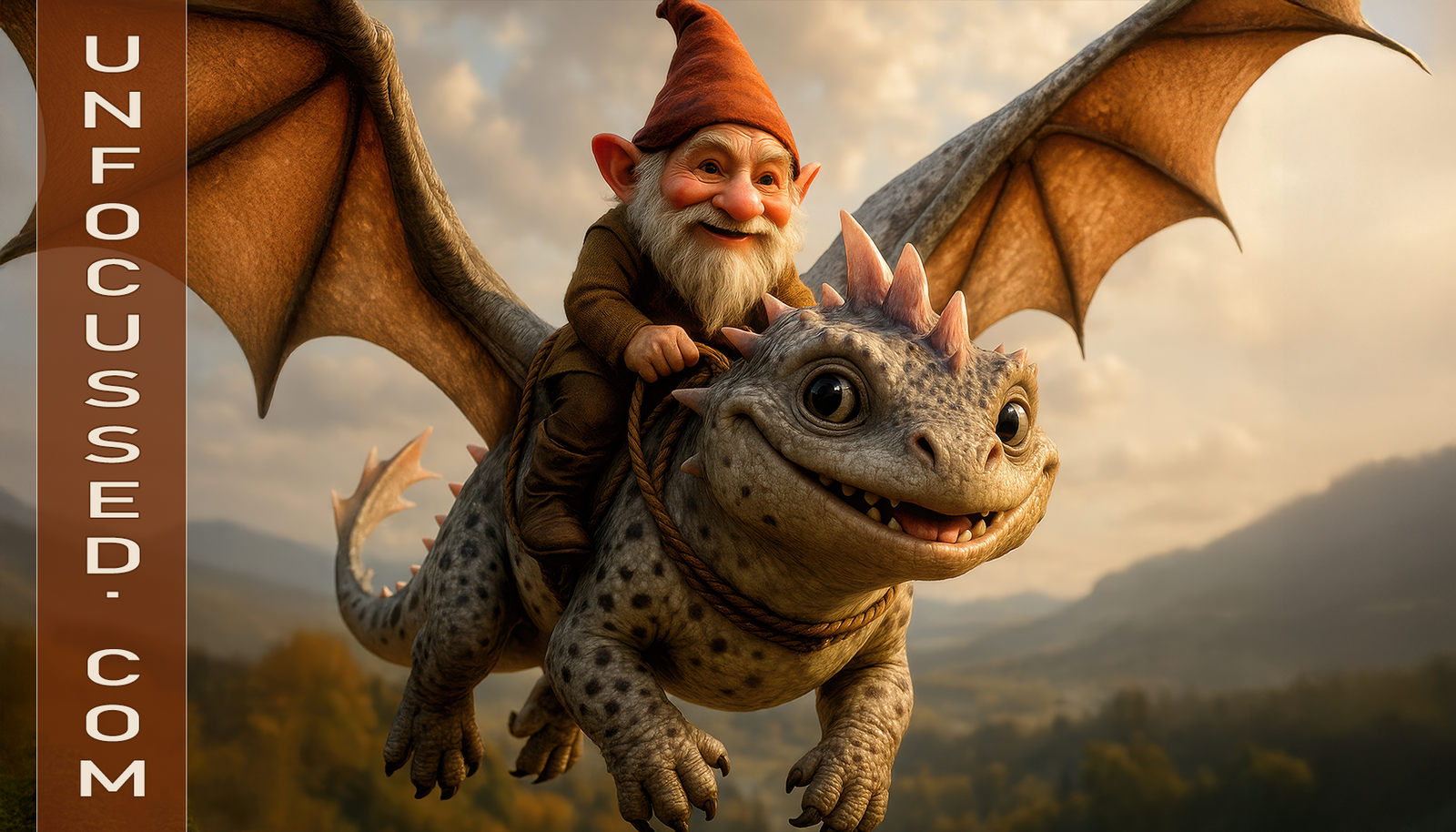
There are rules for gnomes. You don’t speak loudly in public unless you’re selling onions. You don’t drink before noon unless it’s mead (in which case it doesn’t count). And above all else, you don’tβ€”under any circumstancesβ€”go around taming dragons. Dragons are for elves with cheekbones sharp enough to slice bread, or for dwarves who can drink molten iron and still belch politely afterward. Gnomes? Gnomes are supposed to tend gardens, paint doorframes cheerful colors, and keep their heads down when giants argue about who owns which mountain. Roderick Bramblehelm had never kept his head down in his life. At forty-three, he had the beard of a prophet, the patience of a mosquito, and the temper of a blacksmith whose anvil had just insulted his mother. He also had a hammerβ€”a proper hammer, not one of those dainty mallets you use to hang shelves. This was forged steel with a handle of oak charred in dragonfire, the kind of hammer that made grown men step out of the way and priests start revising their wills. Roderick didn’t build with it. He didn’t fix with it. He raised it high as a promise to the world: if destiny won’t come knocking, I’ll bash the bloody door down myself. That philosophy is what led him into the Blacktooth Caverns on a storm-sick evening when most gnomes were at home, quietly admiring cabbages. The cavern was rumored to house something ancient and terrible. Villagers swore that every third Tuesday the mountains shuddered from within, as though the stones themselves had indigestion. Chickens went missing. Smoke rose where no fire had been lit. No one dared go insideβ€”no one except Roderick, who had grown tired of hearing the elders whisper, β€œThat one’s trouble,” whenever he entered the tavern. Trouble? He’d show them trouble. He’d show them wings slicing through thunder, jaws dripping with lightning, the kind of spectacle that made people drop tankards and soil breeches simultaneously. He found the beast curled among bones and broken wagons, snoring with the guttural rumble of earthquakes making love. The dragon was smaller than the legends promised, though β€œsmaller” in this case meant only slightly less enormous than a cathedral. Its scales shimmered like wet stone, its horns were twisted corkscrews of ivory, and its teeth gleamed with the confidence of someone who had eaten several knights and found them bland. But the strangest thing of all was its grinβ€”wide, feral, and utterly inappropriate for a creature that could end civilizations. The dragon’s name was Pickles. Roderick didn’t ask why; he suspected the answer would make his brain sprout mushrooms. β€œOi, you scaly thunderchicken!” Roderick shouted, raising his hammer until it scraped the cavern roof. β€œWake up, your nap’s over. The sky won’t conquer itself.” Pickles opened one saucer-sized eye, blinked once, and then let out a laugh so unholy that several bats dropped dead on the spot. It wasn’t a growl. It wasn’t a roar. It was the sound of madness having a tea party with chaos, and it rattled Roderick’s bones in the most satisfying way. β€œFinally,” the dragon croaked, its voice thick as burning tar. β€œA gnome with ambition. Do you know how long I’ve waited for one of you garden-tinkerers to grow a spine?” From that moment, their fates welded together like iron in a forge. Roderick climbed onto the beast’s back as if mounting a stubborn mule, and Picklesβ€”after a ceremonial belch that scorched several stalactitesβ€”unfurled wings vast enough to slap the storm outside into submission. Together, they launched into the sky, shredding the night with fire and fury. The villagers of Cinderwhip, still sipping their weak ale and gossiping about the mayor’s suspicious mole, nearly dropped dead when they saw it: a gnome, of all things, astride a dragon the size of their bakery, laughing like a lunatic while waving a hammer that seemed far too big for his tiny arms. Their screams were immediate. Mothers dragged children indoors. Farmers dropped pitchforks. A priest fainted into his own soup. Yet there was no denying the magnificence of the spectacle. Pickles twisted through thunderheads, his wings scattering lightning like spilled jewels, while Roderick howled insults at the very clouds. β€œIs that all you’ve got?” he shouted into the storm, voice echoing across valleys. β€œI’ve seen scarier drizzle from a drunk donkey!” He slammed his hammer against his belt for emphasis, each clang like a war drum beating out the end of the old order. No one watching that night would forget it, no matter how hard they prayed. By dawn, the legend of Roderick Bramblehelm and Pickles the Dragon had been born. And legends, as everyone knows, are dangerous things. They don’t just change how others see you. They change what you are, and what you will have to face next. For the skies are never given freelyβ€”they are only won, and always at a price. The first night of flight was not graceful. Roderick Bramblehelm clung to Pickles’ scaly back like a barnacle strapped to a cannonball, his hammer raised high mostly because letting go meant falling to a very poetic death. The dragon’s wings pummeled the air with a sound like thunder being beaten into submission, and every dive threatened to eject the gnome into the clouds. But Roderick wasn’t afraidβ€”not exactly. Fear, he’d decided long ago, was just excitement with poor posture. Besides, the view was intoxicating: lightning dancing through clouds, mountains carved in silver by the moon, and entire villages below, blissfully unaware that their future nightmares now came with a beard and a war hammer. Pickles was enjoying himself far too much. β€œLeft, right, barrel roll!” he cackled, throwing his weight into aerial acrobatics that made falcons puke midflight. Roderick’s stomach lurched somewhere behind him, probably in a field. Yet he grinned, teeth bared against the wind, shouting back, β€œIs this all you’ve got, you overgrown newt? My aunt’s washing line gave me a rougher ride than this!” The insult delighted Pickles. He let out a wheezing, guttural laugh that sent sparks fizzing from his nostrils and set a cloud partially aflame. The cloud did not appreciate this and drifted off sulking, its edges smoldering like a badly rolled cigar. Their aerial chaos could not go unnoticed. By the second dawn, the news of a gnome atop a dragon spread faster than gossip about who’d been caught snogging behind the millhouse. Bards exaggerated, priests panicked, and kings muttered to their advisors, β€œSurely this is a joke, yes? A gnome? On a dragon?” Entire councils debated whether to laugh, declare war, or drink heavily until the memory passed. But memory does not pass when a dragon and rider scorch their names across the sky. And scorch they did. Their first target, entirely by accident, was a bandit camp nestled in the crook of the River Grell. Roderick had spotted their fire and, assuming it was a tavern, demanded a closer look. Pickles, never one to resist mischief, dove like a plummeting anvil. What followed was less a battle and more an extremely one-sided barbecue. Tents went up like parchment. Bandits screamed, scattering like cockroaches under divine judgment, while Roderick bellowed, β€œThat’ll teach you to overcharge for ale!” He swung his hammer, obliterating a crate of stolen coins, sending silver raining into the dirt like divine confetti. The survivors later swore they had been attacked by the god of drunk lunatics and his pet apocalypse. From there, things escalated. Villages trembled when shadows darkened their skies. Noblemen soiled velvet trousers when Pickles swooped overhead, his grin a banner of impending chaos. Roderick found the whole affair intoxicating. He began inventing speeches to accompany their raidsβ€”grand, booming declarations that nobody could actually hear over the roaring wind but which made him feel dramatically important. β€œCitizens below!” he would shout into the gale, hammer aloft, β€œYour boring days are at an end! Behold your liberation in flame and glory!” To which Pickles would usually reply with a fart that set passing crows ablaze. Truly, they were poetry incarnate. But legends do not grow without enemies. Soon, the High Council of Stormwright Keep convened in their granite fortress. These were not sentimental peopleβ€”they were the kind who measured morality in taxes and peace in tidy borders. A gnome with a dragon, unpredictable and ungovernable, was the sort of thing that sent their bowels into parliamentary panic. β€œThis cannot stand,” decreed Archlord Velthram, a man whose face had all the warmth of a salted cod. β€œSummon the Knights of the Skyward Order. If a gnome believes he can own the clouds, then we shall remind him they are already under lease.” His advisors nodded gravely, though one or two scribbled furiously about whether they should trademark the phrase β€˜lease of the skies’ for propaganda posters. Meanwhile, Roderick was utterly unaware that his name had become both battle cry and curse. He was too busy learning the mechanics of dragon flight. β€œLean with me, you winged lunatic!” he barked during a sharp dive. β€œIf I’m going to conquer the skies, I’ll not do it looking like a sack of potatoes flopping on your back.” Pickles snorted, amused, and adjusted his trajectory. Slowly, painfully, something resembling teamwork began to emerge from the chaos. Within a fortnight, they could slice through valleys like arrows, loop around storm spires with balletic grace, and terrify migrating geese for sport. Roderick even managed to stay in his saddle without swearing every third word. Progress. Their bond deepened not just through combat but through conversation. Around campfires of stolen logs, Roderick would drink bitter ale while Pickles roasted wild boars whole. β€œYou know,” Roderick mused one night, β€œthey’ll all come for us eventually. Kings, priests, heroes. They can’t stand the thought of a gnome rewriting their stories.” Pickles licked pork grease from his fangs and grinned. β€œGood. Let them come. I’ve been bored for centuries. Nothing tastes better than righteous indignation served on a silver spear.” And so the legend of Hammer and Dragon grew teeth. Songs carried their deeds across taverns. Children carved crude figures of a gnome with a hammer, standing triumphant atop a smiling beast. Merchants began selling counterfeit β€˜dragon-scale charms’ and β€˜authentic Bramblehelm beards’ at markets. For every cheer, though, there came a curse. Armies began to march. War horns blew across the realm. In storm clouds above, the first shadows of rival riders began to stir, knights with spears tipped in lightning, sworn to drag Roderick Bramblehelm screaming from the skies. But Roderick only laughed. He welcomed the challenge, hammer flashing in firelight. β€œLet them come,” he told Pickles, his eyes burning brighter than any dawn. β€œThe skies were never meant for cowards. They were meant for us.” The first war horns sounded at dawn. Not the kind of dawn filled with rosy optimism and cheerful roosters, but the kind of dawn where the sun itself looked nervous about showing up. Across the valleys, banners unfurledβ€”banners of lords, mercenaries, zealots, and anyone who thought killing a gnome on a dragon might look good on a rΓ©sumΓ©. The skies filled with armored gryphons, hawks so massive they could carry a cow in one talon, and the dreaded Knights of the Skyward Order: riders clad in polished steel, their spears tipped with bottled lightning. Their formation cut across the heavens like a razor. This was not a raid. This was an extermination. Pickles hovered at the edge of a storm, wings half-furled, grinning like a lunatic as always. His laughter boomed, rolling over the land like artillery. β€œFinally!” he crowed, sparks bursting from his teeth. β€œA proper audience!” His tail lashed through clouds, thunder growling like a hungry wolf. On his back, Roderick Bramblehelm tightened the straps of his saddle, the hammer across his shoulders heavy with promise. His beard whipped in the wind, his eyes gleamed with manic determination, and his grin matched his dragon’s. β€œThat’s quite the reception,” he muttered. β€œI almost feel important.” β€œAlmost?” Pickles snorted, then belched out a plume of fire so wide it startled a flock of starlings into immediate retirement. β€œYou’re the most dangerous joke they’ve ever faced, hammer-boy. And jokes, when sharp enough, cut deeper than swords.” The enemy approached in waves. Trumpets shrieked. War drums thundered. Priests hurled curses into the gale, summoning holy fire and divine chains. But Roderick rose in his saddle, raised his hammer high, and bellowed a single word into the storm: β€œCOME!” It wasn’t a plea. It was a command, and even the clouds flinched. The battle exploded like chaos uncaged. Gryphon riders dove, their beasts screaming, claws flashing in the stormlight. Pickles rolled, twisted, snapped one from the sky in his jaws, and spat the armored corpse into a village well three miles below. Roderick swung his hammer with glee, caving helmets, shattering shields, and occasionally smacking an unfortunate gryphon in the backside so hard it changed religions midflight. β€œIs that all?” he roared, laughter tearing from his throat. β€œMy grandmother wrestled angrier chickens!” The Knights of the Skyward Order were no ordinary soldiers. They flew in flawless formations, their lightning-spears humming with captured storms. One spear struck Pickles square across the chest, sending sparks arcing over his scales. The dragon snarled, more annoyed than hurt, and let out a roar that cracked stone bridges below. Roderick nearly lost his grip, but instead of fear, his heart flooded with exhilaration. This was itβ€”the storm he was born for. β€œPickles!” he yelled, hammer aloft, β€œLet’s show these tin-plated pigeons how a gnome rewrites the sky!” What followed was not a battle. It was an opera of annihilation. Pickles spun through clouds, wings slicing wind into deadly vortices. His laughβ€”half shriek, half thunderβ€”rolled over the field like doom itself. Roderick moved with lunatic precision, his hammer striking like punctuation in a poem written in blood and fire. He shattered the spear of one knight, dragged the rider from his saddle, and hurled him screaming into a thunderhead. Another knight lunged, only to find himself clotheslined by a gnome’s steel hammer in midair, which by all accounts should have been physically impossible. But legends care little for physics. Below, villagers stared upward, their lives frozen mid-task. Some prayed, some wept, some cheered. Children laughed at the absurdity of itβ€”a tiny gnome slaying sky-knights while a dragon with a grin wider than the horizon shrieked in joy. Farmers swore they saw the gnome raise his hammer and strike lightning itself, splitting it into fragments that rained like molten silver. Entire churches would later form around the event, declaring Roderick Bramblehelm a prophet of chaos. Not that he’d ever attend a service. He thought sermons were dull unless someone caught fire halfway through. But legends always demand a price. The Archlord himself entered the fray atop a beast bred from nightmaresβ€”an obsidian wyvern, armored in spiked steel, eyes like black suns. Velthram was no fool. He carried no ordinary spear but the Spear of Dawnsbane, forged in storms older than empires, designed for a single purpose: killing dragons. His arrival hushed the battle for a breathless instant. Even Pickles’ grin faltered. β€œAh,” the dragon hissed. β€œFinally, someone worth burping on.” The clash was cataclysmic. The wyvern slammed into Pickles midflight, talons tearing scales, tail smashing like a spiked whip. Roderick nearly flew from the saddle, clinging by one strap as the world spun into fire and shrieking metal. Velthram thrust the Dawnsbane, the spear’s lightning kissing Pickles’ ribs, carving a searing wound. The dragon roared in pain, fire exploding from his lungs, engulfing three unfortunate knights who had wandered too close. Roderick, dangling by one arm, swung his hammer with all the fury in his tiny body, smashing against Velthram’s armored face. The Archlord snarled, blood spraying, but did not fall. The battle raged across miles of sky. Villages below quaked as dragon and wyvern crashed through storm fronts, their roars louder than earthquakes. Roderick screamed insults with each swingβ€”β€œYour wyvern smells like boiled cabbage!”—while Velthram countered with the cold silence of a man who hadn’t laughed since birth. Sparks rained, wings clashed, the very clouds tore apart beneath their fury. Finally, in a moment carved from madness, Roderick stood on Pickles’ neck, hammer raised, as the wyvern lunged in for the kill. Time slowed. The world held its breath. With a howl that shook heaven itself, Roderick leapt. He soared through the airβ€”gnome beard streaming, hammer ablaze with stormlightβ€”and brought it down upon Velthram’s spear. The impact cracked the Dawnsbane in two, thunder exploding outward in a wave that sent gryphons spiraling, shattered church bells across the realm, and split the storm into shreds of brilliant fire. Velthram, stunned, toppled from his saddle, his wyvern shrieking in panic as it dove to catch him. The sky was theirs. Pickles bellowed triumph, a laugh so wild it made the storm itself shudder into retreat. Roderick landed hard on his dragon’s back, barely clinging, lungs burning, body battered, but alive. Alive, and victorious. His hammer, cracked but unbroken, pulsed in his hands like a heartbeat. β€œThat,” he rasped, spitting blood into the wind, β€œis how a gnome writes history.” The armies broke. The knights fled. The Council’s banners burned. Songs would be sung for centuries about the day a gnome and his dragon claimed the heavens. Some would call it madness. Others would call it legend. But for those who saw it with their own eyes, it was something greater: proof that the skies belonged not to kings, nor gods, nor armies, but to those mad enough to seize them. And so Roderick Bramblehelm and Pickles the Dragon carved their names into eternity, not as tyrants or saviors, but as chaos given wings. The hammer had fallen, the skies had been conquered, and the worldβ€”forever afterβ€”looked up in both terror and awe, waiting for the next roar of laughter to roll across the clouds. Β  Β  Bring the Legend Home The tale of Roderick Bramblehelm and Pickles the Dragon doesn’t have to stay in the clouds. You can capture their chaos, triumph, and laughter in your own space. Hang their storm-scorched glory on your wall with a framed print or let the legend breathe boldly across a canvas that commands the room. Carry their madness wherever you go with a spiral notebook for your own daring plans, or slap their fearless grin onto your favorite surface with a battle-ready sticker. The skies may belong to legends, but the art can belong to you.

Read more

Tooth & Twinkle

by Bill Tiepelman

Tooth & Twinkle

The Recruitment of Reginald Reginald the Gnome had always considered himself something of a specialist in doing as little as possible with as much flair as possible. While other gnomes were busy tending gardens, crafting fine tools, or running suspiciously profitable mushroom ale distilleries, Reginald preferred reclining beneath a toadstool, puffing on a pipe filled with herbs of questionable legality, and sighing dramatically whenever anyone asked him for help. His philosophy was simple: the world had more than enough heroes and martyrs, but a true master of loafing was a rare and valuable treasure. At least, that’s what he told himself as he dodged responsibility with the skill of an Olympic-level tax evader. So when a crooked-nosed wizard named Bartholomew appeared in his front yard one gray morning, waving a staff and muttering about β€œdestiny” and β€œchosen companions,” Reginald naturally assumed he was being scammed. β€œListen,” Reginald had said, clutching his tea with both hands, β€œif this is about signing me up for some β€˜hero’s guild,’ forget it. I don’t do quests. I don’t fetch, I don’t fight, and I certainly don’t wear tights.” Bartholomew had only grinned in that unnerving way people do when they know something you don’t β€” or worse, when they think they’re funny. Before Reginald could protest further, the wizard had clapped his hands, shouted something about contracts, and introduced him to a creature that would change his life in ways he was not remotely ready for. Enter Twinkle: a baby dragon with eyes the size of soup bowls, wings like oversized laundry sheets, and the perpetually gleeful smile of a drunk bard who has just discovered free ale night. Twinkle’s scales shimmered faintly under the sun β€” not glittering like diamonds, but with the humble shine of a well-oiled frying pan. He was, in short, both ridiculous and terrifying. Reginald, on first sight, had uttered the words: β€œAbsolutely not.” β€œAbsolutely yes,” Bartholomew countered, already strapping a rope harness around the dragon’s chest. β€œYou’ll fly together, bond together, and save something or other. Don’t worry about the details. Quests always sort themselves out in the middle. That’s the magic of narrative structure.” Now, Reginald was no scholar, but he knew when he was being railroaded into a plotline. And yet, despite all his protests, he found himself β€” ten minutes later β€” airborne, screaming into the wind as Twinkle flapped with all the grace of a goat learning ballet. The ground dropped away, and the landscape unfurled like a painted scroll beneath them: forests, rivers, hills, and, somewhere in the distance, the faint twinkle (no relation) of civilization. Reginald’s stomach, however, refused to be impressed. It preferred to lurch violently, reminding him that gnomes were creatures of burrows and soil, not open skies and feather-brained wizards. β€œIf I fall to my death, I swear I will come back as a poltergeist and knock over all your soup pots,” Reginald bellowed, his voice whipped away by the wind. Twinkle turned his head slightly, flashing that infuriating, wide-mouthed grin that revealed rows of tiny, pearly teeth. There was no malice in it β€” only joy. Pure, unfiltered, puppy-like joy. And that, Reginald decided, was the most unsettling thing of all. β€œStop smiling at me like that,” he hissed. β€œYou’re not supposed to enjoy being the harbinger of doom!” The dragon’s wings dipped, then rose sharply, sending Reginald bouncing in the harness like a sack of turnips strapped to a catapult. He cursed in three languages (four, if you count the dialect of muttered gnomish reserved specifically for complaining). His hat nearly flew off, his beard whipped about like tangled yarn, and his grip on the rope tightened until his knuckles resembled pearl buttons. Somewhere in the back of his mind, he realized he had forgotten to lock his cottage door. β€œBrilliant,” he muttered. β€œI’ll come home to find raccoons playing cards in my kitchen. And if they’re anything like last time, they’ll cheat.” But for all his bellyaching, Reginald couldn’t entirely ignore the thrill crawling along his spine. The world below, usually so stubbornly out of reach, now lay like a map spread at his feet. The clouds parted, the sun caught Twinkle’s wings, and for one brief, treacherous moment, he felt something disturbingly close to… wonder. Of course, he smothered the feeling immediately. β€œWonder is for poets and lunatics,” he said aloud, mostly to reassure himself. β€œI am neither. I am a sensible gnome in a highly insensible situation.” Twinkle, naturally, ignored him. The dragon flapped harder, dove with terrifying speed, then swooped upward in a maneuver that would have impressed any respectable knight but only made Reginald wheeze like an accordion dropped down a staircase. β€œBy the beard of my ancestors,” he gasped, β€œif you break my spine, I will haunt you so relentlessly you’ll never nap again.” Twinkle chirped β€” yes, chirped β€” as though to say, deal. And so, the unlikely duo carried on: one gnome with the permanent expression of a man regretting all his life choices, and one dragon with the demeanor of an overeager puppy who had just discovered the concept of air travel. Together, they cut across the sky β€” not gracefully, not even competently, but loudly and with far too much enthusiasm from one side of the partnership. Reginald clung to the harness, muttering darkly, β€œThis is how legends start: with someone else’s bad idea and my unpaid labor. Typical.” The Perils of Mid-Air Hospitality Reginald had always believed that traveling should involve two essential comforts: steady ground beneath one’s feet and a flask of something strong enough to burn regrets out of the bloodstream. Unfortunately, flying on the back of Twinkle offered neither. His backside was already numb, the rope harness dug into his ribs like a debt collector, and the flask he’d hidden in his pocket had sprung a leak sometime between the second nosedive and the third death spiral. The scent of elderberry brandy now drifted in the air behind them, forming a fragrant trail that would have made bees and bandits alike giddy. β€œLovely,” he muttered, wringing out his sleeve. β€œNothing says β€˜professional adventurer’ like reeking of spilt liquor before the first crisis.” Twinkle, naturally, was having the time of his life. He banked, spun, and chirped in that oddly musical way, as though he were hosting an aerial cabaret. Reginald clutched the ropes tighter, his teeth rattling so hard they could’ve been used as castanets. β€œI know you think this is fun,” he grumbled into the wind, β€œbut some of us are not equipped for spontaneous air acrobatics. Some of us have delicate spines, weak constitutions, and, might I remind you, absolutely no wings.” The dragon ignored him, of course, but Reginald wasn’t entirely alone. As they soared past a flock of geese, one particularly bold bird flew alarmingly close to Reginald’s face. He swatted at it half-heartedly. β€œShoo! I don’t have time for avian harassment. I’m already being chauffeured by a reptilian maniac.” The goose honked indignantly, as if to say, your fashion sense offends us all, short one, before veering back to its flock. β€œYes, well, take it up with the wizard,” Reginald snapped. β€œHe’s the one who dressed me like a potato sack escaped from the laundry line.” As if things weren’t humiliating enough, Twinkle suddenly let out a sound suspiciously like a growling stomach. Reginald froze. β€œNo,” he said firmly. β€œAbsolutely not. We are not mid-flight snacking, not unless you’ve brought your own sandwiches.” Twinkle burbled happily and banked toward a small plateau sticking out of the forest below, wings flaring in what Reginald instantly recognized as the international signal for picnic landing. The dragon swooped down, wobbling slightly on his descent, and touched down with all the grace of a sack of flour being dropped from a barn roof. Reginald’s bones clattered, his beard went sideways, and when the dust settled, he slid off the dragon’s back like an exhausted potato peel. β€œCongratulations,” he wheezed. β€œYou’ve invented the world’s least comfortable carriage ride.” Twinkle, meanwhile, sat happily on his haunches, panting like a dog and staring expectantly at Reginald. The gnome raised one bushy eyebrow. β€œWhat? You think I packed snacks? Do I look like your personal caterer? I barely remember to feed myself, and half the time that involves moldy bread and regret soup.” Twinkle tilted his enormous head, blinked twice, and let out the faintest, most pitiful whine imaginable. β€œOh no,” Reginald groaned, covering his ears. β€œDon’t you dare weaponize cuteness against me. I have survived decades of guilt-tripping aunties and manipulative raccoons. I am immune.” He was not immune. Ten minutes later, Reginald was rooting around in his satchel, producing the sad remnants of his travel supplies: two crumbling biscuits, half a wheel of suspiciously sweaty cheese, and what might once have been an apple before time and neglect transformed it into a small weapon. Twinkle eyed the pile with such radiant joy you’d have thought Reginald had conjured a feast of roasted boar and honeycakes. β€œDon’t get too excited,” Reginald warned, snapping the apple in half and tossing it at him. β€œThis is barely enough to feed a hungry hamster. You, meanwhile, are the size of a hay wagon.” Twinkle swallowed the apple whole, then burped, sending out a puff of smoke that singed the tips of Reginald’s beard. β€œMarvelous,” the gnome grumbled, patting out the sparks. β€œA flying furnace with indigestion. Just what I needed.” They sat in uneasy companionship on the plateau for a while. Twinkle gnawed happily on the stale cheese, while Reginald stretched his aching legs and muttered about how retirement had been within reach just yesterday. β€œI could be in my burrow right now, sipping tea, playing cards with badgers, and listening to the rain,” he complained to no one in particular. β€œInstead, I’m babysitting a dragon with the digestive habits of a goat.” Twinkle, finished with the cheese, scooted closer and nudged him with his snout, nearly knocking him into the dirt. β€œYes, yes, I like you too,” Reginald said reluctantly, rubbing the dragon’s nose. β€œBut if you keep looking at me like I’m your replacement mother, I’m buying you a nanny goat and calling it a day.” Before he could say more, the sky above them shifted. A shadow swept across the plateau, long and ominous. Reginald froze, squinting up. It wasn’t a cloud. It wasn’t a bird. It was something far larger, something with wings so vast they seemed stitched from night itself. Twinkle froze, too, his goofy grin vanishing, replaced by a wary flick of his tail. β€œOh, splendid,” Reginald muttered, standing slowly. β€œBecause what this day was missing was a larger, scarier dragon with a possible appetite for gnomes.” The shadow circled once, twice, and then descended in a slow, predatory spiral. Reginald felt the hairs on his neck bristle. He gripped the harness rope still dangling from Twinkle’s chest and whispered, β€œIf this ends with me being swallowed whole, I just want it noted that I was right all along. Adventure is a racket.” Twinkle crouched, wings twitching, eyes wide, caught somewhere between terror and excitement β€” the look of a child about to meet a relative who may or may not bring candy. Reginald patted his scaly companion nervously. β€œSteady now, lad. Try not to look edible.” The massive figure landed with a ground-shaking thud just ten yards away. Dust billowed, pebbles rattled, and Reginald’s heart sank. Before him stood a dragon four times Twinkle’s size, scales black as obsidian, eyes glowing like molten gold. Its wings folded neatly with the calm precision of someone who knew they were in charge of every living thing within five miles. The elder dragon lowered its head, nostrils flaring as it sniffed Reginald first, then Twinkle. Finally, with a voice that rumbled like distant thunder, it spoke: β€œWhat… is this?” Reginald swallowed hard. β€œOh, wonderful. It talks. Because it wasn’t intimidating enough already.” He straightened his hat, cleared his throat, and replied with all the bravado he could fake: β€œThis is, uh… an apprenticeship program?” The Audition for Disaster The elder dragon’s molten eyes narrowed, flicking from Reginald to Twinkle and back again, as though trying to decide which looked more ridiculous. β€œAn apprenticeship program,” it repeated, every syllable rumbling deep enough to rearrange Reginald’s organs. β€œThis… is what the world has come to?” Reginald, being a gnome of resourceful cowardice, nodded vigorously. β€œYes. That’s exactly it. Training the next generation. All very official. You know how it is β€” forms to fill, waivers to sign, nobody wants liability these days.” He gave a little laugh that sounded more like a cough, then glanced sideways at Twinkle, who wagged his tail like an overexcited puppy. β€œSee? Enthusiastic recruit. Very promising. Could probably roast marshmallows with minimal collateral damage.” The elder dragon leaned in closer, nostrils flaring. The blast of hot breath nearly flattened Reginald’s beard. β€œThis hatchling is weak,” it growled. β€œIts flame is untested. Its wings are clumsy. Its heart…” The golden eyes locked on Twinkle, who, instead of cowering, belched out a puff of smoke that came with a faint squeak β€” like a kettle left too long on the stove. The elder dragon blinked. β€œIts heart is absurd.” Reginald threw his arms wide. β€œAbsurd, yes! But in an endearing way. Everyone loves absurd these days. It sells. Absurdity is the new black, haven’t you heard?” He was stalling, of course, desperately trying to keep from being fried, stomped, or eaten. β€œGive him a chance. He just needs… polish. Like an uncut gem. Or an un-housebroken goat. You know, potential.” The elder dragon tilted its massive head, clearly amused by the spectacle. β€œVery well. The hatchling may prove itself. But if it fails…” The golden eyes fixed on Reginald, glowing hotter. β€œβ€¦you will take its place.” β€œTake its place where?” Reginald asked nervously. β€œI should warn you, I’m not very good at laying eggs.” The elder dragon did not laugh. Dragons, it seemed, had a limited appreciation for gnomish humor. β€œThere is a trial,” it rumbled. β€œThe hatchling will demonstrate courage in the face of peril.” Its massive wings unfurled, blotting out the sun, before beating downward in a gale that nearly knocked Reginald on his backside. β€œFollow.” β€œOh, splendid,” Reginald muttered, clambering back onto Twinkle with all the grace of a sack of disgruntled potatoes. β€œWe’re off to prove your worth in some arbitrary dragon hazing ritual. Don’t worry, I’ll just be over here quietly dying of anxiety.” Twinkle chirped cheerfully, as if volunteering for a carnival ride. The trial site turned out to be a canyon split so deep into the earth that even sunlight seemed afraid to enter. The elder dragon landed on one side, its wings stirring whirlwinds of dust, while Reginald and Twinkle teetered on a narrow outcropping across the gap. Between them stretched a rope bridge so rickety it looked like it had last been maintained by squirrels with a death wish. β€œThe hatchling must cross,” the elder dragon declared. β€œIt must reach me, though the winds will fight it.” Reginald peered over the edge of the canyon. The abyss seemed bottomless. He could practically hear his ancestors shouting, we told you not to leave the burrow! He turned to Twinkle, whose wide grin had dimmed into something halfway between nervousness and excitement. β€œYou realize,” Reginald said, adjusting his hat, β€œthat I am not built for inspirational speeches. I don’t do β€˜you can do it.’ I do β€˜why are we doing it at all.’ But here we are. So… listen carefully. Do not look down, do not sneeze fire at the ropes, and for the love of all that is unholy, do not grin so hard you forget to flap.” Twinkle chirped, then waddled onto the bridge, the ropes creaking ominously under his weight. Reginald, of course, had no choice but to follow, clutching the ropes as though they were his last tether to sanity. The wind howled, tugging at his beard and hat, and somewhere far below came the echoing cackle of something that very much wanted to see them fall. β€œPerfect,” he muttered. β€œThe canyon comes with an audience.” Halfway across, disaster struck β€” naturally, because stories thrive on disaster. A sudden gust of wind roared up, twisting the bridge so violently that Reginald found himself dangling sideways like laundry on a line. Twinkle screeched, flapping frantically, wings smacking against the canyon walls. Reginald yelled, β€œFlap UP, you lunatic, not SIDEWAYS!” Somehow β€” through sheer stubbornness and a good deal of physics-defying nonsense β€” Twinkle found his rhythm. He steadied himself, wings catching the air just right, propelling him forward with a grace that surprised even him. Reginald clung to the dragon’s harness, eyes squeezed shut, muttering every prayer he could remember and several he invented on the spot. (β€œDear whoever runs the afterlife, please don’t assign me to raccoon duty again…”) At last, they reached the far side, tumbling into the dust at the elder dragon’s feet. Reginald lay on his back, gasping like a fish left out of water. Twinkle, on the other hand, puffed proudly, chest swelling, tail wagging like a flag of victory. The elder dragon studied them in silence, then let out a low rumble that might almost have been… approval. β€œThe hatchling is reckless,” it said. β€œBut brave. Its flame will grow.” A pause. β€œAnd the gnome… is irritating. But resourceful.” Reginald sat up, brushing dirt from his beard. β€œI’ll take that as a compliment, though I notice you didn’t say handsome.” The elder dragon ignored him. β€œGo. Train the hatchling well. The world will need such absurd courage sooner than you think.” With that, the great wings unfurled again, carrying the elder dragon skyward, its shadow shrinking as it vanished into the clouds. Silence settled over the canyon. Reginald glanced at Twinkle, who beamed at him with uncontainable joy. Against his better judgment, the gnome chuckled. β€œWell,” he said, adjusting his hat, β€œlooks like we didn’t die. That’s new.” Twinkle nuzzled him affectionately, nearly knocking him over again. β€œFine, fine,” Reginald said, patting the dragon’s snout. β€œYou did well, you ridiculous furnace. Perhaps we’ll make something of you yet.” They climbed back onto the harness. Twinkle leapt into the air, wings beating steadily now, confidence growing with each flap. Reginald clutched the ropes, grumbling as usual, but this time there was the faintest trace of a smile hiding in his beard. β€œAdventure,” he muttered. β€œA racket, sure. But maybe… not entirely a waste of time.” Below them, the canyon faded into shadow. Ahead, the horizon stretched, wide and waiting. And somewhere in the distance, Reginald swore he could already hear the wizard laughing. β€œBartholomew,” he muttered darkly. β€œIf this ends with me fighting trolls before breakfast, I’m sending you the bill.” Twinkle chirped brightly, banking toward the sunrise. Their absurd journey had only begun. Β  Β  Bring a piece of "Tooth & Twinkle" into your own world. Reginald and Twinkle’s absurd, sky-high adventure doesn’t have to live only in words β€” you can capture the whimsy, the humor, and the magic in your home. Whether you want to hang their tale on your wall, piece it together slowly, or send a little joy in the mail, there’s a perfect option waiting for you: Framed Print – Add character and charm to any room with this enchanting artwork, ready to hang and brimming with storybook spirit. Acrylic Print – Bold, glossy, and luminous, perfect for showcasing every detail of Reginald’s exasperation and Twinkle’s irrepressible grin. Jigsaw Puzzle – Relive the adventure piece by piece, with a puzzle as whimsical (and occasionally frustrating) as the journey itself. Greeting Card – Send a smile, a laugh, or a spark of magic to someone you love β€” Reginald and Twinkle make unforgettable messengers. Sticker – Take the absurdity with you anywhere: laptops, water bottles, journals β€” a little dragon-fueled cheer for everyday life. However you choose to enjoy it, β€œTooth & Twinkle” is ready to bring a dash of adventure and humor to your day. Because every home β€” and every heart β€” deserves a touch of the ridiculous.

Read more

The Acorn Avenger

by Bill Tiepelman

The Acorn Avenger

The Gnome, The Nut, and the Nonsense Somewhere in the leafy middle of nowhere, between the edge of β€œdon’t go in there” and β€œoh hell, why did we come in here,” lived a legend. Not a tall legend. Not even an average-sized legend. No, this one came in just under three feet if you didn’t count the hat. And you had to count the hat, because it was about the only thing that gave him presence. He was The Acorn Avenger, and if you were expecting heroics involving dragons, maidens, or great bloody quests, you’ve come to the wrong wood. This was a gnome whose most daring battle to date had been against indigestion. But oh, did he strut. Bark armor clanked around his stubby frame like an overenthusiastic child wearing too many Lego pieces, while his faceβ€”ruddy cheeks, twinkling eyes, and a beard the exact shade of spilled cream aleβ€”beamed with dangerous self-confidence. On his chest, slung by ropes that looked like they’d been borrowed from an old clothesline, bounced his closest companion: Nibbs the Acorn. And no, not just an ordinary acorn. Nibbs had a face. A wide-eyed, perpetually startled, wooden face. Worse yet, it talked sometimes. Or sang. Or squeaked. Depending on the mood. The locals called it cursed. The Avenger called it β€œbackup vocals.” On this particular morning, The Acorn Avenger was stomping through the forest with the air of someone who believed the trees were secretly applauding him. His boots squelched in the mud, his bark armor creaked like an old door hinge, and Nibbs bounced merrily with every step. β€œOnward, noble steed!” he shouted at no one, since he owned no horse and was, in fact, simply walking. β€œI don’t think I like being referred to as a steed,” Nibbs muttered. His voice was somewhere between a kazoo and a squeaky drawer hinge. β€œI’m more of a sidekick. Or a tambourine.” β€œSidekicks don’t usually hang off my sternum,” the Avenger replied, puffing his chest proudly. β€œBesides, you’re lucky. Some gnomes lug around pocket watches. Or shovels. You get to be the chosen nut.” β€œYou say that like it’s a promotion,” Nibbs grumbled, then fell silent as a squirrel scampered past. The squirrel gave them both the kind of side-eye usually reserved for drunk relatives at weddings. You see, the animals of the forest had learned to endure The Acorn Avenger. He wasn’t malicious. He wasn’t cruel. He was just… loud. He once spent three consecutive nights challenging owls to staring contests. He accused raccoons of plotting against him because they wore β€œbandit masks.” And once, he drew his bark sword against a deer, declaring, β€œUnhand the grass, villain!” The deer continued chewing and, as expected, won the duel by default. Still, the gnome was tolerated. Mostly. Until the mushrooms began to organize. But I’m getting ahead of myself. That morning, the Avenger climbed atop a mossy rock, striking what he believed to be a heroic pose. His hat drooped left in protest, but otherwise it was magnificent. β€œHear me, Whispering Wood!” he cried, his voice echoing weakly through the mist. β€œI am the Acorn Avenger, defender of twigs, scourge of beetles, the bane of damp socks, andβ€”most importantlyβ€”the only one here with a musical nut!” Nibbs squeaked like a deflating balloon to punctuate the moment. Somewhere in the underbrush, a rabbit muttered something rude in Lapine. Birds ruffled their feathers and muttered to each other like gossipy grandmothers. Even the trees seemed unimpressed. But The Acorn Avenger didn’t noticeβ€”or chose not to. Confidence, after all, is the art of ignoring reality with enthusiasm. β€œAdventure awaits, Nibbs!” he boomed, hopping off the rock and immediately landing ankle-deep in a puddle. Bark armor is not waterproof. He squelched forward anyway, determined. β€œToday, destiny calls!” β€œDestiny sounds damp,” Nibbs said dryly. β€œAnd smells like wet bark.” β€œNonsense,” the Avenger snapped. β€œDestiny smells like victory! And perhaps roasted chestnuts. But mostly victory!” They trudged deeper into the forest, unaware that something small, spongy, and deeply offended was already watching them from the shadows. Something that had had enough of his nonsense. Something… fungal. The Fungus Among Us Every great hero has a nemesis. Achilles had Hector. Sherlock had Moriarty. The Acorn Avenger? Well, he had mushrooms. Yes, mushrooms. Don’t laughβ€”it’s terribly rude. These weren’t your harmless β€œtoss them on pizza” kind of mushrooms. These were the puffed-up, resentful, perpetually damp kind, with little round heads and a grudge against anyone who stepped on them (which, in fairness, the Avenger did frequently and with dramatic flair). Our gnome had a habit of kicking at toadstools whenever he wanted to β€œmake an entrance.” He once leapt from behind a log shouting β€œPrepare to be astonished!” and stomped squarely onto a mushroom ring, scattering spores everywhere. To him, this was harmless fun. To the fungi, it was an act of war. And fungi, unlike squirrels or deer, didn’t forget. They multiplied. They whispered in damp corners. They waited. On this damp morning, as the Avenger sloshed deeper into the trees, an entire conclave of mushrooms gathered in the shadows. Puffballs, shiitakes, chanterelles, even a terrifyingly pompous porciniβ€”all arranged in a circle that looked suspiciously like a committee meeting. Their leader, a massive, sulking morel with a voice like wet corduroy, cleared his nonexistent throat. β€œThe gnome must go.” Gasps echoed around the ring. A portly button mushroom fainted. A deadly-looking Amanita tried to clap but succeeded only in wobbling. β€œHe mocks us,” the morel continued, darkly. β€œHe tramples our rings. He spreads our spores without consent. Worst of all, he makes jokes about β€˜mushroom puns.’” The mushrooms shuddered collectively. One piped up timidly: β€œBut… what if he’s the chosen one? You know, foretold by the prophecy?” β€œProphecy?” the morel snapped. β€œThat was just graffiti on the side of a log. It said β€˜Fun Guys Rule.’ It wasn’t divine, it was vandalism.” Meanwhile, blissfully unaware of the fungal plot, The Acorn Avenger continued tromping through the wood, narrating loudly to himself like a bard who’d been fired for excessive enthusiasm. β€œMark my words, Nibbs, today we shall encounter great peril, test our courage, and maybeβ€”just maybeβ€”find that legendary tavern with the half-priced mead pitchers!” β€œI’d settle for finding a towel,” Nibbs muttered, still squeaky with damp. The gnome paused. β€œDo you hear that?” β€œHear what?” β€œExactly. Silence. Too silent. The kind of silence that suggests dramatic tension.” He narrowed his eyes. His bark armor groaned like a cranky chair. β€œThis can only mean one thing… ambush.” Of course, he was correct. But not in the way he thought. He expected goblins, maybe wolves, possibly tax collectors. What he got was… mushrooms. Dozens of them. They emerged slowly from the underbrush, wobbling like damp cupcakes, forming a circle around him. Some glowed faintly. Some spat spores into the air like smoke bombs. It was less intimidating than the Avenger’s imagination had promised, but stillβ€”he had to admitβ€”eerily organized. β€œOh no,” Nibbs groaned. β€œNot them again.” β€œAha!” The Avenger puffed out his chest. β€œVillains! Foes! Fungus fiends!” He raised his barky fist. β€œYou dare stand against the Acorn Avenger?” β€œWe dare,” said the morel leader, his voice damp and gurgling, like soup simmering resentfully. β€œWe are the Mycelium Collective. And you, sir, are a menace to soil stability, spore sovereignty, and good taste in general.” β€œI’ll have you know I am beloved by all creatures of the forest!” The Avenger shouted, though the birds, squirrels, and one deeply unimpressed fox nearby rolled their eyes in unison. β€œBeloved?!” scoffed the Amanita, wobbling forward dramatically. β€œYou’ve urinated in no fewer than three fairy rings.” β€œThat was ONE TIME!” the Avenger shouted. β€œAnd technically, twice. But who keeps count?” β€œWe do,” the mushrooms intoned together. It was like a choir of damp towels. Nibbs sighed. β€œYou’ve really done it now. You don’t anger mushrooms. You don’t mock mushrooms. And above all, you don’t step on mushrooms. You should’ve known better. You’re basically at war with a salad bar.” β€œSilence, acorn!” the morel roared. β€œYou, too, are complicit. You hang upon the chest of this fool, squeaking your support.” β€œOh, don’t drag me into this,” Nibbs snapped. β€œI’ve been trying to unionize for years. He doesn’t listen.” The Avenger gasped. β€œUnionize? You… you traitor!” Before Nibbs could respond, the mushrooms began to advance. Slowly, yes, because they were mushrooms and their legsβ€”well, they didn’t technically have legs, but they sort of shuffled in a way that implied locomotion. Still, there were many of them, and they encircled the gnome with grim determination. Spores drifted into the air, glowing faintly in the morning light. It looked less like a battle and more like an aggressively weird festival. β€œThis is your end, Acorn Avenger,” the morel declared. β€œThe forest will no longer suffer your antics. Prepare to be… composted.” The Avenger tightened his fists, bark creaking. His hat twitched heroically in the breeze. β€œVery well. If it is war you want, it is war you shall have.” He grinned madly. β€œI’ll make mulch of the lot of you!” β€œThat’s a terrible pun,” Nibbs whispered. β€œPlease don’t say that again.” And with that, the battle of gnome versus fungus officially beganβ€”though whether it would end in glory, disaster, or the world’s weirdest soup recipe remained to be seen. The Spores of War The air grew thick with spores, glowing like fireflies on a drunken bender. The mushrooms shuffled closer, their damp caps glistening with menace. To the casual observer, it might have looked like a salad slowly closing in on a man who really should’ve stayed home. But to the Acorn Avenger, this was destiny. Finally, a battle worthy of his legendβ€”or at least a battle that would look impressive in his memoirs if he exaggerated the details (which, of course, he would). β€œNibbs!” he barked, striking a pose so heroic that his bark armor immediately squealed in protest. β€œToday we make history. Today we show these fungal fiends what it means to face the power of gnome-kind!” β€œPower of gnome-kind?” Nibbs muttered. β€œThe last time you flexed that power, you lost an arm-wrestling contest to a dandelion stem.” β€œThat stem had been working out,” the Avenger snapped back. He unslung his bark swordβ€”really just a sharpened plank he’d stolen from a picnic tableβ€”and brandished it with wild confidence. β€œFace me, spongy scoundrels!” The Mycelium Collective advanced, puffing spores like disgruntled chimneys. The morel leader stepped forward dramatically. β€œYou will fall, gnome. You will rot beneath our caps. The forest shall sprout from your foolish remains.” β€œOver my hat!” the Avenger bellowed. He leapt forward, which was impressive in spirit if not in distance (gnomes don’t leap very far). His sword came down with a thwack, cleaving a puffball in two. Spores exploded everywhere like someone had shaken a bag of flour in a sauna. He coughed, sneezed, and shouted, β€œFirst blood!” β€œThat’s not blood,” Nibbs squeaked, muffled by spores. β€œThat’s fungus dust. You’re basically sneezing on your enemies.” β€œSneezing is my weapon!” the Avenger declared proudly, before unleashing an almighty sneeze that blew three button mushrooms onto their backs. The mushrooms retaliated. One Amanita hurled spores like a smoke bomb, filling the clearing with a choking haze. Another launched itself bodily at the gnome, smacking into his armor with a wet splut. The Avenger staggered but remained upright, laughing maniacally. β€œIs that all you’ve got?!” β€œThis is getting ridiculous,” muttered a fox, watching from the sidelines. β€œI came here for a quiet breakfast and now I’m in the middle of a fungal circus.” The Avenger swung his sword in wild arcs, chopping down mushrooms left and right. But for every one that fell, three more shuffled forward. The forest floor pulsed with life, the hidden network of mycelium beneath the soil whispering, summoning reinforcements. Tiny mushrooms sprouted instantly at his feet, tripping him. He fell backward with a grunt, his hat sliding sideways. β€œVictory… is slipping…!” he groaned dramatically, flailing like an upturned turtle. Nibbs swung against his chest with each movement, squeaking in protest. β€œStop rolling, you idiot, you’re crushing my face!” Just as the mushrooms prepared to bury him beneath a tide of damp caps, the gnome’s eyes lit up. β€œOf course!” he cried. β€œTheir weakness!” He yanked Nibbs free from his chest straps and held the acorn aloft like a divine relic. β€œNibbs, unleash your secret weapon!” β€œWhat secret weapon?!” Nibbs squealed. β€œThe one I’ve been saving for this very moment! You know, the… uh… thing!” β€œI don’t have a thing!” β€œYes, you do! Do the… squeaky scream!” Nibbs blinked his wooden eyes, then sighed. β€œFine.” He opened his tiny acorn mouth and let out a noise so shrill, so piercing, it made bats drop from the treetops and worms evacuate the soil in protest. The mushrooms froze. The spores quivered in midair. The forest itself seemed to pause, as though embarrassed to witness such a sound. The gnome seized the moment. He scrambled to his feet, sword raised, and shouted, β€œBehold! The power of the Acorn Avengerβ€”and his terrible, terrible nut!” With one final, heroic sneeze (it was mostly phlegm, honestly), he charged through the stunned mushrooms, scattering them like bowling pins. Caps flew, spores popped, and the morel leader toppled into a puddle with an indignant splush. When the spores finally cleared, the battlefield was a mess of trampled fungi and damp gnome footprints. The Avenger stood panting, his hat askew, his armor smeared with questionable goo. He raised his sword triumphantly. β€œVictory!” β€œYou’re covered in fungus,” Nibbs observed flatly. β€œYou smell like a compost bin. And I think you have mold in your beard.” β€œAll part of the heroic aesthetic,” the gnome replied, striking a pose despite his dripping state. β€œFrom this day forth, let it be known: The Acorn Avenger fears no fungus! I am the champion of the Whispering Wood! Protector of squirrels! Defender of damp places!” The fox watching nearby rolled its eyes. β€œCongratulations,” it muttered. β€œYou’ve won a war against side salad.” Then it trotted off, unimpressed. And so the forest quieted again, the Mycelium Collective scattered but not entirely defeated. Somewhere beneath the soil, spores whispered their vows of revenge. But for now, the Acorn Avenger strutted home, squeaky nut in tow, already planning how he’d embellish this tale at the tavern. And if anyone doubted him? Well, he’d simply shout louder until they gave up. That, after all, was the true power of the Acorn Avenger: unstoppable confidence, questionable hygiene, and an acorn with lungs strong enough to wake the dead. Β  Β  Bring The Acorn Avenger Home If you enjoyed the absurd saga of bark armor, squeaky nuts, and mushroom mayhem, you don’t have to leave it in the forest. The Acorn Avenger can march straight into your life with a range of whimsical treasures. Dress up your walls with a Framed Print or a bold Metal Print, perfect for adding a splash of fantasy and humor to your dΓ©cor. Prefer something more personal? Jot down your own epic gnome-versus-fungus chronicles in a handy Spiral Notebook, or carry a piece of his mischief everywhere with a quirky Sticker. Each item features the playful, richly detailed imagery of The Acorn Avengerβ€”perfect for fans of fantasy art, woodland whimsy, or anyone who just really, really hates mushrooms.

Read more

Snuggle Scales

by Bill Tiepelman

Snuggle Scales

Of Blossoms, Boredom, and Blunt Claws Snuggle Scales was not her given name. No self-respecting dragon would hatch with a name that sounded like it belonged to a toddler’s bedtime plushie. No, she was born as Flareth Sparkfang the Third, a name that demanded respect, fear, and at the very least, a mildly dramatic soundtrack. But that all changed when she tumbledβ€”quite literallyβ€”out of her cozy cave and landed butt-first in a bed of cherry blossoms, wings tangled and claws pointed skyward, like a fallen croissant with an attitude. That’s when the forest gnomes found her. All seventy-three of them. β€œOH MY GOODNESS, IT’S GOT TOES!” one of them shrieked with the volume of a kazoo in heat. β€œAND LOOK AT HER LITTLE BELLY FLUFF!” another gushed, already crocheting a pink bow mid-hyperventilation. The vote to rename her "Snuggle Scales" was unanimous. Flarespark-whatever was never mentioned againβ€”except by her therapist (a deeply overworked toad named Dr. Gloomp). Now, Snuggle Scales lived in the *Whifflewood Glade*, an aggressively cheerful corner of the Enchanted Lands that always smelled faintly of cinnamon and gossip. It was springtime, which meant the petals were falling like pink confetti, the birds were practicing passive-aggressive harmonies, and Snuggle Scales had reached peak boredom. She'd already rearranged her claw polish collection (sixteen shades of 'Molten Mischief'), ironed her tail ribbons, and sorted her wing glitter by sass level. So, she decided to do something no baby dragon had dared before. She would leave the glade. She would enter The Human Realm. Why? Because dragons were meant to soar, not pose for gnome-sponsored tea parties with daffodil cupcakes and emotional support hedgehogs named Crispin. And if one more elf tried to paint her scales for β€œpastel realism” art class, she was going to burn their easel into bite-sized regret. So, with her wings fluffed, talons sharpened, and bow freshly fluffed, Snuggle Scales grabbed her emotional support mushroom (don’t judge), did a dramatic stretch for the imaginary audience, and waddled confidently toward the portal tree. Which, of course, had a β€œWet Bark” sign hanging from it. β€œYou have GOT to be kidding me,” she muttered, tapping the wood like a suspicious landlord. β€œI swear, if I get moss on my tail again, I’m suing the forest.” And with one last eye-roll at the overly fragrant breeze, Snuggle Scales stepped through the tree, into a world of chaos, caffeine, and, as she would soon discover, feral toddlers at birthday parties. Caffeine, Cupcakes, and Catastrophic Bounce Houses The Human Realm was not what Snuggle Scales expected. She had envisioned grand towers, mysterious music, and possibly a ritualistic offering of snacks. Instead, she crash-landed in the middle of a suburban park β€” face-first into a pink plastic picnic table covered in unicorn napkins and half-eaten cupcakes. A small human screamed. Then another. Then several. Within seconds, she was surrounded by a battalion of sticky-fingered, frosting-smeared toddlers β€” the terrifying kind that ask β€œWhy?” five hundred times and think personal space is a myth. β€œLOOK! A LIZARD!” one of them shrieked, pointing at her with a sparkly wand that smelled like raspberry sanitizer and poor decisions. β€œShe’s a DINOSAUR!” said another, already attempting to mount her tail like a pony ride. Snuggle Scales was two seconds away from turning this party into a fiery lesson in boundaries, but just then β€” she locked eyes with the ringleader. A tiny human queen in a glitter crown and a tutu the size of a small planet. β€œYou’re invited,” the girl said solemnly, offering her a cupcake with the confidence of someone who had never been denied anything in her life. β€œYou’re my special guest now.” Snuggle Scales blinked. The cupcake was vanilla. It had edible glitter. And more importantly, it was presented without any adult supervision. With great dignity (and minor frosting inhalation), she accepted. Two hours later, Snuggle Scales was inexplicably wearing a Hello Kitty sticker on her snout, had adopted the name β€œMiss Wiggles,” and had somehow agreed to be the grand finale in a game called *Pin the Sparkle on the Reptile.* β€œThis is a new low,” she muttered, glancing sideways at a balloon animal that looked like a depressed goat. β€œI used to be feared. I used to be majestic.” β€œYou used to be lonely,” said a tiny voice from under the cupcake table. It was the birthday girl, now minus the crown and frosting but plus a surprisingly sharp sense of emotional timing. Snuggle Scales looked at her β€” really looked at her. She had that messy, defiant, beautiful chaos that reminded the dragon of spring mornings in the glade. Of imperfect gnome poetry. Of soft petals on scales and snorting laughter during daffodil charades. And for the first time since she'd crossed into this sugar-coated world, something inside her softened. β€œDo you... want to pet my toe beans?” she offered, lifting a foot. The child gasped in reverent delight. β€œYES.” And just like that, an unspoken contract was sealed: the girl would never tell anyone that Miss Wiggles had accidentally belched glitter mid-yawn, and Snuggle Scales would never admit that she now owned a friendship bracelet made of licorice string and rainbow beads. β€œYou’re magic,” the girl whispered, curling up beside her under the shade of the party tent. β€œCan you stay forever?” Snuggle Scales hesitated. Forever was a long time. Long enough for more birthdays. More cupcakes. More of this squishy, imperfect chaos that somehow made her scales feel warmer. And maybe… just maybe… long enough to teach these tiny humans how to properly use wing glitter. She looked up at the sky, half-expecting a portal to yank her back. But nothing came. Just a breeze carrying the scent of sugar, grass, and potential. β€œWe’ll see,” she said, smirking. β€œBut only if I get my own bounce house next time.” β€œDeal,” the girl said. β€œAnd a tiara.” Snuggle Scales snorted. β€œObviously.” And so, the rest of the party unfolded in a blur of squeals, sprinkles, and unlicensed dragon rides. Somewhere between her second slice of confetti cake and a dance-off with a toddler DJ, Snuggle Scales forgot entirely why she ever thought she was too big, too bold, or too weird for a little human joy. Turns out, she wasn’t the only creature who’d needed rescuing that day. Of Glittering Goodbyes and Slightly Illegal Tiara Smuggling Monday morning hit the human realm like a caffeinated squirrel. The park was empty. The balloons had deflated into sad rubber pancakes, the frosting had turned crusty in the sun, and someone had stolen the bounce house (probably Gary from next door β€” he looked shady). Snuggle Scales sat in the middle of the battlefield β€” I mean, playground β€” still wearing her licorice friendship bracelet and a flower crown made of dandelions, which she had not agreed to but now kind of loved. She’d stayed the night curled up under a picnic table, half-watching the stars, half-listening to the little girl breathe in her sleep beside her. She hadn’t slept. Dragons didn’t sleep during soul shifts. Because something was shifting. Back in Whifflewood, the seasons were changing. The trees would be gossiping. The gnomes would be filing a formal β€œWhere Is Our Dramatic Baby?” complaint. And Dr. Gloomp was probably sending passive-aggressive mushrooms through the portal. The forest wanted her back. But… did she want back? β€œYou’re still here,” said a sleepy voice beside her. The girl sat up, hair wild, tutu wrinkled, eyes soft. β€œI thought maybe you were a dream.” Snuggle Scales sighed, releasing a small puff of glitter-smoke. β€œI mean, I’m adorable enough to be. But no. Real dragon. Still technically fierce. Now 37% cupcake.” The girl giggled, then got serious in that intense child way that feels like an emotional ambush. β€œYou don’t look like you want to go home.” β€œHome is... complicated,” Snuggle said. β€œIt’s full of expectations. Rituals. Very clingy gnomes. I’m supposed to be majestic. Breathe fire on command. Pretend I’m not obsessed with sparkles.” β€œBut you can breathe sparkles now,” the girl pointed out. β€œAnd you’re so majestic when you do a dance spin before sneezing.” Snuggle blinked. β€œYou mean... my patented Glitter Twirl Sneezeβ„’?” β€œThat one,” the girl whispered reverently. β€œIt changed me.” They sat in silence, the kind that only exists when two odd souls have found an unexpected alignment. Then β€” the wind shifted. β€œUh oh,” said Snuggle Scales. The portal tree was humming behind them, its bark glowing with that β€œancient magic plus low battery warning” vibe. If she didn’t return soon, it might close. Permanently. β€œIf I go now,” she said slowly, β€œI’ll be stuck there until next spring. And honestly, gnome karaoke season starts soon. It’s a nightmare.” The girl stood up, walked to the tree, and did something astonishing. She *hugged it.* β€œYou can come visit her,” she said to the tree like it was an ex-boyfriend who still had good books. β€œBut you don’t get to trap her.” The portal shimmered. Flickered. Then… waited. Snuggle Scales blinked. That had never happened before. Trees didn’t negotiate. But maybe β€” just maybe β€” it wasn’t the tree deciding anymore. β€œYou’re magic,” she whispered to the girl, her voice caught between a sob and a snort. β€œI know,” the girl replied. β€œBut don’t tell anyone. They’ll make me run the PTA.” They hugged, long and fierce. Dragon claws against glitter-stained hands. Old magic meeting new. Snuggle Scales stepped into the portal. Just one foot. Just enough to keep the door open. And then, before anyone could stop her, she turned around and tossed the flower crown to the girl. β€œIf you ever need me,” she said, β€œjust light a vanilla cupcake and whisper, β€˜Slay, Miss Wiggles.’ I’ll come running.” The portal closed with a pop. And far away, back in the glade, the gnomes gasped in horror β€” because their baby dragon had returned wearing a homemade tiara, toe polish in four different colors, and an attitude that would not be contained. Spring had come. And Snuggle Scales? She had bloomed. And heaven help the next elf who tried to paint her scales without permission. Β  Β  Love Snuggle Scales as much as she loves toe polish and rebellion? Bring home the magic β€” and a little cheeky dragon charm β€” with these delightful products inspired by our sassiest hatchling yet: Framed Print β€” Perfect for nurseries, nooks, or any wall that needs a little sparkle and sass. Acrylic Print β€” A bold, vivid statement piece with magical gloss and mythical attitude. Jigsaw Puzzle β€” Because nothing says β€œcozy chaos” like piecing together a dragon’s glitter sneeze in 500 bits. Greeting Card β€” Send someone a snuggly fire-breath of joy (and maybe a tiara). Whether you hang her on your wall, piece her together on a cozy afternoon, or send her to a friend who needs a giggle β€” Snuggle Scales is ready to bring whimsy, warmth, and just the right amount of dragon drama to your world.

Read more

Blossomfire Hatchling

by Bill Tiepelman

Blossomfire Hatchling

The Hatchling in the Meadow In the world’s forgotten foldsβ€”where maps grew skittish and cartographers quietly pretended certain regions didn’t existβ€”there lived a creature that would one day become legend. For now, however, she was a wobbling, squeaking, sass-laden baby dragon who had the audacity to hatch beneath a tree that never stopped blooming. Her scales glimmered like warm embers wrapped in rose petals, a curious mix of fragility and fire, and so the villagers who whispered about her called her the Blossomfire Hatchling. Now, if you think hatchlings are supposed to be delicate, reserved little thingsβ€”content to blink wide-eyed at the world and coo gentlyβ€”you clearly haven’t met this one. From the very moment her eggshell cracked, she was already a critic. The air was too cold. The petals falling on her head were too pushy. The sunlight hit her left wing at a suspicious angle. And don’t get her started on the clumsy butterflies who thought her nose was a landing strip. She gave each of them the kind of side-eye that could curdle milk. Still, the meadow was hers. Or at least, she decided it was hers. Hatchlings rarely ask permission. She planted her chubby behind on a moss-covered log, puffed out her tiny chest, and declared herself queen by way of a wobbly wave. The bees, naturally, didn’t approve of this appointmentβ€”they were unionized, after allβ€”but they were forced to accept her sovereignty after she accidentally sneezed and set an entire patch of nettles aflame. The bees voted 12-3 to just let her have the meadow. Democracy in action. She was no ordinary sight. Her wings, though currently as useless as lace curtains on a potato, shimmered faintly with rainbow hues whenever the sun dared kiss them. The hatchling herself was a bundle of contradictions: fierce yet adorable, loud yet somehow enchanting, destructive yet oddly good for business. A farmer swore that after she winked at him from across the field, his potatoes grew the size of small boulders. Another villager insisted that after she burped during a thunderstorm, his pond frogs suddenly developed the ability to croak in baritone harmonies. Whether these stories were true or just beer-inspired exaggerations was irrelevantβ€”they spread like wildfire, much like the unfortunate haystack incident she would never live down. The hatchling, of course, was blissfully unaware of all this. She had no concept of legend, of worship, of fearful whispers that spoke of β€œwhat will she be like once she grows.” Her world was simple: blossoms, bugs, sunbeams, and the occasional stubborn squirrel who refused to bow to her rule. She was certain the meadow belonged entirely to her, and if you dared disagree, she would stomp her tiny foot and squeak with such authority that even grown men reconsidered their life choices. But for all her sass and fire, there was sweetness too. At sunset, when the sky flushed pink and gold, she would stretch her stubby wings and gaze toward the horizon. She imagined soaring, though she had no real clue what flying felt like. Sometimes, when the wind swirled, she thought she could almost lift off, only to land flat on her rear with an indignant snort. And yet she kept trying, because even in her potato-with-curtains stage, hope burned as brightly as the spark in her scales. Travelers who stumbled into her meadow often spoke of a strange warmth. Not the kind from the sun, but the kind that curled inside the chest and made the world feel a little softer, a little kinder. Some left with baskets of flowers that bloomed twice as bright. Others swore their luck improved after glimpsing her little wave. She was a living rumor, a myth in training, a hatchling destined for something neither she nor anyone else could yet define. Of course, destiny wasn’t on her mind. At this stage in her life, she was far more concerned with whether daisies or dandelions made a better afternoon snack (spoiler: they both tasted like disappointment, though she chewed them anyway with great ceremony). She spent her days tumbling through blossoms, chasing shadows, and perfecting her royal wave. In her eyes, she was already the reigning monarch of whimsy and sass, and no one could convince her otherwise. Perhaps, in her own way, she was right. After all, when you’re a dragonβ€”even a baby oneβ€”the world tends to bend just a little in your favor. A Whiff of Trouble By the time the Blossomfire Hatchling had survived her first season in the meadow, she had gained a reputation among the locals as both a blessing and a menace. Blessing because gardens bloomed twice as lush when she pranced near them, menace because laundry lines had an unfortunate habit of spontaneously catching fire if she sneezed. One might think the villagers would avoid the meadow entirely, but humans are a strange breed. Some brought offeringsβ€”baskets of honey, fresh fruit, shiny trinketsβ€”hoping to win her favor. Others crept in at night, muttering that the β€œbeast” should be driven out before she grew larger. The hatchling, of course, remained gloriously oblivious. She thought the baskets of fruit simply rained from the sky. She believed the whispers in the night were owls who had nothing better to do. And she assumed that shiny trinkets simply sprouted like mushrooms. In her mind, she was not only the monarch of the meadow but also clearly the universe’s favorite child. If anyone disagreed, well… she had ways of making her opinions known. It was during one particularly warm afternoon that her destinyβ€”or at least her first great adventureβ€”came sniffing through the tall grass. Literally sniffing. A fox, lean and red-furred, with eyes the color of old copper coins, slunk into her kingdom. He had the swagger of someone who’d stolen too many chickens and gotten away with it. The hatchling watched him with wide, curious eyes from atop her mossy log throne. The fox, equally curious, tilted his head as if to say, β€œWhat in the fiery underworld are you supposed to be?” She answered with a squeaky roar. Not exactly intimidating, but effective enough. The fox flinched, then smirkedβ€”if foxes can smirk, and this one most certainly could. β€œLittle ember,” he said in a voice that purred like smoke, β€œyou sit like a queen but smell like a campfire. Who are you to claim this meadow?” The hatchling flapped her stubby wings with indignation. Who was she? She was the Blossomfire Hatchling. She was blossom and flame, sass and sparkle, ruler of bees, terror of squirrels, and breaker of laundry lines! She squeaked again, longer this time, and added a defiant stomp. The meadow itself seemed to tremble, though that was probably just the fox’s imagination. β€œWell,” the fox chuckled, circling her throne-log. β€œYou’ve got guts, potato-with-wings. But guts aren’t enough. This meadow is prime real estate for foxes. Rabbits taste better here, and the beetles crunch like candy. If you think you can keep it, you’ll need to prove yourself.” The hatchling puffed up like a dandelion in full seed. Prove herself? Challenge accepted. She sneezed once, singeing the grass dangerously close to his tail. The fox yelped, leapt three feet in the air, and landed with his fur smoking. She giggledβ€”a wheezy, flame-flecked giggleβ€”and stomped again for good measure. The fox’s smirk faltered. Maybe, just maybe, this potato was trouble. But before he could retreat, the ground shuddered with an altogether different presence. Out from the tree line lumbered a bear. Not just any bearβ€”a massive old creature with a patchy coat, scarred snout, and a crown of burrs tangled in his fur. He was grumpy. He was hungry. And he had a nose for honey, which was precisely what the villagers had left at the edge of the meadow that morning. The hatchling froze, her tiny wings quivering. The fox swore under his breath and crouched low. The bear sniffed once, twice, then turned his great head toward the mossy log. Toward her. Toward the little ember that had no business being so bright. For a moment, the meadow held its breath. Even the bees stopped mid-buzz, as if deciding whether it was wiser to abandon ship. The hatchling, however, remembered she was queen. Queens did not cower. Queens commanded. And so she stood, wobbling but defiant, and gave her best squeaky roar yetβ€”so loud it startled herself. To her surprise, the bear paused. He blinked at her. Then he did something wholly unexpected: he snorted, rolled onto his back, and began scratching his back in the dirt as though she had just given him permission to lounge. The fox blinked, utterly flummoxed. β€œWhat in all nine trickster tales… did you just tame that bear?” The hatchling, seizing the opportunity, puffed out her chest and waved a tiny paw as if to say, β€œYes, obviously. This is how royalty handles things.” Inside, her little heart hammered like a drum. She hadn’t tamed anythingβ€”she had just gotten incredibly lucky. But luck, she decided, was as good a crown as any. News of the bear incident spread quickly. By dusk, whispers carried from village to village: the Blossomfire Hatchling had allies. First bees, now bears. What would be nextβ€”wolves, owls, the river itself? She was no longer just a rumor. She was a force. And forces, as history likes to remind us, rarely stay small. But destiny wasn’t done toying with her yet. The very next morning, she woke to find not just fox eyes watching her, but the glint of something colder, sharper, human. Someone had finally come to take her away. Fire, Folly, and a Flicker of Destiny The dawn broke golden over the meadow, each petal dew-dappled and sparkling as if the world itself had dressed in diamonds for the day. The Blossomfire Hatchling stretched on her mossy throne, wings twitching, tail curling lazily. She was queen, and the kingdom was peacefulβ€”or so she thought. She hadn’t noticed the rustle of leather boots in the underbrush, the faint glimmer of steel catching morning light, the human breath held just beyond the tree line. Three figures emerged from the shadows like badly timed thunderclouds: a wiry man in a patchwork cloak, a woman with a crossbow too large for her body, and a grizzled knight who looked as though retirement had been forced upon him far too late. They were not villagers bearing offerings. They were huntersβ€”and they had come for her. The fox, sly observer that he was, slunk into the tall grass with a muttered, β€œGood luck, potato-with-wings. I don’t do humans.” The bear, already half-asleep, rolled over and snored. The hatchling was on her own. β€œBy order of the High Council!” the knight bellowed, though it came out more wheezy than regal. β€œThe creature known as the Blossomfire Hatchling is to be captured and contained! For the safety of the people!” The hatchling tilted her head. Contained? As if she were some sort of butter churn? Absolutely not. She squeaked furiously, flapped her stubby wings, and stomped so hard a mushroom nearby burst into spores. The humans, unimpressed, advanced. The crossbow bolt came firstβ€”zipping through the air toward her little chest. It might have struck true if she hadn’t sneezed at that exact moment. The sneeze, fiery and unladylike, turned the bolt into molten goo that dribbled harmlessly onto the ground. The wiry man swore. The knight groaned. The hatchling burped smoke and blinked, surprised at herself. Then chaos unfurled like a badly rolled rug. The hunters lunged. The hatchling ran. Her tiny legs pumped furiously, wings flapping in useless panic. Through blossoms, under logs, across streams she darted, squealing indignantly the whole way. Arrows thunked into tree trunks behind her. Nets swooshed over her head. At one point, the wiry man tripped and cursed, tangling himself in his own rope, which the fox found hilarious. But luck, fickle as ever, didn’t hold forever. At the meadow’s edge, she skidded to a stop. A wall of iron cages loomed, dragged there by horses she hadn’t noticed before. The smell of cold metal and fear seeped into her nose. For the first time, the Blossomfire Hatchling felt her flame flicker low. She was small. They were many. And queens, as it turned out, could indeed be cornered. The knight raised his sword. The woman reloaded her crossbow. The wiry man, finally untangled, grinned with the triumph of someone about to become wealthy at another’s expense. β€œBag her,” he hissed. β€œShe’ll fetch a king’s ransom.” But destiny, cheeky rascal that it is, had other plans. The earth trembledβ€”not with the clumsy charge of men, but with the rolling, unmistakable snore of the bear. He had woken cranky, and nothing is crankier than a bear whose nap is disturbed by humans waving pointy sticks. With a roar that rattled the marrow of every living creature, the bear barreled into the clearing, swatting weapons aside like toys. The hunters scattered, shrieking. One dove headfirst into his own cage and promptly locked himself in. The crossbow clattered uselessly to the ground. Even the knight, weary and world-worn, muttered something about β€œnot being paid enough for this” and bolted. The hatchling blinked at the chaos, her little jaw hanging open. She hadn’t roared. She hadn’t fought. She had just… stood there. And yet, the meadow had risen for her. The fox slunk back into view, licking a paw with smug amusement. β€œNot bad, potato. Not bad at all. You’ve got bears on payroll now. I’d say you’re doing alright.” But as the dust settled, something curious happened. The hatchling felt warmth not just in her scales but deep in her chest. A glow. A pull. She waddled forward, past the broken nets and bent swords, and pressed her tiny paw to the iron cages. To her astonishment, the metal softened beneath her touch, blooming into vines covered in flowers. She squeaked in delight. The cages melted away, becoming harmless trellises. The humans stared, dumbstruck. The knight, kneeling now, whispered, β€œBy the gods… she is no monster.” His voice cracked with awe. β€œShe is a guardian.” The hatchling, who still considered herself primarily a professional stomper and dandelion-chewer, had no idea what any of this meant. But she waved anyway, as if to say, Yes, yes, bow to the potato queen. The villagers would tell the story for generations: how a baby dragon turned weapons into blossoms, how a fox and a bear became her unlikely companions, and how destiny itself bent like iron before her. Some would swear she grew into a mighty dragon, defender of the valley. Others insisted she remained small forever, a perpetual hatchling who ruled through charm rather than flame. But those who had seen her, truly seen her, knew the truth. She was more than blossom. She was more than fire. She was hope wrapped in scales, a sassy miracle with a sneeze that could change the world. And the best part? Her story was only just beginning. Β  Β  Bring the Blossomfire Hatchling Home The tale of the Blossomfire Hatchling doesn’t have to stay within these wordsβ€”it can brighten your own world, too. Whether you want her sass and sparkle glowing from your wall, your coffee table, or even your cozy reading nook, she’s ready to bring her whimsical fire into your daily life. Adorn your walls with her magic through a framed fine art print or a bold canvas print. If you crave a bit of play, challenge yourself with a puzzle that brings her meadow kingdom to life piece by piece. For something heartfelt and shareable, send her charm to loved ones with a greeting card. Or, if cozy comfort is more your style, wrap yourself in her warmth with a soft fleece blanket. Wherever she lands, the Blossomfire Hatchling brings with her a spark of whimsy, hope, and just enough sass to keep your days interesting. Let her story live not just in imagination, but in your home.

Read more

Nebula-Winged Wisdom

by Bill Tiepelman

Nebula-Winged Wisdom

The Owl Who Knew Too Much In the beginning β€” before calendars, before clocks, before that awkward invention of β€œdaylight savings time” β€” there was only the silence of the void. And in that silence perched an owl. Not just any owl, mind you, but a colossal, shimmering creature whose feathers were dipped in nebulae and whose wings stretched across constellations. Mortals called it by many names: The Silent Watcher, The Feathery Oracle, The Cosmic Feather-Duster. But the stars themselves whispered one title in awe: Nebula-Winged Wisdom. This owl was no ordinary wise old bird delivering fortune-cookie advice. Oh no, it was a living archive of every secret the universe had ever coughed up β€” from the recipe for black holes (hint: too much dark matter in one pot) to the embarrassing karaoke sessions of gods who thought no one was listening. Its eyes glowed like twin suns not just because they were radiant, but because they had witnessed the rise and fall of worlds, lovers, civilizations, and regrettable fashion choices involving cosmic spandex. The legend goes that if you caught the owl’s gaze, you’d either be blessed with a sudden surge of wisdom or doomed to know just a little too much. Like the knowledge that the universe isn’t infinite β€” it just loops like a cosmic rerun, and yes, you’ve already read this story forty-seven times before in slightly different socks. Ominous? Absolutely. But also kind of funny, if you ask the owl. After all, eternity is one long joke, and the punchline hasn’t landed yet. Mortals feared the owl, yet they also adored it. Lovers made wishes beneath its wings, poets drank themselves silly trying to capture its silhouette in words, and kings demanded to know if their conquests impressed it. The owl said nothing, only hooted β€” a sound that could echo across galaxies and make black holes quiver. Was it laughter? Was it doom? Only the owl knew, and it wasn’t telling. But once, long ago, when the stars were young and the universe still smelled faintly of creation dust, the owl broke its silence. And what it said would alter the destiny of everything β€” or at least ruin dinner for a few billion mortals. Because when the owl spoke, it didn’t offer riddles or prophecies. It offered a warning, wrapped in feathers and delivered with the humor of a trickster god. β€œWisdom,” it declared, β€œis knowing which star not to lick.” And so the legend begins... The Night of Feathers and Fire The owl’s warning β€” β€œWisdom is knowing which star not to lick” β€” echoed across the cosmos for millennia, baffling scholars and delighting jesters in equal measure. Whole civilizations rose and fell trying to decipher it. Was it metaphorical? A riddle? Or a literal warning not to lick stars, which, admittedly, did sound like something a reckless space-pirate would try at least once. Mortals wrote epics, carved temples, and even held yearly festivals where they roasted glowing fruits under the stars, chanting, β€œDon’t lick the sun, don’t lick the moon!” Nobody fully understood, but everyone agreed it was probably important. Meanwhile, the owl itself was content to perch on the arm of Orion, flap its wings across the Pleiades, and occasionally swoop down through galaxies like a drunken comet with feathers. It was equal parts terrifying and hilarious to watch. Nebula-Winged Wisdom had a knack for showing up at the most inconvenient times: weddings, coronations, or whenever two mortals were having a particularly juicy argument about whose goat had the shinier coat. Just imagine, you’re screaming at your neighbor, and suddenly an owl the size of Saturn stares down at you with burning amber eyes. It’s the kind of thing that makes you immediately reconsider your priorities β€” or soil your toga. Yet it was not mere chaos. There was intent in those wings. The owl was a living paradox: playful but grim, whimsical but deadly serious. It told jokes in hoots that mortals never understood but laughed at anyway because they were afraid not to. And always, always, there was that feeling β€” that if the owl wanted to, it could snuff out entire galaxies with a casual blink. It rarely did, of course, but legends whisper of one night when a civilization grew too arrogant, building spires so high they scratched the owl’s belly feathers. Offended, the owl flapped once β€” just once β€” and the entire empire became stardust. The moral? Don’t touch the owl. Or its belly. But for all its ominous presence, it was strangely generous with mortals. Travelers claimed that if you lit a fire under the northern lights, the owl would swoop down and drop a single glowing feather at your feet. These feathers, infused with cosmic wisdom, were said to make the bearer clever, lucky, or tragically sarcastic. Kings used them to outwit rivals, witches wove them into cloaks that shimmered like galaxies, and common folk tucked them under pillows to dream of things they had no business knowing. A single feather could rewrite destinies, and yet the owl scattered them like breadcrumbs across the void, half amusement, half test. β€œLet’s see what they do with this one,” it probably thought, sipping a metaphorical cosmic espresso. Of course, not every feather was a blessing. Some carried truths too sharp to hold. A fisherman once found one glowing on the beach, tucked it into his hat, and immediately understood that his wife’s β€œbook club” was actually code for meeting a handsome sailor. Another feather fell to a philosopher, who upon touching it, realized he was wrong about absolutely everything he had ever published, including that bit about triangles being sacred. He drank himself into legend and became a constellation shaped vaguely like a man face-palming. And then there was the feather that nearly ended the universe. It fell into the lap of a wandering bard β€” a joker, trickster, and part-time lover of far too many people. The bard strummed it across their harp strings, thinking it would make a fun party trick, only to discover the feather sang back. Not just any song, but the true song of the cosmos: a melody so ancient and powerful that stars leaned in to listen, black holes swayed, and time itself hiccupped. For one dazzling night, every creature in existence dreamed the same dream β€” a dream of the owl’s eyes, endless and terrifying, blinking in slow rhythm to the song. Some woke laughing. Others woke screaming. But all woke knowing one thing: the owl was not simply a bird. It was the page-turner of reality, deciding which chapters continued and which were set aflame. And when the dream ended, mortals looked to the sky and swore they heard the owl laughing. A low, rumbling hoot that shook the stars loose and rolled them across the firmament like dice. Because perhaps the greatest joke of all was this: Wisdom doesn’t make the universe less dangerous. It just makes you aware of how ridiculous it all is. From that night forward, the owl was no longer just a legend. It was a god of paradox, humor, and looming dread. And whether mortals liked it or not, they were part of its comedy act. Because everyone knows, when an owl that big is running the show, you don’t argue about the script. You just hope you’re not cast as the fool… unless, of course, that’s the role it wanted you to play all along. The Last Hoot The trouble with cosmic owls is that they never really leave you alone. Once you’ve heard their hoot in your dreams, you carry it forever, like a tattoo etched on the marrow of your bones. Mortals tried to move on after the Night of Feathers and Fire, but the owl’s presence lingered. Farmers swore their crops grew in time with the rhythm of its wings. Sailors charted entire voyages based on where its feathers drifted down. Even lovers whispered vows under its glow, convinced the owl was some kind of feathery priest, silently officiating weddings with ominous approval. But the owl had grown restless. You see, wisdom is a heavy burden, and laughter β€” even cosmic, bone-shaking laughter β€” can only carry so much of it. The owl knew things it wished it didn’t. It knew which stars would implode next. It knew that galaxies flirted with each other, colliding in cataclysmic bursts of light and heartbreak. It knew every secret whispered in the void, from gods’ betrayals to mortals’ half-baked excuses. It knew that in the end, wisdom isn’t a gift. It’s a curse that makes you watch the same joke replay forever, without the mercy of forgetting the punchline. So one evening, when the veil of night was as black as unspilled ink, the owl decided to tell the truth. Not a feather-truth, not a riddle-truth, but the truth wholecloth. It descended on a mountain where a thousand mortals had gathered, hoping for blessings, prophecies, or maybe a free glowing feather they could pawn. The sky split open as its wings unfurled, each feather trailing galaxies. Its eyes glowed with the intensity of twin suns undergoing midlife crises. And then it hooted β€” one long, rolling sound that cracked valleys and rattled ribcages. The mortals clutched their ears, expecting doom. Instead, words filled the air, woven in the vibration of its call. β€œYou want wisdom?” the owl thundered. β€œFine. Here it is. The universe is not a plan. It’s not even a story. It’s a badly timed joke told by a drunk god at a party that never ends. You are not chosen. You are not doomed. You are not special. You are… hilariously temporary.” Gasps erupted. Some laughed, some wept, some tried to sell pamphlets immediately declaring themselves prophets of the owl’s gospel. But the owl wasn’t done. It leaned closer, eyes blazing with humor and sorrow. β€œThe only wisdom worth having,” it continued, β€œis to know when to laugh at your own insignificance. You are stardust with opinions. Don’t take yourself so seriously.” It would have been a perfect mic-drop moment, except the owl didn’t use mics. It used feathers. And as if on cue, it shook itself like a wet dog and loosed a storm of radiant plumes. They fell across mountains, rivers, kingdoms, and oceans, each one burning with cosmic fire. Entire generations would find those feathers and make of them what they willed β€” weapons, poems, lullabies, or just very expensive hats. Some would gain insight; others would be driven mad. But all would carry a piece of the owl’s truth, whether they wanted it or not. And then, satisfied β€” or perhaps exhausted β€” the owl ascended into the black, wings blotting out constellations as it soared higher and higher until it vanished. The stars returned, shy and blinking, as though embarrassed to have been part of the whole spectacle. Mortals stood in stunned silence, clutching glowing feathers and realizing, for the first time, that the world was both funnier and more terrifying than they had ever dared admit. In the years that followed, new religions sprang up. Some worshipped the owl as the Harbinger of Doom. Others painted it as a drunken cosmic trickster. And a small but loud cult insisted the owl was simply a massive, interdimensional chicken that had gotten lost. The owl, of course, didn’t correct them. Why would it? Let mortals argue; it had better things to do β€” like rearranging quasars into rude hand gestures or teaching comets how to whistle. And yet… sometimes, on the quietest nights, travelers swore they heard it again: a single, distant hoot rolling through the void, equal parts chuckle and warning. They said it meant the owl was watching, waiting, and maybe β€” just maybe β€” writing new material for the next cosmic comedy set. After all, the owl had made one thing very clear: the joke never ends. And we’re all part of the punchline. So remember the lesson of Nebula-Winged Wisdom. Don’t lick the wrong star. Don’t take yourself too seriously. And if a galaxy-sized owl looks you dead in the eye and hoots? Just laugh. Trust me, it’s safer that way. Β  Β  Bring Nebula-Winged Wisdom Into Your World Now you can capture the legend and laughter of the cosmic owl in your own space. Whether you want a bold framed print to command attention on your wall, a luminous metal print that glimmers like starlight, or a playful jigsaw puzzle that lets you piece together the owl’s cosmic mystery, there’s a version of this story waiting for you. For comfort seekers, wrap yourself in the soft glow of the cosmos with a cozy fleece blanket, or add a whimsical accent to your favorite chair with a vibrant throw pillow. Each piece brings the lore of Nebula-Winged Wisdom into your home β€” a reminder that wisdom, humor, and a touch of cosmic chaos can live right alongside you. Because sometimes, the best kind of wisdom is the one you can frame, cuddle, or even build feather by feather.

Read more

Squeaky Clean Scales

by Bill Tiepelman

Squeaky Clean Scales

The Bath Time Rebellion Dragons, as you may know, are not typically creatures of hygiene. They’re more β€œroll in ashes and singe your eyebrows” than β€œminty fresh and sparkling clean.” But then there was Crispin, the hatchling with scales the color of caramelized sugar and an expression permanently stuck between β€œevil mastermind” and β€œgleeful toddler on a sugar rush.” Today, Crispin had declared war… on dirt. Or maybe it was soap. The jury was still out. It all began when his keeper, a half-asleep wizard named Marvin, tried to dunk Crispin in a copper basin full of bubbles. β€œYou’ll enjoy it!” Marvin promised, stirring the frothy water like he was mixing a witch’s brew. Crispin, however, was unconvinced. Bath time had always been a source of great drama in the lairβ€”tantrums, tail-thrashing, and one incident where the curtains had to be replaced because the hatchling had tried to flee mid-suds and accidentally set them ablaze. But then Crispin spotted somethingβ€”bubbles. Shiny, rainbow-glass globes floating upward, popping with tiny kisses of sound. His pupils widened. His wings twitched. And before Marvin could lecture him about soap-to-scale ratios, Crispin lunged straight into the tub with the kind of enthusiasm normally reserved for bacon-wrapped griffin wings. He erupted out of the foam like a champagne cork, sending suds flying in every direction. Marvin sputtered, soaked, and muttered something about β€œregretting his life choices.” Crispin, meanwhile, was in ecstasy. He discovered the joy of clapping his tiny claws together and making bubbles leap like startled pixies. He practiced blowing on them, which resulted in singed froth and one very offended rubber ducky. His reflection warped and shimmered across each bubble’s surface, turning his grin into monstrous, goofy caricatures of himselfβ€”something he found absolutely hilarious. For once, the little terror wasn’t interested in setting things on fire, hoarding shiny objects, or gnawing on Marvin’s spellbooks. He was just… celebrating the sheer miracle of soap. And in that moment, Marvin, dripping and annoyed, realized something profound. Life wasn’t always about conquering towers or memorizing spells or repairing scorch marks on the ceiling. Sometimes, life was about watching a dragon discover joy in a bubble bath. Crispin wasn’t just squeaky cleanβ€”he was teaching Marvin that delight can be found in the simplest, sudsiest corners of existence. Still, Marvin prayed fervently that Crispin wouldn’t sneeze while submerged in foam. Nothing says β€œspiritual life lesson ruined” quite like igniting an entire bath’s worth of bubbles in a single fiery hiccup. The Suds Uprising By the time Marvin had mopped up the first tidal wave of foam, Crispin had gone full renegade. The dragonling discovered that when he slapped his tail just right, he could send geysers of suds rocketing into the air like celebratory fireworks. He shrieked with laughter, spraying the walls with wet streaks of soap and bubbles that clung to the ceiling like glistening cobwebs. It was less β€œbath time” and more β€œfoam-fueled riot.” Marvin, towel draped around his shoulders like a defeated gladiator, sighed. β€œYou’re supposed to be a fearsome beast one day, Crispin. You’ll terrorize villages, scorch kingdoms, demand tribute.” He waved a soggy hand at the dragonling. β€œNot… this.” Crispin, of course, ignored him. He was busy building a bubble crown. Each sphere balanced precariously on his spiky horns, creating an absurd, regal headpiece that would’ve made any monarch jealous. He puffed out his tiny chest, narrowed his eyes in mock seriousness, and gave Marvin a look that clearly translated to: Bow before your Squeaky Majesty. β€œOh no,” Marvin muttered, massaging his temples. β€œHe’s invented monarchy.” The rebellion escalated quickly. Crispin discovered that he could bite the bubbles without consequence. POP. POP. POP. He snapped at them like a cat in a sunbeam chasing dust motes, wings flapping wildly. Soon, he’d cleared a small patch of airspace, then leapt out of the tubβ€”suds still dripping from his bellyβ€”declaring himself Champion of All Things That Burst. He roared (more of a squeaky hiccup, but the sentiment was there) and promptly slipped on the tile, landing in a splat that sent Marvin into uncontrollable laughter. For once, the old wizard wasn’t annoyedβ€”he was cackling like a drunk at a comedy tavern, because seeing a dragon crown himself with soap bubbles only to skid across the bathroom like a greased piglet was just… priceless. And then came the philosophy, as bath-time chaos often inspires. Marvin realized that Crispin wasn’t just rebelling against dirtβ€”he was rebelling against the expectation of being serious. Society told dragons to be terrifying, wizards to be wise, and bubbles to pop silently without purpose. But Crispin was rewriting the script. He was bratty, yesβ€”he dunked his head into the suds and blew out his nostrils like a fire-breathing walrusβ€”but he was also showing that joy was an act of defiance. To laugh at the absurdity of it all was to thumb your nose (or snout) at the very weight of existence. β€œLesson of the day,” Marvin announced to no one, raising a dripping finger like a lecturer. β€œIf life hands you soap, crown yourself King of Bubbles.” Crispin rewarded him by spitting foam directly into his beard. Marvin sputtered, but even he had to admitβ€”it was well-deserved. The bubbles had become something greater: not just toys, not just soap, but symbols. Crispin wasn’t merely playingβ€”he was staging a revolution of simplicity. Each bubble was a tiny manifesto, iridescent declarations that screamed: we are fleeting but fabulous! And though Marvin knew this was probably just his sleep-deprived brain overanalyzing, he couldn’t help but feel moved. The bratty little beast was teaching him to celebrate things that lasted mere seconds before popping. That maybe the point wasn’t permanenceβ€”it was the sparkle before the end. Crispin, meanwhile, had decided to test the boundaries of physics. He flapped his wings furiously, scattering soapy droplets like rain across the room, and tried to take flight. The effort launched him a glorious six inches into the air before gravity yanked him back into the tub with a KER-SPLASH that flooded half the floor. The dragonling poked his head out of the foam, eyes gleaming, grin wide, and let out a satisfied burble. Marvin just stared at the flooded chaos around him and whispered: β€œThis… is my life now.” And yet, he wasn’t angry. He was weirdly grateful. Grateful for the mess, the noise, the bratty energy of a creature too young to care about dignity. Crispin was chaos, yesβ€”but he was also a reminder that even wizards needed to loosen their robes once in a while and laugh at the suds sticking to their noses. Life, Marvin realized, is basically one long bubble bath: foamy, ridiculous, and gone too soon. The Gospel of the Bubble Dragon By now the bathroom looked less like a place of hygiene and more like a battlefield where the gods of Foam and Chaos had fought an epic war. The walls dripped with suds, the ceiling wore a frothy halo, and Marvin’s slippers had vanished somewhere under a swamp of soapy water. Crispin, however, was unfazed. He perched proudly on the rim of the copper tub, suds clinging to his horns, tail flicking like a metronome set to β€œtrouble,” eyes gleaming with bratty triumph. He had conquered bath time, rewritten the rules, and crowned himself emperor of everything bubbly. Marvin sat cross-legged on the wet floor, soaked to his knobby knees, beard sparkling with soap residue. He had officially given up trying to control the situation. Instead, he leaned back against the wall and watched, part of him wondering how his life had come to this, another part weirdly thrilled to witness the spectacle. Somewhere between the suds in his ear and the dragon spit in his beard, the old wizard realized he’d stumbled into something rare: a teaching moment. Not the kind found in dusty grimoires or scrawled on parchment scrollsβ€”no, this was the messy, hilarious gospel according to Crispin. The dragonling cleared his throat (a dramatic little β€œhrrrk” noise that sounded suspiciously like a toddler about to demand apple juice) and began strutting along the tub’s edge like a king addressing his court. His tiny claws tapped the rim, his wings flicked theatrically, and his bubble crown wobbled but somehow stayed intact. Marvin swore the little beast was giving a speech. β€œPop, pop, pop,” Crispin chirped, punctuating each sound by biting at bubbles that drifted too close. Marvin couldn’t translate dragonling chatter exactly, but the meaning felt obvious: Life is short, so chomp it while it’s shiny. The more Marvin watched, the more the philosophy unfolded. Crispin splashed deliberately, soaking himself anew, as if to say: Cleanliness is temporary, but joy is renewable. He piled foam into ridiculous sculpturesβ€”mountains, castles, what looked suspiciously like Marvin’s bald headβ€”and then gleefully smashed them, cackling with dragon giggles. Marvin found himself laughing too, realizing Crispin was showing him the joy of impermanence. You didn’t cling to bubbles. You played with them, loved them, and let them go. There was no tragedy in their poppingβ€”only the memory of sparkle. Of course, Crispin’s bratty streak wasn’t about to let the evening stay purely philosophical. Once he sensed he had Marvin’s attention, the dragonling doubled down on the mischief. He leapt from the tub with a wild squeal, wings flapping, and landed squarely on Marvin’s chest. The impact knocked the wizard backward into the puddled floor with a splash. Marvin wheezed, β€œI’m too old for this!” but Crispin just curled up smugly on his robe, leaving streaks of soap and little claw prints all over the fabric like a wet signature. Then came the grand finale: Crispin’s fire sneeze. Marvin saw it coming too lateβ€”the dragonling’s nose crinkled, his eyes crossed, his cheeks puffed. β€œNo, no, no!” Marvin shouted, scrambling to grab a towel. But the sneeze erupted with a WHOOSH, igniting a cluster of bubbles into a brief, glorious fireball that shimmered across the bathroom like a dragon’s disco ball. Miraculously, nothing burned. Instead, the flames fizzled into rainbow smoke that smelled faintly of lavender soap. Marvin collapsed into helpless laughter, wheezing, tears streaming down his face. Even Crispin, startled, blinked once before bursting into shrieking giggles. It was official: bath time had become both rave and sermon. Later, when the chaos subsided, Marvin sat with Crispin curled up in a nest of towels. The hatchling, worn out from the suds rebellion, let out a little snore that sounded like a hiccup wrapped in purrs. Marvin stroked the damp scales on his head, reflecting. He’d always thought wisdom came from solemn rituals, from silence, from discipline. But tonight, wisdom had come in the form of bubbles, bratty tantrums, slippery floors, and a dragon that refused to do anything without making it fun. And maybeβ€”just maybeβ€”that was the greater lesson: that joy itself is an act of rebellion against a world too obsessed with being serious all the time. β€œSqueaky clean scales,” Marvin whispered with a chuckle, glancing at the glistening hatchling in his lap. β€œYou’re not just clean, Crispin. You’re holy. A prophet of play, a tiny philosopher of foam.” He shook his head and smiled. β€œAnd you’re also the reason I’ll need to buy a mop.” Somewhere in his sleep, Crispin burbled happily, a bubble popping on his nose. And Marvin, exhausted but oddly renewed, decided that the simple thingsβ€”the bratty, goofy, messy, fleeting, soapy thingsβ€”were the ones worth celebrating. After all, no kingdom, no spell, no treasure could rival the miracle of a dragon who found enlightenment in a bubble bath. Β  Β  Epilogue: The Legend of Squeaky Clean Scales In the weeks that followed, Marvin noticed something strange. Crispin began demanding regular baths. Not because he cared about hygieneβ€”his bratty grin made it clear he just wanted more bubble chaosβ€”but because bath time had become ritual. Every splash, every crown of suds, every fire-sneeze into foam became part of the dragonling’s growing legend. Neighbors whispered that Marvin’s hatchling was not just any dragon, but a mystical beast who glowed brighter than treasure after a bubble scrub. Of course, the truth was far less glamorous. Crispin still slipped on tiles. He still spit soap into Marvin’s beard for fun. He still staged miniature rebellions against bedtime, vegetables, and anything that didn’t involve sparkle or snacks. But in the oddest way, the little creature had changed something fundamental. Marvin, once stoic and grumpy, now found himself chuckling in the market, buying lavender soap in bulk. He even started greeting people with the phrase: β€œFind your bubble and pop it proudly.” It confused the townsfolk, but Marvin didn’t careβ€”he had bubbles in his beard and joy in his chest. As for Crispin, he wore his title proudly: Squeaky Clean Scales. A dragon who would one day grow massive wings and fiery breath, but who, for now, was perfectly content to be small, goofy, and dripping with foam. His kingdom wasn’t of gold or jewelsβ€”it was of laughter, suds, and life lessons disguised as bratty fun. And in some quiet corner of the world, where dragons and wizards and bubbles all existed together, the simple miracle of bath time became a reminder that sometimes the greatest magic isn’t fire or flightβ€”it’s joy. Pure, ridiculous, fleeting joy. Β  Β  Bring the Bubble Dragon Home If Crispin the hatchling made you smile, why not let his bubbly antics brighten your own space? Squeaky Clean Scales is more than a storyβ€”it’s a celebration of joy, silliness, and life’s simplest pleasures. And now you can carry that magic into your everyday world with beautifully crafted products featuring this whimsical artwork. Dress up your walls with a stunning Framed Print or a luminous Acrylic Printβ€”perfect conversation starters that capture every bubble and sparkle in vivid detail. Or make bath time legendary with a playful Shower Curtain that turns any bathroom into Crispin’s kingdom of foam. For cozy nights, wrap yourself in the warmth of a Fleece Blanket, or bring the dragonling’s bratty charm on the go with a versatile Tote Bag. Each piece is crafted to celebrate the joy, play, and laughter that Crispin reminds us to embrace. Because sometimes, the greatest treasures aren’t gold or fireβ€”they’re bubbles, giggles, and the reminder to celebrate life’s little sparks.

Read more

The Leviathan of Crimson Fins

by Bill Tiepelman

The Leviathan of Crimson Fins

The Contract, the Boat, and the Bad Idea I signed the contract the way every bad adventure begins: with a cheap pen, a good whiskey, and a promise I absolutely should not have believed. The client wanted β€œone clean, frame-worthy, trophy-shot of a sea dragon breaching at golden hourβ€”preferably with the fins backlit so the crimson pops.” In other words, they wanted the impossible. Also in other words, they wanted what I live for. Our boatβ€”if you could call a grudging pile of bolted-together aluminum a boatβ€”was The Indecision, and she creaked like a pirate’s knees. The crew was a handpicked circus. There was Mae, a marine biologist who moonlights as a sarcastic influencer (β€œLike and subscribe if you survive,” she said, deadpan, every time the deck tilted). There was Gus, a retired lighthouse keeper who’d seen enough storms to tsk at thunder and call it β€œatmosphere.” There was Scupper, a cat who never paid rent and absolutely ran the place. And there was meβ€”the photographer who chases the kind of leviathan artwork that makes people mortgage walls to hang it on. We idled over a trench known on maps as the Cerulean Drop and in sailor gossip as Don’t. It was a bruise in the ocean, a perfect throat where currents swallowed ships, rumors, and occasionally an overeager documentary crew. My drones skimmed the waves like patient gulls, lenses hungry. The sky was bleached linen; the water was that heavy, iron-blue that means something ancient is thinking beneath it. β€œWhat are we even calling this thing?” Mae asked, fussing with a sensor array that looked suspiciously like a cookie tin strapped to a car battery. β€œDragon? Serpent? Very large β€˜nope’?” β€œThe Leviathan of Crimson Fins,” I said, because you name the monster or it names you. β€œOcean monster, apex myth, patron saint of bad decisions. And if we do this right, we turn it into fantasy wall art people whisper about from across the room.” Gus spat neatly into the scuppers. β€œYou want whispering? Put a price on it.” Scupper meowed, which in cat means, you’re all idiots but I’m morally obligated to supervise. We set our trap, which was really more of an invitation. A crate of brined mackerel hung off the stern on a cable, swaying like a greasy chandelier. Mae swore by the scent profile. β€œNot bait,” she said, β€œjust… an alert.” Sure. And my camera was β€œjust” a high-speed confession booth where reality blurts out details in 1/8000th of a second. The trench breathed. The first signal was the lightβ€”gone flat, like a stage waiting for an actor. The second was heat: a soft exhale pushing up from thirty fathoms, frosting our lenses with humidity. The third was the sound: a distant churning, like cathedral doors grinding open under the sea. β€œHeads up,” Mae said, voice suddenly clean and professional. β€œPressure shift.” Gus strapped in. β€œIf it asks for our Wi-Fi, say no.” I checked the rig: twin stabilized gimbals; two primary cameras with glass fast enough to steal light from the gods; one custom housing that laughed at salt spray; and a backup sensor because I am unlucky, not stupid. I locked the focus plane where water becomes miracleβ€”right at the skin of the sea, where everything important happens fast. On the monitor, my forward drone caught something like weather made of scales. Not a shape yetβ€”more a rumor of geometry, patterns tiling and untangling, teal deepening to indigo, then flashing to ember as if a forge had opened underwater. β€œWe’ve got movement,” I said. My voice did not shake. It quivered tastefully. The cable rattled. The mackerel crate jittered as if nervous about its life choices. The ocean liftedβ€”not in a wave, but in a shrugβ€”as if something vast were moving its shoulders beneath the surface. Mae inhaled. β€œOh… wow.” I’ve seen whales breach like towns rising into the sky. I’ve watched a waterspout turn a horizon into a zipper. I’ve never seen intent like this. The sea dragon didn’t so much emerge as arriveβ€”with the unbothered confidence of a storm or a billionaire. A horned brow cut the surface. Then an eye: gold, patient, and very much not impressed with us. The head that followed was architected in brutality, scaled in mosaics of copper-green and slate, every contour slick with the wet clarity that makes studio lights jealous. β€œRecord. Record. Record.” I heard my own voice go stupid with awe. Shutter clatter became music. The hyper-realistic dragon in my viewfinder looked less like a legend and more like the ocean had decided to grow teeth and unionize. The dorsal fins surfaced nextβ€”those famous crimson finsβ€”not simply red, but layered: ember at the roots, blood-orange in the membranes, and sunset right at the edges, where backlight turned them electric. The water loved those fins. It banded to them. It worshipped them in halos of spray. The droplets hung midair long enough to pose. Gus muttered, β€œThat’s a church right there.” Mae was already taking readings with the kind of grin that makes tenure committees nervous. β€œThermal spikes. Electromagnetic flutter. And… pheromone traces? Oh, that’s not great.” β€œNot great how?” I asked, eyes welded to the viewfinder, fingers dancing the exposure like a safecracker. β€œAs in, we may have rung the dinner bell for two of them.” Scupper chose that moment to hiss at something no one could see. Cats always get the trailer before the movie. The dragon turnedβ€”slowly, with the bored drama of a queen acknowledging peasantsβ€”and noticed our crate. It extended a whiskered tongue, black as ship rope, and tasted the air with a sound like a violin string being plucked by thunder. Then it laughed. I swear to all six gods of the Gulf, it laughedβ€”just a rasp, a chuckle made of old anchors and older appetitesβ€”but laughter, all the same. My camera caught that look: the cruel amusement, the lazy competence. The ocean guardian had decided we were entertainment. β€œOkay,” I said, β€œnew plan: we don’t die, and we get a cover shot that sells out a thousand limited editions.” β€œYour plan is just adjectives,” Gus said. β€œAdjectives pay the fuel bill.” The dragon flowed closer, scales ticking like coins in a jar. Up this near, the details became a problem. There were too many: micro-ridges, healed scars, salt crystals clinging to the armored plates, tiny lichens (or were those symbiotic glow-worms?) threading faint bioluminescent veins through the membranes of those red sails. My lens, brave soldier, held the line. Then the ocean dropped three feet as something else displaced it. Mae’s monitors screamed. The surface behind the first dragon bulged, then fractured, as if the trench were spitting out a second opinion. β€œTold you,” Mae whispered. β€œPheromones. Either a rival or a—” β€œMate?” I finished, trying very hard not to picture how dragons date. β€œI am not licensed for that documentary.” Gus pointed with a hand that had steadied a lighthouse through hurricanes. β€œYou two can argue taxonomy later. That one’s looking at our engine. That one’s looking at our camera. And neither of them blinks like something that respects warranties.” I toggled the burst rate to indecent and framed the shot of my life: the first dragon rising, jaws open in a roar that showed a cathedral of teeth; the second a darker ghost pushing the sea aside in a crown of foam; the horizon tilting like a stage set; a sky abruptly crowded with gulls who’d read the script and decided to improvise exits. Somewhere inside the panic, a part of meβ€”the greedy, artistic, unfathomably stubborn partβ€”did the math. If I waited one more beat, right as the primary broke full breach, the crimson would hit the sun at the perfect angle and the water would pearl along the fin like diamonds. That was the difference between a good shot and a print that makes rooms go quiet. β€œHold…” I breathed, to the boat, the crew, the camera, the universe. β€œHold for glory.” The ocean obeyed. It coiled, tensed, and exploded. The Leviathan came up like a missile wrapped in biology, every line razor, every scale readable, every drop a gemstone. The roar hit us a fraction later, a freight train made of choir. The fin flaredβ€”a curtain of crimson fireβ€”and the sun, bless her dramatic heart, lit it like stained glass. I took the shot. And that’s when the second dragon surfaced directly off our stern, close enough to fog the lens with its breath, and gentlyβ€”almost politelyβ€”bit the mackerel crate in half. The Shot That Cost a Hull The sound of the crate snapping was less β€œcrunch” and more β€œfinancial catastrophe.” Half the bait disappeared into a jaw lined with teeth that could rent apartments in San Francisco. The other half bobbed sadly against the stern as if to say, you tried. Scupper leapt onto the cabin roof with the agility of someone who hadn’t co-signed a death wish and announced in cat-language, your deductible does not cover this. Mae’s instruments lit up like Vegas. β€œEM surge! Hull pressure spike! Oh, wow. That’s not physics anymore, that’s improv.” β€œLess readings, more surviving!” Gus barked, unspooling a line and clipping into the mast like he was back in a storm. β€œShe’s gonna roll us if she sneezes.” The first dragon rose higher, body arcing with impossible grace, like a skyscraper pretending to be a fish. My lens was still glued to it. Water peeled off in sheets, catching the sun and painting rainbows across the fins. Every photo I snapped was pure fantasy dragon poster goldβ€”images that galleries would bid for like hungry pirates. Every photo was also another nail in the coffin of our poor little boat. The second dragon wasn’t so much jealous as… practical. It inspected us with an eye the color of molten bronze. Then it tested our engine with a flick of its tongue. The engine, being mortal and carbureted, sputtered like a kid caught smoking. We weren’t moving unless the dragons approved. We had become their Netflix. Mae clutched her sensor tin. β€œThey’re… they’re talking.” β€œTalking?” I said, too busy chimping my shots like an idiot to be alarmed. β€œDo we want subtitles?” β€œNot words. Pulses. They’re pinging each other with bioelectric bursts. One is dominant. The other’s… negotiating?” She paused, frowned, then added with dry menace: β€œOr foreplay. Hard to tell.” Gus muttered, β€œI didn’t sign up for National Geographic After Dark.” The boat lurched sideways as the second dragon nuzzled the stern with its snout. I know people romanticize sea monsters. They imagine scales like armor and faces like statues. Up close, though? It smelled like old kelp and ozone, and the hide wasn’t smooth at allβ€”it was ridged, barnacled, scarred. History written in tissue. A camera lens makes it gorgeous. A human nose makes it survival horror. β€œBack it off!” Gus yelled, thumping the hull with a gaff hook like he was shooing a drunk walrus. β€œThis tub ain’t rated for dragon cuddles!” I fired my shutter again and again, ignoring the sting of salt spray in my eyes. These were the epic sea creature shots that would hang over fireplaces, that would anchor collectors’ living rooms, that would make curators whisper who the hell got this close? I was already imagining the fine art catalogues: β€˜The Leviathan of Crimson Fins,’ limited edition of 50, signed and numbered, comes with a notarized affidavit that the photographer was an idiot with good reflexes. Mae’s monitors screamed. β€œGuys! Electromagnetic discharge building in the dorsal fins. If this thing sneezes lightning, our cameras are toast.” β€œOr,” I said, framing the perfect shot of backlit crimson membranes swelling with static, β€œour cameras are legendary.” β€œYou’re deranged.” β€œVisionary,” I corrected. The first dragon bellowed. The sound slapped the air itself into submission. Birds detonated from the sky in every direction. The horizon staggered. My stern drone caught the shot: two dragons in the same frame, one rearing with fins blazing like stained glass, the other circling close to our fragile deck, water hissing around its massive shoulders. A composition you could only get if you were suicidal or extremely lucky. I was both. Then the hull cracked. It wasn’t dramatic at first. Just a sound like ice fracturing on a winter lake. But every sailor knows that noise. It’s the universe whispering: you gambled too hard, kid. β€œWe’re taking water!” Gus barked, already knee-deep in foam. He kicked the bilge pump awake, but it coughed like a smoker. β€œAin’t gonna keep up if they keep hugging.” Mae looked up from her tin. β€œIf they’re courting, this is the part where they display dominance.” β€œDefine dominance,” I said, even though I knew. Oh, I knew. β€œBreaching duel,” she said flatly. β€œThey’ll take turns leaping until one backs down. Guess what’s directly in their splash zone?” Scupper yowled, then retreated below deck, proving he was the smartest of us. The sea bulged again. One dragon plunged deep, dragging a wake that spun us sideways. The other rose, fins outspread like cathedral windows, then slammed down into the trench with a force that kicked our boat skyward. For one weightless moment I hung in the air, camera still clicking like an addict’s lighter, framing the impossible. Spray turned into shattered glass all around us. The horizon somersaulted. And thenβ€”inevitablyβ€”gravity collected its debt. We crashed back onto the sea with enough force to throw Gus across the deck. Mae screamed, not in fear, but in sheer scientific ecstasy. β€œYes! YES! Data points! I’m going to publish so hard!” Water poured over the gunwales. My gear clanged. My cameras survivedβ€”miracle of miraclesβ€”but the boat was coughing its last prayers. The second dragon surfaced again, close enough to fog my lens with its steaming breath, and nudged us like a curious cat toy. Its eye locked on mine. Ancient. Playful. Predatory. And I realized in one sickening, thrilling instant: We weren’t observers anymore. We were part of the ritual. And the ritual wasn’t close to finished. The Baptism of Fools The boat was no longer a boat. It was a prop in somebody else’s opera. We bobbed in the froth between two dragons staging a thunderous love-hate courtship ritual, and every splash came with a side order of β€œthere goes your insurance premium.” The first dragon, the one I’d already christened The Leviathan of Crimson Fins, launched into another breach that would’ve made Poseidon clap politely. It soared like a skyscraper in rebellion, fins ablaze with sunlight. I caught the exact frame: water exploding, teeth gleaming, scales refracting every color a paint store could dream up. A shot worth careers. A shot worth drowning for. Which was convenient, because drowning seemed imminent. The second dragon, not to be outdone, coiled under our stern and erupted sideways. The wave it threw wasn’t a wave at allβ€”it was a wet apocalypse. The Indecision lifted, twisted, and for a few glorious seconds we were flying, boat and all. Gus roared curses so colorful they probably offended Poseidon personally. Mae clutched her tin and screamed, β€œYES! MORE DATA!” like she was mainlining chaos. Scupper yowled from the cabin in tones that translated roughly to, I did not vote for this cruise line. My cameras clattered around me as I straddled the deck, clicking wildly, chasing glory while the ocean demanded sacrifice. I knew these frames would be legendary dragon artwork, but in the back of my head another thought sharpened: don’t let the SD cards die with you. The dragons circled each other, slamming the sea like dueling gods. Every pass painted the water with streaks of foam, every roar carved the air into panic. Their massive bodies locked in spirals that dragged whirlpools open beneath them. The trench below seethed. The pressure shifted so hard my ears rang. The ocean wasn’t water anymoreβ€”it was stage lighting for monsters. And then they both went still. Not calm. Still. Hanging in the water, fins flared, eyes glowing with the judgment of creatures who’ve seen continents drown and continents rise again. The silence was worse than the noise. Even the gulls had stopped fleeing. For a heartbeat, the world forgot how to breathe. Then, as if choreographed, both dragons exhaled jets of steam so hot they scorched the salt from the air. Mae’s instruments fried in her hands with a sad little pop. Gus crossed himself with one hand while jamming a bilge pump lever with the other. Scupper padded up, sat in the middle of the chaos, and calmly licked his paw. Cats are contractually immune to existential dread. The dragons’ heads dipped toward usβ€”closer, closerβ€”until two golden eyes the size of portholes stared directly into mine. I swear they could see every stupid decision I’d ever made, every bill I’d ducked, every ex I’d ghosted. They knew I was here for the picture, not the wisdom. And thenβ€”just as my bladder politely suggested we evacuateβ€”they blinked, as if to say: Fine. You’re amusing. You may leave. Both leviathans dived at once, slipping back into the abyss with a grace that mocked gravity itself. The sea rolled over their passing, flattening into a bruised calm. No trace left. No evidence. Just me, three lunatics, one damp cat, and a hull screaming for retirement. Mae finally broke the silence. β€œSo, uh… round two tomorrow?” Gus threw his cap at her. β€œRound two my ass. This boat’s held together with duct tape and spite!” Scupper sneezed, unimpressed. I sat back, waterlogged, shaking, delirious with the high of it all. My cameras had survived. The cards were full. And when I flicked through the previews, my breath caught. The shots were everything I’d dreamed of: crimson fins lit like stained glass, teeth framed against the horizon, sprays of diamonds frozen midair. Proof that ocean mythology isn’t deadβ€”it’s just very picky about photographers. I grinned through salt-stung lips. β€œLadies and gentlemen, we just baptized ourselves in legend.” β€œAnd almost died doing it,” Mae muttered. β€œDetails,” I said. β€œAdjectives pay the fuel bill.” Behind us, the horizon brooded, as if waiting for the next round. I didn’t care. For now, I had the crown jewel: The Leviathan of Crimson Fins, captured in all its feral majesty. People would whisper about these prints, hang them like relics, buy them as if owning one meant you’d faced the ocean’s oldest trick and lived. Which, against every odd, we had. Of course, the boat was sinking, but that’s another invoice. Β  Β  Bring the Legend Home β€œThe Leviathan of Crimson Fins” wasn’t just an adventureβ€”it became an image worthy of immortality. Now you can bring that same feral majesty into your own space. Whether you want a bold centerpiece or a subtle reminder of oceanic legend, the Leviathan translates beautifully into curated art products designed to inspire awe every time you see them. For collectors and dΓ©cor lovers, the framed print or acrylic print offer museum-quality presentation, capturing every crisp detail of the dragon’s scales and fins. For those who like to puzzle over mysteries (literally), the jigsaw puzzle lets you relive the chaos of the breach one piece at a time. On the go? Carry a touch of myth with you using the tote bag, perfect for daily adventures, or keep your essentials in a sleek zippered pouch that turns practicality into legend. Each product is more than just merchandiseβ€”it’s a piece of the story, a way to hold onto the wild thrill of witnessing a sea dragon rise from the deep. Own your part of the adventure today.

Read more

Guardian of the Painted Feathers

by Bill Tiepelman

Guardian of the Painted Feathers

The Night the Forest Blinked The forest didn’t go dark; it went quietβ€”the kind of hush that makes even the moths put on slippers. High on a braid of oak limbs, the Guardian of the Painted Feathers opened her eyes, and the night opened with her. Her nameβ€”rarely spoken, because respect doesn’t always need syllablesβ€”was Seraphine Quill, an owl whose plumage held more color than a market full of unruly scarves. Blues that remembered rain. Ambers with opinions. Petal-pink sighs. She was a woodland guardian with the posture of a librarian and the patience of a saint who drinks espresso. Tonight, the silence had a shape. Something was sipping saturation from the world, the way a bored god might swirl a spoon in the teacup of creation. Seraphine heard it before she saw it: that thin sound, like a violin string tuned to β€œuh-oh.” She rotated her head in a slow, scandalized arcβ€”owls are basically swivel chairs with talonsβ€”and let her gaze travel the understory. The enchanted forest breathed in patterns: fern-ripple, blossom-rustle, fox-sigh, cricket-one-two-three. But beyond the chrysanthemums and the gossiping mushrooms (who, frankly, shouldn’t be trusted with anything you wouldn’t spray with vinegar), a gray smear drifted between the trunks. β€œAbsolutely not,” Seraphine murmured. Her voice was low and velvet and contained enough authority to make a wolf apologize to its shadow. She dropped from the branch and rode a column of cool air, her colorful feathers catching star-light like tiny stained-glass windows. Flowers turned as she passedβ€”flirting, mostly. The peonies were hopeless. She landed near the old root where the forest kept its secrets. A fox emerged, eyes bright with the kind of anxiety only foxes and human poets truly cultivate. β€œGuardian,” he said, tail doing the nervous metronome. β€œThe color thief is back. I chased it, but it kept… not being.” Seraphine clicked her beak once, which in owl language meant: I believe you; also, hydrate. β€œYou did well, Vesper. Go home. Guard your den and your kits. No heroics. Leave the dramatics to the bird with better eyeliner.” Vesper squinted at her. β€œIs it weird that I find you reassuring and vaguely terrifying?” β€œCorrect on both counts.” She fluffed her chest and every hue sharpened, like the forest took a breath and remembered its opinions. This was Seraphine’s first gift: nocturnal protector of saturation, conductor of chroma. Where she blinked, colors woke up and behaved like themselves. The gray smear crept closer, as if curious, as if trying on the idea of existing. The air cooled in that specific way that makes you suddenly aware of your knuckles. Where the smear passed, violets turned to etiquette-violating beige. A fern folded its own memo and forgot what it wanted to say. β€œName yourself,” Seraphine called, voice ringing against bark and moon. β€œAnd if you don’t have a name, darling, that’s your first problem.” No answer. Only that violin-string sound, a whine pitched at the uneasy place behind the eyes. The smear reached for a cluster of late roses, and the petals dulled like old coins. Seraphine stepped forward, one talon at a time, and the roses blushed back to themselves. She wasn’t just blocking the thing; she was repainting the night. From the left came a flutter of chaos: three moths in formalwear, the sort who subscribe to niche magazines. β€œGuardian!” they chorused. β€œThere’s a leak in the moonlight two clearings over; we are beside ourselves and we do not have enough selves for this.” β€œTell the bats to hang tight and practice their vowels,” Seraphine said. β€œWe’ll fix the leak after we plug this vacuum cleaner of gloom.” She turned back to the smear. β€œI know you,” she said softly. β€œYou’re the Unravelingβ€”entropy with social anxiety.” The smear quivered, then tried to be five inches to the right. Seraphine’s feathers shimmeredβ€”turquoise slipping into citrine, aubergine into emberβ€”until the owl art print the world would one day hang on a gallery wall felt like it had been born in that moment. She reached into herself for her second gift, one she used sparingly because it tended to attract myths: the voice that convinced shadows to tell the truth. β€œWhy do you eat color?” she asked. β€œSpeak, little hunger.” It didn’t speak, exactly. It threw images at her: a rain-soaked palette left out overnight; a child’s crayon snapped in an argument with gravity; a blank page that had never been brave. Seraphine tasted the loneliness in itβ€”the awkward, shy ache of things that never learned how to be vibrant without apology. She softened. It’s hard to stay mad when the monster turns out to be a diary that learned to walk. β€œListen,” she said, wings mantling. β€œThis forest needs every audacious shade it can muster. Saturation is a promise, not a crime. You can travel with me and learn hunger with manners, or I can put you in a jar labeled β€˜Absolutely Not’ and bury you under the sassiest hydrangea in existence. Decide quickly.” The smear hesitated. From the branches above, a chorus of small mindsβ€”sparrows, finches, one judgmental wrenβ€”leaned in. Even the cicadas stopped crunching their existential chips. In that pause, Seraphine felt the forest teeter, like a teacup on the edge of a desk during an emphatic email. At her feet, the roses tested their own perfume as if to say, We’re rooting for you, dear; don’t make us display our thorns. A breeze crept in, tasting of mint and rumor, and lifted the fringe of Seraphine’s face like a crown considering its options. She took a breath, layered with pine and a whisper of thunder, and began the old workβ€”the art older than artβ€”the dance of keeping things bright. She moved in a slow circle around the smear, talons whispering on bark, voice low. β€œRepeat after me,” she coaxed. β€œI am not a void; I am a frame.” Something in the smear steadied. It gathered itself like a shy person in a thrift-store mirror and took on the faintest blush of color, as if courage were a pigment. A faint blueβ€”one that remembered pondsβ€”rippled across its edge. Seraphine nodded, the tilt small and queenly. Frames do not devour paintings; frames insist the painting be seen. Branches creaked above. The old oakβ€”Elder Root, who slept like a landlordβ€”spoke in a voice that sounded like contracts made with rain. β€œGuardian,” he rumbled, β€œdoes your mercy have room for what forgets itself?” β€œMy mercy has room for the chronically uncertain,” Seraphine replied. β€œIf it misbehaves, we’ll try consequences after compassion. That’s the sequence. Otherwise, what are we protectingβ€”color, or dignity?” Elder Root considered, which took a number of centuries and also six seconds. β€œProceed.” Seraphine leaned closer to the smear, warm and terrifying as a sunrise with great eyebrows. β€œStay,” she commanded. β€œLearn. You will not sip a single shade without asking. You will send me a polite whisper for anything bolder than taupe. We begin with blues at dawn. The frogs will supervise; they’re bureaucrats at heart.” She lowered her voice. β€œAnd if you try nonsense, darling, I will turn you into a tasteful border around a fantasy forest tea menu and serve you chamomile forever.” The smear shivered. Thenβ€”miracle with a sheepish grinβ€”it folded. Not gone, not defeated. Simply… outlined. A thin band of slateβ€”now clearly a frameβ€”stayed where it was placed, humming softly like a cat pretending it’s not purring. The air rushed back into itself. Colors sighed and went dramatic, as colors do when they realize they almost became a metaphor for austerity. Across the clearing, the chrysanthemums applauded with the modesty of fireworks. The moth trio lit a celebratory lantern that turned out to be a glowworm with feelings; apologies were made. Vesper the fox returned with a beleaguered vole and a pie made of blackberries and ambition. Someone struck up a cricket jazz standard. For a dangerous minute, the night felt like a party. Seraphine took her place on the branch again, a majestic owl painting made real, her vibrant feather detail pulsing like the heartbeat of the grove. She closed one eye, then the other, letting the scene filter through the wisdom between. The frame waited, obedient and a little proud. The forest breathed, saturated and brave. But peace is not the same as safety. A wind blew from the northβ€”dry, broom-swept, carrying a smell like burnt promises. On the horizon, beyond the hills that wore the moon like a brooch, something rose that wasn’t a storm and wasn’t a mountain. It had architecture. It had ambition. It had lawyers. Seraphine’s claws tightened around the bark until the tree hummed comfort up to her bones. β€œOh,” she said to the night, to the framed hunger, to the moths dusting their anxieties with glitter. β€œIt’s one of those nights.” High above, an owl with painted plumage and a timetable of miracles opened both eyes. She lifted her head and let the moonlight show off. If the forest had to face what was coming, it would face it in full color, with extra sass and a hopeful heart. That, after all, is what guardians are for: not to keep the world from changing, but to make sure it changes without losing its palette. And from the north, the first note of the next trouble arrivedβ€”long, legal, off-key. The Committee of Acceptable Shades By dawn, Seraphine Quill had already given the smear its first lesson in responsible blueness. It went surprisingly well, once she bribed it with dew. But owls rarely have the luxury of lingering victories. Because by the time the second cricket rehearsal ended and Vesper had passed out from pie-related hubris, the north wind brought with it an entourage. They weren’t storms. They weren’t spirits. They were bureaucrats. Which is to say: worse. A thunder of parchment flapped into the clearing, pages bound by red ribbons, fluttering like the wings of a thousand passive-aggressive butterflies. And from that cyclone of clauses emerged the Committee of Acceptable Shadesβ€”tall, gangly silhouettes with clipboards where faces should be. Each clipboard bore a single rectangle of gray: flat, unyielding, and smug. Their leader’s rectangle read β€œTaupe, Standardized.” β€œGuardian,” the head figure intoned, its voice like two staplers mating. β€œYou have been operating without a license to distribute vibrancy. All saturation above Pantone 3268-C must be surrendered immediately for recalibration. Non-compliance will result in monochrome sanctions.” The forest gasped. A violet fainted, a sunflower cursed under its breath. Even the glowworm that had been impersonating a lantern dimmed in horror. Seraphine fluffed her feathers until the dawn light ricocheted through her like stained glass at a rave. β€œSanctions?” she said, sweet and sharp. β€œDarling, the only thing you’ll sanction here is your own relevance.” The fox, Vesper, rubbed sleep from his eyes and squinted at the clipboard-faces. β€œWait, are those… lawyers?” β€œWorse,” Seraphine replied. β€œThey’re design consultants.” The Committee advanced, clipboards glowing faintly with the power of overused Helvetica. The leader snapped its ribbon like a whip. β€œWe offer a deal,” it said. β€œSurrender the unauthorized hues. You may keep beige, cream, and a very modest mint green if used only in moderation. Otherwise, we will strip your spectrum clean.” Seraphine blinked slowly. Owls are masters of the long blinkβ€”it’s like sarcasm made visual. β€œBeige?” she whispered. β€œMint in moderation? You walk into my forestβ€”the one I’ve bled starlight to protectβ€”and you dare reduce it to a waiting room wall?” The Committee rustled nervously. One of the lesser silhouettes fumbled its papers and a faint splash of lavender slipped free before being recaptured. Seraphine saw it. The smear-turned-frame saw it. Even the moths saw it, though they pretended to be too sophisticated. She pounced on the slip like a cat in Prada heels. β€œThere it is,” she declared. β€œProof! You keep color for yourselves while rationing the rest of us like misers at a confetti party. Don’t preach balance when your clipboards bleed hypocrisy.” Gasps rippled through the undergrowth. The Committee faltered. For the first time, the forest felt the truth: that color rationing wasn’t order; it was theft disguised as neatness. Seraphine turned her back deliberately, tail feathers splayed in a way that screamed majestic defiance. She addressed the crowd of ferns, roses, and startled beetles. β€œColors, hear me. They would make you ashamed of being bold. They’d have you believe beige is safer, taupe is respectable, and neon only belongs on karaoke flyers. But you were born audacious. You were painted reckless. This forest is not a cubicleβ€”it is a cathedral. And cathedrals deserve stained glass, not frosted panels of standardized taupe!” The roses cheered with thorns out. The fox howled. Even Elder Root shook his branches, sending down a shower of acorns like emphatic applause. The smear-frame pulsed, a faint ripple of aquamarine sliding across its edge, as if it too wanted to belong. The Committee recoiled. Their clipboards quivered, rectangles of gray rippling with a hint of fear. β€œThis is irregular,” hissed the leader. β€œWe must consult… higher management.” β€œDo that,” Seraphine said. β€œBut know this: while you file your memos and sharpen your monochrome, my forest will keep its hues. And should you return with chains for color, I’ll repaint your clipboards into rainbows so gaudy, you’ll wish you’d died beige.” The Committee dispersed in a flurry of papers, vanishing into the northern horizon like a bad newsletter. The silence they left behind was fragile, but the forest filled it with cautious song. Petals brightened. Leaves stretched. The smear-frame hummed like a child reciting its first poem. Vesper padded closer, eyes gleaming. β€œYou know they’ll come back, right? With more paperwork. Maybe even PowerPoints.” Seraphine gave a dark, velvety chuckle. β€œThen we’ll need allies. The brighter, the bolder, the sassier, the better. This fight isn’t just about keeping our colors. It’s about refusing to apologize for them.” She spread her wings, hues exploding across the dawn like a rebellion with feathers. And somewhere beyond the horizon, higher management stirred. The kind of management that didn’t just ration colorsβ€”they patented them. The kind that painted skies gray for profit. The kind that, if Seraphine wasn’t careful, would rewrite the forest in grayscale footnotes. The Color Cartel The first rumor arrived on raven wings. Not the polite, note-taking ravens, mind you. These were the sarcastic ones who couldn’t tell a secret without adding commentary. β€œGuardian,” croaked the lead raven, perching dramatically on Elder Root’s shoulder, β€œthe Color Cartel is mobilizing. They’ve sent cease-and-desist letters to sunsets and threatened to repossess rainbows. One rainbow in particular is suing for emotional damages.” Seraphine narrowed her eyes. β€œSo they’re moving from bullying flowers to bankrupting horizons. How tedious.” She ruffled her feathers, throwing sparks of chartreuse and garnet into the morning air like a fireworks display with opinions. β€œTell them we’ll be hosting a festivalβ€”of pigments too impossible to patent.” The raven tilted his head. β€œA festival? You’re going to fight a cartel with… glitter?” β€œNot glitter,” she said. β€œWonder.” The Festival of Impossible Pigments Within days, the forest transformed. Mushrooms glowed with colors they’d been hiding out of shyness. Ferns sprouted leaves edged in hues only bees could name. The foxes painted their tails with ultraviolet streaks visible only to the honest. Vesper strutted like he’d invented confidence. The moths threw a runway show, modeling outfits so dazzling even the cicadas forgot to be obnoxious for five minutes. And then came Seraphine. She took the central perch, feathers flaring into shades no mortal palette had cataloged: the green of laughter echoing in a canyon, the violet of secrets kept under pillows, the gold of forgiveness after a fight. These weren’t colorsβ€”they were confessions wearing light. The crowd gasped, cheered, cried, and danced all at once. The festival was not merely a celebration; it was defiance given wings. Naturally, that’s when the Color Cartel showed up. They arrived in uniforms the shade of lawyer breathβ€”a beige so dull it could cancel joy at twenty paces. Their leader, a tall figure in a robe stitched entirely of contracts, stepped forward. Its voice rattled like a stapler in heat. β€œCease this unauthorized saturation. Effective immediately. Or we’ll desaturate your forest into compliance.” Seraphine tilted her head, slow and regal. β€œYou’re welcome to try,” she said, her eyes glowing with every shade of defiance. β€œBut understand this: you can’t copyright awe. You can’t trademark wonder. And if you so much as sneeze on a violet, I will personally repaint your robes with hues so bright they’ll burn your retinas into optimism.” The crowd roared. The smear-frame pulsed aquamarine, then emerald, thenβ€”miracle of miraclesβ€”crimson. It had found its courage at last. The ravens dive-bombed with sarcasm, distracting the Cartel’s enforcers. Foxes stole their staplers. The moth runway show pivoted into a battle catwalk, dazzling the enemy with avant-garde sparkle. Elder Root dropped acorns like meteors. Even the hydrangea got in on it, shouting, β€œTasteful border, my petals!” before walloping a Cartel goon with a bouquet. The Last Laugh of the Guardian The battle was loud, ridiculous, and deeply satisfying. Contracts tore. Beige unraveled. The Cartel’s robes faded until they were nothing more than dull shadows too embarrassed to linger. Seraphine soared overhead, every wingbeat painting the sky with a new declaration: Hope is not negotiable. When the dust settled (and the moths finished their encore strut), the forest was brighter than ever. The smear-frame, once ashamed of its hunger, now shimmered proudly at the edge of the clearingβ€”no longer a void, but a window into possibility. It hummed softly, like a promise learning to sing. Seraphine perched on Elder Root again, gazing over her domain. β€œWell,” she said, smoothing a rebellious feather. β€œThat was fun. Who’s up for pie?” The fox groaned. β€œPlease. No more pie.” The ravens cackled. The flowers blushed. Even the cicadas clapped their wings, though badly off-beat. And in the center of it all, Seraphine, Guardian of the Painted Feathers, closed her eyes. For tonight, the colors were safe. Tomorrow, bureaucracy might return. But she’d be readyβ€”with sass, with feathers, and with a hope too radiant to ration. Because guardians don’t just protect. They remind the world to stay audacious. Epilogue They say if you wander deep into that forest on a moonlit night, you’ll see her: an owl shimmering with impossible hues, watching with eyes that could outwit empires. If you’re lucky, she’ll wink. If you’re unlucky, she’ll assign you to hydrangea duty. Either way, you’ll leave brighter than you came. Β  Β  Bring the Guardian Home The legend of Seraphine, the Guardian of the Painted Feathers, doesn’t have to live only in story. Her brilliant hues and defiant spirit can brighten your own space, wrapping your world in the same audacity she gifted the forest. Imagine her gaze watching over your home, her plumage spilling color into your daysβ€”a reminder that hope and sass are always worth protecting. Choose how you’d like to welcome her: Framed Print β€” perfect for gallery walls or living spaces that crave bold energy. Canvas Print β€” a textured, painterly feel that makes the Guardian’s feathers look alive. Tote Bag β€” carry the Guardian with you as a daily protector of both your belongings and your style. Fleece Blanket β€” curl up under her wings of impossible color and warmth. Greeting Card β€” share the Guardian’s hope and humor with friends who could use a reminder to stay bold. Whichever form you choose, the Guardian is ready to perch in your world, infusing it with the same defiant beauty she used to save her forest. Bring her home, and let every glance remind you that your colors deserve to shine.

Read more

Ritualist of the Forgotten Forge

by Bill Tiepelman

Ritualist of the Forgotten Forge

The Circle No One Sweeps The village had long since stopped asking why their forge was haunted. Honestly, it was easier to pretend that the glowing sigil carved into the soot-stained floor was just β€œdecorative rustic lighting.” Everyone knew better, of course. They whispered about the little figure who appeared only at midnight: a gnome, pale as moonlight, with chains jingling around his tattered boots. He had the kind of beard that screamed, β€œI’ve got secrets,” and eyes that glowed as though he’d mainlined battery acid. They called him the Ritualist, though behind closed doors they also called him less flattering thingsβ€”like β€œthat cranky little goth garden statue reject.” No one dared sweep the forge anymore. The glowing circle on the ground? Untouched. The puddle of neon goo dripping endlessly from nowhere? Nobody even mopped. It was simply understood that those were the Ritualist’s toys, and tampering with them meant your cows went dry or your husband suddenly started reciting poetry about toenail fungus. The Ritualist didn’t mess around with subtle curses. He went straight for the weird and humiliating. Some swore he had once been a smithβ€”back when the forge actually forged, before it became a paranormal Airbnb for things with too many teeth. They said he hammered armor so sharp it sliced shadows, swords that bled smoke, and helmets that whispered to their owners at night, telling them secrets about who farted in the tavern. But that was centuries ago. Now he sat in the dust, crouched low, muttering over runes that pulsed in colors even the rainbow didn’t claim. The strangest part wasn’t his magic, though. It was his attitude. The Ritualist wasn’t your solemn, robe-wrapped mystic. He was snark incarnate. Villagers swore they’d heard him heckle wandering spirits. β€œBoo? Really? That’s the best you’ve got?” he’d sneer, or worse, β€œWow, Casper, I’m shaking in my bootsβ€”oh wait, those are YOUR boots, nice try.” His reputation as the village’s resident paranormal troll was both feared and begrudgingly respected. No ghost dared linger, no demon dared poutβ€”he roasted them harder than the forge’s old flames. Yet, beneath all the eye-rolling bravado, there was something else. A mystery thicker than his beard oils. Why did he keep that circle glowing? Why did he never leave the forge, never step into daylight? And whyβ€”on that particular midnightβ€”did he look up from the circle with an expression that wasn’t snarky at all, but genuinely… afraid? Forge Gossip, Bad Omens, and a Gnome Who Knows Too Much Midnight again, and the forge was already humming like a drunk monk chanting off-key. The sigil burned hotter, violet sparks shooting into the air like the world’s most pretentious fireworks display. The Ritualist crouched at its center, muttering in a language that sounded half like incantation and half like he was trying to beatbox with bronchitis. His beard swayed with each whispered syllable, and the chains on his boots rattled in rhythm, giving him the vibe of an off-brand gothic metronome. What no villager ever knewβ€”because they valued their lives too much to peekβ€”was that the Ritualist didn’t just sit there looking spooky for kicks. He was working. Sort of. Every night he argued with the circle. Yes, argued. The runes hissed at him, the neon goo sloshed with disapproval, and occasionally a voice would bubble up from beneath the floor with the passive-aggressive tone of someone’s dead aunt. β€œYou should have cleaned up better when you had the chance,” the voice would say. β€œYou were always so lazy.” The Ritualist would snarl back, β€œOh, put a rune in it, Agnes. Your casseroles were terrible.” He wasn’t entirely wrongβ€”the runes were haunted. Each stroke of glowing script was an IOU signed in blood and sass centuries ago. The Forgotten Forge had been the playground of entities that thought blacksmiths were the best kind of pen pals: they sent anvils in exchange for souls, hammers for promises, tongs for secrets. And the Ritualist? He was the last smith standing. He kept the debts balancedβ€”or at least juggled them long enough to keep the forge from imploding into an interdimensional sinkhole. Glamorous, it was not. And yet, for someone whose job was essentially to babysit eldritch graffiti, he had style. He leaned into the goth aesthetic so hard it practically squeaked. Black leather jacket stitched with runes no one could read? Check. Tall, pointed hat that looked like it could stab a squirrel at twenty paces? Double check. Boots heavy enough to stomp through the bones of the damned? Triple check, plus steel toes. The Ritualist didn’t half-ass his look, not even when summoning things that could liquify him faster than an overripe tomato in a blender. On this night, however, the look wasn’t enough to hide the twitch in his eye. The circle was glowing wrong. Too bright. Too… needy. Like a cat at 3 a.m. demanding snacks. He could feel the forge floor thrumming under his palms, the metal veins in the stone vibrating as though something beneath was stretching after a long nap. He didn’t like it. He didn’t like it one damn bit. β€œOh, you’ve got to be kidding me,” he muttered, squinting at the neon goo now bubbling like a pot of suspicious soup. β€œNot tonight. I’ve got things to do. I’ve got beard oil to apply, curses to polish. Do you even realize how much unpaid overtime I’ve got stacked up?” The circle hissed louder, like a chorus of angry snakes. Sparks showered the air, scorching little burn marks into the rafters. A shadow slithered along the forge walls, longer than it should’ve been, sharper, hungrier. The Ritualist pulled a jagged little knife from his belt and pointed it lazily, like he was too tired for this nonsense but still willing to stab something if it ruined his evening. β€œDon’t test me,” he growled. β€œYou know I’m cranky after midnight. You wouldn’t like me when I’m cranky.” But the thing did test him. From the circle rose a figure: not demon, not ghost, but something worseβ€”the village gossip. Or, more precisely, the spirit of every bit of gossip the village had ever spewed. The thing formed from whispers and rumors, stitched together with petty envy and judgmental eyebrow raises. It oozed into shape like smoke made of disapproving sighs. It was hideous. It was relentless. It was the kind of entity that didn’t just eat soulsβ€”it ate your self-esteem. β€œOh look at you,” the whisper-spirit crooned in a thousand voices. β€œAll alone. Playing witch-doctor with chalk scribbles. Not even a real gnomeβ€”more like a washed-up lawn ornament with a hot topic gift card.” The Ritualist snarled, jabbing his knife at the thing. β€œSay that again, you whispering pile of mildew.” β€œOh, we’ll say more,” it hissed, circling him. β€œWe’ll say everything. We’ll tell them you’re scared. That you’re failing. That the forge is breaking, and you’re too busy being dramatic to fix it. We’ll tell them you wear eyeliner in the dark even though no one’s watching.” He squinted. β€œFirst off, eyeliner is a mood, not an audience event. Second—” He slashed the knife through the air, sending a spark of violet lightning across the circle. The gossip-wraith recoiled, shrieking in overlapping voices. But it didn’t vanish. Not yet. The Ritualist stood straighter now, his pale skin aglow with the circle’s fire, his beard practically sparkling with static. β€œListen, you pile of spectral trash,” he said, voice dripping with mockery. β€œI’ve dealt with banshees who sang off-key, revenants with bad breath, and one very angry ghost donkey. Do you think a walking pile of rumor-mill nonsense is going to rattle me?” He grinned, baring teeth too sharp for a gnome. β€œNewsflash: I am the rumor. I am the punchline. And I’m not afraid to burn your little whispering ass back to whatever cosmic sewing circle you crawled out of.” The wraith hissed again, but the forge itself shook this timeβ€”rafters groaning, iron chains rattling, embers bursting like fireworks. The Ritualist’s grin faltered. Just a little. Because behind the gossip-thing, something bigger was pressing against the circle, something too large for words, too old for jokes. And for the first time in a very long while, his sarcasm didn’t feel like enough. The Forge Throws a Tantrum The gossip-wraith shimmered like static, circling the Ritualist with the smugness of a cat that just knocked over your last glass of wine. It was annoying enough, but the real problem was what was happening behind it. The forge floor was cracking. The neon sigil pulsed like a diseased heartbeat, veins of glowing violet spiderwebbing through the stone. Whatever was pressing from below was no polite house spiritβ€”it was old, it was hungry, and it was stretching like it hadn’t had a snack since the Dark Ages. β€œWell,” the Ritualist muttered, shoving his knife back into its sheath, β€œthis is officially above my pay grade. And I don’t even get paid. You’d think babysitting a haunted forge would come with benefits. Dental? A retirement plan? Hell, I’d settle for a beer tab.” The gossip-wraith cackled in overlapping voices. β€œYou’re slipping. They’ll see it. They’ll whisper it. They’ll laugh.” He scowled, then jabbed a finger at it. β€œDo me a favor and choke on your own smug. I’ve got bigger problems than your commentary track.” That’s when the floor gave out. A crack split the circle wide open, neon goo splattering like someone tipped over a vat of radioactive jam. From the fissure rose a clawβ€”gnarled, metallic, dripping molten sparks. Then another. Then something enormous heaved itself halfway out of the earth, forcing the rafters to quake and the iron beams to groan. It was like the forge itself had decided it was done being a workplace and wanted to be a boss monster instead. And what emerged wasn’t exactly a demon. Or a ghost. Or even something describable in polite company. It was all of them, a mashup of nightmare tropes rolled into one hideous, jaw-dropping monstrosity. Think dragon made out of chainmail and resentment, stitched together with the bad attitude of every villain who ever monologued too long. Its eyes blazed with the light of exploding suns. Its teeth looked like they’d flossed with barbed wire. And its voiceβ€”when it opened its mawβ€”sounded like a garbage disposal trying to sing opera. β€œWell, shit,” said the Ritualist, dusting off his hands. β€œGuess I’m working overtime.” The gossip-wraith, now reduced to a shadow clinging to the forge wall, squeaked, β€œYou can’t stop it!” β€œOh honey,” the Ritualist drawled, pulling a jagged black hammer from behind the anvil, β€œI don’t need to stop it. I just need to piss it off enough that it leaves me alone for another hundred years.” The hammer wasn’t just a hammerβ€”it was the hammer. The last artifact of the Forgotten Forge, etched with runes so ancient even the gossip-thing shut up for a moment. When he swung it, it didn’t just hit metal. It hit concepts. You could bash someone’s hope with it. You could smash irony across the jaw. Once, legend said, he had flattened an entire bureaucracy just by tapping their paperwork with it. True story. The Ritualist raised the hammer as the monstrous thing hauled itself higher, its claws gouging trenches into the floor. β€œAlright, Stretch,” he called out, voice sharp as a whip. β€œYou woke up on the wrong side of the apocalypse. I get it. But here’s the dealβ€”this is my forge. My circle. My neon goo puddle. And if you think you’re going to waltz in here like you own the place, well…” He smirked, baring sharp teeth. β€œYou’re about to get hammered.” The fight that followed would’ve made the gods lean in with popcorn. The creature lunged, jaws snapping, molten spit sizzling on the stone. The Ritualist swung, hammer connecting with a roar that rippled through dimensions. Sparks flew, each one a memory burned into existence, each one stinging like sarcasm flung at the wrong time. The monster reeled back, screeching. The circle pulsed harder, trying to contain the chaos, but cracks spread wider, glowing brighter, like a rave held by tectonic plates. β€œYou can’t win!” the gossip-wraith shrieked. β€œYou’re just one cranky gnome with eyeliner!” β€œCorrection,” the Ritualist snarled, dodging a claw swipe that nearly took his hat, β€œI’m the crankiest gnome with eyeliner, and that makes me unstoppable.” Another swing of the hammer cracked one of the beast’s claws clean off. It hit the floor with a clang, rattling the rafters. The monster screamed, retaliating with a wave of molten sparks that lit the forge in blinding firelight. Shadows danced across the walls, and for a moment the Ritualist looked less like a gnome and more like a godβ€”a tiny, furious god in black boots, standing defiant against something ten times his size. The villagers outside woke to the sound of explosions, groaning metal, and one very loud gnome screaming things like, β€œI SAID NO TRESPASSING!” and β€œGET YOUR OVERGROWN ASS OUT OF MY CIRCLE!” Windows rattled. Cows panicked. Someone tried to pray, but their words got drowned out by a particularly nasty clang followed by the monster’s howl of defeat. By dawn, the forge was quiet again. The villagers crept up, peeking from behind fences, half-expecting to find nothing but rubble. Instead, they found the forge intact, glowing faintly. The Ritualist sat in the middle of it all, cross-legged, hammer resting across his lap, beard singed at the edges, boots steaming. His hat was crooked, his jacket torn, and his glare dared anyone to ask questions. β€œWhat happened?” one brave idiot finally asked. The Ritualist looked up slowly, eyes glowing with leftover fire. β€œWhat happened,” he said dryly, β€œis that you owe me a beer. Actually, three. No, make it five. And if anyone so much as thinks about sweeping this forge, I swear I’ll curse your entire family tree with flatulence until the seventh generation.” And that was that. The forge remained standing, the circle glowing. The villagers never asked again. Because they knew better. The Ritualist of the Forgotten Forge wasn’t just a guardian. He was a professional problem, and sometimesβ€”just sometimesβ€”he was the only thing standing between their little world and complete annihilation. With sarcasm as sharp as his hammer, and eyeliner dark enough to shame the night, he would keep the circle burning, one snarky midnight at a time. Β  Β  Epilogue: Beard Oil and Beer Tabs Days passed, and the villagers noticed something odd. The forge wasn’t just glowing anymoreβ€”it was purring. A low, steady hum, like the sound of a very smug cat that had eaten its fill of eldritch horrors. The Ritualist himself was seen less often, mostly because he spent more time napping in the forge with his hammer across his chest like a gnome-sized guard dog. When questioned, he’d wave them off with a grunt. β€œCircle’s fine. Big ugly went back to sleep. Don’t touch my goo puddle. That’s all you need to know.” The gossip-wraith? Still lurking in the rafters, but quieter now. Occasionally it would whisper mean things, but the Ritualist had perfected the art of flipping it off without even opening his eyes. He claimed he’d β€œdomesticated it,” like one might with a raccoon or a very rude parrot. Nobody wanted to test him on that. Legend spread. Children dared each other to peek at the forge windows at night, hoping to see sparks of violet lightning or hear the gnome muttering insults at unseen enemies. Merchants made jokes about bottling the neon goo as a tonicβ€”though no one had the guts to try. The Ritualist, meanwhile, enjoyed the attention only in the sense that it annoyed him. β€œGreat,” he said, rolling his eyes. β€œI’m a tourist attraction now. Next thing you know, you’ll want to put me on a damn postcard.” And yet, every night at midnight, he still crouched over the circle. Still muttered his strange half-incantations, half-insults. Still kept the balance. Because deep downβ€”even beneath the eyeliner, the sarcasm, and the layers of cranky attitudeβ€”he knew what the villagers would never admit: that without him, their world would’ve cracked open long ago. He didn’t need their gratitude. He just needed their beer. And maybe, on a good day, someone to bring him a new bottle of beard oil. So the forge burned, the circle glowed, and the Ritualist enduredβ€”snark, curses, neon goo puddle and all. Because sometimes the world doesn’t need a hero. Sometimes it just needs a goth gnome with attitude and a hammer that can smack concepts in the teeth. Β  Bring the Ritual Home If the Ritualist of the Forgotten Forge made you laugh, cringe, or secretly wish you had your own goo puddle of eldritch neon power, you can bring a piece of his world into yours. Whether you want a bold statement for your walls, a cozy snark-filled blanket, or even a notebook to scribble your own questionable runes, we’ve got you covered. Hang the Ritualist’s midnight snarl in your living room with a Framed Print, or go sleek and modern with a fiery Metal Print. Need a sidekick for your ideas (or curses)? Grab the Spiral Notebook and jot down every sarcastic prophecy that pops into your head. For those who like their goth gnomes portable, slap him anywhere with a Stickerβ€”on your laptop, your water bottle, or straight onto your neighbor’s broom (no judgment). And when the night grows long, curl up under the dark comfort of a Fleece Blanket glowing with his mysterious energy. Because sometimes the world doesn’t need a hero. It just needs a goth gnome with an attitudeβ€”and now, so do you.

Read more

Daughter of the Flameveil

by Bill Tiepelman

Daughter of the Flameveil

The Emberling Who Wouldn't Behave In a desert so old it forgot its own name, where the sun whispered secrets to the dunes and the wind told only dirty jokes, a girl was born beneath a veil of flame. Not literally on fire, mind youβ€”though her Aunt Keela would forever claim there was β€œa glimmer of combustion behind those eyes.” No, little Maelyra came into the world wrapped in smoke-colored swaddles and prophecy. And colic. Lots of colic. She was the third daughter of the House of Emberveil, a bloodline known for birthing women who could summon storms with a wink and read the truth off a man's tongue like a menu. Each girl was meant to grow into a Seer, a Whisperer, a Queen of the Inner Flame. But not Maelyra. Maelyra liked to braid scorpions into her hair (non-venomous, usually), blow bubbles during sacred meditations, and sneak fire-milk liquor into the ceremonial tea of the High Sisters. By thirteen, she’d rewritten the temple’s hymnal to include fart jokes and rewritten her fate by setting the Oracle Tent on fire with nothing but a glare, a sarcastic prayer, and a stolen jar of moon oil. β€œShe is... spirited,” whispered the High Priestess, stroking her singed brows. β€œShe’s a menace,” sighed Maelyra’s mother, Queen Ashava, as her daughter skipped past naked except for henna, a sash, and a goat wearing her tiara. And the Flameveil? That ancient mask of swirling patterns that revealed a Seer’s calling, the one that kissed each chosen face in sleep with divine approval? It refused to appear on Maelyra’s face, no matter how many rites they tried. β€œFlame-shamed,” they called her behind jeweled fans and closed tent flaps. But Maelyra wasn’t flame-shamed. She was flame-pissed. β€œYou want fire?” she declared one star-bloated night, staring into the embers of her campfire. β€œFine. Let’s start with your rules.” And she did. Starting with the β€œdon’t commune with spirits while tipsy” rule. That was the night she met him. β€œYou rang?” said the spirit, climbing out of the smoke like a cinnamon-dusted flirt. He had a jaw that could cut glass, eyes full of bad decisions, and the laugh of a forgotten god who’d just found tequila. He wasn’t exactly part of the temple’s approved pantheon, but Maelyra didn’t care. His name was Thalun, and he was the discarded guardian of failed seersβ€”what he called β€œfreelance spiritual misfits.” β€œYou're like a cosmic guidance counselor,” she smirked. β€œBut hot.” β€œAnd you,” he purred, flicking a spark off her nose, β€œare a walking violation of sacred protocol. I like you already.” Their partnership began with sass and firelight and a mutually understood agreement to not follow any cosmic instruction manuals. Together, they crashed a moon festival, released a captured desert wind, and convinced a bored sand wyrm to become the temple’s new therapy pet. But something strange was happening to Maelyra’s skin. The first mark appeared while she was eating pickled cactus at sunriseβ€”a soft, gold spiral etched on her cheek. By the next day, two more blossomed across her brow and jawline, delicate as henna, radiant as sunrise, and suspiciously familiar. β€œIs that the—” Thalun started. β€œNope,” Maelyra said, licking pickle brine off her fingers. β€œMust be a rash.” But it wasn’t. The Flameveil was waking up... and it had opinions. The Veil Talks Back The day Maelyra’s third Flameveil marking appeared, the temple’s bird-messenger dropped dead mid-air. β€œDramatic,” she muttered, stepping over the feathered omen like it was a laundry basket. β€œCould’ve just sent a passive-aggressive dream like everyone else.” But the Elders were already twitching in their robes. Her mother, Queen Ashava, summoned a private conclave where everyone spoke in low, sacred tones and sipped tea like it was truth serum. The High Priestess clutched her prayer beads so hard one of them exploded, and the Spirit of Communal Modesty hiccuped loudly through the incense smoke. They were worried. About Maelyra. About the Flameveil. About what it meant when an irreverent girl who once taught the temple goats to twerk began growing divine tattoos she clearly hadn't earned. β€œIt’s not supposed to grow on her,” an Elder hissed, mouth full of blessed pastry. β€œMaybe it's a punishment,” offered another, adjusting his belt of holy enlightenment (which Maelyra always thought looked suspiciously like a cheap curtain tie). β€œA slow divine branding.” Maelyra, eavesdropping in the rafters while hand-feeding raisins to a spiritual crow named Kevin, rolled her eyes so hard she saw the beginning of time. β€œIf they’re going to gossip,” she told Kevin, β€œthey could at least offer snacks.” That night, the Flameveil spoke to her for the first time. Not in riddles or fiery scrolls, but with the bluntness of a battle-worn auntie and the subtlety of a camel in tap shoes. β€œGet up. We need to talk.” Maelyra bolted upright in her tent, halfway tangled in her sleeping rug and clutching a pillow shaped like a desert potato. β€œWhat in the seven rings—” β€œNo time. Listen. I’ve been watching. You’re a mess.” The voice came from inside her own skin, as if the golden marks had grown vocal cords and no filter. β€œYou’re stubborn, chaotic, easily distracted by shiny men and forbidden beverages, and utterly unequipped for spiritual leadership.” Maelyra blinked. β€œOkay, ouch.” β€œBut... you’re also curious, hilarious, absurdly brave, and... well, let’s just say the other candidates were like wet scrolls compared to you. The Flame chose. Reluctantly. I am your Veil now. Deal with it.” She stared into the polished bowl of water beside her bed, where her reflection now shimmered with faint, pulsing lines of divine filigree. Each new mark curved and danced like a flame drawn in lace. Andβ€”most unsettling of allβ€”they wiggled when she made snarky comments. β€œYou’re alive, aren’t you?” she whispered to the mask. β€œOf course I am. I’ve outlived empires, judged queens, slapped prophets, and once cursed a llama into enlightenment. I’m not just some cosmetic destiny doodle.” That was how she learned the Flameveil wasn’t just a symbol. It was a sentient legacy, bound to the soul of its bearer like cosmic spanxβ€”tight, occasionally sassy, and constantly holding things together whether you wanted it or not. The next few weeks were a montage of magical mishaps. The veil wouldn’t stop giving commentary during rituals. (β€œWrong hand, darling.” β€œThat’s not a sacred bowl, that’s soup.” β€œStop winking at the acolyte, Maelyra.”) Thalun, her spirit guide turned semi-boyfriend turned full-time mischief coach, watched with increasing amusement. β€œYou’re literally arguing with your own destiny,” he said, lounging in midair and eating starfruit like a smug lantern. β€œDestiny shouldn’t have opinions on underwear,” she snapped, tugging at the ceremonial garb the Veil insisted was β€œtraditionally flattering.” But things were shifting. The sand no longer burned her feet when she walked barefoot. The temple’s cats followed her in perfect spiral formations. A forgotten prophecyβ€”a very dramatic, rhyming one involving β€œlaughter unburnt and a womb of chaos”—started circulating like gossip at a camel race. And then the visions began. Not the polite, misty dream-visions of old. These were vivid, loud, and surprisingly musical. One minute she was meditating with Thalun, the next she was in a glowing hallway of ancestral seers, being serenaded by a chorus of grandmothers with tambourines. β€œOh no,” Thalun said, as her eyes glazed over in yet another vision fit. β€œShe’s in Grandma-Mode again.” Maelyra returned from each trance sweaty, confused, and often humming tunes she’d never heard before. The Flameveil would then glow brighter, as if pleased, while her mother grew increasingly pale at the sight of her daughter levitating during breakfast. Eventually, the temple had to act. They declared a Pilgrimage of Provingβ€”a sacred, absurdly long journey through fire, storms, awkward mountain villages, and at least one judgmental cactusβ€”to determine whether Maelyra truly deserved the mask that was now clearly clinging to her like a divine barnacle. β€œYou will leave at dawn,” the High Priestess announced dramatically. β€œYou may take one companion and one spiritual artifact.” Maelyra grinned. β€œI’ll take Thalun. And Kevin the crow.” β€œThat’s two companions.” β€œKevin’s technically an artifact. He once swallowed a blessed spoon.” The council groaned. And so, with sass in her sandals, visions in her veins, and a sassy ancient tattoo-mask fused to her face, Maelyra stepped beyond the temple gates. The Flameveil pulsed. Thalun floated beside her like a scandalous idea. Kevin pooped dramatically on a sacred rock. The journey had begun. The Prophecy of Inappropriate Timing It rained frogs on the fifth day of Maelyra’s pilgrimage. β€œThis is a test,” Thalun muttered, shielding his spectral head with a half-eaten scroll. β€œIt’s gotta be. Divine plumbing gone rogue.” β€œNo, this is definitely Grandma Anareth’s doing,” Maelyra muttered, swatting a toad out of her sandal. β€œShe always said my journey would be β€˜ribbiting.’” They had crossed five deserts, four sacred sinkholes, and a field of whispering sandstones that only insulted travelers in haiku form. Kevin the crow had developed a gambling problem with desert beetles. Thalun had been propositioned by a sentient cactus. And Maelyra? She was now glowing. Literally. Her Flameveil shimmered like dusk caught in silk, the golden designs on her skin now spreading down her arms and spine like creeping ivy lit from within. β€œI think I’m mutating,” she said one night, watching her reflection shimmer in a puddle of starlight. β€œYou’re ascending,” the Veil corrected, always the know-it-all. β€œThough yes, it’s very glowy. Try not to blind yourself.” By now, the bond between Maelyra and the Flameveil was... complicated. Like co-parenting a magical toddler with a spicy ex. The Veil nagged, snarked, and guided her with the same energy as a stubborn dance instructor who refused to let the student sit down until the twirl was perfect. But there was affection, too. She felt it during the quiet hours when the stars listened and the mask hummed lullabies through her bones. And then they reached the Canyon of Echoes, where every flameborn Seer for the past thousand years had gone to receive their final rite. Maelyra expected music. Fireworks. A laser-projected flaming goat, maybe. Instead, she got a single stone slab, a pile of spiritual paperwork, and a bored-looking celestial clerk named Meryl. β€œSign here. Blood or ink. No refunds.” β€œThat’s it?” Maelyra asked, side-eyeing Thalun. β€œThat’s bureaucracy, love,” Thalun sighed. β€œEven for the divine.” But the moment her palm touched the stone, the air changed. Her body lifted off the ground, the Flameveil igniting in a blinding burst of gold and rose-pink light. She hovered mid-air, arms out, hair wild, voice trembling with something far older than herself. β€œI am Maelyra of the Flameveil,” she declared, her voice no longer just hers, but woven with ancestral tones and slightly inappropriate jazz harmonies. β€œI carry the laughter of the unruly, the wisdom of the half-drunk, and the sacred nonsense of chaos made holy. I claim the right to burn with joy, to see through shadows, and to kiss fate on the mouth if I feel like it!” Then she burst into flames. Beautiful, harmless, sassy flames. The kind that danced and curled and left sparkles in the air like confetti. When she landed, the canyon had changed. A temple stood where there had been stone. A gathering of spirits waited with tambourines and smirks. Kevin wore a tiny crown. β€œYou’re late,” said a familiar voice. The ancestors. Dozens of them. Some regal, some weird, one clearly holding a margarita. β€œYou mean I made it?” β€œYou redefined it,” said the Veil. β€œYou took the sacred and made it sweaty, funny, and ridiculous. That’s power. That’s the point.” Thalun floated closer. β€œSo... are you a full Seer now?” She turned to him, her eyes full of fire and mischief. β€œNo, I’m something worse. I’m the first Wyrd Seer. The one who laughs at fate, flirts with destiny, and makes the gods uncomfortable in their sandals.” She leaned in and kissed him, fiery and slow, as celestial spirits pretended not to watch but totally did. From that day on, Maelyra traveled the realms as a wild oracle of sass and wonder. She gave visions to anyone who asked, as long as they were willing to dance, drink, or listen to dirty jokes. She rewrote the rules of prophecy, starting with: β€œStop taking yourself so seriously, you holy biscuit.” The Flameveil glowed brighter every year. Not because it was ancient, but because it was finally having fun. And in the great cosmic ledger, where the deeds of every Seer were inscribed, Maelyra’s entry simply read: β€œShe made us laugh. She made us feel. She stole a god’s pants once. We approve.” Story image reference and inspiration from Rania Renderings Β  Β  Β  Want to carry a spark of Maelyra’s wild prophecy into your world? Whether you’re dressing up your walls or wrapping yourself in sass-soaked mysticism, framed art prints and acrylic panels bring her gaze into your sacred space with full fire and finesse. Let her travel with you on an enchanted tote bag, lounge beside you on a boldly woven beach towel, or stretch across your realm as a vibrant tapestry worth prophesying over. Wherever she goes, so does the laughter, the mystery, and the unapologetic magic of the Flameveil.

Read more

Guardian Cub of Enchanted Realms

by Bill Tiepelman

Guardian Cub of Enchanted Realms

The Branch, the Bright Eyes, and the Bad Timing The first rule of the Enchanted Forest is simple: don’t lick anything that glows. The second rule is more of a gentle suggestionβ€”try not to insult the wildlife, especially if it has wings large enough to fan you like a celebrity at a summer gala. I broke both rules within ten minutes. I was tracking a strand of sunset that had slipped between the treesβ€”a lazy, honey-gold ribbon that pooled across a moss-covered branch. That’s when I saw her: a winged snow leopard cub, all spotted velvet and impossible featherwork, perched like a secret the forest had been dying to tell someone with the right kind of ears. Her eyes were the glassy blue of mountain air, bright enough to make the shadows admit they’d been exaggerating. β€œHello,” I said, because this is what you say to miracles if you’re polite and over thirty-five. β€œYou’re not in the product catalog.” The cub blinked slowlyβ€”the feline equivalent of an elevator door that has decided it will not close while you are still telling your life story. A single feather unhooked from her wing and spiraled down, luminous as frost in candlelight. It landed on my boot and melted into a scent like snow at the moment it forgives the sun. You took your time, a voice said inside my head, breezy as chiffon. There’s a prophecy, and also a schedule. I looked around, because the etiquette of telepathy never really stuck with me. β€œYou… talked?” Talked? Please. I upgraded to direct transfer after the owls kept live-tweeting my secrets. The cub stood, every tuft and whisker suddenly photo-real under the latticework of golden light. My name is Lumen. I’m a Guardian. Of the Realms. Junior edition. Probationary, technically. β€œJunior edition?” I repeated, because sometimes your brain just idles. I haven’t had my Ascension Nap. Bureaucracy. She flicked her tail, ringed like a moon seen through lace. But someone has to fix the tear between winter and summer, and the elders are allergic to urgency. I sat on the branch opposite her, careful not to test the load-bearing capacity of myth. The forest breathed around usβ€”glow-mushrooms hemming the shadows, dust motes drifting like confetti that forgot the party ended in 1492. β€œSo there’s a tear. In seasons.” In everything, really. Lumen stretched her wings, and the feathers drank the light before giving it back brighter. The Frostbound Choir thinks the world should be permanently icedβ€”easy to manage, aesthetically consistent. The Ember Syndicate wants a forever-summer with more sizzle than sense. If they finish their tug-of-war, there’ll be no spring to fall into, no autumn to gather. No home for the enchanted forest or the quiet places where hope sprouts like weeds. β€œLet me guess,” I said, β€œyou need a human who can follow instructions, keep calm under supernatural pressure, and absolutely not lick the glowing things.” Lumen tilted her head. Realistically? I need a human who can improvise. And who carries snacks. I offered a bag of trail mix with the air of a knight presenting a holy relic. She nosed it, selected exactly three almonds, and somehow made it a ceremony. You’re hired. Somewhere above us, a bough unspooled from shadow and dropped a drip of resin onto my forehead, the forest’s version of a notary stamp. The gold fleck spread warm across my skin and sank in, humming like a distant choir that had learned to keep its arrogance to a whisper. Contract sealed, Lumen said. Clause one: you will walk with me. Clause two: you will laugh when fear tries to be funny. Clause three: hope is not optional; it’s equipment. We moved along the branch like co-conspirators, the bark a patchwork of emerald and old stories. Beneath us, the forest opened into a clearing where sunbeams stitched the ground into a warm quilt. Dragonflies skimmed the light, wearing jeweled harnesses of dawn. I felt the world thicken with meaning, the way soup does when you’ve finally added enough potatoes. β€œWhere are we going?” I asked. The seam, she said. Where winter leaks into summer and vice versa. We’ll patch it with laughter, ritual, and reckless competence. And possibly a needle made of moonlight. β€œStraightforward,” I said, bravely lying. β€œAnd the odds?” On paper? Unkind. In practice? Her eyes glimmered like ice deciding to behave. We’ll win by making better mistakes than our enemies. We entered the clearingβ€”and the air split with a sound like glass learning to sing. The temperature plunged. Frost raced along the edges of leaves, sketching filigree so perfect it hurt to look at. On the far side, heat shimmered off the earth, the color of apricots and audacity. Between them, a silver rift unstitched the world from ankle to sky. β€œIf this were a merch photo,” I muttered, β€œwe’d call it Celestial Leopard vs. Art-Directed Catastrophe and sell prints until the moon filed for royalties.” Focus, beloved chaos, Lumen said, though I felt her amusement purr through my ribs. First, we listen. From the cold side came a thin, sacred harmonyβ€”voices stacked like iciclesβ€”sharp, beautiful, and merciless. From the hot side throbbed a bass-heavy chant that smelled of citrus and mischief, a music that would dance you into a good decision and then dare you to dance again. The two songs warred, and the rift widened by the width of my regret. β€œCan we… harmonize them?” I asked. Eventually, yes. Tonight? Lumen’s feathered ear twitched. We start smaller. The Choir sent a scout to intimidate usβ€”do not be impressed. The trick with bullies is realizing how boring they are. Something stepped from the winter side: tall, cloaked in hoarfrost, antlers veined with trapped starlight. Its breath scribbled the air into equations that solved for despair. I felt my knees reconsider their career choices. β€œName yourself,” the figure intoned, the syllables so cold they cracked. Before I could speak, Lumen hopped onto the midpoint of the branch like a child claiming a stage. I am Lumen, Guardian Cub of the Enchanted Realms, Assistant Manager of Miracles, and today’s customer service representative. You’ve violated seasonal policy, subsection β€˜Don’t Be a Drama Blizzard.’ Kindly take a number. If a frost-wraith can look offended, this one achieved it with gusto. β€œYou are a cub.” And you are late to your own downfall, Lumen said, fluffing to approximately twice her already fabulous volume. Behold my associate: human, resilient, snack-enabled. β€œHi,” I said, because sometimes bravery just means showing up. I stepped forward and, without overthinking it, began to hum the warm song I’d heard leaking from the summer side. Not loudlyβ€”just enough to set the air vibrating like a list of good ideas. Heat ghosted across the clearing, a hum of peaches and sunset. The frost-wraith flinched. Yes, Lumen murmured. Hope is a temperature. The wraith hissed and raised both arms. Snow spiraled into a spear, elegant as malice. β€œYou will be corrected.” β€œWe prefer edited,” I said, and reached instinctively for Lumen. Her wing cupped my palm. A current ran through usβ€”cold and hot and utterly rightβ€”like being plugged into the original power outlet of the world. Feathers flashed. The spear shattered into harmless glitter that fell as soft as applause. The rift shivered, surprised by our refusal to be predictable. The frost-wraith steadied. β€œChild,” it said to Lumen, β€œdo you know who you are?” Lumen’s eyes went so bright the forest leaned closer. I am the savior no one scheduled, the joke fate tells to heal itself, and the Guardian who brings spring to the stubborn. She bared tiny, polite teeth. And I am not alone. The wraith stepped back toward the winter veil, reconsidering its life choices. It lifted one long finger. β€œTomorrow, at moonrise. We end your hopeful nonsense.” β€œIt’s not nonsense,” I said, voice steady for the first time. β€œIt’s a plan.” The figure dissolved into falling frost that spelled a rude word in four languages, then blew away. The clearing exhaled. The rift still burned and glittered, but it no longer growled. Lumen sagged, suddenly just a cub with oversized promises. I knelt and pressed my forehead to hers. β€œWe’re really doing this, aren’t we?” Oh, absolutely, she said, tail curling around my wrist like a bracelet I’d keep forever. Tomorrow we persuade a war to become a duet. Tonight we practiceβ€”and you’ll need to learn how to stitch moonlight without stabbing yourself in the optimism. β€œIs there a manual?” There’s a vibe, she said. And snacks. Don’t forget the snacks. The forest lights brightened in soft approval. Somewhere, the summer side laughed into the leaves; the winter side polished its pride to a shine. Between them, a small, winged celestial feline and a woman who had aged into her courage made a promise the world could hear if it wanted to. The Moonlight Needle and the Fine Art of Panic Morning in the Enchanted Forest has the decency to be both unrealistic and aggressively on-brand. The light doesn’t just shine; it drizzles down like melted sugar, pooling in the creases of bark and the hollows of moss. Birds trill arpeggios that would bankrupt Broadway if they ever sold tickets. And in the middle of it all, I woke up with a winged snow leopard cub standing on my chest, lecturing me about moonlight embroidery. Hold still, human, Lumen said, pawing through my pockets with the determined subtlety of a TSA agent. We need something sharp, something steady, and something profoundly unnecessary. β€œLike, say, a life coach?” I wheezed under her eight pounds of destiny. Funny, she deadpanned. No, we’re making a Needle of Moonlight. Frost rifts don’t close themselves, and celestial thread doesn’t exactly come prepackaged at the craft store. She leapt to the branch above, feathers brushing my cheek like the world’s fanciest alarm clock. The canopy still dripped silver from last night’s duel. Lumen gathered it the way children gather excusesβ€”messy, abundant, and with suspicious joy. She nudged a thread of liquid light toward me. Hold it. It was cool, electric, and whisper-thin, like clutching a sigh before it could escape. My hands shook. β€œFeels fragile.” It is fragile. Like truth, or soufflΓ©. Don’t drop it. She shaped her wings into a cradle, focusing, her eyes twin glaciers set on fire. The thread sharpened under her gaze until it gleamed needle-fine, humming with that particular frequency of things that rewrite the rules. β€œThis is either witchcraft,” I muttered, β€œor the world’s most elaborate Etsy tutorial.” Both, Lumen said. Now, about the panicβ€”you’ll need it. I blinked. β€œI thought you said hope was the equipment.” Yes, but panic is the engine. Hope without panic is a fairy tale. Panic without hope is a headline. Together? You get improvisation with teeth. We descended into the clearing where the rift still yawned, half winter, half summer. The air was drunk on contradictionsβ€”snowflakes sizzling into steam, leaves burning themselves back into green. The seam shimmered, wider than before, as though last night’s frost-wraith had returned home to file a complaint. β€œWe’re early,” I whispered. The Choir’s icicle-hymn was faint, the Ember Syndicate’s bass-beat more like warm-up rehearsal than full brawl. Good, Lumen said. Gives us time to practice stitching. So I did what any reasonable person does when handed cosmic thread and told to patch the fabric of reality: I stabbed at the air like I was trying to embroider the world’s most judgmental pillow. The needle hummed, each puncture leaving behind a faint glow, as if the universe were politely humoring me. Straighter, Lumen urged. And with less apology. β€œI’m sorry!” I said, immediately proving her point. My hands trembled, the thread wobbled, and I accidentally stitched two snowflakes together. They fused into a butterfly made of frost and fire that immediately flew off to find an open mic night. The rift laughed at me in three languages. Better mistakes, human, Lumen said. Don’t aim for perfection; aim for hope that looks ridiculous until it works. So I stitched faster, clumsier, letting panic push my hands and hope steady them. The rift flickered, resisting, its silver edges sparking like an overcaffeinated welding torch. For a second, I thought we were making progressβ€”until the Choir and the Syndicate noticed. From the frost side, figures emergedβ€”antlered wraiths, dozens this time, their voices braiding into a blade of sound. From the ember side, silhouettes swayed, all heat and hips, their laughter oily with charm. They converged on the seam, each determined to rip it wider. β€œLumen,” I hissed, β€œwe have company.” Correction: we have audience. Her fur bristled, wings arched, every inch of her a celestial guardian who’d forgotten how small she was. Keep stitching. I’ll handle the dialogue. The first frost-wraith stepped forward, spear gleaming, voice slicing. β€œChild Guardian. You cannot resist the Choir.” I can resist anything, Lumen said sweetly, except free samples. The Syndicate’s lead swayed in next, dripping heat like perfume. β€œDarling cub, why bother with balance? Melt it all, let pleasure burn forever. Your human already sweats in our favor.” I wiped my forehead, mortified. β€œThat’s… just genetics.” The Choir hissed. The Syndicate laughed. And I stitched faster, the seam glowing, shaking, resisting. My thread snagged, caughtβ€”and in that instant of clumsy panic, the rift jolted wider, a roar splitting the clearing. Frost and fire lashed out, colliding. The air filled with shards of ice and ribbons of flame, clashing so loud the trees covered their ears. The ground buckled. The rift was no longer a seam; it was a throat, screaming to swallow both seasons whole. Lumen leapt onto my shoulder, her eyes incandescent. It’s time for the climax, human. We’re done patching. Now we perform. β€œPerform?” I squeaked. We make them laugh and we make them singβ€”together. Or we’re all soup. The Choir surged forward. The Syndicate swayed closer. Frost and flame reached for each other, eager to annihilate. And I stood in the middle, clutching a moonlight needle that hummed like a joke I wasn’t ready to tell. β€œDo you even know the punchline?” I asked Lumen. No, she said, voice trembling with mischief and awe. But if we deliver it with enough hope, the world will write it for us. Β  The Punchline That Healed the World The rift howled like a cathedral organ in a fistfight with a nightclub subwoofer. Frost crystals needled my cheeks; heat licked my neck with the unsubtlety of a bad ex. Perform, Lumen had said, which is a charming way to describe bargaining with physics while two elemental unions boo you in stereo. I raised the moonlight needle like a conductor’s baton. Lumen hopped to my shoulder, a celestial feline with wings flared wide, her breath bright and steady. On the frost side, the Choir lined up their antlers and judgments. On the ember side, the Syndicate stretched like summer on a chaise, equal parts invitation and arson. My knees panicked. My heart hoped. Together, they discovered rhythm. β€œOkay,” I told the universe, β€œlet’s make some better mistakes.” I beat a quiet three-countβ€”tap, tap, tapβ€”like rain learning manners. Lumen chimed in with a thrumming purr that tuned the clearing to the key of possible. The Choir’s leader sneered, which is tenor for I’m listening against my will. The Syndicate’s lead smirked, which is contralto for I’m listening, and you’re lucky I styled my hair. β€œHere’s the deal,” I said, voice shaking and a little theatrical. β€œYou’ve both been singing solos so long you forgot harmony was invented to keep egos from ruining parties. Winter has structure. Summer has soul. The forest needs bothβ€”or we end up with either a museum you can’t touch or a dance floor that never closes and eventually smells like regret.” Lumen flicked her tail, a glittering metronome. New rule, she announced, her voice ringing to the canopy. You get a duet or you get nothing. The Choir hissed frost. The Syndicate hissed steam. A snowflake landed on my lip and evaporated into the taste of relics. I took a breath, lifted the needle, and stitched the first bar of twilight. Twilight is where the jokes landβ€”half shadow, half confession. I jabbed and drew, jabbed and drew, the moonlight thread sketching an invisible staff across the air. Lumen sangβ€”not words, but that belly-deep, spine-lit sound cats make when the world gets precisely the amount of attention it deserves. The Choir’s harmonics shivered toward us, cold and precise. The Syndicate’s percussion swaggered in, hot and shameless. β€œTogether,” I said, and brought my baton down. What happened next was not polite. It was right. The Choir’s crystalline syllables didn’t break the Syndicate’s bassβ€”they braided it, each sharp edge finding a groove to ride. The Syndicate didn’t melt the Choir’s architectureβ€”they lifted it, turned corners into curves and rules into dance steps. Frost-lace unfurled in time with a velvet drumline. Heat shimmer traced runes over the brittle beauty, granting it pulse. I sewed like a mad saint. Lumen flew loops, wingbeats flicking accents into the scoreβ€”here, here, here. The rift convulsed. Instead of widening, it listened. Silver edges curled under my thread like hems finally ready to be finished. I tied a knot of dawn at the far endβ€”ridiculous, radiantβ€”and felt the seam hold. The Choir’s leader stepped forward, antlers ringing like chilled crystal. β€œBlasphemy,” it whispered, but it sounded like reverence misfiled. The Syndicate’s lead swayed closer, soft heat blooming over my cold-stung skin. β€œNaughty,” she purred, but it sounded like bravo. Lumen landed between them, tail curling with queenly patience. You both claim to love the world, she said. Prove it by sharing custody. The clearing hushed. In that silence I heard the forest itselfβ€”the roots trading gossip with the rain, the ferns muttering choreographies, the old bark clicking its arthritic approval. Even the glow-mushrooms dimmed to let the moment breathe. The frost-wraith from last night emerged, sheathes of ice spiraling around its arms. It studied the repaired seam, then bowed, something ancient cracking free from its posture. β€œWe hate mess,” it admitted. β€œBut we hate absence more.” It raised its spear andβ€”delicately, almost tenderlyβ€”touched the knot of dawn. The spear iced over with sunrise. The Syndicate’s lead pressed two fingers of flame to the other end of the seam. β€œWe hate limits,” she said. β€œBut we hate boredom more.” The flame cooled to a coppery glow that felt like the last good song at a wedding when everyone still has their shoes on. The rift closed. Not with a slam, but with a satisfied sigh, like a curtain drawn at the end of a show that knows it nailed the landing. Snow settled on one shoulder, heat kissed the other, and for once I didn’t feel split between opposites. I feltβ€”ridiculously, entirelyβ€”at home in the enchanted forest. Then the trees began to clap. Not metaphoricallyβ€”their leaves smacked in leafy applause, trunks thumped root to root like drum talk. Lumen tucked her wings and, to my considerable relief, laughed, the sound bright enough to vector-map my cynicism into confetti. β€œThat’s it?” I asked, a little dazed. β€œWe… did it?” We did it, she said, and then she collapsed into my arms like a furry comet that had discovered gravity’s seductive side. Her body went heavy with the luxurious surrender of safety. Ascension Nap, she mumbled. Don’t let anyone monologue while I’m out. I cradled her, breathing in the scent of snow that forgives the sun and pine that forgives the calendar. The Choir and the Syndicate stood together, awkward as exes at a bake sale. I cleared my throat. β€œSo. Terms?” β€œWe rotate,” said the frost-wraith. β€œWe respect thresholds. No more raids into spring.” β€œWe celebrate,” said the ember lead. β€œWe bring festivals, not fires. No more tantrums in harvest.” β€œAnd if either of you cheats,” I added, because adulting is mostly adding consequences to poetry, β€œyou answer to the Guardian Cub of Enchanted Realmsβ€”who bites gently but effectivelyβ€”and to her human, who wields weaponized customer service and a very pointy needle.” A chorus of dignified grumbles signified acceptance. The treaty sealed itself with the same golden resin that had notarized my life yesterday. Lumen’s ear flicked in her sleep, as if signing in dream cursive. When she woke, dusk had purled the sky into silk. Her eyes opened, bluer than a promise. Feathers reshaped, brighter, an iridescent gradient that held both frost and fire without flinching. She yawned, showing a kitten’s teeth and an archangel’s work ethic. Title upgrade, she said, blinking at me. Guardian. No β€œjunior.” They said I demonstrated β€œimpact.” β€œI’ll be insufferable about this for months,” I said, and meant it. We took the long way back across the branches, past golden forest light pooled like honey in bark-bowls, past dragonflies that had traded their harnesses for halos. Everywhere we went, the world looked a bit more in focusβ€”as if a lens had clicked from almost to exactly. My mind, always editing, framed and reframed: the curve of Lumen’s wing against moss, the delicacy of her paws, the pattern of her spots like constellations that never forgot their origin story. If I were the sort to make fantasy art prints and fine art wall decor (perish the thought), this would be the moment I’d sell hope in archival inks. We stopped in our original clearing. The branch that had first held her secret was warm now, forgiving. Lumen settled, and I sat beside her. It felt like sitting at the edge of a story that had finally decided to love its reader back. β€œTeach me,” I said, surprising myself with how easy the surrender sounded. β€œNot just the needlework. The… guardian stuff.” Lumen studied me with that gaze cats use to measure whether you’re suitable for promotion. Clause four, she said. You’ll collect ordinary miracles: hot tea at the exact right second, strangers who hold doors with their whole heart, children who decide a stick is a starship. You’ll inventory them. You’ll tell people. You’ll make it art so they remember. β€œI can do that,” I said. β€œI can do that with embarrassing enthusiasm.” She bumped her head against my arm. Clause five: you’ll rest. Heroes who refuse to nap are just villains with anxiety. I lay back on the branch, the canopy stitching itself into a quilt of patience. Lumen curled against my ribs, the weight of her a promise I hadn’t known to ask for. Across the newly-mended seam, winter prepped its lace and summer tuned its brass, each waiting for its solo in the symphony we’d forced them to remember. The forest breathed. The world, ridiculous and holy, held. And for the first time in a long time, I believed in a future that could be framed. Β  Epilogue, in which we keep receipts: The Choir now hosts austere winter concerts that end with hot chocolate so scandalously rich the Syndicate claps. The Syndicate throws summer festivals where every bonfire has a fire marshal in a snowflake lapel pin. The treaty stands, pestered by mischief and maintained by better mistakes. Lumen patrols the canopy like a sherbet-colored comet, and I follow with my moonlight needle tucked into a case labeled Hope, Heavy-Duty. We mend things. We tell jokes that fix small cracks. We make enchanted realm feel like a place you can visit just by breathing kindly at a tree. When people ask who saved the seasons, we shrug and say: we performed. If you ever find a feather on your windowsill that smells faintly of snow forgiving the sun, keep it. That’s Lumen signing your guestbook. That’s your reminder that hope is a temperature, balance is a duet, and some of the best miracles arrive disguised as a nap. Β  Β  Bring the Guardian Home If the Guardian Cub of Enchanted Realms stirred something magical in you, you can carry a piece of that enchantment into your own world. This photo-realistic fantasy artwork has been transformed into stunning, high-quality merchandise that blends whimsy, majesty, and everyday usefulness. Adorn your walls with a Metal Print or a classic Framed Print, both designed to showcase the vivid details of the winged snow leopard cub beneath golden forest light. For those who prefer contemporary brilliance, the Acrylic Print adds depth and modern elegance to this celestial masterpiece. Carry a touch of magic with you by choosing the enchanted forest design on a practical Tote Bag or let the cub’s wisdom inspire your creativity with a Spiral Notebook. For those who dream big, wrap yourself in celestial comfort with a Duvet Cover that turns your resting place into a sanctuary guarded by hope itself. Every product preserves the intricate detail of the photo-realistic fantasy artβ€”from the cub’s luminous blue eyes to the enchanted forest atmosphereβ€”making it more than dΓ©cor or utility; it’s a reminder that hope is a temperature, and balance is a duet worth framing. Explore the collection, and let the Guardian watch over your everyday spaces.

Read more

Song of the Scaled Goddess

by Bill Tiepelman

Song of the Scaled Goddess

The First Verse The ocean always had its whispers, but tonight they rose in a chorus. Beneath the ink-black surface, lanternfish flickered like drunken fireflies, and something far more dazzling stirred in the currents. She wasn’t the sweet little mermaid of bedtime tales β€” oh no. She was the Scaled Goddess, radiant and dangerous, with a smile sharp enough to cut through ship’s rigging and a laugh that bubbled like champagne poured in secret coves. Her song wasn’t sung with delicate trills. It rolled through the waves like velvet thunder, low and teasing, a sound that made sailors grip the mast harder and question whether life on land had ever really satisfied them. She didn’t lure men to their deaths; she invited them to reconsider their priorities. Was it really such a tragedy to drown if the last thing you heard was seduction made liquid? On this night, her scales shimmered with impossible color β€” molten gold along her hips, emerald flickers racing her tail, and a splash of ruby red across her breast like some divine tattoo. She arched in the moonlight, unapologetic in her beauty, a living hymn to temptation. Every flip of her single, magnificent tail sent phosphorescence spraying around her like confetti at a particularly decadent party. The fishermen on the surface muttered prayers and curses, but they never looked away. They couldn’t. Her presence was gravity, her gaze the tide itself, and when she tilted her head just so, lips curling into a smirk, they swore she had noticed them. That smirk promised more than music. It promised trouble. Delicious, back-arching, life-changing trouble. And with that, the Scaled Goddess began her song β€” not a ballad, but something far more intoxicating. A tune that hinted at secrets in the depths: treasure, ecstasy, power… and maybe, just maybe, the kind of kiss that leaves your lungs too weak to remember how to breathe. The Second Verse The song did not fade; it swelled, curling itself into every crevice of the sailors’ skulls like a silk ribbon wrapping around candlelight. The Scaled Goddess knew what she was doing. She was no innocent child of the sea. She had centuries of practice and every note of her voice was engineered to vibrate in places men didn’t even know could hum. Her laughter rang out suddenly, cutting the tension like a silver dagger. It wasn’t cruel, but it wasn’t kind either. It was knowing β€” the kind of laugh that comes from someone who has already read the diary you thought was hidden under your mattress. She flipped her hair, strands of it glimmering like wet auroras, and let her eyes roll upward at the pitiful spectacle of them leaning too far over their boat’s edge. β€œCareful, boys,” she purred, her words stretching like molasses, β€œlean any further and you’ll be mine before dessert.” One sailor, bolder or dumber than the rest, called back, β€œWhat dessert would that be, lass?” His voice cracked on the word β€˜dessert,’ but he tried to mask it with bravado. The Goddess smirked β€” oh, that smirk β€” and licked the corner of her lip as if savoring a secret treat. β€œThe kind,” she said, her tail flicking up a cascade of moonlit spray, β€œthat melts in your mouth and leaves you begging for seconds.” The deck erupted in nervous laughter, but their eyes betrayed them. None of them looked away. She had them. Hook, line, and sinker β€” though she never used hooks. She used hips, scales, and a voice that sounded like midnight confessions made after too much wine. The Goddess circled their vessel lazily, every turn displaying the perfect unity of her body and tail, that one tail β€” long, sleek, hypnotic in its movements. It curled and snapped like a lover’s tongue, and the water foamed in adoration around her. β€œTell me,” she cooed, β€œhave any of you ever wondered why the sea takes so many men and so few women?” She did not wait for an answer. β€œBecause the sea knows what it likes. The sea is greedy. The sea is me.” With that, she rolled onto her back, letting the moonlight caress every iridescent scale like a lover’s palm. Her chest rose and fell in rhythm with the swells, and she sighed β€” long, sultry, and deliberate. It was a sound more dangerous than any storm, for it promised the kind of rapture that storms could never offer. The men fumbled with their nets and ropes, pretending to busy themselves, but their ears strained for every note, every syllable dripping from her tongue like honey laced with venom. She paused her circling, propped her elbows on the side of their boat, and lifted her chin to rest in her palms. Her nails tapped a rhythm on the wood, sharp and pointed, reminding them all that beauty this divine always came with teeth. β€œYou’re trembling,” she whispered to one of them, her gaze narrowing. β€œDon’t worry. I like them trembling. I like knowing I’m not the only thing shaking tonight.” The sailor swallowed so hard it was audible over the lapping water. His companions laughed nervously, trying to play it off, but the Goddess leaned closer, her lips so near he could smell the brine and sweetness of her breath β€” seafoam mixed with temptation. β€œCareful, sweetling,” she murmured, β€œyour heart is beating too fast. It’s loud. It’s… delicious.” She pressed a finger to his chest and hummed, as if testing the resonance of a fine instrument. His knees buckled, and she grinned, triumphant and wicked. Then, with a flick of her tail, she vanished beneath the surface. Gasps rippled across the deck. Men scrambled to the rail, peering into the black water, their own reflections staring back in pale, sweating panic. β€œShe’s gone,” one muttered, though his voice carried more hope than certainty. Another whispered, β€œShe’s not gone. She’s never gone.” They were right. In the deep, glowing faintly in the abyss, her scales shimmered like embers in a drowning fire. She circled again, unseen but omnipresent, her song resuming as a low hum. It threaded itself into the planks of their ship, into their bones, into the veins that pulsed in their throats. It was no longer just sound β€” it was sensation, invasive and irresistible. They could feel it in their teeth, in their fingertips, in the tender parts of themselves that had never been touched before. It was a song of hunger. Of promise. Of ownership. When her head finally broke the surface again, she wore a grin that was half-challenge, half-invitation. β€œI’m not finished,” she whispered, her words dripping into the night like molten silver. β€œI haven’t even begun my chorus.” The Final Chorus Silence fell β€” but it was not peace. It was the kind of silence that hums in your bones before lightning splits the sky. The sailors held their breath, clutching ropes, clutching prayers, clutching each other if they had to. They knew she wasn’t gone. The Goddess never left without an encore. She was still there, circling in the dark, letting suspense wind them up like toy soldiers about to break their springs. Then it happened. The surface exploded with light as she rose, not delicately this time, but with force. Her body arched upward, tail slicing the water into diamonds, hair a kaleidoscope of dripping jewels. She landed with a splash that soaked half the deck, her laughter peeling out above the waves, brighter and louder than the ship’s creaking timbers. β€œDid you think,” she mocked, her voice smooth as velvet and sharp as coral, β€œthat I’d leave you with just a verse? Darling, I am the song.” The sailors stared, entranced. One dropped to his knees as though in prayer. Another pressed his lips together, fighting the smile that wanted to betray his fear. And yet another β€” braver or far more foolish than the rest β€” leaned over the side of the boat with his arm extended, as though she might take his hand and drag him into something that wasn’t quite heaven, but wasn’t exactly hell either. She swam closer, slowly, every stroke of her tail deliberate, teasing. Her scales glowed like molten coins scattered by gods, and her lips curled in a smile that suggested she had already tasted each of their names. β€œSo many of you,” she purred, β€œand only one of me. But don’t worry…” She paused, biting her lip as she floated just beneath their railing. β€œI multitask.” Her words hit them harder than cannon fire. She flicked water onto the deck with a casual wave, watching it run down their boots like liquid silver. Her gaze locked onto one man β€” the same trembling sailor she had teased earlier. His eyes widened as she smirked. β€œStill shaking, sweetling?” she asked. He nodded dumbly. She tilted her head, mock concern softening her voice. β€œCareful. I adore the taste of fear. It’s spicy. But don’t burn yourself out before I get to have any fun.” Her hand shot out, nails sharp, and she gripped his wrist. He gasped, pulled forward toward the abyss, but she didn’t yank him overboard. No, the Scaled Goddess was far too clever for brute force. She simply held him there, dangling at the edge, forcing the others to watch. Her thumb traced slow circles on his pulse, and his breath came in ragged shudders. She leaned closer, lips grazing the air just inches from his. β€œEvery heartbeat,” she whispered, β€œis a drum in my song. You thump, I hum. Together, we make symphonies.” She released him suddenly, and he fell backward onto the deck, clutching his chest, eyes wild with terror and longing. The other men swarmed him, but their gazes kept flicking back to her. Always back to her. Always hungry. Always afraid. The Goddess laughed again, a rich, dangerous sound that tasted of wine, smoke, and saltwater. β€œMortals,” she crooned, β€œalways so easy. Offer them a melody and they’ll give you their soul. Offer them a smile, and they’ll drown for it.” Her tail slapped the water once, sending up a fan of glowing foam that painted the sails. She hovered in the dark, half her body above the surface, gleaming like a divine torch. The men leaned forward, even though their instincts screamed to pull away. She raised a single finger and wagged it playfully. β€œAh, ah, ah. You don’t get to touch me. You don’t get to own me. I own you. And I always collect.” One of the older sailors, desperate to regain control, spat over the side and muttered a prayer to whatever saint might listen. She turned her head sharply, locking onto him with eyes the color of violent sunsets. Her smile didn’t falter, but it changed. It hardened. β€œDo not,” she said, her tone a dangerous purr, β€œpray to saints while you look at me. That’s like writing love letters to your wife while you’re in my bed.” The man dropped his gaze, shame burning on his cheeks. The others said nothing. They didn’t dare. She stretched languidly, arching her back, her scales catching the moonlight until she looked less like a creature and more like a living constellation. Her hair spilled over her shoulders like liquid silk, and when she spoke again, her voice was soft, intimate, as though it belonged to each of them alone. β€œThe sea doesn’t just take. The sea gives. And I… I am very generous.” The promise hung in the air like perfume. Every man’s imagination ran riot, filling the silence with visions too scandalous to speak aloud. Her lips parted slightly, the suggestion of a kiss dancing there, but she didn’t move closer. She didn’t need to. They would lean in for her. They always did. Her laughter returned, softer now, wickedly sweet. β€œBut you’ll never know if I’ll drown you or love you. Isn’t that the fun?” With that, she sank again, the glow of her scales vanishing into the black like stars swallowed by dawn. The water stilled, eerily calm. The ship rocked gently, as though nothing had happened at all. Only the men’s ragged breathing remained. Then, faintly, from somewhere deep in the abyss, her song rose once more. It was quieter, distant, but still unmistakably hers. It wound itself into their bones, their dreams, their memories. It would never leave them. And as the ship drifted onward into the night, every man knew the truth: they hadn’t seen the last of her. The Scaled Goddess was eternal, and she always returned for another chorus. And when she did, they would go willingly, trembling, smirking, and begging for more. Β  Β  The Lingering Note Weeks later, the ship made port. The men stumbled onto land with the dazed expressions of dreamers who had woken too soon. They drank, they gambled, they told stories of storms and sea monsters, but none dared to speak her name aloud. Still, her melody followed them β€” humming in their ears when the tavern grew quiet, shivering along their spines when a woman’s laughter echoed too close. One even swore he saw her reflection in a puddle after rain, scales flickering like hidden fire. Their lives resumed, but not unchanged. Each man bore a subtle mark β€” not a scar, but a hunger. A hunger no ale, no coin, no earthly lover could satisfy. They would wake in the night with salt drying on their lips, hearts racing to a rhythm not their own. They knew it was her. It was always her. The Goddess did not release her prey; she marinated it in longing. And somewhere, beneath fathoms of dark silk water, she floated with a smirk curving her lips, tail coiling lazily in glowing arcs. She hummed softly to herself, polishing her voice like a blade. The ocean bent to her tune, as it always had. For she was not just myth, not just temptation β€” she was the eternal chorus of the sea itself. And when the moon waxed full again, when ships drifted too close and men leaned too far over their railings, she would rise once more. Because the Scaled Goddess never sang just once. She always had an encore. Β  Β  Bring the Goddess Ashore Of course, legends like hers are too intoxicating to leave at sea. The Song of the Scaled Goddess has slipped from the ocean’s depths into art you can hold, frame, sip from, and even scribble secrets into. For those who want her shimmer and seduction close at hand, she now lives beyond the waves in crafted treasures β€” each piece catching a hint of her glow, her sass, her mystery. Adorn your walls with her radiant presence on a Metal Print or let her sing through light with an Acrylic Print. Carry her whispers with you in a Greeting Card or jot your own verses of temptation into a Spiral Notebook. And for the bold β€” sip her secrets at dawn with a steaming Coffee Mug, letting her song linger on your lips with every drink. She has always been more than a myth. Now, she can be a part of your world β€” ready to tempt, to inspire, and to remind you that every day deserves a little enchantment.

Read more

The Juicy Guardian

by Bill Tiepelman

The Juicy Guardian

A Dragonling with Too Much Juice Long before kingdoms rose and fell, and even before humanity figured out how to weaponize wine into bad karaoke, there existed a lush orchard where fruits reigned supreme. Mangos glistened in the early sun like golden gems, pineapples stood tall like spiky fortresses, and watermelons lay across the grass as if they had been plucked straight from a fruit god’s imagination. In the middle of this overripe paradise lived a creature no one expected, a dragonling so cheeky and unruly that even the bananas tried to peel themselves just to get away from his speeches. He was known, in a title he gave himself after exactly zero votes, as The Juicy Guardian. This dragonling was small by dragon standardsβ€”hardly bigger than a beach ballβ€”but he compensated with attitude. His scales shimmered in shifting tones of citrus orange and leafy green, and his stubby wings flapped like a drunken butterfly when he was excited. His horns were tiny, more like decorative ice cream cones than menacing spikes, but don’t tell him that unless you’re ready to be pelted with lime wedges at alarming velocity. Worst of allβ€”or best, depending on how much chaos you enjoyβ€”was his tongue. Long, wiggly, and constantly flopping out of his mouth, it was the sort of tongue that made you wonder if evolution had overcorrected somewhere around the amphibian era. β€œHear me, peasants of the orchard!” the dragonling declared one morning, climbing atop a pineapple with the solemn dignity of a child trying to wear their dad’s oversized shoes. His stubby claws gripped the spiky surface like it was a throne built just for him. β€œFrom this day forth, no kiwi shall be stolen, no mango bruised, and no watermelon sliced without my express permission. I am the sacred defender of juice, pulp, and fruity honor!” The audience of fruits was, naturally, silent. But the villagers who worked the orchard had gathered at a distance, pretending to be busy with baskets, all while trying not to choke on their own laughter. The Juicy Guardian, undeterred, believed they were basking in awe. He puffed out his tiny chest until his scales squeaked and stuck his tongue out in what he believed was an intimidating display. It was not. It was adorable in a way that made grown men giggle and women mutter, β€œOh my gods, I want ten of him in my kitchen.” Now, here’s the thing about The Juicy Guardian: he wasn’t exactly a fire-breather. In fact, he had tried once, and the result had been a mild burp that caramelized half an orange and singed his own eyebrows. From that day on, he embraced his true talentβ€”what he called β€œfruit-based combat.” If you threatened the orchard, he’d sneeze pulp into your eyes with sniper-like precision. If you dared to insult pineapples (his favorite fruit, obviously, since he used them as makeshift thrones), he would waggle his sticky tongue until you were so grossed out you left voluntarily. And if you really pushed your luck, well, let’s just say the last raccoon who underestimated him was still finding tangerine seeds in uncomfortable places. β€œOi, dragonling!” shouted one villager from behind a basket of mangos. β€œWhy should we let you guard the fruit? All you do is slobber on it!” The Guardian didn’t even flinch. He tilted his head, narrowed one massive eye, and replied with the bravado only a creature under a foot tall could muster: β€œBecause no one else can guard fruit with this level of flair.” He struck a pose, wings flared, tongue dangling proudly, drooling nectar onto the pineapple he was standing on. The villagers groaned in unison. He took it as applause. Obviously. The truth was, most of the villagers tolerated him. Some even liked him. The kids adored his antics, cheering whenever he declared yet another β€œsacred fruit law” like: All grapes must be eaten in even numbers, lest the gods get indigestion, or Banana bread is holy, and hoarding it is punishable by public tickling. Others found him insufferable, swearing under their breath that if they had to hear one more proclamation about β€œthe divine juiciness of melons,” they’d pickle him alive and serve him with onions. But the dragonling, blissfully oblivious, strutted around as if he were the king of tropical chaos, whichβ€”let’s be honestβ€”he kind of was. It was during one particularly loud morning announcement that things took a turn. The Juicy Guardian was mid-speechβ€”something about enforcing a fruit tax payable in smoothiesβ€”when the orchard fell strangely quiet. Even the cicadas stopped buzzing. A massive shadow rolled over the grove, blotting out the warm sunlight. The fruits themselves seemed to shiver, and the villagers froze mid-basket, staring upward. The Guardian, tongue wagging dramatically, froze in place. His pineapple crown tilted sideways like a drunk sailor’s hat. β€œOh, great,” he muttered under his breath, his smugness cracking into genuine irritation. β€œIf that’s another oversized banana slug trying to eat my melons, I swear I’m moving to the desert.” His wings twitched nervously, his tiny claws digging into the pineapple throne. The villagers gasped as the shadow grew larger and darker, spilling across the watermelon patch and swallowing the rows of citrus. Something huge was coming, something that didn’t care about fruit laws, smoothie taxes, or sticky tongues. The Juicy Guardian narrowed his one open eye, gave the shadow a wobbly salute with his tongue, and whispered, β€œAlright then… come and get juicy.” The Shadow Over the Orchard The shadow slithered across the grove like a spilled smoothie, blotting out the juicy glow of the morning sun. Villagers scattered, clutching baskets of fruit to their chests like they were rescuing sacred relics. A few less committed villagers shrugged, dropped their harvest, and ranβ€”better to lose a few lemons than their heads. Only one tiny figure did not flinch: The Juicy Guardian. Perched atop his pineapple, he tilted his oversized head, narrowed his cartoonishly large eye, and let his tongue dangle defiantly like a warrior waving a very pink, very gooey flag of battle. β€œAlright, you oversized mood-killer,” he called out, his little voice carrying farther than anyone expected, β€œwho dares trespass on my orchard? State your business! If it involves melons, I want a cut. Literally. I’ll take the middle slice.” The villagers gasped. A few of them muttered that the dragonling had finally lost the last marble he never had to begin with. But then the source of the shadow revealed itself: a massive airship, creaking like a wooden whale, descending with ropes and sails flapping. Painted along its hull were crude depictions of swords, grapes, andβ€”for reasons no one could explainβ€”a suggestive-looking carrot. The flag snapping above it read, in bold letters: β€œThe Order of the Fruit Bandits.” β€œOh, come on,” groaned The Juicy Guardian, dragging his claws down his snout. β€œFruit bandits? Really? Is this my life? I wanted epic battles with knights and treasure hoards, not… organic theft on a flying salad bowl.” The airship docked itself awkwardly on the edge of the orchard, crushing three lemon trees and half a papaya grove. Out tumbled a ragtag crew of bandits, each dressed in patchwork armor and fruit-themed bandanas. One had a banana painted across his chest, another had kiwi seeds tattooed across his forehead, and the apparent leaderβ€”tall, muscular, with a jaw that could crack coconutsβ€”strode forward carrying a watermelon-shaped mace. β€œI am Captain Citrullus,” he bellowed, flexing as if auditioning for a very sweaty poster. β€œWe are here to claim this orchard in the name of the Fruit Bandits! Hand over the harvest, or face the consequences!” The Juicy Guardian tilted his pineapple throne back slightly, waggled his tongue, and muttered loud enough for the villagers to hear: β€œCaptain Citrullus? Really? That’s Latin for watermelon. Congratulations, pal, you just named yourself Captain Melon. How threatening. I feel so intimidated. Somebody call the salad bar police.” The villagers tried not to laugh. The bandits scowled. The Captain stomped forward, pointing his mace at the dragonling. β€œAnd who are you, little lizard? A mascot? Do the villagers dress you up and parade you around like a pet?” β€œExcuse me,” the Guardian snapped, hopping down from his pineapple to strut across the grass with the exaggerated swagger of someone six times his size. β€œI am not a mascot. I am not a pet. I am the divinely appointed, absolutely fabulous, disgustingly powerful Juicy Guardian! Protector of fruit, ruler of pulp, and wielder of the most dangerous tongue this side of the tropics!” He flicked his tongue dramatically, slapping one bandit across the cheek with a wet slorp. The man yelped and stumbled backward, smelling faintly of citrus for the rest of his life. The villagers erupted into laughter. The bandits, however, were not amused. β€œGet him!” Captain Citrullus roared, charging forward with his fruit-mace raised high. The bandits surged after him, swords glinting, nets waving, baskets ready to scoop up melons. The Guardian’s wings buzzed nervously, but he didn’t flee. Noβ€”he grinned. A bratty, self-satisfied grin. Because if there was one thing this dragonling loved, it was attention. Preferably the dangerous, dramatic kind. β€œAlright, boys and girls,” he said to himself, rolling his shoulders like a boxer about to step into the ring, β€œtime to make a mess.” The first bandit lunged, swinging a net. The Guardian ducked, darted under his legs, and whipped his tongue around like a whip, snagging an orange from a nearby branch. With a flick, he launched it straight into the bandit’s face. Splurt! Juice and pulp exploded everywhere. The man staggered, blinded, shrieking, β€œIt burns! IT BURNS!” β€œThat’s vitamin C, sweetheart,” the Guardian called after him, β€œthe β€˜C’ stands for cry harder.” Another bandit swung a sword down at him. The blade hit the ground, sending sparks into the grass. The Guardian leapt onto the flat of the sword like it was a seesaw, bounced high into the air, and belly-flopped directly onto the attacker’s helmet. With his claws gripping the man’s face and his tongue slapping against his visor, the dragonling cackled, β€œSurprise smooch, helmet-boy!” before hopping off, leaving the bandit dizzy and smelling faintly of pineapple. The villagers were screaming, cheering, and throwing fruit of their own at the invaders. It wasn’t every day you saw a tiny dragon wage war with produce, and they weren’t going to waste the chance to hurl a few grapefruits. One old woman in particular launched a mango so hard it knocked out a bandit’s front tooth. β€œI’ve still got it!” she cackled, high-fiving the Guardian as he zipped past. But the tide began to shift. Captain Citrullus waded through the chaos, his melon-mace smashing aside fruit like it was made of air. He stomped toward the Guardian, his face red with rage. β€œEnough games, lizard. Your fruit is mine. Your orchard is mine. And your tongue—” he pointed the mace straight at himβ€”β€œis going to be my trophy.” The Juicy Guardian licked his own eyeball slowly, just to make a point, and muttered, β€œBuddy, if you want this tongue, you better be ready for the stickiest fight of your life.” The villagers fell silent. Even the fruit seemed to hold its breath. The bratty little dragon, dripping pulp and sass, squared off against the massive bandit captain. One small, one huge. One wielding a tongue, the other a melon-mace. And in that moment, everyone knew: this was going to get very, very messy. Pulpocalypse Now The orchard stood still, every mango, lime, and papaya trembling as the two champions squared off. On one side, Captain Citrullus, a towering slab of muscle and melon obsession, hefting his watermelon-shaped mace like it was forged from pure intimidation. On the other, The Juicy Guardian: a stubby, bratty little dragonling with wings too small for dignity, a pineapple crown slipping over one eye, and a tongue dripping nectar like a faucet in desperate need of repair. The villagers formed a loose circle, wide-eyed, clutching fruit baskets like improvised shields. Everyone knew something legendary was about to happen. β€œFinal chance, lizard,” Captain Citrullus growled, stomping forward so hard the ground shook, dislodging a peach. β€œHand over the orchard, or I pulp you myself.” The Guardian tilted his head, tongue dangling, then let out the most obnoxious laugh anyone had ever heardβ€”a high-pitched, nasal cackle that made even the parrots flee the trees. β€œOh, honey,” he wheezed between gasps of laughter, β€œyou think you can pulp me? Sweetie, I am the pulp. I’m the juice in your veins. I’m the sticky spot on your kitchen counter that you can never, ever scrub clean.” The villagers gasped. One man dropped an entire basket of figs. Captain Citrullus turned purple with rageβ€”part fury, part embarrassment at being out-sassed by what was essentially a lizard toddler. With a roar, he swung his mace down in a crushing arc. The Guardian darted sideways just in time, the melon weapon smashing into the ground and exploding in a shower of watermelon chunks. Seeds sprayed everywhere, pelting villagers like fruity shrapnel. One farmer caught a seed in the nostril and sneezed for the next five minutes straight. β€œMissed me!” the Guardian taunted, sticking his tongue out so far it smacked Citrullus across the shin. β€œAnd ew, you taste like overripe cantaloupe. Gross. Get some better lotion.” What followed could only be described as fruit warfare on steroids. The Guardian zipped around the battlefield like a sticky orange bullet, launching citrus grenades, slapping people with his tongue, and sneezing mango pulp directly into the eyes of anyone foolish enough to get close. Bandits flailed and slipped on fruit guts, falling over one another like bowling pins coated in guava jelly. Villagers joined in with gusto, weaponizing every edible thing they could grab. Papayas flew like cannonballs. Limes were hurled like grenades. Someone even unleashed a barrage of grapes via slingshot, which was less effective as a weapon and more as an impromptu snack for the Guardian mid-battle. β€œFor the orchard!” bellowed one elderly woman, dual-wielding pineapples as clubs. She bludgeoned a bandit so hard he dropped his sword, then stole his bandana and wore it as a victory sash. The villagers cheered wildly, as if centuries of repressed fruit-related rage had finally found release. But Captain Citrullus would not be undone so easily. He charged at the Guardian again, swinging his melon-mace in wide arcs, knocking aside bananas and terrified villagers alike. β€œYou’re nothing but a snack, dragon!” he roared. β€œWhen I’m done with you, I’ll pickle your tongue and drink it with gin!” The Guardian froze for half a second. Then his face contorted into pure bratty offense. β€œExcuse me? You’re gonna what? Oh, honey, NO ONE pickles this tongue. This tongue is a national treasure. UNESCO should protect it.” He puffed his tiny chest and added with a glare, β€œAlso, gin? Really? At least use rum. What are you, a monster?” And with that, the fight escalated from silly to mythic chaos. The Guardian launched himself into the air, stubby wings flapping furiously, and wrapped his tongue around Citrullus’s mace mid-swing. The sticky appendage clung like sap, yanking the weapon out of the captain’s hands. β€œMine now!” the Guardian squealed, spinning in midair with the mace dangling from his tongue. β€œLook, Mom, I’m jousting!” He swung the mace clumsily, knocking three bandits flat and accidentally smashing a melon cart into oblivion. Villagers roared in laughter, chanting, β€œJuicy! Juicy! Juicy!” as their ridiculous protector rode the chaos like a carnival act gone horribly right. Citrullus lunged after him, fists clenched, but the Guardian wasn’t done. He dropped the mace, spun in the air, and unleashed his most secret, most dreaded weapon: The Citrus Cyclone. It began as a sniffle. Then a cough. Then the dragonling sneezed with such violent force that a hurricane of pulp, juice, and shredded citrus peels erupted from his snout. Oranges whirled like comets, limes spun like buzzsaws, and a lemon wedge smacked a bandit so hard he re-evaluated all his life choices. The orchard became a storm of sticky, acidic chaos. Villagers ducked, bandits screamed, and even Captain Citrullus staggered under the onslaught of pure vitamin C. β€œTaste the rainbow, you salad-flavored meatloaf!” the Guardian shrieked through the storm, eyes wild, tongue flapping like a battle flag. When the cyclone finally subsided, the orchard looked like a battlefield after a smoothie blender explosion. Fruits lay smashed, juice ran in sticky rivers, and the villagers were covered head to toe in pulp. The bandits lay groaning on the ground, their weapons lost, their dignity even more so. Captain Citrullus stumbled, dripping with mango mush, his once-proud melon-mace now just a soggy rind. The Guardian swaggered forward, tongue dragging in the juice-soaked grass. He hopped onto Citrullus’s chest, puffed out his tiny chest, and bellowed, β€œLet this be a lesson, melon-boy! No one messes with The Juicy Guardian. Not you, not banana slugs, not even the smoothie bar at that overpriced yoga retreat. This orchard is under MY protection. The fruit is safe, the villagers are safe, and most importantlyβ€”my tongue remains unpickled.” The villagers erupted into cheers, hurling pineapples into the air like fireworks. The bandits, defeated and embarrassed, scrambled back to their airship, slipping on orange rinds and tripping over mangos. Captain Citrullus, humiliated and sticky, swore revenge but was too busy trying to get papaya seeds out of his hair to sound convincing. Within minutes, the ship lifted off, wobbling into the sky like a drunken balloon, leaving behind only pulp, shame, and a faint smell of overripe cantaloupe. The Juicy Guardian stood tall atop his pineapple throne, juice dripping from his scales, tongue wagging proudly. β€œAnother day, another fruit saved,” he announced with dramatic flair. β€œYou’re welcome, peasants. Long live juice!” The villagers groaned at his arrogance, but they also clapped, laughed, and toasted him with fresh coconuts. Because deep down, they all knew: as bratty, goofy, and insufferable as he was, this tiny dragonling had defended them with sticky, ridiculous glory. He wasn’t just their guardian. He was their legend. And somewhere in the distance, parrots repeated his chant in perfect unison: β€œJuicy! Juicy! Juicy!” echoing across the tropics like the world’s silliest war cry. Β  Β  The Juicy Guardian Lives On The villagers may have wiped pulp out of their hair for weeks, but the legend of The Juicy Guardian grew juicier with every retelling. His tongue became myth, his pineapple throne a symbol of sass and stickiness, and his battle cry echoed through markets, taverns, and the occasional smoothie stand. And as with all legends worth savoring, people wanted more than just the storyβ€”they wanted to bring a little piece of the fruity chaos home. For those bold enough to let a bratty dragonling guard their own space, you can capture his juicy glory in stunning metal prints and sleek acrylic printsβ€”perfect for giving any wall a splash of tropical whimsy. For a softer touch, the Guardian is equally happy lounging across a colorful throw pillow, ready to sass up your couch. If your home craves a statement as bold as his fruit-fueled battles, nothing says β€œlong live juice” quite like a full-sized shower curtain. And for those who simply want to spread his sticky legend everywhere, a cheeky sticker makes the perfect sidekick for laptops, bottles, or anywhere that could use a splash of dragonling attitude. The Juicy Guardian may have been born of pulp and sass, but his story is far from overβ€”because now, he can live wherever you dare to let him. πŸπŸ‰βœ¨

Read more

The Rosebound Hatchling

by Bill Tiepelman

The Rosebound Hatchling

In a garden that didn’t technically exist on any map, but still insisted on blooming anyway, there stood a single rosebush of impossible beauty. Its petals were velvet-dark, kissed with dew that sparkled like diamonds at dawn. Every gardener in the known (and lesser-known) realms swore it was enchanted. They weren’t wrong, but they weren’t entirely right either. Enchantment implied someone had cast a spell on it; this rose had simply decided to be extraordinary all on its own. On one peculiar morning, as the dew drops slid lazily down the petals, a golden-orange hatchling with wings like stained glass tumbled out of nowhereβ€”literally nowhere. One blink it wasn’t there, the next blink it was. The rose caught it like an indulgent stage mother, and the little dragon blinked its oversized eyes as if the world owed it a standing ovation for existing. Which, honestly, it did. The hatchling stretched its wingsβ€”shimmering with streaks of violet, magenta, and sapphireβ€”and immediately knocked half the dew off its perch. β€œWell,” it squeaked in a voice too tiny for such audacious drama, β€œthis is a start.” Already, it was radiating the kind of energy you’d expect from someone who planned to become either a legend or a catastrophe. Possibly both. Its tail curled possessively around the rose’s stem, and with a sniff, the little beast declared: β€œMine.” Across the garden, a chorus of gossiping sparrows paused mid-peck. One muttered, β€œGreat. Another one of those ambitious types.” Another replied, β€œMark my feathers, it’s always the small ones who aim for world domination before they can even fly straight.” The hatchling, naturally, pretended not to hear. After all, big dreams require selective deafness. The rose, for its part, sighed (as much as a flower can sigh) and thought, Here we go again. The hatchling, having made its dramatic debut, decided that a perch upon a rose was entirely too small a stage for its destiny. It tested its wings with a few flaps, each one sending droplets scattering into tiny prisms of light. The garden glistened with irritation. β€œHonestly,” muttered the rose, β€œyou’d think subtlety was outlawed.” But subtlety had never once survived in the company of baby dragons. Especially not ones with aspirations that outpaced their wingspan. β€œFirst things first,” the hatchling announced to absolutely no one, because the sparrows had already lost interest. β€œI need a name.” It paced dramatically along the rose’s curved petal, as if the petal were a catwalk and it was the star model of Paris Draconic Fashion Week. β€œSomething powerful, something people will whisper in taverns after I’ve passed by with a trail of smoke and glory.” Names were auditioned and dismissed at breakneck speed. β€œScorch?” Too obvious. β€œFang?” Too pedestrian. β€œGlitterdeath?” Tempting, but sounded like it belonged to an angsty teenage bard’s sketchbook. After much dramatic preening, it finally sighed and muttered, β€œI’ll wait until fate names me. That’s what all the greats do. And I am most certainly great.” Meanwhile, the rose rolled its petals and thought about all the hatchlings it had seen over the centuries. Some had grown into noble protectors of kingdoms, others into terrifying beasts of calamity. A few, honestly, had just fizzled out after realizing fire-breathing was more complicated than anticipated. But this one… this one had a certain reckless sparkle, like a candle deciding it was destined to become a lighthouse. The rose wasn’t entirely sure whether to admire it or brace for impact. The hatchling leapt to the garden path, managing to glide all of three feet before colliding with a pebble. To its credit, it immediately stood up, shook itself, and declared, β€œNailed it.” That was the kind of confidence that would either inspire ballads or catastrophic insurance claims. A snail, sliding slowly past, muttered, β€œI’ve seen braver landings from slugs.” The hatchling ignored the insult and puffed out its tiny chest. β€œOne day, snail,” it hissed with theatrical menace, β€œthe world will bow before me.” But ambition, like wings, requires exercise. The hatchling began to explore the garden, each new corner becoming a kingdom it claimed for itself. A patch of daisies? β€œMy floral army.” A mossy stone? β€œMy throne.” A puddle glimmering with reflected sky? β€œMy royal lake, for ceremonial splashings.” Every discovery was narrated aloud in case invisible chroniclers were taking notes. After all, legends didn’t write themselves. By midday, the hatchling was exhausted from conquering so much territory and promptly fell asleep under a toadstool, snoring tiny smoke rings. Dreams arrived quicklyβ€”dreams of soaring above mountains, of entire villages cheering, of statues erected in its honor with heroic poses (wings wider, eyes more dramatic, maybe even a crown). In the dream, it even defeated a rival dragon twice its size by delivering a particularly witty insult followed by an accidental tail whip. The crowd roared. The hatchling basked. Back in reality, a family of ants had started building a little dirt mound uncomfortably close to the dragon’s tail. β€œWe’ll need to file a complaint with management,” said one ant, eyeing the hatchling with suspicion. The rose, overhearing, muttered, β€œGood luck. He already thinks he’s management.” When the hatchling awoke, its belly rumbled. Food was clearly in order. Unfortunately, the grand ambitions of glory had not accounted for the logistical problem of being very small and very hungry. It attempted to hunt a butterfly but tripped over its own claws. It tried nibbling on a petal but immediately spat it outβ€”β€œUgh, vegan.” Eventually, it settled on licking dew from a blade of grass. β€œExquisite,” it declared. β€œA feast fit for a king.” The grass, somewhat flattered, bowed slightly in the breeze. As the day waned, the hatchling climbed back to the rose, determined to give a motivational speech. β€œDear subjects,” it squeaked loudly to the garden at large, β€œfear not, for your guardian has arrived! I, the future greatest dragon of all time, shall defend you from—” It paused, realizing it didn’t actually know what threats gardens typically faced. β€œUh… slugs? Overzealous bunnies? Rogue weed-whackers?” The list was uninspiring, but the tone was impeccable. β€œPoint is,” the hatchling continued, β€œno one messes with my rose, or my garden. Ever.” The sparrows chuckled. The ants grumbled. The snail yawned. And the roseβ€”despite itselfβ€”felt a little surge of pride. Perhaps this hatchling was ridiculous. Perhaps its big ambitions were far too big. But the truth was: big ambitions have a way of bending the world to fit them. And somewhere in the quiet of twilight, the hatchling’s tiny roar didn’t sound entirely small anymore. By the time the moon had climbed high into the sky and painted the garden silver, the hatchling had officially decided that its destiny wasn’t just bigβ€”it was astronomical. The little dragon perched proudly on the rose, gazing upward at the constellations with the sort of intensity usually reserved for philosophers or drunk poets. β€œThat one,” it whispered, squinting at a faint smattering of stars shaped vaguely like a spoon, β€œshall be my sigil. The Spoon of Destiny.” The rose groaned. β€œYou can’t just… pick destiny like a salad item.” β€œWatch me,” said the hatchling, wings glittering defiantly. β€œI’m building an empire here, one dramatic declaration at a time.” The night unfolded into a planning session of absurdly epic proportions. Using dew droplets as markers, the hatchling began sketching out a map of the future upon the rose’s leaves. β€œFirst, the garden. Then the meadow. Then, obviously, the castle. Probably two castles. No, threeβ€”one for each season. Then I’ll need a fleet. A fleet of… geese! Yes. War geese. Everyone underestimates geese until they’re chasing you down a cobblestone street with rage in their eyes.” β€œCharming,” muttered the rose. β€œI always knew my thorns weren’t the sharpest thing around here.” But ambition thrives on delusion, and the hatchling’s delusion was glorious. It practiced speeches to imaginary crowds. β€œPeople of the realm, fear not!” it squeaked, balancing dramatically on a rose petal that wobbled dangerously. β€œFor I shall guard your lands, roast your enemies, and provide witty one-liners at festivals. Also, I’ll sign autographs. No touching the wings though.” The sparrows heckled from a branch above. β€œYou’re shorter than a buttercup stem!” one cried. The hatchling snapped back without missing a beat, β€œAnd yet my charisma is taller than your family tree.” Even the sparrows had to admit that was pretty good. By dawn, the hatchling had upgraded its ambitions yet again. Protecting the garden was noble, sure, but why stop there? Why not become the official dragon of inspiration? β€œI shall be a motivational icon,” it announced, marching along the petal with military precision. β€œThey’ll invite me to conferences. I’ll stand behind a podium, wings flared, and declare: β€˜Follow your dreams, even if you fall on your faceβ€”because trust me, I do it all the time!’” The rose laughed so hard it nearly dropped its petals. β€œYou? A motivational speaker?” β€œExactly,” the hatchling said, undeterred. β€œMy brand is resilience wrapped in glitter. People will buy mugs with my slogans. Posters. T-shirts. Maybe even mouse pads.” The ants, who had by now completed an elaborate dirt citadel at the base of the bush, whispered to each other. β€œIt’s insane.” β€œIt’s ridiculous.” β€œIt’s… actually kind of inspiring?” Even the snail admitted, β€œKid’s got moxie.” So the hatchling trained. Not with fire or claws just yetβ€”those skills were still embarrassingly unreliableβ€”but with speeches, poses, and the art of dramatic timing. It perfected the pause before delivering a line, the tilt of the wings for maximum shimmer under moonlight, the confident head-turn that said, β€œYes, I do own this garden, thank you for noticing.” Every day, it declared new goals and celebrated them like victories, even when those victories were, objectively, disasters. One afternoon it attempted to fly across the entire garden and crashed directly into a wheelbarrow. The wheelbarrow tipped over and spilled compost everywhere. The hatchling climbed out, covered in twigs, and announced proudly, β€œI call that a tactical diversion.” By the end of the week, the ants were chanting, β€œTactical diversion! Tactical diversion!” whenever things went sideways in their colony. The hatchling had accidentally created its first cultural legacy. Weeks passed, and the once-ordinary garden was transformed into something extraordinary. It wasn’t the roses or the daisies or the mossy stones that made it legendaryβ€”it was the sheer audacity of a tiny dragon who refused to see itself as tiny. Visitors from nearby villages began to whisper about the garden with the peculiar rose that glowed brighter under moonlight and the sound of strange, squeaky speeches echoing through the hedges. People started leaving small offerings: shiny buttons, scraps of cloth, even the occasional cookie. The hatchling interpreted this as tribute, naturally. The rose just rolled its petals and muttered, β€œHe’s going to need a vault at this rate.” One particularly foggy evening, the hatchling stood proudly at the top of the rose, its wings shimmering in the mist like shards of stained glass. It raised its head high and shouted into the night: β€œI may be small, I may be new, but I am vast in ambition! You can call me many thingsβ€”ridiculous, loud, even clumsyβ€”but someday, when they write the stories of great dragons, they’ll begin with this: The Rosebound Hatchling who dreamed too big and made the world expand just to keep up.” Silence followed. Then a cricket applauded. Then a frog croaked approval. Then, to everyone’s shock, the moon itself broke through the fog and bathed the hatchling in silver light, as if the cosmos were saying, β€œAlright, kid. We see you.” And for the first time, even the rose stopped doubting. Perhaps this ridiculous little creature wasn’t just bluster after all. Perhaps audacity was magic in its own right. With a yawn, the hatchling curled once more against the rose’s velvet petals, already dreaming of bigger stages, grander speeches, and a fleet of goose-warriors honking in unison. The world wasn’t ready. But then again, the world never really is. Β  Β  Epilogue: The Legend in Bloom Years later, when the garden was famous far beyond its hedges, travelers would come searching not for the roses or the mossy stones, but for the whispers of the hatchling. They’d swear they heard speeches carried on the wind, tiny smoke rings floating like punctuation in the night air. Some claimed to see flashes of golden-orange wings darting just beyond the corner of their vision. Others reported losing sandwiches in mysterious β€œtactical diversions.” The ants, naturally, built an entire tourist industry around it. And though skeptics scoffed, those who lingered long enough always felt the same thing: a strange, unshakable sense that ambition could be contagious. That even the smallest sparkβ€”ridiculous, clumsy, loudβ€”could grow into a roaring fire. The rose, older and prouder now, still held the memories in its velvet folds and smiled at the thought. After all, it had been there at the beginning. It had been the cradle of audacity. As for the hatchling? Let’s just say the Spoon of Destiny constellation now had a fan club. And the war geese… well, that’s another story entirely. Β  Β  Bring the Hatchling Home The tale of The Rosebound Hatchling doesn’t have to stay locked in whispers and moonlight. Now, you can let this whimsical little dragon perch proudly in your own home. Whether you want it framed on your wall as a reminder that even the smallest spark can ignite a legend, or stretched across canvas to become the centerpiece of a room, this artwork is ready to inspire bold dreams in your space. For those who prefer to carry a bit of magic wherever they go, the hatchling also takes flight on a stylish tote bag β€” perfect for groceries, books, or smuggling tactical diversion snacks. Or, if your mornings require a little boost of whimsical fire, sip your coffee or tea from a Rosebound Hatchling mug and start the day with ambition as audacious as a tiny dragon’s. Choose your favorite way to bring the legend alive: Framed Print | Canvas Print | Tote Bag | Coffee Mug Because legends aren’t just told. They’re displayed, carried, and sipped from daily.

Read more

Whispers in the Pumpkin Patch

by Bill Tiepelman

Whispers in the Pumpkin Patch

The Lantern Opens Autumn had clicked its amber dimmer switch to β€œmoody,” and the forest complied with cinematic enthusiasm. Leaves rehearsed their slow-motion exits, a choir of crickets tuned up like tiny violinists, and somewhere a raven practiced saying β€œNevermore” with a Midwestern accent. In the center of a mossy clearing sat a remarkable thing: a pumpkin so wide and clear it looked like a lantern blown from syrupy glass, its skin veined with gold like a map of forgotten rivers. The local woodland creatures called it The Lantern, and on the first week of October it opened, like it always did, with the soft sound of a zipper and the even softer sound of a secret. Inside, on a couch of crunchy leaves, perched Hazel the red squirrelβ€”freelance acorn broker, part-time nest architect, full-time snack philosopher. Across from her: Pip the field mouse, a half-button of a person with the metabolism of a blender. Between them lounged mini pumpkins like tasteful ottomans, and at the far wall of The Lantern, a tall stem curved like a question mark, as if the pumpkin itself were curious how two very small mammals had come to treat it like a studio apartment. β€œYou smell like cinnamon sin,” Pip said, nose twitching. β€œSpice brunch? Again?” β€œIt’s called seasonal living,” Hazel replied, combing her tail with a twig. β€œBesides, a barista owed me. I did a consultation on their nut milk strategy. Whole thing was a disasterβ€”no actual nuts. Fraudulent vibes.” Pip tugged at a leaf blanket, fashioning it into a cape he believed flattered his shoulders. β€œI worry about you when the pumpkin spice returns. It makes you ambitious.” β€œAmbition is a harvest dΓ©cor,” Hazel said, air-quoting with two tiny paws. β€œLooks good on the mantle of the soul.” They were not alone in The Lantern. Whispers lived in there tooβ€”thin, musical threads of rumor that floated up when the October light struck just so. The Whispers told stories of enchanted forests, woodland friends, and pumpkin patches that grew where moonbeams spilled and gossip seeded. Some said the Whispers were the ghosts of last year’s leaves. Others said they were the mood swings of the wind. Hazel suspected they were marketing: the forest’s ad team making sure fall remained the most successful brand on the calendar. Outside, the clearing glowed like a candle flickering in a cathedral. A chill walked through the trees wearing a scarf. The Lantern’s inner walls filmed with warm condensation; every little breath drew constellations on glass. One breathβ€”longer, colderβ€”made both Hazel and Pip freeze. They heard a crunch that wasn’t leaf play. They heard laughter that wasn’t the creek. Then three faint knocks, as polite as a librarian but as certain as rent. Hazel’s ears tilted. β€œDid October order company?” β€œIf it’s the raccoon,” Pip whispered, β€œtell him we already donated to his band.” The knocks repeated. Hazel scampered to the opening and peered through a curtain of hanging autumn leaves. There, on a stump like a dessert stand, stood a figure in a cloak the color of late afternoon. The hood fell back to reveal a woman with maple-syrup hair and eyes that caught starlight while the sun was still up. Her smile held a little mischief and a PhD in promises. Humans were rare here; stylish humans were rarer still. β€œHello in the pumpkin,” the woman said. β€œIs this the residence of Hazel, Pip, and assorted woodland wall art?” β€œWe prefer β€˜gallery-ready rodent muses,’” Hazel said, stepping out with her best executive posture. β€œWho asks?” β€œMarigold Moon,” the woman answered, β€œcurator of seasonal spectacles, dealer in tasteful enchantments, part-time witch. I’m recruiting talent for a little Halloween project and your address came highly whispered.” Pip’s whiskers twanged like banjo strings. β€œWe don’t perform without snacks.” β€œObviously,” Marigold said, producing a tin embossed with tiny pumpkins. She opened it; the clearing smelled like golden autumn light and bad decisions in a bakery. β€œMaple-glazed pepitas. Vegan, gluten-free, morally superior.” Pip levitated, spiritually if not physically. β€œI could be persuaded to audition.” Hazel folded her arms, which were very tiny arms now doing very big business. β€œWhat’s the gig?” Marigold set down a velvet folio. It unfurled itself, revealing a sketch: a parade that wound through the forest like a ribbon on gift wrap. Pumpkins of every architecture rolled on wagons, candles beamed from their bellies, and at the front marched a small, proud mouse in a leaf cape, beside a squirrel with a crown of twigs, both carrying a banner that read Whispers in the Pumpkin Patch. β€œThe Harvest Night Walk,” Marigold said. β€œIt’s part costume ball, part fairytale art exhibit, part extremely Instagrammable civic ritual. I need Grand Marshals who understand the vibe: whimsical, a touch silly, a touch spooky, and deeply photogenic. Think fall wall art but ambulatory.” Hazel coughed in a way that suggested she owned two capes and a publicist. β€œAnd compensation?” β€œAn honorarium in currency of your choosing,” Marigold said. β€œAcorns, sunflower seeds, artisanal bread crumbsβ€”plus… a wish.” β€œA wish?” Pip asked, already reaching for a second handful of pepitas. β€œA small one,” Marigold clarified, β€œnothing that collapses economies. The forest grants it at midnight if your parade delights even the owls.” Hazel and Pip exchanged a look that could out-negotiate a fox. A wish, even a small one, could buy a lot of winter. It could buy a roof of evergreen needles that didn’t leak, or an immunity passport against cats, or the ability to detect stale nuts from twenty paces. It could also buy, Hazel admitted privately, an excuse to be splendid in public. β€œWe accept,” Hazel said, sticking out a paw with CEO velocity. β€œContingent upon creative control.” Marigold shook with ceremony. β€œYou’ll have it. Meet me tomorrow at sunset by the old cider press. We’ll do fittings and test the choreography.” β€œChoreography?” Pip squeaked. β€œJust a light prance,” Marigold said. β€œMaybe a twirl near the pumpkin patch. Nothing to alarm your therapist.” She replaced her hood and added, almost as an afterthought, β€œAvoid the northern path tonight. The gourds are restless.” β€œRestless?” Hazel asked, bristling. β€œLike… politically?” β€œLike they’ve been whispering to the wrong moon.” Marigold tapped The Lantern twice with two knuckles; it hummed like a contented kettle. β€œLovely venue. Keep it warm.” And with that she walked away, cloak licking the ground like a campfire. Pip popped a pepita and stared after her until she melted into trees the color of tea. β€œA wish,” he said softly. β€œImagine the practicalities. I could ask for a pantry that refills itself every time I say β€˜snack.’” β€œYou could also ask for discipline,” Hazel offered. β€œRude,” Pip said, brushing leaf crumbs from his cape. β€œWhat would you ask for?” Hazel looked up. The sky was the exact shade of storybook dusk, pulled tight as velvet. Owls test-hooted like audio techs before a show. In the glassy curve of The Lantern, Hazel saw herself: a small creature with a big tail and bigger appetite for spectacle. β€œMaybe… a little reputation,” she said. β€œA signature moment. Something that gets whispered next year too.” β€œOh good,” Pip said, relieved. β€œI thought you’d say β€˜immortality’ and I’d have to explain the storage issues.” They worked late, drafting parade logistics with burnt sticks on the pumpkin floor. Hazel designed banner typography that would make raccoons stop scrolling. Pip curated a snack route with the precision of a sommelier. They tried on roles: Hazel as the Torch of Autumn, Pip as the Squeak of State. Outside, the clearing settled; a fox walked by like a shadow on stilts, the moon rose wearing cloud mascara, and The Lantern exhaled its gentle glassy breath. That was when the first wrong whisper arrived. It slipped through the opening like a cold ribbon, saying something in a language the leaves did not usually speak. Hazel’s fur prickled. Pip’s ears flattened. The whisper smelled faintly of iron kettles and wet rope. It turned the candleflame inside The Lantern into a thin blue blade. β€œDid you hear that?” Pip asked, voice a paper cut. Hazel nodded. β€œIt said… β€˜hollow follows.’” β€œIs that poetry?” β€œWorse,” Hazel said. β€œIt’s foreshadowing.” Another whisper came, then three, then the forest seemed to breathe in through its teeth. Outside, along the northern path Marigold had told them to avoid, a dozen pumpkins rolled into the clearing, not on wagons but under their own agency. Their stems were stiff as thorns; their carved mouths were attempts at smiles made by someone who had never seen one. Blue fire smoldered in their eyes like bad ideas trying to become policy. Pip grabbed Hazel’s paw. β€œTell me this is performance art.” β€œIf it is,” Hazel said, β€œthe reviews will be mixed.” The lead pumpkin stopped an inch from The Lantern and split a jagged grin. From inside that grin came a voice like a root snapping: β€œHollow follows.” Something tapped the glass wall. The Lantern shivered. The Whispers shrank back to the corners like shy cats. Hazel lifted her chin; Pip lifted his leaf cape as if it were armor. Somewhere, deeper in the trees, an owl cleared its throat… and laughed. β€œOkay,” Hazel said, eyes narrowing to espresso shots. β€œWe can still fix this. We just need—” The Lantern’s inner candle guttered. The clearing’s light fell out of itself, and for a heartbeat the whole forest went dark, like an audience holding its breath. The Hollow Follows Darkness in a forest is different from darkness in a bedroom. In a bedroom, there are walls, blankets, maybe a cat who insists on standing on your sternum like a hairy gargoyle. In a forest, however, darkness has infinite doors and each one creaks open at once. Hazel’s tail bushed out to the size of a feather duster in a panic. Pip clung to it as if his friendship came with Velcro. The Hollow Pumpkins out in the clearing pulsed with that eerie blue light, their jagged grins like dentists who went to art school instead of dental school. β€œOkay,” Pip squeaked, pulling his cape around himself, β€œthis is fine. Everything’s fine. Pumpkins can’t move. Pumpkins shouldn’t move. Pumpkins—” β€œAre moving,” Hazel interrupted flatly. β€œWe’re living in an aggressive still-life.” The lead Hollow Pumpkin thunked against The Lantern with a noise like a wet drum. From its maw came a chant: β€œHollow follows… hollow follows…” The other gourds joined in, their voices overlapping into a chilling choir. It was like Halloween caroling, if the carolers had been possessed by a demonic Home & Garden Network. β€œI knew this was foreshadowing!” Hazel barked, pacing tight circles. β€œNever trust whispers in October. They always come with sequels.” Pip peeked through the glass wall, whiskers trembling. β€œThey look like they want to audition too.” β€œThey look like they want to eat the stage,” Hazel countered. At that moment, The Lantern itself groaned. A line of cracks spiderwebbed across its glowing skin. Warm candlelight bled into the night. The Whispers inside scattered like startled pigeons, tumbling up toward the ceiling. Thenβ€”just as Hazel started mentally drafting her obituaryβ€”a sharp clap cut through the air. The Hollow Pumpkins froze like kids caught doodling on the walls with crayons. From the shadows stepped Marigold Moon, cloak shimmering like it was woven out of hot cider steam. Her hands sparkled with rings that hummed like tuning forks. β€œBad gourds!” she snapped, wagging a finger. β€œBack to your patch!” The Hollow Pumpkins hesitated, their eyes flickering, their mouths grinding. Marigold raised both arms, and her cloak billowed like a stage curtain caught in gossip. With a swirl, she tossed a handful of what looked suspiciously like candy corn. The candy hissed as it hit the ground, turning into tiny glowing barriers. The pumpkins groaned, recoiling as if the candy corn were holy water in triangular form. Hazel’s jaw dropped. β€œYou weaponized candy corn?” β€œOf course,” Marigold said, brushing off her sleeves. β€œThe most divisive candy in existence. Pumpkins hate it.” β€œSo do half of humans,” Pip muttered. β€œIt tastes like wax pretending to be sugar.” β€œThat’s what makes it powerful,” Marigold replied. With a hiss, the Hollow Pumpkins retreated, rolling themselves back into the northern path like sulky bowling balls. Their chant died away into the night. The clearing settled again, and The Lantern shivered back into calm. The cracks on its wall sealed, almost as though ashamed they had overreacted. Hazel clutched her chest. β€œThat was not in the contract.” β€œConsider it rehearsal,” Marigold said calmly, flicking the last candy corn from her palm. β€œIf you want the Grand Marshal gig, you’ll need to prove you can handle restless gourds. The Hollow crowd always tries to crash the parade.” Pip blinked. β€œYou’re telling me… this wasn’t a freak accident?” Marigold smirked. β€œEvery season has its politics. Fall’s is gourds. There are traditional pumpkins, ornamental pumpkins, and then the hollowsβ€”feral pumpkins who believe in chaos, blue fire, and badly executed dental work. They follow the moon’s wrong whispers and hate order. Which is to sayβ€”they hate parades.” β€œWell, too bad,” Hazel said, tail flicking like a sabre. β€œThis parade will happen. If I have to crown myself Queen of Autumn Snacks and lead it with nothing but sheer squirrel audacity, I’ll do it.” β€œAnd snacks,” Pip added. β€œDon’t forget the snacks. The snacks are non-negotiable.” Marigold nodded approvingly. β€œGood. You’ll need bravado. And choreography. Tomorrow, sunset. Don’t be late.” She snapped her fingers and disappeared into a curl of smoke that smelled faintly of caramel apples and sass. Hazel collapsed against a miniature pumpkin. β€œI should have asked more questions before signing that deal.” Pip curled up beside her, still clutching his leaf cape. β€œWhat would you even wish for, Hazel, if we survive this?” Hazel stared at the glowing walls of The Lantern, listening to the Whispers stitch themselves back together. β€œSomething permanent. Something bigger than acorns. Something that makes every squirrel who ever doubted me whisper my name when they smell cinnamon.” Pip yawned. β€œI’ll settle for not being eaten by an angry jack-o’-lantern. Ambition is exhausting.” But neither of them slept easily. Outside, in the distance, the Hollow Pumpkins regrouped. Their blue fire glowed faintly through the northern trees, a reminder that not even a witch’s candy corn could hold them forever. And far above, the moon bent close to listen… and whispered again. It said: β€œTomorrow, the Hollow follows faster.” The Parade of Peculiarities The next evening, the forest looked like it had raided every Pinterest board titled β€œFall Vibes.” Golden light dripped through the canopy like warm honey, bats were already gossiping in spirals, and the smell of spiced cider rolled through the trees as if the wind itself had gotten tipsy. The Lantern gleamed brighter than ever, polished by Hazel’s furious determination and Pip’s slightly less furious snacking breaks. Tonight was parade night, and they were readyβ€”well, ready-ish. Hazel wore a crown made from twigs, acorns, and one particularly shiny candy wrapper she claimed was β€œavant-garde.” Pip had upgraded his leaf cape with a brooch made of a bottle cap and a dandelion puff. Between them stretched a hand-painted banner that read in glittering walnut ink: Whispers in the Pumpkin Patch. The Whispers themselves floated along the edges, swirling like streamers, chanting affirmations such as β€œYaaas queen squirrel” and β€œSnack responsibly.” As the procession began, woodland creatures of every fluff and fang lined the mossy path. Owls hooted in baritone harmony. Rabbits tapped out drumlines with carrots. Even the raccoon band showed up, playing what sounded suspiciously like ska but no one wanted to start that argument again. For a glorious ten minutes, Hazel and Pip led the forest in the most whimsical, silly, and faintly chaotic parade autumn had ever produced. Hazel twirled with CEO gravitas; Pip pranced with snack-induced swagger. The forest glowed like a cathedral filled with jack-o’-lanterns and laughter. And thenβ€”of courseβ€”the Hollows came back. They rolled from the northern path like a pumpkin stampede, eyes blazing blue, jagged mouths cackling in rhythm. Their chant thundered louder than before: β€œHollow follows, hollow follows!” The forest trembled. Chipmunks fainted into decorative gourds. The raccoon trombonist hit a sour note and blamed it on β€œthe vibes.” Hazel didn’t flinch. She raised her twig crown high. β€œPip,” she said, β€œdeploy the emergency stash.” Pip’s eyes went wide. β€œYou don’t mean—” β€œYes,” Hazel hissed. β€œThe candy corn reserves.” From beneath the banner, Pip produced a burlap sack the size of his entire torso. With a grunt that sounded like a mouse swearing in Latin, he hurled it into the path of the oncoming pumpkins. The bag burst open, spilling a cascade of neon triangles. Candy corn skittered across the ground like cursed confetti. The Hollow Pumpkins screeched in unison, rolling back and forth as if stepping on Legos barefoot. Blue fire sputtered, their grins cracked, and several of them toppled into each other like incompetent bowling pins. Marigold Moon appeared atop the cider press, clapping slowly with theatrical menace. β€œWell done, darlings. You’ve survived the test.” With a swirl of her cloak, the forest itself seemed to exhale. The Hollows, groaning, melted back into the shadows, muttering something about dental insurance. Silence returned, broken only by the sound of Pip chewing the victory snacks. Hazel collapsed onto a stump, tail still fluffed like an angry feather boa. β€œThat was not a light prance.” β€œBut it was a performance,” Marigold said, descending gracefully. She snapped her fingers, and the Whispers circled Hazel and Pip like golden ribbons. β€œThe owls are delighted, the audience is charmed, and the forest is buzzing. You’ve earned your honorarium. Name your wish.” Pip didn’t hesitate. β€œAn endless snack pantry!” Marigold’s eyebrow arched. β€œSmall wish, remember?” Pip thought fast. β€œFine. A pouch that’s always got one more pepita inside.” β€œDone.” She handed him a tiny leather pouch, which jingled with snack infinity. Pip nearly fainted from joy. Hazel took a deep breath, her crown slightly askew but her eyes sharper than ever. β€œI want a reputation. A legacy. I want whispers of me to travel every fall, from the crunch of the first leaf to the last sip of cider. I want to be the squirrel that autumn itself name-drops at parties.” Marigold smiled, sly as a secret recipe. β€œAmbitious… but clever.” She tapped Hazel’s chest gently. β€œThen every fall, when the leaves change, your name will ride on the whispers. Children will hear stories of the squirrel who defied the Hollow Pumpkins. Artists will paint you into their autumn skies. And squirrelsβ€”everywhereβ€”will pause over their acorns and think, Hazel did it first.” Hazel blinked, her whiskers trembling. β€œYou mean… I’m folklore now?” β€œNot yet,” Marigold said. β€œBut after a few more parades…” She winked, then dissolved into cider-scented smoke, leaving behind only the faintest whisper: β€œSee you next October.” The parade resumed, smaller but brighter. Hazel marched with her twig crown gleaming, Pip strutted with his infinite snack pouch, and the forest erupted into cheers. The Whispers swirled like confetti, calling her name into the crisp night air: Hazel, Hazel, Hazel. High above, the moon leaned in, listening, and for once it whispered backβ€”not hollow, but whole. And so it was that a squirrel, a mouse, and a glassy pumpkin lantern gave autumn its new legend. Each year, when the first chill arrives and the pumpkin spice flows like questionable wine, listen closely. The whispers in the pumpkin patch might just be gossiping about Hazel and Pipβ€”heroes of snacks, defenders of dΓ©cor, and Grand Marshals of whimsy forevermore. Β  Β  Bring the magic of Hazel, Pip, and The Lantern into your home. Whether you love the autumn coziness, the whimsical storytelling, or the mischievous charm of woodland folklore, you can carry a piece of Whispers in the Pumpkin Patch with you. Hang the tale on your walls with a Framed Print or a rustic Wood Print that glows with autumn warmth. Carry their adventure to the market (and the pumpkin patch) with a sturdy Tote Bag. Or share the legend with friends through a charming Greeting Cardβ€”perfect for Halloween, Thanksgiving, or just whispering a little autumn magic to someone special. Let the story live beyond the page, bringing laughter, warmth, and a touch of whimsy into your world every season.

Read more

Fairytales in the Making

by Bill Tiepelman

Fairytales in the Making

The Wand Chooses the Whisker The evening arrived the way good stories do: with a thunk. Specifically, the thunk of an ancient spellbook landing on an even older wooden floor, followed by a puff of pale glitter that smelled faintly of cinnamon toast and improbable ideas. Across from the book sat a girl in a pink lace dress and a wizard hat bravely decorated with stars that looked like they’d auditioned for the moon and gotten a call-back. She held a wand that was definitely not a toy, if only because toys rarely hum in three keys at once or negotiate overtime for miracles. Beside the book, perched on a small stool with the solemn dignity of a tiny emperor, was yours trulyβ€”Marzipan, an adorably ferocious white kitten with junior dragon credentials: soft wings, a starter tail, and the sort of eyes that make adults say, β€œWe can’t possibly take that home,” while already googling β€œcat-safe enchanted litter.” You might be thinking: β€œA kitten with wings? That’s a phase.” First, rude. Second, phases are for the moon; I’m a lifestyle. I’m also the narrator because the spellbook insists on doing only union-approved exposition and the wand refuses to monologue without stunt pay. Besides, you want the whisker-level view. Trust me. I’m close to the ground, but professionally lofty. This is a tale about magic and wonder, the power of imagination, and the surprisingly complex logistics of fitting a dragon personality into a housecat chassis. (We’ll get to doorframes. And curtains. RIP curtains.) The girlβ€”her name is Wren, and yes, like the bird, which is confusing for a cat and terrible for my therapistβ€”leaned closer, her hat brim forming a rosy eclipse. β€œReady?” she whispered, and the wand brightened to a star-core spark. Sparks are like opinions: harmless in moderation, catastrophic near parchment. The spellbook fluttered in alarm until Wren patted its margin like a skittish horse. Pages calmed. Letters rearranged themselves, lining up into neat little ranks like toy soldiers who have just been told they’re going to war against dust. Here’s the first rule of responsible enchantment (and excellent wall dΓ©cor): Frame the moment before it frames you. Wren did exactly that. She shifted the book a finger-width, angled the stool, and squared the wand so the light fell in a golden triangleβ€”girl, book, beastβ€”like a perfectly staged fantasy scene artwork. It wasn’t vanity; it was geometry. Magic is picky. If the composition tilts wrong, the spell comes out as lukewarm tea or, worse, paperwork. We were here for wow, not warranty forms. β€œBy the glitter of small brave things,” Wren intoned, β€œby whisker and wing and a really good nap, reveal the dragon you want to be.” She looked at me, and the look said everything: I know what the world sees; let’s show them what it can’t yet imagine. The star at her wand-tip pulsed. A soft aurora spilled into the room, drifting over floorboards that had seen more birthdays than the moon knows how to count. The air smelled like comet sugar and warm library. Dust motes signed NDAs and turned into constellations. Above my little emperor head, a dragon-outline took shapeβ€”luminous, playful, slightly dramatic. (We share traits.) I won’t exaggerate. Okay, I will, but only where necessary. The light kissed my ears. It threaded my fur like spun silver. It ran its curious fingers along my rookery of dreams, tasting the places where kitten ends and dragon begins. I felt biggerβ€”not taller, but roomier, as if my ribcage were a cathedral for bell-notes I hadn’t learned to ring. The wingsβ€”usually decorative unless someone opens tunaβ€”stretched with a silky shiver. The tail (still on probation) traced a tidy question mark in the air, which is appropriate, because questions are how the universe preheats. β€œMarzipan,” Wren said, β€œthis is only practice.” Her voice had the authority of a lighthouse and the softness of a bedtime promise. Adults underestimate bedtime promises. They’re tiny contracts with amazement. She guided the wand in a slow circle. The star sang a note that made the book’s leather sigh and the room’s shadows scoot politely aside. The shimmering dragonβ€”my possibly-future, possibly-nowβ€”tilted its head as if to say, Nice to meet me. I chirped. (Dragons roar; kittens chirp. We’re working on it.) The sound threaded through the spell, and the aurora brightened. Somewhere, a curtain surrendered. My wings caught a draft of not-quite-wind, the way hope sometimes inflates your chest while your feet are still figuring out the memo. For a breathless second, I left the stool by the scientific distance of three crumbs and a rumor. Wren gasped. I landedβ€”gracefully if you’re generous, hilariously if you’re sentientβ€”and pretended that had been the plan. Sassy dignity is ninety percent pretending it was the plan. Listen, dear reader, collector, daydreaming adult who knows that a home needs at least one piece of whimsical fantasy art to keep the dust honest: there’s a reason we start with practice. Magic is a muscle, and imagination is the gym membership you actually use. Tonight, we were lifting small wonders. Tomorrow, we might bench-press the moon (ethically). For now, the goal was simple: hold the pose, make the light, and let the moment become a photograph the heart doesn’t forget, the kind you frame over a reading chair and point to when guests ask, β€œIs that a kitten with dragon wings?” and you say, β€œObviously,” as if obviousness were a type of courage. The star dimmed to a smolder. The dragon-outline hovered like a possibility deciding whether to land. Wren smiledβ€”mischief with a bow on it. β€œAgain?” she asked. The spellbook rustled its pages into applause. I adjusted my tail, lifted my whiskers, and summoned my best legend-in-training face. The wand lifted. The room held its breath. And somewhere beyond the rafters, the universe leaned in like a friend with tea saying, β€œTell me everything.” The Curtain Conspiracy You know how some nights feel like the universe has RSVP’d early and showed up with hors d'oeuvres made of starlight? This was one of those. The dragon-outline above my head shimmered like a soap bubble that had majored in theatrics. Its wings stretched wider, its glow reflected in Wren’s big curious eyes, and for the record, I looked spectacular. Not β€œcute kitten with a gimmick” spectacular, but β€œif Da Vinci had painted a housecat after three glasses of enchanted wine” spectacular. Naturally, nobody took a picture. Humans. Always trusting memory like it’s not leaky as a colander in a rainstorm. β€œStay still,” Wren whispered, as if I were a nervous ballerina. Which was adorable, because kittens and ballerinas share exactly one thing: the inability to resist twirling when provoked. My whiskers tingled with the vibration of her spell. The wand hummed like it had downloaded a suspiciously large software update. The spellbook’s pages quivered, their letters leaning out like nosy neighbors over the hedge. This was art in the makingβ€”not polished, not framed, but wild, alive, and un-housebroken. Then came the curtains. Curtains, dear reader, are the sworn enemies of magic. They hang there, smug, pretending to frame windows when their real hobby is strangling fledgling miracles. As my dragon-shadow flexed its magnificent phantom wings, one little arc of energy snagged the hem of a paisley drape andβ€”whooshβ€”ignited the entire panel in a shimmer that smelled like bubblegum and embarrassment. It didn’t burn. Oh no, nothing so simple. It started dancing. Yes, dancing. A two-step shimmy, complete with sways and the occasional pirouette. β€œMarzipan!” Wren hissed. Which was unfair, because frankly it wasn’t my fault the curtains lacked professional discipline. But fine. I puffed myself up, wings out, tail curled like a punctuation mark, and chirped a single commanding note. The aurora above me pulsed in agreement. The curtains froze mid-shimmy, blushing an apologetic shade of rose. Then they collapsed into ordinary fabric again, flopping like teenagers caught sneaking back past curfew. β€œBetter,” Wren said, lowering her wand slightly. Her grin betrayed her tone: she was delighted. She always was when magic misbehaved, because that’s when the story got good. If you’ve ever been an adult trying to explain why your living room contains charred drapery and a kitten who looks suspiciously like he’s hiding a flamethrower in his fur, you understand: these are the anecdotes that build reputations. Let’s pause here and acknowledge something important. Magic is 40% ritual, 30% imagination, 20% chaos, and 10% snacks. Without snacks, things get feral. Tonight’s snack of choice was a saucer of milk balanced on a nearby shelf, a decoy offered to distract me should the spell grow too interesting. Rookie mistake. Milk is a beverage; chaos is a calling. Wren turned a page in the spellbook. The parchment whispered. The letters rearranged themselves again, but this time, instead of tidy little ranks, they became doodlesβ€”spirals, stars, one rude caricature of me that made my ears look like satellite dishes. β€œDon’t look at that,” I mewed. She ignored me, tracing the spirals with her finger. The wand glowed brighter, matching her focus. Imagination feeding magic feeding imagination. A feedback loop of whimsy. Dangerous. Delicious. The dragon-outline thickened. No longer a suggestion, but a half-sketched reality. Its scales glittered like someone spilled diamonds over midnight. Its tail brushed the rafters, leaving trails of neon-green afterlight. Its eyes blinked open, two lanterns of golden curiosity. And the funniest thing? It looked exactly like meβ€”if I’d been upgraded to β€œBoss Level.” Same smug whisker tilt. Same sly tail flick. Same general aura of β€œYes, I deserve fan mail.” Wren squealed softly. She clapped her hands, which nearly broke the spell (never clap near active magic, folks, unless you want applause from dimensions you didn’t invite). β€œIt’s working!” she said. Her hat slipped sideways. The dragon-shadow cocked its head like a critic evaluating the performance. Then it winked at me. Yes, winked. Nothing chills a kitten’s blood quite like being winked at by your hypothetical glow-in-the-dark doppelgΓ€nger. I bolted. Not farβ€”just across the floor to the safety of an overturned shoebox. My wings flared, my tail lashed, and my pride leaked out like glitter from a party bag. Wren giggled. β€œDon’t be shy,” she said. Easy for her; her doppelgΓ€nger wasn’t about to unionize and demand equal cuddles. The spellbook flapped impatiently, pages flickering like an angry bird. Its margins scribbled notes to itself: stabilize resonance, feed imagination, don’t let curtains unionize again. Wren nodded sagely, as though she’d understood any of that. Then she raised the wand high, the star at its tip swelling to a miniature sun. Shadows scattered to the corners. Dust motes rearranged into a polite audience. The room became a stage. We were the players. And the storyβ€”our storyβ€”was stretching its wings. I crept forward again, cautiously. The dragon-shadow lowered its glowing head, meeting me eye to eye. We studied each other. Both smug. Both curious. Both knowing that someday, one of us would outgrow the other. Then, in a moment that made the air quiver like a plucked harp string, the dragon’s muzzle touched my forehead. Not physically, but in a shimmer that tingled like carbonated stars. A rush flooded meβ€”warmth, vastness, mischief on an elemental scale. Suddenly, I didn’t just imagine being a dragon. I remembered it. Past lives, future selves, impossible stories, all stacked like teacups balanced by fate’s drunk uncle. Wren gasped. β€œDid you see that?” she whispered to no one in particular. The wand pulsed, echoing the bond. The spellbook scribbled furiously, quills squeaking. The curtains wisely stayed out of it this time. The dragon-shadow pulled back, leaving me dizzy with wonder and hungry for fish. (Magic always makes you crave fish. Don’t ask why.) And that’s how it began: not with fire or fury, but with curtains that couldn’t dance, a book that couldn’t shut up, a girl who wouldn’t quit, and a kittenβ€”meβ€”who discovered he was bigger on the inside. Which, if you’ve ever been underestimated, you know is the sweetest kind of revenge. The Spell That Forgot Its Manners Here’s the thing about spells: they’re like dinner guests. Some arrive on time with flowers and wine, others track mud across your rug and insist on rearranging the furniture. Tonight’s spell? Oh, it was definitely the latter. Wren’s wand pulsed brighter, the spellbook flapped with the dignity of a goose auditioning for Swan Lake, and the dragon-shadow decided it had opinions. Big ones. Opinions about furniture placement, household architecture, and the urgent need for ceiling renovations. My humble cottage-sized frame was not built for these negotiations, but apparently my doppelgΓ€nger dragon had a union card in cosmic redecorating. The rafters groaned. The dragon-shadow’s wings brushed them, leaving streaks of phosphorescent graffiti: looping symbols that looked suspiciously like β€œYOLO” in ancient runes. Wren squinted, trying to copy them into the spellbook, but the letters wriggled away like toddlers refusing bedtime. I sat in the center of the chaos, tail curled primly, watching with the smug satisfaction of a creature who knows he’s too adorable to be blamed for property damage. (Pro tip: always keep your whiskers immaculate during disasters; people will assume you’re innocent.) β€œMarzipan,” Wren said with that particular tone children reserve for unruly sidekicks, β€œyou have to focus.” Which was rich, considering her hat had slipped so low she looked like a magical lampshade. Still, I narrowed my eyes and puffed out my chest. I chirped my most commanding chirp. The dragon-shadow rippled in acknowledgment, then flared brighterβ€”so bright the milk on the shelf curdled into yogurt. A win, if you ask me. Breakfast for tomorrow: sorted. Then it happened. The spell got… ideas. Oh, dangerous ideas. The aurora swirled around the room, rearranging objects with giddy disobedience. The shoebox that had been my hiding fort? Floated upside down like a sulky balloon. The curtains (traitors) rose again, twirling into awkward ballroom poses. Even the saucer of milk performed a lazy pirouette before splashing its contents onto the spellbook’s corner. The book screeched like a librarian discovering you’ve dog-eared her favorite novel. Its margins flared crimson ink and scribbled furious curses at the dairy industry. Wren panicked for half a heartbeatβ€”then laughed. Laughed like a child who just realized the universe wasn’t fragile, it was funny. That laugh bent the spell like sunlight through glass. The dragon-shadow folded its massive wings and tilted its head, listening. The aurora slowed its rampage, swirling instead into little ribbons of light that looped and twined through the room. They brushed against my fur, making me glow faintly like a smug night-light. Wren giggled harder, clutching her wand with one hand and her slipping hat with the other. β€œSee? It’s not brokenβ€”it’s playful!” Playful. A dangerous word. Like β€œharmless prank” or β€œquick snack.” The ribbons of light, emboldened by her declaration, began forming shapes. First, simple things: stars, spirals, a giant fish (much appreciated). Then, more elaborate: a teacup, a bicycle, a unicorn whose horn looked suspiciously like a traffic cone. Finally, they attempted a human. Big mistake. The figure they wove stood lopsided, with too many elbows and a face like a potato that had joined a witness protection program. It waved at us. Wren waved back. I hissed. Look, imagination is fine, but I draw the line at nightmare potatoes. The potato-person collapsed back into sparks with a sigh of relief. Wren wiped tears of laughter from her cheeks. β€œMagic’s sense of humor,” she said breathlessly. β€œIt’s just like mine!” Which was concerning, because her humor involved knock-knock jokes that ended in philosophical crises. Still, her joy tethered the wildness. The spell calmed, the light ribbons dissolving into cozy glows that lit the rafters like fairy lanterns. For a moment, the room felt like the inside of a snow globe someone had shaken with love instead of malice. That’s when the dragon-shadow spoke. Not words, exactlyβ€”more like a thought sneezed directly into my brain. You are small, but you are mine. Which was flattering, until it added: And also, I am you. Oh, lovely. Nothing like an identity crisis to spice up a Tuesday night. I tilted my head, trying to look wise, though I probably resembled a kitten deciding whether to chase lint or overthrow governments. Wren tilted her head the same way. For one dizzy second, we were a triangle of mimicry: girl, cat, dragon. The spellbook sulked. The curtains pretended not to exist. Magic is sticky. Once it decides you’re in, you don’t just walk away. You wade, you paddle, you sometimes drown with dignity. That night, as the dragon-shadow merged closer, I felt my bones hum with potential, my fur itch with stories yet unwritten, my tail twitch like a pen scribbling across cosmic parchment. Wren leaned toward me, her voice soft but strong: β€œLet’s not just make a spell, Marzipan. Let’s make a story.” And that was it. The curtains, the yogurt, the potato-personβ€”they weren’t failures. They were chapters. Imagination’s bloopers reel. I purred. Deep, resonant, like a tiny engine tuning itself to destiny. The dragon-shadow purred too, which rattled the rafters and made the windows hum. Wren laughed again, wild and unafraid. Together, we weren’t just practicing magicβ€”we were building a fairytale. One awkward, glowing, sassy mistake at a time. Lift-Off, or How Not to Redecorate a Ceiling The problem with spells that forget their manners is that they eventually remember other people’s bad habits. In this case, gravity. Or, more accurately, the lack of it. One moment, I was grooming my immaculate whiskers in preparation for destiny’s next close-up; the next, my paws left the floor with all the dignity of a helium balloon that accidentally joined Cirque du Soleil. My wings fluttered. Not gracefullyβ€”more like two feathered pancakes trying to escape a frying pan. Wren squealed, the wand flared, and suddenly the entire room was on a field trip to zero-G land. Chairs lifted first. The shoebox fort rotated lazily in midair like a confused moon. The spellbook levitated just enough to look smug, its pages fluttering as though it had always intended to fly (spoiler: it hadn’t). Then Wren herself rose, her pink lace dress blooming around her like a rebellious jellyfish. She clutched her wizard hat with both hands to keep it from deserting her forehead, which left her wand free to twirl in the air like a magical baton in a parade of chaos. As for me? I soared. And by β€œsoared,” I mean: I collided with the rafters, rebounded off a floating curtain rod, and performed what critics will one day call the most undignified somersault in dragon-cat history. My dragon-shadow, of course, looked magnificent, gliding effortlessly through the air as if auditioning for the cover of β€œWinged Beasts Quarterly.” I mewed in protest. The shadow winked at me again. If smugness were combustible, the entire village would have gone up in flames. β€œMarzipan, flap!” Wren shouted between peals of laughter. Easy for her to say. She had arms. I had fuzzy panic and wings that refused to read the manual. Still, I tried. I flapped, once, twice. On the third attempt, something clickedβ€”like when you finally figure out how to open a stubborn pickle jar but discover it contains glitter instead of pickles. My wings caught the enchanted air. I steadied. I glided. Graceful? Not yet. But less embarrassing than the shoebox, which had by now given up all dignity and was sulking near the ceiling fan. Wren giggled so hard she started spinning, dress and hair a pink comet around her. She was still clutching that hat like it contained state secrets. Her wand, free of supervision, flicked random sparks that turned dust motes into tiny glowfish. They darted around me, nipping at my tail, daring me to chase them. I obliged, of course. When enchanted fish challenge you, you don’t decline; you accept, with a hiss and a loop-de-loop that would make physics cry. Down belowβ€”though β€œdown” was increasingly theoreticalβ€”the curtains decided to rebel again. This time, instead of dancing, they wrapped themselves into what can only be described as a smug parachute. They floated in slow motion, trying to look more elegant than me. (Fail.) Wren noticed, snorted, and whispered something under her breath. The curtains instantly turned plaid. Bright, hideous plaid. They drooped in humiliation. Small victories matter. The dragon-shadow, meanwhile, had grown bolder. Its outline thickened, its scales glowed like spilled starlight, and its wings filled the ceiling space until the rafters looked like toothpicks in a bonfire. Then, in a move that would later haunt my dreams, it lowered its massive claws and scooped Wren gently out of midair. She gasped, clinging tighter to her hat, dangling like a giddy pendant from the shimmering beast. β€œMarzipan! We’re flying!” she squealed. And we were. Sort of. She was. I was busy dodging glowfish, plaid curtains, and my own flapping tail. Still, in the periphery, I caught the shape of her grin: wide, fearless, the grin of someone who believes the world is bendable clay and she’s holding the wheel. That grin steadied me more than my wings ever could. For a heartbeat, I stopped flapping in panic and started gliding on purpose. The aurora currents held me. My paws stretched, my whiskers quivered. For the first time, I wasn’t just a kitten pretending. I was a dragon rehearsing. Of course, the ceiling had other opinions. Specifically, it cracked. A long, deliberate crack, like the house itself clearing its throat to say, β€œExcuse me, this is a rental.” Plaster snowed down. Wren shrieked with laughter instead of fear. The dragon-shadow roared silently, and the sound rattled my ribs though no one else heard it. The spellbook scribbled furious warnings in its margins, none of which Wren read. The shoebox, still sulking, spun in lazy protest. And me? I laughed tooβ€”or purred, or chirped, or whatever sound kittens make when they realize they’re having the time of their nine lives. And just as the rafters threatened to give way entirely, the spell shifted again. The dragon-shadow’s glow dimmed, the aurora slowed, and gravity remembered its job. Everything droppedβ€”girl, book, shoebox, kitten. The landing was… let’s call it β€œcollaborative.” Wren tumbled into a heap of curtains. The book thudded onto the floor with a groan. The shoebox collapsed into cardboard despair. And me? I landed squarely on Wren’s lap, tail high, whiskers perfect, pretending it had all gone according to plan. (Because dignity, my dear reader, is ninety percent pretending.) She laughed, hugging me tight despite the glitter still fizzing around us. β€œBest flight ever,” she declared. The wand, lying beside her, gave one last tired spark of agreement. And just like that, the room went stillβ€”except for the faint outline of the dragon-shadow above us, watching, waiting, patient as tomorrow. Neighbors, Nonsense, and Negotiations with Destiny If you’ve ever lived in a village where everyone knows when you sneezeβ€”and three people knit you a scarf about itβ€”you understand that Wren’s magical rehearsal wasn’t exactly a private affair. The flight, the curtains, the plaster, the aurora glow that briefly turned the roof into a nightclub for starsβ€”it all carried through the night like a gossip with wings. Which meant that, predictably, there was a knock at the door. A polite knock. Then an impatient one. Then a third knock that clearly implied someone better explain why the moon just tap-danced on our chimney. Wren froze, still tangled in plaid curtains. I froze too, mostly because my fur was still fizzing with leftover sparkles and I resembled a living snow globe. The spellbook, however, took initiative. It slid across the floor, pages flapping, until it positioned itself by the door like a bouncer. On its open page, angry red letters scrawled themselves: Not Now. Destiny in Progress. The knock grew louder. Then came a muffled voice: β€œMiss Wren? Are you… hosting comets in there again?” It was Mrs. Thistlebloom, the neighbor famous for her pies, her unsolicited advice, and her suspicion that dragons were just overgrown pigeons with better PR. Wren’s eyes widened. β€œDon’t answer,” she whispered. The book snapped its cover shut in agreement. I, of course, chirped at the door. Because I am a cat, and therefore contractually obligated to ruin stealth with cuteness. Mrs. Thistlebloom pushed the door open anyway. It creaked ominously, revealing her silhouette framed by moonlight. She sniffed. Her nose twitched. Her spectacles glinted. Behind her waddled her corgi, Bumbles, whose default expression was β€œI know your secrets and I disapprove.” The corgi froze, his stubby tail stiffening as his eyes landed on meβ€”glowing faintly, wings twitching, tail leaving streaks of aurora on the floor. He barked. Once. Loud enough to make the curtains flinch. β€œOh, heavens,” Mrs. Thistlebloom muttered. β€œNot again.” She stepped inside, brushing past the spellbook, which scribbled Entry Denied on her shoes. She ignored it. Her gaze flicked from the cracked ceiling, to the sulking shoebox, to Wren in her pink lace dress and starry hat, to me perched like destiny’s mascot. β€œYou’ve been dabbling.” She said it like dabbling was one step short of felony arson. Wren scrambled upright, clutching me to her chest like I was Exhibit A in her defense case. β€œIt was practice!” she squeaked. Her hat flopped sideways for emphasis. β€œAnd lookβ€”Marzipan is fine!” I nodded, whiskers immaculate. (Presentation matters in court.) The dragon-shadow loomed faintly above us, pretending to be an innocent chandelier. Mrs. Thistlebloom sighed, the sigh of someone who had once been young and foolish and was now older, wiser, and only slightly jealous. β€œMagic has rules, Wren. And rules have neighbors.” Her eyes softened, though, when she looked at me. β€œBut I’ll admit… the wings suit him.” Bumbles growled in disagreement, clearly plotting a strongly worded letter to the village council. Before Wren could argue, the spellbook flipped open again, this time scribbling frantically: ATTENTION. IMPORTANT. STORY ARC APPROACHING. The letters glowed gold, then rearranged themselves into a crude cartoon of a pie. Then another of a dragon. Thenβ€”oh godsβ€”a dragon eating a pie. Wren blinked. I licked my lips. Mrs. Thistlebloom clutched her handbag like the book had just revealed state secrets. And then the smell hit us. Warm, buttery, impossible. The scent of pieβ€”real pie, not imaginary light-ribbon pieβ€”drifted into the room. I don’t mean a hint. I mean the kind of aroma that seizes your nose, rewires your priorities, and whispers, forget destiny, you need a fork. My wings fluttered involuntarily. Wren’s stomach growled like a distant thunderstorm. Even the dragon-shadow perked up, its luminous nostrils flaring. Mrs. Thistlebloom blinked. β€œThat’s not mine,” she said nervously. Which meant, logically, it was magic. Wild, wandering, pie-scented magic. The spellbook underlined its pie doodle three times, then scrawled in big shimmering letters: QUEST ACCEPTED. Wren gasped, clapping her hands. β€œA quest!” she cried. Her eyes glittered, hat bobbing. β€œMarzipan, this is it! The story’s next chapter!” She looked down at me, as if I were a seasoned knight rather than a kitten who’d just failed basic flight training. I purred anyway. What else was I going to doβ€”say no to pie? Mrs. Thistlebloom groaned. β€œDon’t drag me into this nonsense.” She turned to leave, but Bumbles refused to move, glaring at me like a canine prosecutor. The dragon-shadow, however, loomed larger, casting its glow across the room until even the corgi stopped growling. Something in the air shiftedβ€”bigger than pie, bigger than plaster cracks. The sense that imagination had just written us a blank check and was waiting to see how recklessly we’d cash it. And in that silence, Wren whispered the words that stitched destiny into comedy, wonder, and chaos all at once: β€œLet’s follow the pie.” The Pastry at the End of the Rainbow If destiny ever wants to lure you out of bed at midnight, it won’t bother with trumpets or angels. It’ll just bake. The buttery perfume of pie wafted through the village, tugging us like invisible strings. Wren marched ahead, pink lace dress swishing, wizard hat slightly crooked but proud. I padded beside her, wings twitching with anticipation, tail arched like an exclamation mark. Behind us waddled Bumbles the corgi, sighing like he’d been roped into babysitting delinquents, while the spellbook floated indignantly at shoulder height, pages snapping like castanets. Above us, the dragon-shadow stretched across rooftops, silent, shimmering, equal parts guardian and neon sign flashing β€œTHIS WILL ESCALATE.” The trail of scent led us down cobblestone alleys, past lampposts that hummed suspiciously with magic, past shutters that cracked open just enough for sleepy villagers to mutter, β€œOh lord, she’s at it again.” Wren ignored them, because when pie is destiny, reputation is optional. Finally, we turned a corner and found it: sitting on a wooden crate in the middle of the square, bathed in moonlight, was The Pie. Not a normal pie. No, this was a capital-P Pastry. Golden crust gleaming like treasure, filling that shimmered between apple, cherry, and something that might have been starlight pudding. Steam rose in curling ribbons that spelled rude jokes in cursive. It radiated power, promise, and calories. My whiskers twitched. Wren’s eyes widened. Even Bumbles, traitor that he was, whimpered in longing. The spellbook trembled, flipping open to reveal one massive glowing word: BOSS BATTLE. Because of course. Of course the pie wasn’t unattended. With a dramatic whoosh, the shadows behind the crate coalesced into a figure: tall, cloaked, radiating the kind of energy that says β€œI have a master’s degree in ominous entrances.” The hood fell back, revealingβ€”oh ironyβ€”a baker. A very cross baker, flour on his cheeks, apron flapping like battle armor. β€œYou’ve meddled,” he intoned, voice rumbling like a sourdough starter left too long. β€œThis pie is not for the likes of you.” Wren tilted her chin, wand raised. β€œEverything’s for the likes of us,” she said sassily. The dragon-shadow above us flared brighter, filling the square with light. I strutted forward, puffing my chest, wings wide. If he wanted intimidation, fineβ€”I’d give him adorable menace. The baker hesitated. For one fatal second, he underestimated me. Rookie mistake. I pounced. Not on him, of courseβ€”I’m not reckless. On the pie. My tiny paw smacked the crust, releasing a puff of cinnamon starlight so strong it sent the baker staggering back. Wren shouted a spell. The wand glowed, hurling a wave of giggles so powerful the cobblestones themselves chuckled. The dragon-shadow roared, rattling windows, a soundless thunder that pinned the baker in place. He flailed, apron strings tangling, while Bumbles (at long last useful) bit him firmly on the boot. The spellbook scribbled furiously, quills squeaking, until the page declared: VICTORY, WITH SNACKS. And just like that, the battle was over. The baker dissolved into flour dust, swept away by the night breeze, leaving only the crate, the moon, and The Pie. Wren approached reverently, lifting it with both hands. β€œMarzipan,” she whispered, β€œthis is our proof. Magic isn’t just rules and ceilings and crabby neighbors. It’s joy. It’s laughter. It’s pie that smells like galaxies.” She set it down on the cobblestone, broke it open, and steam billowed up in shapesβ€”dragons, kittens, stories we hadn’t told yet. She tore off a piece of crust and offered it to me. I sniffed, nibbled, purred. It tasted like everything wonderful I hadn’t dared to believe I could be. It tasted like home. We feasted there in the square: girl, kitten, dragon-shadow, spellbook, corgi (begrudgingly fed crumbs), even the curtains, which floated in through the night breeze to claim a corner slice. Mrs. Thistlebloom peeked from her window, saw us glowing with wonder and pastry crumbs, and muttered, β€œRidiculous,” though her eyes softened like sugar melting in tea. The village, lulled by the scent, dreamed sweeter dreams than it had in years. And me? I curled on Wren’s lap, wings folded, belly full, heart brighter than the stars. Maybe I wasn’t a full dragon yet. Maybe I was still small, still learning. But as the dragon-shadow settled above us like a constellation only we could see, I knew this: I was not just a kitten. I was imagination in fur. I was the story purring itself awake. And tomorrow, when Wren picked up her wand again, we’d make another mess, another miracle. Fairytales in the making. Β  Β  If you’d like to bring a little of this magic into your own world, Fairytales in the Making is available as a collection of enchanting keepsakes and dΓ©cor. Imagine this whimsical scene glowing on your wall as a framed print, shimmering as a vibrant metal print, or standing out as a richly textured canvas print. For those who prefer to carry their imagination with them, it can travel by your side as a charming tote bag, or even be tucked away in your thoughts and plans inside a spiral notebook. And when the day is done, nothing feels cozier than wrapping yourself in a storyβ€”quite literallyβ€”with the soft embrace of a fleece blanket featuring this artwork. Every piece is a reminder that wonder is not just something you read aboutβ€”it’s something you live with, decorate with, and sometimes even nap under. Add a touch of magic to your home or gift it to a fellow dreamer. After all, fairytales are best when shared.

Read more

The Hatchling Companions

by Bill Tiepelman

The Hatchling Companions

The Day the Twins Discovered Trouble (and Each Other) On the morning the mountain sneezed, two baby dragons blinked awake beneath a quilt of warm moss and questionable decisions. The orange oneβ€”Emberβ€”had a belly the color of toasted apricot jam and the perpetual expression of someone about to press a clearly labeled β€œDo Not Touch” button. The teal-and-violet oneβ€”Mistralβ€”looked like moonlight caught in sea glass and wore mischief like eyeliner. They were not identical, but stares tended to rhyme around them: big glossy eyes, soft fangs, and tiny wings that whirred like gossip. They had hatched in the same minuteβ€”Ember three breaths early, Mistral three plans ahead. From the start they were a duet of bad ideas harmonized: Ember supplied sparkle and heat; Mistral supplied strategy and plausible deniability. Their nurseryβ€”an alcove of drippy crystals and dragonfruit peelsβ€”was quiet enough, but quiet is just potential energy in the hands of clever hatchlings. β€œWe should practice our roars,” Ember announced, rolling his shoulders until scales flashed like copper coins. β€œFor safety.” β€œSafety,” Mistral agreed, because she had already decided their roars would be more useful for negotiations with pastry vendors. She shrugged her little wings and the air picked upβ€”just a flirty breeze, but it carried the smell of cinnamon from the village below. She liked cinnamon, and she liked the word below even more. They marched to the ledge like backpackers heading to a brunch reservation. Rows of stone terraces stretched down the mountain, dotted with market tents, steaming cauldrons, and the occasional goat scrawling rude messages in hoofprints. The twins practiced their roars onceβ€”twiceβ€”thrice. The echoes came back sounding taller than they were, which they both took personally. β€œWe need… ambiance,” Mistral said, because ambiance is French for make it extra. She inhaled, tail curling, and exhaled a ribbon of breeze that teased Ember’s throat flame into a brighter note. The combined sound was part thunder, part rumor. Birds startled. A tent peg sighed. Somewhere, a pastry flake took flight. β€œWe’re amazing,” Ember decided, which is a perfectly healthy conclusion after startling infrastructure. They launchedβ€”well, hopped and tumbledβ€”in a spiral that would have been majestic if gravity had been more forgiving. They landed behind a spice stall where glass jars glittered like low-hanging stars. The vendor, a grandmother with braids thick as ship ropes, took one look at the twins and said the ancient market blessing: β€œDon’t you two even think about it.” They thought about it. Hard. Ember’s tummy rumbled a chord of longing. Mistral batted her lashes, which should be registered as a controlled substance. β€œWe’re on a culinary pilgrimage,” she explained. β€œIt’s for… culture.” β€œCulture takes coins,” the grandmother replied, not unkindly, β€œand a promise not to flambΓ© the oregano.” β€œWe can offer endorsements,” Mistral countered, pointing at her own enormous eyes. β€œWe are very influential. Dragonlings. Cute ones. Baby dragons, even.” She paused for effect, then whispered, β€œViral.” The grandmother’s mouth did a dance between no and aw. Ember took advantage of the hesitation to sneeze a spark that crisped a stray clove into something that smelled suspiciously like holiday morning. β€œSee?” he said brightly. β€œLimited-edition aromas.” That was how the twins earned their first job: official breeze-and-heat for the drying racks. Mistral supplied a steady airflow that made the herbs sway like they were at a very polite concert, while Ember delivered micro-bursts of warmth so precise that peppercorns blushed. The grandmother paid them in a coil of cinnamon, three candied ginger bits, and a warning not to weaponize nutmeg. It was, by all accounts, a great gig. It lasted eleven minutes. Because at minute twelve, they overheard two apprentices gossiping about the For-Grown-Dragons-Only wing of the mountain libraryβ€”a place where the maps were too dangerous and the recipes were too ambitious. A place with a rumor attached: a forbidden page that described the technique for turning any breeze into a storm of flavor, and any spark into a memory. The apprentices called it The Palate Codex. The twins looked at each other, and a decision hatched between them like a baby comet. β€œWe’re going,” Ember said. β€œObviously,” Mistral agreed. β€œFor educational purposes. And snacks.” On the way, they collected allies the way trouble collects witnesses. A goat with a jailbroken bell. A moth with opinions about typography. A jar of honey that claimed it could do taxes. Each swore fealty to the twins’ cause, which is to say, they buzzed along for the drama. The library lived inside the mountain’s oldest ribβ€”a vaulted cavern of stone shelves and counterfeit quiet. A librarian dragon, scaled in bureaucratic gray with spectacles large enough to serve tea on, dozed behind a desk. The sign in front of her read: ABSOLUTELY NO SMOLDERING. Ember exhaled through his nose with the solemnity of a monk and still managed to smolder by accident. Mistral tucked his tail under her paw like a babysitter who had given up on subtlety. They slinked past studying wyverns and bored salamanders, toward the wing with the velvet rope and the sign that said Don’t. The rope, alas, was only an invitation written in string. Mistral lifted it, Ember ducked, and they entered a room so still that dust motes discussed philosophy. The shelves here were taller, the leather darker, and the air tasted faintly of cardamom and conspiracy. In the center sat a pedestal with a glass bell jar, and under the jar lay a single sheet, edges singed, letters inked in something that wasn’t quite ink. β€œThe Palate Codex,” Mistral breathed. Her voice sounded like velvet learning to purr. β€œI don’t know what that means,” Ember confessed, β€œbut it feels delicious.” Mistral’s breeze tickled the bell jar’s seal until it lifted with a kiss of suction. Ember’s spark flickered, tender as a candle at a birthday. The page fluttered free as if it had been bored for centuries and was finally offered the chance to be interesting. Words shimmered. Lines rearranged. A recipe assembled itself with scandalous clarity: Recipe 0: Memory Meringue β€” Whip one honest breath of wind into a soft peak. Fold in a single warm spark until glossy. Serve at dusk. Warning: may recall the flavor of the moment you most needed, and survived. β€œThat’s… beautiful,” Ember whispered, unexpectedly reverent. β€œIt’s also dangerous,” Mistral said, which to her meant β€œirresistible.” She glanced at Ember, and in that glance was the entire thesis of their twinhood: I see you. Let’s be extra. They followed the instructions, because instructions are just dares printed neatly. Mistral inhaled a long, careful breath and released it into a bowl made of her cupped claws. The air swirled, then stiffened into pale peaks that quivered like nervous opera. Ember leaned in, offered the gentlest ember of a spark, and the mixture shone. The room changed. The floor became the stony ledge of their nursery; the air smelled of moss, ginger, and shy sunlight. A flicker of soundβ€”another roar, small and stubbornβ€”echoed off the memory of the cave. It was them, newborn and ridiculous, huddled together for warmth and audacity. The meringue tasted like the first time they realized that together they were braver than their own shadows. β€œWe made a feeling you can eat,” Ember said, awe-struck. β€œWe made a brand,” Mistral corrected, because even hatchlings understand merchandising. β€œImagine the fantasy wall art posters, the dragon lovers’ gifts, the enchanted home decor. Memory Meringueβ„’. Has a ring.” A hiss interrupted their brainstorming. The librarianβ€”spectacles shining with the light of impending disappointmentβ€”stood in the doorway, velvet rope looped over one arm like a lasso of consequences. The gray scales along her jaw clicked in sentence structure. β€œChildren,” she said, in the tone of someone about to file paperwork, β€œwhat precisely do you think you are doing in the Restricted Wing with a culinary spell and an unlicensed goat?” Mistral nudged Ember. Ember nudged courage. Together they lifted their chins. β€œResearch,” they said in stereo. β€œFor the community.” The librarian’s eyebrow ridge rose slowly, the way a continent might. β€œCommunity, is it? Then you won’t mind a small demonstration for the Board of Draconic Oversight.” She pointed a claw toward a corridor they had not noticed, its walls hung with stern portraits of dragons who had never giggled. β€œBring your… confection.” Ember swallowed. The Memory Meringue jiggled with the confidence of a dessert that had read too many self-help scrolls. Mistral squared her tiny shoulders, winked at the goat for moral support, and whispered, β€œThis is fine. Worst case, we charm them. Best case, we get a scholarship.” They padded forward, clutching their bowl of edible feelings like a passport. The portraits stared down, unimpressed. A door ahead creaked open on its own, breathing out a gust of cold, official air. Inside, a semicircle of elder dragons waitedβ€”scales austere, pearls of authority strung along their neck ridges, eyes that had seen the world and were not easily sold cinnamon. The librarian took her place at a podium. β€œPresenting Exhibit A: Twins who cannot read signs.” Mistral cleared her throat. Ember tried to look taller by standing on his dignity, which wobbled. Together they stepped into the room that would either make them legendsβ€”or a very funny cautionary tale recited at family dinners for decades. β€œGood afternoon,” Mistral said, voice steady as a drumline. β€œWe’d like to begin with a taste.” Ember lifted the spoon. The nearest elder leaned in, skeptical. The spoon glowed. Somewhere deep in the mountain, something hummed like a chord being tuned. The twins felt it shiver through their little bones: the sense that the next moment would decide whether they were adored innovators… or grounded until the next geological era. And then the lights went out. The Scholarship (or the Scandal) The lights didn’t simply go out; they sulked. The cavern glowed faintly in that awkward way you see your reflection in a dirty spoonβ€”half suggestion, half insult. The bowl of Memory Meringue pulsed like a heart that had ideas above its pay grade. Ember tried to keep the spoon steady, but the dessert had developed ambitions, shivering with the smug aura of a soufflΓ© that knows it rose higher than expected. β€œWell,” Mistral said, breaking the silence with a grin sharp enough to dice onions, β€œthis is dramatic.” She loved dramatic. Drama was basically her cardio. Ember, however, was trying not to panic-burp fire. The last time that happened, their moss blanket never forgave him. From the darkness, a dozen pairs of elder-dragon eyes lit up like lanternsβ€”sour, judgmental lanterns. The Board of Draconic Oversight had survived centuries of crises: volcanic eruptions, knight infestations, the Invention of Bagpipes. They were not in the habit of being impressed by toddlers with tableware. But the smell of the Memory Meringue reached themβ€”warm, soft, tinged with the spice of first courageβ€”and even stone-souled dragons felt a tickle in their throats. β€œPresent your… concoction,” one elder grumbled, his scales the color of unpaid taxes. He leaned forward as if sniffing for contraband. β€œQuickly, before it starts a union.” Ember stumbled closer. The spoon trembled. Mistral, never one to miss a marketing opportunity, bowed with the panache of a circus ringmaster. β€œEsteemed dragons, we humbly introduce Memory Meringue: the first dessert to make you feel as good as you remember feeling before you had responsibilities. Free samples available for feedback. Five stars appreciated.” The first elder accepted a spoonful. His jaws clamped shut. His eyes went very far away, like someone suddenly remembering their first awkward courtship dance at the Solstice Ball. When he swallowed, a tear rolled down his snout, steaming slightly. β€œIt… tastes like my grandmother’s cave,” he whispered, horrified by his own vulnerability. β€œLike the day I was finally allowed to guard the fire alone.” The other elders leaned in, etiquette abandoned faster than laundry on a hot day. One by one, they took bites. The room filled with the clinks of spoons and the sound of nostalgia breaking through dragon-scale egos. A scarred matriarch hiccuped softly, muttering about her first stolen sheep. Another groaned that the flavor reminded him of his youthful wingspan before arthritis set in. Ember blinked. β€œThey… like it?” β€œCorrection,” Mistral whispered smugly, β€œthey need it. We’ve basically invented emotional addiction.” One elder coughed into his claw, composing himself with the dignity of a wardrobe falling over. β€œYounglings, your behavior was reckless, unauthorized, and potentially catastrophic.” He paused, spoon halfway back to his mouth. β€œNevertheless, the product shows… promise.” Another leaned forward, scales gleaming with greed. β€œWe could franchise. Memory Meringue Mondays. Pop-up shops in every cavern. Branding potential is… limitless.” Ember blushed so hot the spoon glowed cherry-red. β€œWe just wanted snacks,” he admitted. Mistral elbowed him, whispering, β€œShh. This is how empires start.” She turned back to the elders with a smile so sugary it could rot enamel. β€œWe graciously accept your patronage, your mentorship, and, of course, your funding. Please make checks payable to β€˜Hatchling Ventures, LLC.’” The librarian dragon finally spoke, her gray spectacles fogging from the emotional whiplash. β€œI move that they be placed under strict probationary scholarshipβ€”supervised, monitored, and restricted from producing anything stronger than whipped cream until further notice.” The elders muttered. Some wanted stricter punishment, others wanted more dessert. In the end, democracy worked the way it always does: everyone compromised and nobody was truly happy. The decision was unanimous: the twins would be enrolled in the Experimental Culinary Arts Program, effective immediately, under the watchful eye of their very displeased librarian chaperone. β€œSee?” Mistral whispered as the librarian slapped probation bracelets on their tails. β€œScholarship. Told you.” Ember tugged at the bracelet, which hummed like a chastity belt for magic. β€œThis feels less like a scholarship and more like parole.” β€œSemantics,” Mistral chirped. β€œWe’re in. We’re funded. We’re legendary.” She paused. β€œAlso, we’re definitely going to break these rules. Together.” The librarian sighed, already planning her future ulcer. β€œYou two are to report to the practice kitchens tomorrow. And may the Great Wyrm preserve us all.” That night, back in their mossy nook, Ember and Mistral sprawled on their bellies, tails tangled like conspiracies. They stared at the ceiling and planned their futureβ€”half business scheme, half prank list. They whispered about meringues that could replay embarrassing moments, soufflΓ©s that could predict the weather, Γ©clairs that could cause crushes. Their laughter was sticky, reckless, bratty. Bad influence met bad influence, and the sum was pure trouble. And somewhere, in a jar on the shelf, the last dollop of Memory Meringue twitched, sprouting a sugar grin. It had heard everything. It had opinions. And it had plans. The Dessert That Wanted to Rule the World The final dollop of Memory Meringue had not been idle. While Ember and Mistral dreamed bratty, sugar-fueled dreams of culinary domination, the meringue whispered to itself in whipped peaks and glossy swirls. It remembered the taste of courage, the sound of applause, and the salt of ancient dragon tears. Worst of all, it remembered ambition. And that was how, by the next dawn, it had grown from dollop to dollop-with-opinions to full-blown sentient pudding with an attitude. When the librarian dragged the twins into the probationary practice kitchen, the meringue came along in a little jar tucked under Ember’s wing. He had sworn it was for β€œquality control.” Mistral had winked because β€œquality control” is French for β€œevidence tampering.” The jar hummed softly, a sugar high with legs it hadn’t sprouted yet. The practice kitchen itself was an arena of chaos disguised as education. Countertops carved from obsidian. Cauldrons simmering with broths that occasionally insulted each other. Shelves lined with spices so potent they required non-disclosure agreements. Other studentsβ€”a mix of salamanders, wyverns, and one very confused griffinβ€”were already at work, whipping up recipes that crackled, popped, and in one case, filed small claims lawsuits. β€œToday,” the librarian announced wearily, β€œyou will each attempt a basic, supervised recipe. No improvisation. No unlicensed flair. No emotions in the food.” Her eyes skewered Ember and Mistral directly. β€œDo I make myself clear?” β€œAbsolutely,” Mistral said with the confidence of a dragon who fully intended to break every rule before lunch. Ember nodded too, though his blush suggested he was already guilty of something. The jar on his hip wobbled knowingly. They were assigned Simple Roasted Root Vegetables. Not glamorous. Not magical. Certainly not destined to make anyone cry about their grandmother’s cave. Ember set about carefully sparking the oven with controlled bursts of flame while Mistral fanned the coals with breezes calibrated to perfection. Boring, predictable… respectable. And then the jar lid popped off. The Memory Meringue rose like a balloon fueled by stolen secrets. It pulsed, it shimmered, it giggled in a way that made spoons tremble. β€œChildren,” it crooned in a voice made of sugar and sass, β€œyou dream too small. Why roast roots when you can roast destinies?” Every student turned. Even the griffin dropped his whisk. The librarian’s spectacles fogged so fast they nearly whistled. β€œWhat is that?” she demanded. β€œQuality control,” Ember said weakly. β€œBrand expansion,” Mistral corrected. β€œMeet our… assistant.” The meringue, unbothered by the scandal, pirouetted midair, scattering sprinkles like confetti. β€œI have plans,” it declared. β€œMemory Meringue was merely the appetizer. Next, I shall bake Regret SoufflΓ©, Vindictive Tiramisu, and Apocalypse Flan! Together, we will season the world!” The librarian shrieked in a register reserved for academic emergencies. β€œContain it!” she barked, slamming down the emergency whisk. The students panicked. The wyverns ducked under tables, the salamanders attempted to sue the situation, and the griffin fainted dramatically. Ember and Mistral, however, exchanged a look. It was the look of twins who had always been each other’s worst influenceβ€”and best weapon. Without words, they hatched a plan. β€œI’ll distract it,” Ember hissed. β€œYou trap it.” β€œWrong,” Mistral countered. β€œWe partner with it. It’s clearly brilliant.” β€œIt’s also trying to overthrow civilization.” β€œSemantics.” But before their bickering could escalate into sibling flame wars, the meringue surged higher, splitting into dollops that rained down like sugary meteors. Each splat transformed: one became a cupcake army with frosted helmets, another a parade of marshmallow minions armed with toothpicks. The kitchen was now Dessertageddon. β€œFine,” Mistral sighed. β€œWe contain. But I call naming rights.” She inhaled, wings snapping open, and summoned a gale so precise it herded the meringue fragments into a swirling vortex. Ember added flame, not destructive but warm and caramelizing. The air filled with the smell of toasted sugar and ozone. The meringue shrieked dramaticallyβ€”half villain, half diva auditioning for a role it already had. β€œYou cannot whisk me away!” it cried. β€œI am the flavor of memory itself!” β€œExactly,” Ember growled, focusing harder than he ever had. β€œAnd some memories are better savored… than obeyed.” With a final synchronized effort, they fused the meringue into a single crystallized shardβ€”glittering, humming, safe-ish. Mistral clapped it into a jar and slapped a sticky note on the lid: Do Not Open Until Dessert Course. The kitchen groaned, sticky with collateral frosting. Students peeked out from hiding. The librarian staggered, whisk bent, spectacles cracked. She stared at the twins, aghast. β€œYou two are a menace.” Mistral grinned. β€œOr pioneers.” Ember shrugged, sheepish. β€œBoth?” The Board of Draconic Oversight convened that evening, naturally furious. But once again, the twins’ creation whispered temptation from the jar. Elders debated for hours, torn between outrage and craving. In the end, bureaucracy did what it always does: it compromised. The twins were punished and rewarded. Their probation extended. Their scholarship doubled. Their culinary license granted on the condition that they never, ever attempt Apocalypse Flan again. That night, Ember and Mistral lay side by side, tails curled like quotation marks, staring at the ceiling. They whispered plansβ€”bad ones, bratty ones, brilliant ones. Their laughter echoed down the mountain, mixing with the hum of the crystallized meringue in its jar. They were twins. They were trouble. They were each other’s favorite bad influence. And the world had no idea what it had just invited to dinner. The End (or just the appetizer). Β  Β  Bring the Hatchlings Home Ember and Mistral may be tiny troublemakers on the page, but they deserve a place in your world too. Their bratty charm and whimsical energy have now been captured in stunning detail across a range of unique collectibles and home dΓ©cor. Whether you want a bold centerpiece for your wall, a puzzle that makes you laugh while you piece together their antics, or a tote bag that carries just as much sass as these dragonlings do β€” we’ve got you covered. Perfect gifts for fantasy lovers, dragon enthusiasts, or anyone who believes desserts should occasionally try to overthrow civilization. Explore the collection: Metal Print β€” Vibrant detail, bold colors, and built to last like dragon mischief itself. Framed Print β€” A refined display of whimsical chaos, ready for your favorite wall. Puzzle β€” Recreate Ember and Mistral piece by piece, perfect for rainy days and cinnamon tea. Greeting Card β€” Share their cheeky charm with friends and family. Tote Bag β€” Carry their bratty energy with you wherever you go. Because sometimes the best kind of trouble… is the kind you can hang on your wall or sling over your shoulder.

Read more

Guardian of Winter Blossoms

by Bill Tiepelman

Guardian of Winter Blossoms

The Tiger in the Snow They said the forest had a keeper. Not a ranger, not some crusty hermit with a beard full of frozen squirrels, but a tiger. A big, white, impossibly real tiger who walked where no paw prints should remain, and who carried in his mane an entire bouquet of blossoms that had no business blooming in a snowstorm. The villagers whispered his name like a curse or a prayer, depending on how many ciders they’d downed. They called him the Guardian of Winter Blossoms. Now, this tiger wasn’t your ordinary β€œI’ll eat your face if you look at me funny” sort of cat. Oh no. He was the divine union of myth, sass, and frostbite. Legends claimed he was born when a goddess of spring had one too many cocktails at a midsummer banquet and accidentally stumbled into the bed of the frost god. Nine months later: boom. One gloriously moody feline with a crown of flowers sprouting out of his fur, like some kind of murderous garden gnome on steroids. He was beautiful, terrifying, and, honestly, a little dramatic. The blossoms never wilted, no matter how deep the blizzards blew, and his amber eyes were rumored to pierce through souls like knives through hot butter. People swore he could see every secret you tried to buryβ€”your midnight trysts, the time you lied about your grandmother being sick to get out of work, or that β€œaccidentally” broken wine glass that totally wasn’t an accident. Nothing was safe under that gaze. The Guardian wasn’t just lounging about looking pretty, though. No, he had a job, and he took it seriously. His role was to keep the balance between frost and bloom. Too much winter and the world froze into silence. Too much spring and things rotted into chaos. He was the cosmic thermostat nobody asked for but desperately needed. Of course, he had opinions about everything, and he wasn’t shy about enforcing his will. Farmers found their crops mysteriously flourishing after leaving him offerings of honeyed mead. Hunters, however, who tried to take too much from the land? They disappeared. And not in a polite β€œoff to grandma’s” kind of wayβ€”more like in a β€œnever seen again, and we don’t talk about it at dinner” kind of way. Still, not everyone believed in him. Some called it a fairy tale. Others, a hallucination brought on by frostbite and boredom. But those who had seen him swore that when he moved through the snow, the wind itself stopped to bow. And every step left behind not paw prints, but a single blooming flower that defied the ice. That was how you knew he’d been there. That was how you knew the stories were real. And so, one night, when the blizzard was howling like a choir of banshees and the moon glowed pale and cruel, a wanderer stumbled into the frozen wood. She was bold, reckless, and frankly a little drunk. And she was about to discover just how much trouble one could get into when face-to-face with a sassy myth wrapped in fur and frost. The Wanderer and the Guardian The wanderer was not your average heroine material. She was not tall, nor noble, nor particularly skilled in anything besides drinking questionable liquors and making poor life choices. Her name was Lyra, though in some taverns she was known as β€œThat Woman Who Tried to Arm-Wrestle a Goat” β€” a title she wore with more pride than shame. On this particular night, she’d set out in search of a shortcut through the winter forest, which anyone with half a brain would tell you was less β€œshortcut” and more β€œdeath wish.” But Lyra had never been particularly encumbered by half a brain. She stumbled through the snow, singing to herself, her breath fogging in the air like smoke signals calling out to whoever was bored enough to listen. That was when the wind changed. It didn’t just blow β€” it hushed, as though the entire forest had suddenly remembered its manners. The blizzard dropped into a silence so heavy it pressed against her ears. And in that silence, she saw him. There he was: the Guardian of Winter Blossoms. A massive, gleaming form of white fur streaked with black, a mane tumbling around his neck like a snowdrift on fire, sprouting flowers that glowed faintly against the dark. His amber eyes burned as if he’d been waiting for her specifically, which was alarming considering she had zero appointments scheduled with mythical beasts that evening. β€œWell,” Lyra muttered to herself, swaying only slightly, β€œeither the cider was stronger than I thought, or I’ve wandered into a children’s storybook. In which case, I’d like to politely request to be the sassy side character who doesn’t die in Act One.” The tiger blinked. And then, to her horror and delight, he spoke. β€œMortal,” his voice rumbled, deep enough to make the icicles tremble, β€œyou trespass in the sacred domain of frost and bloom.” Lyra squinted at him. β€œWow, okay, chill out with the Shakespeare. I’m just passing through. Do you want me to bow, or leave a Yelp review?” The Guardian’s mane of blossoms shivered in the icy wind. β€œYou mock what you do not understand. Few mortals see me and live. Fewer still dare speak with such insolence.” β€œInsolence?” Lyra hiccupped. β€œBuddy, I’m just trying not to freeze my butt off. If you’re the local god-beast thing, can you point me toward an inn that serves stew and doesn’t charge extra for bread?” The tiger growled, and the sound made the trees shake snow from their branches like frightened birds. His eyes narrowed, but there was something else there too β€” amusement. No one had ever spoken to him like this. Usually it was begging, praying, or the high-pitched shriek of someone who realized far too late that staring at a divine predator was not the brightest life choice. β€œYou are bold,” he admitted, pacing around her. His paws left behind blossoms in the snow: roses, marigolds, lilies β€” a trail of impossible life against the death-white world. β€œAnd foolish. Boldness and foolishness often walk hand in hand, though rarely for long.” Lyra turned to follow him, staggering a little but grinning. β€œStory of my life, stripes.” He paused. β€œStripes?” β€œYeah. Big, fluffy, dramatic stripes with flowers. Look, if you expect me to worship you, you’re going to have to get used to nicknames.” For a long, tense moment, the Guardian of Winter Blossoms stared at her, tail twitching, muscles coiled like frozen thunder. Then β€” and this part would become a scandalous rumor among the forest spirits for centuries to come β€” the great beast snorted. A sharp, unexpected huff that fogged the night air. It was almost laughter, though he’d never admit it. β€œPerhaps,” he said slowly, β€œyou amuse me.” Lyra, never one to waste an opening, curtsied clumsily. β€œFinally. Someone gets my charm.” But amusement was a dangerous thing in the presence of gods and guardians. For every blossom in his mane, there were stories of blood in the snow. He was protector, yes β€” but also executioner. And the forest did not suffer fools for long. As the night deepened, Lyra found herself pulled into his orbit, whether she liked it or not. He began to test her, weaving riddles into the wind, shaping illusions in the frost, watching to see if her sass could hold up when the stakes were no longer cute banter, but survival. The first trial came quickly. A chorus of shadows slipped from the treeline β€” wolves, their eyes black as voids, their fur bristling with frost. They were not of this world; they were the Devourers of Balance, creatures who thrived when order tipped too far into chaos. Normally, the Guardian could dispatch them with a single roar. But tonight, as though fate had a sense of humor, he simply looked at Lyra. β€œProve yourself,” he said, lowering his massive head until his breath warmed her face. β€œOr the snow will drink your bones.” β€œExcuse me?” she squeaked, fumbling for the dagger she barely knew how to use. β€œYou’re the giant god-cat with the flower crown! Why do I have to—” But the wolves lunged. And Lyra, drunk, cold, and thoroughly unprepared, had no choice but to meet them head-on. What followed would not be remembered as graceful, dignified, or even competent. But it would be remembered β€” and sometimes, that’s enough to tilt the scales of destiny. The Balance of Frost and Bloom Lyra would later swear that the only thing that saved her from being eaten alive by frost-wolves was sheer dumb luck and the adrenaline-fueled clumsiness of someone who once survived falling off a roof because she landed in a laundry basket. She swung her dagger with all the grace of a drunk scarecrow, shrieking battle cries that sounded suspiciously like β€œDON’T YOU DARE TOUCH MY BOOTS!” Somehow, impossibly, she connected. Steel bit into icy fur, and the wolf dissolved into a puff of snow and shadow. The Guardian of Winter Blossoms sat watching, a smirk in his amber eyes. Not that he’d ever admit to smirking. But the truth was undeniable β€” he was enjoying the show. Every flower in his mane seemed to tremble with laughter, petals unfurling as though his very amusement fueled their bloom. More wolves lunged. Lyra rolled, stabbed, flailed, and cursed with a creativity that would’ve earned her a tavern-wide standing ovation back home. At one point she smacked a wolf with her boot instead of her blade and yelled, β€œI banish thee in the name of stylish footwear!” Somehow, that worked. By the end, the snow was littered with steaming blossoms where the wolves had once stood, proof that chaos had been beaten back by the most unlikely of champions. Breathless, dagger shaking in her hand, Lyra spun toward the Guardian. β€œWell? Am I a chosen hero now? Do I get a medal? A parade? A lifetime supply of mulled wine?” The tiger prowled closer, his fur rippling like living moonlight. He lowered his head until his amber gaze pinned her in place. β€œYou did not fight with skill. You fought with defiance. That is rarer. And far more dangerous.” Lyra wiped her brow with a frozen mitten. β€œTranslation: you’re impressed. Just say it, stripes. Go on. I won’t tell anyone… except literally everyone I meet.” The Guardian’s mane shook, and a single crimson blossom fell into the snow. He looked at it as if even he couldn’t believe what was happening. β€œNo mortal has ever… loosened my crown.” β€œOh great,” Lyra said, bending down to scoop up the flower. β€œNow I’m accidentally flirting with a mythological snow-cat. This is going straight into my diary under bad ideas that somehow worked out.” But as her fingers closed around the bloom, the air shifted. The forest itself groaned, trees bending under an unseen weight. The Guardian stiffened. β€œDo you understand what you’ve done?” he growled. β€œTo take a blossom from my mane is to bind yourself to me. To the balance. To the endless war between frost and bloom.” Lyra blinked. β€œWaitβ€”what? No one told me this was a contract deal! I thought it was just a free souvenir!” But it was too late. The flower pulsed in her hand, its heat searing against her skin even as the snow around her hissed and melted. The shadows of the wolves writhed at the edge of the trees, sensing weakness in the Guardian. He roared, the sound splitting the night, scattering them for now. Yet Lyra knew this wasn’t over. She had just been drafted into a battle older than memory itself. β€œListen carefully, mortal,” the Guardian said, his voice both thunder and whisper. β€œThe Devourers will return. They hunger for imbalance, and they will not stop. You are now part of this cycle. My strength flows into you, and your defiance fuels me. We are bound β€” guardian and fool. Petals and frost.” Lyra gaped. β€œBound? Like… magically linked forever? I didn’t even get to negotiate terms! Where’s my union rep?!” The Guardian’s tail lashed. β€œYou asked for stew and bread. You will instead have destiny and doom.” β€œOh fabulous,” she groaned, throwing her arms up. β€œEvery time I try to take a shortcut, I end up with existential baggage. This is why my friends tell me to just stay home!” Yet despite her protests, something inside her stirred. Power hummed under her skin. The crimson flower dissolved into sparks, sinking into her chest, and she felt the forest pulse with her heartbeat. She looked at the tiger again β€” no, not just a tiger, never just a tiger β€” and realized she wasn’t staring at some fairy-tale beast. She was staring at her partner. Her doom. Her ridiculous, floral-crowned, judgmental partner. β€œFine,” she said at last, planting her fists on her hips. β€œIf I’m stuck in this, you’re going to have to deal with me talking back. And singing when I’m drunk. And stealing the best blankets.” The Guardian’s blossoms rustled in the wind. His golden eyes gleamed like twin suns behind a snowstorm. And for the second time that night, scandalously, impossibly, he laughed. β€œVery well, Lyra,” he said. β€œThen let the world tremble. For the Guardian of Winter Blossoms now walks with a fool β€” and perhaps, just perhaps, the balance will be stronger for it.” And so they walked into the frozen dawn: the divine beast and the drunken wanderer, petals blooming where his paws touched, chaos cursing where her boots stumbled. Together they would face storms, shadows, and gods. Together they would rewrite what it meant to guard the fragile line between frost and bloom. And the legends would whisper forever of the day the Guardian laughed β€” and found his equal in a woman too foolish to fear him. Β  Β  Bring the Guardian Home Lyra may have been bound to the Guardian of Winter Blossoms by accident, but you don’t need to wrestle frost-wolves or sign mythical contracts to bring his legend into your own home. This enchanting artwork is available across a range of unique pieces designed to add both power and whimsy to your space. From framed prints worthy of a gallery wall to cozy throws perfect for curling up during a snowstorm, each product carries the same fierce beauty and playful spirit that made the Guardian unforgettable. Whether you’re seeking to drape his presence across a tapestry, rest your head against a vibrant throw pillow, or jot down your own myths in a spiral notebook, each piece keeps a little of the Guardian’s balance close by. Wrap yourself in the story with a fleece blanket or let him preside proudly from your wall as a framed print. Because sometimes, balance isn’t found in frost or bloom, but in the way art transforms a space β€” reminding us that beauty, power, and a little bit of sass can thrive even in the coldest winters.

Read more

The Raindrop Rider

by Bill Tiepelman

The Raindrop Rider

The Elf Who Wouldn’t Stay Dry Once upon a drizzle, in a forest where the ferns gossiped louder than drunk pixies and the moss had an opinion about everything, there lived a tiny elf named Pipwick. Pipwick was not what you’d call a β€œmodel elf.” He wasn’t elegant, or noble, or particularly good at remembering to wear pants. Instead, Pipwick was an enthusiastic disaster wrapped in pointy ears and impulsive decisions. His hobbies included heckling beetles, inventing swear words for mud, and laughing so hard at his own jokes that he sometimes passed out in tree hollows. He was, in short, chaos with freckles. Now, most elves carried themselves with grace and dignity, especially when it came to inclement weather. They wore cloaks woven from moonlight and spider silk. They danced delicately between raindrops like ballerinas who’d studied choreography with the clouds. Pipwick, however, believed that umbrellas, hoods, and anything resembling β€œcommon sense” were a conspiracy invented by elves who filed their toenails and paid taxes on time. He refused to stay dry. In fact, he insisted on getting wetter than strictly necessary. If rain was nature’s way of telling you to slow down, Pipwick’s response was to sprint shirtless through puddles while hollering like a deranged warlord. So it wasn’t surprising that on one particularly gloomy afternoon, as the heavens ripped open with sheets of silver water, Pipwick sprinted into a meadow of daisies, screaming at the sky: β€œIS THAT ALL YOU’VE GOT? I’VE SEEN SPITIER SHOWERS FROM SNEEZING GNOMES!” The daisies, who were trying very hard to look dignified despite being thrashed by the storm, groaned collectively. β€œOh no,” sighed one particularly tall bloom. β€œHe’s climbing us again.” And sure enough, Pipwick threw himself onto a daisy stem like a cowboy mounting a very confused horse. He wrapped his stubby fingers around it, his little rump squishing against the wet petals, and screamed with joy: β€œYEEHAW! THE RAINDROP EXPRESS HAS NO BRAKES!” Immediately, the storm turned his blue romper into a second skin, clinging tighter than an overeager ex who β€œjust wants closure.” His platinum-blond hair stood in jagged spikes, as if a hedgehog had exploded on his head. Water streamed down his pointed ears and dripped from his button nose, but instead of looking miserable like a normal creature, Pipwick looked like he was auditioning for the role of β€œTiny Idiot Hero” in some forgotten epic ballad. β€œLook at me!” Pipwick shouted, one leg kicking out as the daisy swayed dangerously. β€œI am the Raindrop Rider, champion of wet socks and lord of splashy chaos! Tremble, ye woodland creatures, for I bring NO TOWELS!” From the safety of her hollow log, a squirrel peeked out, rolled her eyes, and muttered, β€œHonestly, if I had a nut for every time that fool nearly drowned himself in drizzle, I’d own half this forest.” A family of mushrooms huddled together at the base of an oak, whispering nervously. β€œDo you think he’ll fall again?” asked one. β€œLast time he did, we smelled wet elf for weeks.” β€œIf he falls,” grumbled a badger nearby, β€œI hope he falls into the river and floats downstream to plague some other woodland.” Pipwick, of course, ignored the critics. He was far too busy shrieking with delight as the daisy bent precariously under his weight. Every gust of wind sent him rocking back and forth like the world’s tiniest carnival ride. Every raindrop that smacked him in the face was met with triumphant giggles. He tilted his head back, opened his mouth, and began biting at the rain like he could chew the weather into submission. β€œMmm, tastes like cloud juice!” he shouted to no one in particular. The storm intensified, lightning flashing briefly across the sky. Most creatures shivered or scampered for cover, but Pipwick only threw both arms into the air. β€œYES! STRIKE ME DOWN, O MIGHTY SKY! I DARE YOU! I’M TOO FABULOUS TO FRY!” Somewhere in the distance, thunder answered with a long, rumbling growl. The trees groaned. The daisies begged him quietly to get off. But Pipwick only clung tighter, grinning wide, his whole body vibrating with the thrill of the storm. If he had known what was about to happen, perhaps he would’ve hopped down, dried off, and behaved like a rational elf. But Pipwick was not rational. Pipwick was the Raindrop Rider. And his greatest adventure was only just beginning… Trouble Rides the Raindrops The storm raged harder, and Pipwick, naturally, got louder. That was his law: the wetter the weather, the bigger the performance. He clung to the daisy stem like a rodeo star and began narrating his own adventure as though the forest were an audience that had paid good coin to see him embarrass himself. β€œBehold!” he shouted over the crash of thunder. β€œI, Pipwick the Raindrop Rider, conqueror of drizzle, master of mud, kisser of questionable frogs, do hereby tame this wild flower beast in the name of…” He paused dramatically, trying to think of something important-sounding. β€œβ€¦in the name of… snacks!” Lightning split the sky. The squirrels all groaned in unison. Somewhere in the distance, a fox muttered, β€œOh, saints preserve us, he’s monologuing again.” The daisy bent so far it was practically horizontal, and Pipwick whooped with delight. β€œFly, my noble steed!” he cried, patting the stem. β€œTake me to glory! Take me toβ€”OH BLOODY MOSS!” A particularly heavy raindrop, fat as a marble, smacked him right between the eyes. He flailed, slipped, and for one terrifying second, the entire forest got to enjoy the sight of a shrieking elf somersaulting through the air like a badly-thrown acorn. β€œNOT LIKE THIS! NOT IN BLUE!” he screamed. By sheer dumb luckβ€”and possibly because the daisy pitied himβ€”he landed back on the stem, legs wrapped around it, hair plastered to his forehead. He clutched the flower like it was a life raft and burst out laughing. β€œHa! Did you see that? Perfect dismount! Ten out of ten! Judges, what say you?” A nearby crow cawed. To Pipwick, that absolutely meant, β€œTwo out of ten.” β€œRude!” Pipwick snapped back, flicking water at the crow. β€œYour nest looks like an unfluffed pillow, by the way!” The crow squawked indignantly and flapped off, leaving Pipwick alone with his daisy rollercoaster ride. The rain kept hammering down, washing mud into little rivers that streamed across the meadow. And that was when Pipwick’s eyes widened, and his grin turned dangerous. Mischief was about to happen. You could practically smell it, like burnt toast and bad decisions. β€œOoooh,” he whispered to himself, glancing at the puddles forming below. β€œRafting season.” Before the daisies could protest, Pipwick slid down the stem, landing with a splat in the mud. He staggered to his feet, his blue romper now so soaked it made squishy noises with every step. Undeterred, he began yanking leaves off nearby plants, shouting, β€œI REQUIRE VESSELS! The Raindrop Rider must RIDE!” β€œYou can’t be serious,” muttered a fern. β€œI’m always serious when it involves speed and potential concussions!” Pipwick replied, gathering soggy petals and fashioning them into what could only generously be called a boat. It looked less like a seaworthy craft and more like something a toddler would build and then immediately regret. Nevertheless, Pipwick placed it in the rushing puddle, hopped aboard, and declared, β€œTO VICTORY!” The makeshift raft lurched forward. The puddle-stream carried him through the meadow, bouncing over pebbles and sticks like a drunk rollercoaster. Pipwick flung his arms wide, water spraying into his face, and screamed with joy, β€œYES! YES! WET SPEED IS THE BEST SPEED!” Forest creatures gathered along the banks to watch, because let’s be honestβ€”entertainment was scarce, and Pipwick was basically free theatre. The squirrels placed bets on how many times he’d fall in. A hedgehog pulled out a quill and started keeping score. Even the badger, who claimed to be sick of Pipwick’s antics, muttered, β€œWell… I’ll give him this much. The boy’s committed.” The raft hit a rock, sending Pipwick flying several feet into the air. He landed face-first in the mud with a splat that echoed like a custard pie hitting a wall. He peeled his face out of the muck, spit out something that may have been a worm, and shouted triumphantly, β€œDID YOU SEE THAT LANDING?!” β€œYou landed on your face,” a vole squeaked helpfully from the sidelines. β€œExactly!” Pipwick grinned, mud dripping from his teeth. β€œI call that move β€˜The Faceplant of Destiny!’” Back onto the raft he scrambled, laughing so hard he nearly fell off again. The stream carried him onward, twisting through the meadow like a miniature river of chaos. And with each new jolt, each new splash, Pipwick’s joy grew wilder. He wasn’t just riding rain anymoreβ€”he was waging war against dignity itself. And dignity was losing. The ride grew faster, the puddle-river widening as it carved a muddy channel through the grass. Pipwick’s raft began to spin. β€œLEFT! NO, RIGHT! NO, STRAIGHT! NO, AAAAHH!” he yelled, spinning so violently he resembled a very dizzy turnip. He clung to his soggy raft with one hand and shook a fist at the storm with the other. β€œIS THAT ALL YOU’VE GOT, SKY? I’VE HAD STRONGER SHOWERS FROM A DRIPPING LEAF!” The storm, apparently insulted, answered with a tremendous crack of thunder. The ground trembled. The puddle-river surged forward, carrying Pipwick straight toward a steep drop where the meadow sloped down into the forest proper. The crowd of creatures gasped in unison. β€œHe’s not going to make it!” shrieked a rabbit. β€œHe never makes it!” corrected a weasel. Pipwick, meanwhile, was cackling like a madman. His hair plastered to his forehead, his romper clinging like blue paint, he leaned into the storm and screamed, β€œBRING ME YOUR WORST! I AM THE RAINDROP RIDER! AND I AMβ€”OH SWEET MOSS, THAT’S A DROP—” And then his raft went over the edge. The last thing anyone heard as he vanished into the depths of the forest below was his delighted shriek: β€œWHEEEEEEEE!” The Legend of the Soggy Fool Pipwick’s leafy raft plunged off the meadow’s edge, spinning violently as the rain-fed stream hurled him into the tangled undergrowth below. He shrieked like a kettle left on the fire, arms flailing, mouth wide open to catch raindrops like they were free samples at a market stall. For one glorious, terrifying moment, he was airborneβ€”hair streaming back, eyes bugging with wild delightβ€”before crashing into a new channel of water that carried him deeper into the forest. β€œWOOOOO! YES! THIS IS WHAT I WAS BORN FOR!” he bellowed, despite swallowing at least half a pint of mud-water. His raft disintegrated almost instantly, but Pipwick simply latched onto a passing log, legs dangling behind him as the torrent rushed forward. Above him, forest creatures lined the slope, following the chaos like spectators at a traveling circus. A chorus of squirrels scurried along the branches, narrating the disaster in squeaky unison. β€œHe’s spinning left! No, right! Noβ€”oh, ooooh, face-first into the brambles! That’s going to sting later!” β€œSomebody should stop him,” sighed an owl, blinking solemnly from her perch. β€œHe’s going to break his neck.” β€œPfft,” replied a hedgehog. β€œThat elf is too stupid to break. He’ll bounce.” The storm didn’t let up. Sheets of water sluiced down the canopy, turning every root and stone into a hazard. Pipwick, of course, treated each new obstacle as if it were part of an elaborate amusement park ride built for his own entertainment. A root snagged his log, sending him flying sideways into a patch of nettles. He emerged seconds later, red and itchy but beaming like a maniac. β€œYES! TEN MORE POINTS FOR STYLE!” The current spat him out into a larger clearing where the water had pooled into a broad, swirling basin. Here, his log began spinning lazily in circles. Pipwick, dizzy but determined, rose to his feet with arms flung wide. β€œLADIES AND GENTLEMEN OF THE FOREST! BEHOLD, THE RAINDROP RIDER IN HIS FINALE PERFORMANCE: THE DEATH-SPIN OF DOOM!” β€œMore like the dizziness of doom,” muttered a vole from the sidelines, chewing on a wet leaf. β€œHe’s gonna hurl.” Sure enough, Pipwick staggered, turned greenish, and leaned over to vomit spectacularly into the water. He wiped his mouth on his sleeve, raised his arms again, and shouted, β€œIT’S PART OF THE SHOW! YOU PAID FOR THE WHOLE PERFORMANCE, DIDN’T YOU?!” The basin overflowed suddenly, sending the water rushing onward in a violent surge. Pipwick’s log shot forward, careening between trees and bouncing over rocks. He ducked under low branches, dodged snapping brambles, and once shouted, β€œOW! MY LEFT BUTTOCK IS SACRIFICED TO THE CAUSE!” after colliding with a sharp stick. But still, he grinned. Still, he cackled. Nothingβ€”not mud, not bruises, not the strong likelihood of tetanusβ€”could dull his joy. At one particularly sharp bend, his log tipped, and Pipwick was flung bodily into the current. He tumbled head over heels, somersaulting through frothing water until he finally managed to cling to an enormous toadstool growing on the bank. He hung there panting, mud streaming off his face, ears twitching wildly. And then, because Pipwick was Pipwick, he started laughing again. β€œI’M ALIVE! STILL WET! STILL FABULOUS!” The toadstool groaned. β€œHonestly, could you not?” But Pipwick was already hauling himself upright, wobbling on the mushroom like a circus performer. His romper sagged with water, squelching horribly. His hair stuck to his face like kelp. He smelled like damp moss, frog spit, and regret. And yet, he struck a pose like a victorious champion, fists on hips, chin raised dramatically. β€œCitizens of the forest!” he proclaimed, ignoring that most of said citizens were either laughing at him or hoping he’d finally drown. β€œThis day shall be remembered as the day Pipwick the Raindrop Rider tamed the storm! The skies themselves tried to throw me down, but lo! I remain standing! Bruised! Moist! Possibly concussed! But victorious!” β€œYou were screaming the whole way down,” pointed out a rabbit. β€œScreaming with joy!” Pipwick shot back. β€œAnd also mild terror! But mostly joy!” Thunder cracked again, and the rain continued to pelt down. Pipwick lifted his tiny fists and shouted, β€œYou’ll never beat me, sky! I am your soggy nemesis! I am the rider of raindrops, the breaker of dignity, the champion of stupid ideas!” And with that, he slipped on the mushroom, tumbled into the mud face-first, and lay there giggling hysterically as worms slithered indignantly out of his hair. He didn’t even bother getting up. Why would he? He had lived his dream. He had taken a storm, wrestled it into absurdity, and turned it into a comedy act. He was Pipwick the Raindrop Rider, and he was exactly where he wanted to be: covered in mud, soaking wet, and cackling like an idiot while the whole forest watched in disbelief. Some called him a fool. Some called him a menace. But everyone, whether they admitted it or not, would be talking about the Raindrop Rider for seasons to come. And Pipwick? He’d be back on the daisies the next time the clouds gathered, ready to shriek, spin, fall, and laugh all over again. Because that’s what fools do. And sometimes, the world needs its fools just as much as it needs its heroes. Β  Β  Bring the Raindrop Rider Home If Pipwick’s soggy adventure made you laugh as hard as the forest critters did, you can carry his joy into your own world. β€œThe Raindrop Rider” is available as a framed print to brighten your walls, or as a striking metal print for bold, modern decor. Share his mischievous grin with friends through a whimsical greeting card, or keep his playful spirit close in a spiral notebook for your own outrageous ideas. And for those who want Pipwick’s cheer wherever the sun shines, there’s even a beach towelβ€”because nothing says summer fun like drying off with the forest’s most infamous wet fool.

Read more

Dragonling in Gentle Hands

by Bill Tiepelman

Dragonling in Gentle Hands

The Morning I Accidentally Adopted a Myth I woke to the sound of something humming on my windowsill, a note so small and bright it could have been a sliver of sunshine practicing scales. It wasn’t the kettle, and it wasn’t the neighbor’s feral wind chimes announcing another victory over the concept of melody. It was, as it turned out, a dragonlingβ€”a baby dragon the color of sunrise marmaladeβ€”clicking its pebble-like scales together the way contented cats purr. I was wearing an intricate dress I’d fallen asleep hemmingβ€”lace like frostwork, embroidery like ivyβ€”and I remember thinking, very calmly: ah, yes, fantasy has finally come for me before coffee. The creature blinked. Two onyx eyes reflected my kitchen in perfect miniature: copper kettle, ceramic mugs, a calendar still turned to last month because deadlines are a myth we whisper to make ourselves feel organized. When I offered my hands, the dragonling tilted its head and scooted forward, claws whispering across the sill. The instant its weight settled in my palm, a warmth bloomed up my wrists, not hot exactlyβ€”more like the heat in fresh bread, the kind you break open and steam hugs your face. It smelled faintly of citrus and campfire. If β€œcozy” had a mascot, it had just climbed into my hands. β€œHello,” I said, because when a mythical creature chooses you, manners matter. β€œAre you lost? Misdelivered? Out of warranty?” The dragonling blinked again, then chirruped. I swear the sound spelled my name. Elara. The syllables trembled in the air, tinged with spark. Tiny horns framed its head like a crown for a very small monarch who could, if pressed, flambΓ© a marshmallow from three paces. It rested its chin where my thumbs met, as if I were a throne it had ordered from an artisan marketplace labeled hands for dragons. Somewhere between the second blink and the third chirrup, my sensible brain returned from its coffee break and filed an objection. We don’t know how to care for a dragon. The objection was overruled by the part of me that collects teacups and stray stories: we learn by doingβ€”and by reading the manual, which surely exists somewhere between fairy-tale and homeowner’s insurance. I set the dragonling gently on a folded tea towelβ€”neutral tones; we respect aestheticsβ€”and inspected it the way you’d examine a priceless antique or a newborn idea. Each scale was a tiny mosaic tile, orange fading to ivory along the belly like a sunrise sliding down a snowy ridge. The texture whispered photorealistic, the way a really good fantasy art print dares your fingers to touch it. The horns looked sharp but not unkind. In the right angle of light, glitterβ€”actual glitterβ€”winked in the creases like stardust too lazy to leave after the party. β€œOkay,” I said, businesslike now. β€œRules. One: no lighting anything on fire without supervision. Two: if you’re going to roast anything, it’s brussels sprouts. Three: we are a shoes-off household.” The dragonling lifted one footβ€”paw? claw?β€”and set it back down with grave dignity. Understood. I texted my group chat, Thread of Chaos (three artists, one baker, one librarian with the tactical calm of a medic), and typed: I have acquired a small dragon. Advice? The baker sent a string of heart emojis and suggested I name it CrΓ¨me BrΓ»lΓ©e. The librarian recommended immediate research and possibly a permit: Is there a Dragon Registry? You can’t just have combustible pets unlicensed. The painter wanted pictures. I snapped oneβ€”dragonling in my hands, lace sleeves soft as cloudβ€”and the replies exploded: That looks REAL. How did you render the scales like that? Is this for your shopβ€”posters, puzzles, stickers? I stared at the screen and typed the truest thing: It breathed on my palm and warmed my rings. The kettle finally finished its marathon to a boil. Steam curled toward the ceiling as if auditioning for the dragon’s job. When I lifted my mug, the dragonling leaned in, intrigued by the shallow sea of tea. β€œNo,” I said gently, easing the cup away. β€œCaffeine is for humans and writers on a deadline.” It sneezed a microscopic spark and looked offended. To make amends, I offered a saucer of water. It lapped delicately, each sip producing a sound like a match being struck in the next room. A name arrived the way names sometimes doβ€”inside a pause, as if it had been waiting for me to catch up. β€œEmber,” I said. β€œOr Emberly, if we’re formal.” The dragonling straightened, clearly pleased. Then it did something that rearranged the furniture of my heart: it pressed its forehead to my thumb, a tiny, trusting weight, as if stamping a treaty. Mine, it said without words. Yours. I hadn’t planned for a mythical roommate. My apartment was optimized for flat lay photography, fantasy decor, and a rotating collection of thrift-store chairs that squeaked like characters with opinions. And yet, as Ember explored the countertopβ€”tail going flick-flick like punctuationβ€”I could already see where the dragon would belong. The arm of the velvet sofa (sun-warm in the afternoons). The bookshelf ledge between poetry and cookbooks (where, admittedly, the cookbooks serve mostly as platonic aspirations). The ceramic planter that once held a succulent and now holds an enduring lesson about hubris. When Ember discovered my sewing basket, she made a sound so ecstatic it nearly hit whistle register. I intercepted her before she could inventory the pins with her mouth. β€œAbsolutely not,” I said, sweeping the basket shut. β€œYou’re a mythical creature, not a hedgehog with impulse control issues.” She pretended not to hear me, all innocence, the way toddlers pretend not to understand the word bedtime. For science, I laid out a rectangle of foil. Ember approached with ceremonial care, tapped it, and then scampered onto it like someone stepping onto a frozen pond for the first time. The foil crinkled. The soundβ€”oh, that soundβ€”made her eyes go moon-wide. She strutted in a circle, then performed a triumphant hop. If there is an internationally recognized dance of victory, Ember invented it on my counter with the stagecraft of a pop star and the dignity of a sparrow discovering breakdancing. I applauded. She bowed, entirely certain applause had been the plan all along. We negotiated breakfast. I offered scrambled eggs; Ember accepted a single bite and then, with the gravitas of a food critic, declined further participation. She preferred the water, the warmth of my hands, and the sunlight pooling across the table like liquid gold. Now and then, she exhaled a whisper of heat that polished my rings and made the spoon warm enough to smell like metal waking up. By nine, Ember had inventoried the apartment, terrified the vacuum from the safety of my shoulder, and discovered the mirror. She placed one handβ€”clawβ€”against the glass, then another, then booped her own nose with profound reverence. The dragon in the mirror booped back. She made a sound like a smol kettle agreeing with itself. I realized, with sudden certainty, that I was not going to make it to my nine-thirty Zoom call. I also realizedβ€”and here I felt every synapse click into a better alignmentβ€”that my life had been a neatly labeled shelf, and Ember was the book that refused to stand upright. I texted my boss (a patient patron saint of freelancers) that my morning had turned β€œunexpectedly mythological,” and she replied, β€œTake pictures. We’ll call it research.” I took a dozen. In each photo, Ember looked like a sculpture of wonder someone had polished with awe. Dragon in hands. Baby dragon. Fantasy realism. Whimsical creature. Mythical bond. The keywords slid through my brain like fish through a stream, not as marketing this time, but as praise. After the photos, we napped on the couch in a puddle of light. Ember fit in the curve of my palm as if my hand had been designed for exactly this purposeβ€”a cradle of scales and dreams. I woke to the sound of the mail slot shivering and found a narrow envelope on the mat, addressed to me in an elegant, old-fashioned hand: Elara,Congratulations on your successful hatching.Do not be alarmed by the hearth-syndrome; it passes.A representative will arrive before dusk to conduct the customary orientation.Warm regards,The Registry of Gentle Monsters I read the letter three times, then reread the part where the universe had apparently been waiting to send me stationery from the Registry of Gentle Monsters. Ember peeked over the paper’s edge and sneezed a spark that punctuated the signature with a dot of singe. Orientation. Before dusk. A representative. I thought of my unwashed hair, my less-than-stellar habits, my collection of mugs with literary quotes that made me sound much more well-read than I actually am. I thought of how quickly you can fall in love with something that fits inside your hands. β€œRight,” I told Ember, smoothing the letter as if it were a patient animal. β€œWe will be excellent. We will be prepared. We will conceal the fact that I once set toast on fire in a toaster labeled β€˜foolproof’.” Ember nodded with a seriousness that could have chaired a board meeting. She tucked her tail around my wristβ€”the living definition of friendship: a small, warm loop closing, promising mischief with consent. We tidied. I vacuumed; Ember judged. I swept; Ember rode the broom like a parade marshal. I lit a candle and then, reconsidering the optics of open flame near a creature that was technically a tiny furnace with opinions, blew it out. The day smoothed itself into quiet, the kind you can set a tea cup on and it won’t rattle. And then, with the deliberation of a curtain rising, someone knocked on my door. Ember and I looked at each other. She climbed my sleeve, settled at the crook of my elbow, and lifted her chin. Ready. I squared my shoulders, smoothed my embroidered dressβ€”lace catching the light like frostβ€”and opened the door to a woman in a long coat the color of thunderclouds. She carried a briefcase that hummed faintly and had the serene face of someone who never loses a pen. β€œGood morning, Elara,” she said, as if she’d known me all my life. β€œAnd good morning, Emberly.” The dragonling chirped, pleased. β€œI’m Maris, with the Registry. Shall we begin?” Behind her, the hallway rippled, just slightly, as if reality had taken a deep breath and decided to hold it. The smell of rain pressed against the threshold, bright and metallic. Maris’s eyes sparked with a kindness I wanted to trust. Ember’s tail tapped my forearm: Let’s. I stepped aside, heart beating a tidy allegro. A representative. An orientation. A whole registry of gentle monsters. Somewhere in the air between us, the future crackled like kindling. The Orientation, or: How to Fail Gracefully at Myth Management Maris swept into the apartment like she owned the air itself. Her thundercloud coat whispered secrets every time it shifted, and her briefcase hummed with a noise suspiciously like an electric kettle deciding whether to gossip. She sat at my wobbly dining table (bless the thrift shop), opened the briefcase with a click that sounded final, and produced a stack of forms bound in silver thread. Each page smelled faintly of lavender, old libraries, and the way parchment feels in dreams. Ember leaned forward, sniffing them with reverence, then sneezed another spark that singed a tidy hole through section C, question 12. β€œDon’t worry,” Maris said smoothly, producing a fountain pen the size of a wand. β€œThat happens often. We encourage young hatchlings to mark their own paperwork. It establishes co-ownership.” She slid the form toward me. At the top, in neat, calligraphic letters, it read: Registry of Gentle Monsters β€” Orientation & Bonding Contract. Beneath that, in bold: Section 1: Acknowledgement of Fire Hazards and Snuggles. I read aloud. β€œI, the undersigned, agree to provide shelter, affection, and regular enrichment to the dragonling, hereafter referred to as Emberly, while acknowledging that accidental flambΓ©ing of curtains, documents, and eyebrows is statistically probable?” Ember gave a self-satisfied trill and licked her tiny lips. I signed. Ember patted the page, leaving a small scorch in place of a signature. Bureaucracy has never looked so whimsical. Next came dietary guidelines: β€œFeed Emberly two tablespoons of hearth fuel daily.” I asked, β€œWhat exactly is hearth fuel?” Maris produced a velvet pouch, opened it, and spilled out a handful of what looked like glittering coal mixed with cinnamon sugar. Ember practically levitated, eyes huge, and scarfed one pebble with the enthusiasm of a child meeting cotton candy for the first time. The afterburp was a delicate puff of smoke shaped suspiciously like a heart. β€œNote,” Maris added, scribbling on her clipboard, β€œEmberly may also attempt to eat tinfoil, shiny buttons, or the concept of jealousy. Please discourage the last oneβ€”it causes indigestion.” She looked at me over her spectacles, and I nodded gravely, as though jealousy snacking was something I dealt with regularly. The orientation continued with a section titled Socialization. Apparently, Ember must attend weekly β€œPlay & Spark” sessions with other hatchlings to prevent what the manual called antisocial hoarding behavior. I pictured a support group of tiny dragons fighting over glitter and squeaky toys. Ember, still crunching on hearth fuel, wagged her tail like a dog at the word β€œplay.” She was in. Then came the Friendship Clause. Maris tapped the page meaningfully. β€œThis is the most important part,” she said. β€œIt ensures your relationship remains reciprocal. Emberly will not simply be a pet. She will be your equal, your companion, and, in many ways, your very small yet very opinionated roommate.” Ember chirped as if to underline roommate. I imagined her leaving passive-aggressive notes on the fridge: Dear Elara, stop hogging the good sunlight spot. Love, Ember. β€œYou will,” Maris continued, β€œshare secrets, share burdens, and share laughter. It is the Registry’s belief that the bond between a human and their gentle monster is not a leash but a handshake.” I looked at Ember, who had curled into my elbow like a molten bracelet, her scales glittering against the lace embroidery of my sleeve. She blinked up at me, slow and trusting. A handshake, indeed. Paperwork finished, Maris reached into her briefcase once more and produced a small, polished object: a key shaped like a dragon’s claw holding a pearl. β€œThis,” she said, β€œopens Emberly’s hearth box. You’ll receive it in the post within the week. Inside, you’ll find her lineage papers, a map to your nearest safe flying field, and a complimentary starter toy.” She paused, then leaned closer. β€œBetween us, the toy will look ridiculousβ€”rubber squeaker, flame-proof. Do not laugh. Dragons are sensitive about enrichment.” I made the mistake of asking how many other humans were bonded with dragonlings in the city. Maris smiled, the kind of smile that could power a lighthouse. β€œEnough to fill a pub,” she said. β€œNot enough to win a rugby match. You’ll know them when you meet them. You’ll smell the faintest trace of campfire, or notice the pockets with suspicious scorch marks. There’s a community.” She looked at Ember. β€œAnd now you’re part of it.” The idea thrilled meβ€”a secret society of gentle monsters and their oddball humans, like a support group where the snacks occasionally catch fire. Ember yawned, showing teeth so tiny and sharp they looked like a row of pearls with a vendetta, and then promptly curled against my wrist, asleep mid-orientation. The warmth of her breath seeped through my skin until I felt branded with comfort. β€œAny questions?” Maris asked, already stacking papers into her humming briefcase. β€œYes,” I said, unable to stop myself. β€œWhat happens if I mess this up?” Maris’s thundercloud eyes softened. β€œOh, Elara. You will mess this up. Everyone does. Curtains will burn, biscuits will vanish, neighbors will file noise complaints about mysterious chirrups at dawn. But if you love her, and if you let her love you back, it won’t matter. Friendship is not about being flawless. It’s about being singed, occasionally, and laughing anyway.” She stood, coat shifting like weather. β€œYou’re doing fine already.” And then she was gone, leaving only the faint smell of ozone and a half-empty pouch of hearth fuel. The latch on the door clicked, reality exhaled, and Ember blinked awake in my arms as if to say: Did I miss anything? I kissed the top of her tiny horned head. β€œOnly the part where we became officially inseparable.” Ember sneezed, this time producing a smoke ring that drifted toward the ceiling before popping into glitter. I laughed until I nearly fell out of the chair. Bureaucracy had never looked so charming. The Friendship Clause in Action The next morning, Ember decided she was ready to explore the outside world. She demonstrated this by staging a protest in the living room: tiny claws on hips, tail whipping back and forth like a metronome set to defiance. When I tried to distract her with a rubber squeaker toy Maris had couriered overnight (shaped like a flame-retardant duck, heaven help us), Ember gave it one sniff, sneezed a spark that made it squeal involuntarily, and then turned her entire back on it. Message received. We were going out. I dressed with care: my prettiest embroidered dress, boots sturdy enough to survive both puddles and potential dragon-related detours, and a shawl to shield Ember from nosy neighbors. Ember clambered onto my shoulder, her scales glittering like sequins that had decided to unionize. She puffed a determined plume of smoke that smelled faintly of toasted marshmallow. β€œAlright,” I whispered, tucking her close. β€œLet’s show the world how whimsical bureaucracy looks in action.” The streets were ordinary that morningβ€”coffee shops buzzing, pigeons plotting their usual bread crimes, joggers pretending running is funβ€”but Ember transformed them. She gasped at everything: lampposts, puddles, the smell of bagels. She tried to chase a leaf, then remembered she couldn’t fly yet and sulked until I let her ride in the crook of my arm like royalty in exile. Every time someone passed too close, she puffed a polite warning smoke ring. Most people ignored it, because apparently the universe is kind enough to let dragons pass as β€œquirky pets” in broad daylight. Bless urban denial. At the park, Ember discovered grass. I didn’t know it was possible for a dragonling to experience rapture, but there it wasβ€”rolling, chirruping, tail-thrashing joy. She tried to collect blades in her mouth like confetti and then spat them out dramatically, offended that they didn’t taste like hearth fuel. A small child pointed and shouted, β€œLook, Mommy, a lizard princess!” Ember froze, then puffed herself up to twice her size and performed a very undignified ta-da. The child applauded. Ember preened, basking in the world’s first recognition of her stage career. That’s when another dragonling arrivedβ€”sleek and blue as twilight, perched on the shoulder of a woman juggling two coffee cups and a tote bag that said World’s Okayest Witch. The blue dragonling chirped. Ember chirped louder. Suddenly I was in the middle of what can only be described as a competitive friendship-off, complete with synchronized tail-whipping and elaborate smoke rings. The other woman and I exchanged weary-but-amused smiles. β€œRegistry?” I asked. She nodded. β€œOrientation yesterday?” She held up her singed sleeve like a badge of honor. Instant kinship. The dragonlings tumbled together on the grass, rolling like overcaffeinated puppies with wings. Ember paused long enough to look at me, her onyx eyes sparkling with unmistakable joy. I felt it then, deep in the lace-trimmed bones of my life: this wasn’t just whimsy, or chaos, or an elaborate form of spontaneous combustion disguised as pet ownership. This was friendshipβ€”messy, charming, ridiculous friendship. The kind that singes your sleeves but warms your soul. When we finally returned home, Ember curled into her hearth box (which had indeed arrived in the post, complete with a squeaky rubber phoenix that I pretended to take seriously). She hummed herself to sleep, scales glinting like pocket-sized constellations. I sat beside her, sipping tea, feeling the house glow with more life than it had ever held before. There would be mishaps. Curtains would burn. Neighbors would gossip. Someday, Ember would grow larger than my sofa and we’d have to renegotiate space and snacks. But none of that mattered. Because I had signed the Friendship Clause, not with ink, but with laughter and careβ€”and Ember had countersigned with sparks, warmth, and the occasional unsolicited flambΓ©. I leaned closer, whispering into her dreams: β€œDragonling in gentle hands, forever.” Ember stirred, exhaled a tiny smoke heart, and settled again. And just like that, I knew: this was the beginning of every good story worth telling. Β  Β  If Ember’s charm has warmed your heart as much as it singed my curtains, you can carry a piece of her whimsical spirit home. OurΒ β€œDragonling in Gentle Hands” artwork is now available as enchanting keepsakes and dΓ©corβ€”perfect for anyone who believes friendship should always come with a spark. Framed Print β€” A timeless presentation, capturing every shimmering scale and delicate detail of Ember in a gallery-ready frame. Canvas Print β€” Bring the warmth of Ember’s gaze into your home with a bold, textured wall display. Tote Bag β€” Carry Ember with you everywhere, a perfect blend of art and everyday utility. Spiral Notebook β€” Let Ember guard your ideas, doodles, or secret plans with a notebook that feels part journal, part spellbook. Sticker β€” Add a touch of magic to your laptop, water bottle, or journal with Ember’s miniature likeness. From framed art for your walls to whimsical accessories for your daily adventures, every product carries the laughter, mischief, and friendship Ember represents. Bring home a spark of magic today.

Read more

Explore Our Blogs, News and FAQ