

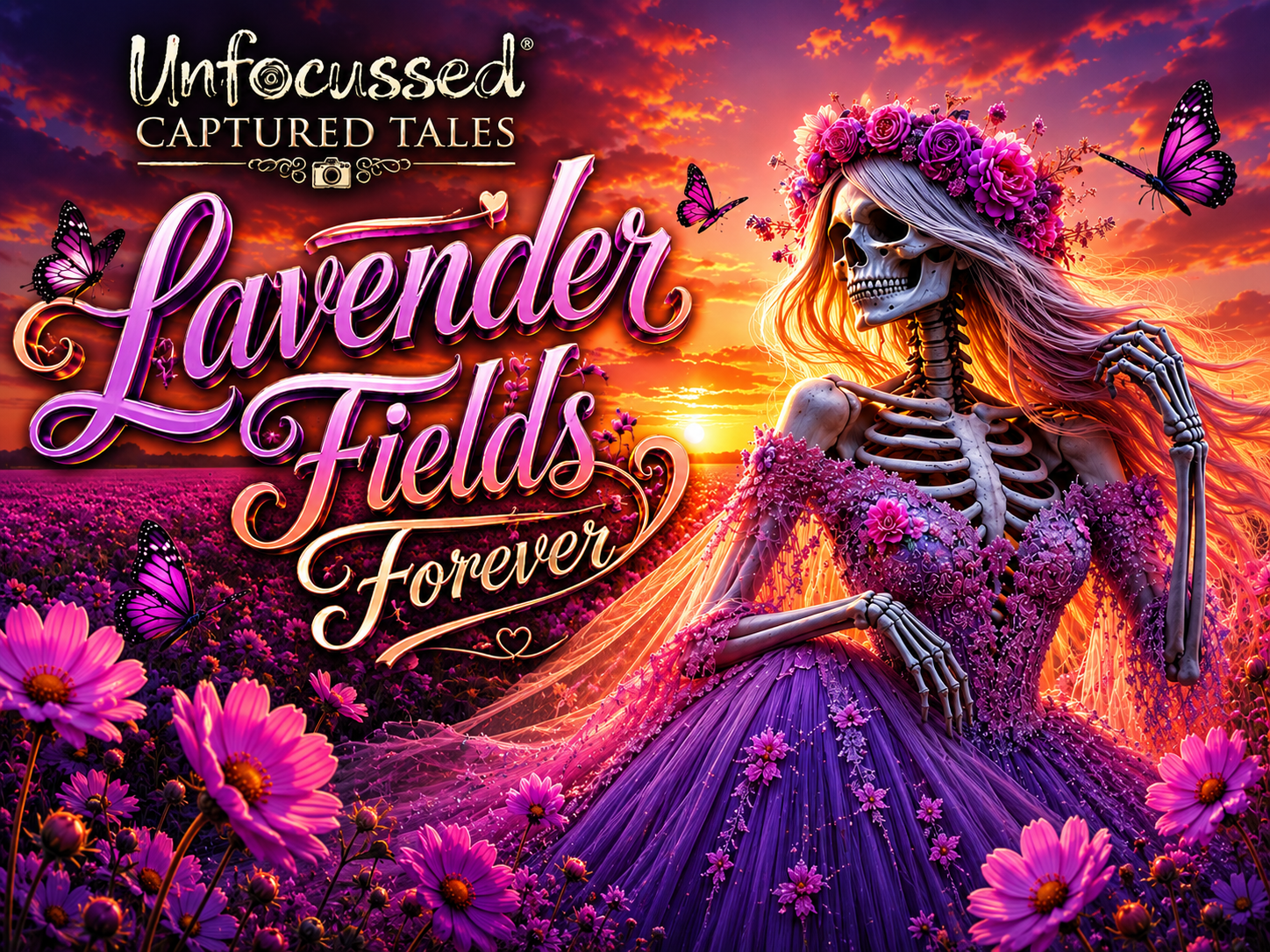
by Bill Tiepelman
Lavender Fields Forever
At the far edge of the valley, where the road gave up pretending it had a destination and simply dissolved into petals, there lay a field of lavender so vast that even the horizon seemed mildly overwhelmed by it. Every evening, when the sun lowered itself into a molten smear of gold and peach, the field became something more than flowers. It became a memory with roots. A hush with color. A place where the wind did not merely pass through the blossoms, but whispered old names, old vows, and occasionally old gossip, because the dead may become poetic, but they do not necessarily become discreet. The villagers called it Lavender’s Reach, though no one agreed on why. Some said the flowers stretched so far that they touched the foot of the mountains. Others claimed the scent reached into dreams and dragged out whatever a person most wished to forget. Children dared one another to run into the field at sunset and shout a secret. Lovers came to make promises they absolutely should have read twice before signing with their whole hearts. Widows came with folded letters. Old men came and pretended they were only admiring the flowers, which was a lie so thin even the bees rolled their tiny judgmental eyes. But there was one figure the field belonged to more than any of them. She stood among the lavender at sundown, crowned in roses the color of bruised pink velvet, draped in lace and beadwork that shimmered like the last blush of daylight. Her hair streamed pale and golden down her shoulders, catching the fire of the sinking sun. Her gown was lavender, lilac, and rose, woven with curling embroidery, glassy threads, and the kind of dramatic detailing that suggested she had either been a bride, a queen, or a woman who had once entered a room and made everyone else feel underdressed and spiritually inadequate. She was beautiful. She was radiant. She was also, quite unmistakably, a skeleton. This last detail bothered visitors more than it bothered her. Her name had been Evelina Vey, and in life she had been known for three things: laughing too loudly in places where people were trying to be respectable, wearing flowers even when flowers were not invited, and loving one man with such spectacular devotion that the village had never recovered from how inconveniently sincere it was. That man was Marlowe Finch. And every year, on the evening when the lavender first caught fire beneath the summer sunset, Marlowe came back to the field. Where the Flowers Learned Her Name Before she became the haunting of Lavender’s Reach, before children dared one another to count her ribs from behind the stone wall, before the field learned to murmur her name in the wind, Evelina had been alive in the loudest, warmest, most unapologetic sense of the word. She did not enter the world quietly, according to anyone who had been unfortunate enough to attend her birth. Her first cry had cracked a teacup, frightened a priest, and caused her grandmother to declare, with profound weariness, “Well, that one’s going to be expensive.” She grew into exactly that sort of woman. Not expensive in coins, necessarily, though she did have a dangerous weakness for embroidered sleeves, jeweled pins, and shoes that were entirely unsuited for mud but perfect for making entrances. She was expensive in feeling. Evelina cost people their cynicism. She was forever making the bitter laugh, the timid dance, and the pompous look briefly human. She had the rare and annoying gift of making life seem possible even when life itself was behaving like a damp loaf. The lavender fields were her favorite place because, as she once told Marlowe, “They smell like peace, purple, and slightly dangerous decisions.” Marlowe had been a carpenter’s son with careful hands and a face that always looked as though he had just heard music from the next room. He was quieter than Evelina, which was useful, because someone had to make sure their love did not knock over furniture. He built gates, cupboards, window frames, cradles, coffins, and occasionally excuses for why Evelina had climbed onto a roof at midnight with a basket of lanterns. “She said the moon looked lonely,” Marlowe explained once, to the town constable. The constable, who had been married for thirty-four years, nodded grimly. “That does sound like a wife.” They were not rich. They were not grand. They were not the sort of couple poets usually bothered with until after tragedy came along and made everyone suddenly interested. But they had something rarer than grandness. They had ease. They had laughter that did not need an audience. They had hands that found each other automatically in crowds. They had arguments about bread, weather, and whether a goat named Madam Butterbean deserved to be invited indoors during storms. Evelina believed Madam Butterbean did. Marlowe believed goats should not have opinions about curtains. Madam Butterbean, being a goat, had opinions about everything and was willing to eat evidence. The lavender field was where Evelina and Marlowe met when the day’s work was done. He would arrive with wood shavings still clinging to his sleeves. She would arrive with flowers in her hair, soil on her hem, and some half-baked plan involving moonlight, music, or petty revenge against a woman named Mrs. Brindle who had once called her “too colorful for a funeral.” Evelina had taken this not as criticism but as prophecy. They danced there before they were married. They danced there after. They danced there when crops failed, when storms tore tiles from roofs, when money thinned, when friends moved away, and when the world did what the world always does: behaved like a rude beast in need of manners. “Promise me,” Evelina said one evening, her head resting against Marlowe’s chest as the sunset burned low, “that if I go first, you’ll still come here.” Marlowe had tightened his arms around her. “Don’t talk like that.” “I’ll talk however I like. I’m wearing flowers and therefore legally ungovernable.” “Evelina.” “Promise me.” He looked over the lavender, over the soft tossing purple that seemed endless in the dying light. “I promise.” She lifted her face and smiled. “Good. Because I have no intention of being forgotten politely.” That was the trouble with promises made in magical fields at sunset. They had roots. They listened. They took notes. The fever came in the following autumn. It moved through the village quietly at first, then hungrily. Doors closed. Bells tolled. Windows glowed late into the night. Marlowe built more coffins than cupboards, and each one stole something from his face. Evelina tried to help, because of course she did. She carried broth. She changed linens. She held hands. She laughed softly with the frightened, told filthy jokes to the dying if they asked for them, and scolded death itself like a misbehaving dog. Death, rude bastard that it was, did not take correction well. When Evelina fell ill, the lavender fields had already gone silver with frost. Marlowe sat beside her bed and held her hand through days that blurred into candles and whispered prayers. She was smaller then, her voice worn thin, her color fading from her cheeks as though the world had begun erasing her in careful strokes. On her last evening, she asked him to open the window. “It’s cold,” he said. “Then be useful and hold me warmer.” He did. The wind came in carrying the faintest trace of lavender, impossible for the season, impossible for the hour, impossible by every sensible measure. Evelina smiled as if she recognized it. “You’ll come?” she asked. Marlowe could not speak at first. His grief had filled his throat with stones. She squeezed his hand. “Don’t make me haunt you just to get an answer. I will, but I’d rather not start our eternity with nagging.” He pressed his forehead to hers. “I’ll come.” “Every year?” “Every year.” “At sunset?” “At sunset.” Her smile softened. “Good. I’ll wear something dramatic.” And then she was gone. They buried her at the edge of Lavender’s Reach in a gown the color of twilight. Marlowe placed roses in her hair with hands that trembled so badly the petals shook. He did not weep in front of the village. He had already spent every tear he owned in the privacy of the room where she had left him. That summer, when the lavender bloomed again, Marlowe returned to the field at sunset. He sat in the place where they used to dance. The wind stirred. The flowers bent. And Evelina came walking out of the purple. Not as flesh. Not as breath. Not as anything the living could properly explain without upsetting a priest. She came as bone and beauty, as memory and moonlight, as a skeleton wrapped in lace and flowers, her empty eyes dark with impossible tenderness. Marlowe looked up. And saw his wife. Whole. Laughing. Golden in the sunset. “You came,” she said. “I promised,” he answered. The lavender field shivered around them, smug as hell. The Annual Appointment with the Dead Woman in Excellent Lace Years passed, because years are show-offs that way. The village changed. Roofs were mended. Babies were born and grew into adults who had babies of their own. Madam Butterbean became a legend, then a cautionary tale, then the name of a tavern cocktail no one ordered twice. Mrs. Brindle died at ninety-two and was buried in a gown so aggressively beige that Evelina’s ghost took it as a personal attack. But Marlowe kept his promise. Every year, on the evening the lavender first reached its full bloom, he walked to the field. At first, he came with firm steps and dark hair, his shoulders still strong from work. Later he came slower. His hair silvered. His hands bent at the knuckles. His back curved beneath the invisible weight of all the days he had survived without her. He brought something each time. One year, a ribbon from her sewing basket. Another, a slice of honey cake wrapped in linen, because she had loved honey cake with a devotion bordering on scandalous. Once, he brought a sprig of rosemary and apologized for the year he had forgotten their anniversary until lunchtime. “I forgave you before supper,” Evelina said, seated beside him in the lavender, unseen by everyone but him. “Though I did briefly consider replacing you with a man who owned a calendar.” Marlowe laughed, and the sound cracked open the field like sunlight through glass. To others, he appeared to be an old widower sitting alone among flowers, speaking softly to the air. Some pitied him. Some found it romantic. Some thought he had finally gone odd in the head, though most of those people had been odd in the head for years and were in no position to be throwing stones from their own cracked little cottages. But Marlowe was not alone. Evelina came every time. To him, she looked as she had in life: cheeks flushed, eyes bright, hair tangled with roses, mouth always on the edge of mischief. To the field mice, who had no sentimental filter and frankly could have used one, she was a skeleton in a gown. To the crows, she was “the fancy dead one.” To the lavender, she was their lady. To herself, she was a woman caught between two versions of being loved. She could not leave the field. At first, she tried. The first year, after Marlowe walked home beneath the stars, Evelina followed him to the stone wall. Her bones glowed faintly in the dusk. The lace of her gown dragged through the flowers without bending a stem. She reached the edge of Lavender’s Reach and stopped so abruptly that her skull nearly continued without the rest of her. “Oh, that is undignified,” she muttered, catching herself. An invisible thread held her there. Not a chain. Not a curse in the old thunder-and-blood sense. Something softer. Crueler, perhaps, because softness can be its own kind of trap. She was bound by the promise. His promise to return. Her promise to wait. The field had accepted both. So Evelina learned the boundaries of her afterlife. She learned where the lavender grew tallest, where the rabbits hid, where the sunset struck the old stone wall and made it shine. She learned which flowers opened earliest and which bees were rude. She learned that death, despite its dramatic reputation, involved a shocking amount of standing around. She also learned that memory could be warm. Whenever Marlowe came, the field changed. The air grew thick with music no living musician played. The lavender brightened until each bloom seemed lit from within. The sun lingered longer, nosy and sentimental, pretending it had not slowed down just to watch. They could not touch for many years. That was the first rule. Not a written rule, of course. The dead rarely receive helpful pamphlets. There was no folded sheet saying, “Welcome to Your Haunting: Boundaries, Regrets, and How Not to Alarm Livestock.” Evelina simply discovered it the painful way. The first time she reached for Marlowe’s hand, her fingers passed through his like moonlight through water. He shivered. She withdrew. “Sorry,” she whispered. “Don’t be.” He looked at the place where her hand had been. “It felt like you.” That nearly ruined her. If skeletons could sob, she would have rattled herself into a pile right there among the blossoms. Instead, she sat beside him each year with her hand close to his, near enough that the space between them seemed to ache. She told him things. She described how the rabbits had formed what appeared to be a small criminal organization beneath the eastern hedgerow. She complained about the crows. She informed him that Mrs. Brindle’s ghost had not appeared, which was merciful, because even death deserved boundaries. Marlowe told her about the village. He told her who had married badly and who had married worse. He told her when the old mill burned, when the schoolhouse opened, when the baker’s son ran away with a traveling puppeteer and returned three months later with a mustache, a limp, and no explanation that satisfied anyone. He told her about the cupboards he built, the roofs he repaired, the chairs he carved because his hands needed work even when his heart did not. He never remarried. Evelina scolded him for that once. “You could have found someone kind,” she said. He looked at her across the lavender, his face lined by years and sunset. “I did.” “You know what I mean.” “I do.” “Marlowe.” “Evelina.” She huffed, which was impressive for someone with no lungs. “You stubborn man.” “You married me.” “Yes, and apparently death has not improved my judgment.” He smiled, and it was the same smile she had loved when they were young: quiet, crooked, unbearably kind. “I had a full life,” he said. “Not an empty one. You were in it. You are in it.” The field went still then. Even the bees, who had been conducting some sort of pollen-related argument nearby, paused as if embarrassed by the intimacy of the moment. “I wanted more for you,” Evelina said. “So did I.” There it was. The truth, simple and sharp as a thorn. They had wanted more. More mornings. More winters. More burnt suppers and ridiculous arguments. More ordinary days, because ordinary days are the treasure no one recognizes until the chest is empty. More time to become boring together. More chances to sit in chairs and complain about the weather as if weather had personally wronged them. But life had given them what it gave them. And love, being both miracle and menace, had made that briefness eternal. As Marlowe aged, the veil between them thinned. The first sign was sound. In the early years, he heard her voice only as wind through lavender. Later, he heard it clearly, especially when she was annoyed. Love may transcend death, but irritation is apparently even more powerful. The second sign was scent. Whenever she came near, he smelled roses and lavender, with a faint trace of the vanilla soap she had once made in a batch so disastrous it foamed under the pantry door and frightened a visiting aunt into confession. The third sign was warmth. One year, when Marlowe was nearly seventy, Evelina sat beside him as always, her hand resting near his. The sunset lowered. The field glowed. A breeze passed over them. And he felt her fingertips brush his. Only for a breath. Only barely. But real. Marlowe froze. Evelina stared at their hands. “Did you feel that?” she asked. He nodded, unable to speak. She looked up at the sky. “Well. About damn time.” The sun dipped behind a cloud as if trying not to laugh. After that, the touch returned in small mercies. A brush of fingers. A hand felt faintly against his shoulder. Once, when he stumbled in the field, she caught him by instinct, and for one impossible second he leaned against her as though she were flesh again. He wept then. So did she, though her tears became dew on the lavender. By the time Marlowe was an old man, the village had stopped pitying him. His yearly walk to Lavender’s Reach had become part of local tradition. People left him alone. They pretended not to notice when the flowers bent toward him, when the sunset burned brighter above his head, when laughter sometimes rang from the field though no one stood beside him. Children still dared one another to sneak close enough to see the lady in lace. Most ran away screaming. One little girl, bolder than the rest, once peered through the lavender and saw Evelina as she truly was: bones, flowers, empty eyes, jeweled gown, sunset glowing through the cage of her ribs. Evelina turned her skull slowly. The child gasped. Then Evelina lifted one skeletal finger to her teeth. “Boo,” she whispered. The girl sprinted home so fast she lost both shoes and a moral certainty. Evelina laughed for twenty minutes. “That was cruel,” Marlowe said, though he was laughing too. “It was educational.” “She may never enter a flower field again.” “Then she has learned respect for boundaries.” “You are terrible.” “And yet here you are.” He looked at her, the lavender between them shining like purple fire. “Here I am.” The Last Sunset in Lavender’s Reach The final year came softly. That was the worst of it. No thunder split the sky. No omen carved itself across the moon. No black horse appeared at Marlowe’s door with glowing eyes and an attitude problem. Morning simply arrived, pale and ordinary, and Marlowe woke knowing his body had become a room he was preparing to leave. He was eighty-seven. His hands were twisted with age. His breath came shallow. His knees had opinions so loud they deserved their own parish meeting. He had outlived friends, enemies, creditors, two doctors, three mayors, and a rooster that everyone agreed had been possessed by something foul and administrative. But he had not outlived his promise. All day, the village watched his cottage. They knew the date. Everyone knew the date. Lavender’s Reach had bloomed overnight, impossibly bright, the flowers opening in waves of purple and rose though the season had been cool. By noon, the scent rolled through the streets thick as incense. Even people who did not believe in ghosts found themselves speaking gently, as though the air had become a chapel. Marlowe dressed slowly. He put on his clean shirt. His dark waistcoat. The boots he had polished the night before, though no one but Evelina would notice, and Evelina had once noticed a missing button from across a crowded room while arguing with a magistrate. On the table lay a small bundle wrapped in linen. Inside was a pressed lavender bloom from the first year he had returned to the field after her death. He had kept it all this time, tucked inside the wooden box where he stored letters, ribbons, and other things too heavy to throw away. He placed it in his pocket. Then he took up his walking stick and opened the door. No one stopped him. Mrs. Vale from the neighboring cottage began to cry into her apron. Her son offered to walk with him, but Marlowe shook his head. “Not this time,” he said. The road to Lavender’s Reach seemed longer than it had ever been. Perhaps it was. Roads are sentimental creatures when they know they are being walked for the last time. Each stone, each rut, each bend seemed determined to remind him of some moment he had carried across the years. Here was where Evelina had once removed her shoes and declared that respectable footwear was a conspiracy. There was where she had kissed him in a rainstorm and then blamed him for the mud. Near the old wall was where she had stolen his hat, placed it on a scarecrow, and announced that the scarecrow wore it with more emotional availability. By the time Marlowe reached the field, the sun had begun its descent. The sky was enormous with color. Gold near the horizon, then orange, rose, and violet rising into the first breath of evening. The lavender moved in long waves, and every blossom seemed turned toward him. He stepped into the field. Evelina was already there. She stood where she had stood for decades, crowned in roses, gown glittering with lavender light, hair streaming like pale fire. To the world, she was bone and lace, a beautiful ruin, a bride made of memory. To Marlowe, she appeared first as the young woman he had loved, the woman with laughter in her eyes and petals in her hair. Then, for the first time, he saw both. The living Evelina and the dead one. The warm face and the hollow skull. The bright eyes and the dark sockets. The bride he had buried and the ghost who had waited. He did not flinch. Evelina saw the moment happen. She felt it like a door opening. “Ah,” she said softly. “There I am.” Marlowe leaned on his stick, breathing hard, his old eyes full of tears and wonder. “There you are.” She looked down at herself, at the bones beneath the lace, at the ribs that no longer held a heart and somehow ached anyway. “I was afraid this would frighten you.” He smiled. “My love, I have seen myself in a washbasin every morning for the last twenty years. You are doing fine.” A laugh burst out of her, bright and startled. The lavender trembled. “Still charming,” she said. “Still dramatic.” “I am literally dead in a flower crown, Marlowe. Drama is the bare minimum.” He took one slow step toward her, then another. She moved to meet him, though she could feel the field holding its breath around them. The old promise tugged at her bones. The sunset burned lower. Somewhere beyond the wall, a village bell rang the hour. Marlowe reached into his pocket and withdrew the pressed lavender bloom. It was fragile now, faded almost gray, but still intact. “I kept this,” he said. Evelina stared at it. “From the first year.” He nodded. “Sentimental fool.” “Yes.” “My favorite kind.” He held it out to her. For a moment, neither of them moved. They had spent so many years nearly touching that the idea of anything more seemed dangerous, like stepping onto ice that might remember it was water. Then Evelina lifted her skeletal hand. Her fingers closed around the lavender. She felt it. Not as a whisper. Not as wind. Not as memory. She felt the dry stem against her bones. She gasped. Marlowe’s face broke open with tenderness. “Evelina,” he whispered. She looked at him. “I’m here.” “I know.” “I’ve always been here.” “I know that too.” The sun touched the horizon. Everything in the field turned gold. Marlowe swayed, and Evelina caught him. This time, fully. Her arms went around him, bone and lace and light, and he leaned into her as though coming home after a journey far too long for one soul to walk alone. He was not young again. Not yet. He was old, tired, aching, and beloved. She held him exactly as he was, because love that only adores the polished version is not love but vanity wearing perfume. “You came,” she said. “Every year.” “Stubborn man.” “You waited.” “Stubborn woman.” He laughed weakly against her shoulder. “We were a menace.” “We were magnificent.” “That too.” The light deepened. The field began to glow from beneath, as though the roots had caught the sunset and were passing it flower to flower. The air filled with music, faint at first, then swelling into a tune Marlowe knew in his bones. Their song. The one they had danced to when they were young and foolish and certain that love could bully time into surrender. Perhaps they had been right. Evelina drew back and offered him her hand. “Can you dance?” she asked. Marlowe looked down at his knees, which had betrayed him in every weather for years. “Poorly.” “Excellent. I have always enjoyed a challenge.” He took her hand. And they danced. Not beautifully at first. Not gracefully. He stumbled. She steadied him. He complained once about his hip. She told him death would sort that out shortly, which he called inappropriate, and she called practical. They moved slowly through the lavender while the sun sank lower, two figures turning in a field that had held their sorrow for so long it had learned the shape of their joy. With each step, Marlowe grew lighter. The years loosened from him one by one. Pain fell away. The stoop left his shoulders. His hands straightened. His breath deepened. His silver hair darkened beneath the sunset, and his face became the face Evelina had kissed in rainstorms and scolded over forgotten bread. But he was not becoming young by erasing the old. He was becoming whole. Every age he had been remained inside him. The boy. The husband. The widower. The old man who kept a promise across decades. The soul who had loved once and never stopped. Evelina changed too. Flesh did not simply return to her bones like a curtain being drawn. It bloomed. Light gathered inside her ribs. Lavender petals rose around her. The roses in her crown opened fresh and wild. Her skull became a face, then shimmered back to bone, then face again, both truths held together without shame. Marlowe touched her cheek. This time, his hand did not pass through. “There you are,” he said again. She covered his hand with hers. “Took you long enough.” “I was eighty-seven.” “I said what I said.” They laughed, and the sound rolled across Lavender’s Reach like bells. At the final edge of sunset, Marlowe’s body sat down gently among the flowers. Those watching from the distant road saw only an old man lowering himself into the lavender as the sun vanished. They saw the field flare gold. They saw the blossoms bend inward as though bowing. They did not see Evelina kneel beside him, did not see him rise from himself young and luminous, did not see him look back once at the long road of his life with gratitude and grief braided together. They did not see her take his hand. They did not see the two of them step beyond the place where the field ended and the stars began. But they heard the music. Everyone heard the music. For one full minute after sunset, Lavender’s Reach sang. After that evening, Evelina no longer appeared alone in the field. Some say she left entirely, her promise fulfilled and her waiting done. Others say she remains, but only at the edge of sight, where the lavender grows thickest and the sky turns the color of old vows. The children still dare one another to approach at sunset, though now they claim there are two figures among the flowers: a woman in a lavender gown and a man who dances with her as if he has finally remembered all the steps. Visitors sometimes find pressed lavender blooms tucked into the stone wall, though no one admits to placing them there. Couples who argue too close to the field report hearing a woman’s voice say, “Apologize properly or stop wasting everyone’s evening.” Widowers say the air feels kinder there. Brides leave roses. Old men sit quietly and smile at nothing. And when the sunset pours gold over the endless purple, when the flowers sway though there is no wind, when laughter rises from the field with the scent of lavender and memory, the villagers lower their voices and let the dead have their dance. Because some love stories end. Some love stories haunt. And some, if planted deep enough in a field that knows how to keep secrets, bloom forever. Lavender fields forever, where love remembers its way home. Bring Lavender Fields Forever Into Your Space The artwork behind Lavender Fields Forever captures a hauntingly romantic vision of a flower-crowned skeletal beauty standing in a glowing lavender field at sunset, blending gothic elegance, soft floral fantasy, and bittersweet eternal-love energy. Bring that dramatic twilight magic into your own space with the Lavender Fields Forever Tapestry, the richly detailed Canvas Print, the cozy and decorative Throw Pillow, or the soft Fleece Blanket. Whether displayed as wall art, wrapped around a quiet reading corner, or added as a moody floral accent, this piece is perfect for anyone who likes their romance beautiful, slightly undead, and emotionally inconvenient in the best possible way.


