
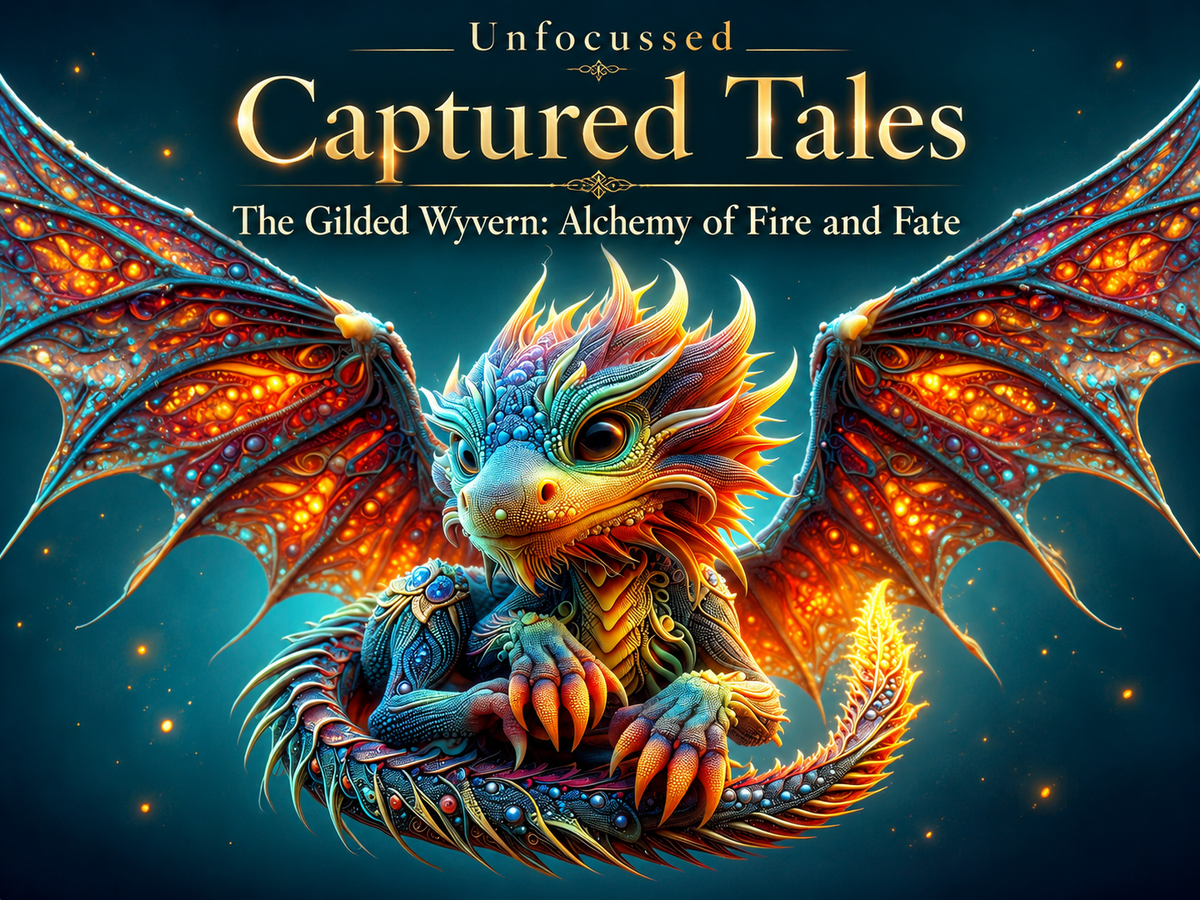
A Guardian of Inconvenient Size
The old songs gave Aithon a voice that split mountains, wings that eclipsed kingdoms and the wisdom of a thousand winters. Aithon had heard those songs. He considered them excellent work, apart from the unfortunate fact that he had only recently learned to climb the kitchen stool.
At the Spire of Sólaris, a narrow mountain settlement built around a lamp-house, people sang about the Gilded Wyvern every year when the winter lanterns were lit. The name belonged to a guardian in a very old story. Aithon had been named for him, which was a great deal of expectation to place on a dragon who could still become trapped behind a flour sack.
He was about the size of a house cat, with blue-green scales edged in gold, a crown of bright spines and orange wings veined like stained glass. When lamplight shone through them, even the grumpiest chimney sweep paused to look. Aithon liked that part. He spread his wings whenever somebody seemed insufficiently impressed.
“Beautiful,” said the keeper one morning. “Now fold them. You are standing in the porridge.”
The keeper was a broad, gray-haired woman with soot in the creases of her hands. She had raised Aithon since his hatching in the warm room behind the furnace. She called him her apprentice. He preferred guardian, a word that sounded less likely to involve cleaning anything.
The lamp-house tended the Flame of Fates. Despite what the songs claimed, it did not weave every life in the world. It kept the settlement’s enchanted lanterns burning through the mountain fog. Each household brought a little oil, each year the keeper renewed the flame, and the lanterns guided late walkers home. Births, weddings and farewells were remembered beside it. That was quite enough responsibility without also having to arrange the stars.
Aithon’s first duty was to carry a lidded ember cup from the furnace to the lantern bench. He could make a short puff of fire himself, but holding it steady exhausted him. The cup was safer. It had a handle fitted for his paws and a lid that clicked shut.
He wanted a sword.
“You have a brush,” said the keeper. “Much more useful at present.”
Then the sorcerer came.
He wore a beautiful black coat and spoke of efficiency. He could bind the Flame of Fates to a single mirror, he said. No more carrying cups. No more soot. Every lamp would answer one voice.
“Whose voice?” asked the keeper.
The sorcerer smiled as though she had asked an unnecessarily small question.
That evening, while she went down the steps to inspect the lower lanterns, he returned to the lamp-house. Aithon heard the furnace grate scrape. Through the doorway he saw a copper mirror open like a little door, swallowing the steady gold flame. The sorcerer wrapped it in black cloth and left through the service passage.
Aithon lunged after him, caught his own tail beneath the bench and knocked over three clean cups.
By the time he freed himself, the furnace was dark.
Outside, the lanterns faded one by one. The settlement did not vanish into an eternal night. Something more immediate happened: a woman on the stair stopped because she could no longer see its edge, and a delivery cart halted above a sharp turn.
Aithon’s splendid wings hung against his sides.
The keeper returned carrying an ordinary oil lamp. He told her everything, including the part with his tail.
She knelt beside him. “Good. Now we know where to start.”
“I let him take it.”
“He took it. You told me.” She set the little ember cup on the bench. A coal still glowed beneath its lid, saved from that morning’s practice. “And you kept this properly shut.”
Aithon looked at the coal. It was scarcely larger than a pea.
For once, he did not ask for a sword.
The Road Beneath the Song
The keeper sent a runner to the settlement wardens, then brought out a map so old that its folds had become small valleys of their own. The sorcerer’s rented workshop stood in the Cradle of Embers, an abandoned kiln hall on the far side of the ridge. The wagon road would take the wardens around the mountain. The lamp-keepers’ service route went through it.
“We take the marked passage,” she told Aithon. “We stay together. If the way is damaged, we turn back.”
Before they left, the keeper checked the coal. “A living ember of the same fire can call the stolen flame out of a mirror,” she said. “If we can open its shutter safely. Keep this dry, and leave the mirror to me.”
He had imagined embarking alone beneath a banner.
Instead, he wore a padded harness carrying the ember cup, two oatcakes and a folded cleaning cloth. The keeper checked every buckle twice. Aithon endured this with the grave expression of a hero being badly misunderstood.
The Caverns of Echoes began behind the lamp-house. In the songs they were haunted by the fears of kings. In practice they were damp, narrow and remarkably good at repeating every noise a nervous dragon made.
Aithon sneezed.
Somewhere deep in the mountain, several much larger Aithons sneezed back.
He stopped so abruptly that the keeper nearly stepped on his tail.
“Echoes,” she said.
“I know.”
“Then why are your wings over your head?”
“In case the echoes are contagious.”
She waited until he lowered them. They counted the blue tiles fixed to the wall and followed the dry ledge beside a trickle of water. At a low arch, she had to crawl. Aithon walked beneath it with room to spare. He tried not to look delighted. He failed.
Beyond the caverns lay Veridian Edge, a narrow green shelf cut into the cliff. The wind came hard across it. Aithon opened his wings instinctively and was pulled sideways before the keeper caught his harness.
“Fold them. Low to the ground.”
His claws trembled against the stone. He had wanted to soar above danger. Crawling past it with his belly brushing cold rock felt horribly unlike a song.
The keeper clipped a safety line between their harnesses. She tested each iron ring along the shelf before moving them forward. They crossed slowly, one sheltered bend at a time. When Aithon needed to stop, she stopped too.
At the far end, she gave him half an oatcake.
“You did well.”
“I was frightened.”
“I noticed. You kept listening.”
He ate in silence. After a while, he leaned against her boot.
The Sea of Shattered Mirrors was the next chamber: a broad floor of shallow mineral pools beneath a roof glittering with quartz. Lamplight broke across the water until a hundred false paths seemed to open ahead.
Aithon saw himself in one pool, wings enormous and eyes blazing. For a moment he looked exactly like the guardian in the songs.
Then the reflection stretched, his paws slipped and he sat down in two inches of very cold water.
The keeper offered the cleaning cloth without comment. This was somehow worse than laughing.
“The white stones,” she reminded him.
The real path was marked by plain white stones above the water. They had no glow and no impressive names. They got them across.
At the entrance to the kiln hall they found a loose black thread caught on a latch. The sorcerer’s coat had brushed it. From inside came the voice of a man discovering that stolen magic was less obedient than advertised.
“Steady,” he snapped.
A gold flash struck the high windows. Then another.
The keeper closed her hand around Aithon’s harness before he could rush forward.
Through a crack in the door they saw the copper mirror fixed above an old furnace. Its black shutter opened and shut erratically. Each time it opened, trapped light spilled out; each time it shut, the room fell dark. The sorcerer was pulling a lever with both hands.
“He has tied the flame to his shutter,” whispered the keeper. “But the draft is pulling against it.”
Aithon touched the ember cup beneath his chin.
His little coal was still warm.
What a Small Flame Can Do
The keeper opened the door and stepped into the kiln hall.
“Release the mirror.”
The sorcerer stared at her, then at the small damp dragon beside her boot.
“You brought a pet?”
Aithon drew himself up. “Apprentice.”
The word surprised him. It felt rather good.
The sorcerer yanked the lever. The shutter slammed closed, and darkness rushed across the room. The keeper raised her ordinary lamp. Its little wick kept burning.
“You have frightened people off their own stairs,” she said. “Give the flame back.”
“They will thank me when they understand.”
“They are waiting in the cold.”
Behind the copper frame, something cracked.
The sorcerer’s expression changed. The lever jerked upward, dragging him onto his toes. He tried to let go, but the ring on his finger had caught in its chain. The mechanism shook. Beneath it, an ash drawer began sliding out of the furnace.
The keeper put her lamp on a stone shelf and caught the drawer before it fell. “Aithon. Stay behind me.”
He did. From there, low beside the furnace, he could see something neither adult could: a narrow cleaning hatch, half hidden by the drawer. Beyond it ran the shutter’s return chain. A bent link had lodged against the guide.
“I can see where it’s stuck.”
The keeper looked down. “Show me.”
He pointed. She followed his gaze, then examined the cold iron around the hatch. The old kiln had not been lit; the danger was the strained mechanism above it.
“You can reach the release pin,” she said. “But do not pull until I have the shutter braced.”
She wedged the ash drawer beneath the lever and wrapped her cloth around its hot copper grip. Aithon set his ember cup safely behind the stone shelf. Without the harness, he could fit his head and one shoulder through the hatch.
Inside, dust tickled his nose. He held very still.
“Now,” said the keeper.
He eased the pin sideways. It resisted. He moved his paw lower, as she had taught him when lifting a stubborn grate, and tried again.
The pin slipped free.
The keeper lowered the lever with both hands. The chain slackened. The sorcerer stumbled back, clutching his freed finger, and the shutter opened onto a small, furious gold flame.
Aithon scrambled out of the hatch. He was gray with dust from nose to shoulder. One of his splendid spines wore a cobweb.
He had not split the sky. He had moved a pin.
The keeper smiled at him as though he had moved a mountain.
She needed a living ember of the same fire to draw the captured flame into a safe vessel. Aithon fetched his cup and opened the lid on the stone shelf. The pea-sized coal glowed steadily. The keeper held the copper mirror above it and spoke the lamp-house words he had heard every morning.
The gold light bent toward the cup, gathered itself and settled over the coal. No stars were born. No kingdoms rose from the floor. A familiar warm brightness filled the room, and Aithon could finally see how badly his knees were shaking.
The wardens arrived by the wagon road while the keeper secured the lid. They took charge of the sorcerer, the mirror and his notes. The keeper described what he had done; Aithon described what he had seen. Nobody asked the dragon to chase him, punish him or become larger than he was.
They rode home in the wardens’ cart. Aithon slept against the keeper’s coat, the closed ember cup secured in her hands.
At Sólaris, the lanterns were relit from the furnace one by one. The delivery cart completed its turn. The woman on the stair reached her own door. Children watched the gold return behind the glass, then hurried inside for supper.
Aithon stood at the lamp-house threshold with his wings spread to dry. Light caught the orange membranes and ran along the gold edges of his blue scales. Someone called him the Gilded Wyvern, and several people cheered.
He enjoyed it enormously.
Then he noticed a lower lantern still waiting on the bench. Its glass was cloudy, its handle bent. He brought his brush.
That winter, the singer added a new verse. It mentioned the caverns, the cliff and the stolen flame. It made Aithon’s roar rather grander than anyone remembered.
“You should tell them,” murmured the keeper.
Aithon listened for a moment. “Perhaps after the chorus.”
But when a child asked how he had brought the light home, he showed her the little lidded cup and the release pin the wardens had returned to him.
“I had help,” he said. “And I was the right size for the hole.”
Then he folded his beautiful wings, climbed onto the kitchen stool without assistance and asked whether guardians were permitted a second bowl of porridge.
Bring a Little of Sólaris Home
Aithon’s wings were what first caught my eye: that bright orange glow against cool blue scales, as though someone had given a small dragon his own stained-glass windows. Then there are the oversized paws and the expression that seems ready to take on rather more than he can manage. If you have a corner that could use a little of that courage, The Gilded Wyvern on canvas gives those colors room to breathe, while an acrylic print suits the artwork’s luminous detail.
For a quieter kind of quest, follow the patterns of his scales through a Gilded Wyvern jigsaw puzzle, or send someone a little encouragement with a greeting card featuring the artwork. The story brings him to the lamp-house; the image leaves you free to imagine where he might belong in yours.

Another Small Beginning
For another young dragon learning that progress need not be spectacular to matter, meet Smidge in The Littlest Flame: A Dragon’s Heartwarming Beginnings. His lessons unfold in a different place, with a very different teacher.
If Aithon’s soot-covered courage stayed with you, follow Ashera and Seraphis into Guardian of Ember in a Frosted World. A tiny dragon finds a way through the ice that his exhausted companion cannot reach, in another adventure about sharing the work of keeping a light alive.
 The Wink That Got Away With Everything
 The Dewdrop He Swore He Could Handle
 Sir Petalgrip and the Fold He Should’ve Respected
Comments
1 comment
Fantassy art or fart for short I luV this stuff