
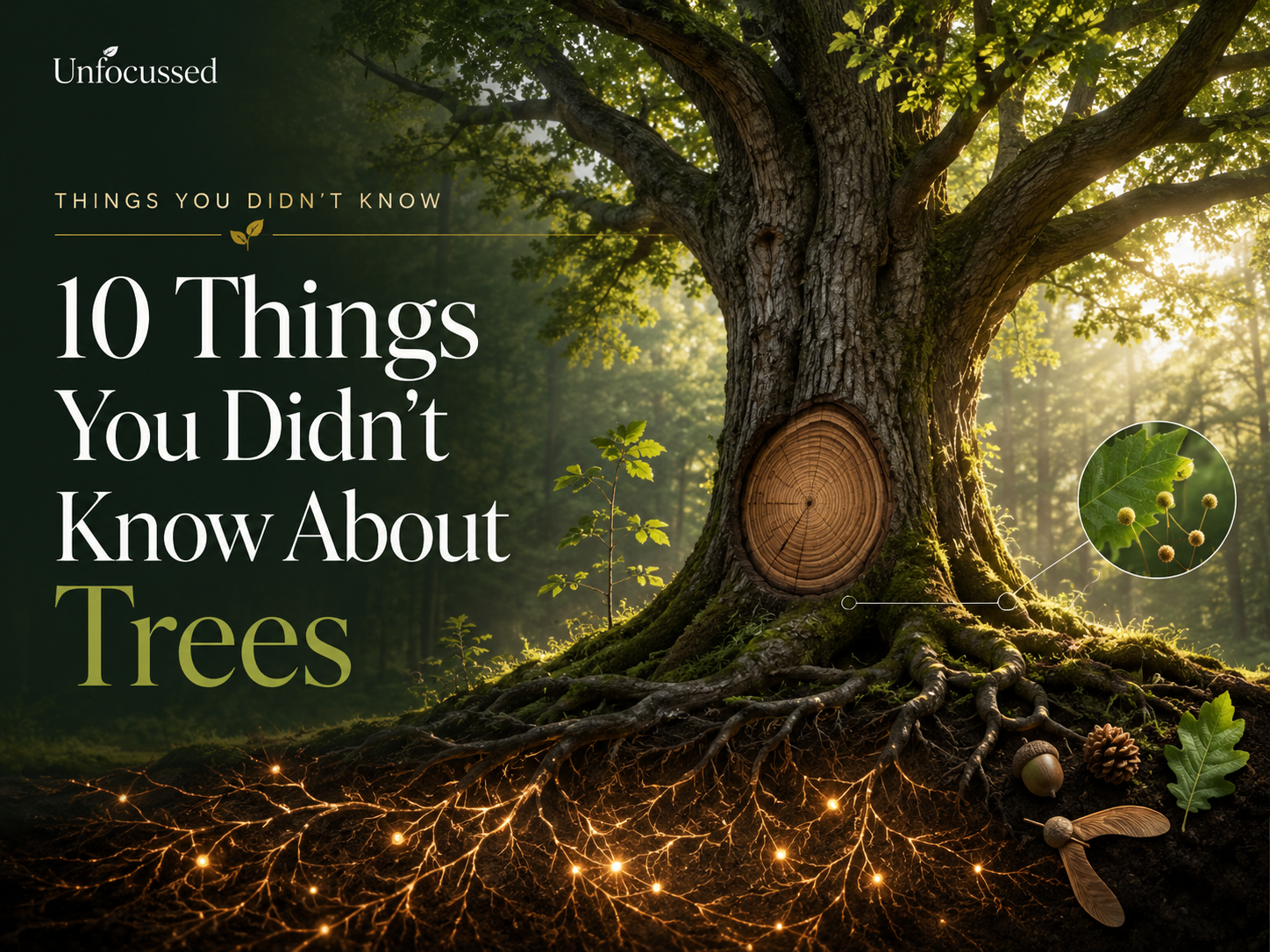
Il est facile de sous-estimer les arbres. Ils se tiennent là, calmes et feuillus, occupés en silence à faire de la chimie, à agir sur le climat, à soutenir la faune, à commercer sous terre, à tenir une comptabilité à long terme et à faire preuve du genre de survie patiente que les humains perdent quelque part entre deux connexions Wi-Fi poussives.
Les arbres sont bien plus qu'un simple décor. Une étude mondiale majeure sur la densité des arbres a estimé qu'il existe environ 3 040 milliards d'arbres sur Terre et a révélé que l'activité humaine a réduit le nombre total d'arbres d'environ 46 % depuis le début de la civilisation humaine.[1] Même le mot « arbre » est plus trompeur qu'il n'y paraît : il désigne une forme de croissance partagée par de nombreuses lignées végétales différentes plutôt qu'une famille botanique bien ordonnée.[2][3] Les arbres et autres plantes peuvent libérer des signaux chimiques dans l'air lorsqu'ils sont attaqués, de nombreuses racines forment des partenariats avec des champignons mycorhiziens sous terre, et le célèbre « internet des arbres » (ou « Wood Wide Web ») est à la fois fascinant et souvent simplifié à l'extrême.[4][5] Les cernes des arbres conservent des indices climatiques, les pins aristés millénaires peuvent vivre des milliers d'années, les arbres urbains rafraîchissent les villes, les forêts aident à déplacer l'eau à travers l'atmosphère, les vieux arbres soutiennent des quartiers entiers de faune sauvage, et l'Évaluation mondiale des arbres de l'UICN 2024 a révélé que 38 % des espèces d'arbres évaluées sont menacées d'extinction.[6][7][8][9][10][11][12] En d'autres termes, les arbres ne sont pas des décorations passives. Ce sont des systèmes vivants dotés de preuves, de relations et d'une éthique de travail étonnamment impressionnante.
Pourquoi les arbres sont plus étranges qu'un simple décor
La plupart d'entre nous traitent les arbres comme les figurants polis du monde naturel. Ils offrent de l'ombre, soutiennent les mangeoires à oiseaux, prennent des couleurs spectaculaires en automne et laissent parfois tomber une branche exactement là où vous espériez qu'ils ne le feraient pas. Utiles ? Oui. Dramatiques ? Aussi, surtout quand la branche atterrit à côté de votre voiture avec l'assurance d'une poursuite judiciaire.
Mais les arbres ne sont pas juste un décor avec une meilleure posture. À l'intérieur et autour de chaque arbre se trouve un réseau affairé de défenses, de compromis, de partenariats, de choix d'ingénierie et de conséquences écologiques. Les feuilles échangent des gaz. Les racines négocient avec les champignons. L'écorce protège les tissus vivants. Les cernes enregistrent discrètement les années difficiles. Les troncs creux deviennent des foyers. Les canopées rafraîchissent les rues. Les forêts influencent l'eau et la météo. C'est beaucoup de travail pour quelque chose qui passe sa vie entière à avoir l'air de simplement rester là.
Regardons donc de plus près. Voici 10 choses que vous ne saviez probablement pas sur les arbres — ou du moins pas avec assez de recul scientifique et d'appréciation pour la nature dans ce qu'elle a d'absurdement extraordinaire.
La Terre possède des milliers de milliards d'arbres

Commençons grand. Vraiment grand. Une étude mondiale majeure sur la densité des arbres a estimé que la Terre compte environ 3 040 milliards d'arbres, dont environ 1 300 milliards dans les forêts tropicales et subtropicales, 740 milliards dans les régions boréales et 660 milliards dans les régions tempérées.[1] Ce chiffre est si grand qu'on dirait qu'il s'est échappé d'une calculatrice après trop de café.
L'échelle est difficile à imaginer. Trois mille milliards d'arbres signifient que les forêts, les zones boisées, les savanes, les flancs de montagne, les rives des rivières, les jardins, les parcs urbains, les vieux vergers et les petits survivants obstinés du bord de route forment ensemble une canopée planétaire tentaculaire. Les arbres sont partout, sauf dans les endroits trop froids, trop secs, trop salés, trop hostiles ou trop déterminés à être un parking.
Mais le côté moins confortable compte aussi. La même étude a estimé que plus de 15 milliards d'arbres sont abattus chaque année et que le nombre mondial d'arbres a chuté d'environ 46 % depuis le début de la civilisation humaine.[1] Nous vivons toujours sur une planète riche en arbres, mais pas intacte. La forêt a des preuves, et elles ne sont pas exactement flatteuses.
« Arbre » est une stratégie, pas une famille bien définie

Voici une petite ruse scientifique : « arbre » n'est pas un club évolutif net avec des vestes assorties. Un arbre est généralement décrit comme une plante ligneuse vivace avec un tronc, des branches et des feuilles, mais les scientifiques débattent toujours des limites car le caractère arboré dépend de traits comme la taille, la lignification, la longévité, la croissance secondaire et la forme générale plutôt que d'une étiquette de famille unique.[2][3]
Cela signifie qu'un érable, un palmier, un pin, un ginkgo, un magnolia et une fougère arborescente peuvent tous vivre sous le large parapluie « arbre » tout en y arrivant par des voies évolutives différentes. Ils ressemblent davantage à des collègues distants qui ont réalisé indépendamment qu'être grand est un excellent moyen de gagner la bataille pour la lumière du soleil.
C'est en partie ce qui rend les arbres fascinants. L'arboréité est moins une lignée unique qu'une stratégie de vie : grandir fort, vivre longtemps, s'élever au-dessus de la compétition, déployer ses feuilles dans la lumière et transformer la lumière du soleil en survie. Élégant ? Oui. Impitoyable ? Aussi. La nature n'est pas là pour distribuer des trophées de participation.
Les arbres peuvent envoyer des signaux d'alerte chimiques

Les arbres ne parlent pas comme nous. Il n'y a pas de chênes qui chuchotent des ragots sur l'érable d'à côté, et pas de groupes de discussion de platanes pleins d'émojis de feuilles dramatiques. Mais les arbres et d'autres plantes peuvent libérer des composés organiques volatils, ou COV, lorsqu'ils sont endommagés ou attaqués par des parasites.[4]
Ces substances chimiques aéroportées peuvent modifier le comportement des insectes, attirer des prédateurs ou des parasitoïdes qui attaquent l'herbivore, et influencer la manière dont les plantes voisines préparent leurs propres défenses. En termes humains simples : lorsqu'un prédateur commence à manger, la plante peut libérer une « alerte » chimique dans l'environnement environnant.[4]
Cela ne signifie pas que les arbres ont des conversations au sens humain. Cela signifie que les forêts et les communautés végétales sont pleines d'informations circulant à travers l'air, les tissus, le sol et les relations. Voyez cela moins comme « les arbres discutent » que comme « la forêt dispose d'un système d'alerte de voisinage étrange ». Pas de sirènes. Pas de notifications push. Juste de la chimie qui fait le travail en silence.
L'« internet des arbres » existe, mais la version féérique a besoin d'être élaguée

Vous avez peut-être entendu dire que les arbres communiquent via un « internet des arbres » souterrain. La science réelle est fascinante, mais ce n'est pas tout à fait la mignonne version mème d'Internet. De nombreux arbres forment des partenariats avec des champignons mycorhiziens, qui se connectent aux racines et peuvent aider à échanger des nutriments, de l'eau et des composés carbonés dans des environnements pédologiques complexes.[5]
Les chercheurs ont découvert que des réseaux mycorhiziens communs existent, mais une étude de 2023 a averti que certaines affirmations populaires ont devancé les preuves. Les affirmations selon lesquelles les arbres adultes envoient de manière fiable des ressources ou des signaux de défense à leur progéniture via ces réseaux, par exemple, ont souvent été répétées avec plus d'assurance que ce que les preuves empiriques évaluées par les pairs ne soutiennent.[5]
La vraie merveille est meilleure que la version simplifiée. Les forêts ne sont pas seulement des collections d'arbres individuels. Ce sont des communautés enchevêtrées façonnées par les racines, les champignons, les microbes, la compétition, la coopération, la décomposition et les échanges. Parfois, les arbres coopèrent. Parfois, ils entrent en compétition. Parfois, les champignons font ce qui profite aux champignons, parce que les champignons ne sont pas une organisation à but non lucratif.
Les cernes des arbres sont des archives climatiques avec une écorce

Chaque cerne dans un tronc d'arbre peut raconter une histoire. Dans de nombreux arbres tempérés, un cerne de croissance marque généralement une année de vie. Des cernes plus larges ou plus étroits peuvent refléter la faveur ou la difficulté des conditions de croissance, bien que le signal exact dépende de l'espèce, de l'emplacement, de la température, des précipitations, de la concurrence, des blessures et d'autres facteurs environnementaux.[6]
Les scientifiques utilisent la dendrochronologie, l'étude de la datation par les cernes, pour reconstituer le climat passé, dater le bois historique et comprendre le changement environnemental. La NOAA note que les arbres nous révèlent non seulement leur âge avec les cernes, mais aussi si les années ont été bonnes, mauvaises, humides, sèches, faciles ou misérables, de cette manière calme propre aux arbres : « J'ai survécu, n'est-ce pas ? ».[6]
Bien sûr, les arbres aiment garder les scientifiques humbles. Les faux cernes, les cernes manquants, le stress local, les maladies, l'entassement et les différences d'espèces peuvent compliquer l'histoire. Donc oui, les arbres tiennent des registres, mais comme tout vieux conteur, il leur arrive de marmonner.
Certains arbres sont plus vieux que des empires

Il existe aujourd'hui des arbres qui ont commencé à pousser avant la montée et la chute des grandes civilisations anciennes. Les pins aristés du Grand Bassin sont célèbres pour survivre des milliers d'années, et Mathusalem, un pin aristé de la forêt nationale d'Inyo en Californie, est l'un des exemples les plus connus.[7]
Le Service forestier des États-Unis garde l'emplacement précis de Mathusalem secret pour le protéger du vandalisme, et l'USDA note que son âge — plus de 4 789 ans — a été déterminé à partir d'échantillons de carottes prélevés en 1957.[7] Les pins aristés ne survivent pas parce qu'ils vivent dans le luxe. Ils survivent dans des conditions difficiles, sèches, froides et de haute altitude, où une croissance lente, un bois dense et résineux et une décomposition réduite fonctionnent ensemble comme un plan de survie extrêmement obstiné.
En d'autres termes, ces arbres vivent dans des endroits qui regardent le confort et disent : « Non merci, je préfère le dépit ». Le résultat est un bois qui peut persister pendant des âges et des arbres qui ont l'air tordus, altérés et presque mythologiques. Ils ne sont pas beaux au sens délicat d'une boutique de fleurs. Ils sont beaux comme les vieilles cicatrices sont belles : la preuve que la survie elle-même peut devenir un art.
Les arbres des villes sont des boucliers thermiques vivants

Une ville sans arbres peut devenir un piège à chaleur. Les trottoirs, les toits et le béton absorbent et irradient la chaleur, créant l'effet d'îlot de chaleur urbain. Les arbres ripostent avec de l'ombre et l'évapotranspiration, le processus d'absorption de l'eau par les racines et de libération de vapeur d'eau par les feuilles.[8]
L'Agence américaine de protection de l'environnement (EPA) décrit les arbres et la végétation comme un moyen efficace de réduire les îlots de chaleur car ils abaissent les températures de surface et de l'air grâce à l'ombre et au refroidissement par évaporation. L'EPA note également qu'une étude a révélé que les forêts urbaines étaient, en moyenne, 1,6° C (3,0° F) plus fraîches que les zones urbaines non végétalisées.[8]
Une bonne canopée n'est pas une décoration. C'est une infrastructure qui porte des feuilles. Tous les arbres n'ont pas leur place partout, et une mauvaise planification peut créer des maux de tête en matière d'entretien, mais le bon arbre au bon endroit est un petit système de climatisation avec de l'écorce. Très chic. Très feuillu. Pas d'abonnement mensuel.
Les forêts déplacent l'eau à travers le ciel

Les arbres ne font pas que boire de l'eau. Ils la déplacent. Par la transpiration, les arbres extraient l'eau du sol et libèrent de la vapeur d'eau par de minuscules ouvertures dans leurs feuilles. L'Institut d'études géologiques des États-Unis (USGS) décrit la transpiration comme faisant partie de l'évapotranspiration, le mouvement combiné de l'eau du sol et des plantes vers l'atmosphère.[9]
Multipliez cela par des millions d'arbres et les forêts deviennent des acteurs majeurs du cycle de l'eau. Des recherches de la NASA sur le sud de l'Amazonie ont trouvé des preuves observationnelles que la forêt tropicale aide à déclencher sa propre saison des pluies en libérant de la vapeur d'eau des feuilles des plantes, montrant à quel point la végétation et l'humidité atmosphérique peuvent être étroitement liées.[10]
Alors oui, les forêts peuvent influencer les précipitations et le climat régional. Pas à la manière d'un magicien de dessin animé, malheureusement. Aucun chêne ne pointe une branche pour invoquer la pluie comme un sorcier forestier dramatique. Mais les forêts aident absolument à déplacer l'eau entre le sol, les feuilles, les nuages et les systèmes météorologiques, de manières bien plus puissantes qu'elles n'y paraissent depuis le sol.
Les vieux arbres sont des immeubles résidentiels pour la faune

Un arbre mature n'est pas seulement un organisme. C'est un écosystème avec de l'écorce. Les oiseaux y font leur nid. Les insectes s'en nourrissent. Les champignons décomposent le bois mort. Les mammifères se cachent dans les cavités. Les mousses, les lichens et les microbes colonisent les surfaces. Les racines abritent des communautés souterraines. Même les troncs tombés peuvent soutenir la vie longtemps après que l'arbre lui-même soit mort.
L'Extension de l'Université du Minnesota recommande de laisser les arbres à cavité, les arbres morts sur pied et le bois mort au sol là où c'est sûr, car ils fournissent un habitat aux mammifères, oiseaux, insectes, amphibiens, reptiles et autres formes de vie forestière. Le même conseil note que le bois mort se décompose avec le temps et redonne des nutriments au sol.[11]
Cela ne signifie pas que les arbres dangereux doivent être ignorés près des maisons, des sentiers, des allées ou des endroits où les gens se rassemblent. La sécurité compte. Mais écologiquement, le bois mort et les vieux arbres ne sont pas des déchets. Ce sont des habitats, de la nourriture, des abris, des pouponnières, des buffets et de minuscules complexes résidentiels, tout en un. Glamour ? Pas toujours. Important ? Absolument.
Plus d'une espèce d'arbre évaluée sur trois est menacée

Malgré toute leur force, les arbres ne sont pas invincibles. L'Évaluation mondiale des arbres de l'UICN 2024 a rapporté que 38 % des espèces d'arbres évaluées dans le monde sont menacées d'extinction. La mise à jour a répertorié au moins 16 425 espèces d'arbres menacées sur 47 282 évaluées, faisant des arbres une préoccupation majeure en matière de conservation à travers la planète.[12]
Les menaces sont familières mais sérieuses : changement de l'utilisation des terres, déforestation, perte d'habitat, espèces envahissantes, parasites, maladies, changement climatique et pression humaine. L'UICN note également que la perte des arbres menace de nombreuses autres plantes, champignons et animaux car les arbres façonnent le carbone, l'eau, les cycles des nutriments, la formation des sols et la régulation climatique.[12] Supprimez assez d'arbres et vous ne perdez pas seulement l'ombre. Vous perdez des relations.
La partie encourageante est que les arbres sont aussi l'un des moyens les plus tangibles par lesquels les gens peuvent renouer avec la nature. Protégez les vieilles forêts. Plantez des arbres indigènes adaptés à la région là où cela a du sens. Soutenez la restauration de l'habitat. Laissez un peu d'espace pour la faune. Et peut-être arrêtez de traiter chaque feuille dans votre jardin comme si elle avait commis un crime.
Ce que cela signifie pour les forêts, les jardins et les humains qui se tiennent dessous
La grande leçon n’est pas simplement de « planter plus d’arbres », bien que planter les bons arbres au bon endroit puisse assurément aider. La leçon la plus importante est que les arbres fonctionnent mieux lorsqu'ils font partie de systèmes vivants, connectés et diversifiés. Un arbre seul peut faire de l'ombre à une véranda. Une canopée saine peut rafraîchir un quartier. Une forêt mixte peut retenir l’eau, abriter la faune, soutenir les champignons, stocker le carbone et résister à certaines contraintes mieux qu'un paysage simplifié.
Cela signifie qu’un bon entretien des arbres ne se limite pas à la plantation. Il s’agit également de protéger les arbres matures existants, de choisir des espèces adaptées au climat et au sol locaux, d’éviter d’endommager inutilement les racines et l’écorce, de réduire autant que possible l’usage de produits chimiques, de préserver les habitats naturels sûrs et de planifier sur le long terme. Les arbres ne sont pas des décorations saisonnières. Ce sont des investissements à croissance lente.
Et oui, il arrive parfois que les arbres soient gênants. Ils perdent leurs feuilles, hébergent des insectes, soulèvent les trottoirs et jettent des branches comme des tout-petits turbulents en forêt. Mais la solution n'est pas de stériliser chaque jardin pour en faire une triste pelouse rase. La solution réside dans une meilleure planification, une meilleure sélection des espèces, un meilleur entretien et un peu d'humilité face à des organismes qui résolvent des problèmes de survie depuis bien plus longtemps que nous n'avons accès à l'eau courante.
Dernière réflexion
Les arbres sont des géants patients, des signaleurs chimiques, des alliés climatiques, des hôtes pour la faune, des survivants ancestraux et des archives vivantes. Ce ne sont pas juste des éléments de décor. Ce sont des systèmes. Ce sont des histoires. Ce sont la preuve que la vie peut être à la fois enracinée et intensément connectée.
La prochaine fois que vous marcherez sous une canopée, arrêtez-vous une seconde. Cet arbre est peut-être en train de filtrer l'air, de rafraîchir le sol, de nourrir des champignons, d'abriter des oiseaux, d'enregistrer l'histoire, de déplacer l'eau et d'aider à maintenir l'écosystème en équilibre — tout cela en ayant l'air de ne absolument rien faire.
Honnêtement, c'est le genre de productivité auquel j'aspire.
Sources
- Crowther et al. « Mapping tree density at a global scale. » Nature (2015).
- Encyclopaedia Britannica. « Tree. »
- Rachel Ehrenberg. « What makes a tree a tree? » Knowable Magazine (2018).
- Université Cornell. « Plants use a common ‘language’ for emergency alerts. »
- Karst, Jones, et Hoeksema. « Positive citation bias and overinterpreted results lead to misinformation on common mycorrhizal networks in forests. » Nature Ecology & Evolution (2023).
- NOAA National Centers for Environmental Information. « How Can Tree Rings Teach Us About Climate? »
- USDA Forest Service. « Methuselah, a Bristlecone Pine is Thought to be the Oldest Living Organism on Earth. »
- U.S. Environmental Protection Agency. « Benefits of Trees and Vegetation. »
- U.S. Geological Survey. « Evapotranspiration and the Water Cycle. »
- NASA Jet Propulsion Laboratory. « New Study Shows the Amazon Makes Its Own Rainy Season. »
- University of Minnesota Extension. « Building biodiversity in your forest: Cavity trees, snags, and deadwood. »
- UICN. « More than one in three tree species worldwide faces extinction - IUCN Red List. »
 10 choses que vous ignoriez sur la Lune | Marées, humeur, mythologie
 10 choses que vous ignoriez sur les hiboux et les chouettes | Science, comportement, survie
 10 choses que vous ignoriez sur les loups