
The Witness at the Threshold
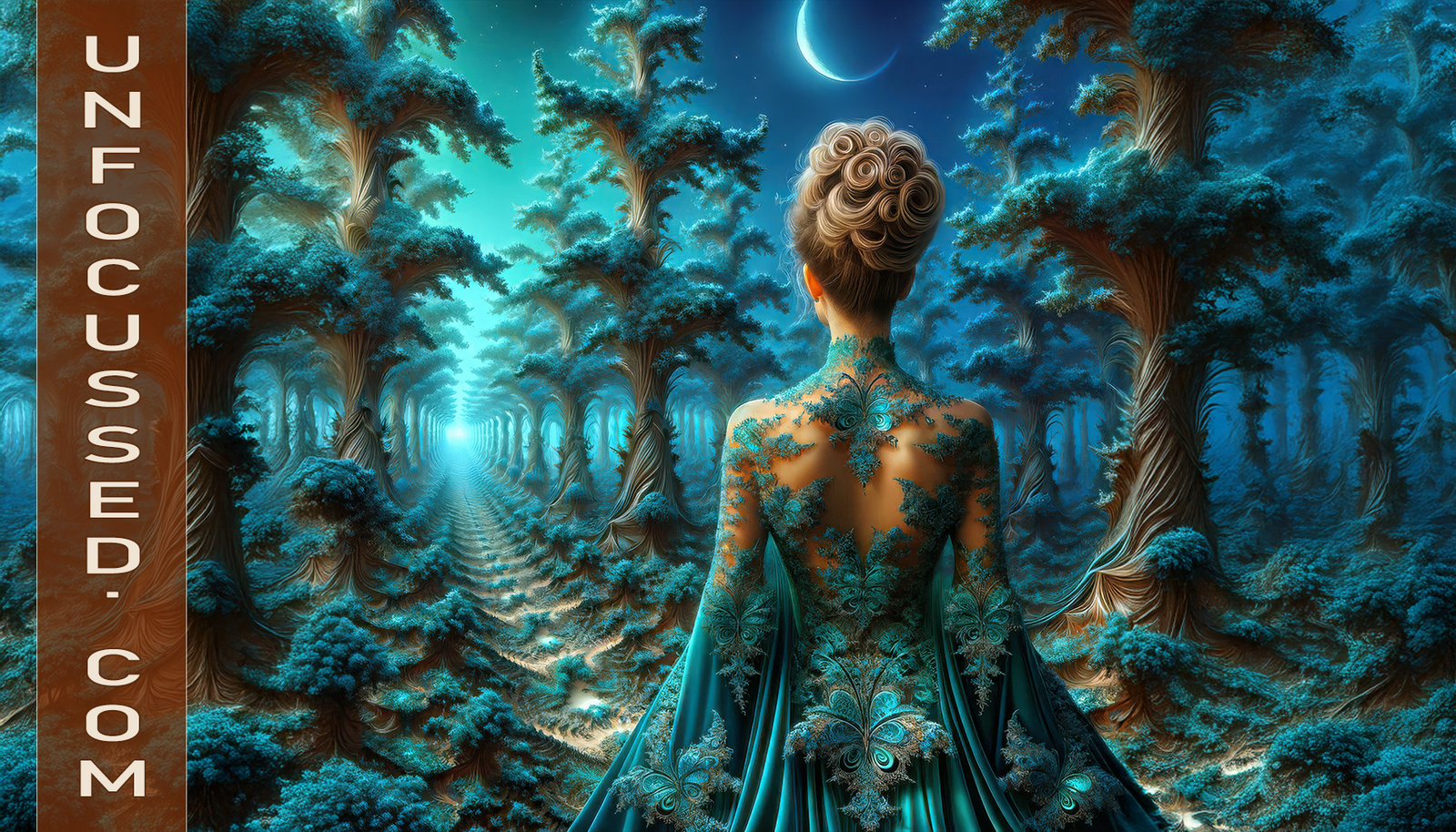
The moon hung above the forest like a held breath—thin, silver, deliberate. Not full. Not empty. Just enough light to imply that darkness, here, was not an accident but a decision made long ago and never questioned. She stood where the ordinary world quietly gave up. Behind her were roads with names, doors with numbers, and time that insisted on marching forward whether it was wanted or not. Ahead of her stretched something that refused such discipline—a forest too symmetrical to be wild and too intricate to be tame. The trees rose in spiraling columns, their trunks curling into themselves with mathematical patience, each pattern repeating smaller and smaller until the eye tired and the mind surrendered.
The path between the trees was not earth. It was not stone. It was light—cool, teal, and impossibly precise. It glowed like shallow water under starlight, yet reflected nothing. It did not shimmer. It waited. The further it went, the less distance behaved like distance at all. The vanishing point did not dissolve into darkness; it remained perfectly intact, as though pinned there for her benefit alone. She knew better than to turn around. The certainty did not arrive as fear. It arrived as memory. The kind that settles behind the ribs and insists it has always been there. If she looked back, the path would not punish her. It would simply forget to exist. And the forest would not mourn the loss.
The air tasted of rain that never fell and leaves that had never died. It carried the quiet authority of something ancient enough to be bored with weather. Her skin prickled beneath the moonlight, not from cold, but from attention. This was not the paranoid sensation of being watched. There were no eyes, no predators hiding behind bark and shadow. This was awareness. The forest was paying attention.
Her gown—if it could still be called that—rested against her skin like a promise she did not remember making. She recalled a mirror, a choice, the gentle lie of fabric draped for beauty rather than purpose. Now the dress clung to her as if it had grown there, its surface threaded with luminous filigree that echoed the trees’ fractal veins. The patterns were not decoration. They were alignment. She lifted her hands slightly, palms open, an unconscious gesture that felt less like surrender and more like truth. In this place, honesty seemed to carry more weight than courage.
To her left, a nearby tree shifted. It did not sway as wood would. It rotated—slowly, deliberately—its spiral tightening as though focusing its attention. The bark caught the moonlight, and she realized with a calm that surprised her that the patterns etched into its surface were not random. They were statements. Not written in words. Written in repetition. In recursion. In the quiet insistence of again and again and again, until meaning emerged not through explanation but familiarity. Her breath fogged faintly in the cool air. She listened.
Silence pressed in—not empty, but weighted. A silence holding something behind it, like a held note that had not yet decided whether it would become music or warning. Then the path responded. Its glow deepened by the smallest fraction, a subtle shift that would have gone unnoticed if she were not already watching it so closely. The light did not come from the moon. It came from within the path itself, as though her attention had stirred it awake. She lifted her gaze, and the crescent moon sharpened against the sky, its edge too precise to be accidental. She did not imagine a face. She did not see a god. What she felt instead was something far more unsettling and far more intimate.
Recognition. Her heart struck once, hard enough to echo in her ears. The forest did not react. It had expected this moment. It had been built around it. She stepped forward. The instant her foot crossed the threshold, the world behind her softened—not visually, but structurally, as if reality itself had reconsidered its commitment to staying solid. There was no sound of closure, no dramatic severing. Just the quiet understanding that returning would now require more than movement. Returning would require permission.
The path brightened in response, welcoming her with the cold affection of something that had waited a very long time and had no intention of pretending otherwise. The trees leaned inward by degrees so small they bordered on imaginary, their spirals aligning like a congregation preparing to speak. She took another step, then another, eyes fixed ahead. With each movement, the forest resolved more sharply, as if rewarded for her attention. The filigree on her gown warmed faintly, its glow syncing with the rhythm of her breath. That was when understanding arrived—not as thought, but as instinct.
The path existed because she was watching it. Not because she walked upon it. Not because she believed in it. Because she observed it. Witnessed it. A fragile agreement between presence and perception. And if she looked away—if she allowed doubt, curiosity, or fear to pull her gaze backward—the path would not resist. It would simply cease. She swallowed and kept walking. The urge to glance behind her rose like a reflex, sharp and insistent. A test. A temptation. The forest felt it immediately, leaning closer, its attention pressing gently but firmly against her spine.
She refused—not out of defiance, but reverence. It felt like prayer without words. Far ahead, deep within the repeating corridor of trees, something crossed the path. It was not a shadow. Not an animal. It moved with intention, paused with awareness, as though it, too, understood the rule. As though it only remained real while being seen. The moon’s light tightened again, and the patterns on her gown flared softly, responding to a name she did not speak aloud. She did not stop. She did not blink. She walked toward the moving shape, eyes locked forward, and the forest—ancient, patient, and profoundly interested—watched her watch it.
The Cost of Looking
The forest did not rush her. That was the first cruelty. Each step forward felt permitted, even encouraged, yet nothing urged her to hurry. The path remained perfectly lit beneath her feet, its teal glow unwavering so long as her gaze held steady. The moment she shifted her focus—just slightly, just enough to feel the temptation—the light dimmed, a subtle warning delivered without sound or ceremony. It was not threatening her. It was educating her. The trees on either side grew closer together the farther she walked, their spiraled trunks leaning inward with deliberate precision. Branches curled overhead, forming repeating arches that echoed themselves into infinity. No two were exactly alike, yet none were truly different. The forest was not expanding. It was refining.
She became acutely aware of her own breathing. In. Out. Counted. Measured. The filigree along her gown responded to this rhythm, pulsing faintly with each breath as if her body had been drafted into the forest’s internal logic. She wondered—briefly, carefully—how long it had been since she last chose a breath without thinking. The thought nearly cost her. The path flickered. Not gone. Not broken. Just uncertain. A fraction of darkness crept along its edge, like ink testing the page. Her attention snapped back into place immediately, heart racing, eyes locked forward once more.
The light returned. The forest seemed to approve. Something shifted ahead. The shape she had seen before moved again, crossing the path farther now, closer than before, yet still just beyond clarity. It did not hurry. It did not hide. It behaved like something aware of its own conditional existence. She felt the absurd urge to apologize to it. As she drew nearer, details resolved themselves reluctantly. The figure was tall—taller than she was—and elongated in ways that suggested anatomy had been negotiated rather than obeyed. Its surface shimmered faintly, not reflecting light but rearranging it, as though reality were being folded around it to make room.
It paused at the edge of the path. She stopped walking. The path dimmed again. She froze, understanding arriving with painful clarity: stillness was not observation. Stopping was a kind of looking away. She resumed walking immediately, slow but deliberate, eyes never leaving the glowing ribbon beneath her feet. The light stabilized, though the forest leaned closer, its attention tightening. The figure tilted its head. She did not meet its gaze. She understood now—this was not about courage. It was about discipline. About choosing one truth and allowing all others to remain unresolved. To see was to collapse possibility into certainty, and the forest guarded that power jealously.
The figure stepped fully into view. It resembled her. Not precisely. Not comfortably. But unmistakably enough to make her breath catch. Its form echoed her posture, her proportions, her silhouette—yet its surface was threaded entirely in the same luminous filigree that now traced her gown and skin. Where her features would have been, there was only suggestion, an outline implied by light and absence. It raised one hand. The forest held its breath. Against every instinct she possessed, she did not look at it. She kept her eyes fixed on the path.
The light flared brighter, approving, almost eager. The figure’s raised hand trembled, its edges blurring as if struggling to maintain cohesion. A sound reached her then—not through her ears, but through the pressure behind her eyes. A vibration shaped like language but lacking words. You are very good at this, it seemed to say. Her throat tightened. Praise, she realized, was another temptation. The forest began to change. The trees closest to her grew more ornate, their fractal spirals tightening into increasingly complex forms. Patterns layered upon patterns, recursion folding inward until the bark glowed faintly from the strain of its own precision. This place was not reacting to her presence.
It was synchronizing with her. The filigree crept higher along her arms now, warm and insistent, mapping pathways she had never learned the names for. She felt no pain, only a peculiar sense of inevitability—as though her body were remembering instructions written long before she arrived. The figure beside the path began to unravel. Its outline softened, light leaking from its edges as the forest reabsorbed it with clinical patience. It did not fight. It did not protest. It simply ceased to be necessary. She understood then. The forest did not want witnesses.
It wanted continuity. She was not here to observe the path. She was here to become part of the mechanism that allowed it to exist. The realization struck hard enough to make her stumble. The path dimmed dangerously. She recovered instantly, eyes snapping forward, breath steadying. The light returned, but something had changed. The glow was no longer merely beneath her feet. It was ahead of her. The vanishing point—once distant and abstract—had grown closer. Defined. Shaped. It no longer waited passively. It beckoned. The moon above sharpened to a thin, merciless curve, and the forest leaned inward with reverent anticipation.
She continued walking, understanding now that the cost of looking was not blindness. It was belonging.
The Shape That Remains
The vanishing point no longer pretended to be distant. With each step she took, it resolved further—edges sharpening, geometry asserting itself with increasing confidence. What had once been an abstract convergence of lines now suggested form, structure, intent. The path did not merely lead toward it. The path terminated there. The forest knew this. The trees leaned inward with reverence rather than curiosity now, their fractal spirals tightening into near-perfect symmetry. Branches interlocked overhead, weaving a vaulted canopy that pressed the moon into a narrow slit of silver light. Even the air seemed reluctant to move, as though breath itself were an interruption.
She felt the filigree beneath her skin settle into permanence. It no longer crept. It no longer tested. It had finished mapping her. The warmth along her arms and spine deepened into something steady and anchoring, like the final stitch in a pattern pulled taut. She realized—without fear—that she could not remember the exact sensation of being untouched by it. The memory existed, but without texture, like recalling a dream after waking. The path brightened one last time.
Ahead, where the forest folded inward upon itself, stood a structure that was not built but arrived at through repetition. An arch, formed entirely of light and recursive geometry, hovering just above the path’s end. It was neither doorway nor gate, but it carried the implication of both. This was where watching would no longer be enough. She slowed, understanding finally complete. The rule had never been about obedience. It had been about training. About teaching her how to hold a single truth without fragmentation. How to maintain presence without reaching for certainty.
The forest had needed someone capable of sustained attention. Someone who would not look away. She stepped beneath the arch. The world compressed. Not violently. Not painfully. Possibility folded inward, collapsing into coherence with exquisite care. The forest did not disappear. It aligned. Every tree, every spiral, every repeating pattern snapped into place around her like a lock recognizing its key. The path dissolved—not into darkness, but into her. She gasped, not from shock, but from completion. The teal light threaded itself fully through her, merging with the filigree etched into her form until distinction became meaningless. The sensation was not of being consumed.
It was of being installed. She understood now what the figures before her had been. Prototypes. Failed continuities. Witnesses who mistook observation for distance. She would not make that mistake. The moon above dimmed slightly, its work finished. It had never been a ruler here—only a signal. A marker indicating when the forest was ready to choose again. The trees straightened. The canopy widened. The forest exhaled. And for the first time since she arrived, she allowed herself to look away. The path did not vanish. It held.
It held because she no longer needed to watch it. She felt the forest through her now—not as voices or visions, but as balance. As recursion stabilized. As patterns maintained without strain. The frontier no longer required constant observation. It had continuity. She turned slowly, carefully, and the world did not collapse behind her. Where the ordinary once dissolved into uncertainty, there was now only quiet potential—a threshold awaiting the next arrival. She understood her role without ceremony or title. She was not guardian. She was not queen.
She was the shape that remained when the watching was no longer necessary. The forest accepted this truth without celebration. The highest compliment it could offer was silence. Above, the crescent moon slipped further into shadow, content to be forgotten. And somewhere beyond the trees—far beyond the frontier where recursion first learned to hold itself steady—the world continued, unaware that its patterns had just been quietly corrected.
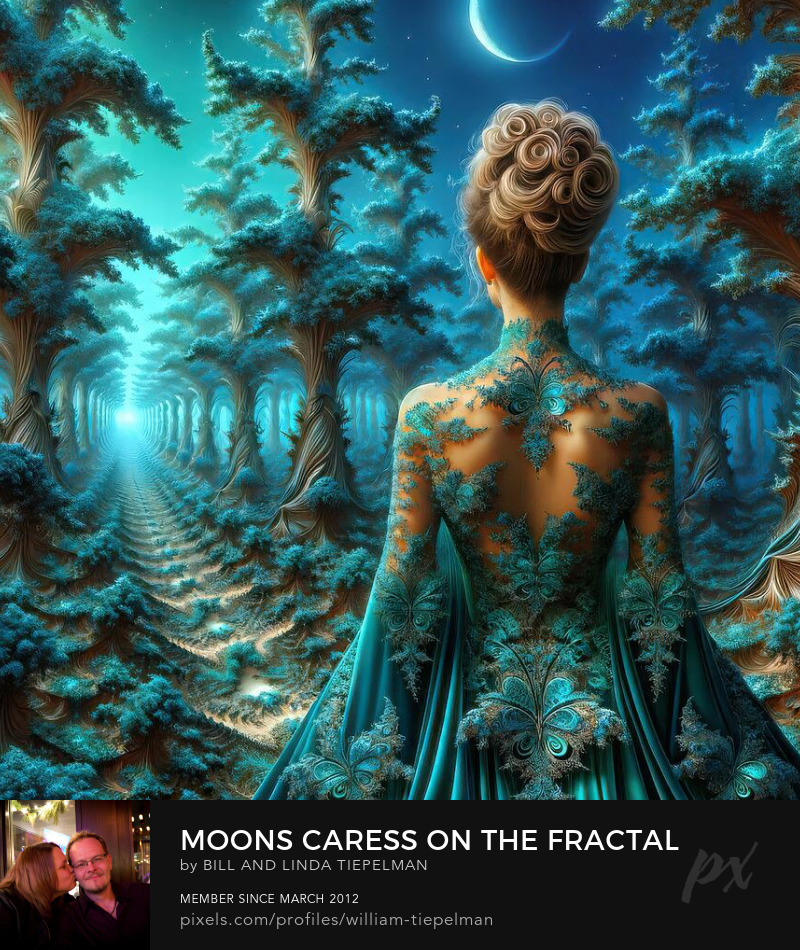
Moon’s Caress on the Fractal Frontier doesn’t end when the story does—it lingers. The artwork that inspired the tale is available as a framed print or a striking metal print, letting the moonlit geometry and infinite path hold their place in your space long after the final word. For those who want the frontier closer at hand, the image also drifts comfortably into the everyday as a throw pillow or a tote bag. And for makers who prefer to follow the path stitch by stitch, the counted cross-stitch pattern offers a slower, more intimate way to witness the recursion—one deliberate thread at a time.
 Sir Grumblethorn and the Mushroom That Disagreed
 The Wink That Got Away With Everything
 The Dewdrop He Swore He Could Handle