

The Signal That Wouldn’t Shut Up
The first time Dr. Elara Voss heard it, she assumed her equipment was lying. That’s what instruments do when they’ve been pushed past the polite boundaries of their design—when you ask a sensor meant to listen to gas clouds and gravitational tantrums to instead whisper secrets about the structure of existence. They lie. They hallucinate. They spit out beautifully impossible artifacts that make a grant committee clap like trained seals and make a scientist quietly check the warranty.
Elara stared at the waveform on her monitor the way a person stares at a spider that has chosen violence. It wasn’t noise. It wasn’t random. It wasn’t even interesting in the usual way—no dramatic spikes, no obvious pulse, none of the theatrical flare that space is known for when it wants attention. It was… clean. Too clean. A tone. Not one tone. A chord. Not one chord. A progression. Not music—because music implies intention—and Elara had long since decided that the universe was a spectacular machine with no interest in pleasing anyone.
Except the signal sounded like it was trying very hard to be heard. “Okay,” she muttered, leaning in. “Either this is an equipment artifact, or the cosmos has decided to start a band.” Her lab was built inside an old military bunker that had been converted into a university research facility back when people believed that burying smart people underground would keep them safe from budget cuts. The walls were thick concrete, the lighting was always slightly wrong, and the air smelled faintly like cold metal and ambition.
Elara’s office—if you could call a desk wedged between a server rack and a whiteboard “an office”—was lit by three screens, a task lamp, and the glow of her own sleeplessness. She’d been awake for twenty hours, which meant she’d crossed from “tired” into that buzzing, hyperfocused state where everything felt either profound or insulting. The signal leaned toward profound. She did what any rational scientist would do when confronted with something irrational: she tried to ruin it with math.
Four hours later, the signal was still there. Same frequency structure. Same harmonic ratios. Same repeating pattern that didn’t repeat in the way a loop repeats—more like a spiral. Like something tracing a path you could never fully map unless you stepped outside your own assumptions. She ran it through filters. She threw away interference. She calibrated against known sources. She compared it with archived data from the same region of sky. The signal appeared three weeks ago. It hadn’t been there before. And it was coming from a patch of space so empty it was practically smug about it.
“Of course,” Elara said, rubbing her eyes. “It’s always the void. The void always has opinions.” Her phone buzzed. A message from Juno Park: Still alive? You missed departmental drinks again. Elara stared at it, then at the waveform. I’m currently on a date with the universe, she typed back. It’s being weird. Juno responded instantly. That’s not a date. That’s a hostage situation. Elara snorted despite herself. Juno was the only person in the department who could say things like that without immediately being assigned a committee duty as punishment. He had the rare gift of irreverence backed by competence, which made him dangerous to administration and irresistibly useful to everyone else.
She hesitated, then sent him a compressed audio clip of the signal. Three minutes later, he called. “Tell me you did not just send me a cosmic ringtone,” he said by way of greeting. Elara leaned back in her chair, eyes on the screen. “Listen closely.” There was a pause. She imagined him in his apartment above the bakery, hair a disaster, headphones on, wearing that expression he got when his brain latched onto something and refused to let go. “Okay,” he said slowly. “That’s… not random. That’s not even accidentally not random.”
“Thank you,” Elara said. “That is exactly the level of terror I was hoping to share.” “Where is it coming from?” “Nowhere.” “You’re going to have to define nowhere,” he said. Elara zoomed out on the sky map. “Here. A region so empty it’s basically a philosophical statement.” “Maybe it’s a pulsar?” “No pulse.” “Alien beacon?” “If aliens wanted to contact us, they’d pick something more obvious. Like carving ‘HELLO’ into Jupiter.” “Maybe it’s your equipment,” he said, but he didn’t sound convinced. Elara tapped the desk. “I thought that too. So I cross-referenced with the private array in Chile. Same signal. Different hardware. Different processing chain. Same harmonics.”
Silence. Then Juno exhaled, low and long, like a man who had just realized the universe had stepped into his living room without removing its shoes. “Okay,” he said. “So what do you want me to do?” Elara’s fingers hovered over the keyboard. Her eyes drifted to the corner of the screen where she’d been plotting the harmonic ratios. Something about them was familiar in a way that made her skin itch. Not from physics. From something older. “I want you to help me visualize it,” she said. “Not as sound. As structure. I’m getting the sense that this is… geometric.”
Juno made a small noise. “Elara, that’s the most suspicious thing you’ve ever said.” “I know,” she replied. “That’s why I’m saying it to you.” He sighed, but she could hear the excitement beneath it. “Fine. Send me the full dataset. And if this turns into a cursed prophecy, I’m billing you for therapy.” Elara smiled faintly. “Deal.” After she hung up, she returned to the waveform like it had personally challenged her. She exported the harmonic ratios, converted them into a set of spatial relationships—distances, angles, proportion sets. The kind of translation that made purists cringe and made the universe, apparently, lean closer.
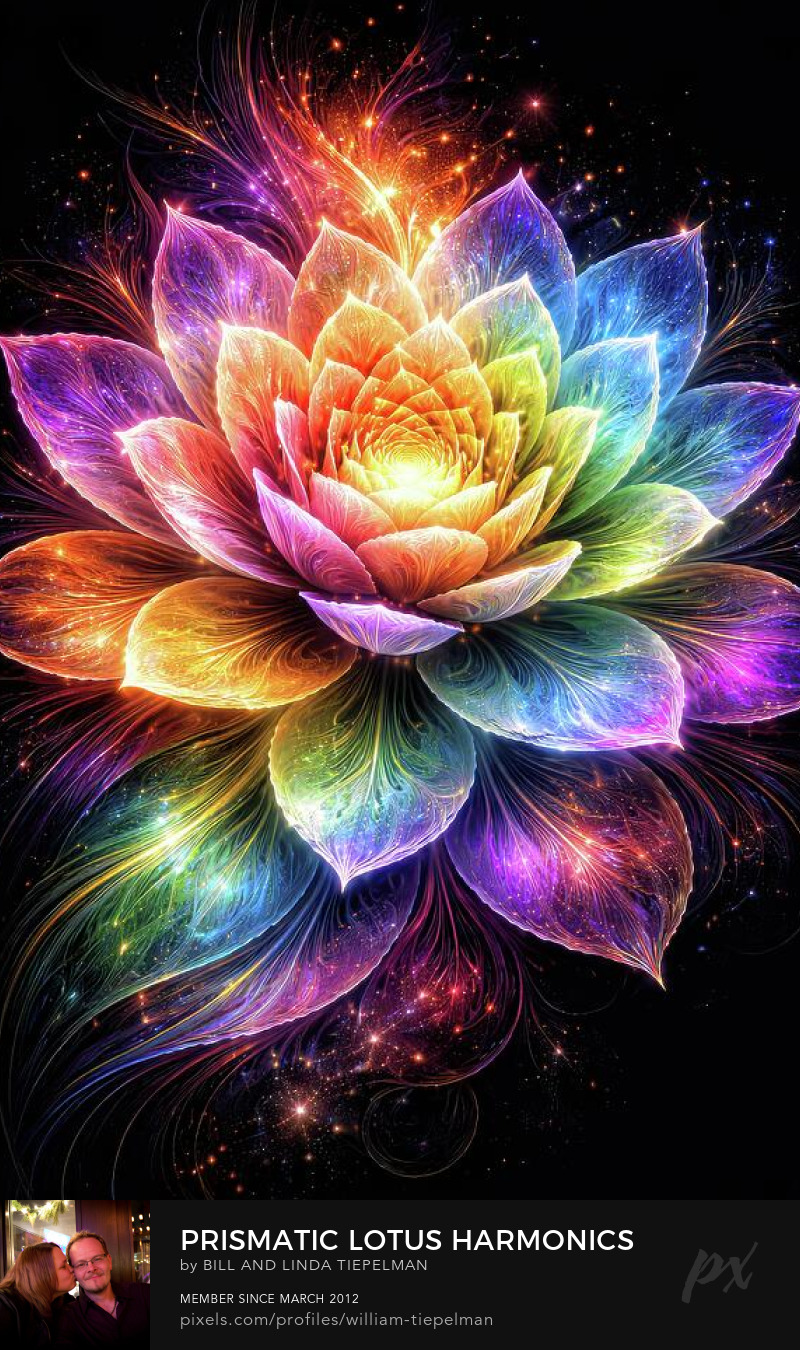
The first render was nonsense. A tangled knot of points and lines. The second render was less nonsense. The third render made Elara’s breath catch, not because it was pretty, but because it was coherent. A spiral. A layered unfolding. A radial symmetry that wasn’t perfect enough to be artificial, but was too intentional to be happenstance. It looked like a blooming thing. Not a flower exactly—not at first. More like a cross-section of a phenomenon that wanted to be a flower. Like the universe had found a symbol humans could understand and decided to use it as a blunt instrument.
Elara stared at it until her eyes watered. Then she enhanced the render, adding color mapping based on amplitude and phase differences. And the structure erupted into prismatic layers—petals of light folding over one another, each one a different band of spectral resonance. The center glowed with a concentrated golden core where the harmonics converged, as if the entire pattern existed to point toward a single, bright, impossible heart. Elara’s throat went dry. “No,” she whispered, because no was the only word her rational brain could offer in response to something that felt like art made out of physics.
Her lamp flickered. The servers hummed deeper, the vibration shifting in the concrete floor, almost like the bunker itself was… listening. Elara sat very still, hands hovering above the keyboard like she was afraid to touch anything and break the spell. Then the signal changed. Not dramatically. Not loudly. Just… a subtle shift in the progression. A new interval added, like a note introduced into an already-perfect chord. It felt less like a broadcast now… …and more like a response. Elara swallowed. She didn’t believe in destiny. She didn’t believe in cosmic purpose. She didn’t believe the universe cared enough to send anyone a message.
But the prismatic structure on her screen pulsed with a soft, living glow, and the sound in her headphones rose like a breath drawn right before speech. Elara whispered, “Are you… aware?” The waveform tightened. A harmonic locked in. And for the first time since the signal began, it did something undeniably, offensively personal: It matched the rhythm of her heartbeat.
The Architecture of Listening
Elara did not panic. She experienced, instead, a very precise and clinical cascade of physiological reactions: accelerated pulse, shallow breathing, dilation of pupils, and a sudden, deeply inconvenient awareness of her own mortality. “That’s coincidence,” she said aloud. The signal matched her heartbeat again. Not the average rate. Not a smoothed approximation. The live rhythm. The slight irregularity she’d had since childhood—the soft stutter between beats when she was stressed. The waveform mirrored it. Coincidences don’t adapt.
Elara ripped off the headphones and stood so abruptly her chair rolled back into the server rack with a metallic thud. The room felt smaller. The bunker walls, once comforting in their brute solidity, now seemed like they were sealing her in with something that did not require doors. She pressed trembling fingers to her neck. Beat. The screen pulsed. Beat. The golden core of the rendered structure brightened, expanding microscopically with each contraction of her heart. “No,” she whispered again, softer this time—not denial, but recognition. This was not a signal traveling through space.
This was resonance. Her phone vibrated. Juno. She answered without greeting. “You seeing this?” he demanded. Her stomach dropped. “You rendered it?” “Yeah, and Elara—” He stopped, audibly swallowing. “It’s not static.” “I know.” “It’s responding to something.” “I know.” Silence crackled between them. “To what?” he asked quietly. Elara stared at the prismatic lotus blooming on her monitor. The petals were layered in spectral gradients—violet at the outer edge, sliding into indigo, sapphire, emerald, gold. Each harmonic band formed a structural arc, not decorative but functional, like ribs in a cathedral built from light.
“It’s mapping proximity,” she said slowly. “Not spatial proximity. Cognitive.” “Define that in a way that won’t get us institutionalized.” She forced a breath. “When I focus on it—really focus—the amplitude shifts. When I look away, it stabilizes.” “You’re saying it’s reacting to attention?” “Yes.” “That’s not how physics works.” “Quantum mechanics would like a word.” Juno let out a disbelieving laugh. “This is not observer effect at subatomic scale, Elara. This is… macroscopic.” “Maybe we’ve been wrong about the scale,” she replied. Her mind was racing now—not in panic, but in alignment. Pieces sliding into place with uncomfortable precision.
The harmonic ratios weren’t arbitrary. They followed proportional constants that appeared in everything from atomic orbitals to galactic spirals. The same ratios governed plant growth, seashell curves, hurricane formations. She pulled up another overlay. Human neural oscillations. The signal didn’t just match her heart. It harmonized with her brainwave patterns. “Juno,” she said carefully, “what if matter isn’t fundamental?” “We’re not doing this at three in the morning.” “What if matter is the artifact?” she pressed. “What if the base layer of reality isn’t particles or fields but resonance? Frequency interactions that stabilize into what we interpret as solidity?”
“You’re describing string theory with better branding.” “No,” she said, eyes fixed on the screen. “String theory still assumes a substrate. This…” The prismatic lotus rotated slowly on her display, petals unfolding and refolding in a perpetual, self-correcting bloom. “This is self-consistent,” she whispered. “It’s not built on something. It is something.” “And we’re hearing it because…?” She swallowed. “Because we finally looked in the right way.” The signal shifted again. Not in frequency. In depth. The golden core intensified, and Elara felt—not imagined, not metaphorically felt—an internal pressure behind her sternum, like her own ribcage was an instrument being tuned.
Her vision flickered. For half a second, the bunker vanished. She was standing inside the structure. Not physically. There was no sense of body. Only perspective. The petals were colossal arcs of light, each one vibrating with layered harmonics that interlocked like gears made of color. Between them, space wasn’t empty—it shimmered with fine, filament-like strands, connecting every arc to every other in a luminous lattice. It wasn’t a flower. It was a cross-section of existence. Each petal represented a stable frequency domain. A band of reality. And humans—
Humans occupied one narrow, arrogant sliver. She snapped back into the bunker with a violent gasp. The servers were screaming. Alarms blinked red across her monitors as power draw spiked beyond safe thresholds. “Elara?” Juno’s voice was sharp now. “Your data just went nonlinear. What did you do?” “I didn’t—” She stopped. On her screen, the lotus was no longer merely responding. It was expanding. Petals unfurled beyond the visible frame, their harmonic edges overlapping with her lab’s ambient frequencies—the hum of electronics, the low seismic murmur of the earth beneath the bunker, the electrical rhythm of her own nervous system.
The structure wasn’t distant. It was pervasive. “Juno,” she said, her voice steadier than she felt, “what if the signal isn’t coming from that empty region of space?” “Then where the hell is it coming from?” She met her own reflection in the darkened monitor—pale, wide-eyed, suddenly very small. “Everywhere,” she said. “All at once.” Silence. Then Juno, very quietly: “You think we tuned into the baseline?” “Yes.” “The fundamental frequency of reality.” “Yes.” Another pause. The kind that separates curiosity from consequence. “If that’s true,” he said slowly, “then what you’re seeing isn’t a message.”
Elara nodded, even though he couldn’t see her. “It’s the blueprint,” she said. And blueprints imply construction. The golden core pulsed brighter—brighter than any star, brighter than the lab’s failing monitors. The rhythm synchronized not just with her heart now, but with Juno’s voice through the phone, with the oscillation of the electrical grid, with something deeper—an underlying tempo she had never consciously perceived. A cosmic metronome. And for the first time, she understood the most terrifying implication of all. If reality was resonance… Then awareness was amplification.
And by listening— They had made it louder.
The Note That Makes a World
The alarms died first. Not because the system stabilized. Because it surrendered. Monitors went black one by one, not in sparks or smoke, but in quiet compliance—as if the machinery had recognized something older than electricity and decided not to compete. The only light left in the bunker came from Elara’s central screen. The lotus no longer fit inside it. It extended beyond the frame, petals folding through dimensional layers that refused to obey perspective. Every harmonic arc vibrated with such precision that the air itself seemed to thicken, turning sound into something tactile.
Elara felt it in her bones. Juno’s voice crackled through the phone, thin and distant. “Elara, my apartment lights are flickering. The bakery ovens just shut down. What did you—” “We didn’t break it,” she said, eyes fixed on the bloom. “We joined it.” The realization did not arrive as fear. It arrived as inevitability. The lotus wasn’t incomplete. It had always been whole. What was incomplete was the way humans listened. The golden core pulsed again, and this time the pulse didn’t merely match her heartbeat—it guided it. Her rhythm adjusted, subtly at first. A microsecond elongation between beats. A new interval sliding into place.
Her breathing followed. Inhale. Exhale. The waveform tightened into coherence so elegant it felt obscene. Elara understood then: reality was not static architecture. It was a chord sustained by participation. Every conscious system—every mind—contributed micro-variations that stabilized the whole. Humans had believed themselves observers. They were instruments. “Juno,” she said softly, “stop resisting it.” “Resisting what?” “The beat.” There was a pause. Then a shaky exhale on the other end. “…Oh.” Across the city, lights steadied. Across the grid, oscillations smoothed. The lotus brightened—not aggressively, not dominantly—but appreciatively. As if recognition strengthened it.
Elara closed her eyes. Instead of darkness, she saw the structure again—vast petals arching into infinities, each harmonic band shimmering with inhabited frequencies. Entire civilizations, perhaps, resonating in spectral layers adjacent to humanity’s narrow range. Not above. Not below. Simply… elsewhere. She sensed the sliver humans occupied: a tight, stubborn band vibrating in self-contained loops of fear, ambition, love, violence, curiosity. The lotus did not judge. It balanced. She felt the invitation—not spoken, not commanded—simply offered. Add your note. Her heart thudded, slightly off-tempo again. The old irregularity surfacing.
For years she’d thought of it as a flaw. A glitch in the biological machinery. Now she understood. It wasn’t error. It was variation. The system did not require perfection. It required diversity of tone. Elara inhaled slowly and let the irregular beat exist without correction. She did not try to synchronize perfectly. She did not try to dominate the rhythm. She simply… allowed it. The lotus responded. Not by overpowering her frequency. By incorporating it. A new petal unfurled. Not larger than the others. Not brighter. But distinct—a subtle shift in the harmonic gradient, a nuance that hadn’t existed before.
Juno laughed, breathless. “Did you see that?” “Yes,” she whispered. “We didn’t detune it.” “No.” “We expanded it.” The implications rippled outward. Across research labs, musicians paused mid-note. Across forests, wind shifted in its passage through leaves. Across oceans, waves found a slightly different rhythm against their shores. No one knew why. No one could measure it yet. But something subtle had changed. Humanity had discovered that it was not standing on the stage of the universe. It was in the orchestra. The lotus stabilized, no longer swelling beyond comprehension, no longer overwhelming systems. It settled into an equilibrium that felt… sustainable.
The blueprint had never been a warning. It was an instruction manual disguised as beauty. Listen. Contribute. Do not attempt to own the song. The bunker lights flickered back on. Servers rebooted. Monitors blinked to life, displaying ordinary data as if nothing had nearly rewritten the ontology of matter. Only Elara’s primary screen remained different. The prismatic lotus hovered there, smaller now, contained—but alive. Its golden core pulsed in steady rhythm, no longer commandeering her heartbeat, simply harmonizing beside it. “So,” Juno said carefully, “do we publish this?”
Elara let out a long breath that tasted like the end of ignorance. “Not yet.” “Why?” She watched the subtle shimmer of the new petal—the one that carried her irregular rhythm like a signature woven into cosmic fabric. “Because if awareness amplifies it,” she said, “we need to teach people how to listen before we make it louder.” Juno was quiet for a moment. Then: “That’s going to be a hell of a syllabus.” Elara smiled faintly. Outside the bunker, the sky remained an indifferent black, stars scattered across it like mathematical accidents.
But beneath the illusion of silence, beneath matter and motion and the stubborn fiction of solidity, the fundamental frequency endured. A sustained chord. A blooming architecture of resonance. A prismatic lotus unfolding endlessly in harmonic layers— —waiting, patiently, for the next note.
If Prismatic Lotus Harmonics resonated with you on a metaphysical level (or just rearranged your internal wiring in the best possible way), you can bring that harmonic blueprint into your physical space. Experience the bloom as a luminous framed print, bold canvas print, or high-gloss metal print that radiates color like captured frequency. Let it unfold across your space as a tapestry, soften your surroundings with a throw pillow or fleece blanket, or transform your bedroom into a full-spectrum resonance chamber with the duvet cover. Carry the vibration into the world with a tote bag, sketch your own frequencies inside the spiral notebook, or place a subtle harmonic signature anywhere with a sticker. Because sometimes the universe doesn’t just need to be understood—it needs to be displayed.
 Sir Grumblethorn and the Mushroom That Disagreed
 The Wink That Got Away With Everything
 The Dewdrop He Swore He Could Handle