
The Problem With Trusting Anyone Who’s Smiling
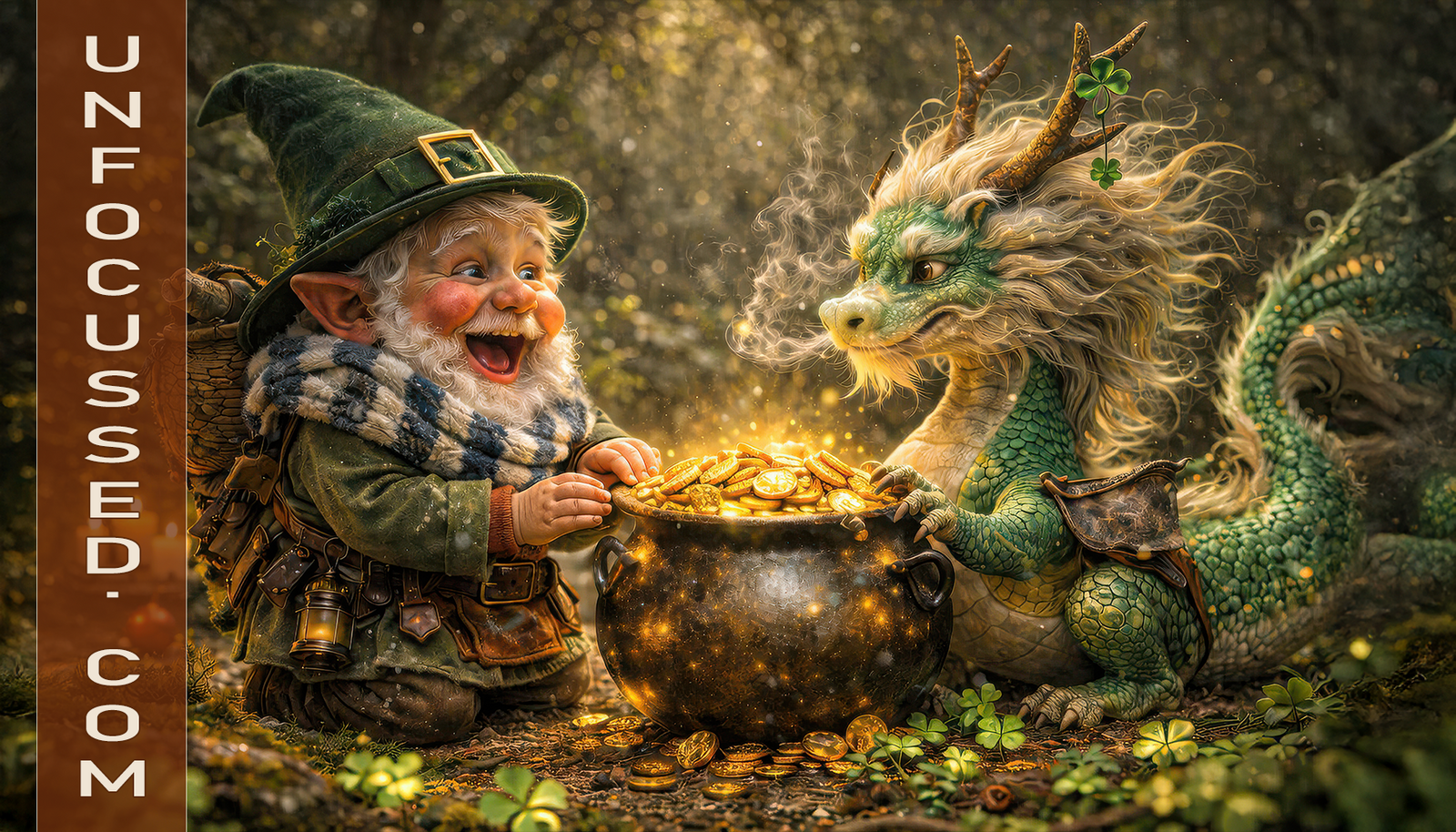
No one in the forest could remember when the gnome and the dragon first agreed to share the pot of gold. This was largely because no one in the forest had been stupid enough to ask. The clearing itself knew better. The moss had learned to lean away. The trees angled their roots just slightly outward, as if bracing for nonsense. Even the fireflies hovered with professional skepticism, flickering in cautious intervals like they were documenting a crime scene. At the center of it all sat the pot.
It was heavy, iron-black, and full to the lip with gold coins that glowed like they were actively enjoying themselves. Some coins shimmered. Others hummed. One near the top occasionally scooted an inch to the left when no one was looking. The gnome laughed. It was not the laugh of a fool. It was the laugh of someone who had already won at least three times and was curious how much worse things could get. “Now, see,” he said, palms open, fingers hovering just above the gold, “this is why I like you. Reasonable creature. Horns, fire, existential menace—yet surprisingly open to compromise.”
The dragon tilted its head, emerald scales catching the lantern light. A clover dangled from one horn, bobbing slightly as it spoke. “You’re confusing compromise with curiosity,” the dragon replied. “I agreed because I want to see what you’re planning.” “Ah,” said the gnome, delighted. “That makes two of us.” Their deal had been simple. Suspiciously simple. A split—half the gold for the dragon, half for the gnome. No curses. No binding runes. No blood oaths. Just a handshake, which the gnome had insisted on even though the dragon did not, strictly speaking, have hands.
“Claws count,” the gnome had said. “Legally speaking.” The dragon had agreed, because dragons love legality almost as much as they love finding loopholes in it. What neither of them admitted—because admitting things ruins the fun—was that they were both cheating. The gnome wasn’t after the gold. Gold was loud. Gold attracted people with shovels and opinions. What he wanted was momentum: the subtle sway of fortune, the quiet redirection of chance. Every coin touched by laughter bent luck just a little, and he was laughing a lot.
The dragon, meanwhile, was counting something else entirely. Not coins. Outcomes. Every time the gnome shifted the pot an inch closer to himself, the dragon adjusted its tail just enough to redirect the forest’s ambient magic. Every time the dragon exhaled a pleased puff of smoke, the gnome casually nudged a candle, altering the shadows in a way that made promises slippery. They smiled at each other like lifelong friends. The forest groaned. Luck began to leak.
Not dramatically. Not with lightning or prophecy. Just small things at first. A mushroom sprouted where it hadn’t been planted. A squirrel found an acorn it hadn’t buried. Somewhere, far beyond the clearing, a traveler tripped over nothing and landed on a solution to a problem he didn’t know he had. The gnome noticed immediately. “Oho,” he said softly. “That’s new.” The dragon noticed too. “No,” it replied, equally soft. “That’s inefficient.” They locked eyes across the pot, grins widening, both fully aware that the game had escalated—and that neither of them was interested in stopping.
The clearing held its breath. This was how it always started.
Escalation Is Just Confidence With Bad Timing
The forest did not complain at first. This was a mistake. Forests, like storms and small-town gossip, operate best when addressed early. Ignore them too long and they begin expressing themselves through inconvenient symbolism—roots in the wrong places, animals behaving like they’ve joined a union, and magic pooling where it absolutely should not. The gnome noticed the first real sign when his shadow arrived half a second late. He stepped left. The shadow followed. He stepped right. The shadow hesitated. “Ah,” he murmured, pleased. “You’re slipping.” Across the pot, the dragon’s pupils narrowed—not in alarm, but appreciation. It had been waiting for that. The moment when subtlety tipped into consequence.
“Correction,” the dragon said. “We are slipping.” The pot of gold gave a quiet, offended clink. Coins rearranged themselves again. This time, deliberately. They had stopped pretending to be inert wealth some time ago. The pot had grown warm—not hot, but alive in the way hearthstones are alive, or long-kept secrets. It hummed now, a low vibration that made candle flames lean inward as if listening. The gnome leaned back on his heels, hands clasped behind his head. “You know,” he said conversationally, “most creatures would have tried to curse me by now.”
“Most creatures,” the dragon replied, curling its tail tighter around the clearing, “wouldn’t have dared.” They grinned again. Equal parts respect and professional rivalry. The tricks escalated. The gnome introduced probability errors—minor ones at first. Dew that formed into arrows pointing nowhere useful. Birds that sang the wrong season. A fox that walked in a straight line and unnerved everyone who saw it. The dragon countered with structural adjustments. Winds that arrived early. Echoes that answered questions no one had asked yet. A gentle increase in coincidence density, making the forest feel crowded with almosts.
Luck, no longer content to leak, began to wander. It pooled at the edges of the clearing like spilled light. Mushrooms glowed. Stones sighed. A fallen log abruptly became important. And the forest noticed. The trees leaned in. Not aggressively. Curiously. Branches creaked closer, leaves whispering with that unmistakable tone of something older than memory deciding whether to interfere or place a wager. “We should slow down,” the gnome said, entirely without slowing down. “Agreed,” the dragon replied, increasing pressure on the ambient magic by exactly one irresponsible degree.
The pot shuddered. A coin near the top popped free, flipped once in the air, and landed on its edge. The clearing went silent. Even the dragon froze. “Oh,” the gnome said quietly. “That’s… new-new.” The coin began to spin. Not fast. Purposefully. Each rotation shed a thread of luck, which drifted outward and attached itself to the nearest living thing like a suggestion. A beetle suddenly found religion. A tree remembered being struck by lightning and felt nostalgic about it. Somewhere far away, a king sneezed and signed the wrong document.
The dragon exhaled a careful plume of smoke. “We are approaching,” it said, “what scholars would later describe as a mistake.” “Rubbish,” said the gnome. “We’re approaching a turning point.” The coin fell. The pot cracked. Not broken—cracked. A hairline fracture that glowed from within, light spilling out in liquid strands. The gold inside shifted, not downward but sideways, as if gravity had briefly changed its mind. The forest reacted. Roots burst through soil, not violently, but insistently—claiming space, drawing boundaries. The ground tilted just enough to make balance a suggestion rather than a rule.
Animals fled. Except the crows. The crows arrived. They gathered on branches, stones, and the edge of the clearing, watching with the quiet patience of creatures who understand contracts better than most gods. The gnome squinted at them. “Did you invite witnesses?” “No,” said the dragon. “But they always show up when things become enforceable.” The pot hummed louder. Words began to form in the sound—not language, exactly, but intent. The shared mischief, the layered deceptions, the elegant cheating had saturated the gold. It was no longer currency.
It was leverage. The gnome felt it then—a tug, subtle but unmistakable. His laughter earlier, the binding kind, had wrapped tighter than he’d intended. Not just around the dragon. Around the forest. The dragon felt it too. A shift in balance. A narrowing of outcomes. For the first time, neither of them smiled. “We may have,” the dragon said slowly, “involved a third party.” The trees leaned closer. The pot pulsed. The crows tilted their heads in unison. The forest cleared its throat. And somewhere deep beneath the roots, something old and patient began counting.
The Forest Collects What It Is Owed
The forest did not speak. That was the first mistake the gnome made. He had expected a voice—deep, echoing, bark-lined with gravitas. A declaration. A warning. Forests in stories loved a speech. Something about balance, or harmony, or ancient laws that had never once stopped anyone from doing something stupid. Instead, the forest adjusted. The ground settled an inch lower beneath the pot. Time hiccupped. Not enough to be alarming—just enough for cause and effect to glance sideways at each other like strangers forced to share a bench.
The dragon’s claws scraped stone that had not been there a moment before. The gnome’s lantern went out. “Ah,” the gnome said, softly now. “That sort of involvement.” The pot of gold pulsed again, the fracture widening like a grin learning new teeth. Light spilled across the clearing, touching bark, feather, scale, and soil. Wherever it touched, luck condensed—thick, syrupy, no longer content to drift. The crows spoke first. Not aloud. Never aloud. Their agreement rippled through the branches like a shared shrug. They did this to themselves.
The dragon straightened, wings unfurling with careful deliberation. Not a threat. A posture of readiness. Of accountability. “We have exceeded acceptable mischief thresholds,” it said. “Nonsense,” the gnome replied automatically. Then he paused. “…We may have exceeded traditional mischief thresholds.” The forest accepted this concession with a gentle, terrifying patience. Roots rose fully now, encircling the clearing in a slow, deliberate weave. Not trapping—defining. Boundaries set not by force but by inevitability. The air thickened, humming with accumulated almosts finally deciding to become. The pot cracked open. Gold did not spill.
Gold stood up. Coins lifted, orbiting the pot in lazy spirals, each one reflecting a different improbable outcome. A farmer’s sudden fortune. A misplaced kiss that became permanent. A narrow miss that rewrote a lineage. Luck, fully weaponized by carelessness. The gnome stared, delighted and horrified in equal measure. “Well,” he said. “That’s new.” The dragon did not laugh. “That,” it said carefully, “is interest.” The forest finally acted. A tree stepped forward. Not uprooted. Not marching. Simply choosing to be closer than before. Its bark shimmered with age and memory, leaves rustling with the quiet authority of something that had survived long enough to stop explaining itself.
The gnome felt the weight then—not of judgment, but accounting. The forest was not angry. The forest was owed. Luck had been siphoned, bent, redirected for sport. Amusement had been extracted without permission. And while the forest tolerated many things—fires, storms, even dragons—it did not tolerate being treated as a resource without compensation. The pot chimed. Once. Every coin froze. The dragon exhaled slowly. “We are,” it said, “about to renegotiate.” The gnome nodded. “I hate when that happens.” The forest’s terms arrived not as words, but understanding.
Luck would remain. But not owned. Gold would stay. But not hoarded. From this moment forward, fortune drawn from the forest would circulate—passed through hands, paws, roots, wings. No more stockpiling outcomes. No more bottling chance like a novelty. The cost? Custodianship. The dragon felt it immediately—a binding not of fire or rune, but responsibility. The gold answered to it now, not as treasure, but as flow. The gnome felt his laughter tighten—not disappear, but change. Still clever. Still sharp. But now tethered. No longer free to tip the scales without consequence.
“We’re caretakers,” the gnome said. “That’s worse than being cursed.” “It lasts longer,” the dragon agreed. The coins fell. The pot sealed itself, fracture mended, glow dimmed to a steady hearth-warm pulse. The forest exhaled, boundaries loosening, roots easing back into soil. The crows departed, disappointed but satisfied. Silence returned. The gnome and dragon sat across from one another, the pot between them—no longer a prize, but a promise. After a while, the gnome chuckled. “You know,” he said, “this is going to make cheating much more complicated.”
The dragon smiled at last. “Yes,” it said. “But infinitely more interesting.” Somewhere beyond the clearing, luck resumed its wandering—lighter now, wiser perhaps, leaving small wonders in its wake. The forest settled. And that was how the gnome and the dragon learned the oldest lesson of all: Mischief is tolerated.
Cleverness is admired.
But nothing gets away with interest forever.
As the mischief settles and the forest finishes balancing its books, How a Laughing Gnome and a Smug Dragon Split the Luck of the Forest lives on beyond the clearing. You can bring this tale home as a framed print or metal print, letting the glow of shared luck and questionable decisions anchor a wall that could use a little magic. Prefer something more portable? The artwork also makes a perfect greeting card for fellow troublemakers, a puzzle for those who enjoy assembling chaos piece by piece, or a zip pouch to carry your own small stash of luck—ethically sourced, forest-approved, and only mildly cursed.
&

 The Emerald Stair of the Sleeping Fern
 The Honey-Lipped Budnewt Who Couldn’t Swallow the Evidence
 The Amethyst Moth Shrine of Palebranch
Comments
1 comment
Gnarly