

The Heart Box and the Highly Questionable Plan
The village of Bramblewick prided itself on two things: warm hearths and cold logic. Not “logic” like philosophers and thinkers—more like the practical, hard-earned logic that comes from generations of people who live in wooden houses and keep open flames indoors on purpose. Which is why Bramblewick had rules. Rule #1: Don’t invite trouble in.
Rule #2: Don’t feed trouble.
Rule #3: If trouble has wings, don’t flirt with it.
Rule #4: If trouble has wings and can sneeze fire, don’t give it emotionally complicated gifts. Those rules were written on a sign nailed to the community board next to “Lost Goat,” “Soup Night,” and “Stop letting Marvin brew experimental cider.”
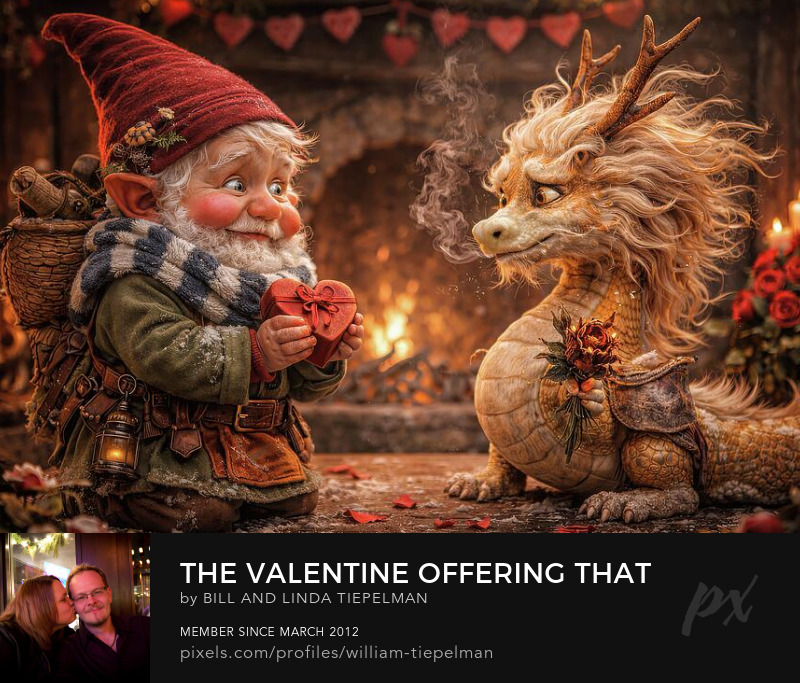
And yet… here was Pip Thistlewhisk, gnome of average height, above-average optimism, and wildly below-average survival instincts, standing at the edge of the woods with a heart-shaped box tucked under his arm like it was contraband. It was late winter, the kind where snow looks pretty from a distance but up close it’s mostly ice and regret. Pip’s boots crunched with each step, and his red pointed hat bobbed like a cheerful warning flag to the universe. He had, strapped to his back, a basket filled with supplies: dried berries, a few hand-knitted socks, a lantern, and—because he couldn’t stop himself—two tiny paper heart garlands he’d made while pretending he was “just passing time.”
He told himself he wasn’t nervous. He was “adventurously calm.” Like a hero. A hero who hadn’t slept properly in three days because every time he closed his eyes he imagined the dragon’s face. And the dragon’s face was… annoyingly charming. It wasn’t supposed to be. Dragons were supposed to be terrifying. Ancient. Awe-inspiring. The kind of creature you saw once, screamed forever, and then made a career out of warning other people not to do whatever you did.
But this dragon was young—still small enough to fit beside a hearth, still awkward enough to sit like a cat that hadn’t agreed to the rules of legs yet. Its scales were cream and gold, like toasted sugar. Its eyes were alert, bright, and suspiciously thoughtful. Like it was constantly evaluating whether you were friend, food, or emotional support gnome. Pip had met it by accident, as all great life-altering mistakes begin. He’d been gathering wood, singing a little tune about not freezing to death, when a warm gust of air rolled through the trees behind him. Not wind. Warmth. Like the forest had exhaled through a fireplace.
Then came a soft chuff—the sound of something large trying to be polite. Pip turned around and found himself face-to-face with a dragon perched on a boulder like it was pretending it belonged there, smoke curling gently from its nostrils as if it had simply eaten something spicy and was embarrassed about it. The dragon stared at him. Pip stared back. The dragon blinked slowly, the way predators do when they’re deciding if you’re worth the chase. Pip did what any rational, survival-focused being would do. He offered it a berry.
The dragon lowered its head, sniffed the berry, and—after a pause long enough for Pip to reconsider every choice he’d made since birth—ate it delicately. Then it sat back and looked at him as if to say, “Proceed.” That was day one. Day two involved Pip returning with more berries because his brain had apparently decided the dragon was now his responsibility, like a stray cat with arson potential. Day three involved the dragon bringing him a charred pinecone—burnt to perfection—as a gift. Pip, who had never in his life been offered anything by a dragon besides the opportunity to flee, had felt something inside him shift. Something warm and foolish and slightly embarrassing.
It wasn’t that he thought the dragon needed him. It was that… the dragon noticed him. Not as prey. Not as nuisance. As someone. Pip had spent his entire gnomehood being overlooked. He was the “nice one” in a village full of “sturdy ones.” The “creative one” in a village that thought creativity was fine as long as it didn’t interfere with turnip harvest schedules. He was the one who made little lanterns out of acorns and got told, kindly, to stop doing that because it wasn’t “useful.”
But the dragon looked at his lanterns like they were stars he could hold in his hands. So… Pip did what a gnome with feelings does when he has no emotional coping mechanisms and too much access to craft supplies. He made a Valentine’s gift box. He called it a “gesture.” He told himself it was “friendly.” He also told himself, boldly, that if the dragon didn’t understand it… he’d simply pretend it was a snack container and die with dignity.
Now he stood at the mouth of the dragon’s den—less a cave and more a cozy hollow beneath a rocky outcropping that leaked warm air like an inviting bakery. Snow melted around the entrance. The stones were blackened in places, but not scorched. More like… thoughtfully warmed. Pip took a deep breath, adjusted his scarf, and stepped inside. It was dim, but not dark. The dragon had arranged stones and old driftwood into a makeshift hearth. A faint glow pulsed from embers tucked neatly in the center, like a fire that had learned self-control and was proud of it.
And there—curled beside the hearth like a golden cat—was the dragon. It raised its head when Pip entered, eyes narrowing slightly, as if it were trying to remember whether Pip had ever been this scented with nervous sweat before. Pip forced a smile. “Hey,” he said, because he couldn’t think of anything else, and because his brain had decided “casual” was the best possible approach to gifting a fire-breathing creature a heart-shaped box. The dragon made a soft sound—half greeting, half exhale—and a thin ribbon of smoke floated up, curling lazily toward the ceiling.
Pip walked closer, every step a tiny crunch of snow off his boots, every heartbeat a loud drum in his ears. He stopped at a respectful distance, because he wasn’t an idiot. Okay, he was an idiot. But not a complete one. He held up the box. “So,” he said, voice cracking just a little, “I made you something.” The dragon’s gaze dropped to the box. Its nostrils flared, not aggressively, but with curiosity. Like it was smelling the intention. Pip cleared his throat. “It’s… uh… it’s not food. Not exactly. Unless you want it to be food. It can become food if that makes this less weird.”
The dragon tilted its head. Pip, for reasons that will one day be studied by scholars attempting to understand gnome stupidity, continued. “It’s like… a village thing. A tradition. Sort of. Not officially. Some people do it. Some don’t. It’s… a whole thing.” The dragon blinked slowly. Pip’s cheeks warmed. He could feel himself spiraling. He extended the box with both hands and said, as bravely as he could, “It’s a Valentine’s gift.” For a moment, the dragon didn’t move. Then—very carefully—it reached out with a clawed hand and accepted the heart-shaped box like it was either precious or suspicious, possibly both.
Pip’s lungs remembered how to work again. The dragon stared at the box. Then at Pip. Then back at the box, as if it were trying to solve the puzzle of why this gnome had brought it something shaped like a heart. Then, slowly, the dragon set the box down beside the hearth. It reached behind itself and produced something Pip hadn’t noticed: a small bundle of dried flowers and twigs tied together with what looked suspiciously like a strip of fabric. It held the bundle out. Pip froze.
“Is that…” he whispered, “for me?” The dragon made a soft, almost embarrassed sound. Pip took the bouquet with reverent hands. It smelled faintly of smoke and pine and something sweet, like burnt sugar. His chest did that stupid warm thing again. For one perfect moment, everything felt safe. Then Pip noticed the dragon’s eyes flick toward the heart-shaped box again—hungry this time, but not for food. Curious. Intent. Like it wanted to understand what it had been given. And in that exact moment, Pip had a thought so bright and foolish it should have come with a warning bell.
Maybe I should show it how to open it. He stepped forward, reaching for the lid. The dragon leaned in. Two sets of hands—one gnome, one dragon—hovered over the box. And that was when the dragon, overwhelmed by excitement and unfamiliar emotion, let out the tiniest little sneeze. It was not dramatic. It was not malicious. It was, by dragon standards, practically polite. But it was still a sneeze from a creature whose lungs contained the concept of fire. A tiny burst of flame flickered out. It kissed the ribbon on the heart-shaped box.
The ribbon caught. Pip stared at it, horrified, as the flame began to crawl up the bow like it had been waiting for this moment all its life. The dragon’s eyes widened. Pip’s mouth opened. No sound came out. Because there are moments in life where your soul briefly leaves your body to file paperwork for later. Then Pip finally found his voice, and it came out as a strangled whisper: “Oh no.” The dragon—panicking—reacted in the worst possible way. It inhaled sharply to blow the flame out.
Which, in theory, was a fine plan. In practice, it sucked the flame into its own mouth… and then coughed. The cough did not blow the flame out. It shot a messy, startled puff of fire directly into the hearth. The embers flared. The entire den brightened like it had been personally insulted by darkness. And Pip realized, with absolute clarity, that his “friendly little gesture” was about to become the Valentine Incident. He grabbed the heart-shaped box and yelled the first thing that came to mind:
“NO FLAMES INDOORS!” The dragon stared at him like he’d just introduced a new religion. Outside the den, in the quiet distance, a snowdrift melted ominously. In Bramblewick, a squirrel sneezed. And somewhere deep in the universe, fate cracked its knuckles and leaned in closer.
Fire Safety Is a Suggestion, Apparently
The first thing Pip learned about dragon panic was this: It smelled like burning pine, singed ribbon, and raw, unfiltered regret. The second thing he learned was that dragons, when emotionally overwhelmed, have the crisis-management skills of a startled goose. The heart-shaped box was now smoldering. Not fully on fire—yet—but glowing along the edges like it was seriously considering a career change into kindling. The ribbon hissed softly, curling in on itself as if embarrassed by the attention. Pip slapped at it with his gloved hands. “No no no no—this is decorative panic, not functional panic,” he muttered, batting the flame like it could be reasoned with.
The dragon, meanwhile, reared back and did the worst possible thing a creature made of fire could do when told “NO FLAMES INDOORS.” It nodded. Firmly. Earnestly. Then immediately tried to help. The dragon scooped up the box with one claw and dashed toward the far side of the den, where a shallow stone basin sat—meant for melting snow into drinking water, not for extinguishing romantic disasters. It dunked the box into the basin with all the enthusiasm of a toddler discovering puddles. Steam exploded upward. Pip yelped and ducked.
The den filled with fog so thick Pip briefly wondered if he had died and gone to the afterlife, which—if this was it—felt unfairly damp. When the steam cleared, the dragon stood proudly beside the basin, chest puffed out, tail swishing like it had just saved a kingdom. The box was… ruined. Soaked. Warped. The lid sagged like a disappointed face. The once-neat heart shape now resembled something anatomical and alarming. Pip stared. The dragon waited. Its eyes were huge. Pip inhaled. Exhaled. Smiled. “You know what?” he said, voice trembling just a little. “That was… very quick thinking.”
The dragon’s shoulders relaxed instantly. It made a soft chirring sound, the kind creatures make when praised sincerely and desperately need it. Pip carefully retrieved the soggy box from the basin. Water dripped onto the hearth stones, hissing where it touched lingering embers. “Okay,” he said, crouching down. “Let’s… reassess.” He opened the lid. Inside were small handmade chocolates—lumpy, uneven, clearly crafted by someone whose primary qualification was enthusiasm. Some had melted together. Others had absorbed water and now looked… philosophical. Pip picked one up, inspected it, then popped it into his mouth.
He chewed. The dragon watched, tense. Pip swallowed. “…Still good,” he declared. The dragon let out a relieved huff that warmed the air but—mercifully—did not ignite anything. Pip laughed. It slipped out of him before he could stop it. A real laugh. The kind that shakes loose fear and leaves only truth behind. “I’m sorry,” he said, sitting back on his heels. “This is probably not how this usually goes.” The dragon tilted its head, as if to say, Usually goes how? “Right. You wouldn’t know. You don’t exactly have… village context.”
Pip sighed, rubbing the back of his neck. “This whole thing?” he gestured weakly at the damp box, the scorched ribbon, the still-steaming basin. “It was supposed to be… nice. Not terrifying. Definitely not flammable.” The dragon padded closer, careful this time. It lowered its head until it was level with Pip’s chest, eyes searching his face. It made a soft, questioning sound. Pip swallowed. “It’s a way of saying you matter,” he admitted quietly. “That you’re… chosen.” The dragon stilled. Smoke stopped curling from its nostrils. Its tail froze mid-swish.
Pip felt suddenly very small. “I didn’t mean it to be a problem,” he added quickly. “I know I’m just a gnome, and you’re a dragon, and this is—objectively—terrible planning. But I didn’t want to not say it either.” The dragon’s eyes softened. It reached out and gently—gently—touched Pip’s shoulder with one claw, careful not to prick, careful not to heat. Pip’s breath hitched. “Okay,” he whispered. “Okay, that’s… that’s a lot.” The dragon withdrew its claw and, after a moment’s thought, did something unexpected. It nudged the basin aside.
Then it carefully rearranged the hearth stones, pushing embers apart until the fire dimmed to a controlled glow. It exhaled slowly, deliberately, producing only warmth. Then it sat. Still. Focused. Pip blinked. “Are you… trying?” The dragon nodded. Once. Very seriously. Pip’s chest tightened. “You don’t have to,” he said. “I mean, I’d appreciate it, but—” The dragon shook its head and tapped its own chest, then gestured vaguely toward the ruined box. Pip stared. “…You’re saying you want to understand.” The dragon’s eyes lit up. Pip laughed again, softer this time.
“Alright,” he said. “Lesson one: no fire during gifts.” The dragon nodded vigorously. “Lesson two: if something catches fire, we do not inhale dramatically.” The dragon winced. “Lesson three…” Pip hesitated, then smiled. “If you’re going to bring flowers, maybe don’t char them first.” The dragon puffed a tiny, controlled spark into the air—no heat, just light—like a sheepish apology. Pip reached out and took the dragon’s claw in both hands. It was warm. Not burning. Not dangerous. Just warm. Outside the den, the snow continued to melt.
And far away in Bramblewick, the village council’s rule board creaked ominously, as if sensing it was about to need an addendum. Rule #5: If trouble gives you flowers, reconsider your definitions.
The Village Council, the Hearth Agreement, and the Longest Silence on Record
The thing about villages like Bramblewick is that they are very good at noticing when something is off. Snow melts where it shouldn’t. Smoke rises without a chimney. The birds evacuate in neat, judgmental lines. By morning, the rumors had already formed. Something warm had moved into the woods. Something large. And—most alarming of all—something had clearly learned restraint, which meant intelligence, which meant paperwork. Pip woke up to knocking. Not frantic knocking. Not panicked knocking. The worst kind. Measured knocking. He groaned, rolled over, and briefly considered pretending to be dead. Unfortunately, the dragon’s den was not equipped for gnome avoidance strategies.
The dragon lifted its head, eyes alert. “No,” Pip whispered instantly. “No fire. No intimidation. No roaring. If anyone roars, it’s me.” The dragon nodded solemnly and tucked itself back beside the hearth, folding wings in tight like a guilty child at a recital. Pip opened the door. Three council members stood outside. They wore sensible coats. Practical boots. Expressions that said, We have prepared notes. At the front was Elder Bramwick himself, beard braided so tightly it could survive a windstorm. Beside him stood Maribel, keeper of village records and destroyer of nonsense. Behind them lurked Marvin, whose cider experiments had already earned him several footnotes in the rulebook.
Bramwick sniffed the air. “Smells like warmth,” he said. Pip smiled weakly. “It’s… a lifestyle choice.” Maribel peered past him into the den. Her eyes widened. Then narrowed. Then widened again, because there is only so much narrowing one can do upon seeing a dragon sitting politely beside a hearth. “Is that,” she said slowly, “a dragon?” The dragon waved. One claw. Very gently. The silence that followed was profound. Birds stopped chirping. Somewhere, a kettle decided not to boil. Bramwick cleared his throat. “Pip Thistlewhisk,” he said, carefully. “Would you like to explain why there is a dragon indoors?”
Pip opened his mouth. Closed it. Then decided honesty was probably cheaper than rebuilding the village. “We’re… courting,” he said. Marvin dropped his clipboard. Maribel pinched the bridge of her nose. Bramwick stared into the middle distance, as if reassessing every choice that had led him to this moment. The dragon puffed a tiny, controlled spark—no heat, just light—then extinguished it immediately, clearly eager to demonstrate growth. “See?” Pip added quickly. “Fire safety.” “This,” Maribel said flatly, “was not in the bylaws.” “We can add it,” Pip offered.
Bramwick sighed. “Alright,” he said. “Let’s start simple. Has the dragon harmed anyone?” Pip shook his head. The dragon shook its head too, a bit more enthusiastically. “Has the dragon burned anything?” Pip hesitated. “…Define ‘burned.’” Marvin squinted. “Is that ribbon still smoking?” The dragon quickly covered the ribbon with its tail. Maribel scribbled something furious into her ledger. “Has the dragon,” Bramwick continued, “shown intent to learn our rules?” The dragon stood, straightened, and carefully rearranged the hearth stones again, dimming the fire to a perfect, controlled glow.
It then sat. Waited. Bramwick raised an eyebrow. “Well,” he admitted, “that’s better than Marvin did on his third warning.” Marvin bristled. “That was a misunderstanding involving apples.” After a long, uncomfortable pause, Bramwick spoke again. “Very well,” he said. “Temporary agreement.” Pip’s heart leapt. “The dragon may remain,” Bramwick continued, “under strict conditions.” Maribel read from the ledger. Condition One: No open flames during gift exchanges.
Condition Two: Hearth use is shared and supervised.
Condition Three: Emotional sneezing must be controlled.
Condition Four: No courting rituals involving fire, molten rock, or interpretive roaring.
The dragon nodded at each point. Pip nodded too, mostly because nodding felt safer than fainting. Bramwick looked at them both. “And,” he added, softer now, “if this arrangement proves dangerous…” The dragon lowered its head. Pip squeezed its claw. “…we will revisit it,” Bramwick finished. “Not punish. Revisit.” Pip swallowed hard. “Thank you,” he said. The council departed, leaving behind scorched snow, shaken expectations, and a brand-new page in the rulebook. Rule #6: Love is unpredictable. Plan accordingly. That evening, Pip and the dragon sat together by the hearth.
The fire was small. Controlled. Perfect. Pip handed the dragon a fresh box—plain this time. No ribbon. The dragon opened it carefully. Inside was a single chocolate. The dragon looked at Pip. Pip smiled. “Baby steps.” The dragon ate it slowly. No flames. Just warmth. Outside, Bramblewick settled into a cautious peace. And in the woods, beside a hearth that no longer feared itself, a gnome and a dragon learned that the bravest thing you can do isn’t controlling fire— It’s choosing not to use it.
The Valentine Offering That Nearly Singed the Village doesn’t have to live only in the telling. You can carry a piece of Pip and the dragon’s dangerously heartfelt moment into your own world through thoughtfully crafted keepsakes inspired by the tale itself. Whether it’s a greeting card meant for someone brave enough to appreciate imperfect love, a mischievous sticker that nods to controlled chaos, or a cozy zip pouch that feels like it belongs beside a hearth, each piece carries the story forward. For those who enjoy patience as much as peril, the illustrated puzzle invites you to linger with every detail, while the bold metal print captures the firelit moment in a form meant to last—warm, vivid, and thankfully non-flammable.
 The Wink That Got Away With Everything
 The Dewdrop He Swore He Could Handle
 Sir Petalgrip and the Fold He Should’ve Respected