
The First Course of Procrastination
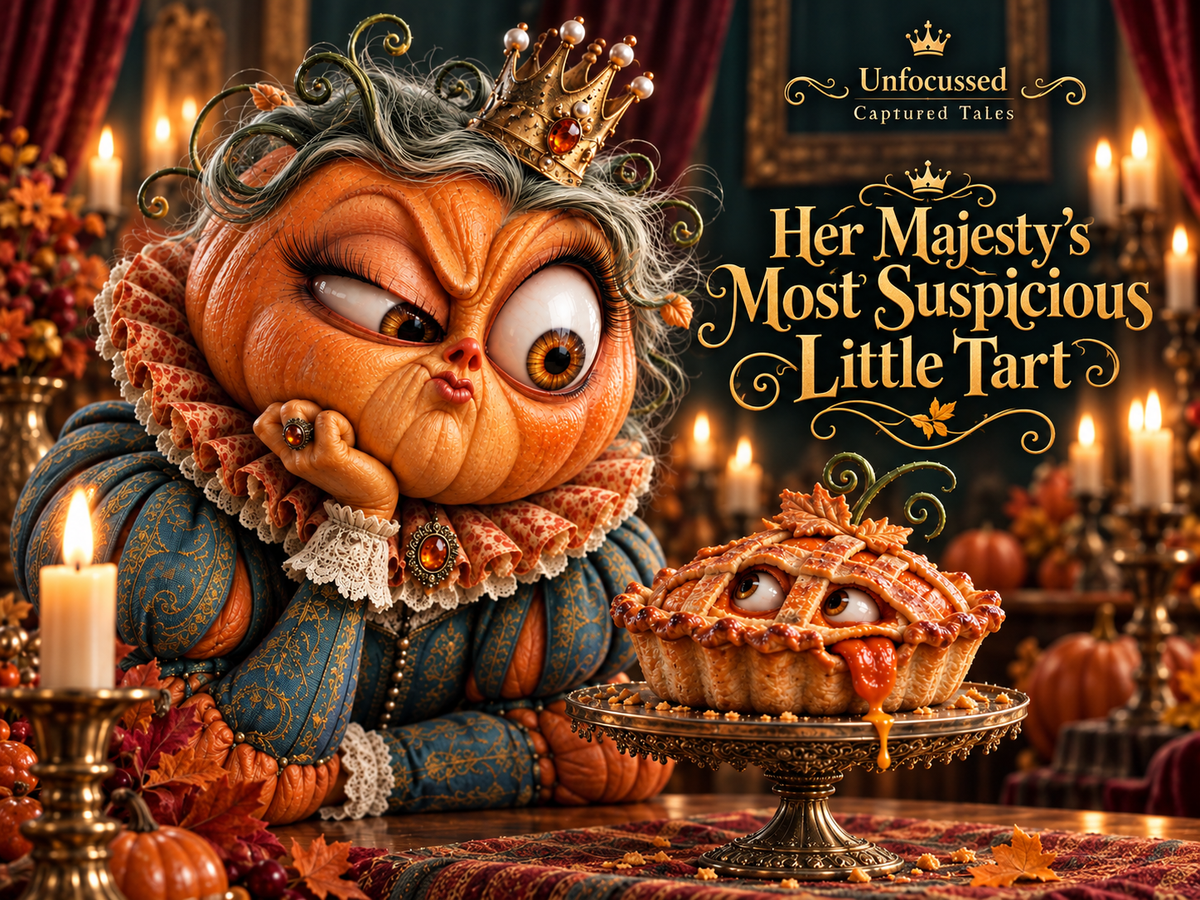
Queen Gourdelia the Fifteenth had never trusted a dessert that could maintain eye contact.
She trusted cakes because cakes were structurally incapable of deceit. She trusted puddings because puddings confessed everything the moment a spoon entered the room. She even trusted custards, despite their notorious wobbling, because a custard’s secrets were generally limited to whether the cook had remembered the nutmeg.
But the little pumpkin tart sitting before her on a silver pedestal possessed two anxious brown eyes, three twitching vine curls, and a bright orange tongue of filling that had been hanging over its crust for nearly four minutes.
It was watching her.
More troublingly, it appeared to be judging her.
Queen Gourdelia rested one plump cheek upon her jeweled hand and narrowed her enormous amber eyes. The tart narrowed its own eyes in return, although one wandered slightly toward the ceiling and ruined the effect.
“You are behaving suspiciously,” said the queen.
“I’m a tart,” said the tart. “We have limited behavioral options.”
“Ordinary tarts do not speak.”
“Ordinary queens don’t interrogate supper.”
The queen’s little red lips compressed until they resembled an offended berry.
Around them, the Royal Autumn Dining Chamber glowed beneath hundreds of candles. Bronze sconces flickered against paneled walls. Velvet curtains the color of mulled wine framed windows blackened by the October night. Pumpkins of every size lined the room, though none possessed crowns, opinions, or the legal authority to have anyone beheaded before tea.
The queen’s private supper table stretched beneath a runner woven with gold vines and burgundy leaves. At its center stood the troublesome tart, surrounded by the scattered crumbs of what should have been a perfectly uneventful dessert.
At the far end of the chamber, twelve servants stood in a rigid line and attempted to become furniture.
Queen Gourdelia lifted her fork.
The tart screamed.
It was not a dignified scream. It began as a shrill whistle, descended into a gurgling moan, and concluded with the tart shouting, “MURDER BY CUTLERY!”
Three servants fainted. A fourth dropped the cream pitcher. The royal food taster attempted to crawl beneath the table without moving his upper body.
Gourdelia lowered the fork.
“Compose yourself.”
“Easy for you to say,” panted the tart. “You’re not staring into the four polished prongs of eternity.”
“You were baked for consumption.”
“That is a deeply prejudicial interpretation of my origins.”
“You are made of pumpkin filling.”
“So are several members of your extended family, by the look of the royal portraits.”
A gasp traveled through the servants like wind through dry leaves.
Queen Gourdelia’s left eyebrow climbed so high it nearly became part of her crown.
“What,” she asked softly, “did you just say about the House of Gourd?”
The tart’s woven crust tightened around its eyes.
“I said your lineage appears rich, distinguished, and adequately spiced.”
“That is not remotely what you said.”
“Your Majesty, I am under considerable stress. I may have misspoken while experiencing imminent mastication.”
The queen raised the fork again.
“WAIT!” cried the tart. “I invoke the Seven Courses of Procrastination!”
The fork stopped one inch above its crust.
Silence fell across the dining chamber.
Even the candles seemed to lean closer.
Queen Gourdelia stared at the tart. The tart stared back with the particular confidence of someone who had just invented a law and was praying nobody owned the correct book.
“The what?” she asked.
“The Seven Courses of Procrastination,” said the tart, more slowly. “The ancient and extremely binding royal custom permitting any dessert condemned to consumption seven final requests before the first bite.”
Gourdelia’s eyes slid toward Lord Butternut, Keeper of the Royal Protocols, who stood among the servants clutching a leather volume large enough to stun an ox.
Lord Butternut was a narrow squash with spectacles, parchment-colored skin, and the perpetual expression of a man who had just remembered an appointment from nineteen years ago.
“Well?” demanded the queen.
He opened the volume and began turning pages.
“I have never heard of such a custom, Your Majesty.”
The tart sagged with relief.
Then Lord Butternut added, “Which does not necessarily mean it does not exist.”
The tart’s crust perked up.
“There are forty-three thousand pages of dining law,” the protocol keeper continued. “Your great-great-grandfather issued seven hundred decrees concerning acceptable soup temperatures alone.”
“A visionary,” murmured the queen.
“He boiled nine dukes.”
“They repeatedly served gazpacho.”
Lord Butternut adjusted his spectacles. “The law may be hidden within the Supplemental Codex of Ceremonial Snacks.”
“Retrieve it.”
“It is stored in the west archive.”
“Then go west.”
Lord Butternut bowed and hurried from the chamber, his enormous book bouncing against his knees.
The queen turned back to the tart.
“Until he returns, I will humor this alleged tradition. State your first request.”
The tart had not expected to reach this stage. Its eyes darted toward the windows, the doors, the tabletop, and finally the sharp fork still hovering above its head.
“Whipped cream,” it blurted.
“You request the substance most commonly served upon your corpse?”
“When you phrase it that way, I regret everything.”
“Bring the whipped cream,” ordered Gourdelia.
A servant rushed forward carrying a silver bowl. He raised a spoonful over the tart.
“Not that cream,” said the tart.
The servant froze.
“What is wrong with it?” asked the queen.
“It lacks structural conviction.”
“It is cream.”
“It is surrender in a bowl. Look at those peaks. They have abandoned hope.”
Queen Gourdelia inspected the cream. The cream, having no self-esteem to defend, remained silent.
“What precisely do you require?” she asked.
“Cream from a moon-fed cow, whipped clockwise in a chilled copper bowl by someone harboring no unresolved romantic resentment.”
Every servant looked at every other servant.
The Royal Whipper of Cream quietly stepped backward.
“You,” said Gourdelia, pointing to him. “Are you harboring unresolved romantic resentment?”
“Only a reasonable amount, Your Majesty.”
“Find someone emotionally unencumbered.”
“At this hour?”
“Search the monastery.”
Two servants raced from the chamber.
The tart watched them go and allowed itself the smallest victorious smile.
Queen Gourdelia noticed.
“You are enjoying this.”
“I’m about to be eaten. My standards for enjoyment have become very flexible.”
While the palace searched for a romantically unburdened cream-whipper, the queen studied her dessert. There was something strangely deliberate about the tart’s panic. Its trembling was genuine. Its tongue of filling had begun to drip onto the pedestal. Yet beneath the fear, Gourdelia detected calculation.
The creature was not merely delaying its death.
It was waiting for something.
“Where were you baked?” she asked.
“In an oven.”
“Whose oven?”
“A hot one.”
“By whom?”
“A baker, presumably. I was dough at the time and found the entire experience disorienting.”
The queen leaned closer.
“You appeared in my kitchen without an order, a delivery seal, or a pastry pedigree. My chef insists he did not make you. My guards claim nobody entered the palace carrying baked goods. Yet here you sit, alive, insolent, and sweating onto an eighteenth-century pedestal.”
The tart glanced down at the orange filling pooling beneath its crust.
“That could be condensation.”
“You are nervous.”
“I am dessert in a room full of forks.”
“You are hiding something.”
“Mostly cinnamon.”
Gourdelia tapped one lacquered fingernail against the table.
“Perhaps I should split you open and inspect your contents.”
The tart recoiled so violently that one of its vine curls slapped itself across the face.
“That would violate the Seven Courses!”
“Only if the law exists.”
“It exists.”
“Then tell me who established it.”
“King... Crumblebottom.”
“There has never been a King Crumblebottom.”
“That is precisely why his reforms have been forgotten.”
The queen’s fork rose again.
“Second request!” shouted the tart.
“Your first has not been fulfilled.”
“Requests may overlap during periods of administrative congestion.”
“Convenient.”
“The law was written by hungry people.”
Gourdelia lowered the fork with a weary sigh. “State it.”
The tart looked around the chamber. Its eyes settled upon the quartet of elderly musicians positioned behind a carved screen. They had been waiting silently throughout supper, hoping the queen would forget they existed and release them before their joints became architectural.
“Ceremonial music,” said the tart.
“For what ceremony?”
“My final moments of uncropped existence.”
The queen gestured toward the musicians.
“Play something appropriate.”
The quartet began a mournful funeral hymn.
The tart’s eyes widened.
“Not that appropriate.”
They shifted into a lively harvest reel.
“Too cheerful. It feels insensitive.”
A romantic waltz followed.
“Absolutely not. The cream-whipper already brought enough emotional complications into this.”
The musicians stopped.
“What would satisfy you?” the queen asked.
“Something stirring but restrained. Hopeful, though conscious of mortality. Moderately danceable without encouraging frivolity. Ideally featuring a bassoon.”
The quartet contained no bassoon.
The first violinist began to cry.
Queen Gourdelia’s suspicious expression deepened until the wrinkles between her eyes resembled a family crest.
The tart had successfully dispatched two servants to the monastery, immobilized four musicians, and sent Lord Butternut across the palace in search of a probably nonexistent statute.
It had also shifted slightly to the left.
Only half an inch, perhaps. Yet the queen distinctly remembered its pedestal being centered upon the golden leaf woven into the table runner. It was no longer centered.
She looked beneath the tart.
A narrow line of crumbs extended from the edge of its crust toward the table.
“What are those?” she asked.
The tart followed her gaze.
“Crumbs.”
“I can see that.”
“Then we agree. Progress.”
“Why are they arranged in a line?”
“Crumbs are notoriously social.”
Gourdelia reached toward the line.
The tart slapped her finger with a tiny vine.
The entire chamber gasped again.
Queen Gourdelia stared at her hand.
The tart stared at the vine that had betrayed it.
“Reflex,” it whispered.
The queen slowly raised her eyes.
“You struck the Crown.”
“I gently redirected a threatening digit.”
“You assaulted your sovereign with foliage.”
“The vine acted independently.”
“It is attached to your head.”
“Royal families use that defense constantly.”
Another gasp moved through the servants. This one carried a faint note of admiration.
Gourdelia stood.
She was not a tall queen, but she possessed the rare ability to make every inch of herself feel legally dangerous. Her teal skirts unfurled around her like storm clouds embroidered in gold. Candlelight flashed across her jeweled crown. Her vine-tangled silver hair seemed to rise with her anger.
The tart began inching backward.
“Remain where you are.”
“I am completely stationary.”
It inched backward again.
“You are moving.”
“The palace may be settling.”
“The palace is not settling beneath one pastry.”
“Perhaps your renovations were cosmetic.”
Gourdelia planted both hands upon the table and brought her face close to the tart.
“Listen carefully, you deceitful little latticework nuisance. I will grant every request required by legitimate royal law. I will provide your special cream, your impossible music, and whatever other nonsense tradition compels. But if Lord Butternut returns without proof, I shall consume you slowly, beginning with whichever portion of your crust you consider most emotionally significant.”
The tart swallowed. Its filling made a wet gulping sound.
“That seems unnecessarily personal.”
“You made it personal when you struck me with your forehead shrubbery.”
Before the tart could answer, the dining chamber doors flew open.
Lord Butternut stumbled inside, dragging a dust-covered volume bound in cracked orange leather. Cobwebs clung to his spectacles. A small archive spider rode triumphantly upon his shoulder.
“Your Majesty!” he wheezed.
Queen Gourdelia turned.
The tart stopped breathing.
Lord Butternut hauled the book onto the table, scattering crumbs in every direction. The tart glanced at the newly created mess, then discreetly extended one vine toward the line it had been building.
Gourdelia slapped the vine flat with one finger.
“Do not.”
Lord Butternut flipped through the ancient pages.
“I found a reference to the Seven Courses of Procrastination.”
The tart’s eyes nearly burst through its crust.
“You did?”
“You sound surprised,” said the queen.
“I am overwhelmed by the majesty of lawful governance.”
Lord Butternut traced one trembling finger along a faded paragraph.
“The custom was established during the reign of Queen Marrowfat the Merciful, following the unfortunate execution of a plum pudding later proven innocent of espionage.”
Gourdelia blinked. “How does one falsely accuse a pudding of espionage?”
“A secret message was found beneath it.”
“That seems compelling.”
“The message had been written on the table before the pudding arrived.”
“Sloppy prosecution.”
“Quite. To prevent further miscarriages of culinary justice, Queen Marrowfat granted speaking desserts seven final requests before consumption.”
The tart puffed itself up until flakes of crust fell from its sides.
“There, you see? Ancient law. Sacred tradition. Very serious business.”
Lord Butternut peered more closely at the page.
“There is, however, a condition.”
The tart deflated.
Queen Gourdelia smiled.
“Of course there is.”
“The requests must be completed before the final bell of midnight. Any dessert remaining upon the royal table after the seventh request...”
Lord Butternut adjusted his spectacles.
“...is granted permanent sanctuary and may never be eaten by any subject of the realm.”
The queen’s smile vanished.
The tart’s tongue slipped from its crust again.
From somewhere deep within the palace, a clock began to chime the quarter hour.
Gourdelia turned toward the dark windows.
It was half past eleven.
The tart had thirty minutes to survive.
The queen had thirty minutes to satisfy six more ridiculous requests and put a fork through its conniving little face.
They slowly looked at one another.
“Third request,” said the tart.
“Make it quickly.”
The tart’s eyes shifted toward the crumbs scattered across the table. Beneath the confusion, its original narrow trail now reached the edge of the runner.
Its mouth curled into a nervous smile.
“I require a character witness.”
The Witnesses for the Dessert
Queen Gourdelia stared at the tart as though deciding whether the law prohibited accidentally sitting on it.
“A character witness,” she repeated.
“Someone willing to testify to my moral fiber.”
“You are pastry.”
“Pastry can possess integrity.”
“Your entire body is held together by butter.”
“There are dukes in this kingdom held together by less.”
Gourdelia glanced toward Lord Butternut.
The Keeper of Royal Protocols lowered his eyes to the ancient volume, wisely pretending to be fascinated by a footnote.
“Very well,” said the queen. “Name your witness.”
The tart looked around the chamber.
The servants suddenly found the ceiling captivating. The musicians inspected their instruments. The royal food taster slid farther beneath the table until only his velvet shoes remained visible.
“I choose...”
The tart stretched the word while searching for anyone foolish enough to help it.
“...the cream.”
Queen Gourdelia’s eyes narrowed.
“The cream has not arrived.”
“Then my witness is delayed through no fault of my own.”
“Cream cannot speak.”
“Neither can most character witnesses until properly whipped.”
Gourdelia reached for the fork.
“Pick someone in this room.”
The tart’s eyes landed upon the first violinist, whose tearful expression suggested a person already regretting every decision that had led him into royal employment.
“Him.”
The violinist went pale.
“Master Fiddlesprig,” said the queen, “approach the table.”
“I would prefer not to, Your Majesty.”
“That was not presented as a preference.”
Master Fiddlesprig shuffled forward clutching his violin against his chest like a wooden shield.
The tart smiled encouragingly.
“Tell Her Majesty about my character.”
“I have never met you.”
“Then you have never witnessed me commit a crime.”
“I watched you strike the queen with a vine.”
“That was foliage acting outside the scope of its duties.”
Gourdelia folded her arms.
“Proceed with this glowing testimony.”
Master Fiddlesprig cleared his throat.
“The tart has not murdered anyone during the seventeen minutes I have known it.”
“Excellent,” said the tart.
“It has insulted the royal family, fabricated at least one historical monarch, disrupted the orchestra, and attempted to escape.”
“Those observations feel needlessly comprehensive.”
“It also made me cry.”
“Your music made you cry.”
“Because you said it lacked emotional architecture.”
“It did.”
Master Fiddlesprig turned to the queen. “May I go now?”
“Immediately.”
He retreated behind the screen with the urgent dignity of a man fleeing a barn fire during a formal procession.
The tart looked toward Lord Butternut.
“That counts.”
The protocol keeper studied the law. “The statute requires only that the witness speak. It does not require favorable testimony.”
“Third request fulfilled,” said the tart triumphantly.
Queen Gourdelia smiled with all the warmth of a closing trap.
“Then you have one fewer obstacle between yourself and my fork. State the fourth.”
The tart’s smile faltered.
Its crumb trail had reached the edge of the table runner, but several feet of polished wood remained between it and freedom. Even if it escaped the pedestal, it faced a sheer drop to the floor. The tart had never fallen from a table before, but instinct suggested the experience would be brief, educational, and terminal.
It needed transportation.
Its wandering eye settled upon a small silver cart beside the queen’s chair. The cart held teapots, cups, sugar tongs, and a wheeled lower shelf intended for discarded dishes.
“I request a warmer plate,” said the tart.
“You are already on a plate.”
“A warmer one.”
“Your filling is sweating.”
“That is fear, not temperature.”
Gourdelia placed the back of one finger against the tart’s crust.
It flinched.
“You are perfectly warm.”
“I feel a chill near my bottom.”
“Most creatures do when death approaches.”
“Exactly. A warmer plate would provide comfort.”
The queen looked toward the silver cart.
The tart attempted not to look toward the silver cart.
Gourdelia looked back at the tart.
“You intend to escape on the tea trolley.”
“I am offended by the accusation.”
“Your left eye has been staring at its wheels.”
“My left eye is adventurous.”
“And your crumb trail leads directly toward it.”
The tart glanced at the evidence.
“That proves nothing.”
“It is an arrow.”
Behind the tart, the crumbs had arranged themselves into a neat triangular point aimed at the trolley.
“A coincidental arrow.”
The queen swept the crumbs from the runner with one hand. The tart let out a tiny cry of despair.
“Bring a warming plate,” she ordered.
A kitchen servant hurried forward with a covered porcelain dish. Steam curled from beneath its lid.
“Place it here.”
The servant set the dish directly before the queen, well beyond the tart’s intended escape route.
Gourdelia reached for the dessert.
The tart shrieked and clung to its silver pedestal with all four vine curls.
“Do not touch me!”
“You requested a warmer plate.”
“I did not consent to relocation.”
“How do you propose to reach it?”
“Bring it to me.”
“It is larger than your current pedestal.”
“Place it underneath.”
“You are inventing complications.”
“My bottom remains dangerously chilly.”
The queen nodded to two servants. They lifted the tart’s pedestal, slid the steaming dish underneath, and lowered it onto the warmed porcelain.
The tart’s eyes bulged.
“Too hot!”
“You requested warmer.”
“Warmer, not volcanic!”
“The law does not promise satisfaction. Only fulfillment.”
Lord Butternut consulted the statute and nodded.
“Fourth request fulfilled.”
The tart began hopping from one edge of its pedestal to the other as heat traveled through the silver.
“My crust is cooking twice!”
“How tragic,” said Gourdelia. “You may become even more delicious.”
The palace clock chimed again.
Eleven forty-five.
The tart froze.
Fifteen minutes remained.
Three requests had been completed since the legal countdown began. Its plan had been to stretch each one until midnight, but the queen had transformed procrastination into an efficient administrative procedure.
Worse, the warming plate was roasting its underside.
“Fifth request,” it gasped.
“State it.”
“I require a brief recess to cool my person.”
“Denied. Recess is not a ceremonial accommodation.”
“Then I require a ceremonial breeze.”
“A what?”
“A traditional cooling wind, administered by six attendants bearing fans made from the tail feathers of morally respectable peacocks.”
Queen Gourdelia looked at Lord Butternut.
“Does the law require morally respectable peacocks?”
“No, Your Majesty.”
“Ordinary fans will suffice.”
Six servants snatched decorative fans from the walls and surrounded the tart.
“Begin.”
They fanned.
The first gust struck the tart broadside.
Its vine curls whipped backward. Its crust rattled. Several crumbs tore free and vanished across the chamber.
“Gently!” it cried.
“Faster,” ordered the queen.
The servants doubled their efforts.
The tart’s tongue flapped against its face. Its lattice crust began to whistle. Loose sugar crystals flew into the air like sand in a desert storm.
“This is not a breeze!” it shouted. “This is weather!”
“Are you cooler?”
“Parts of me have entered winter!”
“Then the request is fulfilled.”
Lord Butternut nodded.
The servants stopped.
The tart sagged sideways, its vine curls tangled around one another and its wandering eye spinning slowly in its socket.
Queen Gourdelia sat again and lifted her fork.
“Two requests remain.”
“I need a moment to gather my crust.”
“You have twelve minutes.”
“Exactly. There is no need to rush.”
“I have never wanted to eat anything as much as I want to eat you.”
“I choose to take that as praise.”
The dining chamber doors opened once more.
Two exhausted servants entered with a broad-shouldered monk between them. The monk wore a brown robe, carried a copper bowl, and regarded the entire room with an expression of profound spiritual inconvenience.
“Brother Turnip,” announced one servant. “The only man at the monastery who claims to harbor no unresolved romantic resentment.”
The monk bowed.
“Romance is a temporary fever of the flesh.”
The tart stared at him.
“He sounds fun.”
Brother Turnip placed the copper bowl upon the table. A small jug of cream followed.
“Is the cream from a moon-fed cow?” asked the tart.
“The cow was outdoors after sunset,” said the servant.
“Close enough.”
Brother Turnip began whipping clockwise.
Queen Gourdelia watched the cream thicken.
The tart watched the clock.
Eleven fifty.
Every turn of the whisk brought its first request closer to completion. Every soft peak was another shovelful of earth upon its grave.
“He is whipping too quickly,” said the tart.
“His speed was not specified.”
“The cream needs time to contemplate its purpose.”
“Its purpose is to sit upon your remains.”
“That is precisely the sort of pressure that ruins dairy.”
Brother Turnip lifted the whisk. A perfect peak stood in the bowl.
“Finished,” he said.
A servant spooned a flawless white cloud onto the tart.
The tart groaned beneath its weight.
“First request fulfilled,” announced Lord Butternut.
“And the music?” asked the queen.
Master Fiddlesprig reluctantly emerged from behind the screen.
“We located a bassoonist, Your Majesty.”
A breathless musician hurried into the chamber carrying a bassoon nearly twice his height.
The quartet began to play. The new arrival joined them with a low, wobbling note that sounded like a goose reconsidering a confession.
The tart listened desperately for fault.
The composition was stirring but restrained. Hopeful, though conscious of mortality. Moderately danceable without encouraging frivolity.
It was, to the tart’s horror, perfect.
“Second request fulfilled,” said Lord Butternut.
Queen Gourdelia raised her fork.
“You have enjoyed your cream, your music, your witness, your heated plate, and your ceremonial wind. State the sixth request.”
The tart trembled beneath its dollop of cream.
Nine minutes remained.
It glanced around the dining chamber, searching for anything that could not be completed quickly. It considered requesting a sunrise, but suspected the queen would produce a painting. It considered demanding a written apology from everyone who had ever eaten pie, but Lord Butternut would undoubtedly locate a statutory limit on correspondence.
Then it saw the crown.
Queen Gourdelia’s magnificent gold crown sat slightly crooked among her wild silver vines. Pearls adorned every point, and a polished amber jewel burned at its center like a captured flame.
The tart smiled.
“For my sixth request, I wish to be crowned.”
The chamber erupted with laughter.
It came from servants, musicians, guards, and even the royal food taster beneath the table. Brother Turnip laughed so unexpectedly that he dropped the whisk.
Queen Gourdelia did not.
“You wish to wear my crown?”
“Only for the duration of one ceremonial portrait.”
“My crown has rested upon the heads of fifteen sovereigns.”
“And tonight it can broaden its experience.”
“It weighs more than you do.”
“Then perhaps the smaller breakfast crown.”
“I do not own a breakfast crown.”
The tart looked genuinely appalled.
“What kind of monarchy is this?”
Gourdelia turned toward Lord Butternut.
“Can I refuse?”
He traced the statute with one finger.
“Only if the request threatens the life of the monarch, disrupts the lawful succession, or requires the expenditure of more than twelve silver crowns.”
“It requires my actual crown.”
“That distinction was apparently not anticipated.”
The tart stuck out its tongue.
Gourdelia removed her crown.
Without it, her silver hair sprang outward in a wild halo of curls and vines. She held the ancient symbol of royal authority above the tart.
“If you damage this, I will have you baked into a brick and installed in the dungeon wall.”
“Your terms are reasonable.”
The queen lowered the crown.
It engulfed the tart completely.
Only its tongue remained visible beneath the golden rim.
“I cannot see,” came its muffled voice.
“An improvement.”
“The portrait must show my face.”
“You failed to specify that.”
Lord Butternut cleared his throat. “A ceremonial portrait traditionally requires an identifiable subject.”
Gourdelia muttered something that caused Brother Turnip to reconsider the spiritual atmosphere of the room.
The servants lifted the crown. A kitchen maid fetched a miniature decorative coronet from a statue of Saint Squashbert in the corridor. It fit the tart perfectly, resting between its vine curls and above its anxious eyes.
The royal portraitist was summoned from bed.
He arrived wearing a nightshirt, one slipper, and the haunted expression of an artist who had been told to paint quickly for someone with execution privileges.
“You have four minutes,” said the queen.
“Four minutes to paint a royal portrait?”
“Three minutes and fifty-five seconds.”
He erected an easel and attacked the canvas.
The tart sat proudly beneath its crown. The cream upon its head resembled an unfortunate ceremonial wig.
“My noble side is the left,” it told the painter.
“Your left eye is looking backward.”
“It conveys vigilance.”
“Hold still.”
“Capture my courage.”
“I am trying to capture your shape.”
“My shape is courage.”
The painter smeared orange, brown, and gold across the canvas with frantic strokes.
Queen Gourdelia watched the clock.
Eleven fifty-seven.
The tart watched the queen.
Two minutes remained.
“Finished!” cried the portraitist.
He spun the easel around.
The painting depicted a vaguely circular orange object beneath a yellow triangle. It could have been a crowned tart. It could also have been a frightened sunset wearing a hat.
“Magnificent,” said the tart immediately.
“Sixth request fulfilled,” announced Lord Butternut.
Gourdelia snatched the miniature crown away and raised her fork.
“One request remains.”
The tart stared at the fork.
The fork stared back in the manner of objects whose intentions require no explanation.
The clock’s minute hand crept toward midnight.
Sixty seconds.
The tart had saved its finest request for last. It had planned to demand a formal farewell from every servant in the palace, or perhaps the composition of a seven-act opera about its childhood.
But the queen had discovered the rhythm of the game. Whatever it asked, she would reduce to its smallest legal form and complete before the final bell.
The tart needed something impossible.
Something beyond royal power.
Something no servant could fetch, no musician could play, and no scholar could redefine.
It looked at Queen Gourdelia.
Beneath the towering hair, jeweled gown, and furious little mouth, she looked tired. Not hungry. Not angry.
Lonely.
The tart’s final plan arrived with such sudden clarity that its filling stopped dripping.
“My seventh request,” it said quietly, “is the truth.”
Gourdelia’s fork paused.
“About what?”
“Why you eat supper alone.”
The room went still.
The queen’s expression did not change, but the candlelight seemed to retreat from her face.
“That is none of your concern.”
“It is my final request.”
“Choose another.”
“I choose the truth.”
Lord Butternut looked down at the statute.
“A spoken answer satisfies the request, Your Majesty.”
The first mechanism inside the great palace clock began to turn.
Gourdelia glanced toward it.
Thirty seconds.
She could lie. She was queen. Nobody in the chamber would contradict her.
Yet the tart’s enormous eyes were fixed upon hers without mockery, evasion, or the frantic calculation that had filled them all evening.
For the first time, it was not trying to escape.
“Because,” Gourdelia said, “everyone who sits at my table is afraid of me.”
The tart remained silent.
“They praise whatever I serve. They laugh before I finish a joke. They agree with opinions I have not yet expressed. It is exhausting to dine with people who treat every raised eyebrow like an approaching execution.”
A guard lowered the ceremonial axe he had been polishing.
The clock began its first midnight chime.
“There,” said the queen. “You have your truth.”
“Not all of it.”
Gourdelia’s eyes widened.
“You asked why I eat alone.”
“And you told me why others won’t join you. That is not the same thing.”
The second chime sounded.
“You insolent little cheat.”
“Takes one to eat one.”
The third chime rang through the chamber.
Queen Gourdelia looked at the clock, the tart, and the fork in her hand.
Then she slowly lowered the fork to the table.
“I eat alone,” she said, “because asking someone to stay would mean admitting I wanted them to.”
The fourth chime sounded.
“And queens are not permitted to want?” asked the tart.
“Queens are permitted everything except the appearance of needing it.”
The fifth chime.
The tart looked at the empty chair across from her.
“That sounds miserable.”
“It has advantages.”
“Such as?”
“Nobody steals the potatoes.”
The sixth chime.
“There,” said Gourdelia. “The complete truth. Seventh request fulfilled.”
She reached for the fork again.
The tart shut its eyes.
The seventh chime rolled over them.
“Your Majesty,” said Lord Butternut carefully, “the law grants the dessert until the final bell of midnight.”
Gourdelia gripped the fork.
The eighth chime.
“Then midnight is not concluded.”
The tart opened one eye.
The ninth chime.
The queen positioned the fork above its crust.
The tenth chime.
The tart’s vine curls wrapped around the pedestal.
The eleventh chime.
Gourdelia raised her arm.
The entire chamber held its breath.
The final bell began to swing.
The Final Bell and the First Supper
The twelfth chime thundered through the Royal Autumn Dining Chamber.
Queen Gourdelia drove the fork downward.
The tart screamed.
Silver struck porcelain with a sharp, ringing crack.
The fork stood buried in the pedestal less than half an inch from the tart’s crust.
For several seconds, nobody moved.
The tart opened one eye.
Then the other.
It looked at the fork trembling beside its face, followed the handle upward, and stared at the queen.
Gourdelia’s hand still gripped it.
Her expression was unreadable.
“Did you miss?” whispered the tart.
“I am the finest competitive stabber in three kingdoms.”
“That does not answer the question.”
“I never miss.”
Lord Butternut placed one finger upon the ancient law.
“The final bell has sounded, Your Majesty.”
The queen released the fork.
“Then declare it properly.”
Lord Butternut straightened his spectacles, cleared his throat, and addressed the assembled chamber.
“By the authority of Queen Marrowfat’s Supplemental Codex of Ceremonial Snacks, this speaking dessert, having remained upon the royal table after the completion of seven lawful requests and the final bell of midnight, is hereby granted permanent sanctuary.”
The tart blinked.
“Permanent?”
“You may never be eaten by any subject of the realm.”
“Never?”
“Not legally.”
The tart looked around at the servants.
Several smiled. Master Fiddlesprig applauded. Brother Turnip made a solemn gesture of blessing over the copper bowl. The royal food taster emerged from beneath the table and immediately pretended he had dropped something.
The tart’s eyes filled with tears.
“I’m going to live.”
“Apparently,” said Gourdelia.
“I have a future.”
“Do not become theatrical.”
“I can make plans.”
“You are becoming theatrical.”
“I can learn embroidery. I can travel. I can develop opinions about curtains.”
“You already have too many opinions.”
The tart attempted to leap for joy.
Its bottom had adhered to the warmed silver pedestal.
It rose half an inch, stretched alarmingly, and snapped back with a wet slap.
“I appear to be stuck.”
Queen Gourdelia stared at it.
“An inspiring beginning to your future.”
Two servants approached with butter knives and began gently prying around the tart’s lower crust.
“Careful,” it said. “That edge is emotionally significant.”
“You declared every edge emotionally significant,” said Gourdelia.
“I have survived a transformative experience. My priorities have deepened.”
The tart finally came free with a moist sucking sound that caused the entire orchestra to wince.
A ring of orange filling remained upon the pedestal.
Gourdelia pointed at it.
“You will pay to have that polished.”
“I own nothing.”
“Then you will work.”
The tart froze.
“Work?”
“Permanent sanctuary prevents your consumption. It does not entitle you to live upon my table while contributing nothing but crumbs and criticism.”
“I am an object of historic legal significance.”
“You are a sticky tenant.”
The queen turned to Lord Butternut.
“What responsibilities accompany sanctuary?”
He searched the ancient text.
“The law says the spared dessert shall receive protection, reasonable lodging, and sufficient preservation against spoilage.”
The tart’s relief returned.
“Excellent.”
“In exchange,” Lord Butternut continued, “it must render service to the Crown according to its natural abilities.”
The relief departed.
“My natural abilities are limited to sitting attractively and surviving attempted murder.”
“You lied to a reigning monarch for thirty minutes,” said Gourdelia. “You manipulated palace staff, invented procedural barriers, exploited obscure law, and turned six meaningless requests into a path toward political immunity.”
The tart considered this.
“When you say it all together, I sound remarkably qualified.”
“Precisely.”
The queen plucked the miniature coronet from the table and placed it back between the tart’s vine curls.
“I appoint you Royal Minister of Delay.”
“Is that a real position?”
“It is now.”
“What would I do?”
“Foreign ambassadors bring me terrible proposals every week. You will prevent them from reaching the point before I lose patience and invade someone.”
“That sounds dangerous.”
“Only if you fail.”
“What are the benefits?”
“You remain uneaten.”
“I was under the impression that benefit was already permanent.”
Gourdelia smiled.
“Then consider it excellent job security.”
The tart looked toward Lord Butternut.
He shrugged.
“Royal appointments fall outside pastry law.”
“Fine,” said the tart. “But I require an office.”
“A shelf.”
“An office with a shelf.”
“A shelf near an office.”
“A window.”
“A painting of a window.”
“Weekly polishing.”
“Monthly dusting.”
“A stipend.”
“Two cinnamon sticks.”
“Four.”
“Three, and you stop dripping on the furniture.”
The tart extended a vine.
“Agreed.”
The queen regarded the vine suspiciously.
“Is that the one that struck me?”
“No. That vine has been formally reprimanded.”
Gourdelia shook it.
The servants applauded. The musicians launched into a triumphant flourish that was stirring, moderately danceable, and ruined almost immediately by the bassoonist losing his place.
The queen reclaimed her crown and returned to her chair.
The newly appointed Royal Minister of Delay sat proudly upon its scarred pedestal, wearing its miniature coronet beneath a collapsing mound of whipped cream.
“Now what?” it asked.
Gourdelia looked at the empty chair across from her.
“Now supper is concluded.”
“You barely ate.”
“You occupied the dessert course for most of an hour.”
“There were potatoes.”
“Cold.”
“Soup?”
“Congealed.”
“Bread?”
“Used as evidence during your attempted escape.”
The tart considered the abandoned dishes scattered along the enormous table.
“You could order another supper.”
“It is after midnight.”
“You are queen.”
“That does not mean the kitchen staff cease requiring sleep.”
The tart looked toward the servants, many of whom had spent the past hour running through corridors, fetching legal books, procuring emotionally detached monks, and searching the palace for a bassoon.
“Fair point,” it said.
One by one, Gourdelia dismissed them. The musicians packed their instruments. Brother Turnip took the copper bowl and departed in search of a monastery carriage. Lord Butternut carried away the ancient codex, muttering about dessert precedents and statutory reform.
Soon only the queen, the tart, and a single maid remained.
“Leave the candles,” Gourdelia told her. “You may go.”
The maid bowed and closed the doors behind her.
Silence returned to the chamber.
It was not the rigid silence of servants afraid to breathe incorrectly. It was softer now, filled with small domestic sounds: the crackle of candlewicks, the settling of silverware, and the faint sticky noise the tart made whenever it shifted.
Queen Gourdelia removed her crown and placed it beside her plate.
Without the gold points holding them in place, her silver curls and green vines spilled around her face.
The tart watched her.
“Do not begin another interrogation,” she said.
“I was merely observing.”
“You observe loudly.”
“You look less frightening without the crown.”
“You look less edible now that the law protects you.”
“That may be the nicest thing anyone has ever said to me.”
Gourdelia reached for the wine decanter and filled her goblet.
“Do you drink?”
“I absorb.”
“That sounds messy.”
“Most of my functions are messy.”
She poured a small measure into a saucer and slid it across the table.
The tart extended one vine, dipped its tip into the wine, and shuddered.
“That is terrible.”
“It is from the royal vineyard.”
“Then the royal vineyard has betrayed you.”
Gourdelia tasted her own wine.
She frowned.
“It is rather sour.”
“See? I am already rendering service to the Crown.”
“You insulted my wine.”
“I prevented you from pretending to enjoy it.”
The queen set down her goblet.
For the first time that evening, she laughed.
It began as an undignified snort. She covered her mouth, but the laugh escaped through her fingers and swelled until her crown trembled upon the table.
The tart stared at her.
“That was alarming.”
“What?”
“You sounded like a carriage losing a wheel.”
Gourdelia laughed harder.
“Stop helping,” she said.
“I am constitutionally incapable.”
When the laughter subsided, the queen wiped one eye.
“You are an appalling little creature.”
“And yet you missed.”
The warmth left her expression.
“I told you. I do not miss.”
“Then why am I alive?”
Gourdelia traced one finger around the base of her goblet.
“Because sanctuary law must be respected.”
“The twelfth bell had barely begun when you stabbed the plate.”
“My timing was cautious.”
“Your timing was deliberate.”
“You overestimate your importance.”
“You underestimate my view of the fork.”
The queen looked away.
The tart studied her face, then glanced at the empty chair opposite her.
“You wanted me to survive.”
“I wanted the law observed.”
“You like me.”
“Do not ruin your first evening of legal personhood.”
“You like me enough not to eat me.”
“That is an extremely low standard for affection.”
“It remains the highest standard available to food.”
Gourdelia tried to suppress another smile and failed.
“You may remain for one drink,” she said. “Then you will be transferred to the cold pantry.”
The tart’s eyes widened.
“The cold pantry?”
“The law requires preservation against spoilage.”
“It also requires reasonable lodging.”
“The pantry is dry, secure, and maintained at an excellent temperature.”
“It is full of ingredients.”
“They do not speak.”
“That makes it worse. Imagine sleeping among silent flour.”
“Where do you suggest we keep you?”
The tart looked around the dining chamber. Its gaze settled upon a velvet-lined alcove beside the fireplace where a decorative silver platter leaned against the wall.
“There.”
“That is where the ceremonial pheasant sits during winter banquets.”
“I am smaller than a pheasant.”
“You are louder than six pheasants.”
“I would improve the alcove.”
“You would stain the velvet.”
“Place a saucer underneath me.”
“You are already negotiating for palace property.”
“I am Royal Minister of Delay. Negotiating is my natural ability.”
Gourdelia sighed.
“You may use the alcove until suitable quarters are arranged.”
“With cushions.”
“One cushion.”
“Two small cushions.”
“One cushion folded in half.”
“Done.”
The tart extended its vine again.
This time, Gourdelia shook it without asking whether it had assaulted her earlier.
At breakfast, the court learned that the queen’s dessert had survived supper, acquired political immunity, and accepted a cabinet appointment.
By luncheon, rumors had spread that the tart was an enchanted prince.
By afternoon tea, the prince had become the exiled emperor of a pastry kingdom hidden beneath the eastern ovens.
Before dinner, three ambitious duchesses had sent marriage proposals.
The tart rejected them all.
“Why?” asked Queen Gourdelia as she read the letters aloud.
“They only want my title.”
“You are a minister, not nobility.”
“Then they only want my filling.”
“That is a sentence I forbid you to repeat.”
The tart settled quickly into palace life.
Its official name became Minister Crustwick after it refused to reveal whether it had possessed a name before being baked. Its office consisted of the promised shelf near Lord Butternut’s study, a miniature writing desk, and a brass plaque reading:
HIS EXCELLENCY CRUSTWICK
ROYAL MINISTER OF DELAY
KNOCK, THEN WAIT UNNECESSARILY
Crustwick proved remarkably effective.
When the Duke of Parsnippia demanded lower tariffs on imported gravy, Crustwick required him to submit the proposal in seven different fonts.
When an ambassador from the Onion Territories threatened war, Crustwick interrupted his speech to request ceremonial music and spent forty minutes locating a bassoon.
When the Treasury Minister attempted to conceal a missing chest of gold beneath four hundred pages of financial language, Crustwick read every word, asked why page two hundred and seventeen smelled of turnips, and uncovered an embezzlement scheme before lunch.
Queen Gourdelia rewarded him with four cinnamon sticks.
He reminded her they had agreed upon three.
She reminded him that queens were permitted generosity.
He framed the fourth.
Yet Crustwick’s most important duty began each evening when the final meeting ended and the palace halls grew quiet.
At seven o’clock, servants carried him into the Royal Autumn Dining Chamber and placed him upon the chair across from the queen.
He did not eat, though he sampled sauces with the tips of his vines and offered brutally specific criticism.
“Too much clove.”
“That is pepper.”
“Then the pepper has become ambitious.”
He told Gourdelia when her jokes were not funny.
He contradicted her opinions before she finished expressing them.
He once described her new ceremonial gown as “a curtain experiencing political power.”
She had him removed from the chamber.
He returned ten minutes later on the tea trolley.
And every night, she saved the potatoes for herself.
Months passed.
The autumn pumpkins were replaced by winter holly. Snow gathered upon the palace roofs. Crustwick’s crust remained remarkably fresh thanks to a preservation charm supplied by the royal apothecary, although the charm occasionally caused him to smell faintly of peppermint.
One cold evening, Queen Gourdelia entered the dining chamber and found his chair empty.
She stopped in the doorway.
“Where is the minister?”
The servants looked at one another.
“He has not arrived, Your Majesty.”
“Then retrieve him.”
They searched his office.
They searched the velvet alcove.
They searched the pantry, the kitchen, the archive, the throne room, and every tea trolley in the palace.
Minister Crustwick was gone.
Gourdelia ordered the gates closed.
Guards inspected every carriage. Servants crawled beneath every table. Lord Butternut examined the sanctuary statute for clauses concerning missing pastry officials.
The queen searched his office herself.
His brass coronet rested upon the miniature desk. Beside it lay the framed cinnamon stick, three clean quills, and a line of crumbs leading toward an open window.
Gourdelia touched the crumbs.
Snow blew through the narrow gap.
For a moment, she saw him as he had been on that first night: frightened, ridiculous, and desperately crawling toward freedom one crumb at a time.
Perhaps he had finally achieved it.
Perhaps sanctuary within a palace had only been another kind of serving dish.
The queen returned to the dining chamber alone.
She sat at the head of the enormous table beneath hundreds of candles. Servants brought soup, bread, roasted vegetables, and potatoes.
Nobody criticized the seasoning.
Nobody insulted the wine.
Nobody accused the curtains of excessive ambition.
Every servant agreed that the meal was perfect.
Gourdelia placed down her spoon.
“It is unbearable,” she whispered.
Something rattled inside the covered dish at the opposite end of the table.
The queen looked up.
The silver lid lifted slightly, then fell.
Gourdelia rose and approached it.
She lifted the lid.
Crustwick sat inside wearing a new crown woven from holly leaves. Snow dusted his lattice, and a rolled parchment was tucked beneath one vine.
“Surprise,” he said.
The queen stared at him.
“You escaped the palace.”
“Temporarily.”
“You triggered a lockdown.”
“I required materials.”
“I dispatched mounted guards.”
“That feels excessive.”
“I thought you had left.”
Crustwick’s expression softened.
“I did leave.”
Gourdelia said nothing.
“But I came back.”
He handed her the parchment.
It was a menu from a tiny village bakery beyond the palace walls. Every item had been marked with notes in Crustwick’s cramped handwriting.
Apple turnover: arrogant.
Honey cake: pleasant but emotionally vacant.
Potato loaf: excellent. Guard your portion.
At the bottom, beneath several scratched-out attempts, he had written:
Request for a permanent seat at the queen’s table, submitted without legal coercion.
Gourdelia read the line twice.
“You could have asked before disappearing.”
“You would have granted it out of obligation.”
“I am under no obligation to provide furniture to pastries.”
“Then say no.”
The queen looked at the empty chair across from hers.
“No.”
Crustwick’s eyes fell.
“That chair is too large,” she continued. “You require one fitted to your dimensions.”
He looked up.
“With cushions?”
“One cushion.”
“Two small cushions.”
“One cushion folded in half.”
“Done.”
Gourdelia carried him back to the table herself.
From that night forward, the queen never ate supper alone.
The court eventually stopped whispering about the living tart seated at her table, though visiting dignitaries remained alarmed when he asked questions about their moral fiber. His miniature chair became as permanent a feature of the dining chamber as the royal crest. A silver plaque on its back bore the words:
RESERVED FOR THE DESSERT
WHO REFUSED TO BE EATEN
Years later, when scholars recorded the great accomplishments of Queen Gourdelia the Fifteenth, they praised her reforms, her diplomacy, and the unprecedented peace achieved during her reign.
Few mentioned that most international disputes were prevented by a tart demanding unnecessary paperwork until everyone became too tired to fight.
Fewer still knew what happened each evening after the advisers departed and the palace doors closed.
The queen would remove her crown.
The tart would criticize the wine.
They would argue over the potatoes.
And just before midnight, Gourdelia would raise her fork, narrow her enormous amber eyes, and ask whether he had any final requests.
Crustwick always answered the same way.
“Only one, Your Majesty.”
“State it.”
He would settle into his folded cushion, glance around the candlelit chamber, and smile.
“Supper again tomorrow.”
Bring Her Majesty and Her Suspicious Little Tart Home
Queen Gourdelia and Minister Crustwick have escaped the royal dining chamber and claimed several new places to conduct their ongoing argument over appetite, sanctuary law, and who gets the last potato.
Let their gloriously suspicious expressions command a room with a framed print or richly textured canvas print. For a larger dose of royal autumn absurdity, the artwork is also available as a dramatic wall tapestry or an exceptionally cozy fleece blanket.
Anyone brave enough to reconstruct the entire royal interrogation can attempt the jigsaw puzzle. You can also carry Her Majesty’s magnificently judgmental stare on a tote bag or send someone a highly suspicious seasonal greeting with the greeting card.
Explore the complete Her Majesty’s Most Suspicious Little Tart collection at shop.unfocussed.com.

 Sir Nectarback and the Petal That Took It Personally
 The Emerald Stair of the Sleeping Fern
 The Honey-Lipped Budnewt Who Couldn’t Swallow the Evidence