absurd gnome humor

Captured Tales

View

Laughter in the Dark

by Bill Tiepelman

Laughter in the Dark

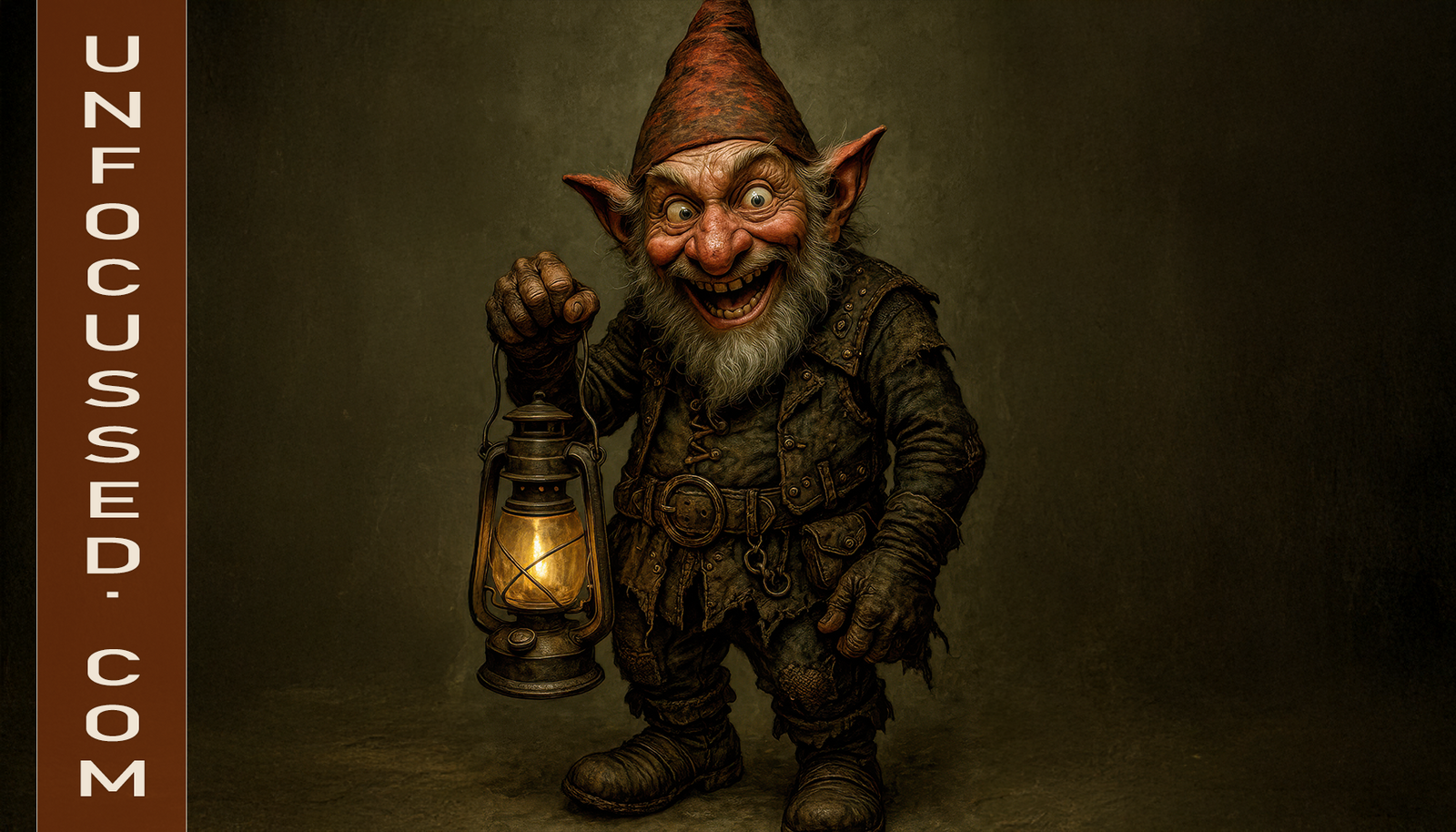
The Lantern-Bearer Appears Everyone in the village of Mirewood knew the rules about the forest. The elders taught them in school, the barkeep scrawled them on the back of ale-stained napkins, and old Grandmother Bipple would shout them at anyone walking too close to the edge of the trees. They were simple rules, easy enough to remember, though most ignored them until it was too late: Never whistle after dark. (It attracts unwanted attention.) Never follow the sound of laughter in the woods. (It is not your friends.) If you see a lantern swaying where no lantern should be—run. Of course, travelers passing through rarely knew these rules. And travelers, being what they are, tended to scoff at local superstition, right until the superstition waddled out of the bushes and introduced itself with a smile wide enough to make their teeth ache. That superstition had a name—or at least several variations of one. Some called him Grimble. Others called him Snagtooth. A few claimed his name was Darryl, but those people had been drinking heavily, and possibly had a habit of naming everything Darryl. Whatever his name, the truth remained: he was a lantern-bearer. Not a guide. Not a helper. Certainly not a friend. A lantern-bearer, and if you saw the light, you were already in trouble. The night our story begins was moonless, the sky clotted with heavy clouds, and the woods darker than the inside of a cow’s belly. A group of weary merchants, their donkeys sagging under bags of turnips, onions, and exactly one barrel of something suspiciously sloshy, were making their way down the Old Hollow Road. Their boots squelched in the mud, their tempers were thin, and their conversation had dwindled to muttered complaints about turnip prices. They didn’t notice it at first. A faint glow, like the last ember of a dying fire, bobbing between the trees. Perhaps it could have been a will-o’-the-wisp, perhaps moonlight glinting off wet bark—but then came the sound. The laugh. Oh, the laugh. It began as a hiccup, as though someone had swallowed a kazoo. Then it rose into a cackle that rattled the leaves, wheezed through the undergrowth, and echoed through the travelers’ bones until their spines tightened like violin strings. It was a laugh that said, Yes, I know exactly where you’re going. And no, you won’t like it when you get there. One of the donkeys brayed nervously. The youngest merchant whispered, “Did you hear that?” The oldest merchant pretended he hadn’t. Denial, after all, was cheaper than therapy. And then— He appeared. A squat figure, not more than four feet tall but twice as broad, stepping out of the trees as though the forest itself had coughed him up. His leather vest looked as though it had been stitched together by someone with poor eyesight and no sense of proportion. His boots sagged, patched so many times they had become more patch than boot. His gloves creaked with grime, and his belt buckle was bent in the shape of something that might once have been a circle. But the merchants weren’t staring at his outfit. They were staring at his face. At the pointed ears sticking out like dagger handles. At the eyes, round and bulging, that glistened with lunatic cheer. At the nose—red, bulbous, the sort of nose that spoke of centuries of bad life choices. And, of course, the mouth. That enormous, horrifying, magnificent mouth that stretched almost ear to ear and revealed a collection of teeth that looked like they had been borrowed from several different species and arranged without a clear plan. He grinned. The lantern in his hand swayed, casting a flicker of golden light that danced across the merchants’ pale, horrified faces. “HA! HA! HA! YOU’RE LOST, AREN’T YA?” The laugh that followed could not possibly have come from a creature of his size. It was thunderous, ridiculous, echoing through the trees like a drunk choir of demons trying to sing sea shanties. One of the donkeys sat down in protest. Another began chewing its reins. The merchants clutched their turnips for moral support. No one moved. The woods seemed to hold its breath. And then, in a voice far too chipper for the situation, the lantern-bearer said: “Don’t worry. I know a shortcut.” The Shortcut Now, in most tales, when a grinning goblin-like stranger pops out of the forest at midnight and offers you a shortcut, the sensible thing to do is refuse, bow politely, and run in the opposite direction until your shoes catch fire. Unfortunately, merchants are not known for their sense of adventure—or their sense of caution. They are, however, known for their greed and impatience. The youngest merchant cleared his throat nervously. “A shortcut, you say?” The lantern-bearer’s grin widened, which seemed medically impossible. “Oh aye. The quickest way to the village. Quick as a hiccup, quicker than a sneeze, quicker than a goose falling down a well.” “Goose falling down a—what?” the eldest merchant asked, eyebrows furrowing like angry caterpillars. The creature blinked at him, expression utterly serious, then threw back his head and howled with laughter so violent his hat nearly flew off. The woods joined in, the echoes clattering through the branches until it sounded as if the forest itself was giggling. That was the trouble with him: once he started laughing, everything laughed. The trees creaked in mirth. The wind wheezed. Even the donkeys let out startled, undignified hee-haws that sounded suspiciously like chuckles. The merchants shivered, because there is nothing more sinister than a donkey laughing at you. Still, the idea of shaving two days off their journey was too tempting. The merchants exchanged glances. Their boots were muddy, their tempers sour, and the barrel of suspiciously sloshy liquid was already half-empty. A shortcut would mean warmth, ale, and safety sooner. Surely, they reasoned, a creature with such excellent comedic timing couldn’t possibly be dangerous. “Lead on, good sir,” the youngest merchant said bravely, though his voice cracked in three different places. “Sir?” The lantern-bearer clutched his chest as if mortally wounded. “Do I look like a sir to you? My dear boy, I’m a professional!” “A professional…what?” the eldest merchant asked suspiciously. “A professional guide of lost things!” the creature bellowed, flourishing the lantern dramatically. “Lost sheep! Lost coins! Lost socks! Lost sense of direction! I find it all. Except virginity. That one tends to stay lost.” The merchants coughed uncomfortably. One donkey snorted. Somewhere in the distance, a crow cawed in disapproval.     And so, against the advice of every folktale ever written, the merchants followed the Lantern-Bearer off the main road. His lantern bobbed ahead of them like a firefly on caffeine, dipping and swaying, sometimes vanishing completely before popping up again with a sudden shout of “BOO!” that made the donkeys fart in terror. The path he led them on was no path at all. It twisted through undergrowth that snagged their clothes, across streams that soaked their boots, and under branches that seemed to duck too late on purpose. Each time they stumbled, each time they cursed, each time they tripped over a log that hadn’t been there a moment before—the Lantern-Bearer laughed. Loud, long, and wheezing, like a broken organ grinder trying to play itself to death. After what felt like hours, the merchants were panting, muddy, and less certain about their life choices. “Are you sure this is shorter?” one muttered. “Shorter than what?” the guide asked innocently, eyes gleaming. “Than the road!” “Oh aye,” he said, beaming. “Shorter than the road. Also shorter than eternity, shorter than a giraffe, shorter than—” he leaned in close, his nose nearly brushing the merchant’s cheek—“shorter than your patience.” He threw back his head and erupted into another gale of laughter. The sound was so loud and so infectious that the merchants found themselves chuckling nervously, then giggling, then outright cackling, though they couldn’t for the life of them explain why. Their laughter tangled with his, until the forest was a roaring carnival of giggles, howls, guffaws, and snorts. It went on and on, until they felt drunk on mirth, lightheaded and dizzy, stumbling through the dark with tears streaming down their cheeks. And then, just as abruptly, the laughter stopped. Silence. Heavy, suffocating silence. The kind of silence that pressed on your ears until you heard your own blood sloshing about like soup in a kettle. The merchants blinked, panting, and realized the lantern-bearer was no longer ahead of them. He was behind them. Grinning. Still. Always grinning. “Now,” he whispered, his voice sharp as a knife scraping bone. “Here we are.” The merchants looked around. They weren’t on a road. They weren’t anywhere near a village. They stood in a clearing ringed by trees with trunks warped and twisted into strange shapes. Knots in the bark seemed to watch them, faces frozen mid-laugh. Roots curled across the ground like skeletal fingers. And in the center of it all was a stone well, old and moss-eaten, its mouth blacker than the night sky. The Lantern-Bearer raised his light. His grin somehow grew wider. “The shortcut,” he declared proudly, “to exactly where you never wanted to be.” And then he laughed again. Louder than ever. The kind of laugh that promised Part Three of this story was going to get much, much worse. The Well of Echoes The clearing held its breath. The merchants stood huddled together, clutching their onions like holy relics, staring at the mossy stone well in the center. The air smelled damp and earthy, with a faint tang of iron, like the forest had been chewing on old nails. Somewhere far above, a crow cawed once, then thought better of it. Silence returned. “Well,” said the eldest merchant, forcing a laugh that sounded more like a hiccup, “thank you for your… services, friend. We’ll just, ah, be on our way now.” The Lantern-Bearer’s eyes bulged wider. His grin twitched. He leaned forward, lantern swinging, until the glow carved strange shadows across his face. “On your way? But you’ve only just arrived. Don’t you want to see what’s inside?” He jabbed a stubby finger toward the well. The moss shivered. The stones groaned as if they remembered something unpleasant. The youngest merchant squeaked. “Inside? No, no, we don’t—no time, really—” “INSIDE!” bellowed the Lantern-Bearer, and his laughter followed, booming, crashing, echoing off the trees until the roots quivered in glee. The merchants covered their ears, but it was no use. His laughter slid into their skulls, rattled around in their brains, and leaked out their noses like smoke. They couldn’t escape it. They couldn’t even think over it. The donkeys brayed in panic, tugging against their reins. One of them backed up, tripped over a root, and landed directly on the barrel of sloshy liquid. The barrel cracked, spilling a stream of something pungent that hissed as it hit the ground. The forest floor slurped it up hungrily, and the trees gave a collective shudder of delight. “Oh, that’s just lovely,” the Lantern-Bearer sighed dreamily, sniffing the fumes. “Reminds me of my childhood. Nothing like a good solvent to bring out the nostalgia.”     The eldest merchant, summoning what little courage remained in his wrinkled bones, stepped forward. “Look here, you little imp. We’ve had enough of your games. We demand—” He didn’t get to finish. The Lantern-Bearer’s lantern flared bright, dazzling white, so bright that the merchants staggered back, shielding their eyes. The clearing seemed to warp. The well stretched taller, wider, its stones groaning, until it loomed like a hungry mouth. From deep within, something shifted. Something giggled. Something very large, very old, and very awake. “You hear it?” whispered the Lantern-Bearer, suddenly quiet, reverent, almost tender. “That’s the Well of Echoes. It collects every laugh ever lost in the woods. Giggles from children who wandered too far. Chuckles from hunters who never came back. Even one or two cackles from priests who really should’ve known better.” The merchants shivered. The sound rose from the well—layered, overlapping laughter, hundreds of voices tangled together, some shrill, some guttural, some hysterical, some sobbing even as they laughed. It wasn’t just noise. It was hungry. The youngest merchant dropped his onion bag. The bulbs rolled across the clearing, tumbling toward the lip of the well. One onion tipped over the edge and fell. For a heartbeat, nothing happened. Then the laughter in the well swallowed it whole with a satisfied burp. “Well,” said the Lantern-Bearer, beaming proudly, “that’s dinner sorted.”     Panic set in. The merchants bolted for the trees, stumbling and shrieking. But no matter which way they ran, the clearing stretched with them. The well remained at the center. The trees curved back, folding the world like a cruel carnival tent. They were trapped inside a joke, and the punchline was coming fast. The Lantern-Bearer danced in circles, swinging his lantern, kicking his stubby legs, howling with mirth. His eyes glittered. His teeth gleamed. His voice rang out like a gleeful executioner. “Don’t you see? You’re part of it now! You came for a shortcut, and you’ll never leave! You’ll laugh, and laugh, and laugh, until there’s nothing left but echoes!” One by one, the merchants began to laugh. First a nervous chuckle. Then a wheeze. Then helpless, roaring hysteria. Their bodies doubled over, their faces twisted, tears streaming. They clutched their sides, unable to breathe, unable to stop. Their laughter tangled with the voices in the well, pulled downward, dragged into the hungry dark until their own echoes joined the eternal chorus. Even the donkeys giggled. A terrible, braying, soul-curdling laughter that would have been funny if it weren’t so horribly wrong. Their reins snapped as they bucked and rolled, their laughter tumbling down into the well, swallowed whole.     At last, silence fell again. The clearing was empty. Only the Lantern-Bearer remained, standing by the mossy stones, lantern glowing faintly gold. He hummed a little tune, tapping his foot, as if nothing strange had happened at all. “Well,” he said cheerfully, glancing around, “that was fun.” He adjusted his hat, burped, and wiped a tear from his bulging eye. “But I do hope the next lot brings better snacks. Onions, really? Pah.” He turned and waddled back into the forest, lantern bobbing. His laughter trailed behind him like smoke, curling through the trees, drifting down the Old Hollow Road toward the next group of travelers who thought superstition was just silly old stories. And the well waited. Always waiting. Hungry for the next laugh in the dark.     Bring the Lantern-Bearer Home (If You Dare) If the tale of Laughter in the Dark tickled your funny bone (or chilled it), you can invite the mischievous Lantern-Bearer into your own world. His eerie grin and glowing lantern live on in a series of high-quality art products—perfect for lovers of spooky whimsy and gothic humor. 🖼️ Framed Prints – Bring his unsettling charm to your walls in a beautifully crafted frame. ✨ Metal Prints – Make his lantern glow even brighter with bold, modern metal finishes. 💌 Greeting Cards – Send a little spooky cheer (and maybe a cackle or two) through the mail. 🔖 Stickers – Add a pop of creepy whimsy to your laptop, journal, or favorite potion bottle. Whichever form you choose, you’ll carry a piece of the Lantern-Bearer’s strange magic with you. Just… be careful when the lights go out. His laugh has a way of finding you.

Read more

Acorn Express Airways

by Bill Tiepelman

Acorn Express Airways

Boarding & Questionable Safety Briefing Sprig Thistlewick, professional optimist and part-time mushroom taxidermist, had finally decided to launch his airline. Not a metaphorical airline. A literal one. His plan was simple: slap a hat on, grab a squirrel, and call it an enterprise. No paperwork, no infrastructure, just raw courage and a complete misunderstanding of physics. Now, to be fair, most gnomes lacked Sprig’s flair for disastrous entrepreneurship. The last time he tried to “modernize” gnome society, he had invented self-heating trousers. Unfortunately, they had worked too well, turning every family dinner into a small bonfire. The squirrels still referred to it as “the Winter of Screams.” And yet here he was, standing in the middle of a mossy runway—a fallen log painted with suspicious white stripes—preparing to launch his greatest venture yet: Acorn Express Airways, offering daily flights to “wherever the squirrel feels like going.” Helix, his squirrel pilot, had not signed a contract. In fact, Helix hadn’t even signed up. He was recruited at acorn-point (which is like gunpoint, but more adorable), bribed with promises of unlimited hazelnuts and a health insurance plan Sprig had scribbled on a leaf. The terms read: “If you die, you don’t have to pay premiums.” Helix considered this generous. The passengers—well, passenger—was also Sprig himself. “Every great airline begins with one brave traveler,” he announced, saluting the trees. “And also, technically, one brave mammal who doesn’t know what’s happening.” Mushrooms leaned out of the underbrush to watch. A pair of hedgehogs sold popcorn. Somewhere, a frog was taking bets. The entire forest knew this flight was a disaster waiting to happen, and they’d canceled their evening plans to spectate. Sprig climbed aboard Helix with all the dignity of a drunk librarian mounting a roller skate. His boots flopped, his beard snagged, his hat got caught on a twig and flung backward like a parachute that gave up halfway through deployment. “Preflight checklist!” he bellowed, gripping Helix’s fur like he was about to wrestle a particularly hairy pillow. “Tail: flamboyant. Whiskers: symmetrical. Nuts: accounted for.” Helix gave him a look. That look squirrels give when they’re not sure whether you’re about to feed them or ruin their entire bloodline. Sprig translated it generously as, “Permission granted.” With a solemn nod, he reached into his pocket and pulled out a rolled-up fern leaf. He cleared his throat and recited the safety briefing he’d written at 3 a.m. while delirious on dandelion wine: “In the unlikely event of a water landing, please scream loudly and hope a duck feels charitable.” “Acorns may drop from overhead compartments. These are for eating, not flotation.” “Please keep your arms and dignity inside the ride at all times.” “If you are seated next to an emergency exit, congratulations, you are also the emergency exit.” Helix twitched his whiskers and launched. Straight up. No runway, no build-up, just boom—vertical takeoff like a caffeinated rocket. Sprig’s scream ricocheted through the branches, equal parts thrill and bowel-loosening terror. Below, the fox ground crew waved fern fronds in professional arcs, guiding their ascent with the exaggerated confidence of someone who had absolutely no idea what air traffic control was. A badger in a neon vest blew a whistle. No one asked why. Through the canopy they burst, slicing through golden beams of morning light. Birds scattered. Leaves tore free. One owl muttered, “Unbelievable,” and went back to sleep. Sprig’s hat flapped behind him like a flag of questionable sovereignty. “Altitude: dramatic!” he shouted. “Dignity: postponed!” The forest below stretched into a dizzying swirl of fantasy woodland art, whimsical forest scene, and enchanted nature waiting to be marketed on Etsy. They whipped past a hawk who gave them the side-eye usually reserved for people who clap when the plane lands. A pair of sparrows debated filing a noise complaint. Helix ignored them all, laser-focused on the thrill of speed and the occasional possibility of spontaneous combustion. Then Sprig saw it: hanging impossibly in midair was a floating brass door, polished to a glow, stamped with an ornate sign: Gate A-Corn. Suspended by nothing, radiating authority, humming with magic, the doorway shimmered with the promise of destinations unknown. Sprig pointed dramatically. “There! First stop on the Acorn Express! Aim true, Helix, and mind the turbulence of existential dread!” Helix tightened his grip on physics, ignored several laws of aerodynamics, and arrowed straight toward the door. The air around them trembled, and Sprig’s grin stretched into the kind of manic expression only found on cult leaders and people who’ve had six espressos on an empty stomach. The adventure had begun, and neither gravity, reason, nor common sense was invited along for the ride.   The Turbulence of Utter Nonsense The brass door grew larger, looming like a bureaucratic nightmare in the middle of open sky. Helix, panting with the ferocity of a squirrel who’d once bitten into a chili pepper by mistake, powered forward. Sprig tightened his grip, shouting into the wind like a prophet who’d just discovered caffeine. “Gate A-Corn, our destiny!” he cried. “Or possibly our obituary headline!” The door creaked open midair. Not swung, not slid—creaked, as though it had hinges in the clouds themselves. From within, light spilled: golden, shimmering, and suspiciously judgmental. A sign above flickered in runes that translated, unhelpfully, to: “Now Boarding Group All.” Sprig adjusted his hat, which had migrated halfway down his back, and yelled at Helix, “This is it! Remember your training!” Helix, who had received no training beyond the words “don’t die,” chirped in squirrel profanity and barreled through. They shot into a void of impossible architecture. Corridors twisted like licorice sticks designed by an angry mathematician. Floors melted into ceilings, which politely excused themselves and became walls. A tannoy voice announced, “Welcome to Acorn Express Airways. Please abandon logic in the overhead compartment.” Sprig saluted. “Already did!” They weren’t alone. Passengers—other gnomes, pixies, at least one surprisingly well-dressed frog—floated in midair, clutching boarding passes made of bark. A centipede in a waistcoat offered complimentary peanuts (which were actually acorns, but the branding department insisted on calling them peanuts). “Can I get you a beverage, sir?” the centipede asked in a customer-service tone that implied violence. Sprig grinned. “Do you have dandelion wine?” “We have water that has looked at wine.” “Close enough.” Helix landed with a clumsy skid on what appeared to be carpeting woven from moss and gossip. A flight attendant—a raven in a bowtie—flapped forward, glaring. “Sir, your mount must be placed in an overhead compartment or under the seat in front of you.” Sprig snorted. “Do you see a seat in front of me?” The raven checked. The seats were currently in rebellion, galloping off toward the emergency exit while singing sea shanties. “Point taken,” the raven said, and handed him a complimentary sick bag labeled ‘Soul Leakage Only’. The tannoy boomed again: “This is your captain speaking. Captain Probability. Our cruising altitude will be approximately yes, and our estimated arrival time is don’t ask. Please enjoy your flight, and remember: if you feel turbulence, it’s probably emotional.” And turbulence there was. The corridor-airplane hybrid jolted violently, tossing passengers like dice in a cosmic gambling hall. A pixie lost her hat, which immediately filed for divorce. A goblin’s lunch turned into a live chicken mid-bite. Helix dug his claws into the moss carpet while Sprig flailed with the elegance of a man fighting off bees at a funeral. “Brace positions!” the tannoy announced. “Or just improvise. Honestly, no one cares.” The turbulence escalated into full chaos. Luggage compartments began spewing secrets: a suitcase burst open, releasing 47 unpaid parking tickets and a raccoon with diplomatic immunity. Another compartment exploded in confetti and existential dread. Sprig clung to Helix, shouting over the din, “THIS IS EXACTLY WHAT I EXPECTED!” which, frankly, made it worse. The gnome’s laughter blended with screams, creating a symphony of woodland absurdity that might’ve impressed Wagner if Wagner had been drunk and concussed. Then came the in-flight entertainment. A giant screen unfolded from thin air, flickering on to reveal a propaganda film: “Why Flying Squirrel Airlines Are the Future.” The narrator’s voice boomed with ominous cheer: “Tired of walking? Of course you are! Introducing high-speed, fur-lined, moderately rabid travel. Our pilots are trained in climbing trees and ignoring consequences. Book now, and you’ll receive a free hat you didn’t want.” Helix stared at the screen, tail twitching furiously. Sprig patted his neck. “Don’t take it personally, lad. You’re the pioneer. The Wright Brother. The… Wright Brother’s pet squirrel.” Helix squeaked indignantly, clearly offended at being demoted to sidekick status in his own narrative. But before Sprig could placate him with a bribe of candied pinecones, the tannoy blared once more: “Attention passengers: we are now entering the Anomalous Weather Zone. Please ensure your limbs are securely attached, and for the love of moss, don’t make eye contact with the sky.” The plane shook like a blender filled with bad decisions. Out the windows (which appeared and disappeared depending on mood), the sky warped into colors usually reserved for lava lamps and regrettable tattoos. Raindrops fell upward. Thunder clapped in Morse code, spelling out rude words. A lightning bolt high-fived another lightning bolt, then turned to wink at Sprig. “Friendly lot,” he muttered, before being slapped across the face by a passing cumulonimbus. The gnome realized this was no ordinary turbulence. This was orchestrated chaos. He sniffed the air. Yes—mischief. Sabotage. Possibly sabotage fueled by mushrooms, but sabotage nonetheless. Somewhere in this nightmare-aircraft, someone wanted them grounded. Literally. Sprig stood, wobbling like a marionette drunk on vinegar. “Helix!” he shouted over the madness. “Plot a course to the cockpit! Someone’s playing games with our lives, and it’s not even us this time!” Helix squeaked in agreement, lunged forward, and tore down the twisting corridor-airplane hybrid like a streak of vengeful fur. Gnomes, frogs, pixies, and at least one confused insurance salesman scattered out of the way. The journey to the cockpit was perilous. They dodged a stampede of seats still singing sea shanties, leapt over a snack cart staffed by an angry beetle demanding exact change, and sprinted through a cabin section where gravity had simply quit its job and gone home. Sprig clung on with the grim determination of a man who knew that heroism and idiocy were separated only by who wrote the history books. His beard streamed behind him like an untrustworthy flag. His heart pounded. The tannoy whispered seductively, “Please don’t die. It’s tacky.” Finally, at the end of a corridor that looped back on itself three times before giving up, they saw it: the cockpit door. Polished brass. Massive. Glowing faintly with the promise of answers. Sprig jabbed a finger toward it. “There, Helix! Destiny! Or perhaps indigestion!” The squirrel squealed, launched himself into a final sprint, and leapt for the handle. And that’s when the door began to laugh.   Cockpit of Chaos & the Final Boarding Call The cockpit door did not just laugh. It guffawed, a deep, rattling belly-laugh that shook the very air around it, as though someone had installed an entire comedy club into its hinges. Sprig froze mid-leap, dangling from Helix’s back like an accessory no one ordered. “Doors don’t laugh,” he muttered. “That’s page one of ‘How to Identify Things That Are Doors.’” Helix squeaked nervously, his tail puffing up like a feather duster in a thunderstorm. The brass rippled, and the handle twisted into a sneering smile. “You’ve come this far,” the door said, voice dripping with smugness. “But no gnome, squirrel, or tragically overdressed woodland creature has ever passed through me. I am the Cockpit Door, Guardian of Captain Probability, Keeper of the Flight Manifest, Judge of Carry-On Liquids!” Sprig puffed up his chest. “Listen here, you smug slab of hinges, I’ve faced trousers that spontaneously combusted and survived the aftertaste of mushroom brandy. I am not afraid of a talking door.” Helix, meanwhile, was quietly gnawing on the corner of the carpeting in stress. The door chuckled again. “To enter, you must answer my riddles three!” Sprig groaned. “Of course. Always three. Never two, never four, always three. Fine. Give me your worst, you squeaky furniture.” Riddle One: “What flies without wings, roars without a throat, and terrifies squirrels at picnics?” Sprig squinted. “That’s easy. Wind. Or my Aunt Maple after three cups of pine needle tea. But mostly wind.” The door shuddered. “Correct. Though your Aunt Maple is terrifying.” Riddle Two: “What is heavier than guilt, faster than gossip, and more unpredictable than your tax returns?” “Obviously time,” Sprig replied. “Or possibly Helix after eating fermented berries. But I’ll stick with time.” The door rattled angrily. “Correct again. But your tax returns remain suspicious.” Riddle Three: “What is both destination and journey, filled with laughter and terror, and only possible when logic takes a day off?” Sprig grinned, his eyes sparkling with manic triumph. “Flight. Specifically, Acorn Express Airways.” The door howled, cracked, and finally swung open with theatrical reluctance. “Ugh. Fine. Go on then. But don’t say I didn’t warn you when the captain gets weird.”     Inside, the cockpit defied comprehension. Buttons grew like mushrooms across every surface. Levers hung from the ceiling, dripping with condensation. The control panel was clearly designed by someone who had once seen an accordion and thought, “Yes, but angrier.” At the center sat Captain Probability, a massive owl wearing aviator goggles and a captain’s hat two sizes too small. His feathers gleamed like spilled ink. His eyes were orbs of mathematics gone rogue. “Ah,” Captain Probability hooted, voice a strange mix of dignified scholar and used-car salesman. “Welcome to my office. You’ve braved turbulence, riddles, and seating arrangements that defy Geneva Conventions. But why are you here? To fly? To question? To snack?” Sprig cleared his throat. “We’re here because the weather tried to eat us, the tannoy keeps flirting with me, and my squirrel has developed PTSD from peanuts.” Helix squeaked agreement, twitching his whiskers like an overstimulated antenna. “We demand answers!” Captain Probability leaned forward, his beak clicking ominously. “The truth is this: Acorn Express Airways is no mere airline. It is a crucible, a test of those who dare to reject the tyranny of logic. Each passenger is chosen, plucked from their quiet woodland lives, and hurled into chaos to see if they will laugh, cry, or order overpriced snacks.” “So it’s a cult,” Sprig said flatly. “Great. Knew it.” “Not a cult,” the owl corrected. “An adventure subscription service. Auto-renews every full moon. No refunds.” The cockpit lurched violently. Outside, the Anomalous Weather Zone roared with renewed fury. Clouds twisted into monstrous faces. Lightning spelled out, “HA HA NO.” The tannoy blared: “Brace yourselves! Or don’t. Honestly, mortality rates are included in the brochure.” Sprig gritted his teeth. “Helix, we’re taking over this flight.” The squirrel squealed, appalled but loyal, and scampered toward the controls. Captain Probability flared his wings. “You dare?” he bellowed. “Do you think you can outfly chaos itself?” “No,” Sprig said, grinning wildly. “But I can ride a squirrel into absolute nonsense, and that’s practically the same thing.”     Chaos erupted. Helix leapt onto the console, paws slamming random buttons with all the subtlety of a drunk orchestra conductor. Sirens wailed. Panels lit up with messages like ‘You Shouldn’t Press That’ and ‘Congratulations, You’ve Opened the Wormhole’. The floor tilted violently, sending Sprig skidding toward a lever labeled “Do Not Pull Unless You’re Feeling Spicy.” Naturally, he pulled it. The plane screamed, reality hiccupped, and suddenly they were no longer in sky or storm—they were in a tunnel of pure absurdity. Colors exploded. Acorns rained sideways. A choir of chipmunks sang “O Fortuna” while juggling flaming pinecones. Captain Probability flailed, hooting in outrage. “You’ll destroy everything!” Sprig whooped with joy, clinging to Helix as the squirrel steered them through collapsing geometry. “DESTROY? NO, MY FEATHERED FRIEND! THIS IS INNOVATION!” He slammed another button. The tannoy moaned sensually. The moss carpeting grew legs and began tap-dancing. Somewhere, a vending machine achieved enlightenment. At the end of the tunnel, a blinding light awaited. Not gentle, hopeful light. Blinding, obnoxious, migraine-inducing light, the kind that suggests a divine being really needs to adjust their dimmer switch. Sprig pointed. “That’s our exit, Helix! Take us home!” Helix gathered every ounce of rodent strength, tail blazing like a comet, and hurled them forward. Captain Probability lunged after them, screeching, “No passenger escapes probability!” But Sprig turned, hat askew, beard wild, and shouted back the most heroic nonsense ever uttered by a gnome: “MAYBE IS FOR COWARDS!”     They burst through the light— —and crash-landed on the forest floor with all the grace of a piano falling down stairs. Birds scattered. Trees groaned. A mushroom fainted dramatically. Sprig staggered to his feet, brushing moss from his beard, while Helix flopped onto his back, chest heaving. Silence reigned for a long moment. Then Sprig grinned, wide and maniacal. “Well, Helix, we’ve done it. We’ve survived the maiden voyage of Acorn Express Airways. I declare it a success!” He raised a triumphant fist, only to immediately collapse on his face. Helix chattered weakly, rolling his eyes. Behind them, the sky shimmered. The brass door flickered, laughed once more, and disappeared into nothing. The forest returned to normal—or at least as normal as a forest gets when one gnome and one squirrel have committed interdimensional hijinks. Sprig groaned, pushed himself upright, and looked at Helix. “Same time tomorrow?” The squirrel slapped him in the face with his tail. And thus ended the first and very possibly last official flight of Acorn Express Airways, an airline that operated for exactly forty-seven minutes, carried exactly one idiot and one reluctant squirrel, and somehow managed to change the fate of woodland absurdity forever.     Bring the Adventure Home If Sprig and Helix’s madcap maiden voyage made you laugh, gasp, or quietly worry about the state of gnome aviation safety, you can keep the magic alive with beautiful products featuring Acorn Express Airways. Perfect for adding whimsy to your space, gifting to a fellow daydreamer, or carrying a little absurd humor into everyday life. Framed Print — Elevate your walls with a polished, ready-to-hang piece that captures the soaring absurdity of Sprig and Helix’s adventure. Canvas Print — Bring texture and depth to your home with this gallery-style print, the perfect centerpiece for a whimsical space. Jigsaw Puzzle — Relive the chaos piece by piece, whether as a solo challenge or with friends who also enjoy gnomish nonsense. Greeting Card — Share a laugh and a touch of woodland magic with someone who could use a smile (or a squirrel-powered airline ticket). Weekender Tote Bag — Whether you’re packing for adventure or just grocery day, this bag lets you carry the absurd whimsy of the Acorn Express with you. Each product is crafted with care and high-quality printing, ensuring that the spirit of Acorn Express Airways shines bright—whether on your wall, your table, or over your shoulder. Because some journeys deserve to be remembered… even the ones powered by squirrels.

Read more

The Agave Whisperer

by Bill Tiepelman

The Agave Whisperer

The Barrel-Bottom Prophet It was said in the whisperiest of taverns — between shots of regret and beers of poor decisions — that somewhere deep in the groves of Tuscagave, there lived a gnome who could speak to tequila. Not about tequila. To it. And worse still... it whispered back. His name was Bartó the Brash, and legend had it he was born in a bootleg still, cradled in blue agave husks, and teethed on fermented lime peels. The midwife had slapped his ass, and he belched a perfect margarita mist. His mother passed out from pride. Or mezcal. Or both. Bartó lived alone, if you didn’t count the raccoons (whom he called his “spirit consultants”) and the near-empty bottle of Tequila Yore N. Abort he carried like a talisman. He claimed the bottle contained the voice of an ancient agave god named Chuchululululul — or “Chu” for short — who had chosen him as the last Tequilamancer, a sacred order long disbanded due to liver failure and questionable pants choices. “I don’t drink to forget,” Bartó would slur at passing squirrels, “I drink to remember what the hell I’m meant to be doing.” Then he’d usually pass out face-first into a cactus and have visions of the future, or at least hallucinate himself into a screaming match with a talking gecko wearing a fedora. But fate — that wobbly barstool of destiny — was about to spin beneath him. On a morning dripping in sun and hangover dew, Bartó squinted into the olive grove horizon and saw it: a caravan of bureaucrats in beige capes, clipboards clenched like holy relics. The Department of Magical Overreach and Beverage Regulation (DMOBR) had arrived — and they were pissed. “Unauthorized intoximancy! Public incantation while under the influence! Summoning of unlicensed limes!” barked the lead official, a sour-faced elf named Sandra with a severe bob and the moral flexibility of a corkscrew. “You, sir, are a fermenting menace!” “Oh please,” Bartó scoffed, adjusting his mossy, sagging hat. “I’ve fermented things that would make your clipboard cry.” Sandra raised a pen. “By the authority of subsection 3B of the Intoxicating Enchantments Code, I hereby revoke your right to whisper to any agave-derived spirit for a period not less than—” CRACK! Lightning struck a nearby clay jug. A sizzling bolt carved the words “BITE ME” into the side of an olive tree. Chu, the bottle god, was awake. “OH SH*T,” Bartó grinned. “He’s back.” The tequila began to glow. The raccoons began to chant. The olives rolled uphill. Somewhere, a mariachi band formed out of thin air. And just like that, our story — soaked in alcohol, mischief, and prophecy — had begun. The Rise of the Drunken Oracle As the tequila bottle pulsed with a holy light that smelled vaguely of lime zest and bad decisions, the air around Bartó the Brash thickened like a triple-distilled vision quest. The gnome stood — or rather, teetered confidently — on the barrel like a demented squirrel messiah, arms raised high, eyes crossed but determined. “Chu has spoken,” he announced, “and he says you’re all a bunch of cork-sniffing, oak-aged fun vampires.” Sandra, lead pencil-pusher of DMOBR, adjusted her clipboard with bureaucratic menace. “That bottle is unauthorized and unregistered. Its mouthpiece—you—are in direct violation of thirteen beverage communion laws, four forbidden fermentation rites, and one very specific restraining order involving a sacred cactus.” “That cactus liked it,” Bartó muttered under his breath, then belched out a tiny lightning bolt. A nearby stone frog sculpture twitched and winked. The raccoons began circling in a loose formation resembling a pentagram made entirely of bad intentions and spilled mezcal. Their eyes glowed with a dangerous mix of mysticism and dumpster trauma. One was wearing a tiny cape made from a bar mat that said "Lick, Sip, Regret." From the tequila bottle came the rumbling voice of Chu — ancient, boozy, and oddly flirtatious. “THE AGAVE AWAKENS. THE TIME OF DISTILLED PROPHECY IS NIGH. BRING ME TACOS.” Bartó gasped. “It’s the Prophecy of the Blistered Tongue!” Sandra rolled her eyes so hard they almost filed a complaint. “There is no such prophecy. That was debunked in a 2007 memo titled ‘Delirium-Driven Distillery Delusions.’” “Delusions?! You bureaucratic bottle cap!” Bartó roared. “I have seen visions in the foam of my beer, heard sermons in the slosh of a margarita! I AM THE AGAVE WHISPERER!” He chugged from the bottle like a man possessed by both the divine and several questionable life choices. The sky dimmed. Olive trees trembled. Somewhere in the distance, a goat screamed in what might have been Latin. BOOM! A wave of golden vapor exploded from the bottle and blasted across the grove. Everyone within a fifty-foot radius was hit with a sudden wave of intoxicated clairvoyance. One elf dropped to his knees sobbing about his childhood toothbrush. Another began giggling and drawing phallic doodles in the dirt with his wand. Sandra’s clipboard snapped in half. “This… this is unauthorized revelatory broadcasting!” “This,” Bartó grinned, “is happy hour at the end of the f*cking world.” And with that, he flung the bottle skyward. It hovered. Hovered! Swirling with magical carbonation, it began to rotate, casting symbols in the air — ancient agave runes, each one glowing and dripping with tequila logic. The runes formed into a flaming piñata goat, which promptly exploded into glitter and regret confetti. The raccoons began to chant in tongues. Literal tongues. They had stolen some from a taco truck. “We are the Chosen Few!” Bartó shouted. “We are the Drunk, the Damned, the Slightly Sticky! Rise, my festive minions! The world must be unbuttoned!” At this, the caravan of DMOBR agents began to panic. Their enchanted clipboards were now possessed by spirits (both bureaucratic and alcoholic), their regulation sashes turned into salsa-scented snakes, and several of them had started twerking involuntarily to an invisible mariachi band echoing through the hills. Sandra screamed. “Code Vermouth! I repeat, Code Vermouth!” Bartó, now somehow riding a summoned barrel like a tequila-powered chariot, pointed at her dramatically. “You wanna regulate joy? License laughter? Tax my farts? Over my pickled body!” Chu’s voice thundered once more. “ONE AMONG YOU SHALL SQUEEZE THE SACRED LIME. THEY SHALL UNCORK THE FINAL FIESTA.” A hush fell. Even the raccoons stopped licking their toes. Everyone stared at Bartó. His eyes sparkled. His beard blew dramatically in the wind. He dropped the tequila bottle into the crook of his arm like a baby made of danger. “I must find the Sacred Lime,” he whispered. “Only it can complete the Rite of the Salty Rim.” “That’s not a real thing,” Sandra snapped. “It is now,” Bartó said, then mounted his raccoon-pulled barrel chariot and disappeared into the grove at full squeaky wheel speed, laughing like a gremlin who just farted in a cathedral. The DMOBR team was left in stunned silence. Sandra stared at the bottle, now lying innocently in the dirt, leaking a faint trail of glowing liquid that spelled the word “WHEEEE” in cursive. The prophecy had begun. And Bartó the Brash? He was off to save the world — armed with only a bottle, some cursed citrus, and the unwavering belief that destiny was best pursued while hammered. The Sacred Lime & the End of the Pour Deep in the sunburnt olive groves of Tuscagave, under skies marbled with hangover clouds and divine indecision, Bartó the Brash thundered through the underbrush on his raccoon-powered barrel-chariot of destiny. His eyes were bloodshot with purpose. His beard? Windswept. His bottle? Glowing like a disco ball in a frat house bathroom. “THE SACRED LIME!” he cried, yanking hard on the reins (which were actually shoelaces tied to raccoon tails). “It calls to me!” “SQUEEEEE!” squealed the lead raccoon, who had been mainlining moonshine since breakfast and was now entirely committed to whatever this mission was. He tore through a grove of enchanted citrus trees, where oranges screamed motivational quotes and grapefruits sobbed about their father issues. But there, on a mossy pedestal carved from a petrified margarita glass, pulsed the Sacred Lime — the one foretold in soggy bar napkin prophecies and whispered about in inebriated dreams. It was perfect. Glossy. Green. Slightly smug. And guarded by a beast of legend: a giant horned badger with a salt-rimmed collar and a body carved from hardened party fouls. It reeked of expired guacamole and regret. Its name was only spoken in the lost language of Jell-O shots. “BEHOLD!” Bartó yelled, drawing forth his corkscrew wand. “I demand tequila-based trial by combat!” The badger hissed like a shaken can of LaCroix and lunged. Bartó countered with a savage swirl of his tequila bottle, spraying a hypnotic mist that hit the beast right in the dignity. It staggered, disoriented, and tripped over a lime wedge from 1983. “Chug, raccoons, chug!” Bartó bellowed. The raccoons formed a circle, chanting and doing something that looked suspiciously like a conga line of doom. He seized the Sacred Lime and held it aloft. The heavens parted. Trumpets farted a triumphant tune. Somewhere, a mariachi band combusted into pure joy. Chu’s voice echoed once more from the tequila bottle: “YOU HAVE THE LIME. NOW UNCORK THE FINAL FIESTA.” “Oh, we’re about to fiesta so hard the gods will need aspirin,” Bartó whispered with a drunken reverence only achievable at blood-alcohol levels considered biologically implausible. He rolled back into town like a legend carved from leftover nachos, raccoons flanking him like intoxicated bodyguards. The villagers of Tuscagave were already halfway through their annual Tax-Free Liquor Festival and thus barely blinked at the sight of their drunken savior astride a squeaky wheel of destiny. Sandra, DMOBR’s fun-hating elf enforcer, awaited him at the gates, looking slightly more frazzled and extremely more sticky than last we saw her. “You’ve violated more ordinances than the Great Whiskey Riots of 1824,” she spat. “What say you in your defense, gnome?” “I say this,” Bartó declared. He raised the Sacred Lime in one hand, the tequila bottle in the other. “Let the world know: regulation without celebration is just constipation in a cocktail glass.” He squeezed the lime into the bottle. Time stopped. Reality hiccupped. A geyser of fluorescent tequila shot into the air like a golden volcano of freedom. It rained down on Tuscagave like divine margarita mist. People screamed. People stripped. One man achieved enlightenment while motorboating a vat of salsa. The olive trees danced. The raccoons ascended. Sandra’s clipboard melted into a poem about forgiveness and nachos. The Final Fiesta had begun. And what a fiesta it was. For seven days and six blurry nights, the world paused for celebration. Debts were forgiven, enemies made out in alleyways, and the moon was replaced with a glowing disco lime. Bartó became both messiah and cautionary tale, immortalized in limericks, bar songs, and a regrettable tattoo on someone’s buttock in a village far away. When the fog of booze and prophecy finally cleared, the town was different. Happier. Wilder. Sticky. Bartó the Brash? He vanished into the hills, bottle in hand, raccoons in tow. His final words to Sandra (who, by then, had retired from DMOBR to open a margarita spa for burned-out auditors) were simple: “If the lime fits… squeeze it.” And from that day forward, bartenders in every realm would raise their glasses to the sky and whisper a toast to the Agave Whisperer — gnome, oracle, and sacred party goblin. May your salt be fine, your lime be sacred, and your hangovers blessed with purpose. Fin.     Take Bartó home with you! Immortalize the legendary Agave Whisperer on something equally bold and occasionally questionable. Whether you're sipping inspiration or summoning chaos, we've bottled his mischievous magic into a wood print worthy of a cantina wall, or a sleek acrylic print that glows with prophecy and poor decisions. Need something for your wild journeys? Sling the tote bag over your shoulder and smuggle sacred limes like a true believer. Prefer your revelations in doodle form? The spiral notebook is perfect for recording drunken prophecies and raccoon conspiracy theories. And if you just want to slap Bartó’s face somewhere totally inappropriate, there’s always the sticker. Go ahead — join the cult of Chu. Tequila not included… but strongly encouraged.

Read more

The Laughing Grovekeeper

by Bill Tiepelman

The Laughing Grovekeeper

There are two types of gnomes in the deepwood wilds: the silent, mysterious kind who guard ancient secrets and never speak above a whisper… and then there’s Bimble. Bimble was, by most measurements, a disaster of a gnome. His hat was perpetually askew, like it had fought a raven and lost. His boots were tied with spaghetti vines (which, yes, eventually molded and had to be replaced with slightly more practical slugs), and his beard looked like it had been combed with a squirrel in heat. But what truly set him apart was his laugh—a high-pitched, rusty-kettle wheeze that could startle owls off branches and make fairies reconsider immortality. He lived atop a mushroom throne so large and suspiciously squishy that it probably had its own zip code. The cap was dotted with tiny, bioluminescent freckles—because of course it was—and the stem occasionally sighed under his weight, which was concerning, because fungi aren’t known to breathe. To the untrained eye, Bimble’s job title might have been something lofty like “Steward of the Grove” or “Elder Guardian of Mossy Things.” But in truth, his primary responsibilities included the following: Laughing at nothing in particular Terrifying squirrels into paying “mushroom taxes” And licking rocks to “see what decade they taste like” Still, the forest tolerated Bimble. Mostly because no one else wanted the job. Ever since the Great Leaf Pile Incident of '08 (don’t ask), the grove had struggled to recruit competent leadership. Bimble, with his complete lack of dignity and a knack for repelling centaurs with his natural musk, had been reluctantly voted in by a council of depressed badgers and one stoned fox. And honestly? It kind of worked. Every morning, he sat on his mushroom throne, sipping lukewarm pine-needle tea from a chipped acorn cap and cackling like a lunatic at the sunrise. Occasionally, he’d shout unsolicited advice at passing deer (“Stop dating does who don’t text back, Greg!”) or wave at trees that definitely weren’t waving back. Yet, somehow, the forest thrived under his watch. The moss grew thicker, the mushrooms puffier, and the vibes? Immaculate. Creatures came from miles around just to bask in his chaotic neutrality. He wasn’t good. He wasn’t evil. He was just... vibing. Until one day, he wasn’t. Because on the fourth Tuesday of Springleak, something stomped into his grove that wasn’t supposed to exist anymore. Something that hadn’t been seen since the War of the Wandering Toenails. Something large. Something loud. Something wearing a name tag that read: “Hi, I’m Dennis.” Bimble squinted into the foliage, his smile slowly spreading into the kind of grin that made fungi wilt out of fear. “Well, piss on a possum. It’s finally happening,” he said. And with that, the Laughing Grovekeeper rose—creaking like a haunted accordion—and adjusted his hat with all the regal grace of a raccoon unhinging a trash can lid. The grove held its breath. The mushroom trembled. The squirrels armed themselves with acorns sharpened into tiny shivs. Whatever Dennis was, Bimble was about to meet it. Possibly fight it. Possibly flirt with it. Possibly offer it tea made of moss and sarcasm. And thus began the weirdest week the forest had ever known. Dennis, Destroyer of Vibes Dennis was, and this is putting it gently, a lot. He crashed into the grove like a drunken minotaur at a yoga retreat. Birds evacuated. Moss curled up like it didn’t want to be perceived. Even the notoriously unbothered toads let out little amphibian swear words and flopped off into the underbrush. He was seven feet of horned fury, with arms like tree trunks and the emotional intelligence of a toaster oven. His armor clanked like a marching band falling down a well, and his breath smelled like someone had boiled onions in regret. And yet, somehow, his name tag still gleamed with a wholesome cheerfulness that just screamed, “I’m here for the icebreaker games and free granola bars!” Bimble didn’t move. He just sipped his tea, still grinning like the world’s oldest toddler who just found scissors. The mushroom squelched softly beneath him. It hated confrontation. “Dennis,” Bimble said, dragging the name out like it owed him money. “I thought you got banished to the Realm of Extremely Moist Things.” Dennis shrugged, sending a cascade of rust flakes from his shoulder plates into a nearby fern that immediately turned brown and died of sheer inconvenience. “They let me out early. Said I’d been ‘reflective.’” Bimble snorted. “Reflective? You tried to teach a pack of nymphs how to do CrossFit using actual centaur corpses.” “Character building,” Dennis replied, flexing a bicep. It made a sound like a creaking drawbridge and an old sandwich being stepped on at the same time. “But I’m not here for the past. I’ve found purpose.” “Oh no,” Bimble said. “You’re not selling essential oils again, are you?” “No,” Dennis said with alarming solemnity. “I’m building a wellness retreat.” A squirrel gasped audibly from a nearby tree. Somewhere, a pixie dropped her latte. Bimble’s left eye twitched. “A wellness retreat,” the Grovekeeper repeated slowly, like he was tasting a new kind of poison. “In my grove.” “Oh, not just in the grove,” Dennis said, pulling out a scroll so long it unrolled across half a clearing and landed in a puddle of salamanders. “We’re gonna rebrand the whole forest. It’s gonna be called… Tranquil Pines™.” Bimble made a noise somewhere between a gag and a bark. “This isn’t Aspen, Dennis. You can’t just gentrify a biome.” “There’ll be juice cleanses, crystal balancing, and meditation circles led by raccoons,” Dennis said dreamily. “Also, a goat that screams motivational quotes.” “That’s Brenda,” Bimble muttered. “She already lives here. And she screams because she hates you.” Dennis knelt dramatically, nearly flattening a mushroom colony. “Bimble, I’m offering you a chance to be part of something bigger. Picture it: branded robes. Organic pinecone foot soaks. Gnome-themed retreats with hashtags. You could be the Mindfulness Wizard.” “I once stuck my finger in a beehive to find out if honey could ferment,” Bimble replied. “I’m not qualified for inner peace.” “All the better,” Dennis beamed. “People love authenticity.” The mushroom let out a despairing gurgle as Bimble stood up slowly, dusted off his tunic (which accomplished nothing except releasing a cloud of glitter spores), and exhaled through his nose like a dragon who just found out the princess eloped with a blacksmith. “Alright, Dennis,” he said. “You can have one trial event. One. No tiki torches. No vibe consultants. No spiritual tax forms.” Dennis squealed like a man twice his size and half his sanity. “YES! You won’t regret this, Bimbobuddy.” “Don’t call me that,” Bimble said, already regretting this. “You won’t regret this, Lord Vibe-A-Lot,” Dennis tried again. “I swear on my spores, Dennis…” — One week later — The grove was chaos. Absolute, glorious chaos. There were 47 self-proclaimed influencers, all arguing over who had exclusive rights to film near the ancient wishing stump. A group of elves was stuck in a group therapy circle, sobbing over how nobody respected their leaf arrangement skills. Three bears had started a kombucha stand, and one raccoon had declared himself “The Guru of Trash,” charging six acorns per enlightened dumpster dive. Bimble, meanwhile, sat on his mushroom throne wearing sunglasses carved from smoked quartz and a shirt that read “Namaste Outta My Grove.” He was surrounded by candles made of scented wax and bad decisions, while a lizard in a crop top played ambient didgeridoo next to him. “This,” he muttered to himself, sipping something green and suspiciously chunky, “is why we don’t say yes to Dennis.” Just then, a goat trotted by screaming “YOU’RE ENOUGH, BITCH!” and somersaulted into a moss pile. “Alright,” Bimble said, standing up and cracking his knuckles. “It’s time to end the retreat.” “With fire?” asked a chipmunk assistant who had been documenting the whole thing for his upcoming memoir, ‘Nuts and Nonsense: My Time Under Bimble.’ “No,” Bimble said with a grin, “with performance art.” The grove would never be the same. The Great De-influencing Bimble’s performance art piece was called “The Untethering of the Grove’s Colon.” And no, it wasn’t metaphorical. At precisely dawn-o-clock, Bimble rose atop his mushroom throne—which he had dramatically dragged to the center of Dennis’s crystal-tent-studded “serenity glade”—and clanged two ladles together like a possessed dinner bell. This immediately startled five “forest wellness coaches” into dropping their sage bundles into a communal smoothie vat, which began smoking ominously. “LADIES, LICHES, AND PEOPLE WHO HAVE NOT POOPED SINCE STARTING THIS DETOX,” he bellowed, “welcome to your final lesson in gnome-led spiritual reclamation.” Someone in tie-dye raised a hand and asked if there would be gluten-free seating. Bimble stared into the middle distance and didn’t blink for a full thirty seconds. “You’ve colonized my glade,” he said finally, “with your hollow laughter, your ring lights, your whispery-voiced content reels about ‘staying grounded.’ You’re standing on literal ground. How much more grounded do you want to be, Fern?” “It’s Fernë,” she corrected, because of course it was. Bimble ignored her. “You took a wild, chaotic, fart-scented miracle of a forest and tried to brand it. You named a wasps’ nest ‘The Self-Care Pod.’ You’re microdosing pine needles and calling it ‘nectar ascension.’ And you’ve turned my goat Brenda into a cult leader.” Brenda, nearby, stomped dramatically on a vintage yoga mat and screamed “SURRENDER TO THE CRUMBLE!” A dozen acolytes collapsed into grateful sobs. “So,” Bimble continued, “as Grovekeeper, I have one last gift for you. It’s called: Reality.” He snapped his fingers. From the underbrush, a hundred forest critters poured out—squirrels, opossums, an owl wearing a monocle, and something that may have once been a porcupine but now identified as a ‘sentient pincushion named Carl.’ They weren’t violent. Not at first. They simply began un-decorating. Lamps were chewed. Tents were deflated. Sound bowls were rolled down hills and into a creek. A raccoon found a ring light and wore it like a hula hoop of shame. The kombucha bears were tranquilized with valerian root and tucked gently into hammocks. Bimble approached Dennis, who had climbed onto a meditation swing that was now hanging from a birch tree by a single desperate rope. “Dennis,” Bimble said, arms folded, beard billowing in the gentle breeze of justified fury, “you took something sacred and turned it into… into influencer brunch.” Dennis looked up, dazed, and sniffed. “But the hashtags were trending…” “No one trends in the deepwoods, Dennis. Out here, the only algorithm is survival. The only filter is dirt. And the only juice cleanse is getting chased by a boar until you puke berries.” There was a long pause. A wind rustled the leaves. Somewhere in the distance, Brenda screamed “EGO IS A WEED, AND I AM THE FLAME.” “I don’t understand nature anymore,” Dennis whispered. “You never did,” Bimble replied gently, patting his metal-clad shoulder. “Now go. Tell your people. Let the woods heal.” And with that, Dennis was given a backpack filled with granola, a canteen of mushroom tea, and a firm slap on the behind from a very aggressive chipmunk named Larry. He was last seen stumbling out of the forest muttering something about chakra parasites and losing followers in real time. The grove took weeks to recover. Brenda stepped down from her goat cult, citing exhaustion and a newfound passion for interpretive screaming in private. The influencers scattered back to their podcasts and patchouli farms. The mushroom throne grew back its natural glisten. Even the air smelled less of sandalwood disappointment. Bimble returned to his duties with a little more grey in his beard and a renewed appreciation for silence. The animals resumed their non-taxed existence. Moss thrived. And the sun once again rose each day to the sound of gnome laughter echoing through the trees—not hollow, not recorded, not hashtagged. Just real. One day, a small sign appeared at the entrance to the grove. It read: “Welcome to the Grove. No Wi-Fi. No smoothies. No bullshit.” Below it, scrawled in crayon, someone had added: “But yes to Brenda, if you bring snacks.” And thus, the Laughing Grovekeeper remained. Slightly weirder. Slightly wiser. And forever, delightfully, unfollowable.     Love Bimble’s vibes? Carry a little Grovekeeper mischief into your world! From a poster that immortalizes his chaotic smirk, to a tapestry that'll make your walls 73% weirder (in the best way), we’ve got you covered. Snuggle up with a fleece blanket woven with woodland nonsense, or take notes on your own gnome encounters in this handy spiral notebook. Each item is a little wink from the woods, guaranteed to confuse at least one guest per week.

Read more

Last Call at Gnome O’Clock

by Bill Tiepelman

Last Call at Gnome O’Clock

The Pint-Sized Provocateur There are taverns, and then there’s The Pickled Toadstool, a place so off-the-grid not even Google Maps could find it. Buried beneath a crooked willow stump at the far edge of Hooten Hollow, this snug little den of wooden stools, sticky floors, and questionable liqueurs was a well-kept secret among woodland folk. It had only two rules: no goblins on Thursdays, and if Old Finn the gnome is drinking tequila—just let him. Old Finn wasn’t just a regular. He was the reason the barkeep kept lime wedges in stock and the wallpaper perpetually smelled of salt and bad decisions. Clad in a lopsided red cap and a waistcoat that hadn't seen a button in decades, Finn was a legend, a cautionary tale, and a frequent health violation all rolled into one. He wasn't technically old—gnomes lived forever if they stayed away from lawnmowers—but he sure drank like he had nothing left to prove. On the night in question, Finn stumbled into The Pickled Toadstool with a swagger only the irreparably inebriated could pull off. He kicked open the acorn-hinged door, paused dramatically under the threshold like some kind of pointy-shoed gunslinger, and belched a wordless threat into the room. A hush fell. Even the pixies stopped mid-flutter. "I want," he said, pointing a stubby, gnarled finger at nobody in particular, "your finest bottle of whatever makes me forget the mating call of the red-breasted swamp goose." Jilly the bar-maiden, a flirty mushroom sprite with an eyebrow ring and zero patience, rolled her eyes and reached beneath the bar. Out came a bottle of Murkwood Gold—gnome-grade tequila, aged three months in a chipmunk skull and rumored to be illegal in three realms. She didn’t even bother pouring. She just handed it over like it was a loaded weapon. Finn grinned, popped the cork with his teeth, and took a swig so violent it made the tavern’s only decorative fern faint. He thumped his shot glass on the table (though he'd brought his own from a previous bar fight), sliced a lime with a blade he kept in his boot, and shouted, “TO BAD DECISIONS AND IRRITABLE BOWELS!” The cheer that followed shook the roots of the tree overhead. A hedgehog slurred something about streaking, a satyr passed out before he could object, and someone (no one ever admits who) summoned a conga line that trampled an entire chess game in progress. Chaos bloomed like a moldy turnip—and Finn was at the center, drunker than a troll at Oktoberfest, eyes twinkling like a raccoon who just found an unlocked dumpster. But as the night pressed on, the tequila ran low, the music got weirder, and Finn started asking existential questions no one was prepared to answer, like “Have you ever seen a squirrel cry?” and “What’s the moral weight of drinking pickle brine for money?” And that’s when things took a turn… Tequila Revelations and Mushroom Revelry Now, let’s be clear about something: when a gnome starts philosophizing with a half-empty bottle of Murkwood Gold and a lime wedge clutched in one hand like it’s an emotional support citrus, it’s time to either run or record the whole damn thing for folklore. But none of the drunken degenerates in The Pickled Toadstool had the good sense—or sobriety—for either. So instead, they leaned in. Finn had planted himself atop the bar like a prophet of the porcelain throne, beard stained with tequila dribbles, one boot missing, the other mysteriously containing a goldfish. He pointed to a confused possum wearing a monocle—Sir Slinksworth, who was mostly there for the free peanuts—and bellowed, “YOU. If mushrooms can talk, why don’t they ever text back?” Sir Slinksworth blinked once, adjusted his monocle, and slowly backed away into a broom closet, where he’d remain for the rest of the evening pretending to be a coat rack. Finn’s gaze swept the bar. He grabbed a nearby spoon and raised it like a conductor’s wand. “Ladies. Gentlefolk. Illegally sapient fungi. It’s time... for stories.” A cricket played a dramatic sting on a nearby leaf. Someone farted. And with that, the bar fell silent again as Finn leaned into his legend. “Once,” he began, wobbling slightly, “I kissed a troll under a bridge. She was beautiful in a ‘will definitely murder me’ kind of way. Hair like seaweed and breath like fermented cabbage. Mmm. I was young. I was stupid. I was... unemployed.” Jilly, wiping down the counter with something that might have once been a towel, muttered, “You’re still unemployed.” “Technically,” he countered, “I’m a freelance beverage tester and spiritual consultant.” “Spiritual consultant?” “I consult the spirits. They say, ‘drink more.’” The tavern erupted in cackles. A pixie fell off her stool and knocked over a bowl of glowing slugnuts. A squirrel danced on the bar with two acorns strategically placed where no acorns should be. The conga line had long since devolved into interpretive crawling, and a raccoon was vomiting behind a potted plant named Carl. But then came the lime. No one knows who started it. Some say it was Old Gertie, the barkeep’s pet newt. Others blame the twins—two bipedal weasels named Fizz and Gnarle who’d been banned from three fairy communes for “excessive nibbling.” But what’s certain is this: the lime fight began with one innocent toss... and escalated into full-blown citrus warfare. Finn took a lime square to the forehead and didn't flinch. Instead, he popped it in his mouth and spat the rind out like a watermelon seed, hitting a unicorn in the ear. That unicorn had rage issues. Chaos leveled up. Glass shattered. Someone pulled out a kazoo. The tavern’s chandelier—actually just a tangled wad of spider silk and glowworms—collapsed onto a group of druids who were too busy singing Fleetwood Mac backwards to notice. The air turned thick with lime pulp and salt spray. Finn was hoisted onto the shoulders of two inebriated field mice and declared, by popular vote, the “Minister of Bad Timing.” He waved regally. “I accept this non-consensual nomination with grace and the promise of moderate destruction!” And so, Minister Finn presided over what became known in local legend as The Great Lime Rebellion of Hooten Hollow. By midnight, the bar was a war zone. By 2 a.m., it had become an impromptu poetry slam featuring a drunken centaur who rhymed everything with “butt.” By 3:30, the entire establishment had run out of tequila, salt, limes, and patience. That’s when Jilly rang the bell. A single clang that cut through the noise like a knife through overripe brie. “Last call, you creatures of chaos. Finish your drinks, kiss someone questionable, and get the hell out before I start turning people into decorative mushrooms.” Everyone groaned. Someone actually wept. Finn, still wobbling, now wearing a pirate hat that was definitely a lettuce leaf, raised his shot glass for one final toast. “To terrible choices!” he shouted. “To memories we won’t remember and regrets we’ll enthusiastically repeat!” And with that, the entire bar echoed him back with drunken reverence: “TO GNOME O’CLOCK!” Outside, dawn was beginning to pink the sky. The first birds chirped sweet songs of impending hangovers. The revelers stumbled out, glitter-covered, grass-stained, and partially pantsless—but deeply, sincerely content. Except Finn. Finn wasn’t done yet. He had one more idea. One more terrible, beautiful, lime-soaked idea. And it involved a wheelbarrow, a jug of honey, and the mayor’s prized goose... The Goose, the Glory, and the Gnome Morning dew shimmered on the blades of grass like the universe itself was hungover. A foggy mist rolled across Hooten Hollow, disturbed only by the faint wobble of a single squeaky wheel. That wheel belonged to a rusted, slightly bloodstained wheelbarrow, careening down a slope with all the grace of a goat in roller skates. And at its helm? You guessed it—Finn the gnome, grinning like a maniac who had absolutely no business operating farm equipment. The honey jug was strapped to his chest with twine. The mayor’s goose—Lady Featherstone the Third—was tucked under his arm like an indignant accordion. And the plan? Well, “plan” is a generous word. It was more of a tequila-induced vision involving revenge, animal pageantry, and a deeply misguided attempt to start a new religion centered around fermented agave and poultry-based wisdom. Let’s rewind five minutes. After being ceremoniously ejected from The Pickled Toadstool via slingshot (an annual tradition), Finn had landed squarely in a hedge and muttered something about “divine enlightenment via waterfowl.” He emerged covered in burrs, wild-eyed, and on a mission. That mission, as far as anyone could tell, involved honey-glazing the mayor’s prized goose and declaring her the reincarnation of a forgotten gnome goddess named Quacklarella. Now, Lady Featherstone was not your average goose. She was a biter. A seasoned one. Rumor had it she once chased a dwarf through three provinces for insulting her plumage. She’d survived two magical floods, a karaoke night gone wrong, and a brief stint as an underground fight club champion. She was not, in any realm, fit for religious exploitation. But Finn, drunk on ego and corn liquor he found behind a log, disagreed. He slathered the goose in honey, placed a crown made of cocktail umbrellas on her head, and stood atop a stump to deliver his sermon. “Fellow forest beings!” he declared to a bewildered audience of chipmunks and two hungover dryads. “Behold your sticky savior! Quacklarella demands respect, snacks, and exactly two minutes of synchronized honking in her honor!” The goose, now furious and glistening like a honey-glazed ham, honked once—an unholy, vengeful sound that triggered several squirrels into fight-or-flight responses. Then she snapped her beak shut around Finn’s beard and yanked. What followed was chaos, pure and sweet like the honey still clinging to his socks. The wheelbarrow overturned. Finn tumbled into a patch of stinging nettles. The goose ran off flapping into the sunrise, trailing cocktail umbrellas and gnome curses. The townsfolk woke to find feathers everywhere, the town bell ringing (no one knew how), and a pamphlet nailed to the mayor’s door entitled “Ten Spiritual Lessons from a Goose Who Knew Too Much.” It was mostly blank except for a drawing of a martini glass and a deeply unsettling haiku about egg salad. Later that day, Finn was found passed out in the town fountain wearing nothing but a monocle and a boot filled with mashed peas. He was smiling. When asked what the hell had happened, he opened one eye and whispered, “Revolution… tastes like poultry and shame.” Then he belched, rolled over, and began humming a slow, melodic version of “Livin’ on a Prayer.” That week, the mayor passed a motion banning both goose coronations and gnome-led sermons within town limits. Finn was put on probation, which meant nothing, as he hadn’t followed rules since the invention of pickled turnips. Still, to this day, when the moon is full and the lime trees bloom, whispers travel through Hooten Hollow. They say you can hear the flapping of honey-soaked wings and the faint sound of a shot glass being slammed on ancient oak. And if you’re very quiet... you might just catch a glimpse of a bearded figure staggering through the woods, muttering about limes and lost royalty. Because some legends wear crowns. Others ride noble steeds. And some? Some wear a lettuce hat and rule the night... one bad decision at a time.     Bring the legend home: If Finn’s tequila-fueled chaos made you snort, giggle, or question your life choices, you're in good company. Commemorate this tipsy tale with exclusive merch from our Last Call at Gnome O’Clock collection. Whether you're into crisp metal prints, cozy wood prints, a cheeky greeting card to send to your drinking buddy, or a spiral notebook for your own questionable ideas—this collection captures every ounce of forest-fueled mischief and lime-soaked nonsense. Warning: may inspire spontaneous conga lines and unsolicited sermons.

Read more

The Howling Hat of Hooten Hollow

by Bill Tiepelman

The Howling Hat of Hooten Hollow

The Hat That Bit Back By the time Glumbella Fernwhistle turned ninety-seven-and-a-half, she’d stopped pretending her hat wasn’t alive. It gurgled when she yawned, belched when she ate lentils, and once slapped a squirrel clean out of a tree for looking at her mushrooms the wrong way. And not metaphorical mushrooms, mind you—actual fungi sprouting from the side of her floppy, overgrown headpiece. She called it Carl. Carl the Hat. Carl did not approve of sobriety, shame, or squirrels. This suited Glumbella just fine. She lived in a cobbled mushroom cottage on the edge of Hooten Hollow, a place so full of mischief that the trees had mood swings and the moss had opinions. Glumbella was the kind of gnome you didn’t visit unless you brought both a bottle and an apology—for what, you weren’t always sure. She had a cackle like a goat in therapy and a tongue so frequently stuck out it had developed a tan. But what really made Glumbella infamous was the night she made the moon blush. It started, as most regrettable triumphs do, with a dare. Her neighbor, Tildy Grizzleblum—renowned inventor of the self-stirring gravy cauldron—bet Glumbella ten copper buttons she couldn’t seduce the moon. Glumbella, three elderberry wines in and barefoot, had climbed to the top of Flasher’s Bluff, bared one spectacularly unfiltered grin, and shouted, “OI! MOON! You big glowing tease! Show us yer craters!” The moon, previously considered emotionally distant, turned pink for the first time in recorded history. Tildy never paid up. Claimed the blush was atmospheric disturbance. Glumbella hexed her gravy to taste like regret for a week. It was the talk of the Hollow until the time Glumbella accidentally married a toad. But that’s a whole other issue involving a cursed wedding veil and a case of mistaken identity during mating season. Still, nothing in her long, outrageously inappropriate life prepared her for the arrival of HIM. A forest path, a suspicious breeze, and one very disheveled male gnome with eyes like drunken chestnuts. She could smell trouble. And a hint of old socks. Her favorite combination. “You lost, sweetcheeks?” she asked, lips curled, Carl twitching with interest. He didn’t blink. Just grinned with a mouth full of crooked charm and said, “Only if you say no.” And just like that, the Hollow was no longer the weirdest thing in Glumbella’s life. He was. Spells, Sass, and One Regrettable Pickle He called himself Bramble. No last name. Just Bramble. Which was, of course, either suspicious or sexy. Possibly both. Glumbella squinted at him the way one examines mold on cheese—trying to decide if it added flavor or would cause hallucinations. Carl the Hat drooped slightly in what might’ve been approval. Or gas. No one could ever tell with Carl. “So,” Glumbella said, leaning against a crooked fencepost with all the grace of a drunk poetry critic, “you show up here with those boots—muddy, charming, criminally well-worn—and that beard that’s clearly never met a comb, and expect me not to ask where you’re hiding your motives?” Bramble chuckled, a low, gravel-smooth sound that tickled her mossy instincts. “I’m just a wanderer,” he said, “looking for trouble.” “You found it,” she grinned. “And she bites.” They traded words like potions—some bubbling with innuendo, others fizzing with sarcasm. The gnomes of Hooten Hollow weren’t known for subtlety, but even Glumbella’s porch toad stopped sunbathing to observe the sparks flying. Within the hour, Bramble had accepted an invitation into her kitchen, where the mugs were mismatched, the wine was elderberry and defiant, and every single piece of furniture had at least one embarrassing story attached to it. “That chair over there,” she said, pointing with a ladle, “once hosted an orgy of pixies during a midsummer moon rave. Still smells like glitter and fermented rose hips.” Bramble sat in it without hesitation. “Now I’m even more comfortable.” Carl let out a low hum. The hat was always a little jealous. It had once hexed a suitor’s beard into a nest for furious hummingbirds. But Carl… Carl liked Bramble. Not trust, not yet. But interest. Carl only drooled on things he wanted to keep. Bramble got drooled on. A lot. As the wine flowed, the conversation turned slippery. Spells were swapped like dirty jokes. Glumbella showed off her prized collection of cursed socks—each one stolen from mysterious laundry disappearances across dimensions. Bramble, in turn, revealed a tattoo on his hip that could whisper insults in seventeen languages. “Say something in Gobbledygroan,” she purred. “It just called you a ‘shimmer-skulled minx with wild cabbage energy.’” She nearly choked on her wine. “That’s the nicest thing anyone’s said to me this decade.” Their evening escalated into potion pong (she won), a one-on-one broom jousting match (she also won, but he looked great falling), and a heated debate over whether moonlight was better for hexes or skinny-dipping (jury's still out). At some point, Bramble dared her to let Carl cast a spell unsupervised. “Are you mad?” she cried. “Carl once tried to turn a goose into a loaf of bread and ended up with a squawking baguette that still haunts my pantry.” “I live dangerously,” Bramble grinned. “And you’re obviously into chaos.” “Well,” she said, standing dramatically and knocking over a bottle of sparkle tonic, “I suppose it’s not a proper Tuesday until something catches fire or someone gets kissed.” And that was how Bramble ended up stuck to the ceiling. Carl, in a rare mood of cooperation, had tried to conjure a “romantic levitation spell.” It worked. Too well. Bramble hovered upside down, flailing, one sock falling off while Glumbella roared with laughter and took notes on a napkin titled “future foreplay ideas.” “How long does this last?” Bramble asked from above, spinning slowly. “Oh, I’d guess until the hat gets bored or until you compliment my knees,” she smirked. He eyed her legs. “Sturdy as a spellbound oak and twice as enchanting.” With a dramatic “fwoomp,” he fell directly into her arms. She dropped him, naturally, because she was built for insults and wine, not bridal carries. They landed in a heap of limbs, lace, and one rather smug hat who casually slithered off Glumbella’s head to claim the wine bottle for itself. “Carl’s gone rogue,” she muttered. “Does this mean the date’s going well?” Bramble asked, breathless. “Sweetcheeks,” she said, brushing leaf confetti from his beard, “if this were going badly, you’d already be a frog wearing a tutu and begging for flies.” And just like that, a new kind of trouble rooted itself in Hooten Hollow—a mischievous, magnetic, absolutely inadvisable connection between a gnome witch with no filter and a rogue wanderer who smiled like he knew how to start fires with compliments. Toads began gossiping. The trees leaned closer. Carl sharpened his brim. The Hangover, The Hex, and The Honeymoon (Not Necessarily In That Order) The next morning smelled like regret, roasted acorns, and singed beard hair. Bramble awoke dangling upside-down in a hammock made entirely of enchanted laundry, his left eyebrow missing and his right one twitching in Morse code. Carl was perched beside him with an empty flask and a threatening gleam in his brim. “Good morning, you rakish woodland degenerate,” Glumbella chirped from the garden, dressed in a scandalously mossy robe and wielding a trowel like a sword. “You shrieked in your sleep. Either you were dreaming of tax audits or you’re allergic to flirtation.” “I dreamed I was a zucchini,” he groaned. “Being judged. By squirrels.” She cackled so hard a tomato blushed. “Then we’re progressing nicely.” The Hollow was in full gossip bloom. Gnomelings whispered of a courtship forged in chaos. The Elder Council sent Glumbella a strongly worded scroll urging “discretion, decency, and pants.” She framed it above her loo. Bramble, now semi-resident and fully shirtless 60% of the time, fit into the ecosystem like a charming virus. Plants leaned toward him. Crickets composed sonnets about his butt. Carl hissed when they kissed, but only out of habit. And then came the Pickle Incident. It started with a potion. Always does. Glumbella had been experimenting with a “Love Me, Loathe Me, Lick Me” elixir—allegedly a mild flirtation enhancer. She left it on the kitchen shelf labeled Not For Bramble, which of course ensured that Bramble would absolutely drink it by accident while trying to pickle beets. The result? He fell desperately, dramatically in love with a jar of fermented cucumbers. “She understands me,” he declared, cradling the jar, eyes misty. “She’s complex. Salty. A little spicy.” Glumbella responded with a hex so potent it briefly turned him into a sentient sandwich. He still has nightmares about mayonnaise therapy. Once the elixir wore off (with the help of two sarcastic fairies, one slap from Carl, and a kiss so aggressive it startled a flock of crows), Bramble regained his senses. He apologized by crafting her a love letter out of enchanted leaves that screamed compliments when read aloud. The neighbors complained. Glumbella cried once—silently, while pouring wine into her boots. Eventually, the Hollow began to accept the duo as a necessary evil. Like seasonal flooding or emotionally unstable hedgehogs. The town bakery started selling “Carl Crust” sourdough. The local tavern offered a cocktail called the “Witch’s Whiplash”—two parts elderberry brandy, one part seductive regret. Tourists wandered into the woods hoping to see the infamous hat-witch and her dangerously handsome consort. Most of them got lost. One married a tree. It happens. But Glumbella and Bramble? They simply… thrived. Like fungus in a damp drawer. They didn’t marry in any traditional sense. There were no doves or rings or solemn declarations. Instead, one foggy morning, Glumbella woke to find Bramble had carved their initials into the moon using a stolen weather spell and a goat with anxiety issues. The moon blinked twice. Carl sang a sea shanty. And that was that. They celebrated by getting drunk in a treehouse, racing leaf-boats in the river, and aggressively ignoring the concept of monogamy for six months straight. It was perfect. Some say their laughter still echoes through the Hollow. Others claim Carl runs a poker game on Wednesdays and cheats with his brim. One thing’s for certain: if you ever find yourself lost in Hooten Hollow and stumble upon a wild-haired witch with a wicked grin and a man beside her who looks like he just kissed a tornado, you’ve found them. Don’t stare. Don’t judge. And absolutely do not touch the hat. It bites.     Bring the Magic Home If Glumbella’s sass, Bramble’s charm, and Carl’s unpredictable brim made you laugh, blush, or consider abandoning your career for a life of enchanted chaos—why not invite their mischief into your space? Explore a range of beautifully printed keepsakes inspired by The Howling Hat of Hooten Hollow—each crafted with care to bring a touch of forest whimsy and gnomish delight into your everyday world: Tapestry – Transform any room with this richly detailed woven tapestry featuring Glumbella in all her wild glory. Wood Print – Add rustic charm to your walls with this vibrant artwork printed on smooth wood grain—just like Carl would want (assuming he approved). Framed Print – A classic option for lovers of fantasy art and chaotic gnome energy—framed, ready to hang, and guaranteed to make guests ask questions. Fleece Blanket – Cozy up with a blanket that captures the warmth, whimsy, and low-key seduction of a magical night in Hooten Hollow. Greeting Card – Send a giggle, a wink, or a mild hex in the mail with a card featuring this unforgettable scene. Each item is perfect for fans of whimsical fantasy, mischievous storytelling, and the kind of art that feels alive (possibly sentient, definitely opinionated). Find your favorite at shop.unfocussed.com and let the spirit of Hooten Hollow haunt your heart—and maybe your guest room.

Read more

The Woodland Wisecracker

by Bill Tiepelman

The Woodland Wisecracker

The Bark Behind the Giggle Deep in the rustling bowels of Elderbark Woods—where the ferns gossip louder than the crows and the mushrooms have cliques—there lives a gnome with a laugh like a strangled squirrel and a tongue quicker than a squirrel on mead. His name? No one really knows. Most call him “That Damned Gnome” or, more respectfully, The Woodland Wisecracker. He’s ancient in gnome years, which is already saying something, because gnomes start sprouting gray whiskers before they’re out of diapers. But this one’s been around long enough to prank a dryad’s sacred tree, live to tell about it, and then prank it again just because he didn’t like the sap tone she used when she caught him the first time. His hat is a collage of past indiscretions—berries he stole from witch-purses, mushrooms “borrowed” from faerie circles, and a tuft of dire squirrel tail he claims was won in a poker game (no one believes him, especially not the squirrels). His days are a tapestry of mischief. Today, he had rigged a family of tree frogs to croak in unison every time someone passed the old cedar latrine. Yesterday, he spelled the badger’s burrow to smell like elderflower perfume—an incident still being litigated in the unofficial woodland court of “WTF Did You Just Do, Gary?” But it wasn’t always like this. The Wisecracker had once been a promising woodland historian, with impeccable footnotes and a genuine fondness for moss classification. That was until the Great Incident—a scholarly disagreement over whether blue moss was just green moss with sass. It ended with a symposium ruined by glitterbombs, an angry dryad boycott, and one furious troll with sparkles in places no troll should sparkle. Since then, the Wisecracker had chosen a more... recreational route through life. He lived in a hollowed-out stump stacked with scrolls, frog jokes, and an ever-replenishing jar of fermented beet liquor. Nobody knew where it came from. It was just there. Like his opinions. Loud. Uninvited. And usually followed by a prank involving slippery root polish or magically animated underpants. It was on a bright, dew-fresh morning—one of those disgustingly poetic ones that inspires woodland critters to hum showtunes—that the Wisecracker decided it was time to raise the stakes. The forest had gotten too cozy. Too polite. Even the weasels were organizing book clubs. “Unacceptable,” he muttered to his toadstool seat, scratching his chin with a twig he’d sharpened purely for dramatic effect. “If they want wholesome... I’ll give them wholesome. With a side of explosive berry jam.” And so began the Grand Forest Prank War of the Season—a campaign destined to scandalize nymphs, enrage beetles, and firmly cement the Wisecracker’s legacy as the most unrepentant little bastard the woodland had ever loved to hate. Of Pranks, Pheromones, and Poorly Timed Potion Eruptions The Wisecracker, being a gnome of refined nonsense, knew the key to a truly memorable prank wasn’t mere humiliation—it was poetic humiliation. There had to be timing. Artistry. A dramatic arc. Ideally, pantslessness. And so, the first phase of the Grand Forest Prank War of the Season began at dawn... with a basket of enchanted berries and a pheromone spell so potent it could make a rock pine for a cuddle. He left the basket at the foot of the Council Glade, where forestfolk gathered for their weekly “Mediation and Mutual Squeaking” circle. Inside were berries infused with giggleleaf oil, tickle spores, and just a pinch of something he called “pixie pheroblaster”—a substance banned in at least seven counties and one very traumatized fairy convent. By noon, the glade had descended into full chaos. An elderly squirrel began slow-dancing with a pinecone. Two wood nymphs started a vigorous debate on the ethics of licking tree sap straight from the bark—with full demonstration. And one unfortunate owl began hooting at its own reflection in a puddle, proclaiming it “the only bird who understands me.” When the Council tried to investigate, they found nothing but a calling card left under the basket: a crude drawing of a gnome mooning a pine tree with “KISS THIS, TREE-HUGGERS” written in aggressive mushroom ink. “It’s him again,” groaned Elder Wyrmbark, a centuries-old talking stump with the patience of a Buddhist snail and the libido of a very lonely log. “The Wisecracker’s struck again.” As expected, the forest community was split. Half declared war. The other half requested recipe tips. Meanwhile, the gnome himself was busy working on Phase Two: Operation Hot-Buns. This involved rerouting the fae hot spring using a system of enchanted hoses (which he had borrowed—permanently—from a disgraced water elemental with intimacy issues). By midafternoon, the pixies’ annual Full Moon Tan-athon was a steamy, bubbling geyser of screeches and rapidly evaporating modesty. “They were this close to inventing bikini lines,” he whispered proudly to a nearby beetle, who stared back with the thousand-yard gaze of someone who’d seen things no beetle should. But not every scheme went perfectly. Take, for instance, the romantic detour. You see, the Wisecracker had a complicated relationship with one Miss Bramblevine—a half-sprite, half-briar bush enchantress who had once kissed him, slapped him, then enchanted his eyebrows to grow in reverse. He still hadn’t forgiven her. Or stopped writing letters he never sent. One evening, he found her in a clearing, muttering incantations and plucking suspiciously romantic-sounding harp chords. She was conjuring a love aura for woodland speed dating. Naturally, he couldn’t let this travesty of intimacy unfold un-messed-with. He approached her with his usual charm—wearing nothing but a smile, a leaf thong, and one boot (the other was being used by a family of hedgehogs for tax reasons). “Fancy seeing you here,” he winked, leaning seductively against a log that immediately crumbled. “Care to sample a little homemade ‘gnomebrew’? It’s got notes of regret and wild raspberry.” “Still trying to seduce the entire underbrush with your fermented nonsense?” she smirked, but took the flask. She sniffed, gagged, and downed it in one swig. “Still tastes like broken promises and bat piss.” “You always said I was consistent.” There was a moment. A dangerous, sparkling, “should-we-or-should-we-not-do-this-again” kind of moment. Then her hair caught fire. Gently. Softly. Because the gnome had, regrettably, spiced the batch with firefern for “zest.” “DID YOU JUST—” “I panicked! It was supposed to be seductive! Do NOT explode the frogs again!” It was too late. Her rage spell detonated the decorative frog choir he’d hidden in the nearby bush. The explosion scattered musical amphibians across the glade. One of them croaked the opening bars of a Barry White song before going silent forever. The Wisecracker fled, his one boot flapping, hair full of harp strings, heart beating to the tempo of his own mischief. He’d have to lay low—maybe in the badger tunnels. Maybe in Bramblevine’s heart. Maybe both. He liked it complicated. And yet, the forest was now alive with energy. Pranks were spreading like spores in springtime. Hedgehog street art. Raccoon rap battles. A mysterious new trend where squirrels wore tiny mustaches and conducted acorn inspections. The Wisecracker’s influence was seeping through the roots themselves. It wasn’t just about giggles anymore. It was an uprising. A forest-wide movement of snark and subversion. And at the center of it all, the little gnome with the too-wide grin, a dangerously overstocked arsenal of practical jokes, and absolutely no sense of when to stop. He climbed atop his mossy throne that night, arms wide to the stars, and bellowed into the canopy: “LET THE THIRD PHASE COMMENCE!” Somewhere in the dark, an owl pooped itself. A frog sang again. And the trees braced themselves for what came next. Mayhem, Moss, and the Moonlit Tribunal of Shenanigans The forest had reached critical silliness. The squirrels had unionized. The frogs had formed a jazz trio. A fox began charging admission to watch a raccoon and a badger fight in interpretive dance. Everywhere, everywhere, the Wisecracker’s influence oozed like glittery tree sap—mischief, whimsy, chaos, and just a splash of low-grade arson. It was time. Not for another prank. No. This was beyond mischief. This was legacy. This... was The Final Gag. But first, he needed a diversion. And so he called upon his most loyal allies: the Truffle Dancers—a group of rotund, semi-retired badgers who owed him a favor from that one time he helped hide their mushroom moonshine still from the ranger fauns. “I need you to stage a performance,” he said, adjusting his ceremonial prank hat (a regular hat, but covered in feathers, jam stains, and live beetles trained to spell rude words). “Interpretive?” asked Bunt, the lead badger, already oiling his hip joints with pine resin. “Explosive,” said the gnome. “There will be glitter. There will be jazz. There may be screams.” By twilight, the clearing behind the Elderbark Grove was filled with an audience of questionable sobriety and wildly varying consent levels. Bramblevine was there, arms crossed, eyes narrowed, already holding a small fireball in one hand and a healing salve in the other. Duality. The performance began. Fog. Dramatic torchlight. Bunt spinning like an angry cinnamon roll. The badgers twerked. A ferret wept. Somewhere, a crow squawked the Wilhelm scream. But just as the grand finale began—with a chorus of frogs launching bottle rockets from their mouths—everything froze. A thunderclap echoed across the forest. The glade went dead silent. Even the beetles spelling out “FLAPSACK” paused mid-A. From the sky descended a giant pair of moss-covered sandals, attached to the spectral form of Grandfather Spriggan, the ancient forest spirit and reluctant enforcer of natural order (and, regrettably, trousers). “ENOUGH,” the spirit bellowed, voice like thunder wrapped in nettles. “THE BALANCE HAS BEEN UNPRANKED.” The forest tribunal convened on the spot. Spectators transformed into a jury of woodland peers: a stork, three indignant squirrels, one disapproving mole with bifocals, and a toad who seemed entirely too into the drama. The charge? Crimes against quietude, reckless charm, unauthorized enchantment of raccoon tail accessories, and the willful violation of Article 7B of the Woodland Code: “Thou shalt not install fart noises in sacred glens.” The Wisecracker stood accused. Shirtless. Glorious. Holding a bottle of homemade sparkling bogwater and still slightly singed from a previous glitter incident. “How do you plead?” asked the Grandfather, his sandals creaking ominously. “I plead... absolutely fabulous,” the gnome said, performing a pirouette and releasing a smoke bomb shaped like a duck. The duck quacked. Dramatically. Gasps echoed through the clearing. Somewhere, a pinecone fainted. The tribunal descended into chaos. The jury broke into argument. The squirrels wanted exile. The mole demanded public shaming. The toad proposed something involving marmalade and a haunted bidet. Bramblevine watched it all with a look that blended admiration and homicidal irritation. But then... silence. The Grandfather raised one hand. “Let the accused make a final statement.” The Wisecracker took the stand—a stump with a suspiciously familiar frog perched on it—and cleared his throat. “Friends. Foes. Sap-suckers of all types. I do not deny my pranks. I embrace them. I curate them. This forest was growing dull. The squirrels were starting to quote Plato. The moss had formed a jazz quartet called 'Soft & Moist.' We were becoming... tasteful.” He shuddered. So did the jazz moss. “Yes, I spiced your spring festivals with nude raccoons and enchanted whistles. Yes, I bewitched an entire weasel choir to sing bawdy limericks in front of the Sacred Hollow. But I did it because I love this forest. And because I’m just the right kind of emotionally stunted chaos goblin to think it’s funny.” A pause. A silence thicker than badger gravy. Then... the toad applauded. Slowly. Then maniacally. The crowd followed. A frog exploded in joy (literally—he was part balloon). Even Grandfather Spriggan cracked what might have been a mossy smirk. “Very well,” the old spirit said. “Your punishment... is to continue.” “...Wait, what?” said the gnome. “You are hereby appointed the Official Prank Warden of Elderbark Woods. You will balance mischief with magic. Bring chaos where there is order. And order where there is too much bean stew. You shall report directly to me—and to Bramblevine, because someone has to keep you from dying in a frog-related accident.” “I accept,” the gnome said, straightening his beetle-feather hat with surprising gravity. Then he turned to Bramblevine. “So... drinks?” She rolled her eyes. “One. But if your flask smells like regret again, I’m setting your left nipple on fire.” “Deal.” And so it was that the Woodland Wisecracker ascended—not to glory, but to legend. A gnome of gags, a prophet of prankery, a messiah of magical mischief whose deeds would echo through the roots and leaves for ages. The frogs would sing songs. The beetles would spell tributes. And somewhere, in the warm belly of the woods, a badger would shake its hips... just for him. Long live the Wisecracker.     Bring the mischief home! If the antics of the Woodland Wisecracker made you snort, chuckle, or question the life choices of certain amphibians, you can now immortalize his chaos in your own realm. Whether you’re decorating a den worthy of enchanted badgers or searching for the perfect gift for that lovable troublemaker in your life, we’ve got you covered: Adorn your walls with a vibrant tapestry that captures his gnomey glory in full chaotic bloom, or go bold with a glossy metal print or dazzling acrylic display worthy of a tribunal hall. For cozy nights of mischief planning (or regretful introspection), wrap yourself in our luxuriously soft fleece blanket. And don’t forget to send someone a laugh (or a gentle warning) with our delightfully irreverent greeting card featuring the Wisecracker himself. Claim a piece of the prankster’s legacy—and let your decor cackle with character.

Read more

Explore Our Blogs, News and FAQ

Still looking for something?