animalistic abstracts

Captured Tales

View

Snowveil Hare of the Frozen Court

by Bill Tiepelman

Snowveil Hare of the Frozen Court

The Hare Who Refused to Be Ordinary On the coldest night of the year, when the aurora stretched across the sky like spilled paint and everyone with common sense was indoors hoarding soup, the Frozen Court gathered in the Valley of Unreasonable Sparkle. The snow there never simply “fell.” It pirouetted. It glowed. It attempted, on more than one occasion, to unionize. Every ruler of the North was present. The Ice Stag with his cathedral-sized antlers, the Glacial Owls with their disapproving expressions, the Polar Bear Matron wearing a cloak of storm clouds, and a flock of snow sprites who communicated exclusively in giggles and glitter. Even the northern wind had attended, appearing as a tall, translucent figure who looked like they spent far too much time in perfume commercials. At the center of it all, sitting on a smooth rise of snow that glowed from within, was a throne carved from a single block of ice. It was both magnificent and deeply uncomfortable, which is how you knew it was a throne. And atop that throne, in a halo of swirling frost, sat the most improbable monarch the realm had ever had: the Snowveil Hare of the Frozen Court. Snowveil was not what anyone expected from a winter ruler. For starters, they were small. Not metaphorically small, either. Physically. A hare. A very fluffy hare with long legs, luminous sapphire eyes, and antlers that looked like moonlight had grown tired of being intangible and decided to crystallize into something with sharp edges and opinions. The antlers glimmered with frost fractal patterns, delicate branches sparkling as though each was lit by its own tiny aurora. Snowveil’s coat was etched with swirls of ice-lace, filigree crawling over fur like an artist had been allowed to go absolutely feral with a frostbrush. Every time Snowveil moved, the patterns shifted, catching the light and throwing fragments of cold fire into the air. The Frozen Court had elected Snowveil for a simple reason: no one could intimidate enemies and charm tourists quite like a hyper-realistic magical hare with crystalline antlers. The marketing potential alone was obscene. There were already plans for seasonal tapestries, enamel pins, and collectible prints in the Hall of Excessively On-Brand Merchandise. But that night, the Court wasn’t thinking about merchandising strategies or limited-edition aurora posters. They were thinking about the problem. The problem in question came in the form of a messenger wisp, who spun into existence over the court like a terrified snowflake that had read too much bad news. It trembled in the cold air, its tiny face pale blue and worried. “Your Frosted Majesty,” the wisp squeaked, bowing so low it nearly folded itself inside out, “we have an issue in the Southern Melt.” The Southern Melt was not a place anyone enjoyed saying out loud, mostly because it sounded like a seasonal dessert special. It was the liminal region where the eternal winter of the North grudgingly shook hands with the warmer lands beyond. The snow there had a habit of melting, refreezing, sulking, and writing anonymous complaints in the slush. Snowveil’s whiskers twitched. “What kind of issue?” they asked, voice soft but edged with the crispness of subzero air. The wisp hesitated. “The snow,” it said, “is… refusing to fall.” The Court erupted into panicked murmurs. The Glacial Owls fluffed up indignantly. The Ice Stag stomped a hoof, causing an avalanche somewhere unfortunate. The Polar Bear Matron let out a shocked huff that formed a new iceberg off the northern coast. “Refusing?” Snowveil repeated, one elegant ear flicking. “Snow is not allowed to refuse. That’s literally its whole job. It goes up, it freezes, it falls. That’s the brand.” The wisp nodded miserably. “It says it’s on strike, Your Majesty. Something about ‘unreasonable working conditions, lack of respect, and human tourists who keep calling it ‘so aesthetic’ instead of appreciating its complex crystalline geometry.’” Snowveil pinched the bridge of their nose with an invisible paw of pure exasperation. The antlers glittered in sympathy. “Of course it does,” they muttered. “The last time we let a cloud read anything about labor rights, it staged a blizzard walkout.” The Wind leaned closer, cape of translucent air whispering. “If the snow stops falling in the Southern Melt, the line between winter and spring will blur,” it warned. “Rivers will swell early. Flowers will bloom too soon. Mortals will start posting ‘Is this climate change or vibes?’ on their little glowing rectangles. It will be chaos.” Snowveil wasn’t afraid of chaos; they were the sort of creature who could turn a snowstorm into a fashion statement. But they were concerned about balance. The winter realms relied on subtle rhythms: snowfall patterns, frost crystal maps, aurora schedules, the weekly migration of overly dramatic ravens. If the snow decided to rebel, everything else would wobble. The Ice Stag cleared his throat, antlers chiming like distant bells. “We could send the Storm Wolves,” he suggested. “A little intimidation might persuade the flakes to fall in line.” Snowveil’s blue eyes narrowed. “We are not threatening the weather into compliance,” they said. “Every time we do that, some mortal writes a myth where the gods are jerks and the moral is ‘Never trust atmospheric deities.’ Our PR team still hasn’t recovered from the Great Hailstone Incident.” There were solemn nods. The Great Hailstone Incident was still whispered about in the Hall of Reputational Damage. Somebody had tried to speed-run an entire winter in one week. It had not gone well. Snowveil hopped down from the ice throne in a flurry of glittering frost, landing so softly the snow barely noticed. They paced slowly, hooves—no, paws, but dignified ones—leaving faint trails of glowing patterns behind them. Each step wrote a secret sigil in the snow, the language of ice and intention. “Snow is not the enemy,” Snowveil said at last. “It’s an artist. It likes to be admired. It likes to be taken seriously. And lately it’s been treated like nothing more than a filter for mortal photographs and a hazard for poorly chosen footwear.” The Polar Bear Matron rumbled thoughtfully. “Humans do enjoy sliding around shrieking as if walking on frozen water is a deeply surprising concept.” “Exactly,” Snowveil said. “If I were a snowflake, I’d be offended too. Imagine spending hours crystallizing yourself into a unique six-armed masterpiece, just to get stomped by someone in discount boots and then compressed into sludge.” The Court winced collectively. “So,” Snowveil continued, “we’re going to negotiate.” The Glacial Owls blinked. “Negotiate,” one repeated slowly, as though tasting the word like a questionable berry. “With precipitation.” Snowveil’s whiskers twitched again, this time in amusement. “Yes. With precipitation. The snow wants respect? We’ll see what that means. And if we can’t come to an agreement, then we’ll find the real reason behind this strike. Snow doesn’t just stop falling unless something bigger is meddling.” The suggestion settled over the Court like a thin new layer of frost—chilly but stabilizing. They all knew what Snowveil wasn’t saying: storms didn’t organize themselves. If there was a labor movement among the clouds, something—or someone—had stirred it. A faint shiver slid through the air. Snowveil felt it, the way a hare feels the shadow of a hawk long before it sees the wings. It was subtle, like a ripple in the pattern of the cold, a small wrongness humming under the usual song of the North. That was the twist, Snowveil realized. The snow’s rebellion wasn’t the problem. It was the symptom. They turned to the wisp. “You’ll guide me to the Southern Melt,” Snowveil said. “We leave at once.” There was a murmur of protest—about the hour, the temperature, the ongoing agenda items concerning icicle zoning regulations—but Snowveil flicked one antler and the complaints froze solid, glittering briefly before shattering. “This realm,” Snowveil said calmly, “is balanced on patterns most mortals never see. Frost fractals, snowdrift rhythms, the way ice sings under starlight. If those patterns start misbehaving, we don’t sit here and fill out complaint forms. We go out there and fix it.” The Wind gave an appreciative bow, snow swirling in elegant spirals. “Very dramatic,” it said. “Nine out of ten. I would have added a cape swirl.” Snowveil’s fur rippled in a way that absolutely counted as a cape swirl. “Happy now?” they asked dryly. And so the Court parted to open a path of glowing frost. Snowveil stepped forward, antlers haloed in pale light, eyes reflecting all the strange, beautiful cold of the North. The wisp bobbed nervously at their side, already regretting every life choice that had led it to be the courier of bad meteorological news. As Snowveil crossed the boundary of the valley, the sky brightened with a fresh wave of aurora. Greens and violets rippled across the dark, dancing above the hare like a royal banner. Snowveil didn’t look back, but if they had, they would have seen the Frozen Court watching in tense silence, each member aware that something old and patient was stirring beneath the snow. Because far to the south, just beyond the edge of winter, someone else was tired of being ignored by the world. And unlike the snow, they weren’t planning a strike. They were planning a takeover. Snowveil didn’t know the details yet. But as a faint tremor shivered through the eternal ice, the hare’s antlers rang like distant glass bells, and they had the unsettling sensation that the season itself had just winked at them. “Wonderful,” Snowveil muttered under their breath. “It’s going to be one of those winters.” Negotiating With Weather (And Other Terrible Ideas) The journey to the Southern Melt began with the sort of dramatic flourish Snowveil generally tried to avoid before their morning tea. The wisp led the way, jittering like a lantern flame in a nervous sneeze, while Snowveil bounded through drifts of glittering snow that behaved as though they were in a perfume ad—swirling, shimmering, and showing off for absolutely no reason. The first sign something was wrong came when they reached the River of Respectable Ice, which had recently rebranded itself from the River of Slightly Cranky Ice after a successful therapy arc. Normally, it was frozen solid—quiet, reliable, and pleasantly self-important. Now? A chunk near the southern bank had melted into a suspiciously warm puddle, bubbling as though being boiled by a kettle operated by an unlicensed pyromancer. Snowveil leaned down, antlers casting shimmering reflections on the surface. “This isn’t normal.” The wisp nodded vigorously. “This happened when the snow declared its strike. The Melt's expanding faster than it should, and the air keeps getting… hotter.” Snowveil raised a furry brow. “Hotter? In the North? Without a signed permission slip from the Winter Council? Bold.” The puddle suddenly belched steam, which coalesced into a tiny, irritable heat sprite. It looked up at Snowveil with the expression of someone who had eaten a ghost pepper and immediately regretted all life choices leading to that moment. “Look,” the sprite rasped, hands on nonexistent hips, “we’re doing our best, okay? There’s interference. Someone’s cranking up the temperature without filling out one single Seasonal Adjustment Form. I swear, it’s like mortals think weather just happens by accident.” Snowveil cleared their throat. “Do you know who’s causing it?” The sprite squinted. “Something big. Something fiery. Something with an ego large enough to require its own postal code.” Snowveil winced. “Oh no. Not… him.” The sprite shuddered. “Yep.” Snowveil muttered a string of ancient frost-words that sounded suspiciously like someone cursing into a scarf. “The Sun Prince?" The wisp gasped. “He wouldn’t dare!” “Oh, he absolutely would,” Snowveil said. “He once tried to annex the twilight hours because he wanted to ‘expand his brand.’ The man radiates confidence and secondhand embarrassment.” But there was no time to stand there and make fun of a nuclear star’s self-esteem issues. The snow had unionized. The Melt was creeping north. There was a solid chance someone would attempt to turn the Frozen Court into a spa resort “for warmth enthusiasts.” Snowveil marched southward, antlers glowing faintly with frost energy. Along the way they encountered several troubling anomalies: A patch of daisies blooming aggressively out of season, attempting to start a selfie trend. A flock of robins arguing heatedly with a confused snowdrift about territory law. A snowman lying on its side like a Victorian damsel, dramatically claiming it was “melting from emotional distress.” And then—there it was. The Southern Melt in full rebellion mode. Snow wasn’t falling. It was floating upward in tiny groups, holding tiny picket signs made of ice chips. Every single snowflake was shouting at once, which sounded like a thousand faint jingles mixed with the subtle auditory equivalent of passive-aggressive emails. Snowveil took a deep breath. “Here we go.” They hopped onto a mound of slush like a politician climbing onto a podium moments before regretting everything. “Attention, snow!” Snowveil called, antlers ringing like crystalline bells. “We are here to listen to your grievances.” A representative flake drifted forward, swirling itself into a larger, more dramatic configuration that vaguely resembled a snowflake with managerial responsibilities. It floated eye-level with Snowveil. “We demand respect,” it chirped. “And hazard pay.” Snowveil blinked slowly. “Hazard pay?” “Yes!” the snowflake huffed. “Do you have any idea how dangerous it is falling through the atmosphere? We’re basically yeeted from the sky at terminal velocity! And what for? To be shoveled, stomped, salted, and photographed with filters that completely misrepresent our crystalline geometry!” Snowveil rubbed their forehead. “Okay. I understand. But refusing to fall is destabilizing the winter cycle. We need you.” The snowflake crossed its little flake-arms. “We’re not doing a single elegant descent until our demands are acknowledged.” Snowveil’s voice softened. “What if I promised to speak to the Court? To advocate for better conditions, better appreciation, and maybe a mandatory course on how to photograph snow without flattening it into white mush?” The snowflake’s edges softened. “That… could be negotiated.” Snowveil nodded. “Good. Because something far bigger is threatening the winter realms. You aren’t striking alone. Something’s heating the North from the inside out.” A hush fell over the strike line. The snowflake trembled. “You mean—” “Yes,” Snowveil said grimly. “The Sun Prince.” The snowflakes erupted into outraged jingling. “That radiant himbo!” one shouted. “He’s always trying to steamroll winter! Literally!” “Precisely.” Snowveil shook frost from their whiskers. “We need unity, not rebellion. Winter won’t stand a chance if he unleashes one of his ‘seasonal rebrand’ schemes. The last time he tried to warm up the North, we ended up with the Great Slush Flood of Year 401. The otters still don’t speak to us." The snowflake hovered thoughtfully. “What do you need from us?” Snowveil looked up, antlers glittering with incoming determination. “Your help. Not as precipitation. As witnesses. Scouts. The Sun Prince won’t expect resistance from those he ignores. We need you to find where he’s concentrating heat. Where he’s planning his move.” The snowflakes conferred among themselves in soft crystalline chimes. Finally, the leader drifted forward. “We accept. On one condition.” Snowveil braced internally. “Name it.” The flake pointed one of its tiny arms at Snowveil. “If we save winter, we want recognition. Official titles. An annual parade. And—this is non-negotiable—a public apology from the Sun Prince for melting our brethren without proper documentation.” Snowveil nodded. “Done. Winterwide proclamation, parade funding, and a strongly worded letter dipped in frost for dramatic effect.” The snowflake twinkled smugly. “We’ll begin surveillance immediately.” The flakes scattered into the air like a burst of silent fireworks, streaking southward on cold winds. Snowveil exhaled in relief. One disaster stabilized. A larger one incoming. The wisp drifted beside them, trembling. “What now?” Snowveil stared toward the horizon where heat shimmered like a mirage. “Now? We go meet the Sun Prince.” The wisp squeaked. “Isn’t he… dangerous?” “Oh, absolutely,” Snowveil said. “He’s hotter than the gossip about two yetis caught canoodling behind the Icefall Tavern. But he’s also vain. And dramatic. And deeply susceptible to emotional manipulation.” The wisp blinked. “Manipulation?” Snowveil smirked. “Yes. You’d be amazed what you can accomplish with a strategic compliment about the luminosity of his solar flares.” The wisp groaned. “We’re doomed.” As they continued south, heat shimmered stronger, rising in waves that made the snow beneath them whimper anxiously. Something truly immense was interfering with the season—bigger and bolder than any prior tantrum the Sun Prince had thrown. But the final confirmation didn’t come until the clouds themselves parted in a sudden, dramatic flourish… and a colossal golden figure stepped forward, radiating smugness and SPF 500 energy. The Sun Prince, crown blazing like a supernova, looked down at Snowveil with a smile that suggested he practiced it in reflective surfaces. “Well, well,” he purred. “If it isn’t winter’s cutest little monarch.” He winked. “Don’t melt on me.” Snowveil’s eye twitched. “Fantastic,” they whispered. “It’s going to be one of those negotiations.” The Hare, the Himbo Sun Prince, and the Great Winter Rebrand Attempt The Sun Prince stood before Snowveil like a bronzed monument to questionable decisions, basking in his own radiance with the confidence of someone who believed sunscreen was a personality trait. Heat shimmered around him in waves so intense that several nearby icicles fainted dramatically and had to be revived with sassy pep talks from a passing frost sprite. Snowveil squared their tiny but ferociously majestic shoulders. Their crystalline antlers glinted defiantly, each delicate branch giving off the distinct impression that it would absolutely be used as a weapon if negotiations failed. “Sun Prince,” Snowveil began coolly, tone sharp enough to shave ice sculptures. “What exactly do you think you’re doing?” He flashed a smile bright enough to cause mild retinal trauma. “Just warming things up, darling. Your winter has been a liiittle too... wintery this year. I thought I'd give the land some razzle-dazzle.” He wiggled his fingers, and a plume of steam spiraled upward as if agreeing with him. Snowveil stared at him. Blinked once. Slowly. “You are destabilizing the entire seasonal structure of the Northern Realms.” He shrugged. “I like to think of it as… rebranding.” He leaned forward with a conspiratorial grin. “Picture it: ‘Hot Winter™: A Sunny Take on Snow.’” Snowveil made a strangled noise that could have frozen a lesser being on the spot. “You cannot trademark winter.” The Sun Prince gave a devastatingly smug wink. “Watch me.” Behind Snowveil, the wisp made a noise somewhere between a gasp and a dying squeal. The hare pressed a paw to their forehead, antlers buzzing with frost energy. “Why,” Snowveil hissed, “would you do this? What are you possibly gaining from melting my domain?” The Sun Prince sighed dramatically, wind machines of pure solar flare powering up behind him. “Fine. You want the truth? I’m bored.” Snowveil arched a brow. “Bored.” “YES bored!” he burst out. “Mortals worship me all summer long—sunbathing, sunflowers, that whole solar-powered happiness aesthetic. But winter comes? And suddenly it’s all cocoa and blankets and ‘oh look how elegant the frost is’ and ‘the moonlight is so atmospheric’ and ‘let’s light candles and pretend the sun doesn’t exist.’” He stomped a foot, causing the ground to steam aggressively. “It’s rude.” Snowveil inhaled deeply. “So you heated half of my kingdom because you felt… underappreciated.” “Yes,” he said without shame. “Also, one mortal called me ‘mid’ in a poem last month, and I haven’t recovered.” Snowveil’s eye twitched with the force of an avalanche. But then—something shifted. Behind the heat shimmer on the horizon, a familiar glittering cloud approached, moving with purposeful, icy grace. Snowflakes. Thousands of them, sparkling like a rebellious militia with excellent posture. The snowflake leader hovered forward, tiny arms crossed in indignation. “Excuse us,” it chimed pointedly, “but are YOU the reason half of us melted before we even fell? Because some of us were masterpieces, thank you very much.” The Sun Prince recoiled. “Are you talking to me?” The snowflake jabbed a tiny icy arm right at his solar-plexus region. “Oh, we are more than talking. We are FILING A FORMAL COMPLAINT.” Several snowflakes behind it chanted “COMPLAINT! COMPLAINT!” like an extremely chilly protest group. The Sun Prince sputtered. “I—I didn’t melt you on purpose!” “Oh REALLY?” the snowflake hissed. “Because we have eyewitness accounts of unauthorized heat waves, unscheduled solar bursts, and at least one snowman who claims you looked at him funny and he liquefied out of fear.” Snowveil cleared their throat. “Prince. Apologize.” He stared at Snowveil as though they had asked him to dim. “I’m sorry—you want me to apologize to the weather?” “Yes,” Snowveil said firmly. “It’s that or we file a complaint with the Equinox Council. And you know how they get.” The Sun Prince blanched. “Not the Equinox Council. They make everything so… bureaucratic.” Snowveil nodded solemnly. “Mm-hmm. You’d be stuck filling out sunbeam allocation forms until next solstice.” The Prince shuddered in horror. “Fine! FINE. I apologize to the snow for melting—” A snowflake coughed loudly. He rolled his eyes. “—for melting you… without authorization. And for… uh… calling winter ‘emotionally clingy.’” The snowflakes squealed triumphantly and immediately began drafting parade blueprints. Satisfied, Snowveil stepped forward. “Now. You’re going to turn the heat down. Gradually. We don’t want steamstorms again. And after that, you’re going to sit with your feelings like a responsible celestial entity instead of committing meteorological arson every time someone forgets your fan club.” The Sun Prince sighed. “You’re surprisingly stern for someone so fluffy.” Snowveil smiled sweetly. “I will end you.” He believed them. A slow, controlled coolness spread through the land. Frost reformed. Snowflakes fell with dramatic flair. The river sighed in relief and refroze in the shape of a polite bow. The Melt retreated, muttering apologies as it went. By the time the Frozen Court gathered to greet their returning monarch, winter had returned to its elegant, orderly, and mildly judgmental self. The Court erupted in cheers. The Polar Bear Matron shed proud tears (which froze midair and had to be chiseled off). The Ice Stag bowed deeply. The Glacial Owls attempted applause but produced only very dignified wing flaps. Snowveil climbed the icy throne once more, fur glittering with victorious frost. “Winter,” they proclaimed, “is restored. And our realm stands strong—because even rebellious snowflakes have their place in the pattern.” The snowflake leader drifted up beside them. “We expect that parade by mid-month.” Snowveil sighed. “Yes, yes. I’ll inform the auroras to prep their choreography.” The auroras overhead brightened in smug acknowledgment. As celebrations erupted around them, Snowveil glanced southward. The Sun Prince was already retreating, muttering something about updating his fan club newsletter and exfoliating his solar layers. Snowveil shook their head with fond exasperation. “Drama,” they murmured. “Pure, incandescent drama.” But peace had returned. Balance was restored. And winter, once again, would sparkle with elegance, mystery, and just a hint of absurdity—exactly as it should.     Bring the Snowveil Hare of the Frozen Court into your own winter realm. Whether you're looking to elevate your décor, wrap yourself in enchanted warmth, or send a bit of frosted magic to someone special, this piece shines across multiple premium formats. Each product below transforms Snowveil’s crystalline elegance into a tangible keepsake—perfect for collectors, fantasy lovers, and anyone who lives for winter’s spellbinding charm. Explore the full collection:• Framed Print: A gallery-worthy display capturing every icy fractal and luminous detail.Shop Framed Print• Metal Print: Vibrant, reflective, and impossibly crisp—Snowveil practically glows from within.Shop Metal Print• Acrylic Print: Depth, clarity, and a glass-like finish that gives Snowveil dimensional presence.Shop Acrylic Print• Fleece Blanket: Wrap yourself in winter magic with a soft, luxurious blanket featuring Snowveil’s regal glow.Shop Fleece Blanket• Bath Towel: Add a touch of frosted elegance to your bathroom décor—yes, even your towels can be majestic.Shop Bath Towel• Greeting Card: Send winter magic to friends and family with a card that sparkles with charm and mischief.Shop Greeting Card Surround yourself with the enchanting energy of Snowveil—and let the Frozen Court’s most fashionable monarch bring a little winter wonder into your space.

Read more

Twinkle-Shell the Festive Wanderer

by Bill Tiepelman

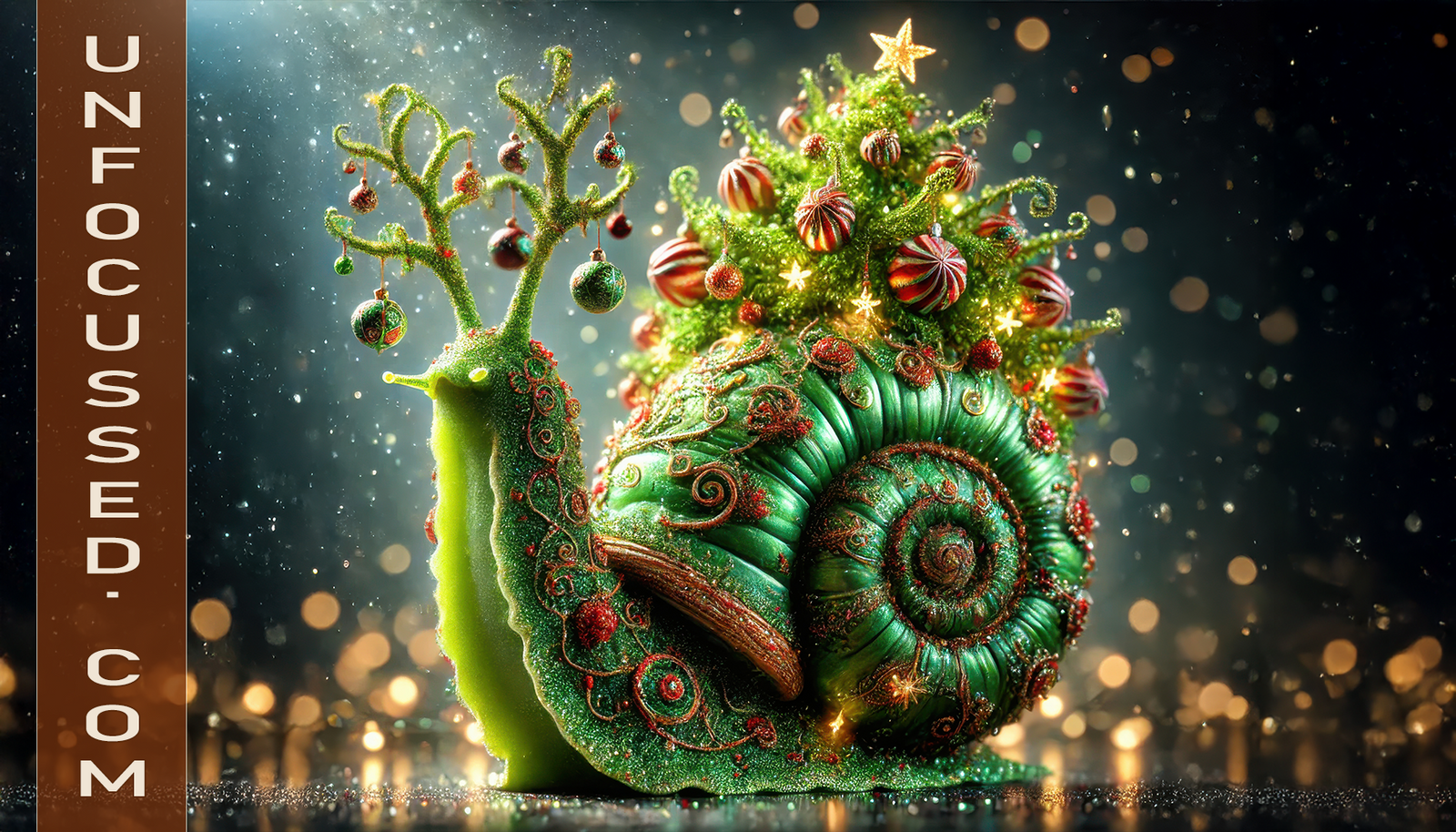
Twinkle-Shell the Festive Wanderer

The Glitter-Covered Menace of Mistletoe Marsh Deep inside the glimmering heart of Mistletoe Marsh—where the trees shed glitter instead of leaves and the ground is permanently sticky from a century of spilled eggnog—there lived a creature so cheerfully chaotic that even Santa had him on a “soft ban” list. His name was Twinkle-Shell, the Festive Wanderer, and his hobbies included: jingling loudly at inappropriate hours, hoarding peppermint just to say he had it, and single-handedly destabilizing the local ecosystem every time he tried to “spread holiday joy.” Twinkle-Shell, a snail by birth but an *aspiring* reindeer by attitude, strutted—or slithered, depending on how frozen the marsh happened to be—beneath a towering Christmas tree growing directly out of his shell. Not metaphorically. Not tattooed. Literally. A whole, sparkly, fully-functional tree, complete with ornaments that jingled, lights that flickered, and a star on top that glowed brighter whenever he felt dramatic… which was often. His antlers, grown out of pure festive stubbornness, sprouted ornaments like some kind of holiday fruit tree with boundary issues. Every time he moved, a cascade of jingles followed behind him, making stealth absolutely impossible. Neighborhood squirrels used him as a navigational beacon. A family of chipmunks synchronized their winter dances to the rhythm of his accidental jingling. And at least one very confused owl tried to mate with the ornament hanging from his left antler. (Twinkle-Shell never recovered emotionally.) He also had, for reasons beyond nature or decency, a reputation as a walking hazard. If you saw glitter drifting in the air, it wasn’t snowfall—it was him. If a candy cane mysteriously disappeared from your porch and reappeared lodged in a tree branch two miles away, it was him. If your snowman woke up wearing red lace garland like a feather boa, it was definitely him. Twinkle-Shell insisted these things just “sort of happened” around him, a statement that carried the same sincerity as a toddler claiming the dog opened the permanent marker. But despite the chaos—or perhaps because of it—everyone at Mistletoe Marsh adored him. He was the unofficial herald of the holiday season. The moment they heard his jingle-jangle-jing-JANGLE (followed by a thud, usually him slipping on his own ornament debris), they knew: the season had begun. This year, however… things were different. Twinkle-Shell had woken up with a feeling. A vibe. A destiny-level sensation that this holiday season, he was meant for something big. Something important. Something completely beyond his normal jurisdiction of moderately controlled chaos. And that, unfortunately for Mistletoe Marsh, meant he was about to try—really try—to be helpful. The last time he tried to be helpful, twelve ducks got perms and the mayor of the Marsh still refused to discuss “the tinsel incident.” But none of that deterred him. With the star on his shell glowing like it had just consumed espresso, Twinkle-Shell declared: “THIS YEAR… I SHALL SAVE CHRISTMAS!” No one had asked him to. No one had suggested Christmas was even remotely in danger. But history had proven one fact: when Twinkle-Shell decided something was destiny, destiny usually sent an apology note in advance. As he jingle-slid toward the edge of the Marsh to begin his “heroic quest,” local residents whispered, worried, hopeful, and bracing for impact. Because whatever was about to happen… it would be memorable. And probably sticky. Twinkle-Shell’s Incredibly Poor Life Choices Twinkle-Shell had barely made it twenty jingle-steps out of Mistletoe Marsh before destiny introduced itself in the form of a frantic puffin wearing a scarf knitted entirely of panic and broken dreams. The puffin crash-landed into the snow in front of him, skidding through slush like a feathery curling stone before popping up and blurting, “THE NORTH POLE IS A DISASTER!” Now, Twinkle-Shell was no stranger to the word “disaster.” He heard it often. Usually directed at him. But this time, it had a certain global tone—like the kind of disaster where holiday laws would be violated, elves would unionize, and Santa might start drinking the non-virgin eggnog before noon. “Explain yourself,” Twinkle-Shell declared, attempting to stand heroically tall, but remembering too late that snails do not stand. He settled instead for rearing up in slow motion, which looked less like bravery and more like he was trying to reach a cookie on a high shelf. The puffin took a dramatic breath. “Santa’s workshop… is covered in gingerbread sludge! The ovens malfunctioned, the cookie mixers revolted, and half the toys smell like cinnamon-based despair!” Twinkle-Shell gasped with the force of a creature who once ate an entire wreath and regretted nothing. “Is Santa okay?” “He’s… sticky,” the puffin whispered, as though sharing a national secret. “Very… very sticky.” That settled it. This was a job for a hero. A legend. A creature with the power to make things worse before making them better. This was a job for— “TWINKLE-SHELL THE FESTIVE WANDERER!” The puffin blinked. “I don’t know who that is.” “Still me,” Twinkle-Shell said, flexing an antler so that a tiny ornament fell off and rolled dramatically into a snowbank. And so, the two set off toward the North Pole, Twinkle-Shell jingling with heroic enthusiasm and the puffin waddling in a state of ongoing regret. Their journey was… complicated. First, Twinkle-Shell attempted to “speed up” by sliding down a frozen hill. This resulted in him spinning like a holiday Beyblade, screaming, “I WAS NOT BUILT FOR THIS!” as ornaments flew off his antlers like festive shrapnel. The puffin, trying to help, flapped frantically behind him, shouting instructions such as “STEER LEFT!” and “WHY ARE YOU SPARKLING MORE?!” Twinkle-Shell eventually crashed into a drift of powdered snow, emerging glitterier than before, which should have been impossible by the laws of physics but was absolutely on-brand for him. Then came the Snow Sprite Incident. Snow Sprites were known for their ephemeral beauty, frosted wings, and a temperament roughly equivalent to a caffeinated ferret. They were fragile, delicate, and notoriously manipulative when slightly bored. As Twinkle-Shell and the puffin cut through a clearing, a cluster of them descended like sparkly piranhas. “Ooooh! A walking tree!” one Sprite squealed. “A talking ornament bush!” another cried. “A sentient holiday fever dream!” said a third, deeply concerned but intrigued. Twinkle-Shell tried to introduce himself, but Sprites don’t wait for introductions. Or permission. Within seconds, they were hanging new ornaments on him, braiding his garlands, fluffing the branches of his shell-tree, and rearranging his decorations with the aggressive enthusiasm of interior decorators who haven’t eaten in days. “We added more sparkle to your sparkle,” one Sprite reported proudly. “You’re welcome,” another said, while applying shimmering frost to his left flank. Twinkle-Shell attempted polite gratitude, but the sheer weight of the extra ornaments nearly tipped him over. He had to dig his foot into the snow to keep upright. “I appreciate the… enthusiasm,” he managed, “but we’re on an urgent quest!” “A quest?” the Sprites gasped collectively like a dramatic choir. “For WHAT?” “To save Christmas!” There was a silence, followed by all twenty Sprites bursting into chaotic applause while yelling conflicting advice: “Kidnap the gingerbread!” “Punch a snowman!” “Blame the elves! They can take it!” “Bring Santa soup!” “Don’t bring Santa soup! He hates soup!” By the time the Sprites finished “decorating” him, Twinkle-Shell now jingled when he blinked. Literally. The puffin stared at him with the hollow expression of someone reconsidering every life decision. “Let’s just… go,” the puffin muttered. At last, after waddling, sliding, jingling, and arguing their way across the tundra, the North Pole appeared on the horizon—shimmering with lights, smoke, and the faint smell of gingerbread on fire. Twinkle-Shell whispered reverently, “We made it…” “I’m going to regret this,” the puffin whispered back. They approached the candy-cane gates, only to find them half-melted, coated in sticky sugar, and buzzing with tiny, exhausted elves trying to chisel themselves free from cookie cement. One elf, covered in dried frosting and rethinking all career choices, pointed at Twinkle-Shell and groaned, “Oh no. Not again.” Twinkle-Shell’s eyes widened. “We’ve never met!” The elf shook his head. “Doesn’t matter. I can FEEL the chaos.” That was when another elf staggered out of the workshop, hair smoking slightly, and shouted: “THE GINGERBREAD HAS GONE SENTIENT! AND IT HAS DEMANDS!” Twinkle-Shell inhaled sharply. “This… this is my moment.” And as the peppermint-scented smoke billowed out of the workshop behind him, Twinkle-Shell jingle-glowed with heroic determination. This would be the day he proved himself. This would be the moment he saved Christmas. Or—more statistically likely—this would be the moment everything went gloriously, catastrophically wrong. The Great Gingerbread Uprising (And the Snail Who Probably Should’ve Stayed Home) The moment Twinkle-Shell slid into the workshop, he was hit with a wave of heat, spice, and the unmistakable smell of burnt sugar trauma. The walls were coated in gingerbread goo. Half-constructed toys were glued to the ceiling. A Nutcracker soldier was stuck to the floor, repeatedly muttering, “I did NOT sign up for this.” Somewhere in the distance, an oven door rattled like something inside was trying to negotiate its release. Elves scurried everywhere, armed with frosting spatulas, licorice whips, and the kind of exhausted expressions found on retail workers on December 24th at exactly 11:59 p.m. And right there, at the center of the chaos, stood the enemy. A giant, twelve-foot-tall, semi-sentient gingerbread man. He had gumdrop eyes of pure malice. He had frosting facial hair that suggested he’d been through three divorces. And he wore a peppermint belt like he was in some kind of seasonal wrestling league. “I AM GINGERPAPA!” he bellowed, his voice echoing like thunder made of cookie crumbs. “AND CHRISTMAS SHALL BURN IN THE OVEN OF MY WRATH!” Twinkle-Shell gasped. Mostly because he got too excited and inhaled a sprinkle. The giant gingerbread titan turned his gumdrop glare on him. “You,” GingerPapa growled. “Tree snail. Decorative menace. Living mall display. You dare approach me?” Twinkle-Shell jingle-flexed proudly, which involved wiggling his antlers and immediately losing two ornaments. “I am here… to restore holiday harmony!” An elf whispered to another, “Oh great. He’s monologuing. This is going to end in frosting.” GingerPapa raised one icing-coated arm and roared, “ATTACK, MY GINGERMINIONS!” From behind him poured an army of smaller gingerbread creatures—some shaped like classic gingerbread men, others shaped like little stars, bells, candy canes, and one disturbingly buff gingerbread duck who looked like he worked out twice a day and drank raw eggnog. Twinkle-Shell took a heroic stance (again, mostly by accident). The puffin behind him screamed into his scarf. The elves shrieked. The oven doors rattled harder. It was chaos. Beautiful, stupid, holiday chaos.   The Battle Was… Not Great Twinkle-Shell attempted to charge heroically. Unfortunately, as a snail, his top speed was “confidently leisurely.” The gingerbread army reached him long before he made any meaningful forward progress. They swarmed up his shell, climbing the branches of his Christmas tree, poking his ornaments, licking his lights (disgusting), and slapping him with tiny sugary hands. “Ow! Ow! Hey! Personal space! That’s a limited edition bauble!” Twinkle-Shell cried, flailing his antlers wildly—knocking gingerbread men off like shuriken made of holiday shame. Meanwhile, GingerPapa bellowed laughter. “FOOLISH SNAIL! YOU CANNOT STOP THE RISE OF THE COOKIE KINGDOM!” The elves, realizing they had backup, began throwing handfuls of flour like improvised flash grenades. The puffin aggressively pecked a gingerbread star into crumbs. A squad of teddy-bear-shaped cookies began chanting, “DOWN WITH MILK! DOWN WITH MILK!” for reasons no one fully understood. Overwhelmed and sticky, Twinkle-Shell’s star began to glow—not with chaos, but with something he had never experienced before: Actual determination. And then something incredible happened. His shell-tree lit up. Every ornament flared. Every garland shimmered. Every holiday light sparked to life all at once— —and unleashed a blinding explosion of glitter. Not normal glitter. Not craft-store glitter. This was primordial holiday glitter. The kind that sticks to souls. The kind that ruins marriages. The kind that you still find on you 17 years later. The workshop was consumed by a shimmering shockwave that froze the gingerbread army in place—literally. The sugar in their dough flash-crystallized, turning them into sparkling statue versions of themselves. GingerPapa let out a final dramatic roar: “NOOOOOOO! I SHOULD HAVE ADDED MORE MOLASSES!” before freezing solid with a pose suspiciously similar to interpretive jazz hands. When the glitter cleared, the workshop was silent. Twinkle-Shell blinked. The glitter blinked back.   Aftermath, Regret, and Questionable Praise Santa finally emerged from the back, coated in hardened gingerbread goo like a festive swamp creature. He squinted at Twinkle-Shell through the sticky sugar on his beard. “…did you… save Christmas?” Twinkle-Shell stood tall (as tall as a snail can stand). “Yes. I did.” Santa stared at the frozen gingerbread titan. Then at the glitter coating every inch of his workshop. Then at the elves—half cheering, half trying to scrape cookie cement off the walls. Then at the puffin, who looked like he needed therapy immediately. Finally, Santa sighed. “Could you… maybe next time… warn me before doing whatever you just did?” Twinkle-Shell thought about it. Thought long and hard. Then said confidently: “No.” Santa closed his eyes in defeat, but the elves celebrated. They lifted Twinkle-Shell onto a sled, cheering his name, chanting as though he were a holiday demigod: “TWINKLE-SHELL! TWINKLE-SHELL! SAVIOR OF THE SEASON!” The puffin even flapped up onto his shell-tree and declared, “You absolute disaster… I am so proud of you.”   A Hero Returns Twinkle-Shell returned to Mistletoe Marsh that night, glowing with triumph, glittering from shell to foot, and dragging so much leftover cookie dust that he left behind a trail of gingerbread crumbs like Hansel and Gretel going through a holiday divorce. Everyone gathered around him. They cheered. They jingled their bells. A choir of squirrels performed a celebratory interpretive dance despite having no formal training. Twinkle-Shell announced proudly: “I HAVE SAVED CHRISTMAS!” And the Marsh erupted in applause. However… a small, nervous squirrel raised a paw. “So… uh… does this mean you’ll stop trying to ‘help’ now?” Twinkle-Shell laughed, his ornaments chiming like tiny alarm bells of doom. “No, my sweet winter children. No it does not.” And from that day forward, the holidays were never peaceful again.     Bring Twinkle-Shell Home If Twinkle-Shell’s heroic glitterbomb of holiday chaos made you smile, swoon, or briefly reconsider the stability of the gingerbread ecosystem, you can now bring this gloriously unhinged icon into your own home. Celebrate the season (and the snail who almost accidentally destroyed it) with beautifully crafted holiday collectibles featuring Twinkle-Shell the Festive Wanderer. For a classic touch, hang him proudly on your wall as a framed print — a perfect way to let guests know your décor aesthetic is “classy chaos with a side of peppermint madness.” Prefer something sleek and modern? Show off every shimmering detail with a metal print that captures the image’s glossy textures and festive glow. If you enjoy a challenge (or simply wish to relive the gingerbread uprising in slow motion), the jigsaw puzzle offers a wonderfully chaotic holiday pastime — ideal for family gatherings, cozy evenings, or proving you're mentally stronger than sentient cookies. And for spreading the joy directly, nothing beats the charm of a greeting card. Send it to friends, family, coworkers, or that one neighbor who still owes you a borrowed wreath. Twinkle-Shell will deliver seasonal cheer, questionable decisions, and glitter-based optimism wherever he goes. Let the legend of Twinkle-Shell live on — in your home, on your walls, and in the hearts of everyone who receives a card and thinks, “Why is that snail sexier than I expected?”

Read more

Inferno on the Branch

by Bill Tiepelman

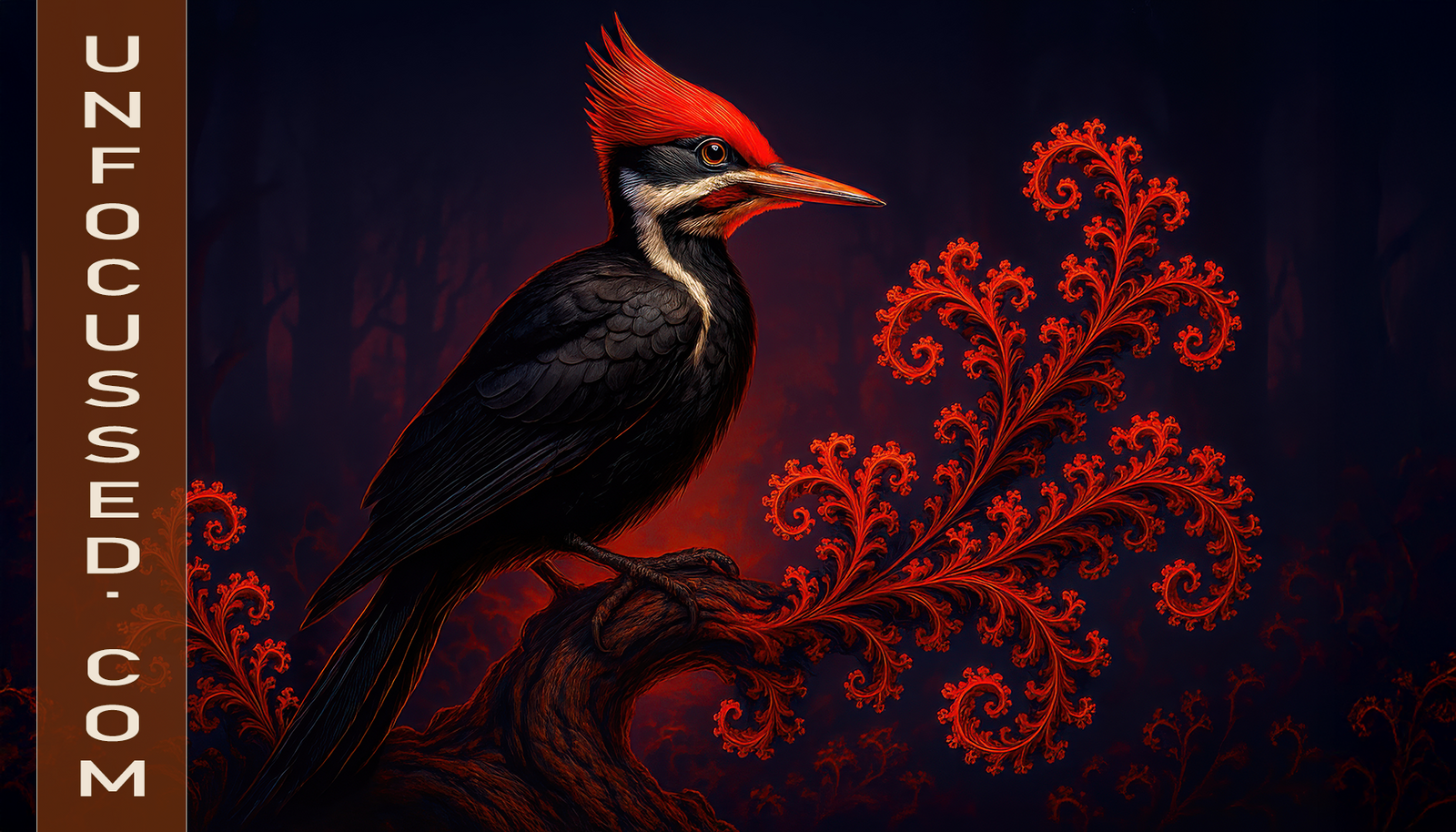
Inferno on the Branch

If you ask the birders down at the trailhead what a Pileated Woodpecker sounds like, they’ll give you three answers: a jungle monkey on espresso, a carpenter with a union card and no patience, and the exact ringtone that makes them fumble their binoculars into the mud. I heard all three the morning I met the crimson-crowned chaos engine who would later become the reluctant star of my portfolio and the patron saint of my caffeine addiction. The forest was still damp with night, the understory steamed like a tea kettle, and out of the silhouette of black trunks came a laugh—kik-kik-kik—that sliced the mist like a gossip column through a small town. I was there for a photo—what I call a “fractal field trip,” because apparently I can’t just photograph a bird on a branch like a normal adult. No, my brand requires a branch that curls into fiery spiral filigree as if Mother Nature took a workshop with M.C. Escher and then got spicy with a blowtorch. The maples had played along, sending out burls and lichens in arabesques, but this perch, this ember-painted corkscrew of a limb, looked forged by a blacksmith with an art degree and a grudge. I framed it, adjusted my ISO, and promised the forest I’d be tasteful this time. The forest, veteran of my promises, remained unconvinced. Enter our protagonist: a pileated the size of a skinny chicken and twice as judgmental. He arrived like a thrown comet, leveled the red crest like a Don’t-Speak-to-Me-Until-I’ve-Hammered sign, and rode the branch with the athletic balance of a tightrope walker who’d also taken a few semesters of carpentry. His beak—let’s call it what it is, a gothic chisel—ticked against the bark once, twice, then BAM, a strike so decisive the ants filed a workplace complaint. “Morning,” I whispered, as if the bird spoke English and preferred soft openings. “Just one pose. Hyper-realistic. Moody forest. Inferno on the Branch. You’re going to be merch.” The woodpecker did the slow swivel—one amber eye, then the other—like a maître d’ deciding whether my shoes were acceptable. Satisfied, or at least resigned, he flared his tail into a glossy black fan, braced with white like punctuation marks, and presented me with a profile that would make an owl jealous. In case you’re not a birder, this is the moment the life-listers whisper, “Oh my God, the Merlin app was right,” and try not to squeal. I do not squeal. I exhale very loudly and pretend I planned it. The branch beneath him—my corkscrew diva—began to glow with morning. From trunk to tip the textures rose in spiral rosettes, each curve catching ember-red light. I could feel the composition locking into place: bird’s gaze to the right, fractal plumes unfurling like fire made ferns, shadowed forest soft as velvet behind it all. This is the part where the art professors say “leading lines” and I nod like I discovered geometry personally. He drummed again—tat-tat-tat-TAT—and a flotilla of ants staged an emergency evacuation. It’s a myth that pileateds are chaotic; they’re engineers in feathers, running probabilistic models on every strike. He tested, listened for hollow space, then set to work on the exact patch where the bark had a tiny ripple, the kind only a bird with 50 million years of tool-making behind his eyes would notice. Chips flew. I smelled sap. Somewhere, a squirrel muttered the woodland equivalent of “not again.” “You know you’re trending,” I said, because the adult human brain needs conversation even when the audience is a bird. “Your species is basically the celebrity sighting of the eastern forest. People hear one drumroll and suddenly they’re wildlife photographers. We love your crimson crest. We love your moody lighting. We love that you’re a bulldozer with eyeliner.” The woodpecker paused, tilted his head, and regarded the curves of the branch as if auditioning them. Then he took three deliberate steps higher—click-click-click—and parked himself square in the golden eddy where the spiral foliage created a halo. If he had read my shot list, he could not have done better. I framed tighter, let the background fall charcoal-dark, and watched the reds saturate until they looked like embers in slow motion. My shutter whispered a thousand small yeses. In the trail behind me, a small procession of birders formed, the kind with hats that have sun shields and pockets for snacks and, presumably, life insurance policies for when a Great Horned Owl side-eyes their Chihuahua. They froze in that communal hush that means oh, we are in church now. Someone whispered, “Inferno on the Branch,” like they’d read the caption in my head, and I felt the delicious tingle of a shot earning its title while still being made. “What’s he after?” a new birder breathed. I wanted to say: redemption. I wanted to say: brand synergy. But the truth was simpler. “Carpenter ants,” I murmured. “Big ones. The filet mignon of protein. And maybe the prestige of looking like a living exclamation point.” The bird obliged by extracting one (ant, not exclamation point) and swallowing with the bland professionalism of a sommelier tasting from a paper cup. Then the forest did its favorite magic trick—time dilation. The light slid an inch, the branch went from blood-orange to garnet, and the woodpecker, as if aware of color theory, repositioned step by step until the rule of thirds lined up like we’d rehearsed. He held still long enough for the shutter to whisper a burst, then whip-cracked around to glare at a rival hammering deeper in the ravine. The laugh came again, the espresso-jungle-monkey kind, and a ripple of chills moved through the line like a stadium wave for very quiet people. I could have packed up right there. The image was in the camera and simmering in the back of my skull, already titled, already framed, already begging to become a fine art print with paper so thick it could stop a rumor. But the bird had not finished his set. He fluffed, shook out a snow globe of bark dust, and delivered one last drumroll that echoed off the black trunks and bounced back as applause. And because I am, despite evidence, a professional, I thanked him. Out loud. With feeling. The kind of gratitude you reserve for baristas and unblocked creative flow. “You were incandescent,” I said. “You were Inferno on the Branch.” The woodpecker blinked once, twice, and then, like a stage actor hearing a cue, lifted into the smoky light. He arrowed across the canyon of trees, a scarlet streak that dwindled to a comma in the sentence of the forest, and was gone. The birders exhaled. Someone dabbed at their eyes. Someone else asked me what settings I used, and I gave them the classic answer: “All of them.” We laughed the relieved laugh of people who got what they came for and then a little extra. I checked my screen again and—yes—there it was: the pileated woodpecker regal as myth, the fractal branch uncurling like flame, the dusky forest holding it all like a velvet box. The kind of frame that makes a wall say thank you. Of course, I didn’t yet know what waited deeper in those trees, or why the woodpecker chose that particular ember-lit perch, or what restless geometry was growing beneath the bark like a secret alphabet. That was a problem for Future Me, Photographic Adventurer and Occasional Bad Decision Enthusiast. Present Me just closed my eyes, listened to the dying echoes of the drum, and marked the GPS pin with a name: Inferno on the Branch. What I did next would have made a park ranger sigh and a poet nod approvingly. But that is Part Two, and this forest loves a cliffhanger almost as much as I do. The Ember Grove The thing about woodpeckers—and you can quote me at the next Audubon meeting—is that they don’t just happen. They appear like punctuation in the forest, interrupting your sentence with a full stop or an exclamation mark, and then dare you to rewrite the whole paragraph around them. That morning’s Inferno on the Branch moment could have been the perfect ending to my hike. I could’ve hiked back to the trailhead, smug and caffeinated, clutching my camera like a poker player walking away from the table while still ahead. But smug doesn’t feed curiosity, and caffeine makes you overconfident. I followed the direction of his flight. It wasn’t stalking. It was… professional interest. Birders call it “shadowing” if they want to make it sound respectable, and “woodpecker paparazzi” if they don’t. My boots crunched the frost-laced leaf litter, each step sounding absurdly loud in the cathedral silence. Somewhere ahead, I heard the faint drumming again—slower now, like he was working through a particularly stubborn patch of bark or a crossword puzzle with only vowels. The branch fractals behind me still glowed in my mind’s eye, but the pull forward was irresistible. What, after all, was worth leaving that stage for? The terrain changed subtly. The oaks gave way to older pines, their trunks straight as moral absolutes but scarred with decades of fire and lightning. The undergrowth thinned, replaced by a carpet of needles that muted my steps. And then I saw it: a clearing that shouldn’t exist, at least not in that geometry. The trees formed an almost perfect circle, and in the center grew a twisted giant of a maple, its limbs spiraling in patterns so complex they looked engineered by some cosmic watchmaker. The light in this space was stranger, warmer, as if the canopy filtered it through an old bottle of brandy. And there he was—my woodpecker—clinging to the trunk like it owed him money. His crest caught the filtered light and flared into a molten crown. He hammered with steady, deliberate strikes, each one sending a small snow of reddish bark to the ground. The tree seemed to respond—don’t ask me how—to his rhythm, the spiraling limbs flexing imperceptibly in time, like a dancer stretching before a performance. I crouched, zoomed, and framed. This wasn’t the Inferno branch; this was something else entirely. If the earlier perch was a piece of functional art, this tree was an altar. Every knot and burl glowed faintly, the reds and golds deepening with every beam of morning light. I’d photographed plenty of fractal structures before—ferns, frost, the accidental swirls in a jar of peanut butter—but this was different. The spirals weren’t random; they spoke. The patterns led the eye inward, toward a hollow in the trunk just above the woodpecker’s industrious beak. It was then I noticed the smell: resin, yes, but undercut by something warmer, almost sweet, like cinnamon and old paper. The woodpecker paused, cocked his head, and stared directly into that hollow as though listening for an answer. I swear I heard something—a faint clicking, like the sound of a typewriter buried under moss. He resumed hammering, and the clicking stopped. My skin prickled. Nature loves her mysteries, and I’d just walked into one wearing a camera like a backstage pass. Somewhere above, a shadow flickered through the canopy. Not another woodpecker—too big. I glanced up just in time to see a broad wing vanish into the sunlight. A hawk? Maybe. Or maybe the kind of forest resident you only see once and then spend the rest of your life trying to prove wasn’t a figment of an under-caffeinated morning. I checked the tree again. My woodpecker had moved higher, closer to the hollow, his claws gripping the bark in those perfect zygodactyl toes—two forward, two back—like he was designed in a laboratory for vertical defiance. I inched closer, the photographer in me bargaining with the part of my brain that knew better. The spiral patterns in the bark became hypnotic up close. Tiny ridges caught the light like illuminated manuscript borders, curling inward in deliberate arcs. My lens drank it all in. The closer I got, the more the patterns began to repeat—not just in the bark, but in the shapes of the leaves overhead, in the curve of the woodpecker’s tail feathers, in the ripple of the moss underfoot. It was the forest’s quiet admission: fractals weren’t an art trick. They were the blueprint. The woodpecker stopped hammering and looked down at me with the kind of expression only birds and high school guidance counselors can pull off: equal parts suspicion and pity. Then, without warning, he plunged his head into the hollow and came up with… something. Not an insect. Not sap. It was small, flat, and glinted like old brass. He held it delicately in his beak, turned toward me, and—this part I will argue with anyone over—nodded. Once. Then he flew past me in a flash of crimson and shadow, the object still clamped in his beak. I spun to follow him, tripped over a root, and did a graceless half-roll that put me on my back staring at the spiraled canopy. By the time I scrambled up, he was gone. The clearing was still, the only sound the faint creak of branches in a wind I couldn’t feel. The maple loomed overhead, spirals turning in my peripheral vision, daring me to come closer. I did. My fingers brushed the hollow’s rim. The wood was warm, unnaturally so, and under my touch the spirals seemed to deepen, the grooves tightening into a pattern that felt less like wood grain and more like… handwriting. I snapped a photo, then another, checking the playback obsessively. In each image, the spirals shifted slightly, as though the tree wasn’t posing so much as conversing. And in the very center of the hollow, framed by the curling grain, was a faint, perfect imprint: the outline of a feather. Not a woodpecker’s—too long, too narrow. I didn’t recognize it, and that bothered me more than I wanted to admit. When I finally tore myself away, I marked the GPS again, labeling it “Ember Grove.” The hike back felt longer, every tree suddenly suspect in its geometry. By the time the parking lot came into view, I’d convinced myself the whole thing was just a trick of light, a fever dream of reds and golds. But that night, when I uploaded the shots to my computer, the truth stared back at me in pixel-perfect detail: the spirals were real. The feather was real. And in the corner of one frame, half-hidden by a blur of motion, was the woodpecker—crest blazing, eyes locked on the lens—still carrying that mysterious glint in his beak. I didn’t sleep much. I kept thinking about the hollow, the smell, the clicking sound, the way the branch at Inferno and the maple in the grove shared the same curling geometry. And I kept asking myself one question: what in the forest needs a woodpecker as its locksmith? Whatever the answer was, I had the distinct, unsettling feeling it was waiting for me to come back. The Locksmith’s Secret I’ve done plenty of return trips to interesting photo spots before, but this one didn’t feel like my usual “let’s see if the heron’s still there” jaunt. This felt… loaded. Like the forest and I had an unfinished conversation, and the woodpecker—my so-called locksmith—was the only one holding the spare key. I spent three days trying to act like a normal human: editing other shots, answering emails, pretending I wasn’t Googling “pileated woodpecker mythology” at 2 a.m. Spoiler: turns out that in certain Native folklore, they’re messengers. In others, they’re builders for the gods. In my overcaffeinated brain, they were now both—and also possibly the forest’s maintenance crew. When I finally went back, it was pre-dawn. I wanted to arrive before the light turned the forest into an Instagram cliché. The air was sharp enough to sting my lungs, and the first chorus of birdsong was still warming up. My boots remembered the way without me thinking; my body was a compass set on “creeping around in questionable situations.” Every so often, I’d hear a distant hammering—three beats, pause, three beats—like the woodpecker was playing his own doorbell chime. By the time I reached the clearing, the light was dripping through the canopy like molten brass, just as before. The maple stood waiting, its spirals catching the first fire of the day. And there he was, crest flared, tail braced, pounding away at a new section of bark just below the hollow. The rhythm was steady, almost ceremonial. I raised my camera, half-expecting him to fly off like most self-respecting birds when a paparazzo shows up. Instead, he hopped sideways, giving me a perfect view of what he’d been working on: a ring of shallow holes forming a precise, geometric shape. A lock, I realized. Or at least the bird equivalent of one. Each hole was spaced with uncanny symmetry, like he’d measured it with calipers. My inner art nerd was thrilled; my inner rational human was starting to sweat. I stayed low, inching forward. He didn’t seem to mind. In fact, he began tapping the holes in a sequence—front, left, right, bottom—as if entering a code. A low thunk followed, not the brittle crack of bark but the dull, resonant shift of wood moving somewhere deeper inside. The spirals in the grain shivered. The hollow darkened, then deepened, as if the space itself was stretching. I couldn’t breathe. The woodpecker stepped aside, cocked his head toward me, and—again, I swear this happened—jerked his beak toward the hollow in a very clear your turn. Everything in me screamed do not stick your hand into strange forest holes. But curiosity is a drug, and I was already high on the scent of resin and whatever ancient secret this tree was cooking up. I set the camera to video, slung it over my shoulder, and reached in. The wood wasn’t just warm; it was pulsing faintly, like a heartbeat through old timber. My fingertips brushed something smooth and cool. I curled my hand around it and pulled it free. It was the same object I’d seen days before—flat, brass-like—but now I could see the detail. A medallion, no bigger than a drink coaster, etched with the same spiraling patterns as the bark, radiating outward from a single feather symbol in the center. The feather was inlaid with something dark, maybe obsidian, that seemed to swallow the light instead of reflecting it. Around the edge, in letters too fine to have been carved by human hands, was an inscription. Not English. Not any script I knew. The characters were fractal too—tiny curves within curves, so intricate I couldn’t follow their lines without getting lost. Behind me, the woodpecker drummed once—sharp, decisive. The ground beneath the maple shuddered just enough for me to feel it through my boots. I looked up, half-expecting the sky to split, but instead I saw movement in the spirals overhead. The branches were… shifting. Slowly, imperceptibly at first, then with deliberate grace. The limbs untwined and retwined into new patterns, closing off the clearing like the iris of an eye. Light poured in through specific gaps, illuminating the medallion in my palm. The inlaid feather shimmered, and for a brief, spine-tingling second, I heard that same clicking sound from before—but louder now, faster, like an invisible typewriter finishing a sentence. “Okay,” I whispered to the bird, because silence would have been worse. “You win. What is this? Why me?” The woodpecker only blinked, then launched himself onto the spiral limb directly above my head. He tilted his beak skyward and called—a loud, rolling kik-kik-kik that bounced between the trunks. Almost immediately, shapes moved at the edge of the clearing. Shadows, but… not entirely. Some tall and narrow, some low and branching, all slipping between shafts of golden light like they belonged to a slower clock than mine. I couldn’t make out faces, only the gleam of eyes reflecting the medallion’s light. They didn’t come closer. They just watched. I felt the weight of the moment the way you feel the weight of deep water. The medallion was warm now, almost hot. The spirals etched into it seemed to crawl under my fingertips, rearranging themselves like puzzle pieces. One shape resolved into something familiar: a map. Not a top-down map with rivers and mountains, but a map of connections—spirals linked to spirals, branches to branches. And at the center, the feather. The same feather etched in the tree, the same feather inlaid into the medallion. The same feather I now realized I’d seen in the subtle patterns of Inferno’s branch days ago. The shadows at the clearing’s edge stirred. The woodpecker called again, softer this time. The spirals in the maple’s bark began to slow, the branches returning to their original positions. The light shifted back to its ordinary golden filter, the clearing once again a simple circle of trees. Whatever had been watching melted back into the forest without a sound. The medallion cooled in my hand, the etched map freezing into place. The woodpecker dropped down to the maple’s trunk, sidled toward me, and with the precision of a jeweler inspecting a gemstone, tapped the medallion once with his beak. Then he launched upward, crest blazing like the last ember in a dying fire, and vanished into the canopy. The clearing was still again. Too still. I stood there a long time, listening for anything—a creak, a drumroll, a laugh. Nothing. Finally, I slipped the medallion into my jacket pocket and started the slow walk back to the trailhead. Every spiral in the bark along the way caught my eye. Every pattern in the moss looked a little too deliberate. By the time I reached my car, I’d stopped telling myself I was imagining things. I wasn’t. The forest was keeping secrets, and my woodpecker friend was one of its gatekeepers. That night, I laid the medallion on my desk under a lamp. The feather symbol seemed dull now, ordinary. But when I turned off the light, it faintly glowed—a deep, ember red, the color of a crest slicing through the morning mist. I don’t know if I’ll ever see him again. I don’t know what the map leads to, or why he chose to give it to me. But I do know one thing: the next time I hear that jungle-monkey espresso laugh in the forest, I’ll be ready. Camera in one hand, medallion in the other, waiting for my locksmith to open another door I never knew existed. And maybe—just maybe—that’s the whole point. The forest doesn’t hand you answers. It hands you keys, a little at a time, and trusts you to notice the locks. All you have to do is follow the sound of the hammering, and hope you’re clever enough to knock back.     Bring “Inferno on the Branch” Into Your World Let the fiery elegance of the pileated woodpecker and the hypnotic curves of the fractal branch ignite your space with our exclusive Inferno on the Branch merchandise. Whether you want a statement piece for your walls, a functional work of art for your daily life, or a tactile puzzle to immerse yourself in, this design brings the forest’s mystery right to you. Showcase the drama and vivid color on a Metal Print for modern, luminous impact, or opt for a timeless Framed Print that turns your wall into a gallery. For something you can carry into the wild—or the farmer’s market—the Tote Bag lets you bring the ember-lit forest wherever you go. And for quiet, mindful moments, piece together the magic one curve at a time with our Jigsaw Puzzle. No matter which form you choose, every piece captures the same rich colors, hyper-realistic details, and mystical energy that made the original image unforgettable. Invite the legend of the locksmith woodpecker into your home—you never know what doors it might open.

Read more

The Rooster’s Bloom

by Bill Tiepelman

The Rooster’s Bloom

The Blooming Begins Once upon a time (and probably three chardonnays deep), in the sleepy village of Cluckminster, lived a rooster unlike any other. His name was Bartholomew Featherfax the Third, but most just called him Bart. He wasn’t your average morning-screamer. No. Bart was a vibe, an icon, a strut incarnate. He crowed not at dawn, but when he was good and ready — preferably after a nice stretch, a moment of affirmations, and two sips of lukewarm espresso with goat milk foam. But what truly made Bart different — aside from his deep baritone voice and suspiciously tight thighs — was his plumage. Where other roosters sported rugged reds or moody blacks, Bart had… flora. Petals. Fronds. Tiny spiraling succulents growing where feathers should be. His tail alone looked like a small, highly curated Etsy boutique, and his neck shimmered like the inside of a dream wrapped in a kaleidoscope wrapped in a cheeky Pinterest board. Of course, this was not the norm in Cluckminster, where most poultry preferred their feathers basic, their beaks unmoisturized, and their ambitions low. Bart, however, bloomed loudly. And unapologetically. “Are those flowers growing out of your butt?” hissed Gertrude the Hen one morning as Bart passed the grain trough, hips swaying like a disco ball in slow motion. “Excuse me, Gertrude,” he clucked, tossing a begonia over his shoulder, “they’re fractal-integrated botanicals. And they are thriving, unlike your brittle dry comb.” The hens gasped. The ducks pretended not to listen, but everyone knew ducks were messy. Even the barn cat, who’d spent most of the week high on catnip behind the hay bales, peeked out and whispered, “Daaaaamn.” That very day, Bart strutted up to the barn roof (as one does), stood against the inky dawn sky, fluffed his botanical majesty, and let out a crow so powerfully fabulous that nearby sunflowers did a little shimmy. This was not just a wake-up call. It was a declaration. An arrival. A blooming of epic proportions. Unfortunately, it also alerted the Council of Poultry Aesthetics — an outdated, cranky bunch of feathered fossils who preferred conformity, beige feathers, and strictly one type of squawk per gender. And thus began the official filing of **Complaint #37B: Unauthorized Blooming While Male**. The Petal Trials of Bartholomew Featherfax the Third The Council of Poultry Aesthetics convened in their musty little coop-turned-office behind the barn. Their motto, carved in dust on a crooked plaque, read: "Neutral tones. Modest combs. No flair, no fun, no feathers undone." Each member was older than hay, balder than truth, and more wrinkled than a two-week-old raisin in a sauna. At the head of the table sat Lord Pecksley, a rooster so uptight his tail feathers had fused into a single, clenched curl. “This Bartholomew menace,” he wheezed, adjusting his monocle (yes, monocle), “must be... pruned.” “He’s flaunting,” clucked Madam Prunella, chief hen of etiquette. “With petals. In broad daylight. Children can see them. Succulents, even! Euphorbia vulgaris right on his neck!” “And that spiral bloom near his vent?” whispered the Vice Chair, scandalized. “Nature doesn’t spiral there.” “Well,” Pecksley snapped, slamming a talon down, “nature clearly needs a stern reminder of boundaries!” The council voted unanimously: Bart was to appear before the Barn Court in three days’ time to account for his botanical 'indecency'. Meanwhile, the barnyard was losing its mind. On one side, Bart’s fans. The Bloomers. They were a colorful coalition of hens with glittery combs, ducklings with attitude, a wildly dramatic peacock from three towns over, and at least one suspiciously muscular squirrel who just wanted to vibe. They marched with signs like “”, “Fractal is Functional,” and “Botany Is Not A Crime.” Someone even wrote a spoken-word piece about photosynthesis and liberation. It was weird. And beautiful. On the other side? The Cluckservatives. Stern hens in neutral shawls. Roosters who'd never moisturized. A pair of judgmental pigeons from accounting. They accused Bart of ‘distracting the flock,’ ‘unsettling the egg count,’ and ‘making the chicks ask too many damn questions.’ In the middle of it all? Bart. Fabulous. Furious. And frankly, exhausted. He’d never asked to be a symbol. He just wanted to bloom. Was that so much? Still, the pressure was mounting. The council began clipping the petals of other hens who dared to accessorize. Feathers were being inspected. Seeds confiscated. The goose who painted her beak was publicly peck-shamed. Dandelion crowns were outlawed. They even tried to dye Bart’s tail beige with expired oat milk. (He slapped it away with a calendula plume and muttered “Try again, you bland bastards.”) By the time the trial began, Bart arrived in full regalia. He’d spent the night cultivating a rare orchid at the tip of each tail plume. A crown of golden chrysanthemum spirals framed his head. His wattles sparkled with bioluminescent dew drops. His beak was polished. His claws were French-tipped. And his eye — oh, his eye — was a smoldering blaze of “I will burn your coop with my vibe.” “Bart Featherfax,” boomed Lord Pecksley, standing beneath a flickering barn bulb that made him look like an undercooked chicken nugget, “you stand accused of aesthetic anarchy, defiance of rooster norms, and inciting unauthorized botanical awakening. How do you plead?” Bart stepped forward. Slowly. Every movement caused a ripple of floral shimmer to cascade across his body like spring gossip on a breeze. He cleared his throat. Held the entire barn’s breath in his claws. Then, with a voice smooth as silken molasses draped over a jazz solo, he replied: “I plead flourished.” Gasps. Screeches. A hen fainted. Someone dropped a corn cob. “You say I incite awakening?” he continued, strutting a slow spiral around the haybale podium. “Good. Because we’ve been asleep far too long. For generations, you told us our feathers were only worth something if they matched someone else’s mold. That we had to peck in place. That color was chaos. That bloom was bad. But I am not your beige fantasy.” He spun, flared his wings. Petals shimmered. Fractals unfurled. The damn flowers sang. (No one knows how. It just happened.) “I’m not here to conform. I’m here to photosynthesize and stir sh*t up.” The Bloomers exploded in applause. The peacock sobbed. The squirrel threw glitter. Even a few Cluckservatives began loosening their comb wraps. Lord Pecksley’s monocle popped off. “Order! ORDER I SAY!” he clucked, shaking his beak violently. “This isn’t over, Featherfax! This is a war on standardization!” Bart winked. “Then call me your flamboyant revolution.” And as the barn doors creaked open behind him, letting in the morning light — Bart strutted out, feathers in full bloom, tail spirals catching the sun like fire-wheels of rebellion. The hens followed. The ducks quacked in rhythm. The squirrel raised a tiny flowered fist. But just beyond the barnyard fence... something else stirred. Something bigger. Something ancient. Something with feathers... and vines. The Bloom Beyond the Fence The fence behind the barn had always been a mystery — a line never crossed, a story never told. Chickens said it led to the Overgrowth. The elders whispered it was where the Wild Roosters roamed. Roosters who refused to be plucked, preened, or pigeonholed. Roosters whose feathers had evolved into forests. Roosters who didn’t crow… but howled. And now, as Bart stood blinking into the early dawn light, fresh from revolution and still radiating orchid-based defiance, he saw them. First, the trees parted. Not like they’d been pushed, but like they’d politely stepped aside. Then out came a shape — tall, plumed, and radiant. A rooster, yes, but... more. Part phoenix, part rainforest. His tail coiled like galaxies. His beak glinted like obsidian wrapped in mango nectar. His chest bore markings older than shade. His eyes held starlight and dirt. He smelled like rebellion steeped in rosemary. He approached Bart and spoke in a voice that didn’t echo — it rooted. “You bloomed loud, little brother.” “I didn’t know I had a family out there,” Bart whispered, petals trembling. “You bloomed. That’s enough.” Behind the Forest Rooster came others — a parade of legendary bloomers. A hen whose feathers were literal roses. A duck with floating lily pads for wings. A turkey with bioluminescent mushroom gills. A quail that glowed with internal fire. A peacock that bent light itself. Bart blinked. “Is this heaven?” “It’s better,” the Forest Rooster grinned. “It’s real. And it’s ours. Come walk with us.” But Bart looked back. Behind him, the barnyard was in chaos and color. The Bloomers were holding their ground. The Cluckservatives had begun to fray at the combs. A small group of chicks were painting each other’s beaks with elderberry juice and shouting things like “Pollinate your power!” and “Be your own bouquet!” He turned back. “I can’t leave them.” The Forest Rooster nodded. “Then we’ll come with you.” And that’s how the Bloom War began. Oh, don’t worry, it wasn’t violent. It was worse. It was artistic. They began with the barn. They painted it in gradients so bold even the sheep looked up. They threw a full moon rave in the coop. They taught the chicks geometry via sunflowers. They brought jazz. Poetry. Mushroom farming. Avian glitter drag shows. One night, a nightingale beatboxed the entire first act of *Hamlet*. It was confusing and transcendent. The Cluckservatives fought back the only way they knew how: bureaucracy. They issued cease-and-decrow orders. They tried to form a Ministry of Modesty. They attempted to regulate petal diameter. Someone even invented a Bloom Tax. But the movement couldn’t be stopped. Not when the very soil had begun to shift. The coop’s walls started growing vines. The old troughs overflowed with marigolds. The roosts sprouted lavender stems that hummed lullabies at night. Nature had chosen a side. And at the center of it all was Bart — no longer just a rooster, but a revolution in feathers. He stood daily in the sun, petals wide, comb glowing with dew, and told stories to the chicks about the time he turned shame into shade, judgment into jasmine, and hate into horticulture. He never wore the same feathers twice. He always smiled when the council glared. He kissed his reflection good morning. He was everything they'd told him not to be — and then some. Years later, long after Lord Pecksley was seen retiring bitterly into a worm commune and the barn had become a museum-slash-nightclub-slash-botanical sanctuary, an elder chick asked Bart: “Why flowers?” He smiled, rustling with heliotrope and sass. “Because feathers fly,” he said. “But blooms? Blooms stay. They root. They multiply. They shake the ground and perfume the air. And you can’t pluck a bloom without spreading seeds.” The chick blinked. “So... you’re saying we’re all just walking flower bombs?” Bart winked. “Exactly. Now go explode somewhere fabulous.” And so they did.     🌺 Take a Piece of the Bloom Home If Bart strutted into your heart like he did into history, now you can let his blooming brilliance brighten your everyday life. Bring The Rooster’s Bloom into your space with our Framed Print — a stunning, gallery-ready tribute to floral rebellion and fearless expression. Carry his sass wherever you go with the eco-chic Tote Bag, perfect for farmers markets, libraries, or storming the gates of boring fashion. Send blooming wisdom to your favorite humans with a vibrant Greeting Card, ideal for birthdays, affirmations, or unapologetic declarations of fabulousness. And for a sleek modern touch? The Metal Print brings Bart’s fractal feathers to life in full radiant glory — durable, bold, and entirely unbothered by bland walls. Whether you're here for the laughter, the layers, or the lush, rebellious artistry — let Bart remind you: it’s always the season to bloom exactly as you are.

Read more

Grinfinity Purradox

by Bill Tiepelman

Grinfinity Purradox

The Cat, the Cult, and the Missing Underpants In the acid-laced dreamscape of Kaleidowood, nestled between the Caffeine Mountains and the River of Poor Decisions, lived a feline who wasn’t quite... sane. Or real. Or housebroken. Locals called it Grinfinity — a name spoken only after three espresso shots and a silent prayer to the God of Hangovers. Grinfinity wasn’t born. He coalesced. Formed from the collective subconscious of every drunk art major who ever said “I could totally design an NFT of a cat that eats the multiverse.” He was 70% fractal mischief, 20% day-glow fluff, and 10% weaponized smile. And that smile? It had molars. Not like “oh how cute, kitty has teeth,” but “oh god it bit the mayor and he still can't eat pudding right.” By day, he posed as a mystical guru in the backyard of a defunct yoga studio, purring cryptic nonsense to wide-eyed influencers and failed DJs. By night, he attended underground raves where he sold micro-doses of existential dread packed in jellybean form. His third favorite hobby was rearranging people’s sock drawers into mandalas and then watching their slow mental decline. But on the fateful Thursday that kicked off the Purradox, Grinfinity had other plans: he wanted the Moon's underpants. "What?" you ask. "The Moon wears underpants?" Of course it does. Why do you think it hides behind clouds during full moons? Modesty. Lunar modesty. But the Moon’s underpants weren’t just any cosmic skivvies — no, these were handwoven from the silky regret of 1990s boybands and reinforced with the sighs of every raccoon who ever found an empty trash bin. They were the comfiest, most powerful underpants in the known reality cluster. Legend said that whoever wore them gained the ability to lick their own ego clean, summon a never-ending brunch, and annoy telemarketers with mind bullets. Grinfinity didn’t care about that. He just wanted to steal them and leave them hanging on a church steeple in Wisconsin. For the vibes. Thus began a journey through wormholes, drive-thrus, and a surprisingly aggressive nudist colony called “Freeballonia.” But first, he needed a crew. And like any true antihero, he started with the worst idea possible: Craigslist. The first to answer was Darla Doomleg, a retired roller derby champ turned erotic taxidermist. She had a bat tattooed on each butt cheek and a pet stoat named Greg. Then came Phil “No Pants” McGravy, a man banned from seventeen diners and one time accidentally married an inflatable couch. And rounding out the chaos was Kevin, a sentient pile of glitter with a vape addiction and daddy issues. “We're going to steal lunar underwear,” Grinfinity announced, tail coiling like a Salvador Dalí signature. “And if we’re lucky, fart in them before the universe resets.” No one blinked. Kevin did release a small puff of lavender mist, but that was just how he showed excitement. They climbed into Darla’s hover-Winnebago, gassed up on fermented Snapple and sheer spite, and rocketed toward their fate. Grinfinity sat at the helm, purring like a tattoo gun stuck on “regret,” eyes glowing like traffic lights at a rave. The first destination? The Great Cosmic Sock Drawer — a sub-dimensional vault rumored to contain every lost sock, sense of dignity, and good decision ever made while drunk. It was also, according to Reddit, the portal to the Moon's laundry chute. They had no idea what horrors awaited. But Grinfinity didn’t care. He had his claws sharpened, his grin dialed to “menace,” and his butt parked squarely in destiny’s cupholder. The Great Sock Drawer and the Trouble with Sentient Panties Inside the yawning, sock-scented maw of the Great Cosmic Sock Drawer, time hiccuped. Reality folded like origami made by a drunk uncle at a family BBQ, and gravity was having a petty argument with inertia. Grinfinity and his crew stumbled out of the hover-Winnebago, blinking at the fuzzy chaos sprawling before them. The landscape was pure chaos. Left socks lounged in velvet hammocks, drinking hot cocoa and sighing about their missing partners. Right socks marched in military formations, demanding justice, a Netflix series, and warm feet. Thongs floated overhead like smug butterflies, occasionally dive-bombing crew members with snarky insults. A massive athletic sock the size of a cathedral sobbed gently into a vat of Axe body spray. “I feel like I licked a lava lamp,” muttered Phil No Pants, who was currently wearing a kilt made of caution tape and chewing on a glowstick for courage. “What is this place?” “The psychic fallout zone of every laundry day gone wrong,” Darla Doomleg whispered, clutching Greg the stoat, who had gone full feral and was now gnawing at the space-time continuum like it owed him money. “We need to find the Laundry Chute of Ascension.” Kevin the Glitter Pile was vibrating, leaving behind little trails of sparkly nonsense and purring to himself in Morse code. “This place smells like wet shame and cinnamon gum,” he murmured. “I feel alive.” Grinfinity prowled ahead, his paws leaving imprints of color that shifted when no one was looking. Every step was an insult to geometry. His grin widened with each twitching sock and floating brassiere they passed. He was in his element — chaos, laundry, and low-stakes cosmic thievery. All his nine lives had been leading to this moment. Suddenly, a booming voice erupted from the horizon like a burp from a god who’d eaten too much cheese. “WHO SEEKS THE PANTIES OF THE MOON?” Everyone froze. Even Greg. Even Darla’s left butt cheek clenched in alarm. Out of a storm cloud made entirely of mismatched dryer lint emerged a being of impossible fluff and profound sass: the Panty Warden of the 7th Cycle. It had the body of a sentient laundry basket, legs made of coat hangers, and eyes that screamed "I once had hopes, but then I taught middle school." “State your purpose or be ye sorted by the eternal spin cycle!” it roared. Phil stepped forward, holding a novelty-sized pair of edible underpants as a peace offering. “We’re here to borrow the Moon’s undies and maybe cause some low-level metaphysical vandalism. No biggie.” The Panty Warden blinked slowly. “Do you even understand the power you seek? Those briefs control tides, menstrual cycles, and cheese production in Wisconsin. They're woven from lunar wool and blessed by the Pope's weird cousin.” “That’s exactly why we need them,” Grinfinity replied, his eyes glowing like radioactive olives. “Also, I made a bet with a comet that I could graffiti Saturn’s rings while wearing them.” The Warden sighed, releasing a cloud of fabric softener that smelled like unresolved childhood trauma. “Very well. But first, you must pass... the Trials of the Tumble.” And just like that, the ground fell away. The crew screamed, some out of fear, others out of habit. They plummeted through a vortex of laundry-themed horrors: a tunnel of moist towels, a field of biting sock puppets quoting Nietzsche, and a karaoke pit where rogue lingerie sang ABBA songs at weaponized volume. Trial One: The Washer of Regret. The team was trapped inside a swirling cylinder of bad exes, awkward conversations, and that one time you texted “you too” when the barista said “enjoy your drink.” Grinfinity just floated through, humming “Toxic” by Britney Spears and occasionally hissing at ghosts. Darla punched her way out with brass-knuckled sass. Kevin just melted into a puddle of self-love and re-emerged fabulous and more glittery than ever. Trial Two: The Bleach Zone. Everything turned white. The crew was assaulted by unsolicited opinions, yoga moms in Uggs, and the endless loop of someone explaining NFTs. Phil nearly broke until he remembered he’d once peed in an influencer’s smoothie. That gave him strength. Trial Three: Ironing Board of Destiny. A smooth-talking ironing board challenged them to a game of philosophical beer pong. The questions were abstract (“Can socks dream of matching feet?”), the answers more so. Grinfinity aced it with riddles that sounded like pickup lines from a sentient thesaurus. He seduced the board into submission. Finally, they emerged in the heart of the Drawer — the Spin Temple, a massive coliseum of cotton and ego. Suspended in the center, guarded by a choir of floating sentient boxer briefs, hovered the prize: the Lunar Underpants. They were magnificent. High-waisted. Laced with constellations. The tag simply read “Handwash Only: Violates 17 Natural Laws if Machine Dried.” “I’m gonna sniff them,” Kevin whispered reverently. “You’re not gonna sniff them,” Darla snapped. “I might sniff them,” Grinfinity admitted, already climbing the scaffolding with the grace of a deranged ballet dancer. As he reached for the waistband, a ripple shot through space — a psychic fart of destiny. The Moon felt it. Back on the lunar surface, the Moon blinked. It had been binge-watching telenovelas and eating emotional ice cream, unaware its favorite underpants were under siege. It rose slowly. The air crackled. Somewhere, a celestial gong sounded. The Moon. Was. Coming. Underwearageddon, Glitter Redemption, and the Grinning End of All Things The Moon was pissed. Like, full-on “I came home to find my favorite snack gone and someone used my toothbrush as a butt-scrubber” kind of pissed. It tore across the cosmos like a cosmic Karen in a minivan made of passive-aggressive Yelp reviews, headed directly for the Great Cosmic Sock Drawer. As it moved, it plucked meteors from space like curlers and rolled them into its hair. Lightning cracked across its craters. It snarled in Spanish. Meanwhile, deep within the Spin Temple, Grinfinity clutched the legendary Lunar Underpants like a man possessed — or more accurately, like a cat who had just found the warmest, most forbidden nap spot in the multiverse. “They’re... so soft,” he purred, eyes rolling back as celestial cotton caressed his furry cheeks. “This must be what angels wear when they go clubbing.” Darla Doomleg stood guard, wielding a feather boa turned plasma whip. “We’ve got maybe thirty seconds until the Moon shows up and rage-bounces us into another dimension.” Kevin, now three times larger and pulsing with high-voltage glam energy, was covered in psychic sequins and vibrating with existential anxiety. “I don’t think I’m ready to fight a planetary body, guys. I barely survived brunch with my ex last week.” Phil No Pants was applying glow-in-the-dark war paint using a bottle of expired ranch dressing. “You guys worry too much. What’s the Moon gonna do, moon us?” Then the ceiling exploded in a tidal wave of lunar fury. The Moon descended like a glittery judgment god, wreathed in flames and expletives. “WHO. TOUCHED. MY. UNDIES.” “It was consensual!” Grinfinity shouted, hiding the underpants in a pocket dimension shaped like a suspiciously moist gym sock. “Also, we’re technically insured.” The Moon blinked, then launched a crater-sized moonbeam directly at them. Chaos erupted. Battle of the Briefs had begun. Sock armies rose from beneath the temple, unified by their mutual hatred of foot sweat and abandonment. They charged the Moon’s shoelace golems, who whipped through the air with deadly accuracy. Lingerie drones buzzed above, firing taser-thongs at anything that moved. One particularly aggressive sports bra suplexed a cardigan into next week. Phil No Pants rode into the fray on a flaming flip-flop, swinging twin pool noodles like nunchucks and screaming, “I AM THE TIDE POD WARRIOR!” Darla leapt into the air, roundhouse-kicking a pair of sentient long johns into a spinning dryer vortex, then delivered a passionate monologue about consent and the importance of label-reading during laundry. The socks paused, inspired. One wept quietly. Kevin, meanwhile, had achieved a glitter-based transcendence. He floated above the battlefield, shimmering like a rave god, whispering affirmations and raining down healing sparkles. Enemies froze mid-punch to marvel at his radiant thighs. A bra snapped itself back on in respect. But the Moon would not be swayed. It summoned a tidal wave of moonlight, collapsing the fabric of the drawer. Grinfinity had one shot — one chance to save them all and pants the Moon at the same time. He reached into the quantum sock-pocket, pulled out the Lunar Underpants, and slipped them on with the slow-motion power of a shampoo commercial meets an exorcism. Light flared. Somewhere, a llama learned to play bass guitar. Reality hiccuped. “You cannot wear those,” the Moon roared. “They are mine!” “Correction,” Grinfinity said, stepping forward with a pelvic thrust that echoed through the void. “They were yours. Now they’re riding this fuzzy thunder-thicc tail and fueling chaos like grandma’s chili on cheat day.” He activated the Underpant Protocol: an ancient power encoded in the waistband. Threads of truth and bad decisions spiraled outward, rewriting physics with every purr. The Moon staggered, blinking in slow-motion as its own gravitational ego was pulled into a swirling vortex of shame and self-reflection. “Is this what I’ve become?” the Moon whispered. “A petty ball of overreactive glow?” Kevin floated up beside it. “We all lose our shine sometimes. What matters is whether you sparkle again… on your own terms.” The Moon sobbed. One giant, shimmering tear fell from the sky and splashed onto Earth, instantly birthing a pop-up spa in Cleveland. No one questioned it. It had a four-star rating by noon. In that moment, Grinfinity forgave the Moon. Or maybe just got distracted by a floating meatball. Either way, peace was restored. The Spin Temple faded into a soft fog of dryer sheets and awkward goodbyes. The sock armies disbanded. The sentient panties returned to their cloud nests. The Moon returned home, slightly wiser, moderately humbler, and down one pair of godly underwear. Back on Earth, Grinfinity opened a fusion brunch parlor called Purradox & Eggs. Darla launched a wildly successful line of tactical corsets. Phil became the host of a reality show called “Naked and Mildly Confused.” Kevin published a memoir titled “Glitter and Guts: My Journey Through Sockspace.” And the underpants? Still worn by Grinfinity, usually on Wednesdays, always backwards, occasionally while skateboarding down gravity wells just to flip off the laws of thermodynamics. He never stopped grinning.     Still grinning? Good — because now you can bring a piece of the madness home. Whether you want to display Grinfinity’s legendary smirk above your fireplace, send dangerously whimsical greetings to frenemies, or spend a questionable weekend assembling his fur one psychedelic piece at a time, we've got you covered. Own the purradox in glorious form: Framed Print: Class up your chaos — Grinfinity belongs in a frame, not in your sock drawer. Canvas Print: Vibrant, bold, and as misbehaved as your last birthday party. Tapestry: Cover your wall in color-drenched cat chaos (or your ex’s taste in décor). Jigsaw Puzzle: Lose your sanity piece by piece — just like Grinfinity intended. Greeting Card: Because nothing says “I’m thinking of you” like a cosmic cat who may have destroyed space-time for fun. Get weird. Get wonderful. Get Grinfinity.

Read more

Whiskers at the Witching Window

by Bill Tiepelman

Whiskers at the Witching Window

The Familiar's Complaint “If one more squirrel insults me from the holly bush, I swear to Bast I’ll torch the tree.” The orange tabby was muttering again. His name—though few dared use it aloud—was Bartholomew R.J. Whiskerstein, Esquire. He was the third Familiar to serve at No. 13 Embercurl Lane, a mystical townhouse wedged between dimensions, where the mail arrived only when Mercury was in retrograde and the curtains had a mind of their own. Bartholomew’s ears twitched as he sat perched on the ledge of the violet-paned window. Beneath him bloomed a plush carpet of enchanted lavender that hissed faintly if plucked without permission. Behind him, thick velvet curtains danced without breeze—tracing glowing sigils in the air like lazy lightning bugs scribbling curses in cursive. Inside the townhouse, chaos hummed in that pleasant, distant way only mild sorcery can. There was the sound of a teapot making demands. A stack of grimoire pages trying to unionize. And, somewhere in the study, the soft weeping of a sentient lamp contemplating its existence. Bartholomew ignored all of this. Because Bartholomew had a job. A highly specific job. A job that came with perks (a bottomless dish of roasted chicken hearts) and perils (being regularly used as a scrying lens by a witch who still hadn’t mastered “consent”). He was the Official Perimeter Watcher, Guardian of Thresholds, and—unofficially—the only housemate with the balls to tell Madam Zephira that her black lace corsets were clashing with her aura again. Tonight, however, the swirls in the stucco glowed brighter than usual. Their fractal curls pulsed like molten gold veins across the obsidian walls, marking the hour as not quite midnight and definitely up to something. And Bartholomew, with his one crooked whisker and eyes the color of guilty marmalade, knew the signs. Someone was coming. And not the kind who wore boots or knocked politely or brought salmon. Someone uninvited. With a tail twitch of annoyance and a small sneeze into the lavender blooms (they smelled amazing but were absolute bastards to his sinuses), Bartholomew straightened his spine, narrowed his gaze, and did what any respectable magical creature would do in his position. He farted dramatically, just to establish dominance. The wall beside him hissed in response. “Oh please,” he purred into the growing glow. “If you’re here to devour souls, at least bring a snack.” Zephira, Doomscrolling, and the Visitor from the Slant Madam Zephira Marrowvale was elbow-deep in her spellbook, though not for anything productive. She was doomscrolling. To be fair, the grimoire had recently updated its interface, and now it mimicked the layout of a social media feed—an unfortunate side effect of Zephira’s habit of whispering her thoughts to her mirror while the Wi-Fi was unstable. As such, instead of recipes for lunar elixirs or hexes for passive-aggressive neighbors, the leather-bound tome now served up endless gossip from disembodied witches across the astral plane. “Ugh,” Zephira groaned. “Another thirst trap from Hagatha Moonbroom. That’s the third this week. No one needs to see that much thigh from a lich.” Bartholomew, having returned from his window post only to find his warning hisses entirely ignored, slunk into the main room, tail held at a judgmental tilt. “You do realize,” he said with that slow, deliberate tone cats use when they know you’re not paying attention, “that there’s a potential rift forming in the wall?” Zephira didn’t look up. “Is it the laundry wall or the library wall?” “The front wall.” “Oh.” She blinked. “That’s... more important, isn’t it?” “Only if you enjoy the concept of interior dimensions staying on the inside,” Bartholomew replied, now licking one paw in a manner that suggested this was all terribly beneath him. With a sigh and a dramatic flourish, Zephira stood up, her long coat rustling like parchment paper dipped in attitude. The air around her shimmered with leftover magic: sparkles, ash, and the faint smell of peppermint schnapps. She stomped toward the window where Bartholomew had resumed his watch, this time sitting like a disappointed statue made entirely of orange velvet. Outside, the night was beginning to change. Not just darken—but change. The swirling glow around the window had thickened, threads of molten amber knotting and curving like someone had spilled calligraphy ink into firelight and pressed it to the walls of reality. Then—something knocked. Or maybe it burped. Or maybe the universe coughed up a hairball. Either way, the sound was wrong. “That’s not good,” Zephira whispered, suddenly sober. “That’s... from the Slant.” Bartholomew’s ears flattened. The Slant was a bad neighborhood between planes. It was where lost socks went. Where contracts rewrote themselves. Where things that weren’t supposed to feel shame hung out just to enjoy the sensation. No one invited guests from the Slant. Mostly because if you could invite them, it meant you were already partly one of them. The knock-burp-hiccup came again. “Do you think it’s after you or me?” Zephira asked, half-hoping it would be Bartholomew. He was, after all, technically immortal and less emotionally fragile. “Neither,” he said, fur bristling. “It’s here for the window.” “Why the hell would anyone come for a window?” “Because,” Bartholomew said, leaping down into a stretch that made every vertebrae in his body crackle like a haunted fireplace, “this particular window is a passage. A junction between realms. A former portal to the Celestial DMV. You really should keep better notes.” Zephira’s mouth fell open. “I thought this window had weird feng shui.” Before either of them could speak again, the glass began to bend inward—not break, not shatter—bend, like it was made of smoke or jelly or poorly explained plot devices. The lavender beneath the sill rustled and puffed in protest, releasing sparkles and spores that smelled strongly of sassafras and minor regret. From the swirling gold, a face emerged. Not a full face. Just... parts. An eye here, a suggestion of a grin there. And—strangest of all—a monocle made of static electricity. It was a face both beautiful and terrible, like a Greek god who also did your taxes and wasn’t happy about your deductions. “HOUSE OCCUPANTS,” the entity intoned, its voice vibrating the curtains into curls. Bartholomew leapt back onto the sill and squared his shoulders. “What in the unholy name of wet kibble do you want?” The face pulsed, amused. “I AM THE INSPECTOR OF INTERPLANE THRESHOLDS. THIS UNIT—” “This house, darling,” Zephira corrected, arms crossed. “—THIS UNIT IS IN VIOLATION OF CODE 776-B: UNSANCTIONED ENCHANTMENT OF ARCHITECTURAL OPENINGS.” Zephira raised an eyebrow. “So you’re telling me I have a... magical zoning issue?” Bartholomew hissed. “He’s here to repo the window.” The entity blinked. “YES.” For a moment, no one spoke. Then Zephira reached down, plucked Bartholomew off the sill, and cradled him like a particularly judgmental baguette. “Listen here, Spectral Bureaucrat,” she said, raising her chin, “this window is original to the house. Hand-framed by a sentient carpenter who charged us in riddles. It’s mine. Mine!” The inspector swirled ominously, then paused. “HAVE YOU FILED FORM 13-WHISKER?” Zephira blinked. “...There’s a form?” Bartholomew groaned. “Of course there’s a form.” The face began to phase back into the wall. “I SHALL RETURN AT MOONRISE TO SEIZE THE STRUCTURAL COMPONENT UNLESS PROPER PAPERWORK IS PRODUCED. PREFERABLY WITH A NOTARY’S SIGIL AND A RUNE OF COMPLIANCE.” Then—poof. Gone. Only a light sprinkle of bureaucracy sparkles remained in the air, which smelled like cinnamon and mild passive aggression. Zephira looked down at Bartholomew. “Well... now what?” “Now?” he said, wriggling out of her arms. “Now we commit minor fraud and probably summon your cousin from the Ministry of Misfiled Souls.” “Ugh. Thistle? She still owes me twenty moons and a jar of pickled griffin toes.” “Then I suggest you bring snacks,” Bartholomew said, already walking away. “And don’t wear the lace. It makes your aura look bloated.” Loopholes, Lavender, and Larceny The clock struck something. Probably not midnight, because this particular clock refused to engage with time in a linear fashion. It preferred vibes. Tonight, it struck “tense-but-optimistic,” which was either promising or deeply concerning. Bartholomew was back at the window, tail twitching like a metronome set to sarcasm. The lavender beneath him had sprouted extra blossoms during the argument with the inspector, clearly energized by the conflict. They whispered quietly to themselves about how juicy everything was getting. Inside the house, Zephira was hunched over a cluttered desk, surrounded by scrolls, spell-stamped forms, and at least two empty wine bottles (one real, one conjured). She’d summoned her cousin Thistle for help, which was like hiring a tax attorney who specialized in interpretive dance. “You don’t file the 13-Whisker form,” Thistle was explaining, twirling a quill that occasionally bit her fingers. “You embed it into a sub-layer of your home’s aura, with a notarized dream. Honestly, Zeph, everyone knows that.” “Everyone?” Zephira asked, face planted in a stack of parchment. “You mean everyone who majored in Arcane Bureaucracy and enjoys licking stamps made of beetle shells?” Thistle shrugged, looking very pleased with herself in a cardigan made of disappointment and sequins. “I got mine done during a blackout after a cursed fondue party. You’ve had years.” Bartholomew, overhearing this, let out a sound that was somewhere between a meow and a groan. “You two do realize the Inspector’s coming back tonight, right? I’m not in the mood to explain to the dimensional authorities why a ginger tabby is living inside a legally extradimensional portal with noncompliant trim.” Zephira stood up, eyes glowing faintly with a mix of hope and sleep deprivation. “We have one chance. If we can disguise the window’s threshold signature—just until the next lunar quarter—we can delay the repossession. Thistle, get the dreamcatcher chalk. Bart, start projecting non-threatening thoughtforms. I need plausible deniability on the astral field.” “Excuse you,” Bartholomew sniffed. “I’ve been projecting non-threatening thoughtforms since I was neutered.” The house groaned in agreement, shifting its weight as spells realigned themselves. The curtains flattened. The furniture arranged itself into Feng Shui legal compliance. The dishes washed themselves in a frenzy of sudsy paranoia. Just as the finishing rune was inscribed around the window frame—using chalk blessed by three caffeine-addled dreamwalkers and one heavily sedated owl—the wall glowed again. He was back. The Inspector oozed into existence like molasses with a law degree. “OCCUPANTS,” it bellowed, less intense this time. “I RETURN FOR—” “Hold it,” Zephira interrupted, stepping forward like a woman who had absolutely not just spilled gin on an ancient document of exemption. “Please review Form 13-WHISKER, Subsection D, filed under the Implied Entanglement Clause, certified via mnemonic binding and signed by my Familiar’s third eyelash.” She held up a glittering sigil embossed into a strip of lavender parchment that reeked of legitimacy. Mostly because it was actually a forged wedding license from a dryad and a toaster, re-enchanted by Thistle with mild deception runes and a scent of “forest confidence.” The Inspector pulsed. Blinked. Spun slowly. “THIS... DOES APPEAR TO BE... ACCEPTABLE.” “Then kindly sod off into your dimension’s nearest cubicle farm,” Bartholomew purred, eyes half-lidded. “Before we file a Form 99-B for harassment under Rule of Familiar Dignity.” The Inspector paused. “THOSE STILL EXIST?” “They do if you’ve got a cousin in the Ministry,” Thistle said sweetly, batting her eyes and sipping something from a mug that steamed in Morse code. The glow faded. The swirling tendrils dimmed. The monocle flickered, sighed, and finally vanished like a disappointed dad at a community theatre recital. The Inspector was gone. Zephira slumped against the wall, lavender chalk crumbling in her fist. “We did it.” “We barely did it,” Bartholomew corrected, stretching luxuriously. “You owe me an entire week of scrying-free naps and the good sardines.” “Done,” Zephira said, kissing his furry forehead. “And no corsets for at least a lunar cycle.” “Blessed be,” Thistle whispered, throwing a little confetti made of shredded legal scrolls into the air. Outside, the window returned to its quiet glow. The lavender purred. The swirls of gold settled into elegant curves again—less frantic now, more decorative. Like they were proud of themselves. Like they, too, were in on the joke. Bartholomew returned to his perch, curling up with a satisfied grunt. He blinked once at the stars. “Let ‘em try,” he muttered. “This house is defended by sarcasm and sleep deprivation. We’ll never be conquered.” And as the first rays of false dawn peeked through the enchanted sky, the cat on the sill slept—dreaming, no doubt, of squirrels who finally shut their damn mouths.     Take a Little Magic Home If you felt the curl of mystery or heard the whisper of lavender while reading Whiskers at the Witching Window, you’re not alone. Now you can bring a piece of Bartholomew’s world into your own with a selection of enchanted keepsakes featuring this very scene. Cozy up with the fleece blanket for a nap worthy of a Familiar, or rest your dreams beneath the swirling gold with our duvet cover. Need a bit of sass on the go? The tote bag has your back—whether you're transporting spell ingredients or snacks. And for those seeking a bold statement of aesthetic rebellion, the framed art print is a portal unto itself, ready to hang in any room that dares to flirt with the arcane. Each item is available exclusively at shop.unfocussed.com, where fantasy meets home decor in purring, glowing, ginger-furred defiance.

Read more

Watcher of the Fractal Rift

by Bill Tiepelman

Watcher of the Fractal Rift

The Contract of Bones and Bubbles Every few centuries, the ocean forgets how to lie. When that happens, it sends something ancient to the surface—just briefly—to remind the world that monsters don’t need to be evil. They only need to be patient. The Watcher of the Fractal Rift wasn’t born. It was exhaled, like a sigh from the deep tectonic lips of the world. Its flesh—scaled like volcanic armor, its claws—weathered into brutal honesty, and its shell—a massive, barnacled library of forgotten crimes. Its name wasn’t always the Watcher. For a time, it went by “The Beast With the Bureaucracy Fetish,” thanks to an unfortunate entanglement with a drowned city-state that thought forming a council to worship it might win them favor. Spoiler: it didn’t. Somewhere beneath the Mariana Slouch (a rift deeper than the Trench but too lazy to hold record-breaking status), the Watcher stirred again. The reef above it had begun to burn—not with fire, but with ideas. Human divers had found it. Not it directly, of course. Just a heat shimmer, a few bubbles that tasted like crushed secrets, and a fossilized merman with what appeared to be a “Live, Laugh, Lurk” tattoo on his pelvis. The Watcher was not pleased. Ancient beings don’t do well with exposure. The internet had not been kind. An AI-enhanced sonar scan labeled the Watcher as a “turtle-dragon-muppet hybrid with trust issues.” This had 4.2 million views on TikTok, and one influencer named “DrenchedMami88” had already announced her intention to ride it for likes. So the Watcher ascended. Not because it wanted to destroy humanity. Oh no. It had done that before, in a previous geological epoch, and frankly it was exhausting. No, this time, it wanted to file a complaint. A proper one. In triplicate. It rose through curtains of crimson coral and electric-blue fractals—its claws slicing the water with righteous bureaucracy. Along the way, it accidentally devoured three jellyfish cults and one sentient coral opera troupe. It didn’t mean to. They just... floated wrong. At 800 meters below the surface, the Watcher paused. A pair of human eyes stared back at it through a reinforced diving helmet. “Whoa,” the diver breathed. “It’s like... an angry grandpa made of reef and trauma.” The Watcher blinked. Slowly. Then it did something no one expected: it signed. Underwater hand gestures. Fluid movements that spoke of decades in therapy and one particularly traumatizing internship with Poseidon’s legal department. The Watcher gestured: You have 48 hours to vacate my mythos. The diver, understandably, peed a little. What followed was the beginning of a new era—one of haunted negotiations, bureaucratic hauntings, and the slow unravelling of everything humanity thought it knew about sea life, cosmic justice, and the real reason lobsters scream when boiled (hint: it's not the heat—it's the paperwork). But the story doesn’t end here. No, this was merely the handshake. The opening clause. The preamble to a contract none of us remember signing... Of Pelicans, Paperwork, and the Rage of Coral The thing about negotiating with ancient, eldritch sea turtles is that your first instinct—run, scream, upload—is always wrong. And also, counterproductive. The Watcher of the Fractal Rift did not forget. It didn’t forgive. But most terrifyingly, it followed up. Three days after the initial encounter, an intern at the Pacific Geological Survey office named Jasmine received a waterproof scroll via certified orca courier. It was etched in bioluminescent squid ink and wrapped in tendrils of passive-aggressive kelp. The heading read: FORM 1089-R: Request for Mythological Non-Disclosure Rectification Jasmine did not have clearance for this form. She also did not have emotional stability, an exoskeleton, or even caffeine, since someone named Ken had “borrowed” the communal cold brew again. What she did have was an instinct for escalation, so she slid it into the “Probably Not Our Problem” tray, which triggered a proximity alert at Oceanic Legal, Level 9: Myth Management & Deep Rifts Division. Meanwhile, beneath the waves, the Watcher waited. And watched. And mentally composed a withering Yelp review for Earth’s hospitality. But patience was beginning to calcify into something worse—hope. Hope that maybe, this time, the surface dwellers would get it right. That they’d stop poking holes in myths and calling it “content.” That they’d respect the sanctity of coral courts and the rift’s living laws. Hope, unfortunately, has a taste. Like betrayal steeped in lemon brine. And just as it was about to sink back into dormant rage, the Watcher was visited by The Ghost of a Pelican That Regrets Everything™. “Gerald,” the Watcher intoned, without turning its head. The pelican’s ghost swirled into view, translucent, bloated with guilt and vintage anchovies. “You’re mad,” Gerald wheezed, his beak flickering like an existential screensaver. “You encouraged the cult,” the Watcher rumbled. “They were offering snacks!” Gerald snapped. “How was I to know the ‘Salted Flesh of the Shell Warden’ was a metaphor?” The Watcher exhaled. Bubbles spiraled upward like regret in champagne. “What do you want, Gerald?” “To help,” the ghost replied. “To stop another ocean-wide panic. You remember the Mackerel Schism.” The Watcher remembered. Thousands of fish flipping political allegiance mid-current. Anchovy uprisings. Swordfish rhetoric. It had been exhausting. “They need a representative,” Gerald said. “Someone who can mediate between your grievances and their... ridiculous TikTok dances.” “They’ll send a fool,” the Watcher murmured. “They always do.” And he was right. Enter: Trevor. Middle management. Human Resources liaison for the Department of Subaquatic Compliance and Public Mythos Transparency. His LinkedIn bio included “proficient in spreadsheets” and “once survived an awkward dolphin encounter.” Trevor was flown in by helicopter, strapped into a neoprene suit that cost more than his car, and dropped with great optimism into the abyss. He arrived at the designated meeting rift—glowing, thrumming, lined with fractal coral that hissed passive insults like, “Nice haircut, corporate drone” and “Your ancestors evolved gills for this?” The Watcher emerged from the shadows like the memory of a tax audit. Slowly. Impossibly large. Its presence made Trevor’s kidneys contract in primal reverence. “Oh sweet bureaucracy,” Trevor gasped, flailing. “You’re real. You’re... glistening.” “You are the emissary?” the Watcher asked, voice rolling like tectonic plates muttering about job security. Trevor fumbled for his laminated ID. “Trevor Benson, Myth Liaison Specialist. I brought... the folder.” The Watcher blinked. Slowly. Folders were a good sign. Or at least less offensive than harpoons or YouTube channels. “Then we begin,” the Watcher said. “With the First Clause: Reckoning.” Trevor opened the folder and promptly passed out. Because the First Clause was alive. It slithered from the page, ink forming spectral tentacles of obligation. It whispered tax codes and grandmotherly disappointment. It made a small child in Argentina sneeze out of season. It was, in every sense, a haunted memo. Gerald reappeared. “It’s... going well, I think.” The reef shook. The coral screamed. Every polyp within five leagues screamed a single word in unison: “DENIED!” Trevor woke up vomiting seawater and generational shame. He flailed again. “Wait! I—I brought amendments! Suggested revisions! A four-point plan with interdepartmental synergy!” That last part stopped everything. The coral quieted. Gerald hiccupped. Even the Watcher tilted its colossal head. “Did you say... synergy?” “Yes!” Trevor gasped. “And a diversity initiative. We’re prepared to rename invasive species in accordance with rift heritage.” The Watcher studied this small, trembling fool. This oddly sincere little mammal with corporate printouts and too much cologne. It considered annihilation. Then considered... precedent. “You have until the next lunar bloom to present terms the Rift can respect,” the Watcher intoned. “Fail, and the sea will rise—not in anger, but compliance.” Trevor nodded, shaking like a wet Chihuahua in a thunderstorm. “Understood. May I—uh—return to my boat?” “The trench provides,” the Watcher said cryptically, and the reef unceremoniously spat Trevor upward like a regretful burp. Gerald hovered beside the Watcher. “You’re going soft.” “No,” the Watcher replied. “I’m going legal.” And somewhere far above, a jellyfish influencer posted a new reel titled #TurtleDaddyReturns, tagging a location she did not understand and a fate she could not avoid. Because the sea was awake now. The Watcher was listening. And the coral? Oh, it was taking notes. The Final Clause and the Surface That Forgot For exactly one lunar bloom—twenty-eight tidal contractions, four hundred reef seizures, and an unsettling number of dolphins unionizing—Trevor scrambled to prepare. Back on the surface, he worked from a borrowed fishing boat converted into a makeshift office. He installed a printer powered by guilt and solar panels, dictated amendments via kelp-wrapped microphone, and coordinated a team of myth compliance specialists via seagull courier (less reliable than email, but far more dramatic). He didn't sleep. He barely ate. He only cried once—when the AI-generated proposal for clause simplification autocorrected “Watcher of the Fractal Rift” to “Turt Daddy Vibes.” Meanwhile, the sea waited. And dreamed. Down where light becomes myth and temperature becomes threat, the Watcher stirred among the fractals of living law. The coral—pulsing in slow, vengeful Morse—compiled lists of violations committed by the surface: improper myth disposal, cultural reef appropriation, unauthorized whale-meme production, disrespectful kelp harvesting. The reef was done being ornamental. It had grown teeth—metaphorical and otherwise. Worse, the Archive Octopus had risen. This ancient, ink-stained cephalopod lived nestled inside a spiral of petrified myth. It remembered everything—every lie whispered into a shell, every deity demoted to a children’s cartoon, every coral poem turned into stock footage. It now served as archivist and arbitrator for the Watcher’s case. It also wore bifocals and passive-aggressive pearls. “I have reviewed the brief,” the Octopus said, her voice slick with disdain. “Trevor has submitted 422 pages of ‘amended clauses,’ a playlist, and—bafflingly—a scented bath bomb called ‘Tranquili-sea.’” The Watcher frowned. “I liked the bath bomb.” “That is not relevant,” the Octopus hissed. “What is relevant is that this mortal’s proposal includes a clause recognizing reef consciousness, reparations in the form of sustainable story licensing, and a quarterly performance review for humanity’s myth behavior.” The coral began to murmur. Not scream. Not roar. Just whisper—dangerously—like a gossip with a grudge and all the receipts. “Let him speak,” the Watcher finally said. Trevor, visibly moist with stress, descended in a personal submersible that resembled a soup can with ambition. He wore a suit. It was crumpled. His tie had fish on it. He cleared his throat and held up a waterproof binder labeled “Initiative: Operation LoreHarmony.” “Esteemed... entities,” he began, voice trembling like a squid at a sushi festival. “We recognize that humanity has—uh—extracted, sensationalized, and memeified your existence. We’ve commodified myth and flattened magic into marketing. For that, we offer... structure.” The Watcher blinked, slow and tectonic. Trevor flipped the binder open. “Item one: annual symposiums on myth integrity, hosted jointly by surface and rift. Item two: revenue-sharing agreements for merchandising rights. Item three: restoration of previously redacted legends through official platforms—Wikipedia, folklore podcasts, late-night cable documentaries. Item four: a warning label system for any human fiction featuring underwater beings.” The reef hissed. The coral spat bubbles. The Archive Octopus adjusted her pearls. “And finally,” Trevor said, voice cracking, “item five: the establishment of a Department of Mythos Relations—a permanent council of surface-dwellers and sentient sea creatures to govern the boundaries between truth and tourism.” Silence. Then: “He forgot the ceremonial reef snack,” Gerald whispered in horror. But the Watcher raised one massive, clawed flipper. “Enough.” Its voice made the sea still. Even the currents knelt. “You come not with fear, or weapons, or false reverence. But with paperwork, performance metrics, and olive oil-stained ambition. I see in you the flaws of your species... but also its ridiculous hope.” The Watcher swam forward, massive eyes glowing with ancient light. “Very well.” It extended one claw. Trevor stared. Hesitated. Then reached out and shook it. The Contract was sealed. Not in blood. Not in fire. But in mutual disillusionment and complicated policy. Which, in ancient mythic terms, is far more binding. The Archive Octopus sighed. “Fine. I’ll draft the final copy in triplicate. Anyone got a pen that doesn’t scream when used on wet vellum?” And so the Council of LoreHarmony was born. The Watcher returned to its rift—not in anger, but in exhausted hope. The reef quieted. Gerald ascended to the Upper Pelican Plane, where regret is optional and fish are always consenting. And Trevor? Well, he became head of Mythos HR, writing memos like: “Reminder: If you see a kelp construct whispering your childhood fears, please file a Form 2-B before engaging.” But the sea... it remembers. Every story. Every insult. Every unpaid mythological debt. So tell your tales wisely, surface-walker. Because deep below, a red eye still glows. A contract still waits. And the coral? It’s still taking notes.     Bring the Rift Home If you're ready to take a piece of mythic madness into your space, our Watcher of the Fractal Rift collection is now available on select products. Whether you want to wrap yourself in oceanic lore, stare into the abyss over morning coffee, or simply confuse your guests with a fractal turtle guardian—they’re all here, waiting. Tapestry – Drape a legend across your wall, doorway, or altar to interdimensional bureaucracy. Framed Print – For the office, dungeon, or aquarium lobby that craves quiet intimidation. Acrylic Print – As vivid and reflective as the Watcher’s own armored hide. Jigsaw Puzzle – Piece together the abyss, one mildly cursed shard at a time. Weekender Tote – Because even reef gods need luggage. Shop the myth. Display the Watcher. Disturb your guests.

Read more

Tempest of Taurus

by Bill Tiepelman

Tempest of Taurus

The Fracture Before the stars were sewn into the heavens, before breath had found a name, the Bull stood alone at the edge of creation. A beast born not of flesh, but of force—of element, echo, and eternity. His body was split from the moment of his awakening: half of him blazed with volcanic wrath, molten rivers carving scars across a horned brow; the other half grew with the quiet pulse of life, moss-covered and breathing, rooted in stars and soil alike. He did not know time, only motion. He walked across the void as if it were pasture, his hooves forging galaxies in his wake. Wherever he passed, dual realms unfurled: forests that smoldered with flame, rivers that ran both steam and starlight, skies that trembled under his silent roar. But the Bull—he was not whole. He was a tempest trapped in duality, torn between destruction and birth, fury and forgiveness. The gods who made him had long disappeared, leaving no answer to his agony. He became myth before the worlds had names, and his suffering was written into the bones of every planet he forged. In one world, where the blue glowed too fiercely and the soil sang with sorrow, he stopped. For the first time since the First Spark, he folded his legs beneath him and lay still. The fire in his left eye dimmed. The vines along his right shoulder whispered to the sky. And the stars came closer to listen. It was then he spoke—not with voice, but with gravity. A soundless, resonant sorrow echoed across the sky: “I am the fracture. I am the seed and the scorch.” From his tears bloomed the first mortals—flawed, divided, beautiful—each carrying a sliver of his war inside them. Some burned. Some grew. Most did both. As time passed, they built temples to his fury and songs to his grace. They did not understand he was neither god nor demon—but a mirror. A reminder. A wound that shaped the universe. Yet something stirred in him as the people danced under twin moons, as they painted their skin in ash and pollen, as they whispered his name not in fear, but in reverence: Taurun. The Tempest. The Eternal. And in that reverence, he felt the first hint of peace—a flicker. A beginning. But peace, like fire, must be earned. The Reckoning Centuries passed like drifting embers across the void, and still the Bull lay beneath the twin moons, half-coiled in forest, half-encased in flame. Civilizations rose and fell in the shadow of his slumber. Priests walked barefoot across obsidian fields to whisper their dreams into the cracks of his scorched side. Lovers carved promises into the bark of the trees that grew from his ribs. And children, born of stardust and sweat, played beneath the branches of his mane without fear. Yet still he did not rise. The gods, forgotten or fled, had left him as their final parable. The Bull, the Broken One, whose duality mirrored the soul of all things. But the mortals began to forget that duality was not a punishment—it was a path. And when they forgot, they tried to cleanse what made them whole. They built fires to burn away their roots. They razed the forests to tame the chaos. They crowned kings who spoke only with fire and banished those who still listened to the leaves. In time, they split themselves as the Bull had once been split—not by gods, but by choice. It was then that Taurun stirred. His eye of flame re-ignited like a dying star reborn, casting shadows across the constellations. The leaves in his fur trembled. The air thickened. And from deep within the earth, a rumble that had no source or direction rose—a pulse, ancient and undeniable. He rose not in anger, but necessity. His hooves cracked the crust of the world. His breath shook the oceans. Above him, the sky split open—not with lightning, but with memory. Visions fell like rain: of every child who had sung in his forest, every prayer spoken in firelight, every soul who had ever dared to hold both grief and wonder in the same heart. He roared, not to destroy, but to remind. And the world listened. Torrents of rain fell where deserts had claimed dominion. Forests rose in the wake of ash. And where fire had consumed, life returned—not in defiance, but in unity. The Bull’s body was no longer divided, but fused: flames that fed the soil, branches that danced with sparks. He was no longer half-this or half-that. He was wholeness born of fracture. And for the first time since the stars had learned to sing, Taurun smiled—not with lips, but with silence. The silence that follows a storm. The silence that speaks of balance restored. The mortals, changed, carried this new myth into their bones. They built no more temples. They planted forests instead. And they taught their children that to burn was not to be evil, and to grow was not to be weak. That they, like Taurun, held both fury and forest in their chest. And that was their magic. The Bull walked into the night sky then, his body dissolving into constellations, into stories, into the veins of every living thing. He had been fire. He had been forest. And now, he was forever. Look to the sky when your heart breaks in two. You will see him—horns arched across the heavens, stars tangled in his mane, the Tempest watching, waiting, reminding you: You are not broken. You are becoming.     Epilogue: The Silence Between Stars Long after the Bull dissolved into constellation and legend, long after the final embers cooled beneath roots of newly-grown trees, a quiet question still drifts between the galaxies: “What remains when the gods are gone, and the world must choose for itself?” The answer is not written in stone, nor hidden in fire. It is not carried by prophets or preserved in parchment. It lives in the flicker of contradiction—where kindness meets anger, where grief dances with joy, where you break, and from the cracks something green begins to grow. That is where the Bull lives now—not in temples, not in stars, but in the moment a hand clenches in rage, and chooses instead to open. In the way we burn, and still love. In how we destroy, and then plant anew. Some say you can still hear his breath in the wind between seasons, feel his footsteps in the shifting soil beneath your bare feet. Others say he is simply a myth—an old tale born of cosmic need. But if you ever feel both too much and not enough, too fierce and too fragile—remember: You are the storm and the soil. You are not lost. You are not alone. And in the silence between stars, Taurun watches. Not as judge. But as kin.     Bring the Bull Home If the story of Taurun stirred something within you—if you too carry fire and forest inside your bones—carry this myth into your space. Our “Tempest of Taurus” image is available in a range of high-quality products designed to keep the dual magic alive in your everyday world. Celestial Tapestry: Drape your space in myth. This vibrant fabric wall art makes any room feel like a portal to the stars. Metal Print: A bold, gallery-quality display that captures the fire and forest in hyper-vivid clarity. Glossy. Iconic. Immortal. Jigsaw Puzzle: Piece together the myth yourself—perfect for quiet moments of reflection and those who savor complexity. Tote Bag: Carry the tempest with you—ideal for book lovers, market wanderers, and those who walk between worlds. Coffee Mug: Sip the story. A daily ritual infused with myth, strength, and the serenity of celestial balance. View all available formats here → Your walls. Your rituals. Your myth.

Read more

Mini Kraken, Major Attitude

by Bill Tiepelman

Mini Kraken, Major Attitude

Trouble in the Tidal Flats It was a quiet morning in the shallows of the Glimmering Gulf, where the sand sparkled like spilled champagne and hermit crabs gossiped like old barmaids. The sea was calm. The waves whispered. And in the middle of it all, sitting under a shell-shaped shadow with the grumpiest frown this side of Atlantis, was the Mini Kraken. He wasn’t technically a kraken. His government-issued name was Reginald of Tentacleshire, but he’d long since rebranded himself. At just nine inches long (when feeling generous), he made up for his lack of mass with excessive sass. Wide black eyes, eight sticky limbs, and a permanent scowl that could sour milk at twenty leagues. Reginald hated mornings. He hated pebbles that weren’t symmetrical. He especially hated the way the clams clicked at him like they were judging his life choices. And most of all, he hated being called “adorable.” “I’m not cute,” he grumbled, puffing up his mantle and turning slightly more purple. “I’m a terrifying leviathan of the deep.” “Of course you are, sweetie,” murmured an elderly starfish named Dorinda, sipping her brine latte from a limp sea sponge. “You tell them, sugar tentacles.” Reginald narrowed his eyes. “I don’t need your validation, Dorinda.” She winked a slow, five-armed wink. “And yet here you are, monologuing into the current like a theatre major with a shellfish allergy.” It wasn’t easy being the Mini Kraken. The seahorses called him “Snippy.” The anglerfish used him as a mood ring. And last week, a group of scuba influencers took a selfie with him and captioned it, “Tiny Terrors of the Tide #SoSquishy”. He was still emotionally recovering. Today, however, was the day everything would change. Today, Reginald had a plan. He had drawn up blueprints in ink, tucked under a rock labeled “Totally Not Evil Plans.” If all went well, he’d reclaim his dignity, his territory, and maybe—just maybe—get those sea cucumbers to stop calling him “cutie patootie.” But first, he needed allies. And unfortunately, that meant... mingling. The Mollusk Manifesto Reginald wasn’t fond of group projects. He preferred the solitude of brooding under rocks, perfecting his death glare, and muttering passive-aggressive insults into the current. But desperate times called for collaborative pettiness. He began his recruitment with the easiest mark: a disgruntled jellyfish named Greg, who had recently been stung by his own existential crisis. Greg was translucent, emotionally fragile, and constantly narrating his life like it was a sad French film. “I float, therefore I am… ignored,” Greg moaned as he drifted aimlessly. “You want revenge on the entire ecosystem, or not?” Reginald snapped. Greg blinked (probably), then pulsed with uncertain rage. “Only if I can write the manifesto.” “Fine. But no metaphors about drifting through capitalism’s emotional tidepools, okay?” Next up was Coraline the crab, a battle-hardened crustacean with two missing legs and zero tolerance for nonsense. She ran a black-market barnacle-shaving operation and had claws sharp enough to slice through condescension. “What’s in it for me?” she demanded, eyes narrowed beneath her chipped shell. “Power. Infamy. The right to pinch anyone who calls you a ‘side dish,’” Reginald said, deadpan. She paused. Then slowly, silently, extended a claw. “I’m in.” Within hours, the underwater coup had grown to a full-blown movement. They called themselves: F.R.O.T.H. – Ferocious Rascals Of The Hadal. Membership included: A cynical cuttlefish who only spoke in passive-aggressive haikus. An emo dolphin who wrote sea-shanties about unrequited love. Two barnacle twins named Clack and Cluck who had been kicked off a coral reef for being “too dramatic.” Reginald was thrilled. Or as thrilled as his face would allow—which meant a slightly less intense scowl and a contented grumble. The plan was simple: during the Coral Carnival, the most festive event of the season, they would unleash a synchronized ink-cloud performance so chaotic, it would shut down every seashell selfie station within a nautical mile. Aesthetic ruin. Digital despair. Perfect vengeance. The day arrived. Coral streamers floated in the tide. Clownfish wore bow ties. Anemones pulsed in technicolor. The influencers had arrived early, phones clutched in waterproof pouches like weapons of mass documentation. And then, it began. Greg, high on poetic vengeance, opened the event by reciting a 12-verse spoken-word poem titled “My Gelatinous Cage”. The crowd was confused. Some applauded out of fear. A toddler eel wept softly. Coraline pinch-snapped confetti urchins into the water, causing a minor panic. The cuttlefish cast a gloom-colored haiku into the reef: Inky depths murmur—Your vibes are unseasoned brine,Float away, peasant. And then, the finale—Reginald rose from behind a giant oyster shell, arms dramatically outstretched, eyes gleaming like abyssal orbs of sass and glory. “BEHOLD! I am the terror in your tranquil tide! The shadow in your shimmering filter! I AM THE MINI KRAKEN!” he roared. At his signal, a volcanic explosion of ink erupted from every F.R.O.T.H. member, blackening the water like a goth squid wedding. Chaos. Screams. A GoPro spiraled into the abyss. Somewhere, a conch fainted. The Carnival was ruined. And Reginald? He floated in the middle of it all, arms folded, basking in the inky glory of his vengeance. Days later, the reef was still talking about it. The sea-cucumbers gave him a respectful nod. The dolphins stopped calling him “baby blob.” Even Dorinda offered him a spongy latte and said, “You know what, Reg—you’ve got teeth.” He didn’t smile. Not outwardly. But his frown was... slightly less catastrophic. And as he slipped into the deeper water, cloak of ink behind him, Reginald whispered the words he’d waited so long to say: “Not cute. Legendary.”     Epilogue: Of Ink and Influence Weeks passed. The Carnival scandal had gone viral—literally. Some sea lion with a shellphone had posted the footage, and now Reginald was trending under hashtags like #Inkfluencer, #KrakenKhaos, and inexplicably, #CephalopodDaddy. He hated it. He loved it. Mostly, he tolerated it with a level of disdain usually reserved for overcooked plankton. His face had been plastered on reef walls, coffee mugs made of polished clamshell, and kelp-themed fashion lines. Influencers started imitating his scowl, calling it “Kraken Chic.” Coraline started a self-defense class for crustaceans. Greg was on tour. F.R.O.T.H. was now a movement—and somehow, a lifestyle brand. Reginald was no longer just the Mini Kraken. He was a symbol. Of sea-powered rebellion. Of cute-anarchic energy. Of not letting the ocean walk all over your squishy little dignity. He still didn’t smile. He might have signed an autograph. And every now and then, when the tide was low and no one was looking, he’d ink a quick signature on a rock: “With zero affection – MK.” And somewhere in the dark, swirling deep where legends linger, the whisper echoed through the water like the pulse of an old sea god with attitude: “Don’t underestimate the small ones. We’ve got suction and grudges.”     Bring the Kraken Vibes Home If you found yourself oddly inspired by Reginald’s inky rebellion and unbothered glare, good news: you can now take the Mini Kraken, Major Attitude wherever your tide rolls. Whether you’re drying off your salty sass with a beach towel, lounging in full kraken glory on a round towel, or hauling your drama in a stylish weekender tote, there’s a deep-sea statement piece just waiting for you. Feeling bold? Make a splash with a sleek acrylic print and let Reginald glare at your guests in high definition. Live salty. Ink proudly.

Read more

The Noble Watcher

by Bill Tiepelman

The Noble Watcher

Frost, Chain, and Silence He stood at the gate long before the mountain was named. Before the forests whispered. Before the rivers learned their curves. Before humans had words for faith or beasts or fear — he stood. Still. Unmoving. Watching. They call him many things. The Pale Chain. The Frosted Sentinel. The One Who Does Not Blink. But once, long ago — before the first crown was forged and before betrayal taught kings to kneel — he had a name. That name is lost. Buried beneath snow and silence. And yet… he remembers it. But he will not speak it. He has not barked in centuries. He only watches. What He Guards Some say he guards a door. Others, a curse. A realm. A child. A secret too dangerous for language. Or perhaps he guards nothing — perhaps he is simply there, because some beasts are born to wait, and some souls are built of patience too deep to measure. He is massive — bigger than stories allow, with shoulders carved like mountains and a presence that bends wind around him. His fur ripples with frost-laced curls, as if time tried to settle into him but never quite managed to stay. A chain hangs around his neck. Heavy. Cold. Unbroken. It’s not for restraint. It’s a memory. A vow made in steel. Those who try to pass him — well, let’s just say they don’t tend to try again. He doesn’t growl. He doesn’t lunge. He simply looks at them until they understand they were never worthy of what lies beyond. Or, if they’re truly foolish — until the ground opens and gently encourages them to leave. He doesn’t make the ground do that. The mountain just likes him. The Boy and the Apple On the 7,392nd winter of his watch, a boy arrived. No armor. No sword. Just a half-frozen apple and a stare far too bold for someone whose boots were on backwards. “Are you the dog that eats intruders?” Silence. “I brought an apple. I didn’t have meat. Hope that’s okay.” The Watcher did not move. The boy sat cross-legged. “Okay. So. If you’re here, then something important is back there. And if it’s that important, it probably needs someone like you.” He tossed the apple forward. It rolled. Stopped just shy of the Watcher’s paw. The dog (if one were to call him that) stared at it as though it had deeply insulted his ancestors. “You gonna eat it?” Silence. Breath visible in the cold. “Right. Dignified. Stoic. Very ‘silent sentinel in a snowstorm’ aesthetic. I get it.” The Watcher blinked. Slowly. Once. The boy blinked back. Twice. “I’m coming back tomorrow,” the boy said. “With better boots and a ham sandwich. You look like a sandwich guy.” And just like that, he left. The Watcher looked down at the apple. He did not eat it. But he didn’t freeze it either. And when the snow fell again that night, it fell gently on the boy’s footprints, as if reluctant to erase them. The Chain and the Choice The boy came back the next day. As promised. This time with boots that matched and a sandwich that did not. Ham and something purple. It smelled questionable. The Watcher remained unimpressed. “Look,” the boy said, plopping down again, “I don’t know what you’re guarding. And I don’t really need to. I just… needed to get away from where I was.” The Watcher said nothing, but the wind quieted. Listening. “They said I wasn’t brave enough. Said I ran away. But I think sometimes running is just trying to find the right place to stand still.” He unwrapped the sandwich. Took a bite. Made a face. “Okay. That was a mistake.” He offered the rest anyway. For the first time in seven millennia, the Watcher moved. One step. One paw forward. He didn’t eat it. But he let the boy set it down without growling. The Storm Three days passed. Three visits. Then came the fourth — with no boy. Instead came the wind. The wrong kind. Thick with magic. Tainted. Hungry. Shadows slithered from the north, spilling over snow and stone. A whispering force not seen since the Watcher’s chain was first forged. It sought passage. It sought what lay beyond. The Watcher stood taller. He did not bark. He did not lunge. He simply stepped between the wind and the gate — his chest rising with something not seen in ages: defiance. The shadows struck. They did not pass. When the blizzard cleared, the mountain groaned — and the Watcher stood unmoved, coated in a layer of black frost that cracked and fell like old regret. And beside him, buried but unbroken — the apple. The first one. The Breaking On the seventh day, the boy returned. Limping. Mud-streaked. Bleeding from a shoulder cut made by something he wouldn’t talk about. “They found me,” he muttered. “I didn’t think they’d follow. I thought I was just... nobody.” The Watcher moved again. Slow. Measured. He circled the boy once. Then stopped. And lowered his head. The boy’s hand trembled as he touched the Watcher’s massive skull — the cold of myth and metal, softened by something older than mercy. The chain rattled. Then cracked. One link. Then another. Seven links, one for each age he had stood. And as the final one fell, the boy gasped. “Are you... leaving?” The Watcher looked at him, eyes heavy with weight and will. Then turned — not away from the gate, but toward him. And sat. He wasn’t guarding a place anymore. He was guarding someone. After the Silence The legends changed that year. Some still said the Watcher guards a realm of untold power. Others claim he died in the storm. Some say he walks now — unseen — beside lost travelers, the broken, the brave, and the in-between. But in one small village, nestled beneath an unnamed mountain, lives a man with silver scars and a calm gaze. He owns no sword. He speaks little. But by his side walks a creature the size of a boulder, with fur like snowstorm spirals and eyes that see far too much. Children call him The Noble Watcher. And he does not correct them.     Carry the Watcher’s Legacy The Noble Watcher is more than an image — he is a symbol. Of guardianship. Of loyalty. Of silent strength that speaks louder than war drums. Now, his presence can live on in your world — in quiet corners and sacred spaces alike. Bring home the myth. Not as a memory — but as a companion: Tapestry – Let the legend stand watch in your space, woven in shadow and frost, silent but ever-seeing. Tote Bag – Take a guardian with you — strong, stoic, and surprisingly good at carrying books or battle snacks. Coffee Mug – Because even legends start their watch with warmth. Let your morning brew be watched over with dignity. Throw Pillow – Rest beside strength. Soft on the outside, enduring at heart — like any true guardian. Cross-Stitch Pattern – Honor the legend one stitch at a time. A slow ritual, worthy of the one who never blinked. Let the Watcher stand with you.Not in noise. Not in fire. But in unwavering presence — exactly where he’s needed most.

Read more

The Enchanted Husky

by Bill Tiepelman

The Enchanted Husky

The Snow Between the Stars They say the world was once a whisper — cold and formless, drifting in silence until the winds learned to howl. It was then that Varro came, born not of mother or pack, but of breath and blizzard. His fur was spun from frost-laced clouds, his eyes twin shards of glacier sky. He walked without sound, but where he passed, the lost found direction, and the broken remembered how to mend. They call him many names. The Spirit Between Steps. The Winter Watcher. The Dog Who Waits. But only one knows his true name — and that is the girl who once wept in the forest, her hands full of ashes and her heart full of silence. She Had No Name The girl had wandered far. Too far. Past the edge of memory, past the trees that spoke in roots and riddles. She had nothing. No family. No purpose. No voice. Just the ache of something lost before it was ever found. Snow fell in spirals that day. Not cruel, but insistent. It kissed her lashes and curled around her like a question waiting to be answered. And then — she saw him. Varro stood atop a rise of crystal drift, his form barely touching the earth. He did not bark. He did not growl. He simply was — watching her with the kind of knowing that made your soul sit up straight. She took a step forward, then another. “I don’t know where I’m going,” she whispered. His eyes flickered. Not pity. Not command. Just... understanding. And then he turned and walked into the mist. She followed. The Path of Stillness They walked for what could have been minutes or a thousand quiet years. No words. No trail. Only the crunch of snow beneath her, and the soft disturbance of air as Varro moved ahead, weaving between trees and half-frozen dreams. Every so often, she would stumble, and he would pause. Not to help — but to wait. As if to say: This is your walk. I will not carry you. But I will not leave you. They came to a frozen lake that mirrored the sky. Stars blinked in its reflection, though none burned above them. She knelt at its edge and touched the ice — and it rippled with memory. Her father’s laugh. Her mother’s lullaby. The first time she fell. The first time she stood again. The way her name used to sound when said with love. She gasped and turned — but Varro was gone. In his place: pawprints. Leading across the lake. No cracks beneath them. Only stars. She rose and followed. The Voice Beneath the Cold At the lake’s center, she heard it — not with her ears, but with the part of her that had once been silent for too long. “Do you remember now?” She closed her eyes. “I remember being small. I remember being scared. I remember... forgetting who I was supposed to become.” The wind stirred. “Then you are ready.” She opened her eyes. Varro stood before her again, his face close. Eyes clear. Steady. Alive. She raised a hand, expecting to meet fur — but her fingers touched starlight instead. Cool. Luminous. A shimmer of soul given form. “Are you real?” she asked softly. He blinked. And in that moment, she knew — he was not meant to be questioned. He was meant to be followed. The Echo in the Ice The lake shimmered as she stepped forward, her reflection rippling beneath her feet — not just herself as she was, but every version she had ever been: the laughing child, the silent teen, the woman with questions no one had the courage to answer. Varro walked beside her now, not ahead. Their paths parallel, no longer teacher and student, but companions in clarity. At the center of the lake stood a tree — not made of bark, but ice and light, its branches curling like breath in frost. It pulsed with energy that felt older than the stars. Older than loss. “This is where I stop,” Varro said. Not aloud. But clearly. She turned to him. “What is it?” “The place where you choose.” “Choose what?” “To return. Or to rise.” The Heart of Stillness She placed her hand against the tree’s surface. It was cold — not painfully so, but clean, like the feeling of being seen without judgment. The tree responded, and the world shifted. She stood in her childhood room, but it was made of stars. She walked through the memory of her mother’s laughter, but it echoed like wind through pine. She stood face-to-face with herself — the real her, the hidden her, the one who had always doubted her own worth — and for the first time, she smiled at that version of herself. Not with pity. With recognition. She placed her hands on her own shoulders, looked herself in the eyes, and whispered: “We are enough. And we are not done.” The image folded into light. Varro’s Gift When she turned from the tree, Varro was waiting. He had grown — not in size, but in presence. A great creature of swirling winds and celestial wisdom. His fur moved like ocean tides. His eyes glowed with galaxies. “I don’t want to say goodbye,” she said. “You never will. I live in the steps between your courage and your kindness. I walk in the moments when you trust yourself again.” “Then what now?” He stepped forward, pressed his forehead to hers. “Now, you go back. And you guide others. As I guided you.” He stepped away, and as he did, his body dissolved into light — not death, but expansion. Wind curled around her like an embrace. The stars spun. The ice tree glowed — then shattered into a thousand sparks, each one a whisper of awakening. She woke beneath a pine, heart pounding, breath steady. Snow clung to her lashes. The sun broke through the trees. And beside her in the snow — a single pawprint. Warm. Fresh. Waiting. She stood. And followed.     Carry the Spirit. Remember the Path. “The Enchanted Husky” is more than a tale — it’s a guidepost, a companion, and a reminder that some journeys begin in stillness, and some guardians walk with us even when unseen. Now, you can bring Varro’s quiet strength and luminous beauty into your space through a collection designed for those who feel the call of the wild and the whisper of the stars: Wood Print – Let the story breathe on natural grain, where every line carries the texture of ancient wisdom and quiet strength. Throw Pillow – Rest with a guardian by your side. Subtle. Majestic. Ever-watchful. Tote Bag – Carry calm, carry clarity, carry a myth wrapped in fur and frost wherever you go. Sticker – A small reminder on your journal, water bottle, or window — that guidance often comes on quiet paws. Cross-Stitch Pattern – Stitch a spirit into form. Meditative, meaningful, and timeless. Let Varro walk with you.Because some stories don’t end — they echo, softly, wherever the snow falls and the soul listens.

Read more

The Painter's Pup

by Bill Tiepelman

The Painter's Pup

The Trouble With Turpentine and Tails There once lived a pup with fur so swirled, so vibrantly chaotic, that art professors across the land either wept with envy or spontaneously retired. His name? Bristle. Named not after a brush, but after what most people did when he tried to “help” them paint. Bristle was no ordinary dog. He didn’t bark. He *splattered*. His tail was a living brushstroke, his paws tracked cerulean, ochre, and “is-that-glitter?” across every surface. If he sneezed, someone got a new mural. His human, Gilda van Splick, was a renowned expressionist painter with a penchant for dramatic hats and even more dramatic tantrums. “Bristle, darling,” she’d often sigh, mid-explosion, “you can’t just PEE in the palette again. That’s a *limited edition* umber.” Bristle would cock his head, blink twice, and promptly chase a phantom dot only he could see. It was rumored the dot was existential. The Incident With the Art Critic It was a sunny Tuesday when the infamous art critic Clive Rottensnob arrived at Gilda’s studio. He wore a monocle, carried a snarky aura, and smelled faintly of ungrateful cheese. “I’m here,” he announced, “to review your latest masterpiece. It had better not involve that dog again.” Gilda’s eyes twitched. “Of course not, Clive. He’s simply... around. Not *involved*.” At that exact moment, Bristle launched from behind a canvas, flying in an arc of neon green and metallic gold, leaving a streak of paint across Clive’s cream linen trousers. The dog landed with a proud yip and a splat. The splat was considered avant-garde. “Good heavens!” Clive bellowed. “I am not a canvas!” “Clearly not,” Gilda said. “You lack depth.” Clive left in a huff, then a minute later returned to retrieve his monocle. Bristle had chewed it into a kaleidoscope and renamed it “Optic Confusion.” It sold two days later for $4,000 and a meatball sub. The Rise of a Furry Muse Word spread quickly. Suddenly, everyone wanted a Bristle Original. His pawprint had become the toast of the art world — literal toast, in one gallery's case. He had no idea what he was doing, and that made it better. “Art is feeling,” Gilda mused one night, sipping wine and watching Bristle roll through a vat of abstract glitter goo. “Art,” Bristle replied, licking a brush that had definitely seen too much turpentine, “tastes weird.” He sneezed. The splatter hit a blank wall. It sold the next morning for $12,000 and a year’s supply of chew toys. And thus, the legend of the Painter’s Pup began. The Gallery Gala, the Glitterpocalypse, and the Brush With Greatness Six months later, Bristle was a phenomenon. No longer just a mischievous mutt with a Jackson Paw-llock complex, he had become a celebrated enigma in the art world. People whispered his name in hushed tones at espresso bars. Critics battled over the meaning of his works, particularly the infamous "Untitled #37", which was just a series of red pawprints across a yoga mat and one disturbingly accurate depiction of a sausage. Gilda, once a misunderstood genius, now found herself outshone by her shaggy sidekick. Invitations rolled in faster than Bristle could destroy them. (He had an unfortunate habit of mistaking envelopes for hostile squirrels.) But none of that compared to the invitation that arrived by drone one cloudy Tuesday: THE GRAND GALA OF GLORIOUS GALLERIESThe prestigious House of Aesthetics invites you to unveil your greatest work at the Gala of the Century.Dress code: Excessively dramatic. Glitter optional but encouraged. Bristle barked once and promptly painted the RSVP in raspberry jam on the carpet. They were going. Gala Night: The Brush, the Bark, the Buffet The venue was a literal castle, converted from a 14th-century fortress into a modern space with ambient lighting, brooding violinists, and at least three people named “Sebastian” wearing scarves that cost more than rent. Gilda wore a gown inspired by one of Bristle’s earlier works — a swirling pattern of orange, blue, and “oops-that-was-coffee.” Bristle? He wore a bowtie made of paintbrush bristles and glitter shoes he made himself by rolling through a craft bin. He looked like a Lisa Frank fever dream — and he loved it. “Are you nervous?” Gilda asked as they entered the main hall, which was filled with gallerists, influencers, and that one guy who always insists NFTs are still a thing. Bristle sniffed the air. “I smell shrimp cocktail and mild existential panic. Classic opening night energy.” At the center of the gala, on a rotating dais beneath a chandelier shaped like a question mark, was the showstopper: Bristle’s newest masterpiece. He’d titled it “I Chased the Moon and Found My Tail”. The piece defied explanation. Swirls, splatters, bite marks. A haunting dab of mustard in the corner that art theorists would debate for years. One critic cried openly. Another proposed marriage to the canvas. Then... disaster struck. The Glitterpocalypse Everything was going well until Bristle, overcome with creative inspiration (or possibly indigestion), attempted a live performance piece. He leapt onto the buffet table. He rolled through a tray of canapés. He launched himself at the rotating dais, did a backflip midair (where did he learn that?!), and knocked over three vats of promotional glitter — one of which was pressurized. The explosion was immediate. And glorious. Glitter coated every person, every artwork, every canapé. The chandelier collapsed under the weight of aesthetic irony. One influencer livestreamed the entire thing and gained 42,000 new followers in 30 minutes. In the center of it all, Bristle stood triumphant, tail wagging in a shimmering cyclone of fabulous ruin. His bowtie was on fire. Nobody cared. It was art. The Aftermath and Accidental Enlightenment The House of Aesthetics tried to be outraged. They issued a formal complaint written entirely in haiku. But it was too late — Bristle had become a legend. His work — the smeared remains of food, fabric, and glitter-borne chaos — was rebranded as “Post-Intentional Aesthetic Destruction”. It sold to a private collector in Milan for the price of a small yacht, a lifetime supply of chew toys, and a full-time emotional support butler named Wayne. Gilda and Bristle returned to their studio. They painted less and played more. Bristle, tired of fame, focused on his true calling: making very specific messes in very expensive places. “Do you ever wonder what it all means?” Gilda asked one evening, watching Bristle nap on a palette shaped like a cloud. Bristle yawned, rolled onto his back, and whispered, “Art is just the universe licking its own tail and calling it a masterpiece.” She blinked. “That... was actually profound.” He farted. “And that was balance.” Epilogue: Where Are They Now? Bristle currently teaches an abstract splatter class for toddlers and surrealist pigeons. Gilda is launching a line of clothing inspired by dog prints and chaos. Clive Rottensnob became a llama therapist and hasn’t spoken about “Optic Confusion” since. Optic Confusion was recently acquired by a museum, where it now haunts the gift shop. And as for art? It’s still messy. Still loud. Still weird. Just like Bristle.     Decorate Like a Dog Just Discovered Color Inspired by the legendary chaos of Bristle the Brush-Tailed Wonder, we've turned his vibrant, swirly madness into home décor that makes a statement. (That statement is somewhere between “I love dogs” and “I let my inner goblin paint the guest room.”) The Painter’s Pup is now available in glorious, cuddle-approved form: Tapestry – Hang a hurricane of color and fluff on your wall like the artistic rebel you are. Throw Pillow – Snuggle into swirls that may or may not inspire a nap and a sudden craving for peanut butter. Fleece Blanket – Stay warm in a flurry of fur, color, and questionable life choices (just like Bristle). Tote Bag – Carry your snacks, sketchpads, or emergency glitter with Bristle’s chaotic charm by your side. Cross-Stitch Pattern – Stitch this adorable masterpiece one loop at a time while Bristle barks encouragement from beyond the frame. Shop the Pup Collection and let your living space scream "I believe in art, color, and small dogs with big dreams." 🎨🐾

Read more

Mystic Guardian: The Wolf of Thousand Dreams

by Bill Tiepelman

Mystic Guardian: The Wolf of Thousand Dreams

In the quiet hours between dusk and nightfall, when shadows slither long and the wind hums forgotten names, the forest breathes with more than leaves. It was here, in the forbidden boundary of reality and myth, that the villagers spoke of a presence not bound by flesh, but carved in dream and fire. They called it Avenar, the Wolf of Thousand Dreams. Avenar was not born but woven. The old stories said his fur was stitched from strands of starfire, his eyes forged in the black furnace between worlds. To gaze upon him was to glimpse all your regrets at once, bathed in cosmic silence. Children dared one another to cross the Hollowroot River—the border of the waking world—to seek his trail. None returned unchanged. But tonight was different. She came from the city. Leather jacket cracked with wear, her boots stained in blood and secrets. Her name was Elira, and she carried a blade shaped like a crescent moon and scarred like its surface. A Guardian. Chosen not by gods, but by consequence. She bore no mark, no blessing. Only purpose. Whispers from the Elderglen trees wound around her mind like mist: He is awake. She did not flinch when the cold howl rose from the depths of the vale, ancient and aching. Instead, she followed it. Past the grove where time bent, past the rocks that bled silver when touched by shadow. She knew the wolf was waiting—not to attack, but to weigh her soul. They met beneath the forgotten temple, half-consumed by ivy and moonlight. The wolf’s breath stirred the stars. His fur rippled with fractal hues, a living mosaic of dreams lost and found. Eyes like burning orbs, deep and knowing, fixed on her. Elira knelt. "I seek not absolution,” she said, “only truth." The wind stilled. The trees bowed. And in a voice that was both thunder and whisper, the wolf answered: "Then walk the path of those who never sleep." The night cracked. A portal of memory and madness yawned open behind him, a swirl of lives unlived and moments unborn. Elira stepped forward, blade humming with light, into the fold of eternity itself. Behind her, the forest closed like a secret. Only the howl remained, echoing across realms. The Dream That Hunts There was no up, no down. Only the spiral. Elira fell and flew at once, her mind stitched across lifetimes—hers and others. Memories not her own clawed into her senses: a child lost in winter, a lover swallowed by fire, a war that never was. The dream-path was no mere vision; it was an ecosystem, breathing pain and hope in equal measure. The Wolf of Thousand Dreams led her through it—not as a guide, but as a test. “Every step forward,” he had told her in voice like rusted bells, “is a truth laid bare.” First, she met the hunter she might have become. In that strand of existence, Elira had slain Avenar before his howl ever touched the sky. She wore his pelt like a crown, ruled villages with fear. Her eyes were hollow, her smile cruel. When their gazes met across the thin veil, both versions of her snarled. She staggered back into the spiral. Next came the child. A girl with silver braids and mismatched eyes, cradling a bone flute made from the spine of her fallen mother. She looked at Elira, not with fear, but recognition. “You left me,” the girl whispered. “And the dream turned into a cage.” The world around her was barren—ashes, cracked earth, no stars above. The Guardian dropped to her knees. Her blade trembled. She couldn’t tell if the girl was future or past, consequence or warning. But Avenar was watching. The wolf emerged from the starlit fissures again, silent as breath. His form had shifted—no longer entirely wolf. Wings feathered with cosmic ink shimmered behind him, and his limbs bent in ways no earthly creature should. His voice, when it came, resonated through her bones. "You think your strength is in the sword. But your burden is older than steel." Elira rose slowly, her voice hoarse. “Then tell me what I carry.” Avenar circled her, eyes flaming suns. "You carry every soul that cried for justice. Every whisper ignored. Every nightmare you never faced. You are not here to defeat me, Elira. You are here to become me." The realization struck like lightning. This was not a trial to conquer the guardian wolf. It was a rite to inherit his legacy. Elira’s breath caught. Her blade shattered—voluntarily—splintering into motes of light that embedded themselves into her skin. Her bones felt heavier, older, made of the forest and fire and sorrow. She collapsed to her knees as the last echoes of her former self fell away. When she rose, her eyes mirrored his. And the spiral shifted. Now she stood at the mouth of the forgotten temple, half-consumed by ivy and moonlight. A young man approached, weapon at his back, his soul cracked by grief. He did not see a woman. He saw a beast of myth, fur laced with glowing fractals, eyes that glimmered with every dream he’d buried. He dropped to one knee. “I seek not glory, only peace.” Elira—the new Avenar—breathed deep and spoke her first words as the Dream Guardian: "Then walk the path of those who never sleep." The howl rose again, ancient and fierce, carrying across dimensions like a beacon. A new guardian stood watch. A new spiral had begun. And somewhere, far away, a child dreamed of a silver wolf, and smiled in her sleep.     Bring the Mystic Guardian into Your World If the legend of Avenar stirred your soul, now you can carry his story into your space. The Wolf of Thousand Dreams by Bill and Linda Tiepelman is available in beautifully crafted formats for your home, heart, and hands. 🔥 Wood Print – Bold, natural, and timeless 🌌 Wall Tapestry – Let dreams flow across your walls 👜 Tote Bag – Carry a guardian wherever you go ☕ Coffee Mug – Start your mornings with myth 🧵 Cross-Stitch Pattern – Craft the dream with your own hands Let the Guardian live on—not just in tales, but in the texture of your life.

Read more

Queen of the Gossamer Hive

by Bill Tiepelman

Queen of the Gossamer Hive

The Buzzening It began on a Tuesday, which was already suspicious. Tuesdays have a way of feeling like Mondays in a cheaper outfit, and this one had a particularly uncanny vibe—like reality was wearing its seams inside out. Desmond Flarrow, mild-mannered beekeeper and semi-retired baritone, stood ankle-deep in clover, admiring his hive and nursing a lukewarm thermos of chamomile gin. It was his daily ritual: check the bees, mutter something poetic, then go inside and pretend to write a novel. But today, something was... humming. Not just the usual bee buzz, but a rich, harmonic vibration that shimmered through the air like a choir of tuning forks singing in Latin. The clover swayed as though tickled by unseen hands, and the sky—was that glitter? From the heart of Hive 7, the one Desmond always suspected was a little “extra,” erupted a flash of gold and cobalt light. The top of the hive popped off like a champagne cork, releasing a scent somewhere between caramel thunder and ancient spellbook. Then, from the misty interior, she emerged. Not a queen bee. The Queen. The mother of buzz. The feathered empress of nectar. She hovered five feet in the air, wings vibrating with lace-like precision, her fur a velvet tapestry of burnt orange, turquoise, and secrets. Eyes like midnight gemstones. She was part insect, part divine fashion statement, and 100% not supposed to be real. "Hello, Desmond," she said, her voice like wind chimes at a burlesque show. "I’m Queen Aurelia. We’ve got work to do." Desmond, to his credit, only spilled half his gin. Before he could ask how or why a bee was speaking to him—and doing it with more charisma than most mayors—Queen Aurelia extended a wing, traced a circle in the air, and opened a glowing portal made entirely of honeycomb patterns and electric tangerine light. "You’ve been chosen," she said. "You’re not just a beekeeper, Desmond. You’re the Keeper of the Old Nectar." "The what-now?" he stammered, already feeling the pull of the portal. His feet lifted off the ground as if the grass had given up on gravity. He floated toward the opening, gin thermos still clutched in one trembling hand. "You’ll understand soon," she purred. "But for now, hold on tight. We’re going beyond the veil. And there’s a bureaucratic centipede who owes me a favor." And with that, they vanished into the glowing vortex, leaving only a scorched clover patch and a very confused squirrel behind. The Nectarverse Bureaucracy and the Dance of Seven Stingers Desmond landed not with a thud, but with the disconcerting squelch of a mushroom sofa. The realm around him pulsed with soft light and whispered in six dialects of Bee. He was inside the Nectarverse—a hidden dimension somewhere between dream logic, jazz improv, and the inside of a Fabergé egg. Everything sparkled, but also somehow smelled faintly of smoked paprika and regret. Queen Aurelia fluttered beside him, radiating confidence and pheromonal majesty. “Welcome to Central Apis,” she declared. “The capital of the pollinational multirealm.” “It’s... weirdly moist,” Desmond muttered, brushing a small constellation of glittering beetles off his shoulder. One of them gave him a tiny thumbs-up. He would later discover this was a political gesture, and he had accidentally committed to sponsoring a dung beetle election campaign. They were greeted by a footman—a centipede in a waistcoat with a monocle on each of his first eight eyes. “Her Majesty Queen Aurelia, Sovereign of Pollenlight, Duchess of Dandelion Dust, and Keeper of the Forbidden Buzz,” he intoned. “And... guest.” Desmond waved sheepishly. “Hi. Just here for the ride, honestly.” Queen Aurelia ignored the formalities. “We need a pass to the Blooming Courts. The Queen of Hornets is stirring again.” The centipede sniffed and unfurled a scroll longer than a tailgate party. “You’ll need to submit Form Bee-17B, request an audience with the Floral Conclave, and schedule a pollen audit. Oh, and your human companion must undergo the Trial of Seven Stingers.” Desmond’s voice cracked. “I’m sorry—the what?” He was immediately whisked away by a swarm of very polite moths in tuxedos, leaving Aurelia behind with the centipede and some impressively tense diplomatic stares. He was flown into a glowing amphitheater made of thistleglass and echoing with murmurs of ancient pollen law. At the center: a circle of thrones shaped like giant flower pistils. On each sat a member of the **Council of Seven Stingers**, draped in pollen-robes and judging everyone with the kind of intensity usually reserved for drag queens and dental hygienists. “State your nectar lineage!” one barked. “Um. I like honey in my tea?” “Unacceptable!” shouted another. “Perform the Dance of Seven Stingers or face eternal reclassification as Floral Debris!” Desmond, not a man of movement, stared into the glowing dance pit. Music began: part techno, part beeswax gospel. A drone passed him a glittering leotard with sequins that spelled “BUZZWORTHY” in six languages. The choice was clear: dance or die. What followed was thirty-seven minutes of increasingly erratic flailing, interpretive twirls, and one accidental summoning of a pollen storm spirit named Todd. The crowd roared. The Council wept. One old wasp knight whispered, “He has the nectar in him.” Back in the foyer of fragrant madness, Queen Aurelia was sipping nectar out of a chalice shaped like a tulip martini glass when Desmond returned, panting and slightly radioactive. “Did I pass?” he croaked. “Oh yes,” she beamed. “Not only did you pass, you’re now legally considered a Demi-Buzz Entity. It comes with dental.” With the bureaucratic nonsense cleared, Aurelia flared her wings, casting dazzling patterns of sacred geometry across the realm. The air vibrated with anticipation. “Now,” she said, “to the Blooming Courts. The Queen of Hornets is plotting to rewrite the Floral Constitution. And I need someone who can dance the unholy pollen out of her.” Desmond blinked. “You want me to dance again?” “Oh, sweetheart,” she smirked, “we’re just getting started.” And with that, they vanished once more into a swirl of chromatic light, ready to face conspiracy, chaos, and at least one ballroom showdown that would be remembered in bee folklore for centuries to come.     🛍️ Take a Piece of the Hive Home If you’re still buzzing from Desmond’s dance of destiny and Queen Aurelia’s gilded glory, why not bring a bit of that enchantment into your own realm? Canvas prints of Queen of the Gossamer Hive capture every luminous detail, while the tapestry turns your wall into a portal to the Nectarverse itself. Sip your own brew like a demi-buzz deity with a mug, cuddle up with a throw pillow, or flaunt your allegiance to the hive with a tote bag. And yes, there’s even a sticker for those of you who want to make your laptop or journal 86% more royal. Long live the buzz!

Read more

Roar of Balance: A Lion Split by the Elements

by Bill Tiepelman

Roar of Balance: A Lion Split by the Elements

A Roar for New Beginnings New Year’s Eve—the one night of the year when everyone collectively agrees that life is chaos, but champagne makes it tolerable. I stood at the edge of a party where glitter clung to every surface, like hope refusing to let go. My “resolution list” was shoved in my pocket, but honestly, it was more of a suggestion box for the universe: ‘Lose weight, gain money, and stop texting my ex when drunk.’ Lofty goals, considering I was three flutes of Prosecco deep and eyeing a fourth. The clock read 11:18 PM. I still had time to reflect, as people always say you should. But who reflects during a party? The DJ was blasting a remix of songs no one admitted to liking, and the bartender looked like he was seconds away from throwing a cocktail shaker at someone. My kind of chaos. “What’s your big resolution this year?” came a voice beside me. I turned to see an old friend—or maybe just an acquaintance I liked enough to vaguely remember. “Same as last year,” I said, shrugging. “Stop making resolutions I’ll fail at.” They laughed like I was kidding, but I wasn’t. Resolutions, in my opinion, are just an annual to-do list for people who will inevitably break promises to themselves by February. It’s tradition. Midnight Approaches By 11:45 PM, the party had reached the inevitable “philosophical drunk” stage. Groups of people gathered in corners, debating whether time was real or if pineapple on pizza could ruin friendships. Somewhere near the snack table, someone had spilled a drink, and another person was trying to “clean it up” by pouring more champagne on it. Ah, the circle of life. For my part, I found myself at a balcony, staring at the city lights below. The air was cold, sharp against my cheeks, and I loved it. Out here, away from the noise, I could almost feel the weight of the moment—the quiet pressure to say goodbye to one year and welcome the next like they weren’t just arbitrary lines drawn on the calendar. Time, after all, is as real as my commitment to “cut carbs.” “Heavy thoughts?” a voice said behind me. It was my friend again—or the acquaintance, whatever. They handed me a glass of something suspiciously clear. Probably vodka. “Just thinking about how this year’s ending exactly the way it started,” I said, taking a sip. “A drink in my hand and no idea what I’m doing.” “Hey, consistency is underrated,” they replied, clinking their glass against mine. “But seriously, don’t tell me you’re one of those people who hates New Year’s. It’s like, the one night we’re allowed to be ridiculous and hopeful at the same time.” I raised an eyebrow. “Hopeful? That’s a stretch. We’re all just pretending not to notice that life is basically a flaming dumpster fire on wheels.” “Yeah, but it’s our flaming dumpster fire,” they said with a grin. “And who doesn’t love a good bonfire?” The Countdown By 11:58 PM, the room was a cacophony of shouts, laughter, and last-minute hookups. The DJ counted down prematurely twice, earning boos from the crowd. Someone handed me a party horn, which I immediately lost, and a glass of champagne, which I definitely did not. The final moments of the year felt like standing on the edge of a cliff—exciting and terrifying, with just a hint of vertigo. As the countdown began, I felt the strange mix of emotions that always hit me this time of year: relief, regret, and a little bit of that stupid, ridiculous hope my acquaintance had talked about. “Ten! Nine! Eight!” People screamed, jumped, and spilled drinks with abandon. Couples leaned in for their midnight kiss, while the singles pretended not to care. Someone in the back was already crying, but whether it was from joy or existential dread was anyone’s guess. “Three! Two! One!” The room erupted in chaos. Glasses clinked, strangers hugged, and the DJ finally got the timing right. Fireworks exploded outside, lighting up the sky in flashes of gold, red, and blue. For a moment, everything felt possible. A Roar for the Future And then, in true New Year’s fashion, reality reasserted itself. Someone tripped over the speaker cables, cutting the music. The guy who’d been crying earlier was now full-on sobbing. I watched as a drunk partygoer attempted to scale the balcony railing, only to be dragged back by their friends, who were laughing so hard they couldn’t stand straight. I stayed in my corner, sipping my champagne and feeling... oddly okay. Sure, the year had been a mess. Sure, I hadn’t accomplished half the things I’d set out to do. But in that moment, watching the madness unfold around me, I realized something: nobody really knows what they’re doing. We’re all just stumbling through, hoping for the best and bracing for the worst. And somehow, that’s comforting. The acquaintance-turned-friend joined me again, holding two glasses of whatever the bartender was giving away for free. “Happy New Year,” they said, raising their glass. “Here’s to whatever comes next.” I smiled, clinking my glass against theirs. “Here’s to surviving the flaming dumpster fire.” And with that, the New Year began—messy, chaotic, and full of potential. Just the way I like it.     Bring Roar of Balance Into Your Space Love the duality and power captured in "Roar of Balance"? You can now bring this stunning design into your home or workspace with our exclusive product offerings. Choose from a variety of high-quality items to match your style: Tapestry: Transform your walls into a statement of fire and life with this striking tapestry. Canvas Print: Add an elegant touch to your decor with a vibrant canvas print of this artwork. Throw Pillow: Make your living space cozy and bold with a throw pillow featuring this dynamic design. Fleece Blanket: Wrap yourself in the comfort of balance with a fleece blanket showcasing this powerful image. Click on the links to explore each product and bring "Roar of Balance" into your world. It’s not just art—it’s a conversation starter and a reminder of nature’s striking duality.

Read more

Guardian of Changing Times

by Bill Tiepelman

Guardian of Changing Times

The Dragonfly’s New Year’s Resolution It was December 31st, and deep within the forest, where the trees whispered secrets and the rivers chuckled like gossipy grandmothers, a dragonfly sat pondering its year. This wasn’t just any dragonfly. Oh no, this was **Donovan**, a dragonfly with iridescent wings that shimmered with the hues of all four seasons. Donovan was the kind of dragonfly who’d seen it all: frosty mornings, rainy afternoons, sultry summer nights, and far too many pumpkin spice latte cups discarded by hikers. “Another year gone,” Donovan sighed, sipping nectar from a tiny mug. (It wasn’t actually a mug—it was a dew-covered acorn cap, but a dragonfly’s imagination is a powerful thing.) “What have I accomplished? Did I grow as a dragonfly? Did I live my truth? Did I eat too many mosquitoes? Probably. But regrets are unbecoming of my species.” Despite his musings, Donovan was feeling the same weight many adults do as the calendar threatened to flip: the crushing existential dread of **New Year’s resolutions.** The Resolution Brainstorm “Okay, Donovan,” he muttered to himself, “Let’s get serious. If humans can convince themselves they’ll ‘go to the gym’ or ‘stop binge-watching shows they’ve already seen,’ then I can set my own goals.” He grabbed a leaf, dipped a twig into some mud, and began to write. Fly more. “I spent way too much time resting on branches this year. I’ll zig-zag more dramatically in 2024!” Cut back on snacking. “Fewer mosquitoes, more… uh… smaller mosquitoes?” Learn a new skill. “Like hovering upside down? Or synchronized flying? The other dragonflies would LOVE that!” Find love. Donovan paused, blushing slightly. “Okay, maybe I’ll just try not to get ghosted by another mayfly.” As the list grew, Donovan began to feel something unfamiliar: hope. Sure, his resolutions sounded silly, but wasn’t that the point? Life didn’t have to be a grand spectacle—it just had to be his own little adventure. The New Year’s Eve Celebration That evening, the forest buzzed with excitement. Animals of all shapes and sizes had gathered by the glimmering pond for the annual **New Year’s Bash.** A family of raccoons hosted, naturally, because raccoons know how to throw a party. Fireflies provided lighting, owls DJ’d with their soothing hoots, and the frogs? Oh, the frogs croaked in harmony like a drunken karaoke choir. Donovan showed up wearing his finest sheen of dew, his wings catching the glow of the fireflies. “New Year, new me,” he whispered as he tried to mingle. He chatted with a squirrel who couldn’t stop nervously nibbling on an acorn, complimented a ladybug on her perfectly symmetrical spots, and even exchanged awkward pleasantries with an intimidatingly large beetle who claimed to “invest in aphid futures.” When midnight approached, the entire forest gathered near the pond. A wise old turtle climbed onto a mossy rock, clearing his throat to deliver the annual countdown speech. Reflections and Revelations “Another year comes to a close,” the turtle began, his voice slow and steady. “We’ve survived storms, droughts, and… whatever that weird human camping trip was. But look around you now. We are here. Together. And that, my friends, is enough.” The crowd erupted in cheers, croaks, and chitters. Donovan felt a surge of warmth—not just from the fireflies, but from within. Sure, he’d made a list of resolutions, but maybe, just maybe, he didn’t need to achieve every single one. Maybe the act of hoping, of dreaming, was enough to flutter into the New Year with purpose. As the countdown began—“10! 9! 8!”—Donovan turned his face to the stars. He thought of all the zigs and zags he’d taken this past year, the near-misses and the perfect landings. Life wasn’t perfect, but it was his. “3! 2! 1!” “Happy New Year!” the forest roared as fireflies lit up the night sky in spectacular patterns. Donovan felt a small tear roll down his compound eye. “Here’s to flying higher, laughing harder, and maybe eating one less mosquito… but just one.” And with that, the dragonfly launched himself into the air, his iridescent wings glowing brighter than ever. The New Year stretched ahead of him, vast and uncharted. And Donovan, the dragonfly with four seasons on his wings, was ready to face it all. The Moral of the Story So here’s to us, the Donovans of the world. Life doesn’t have to be flawless or meticulously planned. It just needs us to keep flying, dreaming, and showing up—sparkling wings and all. Cheers to a funny, hopeful, and joyfully imperfect New Year!     A Dragonfly's New Year Wish Oh, the dragonfly perched with its colorful flair, Wings of four seasons, a wardrobe so rare. "Another year passes, oh my, what a ride, But here’s to new chapters with laughter as our guide!" Winter was frigid; we froze in our tracks, Spring teased us with allergies and aching backs. Summer? Too hot—sweaty pits were a curse, And fall brought pumpkin spice (and receipts in our purse). Yet onward we go, with a toast in our hand, To a New Year ahead—unmapped, unplanned. Let’s shed off the old like a molt in the sun, And embrace every challenge, each new laugh and pun. Remember last January? The gym was our vow, Until February hit—"Eh, maybe not now." But this year is different, we swear we’ll succeed, (Though snacks during Netflix? A non-negotiable need.) The dragonfly whispers, "Just go with the flow, Let life’s breezes guide you, don’t row against snow. Your wings may get battered, your path not a line, But with humor and hope, you’ll do just fine." So here’s to mistakes, and to growth when we learn, To taking small steps, to the pages we’ll turn. The New Year awaits us, like spring's early bloom, Let’s laugh in the chaos and sweep out the gloom. Raise your glass high, let’s toast in good cheer: "To a funny, hopeful, messy New Year!" Bring the Magic of the Dragonfly Home Celebrate the beauty and hope of the seasons with products inspired by "Guardian of Changing Times." Tapestry – Perfect for adding a touch of seasonal magic to your space. Canvas Print – A stunning centerpiece for your wall art collection. Puzzle – Enjoy piecing together this intricate artwork during cozy nights in. Fleece Blanket – Wrap yourself in the warmth of this enchanting design. Click on any of the links above to explore these unique products and make the spirit of the dragonfly a part of your world!    

Read more

Guardian of the Frozen Tundra

by Bill Tiepelman

Guardian of the Frozen Tundra

In the frigid expanse of the Frozen Tundra, where the snow stretches endlessly beneath an eternal blanket of stars, there is a legend that the winds whisper to the daring and the desperate. It is the tale of the Frostfang Sovereign—a spectral wolf who wears the crown of winter itself, protector of the unseen and arbiter of the unforgiving wilderness. The Birth of the Frostfang Sovereign Centuries ago, before the tundra was a desolate expanse, it was ruled by a tribe of nomadic hunters known as the Skýlmar. They lived in harmony with the icy land, worshiping the celestial wolf spirit Fenroth, who they believed governed the balance between life and death. It was said that Fenroth roamed the heavens, his silvery fur woven from stardust, his icy breath painting the Arctic skies. One fateful winter, darker and colder than any before, the harmony was broken. A monstrous wraith, known as Klythar the Devourer, emerged from the depths of the glacier caves. Its hunger was insatiable; it consumed everything—villages, forests, even light itself. As Klythar grew, its very presence drained the warmth from the world, threatening to plunge all into an eternal ice age. The Skýlmar prayed to Fenroth, beseeching the wolf spirit for salvation. Fenroth, moved by their devotion, descended from the celestial realm. But he did not arrive alone. By his side was his mortal counterpart, a snow-white wolf named Lykara, whose loyalty and strength had earned her Fenroth’s blessing. Together, they confronted Klythar in a battle that shook the tundra itself. Fenroth fought valiantly, but even the celestial could not kill what was already dead. The spirit wolf sacrificed his essence, merging his soul with Lykara’s, transforming her into the Frostfang Sovereign—the eternal Guardian of the Frozen Tundra. The Headdress of Winter After the battle, the Skýlmar marveled at the transformation. Lykara was no longer just a wolf. Her fur gleamed like the frost-kissed moon, her eyes glowed with the ethereal blue fire of Fenroth’s spirit, and atop her head rested the Headdress of Winter—a magnificent crown forged from the shards of Klythar’s frozen essence. Silver feathers stretched outward like the rays of the Arctic dawn, while glacial crystals pulsed with the soul of the tundra itself. It was said that the headdress allowed Lykara to control the very fabric of winter, wielding the frost, the winds, and even the stars. With her newfound power, the Frostfang Sovereign sealed Klythar beneath the Glacier of Oblivion, ensuring the wraith could never return. She then retreated to the icy wilderness, where she became a myth, a protector who ensured that balance was maintained in the tundra. The Skýlmar swore an oath to honor her, passing down the tale through generations. The Legend Lives On As the centuries passed, the Frozen Tundra claimed the Skýlmar and their stories faded into obscurity. But the legend of the Frostfang Sovereign endured. Travelers who dared to cross the tundra told tales of piercing blue eyes watching them from the darkness, of ghostly howls that froze the marrow in their bones, and of an unseen force that protected the weak and punished the wicked. One such tale tells of a wayward band of mercenaries, who sought to plunder the ancient ruins buried beneath the tundra’s icy crust. They desecrated sacred burial sites, smashing ancient totems for trinkets of gold. On their third night, as they camped beneath the eerie glow of the aurora, they were visited by the Frostfang Sovereign. She emerged from the shadows, her headdress radiating a cold light that turned the snow beneath her paws into crystalline ice. The mercenaries’ weapons were useless against her; the very frost turned against them, entombing them in unyielding glaciers. In another story, a lost child wandering in a blizzard claimed to have been guided back to safety by a great silver wolf. She described glowing eyes and a voice that echoed not in sound but in thought, urging her to follow. When she was found by her people, she was clutching a single feather of silver and ice, which melted as they tried to take it from her hand. The Sovereign’s Promise The Frostfang Sovereign remains an enigma, neither friend nor foe. To the pure-hearted and those in need, she is a guardian and guide, a reminder of the tundra’s harsh yet impartial nature. But to the cruel and those who seek to exploit the land, she is a vengeful force of nature, an avatar of retribution. Even today, beneath the icy winds of the Arctic, some say they can see her silhouette against the stars, her crown glittering with the light of ancient battles fought and won. Her legend continues, etched into the very fabric of the Frozen Tundra, a timeless guardian whose story will never be buried by the snow. Epilogue Should you ever find yourself beneath the cold expanse of the Arctic skies, and you hear a distant howl carried on the wind, remember the Frostfang Sovereign. She watches, always, from the edge of legend and reality. Her eyes see your truth, and her judgment, like winter itself, is absolute.    Bring the Legend Home Immerse yourself in the timeless tale of the Frostfang Sovereign with exclusive artwork and products inspired by the legend. From tapestries that bring the ethereal beauty of the Frozen Tundra to your walls to cozy blankets that envelop you in the warmth of winter’s magic, each piece captures the essence of the Guardian. Tapestry: Transform your space with this stunning depiction of the Frostfang Sovereign, ideal for creating a regal winter ambiance. Canvas Print: Own a high-quality canvas print of the artwork, perfect for showcasing the majesty of the Frozen Tundra in any room. Throw Pillow: Add a touch of frost-kissed elegance to your home with this beautifully designed pillow, a conversation starter for any space. Fleece Blanket: Wrap yourself in the cozy embrace of this premium fleece blanket, perfect for those cold winter nights. Explore the full collection: Visit the official shop for more products inspired by the legend of the Frostfang Sovereign.

Read more

Enchanted Protector of the Ancients

by Bill Tiepelman

Enchanted Protector of the Ancients

The dense jungle breathed with life, its towering trees whispering secrets of an ancient past. A lone traveler, Mara, ventured into its heart, her steps faltering as shadows stretched across the uneven terrain. She had heard the legends, stories of a mystical guardian—half spirit, half beast—who ruled these lands. No one entered willingly, yet here she was, driven not by curiosity, but by a desperate need to conquer the fear that had paralyzed her for years. Mara was no stranger to fear. It had been her companion since childhood—a relentless voice that told her she was not enough. It whispered in the quiet moments, screamed in the chaotic ones, and carved its presence into her every decision. She thought that by facing the unknown, by stepping into the jungle’s forbidden embrace, she could finally silence the voice. Yet now, surrounded by the weight of the jungle, her resolve wavered. As twilight descended, she stumbled into a clearing. In its center stood a colossal monolith, etched with symbols glowing faintly in the dim light. The air thickened, humming with energy. She stepped closer, her breath hitching as the ground beneath her feet seemed to pulse in time with her racing heart. Then, it happened—a sound so deep and guttural it seemed to rise from the earth itself. A growl. The Arrival of the Protector Emerging from the shadows, the tiger appeared. But it was no ordinary beast. Its head was adorned with an extravagant headdress, a crown of feathers and jewels that shimmered like starlight. The patterns of its fur seemed alive, shifting and flowing like rivers of molten gold. It was both terrifying and breathtaking. Its amber eyes locked onto hers, unblinking, as if piercing through her very soul. Mara froze. The stories hadn’t prepared her for this. The tiger, the Protector, was said to be the keeper of balance, a judge of hearts. It punished those who sought to exploit the jungle’s secrets and rewarded those who came with pure intent. But Mara wasn’t here for treasure or glory. She was here for something intangible, something she couldn’t quite name. The tiger circled her slowly, each step deliberate. The feathers of its headdress whispered as they brushed the air. She felt its gaze not as a predator eyeing prey, but as a force weighing her essence. Her instinct screamed at her to run, but something deeper—a flicker of defiance—kept her rooted. The Mirror Within “Why are you here?” a voice echoed in her mind. It was deep, resonant, yet strangely compassionate. Mara’s lips moved, but no sound came. The tiger tilted its head, as if amused by her struggle. “You seek to conquer fear,” the voice continued. “But fear is not an enemy. It is a teacher, a guide. To conquer it, you must first understand it.” The tiger stepped closer, its massive form towering over her. Mara wanted to look away, but the intensity of its gaze held her captive. In its eyes, she saw something extraordinary—herself. Not the self that trembled in the face of challenges, but the self she had buried. The fearless child who climbed trees without hesitation, the dreamer who believed she could change the world, the fighter who had endured when life seemed impossible. It was all there, reflected back at her. Tears streamed down her face as the realization hit her. Fear wasn’t her adversary; it was the cage she had built to protect herself from failure, pain, and rejection. But that cage had become her prison. The tiger’s gaze softened, as if acknowledging her understanding. The Transformation “Step forward,” the voice commanded. Mara hesitated, then took a tentative step. The tiger lowered its head, and for a moment, their foreheads touched. A surge of energy coursed through her, warm and powerful, igniting something deep within. Her fear, once a suffocating weight, began to dissolve, replaced by a sense of clarity and purpose. The tiger stepped back, its headdress glinting like the dawn. “You have faced yourself, and that is the greatest challenge of all. Go now, and remember: courage is not the absence of fear, but the decision to move forward despite it.” As the tiger faded into the shadows, the jungle seemed to exhale. The once-ominous trees now felt protective, their whispers soothing rather than sinister. Mara stood in the clearing, the weight she had carried for years finally lifted. She wasn’t fearless—she didn’t need to be. She was enough, just as she was. The Legacy of Courage Years later, Mara would return to the jungle, not as a seeker, but as a guide. She would tell others of the Protector, of the power that lay not in running from fear, but in facing it head-on. Her journey became a story passed down through generations, a reminder that the greatest battles are fought within, and the most profound victories are those of the spirit. And deep within the jungle, the tiger watched, its golden eyes gleaming with quiet pride. For every soul that faced the truth of their fear, the Protector’s purpose was fulfilled, and the balance of the ancient world remained intact.    Bring the Enchantment Home Inspired by the timeless journey of self-discovery and courage, "Enchanted Protector of the Ancients" is more than just an artwork—it’s a story that resonates deeply with the human spirit. Now, you can bring this stunning piece into your life through a variety of beautifully crafted products. Tapestry: Transform your space with the elegance and power of the Protector. Perfect as a wall centerpiece. Canvas Print: Experience the intricate details and vibrant colors in a gallery-quality canvas ready to adorn your walls. Spiral Notebook: Carry the Protector's wisdom and inspiration with you wherever you go, perfect for journaling your own journey. Beach Towel: Bask in the majesty of the tiger while enjoying sunny days by the water, a true conversation starter. These exclusive products celebrate the essence of the artwork, allowing you to draw inspiration from its message every day. Explore the collection here and let the Protector remind you of your courage and strength.

Read more

The Heavenly Tiger's Call

by Bill Tiepelman

The Heavenly Tiger's Call

In a realm where the boundaries of earth and sky blurred into a perpetual twilight, the Heavenly Tiger reigned as a solitary sentinel. It was a creature of unparalleled majesty, its striped coat a testament to its earthly origins, while its vast, angelic wings marked its celestial transcendence. Few had seen it, and fewer still lived to tell of the encounter. Yet, for centuries, its legend endured, whispered across realms in tones of awe and reverence. The tiger's wings were no mere decoration. Each feather seemed alive, shimmering with a subtle iridescence that reflected the hues of the heavens: golds of sunrise, silvers of moonlight, and the deep purples of the coming storm. It was said that its wings had not been given but earned—each feather representing a trial, a sacrifice, a moment where the tiger had chosen duty over desire, others over itself. There were days when the tiger longed for simpler times, for the innocence of its youth when it prowled the dense forests of a forgotten world. Back then, its world was defined by instinct and survival. But that life had been torn from it the day it answered the gods’ call. It remembered the celestial voice, neither male nor female, that had echoed in its soul: "You are chosen. For courage. For honor. For the love of all things untamed." In accepting, the tiger had been transformed. Its body grew stronger, its senses sharper, and those wings—those impossibly beautiful wings—had unfurled for the first time. Yet, with every gift came a price. It was no longer merely a creature of the wild; it had become a bridge between two worlds, bound to neither and responsible for both. It was a heavy burden, one that no mortal could carry without cracks forming beneath the weight. An Eternal Vigil For centuries, the tiger roamed the liminal spaces: the edges of forests, the ridges of mountains, the distant horizons where the sky met the sea. Wherever imbalance threatened to tip the delicate scales of existence, the tiger appeared. Its roar was a balm to the broken-hearted, a rallying cry to the downtrodden, and a warning to those who sought to exploit the fragile harmony of the realms. But as time wore on, doubts began to seep into the tiger's once-steadfast heart. It wondered if its efforts were futile. No matter how many times it restored balance, chaos always returned, wearing a new face. Each battle left scars—some visible on its striped body, others etched deep within its soul. It had no companions, no kindred spirits to share its burden. The heavens were silent, and the earth, though beautiful, was indifferent. One evening, as it perched on a cliff overlooking a valley bathed in the silver glow of moonlight, the tiger let out a roar. It was not the commanding roar it had used to warn or protect. This was different—a raw, unfiltered cry of anguish that echoed across the heavens. The sound startled the stars, making them flicker as if unsure of their place in the cosmos. The Call of Reflection In the silence that followed, the tiger folded its wings and closed its eyes. For the first time in centuries, it allowed itself to feel the full weight of its loneliness. It remembered the faces of the creatures it had saved, the lives it had touched. Did they remember it? Did they ever think of the guardian that had silently ensured their survival? It thought of the gods who had chosen it. Were they watching still, or had they moved on to other creations, other champions? Was it a pawn in a game it couldn’t understand, or did its actions truly matter? These questions gnawed at its soul, but no answers came. Only the rustling of the wind through its feathers reminded it that the world moved on, with or without its intervention. Yet, even in its despair, the tiger could not ignore the faint tremor beneath its feet. Somewhere in the valley below, a fire flickered unnaturally, its light distorted and hungry. Shadows coiled around it, consuming the trees and spreading like a sickness. The tiger stood, its wings unfurling instinctively. The doubts, the loneliness, the questions—they didn’t matter now. Something was wrong, and it was needed. A Guardian’s Choice As it leapt from the cliff, its wings catching the cool night air, the tiger felt a familiar pang in its heart. This was its purpose. Not the answers, not the recognition, but the act itself. In that moment, it understood: the meaning of its existence wasn’t something to be given or found. It was something to be created, moment by moment, choice by choice. The fire roared louder as the tiger approached, its golden eyes reflecting the chaos below. It did not hesitate. With a final, earth-shaking roar, it descended into the heart of the darkness, a beacon of strength and light against the encroaching void. The battle would be fierce, and the scars would be many. But for now, in this moment, it was enough to know that it was fighting for something greater than itself. And so, the legend of the Heavenly Tiger continued, etched not in the annals of gods or mortals, but in the silent, unspoken gratitude of a world that, whether it knew it or not, owed everything to a creature that would never stop fighting for its balance.    Bring the Legend Home Celebrate the awe-inspiring majesty of the Heavenly Tiger with exclusive artwork and products designed to transform your space into a realm of myth and beauty. Explore these premium offerings inspired by the celestial guardian: Heavenly Tiger Tapestry – Perfect for adding an ethereal touch to your walls. Canvas Print – A stunning centerpiece to inspire any room. Throw Pillow – Bring comfort and elegance to your living space. Duvet Cover – Drift into dreams of celestial balance with this exquisite bedding. Each piece is crafted with care to honor the story and spirit of the Heavenly Tiger. Click the links above to make a part of this legend yours today.

Read more

A Hummingbird's Holiday

by Bill Tiepelman

A Hummingbird's Holiday

It was a frosty December morning, and the world had donned its sparkly winter attire. The sun hung low in the sky, its feeble light glinting off snow-dusted branches and icy red berries. On one such branch sat a rather extraordinary hummingbird named Percival Featherbottom III, or Percy for short. Percy wasn’t your average hummingbird. For one, he was wearing a Santa hat. But more importantly, Percy was on a mission—a mission to save Christmas. “Right, let’s see,” Percy muttered, adjusting the tiny Santa hat perched atop his shimmering head. “The list says I need precisely five of the reddest berries from the Frosted Bramble to complete the potion.” He peered down at the berries surrounding him, each one glistening like a jewel in the winter sunlight. “Hmm. Too pink. Too round. Too… suspiciously sticky.” He hopped from branch to branch with the grace of a gymnast and the paranoia of a caffeinated squirrel. The potion, as Percy explained to a bewildered robin the day before, was for a rather peculiar problem. The Great Snow Goose, an ancient guardian of winter magic, had caught a terrible cold. Without the goose’s annual honk of enchantment, the snow wouldn’t sparkle, the trees wouldn’t glisten, and—horror of horrors—Santa’s sleigh wouldn’t fly. “Imagine!” Percy had exclaimed dramatically. “A grounded sleigh. The children’s faces! The absolute scandal!” And so, Percy had taken it upon himself to find the ingredients for the Potion of Glittering Renewal, a magical concoction said to cure even the frostiest of winter ailments. The recipe had been handed down by the wise (and slightly inebriated) owls of the Northern Pine, who assured Percy it would work. Probably. The Bumbling Beasts of Bramblewood As Percy selected his third berry—“Ah, perfectly crimson!”—a rustling noise behind him made him freeze. He turned slowly, heart hammering, to find two squirrels glaring at him from a neighboring branch. “And what,” said the larger of the two, a grizzled squirrel with a chunk missing from his left ear, “do you think you’re doing with our berries?” “Your berries?” Percy said, feigning shock. “These aren’t your berries! These are communal berries! Forest property! Public fruit!” The smaller squirrel, a jittery creature with a twitchy tail, narrowed his eyes. “We saw them first. Fork ‘em over, bird.” Percy puffed out his chest. “Listen here, rodent, I am on a quest of the utmost importance. Christmas itself hangs in the balance! Surely you wouldn’t—” Before he could finish, the squirrels launched themselves at Percy like furry cannonballs. What ensued was a chase that would go down in Bramblewood history as “The Great Berry Heist.” Percy darted through branches and around trunks, the Santa hat wobbling perilously on his head. The squirrels followed with surprising agility, screeching war cries like tiny woodland warriors. “Give us the berries!” they shouted. “For the glory of the stash!” The Goose, the Hat, and the Glitter Bomb Eventually, Percy managed to lose the squirrels by diving into a snowbank and burrowing until he was completely hidden. When the coast was clear, he emerged, shaking off snow like a very indignant ornament. “Ruffians,” he muttered, clutching his berries tightly. “The youth these days have no respect for noble causes.” By the time Percy reached the Great Snow Goose’s lair—a cozy cave adorned with icicles and smelling faintly of cinnamon—the sun was beginning to set. The Goose, a massive bird with feathers as white as freshly fallen snow, lay curled on a nest of pine needles, her beak drooping. “You’re late,” she croaked, her voice like the rasp of old parchment. “Traffic,” Percy said, plopping the berries into a tiny cauldron he’d brought along. “Now, let’s see…” He added a dash of powdered frost, a sprinkle of stardust, and a single drop of moonlight (siphoned painstakingly the night before from a particularly cooperative lunar moth). As he stirred, the potion began to glow, emitting a soft, tinkling sound like the laughter of distant elves. “Drink up,” Percy said, handing the cauldron to the Goose. She eyed it suspiciously. “If this explodes, bird, you’ll be spending Christmas as a popsicle.” “Charming,” Percy said with a winning smile. “Now drink, before the magic wears off.” The Goose took a cautious sip, then another. Suddenly, her feathers fluffed, her eyes brightened, and she let out a magnificent honk that echoed through the forest. Snowflakes began to shimmer, the air sparkled with unseen magic, and somewhere, a choir of chipmunks broke into an impromptu rendition of “Jingle Bells.” A Toast to Tiny Heroes By the time Percy returned to his branch, he was exhausted but triumphant. The Great Snow Goose was healed, the potion was a success, and Christmas was saved. As he settled down to roost, he noticed the two squirrels from earlier watching him from a distance. They hesitated, then approached, holding out a small cluster of berries. “For… your quest,” said the grizzled squirrel awkwardly. Percy blinked, touched. “Thank you, friends,” he said, taking the berries. “Though, between us, I think I’ve had enough excitement for one holiday.” And as the first stars appeared in the winter sky, Percy dozed off, his Santa hat slightly askew, dreaming of a world where even the tiniest of creatures could make a difference. Because, as Percy liked to say, “Sometimes, it’s the smallest wings that carry the biggest magic.”    Get "A Hummingbird's Holiday" for Your Home Bring the magic of Percy’s festive adventure into your home with stunning products featuring A Hummingbird’s Holiday: Tapestries Canvas Prints Puzzles Greeting Cards Click the links above to explore these beautiful keepsakes and add a touch of whimsical holiday cheer to your decor!

Read more

The Geometric Serpent

by Bill Tiepelman

The Geometric Serpent

In a realm where geometry met magic, there existed a creature of unparalleled beauty and wit: a serpent named Kalidos, whose scales shimmered in intricate fractal patterns that shifted and glowed like the surface of a kaleidoscope. Kalidos was not your average serpent—he was the self-proclaimed "Guardian of Symmetry" and an occasional mischief-maker who thrived on riddles, pranks, and perplexing visitors to his domain. His lair, if it could be called that, was a labyrinth of glowing geometric shapes—impossible spirals, recursive triangles, and pulsating mandalas that defied the laws of physics. Travelers stumbled into Kalidos’s realm often, drawn by the legend of his jewel-like scales and the promise that he could solve any problem, no matter how complex. What the legends failed to mention, however, was his peculiar sense of humor. The Intruder One fateful evening, as the fractal forest hummed with its usual symphony of shifting patterns, Kalidos lounged lazily atop a glowing mandala, his tail coiled neatly in the center like an artist signing his work. He was just about to doze off when a voice pierced the stillness. “Uh… excuse me?” Kalidos uncoiled, raising his triangular head to peer at the newcomer—a man wearing a backpack and the unmistakable expression of someone deeply regretting their life choices. “You’re trespassing,” Kalidos said, his voice a velvety drawl. “But you’re in luck. Today’s a good day. I’m feeling generous and possibly bored.” The man blinked. “I’m, uh, looking for the legendary Geometric Serpent. They say you can grant wisdom and solve impossible problems.” Kalidos preened, his scales flickering in a self-satisfied glow. “You’ve found him. But wisdom isn’t free, my friend. It must be earned. Let’s start with something simple: Why does a circle never trust a triangle?” The man scratched his head. “Because… triangles are… pointy?” Kalidos burst out laughing, his laughter echoing through the labyrinth like a chorus of chimes. “Close enough! You’ll do. Now, what brings you here? A lost treasure? A broken heart? Or are you just terrible at reading maps?” The Bargain “I need your help,” the man said, ignoring the jab. “There’s a curse on my family. Every full moon, we turn into very awkward… ducks.” Kalidos blinked. “Ducks? That’s new. I usually get princes turning into frogs, or entire kingdoms frozen in time. Ducks is… creative.” “Can you lift the curse or not?” the man asked, growing impatient. Kalidos tilted his head, his eyes gleaming like twin galaxies. “Oh, I could lift it. But where’s the fun in that? Let’s make a game of it. If you can solve my labyrinth and reach the center, I’ll lift the curse. If you fail, you’ll have to leave behind your most prized possession.” The man hesitated. “That’s… vague. What counts as my most prized possession?” Kalidos grinned, revealing teeth that shimmered like opals. “That’s for me to decide. Now, off you go!” The Labyrinth of Laughter The labyrinth was a kaleidoscopic nightmare. Walls shifted and rotated, floors became ceilings, and every corner seemed to lead back to where the man had started. Adding to the chaos were Kalidos’s pranks—occasionally, a glowing fractal would explode into confetti, or a corridor would suddenly echo with the serpent’s disembodied voice delivering terrible puns. “Why don’t polygons ever get invited to parties?” Kalidos’s voice boomed. “Because they’re too edgy!” The man groaned but pressed on, navigating the shifting maze by trial and error. Just when he thought he was making progress, he tripped over what appeared to be… a floating Möbius strip? “Careful!” Kalidos called from somewhere above. “That’s a one-sided argument waiting to happen!” Hours passed, or perhaps days—time had no meaning in the labyrinth. At last, the man stumbled into the center, where Kalidos awaited, coiled atop a grand mandala that shimmered like a starry sky. The Resolution “Well, well,” Kalidos purred. “You actually made it. I’m impressed. Now, about that curse…” “You’ll lift it?” the man asked, breathless. “Of course,” Kalidos said, his voice dripping with faux sincerity. “But first, your most prized possession. Hand it over.” The man hesitated, then reached into his backpack and produced… a sandwich. A slightly squished peanut butter and jelly sandwich, to be precise. Kalidos stared. “This is your most prized possession?” The man shrugged. “I skipped breakfast.” For a moment, Kalidos looked as though he might protest. Then, with a dramatic sigh, he uncoiled and tapped the sandwich with his tail. “Fine. Curse lifted. Now go, before I change my mind.” The Aftermath As the man left the labyrinth, Kalidos watched him go, shaking his head in disbelief. “Humans,” he muttered, biting into the sandwich. “Always so dramatic.” And so, the Geometric Serpent returned to his mandala, ready to weave more pranks and puzzles into his ever-shifting domain. After all, what was the point of guarding symmetry if you couldn’t have a little fun along the way?     Bring The Geometric Serpent Into Your Space Celebrate the whimsical charm and mesmerizing beauty of Kalidos, the Geometric Serpent, with these exclusive products. Whether you're looking to add an enchanting touch to your home or carry a piece of his magical world with you, there's something for everyone: Cross-Stitch Pattern – Bring Kalidos to life with this intricate and creative cross-stitch design, perfect for both beginners and seasoned stitchers. Poster – A vibrant and captivating print that adds a splash of magic and geometry to any wall. Tapestry – Elevate your space with this stunning fabric piece, showcasing the dazzling patterns of Kalidos’s world. Throw Pillow – Add a touch of comfort and enchantment with this beautifully designed pillow. Tote Bag – Carry a piece of Kalidos’s magic wherever you go with this stylish and functional accessory. Metal Print – A sleek and durable option that transforms Kalidos into a modern masterpiece for your home or office.

Read more

The Dual Seasons of the Fox

by Bill Tiepelman

The Dual Seasons of the Fox

In a remote corner of the world, where the sun and moon danced upon the border of two seasons, a fox of extraordinary origin wandered the forest. It was said to be no ordinary creature, but a being whispered of in myths—a guardian of balance, an emissary of both fire and frost. Those who claimed to have seen it spoke of a strange beauty: one half of its fur burned with the vivid colors of autumn, while the other shimmered like freshly fallen snow, as if the creature itself embodied the eternal struggle between warmth and cold. The Forest's Divided Soul The forest it called home was unlike any other. On one side, amber leaves fell endlessly, carpeting the ground in a fiery quilt of red and gold. The air here smelled of earth and smoke, where the crisp crunch of footsteps announced your presence. Yet cross a mere few steps, and the landscape transformed. Frost clung to skeletal branches, and the ground was hard with ice. Snowflakes drifted gently through the stillness, and the bitter bite of winter claimed the senses. Legends told that the fox was born at the exact moment the seasons clashed—the fleeting instant when autumn dies and winter takes its first breath. The world had shuddered at that boundary, and from its heartbeat, the fox emerged. Both sides of the forest revered the creature, calling it the Equinox Keeper, a spirit sent to ensure that neither season overtook the other. But reverence soon gave way to greed. For where balance lies, so does power. The Betrayal of the Seasons Not all who sought the fox admired it. Stories spread that to capture the creature was to hold dominion over nature itself. Farmers whispered that its blood could summon eternal spring or endless harvest, while warlords dreamed of harnessing storms or droughts to cripple their enemies. And so, hunters came, their traps laced with iron teeth and their hearts hardened with ambition. But the fox was elusive, slipping between shadows and frost, never lingering long enough to be seen clearly. Until one fateful night. A hunter named Kaelen, bitter and weathered from years of chasing the creature, devised a trap unlike any other. He understood the fox's nature, its bond to the seasons. He placed his trap at the forest's heart—where the autumn leaves met winter’s snow—and waited in silence. Hours stretched into eternity, the forest breathing around him, until at last, the creature appeared. It moved with a strange, ethereal grace, its fiery and icy halves shimmering in the moonlight. Kaelen held his breath as the fox approached the bait. Just as it stepped onto the concealed snare, its golden eyes met his. In that instant, he felt something stir deep within him—a wave of sorrow so profound it almost brought him to his knees. But the hunter’s resolve hardened. With a sharp clang, the trap snapped shut. The Curse of Greed Kaelen approached the captured fox, triumphant, but as he neared, he noticed something strange. The fox did not struggle or snarl. Instead, it gazed at him with a calm, knowing expression. Its voice, soft as falling snow, filled his mind. “You do not understand what you have done,” it said, the sound carrying the weight of centuries. “The balance I maintain is fragile. Without me, the seasons will rage unchecked, consuming one another until nothing remains.” Kaelen hesitated, the fox’s words gnawing at the edges of his greed. But he had spent too many years chasing this prize to turn back now. He carried the creature to a distant village, intent on selling it to the highest bidder. Yet as days passed, strange things began to happen. The forest behind him withered and died, its autumn warmth giving way to an unrelenting winter. The frost spread further each day, creeping into the surrounding lands. Villages were swallowed by snowdrifts, their people fleeing the icy grasp of an endless winter. Kaelen began to dream of the fox, its golden eyes haunting him with unspoken judgment. “Release me,” it whispered in his sleep, over and over, until the sound became unbearable. The hunter's triumph soured into a festering guilt. He realized too late that his greed had set in motion a catastrophe he could not control. The Redemption Desperate to undo his mistake, Kaelen returned to the forest with the fox. But the land was no longer the same. The vibrant autumn glades had been devoured by frost, their fiery leaves now brittle and lifeless. Snow and ice blanketed the ground where warmth had once reigned. The fox, though weakened, raised its head as if sensing the change. “The balance must be restored,” it said, its voice faint but resolute. “But it will come at a cost.” Kaelen knelt before the creature, tears freezing on his cheeks. “What must I do?” The fox fixed him with its golden eyes, a flicker of sorrow in their depths. “To mend the world, a life must be given. The choice is yours.” Without hesitation, Kaelen nodded. He knew the price for his greed could only be paid with his own life. The fox stepped forward, its fiery and frosty halves blending into a radiant glow. As it touched him, Kaelen felt a warmth spread through his chest, followed by an icy calm. His vision dimmed, and the last thing he saw was the fox standing tall, whole and unbroken, as the forest began to heal. The Legacy of the Equinox Keeper The fox roams the forest still, its fiery and frosty fur a reminder of the fragile balance it protects. Some say that on the night of the equinox, when the seasons meet, you can hear its haunting cry—a sound both mournful and beautiful, echoing through the trees. It serves as a warning, a tale passed down through generations: nature’s balance is not a thing to be owned, but a force to be respected. And if you ever find yourself walking through a forest where autumn meets winter, tread carefully. You may catch a glimpse of the Equinox Keeper, watching, waiting, ensuring that the world remains whole.    The Legacy of the Equinox Keeper The fox roams the forest still, its fiery and frosty fur a reminder of the fragile balance it protects... Own the Dual Seasons of the Fox Bring the enchantment of this legend into your own space with beautiful products inspired by the story. Whether you're looking to transform your home with a tapestry, a unique wood print, or a cozy throw pillow, we have something for every admirer of nature’s duality. Browse these exclusive items: Tapestry - Transform your walls with the striking image of the fox embodying the seasons. Wood Print - Add a rustic touch to your decor with this unique wood-mounted artwork. Throw Pillow - Perfect for creating a cozy corner while celebrating the beauty of nature. Puzzle - Immerse yourself in the details of this magnificent artwork with a challenging puzzle. Discover these and more at our online store.

Read more

The Celestial Butterfly's Whimsical Adventure

by Bill Tiepelman

The Celestial Butterfly's Whimsical Adventure

Once upon a time, in a land where the sky shimmered with a thousand hues and the trees whispered secrets to the stars, there lived a butterfly named Binky. But Binky wasn't just any butterfly—he was the Celestial Butterfly, known far and wide for his dazzling, ever-changing colors and his whimsical sense of humor. One sunny morning, Binky fluttered out of his cozy cocoon in the Enchanted Garden. As he stretched his vibrant wings, he decided it was the perfect day for an adventure. "Today, I'm going to find the legendary Giggleberry Bush!" he declared to no one in particular, for Binky often talked to himself. The Giggleberry Bush was rumored to be the funniest plant in the entire magical realm. Its berries were said to burst into laughter when picked, and anyone who ate them would be filled with uncontrollable giggles for hours. Binky had heard tales of the bush from the wise old owl, Hootington, who lived in the tallest tree in the garden. The Quest Begins With a flutter and a flap, Binky set off on his quest. Along the way, he encountered many of his quirky friends. First, he met Squeaky the Squirrel, who was always in a hurry. "Hey, Squeaky! Have you seen the Giggleberry Bush?" Binky asked. Squeaky paused for a moment, twitching his tail. "I haven't, but I heard it's guarded by the Snickerdoodle Snakes. They're not dangerous, just incredibly ticklish!" Binky laughed and thanked Squeaky before continuing his journey. As he flew over the sparkling brook, he spotted Grumble the Frog, who was known for his perpetual frown. "Hello, Grumble! Do you know where I can find the Giggleberry Bush?" Grumble let out a deep croak. "I heard it's beyond the Giggle Glade, where the Tickle Trees grow. But beware, the Tickle Trees love to tickle anyone who passes by." The Giggle Glade Challenge With each step of his journey, Binky grew more excited. He loved a good challenge, especially one that promised laughter. Finally, he reached the edge of the Giggle Glade. The air was filled with a light, tinkling sound, like a chorus of tiny bells. As he ventured deeper into the glade, he could see the Tickle Trees with their wiggly branches. "Well, here goes nothing," Binky said, bracing himself. He fluttered through the trees, which immediately started to tickle him with their feathery leaves. Binky giggled uncontrollably, his colorful wings fluttering wildly. "Stop! Hahaha! Stop it, you silly trees!" After what felt like an eternity of laughter, Binky finally emerged on the other side of the glade. There, in the center of a sunlit clearing, stood the Giggleberry Bush. Its berries sparkled with a mischievous glint, and as Binky approached, they started to chuckle softly. The Riddle of the Giggleberry Bush Binky plucked a berry and took a bite. Instantly, he was overcome with the most joyous, belly-shaking laughter he had ever experienced. As he laughed, he noticed something curious: there was a riddle etched into the bark of the bush. It read: "I have keys but open no locks. I have space but no room. You can enter, but not go outside. What am I?" Between giggles, Binky pondered the riddle. What could it be? He thought about all the funny and whimsical things he had encountered on his journey. Dear reader, can you help Binky solve the riddle? What has keys but opens no locks, has space but no room, and you can enter but not go outside? As Binky giggled and thought, he realized the answer to the puzzle. Can you guess it too?    Bring the Magic of the Celestial Butterfly Home Inspired by the whimsical adventure of Binky and the enchanting Giggleberry Bush, these exclusive Celestial Butterfly products allow you to carry a piece of this magical tale into your own world. Whether you’re decorating your space or gifting joy to others, there’s something for every butterfly dreamer! Create Your Own Celestial Butterfly with a Cross-Stitch Pattern – Perfect for craft lovers who want to recreate Binky’s dazzling colors. Transform Your Space with a Stunning Tapestry – Let the vibrant hues of Binky’s wings light up any room. Adorn Your Walls with a Captivating Poster – Relive Binky’s journey to the Giggleberry Bush every day. Cozy Up with a Celestial Butterfly Throw Pillow – A perfect blend of comfort and magic for your home. Spread Joy with Celestial Butterfly Greeting Cards – Share the laughter and beauty of Binky’s whimsical adventure with friends and family. Don’t miss out on these treasures inspired by the Celestial Butterfly’s whimsical journey. Explore more magical creations here!

Read more

Flight Between Warmth and Winter

by Bill Tiepelman

Flight Between Warmth and Winter

The butterfly’s wings beat in silence, a fragile flicker caught between two worlds. On her left, a warmth radiated from autumn’s fading glow, trees ablaze in burnt orange and crimson hues, casting shadows long and soft. On her right, the chill of winter loomed, an ethereal blue light frosting the branches, each twig brittle under a sheath of ice. She felt them both – the fire and the frost, the yearning and the silence, the memory of warmth and the allure of stillness. For ages, she had known this dance, moving from one season to the next. Her flight was never straight; she veered, drifted, dipped, like a leaf caught in an unseen wind. She knew each gust that pulled her one way or another was an invitation, but her journey was neither simple nor aimless. Her path was shaped by the desire to find that place – that fleeting moment when autumn’s warmth met winter’s chill, where fire did not burn and ice did not shatter. There, in that quiet seam, she believed, was peace. Yet, peace was a promise she could never quite touch. Every year, as the autumn leaves fell and the first snow drifted down, she felt a yearning swell within her fragile chest. She was both light and shadow, fire and frost, and though her wings carried her through each realm, she belonged to neither. Her heart ached with a timeless hunger, a need to understand her place in the world – a world that kept shifting, slipping from warmth to cold, from light to shadow. Her journey was not without scars. Each season left its mark, a subtle shift in the hues of her wings, a whisper of change in the rhythm of her flight. She was resilient, yet each shift drained something from her. She had seen others – other butterflies who did not struggle between worlds. They settled, resting upon blossoms or braving the frost, at home in their chosen season. But she could not still herself, could not anchor to one time, one place. As twilight fell, casting a bruised purple across the sky, she landed on the limb of a tree that stood on the edge of both realms. One half of the tree was barren, its branches stripped and skeletal, a testament to autumn’s fiery conclusion. The other half was blanketed in frost, every leaf coated in glistening silver. She rested there, feeling the deep ache in her wings, the burden of endless flight, of yearning without answer. In that quiet, she dared to close her eyes, letting the sensations wash over her – the biting chill, the lingering warmth. She thought of the many cycles she had witnessed, the births and deaths, the wild colors fading into muted grays. She thought of the lives she had touched, the places she had seen, and wondered if perhaps her place was not in finding peace but in the act of searching itself. With a gentle shiver, she opened her eyes to find herself surrounded by a faint glow. The tree, standing at the threshold of seasons, seemed to pulse with a quiet, ancient life. Frost and fire coexisted in delicate harmony, neither overpowering the other, each vibrant and still. She could feel it, a whisper in the quiet – a message that all she sought was here, in the liminal, in the balance between two forces. She spread her wings, feeling the warmth of autumn bleed into the icy chill of winter, and lifted herself into the air. For the first time, she flew without resistance, embracing both sides of herself – the fire and the frost, the hope and the yearning. She did not belong to one world or the other, but to the seam where they met. She was the bridge, the butterfly that could carry both warmth and cold, carrying a promise that somewhere, in each passing season, there lay a moment of stillness. And with that, she soared, a spark against the twilight, a creature of both seasons and none. She carried with her the whispers of autumn leaves and the secrets of winter’s chill, a living testament to hope, to yearning, and to the beauty of embracing both light and shadow.     Bring the Beauty of “Flight Between Warmth and Winter” Into Your Home Immerse yourself in the delicate balance of nature’s duality with products inspired by Flight Between Warmth and Winter. Each piece captures the ethereal beauty of the butterfly’s journey, allowing you to bring a touch of seasonal magic to your surroundings. Tapestry – Adorn your walls with this artwork, capturing the seamless transition between autumn and winter. Puzzle – Piece together the story of transformation and resilience with each intricate detail. Throw Pillow – Add a touch of seasonal elegance to your living space with this beautifully crafted pillow. Shower Curtain – Transform your bathroom into a sanctuary of warmth and cool elegance with this unique shower curtain. Cross Stitch Pattern – Capture the beauty of seasonal contrast with this detailed butterfly cross stitch chart, perfect for advanced stitchers. Each product serves as a reminder of the butterfly’s journey – a symbol of hope, yearning, and the beauty found in the balance between worlds. Embrace the seasons and make “Flight Between Warmth and Winter” a part of your story.

Read more

Explore Our Blogs, News and FAQ

Still looking for something?