Cosmic dragon

Captured Tales

View

Rage from the Egg

by Bill Tiepelman

Rage from the Egg

Shards, Smoke, and a Bad Attitude The egg didn’t so much hatch as declare war on complacency. It split with the sound of a wineglass meeting a tiled floor after an “I deserve better” speech—clean, decisive, cathartic. Purple-and-brown scales pressed through the fracture like midnight lightning under varnish, and two molten-amber eyes snapped open with the unmistakable look of someone who woke up already annoyed with the universe. A talon hooked the shell’s rim—black, glossy, and ready to write a strongly worded letter to fate—then another, and then a snout, ridged and ancient, inhaled the world for the very first time. If you’ve never seen a newborn dragon glare, imagine a house cat who paid taxes. There was grievance. There was grievance interest. The hatchling flexed, scattering shards that pinged off the rocks, and the forest went quiet in that respectful way nature gets when it realizes it might have just acquired a new landlord. A coil of warm smoke leaked between needle teeth, smelling faintly of singed cedar and smugness. She—because the energy was absolutely “ma’am, that’s my throne”—tested her jaw like a boxer flexing before round one. The purple in her scales wasn’t cute-lilac; it was bruised twilight, the color of expensive secrets. The brown was weathered oak and old leather—practical, grounded, something you trust to outlive your worst decisions. Every plate of scale caught the dim light with hyper-realistic texture, as if some obsessive artisan had hand-carved each ridge and then whispered, “Yes, but meaner.” “Congratulations,” I said from my respectable distance behind a very humble boulder. “Welcome to the world. We have snacks. Mostly each other.” I’m a freelancer—field notes on mythical creature photography pays in prestige and bruises—so a baby dragon hatching fell half under career goals, half under what if my mom was right. The hatchling swiveled, pupils thinning to predatory slits. Her gaze pinned me the way a magnet finds the only paperclip you actually needed. She hissed, but it wasn’t an animal hiss. It was the sound of a stranger pulling your latte without asking and checking their phone while they do it. The jagged eggshell scraped as she dragged it with her—little queen in a cracked chariot—then froze to sniff the air, nostrils flaring like bellows. Ozone. Sap. My deodorant, which had promised “mountain breeze” but apparently translated to “come eat this nervous photographer.” “You’re okay,” I said, lowering my voice to the register reserved for skittish horses and tax auditors. “You’re safe. I’m just here for… documentation.” I didn’t add and merch, but I’m not made of stone. This was baby dragon art in the wild—dragon hatching meets “look at those dragon scales” meets “I will absolutely buy a mouse pad of this if I survive.” She rumbled—a tiny earthquake with big dreams—and stretched, her spine articulating in a ripple of purple dusk. Claws cinched the shell lip and she levered herself higher, a gymnast mounting a very dramatic pommel horse. The pose was… photogenic. Cinematic. Sellable. The forest floor seemed to lean into her; even the rocks wanted a selfie. That’s when the ravens arrived. Three of them, black as tax law, swirling down as if someone had uncorked a flute of night. They perched in a triangle: two in the branches, one on a snag with the casual menace of a bouncer named Poem. Ravens love a myth in progress. They also love shiny things, and this baby had talons like patent leather and eyes like stolen sunsets. “Shall we not,” I whispered toward the birds, who ignored me the way glitter ignores your attempts to vacuum it. The hatchling noticed them and something ancient lit behind her eyes—coded memory, baked into the DNA of things that once taught fire how to behave. She uncoiled just enough to look bigger. The air changed. My breath decided it had somewhere else to be. The ravens shuffled. The forest held its applause. Then—because destiny enjoys good staging—the wind shifted and brought the scent of boar. Not a delicate hint. A statement. Wild pig: the bar fight of the forest. The boar lumbered into the clearing like a security deposit who’d learned to walk: a wall of bristles, tusks, and unresolved issues. He saw the broken egg. He saw me. He saw the hatchling, who—if we’re being honest—looked like a fancy snack with knives. The baby dragon’s expression sharpened: from “everyone is already on my nerves” to “and now you.” The boar breathed steam and pawed the leaves, etching a rude letter to the season. He had size, sure. He had momentum. What he didn’t have was a working understanding of mythology. “Don’t,” I said, which is exactly the kind of helpful field advice that has kept me alive this long by sheer accident. The boar didn’t speak human, but he was fluent in drama. He charged. The hatchling’s first move wasn’t fire. It wasn’t even teeth. It was attitude. She met the rush by snapping her head forward and slamming her eggshell against the ground with a crack that traveled up my spine. The echo spooked the boar just enough to wreck his line. She followed with a lunge that was part pounce, part angry thesis paper, talons flashing. Sparks leapt where claw met rock—tiny, indignant constellations—and the smell of hot mineral hit like a struck match. The ravens croaked in a single chorus that translated cleanly to: Ooooh, she’s spicy. Boar and hatchling collided in a tumble of fur, scale, and undignified squeals. She was smaller, yes, but she was geometry and leverage and a very personal vendetta against being underestimated. Her tail—thorned, surprisingly articulate—whipped around to hook the boar’s foreleg while her front claws raked shallow lines across his shoulder. Not mortal. Not yet. A warning letter carved into meat. The boar juked, throwing her sideways. The shell shattered further, eggshell confetti fluttering like an invitation to chaos. She rolled, planted, and came up with an expression I’ve seen on three exes and one mirror: try me. The boar’s courage faltered. Not big enough to back out gracefully, not smart enough to bow. He dug in for another charge. This time she inhaled. Not just air—heat. The temperature around us stepped up like someone turned the sun’s settings to “simmer.” The purple in her scales drank the light; the brown went ember-warm. Smoke curled from the corners of her mouth in thin, disciplined threads. It wasn’t a blast. She didn’t have that yet. It was something more surgical: a cough of fire, tight as a secret, that zipped across the boar’s path and licked the ground into a glowing brand. He froze mid-stride, skidding, eyes wide at the orange ribbon of that shouldn’t be there. The forest exhaled at once. Leaves hissed. Sap snapped. My camera—bless her anxious heart—clicked twice before my hands remembered they were attached to a survival plan. The hatchling padded forward, small, slow steps that said I am learning the choreography of fear, and you are my first partner. She stopped so close to the boar that her reflection burned in his eyes. And then she smiled. Not nice. Not theatrical. A smile that promised that the category prey was a temporary misunderstanding. The boar backed up, breath wheezing, dignity looking for an Uber. He turned and fled into the trees, cracking deadfall like fresh bread. The ravens laughed, which should be illegal, and shook the branches until the leaves applauded anyway. The hatchling settled on the ruined cup of her egg and looked at me as if I’d been an extra in her debut. There was soot on her lips like rebellious lipstick, and a chip of shell stuck to her brow ridges like a careless crown. She tasted the air again—my fear, the boar’s retreat, the iron tang of her own new fire—and made a soft, satisfied sound that felt older than memory. “Okay,” I said, voice cracking into a register only dogs and bad decisions can hear. “You’re… perfect.” I meant it the way you mean sunrise and revenge. Purple dragon. Brown dragon. Newborn mythical beast. Fierce hatchling. Fantasy artwork had suddenly become fantasy witness. And something else whispered at the back of my brain: this wasn’t just a good picture. This was a legend learning to walk. A dragon portrait the world would try and fail to tame. She blinked slowly, then lifted one talon and—like every bratty heiress of power—gestured. Not a threat. An invitation. The message was unmistakable: Follow. Or don’t. The river of her story would flow either way, and I could choose to drown in wonder or stay on the shore with the polite people. I chose wonder. I chose rocks in my shoes and scorch marks on my sleeves and a camera that would smell like campfire for a month. I chose to step from behind the boulder, hands open, and trail the hatchling as she padded toward the treeline with her broken egg dragging behind like a royal train. Above us, the ravens spun a lazy orbit, three punctuation marks at the end of a sentence the world hadn’t learned to read yet. That was when the ground hummed. Barely. A teeth-rattling murmur from somewhere deeper in the valley, then a second note, lower, older, like cathedral bells under the dirt. The hatchling’s head snapped toward the sound. The forest went from quiet to church-silent. She looked back at me with those burning eyes and, for the first time since she cut herself free of forever, she didn’t look angry. She looked… interested. Whatever had made that sound wasn’t a boar. It wasn’t afraid of her. It wasn’t impressed with me. And it knew we were listening. The hatchling stepped into the shade, and the purple of her scales deepened to stormwater wine. She flicked her talon again: Come on, slowpoke. Then she vanished into the green, a rumor in motion, while the valley’s subterranean bell tolled once more, long and ominous, promising that the story we’d just begun had teeth much bigger than hers. Bells Beneath the Bones Following a baby dragon into the woods sounds like the sort of activity you’d find on a list of “Top Ten Ways to Test Your Will to Live,” right between “poke a sleeping bear” and “start a conversation about cryptocurrency at a family reunion.” But there I was, trudging after her, my camera bouncing against my chest, my boots swallowing mud with the kind of enthusiasm that makes shoe stores rich. The air had shifted—thicker, damp, scented with moss, old stone, and the coppery tang of rain that hasn’t happened yet. That subterranean bell tone rolled again, slower this time, like the heartbeat of something that had seen empires rise and politely implode. The hatchling glanced over her shoulder, not slowing, her eyes half-lidded with the confidence of someone who knows exactly where they’re going and also that you will follow because you have no other viable life choices. Her tail dragged a shallow trench in the loam, carving an accidental breadcrumb trail for predators with excellent taste in exotic entrées. We moved deeper, under a canopy so thick the daylight fractured into narrow gold blades. Every few steps, she’d pause—not in fear, but in that considering way cats do before they either leap onto your lap or destroy a priceless heirloom. She was cataloging the forest: sniffing a fern, raking talons across a birch, pausing to watch a squirrel who immediately decided it had pressing business in another county. The ground under my boots began to change—less mud, more rock. Roots knuckled up from the earth like gnarled fingers, snagging my toes. The bell toll grew into a layered chorus, faint but insistent, vibrating up my bones and into my teeth. It wasn’t random. It had a rhythm. Five beats, pause, three beats, pause, then a long low note that slid into the marrow of the air. “Okay,” I whispered to no one, “either we’re about to find an ancient temple, or this is how the forest invites you to dinner.” The hatchling slowed, her nostrils flaring. She turned her head slightly, and I caught the gleam of her eyes in a shaft of light—bright, fierce, and oddly curious. She wanted me to see something. She angled her body toward a ridge of dark stone jutting up like the spine of a buried beast. Moss clung to it, but the surface was too regular, too deliberate. Not natural. A staircase. Or rather, what was left of one—broad steps worn into concave arcs by centuries of feet that had no business being human. She climbed without hesitation, claws clicking against the weathered stone. I followed, more careful, because unlike her, I am not equipped with talons or a built-in insurance policy against gravity. At the top, the ridge leveled into a wide ledge, and there it was: a hole in the ground so perfectly round it might have been drilled by a god with a strong opinion about symmetry. From its depths, the bell-song pulsed up in waves, the sound wrapping around my skull like silk dipped in thunder. The hatchling approached the edge, peering down into the darkness. She made a low sound in her throat—half growl, half question—and the bell immediately answered with a shorter, sharper note. My skin prickled. This wasn’t random resonance. This was a conversation. And my brand-new, freshly hatched traveling companion had just dialed a very old number. A warm updraft curled out of the shaft, smelling faintly of iron, ash, and something sweetly rotting, like fruit left too long in the sun. My instincts screamed for me to take two steps back and maybe fake my own death somewhere safer. Instead, I crouched and aimed my camera into the hole, because humans are a species that invented both parachuting and jalapeño tequila shots: caution is optional if there’s a good story in it. My flash cut into the blackness and reflected off something moving. Not fast. Not close. Just… vast. A surface that gleamed in broad plates, shifting slightly as if disturbed by the weight of our gaze. The movement carried a deep rumble that didn’t quite reach my ears—it was more like my spine got a personal notification. I realized, with unpleasant clarity, that the bell-sound wasn’t a bell at all. It was the sound of something alive. Something breathing through stone. The hatchling’s expression changed—still fierce, still bratty, but with an undercurrent I hadn’t seen before. Reverence. She lowered her head, almost a bow, and the thing in the darkness exhaled, sending another hot gust into the air. The bell-song faded into a single low hum that vibrated in my fillings. “Friend of yours?” I asked her, my voice way too high to be considered dignified. She looked back at me, and I swear there was a glint of amusement in those molten eyes, like she was thinking, Oh, sweet summer child, you have no idea who you’re standing next to. A claw scraped stone below, and for the briefest moment, I saw it: a talon the size of my torso, curling slowly into the rock, the tip etched with age and battles long past. It withdrew without haste, the way mountains shift in geological time. Then came the voice—not words, not in any human tongue, but a sound layered with the weight of centuries. It rolled up out of the shaft like smoke, and every nerve in my body translated it the same way: Mine. The hatchling answered in kind—a short, defiant hiss that carried both acknowledgment and refusal. The thing below laughed, if you could call the sudden, seismic shiver of stone a laugh. I took a careful step back because in my experience, when two apex predators start arguing over ownership, the snack in the middle rarely gets a vote. The hum shifted again, this time to something darker, more deliberate. My chest tightened, my ears popped, and the hatchling’s scales rippled as if in response to some invisible wind. She turned from the shaft abruptly and started down the ledge, flicking her tail in that keep up or get left way. I hesitated, but the hum seemed to follow us, a sound that wasn’t really a sound but a reminder—like a stamp pressed into wax: we were marked now. Back under the trees, the forest felt subtly altered. The shadows were deeper, the air heavier. Even the ravens were gone, which was deeply unsettling, because ravens don’t just leave when the plot gets good. The hatchling moved faster, weaving between tree trunks, and I had the sense she wasn’t just wandering anymore. She had a destination, and whatever lived in that shaft had just changed the route. It wasn’t until the ridge dropped away into a broad clearing that I realized where she’d brought me. At first glance, it looked like a ruin—pillars half-swallowed by vines, cracked marble slabs littering the ground like discarded game pieces. But the longer I looked, the more deliberate it felt. The stones weren’t scattered. They’d been placed. Arranged in concentric circles, each one slightly offset from the last, forming a spiral pattern that drew the eye inward to a central pedestal. The hatchling hopped onto the pedestal, curling her tail around her feet. She lifted her head high, looking every inch the monarch she believed herself to be. I stepped closer, brushing moss from the base of the pedestal, and saw the carvings—spiraling scripts of creatures and battles, fire and shadow, and a recurring symbol: the same perfect circle as the shaft we’d just left, etched with radiating lines like a sun or an eye. “This is…” I trailed off, because saying important out loud felt like whispering in church. My camera clicked almost involuntarily, documenting each detail. In the viewfinder, the hatchling looked larger, older somehow, as if the place was lending her a fraction of its authority. The air in the clearing began to hum again, faint but unmistakable. I spun, expecting to see the shaft, but there was nothing—just the trees, standing too still, their leaves trembling without wind. The hum built into a thrum, then a pulse, matching the earlier rhythm: five beats, pause, three beats, pause. The pedestal under the hatchling warmed, a glow spreading up through her talons until her scales caught the light from within. She didn’t flinch. She didn’t blink. She just stood there, absorbing it, until her eyes flared brighter and the glow pulsed outward, racing along the spiral pattern in the stones. The light reached the edges of the clearing and vanished into the earth, leaving behind a silence so sudden it felt like the world had paused to breathe in. Then, faint but sharp, from somewhere beyond the trees, came a sound that didn’t belong to bells or breath: the echoing clatter of armored feet. Many feet. Moving fast. The hatchling’s gaze snapped toward the sound, and for the first time since she’d emerged from the egg, she didn’t look annoyed. She looked ready. Teeth in the Trees The clatter grew louder, rattling the undergrowth in a way that suggested whatever was coming wasn’t built for subtlety. The hatchling hopped down from the pedestal with a precision that was more “performance” than “necessity,” landing in a crouch like a gymnast who knew she’d nailed the dismount. Her head tilted toward the sound, pupils tightening into surgical blades. The glow in her scales hadn’t faded—it pulsed faintly, synced to some rhythm I couldn’t hear, but she could feel. The first figure broke through the treeline in a shower of leaves and a bad attitude. Humanoid, but stretched in the wrong directions—limbs too long, armor plated in matte black that seemed to drink the light. Behind it came five more, moving in perfect formation, their steps so in-sync it was like watching an insect with six legs made of spite. Their helmets were smooth ovals, no eyes, no mouths, just blank faces that reflected me back in distorted fragments. They carried weapons that looked like someone had taken the concept of a halberd, a cattle prod, and a medieval guillotine, then thrown it in a blender with a bad mood. Blue sparks crackled along their edges. The air hissed around them, charged with the static of people who had a mission and an alarming lack of hobbies. The hatchling growled low, the kind of sound that makes your skin think about leaving without you. One of the black-armored figures raised a hand—three fingers, jointed oddly—and made a gesture toward her. I didn’t speak their language, but I’ve been around enough cops and bouncers to know the universal sign for That’s ours now. She answered with a noise so sharp it seemed to split the clearing in two. The blue sparks on their weapons guttered like candles in a gale. The lead figure took a step forward and drove the blade-tip of its weapon into the soil. A ring of blue light surged outward along the ground, racing toward us in a perfect circle. I didn’t think. I just dove sideways. The hatchling didn’t move—she braced. When the light reached her, it broke. Not fizzled, not dissipated—shattered. The glow from her scales flared, swallowing the blue and sending it back in a jagged arc that cracked one of their helmets clean open. Inside was no face, no skull—just a churning mass of smoke and tiny lights, like a swarm of fireflies in a jar made of nightmares. The creature screamed without sound, dropped its weapon, and crumpled into itself until it vanished into a puff of ash. The others didn’t retreat. They surged forward, weapons spinning into offensive arcs. I scrambled behind the nearest fallen pillar, pulling my camera around not to take pictures—though God help me, I still took one—but to use the long lens as a periscope. The hatchling was already in motion, and what I saw through the lens was poetry in petty violence. She darted between them, tail whipping like a spiked chain, claws catching and dragging across armor to carve glowing rents into their matte black plating. She wasn’t trying to kill all of them—not yet. She was provoking. Testing. Every hit she landed drew a response, and she seemed to be building a catalog of exactly how hard she could push before they broke. One swung at her with that halberd-thing, catching the edge of her shell-fragment still dragging from her tail. The fragment exploded into shards under the impact, but instead of retreating, she lunged forward into the opening, jaws snapping shut on the figure’s forearm. The sound was like steel cable snapping underwater—muffled, wet, and final. The arm came off. Blue sparks gushed from the wound before the limb crumbled into the same ash as the helmeted head earlier. The leader, still intact, barked something—a series of harsh clicks that made the leaves tremble. The formation changed instantly. They widened their stance, surrounding her, weapons raised in a tight vertical line. The ground between them began to glow with the same blue light as before, but this time, it didn’t race outward. It formed a dome, shimmering faintly, trapping her inside. I felt my pulse in my throat. She paced inside the dome, hissing, tail lashing, the glow in her scales fighting against the blue shimmer but not breaking it. My gut went cold. They weren’t trying to kill her—they were trying to contain her. Which meant, against all rational thought, it was time for me to do something catastrophically stupid. I crawled from behind my pillar, keeping low, and grabbed one of the fallen halberd-prods from the dirt. It was heavier than it looked, and it hummed in my hands like it was considering whether to electrocute me out of principle. I ran forward, circling the dome until I found a seam—two figures standing just close enough for the base of the dome to look thinner there. I jammed the weapon’s blade into the seam and hit the trigger. White-hot pain shot up my arms, but the dome shivered, then cracked like ice in warm water. The hatchling didn’t waste the opening. She blasted toward it, slipping through just as one of the figures pivoted to intercept. Her claws caught its chest, and the resulting spray of sparks lit her like a festival firework. She landed beside me, gave me one long look that said, Fine, you can stay, and then turned back to the fight. She didn’t bother with testing anymore. Now it was demolition. Her fire—stronger now, hotter—erupted in controlled bursts, each one precise enough to hit joints and seams in their armor. Three more fell in seconds, their bodies unraveling into ash and light. The leader was the last, standing alone, its weapon raised in a defensive angle. They stared at each other for a long, tense moment. The leader took a step forward. The hatchling did the same. The leader raised its weapon high—then froze as the ground beneath it split open. The perfect circle we’d seen earlier, the one in the ridge, bloomed here in miniature, glowing with the same ancient, radiant pattern. From it came that voice again—the subterranean hum, now so loud it rattled the teeth in my head. The leader hesitated just a second too long. The hatchling lunged, clamping her jaws around its helmet, and ripped it free. The inside was the same roiling swarm of lights, but this time, instead of scattering, the swarm shot downward into the glowing circle. The hum deepened to a note of satisfaction, and the circle sealed shut as if it had never been there. The clearing was silent again, except for the hatchling’s breathing—steady, unhurried, like she’d just taken a leisurely stroll instead of fighting for her life. She turned to me, smoke curling from her nostrils, and padded closer until we were eye to eye. Then, in a gesture so abrupt I nearly flinched, she butted her head against my chest. Just once. Hard enough to bruise. Affection, dragon-style. She stepped past me toward the treeline, her tail flicking once in a keep up motion. I looked back at the clearing—the shattered weapons, the ash drifting into the moss, the faint scent of burnt ozone—and realized two things. One: whatever lived beneath the earth had just claimed her in some way I couldn’t yet understand. Two: I was no longer just a photographer documenting a hatchling’s first day. I was now, whether I liked it or not, part of the story. I slung my camera over my shoulder and followed her into the shadows, knowing the next bell we heard might not be a greeting. It might be a summons. And if there was one thing I’d already learned about her, it was this: she had no intention of answering politely.   Bring “Rage from the Egg” Into Your Lair The fierce beauty and unapologetic attitude of Rage from the Egg doesn’t have to stay trapped in the story—you can claim a piece of her legend for yourself. Whether you want to bring the crackle of her first fire into your living room or hang her watchful gaze in your favorite reading nook, these high-quality art products let you keep her close… without the risk of being turned into a crispy snack. Tapestry — Let the power of the hatchling take over your walls with a richly detailed tapestry. Her purple-and-brown scales, molten eyes, and fierce expression turn any space into a gateway to myth and fire. Framed Print — Perfect for collectors and dragon devotees alike. The bold textures and cinematic composition are framed to perfection, ready to become the centerpiece of your decor. Canvas Print — Bring the depth and realism of the scene to life with gallery-quality canvas. Every talon, every shard of eggshell, every flicker of fire rendered in tactile, timeless detail. Wood Print — For a truly unique touch, the hatchling’s debut is printed on natural wood grain, adding warmth and organic character to her already commanding presence. Whether you choose tapestry, framed elegance, canvas artistry, or rustic wood charm, Rage from the Egg will dominate your space with the same fierce energy she brought to her first day in the world. Click the links above to make her part of your story.

Read more

How to Tame Your Dragon’s Dental Hygiene

by Bill Tiepelman

How to Tame Your Dragon’s Dental Hygiene

The Gums of War In the majestic realm of Gingivaria—a place tragically overlooked by most fantasy cartographers—dragons weren’t known for their hoards or fiery wrath. No, they were known for their halitosis. The kind that could melt faces faster than their actual flame breath. The kind that left a streak of singed eyebrows in its wake. The kind that made even trolls retch and cry, “Dear gods, is that anchovy?” Enter Fizzwhistle Junebug, a winged dental hygienist with a vengeance. She was petite, sparkly, and meaner than a tax audit. Her wings shimmered in irritated gold whenever someone said, “Fairy dust solves everything.” Her toothbrush? An industrial-grade wand forged in the Molars of Mount Munch. Her mission? To tame the worst dental case in all seven realms: Greg. Greg the dragon had many titles: Scourge of Skincare, Flamey the Flatulent, Baron of the Bicuspid Apocalypse. But most knew him simply as The Breath of Doom. Villagers no longer brought sacrifices—they brought mints. Bards refused to sing of his deeds until they invented rhymes for “decay” and “oral swamp.” Greg didn’t mind. He was perfectly content gnawing on boulders and basking in the solitude of people running in the opposite direction. Until Fizzwhistle flew into his cave one dewy Tuesday morning with a clipboard and a peppermint aura. “Gregory?” she chirped, somehow sounding both chipper and ready to commit murder. “I’m with the Enchanted Oral Order. You’ve been reported… seven hundred and sixty-two times for olfactory assault. It’s time.” Greg blinked. One eye. Then the other. He was halfway through a mouthful of charcoal briquettes. “Time for what?” he rumbled, a cloud of greenish horror seeping from his mouth like a fog of forgotten sins. Fizzwhistle donned aviator goggles, clicked a button on her wand, and extended it into a dual-action, enchanted toothbrush-flossing lance. “Time,” she said, “for your first cleaning.” The scream that followed echoed through five valleys, startled a herd of centaurs into a synchronized can-can, and permanently curled the leaves of the Whimpering Woods. The Plaqueening Greg did not come quietly. He howled. He thrashed. He gnawed the air like a feral toddler teething on thunder. And yet, despite all this prehistoric drama, Fizzwhistle Junebug hovered with the dead-eyed calm of someone who’s flossed the teeth of mountain trolls while they snored. She waited, mid-air, wings buzzing faintly, wand-brush at the ready, sipping from a travel-sized espresso chalice that read: “Don’t Make Me Use The Mint.” “Done?” she asked after the third cave stalactite crumbled from Greg’s banshee roar. “No.” Greg grunted, curling his massive tail protectively around his snout. “You can’t make me. I have rights. I’m a majestic, ancient being. I’m on several tapestries.” “You’re also a public health crisis,” she replied. “Open wide, Sir Fumebreath.” “Why does it smell like burning cucumbers when I burp?” “That’s your tonsils waving a white flag.” Greg sighed, smoke curling out of his nostrils. Somewhere in the back of his prehistoric brain, the tiniest speck of shame flickered. Not that he’d ever admit it. Dragons don’t do shame. They do rage, naps, and existential ennui. But as Fizzwhistle cracked her knuckles and activated the sonic floss attachment, Greg realized that maybe—just maybe—he was not okay. “Okay, ground rules,” he growled. “No touching the uvula. That thing’s sensitive.” Fizzwhistle rolled her eyes. “Please. I’ve flossed krakens. Your uvula’s a powder puff.” And so it began. The Great Cleaning. First came the rinse: a cauldron of enchanted water infused with mint, moonlight, and a hint of cinnamon broom. Greg sputtered and foamed like a broken cappuccino machine. He belched a bubble that floated away, popped midair, and turned a squirrel into a barista. Then came the scaling. Fizzwhistle zipped between his teeth, lance vibrating, scraping decades of fossilized meat goo from his molars. Out came a knight’s helmet, two ox bones, a whole wheel of ghost cheese (still screaming), and what appeared to be the skeletal remains of a bard holding a tiny lute. Greg blinked. “So that’s where Harold went.” Fizzwhistle didn’t stop. She whirred. She buffed. She flossed with the fury of someone who had been left on read one too many times. And all the while, Greg sat there, his tongue dangling out like a defeated dog’s, whimpering. “Do you enjoy this?” he mumbled, half-choking on a minty glob of magical foam. “Immensely,” she grinned, wiping sweat from her brow with a disinfected lavender towel. Midway through quadrant three (left bicuspid zone), Greg coughed up a toothpick the size of a javelin and murmured, “This feels… oddly intimate.” Fizzwhistle paused. Hovered. Cocked her head sideways. “You ever had anyone care enough to scrape out your tartar, Greg?” “…no.” “Well, congrats. This is either love or professional stubbornness. Possibly both.” He blinked slowly. “Do you do tail scales too?” “That’s extra,” she deadpanned. Time slipped sideways. Light filtered in from the edge of the cave mouth in a hazy, post-cleanse glow. Greg’s teeth sparkled like cursed sapphires. His gums—formerly a toxic swamp of regret and regret sandwiches—now shone with the healthy blush of a creature who had finally seen a toothbrush. Fizzwhistle dropped into a seated hover, wand cooling in its holster. “Well. That’s done.” “I feel… light,” Greg said, opening his mouth and exhaling. A flock of nearby birds did not fall dead from the sky. Flowers did not immediately wither. A nearby tree actually perked up. “I feel like I could go to a brunch.” “Don’t push it,” she muttered. Greg sat in stunned silence, sniffing at his own breath like a dog discovering peanut butter. “I’m minty.” “You’re welcome.” Fizzwhistle tucked her gear back into her satchel, now clinking with extracted plaque crystals and some extra treasure she “accidentally” picked up from the hoard. Greg didn’t notice. He was too busy smiling—an act that, for the first time, did not cause a thunderclap or spontaneous nosebleeds in nearby villagers. “Hey, Fizz?” he said, his voice awkward and rumbly. “Would you maybe… come back? Like next week? Just to, you know, check the molars?” Fizzwhistle smirked. “We’ll see. Depends if you floss.” Greg's face fell. “What’s floss?” A Mint Condition Relationship The following week, Greg flossed using a pine tree and a suspiciously bendy wizard. It wasn’t effective, but the effort was there. Fizzwhistle returned, reluctantly impressed. She arrived with a toolbox of enchanted dental gear and the wary eyes of a woman who wasn’t sure whether this was a follow-up cleaning or an accidental date. “I even rinsed,” Greg offered proudly, mistaking a bucket of rainwater for mouthwash. He’d added crushed snowberries for flavor. He gagged. But he did it. Fizzwhistle raised an eyebrow. “You used the berries that scream when picked?” “It seemed festive.” “They’re also mildly hallucinogenic. Don’t eat your own tail for the next hour.” Despite the chaos, something had shifted. Greg didn’t flinch when she hovered near his canines. He even smiled—without weaponizing it. Birds didn’t scatter. Trees didn’t ignite. The world stayed mostly intact, which in Greg’s case was emotional growth. After his third appointment (he was now on a plan), Greg did something unthinkable. He made tea. He boiled water with his breath, steeped herbs from the Whispering Glade, and served it in a tea set he accidentally stole from a gnome wedding two centuries ago. Fizzwhistle, suspicious but curious, accepted. She even sipped. It wasn’t terrible. “I’ve never hosted tea before,” Greg admitted, fidgeting with his tail. “Usually I just incinerate guests.” “This is slightly more charming,” she said. “Also less murdery.” They sipped. They chatted. Topics ranged from dental horror stories to Greg’s brief but dramatic stint as a backup dancer in the Goblin Opera. She laughed. He blushed. Somewhere, a unicorn sneezed glitter and nobody knew why. The visits became routine. Weekly cleanings turned into bi-weekly brunches. Greg started brushing daily with a house-sized bristle brush mounted to a siege tower. Fizzwhistle installed a flossing polearm near the stalactites. She even left behind a magically singing toothbrush named Cheryl who kept yelling, “SCRUB THOSE MOLARS, YOU FILTHY KING!” every morning at sunrise. It was oddly romantic. Not in a “let’s hold hands under moonlight” kind of way, but in the “I scrape barnacles off your gums because I respect you” kind of way. Which, in Gingivaria, was basically a proposal. One day, as they flew together over the Sparkling Ridge (Fizzwhistle clinging to Greg’s neck spike with a picnic basket strapped to her back), he asked, “Do you think it’s weird?” “What? The fact that I clean your teeth with a glowing spear and also bring you croissants?” “That… and maybe the feelings part.” Fizzwhistle looked ahead, past the shimmering clouds and the distant spires of Gingivaria’s Capital of Canker, and said, “Greg, I’ve cleaned between your molars. There is no going back from that level of emotional intimacy.” Greg rumbled a soft laugh that only incinerated a small shrub. Progress. They landed on a cliff edge, laid out their brunch, and watched a pair of thunderbirds dance across the horizon. Greg delicately munched on a charcoal scone (recipe courtesy of Cheryl the toothbrush). Fizzwhistle nibbled a cloudberry tart and sipped a flask of wine that sang Gregorian chants in the key of gingivitis. “So…” Greg said, tail twitching nervously. “I was thinking of adding a second toothbrush tower. For guests. You know. If you ever wanted to… stay?” Fizzwhistle choked slightly on her tart. “Are you asking me to move in?” “Well. Only if you want to. And maybe if we survive your mom’s reaction. And if Cheryl doesn’t object. She’s gotten… territorial.” Fizzwhistle stared at him. This ancient, terrifying, plaque-producing beast with a now-brilliant smile and a secret weakness for honey tea. She wiped tart crumbs from her lip, adjusted her wing cuff, and said: “I’d be delighted, Greg. On one condition.” “Anything.” “You floss. With actual floss. Not wizards.” Greg grumbled but nodded. “Deal. Can we still use gnomes as mouthwash?” “Only if they volunteer.” And so they lived—mintily, sassily, and ever after—in a dragon’s lair turned open-plan dental spa. Word spread. Creatures from all corners of the land flocked to Gingivaria not to battle a beast, but to book an appointment. Fizzwhistle opened a boutique. Greg became the poster child for reformed dragon breath. Their love was weird. Their brunches legendary. Their plaque? Nonexistent. Because in the end, even the most fearsome monsters deserve someone who cares enough to clean their teeth, love their bad habits, and gently whisper, “You missed a spot, babe.”     Want to bring a little mythical mischief into your home? This magical moment between Greg and Fizzwhistle is available as a print, puzzle, tumbler, and more. Explore "How to Tame Your Dragon’s Dental Hygiene" in glorious detail through high-quality merchandise and fine art prints at Unfocussed Archive. Add a touch of enchanted chaos to your walls—or your morning coffee routine.

Read more

A Dragon's First Breath

by Bill Tiepelman

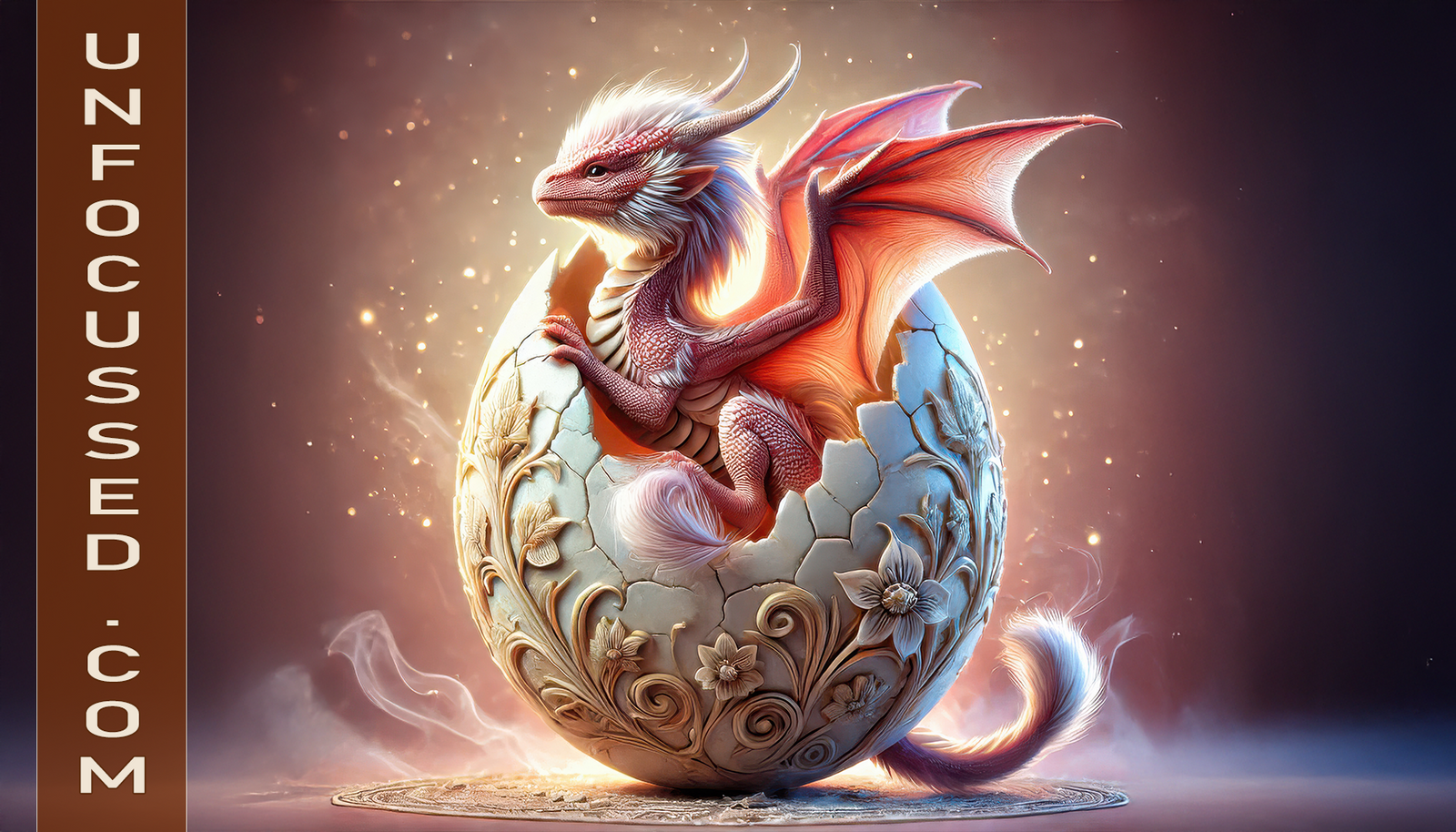
A Dragon's First Breath

There are few things more awe-inspiring than the birth of a legend. But legends, much like dragons, rarely come into the world quietly. The egg sat atop a pedestal of stone, its surface a masterpiece of ornate carvings that seemed less the work of time and more of an artisan with a penchant for beauty and whimsy. Vines of delicate flowers and swirls wrapped around the shell, as though nature itself had decided to protect the treasure within. The room was silent, save for the faint hum of magic that pulsed in the air—an ancient rhythm, slow and steady, as though the world itself was holding its breath. Then it happened. A crack. It started as a whisper of sound, the faintest of clicks, as a single hairline fracture split the surface of the egg. From the fracture, a soft, golden light began to seep out, illuminating the chamber in a warm, ethereal glow. The crack widened, and then, with a sudden burst of force, a claw—tiny, yet unmistakably sharp—pierced through the shell. “Well, it’s about time,” muttered a voice from the shadows. The speaker, an ancient wizard with a beard that had seen too many years and a robe that had seen too few washes, stepped closer to the egg. “Three centuries of waiting, and you decide to make your entrance while I’m mid-breakfast. Typical dragon timing.” The dragon paid no attention to the wizard’s grumbles. Its focus was singular and instinctual—freedom. Another claw broke through the shell, followed by a delicate snout covered in shimmering pink and white scales. With a final push, the dragonling emerged, wings unfurling in a spray of golden dust. It blinked once, twice, its eyes wide and filled with the kind of wonder only the truly newborn can possess. “Ah, there you are,” the wizard said, his tone softening despite himself. “A little smaller than I expected, but I suppose even dragons have to start somewhere.” He squinted at the dragon, who was now inspecting its surroundings with a mixture of curiosity and mild disdain, as though unimpressed by the wizard’s décor. “Don’t look at me like that. You’re lucky you hatched here and not in some bandit’s den. This place has history!” The dragon sneezed, and a small puff of smoke escaped its nostrils. The wizard took a hasty step back. “Right, no need to start with the fire. We’ll get to that later,” he muttered, waving the smoke away. “Let’s see, you’ll need a name. Something grand, something that strikes fear into the hearts of your enemies—or at least makes the villagers less likely to throw rocks at you. How about… Flameheart?” The dragon tilted its head, unimpressed. “Alright, fine. Too cliché. What about… Blossom?” The dragon snorted, and a tiny ember landed dangerously close to the wizard’s robe. “Alright, alright! No need to be dramatic. How about Auriel? A bit of elegance, a touch of mystery. Yes, you look like an Auriel.” Auriel, as though considering the name, stretched its wings wide. They glimmered in the golden light, a tapestry of soft hues that seemed to shift and shimmer with every movement. For a moment, even the wizard was struck silent. The dragon, barely the size of a housecat, somehow commanded the room with the presence of something far greater. It was as though the universe itself had paused to acknowledge this small but significant life. “You’ll do great things,” the wizard said softly, his voice filled with a rare sincerity. “But not today. Today, you eat, you sleep, and you figure out how to fly without breaking everything in sight.” As if in agreement, Auriel let out a tiny roar—a sound that was equal parts adorable and pitifully small. The wizard chuckled, a deep, hearty laugh that echoed through the chamber. For the first time in centuries, he felt hope. Not the fleeting kind that comes and goes with a passing thought, but the deep, unshakable kind that settles in the bones and refuses to leave. “Come on then,” the wizard said, turning toward the doorway. “Let’s get you some food. And for the love of magic, try not to set anything on fire.” The dragon trotted after him, its steps light but full of purpose. Behind them, the shattered egg lay forgotten, its ornate shell a silent testament to the beginning of something extraordinary. As they left the chamber, a golden light lingered in the air, as though the magic itself knew that this was no ordinary day. Legends, after all, are not born; they are made. But every legend begins somewhere. And for Auriel, it began here, with a crack, a breath, and the promise of a world yet to be conquered.    Bring "A Dragon's First Breath" Into Your Home Capture the magic and wonder of Auriel's journey with stunning products that showcase this enchanting artwork. Whether you're looking to decorate your home or carry a piece of fantasy with you, we've got you covered: Tapestry - Transform your walls with the majestic glow of this magical dragon. Canvas Print - Bring the legend to life with a premium-quality canvas that exudes elegance. Throw Pillow - Add a touch of mythical charm to your living space with this cozy, decorative piece. Tote Bag - Carry the magic with you wherever you go with this stylish and durable tote bag. Each item is crafted with care and designed to bring the story of "A Dragon's First Breath" to life in your everyday world. Explore these products and more at Unfocussed Shop.

Read more

Celestial Coil: Guardian of the Winter Skies

by Bill Tiepelman

Celestial Coil: Guardian of the Winter Skies

In a realm where time curled like smoke and the stars hummed old, forgotten songs, there existed a dragon unlike any other. This dragon, coiled in eternal slumber, was not of fire or fury, but of frost and quietude. His name, known only to the winds and whispered by the stars, was Kaelthys, the Guardian of the Winter Skies. And though Kaelthys dreamed, his presence was felt across the realms—a subtle force of frozen majesty, keeping balance between the chaos of the storm and the serenity of the snowflake. The cosmos was his cradle, a swirling blanket of stars and celestial mist that danced around his sleek, glimmering form. His scales shimmered like fractured ice, catching and reflecting the soft glow of distant galaxies, each one a testament to the timeless power he wielded. Yet, Kaelthys did not crave power. No, he had long ago decided that the universe had enough of that. Instead, his duty was far more profound: to protect the dreamers. The Guardian’s Slumber Now, you might be wondering, what exactly does a dragon of the winter skies dream about? Certainly not knights, maidens, or treasure chests overflowing with gold. That was the concern of dragons of fire and greed. Kaelthys, however, was a dragon of the stars and snow. He dreamt of the stillness between snowflakes, the gentle hush before a blizzard, and the icy kiss of the northern wind. He dreamt of moments when the world held its breath, wrapped in a soft, frozen silence. But above all, Kaelthys dreamt of the beings who wandered beneath him. The dreamers. Those curious souls, often wrapped in woolen coats, braving the winter chill to gaze up at the night sky, wondering what lay beyond. Kaelthys loved the dreamers—those who dared to believe in something more. And so, with each breath of his long slumber, he guided the stars to shimmer a little brighter, nudged the constellations into new formations, just to keep the dreamers’ imaginations alive. Of course, Kaelthys’s dreams were not without their quirks. Sometimes, in the midst of all this cosmic majesty, he would dream about more peculiar things, like misplaced mittens. There was an entire section of his mind dedicated to missing winter apparel—hats, scarves, gloves—all whisked away by the mischievous winter winds. “It’s not my fault,” Kaelthys often muttered in his sleep. “The wind has a mind of its own.” Indeed, if there was one lesson the Guardian of the Winter Skies had learned, it was that nature—especially winter—could be whimsically unpredictable. Winter’s Whims and Cosmic Winks The unpredictability of winter was something that Kaelthys cherished. He loved the way snowflakes could fall with precision but still land in chaotic little piles. The way icicles formed delicate daggers, only to drip away under the first kiss of sunlight. It was these little contradictions that made winter magical, and Kaelthys, in his infinite age, still marveled at them. But winter had a sense of humor too, and Kaelthys knew this all too well. He had witnessed it through centuries of winter festivals, snowball fights, and ice-skating mishaps. Once, in a particularly lucid dream, he had nudged a comet just slightly off course to make it look like a falling star. That night, dozens of wishes had been made by wide-eyed children and wistful adults alike, all hoping for something magical. Kaelthys had chuckled in his sleep. He didn’t grant the wishes, of course—he wasn’t that kind of dragon—but he liked the idea of sparking hope, even if it was by accident. Winter, as Kaelthys understood it, wasn’t about harshness or coldness. It was about the moments of stillness in between—the laughter carried on frosty breaths, the warmth of gathering around fires, and the wonder of looking up at a sky filled with stars. His role was to protect that magic, to ensure that the winter skies remained a place of mystery and wonder. Guarding the Dreamers Though he slept, Kaelthys was always aware of the world below. Sometimes, on the longest winter nights, he would stir just enough to let out a soft breath, sending a fresh wave of snow across mountain peaks or turning the night sky a deeper shade of blue. It wasn’t much—just a little nudge to remind the dreamers that magic was still out there, somewhere, waiting to be found. One evening, as Kaelthys lay wrapped in his celestial coil, a particularly cold gust of wind brought with it a stray thought from a wandering human. The thought was curious and light, like a snowflake in a gust of wind: “Do dragons still exist?” it asked, full of wonder. Kaelthys, amused, shifted slightly in his sleep. A single, luminous scale drifted off his body, carried by the wind, and floated down to earth, landing on a frozen lake where it twinkled in the moonlight. A child, bundled in too many layers of clothing, spotted the shimmering scale. Wide-eyed, she bent down to pick it up, cradling it in her mittened hands. “It’s magic,” she whispered to herself, tucking the scale into her pocket. She didn’t know where it had come from, but in that moment, she believed in something bigger than herself. Something grand and magical, hidden just beyond the stars. Kaelthys, still half-asleep, smiled inwardly. He might not be able to grant wishes, but he could at least leave a little piece of wonder behind now and then. The Endless Winter Sky As Kaelthys drifted deeper into his slumber, the stars above began to shift, swirling in patterns only he could command. A new constellation appeared—an elegant dragon, coiled in the heavens, watching over the winter night. Those who gazed up at the sky that evening would later speak of the unusual brightness in the stars, the way they seemed to tell a story all their own. But Kaelthys wasn’t concerned with stories or legends. He was content in his role as the silent guardian, watching over the dreamers below. His slumber was eternal, but so too was the magic of winter, a season that held its own kind of warmth and wonder. And so, under the vast, star-strewn sky, Kaelthys slept—serenely, peacefully, knowing that as long as the dreamers believed, the magic of the winter skies would never fade. For the dreamers would always look up, their breaths fogging in the cold night air, and wonder at the stars. And maybe, just maybe, they would catch a glimpse of the sleeping dragon, coiled among the constellations, guarding the magic of winter from his celestial perch.     Bring the Magic of the Winter Skies Home Inspired by Kaelthys, the Guardian of the Winter Skies, you can now bring a touch of that celestial beauty into your own space. Whether you're curling up on a cold winter night or looking to add a bit of cosmic magic to your decor, we’ve curated a selection of enchanting products that capture the essence of this frosty dragon’s world: Celestial Coil Throw Pillow – Add a splash of cosmic elegance to your couch or bed with this striking throw pillow, featuring the intricate and serene form of Kaelthys, wrapped in his frosty coil. Celestial Coil Fleece Blanket – Snuggle up under the stars with this soft fleece blanket, perfect for cold winter nights when you want to be wrapped in the same magic that Kaelthys protects. Celestial Coil Tote Bag – Carry a piece of the winter sky wherever you go with this stylish tote bag, featuring the captivating image of the Guardian of the Winter Skies. Celestial Coil Tapestry – Transform your space with this vibrant tapestry, showcasing the mystical beauty of Kaelthys, the frost dragon, coiled amidst the stars. Hang it in your home to inspire wonder and tranquility. Celestial Coil Cross-Stitch Pattern – Bring Kaelthys to life with your own hands using this detailed cross-stitch pattern, perfect for crafters who love celestial designs. Each product is designed to bring the magic and serenity of the winter skies into your life, a perfect reminder of the quiet majesty that Kaelthys guards in his eternal slumber. Explore more enchanting designs and bring home the magic at Unfocussed Shop.

Read more

Checkmate of the Cosmic Dragon

by Bill Tiepelman

Checkmate of the Cosmic Dragon

In a mystical universe, where the very essence of magic intertwines with the threads of reality, a tale of epic proportions unfolds. The Grandmaster Wizard, a figure of immense power and ancient wisdom, his cloak a tapestry of twinkling cosmic fabric, stands at the heart of this narrative. He faces a formidable and majestic opponent: the Cosmic Dragon, a being whose scales hold the whispers of time and space, whose very presence is a maelstrom altering the weave of the universe. Their arena, a boundless expanse transformed into a titanic chessboard, sprawls across the vastness of a star-born nebula. This board, a reflection of the cosmos itself, plays host to a game of existential consequence. The chess pieces, animated by the echoes of creation, are embodiments of celestial phenomena, from pulsing stars to wandering comets, each resonating with the essence of cosmic entities. As the Grandmaster Wizard, his hand wreathed in stardust, contemplates his next gambit, his fingers trace the outline of a bishop carved from the heart of a comet. Its icy core, aglow with latent energy, awaits the touch of destiny. His eyes, deep as the endless void, hold the reflection of past, present, and future, contemplating the infinite outcomes of the cosmic dance between creation and oblivion. Before him, the Cosmic Dragon looms, silent yet vibrant. Its fractal wings unfold, a vast tapestry of mesmerizing patterns that speak of the secrets locked within the fabric of everything. Its breath, a conflagration of light and primal energy, bathes the chessboard in a glow that is both ethereal and commanding, a light that sings of the birth and demise of worlds. As their contest of wills and intellect unfolds, the very flow of time warps around them. Eons cascade like moments with each shift upon the board. The wizard, in a masterstroke of foresight, advances his queen—a move mirroring the ignition of a nebula, a cosmic ballet of genesis and illumination. The dragon counters with the grace of inevitability, its knight toppling a piece, heralding the silent fall of a distant star, a solemn nod to the transience of all things. The zenith of their celestial match arrives as the wizard, his voice a low rumble of thunder across the void, declares checkmate. The maneuver, elegant and decisive, seems to dictate the destinies of galaxies yet unborn. In that singular moment of apparent victory, the Cosmic Dragon's wings unfurl, revealing patterns of unfathomable intricacy, a visual symphony of knowledge that transcends understanding. These patterns, hidden within the dragon’s cosmic hide, suggest this match is but a glimpse of the eternal interplay of cosmic strategy, an unending game played across the fabric of reality. The wizard, his eyes alight with the fire of a thousand suns, bows in deep respect. He recognizes the profundity of their game. This dance of moves and counter moves, cast upon the canvas of the universe, is not bound by the terms of victory or defeat. It exists in a realm where the lines between magic and material blur into obscurity, where every choice and chance becomes a part of the boundless pattern of existence. And thus, the Grandmaster Wizard and the Cosmic Dragon continue their game, each move a verse in the eternal poem of the universe. Their contest, far from concluding with the fall of a king or the triumph of a checkmate, lives on as an infinite narrative woven into the vast, majestic tapestry of all that is, ever was, or ever will be.     As the echoes of the final checkmate reverberate through the cosmos, the grand tale of intellect and strategy between the Grandmaster Wizard and the Cosmic Dragon inspires creations in the realm of mortals. For those drawn to the artistry of the stars and the thrill of cosmic conquest, the Checkmate of the Cosmic Dragon Cross Stitch Pattern offers an opportunity to thread the needle through the fabric of the universe, crafting a tableau of their legendary encounter. For minds that delight in piecing together the mysteries of the cosmos, the Checkmate of the Cosmic Dragon Jigsaw Puzzle calls forth the strategist within, each piece a fragment of the grand cosmic game, waiting to reveal the majestic image of the grand chess match. Admirers of astral artistry can gaze upon the Checkmate of the Cosmic Dragon Poster, where the vibrant duel is immortalized, a visual symphony that captures the saga in a single, awe-inspiring moment. For those who seek to enshrine this narrative in their sanctum, the framed print offers a window into the eternal game, bordered with the essence of elegance and cosmic allure. And in spaces where the fabric of reality seems to thin, the Checkmate of the Cosmic Dragon Tapestry hangs as a testament to the boundless imagination, its woven threads a constellation of creativity and inspiration, a piece that not only adorns but also transcends as a portal to the infinite play between magic and reality. Through these inspired artifacts, the legacy of the Grandmaster Wizard and the Cosmic Dragon extends beyond the celestial realm, capturing the imagination of those who seek to touch the extraordinary, to own a piece of the cosmos, and to be a part of the perpetual chronicle that is the Checkmate of the Cosmic Dragon.

Read more

Explore Our Blogs, News and FAQ

Still looking for something?