

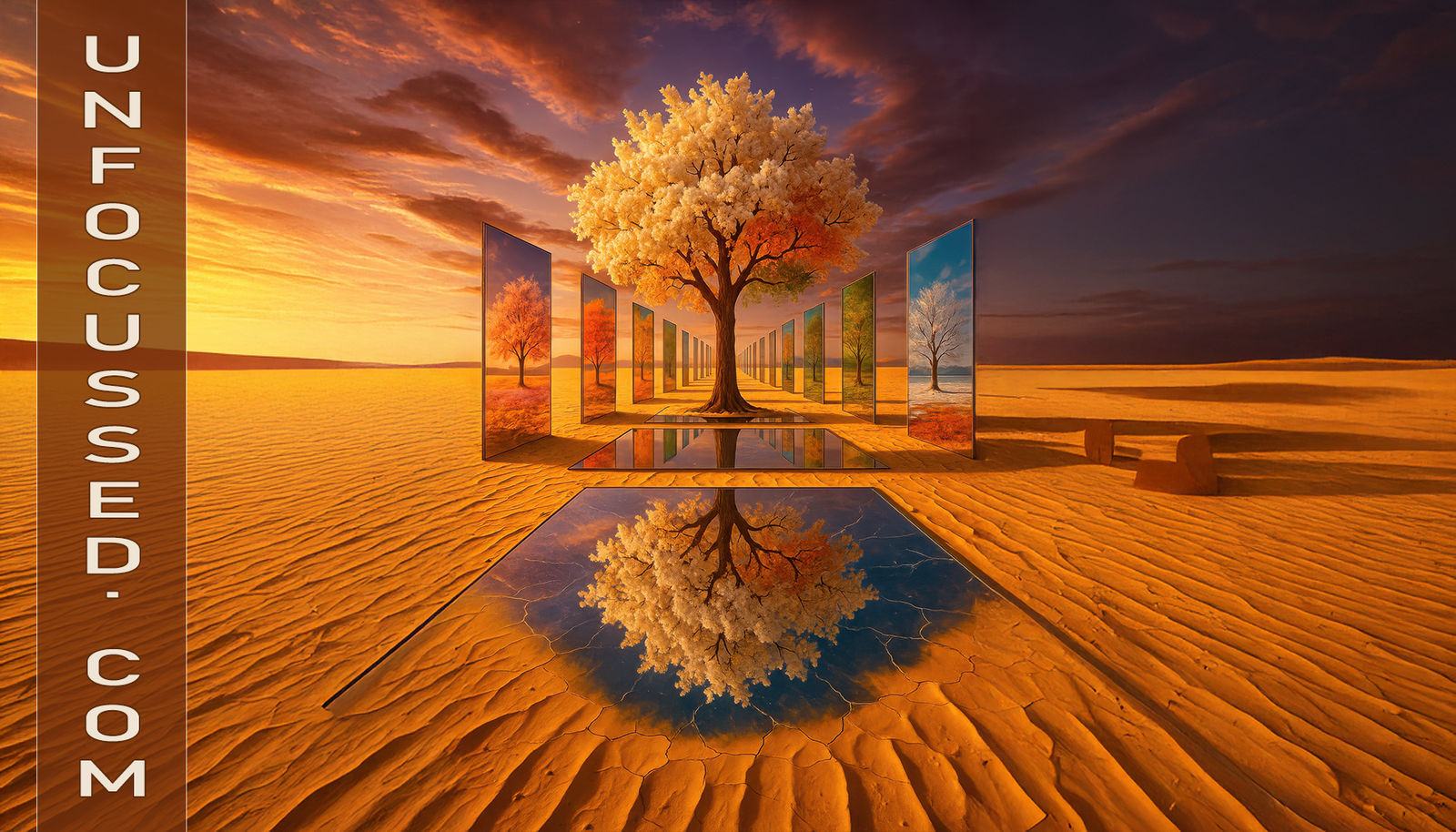
by Bill Tiepelman
The Tree Remembers
The Audit of Seasons At dusk, the four-seasons tree stood in a desert that looked like someone had forgotten to water the planet for a few millennia. The sky was painted in molten apricot and bruised lavender, and the sand shimmered as if it had once been a sea that decided to retire early. Between the dunes stretched a procession of mirrors—tall, sleek, unapologetically smug—each one capturing the same tree in a different mood, as though nature had hired a photographer to document her emotional range. The tree, with its crown of white blossoms shading into flame-tipped leaves, was clearly the star of the show. Its reflection shimmered in a mirror-pool at its roots, an upside-down echo more honest than truth. “You’re early,” said the tree, without opening a mouth—because of course it didn’t have one. “Time waits for no one,” I replied. “Neither does curiosity.” The tree chuckled, a dry, papery sound like old letters catching fire. “Curiosity,” it said, “is how deserts get populated with mirrors and metaphors.” We stood in silence for a while—the kind of silence that hums with ancient Wi-Fi. The tree looked tired but radiant, like someone who’s lived through every breakup, job interview, and therapy session imaginable, yet still gets up in the morning looking fabulous. “You’ve seen things,” I said, the way people say to veterans and mothers. “Yes,” it sighed. “I’ve been spring, summer, autumn, winter, and every awkward in-between. I’ve shed myself more times than I can count, yet here I am—still photosynthesizing.” It paused, then added with a grin I could somehow feel: “Growth is exhausting, darling, but what’s the alternative? Stagnation?” A hot breeze passed, carrying the smell of dust and nostalgia. I looked at the nearest mirror; it showed the tree in full spring bloom, pink and naive, dripping with newness. The next one was summer—a blaze of confidence and overcommitment. Then autumn—gold and wistful, the color of goodbyes said gracefully. And finally, winter—a study in restraint, the art of keeping still until the world remembers warmth again. “You’re like an entire life in syndication,” I said. “Reruns and all.” The tree laughed—a sound that rustled across centuries. “I call it an audit,” it said. “Every reflection is a receipt for who I’ve been. I keep them here so I don’t forget.” I blinked. “You keep mirrors of yourself in the desert to remember?” The tree shrugged its branches. “Don’t you keep photos on your phone? Same idea. Just with better lighting.” I tried to look closer into one of the mirrors, but my reflection kept changing—sometimes older, sometimes younger, sometimes not me at all. It was unnerving, like catching your future self peeking around a corner. “Why am I here?” I asked finally. “Because,” said the tree, “you asked to see what remembering looks like. You wanted to know how something can lose everything, season after season, and still call it growth.” It tilted slightly, as though confiding in me. “Humans think memory is about holding on. It’s not. It’s about composting. You turn old stories into soil.” That line hit like a sermon whispered through roots. I thought of my own seasons—the messy rebirths, the times I mistook exhaustion for stability. “So you forget on purpose?” I asked. “No,” said the tree, “I remember until it stops hurting, then I let the wind have it. Pain makes good mulch.” It glanced toward the horizon, where the sun was melting into amber glass. “You can’t grow without decay. You can’t blossom if you hoard every fallen leaf like a receipt for suffering.” I nodded, pretending to understand but also realizing this tree had just summarized every self-help book I’d ever read. The mirrors caught the fading light, bending it into endless corridors of possibility. Somewhere far off, the sand began to sing—a soft vibration, like the desert humming to itself. “Do they ever break?” I asked, gesturing to the mirrors. “Sometimes,” the tree said. “Usually when I’m trying to learn humility. Reflection can only hold so much truth before it cracks.” I wanted to laugh, cry, and apply for an emotional support cactus all at once. The air shimmered, and the horizon folded inward like origami. “So what happens when you finish your audit?” I asked. The tree considered this for a long time, then said, “When I’ve remembered enough, I’ll forget on purpose again. That’s how eternity keeps itself interesting.” It was then I realized the mirrors weren’t really about time—they were about perspective. Every season was a version of the self, valid, temporary, and completely convinced it was the main character. And maybe that was the cosmic joke: none of them were wrong. As the light deepened into velvet dusk, I turned to leave. “Any advice for a mortal with too many tabs open in their soul?” I asked. The tree rustled thoughtfully. “Yes,” it said. “Close the ones that don’t sing back.” Reflections File for Appeal The mirrors began to hum. Not a polite hum, either—this was the deep, resonant kind that suggested something ancient had just logged in. A dozen panels tilted toward me, catching light that shouldn’t have existed, and the reflections started talking over each other like guests on a bad podcast. Each mirror claimed to represent the “true self” of the tree, which felt very on-brand for any group chat involving identity. The spring mirror, all blush and optimism, fluttered with blossoms. “I’m the version that believed love fixes everything,” it chirped. The summer mirror rolled its leaves. “Please. You were just hormones with a fragrance.” Autumn swirled with copper and nostalgia, sipping imaginary chai. “I’m the one who learned to let go.” Winter just stared, frosted and unbothered. “I’m the only one who knows how to rest,” it said coolly. The tree sighed like a therapist who’s seen too much. “Every year,” it muttered, “they do this. They file for appeal.” I folded my arms. “Appeal?” “Yes,” the tree said, “each version thinks it deserves to be the permanent me. None of them realize permanence is a performance.” The spring reflection gasped. “That’s cruel!” “That’s honest,” said winter. “Cruelty is honesty with frostbite.” I stood there, ankle-deep in sand and metaphors, feeling like an unwilling jury member in the trial of time. Each reflection wanted validation. Spring wanted praise for being brave enough to begin. Summer wanted credit for abundance. Autumn demanded acknowledgment for grace in loss. Winter just wanted everyone to shut up. “You’re all exhausting,” I said, rubbing my temples. “No offense.” “None taken,” said autumn sweetly. “Exhaustion is part of growth. We wear it like eyeliner.” The desert wind stirred again, carrying with it whispers that might have been memories—or ads for enlightenment. I noticed the mirrors had arranged themselves into a rough circle. “What’s happening?” I asked. “The tribunal,” said the tree. “Every so often, I let them argue until they realize they’re the same being. It saves me therapy money.” The tree turned one limb toward me. “You’re welcome to watch, but fair warning—it gets existential.” Spring was first to speak. “I represent hope,” it declared, petals trembling. “Without me, nothing starts. I am joy, I am innocence, I am the first spark after the dark.” Summer followed, voice loud and confident. “Without me, you’d still be a seedling. I bring strength, growth, abundance, and the glorious illusion of control.” Autumn, ever the poet, swayed in slow motion. “Control is overrated. I’m the beauty of letting go. I’m what happens when you stop pretending everything lasts.” Winter waited, then finally said, “I am silence, and that’s why you all fear me. But in silence, the roots remember what to become next.” The arguments continued until I began to suspect that introspection, like tequila, should be taken in moderation. I watched as the mirrors flickered through scenes of lives not quite mine: a younger me dancing in the rain, an older me writing apologies too late, a version that moved to the mountains, another that never left home. Each reflection carried a what-if. “Are you showing me my seasons?” I asked. The tree’s bark creaked like laughter. “I told you, reflection gets greedy. It loves a good cross-reference.” I wanted to look away, but one mirror held me hostage—autumn again. In it, I was sitting under a version of the tree with hair the color of leaves, reading a book titled *How to Be Fine With Almost Everything.* My reflection looked up, smiled, and said, “You’re late.” “Late for what?” I asked. “Acceptance,” she said. “We’ve been waiting for you.” The mirror shimmered, and I caught the scent of cinnamon, loss, and something like peace. I turned back to the tree. “Do you remember all this?” It nodded slowly. “Every leaf, every word, every mistake. Memory’s a burden, but forgetting too much makes you hollow. Balance is survival.” The tribunal reached what looked like a consensus—or exhaustion. The mirrors dimmed, muttering philosophical half-apologies. “So who wins?” I asked. “None of them,” said the tree. “They merge. They dissolve back into me. That’s the trick of being whole—you stop trying to crown one version as better than the others.” The mirrors folded inward, swallowing their light. I realized then that wholeness wasn’t a shape but a sound—the soft click of fragments agreeing to coexist. “Doesn’t it hurt?” I asked. “It always hurts,” said the tree, “but pain’s just the echo of growth. You humans spend so much energy avoiding it, when really, it’s the receipt for transformation.” The desert shimmered in response, like the horizon nodding. “You talk like a philosopher,” I said. “I talk like something that’s had time to practice,” the tree replied. We watched as the mirrors sank slightly into the sand, forming a mosaic that caught starlight. “You said they file for appeal,” I said. “Do they ever win?” The tree chuckled. “Once, autumn almost did. She argued that surrender is the truest form of wisdom. But then spring got sentimental and bloomed all over the paperwork.” A silence settled again, but this one was kind—the silence of digestion after truth. I sat beneath the tree, tracing patterns in the sand. “What happens if you stop remembering?” I asked. “Then I start dying,” said the tree softly. “Not all at once—just in pieces. A memory lost here, a meaning misplaced there. That’s how deserts grow.” I nodded. “That’s how people grow, too.” The tree’s branches quivered in agreement. “Exactly. Every forgetting makes room for something else. The trick is to choose what you forget.” I laughed. “That sounds like selective amnesia.” “No,” said the tree, “it’s curation.” The mirrors flickered again, and now they showed not the seasons but *moments*: hands planting a seed, lovers arguing under rain, someone crying in a parked car, a child chasing dust motes. Each one glowed for a second before fading. “These aren’t all mine,” I said. “No,” said the tree. “They’re borrowed. Memory leaks between living things like stories through generations. Every root, every footprint leaves a whisper.” That thought lodged somewhere deep in me, between cynicism and wonder. “So, basically, we’re all plagiarists of experience?” The tree laughed again—an indulgent sound. “Exactly! We remix existence. Every life is a cover song. The melody’s universal, but the lyrics are yours.” I wanted to ask more—about purpose, time, and why enlightenment never comes with a user manual—but the mirrors began dimming. “They’re tired,” said the tree. “Reflection burns a lot of energy.” “So does overthinking,” I said. “Oh,” replied the tree, “that’s your species’ national pastime.” We sat there as twilight deepened, surrounded by a soft halo of starlit glass. The desert cooled, and a faint breeze carried the smell of unseen flowers—ghost blossoms that only bloom after dark. “You ever get bored of all this wisdom?” I asked. “Constantly,” said the tree. “But boredom is where wonder hibernates. You just have to poke it gently until it wakes.” It occurred to me that maybe the tree wasn’t just remembering—it was teaching itself how to keep remembering differently. “So what’s next?” I asked. The tree rustled thoughtfully. “Soon, I’ll rest. The mirrors will sleep. And you’ll dream of me as something else—perhaps a metaphor, perhaps a coffee mug quote. But you’ll remember enough to come back.” “Why me?” I asked. “Because you listened,” said the tree. A final mirror lingered, half-buried in sand. It showed me walking away, already smaller, already fading into dusk. I wanted to step through, to see where that path led, but the tree stopped me. “Not yet,” it said. “Reflection without action is just narcissism.” I sighed. “Then what do I do?” The tree leaned slightly, its shadow brushing mine. “Go live enough that your next reflection has something new to say.” Terms and Conditions of Becoming By the time the last mirror stopped shimmering, the desert had fallen into that hushed, pre-midnight stillness when even the stars seem to be holding their breath. The four-seasons tree stood quieter now, its branches curved like parentheses around the night. “You look tired,” I said. “Tired,” the tree replied, “is what wisdom feels like on the surface.” It stretched, creaking softly, bark glowing faintly in moonlight. “You’ve met my reflections, listened to my bickering memories, and watched me argue with myself. Most people stop at recognition. You stayed for reconciliation.” I sank into the cool sand, cross-legged, pretending the ground was a yoga mat for the soul. “So what now?” I asked. “Now,” said the tree, “we sign the contract of becoming.” One of its roots nudged a scroll from the sand—a parchment made of light, words written in looping constellations. “It’s the fine print of existence,” the tree continued. “Nobody reads it, and everyone agrees to it at birth.” The scroll unfurled toward me. The first line read: ‘You will change without notice. Updates occur automatically.’ Below it, smaller clauses glittered in the starlight: • Item 1: Every joy carries an expiration date, but the memory may be renewed indefinitely. • Item 2: Grief is not an error message. It’s maintenance. • Item 3: You may love things that outgrow you. That’s allowed. • Item 4: All warranties on innocence are void after adolescence. • Item 5: Laughter is the default language. Use it liberally. “Seems fair,” I said. “Fair?” the tree chuckled. “It’s cosmic bureaucracy. You either grow or you crash the system.” It shook itself, and hundreds of tiny lights drifted from its branches—fireflies, maybe, or leftover pixels from a sunset that hadn’t fully logged out. They swirled around us, forming constellations shaped like memories: a bicycle, a first kiss, a hospital corridor, a cup of coffee still warm. Each image pulsed once, then vanished. “Those are mine,” said the tree, “but you recognize them because experience is an open-source code.” We watched the lights fade. “You said becoming has terms,” I murmured. “What about the conditions?” The tree’s roots shifted, tracing spirals in the sand. “Ah, the conditions. Those are trickier.” A pause, as if considering whether I was ready. “Condition one: You must accept that endings are punctuation, not punishment. Condition two: You must practice astonishment daily. Condition three: Forgive yourself for updates that take longer to install.” Something inside me unclenched. “And if I don’t agree?” I asked. The tree smiled—a rustle more than a gesture. “Then you’ll still become, just slower, with more buffering.” It tapped the ground, and the mirrors, buried beneath the sand, began to hum again—softly this time, like a lullaby from the underworld. “They’re backing up your progress,” the tree said. “It’s automatic. Even pain gets archived.” A coyote cried somewhere beyond the dunes, and the sound rolled toward us like an echo that had lost its owner. “Does it ever end?” I asked. “Endings are for stories,” the tree said gently. “You’re not a story. You’re a library. Every time you think you’ve reached the last page, another branch starts writing.” The wind shifted. The smell of rain—actual rain—threaded through the air, impossible in this place of dust and mirrors. “Weather forecast?” I joked. “No,” said the tree. “Remembrance. Every storm begins as nostalgia for rivers.” I laughed despite myself. “You’re incredibly poetic for a plant.” “Photosynthesis of metaphors,” it said smugly. “It’s a gift.” The first drops fell, heavy and slow, like punctuation marks. They hit the mirrors, making ripples that didn’t fade. Each droplet turned into a tiny lens, refracting a different face of the tree—and of me. “Look closer,” said the tree. In one droplet, I saw my younger self promising to change. In another, my future self already forgiving the failures yet to happen. “Is that what remembering is?” I asked. “No,” said the tree. “That’s what living kindly looks like from the outside.” Lightning flared, revealing how vast the desert really was—mirrors stretching to the horizon, each catching a fragment of sky. “You built all this?” I whispered. “No,” said the tree. “I simply grew where reflection needed an anchor.” It paused, its trunk gleaming like wet bronze. “Every soul needs one.” The rain intensified, washing sand from half-buried mirrors until they shone again. In their collective shimmer, the desert looked alive—a thousand realities blinking awake. The tree’s voice softened. “Listen carefully. This is the part most people miss: You’re not separate from the reflection. You are the reflection remembering itself.” The words sank through me like roots seeking water. I wanted to believe I understood, though I suspected understanding wasn’t the point. “So what happens when I leave?” I asked. “You won’t,” said the tree. “You’ll carry the desert inside. Every time you hesitate between versions of yourself, you’ll hear me rustle. Every time you choose kindness over control, you’ll grow another ring.” We sat together until the rain softened to a mist. The mirrors dimmed, their light now internal, like ideas settling in for the night. I stood, brushing sand from my hands. “Anything else in the fine print?” I asked. “One last clause,” said the tree. “You must share what you’ve learned without pretending you discovered it alone.” I laughed. “A collaborative enlightenment license?” “Exactly,” said the tree. “Creative Commons of the soul.” It stretched once more, shaking droplets that turned into tiny stars. “Now go. The world needs more witnesses who’ve read the terms.” As I walked away, dawn seeped in, quiet and forgiving. Behind me, the four-seasons tree glowed briefly, then folded its reflections back into silence. The desert was already forgetting, but gently—like someone closing a beloved book. When I looked down, I realized a small mirror shard had lodged itself in the cuff of my sleeve. It caught the new sunlight and winked. In it, for a moment, I saw the tree again—alive, amused, infinite. Then only my own face, smiling the kind of smile that happens when you finally realize the story was about remembering how to begin. Bring “The Tree Remembers” Into Your World If this story stirred something in you — that quiet echo of renewal, humor, and human persistence — you can keep its spirit alive beyond the page. Each product below features the original artwork "The Tree Remembers" by Bill and Linda Tiepelman, crafted to bring beauty, reflection, and inspiration into your everyday spaces. ✨ Adorn your wall with a Framed Print, where the timeless imagery transforms your room into a sanctuary of growth and remembrance. 💧 Choose the sleek Acrylic Print for a contemporary, luminous display that captures every reflective detail of the tree’s surreal world. 🖋️ Capture your own thoughts, dreams, or daily awakenings in a Spiral Notebook — because reflection is how growth begins. 💌 Share a piece of soul and story with someone special through a Greeting Card that says more than words ever could. 🌙 And when the night grows quiet, wrap yourself in the warmth of meaning with a Fleece Blanket, soft as memory, comforting as time. Each piece is a reminder: growth is ongoing, reflection is sacred, and beauty belongs wherever you choose to remember.


