enchanted animal

Captured Tales

View

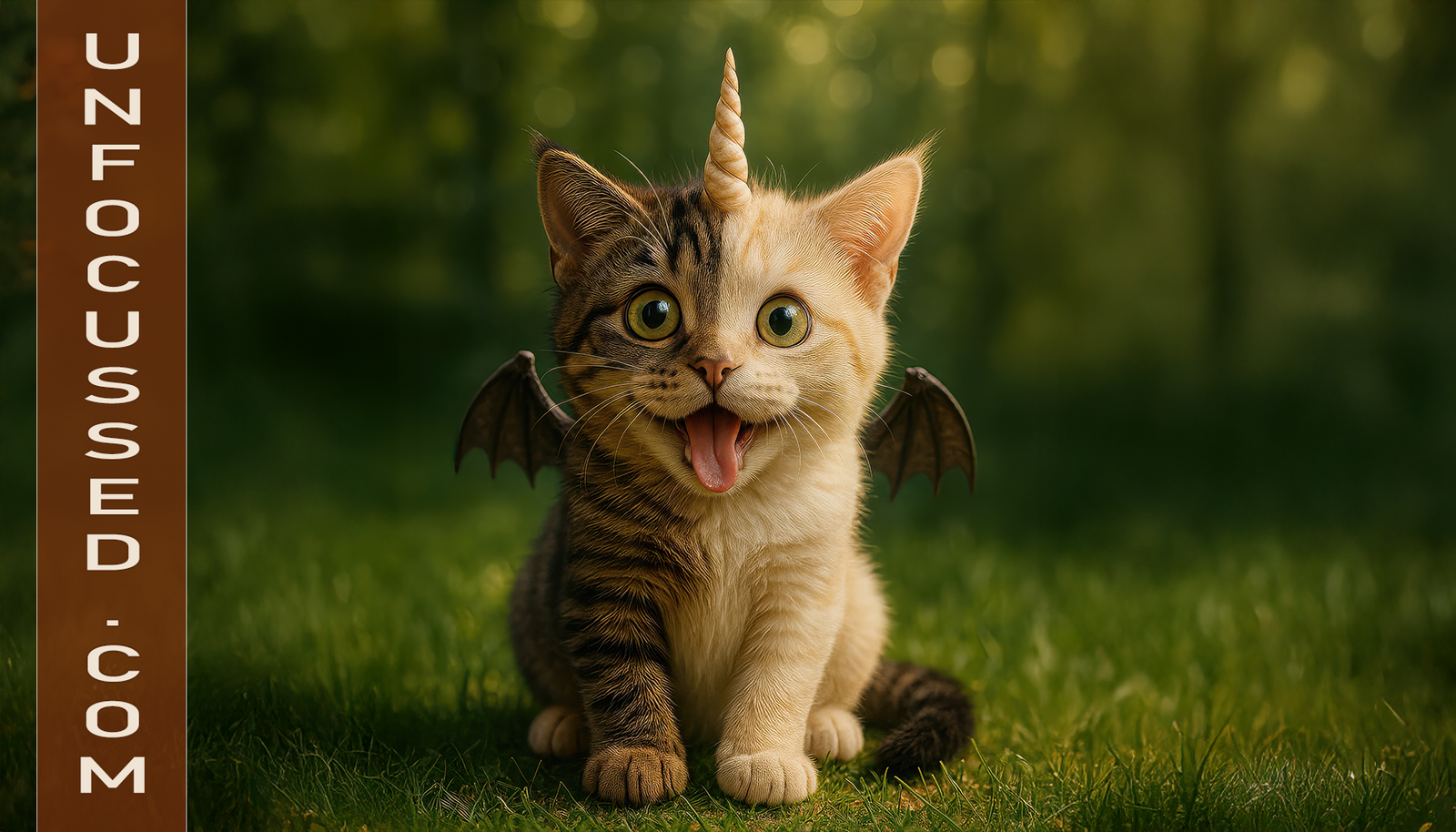
The Split-Pawed Snorticorn

by Bill Tiepelman

The Split-Pawed Snorticorn

The Cursed Cupcake Incident In the heart of the Bewildering Wood — a place where reality tended to forget its pants — there lived a kitten named Fizzle. But not just any kitten. Fizzle was a chimera: half tabby, half cream puff, with a unicorn horn that glowed when he sneezed and tiny bat wings that flapped angrily when someone stole his snacks. Which, to be fair, was often. Because Fizzle had a very punchable face — adorable, yes, but the kind that just screamed “I licked your donut.” Fizzle had no idea how he came to be the universe’s most bizarre mashup of cuteness and chaos. Some say he was cursed by a bored forest witch who got ghosted by a dating app algorithm. Others claim he was the result of a late-night tequila-fueled spell gone wrong involving two cats, one gremlin, and a drunken unicorn. All Fizzle knew was this: his life was a relentless carousel of unwanted attention, absurd quests, and inexplicable cupcake-related incidents. Case in point: on the morning our tale begins, Fizzle awoke to find a cursed red velvet cupcake sitting neatly on a mossy log outside his mossier tree stump. It pulsed ominously. It sparkled obscenely. It smelled like cinnamon, regret, and demonic frosting. “Oh no,” Fizzle muttered, his voice that of a surprisingly deep British butler trapped in a kitten’s body. “Not again.” Last time he ignored a cursed pastry, his wings turned into rubber chickens and his meow summoned tax auditors. But if he ate it? Well, he'd probably be turned into a moon or something equally inconvenient. The cupcake gave a seductive little shimmy. Fizzle gave it the finger. (Figuratively. He didn’t technically have fingers. But the glare did the job.) Just then, a scroll burst into flame mid-air and dropped onto his head. It read: “Oh Glorious Split-Pawed Snorticorn! You have been chosen to embark upon a sacred journey. Save the village of Gloomsnort from its existential dread. You will be compensated in baked goods.” “Nope,” Fizzle said, tossing the scroll into a puddle. It promptly turned into a swarm of motivational bees that buzzed things like “You’ve got this!” and “Believe in your tail!” and “Live. Laugh. Loot.” Fizzle sighed. He flexed his stubby wings, snorted a spark from his horn, and turned dramatically toward the east — which, in this part of the forest, was whatever direction your sarcasm pointed. “Fine,” he muttered, rolling his eyes so hard they almost dislocated. “Let’s go save a bunch of sad peasants from whatever emo nonsense they’ve gotten themselves into this week.” Thus began the legend of the most reluctant, snarky, and snack-obsessed hero the realm had never asked for — but was probably going to get anyway. Gloomsnort’s Emotional Support Goblins By the time Fizzle reached the outskirts of Gloomsnort — a town famous for its moaning fog, emotionally repressed turnips, and aggressively mediocre poetry scene — he already regretted everything. His fur had frizzed from a sudden cloud of passive-aggressive lightning. His horn had been used by a flock of caffeine-addicted sprites as a stirring stick. And worst of all, he’d run out of his emergency cheese crackers. The town gate — which was really more of a fence that had given up on itself — creaked as Fizzle nudged it open. A sentry goblin slumped in a folding chair, wearing a vest labeled “Security-ish” and eating a pickle with deep, philosophical sadness. “Name?” the goblin asked without enthusiasm. “Fizzle,” the kitten replied, brushing soot off his wings. “Chimera. Snorticorn. Destroyer of mild inconveniences. Possibly your last hope, depending on the budget.” The goblin blinked slowly. “That sounds made up.” “So does your mustache,” Fizzle deadpanned. “Let me in.” He was waved through without another word, mostly because nobody in Gloomsnort had the energy to argue with a creature whose horn was currently sparking with repressed rage and low blood sugar. The town square looked like a failed pop-up therapy festival. Banners hung limply with slogans like “Feelings Are Fine (Sometimes)” and “Hug Yourself Before You Mug Yourself.” A trio of goblin buskers was attempting an interpretive dance about the dangers of unprocessed grief while juggling meat pies. No one was watching. Except for a one-eyed newt with a monocle. The newt was weeping. “This place needs a mood swing and a disco ball,” Fizzle muttered. From the shadows emerged a cloaked figure with the vibe of someone who definitely journaled with scented ink. She introduced herself as Sage Crumpet, High Priestess of the Cult of Complex Emotions and Chief Warden of the Town’s Existential Crisis Inventory. “We’re so glad you came,” she said, eyes full of haunted sparkle. “Our entire village has lost its will to brunch. The espresso machines only weep now.” “Tragic,” Fizzle said flatly. “And what, precisely, am I expected to do about it?” She handed him a soggy parchment. It read: “Find the source of the malaise. Neutralize it. Optional: hug it out.” Fizzle sighed and popped his neck. “Let’s start with the usual suspects. Cursed artifacts? Undead therapists? Rogue poets with God complexes?” “We suspect… it’s the fountain,” Crumpet whispered. “The town’s emotional support fountain?” Fizzle asked. “Yes. It’s… begun to give advice.” Now, advising fountains weren’t new in this realm. The Elven city of Faelaqua had one that whispered self-care tips and passive-aggressive reminders to moisturize. But Gloomsnort’s fountain was reportedly speaking in ALL CAPS and demanding tribute in the form of scented candles and cryptic performance art. When Fizzle approached the fountain — which looked suspiciously like a repurposed birdbath covered in motivational moss — it began vibrating ominously. “I AM THE FONT OF INNER TURMOIL,” it bellowed. “BRING ME THE UNRESOLVED DREAMS OF YOUR CHILDHOOD OR BE FOREVER INFLUENCED BY DISCOUNT WELLNESS PODCASTS.” “Oh great,” Fizzle muttered, “a sentient Tumblr post with delusions of grandeur.” The fountain burbled menacingly. “SNORTICORN. I KNOW YOUR SHAME. YOU ONCE TRIED TO CAST A SPELL BY YELLING ‘FIREBALL’ AT A CANDLE.” “That’s called experimenting,” Fizzle snapped. “And it mostly worked. The curtain never fully recovered, but—” “SILENCE! YOU MUST FACE THE FORBIDDEN SPIRIT OF YOUR OWN REPRESSED WHIMSY. OR I WILL FLOOD THIS VILLAGE WITH PUMPKIN SPICE TEARS.” Before Fizzle could argue, the air cracked like a therapy bill, and from the fountain rose a swirling mist that took the shape of… a lizard. A very tall, muscular, improbably oiled lizard with sparkly eyes, a leather vest, and the voice of a late-night jazz DJ. “Well, hello there,” the lizard purred. “You must be my inner trauma.” “I sincerely hope not,” Fizzle said, backing up a pawstep. “I’m Lurvio,” the lizard said, stretching in slow motion. “I’m your unresolved ambition to be taken seriously while also being adorable and mildly unhinged.” “You’re a lot,” Fizzle said. “Like, too much lizard and not enough metaphor.” “Let’s tango,” Lurvio said, summoning a glowing banjo and an audience of giggling will-o’-the-wisps. And so, naturally, they danced. Because that’s how these things go. Fizzle found himself locked in an increasingly absurd ritual known as the “Twirling of Suppressed Self-Realization,” which involved tap-dancing around literal baggage while the townsfolk clapped off-beat and Crumpet wept into a tissue shaped like her father’s disapproval. As the final banjo chord faded into existential moaning, Lurvio bowed and dissolved into sparkles, yelling, “LIVE YOUR TRUTH, YOU FLUFFY ICON!” The fountain stopped vibrating. The town sighed in relief. Somewhere, a turnip wrote a sonnet and smiled. “Did… did I just fix your town by emotionally breakdancing with my lizard shadow self?” Fizzle asked, panting. “Yes,” Crumpet sniffled. “You have healed our emotional fountain. We are, once again, brunch-capable.” Fizzle collapsed into a pile of dramatic sighs and muttered, “I better get a freaking cupcake for this.” The Rise and Mildly Inconvenient Fall of the Snorticorn The morning after the Lizard of Suppressed Whimsy exploded into sparkles, Gloomsnort awoke to something even more unsettling than emotional healing: hope. Villagers danced half-heartedly near the now-chill fountain, sipping herbal tea and debating whether their therapy goats could now be replaced with gratitude journals. Street vendors sold knockoff plushies labeled “Fizzle Plushicorns,” complete with detachable wings and tiny embroidered frowns. A bard had already written a ballad titled “The Horny Half-Cat Who Saved Our Souls.” Fizzle hated everything. He’d tried sneaking out before breakfast, but the moment he stepped out of his tavern room (decorated entirely in his likeness, which was as traumatic as it was poorly lit), he was mobbed by townsfolk demanding inspirational quotes, hair clippings, and in one case, advice on long-distance dating a banshee. “I’m not a guru, I’m a goblin piñata with better marketing,” he growled, snapping at someone trying to polish his horn. “The Snorticorn speaks in riddles!” someone gasped. “Write that down!” “It wasn’t a riddle, Brenda. It was sarcasm.” Just as he reached peak fluff-fueled meltdown, Sage Crumpet appeared with an official-looking scroll and a look of spiritual constipation. “There’s… been a development,” she said ominously. “The Council of Unwarranted Revelations has decreed that you are to be enshrined in the Eternal Temple of Tricky Destiny.” “That sounds made up.” “Oh it is. But it’s also very real. That’s how cults work.” Fizzle was herded (gently, and with far too many flower garlands) to the ceremonial Glimmer Dome — a converted hay barn full of twinkle lights, confetti cannons, and a suspicious number of motivational cats painted on the walls. A robed council stood at the center. One of them was a hedgehog. Nobody explained that. “We have seen the glitter in the goat’s entrails,” intoned the lead seer, who may or may not have been high on nutmeg. “You are the Snorticorn of Legend. You must now ascend to your final form.” “What in the caramel-dipped hells does that mean?” Fizzle snapped. “It means,” said Crumpet gently, “that you’re about to be sacrificed to fulfill the Prophecy of Snackrifice.” “Excuse me??” “You see,” she continued, “ancient texts foretold that a fluffy, grumpy creature with great sass and uneven fur would bring emotional balance — but only by being dunked in the Sacred Fondue of Final Realization.” Fizzle’s wings snapped to full mast. “YOU WANT TO MELT ME IN CHEESE?” “Only a little,” said Crumpet. “Symbolically. Maybe. We’re not really sure what counts as a ‘dunk.’ The texts are vague and partially written in glitter glue.” It was then, as he was eyeing the hot cauldron bubbling ominously with gouda, that Fizzle remembered who he was: a sarcastic, deeply tired chimera kitten who had survived cursed pastries, emotional fountains, and sexy metaphor lizards. And by all the snacks in the sacred pantry — he wasn’t about to become brunch. “NOPE,” he yelled, puffing up like a stress puffball and launching himself into the air with a surprisingly majestic flap of his bat wings. “I AM RETIRING FROM PROPHECIES. I’M GOING BACK TO MY TREE STUMP, AND I’M TAKING THE CEREMONIAL CROISSANTS WITH ME!” The crowd gasped. The seers tripped over their robes. The fondue splashed. And somewhere in the confusion, Fizzle set off a confetti cannon with his horn and disappeared in a puff of glitter and sass. He wasn’t seen again for several weeks — not until a traveling raccoon bard spotted him lounging in a hammock woven from old scrolls, sipping coconut milk out of a skull cup, and muttering into a notebook labeled “New Prophecy Ideas: Less Fondue.” Gloomsnort slowly recovered from its hero-loss trauma. The plushie market crashed. The emotional support fountain eventually retired and opened a podcast. But now and then, when the fog rolls just right and someone lights a cinnamon candle of questionable origin, you might hear a faint voice on the wind whisper: “Live. Laugh. Snort.” And somewhere, Fizzle rolls his eyes and flips the sky the bird.     Take the Snorticorn Home (Without the Fondue Risk) If you laughed, sighed, or questioned reality while following Fizzle’s gloriously unhinged journey, you can now summon a piece of that chaotic charm into your own realm. Canvas prints and framed prints are available to bring mystical snark to your walls, while our delightfully impractical hero also graces greeting cards for those brave enough to send feelings in the mail. Want to scribble sarcastic wisdom like Fizzle himself? Grab a spiral notebook. Or declare your allegiance to weirdly heroic fluffballs with a sticker worthy of laptops, water bottles, or forbidden grimoire covers. Bring the magic home — because every space deserves a little snort-powered sass.

Read more

The Bloomkeeper's Lamb

by Bill Tiepelman

The Bloomkeeper's Lamb

The Garden That Grew Itself Somewhere between where the map ends and where afternoon naps become time travel, there’s a village so small it fits in a pocket dimension — or at least inside the walls of Mrs. Tattersham’s overgrown back garden. Nobody really *moves* there. People just show up with suitcases they don't remember packing and an odd craving for elderflower cordial. They call it Hushmoor Hollow. Now, Hushmoor was known for many things: silent goats, whispering fences, and that one Tuesday when it rained marmalade (don’t ask). But mostly, it was known for the Garden That Grew Itself — a spectacular riot of peonies, roses, and things with far too many vowels in their botanical names, blooming entirely out of sync with the seasons and sometimes in sync with showtunes. No one admitted to tending it. The mayor (a retired opera singer named Dennis) insisted it was “self-cultivating,” though he did once get caught pruning the azaleas while singing to them in Italian. But the truth — the real, whispered-at-tea-time truth — was this: the garden belonged to the Bloomkeeper. And the Bloomkeeper’s lamb? She was a fluffball of inconvenient mysteries. Imagine a lamb. Not your average field-hopper. This one’s wool swirled in tight little curls like spun sugar, shifting hues depending on the angle of the sun or whether you’d said anything cynical lately. She smelled faintly of peppermint and improbable hope. Her eyes? Far too intelligent for someone who frequently licked tree bark like it owed her money. Her name was Luma, and she arrived one spring evening precisely 14 minutes after Hushmoor’s last clock stopped ticking. She simply walked out from the thickest bloom of moon-roses and looked at the villagers like they were the surprise, not her. No one knew where she came from. But the garden grew twice as fast after she appeared. And twice as weird. Within a week, the begonias started forming synchronized dance formations. Bees spoke in haiku. Dennis was abducted briefly by a very polite mushroom (he came back smelling of tea and thunderclaps). And Luma? She just stood there, blinking slowly, like she was waiting for someone to finally read the instructions. Then the dreams started. Dreams of distant bells, ancient keys, and doors made entirely of petals. Everyone in Hushmoor had them, though no one spoke of it aloud, because — well — that's how things work in magical villages held together by gossip and curiosity. One morning, a letter appeared under Luma’s hooves. It was written in gold ink and smelled like elderflower and ambition. The note read: “You are late. The Bloomkeeper is missing. Please report to the Seventh Gate immediately. And bring the lamb.” Luma blinked twice. Then, turning with an alarming sense of purpose for someone shaped like a marshmallow, she trotted toward the forest edge. Nobody moved. Nobody spoke. Until Dennis, back from his fungal escapade, said: “Well, bollocks. I guess we’re going adventuring, then.” And that’s how the village, the lamb, and a great deal of gardening equipment found themselves heading into a realm they didn’t know existed, to find someone they weren’t sure was real… led by a pastel-colored mystery with a peppermint-scented butt. The Seventh Gate (And Other Unwise Landscaping) The party was seven strong: Dennis, who insisted on bringing opera binoculars despite lacking an opera; Miss Turnwell, the village baker with a suspicious knowledge of swordplay; two identical twins named Ivy who communicated exclusively in interpretive sneezes; young Pip, who had recently turned into a flower for an afternoon and come back oddly confident; a shovel named Gregor (don’t ask); and of course, Luma — the pastel lamb with a gaze like she remembered your childhood secrets. They followed her through the forest, which was less a forest and more a polite riot of sentient topiary. The hedges whispered things like “left at the mushrooms” or “have you seen my comb?” and nobody seemed to question it. Luma never faltered. Her tiny hooves barely touched the mossy floor as if the earth was giving her a gentle push with each step. The Seventh Gate turned out to be a large wrought iron arch nestled between two ancient willow trees, with glowing vines spelling out the words: “If You’re Reading This, It’s Probably Too Late.” It gave off the exact vibe of a place that had opinions about who was worthy — or at the very least, a strong interest in dramatic timing. “Shall we knock?” Dennis asked, before the gate sighed audibly and swung open on its own, revealing… a hallway. Not a garden path or a mystical realm. Just a dimly lit hallway that looked like it had been designed by someone who once ate a candle and thought, “Yes. This should be a vibe.” They stepped inside, and immediately, their thoughts got louder. Not verbally — mentally. Pip’s inner monologue began narrating everyone’s actions in a dramatic voice (“Dennis brandishes his opera glasses, bold but emotionally conflicted!”), while one of the Ivys projected continuous images of extremely disappointed grandparents. Miss Turnwell’s brain kept chanting “There is no muffin. There is only the jam.” over and over. Only Luma seemed unfazed. She trotted down the corridor as the very walls shimmered with blooming vines and smells that didn’t exist in the normal world — scents like “first kiss in spring rain” and “cherry pie left on a windowsill for someone who never came home.” At the end of the corridor was a room. Round. Bright. Floating somewhere between “luxury greenhouse” and “witch’s conservatory.” And at the center, reclining on a throne made entirely of thistles and chamomile, was the Bloomkeeper. Or… what was left of her. She looked like someone had pressed ‘pause’ halfway through turning into a constellation. Stars blinked from her cheeks, vines curled through her hair, and her voice sounded like bees politely holding a meeting. “You're late,” she said, eyes on Luma. “I expected you… two blooms ago.” Luma snorted. Loudly. A tiny peony popped from her wool and bounced across the floor. No one knew what that meant, but the Bloomkeeper smiled — that kind of smile that might turn into lightning or forgiveness, depending on how you held it. “They came with you,” she said, gesturing toward the awkward line of villagers now pretending to know how to stand heroically. “That changes things.” “What things?” asked Pip, nervously adjusting a petal that had mysteriously sprouted from his collarbone. The Bloomkeeper stood, her vines curling gently around her arms like living lace. “The garden is no longer content with itself,” she said. “It wants… out.” A moment passed. A deep, root-stirring silence. “Out… of what?” Dennis asked slowly. “Out of here,” she whispered, tapping her temple. “Out of dreams and into streets. Into cities. Into poems written in chalk and hearts that forgot to water themselves.” Luma bleated. The Bloomkeeper nodded. Then, without warning, she unraveled — not in a sad way. More like she’d turned into wind and light and something older than both. In her place stood a mirror. Inside it: a garden. Wild. Blooming. Alive. And waiting. Underneath, a message etched in petals: “To tend a garden like this, you must first break open.” The mirror rippled. And Luma walked through it. The others stood, blinking, unsure. Until Ivy (or was it the other Ivy?) took Pip’s hand and stepped in after her. Then Miss Turnwell. Then Gregor the shovel (still don’t ask). One by one, they entered — shedding old fears like petals on the wind. Only Dennis hesitated. He looked back once, toward the place they'd come from — the cozy, bizarre little village of Hushmoor. Then forward, into the blooming unknown. He straightened his jacket, adjusted his opera glasses, and said: “Right. Let’s garden some chaos.” And with that, the gate closed behind them. But somewhere in Hushmoor, the flowers still danced. And if you looked closely, you’d see new ones blooming — ones that hadn’t existed before. Ones shaped like memory, mischief… and a little lamb’s hoofprint in the soil.     Epilogue: The Hoofprint and the Hush Years passed, as they do — irregularly, if you're in Hushmoor — and the village changed in ways that no one could quite measure. The fences no longer whispered (they sang now, mostly jazz standards), and the marmalade rain had become seasonal rather than spontaneous. The garden remained, impossibly alive, though no one pruned it anymore. It pruned itself, occasionally into the shapes of things not yet invented. Flowers bloomed in languages. Peonies opened to reveal keys, poems, and once, a tiny pair of socks labeled “emotional backup.” And every so often, someone new would appear. Not move in — just appear. Standing at the gate with grass in their shoes and a look like they’d accidentally remembered a dream. They would walk through the village, take tea with Miss Turnwell (still the baker, now also a semi-retired wand instructor), and eventually find themselves near the mirror — now standing proudly at the edge of the garden, framed by twining lavender and a little sign that read: “Proceed if you wish to bloom unbegracefully.” No one saw Luma again in quite the same way. But every full moon, the flowers would bend toward the horizon, as if listening. And in the morning, there’d always be a single perfect hoofprint in the soil. Right at the gate. It smelled faintly of peppermint. And impossible hope. Somewhere out there, beyond mirror and vine, the Bloomkeeper’s Lamb still wandered. Growing gardens in people’s hearts. Snorting at overly serious poets. And making sure no one — not even the most cynical, root-bound soul — forgot that they, too, were meant to bloom. The End. Sort of.     If the story lingered in your chest like a dream you’re not ready to wake from, you can bring a piece of Hushmoor Hollow home. The Bloomkeeper’s Lamb is available as a framed print to enchant your walls, a metal print that gleams like moonlit garden gates, a throw pillow to cuddle like a slightly mysterious pastel companion, and even a fleece blanket — warm enough to ward off even the most cryptic chills. Let your space bloom with whimsy and wonder, one hoofprint at a time.

Read more

The Fluff of Wrath

by Bill Tiepelman

The Fluff of Wrath

A Feathered Menace is Born The villagers of Ember Hollow had many things to fear—rogue spells, mischievous sprites, the occasional fire-breathing goat (long story)—but nothing prepared them for the wrath of a particularly tiny, exceptionally furious ball of fluff. It began, as most catastrophes do, with an innocent mistake. Old Maeryn, the town’s eccentric herbalist, had discovered a peculiar egg nestled in the roots of a charred oak. Thinking it abandoned, she took it home, set it by the fire, and promptly forgot about it. That is, until it hatched. And oh, what a hatching it was. With a crack, a snap, and an explosion of embers, out popped a creature so ridiculously adorable it should have been illegal. But instead of soft peeps and wobbling steps, this fiery fledgling locked eyes with Maeryn, fluffed up its smoking feathers, and let out a shriek of pure, unfiltered rage. “What… in the blazes… are YOU?” Maeryn muttered, brushing soot from her apron. The chick’s eyes burned—literally—like twin molten suns, its expression that of a tiny overlord who had just discovered his empire was made of peasants. With an indignant chirp, it stomped forward, radiating a heat that singed Maeryn’s hem. She grabbed a wooden spoon and pointed it at the chick like a sword. “Now listen here, you little fire hazard,” she scolded. “I saved you, so you’d best drop the attitude.” The chick did not drop the attitude. If anything, it doubled down. It flared its wings (adorably useless), puffed out its chest (somehow even fluffier), and narrowed its smoldering eyes with all the menace of a pint-sized warlord. Then it sneezed. And set the curtains on fire. “Oh, fantastic.” Maeryn groaned as she grabbed a bucket. The fire was quickly extinguished, but the chick remained, unbothered, glaring at her with the silent fury of an emperor insulted by an unworthy subject. With a sigh, Maeryn folded her arms and stared back. “I suppose you need a name, don’t you?” she mused. “How about Ember?” The chick’s feathers flared brighter. It did not look impressed. “Ignis?” The chick let out a disgusted chirp. “Oh, for the love of—FINE. You tell me then.” The chick blinked. Its beak curled in the tiniest, most mischievous smirk. Then, with slow, deliberate menace, it hopped onto a wooden spoon, balanced itself like a feathered king upon his throne, and stared deep into Maeryn’s soul. “Blaze.” Maeryn’s jaw dropped. “Did you just—did you actually just name yourself? By the stars, what are you?” Blaze said nothing. He simply fluffed up, smirked again, and hopped off the spoon as if to say, You’ll find out soon enough. And that was the moment Maeryn realized she had made a terrible mistake. The Reign of Blaze It didn’t take long for the villagers to realize something was… different about Maeryn’s new ‘pet.’ For one, Blaze had opinions. Strong ones. And he expressed them with fire. The baker learned this the hard way when he refused to give Blaze an extra pastry. A perfectly golden croissant was exchanged for a pile of ashes. The town’s blacksmith, a burly man with the patience of a saint, tried to “train” Blaze into behaving. Blaze responded by perching on his anvil and making every single horseshoe he forged mysteriously melt into puddles. And poor old Thom, who dared to call Blaze ‘cute,’ found himself inexplicably locked in his outhouse for three whole days. “That chick is pure chaos.” Thom declared once freed. Maeryn, now sporting singed eyebrows and an ever-present air of exhaustion, could only nod. “I’d give him away, but I think he’d just set my house on fire in revenge.” Meanwhile, Blaze was busy asserting his dominance. He had claimed a spot on the village fountain, where he would sit, fluffing and glaring, as if he were the self-appointed king of Ember Hollow. Passersby would cautiously nod in greeting, lest they incur his wrath. The mayor, in a last-ditch effort to regain control, even tried offering Blaze an “Official Town Mascot” title. Blaze listened. Considered. Then set the mayor’s hat on fire. Things only escalated from there. It started small—chamber pots mysteriously heating up, porridge bowls boiling over before anyone touched them. Then, Blaze discovered revenge. A woman who shooed him out of her garden woke up to find every vegetable in it roasted. A man who laughed at Blaze’s size found his boots melted to the cobblestone. By the time the villagers realized they were living under a tiny, flame-feathered tyrant, it was too late. Blaze had taken full control. “We have to do something!” one of the council members whispered at a secret meeting. “Like what?” another hissed. “He’s unstoppable! He sneezes, and half the town needs repairs!” “Then we outsmart him,” Maeryn declared. “He’s got power, but he’s also got an ego bigger than his body. We just have to make him think it’s his idea to leave.” And so, the next morning, the town gathered at the square, where Blaze sat atop his usual perch, peering down at them like an unimpressed deity. Maeryn stepped forward, clearing her throat. “Oh great and powerful Blaze,” she began, barely suppressing her sarcasm, “we have an honor to bestow upon you.” Blaze blinked, intrigued. “You, our glorious overlord, have clearly outgrown this humble village,” she continued. “Your power is too grand, your presence too mighty. It is time you take your rightful place in the Royal Palace.” Blaze tilted his head. Palace? “Yes, yes!” one of the council members jumped in. “A legendary place where great beings such as yourself are worshipped and given endless food.” Blaze ruffled his feathers, considering this. Worship? Endless food? A palace? He let out a smug little chirp. “We shall escort you there in glorious procession,” Maeryn said dramatically. “Immediately.” With that, they placed Blaze onto a velvet pillow, carried him to the grandest carriage in town, and—with a final chorus of exaggerated praises—sent him off to a castle many miles away, where he would definitely be someone else’s problem. The villagers watched as the carriage disappeared over the hills. Then, in unison, they exhaled. “Do you think he’ll actually make it to the palace?” Thom asked. Maeryn shook her head. “Oh, absolutely not. But that’s a future problem.” And with that, Ember Hollow was free. For now.     Bring the Wrath Home! 🔥 Blaze may have left Ember Hollow, but his fiery spirit lives on! Want to add some smoldering attitude to your space? Check out The Fluff of Wrath collection and take home this mischievous little tyrant in style: 🔥 Tapestry – Let Blaze loom over your kingdom (or living room) like the tiny overlord he is. 🔥 Canvas Print – Perfect for anyone who appreciates a side of attitude with their décor. 🔥 Tote Bag – Carry a little chaos with you wherever you go. Warning: May intimidate lesser bags. 🔥 Round Beach Towel – Because nothing says “don’t mess with me” like sunbathing with a furious fireball. 🔥 Throw Pillow – Soft, sassy, and slightly menacing. Just like Blaze. Get yours now and channel your inner firebird! 🔥🐤

Read more

Explore Our Blogs, News and FAQ

Still looking for something?