gothic horror

Captured Tales

View

Riders of the Chromatic Veil

by Bill Tiepelman

Riders of the Chromatic Veil

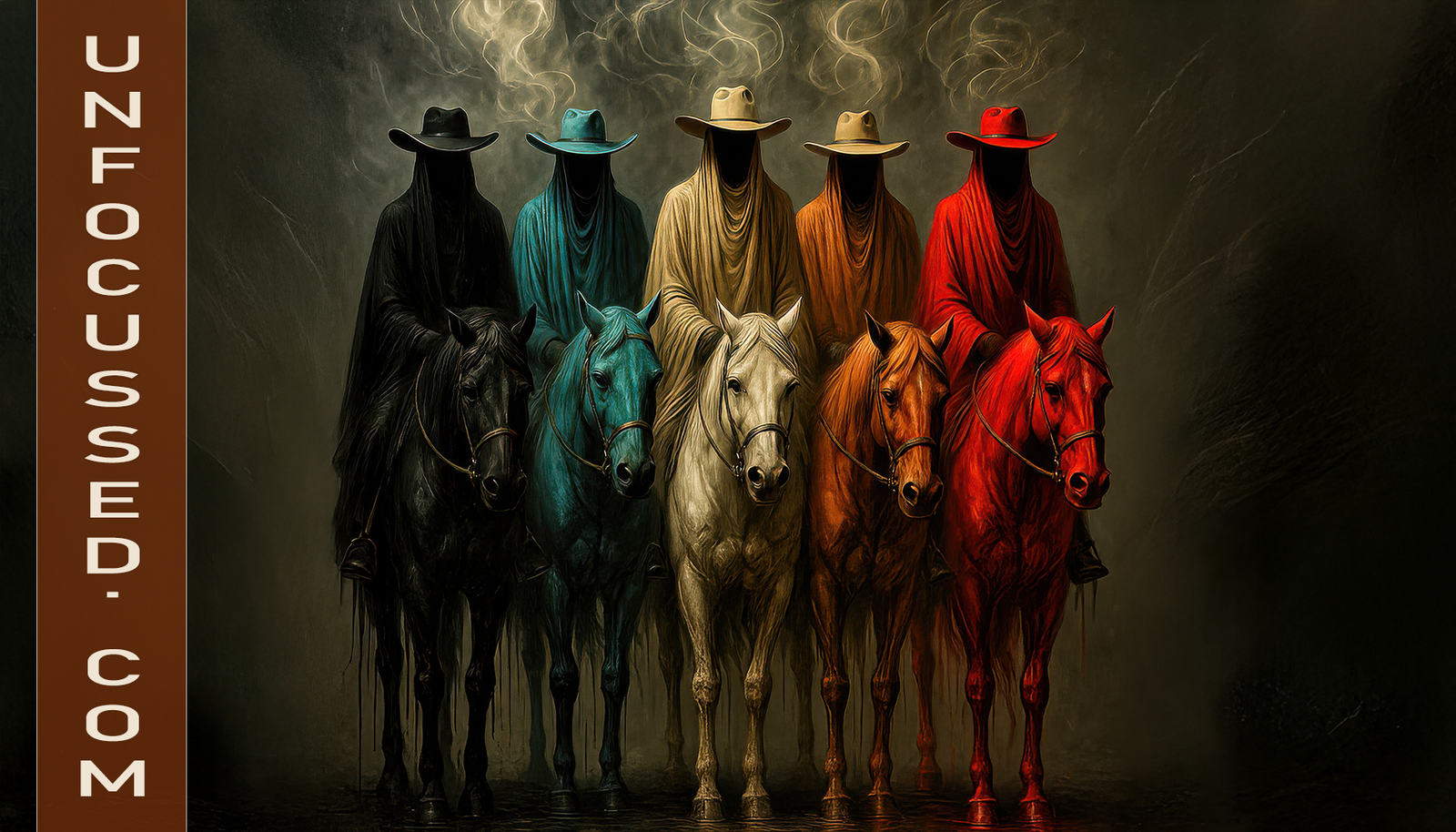
Arrival Beneath the Veil The first time the veil split open, it was barely a whisper. It came on the seventh moonless night in a row — a night so unnaturally dark that even the wolves had stopped howling, as if the sky itself had forgotten how to breathe. When it happened, the villagers of Hollowvale didn’t hear thunder, though the clouds swirled like a storm. They didn’t see lightning, though the air crackled as if under siege. Instead, they heard hoofbeats. Five of them. Each distinct. Each deliberate. Each beating out a rhythm like a death sentence, growing louder across the fields of ash and bone-dry soil. No one left their homes. Not even to peek. The elders remembered. And the elders were afraid. The sky tore open, just beyond the edge of the withering woods, where nothing had grown in two harvests. There, framed by a horizon stitched in smoke and sorrow, five riders emerged in perfect formation. They rode tall on horses that didn’t blink, didn’t snort, didn’t move — as if carved from living stone and shadow. The horses’ coats shimmered with impossible color: obsidian, ivory, ember, sea-glass teal, and wine-dark red. Their riders were cloaked in the same hues, each faceless beneath draping hoods that whispered as they moved, though no wind blew. And then… they stopped. Just outside the hamlet. Watching. Waiting. Dripping color like oil onto the soil, which hissed and burned where the hues fell. It was Judgment Eve. No one said the name out loud, but they all felt it, like a memory you don't own yet know is yours. The Riders had come before. Centuries ago. Always in fives. Always during years when the earth dried up and the crows fattened. And always, they came to choose. What they chose, no one remembered. Only that when they left, the world was not the same. This time, something was different. This time, one of the riders moved. He—if it was a he—was draped in crimson. As he dismounted, the color bled from his robes onto the ground like a gash across reality. His boots made no sound. His hand held no weapon, but his presence was violence itself. He stepped forward, and time slowed. The clouds above shifted violently, as if turning away in shame. A door creaked open in one of the homes. A child peeked out. The crimson rider turned his head. Slowly. Intentionally. And smiled. No one saw his mouth, but everyone felt it. That grin curled around the spine of the village and licked its way up the back of every neck. That was when the screaming started. That was when people began clawing at their doors, begging the gods, any gods, even the wrong ones, to hide them from the smile that wasn’t meant for mortals. The crimson rider raised his hand and pointed at the church steeple. The bell tower cracked in half, and the iron bell plummeted to the ground, burying itself in earth like a tombstone. Then, as silently as he came, the rider returned to his horse. And the five turned as one — fading slowly into the mist that gathered behind them, like ink dispersing in water. When morning came, the sky was clear. Birds chirped like idiots. Children played again. The veil was gone. But the church was still broken. The burn marks still bled through the ground where color had dripped. And the child who had opened the door? She was gone. No trace. Not a footprint. Not a scream. Not even dust. Only a single crimson feather, humming with heat, lay in her place. Signs in the Ash and Blood on the Wind The crimson feather never cooled. It was kept in a jar, sealed by seven rings of salt and watched over by the village's last Seer, a woman with only one eye and no shadow. Her name was Grendyl, and she spoke in riddles unless you asked the right question. That morning, as she held the humming glass in her trembling hands, her one eye leaked black tears. She didn’t speak. She only nodded once and muttered, “The Choosing has begun.” Over the following days, things decayed — not just in flesh, but in spirit. Cattle refused to eat. Fruit on the trees soured in the night. The blacksmith’s wife woke screaming and clawing at her arms, convinced beetles were nesting in her skin. No one could convince her otherwise — even as the physician tried to restrain her, even as she bit through her own wrist. She died staring at the ceiling, smiling and whispering, “The veil is thin, the veil is thin, the veil is thin...” Three more vanished that week. Always just after sunset. Always without sound or struggle. First a hunter, then a pair of newlyweds whose cabin was found untouched except for a ring of ash surrounding their bed and a smear of indigo paint on the pillow. The villagers met under torchlight in the remains of the church. Their voices were hushed, thick with suspicion and fear. They argued over leaving, over hiding, over arming themselves. But Grendyl arrived with the feather in her hand and slammed it down onto the altar. “You can’t run from color,” she hissed. “Not once the Riders have marked you. They don’t want your prayers. They don’t want your weapons. They want your truth.” Silence. Then, a young man — Jerro, the miller’s son — stood. “Then let’s give them mine,” he said. “Let them take me. I have nothing left.” Everyone watched in stunned silence as he walked out of the church, toward the field where the riders first appeared. Grendyl didn’t stop him. She only whispered, “Foolish boy. It doesn’t work like that.” The next morning, Jerro’s body was found in the wheat. At least, what was left of it. He had been split perfectly down the center — vertically — as if dissected by a scalpel wielded by God Himself. One half remained in the field. The other half was nailed to the door of the town’s apothecary. In place of blood, his veins held paint. Thick, radiant, glittering paint in shades no one had names for. His heart was missing. But in its place was a note, burned into the wood behind him: “Your truth was not enough.” That night, the teal rider returned. He stepped out of the mist just past midnight, his horse breathing steam that coiled into serpent shapes. The air turned viscous around him. Every lamp in the village went out. Dreams dissolved into nightmares — and everyone who had ever lied in their sleep woke up choking on their own tongues. One man burst into flames. Another aged fifty years overnight. The village dog began speaking backwards, uttering the names of the dead as it limped through the square, tail between its legs. The teal rider did not approach a home this time. He walked to the old schoolhouse and placed a single hand on its door. The building shuddered like a living thing. Screams erupted from inside — dozens of them, though the building had been abandoned for decades. The door crumbled into smoke. The screams stopped. And the teal rider, without another gesture, melted back into the mist. Grendyl now refused to speak, except in one-word answers. Her right hand began to peel, revealing ink beneath her skin. Lines. Symbols. A language only the dead understood. She began scratching them into the floorboards, muttering “the cycle returns,” over and over, like a prayer for no one. By the end of the week, Hollowvale had lost 17 souls. Not all were killed. Some simply wandered into the woods and didn’t come back. Others were found staring into the river, mouths wide open, no eyes in their sockets — just glistening marbles of swirling paint, still wet. Then came the ivory rider. He was different. Slower. He didn’t burn. He froze. His presence drained color from the world. Flowers wilted into gray powder as he passed. Wood cracked. Windows iced over. And people who looked directly at him were stricken with a shivering silence they never recovered from. Whole families stood in their yards, unmoving, unmoving, unmoving — until they crumbled into dust like frost-swept statues kissed by wind. Only Grendyl seemed unaffected. She sat in the square, scribbling furiously, humming a dirge with no melody. The feather now hovered in front of her, pulsing to the beat of the Riders' hooves no matter how far away they seemed. She was counting something. Not days. Not deaths. She was counting lies. Because that was what the Riders were feeding on. The lies we told ourselves. The ones about safety. About gods. About who we were before the veil first cracked. Before the Riders returned to remind us of the truths we buried too deep. Hollowvale was not innocent. It was chosen. And someone among them had summoned the Veil. Not by prayer. Not by magic. But by secret. Someone had made a pact. And the Riders had come to collect. The Pact, The Price, and The Pale Horizon The truth did not come gently. It broke open like a coffin kicked from the inside. It bled into Hollowvale one final night — when the sky above the woods caught fire and the last two Riders emerged. The Obsidian and the Amber. They came together this time. They did not stop at the field. They did not observe. They entered Hollowvale. Doors unlatched on their own. Walls wept varnish. Every reflective surface — from puddles to mirrors — showed not the present, but memories. Traumas. Sins. A woman dropped to her knees when she saw her reflection confess to a murder no one knew had happened. A child screamed as his own face mouthed the words: “I let it drown.” Even the dogs howled with human voices. The Riders walked through it all in silence. Their horses glided rather than trotted. The Obsidian one cast no shadow, and the Amber’s hooves rang like bells at a funeral procession. And between them, drifting like a piece of scorched cloth on invisible threads, came the Veil. It was not a metaphor. It was real. A tattered swath of something not quite fabric, not quite light — darker than night but brighter than death. It pulsed like a heartbeat, and it hummed with the weight of a thousand unspoken oaths. And when it reached the square, it stopped above Grendyl. She looked up for the first time in days, her lips cracked and dry, eyes ringed with ink. The floating feather hovered above her heart. The lines on her arms now connected into a map — a map of Hollowvale’s secrets, burned into her skin from within. She laughed. Not the laugh of someone who won — but the desperate, broken laugh of someone who thought they had time. “It wasn’t supposed to be me,” she said. The Obsidian rider spoke. A single word, and the ground rippled with it. “Lie.” The Amber rider raised a hand. The Veil descended. It touched Grendyl’s head like a crown. She arched backward with a scream so raw it flayed the crows from the sky. Her memories poured into the Veil. One by one. We saw them. Grendyl as a girl, whispering curses into the bones of a drowned priest. Grendyl in a midnight ritual with a circle of robed villagers, naming names, promising favors. Grendyl bleeding into the soil beneath the chapel, making a pact with something that had no face but many mouths. Grendyl holding a red stone, chanting, as she summoned the Riders to burn away her guilt… by making others pay her price. The Veil hissed. Not in anger. In understanding. It wrapped her completely. Her body vanished. Her screams did not. They still haven’t. And then — the Riders turned to the village. The rest of it. Not to destroy. But to choose. Every man, woman, and child was paralyzed in place. Not by magic. But by truth. When the Riders looked at you, you remembered everything you ever hid. And you felt it. In your bones. In your breath. Like you were being rewritten. Each Rider passed through the crowd. They placed hands on foreheads, over hearts, on trembling hands. They weren’t killing. They were collecting. Some people dropped where they stood — their bodies intact, but their eyes blank. Whatever made them human had been extracted. Others wept and fell to their knees in forgiveness for crimes they hadn’t admitted even to themselves. A few — very few — were untouched. Not pure, but honest. Honest in their fear, in their regret, in their weakness. The Veil spared them. The Riders bowed to them. And then the sky opened one final time. The colors that spilled out weren’t colors we know. They were emotions made visible — grief in hues that tasted like metal, joy that echoed like music. The five Riders rode back into the wound in the sky, and the Veil followed, dragging behind them like a river being sucked back into the earth. Before the breach sealed, the Obsidian rider turned once more… and dropped something into the dirt. A mirror. It still lies in the center of Hollowvale. Untouched. Because no one wants to see themselves the way the Riders saw them. The survivors rebuilt. Slowly. Quietly. With fewer lies. But they never removed the mirror. They planted nothing near it. No children are born near it. And every night, a candle is lit beside it. Not to keep anything out. But to make sure they remember what they let in. Years later, a traveler asked a blind old man sitting near the mirror, “What were they, really? Spirits? Gods?” The old man didn’t answer at first. He reached into his cloak and held up a feather — crimson, still warm to the touch. “They were our truth,” he said. “And that’s the scariest thing that’s ever come through the dark.”     If the Riders have ridden into your imagination and refused to leave, you can now bring a piece of that ominous energy into your own world. “Riders of the Chromatic Veil” is available as a hauntingly vivid wood print or as a brilliantly reflective metal print, perfect for framing your darker side in the most striking way possible. Prefer something more tactile? Challenge your sanity with the 1000-piece jigsaw puzzle — and piece together the mystery yourself. Or carry the shadows with you everywhere in a stylish, soul-stirring tote bag. Let the story live beyond the screen. Own the Veil. Touch the myth. Dare to frame your truth.
Read more

Queen of the Forsaken Soil

by Bill Tiepelman

Queen of the Forsaken Soil

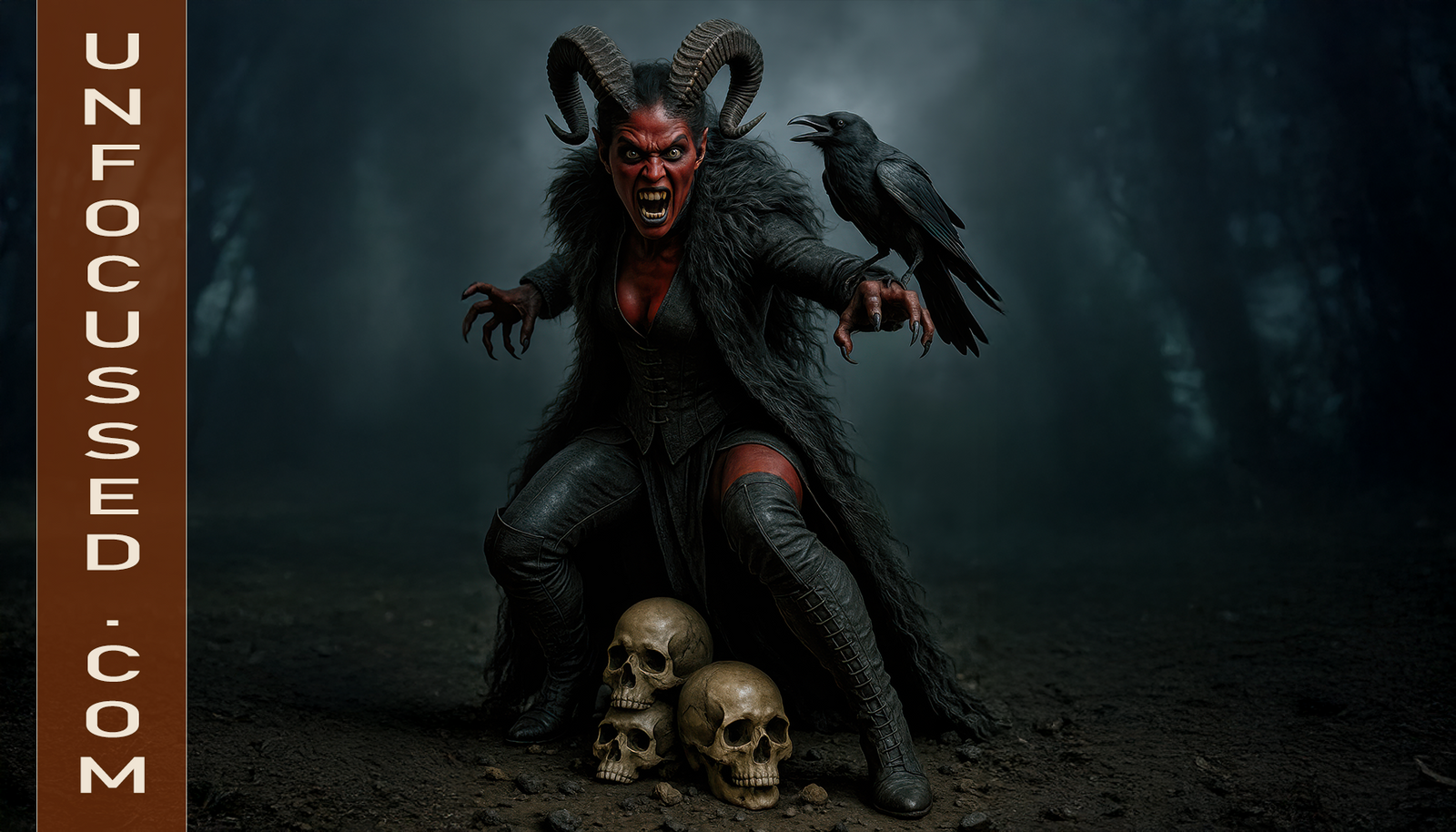
The Screaming Soil The land was wrong. Not just haunted, not just cursed. It screamed. Beneath the brittle roots of leafless trees, under stones older than kings, deep in the marrow of the earth — the soil itself whispered names. Names no one should know. It begged. It threatened. It told filthy stories that’d peel the teeth from your skull if you listened too long. That’s why no one came here willingly. Except for bastard lunatics. And Pym. Pym was a rat-catcher, formally. Informally, he was a drunk, a gravedigger’s assistant, a mediocre pickpocket, and an ex-squire who once farted during a bishop’s funeral mass and had never recovered socially. Life hadn’t handed Pym much in the way of dignity. But he had nimble fingers and a talent for pretending he didn’t notice corpses moving. He’d been sent to the Forsaken Soil by a mistake. A cartographer’s one-eyed apprentice had miswritten “blessed woodlands” on a parchment that actually meant “do not enter unless you’re tired of your skin.” Pym, ever optimistic and three tankards deep, had taken the job for a silver half-drake and a warm handjob behind the alehouse. That was twelve hours ago. And now he stood ankle-deep in muck that bled when you stepped wrong, staring at what was unmistakably a throne of skulls, and a woman — if you could call that towering hell-beast a woman — perched on it like a spider in mourning. The sky was dead gray. The trees had no leaves. The wind sounded like it sobbed through broken flutes. And the queen... She wore the darkness like a perfume. Her horns curled like old knives. Her red skin gleamed like lacquered sin. A black raven perched on her arm, pecking at a silver chain wound tight around her wrist. She snarled with the kind of authority that didn’t ask for your attention, it seized it by the throat, bit down, and whispered “mine.” “Well,” Pym muttered, already regretting everything from his childhood onward, “looks like I’ve stumbled into a royal arse-whooping.” The Queen rose. Slowly. Deliberately. As if gravity was her plaything. Her eyes, bright with fury and ancient boredom, locked on his. Her lips parted. And when she spoke, her voice cracked the air like frost cracking a tombstone. “You dare trespass,” she said, “with piss on your boots and hangover breath in your mouth?” Pym blinked. “Technically, milady, it's not my piss.” Silence. Even the raven tilted its head like it wasn’t sure whether to laugh or disembowel him. She stepped forward, the skulls beneath her throne crunching like dry cereal. “Then whose piss is it?” “...Would you believe me if I said divine intervention?” There are many ways to die in the Forsaken Soil. Slowly, screaming, clawing your own eyes out. Quickly, with your heart ripped through your back. But Pym, the idiot, did what no one in five hundred years had done: He made the Queen of the Forsaken Soil laugh. It wasn’t a pleasant sound. It was the kind of laugh that made your spleen try to leave your body through your spine. But it was a laugh. And when she was done, when her jagged grin had split her face nearly in half, she said, “Fine. I’ll give you a task.” Pym sighed. “Can it be fetching ale? I’m quite good at that.” “No,” she said. “I want you to find my heart.” “Not much for poetry, are you?” “I buried it six centuries ago in the belly of a demon. Find it, bring it to me, and I might let you leave with your genitals still attached.” Pym scratched his stubble. “Seems fair.” And with that, the Queen turned and vanished into mist. The raven stayed, watching him. Judging him. Probably considering whether he could survive on rat-catcher meat alone. “Well, bird,” Pym said, adjusting his crotch. “Looks like we’re going heart hunting.” The Demon’s Belly and the House that Hated Floors Pym had one rule in life, and it was: Don’t follow talking birds. Unfortunately, the Queen hadn’t exactly given him options. The raven squawked once, flapped its wings, and began drifting down a trail of gnarled, bone-colored trees that arched over like a vertebrae-choked tunnel. The soil beneath his feet pulsed occasionally, as if it was dreaming something ugly. Which it probably was. The whole landscape felt like the inside of a colon that belonged to a failed god. The raven didn’t talk. But it sure did judge. Every time Pym stumbled, it turned its head slowly like a disappointed librarian. Every time he muttered something sarcastic, it cawed just once — sharp and short, like it was filing his name under “Future Disembowelment.” After two hours of walking through fog so thick it made his teeth ache, Pym saw the demon. To be fair, the demon might’ve once been a castle. Or a mountain. Or a cathedral. Now it was all three, and none. It pulsed like a living organ, with windows for eyes and doors that opened and closed like mouths mid-scream. From its roof jutted towers shaped like broken fingers, and down its sides oozed viscous, dark ichor that smelled like regret, onions, and betrayal. “Queen really knows how to bury a heart,” Pym muttered. The entrance wasn’t guarded, unless you counted the wall of teeth that snapped shut every thirty seconds like a metronome for the damned. The raven landed on a crooked fencepost and cawed twice. Translation: Well, you going in or what, dickhead? Pym waited until the jaw-wall opened, dashed through, and immediately regretted everything. The inside of the demon’s belly was worse. The floors weren’t floors. They were slick, pulsing membranes that squelched under his boots. The halls shifted. Sometimes they were too narrow, other times they yawned open into cathedral-sized spaces with ceilings made of writhing worms. Portraits blinked. Doors screamed when you touched them. And worst of all, the building hated gravity. Halfway down one hallway, he fell up. He landed on the ceiling, only for it to turn into a staircase that folded inside itself like origami having a panic attack. He cursed. Loudly. The place responded with a wet belch and a wall that tried to lick him. “I’ve been in brothels cleaner than this,” he grunted. Eventually, he found the heart. Or what was left of it. It floated in a chamber the size of a cathedral nave, encased in glass, suspended in thick yellow-green fluid. It pulsed slowly, like it was remembering how to beat. Black veins curled through it, and arcane runes lit the air around it like angry fireflies. Surrounding the heart was a circle of iron obelisks, and kneeling at each was a creature that could best be described as "priest-shaped fungus with opinions." The raven landed beside him, somehow unfazed. Pym sighed. “Well. This is either the world’s creepiest baptism or a Monday in the Queen’s calendar.” He crept in, careful not to step on the writhing red roots that wormed out from the obelisks and into the walls. The moment he touched the glass, one of the kneeling things moaned and lifted its face. It had no eyes. No mouth. Just a lot of weeping holes and a very wet sound when it moved. “Ah. The welcoming committee.” Things escalated quickly. The fungus-priests rose, shaking off bits of sacred slime. They hissed. One reached for a curved knife made of screaming bone. Pym pulled a dagger from his belt — which, to be fair, was mostly ceremonial and mostly used to slice cheese — and launched himself into the dumbest fight of his life. He stabbed one in the kneecap. It squealed like a pig made of fungus and exploded into spores. Another lunged; Pym dodged and accidentally tripped on a root, landing face-first in something that definitely wasn’t carpet. He scrambled, slashed, bit, headbutted. Eventually, he stood panting, covered in goo, with three dead not-quite-monks around him, and the raven staring like it was reconsidering their entire partnership. “Don’t judge me,” he wheezed. “I was trained for rats, not demonic clergy.” He grabbed the heart. The runes screamed. The tower trembled. Outside, the demon-castle let out a sound like someone stepping on a bag of organs. The fluid in the tank began to boil. The heart beat faster — it was alive now, angry and wet and pulsing with foul heat. “Time to leave,” Pym muttered, sprinting as the floor melted and the ceiling turned into a nest of teeth. It was a blur. He ran, ducked, swore, possibly soiled himself (again — still not his fault), and finally burst out the demon’s jaw-door just as it collapsed behind him in a roaring wave of broken architecture and bile. He collapsed in the mud, still holding the jarred, steaming heart in his hands like a sacred turd. The raven landed beside him, gave a single approving caw, and nodded toward the mist. The Queen waited. Of course she did. And Pym had no idea what the hell she was going to do with this disgusting chunk of ancient rage — or what she might do with him for being stupid enough to actually succeed. But hell, he wasn’t going to back out now. “Let’s go see royalty,” he muttered, and followed the bird into the fog. The Heartless Queen and the Bastard Crown The fog thickened as Pym walked. It clung to him like a wet, pervy uncle. With every step, the heart pulsed hotter in his arms, leaking small drips of ancient, boiling ichor onto his shirt. His nipples would never be the same. Behind him, the demon-castle collapsed into a gurgling sinkhole, still belching out the occasional hymn of despair, which Pym found oddly catchy. The raven circled ahead like a drunken prophet, finally guiding him back to the clearing — back to her. The Queen of the Forsaken Soil stood exactly where he’d left her, though now the throne of skulls had multiplied. Twice the bones. Triple the menace. A second raven perched on her shoulder, this one older, balder, and somehow more disappointed-looking. “You return,” she said, eyeing him with a gaze that could make stone weep blood. “And intact.” Pym coughed, wiped some demon-slime off his chin, and held up the jar like an idiot displaying a meat prize at a butcher’s convention. “Found your heart. It was inside a giant screaming building full of religious mushrooms and bad taste.” She did not laugh this time. Instead, she descended the skull steps with a grace that made gravity blush. The mist curled away from her. The ground whispered, She walks, she walks, she walks. The two ravens flanked her like feathery shadows. When she reached him, she extended a single clawed hand. Pym hesitated, just a little. Because in that moment, the heart twitched. Not like a dying thing. Like a watching thing. Like it knew this wasn’t just a delivery. Like it wanted to be held a little longer. “...You’re not going to eat it, are you?” The Queen raised a brow. “Would it matter?” He thought about it. “Kind of, yeah. I'm emotionally fragile and squeamish after that last fungus orgy.” She grinned. “I’ll show you what I do with it.” She took the jar and — in one impossibly smooth motion — crushed it in her palm. Glass and fluid hissed, and the heart dropped onto her other hand like it had been waiting. She raised it above her head. The sky groaned. The skulls howled. A bolt of black lightning struck the earth a few feet away and opened a screaming pit full of wailing, naked lawyers (probably). Then she shoved the heart into her own chest. No wound. No incision. Just pure magic. The flesh parted like old curtains and drank the organ in. She roared — not in pain, but in power. Her skin lit from within, brighter than fire, redder than vengeance. The wind shrieked. Trees caught fire. Ravens exploded into feathers and reformed into skeletal versions of themselves. She levitated a few inches off the ground and spoke with a voice made of iron, shadow, and sarcasm. “I AM WHOLE.” “That’s... great,” Pym said, trying not to pee himself again. “So, we good? You’re healed, I get to leave with all my fingers?” She floated gently back to the ground, her form changed. Taller. More monstrous. More regal. She was still beautiful, but in the way a thunderstorm is beautiful right before it drops a tornado on your house. “You did not merely return my heart,” she said. “You touched it. Carried it. Gave it warmth. You breathed over it. That makes you...” She stepped forward, and placed one clawed hand on his chest. “...a consort.” “I’m sorry, a what now?” She snapped her fingers. Chains of mist wrapped around his limbs. A crown of bone and blood appeared in her other hand. She held it over his head with amused menace. “Kneel, rat-catcher.” “I think this is moving a bit fast—” “Kneel and rule beside me, or die with your balls in a jar. Your choice.” Pym, being an adaptable man and not particularly attached to his testicles, dropped to one knee. The crown dropped onto his greasy hair. It hissed, bit, then settled. He felt nothing at first. Then too much. Power, yes — but also history. Centuries of war, sorrow, rage, betrayal, and very poor architectural decisions. “Ow,” he said, as his spine cracked into regal posture. “That tickles. And burns.” The Queen leaned in, her lips at his ear. “You’ll get used to it. Or you’ll rot trying.” The mist lifted. The Forsaken Soil shifted. It accepted him. Skulls arranged themselves into a new throne beside hers. The dead whispered gossip. The trees bowed. The ravens nested in his hair. One of them pooped gently on his shoulder in approval. And just like that, Pym the rat-catcher became King of the Damned. Consort to a furious, heart-reborn goddess. Keeper of the Fog. Heir to nothing, master of everything that should not exist. He sat beside her, newly majestic, already itching from the crown and wondering if kings got bar tabs. He leaned over to her. “So,” he whispered, “now that we’re co-ruling, does this mean we share a bathroom or...?” The Queen did not answer. But she did smile. And far below them, in the screaming soil, something new began to stir.     Claim Your Throne (or at least your wall)If the Queen has haunted your imagination like she did poor Pym’s underwear, why not bring her home in all her dark, cinematic glory? This powerful image — Queen of the Forsaken Soil — is now available as a tapestry fit for a cursed throne room, a canvas print soaked in gothic dread, a metal print sharp enough to summon demons, or an acrylic print smooth enough to lure a raven. Want something more interactive? Dare to assemble the Queen piece by piece with this dark fantasy jigsaw puzzle — perfect for rainy nights and mild psychological unraveling. Long live the Queen… preferably on your wall.

Read more

Flesh and Flutter

by Bill Tiepelman

Flesh and Flutter

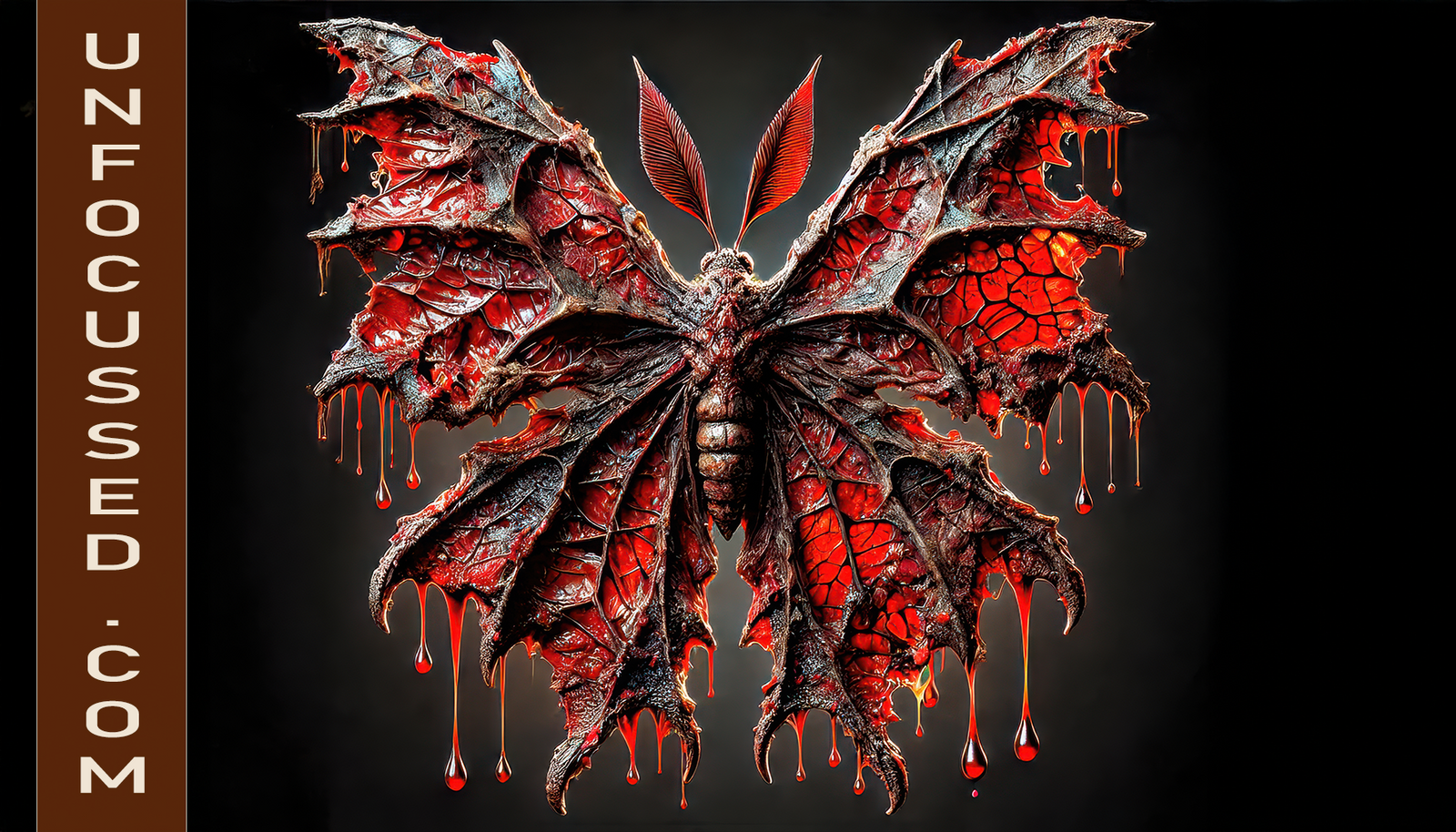
The Mark of the Swarm The sun had begun its slow descent, painting the forest canopy in hues of amber and crimson. Ethan adjusted his pack, wincing as a thorn snagged his sleeve. He glanced back at Claire, her flashlight tucked beneath her arm as she studied a crumpled map. The thick silence of the forest seemed unnatural, as though every insect and bird had fled from something unseen. "Are you sure we're on the right trail?" Ethan asked, his voice barely above a whisper. He didn’t know why he was whispering; there wasn’t a soul around for miles. "This is it," Claire replied curtly, her eyes scanning the scribbled red markings on the map. "The old campsite should be just ahead. Professor Adler said it’s where the artifact was discovered." The artifact. Ethan shuddered. Rumors surrounding the expedition had painted it as something straight out of a nightmare: an ancient relic shaped like a butterfly’s cocoon, found embedded in a tree split by lightning. The team who unearthed it had disappeared, leaving behind torn tents, bloodied gear, and whispers of unnatural deaths. “You don’t think any of it’s true, do you?” Ethan ventured, attempting to lighten the mood. Claire shot him a glare. "It’s just a story. Don’t let your imagination run wild." But Ethan’s imagination had a mind of its own. He couldn’t shake the feeling of being watched, of something ancient and malevolent stirring beneath the soil. The trees seemed to loom closer as the pair trudged forward, their twisted branches forming grotesque shapes in the dim light. It wasn’t long before they found the site. A cluster of shredded tarps clung to the skeletal remains of poles. Rotting food containers lay scattered across the ground, and a scorched fire pit sat in the center. But what caught Ethan’s attention was the tree. It towered over the campsite, its bark blackened and oozing a viscous amber sap. Embedded in its trunk was the artifact. The cocoon was massive, easily the size of a human head, and its surface shimmered as if covered in tiny iridescent scales. Deep grooves etched into its surface created an intricate, almost hypnotic pattern. Ethan stepped closer, the air around it seeming to hum. "Don’t touch it," Claire warned, but her voice was distant, as if muffled by cotton. Ethan wasn’t listening. He extended a hand, his fingers trembling as they hovered inches away from the relic. The moment his skin made contact, the hum turned into a deafening roar. Pain seared up his arm, and he screamed, collapsing to his knees. He clutched his hand, his vision blurring as the world tilted. Claire’s frantic shouts were drowned out by the sudden buzz of wings—a noise that grew louder and louder, as if thousands of insects were converging. Something burst from the cocoon, a plume of red mist erupting into the air. Ethan looked up just in time to see it—an enormous butterfly, its wings tattered but radiant with impossible colors. Its body was grotesque, pulsating with exposed muscle and dripping with some viscous fluid. It perched on the tree, its antennae twitching as if sizing them up. And then it came for him. Before Ethan could react, the creature’s wings unfurled, releasing a spray of fine, glittering dust. He inhaled sharply, coughing as the particles filled his lungs. His body convulsed, a searing pain spreading through his chest and limbs. The world around him dissolved into darkness. When he opened his eyes, everything had changed. The campsite was gone, replaced by an endless void of writhing shadows and luminous cocoons. He could hear them—whispers in a language he couldn’t comprehend, but somehow knew was meant for him. He wasn’t alone. Hundreds of glowing eyes stared back at him, and in the distance, the sound of wings grew louder. Hunger of the Swarm Ethan awoke with a gasp, his lungs burning as though he’d been underwater for hours. He was back in the forest—or at least, a version of it. The trees looked wrong. Their trunks twisted into jagged spirals, and their leaves shimmered like glass under pale moonlight. Every sound was amplified: the creak of the branches, the rustling of unseen creatures, and the ever-present hum of wings just out of sight. “Claire?” he croaked, his voice raspy and weak. She was nowhere to be seen. Panic surged through him, but when he tried to stand, his body rebelled. His limbs felt foreign, like they didn’t belong to him anymore. He looked down and recoiled. His skin was slick with a strange, translucent sheen, and faint patterns—like the veins on a butterfly’s wings—traced up his arms. “What the hell…” he whispered, his voice breaking. The buzzing grew louder, and Ethan stumbled to his feet, clutching his chest. He felt something stirring inside him, a gnawing hunger that was both his own and something… other. His vision blurred, shifting in and out of focus. Every sound, every smell, became overwhelming. The world was too vivid, too alive. And then he saw them. A swarm of creatures emerged from the shadows, their wings catching the moonlight. At first glance, they resembled butterflies, but their bodies were grotesque—bloated and glistening, with sharp, needle-like appendages. Their eyes glowed with an unnatural light, and their movements were unnervingly deliberate. They hovered around him, their wings creating a mesmerizing kaleidoscope of colors. One of them landed on his outstretched hand. He wanted to scream, to fling it away, but he couldn’t. It tilted its head, its antennae twitching as it studied him. And then it bit him. Pain shot through his arm as the creature’s mandibles sank into his flesh. Blood welled up around the wound, but instead of flowing freely, it thickened, turning black and viscous. Ethan screamed, shaking his hand violently until the thing released him and flew off, leaving behind a small cluster of wriggling larvae embedded in his skin. The sight of them made his stomach churn, but before he could react, the hunger returned—stronger this time, unbearable. His body moved on its own, his legs carrying him deeper into the twisted forest. He stumbled upon a clearing where the ground was littered with decayed animal carcasses. The stench was overwhelming, but instead of recoiling, he felt his mouth water. “No… no, no, no,” he muttered, clutching his head. But the hunger was relentless, consuming every thought. He dropped to his knees, his hands trembling as they reached for a half-rotted deer carcass. The moment his fingers touched the flesh, he felt a rush of euphoria. He tore into it, his nails slicing through skin and sinew as he devoured it like a starving animal. It wasn’t until he tasted the coppery tang of blood on his tongue that he realized what he was doing. He pushed the carcass away, retching violently. Tears streamed down his face as he looked at his blood-soaked hands. He barely recognized himself anymore. “Ethan?” His head snapped up at the sound of Claire’s voice. She stood at the edge of the clearing, her flashlight trembling in her hand. Her face was pale, her eyes wide with horror as she took in the scene before her. “Claire,” he rasped, stumbling toward her. “It’s not what it looks like. I—” “Stay back!” she screamed, fumbling to pull something from her backpack. “What the hell is wrong with you?” Ethan stopped, his heart breaking at the fear in her eyes. “It’s… it’s the artifact. It did something to me. I don’t know what’s happening—” Before he could finish, the swarm descended. They came from every direction, their wings creating a deafening cacophony. Claire screamed as the creatures surrounded her, their sharp appendages slicing through fabric and flesh. Ethan tried to reach her, but the swarm blocked his path, their bodies forming an impenetrable barrier. “No!” he shouted, his voice raw. He lashed out blindly, swatting at the creatures, but it was useless. They tore into Claire with ruthless efficiency, her screams echoing through the forest before abruptly cutting off. When the swarm finally dispersed, all that was left was her flashlight, flickering weakly on the blood-soaked ground. Ethan fell to his knees, his body wracked with sobs. The hunger surged again, stronger than ever, and he realized with growing dread that he could still smell her blood. The transformation wasn’t over. Whatever the artifact had done to him, it was far from finished. The Hive's Embrace The forest was no longer a forest. Ethan wandered through its warped remnants, the trees now pulsating as if alive. Their bark writhed with veins of dark sap, and the air vibrated with an unnatural hum. Time had lost all meaning. He didn’t know if minutes or hours had passed since Claire’s screams had faded into silence. His body continued to betray him. The hunger was insatiable, gnawing at his very core, and his flesh had become alien—translucent, with veins that shimmered in the moonlight like liquid mercury. The patterns spreading across his skin now covered his chest and neck, their iridescent glow pulsing faintly with each beat of his heart. The larvae in his arm had grown, their movement beneath his skin an unbearable itch that he couldn’t scratch. He stumbled into another clearing, this one dominated by a massive cocoon suspended between two gnarled trees. It glowed faintly, its surface undulating like a living thing. Beneath it, the ground was littered with the remains of animals—and people. Shredded clothing, broken bones, and half-dissolved bodies lay in grotesque heaps, the air thick with the stench of decay. In the center of the carnage stood the butterfly. Its wings, once tattered, were now whole, their colors so vibrant they seemed to burn the air around them. Its grotesque body pulsed with life, its antennae twitching as it turned to face Ethan. The creature’s multifaceted eyes glowed with an unnatural light, and in that moment, he knew—it was the queen. “You brought me here,” Ethan rasped, his voice trembling. “Why? What do you want from me?” The queen didn’t respond in words. Instead, she spread her wings, releasing a burst of the glittering dust that had first infected him. The particles swirled around him, entering his lungs and eyes, and the world tilted once more. The ground beneath him seemed to dissolve, and he fell—into memory, into darkness, into something far older than himself. Visions filled his mind. He saw the artifact’s creation, a monstrous ritual performed by a long-forgotten civilization. They had worshipped the queen, offering themselves to her in exchange for power and immortality. He saw their transformation, their bodies twisted and reshaped into something no longer human. And he saw their end—a mass of writhing, winged horrors consumed by their own hunger, leaving behind only the cocoon to wait for the next host. Ethan’s knees hit the ground as he returned to reality, gasping for air. The queen had moved closer, her antennae brushing against his face. He didn’t flinch. He couldn’t. Her presence was overwhelming, her gaze piercing into the deepest parts of his soul. He felt something snap inside him, a tether to his humanity breaking free. “No,” he whispered, shaking his head. “I won’t become one of you.” The queen emitted a sound—a low, chittering noise that resonated in his skull. It wasn’t laughter, but it felt like mockery. She spread her wings once more, and the swarm emerged from the shadows. They surrounded him, their eyes glowing like distant stars. Ethan’s heart raced as they descended, their needle-like appendages piercing his flesh. Pain flooded his senses, but it was nothing compared to what came next. The larvae in his arm began to move, pushing their way to the surface. His skin split open, and he screamed as they emerged, writhing and pulsating. They fell to the ground, where they were immediately consumed by the swarm, their bodies dissolving into a glittering mist that enveloped him. The transformation was complete. Ethan’s body contorted, his bones snapping and reshaping. His arms elongated, his fingers fusing into sharp, chitinous appendages. His back erupted in a spray of blood and fluid as wings tore through his flesh, their surface shimmering with the same iridescent patterns that had overtaken his skin. He screamed, but the sound was no longer human—it was a piercing, inhuman shriek that echoed through the forest. When it was over, he collapsed to the ground, his body trembling. The queen loomed over him, her antennae brushing against his new, alien form. She emitted another chittering sound, and this time, he understood. It was an order, a command that resonated deep within him. He rose to his feet, his wings unfurling behind him. The swarm parted, and he took his place beside the queen. He was no longer Ethan. He was part of the hive now, a creature of hunger and darkness. And as the queen turned toward the distant lights of the town, he followed her, the swarm rising around them like a storm. The Devouring The town slept, blissfully unaware of the storm that was coming. Streetlights flickered in the cold night air, and the faint hum of cicadas was the only sound that accompanied the stillness. In the distance, the hum of wings grew louder, a rising crescendo that would soon drown out everything else. Ethan—if that name still held meaning—watched the town from the edge of the forest. His new eyes saw the world differently, every detail sharper, more vivid. He could see the heat radiating from the houses, the slow, rhythmic pulses of the people sleeping inside. The hunger twisted inside him, relentless and overwhelming. His body ached with the need to feed, to consume, to spread. The queen moved beside him, her wings shimmering in the pale light. She emitted a low chittering sound, and the swarm surged forward, a living tide of wings and claws. Ethan followed, his movements fluid and alien, his wings beating in time with the rest of the hive. He no longer felt fear or hesitation—only hunger and purpose. They descended upon the first house like a plague. The windows shattered as the swarm poured inside, their needle-like appendages slicing through walls and furniture with ease. Screams erupted from within, but they were quickly silenced. Ethan stepped through the wreckage, his antennae twitching as he sensed the lingering warmth of life. A man stumbled into the hallway, his face pale and his eyes wide with terror. “Please,” the man begged, his voice shaking. “Don’t—” Ethan lunged, his claws piercing the man’s chest. He felt the life drain from him, the warmth transferring into his own body, fueling the transformation further. The hunger eased for a moment, but it wasn’t enough. It would never be enough. The swarm moved from house to house, leaving destruction in their wake. The streets were soon littered with bodies, their flesh stripped and their bones left to rot. The town’s alarm system blared to life, but it was too late. The few who managed to escape their homes ran blindly into the night, only to be overtaken by the swarm in moments. Ethan found himself standing in the center of the town square, his wings casting long shadows under the flickering streetlights. The queen perched on the clocktower above, her wings spreading wide as she emitted a sound that resonated through the entire swarm. It was a triumphant cry, a signal that the hive had claimed another place as its own. But something shifted within Ethan. As he looked at the carnage around him, fragments of his old self clawed their way to the surface. He remembered Claire’s face, the way she had looked at him with fear and desperation. He remembered the life he had before the artifact, before the swarm. And for the first time since his transformation, he felt something other than hunger. The queen sensed it. She turned her gaze toward him, her eyes glowing with fury. Her wings beat once, and the swarm surrounded him, their bodies forming an impenetrable wall. He knew what was coming. The hive didn’t tolerate weakness or rebellion. If he couldn’t obey, he would be destroyed. “No,” Ethan growled, his voice distorted and inhuman. “Not like this.” He lunged at the queen, his claws slicing through the air. She shrieked, her wings creating a burst of wind that sent him crashing to the ground. The swarm attacked, their mandibles tearing into his flesh, but he didn’t stop. He clawed his way toward her, his body fueled by a desperate determination. With a final, furious leap, he plunged his claws into the queen’s chest. Her shriek was deafening, and the swarm froze, their movements erratic and confused. The queen’s body convulsed, her wings flailing wildly before she collapsed, her glow fading into darkness. As the queen died, the swarm disintegrated. Their bodies crumbled into ash, carried away by the wind. Ethan collapsed beside her, his body trembling with exhaustion. The hunger was gone, replaced by a crushing emptiness. He looked at his hands, now clawed and alien, and knew there was no going back. The town was silent once more, the only sounds the faint crackle of fires burning in the ruins. Ethan rose to his feet, his wings unfurling behind him. He was alone now, a creature caught between two worlds. As he stared at the horizon, the first rays of dawn breaking through the darkness, he made his decision. He would leave, far from humanity, far from the relics of the past. He didn’t know if he could control what he had become, but he would try. He owed it to Claire, to himself, to whatever fragments of his soul still remained. And as the light washed over him, he disappeared into the forest, leaving behind only the echoes of his wings.     This haunting story, "Flesh and Flutter," is brought to life with captivating imagery. If you're intrigued by the eerie atmosphere and stunning visuals, you can explore and obtain prints, downloads, or licensing of the featured artwork from our Image Archive. Visit the link below to discover more: Explore the Image Archive

Read more

The Vampire Moth: Fluttering Fangs

by Bill Tiepelman

The Vampire Moth: Fluttering Fangs

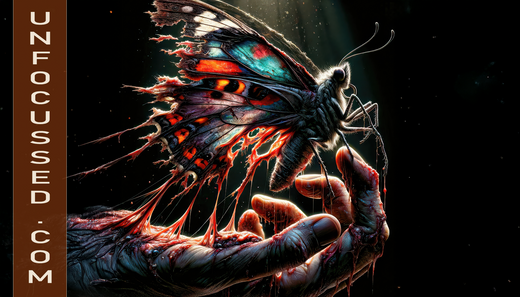
Chapter One: Hollow's End The story started like any other urban legend: whispered in dimly lit bars, passed around campfires, and dismissed as drunken ramblings. But in Hollow’s End, everyone knew something lurked in the shadows, even if no one wanted to admit it. The tales weren’t just stories—they were warnings. You didn't stay out after dark, and you sure as hell didn’t open your windows, no matter how stuffy the summer night air felt. They said the Vampire Moth had been around for centuries. Legends claimed it had arrived on a ship from the Old World, clinging to the tattered sails, drawn by the scent of sailors’ blood. Some said it was the result of a curse—a monarch who angered the gods and was condemned to forever feed on life but never live. But if you asked the local hunters, they’d just tell you it was an overgrown moth with a taste for blood. The truth, as always, was somewhere in between. Hollow’s End wasn’t always a town drowning in rumors. There was a time, long before I was born, when it thrived—orchards bursting with apples, kids playing in the streets, and neighbors who smiled and waved. But that was before the disappearances. They started slow, a child here, a vagrant there, but after a while, it became impossible to ignore. By the time I was old enough to understand, the town had become a shell of its former self. People moved away. The orchards rotted. No one smiled anymore. And the only thing that filled the streets at night was the wind, carrying with it the scent of decay and fear. My parents were one of the few that stayed. Call it stubbornness or stupidity, but they weren't the kind to run. Maybe they thought the stories were just that—stories. I mean, who really believes in a giant blood-drinking moth? Monsters weren’t real. Or so I thought. Until the night it came for me. Chapter Two: The Encounter I was never one for superstitions. I'd heard the warnings all my life, the whispered advice to never open your windows after sunset. But on that particularly sticky August evening, I just didn’t care. The air inside my room was suffocating, and I figured the odds of getting snatched by some mythical moth were about as high as winning the lottery. So, I cracked the window. The breeze that swept in was a relief, cool and calming. For a while, I just lay there, letting the air wash over me. I was half-asleep when I heard it—a soft fluttering, barely audible, like the distant sound of paper wings. At first, I thought it was nothing. Maybe a bird or a bat. But the noise grew louder. Then came the smell—a thick, coppery scent, like fresh blood hanging in the air. My skin prickled. I sat up, heart pounding, my gaze scanning the room. That’s when I saw it. It wasn’t just a moth. No, this thing was monstrous. Its wings spanned nearly the length of my bed, dripping with a dark red substance that oozed off the edges and splattered onto the floor. The wings were translucent in places, revealing veins that pulsed with every beat. Its body was grotesque, bloated and pulsating, with an unnatural sheen like wet leather stretched over a skeleton too big for its frame. And its eyes—those glowing, ember-red eyes—locked onto me. I froze, unsure if I should scream or run, but my body refused to move. The moth hovered there for a moment, its wings beating slow, hypnotic rhythms. Then it moved toward me, a predatory grace in every shift of its wings. I could see its fangs now, sharp and glistening with whatever life it had stolen from its last victim. In my paralyzing panic, I muttered, “Nice wings. You doing a blood drive or something?” Because dark humor is all I had left. The moth paused, as if it understood me. For a moment, I could swear it smiled. Then it struck. Chapter Three: The Feed The fangs sank into my shoulder, and though I had expected sharp pain, it was oddly delicate. The moth's bite was precise, almost clinical, as if it knew exactly where to sink its fangs to cause the least damage but still drain me dry. The sensation wasn’t pain—it was worse. It was like my very essence was being siphoned, the life draining from me one drop at a time. I could feel the warmth leaving my body, replaced with an unnatural cold that seeped into my bones. My vision blurred as the moth’s wings wrapped around me, enveloping me in a cocoon of darkness and decay. The scent of blood and rot filled my lungs, making it hard to breathe. My heart raced, then slowed, the beats becoming weaker with each passing second. Just when I thought it would drain me completely, the creature stopped. Its wings unfurled, and it hovered above me, its eyes still fixed on mine. For a moment, I thought it might finish the job. But instead, it did something far worse. It laughed. Not a sound I would expect from an insect—no, it was almost human, a soft, raspy chuckle that sent chills down my spine. It floated back, as if admiring its work, and then, with a final flutter of its blood-soaked wings, it flew off into the night, leaving me gasping for air and half-dead on my bed. Chapter Four: Aftermath When I woke the next morning, the marks on my shoulder were still there—two perfect puncture wounds. But they weren’t what scared me. What scared me was the feeling that something had been taken from me. I was still alive, sure, but I wasn’t whole. The moth had left me with more than just scars. It had taken a part of my soul, a piece of me I would never get back. I tried to explain it to people, but no one believed me. Not at first. Not until more bodies started turning up, drained, hollowed out like empty husks. The town was in a panic. The sheriff organized search parties, and people started boarding up their windows, but it didn’t matter. The moth wasn’t some wild animal you could hunt. It was smarter than that. And it was hungry. Chapter Five: The Joke’s on You Now, whenever someone in Hollow’s End cracks a joke about the Vampire Moth, I just smile and pull down my shirt collar. “Laugh all you want,” I say, revealing the twin puncture marks, “but the real joke’s on you when it decides you’re next.” Because here’s the thing they don’t tell you in the legends. The Vampire Moth doesn’t just kill you. It leaves a piece of itself behind, a little parting gift. I can feel it growing inside me, every day, bit by bit. The hunger. The need. It’s only a matter of time before I turn into something else—something that craves the taste of blood just as much as it did. So, if you’re ever in Hollow’s End, keep your windows closed, and maybe—just maybe—you’ll make it through the night. But if you hear a soft fluttering sound and smell something sweet and coppery in the air, well… let’s just say you should start writing your will.  

Read more

Explore Our Blogs, News and FAQ

Still looking for something?