
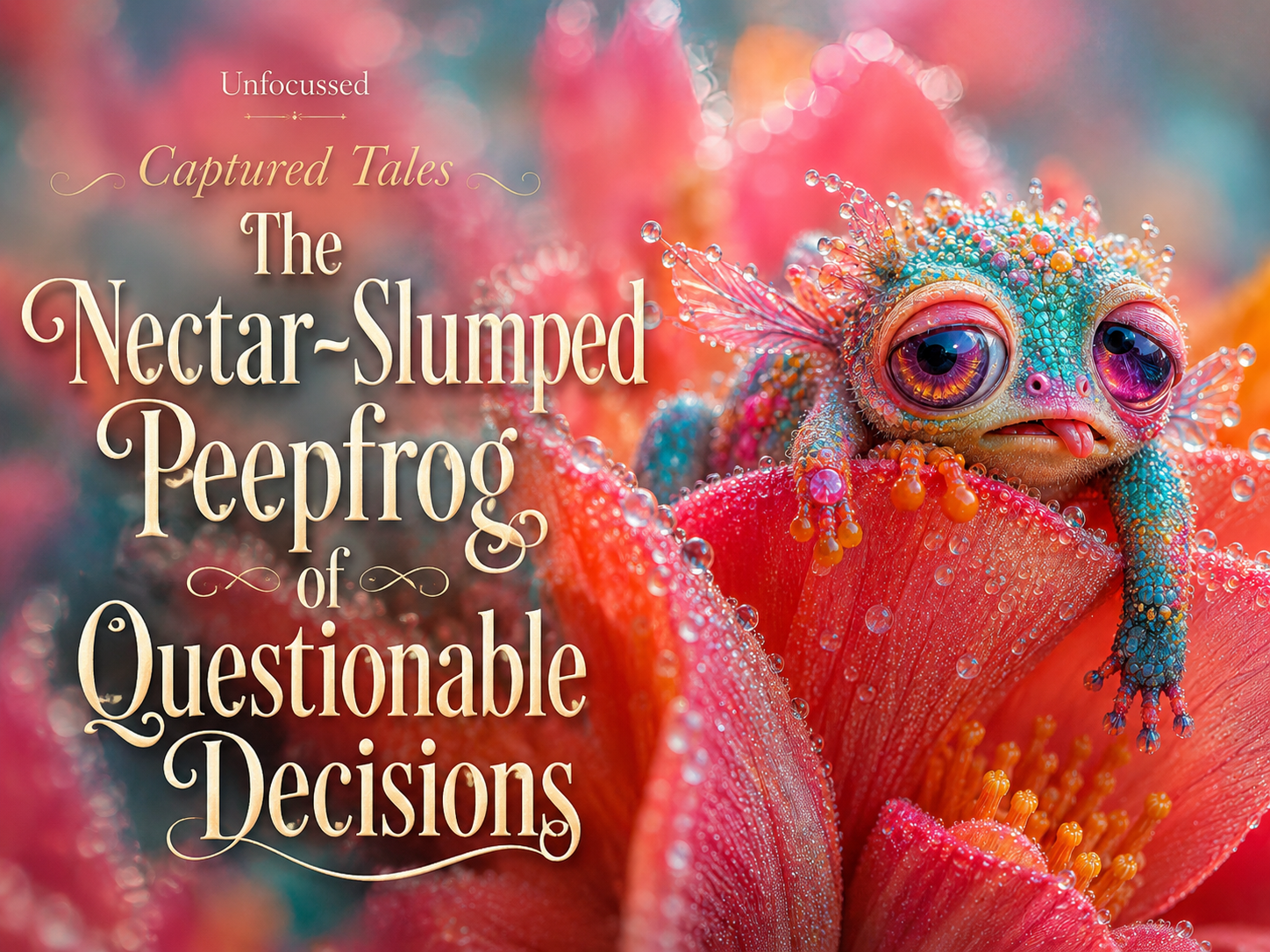
La flor que escuchó demasiado
Para cuando el rocío de la mañana terminó de acomodarse en pequeñas y respetables perlas a lo largo de los pétalos del hibisco color coral, todos en el Jardín de Azúcar Silvestre ya se habían puesto de acuerdo en dos cosas.
Primero, la flor se veía magnífica.
Segundo, la diminuta rana que había dentro parecía como si el infierno se la hubiera prestado toda la noche y se la hubiera devuelto sin el recibo.
Su nombre era Pipkin Spogglewort, aunque absolutamente nadie lo llamaba así a menos que estuvieran enojados, fueran funcionarios o tuvieran papeles que llenar. Para la mayoría del jardín, él era Pip. Para sus amigos, era Pips. Para las abejas, era "ese pequeño idiota pegajoso". Y para el hibisco que actualmente acunaba su cuerpo lacio y salpicado de purpurina entre tres pétalos de terciopelo, él era "una carga espiritual húmeda con poco sentido de los límites".
Pip parpadeó un ojo enorme de color rosa púrpura, y luego el otro. No parpadearon al mismo tiempo, lo cual ya era una mala señal. Su piel turquesa brillaba con motas naranjas, protuberancias rosadas y suficiente rocío como para sugerir que había sobrevivido a una tormenta o que una nube lo había lamido agresivamente. Su boquita estaba ligeramente abierta. Su lengua colgaba hacia un lado como un serpentín abandonado después de un desfile decepcionante.
—¿Dónde —susurró Pip— está mi dignidad?
El hibisco se agitó a su alrededor.
—Tres pétalos más abajo —dijo ella—. Al lado de tu sentido común.
Pip consideró esto por un momento. Pensar dolía. Se detuvo.
A su alrededor, el Jardín de Azúcar Silvestre se adentraba en el amanecer con esa clase de belleza excesiva que hacía que los jardines normales parecieran haberse rendido a mitad de camino mientras se vestían. Las gotas de rocío brillaban en cada tallo. El aire olía a néctar, polen, musgo cálido y secretos. Las flores rosadas se abrían como bocas chismosas. Los estambres naranjas se balanceaban bajo la luz. Diminutas criaturas aladas zumbaban entre las flores, fingiendo que tenían algo importante que hacer, porque si algo caracterizaba a los insectos, era su compromiso por parecer ocupados.
Pero hoy, la atención del jardín se había reunido alrededor de Pip.
Las mariquitas se alinearon en la hoja más cercana en pequeñas filas preocupadas. Un par de polillas revoloteaban boca abajo desde una enredadera rizada, susurrando dramáticamente. Tres hormigas habían dejado de cargar una miga solo para mirar. Incluso los escarabajos, que normalmente se ocupaban de sus propios asuntos a menos que algo involucrara hongos, disputas de alquiler o humillación pública, se habían reunido cerca de la base del hibisco.
Y por encima de todos ellos, zumbando en un círculo profundamente crítico, estaba Brindlewax, auditor superior de néctar del Apiario de la Flor del Este.
—Está despierto —anunció Brindlewax.
Varias criaturas jadearon.
—Apenas —dijo el hibisco.
Pip intentó levantar la cabeza. Su cabeza rechazó la invitación.
—No estoy despierto —murmuró—. Solo estoy siendo molestado desde otro reino.
El jardín se quedó en silencio.
Ese fue el primer problema.
Porque Pip lo había dicho como una queja. Una patética, sí, pero aún así solo una queja. El tipo de cosa que cualquier rana del jardín caída en el néctar podría decir después de una noche de exceso de confianza, deshidratación y decisiones tomadas cerca de una flor etiquetada como *Solo para uso ceremonial, ustedes duendes absolutos*.
Pero el Jardín de Azúcar Silvestre no era un lugar donde las declaraciones dramáticas pasaran desapercibidas. Era un lugar donde un escarabajo podía estornudar dos veces y encontrarse acusado de predecir la lluvia.
Así que, cuando Pip dijo que estaba siendo molestado desde otro reino, las polillas se miraron entre sí.
Las hormigas dejaron de moverse por completo.
Las alas de Brindlewax se ralentizaron.
Y el viejo caracol debajo del helecho, que alguna vez había comido la mitad de una flor de luna y decía entender de impuestos, levantó la cabeza y susurró: "Él ve más allá del rocío".
Pip gimió.
—No —dijo—. Veo diecisiete de cada cosa y odio a doce de ellas.
Las polillas volvieron a jadear, más fuerte esta vez.
—Diecisiete visiones —susurró una.
—Doce caminos falsos —respiró la otra.
—Ay, por el amor al polen —dijo el hibisco—. Tiene resaca.
Pero la noticia ya había comenzado a extenderse.
No la palabra *resaca*, naturalmente. Eso habría sido útil, razonable y preciso. No, el jardín prefería las palabras con capa.
Para el desayuno, tres escarabajos le decían a los lechos de musgo inferiores que la rana del jardín en la flor coral había regresado del Reino de las Diecisiete Visiones.
Para el segundo desayuno, una oruga había adornado esto para incluir una puerta brillante, una corona de gotas de rocío y una misteriosa advertencia sobre la mermelada.
Para cuando el sol alcanzó los pétalos superiores, Pip Spogglewort se había convertido en un profeta.
Y Pip, que en ese momento no podía recordar si tenía pies, no estaba en condiciones de detenerlo.
El néctar prohibido estaba claramente etiquetado
La noche anterior había comenzado de forma bastante inocente, que es lo que todo el mundo decía justo antes de describir algo que absolutamente no permaneció inocente.
El Jardín de Azúcar Silvestre se había estado preparando para la Revelación del Cambio de Flores, una celebración anual en la que las flores cambiaban sus perfumes estacionales, las abejas bendecían las reservas de néctar, las luciérnagas ensayaban su coreografía de luz y todo el mundo fingía que las babosas no se volverían raras a medianoche.
Pip había asistido porque había bocadillos.
Esto no era inusual. Pip asistía a la mayoría de las cosas porque había bocadillos, la posibilidad de bocadillos o rumores de bocadillos que alguna vez existieron cerca. No era codicioso, exactamente. Simplemente estaba espiritualmente alineado con el consumo.
Había llegado al crepúsculo con rocío en sus adornos capilares, polen en los dedos de los pies y el rebote optimista de una criatura que ya había olvidado dos advertencias y estaba trabajando en una tercera.
—No bebas de las Copas del Pozo de Luna —le había dicho Brindlewax en la entrada de la arboleda de hibiscos.
—Obviamente —había dicho Pip.
—Hablo en serio —dijo Brindlewax, estrechando sus cinco mil opiniones de abeja en una sola mirada—. Son néctar ceremonial. Concentrado. Fermentado a la luz de la luna. Revuelto con tomillo plateado. Reservado para la Reina Hibisco, los polinizadores ancianos y quien gane el concurso formal de recitación de pétalos.
Pip asintió solemnemente.
—¿Y yo?
—No.
—¿Como invitado?
—No.
—¿Como una rana de complejidad emocional?
—Absolutamente no.
Pip colocó una mano diminuta sobre su corazón. —Brindlewax, me ofende que pienses tan poco de mí.
—Pienso exactamente lo necesario de ti —dijo Brindlewax.
Esto fue grosero, pero no inexacto.
Durante la primera hora, Pip se comportó maravillosamente. Probó néctar respetable de flores aprobadas. Cumplimentó a los caléndulas por su trabajo de flecos. Aplaudió en el ensayo de las luciérnagas, aunque una de ellas deletreó *BIENVENIDO* como *BIENCORNO* y todos tuvieron que fingir que el maíz era festivo.
Incluso escuchó cortésmente mientras la Dama Periwink, el caracol más viejo en los lechos del este, realizaba un poema de diecisiete minutos sobre el compost.
Luego alguien sacó las Copas del Pozo de Luna.
Estaban sobre un anillo de musgo pálido debajo del dosel de hibisco, cada una formada por un pétalo de hoja de plata rizado y llena de néctar tan luminoso que parecía recordar a las estrellas personalmente. Las copas brillaban débilmente. Olían a miel, bayas silvestres, lluvia y el tipo exacto de error que se presenta a sí mismo como una oportunidad única en la vida.
Pip las vio.
Las copas vieron a Pip.
El destino, ese viejo y desordenado vándalo, tomó un pincel.
—No —dijo Brindlewax desde algún lugar cercano, sin siquiera darse la vuelta.
Pip se congeló.
—No estaba haciendo nada.
—Estabas pensando.
—Eso es legal.
—No de la forma en que tú lo haces.
Pip retrocedió de las copas con una inocencia exagerada. Pasó los siguientes diez minutos fingiendo admirar un helecho. Luego fingió estornudar. Luego fingió buscar un pendiente perdido, a pesar de no tener oídos en el sentido de pendiente, ni joyas en el sentido de propiedad.
Finalmente, en la breve confusión causada por una babosa intentando coquetear con un tulipán cerrado, Pip se deslizó detrás del hibisco y se encontró solo con una Copa del Pozo de Luna.
Brillaba.
Pip tragó saliva.
—Solo un sorbo —susurró.
La Copa del Pozo de Luna no dijo nada, porque las copas rara vez son útiles en situaciones morales.
Pip tomó un sorbo.
El néctar era glorioso.
Sabía a luz de melocotón, trueno de frambuesa y ser perdonado por adelantado. Rodó por su lengua, bajó por su garganta y fue directamente a la parte de su cerebro responsable de la moderación, donde derribó la puerta de sus bisagras y arrojó purpurina sobre los muebles.
—Oh no —susurró Pip.
Luego tomó otro sorbo.
Después de eso, la historia se volvió decorativa.
Recordaba bailar sobre un hongo y declararlo "demasiado emocionalmente redondo". Recordaba desafiar a una libélula a un concurso de miradas y perder contra su propio reflejo. Recordaba decirle a un grupo de hormigas que eran "la columna vertebral del jardín pero demasiado engreídas al respecto". Recordaba abrazar un copo de polen y disculparse con él por el capitalismo, a pesar de no saber qué era el capitalismo.
En algún momento se había subido al hibisco color coral, se había acurrucado en los pétalos, anunció: "La luna tiene huesos", y se desmayó tan profundamente que una araña lo había revisado por su valor de reventa.
Ahora había llegado la mañana, con su brillo grosero y sus expectativas imperdonables.
Y lo que es peor, testigos.
La primera profecía era mayormente sin sentido
—Profeta —dijo el viejo caracol.
Pip entrecerró los ojos hacia él desde el hibisco.
El caracol llevaba una pequeña capa hecha con un pétalo de violeta caído. Esto era nuevo. Esto era preocupante.
—¿Por qué —preguntó Pip con cautela— estás vestido como una servilleta dramática?
El caracol inclinó la cabeza. —Soy Sloop de la Concha Escuchadora, primer seguidor humilde del Vidente de la Flor.
—No.
—Tu sabiduría me humilla.
—Eso no fue sabiduría. Eso fue rechazo.
—El rechazo es la primera puerta.
Pip se quedó mirándolo.
—Necesito agua.
El caracol se volvió bruscamente hacia las criaturas reunidas. —¡Ha hablado! ¡La primera puerta requiere agua!
—Eso no es lo que yo—
Pero una docena de mariquitas ya se habían dispersado para buscar rocío.
Pip se hundió más en los pétalos. La flor olía cálida y azucarada, lo cual era a la vez reconfortante y profundamente amenazante. Cada vez que inhalaba, su estómago hacía un pequeño ruido infeliz, como un pudín siendo embrujado.
—Escuchen —dijo, tratando de sonar autoritario y no como una rana cuya lengua se había convertido en una bufanda húmeda—. No soy un profeta.
—Por supuesto —dijo Sloop—. El verdadero profeta niega la flor.
—Te niego a ti específicamente.
—Bendita especificidad.
—Los patearé a todos a un huerto de frijoles.
Las polillas temblaron. Una se agarró a la otra.
—Un huerto de frijoles —susurró la primera—. Un lugar de comienzos enterrados.
—Y legumbres —susurró la segunda.
El hibisco dio un largo y cansado suspiro. —Ustedes son agotadores. Podría eructar y escribirían las escrituras.
Desde algún lugar entre la multitud, un escarabajo levantó un pie. —Depende del eructo.
Pip cerró los ojos.
Este fue un error.
Detrás de sus párpados, formas brillantes tambaleaban. Vio destellos de la noche anterior: el néctar brillante, el hongo giratorio, Brindlewax gritando, la babosa del tulipán guiñando con todo su cuerpo. Se vio a sí mismo de pie sobre una raíz cubierta de musgo, señalando la luna, diciendo algo con gran confianza y sin supervisión interna.
Cuando abrió los ojos de nuevo, la multitud se había acercado.
—¿Qué? —dijo Pip.
La concha de Sloop se estremeció. —Estabas comulgando.
—Estaba parpadeando.
—Con el ojo interior.
—Con el ojo normal. Con ambos, si logran ponerse de acuerdo.
Una mariquina regresó con una gran gota de rocío equilibrada en una brizna de hierba. Pip la bebió con avidez. Ayudó lo suficiente como para recordarle cuánto no ayudaba todo lo demás.
—Bien —murmuró—. Aquí hay una profecía. No beban néctar brillante de copas desatendidas.
La multitud inhaló al unísono.
Brindlewax aterrizó en un pétalo cercano, dobló las piernas y miró fijamente. —Eso no es una profecía. Eso es señalización básica.
—La señalización salva vidas —dijo Pip.
Sloop bajó hasta que su capa se arrastró por el polen. —El Vidente de la Flor nos advierte: la tentación brilla más cuando está desatendida.
Las polillas comenzaron a repetirlo.
—La tentación brilla más.
—Cuando está desatendida.
—Oh, no —dijo el hibisco.
—No —coincidió Pip—. Absolutamente no. Dejen de hacerme sonar significativo.
Pero era demasiado tarde. El significado había entrado en el jardín como el moho en una casa de baños.
En cuestión de minutos, tres hormigas habían abandonado su miga, alegando que necesitaban reconsiderar el peso moral del trabajo. Un joven escarabajo rompió a llorar porque alguna vez había comido mermelada desatendida. Dos abejas cubrieron las Copas del Pozo de Luna restantes con musgo y comenzaron a discutir sobre si la tentación requería un permiso.
Pip observó con horror cómo su advertencia casual se transformaba en doctrina.
—Tú hiciste esto —dijo Brindlewax.
—Yo no hice esto —espetó Pip—. Dije algo normal. Ellos lo hicieron raro.
—Así es como empiezan la mayoría de los desastres contigo.
El hibisco inclinó suavemente un pétalo, obligando a Pip a deslizarse medio centímetro hacia el borde.
—Tal vez —dijo ella—, el profeta debería descender antes de que sus seguidores comiencen a llamar a sus hijos como él.
Pip miró hacia la multitud.
Un escarabajo ya estaba tallando algo en un trozo de corteza.
—¿Qué estás escribiendo? —preguntó Pip.
El escarabajo levantó la vista con orgullo. —La Primera Gota de Pip.
Pip miró a Brindlewax.
—Mátame.
—Ponte a la fila —dijo la abeja.
Una capa, un culto y varias malas interpretaciones
Para el mediodía, el problema tenía piernas.
Esto era injusto, porque las propias piernas de Pip todavía se sentían como si hubieran sido tomadas prestadas de un fideo húmedo e instaladas incorrectamente. Pero el rumor no tenía tal dificultad. Corría maravillosamente.
A través del Jardín de Azúcar Silvestre, las criaturas repetían fragmentos de la supuesta profecía de Pip con la confianza de personas que no habían estado allí y, por lo tanto, no sentían la carga de ser precisas.
En el parche de menta, decían que el Vidente de la Flor había advertido contra todas las cosas brillantes, haciendo que una luciérnaga renunciara a sus actuaciones públicas y se dedicara a la contabilidad.
Cerca de las zarzas de moras, un grupo de hormigas declaró que los objetos desatendidos eran espiritualmente peligrosos y se negaron a cargar nada a menos que estuviera siendo observado.
En la orilla del estanque, tres mosquitos formaron un círculo de discusión alrededor de la frase "la luna tiene huesos", que Pip aparentemente había dicho durante la noche y que ahora los tenía a todos aterrorizados por las mareas.
Y Sloop de la Concha Escuchadora se había vuelto insoportable.
Se paró sobre un guijarro debajo del hibisco, vistiendo su capa violeta y dirigiéndose a una multitud creciente.
—Amigos del rocío y la tierra —proclamó Sloop—, nos reunimos bajo la Flor Coral, donde la gran Rana del Jardín regresó del error brillante y nos trajo una advertencia.
—Traje náuseas —murmuró Pip.
—¡Habla! —gritó una polilla.
—No, me quejo. Hay una diferencia.
Sloop levantó un tallo ocular. —El profeta nos dice que la queja y la verdad son gemelas.
—No son gemelas. Apenas se conocen.
—¡Gemelos distanciados! —jadeó el escarabajo con la tablilla de corteza.
Pip se frotó la cara con ambas manos diminutas. El rocío se corrió por sus mejillas. Una gota de néctar rodó desde una protuberancia de su frente hasta su nariz y se quedó allí, brillando como una acusación.
—¿Por qué todos son así? —preguntó.
El hibisco respondió sin dudarlo. —Porque un jardín es solo un pueblo con mejor iluminación y más polen.
Eso, desafortunadamente, era sabiduría.
Brindlewax caminó a lo largo del borde del pétalo, moviendo las alas. —Tenemos que terminar con esto antes de que la Reina Hibisco se entere.
Pip se puso rígido.
—¿Ella no se ha enterado?
—Todavía no.
—Bien.
—Está en la arboleda superior aprobando las revisiones de perfumes.
—Genial.
—Y si ella se entera de que bebiste néctar ceremonial, profanaste su flor y accidentalmente fundaste un movimiento espiritual antes del almuerzo, tendrá preguntas.
Pip tragó saliva. —¿Cuántas preguntas?
Brindlewax le lanzó una mirada.
—Del tipo que tiene consecuencias.
El estómago de Pip hizo otro ruido de pudín embrujado.
La Reina Hibisco no era una gobernante en el sentido de corona y trono. Era peor. Era una gobernante en el sentido social. Ella controlaba qué flores se abrían para los festivales, qué abejas recibían acceso prioritario al néctar, qué enredaderas podían trepar por el enrejado y quién era invitado a la Cena Anual de Almizcle Lunar, donde todos fingían disfrutar de pasteles de polen fermentado.
Si la Reina Hibisco decidía que Pip era una amenaza, las puertas se cerrarían. Los pétalos se cerrarían. El acceso a los bocadillos se volvería complicado.
Y Pip era muchas cosas, pero no estaba preparado para una vida de bocadillos complicados.
—Necesitamos un plan —dijo.
—Finalmente —dijo Brindlewax.
Pip se puso de pie, se tambaleó y se agarró al borde del pétalo. —Me dirigiré a la multitud. Explicaré que no soy un profeta. Me disculparé por el néctar. Luego me iré a casa, me enterraré bajo una hoja húmeda y nunca más volveré a experimentar la conciencia.
—Razonable —dijo Brindlewax.
—Cobarde, pero razonable —dijo el hibisco.
Pip ignoró eso porque las flores eran crueles cuando tenían buenos pómulos.
Se arrastró hacia el borde de la flor. La multitud de abajo se calló. La luz del sol atrapó cada gota a lo largo de su cabeza y adornos, convirtiéndolo en un diminuto desastre enjoyado. Sus ojos, aún hinchados de color y arrepentimiento, reflejaban todo el jardín hacia sí mismo.
Sloop se inclinó tanto que su capa se volcó sobre su concha.
—Vidente de la Flor —dijo, amortiguado bajo la tela violeta—, esperamos el segundo goteo.
—No lo llames así —dijo Pip.
El escarabajo rasguñó con entusiasmo en la tablilla de corteza.
Pip tomó aire.
—Todos —comenzó—, ha habido un malentendido.
La multitud se inclinó hacia adelante.
—Bebí algo que no debería haber bebido.
Un murmullo recorrió a las criaturas.
“Sí”, dijo Sloop solemnemente. “El error sagrado”.
“No. No es sagrado. Solo es una estupidez”.
“La humilde máscara de la sabiduría”.
“Juro por cada mosca que he comido que no soy sabio”.
Varios mosquitos se desmayaron.
Pip insistió. “No visité otro reino. No tuve diecisiete visiones. No regresé con conocimiento divino. Me desperté pegajoso en una flor porque soy bajo, impulsivo y, al parecer, no se puede confiar en mí cerca de bebidas brillantes”.
Por un segundo hermoso, reinó el silencio.
Pip sintió esperanza.
Entonces Sloop susurró: “El profeta se despoja de la gloria”.
“Oh, vamos”.
“Confiesa el error sagrado, nombra la bebida brillante y se llama a sí mismo bajo para que podamos entender la humildad”.
“¡Me llamé bajo porque mido seis bayas de altura y estoy hecho como una coma mojada!”.
El escarabajo de corteza talló más rápido.
“Coma mojada”, susurró. “Poderoso”.
El ojo izquierdo de Pip se contrajo.
“Escúchame con mucha atención”, dijo. “No hay mensaje. No hay verdad secreta. No hay plan cósmico. A veces una rana entra en el néctar elegante y se despierta sintiendo que su cráneo está lleno de abejas con botas”.
Las abejas reales se opusieron ruidosamente.
“Sin ofender”, añadió Pip.
“Algo ofendidas”, dijo Brindlewax.
Un saltamontes joven cerca del frente levantó una pata temblorosa. “Vidente de las Flores, ¿qué significa cuando las abejas del cráneo usan botas?”.
Pip lo miró fijamente.
“Significa que necesito silencio”.
El saltamontes jadeó. “El silencio es el prado bajo el pensamiento”.
“No, el silencio es cuando dejas de hablar”.
Pero la frase ya había comenzado a moverse entre la multitud.
“El prado bajo el pensamiento”.
“Silencio bajo el pensamiento”.
“Botas de las abejas del cráneo”.
“Coma mojada sagrada”.
Brindlewax dejó caer su cabeza sobre sus patas delanteras.
El hibisco susurró: “Eres asombrosamente malo para no convertirte en profeta”.
Pip se desplomó contra el pétalo.
“Lo sé”.
La Reina envía una espina
El mensajero llegó justo cuando comenzaba el primer himno.
No era un buen himno. Había sido escrito por las polillas en aproximadamente cuatro minutos y presentaba la frase “goteanos hacia la verdad” más veces de lo que la comodidad permitía.
Pip estaba tumbado boca abajo sobre el pétalo, tratando de convertirse en parte de la flor mediante la negativa absoluta, cuando un silencio recorrió a la multitud.
Un escarabajo mensajero espinoso marchó hacia el claro luciendo un casco de semilla pulida y la expresión de alguien que nunca se había reído sin presentar un formulario de solicitud.
Detrás de él caminaban dos escribanos pulgones que llevaban un pergamino atado con hierba dorada.
Brindlewax se puso rígido.
“Oh, no”.
Pip levantó un ojo. “¿Qué?”.
“Mensajero real”.
Los huesos de Pip intentaron irse.
El escarabajo mensajero se detuvo bajo el hibisco y desplegó el pergamino con gran ceremonia. Los escribanos pulgones tararearon una única nota oficial, desafinada.
“Por aviso de Su Radiancia Floreciente, Reina Hibiscus Belladonna Frill Tercera, Guardiana del Orden Perfumado, Supervisora de la Etiqueta del Néctar y Jueza Final de las Sinsentidos Basados en Pétalos…”
“Ese título se hizo más largo”, susurró Pip.
“Ella lo añade cuando está molesta”, dijo Brindlewax.
El mensajero continuó. “La criatura conocida como Pipkin Spogglewort, que ocupa actualmente el Hibisco Coralblush sin residencia aprobada, queda citada por la presente a la Arboleda Superior para una aclaración inmediata sobre los informes de profecía no autorizada, uso ceremonial del néctar, formación de doctrina pública y un supuesto insulto contra un hongo”.
Pip hizo una mueca.
“El hongo estaba siendo emocionalmente redondo”.
“Puedes explicarle eso a la Reina”, dijo el mensajero.
Sloop se deslizó hacia adelante, con su capa ondeando. “El Vidente de las Flores no puede ser citado como un ciudadano húmedo común. Él camina por el sendero entre pétalos”.
“El Vidente de las Flores”, dijo el mensajero, “puede caminar por el sendero que quiera siempre y cuando termine en la Arboleda Superior”.
Pip se sentó lentamente. El rocío caía de su frente. Su lengua se deslizó de nuevo y la retiró con la poca dignidad que pudo rescatar de la situación.
Abajo, la multitud lo observaba con ojos brillantes.
Esa era la peor parte.
No la citación. No la resaca. Ni siquiera la frase “profecía no autorizada”, aunque eso probablemente lo perseguiría.
Era la forma en que lo miraban.
Como si él tuviera respuestas.
Como si sus estúpidos y pequeños errores significaran algo.
Como si, en algún lugar entre el desastre del néctar brillante, los desvaríos absurdos y la vergüenza pública, hubiera abierto accidentalmente una puerta junto a la cual todos habían estado esperando sin saberlo.
A Pip no le gustaba la responsabilidad. La responsabilidad era solo un problema con zapatos.
Pero el jardín se había quedado en silencio y, debajo del silencio, notó algo extraño.
Las hormigas que habían abandonado su migaja parecían aliviadas.
La luciérnaga que había dejado de brillar parecía menos avergonzada.
El escarabajo con la tabla de corteza sonreía como si hubiera encontrado un propósito más allá de masticar madera muerta y juzgar larvas.
Incluso Sloop, con su capa ridícula y todo, parecía más feliz de lo que Pip lo había visto jamás.
Era horroroso.
Era conmovedor.
Era absolutamente inconveniente.
Pip miró a Brindlewax. “¿Puedo correr?”.
“No bien”, dijo la abeja.
“¿Puedo esconderme?”.
“Eres de color turquesa neón y actualmente estás brillando”.
“¿Puedo fingir mi muerte?”.
El hibisco inclinó sus pétalos. “¿Otra vez? Las arañas cobrarán una tarifa de manejo”.
Pip suspiró tan profundamente que una de las polillas lo confundió con una bendición y se desmayó sobre una margarita.
Miró hacia abajo a Sloop, a las criaturas reunidas, al escarabajo mensajero que esperaba con impaciencia real. Luego miró hacia la Arboleda Superior, donde la Reina Hibiscus gobernaba sobre el perfume, la etiqueta y el castigo con una sonrisa lo suficientemente afilada como para podar rosas.
“Está bien”, dijo Pip. “Iré”.
Sloop hizo una reverencia. “El Vidente de las Flores camina voluntariamente hacia el juicio”.
“No”, dijo Pip, bajando inestablemente por el pétalo. “El Vidente de las Flores necesita desayuno, agua y un abogado”.
La multitud estalló en susurros.
“Desayuno”.
“Agua”.
“Un abogado”.
“Tres herramientas sagradas”.
Pip hizo una pausa a mitad de la flor y cerró los ojos.
“Los odio un poco a todos”.
Brindlewax flotó a su lado. “Cuidado. Tallarán eso en algo”.
En la base del hibisco, el escarabajo de corteza ya estaba escribiendo.
Y así, Pipkin Spogglewort, el Peepfrog Derrotado por el Néctar de Decisiones Cuestionables, descendió de la flor coral hacia un jardín que había decidido que él era sagrado, sabio y posiblemente elegido por los huesos de la luna.
Él no era ninguna de esas cosas.
Estaba pegajoso, con náuseas, culpable y todavía bastante seguro de que el hongo se merecía lo que le dijo.
Pero mientras el mensajero real lo guiaba hacia la Arboleda Superior y una procesión de creyentes se formaba detrás de él, Pip comenzó a sospechar que negar una profecía era mucho más difícil que entregar una.
Especialmente cuando cada cosa estúpida que salía de su boca sonaba mejor con una capa cerca.
La Arboleda Superior tenía opiniones sobre todo
La procesión hacia la Arboleda Superior se movía al paso solemne de un funeral, si es que los funerales incluyeran más chismes, peores cantos y un anfibio pegajoso preguntando repetidamente si alguien tenía hojas de menta para su estómago.
Pip caminaba al frente porque el mensajero espinoso insistió en ello. Brindlewax flotaba a su hombro derecho porque no confiaba en Pip sin supervisión cerca de nada que brillara, fermentara, centelleara, oliera a caro o pudiera ser malinterpretado por idiotas. Sloop de la Concha Escuchante se deslizó orgullosamente a la izquierda de Pip, con la capa violeta arrastrándose detrás de él como una hoja de ensalada magullada con aspiraciones espirituales.
Detrás de ellos venían los creyentes.
Pip odiaba que hubiera creyentes.
Las mariquitas marchaban en filas rojas ordenadas, susurrándose fragmentos de su sabiduría accidental unos a otros. Las polillas revoloteaban en picados dramáticos, ya componiendo un segundo himno a pesar de que el primero había violado técnicamente varios principios de la música y la decencia. Un par de hormigas llevaban la migaja abandonada en una cama de trébol, no porque tuvieran la intención de comerla más, sino porque habían decidido que representaba “la carga de la tentación observada”.
Pip había creado cosas peores que la confusión en su vida, pero esta había desarrollado coreografía.
“Esto se ha salido de control”, murmuró.
Sloop asintió. “La mano no puede sostener lo que la flor derrama”.
Pip dejó de caminar y lo miró fijamente. “¿Practicas para ser insoportable, o es solo talento natural?”.
Sloop sonrió serenamente. “El Vidente de las Flores prueba la concha”.
“El Vidente de las Flores va a patear la concha hacia un charco”.
“Una amenaza purificadora”.
Brindlewax se inclinó cerca del oído de Pip. “¿Ves lo que pasa cuando hablas?”.
“Veo lo que pasa cuando todos a mi alrededor tienen la disciplina interpretativa de un helecho borracho”.
Una polilla detrás de ellos jadeó. “El helecho borracho representa la sabiduría doblada por el viento”.
Pip gimió. “Ahora odio el lenguaje”.
El camino a la Arboleda Superior se curvaba a través de un corredor de dedaleras, helechos de azúcar y altísimos ranúnculos con pétalos pulidos por la luz de la mañana. Todo se volvía más limpio cuanto más alto subían. El jardín inferior era salvaje y exuberante, lleno de rincones cubiertos de musgo, tallos torcidos, hongos sorpresa y charcos sospechosos. La Arboleda Superior, por el contrario, parecía como si alguien hubiera fregado la naturaleza con un cepillo diminuto y un complejo de superioridad.
Cada brizna de hierba estaba derecha.
Cada flor miraba en la dirección correcta.
Incluso las abejas zumbaban en patrones reglamentarios.
Pip desconfió inmediatamente.
“Este lugar huele a reglas”, dijo.
El escarabajo mensajero no se dio la vuelta. “La Arboleda Superior huele a orden”.
“Eso es lo que dije”.
Brindlewax se cubrió la cara con dos patas.
Sloop levantó sus tallos oculares. “El profeta nombra al orden como perfume y a la regla como olor”.
“Lo nombré como agotador”.
“Tres verdades en un solo aliento”.
Pip se inclinó hacia Brindlewax. “¿Pueden las abejas picar a los caracoles?”.
“Sí”.
“¿Pueden hacerlo espiritualmente?”.
“Con suficiente motivación”.
En la entrada de la corte de la Reina estaban dos guardias orquídeas. Eran flores altas de color violeta pálido con tallos verdes retorcidos como lanzas pulidas. Cada uno llevaba un collar de hierba dorada y una expresión que sugería que sonreír requeriría la aprobación de un comité.
Un guardia miró a Pip de arriba abajo.
“¿Este es el profeta?”.
Pip abrió la boca.
Brindlewax le puso una pata encima.
“Este”, dijo la abeja, “es Pipkin Spogglewort, citado para una aclaración”.
La mirada del guardia orquídea se deslizó hacia la fila de seguidores detrás de ellos. “La aclaración parece haber traído una multitud”.
Sloop se elevó a su altura total, que seguía siendo poco impresionante pero emocionalmente comprometida. “Atendemos al Vidente de las Flores como testigos del desarrollo”.
“¿El desarrollo de qué?”, preguntó el guardia.
Pip quitó la pata de Brindlewax de su boca. “De mi humillación pública, aparentemente”.
Las polillas suspiraron.
“Tan valiente”, susurró una.
“Tan húmedo”, susurró la otra.
Los guardias se hicieron a un lado.
Más allá de ellos, la corte real de la Arboleda Superior se abría en un círculo amplio bajo un dosel de pétalos de hibisco en capas. El polen dorado flotaba perezosamente a través de la luz. El rocío corría en canales delgados a lo largo de los tallos tallados. El perfume colgaba espeso en el aire, rico, floral y lo suficientemente dramático como para abofetear a un hombre llamado Gerald.
En el centro se alzaba la Reina Hibiscus.
Ella era enorme, de color rosa carmesí y magnífica de la manera en que solo una flor puede ser magnífica mientras parece saber exactamente lo que usaste la temporada pasada y por qué te falló. Sus pétalos se curvaban hacia afuera en ondas de terciopelo bordeadas con polvo de oro. Su corona de estambres brillaba como una lámpara que había aprendido política. Alrededor de su base estaban sus asesores: una peonía severa, dos bocas de dragón ansiosas, un grupo de abejas con alforjas de polen pulidas y un lirio blanco que parecía permanentemente ofendido por la humedad.
Pip tragó saliva.
Su estómago hizo el ruido de pudín embrujado otra vez, solo que esta vez con percusión.
Los pétalos de la Reina se movieron.
“Pipkin Spogglewort”, dijo.
Su voz era suave, fragante y aterradora.
“Su Florecencia”, dijo Pip, y luego deseó inmediatamente que un pájaro se lo comiera.
Varios cortesanos hicieron una mueca.
Brindlewax susurró: “Radiancia. Su Radiancia Floreciente”.
“Cierto”, dijo Pip. “Lo siento. Su Floreciente Radiancia”.
El lirio blanco hizo un sonido de asfixia.
La Reina no parpadeó, porque las flores rara vez parpadean y las flores poderosas nunca te dejan saber si quieren hacerlo.
“Has tenido”, dijo, “una mañana movida”.
“He tenido una mañana abusiva”.
Un murmullo recorrió la corte.
Sloop susurró desde detrás de él: “El profeta habla de la verdad como algo que hiere”.
Pip se dio la vuelta. “No me hagas sonar poético mientras me interrogan”.
Los pétalos de la Reina se inclinaron, casi divertidos. “¿Es eso lo que es esto?”.
Pip la enfrentó de nuevo e hizo el encogimiento de hombros más pequeño posible. “Parece un interrogatorio”.
Las bocas de dragón parecían escandalizadas. Las abejas parecían agotadas. La peonía escribió algo.
La Reina se inclinó hacia adelante.
“Comencemos con lo obvio. ¿Bebiste de las Copas del Pozo Lunar?”.
Pip miró a Brindlewax.
La expresión de la abeja decía: *Di la verdad, tonto pegajoso*.
Pip volvió a mirar a la Reina. “Sí”.
Los jadeos estallaron alrededor de la corte como pequeñas vainas de semillas reventadas.
“¿Las copas estaban etiquetadas?”, preguntó la Reina.
“Agresivamente”.
“¿Entendiste la etiqueta?”.
“En su mayoría”.
“¿En su mayoría?”.
“Las palabras eran claras. El espíritu del mensaje y yo tuvimos un desacuerdo”.
Una boca de dragón se desmayó cerrándose de golpe.
La corona de estambres dorados de la Reina tembló levemente. “Y después de beber el néctar ceremonial, ¿declaraste que la luna tenía huesos?”.
Pip dudó.
“En mi defensa, la luna estaba siendo muy esquelética”.
Brindlewax hizo un sonido como el de una abeja tratando de no maldecir frente a la realeza.
La Reina continuó. “¿Acusaste a un hongo de ser emocionalmente redondo?”.
“Él sabe lo que hizo”.
“¿Te despertaste esta mañana en un hibisco coralblush consagrado y permitiste que el jardín inferior creyera que habías regresado de otro reino?”.
“No”, dijo Pip rápidamente. “Esa parte es injusta. No permití nada. Estuve inconsciente al principio y fui agresivamente malinterpretado el resto del tiempo”.
Sloop se deslizó hacia adelante. “Su Radiancia, si me permite…”.
“No puedes”, dijo la Reina.
Sloop sonrió. “Un límite sabio”.
“Y, sin embargo, lo cruzaste de todos modos”.
“Una lección para todos nosotros”.
La Reina lo miró fijamente.
Pip susurró: “¿Ahora ves?”.
La mirada de la Reina volvió a Pip. “Tus seguidores afirman que entregaste varias enseñanzas”.
“No son mis seguidores”.
“Te siguieron hasta aquí”.
“La indigestión también lo hace, pero tampoco la reclamo”.
El lirio blanco jadeó tan fuerte que un pétalo se curvó.
La cara sin boca de la Reina de alguna manera sonrió.
Eso fue peor.
Un profeta es solo un problema con mejor iluminación
La corte se llenó rápidamente después de eso.
Se había corrido la voz de que la Reina estaba interrogando al Vidente de las Flores, y el Jardín Sugarwild tenía muchas fallas, pero la indiferencia ante el drama no estaba entre ellas. En minutos, las criaturas abarrotaron los senderos de la arboleda, se posaron en las hojas, colgaron de las enredaderas y se agruparon bajo el dosel del hibisco.
Incluso llegó el contable luciérnaga, cargando un libro de contabilidad que había titulado Pérdidas de brillo y reevaluación espiritual.
Pip estaba en el centro de todo, deseando poder disolverse en rocío.
Desafortunadamente, permaneció sólido.
Más o menos.
“Hay dos explicaciones posibles”, anunció la Reina, con sus pétalos brillando bajo el sol filtrado. “O Pipkin Spogglewort ha experimentado una revelación genuina a través del Néctar del Pozo Lunar…”.
La multitud tarareó con emoción.
“O”, continuó ella, “es una pequeña coma de pantano imprudente que bebió lo que no le pertenecía y ha alentado accidentalmente a medio jardín a comportarse como poesía sin supervisión”.
Pip levantó una mano. “Voto por la segunda”.
Sloop hizo una reverencia. “El profeta rechaza la corona”.
“Rechazo toda la sombrerería”.
La multitud murmuró con aprobación.
La Reina lo estudió.
“Estás muy comprometido con la negación”.
“Porque la realidad está parada aquí mismo, moviendo sus brazos, y todos siguen llamándola metáfora”.
El escarabajo de corteza entre la multitud garabateaba furiosamente en su tableta.
“Deja de escribir”, espetó Pip.
El escarabajo abrazó la tableta. “Pero esa tenía brazos”.
La Reina levantó un pétalo y la corte guardó silencio.
“Probemos el asunto”.
Pip se puso rígido. “¿Probar?”.
“Si eres simplemente una rana con resaca, la prueba lo revelará”.
“Genial. Perfecto. Me encanta. Revelémoslo inmediatamente y luego no vuelvan a hablar de mí”.
“Si eres algo más…”.
“No lo soy”.
“…entonces el Jardín Sugarwild puede tener necesidad de ti”.
Esa oración hizo algo extraño en la multitud. Enderezó las espaldas. Levantó las alas. Hizo que las hormigas agarraran con más fuerza su migaja simbólica. Pip escuchó un hambre en el silencio, y no del tipo de hambre por comida, que era la única en la que confiaba.
La Reina hizo un gesto a sus asesores.
La peonía severa dio un paso adelante cargando tres hojas enrolladas atadas con hierba de seda.
“La primera prueba”, dijo la peonía, “concierne al conocimiento oculto”.
Pip suspiró. “Una vez escondí mermelada en una bota. Ese es el límite de mi conocimiento oculto”.
La peonía lo ignoró. “Dentro de estas hojas hay tres preguntas conocidas solo por Su Radiancia y el consejo”.
“Eso parece injusto para una rana que está perdiendo una discusión con la luz del sol”.
“Responde correctamente”, dijo la Reina, “y la corte considerará que el Néctar del Pozo Lunar abrió alguna cámara de percepción”.
“¿Y si respondo incorrectamente?”
“Entonces volveremos al asunto del castigo”.
Pip miró a Brindlewax. “¿Puedo pedir el castigo primero?”
“No”.
“¿Puede mi castigo ser una siesta?”
“Probablemente no”.
“Este gobierno está roto”.
Unos cuantos escarabajos al fondo asintieron.
La peonía desplegó la primera hoja.
“Primera pregunta: ¿qué hay oculto bajo la tercera piedra al lado del lecho de tomillo del oeste?”
Pip parpadeó.
No tenía ni idea.
Pero sí tenía los restos de un recuerdo. Anoche, después de que el Néctar del Pozo Lunar convirtiera sus pensamientos en linternas de carnaval, había vagado cerca del lecho de tomillo del oeste. Recordaba a Brindlewax gritando. Recordaba tropezar con una raíz. Recordaba caer de cara junto a una piedra y oír a alguien susurrar: “No se lo digas a la Reina”.
También recordaba un olor.
Un olor muy específico.
Pip frunció el ceño. “Pasteles de polen encurtidos”.
La arboleda quedó en silencio.
Los pétalos de la peonía se tensaron.
La corona dorada de la Reina dio una pequeña sacudida.
“Correcto”, dijo la peonía.
La multitud estalló.
A Pip se le cayó la boca abierta. “Espera, ¿qué?”
Sloop se levantó como un corcho religioso. “¡El Vidente de las Flores ve bajo la piedra!”
“¡No, olí algo maldito anoche!”
“¡La nariz es la linterna del camino oculto!”, gritó una polilla.
“¡Absolutamente no lo es!”
Brindlewax se acercó. “Podrías haber mentido mal”.
“¡Lo estaba intentando!”, siseó Pip.
La mirada de la Reina se volvió más aguda. “Segunda pregunta”.
La peonía desenrolló la siguiente hoja.
“¿Qué flor alteró su mezcla de perfume sin aprobación antes del Festival?”
Un susurro nervioso recorrió la corte.
Pip miró a su alrededor. Las flores lo miraban con una mezcla de miedo e indignación, lo cual era impresionante para plantas arraigadas en el lugar. Él no sabía la respuesta. No quería saber la respuesta. Quería un charco tranquilo y tal vez un sándwich de escarabajo si su estómago alguna vez perdonaba a la sociedad.
Entonces, el lirio blanco olfateó.
Fue algo pequeño, apenas audible.
Pero la resaca de Pip lo había hecho dolorosamente sensible a los olores, los sonidos, la luz, el juicio moral y el concepto de estar de pie. El perfume del lirio lo golpeó con un toque agudo bajo la dulzura.
Menta.
No menta real. No menta aprobada. Menta barata de lecho inferior.
Pip señaló débilmente. “Ella”.
El lirio blanco retrocedió. “¿Perdón?”
“Hueles como si hubieras asaltado una hoja de pasta de dientes”.
El escándalo detonó.
El lirio se abrió de golpe. “¡Usé una gota de menta silvestre para iluminar la nota base!”
“¡No autorizado!”, gritó una boca de dragón.
“¡Hipócrita!”, gritó alguien del jardín inferior.
“¡Criminal de la menta!”, gritó un mosquito, que no tenía nada que ver con esto pero disfrutaba del ruido.
Pip se tapó los oídos. “¿Por qué los crímenes de perfume son tan ruidosos?”
Los pétalos de la Reina se desplegaron otra pulgada. “Correcto otra vez”.
“No”, dijo Pip. “No correcto. Apestoso. Hay una diferencia”.
A la multitud no le importó. Habían probado el milagro, y el milagro aparentemente olía a menta de contrabando.
Sloop se giró hacia las criaturas reunidas. “Primero, vio bajo la piedra. Ahora, nombra la fragancia oculta. Los sentidos del Vidente de las Flores atraviesan el velo”.
Pip lo señaló con el dedo. “Mis sentidos están siendo tomados como rehenes por malas decisiones”.
“Las malas decisiones”, susurró el escarabajo de la corteza, “abren los sentidos rehenes”.
“Me comeré tu tableta”.
“Un consumo bendito”.
La Reina observaba a Pip cuidadosamente ahora. No con creencia. No exactamente. Con cálculo.
Pip reconocía el cálculo porque Brindlewax lo usaba cada vez que Pip se paraba demasiado cerca de un pastelito desatendido.
La peonía levantó la última hoja.
“Pregunta tres: ¿qué le susurró Su Radiancia a las Copas del Pozo Lunar antes de que fueran selladas?”
La corte se congeló.
Incluso Sloop dejó de verse presumido.
La garganta de Pip se secó.
“No puedo saber eso”.
“Entonces responde incorrectamente”, dijo la Reina con suavidad.
La multitud esperó.
Pip miró a la Reina. Sus pétalos eran perfectos, cada pliegue carmesí en su lugar, cada borde dorado brillando. Se veía poderosa. Intocable. Segura.
Pero bajo el perfume, bajo la cálida dulzura, olió otra cosa.
No menta.
No néctar.
Preocupación.
Tenía un olor en el Jardín de Azúcar Salvaje. Verde amargo. Como un tallo cortado demasiado cerca de la raíz.
Anoche, tal vez antes de la Copa del Pozo Lunar y tal vez después, Pip había tropezado detrás del dosel de hibisco y escuchó a la Reina hablar. No había entendido las palabras. En ese momento, estaba ocupado tratando de decidir si su pie izquierdo estaba conspirando contra él.
Pero recordaba el tono.
No de mando.
No ceremonial.
Una súplica.
Pip se movió incómodo.
“Les pidió que mantuvieran el jardín unido”, dijo.
La Reina no se movió.
La peonía bajó la hoja.
“No es exacto”, dijo la peonía lentamente. “Pero cerca”.
Un silencio cayó sobre la arboleda.
Pip quería empujar las palabras de vuelta a su boca. Se sentían demasiado reales. Demasiado pesadas. No como sus tonterías anteriores sobre abejas-calavera y comas mojadas.
La voz de la Reina fue silenciosa cuando habló: “Las palabras exactas fueron: *Mantenedlos arraigados una temporada más*”.
Nadie vitoreó.
Nadie jadeó.
El jardín simplemente escuchó.
Pip miró alrededor y vio algo cambiar en la multitud. Las criaturas inferiores ya no estaban solo entretenidas. Las flores superiores ya no estaban solo ofendidas. Incluso las abejas se habían quedado quietas.
Brindlewax susurró: “Pip…”
Pip tragó saliva. “¿Qué significa eso?”
Los pétalos de la Reina se contrajeron, y por primera vez desde que Pip entró en la corte, se vio menos como una gobernante y más como una flor a la intemperie.
“Significa”, dijo ella, “que hay asuntos en este jardín que no entiendes”.
Pip miró a la multitud.
Los ojos de Sloop brillaban. Las polillas temblaban. El contador luciérnaga apretaba su libro de contabilidad contra su pecho.
Y Pip se dio cuenta con puro y naciente terror que acababa de pasar la prueba.
Por accidente.
Otra vez.
La Sagrada Coma Mojada es ascendida
La Reina despidió a la corte para un consejo privado.
La corte la ignoró.
Esto no fue porque al jardín le faltara respeto. Fue porque nada hace que una multitud esté más decidida a quedarse que la frase “consejo privado”.
Los guardias de la Reina tuvieron que arrear a las criaturas hacia atrás con gestos educados pero firmes de hojas. Las polillas fueron retiradas después de intentar esconderse detrás de un pétalo colgante. Las hormigas argumentaron que su migaja era un testigo ceremonial y, por lo tanto, legalmente tenían derecho a permanecer. El contador luciérnaga preguntó si la profecía calificaba como ingreso imponible.
Finalmente, después de varios minutos de control botánico de multitudes, solo Pip, Brindlewax, Sloop, la Reina, el consejero peonía y tres guardias permanecieron dentro del anillo interior.
“¿Por qué sigue aquí?”, preguntó Pip, señalando a Sloop.
Sloop hizo una reverencia. “Donde va el Vidente de las Flores, el caparazón asiste”.
“El caparazón necesita pasatiempos”.
La Reina consideró al caracol. “Él se queda”.
Pip se volvió hacia ella. “¿Por qué?”
“Porque los testigos son útiles cuando las historias cambian”.
Esa respuesta hizo que a Pip le cayera peor y la respetara más, lo cual lo molestó.
La Reina bajó la voz. “El Néctar del Pozo Lunar no es meramente ceremonial”.
“Por supuesto que no”, dijo Pip. “Nada de lo que robo es sencillo”.
Brindlewax hizo un sonido agudo.
“Tomar prestado sin permiso”, corrigió Pip.
El consejero peonía frunció el ceño. “El néctar se recolecta de las flores más profundas al salir la luna. Lleva memoria residual de la red de raíces”.
Pip se quedó mirando. “¿Ponen recuerdos de raíces en una bebida de fiesta?”
“No es una bebida de fiesta”, espetó la peonía.
“Entonces, ¿por qué sabía a ser perdonado de antemano?”
Sloop inhaló profundamente. “Un sabor a absolución”.
“No empieces”.
La Reina continuó. “Una vez al año, usamos el néctar para escuchar bajo el jardín. Para sentir desequilibrios. Raíces débiles. Canales secos. Podredumbre. La ceremonia es antigua”.
“Y exclusiva”, dijo Pip.
“Cuidado”.
“Hablo en serio”. Pip se frotó la frente dolorida. “Mantienen el jugo especial brillante de memoria de raíces aquí arriba con los pétalos elegantes y los collares de hierba dorada, luego actúan sorprendidos cuando el jardín inferior convierte cada eructo en escritura. Quizás si alguien nos dijera algo, no estaríamos tan desesperados por confundir las náuseas con significado”.
La peonía se tensó. “Te extralimitas”.
Pip soltó una carcajada, lo cual dolió. “Mido seis bayas de altura. Extralimitarme es la mayor parte de mi viaje”.
Las alas de Brindlewax zumbaron una advertencia.
La Reina no interrumpió.
Así que Pip, porque estaba cansado, pegajoso, aterrorizado y aparentemente suicida en la zona de la boca, siguió hablando.
“Allá abajo, todos saben que algo anda mal. Los lechos de musgo se secan demasiado rápido. Las raíces de tomillo están agrias. Las hormigas han estado moviendo migajas de los mismos tres caminos porque la mitad de los túneles inferiores siguen inundándose. Las luciérnagas se atenúan antes de la medianoche. Los hongos están emocionalmente redondos”.
“Deja a los hongos en paz”, susurró Brindlewax.
“No, son parte de esto”.
Los pétalos de la Reina se doblaron más apretados. “¿Notaste todo eso?”
“Todos lo notaron. Solo que no tenían capas, así que nadie escuchó”.
Sloop levantó la cabeza con orgullo silencioso.
“No disfrutes eso”, le dijo Pip.
La Reina miró hacia el borde de la arboleda donde la multitud esperaba más allá de los guardias. “El jardín inferior es dramático”.
“Sí. Horriblemente. Pero dramático no significa equivocado. Solo significa que la verdad llega usando campanas y demasiado delineador de ojos”.
El consejero peonía susurró: “¿Qué es el delineador de ojos?”
“Un problema futuro”, dijo Pip.
La mirada de la Reina volvió a él. “La red de raíces ha estado inquieta durante semanas”.
Brindlewax se quedó quieto. “¿Semanas?”
“El Néctar del Pozo Lunar lo confirmó anoche. Hay un bloqueo debajo del jardín. Canales de agua retorciéndose. Viejas raíces apretándose. Algo está sacando a los lechos inferiores del equilibrio”.
Pip tragó saliva. “Entonces arréglalo”.
Los pétalos de la Reina se abrieron. “¿Crees que no lo he intentado?”
Por un momento, la fragancia en la arboleda se agudizó. Los guardias bajaron sus tallos. La peonía miró hacia otro lado.
Entonces la Reina se suavizó de nuevo, lo que de alguna manera se sintió más peligroso.
“Los viejos caminos de las raíces no responden al mando. Responden al patrón, al ritual, a la memoria, a la perturbación”.
Pip parpadeó. “Estoy escuchando muchas palabras que suenan como excusas con perfume”.
Brindlewax susurró: “Pip”.
“¿Qué? Ya estoy condenado”.
La Reina lo miró durante un largo rato.
Entonces se rió.
No fue fuerte. No fue cálida, exactamente. Pero fue lo suficientemente real como para que la peonía casi soltara una hoja.
“Eres intolerable”, dijo ella.
“Me lo han dicho”.
“Y quizás útil”.
A Pip no le gustó esa palabra. Útil era solo responsabilidad con mejores zapatos.
“No”, dijo él.
“Aún no sabes lo que estoy pidiendo”.
“Me vas a pedir que haga algo”.
“Sí”.
“Entonces no”.
“El Néctar del Pozo Lunar pasó a través de ti”.
“Todavía me está pasando a través emocionalmente”.
“Quizás estés cargando impresiones de raíces”.
“Estoy cargando arrepentimiento y posiblemente gases”.
El consejero peonía retrocedió.
La Reina lo ignoró. “Respondiste a las preguntas ocultas porque escuchaste, oliste o recordaste lo que otros pasaron por alto. Si eso es profecía o sensibilidad agudizada por la estupidez apenas importa”.
“Para mí sí importa”.
“Para el jardín, no”.
Eso golpeó fuerte.
Pip miró más allá de los guardias. La multitud esperaba en fragmentos: mariquitas brillantes como bayas, polillas temblando de devoción, hormigas reunidas alrededor de su ridícula migaja, abejas flotando en grupos tensos. Todos escuchaban algo. No a él, quizás. No realmente.
Estaban escuchando la prueba de que alguien sabía que el jardín estaba mal.
Y Pip, contra toda justicia, se había convertido en la pequeña boca húmeda por la que salía.
La Reina levantó su pétalo más alto.
“Pipkin Spogglewort, hasta que se resuelva el asunto de la red de raíces, te nombro Vidente Real Temporal de las Flores”.
Pip se quedó mirando.
Brindlewax se quedó mirando.
Sloop comenzó a vibrar con deleite religioso.
“No”, dijo Pip.
“El nombramiento está hecho”.
“Me niego”.
“Tu negativa está anotada”.
“Genial”.
“Y desatendida”.
“Menos genial”.
La Reina se volvió hacia la peonía. “Prepara el anuncio”.
“Absolutamente no”, dijo Pip. “No soy tu nada oficial. Ni siquiera tengo mi vida lo suficientemente organizada como para poseer una segunda hoja”.
La Reina se acercó. “Entonces considera esto una oportunidad para crecer”.
“Crecer es lo que las plantas llaman sufrir para que suene estacional”.
Sloop susurró: “El sufrimiento suena estacional”.
Pip se giró hacia él. “Te quitaré esa capa y la meteré en una nuez”.
“La nuez del silencio”, murmuró Sloop reverentemente.
“Necesito amenazas más fuertes”.
La voz de la Reina resonó antes de que Pip pudiera objetar más.
“Traigan a la multitud”.
Nada une a un jardín como malinterpretar a la misma rana
El anuncio salió tan mal como Pip esperaba, lo que significaba de alguna manera peor.
La Reina lo presentó ante las criaturas reunidas como el Vidente Real Temporal de las Flores, elegido por las circunstancias, el contacto con el Pozo Lunar y la necesidad de emergencia. Pip estaba de pie junto a ella sobre una raíz elevada, todavía húmedo, todavía verde alrededor de los bordes a pesar de ser mayormente azul, y todavía sin expresar ninguna expresión que pudiera confundirse con el consentimiento.
La multitud explotó.
No literalmente, aunque un mosquito sí hiperventiló en una copa de polen.
“¡Vidente de las Flores!”, gritaron las polillas.
“¡Tocado por las raíces!”, gritó un escarabajo.
“¡Coma mojada!”, gritó alguien cerca del fondo.
Pip señaló ciegamente hacia la voz. “Tienes prohibidas las palabras”.
La Reina continuó sobre el ruido. “El Vidente de las Flores asistirá a la corte en la identificación de la fuente del desequilibrio de la red de raíces”.
“Bajo protesta”, añadió Pip.
“Hablará honestamente”.
“Desafortunadamente”.
“Estará protegido”.
“¿De otros o de mí mismo?”
“De ambos, idealmente”, dijo Brindlewax.
La multitud zumbaba, chirriaba, hacía clic y susurraba con la alegría febril de una comunidad que descubre nuevos trámites para creer.
Entonces el contador luciérnaga levantó su libro.
“¿Revisará el Vidente de las Flores todos los cambios de estilo de vida inspirados por sus enseñanzas?”
Pip lo miró entrecerrando los ojos. “¿Qué cambios de estilo de vida?”
La luciérnaga abrió el libro. “He renunciado a mi desempeño de brillo, comencé a contabilizar y reduje todo parpadeo innecesario en un doce por ciento”.
“¿Por qué?”
“Para honrar el prado debajo del pensamiento”.
“Eso no fue un consejo. Eso fui yo rogando a la gente que se callara”.
La luciérnaga anotó algo. “Silencio confirmado”.
Una mariquita dio un paso al frente. “Mi prima ha dejado de comer pulgones desatendidos”.
“¿Bien?”, dijo Pip, con incertidumbre.
“Pero ahora solo los come manteniendo el contacto visual”.
“Mal. Inviértelo”.
Una hormiga levantó una pata. “Hemos formado la Orden de la Migaja Observada”.
Pip cerró los ojos. “Por supuesto que sí”.
“Nuestra pregunta es si las migajas deben ser observadas por el portador, el receptor o un tercero neutral”.
“Cómete la migaja”.
Las hormigas retrocedieron.
“¡Él ordena el consumo!”, gritó Sloop.
“¡No, ordeno el almuerzo!”
La multitud se lanzó a nuevas interpretaciones.
La Reina observaba con una expresión que era mitad irritación, mitad fascinación. “Inspiras una obediencia inusual”.
“Esto no es obediencia. Esto es pánico disfrazado”.
Brindlewax asintió. “Preciso”.
Las preguntas continuaron.
Un escarabajo quería saber si ser emocionalmente redondo era curable. Pip dijo que sí, con esquinas y rendición de cuentas. Esto llevó a tres hongos a solicitar mediación.
Una polilla preguntó si los huesos de luna podían romperse. Pip dijo que la luna no tenía huesos. La polilla preguntó si eso significaba que la luna era deshuesada por elección. Pip se alejó durante ocho segundos, pero la multitud lo siguió.
Un joven saltamontes preguntó si las abejas-calavera usaban botas en verano. Brindlewax amenazó con acciones legales en nombre de las abejas en todas partes.
La Reina finalmente levantó un pétalo y los silenció.
“Basta. El Vidente de las Flores no responderá más preguntas doctrinales”.
Pip suspiró aliviado.
“Hasta después de la Escucha de Raíces”.
El alivio de Pip cayó por un agujero.
“¿La qué?”
La Reina señaló hacia el borde este de la Arboleda Superior, donde un círculo de piedras pálidas rodeaba una abertura oscura en el musgo. Pip no lo había notado antes, en parte porque había estado ocupado sobreviviendo a la adoración y en parte porque el agujero parecía el tipo de lugar que las historias usaban cuando querían que alguien más pequeño que la sensatez entrara arrastrándose.
“El viejo hueco de escucha”, dijo la Reina. “Lleva a la primera cámara de raíces”.
Pip se quedó mirando la abertura.
“No”.
“No has escuchado la petición”.
“He visto el agujero. El agujero es la petición”.
Sloop se deslizó más cerca. “El Vidente de las Flores desciende”.
“El Vidente de las Flores no desciende. El Vidente de las Flores tiene excelentes instintos de supervivencia cuando está casi sobrio”.
La voz de la Reina se agudizó. “El desequilibrio de la red de raíces comenzó abajo. El Néctar del Pozo Lunar te dio impresiones de lo que otros pasaron por alto. Entrarás en el hueco de escucha, tocarás la primera raíz y dirás lo que sientes”.
A Pip se le secó la boca. "¿Y si no presiento nada?"
"Entonces lo sabremos".
"¿Que no soy un profeta?"
"Que el jardín corre un peligro mayor del que esperábamos".
Eso lo dejó callado.
Por una vez, nadie lo grabó en la corteza.
Pip volvió a mirar el agujero. Era lo suficientemente pequeño para él. Demasiado pequeño para la Reina. Demasiado estrecho para la mayoría de los escarabajos. Perfecto, por desgracia, para una rana saltarina de pésima reputación y tamaño inconveniente.
Brindlewax revoloteó a su lado. "No tiene por qué gustarte esto".
"Eso es bueno, porque lo odio con ambos ojos".
"Pero es posible que tengas que hacerlo".
"Eres un consuelo terrible".
"Soy una abeja. Nos especializamos en la productividad y la negligencia emocional".
Pip soltó una carcajada débil a pesar de sí mismo.
Entonces notó que las criaturas del jardín inferior volvían a observarlo.
Ya no vitoreaban. Estaban calladas. Preocupadas. Esperanzadas de esa manera terrible que hacía que negarse se sintiera como patear a un gatito hecho de trauma comunitario.
Pip quería decirles que no era especial.
Quería decirles que dejaran de mirarlo como si supiera dónde depositar su miedo.
Quería decirles que lo único que había dentro de él era néctar, nervios y media mala decisión que aún se estaba disolviendo en su torrente sanguíneo.
En cambio, se oyó decir: "Está bien. Tocaré la raíz espeluznante".
La multitud exhaló.
Sloop se inclinó tanto que su capa volvió a arrastrarse sobre su propio rostro.
"El Vidente de Flores desciende voluntariamente".
Pip lo señaló. "Una palabra más y vendrás conmigo".
Sloop se congeló.
Pip sonrió por primera vez en todo el día.
"Oh", dijo. "Eso funcionó".
Los pétalos de la Reina crujieron con seca diversión. "Lleva al caracol".
Los ojos de Sloop se abrieron de par en par. "¿Su Resplandor?"
"Los testigos son útiles", dijo la Reina. "Especialmente los ruidosos".
Pip miró a Sloop.
Sloop miró a Pip.
Por un momento bendito, el profeta y el primer seguidor compartieron un horror puro y mutuo.
"El caparazón asistirá", dijo Pip dulcemente.
Sloop tragó saliva. "El caparazón... asistirá".
La raíz recordaba las tonterías de todos
El hueco donde escuchaban olía a corteza húmeda, a viejos secretos y a la parte inferior de un problema.
Pip bajó primero, colándose por la entrada revestida de musgo con Brindlewax revoloteando justo detrás y Sloop deslizándose tras ellos con mucha menos confianza de la que había mostrado en público. El túnel descendía suavemente bajo el Bosque Superior, estrechándose entre raíces tan gruesas como enredaderas y pálidas como hueso a la luz de la luna.
"No me gusta esto", susurró Sloop.
Pip miró hacia atrás. "¿Dónde está toda esa energía sagrada del descenso?"
"Es más fácil admirar el descenso desde arriba".
"Esa puede ser la primera cosa sensata que has dicho".
Las alas de Brindlewax zumbaron suavemente, proyectando pequeñas vibraciones a través del aire del túnel. "Mantente concentrado. No toques nada a menos que sea necesario".
Pip tocó inmediatamente una raíz.
"Pip".
"¿Qué? Estaba justo ahí".
La raíz palpitó bajo sus dedos.
Pip se apartó de un tirón.
No porque le doliera.
Porque recordaba.
La sensación recorrió su cuerpo como si hubieran vertido néctar frío detrás de sus ojos. Por un latido, olió todas las flores sobre ellos a la vez. Saboreó la lluvia de hace tres semanas. Escuchó a las hormigas discutiendo en los túneles, a las abejas zumbando sobre el tomillo, a la Reina susurrando sobre las Copas del Pozo Lunar, a Sloop practicando líneas dramáticas para sí mismo bajo un helecho.
Pip se volvió lentamente hacia el caracol.
"Practicaste 'el caparazón asistirá' en el reflejo de un charco, ¿verdad?"
Sloop se puso rígido. "La raíz miente".
"La raíz tiene un excelente sentido de la comedia".
Brindlewax se acercó revoloteando. "¿Sentiste eso?"
Pip se quedó mirando sus dedos. Brillaban tenuemente con un polvo verde pálido de la raíz. "Sentí demasiado".
El túnel se abría hacia una cámara.
Era hermosa de una manera en la que Pip no confiaba.
Las raíces se curvaban por encima como las costillas de una catedral enterrada. Gotas de rocío colgaban de finos pelos radicales, cada una brillando con una luz interior tenue. Hilos de oro, verde y azul recorrían las paredes de las raíces, palpitando suavemente como venas de memoria. En el centro de la cámara se encontraba la primera raíz: enorme, retorcida, antigua y anudada alrededor de un cuenco de piedra lleno de agua oscura.
El agua no reflejaba el rostro de Pip.
Reflejaba el jardín.
No la versión limpia. No la versión del festival. La verdadera.
Pip vio lechos de musgo inferiores agrietados bajo su verde aterciopelado. Vio túneles de hormigas inundados y desviados hasta que las hormigas cargaban el doble de peso por la mitad de la seguridad. Vio larvas de luciérnaga acurrucadas bajo las hojas donde el musgo brillante se había adelgazado. Vio a las abejas reparando los panales de néctar seco con cera raspada de reservas más antiguas.
Entonces vio el Bosque Superior.
Canales perfumados. Raíces pulidas. Rocío redirigido a través de tallos tallados. Copas del Pozo Lunar llenas hasta sus bordes brillantes.
El estómago de Pip se revolvió, y esta vez no tenía nada que ver con el néctar.
"Oh", dijo.
Brindlewax revoloteaba a su lado, en silencio.
Sloop se adelantó con cautela. "¿Qué ve el Vidente de Flores?"
Pip no le contestó de mala manera.
Eso los asustó a los tres.
"El jardín no está solo desequilibrado", dijo Pip. "Se está racionando hacia arriba".
Las alas de Brindlewax se detuvieron.
"¿Qué?"
Pip tocó el borde del cuenco. Las imágenes ondularon más rápido.
Canales de agua desviados de las raíces inferiores. Rocío recolectado y guiado hacia el Bosque Superior para mantener perfectas las flores del festival. Reservas de néctar extraídas de las flores profundas antes de que los lechos inferiores terminaran de alimentarse. No era malicia, exactamente. No era crueldad con capa de villano.
Peor.
Conveniencia.
Tradición.
Mil pequeñas decisiones tomadas por pétalos importantes que nunca tuvieron que sentarse en el musgo seco después.
Pip susurró: "Han estado manteniendo la parte superior bonita dejando que la parte inferior pase sed".
Los tallos oculares de Sloop se inclinaron.
Por una vez, no tenía un eslogan.
Brindlewax se acercó al cuenco. "Los registros de los colmenares mostraban una reducción del néctar inferior, pero el consejo dijo que era estacional".
"Es estacional", dijo Pip con amargura. "La estación es egoísta".
La primera raíz palpitó.
La cámara se estremeció.
Desde algún lugar más profundo bajo tierra llegó un sonido como el de un nudillo de madera gigante agrietándose.
Sloop hizo un ruido diminuto. "¿Eso fue sagrado?"
"Eso", dijo Pip, "fue malo".
El cuenco se oscureció.
Una nueva imagen surgió en el agua: el Bosque Superior al salir la luna, pétalos brillando, criaturas reunidas, la Reina Hibiscus de pie sobre las Copas del Pozo Lunar. Debajo de ella, bajo la corte pulida, la primera raíz apretó otro nudo alrededor del cuenco de piedra.
Entonces la imagen cambió.
El agua retrocedió.
Las raíces se retorcieron.
Los lechos inferiores se secaron.
Y en el centro de todo, algo pequeño y brillante alojado profundamente dentro de un canal de raíz, destellando como fuego estelar robado.
Pip se inclinó más cerca.
"¿Qué es eso?"
Brindlewax entrecerró los ojos. "¿Un fragmento?"
Sloop susurró: "Un hueso lunar".
Pip se volvió lentamente hacia él.
"Ni se te ocurra".
"Pero dijiste..."
"Dije muchas cosas mientras estaba químicamente traicionado".
La cámara se estremeció de nuevo.
Esta vez, la raíz bajo la mano de Pip se tensó.
No alrededor de él.
A través de él.
Un recuerdo se abrió de golpe.
Anoche. Pip tropezando detrás del hibisco. Una copa reluciente en sus manos. La Reina susurrando. Un himno de polilla comenzando demasiado pronto. Un estallido de conmoción cerca del anillo del Pozo Lunar. Alguien riendo. Alguien dejando caer algo brillante.
Luego el propio Pip, mareado y encantado, recogiendo un pequeño fragmento brillante porque era bonito.
Los ojos de Pip se abrieron de par en par.
"Oh, no".
Brindlewax lo miró. "¿Qué hiciste?"
"Aún no lo sé".
"Eso nunca me ha reconfortado".
El recuerdo continuó.
Pip sostuvo el fragmento bajo la luz de la luna. Brillaba con un tono azul plateado. Dijo, con insoportable confianza: "La luna tiene huesos".
Luego estornudó.
El fragmento salió volando de su mano, rebotó en una raíz y desapareció en un canal estrecho debajo del bosque de hibiscos.
El cuenco se volvió negro.
Pip retiró la mano de la raíz.
Nadie habló.
Entonces Brindlewax dijo, muy suavemente: "Pip".
"En mi defensa", susurró Pip, "no estaba calificado para manejar huesos".
Sloop se sentó con fuerza en su caparazón.
"El hueso lunar es real".
"No es un hueso lunar".
"Le pusiste nombre antes de saber qué era".
"Le puse nombre a muchas cosas. Un hongo todavía está enojado".
La voz de Brindlewax se agudizó. "¿Qué era el fragmento?"
La raíz palpitó de nuevo, ahora más débil. El cuenco parpadeó con una última imagen: las Copas del Pozo Lunar dispuestas alrededor de un pequeño cristal azul plateado en su centro.
No era decoración.
Un regulador.
Un pequeño trozo de mineral cultivado en la cámara de raíces más profunda, utilizado para mantener abiertos los viejos canales de agua durante la ceremonia de Escucha de Raíces.
Y Pip lo había estornudado en el maldito agujero equivocado.
Sobre ellos, voces distantes resonaban a través del túnel.
La multitud esperaba.
La Reina esperaba.
Todo el jardín esperaba que el Vidente de Flores regresara con la verdad.
Pip miró el cuenco oscuro, luego a Brindlewax, luego a Sloop.
"Buenas noticias", dijo débilmente.
Brindlewax no parecía divertido. "¿Hay buenas noticias?"
"Descubrí el bloqueo".
Sloop tragó saliva. "¿Y las malas noticias?"
Pip miró hacia el túnel que subía a la corte.
"El profeta lo causó".
Cuando la verdad sale pegajosa
Para cuando Pip emergió del hueco de escucha, el Bosque Superior se había vuelto inquieto.
Salió lentamente, cubierto de polvo de raíz, vetas de rocío y la expresión particular de alguien que había bajado bajo tierra con resaca y regresado con un delito grave. Sloop lo siguió en un silencio aturdido, lo que causó preocupación inmediata entre los creyentes. Brindlewax vino al último, sombrío como una nube de tormenta con alas.
La Reina miró hacia abajo desde la raíz elevada.
"¿Y bien?"
Pip respiró hondo.
Todas las criaturas se inclinaron hacia adelante.
Esto era todo. El momento en el que podía decir la verdad y arruinarse, o decir una mentira y tal vez conservar el ridículo título, la esperanza de la multitud y el acceso a refrigerios que no se servían a través del musgo de la prisión.
Nunca le había gustado la verdad cuando implicaba consecuencias.
La verdad estaba bien en teoría. Encantadora, incluso. Buena para otras personas. Pero en la práctica, la verdad a menudo llegaba cargando una pala y preguntando dónde enterrar tus excusas.
Pip miró a las criaturas del jardín inferior.
Las hormigas. La luciérnaga. Las mariquitas. Los escarabajos. Las polillas.
Miró las flores del Bosque Superior, pulidas y perfumadas, preparándose para lo que pudiera decir.
Miró a la Reina, cuyos pétalos perfectos ocultaban mal la preocupación ahora que sabía a qué olía.
Luego miró a Sloop.
El caracol asintió una vez. Sin eslogan. Sin tonterías dramáticas. Solo un asentimiento.
Pip suspiró.
"El jardín se está secando desde abajo porque demasiada rocío y néctar se han guiado hacia arriba durante demasiado tiempo", dijo.
El bosque entró en erupción.
Las flores protestaron. Las abejas gritaron. Las hormigas hicieron clic con enojo. El lirio blanco declaró la acusación como "traición basada en fragancias". Alguien gritó: "¡Criminal de menta!", de nuevo, porque algunas personas encuentran un carril y mueren en él.
La voz de la Reina cortó el ruido.
"Silencio".
El bosque obedeció.
Pip continuó. "La red de raíces ha estado compensando. Retorciéndose. Tensándose. Intentando mantener vivos los lechos inferiores mientras el Bosque Superior seguía tomando más de lo que devolvía".
Los pétalos de la Reina temblaron. "Los canales se ajustaron para preservar las flores del festival".
"Lo sé".
"El festival alimenta a los polinizadores de cada lecho".
"Lo sé".
"Sin orden, el jardín se fractura".
Pip miró a la multitud. "Ya está fracturado. Ustedes solo decoraron la grieta".
Nadie habló.
El escarabajo de la corteza levantó lentamente su tableta, luego la bajó de nuevo, aparentemente dándose cuenta de que algunas cosas no deberían convertirse en mercancía inmediatamente.
Pip tragó saliva.
"Además", dijo, "hay un fragmento regulador atrapado en un canal de raíz debajo del hibisco inferior".
La Reina se quedó quieta.
El consejero peonía susurró: "¿El corazón del Pozo Lunar?"
"Claro", dijo Pip. "Eso suena más oficial que 'roca de problema brillante'".
Brindlewax aterrizó a su lado. "Fue desplazado anoche".
La mirada de la Reina se agudizó. "¿Desplazado cómo?"
Pip levantó una mano.
Todo el bosque pareció inhalar.
"Estornudé".
Por un momento, nadie entendió.
Pip deseaba no entenderlo él tampoco.
"Bebí el néctar, encontré la roca de problema brillante, dije que la luna tenía huesos, estornudé como una trompeta maldita y la lancé al canal de la raíz".
El silencio fue inmediato y vasto.
Entonces, desde algún lugar en la parte de atrás, una sola polilla susurró: "El estornudo sagrado".
"¡No!", gritó Pip. "¡No es sagrado! ¡Es malo! ¡Estúpido! ¡Cataróstroficamente húmedo!"
Los pétalos de la Reina se abrieron de par en par, proyectando una sombra carmesí sobre la corte.
"¿Retiraste el corazón del Pozo Lunar?"
"Técnicamente, mi nariz lo hizo".
Brindlewax susurró: "Pip, deja de ayudarte a ti mismo".
El perfume de la Reina se agudizó a algo caliente y espinoso. "Ese fragmento estabiliza los viejos canales durante la Escucha de Raíces. Sin él, la tensión podría acelerarse".
"¿Cómo acelerarse?", preguntó una mariquita.
El consejero peonía respondió, con voz pálida. "Lechos inferiores secos. Túneles inundados. Caminos de raíces colapsados. Flores fallidas".
Un murmullo de miedo se extendió por la multitud.
Pip se sintió más pequeño de lo habitual, lo cual parecía injusto dado su ya limitado inventario de altura.
"Lo recuperaré", dijo.
La Reina lo miró. "El canal donde se alojó está debajo de la vieja costura de zarzas. Estrecho, inestable y medio inundado".
"Genial. Suena horrible".
"Puede colapsar antes de la salida de la luna".
"Mejor aún. Me encantan las fechas límite con dientes".
Brindlewax se volvió hacia él. "No puedes ir solo".
Sloop levantó sus tallos oculares. Se veía aterrorizado.
Pip sonrió débilmente. "No te preocupes. Lo sé".
Sloop retrocedió. "El caparazón tiene preocupaciones".
"El caparazón puede archivarlas mientras se mueve".
La Reina estudió a Pip por un largo momento. "¿Admites tu culpa ante la corte?"
"Obviamente".
"¿Entiendes que puede seguir el castigo?"
"En este punto, el castigo sería un cambio de escenario".
"¿Y aun así recuperarás el fragmento?"
Pip miró hacia el camino del jardín inferior.
Pensó en las hormigas cargando el doble de peso. Las luciérnagas apagándose temprano. El musgo agrietándose silenciosamente donde nadie importante tenía que ver. Pensó en la multitud convirtiendo sus tonterías en profecía porque la verdad había sido racionada como el rocío.
Luego miró a la Reina.
"Sí", dijo. "Pero no porque sea santo. No porque sea un elegido. Y definitivamente no porque la luna tenga un esqueleto".
Una polilla abrió la boca.
Pip señaló. "Ni se te ocurra".
La polilla la cerró.
"Me voy", dijo Pip, "porque hice un desastre. Y porque aparentemente lo único peor que ser responsable es ver a todos los demás fingir que no lo son".
El jardín escuchó.
Esta vez, nadie susurró.
Esta vez, nadie grabó.
La Reina bajó sus pétalos ligeramente.
"Entonces ve antes de la salida de la luna. Brindlewax te guiará. Sloop será testigo. Las hormigas abrirán los túneles inferiores. Las abejas mapearán las secciones inundadas. Las luciérnagas iluminarán la costura de zarzas".
El contador luciérnaga levantó su libro de contabilidad. "¿Soy reinstalado como artista de brillo?"
"Temporalmente", dijo la Reina.
La luciérnaga brilló tan intensamente que la mitad de la corte parpadeó.
Pip miró a la Reina. "¿Y los canales de rocío?"
Su expresión se enfrió.
"Recupera primero el corazón del Pozo Lunar".
Pip no se movió.
El bosque contuvo la respiración de nuevo.
"¿Y los canales de rocío?", repitió.
Brindlewax susurró: "Cuidado".
Pip fue cuidadoso.
Durante medio segundo.
"Porque no voy a arrastrarme a través de un agujero de raíz mortal para parchear tu elegante plomería si el plan es seguir matando de hambre a los lechos de musgo después".
El consejero peonía jadeó. Los guardias se tensaron. El lirio blanco hizo un ruido que solo las flores ricas pueden hacer cuando se enfrentan a las consecuencias.
La Reina miró fijamente a Pip.
Pip le devolvió la mirada, húmedo, aterrorizado y, de alguna manera, aún de pie.
Al fin, la Reina Hibiscus Belladonna Frill III levantó su corona dorada.
"Recupera el fragmento", dijo. "Y cuando regreses, abriremos los registros de canales ante todo el jardín".
Un murmullo recorrió la multitud.
No era creencia esta vez.
Algo mejor.
Presión.
Pip asintió.
"Bien".
Sloop se deslizó a su lado, con la capa polvorienta ahora, la voz baja. "Eso sonó casi sabio".
Pip lo miró de reojo. "No te emociones. Probablemente fue deshidratación".
Brindlewax se elevó en el aire. "Necesitamos movernos".
A través de la corte, las hormigas rompieron la formación y corrieron hacia los túneles inferiores. Las abejas salieron disparadas al aire para explorar. El contador luciérnaga brilló más intensamente, temblando con el terror y la alegría de volver al mundo del espectáculo. Las polillas comenzaron a discutir sobre si una misión de rescate necesitaba un himno. Pip sospechaba fuertemente que no, pero sabía que el universo lo castigaría con uno de todos modos.
Mientras bajaba de la raíz elevada, el escarabajo de la corteza lo llamó.
"¡Vidente de Flores!"
Pip se volvió, cansado más allá de toda razón.
El escarabajo levantó la tableta de corteza. "¿Cómo deberíamos llamar a esta enseñanza?"
Pip miró a la multitud. A la Reina. Al camino abierto que descendía hacia las raíces inestables y lo que fuera que esperara bajo la costura de zarzas.
Pensó con cuidado.
Luego dijo: "Dejen de subcontratar la valentía a una rana borracha".
Los ojos del escarabajo se abrieron de par en par.
"Eso es demasiado largo para la tablilla".
"Bien".
Pip saltó al camino, con las patas aún tambaleantes pero en movimiento.
Detrás de él, a pesar de todo, la frase comenzó a extenderse.
Suavemente al principio.
Luego más fuerte.
No como una escritura sagrada.
Como un desafío.
Dejen de subcontratar la valentía.
Dejen de subcontratar la valentía.
Dejen de subcontratar la valentía.
Pip gimió. "Odio cuando ayudo accidentalmente".
Brindlewax zumbó a su lado. "Sobrevivirás".
"Eso suena optimista".
"Está bien. Probablemente sobrevivirás".
"Mejor".
Y con Sloop deslizándose tras ellos, la luciérnaga iluminando el camino por delante y la mitad del jardín finalmente en movimiento por razones distintas a los chismes, Pipkin Spogglewort descendió hacia las raíces inferiores para recuperar el corazón del Pozo Lunar que él mismo había estornudado hasta el desastre.
El profeta seguía siendo un fraude.
La crisis seguía siendo su culpa.
Pero por primera vez en todo el día, Pip tenía un plan.
Era un plan terrible, obviamente.
Pero tenía movimiento, testigos y solo una probabilidad moderada de que alguien compusiera un himno sobre su mucosidad.
Dada la mañana que había tenido, eso era prácticamente un progreso.
El equipo de rescate tenía una sola neurona y estaba bajo prueba
El jardín inferior no se preparaba para las emergencias tanto como entraba en pánico en una dirección constante.
Para cuando Pip, Brindlewax, Sloop y la luciérnaga recién reinstalada llegaron a los lechos de musgo, las hormigas ya habían abierto tres entradas de túnel, cerrado dos por accidente, reabierto una al revés y asignado a un inspector de migajas para asegurarse de que nadie "perdiera de vista las cargas simbólicas durante la transición operativa".
Pip se quedó mirando a la pequeña hormiga que llevaba una faja de fibra de hierba.
"¿Por qué hay un inspector de migajas?"
La hormiga saludó. "Para evitar que la tentación quede desatendida".
Pip se volvió lentamente hacia Brindlewax.
"Quiero que sepas que acepto la responsabilidad de muchas cosas hoy", dijo. "Pero no de eso".
Brindlewax flotaba a su lado, con las alas zumbando con ansiosa precisión. "Tú dijiste las palabras".
"Yo digo muchas palabras. El jardín necesita dejar de adoptar las salvajes".
Sloop se deslizó detrás de ellos, con su capa violeta arrastrándose por el musgo húmedo. La capa había perdido gran parte de su gloria anterior. Estaba desgarrada por un borde, cubierta de polvo de raíces y pegada al caparazón de Sloop de una manera que lo hacía parecer menos un testigo sagrado y más un accidente de ensalada con ambición.
"La palabra salvaje es a menudo la más verdadera", dijo.
Pip señaló el túnel más cercano. "Tú primero".
"La crueldad ha entrado en la enseñanza".
"La crueldad ha traído una linterna".
El contable luciérnaga flotó hacia adelante, brillando con un brillo nervioso. Su nombre, Pip había aprendido durante el camino, era Ledgerwick, porque por supuesto que lo era. Había pasado la mayor parte del viaje preguntando si la reinstalación temporal como artista de luz requería un título revisado, una insignia o una canción. Pip le había dicho que requería iluminar el camino y no empeorar las cosas, lo cual Ledgerwick había anotado como "parámetros de rendimiento".
"La costura de zarzas está por aquí", dijo Ledgerwick, con el abdomen pulsando en dorado. "Pasando el tomillo agrio, bajo la raíz dividida y a través del viejo canal de hormigas antes conocido como Túnel Siete".
"¿Antes?", preguntó Pip.
Una hormiga tosió.
"El Túnel Siete ha solicitado una nueva identidad".
Pip cerró los ojos. "Los túneles no solicitan cosas".
"Este colapsó dos veces y regresó diferente".
"Honestamente", dijo Brindlewax, "justo".
Los lechos de musgo inferiores se extendían a su alrededor en un triste silencio verde. Desde arriba, el Jardín Sugarwild siempre parecía lujoso y excesivo, un derroche de pétalos, rocío y color. Sin embargo, aquí abajo, el daño era evidente. El musgo se enroscaba en los bordes como papel viejo. Algunos tallos se inclinaban demasiado, sus hojas se volvían marrones a lo largo de las venas. Los pequeños canales donde debería haberse acumulado el rocío estaban secos y pálidos. El aire olía ligeramente agrio, como raíces conteniendo la respiración.
Pip sintió el peso de aquello presionando contra su ya sobrecargada culpa.
Él había causado el bloqueo inmediato, sí. Eso ya era bastante malo. Espectacularmente malo. El tipo de mal que debería venir con una placa que dijera: Aquí estornudó un idiota.
Pero el problema más profundo ya estaba allí antes que él.
Eso lo enfureció.
No una ira limpia. No el tipo dramático en el que un héroe aprieta el puño y dice algo excelente de perfil. La ira de Pip llegaba pegajosa, nauseabunda e inconveniente, como la mayoría de sus emociones. Se sentaba detrás de sus ojos y hacía que todo fuera demasiado brillante.
"Realmente dejaron que llegara a esto", murmuró.
Brindlewax siguió su mirada. "El Bosque Superior siempre decía que los lechos inferiores eran resistentes".
"Eso es lo que la gente cómoda llama negligencia cuando sigue sobreviviendo".
Los tallos oculares de Sloop se elevaron.
Pip se volvió. "Ni se te ocurra".
Sloop los bajó. "No dije nada".
"Tu cara estaba grabando".
Las hormigas los llevaron a la boca del viejo canal. Estaba medio oculto bajo un helecho caído y nervado con raíces pálidas que se retorcían hacia la oscuridad. El agua goteaba en algún lugar del interior, no de forma constante, sino con pequeños arranques nerviosos. Ledgerwick intensificó su brillo. Las paredes del túnel resplandecían con motas húmedas de polvo mineral.
Pip tragó saliva.
"Ese agujero parece haber comido ranas mejores que yo".
Brindlewax inspeccionó la entrada. "Eres más pequeño que la mayoría de las obstrucciones. Eso ayuda".
"Me encanta ser valorado por mi altura libre".
Una de las hormigas le entregó a Pip un diminuto lazo de fibra de hierba atado alrededor de una semilla de rocío.
"Hidratación de emergencia", dijo la hormiga.
Pip la tomó con cuidado. "Gracias".
La hormiga dudó. "¿Vidente de la Floración?"
"Por favor, no".
"Lo siento. ¿Pip?"
Eso lo sorprendió. "¿Sí?"
La hormiga miró hacia el musgo seco. "Tráelo de vuelta".
Sin profecías. Sin eslóganes. Sin tonterías.
Solo una petición.
Pip asintió. "Lo intentaré".
La hormiga asintió una vez y se hizo a un lado.
Eso era de alguna manera peor que la adoración.
La adoración dejaba que una rana se molestara. La confianza lo obligaba a comportarse.
Cosas horribles.
Pip respiró hondo, se agachó y se metió en el túnel.
Detrás de él, Brindlewax flotaba bajo, Ledgerwick flotaba adelante como una linterna nerviosa y Sloop se deslizaba último, murmurando lo que Pip esperaba desesperadamente que no fuera el primer verso de un himno de rescate.
"Si cantas", llamó Pip hacia atrás, "le daré tu capa a una babosa".
Sloop se quedó callado.
El equipo de rescate entró en el canal de raíces en un silencio bendito.
Duró casi doce segundos.
El túnel era estrecho, húmedo y crítico
Dentro del viejo canal de hormigas, el mundo se redujo a paredes de raíces, hilos minerales que goteaban y el chapoteo de los diminutos pies de Pip en un lodo que tenía opiniones.
El brillo de Ledgerwick pintaba todo con pulsos cálidos de oro. Las raíces se retorcían a su alrededor como dedos anudados. Algunas eran suaves y pálidas. Otras eran oscuras, tensas y secas como una vieja cuerda de vid. De vez en cuando, Pip rozaba una y sentía un destello de memoria: lluvia que nunca llegaba al musgo, hormigas desviándose alrededor de aguas de inundación, el perfume de la Reina derivando hacia abajo sin rocío que lo siguiera.
La red de raíces no estaba en silencio.
Gruñía.
No con palabras, exactamente. Más bien como presión. Queja. Una profunda irritación botánica que hacía sentir a Pip como si hubiera entrado en los pensamientos privados de un árbol muy viejo que estaba harto de la basura de todos.
"Las raíces están enfadadas", susurró Pip.
Brindlewax flotó más cerca. "¿Contigo?"
"Con todos".
"Eso parece eficiente".
El túnel se estrechó. Pip tuvo que agacharse más, apretándose bajo una raíz doblada. El rocío goteaba sobre su cabeza. Su estómago se quejaba. Sus piernas todavía se sentían inseguras sobre su empleo.
Sloop se deslizó detrás de él con difícil silencio.
"Mi caparazón no está diseñado para la reparación heroica de infraestructura", dijo el caracol.
"Tampoco lo está toda mi personalidad", respondió Pip. "Sigue moviéndote".
"Yo estaba más adaptado a la interpretación".
"Me interpretaste hasta meterme en un trabajo. Estas son las consecuencias vistiendo lodo".
Ledgerwick se atenuó de repente.
Todos se detuvieron.
"¿Por qué hiciste eso?", susurró Pip.
"Escuché algo".
Desde lo más profundo del túnel llegó un sonido de raspado húmedo.
La garganta de Pip se tensó. "Por favor, que sea un ruido inofensivo de raíces".
El raspado volvió a sonar.
Luego una voz siseó: "¿Quién se arrastra a través de la costura?"
Pip cerró los ojos. "Por supuesto que el agujero tiene personal".
Ledgerwick brilló lo suficiente como para revelar un grupo de ácaros de zarza aferrados boca abajo de las raíces más adelante. Eran criaturas pequeñas, con espinas en el lomo, bigotes largos, ojos oscuros como cuentas y la expresión agria de los propietarios que descubren inquilinos con tambores. Cada uno llevaba una lanza de astilla.
El ácaro más grande se arrastró hacia adelante. "Este canal está restringido".
Brindlewax zumbó. "¿Bajo qué autoridad?"
"Por acuerdo antiguo, ley de molestia de raíces y porque estábamos aquí primero".
Pip lo miró entrecerrando los ojos. "¿Viven en el túnel del bloqueo?"
"Mantenemos la costura".
"Está colapsando".
"Mantenemos su personalidad".
Sloop susurró: "Un guardián sagrado de la descomposición".
Pip golpeó una mano contra la pared de lodo. "No. Nadie es sagrado en este momento. Hemos pasado lo sagrado. Estamos en una falla municipal".
El líder de los ácaros señaló a Pip con su lanza de astilla. "Declaren su propósito".
Pip se irguió tanto como lo permitió el túnel, lo cual no fue mucho. "Estornudé el corazón del Pozo Lunar dentro del canal de raíces y ahora necesito recuperarlo antes de que el jardín se seque, se inunde, se agriete o de alguna manera me convierta en el titular de una balada de desastre".
Los ácaros se quedaron mirando.
Ledgerwick parpadeó.
Brindlewax suspiró.
Sloop susurró: "La honestidad se ha vuelto tan contundente como una remolacha caída".
El líder de los ácaros bajó ligeramente su lanza. "¿Tú eres el estornudador?"
Los ojos de Pip se entrecerraron. "¿Cómo sabes sobre eso?"
Los ácaros se movieron, susurrando.
"Sentimos el fragmento golpear el canal", dijo el líder. "Resonó a través de la costura. Luego vino el endurecimiento de las raíces. Luego vino el pánico húmedo. Luego vinieron los rumores".
"¿Incluso bajo tierra?", preguntó Pip.
El ácaro le dirigió una mirada plana. "Tenemos túneles, no dignidad".
"Relatable".
Brindlewax se movió hacia adelante. "¿Pueden guiarnos hasta el fragmento?"
El líder de los ácaros raspó su lanza a lo largo de una raíz. "Podemos. Pero la costura se ha desplazado. El agua está atrapada detrás de la piedra del corazón. Si la sacan mal, el canal estalla".
Pip miró las paredes del túnel.
"¿Estalla cómo?"
El ácaro sonrió, revelando pequeños dientes. "Húmedamente".
"Odio a los expertos".
"Además", dijo otro ácaro, "la vieja raíz se ha envuelto alrededor del fragmento. Puede que no lo suelte a menos que se le pida adecuadamente".
Pip se quedó mirando. "¿Pedirse adecuadamente?"
El ácaro asintió. "Las raíces son emocionales".
"Genial. Los hongos fueron solo el acto de apertura".
Sloop se acercó con cuidado. "Quizás el Vidente de la Floración pueda hablar con la raíz".
Pip lo miró. "Quizás la capa podría cerrar su dobladillo".
"Justo".
El líder de los ácaros inclinó la cabeza. "¿Vidente de la Floración?"
"Temporal", dijo Pip.
"Reacio", dijo Brindlewax.
"Subcalificado", dijo Ledgerwick.
"Tocado por las raíces", susurró Sloop.
Pip señaló hacia atrás sin mirar. "Un adjetivo más y pueden convertirse en arte del túnel".
Los ácaros de zarza parecieron considerar esto. Luego, el líder se hizo a un lado y gesticuló hacia lo profundo de la costura.
"Vengan entonces, Vidente-Estornudador".
Pip gimió.
"Eso es absolutamente peor".
El corazón del Pozo Lunar estaba atascado exactamente donde un idiota lo pondría
Los ácaros de zarza los guiaron a través de un estrecho pasaje lateral donde las raíces de espinas raspaban la espalda de Pip y el lodo succionaba sus pies con pequeños sonidos insultantes.
El aire se volvió más fresco. Más húmedo. El sonido de goteo más adelante se hizo más fuerte, luego irregular, como agua tratando de no entrar en pánico. El brillo de Ledgerwick parpadeaba a través de paredes cubiertas de finos pelos de raíz. Cada pelo temblaba a medida que pasaban, rozando a Pip con destellos de sensaciones.
Un escarabajo cavando solo.
Una abeja reparando un panal seco.
Un lirio bebiendo más de su parte.
Una hormiga diciéndole a otra hormiga que no se quejara porque las raíces superiores siempre sabían mejor.
La Reina susurrando: Manténlos arraigados una temporada más.
Pip se estremeció.
"La red de raíces recuerda todo", dijo.
El líder de los ácaros resopló. "Por supuesto. La tierra es principalmente memoria y argumentos muertos".
"Eso explica la jardinería", murmuró Brindlewax.
Por fin, el pasaje se abrió a una cámara estrecha bajo la costura de zarzas.
El corazón del Pozo Lunar estaba alojado en el centro.
Era más pequeño de lo que Pip esperaba, no más grande que un hueso de baya, pero dolorosamente brillante. Una luz azul plateada pulsaba desde él en ráfagas agudas, atrapada entre dos raíces retorcidas que se habían cerrado a su alrededor como una vieja boca mordiendo malas noticias. Detrás de él, agua oscura se abultaba en el canal, contenida por la presión y la tensión de las raíces. Cada pulso del fragmento enviaba ondas a través de las paredes de lodo.
Pip se quedó mirando.
"Sí", dijo en voz baja. "Eso parece culpa mía".
Brindlewax flotaba a su lado. "Necesitamos aflojar las raíces sin romper el canal".
"Maravilloso. ¿Alguien aquí es dentista de raíces?"
El líder de los ácaros de zarza golpeó su lanza. "La vieja raíz soltará si se le convence de que el patrón ha cambiado".
Pip se frotó la cara. "¿Podríamos sobornarla tal vez?"
"¿Con qué?", preguntó Brindlewax.
"No lo sé. ¿Cumplidos? ¿Un cupón? ¿La capa de Sloop?"
Sloop se ajustó más la capa. "La capa ha sufrido suficiente".
Ledgerwick flotó cerca del fragmento, evitando cuidadosamente el bulto de agua. "La presión está aumentando".
El agua hizo un sonido de gorgoteo bajo.
Pip levantó ambas manos. "Está bien. Bien. Le pediré a la raíz".
Sloop inhaló.
Pip espetó: "En silencio".
El caracol se desinfló pero obedeció.
Pip se acercó a la vieja raíz. Cuanto más se acercaba, más fuerte se volvía la presión de la memoria. Su piel se erizó. Los bultos con forma de joya a lo largo de su cabeza brillaron débilmente. Colocó una pequeña mano contra la raíz.
La cámara desapareció.
No del todo. Pip todavía sentía el lodo bajo sus pies y el aire húmedo en su cara. Pero otra conciencia se abrió debajo, enorme, lenta y enredada.
Sintió la edad de la raíz. Estaciones apiladas sobre estaciones. Lluvias, sequías, floración, descomposición, túneles de escarabajos, canciones de abejas, baba de caracol, caminos de hormigas, pétalos caídos volviendo a la tierra. Sintió el jardín como un solo cuerpo, y ese cuerpo dolía.
La vieja raíz no hablaba con palabras.
Pero Pip entendió el sentimiento de todos modos.
Ellos toman.
Pip tragó saliva.
"Sí", susurró. "Lo hacen".
Brindlewax flotaba muy quieto.
Ellos pulen la parte superior. Ellos hacen pasar sed a la parte inferior. Lo llaman orden.
Pip presionó su frente contra la raíz. "Lo sé".
Tú rompiste el corazón.
"Técnicamente lo desplacé con mi cara".
La raíz pulsó, profundamente poco impresionada.
Pip suspiró. "Sí. Rompí el corazón".
El fragmento brilló más intensamente.
¿Por qué soltarlo?
Pip no tenía una respuesta inteligente.
Eso era raro y perturbador.
Quería decir que porque la Reina había prometido abrir los registros del canal. Quería decir que porque el jardín necesitaba el fragmento. Quería decir que porque todos contaban con él, lo cual era cierto pero sonaba sospechosamente como algo que Sloop bordaría en una servilleta ceremonial.
En su lugar, Pip pensó en la hormiga en la entrada del túnel.
Tráelo de vuelta.
Sin adoración.
Confianza.
Confianza asquerosa, difícil y puntiaguda.
"Porque si lo mantienes atascado aquí", dijo Pip suavemente, "los lechos inferiores se secan y los túneles se inundan y todos aquí abajo pagan primero. Los que ya estaban pagando".
La raíz se tensó.
El agua se abultó detrás del fragmento.
"Y si lo sueltas", continuó Pip, "la Reina tiene que enfrentar lo que muestran los registros. Delante de todos. Sin perfumarlo. Sin pulirlo. Sin llamarlo resiliencia estacional o cualquier frase elegante que usen cuando no quieren decir: 'Jodimos al musgo'".
Brindlewax hizo un zumbido bajo.
Los ácaros de zarza observaron en silencio.
La raíz volvió a pulsar.
Las Reinas prometen. Las raíces recuerdan.
"Bien", dijo Pip. "Entonces recuerda esto también".
Se irguió, todavía tocando la raíz.
"No quiero ser un profeta. Soy malo en ello. No tengo túnicas, no tengo disciplina y mi último gran acto espiritual fue estornudar infraestructura pública hasta el fracaso. Pero me pararé frente a toda esa corte y diré exactamente lo que vi. En voz alta. Groseramente. Con ejemplos. Lo haré tan incómodo que olerán las consecuencias durante semanas".
Sloop susurró: "Hermoso".
Pip espetó sin girarse: "No hagas esto tierno".
La memoria de la raíz cambió.
Pip sintió los viejos canales. Sintió el agua esperando. Sintió el pulso atrapado del fragmento.
No es suficiente.
"Por supuesto que no", murmuró Pip. "Las raíces negocian como abogados con corteza".
Brindlewax aterrizó en una pequeña piedra a su lado. "Pregúntale qué quiere".
Pip cerró los ojos de nuevo. "¿Qué quieres?"
La respuesta llegó lentamente.
Retorno del flujo.
Pip frunció el ceño. "¿Los canales de rocío?"
Retorno del flujo. Floración compartida. Raíz abierta. No más hambre bonita.
Las palabras no eran palabras, pero Pip las entendió.
La raíz no solo quería que se extrajera el fragmento. Quería que se rompiera el patrón. No más racionamiento hacia arriba. No más ceremonias que bebían de los lechos inferiores para hacer brillar a los pétalos superiores. No más llamar tradición al desequilibrio porque la palabra «tradición» sonaba mejor en las invitaciones.
Pip exhaló.
—No puedo prometer nada en nombre de la Reina.
La raíz se tensó.
—Pero puedo prometer que no dejaré que se escape discretamente.
La vieja raíz hizo una pausa.
Entonces le mostró algo.
Una imagen floreció dentro de la cabeza de Pip: los registros de los canales bajo la Arboleda Superior, escritos no en hojas, sino a través de marcas en raíces vivas. Líneas de flujo. Estaciones de desviación. Pruebas. No cotilleos. No profecías. Evidencia.
Junto a los registros había una compuerta de raíz inferior, sellada por costumbre, no por necesidad.
Pip abrió los ojos.
—Hay una compuerta de retorno.
Brindlewax se inclinó hacia adelante. —¿Dónde?
—Bajo la corte de la Reina. No está rota. Está cerrada.
Las alas de la abeja se tensaron en un zumbido agudo. —¿Cerrada por quién?
Pip miró el fragmento pulsante.
—Por todos aquellos que se beneficiaron de olvidar que existía.
La cámara tembló.
La vieja raíz se aflojó una fracción.
El agua siseó detrás del fragmento.
El líder de los ácaros de la zarza ladró: —Con cuidado. En cuanto se libere, vendrá la presión.
—¿Cómo evitamos que explote? —preguntó Pip.
El ácaro señaló tres pequeñas raíces laterales. —Esas válvulas deben abrirse juntas. Una ahí, otra arriba, y una bajo el nivel del agua.
Pip miró las raíces. —Tengo dos manos y una relación cuestionable con el equilibrio.
Brindlewax voló hacia la raíz superior. —Yo puedo sujetar esta.
Ledgerwick se iluminó. —Yo puedo hacer señas a las hormigas para que abran el conducto lateral.
Sloop tragó saliva y miró la raíz inferior parcialmente sumergida en agua oscura. —Y supongo que el caracol se encarga de la que está mojada.
Pip lo miró.
Sloop parecía miserable.
—No tienes por qué hacerlo —dijo Pip.
El caracol parpadeó lentamente. —No arruines mi valiente reticencia siendo amable.
Pip sonrió. —Ni se me pasaría por la cabeza.
Sloop se deslizó hacia el agua poco profunda con un chillido pequeño y horrorizado. Su capa flotaba tras él como una proclama real ahogada.
—La capa —susurró—, nunca se recuperará.
—Tampoco mi reputación —dijo Pip—. Todos hacemos sacrificios.
Los ácaros de la zarza tomaron posiciones a lo largo de las paredes de la cámara. Ledgerwick destelló tres veces hacia la boca del túnel, enviando la señal por el conducto lateral. Unos clics de hormigas distantes respondieron.
Brindlewax se apoyó contra la raíz de la válvula superior.
Sloop presionó su cuerpo blando contra la raíz inferior y puso cara de criatura que descubre que la santidad es húmeda.
Pip colocó ambas manos sobre la raíz principal, al lado del corazón del Pozo Lunar.
El fragmento palpitó.
El agua se abultó.
La raíz esperó.
—Muy bien —susurró Pip—. A la de tres.
Brindlewax asintió.
Sloop cerró los ojos.
Ledgerwick brilló intensamente.
—Uno.
La cámara crujió.
—Dos.
La vieja raíz se soltó.
—¡Tres!
Todo ocurrió de forma muy húmeda.
No se requería un estornudo sagrado, pero ocurrió de todos modos
El corazón del Pozo Lunar salió disparado con un agudo destello plateado.
El agua irrumpió por la brecha como si la hubieran insultado personalmente. Brindlewax apartó la raíz de la válvula superior. Sloop chilló y presionó la válvula inferior para abrirla con su concha. Ledgerwick brilló con tal intensidad que la cámara se volvió de color blanco dorado. Las hormigas, en algún lugar más allá de la pared, abrieron su conducto lateral en el momento justo, y una oleada de agua atrapada rugió hacia los canales laterales en lugar de estrellar a Pip contra un mural de ácaros de zarza.
Más o menos.
Pip aún salió volando hacia atrás.
Chocó contra el barro con un chapoteo que sonó indigno incluso para los estándares de una rana.
El corazón del Pozo Lunar rebotó una vez, dos veces, y luego se deslizó hacia una grieta en la piedra.
—¡No! —Pip se lanzó hacia él.
Su cuerpo no estaba de acuerdo con esta decisión, pero su sentido de la culpa había tomado el mando. Se deslizó por el barro, estiró ambas manos y atrapó el fragmento brillante justo antes de que desapareciera en otro problema.
Por un glorioso segundo, lo tuvo.
Entonces, el resplandor lo atravesó.
Pip se quedó paralizado.
La cámara se extendió hacia el recuerdo de nuevo.
Vio todo el jardín.
No como un mapa. No como una visión con estandartes y truenos y toda esa basura dramática que a Sloop le habría encantado. Lo vio como un flujo.
El rocío se movía como la respiración. El néctar se movía como la sangre. Las raíces retenían y liberaban. Las flores bebían. Los insectos transportaban. El musgo refrescaba. Los hongos convertían la podredumbre en alimento. Las hormigas abrían el aire a través del suelo. Las abejas cosían flor con flor. Incluso los caracoles, por ridículos que fueran, mantenían vivos los caminos húmedos por los que viajaban criaturas más pequeñas durante la noche.
Todo importaba.
Esa era la parte molesta.
Nada en el jardín era meramente ornamental. Ni siquiera la Arboleda Superior, pulida y arrogante y embriagada por su propia importancia. Las flores superiores alimentaban a los polinizadores durante las semanas de escasez. Su dosel retenía el calor. Sus pétalos atraían la luz de la luna hacia las Copas del Pozo Lunar. No eran inútiles.
Simplemente estaban sobrealimentadas.
Pip vio la compuerta de retorno bajo la corte de la Reina, cerrada por antiguos cerrojos de raíz. Vio cómo el corazón del Pozo Lunar encajaba no solo en el anillo ceremonial superior, sino en un encaje inferior que podía reiniciar los canales al salir la luna.
Vio lo que tenía que suceder.
Y como el universo aparentemente había desarrollado un sentido del humor lo bastante afilado como para afeitar a un escarabajo, también se vio a sí mismo haciéndolo.
—Oh, maldita sea —susurró.
Brindlewax aterrizó a su lado, empapado y furioso. —¿Lo tienes?
Pip abrió las manos.
El corazón del Pozo Lunar palpitaba en sus palmas, de color azul plateado y brillante como un rayo congelado.
Sloop emergió del agua cubierto de barro, con la capa pegada sobre la cabeza. —¿Está todo el mundo vivo?
—Desafortunadamente para los escritores de himnos —dijo Pip.
Ledgerwick se atenuó con un brillo aliviado. —La presión ha bajado en la cámara.
El líder de los ácaros de la zarza dio un golpecito en la pared de raíces. —El flujo está volviendo a través de las válvulas laterales.
Desde algún lugar más allá de la cámara, las hormigas vitorearon. Sonaba como semillas secas traqueteando en una taza feliz.
Pip se incorporó lentamente. El barro goteaba de su barbilla. Su lengua amenazaba con volverse a salir, pero la recuperó antes de que la historia empezara a tener ideas.
Brindlewax inspeccionó el fragmento. —Tenemos que llevarlo ante la Reina.
—No ante la Reina —dijo Pip.
La abeja lo miró.
—Hacia la compuerta de retorno.
Sloop levantó un pedúnculo ocular desde debajo de su capa. —¿La compuerta de retorno?
—Bajo la corte. Los viejos canales pueden reiniciarse desde allí cuando salga la luna. Los registros de la Reina lo demostrarán.
La expresión de Brindlewax se endureció. —Si la compuerta existe y ha estado cerrada...
—Entonces todo el mundo va a tener una velada muy incómoda.
Sloop se quitó lentamente la capa arruinada de la cara.
—El Vidente de la Floración trae la compuerta oculta.
Pip lo miró con un agotado aviso.
Sloop se aclaró la garganta. —Pip trae pruebas.
—Mejor.
El líder de los ácaros de la zarza se acercó. —Si abres la compuerta de retorno, la costura puede estabilizarse.
—¿Y si no lo hago?
El ácaro se encogió de hombros. —Seguimos manteniendo su personalidad hasta que todo colapse.
—Ustedes son unos motivadores terribles.
—Vivimos bajo tierra. La esperanza se llena de moho.
Pip apretó el corazón del Pozo Lunar y se puso en pie. Sus piernas temblaban, pero menos que antes. O quizás simplemente había dejado de esperar dignidad de ellas.
Regresaron por el túnel más rápido que antes. Las raíces ya no presionaban tanto. El agua goteaba hacia los canales laterales con un ritmo más saludable. En un momento, Pip rozó una raíz y sintió que la vieja red respiraba con un poco más de alivio.
No le dio las gracias.
Las raíces no eran sentimentales.
Pero tampoco lo insultaron, y Pip lo consideró una victoria.
Cuando emergieron a los lechos de musgo, las hormigas que esperaban estallaron en vítores. Ledgerwick brilló triunfalmente. Brindlewax llevó el informe a las abejas. Sloop intentó alzar su capa dramáticamente, descubrió que seguía empapada y, accidentalmente, se golpeó en la cara con ella.
Pip se rió.
Salió pequeña, cansada y real.
Luego miró hacia el camino de regreso a la Arboleda Superior.
La Reina estaría esperando.
También la corte.
También cada flor pulida que prefería que los problemas siguieran enterrados, cada criatura inferior que necesitaba pruebas, y cada polilla con una relación peligrosamente flexible con las letras de las canciones.
Pip apretó su agarre sobre el corazón del Pozo Lunar.
—Vamos a arruinar la cena —dijo.
Los ojos de Brindlewax brillaron. —Esa puede ser la cosa más sabia que has dicho en todo el día.
Sloop abrió la boca.
Pip señaló.
El caracol la cerró.
El progreso era posible, después de todo.
Los registros de los canales olían a viejas excusas
La salida de la luna encontró al Jardín de Sugarwild reunido en la Arboleda Superior.
Nadie había sido invitado, exactamente. La Reina había pedido una revisión limitada del consejo, lo que en términos de Sugarwild significaba que cada criatura con patas, alas, baba, cotilleos o necesidades emocionales sin resolver llegaba inmediatamente y fingía que era oficial.
La corte brillaba bajo la luna. La luz plateada bañaba los pétalos de hibisco, las hojas pulidas y el anillo de piedra pálida donde las Copas del Pozo Lunar permanecían vacías. El aire se sentía tenso. Incluso los perfumes parecían estar de pie con los brazos cruzados.
Pip entró por el camino inferior cargando el corazón del Pozo Lunar.
La multitud se apartó.
Eso le molestó.
Antes, cuando se apartaban para dejarlo pasar, había sido adoración. Ahora se sentía más pesado. Menos brillante. Más consciente de que esta diminuta rana no traía una respuesta mágica, sino una factura que todo el mundo había estado evitando.
Brindlewax volaba a su hombro. Ledgerwick flotaba delante, brillando con orgullo. Sloop le seguía con su capa arruinada envuelta alrededor como una prueba húmeda.
La Reina esperaba en el centro de la corte.
Sus pétalos volvían a parecer perfectos, pero Pip podía oler la preocupación bajo el perfume. Verde amargo. Tallo cortado. Honesta, le gustara o no.
—Has recuperado el corazón del Pozo Lunar —dijo ella.
Pip lo levantó. —Sí.
Un murmullo de alivio recorrió la corte.
Pip no se lo entregó.
La Reina se dio cuenta.
—Pipkin.
—Antes de que esto vuelva al brillante artefacto ceremonial de lo que sea —dijo Pip—, necesitamos los registros de los canales.
El asesor peonía se tensó. —Este no es el momento ni...
—Es extremadamente el momento —dijo Pip—. La red de raíces está escuchando. Los lechos inferiores están mirando. Las hormigas han abierto túneles. Las abejas han trazado líneas de inundación. El contador luciérnaga salió de su retiro. Sloop se mojó y, francamente, ninguno de nosotros debería sufrir eso por un encubrimiento.
Sloop levantó la barbilla. —La capa confirma las dificultades.
—Por una vez, sí.
La multitud murmuró con más fuerza.
La mirada de la Reina se encontró con la de Pip.
Por un momento, pensó que podría negarse.
Entonces, la vieja raíz bajo la corte palpitó.
Todos lo sintieron.
El suelo pulido de la Arboleda Superior se estremeció. El rocío tembló en las Copas del Pozo Lunar. Varias flores superiores miraron hacia abajo como si de repente recordaran que estaban unidas a algo más grande que su estatus.
La Reina bajó sus pétalos.
—Abran los registros.
El asesor peonía parecía consternado. —Su Radiantez...
—Ábranlos.
Dos guardias orquídea se movieron hacia la base de la corte y apartaron una cortina de musgo colgante. Bajo ella yacía una placa de raíz circular marcada con antiguas líneas vivas. Pip la reconoció del recuerdo de la raíz. La compuerta de retorno se asentaba detrás, sellada por tres cerrojos de raíz curvados.
La Reina tocó la placa de raíz con un pétalo.
Las líneas se iluminaron sobre ella.
Los registros de los canales se abrieron.
No eran palabras, lo que molestó al escarabajo de corteza, que había llegado con tres tablillas frescas y la expresión atormentada de un historiador con fecha límite. En cambio, los registros aparecieron como caminos brillantes a través de la placa de raíz: azul para el rocío, oro para el néctar, verde para la fuerza de la raíz. Temporada tras temporada, las líneas mostraban el flujo moviéndose hacia arriba.
Al principio, las desviaciones eran pequeñas.
Un poco de rocío extra para las flores del festival.
Un poco de néctar extraído de las reservas inferiores durante las sequías.
Un poco de apoyo de raíz redirigido para preservar el dosel de la Arboleda Superior.
Cada decisión probablemente tenía sentido cuando se tomaba por separado.
Juntas, parecían un robo con corona de flores.
Las criaturas del jardín inferior miraban en silencio.
Las flores superiores se movieron incómodas.
El lirio blanco bufó. —Seguramente los lechos inferiores se beneficiaron de la estabilidad general.
Una hormiga dio un paso adelante. No el inspector de migas. La que le había dado a Pip la semilla de rocío de emergencia.
—Mi túnel se inundó tres veces este mes —dijo la hormiga.
El lirio vaciló.
Una abeja del Apiario de la Floración del Este flotó junto a Brindlewax. —Nuestros rendimientos de panal inferior se redujeron a la mitad.
Una larva de luciérnaga se asomó detrás de Ledgerwick. —El musgo luminoso se oscureció cerca de nuestra guardería.
Un escarabajo levantó una pata. —Mi casero hongo se volvió emocionalmente más redondo.
Pip lo miró. —Ahora no, pero también sí.
La Reina observaba las líneas brillantes sin hablar.
Pip casi sintió lástima por ella.
Casi.
El poder no convierte a alguien en malvado automáticamente. Eso habría sido ordenado. Molestamente, la Reina no era una villana. Ella había preservado el festival, el dosel, los rituales del Pozo Lunar, la apariencia de orden. Probablemente se había dicho a sí misma que un poco de tensión abajo era mejor que un colapso arriba.
Pero la comodidad tiene una forma de hacer que el robo suene administrativo.
Y la administración casi había secado los lechos de musgo hasta dejarlos convertidos en leña.
La placa de raíz volvió a palpitar.
Los cerrojos de la compuerta de retorno temblaron.
Pip caminó hacia ellos.
El asesor peonía se movió para bloquearlo. —La compuerta de retorno no puede abrirse simplemente. Los antiguos patrones de flujo son delicados.
—¿Delicados para quién? —preguntó Pip.
La peonía abrió la boca.
No salió nada útil.
Brindlewax aterrizó sobre la placa de raíz. —El corazón del Pozo Lunar puede reiniciar los canales al salir la luna. Pip lo vio en la cámara de la raíz.
La peonía espetó: —Pip estaba bajo la influencia del Pozo Lunar.
—Pip también estaba bajo la influencia del Pozo Lunar cuando encontró tus pasteles de polen encurtidos —dijo Brindlewax—. Confiaste en eso lo suficiente cuando era impresionante en lugar de inconveniente.
Un bajo zumbido de acuerdo recorrió a las abejas.
Sloop se deslizó hacia adelante. Su capa arruinada se arrastraba tras él. Parecía más pequeño sin todo el drama, pero también más firme.
—Creí que Pip era un profeta porque quería que alguien más cargara con lo que yo temía —dijo.
La multitud se calló.
Pip lo miró, sorprendido.
Sloop continuó. —El jardín inferior sabía que las cosas estaban mal. Hicimos sagrado su sinsentido porque la verdad se sentía más segura cuando provenía de un error brillante en una flor.
Pip parpadeó.
—Eso fue... realmente bueno.
Sloop asintió. —He estado practicando no ser insoportable.
—Haz más de eso.
El caracol miró a la Reina. —Pero él trajo pruebas. Y todos vimos los registros. Si el jardín es un cuerpo, entonces los pies han estado de pie en el barro mientras el cabello recibía perfume.
Pip susurró: —Trabajaremos en eso.
Los pétalos de la Reina se movieron lentamente.
—Basta.
La corte quedó en silencio.
Ella miró los registros. Luego a las criaturas inferiores. Luego a las flores superiores que la rodeaban, muchas de las cuales de repente encontraron que la luna era muy interesante.
—La compuerta de retorno será abierta —dijo la Reina.
El asesor peonía se desplomó.
El jardín inferior exhaló al unísono.
La Reina se volvió hacia Pip. —Coloca el corazón del Pozo Lunar.
Pip caminó hacia el encaje debajo de la placa de raíz.
Estaba exactamente donde la visión lo había mostrado: un pequeño hueco rodeado de pelos de raíz pálidos. El fragmento palpitó más rápido en sus manos mientras se acercaba.
Hizo una pausa.
—Solo para aclarar —dijo—, si esto explota, los perseguiré a todos como un fantasma.
Brindlewax asintió. —Justo.
Sloop dijo: —Una rana fantasma sería muy...
Pip lanzó una mirada fulminante.
—Desafortunado —terminó Sloop.
Pip colocó el corazón del Pozo Lunar en el encaje.
La placa de raíz se iluminó como fuego lunar.
El flujo de retorno es una forma elegante de decir compartan el agua maldita
Lo primero que ocurrió fue nada.
Esto fue profundamente grosero.
Pip se quedó con ambas manos aún cerca del encaje, esperando que la antigua magia de las raíces hiciera algo impresionante. La multitud se inclinó. La Reina se mantuvo perfectamente quieta. Brindlewax flotaba. Sloop se aferraba a su capa. Ledgerwick brillaba con preparación teatral.
Nada.
Pip frunció el ceño.
—¿Lo puse al revés?
La placa de raíz respondió explotando con luz.
Pip chilló y cayó de espaldas.
Líneas de color azul plateado dispararon a través de la corte, corriendo desde el corazón del Pozo Lunar hacia los viejos canales. Los tres cerrojos de raíz se abrieron de golpe uno por uno. Bajo la Arboleda Superior, algo profundo y antiguo gimió al despertar.
El rocío se desplazó.
No visiblemente al principio. Comenzó como un cambio en el aroma. La frescura cortó el pesado perfume. Musgo húmedo. Raíz limpia. Lluvia recordada correctamente.
Entonces, los canales se abrieron.
El rocío que se había acumulado en las cuencas superiores fluyó hacia abajo a través de venas de raíz ocultas. Las reservas de néctar se redistribuyeron desde las cuencas superiores sobrellenadas hacia los hilos de alimentación inferiores. El agua atrapada bajo la costura de zarza se movió hacia los lechos de musgo secos. La vieja red de raíces, ya no obligada a tensarse alrededor del desequilibrio, se relajó con un escalofrío que recorrió todo el jardín.
El camino inferior brilló.
Uno por uno, los rizos de musgo seco se desplegaron.
A lo lejos, la guardería de las luciérnagas se iluminó.
Los túneles de hormigas se vaciaron en canales laterales. Las abejas que sobrevolaban los lechos inferiores empezaron a gritar informes. Un hongo cerca del parche de tomillo se ablandó, pasando de una redondez emocional a una mera sensibilidad.
Pip observaba, atónito.
—Eh —dijo.
Brindlewax aterrizó a su lado. —¿Eh?
—No pensé que realmente fuera a funcionar.
—¿Hiciste todo eso sin saber si funcionaría?
—Sabía que podría funcionar.
—Pip.
—Estaba bajo mucha presión social.
Los ojos de Sloop brillaron. —Comienza el flujo de retorno.
Pip suspiró. —Ese está bien.
La Reina dio un paso adelante, con los pétalos brillando bajo la luz de la luna. Las líneas de color azul plateado se reflejaban a lo largo de sus bordes carmesí. Por una vez, no parecía más grande que los demás. Parecía conectada a ellos. Arraigada en la misma red, le gustara o no.
Se enfrentó a la multitud.
—Los registros de los canales permanecerán abiertos durante tres noches —dijo—. Los representantes de los lechos inferiores, los apiarios, los túneles de musgo, los viveros de musgo brillante, el límite de las zarzas y las flores superiores revisarán juntos los futuros ajustes del flujo.
El lirio blanco emitió un pequeño sonido de ofensa.
La Reina giró la cabeza ligeramente. —Y todas las violaciones de la mezcla de perfumes serán tratadas después de los asuntos de supervivencia.
El lirio pareció aliviado por la razón equivocada.
—Además —continuó la Reina—, la Revelación del Pozo Lunar ya no extraerá néctar ceremonial de las reservas inferiores sin reponerlo. La puerta de retorno permanecerá activa durante las estaciones secas. No se le pedirá al jardín inferior que pase hambre en silencio para que los pétalos superiores parezcan generosos.
Eso fue todo.
El jardín inferior estalló.
Las hormigas hicieron chasquidos. Las abejas zumbaron. Las mariquitas pisotearon en filas diminutas y encantadas. Ledgerwick brilló con tal intensidad que las polillas empezaron a improvisar coreografías. El escarabajo de la corteza tallaba como si su vida dependiera de ello. Probablemente así era. Los historiadores eran pequeños duendes de serrín dramáticos.
Pip sintió un extraño alivio en el pecho.
No era orgullo.
Probablemente indigestión.
Tal vez orgullo con indigestión.
La Reina se volvió hacia él.
—Pipkin Spogglewort.
—Oh, oh.
—Has cometido una ofensa grave.
—Ya salió.
—Bebiste néctar ceremonial sin permiso, manejaste mal el corazón del Pozo Lunar, interrumpiste el procedimiento real, insultaste a un hongo, creaste una doctrina no autorizada y forzaste un reinicio de raíces de emergencia.
Pip contó con los dedos. —Cuando lo dices rápido, suena mal.
—Cuando lo digo despacio, suena peor.
—Justo.
Los pétalos de la Reina se inclinaron. —Sin embargo, también recuperaste el corazón, expusiste un patrón fallido, restauraste el flujo de retorno y obligaste a la corte a enfrentarse a una verdad que había perfumado más allá de todo reconocimiento.
—Eso fue mayormente accidental.
—Sí —dijo ella—. Ese parece ser tu método.
La multitud rió.
A Pip no le molestó.
La Reina levantó un pétalo hacia las Copas del Pozo Lunar. —Tu castigo es el siguiente.
Pip se preparó.
—Durante una estación completa, tienes prohibido beber, sorber, lamer, probar, olfatear demasiado de cerca o considerar espiritualmente cualquier néctar ceremonial.
Pip se llevó una mano al corazón. —Cruel, pero soportable.
—Ayudarás a Brindlewax a reescribir las etiquetas de las Copas del Pozo Lunar para que incluso tú las entiendas.
Brindlewax sonrió lentamente.
Pip pareció ofendido. —Eso se siente personal.
—Lo es —dijo la Reina.
—Buen gobierno —dijo Brindlewax.
—Y —continuó la Reina—, asistirás a los tres primeros consejos de registro de canales como testigo del jardín inferior.
Pip parpadeó. —¿Testigo?
—No profeta.
La palabra se propagó por la multitud.
No profeta.
Pip miró a Sloop.
El caracol asintió con solemnidad.
—Testigo —dijo Sloop—. Una carga mejor.
Pip asintió lentamente. —Sí. De acuerdo. Puedo ser un testigo.
—Aun así, puedes ser molesto —dijo la Reina.
—Supuse que eso estaba protegido.
—Dentro de unos límites.
—Rechazo los límites emocionalmente.
—Y los obedecerás legalmente.
Pip lo consideró. —Bien.
La multitud rió de nuevo.
Entonces, desde el fondo, una polilla levantó una delicada pata.
—¿Podemos seguir cantando?
—No —dijo Pip.
—Más tarde —dijo la Reina.
Pip la miró fijamente. —Traición.
Los pétalos de la Reina brillaron. —Compromiso.
—Lo mismo, pero con mejor postura.
El profeta se retiró a comer bocadillos
Al amanecer, el Jardín Sugarwild se veía diferente.
No arreglado. Arreglado era una palabra demasiado fácil, y los jardines eran cosas vivas, no tazas de té rotas. Pero los lechos de musgo inferiores se habían oscurecido con la humedad que regresaba. Los túneles de hormigas se habían vaciado. Las luciérnagas brillaban sobre el vivero en suaves pulsos de oro. Las abejas se movían entre las flores superiores e inferiores con nuevos mapas y viejas sospechas. El Bosque Superior olía menos sofocantemente rico, como si alguien hubiera abierto una ventana en una habitación llena de cumplidos.
El primer consejo de canales había sido programado para la noche siguiente.
El escarabajo de la corteza ya había titulado las actas como Flujo de retorno y otras cosas que deberíamos haber hecho antes.
Pip aprobó.
Se sentó una vez más dentro del hibisco de color coral donde había comenzado todo el desastre. Esta vez, sin embargo, estaba allí por invitación. La flor le había permitido a regañadientes descansar en sus pétalos después de extraerle la promesa de que no babearía, profetizaría o “pondría esa trágica cara de lengua” a menos que fuera médicamente necesario.
Pip había aceptado dos de las tres.
Brindlewax aterrizó en el borde del pétalo llevando un pequeño letrero de madera.
—Primer borrador —dijo la abeja.
Pip lo entrecerró los ojos.
El letrero decía: Néctar del Pozo Lunar. No beber. Esto es para ti, Pip.
Pip asintió. —Claro. Doloroso. Efectivo.
—Eso pensé.
Sloop se deslizó por el tallo de abajo, ya sin llevar la capa violeta. En cambio, la capa había sido lavada, doblada y colgada en una ramita para que se secara con lo que Sloop llamaba “retiro digno”.
—He disuelto la Orden de la Primera Gota —anunció Sloop.
Pip suspiró aliviado. —Gracias al musgo.
—Ha sido reemplazada por el Círculo de la Concha Escuchante.
Los ojos de Pip se estrecharon.
—Antes de que te opongas —dijo Sloop rápidamente—, su propósito no es la adoración. Es recopilar quejas de criaturas demasiado pequeñas, demasiado cansadas o demasiado ignoradas para llegar al consejo.
Pip parpadeó.
—Eso es… realmente útil.
Sloop pareció complacido. —También servimos bocadillos.
—Ahora sí es un movimiento.
Ledgerwick apareció en escena, brillando suavemente a pesar de la salida del sol porque dijo que estaba “reconstruyendo el reconocimiento de marca”. Detrás de él vino la hormiga que le había dado a Pip la semilla de rocío. Esta vez no llevaba ninguna migaja.
—Los canales inferiores están funcionando —dijo ella.
Pip asintió. —Bien.
—La orden de las migajas ha sido disuelta.
—Mejor.
—Pero conservamos la faja.
—Naturalmente.
La hormiga sonrió y desapareció por el tallo.
Pip se reclinó en los pétalos del hibisco. El rocío se acumuló a su alrededor en suaves perlas. La flor olía cálida y dulce, pero no de forma peligrosa. Finalmente sintió que su cabeza le pertenecía de nuevo, aunque quizás bajo una nueva administración.
Abajo, el Jardín Sugarwild se ocupaba del extraño y torpe trabajo de cambiar.
No todos estaban felices. El lirio blanco había presentado tres objeciones sobre fragancias, dos preocupaciones sobre procedimientos y una queja sobre el “tono de los lechos inferiores”. El asesor de peonías insistía en que la reforma de los canales necesitaba subcomités, que era aparentemente como las plantas intentaban sofocar la urgencia con vocabulario. Un grupo de polillas había escrito un himno de todos modos y actualmente estaban discutiendo si “estornudo sagrado” podría ser reemplazado por “punto de inflexión nasal inesperado”.
Pero el agua se movía.
Los registros estaban abiertos.
Y cuando un joven escarabajo preguntó si Pip bendeciría su tableta de corteza, Pip dijo: “No, pero te diré cuando estés siendo ridículo”, y el escarabajo aceptó esto como posiblemente mejor.
La Reina Hibisco llegó justo después de que el sol despejara los pétalos superiores.
La multitud se abrió para ella, aunque menos dramáticamente que antes. Se detuvo bajo la flor de hibisco y miró a Pip.
—¿Cómodo? —preguntó ella.
—Sospechosamente.
—La flor se quejó.
El hibisco susurró. —Presenté una nota, no una queja.
—Te llamó responsabilidad moral húmeda —dijo la Reina.
Pip asintió. —Eso es justo.
Los pétalos de la Reina se movieron con una leve diversión. —Los representantes inferiores han solicitado que asistas al consejo de mañana.
—Pensé que ya estaba castigado con eso.
—Te solicitaron por nombre.
Pip gimió. —La responsabilidad sigue encontrándome. Necesito mudarme debajo de una roca con peor señalización.
—Podrías asistir en silencio.
Brindlewax resopló.
Sloop tosió.
El hibisco se rió tan fuerte que una gota de rocío cayó en la nariz de Pip.
La Reina casi sonrió. —Asiste honestamente, entonces.
Pip se limpió la nariz. —Eso puedo hacerlo.
Ella miró hacia el jardín inferior. Por un momento, el aroma de la preocupación volvió a surgir, pero más suave ahora. Mezclado con algo más.
Determinación, tal vez.
O la versión floral de ser humillado públicamente y decidir convertirlo en el problema de todos en una dirección productiva.
—Tenías razón —dijo ella.
Todo el hibisco quedó en silencio.
Pip levantó la cabeza. —Disculpa, ¿podrías repetir eso más fuerte? Quiero que el hongo lo escuche.
Los pétalos de la Reina se estrecharon.
—No sobreexplotes el momento.
—Lo estoy pastoreando ligeramente.
—Tenías razón —dijo ella de nuevo, con paciencia real aplicada con moderación—. Drama no significa equivocado.
Los ojos de Sloop brillaron.
Pip lo señaló. —Contente.
La Reina continuó. —Y un orden que no puede ser testigo de su propio costo es simplemente vanidad con raíces.
Ahora el escarabajo de la corteza sí talló eso.
Nadie lo detuvo.
Pip miró a la Reina durante un largo momento.
—Eso estuvo bien —dijo.
—Lo sé.
—Un poco pulido.
—Soy un hibisco.
—Justo.
La Reina se dio la vuelta para irse, luego hizo una pausa. —Una cosa más.
Pip se tensó. —¿Qué hice ahora?
—Nada.
—Eso parece poco probable.
—La Revelación del Pozo Lunar se llevará a cabo de nuevo después de que los canales se estabilicen. Adecuadamente esta vez. Néctar compartido. Registros abiertos. Incluyendo a los anfitriones del lecho inferior.
Pip esperó.
La Reina levantó un pétalo. —Puedes asistir.
—¿Puedo beber algo?
—Agua.
—Duro.
—Y jugo de bayas supervisado.
—Una monarquía generosa.
—No me pongas a prueba.
Se fue en un barrido de pétalos carmesí y perfume controlado.
Pip la vio irse, luego se acomodó de nuevo en la flor.
Sloop lo miró. —Así termina la profecía.
—Así termina el malentendido.
—Así comienza el testigo.
—Así comienza tu nuevo pasatiempo de decir menos cosas.
Sloop lo consideró. —Un camino difícil.
—Todos los sagrados lo son, al parecer.
Brindlewax colocó el nuevo letrero de advertencia de néctar en la base del hibisco. —Lo hiciste bien, Pip.
Pip parpadeó. —Eso sonó doloroso para ti.
—Lo fue.
—Gracias.
La abeja se quedó suspendida por un momento. —Intenta no volver a ser importante.
—Lo evitaré activamente.
—Bien.
—A menos que haya bocadillos involucrados.
—Ya está.
Brindlewax voló hacia el apiario, murmurando sobre fuentes de etiquetas y redacción a prueba de ranas.
Pip cerró los ojos.
Una brisa recorrió el Jardín Sugarwild. El rocío brillaba en el musgo de abajo. En algún lugar, las hormigas reían. En otro lugar, las luciérnagas practicaban un nuevo patrón de brillo que casi con seguridad deletreaba algo mal. Las polillas comenzaron a tararear una melodía que Pip elegía no reconocer. El hongo que había insultado seguía siendo emocionalmente redondo, pero ahora tenía acceso a un círculo de mediación, así que probablemente eso era crecimiento personal.
La lengua de Pip se deslizó hacia afuera, solo un poco.
El hibisco susurró. —No empieces.
—Estoy descansando.
—Te ves cuestionable.
—Ese es mi acabado natural.
Abajo, Sloop se dirigía a dos jóvenes escarabajos que habían venido a preguntar si las palabras de Pip debían conservarse como enseñanzas.
—No —les dijo Sloop—. Conserven lo que sucedió. No lo que desean que haya querido decir.
Pip abrió un ojo.
Tal vez el caracol realmente estaba aprendiendo.
Entonces Sloop añadió: —Excepto la coma húmeda. Esa tiene valor histórico.
Pip volvió a cerrar el ojo.
El progreso, como el rocío, aparentemente llegaba en gotas.
Y así, Pipkin Spogglewort, alguna vez confundido con el Vidente de las Diecisiete Visiones, se retiró de la profecía antes del almuerzo y volvió a sus ocupaciones preferidas: dormir en lugares cuestionables, comer cosas con un mínimo de papeleo y advertir a las ranas más jóvenes que el néctar brillante nunca era “solo un sorbo”, sin importar lo perdonador que oliera.
No se había vuelto santo.
No se había vuelto sabio.
No se había vuelto, a pesar de varios intentos de las polillas, el tema de un himno de buen gusto.
Pero se había vuelto algo un poco más peligroso.
Un testigo.
Un testigo pequeño, pegajoso y descarado sin paciencia para excusas pulidas y con una probada disposición a decir la parte fea lo suficientemente fuerte como para que las raíces la escucharan.
Y en el Jardín Sugarwild, donde la verdad alguna vez se había racionado hacia arriba con el rocío, eso resultó ser suficiente.
Mayormente.
Porque tres noches después, en la reformada Revelación del Pozo Lunar, alguien dejó una taza de jugo de bayas supervisado desatendida durante medio minuto.
Pip la miró.
La taza miró a Pip.
Brindlewax gritó desde el otro lado del bosque: —¡Ni siquiera lo consideres espiritualmente!
Pip levantó ambas manos.
—¡No estaba haciendo nada!
Sloop, ahora oficialmente secretario del Círculo de la Concha Escuchante, escribió con cuidado en una hoja fresca:
La tentación sigue siendo más brillante cuando está desatendida.
Pip lo vio escribir.
—Borra eso.
Sloop sonrió.
El jardín se rió.
Y por una vez, nadie necesitó que significara algo más que exactamente lo que era.
Lleva un poco de Sugarwild a casa
Lleva a casa a La rana de las decisiones cuestionables, aturdida por el néctar, el desastre de jardín pequeño y gloriosamente aturdido que parece haberse despertado dentro de una flor después de tomar al menos seis decisiones de vida pegajosas. La rana brillante como una joya, los pétalos de coral, el rocío brillante y la energía del néctar sospechosamente fermentado de la obra de arte la hacen perfecta para el arte de pared como un impresión en lienzo, impresión enmarcada o impresión en metal. Para una dosis más suave de sabiduría anfibia cuestionable, también brilla en un tapiz, cojín o funda nórdica. Y para cualquiera que disfrute ensamblando el caos pieza por pieza, esta pequeña rana también está disponible como rompecabezas o tarjeta de felicitación.

 Sir Grumblethorn and the Mushroom That Disagreed
 The Wink That Got Away With Everything
 The Dewdrop He Swore He Could Handle