
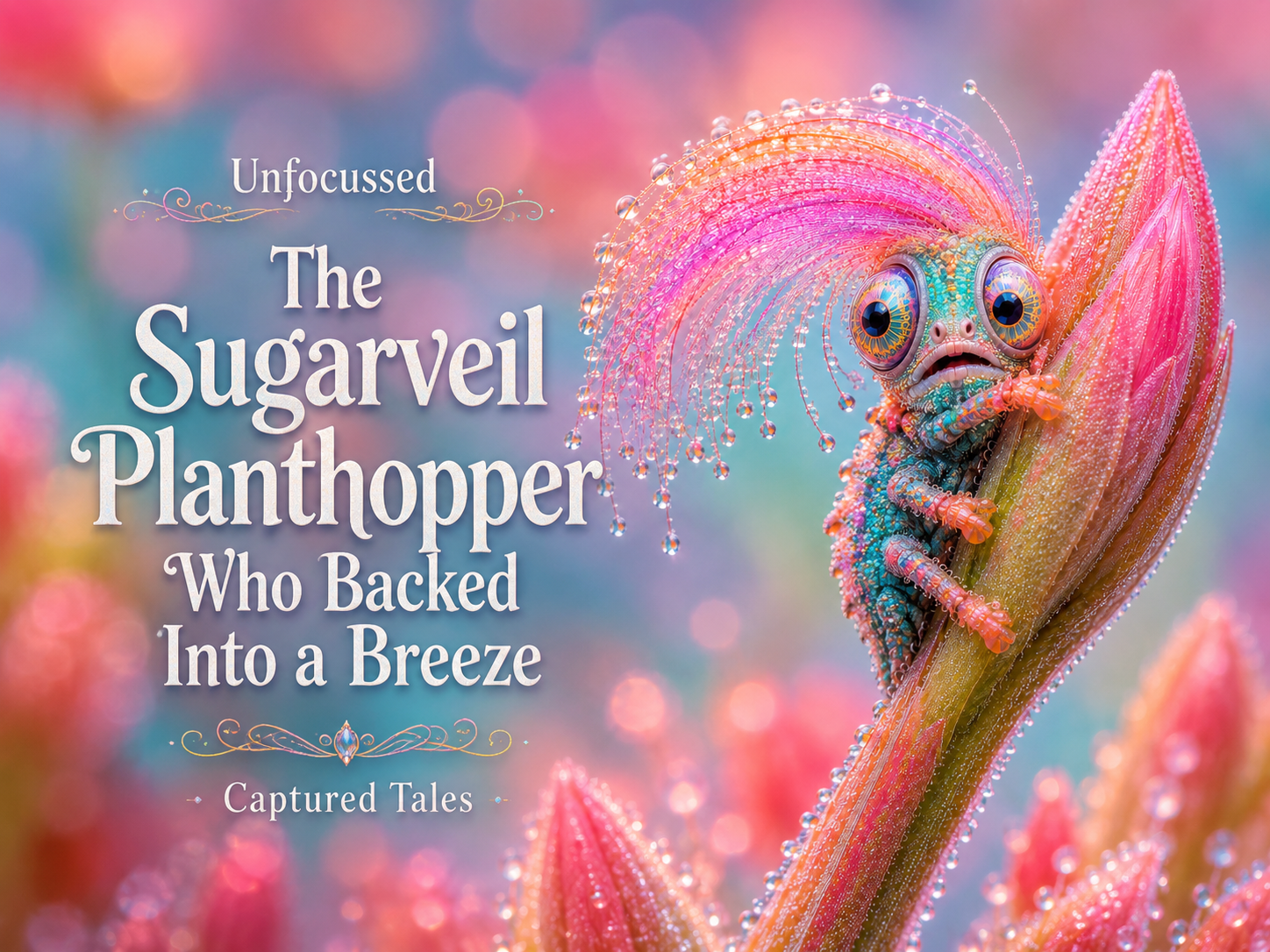
La mañana se torció antes del desayuno
En los pétalos cubiertos de rocío de Bloomberry Court, donde cada amanecer llegaba con demasiado colorete y las flores se comportaban como si hubieran heredado dinero, vivía un saltamontes azucarado llamado Pippit Frill.
Pippit no era grande. No era valiente. No era lo que nadie llamaría emocionalmente resistente. Pero era magnífico de una manera que hacía que otras criaturas diminutas se detuvieran, entrecerraran los ojos y murmuraran: «Bueno, alguien se despertó brillante y sospechoso».
Su cuerpo brillaba en turquesa, coral, melocotón y oro, como si un pintor hubiera estornudado en un joyero. Sus ojos eran globos vidriosos enormes llenos de pétalos reflejados, cielo, pánico y la suficiente vanidad como para hacerlo peligroso en un brunch. De la parte superior de su cabeza se elevaba su famoso velo de azúcar: una cascada de filamentos rosados y naranjas con puntas de rocío perfectas, cada una tan delicadamente equilibrada que incluso un susurro podía hacerle parecer una lámpara de araña al borde de un ataque de nervios.
Y a Pippit le importaba ese velo.
Profundamente.
Religiosamente.
Molestamente.
Cada mañana, antes de que las mariquitas comenzaran a cotillear y antes de que las abejas empezaran a gritar eslóganes motivadores al polen, Pippit realizaba lo que él llamaba su Arreglo del Amanecer. Otros lo llamaban «esa ridícula ceremonia del pelo», pero solo a sus espaldas, porque Pippit tenía unos ojos muy expresivos y podía hacer que el silencio pareciera una demanda.
Primero, salía del pliegue rosa interior de su capullo de flor sin abrir favorito, el que había declarado su «residencia principal» a pesar de que la flor nunca fue consultada. Luego sumergía cada diminuto pie naranja en rocío, quitaba el exceso y comprobaba el ángulo de su velo de azúcar contra la curva del sol naciente.
«Barredura izquierda aceptable», se susurró a sí mismo. «Espaciado de gotas elegante. Densidad de flecos lujosa pero no desesperada».
Un pulgón cercano bostezó.
Pippit se quedó inmóvil.
«¿Eso fue un comentario?», preguntó.
El pulgón lo miró con el vacío espiritual de una criatura a la que nunca le había importado la densidad de los flecos.
«No», dijo el pulgón. «Fue un bostezo».
«Mmm». Pippit entrecerró sus enormes ojos. «Conveniente».
El pulgón volvió a masticar la savia de las hojas, porque los pulgones, como pueblo, nunca han sido acusados de profundidad teatral.
Pippit continuó.
Giró dos veces en el sentido de las agujas del reloj, una en sentido contrario, ajustó una perla de rocío que colgaba del filamento más a la izquierda de su velo y se inclinó hacia su reflejo en una gota de agua que reposaba en el borde del capullo de la flor. La cara reflejada que lo miraba parecía asustada, húmeda y ligeramente ofendida por la existencia.
Perfecto.
Esa era su cara.
«Hoy», anunció Pippit a la flor sin abrir, al pulgón, a tres mosquitos y a un caracol dormido que accidentalmente se había convertido en parte del público, «será ordenado».
El caracol dormido soltó una suave burbuja por la nariz.
Pippit lo tomó como un aplauso.
El orden importaba en Bloomberry Court porque el jardín no era, por naturaleza, un lugar sensato. Los pétalos se abrían con opiniones. Los hongos formaban comités. Las abejas creían que el volumen era liderazgo. Una vez, una polilla llamada Vesper intentó casarse con una pantalla de lámpara porque dijo que la entendía. La boda fue hermosa, aunque el novio era emocionalmente inalcanzable.
Pippit sobrevivía a esta tontería general a través de la rutina. Conocía el momento de la niebla matutina, los pétalos más seguros a los que aferrarse durante el tráfico de los abejorros, las flores más propensas a estornudar y el momento exacto en que el sol transformaba su velo de azúcar de «agradablemente radiante» a «que alguien traiga una corona».
Así que, cuando la primera brisa de la mañana se deslizó en el jardín sin cita previa, Pippit, comprensiblemente, no estaba preparado.
Comenzó como un suspiro.
Ni siquiera un viento propio. Ni una ráfaga con hombros. Ni un empujón tormentoso ni un dramático silbido. Solo una pequeña respiración errante moviéndose entre los tallos, llevando el aroma a trébol, musgo húmedo y una margarita lejana con mala actitud.
Pippit no lo vio venir.
Se había dado la vuelta para inspeccionar la alineación trasera de su velo de azúcar, porque la excelencia tiene una parte trasera y alguien debe mantener los estándares. Retrocedió con cuidado por el borde del capullo de la flor, un pequeño pie a la vez, con los ojos fijos en el reflejo del rocío detrás de él.
«Un poco más de elevación», murmuró. «Quizás un toque menos de adorno. Somos majestuosos, no intentamos vender perfume».
Entonces llegó la brisa.
Tocó la parte trasera de su velo de azúcar.
Solo lo tocó.
Ligeramente.
Educadamente, incluso.
Pippit reaccionó como si el cielo lo hubiera lamido.
Sus ojos se abrieron más de lo físicamente aconsejable. Cada gota de rocío de su velo tembló. Sus patas se agitaron. Su boca se abrió en un pequeño óvalo de traición.
«¡ALGO HA PASADO CON MI ATMÓSFERA TRASERA!», gritó.
El capullo de la flor vibró.
El pulgón se cayó de su hoja.
El caracol dormido se despertó a medias, miró a su alrededor e inmediatamente decidió que la conciencia estaba sobrevalorada.
Pippit intentó afirmarse, pero la brisa se deslizó debajo del velo de azúcar y lo levantó como un pequeño paracaídas de seda rosa con problemas emocionales sin resolver. Su cresta se hinchó hacia atrás, las gotas se balanceaban salvajemente bajo la luz del sol. Por un instante brillante, Pippit permaneció unido al capullo de la flor por exactamente tres pies, un codo y pura indignación.
«NO», chilló. «Absolutamente no. Tengo planes».
A la brisa, siendo una brisa, no le importó. No tenía horario, ni vergüenza, ni comprensión del cuidado personal.
Lo empujó de nuevo.
Pippit se deslizó hacia atrás.
Sus pies rozaron el pétalo. El rocío salpicó. Una gota se desprendió de su velo y golpeó al pulgón directamente entre los ojos.
«Grosero», dijo el pulgón desde la tierra.
«¡Estoy siendo atacado por un clima invisible!», chilló Pippit.
«Es viento».
«No minimices mi incidente».
Se agarró a la costura interior del capullo con sus seis patas y se aferró allí, temblando, mientras su velo de azúcar se extendía detrás de él en un arco espectacular. Habría parecido elegante si su rostro no hubiera estado haciendo la expresión de una criatura que acababa de chocar con un fantasma que llevaba manos frías.
La brisa pasó.
El silencio se instaló.
Una perla de rocío tintineó desde la punta de su velo y aterrizó en el pétalo de abajo.
Pippit miró al vacío.
En algún lugar del jardín, una abeja gritó: «BUENO, ESO FUE MUCHO».
Pippit inhaló lentamente por sus pequeñas fosas nasales.
Luego dijo, con una calma aterradora: «Habrá una investigación».
El primer testigo fue inútil
En nueve minutos, Pippit había declarado el capullo de la flor como una escena oficial de alteración.
Se paseaba por el borde del pétalo con su velo de azúcar ligeramente doblado, lo que lo hacía parecer menos realeza y más un trapeador decorativo que había visto combate. Esto solo empeoró su humor.
«Nadie toque nada», ordenó.
«Nadie iba a hacerlo», dijo el pulgón, ahora de vuelta en su hoja, pero visiblemente humedecido en espíritu y frente.
«Especialmente tú».
«Estoy desayunando».
«Sospechosamente».
El pulgón le lanzó una mirada larga y fría. «Soy un pulgón. Comer es la mayor parte de lo que tengo».
Pippit se inclinó más, sus enormes ojos reflejando al pulgón duplicado, lo cual era francamente demasiados pulgones para la comodidad del pulgón.
«¿Dónde estabas cuando la brisa tocó mi parte trasera?»
«Esa es una frase horrible».
«Responde la pregunta».
«En la hoja».
«¿Haciendo qué?»
«Comiendo».
«Conveniente otra vez».
«Sigues diciendo eso como si tuviera una vida».
Pippit hizo clic con sus diminutas garras contra el pétalo en una profunda reflexión investigativa. Al pulgón le faltaba motivo, a menos que el aburrimiento contara. En Bloomberry Court, el aburrimiento absolutamente contaba, pero Pippit quería un culpable más grande. Una conspiración, quizás. Un insecto rival. Una flor celosa. Un duende meteorológico pícaro con una vendetta contra la elegancia.
Se giró hacia el caracol, que se había retraído hasta la mitad de su concha, pero desafortunadamente había dejado un pedúnculo ocular visible.
«Tú», dijo Pippit. «Di tu nombre y afiliaciones atmosféricas».
El pedúnculo ocular del caracol se inclinó lentamente hacia él.
«Mornold».
«¿Mornold qué?»
«Solo Mornold».
«Eso suena inacabado».
«Así lo hacen la mayoría de las mañanas».
Pippit frunció el ceño. «¿Viste lo que pasó?»
«No».
«¿Escuchaste algo?»
«Tú gritando sobre tu atmósfera trasera».
El pulgón resopló.
Pippit lo ignoró con la dignidad practicada de alguien a quien se le había reído lo suficiente como para desarrollar cortinas interiores.
«¿Y antes de eso?»
Mornold consideró esto con la lenta gravedad de una criatura cuyos pensamientos llegaban a pie.
«Hubo una brisa».
Pippit jadeó. «Así que lo admites».
«¿Admitir qué?»
«Que ocurrió una brisa».
«Sí».
«En mi vecindad».
«Todo está en la vecindad de alguien».
«No te pongas filosófico conmigo, mueble concha».
Mornold parpadeó un ojo, luego el otro. «Voy a volver a dormir».
«Eres un testigo».
«Soy un caracol. Apenas soy un participante».
Con eso, Mornold se retiró a su caparazón, dejando a Pippit sin un testimonio útil y con una sensación aún más profunda de que el sistema de justicia del jardín se estaba pudriendo desde las raíces.
Miró el pétalo donde la brisa lo había empujado. Los rastros de rocío marcaban su camino de deslizamiento. Diminutos arañazos de garras cortaban el polvo de polen. Una de sus gotas de velo de azúcar había dejado un salpicadura perfecta en el labio exterior del capullo.
Evidencia.
Por fin.
Pippit se agachó dramáticamente, olisqueó el pétalo e inmediatamente inhaló polen.
«Ah—ah—AH—»
El pulgón se apartó.
Pippit estornudó tan fuerte que su velo de azúcar se deslizó hacia adelante y lo golpeó en ambos ojos.
Durante tres segundos completos, estuvo ciego, pegajoso, brillante y furioso.
«Quise hacer eso», dijo desde debajo del velo.
«Claro», dijo el pulgón.
«Fue una técnica».
«Parecía avanzada».
Pippit se quitó los hilos húmedos de la cara e intentó recuperar la poca dignidad que no había sido arrastrada por el polen y golpeada por sus propios flecos de la cabeza.
Fue entonces cuando notó la dirección del salpicadura de rocío.
Las gotas no se habían dispersado al azar. Formaban un rastro débil a través del capullo de la flor, bajando por el tallo y hacia el sendero inferior del jardín donde el musgo crecía espeso y el trébol se inclinaba en racimos susurrantes.
Pippit entrecerró los ojos.
«La brisa fue por ahí».
El pulgón miró el rastro de rocío, luego a Pippit.
«¿Vas a seguir al viento?»
«Voy a perseguir a un sospechoso».
«El sospechoso es aire».
«Entonces el aire debería haberlo pensado dos veces antes de interferir con mi mañana».
El pulgón masticó pensativo. «Sabes, a veces las cosas simplemente suceden».
Pippit se volvió hacia él con herida grandeza.
«Eso», dijo, «es exactamente el tipo de pensamiento perezoso que permite que las brisas se conviertan en tormentas».
Luego bajó del capullo de la flor, cada paso húmedo de propósito, cada gota de su velo de azúcar torcido temblaba como pequeños testigos con miedo a testificar.
El jardín tenía opiniones, desafortunadamente
Las noticias del incidente de Pippit se extendieron más rápido que el moho en un muffin descuidado.
Esto no se debía a que nadie entendiera lo que había sucedido. Era porque Bloomberry Court contenía diecisiete rutas de chismes confirmadas, seis túneles de susurros no oficiales y una polilla que afirmaba que nunca repetía nada, pero de alguna manera conocía los asuntos de todos antes del almuerzo.
Para cuando Pippit llegó al sendero de musgo, tres mosquitos ya revoloteaban sobre él.
«¿Es cierto que te voltearon por completo?», preguntó el primero.
«No», dijo Pippit.
«¿Es cierto que tu velo se desprendió e intentó huir?», preguntó el segundo.
«Absolutamente no».
El tercer mosquito jadeó. «Oí que retaste al viento a un duelo».
Pippit se detuvo.
Esa tenía potencial.
«Todavía no», dijo.
Los mosquitos chillaron de alegría y se alejaron zumbando para empeorar la historia.
Pippit continuó por el rastro de rocío, sus pequeños pies pisando musgo que se aplastaba con ofensiva alegría. El jardín inferior aún se estaba despertando. Las campanillas se desplegaban con dramáticos bostezos. Un escarabajo pulía su caparazón sobre un pétalo caído. Una mariquita llamada Tansy estaba de pie sobre el gorro de un hongo leyendo en voz alta una lista de quejas que había escrito contra la humedad.
«Punto siete», anunció Tansy. «La humedad fomenta el encrespamiento, el moho y la sobreexposición emocional».
«De acuerdo», dijo Pippit al pasar.
Tansy miró su velo de azúcar doblado. «Ay, cariño. ¿Luchaste contra una telaraña o perdiste una discusión con la estática?»
Pippit levantó la barbilla. «Sobreviví a un asalto atmosférico».
«¿Viento?»
«No uses su nombre de la calle».
Tansy hizo clic con sus mandíbulas. «Cosa desagradable. Sin modales. Entra donde quiere. Como las hormigas».
Debajo del gorro del hongo, una hormiga gritó: «Te oímos».
«Bien», dijo Tansy. «Entonces oye esto: organiza tus pies más silenciosamente».
Pippit no tenía tiempo para el tribunal de humedad de Tansy, aunque respetaba la mezquindad. Siguió el rastro de rocío alrededor de un helecho rizado y cruzó un puente de pétalos caídos, donde las gotas se volvieron escasas.
Allí, agachado junto a un charco, estaba Brindle Nib, un saltamontes joven con rodillas nudillos, optimismo imprudente y el tipo de sonrisa que hacía que los adultos comprobaran si algo cercano ya estaba roto.
«¡Pippit!», gritó Brindle. «Oí que el cielo te pateó».
«No me patearon».
«¿Empujaron?»
«No».
«¿Acariciado por el clima?»
«Brindle».
«Lo siento».
Pippit se subió a una piedrecita para poder dirigirse al saltamontes desde una posición de autoridad ligeramente mayor. No ayudó mucho, ya que Brindle seguía siendo cuatro veces más alto que él y tenía migas en la cara.
«Estoy rastreando la brisa responsable de desestabilizar mi presentación matutina».
Brindle silbó. «Caso grande».
«Enorme».
«¿Algún sospechoso?»
«Aire».
«Amplia red».
«Voy donde me lleva la evidencia».
Brindle asintió solemnemente, luego lo arruinó preguntando: «¿Puedo ir?»
«No».
«Soy útil».
«Una vez intentaste saltar sobre un hongo y le pediste perdón al suelo antes de aterrizar».
«Eso es porque sabía lo que venía».
«No vienes».
Brindle se inclinó más, con los ojos brillantes. «¿Qué pasa si la brisa es parte de algo más grande?»
Pippit se detuvo.
Odiaba que esto le interesara.
«Explica».
Brindle bajó la voz. «Bueno, primera brisa de la mañana, ¿verdad?»
«Correcto».
«Se te cuela por detrás».
«Correcto y vulgar».
«Te desordena el velo».
«Casi».
«Deja un rastro».
«Posiblemente».
«Suena planeado».
Los ojos de Pippit se abrieron tanto que Brindle pudo verse reflejado en ellos dos veces, lo que lo hizo saludar a ambas versiones.
«Una brisa planeada», susurró Pippit.
«Quizás».
«Una ráfaga deliberada».
«Podría ser».
«Un evento de viento dirigido».
«Ahora lo entiendes».
Pippit paseó en un círculo apretado sobre la piedrecita. Esto lo cambió todo. Una brisa aleatoria era una cosa. Irritante, irrespetuosa, motivo de queja, ciertamente. Pero una brisa planeada significaba intención. Intención significaba culpable. Culpable significaba confrontación. Y confrontación significaba que Pippit necesitaría pararse muy dramáticamente en un lugar elevado mientras decía algo memorable.
Siempre había querido eso.
«Bien», dijo Pippit. «Puedes ayudar».
Brindle bombeó una pierna. «¡Sí!»
«Pero esta es una investigación profesional. No saltos sin autorización. No masticar pruebas. No gritar ‘puntapié del cielo’ en público».
«¿Qué hay de en privado?»
«Uso limitado».
«Justo».
Pippit saltó de la piedrecita y reanudó el camino. Brindle lo siguió con la sigilo de un cajón volcado.
El camino conducía hacia el borde este de Bloomberry Court, donde las flores crecían más altas y el aire se movía extrañamente entre sus tallos. Pippit no solía ir allí. El borde este era conocido por las corrientes de aire, el polen suelto y un sospechoso parche de hierba que se susurraba cumplidos a sí mismo.
Mientras se acercaban, Pippit lo sintió de nuevo.
Un leve movimiento contra su velo de azúcar.
Se detuvo tan de repente que Brindle casi tropieza con él.
«Ahí», susurró Pippit.
Los hilos de su velo se levantaron. Solo un poco.
Las perlas de rocío temblaron.
En algún lugar adelante, entre dos altas flores rosadas, el aire suspiró.
Pippit tragó saliva.
«Ha vuelto».
Brindle se inclinó hacia adelante, emocionado más allá de la razón. «¿El sospechoso?»
«El perpetrador».
La brisa se deslizó de nuevo entre los tallos de las flores, más fuerte esta vez. Se curvó alrededor del musgo, rozó el trébol y tiró del velo de azúcar de Pippit hacia atrás con un suave y brillante tirón.
Pippit hizo un ruido que comenzó como un grito de guerra y terminó como un chillido.
«¡Mantén tu posición!», gritó.
Brindle inmediatamente agarró un tallo.
Pippit no agarró nada, porque estaba demasiado ocupado tratando de parecer desafiante. Esto fue un error.
La brisa se deslizó bajo su velo levantado y lo infló como una diminuta vela radiante.
Sus pies dejaron el musgo.
Solo una fracción.
Solo por un momento.
Pero suficiente.
Pippit se elevó media pulgada en el aire, los ojos saltones, las piernas recogidas, la dignidad gritando silenciosamente desde otra habitación.
«¡ESTOY SIENDO ESCALADO!», exclamó.
Brindle extendió la mano y le atrapó una pata trasera.
Pippit colgaba de lado, con el velo de azúcar ondeando, las gotas brillando bajo el sol naciente.
La brisa siguió su curso como si nada hubiera pasado.
Brindle lo bajó lentamente al musgo.
Ninguno de los dos habló.
Luego, desde la copa de una flor cercana, una voz suave como el polen y doblemente irritante dijo:
“Vaya,” dijo, “eso fue profundamente elegante.”
Pippit levantó la vista.
Posada sobre ellos en un pétalo, con las alas plegadas como un chismorreo guardado en mangas de seda, estaba Vesper la polilla. Su cara peluda mostraba la expresión encantada de alguien que acababa de presenciar un desastre y pretendía sazonarlo adecuadamente antes de servirlo a todos.
La boca de Pippit se tensó.
“No viste nada.”
Vesper sonrió.
“Cariño,” dijo, “vi lo suficiente.”
Pippit la miró fijamente, con su velo de azúcar torcido, las gotas temblando, un pie aún torpemente sostenido por Brindle.
Su mañana había comenzado con orden.
Ahora tenía una sospecha de brisa, un asistente saltamontes, una humillación pública, y Vesper la polilla preparándose para convertirse en un sistema de transmisión con pestañas.
En algún lugar de las flores del este, el aire volvió a cambiar.
Esta vez, llevaba un sonido tenue.
No un suspiro.
No un susurro.
Un murmullo.
Pippit se volvió hacia él, cada cuenta de su velo brillando con temor.
El murmullo se deslizó entre las flores y le rozó la cara.
No fue un accidente.
Los ojos de Pippit se convirtieron en dos enormes lunas de pánico.
Brindle susurró: “¿El viento acaba de hablar?”
Pippit levantó un pie tembloroso, señaló hacia las flores del este y dijo lo único que un investigador responsable podía decir dadas las circunstancias.
“Vamos a necesitar una queja mucho más grande.”
El susurro tuvo un momento terrible
Hay momentos en la vida de cada pequeña criatura en que el mundo ofrece dos opciones claras: mantener la calma, evaluar los hechos y proceder con dignidad, o entrar en pánico tan fuerte que tu cara se convierte en un evento público.
Pippit Frill eligió la segunda opción con compromiso.
Sus ya enormes ojos se abrieron aún más mientras el susurro se desvanecía entre las flores del este. Su velo de azúcar, todavía doblado por su anterior asalto atmosférico, temblaba detrás de él como una bandera de desfile que hubiera visto una serpiente.
“El viento habló,” susurró Brindle.
“No,” dijo Pippit, demasiado rápido. “Absolutamente no. El viento no habla. El viento mueve cortinas, arruina arreglos de polen y viola los límites del aseo personal. No forma oraciones.”
Vesper la polilla se inclinó desde su posición en el pétalo, sus alas brillando a la suave luz de la mañana. “Lo escuché.”
“No escuchaste nada,” espetó Pippit.
“Escuché lo suficiente.”
“Siempre escuchas lo suficiente. Ese es todo tu problema.”
Vesper se presionó un pie peludo contra el pecho. “Mi don es la observación.”
“Tu don es hacer que la observación sea contagiosa.”
Brindle levantó una pata. “Para que conste, yo también lo escuché.”
Pippit se volvió hacia él lentamente. “Tu historial tiene migas.”
“Aun así cuenta.”
Las flores del este volvieron a moverse. Sus altas cabezas rosadas se inclinaron unas hacia otras, los pétalos rozándose con un sonido seco de satén. En algún lugar más allá de ellas, el aire se retrajo como si el propio jardín hubiera respirado y estuviera decidiendo si estornudar.
Pippit sintió el tirón contra su velo.
No fuerte. No lo suficiente como para levantarlo esta vez. Pero sí lo suficiente como para hacer que cada perla de rocío de su velo de azúcar temblara en una fila ordenada, como si toda su cabeza se hubiera convertido en una pequeña lámpara de araña en una posada embrujada.
“Que nadie se mueva,” dijo.
Brindle se quedó inmóvil con una pata en el aire.
Vesper parpadeó. “Te moviste al decir eso.”
“Se me permite establecer la quietud dinámicamente.”
“Eso suena a caerse con papeleo.”
Pippit la ignoró y se arrastró hacia la abertura entre las flores. El rastro de rocío, ahora casi desvanecido, apareció de nuevo en la base del tallo más alto. Brillaba tenuemente en el musgo, cada gota extendida en una fina y brillante mancha que señalaba al este.
“Ahí,” susurró Pippit. “Evidencia.”
Brindle se inclinó sobre su hombro. “Parece agua.”
“Muchos crímenes empiezan como agua.”
“Nombra uno.”
“Inundación.”
“Justo.”
Pippit avanzó con dramática cautela. Nunca le habían gustado las flores del este. Eran más altas que el resto de Bloomberry Court, con tallos largos y pesados pétalos que producían pequeños crujidos cada vez que el aire se movía. Peor aún, crecían alrededor de un viejo hueco en el muro del jardín conocido como Whiffle Gap, una estrecha abertura entre dos piedras musgosas por donde se colaban corrientes de aire del prado salvaje.
Whiffle Gap no estaba prohibido. Nada en Bloomberry Court estaba oficialmente prohibido, principalmente porque los caracoles tardaban demasiado en poner letreros. Pero se sabía que era un lugar donde el polen desaparecía, los pétalos revoloteaban sin permiso y las criaturas delicadas evitaban estar de espaldas a menos que disfrutaran de una ventilación sorpresa.
Pippit no disfrutaba de la ventilación sorpresa.
Prefería la ventilación planificada. La ventilación suave. La ventilación con límites, avisos y quizás una pequeña cesta de disculpas.
Mientras se acercaba a las flores, el susurro regresó.
No fue un accidente.
Pippit se detuvo tan abruptamente que sus patas delanteras se hundieron en el musgo.
Brindle chocó con él.
Vesper aleteó hacia un pétalo inferior, encantada más allá de la decencia.
“Ahí está de nuevo,” dijo.
Pippit inhaló por la nariz y trató de parecer un investigador en lugar de un grano de pánico cubierto de cuentas.
“Identifícate,” gritó hacia el hueco.
La brisa respondió deslizándose entre los tallos y volteando un mechón de su velo de azúcar sobre su cara.
Pippit lo apartó de un manotazo.
“Eso no es identificación. Eso es acoso con estilo.”
Las flores crujieron.
El musgo se onduló.
Un pétalo suelto se deslizó por el sendero, giró dos veces y se detuvo a los pies de Pippit.
En él, escrito con polvo de polen, había tres palabras torcidas:
¡Mira hacia arriba, tonto!
Pippit se quedó mirando.
Brindle se acercó. “Eso parece personal.”
“No dice mi nombre.”
“Dice tonto.”
“Podría ser cualquiera.”
Vesper dio una tos pequeña y elegante. “Y sin embargo, el pétalo se detuvo directamente delante de ti.”
Pippit lentamente levantó la mirada.
En lo alto, enredado entre dos flores orientales, había un hilo de seda de araña tendido sobre Whiffle Gap. Había atrapado un racimo de pelusa de semillas flotantes, hojas rasgadas y la carcasa brillante de un ala de escarabajo azul. Todo el grupo se doblaba hacia adentro cada vez que el viento del prado empujaba a través de la brecha.
Actuaba como un tapón.
Un tapón muy inestable, muy brillante, muy estúpido.
Cada vez que la presión se acumulaba detrás de él, el aire se filtraba en ráfagas delgadas y concentradas, convirtiendo la suave brisa matutina en pequeños chorros agudos que se dirigían directamente a Bloomberry Court.
El velo de azúcar de Pippit se hundió.
“Oh.”
Brindle sonrió. “Así que el viento fue weaponized.”
“No te alegres por eso.”
“No estoy feliz.”
“Tus rodillas están sonriendo.”
Vesper chasqueó la lengua. “Esa trampa de seda debe haber atrapado toda la pelusa flotante durante la noche. Ahora el hueco está tosiendo pequeñas ráfagas en el jardín.”
“¿Tosiendo?” dijo Pippit. “Eso atacó mi ceremonia de aseo.”
“Con una tos.”
“Una tos dirigida.”
Otra ráfaga de aire se coló por el hueco bloqueado.
La seda se abultó.
La pelusa de semillas tembló.
La carcasa del ala del escarabajo brilló.
Entonces la brisa salió disparada, baja y rápida, atrapando a Pippit de nuevo bajo el velo de azúcar.
Esta vez, estaba listo.
Clavó las seis patas, amplió su postura, bajó la cabeza y anunció: “No me moverás.”
La ráfaga lo movió.
No muy lejos. Pero lo suficiente como para deslizarlo hacia atrás en una línea recta perfecta, dejando seis pequeñas marcas de arrastre en el musgo.
Brindle lo detuvo por el abdomen antes de que se deslizara bajo un helecho.
Pippit se quedó colgado, con la expresión vacía por la traición.
“No discutiremos eso,” dijo.
“De acuerdo,” dijo Brindle.
“Nunca.”
“No.”
Vesper ya se reía tan silenciosamente que sus alas temblaban.
Pippit la señaló con un pie tembloroso. “Tú, especialmente, no discutirás eso.”
Vesper se secó un ojo. “Cariño, ya he compuesto tres versiones.”
“Bórralas.”
“Una rima.”
“Vesper.”
“Está bien. La guardaré para emergencias.”
Pippit se volvió hacia Whiffle Gap, su orgullo ahora magullado en varios lugares de difícil acceso.
“Necesitamos quitar el bloqueo.”
Brindle rebotó una vez. “Puedo saltar hasta ahí.”
“No.”
“Puedo patearlo.”
“No.”
“Puedo patear cerca.”
“De alguna manera peor.”
Vesper levantó sus alas. “Puedo volar y examinarlo.”
Pippit la miró. “¿Y luego contarles a todos cómo se ve, a qué huele y lo asustado que me veía mientras lo inspeccionabas?”
“Solo si me preguntan.”
“¿Quién?”
“El público.”
“El público no está invitado.”
Detrás de ellos se escuchó una voz. “Demasiado tarde.”
Pippit se volvió.
Tansy la mariquita estaba de pie en el sendero de musgo con un portapapeles hecho de una hoja enrollada. A su lado había dos hormigas, tres mosquitos, el pulgón del capullo de flor de Pippit y Mornold el caracol, que de alguna manera había llegado a pesar de moverse con la urgencia de la sopa.
“¿Qué hacen aquí?” preguntó Pippit.
Tansy golpeó su portapapeles de hojas. “Supervisión atmosférica de emergencia.”
“Eso no existe.”
“Se convirtió en una cuando Vesper dijo que el viento te estaba acosando.”
Pippit miró con enojo a la polilla.
Las alas de Vesper revolotearon inocentemente. “Quizás mencioné una situación en desarrollo.”
“Dijiste que el clima lo abofeteó,” dijo uno de los mosquitos.
“Dijiste que su velo se convirtió en una vela,” añadió otro.
El tercer mosquito flotó boca abajo. “Dijiste que su dignidad solicitó reubicación.”
Pippit cerró los ojos.
Por un momento, imaginó una vida tranquila en otro lugar. Un helecho tranquilo. Un pétalo privado. Un lugar donde nadie usaba la frase “atmósfera trasera” con interés forense.
Entonces el tapón de seda que tenían encima gimió.
Todos miraron hacia arriba.
El racimo de pelusa de semillas se había hinchado hacia afuera. Más aire del prado lo empujaba desde el otro lado de la brecha, haciendo que toda la masa palpitara como el peor pulmón del mundo.
Mornold parpadeó lentamente. “Eso parece malo.”
“Gracias, oráculo de la concha,” dijo Pippit.
Tansy frunció el ceño ante el bloqueo. “Si eso cede de golpe, todo el jardín podría recibir una ráfaga.”
“¿Una ráfaga?” preguntó el pulgón.
“Una grande.”
El pulgón lo consideró. “¿Afectará al desayuno?”
“Podría afectar a todos,” dijo Tansy.
El pulgón pareció genuinamente preocupado por primera vez en toda la mañana. “Así que sí.”
Otra ráfaga se coló, más fuerte que antes. Se precipitó bajo las flores y sopló directamente hacia las criaturas reunidas. Los mosquitos se dispersaron como pimienta. El portapapeles de Tansy se le escapó de las manos. El pulgón se aferró al tallo de una hoja y chilló de una manera que más tarde negaría. Los pedúnculos oculares de Mornold se aplanaron hacia atrás.
Pippit, que esta vez se había preparado envolviendo cuatro patas alrededor de una raíz de musgo, se mantuvo casi en su sitio.
Casi.
Su velo de azúcar no lo hizo.
Se levantó, se extendió en toda su ridícula gloria y brilló a la luz del sol como el abanico ceremonial de una reina que acababa de escuchar a alguien insultar su sopa.
Por un momento sin aliento, todos se quedaron mirando.
Brindle susurró: “De hecho, eso se veía increíble.”
Pippit trató de no resplandecer. Falló ligeramente.
“Sí, bueno,” dijo, “el desastre a veces sabe cómo enmarcarme.”
El Comité se formó sin permiso
Ninguna crisis en Bloomberry Court podía permanecer práctica por mucho tiempo. La practicidad se consideraba grosera, y el pánico, cuando estaba bien organizado, podía llenar una mañana entera.
En quince minutos, el sendero de musgo del este se había convertido en un lugar de reunión de emergencia.
Tansy tomó el mando, porque las mariquitas están naturalmente convencidas de que las manchas cuentan como credenciales. Vesper se posó sobre todos como narradora no oficial, lo que significaba que repetía todo más alto y con peores implicaciones. Brindle se autoproclamó “Operaciones de Salto”, un título que nadie aprobaba pero que todos estaban demasiado ocupados para discutir. Mornold se convirtió en “Asesor de Estabilidad” después de negarse a moverse. Al pulgón se le asignó “Enlace de Hoja”, principalmente porque ya estaba en una.
Pippit, por supuesto, se declaró Investigador Atmosférico Principal.
“Te investigaste a ti mismo en el aire dos veces,” dijo Tansy.
“Pruebas de campo.”
“Gritaste.”
“Pruebas de campo con marcadores de audio.”
“Llamaste a tu trasero atmósfera trasera.”
“La terminología precisa salva vidas.”
Tansy lo miró fijamente durante un largo momento. “Está bien. Investigador Atmosférico Principal. Pero si esto se convierte en una reunión de peluquería, me voy.”
Pippit jadeó. “Mi velo de azúcar es un instrumento sensorial.”
“Es una cortina de pánico sensible al clima.”
“Esa es una de sus funciones.”
El bloqueo sobre Whiffle Gap pulsó de nuevo, y un fino silbido escapó a través de la seda. El sonido subía y bajaba como una pequeña tetera en crisis moral.
Todos se quedaron en silencio.
Entonces el susurro regresó, hilándose a través del silbido.
Libéralo antes del mediodía.
El pulgón tragó saliva. “El viento está dando plazos ahora.”
Brindle parecía encantado. “Esta es la mejor mañana de todas.”
Pippit se volvió hacia él. “Esta es la peor mañana de todas. Hay una diferencia.”
“Para ti.”
“Para la civilización.”
Tansy levantó su portapapeles, ahora rescatado pero doblado. “El mediodía es cuando el prado se calienta. El aire caliente sube, empuja a través del hueco, la presión aumenta. Si ese tapón estalla entonces…”
Hizo una pausa.
Los mosquitos se acercaron.
“¿Entonces qué?” preguntó Pippit.
Tansy miró hacia el jardín principal, donde delicadas flores, pétalos cubiertos de rocío y criaturas medio despiertas se deleitaban con la inocente brillantez de la mañana.
“Entonces Bloomberry Court será reorganizado.”
Mornold parpadeó. “Define reorganizado.”
“Pétalos arrancados. Polvo esparcido. Pequeñas criaturas levantadas. Rocío lanzado por todas partes.”
La voz del pulgón se hizo fina. “¿Savia interrumpida?”
“Posiblemente.”
El pulgón se puso una patita en la frente. “Bárbaro.”
Pippit miró fijamente el tapón de seda. El bloqueo estaba alto. Demasiado alto para que él lo alcanzara. Demasiado delicado para que Brindle lo pateara. Demasiado pegajoso para que Vesper volara de forma segura. Demasiado urgente para que Mornold lo abordara el próximo jueves.
Y sin embargo, el susurro les había dicho que lo liberaran.
“Debe haber una manera,” dijo.
“Podríamos morder la seda,” dijo Brindle.
“¿Seda de araña?” Vesper se estremeció. “Absolutamente no. No me meto arquitectura abandonada en la boca.”
Las hormigas se adelantaron.
“Podemos escalar,” dijo la primera hormiga.
“Podemos cortar,” dijo la segunda.
“Podemos quejarnos mientras hacemos ambas cosas,” dijo Tansy.
Pippit miró a las hormigas. “¿Pueden alcanzar el hilo superior?”
La primera hormiga miró hacia arriba. “Sí.”
“¿Pueden quitar el bloqueo con cuidado?”
La segunda hormiga miró hacia arriba. “Tal vez.”
“¿Pueden hacerlo sin dejar caer pelusa de semillas, trozos de hojas rotas y suciedad aérea variada directamente sobre mi velo?”
Las hormigas se miraron entre sí.
“Define directamente,” dijo la primera.
“Denegado,” dijo Pippit.
Tansy garabateó en su portapapeles. “Plan de hormigas pendiente.”
“No está pendiente. Ha muerto.”
Vesper ladeó la cabeza. “¿Y si lo aflojamos por abajo?”
Pippit la miró. “Explica con el mínimo de chismorreo.”
“La seda está estirada entre dos tallos de flores. Si doblamos los tallos hacia afuera, la tensión cambia. El tapón podría ceder más abajo.”
La sonrisa de Brindle regresó. “Entonces yo salto.”
“Entonces no saltas,” dijo Pippit.
“Salto con cuidado.”
“Una vez saltaste a tu propia sombra y te disculpaste porque pensaste que era un escarabajo.”
“Me asustó primero.”
Tansy consideró las flores. “Doblar los tallos podría funcionar. Necesitamos peso.”
Todos miraron a Mornold.
Mornold respondió desde debajo del borde de su caparazón. “No.”
“No sabes lo que pedimos,” dijo Tansy.
“Sé que me miraste como un saco.”
Pippit se adelantó. “Mornold, Bloomberry Court requiere tu masa.”
“Bloomberry Court puede escribirme una carta.”
“No hay tiempo.”
“Entonces debió haber escrito antes.”
Otra ráfaga silbó a través del tapón, más fuerte de nuevo. Hizo vibrar los pétalos sobre sus cabezas y envió una onda a través de la multitud. El velo de Pippit se levantó, pero esta vez mantuvo su posición agachándose y agarrando dos hebras de musgo.
Los mosquitos no tuvieron tanta suerte. Los tres fueron arrastrados hacia atrás a una margarita, que se cerró sobre ellos por instinto.
“¡Estamos bien!” se oyó una voz amortiguada.
“¡Huele a amarillo aquí!” gritó otro.
La margarita los eructó.
Tansy se volvió hacia Mornold. “Masa, por favor.”
Mornold suspiró, lo que sonó como un acordeón húmedo rindiéndose. “De acuerdo. Pero si alguien me llama lastre, seré profundamente aburrido con ellos durante una hora.”
El plan se formó rápidamente, lo que hizo sospechar a Pippit. Los buenos planes solían requerir al menos tres argumentos, un rechazo dramático y alguien diciendo “absolutamente no” antes de hacerlo de todos modos.
Mornold se arrastraría hasta la base del tallo de la flor oriental izquierda, doblándolo ligeramente hacia afuera. Brindle treparía por el tallo derecho y usaría su peso para tirar en la dirección opuesta. Las hormigas treparían una vez que la seda cediera y roerían el borde inferior del tapón de pelusa de semillas. Vesper flotaría cerca para guiar a las hormigas. Tansy coordinaría desde abajo.
Pippit supervisaría.
“¿Supervisar desde dónde?” preguntó Tansy.
“Una posición estratégica segura.”
“Entonces, detrás de una piedra.”
“Cerca de una piedra.”
Brindle se inclinó. —Sabes, tu velo reacciona antes de que lleguen las ráfagas.
Pippit parpadeó. —Sí. Porque es refinado.
—Podría avisarnos.
—Ya me avisó. Repetidamente. Con trauma.
—No, me refiero a que si el tapón empieza a acumular presión, tu velo se levanta primero. Podrías avisarnos.
El grupo se quedó en silencio.
Pippit sintió cómo todas las miradas se volvían hacia él. Incluso la de Mornold, aunque esta llegó más tarde.
—Absolutamente no —dijo Pippit.
Tansy sonrió. —Ahí está.
—No voy a quedarme frente al agujero de viento como un sistema de alarma decorativo.
—Instrumento sensorial —corrigió Tansy.
—No uses mis palabras en mi contra. Son delicadas.
Vesper revoloteó hasta un pétalo más bajo. —Cariño, tiene sentido. Tu velo de azúcar atrapa el aire antes de que el resto lo sintamos.
—Mi velo de azúcar también atrapa polen, rocío, burlas y, aparentemente, el destino. Está sobrecargado.
Brindle se agachó a su lado. —Te necesitamos.
A Pippit no le gustó esa frase.
No porque le asustara, que sí lo hacía. No porque sonara heroica, aunque desafortunadamente sí lo hacía. Le disgustó porque aterrizó en algún lugar suave debajo de todo su pánico, un lugar que usualmente mantenía cubierto con vanidad, rutina y quejas sobre la humedad.
Lo necesitaban a él.
No a pesar del ridículo velo.
Sino por él.
Eso era irritantemente significativo.
—Bien —dijo Pippit, demasiado alto—. Me quedaré frente a la desagradable grieta.
El pulgón aplaudió una vez. —Valiente.
Pippit lo señaló. —No lo hagas raro.
—Demasiado tarde —dijo Vesper suavemente.
Pippit subió a un montículo de musgo elevado directamente delante de Whiffle Gap. El aire era más fresco allí, deslizándose entre los tallos en pequeñas bocanadas de advertencia. Su velo de azúcar se levantó de inmediato, cada hebra ondeando hacia atrás. Las perlas de rocío tiraban de sus filamentos. La sensación le hizo querer que sus rodillas dimitieran.
Plantó sus seis patas.
—Empezad —dijo.
Mornold se arrastró hasta la base del tallo de la flor izquierda con ceremonial reticencia. El tallo se dobló ligeramente hacia afuera.
Brindle saltó al tallo derecho, lo agarró con las patas y se echó hacia atrás. La flor se inclinó.
Arriba, la trampa de seda se estiró.
El tapón de pelusa de semilla cedió.
Las hormigas comenzaron a trepar.
Por un momento, funcionó.
—Tallo izquierdo firme —gritó Tansy.
—Tallo derecho firme —gritó Brindle.
—Caracol emocionalmente incomodado —gritó Mornold.
—Hormigas ascendiendo —dijo Vesper.
Pippit permaneció de pie con su velo ondeando, intentando respirar con normalidad mientras el viento lo presionaba en pequeños impulsos. Observó atentamente el movimiento del velo de azúcar. Un pequeño levantamiento significaba una ráfaga suave. Un chasquido brusco significaba acumulación de presión. Una extensión completa significaba agarrarse a algo y reconsiderar la vida.
—Pulso menor —gritó Pippit.
Las hormigas se detuvieron.
La brisa se coló.
No pasó nada terrible.
—Continuad —dijo.
Las hormigas treparon más alto. Una alcanzó el hilo de seda. La otra se apoyó en el tallo. Vesper revoloteaba a su lado, sus alas batiendo con un ritmo cuidadoso.
—Casi llegan —dijo Brindle.
El velo de Pippit se movió.
Luego se levantó.
Luego se enderezó de golpe.
Sus ojos se abrieron de par en par.
—¡Presión! —gritó—. ¡Gran presión! ¡Presión poco halagadora!
—¡Parad! —gritó Tansy.
Las hormigas se pegaron al tallo. Vesper agarró el borde de un pétalo. Brindle apretó las patas alrededor del tallo derecho. Mornold se metió hasta la mitad en su caparazón, pero siguió siendo, técnicamente, útil.
La ráfaga estalló.
Pippit se había preparado para ello.
De verdad que sí.
Se había agachado, trabado las piernas, preparado su espíritu y hecho un pacto privado con cada raíz conocida bajo él.
La ráfaga golpeó de todos modos.
Su velo de azúcar se abrió completamente.
Las perlas de rocío destellaron.
Sus pies resbalaron.
—¡NO, GRACIAS! —gritó, lo que no era un lenguaje heroico pero tenía el beneficio de la honestidad.
Brindle soltó una pata del tallo y se estiró, atrapando a Pippit por la espalda de nuevo.
—¡Te tengo!
—¡Para de agarrarme ahí!
—¡Ahora mismo hay mucho de ti ahí atrás!
—¡Eso es el velo!
—¡Está por todas partes!
La ráfaga terminó.
Pippit se desplomó sobre el musgo, jadeando, con su velo extendido a su alrededor como un amanecer derretido.
Arriba, las hormigas reanudaron su mordisqueo de los hilos de seda inferiores.
—¡Progreso! —gritó Vesper.
Un hilo se rompió.
El tapón se hundió más.
Todos aplaudieron.
Entonces, todo el bloqueo se movió.
No hacia abajo.
De lado.
La trampa de seda se torció, se enganchó en la carcasa del ala del escarabajo y se tensó alrededor de la pelusa de semillas. En lugar de aflojarse, el tapón se ciñó en un nudo más pequeño y denso en el centro del Whiffle Gap.
El silbido se agudizó.
El aire detrás de él se acumuló más rápido.
La cara de Tansy cambió.
—Eso no es bueno.
Pippit se enderezó. —¿Qué tan no bueno?
El susurro respondió antes de que ella pudiera.
Corre.
La mañana se convirtió en el problema de todos
La palabra se deslizó por el jardín como un hilo frío.
Durante un segundo atónito, nadie se movió.
Luego, Whiffle Gap gritó.
No era el grito de una criatura. Era el aire forzado a través de un espacio demasiado pequeño, agudo, penetrante y furioso, el sonido de una tetera que decidía haberse unido a una secta. El tapón apretado se arqueó hacia adentro, temblando bajo la presión del prado. Trozos de hoja desgarrada giraban en sus bordes. La pelusa de semillas temblaba en un denso nudo blanco.
Las hormigas bajaron corriendo por los tallos.
Vesper se dejó caer del pétalo en un aleteo salvaje.
Brindle soltó el tallo derecho y aterrizó con fuerza en el musgo.
Mornold, que había estado sirviendo de contrapeso y ahora, debido al trauma que cambia los principios, definitivamente usaría esa palabra, se deslizó del tallo izquierdo con un golpe húmedo.
Pippit se quedó congelado frente a la brecha.
Su velo de azúcar se extendió completamente hacia atrás.
No ondeando.
No levantándose.
Completamente extendido.
Cada gota de rocío se convirtió en una línea brillante.
Se había convertido en la veleta más diminuta del jardín, y odiaba lo útil que era.
—¡Pippit! —gritó Brindle—. ¡Muévete!
Pippit lo intentó.
Sus pies no querían cooperar.
La presión frente a él crecía, apretando a través de la brecha en finas ráfagas. Su velo tiraba con fuerza. Sus piernas temblaban. Podía sentir la explosión acumulándose detrás del bloqueo como una mejilla invisible gigante que se inflaba para el escupitajo más grosero del mundo.
—Estoy intentando moverme —dijo con los dientes apretados.
—¡Inténtalo con más fuerza!
—¡No entrenes mis extremidades!
Tansy corrió hacia él. —¡Todos detrás de las raíces del helecho!
Las criaturas reunidas se dispersaron. Los mosquitos se zambulleron en las flores. Las hormigas desaparecieron bajo las hojas. El pulgón abandonó toda dignidad y se lanzó a una brizna de hierba enrollada. Vesper agarró el borde del caparazón de Mornold y trató de arrastrarlo hacia el refugio.
—No soy equipaje —gruñó Mornold.
—Hoy sí lo eres —dijo Vesper.
Brindle se lanzó hacia Pippit, pero otra ráfaga de viento atravesó el hueco y lo golpeó de lado contra un hongo. El hongo liberó una nube de esporas polvorientas directamente en su cara.
—¡Sabe a marrón! —gritó Brindle.
Pippit finalmente forzó un pie hacia atrás.
Luego, el otro.
El tapón se tensó.
Los hilos de seda crujieron.
El susurro volvió, casi perdido bajo el silbido agudo.
No lejos.
Pippit se detuvo.
Su estómago se hundió tanto que prácticamente solicitó un permiso de excavación.
—¿Qué quieres decir con que no lejos? —exigió.
El viento tiró de su velo con más fuerza.
Arriba.
Pippit miró el tapón.
Luego los tallos de las flores inclinados.
Luego el nudo de seda apretado en la brecha.
Luego, de nuevo al tapón.
—No —dijo.
El susurro se abrió paso entre la presión.
Levántalo.
Los ojos de Pippit se convirtieron en monumentos perfectamente redondos de traición.
—Soy un saltamontes, no una grulla.
Tu velo.
—Mi velo es un encaje de pánico ornamental.
Tu velo atrapó la primera ráfaga.
—¡Contra mi voluntad!
Puede atrapar esta.
Pippit miró fijamente a Whiffle Gap, donde el bloqueo temblaba y el aire gritaba detrás de él.
La comprensión llegó a su mente como un invitado no deseado con zapatos embarrados.
El tapón se había apretado porque habían tirado hacia abajo y hacia un lado. Pero si algo atrapaba la siguiente explosión controlada y ascendía con ella, podría tirar del nudo de seda hacia arriba, aflojando la presión en lugar de dejar que explotara directamente en el jardín.
Algo ancho.
Algo ligero.
Algo absurdamente volado y catastróficamente sensible al movimiento del aire.
Pippit volvió a mirar su velo de azúcar.
—Oh, que le den a esta mañana.
Brindle se tambaleó a su lado, todavía cubierto de esporas de hongos. —¿Qué está pasando?
—El viento quiere que use mi velo.
—¿Para qué?
—Algo valiente y estúpido.
Brindle se limpió las esporas de los ojos. —Eso suena al tema de hoy.
Tansy se acercó corriendo, sin aliento. —El tapón va a explotar.
—Lo sé.
—¿Podemos detenerlo?
Pippit tragó saliva. Su velo ondeaba detrás de él, tirando, levantándose, suplicando convertirse exactamente en aquello por lo que había estado refunfuñando toda la mañana.
—Quizás —dijo.
Vesper, medio escondida detrás de una raíz de helecho con Mornold, exclamó: —Pippit, cariño, sea lo que sea que estés considerando, tu cara dice que es espantoso.
—Mi cara es honesta.
—Tu cara está escribiendo un testamento.
Pippit volvió a subir al montículo de musgo elevado.
Esta vez, no se agachó.
Se mantuvo erguido.
O tan erguido como un saltamontes de cuerpo de cuentas, ojos saltones y velo de azúcar podía estar sin parecer una chincheta decorativa.
Se enfrentó a Whiffle Gap.
La presión aumentaba.
El tapón temblaba.
Detrás de él, Bloomberry Court contuvo el aliento.
—Brindle —dijo Pippit.
—¿Sí?
—Si salgo disparado, atrapa algo importante.
—¿Como a ti?
—Idealmente.
—¿Y si fallo?
Pippit miró por encima del hombro con un horror magnífico. —¿Por qué preguntas eso ahora?
—Aclarando expectativas.
—Atrápame, desastre con resortes.
—Entendido.
Pippit abrió las patas. Bajó la cabeza. Levantó el velo de azúcar deliberadamente, inclinándolo hacia la brecha como una vela.
El viento golpeó.
Al principio fue solo un fuerte empujón, frío y repentino. El velo se abrió de golpe detrás de él, las perlas de rocío destellando como estrellas siendo asaltadas. Pippit apretó los pies contra el musgo, cada músculo temblando.
—¡Sujeta! —gritó Tansy.
—¡ESTOY SUJETANDO CON CADA APÉNDICE DISPONIBLE! —gritó Pippit.
La explosión creció.
Su velo se llenó.
Las hebras superiores se levantaron hacia el tapón, atrapando el aire en movimiento y elevándose en un arco brillante. Las perlas de rocío en las puntas se movieron hacia arriba, enganchando la pelusa de semillas suelta enredada en el nudo de seda.
Pippit sintió el tirón.
Esta vez no hacia atrás.
Hacia arriba.
Sus pies empezaron a despegarse del musgo.
—¡Brindle!
Brindle le agarró las patas traseras.
Tansy agarró a Brindle.
Las hormigas agarraron a Tansy.
El pulgón, tras una breve pero visible lucha moral, agarró a una hormiga.
Mornold se deslizó hacia adelante y se apoyó contra la espalda de Brindle como un tope de puerta viviente.
Vesper revoloteaba por encima, gritando: —¡Todos se ven terribles pero decididos!
—¡No ayuda! —chilló Pippit.
El velo se estiró más alto.
Una hebra con punta de rocío atrapó la carcasa del ala del escarabajo.
El nudo de seda se movió.
Otra hebra enganchó la pelusa de semillas.
El tapón se levantó.
Durante un segundo glorioso, funcionó.
El bloqueo se aflojó.
La presión comenzó a liberarse hacia arriba a través del hueco abierto en lugar de directamente hacia el jardín.
El silbido agudo se convirtió en un susurro más grave.
Todos aplaudieron.
Entonces, la seda de araña se rompió.
No un hilo.
Todos ellos.
Todo el tapón de pelusa de semillas se desprendió del Whiffle Gap y salió disparado hacia arriba, enredado en el velo de azúcar de Pippit como una nube sucia con joyas.
El viento del prado irrumpió por la brecha.
Pippit se levantó del musgo.
Brindle se levantó con él.
Tansy se levantó con Brindle.
Las hormigas se levantaron con Tansy.
El pulgón lamentó la implicación comunitaria.
Mornold aguantó medio segundo, luego se deslizó hacia adelante con un ruido como el de un corcho mojado saliendo de una botella.
Toda la cadena de rescate se elevó en el aire en un arco brillante, agitado y profundamente indigno.
—¡DIJE QUE ME ATRAJARAS! —gritó Pippit.
—¡LO HICE! —gritó Brindle.
—¡ENTONCES, POR QUÉ AMBOS SOMOS CIELO?
Navegaron por el sendero de musgo, pasando las flores del este y directamente al corazón de Bloomberry Court mientras el viento liberado rugía tras ellos.
Los pétalos volaron.
El rocío explotó bajo el sol.
Los mosquitos giraban como signos de puntuación.
En algún lugar, el pulgón gritó: —¡MI DESAYUNO!
Pippit, suspendido al frente de la cadena aérea con su velo de azúcar lleno de pelusa de semillas y destino, vio todo el jardín pasar rápidamente bajo él.
Y directamente delante, elevándose desde el centro de Bloomberry Court, se encontraba su capullo de flor sin abrir favorito.
Su hogar.
Su santuario.
Su escenario matutino cuidadosamente curado.
Se dirigían directamente hacia él.
Pippit tuvo tiempo justo para abrir la boca.
—¡Nadie —gritó— aterrice en mi residencia!
Luego, el viento los arrastró hacia adelante en un desastre brillante y chillón.
Nadie aterrizó con gracia
Hay aterrizajes que se convierten en canciones.
Hay aterrizajes que se convierten en leyendas.
Hay aterrizajes que se convierten en pequeñas notas a pie de página en la historia familiar, mencionadas solo cuando alguien quiere avergonzar a un primo en la cena.
Y luego estaba el regreso de Pippit Frill a Bloomberry Court, que se convirtió en las tres cosas, más un aviso de seguridad formal escrito por Tansy la mariquita con polen y agresividad pasiva.
La cadena aérea cruzó el jardín chillando en una maraña reluciente de patas, alas, rocío, terror, pelusa de semillas y un velo de azúcar extremadamente ofendido. Pippit voló al frente, con su velo extendido y lleno de viento, pareciendo a todas luces una cometa de desfile enjoyada diseñada por alguien con ansiedad y acceso a glaseado.
Detrás de él colgaba Brindle Nib, quien había cumplido su promesa de atrapar a Pippit transformándose en equipaje. Detrás de Brindle se aferraba Tansy, quien gritaba instrucciones que nadie podía escuchar. Detrás de ella colgaban dos hormigas, una de las cuales seguía intentando masticar un hilo suelto de seda de araña porque las hormigas no saben cuándo termina la jornada laboral. Detrás de ellas revoloteaba el pulgón, que había hecho varias promesas espirituales a varios dioses de la savia.
Mornold el caracol no había permanecido pegado a la cadena, pero se deslizaba por el musgo debajo de ellos en la misma dirección, impulsado por la ráfaga final y con la expresión de una criatura que había sido empujada a la aventura contra todos los principios por los que alguna vez había dormido la siesta.
—¡IZQUIERDA! —gritó Brindle.
—¡NO TENGO UN APÉNDICE DE DIRECCIÓN! —gritó Pippit.
—¡INCLÍNATE!
—¡ESTOY COMPLETAMENTE INCLINADO!
—¡INCLÍNATE MEJOR!
—¡ATORMENTARÉ TUS RODILLAS!
El viento los empujó directamente hacia el capullo de flor sin abrir de Pippit.
Su amado capullo se erguía en medio de Bloomberry Court, rosado y dorado y perfectamente regordete, con el espejo de gota de rocío en su borde aún brillando de su interrumpido Arreglo Matutino. Había sobrevivido a abejas, chismes de polillas, un confuso picnic de escarabajos y una babosa que una vez lo confundió con un vegetal de apoyo emocional.
No había sido construido para el impacto de una cadena de bichos entrante.
Los ojos de Pippit se llenaron de horror.
—No el capullo —susurró.
Al viento no le importó.
—¡NO EL CAPULLO! —corrigió, mucho más fuerte.
Aun así, nada.
Así que Pippit hizo lo único que se le ocurrió, que no fue mucho, porque el terror le había reordenado los muebles del cerebro.
Giró su velo de azúcar de lado.
Las hebras mojadas se retorcieron. La pelusa de semillas atrapada en ellas se hinchó de forma desigual. Todo el velo se sacudió, atrapando la brisa en ángulo. Por un momento asombroso, Pippit cambió de dirección.
No lo suficiente como para evitar por completo el capullo de la flor.
Pero lo suficiente como para evitar el centro.
Rozaron el borde superior.
Pippit rebotó en el costado con un ruido como el de una baya siendo insultada.
Brindle se estrelló contra el pétalo detrás de él.
Tansy rebotó en Brindle.
Las hormigas rebotaron en una suave bocanada de polen.
El pulgón golpeó el espejo de rocío de cara, se deslizó lentamente y susurró: —Vi el desayuno pasar ante mis ojos.
El capullo de la flor se estremeció.
Por un segundo horrible, pareció que podría colapsar.
Pippit yacía boca abajo en un pliegue de pétalo, con las patas temblando, el velo de azúcar sobre su cara, esperando el fin de su imperio inmobiliario.
En cambio, el capullo emitió un suave sonido.
Pop.
Luego otro.
Pop-pop.
Luego, con el solemne drama de un vestido real siendo desplegado por sirvientes exhaustos, la flor se abrió.
Los pétalos se desplegaron en capas de rosa, melocotón y oro mielado. El rocío resbalaba por sus bordes en brillantes senderos. El polen se elevaba en una nube luminosa. El cáliz interior de la flor revelaba un diminuto centro dorado con forma de explosión solar, cálido, fragante y absurdamente hermoso.
El jardín entero quedó en silencio.
Pippit se quitó lentamente el velo de azúcar de la cara.
Se quedó mirando la flor abierta.
«Mi residencia», dijo débilmente.
Brindle, que estaba tumbado sobre un pétalo con ambas rodillas abrazando su propia cabeza, parpadeó. «Floreció».
«Mi residencia se expandió sin autorización».
Tansy se sentó, retirándose un hilo de polen de una antena. «Pippit, esto es precioso».
«Tenía techo».
«Es una flor».
«Era una flor segura».
Vesper revoloteó y aterrizó delicadamente en el pétalo exterior, porque las polillas siempre logran llegar después del impacto como si solo hubieran asistido a las consecuencias.
«Cariño», dijo, mirando a su alrededor, «es magnífico».
Pippit miró el corazón abierto de la flor, los pétalos luminosos, el rocío brillando a lo largo de cada curva.
Era magnífico.
Desgraciadamente.
Odiaba cuando la belleza complicaba una queja.
La última ráfaga pasó sobre Bloomberry Court, pero esta vez no golpeó con un estallido salvaje. Con el tapón liberado de Whiffle Gap, el aire se movió uniformemente, rodando por el jardín en una suave y cálida ola. Los pétalos se levantaron y se asentaron. El rocío brilló. Los mosquitos salieron de sus escondites, mareados pero vivos. Las abejas se detuvieron a mitad de eslogan. Incluso la sospechosa hierba cerca del sendero oriental susurró: «Qué bonito», lo que incomodó a todos, pero no lo suficiente como para arruinar el momento.
Pippit se mantuvo temblorosamente en su flor recién abierta.
Su velo de azúcar era un desastre.
La pelusa de semillas se aferraba a él en grupos. Un hilo estaba enrollado alrededor de la cubierta de una ala de escarabajo. Las gotas de rocío habían migrado a lugares donde ninguna gota había sido asignada. Su barrido izquierdo, antes aceptable, ahora parecía haber sido masticado por una nube con opiniones.
Pero estaba de pie.
Bloomberry Court no había sido reordenado.
Y cada criatura del jardín lo miraba con algo que no era risa.
Al menos, no solo risa.
Tansy subió a un pétalo junto a él. «Lo hiciste».
Pippit tragó saliva. «Fui muy asistido».
«Sí», dijo Brindle desde abajo. «Por mí, sobre todo. Y tu aterradora vela de pelo».
«No es pelo».
«Tus aterradoras cortinas de cabeza».
«Peor».
El pulgón se despegó del espejo de rocío y se tambaleó hasta ponerse de pie. «Salvaste el desayuno».
Pippit lo miró fijamente. «¿Eso es lo que sacaste de esto?»
El pulgón asintió solemnemente. «El desayuno es donde empieza el coraje».
Nadie supo qué decir a eso, así que sabiamente fingieron que tenía profundidad.
Desde el lado este del jardín llegó de nuevo la brisa, ahora suave y ordinaria. Se deslizó sobre la flor abierta y levantó los bordes del velo de Pippit.
Se puso rígido.
Todos lo notaron.
La brisa le rozó la cara.
Esta vez, el susurro fue suave.
Gracias.
Pippit parpadeó.
El viento siguió su curso.
Por una vez, no gritó.
La brisa finalmente hizo su declaración
Después de la crisis inmediata, Bloomberry Court hizo lo que siempre hacía después de un peligro: formó un círculo, hablaron unos sobre otros y fingieron que esto contaba como gobernanza.
Tansy tomó notas en su portapapeles de hojas dobladas. Las hormigas se pararon orgullosas junto a una espiral de seda de araña desgarrada. Brindle recreó la trayectoria de vuelo usando una ramita, tres guijarros y demasiados efectos de sonido. Vesper planeó sobre la escena, recopilando detalles para lo que ella llamaba «precisión» y lo que todos los demás llamaban «futuro chantaje».
Pippit se sentó en el centro de su flor abierta, tratando de quitar la pelusa de semillas de su velo de azúcar sin parecer vanidoso.
Esto era difícil, porque quitar la pelusa de semillas del velo de azúcar de uno es inherentemente vanidoso cuando se hace con pequeños tirones dramáticos y comentarios murmurados.
«Este mechón», dijo, tirando de un testarudo penacho blanco, «no tiene respeto por la dirección del hilo».
«Estabas en el aire hace diez minutos», dijo Tansy.
«Y sin embargo, la dirección del hilo sigue siendo relevante».
Brindle saltó al pétalo. «Te veías increíble allí arriba».
Pippit no lo miró. «Me veía comprometido».
«Parecías un amanecer que se peleó con una servilleta y ganó».
«Eso es casi un cumplido».
«Se suponía que lo era».
«Debes practicar».
Mornold había llegado a la base de la flor abierta y descansaba contra el tallo, exhausto por haber sido brevemente útil antes del mediodía. «¿Alguien ha determinado por qué el viento estaba hablando?»
El círculo se quedó en silencio.
Todos miraron hacia Whiffle Gap.
Ahora que el tapón de seda había sido arrancado, la estrecha abertura en la pared del jardín parecía inofensiva. Una suave corriente la atravesaba, trayendo aromas del prado más allá: trébol silvestre, piedra cálida, hierba y el tenue picor de las caléndulas lejanas. Las flores orientales se balanceaban sin crujir. La presión había desaparecido.
Vesper revoloteó más cerca del hueco. «Quizás no era el viento el que hablaba».
Pippit bajó un mechón de pelusa de semillas. «No lo hagas más extraño».
«Lo estoy aclarando».
«Esa no ha sido históricamente tu dirección».
Vesper lo ignoró y rozó una pata peluda a lo largo de las piedras musgosas alrededor de Whiffle Gap. «Hay viejas cañas de semillas escondidas en la grieta».
Tansy se unió a ella. «¿Cañas de semillas?»
«Tallos huecos», dijo Vesper. «Cuando el aire pasa a través de ellos, silban».
Brindle jadeó. «¿Así que el viento los estaba tocando?»
«Posiblemente».
Pippit entrecerró los ojos. «Los silbatos no dicen "corre"».
«No usualmente», dijo Vesper.
Mornold abrió un ojo. «Define "usualmente"».
Vesper se asomó al hueco. «También hay viejas campanas susurrantes creciendo al otro lado».
Eso hizo que incluso Pippit se detuviera.
Las campanillas susurrantes eran raras flores de pradera conocidas por atrapar sonidos en sus flores huecas y liberarlos más tarde en fragmentos. La mayor parte de lo que repetían era un sin sentido: direcciones de abejas, llamadas de pájaros, el repiqueteo de la lluvia, la ocasional discusión de gusanos. Pero cuando una brisa pasaba por un parche de campanillas susurrantes, podía llevar esos fragmentos a distancias sorprendentes.
Tansy golpeó su portapapeles. «Así que la brisa no estaba hablando. Estaba llevando viejas advertencias».
Vesper asintió. «Probablemente desde el lado de la pradera. Tal vez alguna criatura vio el tapón formándose durante la noche».
Brindle se inclinó hacia el hueco. «¿Quién?»
Una pequeña voz respondió desde más allá de las piedras.
«Yo».
Todas las criaturas saltaron excepto Mornold, quien ya se había comprometido a no desperdiciar movimiento.
Una pequeña cara apareció en la sombra de Whiffle Gap. Pertenecía a un ácaro de prado, redondo como una semilla de pimienta y cubierto de polvo. Llevaba una gorra de trébol seco y la expresión agotada de alguien que había sido ignorado por la arquitectura.
«¿Nombre?», preguntó Tansy.
«Nella».
«¿Ocupación?»
«Ocuparme de mis asuntos hasta que los asuntos de los demás me bloquearon el pasillo».
Pippit se irguió. «¿Viste el tapón de seda?»
Nella se abrió paso por la abertura y cayó sobre el musgo. «¿Lo vi? Pasé la mitad de la noche tratando de que no me succionara. Esa seda de araña atrapó pelusa de semillas después de la salida de la luna. Luego, restos de escarabajos. Luego, trozos de hojas. Al amanecer estaba bloqueando la abertura».
«¿Por qué no viniste a contárnoslo?», preguntó Tansy.
Nella se sacudió la gorra. «Porque soy del tamaño de una queja y había una pared de viento en mi puerta».
«Justo», dijo Brindle.
Nella señaló hacia el lado de la pradera. «Así que grité a las campanas susurrantes. Les dije que no era un accidente. Les dije que miraran hacia arriba. Les dije que lo arrancaran antes del mediodía. Les dije que corrieran cuando se ajustara».
La boca de Pippit se abrió.
Luego se cerró.
Luego se abrió de nuevo, porque a su cara le gustaba el trabajo en equipo.
«Así que la brisa no me estaba amenazando».
«No», dijo Nella. «Estaba entregando mis mensajes».
«A través de viejas flores».
«Sí».
«Y cañas huecas».
«Parte de la pronunciación pudo haber sufrido».
«Y la primera ráfaga que me golpeó…»
Nella hizo una mueca. «Fuga de presión».
Pippit volvió lentamente sus enormes ojos hacia Whiffle Gap.
Toda su investigación cambió desagradablemente dentro de su cabeza. La brisa no lo había atacado. No había apuntado a su mañana. No había desarrollado una vendetta contra la simetría del velo.
Había sido un síntoma.
Una advertencia.
Una advertencia muy grosera, sí. Una advertencia que había tocado su atmósfera trasera sin consentimiento por escrito, absolutamente. Pero aún así, técnicamente, una advertencia.
Odiaba las tecnicidades cuando eran correctas.
Tansy garabateó en el portapapeles. «Causa del incidente: acumulación de presión por obstrucción en Whiffle Gap. Causa secundaria: acumulación inestable de seda de araña. Causa terciaria: Pippit de espaldas durante el aseo».
Pippit giró bruscamente la cabeza. «Elimina la causa terciaria».
«Es un hecho».
«Es culpar a la víctima con papelería».
«Te echaste hacia atrás contra una brisa».
«La brisa debería haberse anunciado».
Nella levantó un pequeño pie. «Algo así hizo. Repetidamente. A través de tu velo».
Pippit la miró fijamente.
Nella bajó el pie. «Dejaré de ayudar».
Vesper sonrió. «No, no. Esto es excelente. El velo detectó los cambios de presión antes de que cualquiera de nosotros se diera cuenta».
«De nuevo», dijo Pippit, «mi velo de azúcar no está disponible para el servicio meteorológico público».
Brindle sonrió. «Pero podría serlo».
«No».
Tansy levantó lentamente su portapapeles.
«No», repitió Pippit.
El pulgón, que había vuelto a desayunar pero permanecía a una distancia curiosa, dijo: «Escuchador Oficial de la Brisa».
Los ojos de Pippit se entrecerraron. «Ese título es horrible».
Vesper ladeó la cabeza. «¿Centinela del Velo de Azúcar?»
«Mejor, pero sigue siendo invasivo».
Brindle rebotó. «Guardián de la Atmósfera Trasera».
Pippit lo señaló con calma mortal. «Estás prohibido de nombrar cosas».
Mornold abrió ambos ojos. «Duquesa de la Corriente».
Todos lo miraron.
«¿Qué?», dijo. «Contengo multitudes lentamente».
Pippit se puso de pie, arrastrando la última pelusa de semillas de su velo. Miró a las criaturas del jardín reunidas: Tansy con su portapapeles, Brindle con su sonrisa, Vesper con su peligrosa sonrisita, Nella con su gorra de trébol polvorienta, Mornold medio dormido contra el tallo, las hormigas esperando algo que llevar, los mosquitos ya vibrando con futuras exageraciones, y el pulgón masticando como si la historia se viera mejor con la boca ocupada.
Iban a contar esta historia.
No había forma de evitarlo.
Al atardecer, habría sido arrastrado por tres setos, luchado contra un tornado con las piernas desnudas y seducido al viento para que se rindiera. Mañana, alguien afirmaría que su velo de azúcar había invocado un rayo. La próxima semana, las abejas estarían gritando eslóganes motivacionales sobre él antes del desayuno.
Podía luchar contra la historia o darle forma.
Pippit levantó la barbilla.
«Si», dijo, «el jardín insiste en reconocer mi papel en la corrección atmosférica de hoy…»
«Lo hace», dijo Tansy.
«Profundamente», dijo Vesper.
«Ruidosamente», dijo Brindle.
«Innecesariamente», dijo Mornold.
«Entonces el título será: Consultor Atmosférico Principal del Velo de Azúcar».
El jardín se quedó mirando.
Tansy lo escribió. «Es demasiado largo».
«Es preciso».
«No cabrá en una insignia de hoja».
«Usa una hoja más grande».
Brindle susurró: «Todavía te llamaré Guardián de la Atmósfera Trasera en privado».
«Lo sabré».
«Eso lo mejora».
Pippit se acercó al borde de la flor abierta y miró hacia Whiffle Gap. La brisa se movía suavemente ahora, inofensiva y cálida. Le levantó el velo de azúcar, no lo suficiente como para tirar o asustar, solo lo suficiente como para hacer brillar las perlas de rocío.
Por primera vez en toda la mañana, Pippit no se inmutó.
Mucho.
«Nella», dijo.
La ácara de la pradera se enderezó. «¿Sí?»
«Tus mensajes fueron mal entregados».
«Eso parece más un problema de flores-cañas-viento».
«Sin embargo, fueron útiles».
«¿Gracias?»
«Puedes usar Whiffle Gap libremente, siempre y cuando no haya más intentos nocturnos de arquitectura para militarizar el amanecer».
Nella parpadeó. «De todos modos, lo iba a hacer».
«Con mi aprobación».
«Eso no cambia nada».
«Cambia el tono».
Ella lo consideró. «Bien».
Pippit asintió, satisfecho por una victoria tan simbólica que era casi imaginaria.
El resto del día se negó a portarse bien
Al mediodía, Bloomberry Court había sido limpiado, en su mayor parte.
Las flores orientales se mantenían más erguidas con Whiffle Gap despejado. La pelusa de semillas liberada había sido recogida en un montón esponjoso para uso futuro, aunque nadie se ponía de acuerdo sobre cuál debería ser ese uso. Las hormigas propusieron aislamiento. Vesper propuso sombreros dramáticos. Brindle propuso saltar en él desde un hongo, lo que hizo que el período de propuestas se cerrara inmediatamente.
La flor de Pippit permaneció abierta.
Esto, insistió, era inconveniente.
«Tenía privacidad», dijo, paseándose por el pétalo interior. «Tenía sombra. Tenía un techo. Una entrada controlada. Un espejo de rocío respetable. Ahora mira este lugar. Concepto abierto. Odio el concepto abierto».
Vesper se tumbó en el borde de un pétalo. «Te sienta bien».
«Me expone».
«Te paraste frente a un hueco de viento y volaste antes que los testigos. La exposición ya ha ocurrido».
Pippit le lanzó una mirada lo suficientemente afilada como para cortar musgo.
Brindle saltó de un pétalo a otro, probando el rebote. «Esto es genial. Ahora tienes más espacio».
«¿Para qué?»
«Reuniones».
«No celebro reuniones».
Tansy subió por el tallo de la flor llevando una insignia de hoja, recién cortada y prendida con la punta de una espina. «Ahora sí».
Pippit se quedó mirando la insignia.
En ella, con esmeradas letras de polen, estaban las palabras:
Consultor Atmosférico Principal del Velo de Azúcar
El título envolvía toda la hoja, se curvaba por un lado y continuaba torpemente a lo largo del tallo.
Los ojos de Pippit se suavizaron a pesar de sí mismo.
«El espaciado es terrible».
«De nada», dijo Tansy.
«Las letras tiemblan cerca de "Atmosférico"».
«Más de nada».
Aceptó la insignia y se la prendió junto a su velo de azúcar, donde inmediatamente le hizo parecer tanto oficial como profundamente ridículo.
Desgraciadamente, este era su ámbito natural.
A principios de la tarde, las criaturas empezaron a llegar para preguntarle por el tiempo.
Un escarabajo preguntó si era seguro pulir su caparazón afuera.
«Tu caparazón ya refleja la mitad del jardín», dijo Pippit. «Pero sí».
Una oruga preguntó si la brisa interferiría con su hoja de siesta.
«Gírala ligeramente hacia el este. Evita los bordes colgantes. Deja de dormir cerca del drama».
Los mosquitos preguntaron si podían montar la corriente a través de Whiffle Gap.
«Absolutamente no».
Lo hicieron de todos modos y regresaron doce segundos después, gritando de alegría y con una hoja pegada a la cara.
El pulgón se acercó para preguntar si el desayuno se mantendría estable mañana.
Pippit estudió la brisa, levantó su velo, sintió los pequeños movimientos a lo largo de los hilos rociados y asintió.
«El desayuno parece seguro».
El pulgón cerró los ojos. «Entonces la civilización continúa».
Pippit descubrió, para su propia irritación, que era bueno en eso.
Su velo de azúcar realmente sentía los cambios sutiles antes de que otros se dieran cuenta. Un hilo se levantaba cuando la presión cambiaba. Las perlas de rocío temblaban cuando el aire se movía a través de las flores orientales. El ángulo de los filamentos le decía si la brisa era cálida de pradera, fresca de musgo o arremolinada por las flores. Lo que había sido una fuente de pánico toda la mañana se convirtió en información una vez que dejó de tratar cada movimiento como un ataque personal.
Mayormente.
Cuando una ráfaga repentina levantó el lado izquierdo de su velo durante una conversación con Tansy, todavía gritó: «¿QUIÉN ME TOCÓ?»
El progreso, como el viaje de un caracol, no siempre es rápido.
Cerca del atardecer, el jardín se reunió alrededor de la flor abierta. El cielo se tiñó de melocotón y lavanda. El rocío comenzó a acumularse de nuevo en pétalos y hojas. El caos anterior se había suavizado hasta convertirse en historia, y la historia en Bloomberry Court siempre necesitaba un centro.
Esta vez, el centro era Pippit.
Se paró en el borde de su flor ahora abierta, con el velo de azúcar reparado lo mejor posible, la insignia prendida torcidamente pero con orgullo, sus enormes ojos reflejando el jardín resplandeciente.
Vesper se aclaró la garganta. «He compuesto un breve relato de los acontecimientos de hoy».
Pippit se tensó de inmediato. «¿Qué tan breve?»
«Emocionalmente breve».
«Eso suena largo».
«Comienza con, 'Cuando amaneció sobre Bloomberry Court, una valiente figura se enfrentó al aliento del prado—'»
«No».
«¿Demasiado?»
«No hay suficiente precisión».
Brindle levantó una pata. «Empieza con la atmósfera trasera».
«No lo hagas».
Los mosquitos comenzaron a cantar: «¡Atmósfera tra-sera! ¡Atmósfera tra-sera!»
La cara de Pippit se quedó perfectamente inmóvil.
«Los salvé a todos».
El cántico se detuvo.
«Y puedo dejar de decirles si el aire del desayuno de mañana es seguro».
El pulgón se giró bruscamente hacia los mosquitos. «Muestren algo de respeto».
«Gracias», dijo Pippit.
«Por el desayuno», añadió el pulgón.
«Menos gracias».
Tansy dio un paso adelante. «Bien. Versión oficial».
Levantó el portapapeles y leyó en voz alta.
«Esta mañana, una corriente de aire obstruida a través de Whiffle Gap causó ráfagas de presión crecientes que pusieron en peligro Bloomberry Court. Pippit Frill, ayudado por Brindle Nib, Vesper, Mornold, Nella, las hormigas y varios testigos de diversa utilidad, usó su velo de azúcar para redirigir la ráfaga final y despejar la obstrucción, evitando daños generalizados en el jardín».
Bajó el portapapeles.
“Además, se chocó contra una brisa y gritó.”
El jardín estalló.
Las risas resonaron en pétalos, tallos, hojas y musgo. Incluso Mornold dejó escapar un lento resoplido que pudo haber sido diversión o digestión. Brindle se cayó. Vesper ocultó una sonrisa detrás de un ala. El pulgón se rió una vez y luego fingió haber tosido.
Pippit esperó a que pasara la risa.
No pasó rápidamente.
Tomó una ruta escénica.
Finalmente, levantó un pie.
“Sí”, dijo. “Grité.”
El jardín se aquietó.
“También investigué.”
Algunos asintieron.
“Fui levantado sin permiso.”
Más asentimientos, además de un mosquito que susurró: “Patada al cielo”, antes de ser empujado por otro mosquito.
“Soporté la exposición al polen, los comentarios públicos, los agarres inapropiados, la sorpresa estructural de la flor y la violencia emocional de la vida de concepto abierto.”
Tansy murmuró: “Aquí vamos”.
“Pero”, continuó Pippit, más fuerte, “no dejé que la brisa reorganizara el jardín.”
Las criaturas lo miraron.
Su voz se suavizó, aunque solo un poco, porque la suavidad sin descaro le picaba.
“Esta mañana fue grosera. Inesperada. Húmeda en algunos lugares. Pero quizás no toda interrupción es un ataque. Quizás a veces una ráfaga te advierte que algo anda mal. Quizás aquello que te hace ridículo es también lo que te ayuda a notar lo que los demás no ven.”
Hizo una pausa.
Luego añadió: “Y quizás cualquiera que se ría demasiado de mi atmósfera trasera pueda comprobar la dirección del viento de mañana con su propio trasero.”
El jardín vitoreó.
Ese era el Pippit que conocían.
Vesper revoloteó a su lado. “Eso fue casi sincero.”
“Corregí el rumbo al final.”
“Sabio.”
La brisa vespertina se movía por Whiffle Gap, cálida y suave. Pasó por encima de la flor abierta, levantando el velo de azúcar de Pippit en un arco elegante. Las perlas de rocío captaron el atardecer y brillaron en rosa, naranja y dorado.
Esta vez, Pippit lo permitió.
Se mantuvo erguido sobre la flor, con la insignia torcida, el velo resplandeciente, los ojos grandes y brillantes con el orgullo agotado de alguien que había comenzado el día quejándose de la densidad de los flecos y lo terminó como un instrumento meteorológico municipal.
Brindle se acercó. “Entonces, mañana por la mañana. ¿La misma rutina?”
Pippit miró el jardín, luego la flor abierta bajo sus pies.
“No”, dijo.
Brindle parpadeó. “¿No?”
“Mañana, empiezo antes.”
“¿Para el deber meteorológico?”
“Para la reparación del velo. El heroísmo es extremadamente perjudicial para la presentación.”
Brindle sonrió. “¿Y el deber meteorológico?”
Pippit suspiró tan profundamente que su velo de azúcar tembló.
“Bien. Deber meteorológico después de la presentación.”
La brisa lo rozó de nuevo, juguetona y suave.
Pippit entrecerró los ojos hacia Whiffle Gap.
“Y tú”, le dijo al aire, “tocarás.”
La brisa susurró a través de las campanillas más allá del muro.
Por un momento, sonó casi como una risa.
Pippit fingió no oírla.
Pero cuando la siguiente pequeña ráfaga levantó su velo de azúcar, no gritó.
Solo le hizo un pequeño y brusco asentimiento al viento, como si reconociera a un rival que, lamentablemente, se había ganado un asiento en la mesa.
Y desde ese día en adelante, cada vez que llegaba la mañana a Bloomberry Court, cubierta de rocío y problemas, las criaturas miraban primero la flor rosa abierta en el centro del jardín. Allí encontraban a Pippit Frill, pulido, espinoso, exagerado y brillando como una joya con quejas, con su velo de azúcar elevado por la brisa.
Si el aire estaba en calma, asentía con dignidad.
Si la presión cambiaba, emitía una advertencia.
Y si alguien se atrevía a preguntar si realmente se había chocado una vez con una brisa y había acusado al cielo de tocar su atmósfera trasera, Pippit simplemente levantaba sus enormes ojos vidriosos, sacudía una hebra de su velo con rocío y decía:
“Algunos sobrevivimos a la historia. Otros simplemente la repiten a un volumen inapropiado.”
Lo cual, en Bloomberry Court, se consideraba tanto una amenaza como una muy buena frase final.
Así que la historia se asentó en los pétalos, como suelen hacer las historias. Una pequeña criatura se había asustado. Una mañana se había arruinado. Una brisa había sido culpada, investigada, confrontada y, finalmente, ascendida a mensajera incomprendida. Y Pippit Frill, que solo quería orden, simetría y una ceremonia de aseo ininterrumpida, se convirtió en lo que nadie esperaba y todos necesitaban desesperadamente.
Un héroe.
Un consultor.
Una cortina de pánico sensible al clima con autoridad.
Y nunca más se chocó con una brisa.
No sin mirar primero detrás de él.
Porque la valentía es importante, sí.
Pero también lo es la cobertura trasera.
Traiga un poco de glorioso pánico por la atmósfera trasera a su espacio con The Sugarveil Planthopper Who Backed Into a Breeze, que presenta al pequeño desastre de jardín de ojos grandes y cubierto de rocío que convirtió una ráfaga grosera en una emergencia cívica total. La obra de arte está disponible como lámina enmarcada, lienzo, lámina de metal y tapiz para cualquiera que aprecie las pequeñas criaturas con sentimientos enormes. Para regalos, caos acogedor o caprichos de escritorio, también puede encontrarlo como un rompecabezas, tarjeta de felicitación, cuaderno de espiral e incluso una cortina de ducha, porque aparentemente incluso los baños merecen un pequeño insecto gritándole al clima.

 The Emerald Stair of the Sleeping Fern
 The Honey-Lipped Budnewt Who Couldn’t Swallow the Evidence
 The Amethyst Moth Shrine of Palebranch