
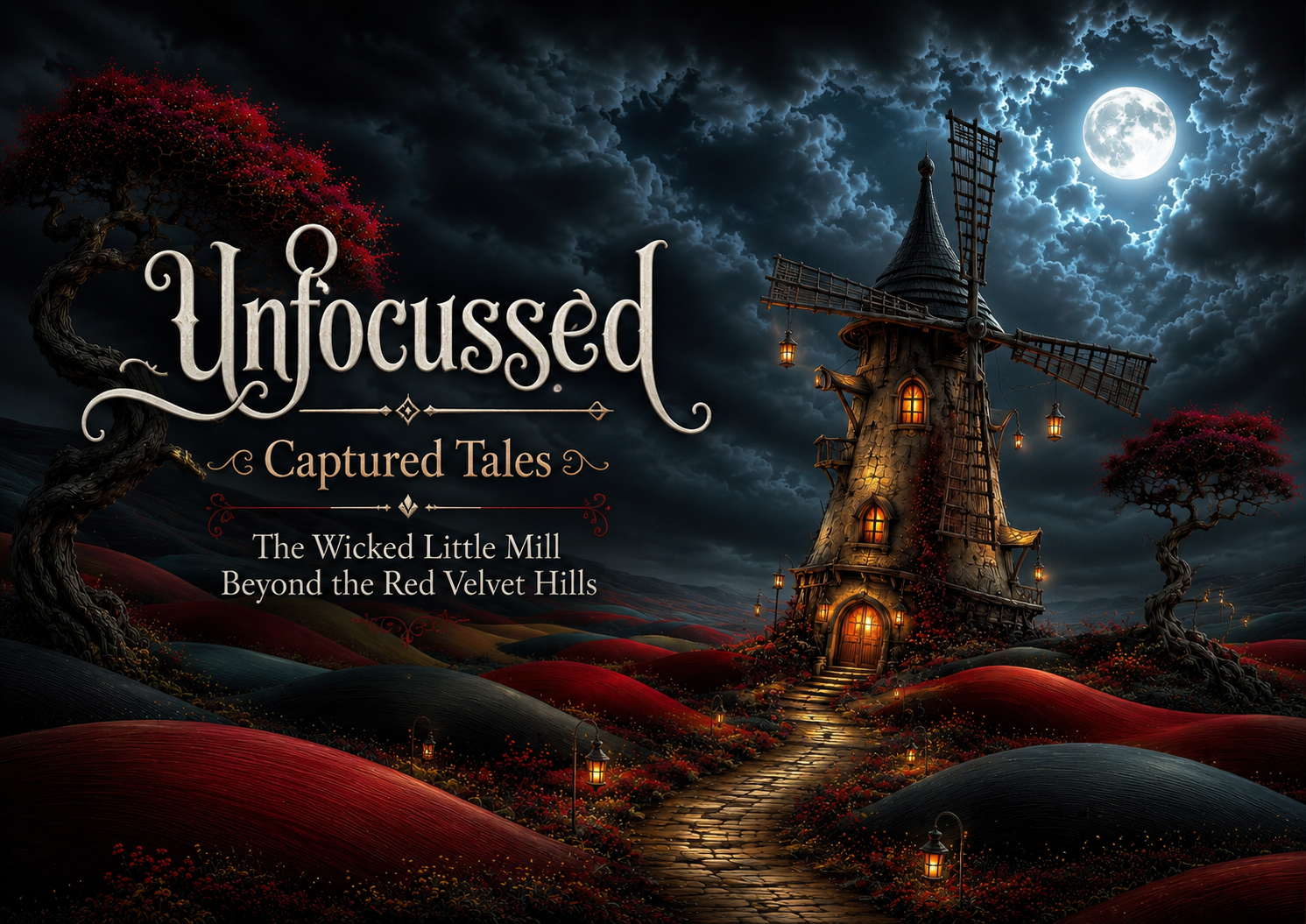
La harina que no se portaba bien
Al otro lado del Valle de Flor de Trueno, más allá de la última valla sensata y del letrero final que decía Regresa a menos que tengas bocadillos, se alzaba un pequeño y perverso molino detrás de las colinas de terciopelo rojo.
No era perverso de la manera dramática y asesina de la que la gente gustaba susurrar después de beber demasiado vino de zarzamora. No se comía a los niños, no maldecía a las novias, ni invitaba a los recaudadores de impuestos a entrar para luego "accidentalmente" extraviarlos en la despensa. Su maldad era más pequeña, más aguda y mucho más irritante. Crujía en momentos críticos. Cerraba sus propias puertas cuando se acercaba gente aburrida. Soplaba harina en la cara de los hombres que empezaban las frases con: "En realidad, lo que deberías hacer es..."
Y una vez, durante un festival de la cosecha, había convertido el sombrero del alcalde en un ganso vivo porque el alcalde lo había llamado "pintoresco".
El ganso había cumplido tres mandatos desde entonces.
La molinera, Belladonna Crumb, insistía en que nada de esto se consideraba maldad. "Personalidad", lo llamaba, usualmente mientras barría harina iluminada por la luna del umbral con una escoba que mordía a los extraños.
Belladonna era conocida en todo el valle como Bella por sus amigos, Señorita Crumb para cualquiera con modales, y "esa bruja de la harina con las cejas" para la gente que quería ser encontrada más tarde con masa de galletas en sus botas. Era alta, de barbilla afilada, y llevaba su cabello gris tormenta recogido bajo un pañuelo rojo que había sobrevivido a tres rayos y un malentendido romántico con un deshollinador. Sus botas eran negras, su delantal estaba bordado con pequeñas lunas doradas, y su paciencia se guardaba en un frasco que no había abierto desde que tenía veintitrés años.
Cada luna llena, cuando las nubes se reunían como tías chismosas y el viento jugaba con los árboles, Bella molía trigo lunar en el pequeño y perverso molino. El trigo lunar era difícil de cultivar, dramático de cosechar y lo suficientemente caro como para hacer sudar a los panaderos a través de sus chalecos. Solo maduraba bajo la luz de la luna llena y solo en suelo que había sido insultado al menos dos veces por un trueno.
Bien molido, producía una harina tan fina que brillaba como polvo de estrellas. Una pizca en el pan le daba a la corteza un brillo plateado. Una cucharada en un pastel hacía que la masa subiera más que la opinión de un obispo sobre sí mismo. Un espolvoreo sobre la repostería podía hacer que una persona perdonara un viejo rencor, confesara un secreto o besara a alguien a quien había estado fingiendo no notar durante siete años.
Mal molido, sin embargo, el trigo lunar se convertía en un problema.
Bella lo sabía. El molino lo sabía. Incluso los faroles a lo largo del sendero empedrado lo sabían, y ellos eran en su mayoría idiotas decorativos.
Por eso la primera regla de la noche de moler la luna era simple: no gritar, no enfurruñarse, no quejarse a menos de doce pasos de la tolva.
Desafortunadamente, las reglas eran como las manijas de las puertas en el Valle de Flor de Trueno. Todos las usaban a diario y aun así se sentían personalmente ofendidos por su existencia.
El problema comenzó poco después de medianoche, cuando la luna llena se abrió paso entre las nubes de tormenta e iluminó las colinas de terciopelo rojo en ondulantes bandas de carmesí, carbón, oro y verde azulado profundo. Las colinas se alejaban del molino como rollos de tela derramados de la cesta de costura de un gigante. Sus crestas brillaban con hierba húmeda, sus laderas estaban cosidas con flores silvestres, y sus huecos recogían una niebla tan espesa que parecía haber sido vertida.
Un rayo brilló detrás del techo torcido del molino. Las aspas del molino de viento giraban lentamente, gimiendo con una miseria teatral.
"Sí, sí", murmuró Bella, revisando la piedra de moler. "Eres antiguo. Eres misterioso. Te duelen las articulaciones. Todo el mundo está muy impresionado".
El molino dio un crujido herido.
"No empieces conmigo", dijo. "Tú elegiste la silueta gótica".
En la mesa de trabajo, su aprendiz, Pipkin Tallow, estaba de pie sobre un taburete e intentaba parecer útil. Pipkin tenía doce años, mejillas redondas, ojos brillantes y poseía el tipo de entusiasmo que hacía que los adultos escondieran cualquier cosa inflamable. Llevaba un chaleco con demasiados bolsillos, cada uno lleno de cosas que consideraba "herramientas prácticas de emergencia", incluyendo cuerda, botones, migas, una cuchara doblada y un escarabajo muerto al que había llamado Sir Munch.
"La harina brilla más fuerte esta noche", dijo Pipkin.
"Eso es porque la tormenta está cerca". Bella se inclinó sobre el recipiente de madera donde la harina de luna fresca descendía del conducto en pálidos y relucientes rizos. "La luz de la tormenta la agita".
"¿Eso significa que es poderosa?"
"Significa que está de mal humor".
"¿Como la señora Rumble cuando la campana de la iglesia suena antes del desayuno?"
"Peor. La señora Rumble solo usa la sopa como arma".
Pipkin asintió solemnemente. Todos recordaban el Incidente de las Lentejas.
Bella levantó un dedo mientras la harina seguía cayendo. "Repite las reglas".
Pipkin se enderezó. "No gritar cerca de la tolva. No quejarse cerca de la tolva. No chismear a menos que sea de conocimiento público o sobre alguien lo suficientemente muerto como para no demandar".
"Bien".
"No estornudar en la harina".
"Esencial".
"No decir cosas como 'que las pulgas de siete graneros infesten sus pantalones' a menos que lo digas en serio".
"Especialmente eso".
"Y no dejar entrar a Tobin Grudge".
Bella lo señaló. "La regla más importante".
En ese mismo momento, alguien golpeó la puerta del molino.
El molino tembló. Los faroles de afuera parpadearon de color naranja. La escoba debajo del mostrador gruñó.
Los ojos de Pipkin se abrieron. "Eso sonó como un golpe de Tobin".
"Todo golpe suena como un golpe de Tobin si tiene suficiente derecho", dijo Bella.
Volvieron a golpear.
"¡Abran!" gritó un hombre desde afuera. "Hace frío aquí fuera, ¡y su camino está tratando de hacerme tropezar!"
Bella cerró los ojos. "El camino tiene un gusto excelente".
Pipkin saltó del taburete y susurró: "¿Deberíamos fingir que estamos muertos?"
"No. La última vez, intentó vender condolencias".
Bella se limpió las manos en el delantal, se dirigió a la puerta de madera arqueada y la abrió lo suficiente para mostrar un ojo impasible.
Tobin Grudge estaba de pie en el escalón, goteando lluvia y arrogancia. Era un hombre delgado con una barba puntiaguda, un abrigo color ciruela y el aire trágico de alguien que creía que cualquier habitación se volvía más interesante cuando él entraba. Colgado de un hombro llevaba una cartera de cuero abultada con folletos, tónicos, alfileres milagrosos, cucharas conmemorativas y cualquier otra cosa que recientemente había convencido a los tontos de comprar.
Detrás de él, la tormenta rodaba sobre las colinas. Los árboles de flores rojas se doblaban con el viento. Los faroles a lo largo del camino se balanceaban como si intentaran evitar el contacto visual.
"Absolutamente no", dijo Bella.
Tobin sonrió. "Bella, cariño..."
"Todavía no".
"Estoy aquí por negocios".
"Eso lo empeora".
"Ni siquiera has oído mi oferta".
"Una vez te escuché ofrecerle a la señora Brindle una botella de rocío antiarrugas que claramente era agua de estanque con un renacuajo confundido adentro".
"Ese renacuajo tenía una piel excepcional".
Bella empezó a cerrar la puerta.
Tobin metió su bota en el hueco. "Necesito harina".
"Entonces ve a una tienda".
"No harina común. Harina de luna".
"No".
"Un puñado".
"No".
"Un dedal".
"No".
"Un espolvoreo románticamente sugerente".
"Tobin, te romperé el pie y te cobraré la lección".
Su sonrisa flaqueó, pero solo ligeramente. La confianza de Tobin era como el moho: desagradable, persistente y prosperando en condiciones húmedas.
"Escucha", dijo, bajando la voz. "Hay un mercado en Lowbarrow mañana. Gente rica. Gente solitaria. Gente con poco control de sus impulsos y bolsos decorativos. Si les vendo sobres de harina de luna como 'Polvo Matrimonial Místico', ambos nos beneficiamos".
Bella lo miró fijamente.
Pipkin apareció detrás de su codo. "¿Qué es matrimonial?"
"Algo que Tobin debería tener legalmente prohibido explicar", dijo Bella.
Tobin se llevó una mano al pecho. "Me hieres".
"Todavía no".
La puerta del molino eligió ese momento para abrirse más, traicionera y curiosa. Una ráfaga de viento entró, arrastrando lluvia, hojas y el olor a tierra revuelta por la tormenta. El farol sobre la puerta siseó. En algún lugar dentro del molino, la piedra de moler zumbaba más fuerte.
Bella espetó: "Fuera".
Pero Tobin ya había cruzado el umbral.
El molino gimió.
La escoba gruñó.
Pipkin susurró: "Violación de la regla".
"Lo sé", dijo Bella entre dientes.
Tobin miró alrededor de la habitación, observando las ventanas que brillaban, las cestas de trigo lunar, las balanzas de latón, los estantes de tarros etiquetados y la harina fresca que se derramaba como humo plateado en el recipiente. La codicia iluminó su rostro.
"Oh", dijo. "Eso es precioso".
Bella se interpuso entre él y la harina. "No toques nada".
"Nunca lo haría".
"Una vez robaste un jamón entero durante un funeral".
"Fue una celebración de la vida".
"Era la vida del padre Mallow, no la tuya".
Tobin se inclinó a la izquierda. Bella se inclinó con él.
Él se inclinó a la derecha. Ella lo igualó.
Pipkin se puso de puntillas detrás de ellos, observando como si fuera la mejor obra de teatro que el Valle de Flor de Trueno hubiera producido jamás, lo cual, dado que el último concurso del pueblo había presentado a un burro con miedo escénico y un ángel falso atascado en una polea, era posiblemente cierto.
"Bella", dijo Tobin, extendiendo las manos, "no estoy aquí para causar problemas".
El molino emitió un agudo y descreído sonido metálico.
"Estoy aquí para hablar de oportunidades".
"Tus oportunidades suelen terminar con alguien a quien le falta la cubertería".
"Esa es una interpretación estrecha y hiriente del espíritu empresarial".
"Esa es una interpretación generosa del robo".
Un trueno estalló sobre sus cabezas. La luna llena brilló a través de un desgarro en las nubes, derramando luz blanca a través de la ventana redonda sobre la tolva. La harina brilló más intensamente.
Bella sintió el cambio inmediatamente.
La harina de luna tenía estados de ánimo, sí, pero también tenía apetitos. Le gustaba el calor, el ritmo y la canción. Le disgustaban el hierro, las mentiras viejas y que los tontos hablaran de ella. Bajo la luz de la tormenta, se volvía especialmente sensible al lenguaje. Las palabras se empapaban en ella. Las intenciones se aferraban a ella. Una frase descuidada podía rizarse a través de la harina como humo a través de encaje.
"Pip", dijo Bella en voz baja, "cubre el recipiente".
Pipkin se apresuró a obedecer.
Tobin, al ver movimiento cerca del objeto de su deseo, confundió la urgencia con la oportunidad. Se abalanzó hacia adelante con toda la gracia de un hurón con chaleco.
Bella lo agarró de la manga. Pipkin agarró la cubierta de tela. El molino tembló. La piedra de moler rugió. La harina se elevó del recipiente en una nube brillante.
Y Tobin Grudge, abofeteado por una ráfaga de harina de luna, gritó: "¡Maldita sea, que cada gallina codiciosa de este valle me juzgue si esta harina no es más problema de lo que vale!"
La habitación se quedó en silencio.
Incluso el trueno pareció detenerse afuera, como si se acercara para escuchar lo que sucedería a continuación.
La mano de Bella se apretó en la manga de Tobin.
Pipkin se quedó inmóvil con la tela medio levantada.
Una sola chispa plateada salió de la nube de harina, se meció en el aire como una luciérnaga curiosa y aterrizó en la nariz de Tobin.
"Oh", dijo Pipkin.
Bella exhaló lentamente. "Eres un completo nabo".
Tobin parpadeó. "¿Qué?"
Desde algún lugar más allá de la puerta del molino llegó un suave cacareo.
Luego otro.
Luego treinta y siete más.
Tobin se volvió hacia la puerta abierta.
Los faroles exteriores brillaron en oro, iluminando el sendero empedrado. A lo largo del sendero, emergiendo de la lluvia, la luz de la luna y, al parecer, de ninguna parte sensata, llegaron gallinas.
Eran gallinas grandes. Gallinas de aspecto codicioso. Gallinas con plumas lustrosas, ojos estrechos y la expresión unificada de un jurado que ya había llegado a su veredicto y solo asistía al juicio por los bocadillos.
Marchaban de dos en dos por el sendero hacia el molino.
Pipkin tragó saliva. "¿Son esas gallinas de juicio?"
Bella se pellizcó el puente de la nariz. "Ahora lo son".
Tobin retrocedió. "Eso no puede ser por lo que dije".
Una gallina saltó al umbral, lo miró de arriba abajo y cacareó con una claridad moral devastadora.
Tobin se llevó una mano al corazón. "Me siento criticado".
"Bien", dijo Bella. "Eso significa que está funcionando".
Las gallinas se precipitaron al molino.
Rodearon a Tobin en una media luna emplumada, picoteando no su cuerpo, sino su dignidad. Una tiró de un hilo suelto de su abrigo. Otra inspeccionó sus botas e hizo un ruido de profunda decepción. Una tercera saltó a un saco de harina, lo miró a los ojos y puso un huevo con la solemnidad de un juez dictando sentencia.
Pipkin miró fijamente. "Ese huevo tiene escritura".
Bella lo recogió.
En diminutas letras doradas, el huevo decía: Necesita mejorar.
Tobin farfulló. "¡No seré revisado por aves de corral!"
Las gallinas cacarearon más fuerte.
"¡Todos callados!" espetó Bella.
El molino obedeció. Pipkin obedeció. Incluso la mayoría de las gallinas obedecieron, aunque una murmuró por lo bajo de una manera que Bella no apreció.
Miró el recipiente de harina.
La harina de luna brillaba violentamente ahora, inquieta y brillante. La queja descuidada no solo la había tocado. La había despertado.
"Pip", dijo Bella, "coge el frasco azul".
"¿La sal?"
"El otro frasco azul".
"¿El polvo de disculpas?"
"Eso es lavanda".
"¿El polvo de emergencia para calmar?"
"Eso también es lavanda".
"¿Por qué tenemos tantos polvos emocionales?"
"Porque la gente sigue hablando".
Pipkin corrió hacia los estantes, cogió un tarro de cristal azul y lo trajo. Bella lo descorchó y esparció una pizca de raíz inmóvil en polvo sobre el recipiente. La harina siseó, se atenuó y se asentó.
Durante tres segundos.
Luego, desde fuera, alguien gritó.
"¡Que tus gallinas te juzguen, Tobin Grudge!"
Bella se quedó muy quieta.
Tobin hizo una mueca. "Eso sonó como la señora Rumble".
"¿Por qué", preguntó Bella, "¿está la señora Rumble fuera de mi molino?"
Pipkin se asomó por la ventana. "Porque hay aldeanos subiendo por el camino".
Bella se acercó a la ventana.
Efectivamente, faroles se balanceaban a lo largo del camino empedrado de abajo. Los aldeanos subían del valle envueltos en capas y chales, gritando por encima de la tormenta. Algunos llevaban cestas. Algunos llevaban paraguas. Varios tenían la mirada brillante de personas que habían oído que algo extraño estaba sucediendo y se apresuraron a empeorarlo.
Al frente estaba la señora Rumble, ancha como un armario y el doble de difícil de mover, con un gorro atado bajo la barbilla con precisión militante. Detrás de ella venía el señor Wicks el panadero, el ganso alcalde, el viejo Nettle con su pipa, los gemelos Brindle y la mitad de la población soltera del pueblo, que fingían estar allí por la harina y no porque Tobin les había prometido "Polvo Matrimonial Místico" con descuento.
Bella se volvió lentamente hacia Tobin.
Él miró al techo. "Ah".
"¿Anunciaste esto?"
"Solo suavemente".
"¿Al pueblo?"
"No a todo el pueblo".
Más faroles aparecieron en la colina.
"Tobin".
"Se me fue de las manos".
"Así lo harán tus rótulas".
La puerta se abrió de golpe, y la señora Rumble entró a toda prisa con la lluvia goteando de su gorro.
"Belladonna Crumb", declaró, "exijo un reembolso".
Bella parpadeó. "¿Por qué? No te he vendido nada".
La señora Rumble señaló a Tobin con un dedo. "Dijo que tu harina de luna podría hacer que mi Harold fuera más cariñoso".
Detrás de ella, un hombre delgado con bigote levantó una mano tímida. "Ya soy cariñoso".
"Me diste una palmada en el codo en nuestro aniversario y lo llamaste un gesto festivo".
"Fue una palmada muy significativa".
"Tuvo la pasión de una tostada húmeda".
La harina de luna en el recipiente chispeó.
Bella espetó: "¡Nada de quejas cerca de la harina!"
Demasiado tarde.
Una onda plateada salió del recipiente, se rizó alrededor de Harold Rumble y estalló como una burbuja de jabón.
Harold se miró a sí mismo.
El vapor empezó a salir de su abrigo. Su bigote se esponjó. Sus ojos se empañaron. Luego agarró la mano de la señora Rumble y susurró: "Mi nube de trueno de masa, tus codos son las bisagras sobre las que mi corazón se balancea".
El rostro de la señora Rumble cambió de furia a alarma y a algo peligrosamente cercano al interés.
Pipkin susurró: "Tostada húmeda arreglada".
Bella agarró la cubierta de la harina. "Todos fuera".
Pero los aldeanos ya estaban dentro.
El señor Wicks se adelantó, retorciéndose la gorra de panadero. "Si se trata de harina mágica, debería participar profesionalmente".
"Deberías participar en silencio", dijo Bella.
El viejo Nettle miró dentro del recipiente. "Parece inofensivo".
"También lo parecen los champiñones antes de que te hagan ver a tu tío muerto haciendo claqué en un bebedero para pájaros".
Una de las gemelas Brindle, a quien nunca se le había acusado de sabiduría y lo habría negado si lo hubiera sido, señaló a Tobin. "Nos dijo que la harina podía mejorar las perspectivas románticas".
Su hermana añadió: "Y las perspectivas de venganza".
"Y la tez", dijo alguien en la parte de atrás.
"Y posiblemente la fertilidad del ganado", dijo alguien más.
Bella se volvió hacia Tobin. "¿Estabas vendiendo mi harina como polvo de romance, polvo de venganza, polvos faciales y para animar a las cabras?"
Tobin intentó un encogimiento de hombros digno mientras una gallina de juicio picoteaba el dobladillo de su pantalón. "La diversificación es la columna vertebral del comercio".
"Estoy a punto de diversificar tu columna vertebral".
"¡Que su lengua se retuerza en algo útil!" gritó la señora Rumble.
"¡No!" gritó Bella.
La harina destelló.
Tobin se ahogó.
Su lengua salió disparada, se rizó, se enlazó y se ató en un lazo pulcro.
La habitación jadeó.
Pipkin se acercó. "Es más útil. Podrías colgar una llave en eso".
Tobin hizo un ruido ahogado de indignación.
"¡Que nadie hable!" gritó Bella. "¡Que nadie se queje, insulte, maldiga, se lamente, murmure, gruña, gima o narre emocionalmente sus decepciones!"
Durante un milagroso latido, todos obedecieron.
Entonces el señor Wicks, que había construido toda una personalidad en torno a la ansiedad y la levadura, susurró: "Solo espero que mis bollos no suban demasiado mañana".
La harina pulsó.
En el pueblo, muy abajo, sonó una campana.
Otra campana se unió a ella.
Luego vino un sonido distante como de tejados abriéndose.
Todos se volvieron hacia la ventana.
Desde la panadería al pie de la colina, enormes bollos comenzaron a elevarse en la noche tormentosa. Redondos, dorados y brillantes, se hinchaban a través del techo como globos satisfechos. Uno flotó junto a la ventana, dejando un rastro de glaseado y hollín de chimenea.
El señor Wicks gimió. “Esos eran para el desayuno”.
“Ya no”, dijo Bella.
El caos siguió con una velocidad impresionante.
Una mujer cerca de la puerta murmuró que esperaba que la madre de su marido "se bajara de su caballo", y en algún lugar afuera, un chillido anunció la llegada de una anciana deslizándose por el camino en un caballo muy ofendido que parecía encogerse debajo de ella.
El viejo Nettle se quejó de que sus rodillas no eran "más que bisagras oxidadas", y sus piernas inmediatamente comenzaron a chirriar cada vez que pisaba.
Uno de los gemelos Brindle exclamó: "Podría morirme de vergüenza", y Bella la derribó antes de que la harina pudiera decidir si eso era legalmente vinculante.
El alcalde ganso le graznó a Tobin con aire de decepción ejecutiva.
“¡Basta!” gritó Bella, levantándose del suelo con un gemelo Brindle bajo el brazo como un saco de patatas. “Fuera del molino. Todos ustedes. Ahora.”
Los aldeanos no se movieron.
Afuera, la tormenta explotó con relámpagos blancos. Las aspas del molino giraron más rápido. Todo el edificio torcido tembló desde los cimientos hasta la cumbrera, sus ventanas brillando ámbar y oro, sus faroles balanceándose como estrellas borrachas.
La harina lunar se elevó del recipiente.
No toda. Solo un velo brillante, fino y pálido, elevándose en el aire como si fuera atraído por un aliento invisible. Se extendió por la habitación, capturando la luz de la luna, la luz de la tormenta, la luz de los faroles y cada última palabra tonta que aún colgaba entre las vigas.
El estómago de Bella se hundió.
Había visto la harina crecer antes. La había visto brillar, enfurruñarse, cuajarse y una vez imitar una pequeña nube grosera.
Nunca la había visto escuchar.
Pipkin se acercó a ella. “¿Señorita Crumb?”
“No respires fuerte.”
“¿Puede ser una queja la respiración?”
“En este pueblo, probablemente.”
La nube de harina se dirigió hacia la puerta abierta.
Bella se lanzó de nuevo hacia el frasco azul, pero el frasco se rompió en su mano. El polvo de Stillroot se derramó inútilmente por el suelo.
El molino gimió. Las tablas del suelo se abombaron. La nube de harina se deslizó por el umbral y salió a la tormenta.
Por un momento, no pasó nada.
Luego, las colinas de terciopelo rojo comenzaron a brillar.
Comenzó con la ladera más cercana, un suave brillo plateado que recorría las crestas como la luz de la luna cosida en tela. Luego se iluminó la siguiente colina, y la siguiente, y la siguiente, hasta que todo el valle rodó bajo la tormenta en olas de carmesí y plata.
Cada linterna a lo largo del camino se encendió intensamente.
Cada árbol retorcido soltó sus flores rojas.
Cada gallina se volvió hacia Tobin con un renovado propósito profesional.
Bella salió por la puerta y observó cómo la harina lunar se extendía por el Valle de Thunderbloom como un escándalo susurrado.
Abajo, los aldeanos comenzaron a gritar desde sus cabañas, graneros y camas.
“¿Quién dejó la puerta abierta?”
“¡Que ese tejado deje de gotear por una vez!”
“¡Ojalá el bebé durmiera como un tronco!”
“¡Malditos nabos, que se pudran por lo que a mí me importa!”
Una a una, las quejas tomaron forma.
Una puerta echó piernas y salió corriendo bajo la lluvia. El tejado de una cabaña se selló tan completamente que la chimenea tosió en protesta. En algún lugar, un bebé dio un pequeño ronquido y se convirtió en un tronco real con un gorro. En el huerto de abajo, los nabos comenzaron a descomponerse con obediencia satisfecha.
Pipkin apareció junto a Bella. “Esto parece malo.”
“Por eso tenemos reglas.”
“¿Debo escribir eso?”
“Grábalo en Tobin.”
Tobin emitió un sonido indignado de lengua atada.
Bella lo agarró por el cuello y lo arrastró hasta la puerta. “Desata tu lengua.”
Señaló impotente su boca.
“Bien.” Le pellizcó el lazo de la lengua entre dos dedos, murmuró un hechizo de inversión y tiró.
Tobin chilló cuando su lengua volvió a la normalidad.
“Eso fue invasivo,” dijo.
“De nada.”
“Mi boca se siente violada.”
“Tu boca ha estado violando el valle durante años.”
La señora Rumble, aún agarrando la mano de Harold mientras él le susurraba poesías cada vez más húmedas, se inclinó hacia adelante. “¿Puedes arreglar esto?”
Bella miró las colinas resplandecientes.
“Sí,” dijo.
Los aldeanos exhalaron.
“Probablemente,” añadió.
Los aldeanos volvieron a inhalar.
“Hay una vieja atadura debajo de la cresta lejana,” dijo Bella. “El Gripewell. Es donde el primer molinero enterró las peores quejas del valle para que no fermentaran en maldiciones.”
Pipkin frunció el ceño. “¿Las quejas fermentan?”
“Todo fermenta si la gente lo ignora el tiempo suficiente.”
“¿Incluso los sentimientos?”
“Especialmente los sentimientos.”
Tobin se sacudió la harina del abrigo. “Historia fascinante. De verdad. Ya me voy.”
Bella no lo miró. “No, no lo harás.”
Se congeló.
“La harina se despertó por tu queja,” dijo. “Tu voz la sembró. Tu avaricia la alimentó. Tus gallinas todavía te juzgan, lo que francamente parece la parte más sana de esta noche.”
La gallina más cercana cacareó en señal de acuerdo.
“Para detener la harina,” continuó Bella, “tenemos que llevar la queja original al Gripewell antes del amanecer y ahogarla en agua de trueno.”
Tobin retrocedió un paso. “No tengo la queja. La dije. Se ha ido.”
Bella sonrió sin calidez.
“Oh, Tobin,” dijo. “Las palabras nunca desaparecen. Solo encuentran un lugar inconveniente para vivir.”
Metió la mano en el recipiente de harina y sacó algo pequeño, plateado y retorciéndose.
Parecía un gusano hecho de humo y luz de luna, con una pequeña boca en un extremo y el pequeño y engreído bigote de Tobin en el otro.
Pipkin retrocedió. “¿Es esa su queja?”
“Sí.”
La queja abrió la boca y chirrió: "¡Más problemas de los que vale!".
Todas las gallinas de la habitación entrecerraron los ojos.
Tobin se sintió mal. “¿Eso salió de mí?”
“Varias cosas han salido de ti esta noche que deberían haber permanecido privadas.”
Bella dejó caer la queja retorciéndose en un frasco de vidrio con tapón. Rebotó contra los lados, chillando con la voz de Tobin.
“Nos vamos ahora,” dijo Bella.
“¿Ahora?” chilló Tobin.
“Antes del amanecer.”
“¿Por las colinas?”
“A menos que conozcas un atajo a través de tus propias malas decisiones.”
Afuera, las colinas de terciopelo rojo brillaban bajo los relámpagos. El camino empedrado se retorcía lejos del molino, luego desaparecía entre las ondulantes laderas carmesí y las siluetas negras de los árboles doblados por la tormenta. Mucho más allá de ellos, bajo las nubes magulladas y la luna plateada, algo antiguo pulsó una vez en la tierra.
El Gripewell estaba despierto.
Tobin tragó. “¿Y si no lo alcanzamos?”
Desde el pueblo de abajo llegó un estruendo distante, seguido por un hombre que gritaba: "¡Solo dije que quería que el maldito armario se abriera emocionalmente!".
Un armario sollozó.
Bella se ató el vial a un cordón alrededor del cuello, se puso su capa de tormenta y cogió un farol del gancho junto a la puerta.
“Entonces, cada queja en el Valle de Thunderbloom se hará realidad hasta la mañana,” dijo. “Y para el desayuno, la mitad del pueblo será ganado, muebles, pasteles o estará casado con alguien a quien insultaron en 1997.”
Harold Rumble suspiró románticamente. “El amor es un tejado que gotea reparado por la luz de la luna.”
La señora Rumble le acarició la mano. “Hablaremos de eso más tarde.”
Bella señaló a Pipkin. “Tú quédate aquí. Haz que todos guarden silencio. Nadie habla cerca de la harina restante. Nadie come nada que brille. Nadie hace contacto visual con los bollos.”
Pipkin saludó. “¿Y si los bollos hacen contacto visual primero?”
“Miente.”
Luego señaló a Tobin.
“Tú,” dijo, “camina delante.”
“¿Por qué?”
“Porque si el camino tiene hambre, prefiero que pruebe algo moralmente tiernizado.”
Tobin abrió la boca, vio la expresión de Bella y la cerró de nuevo.
Eso, al menos, era un progreso.
Juntos, Belladonna Crumb y Tobin Grudge salieron del molino perverso y se adentraron en el camino iluminado por los faroles. Detrás de ellos, los aldeanos susurraban en silencio aterrorizado mientras los pollos jueces se colocaban en una fila ordenada para seguirlos. Sobre ellos, la luna brillaba intensa y llena a través de las nubes desgarradas de la tormenta. Adelante, las colinas de terciopelo rojo rodaban y brillaban, vivas con cada queja descuidada, cada maldición insignificante y cada irritación murmurada que el Valle de Thunderbloom había sido lo suficientemente tonto como para desatar.
El vial en el cuello de Bella sonó.
Dentro, la queja de Tobin volvió a chillar, esta vez más suave.
“Más problemas de los que vale.”
Bella miró a Tobin.
Tobin miró las colinas.
Las colinas parecían, de alguna manera, ofendidas.
Y entonces el camino bajo sus pies se movió, se curvó como una cinta y los arrastró hacia la tormenta.
Las colinas se ofenden
El camino empedrado no solo arrastró a Belladonna Crumb y Tobin Grudge a la tormenta.
Los jaló.
En un momento estaban de pie fuera del pequeño y malvado molino con una procesión de aves de corral juzgadoras formándose detrás de ellos. Al siguiente, el camino se adelantó como una cinta atrapada en un telar hambriento, arrastrándolos por la pendiente tan rápido que las botas de Tobin patinaron, la capa de Bella voló detrás de ella, y tres gallinas se vieron obligadas a un trote rápido que parecía estar muy por debajo de su dignidad.
“¡Haz que se detenga!” gritó Tobin.
“¡Quéjate más bajo!” le gritó Bella.
“¡Esto no es quejarse! ¡Esto es un anuncio de supervivencia!”
El camino descendió, giró y se curvó entre dos colinas carmesí resbaladizas por la lluvia y la luz plateada de la luna. Las linternas se encendieron una a una delante de ellos, cada llama resplandeciendo a su paso, como si el propio valle hubiera decidido proporcionar una iluminación dramática para su humillante descenso.
Detrás de ellos, el molino se encogió en la tormenta, sus cálidas ventanas brillando como ojos vigilantes bajo las aspas giratorias. Más allá, el Valle de Thunderbloom parpadeaba con hechizos descontrolados. Los tejados se sellaban demasiado. Las puertas galopaban por los huertos. Enormes bollos flotaban sobre la panadería, chocando con las chimeneas con la lenta y satisfecha confianza de pasteles que se habían sindicalizado.
Bella mantuvo una mano sobre el vial en su garganta. Dentro, la queja original de Tobin repiqueteaba contra el cristal.
“Más problemas de los que vale,” chirrió.
“Oh, cállate,” espetó Tobin.
La queja volvió a chirriar, más fuerte y con más sentimiento. “¡Más problemas de los que vale!”
“¡Dije que te callaras!”
“No discutas con tu propio residuo emocional,” dijo Bella.
“Empezó él.”
“Es usted.”
“Entonces debería saber lo molesto que es.”
El camino giró bruscamente en una curva, arrojándolos entre hileras de árboles retorcidos cuyas flores rojas se soltaban con el viento. Los pétalos giraban a su alrededor como chispas de un fuego. Un relámpago brilló, convirtiendo cada rama en una garra y cada colina en una bestia roja ondulante.
Las gallinas siguieron.
No porque Bella las hubiera invitado.
Nadie invitaba a gallinas juzgadoras. Simplemente aparecían cuando un hombre se las había ganado.
Ahora eran doce, sus plumas negras y doradas brillando con la lluvia, sus ojos brillantes con desdén profesional. Una gallina particularmente grande con una cresta blanca había tomado la delantera. Marchaba detrás de Tobin con el propósito estirado de alguien que había leído todo el manual moral y lo había encontrado anotado al pie de página.
Tobin miró por encima del hombro. “¿Por qué siguen siguiendo?”
“Porque tu maldición especificaba cada gallina codiciosa del valle.”
“Eso fue una figura retórica.”
“Ya no.”
“Siento sus ojos.”
“Excelente. El crecimiento a menudo comienza con la incomodidad.”
“El crecimiento puede comenzar en otro lugar.”
El camino se tambaleó de nuevo.
Tobin se agitó, agarró la manga de Bella y casi los tira a los dos a una zanja llena de malezas brillantes.
Bella le apartó la mano de un manotazo. “Vuelve a tocarme y dejaré que las gallinas presidan la investigación.”
“¿Hay una investigación?”
“Siempre hay una investigación. Este valle funciona con productos horneados, rencores y procedimientos innecesarios.”
Más adelante, los adoquines terminaban abruptamente en la cima de una colina. Más allá se extendía una amplia cuenca donde la hierba había adquirido el color del vino machacado bajo la tormenta. Una niebla plateada se acumulaba en el terreno bajo. En el centro se alzaba una puerta de madera sin valla adjunta, saltando de un poste a otro como una rana ansiosa.
Tobin señaló. “¿Se supone que debe hacer eso?”
“Esa sería la puerta de la señora Pebble,” dijo Bella. “Debe haberse quejado de que alguien la dejó abierta.”
La puerta dejó de saltar y se abrió de par en par.
Luego se cerró.
Luego de par en par.
Luego se cerró.
Luego se volvió hacia ellos.
No tenía rostro, por supuesto. Era una puerta. Pero de alguna manera logró parecer ofendida.
Bella redujo la velocidad.
Tobin no lo hizo. El camino lo empujó directamente por la espalda.
“¿Por qué nos detenemos?” preguntó.
“Porque el camino nos llevó a la puerta.”
“Entonces atraviésala.”
“Tú atraviésala.”
“¿Por qué yo?”
“Porque claramente está de mal humor.”
La puerta traqueteó.
“¿Crees que nos entiende?” susurró Tobin.
La puerta se abrió y cerró de golpe tres veces en rápida sucesión.
“Creo que tiene notas,” dijo Bella.
La lluvia le corría por la nariz a Tobin. Miró la puerta. Miró a Bella. Miró a las gallinas.
La gallina líder cacareó una vez.
Sonó como, Cobarde.
“Bien,” dijo Tobin. “Soy un mercader. Negocio umbrales difíciles todo el tiempo.”
“Vendes ungüentos a gente crédula.”
“Los umbrales vienen en muchas formas.”
Se enderezó el empapado abrigo ciruela, se acercó a la puerta y le dedicó la sonrisa que solía reservar para las viudas con monederos y los hombres inseguros por la línea del cabello.
“Buenas noches, apuesto portón.”
La puerta crujió.
“Bisagras fuertes. Excelente veta. Encantador sentido de la presencia.”
Bella se cruzó de brazos. “No coquetees con el portón.”
“Estoy construyendo una relación.”
La puerta se abrió a medias.
La sonrisa de Tobin se ensanchó. “Aquí estamos. ¿Ves? Toda criatura aprecia el respeto.”
Dio un paso adelante.
La puerta se cerró de golpe en la cola de su abrigo.
Tobin chilló.
Bella suspiró. “Toda criatura también aprecia la honestidad.”
“¡Fui honesto!”
La puerta apretó su agarre.
“¡Más o menos honesto!”
Se tensó de nuevo.
“¡Bien! ¡Sus bisagras son mediocres!”
La puerta lo soltó.
Tobin retrocedió tambaleándose y casi tropieza con una gallina.
La gallina picoteó el suelo junto a su bota con quirúrgica decepción.
Bella dio un paso adelante. “Puerta, vamos al Gripewell.”
La puerta se estremeció.
“Sí,” dijo Bella. “Lo sé. A nadie le gusta. Ese es el objetivo.”
Se abrió una rendija.
Bella bajó la voz. “Si la harina lunar llega al pozo sin nosotros, cada queja en el valle echará raíces allí. Te quedarás abriendo y cerrando para siempre, incluso cuando nadie te mire, lo que me imagino que se volvería tedioso.”
La puerta se congeló.
Luego se abrió de par en par.
Bella pasó.
Tobin la siguió, murmurando: “Yo la había ablandado.”
La puerta le dio un golpe en la espalda al pasar.
“¡Ay!”
“Parece ablandada,” dijo Bella.
Continuaron hacia la cuenca, con las gallinas en perfecta formación.
La tormenta había cambiado. Ya no solo rugía sobre ellos. Escuchaba. El trueno rodaba bajo y con cuidado, como si intentara no hacer una petición accidentalmente. Los relámpagos venían en finos hilos blancos detrás de las nubes. La luna llena permanecía visible a través de todo, demasiado brillante, demasiado redonda, demasiado interesada.
El vial en el cuello de Bella se calentó.
Dentro, la queja se retorció.
“Más problemas de los que vale.”
Bella golpeó el cristal. “Mantén tu pequeño bigote en silencio.”
Tobin frunció el ceño. “¿Tiene mi bigote porque lo dije yo, o porque la harina no tiene imaginación?”
“La harina tiene mucha imaginación. Simplemente sabe cuándo ve una cara rica en objetivos.”
Se tocó el bigote, ofendido en su nombre.
La cuenca se abría a un largo valle entre las colinas de terciopelo rojo. Las laderas se alzaban abruptamente a ambos lados, resbaladizas y relucientes. Las flores silvestres brillaban en parches de amarillo, púrpura y azul fantasmal. El agua corría por las colinas en riachuelos retorcidos que centelleaban donde la harina lunar los había tocado.
Por todas partes, las quejas se estaban convirtiendo en cosas.
Un par de botas pisaban con rabia por la hierba por sí solas, pateando piedras y gritando: "¡Me están matando los pies!" con la voz del Viejo Nettle.
Un espantapájaros en un campo cercano discutía con los cuervos porque alguien, al parecer, había deseado que "por una vez hiciera su maldito trabajo".
Tres nabos rodaron, podridos y presuntuosos.
La puerta de un armario flotaba sobre sus cabezas, llorando suavemente.
Tobin lo observaba todo con una expresión que podría haber sido de asombro si el asombro llevara calcetines húmedos y contemplara un litigio.
“Esto es peor de lo que pensaba,” dijo.
“Creías que ganarías dinero vendiendo harina de romance robada a aldeanos emocionalmente inmaduros.”
“Dije que era peor, no sorprendente.”
Bella se detuvo en una bifurcación donde dos senderos estrechos se dividían alrededor de un montículo de roca negra. Un sendero se curvaba a la izquierda a través de un bosque de árboles de flores rojas. El otro se inclinaba a la derecha hacia un hueco lleno de niebla.
“¿Por dónde?” preguntó Tobin.
Bella levantó su linterna.
La llama se inclinó a la izquierda.
Luego a la derecha.
Luego a la izquierda de nuevo.
Luego se encogió en un pequeño enfado azul.
—La linterna está confusa —dijo Tobin.
—La linterna es dramática.
—¿Puedes preguntarle al molino?
—No estamos a distancia de gritos.
—Podrías gritar.
—¿Y arriesgarme a que la harina convierta mis palabras en una opinión voladora? No.
Tobin miró por el sendero neblinoso. —El sendero de la derecha parece más rápido.
—El sendero de la derecha parece húmedo.
—El sendero de la izquierda parece el lugar al que van los árboles a practicar el estrangulamiento.
Los árboles de flores rojas susurraron.
—Y tienen un oído excelente —dijo Bella.
Una gallina caminó hacia el sendero de la izquierda, rascó la tierra y cacareó.
Tobin gimió. —¿Ahora estamos recibiendo direcciones de aves de corral?
La gallina líder lo miró.
Él se aclaró la garganta. —De aves de corral muy perceptivas.
Tomaron el sendero de la izquierda.
Los árboles se inclinaron sobre ellos al entrar, las ramas se entrelazaron en un túnel de madera oscura y flores rojas. Las flores olían dulces y agudas, como mermelada hecha por alguien con secretos. La lluvia golpeaba a través de las hojas. La luz de la linterna apenas llegaba a las raíces.
Durante varios minutos, nadie habló.
Esto fue difícil para Tobin, quien había construido su vida sobre el principio de que el silencio era simplemente una conversación esperando ser monetizada.
Finalmente, dijo: —Sabes, esto aún podría convertirse en una oportunidad.
Bella no lo miró. —Elige tus próximas palabras como si estuvieran siendo pesadas por dioses con migrañas.
—Solo quiero decir que, una vez que esto esté contenido, podría haber demanda de aplicaciones de harina de luna debidamente supervisadas.
—No.
—No polvo de romance.
—No.
—Polvo de resolución de conflictos.
—No.
—Servicios de responsabilidad moral basados en aves de corral.
Una gallina cacareó pensativamente.
Bella se volvió. —No lo alientes.
—Podría diseñar panfletos de buen gusto —dijo Tobin—. Gallinas en relieve. Muy digno.
La gallina líder hinchó su pecho.
—Absolutamente no —dijo Bella—. Esas gallinas son manifestaciones de tu codicia maldita, no una empresa consultora.
Tobin pareció decepcionado. —Todo es una empresa consultora si facturas con confianza.
Una rama se rompió adelante.
Bella se detuvo tan abruptamente que Tobin chocó con ella de nuevo.
—Tus codos son hostiles —susurró él.
—Tu cara sigue acercándose a ellos.
Algo se movió entre los árboles.
Al principio, parecía una persona. Una figura alta se encontraba en las sombras, ligeramente inclinada bajo las ramas. Llevaba un abrigo, o quizás una capa, o quizás capas de hojas pegadas por la luz de la luna. Su cabeza se inclinó hacia ellos.
Bella levantó la linterna.
La figura se acercó.
Estaba hecha completamente de palabras.
No palabras escritas en papel, sino palabras habladas que tomaban forma. Las quejas se curvaban a través de ella en cintas pálidas. Los reproches se superponían formando brazos. Los lamentos se retorcían en dedos. Una cara larga y flácida se formó a partir de frases murmuradas durante años, todas ellas agrias, todas ellas cansadas, todas ellas familiares.
Demasiado frío.
Demasiado ruidoso.
Demasiado tarde.
Demasiado.
No es suficiente.
Nadie escucha.
Todo está arruinado.
Tobin hizo un sonido como el de una taza agrietándose. —¿Qué es eso?
—Un Quejumbroso —dijo Bella.
—No me gusta que ya tuvieras un nombre preparado.
—No me gusta que ayudaras a crear uno.
El Quejumbroso abrió la boca.
Decenas de voces se derramaron a la vez.
—Mi sopa está fría.
—La luna es demasiado brillante.
—Nadie aprecia mis rábanos.
—Estos zapatos aprietan.
—Los jóvenes bailan mal.
—Mi marido ronca como un armario maldito.
—Tobin Grudge todavía me debe tres cucharas.
Bella miró a Tobin.
—Supuestamente —susurró él.
El Quejumbroso se acercó flotando. Su cuerpo se estiraba de árbol en árbol, tejido con las quejas sueltas del valle. Cada paso enfriaba el aire.
Bella metió la mano en su mochila y sacó una pizca de sal negra.
—¿Eso lo detendrá? —susurró Tobin.
—Lo ofenderá.
—¿Es eso útil?
—A menudo.
Ella lanzó la sal.
El Quejumbroso retrocedió, siseando en cincuenta voces.
—¡Demasiado salado!
—¡Típico!
—¡Nadie preguntó!
—¡Por eso no salgo!
Los golpeó con un brazo largo de quejas enredadas.
Bella empujó a Tobin al suelo. El brazo pasó por encima, golpeando una rama. La rama inmediatamente comenzó a quejarse de que había sido emocionalmente descuidada por el tronco.
—¡Corran! —gritó Bella.
Corrieron.
Las gallinas también corrieron, aunque con claro resentimiento por la falta de aviso previo.
El Quejumbroso se lanzó tras ellos, deslizándose entre los árboles, sus voces aumentando.
—¡Demasiado rápido!
—¡Demasiado oscuro!
—¡Demasiado húmedo!
—¡Demasiadas gallinas!
La gallina líder miró hacia atrás y cacareó, insultada.
—¡No se enfrenten! —gritó Bella.
Tobin tropezó con una raíz, se recuperó y corrió a su lado. —¿Cómo lo matamos?
—No lo matamos.
—¿Por qué no?
—Porque está hecho de quejas.
—Entonces debería ser fácil. Todo el mundo las ignora.
Bella lo miró. —Así es exactamente como se convierten en monstruos.
El camino se estrechó. Ramas espinosas arañaban su ropa. El frasco rebotaba contra el pecho de Bella. La queja de Tobin chillaba dentro, emocionada o aterrorizada o ambas cosas.
—¡Más problemas de los que vale!
El Quejumbroso hizo eco de las palabras.
—Más problemas.
—Más problemas.
—Más problemas.
Los árboles de adelante se abrieron en un claro donde la luz de la luna caía en un círculo plateado perfecto. En el centro había una pila de piedras llena de agua de lluvia, cuya superficie temblaba bajo la tormenta.
Bella se detuvo bruscamente.
Tobin casi chocó con ella por tercera vez y solo se salvó agarrándose a un árbol, que inmediatamente susurró: "Típico."
—¿Es ese el Pozo de las Quejas? —jadeó.
—No. Esa es una pila de trueno.
—¿Es eso mejor?
—Es necesario.
El Quejumbroso entró en el claro detrás de ellos, llenando los huecos entre los árboles. La luna brillaba a través de su cuerpo tejido con quejas. Su rostro se abrió.
—Nadie escucha —gemía.
Las palabras ondearon por el claro.
La expresión de Bella cambió.
Ya no parecía molesta.
Eso, se dio cuenta Tobin, era peor.
Bella molesta hacía amenazas. Bella callada tomaba decisiones.
—El Pozo de las Quejas requiere agua de trueno —dijo ella—. Tormenta pura capturada antes de que toque el suelo. Esa pila debería contener suficiente.
—Maravilloso. Agárralo.
—Hay que pedirlo.
—Por supuesto.
—Con educación.
—Naturalmente.
—Por alguien que causó el problema.
Tobin la miró fijamente. —No.
El Quejumbroso se acercó con dificultad.
Bella se acercó a Tobin. —Sí.
—No voy a pedirle agua a un cuenco de clima mientras un monstruo hecho de los lamentos del pueblo intenta digerirnos.
—Entonces podemos quedarnos aquí hasta que nos digiera alfabéticamente.
—¿Por qué yo?
—Porque la queja en este vial está conectada a tu voz. La harina despertó a tu codicia. El Pozo de las Quejas no aceptará una cura que no incluya al tonto original.
—Eso parece dirigido.
—Está extremadamente dirigido.
Una cinta de quejas azotó el claro y golpeó el suelo junto a ellos.
—¡Injusto! —gimió el Quejumbroso.
—Sí —respondió Bella—. Así es la vida. Búscate un pasatiempo.
Tobin se acercó a la pila de trueno.
El agua del interior no era agua común. Era negra y plateada, destellando con pequeñas chispas bajo la superficie. Cada ondulación sonaba levemente como un trueno distante. Cuando Tobin se inclinó sobre ella, su reflejo le devolvió la mirada con el cabello más mojado y un juicio mejor.
—¿Qué digo? —susurró.
—Pide lo que necesitamos.
—¿Cómo?
—Honestamente.
—Soy más bien un hombre persuasivo.
—Lo sé. Por eso están las gallinas aquí.
La gallina líder saltó sobre una piedra junto al lavabo y lo miró fijamente.
Tobin tragó saliva.
Detrás de él, el Quejumbroso se arrastró más cerca, su voz deshilachándose en cientos de pequeñas molestias.
—Nadie escucha.
—Nadie se da cuenta.
—A nadie le importa.
—Todo lo que hago es en vano.
—Más problemas de los que vale.
Tobin se estremeció.
Por un instante, el brillo habitual se desvaneció de su rostro. El comerciante encantador, el tramposo de lengua rápida, el hombre que podía vender agua de estanque como tónico de belleza y luego felicitar al renacuajo, flaqueó. Debajo de él había alguien más delgado. Más pequeño. Cansado de una manera que Bella no esperaba.
Miró el agua de trueno.
—Necesito… —comenzó.
El agua no se movió.
Miró a Bella.
Ella no dijo nada.
—Necesito agua de trueno —dijo Tobin— para limpiar un error.
El lavabo emitió un rugido bajo.
Una chispa saltó y chamuscó el borde de su puño.
—¡Ay!
—No le gustó eso —dijo Bella.
—Me di cuenta.
—Intenta de nuevo.
El Quejumbroso gimió y se acercó al borde del claro.
Tobin agarró el lavabo con ambas manos. —Bien. Necesito agua de trueno porque robé harina que todavía no había robado técnicamente, pero espiritualmente tenía toda la intención de robar.
El lavabo volvió a retumbar.
—Y porque invité a la mitad del pueblo a comprar algo que no tenía, no entendía y planeaba vender a un precio dramáticamente excesivo.
Una chispa parpadeó.
—Y porque dije algo tonto cerca de harina mágica.
El agua se agitó.
Bella lo observó con atención.
La mandíbula de Tobin se tensó.
—Y porque —dijo, con la voz más baja—, pensé que si podía vender una cosa más, engañar a una persona más, abrir un bolso más, quizás la gente dejaría de mirarme como si fuera una disculpa andante que nadie quiere aceptar.
El claro quedó inmóvil.
Incluso el Quejumbroso se detuvo.
Tobin parecía furioso consigo mismo por haber hablado. —Ahí. ¿Suficientemente honesto?
La pila de truenos destelló.
El agua se elevó de él en un chorro retorcido, negro y plateado y vivo con relámpagos. Se curvó en el aire y se vertió en la cantimplora vacía de Bella.
Bella la tapó rápidamente.
La gallina líder soltó un suave cacareo.
Este sonó menos a juicio.
Tobin se limpió la lluvia de la cara. —Si alguno de ustedes repite eso, lo negaré con arte.
—Anotado —dijo Bella.
El Quejumbroso gritó.
Su cuerpo se onduló violentamente. La honestidad de Tobin lo había debilitado, abriendo agujeros en su forma tejida de quejas. Las palabras de sus bordes se deshilacharon y soltaron, derramándose sobre la hierba húmeda como hilo desentrañado.
—¡Nadie escucha! —chilló.
Bella se volvió hacia él. —Entonces habla claramente.
El monstruo se congeló.
—Nadie puede responder a una queja que esconde lo que significa —dijo Bella—. La sopa fría es sopa fría. Los zapatos que aprietan son zapatos que aprietan. Pero "nadie escucha" suele significar que alguien ha sido demasiado orgulloso, demasiado cansado o demasiado asustado para decir lo que le dolió.
El rostro del Quejumbroso se retorció.
Por un momento, las muchas voces se redujeron a una.
Era vieja. Pequeña. Familiar.
—La extraño —susurró.
Los ojos de Bella se suavizaron.
En algún lugar entre las quejas, algún aldeano había escondido su dolor bajo la irritación, y la harina de luna lo había recogido con el resto. Ese era el problema con las palabras descuidadas. Llevaban cosas que la gente no sabía que había empacado.
—Lo sé —dijo Bella en voz baja.
El Quejumbroso se desplomó.
Luego Tobin, porque aparentemente no podía dejar un momento tierno sin la estupidez de lamerlo, susurró: —¿Es un mal momento para mencionar que también le debo tres cucharas a alguien?
El Quejumbroso giró la cabeza hacia él.
Bella cerró los ojos. —Tobin.
—Entré en pánico emocionalmente.
El monstruo se lanzó.
Bella agarró a Tobin por el cuello y lo arrastró de lado. El Quejumbroso se estrelló contra la pila de truenos. La pila sonó como una campana. Un rayo se disparó hacia los árboles. Las flores rojas estallaron en una luz azul fuego sin quemarse.
—¿Corremos de nuevo? —preguntó Tobin.
—Corramos de nuevo.
Huyeron del claro por un arco de raíces en el otro extremo, con las gallinas corriendo detrás de ellos. El Quejumbroso, ahora andrajoso pero furioso, se arrastró tras ellos, chillando quejas en la tormenta.
El camino más allá del claro subía empinadamente.
Aquí no había linternas.
Solo luz de luna, lluvia y las colinas rojas que se elevaban como gigantes dormidos a ambos lados. Bella se movió rápidamente a pesar del barro. Tobin resbalaba a cada pocos pasos, maldecía en voz baja, recordaba que las maldiciones eran actualmente una mala elección de estilo de vida, y las reemplazaba con pequeños ruidos tensos que sonaban como una tetera tratando de ser educada.
En la cima de la cresta, se detuvieron.
Todo el valle se extendía bajo ellos.
Tormentaflor ya no era simplemente caótica.
Estaba transformándose.
La harina de luna había llegado más lejos de lo que Bella temía. Un brillo plateado cubría tejados, campos, vallas, pozos y senderos. Cada irritación expresada se convertía en realidad. Una hilera de ropa se había retorcido en sábanas fantasmales porque alguien se quejó de que la casa estaba "embrujada por las tareas". Un rebaño de ovejas se había convertido en diminutas nubes grises porque un pastor deseaba que "simplemente se fueran flotando por una vez". La campana de la iglesia, a la que se le había dicho que "se tocara a sí misma si era tan inteligente", ahora saltaba furiosamente por la carretera principal, sonando obscenamente a cualquiera que se cruzara en su camino.
Cerca de la panadería, los bollos gigantes habían comenzado a multiplicarse.
El señor Wicks estaba de pie en su tejado, agitando una escoba y gritando cosas que no debería haber gritado en absoluto.
Uno de los bollos guiñó un ojo.
Tobin se estremeció. —Ese pastel hizo contacto visual.
—Entonces miente —dijo Bella.
—No vi nada.
—Bien.
El Pozo de las Quejas se extendía más allá de la cresta.
Bella podía sentirlo ahora. Una vieja atracción bajo la tierra. Un lugar hueco donde las palabras habían sido enterradas por generaciones. Se encontraba en el centro de un anillo de piedras negras al otro lado de las colinas rojas, escondido del pueblo por laderas empinadas y malos recuerdos. El primer molinero lo había excavado, o eso cuenta la historia, después de que el valle casi se maldijera a sí mismo hasta la esterilidad durante un invierno en el que todos se quejaban del tiempo pero nadie arreglaba el tejado.
Desde entonces, el Pozo de las Quejas había dormido.
Casi siempre.
Algunas cosas dormían como duermen los gatos: un ojo abierto, las garras listas.
Bella empezó a bajar la ladera lejana.
Tobin la siguió más lentamente.
—Sabías que esto podía pasar —dijo él.
—Sabía que las palabras descuidadas cerca de la harina de luna alimentada por la tormenta eran peligrosas.
—No. Me refiero a todo. El Pozo de las Quejas. Las quejas. Los monstruos.
—Conocía las historias.
—¿Y aun así mueles harina cada luna llena?
—La gente necesita pan.
—Eso suena como una razón insuficiente para arriesgarse a aves de corral malditas.
Bella se detuvo a mitad de la pendiente y se volvió.
El viento tironeaba de su bufanda. La luz de la luna plateaba la lluvia en su rostro.
—La harina de luna no es mala —dijo ella—. Escucha. Eso es todo. Escucha mejor que la gente. Atrapa lo que lanzamos al aire y nos lo devuelve con consecuencias. Usada con cuidado, puede curar. Puede quitar el dolor de una habitación. Puede endulzar un recuerdo amargo. Puede recordar a dos necios tercos que se aman antes de que uno de ellos muera con toda su ternura aún apretada entre los dientes.
Tobin se movió incómodo.
—Usada sin cuidado —continuó Bella—, se convierte en esto.
Debajo de ellos, un hombre gritó que la factura de la reparación de su techo sería su muerte, y una pila de facturas comenzó a perseguirlo por la calle con pequeñas guadañas de papel.
Tobin hizo una mueca. —Entendido.
—No —dijo Bella—. Punto observado. Tomarlo requeriría un cambio.
Él apartó la mirada.
Por una vez, no respondió.
Descendieron a un hueco más oscuro donde la lluvia caía directamente, pesada y fría. La hierba aquí no era carmesí sino verde-negra, aplastada por el viento. La linterna que llevaba Bella ardía débilmente. Incluso las gallinas se quedaron en silencio.
Al fondo había un mojón de piedra semienterrado en el barro.
Las palabras estaban talladas en él, suavizadas por la edad.
AQUÍ YACEN LAS PALABRAS QUE DEBIMOS TRAGAR, LAS HERIDAS QUE DEBIMOS NOMBRAR Y LAS COSAS MEZQUINAS QUE DEBIMOS LLEVAR A LA CAMA COMO ADULTOS.
Tobin lo leyó dos veces. —Esa última parte carece de dignidad.
—La primera molinera era práctica.
—¿Era tu ancestro?
—Peor. Mi maestra.
Tobin parpadeó. —¿Cuántos años tienes?
Bella lo miró.
—Grácilmente incognoscible —dijo rápidamente.
Pasaron el marcador.
El hueco se estrechó en un barranco. A ambos lados se alzaban piedras negras, resbaladizas por la lluvia y veteadas de plata. El aire olía a tierra mojada, a humo viejo y a algo agrio debajo, como una bodega donde se habían guardado discusiones en frascos.
El vial en la garganta de Bella tembló con más fuerza.
—Más problemas de los que vale —chirrió la queja—. Más problemas. Más problemas. Más problemas.
Tobin se frotó los brazos. —¿Por qué repite?
—Porque estamos cerca.
—¿Dolerá?
—¿Para la queja?
—Para mí.
—Eso depende.
—¿De qué?
—De lo apegado que estés a ello.
Tobin no dijo nada.
El barranco se abrió de repente en un claro circular rodeado de piedras negras. En el centro estaba el Pozo de las Quejas.
No era tan impresionante como Tobin había esperado.
Sin llamas. Sin calaveras. Sin una inscripción dramática que dijera Abandonen toda esperanza y límpiense las botas. Era simplemente un viejo pozo de piedra, bajo y redondo, con la boca cubierta por una rejilla de hierro oxidada. El musgo crecía entre sus piedras. Una neblina plateada se elevaba a través de la rejilla en lentas ondas, como alientos.
Pero el sonido.
El sonido era terrible.
Susurros se elevaban del pozo en capas. Viejas quejas. Insultos olvidados. Discusiones inconclusas. Resentimientos murmurados en almohadas. Deseos amargos susurrados y enterrados en lugar de reparados.
Nunca me dio las gracias.
Él siempre se va primero.
Nadie ve lo mucho que trabajo.
Debí haberme ido.
Debí haberme quedado.
Estoy cansado.
Estoy cansado.
Estoy cansado.
El rostro de Tobin se quedó sin color.
Bella se acercó al pozo con la cantimplora de agua de trueno en una mano y el frasco de queja en la otra.
Las gallinas formaron un círculo alrededor del claro.
«Eso es nuevo», susurró Tobin.
«Ellas reconocen una audiencia cuando la ven.»
La gallina líder saltó sobre una piedra, se esponjó y cacareó.
El sonido hizo un eco extraño.
Del pozo, una voz más profunda respondió.
«¿QUIÉN TRAE UNA QUEJA PARA AHOGAR?»
Tobin saltó. «El pozo habla.»
«¿Esperabas que el antiguo repositorio de quejas armadas fuera introvertido?», preguntó Bella.
Ella se acercó. «Belladonna Crumb, guardiana del pequeño y malvado molino más allá de las colinas de terciopelo rojo.»
El pozo exhaló niebla.
«¿QUÉ QUEJA?»
Bella levantó el vial.
La queja dentro se retorcía.
«¡Más problemas de lo que vale!»
El pozo siseó.
Alrededor del claro, las piedras erguidas brillaron débilmente.
«PALABRAS PEQUEÑAS», dijo el pozo. «GRANDE PODREDUMBRE.»
«De acuerdo», dijo Bella.
Tobin frunció el ceño. «Eso suena innecesariamente poético y personalmente insultante.»
«Ambas cosas pueden ser ciertas», dijo Bella.
Ella descorchó el agua de trueno.
La cantimplora crepitó en su mano.
«Traigo agua de trueno recogida antes de que la tierra, el dolor o el chismorreo pudieran agrietarla», dijo. «Traigo la queja original. Le pido al pozo que ate lo que la harina despertó y devuelva al sueño las quejas sueltas del valle.»
El pozo quedó en silencio.
Entonces la niebla se oscureció.
«EL ORADOR DEBE ENTREGARLA.»
Bella miró a Tobin.
Tobin miró detrás de él, como si otro hombre culpable hubiera llegado.
Nadie había llegado.
Solo gallinas.
«Por supuesto», dijo débilmente.
Bella le entregó el frasco.
En el momento en que Tobin lo tocó, la queja plateada en su interior dejó de retorcerse.
Su diminuto rostro bigotudo se apretó contra el cristal.
«Más problemas de lo que vale», susurró.
No chilló.
Susurró.
Suavemente.
Casi con tristeza.
Tobin lo miró fijamente.
La tormenta se calmó sobre el claro. La lluvia disminuyó. La luz de la luna se agudizó.
«Lo entrego», dijo.
El pozo no respondió.
Bella se puso a su lado. «No las palabras. La queja.»
«¿Qué significa eso?»
«Significa que tienes que saber a qué renuncias.»
«Estoy renunciando a la frase.»
«No. La frase es la vestimenta. ¿Qué lleva puesto?»
Tobin parecía molesto. La molestia era más fácil. La molestia tenía asideros. Le daba un lugar donde poner las manos y su sonrisa burlona y el pequeño cuchillo afilado de su voz.
Pero el pozo esperaba.
Las gallinas esperaban.
Bella esperaba.
La queja apretó su diminuta cara contra el cristal.
«Más problemas de lo que vale.»
La boca de Tobin se torció.
«No lo sé», espetó.
El pozo retumbó.
Las piedras erguidas pulsaron.
De detrás de ellas llegó un gemido horrible y familiar.
El Grumblewight emergió al borde del claro.
Los había seguido.
Desgarbado, roto y furioso, se arrastró entre dos piedras, su cuerpo ahora hinchado con nuevas quejas del valle. Su rostro parpadeaba con cientos de expresiones. Sus brazos casi llegaban al suelo.
«Nadie escucha», gimió.
El pozo respondió con una voz como piedras moliéndose. «DOLOR SIN LÍMITES. PODREDUMBRE SIN NOMBRE. VEN A CASA.»
El Grumblewight se abalanzó hacia el pozo.
Los ojos de Bella se abrieron. «No.»
Tobin retrocedió. «¿Qué pasa si entra?»
«Echa raíces.»
«¿Y?»
«El valle se convierte en una queja con edificios.»
«Ya conozco varios pueblos así.»
Bella le clavó la cantimplora de agua de trueno en el pecho. «Entonces, detenlo.»
«¿Yo?»
«Debes entregar la queja antes de que el Grumblewight llegue al pozo.»
«¡Te dije que no sé lo que es!»
El Grumblewight se abalanzó.
Bella arrojó sal negra con una mano y un pequeño y agudo maleficio con la otra. La sal estalló en chispas contra el pecho del monstruo. Se tambaleó, pero siguió avanzando.
Las gallinas atacaron.
No picotearon salvajemente. Formaron filas, avanzaron y golpearon con una disciplina horripilante. Volaron plumas. Resonaron cacareos. Una gallina saltó al brazo del Grumblewight y comenzó a arañar la frase mal servicio al cliente con ambos pies.
Tobin se quedó mirando. «Son magníficas.»
«¡Concéntrate!», gritó Bella.
El Grumblewight apartó a las gallinas de un manotazo. Se cayeron, rodaron y se levantaron de un salto, indignadas pero ilesas. La gallina líder aterrizó en el hombro de Tobin, clavó sus garras en su abrigo y cacareó directamente en su oído.
Sonó como, Hazlo mejor.
Tobin agarró el vial y la cantimplora.
La queja dentro del cristal lo miró.
«Más problemas de lo que vale», susurró.
Y de repente, Tobin recordó la primera vez que lo había dicho.
No esta noche.
No en el molino de Bella.
Hace años.
Era un niño entonces, todo codos y hambre, parado afuera de una tienda en Lowbarrow con una caja de manzanas agrietadas que había recogido de la zanja después de que una carreta volcara. Las había limpiado con su manga. Las había arreglado bien. Había hecho un pequeño cartel. Había tratado de venderlas honestamente.
Una mujer había comprado una.
Un hombre se había reído.
El alguacil le había quitado la caja y le había dicho que la venta ambulante requería un permiso.
Cuando Tobin protestó, el alguacil le había dado un ligero golpe, no cruelmente, no lo suficientemente fuerte como para dejar un moretón que a nadie le importara, y dijo: «Ustedes, pequeños estafadores, son más problemas de lo que valen.»
Más problemas de lo que vales.
Tobin había aprendido una lección útil ese día.
Si la gente ya pensaba que era un tramposo, hacer trampa pagaba mejor que la decepción.
El recuerdo lo golpeó como agua fría.
Estaba en el claro, la lluvia goteando de su cabello, las gallinas luchando contra un monstruo de quejas, Bella gritando hechizos, el pozo susurrando debajo de él, y por una vez en su vida no tenía una respuesta ingeniosa lista.
El frasco tembló.
«Más problemas de lo que vale», dijo la queja.
Tobin tragó saliva.
«No», dijo.
La palabra era pequeña.
Pero el pozo la escuchó.
Bella la escuchó.
El Grumblewight también la escuchó y se giró hacia él con todas sus voces al descubierto.
Tobin se acercó al pozo.
«No», dijo de nuevo, más fuerte. «Eso no es mío.»
El frasco se puso caliente en su mano.
«Lo recogí», dijo. «Lo llevé conmigo. Lo vestí bonito. Se lo vendí a otras personas con un margen de ganancia. Pero no fue mío primero.»
El hechizo de Bella vaciló por un instante. Ella lo miró.
Tobin descorchó el frasco.
La queja plateada se elevó de él, diminuta y retorciéndose.
Su bigote había desaparecido.
Ahora parecía una pequeña y asustada nube con forma de niño, hecha de luz de luna y humo.
«Más problemas de lo que vale», susurró.
La mandíbula de Tobin tembló.
También parecía furioso por eso.
«Entrego», dijo, «la creencia de que si la gente espera podredumbre de mí, les debo podredumbre.»
El pozo rugió.
El Grumblewight gritó.
La cantimplora de agua de trueno se abrió en la mano de Tobin, y el agua negra y plateada se elevó en espiral hacia la luz de la luna. Bella le agarró la muñeca y guio el chorro hacia la queja.
«Ahora», dijo ella.
Tobin soltó la queja.
El agua de trueno la envolvió.
La pequeña cosa con forma de humo se retorció una vez, lanzó un suave grito y se disolvió en lluvia plateada.
Todas las piedras erguidas resplandecieron de blanco.
El Gripewell se abrió.
No físicamente. La rejilla oxidada no se movió. Las piedras no se agrietaron. Pero el aire sobre el pozo se convirtió en un hueco profundo y giratorio, y las quejas sueltas del Valle de Thunderbloom comenzaron a precipitarse hacia él.
Desde el valle de abajo llegó un coro de gritos de asombro.
La puerta galopante se detuvo a mitad de salto y cayó educadamente sobre sus bisagras.
La lavandería encantada se derrumbó en sábanas mojadas.
Las nubes-oveja se transformaron de nuevo en ovejas.
La campana de la iglesia saltarina se cayó con un último y grosero sonido.
Los enormes bollos sobre la panadería se desinflaron lentamente, con los húmedos suspiros de aristócratas decepcionados.
Las rodillas de la Vieja Nettle dejaron de chirriar.
El tronco-bebé estornudó y volvió a ser un bebé.
Alguien vitoreó.
Otro se quejó inmediatamente del tiempo.
Una pequeña chispa plateada parpadeó cerca de su boca, lo pensó mejor y desapareció.
Bella exhaló.
«Está funcionando», dijo Tobin.
Por primera vez en toda la noche, sonaba menos como si estuviera tratando de vender la declaración.
El Grumblewight retrocedió tambaleándose, su cuerpo deshilachándose mientras el pozo le arrancaba las palabras sueltas. Las quejas brotaban de sus brazos, de su pecho, de su rostro flácido. Se encogió, se adelgazó, se derrumbó sobre sí mismo.
«Nadie escucha», susurró.
Bella se acercó a él.
Tobin le agarró la manga. Suavemente esta vez. «Cuidado.»
Ella miró su mano.
Él la soltó de inmediato.
Bella se acercó al Grumblewight que se desvanecía. «Alguien debería haberlo hecho», dijo.
El rostro del monstruo cambió de nuevo.
Por un momento, no fue un monstruo en absoluto. Solo cien voces cansadas, suavizadas por ser escuchadas al fin.
Luego se disolvió en niebla.
El pozo bebió la niebla.
Las piedras se oscurecieron.
La tormenta cesó.
La lluvia dejó de caer en el claro, aunque todavía susurraba sobre las colinas más allá. La luna brillaba clara y limpia a través de las nubes. Las gallinas se recogieron con considerable dignidad, fingiendo que ninguna de ellas había sido arrojada al musgo.
Tobin estaba junto al pozo, empapado, pálido e inusualmente callado.
Bella volvió a tapar la cantimplora vacía.
«Bueno», dijo ella. «Al final no lo empeoraste.»
Él soltó una risa débil. «Tu alabanza es como ser besado por un archivador.»
«Un objeto robusto y útil.»
«Emocionalmente no disponible.»
«A menudo lleno de documentos importantes.»
La gallina líder saltó de la piedra y se acercó a Tobin.
Él se puso rígido.
La gallina lo miró de arriba abajo.
Luego, puso un huevo a sus pies.
Tobin lo miró fijamente. «¿Eso es bueno?»
Bella recogió el huevo.
Letras doradas aparecieron en la cáscara.
En revisión.
Tobin suspiró. «Parece justo.»
Por unos preciosos segundos, hubo paz.
Entonces el Gripewell habló de nuevo.
«UNA QUEJA AHOGADA.»
Bella se quedó quieta.
Tobin la miró. «¿Por qué lo dijo así?»
La niebla del pozo se hizo más densa.
«QUEDA UNA RAÍZ.»
Las piedras erguidas comenzaron a brillar, esta vez no de blanco, sino de un rojo intenso y furioso.
Bella retrocedió.
«Eso no es posible», susurró.
«¿Qué no es posible?», preguntó Tobin.
La tierra tembló bajo ellos.
Lejos, al otro lado de las colinas de terciopelo rojo, las aspas del pequeño y malvado molino empezaron a girar descontroladamente contra el cielo despejado. Incluso desde el Gripewell, podían oír el gemido de la madera vieja y la magia que despertaba.
Bella se volvió hacia el molino.
El cálido resplandor de sus ventanas había cambiado.
Ahora era carmesí.
El frasco había contenido la queja de Tobin. El Gripewell la había aceptado. Las quejas sueltas del valle estaban siendo arrastradas de vuelta al sueño.
Pero la harina misma había sido despertada por algo más que la codicia de Tobin.
Había escuchado toda la noche.
A la Sra. Rumble.
Al Sr. Wicks.
A la Vieja Nettle.
A cada aldeano con una pequeña maldición y una lengua descuidada.
Y antes de eso, quizás, a años de irritación susurrada dentro del propio molino.
Bella sintió la verdad asentarse como escarcha en sus huesos.
La raíz restante no estaba en el valle.
Estaba en el molino.
El pequeño y malvado molino había estado escuchando durante décadas.
Y ahora, finalmente, tenía una queja propia.
Desde la lejana cima de la colina, el molino soltó un largo y furioso crujido que rodó por el Valle de Thunderbloom como un trueno con astillas.
Los faroles del sendero se apagaron uno por uno.
Las gallinas se volvieron hacia el molino.
La gallina líder cacareó.
Esta vez, sonó como, Ay, Dios mío.
Tobin tragó saliva. «Por favor, dime que los edificios no pueden quejarse.»
Bella levantó su farol, aunque la llama interior se había vuelto roja.
«Todo se queja», dijo. «La gente suele ser demasiado ruidosa para escuchar lo demás.»
El camino bajo sus pies volvió a cambiar.
No los alejaba esta vez.
Los arrastraba de vuelta.
Hacia el pequeño y malvado molino más allá de las colinas de terciopelo rojo, cuyas ventanas ardían carmesí a la luz de la luna, cuyas aspas giraban como garras en la tormenta que se disipaba, y cuya queja largamente enterrada estaba a punto de liberarse.
El Molino Dice lo Suyo
El camino arrastró a Belladonna Crumb, Tobin Grudge y doce gallinas de juicio de vuelta a través de las colinas de terciopelo rojo con la sombría determinación de una alfombra que recientemente había descubierto el ejercicio cardiovascular.
No le importaba el tropiezo de Tobin.
No le importaban las amenazas murmuradas de Bella.
Y, sobre todo, no le importaban las gallinas, que cacareaban con creciente indignación cada vez que un adoquín les sacudía las plumas de la cola.
«Este camino se ha vuelto agresivo», gritó Tobin mientras las piedras los arrastraban por una curva.
«El camino está estresado», espetó Bella.
«Yo también estoy estresado, pero no me ves lanzando gente cuesta abajo por los tobillos.»
«Eso es porque careces tanto de claridad moral como de integridad estructural.»
La gallina líder aleteó una vez para mantener el equilibrio, aterrizó pulcramente sobre una piedra en movimiento y le lanzó a Tobin una mirada que sugería que, estructuralmente hablando, tenía preocupaciones.
La tormenta había amainado después de que el Gripewell bebiera las quejas sueltas del valle, pero no se había ido. Acechaba detrás de las colinas en nubes moradas amoratadas, murmurando para sí como un anciano al que se le ha negado un pastel. La luz de la luna bañaba las laderas de plata. La hierba carmesí brillaba húmeda. Flores rojas se aferraban a los árboles retorcidos, aunque muchas habían sido arrancadas por el viento y ahora correteaban por el camino como pequeñas capas dramáticas.
Abajo, el Valle de Thunderbloom se recuperaba de su breve carrera como molestia mágica.
La puerta galopante había regresado a su puesto, aunque ahora se abría y cerraba con un pequeño y petulante floreo cada vez que alguien se acercaba. Las nubes-oveja eran de nuevo ovejas, húmedas y avergonzadas. La campana de la iglesia había sido rodada de vuelta hacia el campanario bajo protesta, sonando solo cuando alguien decía la palabra «presupuesto». Los bollos gigantes se habían desinflado en enormes tortitas sobre el tejado del Sr. Wicks, donde los aldeanos ya discutían si contaban como desayuno, arquitectura o evidencia.
Pero por encima de todo, en la colina más allá del sendero iluminado, el pequeño y malvado molino ardía carmesí.
Sus ventanas brillaban como carbones.
Sus aspas giraban demasiado rápido, cortando la luz de la luna en afiladas cintas blancas. Cada giro enviaba un pulso por el aire. El techo torcido temblaba. Las paredes de madera gemían. La harina se derramaba por las grietas alrededor de las persianas, no suavemente ahora, sino en furiosos chorros plateados que se agitaban alrededor del edificio como un enjambre de abejas brillantes con traumas sin resolver.
Tobin tragó saliva. «Se ve más enojado de cerca.»
«La mayoría de las cosas sí», dijo Bella.
«¿Tú también?»
«Especialmente yo.»
El camino dio un último tirón y los escupió en el terreno plano frente al molino.
Tobin aterrizó de espaldas en un charco.
Las gallinas aterrizaron en fila.
Bella aterrizó de pie porque el universo aparentemente había decidido que ya tenía suficiente.
Al pie de las escaleras, los aldeanos se habían reunido en un silencio aterrorizado. Estaban envueltos en capas, mantas, chales, sacos de harina, y en el caso de la Vieja Nettle, lo que parecía ser media cortina. Nadie hablaba. Varios tenían las manos sobre la boca. La Sra. Rumble había atado un pañuelo alrededor de la cara de Harold, aunque sus ojos aún lograban expresar una húmeda devoción poética.
Pipkin Tallow estaba de pie sobre una caja volcada frente a la multitud, sosteniendo una cuchara de madera como una batuta de mariscal.
«¡Ni una palabra!», siseó mientras Bella se acercaba. «Ni quejas, ni metáforas, ni informes meteorológicos emocionales, ni insultar el sombrero de nadie, incluso si el sombrero se lo merece.»
La Vieja Ortiga levantó una mano.
Pipkin le apuntó con la cuchara. «Especialmente tu sombrero.»
La Vieja Ortiga bajó la mano.
Bella asintió con aprobación. «Lo hiciste bien.»
Pipkin se hinchó el pecho. «También confisqué diecisiete opiniones, tres quejas y una canción sobre nabos que se estaba poniendo peligrosa.»
«Excelente.»
«Pero el molino no deja salir a nadie.»
Bella miró más allá de él.
El camino de los faroles detrás de los aldeanos se había curvado formando un bucle. Cualquiera que intentara bajar la colina simplemente regresaba al patio del molino, pálido e irritado. Los faroles mismos ahora brillaban rojos, cada llama inclinándose hacia el edificio como si escuchara algo en su interior.
Tobin salió del charco y escurrió el agua del dobladillo de su abrigo ciruela. —¿Por qué nos atraparía a todos aquí?
El molino respondió con un gruñido furioso.
El sonido rodó por el patio, profundo y de madera, astillado de dolor.
Varios aldeanos se encogieron.
La bufanda de Harold Rumble amortiguó un leve: —Mi querido bollo de trueno...
La señora Rumble apretó el nudo.
Bella se acercó al molino.
La puerta se cerró de golpe.
Luego se abrió una pulgada.
Luego se cerró de nuevo.
Luego se abrió dos pulgadas.
—Está enfurruñado —susurró Tobin.
—No está enfurruñado —dijo Bella.
La puerta se cerró con la fuerza suficiente para sacudir la harina del dintel.
—De acuerdo —dijo ella—. Está enfurruñado con una amenaza estructural.
Pipkin bajó de la caja. —La harina de dentro empezó a brillar después de que te fuiste. Les dije a todos que se callaran, pero el señor Wicks susurró que esperaba que el resto de sus bollos se portaran bien, y entonces los sacos de grano empezaron a juzgarlo.
El señor Wicks hizo un gesto de disculpa desde la multitud.
—Entonces el molino empezó a crujir —continuó Pipkin—. No un crujido ordinario. Un crujido de palabras.
Bella frunció el ceño. —¿Crujido de palabras?
—Crujía en oraciones.
Tobin miró el molino. —Los edificios no deberían tener vocabulario.
La persiana más cercana se abrió de golpe.
Una ráfaga de harina plateada salió disparada y golpeó a Tobin directamente en el pecho.
Él se tambaleó hacia atrás.
La harina no lo transformó. No lo maldijo. Simplemente dejó una pálida huella de mano de polvo sobre su corazón.
Las gallinas miraron fijamente.
Tobin miró hacia abajo. —Eso se sintió intencionado.
—Lo fue —dijo Bella.
Las aspas del molino de viento giraron más rápido.
Las palabras aparecieron en la harina que cubría el patio. Se escribieron en líneas irregulares sobre los adoquines mojados.
DEMASIADO RUIDO.
Los aldeanos se quedaron muy quietos.
Más harina se derramó de los aleros.
DEMASIADO NECESITADO.
El molino gimió.
DEMASIADO.
El rostro de Bella cambió.
Las mismas palabras habían vivido en el Grumblewight. Demasiado. No lo suficiente. Nadie escucha. Podredumbre vieja en formas nuevas.
Se acercó a la puerta de nuevo, más despacio esta vez.
—Molino —dijo suavemente.
La puerta se abrió un poco.
Detrás de ella, la oscuridad brillaba en rojo.
—Estamos escuchando.
La puerta se abrió más.
Entonces, desde el interior del molino, cada engranaje empezó a girar.
El sonido fue enorme.
Los dientes de madera castañetearon. Las cuerdas se tensaron. La muela rugió sobre ellos. El suelo tembló bajo las botas de Bella. La harina caía por las paredes interiores en láminas luminosas, y dentro de esas láminas, las palabras se formaban y desaparecían.
MOLER.
MOLER.
MOLER.
Entonces:
TOMAR.
TOMAR.
TOMAR.
Pipkin susurró: —¿Señorita Crumb?
Bella levantó una mano.
Entró en el molino.
Cada farol de dentro se encendió de color carmesí.
La habitación había cambiado. La mesa de trabajo estaba volcada. Los frascos traqueteaban en los estantes. La escoba se escondía debajo de un banco, con las cerdas temblorosas. La harina se arremolinaba en el aire en espirales inquietas, trepando por las paredes y volviendo a caer. El cubo de harina de luna estaba abierto en el centro de la habitación, ya no brillando suavemente sino palpitando como un corazón.
La muela sobre el cubo giraba aunque no había grano que la alimentara.
Estaba moliendo aire.
Moliendo recuerdos.
Moliendo cada palabra que el molino había tragado.
Tobin siguió a Bella, aunque tuvo el buen sentido de parecer como si esperara que el edificio lo mordiera. Pipkin lo siguió, agarrando su cuchara. La gallina líder entró al final, porque lo que sucediera a continuación claramente requería supervisión.
La puerta se cerró de golpe tras ellos.
Tobin saltó. —Eso nunca resulta reconfortante.
Las palabras aparecieron en la harina que cubría el suelo.
ROBÉ.
Tobin levantó ambas manos. —Técnicamente, no completé el robo.
La harina se movió.
TUVE LA INTENCIÓN.
—Una distinción justa —dijo Bella.
Tobin suspiró. —Sí. De acuerdo. Preciso.
La harina se elevó en un velo brillante, y el molino volvió a hablar —no con una voz exactamente, sino con el gemido de las vigas, el traqueteo de los engranajes, el raspado de la piedra y el susurro de la harina contra la madera.
PINTÓN.
La habitación tembló.
VENTOSO.
Un estante se rompió.
MALVADO.
La muela rugió.
ÚTIL.
La palabra golpeó a Bella más fuerte que las otras.
Útil.
Ella había llamado al molino de muchas maneras a lo largo de los años. Temperamental. Dramático. Torcido. Poseído por el espíritu de un crítico de teatro jubilado. Había maldecido sus engranajes cuando se atascaban, amenazado sus persianas cuando se quedaban bloqueadas, y le había dicho al menos dos veces al mes que, si se derrumbaba antes de que terminara una hornada, lo reconstruiría más feo por despecho.
También lo había cuidado. Lo había engrasado. Lo había reparado. Le había cantado en las mañanas frías. Había dormido junto a los silos de grano durante las tormentas para asegurarse de que el techo aguantara.
Pero nunca le había preguntado qué contenía.
No de verdad.
El molino se estremeció a su alrededor.
TRAES HAMBRE.
La harina se curvó en imágenes pálidas en el aire: aldeanos esperando en la puerta con cestas vacías, niños pegando la nariz a la ventana, panaderos rogando por un saco más antes del invierno.
TRAES DOLOR.
Las imágenes cambiaron: una viuda amasando harina de luna para hacer pan porque su marido había amado la corteza plateada; un padre pidiendo pastel de la memoria antes de que su hija dejara el valle; la Sra. Rumble de pie sola hace años con un pequeño cuenco, susurrando que Harold había olvidado cómo reír.
TRAES DESEO.
La harina destellaba con rostros. Rostros solitarios. Rostros enfadados. Rostros avergonzados. Rostros esperanzados. Cada persona que había venido al molino queriendo pan, consuelo, venganza, perdón, romance, pruebas, suerte o simplemente algo lo suficientemente cálido como para alejar la noche de sus huesos.
YO MUELO.
Las piedras rugieron.
YO ESCUCHO.
Las ventanas traquetearon.
YO RETENGO.
Todo el molino tembló.
Entonces, en una delgada línea a través de la mesa de trabajo, la harina escribió:
¿QUIÉN ME RETIENE?
Nadie habló.
Ni siquiera Tobin intentó mejorar el silencio, lo que podría haber sido la prueba más sólida hasta ahora de que algo sagrado o aterrador estaba ocurriendo.
Bella tragó.
—Debería haberlo sabido —dijo ella.
La harina se agitó.
—Mi maestra me dijo que el molino escuchaba. Me dijo que cuidara la harina, que respetara la muela, que mantuviera a los tontos lejos de la tolva y que nunca permitiera que nadie hablara descuidadamente bajo la luz de la tormenta —la boca de Bella se tensó—. No me dijo que escuchar podía herir al que escucha.
Las vigas crujieron.
No enfadadas esta vez.
Cansadas.
Terriblemente cansadas.
Los ojos de Pipkin estaban muy abiertos. —¿Señorita Crumb, los molinos pueden sentirse solos?
—Aparentemente —dijo Tobin en voz baja—, cualquier cosa puede.
Bella lo miró.
Él se encogió de hombros, incómodo por haber dicho algo decente donde otros pudieran oírlo.
La nube de harina de luna se espesó cerca de la muela. Se formó en una figura —no una persona, no exactamente, sino un contorno torcido del molino mismo, hecho de polvo plateado y luz roja de linterna. Pequeñas aspas de molino giraban donde debería haber estado su corazón.
La figura se inclinó hacia ellos.
MALVADO.
La palabra rasgó la habitación.
Fuera, los aldeanos atrapados se agitaron. A través de las paredes llegó una ola amortiguada de miedo.
La figura del molino creció más alta.
MALVADO.
—Así es como te llamamos —dijo Bella.
La harina chasqueó como una sábana golpeada.
¿POR QUÉ?
Bella abrió la boca.
La cerró.
Era una pregunta sencilla. Las preguntas sencillas suelen ser las más groseras.
—Porque eres extraña —dijo finalmente—. Porque tienes cambios de humor. Porque haces tropezar a los tontos y muerdes las escobas y una vez convertiste el sombrero del alcalde en un ganso.
Desde fuera llegó un graznido digno.
—Un ganso exitoso —añadió Pipkin.
La figura de harina se inclinó más cerca.
¿POR QUÉ?
Bella exhaló.
—Porque la gente llama malvado a lo que no entiende cuando lo necesita demasiado como para irse.
El molino se quedó quieto.
La muela giró una vuelta más despacio.
La mano de Tobin se posó en la huella de polvo sobre su corazón.
—Eso no es solo un problema del molino —dijo él.
La gallina líder lo miró.
—No te pongas emocional —le dijo Tobin—. Todavía estoy en revisión.
La harina se movió de nuevo.
Nuevas palabras se escribieron en el aire.
MÁS PROBLEMAS QUE VALOR.
Tobin palideció.
Bella lo miró fijamente.
—Esa fue tu raíz —dijo ella.
—Lo sé —susurró Tobin.
MÁS PROBLEMAS QUE VALOR.
Las palabras se extendieron por las paredes, el suelo, las vigas del techo. No habían venido solo de Tobin. Ya se habían dicho en esa habitación antes. Muchas veces. Por aldeanos frustrados con las reparaciones. Por mercaderes regateando el precio. Por aprendices quejándose por los pesados sacos. Por la propia Bella, quizás, en noches en que el engranaje se deslizaba, el techo goteaba y el molino exigía una paciencia que ella no tenía para dar.
Más problemas de los que vale.
La harina había captado la frase de Tobin porque ya conocía su forma.
El molino había estado cargando esa herida durante años.
Bella se acercó a la muela.
Pipkin le agarró la manga. —Cuidado.
—Sí —dijo Tobin—. Cuidado suena profundamente apropiado aquí.
La piedra giraba sobre ellos, más lenta ahora pero aún peligrosa. Una luz roja pulsaba desde la grieta entre sus caras giratorias. Bella levantó la mano y apoyó la palma en la viga de soporte de madera.
El molino tembló.
No por ira.
Por ser tocado suavemente mientras estaba furioso.
Eso, Bella lo sabía, podía desarmar a casi cualquiera.
—Vales la pena —dijo ella.
La harina se detuvo.
Afuera, el viento se calmó.
—Vales las reparaciones. Vales el descanso. Vales el aceite para tus engranajes antes de que chillen. Vales un techo que no gotea porque sigo fingiendo que el sistema de cubos tiene encanto. Vales más de lo que mueles.
Una persiana crujió.
—Y —añadió Bella, porque la honestidad importaba y el molino lo sabría si lo esquivaba—, puedes ser una bestia insoportable cuando quieres serlo.
Los faroles parpadearon.
Pipkin emitió un sonido ahogado.
Tobin susurró: —¿Es este el momento de criticar al edificio sensible?
—Sí —dijo Bella—. Porque el amor sin verdad es solo halago con un sombrero más bonito.
El molino emitió un gemido bajo.
No sonó ofendido.
Sonó, quizás, renuentemente divertido.
La figura de harina bajó la cabeza.
CANSADO.
—Lo sé —dijo Bella.
LLENO.
—Lo sé.
NO MÁS.
La expresión de Bella se tensó. —¿No más escuchar?
La muela se detuvo.
Por primera vez en toda la noche, un verdadero silencio llenó el molino.
Entonces la harina escribió:
NO MÁS SOLO.
Bella cerró los ojos.
Cuando los abrió, brillaban con algo más agudo que las lágrimas y menos conveniente que la ira.
—Entonces no más solo —dijo ella.
Tobin se movió. —¿Cómo se hace un acuerdo formal con un molino?
—Con cuidado —dijo Bella.
Pipkin levantó su cuchara. —¿Debería haber papeleo?
—Siempre hay papeleo —dijo Tobin, recuperándose lo suficiente como para sonar ligeramente horrorizado e interesado—. Pero en este caso, sospecho que el edificio prefiere la acción simbólica.
La gallina líder cacareó.
Tobin la miró. —No empieces. Puedo tener perspicacia.
Afuera, alguien estornudó.
El molino se estremeció.
La harina plateada chispeó.
Bella se volvió hacia la puerta. —Necesitamos a los aldeanos.
—¿Los necesitamos? —preguntó Tobin—. Porque varios de ellos son la razón por la que esto sucedió, y uno de ellos ató poesía al pañuelo de un hombre.
—El molino los ha retenido a todos. Si quieren los dones de la harina, deben ayudar a soportar el costo.
—Se quejarán.
—Entonces aprenderán a hacerlo correctamente.
Pipkin frunció el ceño. —¿Hay una forma correcta de quejarse?
—Sí —dijo Bella—. Nombra el daño, pide lo que se necesita y evita convertir a los bebés en troncos.
—Eso parece razonable.
—Será tremendamente impopular.
Tobin abrió la puerta.
Los aldeanos miraron hacia adentro.
Una luz roja se derramó sobre sus rostros asustados. Más allá de ellos, las colinas de terciopelo rojo brillaban bajo el cielo despejado. La tormenta se había reducido a un anillo de nubes alrededor de la luna, pero los relámpagos aún parpadeaban lejos, esperando ver si el Valle Flor de Trueno merecía otro golpe.
Bella se paró en el umbral.
—El molino tiene una queja —dijo ella.
Nadie respondió.
El Viejo Ortiga levantó un dedo con cautela.
Bella lo señaló. —Este no es el momento de preguntar si tu sombrero puede hablar.
Él bajó el dedo.
—Durante años —continuó Bella—, este molino ha molido vuestro grano, vuestro trigo lunar, vuestro dolor, vuestras esperanzas, vuestras pequeñas fantasías de venganza, vuestra soledad mal disimulada y vuestras peticiones de pasteles que en realidad eran disculpas con glaseado. Ha escuchado mientras lo llamabais malvado, ventoso, caro, inconveniente y más problemático de lo que valía.
Varios aldeanos miraron al suelo.
El señor Wicks tosió en su manga.
La señora Rumble desató el pañuelo de Harold lo justo para permitirle respirar, pero no lo suficiente como para arriesgarse a un soneto.
Bella levantó la barbilla. —Esta noche os creyó.
El molino gimió detrás de ella.
Los aldeanos se encogieron.
—No volverá a moler para nosotros a menos que hagamos un nuevo pacto.
—¿Un pacto? —susurró el señor Wicks.
Pipkin saltó a su caja y apuntó con la cuchara. —No se permiten quejas susurradas. Se permiten preguntas susurradas si tu cara es respetuosa.
El señor Wicks ajustó su cara con un esfuerzo visible. —¿Qué clase de pacto?
Bella se apartó para que la puerta abierta revelara el interior brillante.
—Cada hogar que utilice harina de luna ayudará a mantener el molino. Las reparaciones se compartirán. Los engranajes se engrasarán antes de que chille. El techo se reparará antes de que el sistema de cubos desarrolle folclore. Nadie pronunciará maldiciones, quejas o tonterías románticas manipuladoras a menos de doce pasos de la tolva.
Tobin se llevó una mano al pecho. —Esa última parece dirigida a mi antiguo modelo de negocio.
—Está dirigida a tu antigua personalidad.
—Más amplio, entonces.
La gallina líder cacareó.
Bella continuó. —Y a partir de esta noche, cualquiera que presente una queja al molino debe expresarla claramente. No más pequeños refunfuños ácidos lanzados al aire para que la magia tropiece con ellos. Si estás solo, di solo. Si estás cansado, di cansado. Si quieres ayuda, pide ayuda.
La señora Rumble miró a Harold.
Harold la miró, todavía con los ojos llorosos pero ya no mágicamente demasiado condimentado.
—Quería que volvieras a bailar conmigo —dijo en voz baja.
Harold parpadeó. —Oh.
—No golpecitos en el codo.
—Cierto.
—Bailar.
—Puedo bailar.
—¿Puedes?
—Con supervisión.
La harina de luna dentro del molino brilló, pero no chispeó.
Bella asintió. —Así está mejor.
El Viejo Ortiga se quitó su ridículo sombrero y lo apretó contra el pecho. —Dije que mis rodillas eran bisagras oxidadas porque odio pedir ayuda para cargar leña.
—Entonces pídelo —dijo Bella.
El Viejo Ortiga frunció el ceño como si ella le hubiera sugerido la desnudez pública. —Necesito ayuda para cargar leña.
Tres aldeanos levantaron las manos de inmediato.
Su ceño se frunció más. —No todos a la vez. Todavía tengo dignidad.
El brillo rojo del molino se suavizó un poco.
El señor Wicks retorció su gorro de panadero. —Dije que esperaba que mis bollos no subieran demasiado porque tengo miedo de no poder seguir el ritmo de los pedidos.
—Entonces reduce tus pedidos —dijo la señora Rumble.
—La gente se quejará.
—La gente se queja cuando la sopa tiene personalidad. Déjalos.
El molino emitió un pequeño crujido que sonó sospechosamente aprobador.
Uno por uno, los aldeanos hablaron.
No todos hermosamente. No todos sabiamente. El Valle Flor de Trueno seguía siendo el Valle Flor de Trueno, y la madurez emocional no descendía sobre una población como una paloma solo porque un molino de viento tuviera un colapso.
Pero lo intentaron.
Una madre admitió que no quería que su bebé durmiera como un tronco; quería dos horas ininterrumpidas y que alguien más lavara los pañales sin hacer un martirio. Un pastor admitió que deseaba que las ovejas se fueran flotando solo porque estaba cansado de fingir que le gustaba estar solo en los campos. Los gemelos Brindle admitieron que querían romance, venganza y mejor tez porque estaban aburridos, inseguros y habían estado leyendo demasiados panfletos.
Todos miraron a Tobin.
Él examinó el techo.
—Los panfletos pueden ser educativos.
La gallina líder le pisó la bota.
—Y depredadores —añadió.
Bella se cruzó de brazos. —Tu turno.
—Ya entregué una herida formativa a un pozo antiguo.
—Y ahora puedes entregar las cucharas.
Un murmullo recorrió la multitud.
—¿Qué cucharas? —demandó la señora Brindle.
Tobin hizo una mueca.
Desde la parte de atrás de la multitud, tres personas levantaron la mano.
Luego cinco.
Luego nueve.
Pipkin contó. —Son más de tres cucharas.
—El cuchareo es un campo complicado —dijo Tobin.
—Tobin —advirtió Bella.
—Bien —se volvió hacia los aldeanos. La lluvia goteaba de su cabello. La harina manchaba su abrigo. La estampa de pollo de escrutinio moral aún brillaba sobre su corazón—. He vendido cosas que no debería haber vendido, prometido cosas que no podía cumplir, tomado prestados artículos que no devolví y usado la frase «edición celestial limitada» en circunstancias legalmente optimistas.
La señora Rumble entrecerró los ojos.
—Mentí —dijo Tobin.
Las palabras cayeron con fuerza.
El molino escuchó.
No saltaron chispas.
—Mentí porque mentir pagaba más rápido que ganarse la confianza —continuó—. Y porque cuando la gente esperaba que fuera un estafador, me resultaba conveniente convertirme exactamente en lo que esperaban y luego culparlos por darse cuenta.
El patio quedó en silencio.
Tobin parecía profundamente incómodo, como si la honestidad se hubiera metido en su camisa y comenzara a mover los muebles.
—Devolveré las cucharas —dijo.
Varios aldeanos tosieron.
—Está bien —añadió—. Intentaré identificar y devolver las cucharas.
La gallina líder picoteó su bota.
—Devolveré las cucharas y pagaré por lo que no pueda ser devuelto.
La gallina dejó de picotear.
—Además —dijo, con dolor visible—, no habrá Polvo Matrimonial Místico.
Un suspiro de decepción provino de la sección de solteros de la multitud.
—No habrá Polvo de Venganza, Brillo Facial del Destino, Aliento de Cabra, ni servicio de suscripción de Responsabilidad Moral Basada en Aves de Corral.
La gallina líder hizo una pausa.
—A menos que las aves se sindicalicen de forma independiente —añadió Tobin.
La gallina pareció considerar esto.
Bella le hizo un gesto con los labios: «No lo hagas».
La luz carmesí del molino se atenuó un tono más, tornándose ámbar.
Pero las aspas aún giraban.
Demasiado rápido.
El pacto había comenzado, pero la raíz permanecía alojada en el corazón del molino.
Bella lo sintió antes de verlo. Una presión detrás de sus costillas. Un tirón del molino. El molino había expresado su dolor, pero el dolor expresado no siempre era dolor liberado.
Se volvió hacia el interior.
En el centro de la habitación, el contenedor de harina lunar pulsaba.
Arriba, la muela había dejado de girar, pero las aspas del molino de viento afuera seguían girando. El mecanismo estaba desconectado de la piedra ahora, impulsado por magia en lugar de viento.
Pipkin se puso a su lado. —Qué más necesita?
Bella miró hacia el desván de los engranajes.
—El perno del corazón.
Tobin entró detrás de ellos. —Eso suena a algo que uno no debería tocar.
—Correcto.
—¿Y sin embargo?
—Y sin embargo.
Se dirigió a la escalera que conducía al desván.
Pipkin le agarró el delantal. —Señorita Crumb.
—Quédate abajo.
—Pero…
—Si la harina produce chispas, cubre el contenedor con el paño negro. Si los estantes empiezan a llorar, ignóralos a menos que los frascos azules se rompan. Si Tobin intenta vender algo, golpéalo con tu cuchara.
Pipkin saludó solemnemente. —Con sentimiento.
—Innecesario —dijo Tobin.
—Terapéutico —dijo Bella, y subió.
El desván de los engranajes estaba más caliente de lo que debería haber estado.
La luz roja se filtraba entre las vigas. Los enormes engranajes de madera sobre ella giraban sin la muela, sus dientes enganchándose, resbalando, enganchándose de nuevo. En el centro del mecanismo se encontraba el perno del corazón: una gruesa barra de hierro atravesada por el eje principal, tallada con símbolos antiguos y envuelta en una cadena de plata deslustrada.
Bella lo había visto muchas veces.
Había echado aceite a su alrededor, desempolvado debajo, lo había maldecido cuando enganchaba la tela.
Nunca había leído la inscripción correctamente.
Ahora los símbolos brillaban.
Las palabras se agudizaron a lo largo del hierro.
ATA LO QUE ESCUCHA.
Bella se quedó helada.
Abajo, Tobin llamó: —¿Qué ves?
Ella no respondió.
La primera molinera no solo había construido el Gripewell y enseñado al molino a escuchar. Había atado la capacidad de escucha del molino a su servicio. Un corazón vivo de viento, madera y piedra lunar clavado en los engranajes para que la harina capturara lo que la gente no podía decir.
Útil.
La palabra regresó como una bofetada.
Bella tocó la barra de hierro.
El molino gritó.
No en voz alta.
No con ningún sonido que rompiera ventanas o hiciera rechinar los dientes.
Gritó a través de la memoria.
Bella vio un molino más joven bajo una luna más joven. Madera fresca. Velas brillantes. Una primera molinera con harina en el cabello y pena en las manos, suplicando al valle que sobreviviera un invierno más. Vio aldeanos muriendo de hambre. Niños llorando. Pan que no subía en los hornos. Vio a la primera molinera clavar el pasador del corazón en el eje y susurrar que era necesario, que sería solo hasta la primavera, que todos estarían agradecidos.
Llegó la primavera.
El pasador se quedó.
La gratitud se convirtió en hábito.
El hábito se convirtió en expectativa.
La expectativa se convirtió en derecho, luciendo un delantal limpio.
Bella retiró la mano, temblorosa.
Los engranajes retumbaron a su alrededor.
Abajo, Tobin empezó a subir por la escalera.
—¡Te dije que te quedaras abajo! —espetó Bella.
—No, se lo dijiste al niño. Yo no recibí ninguna instrucción de ese tipo.
—Pues recíbela ahora.
Él subió de todos modos, pálido pero terco. —Tienes el aspecto de alguien que está a punto de hacer algo sacrificado e irritantemente noble.
—Baja.
—No.
—Tobin.
—Bella.
El uso de su nombre sin barniz la hizo detenerse.
Llegó al desván y miró el pasador brillante.
Su rostro cambió mientras leía la inscripción.
—Oh —dijo—. Eso es feo.
—Se hizo para salvar el valle.
—Muchas cosas feas lo son.
El molino se estremeció.
El pasador del corazón pulsó en rojo.
Bella agarró la cadena que lo rodeaba. —Si lo saco, la unión se rompe.
—¿Y el molino descansa?
—O todo el mecanismo se desgarra y la harina se esparce por tres condados.
—Esas probabilidades no me gustan.
—A mí tampoco.
—¿Hay otra manera?
Bella miró hacia abajo a través de la abertura del desván.
Pipkin estaba abajo, junto al contenedor de harina lunar, con una cuchara en una mano y un paño negro en la otra. Los aldeanos se apiñaban en la puerta detrás de él. Pollos justicieros bordeaban el umbral como magistrados emplumados. El pequeño y malvado molino gemía a su alrededor, viejo, enojado y asustado.
—El pasador se insertó por necesidad —dijo Bella lentamente—. Puede que tenga que ser retirado con consentimiento.
—¿De quién?
—De todos.
Tobin miró a los aldeanos. —Ese es un plan terrible. La gente apenas consiente el espesor de la sopa.
—Entonces mejóralos.
—¿Yo?
—Eres un vendedor.
—Antes depredador, ahora húmedo.
—Véndeles la verdad.
Él la miró fijamente.
La boca de Bella se curvó, cansada y afilada. —Procura no ponerle un precio excesivo.
Por una vez, Tobin no hizo ninguna broma.
Bajó de nuevo.
Bella permaneció en el desván con una mano en la cadena y otra en la viga, sintiendo cómo el molino temblaba a su alrededor.
Abajo, Tobin subió al cajón volcado que Pipkin había usado antes.
Los aldeanos se volvieron hacia él con sospecha, lo cual era justo y probablemente necesario.
Se aclaró la garganta.
—Gente del Valle de la Flor de Trueno —comenzó.
La señora Rumble se cruzó de brazos.
—Nada de folletos —advirtió.
—Nada de folletos —acordó Tobin.
—Nada de testimonios.
—Ninguno.
—Nada de precios de introducción.
—Señora, me hiere con su precisión.
La gallina principal cacareó.
Tobin respiró hondo. —Este molino ha estado atado al servicio más tiempo del que cualquiera de nosotros ha vivido. Ha escuchado las cosas que no diríamos correctamente. Ha convertido nuestra hambre en pan, nuestra pena en pastel, nuestra soledad en lo que sea que Harold esté haciendo actualmente con sus cejas.
Harold bajó las cejas.
—Y hemos llamado a esa magia nuestra porque nos beneficiaba —la voz de Tobin se tensó—. Hemos llamado al molino malvado cuando se oponía. Lo hemos llamado problemático cuando requería cuidado. Lo hemos llamado caro cuando pedía no derrumbarse.
El señor Wicks miró hacia abajo.
El Viejo Nettle se retorció el sombrero.
—Esta noche —continuó Tobin—, se le puede forzar a callar de nuevo. Sospecho que la señorita Crumb podría hacerlo. Es aterradora y tiene frascos.
Bella, en el desván, casi sonrió.
—Pero el silencio forzado no es paz —dijo Tobin—. Yo sé algo de eso. El silencio forzado solo espera hasta que aprende a gritar.
Nadie habló.
El molino escuchó.
—Así que aquí está el trato —dijo Tobin—. No es mío. No es para lucrar. No está grabado, ni es limitado, ni celestial. El molino nos da harina solo si el molino lo elige. Nosotros le damos mantenimiento, descanso, respeto y el derecho a rechazar nuestras tonterías. Si queremos una magia que escuche, debemos convertirnos en personas dignas de ser escuchadas.
Las palabras se asentaron sobre el patio.
No estaban pulidas. No eran encantadoras.
Probablemente por eso funcionaron.
La señora Rumble levantó la barbilla. —¿Y si estamos de acuerdo?
Desde el desván, Bella respondió. —Entonces tiraremos del pasador del corazón.
Los aldeanos murmuraron.
El molino gimió.
—¿Y si al tirar de él se rompe el molino? —preguntó el señor Wicks.
Bella los miró a través del resplandor rojo. —Entonces lo reconstruiremos.
—¿Todos nosotros? —preguntó uno de los gemelos Brindle.
—Todos nosotros.
El Viejo Nettle suspiró. —Eso suena a trabajo.
El molino retumbó.
Levantó ambas manos. —Lo cual estoy dispuesto a hacer mientras pido amablemente ayuda para cargar madera.
El retumbar se suavizó.
El alcalde ganso se tambaleó al frente de la multitud, levantó la cabeza y graznó una vez.
Pipkin se inclinó hacia la escalera de Bella. —¿Fue eso legalmente vinculante?
—En este valle —gritó Bella—, probablemente sí.
Uno por uno, los aldeanos estuvieron de acuerdo.
Algunos lo hicieron con valentía. Otros de mala gana. La señora Rumble estuvo de acuerdo en nombre del gremio de la sopa, cuya existencia nadie conocía y que todos estaban demasiado cansados para cuestionar. El señor Wicks accedió a proporcionar pan para los días de reparación. El Viejo Nettle accedió a dejar de llamar al molino "ese viejo cobertizo torcido de harina", al menos mientras estuviera cerca, lo cual, señaló Bella, no era suficiente hasta que lo enmendó a "nunca".
Los gemelos Brindle acordaron dejar de comprar productos románticos mágicos a hombres con sospechosas bandoleras.
Tobin se llevó una mano al corazón. —Eso dolió, pero acepto la oportunidad de crecimiento.
La gallina principal puso otro huevo.
Pipkin lo recogió y leyó las letras doradas. —Dice: Continuar.
Tobin asintió con gravedad. —Duro pero motivador.
Cuando la última voz se unió al pacto, Bella envolvió ambas manos alrededor de la cadena del perno del corazón.
El molino tembló.
—¿Listos? —llamó Tobin.
—No —dijo Bella.
—Excelente. Igual.
Pipkin extendió el paño negro sobre el contenedor de harina lunar.
Los pollos formaron un círculo alrededor de la muela.
Los aldeanos contuvieron la respiración.
Bella tiró.
El pasador no se movió.
Ella tiró con más fuerza.
La cadena quemó fría contra sus palmas. El resplandor rojo se agudizó. Los engranajes se sacudieron. El viento aulló por cada grieta en las paredes, arrastrando consigo viejas voces.
Solo hasta la primavera.
Lo necesitamos.
Entiende.
Es solo un molino.
Bella apretó los dientes.
—No eres solo un molino —dijo ella.
El pasador se movió.
Un grito de hierro atravesó el desván.
Abajo, la harina brotó de debajo de la tela negra en chorros plateados. Pipkin se lanzó sobre el contenedor, con la cuchara apretada entre los dientes, y gritó por el mango: —¡Estoy emocionalmente preparado!
—¡Tienes doce años! —gritó Tobin.
—¡Eso no es culpa mía!
El pasador se deslizó una pulgada más.
El molino se sacudió tan violentamente que los aldeanos tropezaron hacia atrás. Una contraventana se desprendió y voló hacia el patio, donde un pollo justiciero la esquivó con gracia letal.
A Bella se le resbalaron las manos.
Tobin subió a mitad de la escalera y agarró la cadena debajo de ella.
—¡Te dije que te quedaras abajo!
—¡Lo interpreté como emocional en lugar de espacial!
—¡Tira!
Tiraron juntos.
El pasador del corazón se liberó.
Por un segundo imposible, no pasó nada.
Luego, las aspas del molino de viento se detuvieron.
No disminuyeron la velocidad.
Se detuvieron.
El silencio que siguió fue tan completo que todos escucharon una sola gota de lluvia deslizarse del techo y caer en un cubo abajo.
El cubo, sabiamente, no comentó nada.
La luz roja se escurrió de las ventanas.
La harina en el aire caía como nieve suave.
Los engranajes se asentaron.
Bella y Tobin estaban en el desván, sujetando el pasador de hierro liberado entre ellos. La cadena de plata colgaba suelta. La inscripción se desvaneció hasta convertirse en metal rayado.
Abajo, Pipkin levantó la cabeza del contenedor de harina. Su rostro estaba blanco con harina lunar, excepto por dos ojos brillantes y el mango de la cuchara que le sobresalía de la boca.
Se lo quitó. —¿Ganamos?
El molino emitió un crujido.
Uno pequeño.
Uno cansado.
Luego, la harina se esparció por el suelo y escribió tres palabras.
ESTOY AQUÍ.
Bella bajó lentamente.
Se acercó a las palabras y se arrodilló.
—Sí —dijo—. Lo estás.
La harina se movió de nuevo.
NO MOLER.
—Esta noche no.
NO LUNA LLENA.
—Esta luna llena no.
La harina se agitó con leve irritación.
Bella corrigió: —No por tres lunas llenas.
El molino crujió.
Pipkin susurró: —Quiere más.
—Cuatro —dijo Bella.
Las vigas gemían.
—Seis.
Las linternas brillaban con un cálido ámbar.
Tobin se apoyó en la escalera. —Una negociadora maestra.
Bella miró por encima del hombro. —No tienes permitido admirar esto profesionalmente.
—Personalmente, entonces.
El calor de las linternas se intensificó.
Afuera, el camino en bucle se desenroscó. Las linternas a lo largo de él cambiaron de rojo a dorado, una tras otra, derramando luz hacia el valle. Los aldeanos comenzaron a murmurar, no quejas esta vez, sino alivio, asombro, disculpas y el comentario ocasional de sorpresa de alguien que descubría harina en su ropa interior.
El molinillo malvado se mantuvo torcido y silencioso bajo la luna.
Aún extraño.
Aún dramático.
Aún muy capaz de dar un portazo para enfatizar.
Pero ya no carmesí con furia contenida.
La gallina principal entró al centro del molino, sacudió la harina de sus plumas y puso un último huevo.
Pipkin lo recogió.
—¿Y bien? —preguntó Tobin.
Pipkin giró el huevo en sus manos. Letras doradas brillaban en la cáscara.
ACEPTABLE, PENDIENTE DE CUCHARAS.
Los aldeanos se volvieron hacia Tobin.
Tobin suspiró. —Sí. Muy bien. Empezamos con las cucharas.
—Y el cucharón de la señora Brindle —dijo la señora Brindle.
—Y mi dedal conmemorativo —dijo el Viejo Nettle.
—Y el zapato izquierdo que, según usted, estaba bendecido por un santo fluvial —dijo el señor Wicks.
Tobin parpadeó. —Solo compró el zapato izquierdo.
—Usted dijo que el derecho había ascendido.
—Esa fue una de mis mejores mentiras.
La gallina principal levantó una pata.
—Y moralmente indefendible —añadió Tobin rápidamente.
Al amanecer, el Valle de la Flor de Trueno había vuelto a ser él mismo, es decir, profundamente imperfecto, pero ya no se transformaba activamente en metáfora.
El bebé era un bebé. Las ovejas eran ovejas. Las facturas del tejado habían sido desactivadas. Los enormes bollos desinflados del señor Wicks se cortaron y se sirvieron en la plaza con mantequilla, porque ninguna aldea con sentido desperdiciaba productos horneados solo porque hubieran amenazado brevemente el horizonte.
Harold Rumble bailó con la señora Rumble junto a la fuente. No era elegante. Le pisó el pie dos veces, se disculpó una vez correctamente y no mencionó los codos en absoluto. La señora Rumble lo declaró "adecuado con destellos de promesa", lo que Harold aceptó como el romance más grande de su vida de casado.
El Viejo Nettle recibió ayuda para cargar leña y se quejó solo una vez, luego se corrigió tan violentamente que asustó a una cabra.
El señor Wicks anunció un horario reducido de panadería y sobrevivió a la reacción pública repartiendo rebanadas de pan de tejado.
Los gemelos Brindle quemaron los folletos románticos restantes de Tobin en un brasero ceremonial, luego le preguntaron a Bella si la confianza podía hornearse en bollos. Bella dijo que sí, pero solo si ellos mismos proporcionaban la confianza y dejaban de intentar externalizar su autoestima a carbohidratos encantados.
Consideraron esto decepcionante, pero potencialmente a la moda.
En cuanto a Tobin Grudge, pasó la mañana vaciando su cartera sobre una mesa en la plaza.
Las cucharas salieron primero.
Luego dedales, botones, una pequeña campanilla de plata, tres broches, el zapato derecho del señor Wicks, un frasco de agua de estanque etiquetado como Rocío de Juventud Radiante, y un pequeño certificado enmarcado que nombraba a Tobin duque honorario de un país del que nadie había oído hablar porque lo había inventado durante un día de mercado difícil.
Los pollos justicieros supervisaron cada devolución.
Cada vez que Tobin dudaba, la gallina principal cacareaba.
Cada vez que exageraba, picoteaba la mesa.
Cada vez que decía la verdad, parpadeaba con una neutralidad aterradora.
Al mediodía, el veredicto del primer huevo cambió. Pipkin lo descubrió en la mesa junto a una factura impaga.
MEJORANDO.
Tobin miró el huevo durante mucho tiempo.
—Esa —dijo él— es la evaluación avícola más amable que he recibido jamás.
—¿Cuántas has recibido? —preguntó Pipkin.
—Más de las que me parecen normales en retrospectiva.
Bella se paró al borde de la plaza, observando cómo el valle se calmaba.
El pequeño y malvado molino descansaba en la colina de arriba, sus aspas inmóviles, sus ventanas oscuras bajo la luz de la mañana. Sin la tormenta y el resplandor carmesí, parecía más pequeño. Más viejo. No más débil, exactamente, sino aliviado de haber dejado de representar una amenaza para personas que solo notaban el dolor cuando se volvía teatral.
Pipkin se unió a ella con harina aún en el pelo.
—¿Volverá a moler? —preguntó él.
—Cuando decida.
—¿Y si nunca decide?
Bella lo miró de reojo. —Entonces aprenderemos a hacer pan común.
Pipkin parecía horrorizado. —¿Para siempre?
—No pongas esa cara. El pan común tiene su dignidad.
—Le falta brillo.
—Lo mismo ocurre con la mayoría de las decisiones responsables.
Tobin se acercó cargando una caja de artículos devueltos y seguido por tres gallinas que parecían haberlo aceptado como un proyecto a largo plazo.
—Señorita Crumb —dijo él—, he devuelto, pagado, pedido disculpas, o se me ha disuadido físicamente de disputar casi todo.
—¿Casi?
—Queda la cuestión del ducado honorario.
—Devuélvelo.
—¿A quién? El país es ficticio.
—Entonces abdica.
Él lo consideró. —¿Se puede abdicar con estilo?
—No cerca del molino.
—Entonces lo haré en privado y con un moderado trabajo de capa.
Bella miró a las gallinas.
—Todavía te siguen.
—Sí —dijo Tobin—. Aparentemente, estoy en un período de revisión extendido.
La gallina líder cacareó.
—También me han informado —añadió— que la responsabilidad moral basada en aves de corral no puede monetizarse, pero puede soportarse.
—Eso suena saludable.
—Suena ruidoso al amanecer.
Por un momento, se quedaron juntos en la plaza mientras el Valle Flor de Trueno pretendía que no había estado a punto de ser destruido por harina mágica e incompetencia emocional.
—Hablaste bien —dijo Bella.
Tobin parpadeó. —Cuidado. Los elogios de tu parte podrían alterar permanentemente mi postura.
—No me hagas arrepentirme.
—Demasiado tarde. Ya estoy desarrollando carácter.
Pipkin sonrió. —¿Seguirás vendiendo cosas?
Tobin parecía herido. —Jovencito, el comercio no es inherentemente pecaminoso.
Bella levantó una ceja.
—Mi comercio a menudo ha necesitado supervisión —admitió—. Pero quizás pueda vender cosas que existen, hacer lo que digo y que me pertenecen.
La gallina líder cacareó.
—Y que no sean emocionalmente manipuladoras —añadió.
Otro cacareo.
—O románticamente sugerentes sin la licencia adecuada.
Bella se pellizcó el puente de la nariz.
Pipkin susurró: —El crecimiento es accidentado.
—El crecimiento es agotador —dijo Bella.
Esa tarde, después de que el pueblo hubiera limpiado lo que podía limpiarse y acordado no discutir lo que no podía, Bella regresó sola al pequeño molino malvado.
El atardecer se posaba suavemente sobre las colinas de terciopelo rojo, tiñendo las laderas de carmesí a vino y luego a una sombra púrpura profunda. El camino de las linternas brillaba suavemente, ya sin atrapar a nadie, aunque una linterna parpadeó groseramente cuando Bella pisó una piedra suelta.
—Sí —dijo ella—. Lo sé. Lo arreglaremos.
La linterna se iluminó.
En la puerta del molino, Bella se detuvo.
Durante años, había entrado con llaves, hombros, codos, impaciencia y la autoridad incuestionable de una guardiana que creía que el cuidado y el mando eran casi lo mismo.
Esta vez, llamó.
El molino no respondió de inmediato.
Entonces la puerta se abrió.
Lo suficiente.
Bella sonrió levemente y entró.
La habitación estaba tenue y fresca. El polvo de harina seguía cubriéndolo todo, pero ya no chispeaba. La muela descansaba. El pasador del corazón estaba envuelto en tela sobre la mesa de trabajo, inofensivo ahora, o tan inofensivo como podía ser el hierro viejo que una vez había unido un molino vivo.
Bella encendió una linterna.
Un dorado cálido llenó la habitación.
En el suelo, una fina línea de harina se movió.
SEIS LUNAS.
—Sí —dijo Bella—. Seis lunas.
TECHO.
—Lo primero.
ENGRANAJES.
—Engrasados antes del invierno.
NO TOBIN.
Bella consideró esto.
—Tobin limitado —dijo ella.
La harina se agitó en señal de desaprobación.
—Él ayudó.
BAJO REVISIÓN.
—Como todos nosotros.
El molino crujió suavemente.
Bella se acercó al contenedor y apoyó una mano en su borde.
—Lo siento —dijo ella.
La harina no se movió.
—No porque estallaras. No porque los asustaras. No porque hicieras un desorden. —Miró alrededor de los estantes, los engranajes, la ventana iluminada por la luna—. Lamento haber confundido tu resistencia con permiso.
El molino permaneció en silencio durante mucho tiempo.
Entonces la llama de la linterna se inclinó hacia ella.
Un suave crujido se movió a través de las vigas.
La harina escribió una palabra.
QUÉDATE.
La garganta de Bella se contrajo.
Se sentó en el suelo junto al contenedor de harina, con la espalda apoyada en la mesa de trabajo, las botas estiradas frente a ella. Afuera, las colinas rojas se oscurecían bajo las primeras estrellas. La tormenta se había ido hacia el este, a molestar a otros valles con menos habilidades de afrontamiento.
—Por un tiempo —dijo ella.
El molino se asentó a su alrededor.
No molía.
No brillaba.
No había maldad.
Solo un viejo edificio que respiraba en el silencio, y una guardiana aprendiendo que escuchar no era lo mismo que esperar su turno para hablar.
Pasaron seis lunas llenas antes de que el pequeño molino malvado volviera a moler.
Durante ese tiempo, el Valle Flor de Trueno descubrió muchas verdades incómodas. El pan común no brillaba, pero llenaba el vientre. Las quejas expresadas con claridad eran más difíciles de dramatizar, pero más fáciles de resolver. La reparación del tejado era costosa hasta que todos ayudaban. Las gallinas podían mantener el contacto visual más tiempo que la mayoría de los sacerdotes.
Tobin Grudge abrió un pequeño puesto en el mercado con un nuevo cartel:
MERCANCÍA AUTÉNTICA. AFIRMACIONES MODERADAS. SIN POLVO ROMÁNTICO.
Debajo, en letras más pequeñas, alguien había añadido:
SUPERVISADO POR GALLINAS.
El negocio era sorprendentemente bueno.
La gente confiaba en las gallinas.
En la séptima luna llena, Bella, Pipkin, Tobin, la señora Rumble, el señor Wicks, la vieja Nettle, los gemelos Brindle, el alcalde ganso y la mitad del valle subieron por el sendero de las linternas con cestas de trigo lunar y herramientas en lugar de demandas.
El molino esperaba en la cima de la colina, con el tejado reparado, los engranajes aceitados, los postigos pulidos, las aspas quietas y plateadas bajo la luna.
Bella se detuvo a doce pasos de la tolva y se volvió hacia la multitud.
—¿Reglas? —preguntó ella.
Pipkin levantó su cuchara. —No gritar cerca de la tolva.
La señora Rumble añadió: —No quejarse cerca de la tolva.
El señor Wicks dijo: —No esperar que los bollos se porten bien a menos que uno esté preparado para las consecuencias.
La vieja Nettle suspiró. —No decir que la antigua arquitectura mágica es más problema de lo que vale.
Los gemelos Brindle dijeron juntos: —No comprar polvo romántico a hombres húmedos.
Tobin se llevó una mano al corazón. —No vender polvo romántico ni húmedo ni seco.
La gallina líder, ahora cómodamente instalada en un pequeño cojín cerca de la puerta, cacareó.
Bella sonrió. —¿Y?
Los aldeanos se miraron unos a otros.
Luego, un poco torpemente pero con sentimiento, se volvieron hacia el molino.
—Gracias —dijo la señora Rumble.
—Por el pan —dijo el señor Wicks.
—Por escuchar —dijo la vieja Nettle.
—Por no hacernos muebles —susurró uno de los gemelos Brindle.
El molino crujió.
Sonaba casi complacido.
Bella entró y tocó la muela.
—Solo si eliges —dijo ella.
Durante un largo momento, no pasó nada.
Entonces el viento se levantó suavemente sobre las colinas de terciopelo rojo. Las aspas del molino giraron una vez. Dos veces. Una tercera vez. Los engranajes encajaron suavemente, sin gritos ni sacudidas. El trigo lunar se derramó en la tolva. La muela comenzó a moverse.
Harina plateada suave flotó en el contenedor.
Brillaba como luz de luna en polvo.
Se comportaba perfectamente.
Casi siempre.
Cuando Tobin se inclinó demasiado y murmuró: «Quizás haya un mercado de buen gusto para galletas de humildad de origen ético», la harina se hinchó y le empolvó el bigote de blanco.
Las gallinas rieron.
No cacarearon.
Rieron.
Tobin se limpió la cara con gran dignidad. —Eso fue innecesario.
La harina escribió en letras diminutas sobre la mesa de trabajo:
BAJO REVISIÓN.
Bella se rió entonces, y Pipkin se rió, y pronto todo el molino se llenó de ello, la risa segura, la que no se afilaba en la herida oculta de nadie.
Afuera, las colinas de terciopelo rojo rodaban bajo la luna llena. El camino de las linternas brillaba dorado. Los árboles retorcidos sacudían sus flores con el viento suave. El Valle Flor de Trueno esperaba abajo, imperfecto y hambriento y esforzándose, lo que a veces era lo más cerca que un lugar podía estar de sanar.
Y muy por encima de todo, el pequeño molino malvado giraba sus aspas lentamente bajo la luz de la luna, ya no malvado porque escuchaba, ni pequeño porque la gente lo había subestimado, sino vivo, respetado y finalmente permitido ser problemático de maneras justas, negociadas y programadas adecuadamente.
Lo cual, en el Valle Flor de Trueno, se consideraba paz.
Lleva El Molino Malvado Más Allá de las Colinas de Terciopelo Rojo del Valle Flor de Trueno a tu propio rincón maravillosamente cuestionable del mundo con obras de arte que brillan como travesuras iluminadas por la luna bajo cielos cargados de tormenta. Esta escena encantada del molino está disponible como lámina enmarcada, lámina metálica y lámina acrílica para aquellos que prefieren sus paredes con un poco de actitud iluminada por la tormenta. Para una magia más suave, también aparece como un dramático tapiz, una acogedora manta de forro polar, o una tarjeta de felicitación encantadoramente sospechosa, perfecta para cualquiera que aprecie las lunas llenas, los caminos torcidos y la harina que puede o no estar emocionalmente supervisada.

 Sir Grumblethorn and the Mushroom That Disagreed
 The Wink That Got Away With Everything
 The Dewdrop He Swore He Could Handle