
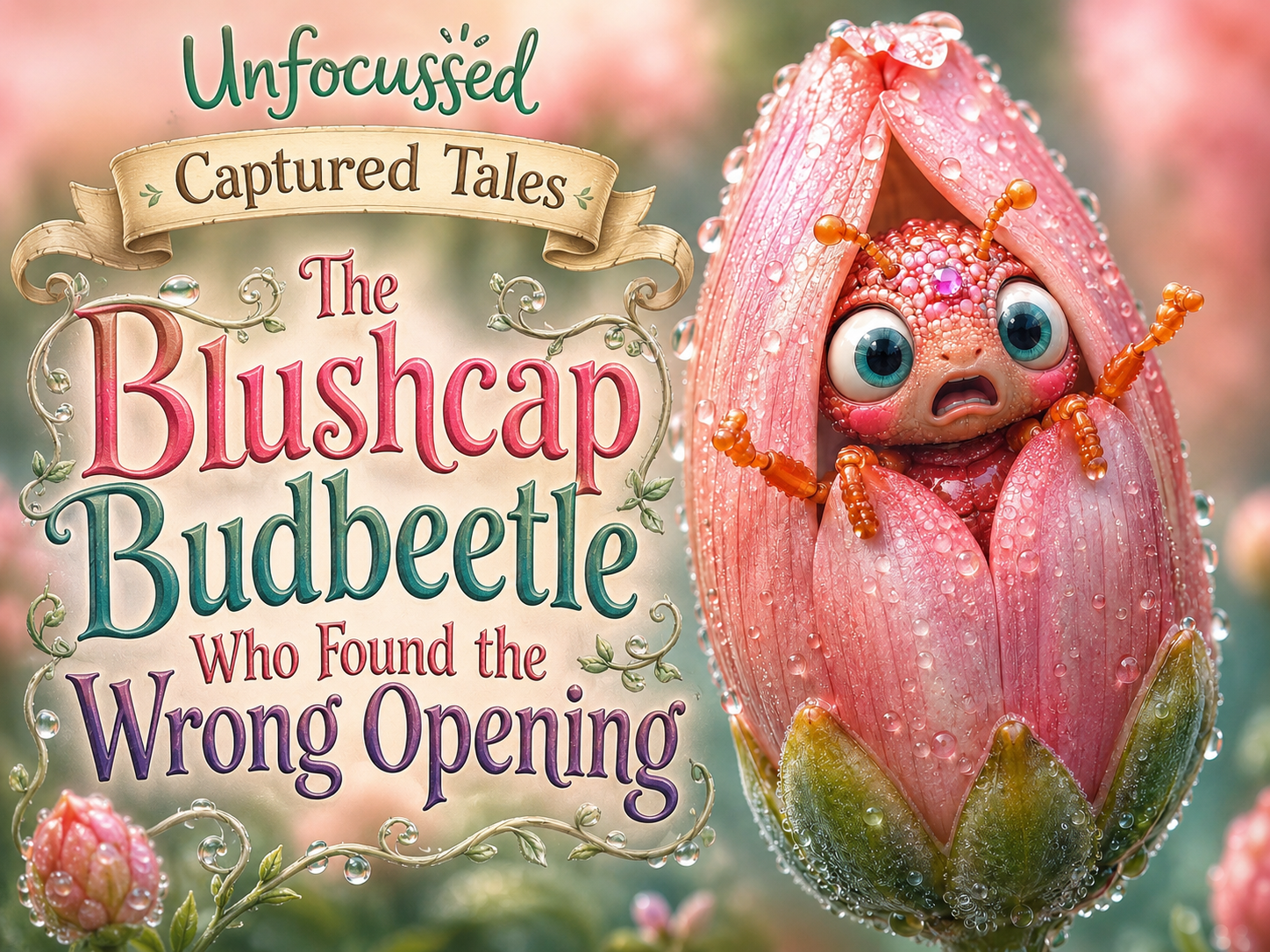
The Morning Dew Roll Went Sideways Immediately
In Sugarwild Garden, where the tulips kept secrets, the moss hummed after midnight, and every mushroom claimed to have once dated a fairy prince, the first rule of morning was simple: never trust a dewdrop before breakfast.
Blip Blushcap knew this rule.
He knew it because his grandmother had told him every sunrise while polishing her antennae with a thistle puff and muttering, “Dew looks innocent, sweetheart, but so does a sleeping raccoon until it steals your jam.” He knew it because Uncle Nib had once tried to ride a dewdrop down a snapdragon stem and ended up lodged upside down in a buttercup for three hours, yelling that he was “exploring vertical opportunity.” He knew it because every budbeetle in the Blushcap cluster knew that morning dew was beautiful, slippery, and approximately one giggle away from attempted murder.
And yet, on the morning everything went wrong, Blip looked at the round, sparkling dewdrop balanced on the edge of a pink petal and thought, That seems manageable.
This was the first dumb thought.
Not his last, certainly. But the first one mattered.
Blip was a small budbeetle, even by budbeetle standards, which were already not what most creatures would describe as physically intimidating. He had a round, rosy face, two enormous teal-blue eyes that always made him look as though someone had just whispered tax consequences into his ear, and a pair of orange antennae that curled at the tips like punctuation marks on a nervous sentence. His shell was blush-pink and freckled with tiny pearl bumps, and he had cheeks that flushed red whenever anyone asked him a direct question, looked at him too long, or said the word “responsibility.”
He belonged to the Blushcap colony, a cozy cluster of budbeetles who lived in the folded petals of the rosebud patch near the east side of Sugarwild Garden. They were sweet, busy little creatures who spent most mornings polishing petals, sorting pollen crumbs, and arguing about whether the moss on the north stone looked more like a sleeping badger or Aunt Fern after wineberry cordial.
Every seventh morning, the colony held the Morning Dew Roll.
It was not, despite the name, an athletic event. It had started many seasons ago as a practical chore: budbeetles would roll dewdrops from the upper petals down into the roots so the flowers could drink without soaking their throats and becoming dramatic. But over time, as happens with chores when tiny creatures become involved, it turned into a festival with banners, snacks, competitive chanting, and one unnecessary trophy shaped like a beetle butt.
Blip had never won the trophy.
Blip had never come close to winning the trophy.
Blip had once been assigned to “cheer support” after panicking during a roll and apologizing to the dewdrop for moving it without consent.
This year, however, he was determined to participate like a proper Blushcap. He had practiced all week on crumbs, seeds, and one very patient pebble. He had stretched all six legs. He had given himself a pep talk in the reflection of a puddle.
“You are a capable budbeetle,” he told himself. “You are not a decorative panic button with feet. You are not going to scream unless screaming is part of the plan.”
The puddle offered no argument, which Blip took as encouragement.
By sunrise, the rosebud patch glowed soft pink beneath a misty sky. Dewdrops clung to every petal like tiny glass lanterns, catching the pale gold light and scattering it across the garden. The air smelled of wet leaves, sugargrass, and the faint minty tang of moon-moss waking up grumpy.
All around him, the other budbeetles bustled with purpose.
“Team Stemside, ready!” called Cousin Pippa, who wore a leaf sash and took every community event with the intensity of a war general.
“Team Petalcrest, ready!” shouted Uncle Nib, who had no business being in charge of anything involving balance.
“Team Budbottom, emotionally present!” squeaked Blip, because he had been told confidence was important and had immediately overcorrected.
Several beetles turned to stare.
Blip’s cheeks went red.
“I mean ready,” he whispered.
Grandmother Bristle gave him a fond pat on the head. “You’ll be fine, sugarbean. Just remember: slow feet, steady shell, and don’t get cocky around spherical moisture.”
Blip nodded solemnly.
Then the whistle blew.
Technically, it was not a whistle. It was a hollow reed being blown by a beetle named Mudge who enjoyed authority far too much. But it made a sharp little fweeeep, and that was enough to send the colony into motion.
Budbeetles pushed, guided, nudged, and rolled dewdrops along the curving petals. The droplets trembled and wobbled, shimmering like captured stars. Some rolled smoothly down the prepared channels toward the waiting roots. Others bounced, split, or made sudden personal decisions that no one appreciated.
Blip found his assigned dewdrop near the top of a large rosebud, fat and clear and almost perfectly round.
“Hello,” he said politely, because Grandmother Bristle had raised him with manners even toward dangerous liquids. “I’ll be your guide this morning. Please don’t ruin my life.”
The dewdrop trembled.
Blip took his position, pressed both front feet against it, and pushed.
It moved.
Only a little, but it moved.
His eyes widened. “Oh. Oh, I’m doing it.”
He pushed again. The dewdrop rolled forward, catching sunlight. It slid along the petal groove exactly as planned.
“I’m doing it,” Blip said louder.
Nearby, Pippa glanced over. “Stay focused!”
“I am focused!” Blip said, which was a lie, because he was already imagining himself standing beside the beetle-butt trophy while everyone applauded and Uncle Nib wept from professional jealousy.
The dewdrop reached the petal’s bend.
Blip leaned in to guide it.
The petal dipped.
The dewdrop shivered.
Somewhere below, a cricket sneezed.
And the entire universe apparently decided, Let’s humble this little idiot.
The dewdrop shot sideways.
Blip yelped and lunged after it. His feet slipped. His shell bounced against the petal. The dewdrop rolled faster, picking up three smaller drops as it went until it became one enormous wobbling orb of doom.
“Problem!” Blip squeaked.
“Control your drop!” Pippa shouted.
“I am attempting a relationship with it!” Blip cried.
The dewdrop hit a ridge in the petal, launched itself into the air, and carried Blip with it.
For one sparkling second, he flew.
It might have been beautiful if he had not been screaming so hard his antennae curled backward.
He tumbled past a surprised ladybug, bounced off a fern, slid down a blade of sugargrass, and landed on a broad pink petal that was definitely not part of the Blushcap colony’s rosebud patch.
The dewdrop burst beneath him with a wet plap.
Blip lay there, soaked from chin to shell, all six legs spread, staring up at the soft morning sky.
He blinked once.
Then twice.
“Still alive,” he whispered. “Deeply moist, but alive.”
The Garden Was Much Larger When Everyone Else Was Elsewhere
At first, Blip assumed the colony would find him immediately. This was because Blip had not yet accepted the insulting size of the world.
From the safety of the Blushcap patch, Sugarwild Garden always seemed cozy and knowable. There was the fern arch, the moss stone, the honeycup puddle, the beetle path, and the little curl of vines where the gossip gnats gathered to ruin reputations before lunch. But from the ground, dripping wet and alone, the garden became enormous.
Every blade of grass towered like a green cathedral column. Every petal seemed to belong to a flower he had never met and did not trust. The breeze moved through the stems with a whispery hiss, making the whole place sound like it was discussing him behind his back.
Which, to be fair, parts of it probably were.
A pair of blue gnats hovered nearby.
“Is that a Blushcap?” one whispered.
“Looks like one,” said the other.
“Why is he wet?”
“Poor choices, presumably.”
Blip sat up fast. “I can hear you.”
The gnats zipped away, giggling.
He wiped dew from his face and tried to orient himself. The rosebud patch should have been visible from here. It had to be. He turned in a slow circle, peering through the misty stems.
Pink flowers everywhere.
Blush-pink buds to the left.
Coral-pink blooms to the right.
Rose-pink petals overhead.
Soft pink bokeh nonsense in every direction.
“That is unhelpful,” Blip told the garden. “There are too many pink things. This is poor labeling.”
A nearby tulip snorted.
Blip froze.
“Did you just snort?”
The tulip remained still, which meant either no, or yes and it was committed to gaslighting him.
Blip took a cautious step forward. Then another. The petal beneath him dipped slightly, sending a tiny bead of dew rolling toward his foot.
“Absolutely not,” he said, stepping aside. “We are done with your kind today.”
He climbed down the petal, slid along a curled leaf, and landed on a mossy stem bridge slick with mist. Somewhere above him, bees were beginning their morning routes, grumbling about traffic patterns and nectar quotas. A snail wearing a cracked acorn cap moved along a twig with the serene confidence of someone who would arrive two days late and still blame the road.
“Excuse me,” Blip called. “Do you know the way to the Blushcap rosebud patch?”
The snail turned slowly.
Very slowly.
So slowly that Blip had time to regret asking.
“Which one?” the snail finally said.
Blip stared. “There’s more than one?”
The snail’s eyestalks lifted with pity. “Oh, child.”
That was never a comforting phrase.
“The one with my family in it,” Blip said.
“That narrows it less than you’d hope.”
Blip’s mouth opened, closed, then opened again. “It has pink petals.”
The snail looked around at the aggressively pink morning garden.
Blip sighed. “I hear it now.”
The snail pointed one eyestalk toward a cluster of closed buds beyond a stand of mintleaf. “There are Blushcap-looking pods over there. Cozy. Quiet. Full of dramatic little beetles who overreact to dew.”
“That sounds deeply familiar,” Blip said.
“Then off you go.”
“Thank you.”
“Try not to enter anything that has not invited you.”
Blip frowned. “That feels oddly specific.”
“It is gardening wisdom.”
The snail continued on his way, leaving Blip to contemplate the unsettling possibility that flowers had opinions about visitors.
Still, the buds beyond the mintleaf did look promising. They were tall, pink, and folded shut in the same snug way as the Blushcap homes. Dew glittered across their petals. Their green sepals hugged their bases like tiny leaf hands. One bud in particular stood slightly apart from the others, its petals parted near the top just enough to suggest a warm hollow within.
Blip’s heart lifted.
“Home,” he whispered.
He hurried toward it, slipping only twice and pretending both times were intentional crouches.
By the time he reached the base of the bud, he was trembling with relief. He could already imagine Grandmother Bristle scolding him while wrapping him in a dry thistle blanket. Pippa would pretend not to have been worried. Uncle Nib would offer useless advice and a snack. Everything would be ordinary again.
Blip climbed the stem, gripping the damp ridges with all six feet. He squeezed between two lower petals, shimmied upward through a soft pink fold, and found the narrow opening near the top.
It was warm inside.
It smelled faintly of sugar, rain, and something floral that reminded him of bedtime.
Blip let out a shaky breath.
“I made it.”
Then the flower bud spoke.
“You most certainly did not.”
A Very Private Bloom With a Very Public Beetle Problem
Blip froze halfway through the petal opening, front feet inside, back feet outside, face pressed awkwardly against a dewy fold.
For a moment, he considered pretending he had not heard anything. This was a strategy he had used several times in childhood, mostly when accused of eating pollen biscuits before supper. Unfortunately, the voice inside the bud cleared its throat with the precision of someone who had been waiting centuries to be annoyed properly.
“I said,” the voice repeated, “you most certainly did not.”
Blip blinked into the dim pink hollow. “Grandmother?”
“Do I sound like your grandmother?”
Blip hesitated.
The correct answer was clearly no.
The safer answer was also no.
His panic chose a third option.
“Depends how mad you are?”
The bud went silent.
Blip swallowed.
Inside the flower, the light was soft and rosy, filtered through layers of closed petals. Tiny droplets clung to the curved walls, shining like stars trapped in pink glass. At the center of the bud hovered a faint glow, no bigger than a seed, pulsing gently like a sleeping heartbeat.
The voice came from everywhere and nowhere at once.
“Who are you?”
“Blip,” he said quickly. “Blip Blushcap. Budbeetle. Dew Roll participant. Not a burglar. Not usually damp to this extent.”
“And why,” the voice asked, each word clipped and delicate, “are you crawling into my bloom?”
Blip’s stomach dropped.
“Your bloom?”
“Yes.”
“Not the Blushcap rosebud patch?”
“No.”
“Not my family’s pod?”
“No.”
“Not even adjacent?”
“Emotionally or geographically?”
Blip’s lower lip wobbled. “Either would help.”
The glowing seed-light pulsed once, softer now. The voice did not become warm exactly, but it became less sharp around the edges.
“You are in the private bloom of Maribelle Rosethorn, third daughter of the old dawn hedge, keeper of the sealed petal chamber, and currently trying to enjoy one quiet morning without some bug backing into my ceiling like a confused chandelier.”
Blip looked down and realized his back legs were, in fact, still sticking upward through the petal opening.
He scrambled the rest of the way inside and tumbled onto the cushioned inner fold with a squeak.
“Sorry. Sorry. I thought this was home.”
“Clearly.”
Blip sat up, dripping onto the petal floor.
A tiny ripple of disgust moved through the bloom.
“Are you leaking?” Maribelle asked.
“Mostly dew.”
“Mostly?”
“Fear is damp.”
The flower spirit made a sound that was somewhere between a sigh and the creak of a petal deciding whether to slam shut.
Blip tucked his feet under himself. “I didn’t mean to bother you. I got separated during the Dew Roll, and the garden is very large, and a snail told me there were Blushcap-looking pods this way, and I suppose I trusted a snail without checking credentials.”
“That was your first mistake.”
“No,” Blip said miserably. “My first mistake was thinking spherical moisture could be reasoned with.”
There was another pause.
Then, very quietly, Maribelle laughed.
It was not a big laugh. It was a tiny, hidden sound, like a petal brushing another petal in the dark. But it changed the whole feeling inside the bloom. The pink light seemed a little warmer. The droplets stopped trembling so severely. Even Blip’s panic took one cautious step backward and agreed not to redecorate his chest cavity for at least a minute.
“You are a strange little creature,” Maribelle said.
“I get that a lot from relatives.”
“They sound honest.”
“Painfully.”
Blip looked toward the narrow opening above. He could see a sliver of pale sky and the blurred shapes of other buds swaying nearby. “I should go. I’m sorry I entered your private bloom. That was rude. Also awkward. Also probably something my cousin Pippa would turn into a safety lecture with diagrams.”
He rose to leave.
The flower trembled.
It was slight, but Blip noticed because budbeetles were very good at reading petals. A happy petal held itself differently than a tired petal. A thirsty one sagged. A gossiping one leaned toward other flowers. And this petal, despite Maribelle’s polished voice and fussy title, trembled like something afraid to be touched by the outside air.
Blip paused.
“Are you all right?”
“Of course.”
“That sounded like a very fancy no.”
“It was a dignified yes.”
“My Aunt Fern uses that voice when she says she’s fine but has actually eaten six fermented cloudberries and challenged a moth to a staring contest.”
“Your family sounds exhausting.”
“They are. But they’re good at noticing when someone is pretending.”
The glow at the center of the bloom dimmed slightly.
For a while, neither of them spoke.
Outside, Sugarwild Garden went on with its bright little morning. Bees buzzed. Leaves shook off dew. Somewhere distant, Blip could hear faint shouting that might have been his colony searching for him or Uncle Nib arguing with gravity again.
Inside the bloom, everything felt held in a soft pink hush.
Maribelle finally said, “I am supposed to open today.”
Blip’s antennae lifted. “That sounds nice.”
“It is not nice.”
“Oh.”
“It is expected. There is a difference.”
Blip settled back down, carefully avoiding the larger dew puddle he had created. “Expected by who?”
“The dawn hedge. The bees. The other blooms. The entire insufferable garden, apparently.”
“That’s a lot of pressure for petals.”
“Exactly.”
The glow pulsed again, nervous and quick.
“I have been sealed for three days,” Maribelle said. “That is normal for my kind. We gather morning light. We sweeten our nectar. We listen to the roots. Then, when the time comes, we open.”
“And your time came?” Blip asked.
“At sunrise.”
Blip glanced around the closed chamber. “Ah.”
“Do not say it like that.”
“Like what?”
“Like a tiny wet therapist.”
Blip closed his mouth.
Maribelle continued, quieter now. “Everyone is watching. They always watch. The bees hover, the butterflies applaud, the elder blooms nod like they have personally invented courage, and the gossip gnats say things like, ‘Oh, she took long enough,’ because apparently having wings gives you the right to be a flying boil on the backside of decency.”
Blip gasped softly. “That was mean.”
“It was accurate.”
“I liked it.”
“Thank you.”
Blip looked up at the petals folded overhead. They were beautiful from the inside, streaked with soft coral lines and jeweled with dew. But he could feel the tension in them. Maribelle was holding herself shut with all the strength a flower could gather.
“Why don’t you want to open?” he asked.
The bloom tightened.
“I didn’t say I didn’t want to.”
“You said everyone expects you to, and you’re still closed, and your petals are doing that thing my face does before someone asks me to speak in public.”
“What thing?”
“Trying to crawl inside itself and become a different species.”
Maribelle said nothing.
Blip waited.
He was not naturally brave. He was not even naturally calm. But he did know how to sit quietly beside fear, because he had been doing it inside his own chest his entire life.
At last, the flower spirit whispered, “What if I open wrong?”
Blip blinked. “Flowers can open wrong?”
“Of course they can.”
“I didn’t know that.”
“Most creatures don’t. They see the pretty part. They do not see the effort. A petal can unfold too quickly and tear. Nectar can spill. Pollen can clump. A bloom can lean the wrong way and spend the entire day looking like she has opinions about the sun’s mother.”
Blip considered this.
“That last one seems specific.”
“My sister.”
“Ah.”
Maribelle’s voice grew small. “Everyone remembers a bad opening.”
Blip thought of the Morning Dew Roll. Of his dewdrop shooting sideways. Of the gnats whispering. Of his family probably telling this story for generations, complete with reenactments and Uncle Nib making wet explosion noises.
“Yes,” he said. “They do.”
“That was not comforting.”
“I wasn’t done.”
“Then perhaps arrive at the helpful part.”
Blip rubbed his damp feet together. “They remember, but not always cruelly. Sometimes they remember because it becomes part of you. Not the whole of you. Just a funny, embarrassing, slightly sticky piece. Like a petal scar. Or Uncle Nib’s buttercup incident.”
“I do not want a buttercup incident.”
“Nobody does. That’s why it’s educational.”
The glow brightened a little.
Blip stood and moved closer to the center of the bud. “When I was little, I was afraid to leave our home pod. Not because the garden was bad. Because it was too much. Too bright. Too loud. Too full of wings and opinions and things with stingers.”
“Sensible concerns.”
“Very sensible,” Blip agreed. “But my grandmother used to say, ‘Little one, the world will still be large whether you look at it or not.’”
Maribelle was quiet.
“I hated that,” Blip added.
A tiny laugh stirred the petals again.
“But she was right,” he said. “The garden didn’t get smaller when I hid. I just got lonelier.”
The pink chamber seemed to breathe around him.
“And did you stop being afraid?” Maribelle asked.
Blip looked down at himself: soaked, lost, trembling, sitting inside the wrong bloom after being emotionally defeated by a dewdrop.
“Absolutely not.”
“That is also not comforting.”
“But I move anyway sometimes.”
“Sometimes?”
“Let’s not get greedy.”
For a moment, Maribelle’s petals loosened. A thin blade of sunlight slipped through the top opening and fell across Blip’s face. He squinted, and his teal eyes shone like little pools of startled sky.
From outside came a sharp buzzing voice.
“Maribelle? Still closed, dear?”
The flower stiffened instantly.
Blip flinched. “Who’s that?”
“One of the elder blooms,” Maribelle whispered. “Aunt Clematis. She has never had an unspoken thought in her life.”
Another voice chimed in, airy and smug. “Perhaps she needs another hour. Or another season.”
Then came the high, nasal giggle of gossip gnats.
Blip felt Maribelle shrink around him.
Something warm and unfamiliar stirred in his little beetle chest. It was not courage exactly. Courage was too large and shiny a word for what Blip felt. This was smaller. Messier. More like irritation wearing a brave hat.
He crawled toward the upper petal opening and stuck his head out.
Several flowers nearby turned toward him.
A cluster of gnats froze mid-hover.
Aunt Clematis, a tall lavender bloom with a neck like a judgmental spoon, recoiled. “What in the root rot is that?”
Blip’s eyes widened.
His mouth went dry.
His entire body suggested returning inside and pretending to be moss.
Instead, he lifted one orange foot and waved.
“Good morning,” he squeaked. “This bloom is currently unavailable for commentary.”
The gnats stared.
Aunt Clematis blinked. “Excuse me?”
Blip’s cheeks burned scarlet, but he pressed on. “There will be no hovering, heckling, petal-pressure, or unsolicited opinions at this time.”
“Who are you?” demanded the lavender bloom.
Blip swallowed. “Official... bloom privacy beetle.”
Behind him, Maribelle whispered, “That is not a thing.”
“It is today,” Blip whispered back.
Aunt Clematis narrowed her petals. “Young beetle, Maribelle is expected to open.”
“And I am expected not to be wet,” Blip said, “yet here we both are, managing disappointment.”
One of the gnats snorted so hard it dropped two inches.
Aunt Clematis gasped. “Well.”
“Yes,” Blip said, gaining the tiniest shred of confidence and immediately mishandling it. “Well indeed.”
There was a dangerous silence.
Then, from somewhere below, a familiar voice shouted, “Blip? Blip Blushcap, if you are dead, say nothing!”
Blip looked over the edge.
There, pushing through the mintleaf with the ferocity of a tiny pink general, came Cousin Pippa. Behind her were Grandmother Bristle, Uncle Nib, and half the Blushcap colony, all soaked, frantic, and carrying what appeared to be an emergency crumb basket.
“I’m not dead!” Blip called.
Uncle Nib looked relieved. “That’s exactly what a ghost would say!”
Pippa spotted him wedged in the top of Maribelle’s bloom.
Her face changed from relief to horror to the kind of exhausted anger usually reserved for toddlers with paint.
“Blip,” she said slowly, “why are you inside a dawn hedge bloom?”
Blip looked at Maribelle’s folded petals. He looked at Aunt Clematis. He looked at the gnats, the bees gathering in curious loops, and his family staring up from below.
Then he looked inward, where the soft glow of Maribelle’s spirit pulsed anxiously in the pink hush.
He did not know how to explain that he had found the wrong opening.
He did not know how to explain that perhaps the wrong opening had needed finding.
So he said the only thing that felt true.
“I got lost,” Blip called down, “and then someone else was lost too.”
Grandmother Bristle’s expression softened.
Pippa stopped scowling.
Even Aunt Clematis closed her mouth, which several gnats would later describe as “a historic event worth preserving in song.”
Inside the bloom, Maribelle whispered, “You do not have to stay.”
Blip glanced at the waiting garden, bright and loud and full of eyes.
His legs trembled.
His cheeks burned.
He wanted very badly to climb down into Grandmother Bristle’s arms and be wrapped in a dry thistle blanket and never discuss personal growth again.
But the petals around him were trembling too.
So Blip took a breath.
“I know,” he whispered back. “But maybe we could both move a little.”
The glow inside Maribelle’s bloom flickered.
Outside, the sun climbed higher.
And for the first time that morning, the sealed petals of the private bloom loosened by the width of one tiny beetle foot.
It was not an opening.
Not yet.
But it was less closed than before.
And in Sugarwild Garden, where even the smallest wrong turn could lead to a ridiculous amount of emotional inconvenience, that was enough to make the dew tremble.
The Bloom Privacy Beetle Made Things Worse Before Better
For three whole breaths, Sugarwild Garden held perfectly still.
This was impressive, because Sugarwild Garden was not built for stillness. It was built for buzzing, dripping, sneezing, blooming, gossiping, rustling, fluttering, and the occasional mushroom making a dramatic announcement about its “personal humidity journey.” But after Blip Blushcap declared himself an official bloom privacy beetle and informed Aunt Clematis that Maribelle was unavailable for commentary, the entire garden paused like someone had dropped a teacup in church.
Then Uncle Nib ruined it.
“Bloom privacy beetle?” he called from below. “Is that paid?”
“Nib,” Grandmother Bristle hissed.
“What? I’m just asking. He’s young. He should understand workplace structure.”
Pippa shoved through the mintleaf at the base of the dawn hedge bloom, shaking dew from her shell with brisk little flicks. Her leaf sash was crooked, her antennae were damp, and her face had the exact expression of someone who had spent the morning planning a community event only to discover her cousin had turned it into a public incident with witnesses.
“Blip,” she said, very slowly, “please climb down from the unauthorized bloom.”
From inside Maribelle’s folded petals, the flower spirit whispered, “Unauthorized?”
Blip winced. “It’s a family word. We use it when someone has done something that requires a meeting.”
“Do you require many meetings?”
“We are small. The drama needs somewhere to go.”
Pippa planted two feet on the stem and pointed upward. “You are not supposed to be in there.”
“I know.”
“That is a dawn hedge bloom.”
“I have been informed.”
“They are private.”
“Also mentioned.”
“They can be emotionally prickly.”
Maribelle’s petals tightened. “I heard that.”
Pippa froze.
Blip leaned back inside the petal opening. “She heard that.”
“I gathered,” Pippa said through her teeth.
Aunt Clematis, who had recovered from the shock of being contradicted by a creature smaller than her pollen pouch, lifted her lavender head and cleared her throat with unnecessary grandeur.
“This situation is highly irregular.”
“So is your tone before breakfast,” Grandmother Bristle muttered.
A few nearby moss mites snickered.
Aunt Clematis ignored them, which was generous of her because she ignored almost nothing. “Maribelle Rosethorn was expected to open at sunrise. The bees have arranged their route. The dawn hedge has prepared its light exchange. The butterflies have stretched their applause wings. We cannot simply delay because some damp beetle has mistaken a sacred bloom for a boarding house.”
Blip flinched.
He had already felt embarrassed. Now his embarrassment had been dressed in a little hat and paraded before the neighbors.
Grandmother Bristle stepped forward. She was old by budbeetle standards, which meant her shell had faded to a warm rose-gold and her antennae curled in magnificent spirals that could make even a dragonfly reconsider his tone. She looked up at Aunt Clematis and smiled politely.
It was a dangerous smile.
“Dear,” Grandmother Bristle said, “if every creature opened exactly when expected, half the garden would be bored and the other half would be unemployed.”
Aunt Clematis bristled. “This is not about boredom.”
“No,” Grandmother said. “It is about a young bloom being watched by every loose mouth within wing distance.”
The gossip gnats looked offended, which was rich considering they had never been innocent of anything except volume control.
“We are simply observing,” one gnat said.
Grandmother Bristle turned her smile toward him. “And I am simply imagining you stuck to a sundew.”
The gnat zipped backward.
Blip felt a warm bloom of gratitude spread through his chest. Grandmother Bristle could slice a rude moment clean in half without raising her voice. Blip admired this skill deeply, mostly because his own conflict strategy involved making a squeaking noise and hoping someone changed the subject.
Inside the bloom, Maribelle was silent.
Too silent.
Blip pulled his head back into the pink chamber. “Are you okay?”
The glow at the center of the flower pulsed faintly. “I believe I have become a community problem.”
“That happens.”
“Does it?”
“Uncle Nib once got his head stuck in a seed bell during a naming ceremony.”
“Why?”
“He wanted to know if echoes had flavor.”
Maribelle paused. “Did they?”
“He said brass with notes of regret.”
The flower spirit made that tiny hidden laugh again, but it vanished quickly.
Outside, the pressure gathered like a storm made of eyebrows. Bees began hovering in orderly rows, their pollen baskets empty and their patience thinning. Butterflies arranged themselves on a nearby foxglove, pretending they were not waiting for a show. A pair of ladybugs unfolded a petal blanket and sat down, which was never a good sign. Sitting meant they expected entertainment.
Pippa looked up at Blip again, her sternness softened now by worry. “Is she trapped?”
Blip shook his head. “No.”
“Are you trapped?”
He looked around the cozy pink chamber, the folded walls, the narrow opening above, the glow that trembled like a candle pretending not to need shelter.
“Not exactly.”
“That is the sort of answer that causes paperwork.”
“I know.”
Grandmother Bristle climbed onto a low leaf so she could see him better. “Blip, sugarbean, what does Maribelle need?”
Aunt Clematis scoffed. “She needs to open.”
Grandmother did not look away from Blip. “That is what everyone wants from her. It is not necessarily what she needs.”
Blip swallowed.
The whole garden seemed to lean closer.
He had never been the center of anything on purpose. He was the sort of budbeetle who stood near the edge of group photos and tried not to blink weird. But now his family, the bees, the butterflies, Aunt Clematis, several judgmental leaves, and at least twelve gnats with poor boundaries were waiting for him to explain the private fear of a flower he had accidentally entered butt-first.
Blip turned inward. “Maribelle?”
“Do not make a speech,” she whispered.
“I hate speeches.”
“Good.”
“But they asked what you need.”
“Tell them nothing.”
“That seems unlikely to help.”
“Tell them I require silence.”
Blip glanced outside at the growing crowd. “That may require a miracle or a larger predator.”
“Tell them I require privacy.”
“That I can try.”
He poked his head out again.
Aunt Clematis lifted one petal like a fan. “Well?”
Blip inhaled.
His voice came out smaller than planned, but it came out. “Maribelle needs quiet. And space. And fewer faces making her petals feel like a stage curtain.”
One of the butterflies gasped. “We are not faces. We are ambiance.”
“You are hovering judgment with wings,” Grandmother Bristle said.
The butterfly shut her wings halfway.
Pippa looked at the crowd, then at Blip. Something determined moved across her face. Pippa loved rules, but more than rules, she loved a task. Especially a task with boundaries, instructions, and the chance to tell others where to stand.
“All right,” she said, snapping into command. “Emergency petal perimeter.”
Uncle Nib perked up. “Is there a whistle?”
“No.”
“Could there be?”
“No.”
He held up the hollow reed anyway.
“Nib,” Pippa warned.
The reed went slowly behind his back.
Pippa marched toward the bees. “Pollination route will shift three stems east for the next hour. Butterflies, applause wings remain folded unless requested. Ladybugs, this is not a picnic.”
One ladybug looked down at her crumb tart.
Pippa narrowed her eyes.
The ladybug wrapped the tart in a leaf and scooted backward.
“Gnats,” Pippa said.
The gnats froze.
“You are on silence.”
“We don’t have silence,” one whispered.
“Then invent it,” Pippa said.
Grandmother Bristle smiled with pride. “That’s my little tyrant.”
Within minutes, the chaos began rearranging itself into something almost useful. The bees grumbled but adjusted their route. The butterflies pretended they had other places to be. The ladybugs relocated behind a leaf, where they absolutely continued eating crumb tart but more discreetly. Uncle Nib stationed himself at the base of the stem with the emergency basket and announced he was “morale support,” which mostly involved offering snacks to creatures who did not want them.
Aunt Clematis remained where she was.
“I am family,” she said.
Maribelle’s glow dimmed.
Blip heard it in the silence. Not words exactly, but a shrinking. A retreat.
Grandmother Bristle looked at Aunt Clematis. “Then act like it.”
The lavender bloom drew herself taller. “I have watched dawn hedge flowers open for forty-seven seasons.”
“And have you ever watched quietly?”
Aunt Clematis opened her mouth.
Then closed it.
The gnats collectively looked stunned. One whispered, “Second historic event.”
Pippa glared.
The gnat slapped both front legs over his mouth.
Inside the Pink Hush, Fear Had Excellent Posture
With the crowd pushed back and the garden noise softened to a distant murmur, the inside of Maribelle’s bloom changed.
Blip noticed it right away.
The petals still held tight, but not as desperately. The dew on the inner walls no longer quivered from every outside voice. A warm ribbon of sunlight had slipped through the upper gap and painted a golden stripe along the curved petal floor. The air smelled sweeter now, like nectar waking from a nap.
Maribelle said nothing for a long time.
Blip let her have the silence.
He sat with his legs tucked beneath him, trying not to drip on anything important. Every now and then, a tiny bead of dew slid from his shell and landed with a soft pip. He flinched each time.
“Sorry,” he whispered after the fourth one.
“You apologize a great deal,” Maribelle said.
“I have a lot of practice.”
“Do you always feel responsible for taking up space?”
Blip blinked. “That is a rude thing to ask someone accurately.”
“Flowers are rude when sealed too long.”
“I’ll allow it.”
The glow at the center of the bloom brightened just enough for Blip to see faint shapes beneath it: pale golden filaments, curled pollen fronds, and a tiny well of nectar held in the flower’s heart. It was beautiful, but not in the easy way flowers looked beautiful from outside. This beauty felt private and unfinished. A workshop of color. A soft engine. A room where becoming was still happening.
Blip felt suddenly guilty for being inside it.
“I really did think you were home,” he said.
“I know.”
“I would not have entered if I knew.”
“I know that too.”
“Do you?”
“You look like guilt learned to walk.”
Blip considered this. “That has been said at birthdays.”
Maribelle’s petals loosened another tiny fraction. A second line of sunlight slipped in.
Blip tilted his face toward it. The warmth felt good after the morning’s damp catastrophe. It settled into his shell and made him less aware of every place he had bruised himself during the dewdrop launch.
“What is opening like?” he asked.
The glow pulsed slowly.
“I don’t know.”
Blip’s antennae curved forward. “You’ve never opened?”
“Not fully.”
“Oh.”
“I have practiced. At dusk, when no one watches. A petal’s width. Sometimes two. Enough to feel the air.”
“And?”
“The air is rude.”
Blip nodded. “It gets everywhere.”
“It touches without asking.”
“Wind does have boundary issues.”
“Light is worse.”
Blip looked up. “Light?”
“Light shows everything.”
The words fell softly, but Blip felt their weight.
He thought of his own wide eyes, his trembling legs, his cheeks that betrayed every feeling like tiny red traitors. He thought of the way others laughed when he startled, not always cruelly, but often enough that he had learned to stand behind taller beetles when uncertain things happened. He knew what it was to fear being fully seen.
“Sometimes,” he said, “light makes things look gentler than we expect.”
Maribelle made a doubtful little sound.
“Not always,” Blip admitted. “Sometimes it reveals that you have pollen on your face and everyone let you keep talking.”
“That seems cruel.”
“It builds character, according to people who are not covered in pollen.”
The flower laughed again, a little stronger this time. The petals responded to it, easing outward before Maribelle seemed to notice and pulled them back.
Blip saw it happen.
“You moved.”
“I did not.”
“You did.”
“A structural twitch.”
“Is that flower for hope?”
“No.”
“For progress?”
“Absolutely not.”
“For emotionally suspicious petal behavior?”
“Maybe.”
Blip smiled.
Then, because he was still Blip and therefore incapable of leaving a tender moment uninjured, he added, “Should we practice?”
The entire bloom stiffened so quickly that a dew bead snapped loose and hit him between the eyes.
“No,” Maribelle said.
Blip wiped his face. “Fair.”
“No practicing.”
“Understood.”
“No exercises.”
“Right.”
“No breathing in rhythm while you say encouraging nonsense.”
“I did not know that was an option, but now I kind of want to avoid it too.”
“Good.”
They sat in silence again.
Outside, Pippa could be heard reorganizing the world.
“You, moth, stop lurking. Lurking is not supportive. Bees, wider circle. Gnats, I can still hear your thoughts. Uncle Nib, do not feed the ants from the emergency basket. They have their own union.”
Uncle Nib’s voice answered, “They said they were peckish.”
“Ants are always peckish.”
Maribelle listened. “Your cousin is terrifying.”
“She puts labels on everything.”
“Including people?”
“Especially people.”
“What is your label?”
Blip looked down. “Depends who you ask.”
“I am asking you.”
That was worse.
Blip fiddled with a speck of pollen stuck to his foot. “Nervous, mostly. Small. Accident-prone. The one who asks too many questions before doing something everyone else can already do.”
Maribelle was quiet.
Blip’s face warmed. “Sorry. That got sadder than expected.”
“No,” she said. “It got honest.”
He glanced at the center glow. “What is your label?”
“Late.”
“That’s not a label. That’s a clock being judgmental.”
“Closed.”
“That’s a condition.”
“Difficult.”
Blip frowned. “Who called you difficult?”
Maribelle did not answer.
Blip’s little chest tightened.
There were many things he feared: sudden movement, loud bees, public speaking, ambitious dewdrops, mushrooms with opinions, and Aunt Fern’s singing after cordial. But seeing someone else tuck hurt inside themselves made him strangely braver, as if his worry had found a job outside his own body.
“You don’t seem difficult,” he said.
“I am arguing with a beetle while refusing to perform a basic flower function.”
“That is specific, not difficult.”
“I am inconveniencing an entire pollination schedule.”
“Schedules need humility.”
“I called gnats flying boils.”
“That was excellent.”
The glow flickered warmly.
Blip stood carefully. “Maybe opening is not one big thing.”
“I already said no exercises.”
“This isn’t an exercise.”
“It has the shape of one.”
“It is more of a... tiny idea wearing slippers.”
“That is nonsense.”
“Most ideas are at first.”
Maribelle hesitated.
Blip took one cautious step toward the petal wall. “What if you do not open for them? What if you open for one thing?”
“What thing?”
“The sunbeam.”
The flower spirit went still.
Blip pointed to the thin stripe of gold resting on the petal floor. “It is already here. It is not shouting. It is not expecting you to look impressive. It is just... waiting.”
Outside, the garden rustled, but the sound felt far away.
Maribelle’s petals trembled.
“Just for the sunbeam?” she whispered.
“Just for the sunbeam.”
“Not for Aunt Clematis.”
“Especially not for Aunt Clematis.”
“Not for the bees.”
“They can file a complaint with Pippa.”
“Not for the gnats.”
“May they be spiritually swatted.”
A small, delighted warmth moved through the bloom.
“You are rude for someone so apologetic,” Maribelle said.
“It leaks out when I’m scared.”
“That explains the damp.”
Blip laughed before he could stop himself.
The sound startled him. It startled Maribelle too. But instead of tightening, the petals eased again.
Just a little.
The upper opening widened.
A third sunbeam slipped inside.
Then a fourth.
The chamber brightened from rosy dusk to warm coral morning.
Blip held perfectly still.
The dew droplets along the inner petals caught the light and glittered like tiny chandeliers. Maribelle’s golden filaments lifted slightly, shy and elegant. The nectar well shone amber. The whole bloom seemed to inhale.
Outside, someone gasped.
Maribelle panicked.
The petals snapped halfway shut.
Blip yelped as one petal folded over him like a wet blanket, pinning him gently but indignantly to the cushioned wall.
“Sorry!” Maribelle cried.
“I’m fine,” Blip squeaked, muffled by petal. “I have become décor, but I am fine.”
Outside, Aunt Clematis called, “Was that an opening?”
Pippa barked, “No commentary!”
One of the bees shouted, “It looked like an opening.”
“It was a private opening,” Pippa snapped.
“That’s not a thing,” the bee said.
Uncle Nib blew the reed.
Fweeeep.
“Nib!” Pippa yelled.
“Crowd control!”
“You are controlling nothing but my blood pressure!”
Inside, Maribelle loosened the petal enough for Blip to slide free. He tumbled onto his back, legs curled against his belly.
“I am so sorry,” she said.
Blip lifted one foot. “Still alive. Lightly pressed. Emotionally creased.”
“I failed.”
“No.”
“I closed.”
“After opening.”
“Barely.”
“Barely counts when you were closed before.”
The glow trembled. “They gasped.”
“They are easily impressed.”
“They were watching.”
“Yes.”
“I hated it.”
“Also yes.”
Maribelle’s voice shook. “I cannot do this.”
Blip sat up slowly. His own heart was pounding. The brief widening of the petals had overwhelmed even him. The outside light, the sudden sound, the attention pressing in from every side—it had been a lot. He understood why she had snapped shut. A part of him wanted to snap shut too, and he did not even have petals. Unfair design, honestly.
“Maybe not like that,” he said.
“There is no other way.”
“There is always another way. Sometimes it is stupid, but it exists.”
“Your confidence in stupidity is oddly steady.”
“It raised me.”
The Committee of Unwanted Help Arrived Anyway
Unfortunately, the garden was not good at allowing quiet progress to remain quiet.
The partial opening had sent a ripple through the dawn hedge. Leaves whispered. Stems leaned. Bees altered flight patterns in excitement. Butterflies, who had been pretending to respect privacy, began silently mouthing compliments to one another in a way that was somehow louder than talking.
And Aunt Clematis, being Aunt Clematis, decided the moment required leadership.
She bent her lavender stem toward Pippa. “This is ridiculous. The bloom almost opened. It merely requires encouragement.”
Pippa narrowed her eyes. “No.”
“A little breeze. A little song. Perhaps some firm petals from those of us with experience.”
“Absolutely no firm petals.”
“You budbeetles are charming, but you do not understand bloom tradition.”
Grandmother Bristle stepped between them. “And you blooms are lovely, but you sometimes confuse tradition with everyone doing exactly what keeps you comfortable.”
Aunt Clematis’s petals flushed purple at the edges. “I am trying to help.”
“That is the phrase most often spoken before someone makes it worse.”
The gnats nodded, because they enjoyed mess and recognized its early symptoms.
Aunt Clematis drew herself up. “Very well. If the bloom will not respond to private support, perhaps she will respond to proper dawn music.”
Maribelle’s entire chamber went cold.
Blip felt it immediately. “What is dawn music?”
“No,” Maribelle whispered.
Outside, Aunt Clematis lifted her face toward the foxgloves. “Bell-moths!”
From behind a curtain of leaves emerged three pale moths with tiny bell-shaped markings on their wings. They looked gentle. They looked elegant. They looked like the kind of creatures who would apologize before landing on your nose.
Then they began to hum.
The sound was beautiful for approximately half a second.
Then it became enormous.
It vibrated through the stem, through the petals, through the dew, through Blip’s teeth. The whole bloom rang with a shimmering tone that made the droplets jump and the pollen fronds quiver. Blip clamped all six feet over whatever parts of himself seemed most likely to rattle loose.
“What the sugar-damp hell is that?” he cried.
“Opening song,” Maribelle said, voice tight with panic. “They sing blooms awake.”
“It feels like being licked by thunder.”
The moths hummed louder.
Maribelle’s petals tightened so violently that the upper opening shrank to a pinprick. The light vanished. The chamber turned deep pink and airless.
Blip stumbled toward the wall. “Stop! She doesn’t like it!”
But his voice disappeared beneath the vibrating song.
The dew droplets inside the bloom began to slide downward, gathering into trembling beads. One dropped onto Blip’s head. Another hit his shoulder. A third rolled beneath his foot and sent him skidding sideways.
“Nope,” he squeaked. “Nope, nope, nope, we are not doing moisture violence again.”
He scrambled toward the upper petal gap, but Maribelle had clamped too tightly. Not to trap him. He knew that. She was afraid. She was holding herself closed against the noise, the pressure, the expectation, the whole garden trying to sing her into being ready before she was.
“Maribelle,” Blip said, pressing one foot against the petal wall. “Can you hear me?”
The glow at the center flickered wildly.
“Too loud,” she whispered.
Blip’s heart lurched.
He looked around. The humming shook everything. Dew slid faster now, collecting along the lower petal seams. If enough gathered, it would pool at the base and soak the pollen fronds. Blip did not know much about dawn hedge anatomy, but he knew flowers did not enjoy having their private inner workings turned into soup.
He had to get outside.
He looked up at the sealed petals.
Too tight.
He looked down at the base.
A narrow seam where one petal overlapped another had loosened under the vibration.
It was small.
Very small.
Budbeetle small.
Blip swallowed.
“Maribelle, I am going to do something stupid.”
“Please don’t,” she whispered.
“I agree in theory.”
He dropped to all six feet and scurried toward the lower seam. Dew sloshed around his ankles. The hum rattled his shell. The seam flexed open and shut with each vibration, like a mouth deciding whether to bite him.
“This is fine,” Blip told himself. “This is a reasonable activity for a damp beetle with no training.”
A glob of dew slid down the petal and smacked him in the back.
“Rude.”
He reached the seam, shoved his head into the gap, and immediately regretted having a head.
The space was tight, slick, and lined with tiny petal hairs that tickled his cheeks. He wriggled forward. His antennae flattened. His shell scraped. His back feet kicked uselessly in the pooling dew.
For one awful moment, he became stuck.
Blip froze.
His breath came fast.
The petal pressed around him. Darkness filled the seam. The moth song vibrated through his body. He could not move forward. He could not move back.
This was, he decided, a terrible time to remember the snail’s warning about not entering things that had not invited him.
“Blip?” Maribelle whispered.
He tried to answer, but his mouth was pressed against petal.
All that came out was, “Mmph.”
The glow flickered brighter behind him. “Are you stuck?”
“Mmph.”
“Is that yes?”
“Mmph!”
“Oh no.”
The petals trembled harder.
Blip felt panic rising, hot and sharp. His legs kicked. The seam squeezed. Dew dripped into one eye.
Then he remembered Grandmother Bristle’s voice: slow feet, steady shell.
He stopped kicking.
He forced one breath into his tiny chest.
Then another.
“I am not a decorative panic button with feet,” he muttered into the petal.
It sounded like, “Mmph mmph mmmph mmmph,” but the sentiment counted.
He twisted his shell sideways, tucked one shoulder down, flattened his antennae until they objected personally, and pushed.
The seam gave.
Blip popped through the outside of the bloom like a wet seed being spat by a rude fruit.
He shot into the air, bounced off a lower petal, and landed squarely on Aunt Clematis’s nearest leaf.
The moths stopped humming.
Everyone stared.
Blip lay belly-down, drenched, panting, and decorated with several petal hairs.
Aunt Clematis looked at him in horror. “You are on my leaf.”
Blip lifted his head.
His teal eyes were huge. His cheeks were flushed. His orange antennae stuck out at two different angles, and one had a dew bubble dangling from the tip like a tiny emotional lantern.
“Stop helping,” he said.
Aunt Clematis blinked. “I beg your pardon?”
Blip rose on shaking legs. “Stop. Helping.”
The garden went silent.
Even Uncle Nib lowered the reed.
Blip had never spoken so sharply in his life. The words scared him almost as much as they surprised everyone else. But once they were out, more came behind them, wobbling but determined.
“She asked for quiet. You gave her a moth orchestra. She asked for space. You made a crowd. She was opening for the sunbeam, and then everyone gasped like she had laid an egg in public.”
A ladybug whispered, “Can flowers lay eggs?”
Pippa snapped, “Not the point.”
Blip pointed one tiny orange foot at Aunt Clematis. “You keep saying she is expected to open, but you are making it harder. Maybe she knows how to bloom and just needs everyone to stop standing around with their opinions hanging out.”
Several gnats gasped.
Uncle Nib whispered, “That’s my boy.”
Aunt Clematis looked as though she had been slapped with a damp napkin.
Grandmother Bristle’s eyes shone.
Pippa stared at Blip with open astonishment, then recovered enough to step beside him on the leaf. “You heard the bloom privacy beetle.”
Blip glanced at her. “So that’s official now?”
“Don’t get cocky.”
“Wouldn’t dream of it.”
Pippa faced the crowd. “Bell-moths, thank you, but no more opening song. Bees, hold route east. Butterflies, stop looking inspirational. Gnats, leave.”
The gnats complained immediately.
“We’re part of the ecosystem.”
Grandmother Bristle said, “So is mildew. Move.”
The gnats moved.
One by one, the watchers withdrew. Not far, because curiosity had roots in Sugarwild Garden, but far enough that the dawn hedge bloom no longer sat beneath a ring of staring faces. The bell-moths fluttered away, embarrassed but not unkind. The bees formed a distant holding pattern. The butterflies busied themselves complimenting each other’s wing symmetry.
Aunt Clematis remained quiet.
For once, it did not seem theatrical.
Blip turned back toward Maribelle’s bloom.
The petals were sealed tight.
Too tight.
No glow showed through.
His stomach twisted.
“Maribelle?” he called softly.
No answer.
He climbed from Aunt Clematis’s leaf back to the main stem. His legs trembled from the effort of escaping the seam. Dew dripped from his chin. Pollen stuck to his belly. He looked like a pastry that had lost a fight.
At the lower petal fold, he pressed one foot gently against the bloom.
“It’s quiet now,” he said.
The petals did not move.
“The moths stopped.”
Still nothing.
“The gnats are gone. Mostly. One is hiding behind the mintleaf, but Pippa is about to ruin his morning.”
From below came a tiny gnat shriek and Pippa saying, “I said gone.”
No laugh came from inside the bloom.
Blip’s throat tightened.
Grandmother Bristle climbed up beside him, slower but steady. She rested one soft foot on his back. “Give her a moment.”
“What if I made it worse?” Blip whispered.
“You did not.”
“I got stuck. I yelled. I was rude to Aunt Clematis.”
Grandmother glanced toward the lavender bloom. “That last one may qualify as community service.”
Blip almost smiled, but worry swallowed it.
“She was trying,” he said. “Maribelle. She really was.”
“I know.”
“And then everyone...”
“Yes.”
Grandmother Bristle looked at the sealed flower. “Some creatures mistake pressure for encouragement because it lets them feel useful. Real help is harder. It requires listening, and listening gives you fewer chances to be impressive.”
Blip leaned his head against the petal.
The surface was cool now.
Too cool.
The Dawn Hedge Had a Deadline Nobody Mentioned Calmly
The first sign that something was truly wrong came from the roots.
It began as a low shiver through the stem beneath Blip’s feet. Not the nervous tremble of a frightened bloom, and not the vibration of moth song. This was deeper. Older. The kind of tremor that traveled up from the soil with dirt under its fingernails and bad news in its pocket.
Grandmother Bristle felt it too. Her antennae lifted.
Pippa, still patrolling below, stopped mid-command.
Aunt Clematis turned pale along her petal edges.
“What was that?” Blip asked.
No one answered.
The dawn hedge leaves rustled without wind. A faint golden glow ran along the veins of nearby stems, flickered, and dimmed.
Then a very old voice rose from the ground.
It did not belong to a flower, exactly. It belonged to the hedge itself, to roots braided under the garden, to buried seasons and rain memories and soil that had listened to everyone’s nonsense for centuries.
“Daughter of dawn,” the hedge murmured. “The light hour thins.”
Blip went stiff.
Maribelle did not answer.
The hedge voice continued, soft but heavy. “Open before the sun passes, or your gathered morning will sour.”
Aunt Clematis closed her eyes.
Blip turned to Grandmother. “What does that mean?”
Grandmother Bristle’s expression darkened. “Dawn hedge blooms gather sunlight before they open. If they hold it too long, the nectar turns bitter. The pollen hardens.”
“Is that bad?”
Pippa climbed onto the lower leaf. Her face had gone serious in a way Blip rarely saw. “It can make the bloom sick.”
Blip looked at Maribelle’s sealed petals.
His chest tightened.
“Why didn’t anyone say that?”
Aunt Clematis finally spoke, her voice smaller than before. “We thought she knew.”
Grandmother’s gaze sharpened. “Did anyone ask?”
Aunt Clematis looked away.
The old hedge whispered again. “Daughter of dawn, the light hour thins.”
Blip pressed both front feet against Maribelle’s petal. “Maribelle? Did you hear?”
For a moment, nothing.
Then, from deep inside the sealed bloom, came a faint voice.
“I heard.”
Relief rushed through him so quickly his knees almost gave.
“Are you hurt?”
“No.”
“Are you sure?”
“I am closed, frightened, embarrassed, and furious.”
Blip swallowed. “At me?”
A pause.
“No.”
He exhaled.
“Mostly at the moths,” she said.
“Understandable.”
“Somewhat at Aunt Clematis.”
“Also understandable.”
“A little at myself.”
Blip leaned closer. “That one I object to.”
Maribelle’s petals trembled faintly. “I should have opened earlier.”
“Maybe.”
“Maybe?”
“I mean, yes, for your health, that sounds important. But being scared is not the same as doing something wrong.”
“It can have the same result.”
Blip did not know what to say to that.
Because it was true, in the unfair way some true things were. Fear could be innocent and still make a mess. It could come from hurt, from pressure, from too many eyes, and still leave you stuck inside something tightening around you.
He thought of the dewdrop. How one small wobble had sent him flying away from home. How lost he had felt. How easy it would have been to decide he was only the accident, only the scream, only the little beetle who needed rescuing.
But he had found Maribelle.
And she had found him too.
Maybe that mattered.
“What happens if you open now?” he asked.
“Everyone will see.”
“Yes.”
“I might do it badly.”
“Yes.”
“You are supposed to deny that.”
“I am trying not to lie in a medical situation.”
Maribelle made a weak sound that might have been a laugh if it had more energy.
Blip pressed his cheek to the petal. “You might open crooked. You might spill nectar. You might look like you have opinions about the sun’s mother.”
“That would be terrible.”
“Possibly. But if you stay closed until the light sours, you will be hurt, and the garden will still gossip because the garden is full of tiny fools with wings.”
“You have become bold.”
“I am as surprised as anyone.”
Outside, Pippa turned to the waiting bees and flowers. “Everyone back another stem.”
Aunt Clematis did not argue this time.
Instead, she bent her head toward the sealed bloom. “Maribelle.”
The petals tightened.
Aunt Clematis took a breath. It sounded uncomfortable, as though apology had to climb over a lifetime of opinions to reach daylight.
“I thought I was helping,” she said. “I was not.”
Maribelle said nothing.
Aunt Clematis continued, softer. “When I opened, everyone watched too. I hated it. Then I became one of the watchers because I thought that was what experienced blooms did.”
Grandmother Bristle’s expression shifted, not forgiving exactly, but listening.
“That was lazy of me,” Aunt Clematis said. “And unkind.”
A distant gnat whispered, “Third historic event.”
Pippa’s head snapped around.
The gnat vanished.
Maribelle’s petals loosened by a hair.
Blip felt it under his feet.
The old hedge murmured again. “The light hour thins.”
The sun had climbed higher now. Its angle was changing. The warm gold on the leaves had begun to sharpen toward white morning. Blip could feel the urgency in the stem, in the way the petals held heat beneath their soft pink walls.
Maribelle had to open.
Not for the bees. Not for Aunt Clematis. Not for tradition.
For herself.
But wanting that did not make it easy.
“Blip,” Maribelle whispered.
“I’m here.”
“I don’t want to be alone when I do it.”
Blip’s heart squeezed.
He looked down at Grandmother Bristle. She nodded.
Pippa nodded too, though her eyes were suspiciously shiny and she looked furious about it.
Uncle Nib held up the emergency crumb basket. “For afterward,” he whispered loudly. “Or during. No judgment.”
Blip smiled despite everything.
Then he turned back to the bloom. “Do you want me inside or outside?”
Maribelle hesitated.
“Inside,” she said. “But not stuck in anything.”
“A reasonable boundary.”
The lower petal seam opened just enough for him.
Blip glanced at the gap.
His body remembered being squeezed there: the dark, the pressure, the helpless kicking. For one instant, fear grabbed all six of his feet.
Grandmother Bristle touched his shoulder. “Slow feet, steady shell.”
Blip nodded.
He crawled carefully through the seam, this time guided by Maribelle’s petals instead of trapped by them. The passage was still tight, but gentle. He emerged into the inner chamber, now dim and warm and fragrant with nectar edging toward too-sweet.
Maribelle’s glow hovered low at the center.
“Hello,” Blip said softly.
“Hello, bloom privacy beetle.”
“Temporary position.”
“Highly specialized.”
“Terrible benefits.”
The glow brightened.
Blip walked to the center and sat beside it. “Just for the sunbeam?”
“The sunbeam has moved.”
He looked up. She was right. The old stripe of light had vanished from the floor.
For a second, his hope faltered.
Then he saw it: a new line of sunlight pressing against the top seam, waiting at the edge of the petals.
“Then for the next one,” he said.
Maribelle’s petals trembled.
Outside, the garden was quiet.
Not perfectly quiet. Gardens never were. Leaves breathed. Bees held their wings in a soft hover. Somewhere far off, a frog made a noise that suggested digestive uncertainty. But around Maribelle’s bloom, there was a protective hush.
Blip sat beneath the folded petals, small and damp and afraid.
Maribelle gathered herself.
The glow at her center pulsed once.
Twice.
Then the petals began to move.
Slowly.
Carefully.
The top seam widened. Light spilled in, thin at first, then brighter. Dew droplets flashed along the inner walls. The warm air shifted. Blip felt the outside touch his face.
Maribelle kept going.
One petal unfurled a finger’s width.
Then another.
The chamber brightened to coral gold.
Blip’s eyes filled with light.
Outside, no one gasped.
No one spoke.
For one miraculous second, Sugarwild Garden remembered how to shut the hell up.
Maribelle opened wider.
Then the wind arrived.
It came without warning, rushing over the mintleaf and through the dawn hedge in a bright, sharp gust. Later, the garden would blame a passing jay, a collapsing thistle puff, and possibly Uncle Nib’s reed. No one would agree. It did not matter.
The gust struck the half-open bloom.
Maribelle cried out.
Her petals flared unevenly, one side catching too much wind. The stem bent. Dew scattered like thrown glass. Blip tumbled across the inner petal floor and grabbed a golden filament with all six feet.
Outside, Pippa shouted.
Grandmother Bristle called his name.
Aunt Clematis leaned forward in alarm.
The wind shoved again.
One of Maribelle’s outer petals folded backward too far.
A tiny tear appeared along its edge.
Maribelle screamed—not loudly, but with such raw fear that Blip felt it through the filament in his feet.
The bloom began to close.
Fast.
Too fast.
If she snapped shut now, with the wind inside and the light gathered too hot in her heart, the souring would happen at once. Blip did not know how he knew it, but he felt it in the change of the air, in the sharp sweetness of the nectar, in the old hedge groaning beneath the soil.
“Maribelle!” he shouted.
“I can’t!”
Blip looked at the torn petal. He looked at the closing walls. He looked at the sunlight pouring in, wild and bright and terrifying.
Then he did the only thing his tiny, damp, deeply underqualified heart could think to do.
He let go of the filament and ran straight toward the tear.
“Blip!” Maribelle cried.
He launched himself onto the wounded petal edge and grabbed the torn sides with his little orange feet. The wind slapped him flat. His antennae whipped backward. Dew pelted his face.
“Hold!” he squeaked, though he was not entirely sure whether he meant the petal, the flower, himself, or the entire unreasonable morning.
The petal shuddered beneath him.
Maribelle froze halfway closed.
Outside, the garden erupted.
“Get him down!” Pippa shouted.
“Don’t pull the petal!” Grandmother warned.
“I have a crumb!” Uncle Nib yelled, because panic affected him strangely.
Aunt Clematis bent toward them, lavender petals spread against the gust. “Maribelle, listen to me.”
Maribelle sobbed, “It tore.”
“Yes,” Aunt Clematis said, voice shaking. “And you are still blooming.”
Blip clung to the torn edge, every muscle trembling. The wind battered him, but his weight, tiny as it was, kept the tear from widening. He looked into the bright blur beyond the petal and saw Sugarwild Garden staring back—not with judgment now, but fear, hope, and a helpless tenderness that made the world look different.
Maribelle’s petals quivered around him.
The old hedge whispered from below, urgent and low.
“Daughter of dawn, choose.”
The sun pressed against the bloom.
The wind pulled.
Blip held on.
And Maribelle, trembling between closing and opening, had one heartbeat left to decide which way fear would carry her.
The Wind Tried to Have an Opinion
The wind shoved against Maribelle’s half-open bloom like it had been invited to the ceremony and given too much wineberry cordial.
It came in sharp little bursts, twisting through the dawn hedge, rattling leaves, flinging dew, and turning every carefully held breath in Sugarwild Garden into a squeak. Maribelle’s petals trembled around the sudden tear. Blip clung to the wounded edge with all six feet, his blush-pink shell pressed flat, his orange antennae whipping behind him like two panicked ribbons.
He was not built for heroic weather situations.
He was built for pollen crumbs, warm petal folds, nervous apologies, and possibly light administrative work if snacks were provided.
And yet there he was, plastered to a torn flower petal while the entire garden shouted advice no one had properly organized.
“Hold still!” Pippa cried from below.
“I am holding still!” Blip squeaked.
“Hold still better!”
“That is not a measurable instruction!”
Another gust struck. The torn edge fluttered beneath him. Blip slid half an inch, squealed in a pitch that made three gnats reconsider their life choices, and dug his tiny feet deeper into the soft petal tissue.
Maribelle’s voice shook through the bloom. “Blip, let go. You’ll fall.”
“I have fallen several times today,” Blip shouted. “At this point, it’s practically a skill set.”
“This is not funny.”
“No, but if I stop making jokes, I may start making fluids.”
“Fear fluids?”
“Let us not investigate.”
The torn petal quivered again, and the whole bloom tried to curl inward. Blip felt the motion under his belly: Maribelle’s fear pulling her shut, trying to protect the wound by hiding it from the wind, the sun, the garden, and anyone with functioning eyes.
But the old hedge groaned beneath them.
“Daughter of dawn,” it whispered from the roots, “do not close around the wound.”
The words ran through the stem and up into every petal. Even Aunt Clematis lowered her lavender head.
Blip blinked against the light. “What does that mean?”
Grandmother Bristle climbed onto a higher leaf, her rose-gold shell gleaming in the morning sun. “It means if she seals herself now, the tear may fold inward. The heat will trap. The nectar will sour faster.”
Maribelle’s petals trembled. “I can’t stay open.”
“Yes, you can,” Aunt Clematis said.
Everyone looked at her.
She swallowed. “Not because you must. Because you are not doing it alone.”
For the first time all morning, Aunt Clematis sounded less like a ceremonial spoon and more like someone who remembered being soft once.
Pippa snapped into motion. “Bees, form a wind break along the east side. Not too close. No hovering in her face.”
The bees obeyed, buzzing into a curved shield beyond the bloom. They angled their fuzzy bodies against the gusts, wings beating in controlled rhythm. One bee, large and striped and clearly union seniority, muttered, “We are not paid enough for emotional horticulture.”
“No one is,” Pippa said. “Hold formation.”
“Butterflies,” Grandmother Bristle called, “spread wide behind the bees. Soft wing curtain. No dramatic posing.”
The butterflies exchanged wounded looks.
“But dramatic posing is how we process stress,” one said.
“Process quietly,” Grandmother replied.
The butterflies drifted into place, their wings forming a trembling wall of color that softened the wind without turning the moment into a pageant, though several of them were clearly suffering from the lack of applause.
“Ladybugs,” Pippa shouted, “anchor the lower leaves.”
“We’re on it!” called a ladybug, tucking her crumb tart into a safe fold before grabbing a leaf edge.
“Uncle Nib,” Pippa said, pointing at him.
He straightened. “Finally. My hour.”
“Do not blow the reed.”
His face fell. “My hour has been canceled.”
“You and the others take the emergency crumb basket under the bloom. If Blip falls, catch him.”
Uncle Nib looked at the basket. Then at Blip. Then at the basket again.
“This basket was designed for snacks.”
“Today it contains consequences.”
“I don’t love that.”
“Move.”
Uncle Nib moved.
Within moments, the Blushcap colony gathered beneath Maribelle’s bloom, holding the little woven crumb basket open like a rescue net. It still smelled strongly of seed biscuits and emergency jam, which Blip found both comforting and deeply appropriate. If he was going to perish, at least he would land somewhere with flavor.
The wind struck again, but weaker now. The bees and butterflies took the worst of it. Leaves bent. Stems groaned. Dew scattered from the hedge in sparkling sprays.
Blip kept holding the torn petal edge.
His feet ached.
His shell shook.
His cheeks were flushed so hot they might have been visible from the moon.
Inside the bloom, Maribelle was breathing in little pulses. Her petals hovered between closing and opening, caught around fear like a fist around a secret.
“Blip,” she whispered, “I tore.”
“I noticed.”
“Everyone noticed.”
“Yes.”
“That was my nightmare.”
Blip pressed his face against the petal edge and spoke as gently as a beetle could while being wind-slapped. “Then your nightmare has terrible timing, because it arrived while you were also doing the brave part.”
Maribelle’s glow flickered. “It hurts.”
“I know.”
“No, you don’t.”
Blip almost apologized. It rose automatically to his mouth, shiny and familiar. But then he stopped.
She was right. He did not know what it felt like to be a dawn hedge bloom tearing under her first real light. He did not know the ache of petals pulled too far, or nectar warming too quickly, or an old root voice reminding him that the hour was thinning.
He did know fear.
He knew being watched.
He knew wanting to close so badly it felt like survival.
But he did not know everything.
So he said, “You’re right. I don’t know exactly. But I’m here while it hurts.”
The petals stilled.
For a moment, the wind softened.
Then Aunt Clematis spoke from the neighboring stem.
“Maribelle, I need to tell you something.”
The young bloom did not answer.
Aunt Clematis turned slightly, lifting one lavender outer petal. Beneath it, hidden near the base where no casual glance would find it, ran a thin silver line. A scar. Not large. Not ugly. But unmistakable.
The surrounding flowers went quiet.
“My first opening tore too,” Aunt Clematis said.
Maribelle’s glow pulsed.
Blip stared.
Grandmother Bristle’s eyes narrowed, not with anger, but with the sharp sadness of realizing how long a truth had been unnecessarily hidden.
“You never said,” Grandmother murmured.
“No,” Aunt Clematis replied. “I did not.”
The lavender bloom looked suddenly older, not in stem or petal, but in the way pride seemed to loosen from her like a too-tight ribbon.
“I opened during a dry gust,” she said. “One side caught. The petal split. Everyone rushed in with songs and advice and fuss, and I smiled through it because that was what a proper bloom was supposed to do. Afterward, I spent three days pretending the scar was nothing and forty-seven seasons making sure no young bloom ever saw me panic.”
A bee whispered, “That explains a lot.”
Pippa shot him a look.
The bee became passionately interested in holding formation.
Aunt Clematis kept her petal lifted, the silver scar shining in the sun. “I thought if I pushed you, I was sparing you embarrassment. But I was really trying to make your opening prove mine had not frightened me.”
Maribelle’s petals loosened by the smallest amount.
“That is a ridiculous thing to put on someone else,” Aunt Clematis said.
Grandmother Bristle nodded. “Yes, dear. It is.”
Aunt Clematis gave her a wounded look.
Grandmother shrugged. “An apology does not require everyone to pretend you were not being a decorative menace.”
Uncle Nib, from below with the basket, whispered, “Decorative menace is going in my journal.”
“You don’t have a journal,” Pippa said.
“Not with that attitude.”
Maribelle made a tiny sound from inside the bloom.
It was not quite laughter. Not quite crying.
Maybe both.
The old hedge whispered again, softer this time. “Daughter of dawn, open around the wound.”
Blip felt the petal beneath him respond.
Not by closing.
By reaching.
The torn edge eased under his feet. The surrounding petals relaxed a fraction, then another. Maribelle was not forcing herself wide. She was learning the shape of the tear, discovering where the hurt sat, unfolding carefully around it rather than pretending it had never happened.
“That’s it,” Blip whispered. “Slow petals. Steady... flower.”
“That was terrible,” Maribelle said.
“I panicked midway through the phrase.”
“I could tell.”
The petal shifted again.
Blip slid.
“Oh rot.”
He grabbed the edge tighter, but this time the motion was not a tearing pull. It was Maribelle opening deliberately, changing the angle so the wind moved over her instead of into her. The bees adjusted. The butterflies widened their curtain. The ladybugs anchored the leaves. Grandmother Bristle murmured encouragement. Pippa barked practical orders that somehow sounded like love wearing boots.
And Aunt Clematis, scar still visible, leaned her stem against the gust and shielded the wounded side of the bloom.
“Again,” Maribelle whispered.
“Again,” Blip said.
The petals opened another inch.
Light poured in.
This time, no one gasped.
They wanted to. Blip could feel it. The whole garden was practically choking on its own awe. But somehow, miraculously, every bee, bloom, bug, and butterfly managed not to turn Maribelle’s courage into their performance.
The dawn hedge glow rose through the stem in warm golden threads.
Maribelle opened wider.
The torn petal fluttered under Blip’s belly, but it held.
The inner chamber brightened until it no longer felt like a room at all. It became a sunrise. Coral, blush, amber, and rose unfolded in layers. Dewdrops along the petal veins caught fire with light. Golden filaments lifted. The nectar well shone clear and sweet.
Blip forgot to be afraid for one whole second.
Then Maribelle opened fully.
Not evenly.
Not perfectly.
One petal sat higher than the others. The torn edge curved outward in a delicate notch. A few dew beads slid in the wrong direction. The bloom leaned slightly left, as if she did, in fact, have one or two private opinions about the sun’s mother.
But she opened.
She opened bright.
She opened alive.
And she was beautiful in a way perfection would have been too boring to manage.
Maribelle Opened Crooked, Which Was to Say Beautifully
For a long moment, Sugarwild Garden said nothing.
The silence was not empty. It was full, warm, and trembling. The kind of silence that comes after a tiny creature does something enormous and everyone nearby suddenly remembers they have hearts instead of just schedules.
Maribelle held herself open beneath the morning sun.
The dawn hedge light, which had been trapped and souring, released in a golden sigh. It traveled through her petals, through the torn edge, through the nectar and pollen and soft blush folds. The sharp sweetness in the air eased. The nectar cleared. The pollen fronds unfurled like little golden feathers.
The old hedge rustled from root to leaf.
“Daughter of dawn,” it murmured, “well opened.”
Maribelle trembled.
Blip, still clinging to the torn petal edge, blinked through the light. “Did the ground just compliment you?”
“Yes,” Maribelle whispered.
“That seems important.”
“It is.”
“Good. I thought so. I’m currently too exhausted to interpret tree dirt.”
Her laugh moved through every petal.
This time, it was not hidden.
The garden heard it.
And that was when the applause began.
Not loud. Not at first. Pippa, who had apparently decided the moment could tolerate controlled appreciation, tapped two feet together. Grandmother Bristle joined her. Then the Blushcap colony. Then the ladybugs, who clapped with crumb-sticky enthusiasm. The bees buzzed low and warm, more hum than fuss. The butterflies waved their wings gently, restraining themselves with visible pain.
Aunt Clematis bowed her lavender head.
No one cheered like Maribelle had performed a trick.
No one shouted that she had taken long enough.
No one mentioned the tear.
Except Uncle Nib, who whispered, “Honestly, the little notch gives it character,” and was immediately elbowed by three beetles at once.
Blip looked down from the petal edge and realized something troubling.
He was very high.
He had been too busy being emotionally useful to notice that Maribelle’s open petal had lifted him above the rescue basket. Not dangerously high by butterfly standards, perhaps. But Blip was not a butterfly. He was a beetle whose relationship with falling had become far too intimate.
“Maribelle,” he said carefully.
“Yes?”
“I am proud of you.”
“Thank you.”
“Also, I may be stuck on the outside of your achievement.”
The petal beneath him twitched.
“Don’t laugh,” Blip squeaked.
“I am trying not to.”
“Try harder. Your joy has elevation consequences.”
Pippa looked up. “Blip, stay calm.”
“That instruction continues to assume a version of me we have not met.”
Grandmother Bristle shaded her eyes. “Can you climb down?”
Blip looked along the petal. It was slick with dew, curved like a slide, and leading to a stem that suddenly seemed several counties away.
“In theory,” he said.
“Do not move in theory,” Pippa ordered. “Move in practice.”
“Practice has concerns.”
Aunt Clematis extended one lavender petal toward him, forming a bridge between Maribelle’s torn edge and a nearby leaf. “Step across, little one.”
Blip hesitated.
Aunt Clematis gave him a dry look. “I am not going to eat you.”
“I didn’t think you were.”
“Your face suggested several possibilities.”
“My face freelances.”
He lifted one foot and placed it on Aunt Clematis’s petal bridge. It held steady. He moved another foot. Then another. Halfway across, a small gust ruffled the bridge and he flattened himself with a squeak.
“Dignity is optional,” Aunt Clematis said.
“Good,” Blip replied into the petal. “I left mine in a dewdrop.”
Step by shaking step, he crossed onto the safer leaf. Grandmother Bristle and Pippa climbed up to meet him. Grandmother wrapped him immediately in a dry thistle scrap from the emergency basket, while Pippa inspected him with the intensity of a safety manual come to life.
“Six legs?” Pippa asked.
“Present.”
“Two antennae?”
“Bent but employed.”
“Shell intact?”
“Mostly.”
“Sense of self?”
Blip glanced back at Maribelle, open in the morning light. “Under revision.”
Pippa’s stern face softened.
Then she hugged him so hard his shell squeaked.
“You scared the sap out of us,” she muttered.
“Sorry.”
“Don’t apologize.”
“Sorry.”
“Blip.”
“Right. Working on it.”
Uncle Nib thrust the emergency crumb basket upward. “You survived. Eat something before heroism goes to your head and makes you insufferable.”
Blip accepted a crumb with trembling feet. “Is that possible?”
“I became insufferable after winning a moss race in spring.”
Pippa frowned. “You came in fourth.”
“Emotionally, I won.”
The bees approached Maribelle carefully after receiving three separate boundary briefings from Pippa. Their senior pollinator hovered at a respectful distance.
“Permission to collect?” he asked.
Maribelle’s petals quivered, but she did not close.
Blip saw the fear move through her and saw her choose anyway.
“One at a time,” she said.
Pippa pointed at the bees. “You heard her.”
The senior bee nodded. “One at a time. No crowding. No commentary on petal symmetry.”
“Or asymmetry,” Grandmother Bristle added.
“Or emotional journey,” Pippa said.
The bee looked faintly offended. “We are professionals.”
Behind him, a younger bee whispered, “It is a very inspiring asymmetry.”
The senior bee kicked him in midair.
Pollination began gently. One bee landed on an outer petal, then moved inward with careful feet. Maribelle held steady. Her torn petal fluttered once, but Aunt Clematis remained nearby, angled to shield it from the wind.
As the bees worked, Maribelle’s nectar scent deepened. It was no longer sharp with trapped heat. It smelled of warm sugar, rain-washed petals, and the particular sweetness of something that had nearly gone wrong and then somehow became better than expected.
The butterflies began to cry, though they insisted it was dew.
“It’s dew,” one said, dabbing under her eyes with a clover petal.
“You are three feet above the nearest dew,” Pippa said.
“Emotional dew.”
“Fine.”
The gossip gnats returned at a distance, because gnats were physically incapable of learning the first time.
“What should we report?” one whispered.
The other stared at Maribelle. “That she opened crooked?”
A shadow fell over them.
Grandmother Bristle stood on a mintleaf above, smiling sweetly.
“You will report,” she said, “that Maribelle Rosethorn opened bravely, and that anyone describing her petal tear as scandalous may spend the afternoon being introduced to the sundew patch.”
The gnats nodded so hard they blurred.
“Bravely,” one squeaked.
“Extremely bravely,” said the other.
“Possibly terrifyingly bravely.”
Grandmother’s smile widened.
They fled.
Aunt Clematis watched them go. “You are very good at that.”
Grandmother Bristle adjusted her thistle shawl. “I have raised seventeen budbeetles and one Uncle Nib. Gnats do not frighten me.”
“Hey,” Uncle Nib said. “I am standing here.”
“Yes,” Grandmother replied. “That is part of my burden.”
Maribelle laughed again, bright enough that a few remaining dew beads slid from her petals in sparkling trails.
The sound loosened something in the whole garden.
Conversations returned, but softer now. Bees hummed over their work. Ladybugs shared crumb tart. Butterflies quietly complimented Maribelle’s color without making it weird, though one came dangerously close and had to be redirected by Pippa. Aunt Clematis remained beside the torn petal until the wind settled, her own scar visible beneath the sun.
Blip sat wrapped in his thistle scrap, nibbling a crumb and watching Maribelle glow.
For the first time since the dewdrop launched him sideways into catastrophe, he wondered if maybe getting lost had not been a failure.
Maybe it had been a terrible delivery system.
But not a failure.
The Right Home Had More Than One Door
By midday, the crisis had become a story, and the story had already begun growing extra legs.
This was normal in Sugarwild Garden.
By the time the sun reached the high leaves, one beetle claimed Blip had wrestled the wind with his bare antennae. A butterfly insisted Maribelle’s bloom had glowed so brightly that three mushrooms found religion. Uncle Nib told anyone who would listen that the emergency crumb basket had been “central to the rescue infrastructure,” which was technically false but emotionally important to him.
Pippa spent most of the afternoon correcting details.
“He did not wrestle the wind,” she said.
“He did not ride a beam of sunlight.”
“He did not become temporarily translucent.”
“No, the basket did not receive a medal.”
“Uncle Nib, stop calling yourself Commander Crumbnet.”
Blip tried to stay out of it.
He had no interest in becoming a hero. Heroes, from what he could tell, were expected to stand in front of groups while others described their behavior. Blip preferred to avoid any situation where his face might be discussed in public.
But every time he edged behind a leaf, someone found him.
A ladybug brought him a crumb tart.
A bee thanked him for “protecting pollination flow,” which sounded official enough to make Blip nervous.
A moth apologized for the opening song and offered him a tiny bell-shaped wing scale as a token of regret.
Blip accepted it politely and later tucked it into the emergency basket because he did not know what else one did with formal moth remorse.
Near the dawn hedge, Maribelle remained open.
Her petals had relaxed into the shape they were meant to take, though “meant” turned out to be a more flexible word than anyone had admitted. The torn petal edge did not ruin her. It gave her bloom a small, graceful notch that caught the light in a silver curve. Bees moved in and out gently. Sun warmed her center. Her nectar stayed sweet.
Aunt Clematis hovered nearby, quieter than usual.
This alarmed several creatures.
“Is she ill?” a butterfly whispered.
“No,” Grandmother Bristle said. “She’s reflecting.”
The butterfly shuddered. “That sounds serious.”
“It can be.”
When the last scheduled bee departed, Maribelle called softly, “Blip?”
He looked up from the crumb he had been pretending not to enjoy.
“Yes?”
“Could you come here a moment?”
Pippa immediately stepped forward. “He is still recovering from petal trauma.”
“I am not traumatized,” Blip said, then glanced at a nearby dewdrop and moved two inches away from it. “Mostly.”
Grandmother Bristle touched Pippa’s shoulder. “Let him go.”
Blip climbed carefully up the stem toward Maribelle’s bloom. This time, he used the broad outer petals, not the private inner seam. He moved slowly. Every step reminded him of the morning: the wrong opening, the pink hush, the wind, the tear, the moment he had held on because he could not think of anything smarter.
At the edge of the open bloom, he stopped.
“Permission to approach?” he asked.
Maribelle’s petals warmed. “Granted.”
“I learned.”
“I noticed.”
He stepped onto the outer petal. It dipped gently under him. The surface was soft and warm now, no longer sealed tight around fear. He could see the flower’s center clearly: golden filaments, amber nectar, tiny pollen dust shining in the sun.
It felt strange to see the place where he had sat in secret now open to the sky.
Not bad.
Just strange.
Like watching someone brave enough to let the world see their messy room and realizing the mess was beautiful because it meant someone lived there.
“You did it,” Blip said.
“I did.”
“You’re still open.”
“I am.”
“How does it feel?”
Maribelle considered.
“Bright,” she said. “A little rude. Less terrible than expected.”
“That is basically the garden.”
“And you?”
“Me?”
“You crawled into the wrong bloom, challenged my aunt, got stuck in a petal seam, yelled at moths, held my torn edge during a wind gust, and then accepted a crumb tart like none of that was deeply strange.”
Blip looked down at his feet. “It has been an unusual morning.”
“How do you feel?”
No one asked Blip that very often in the middle of an incident. Usually they asked where he had gone, what he had touched, why he was wet, and whether an apology note needed to be written.
He thought about giving the easy answer.
Fine.
Budbeetles loved fine. Fine was tidy. Fine did not require anyone to sit down.
But Maribelle had opened with a torn petal.
So Blip tried something braver than fine.
“I feel scared,” he said. “And proud. And tired in places I didn’t know beetles could be tired. And I think I want to go home, but I’m also glad I found the wrong opening.”
Maribelle’s petals glowed softly around him.
“I am glad too.”
Blip’s cheeks flushed.
“Not because you were lost,” she added. “Because you stayed.”
He swallowed. “You asked me not to leave.”
“I asked because you made the inside feel less lonely.”
For a moment, Blip could not find words. This was rare, not because he was talkative, but because his panic usually supplied at least seventeen awkward options.
Finally he said, “You made lost feel less permanent.”
Maribelle was quiet.
The two of them sat in the open bloom while the garden moved softly around them. Bees hummed in the distance. Leaves dried in the sun. Somewhere below, Uncle Nib was explaining that “Commander Crumbnet” required a sash. Pippa was explaining that it absolutely did not.
Then Maribelle shifted one small lower petal near the base of her bloom.
Blip watched as it curled outward, forming a tiny arch just big enough for a budbeetle to pass through comfortably. Not a torn seam. Not a mistaken gap. A deliberate little doorway.
“What is that?” he asked.
“A proper entrance,” Maribelle said. “For invited guests.”
His eyes widened. “You made a beetle door?”
“A privacy-respecting beetle door.”
“That is very specific architecture.”
“I have had a very specific day.”
Blip stepped closer to the little arch. The petal edges were smooth and warm, lined with tiny dew pearls that glittered like welcome lanterns.
“Can I use it?”
“Not right now,” Maribelle said.
Blip froze.
She laughed. “You need to go home first. Your grandmother is pretending not to worry, your cousin has reorganized half the garden to avoid feeling things, and Uncle Nib is trying to nominate the crumb basket for public office.”
Blip looked down.
The Blushcap colony waited below among the leaves. Grandmother Bristle caught his eye and smiled. Pippa stood with her feet planted, still stern, still damp, still watching him like she might tether him to a stem if he made one suspicious move. Uncle Nib held the crumb basket against his chest and mouthed, “Sash?”
Blip mouthed back, “No.”
Uncle Nib looked wounded.
Maribelle said, “But you may visit tomorrow.”
Blip looked back at her. “Through the correct opening?”
“Yes.”
“With permission?”
“Required.”
“And no moth orchestra?”
“Banned.”
“Good.”
He hesitated, then rested one tiny foot gently against the base of the new doorway. “Thank you.”
“For what?”
“For not making me feel stupid for getting lost.”
Maribelle’s torn petal lifted slightly in the breeze. “Thank you for not making me feel broken for opening scared.”
Blip nodded, because anything more would have made his eyes leak, and he had already had enough moisture-based humiliation for one day.
He climbed down the stem to his family.
Grandmother Bristle wrapped him in a proper thistle blanket the moment he reached the leaf bed. Pippa inspected him again, then gave him a second hug disguised as a balance check. Uncle Nib offered him the largest crumb from the emergency basket.
“For courage,” Uncle Nib said.
Blip took it. “Thank you.”
“Also because it fell on the ground and Pippa said I couldn’t eat it.”
Blip stared.
Uncle Nib shrugged. “Courage is complicated.”
The Blushcap colony began the walk home just after midday. They moved slowly through the mintleaf and sugargrass, partly because Blip was tired, partly because Grandmother Bristle insisted everyone travel as a group, and partly because Uncle Nib kept stopping to tell passing creatures he had been part of “a high-risk floral rescue operation.”
By the time they reached the Blushcap rosebud patch, the Morning Dew Roll was long over.
The beetle-butt trophy had been awarded to Cousin Pippa’s team by default, which should have delighted her. Instead, she set it in front of Blip.
“Absolutely not,” he said.
“You earned it.”
“I did not roll a dewdrop.”
“No,” Pippa said. “You were rolled by one, launched into a private bloom, and somehow turned a safety violation into a community lesson.”
“That does not sound trophy-legal.”
Grandmother Bristle nodded. “We may need a new category.”
Uncle Nib raised a foot. “Most Dramatic Moisture Outcome.”
“No,” said Pippa.
“Best Use of Wrong Opening.”
“Absolutely not,” Grandmother said, though her mouth twitched.
Blip went crimson.
“How about,” Pippa said, “Smallest Beetle, Largest Problem, Surprisingly Helpful.”
Blip looked at the trophy. It was still shaped like a beetle butt. It was polished. Ridiculous. Beloved.
He touched it gently.
“Can Maribelle’s name go on it too?”
The colony went quiet.
Grandmother Bristle smiled. “Yes, sugarbean. I think it should.”
So they engraved the trophy with both names, though Uncle Nib’s lettering made Maribelle look briefly like “Marblebell Roastthorn,” and Pippa had to supervise the correction with great intensity.
That evening, as the sky turned peach and lavender over Sugarwild Garden, Blip sat at the edge of his family’s home pod. The correct home pod. The familiar one, with the soft petal roof, the warm pollen lamps, and Grandmother Bristle humming in the corner while she repaired a thistle blanket.
He was safe.
He was dry.
Mostly.
A small dewdrop formed on the petal beside him.
Blip eyed it carefully.
“Don’t start,” he warned.
The dewdrop trembled innocently.
From across the garden, Maribelle’s open bloom caught the last light of day. Her blush-pink petals glowed against the green haze, one edge silvered where it had torn and healed into the beginning of a scar. Near the base, barely visible unless one knew where to look, a tiny petal doorway rested open like a promise.
Blip smiled.
He had found the wrong opening that morning.
Everyone agreed on that.
It had been embarrassing, slippery, poorly planned, socially complicated, and nearly fatal to his reputation as a beetle who could handle basic dew-related tasks.
But sometimes the wrong opening did not lead to the wrong place.
Sometimes it led to a frightened flower who needed a friend.
Sometimes it led to an aunt revealing her scar, a cousin building boundaries out of bossiness and love, a grandmother threatening gnats with botanical consequences, and an uncle trying to unionize a crumb basket.
Sometimes it led to a new door.
And sometimes, if a little beetle was very lost, very damp, and just brave enough to stay, it led to a kind of home he never would have found by following the proper path.
The next morning, Blip visited Maribelle through the correct opening.
He knocked first.
This became important.
Not because Maribelle demanded ceremony, though she did enjoy a certain level of respect. And not because Blip feared entering the wrong place again, though he remained cautious around petals with ambiguous architecture.
He knocked because both of them understood something Sugarwild Garden had taken far too long to learn.
Opening was brave.
Entering was a privilege.
And even the tiniest doorway deserved to be treated like it mattered.
As for the dew?
Blip eventually returned to the Morning Dew Roll.
Not immediately. Let’s not be ridiculous.
For three weeks, he served as cheer support with a blanket, a biscuit, and what he called “strategic distance from spherical moisture.” But one soft morning, when the rosebuds shimmered and the garden smelled of rain, he placed his feet against a small dewdrop and pushed.
It rolled forward.
Slowly.
Steadily.
No launch.
No screaming.
No accidental bloom entry.
Pippa watched from beside him, holding her breath.
Grandmother Bristle smiled.
Uncle Nib raised the reed.
“Do not,” everyone said.
He lowered it.
Blip guided the dewdrop down the petal groove and into the roots, where it disappeared with a quiet silver shimmer.
For a moment, he simply stared.
Then he turned toward Maribelle’s distant bloom, glowing open in the morning light.
Her tiny beetle door was visible beneath one petal.
Blip lifted one foot and waved.
Across the garden, one blush-pink petal waved back.
And Sugarwild Garden, which had seen many strange things and learned from very few of them, carried on around them in all its ridiculous, glittering, opinionated beauty.
But from that day forward, whenever a young bloom trembled before opening, or a little beetle got lost on the way home, or some loud-mouthed gnat tried to turn someone’s fear into entertainment, the garden remembered the tale of the blushcap budbeetle who found the wrong opening.
And if told properly, with enough snacks and the correct amount of sass, the story always ended the same way:
A wrong turn is not always a mistake.
A closed heart is not always refusing.
And sometimes the smallest creature in the garden is the one who teaches everyone else to knock.
Bring The Blushcap Budbeetle Who Found the Wrong Opening out of Sugarwild Garden and into your own wonderfully questionable corner of the world with artwork that captures Blip’s wide-eyed, dew-drenched moment of floral confusion. The rosy bud, glossy petals, and startled little budbeetle shine beautifully as a canvas print, metal print, or tapestry for anyone who enjoys whimsical garden chaos with a heartfelt little wobble underneath. For softer, cozier, or gift-ready mischief, the image is also available as a fleece blanket, shower curtain, puzzle, tote bag, and greeting card. It is a sweet little reminder that wrong turns, awkward entrances, and tiny beetle-sized disasters can still lead somewhere unexpectedly beautiful.

 The Emerald Stair of the Sleeping Fern
 The Honey-Lipped Budnewt Who Couldn’t Swallow the Evidence
 The Amethyst Moth Shrine of Palebranch