
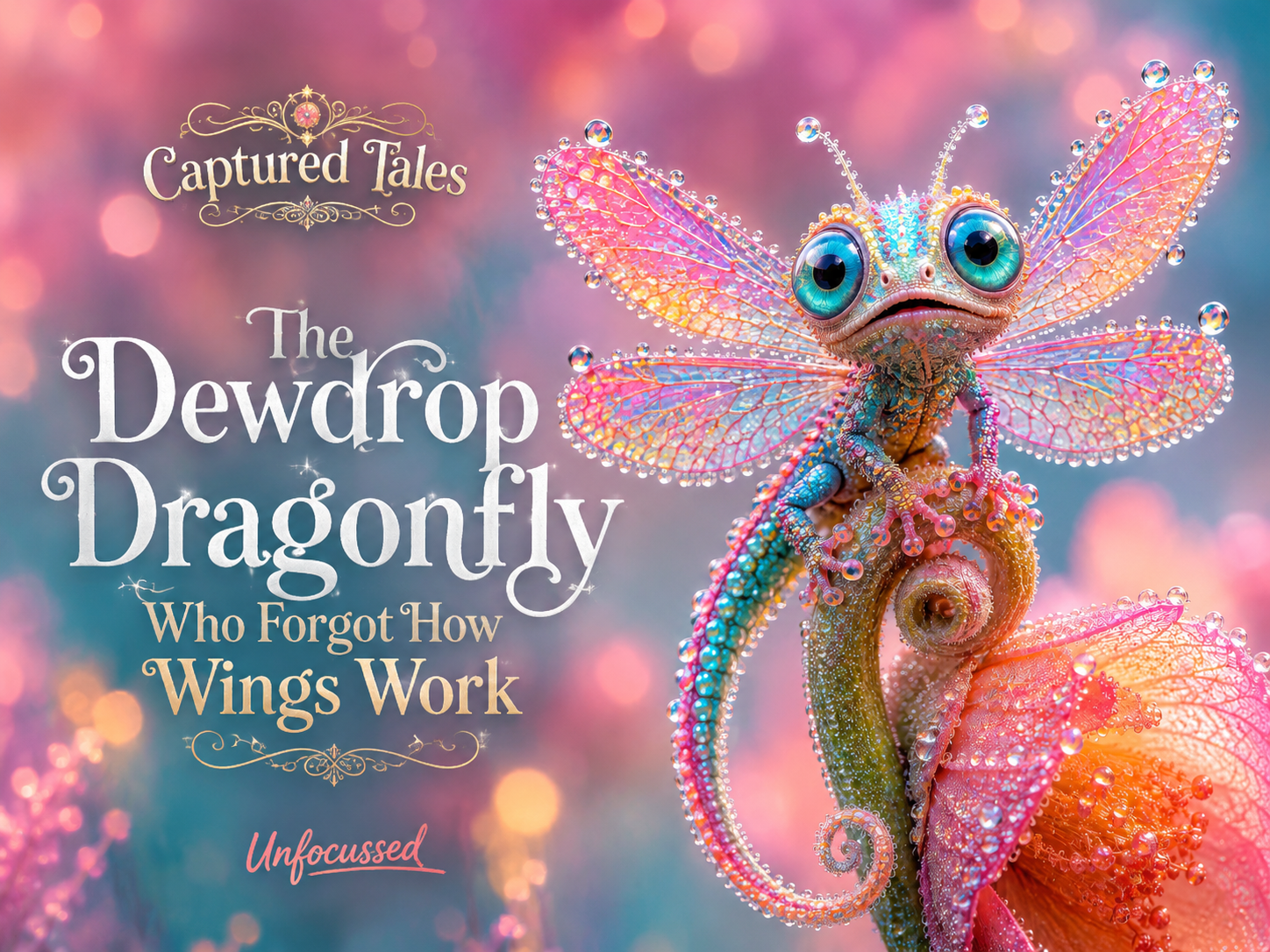
The Morning Gravity Got Personal
In the east curl of Sugarwild Garden, just past the Marmalade Moss and slightly left of the tulip that screamed whenever anyone complimented its complexion, there lived a dewdrop dragonfly named Pip Glimmerflit.
Pip was, by all garden standards, stunning.
Not casually pretty. Not “oh look, a cute little bug” pretty. Pip was the sort of pretty that made passing beetles walk into stems and pretend they had meant to do that. His wings shimmered in impossible shades of coral, taffy pink, sunrise orange, and blue so bright it looked like the sky had spilled its jewelry box. Every vein in those wings glowed like stained glass, and along the edges clung perfect round dewdrops that flashed rainbows whenever the morning light hit them.
He had enormous turquoise eyes, a curling tail, tiny pink toes, and the expression of someone who had just been handed a complicated appliance with no instructions and told it was crucial to his survival.
This was because, on that particular morning, Pip Glimmerflit had forgotten how wings worked.
He had not misplaced a sock. He had not forgotten someone’s birthday. He had not wandered into a room and wondered why he was there, though that happened often enough to be listed as a personality trait. No, Pip had awakened on his favorite curled flower stem, stretched his glittering legs, blinked dew from his lashes, lifted all four wings with great ceremony, and then realized he had absolutely no idea what came next.
“Up,” he whispered to himself.
His wings twitched.
Nothing happened.
“Flutter?” he tried.
One wing made a sound like a bored ribbon.
“Lift? Buzz? Fancy shoulder nonsense?”
The wings remained attached, sparkly, and offensively unhelpful.
Pip stared over the edge of the flower stem. Below him, the garden dropped away into a soft blur of petals, moss, and various small creatures already starting their day with the kind of confidence Pip found personally insulting. Bees were buzzing. Moths were drifting. A pair of lacewings looped through the air like smug little ribbons with legs.
Above him, the sun warmed the dewdrops along his wings until they glittered like a standing ovation.
“All right,” Pip said, swallowing hard. “Clearly the wings are still there. So this is probably just a temporary administrative error.”
A nearby blossom beetle named Murkley paused while polishing pollen off his face.
“Administrative error?” Murkley asked.
Pip froze. “I wasn’t speaking to you.”
“You were speaking out loud.”
“That was for dramatic effect.”
“Ah,” said Murkley. “Well, dramatically, you look like you’re about to fall off that stem and become jam.”
Pip lifted his chin. This was difficult because his chin was small and mostly decorative, but he did his best.
“I am preparing for a controlled launch.”
“You’ve been standing there for nine minutes making wing noises with your mouth.”
“That is part of the ceremony.”
“The ceremony of becoming jam?”
Pip narrowed his enormous eyes. “Murkley, has anyone ever told you that your personality feels like stepping on a wet crumb?”
“Frequently,” said Murkley, pleased. “It means I’m consistent.”
Pip turned away from him and faced the open air. He could do this. Of course he could do this. He was a dragonfly. Flying was not a hobby. It was the whole brochure.
He took a breath.
He lifted his wings.
He imagined himself soaring gracefully over the Sugarwild blossoms, every dewdrop sparkling, every petal sighing, every jealous insect forced to admit that yes, Pip Glimmerflit was basically a flying chandelier with cheekbones.
Then he jumped.
For one beautiful second, Pip hovered.
For one terrible second after that, he did not.
His wings flapped in four unrelated directions, each apparently operating under a different government. One wing tried to go up. One wing tried to go sideways. One wing seemed to have given up and joined a prayer circle. The fourth flapped so aggressively that Pip spun in place like a tiny jeweled weather vane having a breakdown.
“Oh no,” said Pip.
“Oh yes,” said Murkley.
Pip dropped three inches, shot upward five, spun sideways, bounced off a floating puff of pollen, and smacked face-first into a hanging dewdrop so large it briefly wore him like a hat.
The dewdrop burst.
Pip tumbled backward in a spray of rainbow mist, wings buzzing in pure panic, legs kicking, tail curling and uncurling like a party favor at a funeral.
He did not glide.
He did not soar.
He did not even fall with dignity.
He performed what would later be described by witnesses as “a moist aerial tantrum.”
At last, he landed bottom-first in the soft cup of a peach-pink blossom, which gave a dramatic bounce and released a puff of glittery pollen straight into his face.
Pip sat there, covered in sparkling dust, eyes wide, mouth open, wings trembling.
The garden went silent.
Then the tulip screamed.
Not because it was hurt. The tulip simply enjoyed being involved.
“He fell!” it shrieked. “The fancy one fell!”
From behind a leaf, a ladybug gasped. Two bees collided midair. A moth clutched its thorax as though scandal had finally become nutritious. Murkley the blossom beetle leaned over the stem, eyes glittering with the unbearable joy of having witnessed something embarrassing and free.
“Controlled launch?” Murkley called.
Pip slowly wiped pollen from one eye.
“That,” he said, “was the landing portion.”
“You landed upside down in a flower’s lap.”
“Advanced technique.”
“Your left wing slapped your own forehead.”
“Also advanced.”
The tulip screamed again, softer this time, mostly for branding.
Pip crawled out of the blossom with as much dignity as one could manage while sneezing glitter from both nostrils. He tried to shake himself off, but the dewdrops on his wings jingled faintly, and that only made the situation sound more humiliating.
By then, word had begun to spread.
In Sugarwild Garden, gossip moved faster than bees and with less concern for facts. A passing gnat carried the news to the Bluebell Lantern Grove. A caterpillar told three mushrooms. The mushrooms told everyone, because mushrooms could not keep their weird little caps shut. Within minutes, the story had grown from “Pip had a rough launch” to “Pip exploded into a blossom and forgot which end was sky.”
Pip heard a honeybee whisper, “I heard his wings filed a complaint.”
Another replied, “I heard gravity personally requested him.”
A third added, “I heard he tried to fly with his face.”
Pip’s eye twitched.
He had two choices. He could admit, calmly and responsibly, that something had gone wrong and ask for help.
Or he could do the much worse thing.
Naturally, he chose the worse thing.
The Birth of a Terrible Cover Story
“Friends,” Pip announced, climbing onto the edge of the blossom and standing tall despite the pollen clumped on his head like a tiny scandalous hat. “You appear concerned.”
“Amused,” Murkley corrected.
“Deeply amused,” added the ladybug.
“Emotionally fed,” said one of the mushrooms.
Pip ignored them all. “What you just witnessed was not a failure. It was a demonstration.”
A breeze moved through the flowers.
Somewhere, a cricket snorted.
“A demonstration,” Pip continued, “of my new lifestyle choice.”
“Your new lifestyle choice is falling?” asked Murkley.
“No.” Pip lifted one delicate finger. “My new lifestyle choice is grounded elegance.”
There was a pause.
“That’s walking,” said the ladybug.
“Incorrect,” Pip said. “Walking is what creatures do when they have no imagination. Grounded elegance is what I do when I choose not to waste my gifts on obvious behavior.”
“Your obvious behavior is flying,” said Murkley. “You’re a dragonfly.”
“Labels are cages, Murkley.”
“So are spiderwebs, but at least they make sense.”
Pip stepped carefully onto a curling petal and tried to look philosophical rather than terrified. His heart was hammering so hard he worried the dewdrops on his chest might rattle loose. The truth sat in his throat like a pebble: he did not know how to fly anymore. The motion that had always lived in his body had vanished. Where instinct should have been, there was only a blank, fluttering panic.
But admitting that in front of Murkley, the gossip bees, and an overdramatic tulip? Absolutely not. Pip had standards. Poor ones, perhaps, but standards.
“From this moment forward,” Pip declared, “I shall travel by refined alternatives.”
“You mean you’re going to crawl?”
“I mean,” said Pip, “I shall explore the garden through a more intimate relationship with surfaces.”
The mushrooms murmured appreciatively. Mushrooms loved nonsense if it sounded damp enough.
Pip began his descent from the flower. It went badly almost immediately.
Dragonflies, as a general rule, are not designed for casual strolling. Their bodies are graceful in the air and deeply awkward on anything that expects feet to make decisions. Pip’s tiny legs trembled as he moved down the stem. His wings, heavy with dewdrops, dragged slightly behind him and caught on every fuzz, thorn, and judgmental little leaf.
“Careful,” called Murkley. “That twig looks airborne.”
“I am ignoring you artistically,” Pip said.
He made it halfway down before a drop of water rolled from a leaf above and landed squarely between his eyes.
Plop.
Pip froze, dripping.
The ladybug covered her mouth.
“Refreshing,” Pip said through clenched teeth. “This is part of the grounded experience.”
At the base of the flower, the world was larger, louder, and far more full of things that could step on him. Grass blades rose like green towers. Pebbles looked like boulders. Ants marched past in organized lines, which Pip found deeply offensive because no one should look that confident while carrying crumbs.
One ant stopped and examined him.
“You lost?” the ant asked.
“No,” Pip said. “I am expanding.”
“Horizontally?”
“Spiritually.”
The ant stared at him for a moment, then rejoined the line.
“Garden’s getting weirder,” it muttered.
Pip tried his first alternative transportation method just before noon.
He selected a broad fallen petal, pink and gold, curved slightly at the edges like a little boat. The plan was elegant in its simplicity. He would sit upon the petal, wait for the breeze, and drift across the garden like a regal blossom barge. It would look intentional. It would look artistic. It would look nothing like a dragonfly afraid of his own wings.
“Behold,” Pip said to a small audience that had followed him purely to see what would go wrong next. “Petal gliding.”
“That’s litter rafting,” Murkley said.
“Silence from the crumb personality section.”
Pip climbed onto the petal and arranged himself dramatically. He folded his legs. He angled his wings so the dewdrops sparkled. He lifted his chin. The breeze arrived.
The petal did not glide.
It flipped.
Pip was launched three inches into the air, screamed in a pitch usually reserved for boiling kettles, and landed in a patch of powdered pollen with all six limbs pointing in different directions.
The tulip screamed from across the garden, delighted to still be relevant.
Pip emerged yellow from nose to tail.
“A test,” he said.
Murkley nodded solemnly. “And what did we learn?”
Pip spat pollen. “That petals are traitorous little hammocks.”
His second method involved bribing a beetle.
Not Murkley. Never Murkley. Pip had dignity, and besides, Murkley would absolutely charge interest.
Instead, Pip approached a large emerald leaf beetle named Brunna, who had a wide back, sturdy legs, and the emotional range of a doorstop.
“Brunna,” Pip said sweetly, “how would you like the honor of transporting a distinguished dewdrop dragonfly across the garden?”
Brunna chewed a leaf.
“No.”
“I can offer payment.”
Brunna paused. “What payment?”
Pip looked around, panicked slightly, and picked up a shiny pebble no bigger than a seed. “A moonstone.”
Brunna stared at it. “That is gravel.”
“Rare gravel.”
“No.”
“Mystical gravel.”
“Still no.”
“Fine,” Pip said. “Two mystical gravels.”
Brunna considered this with the deep seriousness of someone who did not care at all. At last she sighed, lowered herself, and allowed Pip to climb onto her back.
For a brief shining moment, Pip felt hope.
Then Brunna began walking.
Slowly.
So slowly that a snail passing in the opposite direction whispered, “Good grief, pick a lane.”
Pip clung to Brunna’s shell-smooth back, wings dragging, pride leaking out of him drop by drop.
“Could we perhaps increase speed?” he asked.
“No.”
“A gentle trot?”
“No.”
“A mild scoot?”
“No.”
Behind them, Murkley walked comfortably alongside, not even breathing hard.
“How’s the refined alternative?” he asked.
“Luxurious,” Pip hissed.
“You’ve moved six inches.”
“Quality travel takes time.”
“So does mold.”
Pip’s third method involved climbing a tall grass blade and using it as a launching catapult.
This was suggested by a firefly named Jibbit, who insisted he had seen it work once.
“On whom?” Pip asked.
“A seed.”
“Did the seed survive?”
Jibbit blinked. “Seeds don’t talk much afterward.”
This should have been enough warning.
It was not.
By midafternoon, Pip stood near the top of the grass blade while Murkley, Jibbit, two bees, three mushrooms, the ladybug, and the screaming tulip watched from below. The tulip had somehow dragged its pot closer. Nobody asked how. Nobody wanted that kind of knowledge.
“This,” Pip announced, “is a graceful vertical-assisted journey.”
“It’s a fling,” said Murkley.
“A noble fling.”
The grass blade bent beneath Pip’s weight. He gripped tightly with all his tiny toes. His wings prickled. Somewhere inside him, buried beneath fear and embarrassment, a memory flickered: lift, balance, rhythm, trust.
For half a breath, Pip almost understood.
Then Jibbit shouted, “Release the fancy fool!”
The grass blade snapped upright.
Pip shot into the air.
His wings flew open out of sheer terror.
For one impossible moment, he was airborne again, sunlight burning through his stained-glass wings, dewdrops scattering rainbows in every direction. The garden below blurred into pink and green and gold. His body remembered something. Not everything. Not enough. But something.
Then Pip looked down.
“Absolutely not,” he squeaked.
Panic clamped around him.
His wings locked.
He dropped like a jeweled button.
He landed in a mushroom cap with a soft, humiliating fwump.
The mushroom beneath him sighed.
“I didn’t ask for this,” it said.
Pip lay there staring at the sky, chest heaving, wings spread uselessly on either side.
Above him, a cloud drifted past in the shape of a bee laughing.
“Rude,” Pip whispered.
The Thing Nobody Was Supposed to Notice
By sunset, Pip’s “grounded elegance” had become the most popular disaster in Sugarwild Garden.
Creatures he barely knew wandered by to offer advice no one requested. A moth suggested moon breathing. A caterpillar recommended becoming “more tube-minded.” The snail from earlier offered a pamphlet titled So You’ve Accepted Slowness. Murkley suggested that Pip simply “try being less decorative and more functional,” which nearly resulted in beetle violence.
Pip smiled through all of it.
Badly.
His mouth kept doing the shape of confidence while the rest of him wanted to crawl under a leaf and become a rumor.
He had always flown. He had flown before he knew names for flowers. He had flown through mist, through sunbeams, through warm rain that made every petal smell awake. He had hovered over ponds and skimmed the tops of bluebells. He had danced with gnats, raced hummingmoths, and once performed a midair loop so dazzling that a daisy fainted and had been annoying about it ever since.
Flying was not just something Pip did.
Flying was where Pip felt like himself.
And now, every time he lifted his wings, fear rushed in first.
It filled the space where instinct used to be. It whispered that he would fall again. It reminded him of the tulip’s scream, Murkley’s grin, the bees whispering, the petals flipping, the grass blade flinging him into shame with excellent timing.
Pip sat alone beneath a curling leaf after the crowd finally grew bored and wandered away to judge other things. He watched the sky darken lavender and rose. Tiny lantern beetles blinked awake in the distance. The air smelled of nectar and wet petals.
His wings drooped.
“Maybe I’m not a dragonfly anymore,” he said quietly.
A voice above him answered, “That would be inconvenient, given your entire body.”
Pip looked up.
Perched on a dangling bluebell was Madame Flickerfuss, an elderly damselfly with silver wings, violet spectacles, and the calm expression of someone who had seen generations of idiots do idiot things and no longer had the energy to be surprised.
“Madame Flickerfuss,” Pip said quickly, trying to sit upright and failing when one wing got caught under his foot. “I was just resting.”
“You were sulking.”
“Elegantly.”
“No.”
Pip deflated. “Fine.”
Madame Flickerfuss adjusted her spectacles. “I saw your launch this morning.”
Pip winced. “Which part?”
“The wet hat. The spinning. The blossom impact. The pollen sneeze. The philosophical nonsense afterward.”
“So… all the tasteful portions.”
“Pip.”
He looked away.
Her voice softened, though only slightly. Madame Flickerfuss believed too much softness made young insects soggy. “You did not forget how wings work.”
Pip swallowed. “It feels like I did.”
“No. You forgot how trust works.”
That was a much ruder sentence than Pip had expected from someone wearing violet spectacles.
“My wings are the problem,” he said.
“Your wings opened when the grass launched you.”
“They panicked.”
“So did the rest of you.”
“That seems personal.”
“It is accurate.”
Pip curled his tail around the stem beside him. “Everyone saw me fall.”
“Yes.”
“Everyone laughed.”
“Most of them.”
“That was supposed to comfort me?”
“No. Comfort is not my strongest service.”
He gave her a wounded look.
Madame Flickerfuss sighed and fluttered down to the leaf beside him. Her wings barely moved, yet she landed as lightly as a thought.
“Listen to me, glitter boy,” she said.
Pip blinked. “Glitter boy?”
“You are sparkling in six directions and pouting in seven. The name fits.”
He did not have a defense for that.
“Falling once does not make you flightless,” she continued. “Falling loudly does not make you cursed. Falling in front of Murkley is unfortunate, yes, but many have survived worse.”
“Name one.”
“Murkley’s mother.”
Pip considered that. “Fair.”
Madame Flickerfuss pointed toward the open air between two flowers. “Tomorrow morning, you will try again.”
Pip’s stomach dropped. “Tomorrow morning, I may be busy.”
“Doing what?”
“Expanding spiritually.”
“You will try again.”
“What if I fall?”
“Then you will have learned something.”
“What if everyone laughs?”
“Then everyone will have revealed they need hobbies.”
Pip looked down at his wings. In the fading light, they no longer blazed with sunrise colors. They glowed softly, almost shyly, each dewdrop holding a tiny reflection of the garden he was afraid to rise above.
“I don’t know if I can,” he whispered.
Madame Flickerfuss did not mock him. That was how Pip knew things were serious.
“Then begin with that,” she said. “Not the lie. Not the performance. Not grounded elegance, which, for the record, was a terrible phrase and should be buried under a rock. Begin with the truth.”
Pip sat very still.
The truth was small and heavy.
“I’m scared,” he said.
Madame Flickerfuss nodded. “Good. Now we have something useful.”
Before Pip could answer, a sharp cry rang out from the far side of the garden.
Not the tulip this time.
This cry was different.
Urgent.
High.
Afraid.
The lantern beetles flickered wildly. Bees lifted from their flowers. A ripple of alarm passed through the stems.
Murkley came skittering around a root, all smugness gone from his face.
“Pip!” he shouted.
Pip stood too quickly and nearly tripped over his own tail. “What?”
Murkley pointed toward the western blossoms, where the sky had begun to darken behind the petals.
“The baby pollen sprites,” he gasped. “Their nursery pod broke loose.”
Pip’s eyes widened.
Across the garden, above the thorny drop into Bramblecup Hollow, a pale glowing seedpod bobbed in the wind. Tiny lights fluttered inside it. The baby pollen sprites were trapped, drifting farther from the flowers with every gust.
Every creature looked upward.
The bees were too heavy with nectar. The moths were too slow. The beetles could not reach them. Madame Flickerfuss stared at the pod, then at Pip.
Pip felt his wings tremble.
His whole body went cold.
Murkley’s voice cracked. “You’re the fastest one here.”
Pip stared at the drifting pod as it spun toward the hollow.
For once, nobody laughed.
For once, nobody whispered.
For once, the entire Sugarwild Garden looked at Pip Glimmerflit not because he had fallen, not because he was pretty, not because he had made a fool of himself in public and tried to rebrand it as a lifestyle.
They looked at him because he had wings.
And the wind was getting stronger.
The Rescue Plan That Immediately Became Everyone’s Problem
Pip Glimmerflit stared across Sugarwild Garden as the nursery pod bobbed above Bramblecup Hollow, glowing faintly like a lantern full of frightened stars.
Inside the pod, the baby pollen sprites flickered in panicked little bursts. Their tiny wings were not grown yet. Their voices were too small to carry clearly over the wind, but every creature in the garden could hear the thin, trembling sound of them crying.
That sound did something terrible to Pip’s stomach.
It made it honest.
“No,” Pip whispered.
Murkley blinked. “No?”
“No, as in no. Absolutely not. I am emotionally unavailable for airborne heroics.”
The wind shoved the nursery pod another few feet toward the dark thorny drop below.
Murkley’s face tightened. “Pip.”
“Don’t Pip me. I fell into a flower this morning. A flower. It had opinions.”
“The sprites are drifting into Bramblecup Hollow.”
“I am aware of the geography, thank you.”
Madame Flickerfuss landed beside him, calm as a knife in a teacup. “You are the only one fast enough.”
Pip looked at her with a wild little smile. “Fantastic. Then the garden should have invested in a second option.”
A bee dipped low, wings buzzing anxiously. “We tried reaching them, but the gusts keep pushing us back. We’re too heavy from the morning nectar.”
“Spit it out,” Murkley snapped.
The bee gasped. “Excuse me?”
“The nectar. Spit it out.”
The bee drew itself up. “I am a professional.”
“You are also shaped like a flying dumpling right now.”
“I will not be body-shamed by a beetle with eyebrows made of dirt.”
“Enough,” said Madame Flickerfuss.
The nursery pod spun again, snagged briefly on a tall blade of grass, then slipped free. The baby sprites flashed brighter with fear.
Pip’s wings twitched.
He felt it again—that dreadful blank place in his body where flight used to live. His wings were open. They were beautiful. They were built for slicing through air, hovering in place, shifting direction with impossible grace.
And they felt like four expensive curtains stapled to a panic attack.
“I can’t,” he said.
The words came out small.
Nobody laughed.
That was worse.
Murkley looked like he wanted to say something rude but had briefly misplaced his cruelty in a drawer labeled Actual Emergency. The ladybug wrung her tiny front legs. The mushrooms glowed faintly, which was either concern or fungus behavior. Hard to tell with mushrooms.
Madame Flickerfuss stepped closer. “You can.”
“You don’t know that.”
“No,” she said. “But neither do you.”
Pip swallowed.
Another gust tore through the flowers. The pod lurched sideways, now perilously close to the first black thorns of Bramblecup Hollow. Down there, the brambles grew thick and twisted, their hooked branches reaching upward like the garden had developed bad intentions.
The sprites would not survive a fall into that mess.
Pip’s heart pounded.
He thought of the tulip screaming. He thought of Murkley’s grin. He thought of the wet dewdrop hat, the petal flipping him like breakfast, the mushroom cap catching his shame with a soft little fwump.
Then he thought of the tiny lights inside the pod.
“Fine,” he said, voice shaking. “We need a plan.”
Madame Flickerfuss nodded once. “Good.”
Pip pointed at Murkley. “Not your plan.”
“I hadn’t offered one.”
“Your face was preparing something stupid.”
“My face always looks like this.”
“Exactly.”
Within moments, the entire garden assembled into what could generously be called a rescue council, though it mostly resembled a bickering pile of limbs, wings, petals, and bad instincts.
The bees proposed forming a buzzing wall to push the pod back.
The moths suggested singing calming lunar hymns.
The ants recommended building a bridge, then immediately began arguing about labor distribution.
The snail offered to retrieve a ladder.
“From where?” Pip asked.
“I have one in storage.”
“Why do you have a ladder?”
The snail looked offended. “A gentleman does not explain his architecture.”
“By the time you get it,” Murkley said, “the sprites will have grandchildren.”
The screaming tulip, who had somehow scooted closer again and was now wearing a leaf like a shawl, declared, “I could scream them back.”
“You could scream all of us into a headache,” Pip said.
“That’s still movement.”
Jibbit the firefly lit up excitedly. “What if we launch Pip again?”
Pip slowly turned toward him. “Jibbit.”
“Yes?”
“I want you to understand that I am saying this with all the kindness I can scrape from the bottom of my soul: shut your glowing little disaster mouth.”
Jibbit dimmed. “Noted.”
Madame Flickerfuss raised one silver wing. “The wind is moving west. If Pip can reach the upper milkweed stem, he may be able to leap from there and catch the pod before it crosses the hollow.”
“Leap?” Pip said.
“Launch,” she corrected.
“That is the same word wearing a nicer hat.”
“You will not need to fly far at first. Only enough to reach the pod.”
“Only enough,” Pip repeated. “Lovely. And after I reach the pod?”
Madame Flickerfuss paused.
Murkley coughed. “Then you keep flying.”
Pip stared at him.
“Brilliant. Truly. Has anyone considered carving your wisdom into a seed husk so future generations can ignore it too?”
Murkley lifted both front legs. “I’m just saying the obvious part.”
“The obvious part is the part I am currently least compatible with.”
The nursery pod jerked violently in the wind. A few tiny golden sparks drifted out through a crack in its shell. The baby sprites inside squealed.
The argument died.
Pip looked down at his feet. They were trembling on the leaf.
He hated that everyone could see.
Madame Flickerfuss did not tell him to stop shaking. She did not tell him to be brave. She merely said, “Move while scared.”
Pip let out a shaky breath. “That sounds awful.”
“Most useful things do.”
“You should write greeting cards.”
“I did. They were not popular.”
Pip looked one last time at the pod, then nodded.
“All right,” he said. “Upper milkweed stem. I reach the pod. I keep flying. Nobody screams.”
The tulip opened its mouth.
“Nobody screams,” Pip snapped.
The tulip closed its mouth, visibly wounded by censorship.
The Upper Milkweed Stem of Bad Choices
Reaching the upper milkweed stem without flying was an undertaking so awkward that several creatures later described it as “heroic in the most embarrassing way possible.”
Pip climbed.
Not elegantly.
Not dramatically.
Not with the sleek precision of a creature born for air.
He climbed like a decorated noodle trying to escape a salad.
His wings snagged on fuzz. His tiny toes slipped on sap. One dewdrop rolled off his wing and bonked an ant on the head below.
“Weather attack!” the ant shouted.
“Sorry!” Pip called.
“Unprovoked sky violence!”
“Still sorry!”
Murkley climbed beneath him, grumbling all the way.
“Why are you following me?” Pip demanded.
“Because if you pass out, someone has to drag your shiny carcass back down.”
“That is almost kind.”
“Don’t spread rumors.”
Above them, Madame Flickerfuss hovered near the stem, demonstrating slow wing movements. “Open, angle, balance. Do not flap like you are fighting invisible soup.”
“That was one time,” Pip said.
“It was this morning.”
“Time is a social construct.”
“So is dignity, apparently.”
Pip climbed higher.
The garden stretched beneath him, soft and glowing in the sunset. Flowers became islands of color. Dewdrops flashed like tiny moons. The path to Bramblecup Hollow yawned wider now, its thorned edges dark against the light.
The nursery pod drifted nearer to the hollow.
Too near.
He could see the sprites inside more clearly now: tiny pollen-bright babies huddled together, their little faces pressed against the translucent pod wall.
One of them saw him.
It raised a minuscule hand.
Pip’s fear did something strange.
It did not vanish. That would have been convenient, and life in Sugarwild Garden had never been accused of convenience.
Instead, the fear shifted.
It stopped standing in front of him and moved beside him, like an unpleasant companion he could not ditch but might drag along anyway.
Pip reached the top of the milkweed stem.
The wind hit him full in the face.
His wings opened reflexively.
He froze.
The entire garden below held its breath.
Even the tulip managed silence, though it looked physically painful.
Pip looked at the drop below. His vision blurred for a second. The memory of falling rushed up hard and bright.
Flower lap.
Pollen sneeze.
Murkley’s grin.
The terrible, helpless spin.
“I can’t,” Pip whispered.
Murkley had reached the stem below him. For once, the beetle did not make a joke. He simply dug his claws into the milkweed and looked up.
“You don’t have to look graceful,” Murkley said.
Pip blinked down at him. “What?”
“You’re obsessed with looking graceful. It’s exhausting. Just get there ugly.”
Pip stared.
“That might be the most useful thing you’ve ever said.”
“I hated it too.”
Madame Flickerfuss hovered close. “Open. Angle. Balance.”
Pip took one breath.
Then another.
His wings trembled, but they stayed open.
“Get there ugly,” he muttered.
Then he jumped.
For a fraction of a second, everything went wrong.
His body dropped. His stomach flew upward. His wings flapped too fast, too wide, too frantic. He tilted left, overcorrected right, and made a small noise that he hoped no one would ever describe accurately.
But this time, he did not lock up.
This time, instead of trying to look beautiful, he tried to stay in the air.
His wings caught the wind.
Badly.
Messily.
Miraculously.
Pip lurched forward.
The garden gasped beneath him.
“He’s doing it!” shouted a bee.
“He’s doing something!” Murkley yelled. “Let’s not overstate!”
Pip wobbled through the air, every nerve screaming, wings buzzing unevenly as he fought toward the nursery pod. The wind shoved him sideways. He dipped, rose, nearly spun, and recovered with an undignified kick of all six legs.
It was not flight as Pip remembered it.
It was flight assembled during a crisis using fear, spite, and questionable engineering.
But it was flight.
“I’m flying,” Pip whispered.
Then a gust slapped him so hard he squeaked.
“I’m flying terribly!”
Madame Flickerfuss called from behind him, “Terrible still counts!”
The nursery pod swung closer. Pip reached for it with his front legs.
Missed.
The pod bobbed upward.
He lunged.
Missed again.
One baby sprite inside pressed both hands to the pod wall and appeared to be judging his technique, which Pip felt was deeply unfair given the circumstances.
“Hold still!” Pip shouted.
The pod, being a seedpod in the wind, did not respect instructions.
Pip pushed harder. His wings whirred. A tiny rhythm began to emerge beneath the panic. Open, angle, balance. Open, angle, balance. Not graceful. Not perfect. But enough.
He caught the pod’s trailing fiber with both hands.
“Got you!”
The garden erupted in cheers.
For half a heartbeat, Pip felt triumph blaze through him.
Then the pod yanked him forward.
“Oh, you are heavier than your adorable branding suggested!” he squealed.
The pod swung beneath him, dragging his small body toward Bramblecup Hollow. Pip beat his wings furiously, trying to pull back, but the wind had the pod now. It surged west with a sudden roaring gust.
Pip was pulled with it.
The cheers below turned into shouts.
“Pip!” cried Murkley.
“Let go!” shouted a bee.
“Do not let go!” screamed another bee.
“Pick a message!” Pip yelled.
The nursery pod dipped toward the first thorn branches.
Pip twisted, pulling with every bit of strength in his tiny limbs. His wings beat faster. The dewdrops along them scattered loose, flying into the wind like bright tears.
He gained an inch.
Lost three.
The pod slammed against a bramble tip and bounced. The sprites inside tumbled together in a frightened golden heap.
Pip gritted his teeth.
“No,” he snarled. “Absolutely not. I did not humiliate myself all day just to lose to an overgrown sticker bush.”
He pulled again.
A thorn caught the pod’s side.
For one awful second, that saved it.
Then the thorn tore a wider crack in the pod wall.
Golden pollen-light spilled out.
The babies squealed.
Pip’s breath stopped.
If the pod split open over the hollow, the sprites would scatter into the brambles like sparks into a briar fire.
He needed help.
He looked back toward the garden.
Everyone was too far away.
Madame Flickerfuss was flying toward him, but even she could not reach him before the pod tore wider. The bees struggled against the wind. Murkley clung helplessly to the milkweed stem, his dirty eyebrow face twisted in fear.
Pip looked at the pod.
At the crack.
At the babies.
At the thorn.
Then he saw something below: a huge curled leaf caught between two bramble branches, stretched like a sagging green hammock over the hollow.
It was not close.
It was not safe.
It was barely a plan.
Which, unfortunately, made it very on-brand for the day.
Pip wrapped his arms tighter around the pod fiber and shouted, “Everyone below, move toward the hollow!”
“What are you doing?” Madame Flickerfuss called.
“Getting there ugly!”
Then Pip stopped pulling backward.
He turned with the wind.
For one terrifying moment, he let the gust take him.
The pod shot forward, dragging Pip above the brambles. Thorns clawed up beneath him. The hollow opened like a dark mouth. His wings screamed with effort as he steered—not away from the wind, but through it, angling the pod toward the curled leaf below.
The baby sprites flashed wildly inside.
“I know!” Pip shouted. “This is not my favorite either!”
The pod dropped.
Pip pulled up.
The crack widened.
One tiny sprite slipped halfway through.
Pip let go with one hand and grabbed the baby by the back of its soft pollen wrap.
“No freelancing!” he yelled, stuffing it gently back inside.
The sprite blinked at him.
“You’re welcome.”
The curled leaf rushed up below.
Pip aimed.
Badly.
The pod hit the leaf with a bounce, rolled, and nearly toppled over the far edge. Pip slammed into it shoulder-first, digging his feet into the leaf’s slick surface. The pod stopped inches from a thorny drop.
For one second, everything held.
Pip panted.
The baby sprites stared.
Then the leaf began to tear.
“Oh, come on!” Pip shouted.
A Very Shiny Problem in a Very Thorny Place
The curled leaf sagged beneath the nursery pod, its edges splitting where the bramble thorns held it in place. Below it, Bramblecup Hollow waited dark and deep, packed with twisted stems, hooked thorns, and the sort of shadows that looked like they charged rent.
Pip crouched on the leaf beside the pod, wings shaking so hard the last few dewdrops trembled loose and rolled away.
He was across the hollow now.
That was good.
He was on a tearing leaf above a thorn pit with a cracked nursery pod full of terrified baby sprites.
That was less good.
From the garden side, creatures rushed toward the edge of the hollow. Bees buzzed in frantic loops. Ants began forming lines along the roots. The ladybug fluttered uselessly from petal to petal shouting, “Someone do something organized!” which was a bold request from a creature currently spinning in circles.
Murkley reached the edge first, skidding to a stop near a bramble root.
“Pip!” he yelled. “Are you dead?”
Pip looked up from the leaf. “Would I answer that?”
“You might. You love attention.”
“I am alive and increasingly annoyed!”
“That sounds right!”
Madame Flickerfuss landed on a thorn branch above him, breathing harder than Pip had ever seen. Her silver wings flickered in the darkening light.
“Can you lift the pod?” she called.
Pip grabbed the trailing fiber and pulled.
The pod did not move.
He pulled harder.
The leaf tore another inch.
He stopped.
“Define lift,” he said.
“Can you carry it?”
“No.”
“Can you drag it?”
“Not without converting this leaf into confetti.”
One baby sprite pressed its face to the cracked pod wall and began to cry again.
Pip’s chest hurt.
“Don’t do that,” he whispered. “I’m already very emotionally crowded.”
The sprite cried harder.
“Wonderful. Thank you.”
Madame Flickerfuss scanned the hollow. “We need to stabilize the leaf.”
“With what?” Murkley shouted.
The ants had arrived below him in a neat, bristling cluster.
“We can anchor fibers,” said their captain. “But we need lines across the gap.”
“Spider silk?” suggested the ladybug.
Everyone looked toward the shadow beneath a bent root.
A long, delicate leg emerged.
Then another.
Out stepped Lady Snarelle, the garden spider.
She was elegant, black and silver, with tiny dew pearls along her webbing like she had dressed for a funeral at a jewelry store.
Pip had never trusted her. This was not personal. Pip simply believed anyone with that many legs and that much patience was up to something.
Lady Snarelle tilted her head. “You require silk.”
Murkley narrowed his eyes. “Yes.”
“For children?”
“Yes.”
“Then I will help.”
Pip blinked. “Just like that?”
Lady Snarelle looked offended. “I am dramatic, not monstrous.”
“Fair distinction.”
“Also, if the pod falls, everyone will scream, and I despise cluttered acoustics.”
“Less noble, but still useful.”
In moments, Lady Snarelle began spinning silk lines from the bramble edge toward the torn leaf. Bees carried the lightest strands. Ants anchored them to roots. Madame Flickerfuss directed the work from above, issuing commands with the sharp precision of someone born to terrify incompetence.
“Left anchor tighter. Bee with the crooked stripe, stop showing off. Murkley, hold that root.”
“I am holding it.”
“Hold it with less face.”
“This is my only face.”
“Tragic. Continue.”
Pip crouched beside the pod, pressing one hand against the crack to keep it from widening. The baby sprites huddled near him from inside.
“Hello,” he said softly. “I’m Pip. Today has been a pile of sparkling garbage, but we are not done yet.”
One sprite hiccuped.
Another touched its tiny palm to the pod wall where Pip’s hand rested.
His throat tightened.
He glanced at his wings. They were tired, uneven, and nearly bare of dew now. Without the sparkling droplets, they looked lighter. Less ornamental. More like themselves.
More like wings.
The leaf shifted beneath him.
Pip froze.
Another tear opened along the center vein.
“Madame?” he called.
She looked down.
Her expression changed.
That was how Pip knew they were in proper trouble.
The silk lines were not ready. The ants had not anchored the far side. The bees were struggling in the gusts. Lady Snarelle spun as fast as she could, but the leaf was tearing faster.
“Pip,” Madame Flickerfuss said, “listen carefully.”
“I hate when sentences start like that.”
“You may need to move the babies out one at a time.”
Pip stared at the cracked pod.
“Carry them?”
“Yes.”
“Through the air?”
“Yes.”
“Over the thorn pit?”
“Yes.”
“With my wings?”
“Unless you have been hiding a very small wagon.”
Pip laughed once, sharp and panicked. “I just barely flew myself over here.”
“I know.”
“I flew badly.”
“Yes.”
“I screamed at the wind.”
“The wind deserved it.”
“I can’t carry babies.”
Madame Flickerfuss held his gaze. “You may have to.”
The leaf split another inch.
The baby sprites whimpered.
Pip closed his eyes.
For one stupid, selfish second, he wished he had stayed on the flower stem that morning. He wished he had never jumped, never fallen, never been laughed at, never tried petal rafting, never bribed Brunna with mystical gravel, never climbed the milkweed, never leapt into the wind.
Then he opened his eyes and looked at the sprites.
No.
He did not wish that.
Because if he had stayed there, afraid and pretending, those babies would already be gone.
Pip pressed his forehead gently against the pod.
“All right, tiny glowbeans,” he whispered. “We are going to do something deeply unpleasant.”
He worked his fingers into the crack and carefully widened it just enough for the smallest sprite to crawl out. The baby trembled in his arms, warm and powder-soft, no heavier than a breath.
Pip’s wings opened.
The hollow yawned below.
The wind rose.
His fear came roaring back, loud as the tulip and twice as ugly.
He nearly froze.
Then Murkley shouted from the far edge, “Pip!”
Pip looked up.
The beetle gripped a silk anchor line with all his strength. His face was strained. His claws dug into the root.
“Get there ugly!” Murkley yelled.
Pip let out a breath that almost became a laugh.
“That is a terrible battle cry!” he shouted back.
“It’s yours!”
The leaf tore beneath Pip’s feet.
No more time.
He hugged the baby sprite close.
Opened his wings.
Angled them into the wind.
And jumped.
For a heartbeat, he dropped.
The baby sprite squeaked.
Pip squeaked louder.
Then his wings caught.
Not beautifully.
Not perfectly.
Not like the old Pip who danced over bluebells and made daisies faint for attention.
But enough.
He rose in a crooked, trembling arc over the thorns.
The whole garden shouted.
Pip did not look down.
He looked at the next flower ledge. He looked at Madame Flickerfuss guiding him. He looked at Murkley’s ridiculous dirt-eyebrow face, which for once held no mockery at all.
Open.
Angle.
Balance.
Fear beside him.
Baby safe against him.
Wings working.
Pip landed hard on the garden edge, tumbling into Murkley and sending both of them rolling into a clump of moss.
The baby sprite popped upward in his arms, unharmed, blinking like a tiny confused candle.
The garden erupted.
The tulip screamed.
This time, nobody told it not to.
Pip lay in the moss, gasping, the baby sprite tucked safely against his chest.
Murkley groaned beneath him.
“You landed on my face.”
“Advanced technique,” Pip wheezed.
“I hate that I’m proud of you.”
“Say it louder.”
“Absolutely not.”
Madame Flickerfuss swooped down. “Good. Again.”
Pip lifted his head.
Across the hollow, the nursery pod sagged on the tearing leaf.
More baby sprites waited inside.
The silk lines strained.
The wind strengthened.
Pip’s wings trembled with exhaustion.
And then the pod split wider.
Three tiny sprites tumbled toward the open crack.
Pip scrambled to his feet.
His fear was still there.
So was the hollow.
So were the thorns.
So was the whole garden watching.
But something else was there now too.
Not confidence. Not yet.
Confidence sounded too polished for what Pip felt.
This was messier.
Stubborn.
Hot.
A little rude.
It rose in him like a spark with teeth.
Pip opened his wings again.
“Fine,” he said, glaring at the wind. “Round two, you gusty bastard.”
Round Two Against the Gusty Bastard
Pip Glimmerflit launched himself back over Bramblecup Hollow with all the grace of a jeweled sneeze.
His wings buzzed unevenly. His legs tucked too late. His tail curled so tightly it nearly became punctuation. The wind shoved him sideways the moment he cleared the edge, and for one awful second he tilted toward the thorns below like gravity had just recognized him from earlier and wanted a rematch.
“Nope!” Pip barked. “Not today, you prickly salad of doom.”
He kicked one leg out, overcorrected, spun halfway, and somehow leveled himself just before a bramble thorn could introduce itself to his backside with unnecessary enthusiasm.
From the garden edge, Murkley shouted, “That looked terrible!”
“Still airborne!” Pip yelled back.
“Barely!”
“Barely counts, dirt brows!”
Madame Flickerfuss zipped beside him, her silver wings steady and controlled. “Less yelling. More breathing.”
“Yelling is breathing with seasoning.”
“Pip.”
“Fine.”
He sucked in a breath and focused on the nursery pod. The cracked glowing shell sagged on the torn curled leaf, its seam splitting wider every time the wind tugged at it. Inside, the remaining baby pollen sprites had gathered into a trembling golden clump. Three of them were halfway through the crack, their tiny hands gripping the pod’s edge.
The leaf beneath them tore another inch.
Pip’s stomach clenched.
“Hold on, glowbeans,” he called. “Nobody becomes decorative bramble confetti on my watch.”
One baby sprite blinked at him.
Another sneezed a puff of pollen directly into its sibling’s face.
Even in crisis, children remained committed to making everything sticky and dramatic.
Pip landed on the curled leaf, skidding beside the pod. The leaf dipped under his weight.
“Madame?” he said.
“Quickly,” Madame Flickerfuss replied.
“That was not comforting.”
“It was not meant to be.”
Pip widened the crack carefully and scooped up two sprites this time, one in each arm. They were warm, powdery, and impossibly small. One clung to his neck. The other grabbed a strand of his chest fluff and yanked.
“Ow,” Pip said. “Tiny, terrified, and rude. Excellent survival instincts.”
The leaf groaned beneath him.
He opened his wings.
Fear rose again, fast and sharp.
But now it had competition.
There was the weight of the sprites in his arms. There was Murkley shouting from the edge. There was Madame Flickerfuss circling above. There was Lady Snarelle spinning silk like a furious seamstress. There were ants digging anchors into roots, bees dragging strands through the wind, and the screaming tulip doing its absolute best not to explode from emotional relevance.
Pip was not alone in the fear.
Annoyingly, that helped.
“Open,” he whispered.
His wings spread.
“Angle.”
They tilted into the wind.
“Balance.”
He jumped.
This flight was worse.
The extra weight pulled him down immediately. The sprites squeaked. Pip dropped toward the brambles and kicked upward hard, wings beating so fast they blurred into stained glass fire. The wind clipped him from the side and spun him once.
“No spinning!” he snapped at himself. “We discussed this!”
The sprites shrieked.
“Not you. You’re doing great. Emotionally loud, but great.”
He dipped, rose, dipped again, and then found a rhythm so ugly it would have made his former self faint into a lily. But it worked. Each wingbeat pulled him a little higher. Each breath kept panic from locking his body stiff. Each terrible wobble became something he corrected instead of something he surrendered to.
He reached the garden edge and crash-landed into a cushion of moss the ants had shoved into place.
“Again?” Murkley asked, already reaching for the sprites.
Pip handed them over, gasping. “I would like to formally register that this rescue is abusing my charm.”
“Your charm needed cardio.”
“Your face needs curtains.”
“Still proud of you.”
“Still say it louder.”
“Still no.”
Pip shoved himself upright.
His wings ached. His legs trembled. His chest felt like someone had stuffed it with hot thistle fluff. Across the hollow, the pod shifted again. More sprites waited.
He flew back.
Then again.
And again.
None of the trips were pretty.
On the fourth crossing, he clipped a hanging thorn vine and spun into Madame Flickerfuss, who corrected him with a firm shove and a look so sharp it could peel bark.
On the fifth, a sprite bit his finger.
“Why?” Pip cried.
The sprite burbled.
“That was not an answer!”
On the sixth, the wind slapped him so hard he lost altitude and had to flap straight upward with every muscle he had, screaming, “I am too sparkly for this garbage!” while a line of bees cheered like drunk sports fans.
By the seventh crossing, the garden had become a living machine of frantic cooperation.
Lady Snarelle’s silk lines webbed the hollow edge, catching pieces of the tearing leaf before they dropped. Ants braced the silk with disciplined fury. Bees ferried pollen-sap to patch small tears in the pod. The ladybug directed sprite handoffs with the bossy confidence of someone who had discovered a clipboard in her soul.
Even the tulip helped.
Not with movement. Not with tools. Not with anything one could call practical.
But whenever Pip dipped too low, the tulip screamed, “HIGHER, YOU GLITTERING LITTLE MENACE!”
And somehow, against all reason, it worked.
After the ninth rescue flight, Pip collapsed on the moss beside Murkley, panting so hard his whole body trembled.
“How many left?” he asked.
Murkley looked to Madame Flickerfuss.
She hovered above the hollow, eyes narrowed behind her violet spectacles.
“Two,” she called. “Maybe three. The pod is folding inward.”
Pip closed his eyes. “Wonderful. The pod has chosen origami death.”
Murkley stepped closer. “You can stop for a breath.”
Pip opened one eye. “Did you just express concern?”
“No.”
“That sounded concern-adjacent.”
“I was assessing the equipment.”
“I’m the equipment?”
“Shiny equipment.”
Pip snorted, then winced because even laughing made his wings hurt.
Across the hollow, the pod cracked with a sharp sound.
The whole garden went still.
A golden glow spilled from the split shell.
Madame Flickerfuss shouted, “Now!”
Pip was already moving.
The Last Little Light
He crossed the hollow faster than before.
Not cleaner. Not smoother. But faster.
The fear still came with him, but now it had to run to keep up.
The nursery pod was nearly broken in half when Pip reached it. One side had collapsed against the curled leaf. The other hung open toward the hollow. Two baby pollen sprites clung to the inner fibers, crying and blinking in the harsh wind.
Pip grabbed them both, tucking one against his chest and one beneath his chin.
“That’s it?” he called. “Two?”
Madame Flickerfuss hovered above, scanning the pod. “Wait.”
Pip hated that word.
It was always followed by inconvenience.
From deep inside the lower curve of the broken pod came a tiny flicker.
Not bright like the others.
Small.
Weak.
Half-hidden beneath a fold of torn seed silk.
Pip’s breath caught.
“There’s another.”
The leaf beneath him split again, the tear racing toward the pod like a crack in thin ice.
Madame Flickerfuss darted lower. “You cannot carry three.”
“I know.”
“Bring those two back. I’ll try for the last.”
A gust slammed into her before she finished speaking, pushing her upward and sideways. She fought it, but the wind had worsened over the hollow, funneling between the bramble walls in sharp unpredictable bursts.
Pip looked from Madame Flickerfuss to the dim little flicker still trapped inside the pod.
The two sprites in his arms shivered.
The last one barely moved.
“Damn it,” Pip whispered.
He turned toward the garden edge.
“Murkley!”
“What?” Murkley shouted.
“Can you get the moss closer to the edge?”
“How close?”
Pip looked down at the thorns. He looked at the distance. He looked at his shaking wings.
“Uncomfortably.”
Murkley stared at him for half a second, then spun toward the ants. “Move the moss! Close to the edge! Nobody ask him why. It’ll be stupid and heroic!”
“Mostly stupid!” Pip yelled.
“I was being generous!”
The ants began shoving the moss cushion toward the lip of the hollow. Bees hooked silk lines around it. Lady Snarelle reinforced the edge. The tulip screamed encouragement that was mostly just noise wearing ambition.
Pip tucked the two sprites close and launched.
He did not try to climb high. He dove low and fast, letting the wind carry him toward the garden edge. The thorns whipped beneath him. One snagged the tip of his tail and jerked him downward.
Pip kicked free with a yelp.
He crashed into the moss cushion shoulder-first, rolled twice, and landed on his back with both sprites still clutched safely against him.
Murkley skidded beside him. “Alive?”
“Regretfully.”
“Sprites?”
Pip opened his arms. The two babies blinked up at them, dazed but unharmed.
The garden exhaled.
Then a faint cry came from across the hollow.
The last little light.
Pip sat up too fast and nearly blacked out. Murkley grabbed his shoulder.
“No,” Murkley said.
Pip stared at him.
“Move.”
“You can barely stand.”
“Then I’ll fall with intent.”
“Pip.”
“Don’t suddenly become the reasonable one. It’s upsetting.”
Murkley’s grip tightened. “You already saved the others.”
Pip looked across the hollow.
The pod was collapsing. The leaf was almost gone. The last sprite’s glow flickered weakly inside the broken shell.
“Not all of them.”
Madame Flickerfuss landed beside him. For the first time all evening, she looked uncertain.
“The wind is too strong,” she said quietly. “The pod may fall before you reach it.”
“Then I should hurry.”
“You may not make it back.”
Pip’s mouth went dry.
There it was. The truth, ugly and bare.
He was tired. His wings burned. His body shook. He was no longer glittering like a sunrise chandelier; he was scuffed, pollen-smeared, dewless, and one bad gust away from becoming a cautionary tale told by beetles with too much enthusiasm.
He was terrified.
But the fear no longer felt like a locked door.
It felt like weather.
Awful weather, yes. Rude weather. Weather with personal boundary issues.
But weather could be flown through.
Pip stood.
His knees wobbled.
Murkley moved in front of him. “Don’t make me tackle you. I’ll do it badly, but I’ll do it.”
Pip smiled, small and tired. “You’re a wet crumb, Murkley.”
“Consistent.”
“But you’re my wet crumb.”
Murkley’s face twisted. “That was disgusting.”
“I know. I’m emotionally compromised.”
Madame Flickerfuss stepped aside.
She looked at his wings, then at his face.
“Open,” she said.
Pip opened his wings.
“Angle.”
He angled them toward the screaming wind.
“Balance.”
He breathed.
Then Pip Glimmerflit jumped.
This time, he did not scream.
The wind hit him like a wall. His wings buckled. His body dropped. The brambles surged up beneath him, dark and hooked and hungry-looking.
He pulled hard.
His wings caught.
He rose.
Not much.
Enough.
The garden behind him faded into noise. The cheering, the shouting, the tulip’s deranged encouragement, Murkley’s anxious insults—all of it blurred into one great sound.
Pip focused on the broken pod.
One wingbeat.
Then another.
And another.
For the first time all day, he stopped thinking about how he looked.
He stopped thinking about falling.
He stopped thinking about whether his wings remembered him.
He simply used them.
The motion came back in pieces.
A tilt. A correction. A lift. A turn.
Not the old effortless dance. Something new. Something earned. Something stitched together from fear, failure, fury, and the very inconvenient fact that he cared.
He reached the pod just as the curled leaf tore free.
The broken shell dropped.
Pip dove.
The hollow opened beneath him.
He plunged after the falling pod, wings folded tight for speed. Thorns whipped past. The air smelled sharp and green and dangerous.
The last sprite flickered inside the shell.
Pip slammed into the pod midfall, wrapped all six limbs around it, and tore the cracked side open with his teeth.
“Come here, tiny trouble!”
He grabbed the sprite.
The pod shell spun away into the brambles below and vanished with a brittle crunch.
Pip snapped his wings open.
Too late.
The wind twisted between the bramble walls, slamming him downward.
He hit a thorn vine, bounced, lost his grip on the air, and dropped again. The baby sprite whimpered against his chest.
“I’ve got you,” Pip gasped. “I’ve got you.”
He did not know if he did.
Above him, the garden edge looked impossibly far away. Madame Flickerfuss dove toward him, but the wind pushed her back. Bees shouted. Ants scrambled. Silk lines whipped loose in the gusts.
Pip’s wings beat frantically.
No lift.
He tried again.
Still dropping.
A bramble thorn sliced through one wing edge, tearing a tiny notch through the stained-glass membrane.
Pip cried out.
The pain was bright and shocking.
His wing faltered.
For one breath, he was falling again exactly like the morning. Helpless. Spinning. Humiliated. Small.
The fear roared, See? This is what happens.
Pip hugged the baby sprite tighter.
Then, from above, Murkley screamed, “GET THERE UGLY, YOU SPARKLY IDIOT!”
It was the worst encouragement Pip had ever heard.
It was also perfect.
Pip laughed.
Not because anything was funny.
Because everything was awful, and somehow he was still there.
He twisted his body, angled the torn wing lower, and beat the other three harder to compensate. The motion was lopsided. Painful. Ridiculous. He clipped a bramble leaf, rolled sideways, and nearly lost the rhythm again.
But one wing caught an upward curl of wind.
Then another.
Pip leaned into it.
He stopped fighting the gust head-on and rode the ugly spiral of air rising along the hollow wall. His wings shook. His torn edge burned. The baby sprite clung to his neck with surprising ferocity.
“That’s it,” Pip panted. “Choke me emotionally, not literally.”
The sprite made a tiny determined squeak.
“Fine. Literally a little.”
They rose.
Inches at first.
Then feet.
The brambles fell below them. The garden edge drew closer. Pip’s body screamed for rest, but his wings kept working. Crookedly. Painfully. Beautifully, though he did not know it.
Madame Flickerfuss flew beside him, eyes bright. “Good. Follow the lift.”
“I am following whatever is not death.”
“Excellent instinct.”
Murkley and the ants hauled the moss cushion to the very edge. Lady Snarelle threw out a final silk line. Pip reached for it with one shaking hand.
Missed.
The garden gasped.
He dipped.
Madame Flickerfuss shot beneath him, not carrying him, just nudging his angle.
“Again,” she said.
Pip reached.
This time, he caught the silk.
Murkley, the ants, bees, and even the ladybug pulled.
Pip flapped once more, hard enough that sparks of pollen burst from the baby sprite’s wrap.
He cleared the edge.
Then he crashed into the moss so dramatically that the entire cushion rolled backward, collecting Murkley, three ants, two bees, and the screaming tulip’s shawl leaf in a single ridiculous pile.
For several seconds, nobody moved.
Then the last baby sprite crawled out from Pip’s arms and sneezed.
A tiny golden puff floated into the air.
The garden erupted.
Cheers burst from every flower, stem, mushroom, and mossy corner. Bees buzzed in wild loops. Ants raised their legs in organized celebration. Lady Snarelle bowed like a dark little duchess. The ladybug wept openly while insisting she had simply gotten pollen in both eyes.
The tulip screamed so loudly one petal fell off.
“Worth it!” the tulip cried.
Pip lay flat on his back, staring at the sky, the final sprite curled safely against his chest.
Murkley’s face appeared above him.
“You look terrible,” the beetle said.
Pip smiled weakly. “But airborne terrible.”
Murkley hesitated.
Then, very quietly, he said, “That was magnificent.”
Pip’s eyes widened.
“Say it again.”
“No.”
“Louder.”
“Absolutely not.”
“In front of witnesses.”
“I will bite you.”
Pip laughed, then groaned because laughing still hurt.
The Dragonfly Who Remembered Enough
By moonrise, the baby pollen sprites were safe in a new nursery blossom woven from spider silk, milkweed fluff, and emergency committee panic.
Their caretakers arrived in a golden swarm, sobbing, thanking everyone, and immediately licking pollen off their children’s faces because apparently that was parenting. Pip received so many tiny hugs that he became partially dusted in baby sprite glitter and looked, according to Murkley, “like a dessert that had been through court.”
Madame Flickerfuss inspected Pip’s torn wing beneath the blue glow of lantern beetles.
“You will heal,” she said.
Pip tried to peek at the notch. “Will it scar?”
“A little.”
He considered this.
“Will it look dramatic?”
“Unfortunately, yes.”
“Wonderful.”
“Do not become insufferable.”
“Madame, I was born decorative. Insufferable came with the shimmer.”
She gave him a look.
He smiled. “But I’ll try.”
Nearby, Murkley sat on a pebble, pretending not to watch him. This fooled absolutely no one.
Pip limped over and sat beside him.
For a moment, neither spoke.
The hollow was quiet now. The wind had softened. Dew gathered again on petals and stems, catching moonlight instead of sunrise. The garden smelled bruised, sweet, and alive.
Murkley nudged a bit of gravel with one foot.
“You know,” he said, “grounded elegance was still a stupid phrase.”
Pip nodded. “Criminally stupid.”
“Petal gliding was worse.”
“Petal betrayal, actually.”
“Bribing Brunna with mystical gravel was embarrassing.”
“Rare mystical gravel.”
“It was driveway dust.”
“A limited edition driveway dust.”
Murkley snorted.
Pip looked up at the moon. His wings ached. The torn edge stung. His body was exhausted in places he had not known could be exhausted.
But beneath all that, something had settled.
Not perfection.
Not swagger.
Not the old easy certainty he had woken up missing.
Something better, maybe.
A knowledge that he could fall and still rise. That looking ridiculous did not kill him, though it did give Murkley far too much material. That fear could be loud without being in charge. That wings did not always return all at once.
Sometimes they came back crooked.
Sometimes they came back ugly.
Sometimes they came back while you were yelling insults at weather and carrying a sticky baby over a thorn pit.
But they came back.
Madame Flickerfuss approached and stood before him. Around her, the garden quieted slightly.
“Pip Glimmerflit,” she said, “today you remembered something important.”
Pip straightened as much as his aching body allowed.
“That I am brave?”
“No.”
“That I am inspiring?”
“Also no.”
“That I look excellent in crisis lighting?”
“Regrettably, yes, but that is not the lesson.”
Murkley muttered, “Here we go.”
Madame Flickerfuss lifted one silver wing and pointed toward the hollow. “You remembered that flying is not the absence of falling. It is the decision to keep correcting.”
Pip went still.
The garden listened.
Even the tulip did not scream, though it trembled with restraint.
Madame Flickerfuss lowered her wing. “You did not fly because you stopped being afraid. You flew because something mattered more than your fear.”
Pip looked down at his tiny hands, still dusted with pollen sprite glitter.
His throat tightened.
“That sounds much nicer than what it felt like,” he said.
“Most wisdom does.”
The baby pollen sprites, now safe in their new blossom, began to glow brighter. One by one, they lifted their tiny hands toward Pip. Their soft golden light drifted across the garden and settled on his wings.
The torn edge shimmered.
The remaining dewdrops along his wing veins lit up in moonlit colors: blue, coral, pink, orange, and silver. Not the perfect showy sparkle of morning, but something gentler. Something earned.
Pip blinked quickly.
“I’m not crying,” he said.
Murkley glanced at him. “You’re leaking from the giant eyes.”
“Hero moisture.”
“Disgusting.”
“Consistent.”
The tulip could hold back no longer.
“HE FLEW!” it screamed. “THE FANCY ONE FLEW UGLY AND SAVED THE GLOW BABIES!”
The entire garden cheered again.
Pip covered his face with both hands. “That is going to be the version everyone repeats, isn’t it?”
“Absolutely,” said Murkley.
“Could we workshop it?”
“No.”
“Perhaps ‘The Daring Flight of Pip Glimmerflit’?”
“Too polished.”
“‘The Moonlit Rescue of Bramblecup Hollow’?”
“Too respectable.”
“‘The Dewdrop Dragonfly Who Remembered How Wings Work’?”
Murkley tilted his head. “Almost.”
Madame Flickerfuss smiled faintly. “No. He did not remember all at once.”
Pip looked at her.
She nodded toward his wings.
“He remembered enough.”
And somehow, that was better.
The next morning, Sugarwild Garden woke beneath a soft wash of peach-gold light.
Pip stood once again on his favorite curled flower stem, the same one from which he had launched himself into public humiliation the day before. Dew glittered along his repaired wing bandage. His torn edge still ached. His legs were sore. His pride had bruises in places pride should not have places.
Below him, Murkley watched from the flower base.
“Going to attempt another controlled launch?” the beetle asked.
Pip lifted his chin. “Obviously.”
“Should I alert the flower lap?”
“Rude.”
“Should I alert gravity?”
“Gravity and I have entered a complicated but respectful rivalry.”
The tulip leaned from its pot nearby. “I CAN SCREAM IF NEEDED.”
“We know,” said everyone.
Pip opened his wings.
They trembled.
He let them.
He breathed.
Open.
Angle.
Balance.
Fear rose beside him, familiar and fussy.
Pip nodded to it like an annoying neighbor.
Then he jumped.
For one second, he dropped.
For one second, his heart lurched.
Then his wings caught the morning.
He lifted.
Not perfectly.
Not without wobble.
Not without one leg kicking out in a way Murkley would absolutely mock later.
But he lifted.
He hovered above the flower, sunlight burning through his stained-glass wings, dew scattering tiny rainbows across the petals below. He dipped once, corrected, rose again, and turned in a slow circle over the garden.
The bees cheered.
The mushrooms glowed.
Madame Flickerfuss watched with her violet spectacles shining.
Murkley cupped his front legs around his mouth and shouted, “STILL UGLY!”
Pip laughed.
Then he flew higher.
From that day on, the creatures of Sugarwild Garden told the tale often, though never the same way twice. The bees made it too dramatic. The ants made it too organized. The mushrooms made it too damp. The tulip made it mostly screaming.
But the heart of it stayed true.
There had once been a dewdrop dragonfly so dazzling that everyone assumed he must always know exactly what he was doing.
Then one morning, he forgot how wings worked.
Or thought he did.
He fell, lied, crawled, rafted, bribed, got flung, panicked, cursed the wind, rescued the glow babies, and learned that sometimes courage is not a clean leap into the sky.
Sometimes courage is a crooked little buzz over a thorn pit while your friends scream terrible advice and your whole body votes against you.
Sometimes courage is looking ridiculous and going anyway.
And sometimes, when the light hits just right, even the ugliest flight can sparkle like magic.
Especially if you are Pip Glimmerflit.
Because he was still very, very pretty.
And he made absolutely sure everyone remembered that part.
Bring the sparkling chaos of The Dewdrop Dragonfly Who Forgot How Wings Work into your own little corner of the world with artwork that captures Pip Glimmerflit in all his wide-eyed, wing-confused glory. This colorful Sugarwild Garden piece is available as a framed print, metal print, and tapestry for anyone who enjoys their wall art with a healthy dose of shimmer and emotional insect drama. For a more hands-on dose of dewdrop disaster, it also makes a delightful puzzle, greeting card, or spiral notebook. And if Pip’s crooked little courage deserves to be cozy, you can find him on a fleece blanket or throw pillow, because sometimes even heroic glitter goblins need soft landing zones.

 Sir Nectarback and the Petal That Took It Personally
 The Emerald Stair of the Sleeping Fern
 The Honey-Lipped Budnewt Who Couldn’t Swallow the Evidence