
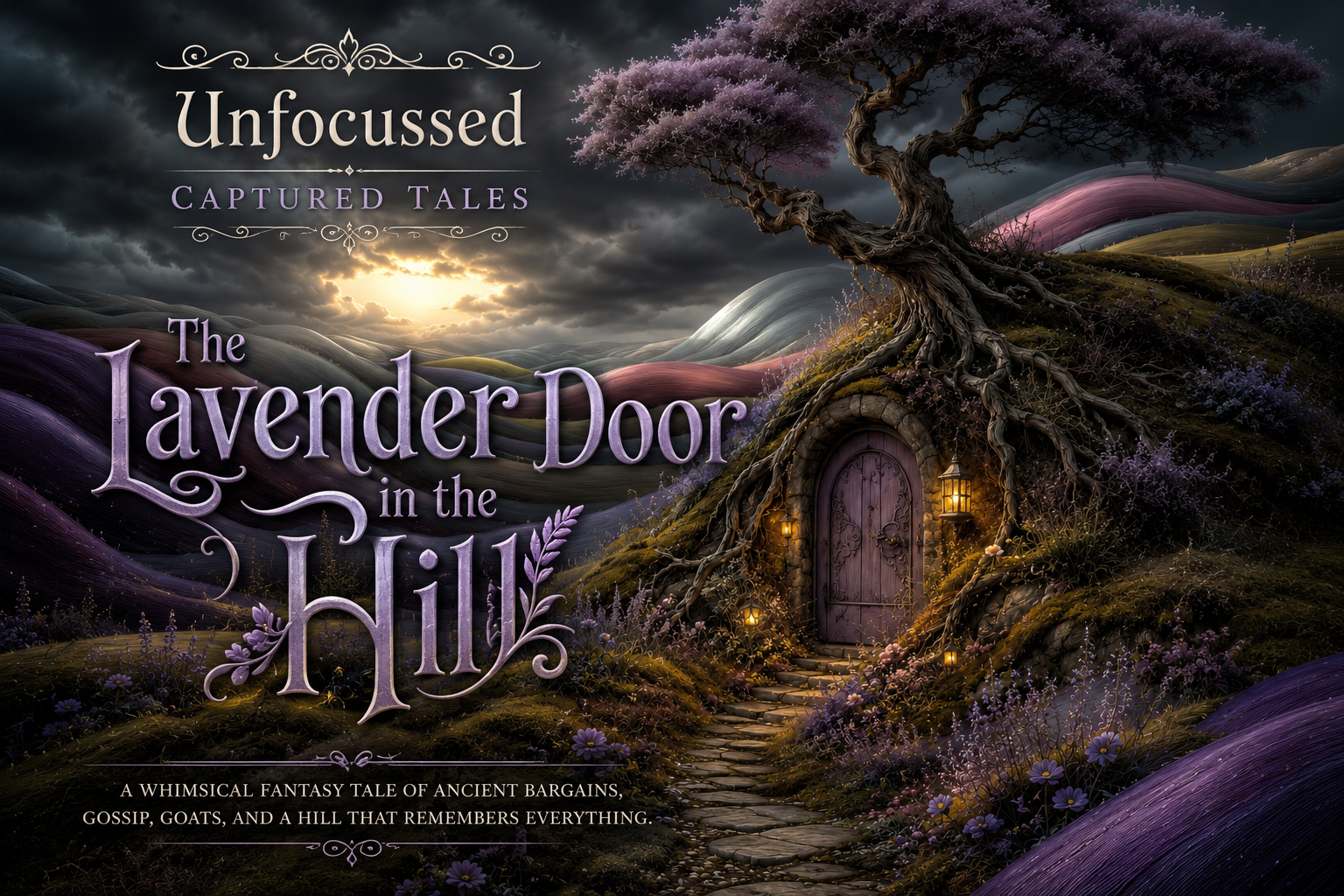
The Hill That Rearranged Itself
The trouble began, as respectable disasters often do, with a goat in the wrong bedroom.
Not a barn. Not a kitchen. Not even a pantry, where goats at least had the decency to be predictable little vandals with horns. No, Clovis the goat had been discovered standing on a lace-covered dressing stool in the private bedchamber of Madame Peony Snipwhistle, chewing through the hem of her best mourning robe while staring at her with the damp, unbothered eyes of a creature who had never once paid rent and never intended to start.
Madame Peony, who was only part fairy but entirely dramatic, had screamed so loudly that three hanging lanterns fainted, four teacups cracked, and the village newspaper printed an emergency edition before breakfast.
GOAT INVADES WIDOW’S CHAMBER: QUESTIONS RAISED, CURTAINS RUINED, declared the headline of The Root & Rumor.
The subheading was worse.
Madame Snipwhistle denies impropriety, but neighbors report “suspicious hoof-patterns” and “an atmosphere of unresolved yearning.”
By midmorning, the whole underground village of Underbloom had gathered in a state of scandalized delight. Not concern. Not fear. Delight. If there was one thing the residents of Underbloom enjoyed more than warm mushroom scones and judging outsiders’ boots, it was a crisis that allowed them to whisper professionally.
And Underbloom was very professional.
The village lay beneath a mossy hillside in the Valley of Ribbonweather, tucked behind a lavender door with iron curls, brass hinges, and an attitude that could sour cream at twenty paces. Above it, a gnarled old tree leaned over the mound like a disapproving grandmother who had seen too much, said too little, and planned to take several secrets to the grave just to be annoying.
The tree’s limbs were twisted and dark, its bark knotted into faces when viewed by lanternlight, and its spring blossoms were the color of bruised lilacs and old gossip. Its roots wrapped the hillside, curled around the stone arch of the lavender door, and plunged deep into the earth where they threaded through ceilings, chimneys, cellars, tea rooms, and occasionally the odd bathtub.
That last detail had caused more than one complaint.
Underbloom’s people were strange even by valley standards. Each resident was part fairy, though none agreed which part, and each was also part gossip columnist, which was far easier to prove. Their ears tended toward elegant points, their eyes shimmered with suspicious knowledge, and their tongues had been weaponized at birth by ancestral magic and poor restraint.
They lived in burrow-homes carved beneath the hillside, connected by winding tunnels lined with lanterns, moss, polished stone, and little framed portraits of ancestors looking disappointed in future generations. Their homes were cozy, fragrant, and excessively opinionated. Doors had moods. Windows remembered conversations. Cupboards refused to open for liars, though they were famously generous to people carrying biscuits.
And lately, the entire village had developed what the mayor called “a mild spatial inconvenience.”
This was a lie.
The hill had started rearranging itself every night.
On Monday, the bakery woke up where the bathhouse used to be, which resulted in twelve villagers arriving for hot rolls and receiving towels instead. On Tuesday, the schoolhouse traded places with the goat shed, which the children considered an improvement and the teacher considered a personal attack. On Wednesday, the widow Madame Peony’s bedroom migrated underneath Clovis’s grazing nook, and Clovis, being the sort of goat who believed destiny was mostly edible, stepped through the misplaced threshold and became famous.
By Thursday, half the village was sleeping in the wrong house, three married couples had accidentally swapped spouses for breakfast, and Old Brindlewick had spent six hours shouting at a wall because his front door now opened into a cupboard.
“It is not a cupboard,” said the cupboard, offended. “It is a transitional pantry.”
“It smells like onions.”
“So do you after supper, and no one calls you furniture.”
The mayor of Underbloom, Mistress Hyacinth Nettlegrin, declared an emergency council beneath the roots of the lavender door. She wore a jacket of plum velvet, a hat shaped like a moral judgment, and spectacles so tiny they could only have been designed by someone with a grudge against noses.
“This,” she announced, tapping the meeting table with a spoon, “has gone too far.”
Around her, the Council of Practical Rumors nodded gravely.
“The goat was too far,” said Mr. Fennelwick, editor-in-chief of The Root & Rumor. “The bathhouse-bakery mix-up was unfortunate, but printable. The goat was indefensible and also excellent for circulation.”
“My robe,” Madame Peony said, one hand pressed to her heart, “will never recover.”
“Your robe,” said someone in the back, “has seen worse.”
Madame Peony gasped, which meant the comment was probably true.
Mistress Nettlegrin raised the spoon again. The room quieted, though not out of respect. Underbloomers loved authority as long as it appeared dramatic and was likely to fail in public.
“The hill is shifting faster each night,” she said. “Our homes are moving. Our gardens are tangling. Our tunnels no longer agree with themselves. Yesterday, I opened my cellar and found the library.”
“That explains the wine stains in the poetry section,” muttered the librarian.
“We cannot solve this from within,” the mayor continued. “The enchantment is too tangled. The maps keep rewriting themselves. The hill recognizes us as part of itself, which means it lies to us with domestic confidence. We need someone outside the hill’s memory. Someone with fresh eyes.”
A grim hush fell over the room.
It lasted nearly four seconds before Mr. Fennelwick whispered, “An outsider.”
The council reacted as if he had said plague rat in a bonnet.
“Absolutely not.”
“Filthy boots.”
“Open-mouthed staring.”
“They ask where the bathroom is before complimenting the architecture.”
“One called my pickled moonberries ‘cute.’ I have not healed.”
Mistress Nettlegrin held up her spoon. “We do not need to like the outsider. We need to use the outsider.”
“Very civic-minded,” said Madame Peony.
“Besides,” the mayor added, glancing toward the lavender door, “the hill has already chosen one.”
That, of course, was how Tamsin Thistlebright came to be standing outside in the storm, staring at a lavender door set into a hill and wondering whether her aunt had finally tried to get her killed for sport.
Tamsin was a cartographer by profession, a troublemaker by reputation, and a woman who had been accused more than once of having “opinions where obedience should be.” She was thirty-two, unmarried by choice, and deeply uninterested in the kind of men who believed a woman holding a map needed rescuing from it.
She wore travel boots, a dark green coat, and a satchel full of charcoal pencils, blank parchment, emergency biscuits, and one extremely rude compass that pointed not north, but toward whatever it considered “most interesting.”
At the moment, the compass needle was spinning in frantic circles.
“Helpful as a drunk moth,” Tamsin muttered.
The Valley of Ribbonweather stretched before her in sweeping bands of color, rolling hills striped in lavender, rose, silver-blue, moss, and gold. They looked less like ordinary hills and more like someone had taken the world’s softest quilt, spilled sunset across it, then abandoned the whole thing beneath a sky planning violence.
Storm clouds churned overhead, thick and dark, their bellies bruised purple and charcoal. Far off, sunlight broke through a ragged wound in the sky, pouring gold over the valley and making the colored hills shine as if they had been brushed, polished, and told to behave for company.
The hills did not behave.
Tamsin had been trying to map them for three days.
On the first day, a hill she marked as west of the stream appeared north of her camp by supper. On the second, the stream itself took offense and curved backward. On the third, her own footprints led to a meadow she had never crossed, where six rabbits were holding what appeared to be a trial over a stolen radish.
One of the rabbits had worn a judge’s wig.
Tamsin had not interfered.
She had learned long ago that when animals formed legal systems, humans were better off pretending not to notice.
Her aunt Juniper, who had commissioned the map, had described the Valley of Ribbonweather as “temperamental but scenic.” This was also a lie. Aunt Juniper lied the way other people breathed: often, confidently, and with just enough charm that you blamed yourself for inhaling.
“Map the valley,” Juniper had said. “Simple work. Fresh air. Good for the nerves.”
Tamsin had assumed the job would be dull.
Now she stood before a lavender door in a hill, beneath a tree that looked like it had survived seven curses, three heartbreaks, and a very disappointing dinner party. Warm golden lanterns glowed on either side of the door. Wildflowers nodded along the stone path. The air smelled of rain, moss, and secrets that had aged badly.
“Well,” Tamsin said aloud, “this is either an invitation or a murder with ambiance.”
The lavender door gave a soft click.
Tamsin narrowed her eyes.
“No.”
The door clicked again, louder.
“Still no.”
A small brass knocker shaped like a curled vine lifted itself and tapped once.
Tamsin took one step back. “I do not appreciate doors that flirt.”
The knocker tapped twice.
Above her, the old tree creaked. Its purple blossoms shivered despite the lack of wind. Somewhere beneath the hill, something bleated with magnificent outrage.
Tamsin looked toward the sound.
“Was that a goat?”
The lavender door swung inward.
Warm light spilled across the path, gilding the stones and catching in the wet moss. Inside, there was no simple room, no cottage, no damp root cellar. Instead, a tunnel curved downward, lined with lanterns and braided roots. The walls shimmered faintly with embedded crystals, and the air carried the smell of baked bread, old paper, lavender smoke, and scandal.
A voice from inside said, “Don’t just stand there posing for the weather. Come in before the sky throws a tantrum.”
Tamsin leaned forward but did not cross the threshold. “Who said that?”
“The door,” said the door.
“Naturally.”
“Don’t use that tone with me. I have kept out kings, thieves, tax collectors, poets, and one extremely persistent man selling ornamental spoons.”
“I’m not a tax collector.”
“You look organized enough to be dangerous.”
“I’m a cartographer.”
The door paused.
Then, in a much too pleased voice, it said, “Oh, lovely. They’re going to eat you alive.”
Before Tamsin could decide whether that was literal, the path behind her shifted.
Not cracked. Not sank. Shifted.
The stone steps rippled like they were made of water. The mossy slope rolled beneath her boots. The colored hills beyond the path seemed to sigh and slide sideways, their stripes stretching, folding, and settling into new positions. A lavender ridge drifted behind a gold one. A blue hill tucked itself beneath a pink curve like a cat stealing blankets. The valley rearranged itself with the casual confidence of a drunk person moving furniture at midnight.
Tamsin stumbled forward.
The doorway caught her.
Not with hands, exactly. With threshold. With intention. With the deeply unpleasant sensation that a piece of architecture had grabbed her by the dignity.
She crossed into the tunnel just as thunder cracked open the sky.
The lavender door slammed shut behind her.
“Rude,” Tamsin snapped.
“Alive,” said the door. “You may thank me later in writing.”
The tunnel brightened. Lanterns flared one by one, revealing carved stairs leading downward. At the bottom stood a crowd of small, sharp-eyed people dressed in velvet, moss, lace, leather, and outfits that suggested they had never met a color they did not plan to weaponize.
They stared at Tamsin.
Tamsin stared back.
A woman in a plum jacket stepped forward. She had silver hair pinned into a crown of curls, pointed ears, tiny spectacles, and the expression of someone who could turn a budget meeting into a public execution.
“Tamsin Thistlebright,” she said. “Cartographer. Thirty-two. Fond of coffee, unwise shortcuts, and men only when they are fictional, dead, or quiet.”
Tamsin blinked.
“That is an invasive amount of accuracy.”
Several villagers made impressed little murmurs and wrote things down.
“I am Mistress Hyacinth Nettlegrin,” the woman continued. “Mayor of Underbloom, Keeper of the Lavender Door, and temporary custodian of a municipal catastrophe.”
“Temporary?” asked Tamsin.
“We are optimistic liars.”
“I noticed.”
Mistress Nettlegrin’s mouth twitched. “Good. A spine. We were worried the hill would send us another poet.”
“What happened to the last poet?”
A man in a moss-green waistcoat raised a hand. “He rhymed desire with fire three times in one stanza. We released him into the upper meadows for the benefit of predators.”
“Symbolically,” the mayor added.
“Mostly,” the man said.
Tamsin slowly lowered her satchel from her shoulder. “I would like to leave.”
“Everyone says that before refreshments.”
A tiny woman with enormous violet eyes appeared at Tamsin’s elbow and offered a tray of mushroom scones.
“Eat,” the woman said. “You look like someone who argues on an empty stomach.”
“I do not accept baked goods from people who know too much about me.”
The tiny woman sniffed. “Then you will starve here.”
“Noted.”
Mistress Nettlegrin gestured, and the crowd parted. Beyond them, Underbloom opened beneath the hill in a series of glowing chambers and winding streets. Tamsin had expected, at most, a few cramped burrows. Instead, she found a hidden village carved through the earth like a secret jewel box.
Lanterns hung from roots and beams. Windows glowed amber from rounded stone homes tucked into the walls. Bridges arched over underground streams. Moss carpeted the edges of cobbled lanes. Tiny chimneys breathed lavender smoke into ventilation shafts that disappeared upward through the hill. Here and there, tree roots twisted through ceilings and curled around balconies like old fingers holding the village together by force of habit.
Every doorway had a different color. Every door seemed to be listening.
And every person in Underbloom was staring at Tamsin with the ravenous curiosity of villagers who had not received fresh outsider material in far too long.
“Is she tall, or am I irritated?” whispered someone.
“Both,” whispered another.
“Her boots are muddy.”
“A cartographer with muddy boots. Groundbreaking.”
“Do you think she’s had a tragic romance?”
“With that jawline? At least two.”
Tamsin turned toward them. “My tragic romances are private.”
A dozen pencils scratched at once.
“Do not encourage them,” Mistress Nettlegrin said. “They consider boundaries a form of seasoning.”
“I gathered.”
The mayor led her through the village, walking briskly down a lane called Thimblewick Row, then turning onto Lantern Nook, then stopping abruptly when Lantern Nook curved into what appeared to be a chicken coop.
Mistress Nettlegrin stared at it.
The chicken coop stared back, insofar as chicken coops could stare. Inside, three hens sat atop a velvet chaise, looking offended and wealthy.
“That,” said the mayor, “was the apothecary yesterday.”
Tamsin took out her notebook.
“The village moves?”
“The hill moves the village,” said Mistress Nettlegrin. “Or the village moves inside the hill. Or the hill dreams wrong and we suffer the decorating consequences. We are still assigning blame.”
“And you want me to map it?”
“We want you to understand it.”
“Those are different prices.”
The mayor looked at her properly then, and for the first time, Tamsin saw something beneath the sharpness. Fatigue. Fear. Not panic, exactly, but the strain of someone holding together a place that had begun quietly unmaking itself.
“Name your price,” Mistress Nettlegrin said.
Tamsin should have said no. Any sensible woman would have said no, demanded directions out, and marched back into the storm before someone turned her into a decorative cautionary tale.
But Tamsin had never been accused of being sensible by anyone who knew her twice.
She looked down the glowing lane, at the homes tucked into the earth, the lanterns trembling beneath old roots, the villagers pretending not to watch while openly taking notes. She looked at the chicken coop where an apothecary should be. She looked at the ceiling, where the tree roots twisted through stone like veins.
Then she heard the goat again.
This time, the bleat came from somewhere below and to the left. It was followed by a man shouting, “Clovis, get out of the confessional!”
Tamsin closed her notebook.
“My price,” she said, “is answers, meals, dry lodging, and nobody reading my diary.”
The crowd groaned.
“Fine,” said Mistress Nettlegrin. “Your diary will remain untouched.”
“And unquoted.”
A longer groan.
Mr. Fennelwick appeared from behind a lamppost, holding a pencil. “Can we paraphrase?”
“No.”
“Anonymous sources?”
“No.”
“Allegorical goat-based satire?”
Tamsin stared at him.
He lowered his pencil. “We’ll revisit.”
Mistress Nettlegrin clapped her hands once. “Excellent. We have secured the outsider.”
“You have hired the outsider,” Tamsin corrected.
“A charming distinction.”
“A legal one.”
“We keep lawyers in the old mushroom cellar. Don’t make us fetch one.”
Tamsin decided, not for the first time in her life, that survival sometimes required letting a mayor have the last word while privately planning to become a problem.
They resumed walking, though the village did not make it easy. Three streets later, a stairwell rotated away from them with a squeak of stone. A row of windows slid six feet to the left. A blue door sneezed and became yellow. Somewhere overhead, furniture scraped across an unseen floor.
“Does this happen constantly?” Tamsin asked.
“Only when the hill feels restless.”
“And when does the hill feel restless?”
Mistress Nettlegrin looked at her.
“Lately?”
A crash echoed through the chamber.
A woman shrieked, “My husband is in the jam pantry again!”
Another voice answered, “Not alone, he isn’t!”
The entire village inhaled as one.
Mr. Fennelwick vanished so quickly Tamsin felt the breeze.
Mistress Nettlegrin pinched the bridge of her nose. “We are going to need a second emergency edition.”
Tamsin almost smiled.
Almost.
Then the floor shifted beneath her.
It was subtle at first: a low hum under the cobbles, a vibration like the hill had begun purring in its sleep. The lantern flames stretched tall and thin. The roots overhead tightened. Doors along the lane clicked open, then shut, then open again.
The villagers stopped whispering.
Even The Root & Rumor men stopped writing.
Mistress Nettlegrin went pale.
“It’s early,” she said.
“What is?” Tamsin asked.
The ground lurched.
The lane split down the center, not breaking but peeling apart like two pages of a book. Houses slid along tracks that had not existed a moment before. A bridge rose upward, carrying three startled children and one smug cat toward the ceiling. Lantern Nook detached from the chicken coop and drifted away, while a bakery rotated into view with a tray of buns still steaming in the window.
Around them, Underbloom rearranged itself in broad, impossible silence.
Not chaos.
Worse.
Purpose.
Tamsin grabbed a lamppost as Thimblewick Row tipped beneath her feet. The lamppost grabbed back with a vine-like curl around her wrist, which was both helpful and presumptuous.
“Don’t get familiar,” she snapped.
The lamppost flickered indignantly.
Mistress Nettlegrin shouted orders, but the village swallowed them. Doorways slid past. Windows blinked. A tunnel mouth opened where a wall had been, revealing darkness thick with the smell of rain and old earth.
From deep inside that darkness came the sound of something enormous breathing.
The villagers froze.
Tamsin felt the hair rise along the back of her neck.
The old tree above them groaned. Its roots flexed through the ceiling, pushing into the chamber, twisting and curling as if searching for something. Purple blossoms fell from cracks in the stone, drifting down like bruised snow.
Then the lavender door, far above and behind them, slammed once.
The sound thundered through the village.
Once.
Twice.
Three times.
Every lantern went blue.
Mistress Nettlegrin whispered, “Oh, that miserable old hill.”
Tamsin turned to her. “What does three mean?”
The mayor did not answer.
Instead, the tunnel of darkness yawned wider, and out of it trotted Clovis the goat.
He wore a lace collar, a jam pot stuck on one horn, and an expression of complete spiritual fulfillment.
Behind him, slowly emerging from the dark, was Madame Peony’s bedroom.
The whole bedroom.
Bed, wardrobe, vanity, rug, curtains, scandalous chaise, and all.
Madame Peony stood in the doorway wearing a dressing gown, one slipper, and the brittle dignity of a woman whose secrets had just become mobile architecture.
“Do not,” she said to the assembled village, “write this down.”
Fifty pencils immediately began writing.
Tamsin stared at the room. Then at the tunnel. Then at the map in her hand, whose ink had begun to move by itself, forming new lines across the parchment.
Not random lines.
A pattern.
The village was not merely shifting. It was being sorted.
Homes, streets, stairways, rooms, and tunnels were sliding toward the center of the hill, slowly spiraling inward beneath the roots of the old tree. Every rearrangement had been messy on the surface, ridiculous in detail, and humiliating in execution, but beneath it all was a direction.
The hill was gathering Underbloom.
“Mayor,” Tamsin said quietly.
Mistress Nettlegrin looked at the moving ink.
Her face changed.
For one naked moment, all the sass and spectacle drained away, leaving only dread.
“That center chamber was sealed generations ago,” she said.
“Why?”
The mayor looked toward the old roots overhead.
“Because that is where the first villagers buried the thing they stole from the hill.”
The map darkened in Tamsin’s hand.
A single lavender line drew itself from the door above, down through the village, and into the sealed center.
Then, beneath it, words appeared in ink that was not hers.
Bring the outsider.
Tamsin looked at Mistress Nettlegrin.
“You said the hill chose me.”
The mayor swallowed.
“Yes.”
“You left out the part where the hill apparently wants me delivered like a suspicious parcel.”
“I was working up to it.”
“Were you?”
“With elegance.”
A deep rumble rolled beneath Underbloom.
The lane ahead shifted open, forming a path of stone, roots, and lavender light leading downward into the heart of the hill.
Clovis the goat trotted onto it first, because apparently terror meant nothing when one had already eaten half a widow’s robe and survived.
Tamsin watched him go.
Then she looked at the villagers of Underbloom: part fairy, part gossip columnist, all of them frightened now, though most were trying to look fashionably offended instead. She looked at the moving village, at the trembling lanterns, at the tree roots tightening like knuckles above their heads.
Finally, she looked down at her rude compass.
The needle had stopped spinning.
It pointed straight into the heart of the hill.
“Of course,” Tamsin muttered. “The most interesting thing is also the worst idea.”
The lavender door echoed faintly from above, as if laughing.
Tamsin tucked the compass into her pocket, tightened her grip on the map, and stepped onto the glowing path.
Behind her, Mr. Fennelwick whispered, “Headline suggestion: Outsider Enters Forbidden Chamber, Displays Questionable Judgment and Excellent Posture.”
“Print that,” Tamsin said without turning, “and I’ll feed your pencil to the goat.”
Clovis bleated approvingly.
And beneath the lavender door in the hill, the village of Underbloom began sliding toward a secret it had spent generations pretending was none of its business.
The Lease Beneath the Roots
The glowing path into the heart of the hill did not descend so much as reconsider gravity.
One moment, Tamsin Thistlebright was walking down a respectable slope of stone and moss. The next, the path curled sideways beneath her boots, looped around a root as thick as a cottage beam, and continued downward at an angle that suggested the hill had once heard of architecture but considered it a coward’s hobby.
Clovis the goat trotted ahead with fearless idiocy, the jam pot still stuck on one horn and Madame Peony’s lace collar fluttering around his neck like a trophy from a deeply inappropriate evening.
Behind Tamsin came Mistress Hyacinth Nettlegrin, Mayor of Underbloom, who held her spine so straight it seemed personally offended by fear. Mr. Fennelwick followed close behind, pencil ready, eyes shining with the sort of professional hunger that made Tamsin want to push him into a decorative fern. Madame Peony came next in her dressing gown and one slipper, her chin lifted high enough to qualify as weather. The librarian, Miss Brackenmire, had joined them without invitation and carried a lantern, three emergency books, and the smug conviction that no crisis counted as official until someone had cross-referenced it.
“I would like it noted,” Madame Peony said, stepping carefully over a root, “that I am not dressed for forbidden chambers.”
“Nobody is,” Tamsin said.
Madame Peony gave her a withering look. “Some people are closer than others.”
Mr. Fennelwick scribbled something.
“If that sentence appears in print,” Madame Peony said, “I will remove your thumbs and donate them to literacy.”
He stopped scribbling.
“This village has a disturbing relationship with journalism,” Tamsin muttered.
“We consider it public service,” said Miss Brackenmire.
“You consider other people’s humiliation a renewable resource.”
“Also that.”
The path narrowed. Roots braided around the walls, some old and dark as iron, others pale and fresh, pulsing faintly with lavender light. The air grew warmer, damper, and stranger. It smelled of storm rain, old paper, crushed herbs, and something sweet beneath it all, like honey left too long in a locked room.
Above them, Underbloom continued to shift.
They heard it through the earth: the scrape of moving stone, the clatter of furniture, the muffled shouting of villagers discovering that their kitchens had become stairwells, confessionals, cupboards, or in one unfortunate case, a private dining room occupied by people who had not been invited but had apparently found the pudding.
“This is accelerating,” said Mistress Nettlegrin.
“No,” said Tamsin, glancing down at her map.
The mayor looked at her. “No?”
“It is not accelerating. It is tightening.”
On the parchment, the ink continued moving by itself. Streets and rooms slid into spiral lines, circling toward a blank space at the map’s center. The village was not collapsing randomly. It was being gathered with terrible patience, each house nudged, turned, and pulled closer to the sealed chamber beneath the tree.
“The hill is sorting you,” Tamsin said.
Miss Brackenmire adjusted her spectacles. “Sorting us into what?”
“That depends.”
“On?”
“Whether the hill likes you.”
Everyone went quiet.
Clovis bleated.
“The goat is doomed, then,” Madame Peony said.
Clovis stopped, turned his head, and stared at her with the profound moral emptiness of livestock.
“Do not look at me like that,” she snapped. “You know what you did to my robe.”
The path twisted again, and a door appeared where no door had been.
It was small, round, and painted a faded green. A brass plaque read:
Speak One Truth Or Go Back And Continue Being Useless.
Tamsin stared at it. “Charming.”
Mistress Nettlegrin exhaled slowly. “The old root gates.”
“You knew about this?”
“In the abstract.”
“I am beginning to hate your abstracts.”
The green door cleared its throat.
It did not have a throat, but it cleared one anyway with great ceremony.
“One truth each,” it said, in a voice like bark rubbed with velvet. “Private enough to matter. Public enough to sting.”
Mr. Fennelwick perked up so violently his hat nearly fell off.
“Don’t you dare look excited,” Tamsin said.
“This is not excitement,” he said. “This is civic readiness.”
The door creaked. “Truths. Now.”
Mistress Nettlegrin stepped forward first. “I knew the old century clause might be due.”
The group went still.
Even Clovis stopped chewing the edge of a root.
Tamsin turned. “The what?”
The mayor’s face hardened in the lantern glow. “There are records. Fragments. Warnings. Nothing complete. I thought we had more time.”
“That,” said Tamsin, “is what every fool says right before a building catches fire.”
“The hill is not on fire.”
Somewhere above them, something exploded with a sound suspiciously like a jam pantry losing an argument.
“The hill is fire-adjacent,” Tamsin said.
The green door hummed. One iron curl on its frame unwound and opened like a latch.
“Accepted,” it said.
Madame Peony pressed a hand to her chest. “I refuse to participate in ritualized emotional exposure while underdressed.”
The door remained closed.
“Fine,” she snapped. “Clovis did not wander into my room entirely by accident.”
Everyone looked at her.
Madame Peony’s cheeks flushed a furious pink.
“He has been coming by my window for months because I feed him saltberry jam. There. Are you satisfied? I am a widow, not a corpse. A creature with warm eyes and no opinions about my housekeeping wandered past, and I indulged him.”
Clovis bleated softly.
Mr. Fennelwick’s pencil trembled with the force of restraint.
“Do not,” Madame Peony whispered.
“I said nothing.”
“Your eyebrows are writing.”
The green door opened another inch.
Miss Brackenmire lifted her lantern. “I once deliberately misfiled a romantic letter in Historical Drainage because the recipient was an ass and the sender could do better.”
“Brackenmire,” Mistress Nettlegrin said.
“What? He used the word moist eight times.”
“Accepted,” said the door.
Mr. Fennelwick sighed. “I have never fact-checked the horoscopes.”
Everyone stared at him in horror.
“Never?” said Miss Brackenmire.
“They are written by a moth.”
Madame Peony looked faint. “I made investment decisions based on those.”
“You invested in a goose saddle company because the stars told you to embrace risky seating,” said Mistress Nettlegrin. “That is on you.”
The door opened wider.
Finally, it turned its attention to Tamsin.
“Outsider,” it said. “Your truth.”
Tamsin folded her arms. “I do not owe a door my interior life.”
The door replied, “Then remain exterior.”
The path behind them shifted with a low grinding sound. Stone steps peeled away, leaving only darkness and roots. Going back was no longer an option, or at least not one available to people fond of having bones in the expected arrangement.
Tamsin looked at the door. Then at the others. Then down at the rude compass in her pocket, which had begun to vibrate like it was enjoying itself.
“I took this job,” she said, “because my aunt sent me a letter, and I was too proud to admit I missed her.”
The door waited.
Tamsin’s jaw tightened.
“And because I thought mapping something no one understood would make me feel less lost in my own life.”
The air softened.
The green door opened.
No one spoke for a moment.
Then Mr. Fennelwick whispered, “That is quite good.”
Tamsin pointed at him. “Pencil. Goat.”
He hid the pencil.
Beyond the door, the path changed.
The tunnel widened into a chamber of roots and stone, and the walls were alive with pictures. Not paintings exactly. Memories. They moved under the bark in slow amber light, scenes grown into the wood itself.
At first, Tamsin saw storm.
A valley under black clouds. Colored hills lashed by rain. Tiny figures stumbling through mud with bundles on their backs and children in their arms. They were smaller than ordinary humans, bright-eyed and sharp-eared, their clothes torn, their faces hollow with exhaustion.
“The first Underbloomers,” Miss Brackenmire whispered.
The memory shifted.
The refugees huddled beneath the very tree that now stood over the lavender door. Back then, it was slimmer, younger, its branches lower and full of pale blossoms. The hill beneath it seemed to glow from within, warm and golden in the storm.
A doorway opened in the earth.
Not lavender then. Bare root. Raw stone. A mouth of shelter.
The hill had let them in.
Tamsin felt the chamber around her breathe.
Not metaphorically.
The walls inhaled.
Madame Peony clutched her dressing gown shut. “I dislike sentimental architecture.”
The memory moved on.
The first villagers carved rooms beneath the hill. They planted gardens in hollows of earth, hung lanterns from roots, built bridges over underground streams. The hill bent around them, making space, shaping itself into warmth. It shifted gently at first, moving rooms with the seasons, opening new passages when children were born, sealing old ones when grief needed quiet.
“It was alive,” Tamsin said.
Mistress Nettlegrin said nothing.
The next memory darkened.
Generations passed. The villagers grew comfortable. Comfort became expectation. Expectation became ownership. They marked doors. Claimed rooms. Fenced gardens. Argued over tunnels. Complained when the hill moved a nursery closer to sunlight or a kitchen nearer to water because the hill had the audacity to understand need better than property lines.
Then came the binding.
A circle of elders stood beneath the tree, holding a key of lavender light. They hammered iron into the stone arch. They painted the raw root door purple. They carved rules into a root as thick as a spine. The hill shuddered, and the tree bent low as if in pain.
One elder stepped forward with a compass in her hand.
Tamsin stopped breathing.
The woman in the memory had Tamsin’s cheekbones. Tamsin’s stubborn mouth. Tamsin’s exact expression when watching people make stupid decisions with confidence.
“Who is that?” she asked.
Miss Brackenmire’s lantern dimmed. “The witness.”
“Name.”
The librarian hesitated.
Tamsin turned slowly. “Name.”
“Elowen Thistlebright.”
The rude compass in Tamsin’s pocket gave one sharp click.
The memory paused on Elowen’s face.
Tamsin reached into her pocket and pulled the compass free. Its brass casing warmed in her palm. For the first time since she had inherited it, the needle did not spin, wobble, or point toward taverns, trouble, attractive disasters, or suspiciously interesting side roads.
It pointed straight at the memory of Elowen Thistlebright.
“My aunt knew,” Tamsin said.
No one answered quickly enough.
Tamsin laughed once, without humor. “That meddling, over-perfumed, tea-hoarding menace sent me here on purpose.”
Mistress Nettlegrin had the decency to look uncomfortable. “Juniper Thistlebright corresponded with our archives.”
“Of course she did.”
“She believed you had inherited the witness compass.”
“She gave it to me after telling me it belonged to a pirate nun.”
Miss Brackenmire blinked. “A what?”
“A pirate nun. Sister Black Agnes of the Unholy Coast. I was twelve. It seemed plausible.”
“No, it didn’t,” said Madame Peony.
“I was twelve and bored.”
The memory began moving again.
Elowen Thistlebright stood before the binding elders, arguing. Tamsin could not hear the words, but she knew the shape of them. No. Wrong. Dangerous. You cannot turn a living hill into a locked cupboard and call it gratitude.
The elders did it anyway.
They made the lavender door.
They wrote a lease.
They promised that every hundred years, an outsider from the witness line would return, read the hill’s true map, open the village to change, and renew the bargain. In exchange, the hill would continue sheltering Underbloom, but not as a prison. As a home.
The final image showed Elowen leaving through the lavender door, furious and alone, while behind her the elders sealed the center chamber beneath the roots.
The memory faded.
For a long moment, only the distant shifting of Underbloom filled the chamber.
Tamsin turned to the mayor. “You people had a living hill, signed a lease with it, broke the lease, hid the paperwork, ignored the renewal, and then acted shocked when the property developed opinions.”
Mistress Nettlegrin’s mouth tightened. “That is a vulgar summary.”
“It is also accurate.”
“Mostly.”
“Oh, good. Mostly illegal nonsense. Much better.”
Mr. Fennelwick raised one finger. “Technically, the village was founded before our current municipal legality framework.”
“Technically,” Tamsin said, “you are one sentence away from being indexed under goat digestion.”
He lowered the finger.
Madame Peony stared at the fading roots. “We were taught the hill was dangerous if left unfixed.”
“The hill was alive,” Tamsin said. “Alive things move.”
Miss Brackenmire nodded slowly. “Our oldest household manuals mention Wandering Days. Rooms changing by invitation. Kitchens visiting lonely elders. Nurseries drifting toward laughter. I thought they were metaphors.”
“Underbloom does not have that kind of imagination,” said Mistress Nettlegrin.
“Rude,” said the librarian.
“Correct,” said the mayor.
The path ahead opened with a sigh.
Beyond it waited a corridor lined with doors.
Not village doors. Memory doors.
Each one was different: blue, gold, crimson, moss green, black as wet bark, white as mushroom flesh. As they passed, the doors opened one by one, revealing rooms from Underbloom’s history. A nursery full of sleeping babies while roots rocked the cradles. A kitchen where three old women kneaded bread and cursed each other affectionately. A parlor where two men danced in secret, laughing so hard they nearly knocked over a lamp. A mourning room where the walls grew soft moss to muffle grief. A workshop where a girl with burned hands learned to make lanterns brighter than fear.
Tamsin slowed.
The hill had not merely housed Underbloom.
It had known them.
Known where to hold them close. Known where to give them space. Known which doors needed to stay shut for a season and which windows needed sunlight before the people inside remembered they were not dead.
And in return, they had locked it into stillness because moving houses were inconvenient to furniture arrangements and family pride.
“That,” Tamsin said, “is spectacularly ungrateful.”
“We do excel spectacularly,” said Madame Peony, though her voice had softened.
The final door at the end of the corridor was lavender.
Not painted wood like the entrance above. This door was made of root, stone, and woven light. Iron bands crossed it in curling patterns. At its center was a round hollow where a key should have gone.
Above the frame, old letters had been carved deep:
The First Foundation. The Hill’s Hearth. Let No One Enter Who Fears Rearrangement.
“That rules out everyone in government,” Tamsin said.
Mistress Nettlegrin gave her a look. “I am standing right here.”
“Yes.”
“Insult noted.”
“Good. I was worried it might wander off.”
Miss Brackenmire moved closer to the door and examined the hollow. “The Hearth Key is missing.”
“What is the Hearth Key?” Tamsin asked.
Everyone looked at Madame Peony.
Madame Peony looked offended before she looked guilty, which told Tamsin plenty.
“Why,” Tamsin said, “is everyone looking at the widow in the dressing gown?”
“Because,” said Mistress Nettlegrin carefully, “the last Hearth Keeper was Madame Peony’s late husband.”
Madame Peony sniffed. “Bramble never told me everything.”
“Apparently he told you enough.”
“He told me he had municipal responsibilities. I assumed that meant stealing office supplies and lying to committees like everyone else.”
Miss Brackenmire pointed at the hollow. “The Hearth Key was a small vessel. Brass, usually. Shaped like a cup or pot. It held the seal to the chamber.”
Very slowly, everyone turned toward Clovis.
Clovis stood beside the lavender door, chewing a curtain tassel he had obtained from absolutely nowhere.
On his horn, the jam pot gleamed.
It was not, Tamsin realized, a jam pot.
It was brass beneath the saltberry smear, engraved with root patterns and tiny lavender symbols. A sacred key, disguised by neglect, domestic clutter, and goat-related disrespect.
Madame Peony covered her mouth.
“Oh,” she said faintly. “That was in Bramble’s wardrobe.”
Tamsin stared at her. “You kept the key to the forbidden center of a living hill in a wardrobe?”
“It was a very good wardrobe.”
“And then you let a goat near it?”
“I did not let him. He is emotionally persistent.”
Clovis shook his head. The brass vessel clanked against his horn but did not come loose.
“Clovis,” Madame Peony said in the voice of a woman negotiating with both livestock and destiny, “come here, darling.”
The goat narrowed his eyes.
“I have jam.”
Clovis took one suspicious step forward.
Then the lavender door rumbled.
The hollow at its center flashed with light.
The brass key on Clovis’s horn answered.
So did the hill.
A tremor shot through the corridor. The doors behind them slammed shut in rapid sequence. Roots burst from the walls, not violently but urgently, reaching toward Clovis like hands. He let out a bleat of pure theatrical betrayal and bolted.
“Catch him!” Mistress Nettlegrin shouted.
“He is a goat!” Tamsin snapped. “That is less a plan and more a category!”
They ran.
Clovis charged down the memory corridor, lace collar flapping, sacred key clanging, hooves skidding over polished stone. Tamsin sprinted after him, map in one hand, compass in the other, while behind her came the mayor, the librarian, the editor, and Madame Peony, who ran with surprising speed for a woman wearing one slipper and a lifetime of secrets.
The corridor refused to remain a corridor.
It opened into a bathhouse full of steam.
Clovis vanished through the vapor.
Madame Peony shrieked, “Do not let him into the soaking pools! He gets sentimental around bubbles!”
Tamsin skidded across damp tile, nearly collided with a statue of a modesty nymph who had clearly given up centuries ago, and caught sight of the goat leaping through a pink door.
The pink door led into the bakery.
Or what had once been the bakery.
Now it was upside down.
Loaves hung from ceiling racks. Flour drifted like snow. A baker clung to a counter, shouting, “No refunds during geological events!”
Clovis bounced off an inverted bread table and shot through another opening.
Tamsin followed, because her life had apparently become a series of poor decisions narrated by livestock.
They passed through a schoolroom, where children cheered.
They crossed a parlor, where two elderly women paused mid-card game to shout conflicting advice.
They burst through a narrow pantry where a man and a woman stood much too close together beside several jars of plum preserve.
“We are reorganizing inventory,” the man said immediately.
“Nobody asked,” Tamsin said, and kept running.
Mr. Fennelwick tried to slow down.
Mistress Nettlegrin seized his collar and dragged him onward. “Not now.”
“But the public interest—”
“Move.”
At last, Clovis darted into a round chamber where dozens of tunnels met.
The village crossroads.
But the crossroads had changed. Every tunnel mouth glowed lavender. Every street in Underbloom seemed to have folded into this one place, spiraling inward. Villagers crowded the openings, frightened, whispering, clutching teapots, babies, ledgers, framed portraits, and in one case, an entire smoked ham.
Clovis stopped in the center.
For once, even he seemed to understand that matters had become serious.
The brass key on his horn shone brighter and brighter.
Roots crept across the floor, forming a circle around him.
The old tree’s voice filled the chamber.
It was not loud. It did not need to be.
It came through every beam, every root, every stone. It was ancient, weary, and deeply unimpressed.
“Enough.”
Every villager fell silent.
Tamsin felt the word move through her bones.
The lavender light rose higher.
The roots tightened around Clovis, not touching him yet, but hemming him in.
Madame Peony stepped forward. “Do not hurt him.”
Tamsin looked at her in surprise.
Madame Peony’s face trembled. “He is a menace. He ruined my robe. He has no boundaries and the manners of a damp shoe. But he is not yours to crush because my husband hid something badly.”
Clovis bleated, softer this time.
The tree’s voice answered, “The key must return.”
“We are trying,” Tamsin said.
“You are chasing.”
“With respect, he has hooves.”
A pause.
Somewhere in that pause, Tamsin suspected the tree was deciding whether humor improved or worsened the species.
The roots shifted. The brass vessel slid loose from Clovis’s horn and fell to the floor with a ringing note.
Everyone exhaled.
The vessel rolled once, twice, then stopped at Tamsin’s feet.
She crouched and picked it up.
It was heavier than it looked. Not with metal. With attention.
Inside the little brass cup, beneath a smear of saltberry jam and goat spit, something glowed.
A coil of lavender light. Small. Pulsing. Alive.
Miss Brackenmire whispered, “The hill’s name.”
The chamber reacted.
Doors flew open. Lanterns flared blue. Several villagers began crying without understanding why. Even Mr. Fennelwick lowered his pencil.
Tamsin stared into the brass cup.
The glow did not form a word she could speak. It formed a feeling: shelter during storm, soil under bare feet, rooms that moved toward grief, roots remembering every sleeping child, a door opening because someone needed it.
The villagers had stolen not a possession but a self.
They had taken the hill’s name, locked it into a key, and used it to force the hill into stillness.
“That,” Tamsin said quietly, “is worse than bad real estate.”
Mistress Nettlegrin lowered her eyes.
The tree spoke again. “Return it.”
The lavender door appeared at the far end of the crossroads.
Not the chamber door. The entrance door from above. The same arched lavender door set in stone, with iron curls and lantern light, now standing alone at the heart of Underbloom as if it had walked there, which Tamsin suspected it absolutely had.
Its brass knocker lifted.
Tap.
Tap.
Tap.
Three knocks.
Every villager took a step back.
The mayor whispered, “Judgment.”
Tamsin turned to her. “What does that mean?”
Miss Brackenmire answered instead. “Shelter is one knock. Wisdom is two. Three is judgment.”
“And four?”
Madame Peony said, “Four is claiming.”
The lavender door swung open.
Behind it was not the upper path, not the stormy sky, not the twisted tree and wildflowers.
Behind it was the First Foundation: the sealed chamber beneath the roots, the place the path had been trying to take them all along.
It was vast, round, and golden with old earthlight. Roots formed the ceiling in a tangled dome. At the center stood a stone hearth with no fire, only ash. Around it, carved into the floor, was the First Lease.
Tamsin could read it now.
Not all of it. Some lines were old beyond language. But the compass in her hand warmed, and the words arranged themselves for her eyes.
A home is not owned by those who hide inside it.
A shelter is not a servant.
A living hill shall not be nailed into stillness without consent freely renewed.
Every hundred years, let the witness return.
Let the village remember movement.
Let the hill remember mercy.
Let the door decide whether it opens.
The final line glowed brighter than the rest.
If the bargain is broken, the hill may gather every room, reclaim every root, and choose again.
The brass cup shook in Tamsin’s hand.
The hill’s name pulsed brighter.
The villagers watched her with wide eyes.
Tamsin suddenly understood why the hill had called an outsider.
Not to fix the village.
To witness the choice.
The lavender door waited.
The tree waited.
The hill waited.
Underbloom, for perhaps the first time in generations, had the good sense to shut up.
Tamsin stepped through the doorway into the First Foundation.
The brass cup trembled so hard lavender light spilled over her fingers.
Mistress Nettlegrin followed her to the threshold but did not cross. “Only the witness can enter before judgment.”
“Convenient rule to mention now.”
“I thought it might sound discouraging earlier.”
“You are exhausting.”
“I am aware.”
Tamsin looked back at the village: the mayor pale but upright, Madame Peony holding Clovis by the collar as though he were both beloved and actionable, Miss Brackenmire clutching her books, Mr. Fennelwick finally speechless, and beyond them all the people of Underbloom, pressed into their doorways with their homes shifting around them.
They were ridiculous.
Intrusive. Snobbish. Nosy beyond medical explanation.
But they were also frightened.
And this place, for all its scandals and jam pantry indiscretions, was their home.
Tamsin turned toward the cold hearth.
“All right,” she said to the hill. “Let’s discuss terms.”
The hearth ignited.
Not with flame.
With lavender light so bright it swallowed the chamber.
In that light, a shape rose from the ash. Not a person. Not a creature. A presence made of roots, storm, moss, lantern glow, and every room that had ever held someone through the night.
The hill spoke directly into Tamsin’s chest.
“They made me a house and forgot I was a home.”
Tamsin swallowed.
“Yes.”
“They locked my name.”
“Yes.”
“They feared my movement.”
“They fear almost everything that might inconvenience their furniture.”
The hill was silent.
Then, somewhere in the roots, there was a sound almost like a laugh.
“Witness,” the hill said, “return my name, and I will choose.”
Tamsin looked at the glowing cup.
“Choose what?”
The lavender door creaked behind her.
The hill answered.
“Whether Underbloom remains beneath my roots, or whether I rise and leave them to the weather.”
Outside the chamber, the villagers gasped.
The colored hills above rumbled.
Far overhead, beyond earth and root and stone, thunder rolled across the Valley of Ribbonweather.
Tamsin held the hill’s stolen name in both hands.
For once in her life, she had no clever answer ready.
The Terms of Staying
For once in her life, Tamsin Thistlebright had no clever answer ready.
This annoyed her almost as much as the impending judgment.
She stood in the First Foundation with the hill’s stolen name trembling in her hands, lavender light spilling between her fingers and painting her palms with the ache of old shelter. Around her, roots formed a vast dome above the cold stone hearth. The floor beneath her boots was carved with the First Lease, its ancient lines glowing and dimming like a heart deciding whether it had enough mercy left to keep beating for people who had betrayed it.
Behind her, the lavender door stood open to the gathered village of Underbloom.
No one whispered.
That, more than anything, proved the seriousness of the situation.
A village that could gossip through funerals, bake sales, minor hauntings, and one deeply questionable mayoral election had gone silent. Even Mr. Fennelwick held his pencil still against his notebook. Even Madame Peony stopped fussing with her dressing gown. Even Clovis the goat, who had recently worn a sacred key as horn jewelry and dragged half the village through a historical reckoning, stood with his head lowered as though some ancestral goat memory had told him not to be an ass in front of an earth spirit.
The hill’s presence rose from the hearth in a shape that was not a body but felt more real than one. It was moss after rain. It was soil warmed by sleeping roots. It was a door opening during a storm and a room shifting closer to someone crying alone. It was the groan of an old tree, the hush of underground streams, and the aching patience of a home that had been thanked by being chained.
“Return my name,” said the hill, “and I will choose.”
Tamsin stared into the brass cup.
The name inside it was not a word she could speak, not with tongue or ink. It was too wide for language. It was a shape of belonging. A pulse of remembered kindness. A secret root-language that meant: I held you when the storm came.
She looked back toward the villagers.
Mistress Hyacinth Nettlegrin stood at the threshold, jaw tight, spectacles glinting. She looked every inch the mayor still—plum velvet, rigid posture, hat like a tiny bureaucratic execution—but her face had changed. The performance had peeled away. Beneath it was fear, yes, but also shame.
Madame Peony clutched Clovis by the lace collar. The goat leaned against her leg, either comforted or attempting to locate hidden jam. Miss Brackenmire hugged her emergency books to her chest. Mr. Fennelwick’s eyes flicked from the glowing lease to the villagers behind him, and for once he looked less like a man hunting scandal and more like a man realizing he had been printing symptoms while ignoring the disease.
Tamsin turned back to the hill.
“Before I return anything,” she said, “I have questions.”
A collective gasp rose from the threshold.
“She is negotiating with the hill,” someone whispered.
“During judgment.”
“In those boots.”
The lavender door creaked sharply.
Silence returned at once.
The hill’s light bent toward Tamsin. “Ask.”
Tamsin held the brass cup tighter. “If I return your name and you choose to leave, what happens to them?”
The chamber answered with a deep rumble.
At the edge of the open door, several villagers grabbed one another. Somewhere in the crowd, a baby began to cry and was quickly soothed by three anxious grandmothers and a man offering a biscuit he clearly wanted for himself.
“The rooms will unfold,” said the hill. “The doors will open. The people will stand beneath the weather they forgot I kept from their bones.”
“So they survive.”
“Perhaps.”
“That is a decorative way of saying some of them won’t.”
The roots overhead tightened.
“I am not cruel.”
“No,” Tamsin said. “But pain can make cruelty sound like fairness if it speaks slowly enough.”
The threshold went utterly still.
Mistress Nettlegrin closed her eyes as if expecting the hill to smite the outsider into a tasteful stain.
The hill did not smite her.
It listened.
Tamsin had not expected that. People with power rarely listened when challenged. Hills, apparently, had better manners than most kings.
“Witness,” the hill said, “they took my name.”
“They did.”
“They locked my movement.”
“They did.”
“They remembered comfort and forgot gratitude.”
“They did that too.”
Behind her, someone gave a small wounded sniff.
Tamsin did not soften her voice. “But I have walked through your memories. You know them. Not as a council. Not as a line of oath-breakers. You know the children in the cradles. The widows in the moss rooms. The old women cursing each other over bread. The men dancing where no one would shame them. You know every frightened little fool who crawled under your roots and became someone better because you gave them shelter.”
The lavender light flickered.
“Some became worse,” said the hill.
“Yes,” Tamsin said. “That happens when people are allowed to live indoors too long. They start inventing committees.”
A sound moved through the roots.
Not laughter exactly.
But close enough that Mr. Fennelwick’s pencil twitched with instinctive headline lust.
Tamsin continued. “I am not asking you to forgive them because they deserve it. Most people do not deserve forgiveness at the exact moment they need it. That is what makes the whole arrangement so irritating.”
The hill’s presence leaned closer.
“What do you ask, then?”
“A new bargain. Not the old one. The old one was apparently written by frightened elders with control issues and terrible instincts.”
Mistress Nettlegrin murmured from the threshold, “That is historically ungenerous.”
Tamsin looked back at her. “It is historically accurate.”
“Also true,” Miss Brackenmire said softly.
“A new bargain,” Tamsin said again. “One where your name is returned to you and never locked away. One where the village stays only if it agrees to be part of a living hill, not owners of a buried apartment complex with delusions of sovereignty.”
Madame Peony whispered, “Apartment complex?”
“Outsider insult,” Miss Brackenmire whispered back. “Very cutting.”
The hill’s glow pulsed through the hearth. “They fear movement.”
“Then they will learn flexibility.”
Several villagers made noises of distress.
Tamsin raised her voice toward them. “Yes, I know. Terrifying. Your kitchens may wander. Your bedrooms may become emotionally perceptive. Your cupboards may judge your lies. But frankly, your current system produced a goat in a widow’s chamber, a man in a jam pantry with suspicious inventory posture, and an entire newspaper powered by unresolved personal boundaries. You were not exactly thriving under stillness.”
Mr. Fennelwick opened his mouth.
Madame Peony said, “Do not defend the jam pantry.”
He closed it.
The hill spoke again. “A bargain requires more than witness words.”
“I know.”
Tamsin turned fully toward the threshold.
The villagers of Underbloom stared back at her: sharp ears, bright eyes, velvet jackets, aprons, nightcaps, shawls, boots, slippers, one man inexplicably still holding a smoked ham. Their homes had shifted behind them, squeezed into the great crossroads beyond the door, every hallway and stair and crooked little chamber waiting like a held breath.
“You heard it,” Tamsin said. “The hill may leave. Or it may stay. But if it stays, it stays alive. Not nailed down. Not silenced. Not treated like a foundation with no feelings just because you hung enough curtains to feel important.”
An older man near the front frowned. “My curtains are heirlooms.”
“Then they can have adventures.”
“They are lace.”
“Then they can have delicate adventures.”
A ripple of nervous laughter passed through the villagers and died quickly.
Mistress Nettlegrin stepped to the very edge of the threshold. Her face was pale, but her voice carried.
“Underbloom owes the hill an answer.”
“No,” Tamsin said.
The mayor blinked.
“Underbloom owes the hill the truth. Answers are what politicians give when they have already started lying.”
Mistress Nettlegrin inhaled sharply.
Then, to Tamsin’s surprise, she nodded.
“Very well.”
The mayor removed her tiny spectacles. Without them, she looked older and far more tired.
“I knew enough to be afraid,” she said, not to Tamsin but to the hearth. “I did not know everything. That is not an excuse. I found fragments in the sealed municipal archive: the century clause, the witness line, references to the Hearth Key. I told myself uncertainty justified waiting. But the truth is uglier. I was afraid that if the village learned its comfort depended on a wrong we had inherited, they would panic, blame one another, blame me, blame the hill, blame anyone but themselves. So I delayed. I organized. I formed a subcommittee. I made caution look like leadership.”
The hill’s light washed over her.
Mistress Nettlegrin swallowed.
“I am sorry.”
The words were small.
Because real apologies often are.
They do not arrive wearing velvet and blowing trumpets. They arrive stripped down, embarrassed, and late.
The First Lease glowed brighter beneath Tamsin’s boots.
Miss Brackenmire stepped forward next, clutching her books.
“I kept records,” she said. “I kept every scrap, every rumor, every household manual, every mention of Wandering Days. But I filed them as folklore because that was easier than believing the shelves were full of warnings. I protected knowledge so well that no one could use it. That is not librarianship. That is hoarding with better handwriting.”
Somewhere in the crowd, a librarian’s assistant began crying quietly.
Miss Brackenmire lifted her chin. “I am sorry. The archives will open. No more sealed history. No more secrets pretending to be preservation.”
The floor warmed.
Mr. Fennelwick shifted uneasily.
Madame Peony nudged him with her elbow. “Go on, Ink Weasel.”
He looked wounded. “That nickname was used in confidence.”
“Everything you print was used in confidence.”
He sighed and stepped forward.
“I made scandal our native language,” he said. “Not alone. Do not all look at me like you have never leaned over a fence with murder in your eyes and gossip in your gums. But I fed it. I printed every embarrassment larger than every kindness. I made private pain feel public and public truth feel optional. I chased moving rooms as entertainment when I should have asked why the hill was moving.”
His fingers tightened around his notebook.
“The next edition of The Root & Rumor will print the First Lease in full. No embellishment. No anonymous speculation about Madame Peony’s goat arrangements. No horoscope until we hire something more credible than a moth.”
From somewhere in the crowd, a tiny offended voice squeaked.
“I stand by the goose saddle forecast!”
“You have been wrong for twelve years, Plim,” Mr. Fennelwick said.
The moth made a sound of professional outrage.
The hill’s light flickered with something dangerously close to amusement.
Madame Peony stepped forward last, though she kept one hand on Clovis’s collar.
For once, she did not arrange her face into tragedy. She simply looked at the hearth.
“Bramble was the last Hearth Keeper,” she said. “He told me there were things best left undisturbed. I believed him because he was my husband, and because the dead become very convenient when we use them to avoid responsibility.”
Clovis leaned against her leg.
She continued, voice softer. “After he died, I found the brass vessel in his wardrobe. I knew it mattered. I knew it was not a jam pot. But I was lonely, and angry, and tired of inheriting his mysteries. So I put it where important things go when a widow is not ready to be brave.”
Tamsin raised one eyebrow.
Madame Peony looked at her. “Yes, in the wardrobe. Must you make that face?”
“It is making itself.”
“I am sorry,” Madame Peony said to the hill, and this time her voice broke. “I treated your name like another relic of my husband’s secrets. I should have brought it into the light.”
Clovis bleated.
Madame Peony looked down at him.
“And yes,” she added, “I should not have stored it beside saltberry jam.”
The goat bleated again, more firmly.
“Fine. I should not have blamed you entirely for following your bliss into my wardrobe.”
That seemed to satisfy him.
The chamber grew warmer.
One by one, other villagers spoke from the threshold.
A baker admitted he had complained for years about the kitchen moving closer to the hungry because it disrupted his display case.
A teacher admitted she had punished children for drawing the old Wandering Days because she thought imagination made them unruly, when in truth they were remembering what adults had forgotten.
A carpenter confessed he had reinforced old walls against root movement and charged extra for “stability features,” which now sounded less like craftsmanship and more like politely invoiced betrayal.
Two sisters apologized for turning a room that had once been used for grief into a storage chamber for seasonal hats.
A man apologized to his neighbor, then to the hill, then to his wife, then to the jam pantry, which caused several villagers to cough very loudly.
The hill listened to all of it.
So did Tamsin.
She listened until the villagers ran out of polished words and began finding honest ones. She listened as blame became confession, as confession became memory, as memory became something close to grief.
Not because all grief is noble. Some grief is selfish. Some grief wears expensive hats and complains about moving kitchens. But beneath it, Underbloom was beginning to understand that it had not merely forgotten an agreement. It had forgotten a relationship.
At last, the lavender door swung wider.
The hill spoke.
“Words open nothing by themselves.”
Tamsin nodded. “Terms, then.”
The floor changed beneath her.
The glowing lines of the First Lease loosened, the old letters rising like fireflies. They spun slowly in the chamber, rearranging into blank space. The compass in Tamsin’s hand snapped open of its own accord. Its needle lifted free from the dial and hovered above the parchment map tucked into her satchel.
Tamsin pulled the map out.
The paper stretched in her hands, widening, deepening, its fibers threading with lavender light. The old ink vanished. New lines formed, but not fixed ones. Streets curved, rooms breathed, doors shimmered in place and then not in place. It was not a map of where things were.
It was a map of how things could move.
“Oh,” Miss Brackenmire whispered. “A living chart.”
“A headache with borders,” Tamsin said.
The hill’s light gathered around the map.
Words wrote themselves across the top:
The Second Lease of Underbloom, Witnessed Beneath the Lavender Door.
“I hate paperwork,” Tamsin muttered.
The lavender door clicked.
“You are standing in a legal hearth with a sentient landscape during a municipal reckoning,” it said. “Try to appreciate the drama.”
“You hush. You shoved me inside by the dignity.”
“And improved your evening.”
“Debatable.”
The door sniffed through its hinges.
The new lease began to form.
Tamsin read aloud as the words appeared.
“First: the hill’s name shall remain with the hill. It shall not be contained, locked, borrowed, copied, weaponized, archived, privatized, hidden in wardrobes, or placed near jam.”
Madame Peony bowed her head. “Fair.”
Clovis bleated agreement.
“Second,” Tamsin continued, “Underbloom shall no longer bind the hill into stillness. The hill may move its rooms, passages, gardens, doors, and windows according to need, season, memory, safety, and occasional whim.”
Several villagers groaned.
The lease added another phrase.
Tamsin squinted. “Whim shall not exceed three major household disruptions per moon without notice.”
The groaning softened.
“That seems reasonable,” someone said.
The hill rumbled.
“Reasonable-ish,” the same person corrected.
“Third: the village may request steadiness for births, funerals, illness, baking competitions, and private romantic commitments where furniture placement is emotionally or physically significant.”
A murmur passed through the crowd.
Madame Peony looked at the ceiling. “That clause has range.”
“Fourth,” Tamsin read, raising her voice before anyone could enjoy the clause too much, “the archives shall remain open. The First Lease, the Second Lease, the history of the binding, and all records of Wandering Days shall be taught to every child, mayor, editor, widow, goat-adjacent citizen, and anyone foolish enough to serve on a committee.”
Mistress Nettlegrin nodded. “Agreed.”
“Fifth: The Root & Rumor shall print corrections with the same enthusiasm it prints scandal.”
Mr. Fennelwick winced. “Same font size?”
The lease glowed brighter.
“Larger font size,” Tamsin read.
The villagers applauded.
Mr. Fennelwick looked betrayed by democracy.
“Sixth: no door shall be forced to open to anyone it deems cruel, boring beyond repair, or wearing tragically sensible shoes without compensating charm.”
The lavender door gave a satisfied creak.
“That one was yours,” Tamsin said.
“Naturally.”
“Seventh: the hill shall remember mercy.”
The chamber went quiet.
The words hung above the hearth, glowing softly.
“Mercy is not stillness,” Tamsin read. “Mercy is room to become better without pretending no wrong was done.”
The hill’s presence dimmed, then brightened again, as though the words had touched some place deeper than roots.
“Eighth,” Tamsin said, “Underbloom shall remember gratitude not as ceremony alone, but as practice. Doors repaired. Roots respected. Rooms listened to. Movement welcomed. Shelter shared. Comfort questioned before it becomes entitlement.”
No one joked.
Not even Tamsin.
The final line wrote itself slowly.
“Ninth: every hundred years, or sooner if the village becomes insufferable, a witness from the Thistlebright line shall return to read the living chart, hear the hill, and update the bargain.”
Tamsin’s head snapped up. “Absolutely not.”
The lavender door made a sound suspiciously like laughter.
“No,” Tamsin said. “I am not becoming hereditary customer support for a hill with abandonment trauma and a village full of nosy ankle-biters.”
“We are not ankle-biters,” someone protested.
“Emotionally, you are.”
The lease added a clause.
Tamsin glared at it.
“The witness,” she read through gritted teeth, “shall be compensated with fair lodging, meals, archive access, unrestricted coffee, and the legal right to tell the village when it is being ridiculous.”
She paused.
“That last one has potential.”
Mistress Nettlegrin clasped her hands. “Underbloom accepts.”
“Underbloom has not voted,” said the older man with heirloom lace curtains.
The hill rumbled.
The man looked up.
“Underbloom accepts with enthusiasm.”
Around him, villagers nodded quickly.
The lease’s letters lowered toward the map, sinking into the parchment until the living chart glowed with every term. The compass needle settled back into its casing, now pointing not north, not toward the most interesting disaster, but toward the hearth.
Tamsin looked into the brass cup one last time.
The hill’s name pulsed there, patient and bright.
“How?” she asked.
The hill answered without words.
She understood.
Not because it told her, exactly, but because the map, the compass, the lease, and the blood-memory of Elowen Thistlebright all aligned inside her chest.
Tamsin stepped to the cold hearth.
She knelt.
The stone was warm now beneath her knees. Lavender light climbed its edges. The ash at the center stirred as if breathing.
“This is not mine,” she said.
The villagers heard her. The door heard her. The roots heard her.
“This was never theirs to keep.”
She tipped the brass cup.
The hill’s name poured into the hearth like liquid dawn.
The First Foundation shook.
Not with anger.
With release.
The light struck the ash and vanished downward. For one terrible second, nothing happened.
Then the entire hill remembered itself.
The hearth erupted in lavender fire.
Roots blazed with soft gold. The carved lease flared beneath the floor. The open door behind Tamsin filled with wind scented of rain, moss, bread, old paper, and blooming wildflowers. Far above, the gnarled tree groaned so deeply that every chamber of Underbloom answered.
The village moved.
Not the frantic, humiliating shuffling of the past week. Not bedrooms invading goat paths or pantries collecting suspicious husbands. This movement was graceful and enormous, like an old creature stretching after a century in chains.
Houses slid away from the crowded crossroads and returned to the hillside’s living body. Streets curved, unwound, and braided into new patterns. Gardens rose toward hidden sunlight. The bakery settled beside the underground stream, where its ovens could vent cleanly and its windows could steam attractively for dramatic effect. The schoolhouse drifted closer to the memory chamber, whether as education or warning no one could quite decide. The bathhouse moved far enough from the bakery that no one would again confuse towels for buns, though the baker insisted this had only happened to “people with poor observational discipline.”
Madame Peony’s bedroom lifted gently from the crossroads and began sliding away.
“Wait,” she said.
The room paused.
Everyone looked at her.
Madame Peony lifted her chin. “If the hill is rearranging by need, then perhaps my bedroom does not need to be so far from the goat path.”
A scandalized hush fell.
Mr. Fennelwick’s hand twitched toward his pencil.
Madame Peony pointed at him. “You print one suggestive word and I will personally move your office into the privy.”
The lavender door said, “I can help.”
Mr. Fennelwick lowered his hand.
Clovis leaned against Madame Peony with smug affection.
The hill moved her room—not into the goat path, exactly, but near a little window overlooking a patch of saltberry brambles. A compromise. A mercy. A future with ventilation.
Madame Peony wiped at one eye and pretended there was dust.
Tamsin stood before the hearth as the hill continued to rearrange. She felt the movement through her boots, through the map, through the strange ache in her chest where the hill’s voice had spoken. It was not chaos. It was choreography. Underbloom had not been restored to what it was before.
It was becoming what it should have been allowed to become all along.
The hill’s presence rose once more from the lavender fire.
“I choose to stay,” it said.
The villagers broke.
Some cried. Some laughed. Some grabbed strangers. Some grabbed people they had been avoiding for twenty years and then immediately remembered why. The man with the smoked ham lifted it triumphantly for reasons known only to him and perhaps the ham.
Mistress Nettlegrin bowed her head to the hearth.
“Thank you,” she said.
The hill answered, “Do better.”
“We will.”
“I will know.”
“That is both comforting and horrifying.”
The lavender door clicked approvingly. “Growth often is.”
Tamsin turned to the door. “You sound far too pleased with yourself.”
“I was right to let you in.”
“You shoved me.”
“With purpose.”
“With architecture.”
“A refined tool.”
Before Tamsin could argue further with a smug threshold, the hearthlight softened. The presence of the hill lowered until it was less like a figure and more like warmth under stone. The roots overhead relaxed. The chamber breathed out.
The judgment was over.
Which meant, naturally, Underbloom immediately began forming opinions about it.
“The new bakery placement is better,” someone said.
“The schoolhouse near the memories is dramatic.”
“My parlor moved three doors down.”
“Maybe it was tired of your wallpaper.”
“Who gets to define tragically sensible shoes?”
“The door, apparently.”
“That door has always been judgmental.”
“It kept out my second husband.”
“Then it has excellent taste.”
Within minutes, the village had gone from existential terror to civic bickering, which Tamsin suspected meant healing had begun.
Mistress Nettlegrin approached her with the cautious dignity of someone who had survived a catastrophe and already anticipated paperwork.
“You did well,” the mayor said.
“I threatened a newspaper editor with goat digestion, insulted your municipal ancestry, and accidentally became bound to a century clause.”
“As I said.”
Tamsin looked down at the living chart in her hands. The map had settled, though its lines still shimmered faintly. Streets were marked not with fixed addresses but with tendencies. The bakery leaned toward warmth. The library toward memory. Madame Peony’s room toward saltberries and selectively tolerated goats. The mayor’s office, interestingly, now sat beside the archive instead of above it.
Tamsin smiled slightly. “The hill has opinions about transparency.”
Mistress Nettlegrin followed her gaze and sighed. “The hill is not subtle.”
“Neither are you.”
“A fair match, then.”
Miss Brackenmire joined them, already balancing the living chart with a librarian’s reverence and a bureaucrat’s hunger. “This will require a new classification system.”
“No,” said Tamsin.
“No?”
“The chart stays with me until copies can be made that do not become another locked secret in a room labeled Restricted For Everyone’s Own Good.”
Miss Brackenmire looked offended for half a second before shame caught up with her. “That is reasonable.”
“Painfully refreshing, isn’t it?”
“Deeply unpleasant.”
Mr. Fennelwick approached next, hat in hand. “Miss Thistlebright, may I request a statement?”
Tamsin looked at him.
He visibly reconsidered his life.
“For the historical record,” he added. “Not scandal.”
“Print the lease.”
“In full?”
“In full.”
“With commentary?”
“No.”
“A modest editorial sidebar?”
“No.”
“A tasteful illustration of Clovis wearing the sacred key?”
Madame Peony appeared behind him. “I heard that.”
Mr. Fennelwick paled.
Tamsin considered. “One illustration. Respectful.”
Clovis bleated.
“And flattering,” Madame Peony said.
“To the goat?” asked Mr. Fennelwick.
“To everyone.”
“That may exceed the limits of art.”
Madame Peony smiled.
He wrote down flattering.
By the time the villagers emerged from the First Foundation, Underbloom had changed.
It was still cozy, still mossy, still lined with glowing lanterns and doors too opinionated for their own hinges. But now the air moved differently. Fresher. Less like a sealed jar of inherited denial. Windows had opened where no windows had been. Roots curved through rooms without apology. Some walls had grown alcoves for memory scrolls. A new path spiraled from the village center up toward the lavender door, wide enough for gatherings, processions, and emergencies involving goats with inflated self-importance.
The Council of Practical Rumors reconvened almost immediately, but this time beneath the newly relocated archive doors, which refused to close until Miss Brackenmire posted a sign reading:
HISTORY IS NOT A DECORATION. ASK BEFORE MISUSING IT.
The archive doors approved by turning a dignified shade of blue.
The next morning—or what passed for morning beneath a hill that now felt entitled to interpret time emotionally—Tamsin woke in a guest room that had not been there the night before.
It was small, warm, and lined with shelves. A round window looked out over the Valley of Ribbonweather, though she knew perfectly well she was underground and chose not to question it before coffee. Her boots sat cleaned beside the bed. Her satchel hung from a peg. The living chart rested on the desk, glowing faintly beside a breakfast tray.
The tray held mushroom scones, honeyed butter, dark coffee, and a note written in elegant municipal script.
Miss Thistlebright,
The hill has settled for now. The village remains intact, though mildly offended by accountability. The first public reading of the Second Lease will occur at noon. Your attendance is required by tradition, gratitude, and the fact that the door refuses to open for half the council unless you are present.
Respectfully and with controlled irritation,
Hyacinth Nettlegrin, Mayor of Underbloom
Below it, in a different hand, someone had added:
P.S. The newspaper has been forced to print a correction about my robe. Come witness justice.
And below that, in what appeared to be a tiny smear of ink and hoofprint:
P.S.S. Clovis requests jam.
Tamsin drank the coffee first.
She had survived enough enchanted municipal trauma to know priorities.
At noon, the entire village gathered beneath the lavender door.
Not outside it, but beneath it, in the wide upper chamber where roots framed the arch and lanterns glowed gold against the stone. The door itself stood open to the hillside beyond. Sunlight poured through, soft and clean after the storm. The old tree’s twisted trunk leaned over the entrance, its purple blossoms brighter now, less bruised, more alive. Wildflowers nodded along the path outside. The rolling hills of the valley shimmered in ribbons of lavender, rose, blue, green, and gold.
The Valley of Ribbonweather had rearranged too.
Not drastically. Just enough to make Tamsin’s unfinished maps laughable.
“Petty,” she said to the hill.
The lavender door replied, “Accurate.”
Mistress Nettlegrin stood before the crowd and read the Second Lease aloud.
She did not embellish.
This alone nearly caused a civic incident.
Mr. Fennelwick stood beside her with the first corrected edition of The Root & Rumor. Its headline read:
UNDERBLOOM RENEWS BARGAIN WITH LIVING HILL; CENTURY OF MUNICIPAL NONSENSE ACKNOWLEDGED
The subheading read:
Goat Involvement Confirmed But Tastefully Contextualized
Madame Peony approved of “tastefully” but objected to “contextualized,” claiming it had a smug mouthfeel.
The public reading took most of the afternoon because the villagers insisted on asking questions.
“How much notice must the hill give before moving a pantry?”
“Can one request a south-facing window for emotional reasons?”
“What constitutes compensating charm in the matter of sensible shoes?”
“Are committee rooms allowed to wander away during meetings?”
At that, the hill rumbled approvingly.
Mistress Nettlegrin sighed. “Apparently yes.”
A cheer went up from everyone except the committee members, who began forming a subcommittee about it before their table quietly moved six feet to the left.
By sunset, Underbloom had entered its first official Wandering Day in a hundred years.
The village celebrated badly at first.
People kept trying to predict where rooms would go, which defeated the point and offended several corridors. Children adapted fastest. They ran laughing through shifting lanes, calling out when windows bloomed in new walls or staircases curled into secret balconies. Elderly residents sat in chairs that gently relocated toward music, warmth, or better gossip. Kitchens drifted toward hunger. The library opened a new alcove for the First and Second Leases, directly beside a display titled:
THINGS WE SHOULD NOT HAVE PRETENDED WERE METAPHORS
Miss Brackenmire called it “a working title.”
Tamsin thought it was perfect.
Madame Peony’s room remained close to the saltberry brambles. Clovis visited twice, was fed jam once, and was denied entry after attempting to eat a ceremonial tassel. Boundaries, everyone agreed, were part of healing.
That evening, Tamsin climbed the stone path outside the lavender door and stood beneath the old tree.
The storm had passed completely. The sky above the valley glowed with the last amber light of day. Purple blossoms drifted from the branches, soft against the moss. The lavender door stood behind her, half-open, warm lanternlight spilling onto the stones.
Her map of the valley lay unfinished in her satchel.
No. Not unfinished.
Changed.
She would have to redraw it as a living chart, not a fixed territory. Paths of tendency. Hills of mood. Streams with opinions. Doors that might be entrances, exits, or rude interventions depending on footwear and moral condition.
It would be the best map she had ever made.
Also the most annoying.
A voice behind her said, “Leaving?”
Tamsin turned.
Mistress Nettlegrin stood in the doorway, plum jacket immaculate despite the day’s upheaval. Her hat was slightly crooked, which Tamsin chose not to mention because compassion had limits and she was already overperforming.
“Eventually,” Tamsin said.
“The village hoped you might stay through the first week of Wandering Days.”
“The village wants a buffer between itself and consequences.”
“Yes. But also, you are useful.”
“Careful. That almost sounded affectionate.”
The mayor’s mouth twitched. “Do not spread rumors.”
“Isn’t that your village sport?”
“We are reforming.”
From inside, someone shouted, “Who moved my bathtub into the music room?”
Another voice yelled, “Maybe the hill thinks you need rhythm!”
Tamsin looked at the mayor.
Mistress Nettlegrin closed her eyes. “Gradually.”
Tamsin smiled.
A real smile this time, though she tried to make it look smaller than it was.
“I will stay a few days.”
“Excellent.”
“For coffee, fair lodging, map work, and the legal right to call people ridiculous.”
“The lease is binding.”
“Good.”
Mistress Nettlegrin stepped beside her and looked out over the valley. For a while, neither woman spoke.
The hills rolled away in colored bands, glowing under the soft evening sky. Somewhere below, Underbloom shifted with small domestic sighs. Not crisis now. Not punishment. Life.
“Your aunt wrote that you would understand maps better than most,” the mayor said eventually.
Tamsin snorted. “My aunt wrote that because she wanted me here and knew flattery works poorly on me unless it is disguised as inconvenience.”
“She also wrote that you were stubborn, rude under pressure, and likely to insult sacred institutions if they behaved stupidly.”
“That sounds more accurate.”
“She seemed proud.”
Tamsin looked down at the path.
For a moment, she saw her aunt Juniper as she had been years ago: sharp-eyed, over-perfumed, laughing into her tea like the world was a joke she had not yet decided whether to share. Tamsin had missed her more than she had admitted. Missed being irritated by her. Missed being known too well.
The hill had called her through Juniper’s lie.
That felt both manipulative and loving.
Which, she supposed, was family.
The lavender door creaked softly.
“There is a letter waiting for you in your room,” it said.
Tamsin turned. “From whom?”
“Your aunt.”
Her chest tightened.
“You knew?”
“I am a door,” it said. “Knowing who is on either side is my entire personality.”
“And humility remains outside your skill set.”
“Correct.”
Tamsin found the letter later, tucked beneath the living chart on her desk.
The paper smelled faintly of bergamot, ink, and Aunt Juniper’s lifelong refusal to be straightforward.
My dearest Tamsin,
If you are reading this, then either the hill has accepted you, or you have broken into somewhere interesting again. Possibly both.
I am sorry for not telling you everything. I would claim it was for your safety, but you have always hated noble excuses, and I raised you better than to believe them. The truth is simpler and more shameful: I was afraid you would refuse if you knew how much the village needed you, and more afraid you would go because you knew.
Elowen’s compass was never meant to point north. North is easy. Any fool with a needle and a lack of imagination can find north. The compass points toward the thing that matters most, which is almost always inconvenient and rarely polite.
You have spent much of your life mapping places as though accuracy could protect you from longing. It cannot. But a good map can show you where the doors are, and sometimes that is enough.
Do not let Underbloom flatter you into unpaid labor. Do not trust the editor near your diary. Do not eat anything labeled “traditional root pudding” unless you have made peace with your ancestors.
And when you are ready, come home and tell me whether the lavender door is still as rude as I remember.
With love, meddling, and the usual amount of plausible deniability,
Juniper
Tamsin read the letter twice.
Then she folded it carefully and set it beside the living chart.
Outside her round window, the valley shimmered. Somewhere below, a hallway moved. Somewhere nearby, a door muttered about shoes. Somewhere in the village, The Root & Rumor prepared its first honest issue in a century and would almost certainly ruin the moment with a pun.
Tamsin picked up her pencil.
For the first time in years, she did not begin with borders.
She began with the door.
She drew it lavender, because some details mattered. She drew the stone arch, the lanterns, the twisted tree with its purple blossoms. She drew the path winding down into Underbloom and up into the valley. She drew rooms not as boxes but as possibilities. She drew the hill not as terrain but as a living thing with memory, mercy, and the right to rearrange the furniture of anyone getting too comfortable with old lies.
At the bottom of the map, she wrote:
The Lavender Door in the Hill opens for shelter, wisdom, judgment, and occasionally for women who should know better but go in anyway.
Then she paused, considered, and added:
Bring coffee. Wear interesting shoes. Do not store sacred objects near jam.
The hill gave a low, approving rumble.
The lavender door clicked from somewhere down the hall.
And beneath the old tree, in the heart of a valley that refused to stay where maps told it to, Underbloom wandered gently into its next century—less certain, less tidy, far more alive, and finally honest enough to call itself home.
Step through The Lavender Door in the Hill and bring a little Underbloom mischief into the real world with artwork that feels equal parts enchanted doorway, cozy mystery, and “why is the goat in the bedroom again?” This magical hillside scene is available as a framed print, metal print, and tapestry for anyone who wants their wall decor to look like it knows a few secrets. For something a bit more hands-on, the image also makes a wonderfully whimsical puzzle, perfect for those who enjoy rearranging tiny pieces without angering a sentient hill. You can also find it on a cozy fleece blanket, charming greeting card, or spiral notebook for jotting down secrets, suspicious leases, and reminders not to store sacred objects near jam.

 The Emerald Stair of the Sleeping Fern
 The Honey-Lipped Budnewt Who Couldn’t Swallow the Evidence
 The Amethyst Moth Shrine of Palebranch