
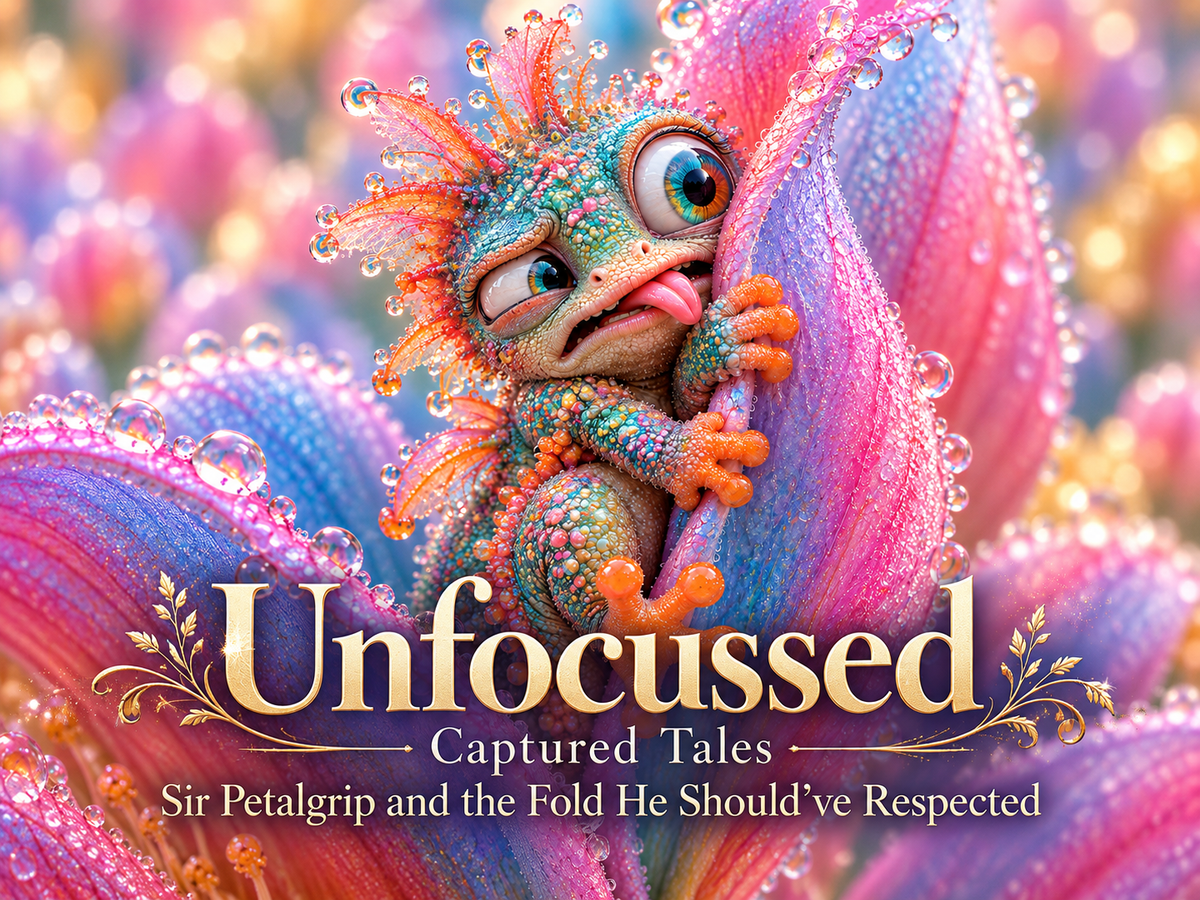
A Gentleman of Considerable Holding Power
Sir Petalgrip had spent most of his adult life waiting for someone to say, “What this situation requires is a man who can really hang on.”
Unfortunately, people usually said, “Could you let go of that?”
Or, “That belongs to somebody.”
Or, on one memorable afternoon involving a ripe plum and a very patient wasp, “You are making this unnecessarily intimate.”
He considered these failures of opportunity.
Petalgrip was a newt-drake of astonishing decorative ambition. Turquoise and honey-gold scales covered his little body like a confectioner’s expensive mistake. Coral frills fanned around his head, each delicate branch capable of holding a dew bead and, in his opinion, looking rather distinguished while doing so. His fingers and toes were bright orange, broad at the tips, and equipped with a grip that had once kept him attached to a leaf through an entire gust, two sneezes, and a beetle’s increasingly personal objections.
He brought up the leaf frequently.
“Crosswind,” he would say.
No one had asked.
“Very little warning.”
Still no one.
“Other men would have come off.”
At which point whoever he was speaking to generally discovered an urgent appointment elsewhere.
What troubled him was not that his gift went unnoticed. Everyone noticed it. They noticed when he shook hands. They noticed when he borrowed cups. They particularly noticed when he offered to help carry something and the carrying ended before the helping did.
What troubled him was that nobody seemed to need it.
That morning, with rain gathering above a sheltered pocket of the Sugarwild Garden, someone finally did.
“I need a steady pair of hands,” said a flower.
Petalgrip stopped so abruptly that his back toes remained on the previous pebble.
“Madam,” he said, turning with considerable care, “you may wish to sit down for what I am about to tell you.”
“I am rooted.”
“Then we are already ahead.”
The flower stood beside a shallow bed of seedlings beneath a low shelf of fern. Her outer petals were pink as sugared berries, shading through violet into a cool blue throat. Along their edges, fine pale ribs curved toward a folded lip that hung just above the soil. Droplets from the night before trembled on her surface, making little upside-down gardens of everything around her.
She was beautiful in a manner that suggested beauty was simply one of several things she had to get done that day.
“Your name?” she asked.
“Sir Petalgrip.”
“Petalgrip will do.”
“Most people find the full version reassuring.”
“Most people are not helping me before a storm.”
He glanced at the seedlings. They were scarcely taller than his ankle, their leaves still folded around themselves in the private, uncertain way of things that had only recently decided to exist.
Around them lay three narrow channels lined with pale grit. The channels began beneath the flower’s lowered lip and divided the little bed into neat watering lanes.
Beyond the bed, a shallow overflow groove curved away toward a patch of thirsty moss.
Petalgrip looked from the channels to the flower.
“An ornamental water feature?”
“A nursery.”
“Of course. I was assessing the overall presentation.”
“Assess this instead. The fern keeps heavy rain off the seedlings. It also keeps most useful rain off them. I catch water, slow it down, and feed it through those three channels.”
She lifted her pink outer petals a fraction. Beneath them, the blue throat opened into a broad, shallow basin.
Petalgrip made an appreciative noise.
“Please do not,” she said.
“I hadn’t said anything.”
“You had arranged your face to.”
He rearranged it.
The Terms of a Perfectly Ordinary Opening
“You may call me the rainkeeper,” the flower said. “And before you ask, no, every blossom in the garden does not do this. I grew beside this bed. These channels suit my roots. This is my work.”
“A specialist.”
“A busy one.”
She showed him the folded lip. A loose bark prop lay beneath it, split down the middle.
“That held the lip level while I opened this morning. It broke. Until the basin fills enough to support the fold, I need someone to steady the outside edge.”
Petalgrip’s frills lifted.
Here it was.
Not a cup. Not a handshake. Not an incident someone would later describe as difficult to explain.
Useful work.
“You have,” he said softly, “found your man.”
“I have found someone standing nearby. We will see about the rest.”
She turned the lip toward him. A pale ridge ran across its outer surface, firm enough for his broad fingers.
“Hands here. Feet on the stone. Stay outside the crease.”
“Naturally.”
“The inner fold is a hinge. It needs room to move.”
“I understand hinges.”
“Then this should be a refreshing experience for both of us.”
He set his orange hands on the ridge. Beneath his fingertips, the petal felt cool and finely textured, its tiny surface ridges catching his grip without requiring much pressure.
It was an excellent hold.
He immediately wanted to improve it.
“When the basin is ready,” said the rainkeeper, “you will feel three little taps through this rib. Then I will say release. Take your hands away. The lip needs to dip before the channels can fill.”
“Three taps.”
“And release.”
“Quite.”
“The dip may look like a collapse. It is not a collapse.”
He nodded solemnly.
“If you keep holding, the hinge cannot open. Water will back up in the basin and go over the rear edge instead of into the nursery.”
“So I am, in a sense, entrusted with the whole operation.”
“You are entrusted with letting go when asked.”
A first drop struck the fern overhead.
Then another.
The rainkeeper spread her upper petals. Light shifted across her blue interior, turning the water beads silver.
“Ready?”
Petalgrip planted his feet.
“Born ready.”
“That seems unlikely, but hold there.”
For several lovely moments, everything went exactly as it should.
The basin opened. Rain ticked against its pink rim. A thin sheet of water slid down the violet slope, gathered in the blue hollow, and trembled just above the folded lip.
Petalgrip held steady.
He was good at it.
This mattered more than he had expected.
There was no audience. No admiring procession. Not even a passing beetle to witness the tasteful set of his jaw. There was only the sound of rain, the small pressure against his palms, and the seedlings waiting under the fern.
For once, his strength had somewhere to go.
Then the lip moved.
Only slightly. A necessary little settling as the water’s weight reached the hinge.
Petalgrip’s left foot slipped on the wet stone.
He recovered at once, but recovery brought his chest closer to the flower and one orange knee into the crease.
“Outside,” said the rainkeeper.
“Entirely under control.”
“Your knee is inside the hinge.”
“A stabilizing knee.”
“An unwanted knee.”
He tried to move it. His hands tightened while he shifted his weight, and the damp petal drew snugly against his side.
The grip was now exceptionally secure.
Petalgrip mistook this for good news.
Three Small Taps
The first tap reached his right palm.
A delicate knock from within the rib.
The second followed.
Petalgrip felt the basin lean.
Every instinct he had cultivated over years of refusing to come off things rose up and shouted the same advice.
Hold tighter.
The third tap came.
“Release,” said the rainkeeper.
Petalgrip held tighter.
He would later wish to explain that he had been responding to a developing structural concern.
What he actually said was, “I’ve got you.”
“That is the problem.”
The lip dipped around his trapped knee instead of beneath his hands. The crease narrowed. His body slid sideways into the blue-violet fold, and one cheek pressed firmly against a cool pink wall.
His left eye squeezed shut.
His right eye became enormous.
His tongue came out.
There are expressions that announce courage, expressions that announce wisdom, and expressions that announce a person has just discovered an entirely new category of mistake.
Petalgrip wore the third with remarkable clarity.
“Oh,” he said.
The rainkeeper stopped moving.
Rain pattered into the basin above him.
“Are you hurt?” she asked.
He considered his dignity, which appeared to have suffered multiple fractures.
“Nothing essential.”
“Can you breathe?”
“With reservations.”
She eased the pressure against his ribs. A narrow pocket opened around his chest.
He took a grateful breath.
“Better?”
“Considerably.”
“Good. Now listen carefully. Do not pull.”
Petalgrip, who had already begun composing a heroic pull, stopped.
“Your fingers are holding the outer ridge. Your knee is blocking the hinge. If you wrench backward, you will strain the rib and hurt yourself.”
“I was merely testing the resistance.”
“It has submitted its report.”
Water touched the back of his neck.
Not a drop. A small, persistent trickle.
His free eye rolled upward.
The basin was filling.
Below him, the three pale channels remained dry.
“Ah,” he said.
“Yes,” said the rainkeeper.
The trickle strengthened, finding the rear edge exactly as she had warned. It spilled past a root and into the overflow groove, where the moss began drinking a breakfast intended for someone else.
Petalgrip looked toward the nursery.
From this angle, he could see the nearest seedling clearly. Two small leaves cupped the dim air under the fern. A bead of old moisture clung to one tip, too little to fall.
He had imagined being necessary would feel grand.
He had not considered that it might also feel like being in the way.
“I can hold until the rain stops,” he offered.
The words sounded brave in his head.
Outside his head, between a blocked watering lip and a bed of dry seedlings, they sounded rather different.
The rainkeeper was quiet for a moment.
When she spoke again, she had set aside her sharpness.
“Petalgrip. I believe you can.”
His eye flicked toward her.
“I believe you could stay there until evening. Perhaps longer. I believe your hands are every bit as strong as you say.”
Something in his chest lifted.
“But that is not what I need from you.”
The lifted thing settled again, more carefully this time.
Rain whispered across the fern. The basin grew heavier. Somewhere beyond the nursery, the rest of the garden was carrying on with its morning, unaware that a small, splendidly colored gentleman had become an obstruction in a private irrigation arrangement.
No one was coming to applaud.
That was probably merciful.
“What do you need?” he asked.
“First, for you to tell me exactly where you are holding. Not where you think a competent assistant ought to be holding. Where you actually are.”
Petalgrip swallowed.
“Right hand on the ridge.”
“Good.”
“Left hand slightly underneath.”
“How slightly?”
He shut his enormous eye for a moment.
“Ambitiously.”
“And your feet?”
“One on the stone.”
“The other?”
Petalgrip opened his eye.
“I had hoped we might establish a little more trust before discussing the other.”
The rainkeeper gave a slow, deliberate breath through her petals.
Then she said, “We are going to have a very honest morning.”
The Geography of an Unfortunate Gentleman
The other foot, once Petalgrip stopped describing it as strategically placed, was hooked beneath the inner rib.
“So,” said the rainkeeper, “you are holding my opening shut from both sides.”
“When you put it like that, it sounds excessive.”
“How would you put it?”
“Thorough.”
A drop ran down his tongue.
He put it away. This was an engineering discussion, and he was doing himself no favors.
The rainkeeper asked him to move only the hooked foot. Petalgrip concentrated. His orange toes flexed, then stopped. The inner rib pressed against his ankle, and the harder he tried to lift it, the more firmly his knee wedged into the crease.
“Not that way,” she said.
“I had reached a similar conclusion.”
“Before or after the squeak?”
“During. I process information quickly.”
She eased the fold a fraction, but the water above them shifted forward. Pressure gathered against his palms.
“Hold still.”
He obeyed with almost religious enthusiasm.
The rainkeeper brought the basin back level. The pressure lessened. Water spilled over her rear edge again, into the overflow groove.
For the first time, Petalgrip understood that she was doing two jobs: keeping the stored rain from surging into the nursery and keeping his ridiculous body from being crushed between the parts that normally delivered it.
He could not see the strain in her roots, but he could feel the small tremor traveling through the ridge.
“Are you hurt?” he asked.
“Not yet.”
He looked down.
Below his cheek, the three channels waited. Beside the nearest one lay half the broken bark prop. The other half rested against the nursery’s outer stone border. Beyond that, the overflow groove gleamed with water that was going somewhere, just not where it was wanted.
“Perhaps we could borrow a little help,” he said.
“Certainly. Call if someone passes.”
He waited.
A snail-shaped stone remained a stone.
A beetle-shaped knot on the fern remained a knot.
The garden, so generously populated whenever he wanted privacy, appeared to have arranged an inconvenient morning elsewhere.
He drew breath to shout.
“Help,” he called.
It came out rather politely.
Rain rattled on the fern above them.
“You can be louder,” said the rainkeeper.
“I dislike alarming people.”
“Then omit the details.”
Petalgrip shouted properly. The sound traveled down the path and vanished among the wet leaves. No reply came.
He had imagined, not entirely against his will, that a rescuer might arrive, take one look at his predicament, and announce that his exceptional strength had prevented something worse.
Instead, the rainkeeper said, “We still have our own observations. Tell me what you can see from down there.”
“A deeply unflattering angle.”
“Beyond that.”
He looked again.
Under the lip, a small triangle of blue petal remained loose. It fluttered with each tremor of the basin. The rest of the fold pressed against his thigh.
He described it.
“That is the end of the crease,” she said. “If your knee comes toward that loose edge, it can slide out without forcing the rib. But I cannot lower that corner safely while the basin is this full.”
Petalgrip glanced toward the rear spill.
“You are emptying it.”
“Rain is replacing what spills. I can turn my upper petals inward and catch less, but first you must stop bracing against them.”
He followed her words along his own body.
His left forearm, which he had privately considered an innocent bystander, was propping up the outer petal.
“Ah.”
“We keep arriving there.”
He slowly moved his elbow toward his chest. The petal above him settled inward like a shutter.
Rain began striking its outer surface and running harmlessly away.
The basin’s level dropped by the width of one orange fingernail.
It was not dramatic.
No light burst through the clouds.
But the tremor beneath his hands softened.
“That helped,” said the rainkeeper.
Petalgrip felt an absurd desire to thank her for noticing.
A Modest Proposal Involving Bark
While they waited for the basin to drain, he studied the overflow.
It ran behind the nursery, followed the shallow groove, and disappeared into the moss. The seedlings lay only a little lower than the groove’s nearest bend. Between them stood the raised stone border and a gap where the broken prop had fallen.
“Could we send some water through there?” he asked.
“Through where?”
For once, he resisted saying something impressive. He described the bend, the gap, the slope and the piece of bark.
The rainkeeper considered it.
“Possibly. The bark is curved underneath. Turn that side up and it could carry a small trickle across the gap.”
“A bridge.”
“A gutter.”
“A modest bridge for water.”
“If that gets you through the morning.”
The longer piece lay within reach of his foot on the stone.
“May I move this foot?” he asked.
The question surprised them both.
“Keep your knee still,” she said. “And move slowly.”
He extended his toes. The bark was slippery, splintered at one end, and awkwardly balanced against a pebble.
Here, finally, was a task made for his peculiar talents.
He caught it by the unbroken edge.
“Got it.”
“I assumed you would.”
He nearly smiled. Then the effort of lifting the bark pulled against his trapped hip.
“Too much?” she asked.
“A little.”
There. Another honest thing. The morning was becoming indecent.
He lowered it, slid his foot closer, and tried a shorter movement. This time the bark scraped across the pebble without levering his knee deeper into the fold.
He turned the curved underside upward.
A trickle caught its edge.
Water ran toward the nursery, then poured straight onto a seedling.
The little stem bent flat.
“Lift the end,” said the rainkeeper.
Petalgrip moved at once.
The stream missed the seedling. Its stem rose again, trembling.
He stared at it.
“I nearly broke that.”
“But you listened and changed what you were doing. Aim for the pale grit, not the plants.”
He shifted the bark’s lower end over the nearest channel. The water struck the rough little stones, divided, and became a thin, manageable run.
It crept along the channel.
Darkness spread through the dry soil beside it.
Petalgrip watched the wet line reach the seedling that had bent. Its roots were hidden, but the soil around its stem drank.
“Oh,” he whispered.
This time it meant something different.
“That will serve the first row,” said the rainkeeper. “The other two still need the lip. But it buys us a little time.”
“I can hold this.”
“Yes,” she said. “This is something worth holding.”
He did not mention the crosswind.
The rain eased. Water ticked from the fern in slower drops, and the space between them filled with the soft sound of the nursery drinking.
Petalgrip remained in a position that would have ruined a commemorative portrait, with one foot holding a bark gutter and the other somewhere he preferred not to advertise. Yet he felt less foolish than he had a moment before.
Then the basin settled.
The movement was slight, but it brought the loose corner of the fold against his knee.
“We have enough room now,” the rainkeeper said. “I can ease that corner. Bring your knee toward it. Slowly.”
He followed the touch rather than trying to push against it.
For a breath, nothing happened.
Then his knee slipped free.
He made a sound of such profound relief that a drop fell off his frill.
“Ankle next,” she said.
He folded the trapped foot inward. His toes cleared the rib.
He was still squeezed sideways beneath the lip, but the hinge was no longer occupied by his leg.
“Now your left hand.”
He lifted one finger.
Then another.
The ridge moved beneath his right palm.
Petalgrip seized it with both hands.
The fold tightened.
The rainkeeper went still.
“Sorry,” he said immediately.
He had heard himself do it. Not with his ears, exactly, but somewhere inside the practiced boast about steady hands. Beneath the boast was a much smaller voice.
If you stop holding, you will fall.
And beneath that, smaller still:
If you stop being useful this way, perhaps you will not be useful at all.
The rainkeeper did not scold him.
“Tell me what frightened you.”
He looked at his hands. They were beautiful hands. Bright, capable, ridiculous hands, still gripping the thing he had promised to release.
“I don’t know where I’ll land,” he said.
“Then we find out before you let go.”
Somewhere Sensible to Land
They began with the stone.
It was broad, slightly tilted, and close enough that Petalgrip could touch its upper surface with his newly freed toes. He had stood on it before deciding that an unwanted knee constituted advanced technique.
“That is where your feet go,” said the rainkeeper.
“Both?”
“Let us not be experimental.”
He still held the bark gutter with one foot. The first channel was damp now, its pale grit darkened by a continuous thread of water.
“If I put this down, it will tip.”
“Can you lower the end onto the border stone?”
He looked carefully. The border had a shallow notch where two stones met. He guided the bark into it and eased his toes away.
The gutter rocked.
He caught it before the stream left the channel.
His chest tightened with the old, familiar satisfaction.
There. Needed.
But the rainkeeper was already speaking.
“The short broken piece. Could it brace the side?”
Petalgrip looked down at the other half of the prop.
He could reach it now.
“It might.”
Using his freed foot, he nudged the small piece between the gutter and the border stone. It took three attempts. On the second, he dropped it in the mud and said a word that caused the rainkeeper to remark that the seedlings had quite enough to absorb already.
On the third, it held.
He lifted his supporting toes.
The gutter stayed.
Water continued running into the first channel without his personal involvement.
He watched it for a moment.
“Good,” he said.
He sounded almost surprised.
Then he put both feet on the stone.
The rainkeeper eased the corner around his hip. He shifted outward until the fold no longer pressed against his ribs. His cheek peeled away from the pink petal with a small damp sound that he hoped no one would ever imitate.
His left eye opened.
With both eyes available, the situation looked no more dignified, but considerably easier to understand.
Only his hands remained on the ridge.
“When you release,” said the rainkeeper, “the lip will dip past you. Your feet stay where they are. Lean away from the fold. I will keep the upper petals turned until the basin settles.”
“And then?”
“Then I catch the rain again.”
“Without an assistant?”
“Without an assistant attached to the hinge.”
He took that distinction seriously.
Above them, the rain strengthened. Drops struck the closed outer petals and ran away down their backs. The nursery’s second and third channels were still dry.
There was time to do this carefully.
There was not time to invent another speech.
Petalgrip looked at the seedlings, then at the ridge beneath his fingers.
“All right,” he said.
The first tap came through the rib.
He loosened his left hand.
The second tap came.
He shifted his weight onto his feet.
The third.
“Release.”
The ridge moved.
Every orange finger wanted to close.
Petalgrip opened them instead.
The lip dipped away.
For one dreadful instant, the absence of pressure felt exactly like falling.
Then his heels settled firmly onto the stone.
He was standing.
Nothing had collapsed.
The rainkeeper’s blue lip unfolded in front of him, a smooth little slope reaching toward the three channels. The water left in the basin slid down it, spread across the grit, and divided.
Three narrow streams moved into the nursery.
Petalgrip lowered his hands.
He had let go.
It was the least impressive-looking thing he had done all morning.
It was also the thing that worked.
The Water Went Where It Was Needed
The rainkeeper opened her upper petals.
Rain gathered in the basin, paused, and flowed through the lowered lip. No sudden flood, no glorious burst of magic. Just water, delivered gently enough that the smallest stems remained upright.
Petalgrip crouched beside the second channel.
The soil darkened grain by grain. A seed husk loosened around a folded pair of leaves. Farther along, a root no thicker than a thread disappeared into newly softened earth.
He had seen flowers open before. He liked the large ones, the spectacular ones, the ones whose colors made him feel slightly underdressed.
He had not spent much time looking at this stage.
It did not announce itself.
“They are very small,” he said.
“Yes.”
“Do they know what you do?”
“Not in the way you mean.”
He watched a bead of water gather at the tip of a leaf.
“Does that bother you?”
The rainkeeper considered the question while another sheet of rain slipped over her rim.
“Sometimes I would enjoy a little appreciation. Preferably from someone old enough not to mistake me for weather.”
Petalgrip smiled.
“But they do not owe me a performance,” she continued. “They need water. I can give them water.”
He rubbed one orange thumb across his palm.
“I heard the taps.”
She said nothing.
“All three. And I heard you say release.”
Rain ticked against the bark gutter. It was carrying only the last of the overflow now.
“I thought if I held through the movement, you would see how dependable I was.”
“I saw how strongly you could hold.”
“Yes.”
He looked at the crease he had occupied. A faint pale line marked the place where his knee had pressed against the rib.
“I am sorry. For not listening. And for the knee.”
“I appreciate the separate accounting.”
“Is the rib damaged?”
“Bruised. It will need rest after the rain.”
He nodded. The answer did not make him feel better, but it gave him something honest to work with.
“Can I help you replace the prop?”
“You can help me find suitable bark. I will tell you what fits.”
“And I will refrain from demonstrating anything underneath.”
“An excellent foundation for our continued acquaintance.”
The rain lasted long enough to wet all three rows. Petalgrip stayed beside the nursery, moving only when asked to clear a bit of leaf from the grit or steady the small gutter while its brace was adjusted.
There were still moments when he wanted to improve a perfectly adequate arrangement.
A particularly elegant pebble tempted him for almost half a minute.
He left it where it was.
When the rain weakened, the rainkeeper folded her upper petals partway inward. The basin drained through the open lip until the last thread of water broke into drops.
“Now the gutter,” she said.
Petalgrip lifted the bark away from the border and set both broken pieces beside the stone. Nothing remained balanced where it might fall into the seedlings later.
Then they looked for a replacement prop.
Or, more accurately, Petalgrip looked while the rainkeeper described.
Not too thick. Not rotten. No sharp edge against the rib. A little curve, but not the extravagant curl he first brought back, which she said looked like it was applying for a ceremonial position.
His second choice was better.
He held it up without a speech.
“That one,” she said.
They fitted it beneath the rested lip together. It supported the fold without pushing it open, and could be moved aside when the basin was ready to dip.
Petalgrip tested it only as instructed.
The rainkeeper let her petals settle.
For the first time since morning, the pale rib stopped trembling.
An Invitation With Clear Instructions
By the time sunlight reached the fern, Petalgrip had mud on his ankles, a petal-shaped crease along one cheek, and no satisfactory account of the morning that made him sound magnificent.
He tried one anyway.
“There was a moment,” he began, “when the entire nursery depended on my actions.”
“Several,” said the rainkeeper.
He glanced at her.
Her pink rim lifted slightly.
“Some more favorably than others.”
He laughed.
It came out unexpectedly, without the defensive little flourish he usually added when someone reached the joke before him.
The rainkeeper seemed to approve.
“Will you be passing this way again?” she asked.
His frills rose.
He was aware of them rising. He could feel every hopeful little branch.
“I could be.”
“The channels collect fallen leaves. A careful pair of hands would be useful.”
“Careful,” he repeated.
“It is a different qualification.”
He looked at the three damp lanes beneath the fern.
“I am willing to develop it.”
“Good. Come after the morning dew. Ask before moving anything. And if I say stop?”
“I stop.”
“If I say release?”
He opened both orange hands.
The gesture was so earnest that she spared him a joke.
For nearly a whole breath.
“We may find a respectable use for those yet.”
Petalgrip looked down at them. Sunlight caught the little pads of his fingers, making them glow like polished amber sweets.
“I should warn you,” he said, “respectability has never come naturally.”
“Neither has drainage. We work at things.”
He left by the path, not through the fold.
This was a small choice. No one marked it. The rainkeeper was resting, the seedlings were growing, and the garden had other matters to attend to.
Halfway to the next bend, he stopped to straighten a frill.
A bead of dew slid from it onto his nose.
He caught the bead on his tongue, considered the morning, and decided that the next time someone asked for a steady pair of hands, he might first ask what they wanted done.
Then he turned back.
“Tomorrow,” he called. “You did mean the outside edge?”
The rainkeeper’s answer followed him down the path.
“Petalgrip, darling. If I ever want your knee inside me again, I shall issue very specific instructions.”
He walked into a leaf.
This time, he let go immediately.
A Little Less Grip, a Little More Garden
Some mornings deserve a place on the wall, especially when someone else is having them. Sir Petalgrip’s jewel-bright scales, extravagant expression and disastrously intimate acquaintance with a pink petal bring the Sugarwild Garden’s warmth and mischief into your own surroundings. A canvas print lets those candy-colored textures make themselves comfortably at home, while a framed print gives his very undignified predicament a wonderfully dignified presentation. Prefer your botanical embarrassment with crisp, luminous color? Explore the metal print option.
There is also something fitting about patiently assembling this particular mess as a jigsaw puzzle: every piece has a proper place, a principle Sir Petalgrip is still practicing. The greeting card offers a smaller dose of garden absurdity for someone who could use a laugh, or a gentle reminder that letting go occasionally counts as progress. Browse the complete Sir Petalgrip artwork and merchandise collection to find the version that belongs in your corner of the world.

 Madame Sucklewink and the Nectar Bead That Hung On Too Long
 Forest Park Keeps Another Season
 Sir Quilliam’s Demonstration of Aggressive Affection